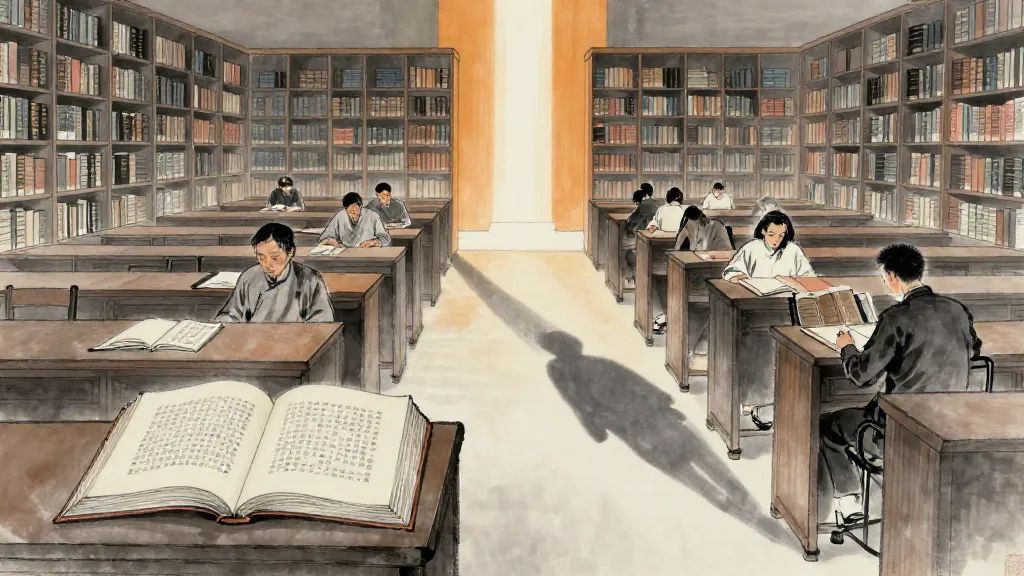
The Long Shadow
The Siku compilers finished their work in the 1790s. Two hundred and thirty years later, their judgments still determine which classical Chinese texts scholars read, how those texts are classified, and what the Chinese intellectual tradition is understood to contain. No other single act of literary criticism has shaped a civilization's self-understanding for so long.
Part 23 of The Emperor's Library — how China reviewed all knowledge.
The Verdict Machine
When the Siku Quanshu Zongmu Tiyao (四庫全書總目提要) was completed in the 1790s, it became the standard reference for Chinese bibliography almost immediately. There was nothing else like it. Previous bibliographies had listed titles and occasionally noted their transmission history. The Zongmu Tiyao reviewed them. It told you not just that a text existed but whether it was worth reading, whether it was genuine, and where it fit in the larger structure of Chinese knowledge.
For a scholar in the nineteenth century, this was invaluable. The Chinese textual tradition was enormous, and navigating it without a guide was impractical. The catalog provided that guide: a single reference work that covered every significant text across every field, with evaluations written by scholars whose competence was beyond question. If you wanted to study a particular topic— Yijing commentaries, military strategy, medical theory, astronomical calculation—the Zongmu Tiyao told you which texts were essential, which were derivative, and which were fraudulent. It was, in effect, a curated reading list for the entire civilization.
Canon Formation by Critical Review
The most consequential effect of the catalog was on canon formation. Texts the compilers praised became more widely read. Texts they dismissed became harder to find. Texts they identified as forgeries lost their authority. Over time, the compilers' verdicts became self-fulfilling: a text praised in the Zongmu Tiyao was more likely to be reprinted, more likely to be cited, and more likely to be taught. A text condemned or ignored in the catalog was more likely to drift into obscurity.
This was not a conspiracy. It was the natural consequence of having a single authoritative reference work dominate a scholarly field for two centuries. When every serious scholar consults the same guide, the guide's recommendations compound. The praised texts accumulate commentary and study. The dismissed texts lose their audience. The catalog does not just describe the canon. It produces it.
The effect was particularly strong in fields where the compilers had clear favorites. In Yijing studies, the compilers' preference for the Cheng-Zhu Neo-Confucian interpretation elevated commentaries in that tradition and marginalized alternatives. In military studies, their praise of Sun Tzu and their contempt for late Ming military writing reinforced a hierarchy that still shapes how Chinese military thought is taught. In divination, their distinction between “legitimate” Yijing-based numerology and “heterodox” popular fortune-telling established a boundary that practitioners still invoke.
The Twentieth-Century Challenge
The first serious challenge to the Siku framework came with the May Fourth Movement (五四運動) of 1919 and the broader intellectual revolution that surrounded it. A generation of scholars influenced by Western critical methods and by a fierce rejection of traditional authority began questioning the assumptions embedded in the catalog.
The challenge operated on multiple levels. At the most basic, May Fourth intellectuals questioned the moral framework that organized the catalog—the idea that knowledge should be evaluated by its relationship to Confucian governance. They argued that this framework systematically undervalued science, technology, fiction, drama, and vernacular literature—entire categories of human achievement that the Siku compilers had either ignored or treated as trivial.
More fundamentally, scholars like Gu Jiegang (顧頡剛) and his Doubting Antiquity school (疑古派) pushed the compilers' textual criticism far beyond where the Siku scholars had been willing to go. The Siku compilers identified specific forgeries but accepted the broad outlines of the traditional chronology—the sage kings, the Three Dynasties, the ancient origins of the Classics. The Doubting Antiquity scholars questioned all of it, arguing that much of what the tradition treated as ancient history was constructed by later periods to serve their own purposes.
Yet even the scholars who challenged the Siku framework continued to use it. Gu Jiegang worked within the Four Treasuries classification even as he questioned its intellectual assumptions. The catalog remained the infrastructure through which scholars accessed the tradition they were trying to reinterpret.
The Digital Transformation
The most significant change in how the catalog is used has come not from intellectual revolution but from technology. Digital projects have made the full text of the Siku Quanshu and its catalog searchable for the first time.
The Chinese Text Project (ctext.org) has transcribed significant portions of the Zongmu Tiyao and made them freely searchable. Wikisource (zh.wikisource.org) provides additional transcriptions. The CADAL project at Zhejiang University has digitized the original Siku Quanshu manuscripts as high-resolution scans, making the actual handwritten copies accessible to anyone with an internet connection. Commercial databases like the Wenyuange Siku Quanshu (文淵閣四庫全書) provide full-text searchable versions of the complete library.
These digital projects have transformed the catalog's function. In the pre-digital era, using the Zongmu Tiyao required either access to a research library with a physical copy or the patience to work through a printed edition juan by juan. Now, a scholar can search for a specific text, author, or topic and find the relevant review in seconds. The catalog has been democratized. What was once the province of specialists in major research libraries is now accessible to anyone.
The digital transformation has also made it easier to see the catalog's biases. When you can search across all 10,000 entries, patterns emerge that are invisible when reading sequentially. The distribution of praise and criticism across different schools, the consistent preference for certain types of scholarship, the treatment of heterodox traditions—all of these become visible when the data is searchable.
The Catalog and Six Lines
The texts that Six Lines translates and implements were all reviewed by the Siku compilers. The Yijing commentaries that inform our hexagram interpretations were evaluated in juan 1 through 10. The divination texts that underlie our methods were evaluated in juan 108 through 111. The military classics in our library were evaluated in juan 99 and 100. The Legalist texts were evaluated in juan 101.
We work within the Siku's shadow deliberately. The compilers' verdicts are not infallible, and we note their biases where relevant. But their evaluations remain the most comprehensive critical assessment of these texts ever conducted, and any serious engagement with classical Chinese literature starts with what they said. To ignore the Siku is to navigate without a map. To accept it uncritically is to mistake the map for the territory. The goal is to use it as what it is: the best guide available, compiled by brilliant scholars with specific biases, under conditions that both enabled and constrained their work.
An Enduring Achievement
No other single work surveys the Chinese intellectual tradition as comprehensively as the Siku Quanshu Zongmu Tiyao. There are more specialized bibliographies. There are more up-to-date bibliographies. There are bibliographies that cover periods or fields that the Siku compilers missed or mishandled. But there is nothing else that attempts to review everything—every field, every period, every school—in a single integrated framework.
The catalog's long shadow is partly a function of this comprehensiveness. You can challenge individual verdicts. You can question the ideological framework. You can note the biases and blind spots. But you cannot replace the catalog without producing something of comparable scope, and no one has done that in two hundred and thirty years. The Siku compilers built the intellectual infrastructure that their critics still depend on.
That is the long shadow: not just influence but infrastructure. The categories are still the categories. The classifications are still the classifications. The verdicts are still the starting point. The compilers built a framework so comprehensive and so deeply embedded in the scholarly tradition that even those who reject its assumptions cannot escape its structure. To study classical Chinese texts is to work within the world the Siku compilers made. The reader's guide that follows will show you how to navigate that world on your own terms.
References
Primary Sources
四庫全書總目提要 (Siku Quanshu Zongmu Tiyao). Ji Yun et al., compiled 1773–1782. 200 juan. Chinese Text Project
Secondary Scholarship
Guy, R. Kent. The Emperor's Four Treasuries: Scholars and the State in the Late Ch'ien-lung Era. Harvard University Press, 1987.
Elman, Benjamin A. From Philosophy to Philology: Intellectual and Social Aspects of Change in Late Imperial China. Harvard University Asia Center, 2001.
Schneider, Laurence A. Ku Chieh-kang and China's New History: Nationalism and the Quest for Alternative Traditions. University of California Press, 1971. On the May Fourth generation's challenge to traditional scholarship.
Wilkinson, Endymion. Chinese History: A New Manual. Harvard University Asia Center, 5th edition, 2018.