80 Reviews of the Rejected Occult
The 術數類存目—the “noted but excluded” section of the divination category—is where the Siku compilers sent the texts they considered too dubious for the imperial library. Across two juan of rejected entries, they reviewed fortune-telling manuals, dream interpretation guides, and physiognomy primers with the precision of surgeons and the patience of judges who have seen too many bad cases.
Part 18 of The Emperor's Library — how China reviewed all knowledge.
The Reject Pile
The divination section (術數類) of the Siku Quanshu Zongmu Tiyao admitted 45 texts to the imperial library. It rejected roughly 80 more, relegating them to the cunmu (存目)—the secondary catalog of titles acknowledged but not preserved. The rejection rate was among the highest in the entire catalog: about two-thirds of all divination texts reviewed failed to meet the compilers' standards.
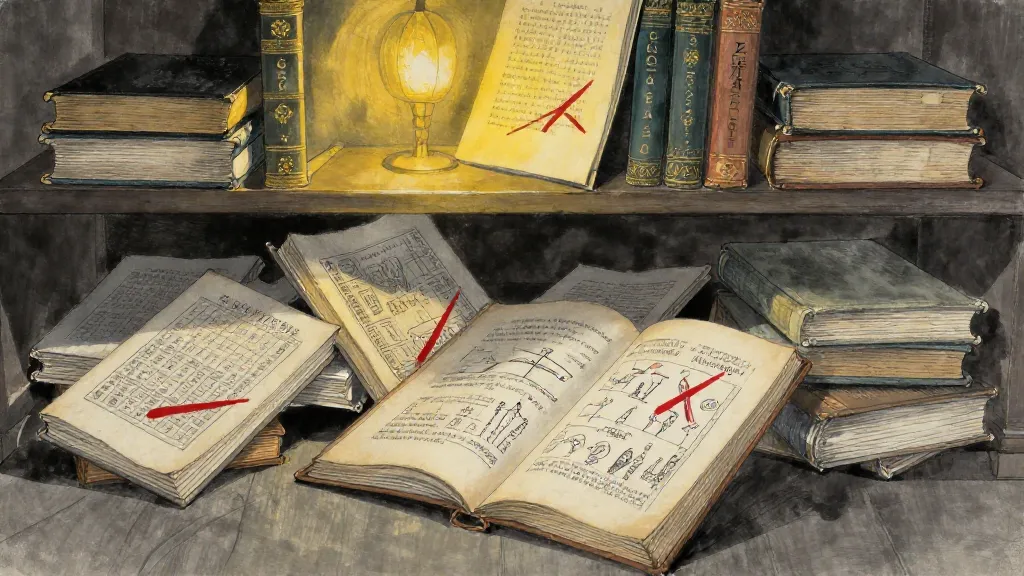
The rejected texts span the full range of Chinese occult practice: numerology, prognostication, geomancy (fengshui), divination proper, fate-calculation (八字/命理), physiognomy (相術), dream interpretation, and various forms of yin-yang cosmological application. Reading through the cunmu entries in juan 110 and 111 is like touring a museum of discredited knowledge—each exhibit accompanied by a card explaining exactly why it does not belong in the main collection.
The Criteria for Rejection
The compilers did not reject texts arbitrarily. Their criteria were consistent, and understanding them reveals the boundary the Qing scholarly establishment drew between “orthodox” and “heterodox” divination.
Lack of textual lineage. The most common grounds for rejection. If a text claimed ancient authorship but could not be traced through the chain of dynastic bibliographies, it was presumed forged. The formula “not listed in either the Sui or Tang bibliographies” (隋唐志皆不著錄) appears repeatedly in the cunmu. For the compilers, a text without a verifiable transmission history was a text without credibility.
Internal contradictions. The compilers checked texts against their own stated principles. A fate-calculation manual that produced contradictory results when its own rules were applied consistently was dismissed. A geomancy text whose directional prescriptions conflicted with each other was noted as self-refuting. The compilers did not need to believe in divination to evaluate its internal logic—they checked whether the system was coherent on its own terms, and many were not.
Extravagant claims. Texts that promised too much were treated with suspicion. A manual that claimed to predict the rise and fall of dynasties from burial-site topography, or to determine a person's exact fate from their birth hour, or to forecast weather years in advance—these were dismissed as exceeding any reasonable scope for the methods described.
Crude literary quality. The compilers valued prose. A divination text written in vulgar or careless Chinese was grounds for dismissal independent of its content. The reasoning was partly aesthetic and partly evidentiary: a genuinely ancient text should exhibit the literary standards of its period, and crude modern prose betrayed a crude modern origin.
Fortune-Telling Manuals
The fate-calculation texts (命書) form the largest single group in the rejected pile. These are the manuals of 八字 (eight characters) astrology—the system that assigns a person's destiny based on the year, month, day, and hour of their birth, each expressed as a pair of heavenly stems and earthly branches.
The compilers' approach to these texts was consistent: they acknowledged the antiquity of the basic system (which they traced to the Tang dynasty scholar Li Xuzhong and the Song refinements of Xu Ziping) but dismissed most of the manuals that proliferated around it. The rejected texts were typically derivative compilations that added layers of spirit-taboos, lucky/unlucky day calculations, and celebrity horoscopes to the core system without adding genuine analytical content.
One common pattern in the rejected fate-calculation texts: the inclusion of famous historical figures' birth data as supposed proof that the system works. The compilers observed that these celebrity examples were often fabricated—the birth hours of ancient emperors and generals were not actually recorded—and that even when the data was genuine, the interpretations were retrofitted to match known outcomes. This is, in modern terms, overfitting: the system was tuned to explain the past rather than predict the future.
Dream Interpretation
Dream interpretation guides received some of the compilers' most skeptical reviews. The Chinese tradition of dream interpretation was ancient—the Zuo Zhuan records dreams and their interpretations as far back as the Spring and Autumn period—but the commercial dream manuals that proliferated in the Ming and Qing bore little resemblance to this classical tradition.
The rejected dream texts typically operated on a simple dictionary model: dreaming of X means Y. The compilers found this reductive and ungrounded. They noted that the same dream might be assigned opposite meanings in different manuals, that the claimed correspondences between dream images and real-world outcomes had no theoretical basis, and that the attribution of most dream manuals to famous ancient figures was transparently false.
The compilers did not dismiss dream interpretation entirely. The Zuo Zhuan's dream narratives were part of the canonical historical tradition and were treated with respect. But the commercial dream dictionaries were treated as what the compilers believed they were: products of the publishing marketplace, designed to sell rather than to inform.
Physiognomy: What Survived vs. What Was Rejected
Physiognomy (相術)—the art of reading character and destiny from physical features—occupied an interesting middle ground. The compilers admitted a handful of physiognomy texts to the main catalog, recognizing the tradition's antiquity and its grounding in systematic observation. But they rejected far more.
The boundary between accepted and rejected physiognomy texts ran along a specific line: systematic observation versus superstitious assertion. A physiognomy text that described physical features in systematic terms, noted correlations carefully, and acknowledged uncertainty was treated as legitimate scholarship. A physiognomy text that claimed to determine a person's exact lifespan from the shape of their earlobes, or that assigned moral character based on facial moles, was dismissed.
The compilers also distinguished between physiognomy texts with genuine observational content and those that were essentially fortune-telling in physiognomic dress. A text that described how experienced officials assessed character from demeanor and bearing was treated as practical wisdom. A text that assigned point values to facial features and calculated a destiny score was treated as quackery.
Geomancy Under Scrutiny
The fengshui texts in the cunmu received particularly thorough treatment, because geomancy was the most commercially significant branch of Chinese divination and the most prone to fraud. The compilers admitted eight geomancy texts to the main catalog— those they considered to have genuine theoretical content grounded in the classical yin-yang and five-phase framework. They rejected roughly twice as many.
The most famous rejected geomancy text was the Yuchi Jing (玉尺經), supposedly written by the Yuan polymath Liu Bingzhong with a commentary by Liu Ji (Liu Bowen). The compilers demolished it on bibliographic grounds: Liu Ji's commentary mentions Guizhou province by name, but Guizhou did not exist as a province until the Yongle reign (1402–1424)—decades after Liu Ji's death in 1375. The commentary could not have been written by Liu Ji. And if the commentary was fake, the base text's attribution was equally suspect.
The Compilers' Hierarchy
Reading across the full set of rejected divination entries, a clear hierarchy emerges. The compilers did not reject all divination. They sorted it into a spectrum of legitimacy:
At the top: Yijing-based divination. Methods grounded in the hexagram system and its numerological extensions were treated as the legitimate core of the tradition. The rationalist framework the compilers applied treated these methods as downstream derivatives of the Classic of Changes, which was itself a canonical text.
In the middle: systematic cosmological applications. Texts that applied the five-phase system, the stem-and-branch cycle, or the 28 lunar mansions in consistent and internally coherent ways were treated as acceptable, even if the compilers had reservations about their predictive power. Coherence and systematicity earned a hearing.
At the bottom: popular fortune-telling. Commercial manuals, dream dictionaries, spirit-taboo compilations, and the various products of the Ming publishing industry were treated as the illegitimate periphery of the tradition—texts that claimed the authority of antiquity while actually originating in the workshops of printers and the practices of itinerant diviners.
This hierarchy is not arbitrary. It maps directly onto the compilers' general principle that knowledge is evaluated by its relationship to canonical foundations. Divination methods traceable to the Yijing have canonical authority. Methods traceable to systematic cosmological principles have theoretical authority. Methods traceable only to commercial publishers have no authority at all.
What the Rejections Reveal
The rejected divination texts are as informative as the accepted ones—sometimes more so. They show us what the compilers considered illegitimate, and by contrast, what they considered legitimate. They document the commercial divination marketplace of late imperial China in extraordinary detail—the manuals, the methods, the claims, the fabricated attributions, the competing systems. And they provide a window into how the Qing scholarly establishment understood the boundary between knowledge and fraud.
That boundary was not where a modern Western observer might expect it. The compilers did not draw the line between “real science” and “superstition.” They drew it between grounded and ungrounded practice. A method grounded in the Yijing's combinatorial logic and the five-phase system's cosmological structure was legitimate even if a modern reader would question its premises. A method with no theoretical grounding, no verifiable lineage, and no internal consistency was illegitimate regardless of its popularity.
The cunmu of the 術數類 is the record of that boundary being enforced, text by text, across the entire landscape of Chinese divination practice. It is the tradition's own quality control apparatus at work—not debunking divination as a category, but separating what the tradition considers its legitimate core from the accumulated noise of centuries of commercial exploitation and uncritical repetition.
References
Primary Sources
四庫全書總目提要 (Siku Quanshu Zongmu Tiyao), juan 110–111: 子部·術數類存目. Ji Yun et al., compiled 1773–1782. Wikisource (juan 110) | Wikisource (juan 111)
Secondary Scholarship
Smith, Richard J. Fortune-tellers and Philosophers: Divination in Traditional Chinese Society. Westview Press, 1991.
Guy, R. Kent. The Emperor's Four Treasuries: Scholars and the State in the Late Ch'ien-lung Era. Harvard University Press, 1987.
Elman, Benjamin A. From Philosophy to Philology: Intellectual and Social Aspects of Change in Late Imperial China. Harvard University Asia Center, 2001.