The Coordinate System: How Stems and Branches Made Chinese Cosmology Computable
Ten stems, twelve branches, sixty states. Two interlocking wheels generate the address scheme that every Chinese divinatory art runs on—Bazi, Ziwei, Qimen, the almanac, fengshui. Why the cycle is sixty and not a hundred and twenty, what the two wheels actually measure, and why ganzhi is the coordinate system of the tradition, not its root.
Most people meet the sexagenary cycle as a list of strange paired names—jiǎ-zǐ, yǐ-chǒu, bǐng-yín—sixty of them, repeating forever. It looks like nomenclature. It is actually a coordinate system: the oldest continuously used addressing scheme in human civilization, running without a break from Shang oracle bones to the date on a modern Chinese almanac. Once you see it as coordinates rather than names, the rest of Chinese metaphysics rearranges itself around it.
The system is called 干支 (gānzhī), the Stems and Branches: ten 天干 (Heavenly Stems) and twelve 地支 (Earthly Branches). The first surprise is the arithmetic. Ten times twelve is a hundred and twenty. The cycle has sixty. Where did the other half go?
Two Wheels
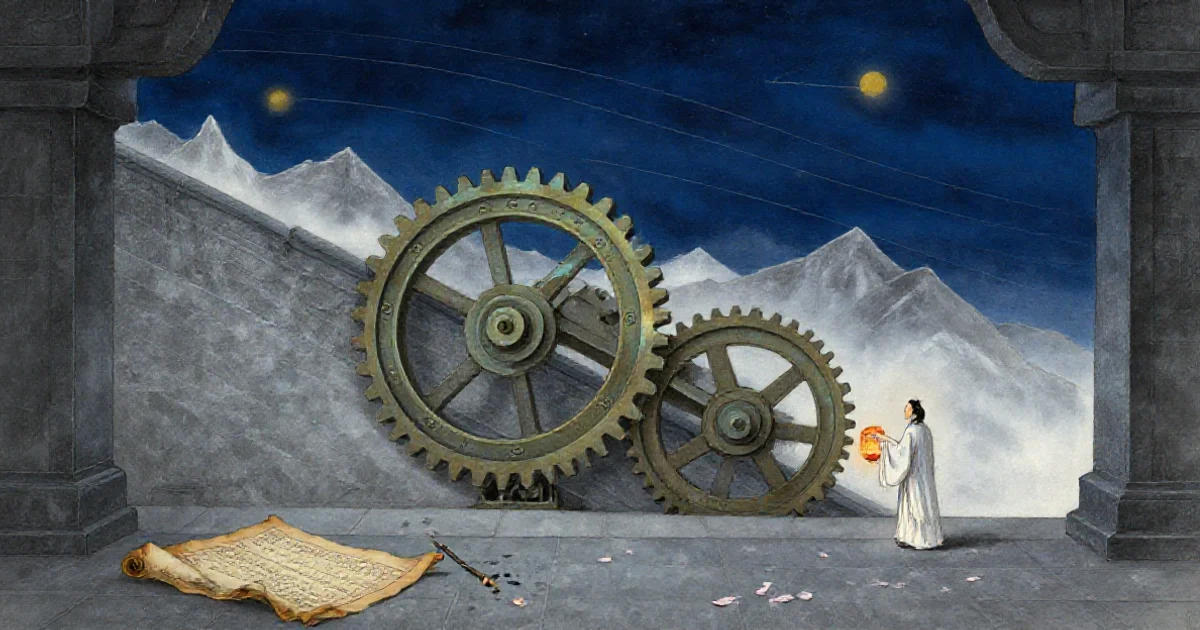
The Chinese were not pairing every stem with every branch. They were running two wheels at once. Think of two gears: one with ten teeth (the stems), one with twelve (the branches). Each day you advance both by a single click.
| Day | Stem (of 10) | Branch (of 12) |
|---|---|---|
| 1 | 1 甲 | 1 子 |
| 10 | 10 癸 | 10 酉 |
| 11 | 1 甲 (wraps) | 11 戌 |
| 13 | 3 丙 | 1 子 (wraps) |
| 61 | 1 甲 (both home) | 1 子 (both home) |
The ten-wheel resets every ten clicks; the twelve-wheel every twelve. The question is: when do both land on position one at the same moment? That is the least common multiple of ten and twelve— sixty. After sixty steps the ten-wheel has turned six times and the twelve-wheel five, and only then do they realign. Sixty unique states. Not a hundred and twenty, not twelve hundred—exactly the number required for two cycles of length ten and twelve to synchronize. It is the same problem as asking how many hours until a ten-hour clock and a twelve-hour clock next show the same pair.
Why Sixty, Not a Hundred and Twenty
There is a second way to reach sixty, and the fact that both routes agree is the first sign that something deeper is going on. The Chinese imposed a rule on the pairing: yang stems pair only with yang branches, yin stems only with yin branches. The stems alternate yang-yin down the list—甲 yang, 乙 yin, 丙 yang, 丁 yin—and so do the branches—子 yang, 丑 yin, 寅 yang, 卯 yin. A yang stem can never meet a yin branch across the join. 甲 (yang) will never sit above 丑 (yin); 乙 (yin) will never sit above 子 (yang).
That forbids exactly half of the hundred and twenty theoretical combinations. A hundred and twenty divided by two is sixty. The mechanical answer (two gears with a shared period of sixty) and the cosmological answer (polarity must match at the join) land on the same number. The mathematics and the metaphysics agree—which is precisely why the cycle felt, to the people who built it, like a fact about the world rather than a convention.
What the Two Wheels Measure
Here the coordinate intuition becomes powerful, because the two wheels are not measuring the same thing twice. They measure different axes.
The ten stems describe quality. By the Han synthesis, the stems are simply the Five Phases doubled by polarity—five elements times two—so that 甲乙 are Yang and Yin Wood, 丙丁 Yang and Yin Fire, 戊己 Earth, 庚辛 Metal, 壬癸 Water. A stem tells you the flavour of qi at a moment: its element and its charge. It is a vector describing the nature of the force.
The twelve branches describe position. They are where you are on a circular timeline that can be read as twelve months, twelve double-hours, twelve directions of the compass, or the twelve zodiac animals. 《史記·律書》, the Grand Historian's treatise on the pitch-pipes, etymologizes each branch as a station in the year's rise and fall of qi:
子者,滋也;滋者,言萬物滋於下也。…午者,陰陽交,故曰午。…酉者,萬物之老也,故曰酉。
— 《史記·律書》
子 (Zi) is germination—things stirring below, the seed of yang at the winter solstice. 午 (Wu) is “where yin and yang cross,” the summer-solstice pivot where yang peaks and yin is born. 酉 (You) is “the ageing of all things,” the autumn harvest. The branch is not a label; it is a coordinate on the year's cycle of light and dark. The same treatise reads the stems the same way—“甲者,言萬物剖符甲而出也”, “Jiǎ is the husk splitting as the thing breaks out”—but the stems track the character of the emergence while the branches track its place in the round.
Put the two axes together and a ganzhi term stops being a name and becomes an address. 丙午 (Bǐng-Wǔ) is not a syllable-pair; it is Yang Fire (the quality) at the Horse position (the place): high summer, due south, noon, the maximum of yang—all read off two numbers at once. A coordinate of the form (quality, position), or more precisely (phase·polarity, cycle-location).
A Coordinate, Not a Root
It is tempting to call ganzhi the foundation of all Chinese metaphysics. That overshoots, and the overshoot is worth correcting, because the corrected version is the stronger claim. Ganzhi is not the most primitive concept in the system. It is assembled out of deeper ones. The stems are the Five Phases crossed with Yin-Yang; you cannot build the ten-wheel without first having polarity and the five elements in hand. The real dependency runs in one direction:
| Layer | Concept | Role |
|---|---|---|
| Substrate | 氣 Qi | What everything is |
| Polarity | 陰陽 Yin-Yang | The primary distinction |
| Typology | 五行 Five Phases | The modes of change |
| Coordinate | 干支 Ganzhi | Where and when a qi-state sits |
| Applied arts | Bazi, Ziwei, Qimen… | Read positions off the grid |
Qi is the substance, Yin-Yang and the Five Phases are the grammar, and ganzhi is the coordinate system that pins that grammar to a definite point in time and space. Its contribution is not a new principle. Its contribution is to make the principles computable—to turn a worldview into an address book. A philosophy that says “all things are qi differentiating through five phases” cannot, by itself, tell you anything about next Tuesday. Stamp next Tuesday with a stem-branch pair and suddenly the whole apparatus has a value to operate on. That is the move ganzhi makes, and it is why it underlies the calculative tradition without being its first principle.
Where the Grid Runs Everything
Once time and space carry stem-branch addresses, every predictive art becomes a way of reading positions off the same grid. They differ in which positions they sample and what they do with them, but the coordinate system underneath is shared.
- Bazi takes the four stem-branch pairs stamped on the year, month, day, and hour of a birth and reads a life out of how their elements relate. The sixty Jiazi and their Nayin signatures are this system's alphabet.
- Ziwei Doushu distributes stars across twelve palaces anchored to the branches of the birth moment.
- Qimen Dunjia reads a spatial-temporal field whose cells are keyed to the stem-branch coordinate of the consultation.
- The almanac selects auspicious dates by checking the day's pair against the rotating spirits, and the whole edifice of date selection sits on top of the same sixty.
None of these is the coordinate system. Each is an application running on it. Strip away their distinctive machinery and what remains, in every case, is the same sexagenary address.
The Caveat: the Changes Came From Somewhere Else
One thing the coordinate system does not generate is the I-Ching itself. The sixty-four hexagrams are an independent combinatorial cosmology—six binary lines, two to the sixth, with their own logic that owes nothing to the count of ten and twelve. The two systems were not born together. They were married later, in the Han, when correlative thinkers such as Jing Fang (京房) bolted the hexagrams onto the calendar: the gua-qi (卦氣) scheme that distributes the sixty-four hexagrams across the solar year, and the najia (納甲) method that assigns stems to the trigrams. So ganzhi is the coordinate system of the calendrical and calculativetradition, onto which the Changes were mapped—not the seed the Changes grew from. The honest claim is “the grid everything was plotted on,” not “the source of everything plotted.”
The Deepest Wheel Is Twelve
Of the two wheels, the twelve is the one that keeps reappearing everywhere a circle needs dividing, and the reason is plain arithmetic. Twelve factors as two squared times three, which means it divides evenly into two, three, four, six, and twelve. No small number carves a circle into so many clean fractions. For anyone building a calendar or charting the sky, twelve is almost irresistible.
And the sky obliged. Jupiter—the 歲星, the “Year Star”—circuits the ecliptic in just under twelve years, so its position served as a slow twelve-station clock against which years were named, the seed of the 太歲 (Tai Sui) reckoning. The moon gives roughly twelve lunations a year. Han astronomers split the celestial circle into twelve 次 (jì, “stations”) and the day into twelve double-hours; the compass into twelve directions. The twelve zodiac animals—rat, ox, tiger—are the latest and most popular coat of paint on this layer, a mnemonic skin over a frame that was astronomical long before it was a menagerie. The branches are the ground floor; the animals, the months, the directions, the Jupiter stations are all overlays on the same original twelvefold division of the circle.
But It Counted Days First
There is a final correction, and it is historical. It is tempting to imagine the cosmological meaning came first—that the ancients contemplated qi and phases and then devised stems and branches to record them. The bones say otherwise. On Shang oracle bones from Anyang, datable to around 1200 BC, the complete sixty-unit ganzhi table appears already in use—as a calendar, for counting days. The ten stems even doubled as the name-days of dead kings. The earliest full sexagenary tables we have were day-counters, three centuries and more before anyone wrote the five-phase “quality” layer onto the stems.
So the system is not one deep twelve-wheel with a ten bolted on. It is two ancient cycles meshed: a ten-day administrative week (the 旬, the Shang “decade”) turning against a twelvefold division of the celestial circle. The two ran together because their least common multiple, sixty, gave a comfortably long count that never repeated within a season. Only later—decisively in the Han—did the correlative cosmologists pour qi, Yin-Yang, and the Five Phases into the empty frame, turning a day-counter into a coordinate system for the whole cosmos. The container is Shang; the meaning is Han. Both facts matter, and confusing them is how the cycle gets mistaken for a revelation rather than an inheritance.
The Address of Now
Strip everything else away and this is what the sexagenary cycle is: a way of giving every moment an address. Two wheels, ten and twelve, geared so they realign only every sixty steps. One wheel names the quality of the qi, the other its position in the round. Together they turn the bare claim “all things are qi in transformation” into something you can point at a Tuesday and compute. That is why a Han thinker could see 丙午 not as a name but as a complete state—Yang Fire, Horse, summer, south, noon, maximum yang, all at once—and why Shao Yong could imagine the whole of history as one vast clock. Ganzhi is not the root of Chinese cosmology. It is the coordinate system that made it computable—and that, in the end, is the more remarkable thing for two interlocking wheels to have done.