When the Ink Cannot Decide
We have been reading one scribe's handwriting for months. Here is the part nobody warns you about: the evidence piles up, and the conclusions keep coming apart.
Every verse on this site is checked against a hand-copied 1780s manuscript, character by character, by a reader who sees one leaf and has to prove every claim with a photograph. That page describes the method. This one is about what the method has actually taught us, which is less flattering and more interesting.
The intuition is that this should get easier. Read enough of one copyist and you learn his hand — how he draws a particular hook, where he puts a dot — and each leaf should go faster and surer than the one before. That is not what happens.
What Accumulates, and What Does Not
One thing does grow steadily. Every time a reader settles a doubtful character, the comparison glyph they used is filed with its location, so anyone can pull the same picture later. That file began with 65 entries. It now holds 2,611, covering 861 distinct characters, and — the valuable part — 938 of them are negatives: instances of the character the reading is not. No automated pass produces those. A recogniser tells you what it thinks a glyph is; only a person bothers to record what it demonstrably isn't.
The readings are stable too. In the entire history of the project, eleven verses have had a character changed after being confirmed against the page — eleven, against roughly 3,700 confirmed. Once a line has been read off the paper it essentially stays read.
What does not accumulate is the rules. Almost every generalisation we have written down about this scribe's hand has later been broken by his own handwriting.
Two Spellings, One Glyph
Start with the easy case. The digital text of the Yilin spells one common word — wéi, “to be, to make” — two different ways: 為 in most places, 爲 in seven verses out of 4,096. That looks like a fact about the scribe.
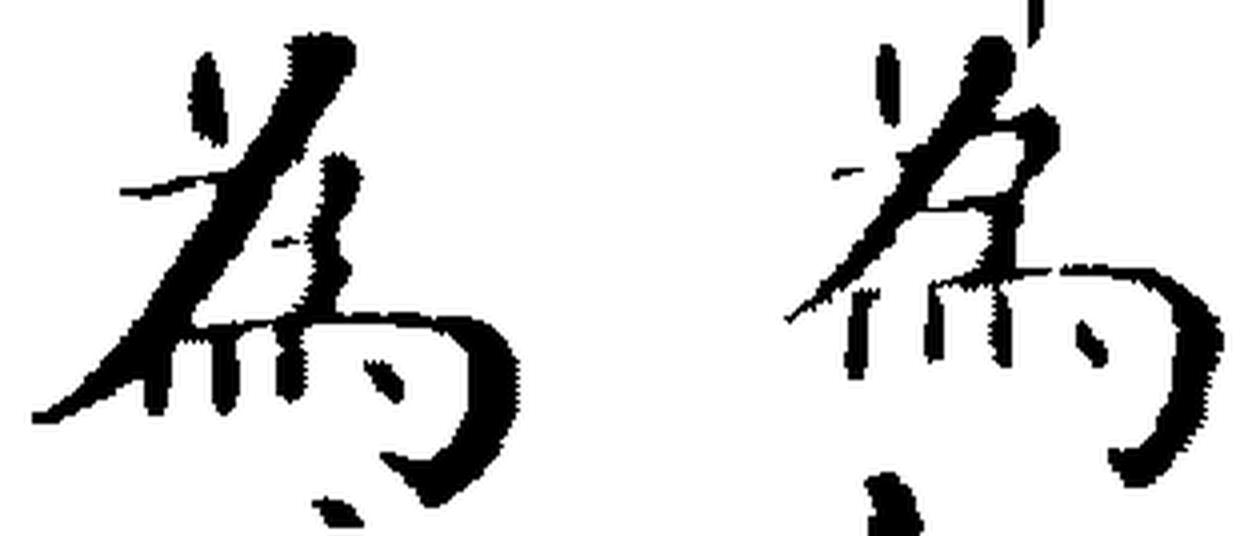
vol 4 / leaves 30 and 45Left, a character the digital text stores as 為. Right, one it stores as 爲. Same volume, same copyist. The reader who fetched the second to compare against the first reported that it did not separate — identical form in this hand.
That much matches what the manuscript page already shows for other characters. The newer and stranger finding is what happened when we tried to settle it properly. The right-hand glyph above is the canonical comparison instance for this question: our own tooling has sent readers to it twelve separate times. Of the twenty-five comparisons filed for this character pair in this volume, twenty came back “inconclusive.”
For a long time our own notes said the reason this question was unsettled was that no comparisons existed. They did. They had been made two dozen times. They simply do not decide anything — which is a completely different problem, and one you only discover by counting your own evidence instead of trusting your summary of it.
A Measurement That Looked Like a Rule
Here is the failure in its purest form. Two characters, 無 and 无, are two ways of writing “not have.” They look nothing alike, so telling them apart should be trivial — and one round of checking produced what looked like a clean mechanical test. Count the detached ink below the character: 無 has the four little strokes underneath, 无 has none. Zero versus not-zero. It was re-derived on seven separate leaves and written into the instructions.
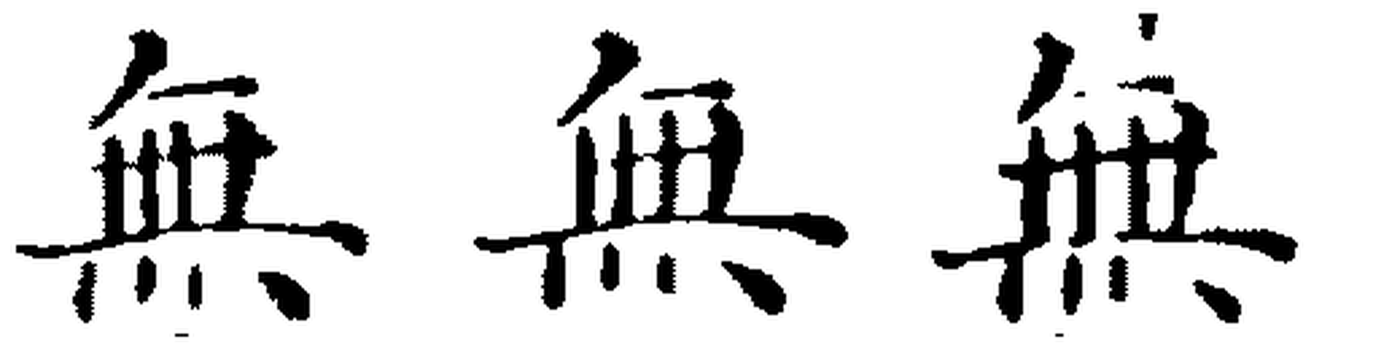
vol 4 / leaf 30Three instances of 無 on a single leaf, one hand, minutes apart. The test counts marks along the bottom that touch nothing above them — which is not the same as marks you can see. It gives four, three, three. In the first the downstroke stops short and all four stand free; in the second and third it sweeps down and absorbs the leftmost one. Two of these sit in the same verse. Look closely and you may not agree, and that is fair: move the band boundary or the minimum mark size and the numbers shift. The reading survives it because it depends only on some versus none. The count never did.
So the count is a property of one instance, not of the character — which we knew. The claim that survived was the weaker, safer one: not the number, just zero versus not-zero. Then eight readers tested it on eight fresh leaves in one round. Two confirmed it. Two broke it, finding 无 characters that returned two and three detached components, because in those instances the character's own legs detach.
Two–two, on a rule that had been declared settled one round earlier on seven leaves of evidence.
The instructions had also carried a tolerance: a note that the measurement flips if your crop boundary moves by about six pixels, so readers would know how much slack they had. Four readers measured that slack on their own leaves and reported −4 to +8, within 3, +3, and −18. Four numbers, spanning twenty-six pixels, without even a consistent sign. The number was worse than useless — it was reassuring.
The correction is not a better threshold. It is to stop shipping numbers and ship the test instead: which of the two is larger on your leaf, measured by you, reported with the reading. Rank survives what magnitude does not.
Why It Resets
There is a structural reason, and it took a while to see. This manuscript was not copied by one person. It runs to four fascicles, and each has its own copyist.
Because a comparison is only honest if it comes from the same hand, readers fetch their evidence almost entirely from within the fascicle they are reading — and so the learning restarts at each boundary. It is visible in the numbers: the rate at which comparisons come back undecidable does not fall as the project goes on, and its two worst values in the whole run are the rounds immediately after crossing into a new fascicle.
A scribe's hand is not a fact about the book. It is a fact about one clerk, for the stretch of pages he happened to copy.
What It Looks Like When the Ink Does Decide
None of this means the readings are soft. When the page carries the distinction, it carries it plainly, and a reader can nail it in one comparison.
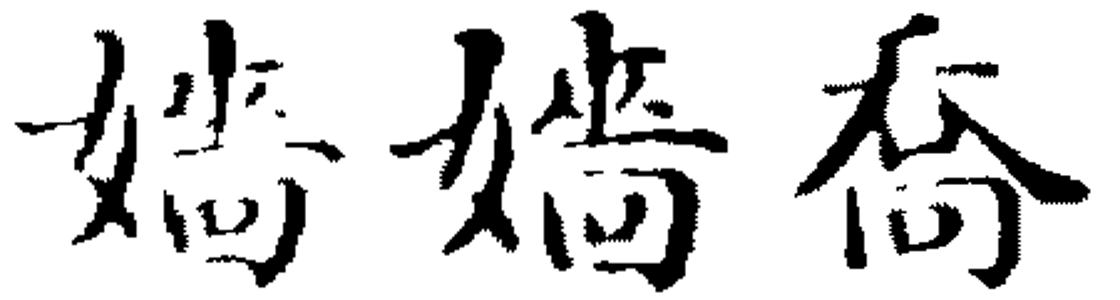
vol 4 / leaves 28, 192, 20Left, a character the digital text read as 嬌. Centre, a known 嬙 from another leaf in the same fascicle — the same stroke by stroke. Right, the character 喬, which 嬌 would have to contain, and plainly does not match. The verse is a line about famous beauties; the page says 毛嬙, and the correction was made from the ink, with the literature consulted only afterwards.
And When It Simply Cannot
The finding that changed how we file things is the third case: not a hard reading, not an easy one, but a distinction that is not present in the ink at all, and never will be, no matter how good the scan or the reader.
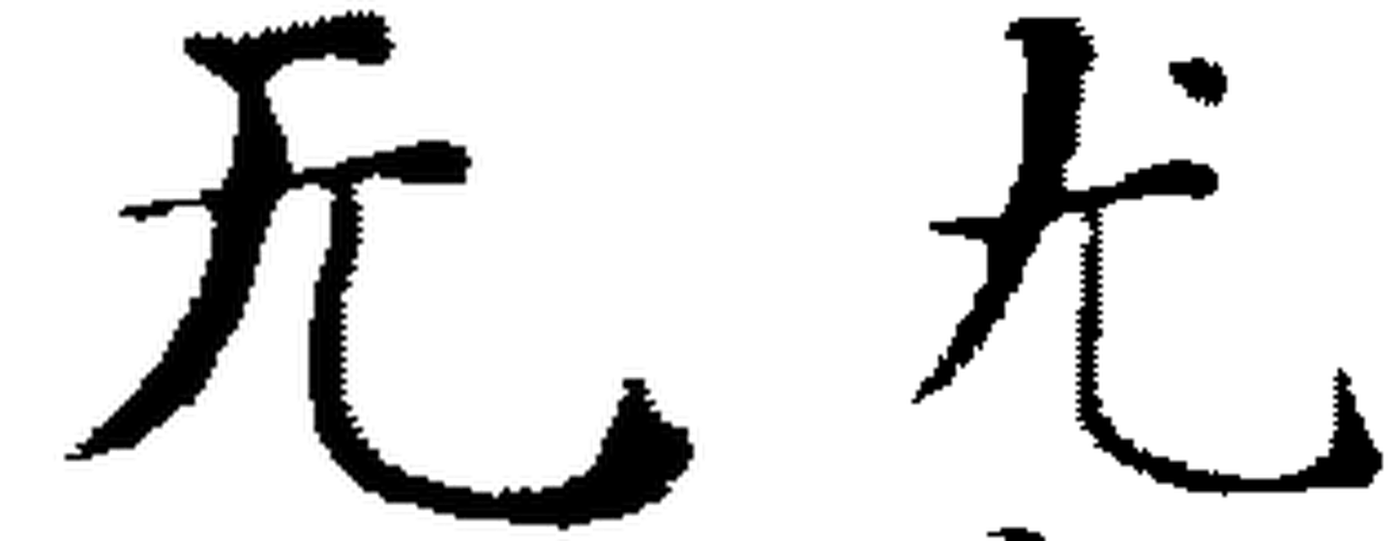
vol 4 / leaves 16 and 26左 无 wú, “not have.” 右 尤 yóu, “fault, blame.” Different words entirely. The whole difference is one detached dot at the upper right — so any test that works by counting marks in the lower part of the character cannot tell them apart at all.
A cleaner example is the pair 母 mǔ, “mother,” and 毋 wú, “do not.” Different words; different meanings; and historically the same drawing, because 毋 is simply 母 with the two inner dots joined into a stroke. When a reader found the manuscript's one instance of 毋 drawn with the two dots separate, it looked briefly like the digital text was wrong.
It is not. What settles that character is not the picture, because the picture does not carry the distinction. It is the sentence. The verse reads do not plant hemp — an omen, and the only reading that means anything. Across the whole fascicle, all fifty-one instances of the drawn shape are the word “mother,” and the single exception is that negation. The digital text is right in all fifty-two places, and it is right for a reason no amount of looking could establish.
The same thing turned up again this month with 婁 and 妻. A reader took a confirmed instance of each from two different leaves, put them side by side, and found them indistinguishable — then tried a numerical shape comparison, which also failed. Two ordinary, unrelated words, written identically by this copyist.
Saying So Is the Result
The temptation in all three cases is to pick the sensible reading and move on. Nobody would ever notice. The verse would scan, the meaning would be right, and the corpus would quietly contain a claim about the page that the page does not make.
So those readings now get marked. They are recorded as contextual rather than diplomatic — meaning: this is what the words must be, and it is not what the ink proves. A reader is also allowed to return a verse with nothing at all in it. One row in this corpus has been left empty across two rounds because two readers in a row could disprove the stored character and neither could name a replacement they could photograph. A blank that says we know this is wrong and we cannot yet say what is right is worth more than a plausible guess.
Which is the whole argument for doing it this way. A text that has been read off a particular leaf of a particular manuscript is a different object from a clean copy of unknown parentage — but only if it also records where looking stopped working. The corrections are the advertised product. The marked limits are the part that makes the rest of it trustworthy.
Every plate here is a photograph of the manuscript at the location cited beneath it, cut by the reader who used it. The header image is an ink-wash illustration, not a photograph of the witness. The verification work is open source, and its round-by-round log — findings, refutations and our own errors alike — is public. See also Reading the Manuscript and our editorial policy.