The Yilin: 4,096 Verses of the Forest of Changes
One verse for every possible hexagram transformation. A guide to Jiao Gan's poetic tradition.
What the Yilin Is
The Yilin (焦氏易林), also known as the Forest of Changes, is a collection of 4,096 verses attributed to Jiao Gan (焦贛), also known as Jiao Yanshou (焦延壽), a scholar of the Western Han Dynasty active around 50 BCE. Jiao was the teacher of Jing Fang, who formalized the Liu Yao system. Where Jing Fang developed structural analysis, his teacher left behind something entirely different: poetry.
The number 4,096 is not arbitrary. It is 64 multiplied by 64. Each hexagram can transform into any of the 64 hexagrams, including itself. One verse for each origin-to-destination pair. The Yilin covers every possible transformation in the system. It is complete.
The Structure
The Yilin is organized by origin hexagram. Under ䷀ Hexagram 1: 乾 Qián, you find 64 verses: Qián transforming to Qián, Qián transforming to Kūn, Qián transforming to Zhūn, and so on through all 64 destinations. Under ䷁ Hexagram 2: 坤 Kūn, another 64 verses. This continues through all 64 origin hexagrams.
Each verse is a short poem, most commonly in four clauses, following the poetic conventions of the Han Dynasty. Some verses are longer or shorter, and clause lengths vary. The verses are dense, allusive, and often draw on historical events, natural imagery, and folk sayings that were current two thousand years ago. Some are immediately vivid. Others require commentary to unlock.
The Poetic Tradition
The Yilin verses do not explain. They evoke. A verse might describe a flock of geese flying south, a cracked wheel on a cart, a plum tree blooming after frost. The connection to the hexagram transformation is often indirect. The reader must sit with the image and let it speak to the situation.
This is a different mode of engagement than reading the Judgment and Image texts of the I-Ching proper. Those texts, while also imagistic, have a more direct instructional quality. The Yilin verses are closer to pure poetry. They create a mood, a scene, a feeling. The meaning arises in the space between the verse and the reader's situation.
Some scholars have noted that the Yilin verses often carry prognostic weight. A verse about a strong tree weathering a storm tends to appear in favorable transformation pairs. A verse about a broken bridge tends to accompany difficult ones. But this is not always the case. Some verses are ambiguous by design. The tradition trusted the reader to bring their own discernment.
Historical Significance
The Yilin occupies a unique position in the I-Ching tradition. It is not part of the canonical text. It is not one of the Ten Wings. It stands alongside the I-Ching as an independent work that uses the hexagram system as its organizing principle but speaks in its own voice.
During the Han Dynasty, the Yilin was widely used in divination practice. Historical records describe officials consulting it for matters of state. Over the following centuries, it fell in and out of favor as different schools of I-Ching interpretation rose and fell. By the Qing Dynasty, it had become primarily a scholarly text, studied for its literary and historical value.
In recent decades, the Yilin has seen renewed interest among practitioners who value its poetic approach as a complement to structural methods like Liu Yao. The verses offer something that structural analysis cannot: an imagistic, intuitive layer that speaks to the feeling of a situation rather than its mechanics.
The Yilin in Six Lines
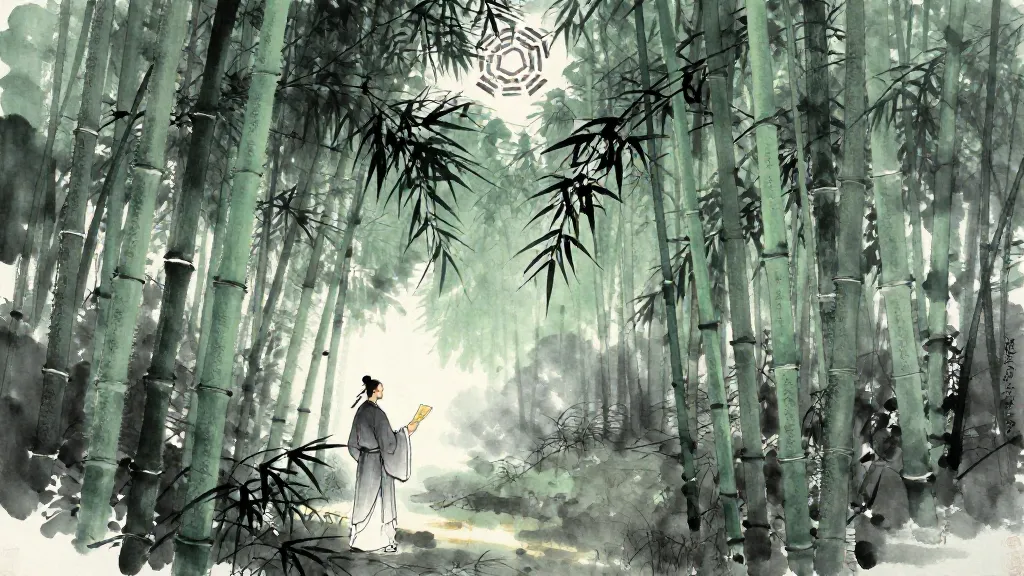
Six Lines presents the complete Yilin: all 4,096 verses with original Chinese text. Each verse is accompanied by original ink brush artwork created specifically for Six Lines. The artwork is not decorative. Each piece responds to the imagery and mood of its verse, creating a visual companion to the poetry.
You can encounter Yilin verses on any hexagram detail page. The verse shown corresponds to the hexagram transforming to itself, which some traditions consider this the hexagram's representative verse, though the full set of 64 transformation verses in the app gives a richer picture.
The verses reward slow reading. They were written to be contemplated, not consumed. A single verse, read carefully, can reframe how you understand a hexagram. Four lines of poetry, two thousand years old, still speaking clearly. That is what the Forest of Changes offers.