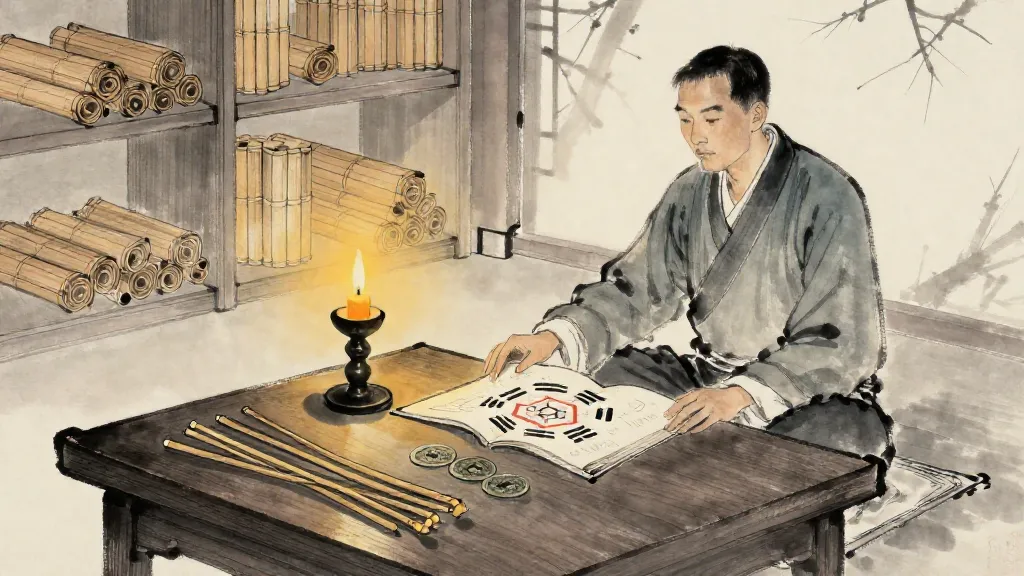
How to Read I-Ching Hexagrams

A grounded introduction to the six-line figures at the heart of the Book of Changes.

What Is a Hexagram?

A hexagram is a figure made of six horizontal lines stacked from bottom to top. Each line is either solid (yang) or broken (yin). Six lines, two possible states each. That gives 64 unique combinations. These 64 hexagrams form the complete structure of the I-Ching.

The word "hexagram" comes from Greek: hex (six) + gramma (line). In Chinese, the term is gua (卦). The I-Ching itself is sometimes called the Zhouyi (周易), the Changes of the Zhou dynasty, reflecting its origins around 1000 BCE.

Each hexagram has a name, a Judgment text (卦辭), and an Image text (象傳). These were composed at different periods. The hexagram names and Judgments are attributed to King Wen. The Image texts draw moral lessons from the hexagram's structure. Later, Confucius and his students added commentaries known as the Ten Wings.

Two Trigrams, One Hexagram

Every hexagram is built from two trigrams. A trigram is a three-line figure. There are eight trigrams in total, each associated with a natural element and a set of qualities:

  • ☰ Qian (乾) — Heaven. Creative force, strength, the initiating power.
  • ☷ Kun (坤) — Earth. Receptive, yielding, the sustaining ground.
  • ☳ Zhen (震) — Thunder. Arousing energy, shock, the first movement.
  • ☴ Xun (巽) — Wind/Wood. Gentle penetration, gradual influence.
  • ☵ Kan (坎) — Water. Danger, depth, the abysmal and flowing.
  • ☲ Li (離) — Fire. Clarity, brightness, clinging and illuminating.
  • ☶ Gen (艮) — Mountain. Stillness, stopping, keeping still.
  • ☱ Dui (兌) — Lake/Marsh. Joy, openness, the pleasure of exchange.

The lower trigram (lines 1-3) represents the inner situation or the foundation. The upper trigram (lines 4-6) represents the outer situation or the visible expression. Reading a hexagram often begins with understanding the relationship between these two halves.

For example, ䷄ Hexagram 5: 需 Xū (Waiting) has Water above Heaven. The creative force below, danger above. The counsel: wait with patience and sincerity. The relationship between the trigrams tells you something before you read a single word of commentary.

Reading the Judgment and Image

The Judgment (卦辭) is the core statement for each hexagram. It is typically brief. For ䷀ Hexagram 1: 乾 Qián (The Creative), the Judgment reads: "The Creative works sublime success, furthering through perseverance." These words carry weight. They are not casual descriptions. They are counsel.

The Image (象傳) draws a lesson from the hexagram's trigram structure. For ䷀ Hexagram 1, with Heaven doubled: "Heaven in its motion gives the idea of strength. The superior man makes himself strong and untiring." The Image text tells you how to embody the hexagram's teaching. It connects structure to practice.

When reading a hexagram, start with the Judgment. Sit with it. Then read the Image. Notice how the Image connects the natural elements (the trigrams) to human conduct. This is the classical method: observe nature, then apply its pattern to your situation.

Moving Lines and Transformation

When you cast a hexagram using coins or yarrow stalks, some lines may be "moving." A moving yang line becomes yin. A moving yin line becomes yang. This creates a second hexagram, called the transformed hexagram or the relating hexagram.

Moving lines have their own individual line texts. These texts speak directly to the position and moment of change. Line 1 is the beginning, often tentative and hidden. Line 6 is the culmination, often excessive or transitional. The middle lines carry the weight of the situation.

The transformed hexagram shows where the situation is heading. Read the original hexagram as the present condition. Read the moving lines as the specific dynamics at play. Read the transformed hexagram as the trajectory. This three-part reading gives depth that a single hexagram cannot.

If no lines are moving, the hexagram speaks as a whole. The Judgment and Image carry the full message. There is no transformation. The situation is stable in its current form.

Approaching a Reading

The classical tradition treats hexagram consultation as a practice, not a game. The Great Treatise (繫辭傳) says the Changes "respond to those who approach with sincerity." This is not a claim about supernatural forces. It is a practical observation: the quality of your attention shapes the quality of your understanding.

Frame your question clearly. Not "Will I be rich?" but "What should I understand about my current approach to this project?" The I-Ching works best with honest, open questions that invite reflection rather than demand prediction.

After casting, read slowly. The texts are dense. A single phrase may illuminate something you had not considered. The practice is contemplative. You are not extracting information from a database. You are sitting with a text that has been contemplated by scholars for three thousand years, and allowing it to speak to your situation.

The complete hexagram reference on Six Lines includes the original Chinese text, Wilhelm's translation, and commentary for all 64 hexagrams. Begin with ䷀ Hexagram 1 (Qián) and ䷁ Hexagram 2 (Kūn). These two form the foundation. Everything else follows from the interplay of Creative and Receptive.