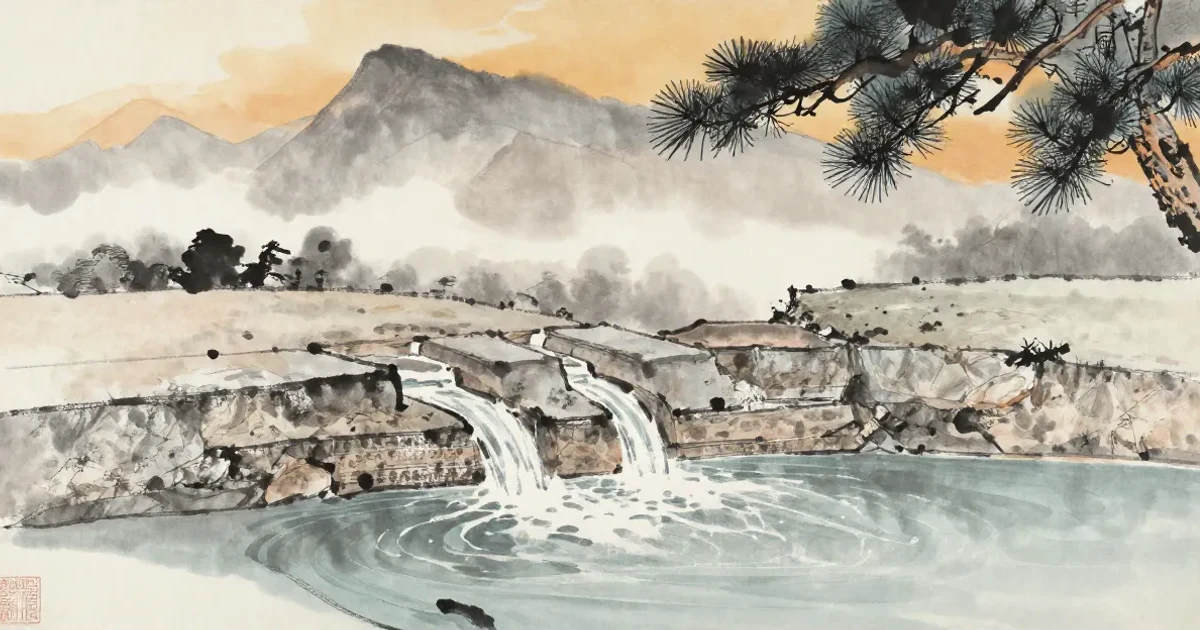
The Highest Good Is Like Water
Why the I-Ching keeps attaching good fortune to the low place.
Part 4 of The Daoist's I-Ching — reading the I-Ching through the Daoism you already know.
Water's Secret
Laozi's favorite teacher is water, and chapter 8 explains why:
上善若水。水善利萬物而不爭,處眾人之所惡,故幾於道
“The highest good is like water. Water benefits all things and does not contend; it dwells in the places people disdain, and so it is close to the Dao.” (Daodejing 8)
Water's power is that it goes down. It seeks the low ground everyone else avoids, and from there it nourishes everything and carves canyons. The Daoist sage imitates this: take the low place, don't contend, and you end up closest to the way things actually work. It is a lovely paradox. The I-Ching turns it into a verdict system.
Kan: Water as a Trigram
One of the eight trigrams is water: Kan (☵), a single yang line held between two yin lines — firmness flowing inside softness. In the I-Ching, Kan carries danger (water is also the abyss, the flood), but it carries water's genius too: it does not fight the terrain, it takes its shape and keeps moving. To read Kan in a cast is to be told the situation is one to flow through, low and persistent, not to dam or batter.
For the full map of how the water trigram sits among the other seven — the same eight that feng shui readers already know — see The I-Ching Through Feng Shui.
The One Hexagram Where Everything Goes Right
Here is the structural proof that the I-Ching agrees with Laozi about the low place. Of all sixty-four hexagrams, exactly one has every single line turn out favorable. It is not the hexagram of triumph or power. It is hexagram 15, Qian (謙), Modesty — and its picture is a mountain sitting beneath the earth.
地中有山,謙。君子以裒多益寡,稱物平施
“Within the earth, a mountain: Modesty. The noble one reduces the excessive and augments the scant, weighing things to make giving even.”
A mountain is the highest thing there is, and here it places itself below the ground. That is 上善若水 in hexagram form: the great thing taking the low position, and being rewarded at every line for it. The I-Ching does not say modesty is nice. It says, by the numbers, that the configuration of the high-made-low is the most uniformly fortunate pattern in the entire book.
Stay Low
This is one of the places the I-Ching is most likely to surprise a Western reader, and least likely to surprise a reader of Laozi. The book quietly, repeatedly, attaches its strongest blessings to descent, yielding, and the place others disdain — not as a moral reward for humility, but as a structural fact about how forces actually resolve. Water taught Laozi that. The hexagrams encode it. The advice, across three thousand years and two texts, is the same two words: stay low.
Next: simplicity — the uncarved block, and the minimal grammar the Dao differentiates into.