Return to the Uncarved Block
Simplicity — and the minimal grammar the Dao differentiates into.
Part 5 of The Daoist's I-Ching — reading the I-Ching through the Daoism you already know.
The Block and the Vessels
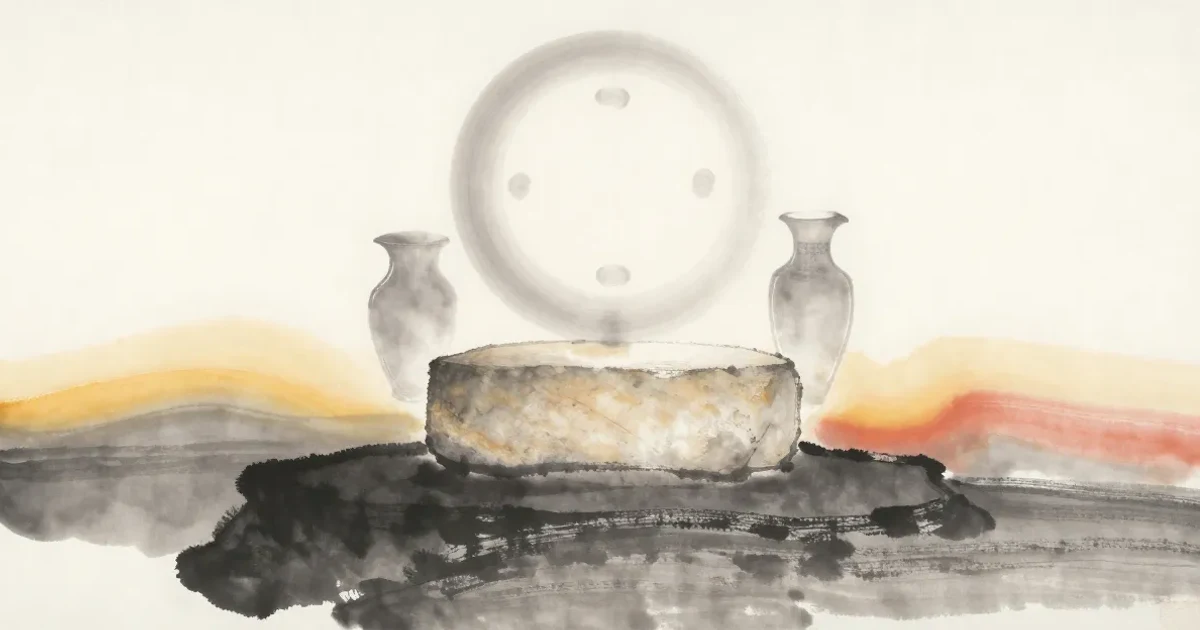
Laozi's image for the original simplicity of the Dao is pu (樸) — the uncarved block, raw wood before the craftsman's knife. From it, everything is made:
樸散則為器
“When the uncarved block is split, it becomes vessels.” (Daodejing 28)
The whole, undivided, holds all possible forms in potential. Cut it, and you get particular things — useful, but partial. The Daoist move is to keep returning toward the block: beneath the ten thousand distinctions, hold the undivided simplicity they all came from. The I-Ching draws that exact descent — from one to many — as a diagram.
The I-Ching's Own Genealogy
In the first article of this series we met Laozi's cosmogony: the Dao gives birth to one, one to two, two to three, three to the ten thousand things (Daodejing 42). The I-Ching tells the same story in its own words, in the Xici:
易有太極,是生兩儀,兩儀生四象,四象生八卦
“In the Changes there is the Great Ultimate. It gives birth to the two modes; the two modes give birth to the four images; the four images give birth to the eight trigrams.”
This is 樸散則為器 made into structure. The taiji (太極), the Great Ultimate, is the uncarved block — the undivided whole. Split it once and you get the two modes, yin and yang. Split again: four images. Again: the eight trigrams. Pair the trigrams and you reach the sixty-four hexagrams — the ten thousand things, the full set of vessels. Every hexagram is the block, carved.
Reading Is Returning
Most divination systems pile on complexity — more cards, more houses, more correspondences. The I-Ching runs the other direction. No matter how intricate a reading looks, every line on the page is one of only two things: yin or yang. A hexagram with all its commentary, changing lines, and transformations resolves, in the end, to a stack of broken and unbroken strokes — and those resolve to the single alternation the Xici named the Dao.
So to read the I-Ching well is to practice the Daoist return in miniature. You take the carved complexity of a situation and walk it back — sixty-four to eight to four to two to the one undivided thing. The reading is not adding meaning on top of the world. It is subtracting distinctions until the simple pattern underneath shows through.
Keep the Block
Laozi's counsel — hold to simplicity, return to the uncarved — turns out to be a description of how the I-Ching is built, not just a virtue to admire. The eight trigrams that organize feng shui, Chinese astrology, and every branch of the tradition are themselves just the first few cuts of the one block. Understand the block and the cuts, and the ten thousand vessels stop looking like ten thousand separate things.
Last in the series: Zhuangzi, the philosopher of flux — and the line that is already becoming its opposite as you read it.