Zhuangzi and the Book of Changes
Transformation — and the line that's already becoming its opposite.
Part 6 of The Daoist's I-Ching — reading the I-Ching through the Daoism you already know.
The Philosopher of Flux
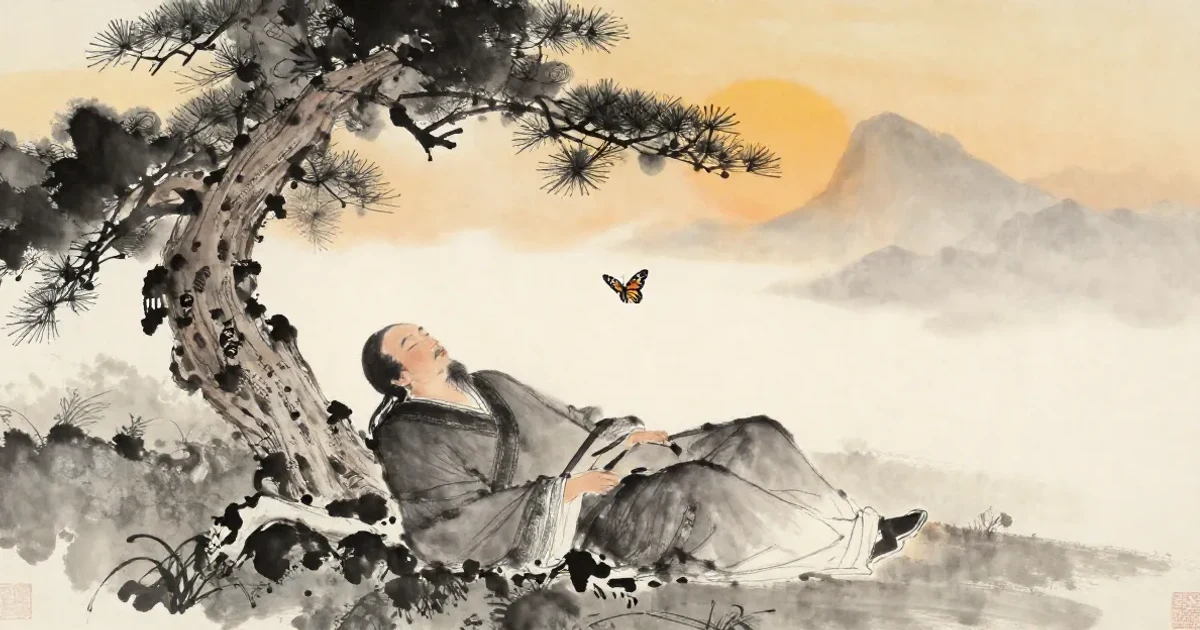
If Laozi is Daoism's law-giver, Zhuangzi is its poet of change. Where Laozi states principles, Zhuangzi tells stories in which the boundaries between things quietly dissolve — and the most famous is the butterfly:
昔者莊周夢為蝴蝶……不知周之夢為蝴蝶與,蝴蝶之夢為周與
“Once Zhuang Zhou dreamt he was a butterfly… He did not know whether he was Zhou who had dreamt he was a butterfly, or a butterfly dreaming he was Zhou.”
Zhuangzi calls this 物化 — the transformation of things.Forms are not fixed. Zhou becomes butterfly becomes Zhou; one state flows into another and the line between them is real only for a moment. To live well, for Zhuangzi, is to ride that flux instead of clutching at any single shape of it.
The Book Is Literally Named “Change”
You could not ask for a better-matched text. The I-Ching — 《易經》 — is the Classic of Change. The character 易 (yì) itself is change: old glosses tie it to the lizard or chameleon, the creature that shifts. The entire book is a study of how one configuration of the world becomes another. Zhuangzi gives you the philosophy of 物化; the I-Ching gives you its working model.
And the model has a precise component for the butterfly moment. The changing line — the one we met in Reversal Is the Movement of the Dao — is 物化 caught in the act. It is the line that is no longer quite what it was and not yet what it will be: Zhou mid-dream, butterfly mid-dream, the boundary still soft.
A Reading That Moves on Its Own
When a cast contains changing lines, the hexagram you threw transforms into a second one. Newcomers sometimes find this unsettling — they wanted one answer and the reading handed them two, the situation already turning into its successor. A reader of Zhuangzi recognizes it instantly. Of course the picture is moving. Nothing holds still. The reading didn't fail to settle; it accurately refused to.
This is the difference between consulting the I-Ching as a fortune machine and reading it as a Daoist instrument. The fortune-seeker wants the changing line to resolve into a verdict. The Daoist watches the transformation itself — sees, in the flip from one figure to the next, the exact shape of how this situation is dreaming its way into the one that follows.
Where the Series Leaves You
You arrived with the philosophy. Across these pieces you've seen it become a structure you can read: the alternation of yin and yang as the Dao itself, reversal written into the changing lines, wu wei drawn as the Receptive, the low place rewarded line by line, the whole book unfolding from one uncarved block — and now flux itself, caught in the line mid-transformation.
The promise from the first page holds. You can now look at six stacked lines and see the Dao doing exactly what Laozi and Zhuangzi said it does, in this particular situation, right now. If you want to start casting, begin with How to Read Hexagrams — or return to the start of the series, Daoism and the I-Ching.