The Last Three Verses
Every verse of the Yilin on this site has now been checked against the manuscript, and 4,094 of the 4,096 have been read off the page. These are the three that held out — and the reason to publish them is that the number means nothing without them. One of the three was found while this was being written; its section ends with where it turned out to be.
For most of a year, readers have been working through a hand-copied 1780s manuscript one leaf at a time, proving each character with a photograph. That pass is finished. Three verses out of 4,096 came out the other end unresolved.
They are worth a page of their own because they fail in three different ways, and the differences matter more than the count. In one the ink does not carry the distinction at all. In one the ink that would settle it is simply not on the paper. In the third there is nothing wrong with the verse — we do not know which sheet it is printed on.
One: A Distinction the Hand Does Not Make
The verse is fifteen-sixteenths certain. Fifteen of its sixteen characters are confirmed, along with the character count, the column geometry and the heading. Everything turns on the fourth: 禪 or 襌.
These are unrelated words. 禪 is chán, the meditation of Chan and Zen, built on 礻, the radical for ritual and the spirits. 襌 is dān, a single unlined garment, built on 衤, the radical for clothing. The rest of the character is identical, and the rest of the character is not in doubt.
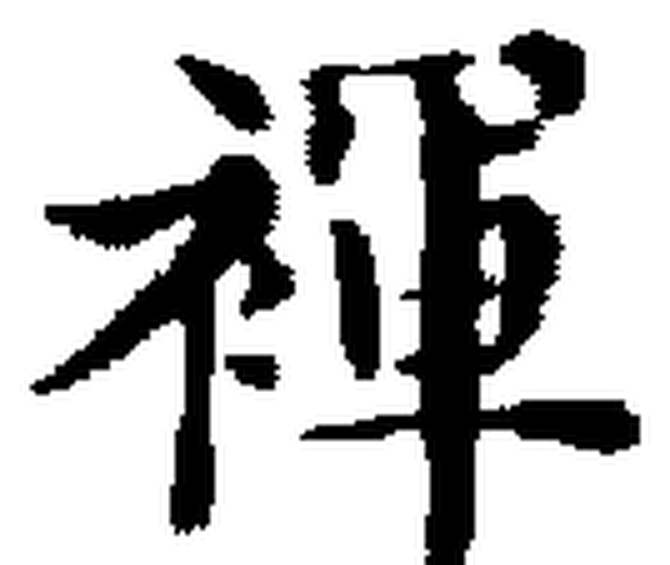
vol 1 / leaf 127 / column 1 / character 4The character at five times scale. The right half is settled — nobody disputes it. The entire question is the left radical, and the scribe has drawn it as a compressed ネ.
In another fascicle of this same manuscript the two radicals separate cleanly: 礻 gets one short side stroke, 衤 gets two. That is a real test, and it was written down as one. Re-derived here as an actual measurement, on this clerk's leaves, the count comes back constant at two for both classes. This copyist writes 衤 as ネ. In his hand the two radicals are the same drawing.
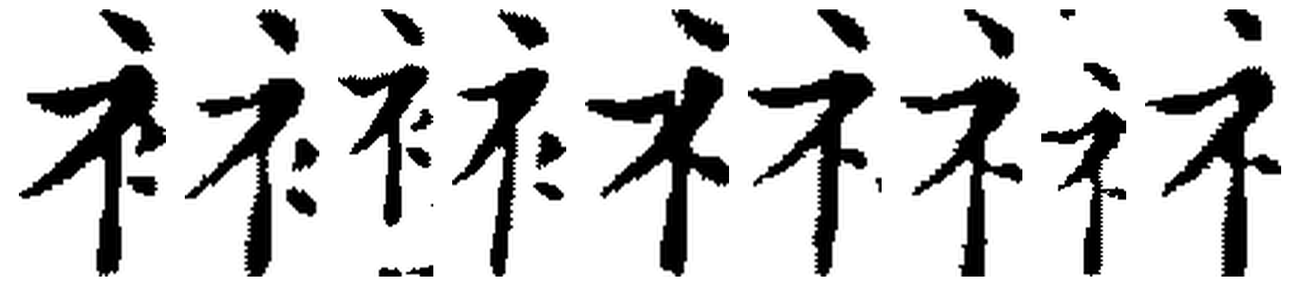
vol 1 / leaves 62, 107, 116, 118, 122, 127, 128The disputed radical first, then eight the same clerk drew elsewhere in this fascicle: three from characters that are certainly 衤 (袂 被 袴), five from characters that are certainly 礻 (祀 福 禍 祿 福). The classes are supposed to be four strokes apart. Find the boundary.
Then the part that is genuinely unnerving. A shape-overlap score run across the whole radical looked decisive: it matched the clothing radical at 0.59 and the ritual radical at 0.36. It is 襌. Except that the clothing examples in that run had been straightened for page skew and the ritual ones had not. Rebuilt with every leaf handled the same way, the same measurement on the same glyph gives 0.35 and 0.53 — the other answer.

vol 1 / first comparison passThe first pass, kept on the record precisely because it is the one that flipped. Nothing here is wrong as a photograph. What was wrong was invisible in the pictures and lived in how they had been prepared.
The stored reading happens to be 禪, which the clean run leans toward. The reader refused to call that corroboration, and was right to: it is the same number that had just been shown to reverse under a confound.
There is no minimal pair to fall back on. A sweep of the entire fascicle for either character returns no 禪 and no 襌 anywhere else. The clean cases that would teach us this clerk's habit do not exist in the stretch of pages he copied — and borrowing from another fascicle is inadmissible, because the hand there belongs to a different person.
Sense points one way — a cart, no something, naked, out the gate, the children laughing — and an unlined garment is obviously what the line wants. Our own rule forbids that from deciding it. The page is the authority; what the sentence needs is recorded separately and never written into the reading.
Two: The Best Match on the Leaf, Missing Two Strokes
The second verse is about an empty feeding trough. The digital text reads 槽空無實豚琬不食 — the trough is empty, nothing in it, the piglets and the wǎn do not eat. A wǎn (琬) is a jade ceremonial tablet. Jade tablets do not eat.
That reading is refuted, and not on the grounds that it is silly: 琬 appears nowhere else in all 4,096 verses, and it was tested against two known instances of its own component from the same fascicle and did not match. It will not be restored. The open question is what the character actually is.
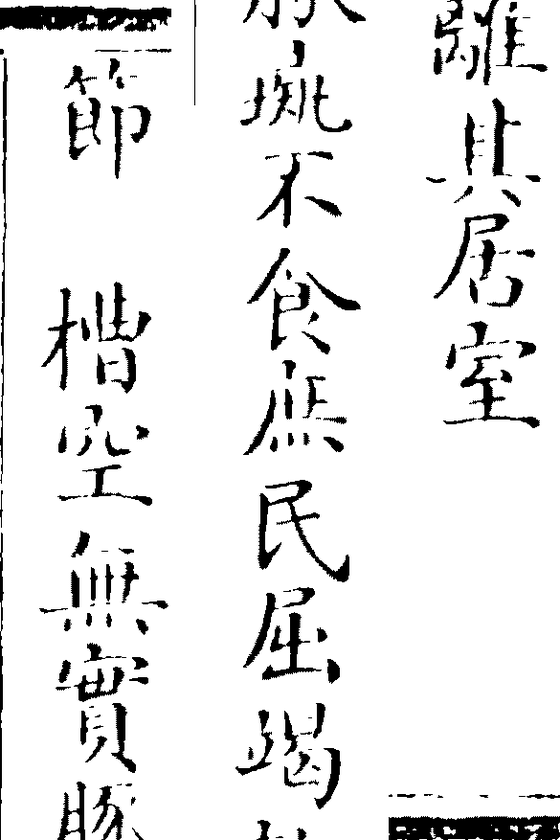
vol 4 / leaf 12 / column 1The column is taller than one strip at this width, so it is cut into three and read left strip first: this verse's own name slot 節, then 槽空無實豚 top to bottom. The disputed character opens the middle strip, followed by 不食庶民屈; the right strip finishes 竭離其居室. Count six straight down the left strip alone and you land on 豚, its neighbour, not the character in question.
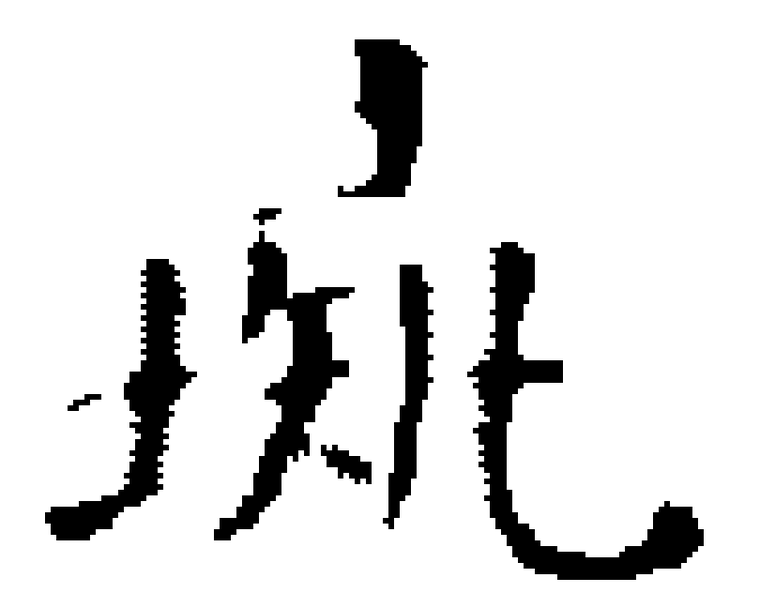
vol 4 / leaf 12 / column 1 / character 6The character at six times scale, in the scan's own pixels with no smoothing, so nothing you see here was invented by enlarging it. Note the small hooked stroke standing alone at the top, with clear paper on either side of it.
The proposal is 彘, zhì, a pig — which would give “the piglets and the pigs do not eat,” and would sit beside the 豚 immediately above it. A previous reader had rejected it and said why: the component that belongs on top, 彑, was “absent, not broken.”
This round found the strongest positive evidence anyone has produced on this row. Comparing the bottom block against two confirmed 彘 from the same fascicle, the match is 0.41 and 0.22 — and the two confirmed 彘 agree with each other at only 0.36. Measured against 2,850 pairings of every whole character on the leaf, that first score sits above 99.5% of them. The best non-彘 match anywhere on the page is 0.25.
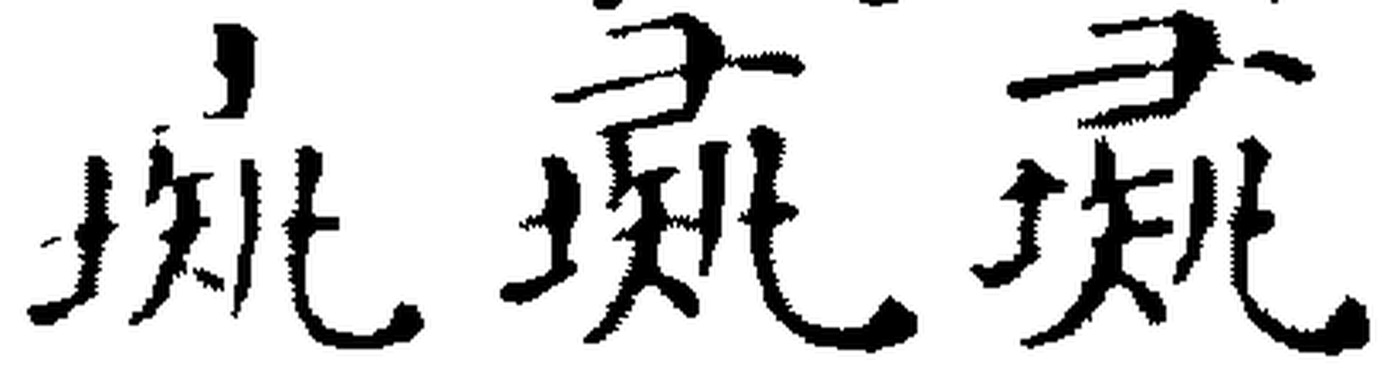
vol 4 / leaves 12, 36, 104Left, the character in question. Centre and right, two confirmed 彘 from the same fascicle. The lower two-thirds are the same character. The tops are not: both controls carry a full component up there, and the disputed glyph carries a single vertical hook and nothing else.
So the top was mapped, stroke by stroke. Each control's 彑 was projected into the disputed character's frame, and the ink inside each projected window counted. The vertical hook lands on ink in both projections. Both horizontal strokes land on blank paper — zero ink pixels, in windows of 816 and 1,188, with the tolerance opened to eight pixels in every direction.
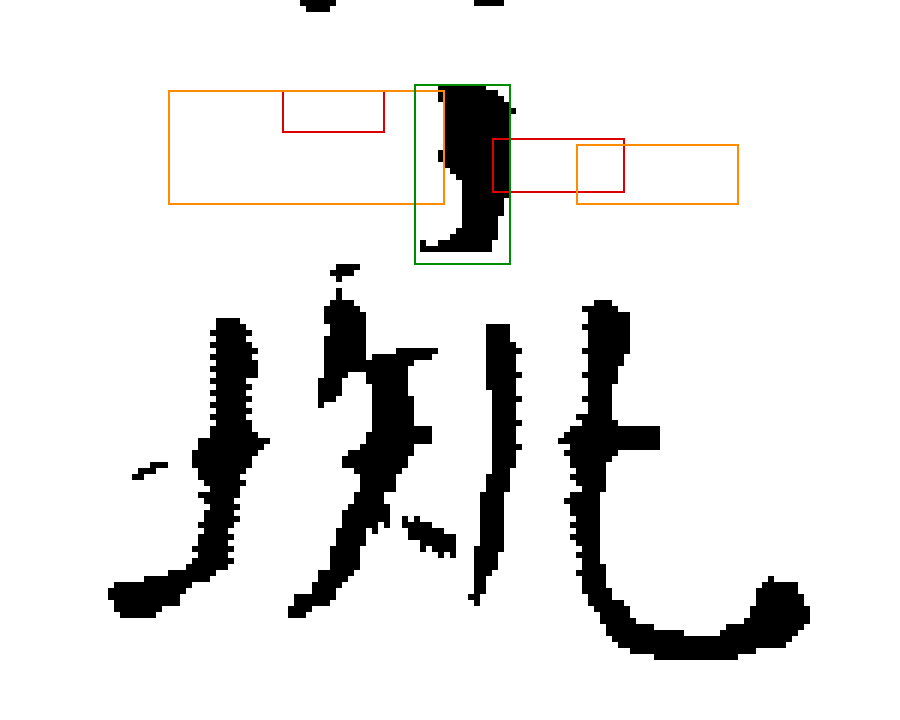
vol 4 / leaf 12Green marks where both controls put the vertical hook: full of ink. Red and orange mark where each control puts its two horizontal strokes: empty. The character's entire top block holds 266 inked pixels and every single one of them falls inside the green box.
Some of this scribe's horizontals do come out faint — elsewhere on this leaf they survive as four- and five-pixel fragments. None survive here. And the scan cannot be re-examined for a fainter trace: it is one bit per pixel at source, black or white with nothing in between, so no adjustment recovers a stroke that was never captured.
Writing 彘 would put a character into the text that anyone holding the same scan can see is missing two of its strokes. The verse is therefore published with the refuted reading flagged and no replacement asserted — which is an uncomfortable thing to ship, and the honest one.
Three: A Verse With Nothing Wrong With It
The third case is not about a character at all. All twenty characters are read and none is in doubt. What is unknown is which sheet of paper it is printed on.
It had been filed against leaf 115 of the fourth fascicle. That leaf number had never been confirmed by anyone — it was inferred from the verses on either side, which is a reasonable guess and not an observation. When a reader finally went and looked, the verse was not there.
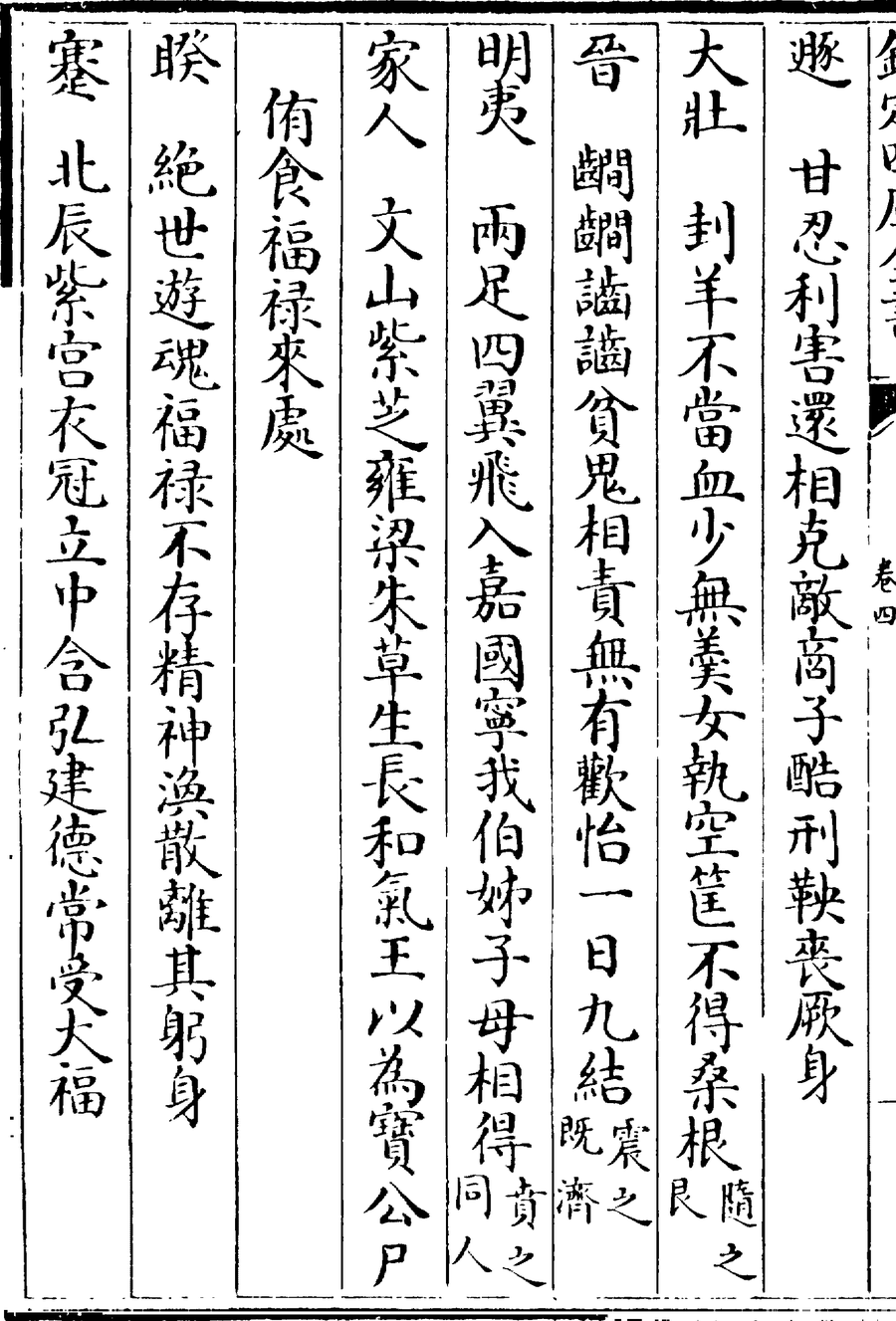
vol 4 / leaf 115Every column on the leaf, censused: 遯, 大壯, 晉, 明夷, 家人, then a column with no heading at all, then 睽 and 蹇 — seven consecutive entries in eight columns. The headless sixth column is not a missing entry; it is the wrapped tail of the twenty-four-character verse beside it, which reserves the name slot and drops the blank one. The reader called all eight before being shown the answer key, and got eight of eight.
The record now says the verse is not on leaf 115. It does not say the verse is nowhere. That distinction is the whole point of measuring an absence rather than assuming one, and the leaf citation was removed from this site rather than left standing as a page number nobody had checked.
Finding it is arithmetic, not mystery. A verse that pairs a hexagram with itself is printed at the head of that hexagram's run of sixty-four, not at numerical position fifty-five; the leaf we do have for the run's first entry puts this one about six leaves earlier than where it had been filed. One other verse was in exactly this state at the start of this round. Narrowing it the same way found it on the first attempt, on leaf 130 — a correction that is also in this update.
It took one leaf, not two. The verse is on leaf 109 — six leaves earlier than where it had been filed, which is what the arithmetic said — and it had been in plain view the whole time.
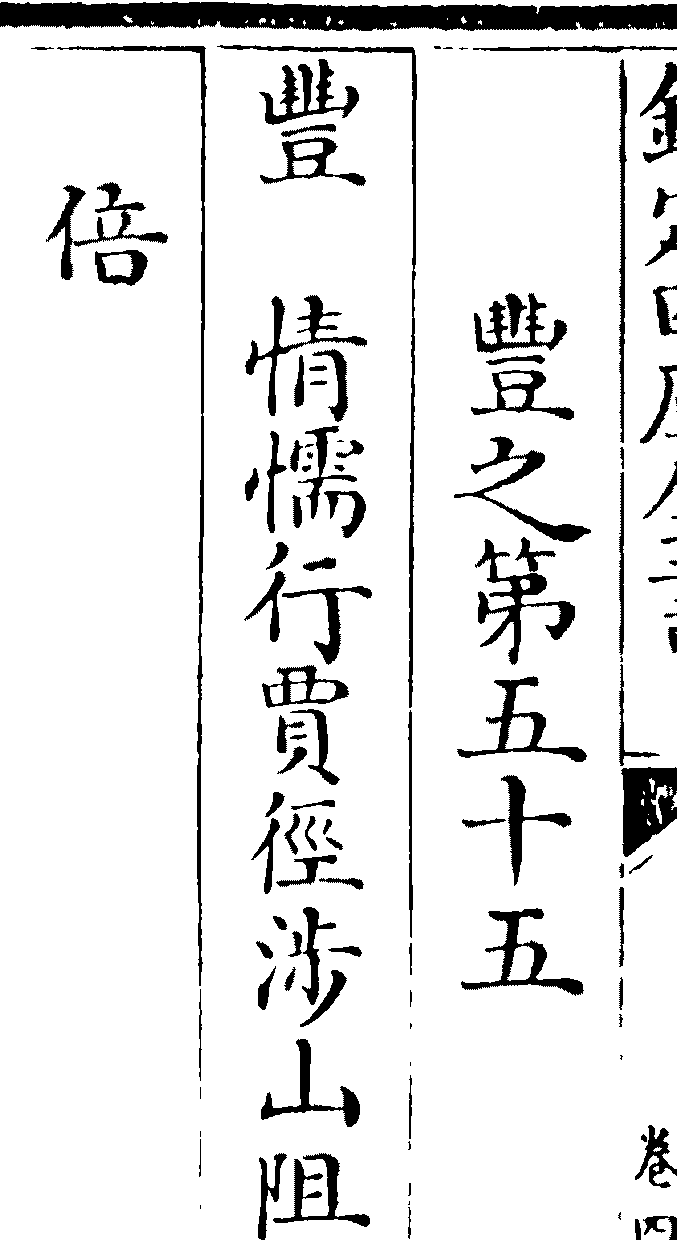
vol 4 / leaf 109Right to left: the fold furniture 欽定四庫全書; the heading 豐之第五十五, which opens the run; the verse itself under its own name slot 豐 — 情懦行賈徑涉山阻…; and then a column holding one character, 倍, and nothing else.
That last column is why nobody found it by counting. The verse runs to twenty characters and a column holds twenty slots, one of which the hexagram's name takes. So the twentieth character wraps, and sits alone at the top of the next column above the depth of an entire empty one. A column with a single character at its head looks exactly like a heading — and the reader who censused this leaf in an earlier round called it one.
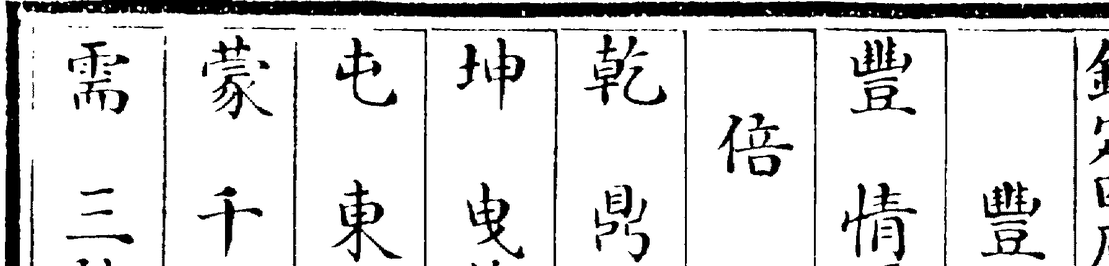
vol 4 / leaf 109The head of every column on the leaf. Right to left: the fold, the heading, the verse under 豐, the stranded 倍, and then 乾 坤 屯 蒙 需 — the next five entries, in order from the first. Nothing but the self-pair can stand where it stands.
The more useful finding is why it was lost, because that had nothing to do with the manuscript. Leaf 115 was produced by a rule that guesses a verse's leaf from its two numerical neighbours. That is a reasonable guess for most of the corpus and wrong for exactly sixty-four verses — the ones that pair a hexagram with itself, printed at the head of their run instead of in numerical order. Here the rule overrode a leaf number the machine transcription had carried correctly all along, replaced it with a leaf a reader then proved the verse was not on, and between them the two erased the leaf altogether. A right observation was beaten by a wrong inference, and the refutation that finished the job was itself sound.
A reader had also already written the answer down. The report on leaf 109, filed several rounds ago, says of the third column that it “likely carries the self-pair entry … which is not in the store's row list for this leaf” — and names the band the verse occupies, to the pixel. But the worksheet a reader is given is generated from the record, the record said this verse had no leaf, so there was no line to write it on. That is the second time in two searches that a correct observation has had nowhere to go, and the fix is in the worksheet, not the reader.
Why Publish the Failures
99.93% is a number, and on its own it is the kind of number anyone can write. It is worth something only if the remaining sliver is specific, named, and available to be argued with. Three verses out of 4,096 is a claim; these three verses, with the photographs, is a statement someone can check and overturn.
None of them is a blank. Each carries what the page shows, what was measured, what was ruled out and what was tried and failed — including the comparisons that cost real effort and settled nothing, which are recorded on purpose so nobody pays for them twice. The first would be settled by a clean pair of the two characters in this clerk's hand, which may not exist. The second would be settled by one further sweep, or by a photograph of the same leaf that is not one bit per pixel. The third was settled by looking at one more leaf, which is the best argument in this piece for writing an unknown down precisely: a question with an address gets answered.
A text read off a particular manuscript is a different object from a clean copy of unknown parentage. What makes it different is not that it contains no unknowns. It is that the unknowns have addresses.
Every plate here is a photograph of the manuscript at the location cited beneath it, cut by the reader who used it, and kept with its checksum so the same image can be produced again. Overlays and enlargements are marked as such in the captions. See also When the Ink Cannot Decide, Reading the Manuscript and our editorial policy.