The Oracle Without Tools: What Plum Blossom Numerology Actually Is
No yarrow stalks, no coins, no judgment text. Plum Blossom Numerology casts a hexagram from whatever is in front of you—a number, a sound, the hour—then reads the war between its two trigrams. The method Shao Yong is said to have built.
Plum Blossom series, Part 1
Two Things It Throws Away
Most people meet the I-Ching the same way. You have a question. You take a handful of yarrow stalks or three coins, and you cast them six times, line by line, to build a hexagram. Then you open the book and read the judgment text—the ancient verdict attached to that hexagram and its changing lines. Two things are happening: you need a tool to cast, and you need the text to interpret.
梅花易數 (Mei Hua Yi Shu), Plum Blossom Numerology, throws away both. It needs no props—you build the hexagram out of numbers taken from the world around you. And once you have the hexagram, it barely glances at the famous judgment text. Instead it reads the two trigrams as elements—metal, wood, water, fire, earth—and asks one question: do they feed each other, or fight?
That is the whole shift. Same sixty-four hexagrams you already know. A completely different way in, and a completely different way to read what comes out.
The Sparrows and the Plum Tree
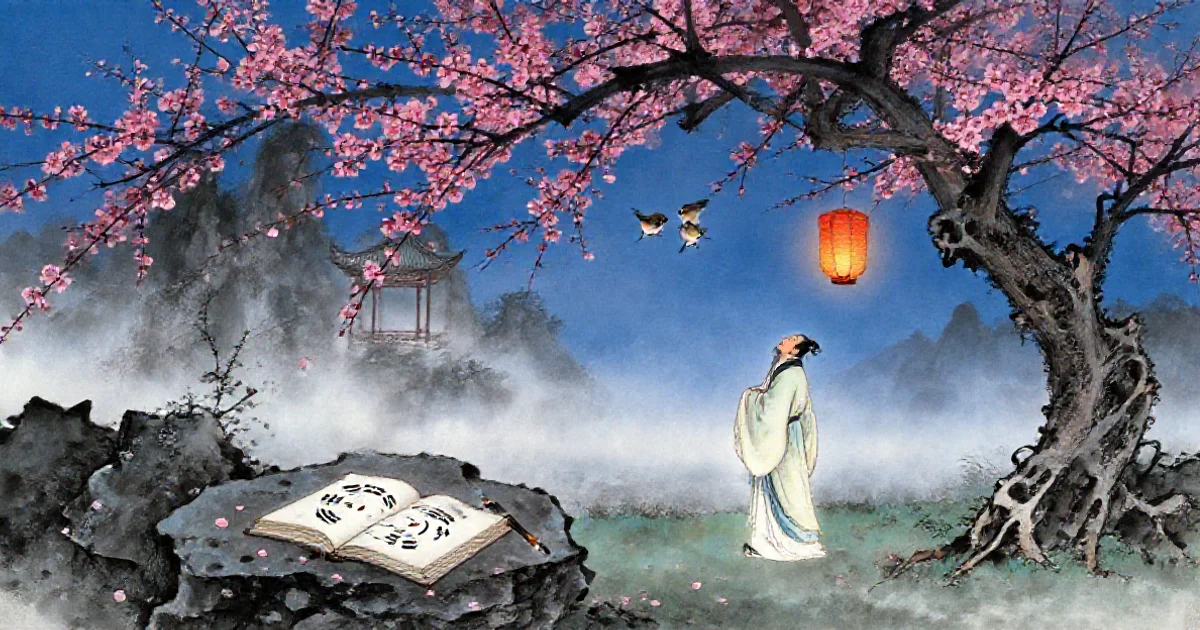
The method is attributed to Shao Yong (邵雍, 1011–1077), the Song-dynasty cosmologist who also gave us the cosmic-clock arrangement of the hexagrams. The name comes from a story. Shao Yong was watching plum blossoms when two sparrows fought over a branch and fell to the ground. He found this strange enough to be worth a reading, cast a hexagram from the moment, and predicted that the following evening a neighbor's daughter would break a flower, fall, and injure her thigh. She did.
後觀梅,以雀爭勝,布算,知次晚有鄰人女折花,墮傷其股。其卜蓋始於此,後世相傳,遂名《觀梅數》。
— 《梅花易數》序
“Later, observing the plum blossoms, he saw sparrows fighting and laid out the calculation, and knew that the next evening a neighbor's daughter would break a flower and fall, injuring her thigh. His divination began here, and later generations, passing it down, named it the Observing-the-Plum Numbers.” That is where “Plum Blossom” comes from—not a flower in the method, but the afternoon it was supposedly born.
The same preface draws the distinction that organizes the entire system. When you derive the number first and the hexagram from it, that is Earlier Heaven (先天): “以數起卦,故曰先天”— “raising the hexagram from number, therefore called Earlier Heaven.” When you start from the hexagram and read numbers out of it, that is Later Heaven (後天). Plum Blossom is the Earlier Heaven method: the number comes first, before the book even opens.
Numbers First, Hexagram Second
To cast, you need only two facts: the eight trigrams have fixed numbers, and you divide. Shao Yong's text states the numbers in one line:
乾,一;兌,二;離,三;震,四;巽,五;坎,六;艮,七;坤,八。
— 《梅花易數》卷一
| Number | Trigram | Element |
|---|---|---|
| 1 | 乾 ☰ Qián | Metal |
| 2 | 兌 ☱ Duì | Metal |
| 3 | 離 ☲ Lí | Fire |
| 4 | 震 ☳ Zhèn | Wood |
| 5 | 巽 ☴ Xùn | Wood |
| 6 | 坎 ☵ Kǎn | Water |
| 7 | 艮 ☶ Gèn | Earth |
| 8 | 坤 ☷ Kūn | Earth |
From there it is arithmetic. Take a set of numbers—say the year, month, and day—and divide their sum by eight; the remainder names the upper trigram (卦以八除, “divide by eight for the trigram”). Add the hour and divide by eight again for the lower trigram. Then divide the grand total by six; that remainder names the changing line (爻以六除, “divide by six for the line”). A remainder of zero just means the last trigram, 坤, or the sixth line.
Run the plum-blossom reading itself. The original gives the date as a 辰 (chén) year, twelfth month, seventeenth day, 申 (shēn) hour:
辰年五數,十二月十二數,十七日十七數,共三十四數,除四八三十二,餘二,屬兌,為上卦,加申時九數,總得四十三數,五八除四十,餘得三數,為離,作下卦。又上下總四十三數,以六除,六七四十二,餘一為動爻,是為澤火革。
— 《梅花易數》卷一,觀梅占
The branch 辰 is the fifth, so 5 + 12 + 17 = 34. Thirty-four minus four eights (32) leaves 2 → 兌, the upper trigram. Add the 申 hour (9) for 43; minus five eights (40) leaves 3 → 離, the lower trigram. Forty-three minus seven sixes (42) leaves 1 → line 1 moves. Upper 兌 over lower 離 is Hexagram 49, 革 Revolution; with line 1 changing it becomes Hexagram 31, 咸 Influence. No coins were thrown. The hexagram fell out of a calendar and a pair of quarreling birds.
Anything Can Be Cast
The date-and-time method is only the most familiar. The classical text lays out a whole repertoire of ways to extract numbers from the world. Each one is just a different faucet feeding the same divide-by-eight, divide-by-six machine.
- By objects—count the things in front of you and divide.
- By sound—count the cries, knocks, or words you hear; a struck drum reads as 震, a bell as 乾.
- By writing—count the brush strokes in the characters of a written question, splitting them between upper and lower.
- By color and shape—a round form is 乾, a square 坤; blue-green is 震, red is 離, black is 坎.
- By the person—who arrives, what they wear, which way they came, what part of the body they move.
One rule governs all of them, and it is the reason the sparrows mattered:
不動不占,不因事不占。
— 《梅花易數》卷一
“Without movement, do not divine; without an occasion, do not divine.” You do not cast on a whim. Something has to break the ordinary surface of things—birds fighting, a branch falling on its own, a stranger arriving with an anxious face. The anomaly is the question. Plum Blossom is less a procedure you initiate than a discipline of noticing when the world has handed you one.
Body and Function
Here is where Plum Blossom stops resembling anything else. Once the hexagram is cast, you split its two trigrams into roles. The changing line decides which is which:
動者為用,靜者為體。
— 《梅花易數》卷三
“What moves is Function; what is still is Substance.” The trigram containing the changing line is 用 (yòng), the Function—the situation, the event, the force acting on things. The other trigram is 體 (tǐ), the Substance or Body—you, the subject, the matter being asked about. In the plum reading, line 1 sits in the lower trigram 離 (fire), so fire is the Function; 兌 (metal) above is the Body.
Now you read them as elements. Fire melts metal—Function overcomes Body. The text spells out exactly what each relationship means:
體克用,諸事吉;用克體,諸事凶。體生用,有耗失之患;用生體,有進益之喜。體用比和,則百事順遂。
— 《梅花易數》卷二,體用總訣
Body overcomes Function: all matters auspicious. Function overcomes Body: all matters inauspicious. Body generates Function: there is drain and loss. Function generates Body: there is gain and joy. Body and Function in harmony (the same element): everything proceeds smoothly. The logic is simple and merciless. You want the world to feed you or yield to you; you do not want it draining you or beating you down.
In the plum reading, Function (fire) overcomes Body (metal)— inauspicious. The Body trigram 兌 also stands for a young girl, and 離 fire striking it became the injured daughter. The full reading checks the mutual trigrams (互卦) hidden in the middle lines and the transformed hexagram (變卦), which here yields 艮 (earth)—and earth generates metal, which is why the prediction was injury, not death. Substance is the subject; Function the event; the mutual trigrams the middle of the story; the changed trigram its end:
體卦為主,用卦為事,互卦為事之中間,刻應變卦為事之終。
— 《梅花易數》卷二
It Reads the Trigrams, Not the Text
This is the hard break from the I-Ching most readers know. The Wilhelm/Baynes translation, the Liu Yao system, the classical line statements—all of them read thewords. Plum Blossom mostly does not. Shao Yong's text says so directly:
先天卦斷吉凶,止以卦論,不甚用《易》之爻辭。
— 《梅花易數》卷二
“The Earlier Heaven hexagram judges fortune and misfortune purely by the trigrams; it does not much use the line texts of the Changes.” The reasoning is almost theological: in the Earlier Heaven method the number arrives before the hexagram, which means it arrives before the book—you are working with the structure of the Changes as it existed prior to anyone writing verdicts onto it. So you read what is prior to language: the five elements, their generation and control cycles, and the seasons.
The seasons matter because an element is not always equally strong. Wood thrives in spring and withers in autumn; fire rules summer; metal rules autumn; water rules winter. A Body trigram in its own season can absorb an attack; a Body trigram out of season can be finished by one. The whole reading hangs on it:
體盛則吉,體衰則凶。
— 《梅花易數》卷二
“If the Body is flourishing, fortune; if the Body is in decline, misfortune.” A hexagram is never simply good or bad. It is a small ecology—one element standing for you, the others feeding it, draining it, or attacking it, all of it tuned up or down by the time of year. Reading Plum Blossom is reading that ecology.
The Same Continent
If you came to the I-Ching through coins and the judgment text, Plum Blossom can feel like a different art entirely. It is not. It uses the same eight trigrams, the same sixty-four hexagrams, the same five elements you already know from the Changes. What it changes is the question it points them at. The standard reading asks what do the words say about this moment? Plum Blossom asks what are these elements doing to each other right now?—and it lets the moment cast itself, through a number you did not choose.
The depths go much further than one primer: ten or more casting methods, the elaborate rules for true versus apparent overcoming (a real blade cuts wood; a hairpin does not), the “Ten Responses” that fold the weather, the terrain, and the stranger in the doorway into the reading. But the engine is already here. Numbers before the hexagram. Trigrams before the text. Body against Function, tuned by the season. Once you can see that engine turning, the rest of the I-Ching tradition stops looking like one book and starts looking like a continent—and Plum Blossom is one of its stranger, more elegant countries.