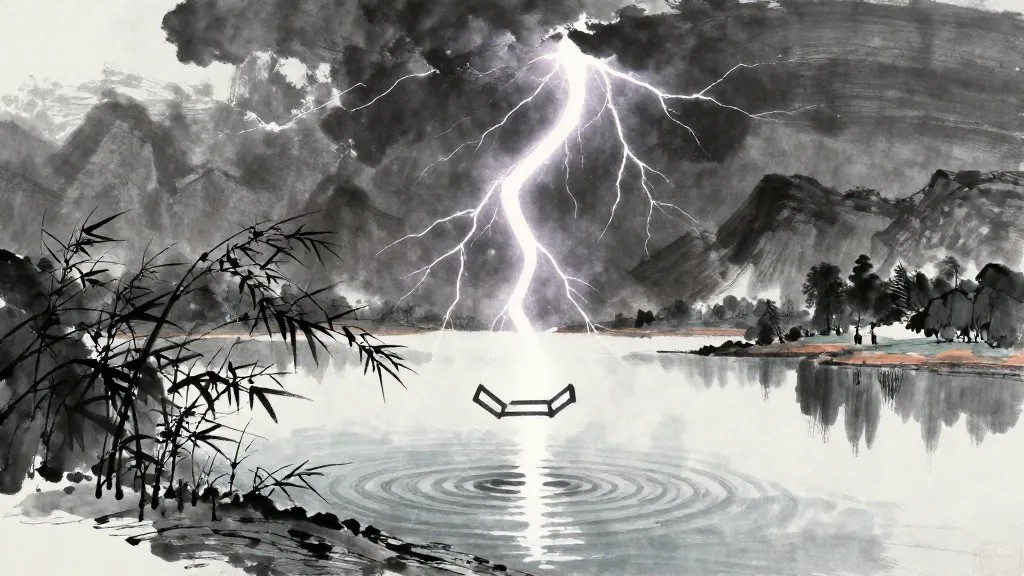
The Palace of Thunder: Zhen and Its Family
Shock, initiative, and the consequences of action — eight hexagrams on movement, adaptation, and endurance.
The Arousing Force
The third of the Eight Palaces (八宮, bā gōng) belongs to Zhen (震), the Arousing — Thunder doubled. Where Qian represents creative authority and Kun represents receptive patience, Zhen represents the moment of action itself: the shock that initiates movement, the first thunderclap of spring that wakes the sleeping earth.
The trigram Zhen (☳) consists of one yang line at the bottom, surmounted by two yin lines. It is the eldest son in the family of trigrams — the first product of yang meeting yin. Its nature is movement, initiative, arousal. The palace that bears its name traces what happens after the initial shock: how action leads to consequences, how consequences demand adaptation, and how adaptation either breaks or endures.
The Eight Hexagrams
- ䷲ Hexagram 51: 震 Zhèn (The Arousing) — Thunder doubled. Pure shock, pure initiative. The moment that changes everything.
- ䷏ Hexagram 16: 豫 Yù (Enthusiasm) — First line changes to yin. Thunder above Earth. The enthusiastic response to decisive action.
- ䷧ Hexagram 40: 解 Jiě (Deliverance) — Two lines changed. Thunder above Water. Release from tension, the storm breaking.
- ䷟ Hexagram 32: 恆 Héng (Duration) — Three lines changed. Thunder above Wind. The challenge of sustaining what was begun.
- ䷭ Hexagram 46: 升 Shēng (Pushing Upward) — Four lines changed. Earth above Wind. Gradual, steady ascent.
- ䷯ Hexagram 48: 井 Jǐng (The Well) — Five lines changed. Water above Wind. An inexhaustible source that serves all who come.
- ䷛ Hexagram 28: 大過 Dà Guò (Great Exceeding) — The soul hexagram (遊魂卦). Lake above Wind. The ridgepole bends — the structure is stressed beyond normal limits.
- ䷐ Hexagram 17: 隨 Suí (Following) — The return hexagram (歸魂卦). Lake above Thunder. Adaptation through responsive movement.
The Parent: Zhen — The Arousing
The Judgment of Hexagram 51 captures the essence of shock with remarkable compression:
震,亨。震來虩虩,笑言啞啞。震驚百里,不喪匕鬯。
The Arousing. Success. Shock comes — terror, terror! Then laughing words — ha, ha! The shock terrifies for a hundred li, yet one does not let fall the sacrificial spoon and chalice.
The sequence within this single judgment tells the full story: first terror (虩虩, xì xì), then recovery (笑言啞啞, laughing words), then the proof of character — the shock resounds for a hundred li (roughly fifty kilometers), yet the officiant at the sacred ritual does not drop the implements. The person who has cultivated genuine composure is not the one who never feels fear. It is the one who feels fear and continues the ceremony.
This is Zhen's deepest teaching: shock is not the enemy. It is the catalyst. “When a man has learned within his heart what fear and trembling mean,” the commentary explains, “he is safeguarded against any terror produced by outside influences.”
From Shock to Endurance: Yu, Jie, and Heng
Hexagram 16 (豫 Yù, Enthusiasm) is what happens when shock meets receptivity. Thunder breaks out of the earth — the first thunderstorm of spring. The Judgment says it is “beneficial to install feudal lords and set armies marching” (利建侯行師). This is the energy of mobilization, the moment when decisive action can rally mass support. The ancient kings used music to channel this energy; the Image text notes that “the former kings made music and honored virtue.”
Hexagram 40 (解 Jiě, Deliverance) represents release. Thunder above Water — the thunderstorm clears the air after a period of tension. The Judgment counsels that after deliverance, “if there is still something where one has to go, hastening brings good fortune.” But if there is nothing left to do, the wise course is to return to normal conditions promptly. Deliverance is a transition, not a destination.
By Hexagram 32 (恆 Héng, Duration), the palace reaches its central challenge: how to sustain what was begun. Thunder above Wind — movement and penetration working together. The Judgment:
恆,亨,无咎,利貞。利有攸往。
Duration. Success. No blame. Perseverance is beneficial. It is beneficial to have somewhere to go.
Duration is not mere persistence. The Image text says: “Thunder and wind: Duration. The noble person stands firm and does not change direction” (雷風,恆。君子以立不易方). But the hexagram's lines make clear that duration means adapting your method while keeping your purpose constant. Line 1 warns against digging too deep too soon. Line 4 says “no game in the field” — even persistent effort fails when applied in the wrong place.
The Depths: Jing — The Well
Hexagram 48 (井 Jǐng, The Well) is one of the I Ching's most powerful images. Water above Wind — the wind-driven water that rises through the well. The Judgment:
井,改邑不改井。无喪无得,往來井井。
The Well. The city may be moved, but the well cannot be moved. It neither decreases nor increases. They come and go and draw from the well.
Dynasties rise and fall, populations shift, cities are relocated — but the well remains. It gives to all who come and is not depleted. This is the image of an inexhaustible resource, whether understood as a natural spring, a principle of governance, or a practice of cultivation. In the context of the Zhen palace, it represents what thunder's initiative ultimately produces when sustained through duration: a source so deep it cannot be exhausted.
The Yilin verse for the Well transforming to Great Exceeding carries a darker undertone:
羿張鳥號,穀射驚狼。鐘鼓夜鳴,將軍壯心。
Yi draws his bow, birds cry out; arrows in the valley startle wolves. Drums and bells sound in the night — the general's heart is bold.
Even the well's depths can be disturbed. The mythical archer Yi represents the kind of force that disrupts established order — a warning as the palace moves toward its crisis point.
The Crisis: Daguo — Great Exceeding
Hexagram 28 (大過 Dà Guò, Great Exceeding) is the soul hexagram of the Zhen palace — the point of maximum stress. Lake above Wind, with four yang lines in the center flanked by yin at top and bottom. The ridgepole bends (棟橈, dòng náo). The structure is overloaded.
This is the consequence of sustained initiative without adequate support. The thunderclap that began the palace has generated so much momentum that the framework can barely contain it. The Judgment says “it is beneficial to have somewhere to go” — extraordinary times require extraordinary action. Standing still under a bending ridgepole is not wisdom; it is paralysis.
The Resolution: Sui — Following
The palace concludes with Hexagram 17 (隨 Suí, Following), the return hexagram. Lake above Thunder. The lower trigram restores itself to Zhen. But now, instead of initiating action, thunder submits to the joyous stillness of the lake above. The Judgment:
隨,元亨,利貞,无咎。
Following. Sublime success. Perseverance furthers. No blame.
Following is the mature form of initiative. Having learned through shock, enthusiasm, deliverance, duration, and crisis, the person of action discovers that the highest form of leadership is knowing when to follow — to adapt to circumstances rather than forcing them. The Yilin verse for Zhen transforming to Sui captures the resolution:
江河淮海,天之與府。衆利所聚,可以富有,安樂無(憂)。
The rivers Jiang, He, Huai, and the sea — Heaven's storehouses. Where all benefits gather, one can have abundance, peace and joy without worry.
All the great rivers converge. The shock that began as a single thunderclap becomes a vast confluence of resources. Initiative, properly sustained and adapted, produces not destruction but abundance.
Reading the Zhen Palace in Practice
Hexagrams from the Zhen palace speak to situations involving action, decisiveness, and their consequences. They appear when something has been set in motion — or when something needs to be.
If Zhen itself appears, prepare for sudden change and meet it with composure. Yu (Enthusiasm) signals that the time is right to mobilize. Jie (Deliverance) says the crisis has passed — act quickly on remaining tasks, then normalize. Heng (Duration) asks whether you can sustain what you have started. Sheng (Pushing Upward) counsels steady, incremental advance. Jing (The Well) points to an inexhaustible source. Daguo (Great Exceeding) warns that the structure is overstressed — act boldly or it collapses. And Sui (Following) teaches that the highest initiative is adaptive response.
The Six Lines app provides the complete classical text and line-by-line commentary for every hexagram in this palace. When you encounter a Zhen palace hexagram in a reading, knowing its place in the sequence — from initial shock through endurance to adaptive following — helps you understand not just what the hexagram says, but where it sits in the larger story of action and consequence.