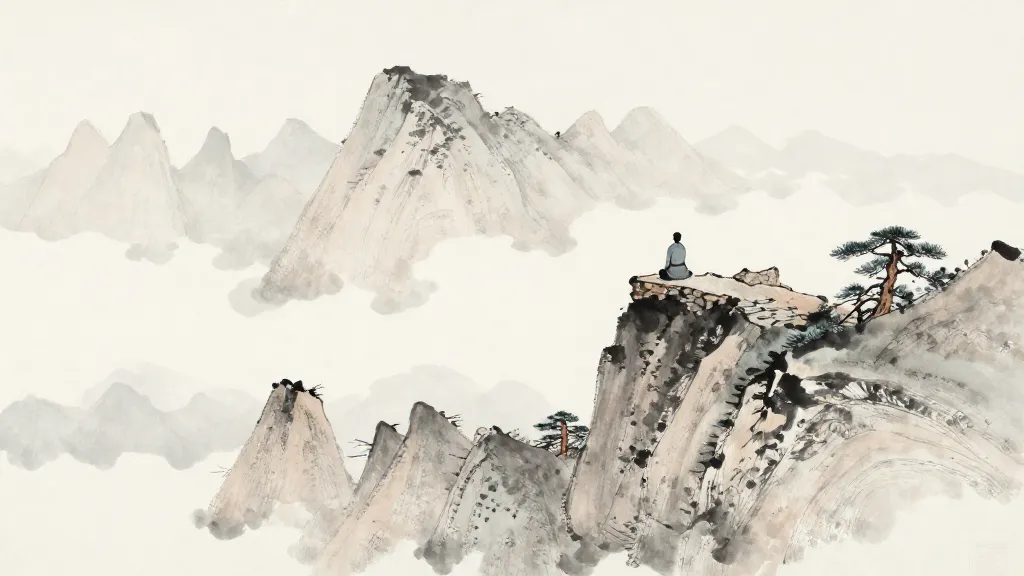
The Palace of Mountain: Gen and Its Family
Stillness, contemplation, and the discipline of knowing when to stop. Eight hexagrams on accumulation, decrease, treading carefully, and the power of gradual progress.
The Nature of Mountain
The Mountain trigram, Gen (艮), represents the most underrated power in the I Ching: the power of stopping. Its structure is one yang line on top, two yin lines below — movement that has reached its peak and become still. The mountain does not advance. It does not retreat. It simply is, and everything around it must reckon with its presence.
The Judgment of ䷳ Hexagram 52: 艮 Gen (Keeping Still) is unusual in its concreteness: 艮其背不獲其身行其庭不見其人無咎 — "Keeping his back so still that he no longer feels his body. He goes into his courtyard and does not see his people. No blame." The back is the part of the body you cannot see. Stillness here means quieting the restless mind that always wants to turn around and look. When you are truly still, even what is directly in front of you does not disturb you.
The Image text reinforces this: 兼山,艮。君子以思不出其位 — "Mountains standing close together. Do not permit your thoughts to go beyond your situation." The heart thinks constantly. That cannot be changed. But thoughts should restrict themselves to the immediate situation. This is not suppression — it is focus.
The Eight Palaces Progression
The Gen palace moves from pure stillness into the complex territory of what stillness makes possible. The sequence: ䷳ 52 艮 Gen, ䷕ 22 賁 Bi, ䷙ 26 大畜 Daxu, ䷨ 41 損 Sun, ䷥ 38 睽 Kui, ䷉ 10 履 Lv, ䷼ 61 中孚 Zhongfu, and ䷴ 53 漸 Jian. From stillness to adornment, great accumulation, strategic decrease, opposition, careful treading, inner truth, and finally gradual development — the arc traces how the contemplative mind engages with the world without losing itself.
Daxu: The Great Accumulation
䷙ Hexagram 26: 大畜 Daxu (Great Taming) places Mountain above Heaven. Think about that image: the creative force of Heaven, restrained and held within the mountain. The Judgment reads: 大畜利貞不家食吉利涉大川 — "Persistence is rewarding. Not eating at home brings good fortune. It is favorable to cross the great water."
The Image text is one of the I Ching's clearest statements on education: 天在山中,大畜。君子以多識前言往行,以畜其德 — "Heaven within the mountain. Study the words and deeds of the past to strengthen your character." The commentary adds: "History isn't academic; it's practical. The patterns repeat. Learning them makes you capable." This is accumulation not of wealth but of wisdom and moral strength. The mountain holds Heaven within it — vast power, contained, available when needed.
Lv: Treading on the Tiger's Tail
䷉ Hexagram 10: 履 Lv (Treading) gives us one of the I Ching's most vivid images. The Judgment: 履虎尾不咥人亨 — "Treading upon the tail of the tiger. It does not bite. Success." Heaven above, Lake below — the joyous treads upon the strong and gets away with it. Not because the tiger is tame, but because the conduct is correct.
The situation is genuinely dangerous. The Image text prescribes: 上天下澤,履。君子以辯上下,定民志 — "Heaven above, lake below. The person of character discriminates between high and low, clarifying distinctions." Knowing where you stand in relation to power is the prerequisite for surviving contact with it. The commentary says: "Your manner, not your strength, determines the outcome." This hexagram belongs to the Mountain palace because the skill it describes — measured, precise, aware conduct — is rooted in the stillness and self-awareness that Gen teaches.
Jian: Gradual Progress
The palace closes with ䷴ Hexagram 53: 漸 Jian (Development), Wind above Mountain. The Judgment: 漸女歸吉利貞 — "The maiden is given in marriage. Good fortune. Persistence furthers." The image is of a tree growing on a mountain, visible from afar, developing slowly according to its own nature. The commentary: "It does not shoot up like a swamp plant; it grows slowly, standing firmly rooted."
Gradual progress is the Mountain palace's ultimate teaching. After stillness, after accumulation, after learning to tread carefully — the result is not explosive breakthrough but steady, visible, organic growth. The Image text says: 山上有木,漸。君子以居賢德善俗 — "On the mountain, a tree. Abide in dignity and virtue to improve the mores." Influence happens naturally when character is rooted.
A Voice from the Forest of Changes
The Jiao Shi Yi Lin verse for the transformation from Gen (艮) to Qian (乾) reads:
憂驚已深,禍不爲災。安全以來。
"Worry and alarm have already run deep, but the misfortune does not become a disaster. Safety comes." The verse captures the Mountain palace's quiet promise. The danger was real. The anxiety was justified. But because stillness held — because the response was measured rather than panicked — the catastrophe did not materialize. Safety arrives not through dramatic rescue but through the simple endurance of staying still when everything urged flight.
The Palace in Practice
When hexagrams from the Gen palace appear in a reading, the counsel tends toward restraint, patience, and careful observation. Bi (賁) says that grace and adornment have their place, but only in small matters — beauty clarifies, it does not decide. Sun (損), Decrease, teaches that strategic reduction can be a form of increase — 山下有澤 — the lake at the mountain's foot nourishes through evaporation. Kui (睽), Opposition, counsels working in small matters when larger collaboration is impossible. And Zhongfu (中孚), Inner Truth, says that sincerity powerful enough to influence even pigs and fishes — the least intelligent creatures — comes from genuine emptiness at the center, not from force.
The Mountain palace is for those moments in life when the most powerful thing you can do is nothing — or more precisely, when the most powerful thing you can do is be still, observe, accumulate, and wait for the organic moment to move. The complete hexagram reference on Six Lines provides the full Chinese text, character breakdowns, and commentary for all eight hexagrams of the Gen palace. Let the mountain teach you: not everything that matters moves fast.