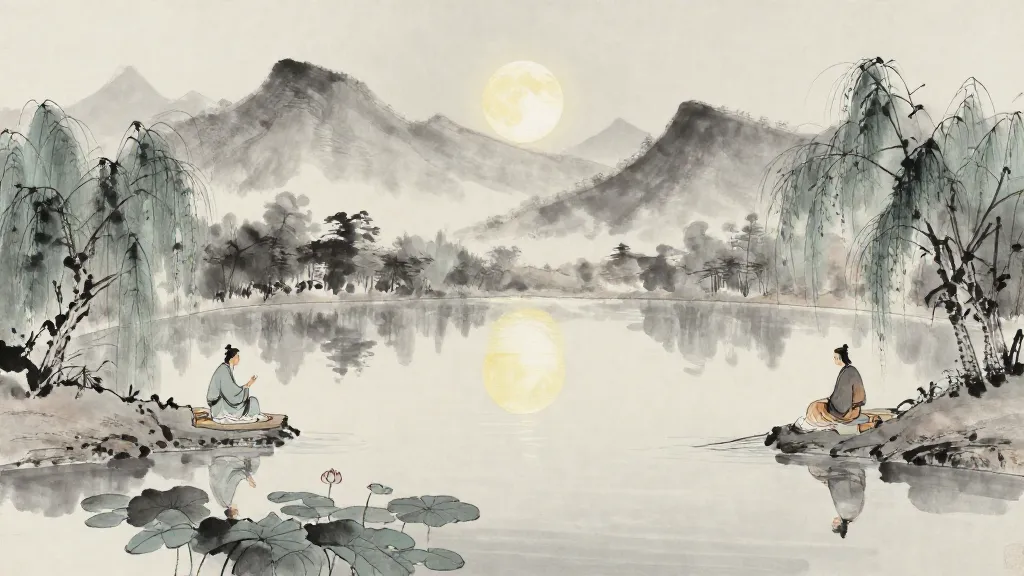
The Palace of Lake: Dui and Its Family
Joy, exchange, and the open surface that hides depth below. Eight hexagrams on exhaustion, gathering, mutual influence, obstruction, and humility as the master strategy.
The Nature of Lake
The Lake trigram, Dui (兌), is the trigram of joy. Its structure is two yang lines below with a yin line on top — strength at the foundation, openness at the surface. The lake receives. It reflects. It communicates freely with the sky above. But a lake without depth is a puddle, and joy without substance is frivolity. The tension between surface and depth runs through every hexagram in this palace.
The Judgment of ䷹ Hexagram 58: 兌 Dui (The Joyous) is brief: 兌亨利貞 — "Success. Persistence is favorable." True joy rests on firmness within, manifesting outwardly as yielding and gentle. The commentary warns: "Joy must be based on steadfastness if it is not to degenerate into uncontrolled mirth."
The Image text gives the practical application: 麗澤,兌。君子以朋友講習 — "Lakes resting one on the other. Join with friends for discussion and practice." Two lakes connected do not dry up as quickly as one alone. Knowledge shared between friends replenishes both. This is joy's highest form — not solitary pleasure but mutual enrichment.
The Eight Palaces Progression
The Dui palace contains: ䷹ 58 兌 Dui, ䷮ 47 困 Kun, ䷬ 45 萃 Cui, ䷞ 31 咸 Xian, ䷦ 39 蹇 Jian, ䷎ 15 謙 Qian, ䷽ 62 小過 Xiaoguo, and ䷵ 54 歸妹 Guimei. The arc is striking: from joy, immediately into exhaustion, then gathering, mutual attraction, obstruction, humility, small excess, and the difficult position of the marrying maiden. Joy in this palace is not naive. It knows what follows celebration.
Kun: Exhaustion
䷮ Hexagram 47: 困 Kun (Oppression) follows Dui directly — the lake drained dry. Lake above, Water below. The water has seeped out through the bottom. The Judgment: 困亨貞大人吉無咎有言不信 — "Success. Perseverance. The great person brings good fortune. No blame. When one has something to say, it is not believed."
That last phrase is the cruelest detail. You are exhausted, and when you speak, no one believes you. The Image text is fierce: 澤無水,困。君子以致命遂志 — "The lake without water. Stake your life on following your will." When the water has drained, the lake must simply endure being dry. There is nothing to do but acquiesce and hold to your purpose. The commentary says: "Adversity is the reverse of success but can lead to success if it befalls the right person." Kun is the test that separates character from circumstance.
Qian: Modesty
䷎ Hexagram 15: 謙 Qian (Modesty) is the single most consistently positive hexagram in the I Ching. Every one of its six lines is favorable. The Judgment: 謙亨君子有終 — "Modesty creates success. The person of character carries things through to completion."
The Image text reveals its structure: 地中有山,謙。君子以裒多益寡,稱物平施 — "Within the earth, a mountain. Reduce what is too much and increase what is too little, weighing things to create balance." A mountain hidden within the earth — great power that does not display itself. The commentary explains why this works universally: "Heaven empties fullness and fills modesty. Earth transforms fullness and flows toward the modest. Spirits harm the full and bless the modest." Every force in the cosmos favors modesty over display. That this hexagram belongs to the Lake palace — the palace of joyful openness — makes sense: genuine humility is not grim self-denial but the lightest, most sustainable way to move through the world.
Xian: Mutual Influence
䷞ Hexagram 31: 咸 Xian (Influence) places Lake above Mountain — the yielding above the still, openness resting on solidity. The Judgment: 咸亨利貞取女吉 — "Success. Persistence furthers. Taking a wife brings good fortune." Mutual attraction as a cosmic law. The strong places itself below the yielding, and genuine connection becomes possible.
The Image: 山上有澤,咸。君子以虛受人 — "A lake on the mountain. Keep your mind humble and receptive." The commentary is pointed: "People stop advising someone who already knows everything. Openness invites influence; rigidity repels it." Xian teaches that influence is not something you exert — it is something you allow by making yourself empty enough to receive. This is the Lake's deepest lesson: the open surface is not weakness. It is the condition for connection.
A Voice from the Forest of Changes
The Jiao Shi Yi Lin verse for the transformation from Dui (兌) to Qian (乾) reads:
踐履尼難,脫去危患。入福喜門,見諸大君。
"Treading through obstacles and difficulty, escaping danger and peril. Entering the gate of good fortune and joy, meeting the great lord." The verse traces the full arc of the Dui palace in four lines — difficulty first, then escape, then joy, then encounter with greatness. It echoes the palace's own progression from Dui through Kun's exhaustion and Jian's obstruction, arriving finally at something worth celebrating. The joy at the end is earned, not given.
The Palace in Practice
When hexagrams from the Dui palace appear in a reading, the themes oscillate between connection and isolation, fullness and emptiness, joy and its shadow. Cui (萃), Gathering, warns that where people collect, strife follows — renew your defenses. Jian (蹇), Obstruction, counsels turning inward when the path forward is blocked: "Difficulties throw you back upon yourself. The inferior person blames others. The superior person seeks the error within." Xiaoguo (小過), Small Exceeding, advises that small things may be done but great things should not — stay low, like a bird whose message is best delivered close to the ground. And Guimei (歸妹), the Marrying Maiden, cautions that entering a subordinate position requires understanding that it is transitory: 君子以永終知敝 — "Understand the transitory in the light of the eternity of the end."
The Lake palace teaches that joy is real but not permanent, that openness creates vulnerability as well as connection, and that the most durable strategy is not brilliance or force but humility. Hexagram 15 stands at the center of this palace like a hidden mountain within the earth — the quiet truth that modesty succeeds where everything else eventually fails.
The complete hexagram reference on Six Lines includes the original text, character-by-character analysis, and commentary for all eight hexagrams of the Dui palace and the full sixty-four. When these hexagrams appear in your readings, let the lake teach you: stay open at the surface, keep your depth, and remember that the truest joy comes from exchange, not accumulation.