The Palace of Fire: Li and Its Family
Clarity, illumination, civilization — and what happens when clarity is incomplete. The wanderer, the cauldron, youthful folly, and the fellowship of those who see.
The Nature of Fire
Fire clings. That is its defining quality. Unlike water, which seeks the lowest point, fire needs something to attach to — fuel, a wick, a surface. Without something to illuminate, fire ceases to exist. The trigram Li (離) is built with a yin line between two yang lines: solid, broken, solid. Brightness on the outside, emptiness at the center. The structure itself is a teaching: clarity depends on receptivity within.
The Judgment of ䷝ Hexagram 30: 離 Li (The Clinging Fire) reads: 離利貞亨畜牝牛吉 — "Persistence is rewarding. Success. Care of the cow brings good fortune." The cow is the symbol of docile receptivity. Fire's brilliance must be anchored by something patient and yielding, or it burns itself out. The commentary puts it plainly: "Fire depends on what it burns — without fuel, no flame. Consciousness depends on what it attaches to."
The Eight Palaces Progression
The Li palace unfolds from Fire doubled into eight hexagrams that explore every dimension of clarity and its absence. The sequence: ䷝ 30 離 Li, ䷷ 56 旅 Lv, ䷱ 50 鼎 Ding, ䷿ 64 未濟 Weiji, ䷃ 4 蒙 Meng, ䷺ 59 渙 Huan, ䷅ 6 訟 Song, and ䷌ 13 同人 Tongren. From pure illumination, through wandering and cultural transformation, to incomplete understanding, youthful confusion, dispersion, conflict, and finally fellowship — the arc traces what happens when light encounters the real world.
Ding: The Cauldron
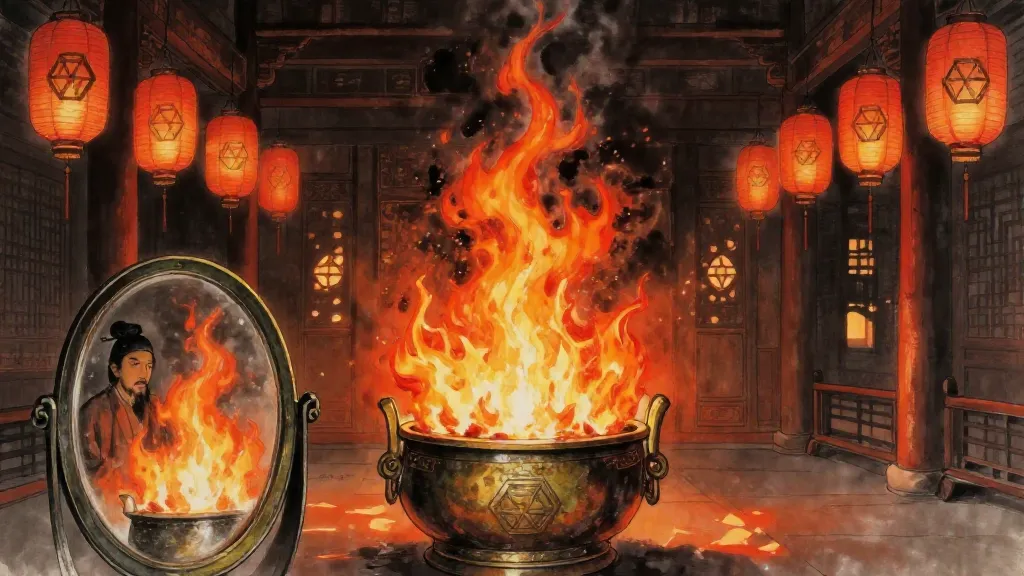
䷱ Hexagram 50: 鼎 Ding (The Cauldron) is one of the I Ching's most affirmative hexagrams. Fire above, Wood below. The Judgment is concise: 鼎元吉亨 — "Supreme good fortune. Success." The cauldron is the ritual vessel, the instrument of civilization. Wood feeds fire, and the fire transforms raw material into nourishment, both physical and spiritual.
The Image text reads: 木上有火,鼎。君子以正位凝命 — "Fire over wood: the Cauldron. The person of character consolidates fate by making their position correct." The commentary elaborates: "The fate of fire depends on wood; as long as there is wood below, the fire burns above. In human life, there is likewise a fate that lends power to life." Ding represents culture at its best — the transformation of raw resources into something that sustains and elevates. In a reading, it signals that conditions are right for meaningful work that will endure.
Meng: Youthful Folly
䷃ Hexagram 4: 蒙 Meng (Youthful Folly) places Mountain above Water — a spring emerging at the base of a mountain, not yet knowing where it will flow. Its Judgment is one of the most quoted passages in the I Ching: 蒙亨匪我求童蒙童蒙求我初筮告再三瀆瀆則不告利貞 — "Success. It is not I who seek the young fool; the young fool seeks me. At the first oracle I inform him. If he asks two or three times, it is importunity. If he importunes, I give him no information."
The directness is startling. The teacher does not chase the student. The oracle does not repeat itself for the anxious. Ask once with sincerity and receive an answer. Ask repeatedly and you are no longer inquiring — you are demanding reassurance, which is a different thing entirely. The Image text captures the developmental principle: 山下出泉,蒙 — "A spring wells up at the foot of the mountain." The spring does not know its destination, only that it must flow. Character develops the same way — thoroughly, filling each hollow before advancing.
Weiji: Before Completion
The I Ching ends with ䷿ Hexagram 64: 未濟 Weiji (Before Completion), and it belongs to the Fire palace. Fire above, Water below — the two elements moving apart, never meeting. The Judgment warns: 未濟亨小狐汔濟濡其尾無攸利 — "Success. But if the little fox, after nearly completing the crossing, gets his tail in the water, there is nothing that would further."
That the I Ching chooses incompletion as its final word is profoundly deliberate. The book does not end with resolution. It ends with the recognition that every crossing is still in progress, every achievement is provisional. The Image text counsels: 君子以慎辨物居方 — "Be careful in the differentiation of things, so that each finds its place." Clarity — the gift of the Fire palace — is most needed precisely when things are not yet finished.
A Voice from the Forest of Changes
The Jiao Shi Yi Lin offers a verse for the transformation from Li (離) to Kun (坤) — from pure fire to pure earth:
春秋禱祀,解禍除憂。君子无咎。
"In spring and autumn, prayers and offerings dissolve misfortune and dispel worry. The person of character is without blame." The verse connects fire's clarity to ritual practice — the seasonal prayers that acknowledge dependence on forces larger than oneself. When fire meets earth, illumination becomes grounded. Insight becomes action. The worry dissolves not because the danger disappears, but because the response is correct.
The Palace in Practice
Hexagrams from the Li palace share a concern with seeing clearly and acting on what you see. Lv (旅), the Wanderer, counsels the stranger to be modest and observant — "When a stranger, you should not be gruff or overbearing." Song (訟), Conflict, warns that believing you are right does not mean you should push through to the end. Huan (渙), Dispersion, says that what has frozen must be gently thawed. And Tongren (同人), Fellowship, affirms that true community is built on universal concern, not private interest — 同人于野亨 — "Fellowship in the open succeeds."
The through-line is that clarity is not passive. It demands something of you. Fire illuminates, but it also tests what it touches. In divination practice, drawing a hexagram from the Li palace is an invitation to look more carefully, to distinguish true from false, to ask whether what you see is the whole picture or only the part that flatters.
The complete hexagram reference on Six Lines provides the original Chinese, character analysis, and classical commentary for every hexagram in the Li palace. Fire's lesson is simple but demanding: attach your brightness to what is real, and let it illuminate without consuming.