The Palace of Earth: Kun and Its Family
How the receptive builds strength through yang accumulation — patience, timing, and the reversal from weakness to power.
The Mirror of Heaven
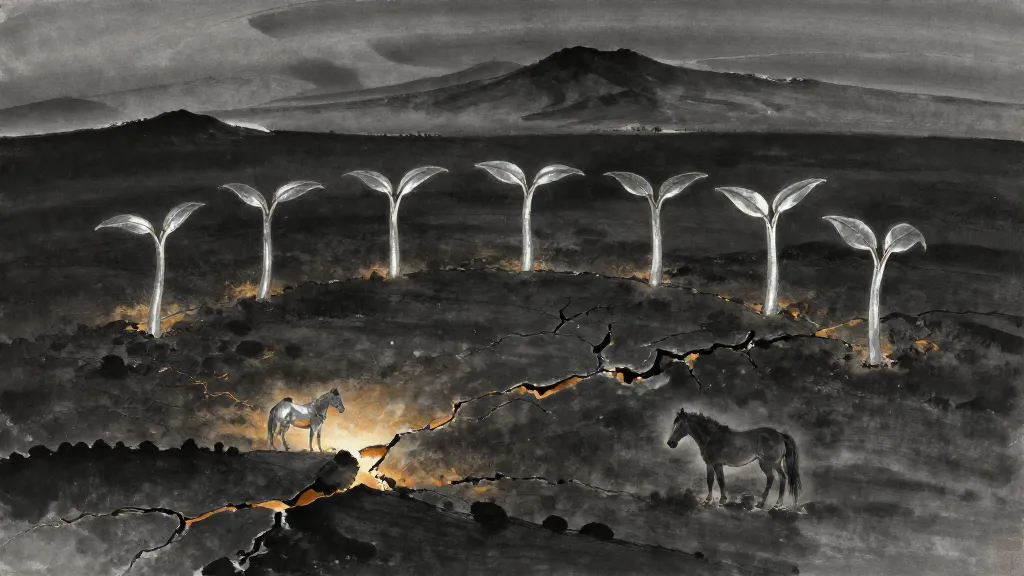
If the Qian palace tells the story of creative force declining, the Kun palace tells the opposite story: receptive ground gathering strength. Where Qian begins with six yang lines and watches yin infiltrate from below, Kun begins with six yin lines and watches yang enter from below, building power one line at a time until the situation transforms.
This is the second of the Eight Palaces (八宮, bā gōng), governed by ䷁ Hexagram 2: 坤 Kūn (The Receptive). Earth doubled. The progression that follows is one of the most practically useful sequences in the I Ching, because it maps the transition from powerlessness to influence — and warns precisely where that transition becomes dangerous.
The Eight Hexagrams
- ䷁ Hexagram 2: 坤 Kūn (The Receptive) — Pure yin. Six broken lines. The ground that receives, nurtures, and sustains.
- ䷗ Hexagram 24: 復 Fù (Return) — One yang line enters at the bottom. Thunder beneath Earth. The first stirring of new life.
- ䷒ Hexagram 19: 臨 Lín (Approach) — Two yang lines. Lake beneath Earth. Growing strength approaches from below.
- ䷊ Hexagram 11: 泰 Tài (Peace) — Three yang below, three yin above. Heaven and Earth in perfect communion. The golden mean.
- ䷡ Hexagram 34: 大壯 Dà Zhuàng (Great Power) — Four yang lines. Thunder above Heaven. Strength in abundance — and the temptation to overuse it.
- ䷪ Hexagram 43: 夬 Guài (Breakthrough) — Five yang lines. One yin remains at the top. The decisive moment of resolution.
- ䷄ Hexagram 5: 需 Xū (Waiting) — The soul hexagram (遊魂卦). Water above Heaven. The reversal point — strength that has grown must now learn patience.
- ䷇ Hexagram 8: 比 Bǐ (Holding Together) — The return hexagram (歸魂卦). Water above Earth. Unity achieved through receptive alliance.
The Parent: Kun — The Receptive
The Judgment of Hexagram 2 is the longest of any hexagram, reflecting the complexity of receptive virtue:
坤:元亨,利牝馬之貞。君子有攸往,先迷後得,主利。西南得朋,東北喪朋。安貞吉。
The Receptive: Sublime Success, benefiting through the perseverance of a mare. The noble person has somewhere to go. Going first leads to confusion; following leads to finding the way. Gaining companions in the southwest, losing companions in the northeast. Peaceful perseverance brings good fortune.
The mare (牝馬, pìn mǎ) is the key image: strong, enduring, but following rather than leading. This is not weakness. The Earth carries everything; it simply does not initiate. “Going first leads to confusion; following leads to finding the way” (先迷後得) is Kun's essential counsel: receptivity is a strategy, not a default.
The Image text echoes this:
地勢坤。君子以厚德載物。
The Earth's disposition is receptive. The noble person, with generous virtue, carries all things.
“Generous virtue carries all things” (厚德載物) is inscribed on the gate of Tsinghua University. It describes not passive yielding but the capacity to hold, sustain, and support — which requires a different kind of strength than Qian's ceaseless vigor.
The First Stirring: Fu — Return
Hexagram 24 (復 Fù, Return) is one of the most celebrated hexagrams in the entire system. A single yang line appears at the bottom of five yin lines — Thunder beneath Earth. The first movement of the creative force, stirring in the depths. Its Judgment:
復,亨。出入无疾。朋來无咎。反復其道,七日來復。利有攸往。
Return. Success. Going out and coming in without affliction. Companions come, no blame. Returning and repeating on the Way — in seven days comes the return. It is beneficial to have somewhere to go.
The “seven days” (七日) refers to the cyclic nature of change: from pure yang (Qian) through six stages of decline, the seventh brings return. This is not mystical numerology but a structural observation — in the palace system, Qian's decline through six hexagrams leads precisely to Fu, where yang reappears. The winter solstice was traditionally associated with this hexagram: the longest night, followed by the first increment of returning light.
The Image text gives practical counsel: “Thunder within the earth: Return. The ancient kings on the day of the solstice closed the passes. Merchants and travelers did not go abroad, and the ruler did not inspect the regions.” When new life first stirs, do not disturb it. Protect the nascent force.
The Apex: Tai — Peace
The palace's midpoint is Hexagram 11 (泰 Tài, Peace), perhaps the most auspicious hexagram in the entire I Ching. Heaven below, Earth above — their natural energies move toward each other. Yang ascends to meet yin descending. Everything connects.
泰,小往大來,吉亨。
Peace. The small departs, the great arrives. Auspicious and pervasive.
Kong Yingda notes that although Tai represents “the utmost of pervasion,” it does not possess all four virtues of Qian (元亨利貞). Why? Because “when things are greatly pervading, they often lose their proper measure.” Even at the peak of harmony, the risk of excess exists. The Image text responds: the ruler must “regulate and complete the Way of Heaven and Earth” (財成天地之道) — active management is needed precisely when things seem to be going perfectly.
The Yilin verse for Tai transforming to Da Zhuang captures this moment with a vivid image:
水流趣下,遠至東海。求我所有,買鮪得鯉。
Water flows downhill, far to the Eastern Sea. Seeking what I have, I buy tuna but get carp.
Even in abundance, what you receive may differ from what you sought. The receptive path accepts what comes.
Beyond the Peak: Breakthrough and Patience
After Tai, yang continues to grow. By Hexagram 34 (大壯 Dà Zhuàng, Great Power), four yang lines fill the lower hexagram and push into the upper. Thunder above Heaven — enormous energy. The danger here is not weakness but uncontrolled strength. The Judgment warns that “persistence in correctness” is needed precisely when power is greatest.
Hexagram 43 (夬 Guài, Breakthrough) is the penultimate stage: five yang lines pressing against the last remaining yin at the top. Lake above Heaven — water about to overflow. The Judgment counsels that the breakthrough must be announced openly, from the royal court. Resolution requires transparency; if it is done through force or secrecy, the eliminated element will return.
Then comes the reversal. Hexagram 5 (需 Xū, Waiting) is the soul hexagram of the Kun palace — the point where the ascending pattern breaks. Water above Heaven. The creative force, having built to nearly full strength, must now wait. “With sincerity, there is brilliant success. Perseverance brings good fortune. It is beneficial to cross the great water.” After all that building of power, the lesson is patience.
The Return Home: Bi — Holding Together
The palace concludes with Hexagram 8 (比 Bǐ, Holding Together), the return hexagram. Water above Earth — the image of streams flowing together, converging into rivers, forming bonds. The lower trigram restores itself to Kun. The Judgment says:
比,吉。原筮元永貞,无咎。不寧方來,後夫凶。
Holding Together. Good fortune. Inquire of the oracle once again: does one possess sublimity, constancy, and perseverance? Then no blame. Those who are uncertain gradually come. Whoever comes too late meets misfortune.
The Yilin verse for Kun transforming to Bi distills the palace's entire arc:
孔德如玉,出于幽谷。飛上喬木,鼓其羽翼,輝光照。
Virtue like jade, emerging from a dark valley. It flies up to the tall tree, beats its wings, and its radiance shines.
From the dark valley of Kun's pure yin, through the gradual accumulation of strength, to radiant flight. The receptive does not remain passive — it gathers force until the moment is right, then rises.
Reading the Kun Palace in Practice
Hexagrams from the Kun palace address situations where you are not yet in a position of power. They speak to the process of building: gathering resources, forming alliances, waiting for the right moment. The palace teaches that receptivity is not resignation. It is the disciplined accumulation of strength.
If Fu appears in a reading, something is beginning to return — protect it; do not rush it. Lin signals that influence is growing and can be exercised with care. Tai says the conditions are ideal, but warns against complacency. Da Zhuang and Guai mark the point where accumulated strength must be deployed wisely or it becomes destructive. Xu counsels that even the powerful must sometimes wait. And Bi reminds that the ultimate strength lies in genuine unity.
The Six Lines hexagram reference includes the full classical text and commentary for each hexagram in this palace. Understanding them as a family — rather than isolated figures — reveals the I Ching's teaching on how receptive power works: slowly, steadily, and with the patience that only genuine strength can sustain.