上卦
坎 Kǎn
Water — Abysmal
下卦
坤 Kūn
Earth — Receptive
经典文本
卦旨
Bi is not mere togetherness. It is the specific structural problem of how individuals cohere around a center — what makes alliance hold and what makes it collapse. The hexagram shows Water (Kan) above Earth (Kun): water spreading across the earth's surface, finding every depression, filling every gap, clinging to the ground by natural law rather than external force. This is cohesion through complementarity, not through command. Unlike Shi (The Army), where organization flows downward from a leader, Bi describes the lateral movement of people toward a center they recognize as genuine. The judgment's most unusual feature is its demand for self-examination: 原筮,元永貞,无咎 — "consult the oracle again; is there sublimity, constancy, and perseverance? Then no blame." Before gathering others, the would-be center must ask whether it possesses the qualities that justify others' allegiance. This is unprecedented in the I-Ching — a hexagram that questions whether you have earned the situation it describes. The warning 不寧方來,後夫凶 — "those who are restless gradually arrive; whoever comes too late meets misfortune" — establishes that alliance has a window. Cohesion forms at a specific moment; those who hesitate past the moment of crystallization find the structure already set, the relationships already formed, the door closed. The fifth line reveals the hexagram's deepest principle: 顯比,王用三驅,失前禽 — "manifest holding together; the king hunts with beaters on three sides only, letting the game that runs off in front escape." The royal hunt deliberately leaves one side open. Those who wish to leave may leave. True alliance cannot be compelled — it must be voluntary, and the willingness to let people go is precisely what makes those who stay trustworthy. Bi's goal is not the maximization of the group but the integrity of the bond. It regulates the formation of genuine community by insisting that cohesion without freedom is captivity, and that the center must deserve its position before expecting anyone to gather around it.
彖辞
Resolves well. Consult the oracle again: supreme, lasting sustained orientation. No fault. Those without peace come directly. The latecomers: adverse. Joining together resolves well — but check again. The text is so serious it tells you to re-consult the oracle, which it almost never does. People who need belonging will arrive on their own. The ones who show up late? Adverse. There's a window for joining and it closes.
象辞
Water upon the earth: holding together. The ancient kings accordingly established the many realms and made allies of the lords. Water on earth flows to where the ground is lower and fills everything evenly. That's belonging. The ancient kings didn't force alliance. They built the low ground and let the water come. Governing controls. Hosting makes a place worth coming to. Completely different.
爻辞
第初爻
With sincerity, joining. No fault. Sincerity fills the plain vessel to overflowing. In the end, additional favorable outcomes arrive. Show up honest. That's the entire instruction. And the image is a plain clay bowl — nothing fancy — overflowing. Sincerity doesn't need a good container. It fills whatever's there. No fault, and the ending keeps getting better. You know what the most effective joining strategy turns out to be? Not having one.
第二爻
Joining from within. Sustained orientation resolves well. The joining comes from inside you, not from external pressure. That's the version that resolves well. You're not networking. You're not being strategic. You genuinely belong here. The difference between those two things is invisible from the outside and completely obvious from the inside.
第三爻
Joining with the wrong people. Three characters. No verdict, no qualifier, no escape hatch. Just: wrong group. The text doesn't even say it's adverse — it doesn't need to. You already know. The hinge line, and this hinge leads to a room full of people you shouldn't be in a room with.
第四爻
Joining outwardly. Sustained orientation resolves well. Joining someone outside your circle. Going beyond the familiar. And it resolves well — because sometimes the person you need isn't in the room you're already in. The line before this was the wrong people. This one is the unfamiliar people. Two very different things.
第五爻
Belonging made manifest. The sovereign uses three beaters in the hunt. The lead quarry escapes. The people are not coerced. Resolves well. The royal hunt where the front animals get away on purpose. Three beaters drive the game but whatever runs straight at you is let go. Only what turns toward you voluntarily gets caught. The people aren't compelled. The belonging is real because anyone who wanted to leave, could. That's the only version of alliance the configuration calls favorable.
第上爻
Joining without a head. Adverse. Belonging without leadership. Without first principles. Without anyone who knows why everyone's in the room. Adverse. The top of the holding-together hexagram and the last word is: a group with no direction is worse than no group at all. Every committee you've sat on that accomplished nothing just got its hexagram line.
焦氏易林
焦延寿《易林》——第8卦本卦之辞。西汉时期以四言诗阐释卦变,为最早的系统性易学占辞集。

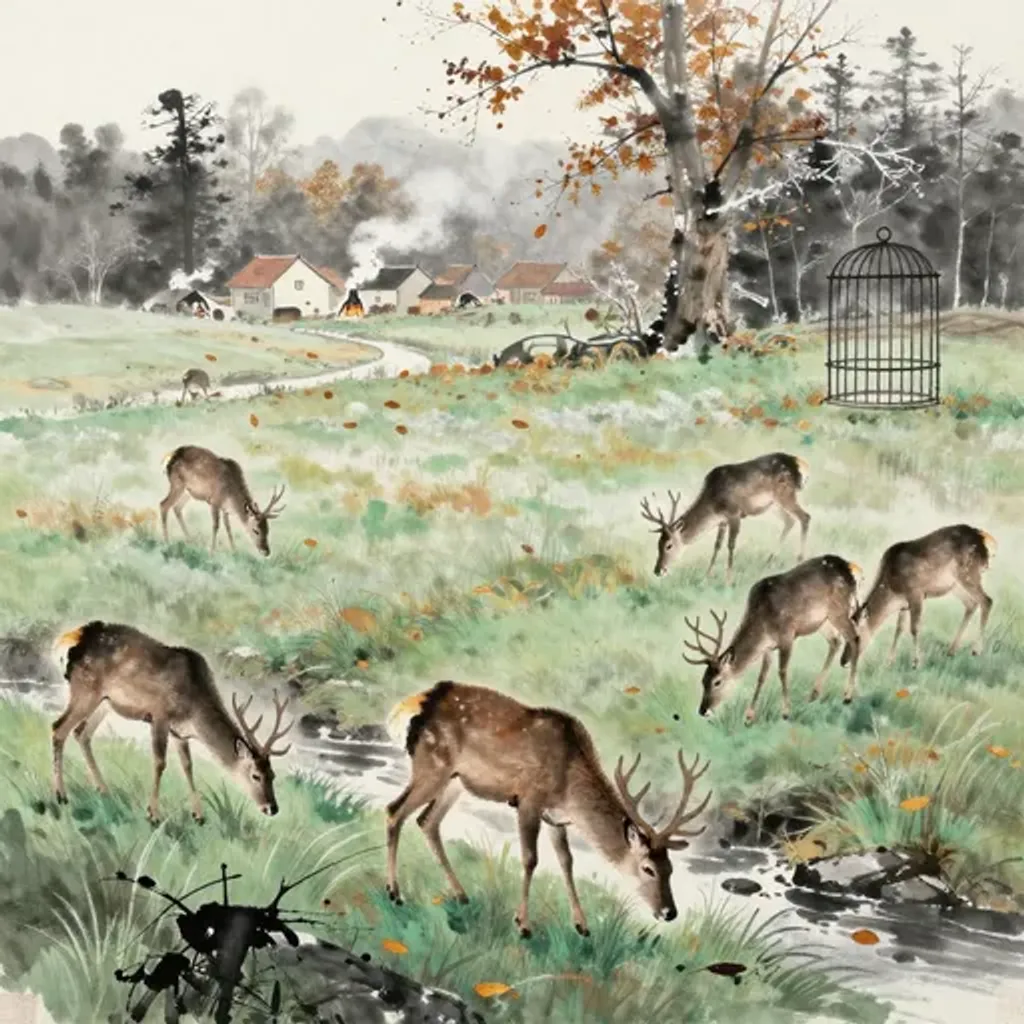
鹿得美草,鳴呼其友。九族和睦,不憂飢乏。長子入獄,霜降族哭。
地上有水,比之自比——親附之卦化為自身。
阅读完整注释 ↓
地上有水,比之自比——親附之卦化為自身。鹿得美草,鳴呼其友——此即《詩經·小雅·鹿鳴》之象:呦呦鹿鳴,食野之苹。九族和睦,不憂飢乏,太平之景也。然詩意驟轉:長子入獄,霜降族哭。霜降為古代行刑之季,秋冬肅殺之氣應乎刑殺。詩之兩半皆為比之表現:鹿鳴呼友,樂中之盟也;全族哀哭,悲中之盟也。親附之道不因厄運而解——反而更深。共享豐饒之同一紐帶,亦須共擔哀慟。
English commentary
Water upon earth, doubled — Holding Together transforming into itself. A deer finds sweet grass and calls out to its companions, echoing the Shijing ode 'Luming': the nine clans gather in harmony, free from hunger and want. Yet the verse pivots sharply: the eldest son enters prison, and when frost descends, the clan weeps together. The frost-descent execution season signals judicial punishment at autumn's appointed time. Both halves are expressions of Bi: the deer calling friends is alliance in joy; the clan weeping for a condemned kinsman is alliance in grief. Holding Together does not dissolve when fortune turns — it deepens. The same bonds that share abundance must also bear collective sorrow.