Adele Bloch Bauer I

第14卦

大有

Dà Yǒu

Great Possession

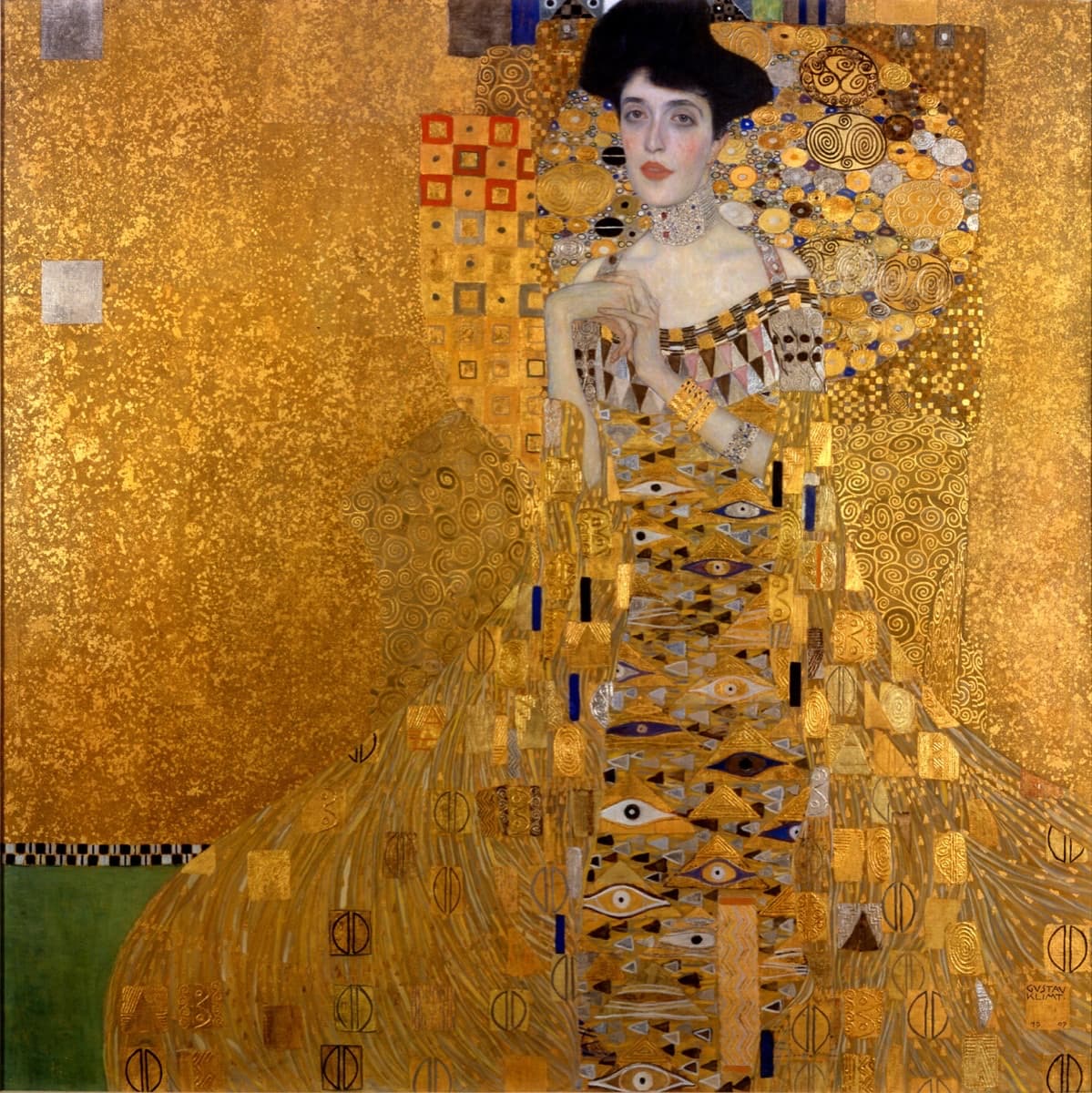
Adele Bloch Bauer IKlimt, Unknown

A woman emerges from fields of gold leaf and Byzantine ornament, her face and hands the only elements rendered as flesh. Klimt painted Adele Bloch-Bauer in 1907, surrounding his wealthy patron with layers of decorative abundance—geometric patterns, spiral motifs, Egyptian eyes, all executed in gold that catches light like burnished metal. The painting announces wealth not through depicted objects but through material itself—gold leaf applied so thickly the surface becomes relief, becomes treasure. Adele sits enthroned in her own abundance, prosperity made visible, great measure possessed and displayed.

阅读完整论述 ↓

This is Dà Yǒu (大有), the Chinese hexagram meaning "possession in great measure" or "great holdings." Ancient diviners saw this configuration when Fire (Lí) sits above Heaven (Qián): illuminating clarity above, creative force below, like the sun at midday shining down on all things, making everything visible, abundant, and accessible. Klimt's gold embodies this solar generosity—light transformed into substance, radiance you can touch. In Zhou Dynasty court divinations, this hexagram appeared during reigns of prosperity when granaries filled, when trade flourished, when the kingdom held great resources and displayed them without shame. Klimt's 1907 portrait depicts wealthy patron Adele Bloch-Bauer adorned in elaborate gold-leaf patterns. The lavish display of wealth and social prominence connects to hexagram 14's theme of possession in great measure. The Judgment text declares the condition simply: "Supreme success." Prosperity this great requires no hedging, no qualification. Adele's wealth came from her husband's sugar refinery fortune, the sweet abundance of industrial-age Vienna. Klimt himself commanded extraordinary fees during his Golden Period—the art market boomed, patrons competed for his work, gold became his signature material. But the text adds crucial guidance: "His supreme success is due to his relationship with heaven, which illuminates, judges, and shapes all things from above." Great measure isn't hoarded; it circulates, illuminates, shapes what it touches. Adele became a patron of the arts herself, her salon gathering Vienna's intellectual elite. The wealth flows through her, not to her alone. The Image Text offers counsel for managing abundance: "Fire in heaven above: the image of possession in great measure. Thus the superior person curbs evil and furthers good, and thereby obeys the benevolent will of heaven." Prosperity creates responsibility. Klimt's painting itself demonstrates this—commissioned for a private home, it became one of Austria's most recognized artworks, reproducible abundance spreading from singular possession. Song Dynasty officials understood this hexagram as the moment when good governance produces surplus, when abundance allows support for culture, scholarship, public works. In the I-Ching's sequence, Dà Yǒu follows Fellowship: when people work together openly, wealth accumulates. The next hexagram is Modesty—a warning that great possession without humility breeds resentment, that abundance handled proudly turns to its opposite.

上卦

FireClinging

五行Fire方位East家庭Second Daughter性质illuminating, dependent, radiant

下卦

Qián

HeavenCreative

五行Metal方位South家庭Father性质creative, strong, dynamic

经典文本

卦旨

Da You is not wealth. It is the condition of great abundance that arises when clarity governs strength — the moment when resources accumulate because the person holding them possesses both the power to gather and the illumination to distribute. The hexagram shows Fire (Li) above Heaven (Qian): the sun at its zenith, shining down from the highest point, making everything visible and accessible. A single yin line occupies the fifth position — the ruler's place — surrounded by five yang lines, meaning that yielding receptivity at the center of command draws strength toward itself through modesty rather than force. The judgment is the shortest and most unconditional endorsement after Qian itself: 元亨 — "supreme success." No warnings, no caveats, no conditions. This is possible because Da You describes possession that is structurally sound — fire above heaven means that illumination directs creative power, that clarity determines how abundance is used. The Image text makes the responsibility explicit: 火在天上,大有;君子以遏惡揚善,順天休命 — "fire in heaven above: great possession. The superior person curbs evil and furthers good, according with heaven's beautiful mandate." Abundance without moral stewardship is hoarding; Da You is abundance administered through discrimination between what should be encouraged and what should be checked. The hexagram's architecture reveals why this particular form of possession succeeds. The third line — 公用亨于天子,小人弗克 — "a prince offers tribute to the Son of Heaven; a small person cannot do this." Great possession requires the willingness to circulate wealth upward, outward, toward the larger order. The person who keeps everything is the small person; the one who gives to the common good sustains the conditions that made abundance possible. Da You's goal is not the accumulation of resources but the achievement of the specific clarity — fire above, illuminating all — that allows abundance to serve its proper function: nourishing the whole rather than inflating the part.

彖辞

Supreme fulfillment. Two words. The great possession, supremely fulfilled. No conditions, no caveats. You know how many hexagram judgments are this clean? Almost none. This is the configuration where abundance and clarity combine and the text has nothing to add except: yes.

象辞

Fire in heaven above: great possession. The realized person accordingly curbs evil and promotes good, accepting heaven's mandate. Fire in heaven — illuminating everything below. When you possess greatly, everything is visible. The realized person's response isn't to enjoy the view. It's to suppress what's wrong and promote what's right. Because great possession with great visibility means your conduct is the weather.

爻辞

第初爻

No interaction with harm. Not a fault. Difficulty, but then no fault. Stay away from trouble. Sounds obvious — but in the beginning of great possession, the trouble looks like opportunity. Every harmful entanglement presents itself as a useful connection. The difficulty is in saying no. No fault, but only because you accepted the difficulty of keeping your distance.

第二爻

A great cart for loading. Having somewhere to go. No fault. Big wagon, full load, somewhere to go. No fault. You have the capacity and you have the destination. This is the line where great possession becomes practical — not the idea of abundance, but the vehicle and the road. The cart doesn't care about your philosophy. It cares about the axle.

第三爻

A prince makes offerings to the Son of Heaven. The common person is not capable of this. Only a prince can make this offering. Not because the common person wouldn't try — because they can't. The position doesn't carry it. In great possession, there are moves available to you that simply aren't available to everyone, and pretending otherwise doesn't make them available. The line is describing structural capacity, not moral worth.

第四爻

Not in one's full domain. No fault. You're not at full power and the verdict is: no fault. In the great possession hexagram, restraint from peak capacity is the correct move at this position. Not because you should be humble. Because the configuration at the fourth line doesn't support the full deployment. Knowing when you're not in your domain is the competence.

第五爻

One's sincerity is mutual, dignified. Resolves well. Trust that goes both ways. Dignity in the exchange. This resolves well — and at the fifth line, maximum influence, the mechanism is reciprocity. Not giving orders, not being generous from above. Actual mutual trust between people who look each other in the eye. Great possession at its peak looks like two people being honest.

第上爻

From heaven, protection is extended. Resolves well. Nothing that isn't supported. Protected by heaven. Everything supported. Nothing unfavorable. The best possible ending to the best possible hexagram. The top of great possession and the configuration is pure: help from above, unrestricted. You know what earns this? The five lines before it. Heaven's protection arrives at the end, not the beginning. It's a receipt, not a gift card.

焦氏易林

焦延寿《易林》——第14卦本卦之辞。西汉时期以四言诗阐释卦变,为最早的系统性易学占辞集。
Yilin artwork for Hexagram 14
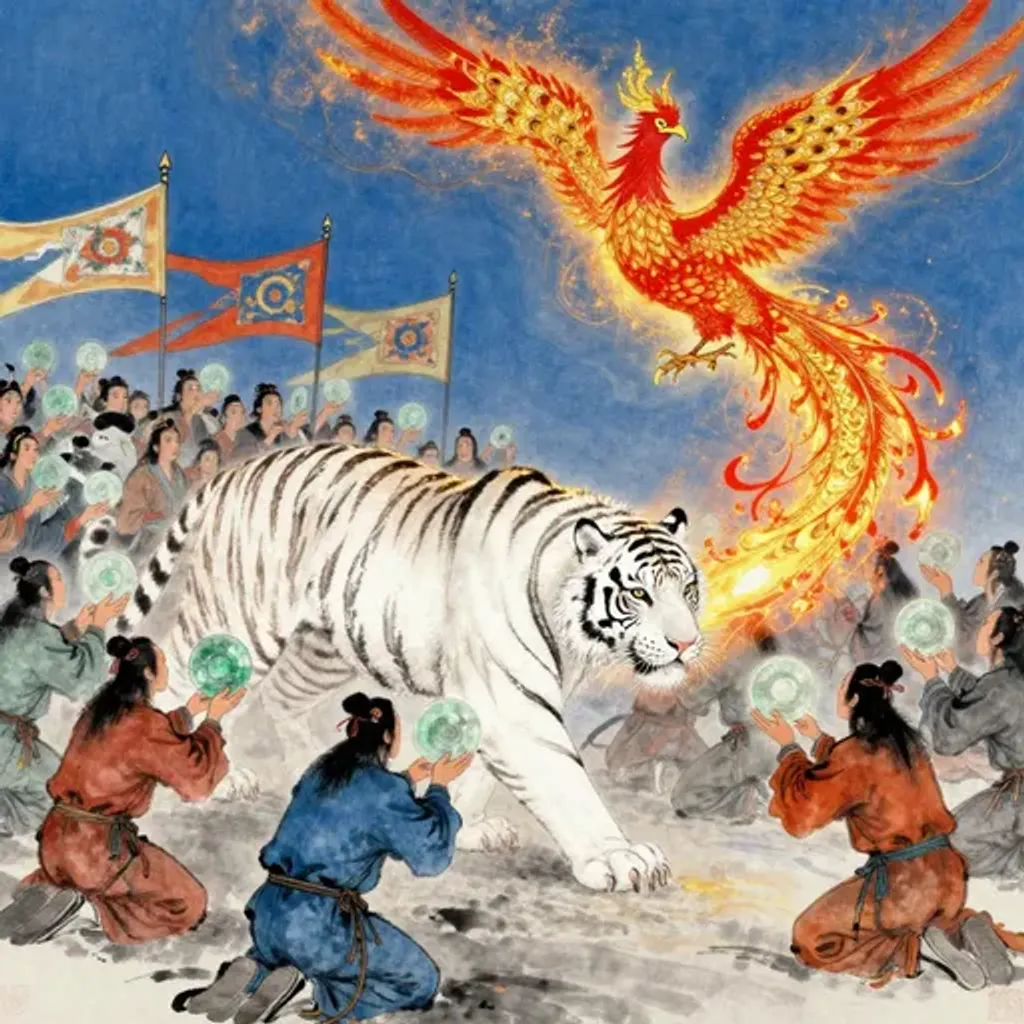
白虎張牙,征伐東來;朱雀前驅,讚道說辭;敵人請服,衘璧前趨。

白虎張牙,征伐東來;朱雀前驅,讚道說辭。

阅读完整注释 ↓

白虎張牙,征伐東來;朱雀前驅,讚道說辭。敵人請服,銜璧前趨。以四象之西方白虎為武鋒,南方朱雀為文使,軍威與禮法並行。從大有至大有,卦象不變,示情勢已臻圓滿,無須更化。火在天上,光焰至盛,四方來服。白虎之武與朱雀之文,恰合大有「遏惡揚善,順天休命」之義。此為大有之極致——擁有之完整得到天下公認,威德兼備令敵自來歸順。

English commentary

The White Tiger bares its fangs, leading a campaign from the east. The Vermilion Bird rides ahead as herald, chanting proclamations and delivering ultimatums. The enemy submits, bearing jade bi-discs as tokens of surrender. The verse deploys the celestial guardians of west and south as military vanguard and diplomatic envoy: White Tiger as the martial spearhead, Vermilion Bird as the voice of authority. From Great Possession to Great Possession — the hexagram unchanged — suggests a situation so fully realized it needs no transformation. The fire in heaven is at its zenith, and all opposing forces recognize its supremacy. This is possession confirmed by universal acknowledgment, power so complete that enemies come forward willingly.