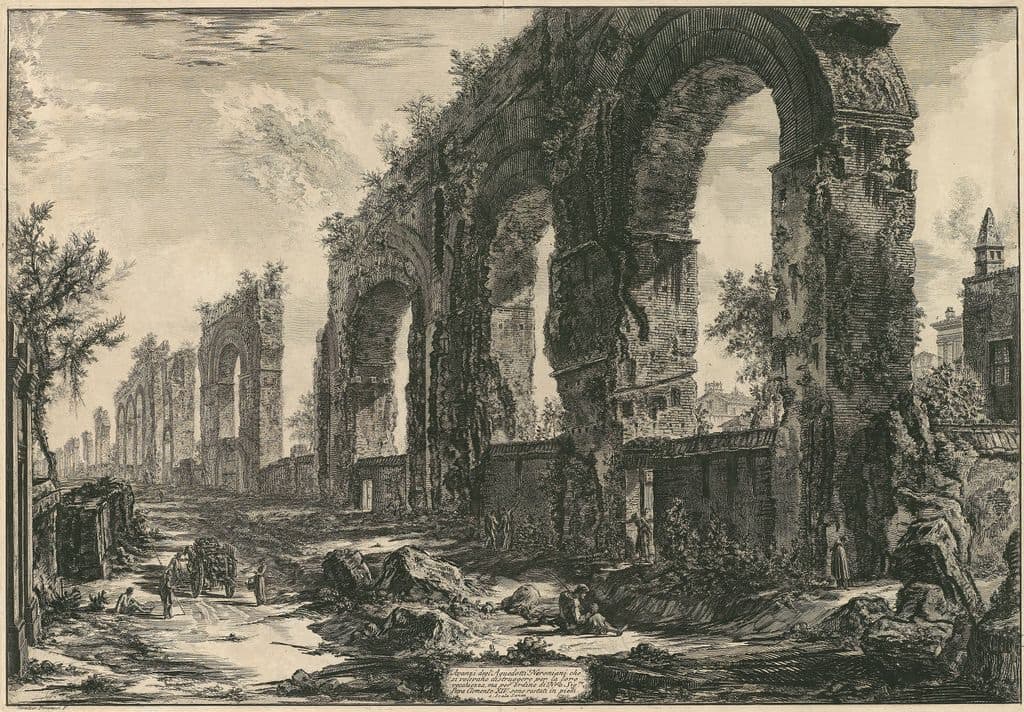
Aqueduct of Nero

第48卦

Jǐng

The Well

Aqueduct of NeroGiovanni Battista Piranesi, 1775

An 18th-century etching of Roman ruins. Giovanni Battista Piranesi documents the Aqua Claudia, an ancient aqueduct bringing mountain spring water to Rome across forty miles of stone arches. His architectural print shows the weathered structure cutting through the countryside, its repeated arches creating perspective depth. The infrastructure endures fifteen centuries after construction—built to serve generations, maintained across dynasties, the well that serves not one household but an entire city.

阅读完整论述 ↓

Piranesi was an 18th-century Italian architect and printmaker who documented Roman ruins. This etching shows the remains of Aqua Claudia, an ancient aqueduct bringing water from mountain springs to Rome. The structure represents infrastructure that draws water from a distant source and distributes it to the city, relating to hexagram 48's image of the well. This is Jǐng (井), The Well, the hexagram representing the unchanging source that serves the changing community. The character depicts the grid pattern of fields surrounding a central well—eight families drawing from one shared source. The trigram structure places Water (Kǎn) above Wind (Xùn): water drawn upward by wood, the rope and bucket penetrating the depths to bring sustenance to the surface. Piranesi's aqueduct extends this principle monumentally—the ancient well become public infrastructure, mountain springs channeled through engineering to supply urban populations. The Judgment text states: "The Well. The town may be changed, but the well cannot be changed. It neither decreases nor increases. They come and go and draw from the well. If one gets down almost to the water and the rope does not go all the way, or the jug breaks, it brings misfortune." The text emphasizes the well's constancy—dynasties rise and fall, populations migrate, but the water source remains. Piranesi's aqueduct embodies this principle: Republican Rome becomes Imperial Rome becomes Papal Rome, yet the Aqua Claudia continues carrying water from the same Anio springs. The text also warns that the well requires proper maintenance—broken jugs and short ropes bring misfortune. Piranesi documents precisely this concern: the aqueduct endures but requires care, its weathered stones testimony to both Roman engineering and centuries of upkeep. The Image Text observes: "Water over wood: the image of The Well. Thus the superior person encourages the people at their work, and exhorts them to help one another." Water rests above wood in the hexagram structure, but the practical image is the wooden bucket drawing water upward—the tool that makes the well functional. Piranesi's aqueduct serves the same function on civic scale, the infrastructure that enables city life. In the I-Ching sequence, Jǐng follows Kùn (oppression): after exhaustion comes the reminder of the reliable source, the well that neither increases in abundance nor decreases in drought, requiring only maintenance and proper use. The aqueduct's repetitive arches create rhythm across the landscape, each section like another family drawing from the shared source, the ancient infrastructure still nourishing Rome fifteen centuries after the engineers who planned it returned to earth.

上卦

Kǎn

WaterAbysmal

五行Water方位West家庭Second Son性质dangerous, flowing, fluid

下卦

Xùn

WindGentle

五行Wood方位Southeast家庭Eldest Daughter性质gentle, penetrating, persistent

经典文本

卦旨

Jing is not about water. It is about the unchanging source that sustains a changing world — the structure that remains constant while everything around it transforms. Water (Kan) above Wind/Wood (Xun) shows water drawn upward through wood, the action of the well's rope and bucket bringing what lies deep to those who need it at the surface. The judgment is the longest and most architectural in the book: 改邑不改井。无喪无得。往來井井。汔至亦未繘井,羸其瓶,凶 — "the town may be changed, but the well cannot be changed; it neither decreases nor increases; they come and go, drawing from the well; if the rope almost reaches the water but does not quite, or the jug breaks, misfortune." Every clause is structural. Towns change — the well does not. Populations come and go — the well serves all equally. But two failures are fatal: the rope that almost reaches (effort that falls short of the source) and the jug that breaks (the vessel that cannot hold what it draws). The Image text extends the well into a principle of social organization: 木上有水,井。君子以勞民勸相 — "water above wood, The Well. The superior person encourages the people at their work and exhorts them to help one another." The well functions only as shared infrastructure. A private well is a contradiction in terms — the character 井 itself depicts the grid of eight families surrounding a common source. The third line reveals the hexagram's deepest grief: 井渫不食。為我心惻。可用汲。王明。並受其福 — "the well is cleaned but no one drinks from it; this is my heart's sorrow; it could be drawn from; if the king were wise, all would share its blessing." A purified source that goes unused — competence without recognition, wisdom without audience — is the specific tragedy the hexagram names. The well exists to be drawn from. Capacity that never reaches those it could serve is worse than no capacity at all. The goal of Jing is to establish the principle that certain structures must be maintained regardless of political, social, or personal change — and that the value of such structures lies entirely in their accessibility. The well that serves only some is not a well. The rope that almost reaches is worse than no rope. The hexagram follows Kun (Oppression) in the sequence: after exhaustion has drained every surface resource, one must reach deeper, to the source that neither increases nor decreases. The top line describes the well perfected: 井收勿幕。有孚元吉 — "the well is open, not covered; there is sincerity, supreme good fortune." No lid, no restriction, no gatekeeping. The fully realized source is available to all without condition. This is the hexagram's ultimate standard: the well exists not for the well-keeper but for whoever comes with a vessel that does not break and a rope that reaches.

彖辞

The town may change but the well does not change. Neither losing nor gaining. Coming and going — the well is the well. Almost reaching, yet not quite drawing the rope to the well, or breaking the bucket: adverse. The town changes. The well doesn't. People come and go. The well stays. It doesn't increase, doesn't decrease. And then the warning: almost getting there but not quite — the rope too short, the bucket broken — that's adverse. The well hexagram is about the resource that's always available and the hundred ways you can fail to reach it. The water is there. The question is whether you are.

象辞

Wood above water: the well. The realized person accordingly encourages the people in their work and urges mutual assistance. Wood drawing water upward — that's the well mechanism. And the instruction is about community: encourage the people, urge them to help each other. Because a well serves everyone. The person who understands the well understands that the deepest resource is shared or it's nothing. A private well is a contradiction.

爻辞

第初爻

The well is muddy. Not consumed. An old well with no creatures. Mud. Nothing drinks here. Not even animals visit this well. No verdict — just abandonment. The well exists and nobody uses it. The first line is about the resource that has been neglected so long it became useless. Not because the water dried up. Because the mud was never cleared. Neglect doesn't drain a well. It buries it.

第二爻

The well valley shoots fish. The jug is cracked and leaks. Shooting fish at the bottom of the well with a broken jug. The water is there but the vessel can't hold it. The infrastructure failed — not the source. The second line of the well, and the problem isn't shortage. It's delivery. The person with good water and a leaking bucket has the most frustrating problem in the book: everything you need, nothing you can carry.

第三爻

The well is cleaned but no one drinks. This is my heart's sorrow. It could be drawn from. If the king were clear-sighted, all could share the blessing. Clean well. Clear water. Nobody drinks. And the text says: this is my heart's sorrow. The most personal line in the entire book — the only time the I-Ching sounds like it's about to cry. The well was purified and the world walked past. If the king noticed, everyone would benefit. But the king doesn't notice. The well waits.

第四爻

The well is being lined with stone. No fault. Relining the well. No fault. The shortest line in the well hexagram, and it's about maintenance. Not the discovery of water, not the crisis of drought — the boring work of relining the walls. No fault. Because the person who repairs the infrastructure while no one's watching is doing the work that makes every other line possible.

第五爻

The well is clear. A cold spring to drink from. Clear well. Cold spring. Drinkable. No verdict — just the image of what a well is supposed to be. The fifth line, and the well has finally reached its purpose. Clean water, available, cold, real. The text doesn't add 'resolves well' because the well itself is the resolution. When the water is clear, the commentary becomes unnecessary.

第上爻

The well is full — do not cover it. Having sincerity: supremely resolves well. The well is full and the instruction is: don't cover it. Don't restrict access, don't gate it, don't put a lid on it. Leave it open. Having sincerity: supremely resolves well. The top of the well hexagram and the final teaching: the well that serves everyone without restriction is the one that receives the highest verdict. The well was always meant to be open. The cover was always the mistake.

焦氏易林

焦延寿《易林》——第48卦本卦之辞。西汉时期以四言诗阐释卦变,为最早的系统性易学占辞集。
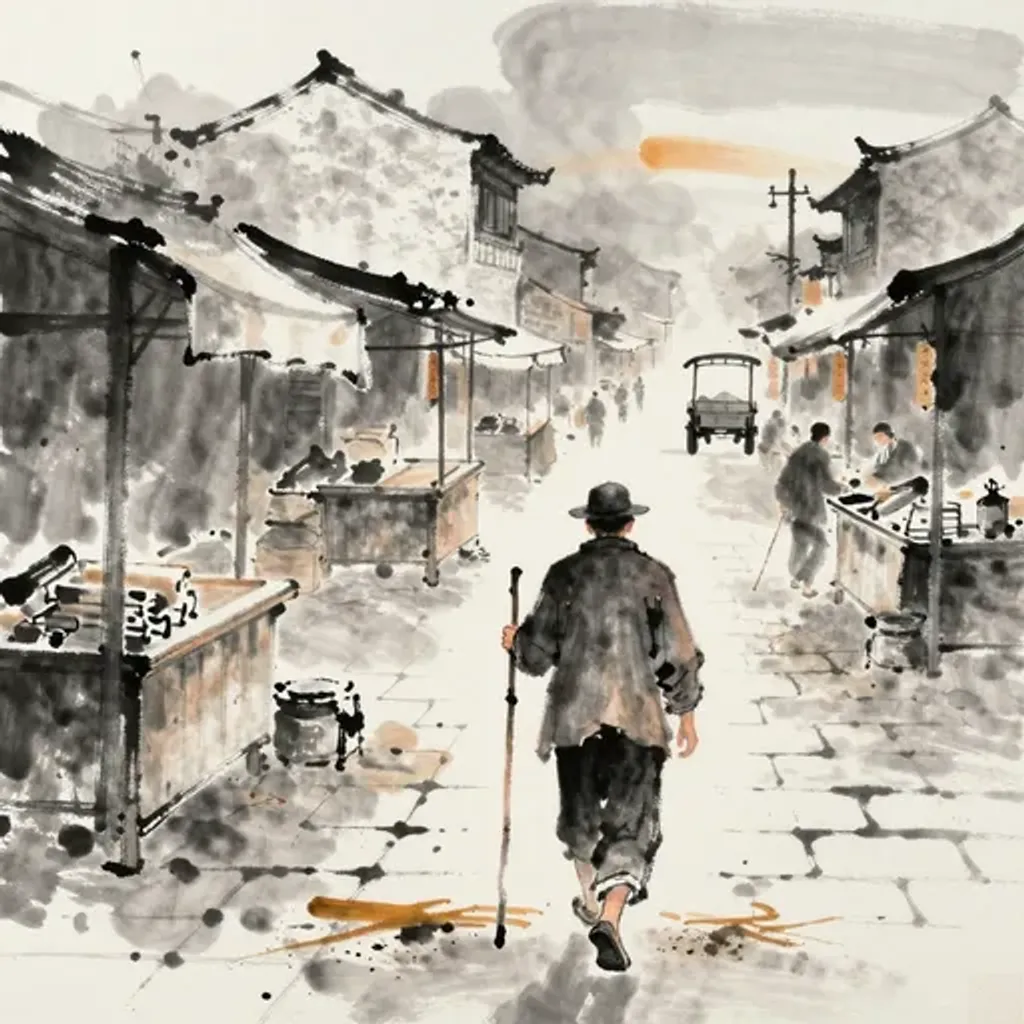
Yilin artwork for Hexagram 48
躓跛未起,失利後市,不得鹿子。

木上有水,井觀自身之影而見停滯——同卦相變,不動之極。

阅读完整注释 ↓

木上有水,井觀自身之影而見停滯——同卦相變,不動之極。躓跛未起——跌倒不能站起,失利後市——趕到集市時好物已售罄,不得鹿子。井變井,同卦重疊強化其固有之險:井不遷不變,水不流則腐。跛者失市如井爻辭「井泥不食」——潛力在而不能發揮。從井至井,無變化則井德僵固:養人者反成重複之牢籠,水清則養,水滯則害。

English commentary

Water drawn up through wood — but the well gazes into its own reflection and sees only stagnation. Stumbling and lame, unable to rise, one arrives too late at the market and fails to catch the young deer. The doubled well (source and target identical) intensifies the hexagram's inherent danger: a well that never changes, never moves, risks becoming a trap rather than a resource. The lame figure who misses the market recalls the well's line texts about fouled water and unused potential. From The Well to The Well, the pattern is self-referential: without transformation, the well's virtue calcifies. What should nourish becomes a prison of repetition, and opportunity slips away while the structure remains frozen in place.