The Astronomer

第4卦

Méng

Youthful Folly

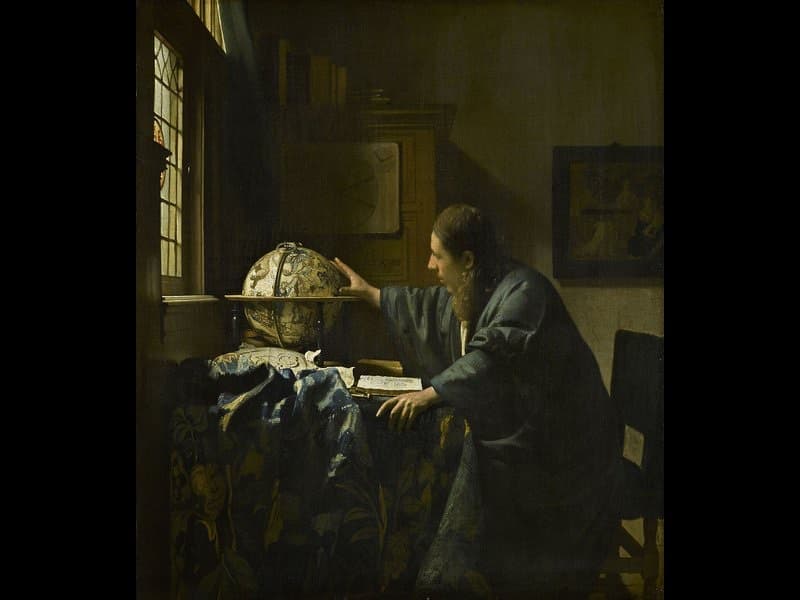
The AstronomerVermeer, Unknown

In Vermeer's studio, an astronomer leans forward over a celestial globe, his right hand suspended mid-gesture above its painted surface. Geometric instruments catch the window light behind him—an astrolabe hangs on the wall, a compass rests nearby, books lie open with star charts visible on their pages. The man wears a richly patterned robe; his face concentrates on the sphere that maps the heavens. He sits at the threshold of understanding, surrounded by the tools of his craft but not yet master of the knowledge they encode. The globe shows constellations; his hand hovers as if to grasp them, to make them yield their secrets.

阅读完整论述 ↓

This is Méng (蒙), which combines Mountain (☶) above and Water (☵) below. The character 蒙 depicts plants covering or obscuring vision, the state of not-yet-knowing. Water flows at the mountain's base, hidden from view—the dangerous unknown beneath the stable boundary. Vermeer painted this exact configuration: the scholar's stillness (mountain) confronting the vast mystery of celestial mechanics (water in its depths). In divination practice, this hexagram appeared when someone stood before a master craft, when genuine questions formed but answers remained obscured. Vermeer painted this scholar studying a celestial globe, surrounded by instruments and books. The astronomer seeks knowledge of the heavens, representing youthful inexperience seeking instruction from a teacher or master. The Judgment speaks directly to Vermeer's scene: "Youthful folly has success. It is not I who seek the young fool; the young fool seeks me." The astronomer has positioned himself before the celestial sphere. He has gathered his instruments, opened his books. The teacher—whether human master or cosmic order—will not chase the student. Ancient texts warn against repeated shallow questioning: "If he asks two or three times, it is importunity." Genuine learning requires patient absorption, the willingness to sit with confusion as the astronomer sits with his globe's mysteries. The Image Text offers unexpected counsel about how learning actually occurs: "A spring wells up at the foot of the mountain: the image of youth. Thus the superior man fosters his character by thoroughness." Water gradually shaping stone, insight accumulating through sustained attention rather than forced revelation. In the I-Ching's sequence, Méng follows Zhūn: after the chaotic breakthrough comes the recognition of inexperience, the moment when one realizes how much remains unknown and positions oneself to learn.

上卦

Gèn

MountainStillness

五行Earth方位Northeast家庭Youngest Son性质still, stopping, resting

下卦

Kǎn

WaterAbysmal

五行Water方位West家庭Second Son性质dangerous, flowing, fluid

经典文本

卦旨

Meng is not stupidity. It is the natural state of not-yet-knowing that precedes all genuine understanding — the fog before clarity, the spring before the river. The hexagram shows Mountain (Gen) above Water (Kan): a spring emerging at the base of a mountain, not yet knowing which direction to flow. The water is present, the potential is real, but the path has not been found. This is the structural condition of every student, every beginner, every mind encountering something it has not yet integrated. The most radical statement in the judgment is its reversal of the teaching relationship: 匪我求童蒙,童蒙求我 — "It is not I who seek the young fool; the young fool seeks me." The teacher does not chase the student. The oracle does not repeat itself. 初筮告,再三瀆,瀆則不告 — the first inquiry receives an answer; repeated questioning is profanation, and profanation receives silence. This is not pedagogical cruelty. It is the recognition that learning requires a specific posture — the learner must arrive with genuine need, not idle curiosity. The spring must push upward of its own pressure before the mountain can shape its course. The common misreading treats Meng as a problem to be solved — folly to be corrected, ignorance to be filled. But the hexagram's goal is not the elimination of not-knowing. It is the cultivation of the capacity to receive knowledge. The Image says 君子以果行育德 — "the superior person nurtures virtue through decisive action," like water that fills each hollow completely before flowing onward. Meng regulates the relationship between ignorance and instruction, ensuring that knowledge is transmitted only when the vessel is ready, and that the vessel shapes itself through its own effort to seek.

彖辞

Fulfillment. It is not I who seek the inexperienced youth — the inexperienced youth seeks me. At the first inquiry, I explain. A second and third asking shows disrespect. Disrespect warrants no answer. Sustained orientation is supported. The teacher doesn't chase the student. This isn't ego — it's engineering. Learning only works when the question is real. You ask once, you get the answer. You ask again because you didn't like the first answer? That's not curiosity. That's shopping. The oracle hangs up, and honestly, you'd do the same thing.

象辞

A spring emerges beneath the mountain: inexperience. The realized person accordingly proceeds with thoroughness, developing character. A spring at the foot of a mountain has no idea where the ocean is. Doesn't matter. It goes forward because that's what springs do. Character doesn't come from knowing the destination. It comes from moving before the map exists.

爻辞

第初爻

Delivering the inexperienced from confusion. Discipline is supported. Removing the shackles is the method. Continuing forward from here: friction. Break the chains. That's the discipline — not punishment, just: get the thing off. But here's the fine print: once the shackles are off, stop. Freedom from ignorance is a starting line, not a runway. The person who keeps going after the first liberation is confusing momentum with progress.

第二爻

Embracing the inexperienced: resolves well. Accepting the bride: resolves well. The young one manages the household. Everything in this line resolves well and the reason is the same every time: you let someone in. Accept what's unfinished. Accept what shows up. Let the kid run the house. Three different situations, one move. The door is open. That's the whole structural insight. Open the door.

第三爻

Do not pair with this woman. She sees the wealthy man and loses her sense of self. No direction is supported. She spots the money and forgets who she is. The line isn't making a moral judgment — it's describing a configuration. When the shiny thing costs you yourself, no possible direction works. Not left, not right, not forward. It's not about the money. It's about the part where she disappears.

第四爻

Surrounded by inexperience. Friction. Stuck. That's the whole line. Not adverse — the trajectory isn't getting worse. Just stuck. Wheels spinning, nothing moving. You know the difference between adverse and stuck? Adverse gets worse when you continue. Stuck just sits there. Both are unpleasant. Only one of them is urgent.

第五爻

The youthful inexperienced one. Resolves well. The shortest favorable line in the hexagram, and it goes to the person who's just genuinely clueless. No pretending, no performing expertise they don't have. Just: I don't know. That's it. That's what resolves well. Everybody in the room faking competence should be taking notes.

第上爻

Striking at inexperience. Acting as the assailant is not supported. Defending against the assailant is supported. Same force. Opposite directions. Completely different verdicts. Hit ignorance in someone else? You're the problem. Hit ignorance in yourself? Now it's structural. The top of the inexperience hexagram and the final exam is a trick question about which end of the stick you're holding.

焦氏易林

焦延寿《易林》——第4卦本卦之辞。西汉时期以四言诗阐释卦变,为最早的系统性易学占辞集。
Yilin artwork for Hexagram 4
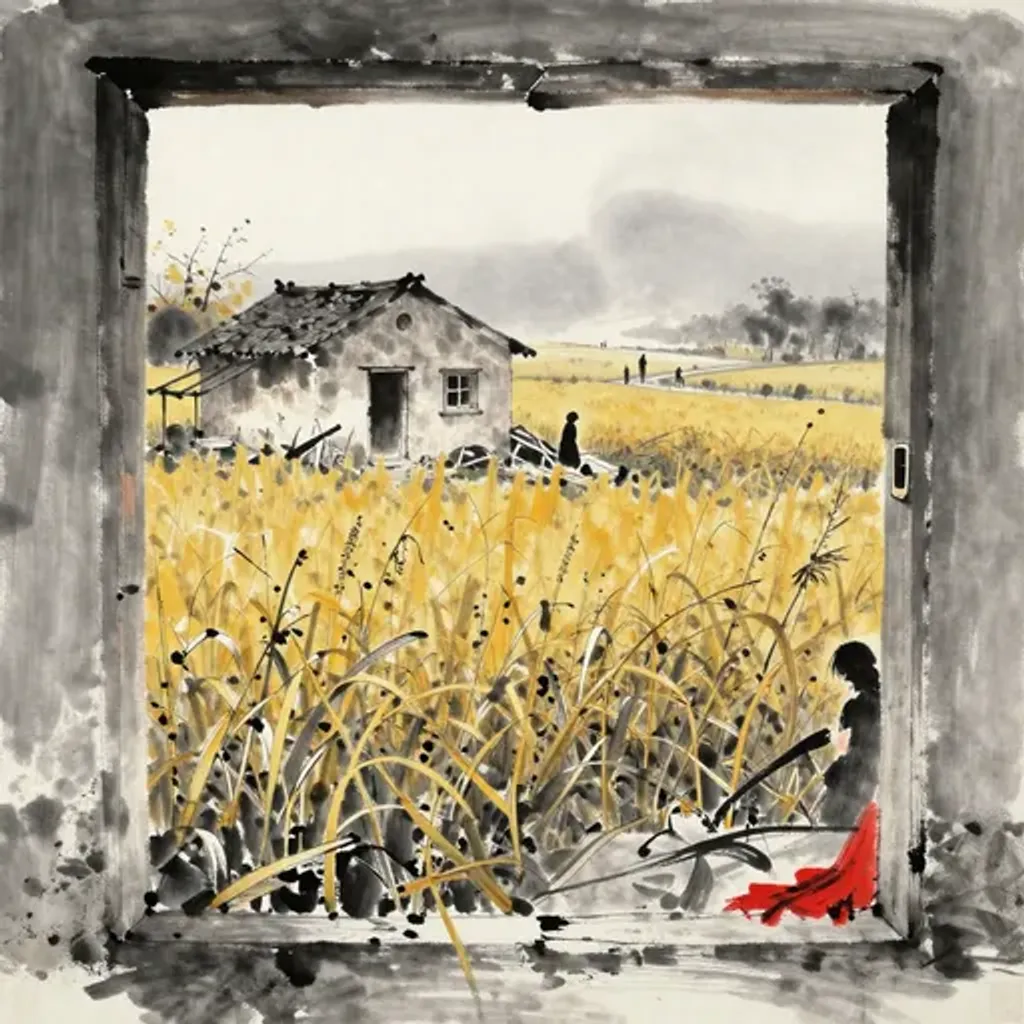
何草不黃,至未盡玄。室家分離,悲愁於心。

山下出泉,蒙之自遇。

阅读完整注释 ↓

山下出泉,蒙之自遇。開篇引《詩經·小雅·何草不黃》:「何草不黃?何日不行?」——征夫之歌,萬物枯黃,疲憊至極。然「至未盡玄」,衰敗尚未至最深之暗。室家分離,悲愁入心。蒙遇蒙,無變化之卦,蒙昧不得開啟而自我加深。離散骨肉乃最深之迷惘——非不知事理,乃失去賦予知識以意義之人倫紐帶。草雖黃而未盡枯,暗示一線轉機,然此刻唯有深切之哀傷。

English commentary

A spring beneath the mountain returns to the mountain — folly encountering itself. The verse opens by quoting the Shijing soldiers' lament 'He Cao Bu Huang': 'What grass is not yellowed?' — an image of universal exhaustion under endless campaigning. But the withering has not yet reached its darkest extreme. Families are torn apart, grief filling the heart. When the source hexagram meets its own reflection, there is no transformation, only intensification: the naivety that might have been educated instead compounds into deeper confusion. Separation from home and kin is the cruelest form of bewilderment — not ignorance of facts, but loss of the relationships that give knowledge its meaning.