Transformations of Hexagram 19
Every line of change out of Hexagram 19 臨 Approach, with the Yilin verse for each of the 64 resulting hexagrams, its translation, and the original ink brush artwork.
臨 → 乾
Hexagram 19 → Hexagram 1: The Creative
Changing lines: 3, 4, 5, 6
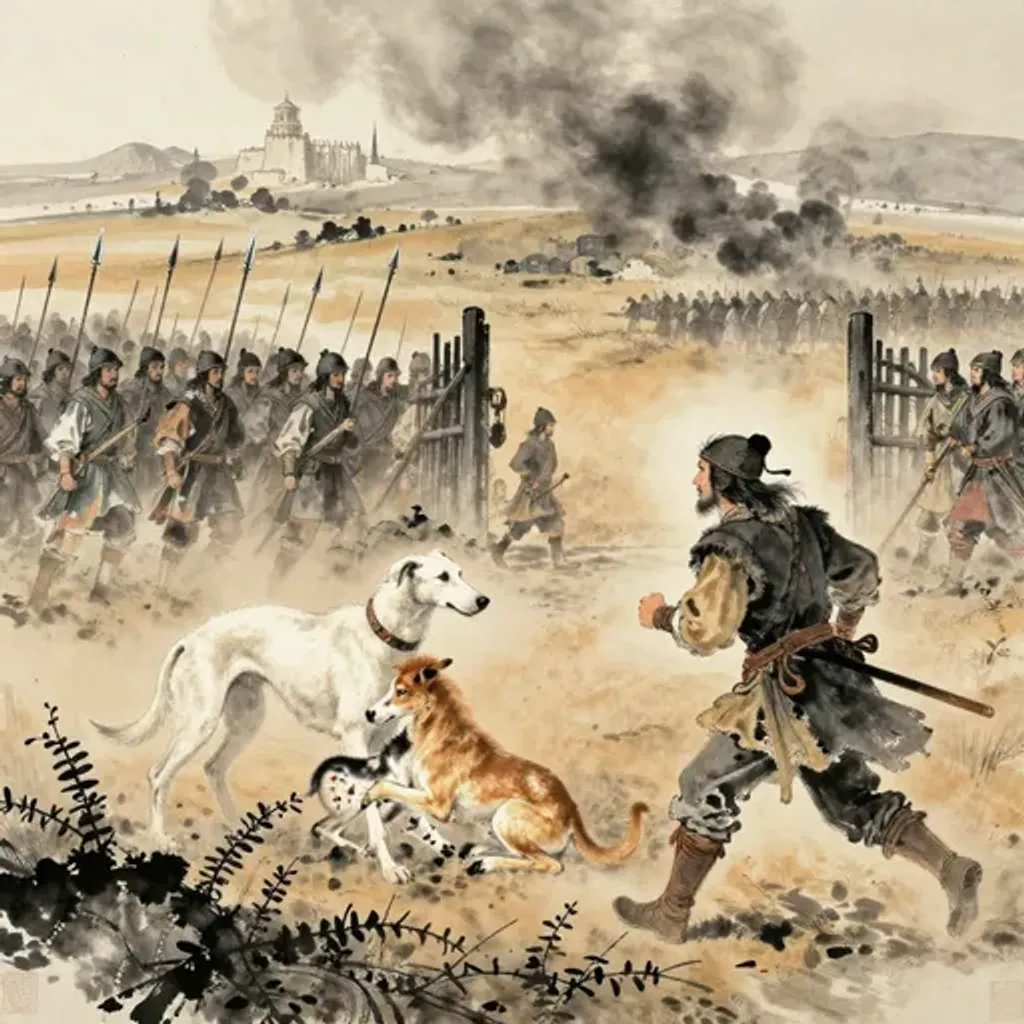
黃獹生馬,白戌為母。晉師在郊,虞公出走。
A yellow bitch bears a horse; a white hound serves as mother. The Jin army at the border -- the Duke of Yu flees.
— Jiao Yanshou, Yilin (Forest of Changes), 1st century BC
Commentary
Earth above the lake approaches heaven's pure creative force. The verse opens with bizarre portents — a yellow hound birthing a horse, a white dog serving as its dam — images of categorical confusion where species boundaries dissolve. Then the scene sharpens: Jin's army stands at the border, and the Duke of Yu flees. This alludes to Jin's destruction of Yu in 655 BC. Duke Xian of Jin bribed Yu's duke with horses and jade to borrow passage for attacking Guo. Counselor Gong Zhiqi warned that 'when the lips are gone, the teeth grow cold,' but the greedy duke ignored him. Jin destroyed Guo, then swallowed Yu on the return march. From Approach to the Creative, the pattern warns: when natural categories are violated — dogs birthing horses, trust betrayed for trinkets — even heaven's self-generating power cannot save the reckless.
臨 → 坤
Hexagram 19 → Hexagram 2: The Receptive
Changing lines: 1, 2
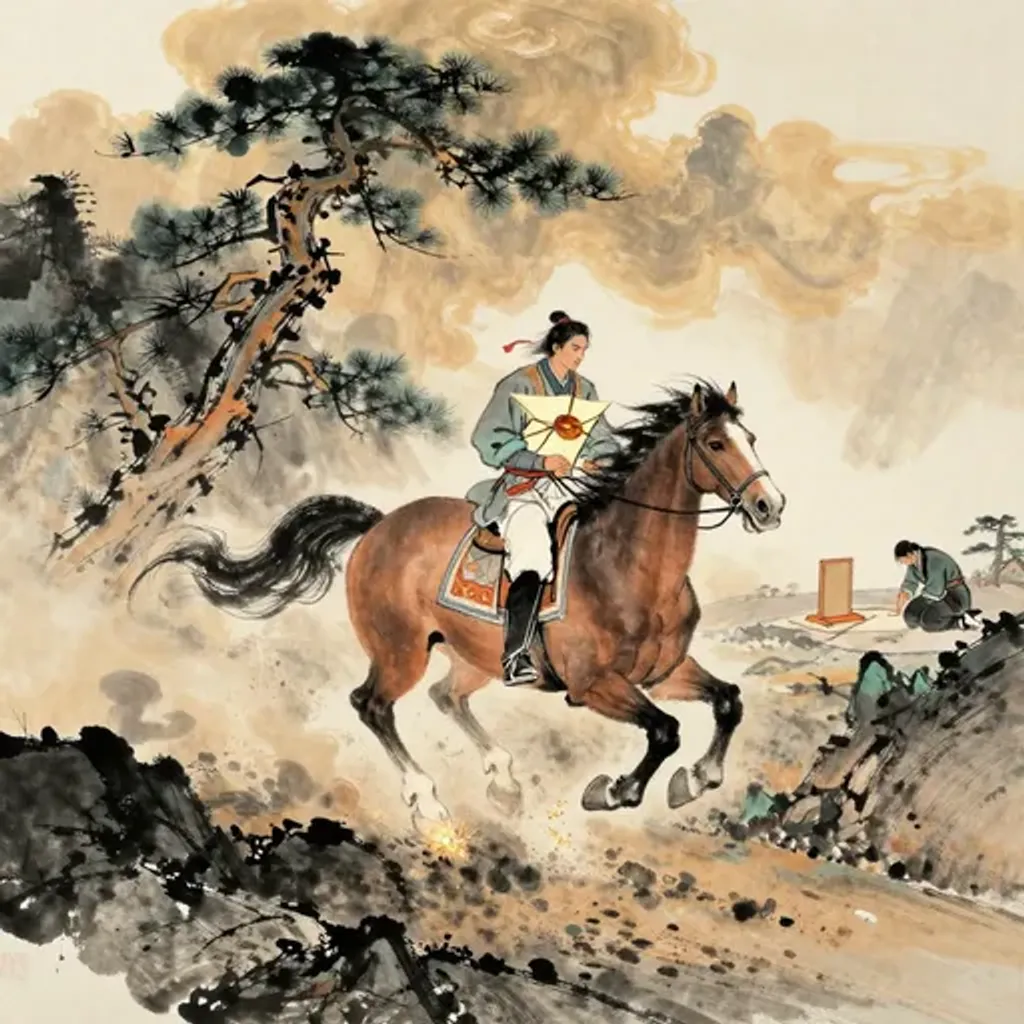
倉唐奉使,中山以孝;文侯悅喜,擊子徵召。
The sealed letter departs the capital; a fast horse raises dust over a thousand ridges. The recipient kneels in the courtyard — today, their name has reached the heavenly ear.
— Jiao Yanshou, Yilin (Forest of Changes), 1st century BC
Commentary
Earth above the lake descends into pure receptive earth. The original verse reads: 'Cangtang bears the mission; Zhongshan responds with filial devotion. Marquis Wen is delighted and summons his son Ji.' This alludes to the story of Zhao Cangtang, an envoy sent by Prince Ji of Wei, who had been installed as lord of Zhongshan. After three years without contact, Cangtang brought gifts of morning ducks and northern dogs, skillfully reciting Shijing odes to demonstrate the prince's filial longing. Marquis Wen of Wei was moved and summoned his son home. From Approach to the Receptive, authority descends as nurturing earth: the father's distant oversight softens into receptive warmth when filial devotion is properly communicated through ritual and poetry.
臨 → 屯
Hexagram 19 → Hexagram 3: Difficulty at the Beginning
Changing lines: 2, 5
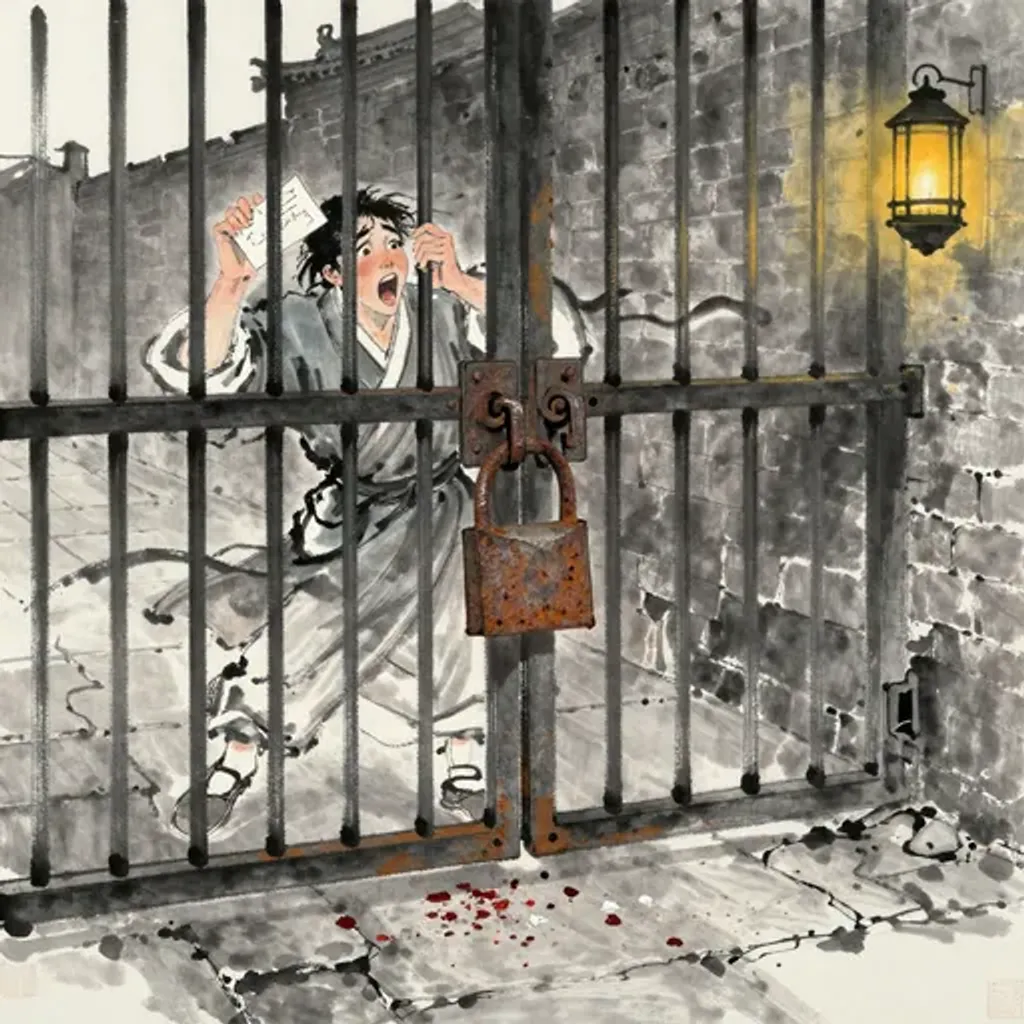
機關不便,不能出言;精誠不通,為人所冤。
The key rusts in the lock — the door will not open. A thousand-word letter is written but cannot be sent. Shouting through the wall, the wind scatters every word — in the right, but nowhere to plead the injustice.
— Jiao Yanshou, Yilin (Forest of Changes), 1st century BC
Commentary
Earth above the lake encounters clouds and thunder gathering in difficult birth. The original verse reads: 'The mechanism jams and cannot speak; sincerity fails to penetrate, and one is wronged by others.' A voice locked behind rusted gates, a letter that cannot be delivered — the imagery is of blocked communication and unjust accusation. Truth exists but finds no channel; the innocent are condemned because their plea cannot reach the judge. From Approach to Difficulty at the Beginning, the lake's expansive approach collides with the storm's confusion: what should flow openly becomes trapped. Like thunder beneath floodwater struggling to break through, the wrongly accused must endure the birth-pangs of a new order before justice can emerge.
臨 → 蒙
Hexagram 19 → Hexagram 4: Youthful Folly
Changing lines: 1, 6
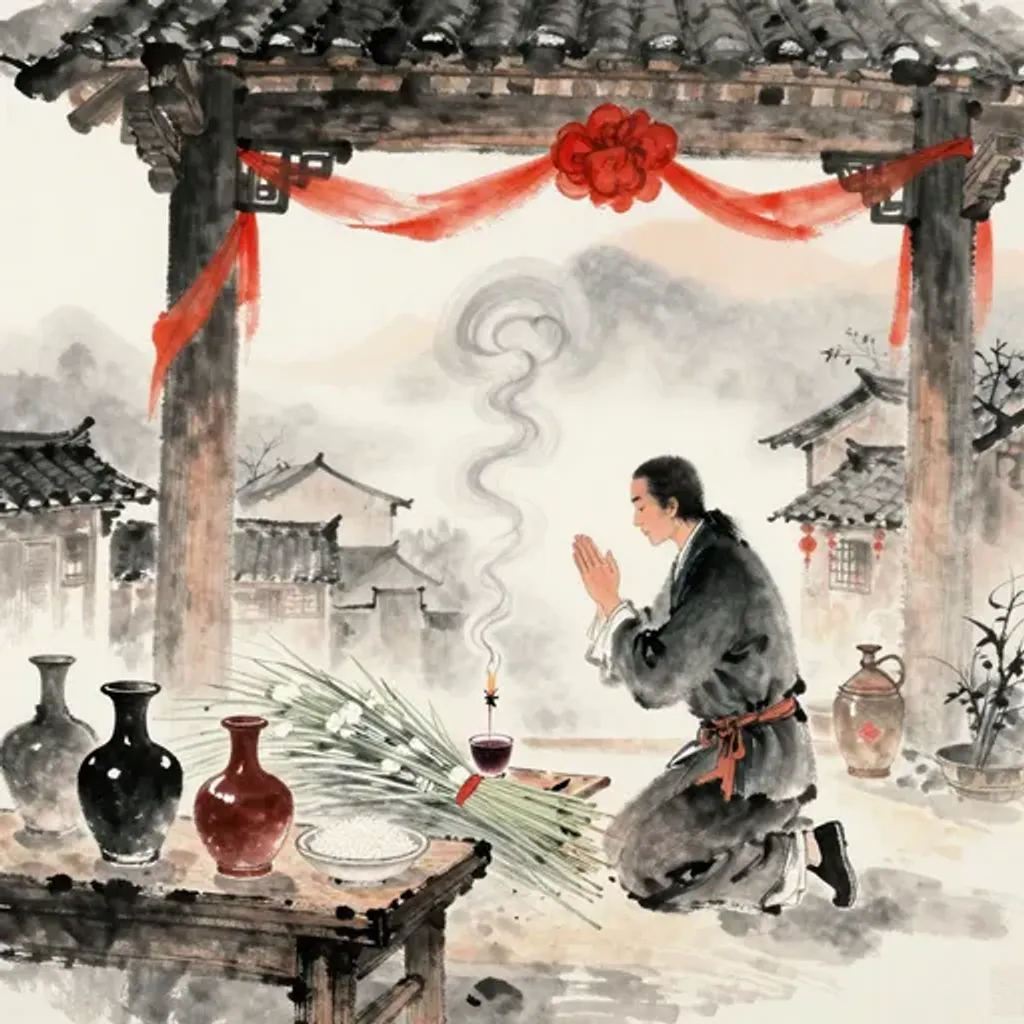
白茅醴酒,靈巫拜禱;神嗜飲食,使君壽考。
White cogon grass and sweet wine; the spirit medium kneels and prays. The spirits savor the offering -- they grant the lord long life.
— Jiao Yanshou, Yilin (Forest of Changes), 1st century BC
Commentary
Earth above the lake approaches the mountain spring of youthful learning. White cogon grass cushions the libation of sweet wine as a spirit-medium bows in prayer. The gods savor the offerings; they grant the lord long life and health. The scene is a spring sacrifice performed with meticulous care — cogon grass for purity, sweet wine for sincerity. The I-Ching itself praises white cogon as a symbol of reverent caution (Hexagram 28, line one). From Approach to Youthful Folly, the elder's oversight becomes the pupil's instruction: just as the medium teaches proper devotion to the spirits, the mountain spring below receives guidance from above. Blessing flows when ritual is performed with genuine humility rather than empty formality.
臨 → 需
Hexagram 19 → Hexagram 5: Waiting
Changing lines: 3, 5
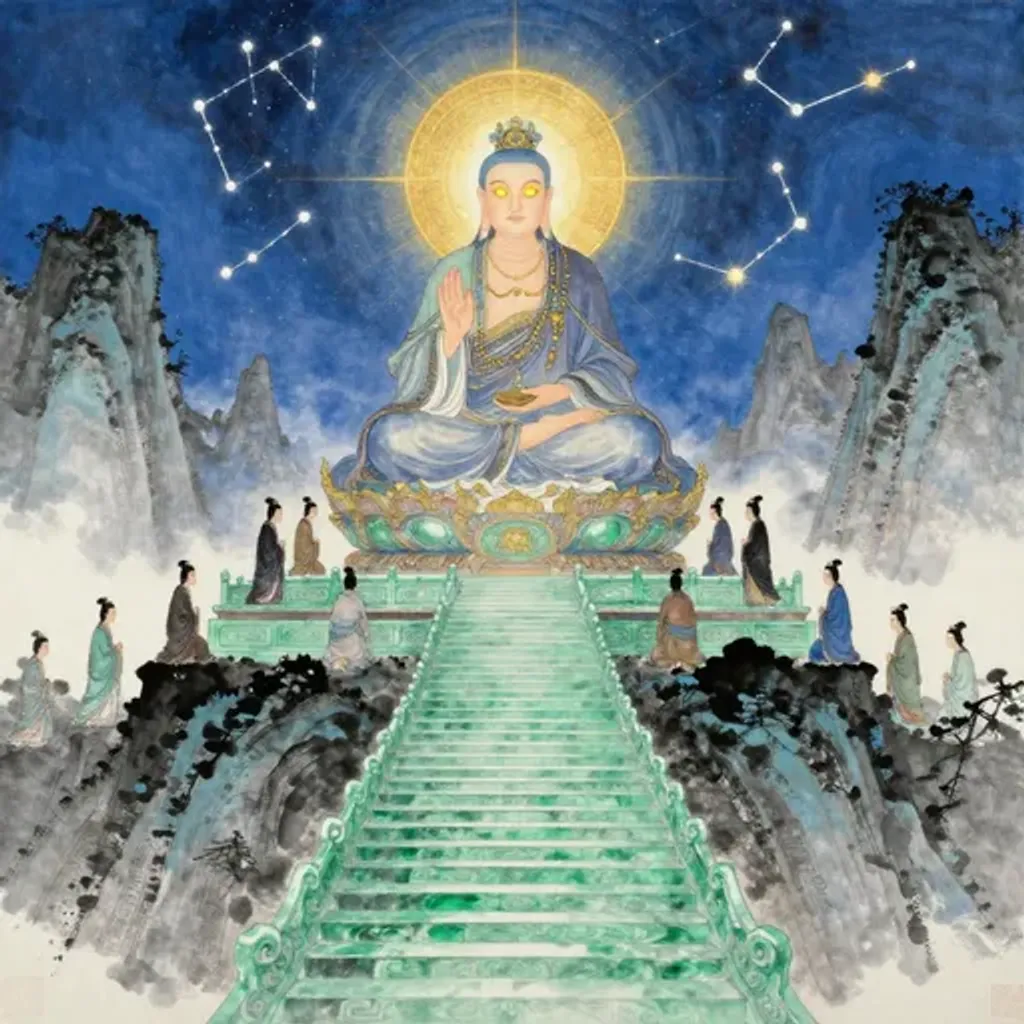
重瞳四乳,耳聰目明;普為仁表,聖作元輔。
Double pupils, four breasts; ears keen, eyes bright. Widely setting the standard of benevolence, the sage serves as chief support.
— Jiao Yanshou, Yilin (Forest of Changes), 1st century BC
Commentary
Earth above the lake approaches the nourishing patience of clouds above heaven. 'Double pupils and four nipples, keen of ear and clear of sight' — these are the miraculous bodily signs of sage-kings. Double pupils belonged to Emperor Shun; four nipples marked King Wen of Zhou. The verse declares them paragons of benevolence and chief pillars of sagely rule. From Approach to Waiting, the gathering of cosmic virtue resembles clouds massing above heaven before rain: these sage-kings did not seize power but waited until their extraordinary nature was recognized. Their physical marks are outward signs of inner fullness — clouds heavy with moisture that will nourish the land when the moment is right.
臨 → 訟
Hexagram 19 → Hexagram 6: Conflict
Changing lines: 1, 4, 5, 6
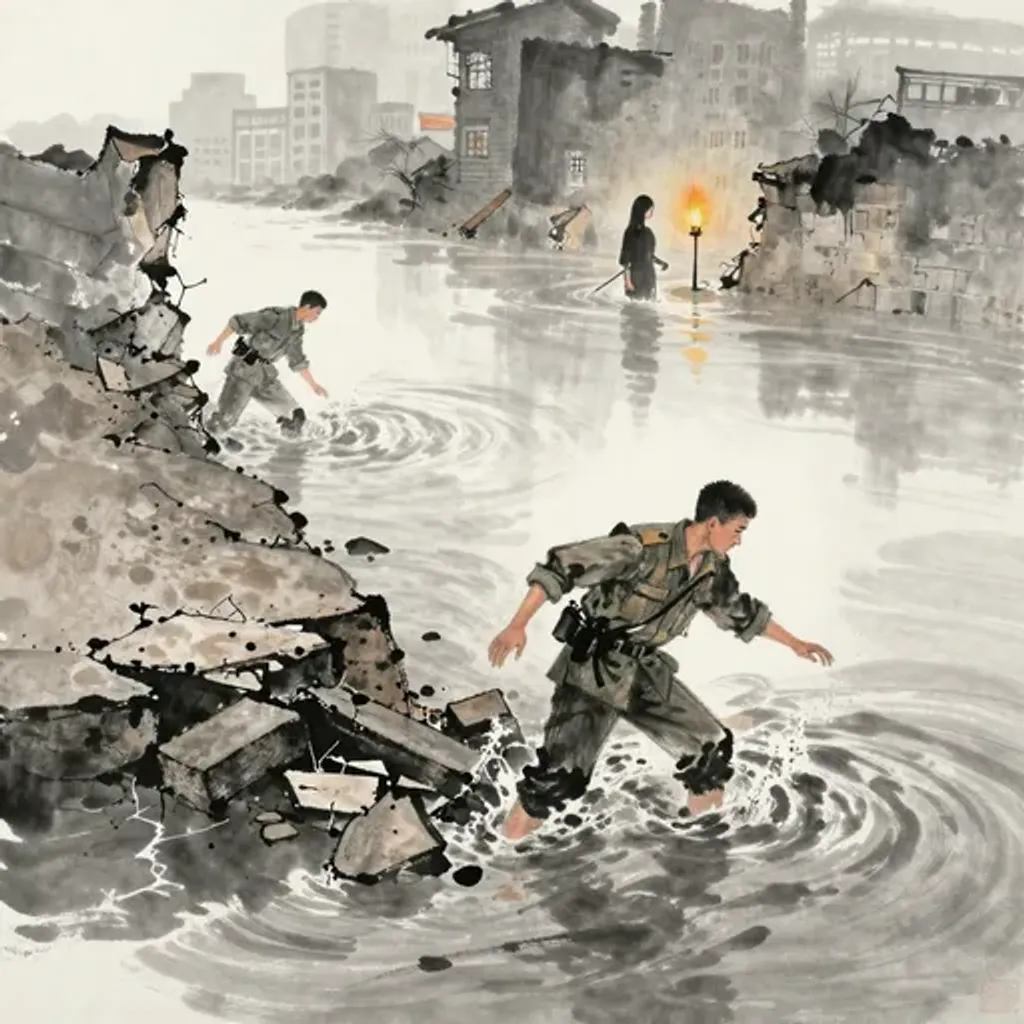
水長無船,破城壞堤;大夫從役,困于泥塗。一朝喪殞,不見少妻。
Waters rise and there is no boat; the city walls breach, the levees break. The officer goes to serve on campaign, mired in mud. In a single morning he perishes -- never again to see his young wife.
— Jiao Yanshou, Yilin (Forest of Changes), 1st century BC
Commentary
Earth above the lake meets heaven moving against water — the discord of Conflict. Floodwaters rise and there is no boat; levees breach and city walls crumble. A minister conscripted for distant service finds himself mired in mud, and one morning he perishes, never again seeing his young wife. The verse layers natural disaster upon personal tragedy: the same flood that destroys the city swallows the man sent to fight it. From Approach to Conflict, the lake's nurturing presence inverts into heaven and water pulling apart. What should have been protective oversight becomes a death sentence — the officer dispatched to manage the crisis is consumed by it, his domestic bonds severed permanently.
臨 → 師
Hexagram 19 → Hexagram 7: The Army
Changing lines: 1
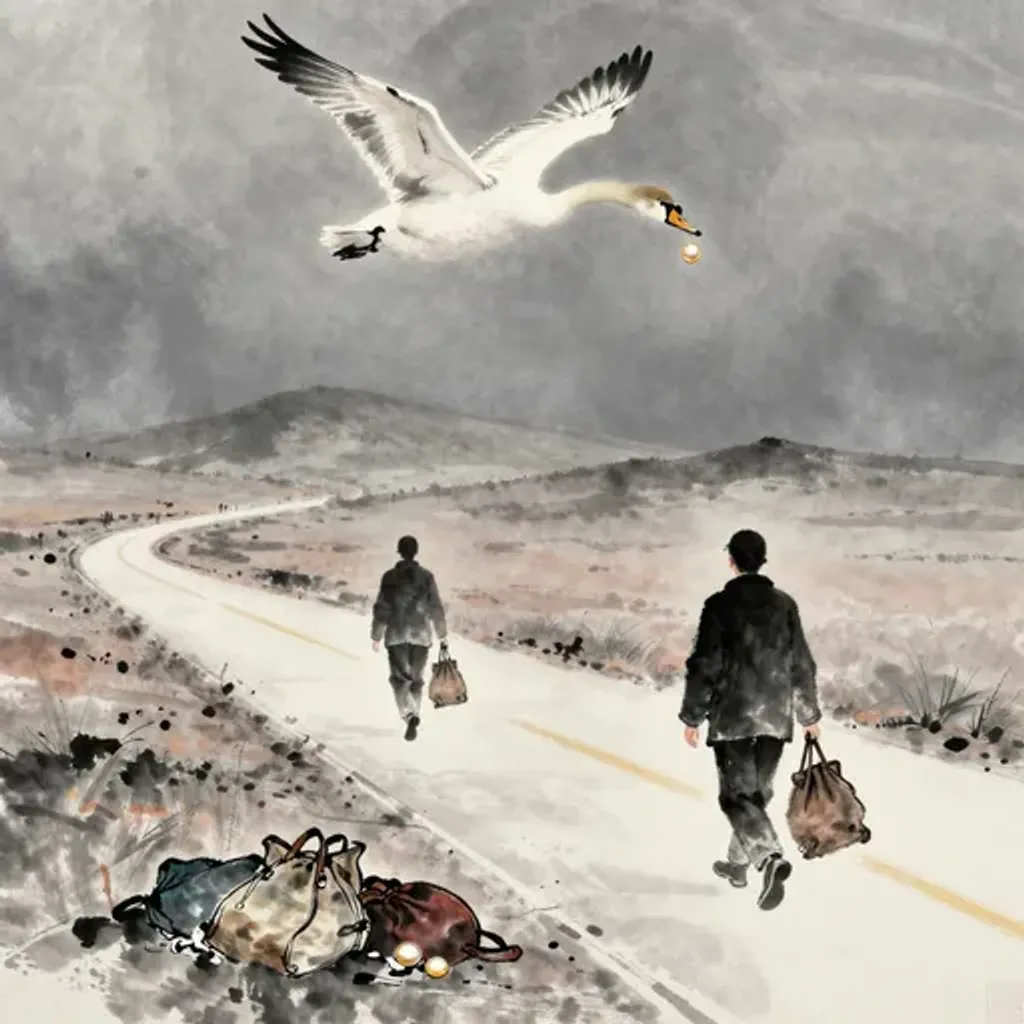
二人俱行,各遺其囊。鴻鵠失珠,無以為明。
Two men walk together, each having dropped his satchel. The wild swan lost its pearl -- it has no light to see by.
— Jiao Yanshou, Yilin (Forest of Changes), 1st century BC
Commentary
Earth above the lake transforms into water hidden within earth — the Army's disciplined force. Two travelers walk together, yet each has lost his provisions. A swan goose drops its luminous pearl and is left without light to see by. The image is of companions who fail to complement each other: both depleted, neither can supply what the other lacks. The pearl — the goose's single source of illumination — once lost, leaves only darkness. From Approach to the Army, the elder's generous oversight must become organized discipline. When individuals scatter their resources, only collective structure can restore capability. Water concealed within earth gathers what scattered travelers cannot: strength through unity rather than parallel impoverishment.
臨 → 比
Hexagram 19 → Hexagram 8: Holding Together
Changing lines: 1, 2, 5
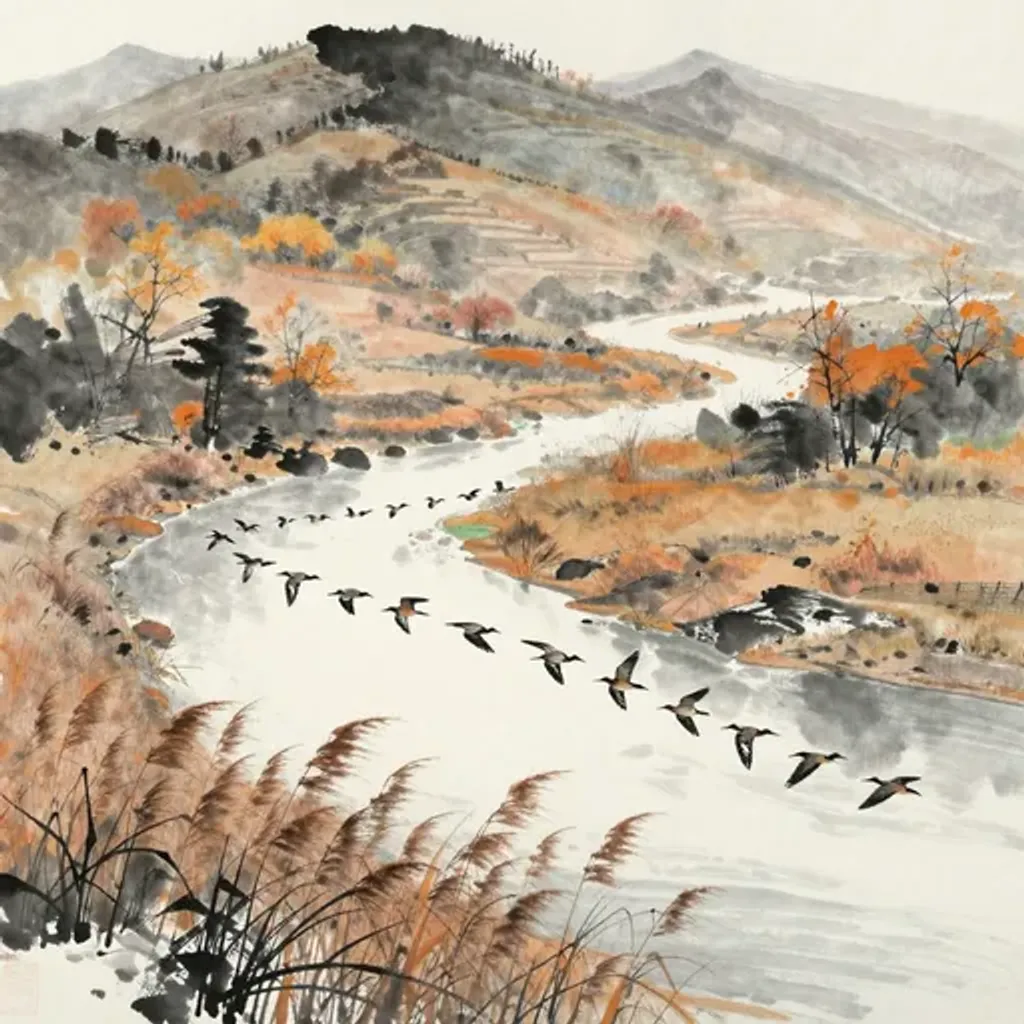
隨時轉行,不失其常。咸樂厥類,身無咎殃。
Turning with the seasons, never losing the constant way. At ease among one kind -- the body suffers no calamity.
— Jiao Yanshou, Yilin (Forest of Changes), 1st century BC
Commentary
Earth above the lake flows into water upon earth — the bonding of Holding Together. Moving with the times and adapting one's course, one never loses the constant way. All creatures delight in their own kind, and the self incurs no blame. The verse celebrates adaptive harmony: not rigid adherence to a single path but fluid responsiveness that remains anchored in principle. From Approach to Holding Together, the elder's oversight becomes lateral alliance. The lake beneath the earth of Lin transforms into water spreading across earth's surface in Bi — authority softens into fellowship, and the wise leader bonds with others not through command but through shared rhythm and mutual benefit.
臨 → 小畜
Hexagram 19 → Hexagram 9: Small Taming
Changing lines: 3, 5, 6
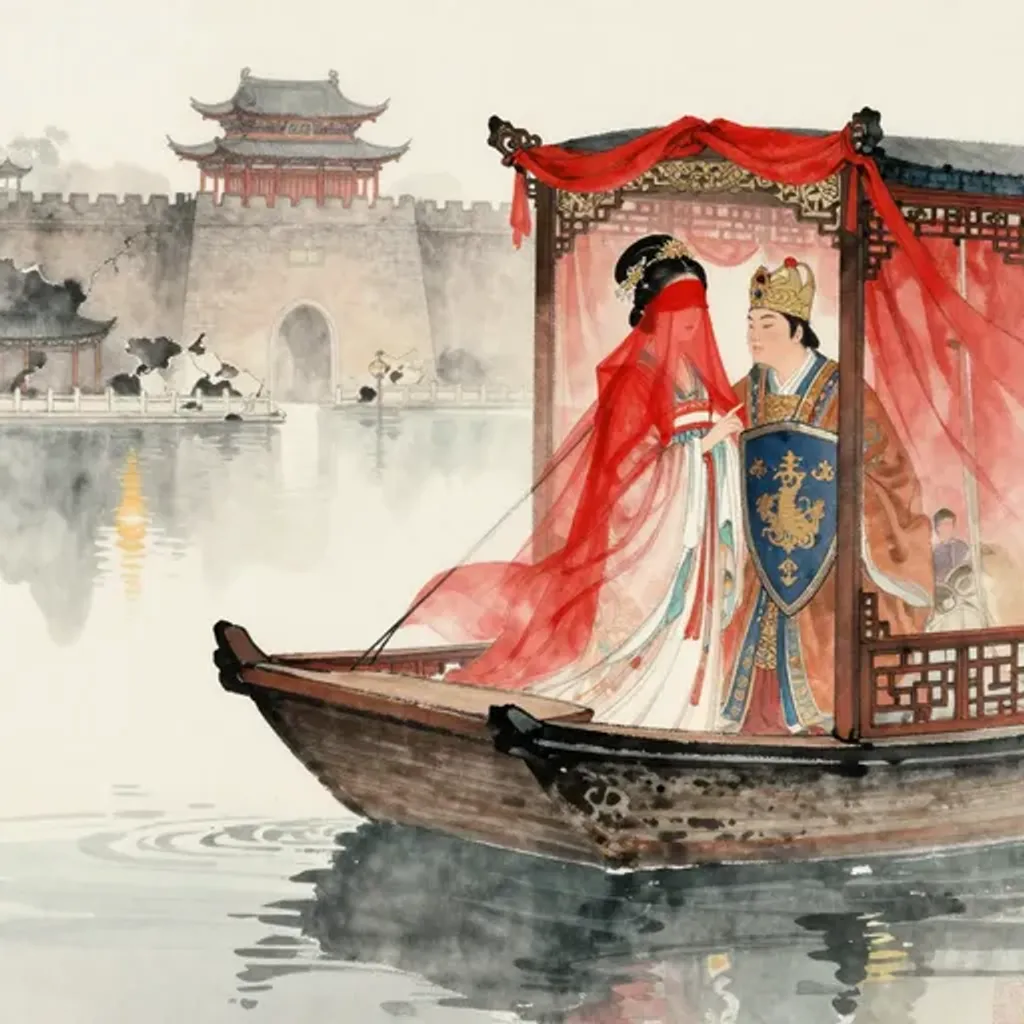
蔡女蕩舟,為國患憂;褒后在側,屏蔽王目。搔擾六國。
Lady Cai dallied on the boat, bringing the state to ruin; Lady Bao at his side, shielding the king eyes. Six nations thrown into turmoil.
— Jiao Yanshou, Yilin (Forest of Changes), 1st century BC
Commentary
Earth above the lake meets wind riding beneath heaven — the gentle restraint of Small Taming. The Lady of Cai rocks the boat, bringing worry to the state; Lady Bao stands beside the king, screening his eyes from truth. Together they throw six states into turmoil. The Lady of Cai is Cai Ji, who playfully rocked Duke Huan of Qi's boat in 657 BC; enraged, he sent her home, and Cai remarried her, triggering Qi's invasion of Cai and then Chu. Lady Bao is Bao Si, whose refusal to smile led King You of Zhou to light false beacon fires, destroying Western Zhou. From Approach to Small Taming, wind above heaven should gently restrain creative force — but here feminine influence, instead of refining power, misdirects it entirely.
臨 → 履
Hexagram 19 → Hexagram 10: Treading
Changing lines: 4, 5, 6
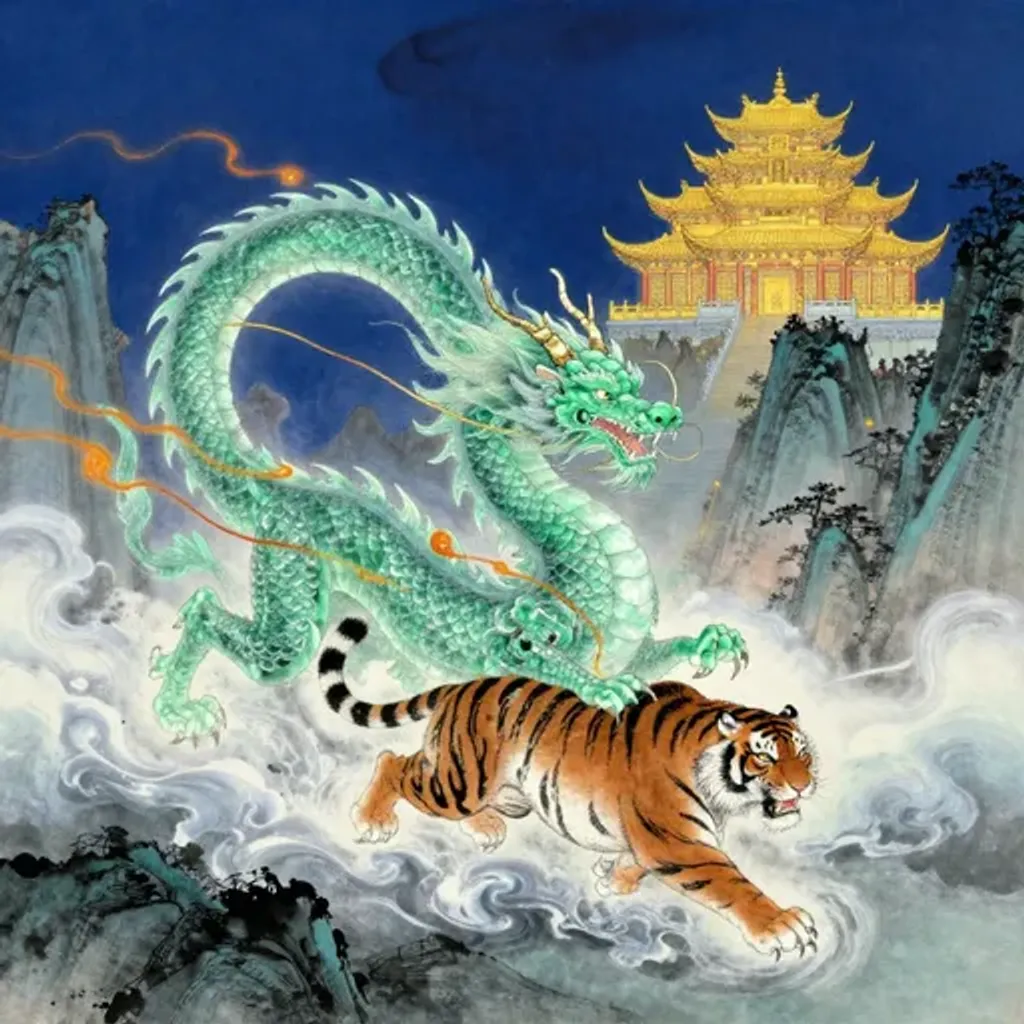
駕龍騎虎,周遍天下;為人所使,西見王母。不憂不殆。
Riding a dragon, astride a tiger, traveling the whole world over; serving another will, one goes west to see the Queen Mother. Neither worry nor peril.
— Jiao Yanshou, Yilin (Forest of Changes), 1st century BC
Commentary
Earth above the lake ascends to heaven above the lake — the careful steps of Treading. Riding dragons and mounted on tigers, one traverses the entire realm, dispatched on a divine mission to visit the Queen Mother of the West in the far reaches. Yet there is neither worry nor peril. The imagery evokes the legendary journey of King Mu of Zhou, who rode westward to Kunlun to meet the Queen Mother. From Approach to Treading, the transformation redefines what it means to walk upon danger: treading the tiger's tail need not end in catastrophe if one moves with cosmic authorization. The rider who harnesses dragon and tiger alike — bridling the most dangerous forces — passes through safely because the mission itself confers protection.
臨 → 泰
Hexagram 19 → Hexagram 11: Peace
Changing lines: 3
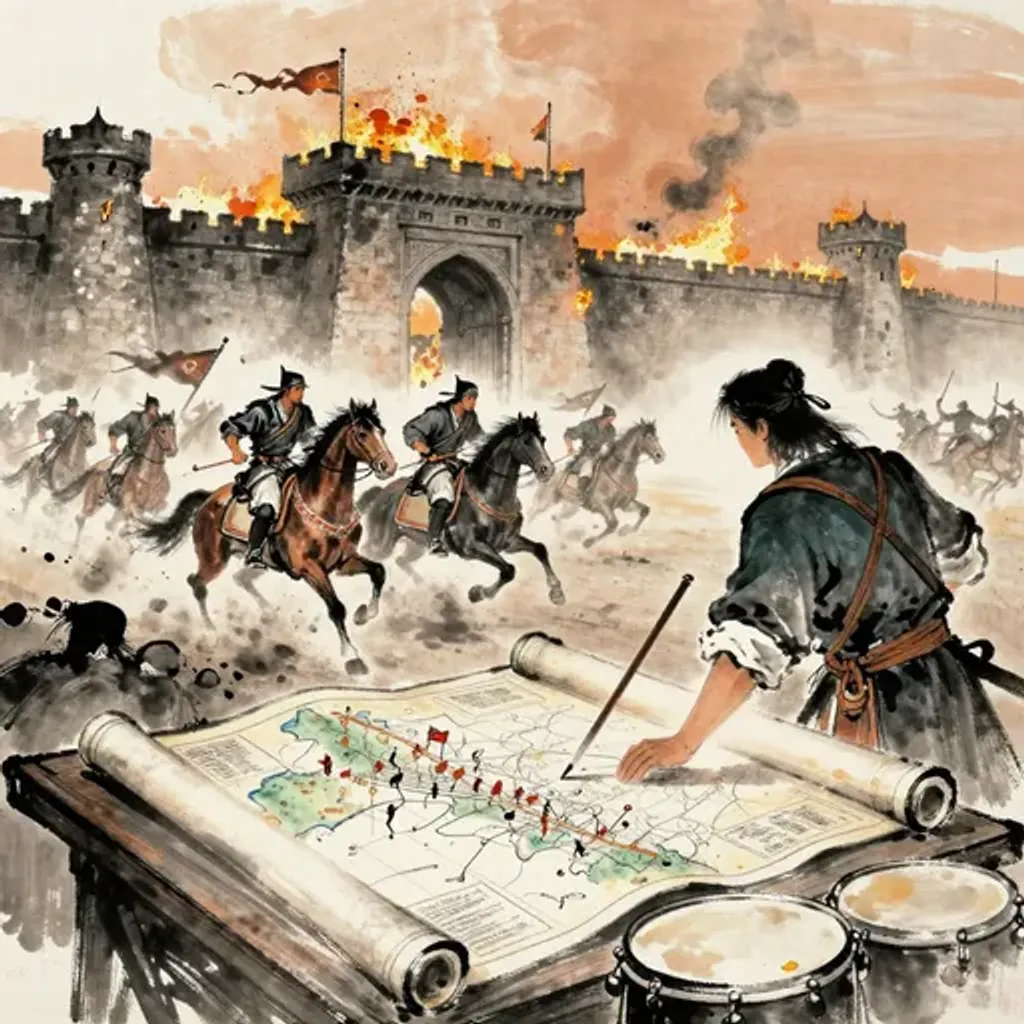
員怨之吳,畫策闔閭;鞭平服荊,除大咎殃。威震敵國,還受上卿。
Yuan, bearing his grudge against Wu, devised strategy for King Helu; he whipped and subdued Jing, removing the great calamity. His might shook the rival state -- he returned to receive the rank of high minister.
— Jiao Yanshou, Yilin (Forest of Changes), 1st century BC
Commentary
Earth above the lake opens into heaven and earth in communion — the great Peace of Tai. Wu Yuan, consumed by resentment, offered his counsel to King Helu of Wu and devised the strategy to punish Chu. He whipped and subdued the kingdom of Jing, removing a great scourge. His power shook the enemy state, and upon return he was honored as a senior minister. Wu Yuan is Wu Zixu, whose father and brother were murdered by King Ping of Chu. He fled to Wu, helped Helu seize the throne, then led Wu's armies into Chu's capital in 506 BC, reportedly whipping King Ping's corpse. From Approach to Peace, devastating vengeance paradoxically restores cosmic balance — heaven descends, earth rises, and the wronged minister's fury becomes the instrument through which order is reestablished.
臨 → 否
Hexagram 19 → Hexagram 12: Standstill
Changing lines: 1, 2, 4, 5, 6
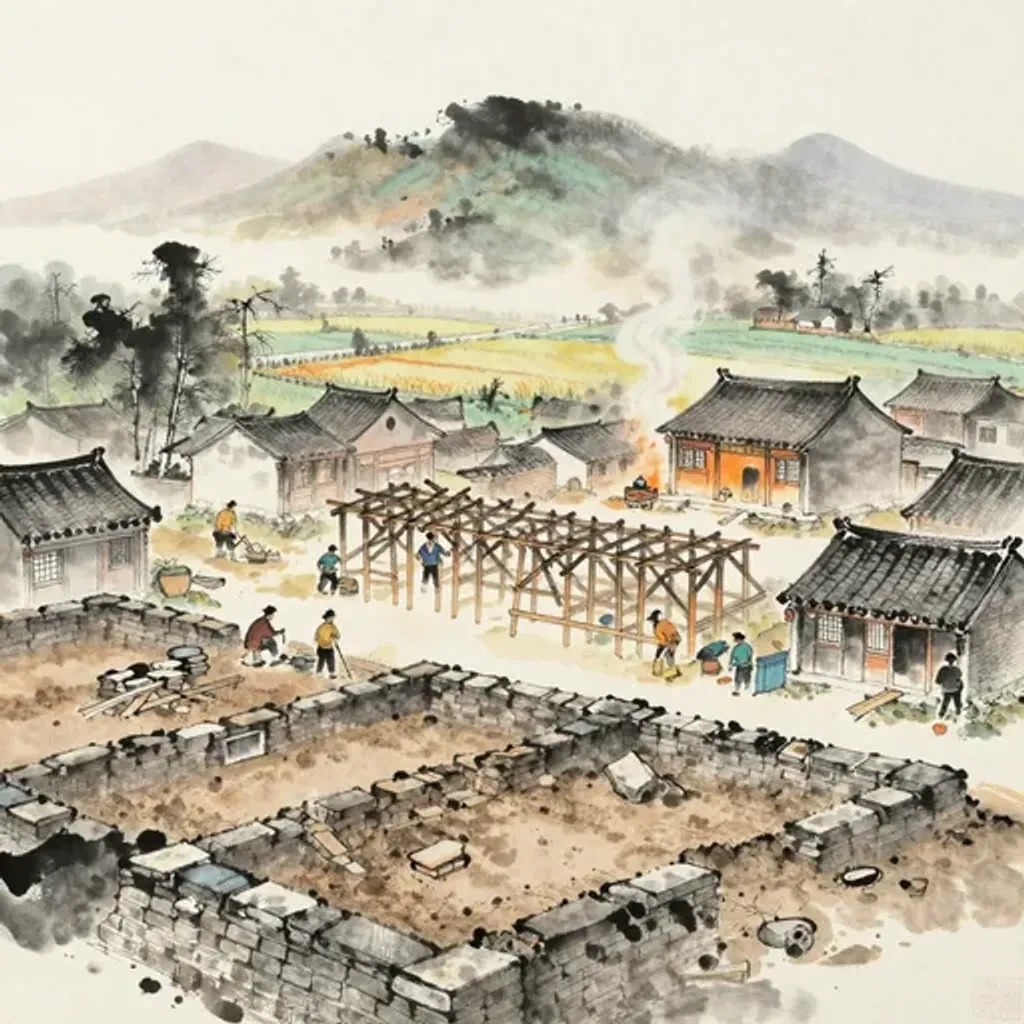
唐邑之墟,晉人之居。虞叔受福,寔沈是國,世載其樂。
The ruins of the Tang capital, the dwelling of the Jin people. Uncle Yu received blessings -- truly Shen was his domain, and his line enjoyed its happiness for generations.
— Jiao Yanshou, Yilin (Forest of Changes), 1st century BC
Commentary
Earth above the lake meets heaven and earth refusing to communicate — the Standstill of Pi. The ruins of Tang become the dwelling of the Jin people; Uncle Yu receives blessings, and the state of Shen is truly this land, its joy carried on for generations. Tang was the ancient fief granted to Shu Yu, son of King Wu, which later became the state of Jin. The verse traces how one domain's collapse becomes another's foundation: Tang's ruins sustain Jin's rise, and the lineage flourishes across generations. From Approach to Standstill, the paradox is striking — even when heaven and earth cease communicating, inherited virtue endures. The joy that persists through stagnation is not new prosperity but the deep root-system of ancestral blessing, quietly sustaining life beneath frozen ground.
臨 → 同人
Hexagram 19 → Hexagram 13: Fellowship
Changing lines: 2, 3, 4, 5, 6

管鮑相知,至德不離;三言相桓,齊國以安。
Guan and Bao knew each other deeply; their perfect virtue never parted. With three words they steadied Duke Huan -- the state of Qi was at peace.
— Jiao Yanshou, Yilin (Forest of Changes), 1st century BC
Commentary
Earth above the lake rises to heaven joined with fire — the Fellowship of kindred spirits. Guan Zhong and Bao Shuya understood each other with supreme virtue, their bond unbreakable. With three counsels they established Duke Huan's hegemony, and the state of Qi found peace. The friendship of Guan and Bao is one of the most celebrated in Chinese tradition: Bao Shuya recognized Guan Zhong's genius despite his poverty and failures, recommending him to Duke Huan even over himself. Guan Zhong then transformed Qi into the foremost power of the Spring and Autumn period. From Approach to Fellowship, the elder's oversight becomes mutual recognition among equals. Fire and heaven unite: true fellowship is not hierarchy but the meeting of kindred brilliance that illuminates an entire era.
臨 → 大有
Hexagram 19 → Hexagram 14: Great Possession
Changing lines: 3, 4, 6
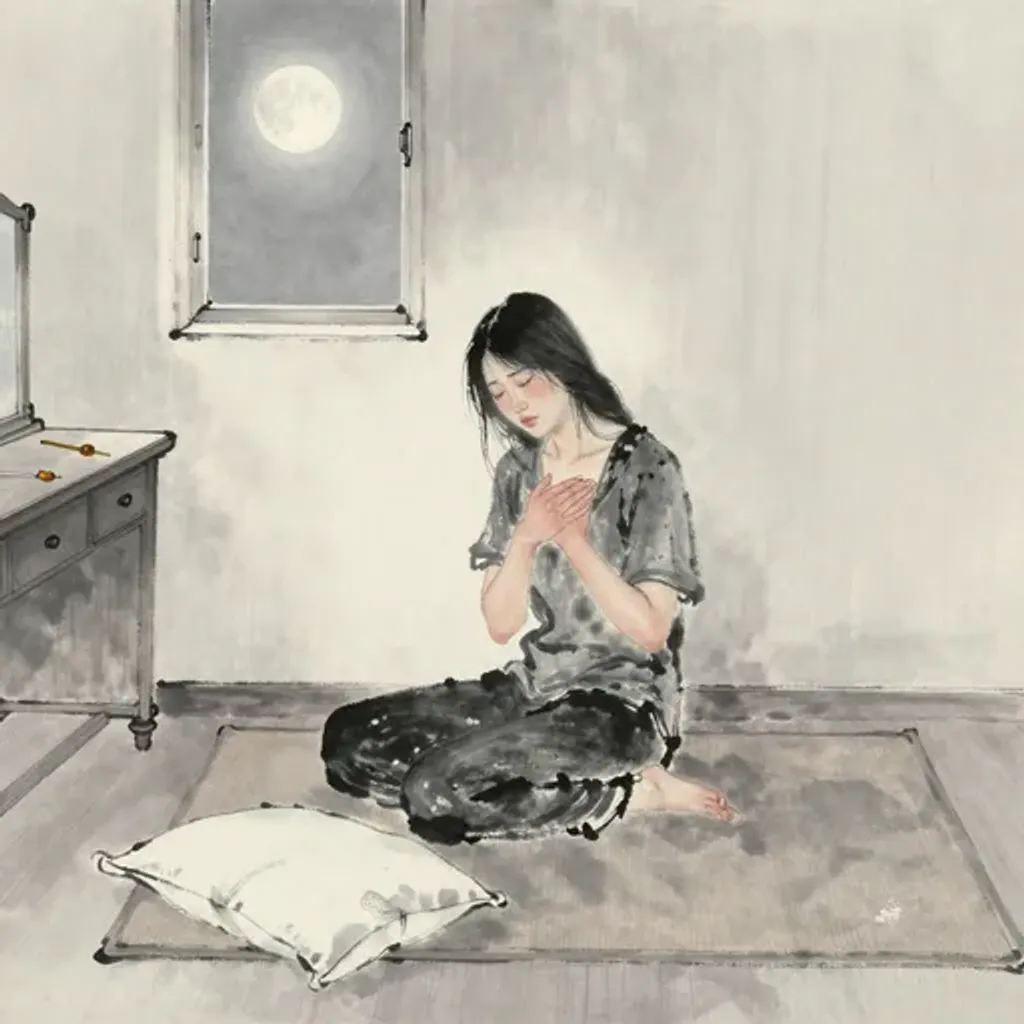
三十無室,長女獨宿;心勞未得,憂在胸臆。
At thirty and still without a household; the elder daughter sleeps alone. The heart toils without gain -- worry lodges in the breast.
— Jiao Yanshou, Yilin (Forest of Changes), 1st century BC
Commentary
Earth above the lake blazes into fire high in heaven — Great Possession. Yet the scene is one of longing rather than abundance: a woman of thirty still without a household, the eldest daughter sleeping alone. Her heart labors for what she has not attained; worry fills her breast. The irony is deliberate — Great Possession as the destination, yet the verse describes its absence. The unmarried woman embodies potential unfulfilled, resources untapped, brilliance without a stage. From Approach to Great Possession, the transformation suggests that what approaches is not yet grasped. Fire blazes in heaven, but its warmth has not reached the one who needs it most. Great wealth exists in the pattern, though the individual has yet to claim her portion.
臨 → 謙
Hexagram 19 → Hexagram 15: Modesty
Changing lines: 1, 2, 3
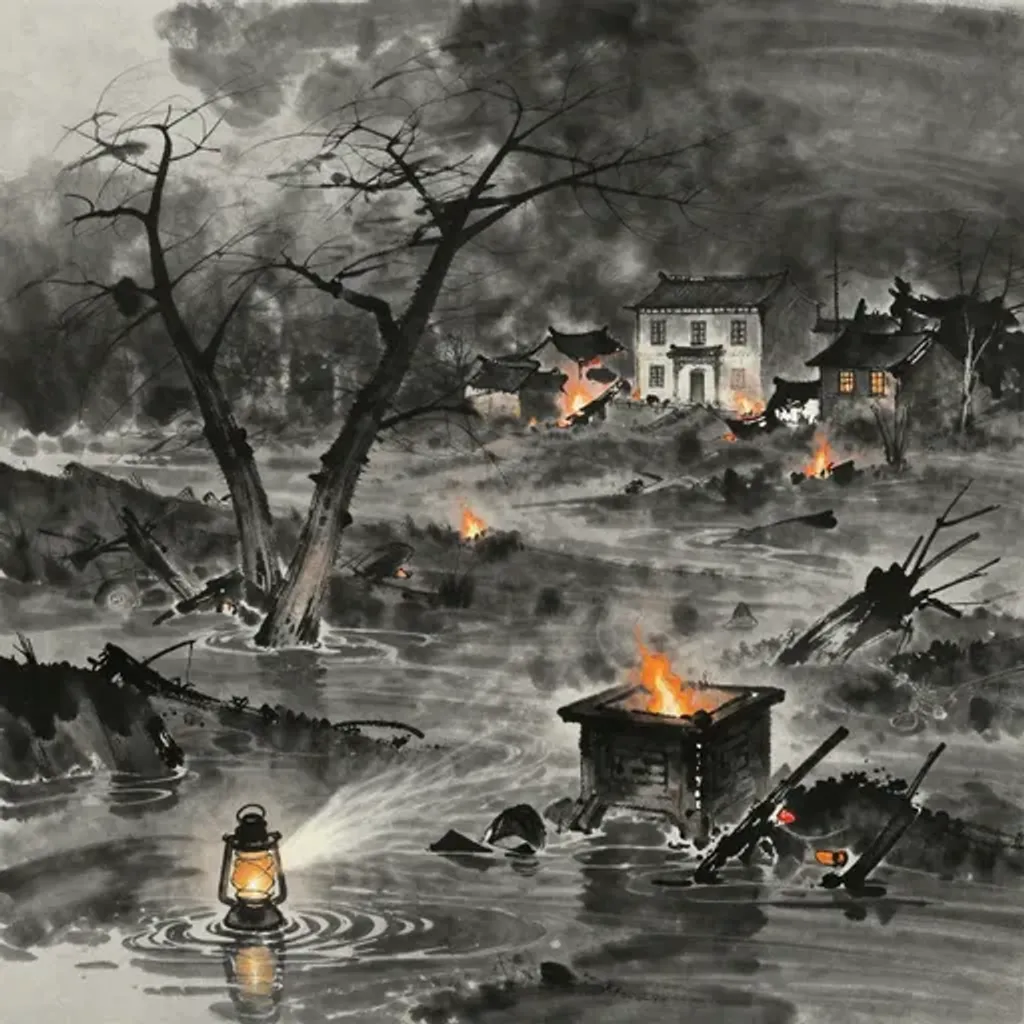
散渙水長,風吹我鄉。火滅無光,墮敗桓公。
Waters scatter far and wide; the wind blows toward my village. The fire goes out and there is no light -- Duke Huan brought to ruin.
— Jiao Yanshou, Yilin (Forest of Changes), 1st century BC
Commentary
Earth above the lake descends to the mountain hidden within earth — Modesty's quiet containment. Waters scatter and lengthen as the wind blows toward home. The fire goes out, leaving no light, and Duke Huan falls into ruin. The verse traces entropy from flood to windstorm to darkness to political collapse. Duke Huan of Qi, once the foremost hegemon, died miserably in 643 BC — his corpse unburied for sixty-seven days while his sons fought for succession, so neglected that maggots crawled from his chamber. From Approach to Modesty, the transformation warns that even the mightiest must yield. The mountain hidden within earth embodies the lesson Huan never learned: true authority rests in restraint, not in the blaze of power that inevitably gutters out.
臨 → 豫
Hexagram 19 → Hexagram 16: Enthusiasm
Changing lines: 1, 2, 4
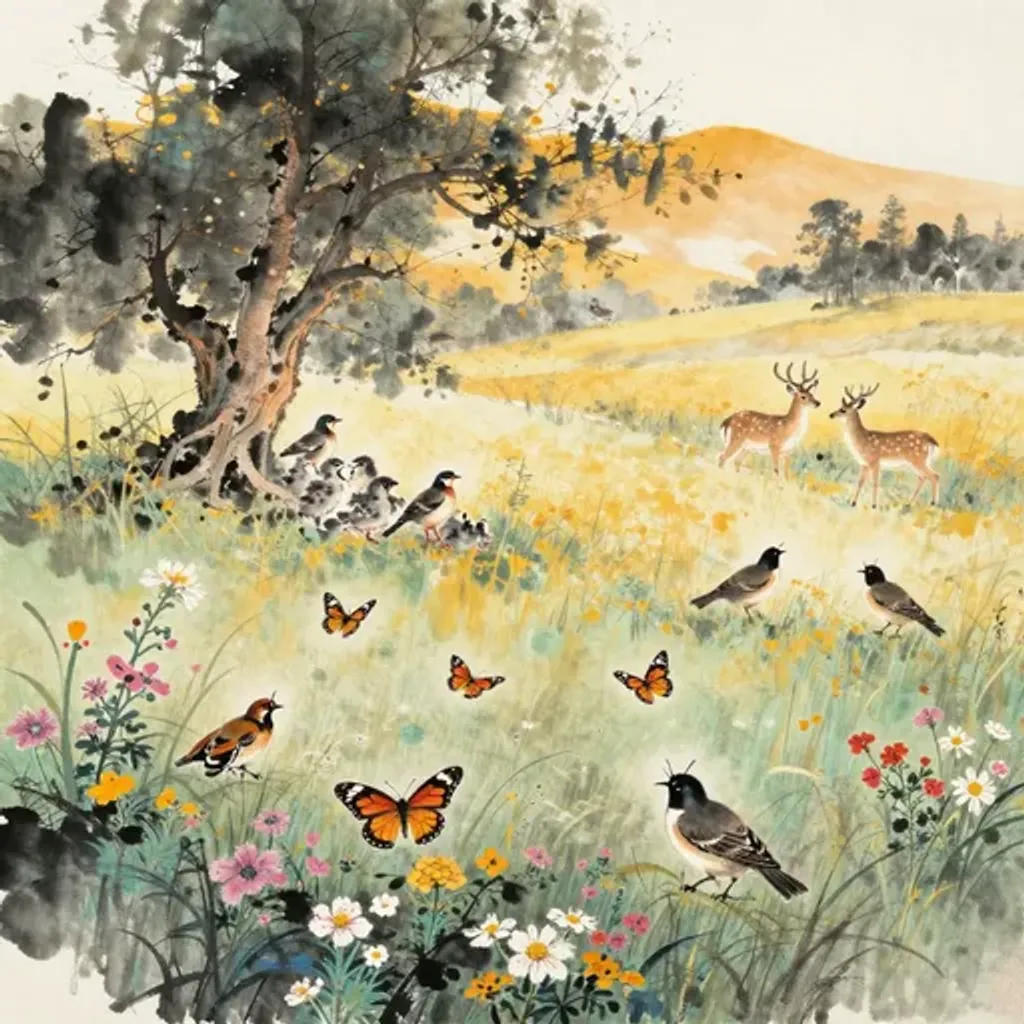
飛蜎蠕動,各有配偶;小大相保,咸得其所。
Winged insects and creeping things, each has its mate; small and great protect one another -- all find their proper place.
— Jiao Yanshou, Yilin (Forest of Changes), 1st century BC
Commentary
Earth above the lake erupts into thunder rising from the earth — Enthusiasm's joyful energy. Flying insects and creeping creatures each find their mate; the small and great protect one another, and all obtain their proper place. The verse celebrates the natural order at its most harmonious: even the humblest organisms participate in cosmic pairing. Nothing is too insignificant to deserve companionship and mutual support. From Approach to Enthusiasm, the elder's careful oversight releases into spontaneous celebration. Thunder bursting from the earth is nature's own music — the ancestral hymn that resonates through every living thing. When each creature finds its match, the world itself becomes a festival.
臨 → 隨
Hexagram 19 → Hexagram 17: Following
Changing lines: 2, 4, 5
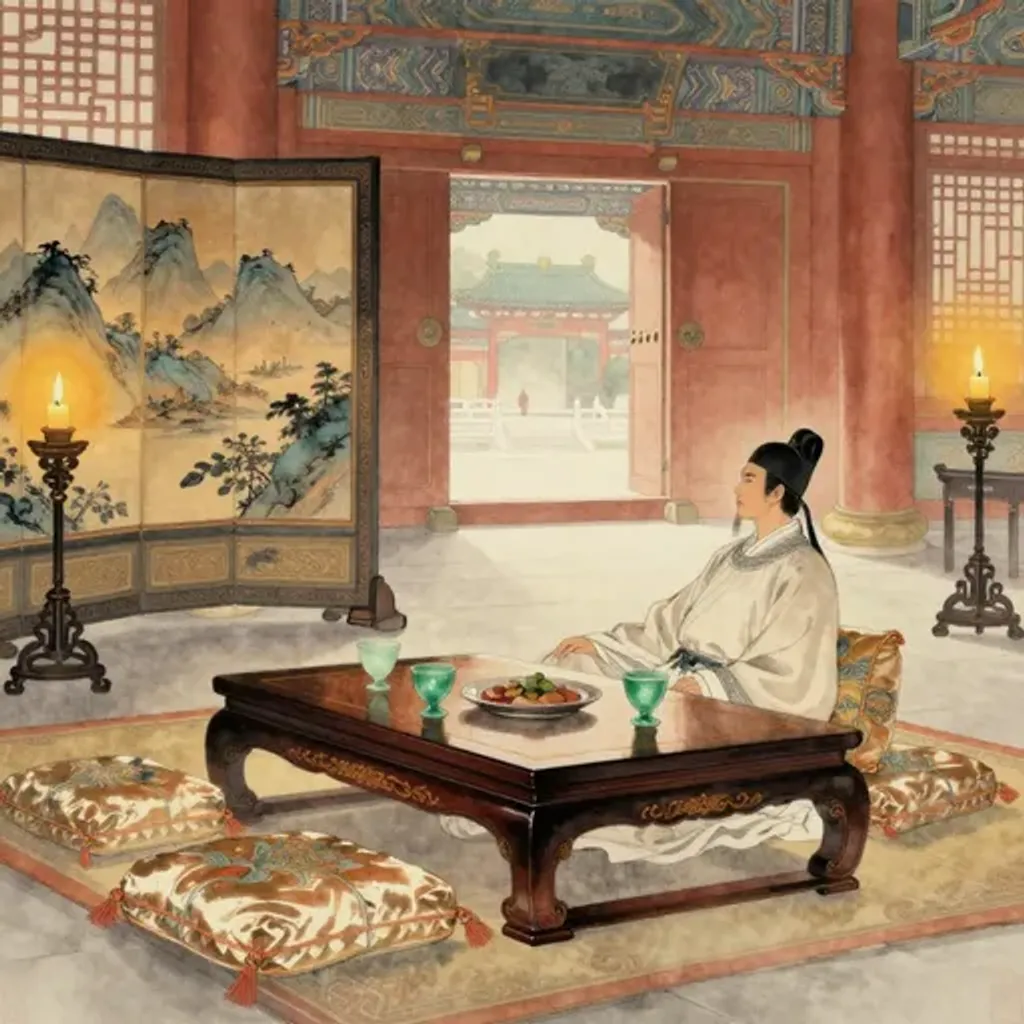
安樂几筵,未出王門。
At ease on bench and banquet mat, never venturing beyond the king gate.
— Jiao Yanshou, Yilin (Forest of Changes), 1st century BC
Commentary
Earth above the lake settles into thunder resting within the lake — Following's contented repose. Comfortable and at ease upon bench and banquet mat, one has not yet stepped beyond the king's gate. The verse is remarkably brief, capturing a single moment of domestic peace: the official rests in the palace, well-fed and undisturbed, with no reason to venture out. From Approach to Following, the elder's active oversight yields to willing rest. Thunder dormant within the lake is the image of retreat at nightfall — the gentleman turns toward darkness and enters into rest. Authority relaxes its grip, and what follows is not disorder but tranquility: the contentment of staying exactly where one belongs.
臨 → 蠱
Hexagram 19 → Hexagram 18: Work on the Decayed
Changing lines: 1, 3, 6
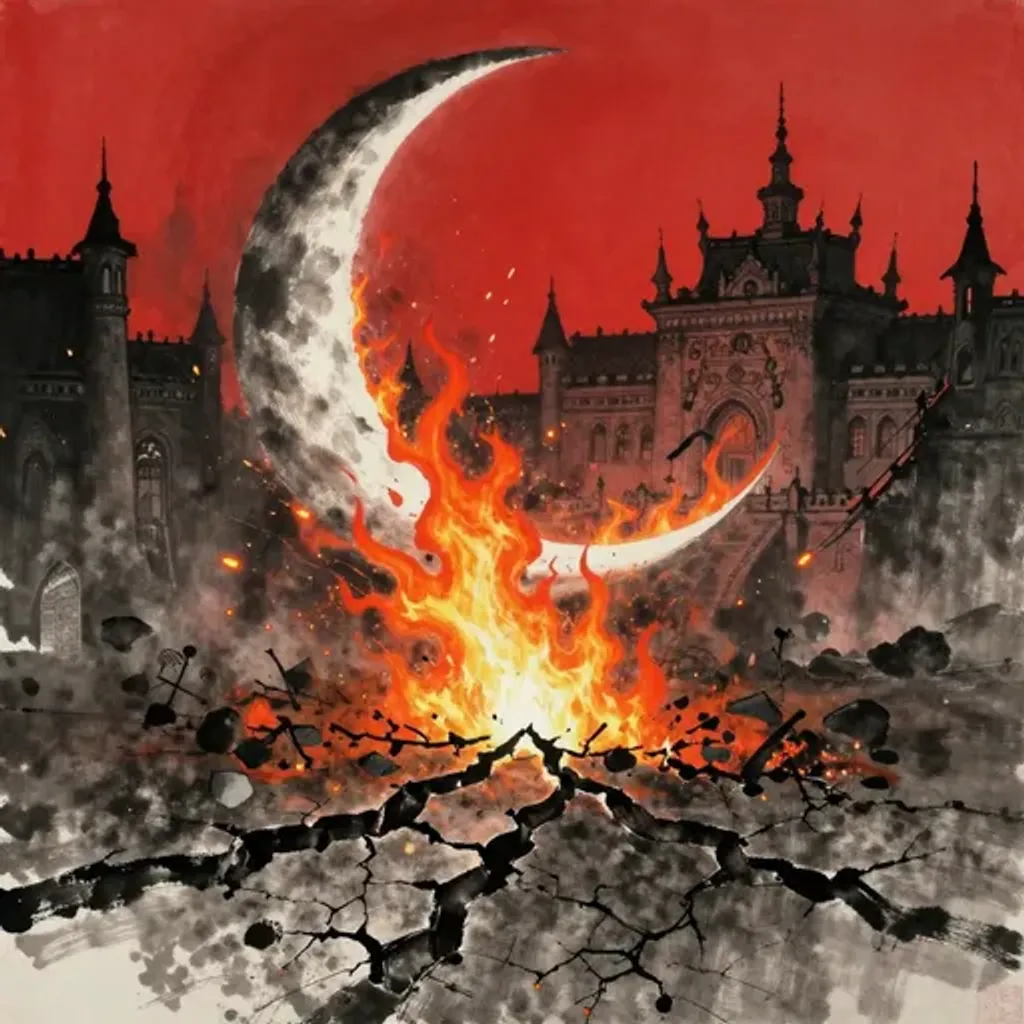
火生月窟,上下恩塞;觝亂我國。
Fire born in the moon hollow; grace blocked above and below -- it throws my kingdom into chaos.
— Jiao Yanshou, Yilin (Forest of Changes), 1st century BC
Commentary
Earth above the lake meets wind beneath the mountain — the corruption of Work on the Decayed. Fire ignites in the moon's den; above and below, beneficence is sealed shut. Disorder assails the state. The 'moon's den' — the place where yin force is most concentrated — erupts in flame, an impossible inversion. When grace between ruler and ruled is blocked, the natural order itself convulses. From Approach to Work on the Decayed, the elder's protective presence fails: what should have been generous oversight has allowed rot to fester beneath the surface. Wind trapped under the mountain cannot disperse the stagnation. The fire born in the yin's deepest chamber signals that corruption has reached the very core, and the state shudders under its weight.
臨 → 臨
Hexagram 19 → Hexagram 19: Approach
No changing lines — the hexagram is unchanged
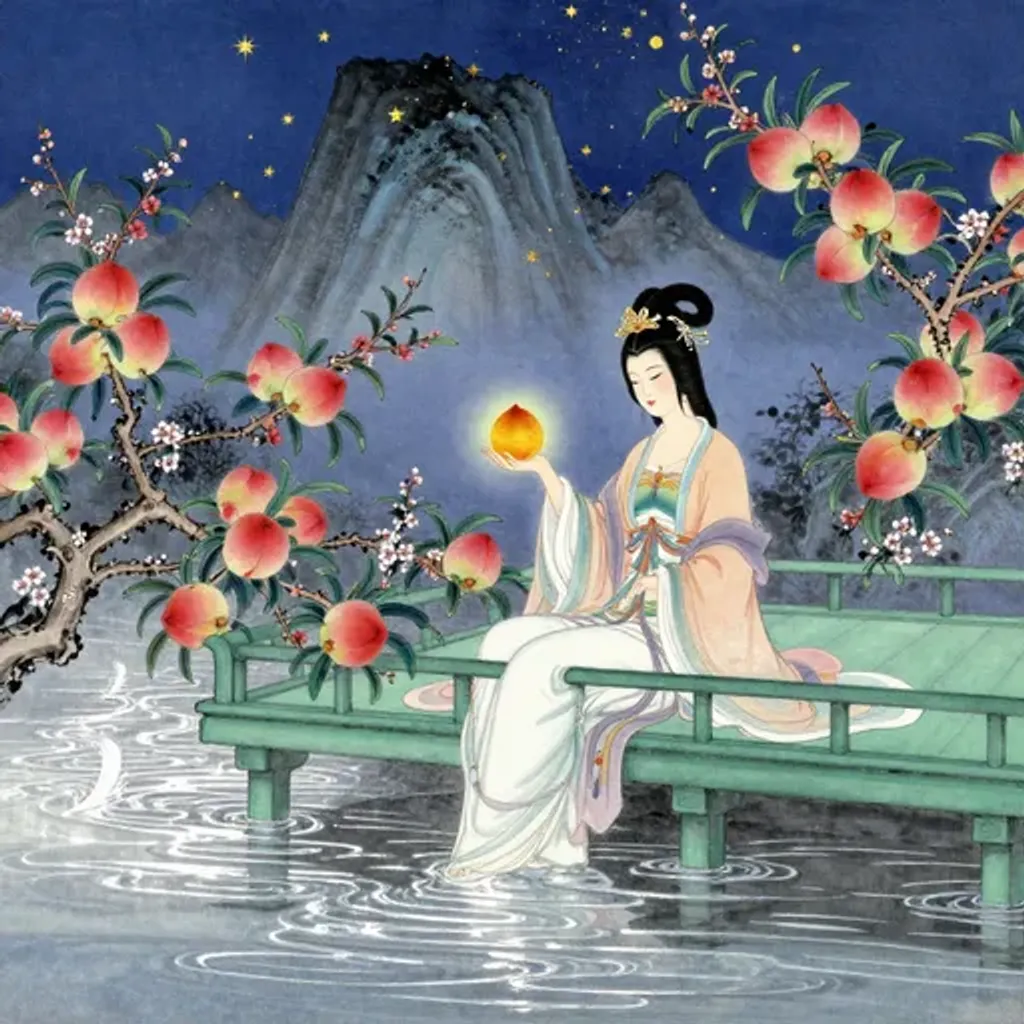
弱水之上,有西王母;生不知老,與天相保。行者危怠,利居善喜。
Above the Weak Water dwells the Queen Mother of the West; born without knowing old age, she endures alongside heaven. The traveler is weary and endangered -- better to stay and find contentment.
— Jiao Yanshou, Yilin (Forest of Changes), 1st century BC
Commentary
Earth above the lake doubled — Approach meeting itself. Above the Weak Water dwells the Queen Mother of the West, who knows neither aging nor death, preserved eternally alongside Heaven. Yet the verse pivots: travelers face danger and exhaustion, while those who remain in place find benefit and joy. With Approach redoubled, the oracle counsels that true sovereignty lies not in restless expansion but in cultivating what is already near. The Queen Mother's immortality at the world's edge teaches that the deepest power resides in stillness, not pursuit. The Weak Water cannot be crossed — not as obstacle but as wisdom of natural limits. Those who know when to stop find what endures.
臨 → 觀
Hexagram 19 → Hexagram 20: Contemplation
Changing lines: 1, 2, 5, 6
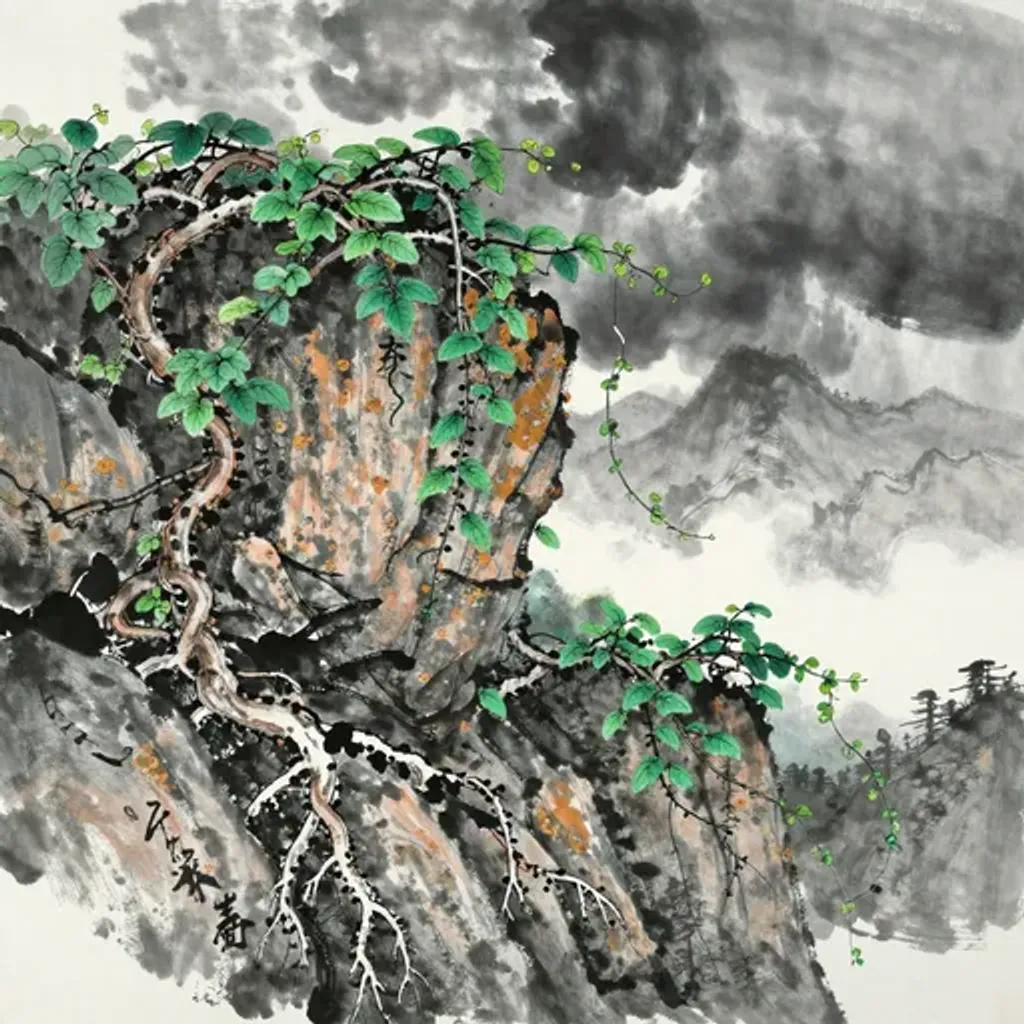
長生無極,子孫千億;柏柱載青,堅固不傾。
Ancient vine wraps around stone, new leaves every year. Roots a hundred fathoms deep — thunder and rain cannot shake it.
— Jiao Yanshou, Yilin (Forest of Changes), 1st century BC
Commentary
Earth above the lake meets wind moving across the earth — Contemplation's broad survey. The original verse reads: 'Long life without limit, descendants in the thousands. Cypress pillars stay green, firm and never toppling.' Evergreen timber and endless progeny — the verse celebrates permanence through deep roots. The cypress, which keeps its color through winter, embodies the constancy that sustains a lineage across generations. From Approach to Contemplation, the elder's direct oversight transforms into the far-reaching gaze of the sage-king who surveys his realm. Wind across the earth carries influence to every corner: the deeply rooted house needs no forceful rule, for its example — like the cypress — stands visible to all who observe.
臨 → 噬嗑
Hexagram 19 → Hexagram 21: Biting Through
Changing lines: 2, 4, 6
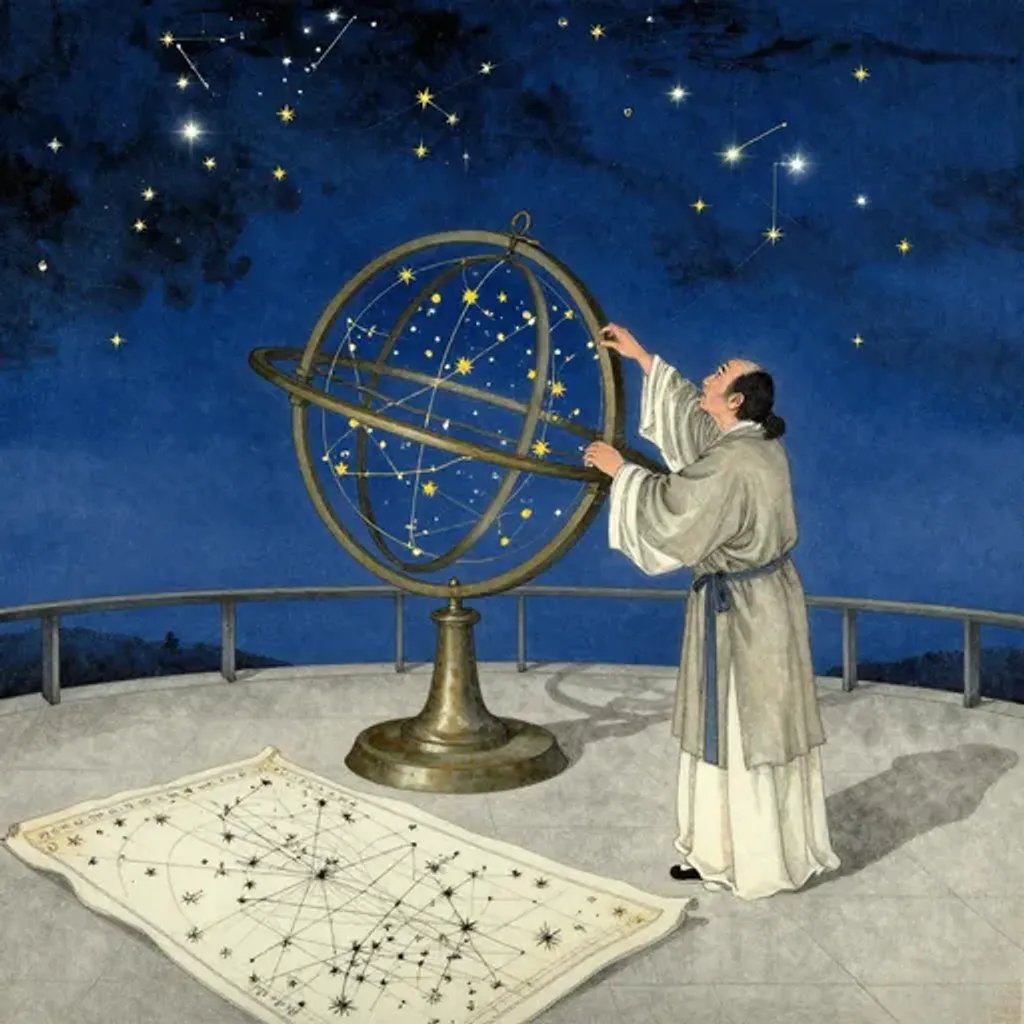
欽敬昊天,曆象星辰;宣授民時,陰陽和調。
Reverently honoring great heaven, charting the stars and constellations; proclaiming the seasons to the people -- yin and yang in harmony.
— Jiao Yanshou, Yilin (Forest of Changes), 1st century BC
Commentary
Earth above the lake meets fire and thunder — Biting Through's decisive justice. Reverently honoring great Heaven, one charts the stars and constellations, then promulgates the calendar to the people so that all may know the proper seasons. Yin and yang find harmony and balance. The verse describes the sage-ruler's most fundamental duty: observing celestial patterns and transmitting them as civil order. This echoes Emperor Yao's commission in the Book of Documents, commanding Xi and He to 'reverently accord with august Heaven, computing and delineating the sun, moon, and stars.' From Approach to Biting Through, the elder's nurturing oversight becomes precise adjudication. Lightning and thunder clarify what is clouded: the calendar bites through confusion, separating proper time from improper, ensuring that human activity aligns with cosmic rhythm.
臨 → 賁
Hexagram 19 → Hexagram 22: Grace
Changing lines: 2, 3, 6
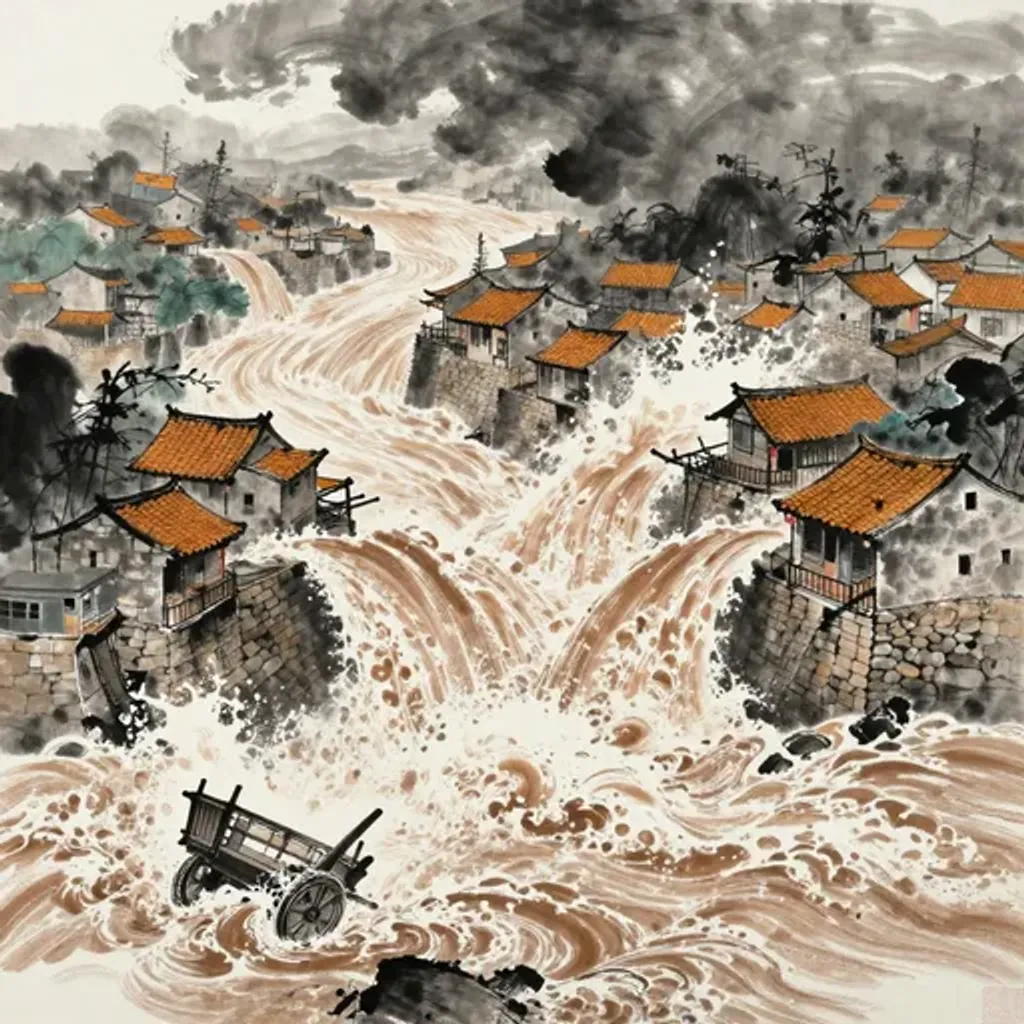
三河俱合,水怒踴躍;壞我王屋,民困於食。
Three rivers converge together; the waters surge in fury. They wreck the royal house -- the people are destitute for food.
— Jiao Yanshou, Yilin (Forest of Changes), 1st century BC
Commentary
Earth above the lake meets fire beneath the mountain — the ornamental clarity of Grace. Three rivers converge at once, their waters raging and surging. The royal palace is destroyed, and the people fall into famine. The convergence of three rivers into a single devastating flood obliterates the distinction between water and land, between shelter and ruin. From Approach to Grace, the contrast is jarring: Grace demands measured beauty, fire illuminating the mountain's patterns — but here raw elemental force overwhelms all structure. The verse warns that when natural forces exceed their banks, no amount of ornamental order can hold. What the lake nurtured in Approach becomes a torrent that drowns the very civilization it was meant to sustain.
臨 → 剝
Hexagram 19 → Hexagram 23: Splitting Apart
Changing lines: 1, 2, 6
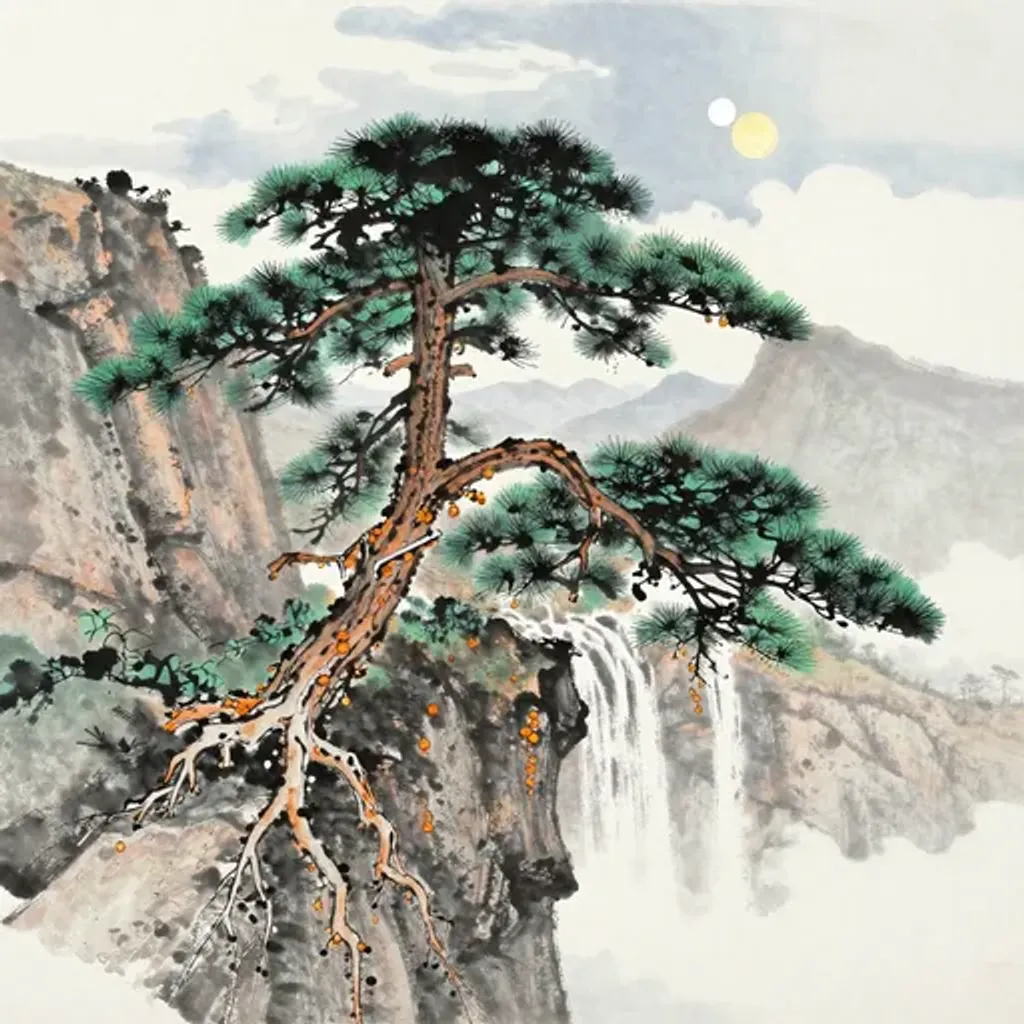
壽如松喬,與日月俱;常安康樂,不見禍憂。
Long-lived as Song and Qiao, enduring alongside sun and moon; ever at peace and in good health, never seeing misfortune or worry.
— Jiao Yanshou, Yilin (Forest of Changes), 1st century BC
Commentary
Earth above the lake meets the mountain resting upon earth — Splitting Apart's quiet erosion. Yet the verse defies the hexagram's usual foreboding: 'Long-lived as Chisongzi and Wang Qiao, enduring together with sun and moon, always at peace and in good health, never glimpsing sorrow or misfortune.' The Daoist immortals Song Qiao represent transcendence beyond temporal decay. From Approach to Splitting Apart, the mountain's slow erosion threatens all structures — but the immortals exist outside structure entirely. Their longevity is not resistance to stripping away but freedom from it. The verse offers a radical consolation: when everything around you crumbles, the one who has already released attachment to form persists untouched.
臨 → 復
Hexagram 19 → Hexagram 24: Return
Changing lines: 2
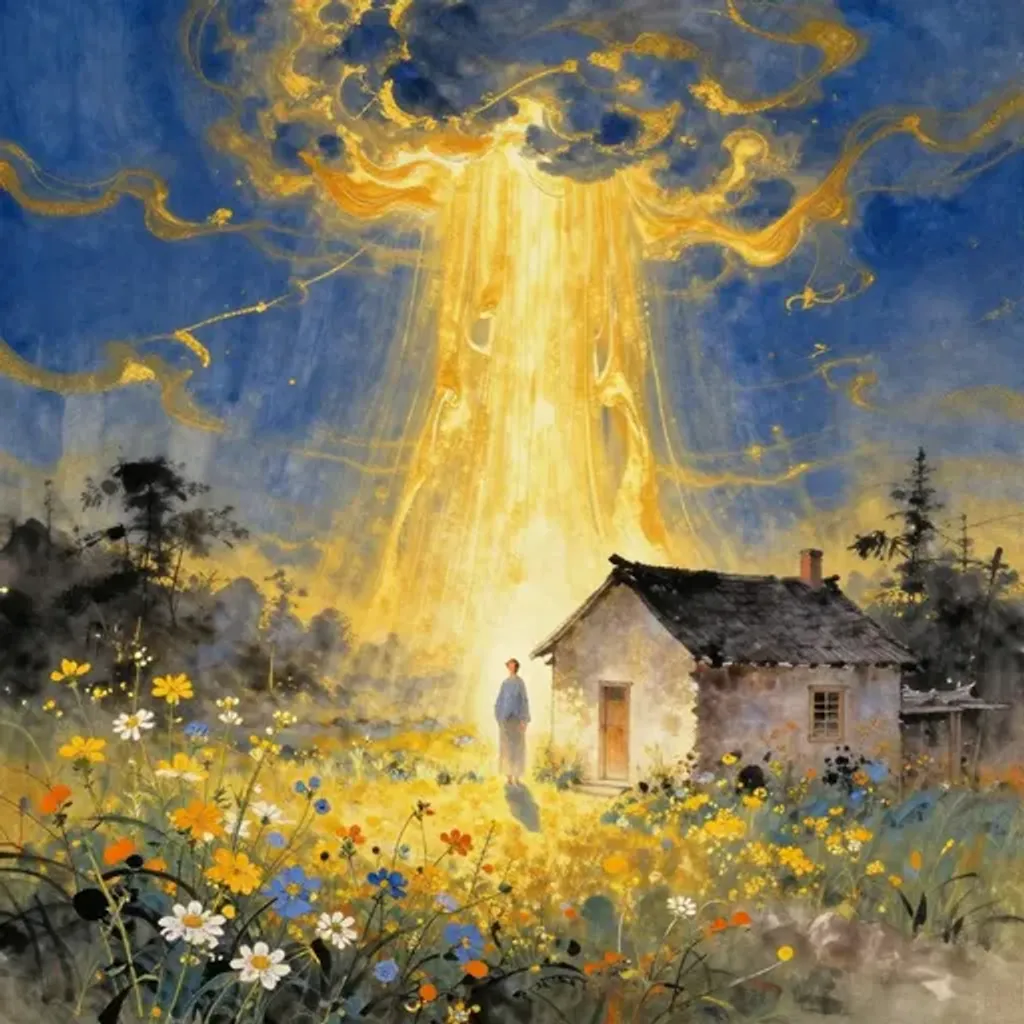
天之所予,福祿常在。不憂危殆。
What heaven bestows, fortune and blessing are ever present. Neither worry nor peril.
— Jiao Yanshou, Yilin (Forest of Changes), 1st century BC
Commentary
Earth above the lake meets thunder returning within the earth — the quiet renewal of Return. What Heaven has bestowed, fortune and blessings, abides always. There is no cause for worry or peril. The verse is strikingly simple — almost a benediction. No narrative, no allusion, just the calm assurance that heavenly favor endures. From Approach to Return, the elder's oversight gives way to the first stirring of renewed yang at the winter solstice. Thunder buried in the earth is the single yang line returning at the bottom of the hexagram: the smallest possible beginning of recovery. The verse's brevity matches the hexagram's quietude — in the moment of return, elaboration is unnecessary. The blessing simply is.
臨 → 无妄
Hexagram 19 → Hexagram 25: Innocence
Changing lines: 2, 4, 5, 6
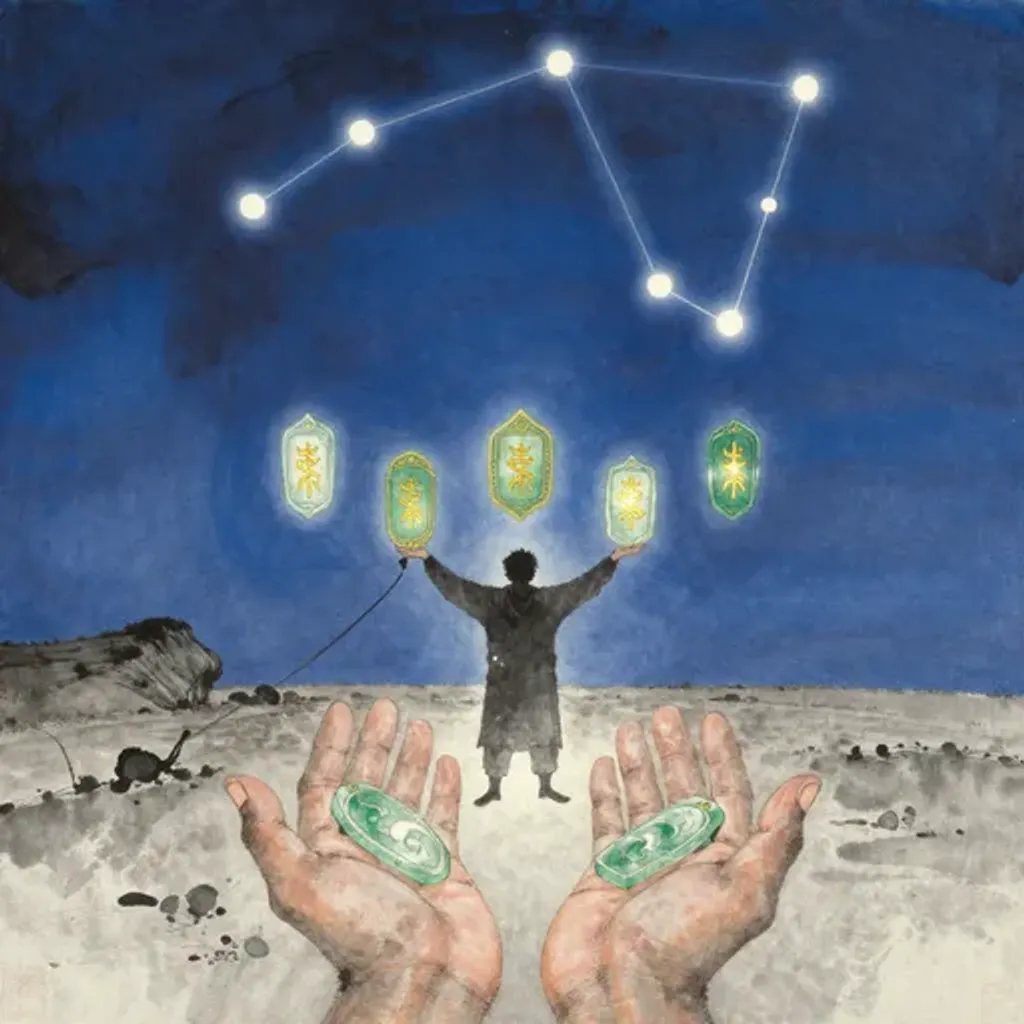
受讖六符,招搖空虛;雖跌無憂,保我全財。
Receiving talismans of the six signs, Zhaoyao points to emptiness; though one stumbles, there is no worry -- my wealth is fully preserved.
— Jiao Yanshou, Yilin (Forest of Changes), 1st century BC
Commentary
Earth above the lake encounters thunder beneath heaven — Innocence's unexpected motion. One receives six talismanic tokens, yet the Dipper star Zhaoyang points to emptiness. Though one stumbles, there is no cause for worry; one's wealth remains intact. The six tokens suggest bureaucratic credentials or spiritual talismans, yet the celestial pointer finds only void — form without substance, credentials without genuine backing. The stumble occurs but proves harmless: the fall is cushioned by what truly matters. From Approach to Innocence, calculated positioning gives way to uncontrolled natural movement. Thunder under heaven acts without premeditation. The verse counsels: when credentials prove hollow, survival depends not on official standing but on the genuine reserves one has quietly accumulated.
臨 → 大畜
Hexagram 19 → Hexagram 26: Great Taming
Changing lines: 3, 6
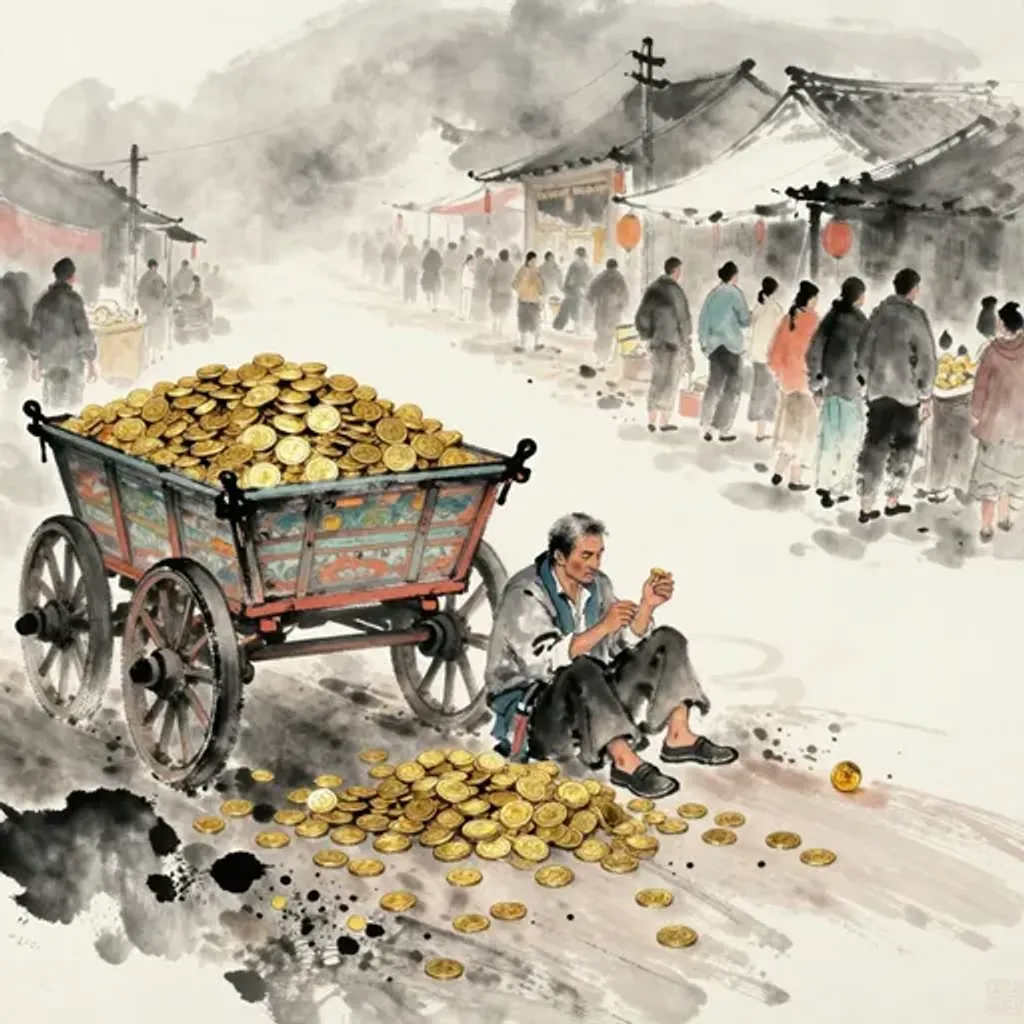
齎金買車,失道後時;勞罷為會,我心則休。
Spending gold to buy a cart, one misses the road and the hour; laboring in vain for the meeting, my heart then finds its rest.
— Jiao Yanshou, Yilin (Forest of Changes), 1st century BC
Commentary
Earth above the lake rises to heaven stored within the mountain — Great Taming's accumulated power. Spending gold to buy a carriage, one loses the way and misses the season. Exhausted from laboring toward the gathering, one's heart finally finds rest. The verse traces a costly detour: resources spent, timing lost, energy depleted in pursuit of an assembly or market. Yet the ending is peace — the heart rests despite the inefficiency. From Approach to Great Taming, the lake's open accessibility gives way to the mountain containing heaven: not everything that approaches should pass through freely. The gold spent on the wrong carriage and the missed timing are the price of learning what to store and what to release. Taming requires expensive lessons.
臨 → 頤
Hexagram 19 → Hexagram 27: Nourishment
Changing lines: 2, 6
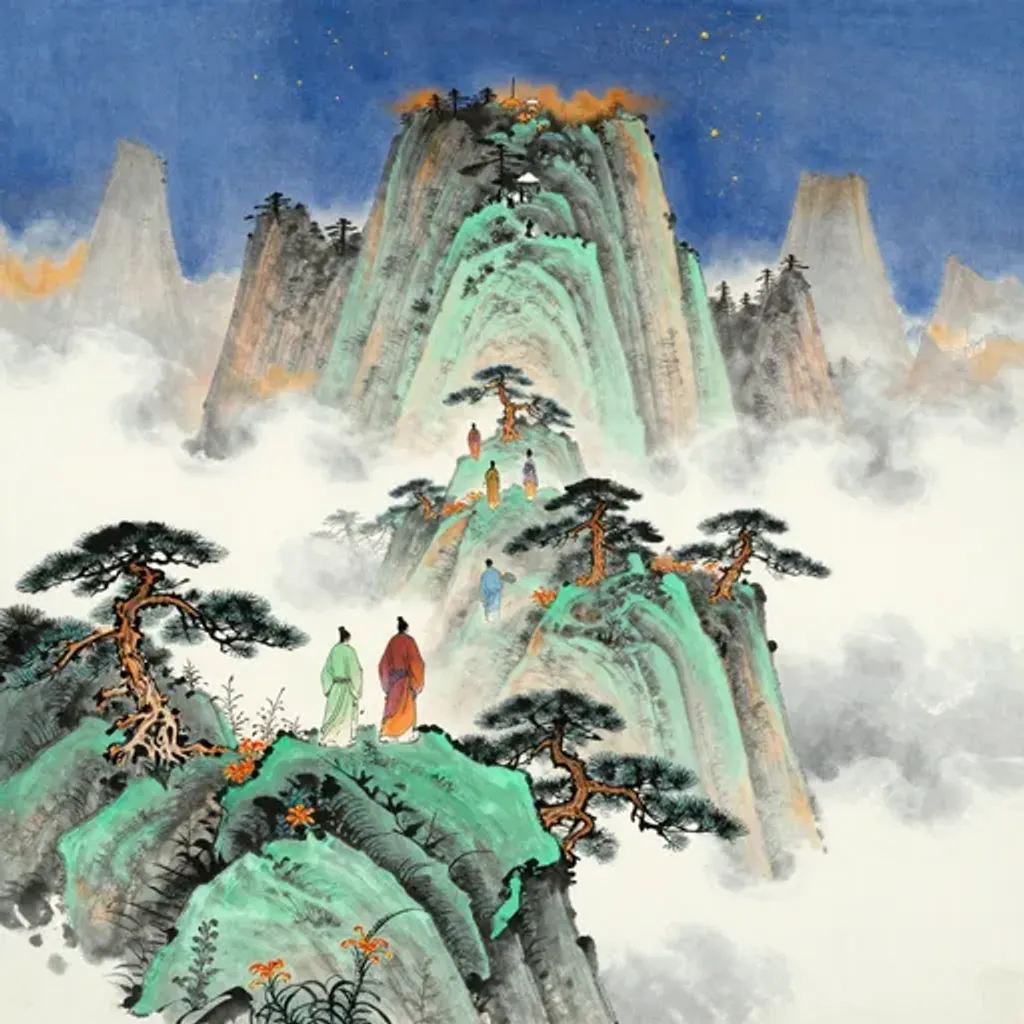
華首山頭,仙道所遊;利以居止,長無憂咎。
On the peak of Mount Huashou, where the immortal way roams; it is good to stop and dwell -- long without worry or fault.
— Jiao Yanshou, Yilin (Forest of Changes), 1st century BC
Commentary
Earth above the lake meets the mountain with thunder beneath — Nourishment's quiet sustenance. At the summit of Mount Huashou, immortals roam and wander. It is advantageous to dwell and remain; one enjoys perpetual freedom from worry and blame. Huashou Mountain, associated with Daoist hermit traditions, represents the heights where the mundane world falls away and spiritual nourishment replaces material concern. From Approach to Nourishment, the elder's protective oversight transforms into the mountain's provision of sustenance. Thunder beneath the mountain — the open mouth of Yi — suggests that true nourishment comes from retreating to sacred ground. The verse prescribes stillness on the mountaintop rather than descent into the world's troubles.
臨 → 大過
Hexagram 19 → Hexagram 28: Great Exceeding
Changing lines: 1, 3, 4, 5
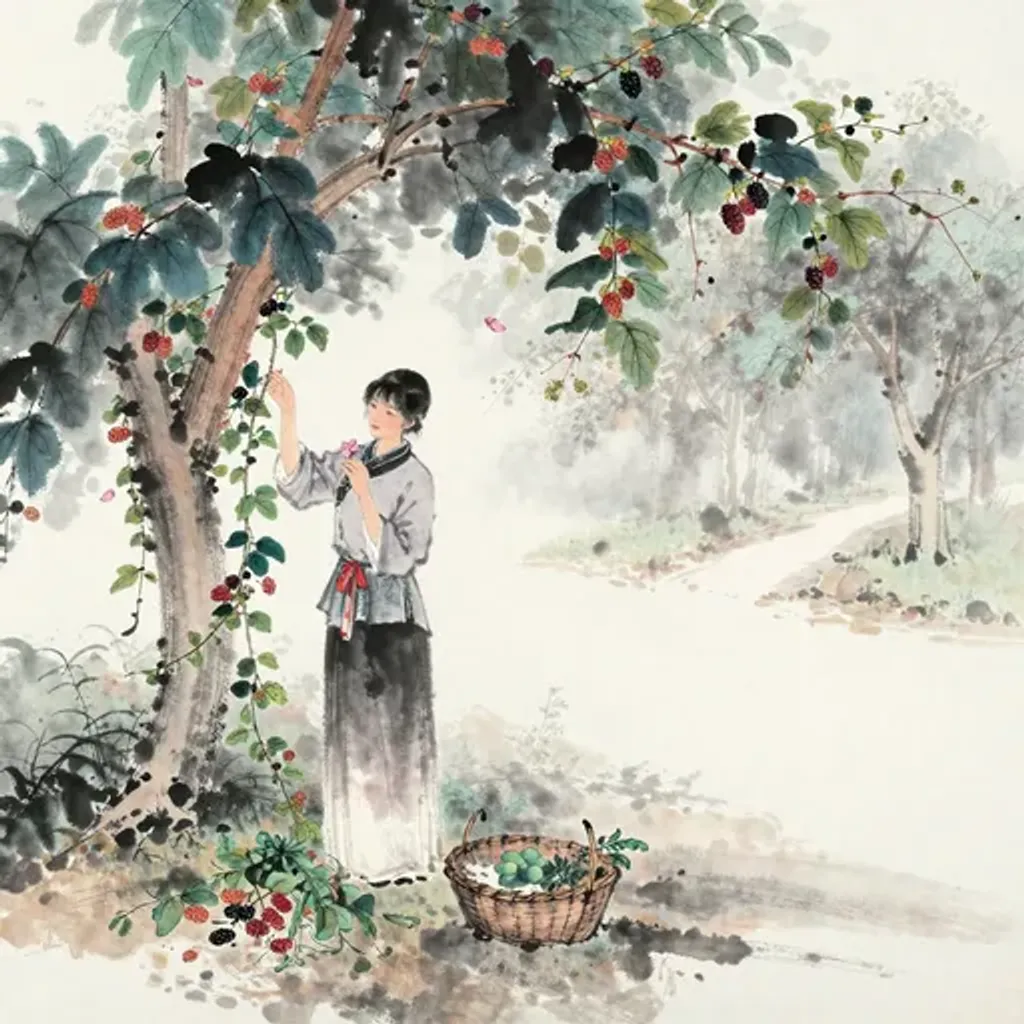
采唐沫鄉,要期桑中;失信不會,憂思約帶。
Gathering dodder at Mo village, arranging a tryst among the mulberry trees; breaking faith, we did not meet -- longing and worry tighten my sash.
— Jiao Yanshou, Yilin (Forest of Changes), 1st century BC
Commentary
Earth above the lake enters the lake submerging the trees — Great Exceeding's structural crisis. The verse alludes to the Shijing ode 'Sang Zhong': gathering tang-grass at Mei, a tryst arranged among the mulberries. But the lover breaks the promise and does not appear. Longing and anxiety tighten the belt — the abandoned one wastes away. From Approach to Great Exceeding, what should be a nurturing meeting becomes an insupportable weight. The lake overwhelms the trees of Xun below: the ridgepole sags under emotional excess. The broken tryst is not merely personal disappointment but structural failure — a weight-bearing relationship that was expected to hold the frame together has snapped, and the whole edifice leans dangerously.
臨 → 坎
Hexagram 19 → Hexagram 29: The Abysmal Water
Changing lines: 1, 5
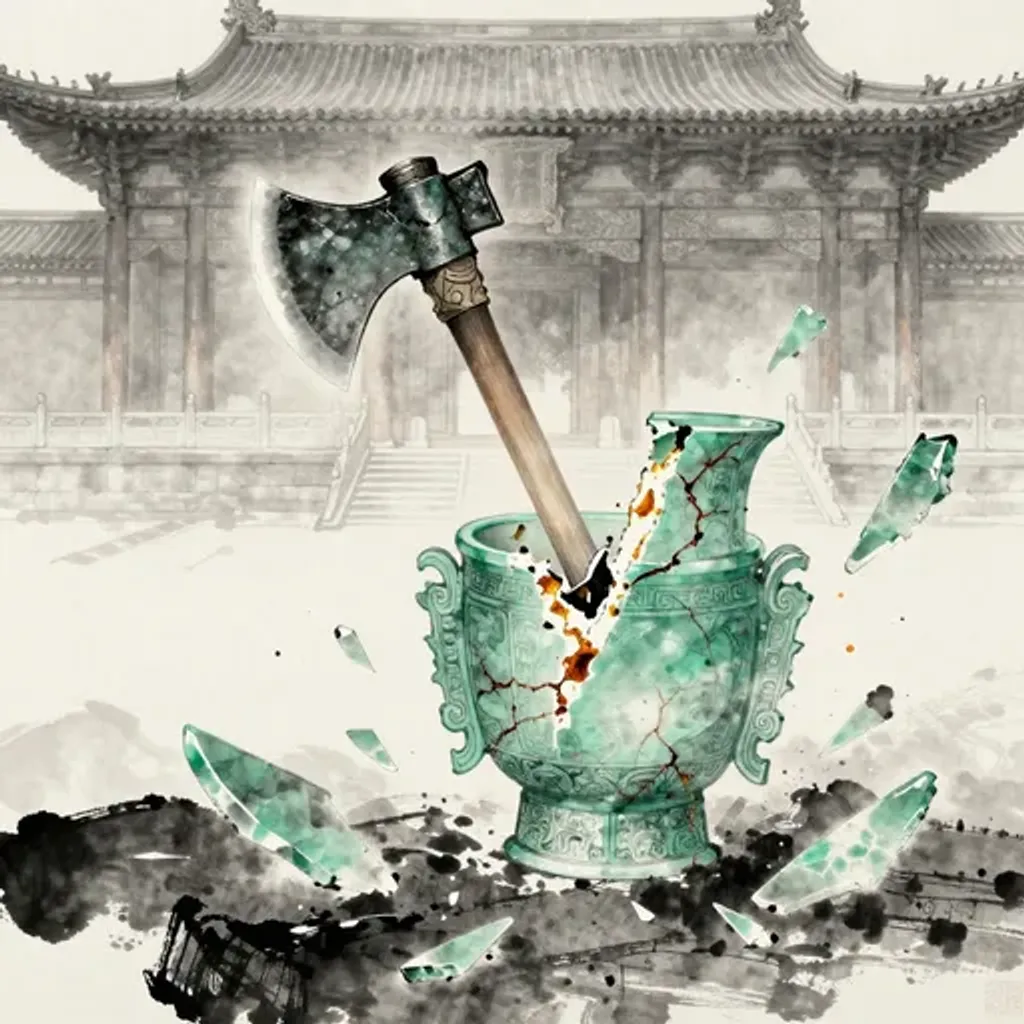
八面九口,長舌為斧;斲破瑚璉,殷商絕後。
Eight faces, nine mouths; the long tongue serves as an axe. It hews apart the ritual vessel -- the Yin-Shang line is severed.
— Jiao Yanshou, Yilin (Forest of Changes), 1st century BC
Commentary
Earth above the lake plunges into doubled water — the Abysmal's repeated peril. Eight faces and nine mouths: the long tongue becomes an axe, hacking apart the sacred hu-lian vessel and cutting off the Shang bloodline. The 'hu-lian' is the ritual jade grain vessel that symbolizes the continuity of sacrifice and state. A long tongue — slander — destroys it as effectively as any weapon. The verse echoes the fall of the Shang dynasty, where malicious counsel and internal corruption shattered the dynasty's ritual foundations. From Approach to the Abysmal, the lake's nurturing waters deepen into treacherous abyss. Gossip and calumny, multiplied through eight faces and nine mouths, carve through the most sacred institutions like an axe through jade.
臨 → 離
Hexagram 19 → Hexagram 30: The Clinging Fire
Changing lines: 2, 3, 4, 6
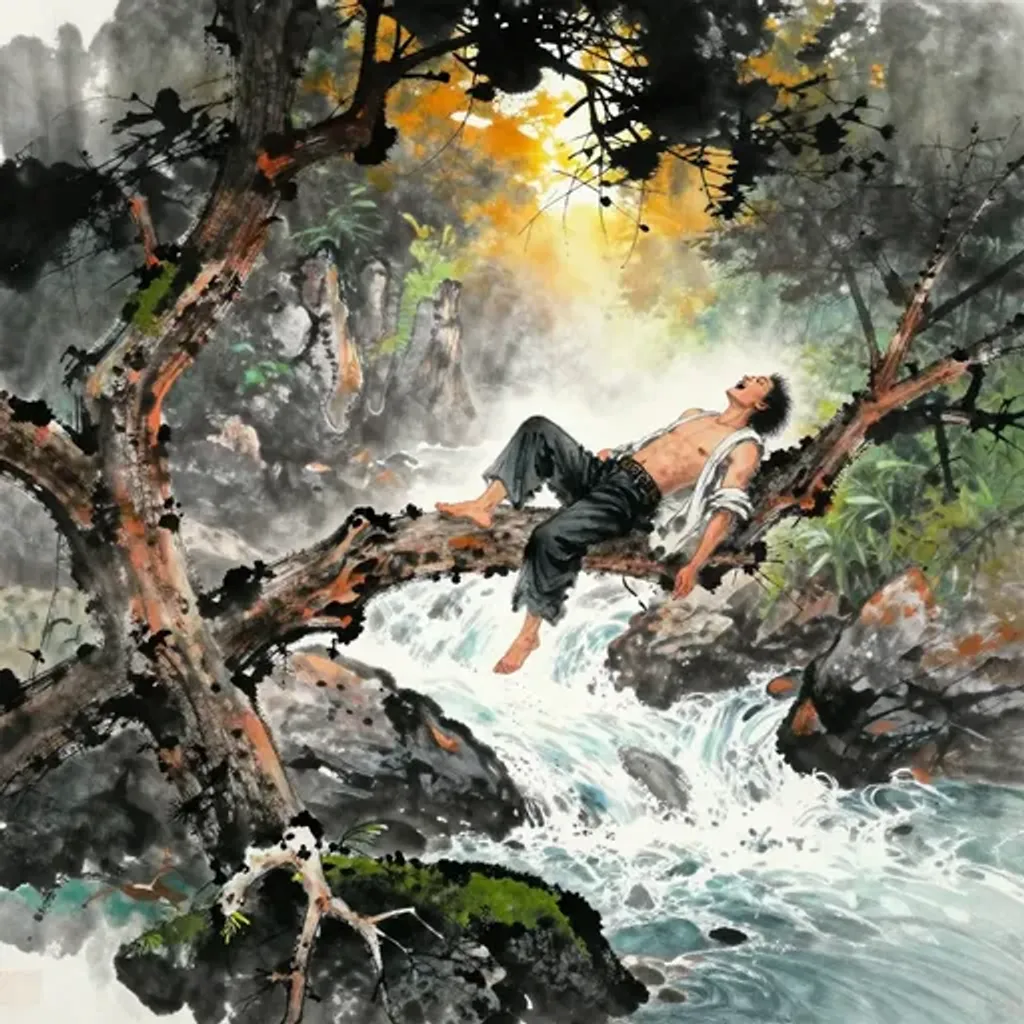
臨溪蟠枝,雖恐不危,樂以笑歌。
Leaning over the creek on a winding branch; though one fears, there is no danger -- delighting in song and laughter.
— Jiao Yanshou, Yilin (Forest of Changes), 1st century BC
Commentary
Earth above the lake meets doubled fire — the Clinging's luminous clarity. Leaning over the stream beside a gnarled, coiling branch, one feels momentary fear but faces no real danger, and gives way to song and laughter. The image is pastoral and vivid: a figure perched on a twisted bough overhanging a creek, heart briefly racing at the height, then relaxing into delight. From Approach to the Clinging, the lake's grounding presence transforms into fire's clear illumination. The fear dissolves because the danger proves illusory — doubled fire shows things as they truly are, and what seemed precarious is merely picturesque. Laughter replaces anxiety when clarity reveals the situation is safe.
臨 → 咸
Hexagram 19 → Hexagram 31: Influence
Changing lines: 1, 2, 3, 4, 5
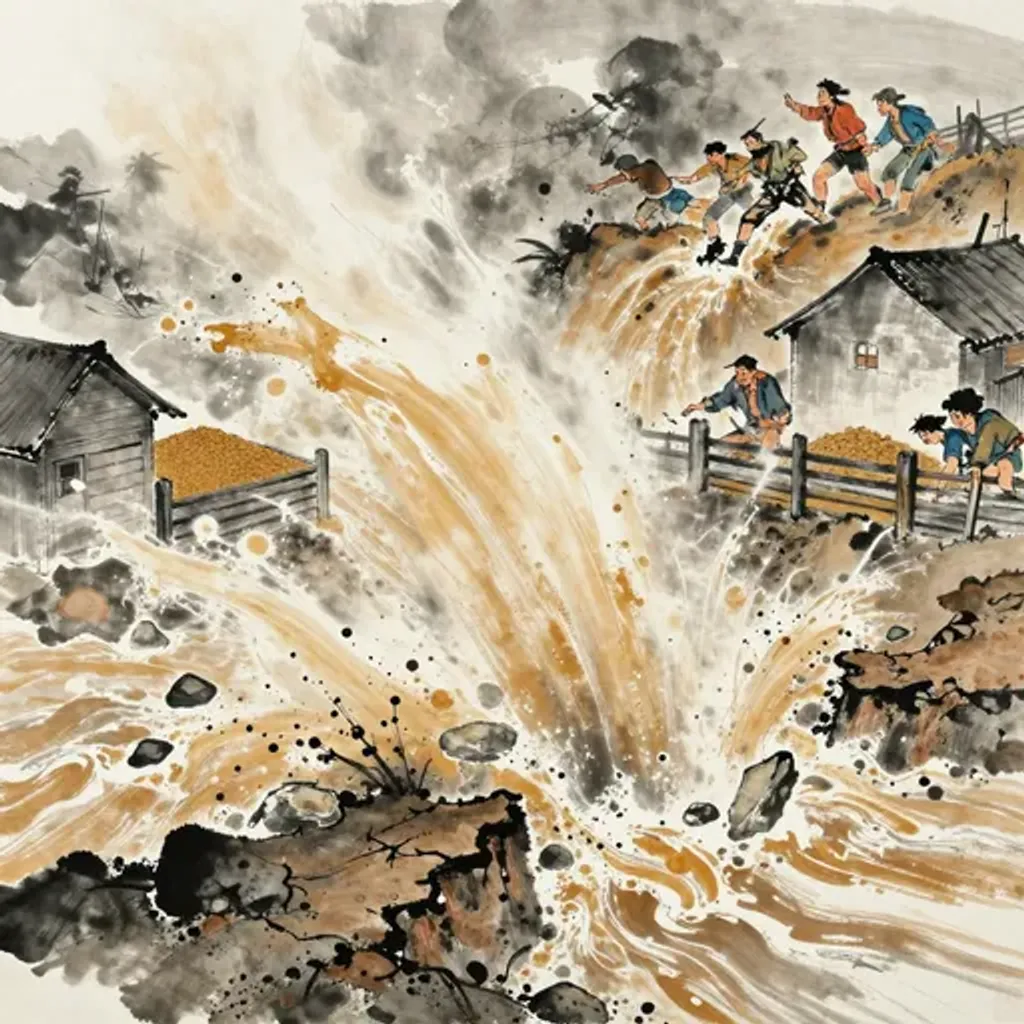
泱泱沸溢,水泉為害,使我無賴。
Waters surging and boiling over; the springs become a bane, leaving me destitute.
— Jiao Yanshou, Yilin (Forest of Changes), 1st century BC
Commentary
Earth above the lake meets the lake gathered upon the mountain — Influence's mutual attraction. Yet the waters here are not gentle: vast and boiling over, springs and floods become a scourge, leaving one destitute. The lake that should nurture instead erupts, overwhelming what it touches. From Approach to Influence, mutual attraction turns destructive when feeling overflows all containment. The lake atop the mountain in Xian should moisten the summit gently — but this verse shows what happens when emotion boils over: the very receptivity that enables connection becomes a flood that strips away all resources. Influence without measure is indistinguishable from catastrophe.
臨 → 恆
Hexagram 19 → Hexagram 32: Duration
Changing lines: 1, 3, 4
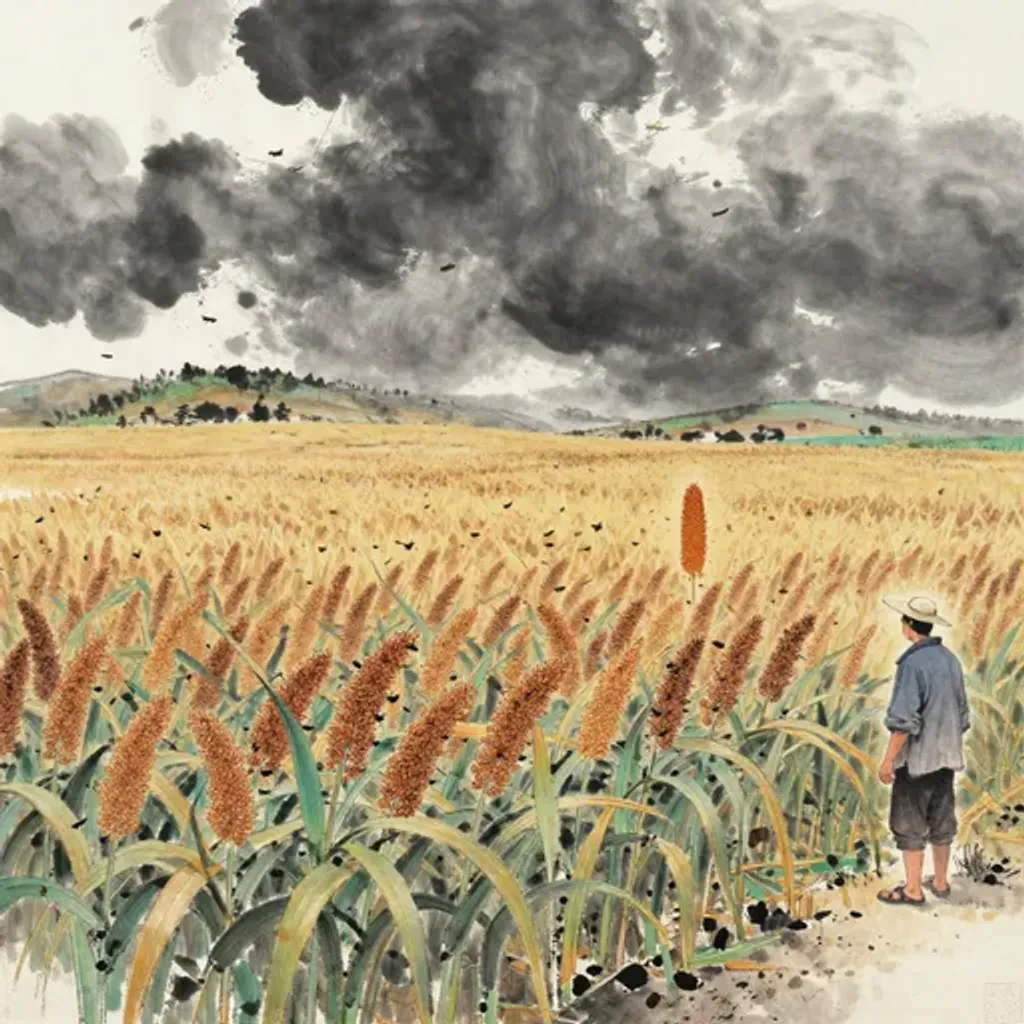
蝗螟為賊,傷害稼穡;愁飢於年,農夫鮮食。
Locusts and borers turn to brigands, ravaging crops and grain; the year brings dread of famine -- the farmer has scarcely a morsel to eat.
— Jiao Yanshou, Yilin (Forest of Changes), 1st century BC
Commentary
Earth above the lake meets thunder and wind together — Duration's persistent rhythm. Locusts and caterpillars become plagues, ravaging crops and grain. The year is spent in anxious hunger; the farmer has little to eat. The insects embody the dark side of Duration: natural cycles that persist relentlessly include cycles of destruction. Locusts return season after season with mechanical regularity. From Approach to Duration, the elder's generous provision confronts nature's indifferent repetition. Thunder and wind reinforce each other perpetually — but perpetuity applies to blight as well as blessing. The farmer's plight reveals that endurance without intervention is merely prolonged suffering, and the constant way includes hardship as surely as harvest.
臨 → 遯
Hexagram 19 → Hexagram 33: Retreat
Changing lines: 1, 2, 3, 4, 5, 6
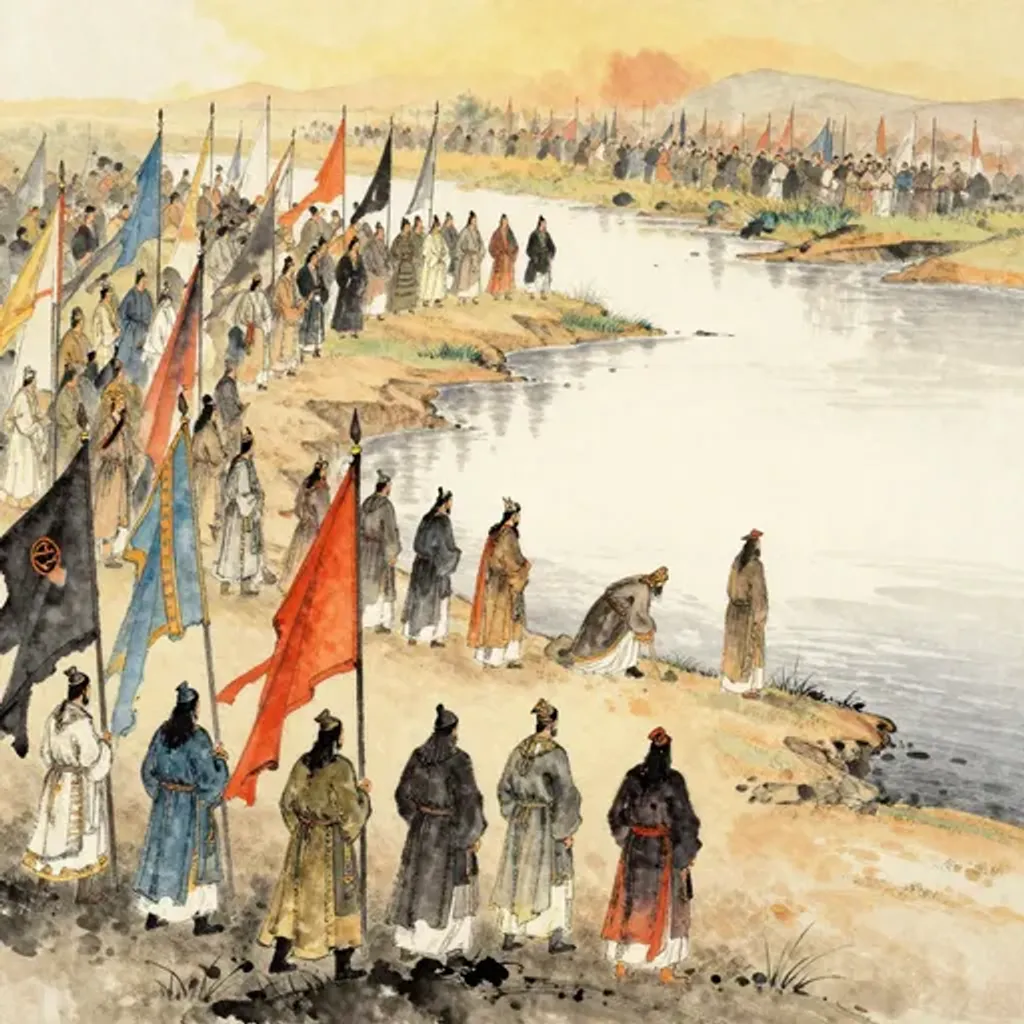
八百諸侯,不期同時;慕西文德,興我宗族。家門雍雍。
Eight hundred lords, unplanned, arrive at the same hour; drawn to the virtue of King Wen, they raise our clan anew. The household is harmonious and warm.
— Jiao Yanshou, Yilin (Forest of Changes), 1st century BC
Commentary
Earth above the lake ascends to heaven beneath the mountain — the strategic withdrawal of Retreat. Eight hundred feudal lords gathered unbidden at the same moment, drawn by the virtue of King Wen in the west. Through his moral authority, the royal lineage flourished and the household gate hummed with harmony. According to tradition, the feudal lords assembled at the Mengjin Ford before King Wu's campaign against Shang, but they came voluntarily, attracted by Zhou's accumulated virtue rather than by military summons. From Approach to Retreat, the paradox is exquisite: the greatest gathering occurs precisely because the sage-king withdrew from confrontation. Heaven beneath the mountain retreats, yet its moral gravity draws the world toward it without a single command being issued.
臨 → 大壯
Hexagram 19 → Hexagram 34: Great Power
Changing lines: 3, 4
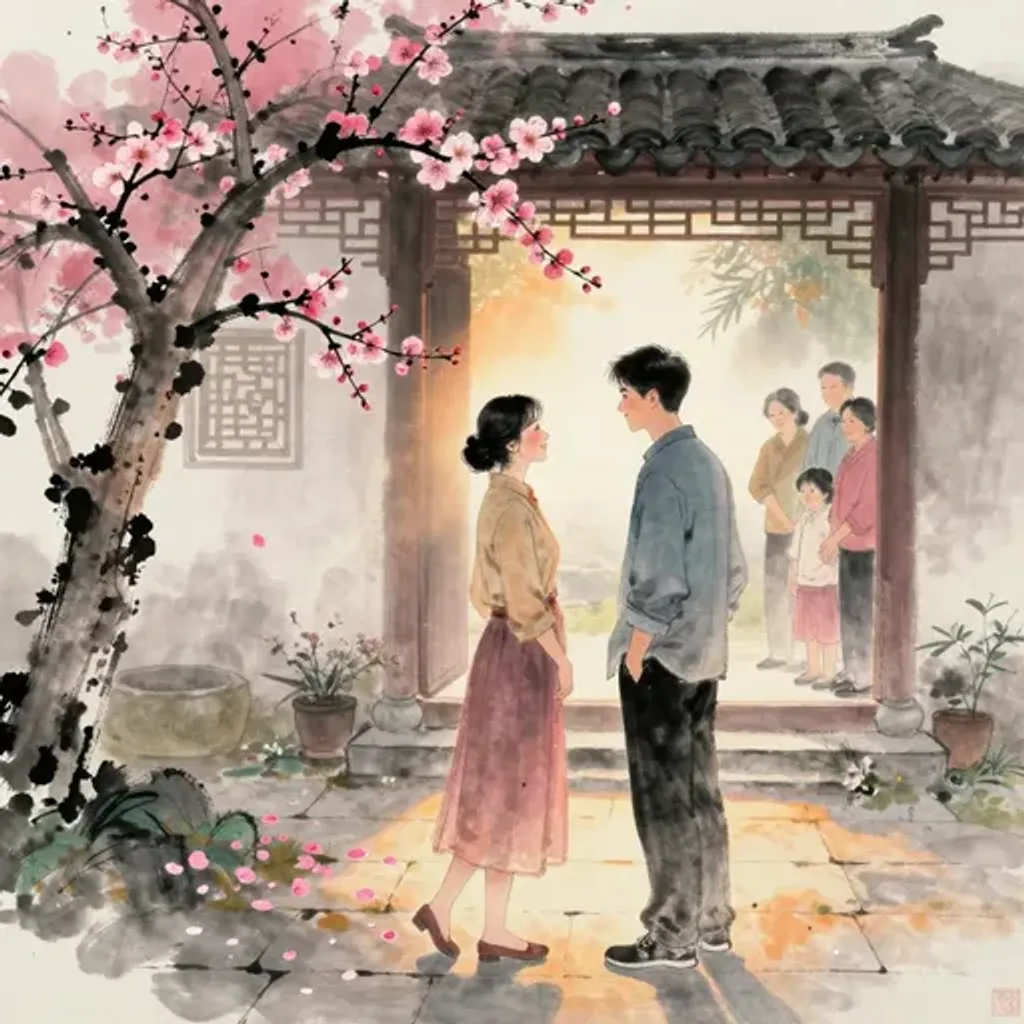
長男少女,相向笑語;來歡致福,和悅樂喜。
An elder son and a young daughter face each other, laughing and talking; they bring joy and invoke blessing -- all is harmony and delight.
— Jiao Yanshou, Yilin (Forest of Changes), 1st century BC
Commentary
Earth above the lake erupts into thunder high in heaven — the exuberant strength of Great Power. The eldest son and youngest daughter face each other, exchanging smiles and playful words. They bring happiness and invite blessing; all is harmony and delight. The trigram pairing of Zhen (eldest son, thunder) and Dui (youngest daughter, lake) generates the warmth of intergenerational joy — youth and maturity in lighthearted exchange. From Approach to Great Power, the elder's measured oversight releases into vigorous celebration. Thunder above heaven is power at its most expansive, yet here it manifests not as domination but as familial warmth. Great strength exercised through gentleness — laughter between generations — is the most durable form of power.
臨 → 晉
Hexagram 19 → Hexagram 35: Progress
Changing lines: 1, 2, 4, 6
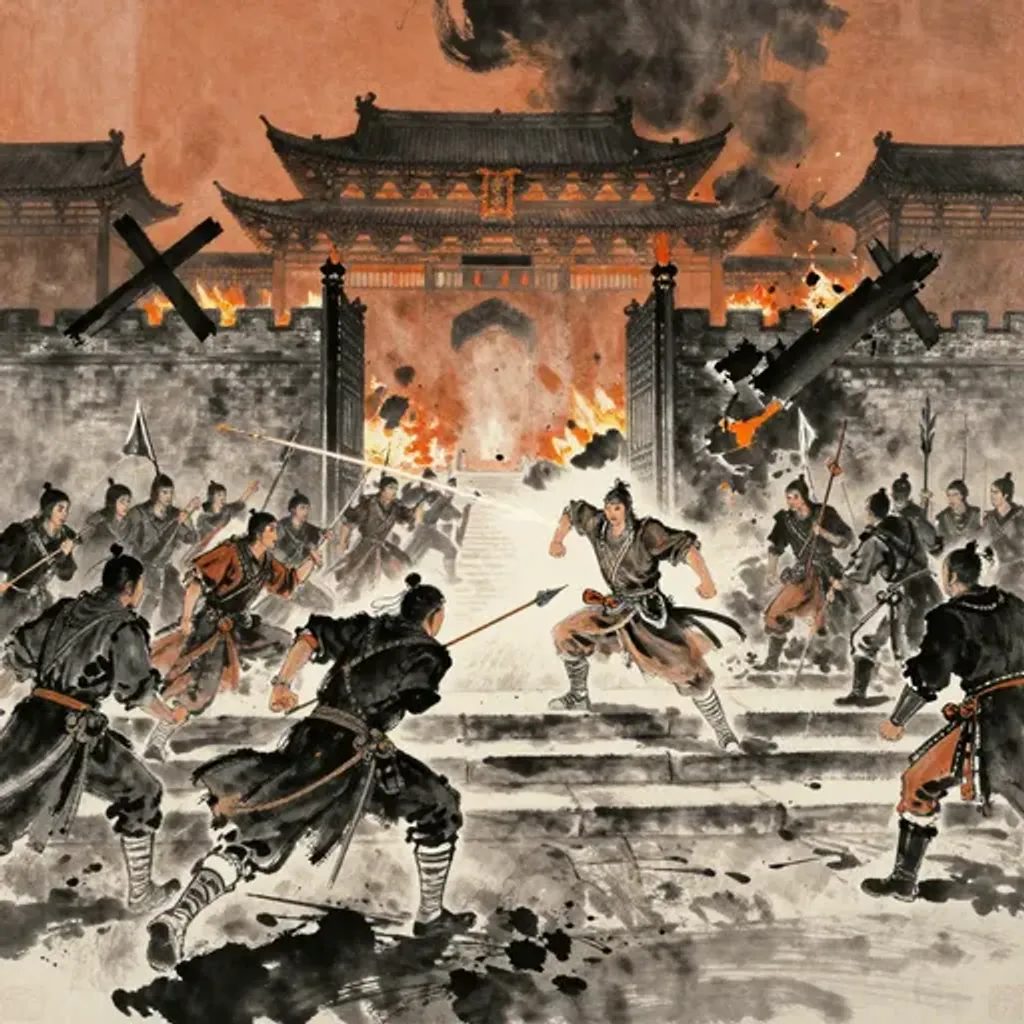
平國不君,夏氏作亂;烏號竊發,靈公殞命。
The state of Ping knows no rightful lord; the Xia clan stirs rebellion. The black bow fires in secret -- Duke Ling loses his life.
— Jiao Yanshou, Yilin (Forest of Changes), 1st century BC
Commentary
Earth above the lake meets fire rising above the earth — the bright advance of Progress. Yet the advance here is catastrophic: 'The state of Ping is without a proper ruler; the Xia clan raises rebellion. The Wuhao bow fires in secret; Duke Ling loses his life.' This alludes to Duke Ling of Chen, who conducted an open affair with Xia Ji. Her son Xia Zhengsu, humiliated by the duke's mockery, shot him from the stable gate in 599 BC. The Wuhao bow — named after the legendary weapon — fires from ambush, and the licentious duke falls. From Approach to Progress, fire advancing above the earth should illuminate — but here it exposes corruption so starkly that violence erupts. Progress without moral foundation only accelerates destruction.
臨 → 明夷
Hexagram 19 → Hexagram 36: Darkening of the Light
Changing lines: 2, 3
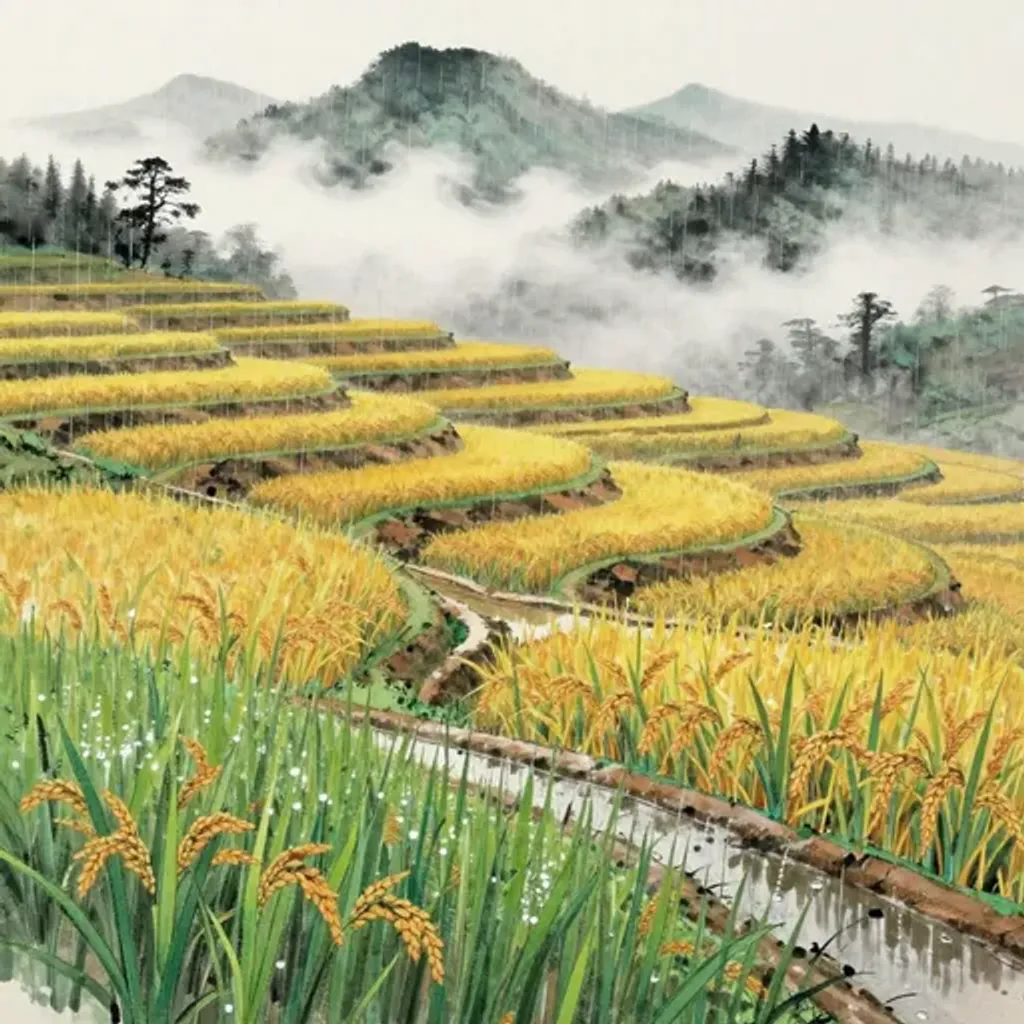
春多膏澤,夏潤優渥;稼穡熟成,畝獲百斛。
Spring brings abundant rain, summer moisture rich and full; the crops ripen to maturity -- each acre yields a hundred bushels.
— Jiao Yanshou, Yilin (Forest of Changes), 1st century BC
Commentary
Earth above the lake descends into fire hidden within the earth — the Darkening of the Light. Yet the verse is paradoxically bright: spring brings abundant rain, summer offers rich moisture, the grain ripens to full maturity, and each mu yields a hundred hu. This is the harvest of a perfect agricultural year — every season delivering exactly what is needed. From Approach to Darkening of the Light, the contrast demands attention: the brightest harvest occurs precisely when light enters the earth. Fire buried underground is not extinguished but transformed into fertility — the hidden warmth that drives germination. The darkened light becomes the subterranean energy that nourishes roots, producing abundance invisible to those who see only the surface.
臨 → 家人
Hexagram 19 → Hexagram 37: The Family
Changing lines: 2, 3, 5, 6
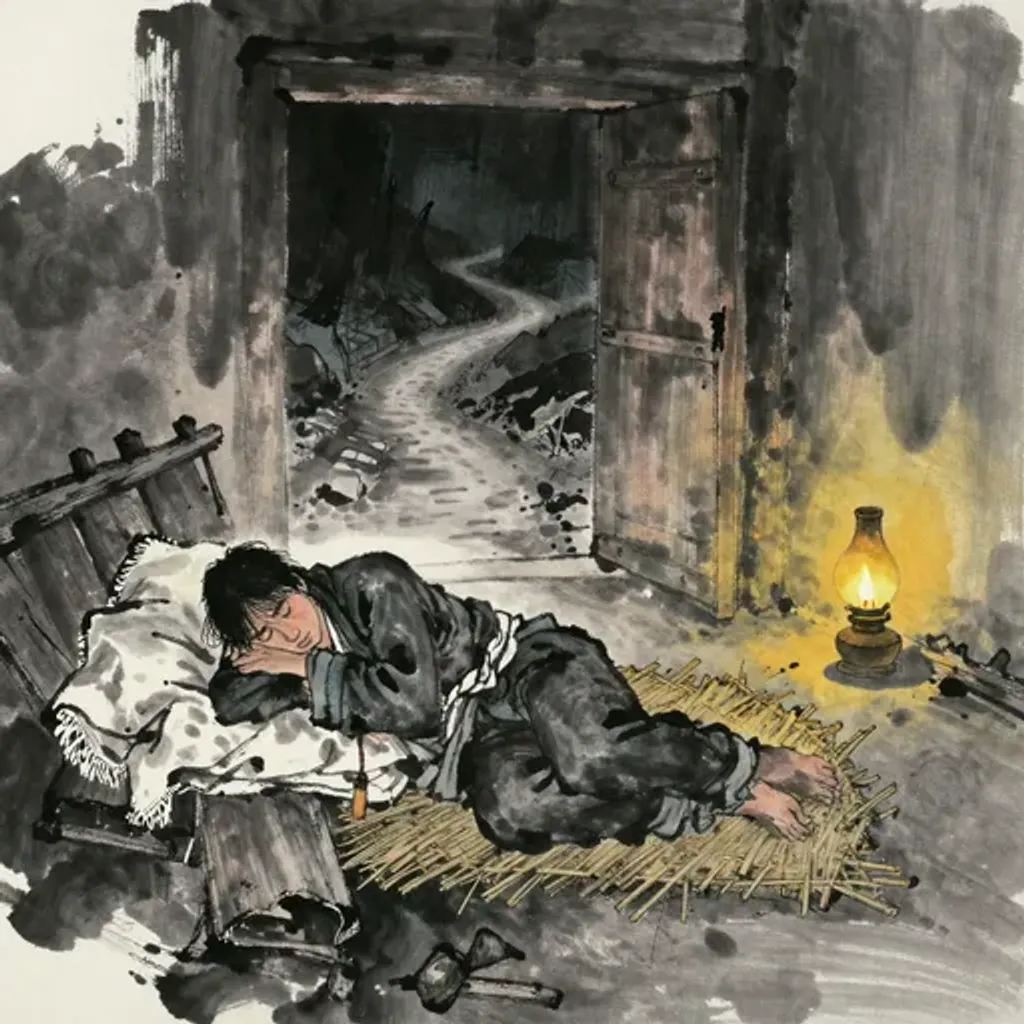
客宿臥寒,席蓐不安;行危為害,留止得歡。
The guest lodges in the cold, his mat and bedding ill at ease; to venture forth brings harm -- better to stay and find contentment.
— Jiao Yanshou, Yilin (Forest of Changes), 1st century BC
Commentary
Earth above the lake encounters wind emerging from fire — the Family's radiating warmth. A guest lodges for the night but sleeps cold; mat and bedding bring no comfort. Travel carries danger and brings harm; only by staying put does one find joy. The verse contrasts the misery of the road with the comfort of home — cold inns versus warm hearths. From Approach to the Family, the elder's broad oversight narrows to the domestic circle where genuine warmth resides. Wind born from fire in the Family hexagram means that inner warmth radiates outward as gentle influence. The traveler who abandons the journey and returns home discovers that what he sought abroad was waiting within his own walls all along.
臨 → 睽
Hexagram 19 → Hexagram 38: Opposition
Changing lines: 4, 6
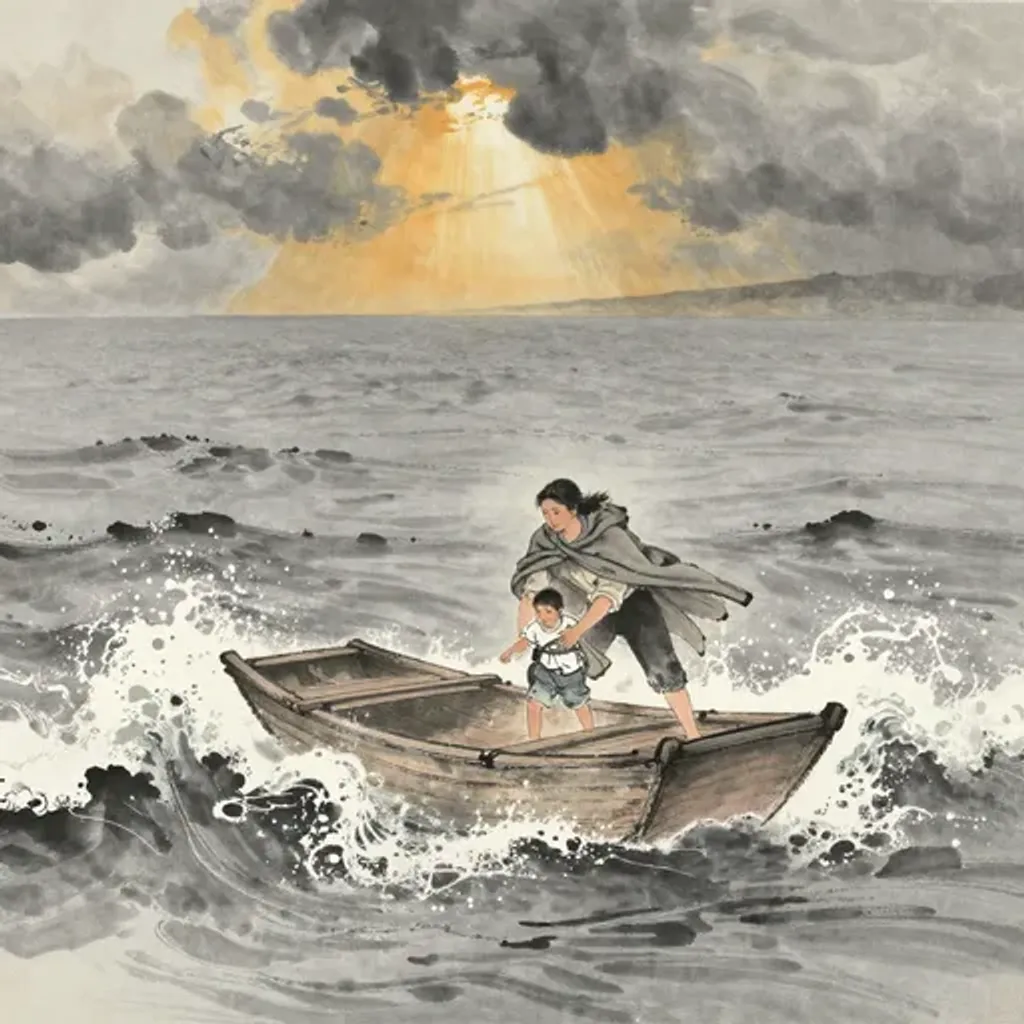
乘桴於海,雖懼不殆;母載其子,終焉何咎?
Setting out on a raft upon the sea, though fearful, there is no true peril; a mother carries her child -- what blame can there be in the end?
— Jiao Yanshou, Yilin (Forest of Changes), 1st century BC
Commentary
Earth above the lake encounters fire above the lake — Opposition's creative tension. Riding a raft upon the sea, one feels fear but faces no real peril. A mother carries her child — what blame could there be? The raft on open water is terrifying yet ultimately safe, like a mother cradling her infant: the protective bond transcends apparent danger. From Approach to Opposition, the lake and fire of Kui pull in different directions — fire rises, water sinks — yet the verse finds harmony within this very tension. The mother-child bond is the archetype of unity within apparent opposition: two beings, one purpose. Fear exists but dissolves before the deeper truth that what holds them together is stronger than what separates them.
臨 → 蹇
Hexagram 19 → Hexagram 39: Obstruction
Changing lines: 1, 2, 3, 5
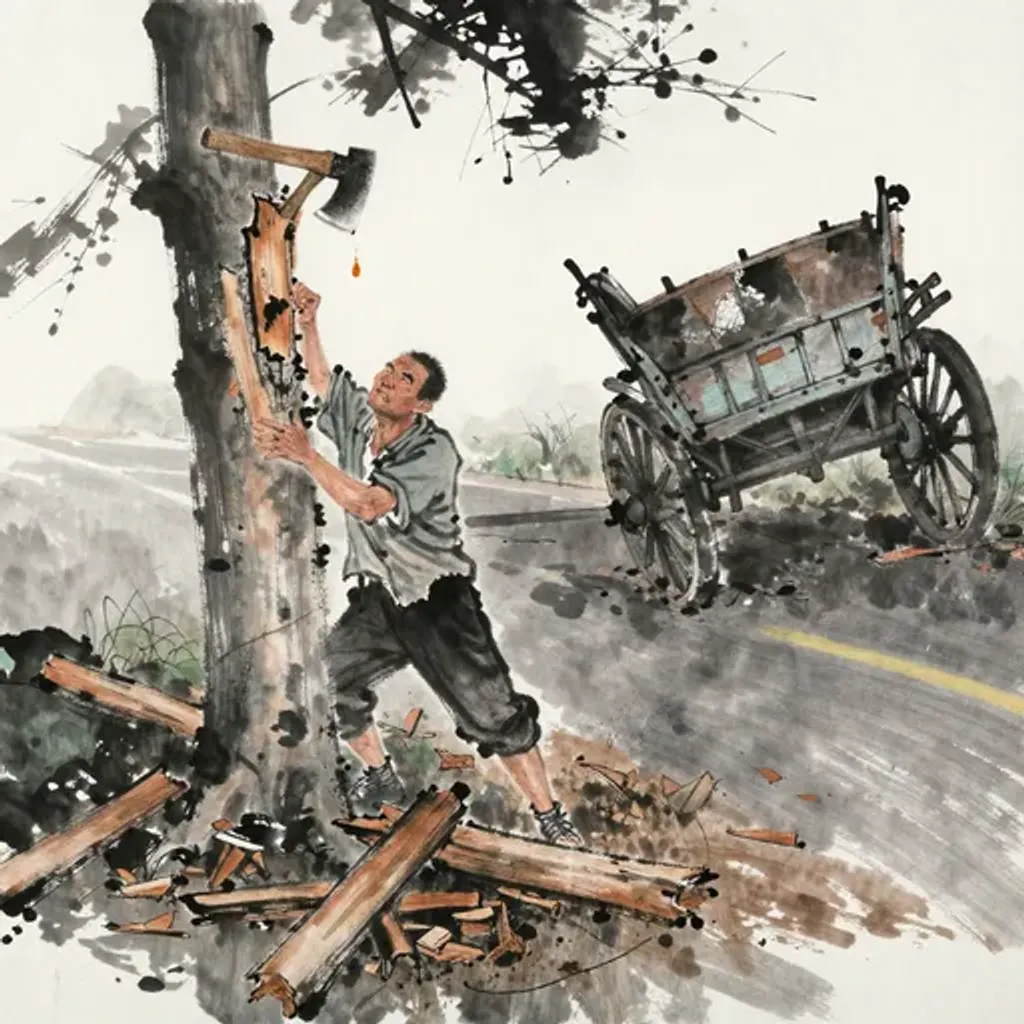
手拙不便,不能伐檀;車無軸轅,行者苦難。
Hands clumsy and unskilled, unable to fell the sandalwood; a cart without axle or shaft -- the traveler suffers hardship.
— Jiao Yanshou, Yilin (Forest of Changes), 1st century BC
Commentary
Earth above the lake meets water upon the mountain — Obstruction's frozen impasse. Clumsy hands cannot manage the work; one cannot fell the sandalwood tree. The cart has no axle or shaft; the traveler suffers bitterly. Everything that should function is broken: the hands lack skill, the tree resists the axe, the cart cannot roll. The verse echoes the Shijing ode 'Fa Tan,' where woodcutters labor at sandalwood — a metaphor for hard, thankless work. From Approach to Obstruction, the lake's open accessibility freezes into mountain water's impassable barrier. When tools fail and skills fall short, the path forward is blocked at every turn. Obstruction demands that one turn inward to cultivate virtue rather than pushing forward with broken equipment.
臨 → 解
Hexagram 19 → Hexagram 40: Deliverance
Changing lines: 1, 4
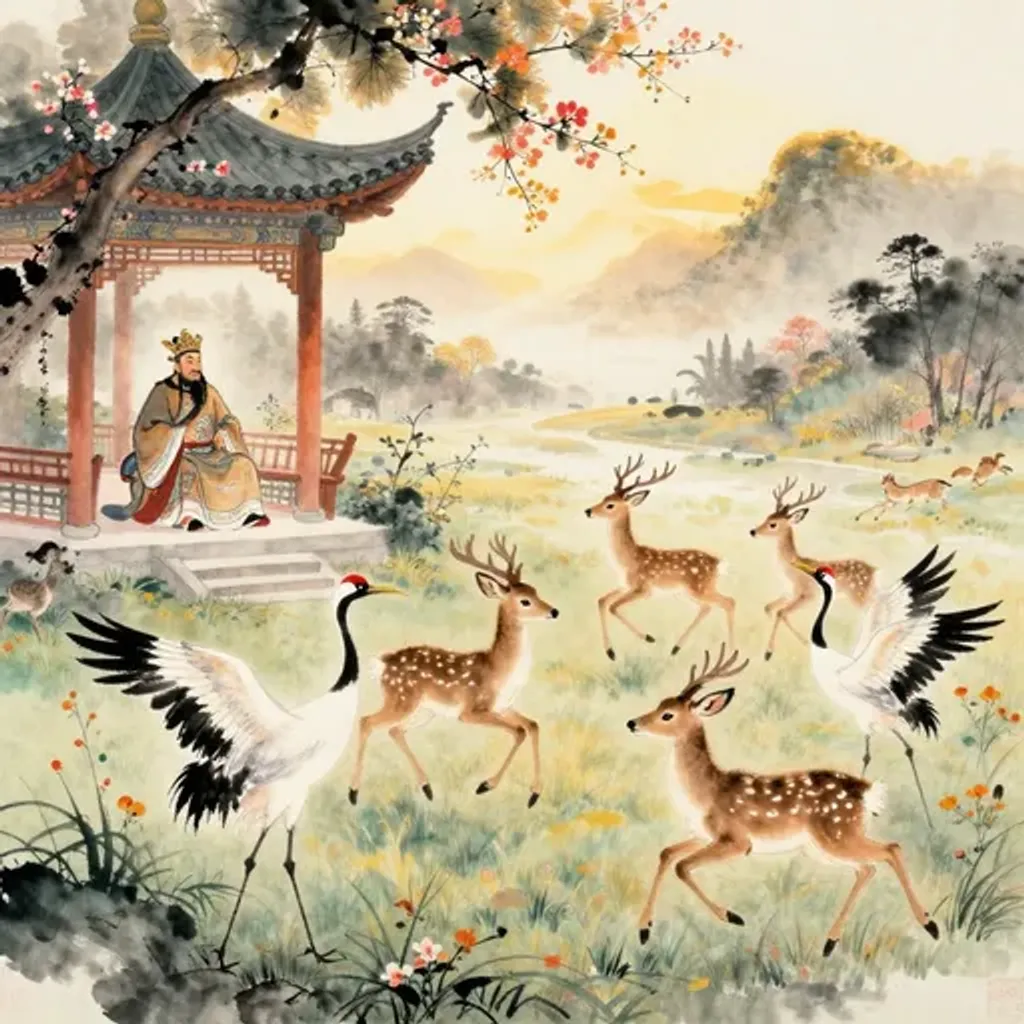
唐虞相輔,鳥獸喜舞;民安無事,國家富有。
Tang and Yu aided each other; birds and beasts danced in joy. The people were at peace without cares -- the state grew rich and prosperous.
— Jiao Yanshou, Yilin (Forest of Changes), 1st century BC
Commentary
Earth above the lake releases into thunder above water — the Deliverance that comes after crisis. Under the reigns of Yao and Shun, mutual support prevails: birds and beasts dance in delight, the people live in peace, and the state overflows with wealth. The golden age of the sage-kings represents governance so perfect that even animals celebrate. From Approach to Deliverance, the elder's oversight achieves its ultimate purpose: releasing the world from suffering. Thunder and rain together in Jie wash away obstruction, and the sage-ruler pardons faults and forgives crimes. The verse presents this as already accomplished — not a promise but a memory of what governance once was, when authority and compassion operated as one seamless force.
臨 → 損
Hexagram 19 → Hexagram 41: Decrease
Changing lines: 6
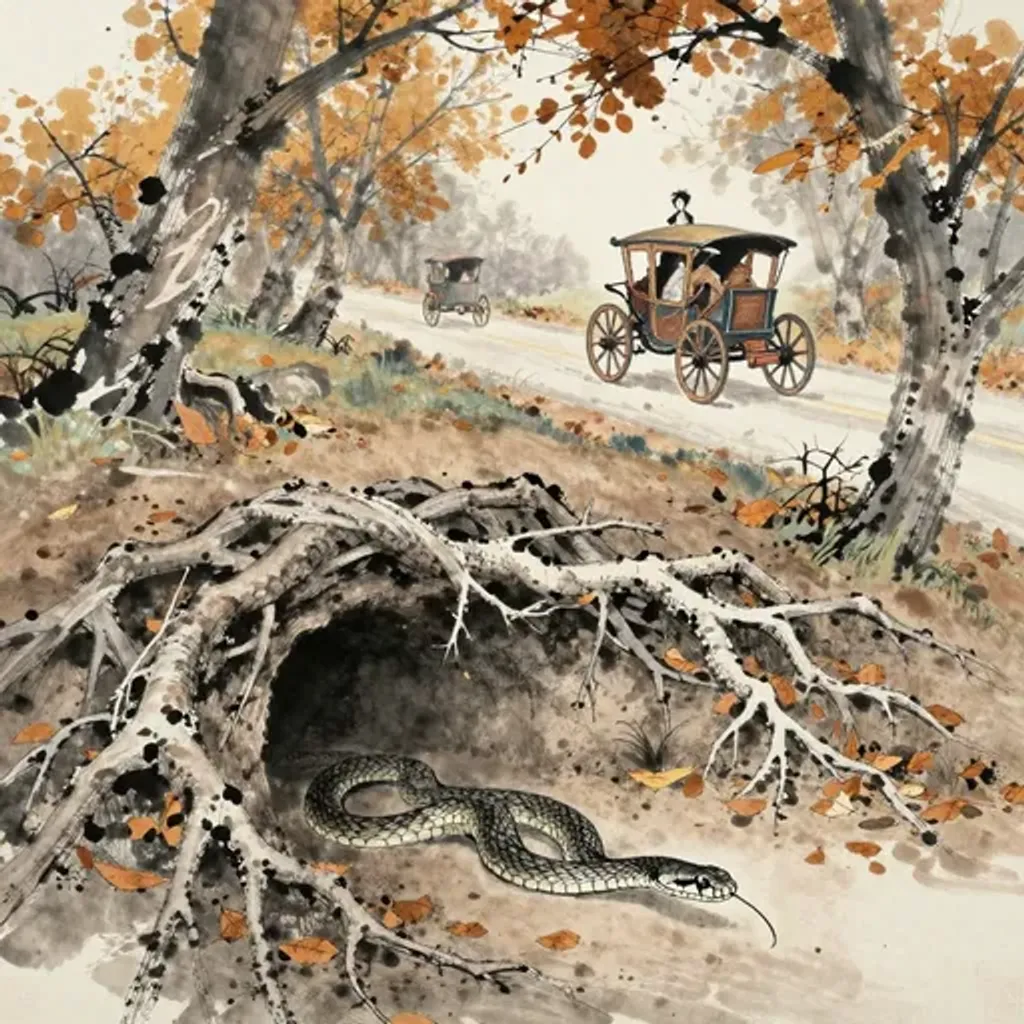
秋蛇向穴,不失其節;夫人姜氏,自齊復入。
The autumn serpent turns toward its burrow, never losing its season; Lady Jiang returned from Qi and entered her household once more.
— Jiao Yanshou, Yilin (Forest of Changes), 1st century BC
Commentary
Earth above the lake meets the mountain above the lake — Decrease's disciplined sacrifice. An autumn snake turns toward its burrow, never losing its proper rhythm. The lady Jiang returns to Lu from Qi, restoring herself to her rightful place. The snake entering its winter den embodies timely withdrawal — instinctive knowledge of when to retreat. The 'lady Jiang from Qi' likely refers to one of the Jiang-surnamed consorts of Lu's ducal house, whose return from her natal state signifies the restoration of marital and political order. From Approach to Decrease, what is given up makes the whole stronger. The snake sacrifices the open field for survival; the lady sacrifices independence for domestic harmony. Both follow the season.
臨 → 益
Hexagram 19 → Hexagram 42: Increase
Changing lines: 2, 5, 6
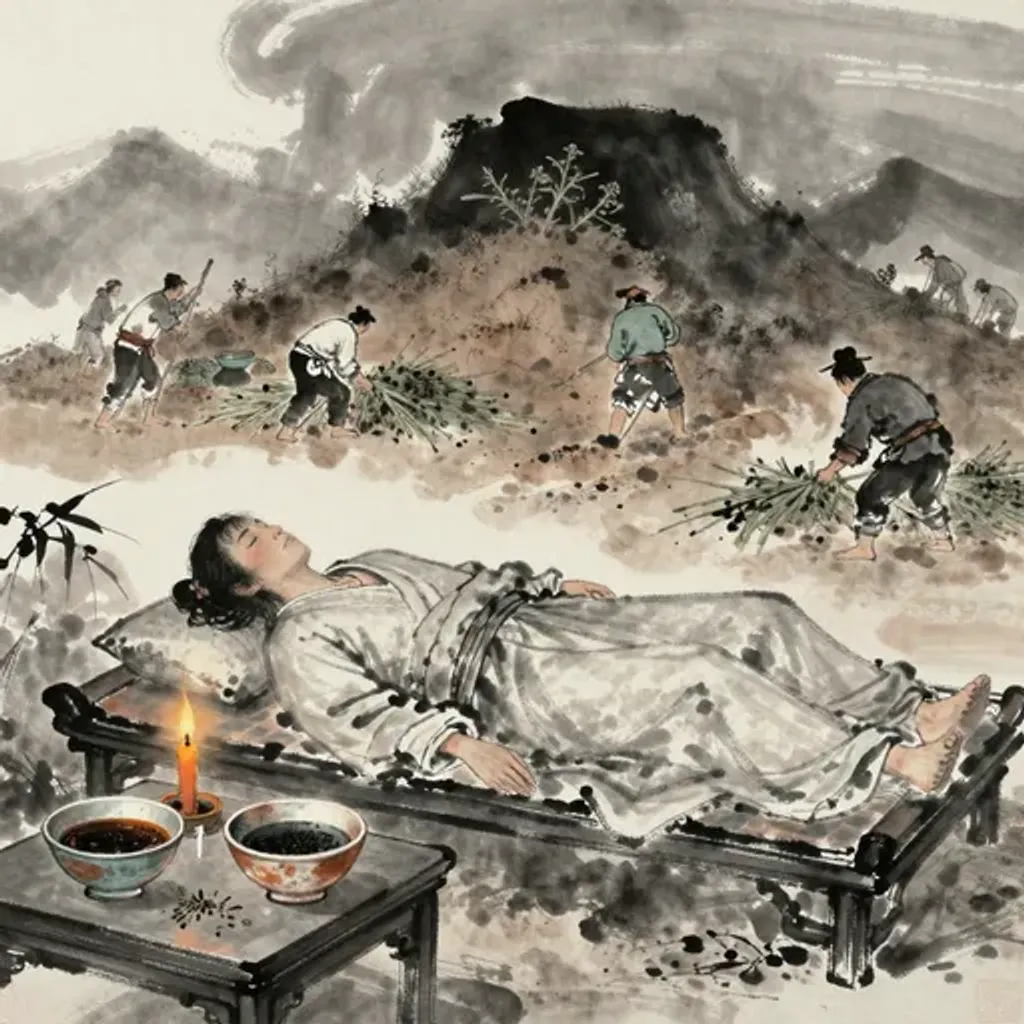
病篤難醫,和不能治;命終斯訖,下即蒿廬。
The illness is grave beyond cure, even harmony cannot heal it; when the appointed end has come, one descends to the thatched grave.
— Jiao Yanshou, Yilin (Forest of Changes), 1st century BC
Commentary
Earth above the lake encounters wind and thunder together — Increase's vital augmentation. Yet the verse is a death scene: the illness is too deep for medicine; even the great physician He cannot cure it. Destiny reaches its end, and the body descends to a thatched grave. The irony is devastating — Increase as the destination, but the verse narrates terminal loss. From Approach to Increase, the transformation suggests that what increases is not always what we wish: sometimes it is the illness itself that compounds beyond remedy. Wind and thunder in Yi should bring growth, but here they become the storm that accompanies the final departure. Even the Yi's augmenting power cannot override exhausted fate.
臨 → 夬
Hexagram 19 → Hexagram 43: Breakthrough
Changing lines: 3, 4, 5
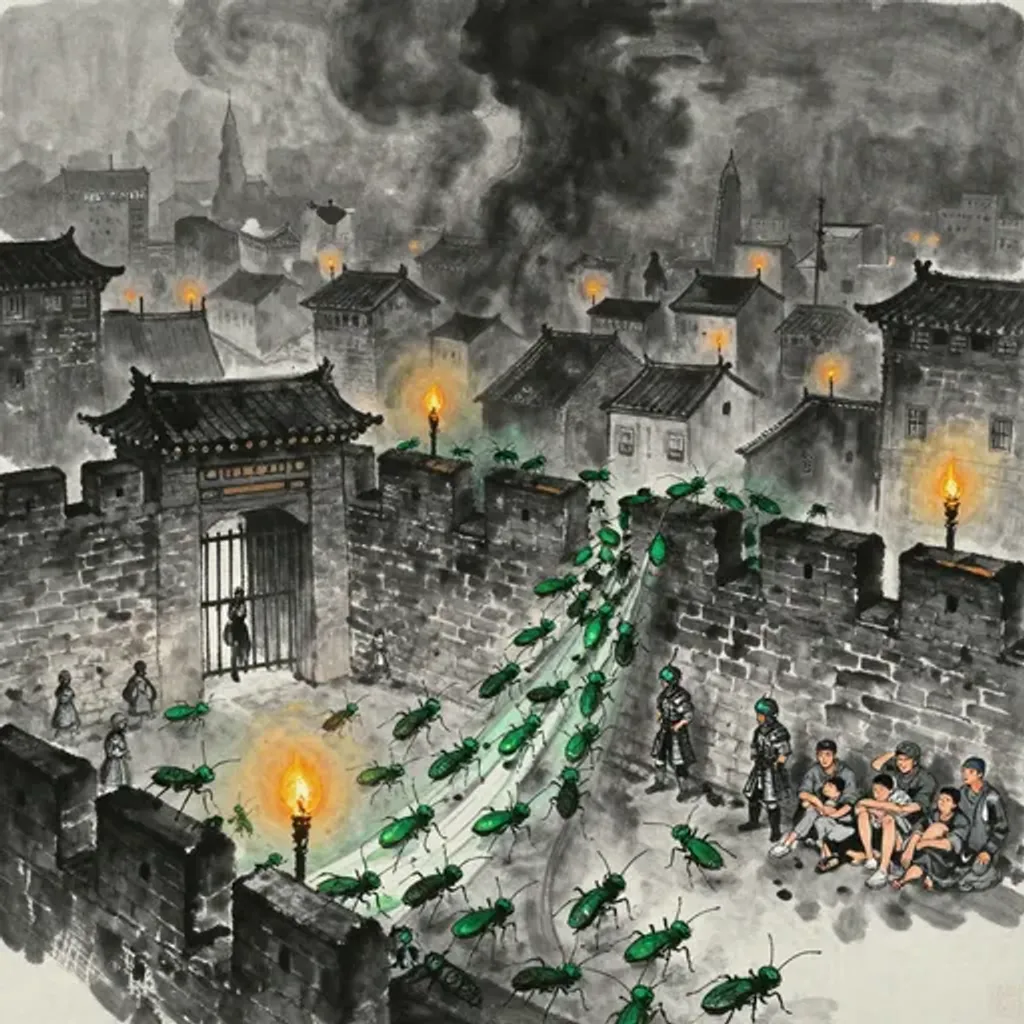
青蛉如雲,城邑閑門;國君衛守,民困於患。
Green dragonflies swarm like clouds, the city gates stand barred; the lord of the state mounts his defense -- the people are beset by calamity.
— Jiao Yanshou, Yilin (Forest of Changes), 1st century BC
Commentary
Earth above the lake ascends to the lake above heaven — Breakthrough's decisive resolution. Green dragonflies swarm like clouds around the city, whose gates stand barred. The ruler defends his walls while the people suffer within. The insect swarm — whether literal plague or metaphor for besieging forces — descends upon a city already sealed against attack. The populace is trapped between external threat and internal deprivation. From Approach to Breakthrough, the lake gathering above heaven must eventually burst through. The barred gates cannot hold forever: what accumulates above will break downward. The verse captures the moment just before the dam gives way, when the pressure of suffering demands decisive action to resolve the crisis.
臨 → 姤
Hexagram 19 → Hexagram 44: Coming to Meet
Changing lines: 1, 3, 4, 5, 6
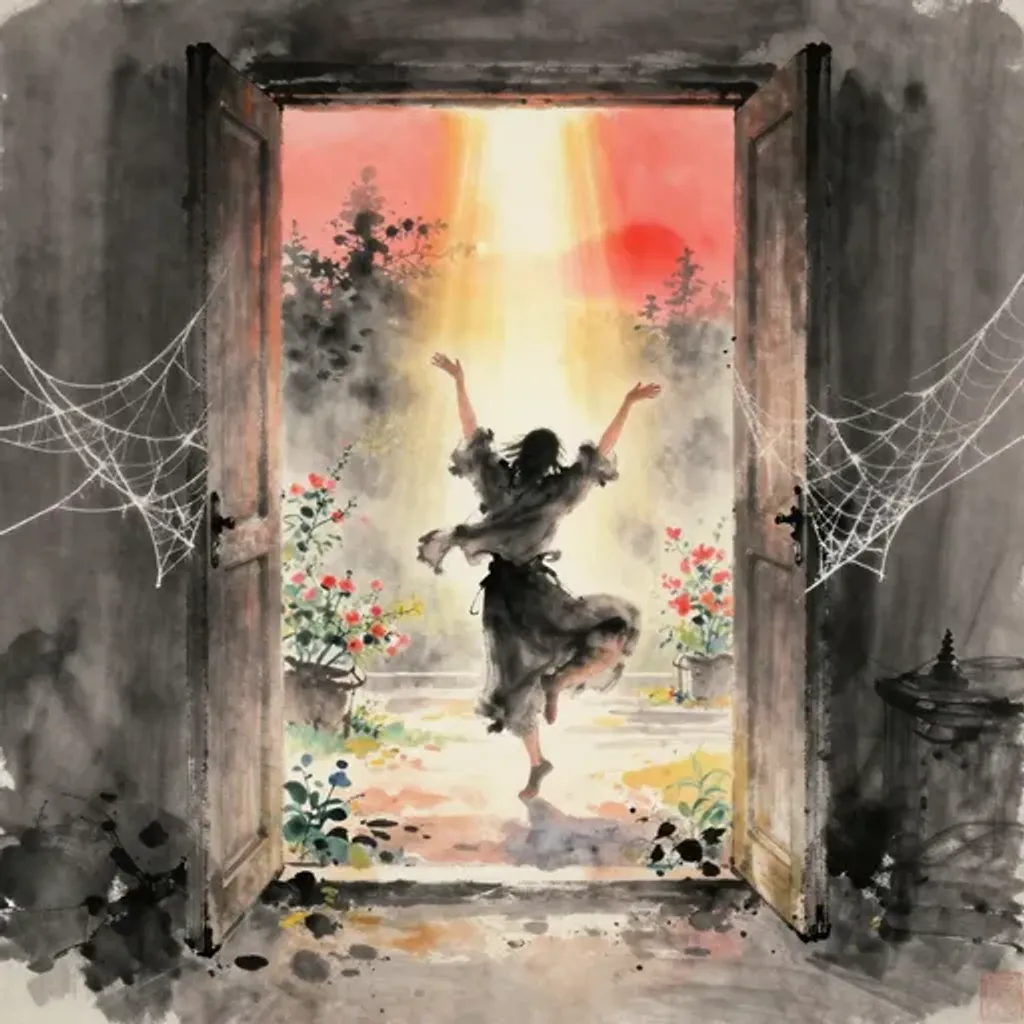
牙孽生齒,室堂啟戶;幽人利貞,鼓翼起舞。
Buds sprout teeth from the shoot, hall and chamber open their doors; the recluse finds constancy auspicious -- he beats his wings and rises to dance.
— Jiao Yanshou, Yilin (Forest of Changes), 1st century BC
Commentary
Earth above the lake encounters heaven with wind below — the unexpected meeting of Coming to Meet. Sprouts push through gums as teeth emerge; room and hall open their doors. The recluse finds advantage in steadfastness, spreading wings and beginning to dance. The verse moves from germination to liberation: teeth breaking through flesh, doors thrown open, the hidden one stepping into light and celebration. From Approach to Coming to Meet, the elder's deliberate oversight gives way to an uninvited encounter — wind beneath heaven arrives without warning. The recluse's dance transforms the hexagram's usual warning about unexpected feminine intrusion into something joyful: what meets you unawares may be the very breakthrough you were cultivating in seclusion.
臨 → 萃
Hexagram 19 → Hexagram 45: Gathering Together
Changing lines: 1, 2, 4, 5
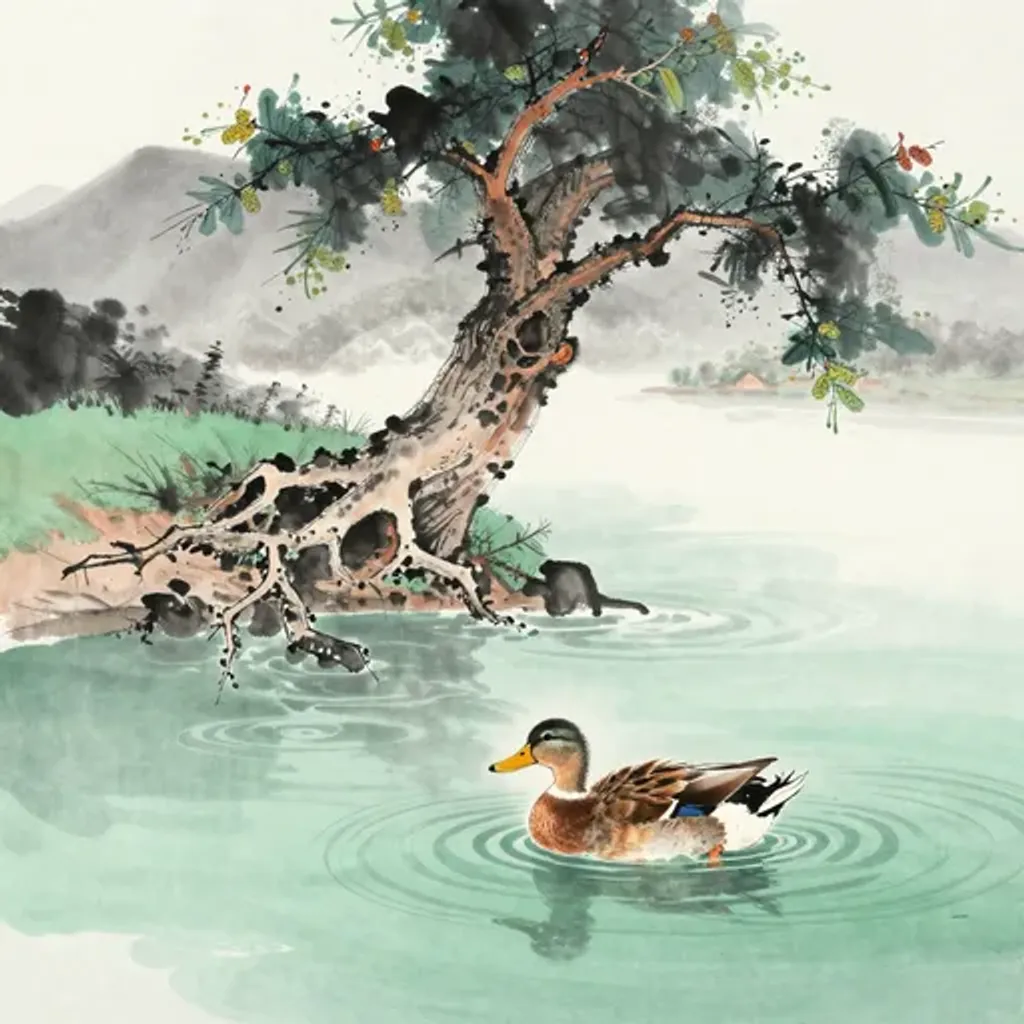
鳧游江海,沒行千里;以為死亡,復見空桑。長生樂鄉。
The wild duck swims the rivers and seas, diving a thousand miles; presumed dead, it reappears at Hollow Mulberry. Long life in a land of joy.
— Jiao Yanshou, Yilin (Forest of Changes), 1st century BC
Commentary
Earth above the lake meets the lake gathered upon earth — the natural congregation of Gathering. A wild duck swims the rivers and seas, diving beneath the surface for a thousand li. Presumed dead, it reappears at the hollow mulberry tree — the mythological birthplace of the sun. Long life in a land of joy. The duck's submarine journey across vast distances, given up for lost and then miraculously resurfacing at the cosmic origin-point, enacts death and rebirth. The hollow mulberry (Kong Sang) is where the ten suns bathe before their daily journey. From Approach to Gathering, scattered energies converge at a sacred center. What seemed lost was merely traveling underground, gathering itself for reemergence at the source of all light.
臨 → 升
Hexagram 19 → Hexagram 46: Pushing Upward
Changing lines: 1, 3
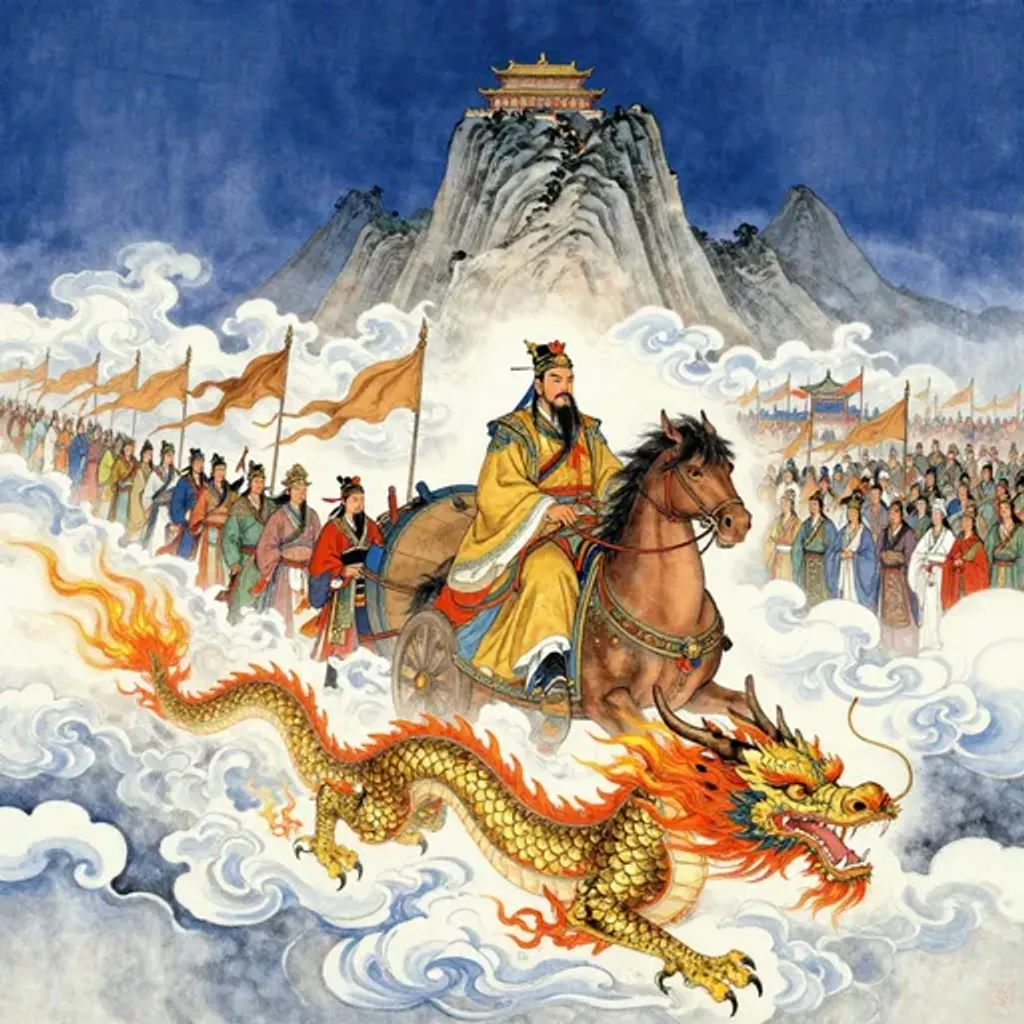
黃帝出遊,駕龍乘馬。東上太山,南遊齊魯;邦國咸喜。
The Yellow Emperor sets forth, riding dragon and driving horse. Eastward he ascends Mount Tai, southward he tours Qi and Lu -- all the states rejoice.
— Jiao Yanshou, Yilin (Forest of Changes), 1st century BC
Commentary
Earth above the lake pushes upward as wood grows within the earth — Pushing Upward's steady ascent. The Yellow Emperor sets forth on a grand progress, riding dragons and horses, ascending Mount Tai in the east and touring the lands of Qi and Lu in the south. Every domain he visits rejoices. The journey traces China's sacred geography: Mount Tai, holiest of the Five Sacred Mountains, and Qi-Lu, the heartland of Zhou civilization. From Approach to Pushing Upward, the ruler's presence does not descend from above but grows organically like wood through soil. The Yellow Emperor's progress embodies this: not conquest but visitation, each stop generating spontaneous delight. The tree grows because the earth welcomes it.
臨 → 困
Hexagram 19 → Hexagram 47: Oppression
Changing lines: 1, 4, 5
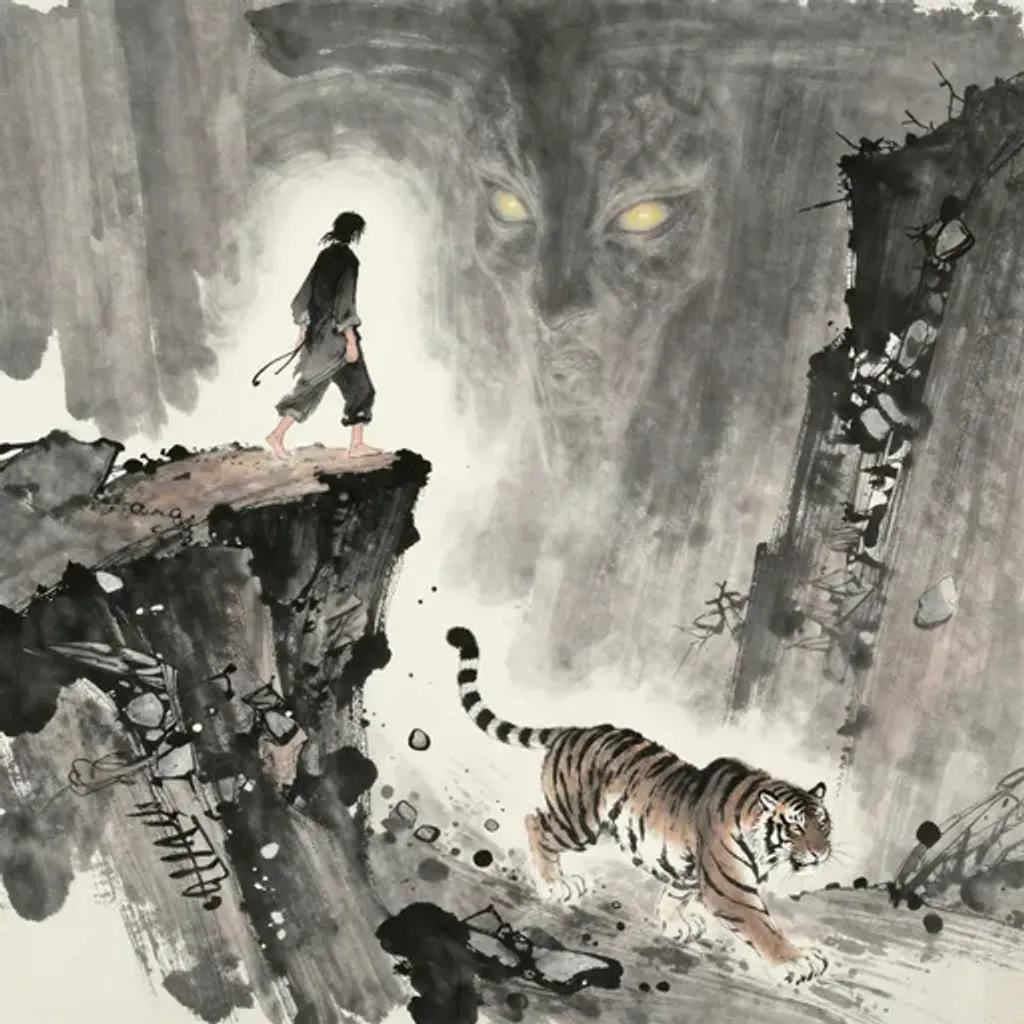
履危不止,與鬼相視;驚恐失氣,如騎虎尾。
Treading danger without stopping, one stares face to face with ghosts; startled and gasping for breath, as though riding the tail of a tiger.
— Jiao Yanshou, Yilin (Forest of Changes), 1st century BC
Commentary
Earth above the lake sinks into the lake drained of water — the Oppression of exhausted resources. Treading danger without stopping, one comes face to face with ghosts. Terror drains the breath away, as if riding a tiger's tail. The verse piles peril upon peril: walking into hazard, confronting spectral forces, losing one's vital energy to sheer fright. The tiger-tail image inverts the assurance of Hexagram 10 (Treading) — there, the tiger does not bite; here, the rider is paralyzed with terror. From Approach to Oppression, the lake's generosity runs dry. When the water is gone from the marsh, one is trapped: resources depleted, courage exhausted, facing terrors that cannot be fought because there is nothing left to fight with.
臨 → 井
Hexagram 19 → Hexagram 48: The Well
Changing lines: 1, 3, 5
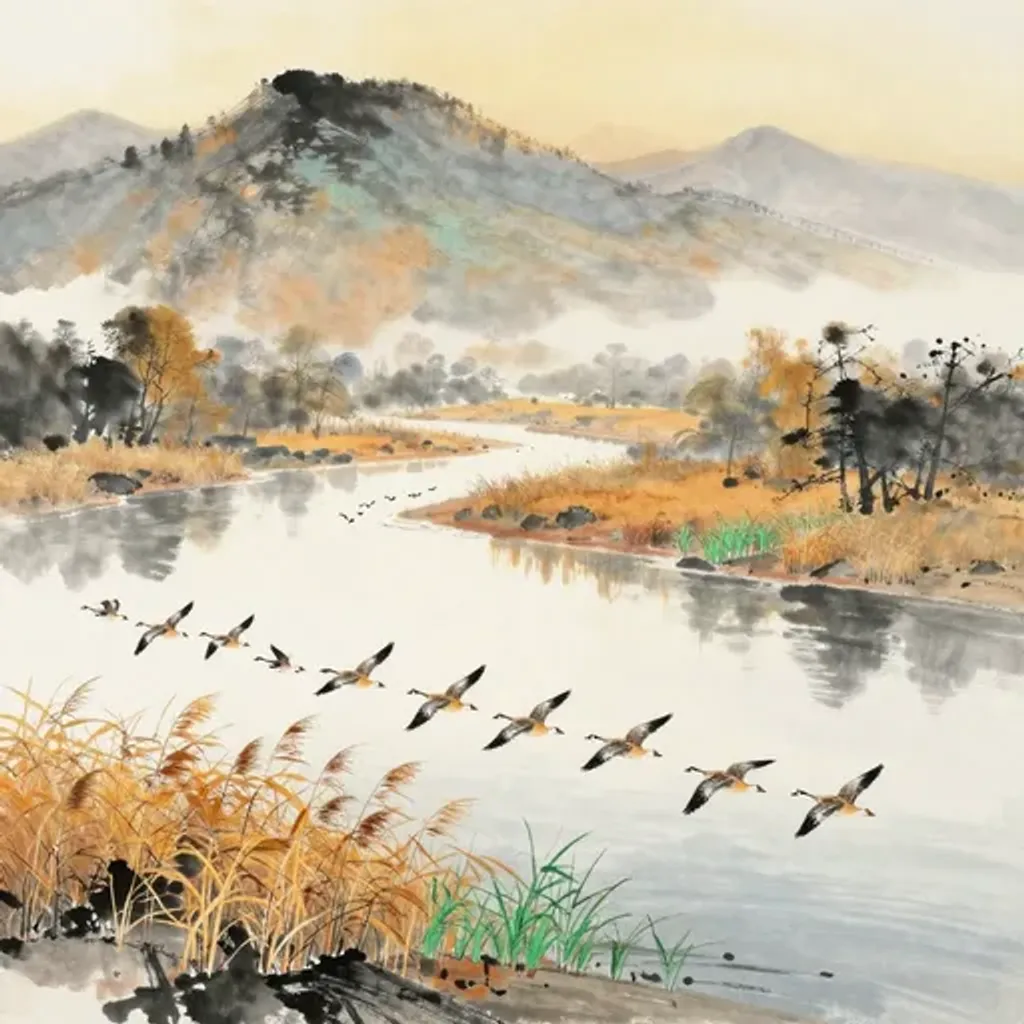
秋南春北,不失消息;涉和履中,時無隱慝。
South in autumn, north in spring, never missing the season turning; treading harmony and holding the center -- no hidden wickedness in any season.
— Jiao Yanshou, Yilin (Forest of Changes), 1st century BC
Commentary
Earth above the lake descends to water above wood — the Well's inexhaustible nourishment. Migrating south in autumn, returning north in spring, never losing the rhythm of the seasons. Walking in harmony and treading the middle path, the times hold no hidden treachery. The verse describes perfect attunement to natural cycles — birds migrating with the seasons, the sage following the Way without deviation. Nothing is concealed; everything moves openly. From Approach to the Well, the lake's surface waters deepen into the well's permanent source. The well does not migrate, yet it nourishes all who come to it season after season. Constancy and transparency sustain the rhythm that makes life possible.
臨 → 革
Hexagram 19 → Hexagram 49: Revolution
Changing lines: 2, 3, 4, 5
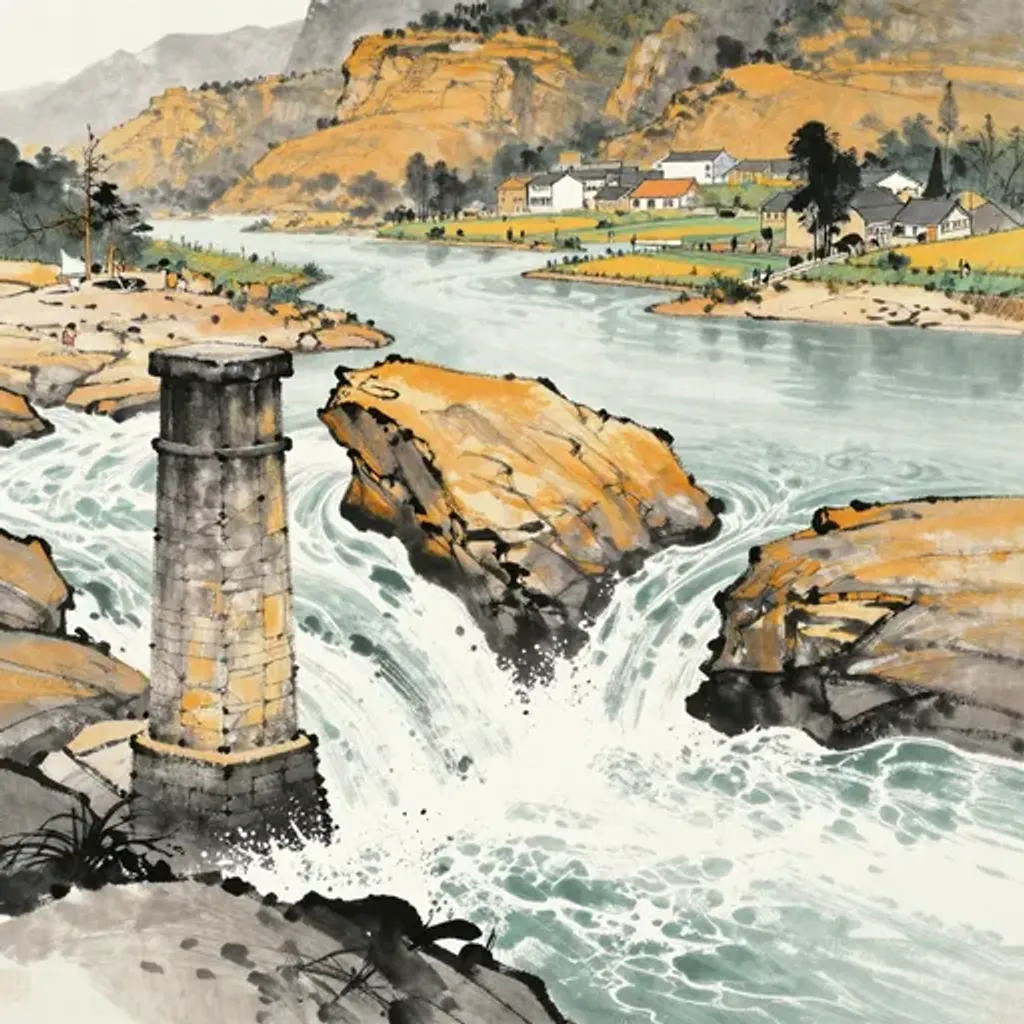
龍門砥柱,通利水道;百川順流,民安其居。
Dragon Gate and the Dizhu rock clear the waterways; a hundred rivers flow in order -- the people dwell in peace.
— Jiao Yanshou, Yilin (Forest of Changes), 1st century BC
Commentary
Earth above the lake meets fire within the lake — Revolution's transformative power. Dragon Gate and Dizhu — Yu the Great carved these gorges to open the waterways. A hundred rivers flow in proper course, and the people dwell in peace. Dragon Gate is the gorge where fish leap to become dragons; Dizhu is the pillar-rock in the Yellow River's rapids. Both were obstacles that Yu removed through heroic engineering, transforming chaos into navigable order. From Approach to Revolution, the lake's gentle oversight gives way to radical reshaping. Fire within the lake is the revolutionary force that remakes the calendar and the landscape alike. Yu's waterworks did not merely fix a problem — they restructured the world, redirecting the flow of civilization itself.
臨 → 鼎
Hexagram 19 → Hexagram 50: The Cauldron
Changing lines: 1, 3, 4, 6
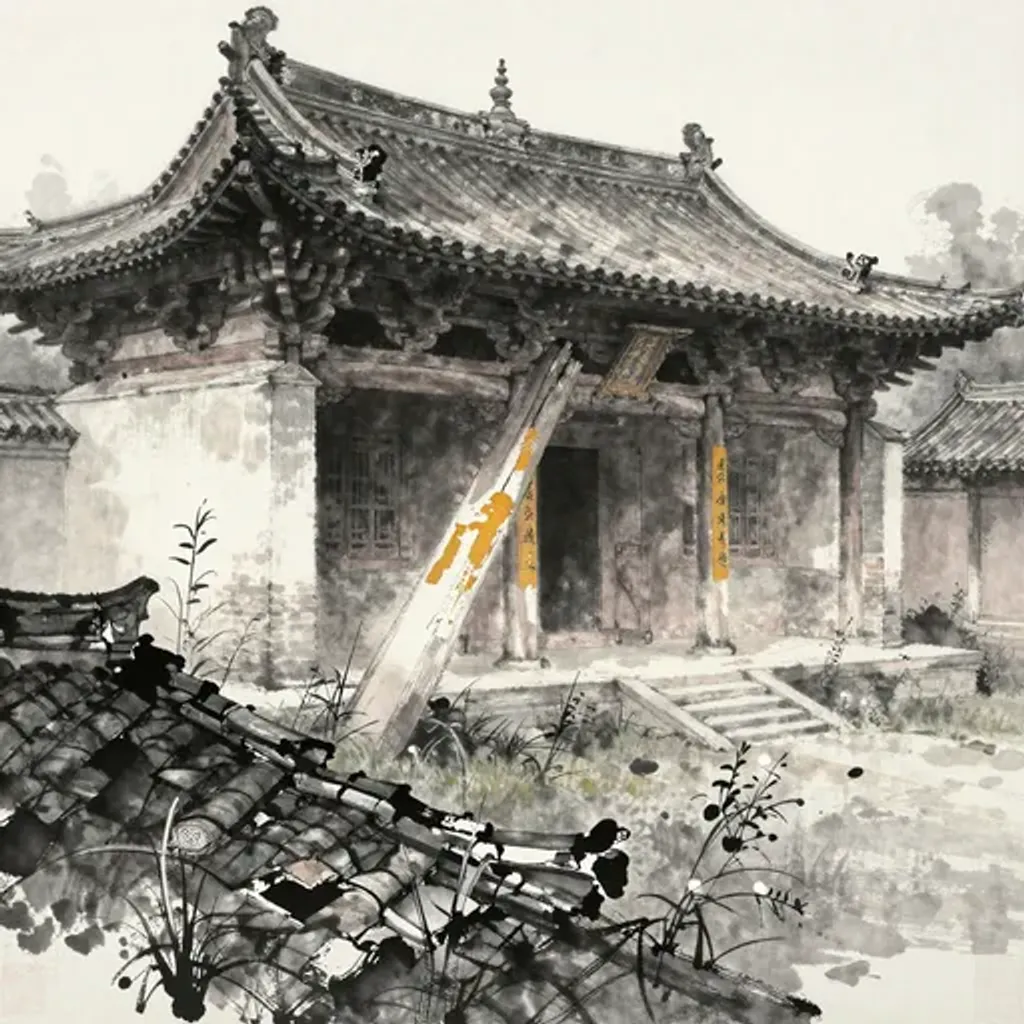
千歲廟堂,棟橈傾僵;天厭周德,失其寵光。
The temple of a thousand years, its ridgepole bends and collapses; heaven grows weary of Zhou virtue -- it loses its favored brilliance.
— Jiao Yanshou, Yilin (Forest of Changes), 1st century BC
Commentary
Earth above the lake meets fire above wind — the Cauldron's transformative vessel. A thousand-year-old ancestral hall sees its ridgepole sag and its pillars collapse. Heaven has grown weary of Zhou's virtue and withdraws its favor and brilliance. The ridgepole's sagging — the 'dong nao' of Hexagram 28 — signals governance overburdened to the breaking point. The verse identifies this structural failure with the decline of the Zhou dynasty: a millennium of accumulated mandate finally exhausted. From Approach to the Cauldron, the vessel that should refine and transform instead buckles under its own antiquity. When heaven withdraws its endorsement, even the most sacred institution crumbles. The cauldron's fire cannot cook what the vessel can no longer hold.
臨 → 震
Hexagram 19 → Hexagram 51: The Arousing Thunder
Changing lines: 2, 4
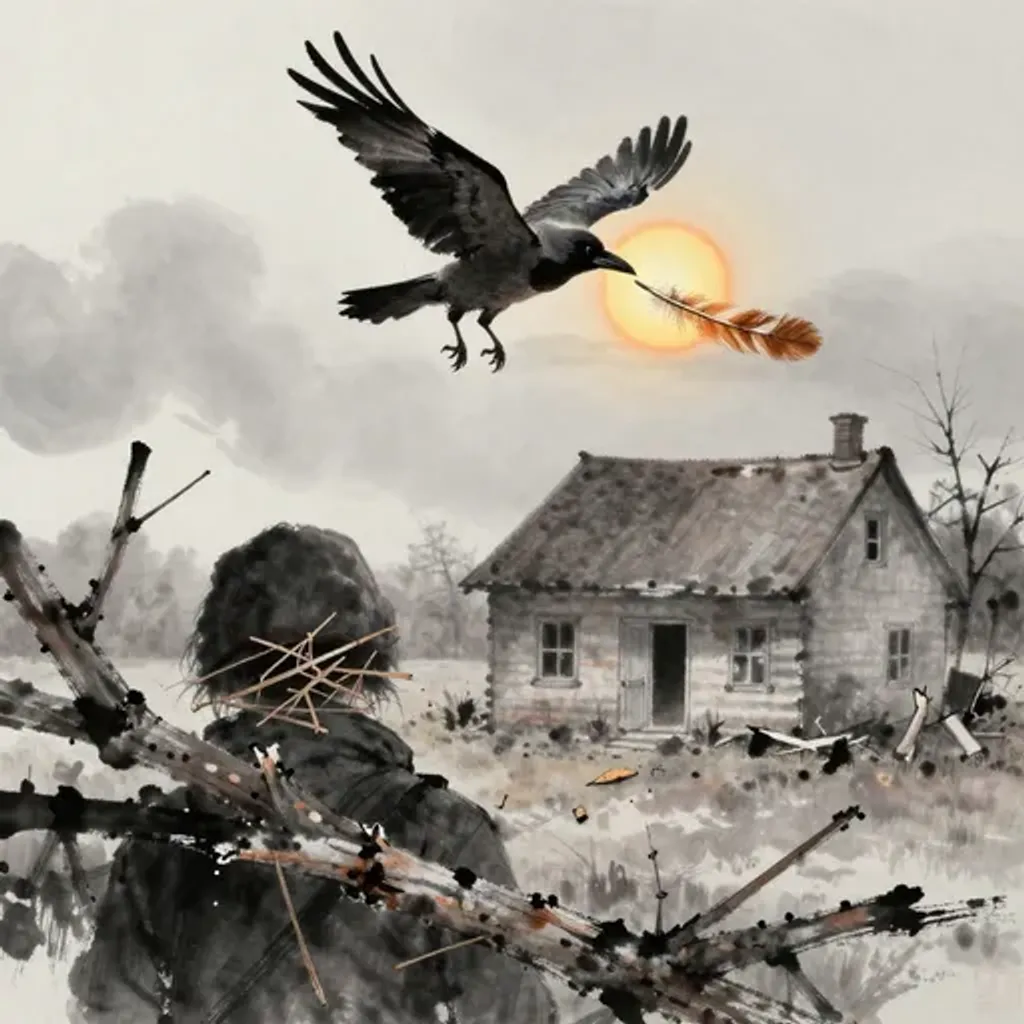
折若蔽目,不見稚叔;三足孤烏,遠離室家。
Branches snap and screen the eyes, one cannot see the younger uncle; the three-legged solitary crow wanders far from hearth and home.
— Jiao Yanshou, Yilin (Forest of Changes), 1st century BC
Commentary
Earth above the lake erupts into doubled thunder — the Arousing's repeated shocks. Broken branches screen the eyes; one cannot see the young lord. The three-legged solitary crow flies far from its home. Obstructed vision and exile converge: something — perhaps foliage, perhaps deliberate obstruction — blocks the view of a beloved figure, while the sun-crow, normally a symbol of cosmic radiance, is here alone and displaced. The three-legged crow dwells in the sun; isolated from its celestial home, it embodies brilliance exiled from its proper seat. From Approach to the Arousing, the elder's steady gaze is shattered by successive shocks. Thunder upon thunder jolts the one who once looked down with calm authority into disorientation and separation.
臨 → 艮
Hexagram 19 → Hexagram 52: Keeping Still Mountain
Changing lines: 1, 2, 3, 6
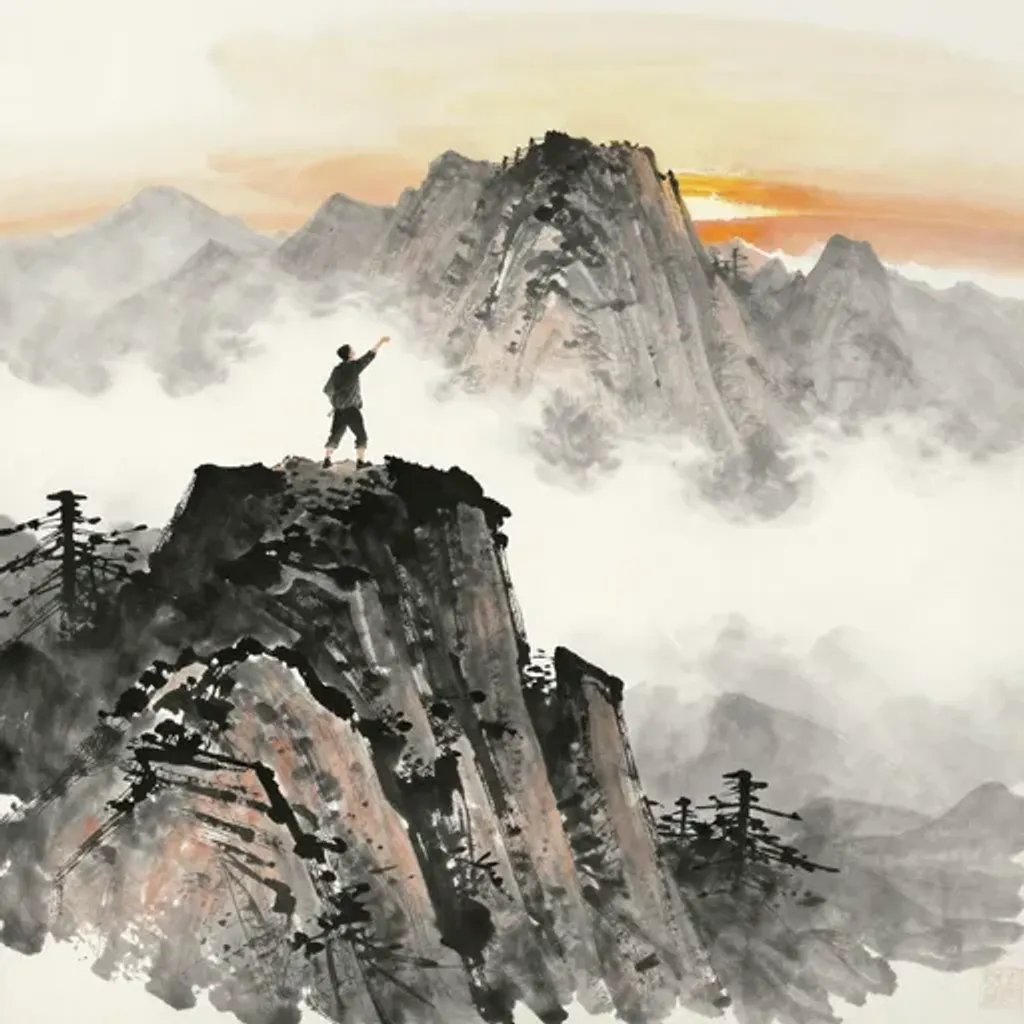
望叔山北,陵隔我目;不見所得,使我憂惑。
Gazing for my uncle north of the hills, the ridge blocks my sight; unable to see what was won -- it leaves me troubled and perplexed.
— Jiao Yanshou, Yilin (Forest of Changes), 1st century BC
Commentary
Earth above the lake meets doubled mountains — Keeping Still's resolute immobility. Gazing northward beyond the mountain for the young lord, ridges block the view. Unable to see what one hopes to gain, the heart fills with worry and doubt. The doubled mountain of Gen creates an impassable wall between the gazer and the desired object. Vision strains but cannot penetrate stone. From Approach to Keeping Still, the lake's open surface freezes into mountain stillness — but this stillness is not peace but frustration. The mountains that should invite contemplation instead obstruct longing. What the eyes cannot reach, the heart cannot release. Stillness here is not chosen meditation but enforced separation, where the only movement left is the churning of anxiety within.
臨 → 漸
Hexagram 19 → Hexagram 53: Development
Changing lines: 1, 2, 3, 5, 6
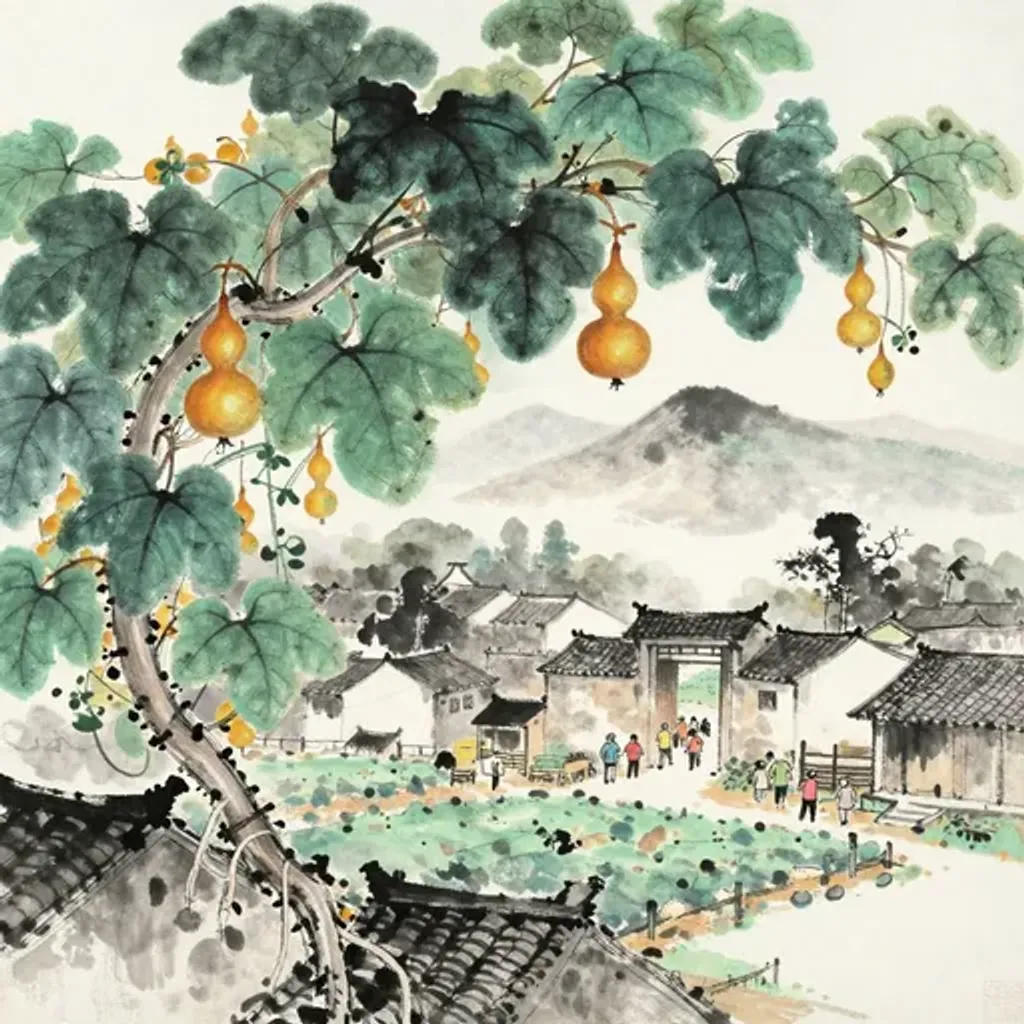
匏瓠之恩,一畝千室。萬國都邑,北門有福。
By the grace of the gourd, one acre shelters a thousand households. Ten thousand states and their capitals -- the northern gate bestows its blessing.
— Jiao Yanshou, Yilin (Forest of Changes), 1st century BC
Commentary
Earth above the lake rises to wind above the mountain — Development's gradual, organic growth. The blessing of the gourd vine: from a single mu, a thousand chambers grow. All the states' capital cities receive fortune through the northern gate. The gourd (pao-hu) is a symbol of prolific abundance — from one planting, innumerable fruits emerge. The verse traces exponential growth from a single seed to metropolitan prosperity. From Approach to Development, the lake's immediate nurturing extends into the tree's patient upward growth on the mountainside. Wind above the mountain carries seeds gradually to new heights. The gourd's thousand chambers from one acre embody Development's core principle: great things grow slowly from small, well-tended beginnings.
臨 → 歸妹
Hexagram 19 → Hexagram 54: The Marrying Maiden
Changing lines: 4
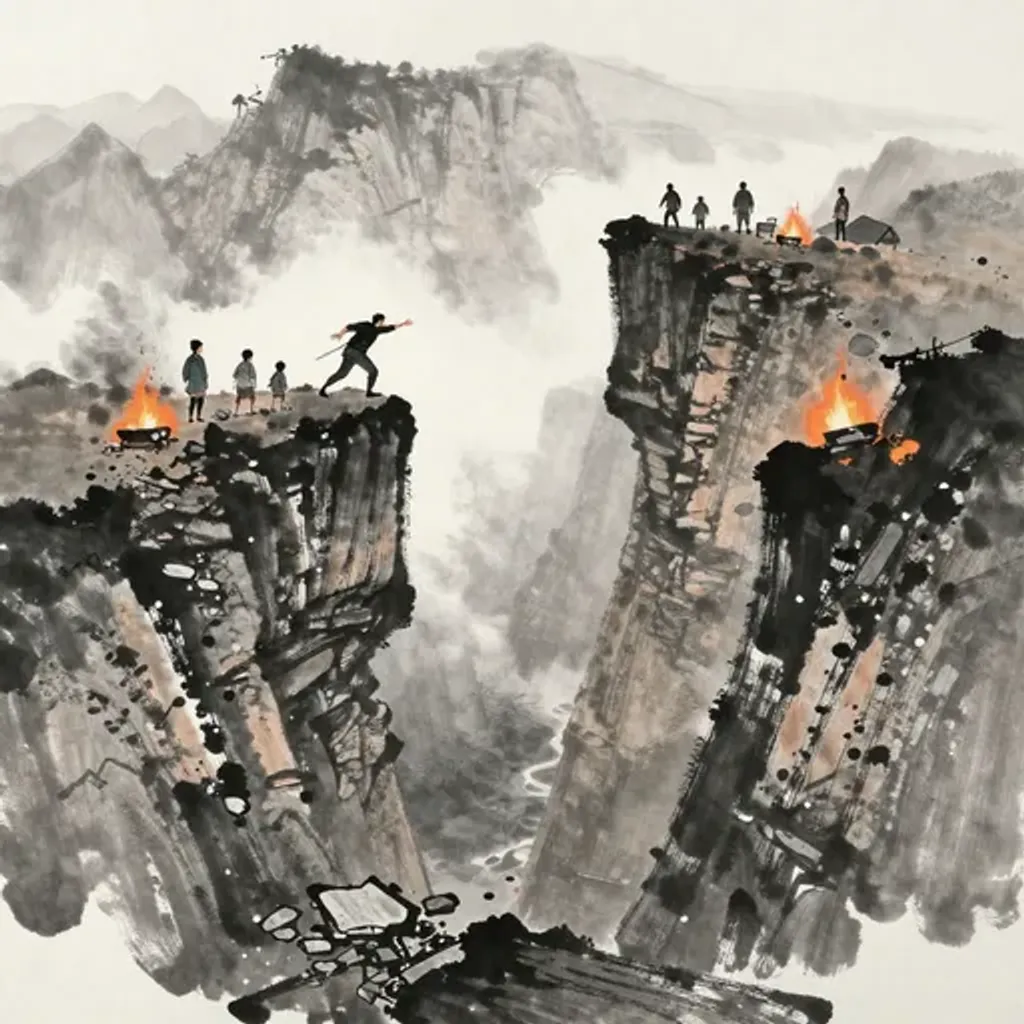
域域牧牧,憂禍相半;隔以巖山,室家分散。
Anxious and fretful, worry and misfortune evenly matched; divided by crag and mountain -- hearth and home are scattered apart.
— Jiao Yanshou, Yilin (Forest of Changes), 1st century BC
Commentary
Earth above the lake encounters thunder above the lake — the Marrying Maiden's irreversible commitment. Restless and anxious, worry and calamity divide in half. Separated by craggy mountains, household and family scatter. The verse paints domestic dissolution: constant agitation, shared misfortune, and finally a mountain range splitting the family apart. From Approach to the Marrying Maiden, the elder's protective oversight gives way to a union that cannot be undone — for better or worse. Thunder over the lake in Gui Mei is the younger sister given in marriage, a one-way journey. The rocky mountains between family members represent the irreversibility of the commitment: once the maiden crosses the threshold, the old household configuration is permanently altered.
臨 → 豐
Hexagram 19 → Hexagram 55: Abundance
Changing lines: 2, 3, 4
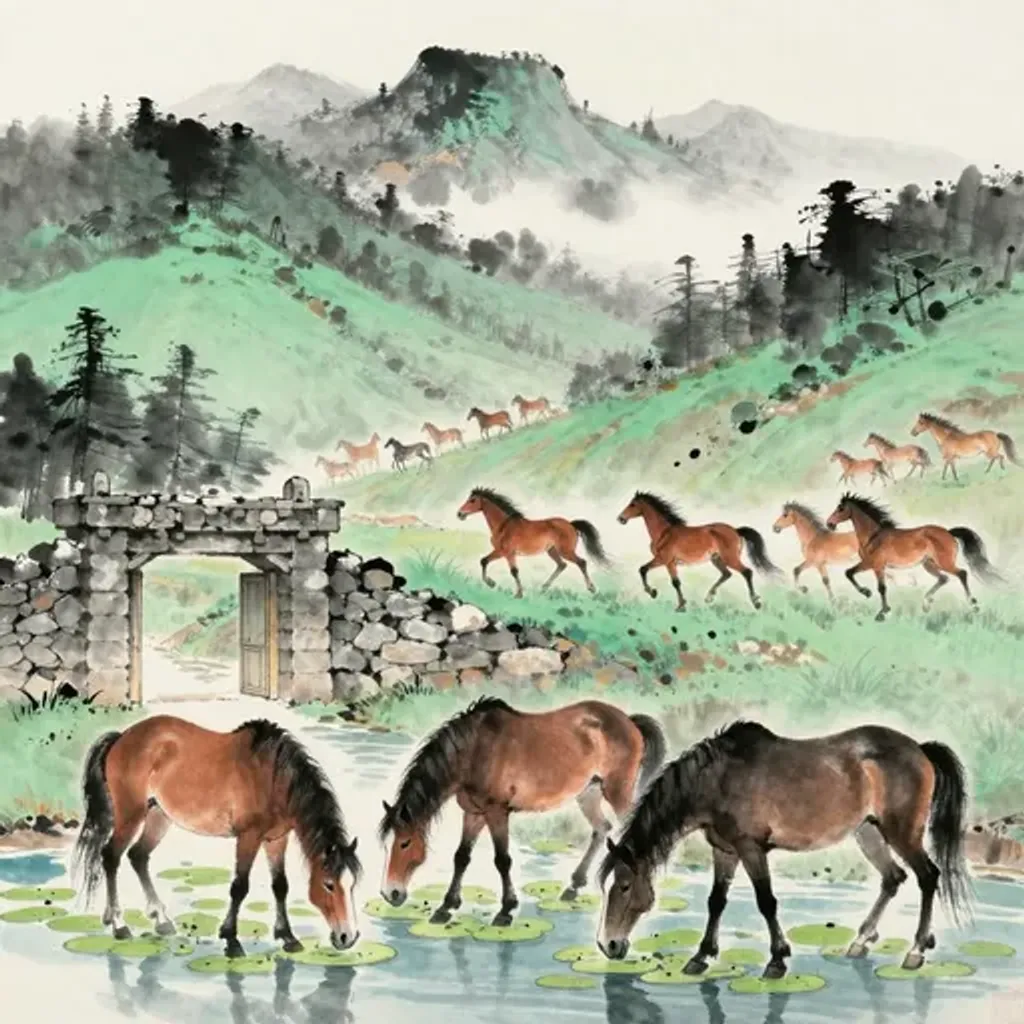
騏驎騄耳,遊食萍草;逍遙石門。循山上下,不失其所。
Qilin and Luji graze on duckweed grass, roaming at ease by the Stone Gate; wandering the hills high and low, they never lose their place.
— Jiao Yanshou, Yilin (Forest of Changes), 1st century BC
Commentary
Earth above the lake meets thunder and fire together — the brilliant fullness of Abundance. Fine steeds Qilin and Luer graze on duckweed, wandering freely at Stone Gate, roaming up and down the mountains, never losing their place. Qilin and Luer are names associated with legendary horses — possibly among King Mu of Zhou's eight famous steeds. Their unhurried grazing at Stone Gate evokes perfect freedom within natural limits. From Approach to Abundance, the lake's nurturing presence ignites into thunder-and-lightning brilliance. Yet this abundance manifests not as accumulation but as the freedom of magnificent creatures at ease in their landscape. They range without constraint yet never stray: abundance as the liberty to move fully within one's proper domain.
臨 → 旅
Hexagram 19 → Hexagram 56: The Wanderer
Changing lines: 1, 2, 3, 4, 6
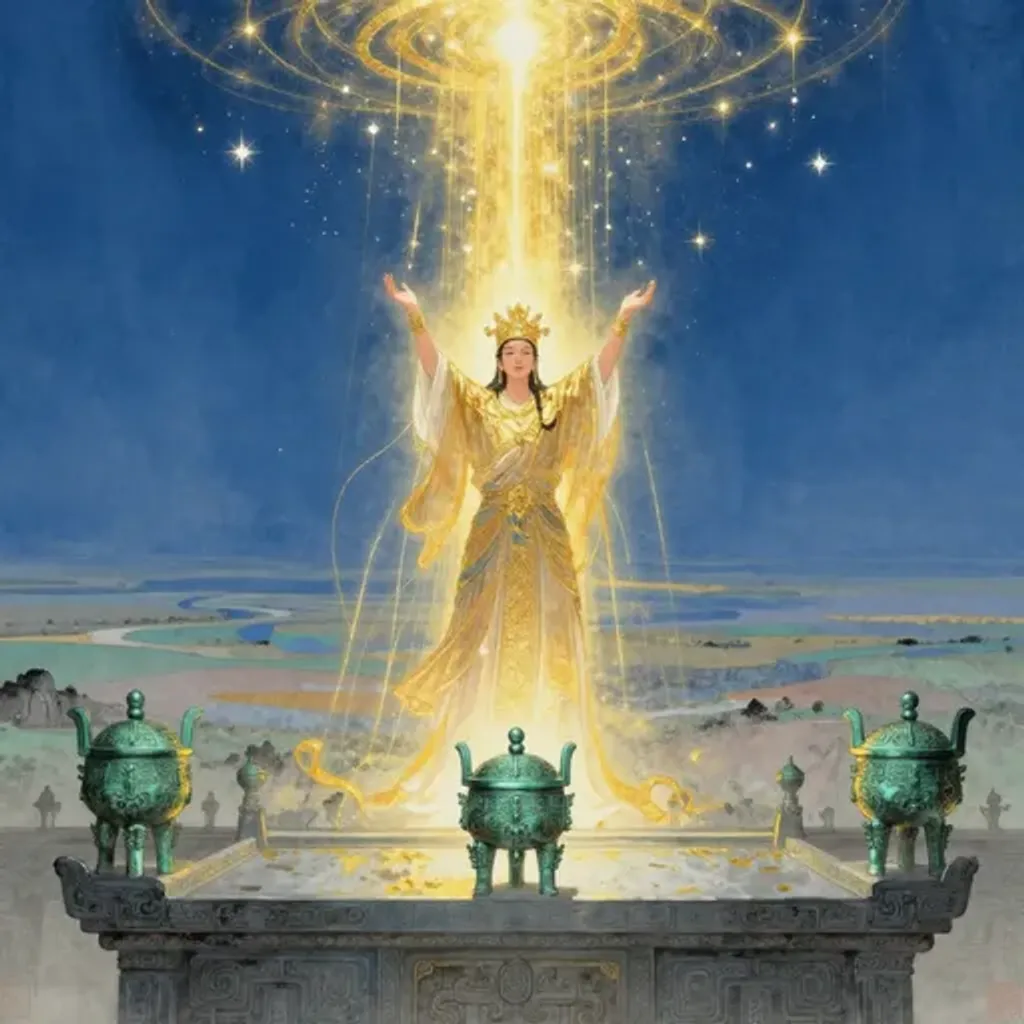
天所祚昌,文以為良;篤生武王,姬受其福。
What heaven bestows its flourishing upon, with Wen deemed most worthy; mightily it bore King Wu -- the house of Ji received its blessing.
— Jiao Yanshou, Yilin (Forest of Changes), 1st century BC
Commentary
Earth above the lake encounters fire upon the mountain — the Wanderer's transient brilliance. Heaven bestows its mandate of prosperity; King Wen serves as the foundation of goodness. From him is born King Wu in splendid vigor, and the Ji clan receives its blessing. The verse celebrates the Zhou succession: Heaven's favor first descends on Wen, whose accumulated virtue then produces Wu, the warrior who completes the mandate. The Ji surname — Zhou's royal clan — inherits the cosmic endorsement. From Approach to the Wanderer, the paradox is that Zhou's enduring dynasty is framed through the Wanderer's transience: even the mightiest mandate is a sojourn, brilliant but finite, like fire flaring upon a mountain before moving on.
臨 → 巽
Hexagram 19 → Hexagram 57: The Gentle Wind
Changing lines: 1, 3, 5, 6
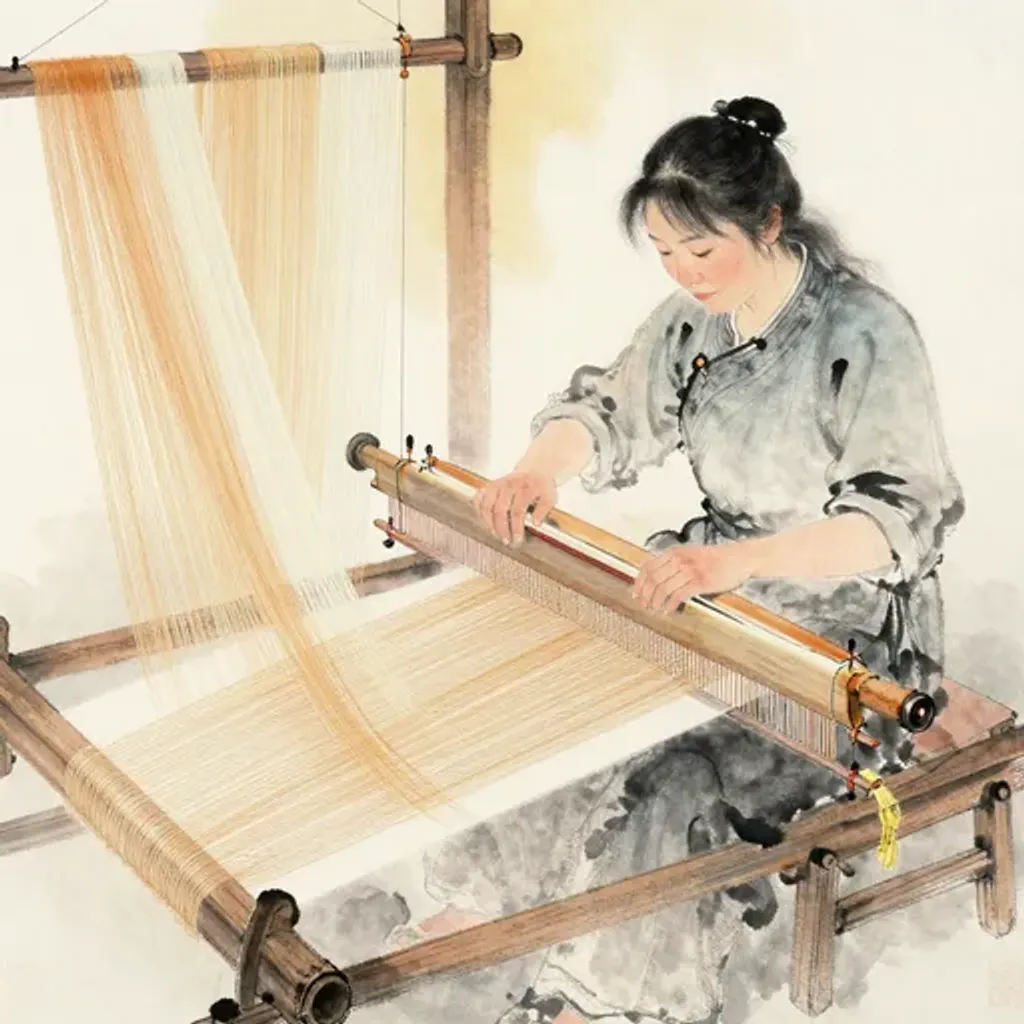
羊腸九縈,相推稍前;止須王孫,乃能上天。
A thousand silkworm threads weave into a single square inch. Spinning one thread per day — by year's end, a brocade robe.
— Jiao Yanshou, Yilin (Forest of Changes), 1st century BC
Commentary
Earth above the lake enters doubled wind — the Gentle's patient penetration. The original verse reads: 'A sheep's intestine winds in nine coils; pushing forward little by little. Wait for the prince's arrival, and then one can ascend to heaven.' The narrow, winding mountain path — proverbially called a 'sheep's gut' — allows only the most gradual advance. Progress is measured in inches, not miles. From Approach to the Gentle, the lake's immediate accessibility gives way to wind's subtle, persistent infiltration. Doubled wind penetrates where force cannot enter: the ninefold winding path demands patience rather than strength. The prince who finally arrives represents the patron or opportunity that transforms incremental effort into transcendent breakthrough.
臨 → 兌
Hexagram 19 → Hexagram 58: The Joyous Lake
Changing lines: 4, 5
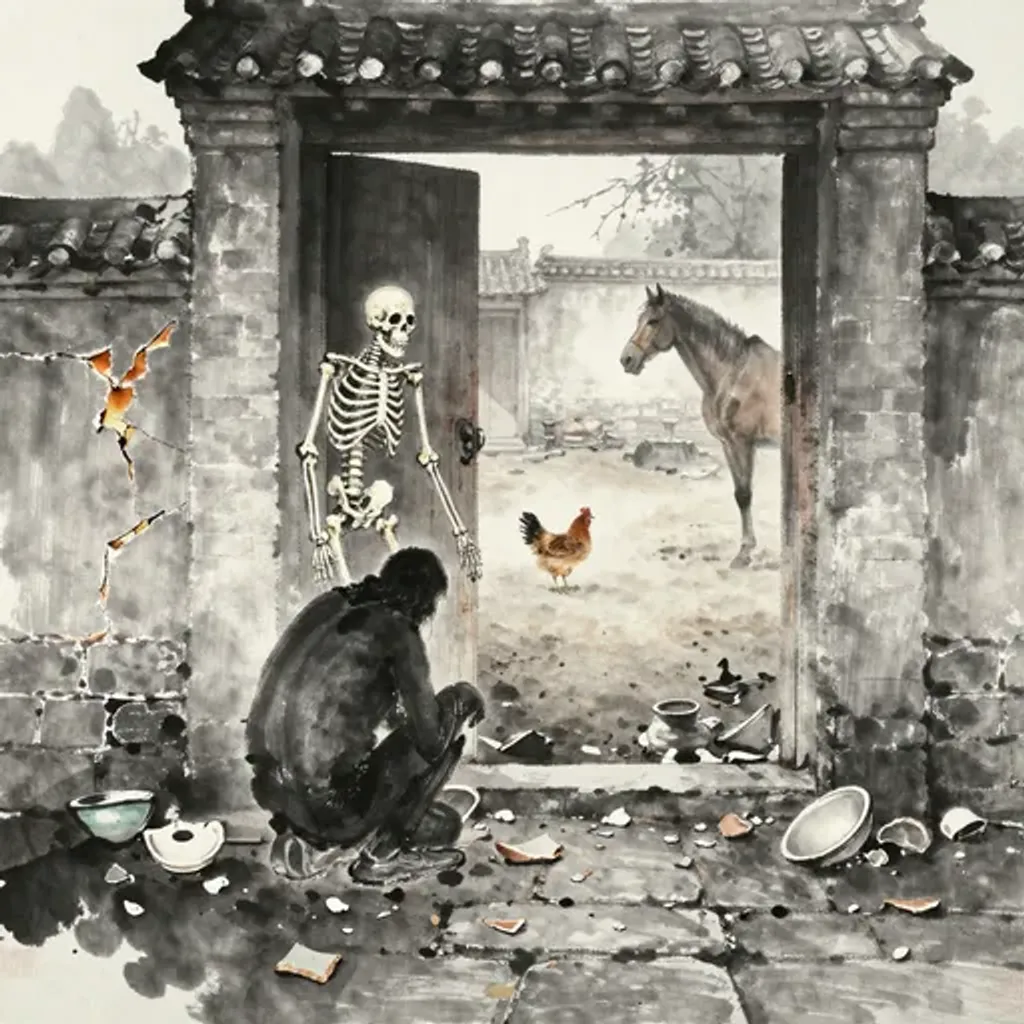
貧鬼守門,日破我盆;孤牝不駒,雞不成雛。
The ghost of poverty guards the gate, day by day shattering my basin; the lone mare bears no foal -- the hen hatches no chick.
— Jiao Yanshou, Yilin (Forest of Changes), 1st century BC
Commentary
Earth above the lake encounters doubled lakes — the Joyous in mutual reflection. Yet there is no joy here: the ghost of poverty guards the door, smashing the household's pots day after day. The lone mare bears no foal; the hen hatches no chicks. Everything that should produce is barren; everything that should hold together shatters. The poverty-ghost is a folk image of relentless destitution — a supernatural force that prevents accumulation. From Approach to the Joyous, the doubled lake should reflect delight in shared discourse, but here the mirror shows only emptiness. Two lakes with nothing between them: the form of joy without its substance, vessels broken, fertility denied, the daily destruction of even the most modest hopes.
臨 → 渙
Hexagram 19 → Hexagram 59: Dispersion
Changing lines: 1, 5, 6
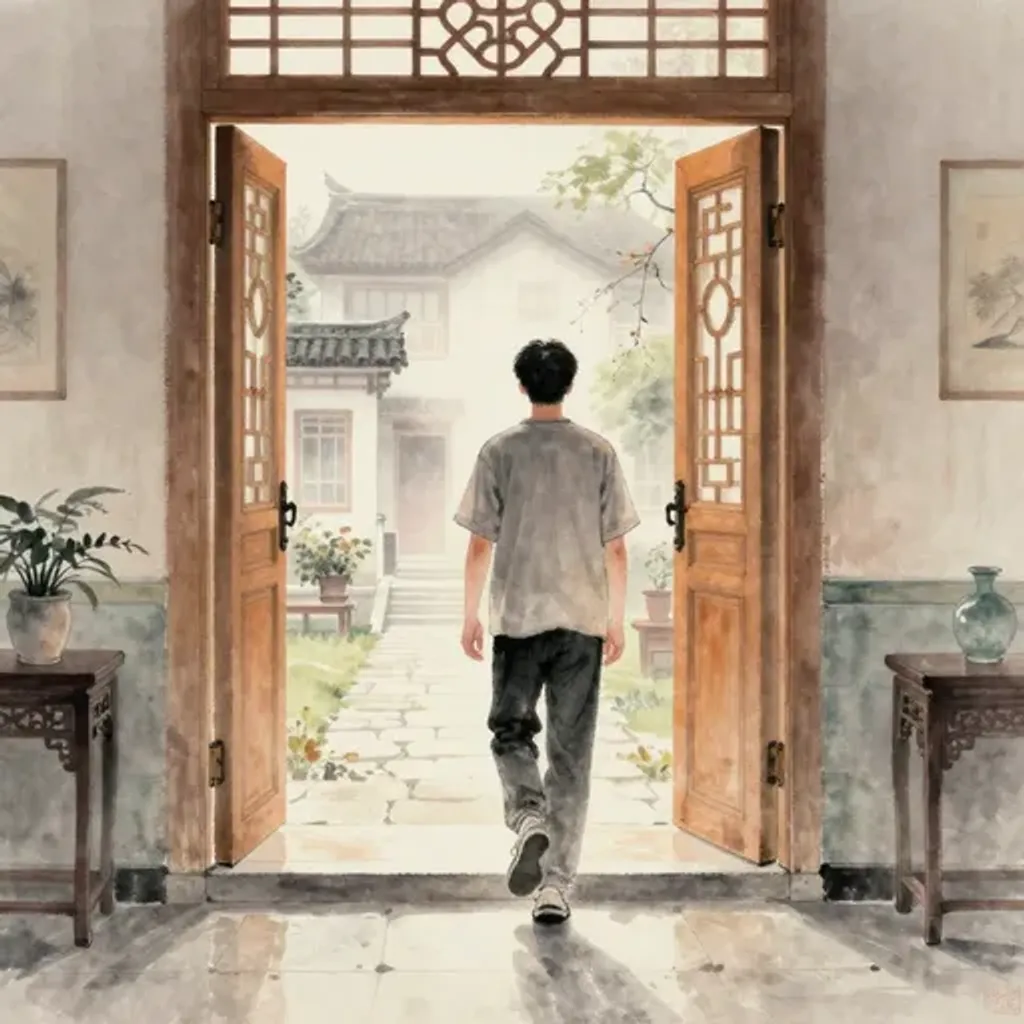
飽食從容,出門上堂;不失其常,家無凶殃。
Well fed and at leisure, one steps out the door and ascends the hall; never losing the constant way -- the household knows no ill fortune.
— Jiao Yanshou, Yilin (Forest of Changes), 1st century BC
Commentary
Earth above the lake meets wind upon water — Dispersion's scattering force. Yet the verse refuses dispersal: well-fed and at ease, one steps from the door onto the hall platform. Nothing departs from the constant way, and the household suffers no misfortune. The calm is deliberate — eating well, moving with measured confidence, maintaining routine. From Approach to Dispersion, the lake's coherent body of water should scatter as wind strikes its surface. But this household resists the scattering force through sheer regularity: the daily rituals of eating, walking, maintaining order hold dispersion at bay. Wind over water creates waves, but a disciplined life absorbs the turbulence without losing its center.
臨 → 節
Hexagram 19 → Hexagram 60: Limitation
Changing lines: 5
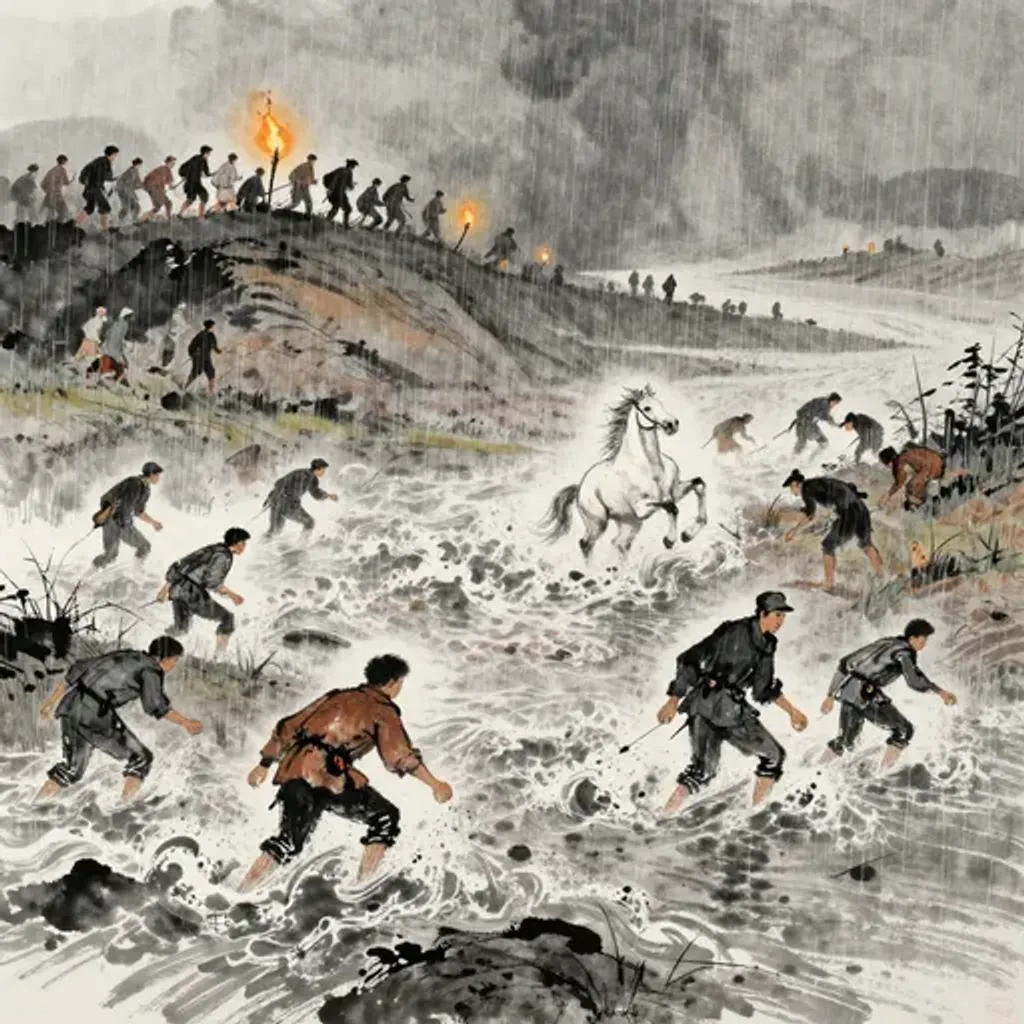
陰淫不止,白馬為洶,皋澤之子,就高而處。
Yin rains fall without ceasing, white-capped waves surge in fury; the children of the marsh and lowland climb to the high ground to dwell.
— Jiao Yanshou, Yilin (Forest of Changes), 1st century BC
Commentary
Earth above the lake encounters water above the lake — Limitation's measured restraint. Excessive yin rains fall without ceasing; white-crested waves surge and roar. The children of the marshlands seek high ground to dwell upon. The imagery is of flooding beyond all normal limits — yin moisture unchecked, waters rising relentlessly. The marsh-dwellers' instinct to climb is the verse's survival wisdom: when the flood exceeds its banks, one must impose one's own limit by choosing higher ground. From Approach to Limitation, the lake's generous waters threaten to overflow all boundaries. Water above the lake in Jie demands the imposition of measured limits. The verse teaches that limitation is not restriction but survival — knowing when enough is too much.
臨 → 中孚
Hexagram 19 → Hexagram 61: Inner Truth
Changing lines: 5, 6
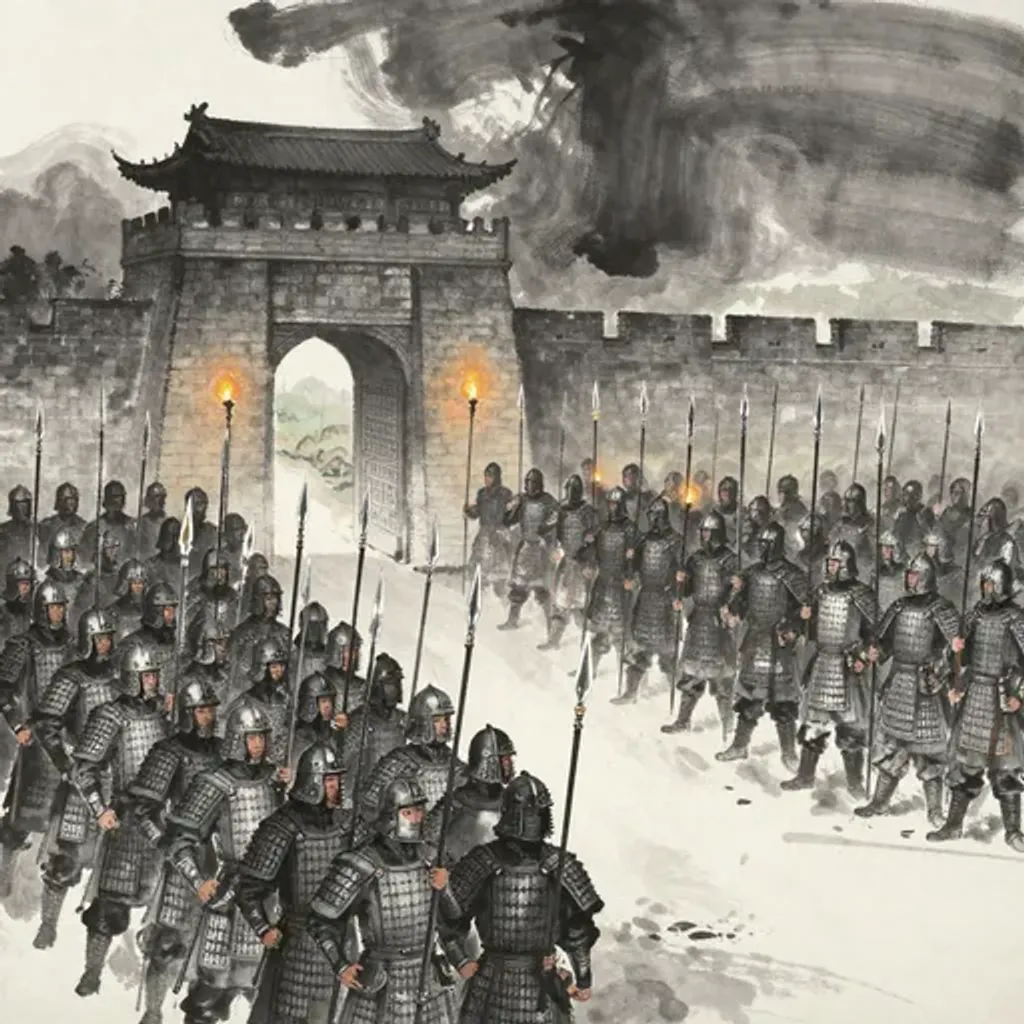
執戈俱立,以備暴急;千人守門,因以益卑。終安何畏?
Grasping halberds, they stand as one, ready against sudden violence; a thousand men guard the gate, and through it their station grows humble. Yet in the end -- what is there to fear?
— Jiao Yanshou, Yilin (Forest of Changes), 1st century BC
Commentary
Earth above the lake rises to wind above the lake — Inner Truth's penetrating sincerity. Guards stand together holding halberds, prepared against sudden violence. A thousand men defend the gate, yet through this very vigilance, humility increases. In the end there is peace — what is there to fear? The paradox is striking: massive defensive preparation produces not arrogance but modesty. The thousand-strong garrison does not swagger; instead, its very discipline cultivates the lowliness that ensures safety. From Approach to Inner Truth, the elder's authority transforms into trust that penetrates like wind across water. The guards' readiness creates the conditions for peace not through intimidation but through the inner truth of genuine preparedness — sincerity made visible in disciplined watchfulness.
臨 → 小過
Hexagram 19 → Hexagram 62: Small Exceeding
Changing lines: 1, 2, 3, 4
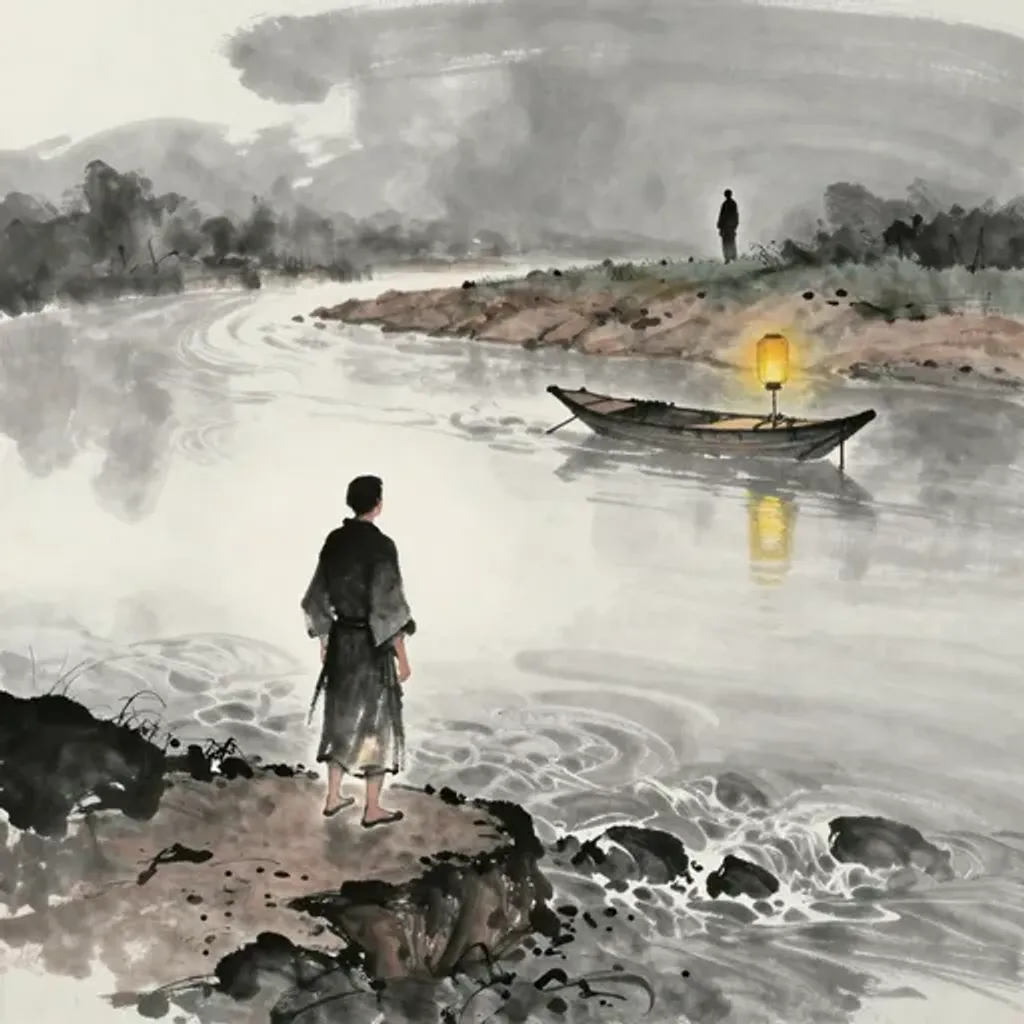
夾河為婚,水長無船;遙心失望,不見歡君。
Betrothed across the river, but the waters rise and there is no boat; the longing heart loses hope -- one does not see the beloved lord.
— Jiao Yanshou, Yilin (Forest of Changes), 1st century BC
Commentary
Earth above the lake encounters thunder above the mountain — Small Exceeding's cautious overreach. Betrothed across the river, but the water has risen and there is no boat. The heart reaches out across the distance but meets only disappointment; one never sees the beloved lord. The river that separates the betrothed couple has become impassable — the marriage arranged but the crossing impossible. From Approach to Small Exceeding, the lake's accessible surface gives way to thunder rumbling atop the mountain, where small things succeed but great things must wait. The verse's lovers face exactly this constraint: the small gesture of longing succeeds, but the great reunion cannot yet occur. One must not attempt the crossing when the water is too high — small exceeding, not great.
臨 → 既濟
Hexagram 19 → Hexagram 63: After Completion
Changing lines: 2, 3, 5
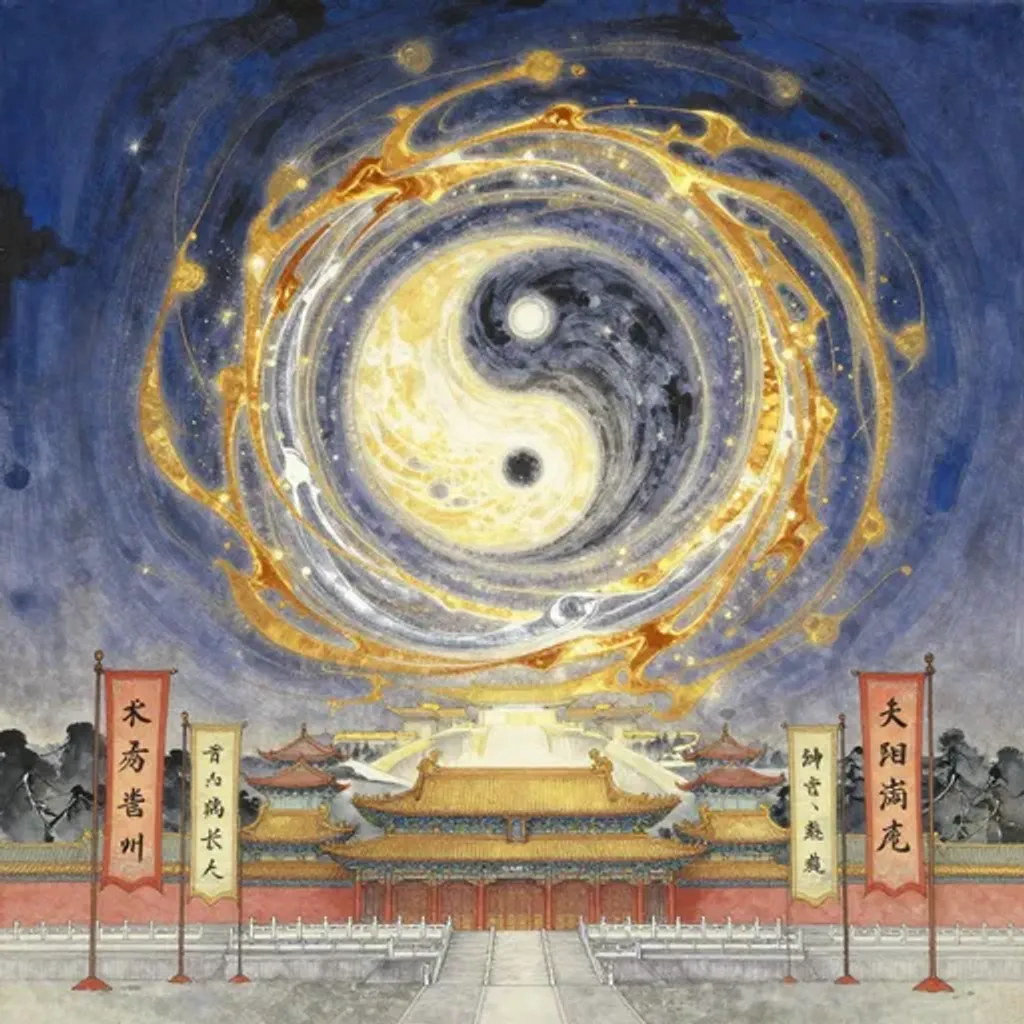
陰陽變化,各得其宜;上下順通,奏為膚功。
Yin and yang shift and change, each finding its proper place; above and below flow freely -- achievement of the utmost merit.
— Jiao Yanshou, Yilin (Forest of Changes), 1st century BC
Commentary
Earth above the lake arrives at water above fire — After Completion's perfect but precarious balance. Yin and yang transform in harmony, each finding its proper place. Above and below communicate freely, and the achievement is complete — a merit that touches the very skin. The verse is one of seamless cosmic order: every element in its right position, every channel open, every effort crowned with success. From Approach to After Completion, the lake's nurturing oversight achieves its ideal endpoint — water and fire in perfect mutual service, each tempering the other. Yet After Completion is the most precarious of all hexagrams: perfection, once achieved, can only decline. The verse celebrates the summit while the I-Ching whispers: think of what comes after.
臨 → 未濟
Hexagram 19 → Hexagram 64: Before Completion
Changing lines: 1, 4, 6
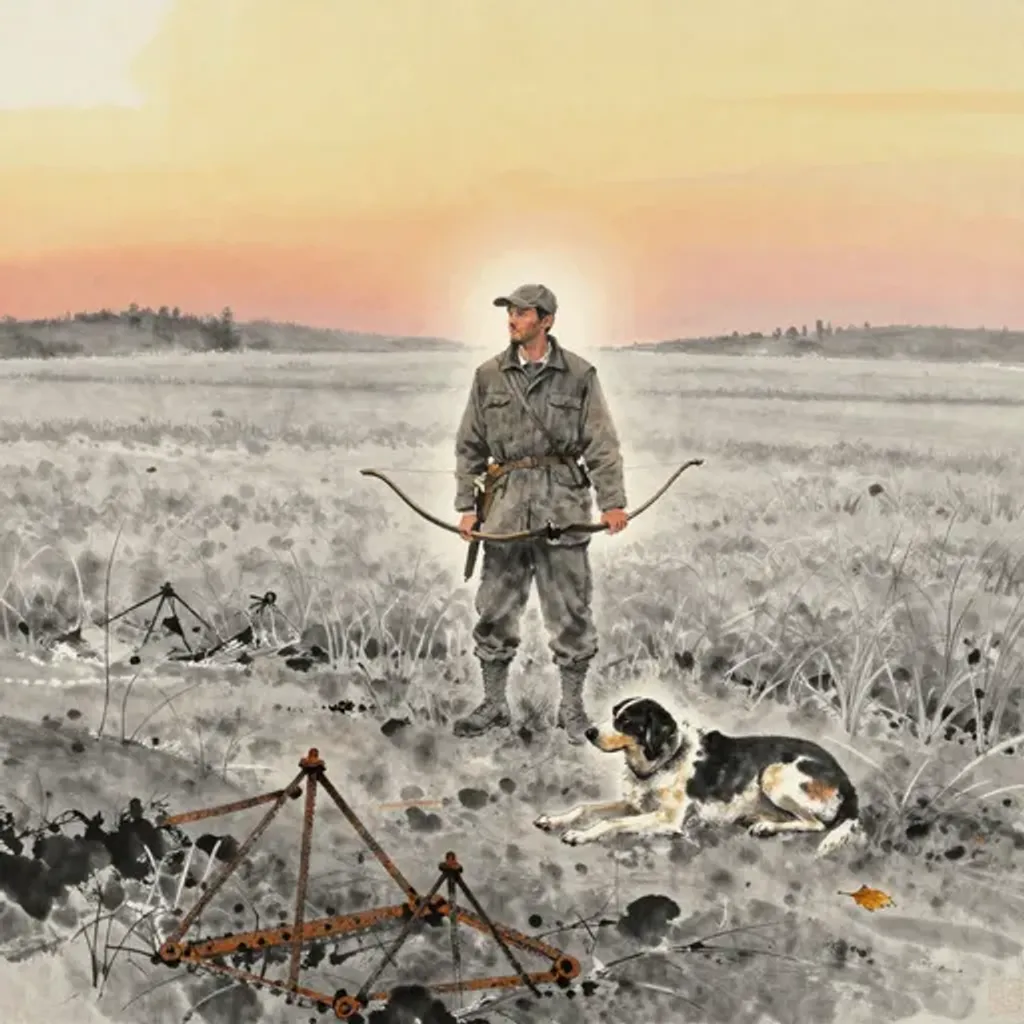
任劣德薄,失其臣妾;田不見禽,犬無所齚。
Ability is meager, virtue is thin; servants and bondsmen are lost. The fields yield no game -- the hound finds nothing to bite.
— Jiao Yanshou, Yilin (Forest of Changes), 1st century BC
Commentary
Earth above the lake meets fire above water — Before Completion's unfinished crossing. Appointed to office despite inferior virtue, one loses both ministers and servants. The hunt yields no game; the dogs find nothing to bite. Everything that should produce results fails: leadership without merit, hunting without quarry, hounds without prey. The verse diagnoses the root cause as moral insufficiency — 'ren lie de bo,' ability too slight and virtue too thin. From Approach to Before Completion, the elder's oversight reaches toward a conclusion that never arrives. Fire above water in Wei Ji means the fox's tail gets wet just before reaching the far bank. The unqualified ruler's failure is not bad luck but structural: without adequate virtue, no crossing can be completed.