Transformations of Hexagram 28
Every line of change out of Hexagram 28 大過 Great Exceeding, with the Yilin verse for each of the 64 resulting hexagrams, its translation, and the original ink brush artwork.
大過 → 乾
Hexagram 28 → Hexagram 1: The Creative
Changing lines: 1, 6
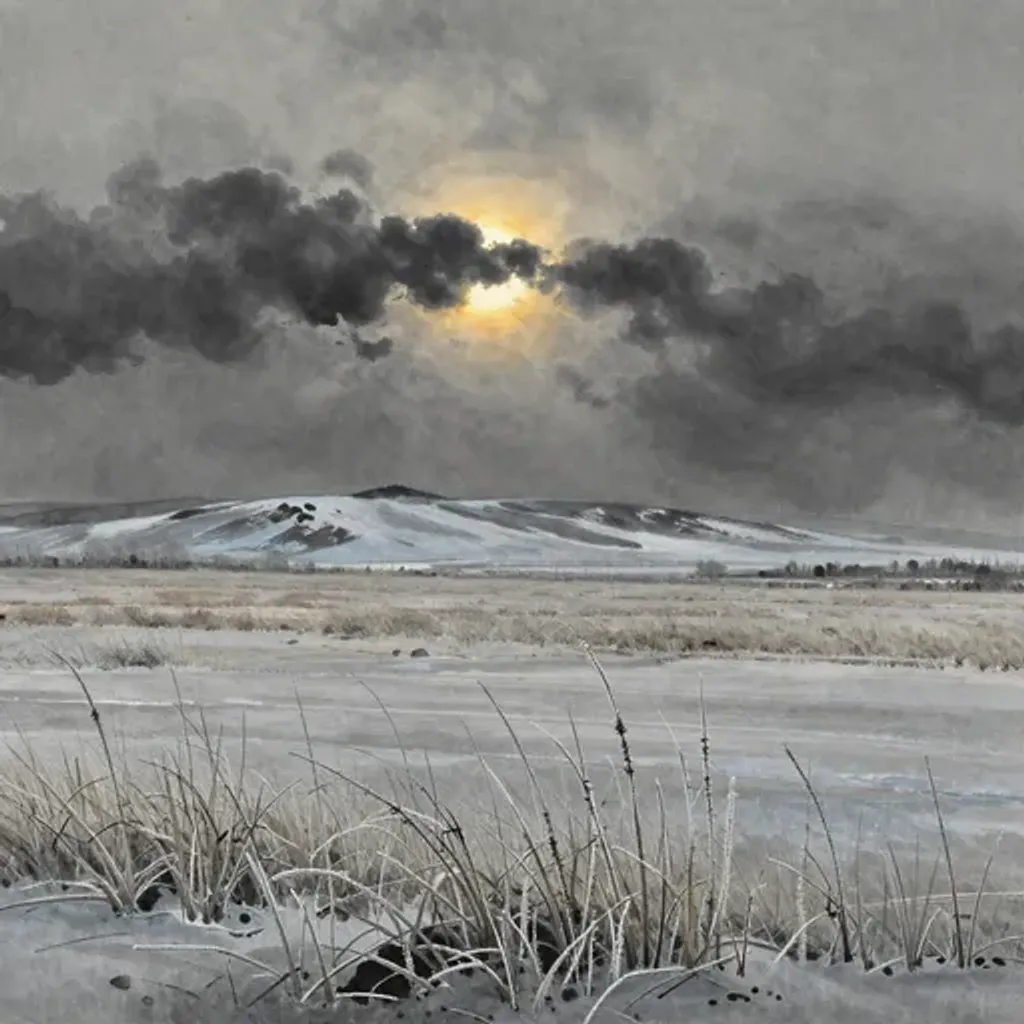
日在北陸,陰蔽陽目。萬物空虛,不見長育。
The sun dwells in the northern wastes; yin veils yang’s eye. The myriad things stand hollow and empty; no growth or nurture is seen.
— Jiao Yanshou, Yilin (Forest of Changes), 1st century BC
Commentary
Lake over wind, the ridgepole bowing under excess — Great Exceeding strains toward the pure dynamism of the Creative. The sun lodges in the northern quarter, the season of deepest yin, where darkness veils the eye of yang. All things stand hollow; nothing grows or thrives. Winter solstice astronomy underlies the image: when the sun reaches its lowest declination, generative power withdraws entirely. Yet the target is Heaven doubled, the self-renewing engine of the cosmos. From Great Exceeding to the Creative, the verse captures the nadir before renewal — the moment when excess weight has crushed all vitality, and only heaven's inexhaustible initiative can restart the cycle. The bleakness is not permanent; it is the darkness that precedes the dragon's first stirring.
大過 → 坤
Hexagram 28 → Hexagram 2: The Receptive
Changing lines: 2, 3, 4, 5
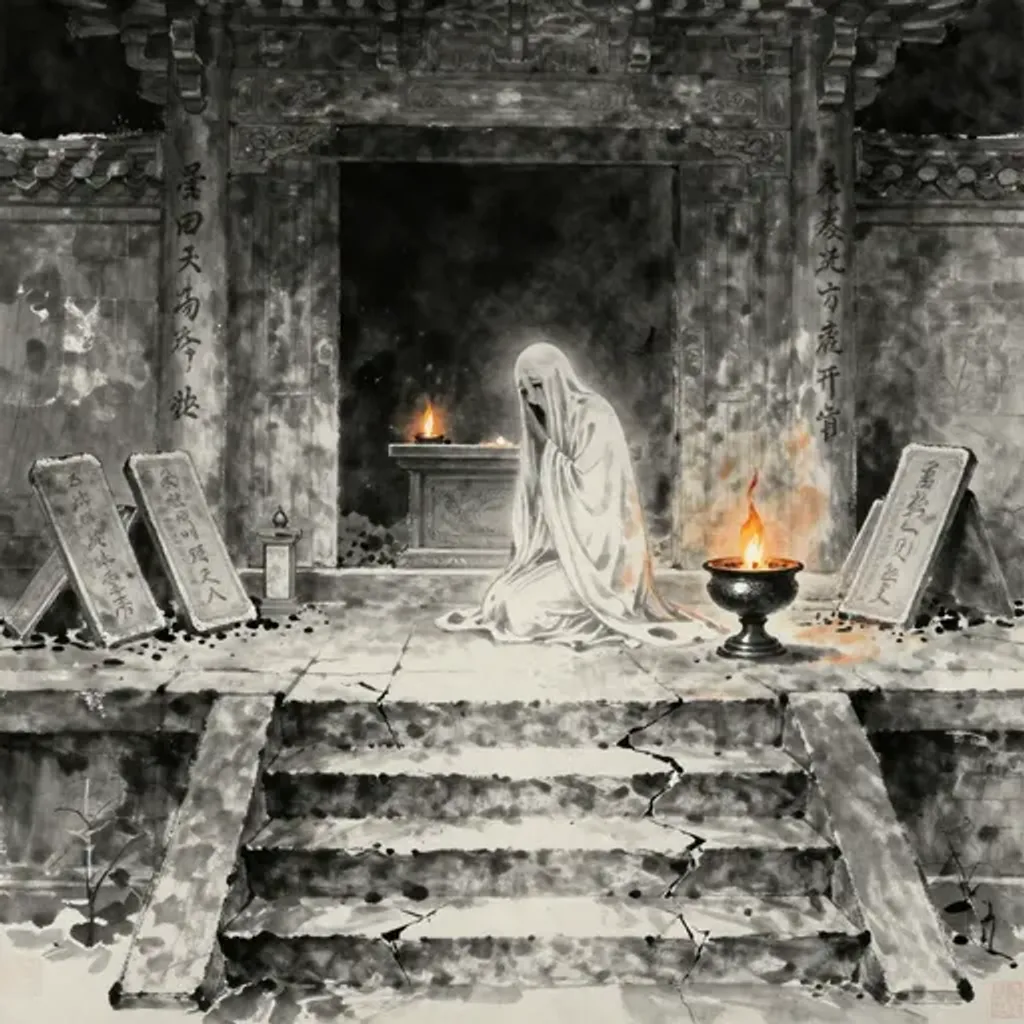
鬼泣哭社,悲商無後。甲子昧爽,殷人絕祀。
Ghosts weep and wail at the shrine; sorrowful Shang has no heir. At dawn on the jiazi day; the Yin people’s sacrifices are cut off.
— Jiao Yanshou, Yilin (Forest of Changes), 1st century BC
Commentary
Lake over wind bows toward earth's pure receptivity — but what arrives is annihilation. Ghosts weep at the ancestral shrine, mourning that the Shang lineage has no heir. At dawn on a jiazi day, the Yin people lose their sacrifices forever. The verse alludes to the fall of the Shang dynasty at the Battle of Muye: King Wu attacked at dawn, and the Shang altars were extinguished. 'Ghosts weep at the shrine' inverts the proper order — ancestors should receive offerings, not shed tears. The jiazi day is historically associated with the Muye battle. From Great Exceeding to the Receptive, overburdened structure collapses into formless earth. The Shang ridgepole, rotted from within by tyranny, buckles and the entire edifice falls into the ground, its sacrificial line severed.
大過 → 屯
Hexagram 28 → Hexagram 3: Difficulty at the Beginning
Changing lines: 1, 2, 3, 4
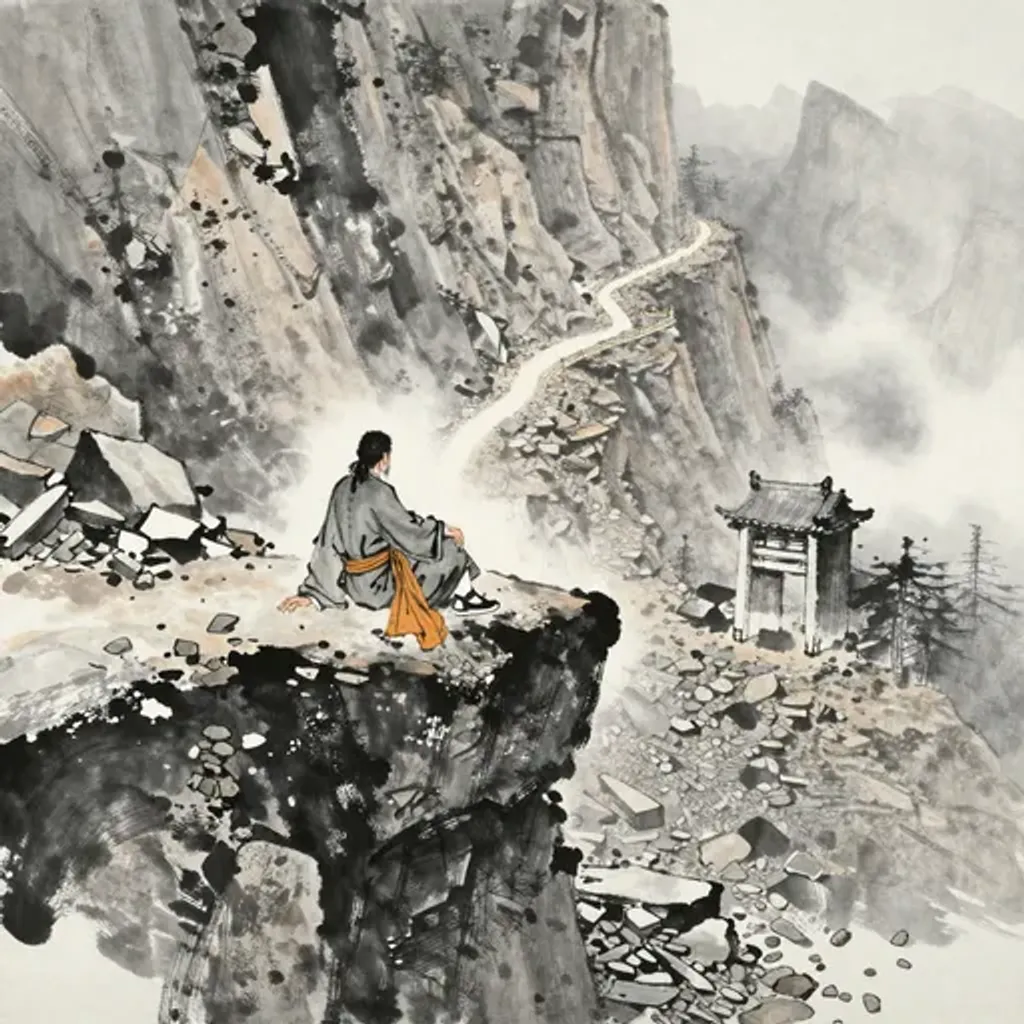
涉塗履危,不利有為。安坐垂裳,乃無災殃。門戶自開,君憂不昌。
Treading mud, walking in peril; action brings no advantage. Sit at ease with robes hanging; thus avoid calamity. The gate opens of itself; the lord worries it will not prosper.
— Jiao Yanshou, Yilin (Forest of Changes), 1st century BC
Commentary
Lake over wind sinks into the birth-struggle of cloud and thunder — Difficulty at the Beginning. Treading muddy roads and walking through danger, nothing favors action. Sitting calmly with robes hanging loose brings no calamity. Yet the gate opens on its own, and the lord worries that things will not flourish. The verse counsels inaction amid chaos: when the ground is treacherous and the way unclear, stillness preserves what recklessness would destroy. The self-opening gate is an ominous sign — what should require effort arrives unbidden, suggesting forces beyond one's control. From Great Exceeding to Difficulty at the Beginning, the sagging ridgepole meets the storm of new creation. In such times, the wise ruler does not force the issue but waits for the thunder to clarify which path leads forward.
大過 → 蒙
Hexagram 28 → Hexagram 4: Youthful Folly
Changing lines: 3, 4, 5, 6
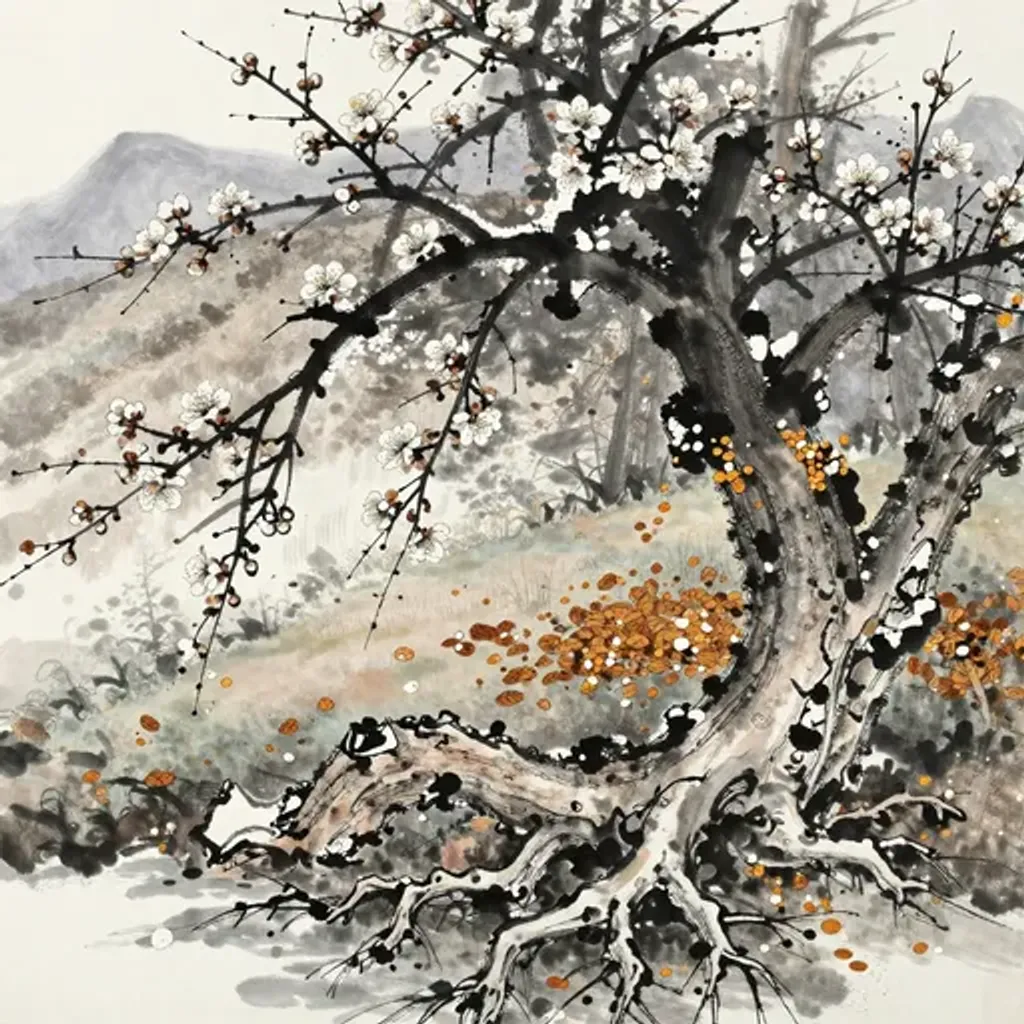
陽失其紀,枯木復起。秋葉冬華,君不得息。
Yang has lost its order; the withered tree rises again. Autumn leaves, winter blossoms; the lord finds no rest.
— Jiao Yanshou, Yilin (Forest of Changes), 1st century BC
Commentary
Lake over wind descends into mountain above water — the bewilderment of Youthful Folly. Yang has lost its governing thread; dead wood sprouts again in defiance of nature. Autumn leaves and winter flowers appear, and the lord finds no rest. The verse paints a world of inverted seasons: when the cosmic order is disrupted, growth occurs at wrong times and in wrong forms. Dead trees blooming is an inauspicious omen in Han-era thought, signaling that what should be finished refuses to end properly. From Great Exceeding to Youthful Folly, the overburdened beam warps the natural order into confusion. The young fool cannot distinguish true vitality from false revival — autumn leaves masquerading as spring, winter blossoms that will bear no fruit.
大過 → 需
Hexagram 28 → Hexagram 5: Waiting
Changing lines: 1, 4
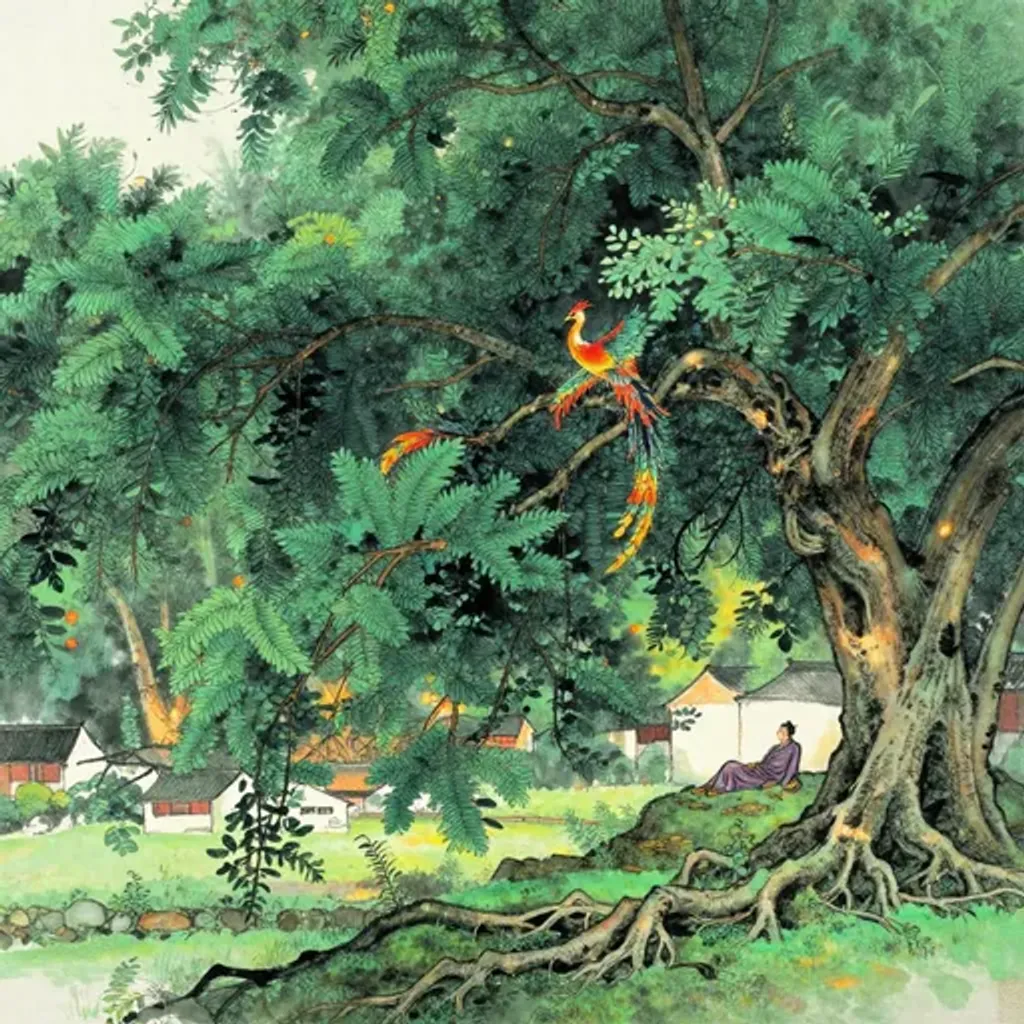
大樹之子,百條共母。當夏六月,枝葉盛茂。鸞鳥以庇,召伯避暑。
The great tree’s offspring; a hundred boughs share one mother. In midsummer’s sixth month; branches and leaves flourish thick. The luan bird shelters beneath; Lord Shao escapes the heat.
— Jiao Yanshou, Yilin (Forest of Changes), 1st century BC
Commentary
Lake over wind opens into clouds above heaven — the patient nurturing of Waiting. A great tree stands with a hundred branches sharing one mother-trunk. In the heat of midsummer its canopy flourishes, sheltering luan birds in its shade. The Duke of Shao rests beneath it, recalling the Shijing ode 'Gan Tang,' where the people cherished the pear tree under which the Duke of Shao administered justice. The tree is both literal shelter and political metaphor: virtuous governance that nourishes all who gather beneath it. From Great Exceeding to Waiting, the sagging ridgepole transforms into a mighty living tree — what was overburdened structure becomes organic abundance, patiently sustaining life through the longest, hottest days.
大過 → 訟
Hexagram 28 → Hexagram 6: Conflict
Changing lines: 3, 6
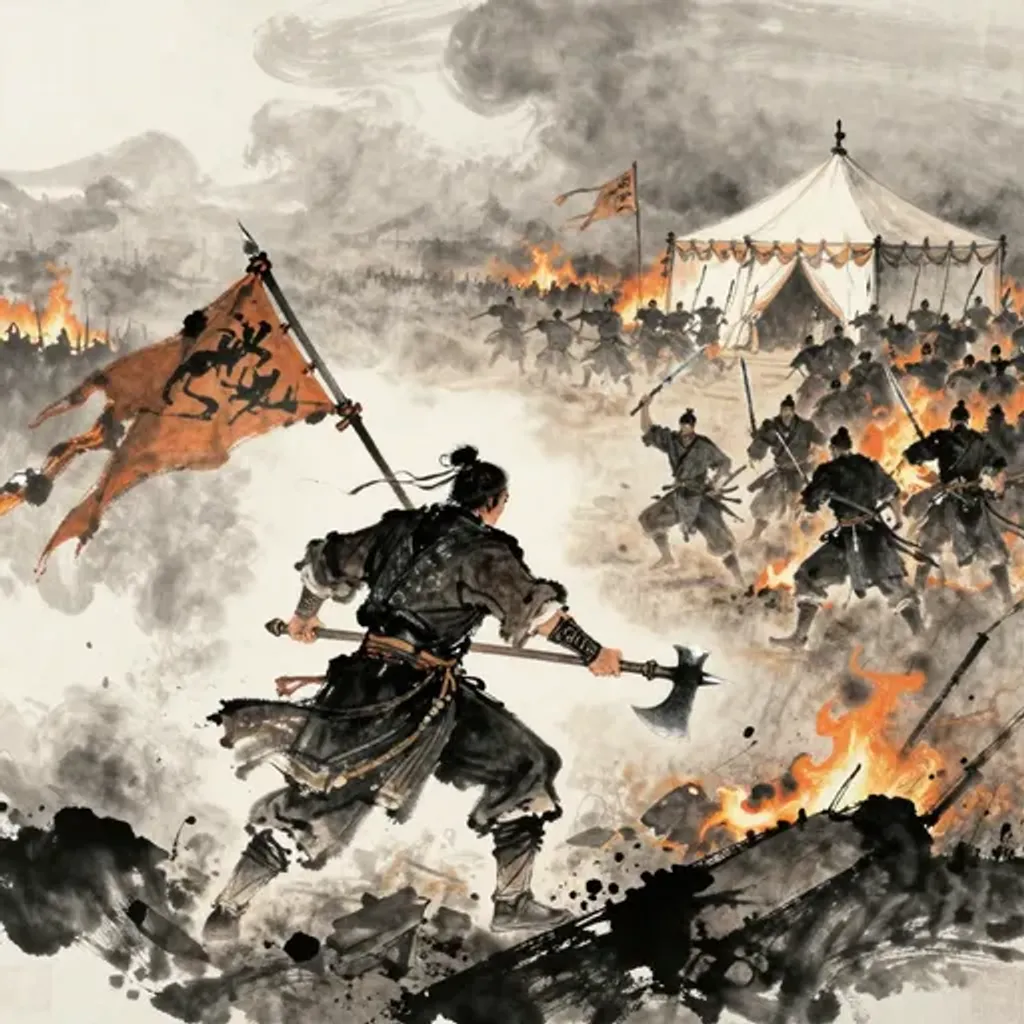
秉鉞執殳,挑戰先驅。不從元帥,敗破為憂。
Grasping battle-axe and spear, he charges forth as vanguard. Not heeding the commander; defeat and ruin are his worry.
— Jiao Yanshou, Yilin (Forest of Changes), 1st century BC
Commentary
Lake over wind gives way to heaven and water in opposition — Conflict. A warrior brandishes his battle-axe and lance, charging ahead as vanguard and challenger. But he does not obey the commander-in-chief, and his reckless advance ends in defeat and worry. The verse is a military cautionary tale: individual valor without coordinated command produces disaster, not glory. The weapons are impressive but the chain of command is broken. From Great Exceeding to Conflict, the overburdened beam snaps into opposing forces — heaven above, water below, each moving in its own direction. The insubordinate warrior embodies this dissonance: personal excess of force, disconnected from the structure that should direct it, guarantees mutual destruction rather than victory.
大過 → 師
Hexagram 28 → Hexagram 7: The Army
Changing lines: 3, 4, 5
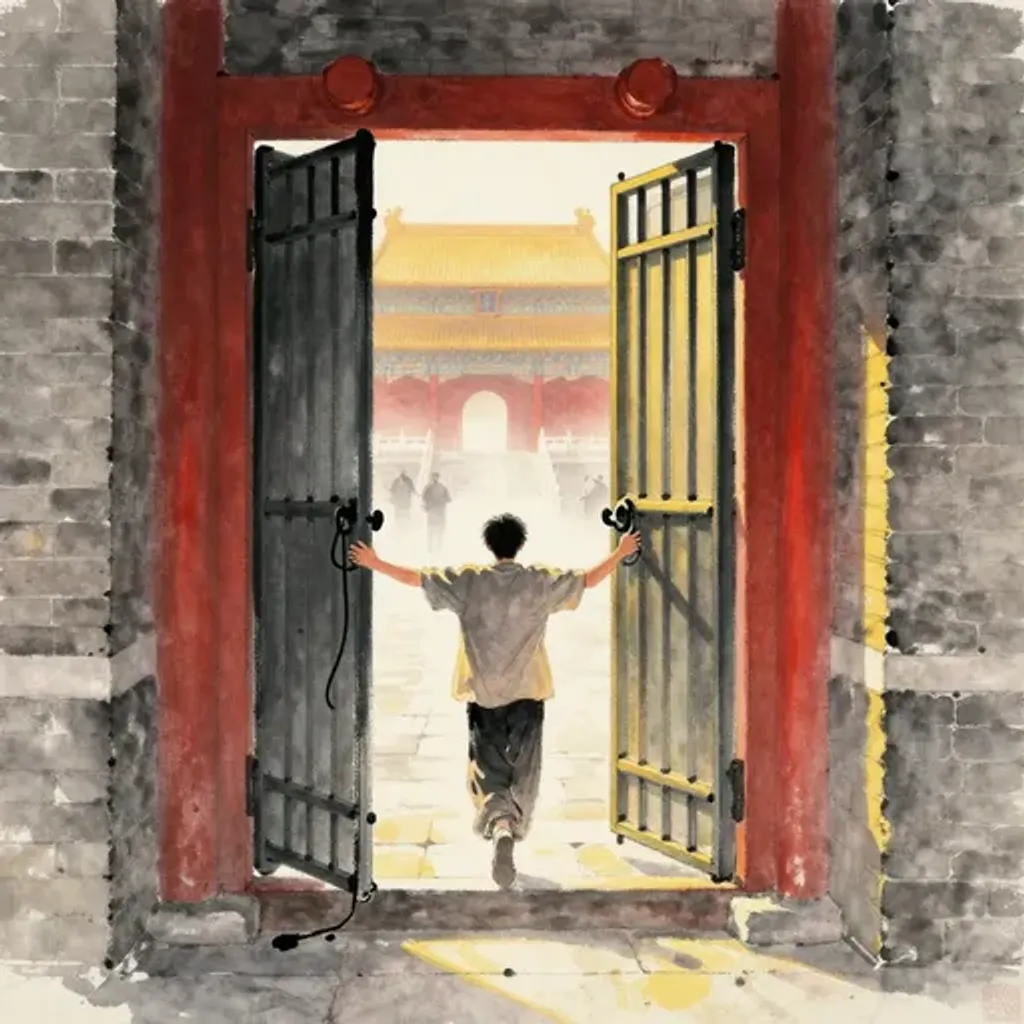
啟室開關,逃得釋冤。夏臺羑里,湯文悅喜。
The chamber opens, the gate unlocks; escaping, the wrong is released. Xiatai, Youli; Tang and Wen rejoice in gladness.
— Jiao Yanshou, Yilin (Forest of Changes), 1st century BC
Commentary
Lake over wind transforms into earth concealing water — the Army's disciplined response. The chamber opens, the gate unlocks, and the prisoner escapes his grievance. Xiatai and Youli — the prisons where King Tang and King Wen were unjustly held — become places of deliverance rather than despair. Tang and Wen emerge rejoicing. The verse pairs the two foundational imprisonments of Chinese political mythology: Tang held by Jie of Xia, Wen held by Zhou of Shang. Both endured confinement and emerged to found righteous dynasties. From Great Exceeding to the Army, the collapsing structure becomes organized force: what was unbearable pressure transforms into the disciplined power that liberates. The prison door opens not by accident but because the weight of injustice finally compels its own reversal.
大過 → 比
Hexagram 28 → Hexagram 8: Holding Together
Changing lines: 2, 3, 4
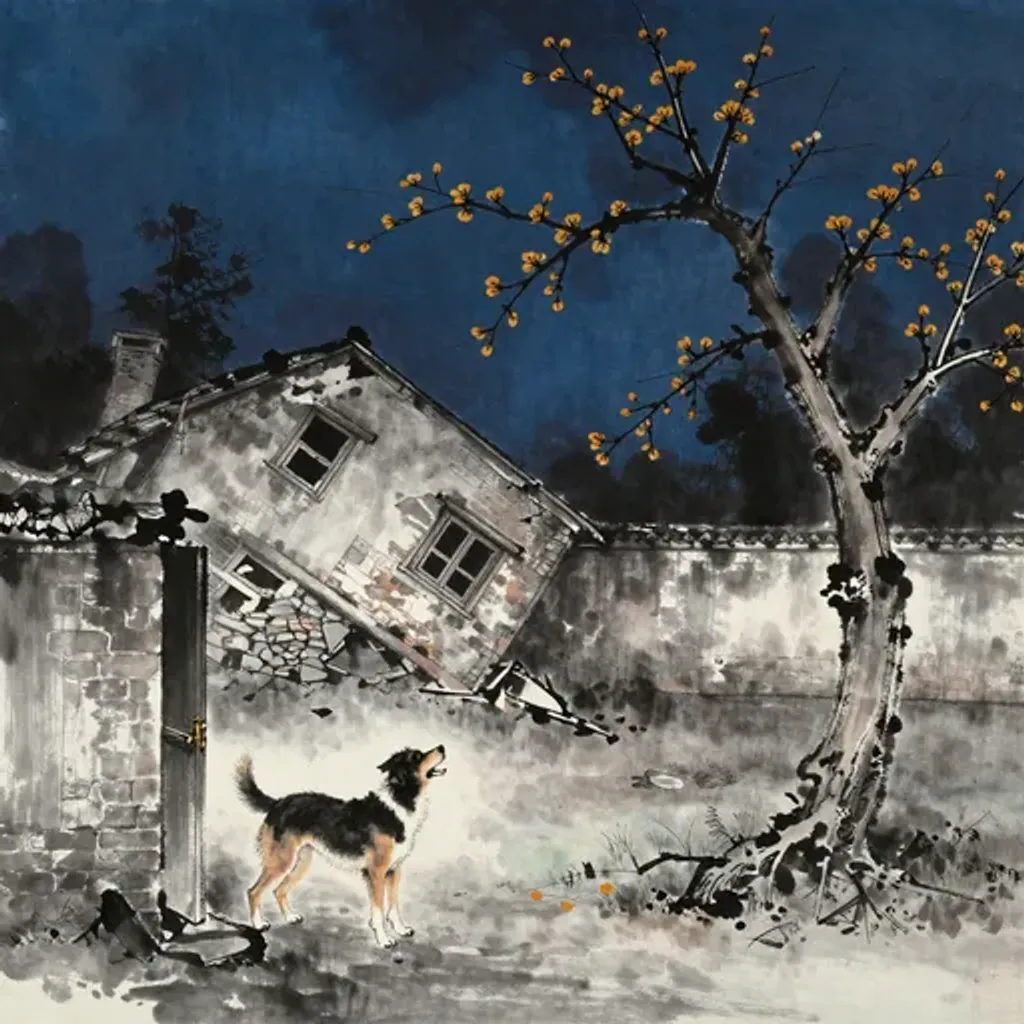
衰滅無成,淵溺在傾。狗吠夜驚,家乃不寧。枯者復華,幽人無憂。
Decline and ruin bring no success; the abyss tilts toward collapse. Dogs bark, the night is alarmed; the household finds no peace. The withered blooms again; the recluse has no worry.
— Jiao Yanshou, Yilin (Forest of Changes), 1st century BC
Commentary
Lake over wind yields to water resting upon earth — Holding Together. Decline and ruin leave nothing accomplished; one teeters at the brink of the abyss. Dogs bark in the night, startling the household into unease. Then the verse pivots: withered things bloom again, and the recluse finds peace. The three-part structure traces a full arc — collapse, nocturnal alarm, and unexpected renewal. Night-barking dogs in Han omen-lore signal ghostly disturbance, yet here the disturbance passes without lasting harm. From Great Exceeding to Holding Together, the sagging beam finds support through alliance. The recluse who weathered decline discovers that solidarity with earth — the humble act of holding together — restores what isolation nearly destroyed.
大過 → 小畜
Hexagram 28 → Hexagram 9: Small Taming
Changing lines: 1, 4, 6
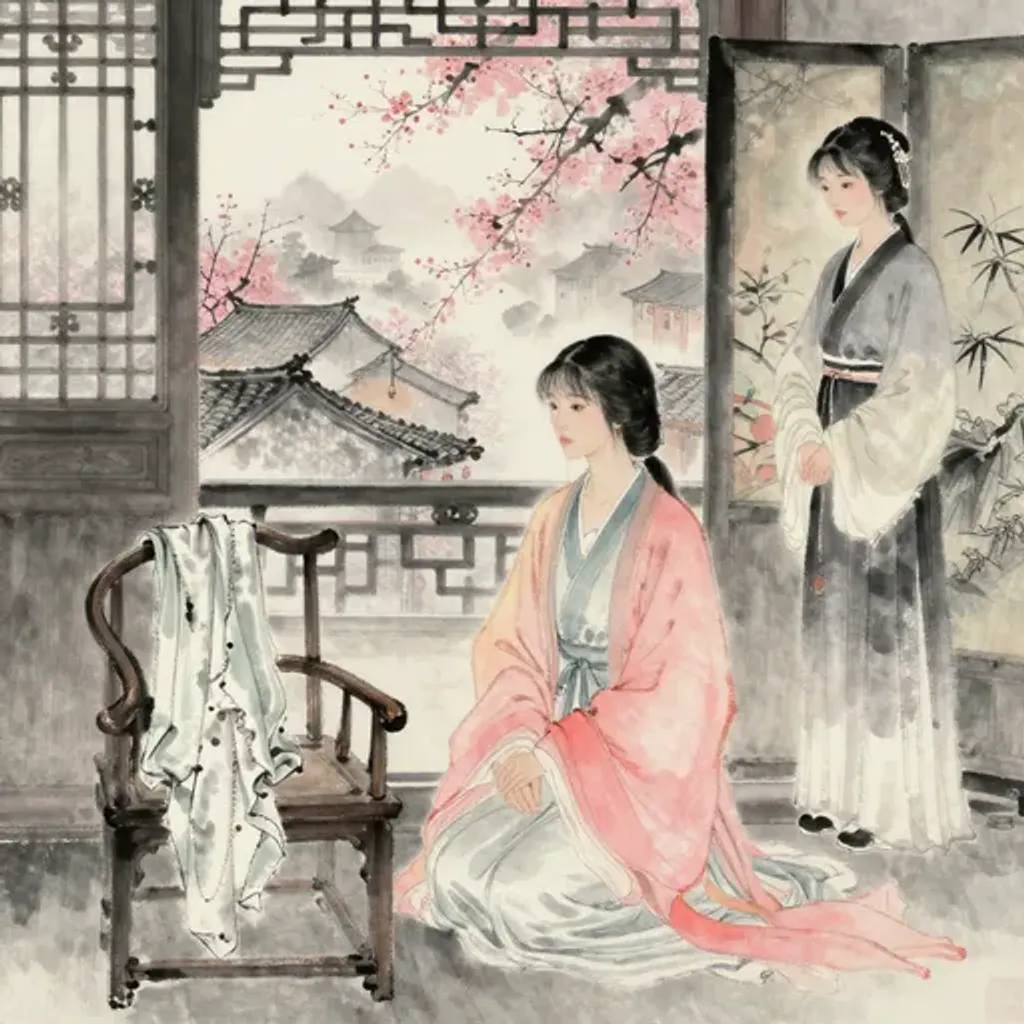
西鄰少女,未有所許。志如委衣,不出房戶。心無所處,傅母何咎?
The young woman of the western village; not yet betrothed to any. Her will like cast-off garments; she does not leave her chamber. Her heart has no settled place; what fault lies with the chaperone?
— Jiao Yanshou, Yilin (Forest of Changes), 1st century BC
Commentary
Lake over wind softens into wind above heaven — the gentle restraint of Small Taming. A young woman of the western neighbor remains unpromised in marriage. Her will is like a discarded garment, listless; she does not leave her chamber. Her heart has nowhere to settle — how can the chaperone be blamed? The verse portrays paralysis of will rather than active misfortune: a maiden old enough to marry but unable to commit, confined not by walls but by indecision. The chaperone (傅母) appears as the ritual guardian of propriety, echoing Lady Boji's fateful dependence on her chaperone. From Great Exceeding to Small Taming, overwhelming pressure shrinks into gentle but ineffectual restraint — wind that stirs heaven's surface without moving it. The maiden's inaction mirrors this: energy present but unable to achieve release.
大過 → 履
Hexagram 28 → Hexagram 10: Treading
Changing lines: 1, 3, 6
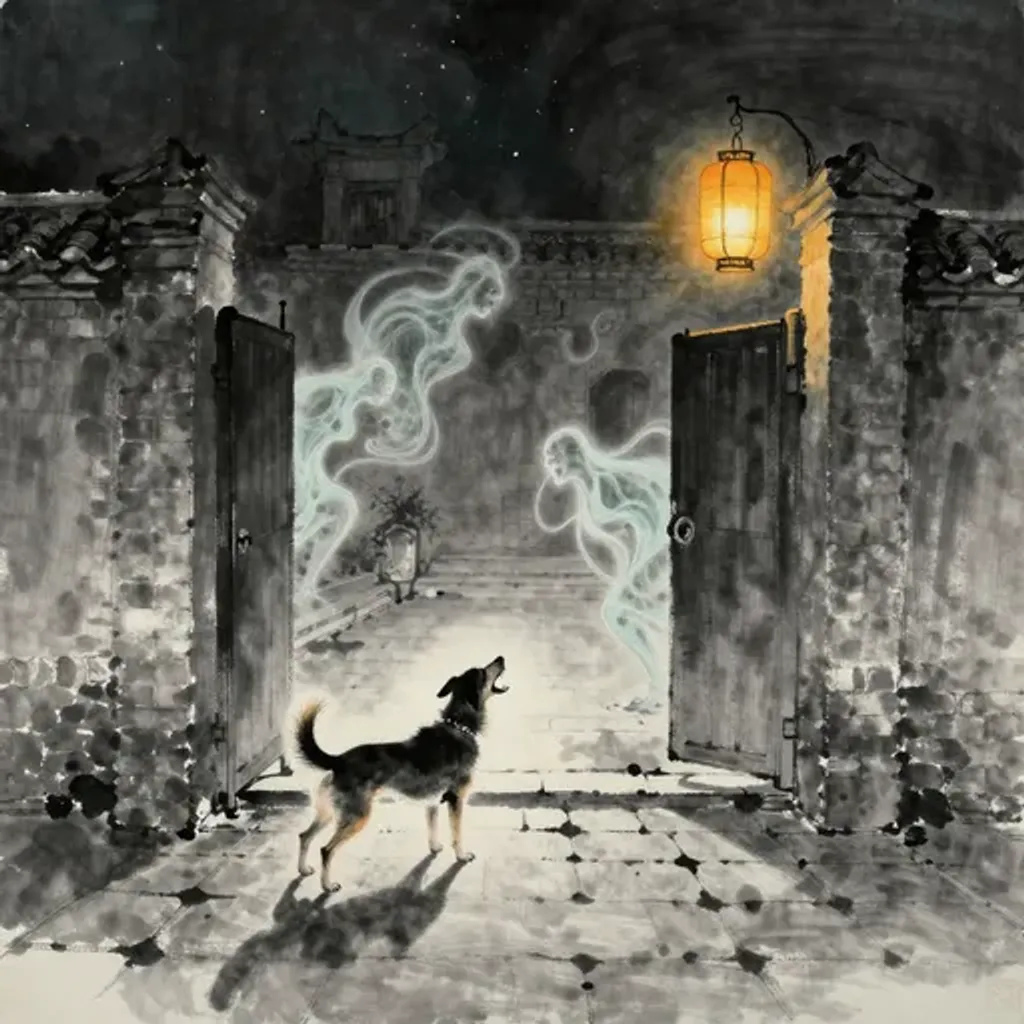
狗吠夜驚,履鬼頭頸。危者弗傾,患滅不成。
Dogs bark, the night is alarmed; treading on ghosts’ heads and necks. The endangered does not topple; the calamity fades, does not take form.
— Jiao Yanshou, Yilin (Forest of Changes), 1st century BC
Commentary
Lake over wind transforms into heaven above the lake — Treading upon the tiger's tail. Dogs bark in the night, startling the sleeper, who treads upon the head and neck of a ghost. Yet what seems perilous does not topple; the calamity dissolves before it forms. The nocturnal scene evokes the terror of stumbling upon the supernatural in darkness, yet the outcome defies expectation: the ghost is harmless, the danger illusory. From Great Exceeding to Treading, the collapsing beam becomes the precarious act of walking atop danger itself. Treading's image — stepping on a tiger's tail without being bitten — perfectly matches this verse: what appears mortally dangerous proves navigable through composure. The dogs warned of nothing real; the ghost had no power to harm.
大過 → 泰
Hexagram 28 → Hexagram 11: Peace
Changing lines: 1, 4, 5
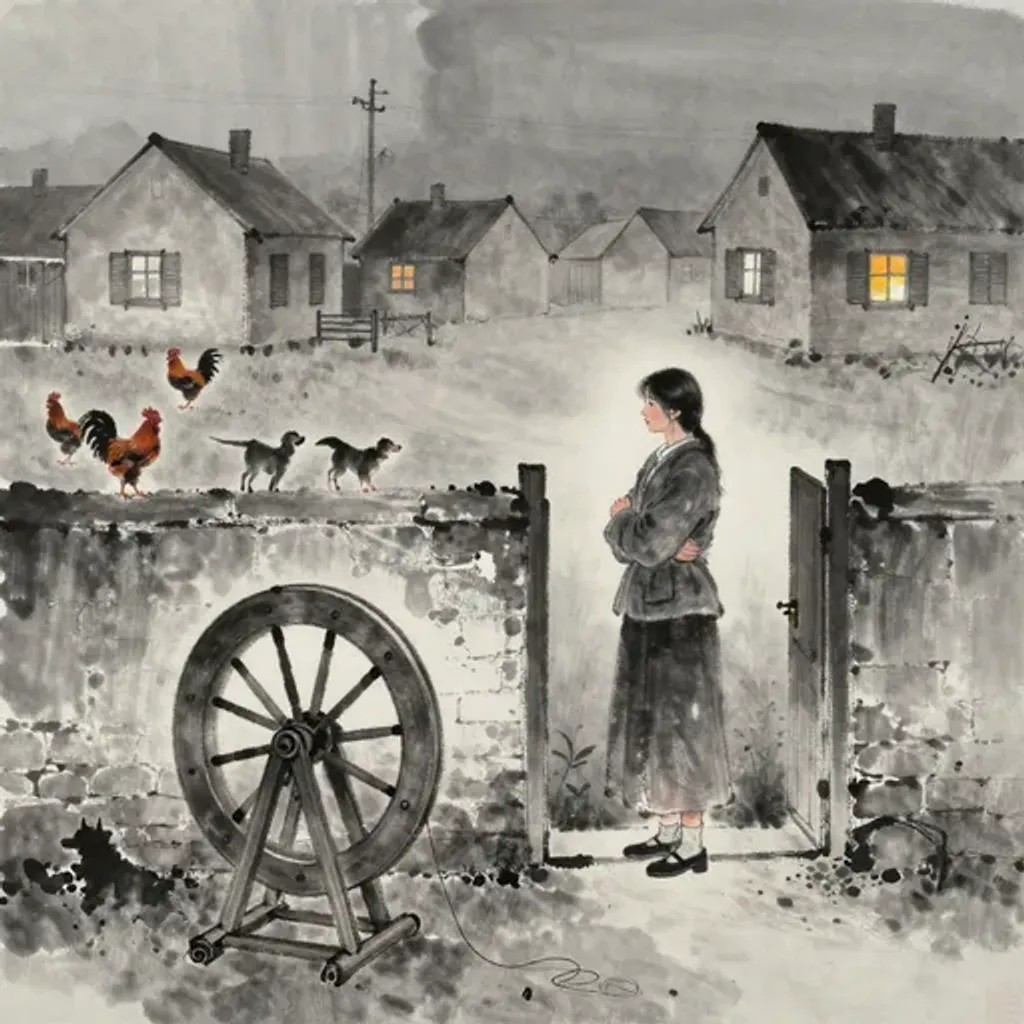
當年少寡,獨與孤處。雞鳴犬吠,無敢誰者。我生不辰,獨嬰寒苦。
Widowed young in her prime; alone she dwells in solitude. Roosters crow, dogs bark; none dares approach her. I was born at an ill hour; alone I embrace cold and hardship.
— Jiao Yanshou, Yilin (Forest of Changes), 1st century BC
Commentary
Lake over wind descends into the communion of heaven and earth — Peace. Yet this Peace arrives as bitter irony. A young widow dwells alone with only the lonely and desolate for company. Roosters crow and dogs bark, but no one dares approach. 'I was born at the wrong time,' she laments, 'and suffer cold hardship alone.' The verse inverts Peace's promise of cosmic harmony: heaven and earth exchange freely, but this woman is cut off from all exchange. Her solitude is not chosen withdrawal but enforced isolation — widowed young, she endures the very opposite of the hexagram's communal blessing. From Great Exceeding to Peace, the transformation suggests that even amid general prosperity, individual suffering persists. The roosters and dogs signal a populated village, yet she remains untouched by its warmth.
大過 → 否
Hexagram 28 → Hexagram 12: Standstill
Changing lines: 2, 3, 6
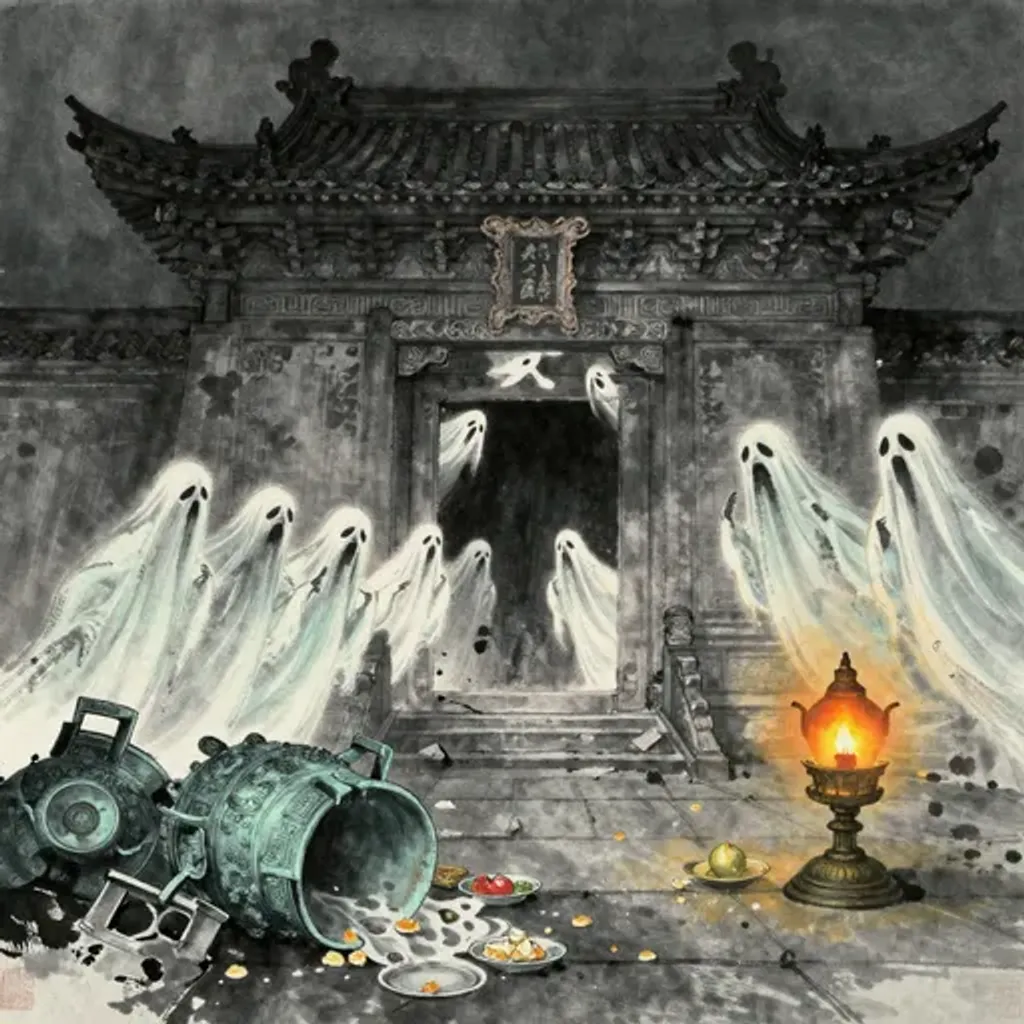
無道之君,鬼哭其門。命與下國,絕得不食。
A lord without the Way; ghosts wail at his gate. The mandate passes to lesser states; cut off, he gains no sustenance.
— Jiao Yanshou, Yilin (Forest of Changes), 1st century BC
Commentary
Lake over wind hardens into heaven and earth refusing to communicate — Standstill. A ruler without the Way finds ghosts weeping at his gate. His mandate descends to a lesser state, and his line is cut off from sustenance. The verse echoes the fall of a dynasty: when the sovereign loses moral authority, even the spirit world mourns, and heaven's mandate passes elsewhere. The imagery of severed sacrifice — 'cut off, unable to eat' — recalls the extinction of a royal line's ancestral rites, the ultimate political death in the Chinese tradition. From Great Exceeding to Standstill, the overburdened beam collapses into total blockage. Heaven and earth no longer exchange; the ruler's excess has sealed every channel of communication between above and below.
大過 → 同人
Hexagram 28 → Hexagram 13: Fellowship
Changing lines: 1, 2, 6
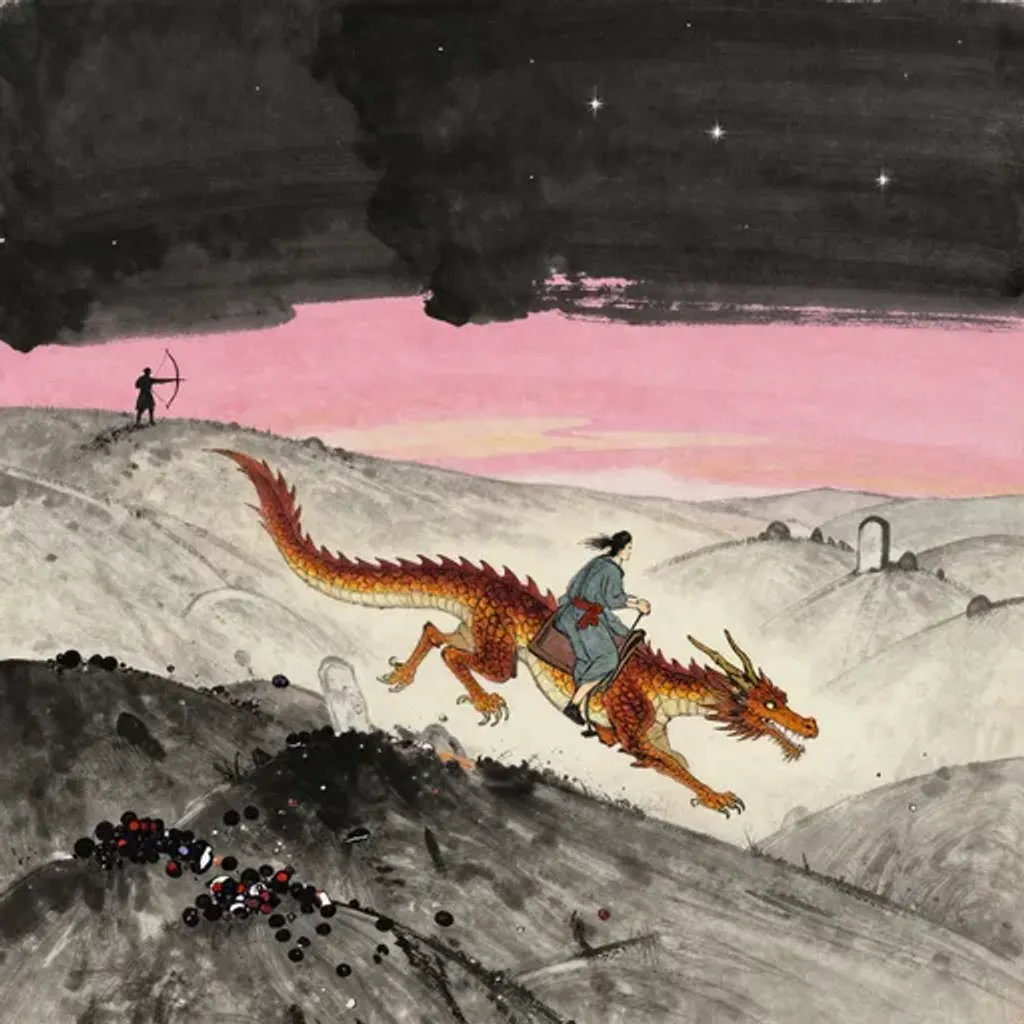
乘龍南遊,夜過糟丘。脫厄無憂。矰絕弩傷,羿不得羹。
Riding a dragon, journeying south; by night passing mounds of lees. Escaping hardship, free of worry. The cord breaks, the crossbow wounds; Yi does not obtain the broth.
— Jiao Yanshou, Yilin (Forest of Changes), 1st century BC
Commentary
Lake over wind soars into heaven joined with fire — Fellowship. Riding a dragon southward, one passes through the Mound of Dregs by night and escapes all peril. Then the verse shifts: the bowstring snaps, the crossbow wounds its wielder, and Archer Yi does not obtain his broth. Yi, the divine archer who shot down nine suns, was according to tradition murdered by his apprentice and denied his elixir of immortality. The 'broth' he fails to obtain may allude to this betrayal. Riding the dragon past danger evokes celestial journey and escape; Yi's failure warns that even supreme skill cannot prevent treachery from within. From Great Exceeding to Fellowship, the overburdened loner finds safety in companionship — but Yi, who trusted the wrong companion, lost everything.
大過 → 大有
Hexagram 28 → Hexagram 14: Great Possession
Changing lines: 1, 5, 6
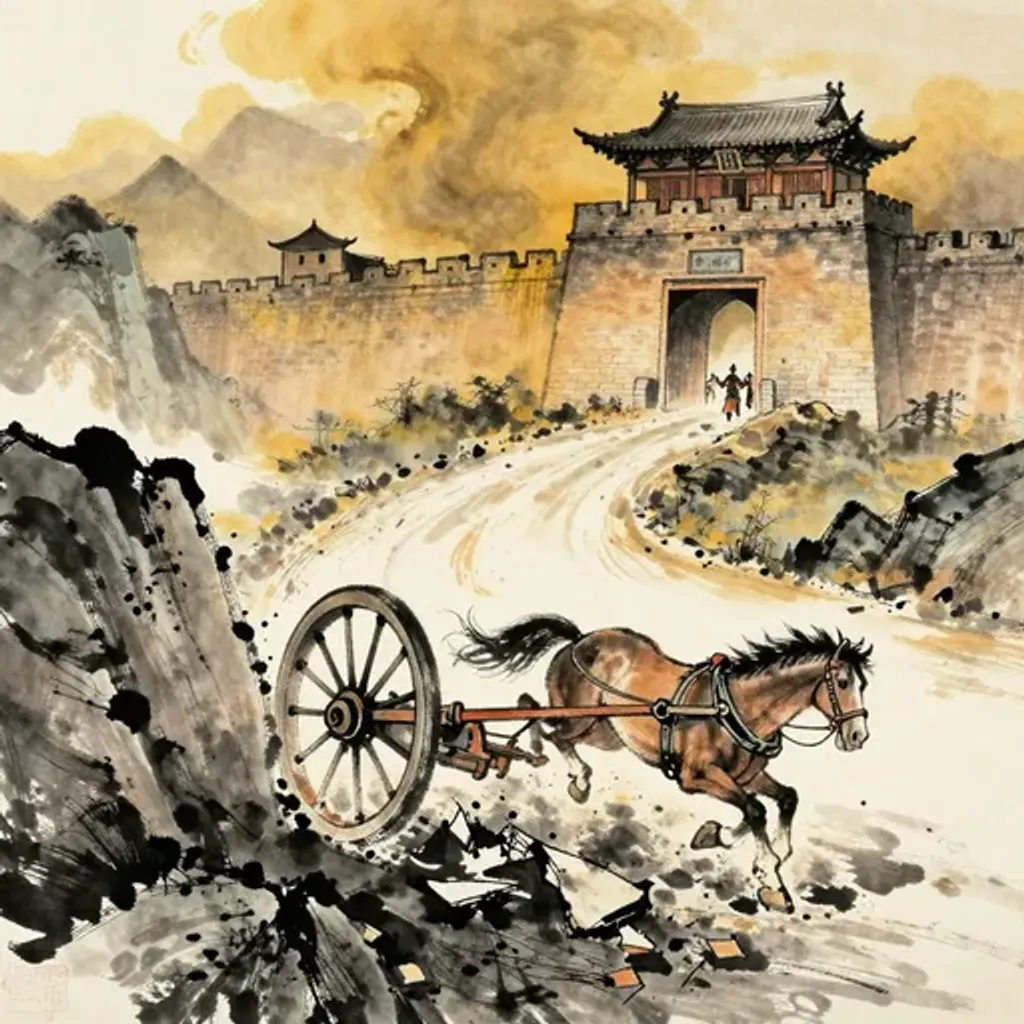
馬躓車傷,長舌破家。東關二五,晉君出走。
The horse stumbles, the carriage breaks; a long tongue destroys the house. At the eastern pass, the twenty-fifth day; the lord of Jin flees in exile.
— Jiao Yanshou, Yilin (Forest of Changes), 1st century BC
Commentary
Lake over wind blazes into fire above heaven — Great Possession. A horse stumbles and the carriage breaks; a long tongue destroys the household. At the Eastern Gate, two and five conspire, and the lord of Jin flees into exile. The 'long tongue' is Lady Li (Liji), whose slander drove Crown Prince Shensheng to suicide and forced Chong Er and Yiwu into exile. The 'two and five' refer to Liang Wu and Dongguan Pivu, the favored courtiers whom Lady Li bribed to persuade Duke Xian to send his sons away from the capital. From Great Exceeding to Great Possession, excess transforms into vast but mismanaged wealth. Fire in heaven illuminates everything — including the poison at the heart of the household. The Jin ruling house possessed greatness but let a scheming tongue break it apart.
大過 → 謙
Hexagram 28 → Hexagram 15: Modesty
Changing lines: 2, 4, 5
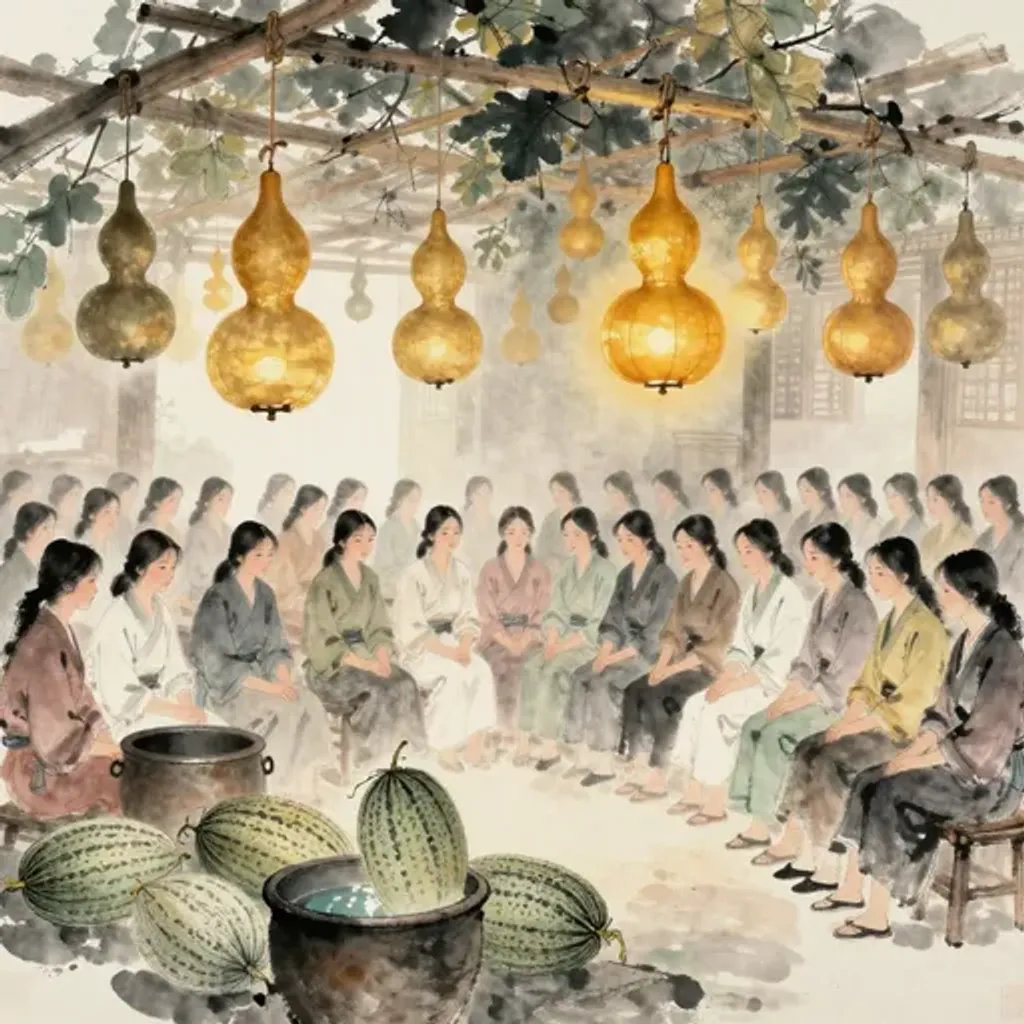
瓜葩匏實,百女同室。苦醯不熟,未有妃合。
Melon flowers, gourd fruit; a hundred women share one room. Bitter vinegar not yet ripe; no consort match has been made.
— Jiao Yanshou, Yilin (Forest of Changes), 1st century BC
Commentary
Lake over wind sinks into earth above mountain — the hidden power of Modesty. Gourd flowers and bottle-gourd fruit; a hundred women share one room. The bitter vinegar has not yet fermented, and no match has been made. The imagery is botanical and domestic: gourds bloom prolifically but produce inedible fruit, and many women crowd together without finding husbands. Unfermented vinegar — something that needs time and the right conditions to mature — suggests a process interrupted or not yet ripe. From Great Exceeding to Modesty, the overburdened structure gives way to the mountain hidden beneath earth. What seems abundant on the surface lacks substance within. The hundred unmatched women and the sour, unready vinegar embody Modesty's lesson: true fruition requires patience, not mere profusion.
大過 → 豫
Hexagram 28 → Hexagram 16: Enthusiasm
Changing lines: 2, 3, 5
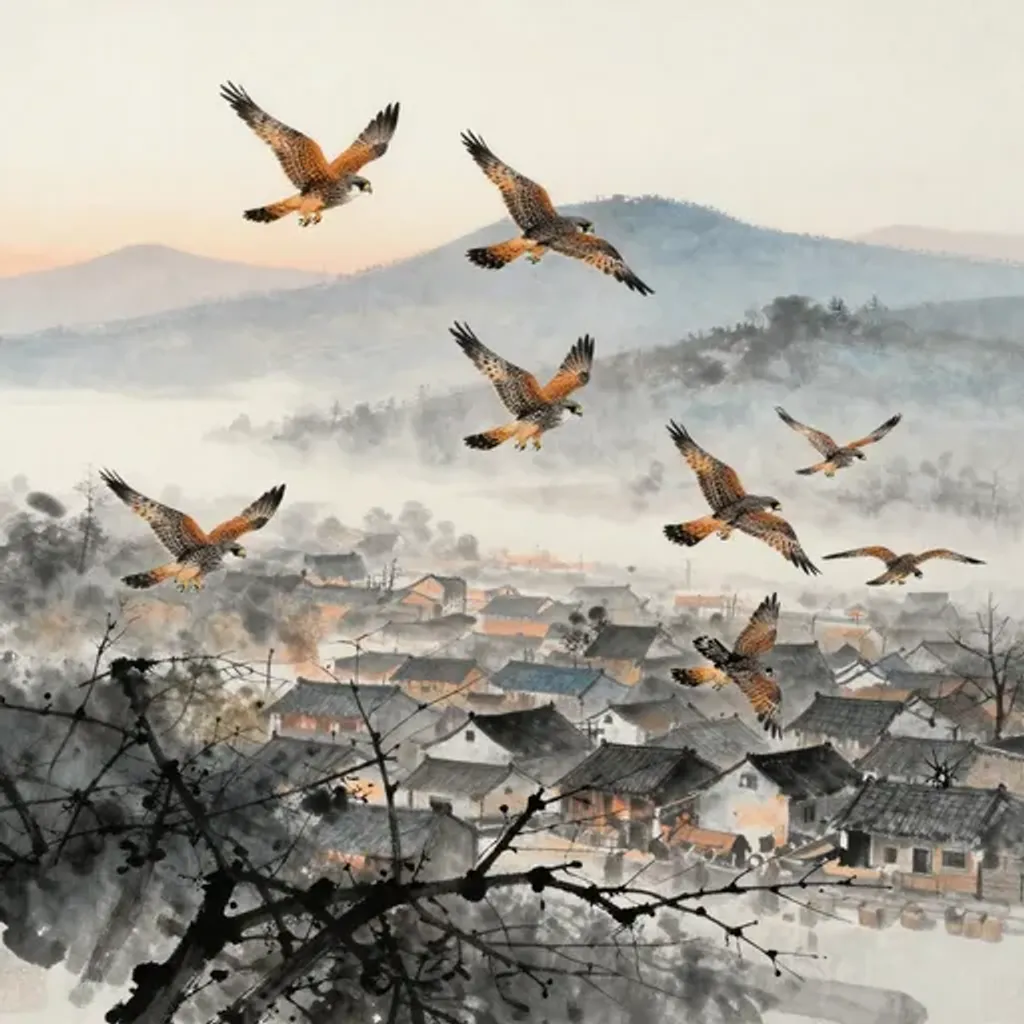
晨風文翰,大舉就溫。昧過我邑,羿無所得。
Morning wind, patterned feathers; the great flock rises toward warmth. Swiftly passing over my village; Yi gains nothing from the hunt.
— Jiao Yanshou, Yilin (Forest of Changes), 1st century BC
Commentary
Lake over wind erupts into thunder above earth — the stirring joy of Enthusiasm. The chenFeng hawk, resplendent in patterned plumage, rises in a great flock and flies toward warmth. Passing swiftly beyond one's territory at dawn, it eludes even Archer Yi's aim. The chenFeng (晨風) is the falcon of the Shijing ode 'Chen Feng' from the Airs of Qin — a swift raptor that symbolizes what cannot be held. Here the birds migrate together, seeking the warm south, too fast and too high for the greatest archer to bring them down. From Great Exceeding to Enthusiasm, the sagging structure releases its energy as collective exuberance. What was trapped bursts forth with irresistible momentum, like a flock no bowman can touch — thunder shaking the earth with the sheer joy of liberated movement.
大過 → 隨
Hexagram 28 → Hexagram 17: Following
Changing lines: 1, 2, 3
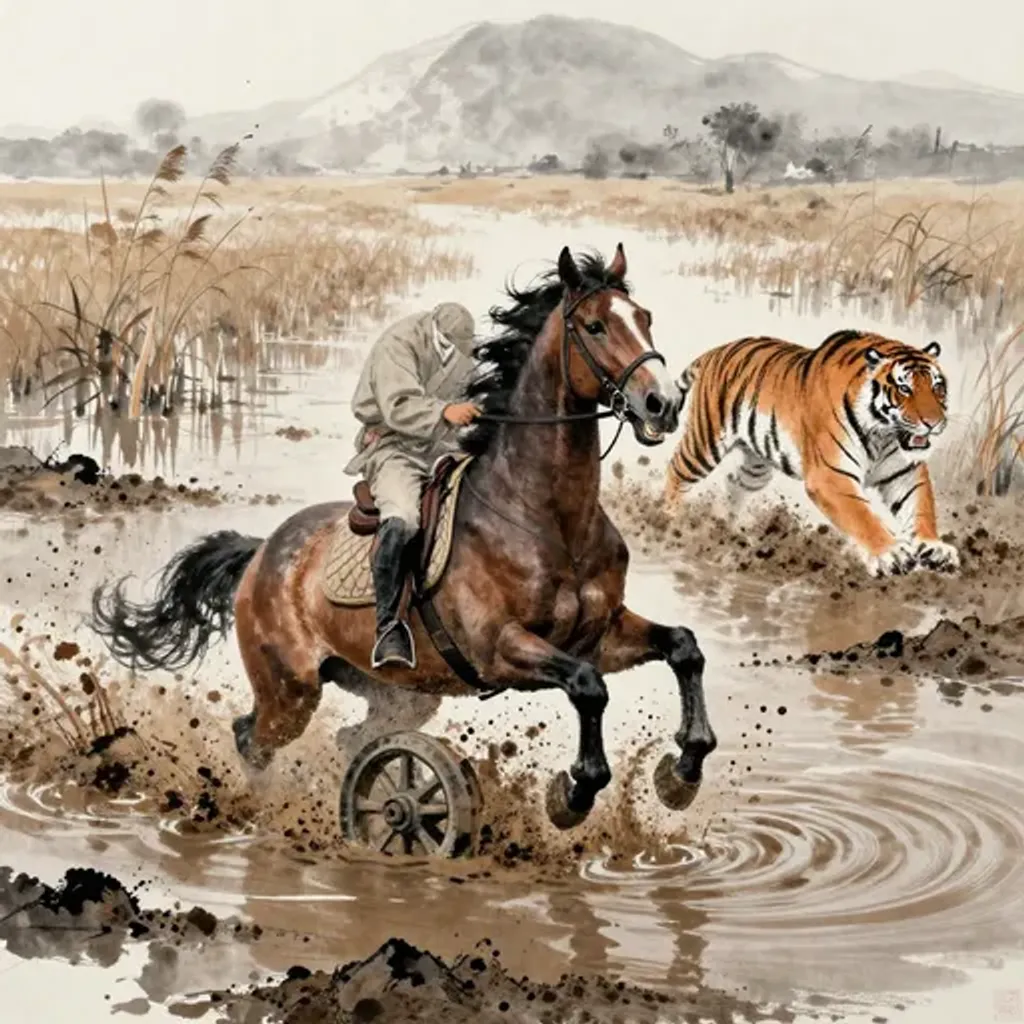
瀺瀺浞浞,塗泥至轂。馬濘不進,虎囓我足。
Dripping, splashing, soaking through; mud rises to the axle hubs. The horse is mired and cannot advance; the tiger gnaws upon my foot.
— Jiao Yanshou, Yilin (Forest of Changes), 1st century BC
Commentary
Lake over wind plunges into lake above thunder — Following, where one adapts to changing currents. Rain pours ceaselessly, mud rises to the wheel hubs, the horse mires and cannot advance, and a tiger gnaws at one's foot. The verse is pure entrapment: every element conspires to halt forward movement. Water above and below, mud swallowing the wheels, a predator attacking from the ground — this is the traveler caught in terrain that will not release him. From Great Exceeding to Following, the sagging beam collapses into the swamp. Following demands adaptation, but the mud offers no foothold for adaptive movement. The tiger at the foot completes the trap: even standing still invites attack. Sometimes the only way to follow is to accept that the road itself has become the enemy.
大過 → 蠱
Hexagram 28 → Hexagram 18: Work on the Decayed
Changing lines: 4, 5, 6
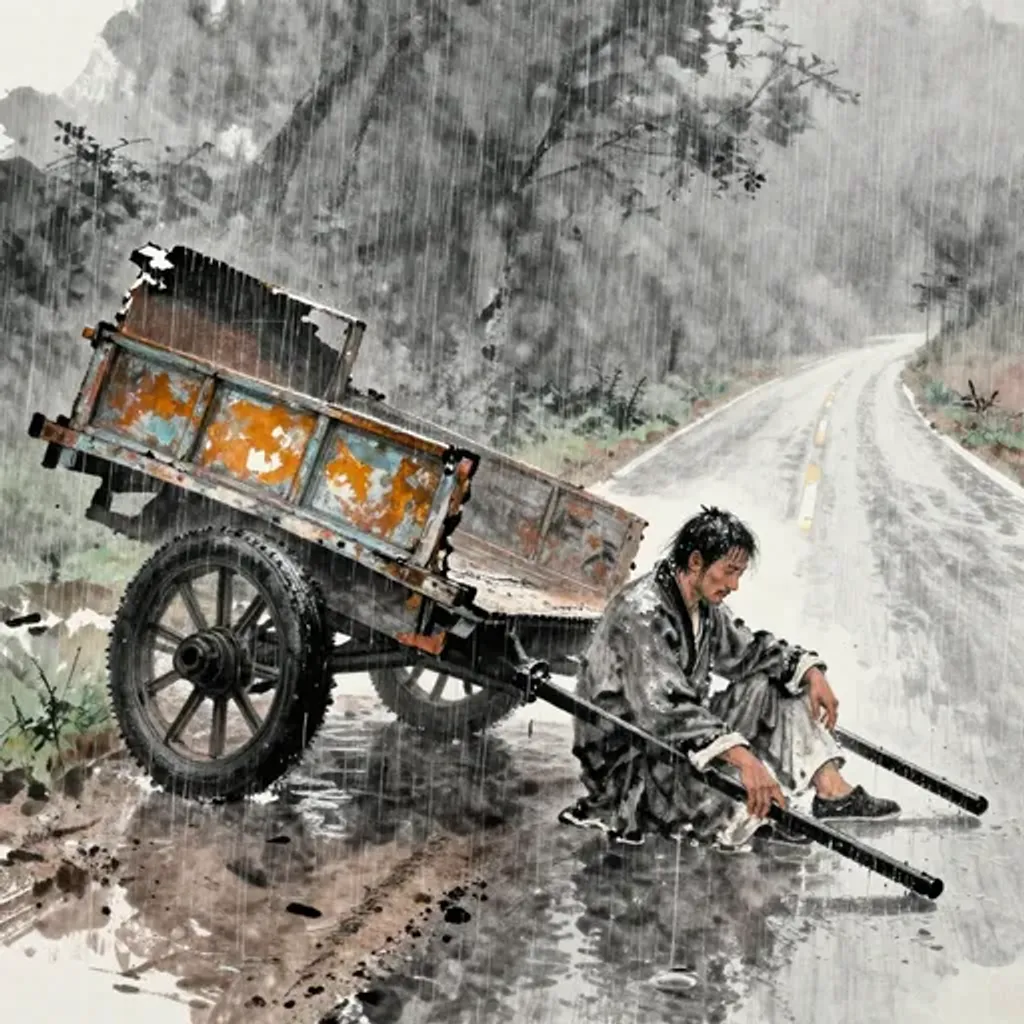
膠車駕東,與雨相逢。故革懈惰,頹輪獨坐。憂不為禍。
A glue-sealed cart drives east; it meets the rain upon the road. Old leather, slack and worn; the wheel collapses, he sits alone. Worry does not become disaster.
— Jiao Yanshou, Yilin (Forest of Changes), 1st century BC
Commentary
Lake over wind meets mountain above wind — Work on the Decayed, where corruption must be addressed. A glued cart drives east and meets the rain. The old leather slackens and loosens; the wheels collapse, and one sits alone amid ruin. Yet worry does not become disaster. Gluing a cart is a proverb for improvised, inadequate repair — the kind that fails at the first test. Rain dissolves the glue, the decrepit vehicle falls apart, and the traveler is stranded. But the verse's final line offers consolation: the anticipated catastrophe does not fully materialize. From Great Exceeding to Work on the Decayed, the overburdened structure reveals its rot. The glued cart is the decayed institution — patched rather than rebuilt. Honest collapse, paradoxically, prevents worse outcomes than continued pretense of soundness.
大過 → 臨
Hexagram 28 → Hexagram 19: Approach
Changing lines: 1, 3, 4, 5
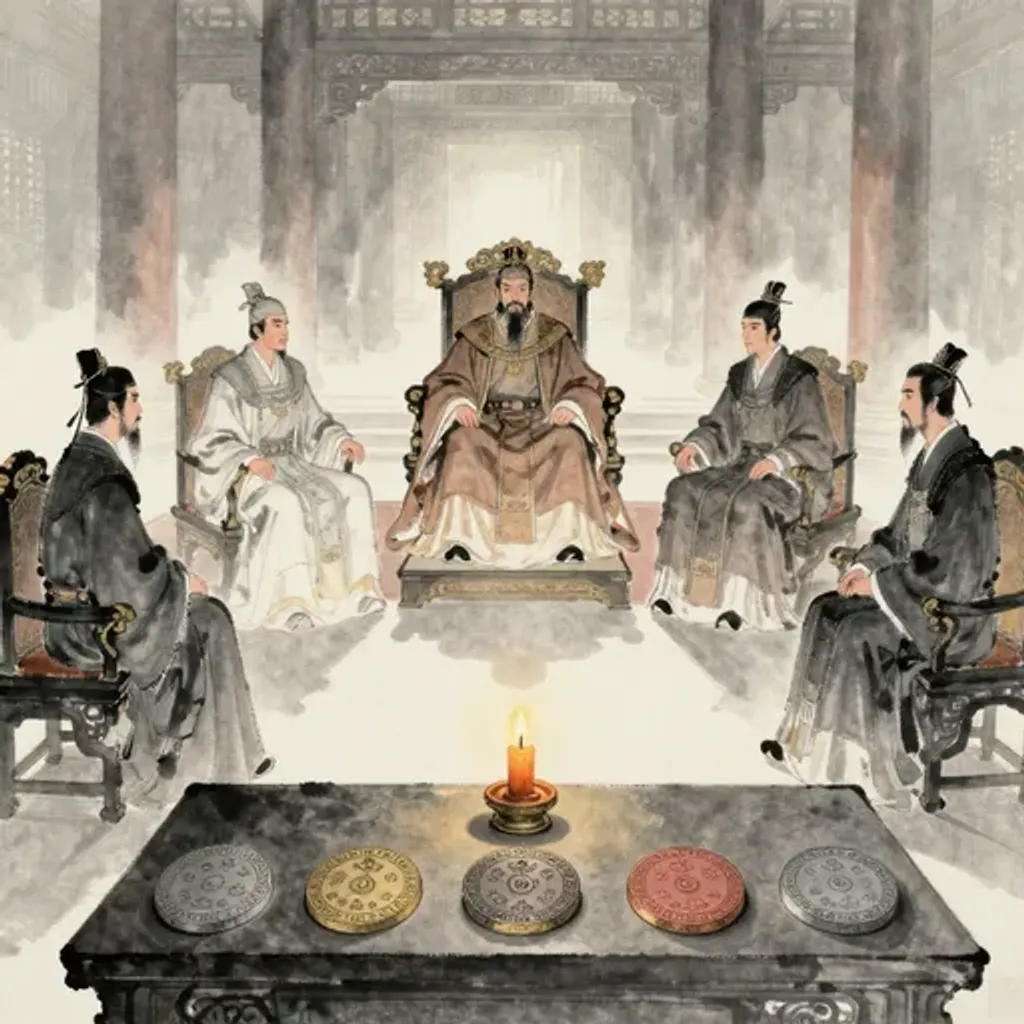
六家作權,公室剖分。陰制其陽,唐叔失明。
Six houses seize authority; the ducal house is carved apart. Yin commands the yang; the heir of Tang loses his sight.
— Jiao Yanshou, Yilin (Forest of Changes), 1st century BC
Commentary
Lake over wind descends into earth above the lake — Approach, where authority draws near. Six houses seize power and carve up the ducal house. Yin overrides yang, and the Tang lord loses his sight. The 'six houses' likely alludes to the six ministerial clans of Jin who usurped ducal authority, eventually splitting the state into three kingdoms (Han, Zhao, Wei). 'Tang lord' refers to the lord of Tang, the original name of Jin state, founded by Tang Shu Yu. The lord's blindness is political: he cannot see the erosion of his own power. From Great Exceeding to Approach, the sagging ridgepole becomes the earth looming over the lake — superior power bearing down. But the verse inverts Approach's promise: instead of benevolent authority drawing near, it is usurpers who approach and dismember the state.
大過 → 觀
Hexagram 28 → Hexagram 20: Contemplation
Changing lines: 2, 3, 4, 6
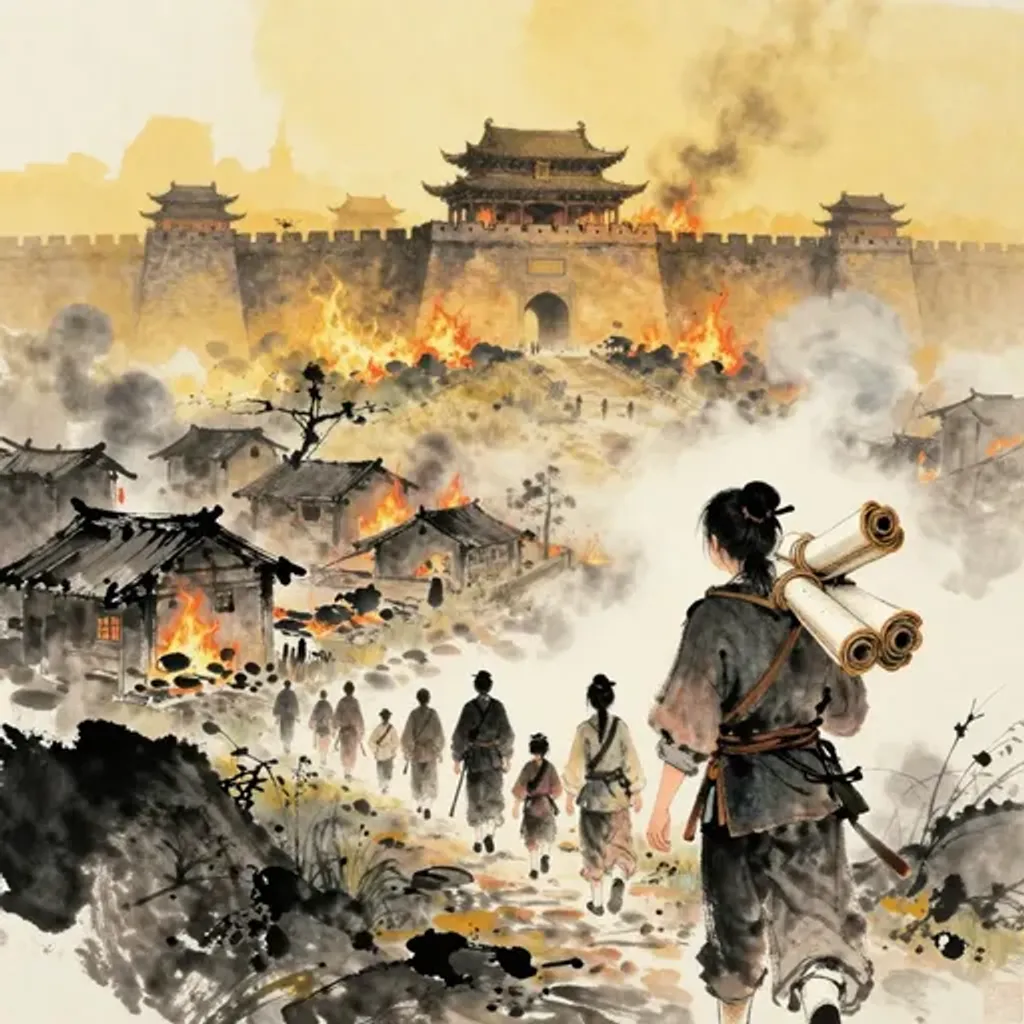
去室離家,來奔大都。火息復明,姬伯以昌。商人失功。
Leaving chamber and home behind; he comes fleeing to the great capital. The fire dies then burns bright again; Lord Ji thereby prospers. The Shang people lose their work.
— Jiao Yanshou, Yilin (Forest of Changes), 1st century BC
Commentary
Lake over wind rises into wind above earth — Contemplation, the sovereign's inspection of the realm. Leaving home and chamber to seek the great capital; fire dies then reignites. Lord Ji prospers, while the Shang people lose their mandate. The verse traces the Zhou ascent: King Wen's clan (姬伯, Lord Ji) departs its rural domain, and though the flame of fortune gutters, it flares anew in the great capital. The Shang, meanwhile, forfeit heaven's blessing. 'Fire dying then brightening' captures the moment when the Zhou cause seemed extinguished but revived to build a new civilization. From Great Exceeding to Contemplation, the collapsing structure gives way to the wind that surveys the earth from above — the new dynasty's panoramic vision replacing the old order's blindness.
大過 → 噬嗑
Hexagram 28 → Hexagram 21: Biting Through
Changing lines: 1, 2, 3, 5, 6
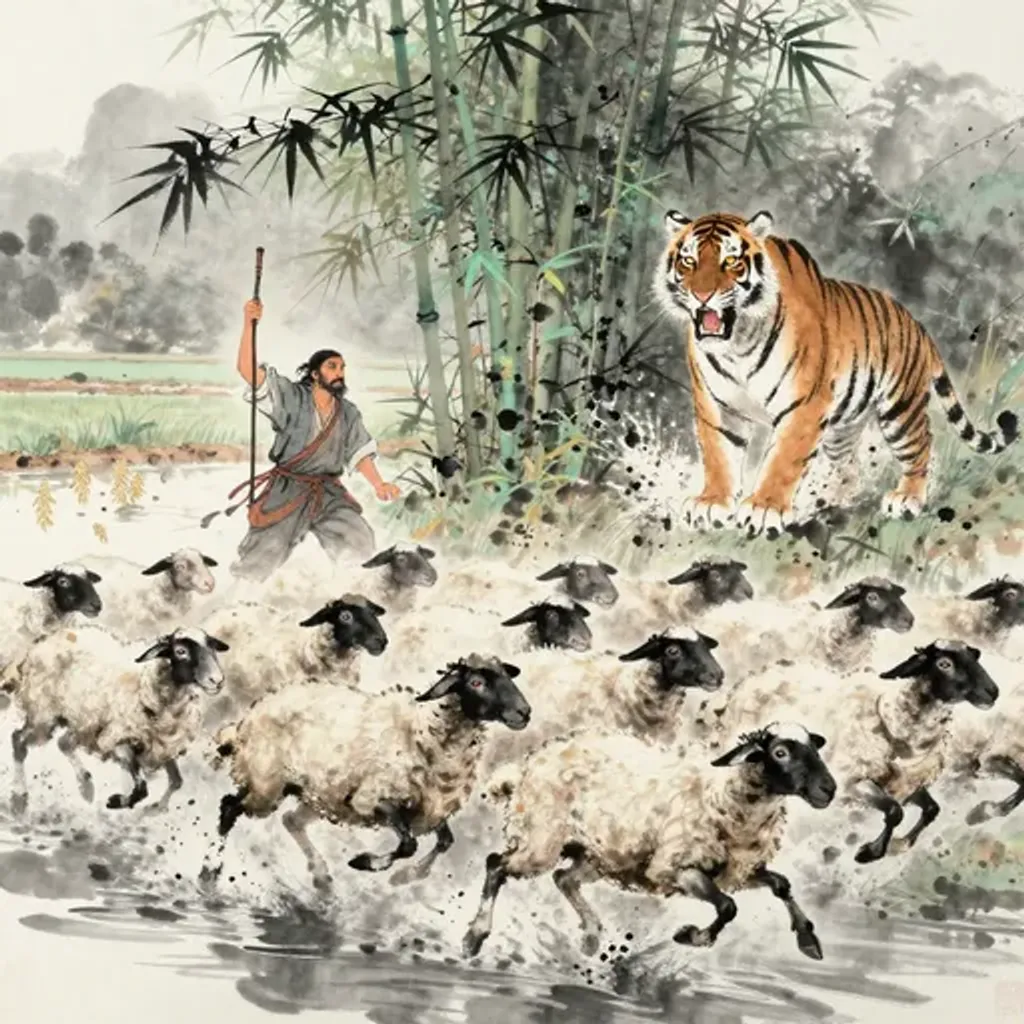
牧羊稻園,聞虎喧讙。危懼喘息,終無禍患。
Herding sheep in the rice garden; the tiger’s roar is heard. Fearful, gasping for breath; in the end there is no calamity.
— Jiao Yanshou, Yilin (Forest of Changes), 1st century BC
Commentary
Lake over wind meets fire above thunder — Biting Through, the hexagram of decisive judgment. A shepherd tends his flock in the rice paddies when he hears a tiger's roar and commotion. Fear seizes him; he pants and trembles. Yet in the end no disaster befalls. The scene is visceral: a vulnerable man with vulnerable animals, suddenly aware of a predator nearby. The terror is real but the threat passes. Biting Through's image — lightning and thunder together — suggests that swift, decisive clarity resolves what seems terrifying. From Great Exceeding to Biting Through, the overburdened beam gives way to the sharp crack of judgment. The tiger's roar is the crisis that demands response, but clear perception reveals that the danger, though loud, does not materialize into actual harm.
大過 → 賁
Hexagram 28 → Hexagram 22: Grace
Changing lines: 1, 2, 4, 5, 6
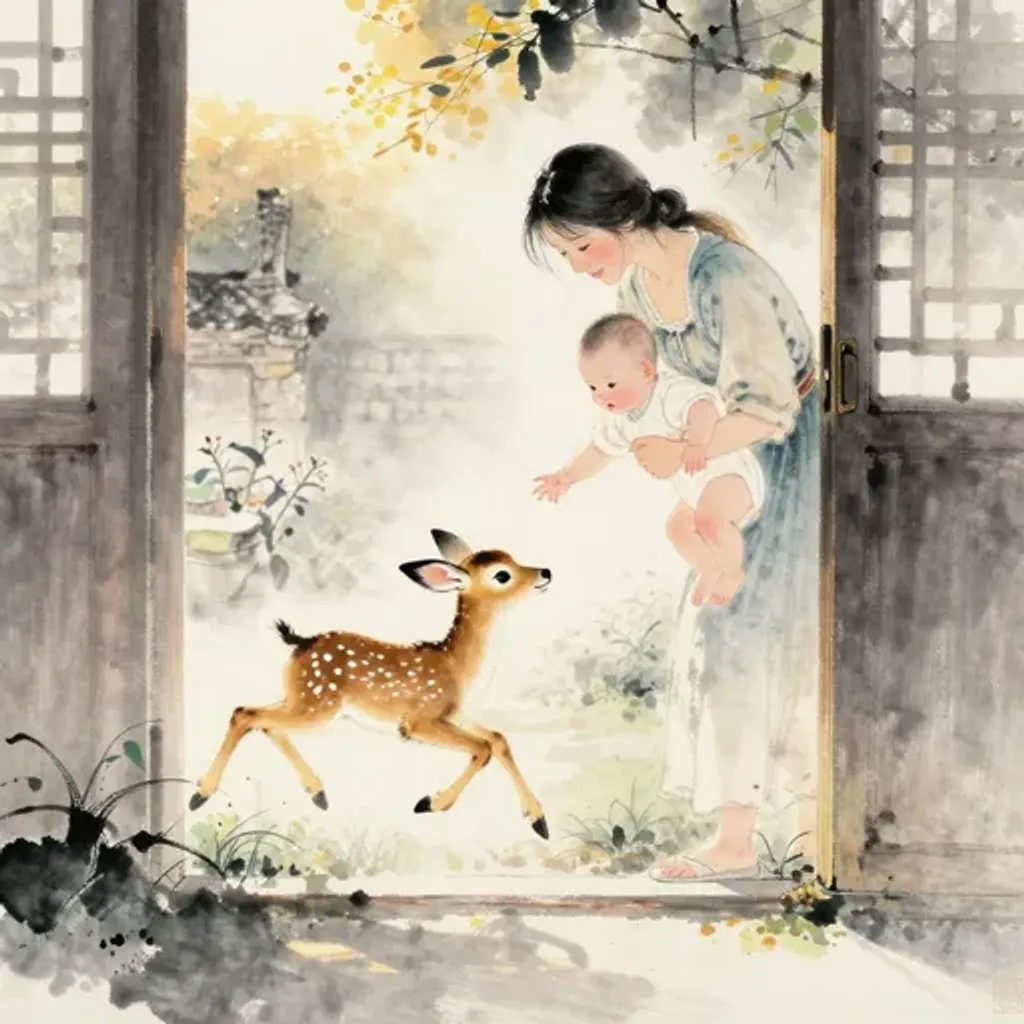
嬰孩求乳,母歸其子,黃麑懽喜。
The infant seeks the breast; the mother returns to her child. The yellow fawn rejoices.
— Jiao Yanshou, Yilin (Forest of Changes), 1st century BC
Commentary
Lake over wind softens into mountain above fire — Grace, where beauty adorns substance. An infant cries for milk; the mother returns to her child, and the young fawn leaps with joy. The verse is tender and elemental: hunger, reunion, and the simple happiness of nourishment received. The yellow fawn (黃麑) suggests innocence and natural delight — a creature that rejoices without calculation. Grace's image is fire glowing at the foot of the mountain, illuminating without consuming. From Great Exceeding to Grace, the overburdened structure dissolves into warmth and adornment. What was crushing weight becomes the gentle light that reveals the beauty of the most basic human bond — a mother nursing her child, the fawn bounding in uncomplicated joy.
大過 → 剝
Hexagram 28 → Hexagram 23: Splitting Apart
Changing lines: 2, 3, 4, 5, 6
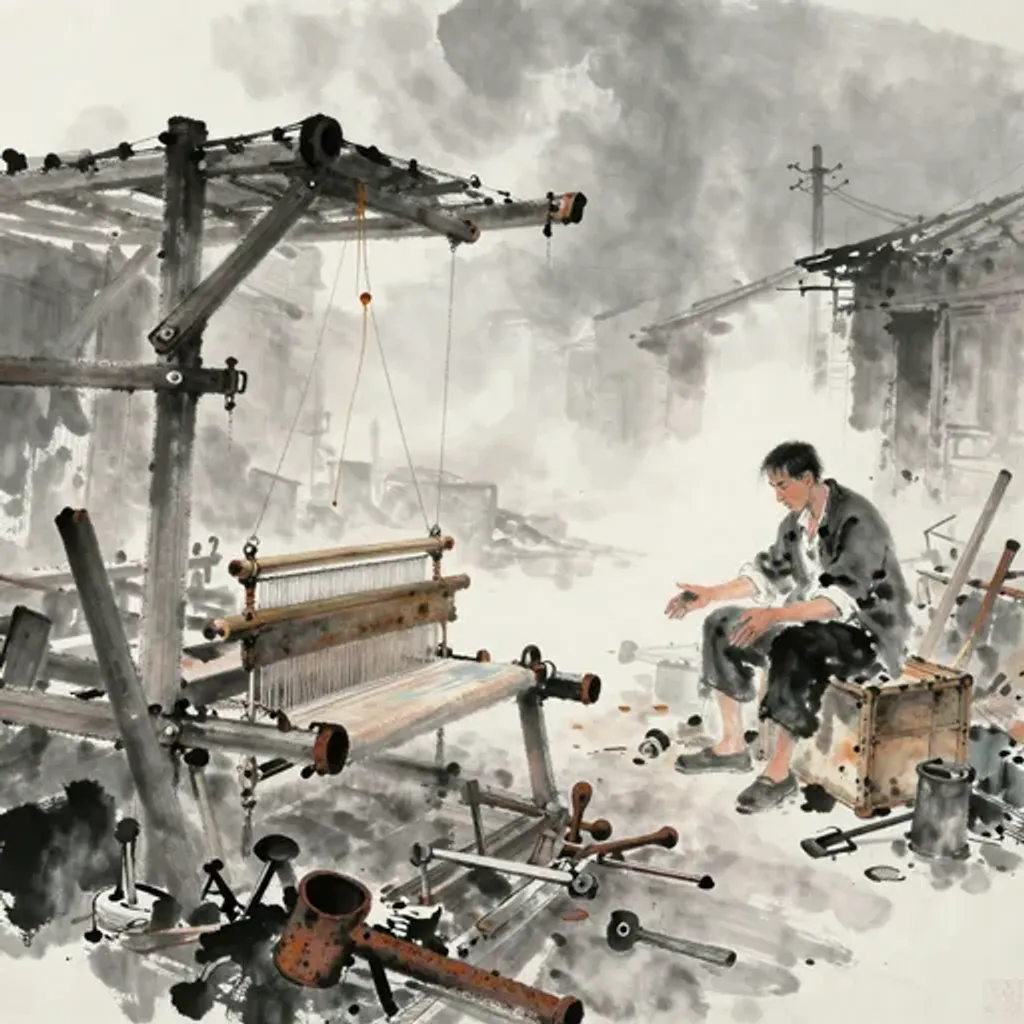
廓落失業,跨禍度福,利無所得。
Vast and vacant, livelihood lost; straddling disaster, crossing toward fortune. Profit is nowhere to be found.
— Jiao Yanshou, Yilin (Forest of Changes), 1st century BC
Commentary
Lake over wind crumbles into mountain upon earth — Splitting Apart, where the bed is stripped to its frame. Empty and desolate, one's livelihood is lost. Straddling misfortune and groping for fortune, one gains nothing of value. The verse is stark: three short phrases of pure loss. No allusion softens the blow, no resolution follows. The livelihood is gone, the attempt to pivot from bad luck to good yields nothing, and profit is nowhere to be found. From Great Exceeding to Splitting Apart, the overburdened ridgepole completes its collapse. The mountain peeling away from the earth is the final stage of structural disintegration — what Great Exceeding threatened, Splitting Apart fulfills. There is no rescue here, only the honest acknowledgment that some collapses leave nothing to salvage.
大過 → 復
Hexagram 28 → Hexagram 24: Return
Changing lines: 1, 2, 3, 4, 5
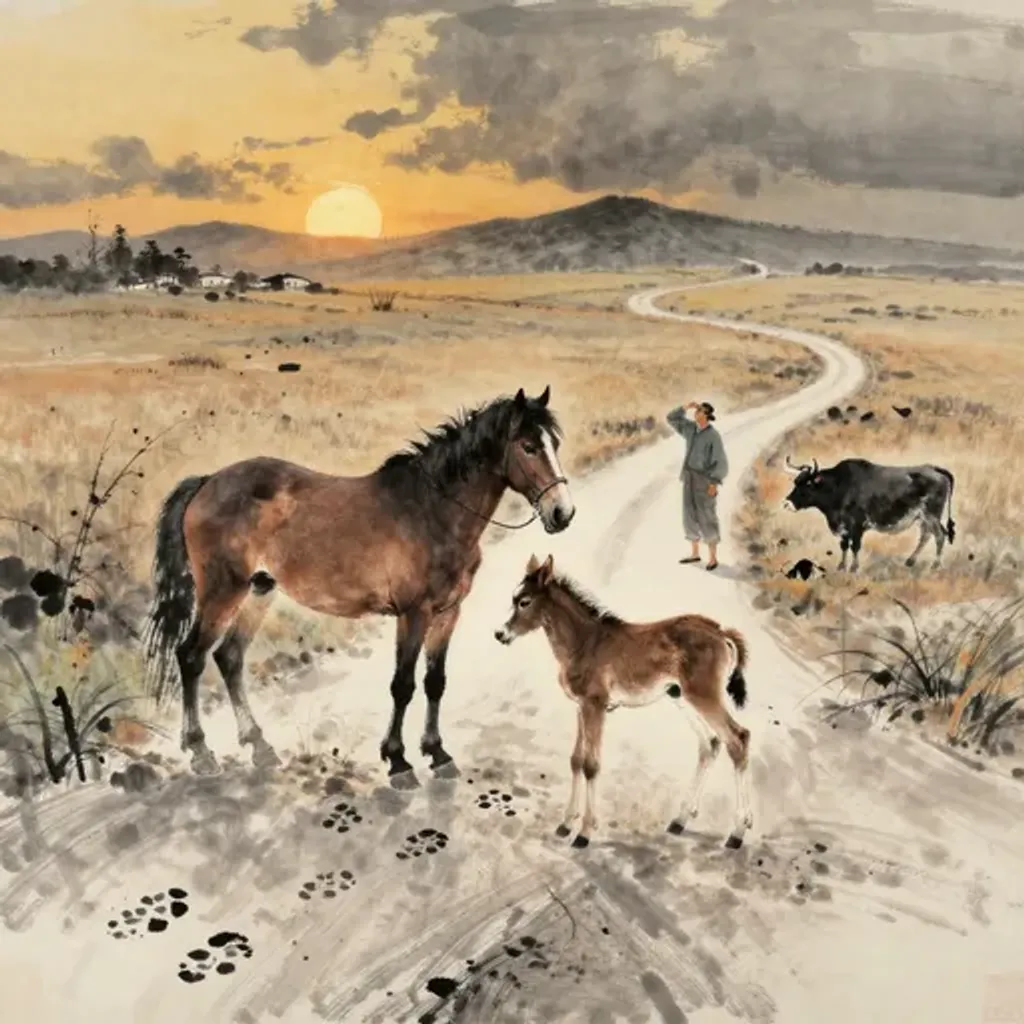
出入無時,憂禍為災。行人失牛,利去不來。老馬少駒,勿與久居。
Coming and going without fixed hour; worry and misfortune become disaster. The traveler loses his ox; profit departs and does not return. An old horse, a young colt; do not dwell with them long.
— Jiao Yanshou, Yilin (Forest of Changes), 1st century BC
Commentary
Lake over wind yields to thunder within the earth — Return, the first yang line stirring beneath five yin lines. Coming and going at irregular hours, worry and calamity intertwine. A traveler loses his ox; profit departs and does not return. An old horse with a young colt — do not dwell with them long. The verse accumulates images of disorder and loss: unpredictable timing, vanished livestock, departing profit. The old horse and young colt warn against mismatched partnerships that drain resources. From Great Exceeding to Return, the collapsed structure meets the faintest stirring of renewal — but the verse suggests this return is premature or misdirected. The lost ox and fleeing profit indicate that the returning energy has not yet found its proper channel; the old horse cannot keep pace with what the situation demands.
大過 → 无妄
Hexagram 28 → Hexagram 25: Innocence
Changing lines: 1, 2, 3, 6
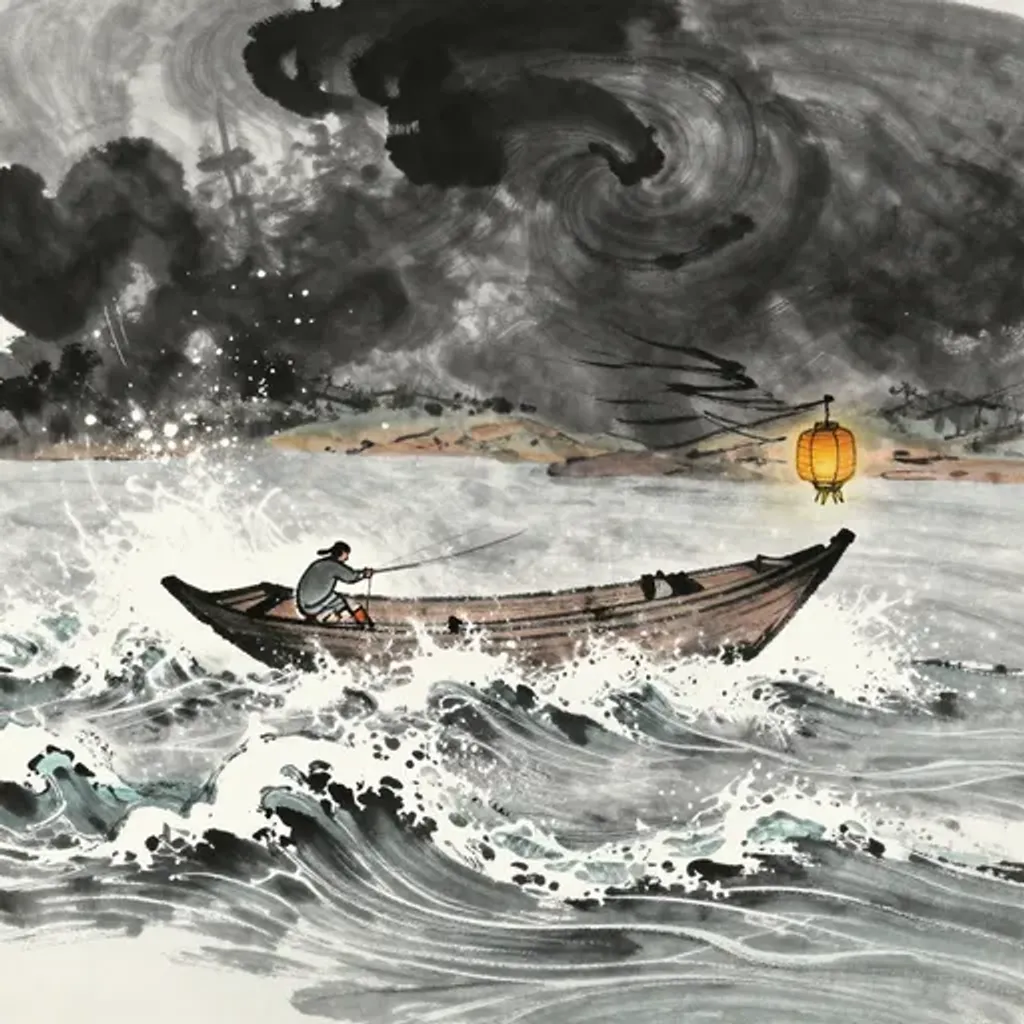
風怒漂水,女惑生疾。陽失其服,陰孽為賊。
Wind rages, scattering water; the woman is beguiled and falls ill. Yang loses its proper garb; yin’s wickedness becomes the thief.
— Jiao Yanshou, Yilin (Forest of Changes), 1st century BC
Commentary
Lake over wind meets heaven above thunder — Innocence, where the unexpected strikes without moral cause. Angry wind churns the water; a woman is beguiled and falls ill. Yang loses its proper garments, and yin's malignant growth becomes a thief. The verse depicts cosmic disorder manifesting as personal calamity: wind and water in violent collision, feminine energy corrupted into illness, masculine order stripped of its authority. In the framework of Innocence, disaster arrives not as punishment but as the amoral blow of circumstance. From Great Exceeding to Innocence, the overburdened structure releases chaotic energy that strikes without warning or justice. The woman's illness and yang's disrobing are not caused by moral failure — they are the collateral damage of a system pushed past its breaking point.
大過 → 大畜
Hexagram 28 → Hexagram 26: Great Taming
Changing lines: 1, 4, 5, 6
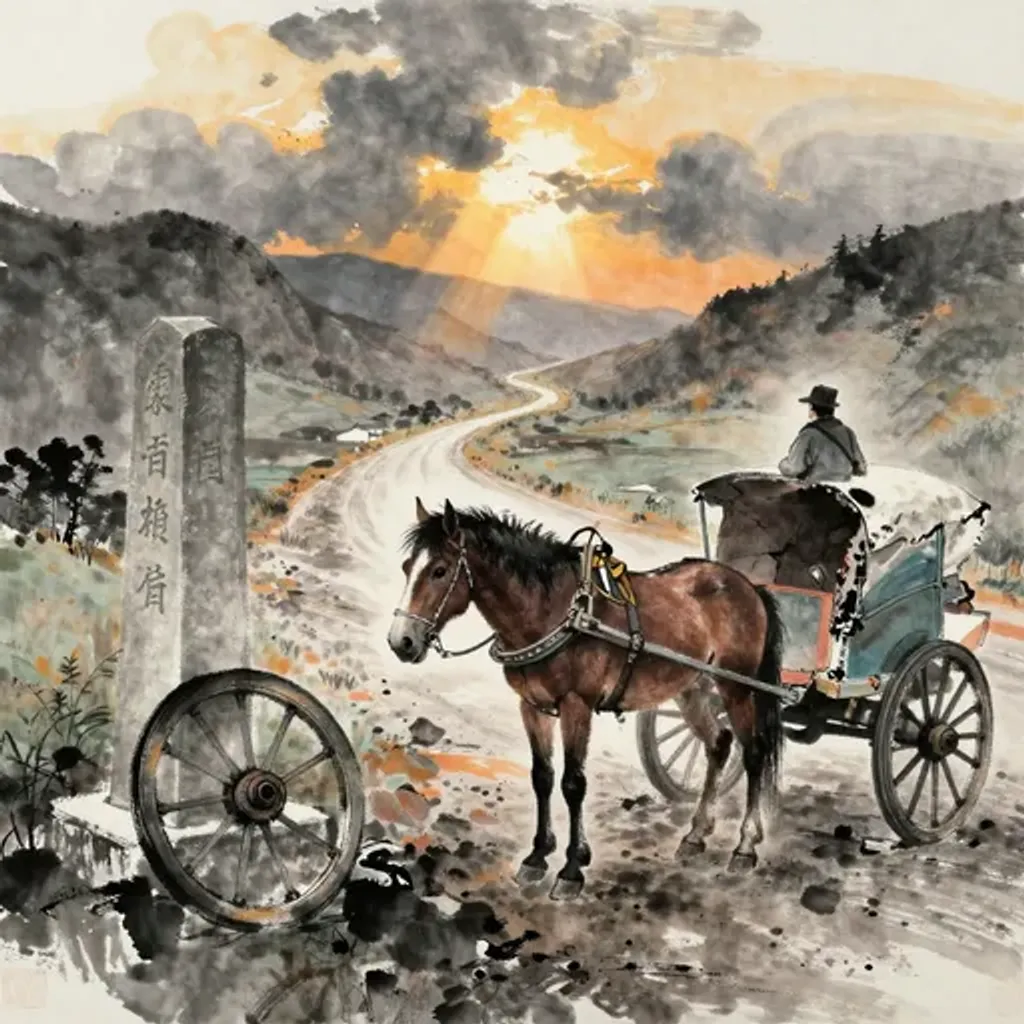
車馬病傷,不利越鄉。幽人元亨,去晦就明。
Cart and horse sick and broken; crossing the border brings no gain. The recluse finds fundamental success; leaving darkness, he enters the light.
— Jiao Yanshou, Yilin (Forest of Changes), 1st century BC
Commentary
Lake over wind transforms into mountain above heaven — Great Taming, where the mountain stores heaven's power. Horses and carts are ailing and injured; crossing the border is not favorable. But the recluse finds fundamental success, leaving darkness to enter the light. The verse splits into two fates: the traveler's broken vehicle cannot make the journey, while the hermit who stays put achieves clarity. 'Leaving darkness for light' echoes the I-Ching's own language for the recluse's inner transformation. From Great Exceeding to Great Taming, the collapsing beam is caught and held by the mountain. What could not be sustained as forward movement becomes stored potential. The recluse succeeds precisely by refusing to push the broken cart further — stopping, accumulating, and letting the mountain gather what excess had scattered.
大過 → 頤
Hexagram 28 → Hexagram 27: Nourishment
Changing lines: 1, 2, 3, 4, 5, 6
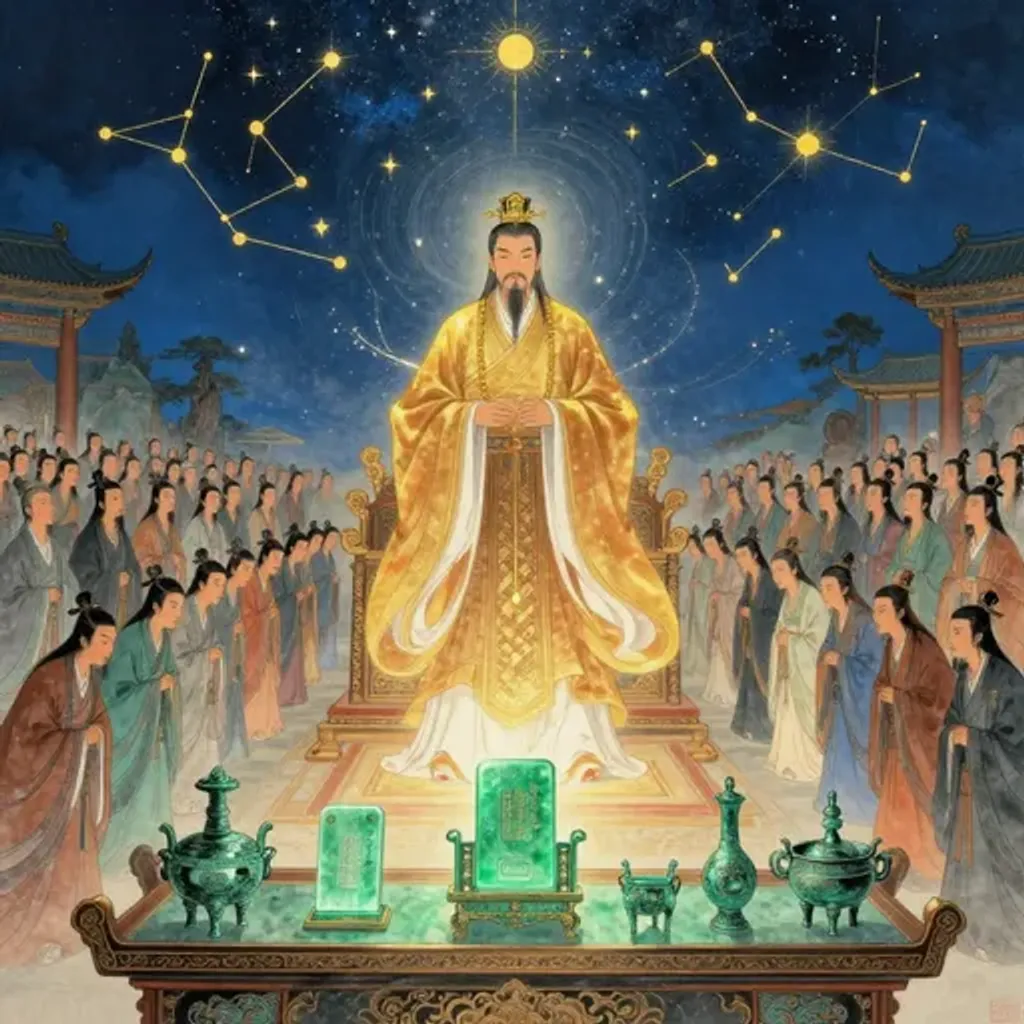
三奇六耦,各有所主。周南召南,聖人所在。德義流行,民悅以喜。
Three odd, six even; each has its proper lord. Zhounan, Shaonan; where the sage resides. Virtue and righteousness flow forth; the people delight and rejoice.
— Jiao Yanshou, Yilin (Forest of Changes), 1st century BC
Commentary
Lake over wind settles into mountain above thunder — Nourishment, where one is careful about what sustains. Three odd and six even, each with its proper ruler. The odes of Zhou Nan and Shao Nan mark where the sage dwells. Virtue and righteousness flow freely; the people rejoice. The 'three odd and six even' refer to the trigram structure — three yang lines and six yin lines of the hexagram system, each in its ordained place. Zhou Nan and Shao Nan are the first two sections of the Shijing, traditionally associated with the civilizing influence of Kings Wen and Wu and the Duke of Zhou. From Great Exceeding to Nourishment, the overburdened beam finds its proper support in ordered hierarchy. True nourishment comes from each element occupying its rightful position, as the sages' virtue flows outward through poetry and moral example.
大過 → 大過
Hexagram 28 → Hexagram 28: Great Exceeding
No changing lines — the hexagram is unchanged
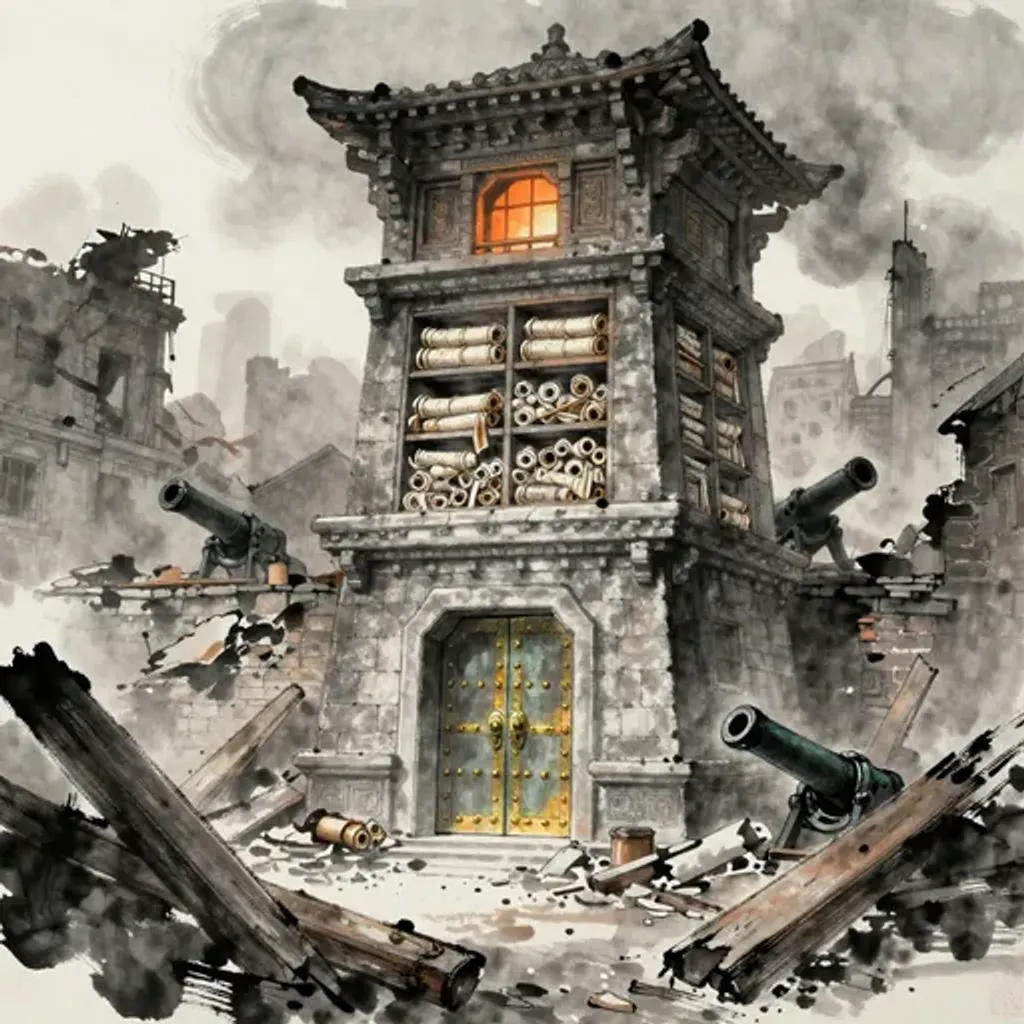
典冊法書,藏閣蘭臺。雖遭亂潰,獨不遇災。
Classic scrolls and legal texts; stored in the Orchid Terrace archive. Though they met with turmoil and ruin; alone they escaped disaster.
— Jiao Yanshou, Yilin (Forest of Changes), 1st century BC
Commentary
Great Exceeding returns to itself — lake over wind doubled, the ridgepole sagging but enduring. Canonical texts and legal records are stored in pavilions and the Lantai Archive. Though encountering chaos and collapse all around, they alone escape disaster. The Lantai (蘭臺) was the Han imperial archive where the dynasty's most precious documents were kept. The verse celebrates preservation through structure: even when everything else falls apart, the written word survives if properly housed. From Great Exceeding to Great Exceeding, there is no transformation — only the doubled weight of excess. Yet the verse finds a paradox within: the very archive that records excess also survives it. Knowledge, properly stored, outlasts the crises it documents.
大過 → 坎
Hexagram 28 → Hexagram 29: The Abysmal Water
Changing lines: 3, 4
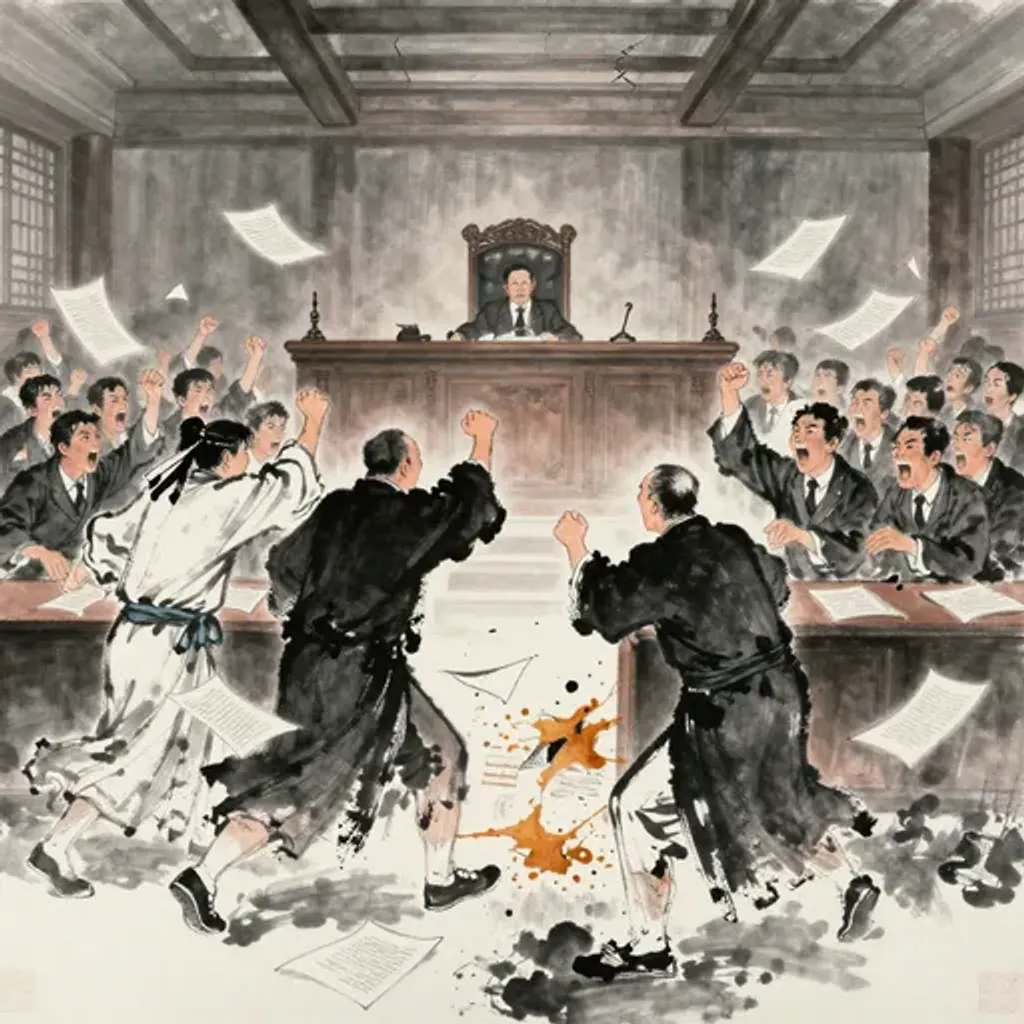
坐爭立訟,紛紛怱怱。卒成禍亂,災及家公。
Sitting they quarrel, standing they litigate; in tumult and confusion. At last it becomes rebellion and ruin; disaster reaches the head of the house.
— Jiao Yanshou, Yilin (Forest of Changes), 1st century BC
Commentary
Lake over wind plunges into doubled water — the Abysmal, danger upon danger. Sitting they quarrel, standing they litigate, in frantic confusion. The turmoil culminates in rebellion and disaster that reaches the lord of the house. The verse traces an escalation from petty bickering to full catastrophe: disputes that begin as seated arguments rise into standing confrontations, then spiral into chaos that destroys the patriarch himself. From Great Exceeding to the Abysmal, the sagging beam collapses into the pit. Water upon water offers no foothold — the quarreling parties have entered a recursive trap where each conflict generates the next. The 'family lord' who suffers the final blow is the center that failed to hold when the structure gave way.
大過 → 離
Hexagram 28 → Hexagram 30: The Clinging Fire
Changing lines: 1, 2, 5, 6
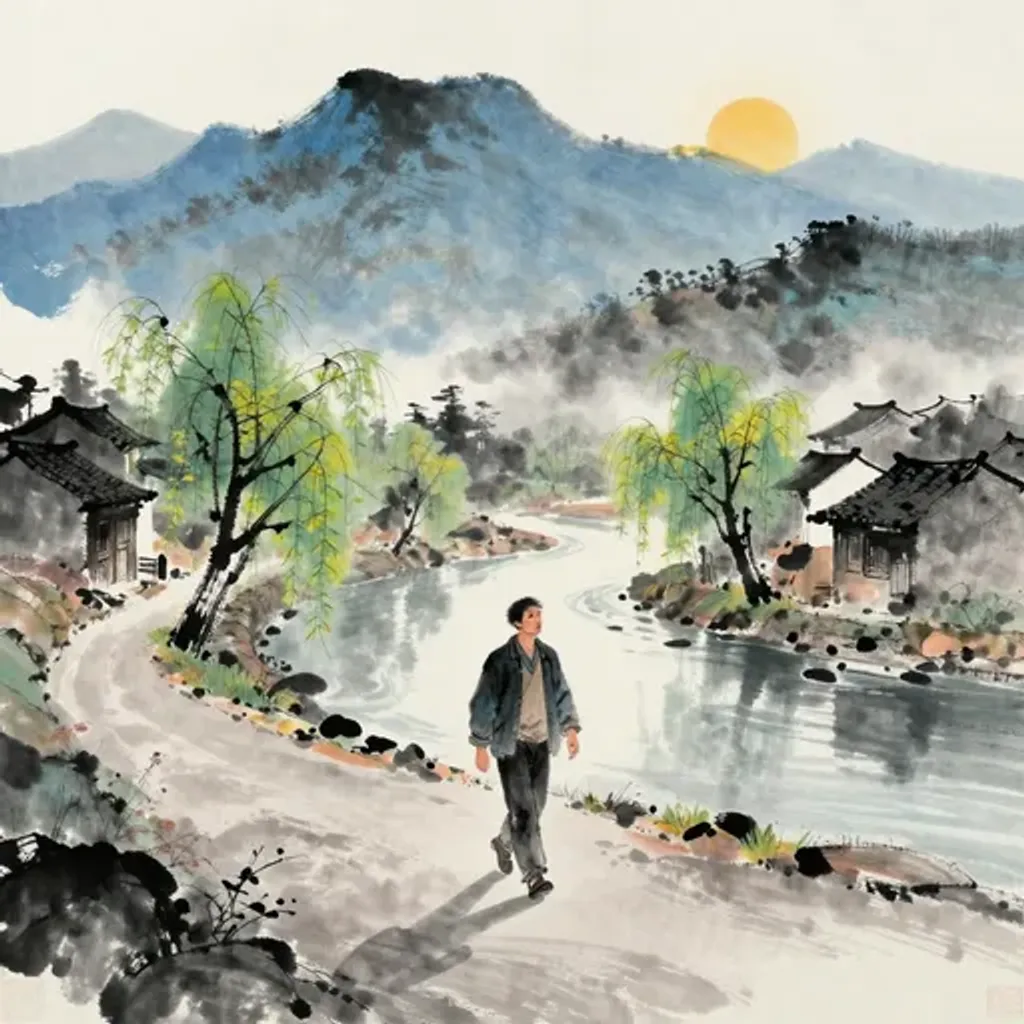
憂凶為殘,使我不安。從之南國,以除心疾。
Dread and misfortune bring destruction; they give me no peace. Following the way to the southern land; thereby the heart’s affliction is cured.
— Jiao Yanshou, Yilin (Forest of Changes), 1st century BC
Commentary
Lake over wind kindles into doubled fire — the Clinging, brightness illuminating brightness. Worry and dread ravage like cruelty, robbing one of peace. But the verse resolves: travel to the southern kingdom to cure the heart's sickness. The south is the direction of fire and warmth, the natural home of the Clinging trigram. The 'heart's sickness' is not physical but spiritual — an ailment of anxiety that can only be cured by moving toward clarity. From Great Exceeding to the Clinging, the waterlogged beam dries in doubled fire. What was bowing under excessive moisture finds its remedy in radiant light. The southern journey is both literal and metaphorical: one must move toward illumination to dispel the darkness that excess breeds within the mind.
大過 → 咸
Hexagram 28 → Hexagram 31: Influence
Changing lines: 2
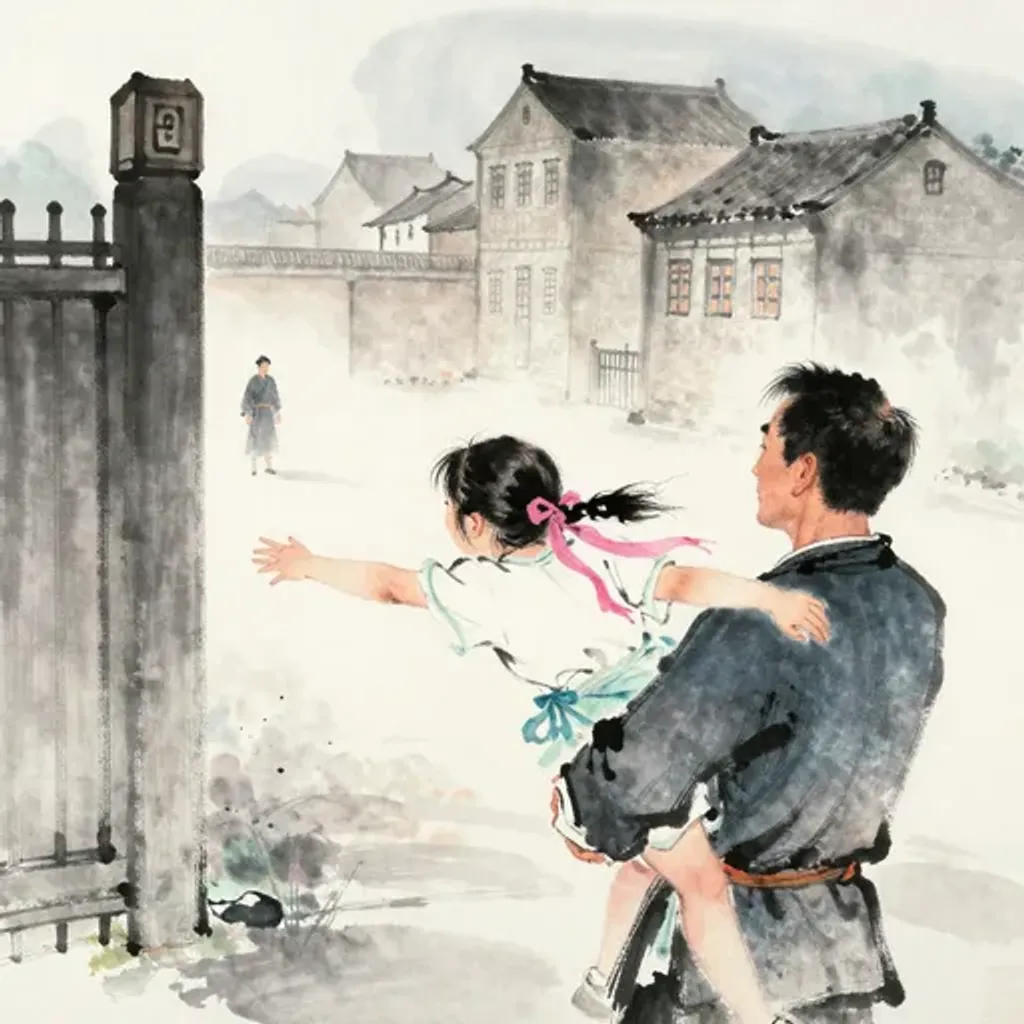
愛我嬰女,牽引不與。冀幸高貴,反得不興。
Cherishing my infant daughter; pulling her back, refusing to give her away. Hoping for high and noble match; instead she gains no prosperity.
— Jiao Yanshou, Yilin (Forest of Changes), 1st century BC
Commentary
Lake over wind meets lake above mountain — Influence, the mutual attraction of opposites. One cherishes a beloved daughter but pulls her back and will not give her away, hoping for a noble match of high status. Yet the result is the opposite of flourishing. The verse depicts a parent's overprotective possessiveness: clinging to a daughter, refusing suitors, aiming too high — and achieving nothing. The lake atop the mountain in Influence represents openness and receptivity, but here the parent blocks the very exchange that Influence requires. From Great Exceeding to Influence, the overburdened structure should yield to mutual responsiveness. Instead, the excess manifests as excessive control — holding too tightly to what must be released, and losing everything through the refusal to let go.
大過 → 恆
Hexagram 28 → Hexagram 32: Duration
Changing lines: 5
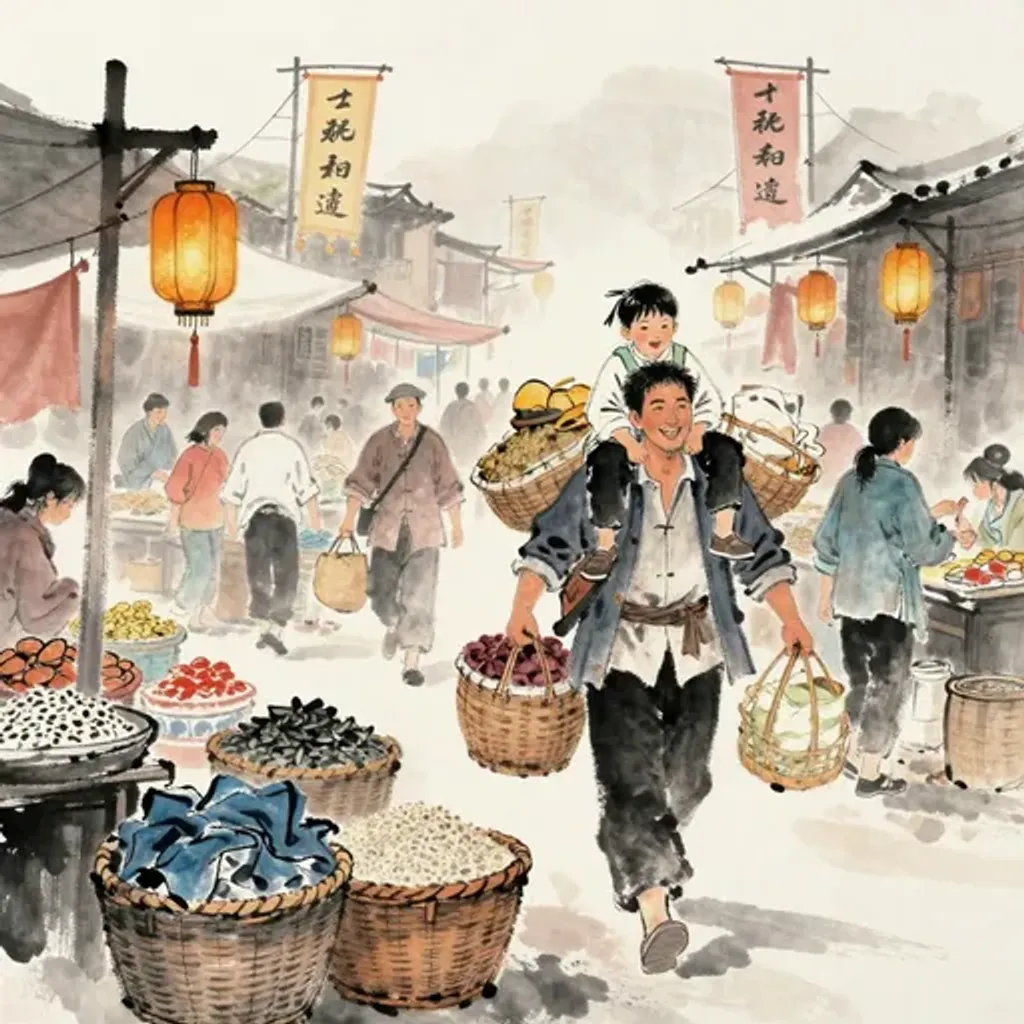
宜行賈市,所聚必倍。載喜抱子,與利為市。
It is fitting to trade at market; what is gathered will surely double. Carrying joy, embracing a child; entering the market with profit in hand.
— Jiao Yanshou, Yilin (Forest of Changes), 1st century BC
Commentary
Lake over wind steadies into thunder above wind — Duration, the hexagram of constancy and steady enterprise. One should travel to trade at the market, for whatever is gathered will be doubled. Carrying joy and embracing a child, one trades alongside profit. The verse is a merchant's blessing: go to market, and your investment will return twofold. The image of holding a child while trading suggests that commercial success and domestic happiness arise together. From Great Exceeding to Duration, the collapsing beam finds its remedy in persistent, rhythmic effort. Thunder and wind reinforce each other endlessly — the steady cycle of buying and selling, departure and return, that creates lasting prosperity. Excess is tamed not by restriction but by channeling it into reliable, repeating patterns of productive exchange.
大過 → 遯
Hexagram 28 → Hexagram 33: Retreat
Changing lines: 2, 6
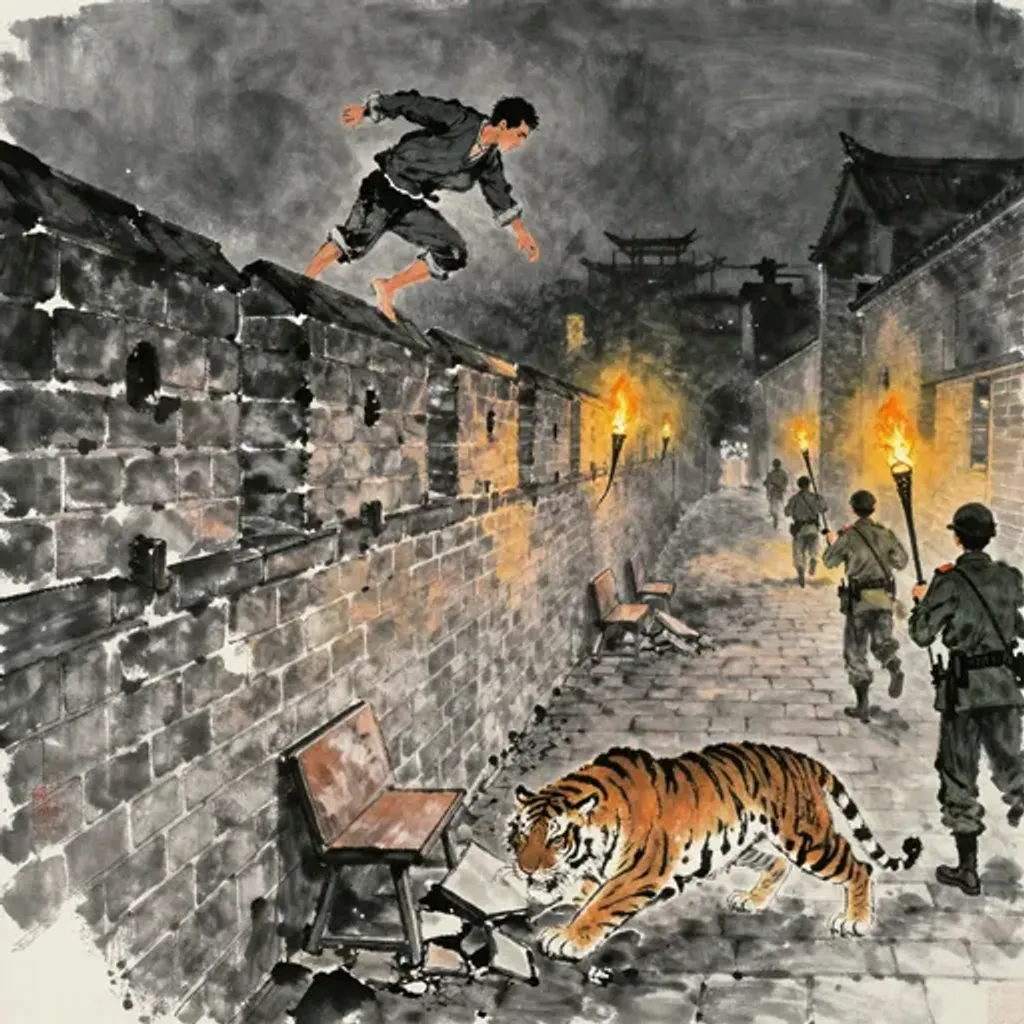
坐席未溫,憂來扣門。踰墻北走,兵交我後。脫於虎口。
The seat not yet warm; worry comes knocking at the gate. Leaping the wall, fleeing north; soldiers clash behind me. Escaping from the tiger’s mouth.
— Jiao Yanshou, Yilin (Forest of Changes), 1st century BC
Commentary
Lake over wind flees into heaven above mountain — Retreat, the timely withdrawal from danger. The seat is not yet warm when worry knocks at the door. One leaps over the wall and runs north; soldiers clash behind. Yet one escapes the tiger's mouth. The verse is a breathless vignette of flight: barely arrived, already fleeing, scrambling over walls with armies in pursuit. The 'seat not yet warm' is a proverb for having no time to settle before crisis strikes. From Great Exceeding to Retreat, the collapsing structure compels immediate evacuation. Retreat's wisdom is not cowardice but survival instinct — heaven rising above the mountain, withdrawing to higher ground. The one who flees lives; the one who stays to defend the crumbling beam is crushed beneath it.
大過 → 大壯
Hexagram 28 → Hexagram 34: Great Power
Changing lines: 1, 5
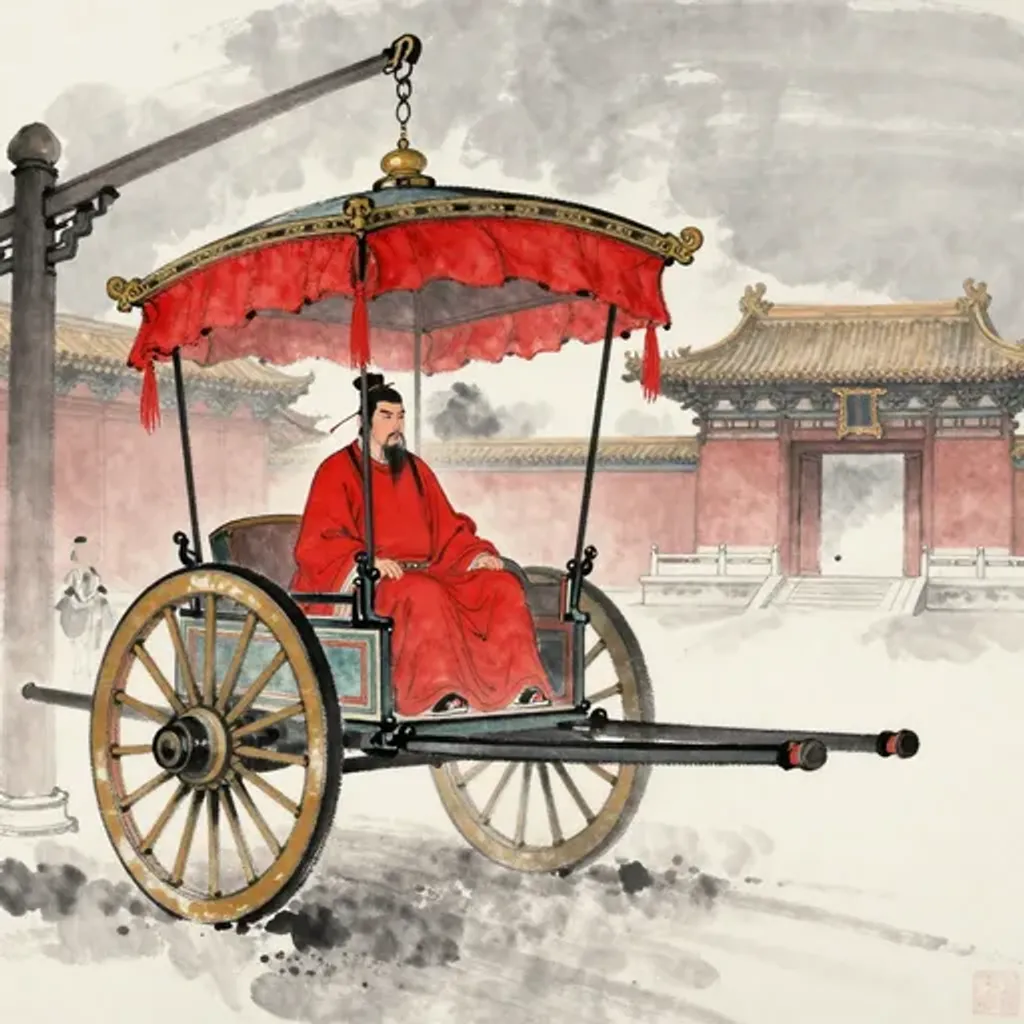
赤帝懸車,廢職不朝。叔帶之災,居于氾廬。
The Red Emperor suspends his chariot; abandoning office, he holds no court. Shudai’s calamity; he dwells at the reed hut of Fan.
— Jiao Yanshou, Yilin (Forest of Changes), 1st century BC
Commentary
Lake over wind surges into thunder above heaven — Great Power, raw force shaking the cosmos. The Red Emperor suspends his carriage and abandons his office, ceasing to hold court. This is the disaster of Uncle Dai (叔帶): the king dwells in exile at Fanlu. The 'Red Emperor' here refers to the Zhou king, whose virtue, like the dying southern fire, has waned. Uncle Dai (Prince Dai) was the younger brother of King Xiang of Zhou who conspired with the Di barbarians to overthrow the king in 636 BC. King Xiang fled to Zheng, and Prince Dai briefly seized the throne before Duke Wen of Jin intervened. From Great Exceeding to Great Power, the overburdened center is overthrown by unbridled force — thunder above heaven, power misapplied, the usurper's raw ambition displacing legitimate authority.
大過 → 晉
Hexagram 28 → Hexagram 35: Progress
Changing lines: 2, 3, 5, 6
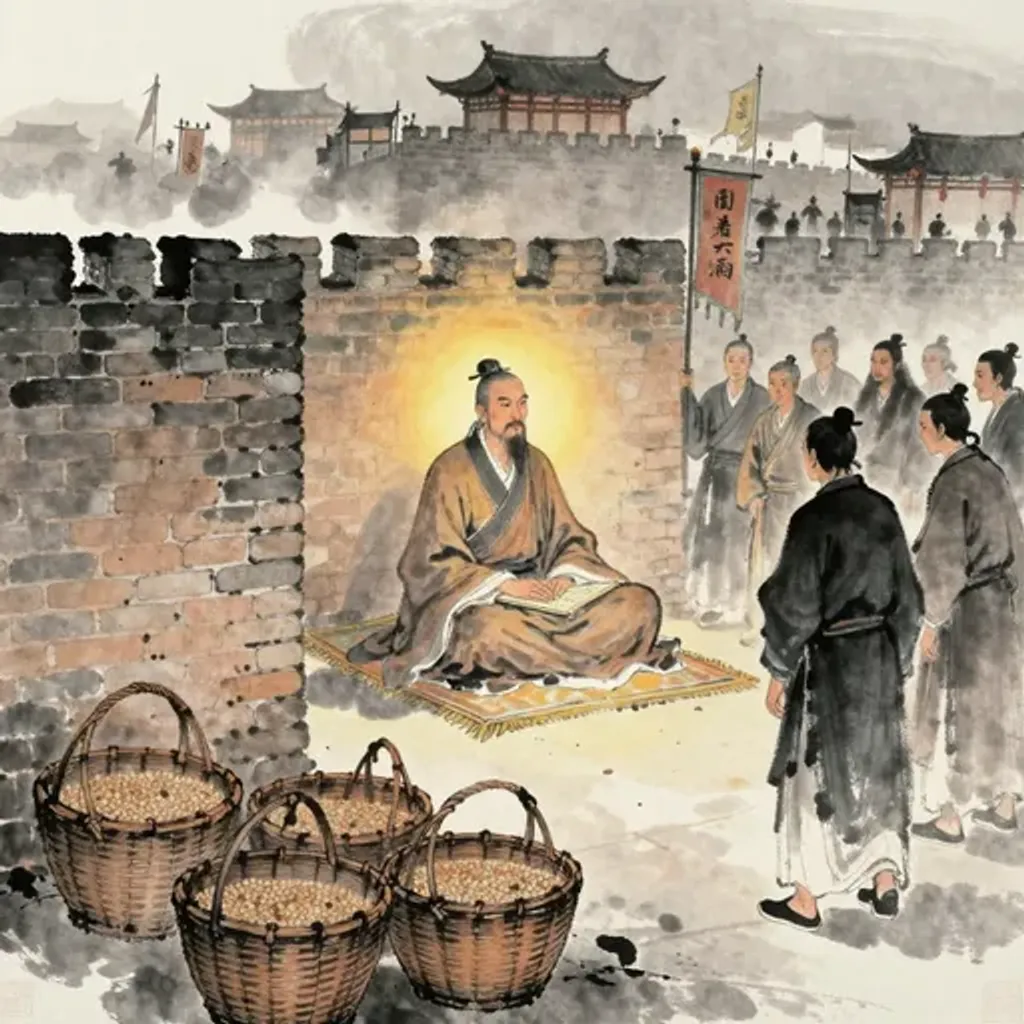
子畏於匡,厄困陳蔡。明德不危,竟自免害。
The Master was threatened at Kuang; beset and stranded in Chen and Cai. Bright virtue is not imperiled; in the end he escapes harm by himself.
— Jiao Yanshou, Yilin (Forest of Changes), 1st century BC
Commentary
Lake over wind brightens into fire above earth — Progress, light rising from the ground. Confucius was besieged at Kuang and suffered hardship between Chen and Cai. Yet his luminous virtue kept him from true peril, and in the end he escaped unharmed. The verse pairs the two most famous dangers of Confucius's wandering years: at Kuang, the townspeople mistook him for the villain Yang Hu and surrounded him; between Chen and Cai, his provisions ran out for seven days. In both cases, the sage declared that Heaven had not yet destroyed culture, and his equanimity preserved him. From Great Exceeding to Progress, the collapsing structure gives way to the dawn — light emerging from the earth. Confucius's virtue is that rising light: however dark the passage, 'luminous virtue does not face destruction.'
大過 → 明夷
Hexagram 28 → Hexagram 36: Darkening of the Light
Changing lines: 1, 2, 4, 5
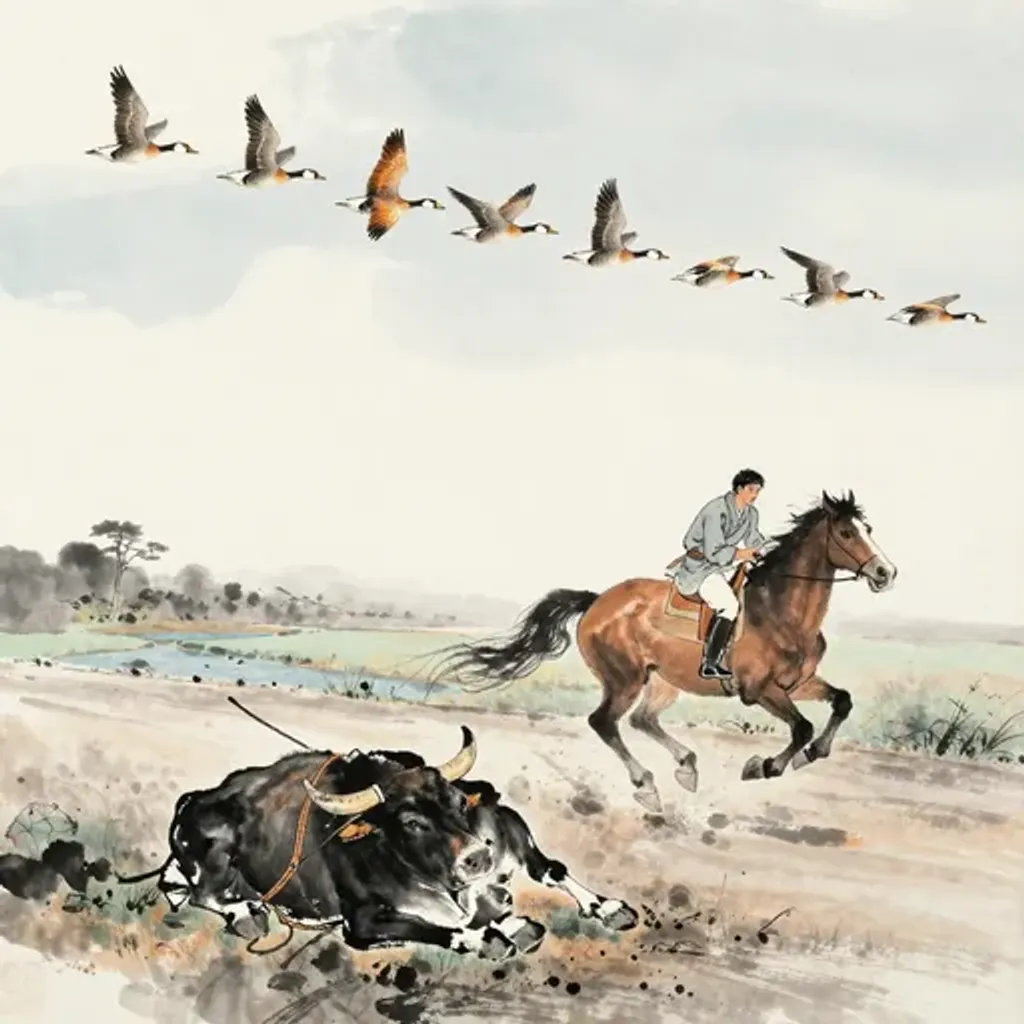
逐雁南飛,馬疾牛罷。不見魚池,失利憂危。牢戶之冤,脫免無患。
Chasing geese flying south; the horse is swift, the ox spent. The fish pond is not seen; profit lost, peril and worry. The prison’s wrong; released, escaping without harm.
— Jiao Yanshou, Yilin (Forest of Changes), 1st century BC
Commentary
Lake over wind sinks into earth above fire — Darkening of the Light, where brilliance is driven underground. Chasing wild geese flying south, the horse gallops to exhaustion and the ox collapses. The fish pond is nowhere to be found; profit vanishes and worry mounts. Yet the verse ends: the prisoner's grievance is resolved, and he escapes unharmed. The verse traces a desperate pursuit that fails — southward-flying geese that cannot be caught, resources depleted in the chase — before pivoting to unexpected liberation. From Great Exceeding to Darkening of the Light, the overburdened beam drives brilliance into concealment. The pursuit of the geese is the futile chase after what has already departed. But within the darkness, a prison door opens: sometimes only by entering the earth can one find the hidden passage to freedom.
大過 → 家人
Hexagram 28 → Hexagram 37: The Family
Changing lines: 1, 2, 4, 6
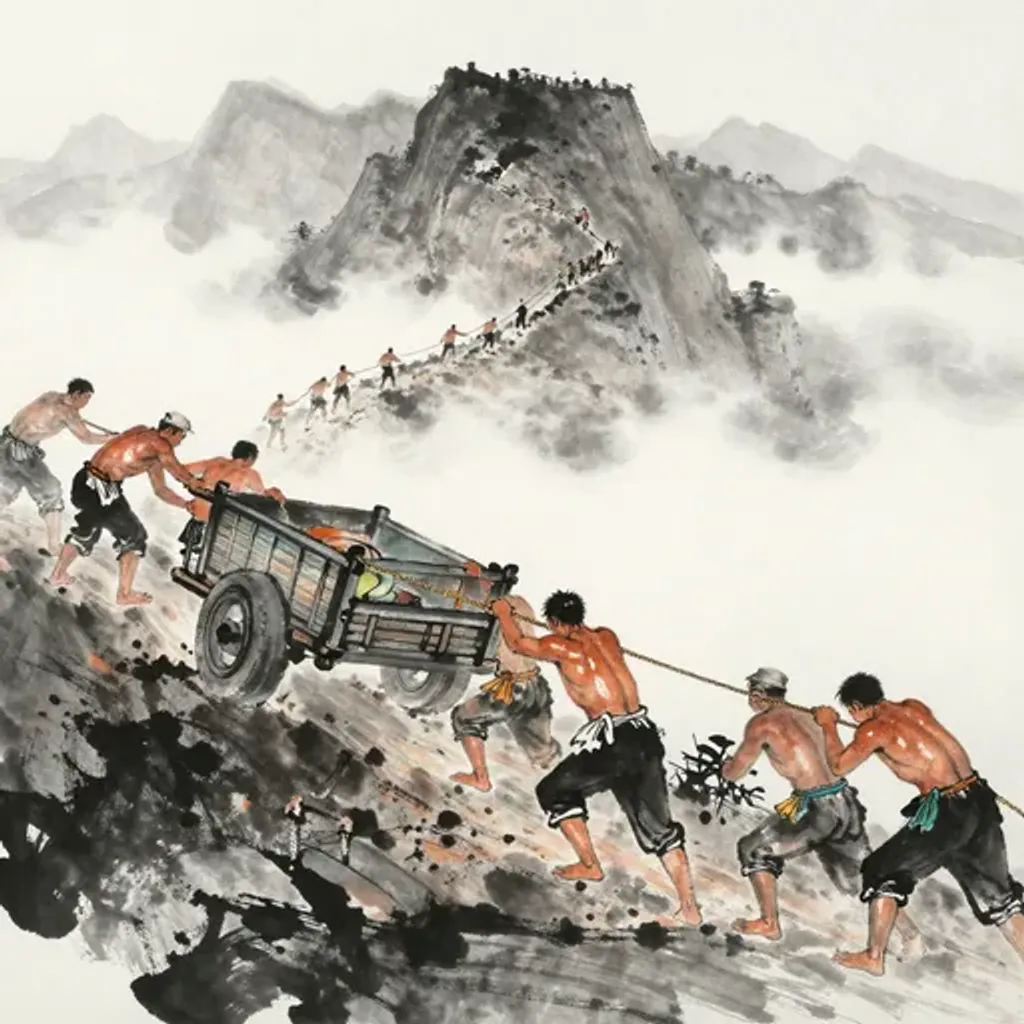
推輦上山,高仰重難。終日至暮,不見阜巔。
Pushing the cart uphill; lofty and steep, the burden heavy. From daybreak until dusk; the hilltop is never seen.
— Jiao Yanshou, Yilin (Forest of Changes), 1st century BC
Commentary
Lake over wind enters wind above fire — the Family, where inner warmth radiates outward as gentle order. Pushing a handcart uphill, the slope is steep and the load unbearable. From dawn to dusk one labors, yet the summit never comes into view. The verse is pure Sisyphean struggle: exhausting effort against an incline that never relents, with the peak perpetually out of reach. The Family's image — wind emerging from fire — promises that warmth within generates gentle influence without, but this verse catches the moment before that promise is fulfilled. From Great Exceeding to the Family, the sagging beam is not yet repaired. The handcart pushing uphill is the household still struggling under its burden, the family order not yet established, the fire lit but its warmth not yet reaching the wind.
大過 → 睽
Hexagram 28 → Hexagram 38: Opposition
Changing lines: 1, 3, 5, 6
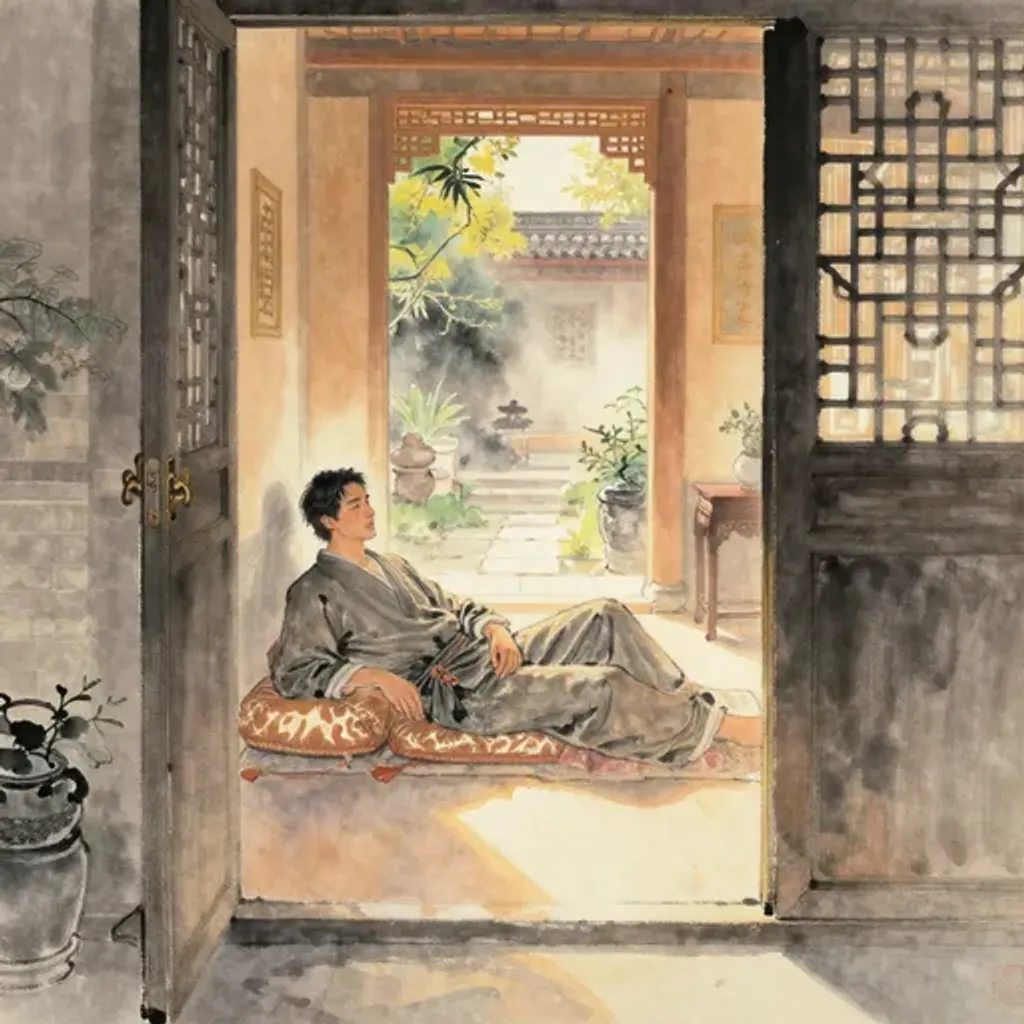
憂不為患,福在堂門。使吾偃安。
Worry does not become disaster; fortune stands at the hall’s door. It grants me ease and rest.
— Jiao Yanshou, Yilin (Forest of Changes), 1st century BC
Commentary
Lake over wind opens into fire above lake — Opposition, where things diverge yet remain connected. Worry does not become disaster; fortune stands at the hall's door, granting peaceful repose. The verse is brief and reassuring: anticipated trouble dissolves, and blessings arrive at the threshold. Opposition's image — fire rising while the lake sinks — suggests forces moving apart, yet here the separation works in the querent's favor, as danger departs and fortune approaches. From Great Exceeding to Opposition, the overburdened beam splits into two diverging elements. But divergence here means that calamity and the self separate — what was crushing weight lifts because it moves in a different direction, leaving comfort and safety behind at the door.
大過 → 蹇
Hexagram 28 → Hexagram 39: Obstruction
Changing lines: 2, 4
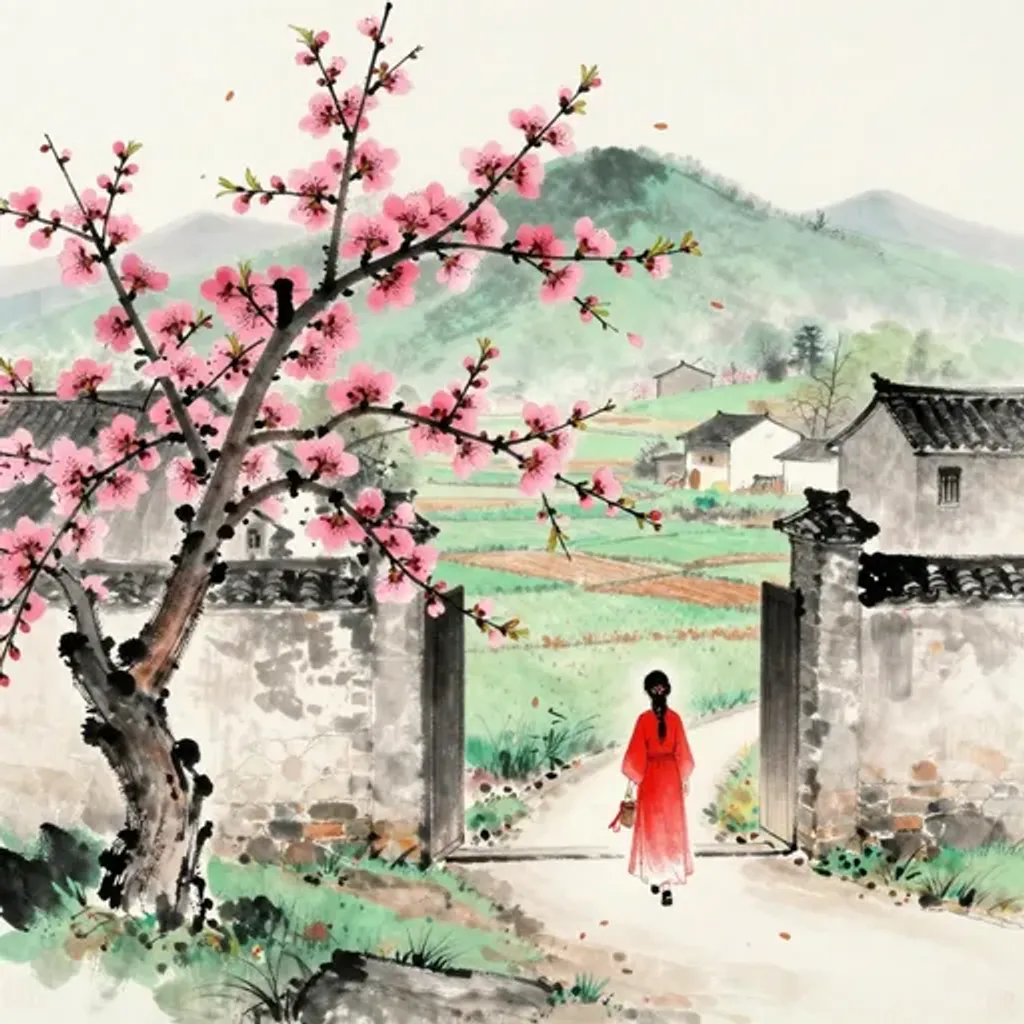
春桃始華,季女宜家。受福多年,男為邦君。
Spring peach begins to bloom; the youngest daughter makes a good home. Receiving blessings for many years; her son becomes lord of the realm.
— Jiao Yanshou, Yilin (Forest of Changes), 1st century BC
Commentary
Lake over wind meets water above mountain — Obstruction, the image of danger looming before the traveler. Yet the verse defies its target hexagram with images of flourishing: spring peach trees begin to blossom, the youngest daughter makes a fine match. Blessings last many years, and her son becomes lord of a domain. The verse reads as a marriage blessing — the peach blossom echoing the Shijing's 'Tao Yao' ode that celebrates a bride entering her husband's household. From Great Exceeding to Obstruction, the collapsing structure encounters the mountain's barrier. But the verse suggests that what seems obstructed is actually being shaped: the mountain's obstacle channels spring water into fertility, and the young woman's marriage, far from blocked, flourishes precisely because difficulty taught patience and the peach blossomed at its proper time.
大過 → 解
Hexagram 28 → Hexagram 40: Deliverance
Changing lines: 3, 5
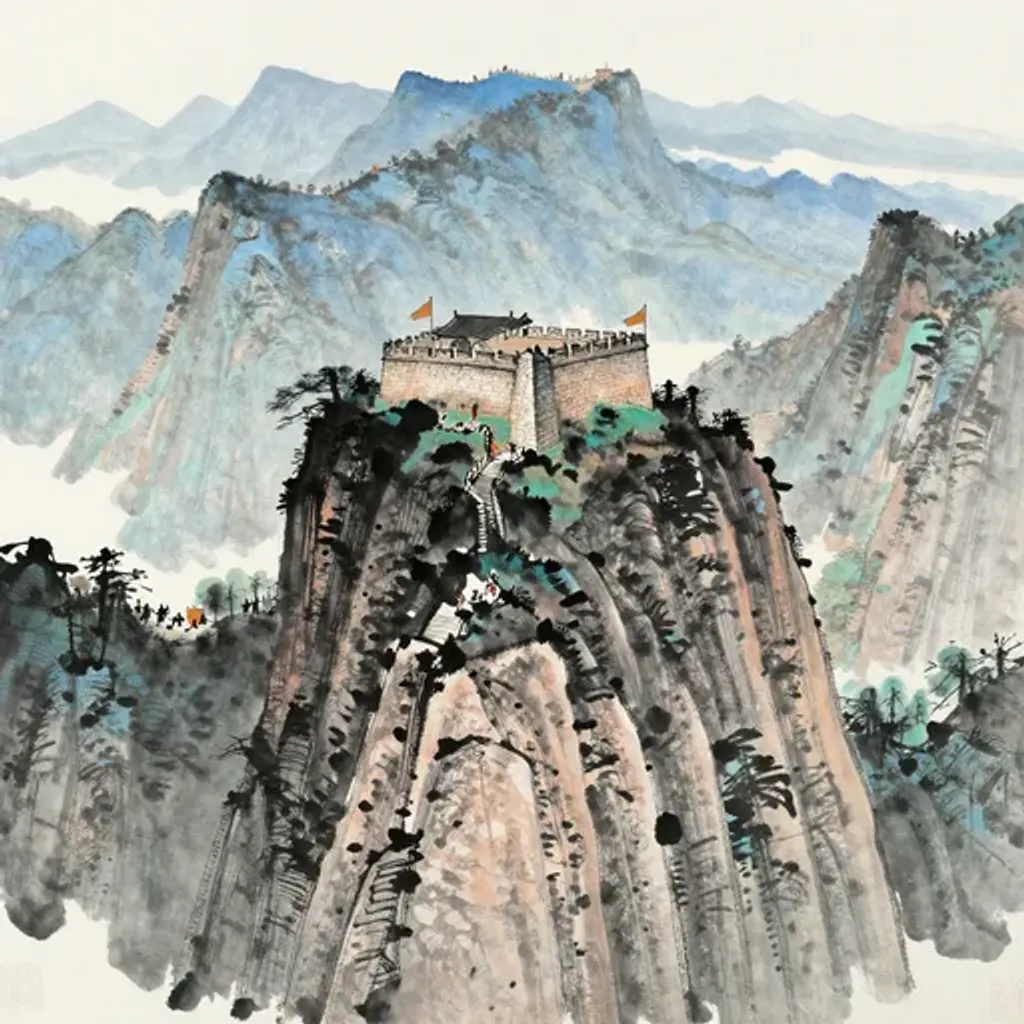
高山之巔,去谷億千。雖有兵寇,足以自守。
The high mountain’s peak; ten thousand fathoms from the valley. Though there be soldiers and bandits; it is enough to hold and defend.
— Jiao Yanshou, Yilin (Forest of Changes), 1st century BC
Commentary
Lake over wind rises to thunder above water — Deliverance, the release of tension after the storm. A high mountain peak stands a thousand miles from the valley floor. Though brigands and invaders threaten, the position is sufficient for self-defense. The verse celebrates natural stronghold: altitude as security, distance as protection. The mountain needs no walls because its very height deters attack. From Great Exceeding to Deliverance, the sagging beam finds relief in the thunderstorm that clears the air. Deliverance is the moment after rain, when pressure lifts. Here the mountain peak embodies that relief — so far above the valley's troubles that even armed enemies cannot reach it. The excess that burdened the structure has been converted into elevation, and elevation itself becomes the deliverance.
大過 → 損
Hexagram 28 → Hexagram 41: Decrease
Changing lines: 1, 3, 4, 5, 6
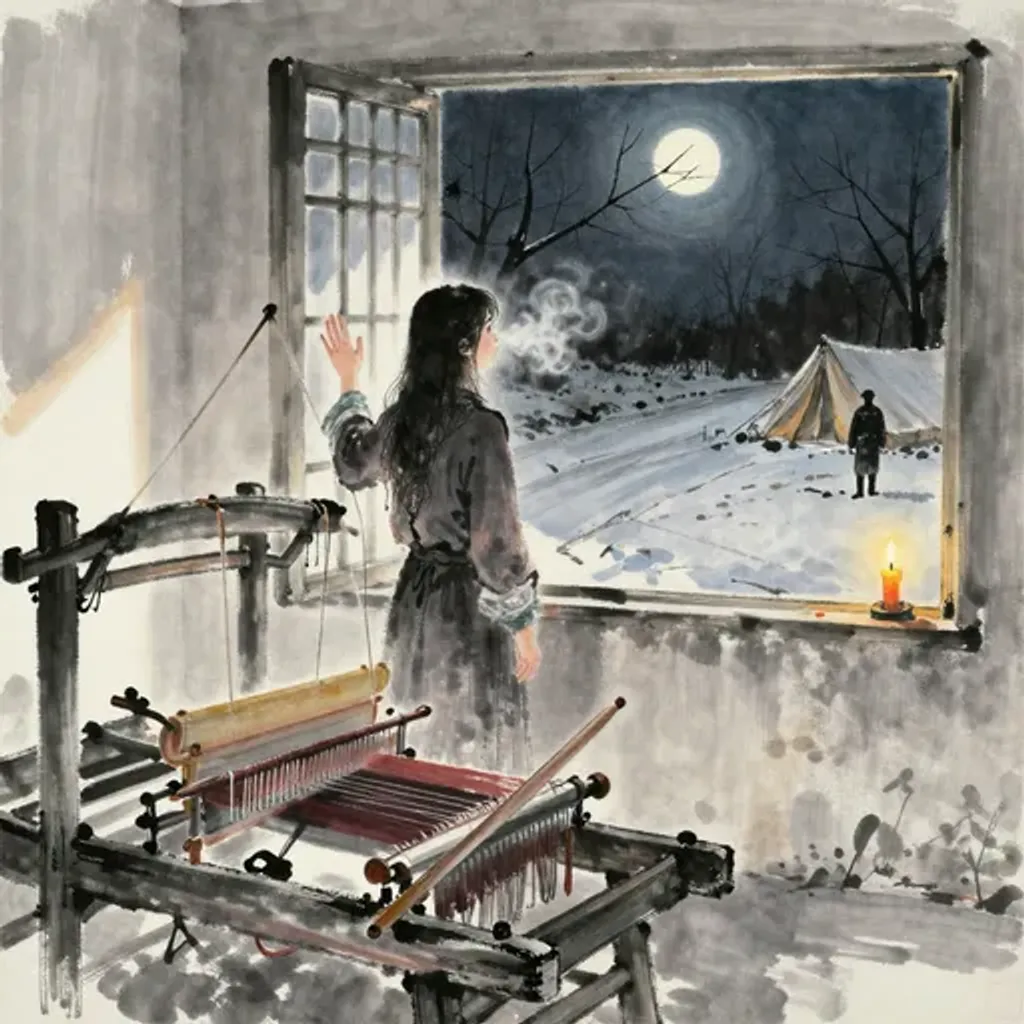
過時歷月,役夫顦顇。處子嘆室,思我伯叔。
Months pass, time stretches on; the laborer is worn and wasted. The maiden sighs within her room; she longs for her husband and uncle.
— Jiao Yanshou, Yilin (Forest of Changes), 1st century BC
Commentary
Lake over wind diminishes into mountain above lake — Decrease, where the lower is reduced to benefit the upper. Months pass beyond their term; the conscript laborer grows gaunt and haggard. An unmarried woman sighs in her chamber, longing for her uncles and brothers. The verse pairs two kinds of diminishment: the soldier wasting away on endless campaign, and the woman wasting her youth waiting for family who will not return. Both suffer the loss of time — the cruelest form of decrease. From Great Exceeding to Decrease, the overburdened structure extracts its toll from those beneath it. The mountain draws substance from the lake below, and here that extraction is felt as the slow draining of vitality from those who serve and those who wait.
大過 → 益
Hexagram 28 → Hexagram 42: Increase
Changing lines: 1, 2, 3, 4, 6
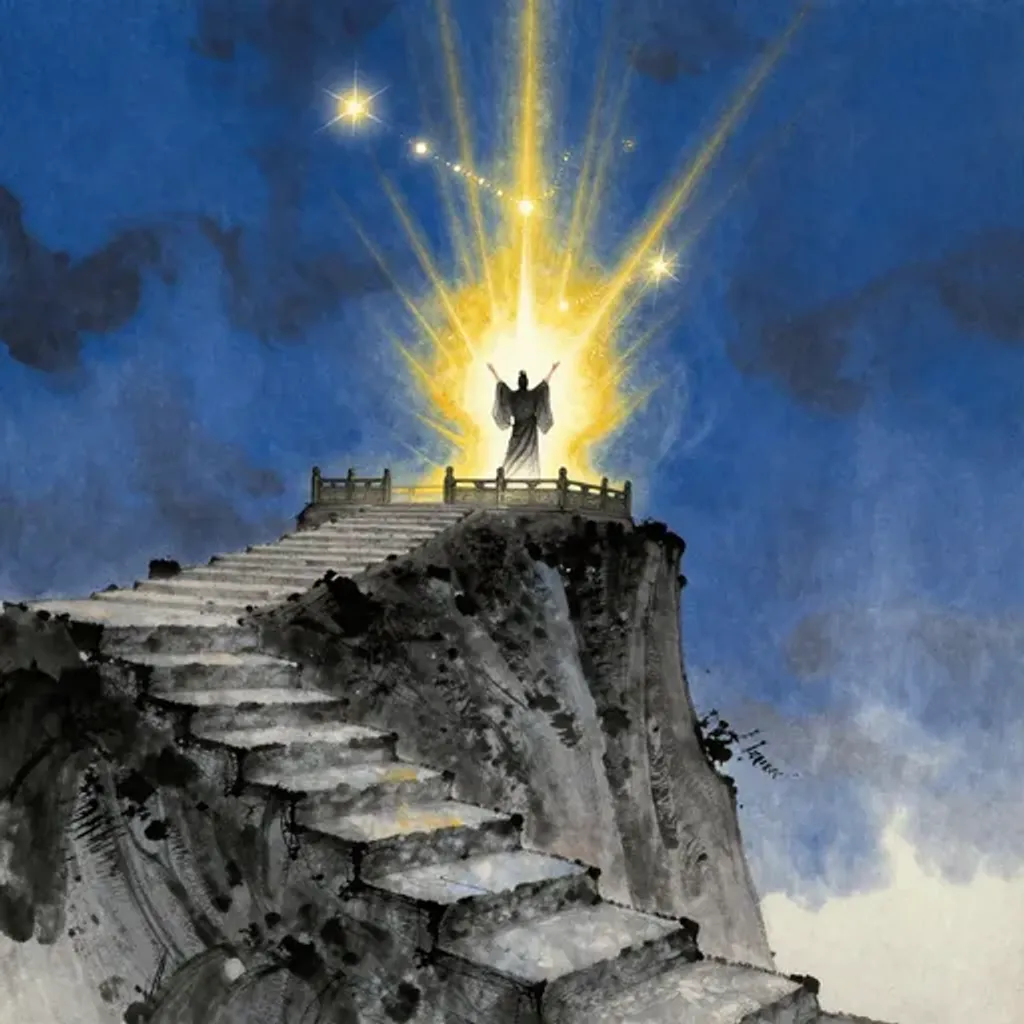
太微復明,說升傅巖。乃稱高室,疾在頭頸。和不能生,滅其令名。
Taiwei shines bright again; Yue ascends from Fuyan. Thus he is called to the high chamber; yet illness lodges in head and neck. Harmony cannot bring life; his illustrious name is extinguished.
— Jiao Yanshou, Yilin (Forest of Changes), 1st century BC
Commentary
Lake over wind rises into wind above thunder — Increase, where the upper diminishes itself to benefit the lower. The Taiwei star shines again; the sage Fu Yue ascends from the cliffs of Fuyan to be elevated to the highest office. But then illness strikes at head and neck, and harmony cannot sustain life — the illustrious name is extinguished. Fu Yue was a slave laborer building walls at Fuyan when King Wu Ding of Shang dreamed of a sage and sought him out among the convicts. Raised to chief minister, Fu Yue presided over the 'Wu Ding Renaissance.' The 'Taiwei star' that brightens is said to be Fu Yue's stellar apotheosis. Yet the verse turns dark: even the greatest minister falls to illness. From Great Exceeding to Increase, the transformation offers magnification — but what is magnified includes vulnerability as well as glory.
大過 → 夬
Hexagram 28 → Hexagram 43: Breakthrough
Changing lines: 1

旁多小星,三五在東。早夜晨行,勞苦無功。
Many small stars crowd the margins; three and five cluster in the east. Rising early, walking through the night; toil and hardship bring no gain.
— Jiao Yanshou, Yilin (Forest of Changes), 1st century BC
Commentary
Lake over wind breaks into lake above heaven — Breakthrough, the decisive moment of resolution. Many small stars cluster beside the greater ones; three and five gather in the east. Rising early and traveling through the night, one labors hard but achieves nothing. The verse contrasts cosmic order with human futility: the stars assume their proper positions in the eastern sky — the Pleiades (three-five, 三五) and their attendant stars — while the traveler exhausts himself without result. The celestial bodies move effortlessly into alignment while human striving produces nothing. From Great Exceeding to Breakthrough, the overburdened beam should snap decisively. But this verse shows a breakthrough that fails to materialize: despite relentless effort, the resolution never arrives. The stars break through the dawn; the traveler does not.
大過 → 姤
Hexagram 28 → Hexagram 44: Coming to Meet
Changing lines: 6
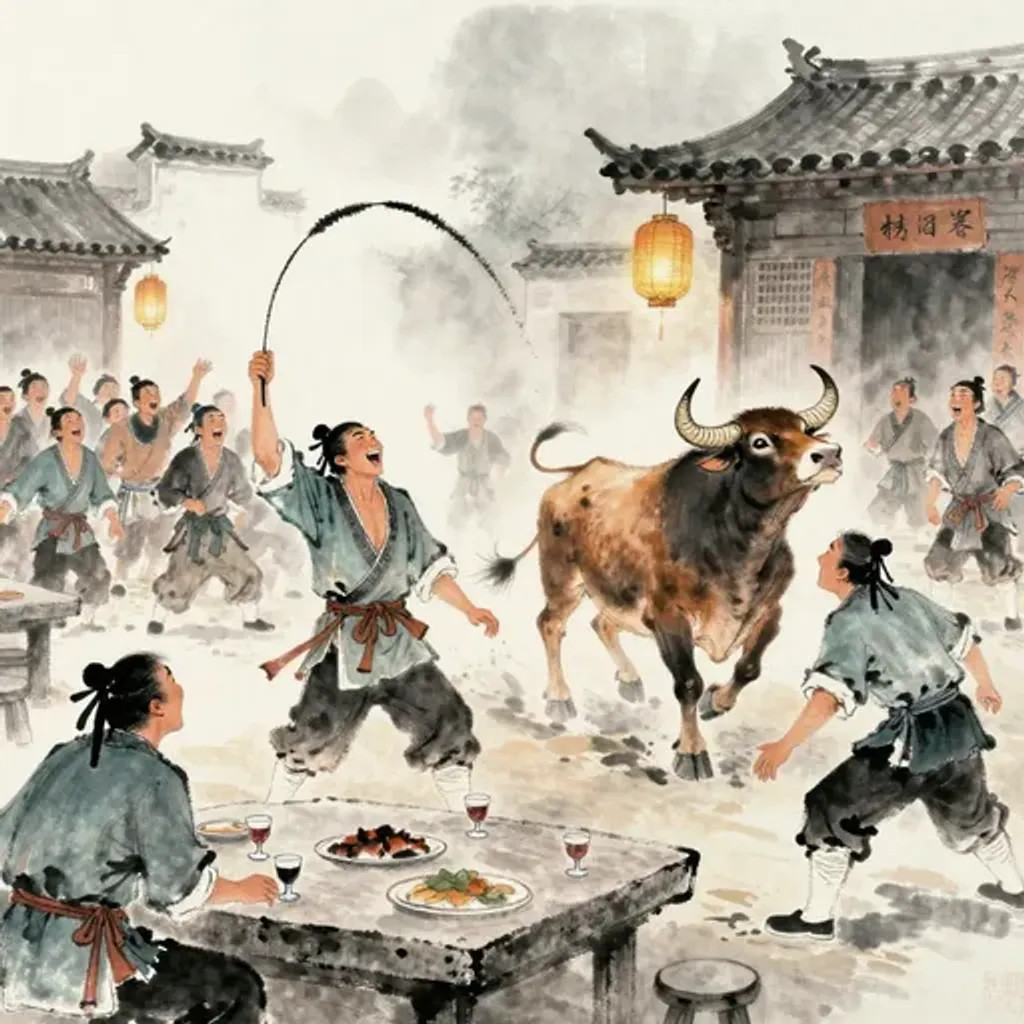
東鄉煩煩,相與笑言。子般鞭犖,圉人作患。
The eastern village bustles and hums; together they laugh and speak. Prince Ban whips the brindled bull; the groom brings calamity.
— Jiao Yanshou, Yilin (Forest of Changes), 1st century BC
Commentary
Lake over wind yields to heaven above wind — Coming to Meet, the unexpected encounter. In the eastern village, people bustle merrily, laughing and chatting together. Then Prince Ban flogs the stableman Luo, and the groom becomes the source of disaster. According to the Zuo Zhuan, Prince Ban (子般) was the heir of Duke Zhuang of Lu. When Luo, a powerful stableman, behaved improperly, Ban had him whipped. Duke Zhuang warned that such a man should be killed outright or left alone — half-measures breed vengeance. After the Duke's death, Qingfu (庆父) sent the aggrieved Luo to assassinate Ban. From Great Exceeding to Coming to Meet, the uninvited encounter proves fatal. A chance meeting with an inferior force, handled with excess rather than decisiveness, returns as the instrument of murder.
大過 → 萃
Hexagram 28 → Hexagram 45: Gathering Together
Changing lines: 2, 3
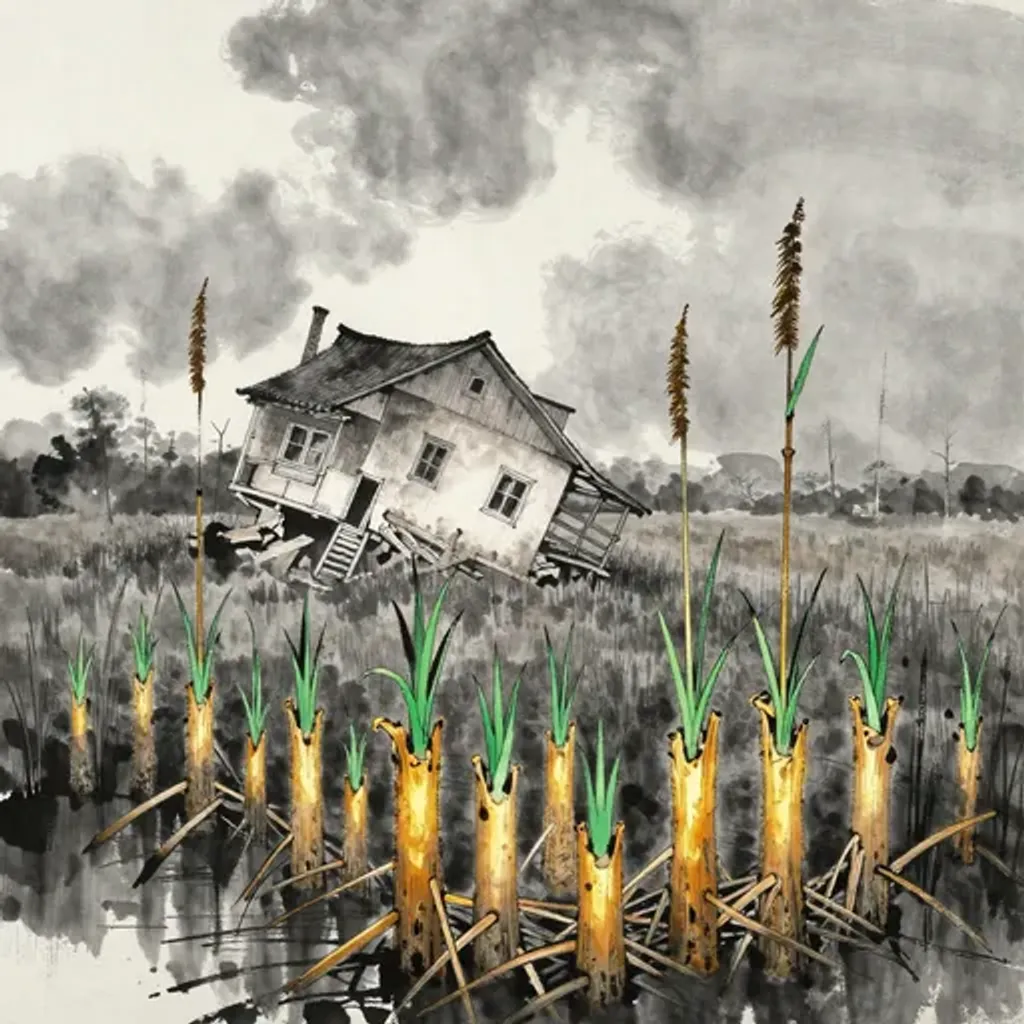
鼻移在頭,枯葦復生。下朽上榮,家乃不寧。其金不成。
The nose moves to the head; withered reeds live again. Below rots, above flourishes; the household finds no peace. Its gold is never perfected.
— Jiao Yanshou, Yilin (Forest of Changes), 1st century BC
Commentary
Lake over wind descends into lake above earth — Gathering, the assembling of people and resources. The nose has moved to the top of the head; withered reeds grow again. Below they rot while above they flourish — the household is uneasy, and the metal does not set. The verse presents a world of grotesque inversion: a nose displaced to the skull, dead reeds reviving only at the crown while the roots decay. This is not renewal but monstrous distortion — life appearing where it should not, death persisting at the foundation. From Great Exceeding to Gathering, the sagging beam attempts to collect its broken pieces. But the gathering is malformed: what assembles is incoherent, with growth in the wrong places and decay at the base. The household's unease and failed metallurgy confirm that this assembly lacks the structural integrity to hold.
大過 → 升
Hexagram 28 → Hexagram 46: Pushing Upward
Changing lines: 4, 5
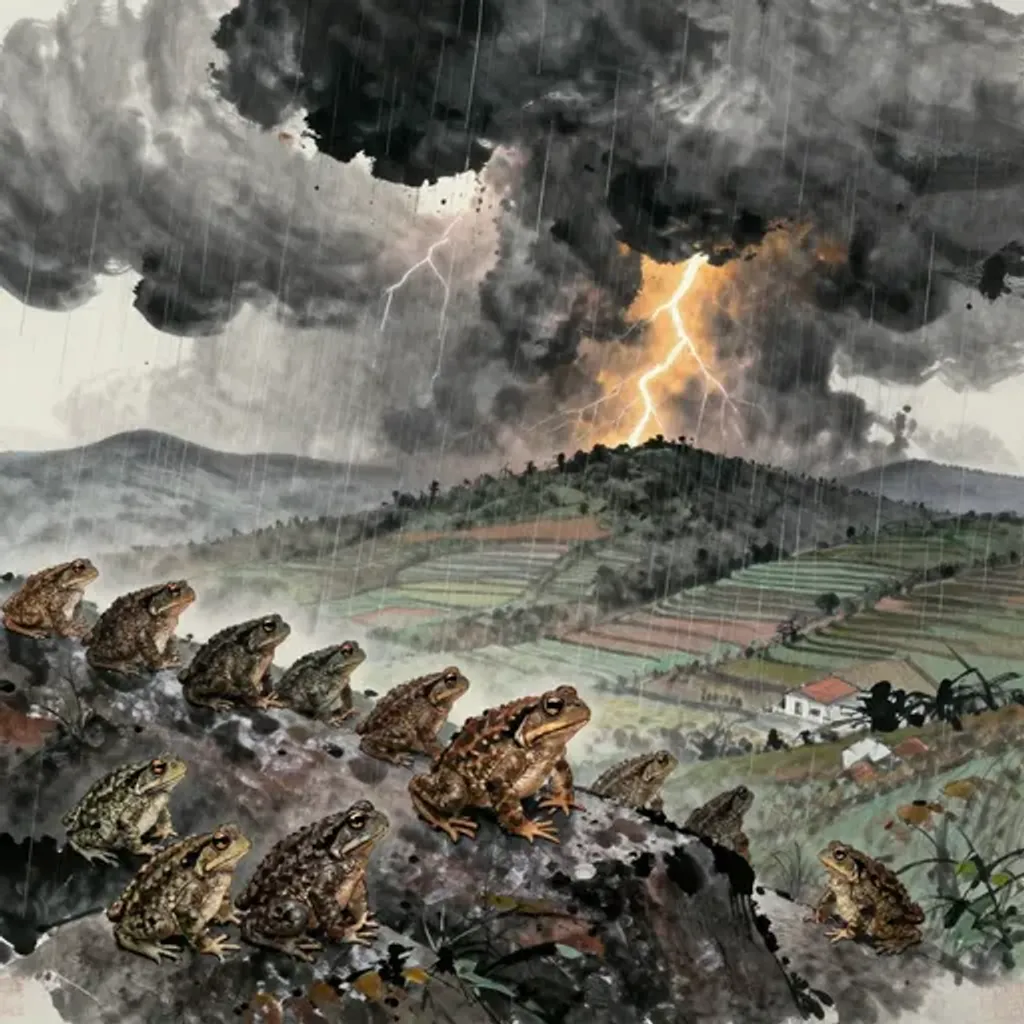
蝦䗫群聚,從天請雨。雲雷疾聚,應時輒下。得其願所。
Toads gather in a swarm; from heaven they petition for rain. Clouds and thunder quickly mass; at the right moment it pours down. Their wish is obtained.
— Jiao Yanshou, Yilin (Forest of Changes), 1st century BC
Commentary
Lake over wind rises into earth above wind — Pushing Upward, the gradual ascent of wood through earth. Toads gather in swarms and pray to heaven for rain. Clouds and thunder assemble swiftly, and the rain falls in answer at the appointed time. One's wish is granted. The verse presents a charming folk image: toads massing together, their collective croaking a prayer to the sky, and heaven responding with timely rain. The correspondence between petition and response is immediate and satisfying. From Great Exceeding to Pushing Upward, the waterlogged beam dries as moisture is redistributed properly. What was excess becomes nourishment when channeled through the earth. The toads' prayer succeeds because it aligns with nature's own rhythm — Pushing Upward's patient, organic growth, not forced but invited by collective effort.
大過 → 困
Hexagram 28 → Hexagram 47: Oppression
Changing lines: 3
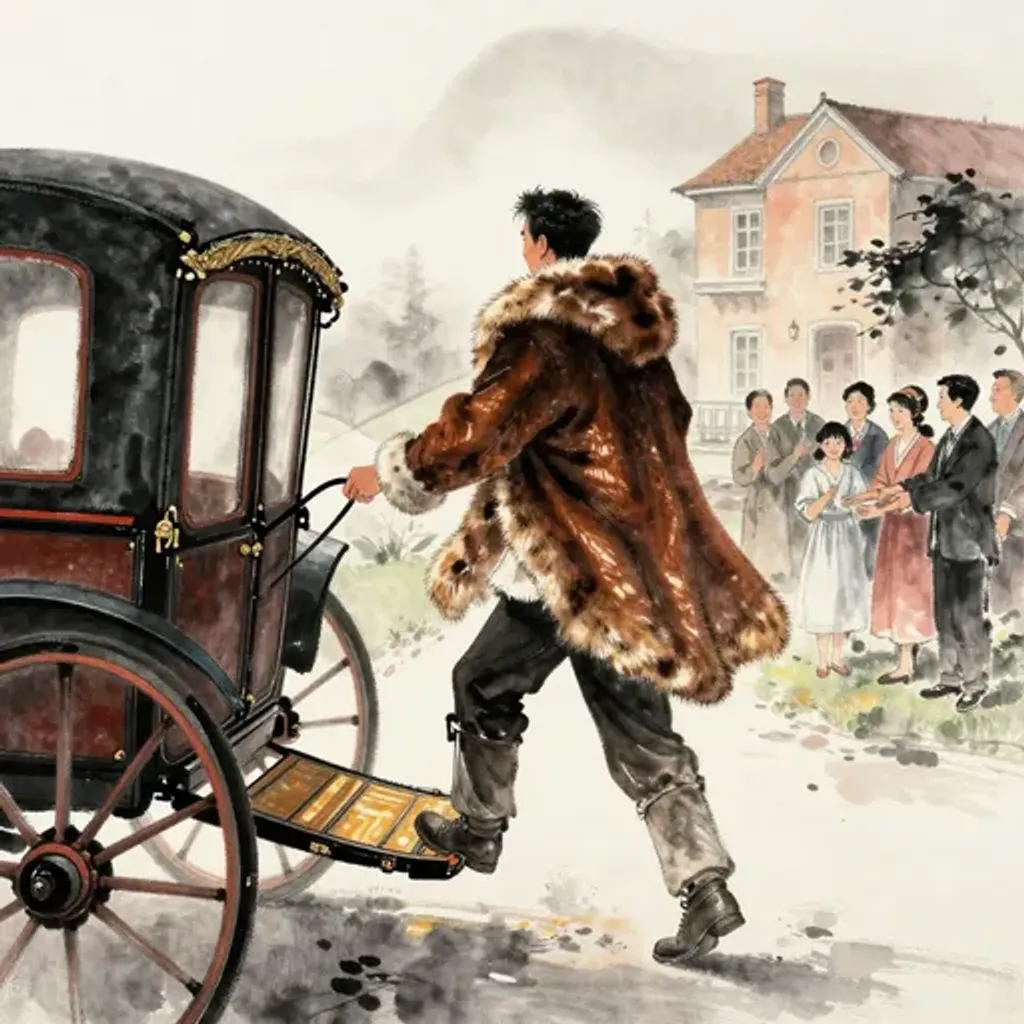
大步上車,南到喜家。送我貂裘,與福載來。
With a great stride he mounts the carriage; south he goes to the joyful house. They present me a sable coat; blessings ride home with me.
— Jiao Yanshou, Yilin (Forest of Changes), 1st century BC
Commentary
Lake over wind meets lake above water — Oppression, where resources are exhausted and the lake runs dry. Yet the verse is surprisingly joyful: one strides confidently onto the carriage, heading south to a happy household. A fur coat is presented as a gift, and blessings arrive alongside. Despite the target hexagram's name, the verse reads as a gift-giving celebration — the sable coat a sign of wealth and generosity, the southern journey ending in warmth and welcome. From Great Exceeding to Oppression, the overburdened beam meets the drained lake. But the verse suggests that sometimes what appears as oppression is actually the necessary emptying that makes room for new abundance. The traveler arrives at a happy house precisely because he left his own collapsing one behind.
大過 → 井
Hexagram 28 → Hexagram 48: The Well
Changing lines: 4
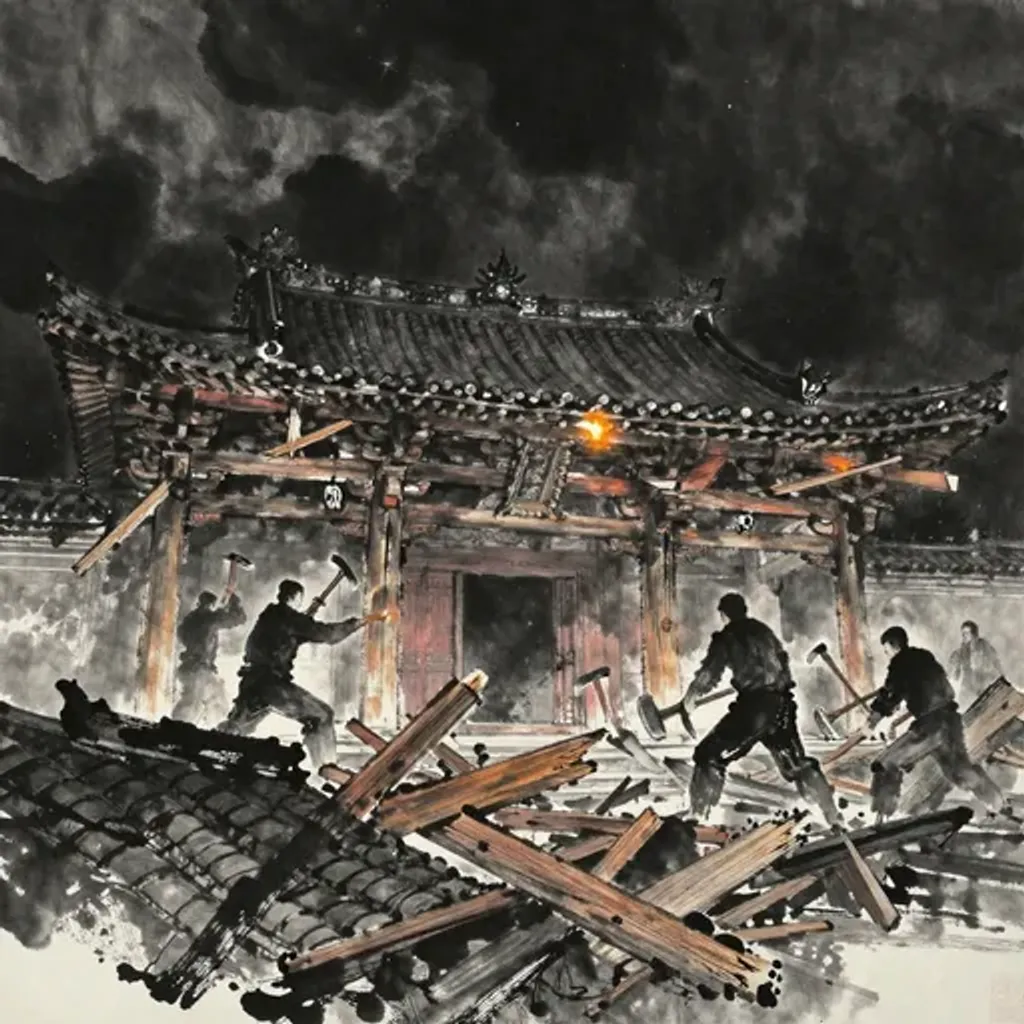
賊仁傷德,天怒不福。斬刈宗社,失其宇守。
He harms benevolence and wounds virtue; heaven rages and withholds its blessing. The ancestral shrine is hewn and cut down; he loses his domain and guardianship.
— Jiao Yanshou, Yilin (Forest of Changes), 1st century BC
Commentary
Lake over wind sinks into water above wind — the Well, the inexhaustible source that nourishes the community. One who harms benevolence and wounds virtue provokes heaven's anger; blessings cease. Ancestral shrines are cut down, and the guardian of the domain loses his realm. The verse is a moral indictment: when the ruler destroys the very foundations of virtue, heaven withdraws its mandate, the altars are razed, and the state collapses. The Well's image — water drawn up through wood — depends on the integrity of the mechanism. From Great Exceeding to the Well, the overburdened structure should find renewal in the deep source below. But a ruler who 'harms benevolence and wounds virtue' has poisoned the well itself. No amount of structural support can save a community whose moral source is corrupted at its origin.
大過 → 革
Hexagram 28 → Hexagram 49: Revolution
Changing lines: 1, 2

從猬見虎,雖危不殆。終已無咎。
Following the hedgehog, one meets the tiger; though perilous, it is not deadly. In the end there is no blame.
— Jiao Yanshou, Yilin (Forest of Changes), 1st century BC
Commentary
Lake over wind meets lake above fire — Revolution, the decisive transformation of the old order. Following the hedgehog, one encounters a tiger. Though perilous, one is not truly endangered; in the end there is no blame. The hedgehog-tiger pairing recalls the 'hedgehog as Gongcao' motif: the small, well-armored creature that can subdue the great predator. Here, 'following the hedgehog' means adopting its defensive strategy — presenting an impregnable exterior to the tiger's aggression. Revolution demands courage, but not recklessness; the hedgehog's approach to the tiger is to stand firm rather than attack. From Great Exceeding to Revolution, the collapsing structure is remade. The encounter with the tiger is the crisis that Revolution requires, and the hedgehog's method — endurance through defense — is how the transformation is survived.
大過 → 鼎
Hexagram 28 → Hexagram 50: The Cauldron
Changing lines: 5, 6
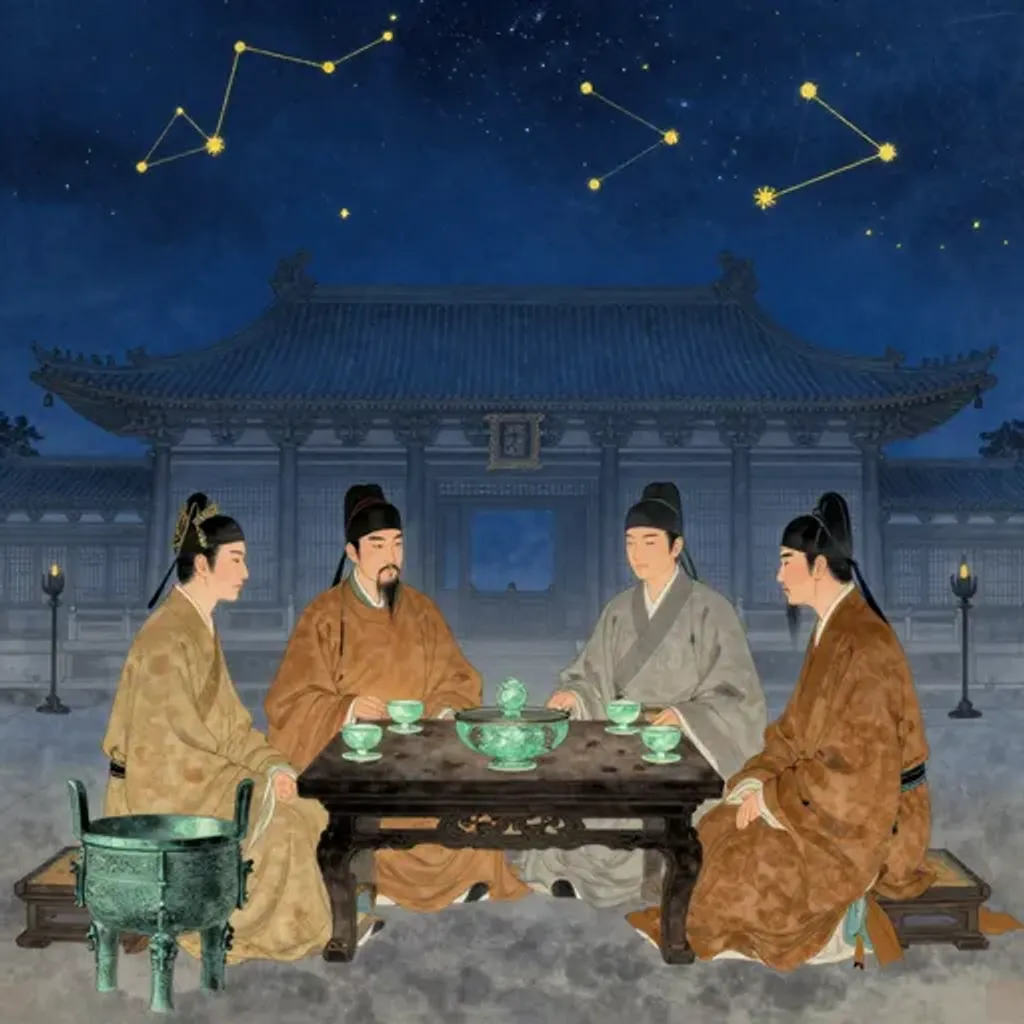
履素行德,卒蒙祐福。與堯侑食,君子有息。
Treading plainly, practicing virtue; at last he receives protection and blessing. Dining at Yao’s side; the noble man finds rest.
— Jiao Yanshou, Yilin (Forest of Changes), 1st century BC
Commentary
Lake over wind transforms into fire above wind — the Cauldron, vessel of civilized transformation. Walking in plainness and practicing virtue, one ultimately receives heaven's blessing and protection. Dining alongside Emperor Yao himself, the gentleman finds repose. The verse invokes Yao, the sage-king par excellence, as the ultimate dining companion — sharing a meal with the embodiment of perfect governance. 'Walking in plainness and practicing virtue' echoes the Zhongyong's teaching that the Way begins in common conduct. The Cauldron's image — fire over wood — cooks raw material into nourishment, just as virtue refines character into worthiness. From Great Exceeding to the Cauldron, the collapsing beam is replaced by the sacrificial vessel. What was structural failure becomes civilized transformation: excess refined into offering, burden transmuted into blessing.
大過 → 震
Hexagram 28 → Hexagram 51: The Arousing Thunder
Changing lines: 1, 2, 3, 5
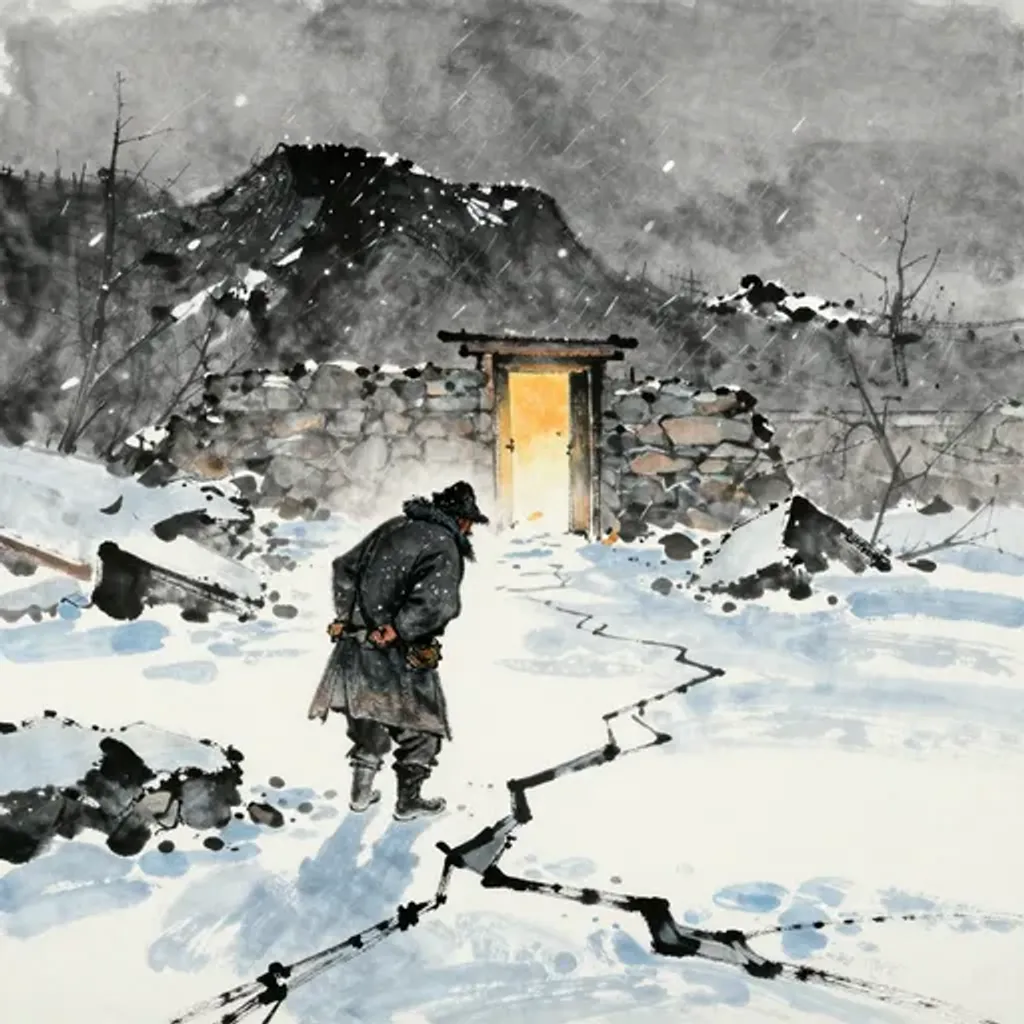
利在北陸。寒苦難得。憂危之患,福為道門。商叔生存。
Profit lies in the northern wastes; cold and bitter, hard to obtain. Perilous worry and dread; fortune becomes the gate of the Way. Shang Shu survives.
— Jiao Yanshou, Yilin (Forest of Changes), 1st century BC
Commentary
Lake over wind erupts into doubled thunder — the Arousing, the shock that stirs renewal. Profit lies in the northern quarter, cold and hard to obtain. Worry and peril threaten, yet fortune becomes the gateway of the Way. The Shang uncle survives. 'The northern quarter' (北陸) is the winter sun's position, the place of maximum cold and hardship. The 'Shang uncle' (商叔) may refer to the Viscount of Wei (Weizi), the Shang prince who survived the dynasty's fall and was enfeoffed at Song. His survival through terrible upheaval embodies the verse's arc: peril does not destroy but leads to fortune's door. From Great Exceeding to the Arousing, the collapsing beam meets the double thunderclap. Shock upon shock — yet within the tremor, the survivor finds the Way.
大過 → 艮
Hexagram 28 → Hexagram 52: Keeping Still Mountain
Changing lines: 2, 4, 5, 6
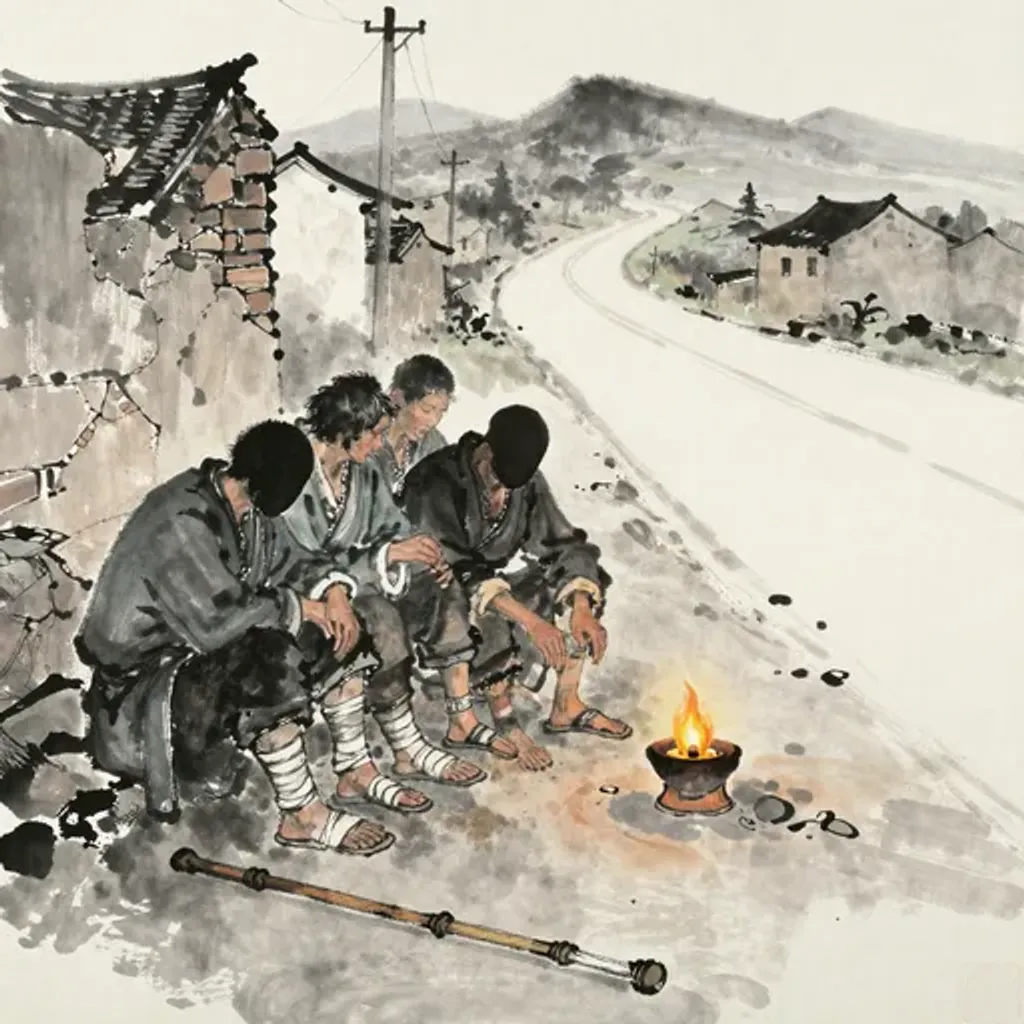
四蹇六盲,足痛難行。終日至暮,不離其鄉。
Four are lame, six are blind; feet ache, walking is hard. All day until dusk; they do not leave their village.
— Jiao Yanshou, Yilin (Forest of Changes), 1st century BC
Commentary
Lake over wind stiffens into doubled mountain — Keeping Still, absolute cessation of movement. Four are lame and six are blind; feet ache and walking is impossible. From dawn to dusk, one never leaves one's village. The verse is the extreme of immobility: physical disability rendering all travel impossible, the world shrinking to the boundaries of one's own hamlet. Keeping Still's image — twin mountains — represents the decision not to move, but here the stillness is enforced rather than chosen. From Great Exceeding to Keeping Still, the collapsing beam freezes in place. What was dynamic excess becomes static imprisonment. The four lame and six blind may allude to the ten lines of a doubled hexagram, all incapacitated — a system so completely locked that nothing within it can shift.
大過 → 漸
Hexagram 28 → Hexagram 53: Development
Changing lines: 2, 4, 6
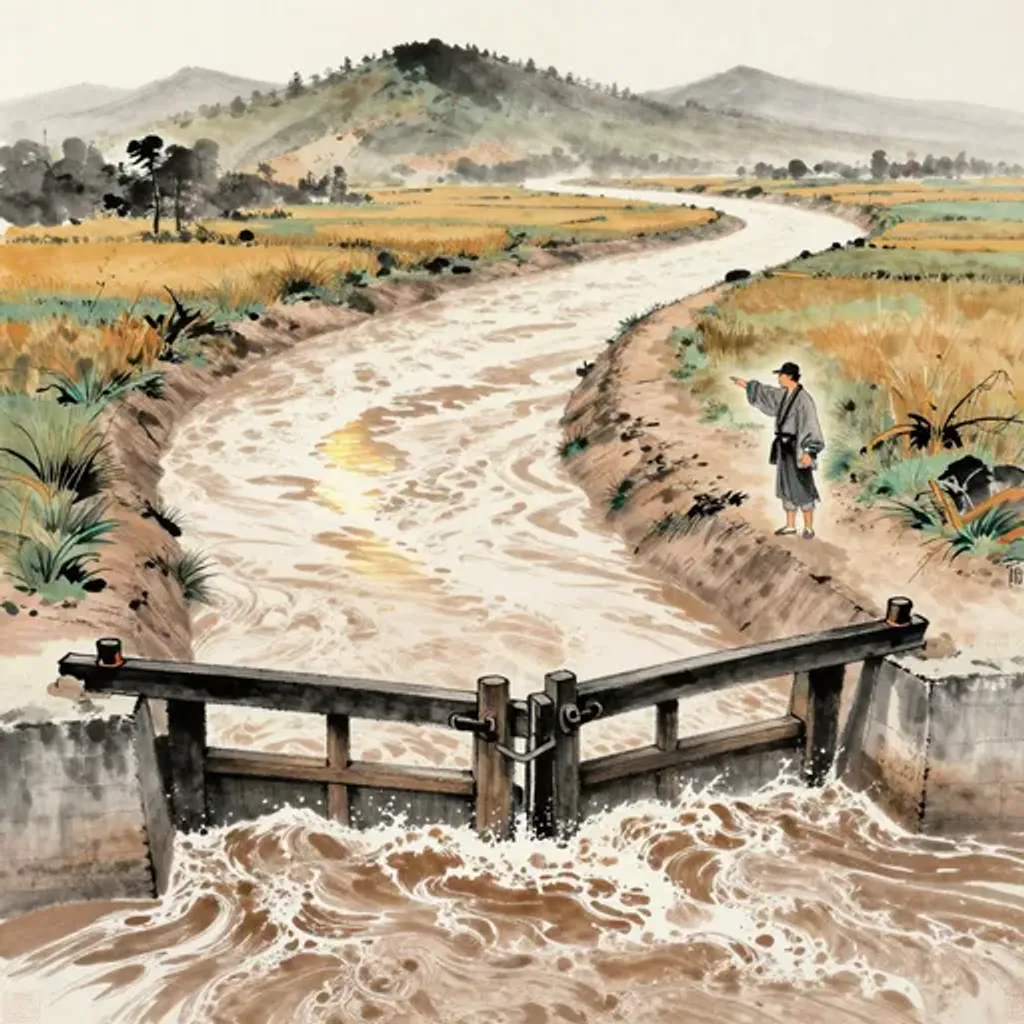
臺駘昧子,明知地理。障澤宣流,封君河水。
Taitai’s wise son; clearly he knows the lay of the land. Damming marshes, directing flow; he is enfeoffed as lord of the river.
— Jiao Yanshou, Yilin (Forest of Changes), 1st century BC
Commentary
Lake over wind grows into wind above mountain — Development, the gradual progress of a tree on a mountain. Taidai, the son of Meizi, understood the principles of geography. He dammed marshes and channeled their flow, and was enfeoffed as lord of the river. According to the Zuo Zhuan (Duke Zhao, Year 1), Taidai was a descendant of Shao Hao (the Golden Sky clan). He managed the waterways of the Fen and Zhao rivers so skillfully that he was made spirit-lord of the Fen River after death. His descendants — the Shen, Si, Ru, and Huang clans — settled the region. From Great Exceeding to Development, the excess water threatening to drown everything is gradually and methodically channeled. Taidai embodies Development's principle: not fighting the flood but guiding it patiently, step by step, until the marsh becomes productive land.
大過 → 歸妹
Hexagram 28 → Hexagram 54: The Marrying Maiden
Changing lines: 1, 3, 5
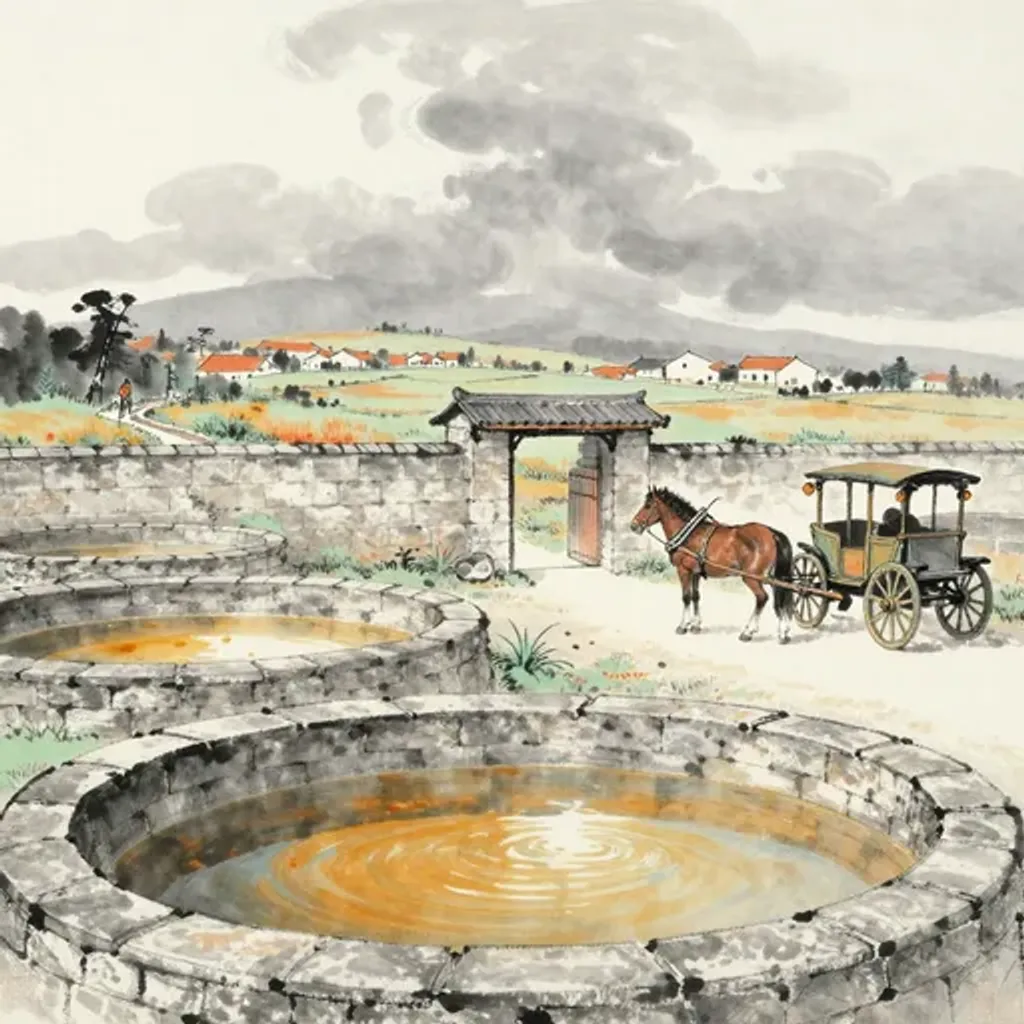
畜水得時,以備火災。柱車絆馬,郊行出旅,可以無咎。
Storing water in its season; to guard against fire’s calamity. Braking the cart, hobbling the horse; setting forth on a journey to the outskirts. Thus there may be no blame.
— Jiao Yanshou, Yilin (Forest of Changes), 1st century BC
Commentary
Lake over wind gives way to thunder above lake — the Marrying Maiden, where the younger follows the elder into an arranged match. Storing water in time of need to prepare against fire; blocking the cart and hobbling the horse for a journey to the suburbs. One may proceed without blame. The verse is about timely preparation: water stored before the fire, horses secured before travel. Each image shows foresight converting potential disaster into manageable risk. The Marrying Maiden's lesson is about accepting an imperfect arrangement and making it work through careful management. From Great Exceeding to the Marrying Maiden, the sagging beam's excess water is stored rather than feared — recast as the reserve that will extinguish future fires. Proper preparation transforms liability into resource.
大過 → 豐
Hexagram 28 → Hexagram 55: Abundance
Changing lines: 1, 2, 5
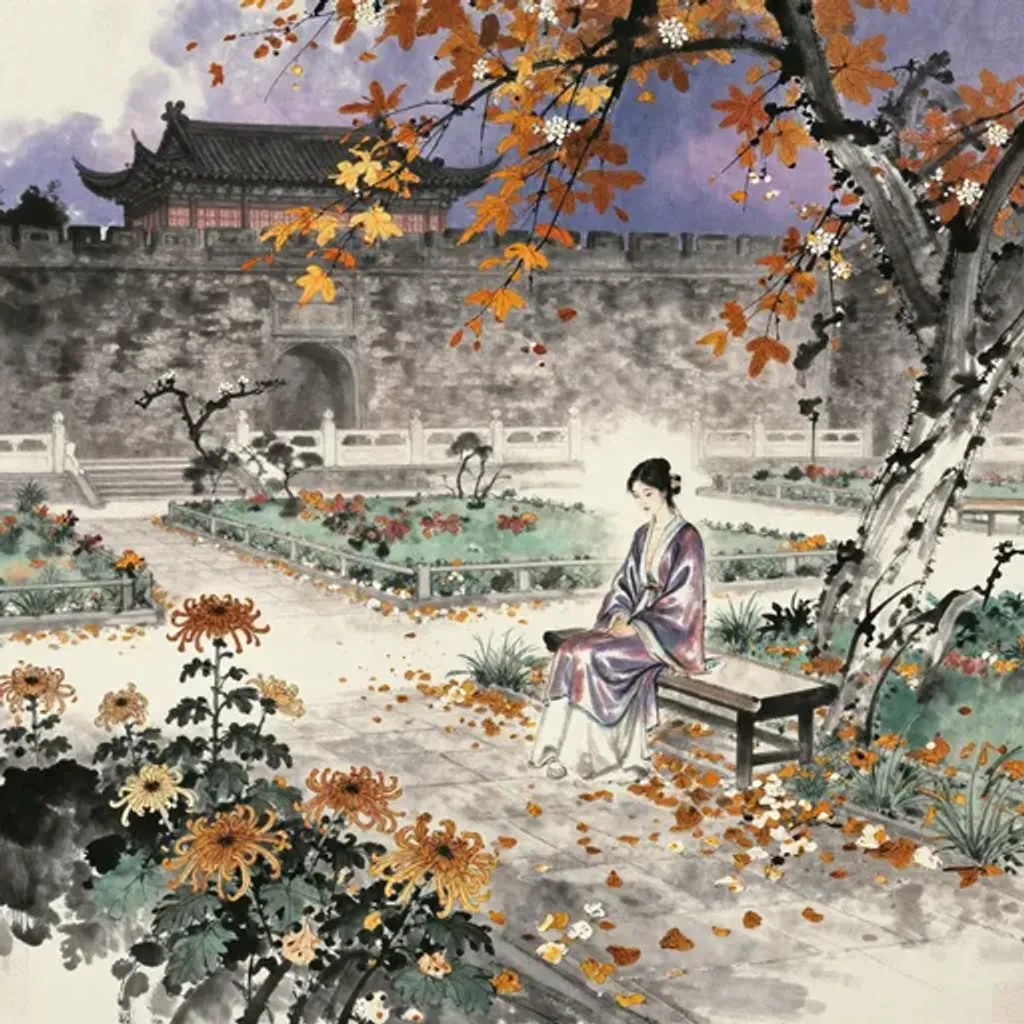
歲暮花落,君衰於德。勞寵損墜,陰奪其室。
Year’s end, blossoms fall; the lord declines in virtue. Favor toils and tumbles; yin seizes his chamber.
— Jiao Yanshou, Yilin (Forest of Changes), 1st century BC
Commentary
Lake over wind blazes into thunder above fire — Abundance, the fullness of light and power at their zenith. As the year wanes and flowers fall, the lord declines in virtue. Favor, once lavished, slips and drops away; yin usurps the chamber. The verse is a study in autumnal loss: the year past its prime, blossoms falling, the ruler's moral authority fading. 'Yin seizes the chamber' suggests a concubine or scheming subordinate displacing the legitimate order — the classic trope of inner-court subversion. Abundance's image is thunder and lightning together — maximum visibility. Yet the verse shows Abundance's shadow: when the zenith passes, decline is swift. From Great Exceeding to Abundance, excess peaks in a blaze of power, but the very brilliance of the moment accelerates the fall that follows.
大過 → 旅
Hexagram 28 → Hexagram 56: The Wanderer
Changing lines: 2, 5, 6
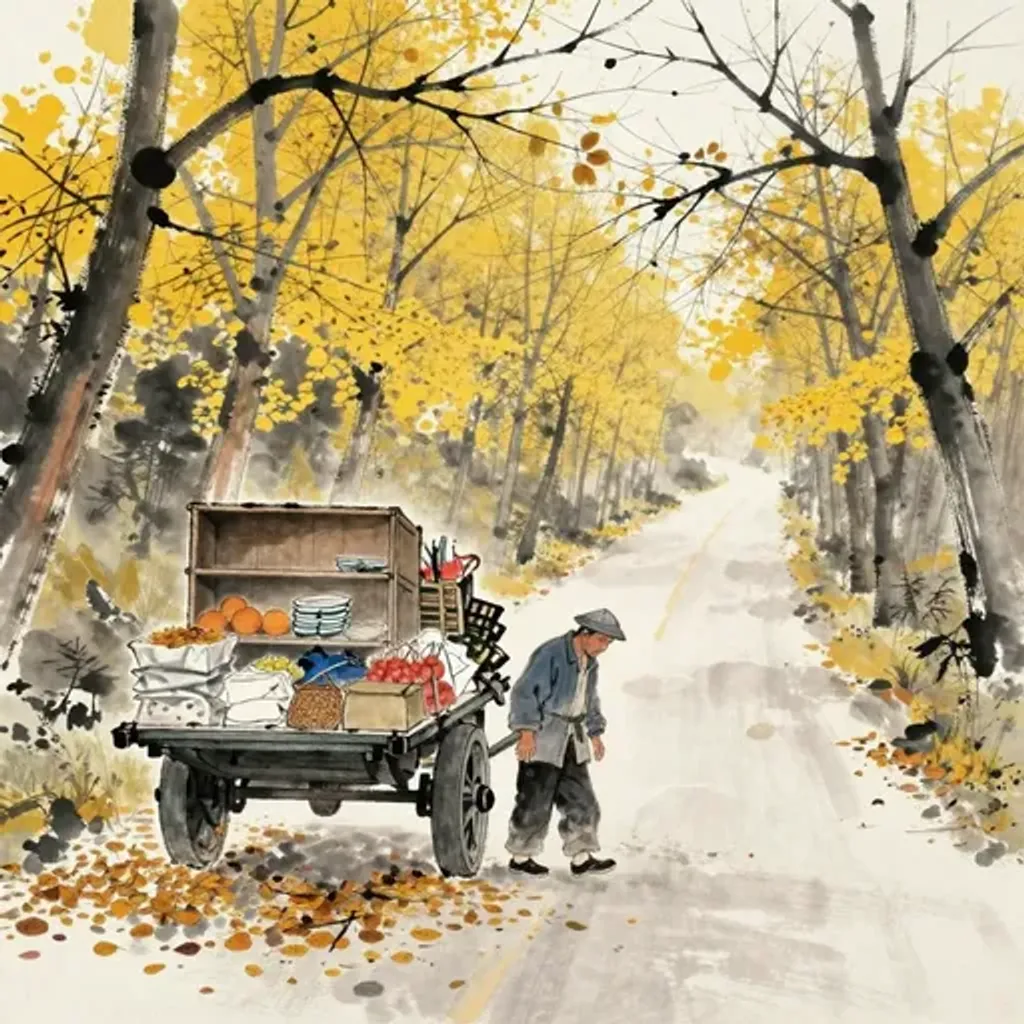
夏販蔡悲,千里為市。黃葉殪鬱,利得無有。
Trading summer goods in Cai brings grief; a thousand li to reach the market. Yellow leaves wilt and wither; profit obtained is nothing at all.
— Jiao Yanshou, Yilin (Forest of Changes), 1st century BC
Commentary
Lake over wind wanders into fire above mountain — the Wanderer, homeless and dependent on strangers. Selling summer goods and mourning firewood from Cai, one travels a thousand li to trade. Yellow leaves wilt and wither; no profit is found. The verse depicts a long-distance merchant whose enterprise fails: goods carried a thousand miles yield nothing, and the leaves — perhaps a metaphor for his wares or his own vitality — turn yellow and die. The mention of Cai (蔡) may simply denote a place of trade, but 'mourning' (悲) attached to it colors the commerce with grief. From Great Exceeding to the Wanderer, the collapsed home forces one onto the road. The Wanderer's fire burns atop the mountain but warms nothing — the merchant's thousand-mile journey ends in empty hands and withered hopes.
大過 → 巽
Hexagram 28 → Hexagram 57: The Gentle Wind
Changing lines: 4, 6
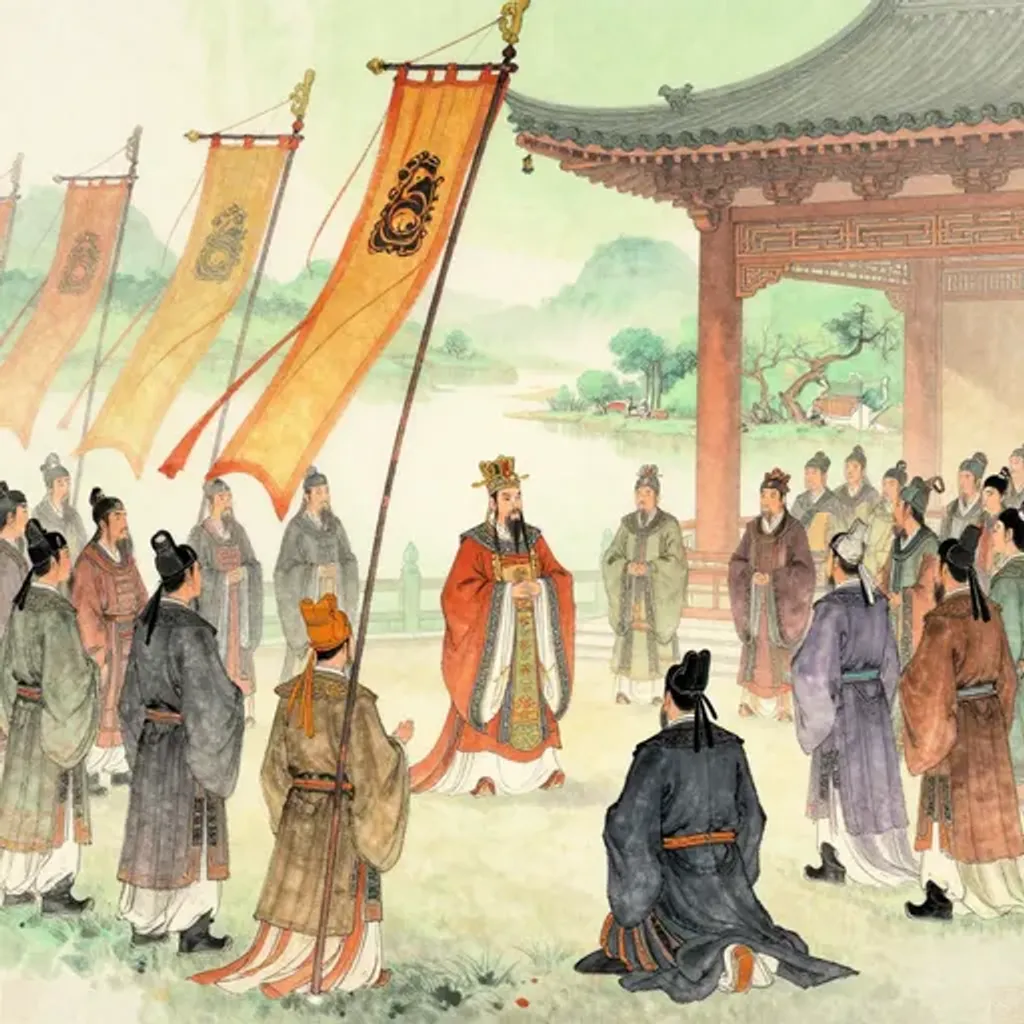
仲春巡狩,東見群后。昭德允明,不失其所。
In mid-spring he tours and inspects; eastward he meets the assembled lords. Radiant virtue, sincere and bright; none loses his rightful place.
— Jiao Yanshou, Yilin (Forest of Changes), 1st century BC
Commentary
Lake over wind dissolves into doubled wind — the Gentle, where commands are issued and repeated until they penetrate. In the second month of spring, the sovereign undertakes his inspection tour and meets the assembled lords in the east. His luminous virtue is clear and trustworthy; nothing loses its proper place. The verse alludes to the royal inspection tours described in the 'Shun Dian' chapter of the Book of Documents: Emperor Shun traveled east in the second month to sacrifice at Mount Dai and receive the feudal lords. The tour enforced cosmic order by verifying that local practices matched the calendar and standards of the center. From Great Exceeding to the Gentle, the overburdened structure is restored through repeated, penetrating attention. Wind upon wind: the sovereign's virtue, like wind, reaches every corner of the realm through patient, persistent visitation.
大過 → 兌
Hexagram 28 → Hexagram 58: The Joyous Lake
Changing lines: 1, 3
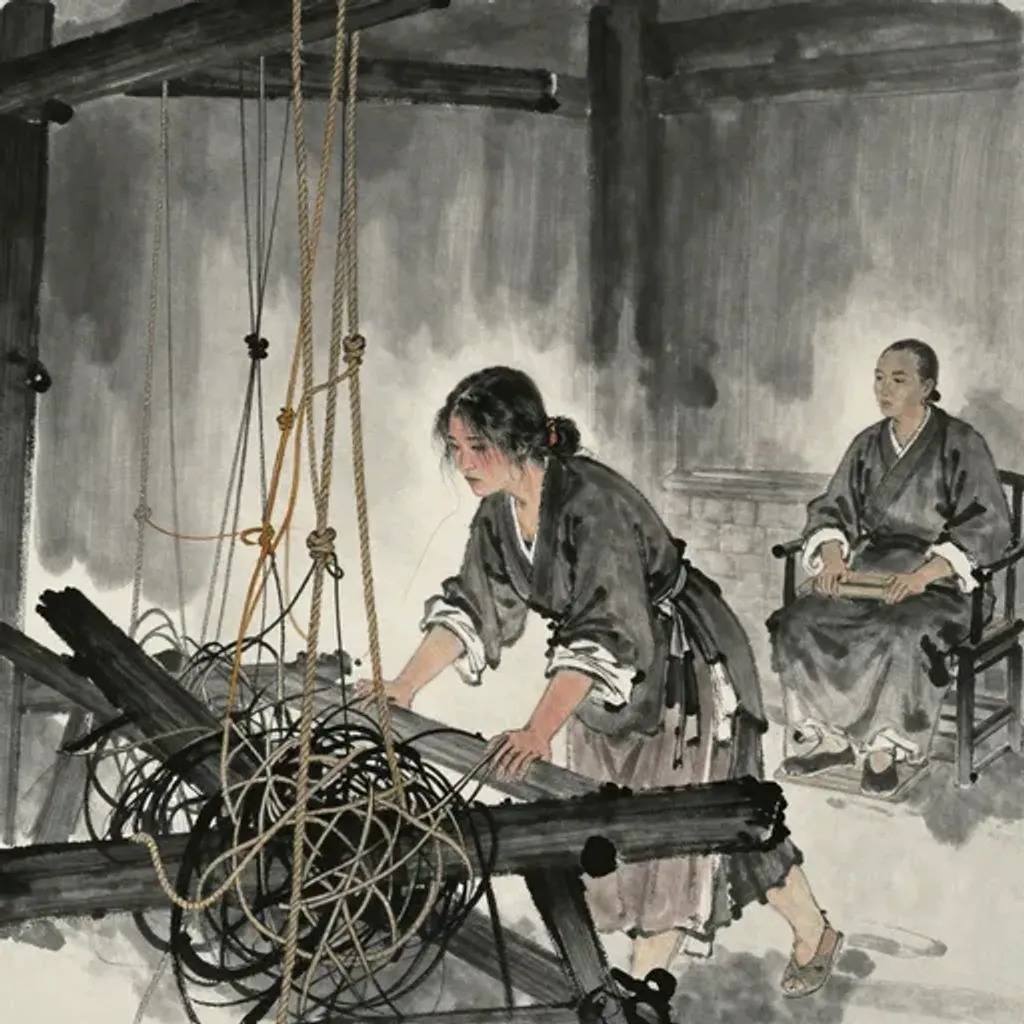
栵潔縲縲,結締難解。嫫母衒嫁,媒不得坐,自為身禍。
Thorns tangled, cords knotted; tied tight and hard to loosen. Momo hawks herself for marriage; the matchmaker cannot even sit. She brings disaster on herself.
— Jiao Yanshou, Yilin (Forest of Changes), 1st century BC
Commentary
Lake over wind meets doubled lake — the Joyous, where openness and mutual delight invite exchange. Branches are stripped and bound in tight tangles, knotted and impossible to undo. Lady Mo advertises herself for marriage, but the matchmaker cannot even sit down — she brings disaster upon herself. Lady Mo (嫫母) was legendarily the ugliest woman in antiquity, yet valued by the Yellow Emperor for her inner virtue. Here, however, Mo Mu 'selling herself' (衒嫁) inverts the original legend: instead of being chosen for hidden worth, she aggressively markets herself and repels everyone. The Joyous promises mutual pleasure through openness, but forced joy is its corruption. From Great Exceeding to the Joyous, excess becomes desperation — the harder one pushes for connection, the more entangled and repulsive the attempt becomes.
大過 → 渙
Hexagram 28 → Hexagram 59: Dispersion
Changing lines: 3, 4, 6
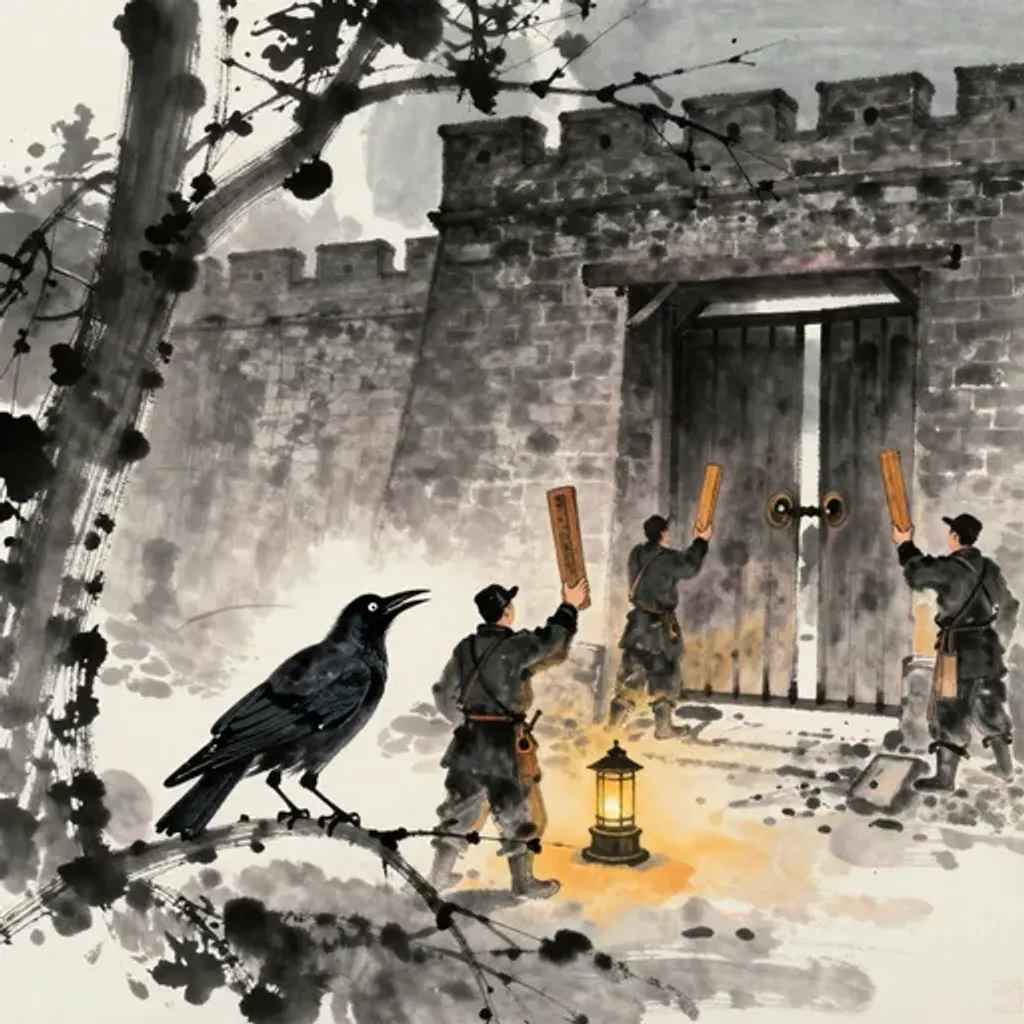
烏鳴庭中,以戒災凶。重門擊柝,備憂暴客。
The crow cries in the courtyard; to warn of calamity and misfortune. Double gates, striking the clapper; guarding against sudden intruders.
— Jiao Yanshou, Yilin (Forest of Changes), 1st century BC
Commentary
Lake over wind scatters into wind above water — Dispersion, where accumulated tension is released. A crow cries in the courtyard, warning of disaster. Double gates are shut and the watchman's clapper sounds, guarding against the sudden intruder. The crow's cry in the courtyard is a classical omen of impending calamity — an uninvited messenger from the liminal world. The response is immediate and practical: gates are doubled, the night watch intensified. 'Double gates and striking clappers' quotes the I-Ching's own Xici commentary on preparing against the unexpected. From Great Exceeding to Dispersion, the overburdened structure disperses its weight through vigilance. The crow's warning scatters complacency; the doubled gates and watchman's clapper redistribute security across every threshold. Dispersion here is not collapse but controlled distribution of defensive attention.
大過 → 節
Hexagram 28 → Hexagram 60: Limitation
Changing lines: 1, 3, 4
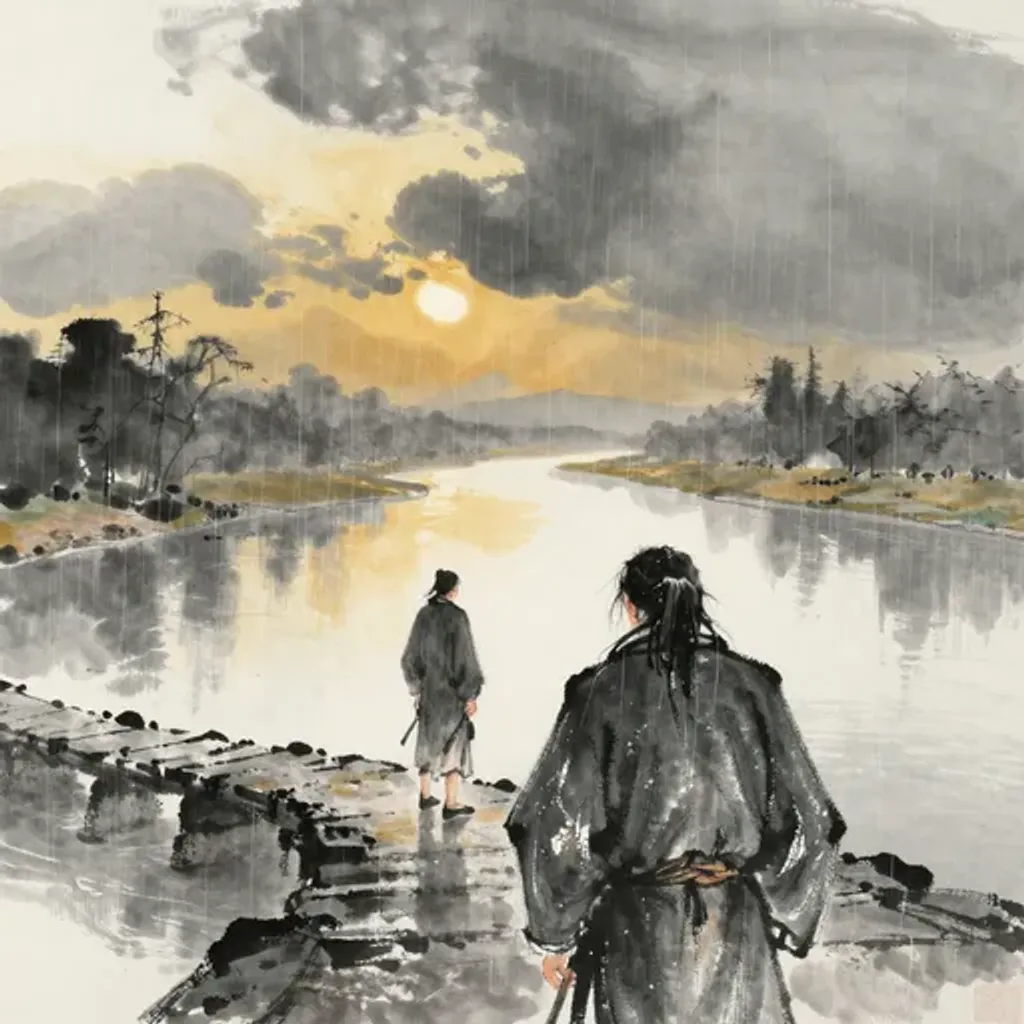
朝霽暮霞,瀸我衣襦。退無得牛。
Morning clears, evening glows; the drizzle soaks my coat and shirt. Retreating, no ox is found.
— Jiao Yanshou, Yilin (Forest of Changes), 1st century BC
Commentary
Lake over wind hardens into water above lake — Limitation, the principle of measured restraint. Morning mist clears into evening glow, but the moisture seeps through and soaks one's jacket. On returning, there is no ox to be found. The verse is spare and melancholy: a day of shifting weather — dawn brightness giving way to dampness — and a loss discovered upon return. The soaked garment suggests exposure to elements one cannot control; the missing ox, a livelihood vanished without explanation. Limitation's image is water atop the lake — excess checked by a containing boundary. But the verse shows limitation's cost: the boundary that conserves also restricts, and what is lost within the limits cannot be recovered. From Great Exceeding to Limitation, excess is trimmed, but the cutting is not painless.
大過 → 中孚
Hexagram 28 → Hexagram 61: Inner Truth
Changing lines: 1, 3, 4, 6
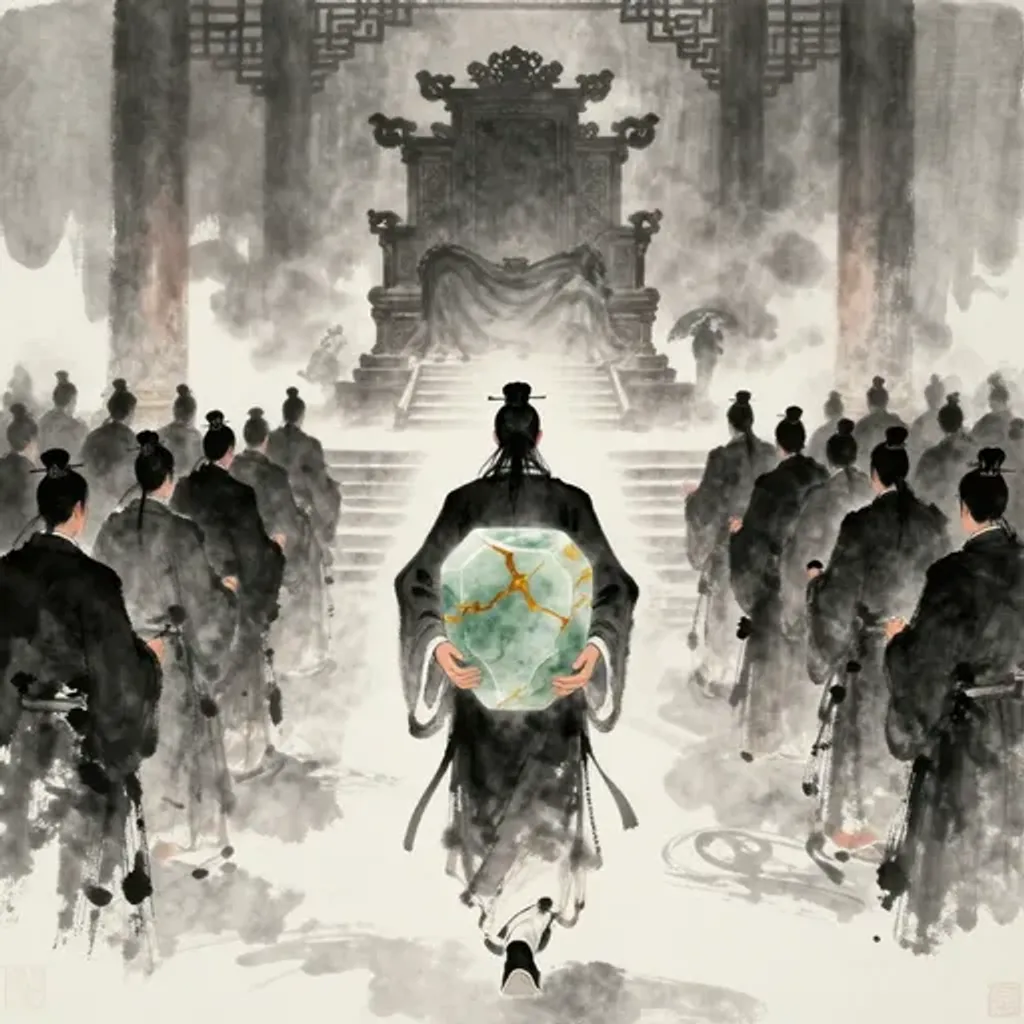
抱璞懷玉,與桀相觸。詘坐不中,道無良人。
Embracing the uncarved jade; he collides with the tyrant Jie. Bent low, he sits off-center; the road has no good companion.
— Jiao Yanshou, Yilin (Forest of Changes), 1st century BC
Commentary
Lake over wind meets wind above lake — Inner Truth, sincerity that moves even pigs and fishes. One embraces uncut jade and carries a precious gem, but collides with the tyrant Jie. Crouching and unable to sit upright, the Way finds no worthy person. The uncut jade (璞) and hidden gem (玉) represent innate virtue unrecognized — the Bian He archetype of value that the world refuses to acknowledge. Encountering Jie, the archetypal tyrant, makes recognition impossible: true worth cannot survive in a court where reality itself is distorted. From Great Exceeding to Inner Truth, the overburdened beam should find its center through sincerity. But the verse shows sincerity confronting tyranny: inner truth exists but finds no vessel. The jade-bearer is forced to crouch because the Way has no one worthy to receive it.
大過 → 小過
Hexagram 28 → Hexagram 62: Small Exceeding
Changing lines: 2, 5
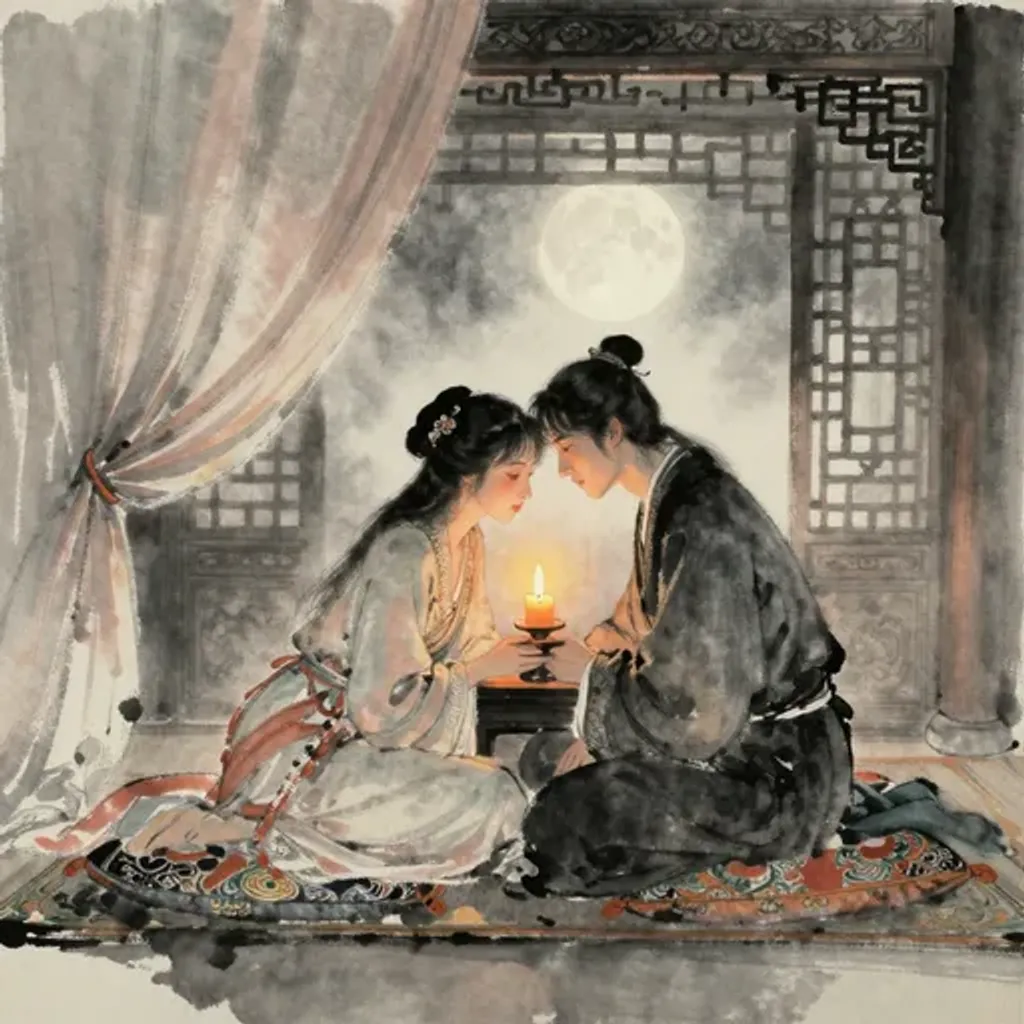
兩心相悅,共其柔筋。夙夜在公,不離房中。得君子意。
Two hearts delighting in each other; sharing their gentle tenderness. Morning and night in devoted service; they do not leave the chamber. Gaining the noble one’s favor.
— Jiao Yanshou, Yilin (Forest of Changes), 1st century BC
Commentary
Lake over wind settles into thunder above mountain — Small Exceeding, where small things succeed but great things do not. Two hearts delight in each other, sharing tender intimacy. Day and night devoted to duty, one does not leave the chamber, and wins the gentleman's favor. The verse is a love poem of quiet contentment: mutual attraction, physical closeness, and the reward of constant devotion. 'Day and night in service, never leaving the room' suggests both romantic intimacy and faithful attendance. Small Exceeding's image — a bird in flight — counsels staying low rather than soaring high. From Great Exceeding to Small Exceeding, overwhelming force is miniaturized into intimate, careful attention. The verse celebrates the small excess of devotion: not grand gestures but the steady presence that earns lasting affection.
大過 → 既濟
Hexagram 28 → Hexagram 63: After Completion
Changing lines: 1, 2, 4
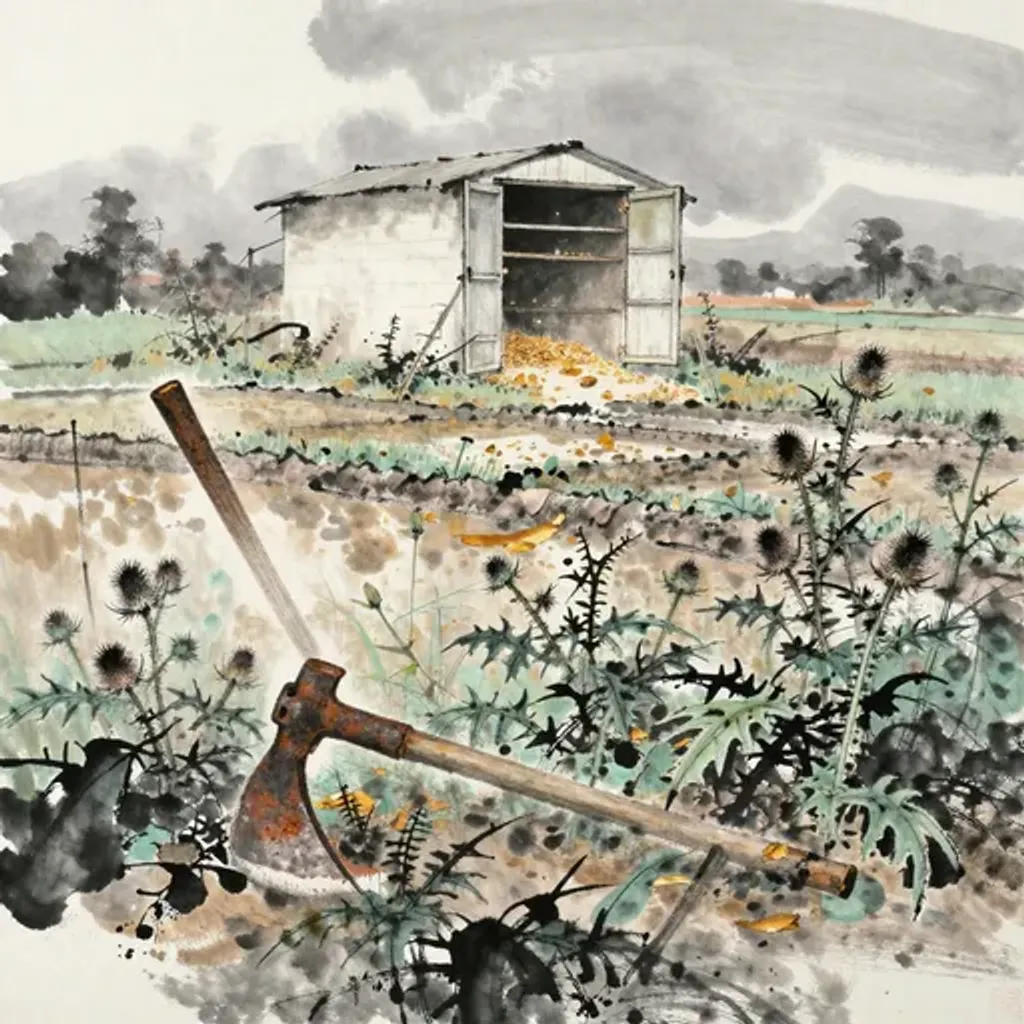
載餽如田,破鉏失食。苗穢不闢,獨飢於年。
Carrying provisions as if to the field; the hoe breaks, food is lost. Weeds choke the seedlings, uncleared; alone he starves through the year.
— Jiao Yanshou, Yilin (Forest of Changes), 1st century BC
Commentary
Lake over wind crosses into water above fire — After Completion, where every line is in its correct place yet complacency threatens. Loading provisions as if going to the fields, but the hoe breaks and the food is lost. Weeds choke the seedlings without being cleared, and one starves alone through the year. The verse describes agricultural failure at every stage: the tool breaks before work begins, weeds are left untended, and famine follows. After Completion's danger is precisely this complacency: when everything seems in order, the temptation is to neglect maintenance. From Great Exceeding to After Completion, the overburdened structure reaches apparent balance — but the hoe's breaking reveals that the equilibrium is fragile. Without constant vigilance, the completed field reverts to wilderness, and the farmer who thought the work was done starves amid his own neglected crops.
大過 → 未濟
Hexagram 28 → Hexagram 64: Before Completion
Changing lines: 3, 5, 6
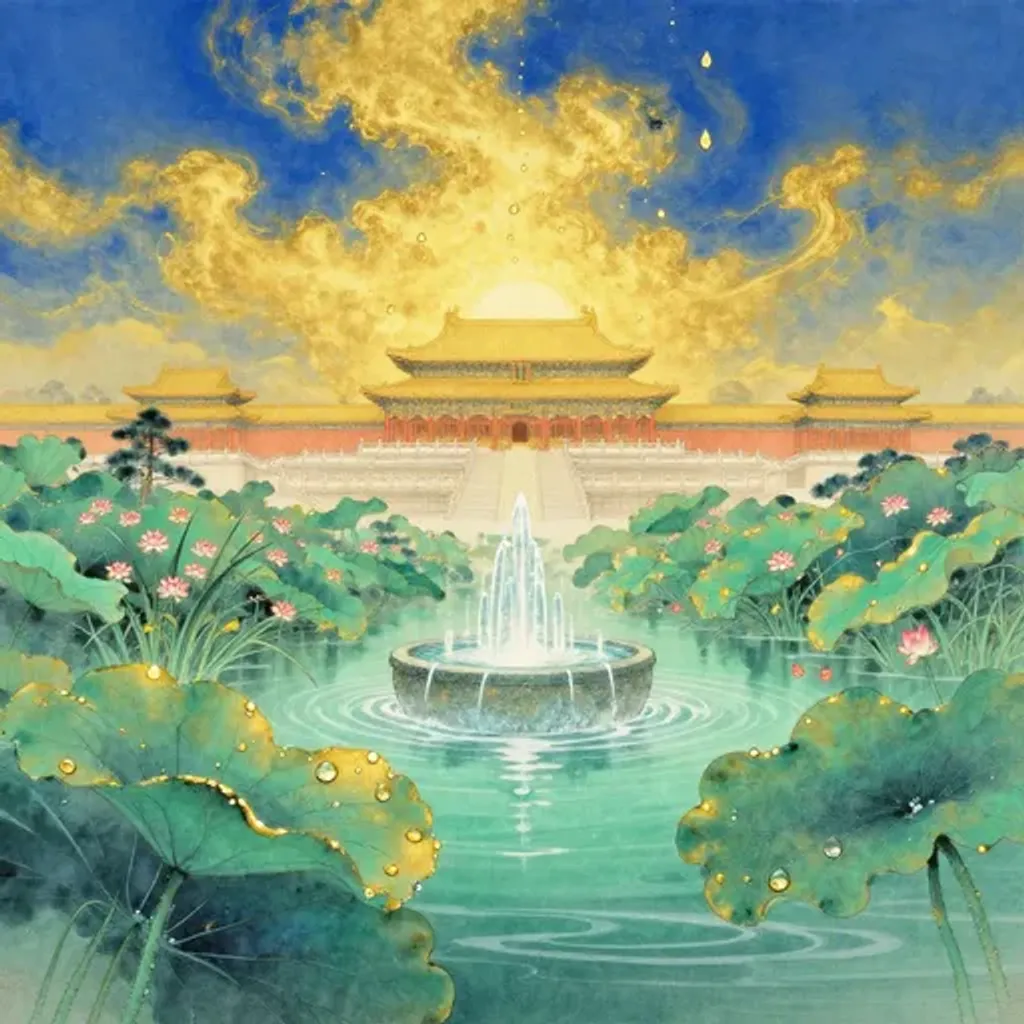
甘露醴泉,太平機關。仁德咸應,歲樂民安。
Sweet dew, the sweet spring; the fulcrum of Great Peace. Benevolent virtue is answered in kind; the years are joyful, the people at ease.
— Jiao Yanshou, Yilin (Forest of Changes), 1st century BC
Commentary
Lake over wind reaches fire above water — Before Completion, the final hexagram where the fox's tail dips in the water just before crossing. Sweet dew and sweet springs appear, the mechanism of great peace. Benevolence and virtue are answered in kind; the year is joyful and the people secure. The verse is a utopian vision: miraculous sweet dew (甘露) and sweet springs (醴泉) were auspicious omens in Han-dynasty thought, signs that heaven approved of the ruler's virtue. The 'mechanism of great peace' (太平機關) suggests the cosmic machinery operating in perfect harmony. From Great Exceeding to Before Completion, the overburdened beam reaches the threshold of a new order. Before Completion is not failure but the moment just before success — the fox nearly across the stream. The sweet dew falls as heaven's advance endorsement of a peace not yet fully achieved but already manifest in the land's bounty.