Transformations of Hexagram 10
Every line of change out of Hexagram 10 履 Treading, with the Yilin verse for each of the 64 resulting hexagrams, its translation, and the original ink brush artwork.
履 → 乾
Hexagram 10 → Hexagram 1: The Creative
Changing lines: 3
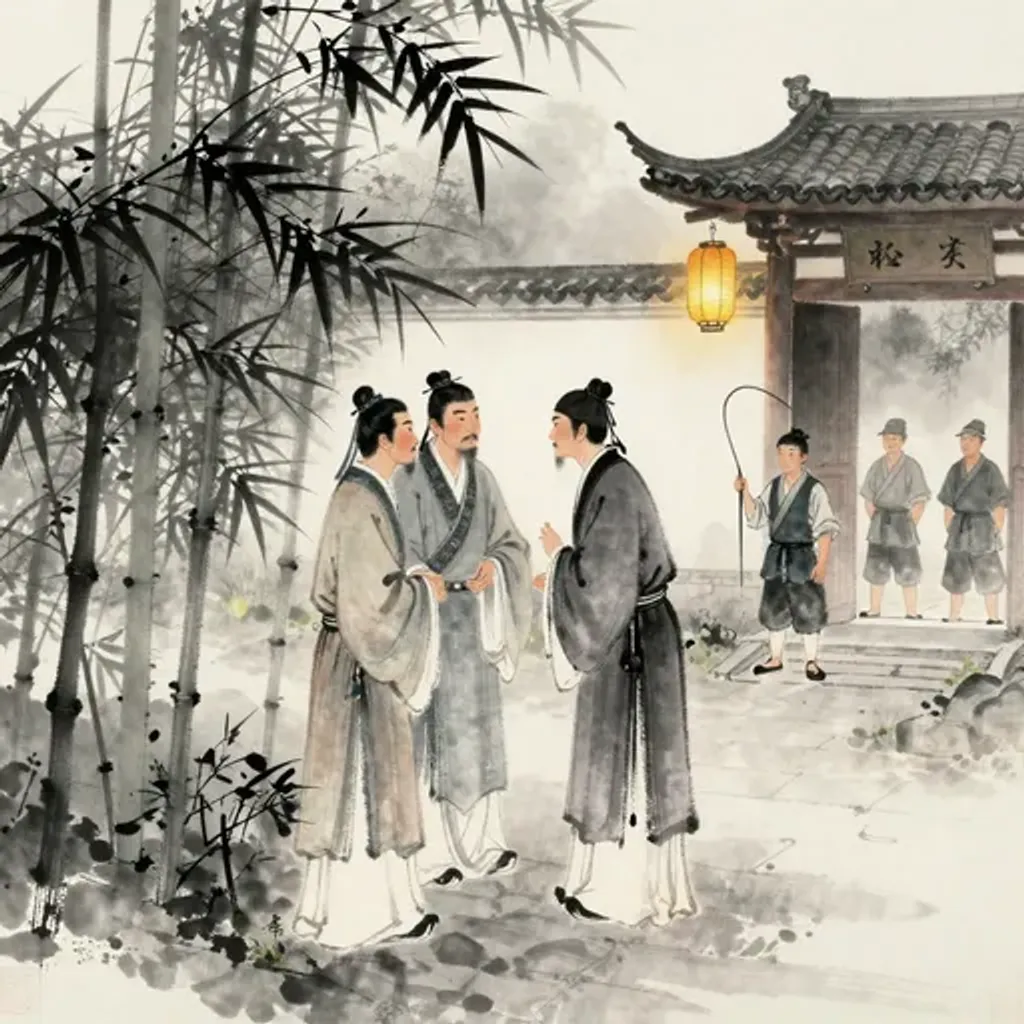
東嚮藩垣,相與笑言;子般執鞭,圉人作患。
Facing east at the wicker fence, laughing and talking together. Young Ban grasps the whip; the stable hand causes trouble.
— Jiao Yanshou, Yilin (Forest of Changes), 1st century BC
Commentary
Heaven above the lake — treading carefully upon power's edge. Eastward facing a hedge wall, people exchange laughter and pleasantries, the court seemingly at ease. But young lord Ziban holds a whip, and the groom he once punished nurses a grudge. According to the Zuo Zhuan, Ziban, heir of Duke Zhuang of Lu, flogged a palace groom named Luo for an indiscretion, not knowing that the strongman Qingfu would later weaponize that resentment. The groom assassinated Ziban at the Dang residence. From Treading to the Creative, the verse warns that careless conduct in a hierarchical world invites self-generating catastrophe: one misstep on the tiger's tail, and raw creative force devours the unwary.
履 → 坤
Hexagram 10 → Hexagram 2: The Receptive
Changing lines: 1, 2, 4, 5, 6
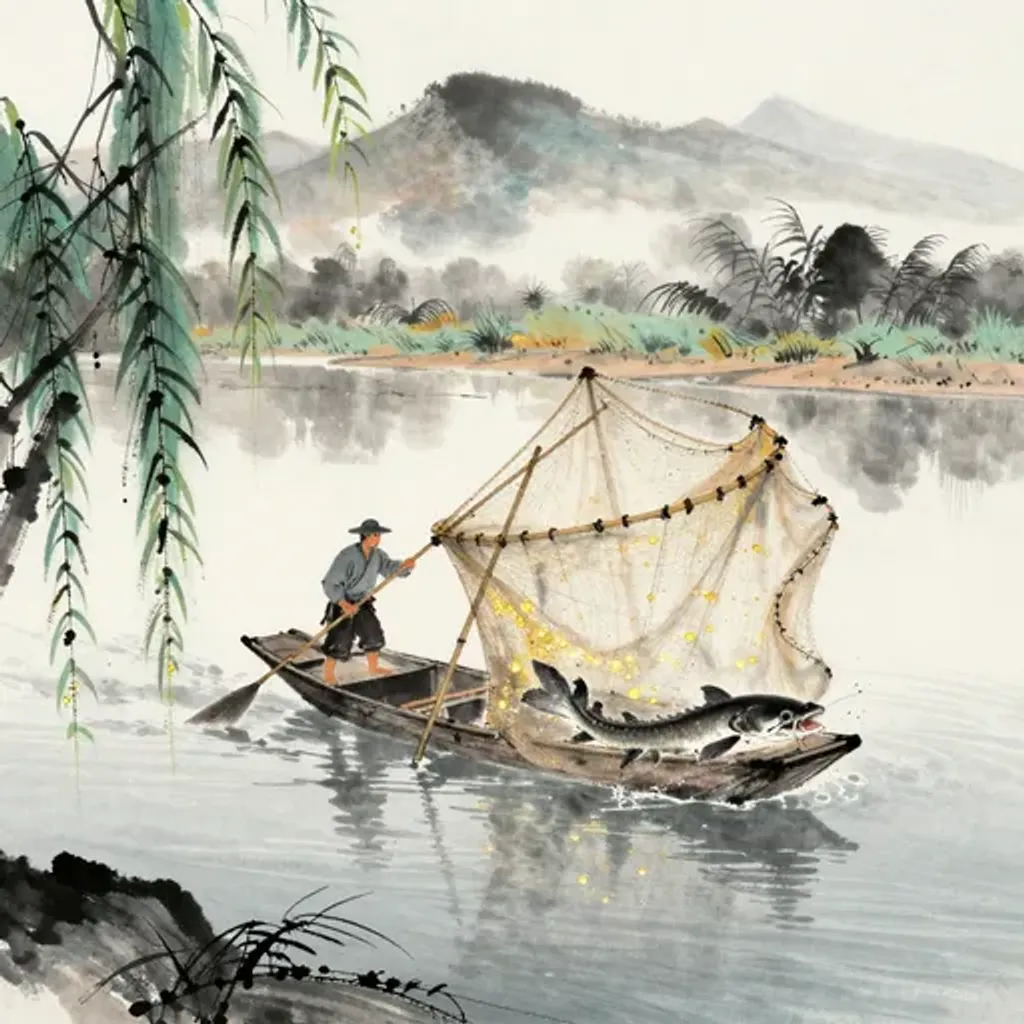
循河樀舟,旁淮東游;漁父舉網,先得大鰌。
Following the river, poling the boat; along the Huai, roaming east. The fisherman casts his net; first he catches a great catfish.
— Jiao Yanshou, Yilin (Forest of Changes), 1st century BC
Commentary
Heaven above the lake sets the scene for careful passage over uncertain waters. A traveler follows the riverbank, towing a boat, then coasts along the Huai River eastward. A fisherman casts his net and first hauls in a great catfish. The imagery is one of patient, methodical effort rewarded: treading steadily along the current, arriving at the right place, and drawing abundance from the deep. From Treading to the Receptive, the transformation suggests that disciplined conduct across dangerous terrain gives way to earth's generous yield. The lake beneath heaven finds its counterpart in earth upon earth — what was precarious becomes bountiful when one follows the natural course rather than forcing passage.
履 → 屯
Hexagram 10 → Hexagram 3: Difficulty at the Beginning
Changing lines: 2, 4, 6
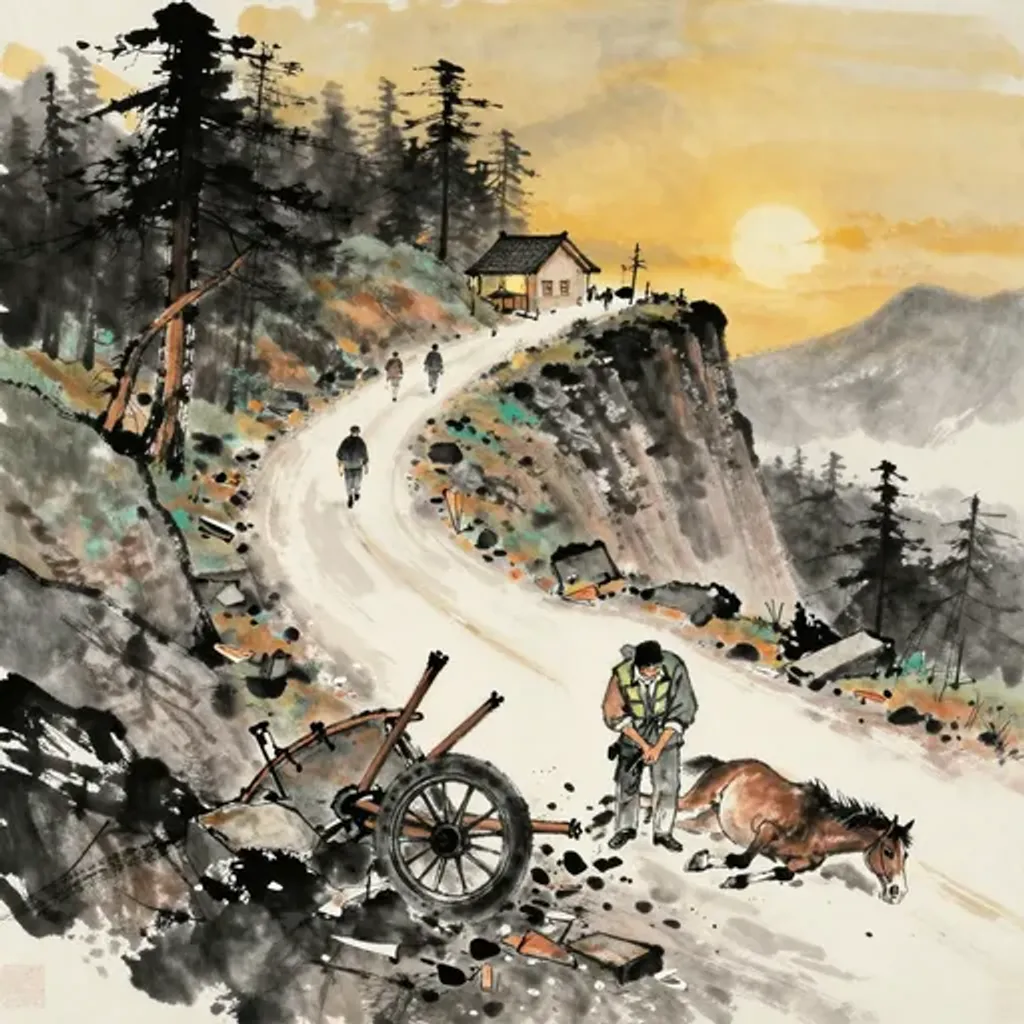
轅折輪破,馬倚僕臥,後旅先宿,右足跌踒。
The shaft snaps, the wheel breaks; the horse leans and the driver falls. The rear travelers lodge before the rest; the right foot is sprained and twisted.
— Jiao Yanshou, Yilin (Forest of Changes), 1st century BC
Commentary
Heaven above the lake, yet the path forward collapses. The cart shaft snaps, the wheel shatters, the horse stumbles and falls, and the traveler injures his right foot. Late arrivals find lodging before the early ones — every order is inverted. This is treading gone catastrophically wrong: the careful step-by-step protocol that Hexagram 10 demands has been abandoned, and chaos results. From Treading to Difficulty at the Beginning, the transformation captures the moment when failed conduct plunges one back into primordial disorder. Thunder stirs beneath gathering clouds, and what should have been an orderly journey becomes a struggle simply to begin again.
履 → 蒙
Hexagram 10 → Hexagram 4: Youthful Folly
Changing lines: 1, 4, 5
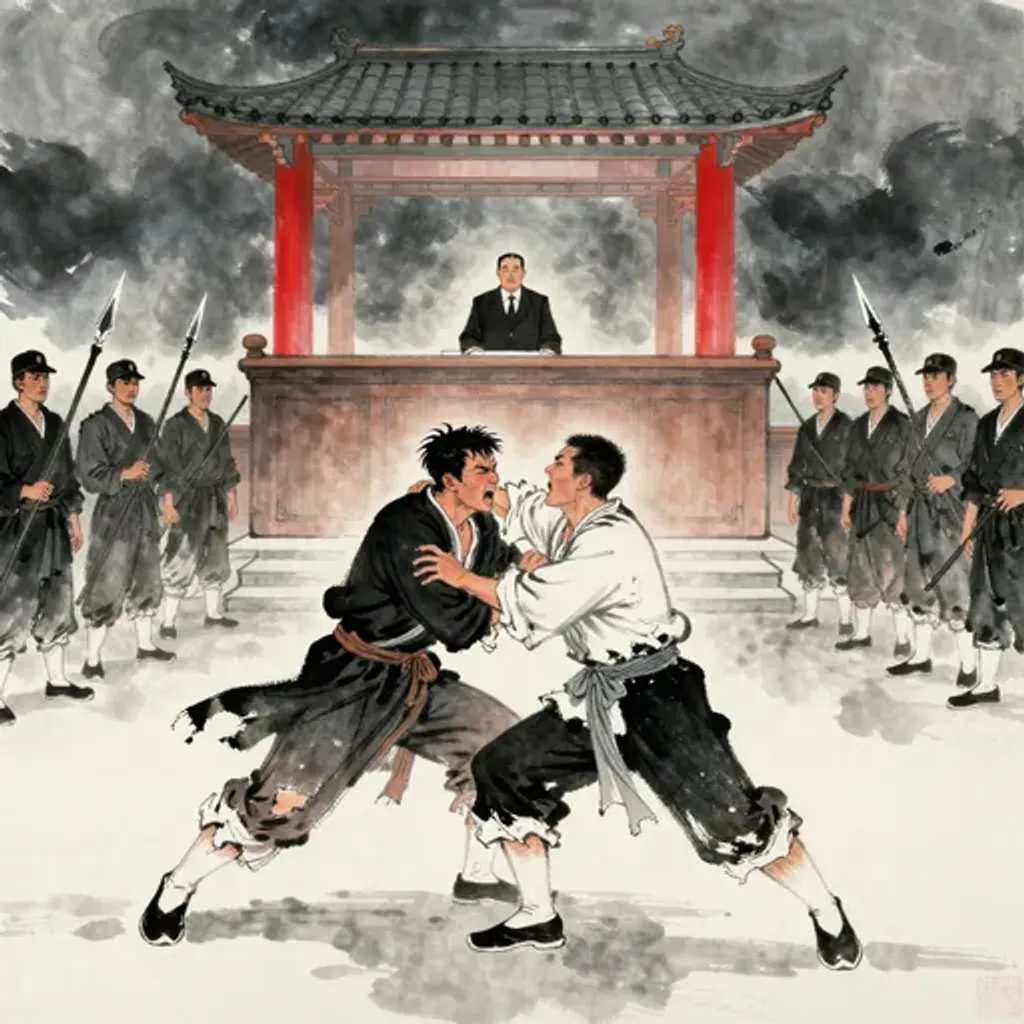
兩人相絆,相與悖戾;心不同爭,訟忷忷然。
Two men entangled together, perverse and contrary toward each other. Hearts at odds, they quarrel; their lawsuit rages furiously.
— Jiao Yanshou, Yilin (Forest of Changes), 1st century BC
Commentary
Heaven above the lake demands clear distinctions, but here two people entangle each other in mutual obstruction. Hearts disagree, resentment festers, and quarrelsome litigation erupts noisily on all sides. The verse captures the antithesis of Treading's ideal: instead of recognizing hierarchy and conducting oneself with care, both parties cling to grievance and neither yields an inch. The cacophony of 'xiongxiong' — the onomatopoeia for angry clamor — underscores how completely decorum has collapsed. From Treading to Youthful Folly, the transformation reveals how failed conduct breeds confusion. Mountain spring water emerges below but cannot yet find its course — the disputants lack the wisdom to see beyond their own positions, trapped in the fog of immaturity where every conflict seems equally urgent and no teacher has yet appeared to show the way.
履 → 需
Hexagram 10 → Hexagram 5: Waiting
Changing lines: 3, 4, 6
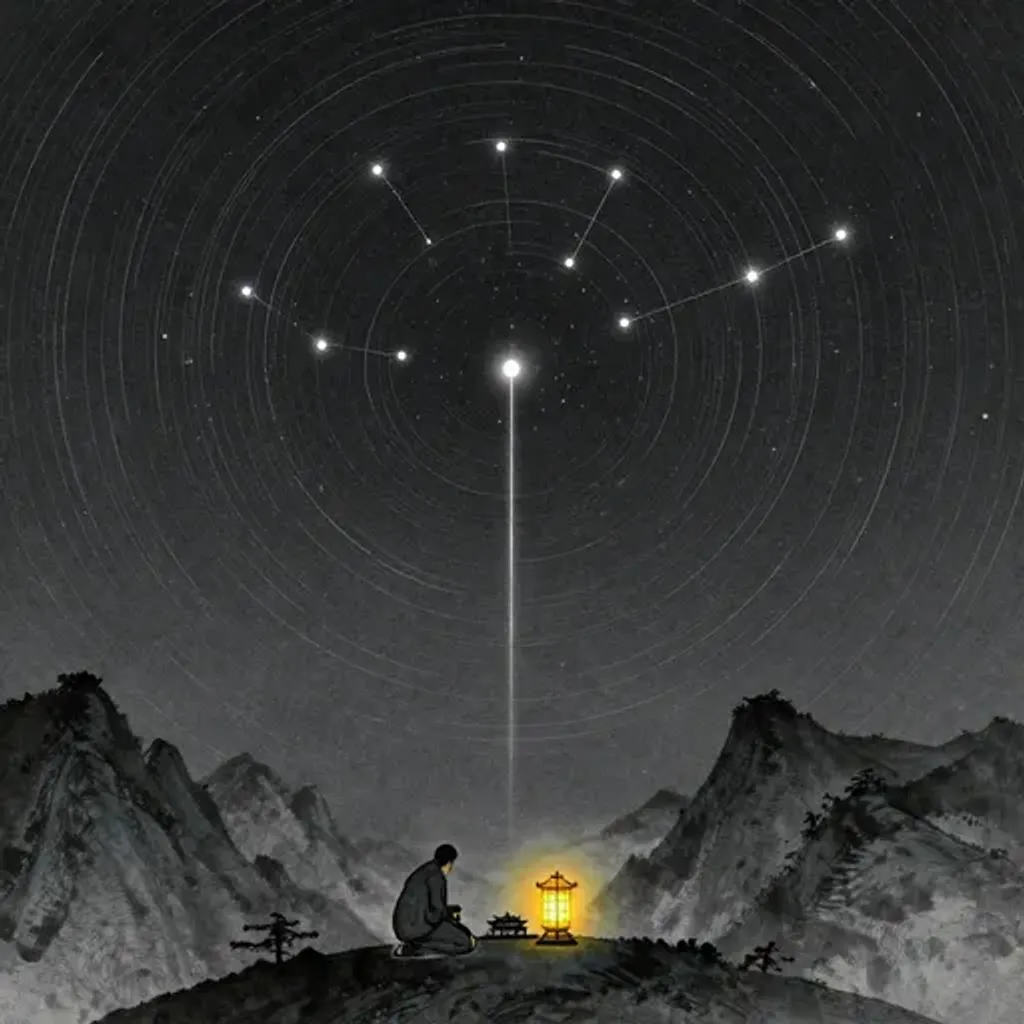
北辰紫宮,衣冠立中;含和建德,常受天福。
The Jade Balance points north; the Celestial Pivot does not shift. The four seasons follow their order; ten thousand states turn their hearts homeward.
— Jiao Yanshou, Yilin (Forest of Changes), 1st century BC
Commentary
Heaven above the lake — conduct measured against the cosmic standard. The original verse places us in the Purple Palace of the Pole Star, where a robed figure stands at the still center of heaven, cultivating harmony and accumulating virtue, forever receiving celestial blessing. The North Star does not move, yet all stars revolve around it — authority expressed through stillness rather than force. From Treading to Waiting, the transformation refines purposeful conduct into patient trust: one who stands at the unmoving center need not chase fortune, for clouds gather above heaven and sustenance arrives in its own time. The disciplined walker becomes the poised host.
履 → 訟
Hexagram 10 → Hexagram 6: Conflict
Changing lines: 1
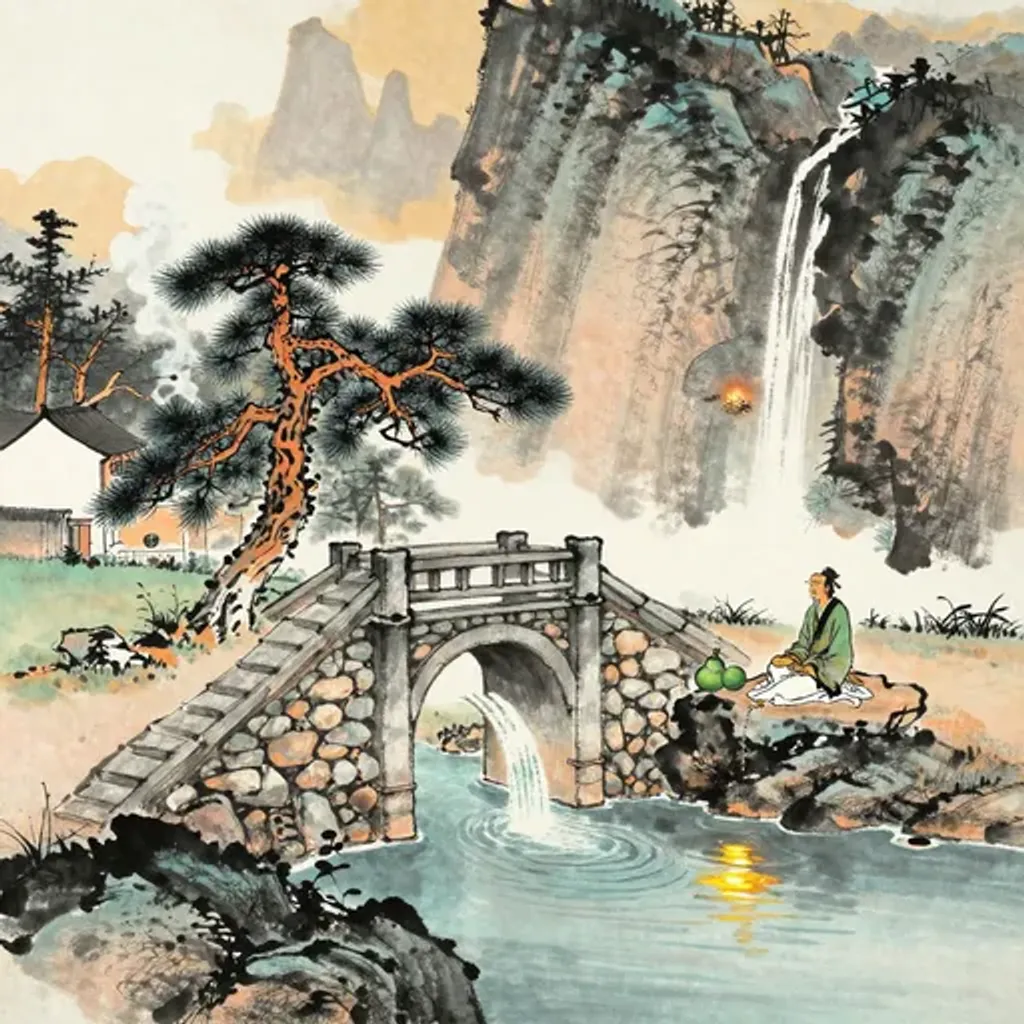
遊居石門,祿身安全;受福西鄰,歸飲玉泉。
Dwelling at leisure by the Stone Gate; body secure and fortune safe. Receiving blessings from the western neighbor; returning home to drink from the Jade Spring.
— Jiao Yanshou, Yilin (Forest of Changes), 1st century BC
Commentary
Heaven above the lake opens onto a vision of sanctuary. A traveler dwells at Stone Gate, safe in body and secure in fortune. Blessings arrive from the western neighbor, and one returns home to drink from a jade spring. Stone Gate may allude to the place where Confucius's disciple Zilu once spent the night, but here the image is purely auspicious: finding refuge in a solid place, receiving generosity from neighbors, and drinking from a source of purity. From Treading to Conflict, the transformation is paradoxical — proper conduct creates a haven even where heaven and water run contrary. The one who treads correctly finds peace amid opposition.
履 → 師
Hexagram 10 → Hexagram 7: The Army
Changing lines: 1, 4, 5, 6
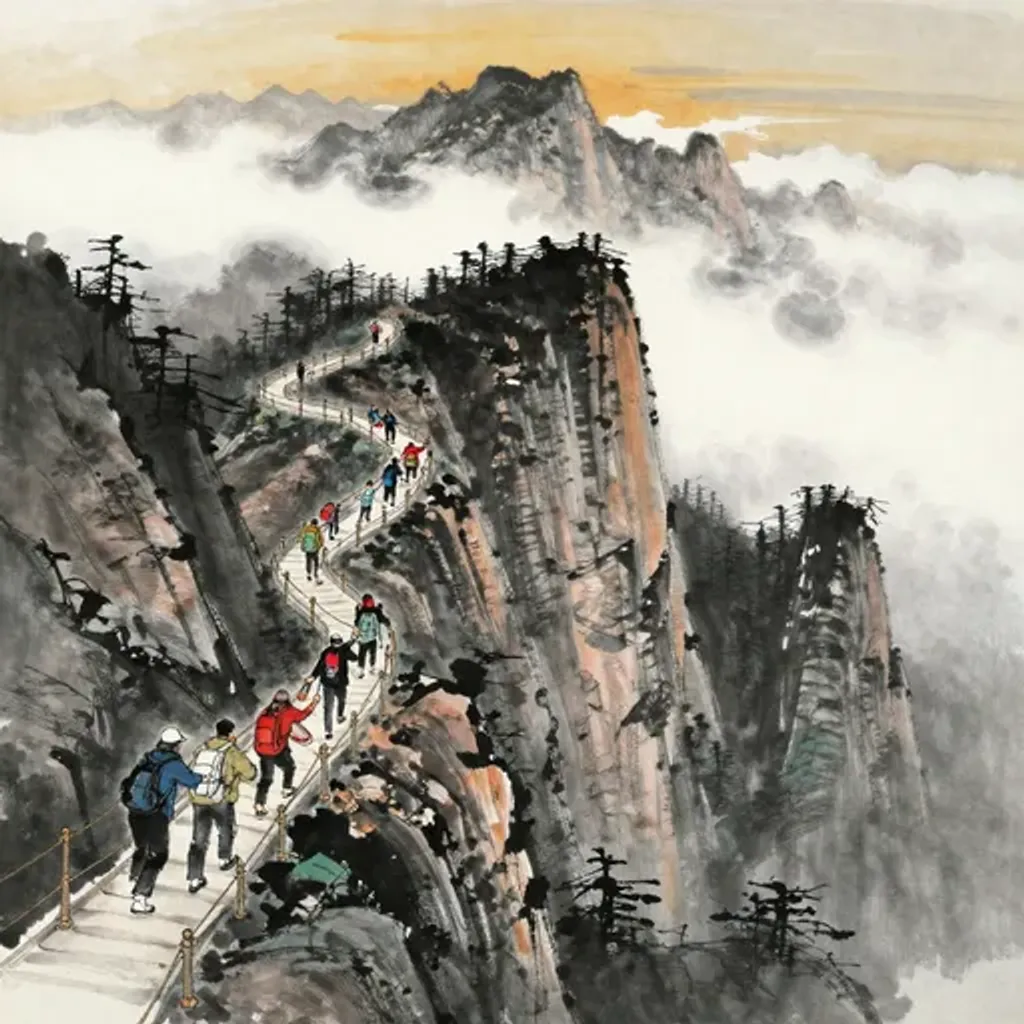
羊腸九縈,相推併前;止須王孫,乃能上天。
The winding sheep-gut trail, nine turns pushing onward. One must await the prince; only then can one ascend to heaven.
— Jiao Yanshou, Yilin (Forest of Changes), 1st century BC
Commentary
Heaven above the lake, yet the path spirals upward through a narrow intestinal pass — nine twists pushing travelers forward in a crush. The road is the famous Yangtze gorge route known as Sheep Gut Pass, winding so tightly that each person must shove the next to advance. Only when one stops to wait for the prince does the way to heaven open. The verse stages a paradox: brute forward motion fails on a treacherous path, but deference to rightful authority clears the passage entirely. From Treading to the Army, disciplined conduct transforms into organized collective force. Water hidden within the earth channels the crowd's chaotic energy into directed power.
履 → 比
Hexagram 10 → Hexagram 8: Holding Together
Changing lines: 1, 2, 4, 6
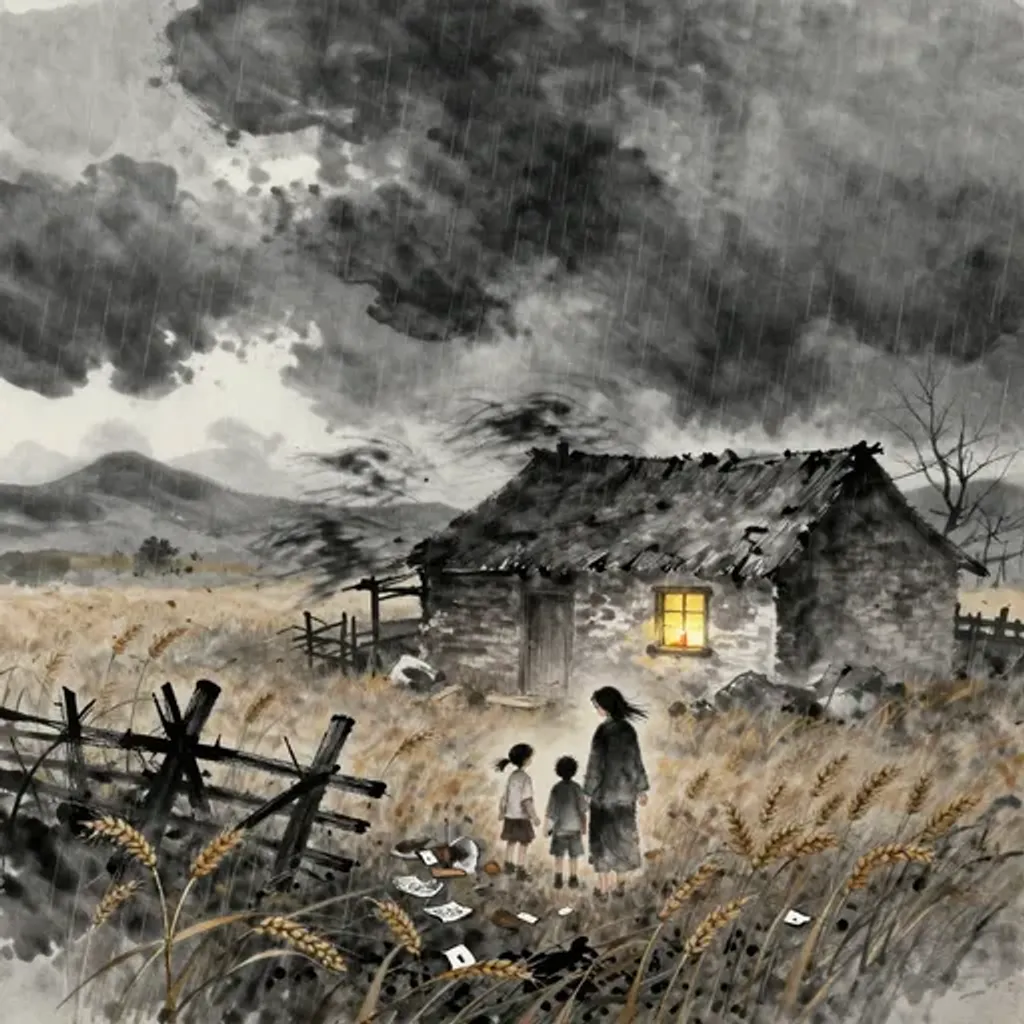
爭訟相倍,和氣不處;陰陽俱否,穀風母子。
Litigation doubles the discord; harmonious qi cannot dwell. Yin and yang both stagnate; the Valley Wind separates mother and child.
— Jiao Yanshou, Yilin (Forest of Changes), 1st century BC
Commentary
Heaven above the lake demands harmony between high and low, but here litigation doubles and harmonious energy departs. Yin and yang both stagnate — the verse invokes the Shijing ode 'Gu Feng' (Valley Wind), a lament of a wife abandoned after years of shared hardship, cast out like a mother torn from her children. The reference to 'Gu Feng mother and child' points to severed domestic bonds: a household where trust has collapsed. From Treading to Holding Together, the transformation reveals the cost of broken conduct. Water upon earth gathers people together, but only when mutual trust is restored. Where discord has driven people apart, reunion requires rebuilding loyalty from the ground up.
履 → 小畜
Hexagram 10 → Hexagram 9: Small Taming
Changing lines: 3, 4
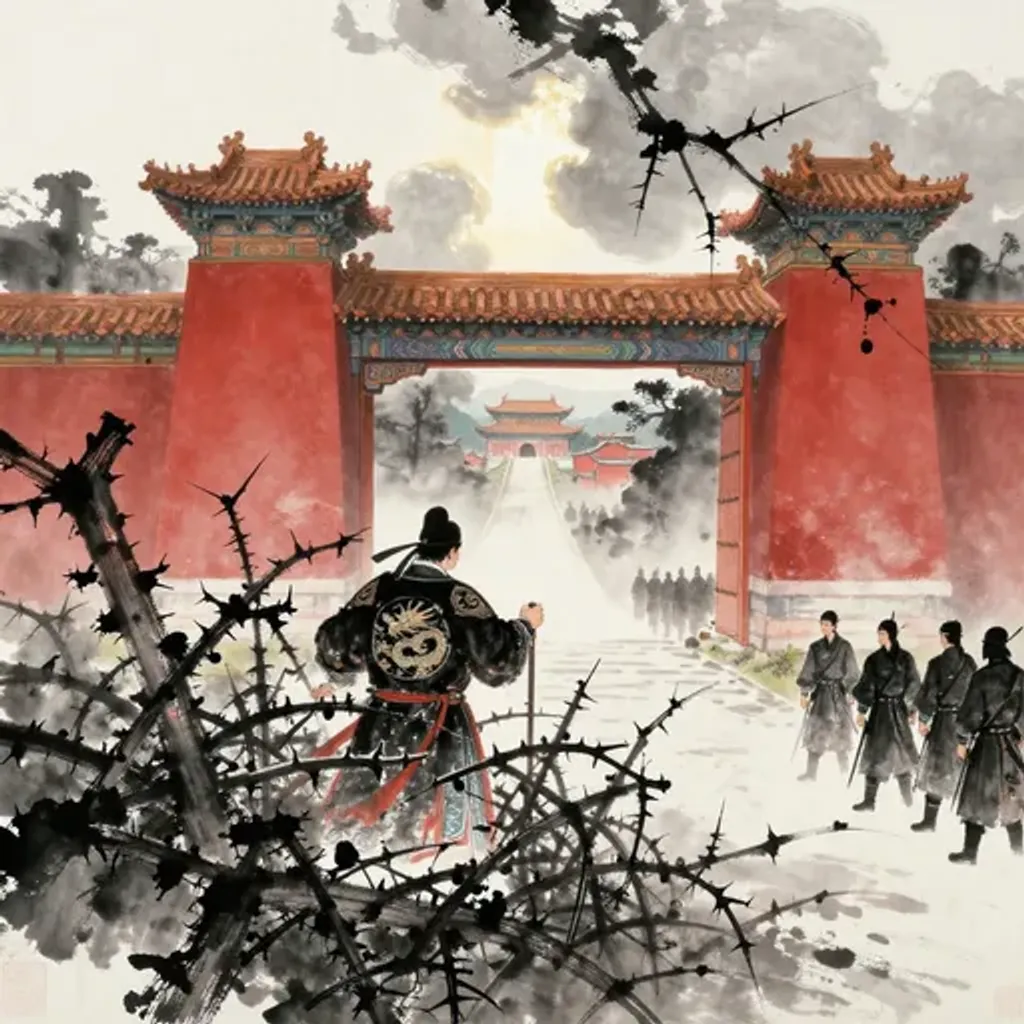
郭叔距頤,為棘所拘;龍額重顙。禍不成殃,復歸其鄉。
Guo Shu propping up his chin, held fast by thorns. Dragon brow and heavy forehead. The disaster does not become calamity; he returns again to his homeland.
— Jiao Yanshou, Yilin (Forest of Changes), 1st century BC
Commentary
Heaven above the lake, a scene of narrow escape. Guo Shu resists with chin jutted out but finds himself entangled in thorns. A dragon-browed, heavy-foreheaded figure appears — formidable yet trapped. But the verse pivots: disaster does not fully ripen into calamity, and the traveler returns safely to his homeland. The allusion likely draws on a Spring and Autumn episode of a stubborn lord caught in political thorns who nonetheless survives. From Treading to Small Taming, the gentle wind of heaven restrains without breaking. The crisis passes not through force but through yielding — the small taming that softens pride before it becomes fatal.
履 → 履
Hexagram 10 → Hexagram 10: Treading
No changing lines — the hexagram is unchanged
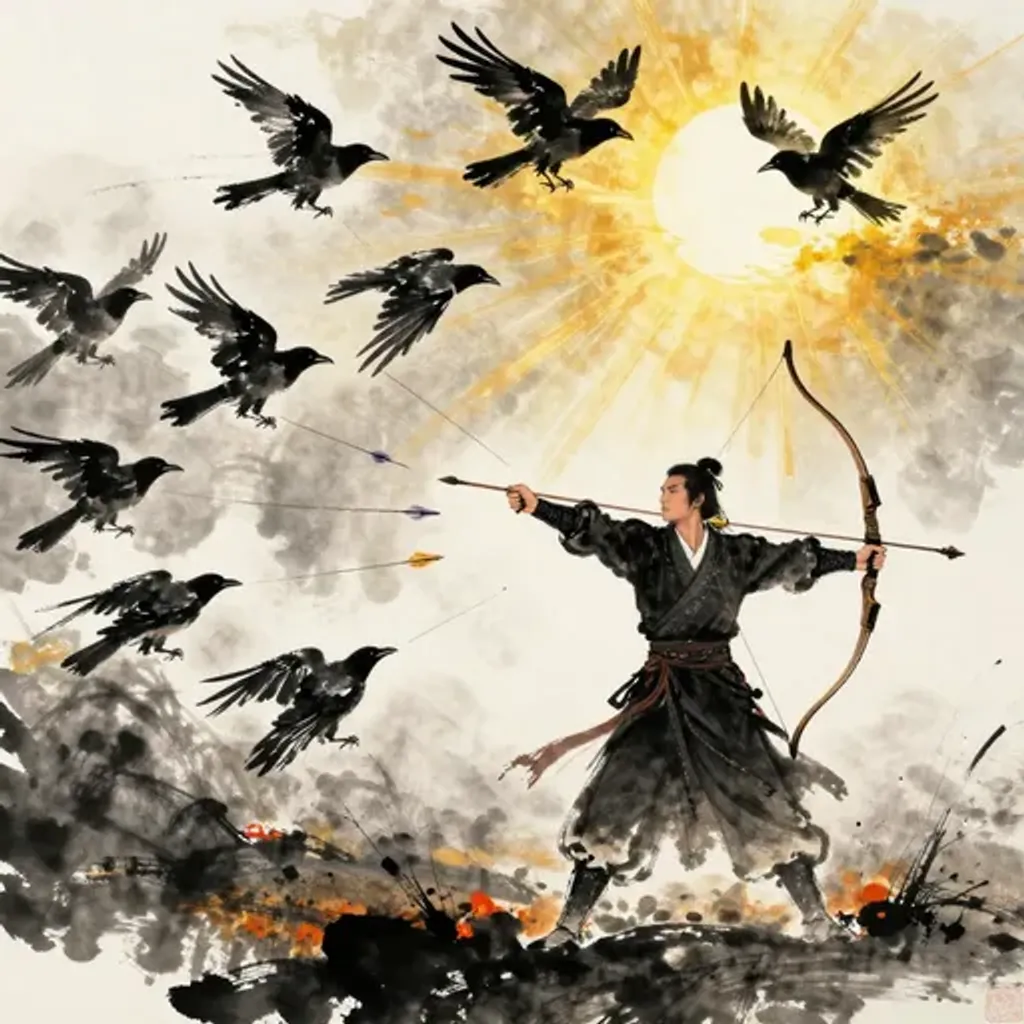
十烏俱飛,羿得九雌;雖得淂全,且驚不危。
Ten crows fly together; Yi shoots down nine hens. Though what is gained is kept whole; there is a fright, but no real danger.
— Jiao Yanshou, Yilin (Forest of Changes), 1st century BC
Commentary
Treading upon itself — the hexagram doubled. Ten sun-crows fly together, and Archer Yi brings down nine, but takes only the females. Though the world survives intact, the fright was real. This directly invokes the myth of Hou Yi shooting down the nine surplus suns that were scorching the earth, leaving one to light the world. Yet the detail of 'nine females' is curious — perhaps distinguishing the docile from the dangerous, or counting only what was safely captured. From Treading to Treading, the pattern is self-referential: peril managed through precise conduct, danger averted but not forgotten. The tiger's tail was touched; the tiger did not bite.
履 → 泰
Hexagram 10 → Hexagram 11: Peace
Changing lines: 3, 4, 5, 6
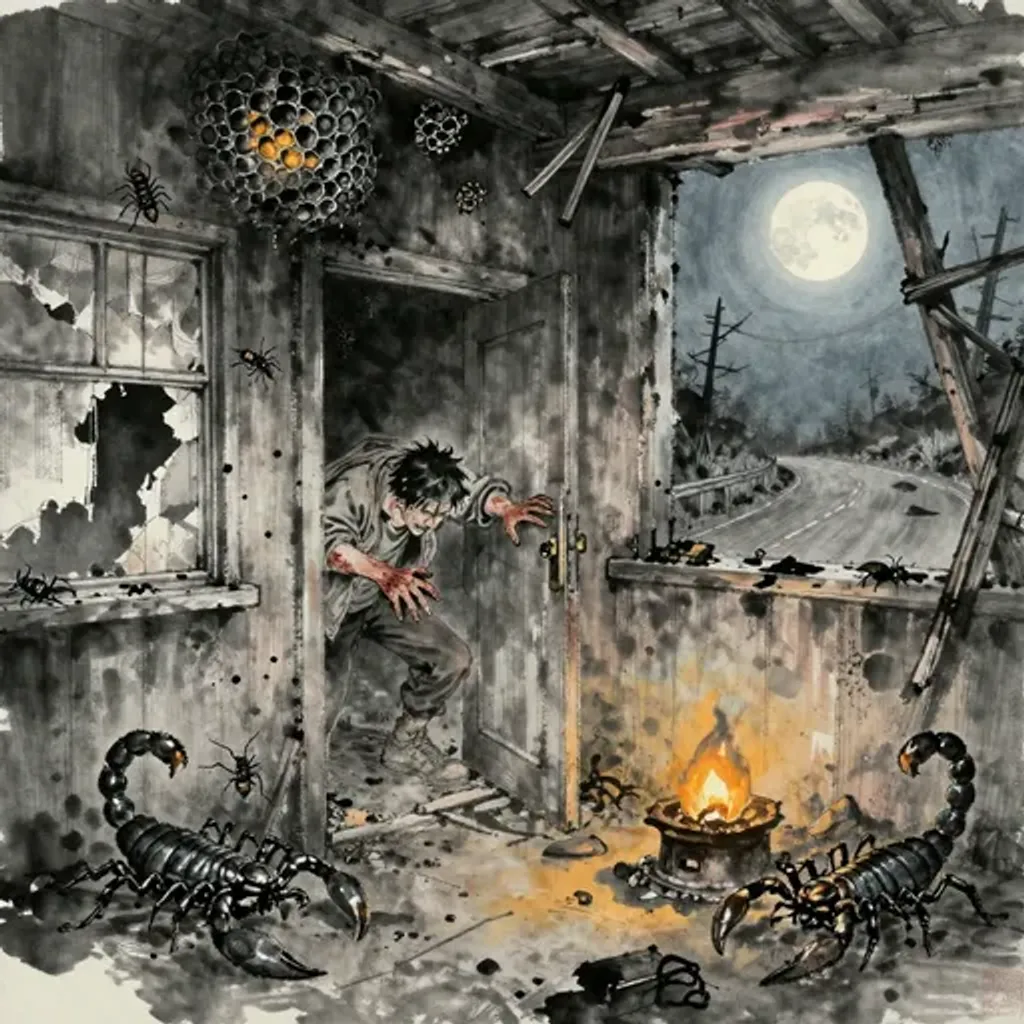
蠆室蜂戶,螫我手足;不利旅客,為吾害咎。
A scorpion is chamber, a wasp is door; they sting my hands and feet. Ill-suited for the traveler; bringing me harm and blame.
— Jiao Yanshou, Yilin (Forest of Changes), 1st century BC
Commentary
Heaven above the lake, yet every step stings. The dwelling is a scorpion's chamber, the doorway a wasp's nest — venomous creatures sting hands and feet at every turn. The traveler finds no safe lodging; everything encountered inflicts harm, and the journey breeds only suffering. This is Treading at its most hostile: the path itself has become poisonous, and proper conduct alone cannot neutralize so saturated an environment. From Treading to Peace, the transformation is sharply ironic. Heaven and earth commune — the great convergence of cosmic forces — but only after passing through this gauntlet of stinging hazards. The promise of Peace demands endurance through pain, and only the traveler who survives the scorpion's chamber reaches the communion beyond it.
履 → 否
Hexagram 10 → Hexagram 12: Standstill
Changing lines: 1, 2
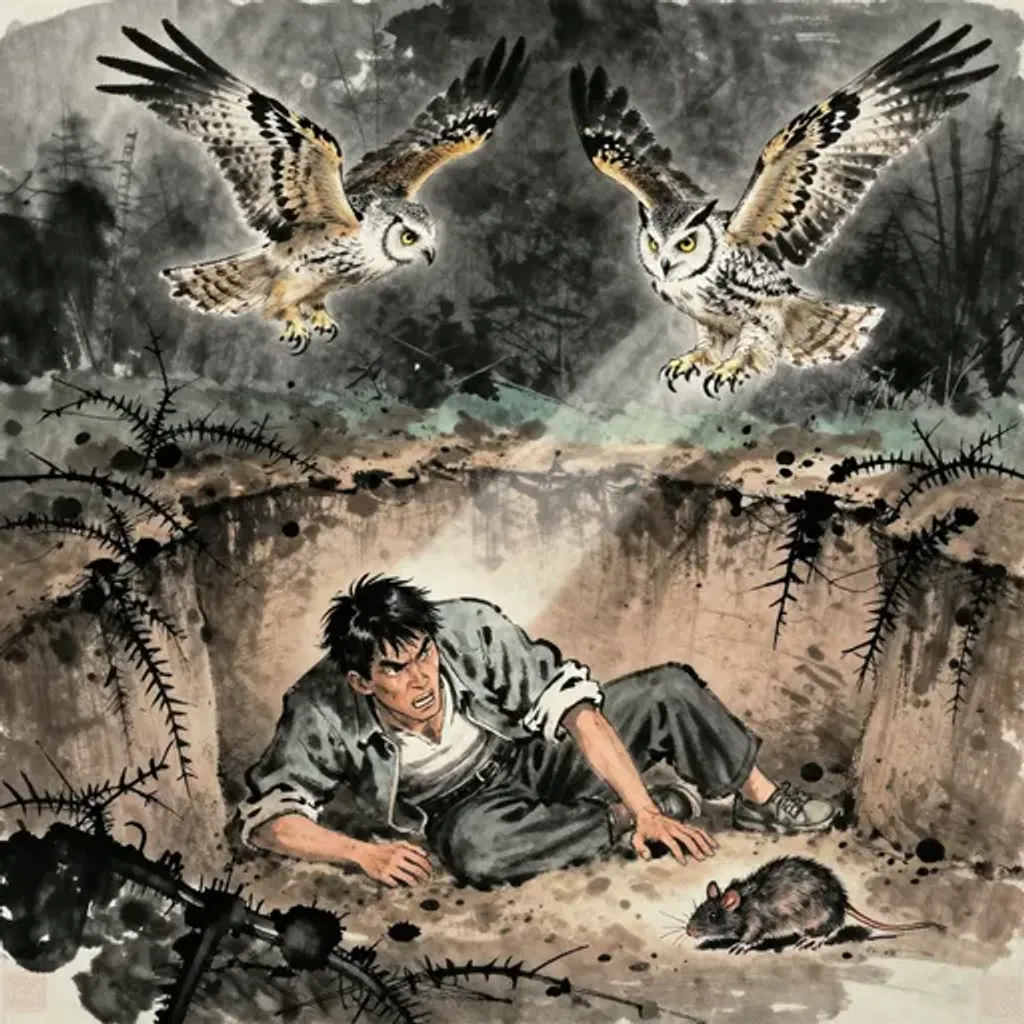
怒非其怨,因拘有遷;貪妬腐鼠,而呼鴞鳶,失反被困。
Anger misplaced against the wrong grievance; seized and sent into exile. Coveting a rotting rat; he summons the owl and the kite -- and loses all, trapped in return.
— Jiao Yanshou, Yilin (Forest of Changes), 1st century BC
Commentary
Heaven above the lake, conduct gone astray. Anger misdirected at those who bear no grudge, detention followed by displacement. One who covets a rotten rat summons owls and kites — the very scavengers drawn to carrion — and in the end is caught in one's own trap. The 'rotten rat' image likely draws on Zhuangzi's parable: Huizi feared that Zhuangzi coveted his ministry, but Zhuangzi compared the office to a dead rat that no phoenix would touch. From Treading to Standstill, heaven and earth cease communication. Misplaced aggression and petty greed sever the connection between high and low, freezing the world into mutual isolation.
履 → 同人
Hexagram 10 → Hexagram 13: Fellowship
Changing lines: 2, 3
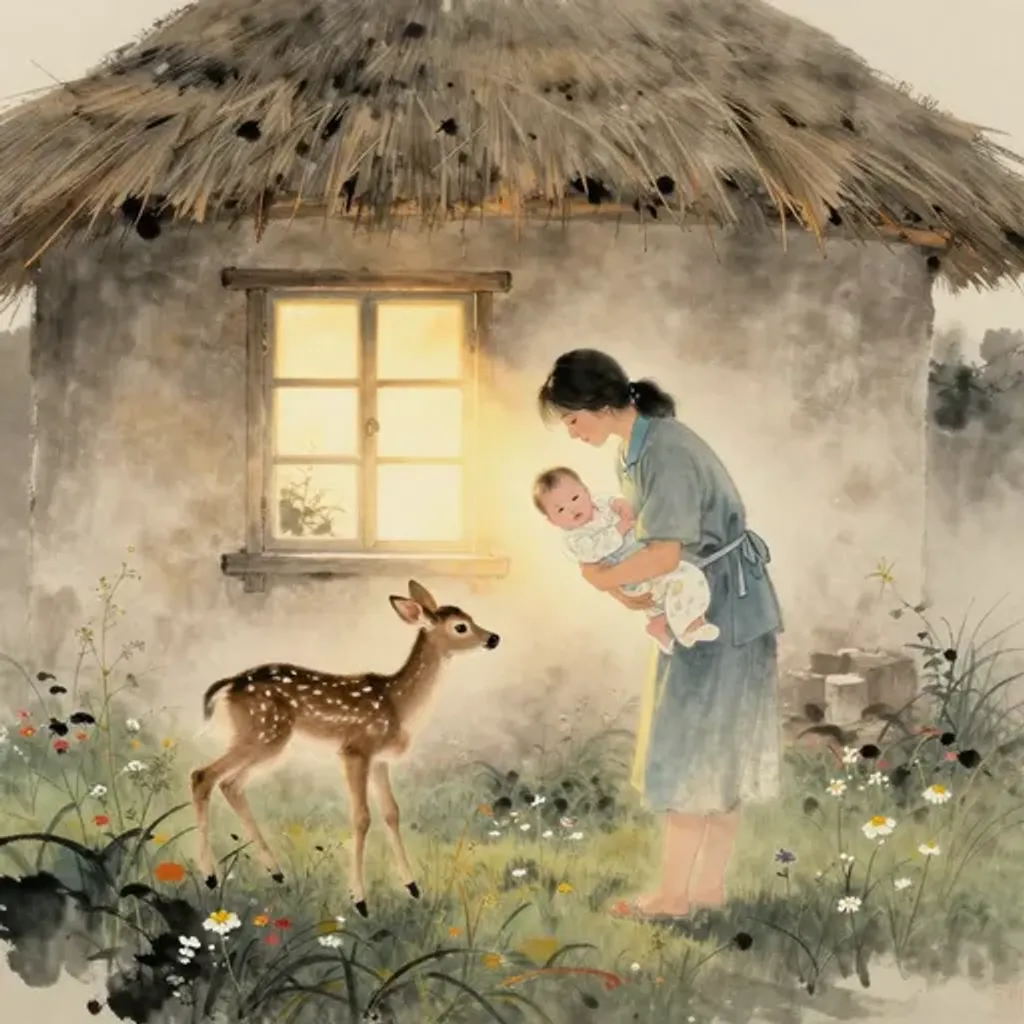
嬰孩求乳,母歸其子;黃麑悅喜,自樂甘餌。
The infant seeks its mother is milk; the mother returns to her child. The yellow fawn leaps with joy; delighting in its sweet food.
— Jiao Yanshou, Yilin (Forest of Changes), 1st century BC
Commentary
Heaven above the lake softens into a scene of natural belonging. An infant cries for milk and the mother returns to her child; a young fawn delights in sweet fodder, content with its nourishment. Every creature finds its proper place — the baby with the mother, the deer with the grass. There is no striving, no misstep; needs are met through the simplest bond. From Treading to Fellowship, fire rises into heaven and illuminates all alike. The careful distinctions of Treading dissolve into the warmth of recognition: when conduct is natural rather than calculated, fellowship arises as instinctively as a child reaching for its mother.
履 → 大有
Hexagram 10 → Hexagram 14: Great Possession
Changing lines: 3, 5
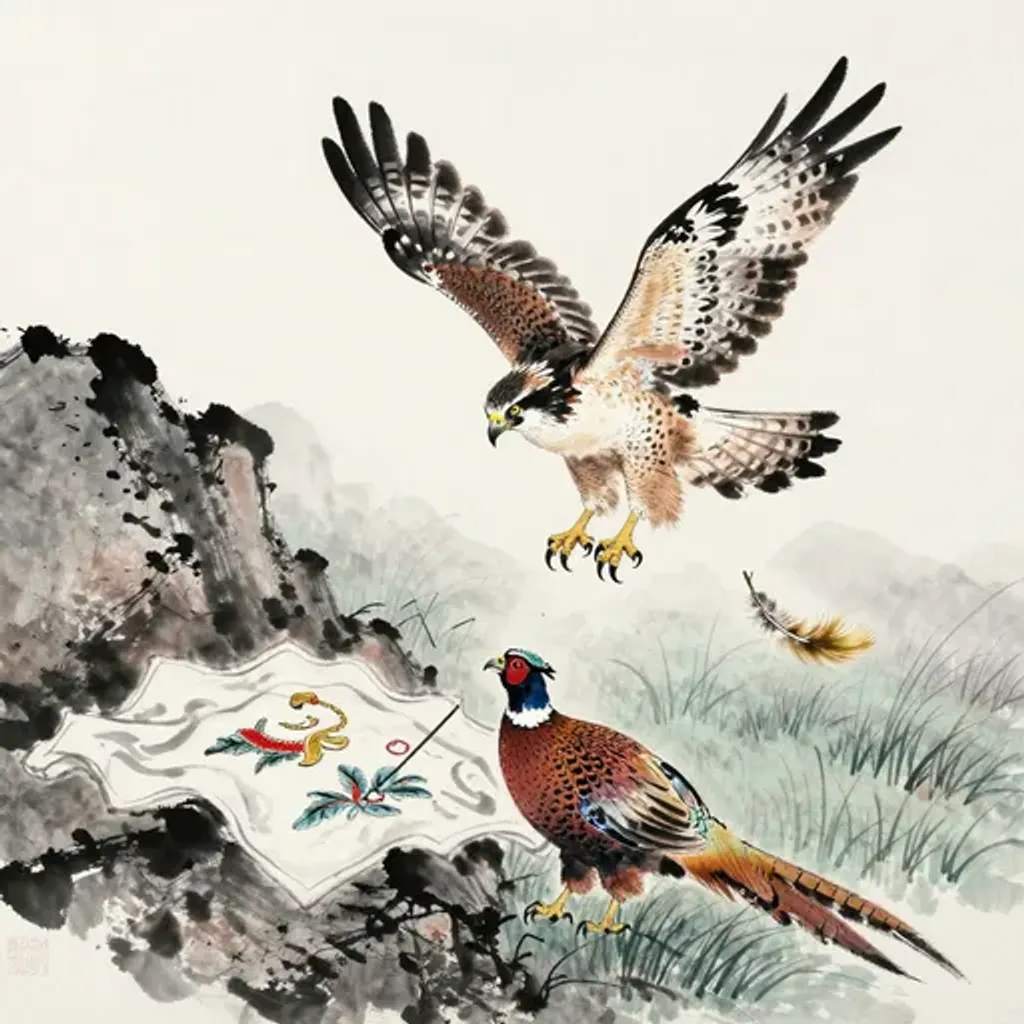
鍼鏤勝服,錦繡不成;鷹逐雉兔,爪折不得。
Needle-carved and finely stitched garments; the brocade embroidery remains unfinished. The hawk chases pheasant and hare; its talons break, gaining nothing.
— Jiao Yanshou, Yilin (Forest of Changes), 1st century BC
Commentary
Heaven above the lake, but fine craftsmanship yields no finished product. Needlework and engraving surpass the material, yet the brocade remains incomplete. A hawk swoops for pheasant and hare, but its talons snap and it catches nothing. Skill exceeds the means to apply it; ambition outruns capacity. The eagle's broken claw is especially vivid — raw predatory power defeated by a single structural failure. From Treading to Great Possession, the gap between potential and realization widens. Fire blazes in heaven but illuminates only what was never grasped. Abundance cannot be seized through force alone; the hawk that strikes too hard destroys its own instrument.
履 → 謙
Hexagram 10 → Hexagram 15: Modesty
Changing lines: 1, 2, 3, 4, 5, 6
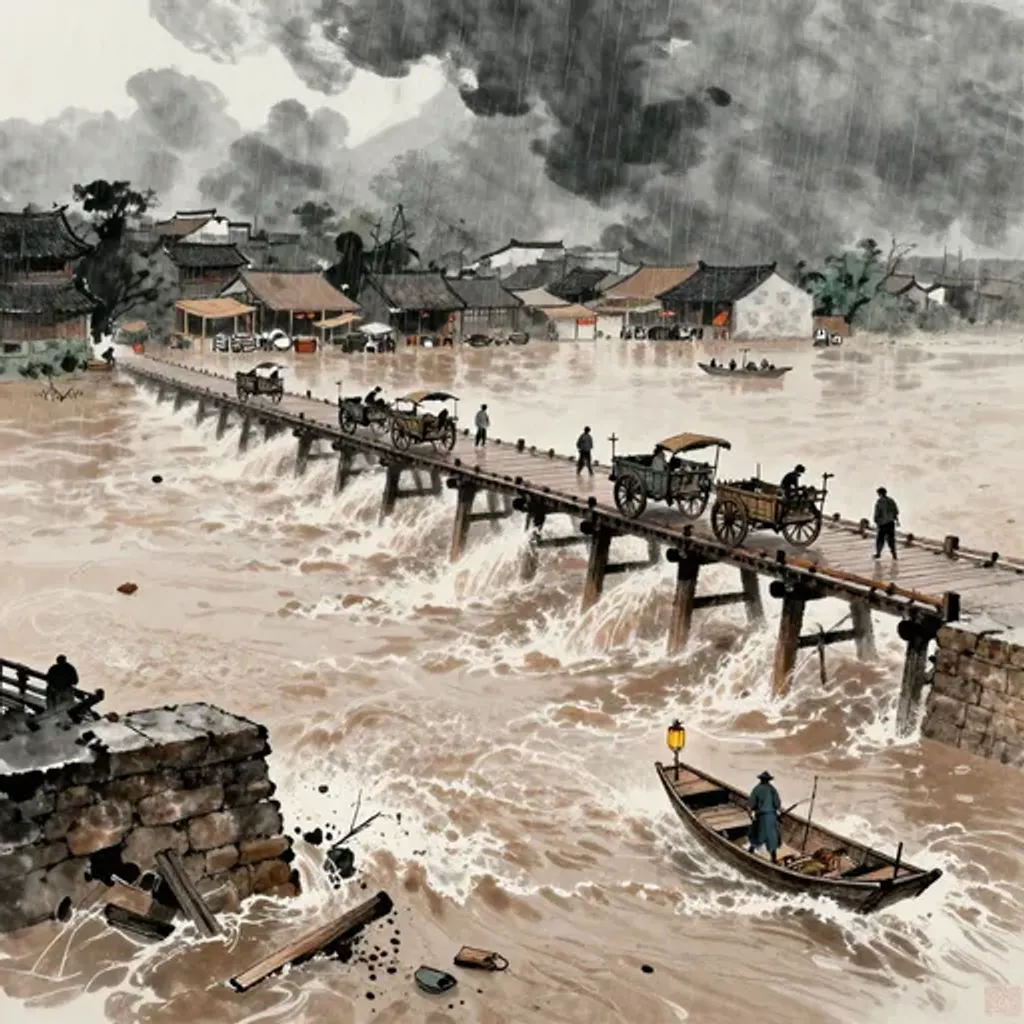
雨潦集降,河梁不通;鄒魯閉塞,破費市空。
Flooding rains pour down; the river bridge is impassable. Zou and Lu are sealed and blocked; stores depleted, the market empty.
— Jiao Yanshou, Yilin (Forest of Changes), 1st century BC
Commentary
Heaven above the lake gives way to deluge. Heavy rains descend and collect, flooding the river bridges until they are impassable. The states of Zou and Lu are blockaded; commerce halts and marketplaces empty. Every avenue of movement is cut off — not by human malice but by nature's excess. The mention of Zou and Lu, Confucius's homeland, grounds the flooding in a real geography of small states vulnerable to seasonal catastrophe. From Treading to Modesty, the mountain hidden within the earth suggests that when all paths are blocked, the only viable conduct is to lower oneself, accept limitation, and redistribute resources — the humble survive the flood.
履 → 豫
Hexagram 10 → Hexagram 16: Enthusiasm
Changing lines: 1, 2, 5, 6
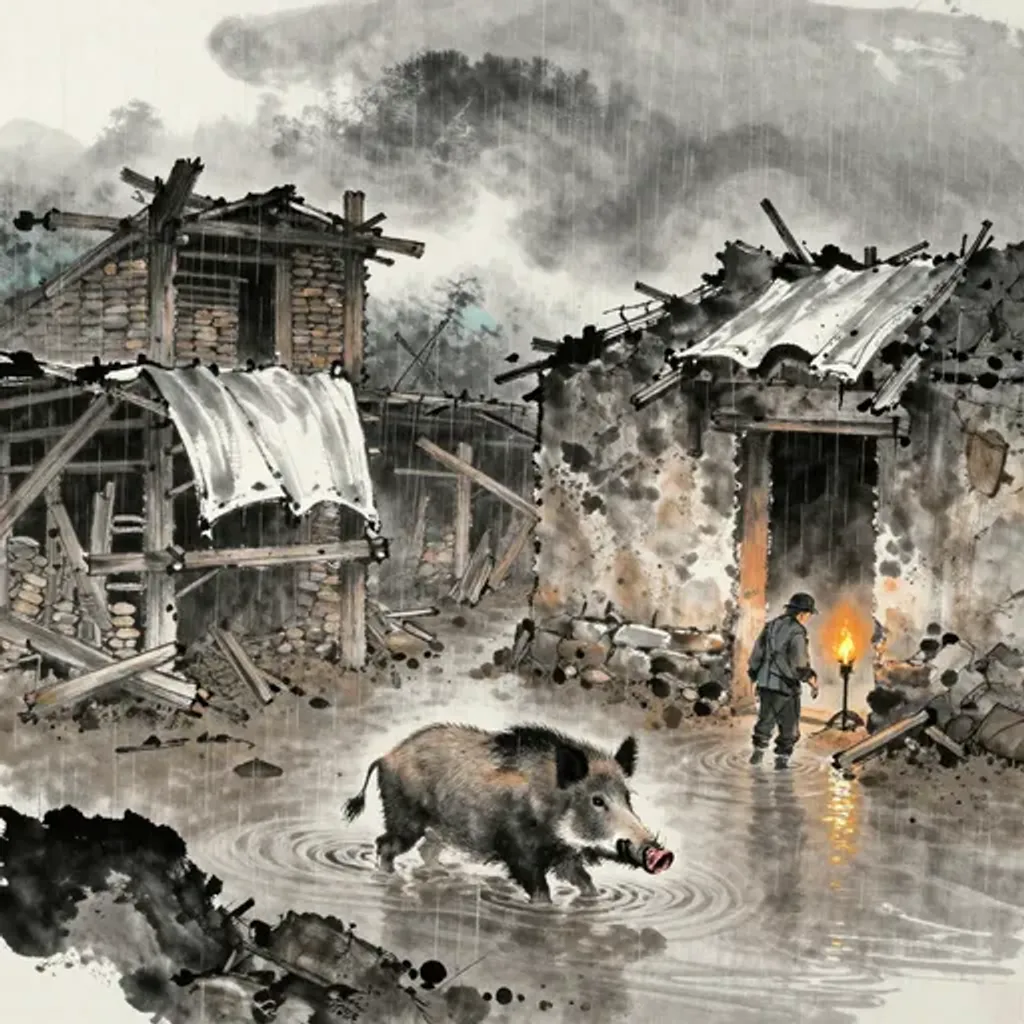
封豕溝瀆,水潦空谷;客止舍宿,泥塗至腹。處無黍稷。
The great boar roots in the ditch; floodwater fills the hollow valley. The traveler halts to lodge for the night; mud rises to his belly. There is no millet or grain.
— Jiao Yanshou, Yilin (Forest of Changes), 1st century BC
Commentary
Heaven above the lake, yet the traveler sinks into a flooded wasteland. A monstrous boar wallows in the ditches, rainwater fills the empty valleys, and the traveler must halt for the night with mud reaching his belly. There is no millet or grain to eat. The image is desolation compounded: swine roaming through waterlogged ruins, the land producing nothing, the body mired halfway to drowning. From Treading to Enthusiasm, thunder breaks from the earth — but here the promise of joyful arousal rings hollow against the verse's misery. The transformation suggests that only a radical eruption of energy, a thunderclap of renewal, can break this paralysis of mud and hunger.
履 → 隨
Hexagram 10 → Hexagram 17: Following
Changing lines: 2, 6
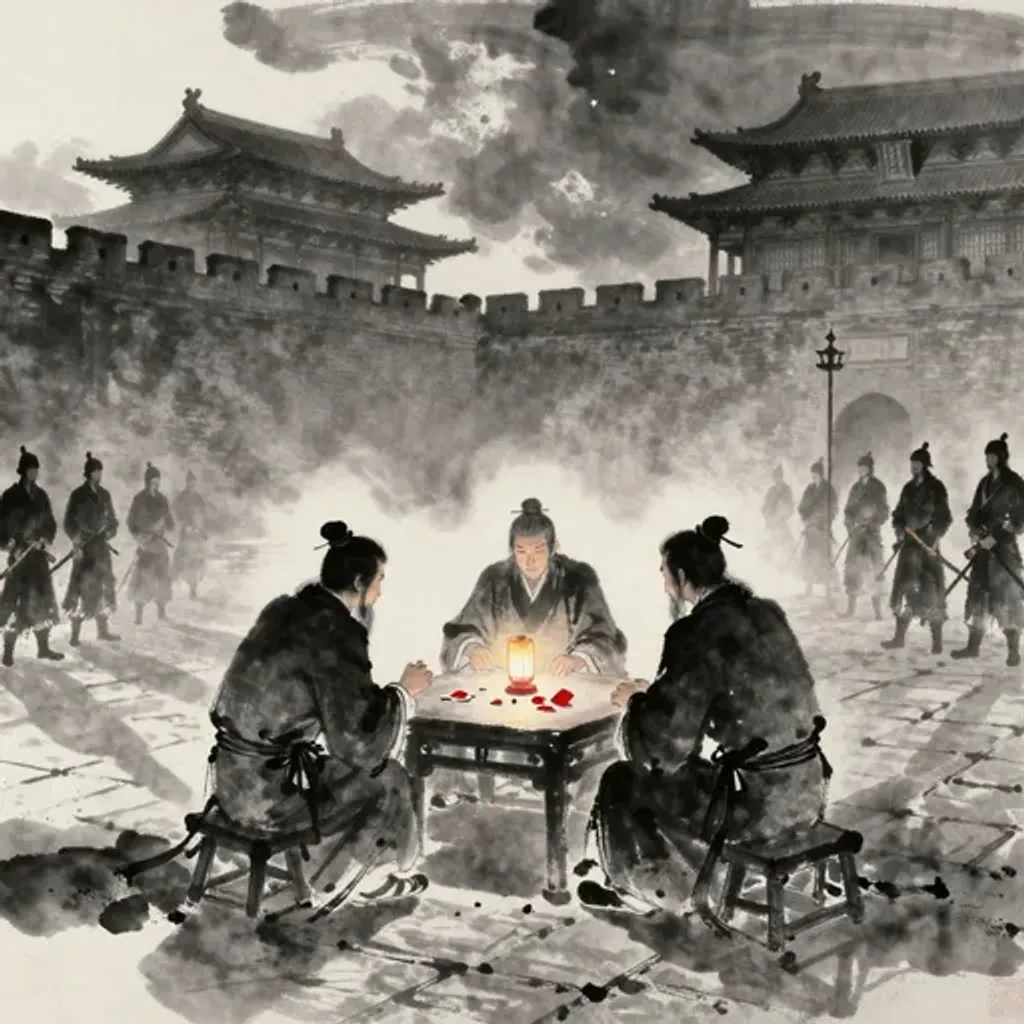
三姦相擾,桀跖為交;上下騷離,隔絕天道。
Three villains agitate one another; Jie and Zhi form their alliance. Above and below, turmoil and separation; cutting off the way of heaven.
— Jiao Yanshou, Yilin (Forest of Changes), 1st century BC
Commentary
Heaven above the lake, but proper conduct has been abandoned. Three treacherous men conspire together, forming alliances as vile as those of tyrant Jie and Robber Zhi. The social order fractures — high and low are torn apart, severed from the Way of Heaven. Jie represents political tyranny at the summit; Zhi represents banditry at the base. Their union signifies the complete corruption of hierarchy when both rulers and outlaws share the same ethics. From Treading to Following, thunder rests within the lake — a force temporarily dormant. The verse warns that when one follows such men, the natural order collapses and heaven's mandate is lost.
履 → 蠱
Hexagram 10 → Hexagram 18: Work on the Decayed
Changing lines: 1, 3, 4, 5
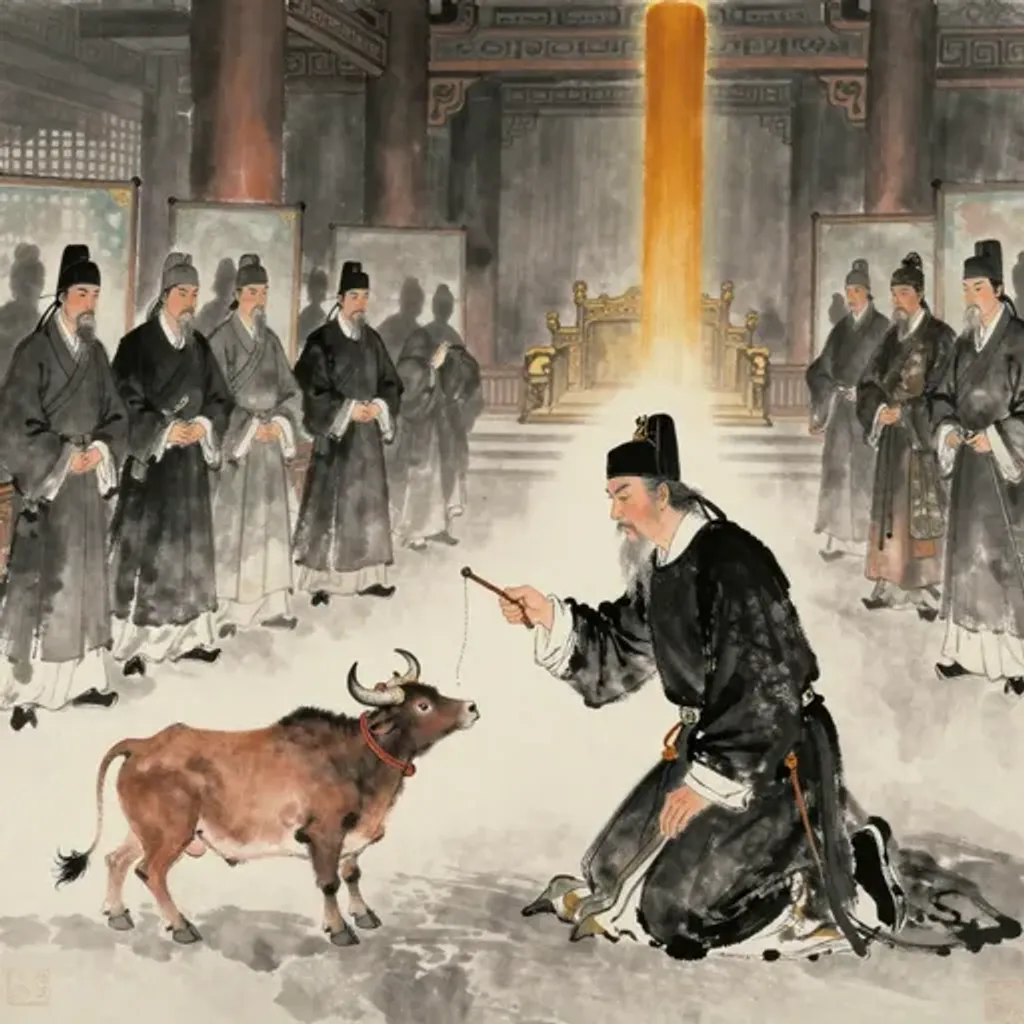
齊景惑疑,為孺子牛;嫡庶不明,賊孽為患。
Duke Jing of Qi was confused and bewildered; he played the ox for the child. Legitimate and bastard lines unclear; treacherous offspring bring calamity.
— Jiao Yanshou, Yilin (Forest of Changes), 1st century BC
Commentary
Heaven above the lake, conduct tested by indulgence. Duke Jing of Qi, besotted with his young favorite, went on all fours and held a rope in his teeth to play 'child's ox' for the boy. When the child fell and broke the duke's tooth, Jing did not punish him — a ruler debasing himself for an illegitimate heir. With legitimate and illegitimate lines blurred, treacherous offspring became a plague upon the state. The Tian clan later exploited this disorder to usurp Qi entirely. From Treading to Work on the Decayed, wind stirs beneath the mountain, exposing rot. Indulgent conduct at the top corrupts the foundations, and what is decayed must be repaired from within.
履 → 臨
Hexagram 10 → Hexagram 19: Approach
Changing lines: 4, 5, 6
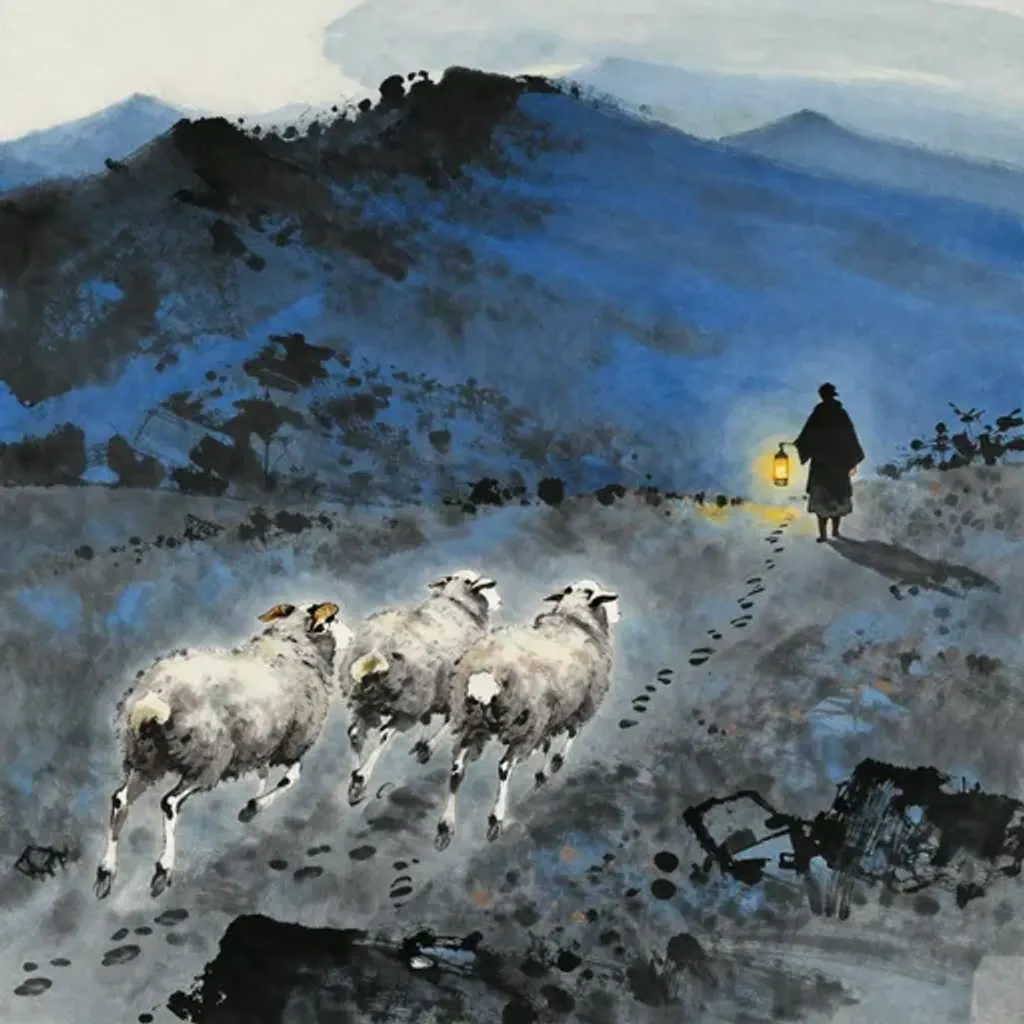
三羊俱亡,走奔南行;會暮失跡,不知所藏。
Three rams all gone astray, running and bolting south. At dusk their tracks are lost; none knows where they are hidden.
— Jiao Yanshou, Yilin (Forest of Changes), 1st century BC
Commentary
Heaven above the lake, and three sheep flee south together. By dusk their tracks are lost, and no one knows where they have hidden. The sheep — symbols of docility and value — vanish into the gathering dark, beyond recovery. This may echo the Liezi parable of the lost sheep at the crossroads, where too many branching paths make retrieval impossible. From Treading to Approach, earth looms above the lake as authority draws near. Yet the verse suggests that what has scattered cannot be recalled merely by approaching — the sheep are gone. The lesson: timely oversight prevents loss; once dusk falls, no amount of searching avails.
履 → 觀
Hexagram 10 → Hexagram 20: Contemplation
Changing lines: 1, 2, 4
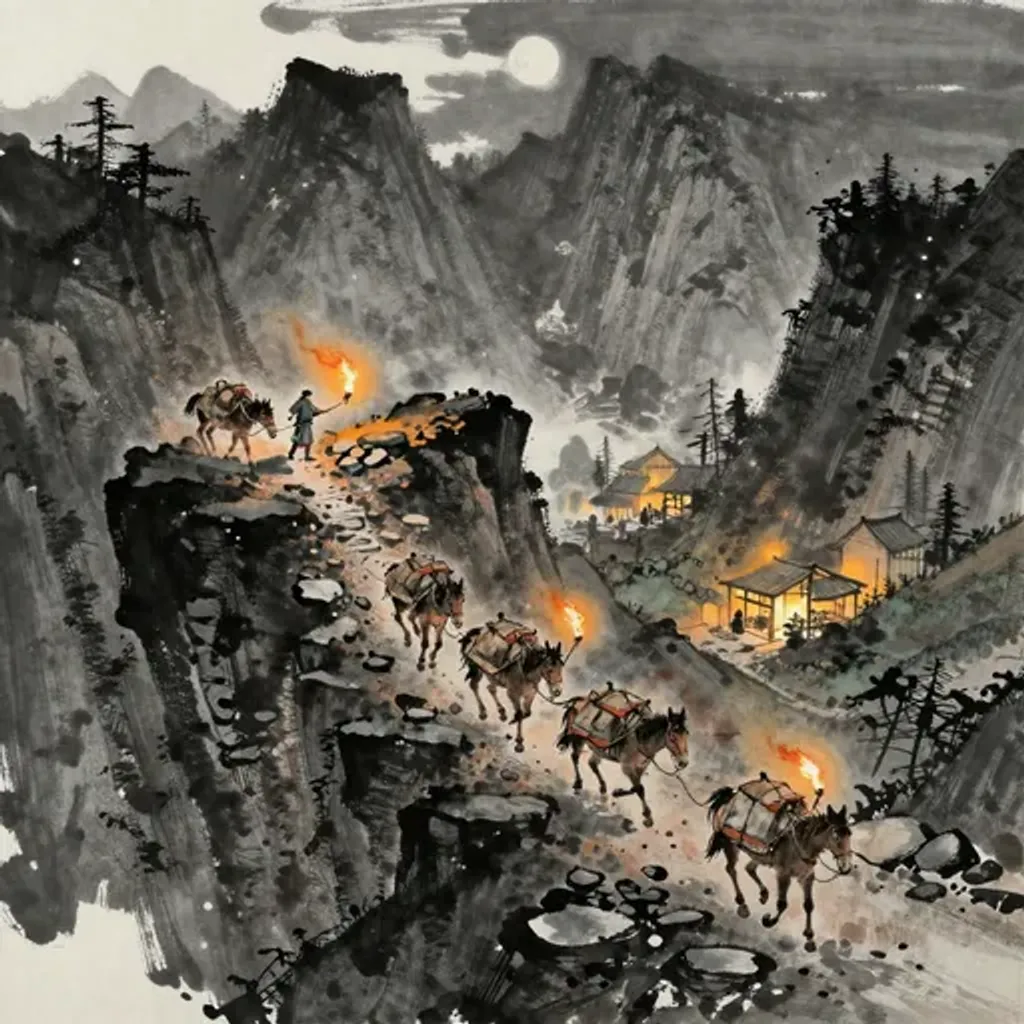
請伯行賈。代山之野,夜歷險阻;不逢危殆,利如澆酒。
Asking Bo to go trade. In the wilds of Dai Mountain, crossing dangerous ground by night. Meeting no peril or disaster; profit flows like poured wine.
— Jiao Yanshou, Yilin (Forest of Changes), 1st century BC
Commentary
Heaven above the lake, a merchant ventures forth. An elder sets out trading, crossing the wilderness of Dai Mountain by night, navigating perilous terrain. Yet he encounters no mortal danger, and his profits flow like poured wine. The verse celebrates risk rewarded: a trader who traverses darkness and rough ground but comes through unscathed, his gains liquid and abundant. From Treading to Contemplation, wind moves over the earth — the sovereign inspects the realm. Careful conduct through danger yields not just survival but the panoramic wisdom of one who has seen the terrain firsthand. The merchant becomes the observer; profit becomes understanding.
履 → 噬嗑
Hexagram 10 → Hexagram 21: Biting Through
Changing lines: 2, 5
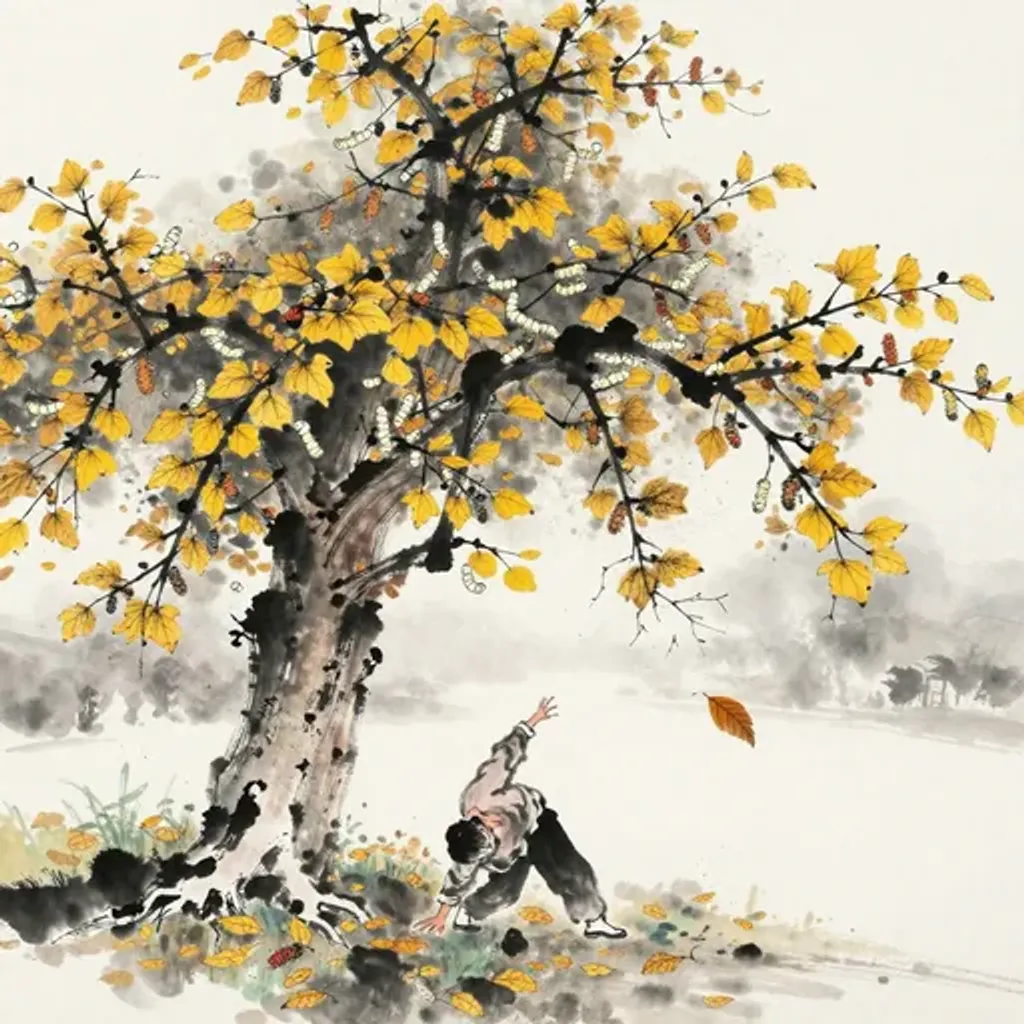
桑之將落,殞其黃葉;失勢傾側,而無所立。
The mulberry tree about to shed, dropping its yellow leaves. Losing its position, tilting and falling; with nothing left to stand upon.
— Jiao Yanshou, Yilin (Forest of Changes), 1st century BC
Commentary
Heaven above the lake, but the mulberry tree is about to shed its leaves. Its yellow foliage falls away, and the tree loses its footing, tilting without support. The mulberry's decline echoes the Shijing ode 'Sang Zhong,' where the mulberry grove marks both fertility and impermanence. Here the tree represents authority or position: once the leaves drop, the trunk stands naked and unstable, unable to maintain itself. From Treading to Biting Through, thunder and lightning combine to enforce judgment. The verse suggests that when one's position crumbles, what follows is not gentle decline but the sharp teeth of consequence — the law bites through pretense.
履 → 賁
Hexagram 10 → Hexagram 22: Grace
Changing lines: 2, 3, 4, 5
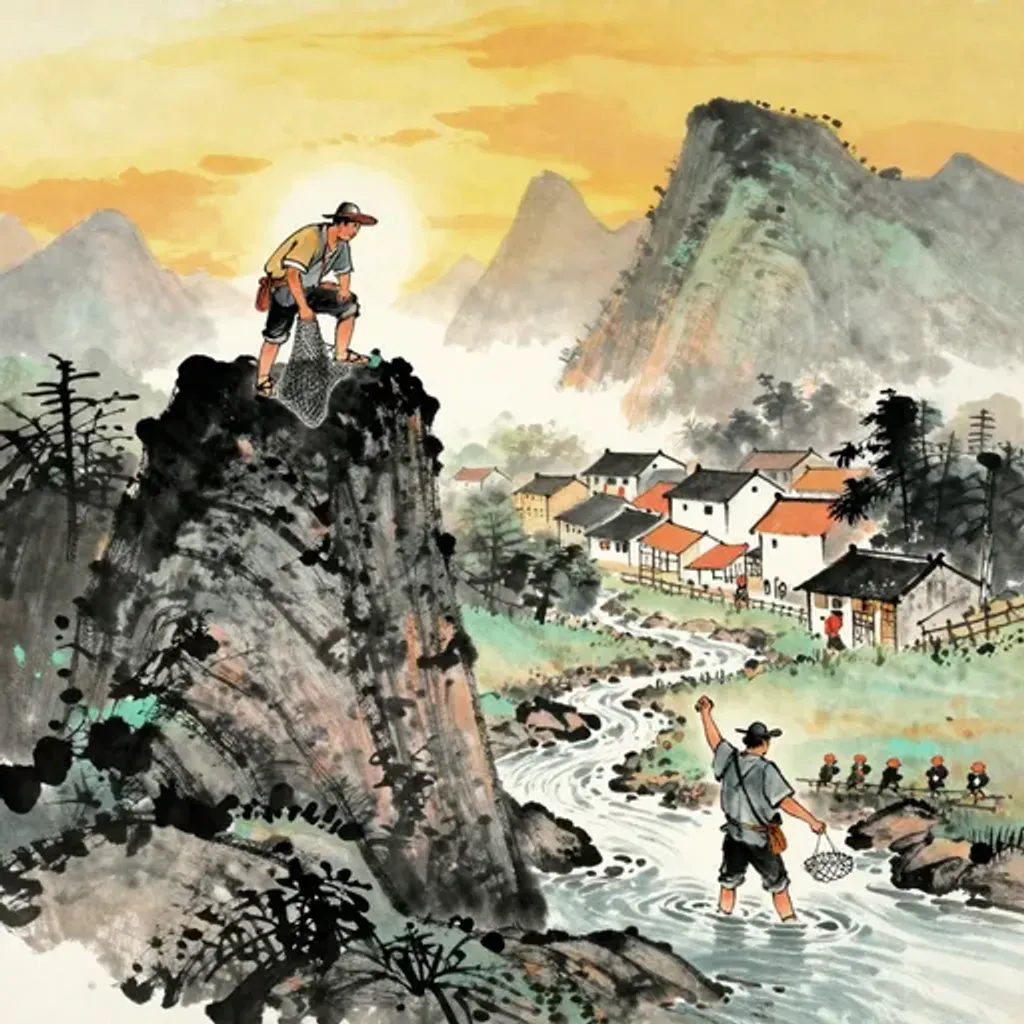
上山求魚,入水捕狸;市非其歸,自令久留。
Climbing the mountain to seek fish; entering the water to catch a wildcat. The market is not the right destination; one makes oneself linger too long.
— Jiao Yanshou, Yilin (Forest of Changes), 1st century BC
Commentary
Heaven above the lake, but the seeker looks in all the wrong places. Climbing a mountain to catch fish, diving into water to hunt a fox — every method is inverted, every effort futile. The marketplace is not where one belongs, yet one lingers there pointlessly. This echoes Mencius's famous metaphor of 'climbing a tree to seek fish' (緣木求魚): a fundamental mismatch between means and ends. From Treading to Grace, fire glows beneath the mountain — beauty adorns substance. The verse warns that misapplied effort produces neither utility nor beauty. Only when action aligns with its proper domain can form and function harmonize.
履 → 剝
Hexagram 10 → Hexagram 23: Splitting Apart
Changing lines: 1, 2, 4, 5
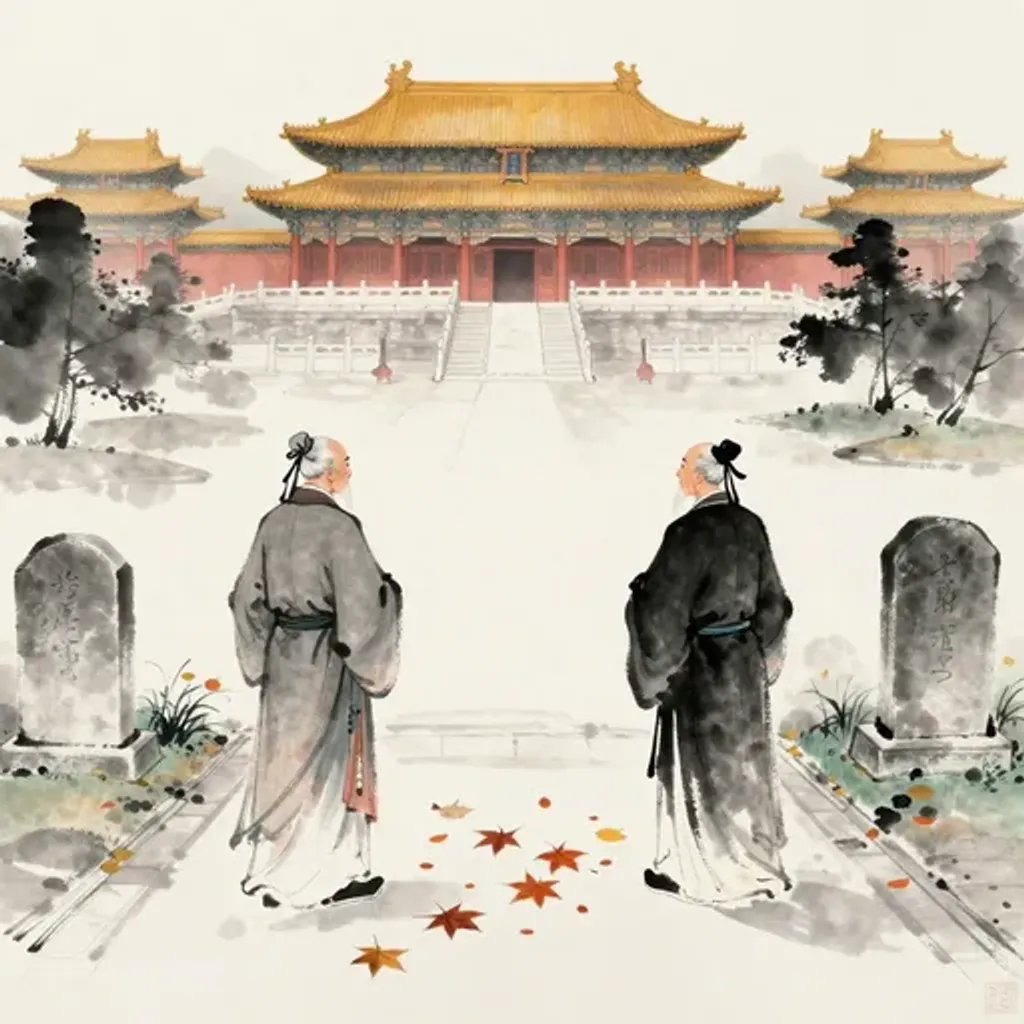
名成德就,項領不試;景公耋老,尼父逝去。
Fame established, virtue complete; the neck is never tested. Duke Jing grows old and infirm; Master Ni passes away.
— Jiao Yanshou, Yilin (Forest of Changes), 1st century BC
Commentary
Heaven above the lake, and a lifetime of accomplishment reaches its twilight. Fame is established and virtue fulfilled, yet the neck stiffens with age and is never tested again. Duke Jing of Qi grows old; Father Ni — Confucius — passes away. The verse mourns the end of an era: the sage who could have transformed the world dies without a kingdom to govern, and the duke who might have reformed his state runs out of time. From Treading to Splitting Apart, the mountain crumbles upon the earth. Achievement that is not transmitted erodes — glory peels away layer by layer, and what was built returns to dust.
履 → 復
Hexagram 10 → Hexagram 24: Return
Changing lines: 2, 4, 5, 6
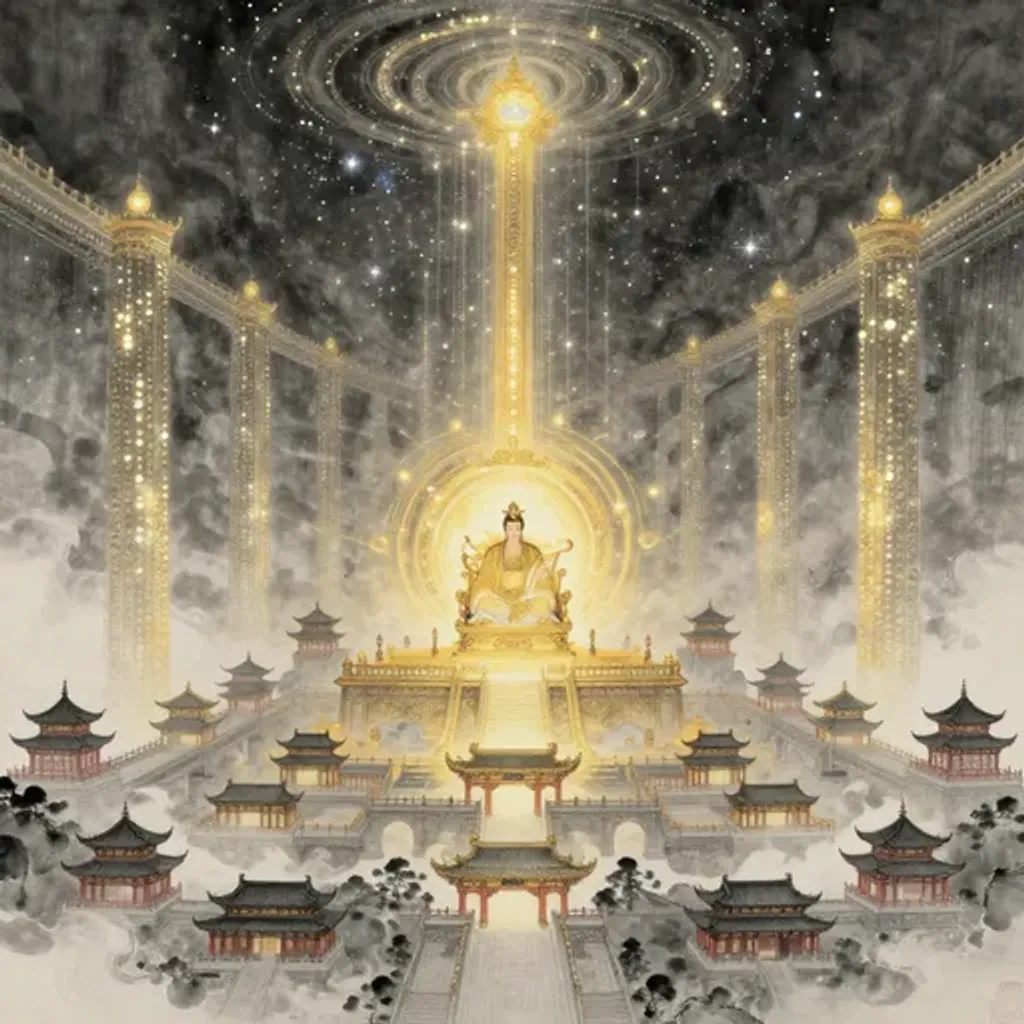
天之奧隅,堯舜所居;以存保身,為我國家。
The hidden corner of heaven; where Yao and Shun once dwelt. It preserves and protects the body; serving our state and home.
— Jiao Yanshou, Yilin (Forest of Changes), 1st century BC
Commentary
Heaven above the lake, and the gaze lifts to the hidden corner of the sky where Yao and Shun once dwelt. This celestial recess preserves and protects the body, securing the foundations of the state. The verse presents the sage-kings' realm as an ultimate sanctuary — a place beyond ordinary reach where one may find preservation. From Treading to Return, thunder stirs within the earth. The verse suggests that proper conduct leads not outward but back to origins: the solstice moment when heaven's light returns from its deepest retreat. One preserves the state by returning to the principles of the sage-kings, not by venturing further afield.
履 → 无妄
Hexagram 10 → Hexagram 25: Innocence
Changing lines: 2
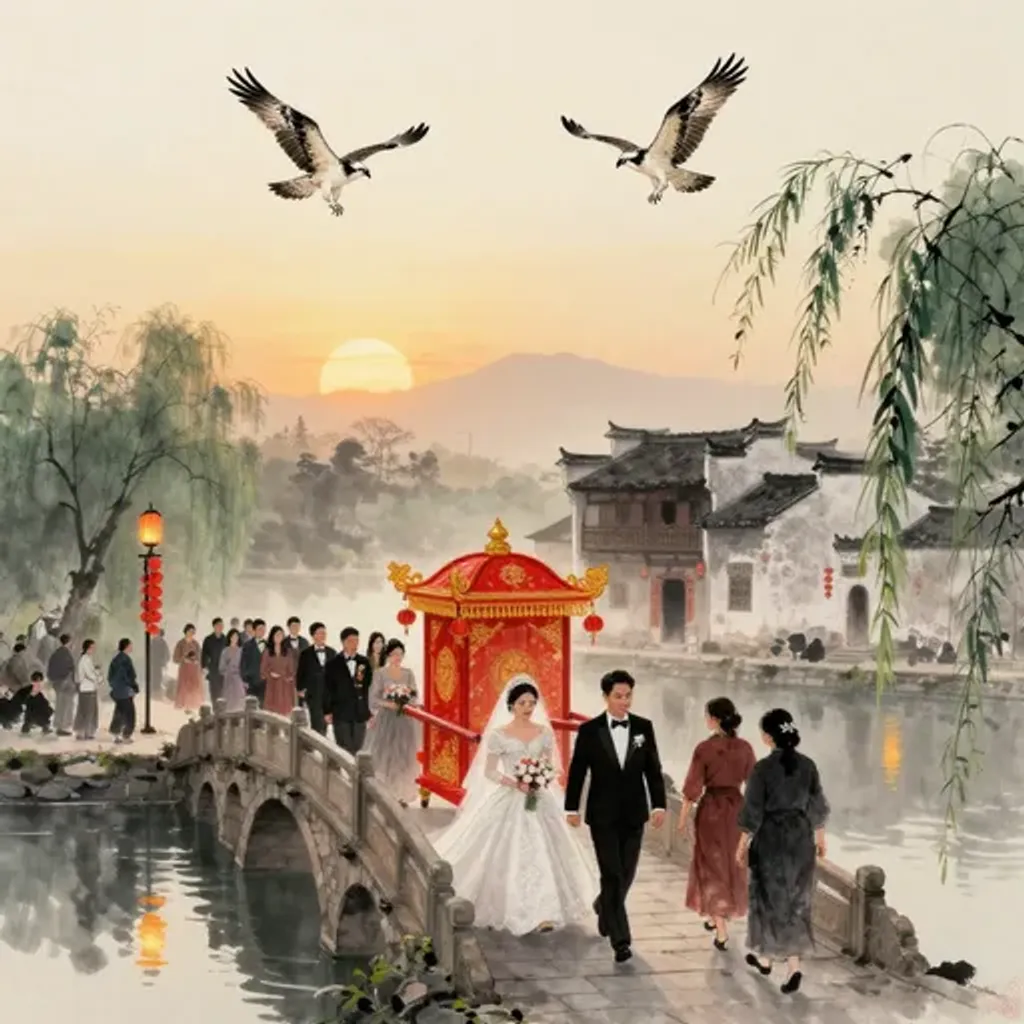
雎鳩淑女,賢聖配偶;宜家壽福,吉慶長久。
The osprey cries for a virtuous maiden; the worthy and sagely make their match. Bringing joy to the household, long life and blessings; auspicious fortune, enduring and lasting.
— Jiao Yanshou, Yilin (Forest of Changes), 1st century BC
Commentary
Heaven above the lake blesses a perfect union. Ospreys cry by the river islet — the opening image of the Shijing itself — as a modest maiden matches a worthy lord. The household prospers, longevity and blessings abound, and good fortune endures. The verse directly quotes the 'Guan Ju' ode, the poem that Confucius praised as 'joyful without excess, sorrowful without injury.' From Treading to Innocence, heaven's thunder moves without contrivance. The transformation captures the essence of guileless conduct: when one treads in natural harmony, unions form without manipulation, and blessings arrive unsought — the very definition of wu wang, innocence without falsehood.
履 → 大畜
Hexagram 10 → Hexagram 26: Great Taming
Changing lines: 3, 4, 5
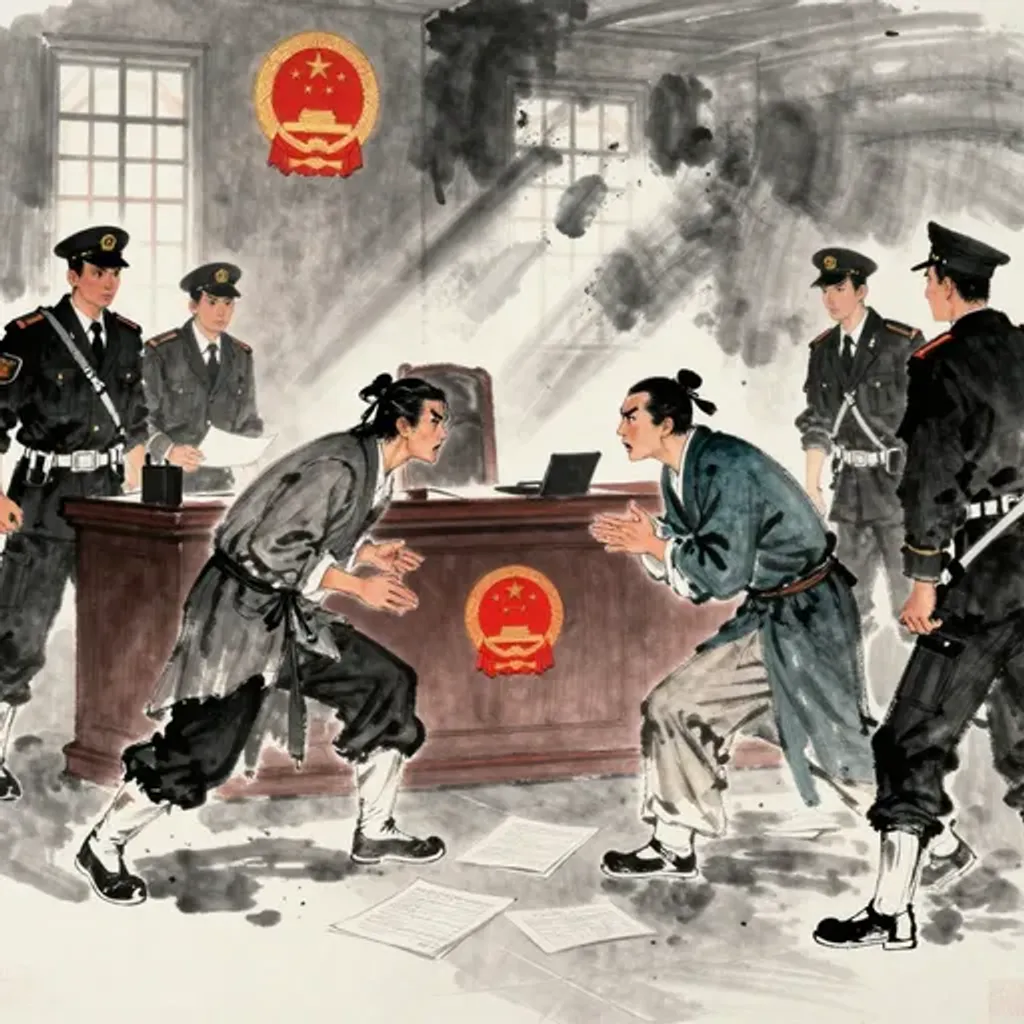
兩人俱爭,莫能有定;心乖不同,訟言起凶。
Two men vie with each other; neither can prevail. Hearts divided, they disagree; the lawsuit stirs misfortune.
— Jiao Yanshou, Yilin (Forest of Changes), 1st century BC
Commentary
Heaven above the lake, two people locked in irreconcilable dispute. Neither party can settle the matter; hearts diverge and refuse to align. Quarrelsome words arise, litigation spirals, and contention brings misfortune to all involved. The verse mirrors 10-4 in theme but darkens the outcome considerably: where that verse showed mere confusion, here the quarrel erupts into active harm, with hostile speech generating its own momentum. From Treading to Great Taming, heaven is stored within the mountain. The transformation suggests that the disputants' ferocious energy, if properly contained and channeled, could become accumulated wisdom — but left uncontained, it merely generates destructive friction that consumes both parties. The mountain must hold heaven; otherwise the pressure explodes outward.
履 → 頤
Hexagram 10 → Hexagram 27: Nourishment
Changing lines: 2, 4, 5
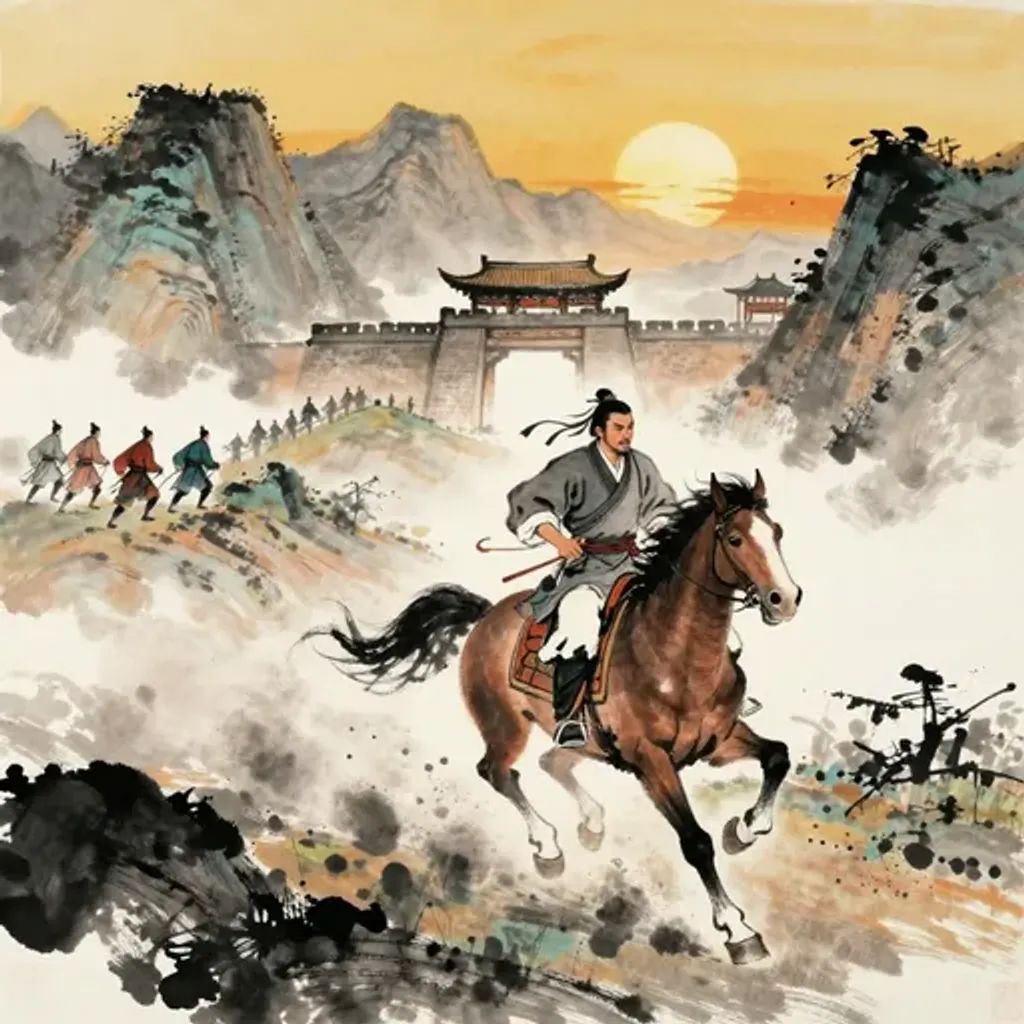
涉伯徇名,棄禮誅身;不得其道,成子奔燕。
She Bo pursues fame, abandoning rites, and brings destruction upon himself. Unable to find the proper way; Cheng Zi flees to Yan.
— Jiao Yanshou, Yilin (Forest of Changes), 1st century BC
Commentary
Heaven above the lake, a cautionary tale of misplaced ambition. Lord She pursues reputation at the cost of propriety, abandoning ritual and bringing death upon himself. Unable to find the proper Way, Lord Chengzi flees to Yan. The verse likely alludes to a Spring and Autumn figure who sacrificed principle for fame and paid with his life, while another chose exile over complicity. From Treading to Nourishment, the mountain rests above thunder. True nourishment demands careful speech and measured appetite — the opposite of reckless pursuit of fame. One who discards ritual to chase glory starves the spirit while feeding the ego.
履 → 大過
Hexagram 10 → Hexagram 28: Great Exceeding
Changing lines: 1, 3, 6
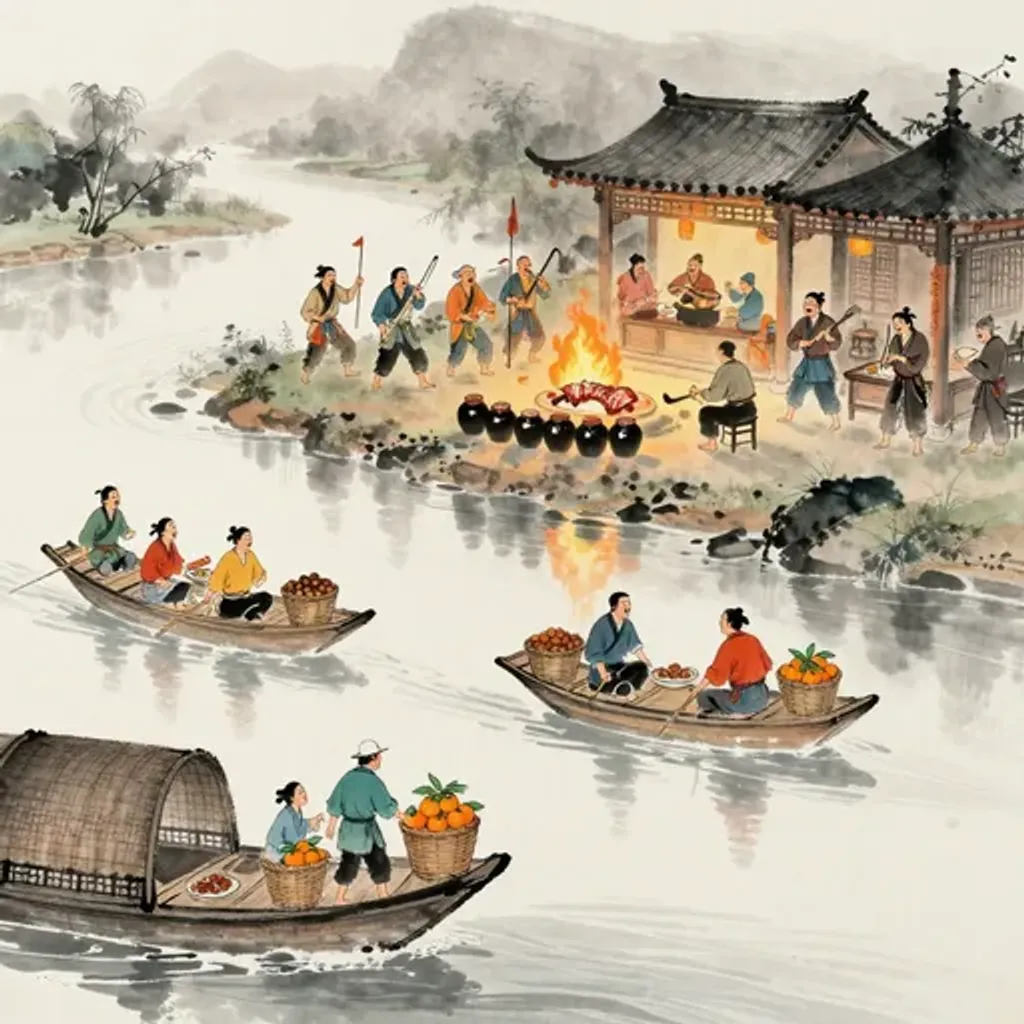
踰江求橘,并得大栗;烹羊食肉,飲酒歌笑。
Crossing the river to seek tangerines; he also finds great chestnuts. Roasting mutton and eating meat; drinking wine, singing, and laughing.
— Jiao Yanshou, Yilin (Forest of Changes), 1st century BC
Commentary
Heaven above the lake, and a journey yields unexpected bounty. Crossing the river in search of tangerines, one also obtains fine chestnuts. A lamb is roasted, meat is eaten, wine flows, and songs fill the air with laughter. The verse stages pure abundance: what was sought is found, and more arrives unbidden. The mood is festive, the journey successful beyond expectation. From Treading to Great Exceeding, the lake submerges the trees — abundance overflows its vessel. Careful conduct has led to a surplus that exceeds normal bounds, and the only proper response is celebration. Yet Great Exceeding also warns: the ridgepole may sag under such weight.
履 → 坎
Hexagram 10 → Hexagram 29: The Abysmal Water
Changing lines: 1, 4, 6
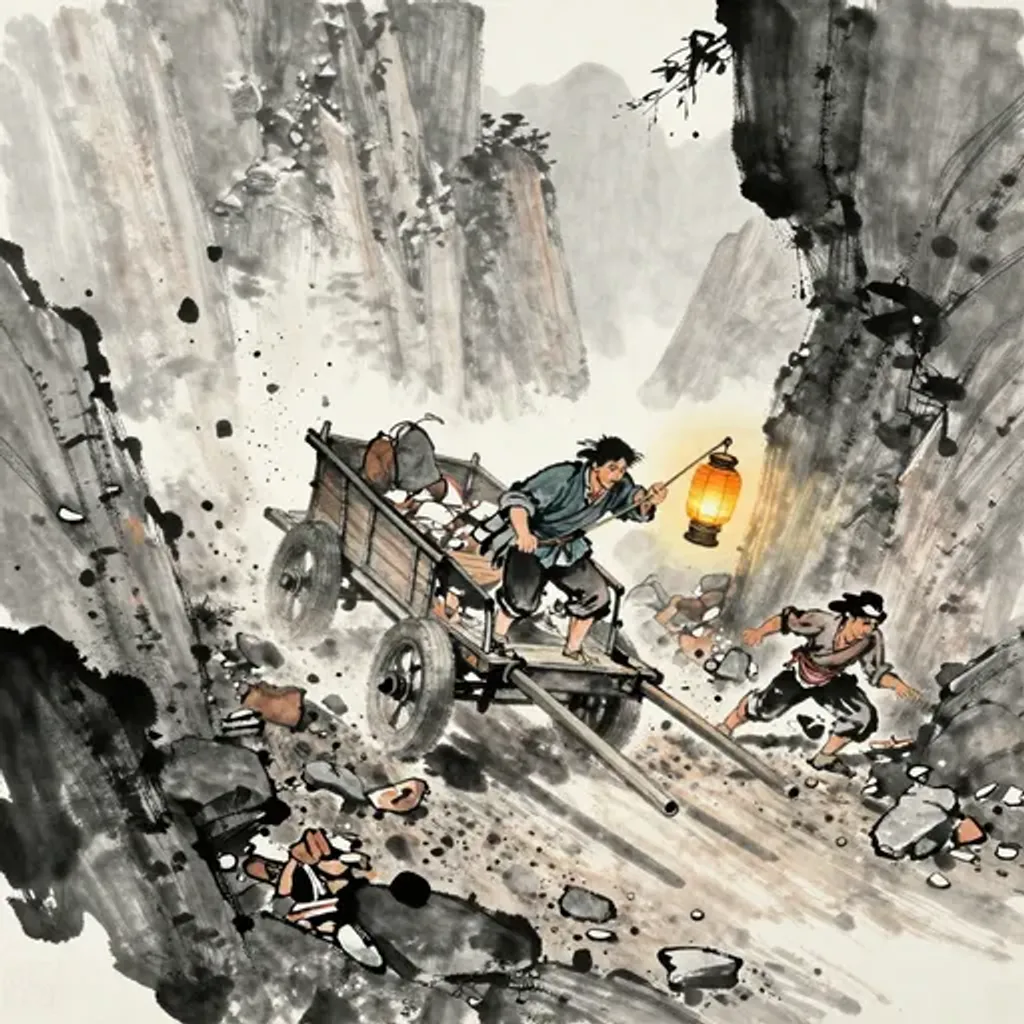
山險難升,澗中多石;車馳轊擊,重傷載軸;擔負善躓,跌踒右足。
The mountain is steep and hard to climb; the ravine is strewn with stones. The carriage races, axle-caps clashing; the axle suffers heavy damage. The bearer stumbles easily; spraining and twisting the right foot.
— Jiao Yanshou, Yilin (Forest of Changes), 1st century BC
Commentary
Heaven above the lake, yet the terrain beneath is treacherous beyond measure. The mountain is too steep to climb, the ravine filled with stones. A speeding cart strikes its axle-cap, damaging the axle severely. Porters stumble under their loads, spraining and breaking the right foot. Every form of passage — by vehicle, on foot, bearing burdens — fails on this ground. From Treading to the Abysmal, water upon water doubles the danger. The transformation strips away any pretense of safe conduct: some paths are simply impassable, and the wise response is not to press forward but to cultivate constancy amid repeated peril.
履 → 離
Hexagram 10 → Hexagram 30: The Clinging Fire
Changing lines: 2, 3, 5
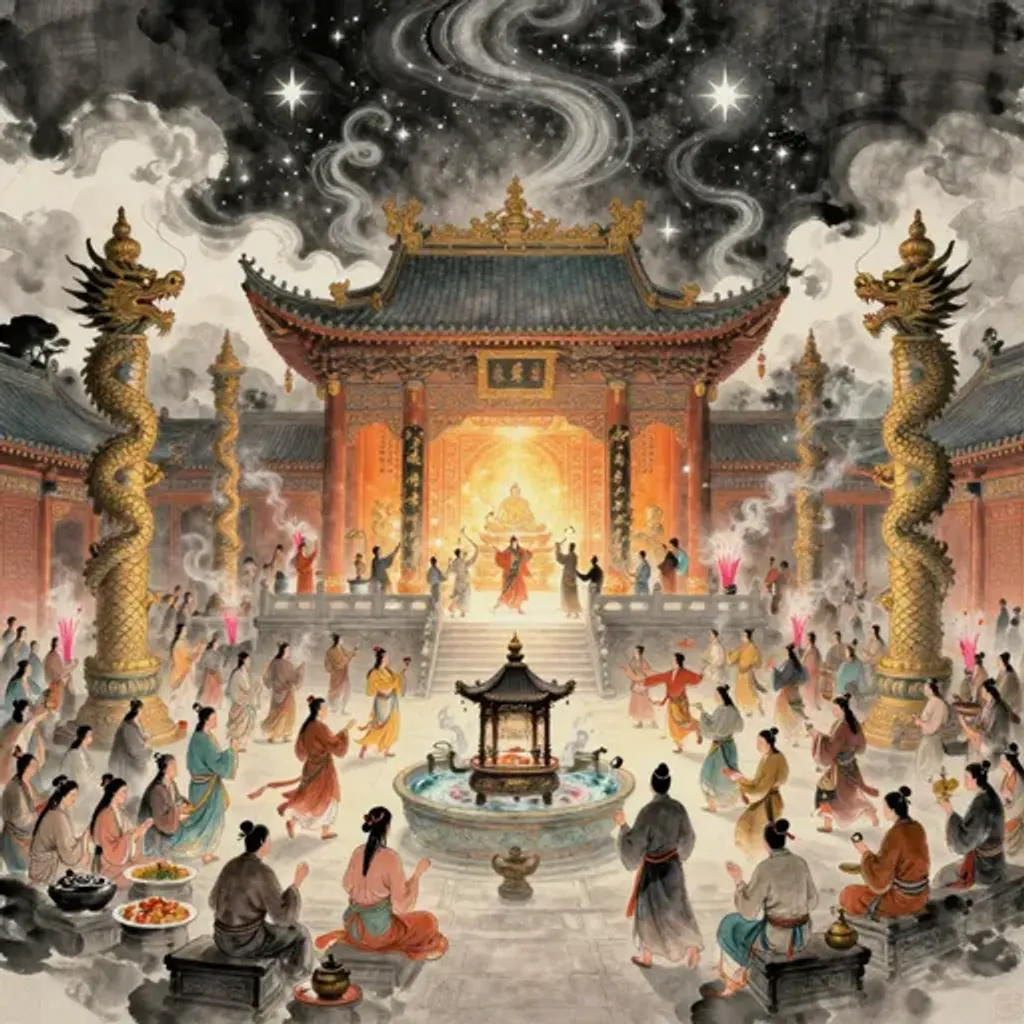
元利孔福,神所子畜;般樂無苦,得其歡欲。
Primal gain and great fortune; cherished and nurtured by the spirits. Pleasure and joy without suffering; one attains what the heart desires.
— Jiao Yanshou, Yilin (Forest of Changes), 1st century BC
Commentary
Heaven above the lake radiates supreme blessing. Great profit and profound fortune descend as gifts from the spirits who nurture and protect. Pleasure without suffering, every desire fulfilled. The verse is unusually unambiguous in its auspiciousness: divine favor is total and unconditional. From Treading to the Clinging, doubled fire illuminates all four directions. Proper conduct has ignited a radiance that perpetuates itself — the great person continues the brightness, shining outward. The transformation from measured treading to sustained brilliance suggests that when one's steps are aligned with heaven, the resulting clarity becomes self-sustaining, a light that needs no external fuel.
履 → 咸
Hexagram 10 → Hexagram 31: Influence
Changing lines: 1, 2, 3, 6
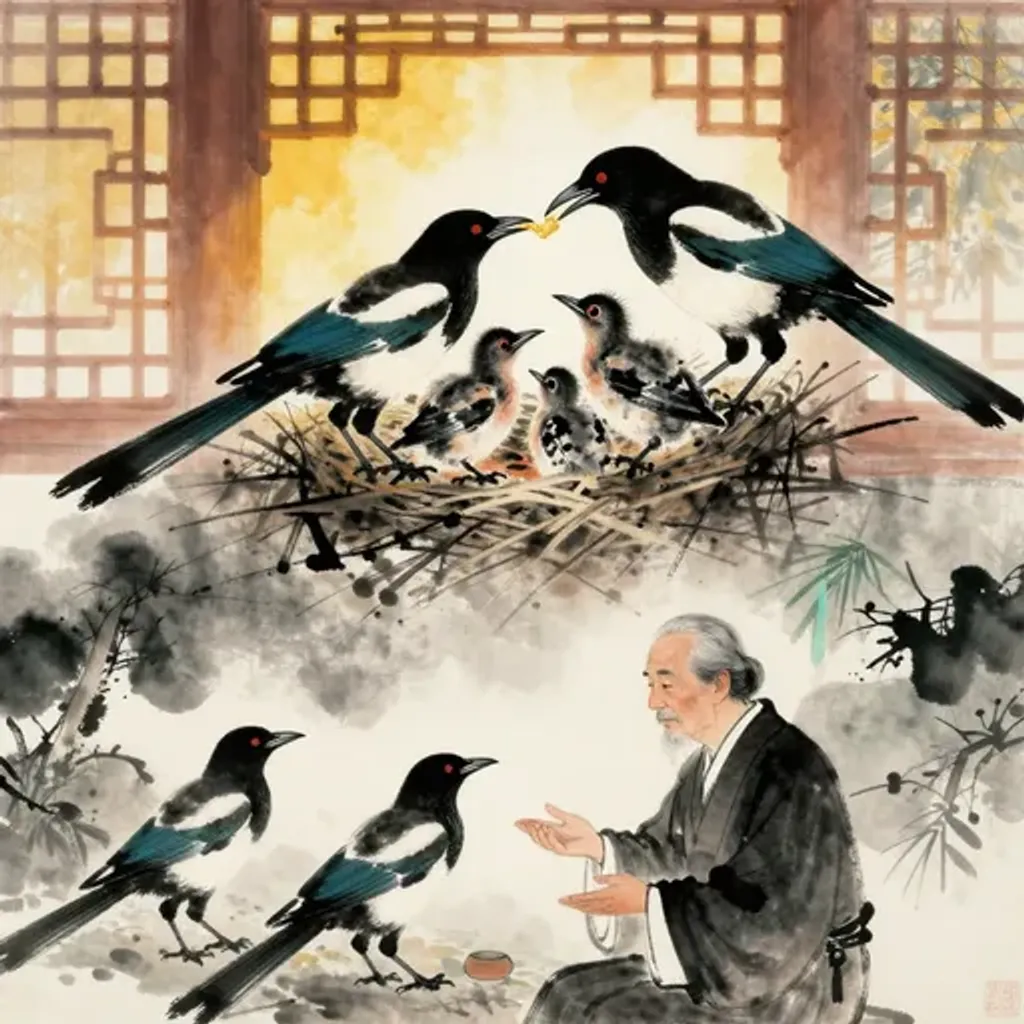
烏鵲食穀,張口受哺;蒙被恩福,長大成就;柔順利貞,君臣合好。
Crows and magpies eat grain, opening their mouths to be fed. Covered with kindness and blessing; they grow and come to maturity. Gentle and steadfast in constancy; lord and minister join in harmony.
— Jiao Yanshou, Yilin (Forest of Changes), 1st century BC
Commentary
Heaven above the lake nourishes the young. Crows and magpies eat grain, opening their mouths to receive food from their parents. Cloaked in blessing and grace, the fledglings grow to full stature. Softness and constancy bring auspicious steadiness; ruler and minister unite in harmony. The imagery of birds feeding their young extends into the political realm: just as parent birds nourish fledglings, wise governance nurtures subjects until they mature into capable beings. From Treading to Influence, the lake rests upon the mountain, receptive and open. Proper conduct cultivated over time produces mutual responsiveness — the heart opened through patient care.
履 → 恆
Hexagram 10 → Hexagram 32: Duration
Changing lines: 1, 3, 5, 6
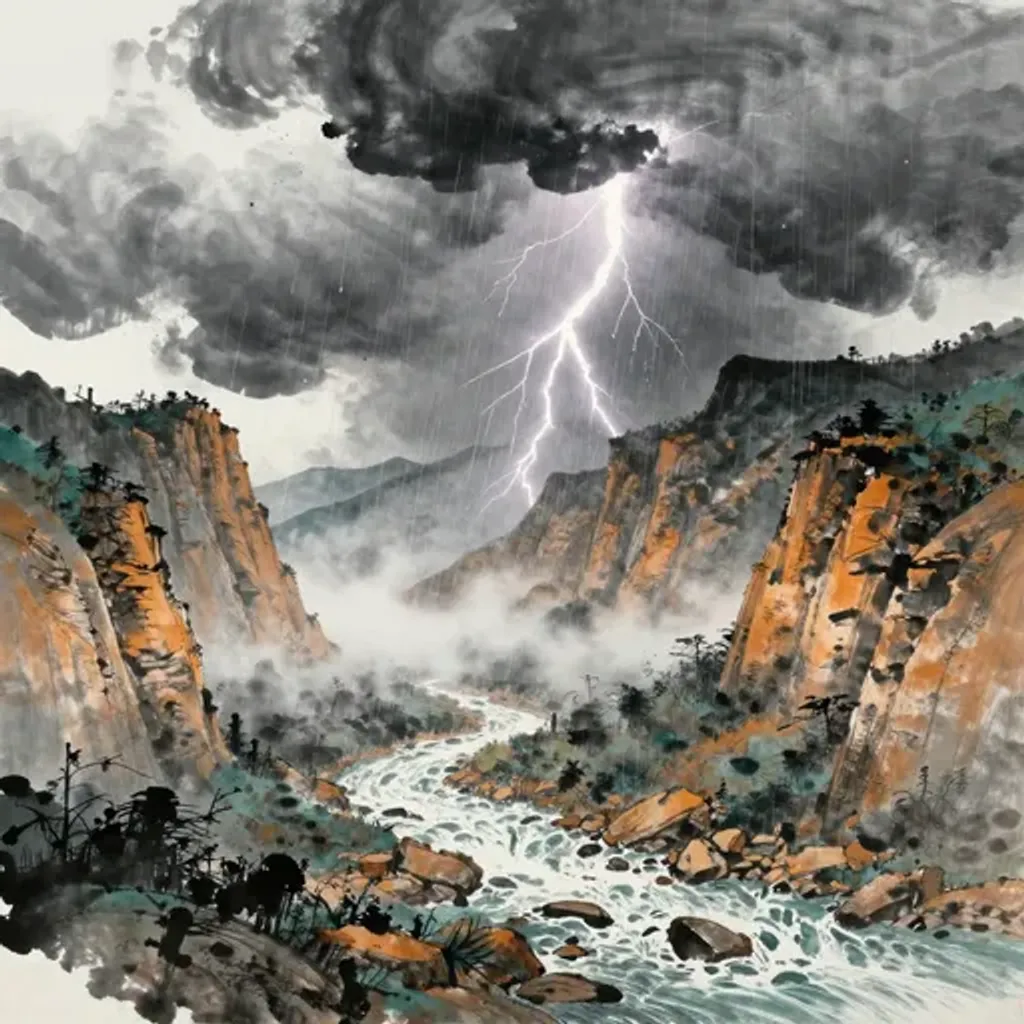
潼滃蔚薈,膚寸來會;津液下降,流潦滂沛。
Swirling, dense, and lush; gathering from the slightest wisp. Dew and moisture descend; streams and floods rush forth in abundance.
— Jiao Yanshou, Yilin (Forest of Changes), 1st century BC
Commentary
Heaven above the lake, and moisture gathers into a great convergence. Dense mists rise lush and layered, condensing from the smallest wisp of cloud — the 'skin-inch' measure that ancient meteorologists used for the first visible condensation. Vital fluids descend, and torrential streams pour forth in overwhelming abundance. The verse traces the entire water cycle without a single human agent: vapor ascending, clouds thickening from a mere fingerbreadth, rain falling, and rivers swelling beyond their banks. From Treading to Duration, thunder and wind sustain each other in an endless reciprocal cycle. The transformation captures perseverance made visible: careful conduct, repeated consistently over time, accumulates like atmospheric moisture until it becomes an unstoppable, self-perpetuating downpour that reshapes the landscape.
履 → 遯
Hexagram 10 → Hexagram 33: Retreat
Changing lines: 1, 2, 3
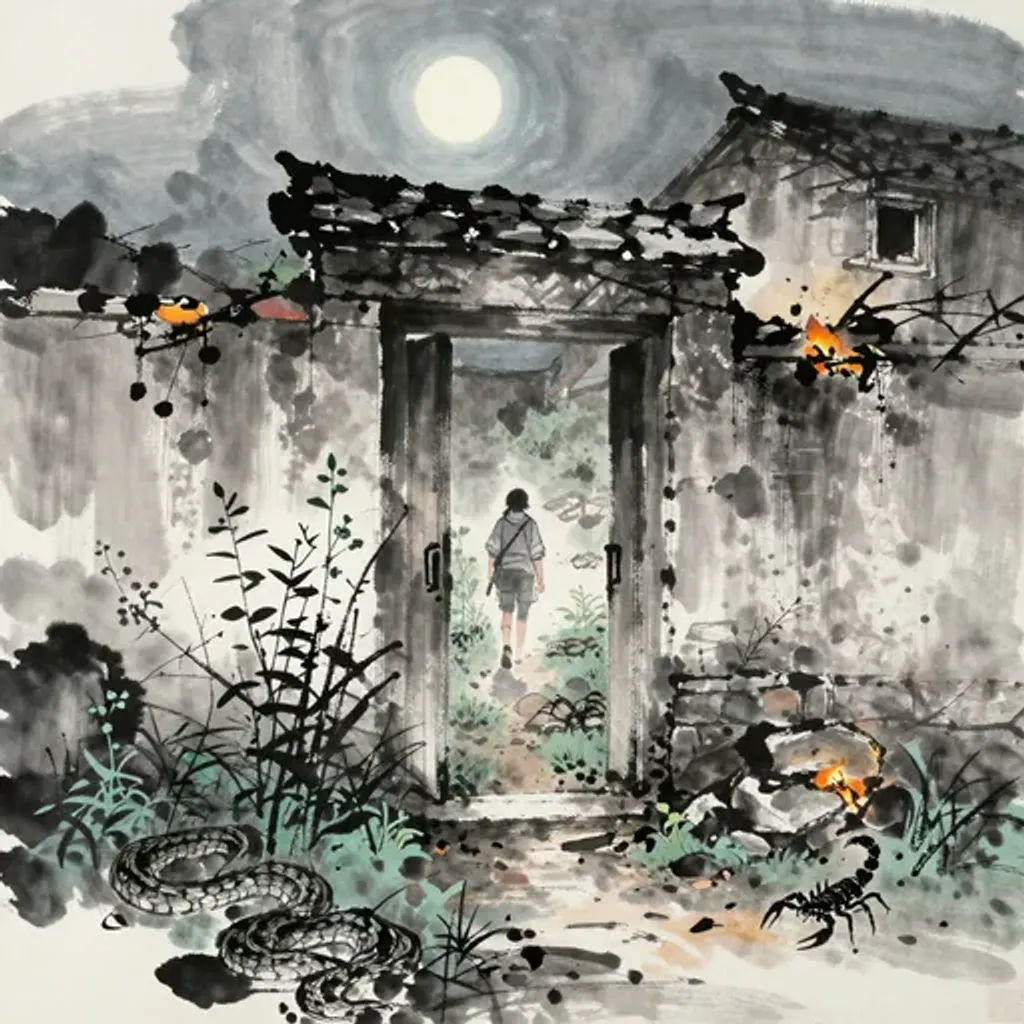
路多枳棘,步刺我足;不利旅客,為心作毒。
The overgrown path rises to the knees; mugwort seals the doorway. Snakes and scorpions lurk hidden — one dares not go forward.
— Jiao Yanshou, Yilin (Forest of Changes), 1st century BC
Commentary
Heaven above the lake, but the path ahead is choked with thorns. The original verse reads: 'The road is thick with thorny jujube, each step piercing my feet. Unfavorable for the traveler, breeding poison in the heart.' Every footfall draws blood; the way forward is hostile, and the journey breeds only resentment. From Treading to Retreat, heaven rises above the mountain — the superior person distances himself from the petty without malice. The verse embodies Retreat's logic perfectly: when the path itself is venomous, wisdom lies not in pressing through but in withdrawing. The gentleman retreats with dignity, not because he fears the thorns, but because the path no longer leads anywhere worth going.
履 → 大壯
Hexagram 10 → Hexagram 34: Great Power
Changing lines: 3, 5, 6
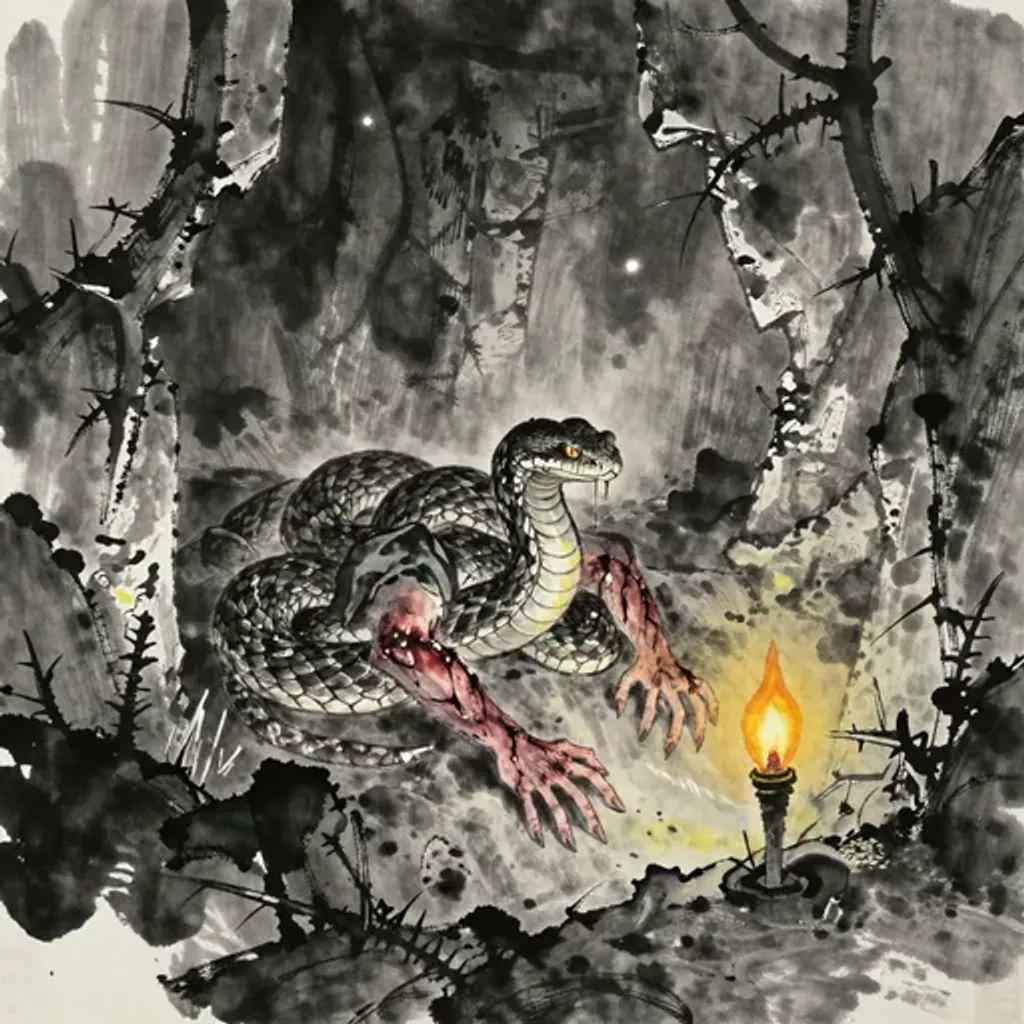
虺蝮所聚,難以居處;毒螫痛甚,瘡不可愈。
Where vipers and adders gather; it is hard to dwell or stay. The venomous stings bring terrible pain; the wounds cannot be healed.
— Jiao Yanshou, Yilin (Forest of Changes), 1st century BC
Commentary
Heaven above the lake, yet venomous serpents cluster in every direction. Vipers and pit snakes gather so thickly that the place is uninhabitable. The stings burn unbearably, and the wounds will not heal. This is Treading at its most lethal — not a single misstep on the tiger's tail, but an environment so saturated with danger that no amount of careful conduct can ensure safety. From Treading to Great Power, thunder crashes above heaven. The transformation suggests that brute strength may be the only answer when the terrain itself is poisonous. Yet Great Power also counsels restraint: the gentleman does not tread where propriety forbids, even when he has the strength to force passage.
履 → 晉
Hexagram 10 → Hexagram 35: Progress
Changing lines: 1, 2, 5
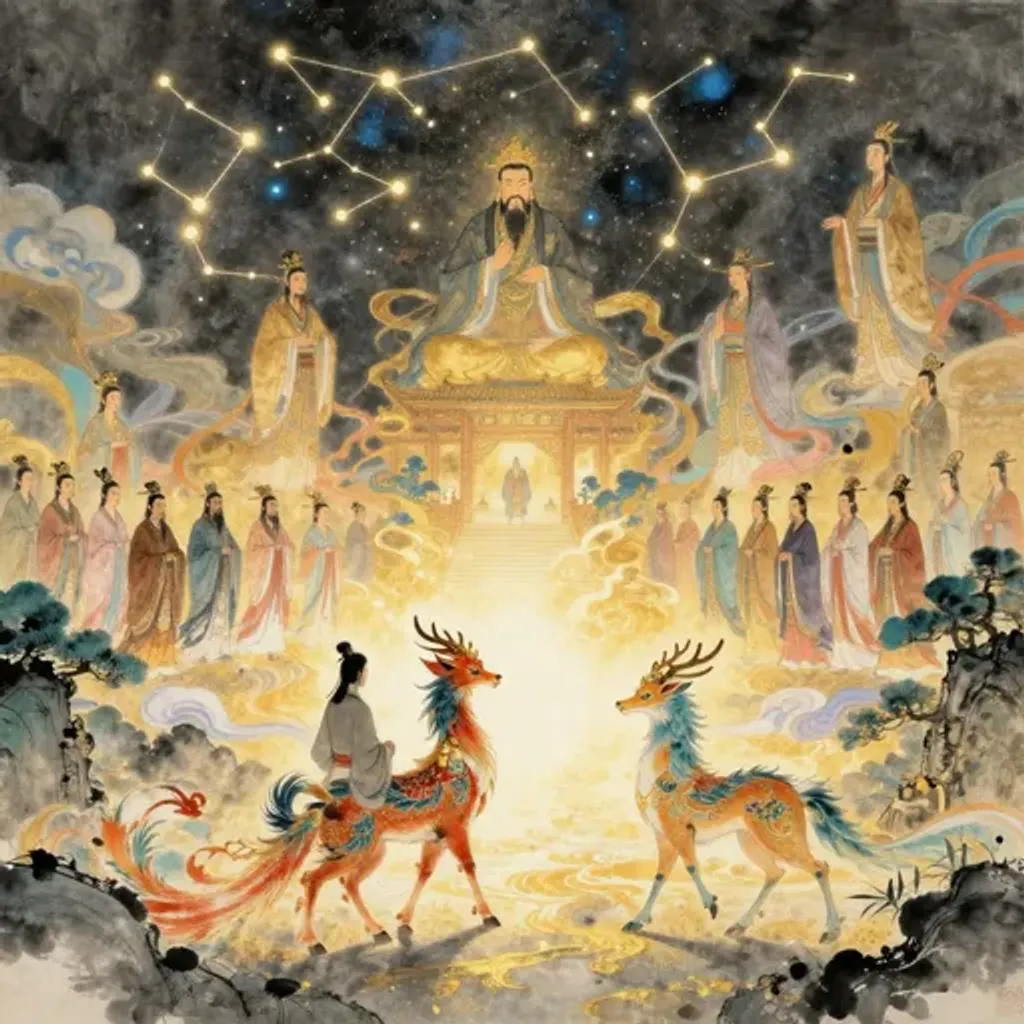
麟鳳相隨,觀察安危;東郭聖人,后稷周公;共和政令,君子攸同;利以居止,長無憂凶。
Qilin and phoenix follow together, observing what is safe and what is perilous. The sage east of the outer wall, Hou Ji and the Duke of Zhou -- together they harmonize governance, and noble men find common cause. Advantageous for settling down; long free from worry and misfortune.
— Jiao Yanshou, Yilin (Forest of Changes), 1st century BC
Commentary
Heaven above the lake, and auspicious creatures walk together. Qilin and phoenix attend one another, observing the balance of safety and peril. The Eastern Suburb sage appears alongside Lord Millet and the Duke of Zhou — three paragons of civilizing virtue — governing in shared harmony. Decrees are just, the gentleman finds his proper place, and one may dwell in lasting peace without misfortune. From Treading to Progress, fire rises above the earth as the sun illuminates the land. Proper conduct, guided by sage precedent, produces an era where virtue advances openly. The transformation from cautious treading to confident progress embodies the promise fulfilled: when the right people govern, brilliance breaks forth naturally.
履 → 明夷
Hexagram 10 → Hexagram 36: Darkening of the Light
Changing lines: 2, 3, 4, 5, 6
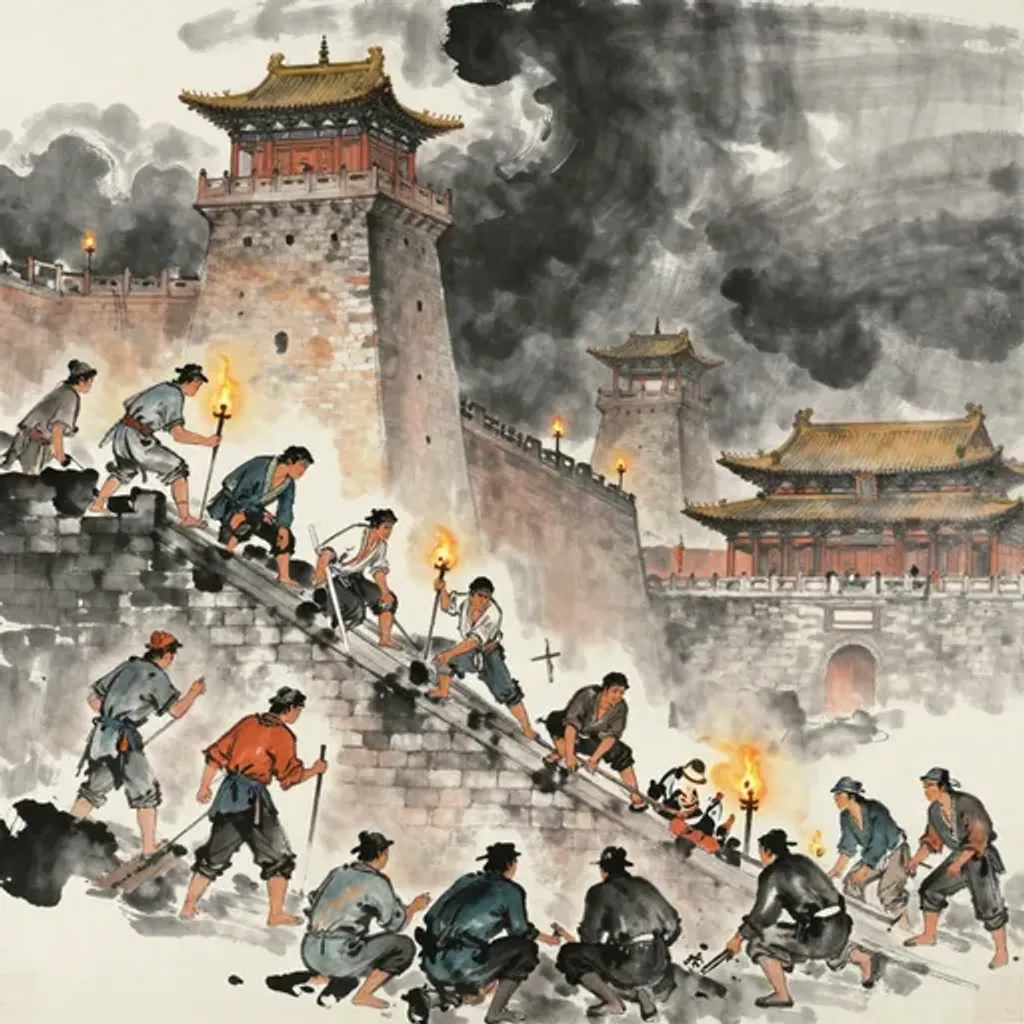
築亂不時,使民恨憂;立祉為笑,君危臣騷。
Building recklessly, out of season; the people are filled with resentment and grief. Establishing a monument only to be mocked; the lord is endangered, the ministers agitated.
— Jiao Yanshou, Yilin (Forest of Changes), 1st century BC
Commentary
Heaven above the lake, but governance has lost its rhythm. Construction is ordered at the wrong season, conscripting the people when they should be farming, breeding resentment and sorrow. What was meant to bring prosperity becomes a joke; the ruler stands in danger and his ministers are in turmoil. The verse condemns untimely governance — the cardinal sin of the agrarian state, where forced labor outside the farming calendar can cause famine. From Treading to Darkening of the Light, fire sinks into the earth. Brightness is buried: the ruler's misjudgment obscures the very welfare he intended to build, and the people's anger smolders underground like light swallowed by darkness.
履 → 家人
Hexagram 10 → Hexagram 37: The Family
Changing lines: 2, 3, 4
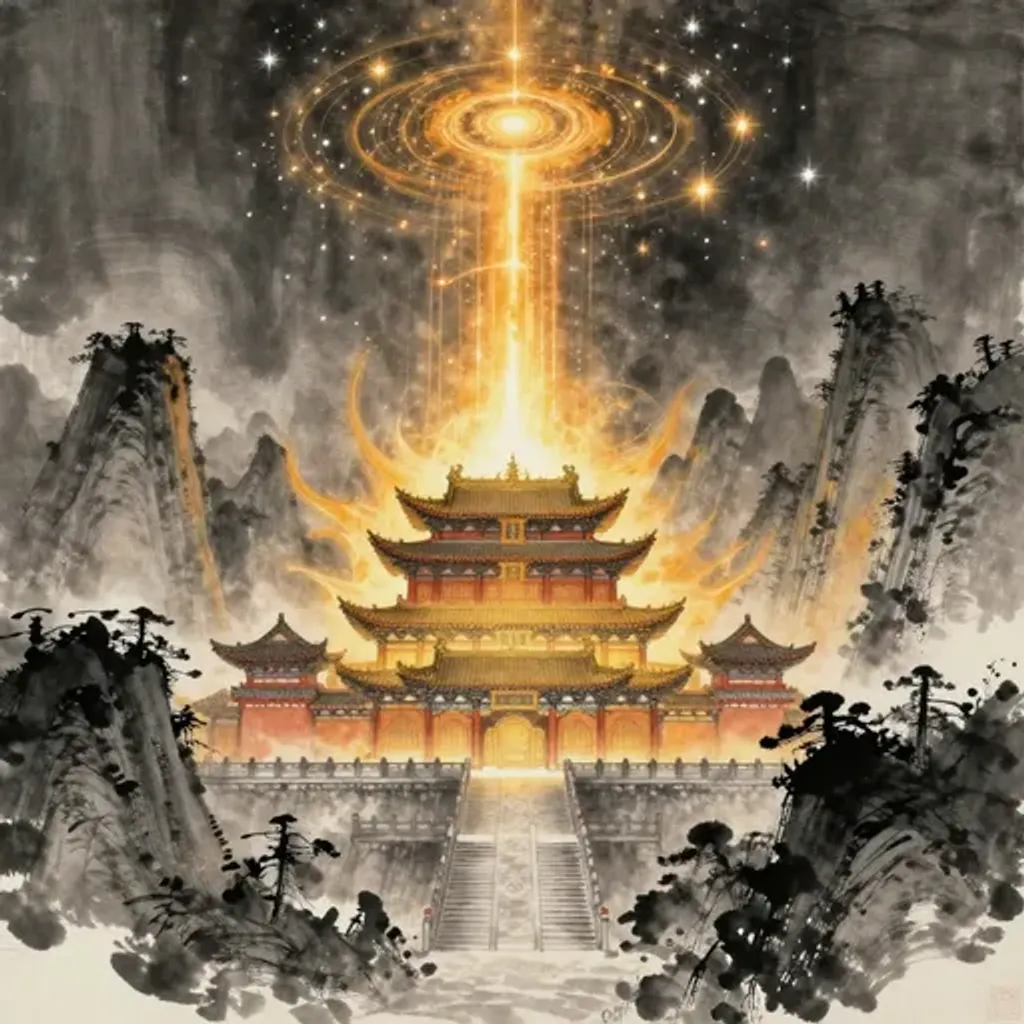
黃帝所生,伏羲之宅;兵刃不至,利以居止。
Where the Yellow Emperor was born; the dwelling of Fuxi. Blades and weapons do not reach here; advantageous for settling down.
— Jiao Yanshou, Yilin (Forest of Changes), 1st century BC
Commentary
Heaven above the lake, and the dwelling is sacred ground. This is the birthplace of the Yellow Emperor and the homeland of Fu Xi — the two culture heroes who gave humanity its foundational order. Weapons and blades cannot reach here; it is an auspicious place to dwell in peace. The verse invokes mythological geography: a primordial sanctuary where civilization began and violence cannot intrude. From Treading to the Family, wind emerges from fire. The transformation from careful public conduct to harmonious domestic order is complete. When one's dwelling rests on the foundations laid by the sages themselves, the household radiates warmth outward as naturally as wind rises from flame.
履 → 睽
Hexagram 10 → Hexagram 38: Opposition
Changing lines: 5
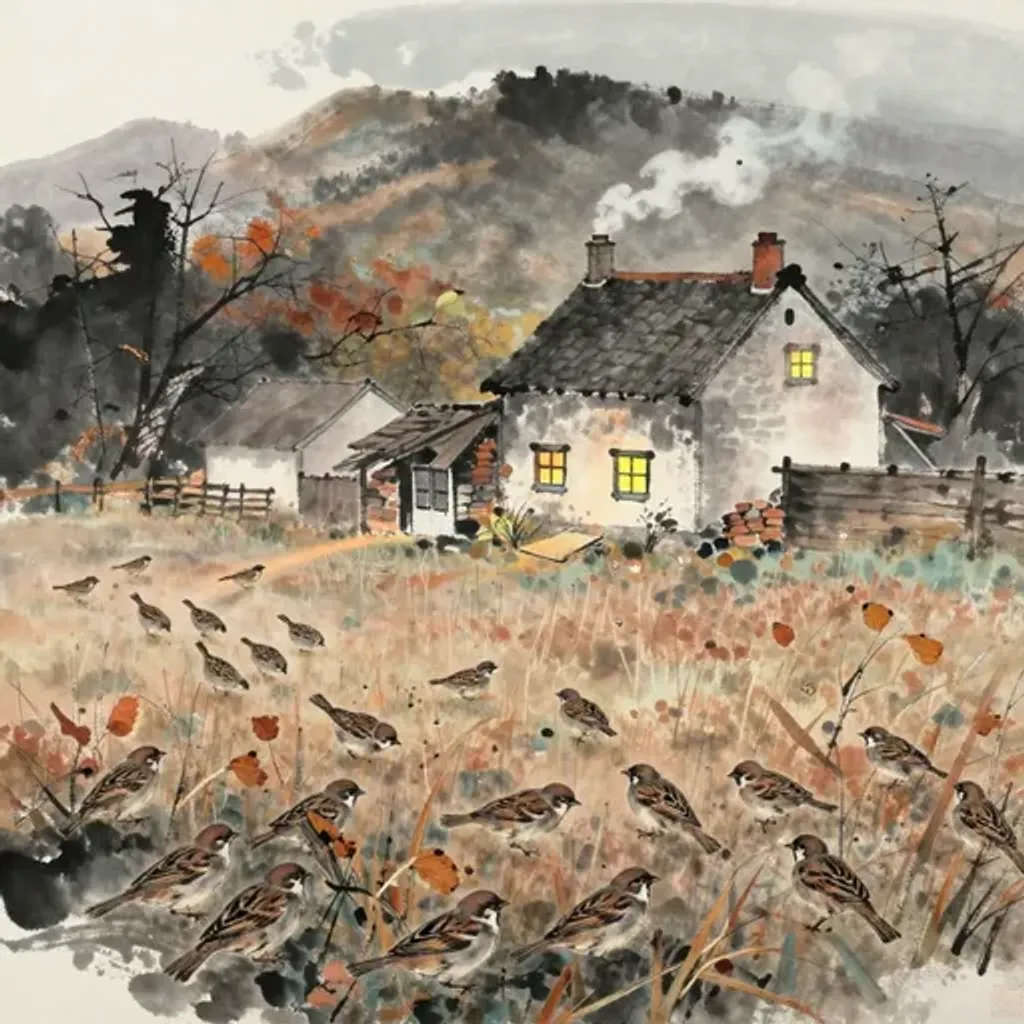
雀行求食,暮歸屋宿;反其室舍,安寧無故。
The sparrow goes out seeking grain; at dusk it returns to roost. Back in its chamber and home; peaceful and calm, as of old.
— Jiao Yanshou, Yilin (Forest of Changes), 1st century BC
Commentary
Heaven above the lake, and a sparrow follows its daily round. It ventures out to forage, returns at dusk to roost beneath the eaves, settles back into its familiar shelter, and rests in tranquility without incident. The imagery is deliberately modest: no grand journey, no heroic exploit — just the reliable rhythm of departure and return. From Treading to Opposition, fire flares above while the lake sinks below, their natures diverging. Yet the sparrow's contentment offers a counterpoint: even amid apparent opposition, there is harmony in knowing one's place. The gentleman finds unity within difference, returning each evening to the same rooftop undisturbed.
履 → 蹇
Hexagram 10 → Hexagram 39: Obstruction
Changing lines: 1, 2, 3, 4, 6
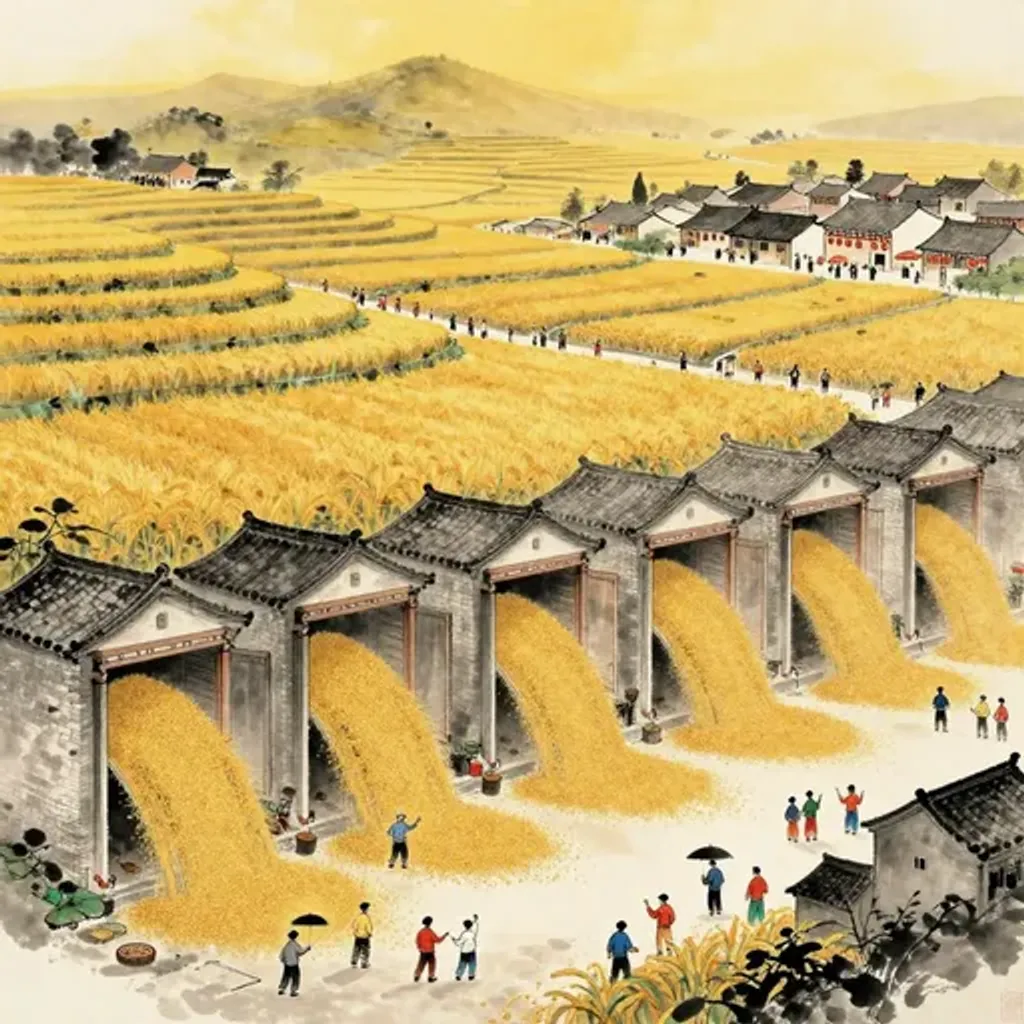
太倉積穀,天下饒食;陰陽調和,年歲時熟。
The great granary stores its grain; all under heaven eats well. Yin and yang are in harmony; the years ripen in their proper season.
— Jiao Yanshou, Yilin (Forest of Changes), 1st century BC
Commentary
Heaven above the lake, and the granaries of the empire overflow. The Great Storehouse brims with grain, the realm has food in abundance. Yin and yang are in harmony, and the harvest ripens on schedule year after year. This is the utopian vision of Treading fulfilled: when conduct at every level — cosmic, political, agricultural — aligns perfectly, the result is inexhaustible plenty. From Treading to Obstruction, water pools atop the mountain in an image of danger. The paradox is deliberate: the very abundance described here is what Obstruction threatens to disrupt. The verse offers the golden age as a benchmark, reminding us what is at stake when the path ahead is blocked.
履 → 解
Hexagram 10 → Hexagram 40: Deliverance
Changing lines: 1, 5, 6
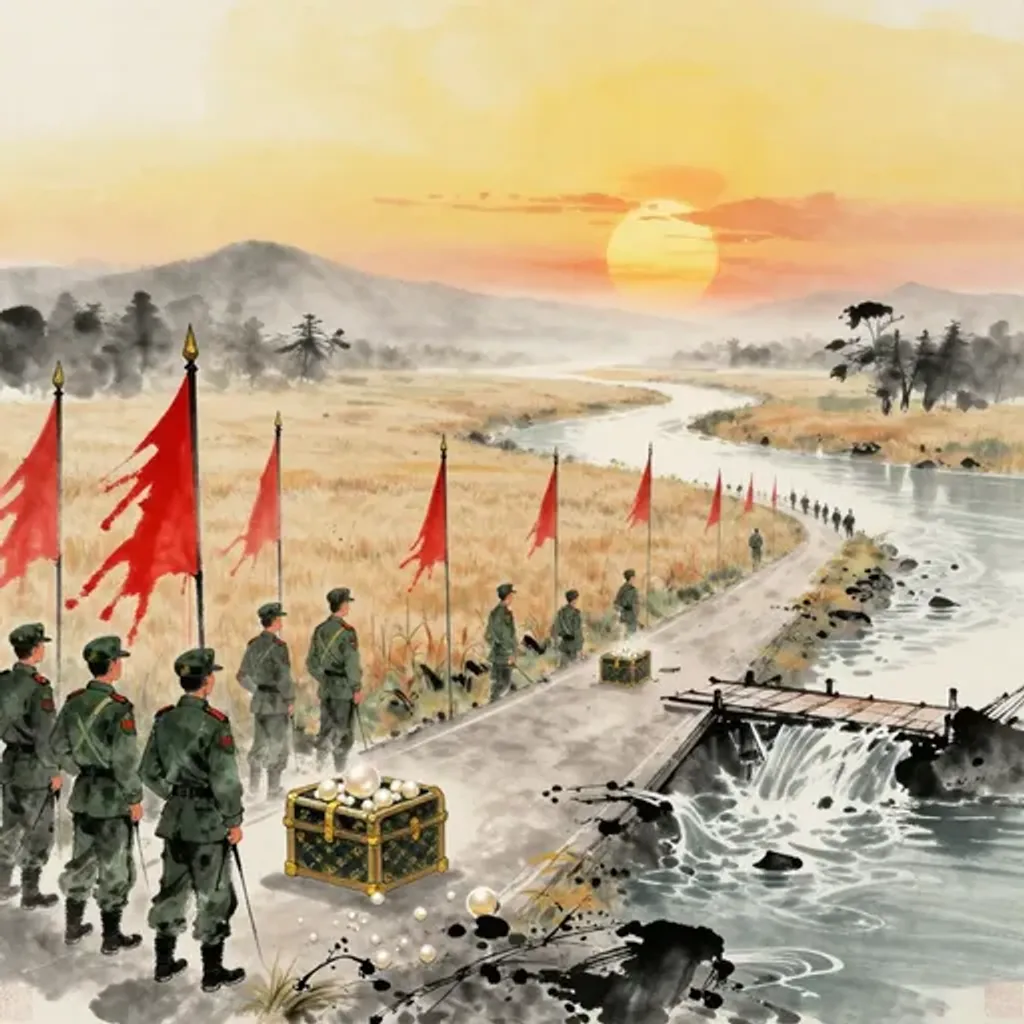
竿旄旗旌,執幟在郊;雖有寶珠,無路致之。
Poles, pennants, banners, and flags; holding ensigns in the open field. Though there are precious pearls; there is no road to deliver them.
— Jiao Yanshou, Yilin (Forest of Changes), 1st century BC
Commentary
Heaven above the lake, banners and pennants wave in the suburban field. Standards are raised and flags flutter, troops mustered at the outskirts. Yet though one possesses precious pearls, there is no road to deliver them. The scene stages frustrated potential: military ceremony and treasured resources exist, but the connection between them is severed. The pearls cannot reach their destination; the display of force lacks practical effect. From Treading to Deliverance, thunder and rain break through obstruction. The verse implies that what is needed is not more wealth or more troops but the liberating stroke that clears the blocked path — the thunderstorm that washes away the impasse.
履 → 損
Hexagram 10 → Hexagram 41: Decrease
Changing lines: 4, 5
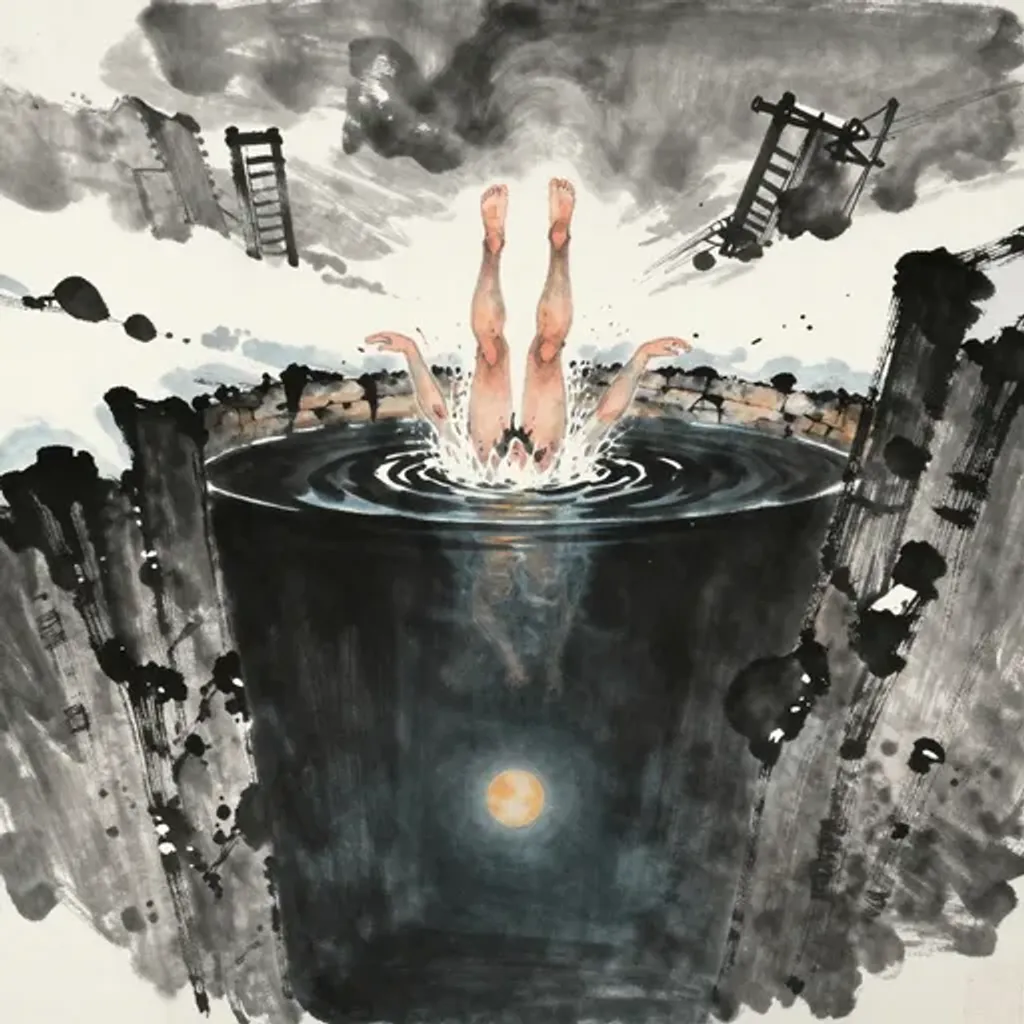
履機蹈顛,墜入寒淵;行不能前,足矮不便。
Treading on the trigger, stepping on the edge; plunging into a cold abyss. Unable to advance on foot; the legs are short and unsteady.
— Jiao Yanshou, Yilin (Forest of Changes), 1st century BC
Commentary
Heaven above the lake, but one step triggers a catastrophic fall. Treading on a mechanism, stumbling at the precipice, plunging into a cold abyss. Unable to advance, feet crippled and useless. The verse enacts Treading's worst nightmare: the very act of stepping forward activates a trap that sends the walker into the depths. This is not mere misfortune but a structural collapse — the ground itself betrays the foot. From Treading to Decrease, the mountain rises above a draining lake. What was liquid and navigable has been drawn away, leaving only the hard reality of diminished means. The fall demands acceptance of loss before any recovery can begin.
履 → 益
Hexagram 10 → Hexagram 42: Increase
Changing lines: 2, 4
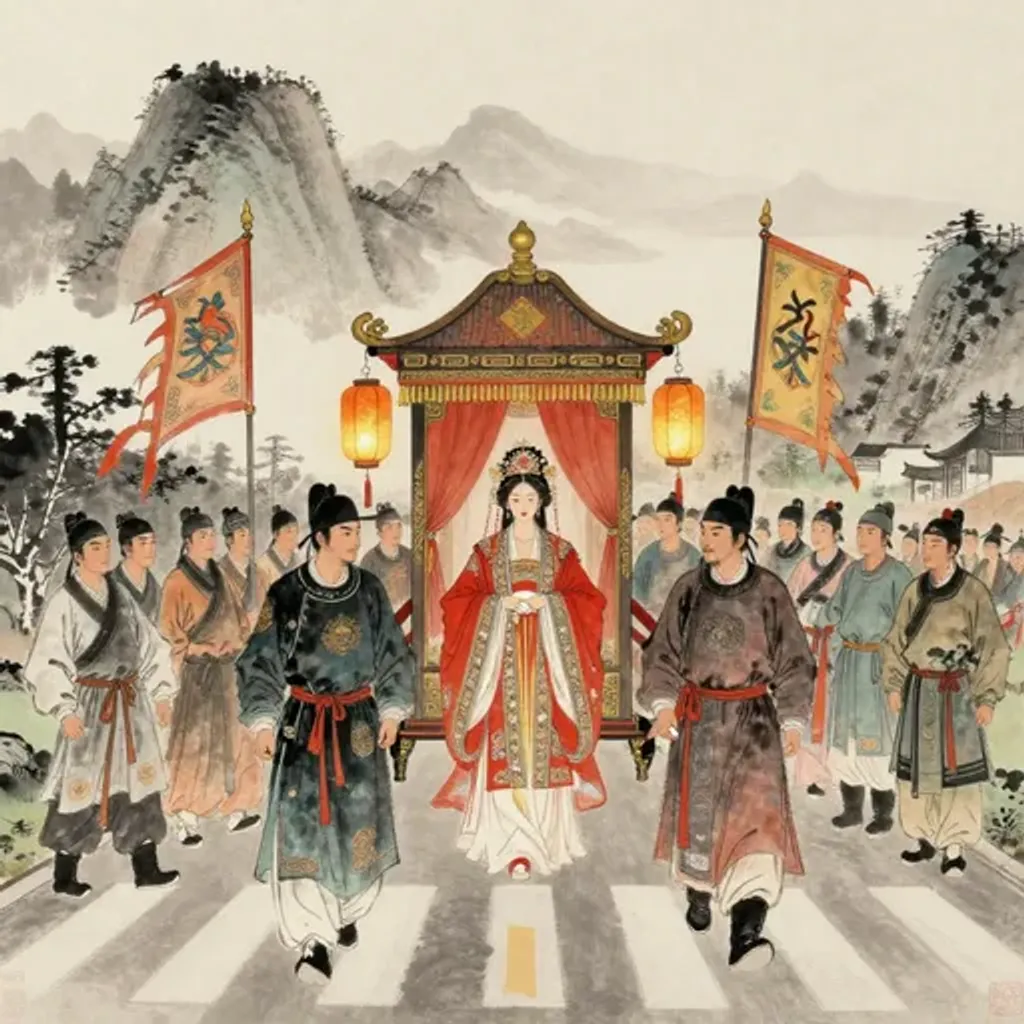
𠾑命止車,和合兩家;蛾眉皓齒,二國率殭。
He commands the carriage to halt; uniting and harmonizing two households. Moth-brow and gleaming teeth; the two states lead their stiffened hosts.
— Jiao Yanshou, Yilin (Forest of Changes), 1st century BC
Commentary
Heaven above the lake, and a command halts the chariot to unite two families. A beautiful woman — moth-browed and white-toothed — stands at the center of the arrangement, and two states are bound together through marriage alliance. The verse describes the ancient practice of diplomatic marriage: political unions sealed through the gift of a bride, with beauty serving as the visible emblem of goodwill between powers. From Treading to Increase, wind and thunder reinforce each other. The transformation reveals how correct diplomatic conduct multiplies strength: when two houses are properly joined, both gain. The wedding chariot stops not from weakness but from the protocol that makes alliance possible.
履 → 夬
Hexagram 10 → Hexagram 43: Breakthrough
Changing lines: 3, 6
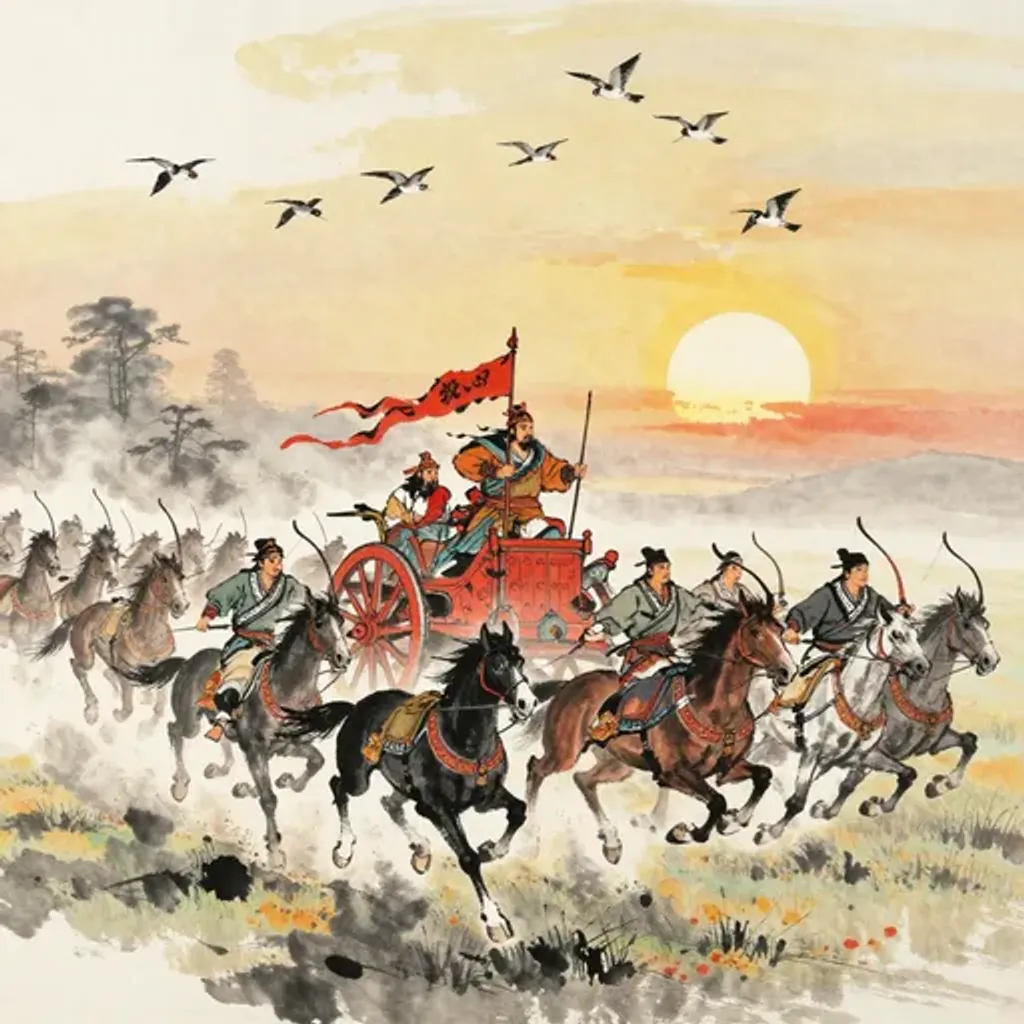
吉日車攻,田弋獲禽;宣王飲酒,以告嘉功。
On an auspicious day, the war chariots advance; hunting with bows, they capture game. King Xuan drinks wine, to proclaim his glorious achievement.
— Jiao Yanshou, Yilin (Forest of Changes), 1st century BC
Commentary
Heaven above the lake, and the royal hunt begins under auspicious skies. The verse quotes two Shijing odes — 'Ji Ri' (Lucky Day) and 'Che Gong' (War Chariots) — both celebrating King Xuan of Zhou's grand hunts. On a propitious day the war chariots advance, and the hunt yields abundant game. King Xuan drinks wine to announce his splendid achievement. These hunts were military exercises disguised as sport: the king demonstrated his army's discipline and rewarded his officers with feasting. From Treading to Breakthrough, the lake rises above heaven. Proper royal conduct — hunting in season, rewarding the worthy — breaks through stagnation and restores the dynasty's vigor.
履 → 姤
Hexagram 10 → Hexagram 44: Coming to Meet
Changing lines: 1, 3
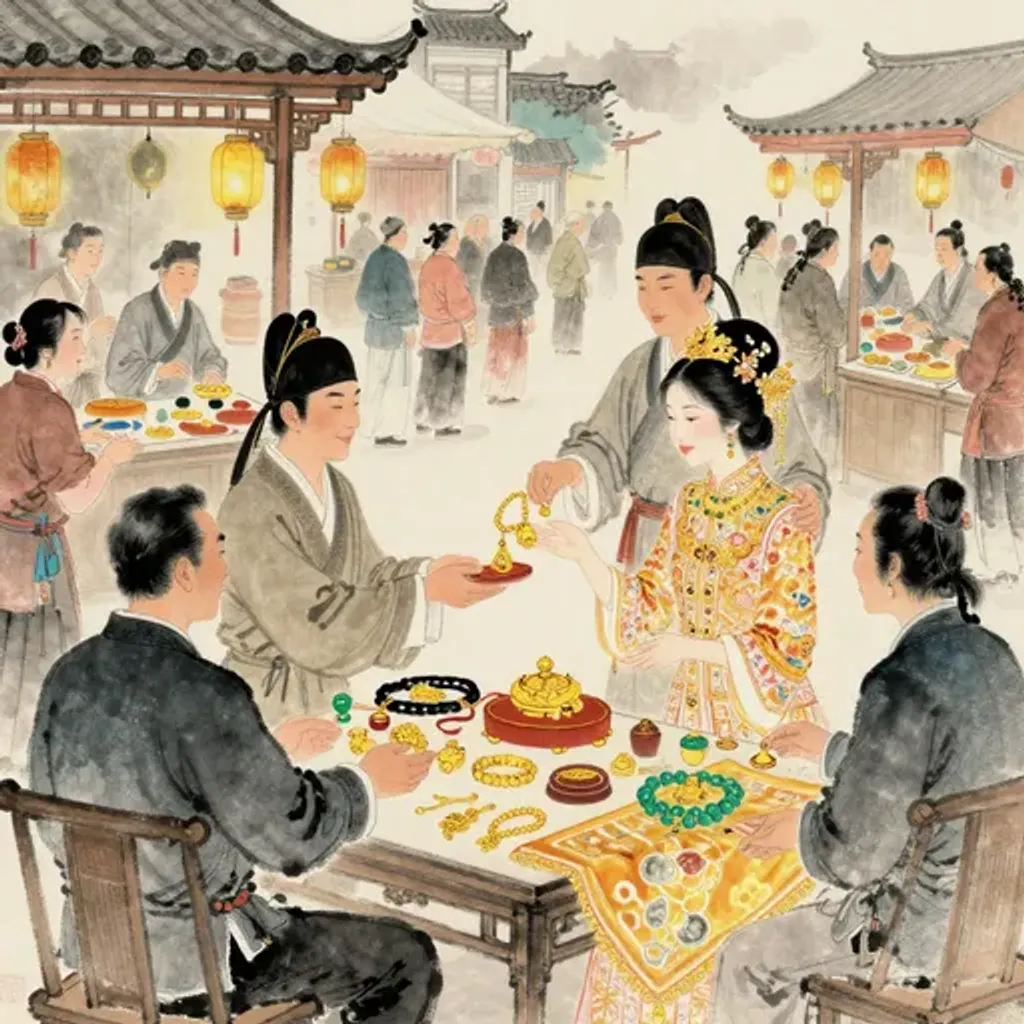
重伯黃寶,宜以我市;嫁娶有恩,利得過母。
Chong Bo is yellow treasure; fit for trade at my market. Marriage brings lasting kindness; the profit gained surpasses the mother is portion.
— Jiao Yanshou, Yilin (Forest of Changes), 1st century BC
Commentary
Heaven above the lake, and precious goods facilitate exchange. Valuable yellow treasures are weighed and deemed fit for trade. Marriage brings mutual benefit, and the profit surpasses what the mother's family expected. The verse presents a commercial-matrimonial transaction: wealth is exchanged, a bride is given, and both sides gain. The tone is practical rather than romantic — alliance through measured reciprocity. From Treading to Coming to Meet, wind stirs beneath heaven as the ruler issues commands to all quarters. The encounter is arranged, not accidental. Proper conduct in negotiation produces a meeting that benefits both parties — the sovereign's decree reaches far, and each side recognizes the other's value.
履 → 萃
Hexagram 10 → Hexagram 45: Gathering Together
Changing lines: 1, 2, 6
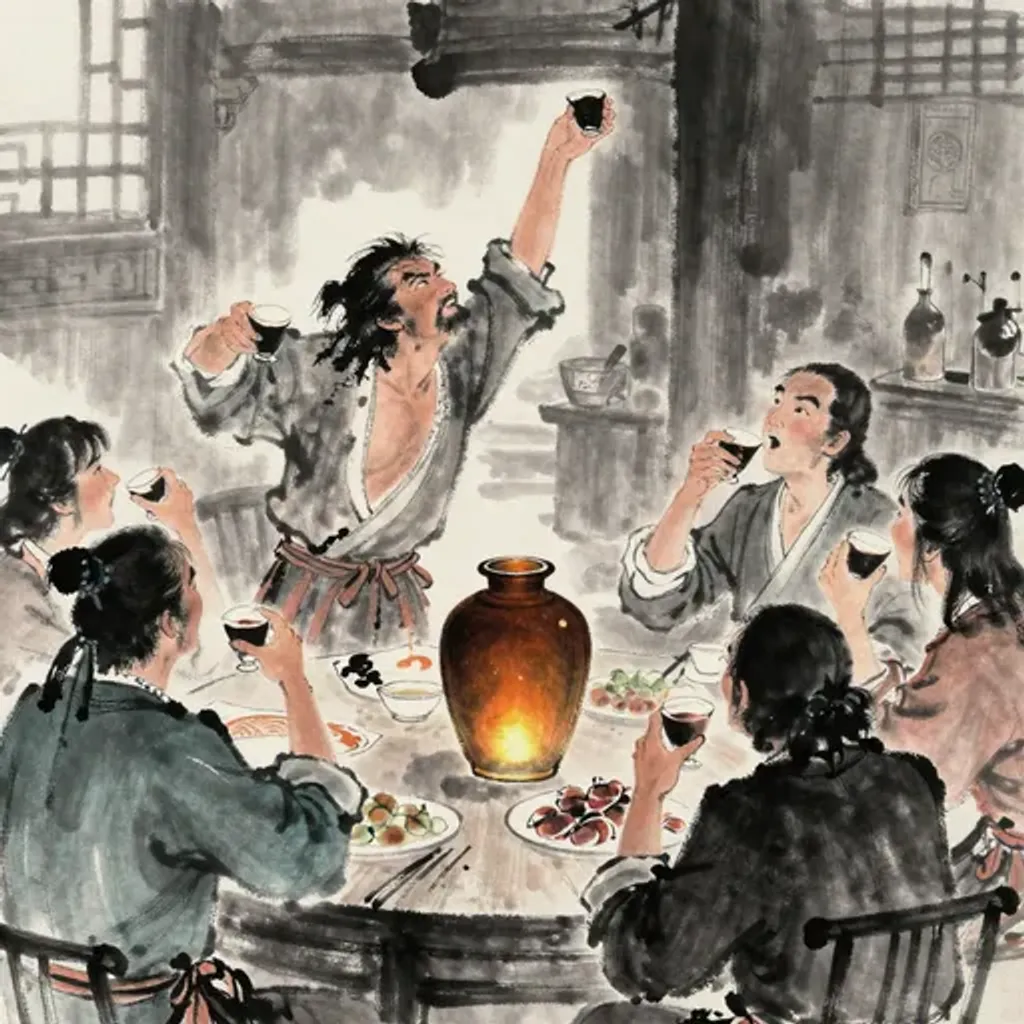
延頸望酒,不入我口;深以自喜,利得無有。
Craning the neck, gazing at wine; it does not enter my mouth. Deeply pleased with oneself; yet no profit is to be had.
— Jiao Yanshou, Yilin (Forest of Changes), 1st century BC
Commentary
Heaven above the lake, yet the wine remains forever out of reach. One stretches the neck longingly toward the cup, but it never touches the lips. Self-congratulation runs deep, yet actual profit amounts to nothing. The verse captures the painful gap between desire and attainment: the drinker can see and smell the wine but cannot taste it. Satisfaction is declared prematurely, masking emptiness. From Treading to Gathering, the lake collects upon the earth. The transformation suggests that what the individual cannot reach alone may be obtained through assembly — but only if the self-deception ends. True gathering requires honesty about what one lacks, not hollow celebrations of phantom gain.
履 → 升
Hexagram 10 → Hexagram 46: Pushing Upward
Changing lines: 1, 3, 4, 5, 6
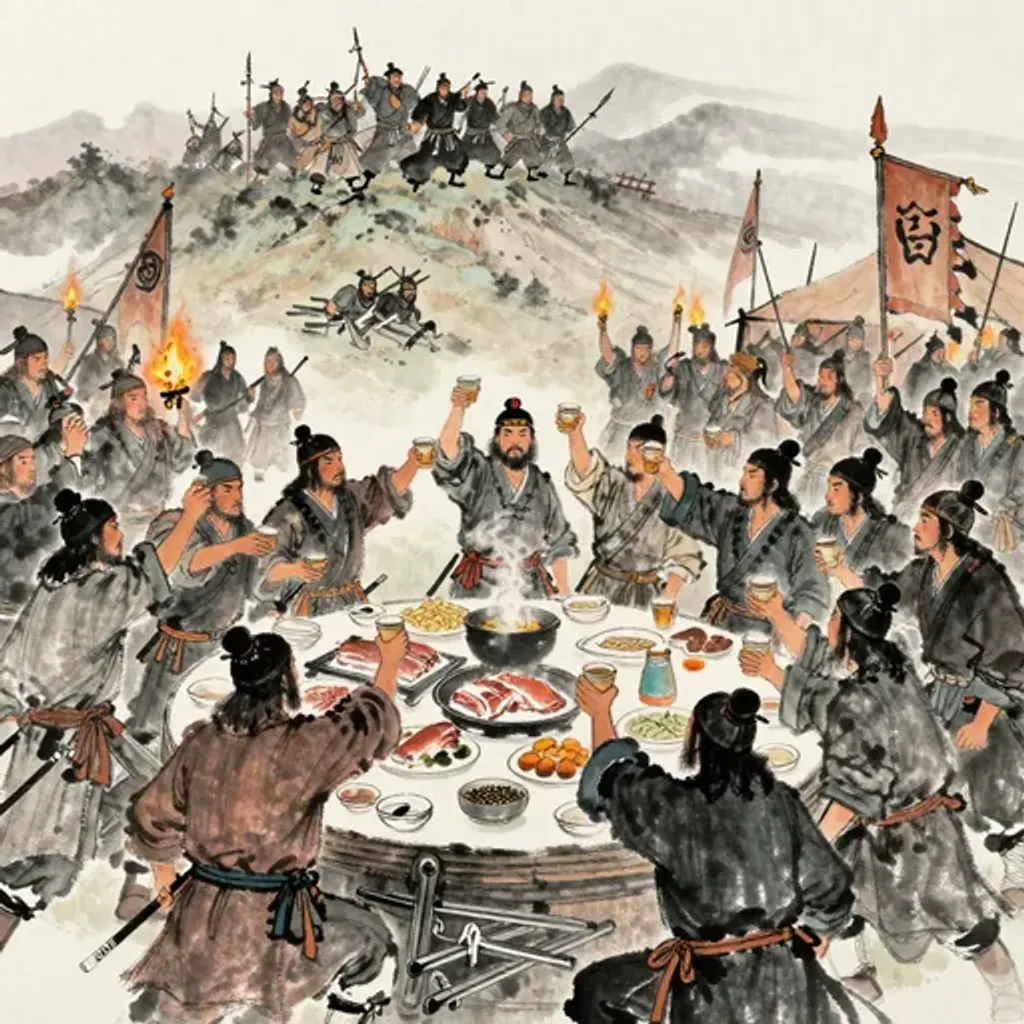
牧為代守,饗食甘賜;得吏士意,戰大破胡,長安國家。
The shepherd becomes the governor; feasting and granting sweet rewards. Winning the hearts of soldiers and clerks; in battle, he shatters the Hu completely -- bringing lasting peace to the state.
— Jiao Yanshou, Yilin (Forest of Changes), 1st century BC
Commentary
Heaven above the lake, and a frontier general secures the realm. The verse likely alludes to Li Mu of Zhao, who served as guardian of Dai and the northern border. He feasted and rewarded his soldiers generously, winning the hearts of officers and troops alike. When the Xiongnu finally attacked in force, he crushed them in a decisive battle, securing the state for generations. From Treading to Pushing Upward, wood grows within the earth — a gradual, methodical rise. Li Mu's patient cultivation of military loyalty, followed by his explosive victory, embodies this transformation: careful conduct over years produces a force that rises irresistibly when the moment arrives.
履 → 困
Hexagram 10 → Hexagram 47: Oppression
Changing lines: 1, 6
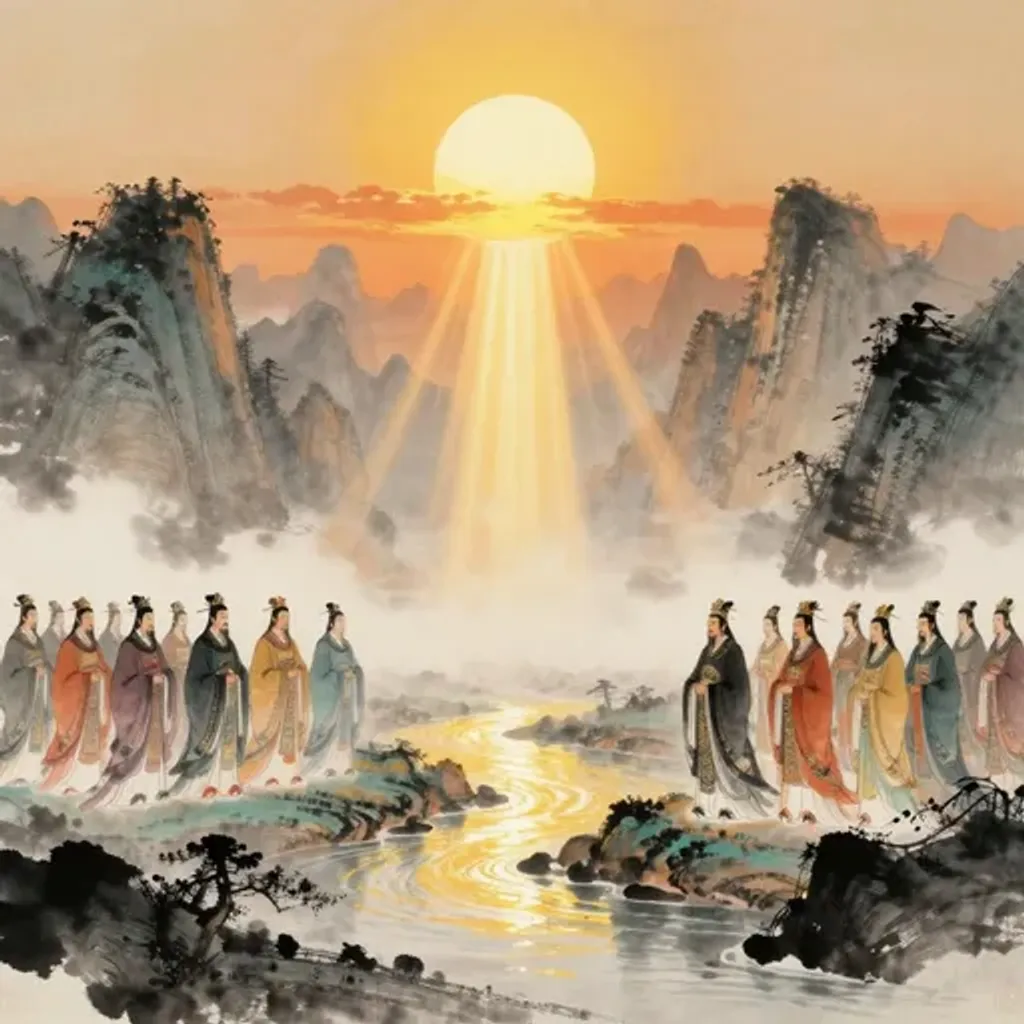
日出溫谷,臨照萬國;高明淑仁,虞夏配德。
The sun rises from the warm valley, shining upon the myriad lands. Lofty, bright, virtuous, and humane; Yu and Xia are matched in merit.
— Jiao Yanshou, Yilin (Forest of Changes), 1st century BC
Commentary
Heaven above the lake, and the sun rises from the Valley of Warmth to illuminate ten thousand states. Its radiance is lofty, brilliant, gentle, and humane — qualities matching the virtue of the legendary Yu and Xia dynasties. The sun emerging from its eastern cradle is a cosmic image of benevolent sovereignty: light that excludes no one. The pairing with Yu and Xia invokes the golden age of sage-kings whose moral radiance matched the sun's physical warmth. From Treading to Oppression, the lake drains dry above water — a shocking reversal. The verse holds up the sunlit ideal precisely because what follows is its absence. Even memory of such radiance sustains hope in dark times.
履 → 井
Hexagram 10 → Hexagram 48: The Well
Changing lines: 1, 3, 4, 6
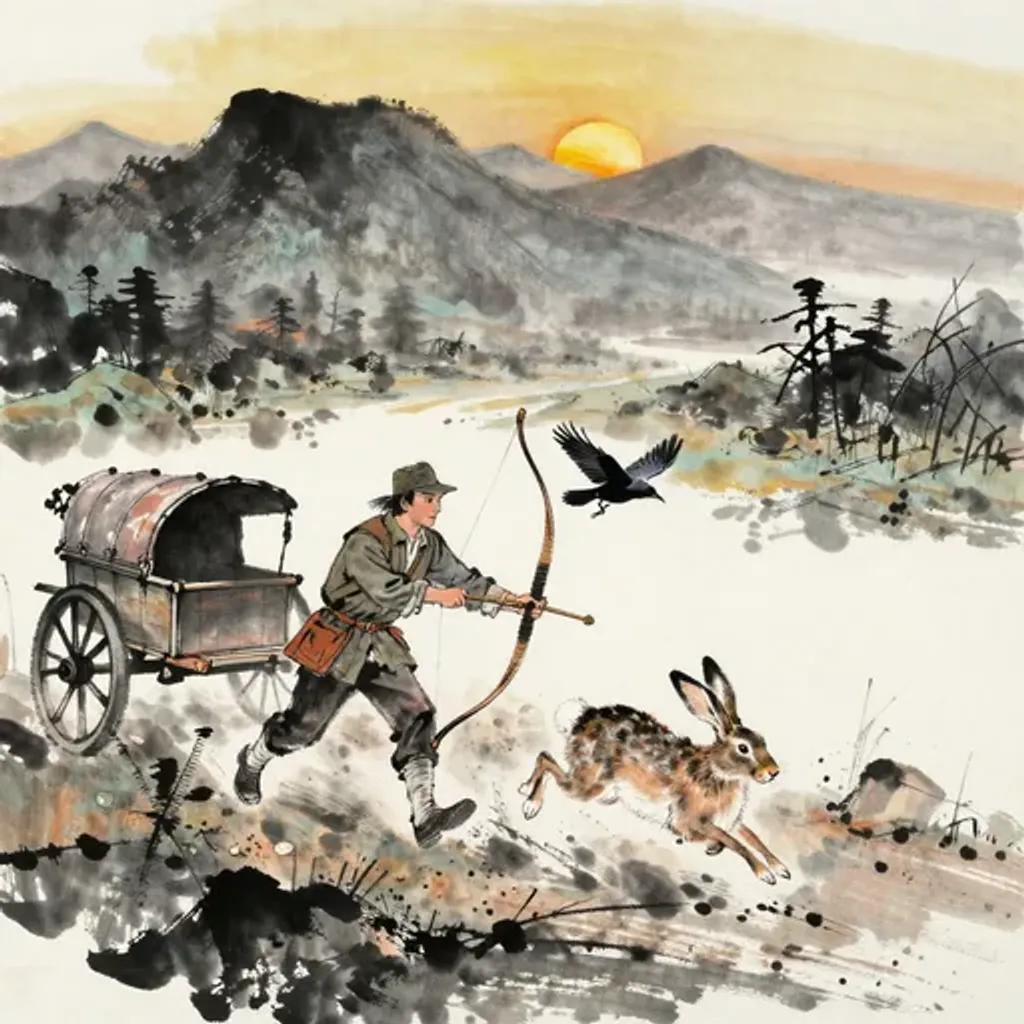
逐兔索烏,破我弓車;日暮不及,失利後時。
Chasing the hare, seeking the crow; smashing my bow and carriage. At dusk, too late to reach the goal; profit lost, the moment passed.
— Jiao Yanshou, Yilin (Forest of Changes), 1st century BC
Commentary
Heaven above the lake, but the hunt goes wrong from the start. Chasing a rabbit while searching for a crow, the bow breaks and the chariot shatters. By dusk it is too late — opportunity has passed and the advantage is lost. The verse stages a double failure of timing and focus: pursuing two different quarries at once ruins the equipment needed for either, and evening arrives before the hunter can recover. From Treading to the Well, water draws upward through wood. The Well never moves, never runs dry, and serves whoever comes. The transformation warns that frantic pursuit destroys what patient, stationary service would have provided. The well does not chase; it simply waits and gives.
履 → 革
Hexagram 10 → Hexagram 49: Revolution
Changing lines: 2, 3, 6
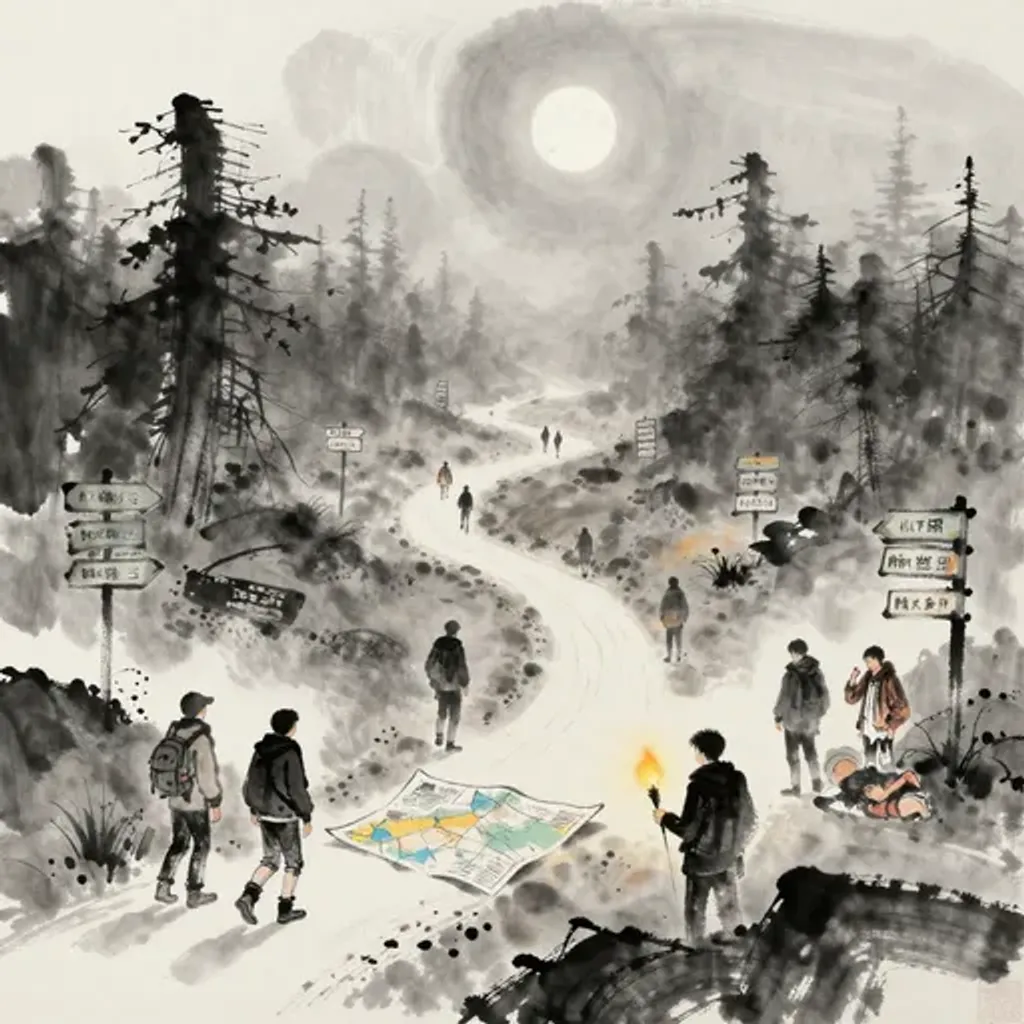
譌言妄語,傳相詿誤;道左失迹,不知所處。
False words and reckless speech; rumors mislead one another. Off the road, the tracks are lost; not knowing where one stands.
— Jiao Yanshou, Yilin (Forest of Changes), 1st century BC
Commentary
Heaven above the lake, but the path is obscured by lies. False words and reckless speech spread deception from person to person, each passing the error forward. On the roadside one loses all tracks and no longer knows where one stands. The verse diagnoses a social contagion: rumors and misinformation that compound until orientation itself is lost. From Treading to Revolution, fire burns within the lake — two irreconcilable forces that demand transformation. The cure for accumulated falsehood is radical change: stripping away the distorted narrative and starting fresh. Revolution corrects the calendar and clarifies the seasons — restoring truth to a world drowned in fabrication.
履 → 鼎
Hexagram 10 → Hexagram 50: The Cauldron
Changing lines: 1, 3, 5
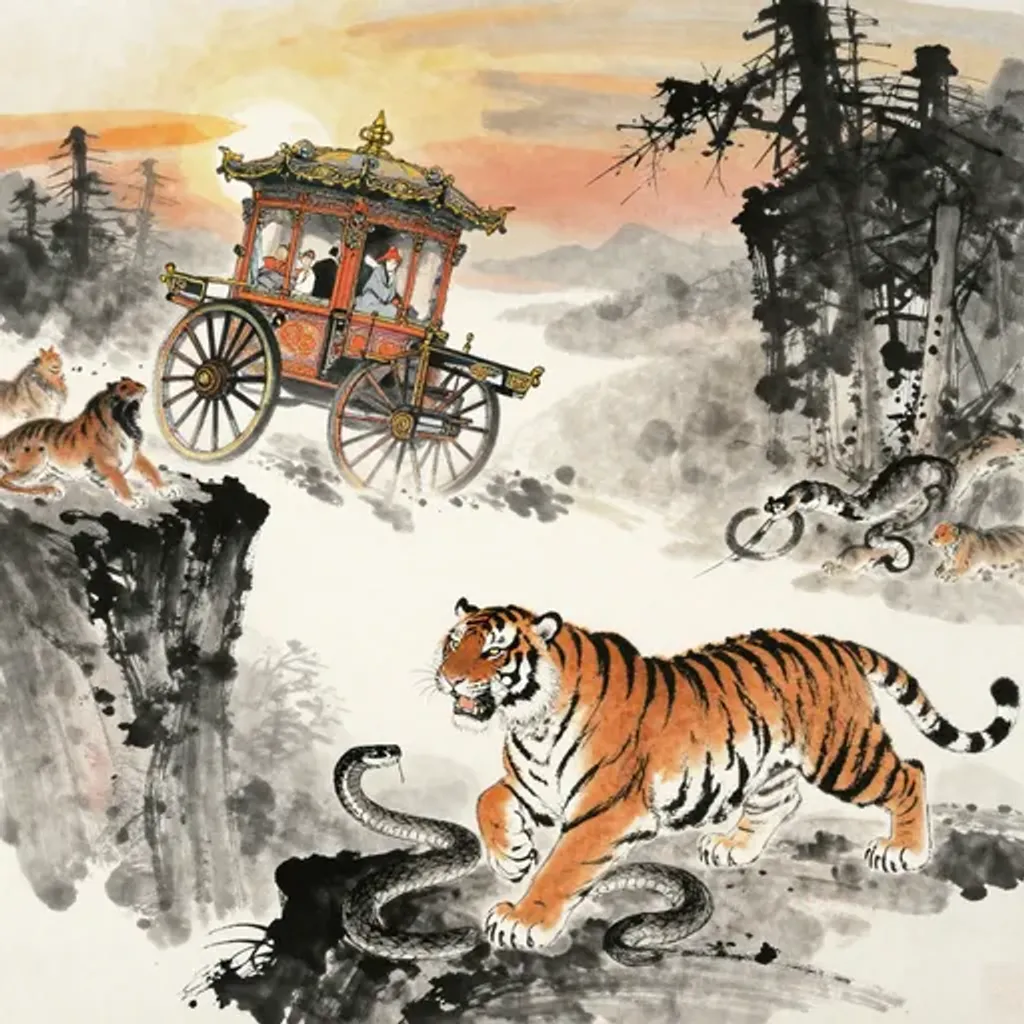
履虎躡蛇,貶損我威;君子失車,去其國家。
Treading on the tiger, stepping on the serpent; my authority is diminished and damaged. The noble man loses his carriage; departing from his state and home.
— Jiao Yanshou, Yilin (Forest of Changes), 1st century BC
Commentary
Heaven above the lake — one treads on the tiger and steps upon the snake, and authority is diminished. The gentleman loses his carriage and departs his homeland. This verse directly invokes Hexagram 10's defining image: 'treading on the tiger's tail.' But here the walker also tramples a snake, doubling the peril. The result is exile — loss of vehicle (status) and country. The verse dramatizes the worst outcome of failed conduct in a world of predatory power. From Treading to the Cauldron, fire blazes above wind-fed wood, transforming raw material into sacred offering. Even from disgrace, something can be refined — but only through the fire of total remaking, not through return to the old path.
履 → 震
Hexagram 10 → Hexagram 51: The Arousing Thunder
Changing lines: 2, 5, 6
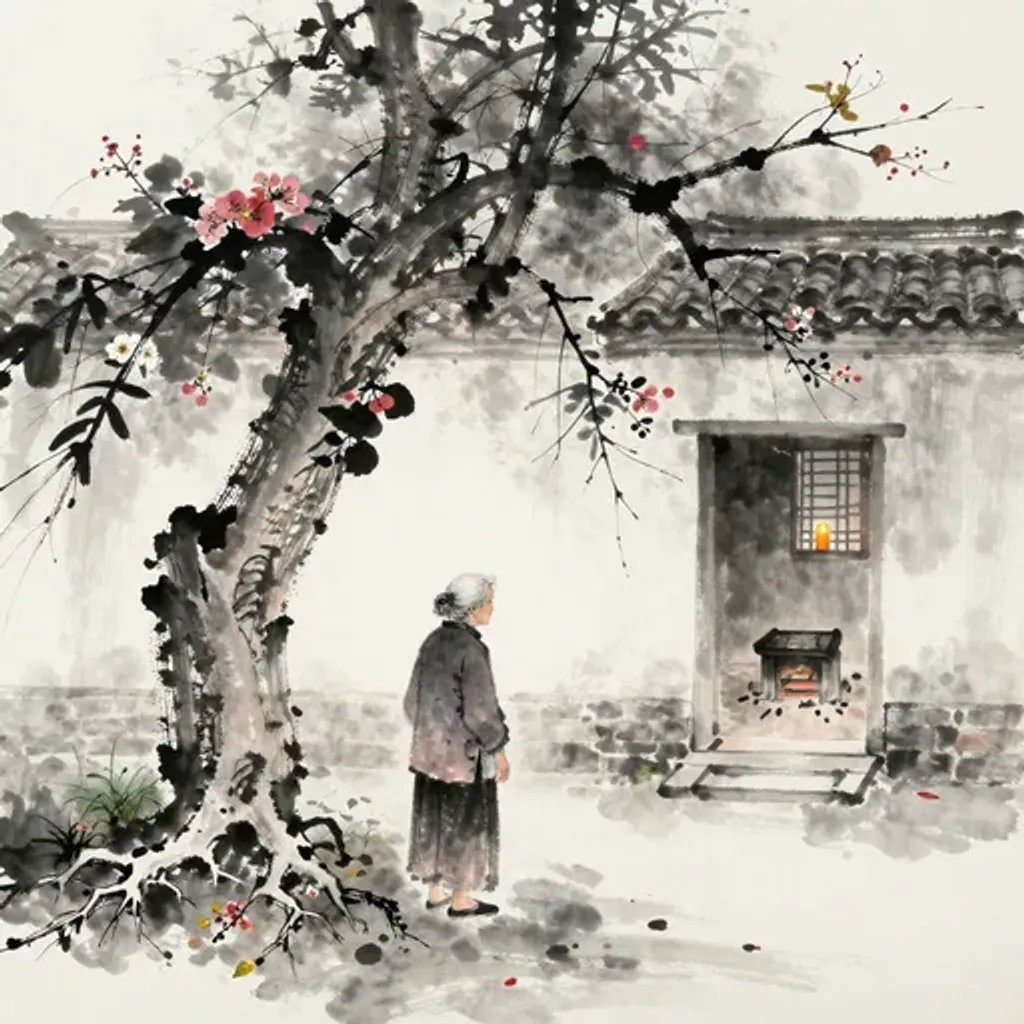
本根不固,花葉落去;更為孤嫗,不得相親。
The root is not firmly set; flowers and leaves fall away. Becoming a lonely old woman; unable to draw close to kin.
— Jiao Yanshou, Yilin (Forest of Changes), 1st century BC
Commentary
Heaven above the lake, but the roots are insecure. Without a firm foundation, flowers and leaves fall away, and one becomes a solitary old woman with no kin to draw near. The tree without roots is a devastating metaphor for social isolation: beauty and vitality depart when the base is hollow, leaving only abandonment. From Treading to the Arousing, doubled thunder shakes the earth. The rootless tree cannot withstand the shock — where deep roots would absorb and channel the tremor, the uprooted simply topple. The verse warns that conduct without grounding leads to total exposure when the world shakes. Only what is deeply rooted survives the thunder.
履 → 艮
Hexagram 10 → Hexagram 52: Keeping Still Mountain
Changing lines: 1, 2, 3, 4, 5
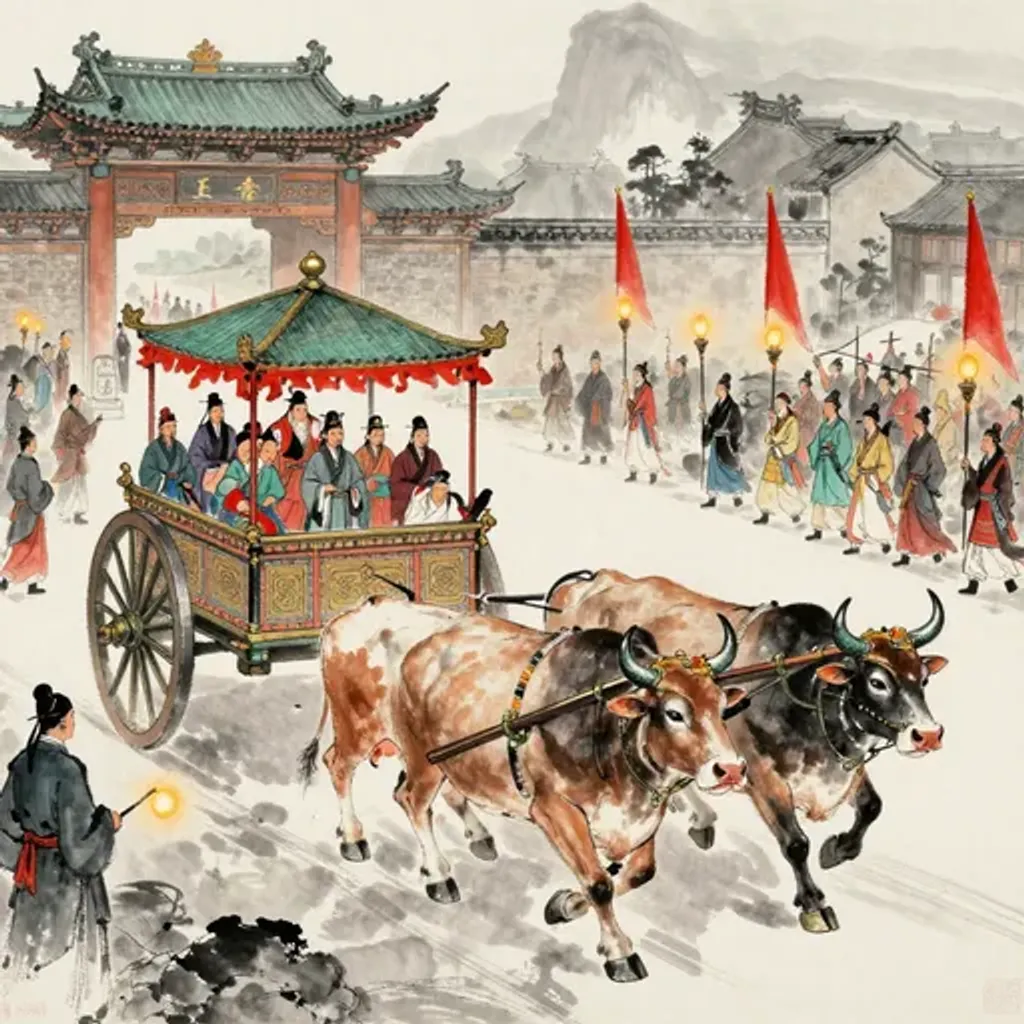
五軛四軏,優得饒有;陳力就列,騶虞喜悅。
Five yokes and four axle-bars; abundance and plenty overflow. Exerting one is strength, filling one is rank; the Zou Yu dances with delight.
— Jiao Yanshou, Yilin (Forest of Changes), 1st century BC
Commentary
Heaven above the lake, and the work animals are yoked in abundance. Five yokes and four axle-pins — more than enough equipment to carry the load. Each person deploys his abilities and takes his proper place in the ranks, and the Zou Yu — the benevolent beast of the Shijing's 'Zou Yu' ode — appears in delight. The phrase 'display one's abilities and take one's station' (陳力就列) comes from the Analerta (Jilun chapter), where Confucius insists that officials must either contribute or step down. From Treading to Keeping Still, the doubled mountain stands firm. When each person finds the right position and stays, the result is not stagnation but the joyous order that makes even mythical beasts rejoice.
履 → 漸
Hexagram 10 → Hexagram 53: Development
Changing lines: 1, 2, 3, 4
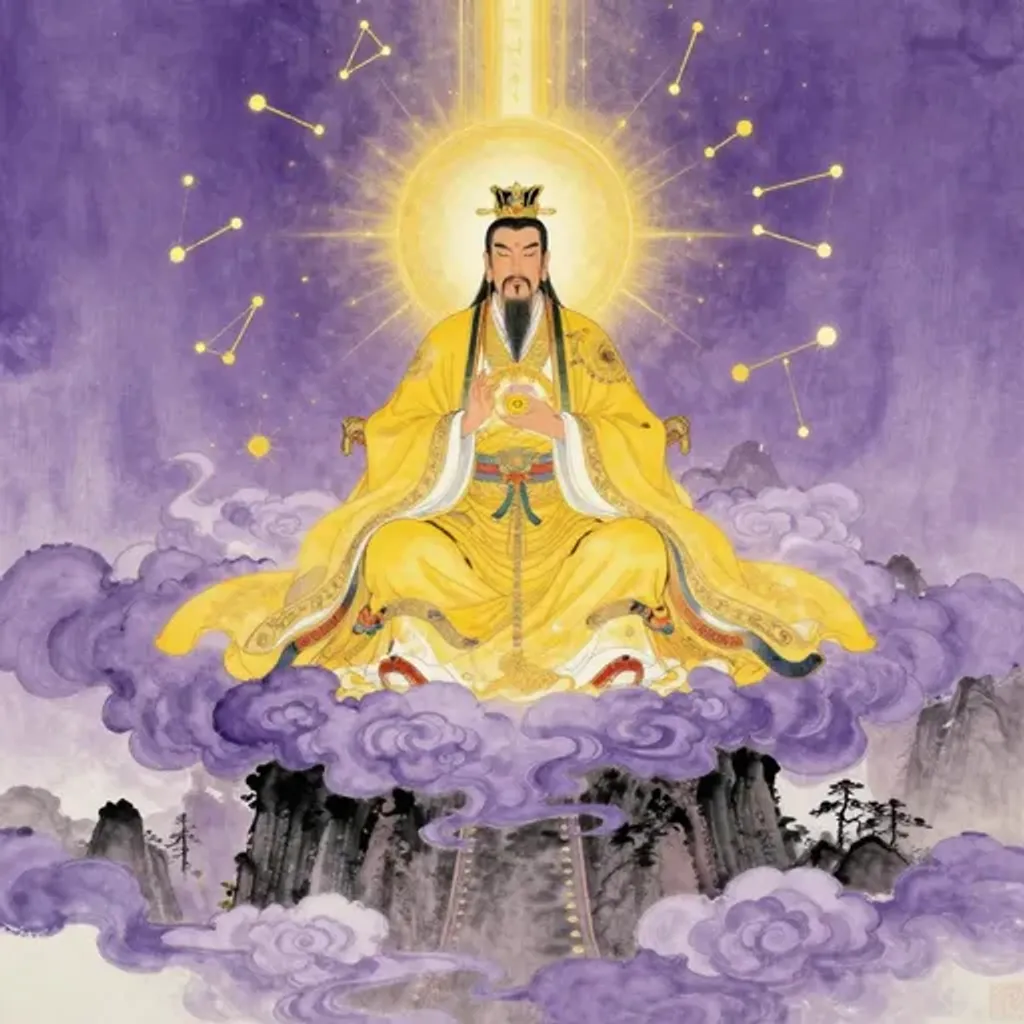
黃帝紫雲,聖且神明;光見福祥,告我无殃。
The Yellow Emperor amid purple clouds; sagely and divinely luminous. His light reveals auspicious omens; proclaiming that I shall suffer no harm.
— Jiao Yanshou, Yilin (Forest of Changes), 1st century BC
Commentary
Heaven above the lake, and purple clouds trail behind the Yellow Emperor's celestial journey. The sage is holy and divinely luminous; auspicious light reveals blessings and announces freedom from calamity. According to tradition, when the Yellow Emperor ascended to heaven, purple clouds gathered in his wake — a sign of supreme cosmic harmony. From Treading to Development, wind blows over the mountain as trees grow gradually upward. The transformation from careful earthly conduct to slow, organic growth mirrors the Yellow Emperor's legacy: his civilizing work did not flash and vanish but developed steadily across generations, like trees climbing a mountainside toward the light.
履 → 歸妹
Hexagram 10 → Hexagram 54: The Marrying Maiden
Changing lines: 5, 6
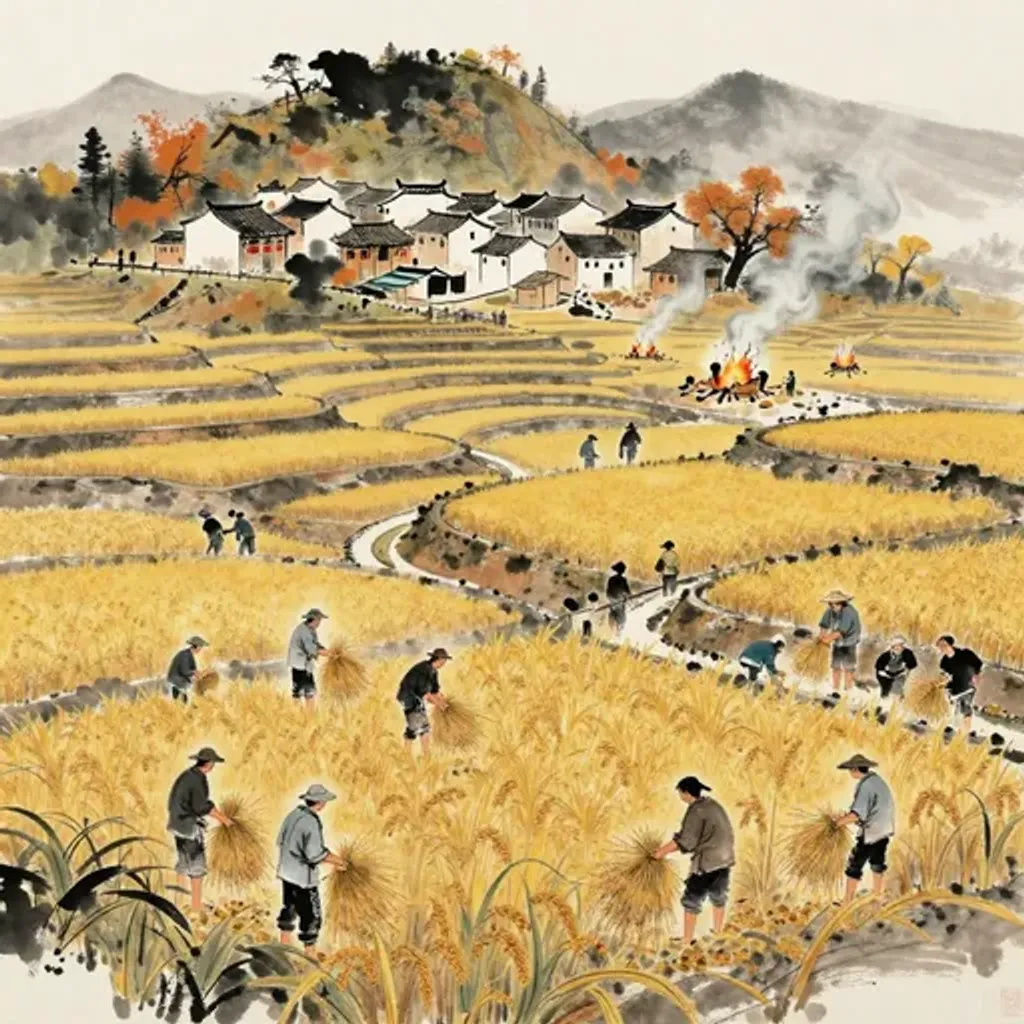
五利四福,俱佃高邑;黍稷盛茂,多獲藁稻。
Five gains and four blessings; all tending the high city. Millet and grain grow lush and full; a great harvest of straw and rice.
— Jiao Yanshou, Yilin (Forest of Changes), 1st century BC
Commentary
Heaven above the lake, and the harvest is splendid. Five kinds of profit and four kinds of blessing converge as farmers cultivate the high fields. Millet and grain grow thick and lush; the yield of straw and rice is abundant. Every agricultural indicator points to prosperity — the land is generous, the season cooperative, the labor fruitful. From Treading to the Marrying Maiden, thunder stirs above the lake. The maiden enters her husband's household, and the verse's agricultural abundance becomes her dowry: a well-cultivated field is the foundation of a new household. Proper conduct in farming produces the surplus that makes family formation possible.
履 → 豐
Hexagram 10 → Hexagram 55: Abundance
Changing lines: 2, 3, 5, 6
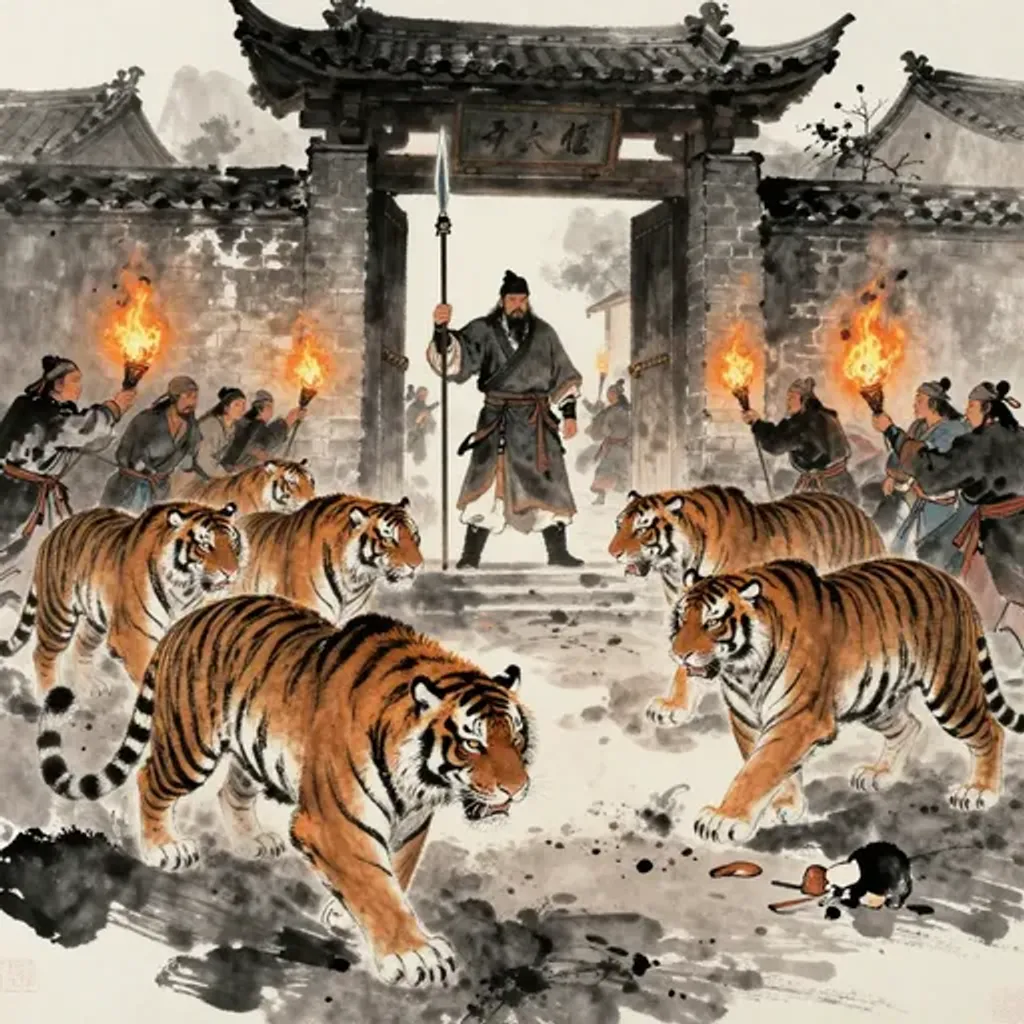
群虎入邑,求索肉食;大人衛守,君不失國。
A pack of tigers enters the city, seeking meat to devour. The great man stands guard; the lord does not lose his state.
— Jiao Yanshou, Yilin (Forest of Changes), 1st century BC
Commentary
Heaven above the lake, and a pack of tigers enters the city seeking flesh. The predators have breached the walls, driven by hunger — a direct threat to civilization itself. But a great person stands guard, and the ruler does not lose his state. The verse stages the ultimate test of Treading: when the tiger is not merely a tail to be stepped on but a ravening force invading the settlement, only decisive leadership holds the line. From Treading to Abundance, thunder and lightning illuminate simultaneously. The great defender's vigilance transforms peril into power: the tiger at the gate, met with unwavering authority, becomes the catalyst for an era of decisive justice and blazing clarity.
履 → 旅
Hexagram 10 → Hexagram 56: The Wanderer
Changing lines: 1, 2, 3, 5
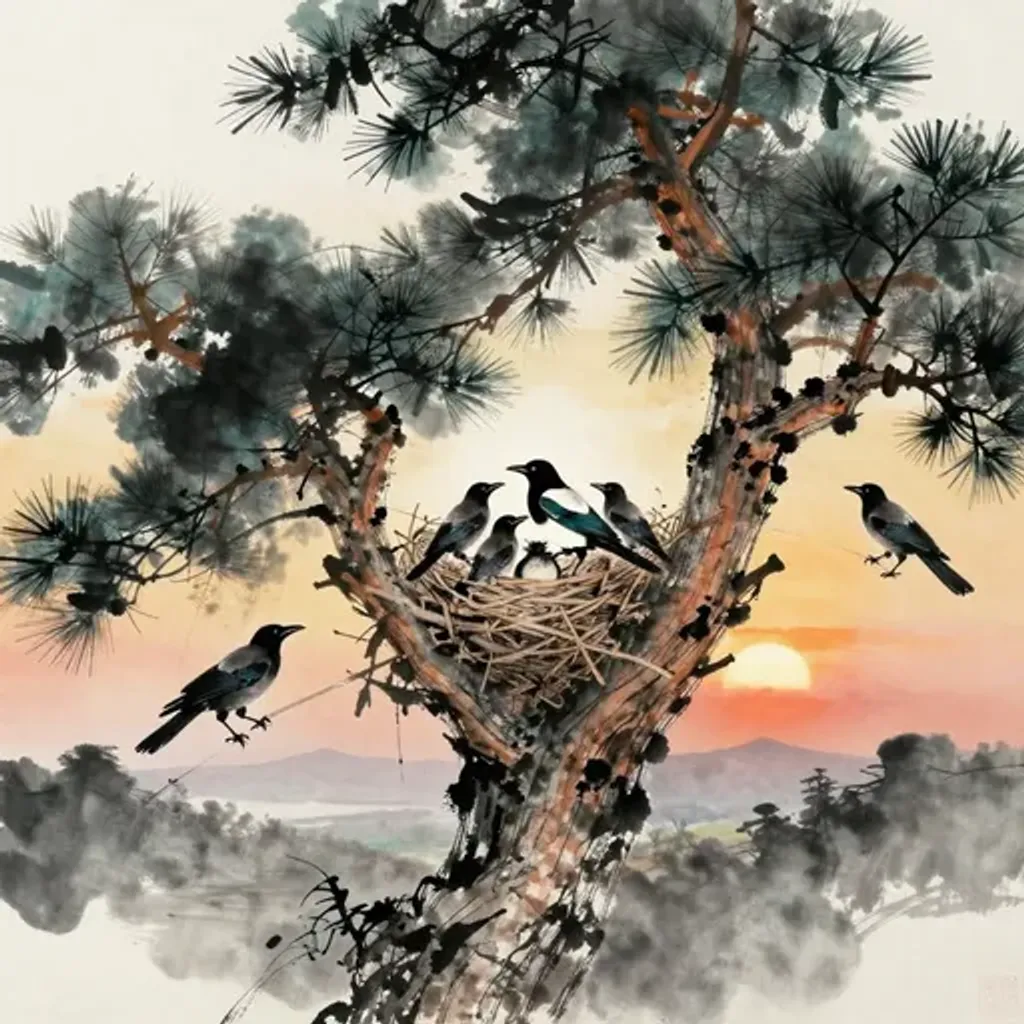
烏子鵲雛,常與母居;願慕群侶,不離其巢。
Crow chicks and magpie nestlings, ever dwelling with their mother. Yearning for flock and companions; they do not leave the nest.
— Jiao Yanshou, Yilin (Forest of Changes), 1st century BC
Commentary
Heaven above the lake, and young birds stay close to home. Crow chicks and magpie fledglings dwell constantly with their mother, longing for their flock's companionship and never straying from the nest. The image is entirely domestic: the young are not yet ready to leave, and instinct keeps them where warmth and nourishment are certain. From Treading to the Wanderer, fire flickers on the mountaintop — a transient, exposed flame with no permanent abode. The contrast is poignant: the fledglings' refusal to leave the nest is the emotional reverse of the Wanderer's rootless condition. The verse suggests that sometimes the wisest treading is staying still, honoring bonds before the world scatters you.
履 → 巽
Hexagram 10 → Hexagram 57: The Gentle Wind
Changing lines: 1, 3, 4
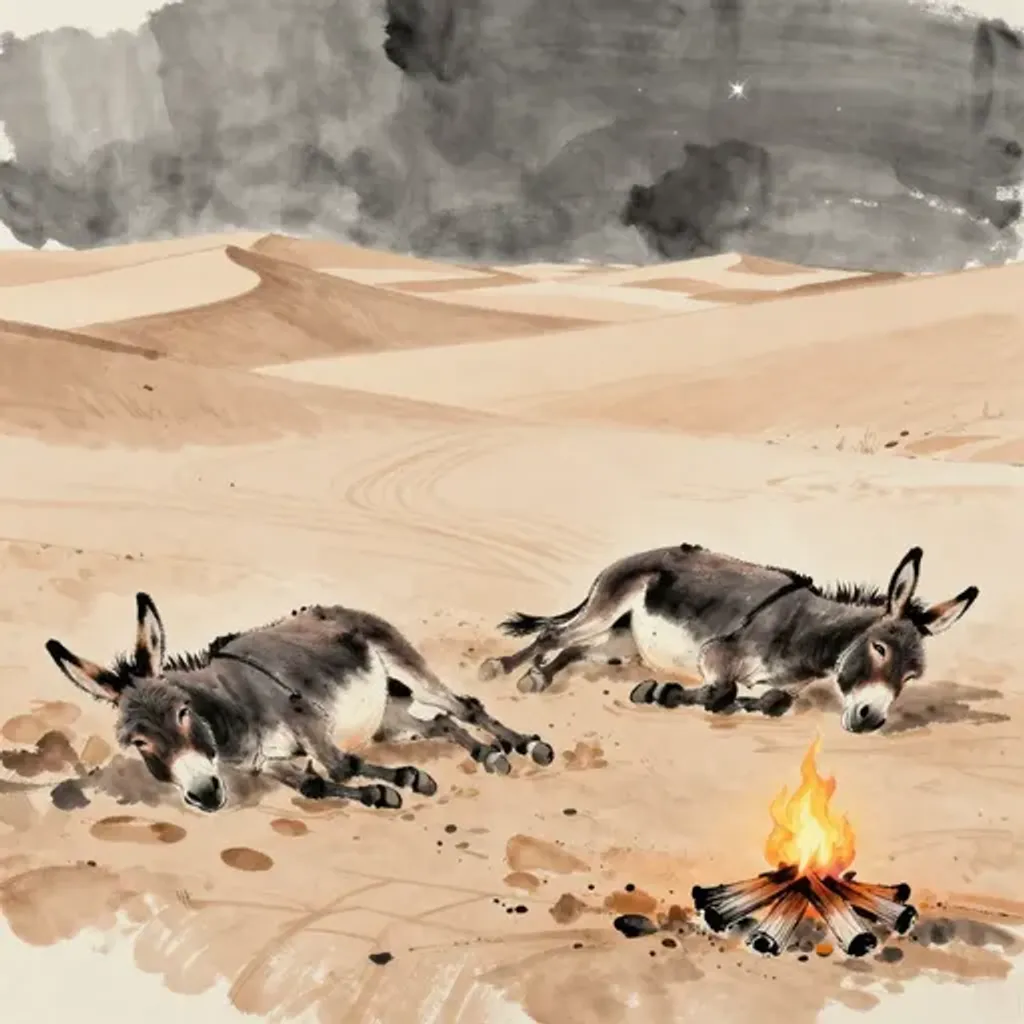
蹇驢不材,駿驥失時;筋勞力盡,罷於沙丘。
The lame donkey is without talent; the swift steed has lost its time. Sinew spent and strength exhausted; collapsed upon the sandy hill.
— Jiao Yanshou, Yilin (Forest of Changes), 1st century BC
Commentary
Heaven above the lake, but the beasts of burden have failed. A lame donkey lacks talent; a fine steed is born at the wrong time. Sinews exhausted and strength spent, both collapse at Shaiqiu — the sandy mound. Shaiqiu carries dark resonance: it is where the Shang tyrant Zhou built his debauchery palace and where the First Emperor of Qin died during his final tour. The place-name signals endings — great power brought low in desolation. From Treading to the Gentle, doubled wind penetrates softly. After the collapse of brute force, only subtle, pervasive influence remains. The verse warns that neither talent nor timing alone guarantees survival when the foundation is exhausted.
履 → 兌
Hexagram 10 → Hexagram 58: The Joyous Lake
Changing lines: 6
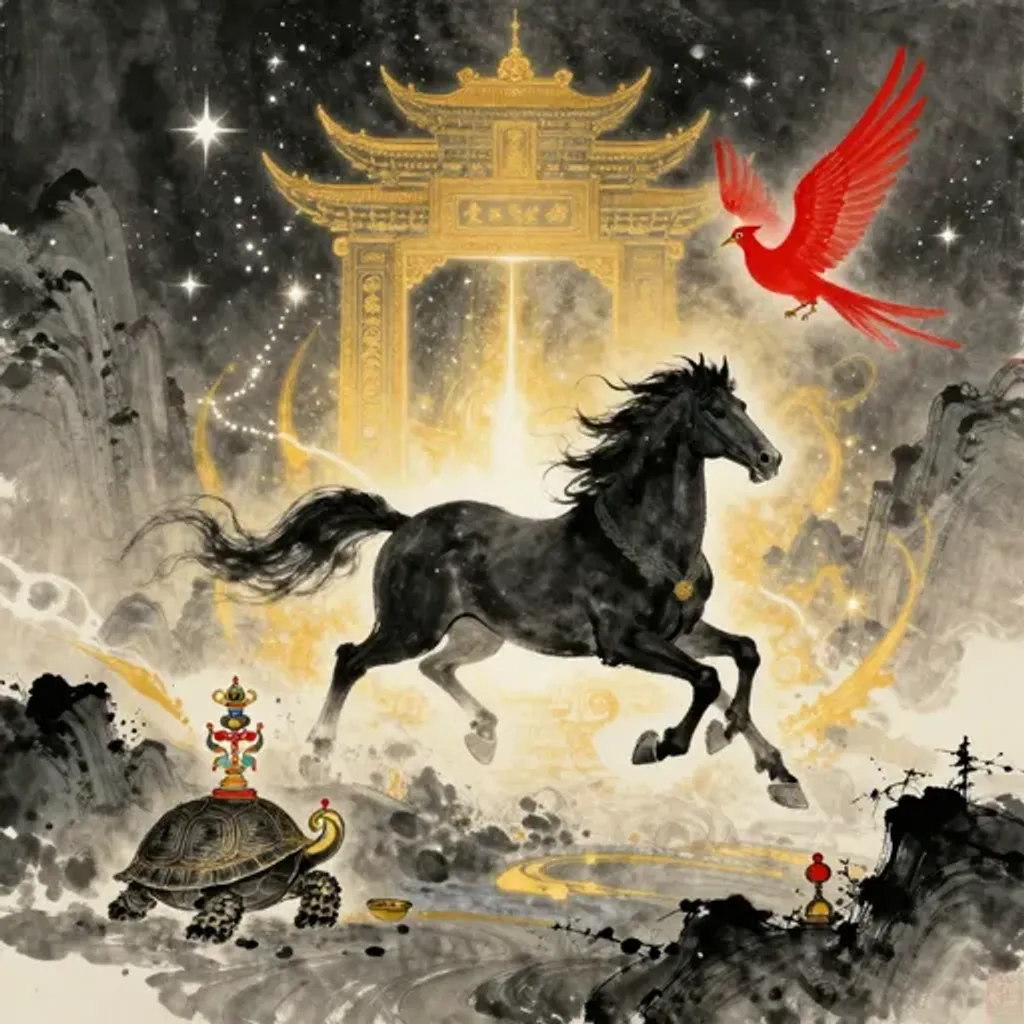
玄鬣黑顙,東歸高鄉;朱鳥道引,靈龜載莊;遂抵天門,見我貞君。
Dark mane and black brow, returning east to the high country. The vermilion bird leads the way; the divine tortoise bears the dignitary. At last reaching heaven is gate; meeting my steadfast lord.
— Jiao Yanshou, Yilin (Forest of Changes), 1st century BC
Commentary
Heaven above the lake, and a procession of celestial creatures escorts the traveler home. A dark-maned, black-browed steed gallops eastward to the high country. The Vermilion Bird guides the way; the Numinous Tortoise bears the traveler in state. They arrive at the Gate of Heaven and behold the steadfast sovereign. The verse assembles the directional guardians — Vermilion Bird of the south, divine tortoise of the north — into a cosmic escort, suggesting a journey not merely homeward but toward transcendence. From Treading to the Joyous, doubled lakes reflect one another in shared delight. The arduous journey of proper conduct culminates in pure joy — the traveler is received at heaven's threshold with ceremonial grandeur.
履 → 渙
Hexagram 10 → Hexagram 59: Dispersion
Changing lines: 1, 4
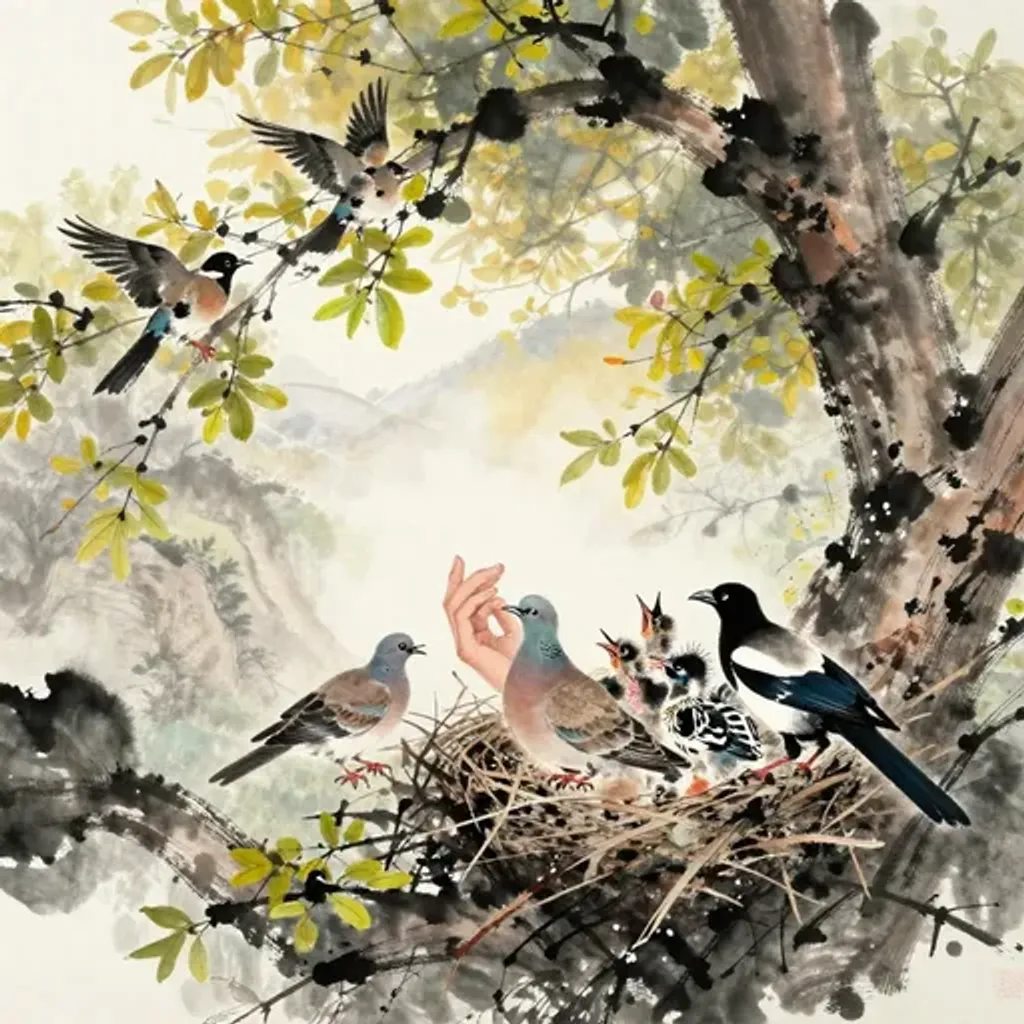
探巢得雛,鳩鵲來俱,使我音娛。
Reaching into the nest, he finds the chicks; dove and magpie come together -- bringing me the pleasure of their song.
— Jiao Yanshou, Yilin (Forest of Changes), 1st century BC
Commentary
Heaven above the lake, and a hand reaches into the nest to find chicks. Doves and magpies arrive together, filling the air with their music for the finder's delight. The image is one of effortless discovery: reaching in and finding exactly what one hoped for, with companion birds gathering as if to celebrate. The brevity of the verse — only three lines — mirrors the simplicity of the moment. From Treading to Dispersion, wind moves over water, scattering what was concentrated. The transformation suggests that the gathered joy of finding will eventually disperse outward like ripples on water, sharing its music beyond the original nest.
履 → 節
Hexagram 10 → Hexagram 60: Limitation
Changing lines: 4, 6
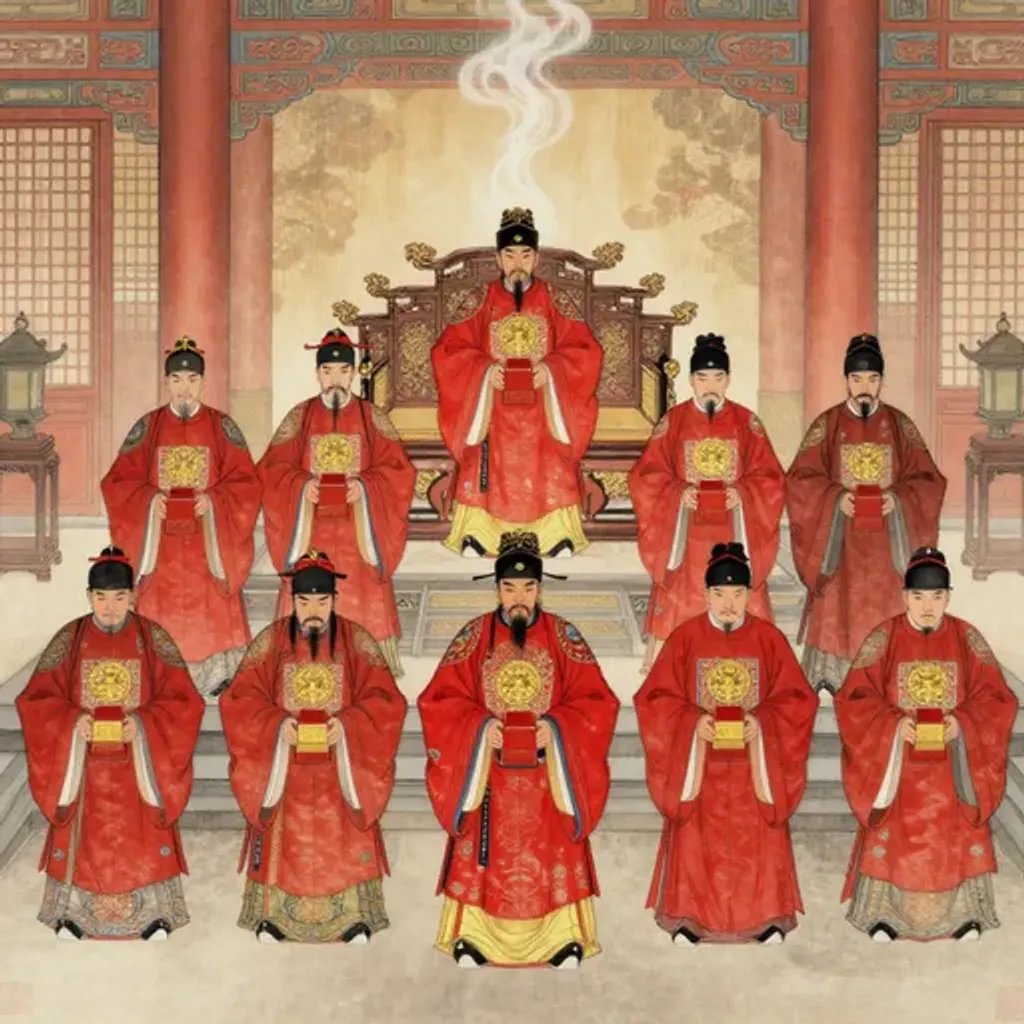
安上宜官,一日九遷;升擢超等,牧養常山。君臣獲安。
Secure above, fit for office; nine promotions in a single day. Rising and advancing beyond his rank; he is appointed to govern Changshan. Lord and minister find peace.
— Jiao Yanshou, Yilin (Forest of Changes), 1st century BC
Commentary
Heaven above the lake, and rapid promotion elevates the worthy. Secure in position and fit for office, one is promoted nine times in a single day — an expression of meteoric advancement. Rising through ranks beyond the ordinary, one is appointed governor of Changshan, and both ruler and minister find peace. The phrase 'one day nine promotions' is a literary formula for dramatically swift recognition. From Treading to Limitation, water rests above the lake, establishing proper measure. The transformation from Treading's careful conduct to Limitation's balanced restraint is apt: even the most dramatic ascent must be governed by proportion. The wise governor succeeds because he understands where abundance ends and excess begins.
履 → 中孚
Hexagram 10 → Hexagram 61: Inner Truth
Changing lines: 4
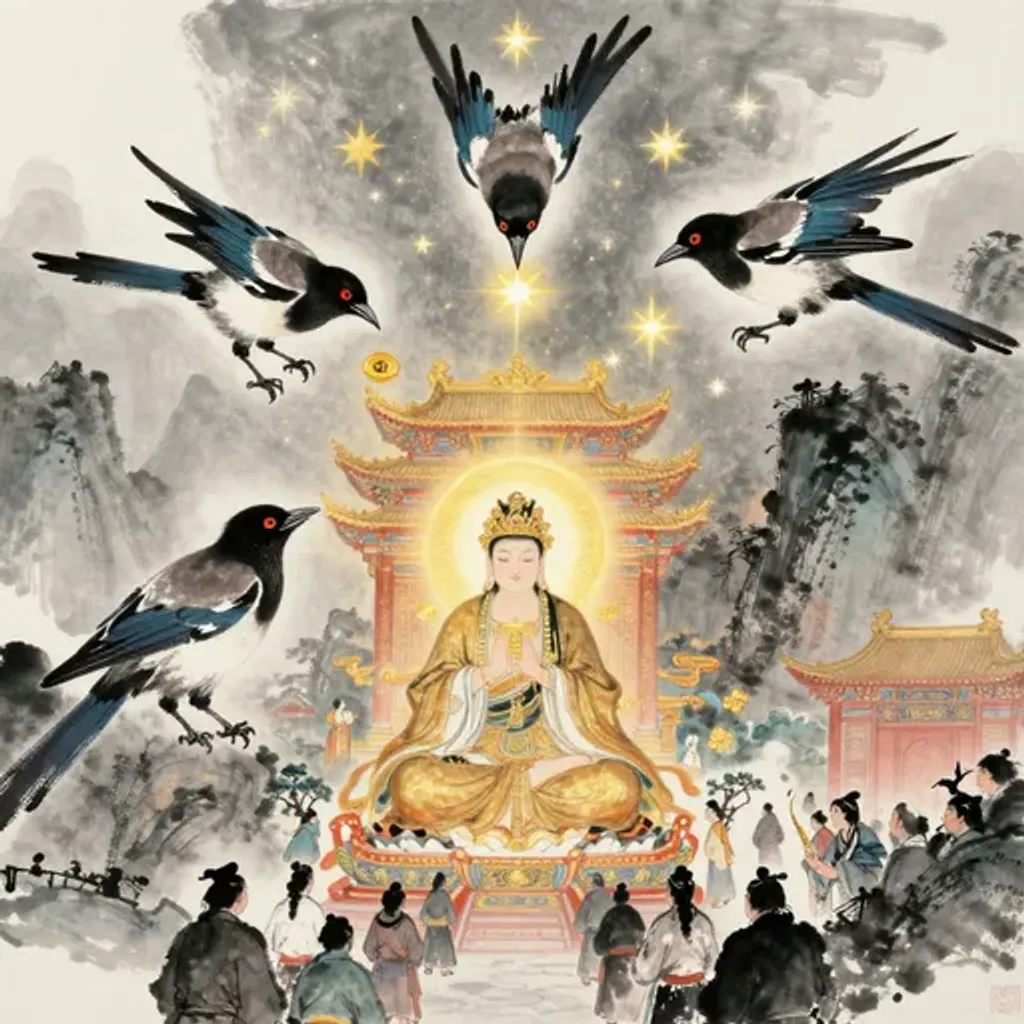
大頭目明,載受嘉福;三雀飛來,與祿相得。
Great of head and bright of eye, blessed and laden with fine fortune. Three sparrows fly to me; meeting with prosperity and gain.
— Jiao Yanshou, Yilin (Forest of Changes), 1st century BC
Commentary
Heaven above the lake, and a broad-headed, bright-eyed figure receives abundant blessings. Three sparrows fly in bearing good fortune — fortune alighting as naturally as birds coming to roost. The verse is entirely auspicious: the recipient's physical presence commands respect (large head and clear eyes suggest authority and perception), and heaven sends its messengers in triplicate. From Treading to Inner Truth, wind moves above the lake. The open center of Inner Truth — the hollow heart of sincerity — becomes a vessel for the blessings that proper conduct attracts. When treading is sincere, fortune does not need to be pursued; it arrives on its own wings.
履 → 小過
Hexagram 10 → Hexagram 62: Small Exceeding
Changing lines: 1, 2, 3, 5, 6
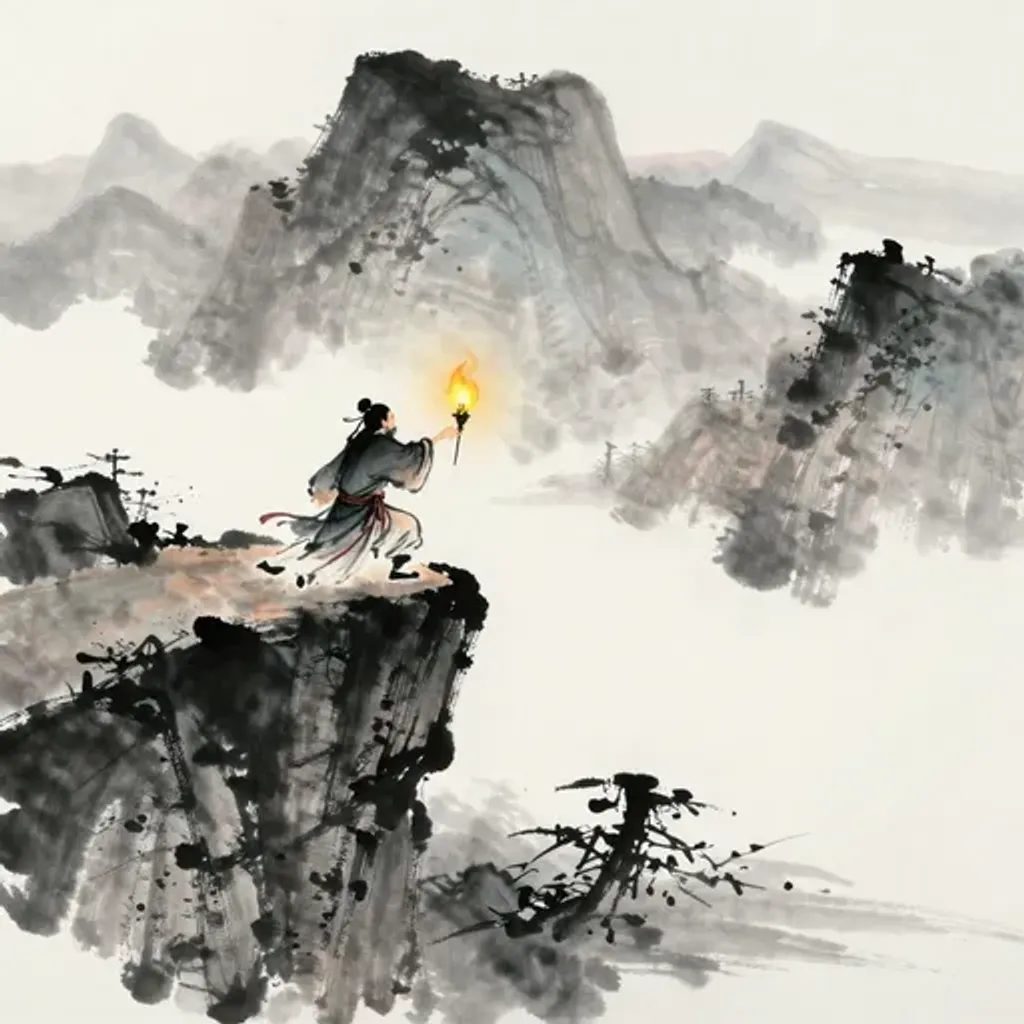
遠視千里,不見黑子;離婁之明,無益于光。
Gazing a thousand li into the distance; unable to see a single mote. Even Li Lou is keen sight adds nothing to the light.
— Jiao Yanshou, Yilin (Forest of Changes), 1st century BC
Commentary
Heaven above the lake, yet even the keenest vision has its limits. One gazes a thousand li into the distance but cannot discern a speck. Li Lou's legendary eyesight — he who could see the tip of an autumn hair at a hundred paces — adds nothing to the light itself. The allusion comes from Mencius: 'With Li Lou's sight and Gongshu Ban's skill, without compass and square one cannot make circles and squares.' Supreme ability without the right framework is useless. From Treading to Small Exceeding, thunder rumbles above the mountain. The small bird flies too high and loses its way — exceeding one's proper measure. The verse warns that extraordinary perception without proper method illuminates nothing.
履 → 既濟
Hexagram 10 → Hexagram 63: After Completion
Changing lines: 2, 3, 4, 6
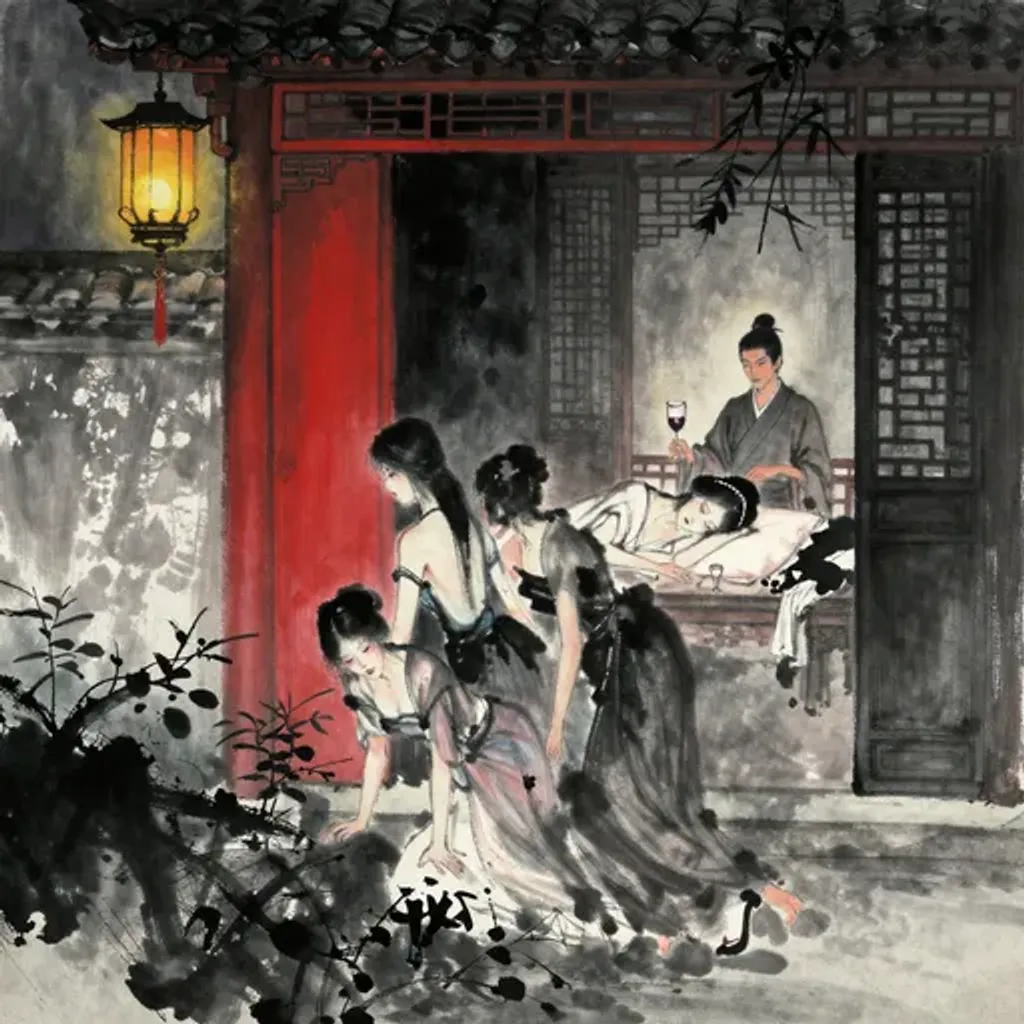
三女為姦,俱遊高園;倍室夜行,與伯笑言。不忍主母,失禮酒冤,皇天誰告。
Three women plotting mischief, all roaming the high garden. Leaving their chambers to walk by night; with the elder brother, laughing and talking. Unable to face the lady of the house; rites abandoned, wine-soured grievance -- to whom in heaven can one appeal?
— Jiao Yanshou, Yilin (Forest of Changes), 1st century BC
Commentary
Heaven above the lake, but the household order has dissolved in darkness. Three women conspire together, wandering the high garden by night. They leave the inner chambers for nocturnal excursions, laughing and whispering with their lord. The mistress of the house is not respected; propriety collapses under wine and resentment, and there is no heaven to hear the appeal. The verse depicts a domestic scandal: concubines usurping the wife's authority, revelry replacing ritual, and the wronged party left without recourse. From Treading to After Completion, water rests perfectly above fire in balanced equilibrium. The irony cuts deep — the household that should have achieved completion instead drowns in disorder.
履 → 未濟
Hexagram 10 → Hexagram 64: Before Completion
Changing lines: 1, 5
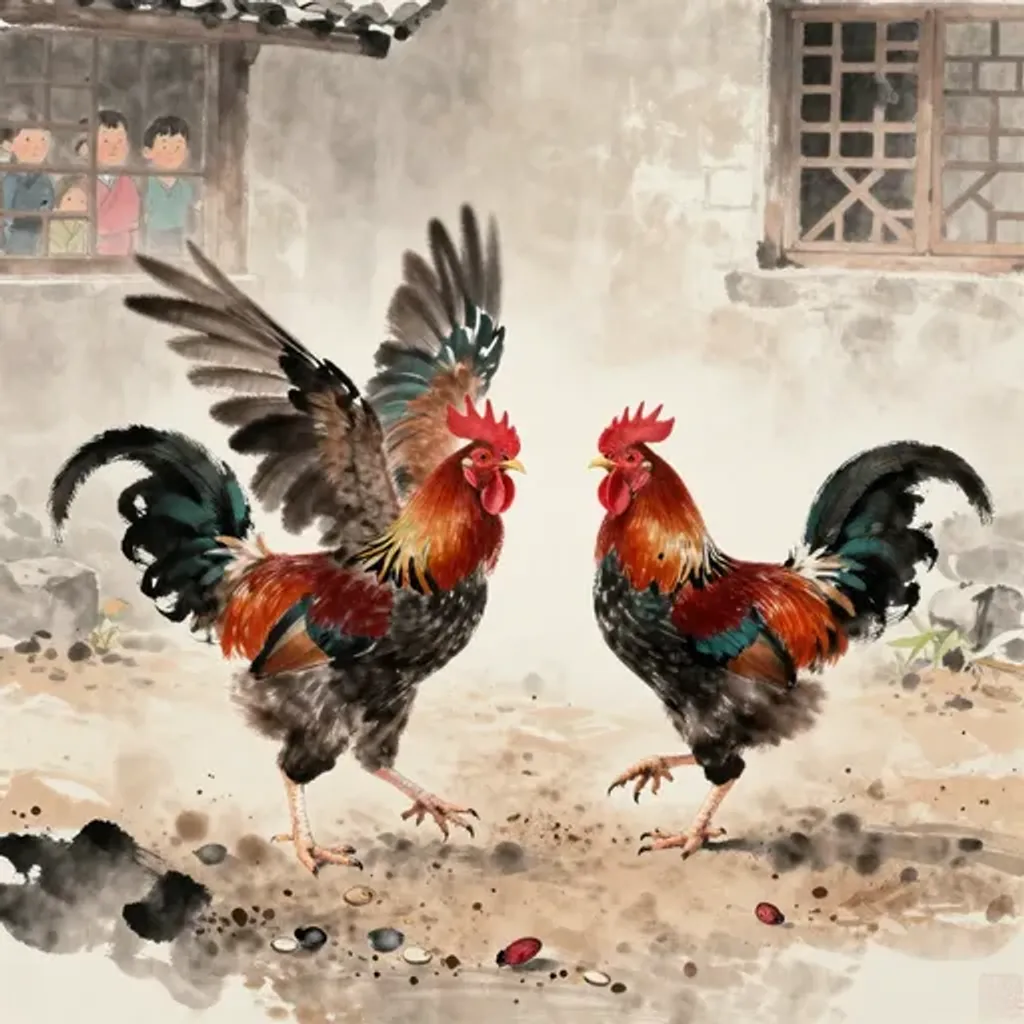
日辰不和,強弱相振,一雌兩雄,客勝主人。
The day and the hour are at odds; strong and weak shake each other. One hen and two roosters; the guest overcomes the host.
— Jiao Yanshou, Yilin (Forest of Changes), 1st century BC
Commentary
Heaven above the lake, but the celestial signs are discordant. Sun and stars clash rather than cooperate, the strong and weak agitate each other instead of finding balance. One female contends with two males — the guest overpowers the host. The verse describes a fundamental inversion of proper order: the subordinate defeats the principal, the outsider dominates the insider. The cosmic disharmony of sun and zodiac mirrors the social inversion below. From Treading to Before Completion, fire burns above water — neither element reaches the other, and nothing is brought to fulfillment. The transformation warns that when conduct produces only friction and displacement, completion remains permanently out of reach.