Transformations of Hexagram 11
Every line of change out of Hexagram 11 泰 Peace, with the Yilin verse for each of the 64 resulting hexagrams, its translation, and the original ink brush artwork.
泰 → 乾
Hexagram 11 → Hexagram 1: The Creative
Changing lines: 4, 5, 6
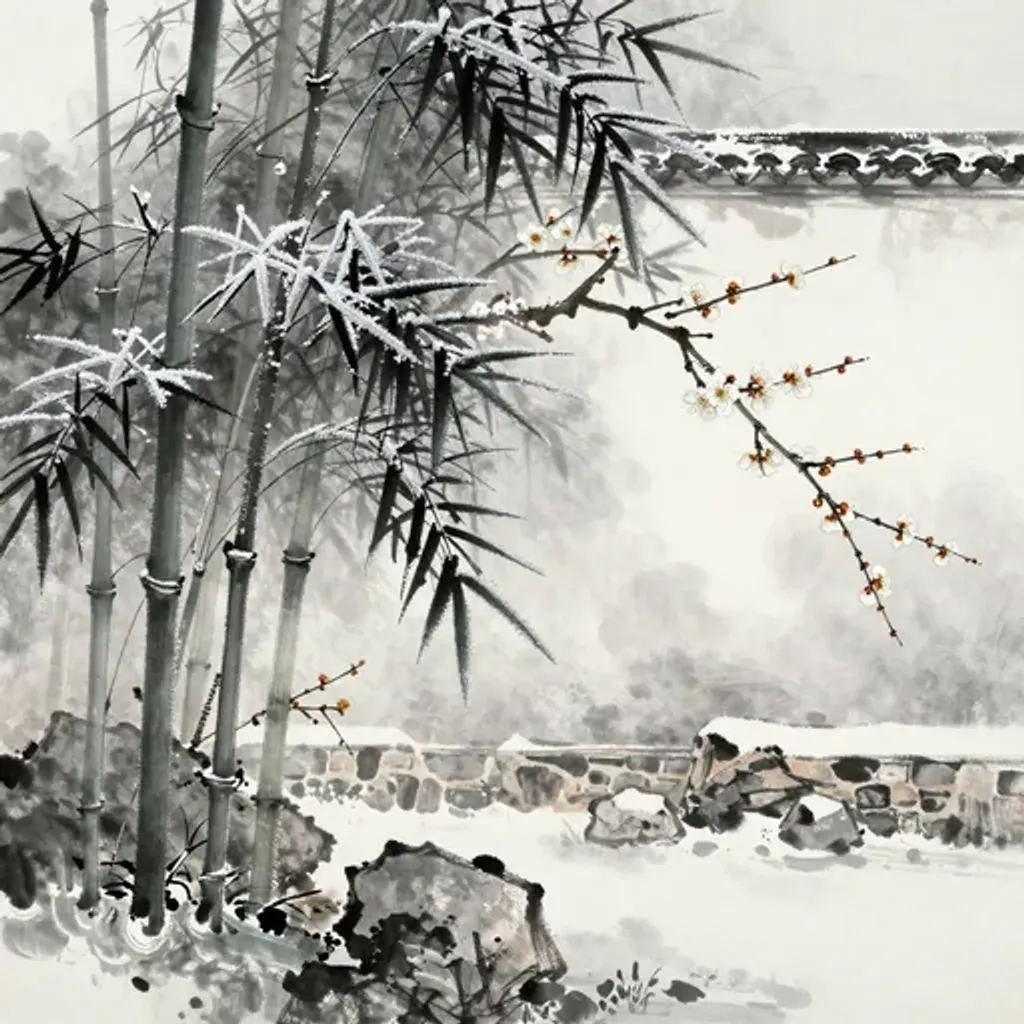
伯夷叔齊,貞廉之師;以德防患,憂禍不存。
Frost cannot break the bamboo; the winter plum blooms alone. Guarding one's purity, no ill wind can intrude.
— Jiao Yanshou, Yilin (Forest of Changes), 1st century BC
Commentary
Earth above heaven, the mingling of Peace, anchors this verse in moral constancy. The original verse names Boyi and Shuqi, paragons of principled integrity who refused to eat Zhou grain after the Shang fell. They withdrew to Mount Shouyang and starved rather than serve a dynasty they deemed illegitimate. Their example stands as a 'teacher of chastity and probity' — virtue as prophylactic against calamity. When righteousness is internalized, external threats lose their power. From Peace to the Creative, the transformation reveals the deepest mechanism of self-generating strength: it is not imposed order but moral self-cultivation that sustains one through upheaval. Heaven's tireless motion begins within.
泰 → 坤
Hexagram 11 → Hexagram 2: The Receptive
Changing lines: 1, 2, 3
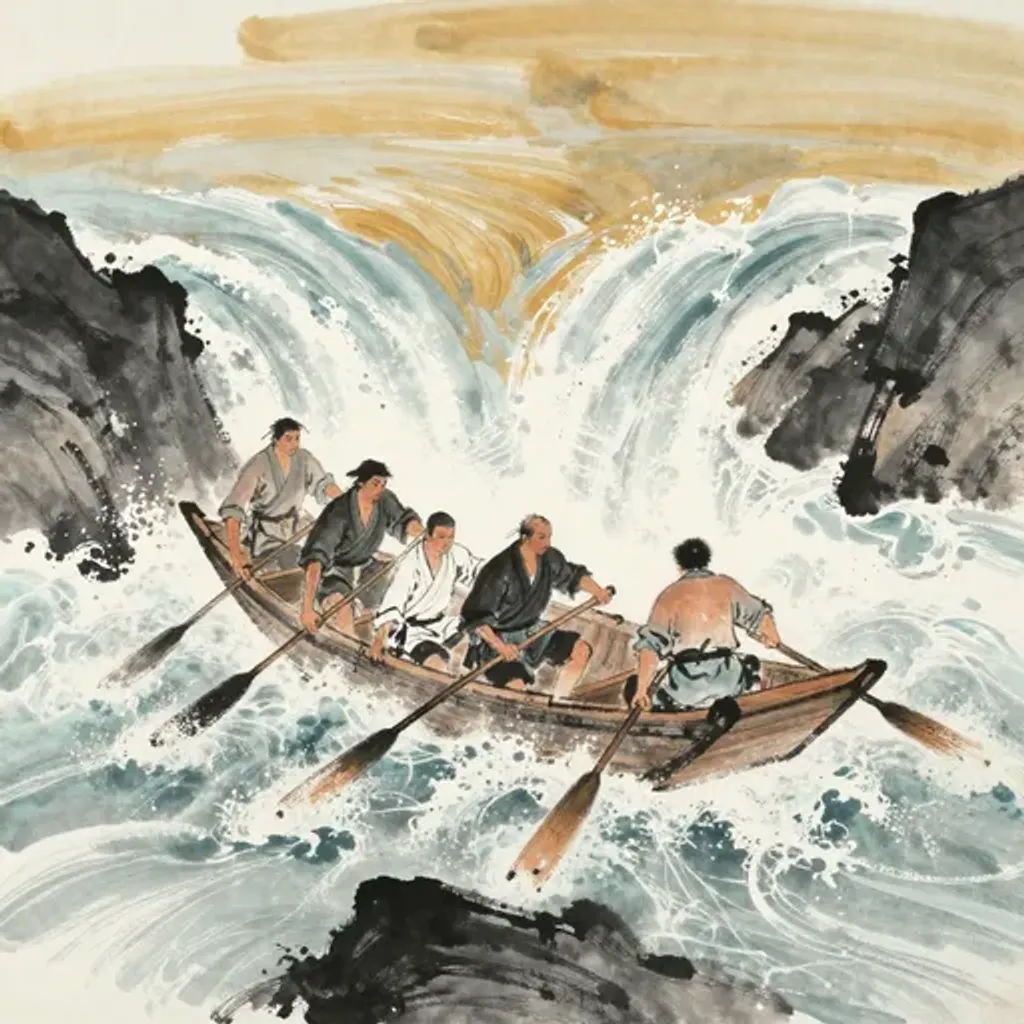
濟深難渡,濡我衣袴;五子善櫂,脫無他故。
The ford is deep, hard to cross; it soaks my robes and trousers. Five skilled oarsmen ply the sweeps; we escape without mishap.
— Jiao Yanshou, Yilin (Forest of Changes), 1st century BC
Commentary
Earth above heaven, Peace's communion, opens onto a river crossing fraught with danger. The ford is deep and treacherous; water soaks through garments, clinging to waist and legs. Yet five skilled oarsmen ply their paddles, and the traveler escapes without mishap. The number five may echo the five elements in harmonious alignment, or simply mark a full complement of boatmen working in concert. Wet clothing signals genuine peril — this is no metaphorical crossing but a visceral encounter with overwhelming force. From Peace to the Receptive, the transformation traces how communal support and yielding responsiveness carry one through danger. Earth's boundless capacity to bear is the quiet strength that rescues.
泰 → 屯
Hexagram 11 → Hexagram 3: Difficulty at the Beginning
Changing lines: 2, 3, 5
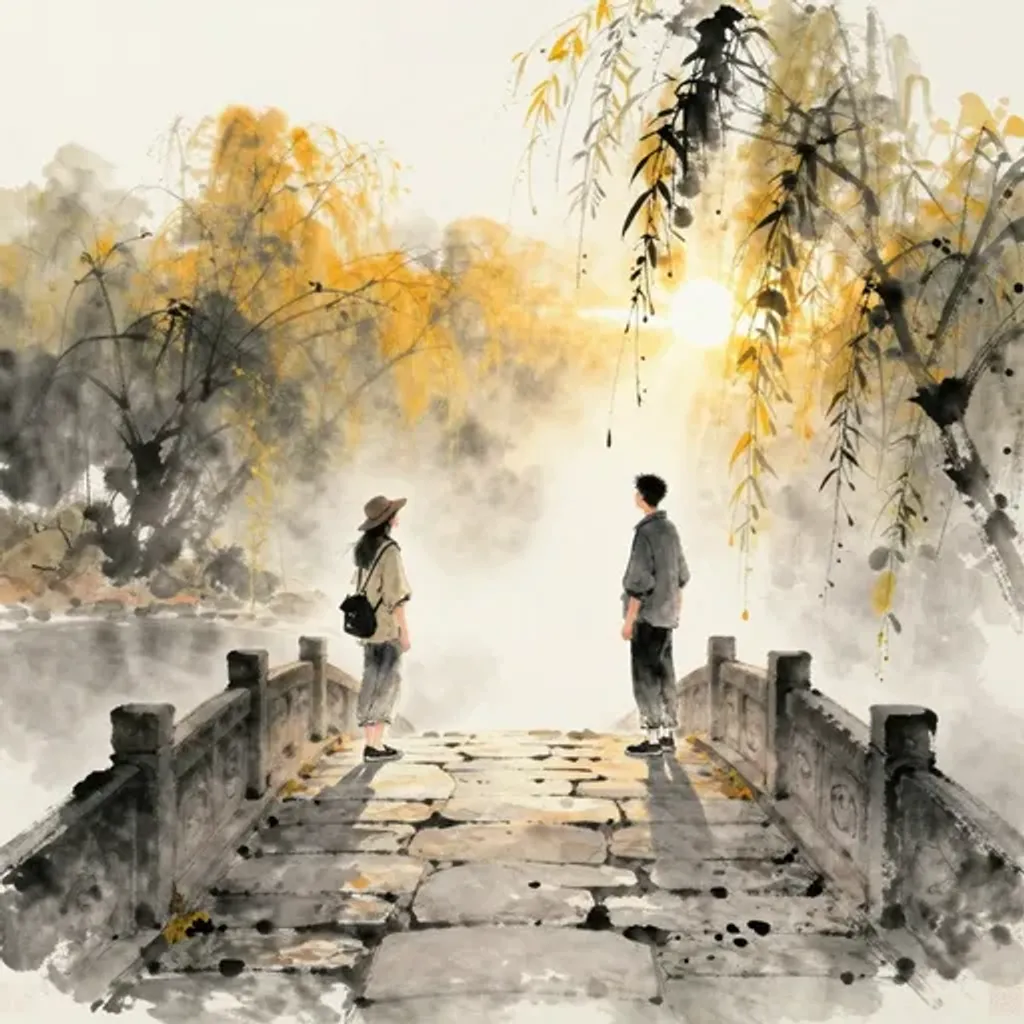
倚立相望,適得道通。驅駕奔馳,比目同床。
Leaning and gazing at each other; at last the way opens through. Galloping in haste; paired eyes share one bed.
— Jiao Yanshou, Yilin (Forest of Changes), 1st century BC
Commentary
Earth above heaven, Peace's open channel, frames a scene of longing fulfilled. Two figures lean forward gazing at each other across a distance, and suddenly the road opens between them. They race forward, driving their carriages at full gallop, and find themselves together — paired-eye fish sharing a single bed, inseparable at last. The 'paired-eye fish' (比目) is a classical image of lovers who can only survive joined together, each possessing a single eye. From Peace to Difficulty at the Beginning, the transformation captures the paradox of union born from struggle: clouds and thunder churn at the start of new life, and the very difficulty of the path is what makes the meeting precious.
泰 → 蒙
Hexagram 11 → Hexagram 4: Youthful Folly
Changing lines: 1, 3, 6
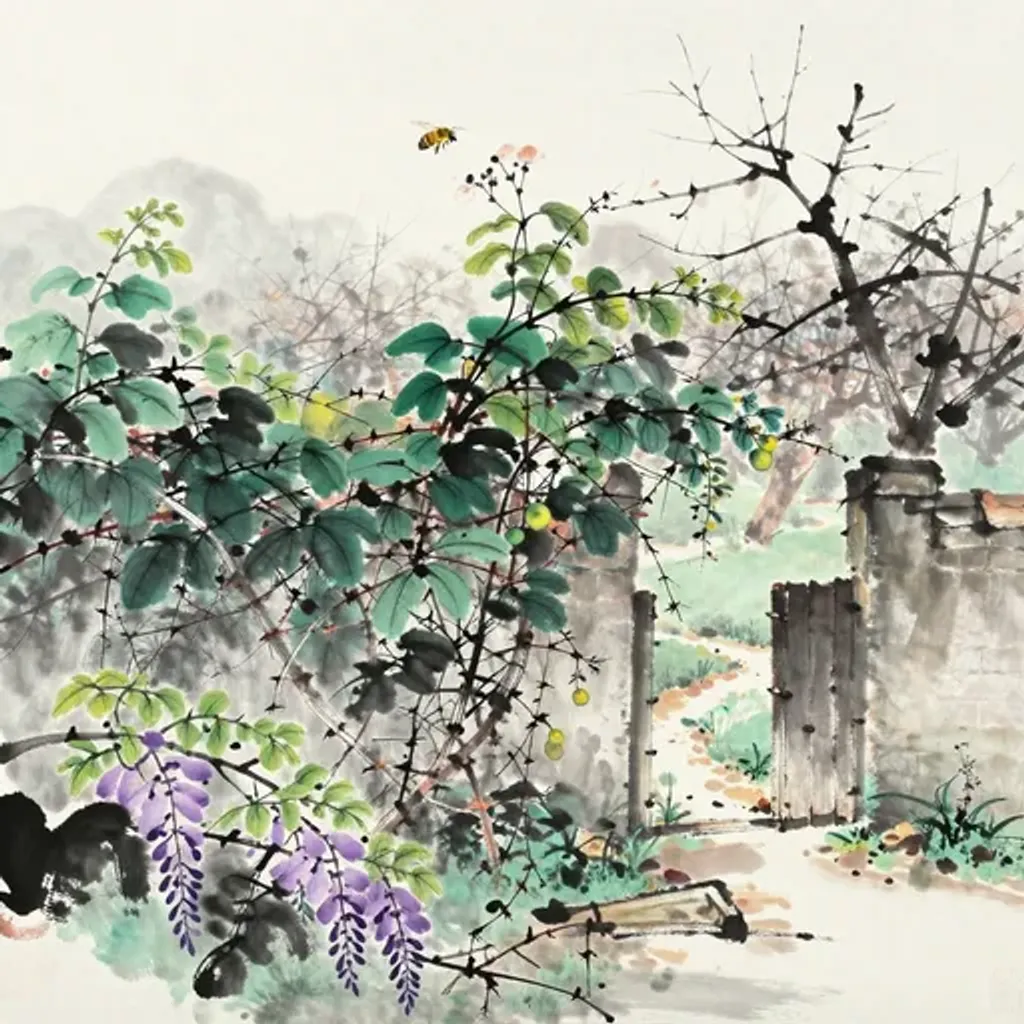
葛藟蒙棘,花不得實;讒佞為政,使恩壅塞。
Kudzu vines smother the thornbush; blossoms bear no fruit. Slanderers govern; benevolence is blocked and choked.
— Jiao Yanshou, Yilin (Forest of Changes), 1st century BC
Commentary
Earth above heaven, Peace overturned by parasitic growth. Kudzu and creeping vines smother the thorny shrub, choking its blossoms so that no fruit can form. The image is political: slanderers and flatterers have seized governance, blocking the flow of royal benevolence until it is entirely dammed. The vine-choked plant recalls the Shijing's 'Ge Lei' imagery of entangling growth, but here the entanglement is malicious — counsel corrupted at the source. From Peace to Youthful Folly, the transformation shows how a spring emerging beneath a mountain can be muddied before it ever reaches open ground. When sycophants obstruct the channel between ruler and people, even genuine grace cannot penetrate.
泰 → 需
Hexagram 11 → Hexagram 5: Waiting
Changing lines: 5
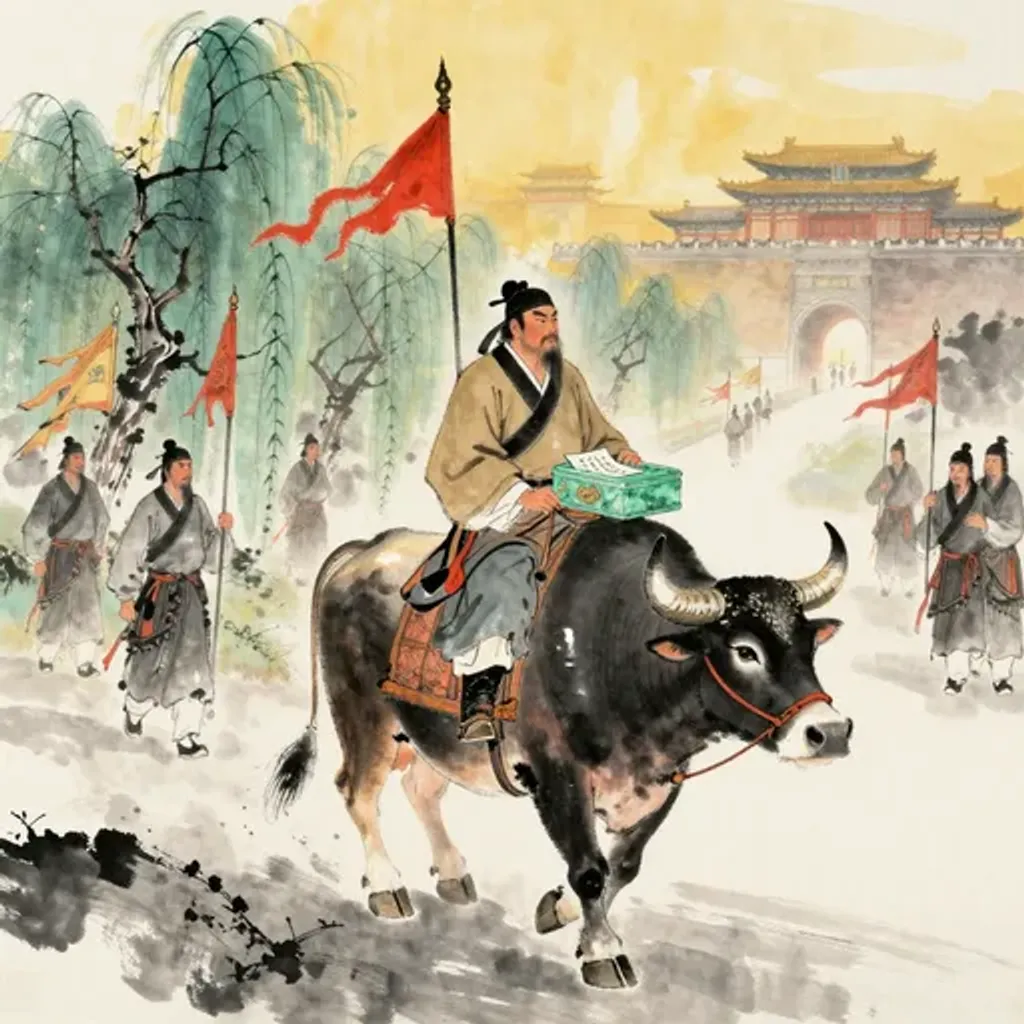
四足無角,君子所服;南征述職,與福相得。
Four-footed and hornless, the mount a gentleman rides. Journeying south on official duty, he meets with good fortune.
— Jiao Yanshou, Yilin (Forest of Changes), 1st century BC
Commentary
Earth above heaven, Peace's bountiful communion, conjures an image of a fine horse: four-footed and hornless, the kind a gentleman would ride. Mounted on this steed, he journeys south to fulfill his duties, reporting to the court on his inspection tour. Fortune follows naturally. The 'four-footed without horns' formula describes a horse by negation — distinguishing it from oxen or deer — and the southern journey echoes the sage-king's circuit of inspection, traveling outward to assess the realm. From Peace to Waiting, clouds gather above heaven but rain has not yet fallen; the traveler proceeds with calm assurance, knowing that proper timing brings blessing. Nourishment awaits those who attend to duty with patience.
泰 → 訟
Hexagram 11 → Hexagram 6: Conflict
Changing lines: 1, 3, 4, 5, 6
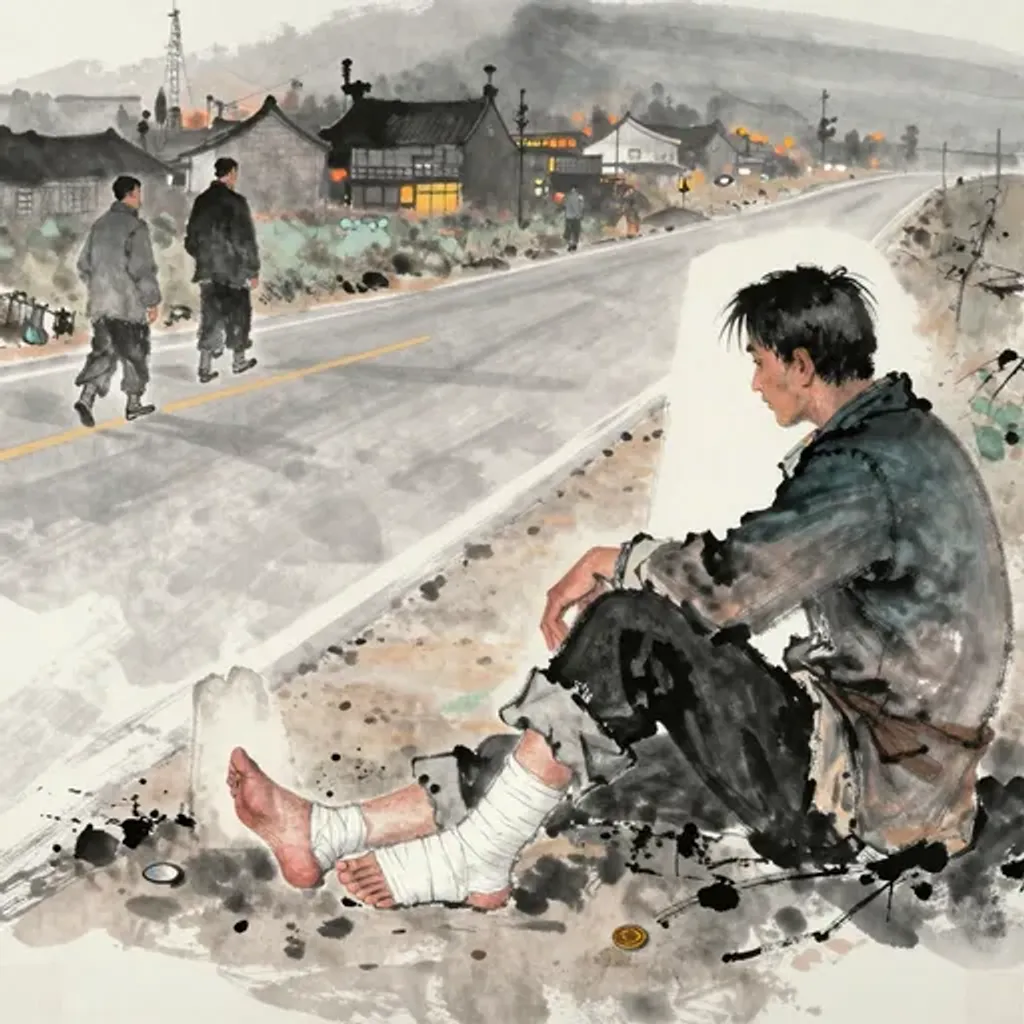
踝踵之傷,左指病癰;失旅後時,利走不來。
Injury to ankle and heel; the left finger swells with abscess. Missing the caravan, arriving too late; profit flees and will not come.
— Jiao Yanshou, Yilin (Forest of Changes), 1st century BC
Commentary
Earth above heaven, Peace's harmony, fractures into bodily injury. Ankles and heels are wounded, the left hand festers with an abscess. Having lost the army's momentum and missed the proper season, profit flees and cannot be reclaimed. The verse catalogs physical breakdown as a metaphor for strategic failure: a body too damaged to march mirrors a campaign launched at the wrong moment. Every wound compounds the delay. From Peace to Conflict, heaven and water diverge — forces that should align instead work at cross purposes. The transformation captures how harmonious conditions, once squandered through poor timing, devolve into discord where every initiative meets opposition.
泰 → 師
Hexagram 11 → Hexagram 7: The Army
Changing lines: 1, 3
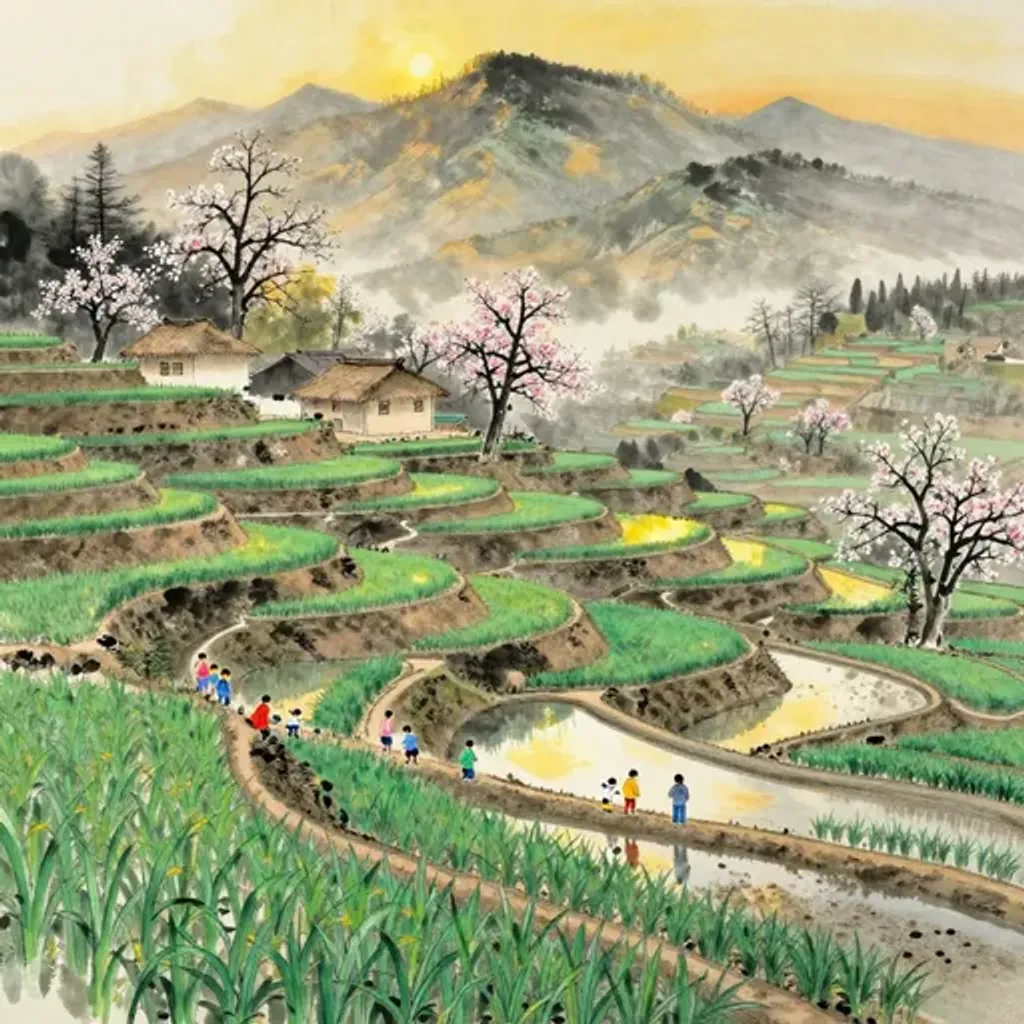
春城夏國,生長之域;可以服食,保全家國。
Spring city, summer realm, a domain of growth and nurture. Fit to sustain and nourish; it preserves the household and the state.
— Jiao Yanshou, Yilin (Forest of Changes), 1st century BC
Commentary
Earth above heaven, Peace nurtures like spring and summer combined. The verse envisions a domain of growth — spring's city and summer's kingdom, where all things flourish in their season. Here one may gather sustenance and preserve both family and state intact. The paired seasons evoke the ascending arc of the agricultural year, when warmth and rain conspire to bring abundance. No conflict disturbs this realm; governance and nature work in concert. From Peace to The Army, earth contains water hidden within — disciplined reserves marshaled beneath a tranquil surface. The transformation reveals that true security rests not on visible force but on a well-nourished populace whose loyalty forms the state's deepest strength.
泰 → 比
Hexagram 11 → Hexagram 8: Holding Together
Changing lines: 1, 2, 3, 5
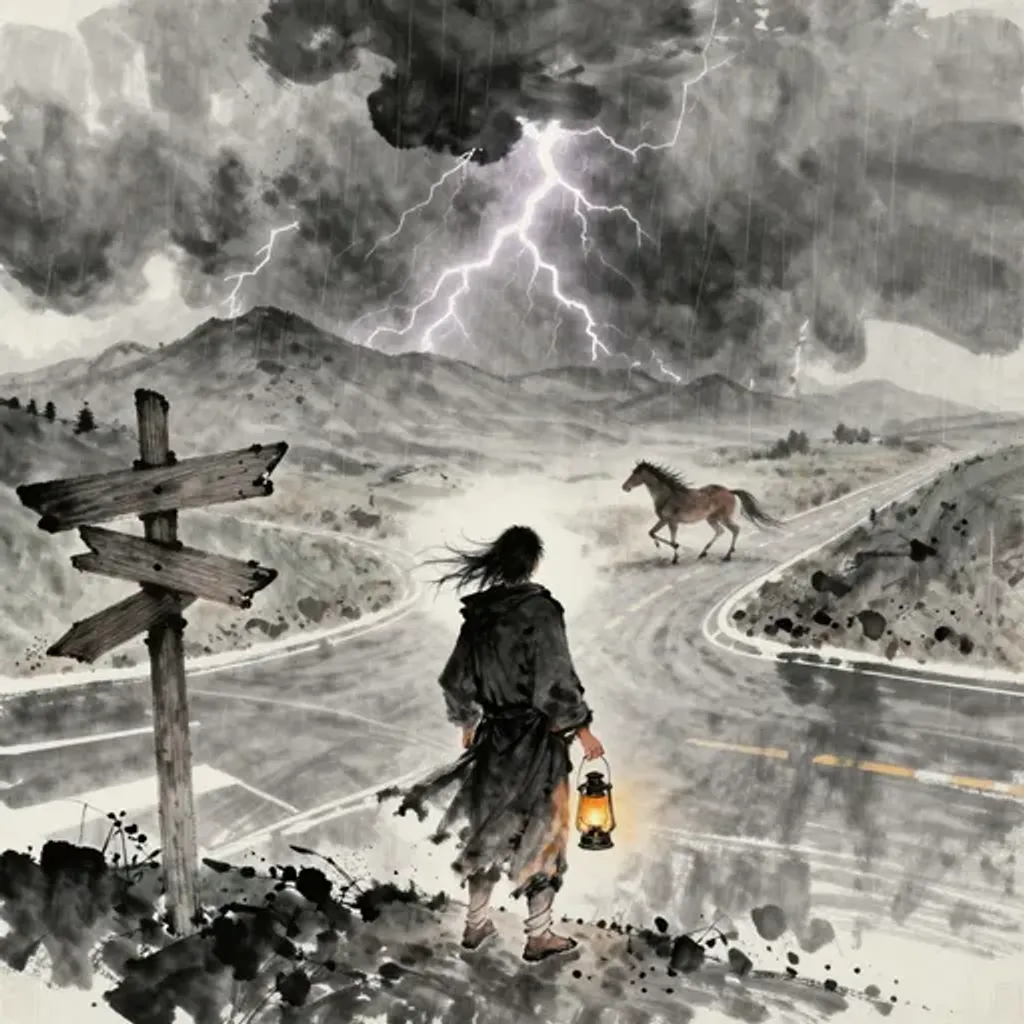
望驥不來,駒蹇為憂;雨驚我心,風撼我肌。
Hoping for the steed, it does not come; the colt is lame, cause for worry. Rain startles my heart; wind shakes my flesh.
— Jiao Yanshou, Yilin (Forest of Changes), 1st century BC
Commentary
Earth above heaven, Peace's expectation dissolves into anxiety. One watches for a fine steed on the horizon, but it never arrives; instead a lame colt stumbles forward, compounding worry. Rain startles the heart and wind shakes the body — nature itself turns hostile to the waiting figure. The hoped-for thoroughbred represents an ally, a promotion, or the return of someone important; receiving a limping foal instead is a cruel substitution. From Peace to Holding Together, water rests upon the earth, seeking unity — but unity requires a center worth gathering around. The transformation warns that when the awaited leader disappoints, those who gather may find only shared vulnerability.
泰 → 小畜
Hexagram 11 → Hexagram 9: Small Taming
Changing lines: 5, 6
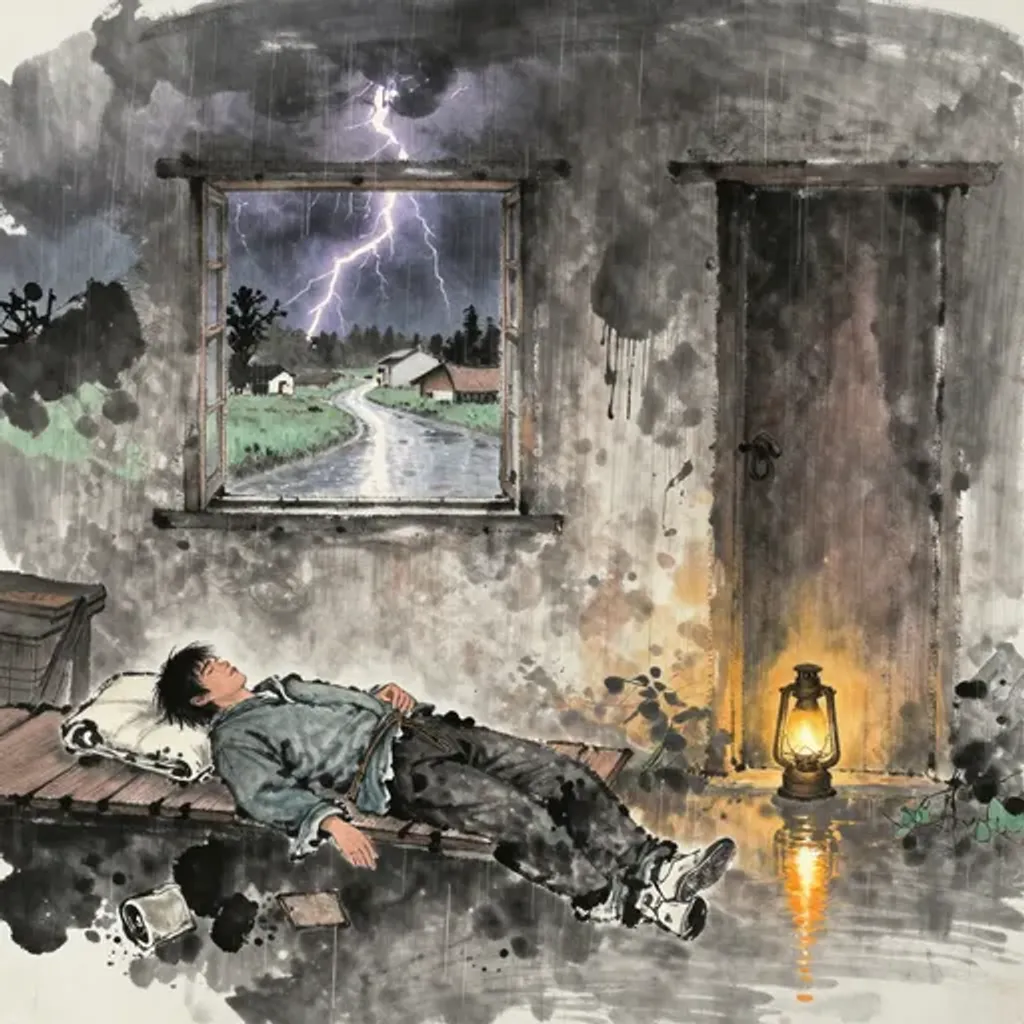
久客無床,思歸我鄉;雷雨涌盈,道不得通。
Long a guest with no bed, longing to return home. Thunder and rain swell and surge; the road cannot be traveled.
— Jiao Yanshou, Yilin (Forest of Changes), 1st century BC
Commentary
Earth above heaven, Peace inverted into displacement. A traveler stranded far from home has no proper bed, longing ceaselessly for his native village. Thunder and rain surge and overflow, flooding the roads until no passage remains. The verse captures the exile's double bind: homesickness intensifies precisely when return becomes impossible. Storms block every path home. From Peace to Small Taming, wind blows across heaven — a gentle force attempting to restrain vast energy but not yet succeeding. The rain clouds gather but have not released their burden. The transformation mirrors the traveler's predicament: desire is present, the way is imagined, but circumstances have not yet yielded the opening.
泰 → 履
Hexagram 11 → Hexagram 10: Treading
Changing lines: 3, 4, 5, 6
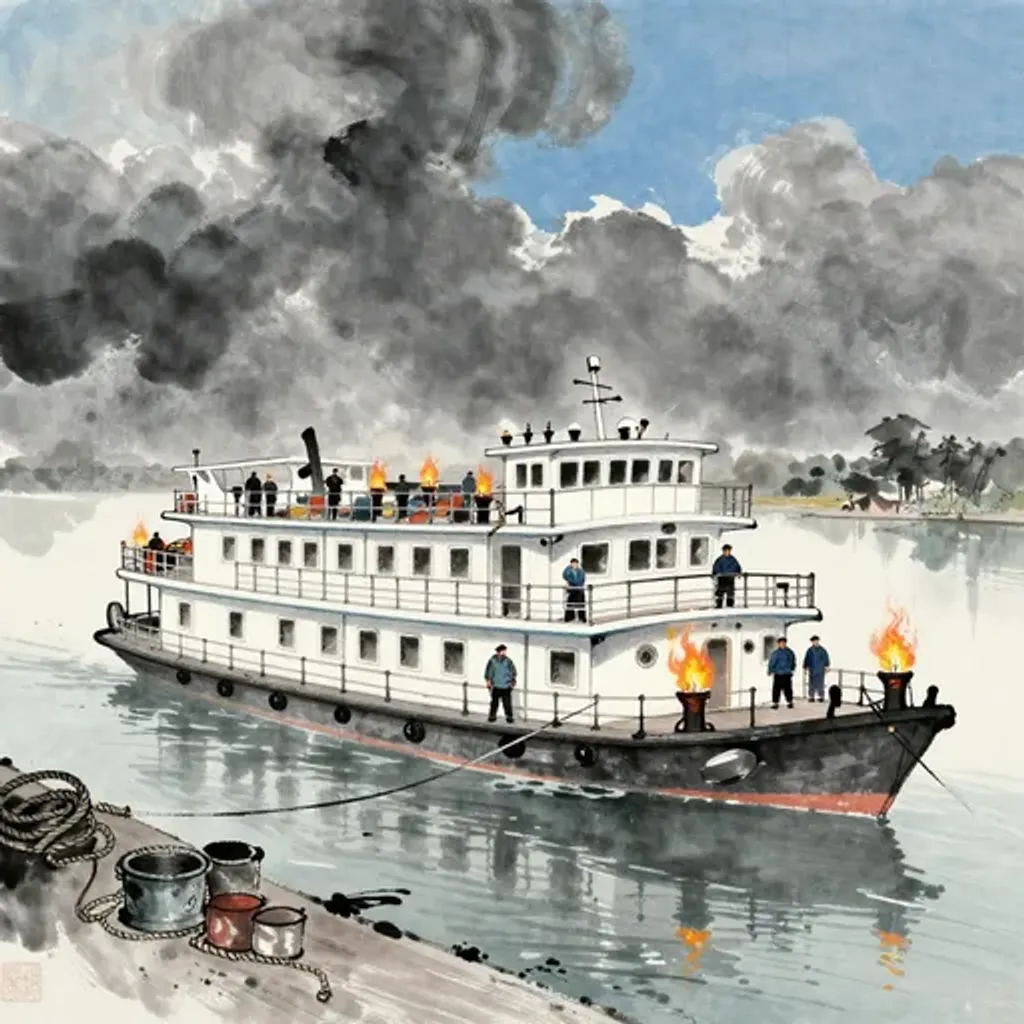
舫船備水,旁可燃火;積善有徵,終身無禍。
Boats lashed together guard against flood; fire can be lit alongside. Accumulated good deeds find their proof; to the end of life, no calamity.
— Jiao Yanshou, Yilin (Forest of Changes), 1st century BC
Commentary
Earth above heaven, Peace's equilibrium, extends into prudent preparation. Twin-hulled boats guard against flooding, while alongside them fire stands ready for warmth and signal. These are not reactive measures but precautions taken in advance — provisions against disaster that never materializes precisely because the provisions were made. The accumulated merit of good deeds manifests as a lifetime without calamity. From Peace to Treading, heaven above the lake, one walks upon a tiger's tail with ritual precision. The transformation reveals that safety through danger comes from preparation and propriety: those who have laid careful foundations may tread perilous paths without being bitten.
泰 → 泰
Hexagram 11 → Hexagram 11: Peace
No changing lines — the hexagram is unchanged
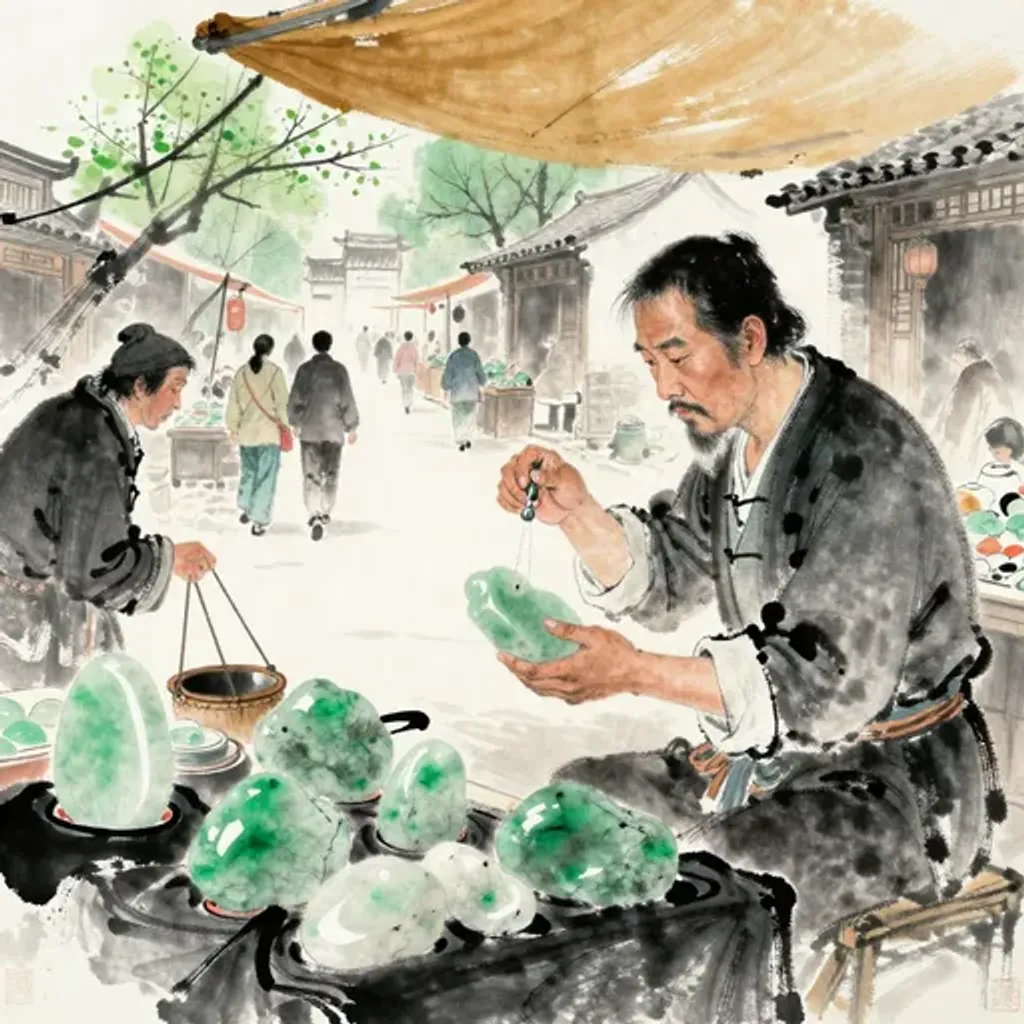
求玉陳國,留連東域;須我王孫,四月來復;主君有德,蒙恩受福。
Seeking jade in the state of Chen, lingering in the eastern lands. Awaiting our noble scion, who returns in the fourth month. The lord possesses virtue; we receive grace and blessing.
— Jiao Yanshou, Yilin (Forest of Changes), 1st century BC
Commentary
Peace returning to itself, earth above heaven in doubled communion. One journeys to the state of Chen seeking jade, lingering in the eastern lands. The verse then calls out: 'Wait for our prince to return — in the fourth month he shall come back.' The lord possesses virtue, and through his merit all receive blessing. Chen was famed for its jade and its ancient lineage descended from Emperor Shun. The fourth month marks the height of spring's generative power. From Peace to Peace, the pattern is self-renewing: virtue circulates without depletion, and the prince who departs on a worthy errand returns enriched, distributing fortune to all.
泰 → 否
Hexagram 11 → Hexagram 12: Standstill
Changing lines: 1, 2, 3, 4, 5, 6
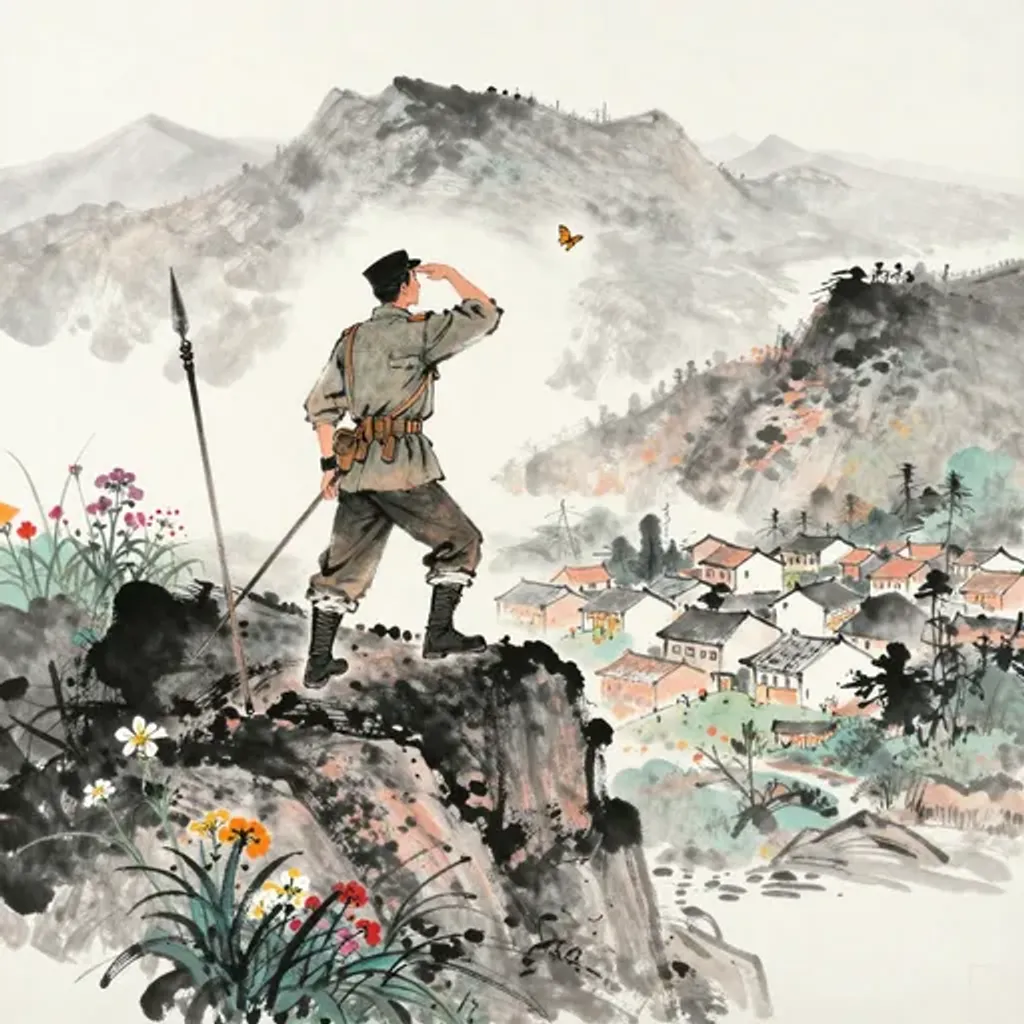
陟岵望母,役事未已;王政無盬,不得相保。
Climbing the hill, gazing toward mother; service and labor never cease. The king's affairs know no end; we cannot keep each other safe.
— Jiao Yanshou, Yilin (Forest of Changes), 1st century BC
Commentary
Earth above heaven, Peace crumbles under endless conscription. The verse quotes the Shijing ode 'Zhi Hu' from the Wei songs: a soldier climbs a bare hilltop and gazes toward his mother, but the king's service never ends. Royal governance grinds on without rest, and families cannot hold together. The poem's grief is structural, not personal — it indicts a system that tears the young from their parents without pause. From Peace to Standstill, heaven and earth cease their communion entirely. The transformation is devastating: where once energies mingled freely, now above and below are severed, and the conscript's longing gaze finds only distance.
泰 → 同人
Hexagram 11 → Hexagram 13: Fellowship
Changing lines: 2, 4, 5, 6
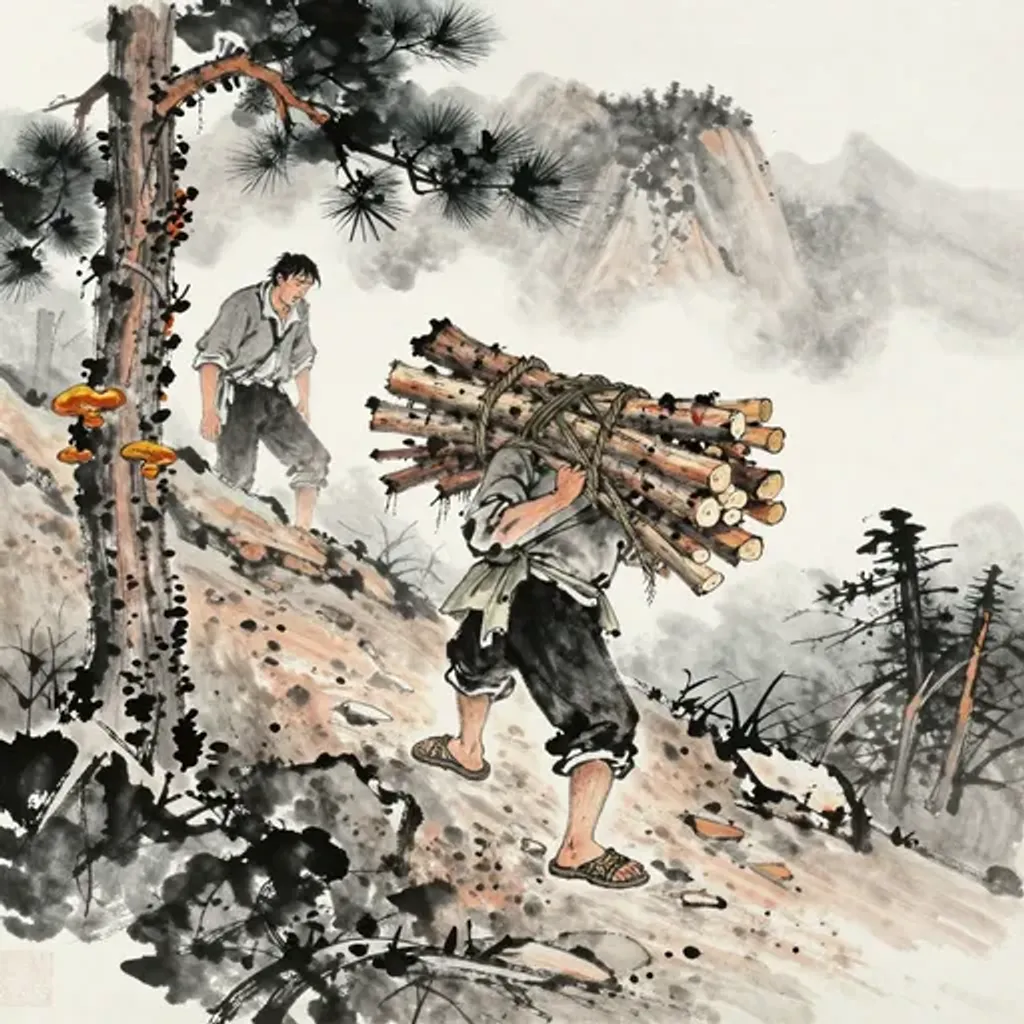
多載重負,捐棄于野;予母誰子,但自勞苦。
Carrying firewood over the ridge, back bent like a bow. The wood is gone, the path ends — no companion to rest with.
— Jiao Yanshou, Yilin (Forest of Changes), 1st century BC
Commentary
Earth above heaven, Peace's bounty becomes an unbearable load. The original verse shows a figure carrying too much cargo, forced to abandon it by the roadside. The lament deepens: 'Whose child am I to my mother? I only exhaust myself in labor.' The burden exceeds what any single person can bear, yet no one shares the weight. From Peace to Fellowship, heaven and fire blaze together, promising solidarity — but the verse's bitterness lies in its absence. The transformation from Peace to Fellowship reveals fellowship as the missing remedy: a lone laborer collapses under cargo that a community could distribute. When heaven's fire illuminates shared purpose, the burden finds many shoulders.
泰 → 大有
Hexagram 11 → Hexagram 14: Great Possession
Changing lines: 4, 6
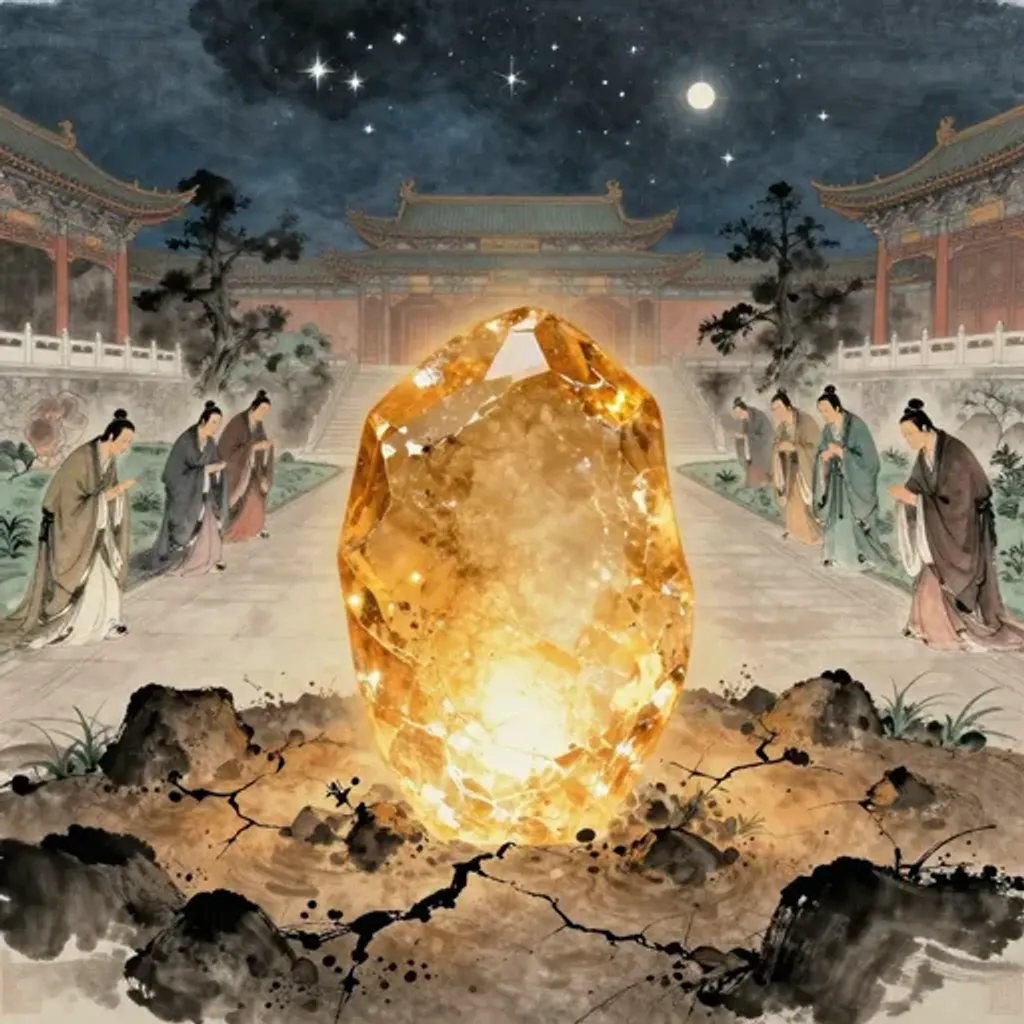
生直地乳,上皇大喜;賜我福祉,受命無極。
An earth-born treasure, a milky gem, rises from the ground; the sovereign is greatly pleased. He bestows blessing and favor upon us; the mandate received knows no limit.
— Jiao Yanshou, Yilin (Forest of Changes), 1st century BC
Commentary
Earth above heaven, Peace's fertile communion births a portent. A sweet spring (地乳) erupts directly from the earth, and the Supreme Sovereign rejoices. This is the language of imperial omens: when the earth spontaneously produces nourishment, heaven confirms the ruler's virtue. The sovereign bestows blessings and the mandate extends without limit. 'Earth's milk' (地乳) refers to a milky sweet spring, an auspicious geological phenomenon recorded in Han-dynasty omen catalogues. From Peace to Great Possession, fire blazes above heaven — illuminated abundance radiating in all directions. The transformation captures how genuine communion between heaven and earth produces signs of favor that confirm limitless mandate.
泰 → 謙
Hexagram 11 → Hexagram 15: Modesty
Changing lines: 1, 2
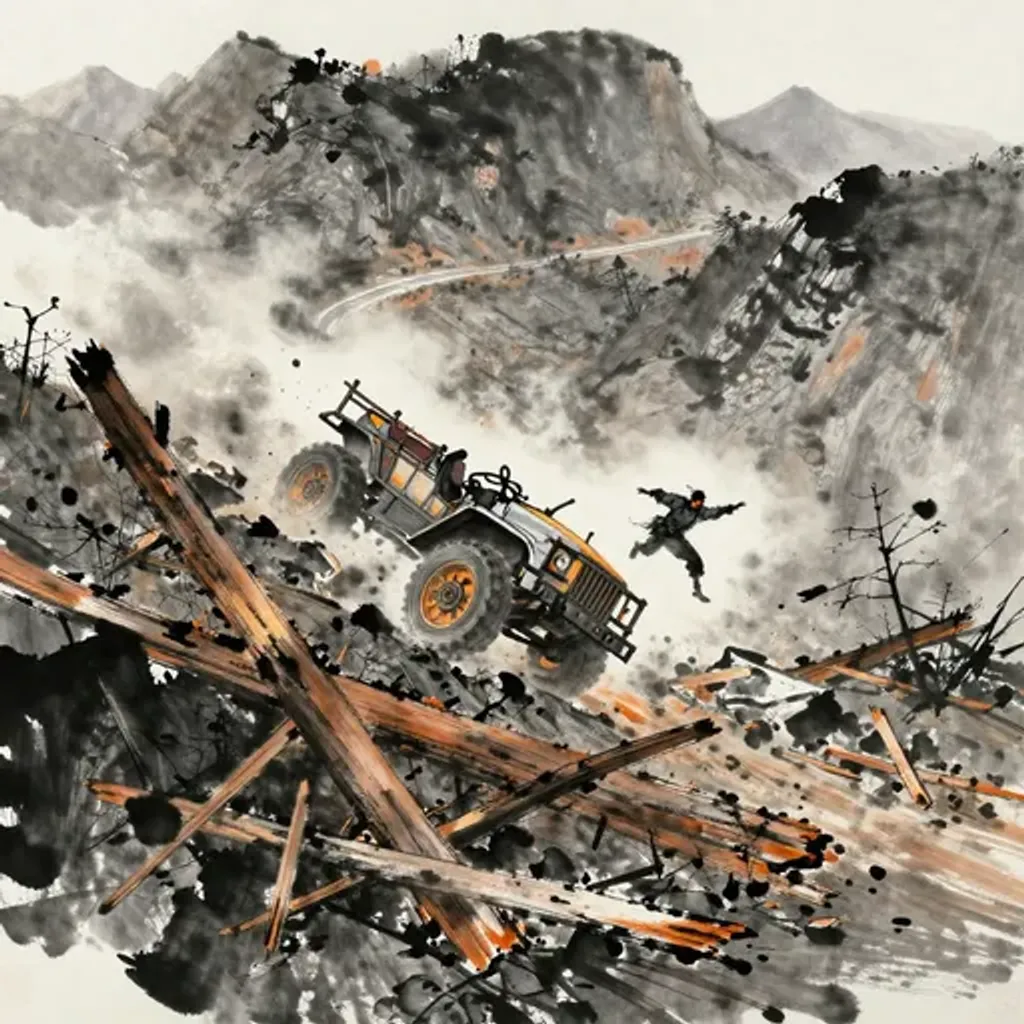
翕翕䡘䡘,稍墮山顛;滅其令名,長沒不全。
Rattling and shaking, gradually tumbling from the mountaintop. The fine name is extinguished; it sinks away, never to be whole.
— Jiao Yanshou, Yilin (Forest of Changes), 1st century BC
Commentary
Earth above heaven, Peace undone by reckless descent. Things crowd together in confusion, then tumble from the mountain peak. A good name is extinguished; one sinks forever, never to be whole again. The opening onomatopoeia (翕翕䡘䡘) evokes the sound of things collapsing inward, gathering momentum before the fall. The mountain peak represents the height of reputation, and the descent is irreversible. From Peace to Modesty, earth contains a mountain hidden within — what was towering is brought low. But where Modesty teaches the wisdom of voluntary lowering, this verse warns of involuntary collapse. The distinction is crucial: one who humbles himself survives; one who falls loses everything.
泰 → 豫
Hexagram 11 → Hexagram 16: Enthusiasm
Changing lines: 1, 2, 3, 4
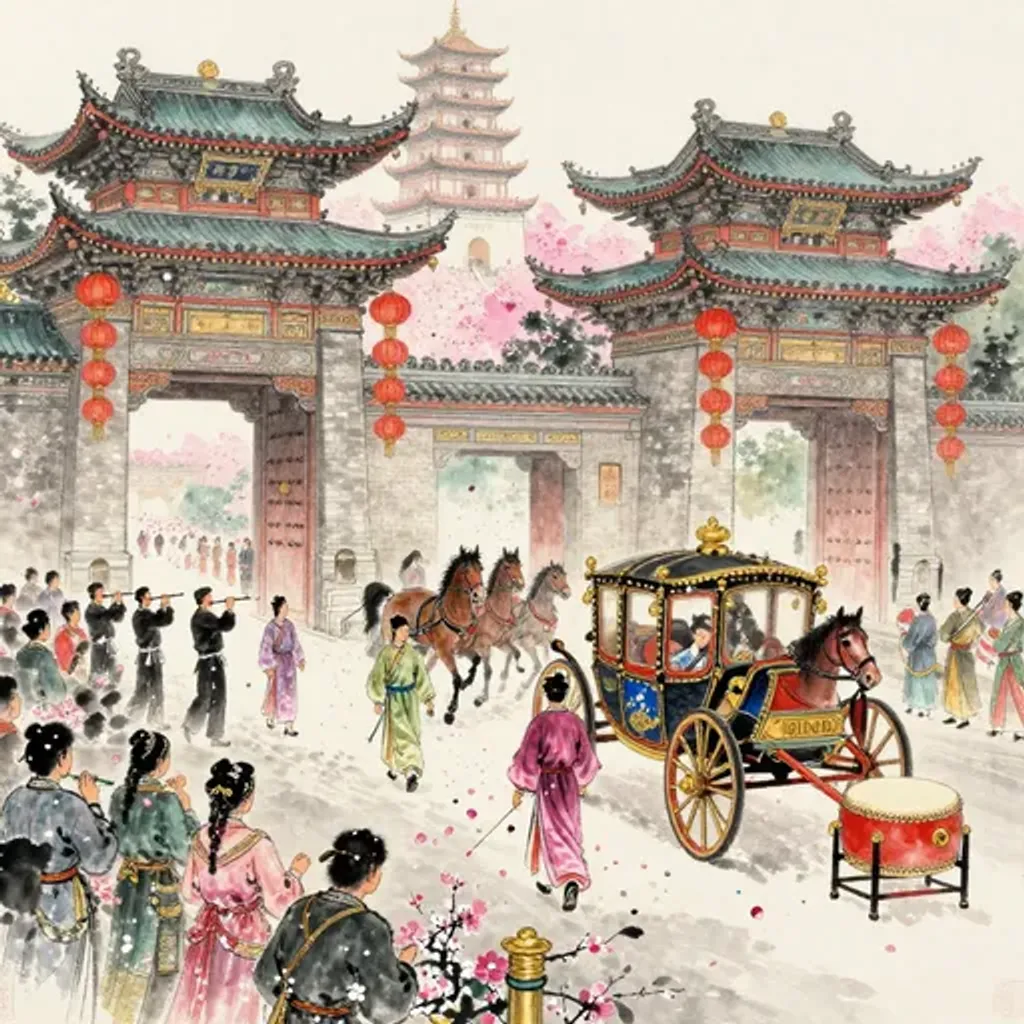
東鄰嫁女,為王妃后;莊公築館,以尊王母;歸于京師,季姜悅喜。
The phoenix carriage enters the city; flutes and drums sound together. The people line the road, showering petals in welcome.
— Jiao Yanshou, Yilin (Forest of Changes), 1st century BC
Commentary
Earth above heaven, Peace's cosmological harmony finds ritual expression. The original verse describes an eastern neighbor's daughter married as royal consort. Duke Zhuang builds a pavilion to honor the queen mother, and the lady named Ji Jiang returns to the capital in delight. This is a scene of ceremonial marriage elevating a woman into the heart of the state, with proper rites and jubilant reception. From Peace to Enthusiasm, thunder erupts from the earth — the ancient kings made music to honor virtue and offered sacrifice to the Supreme Deity. The transformation shows Peace's quiet communion crystallizing into public celebration, as heaven's blessing is acknowledged through ritual joy.
泰 → 隨
Hexagram 11 → Hexagram 17: Following
Changing lines: 2, 3, 4, 5
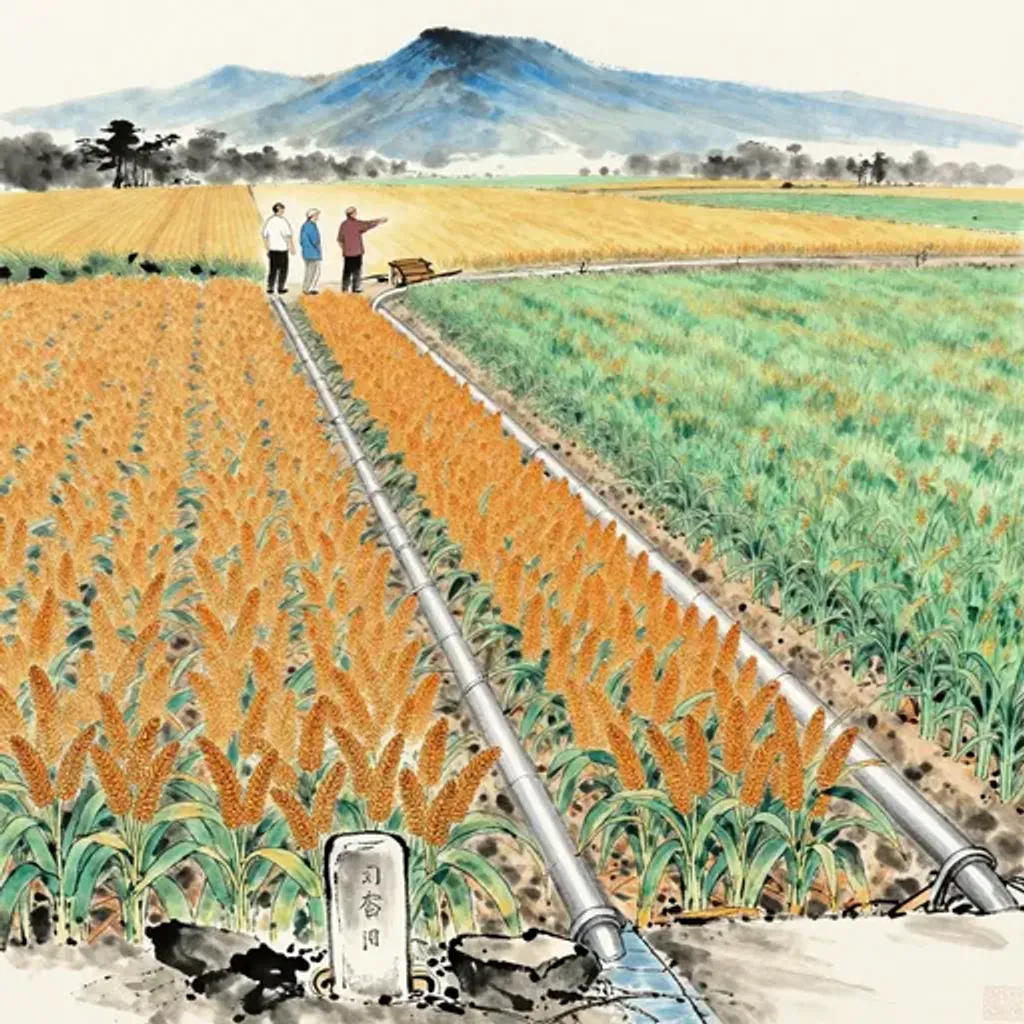
伯虎仲熊,德義淵閎;使布五穀,陰陽順敘。
Bo Hu and Zhong Xiong, their virtue and righteousness vast and deep. They spread the five grains; yin and yang followed proper order.
— Jiao Yanshou, Yilin (Forest of Changes), 1st century BC
Commentary
Earth above heaven, Peace entrusts its bounty to worthy ministers. Bohu and Zhongxiong were among the legendary Eight Worthies (八元) of Emperor Ku, praised in the Zuo Zhuan for being 'loyal, respectful, and kind.' Under their stewardship, the five grains are distributed and the rhythms of yin and yang proceed in proper sequence. Good governance does not impose order from above but aligns human effort with natural cycles. From Peace to Following, thunder rests within the lake — the gentleman retires at dusk to rest. The transformation reveals that virtuous administration creates a world where one can follow the natural order without anxiety, trusting in the season's rhythm.
泰 → 蠱
Hexagram 11 → Hexagram 18: Work on the Decayed
Changing lines: 1, 6
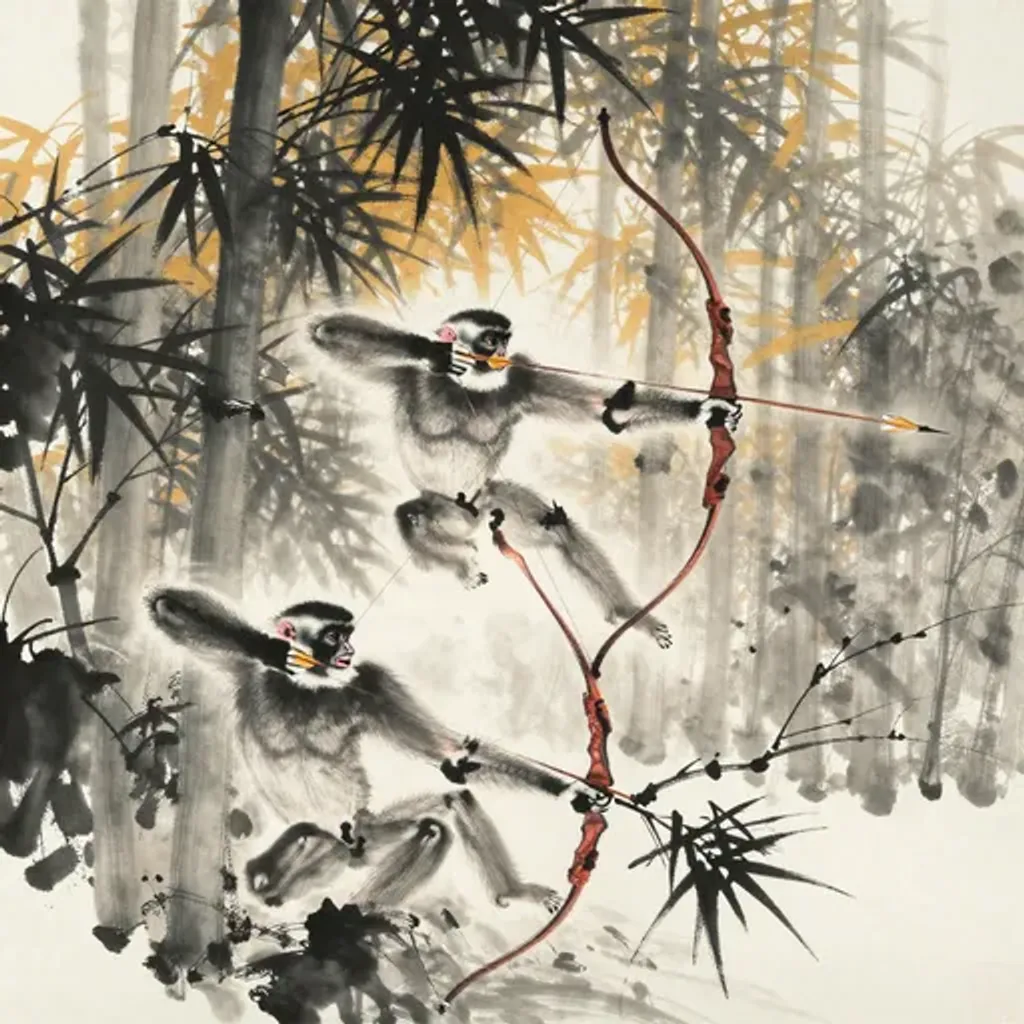
敏捷敬疾,如猨升木;彤弓雖調,終不能獲。
Nimble and swift as a gibbon climbing a tree. Though the vermillion bow is tuned, in the end it cannot catch its quarry.
— Jiao Yanshou, Yilin (Forest of Changes), 1st century BC
Commentary
Earth above heaven, Peace confronts an elusive quarry. The target moves with startling agility — nimble and swift as an ape scaling a tree. Though the vermilion bow is drawn and tuned, it cannot secure the catch. Speed and skill are insufficient when the prey is simply more agile than the hunter. The verse does not moralize; it simply records the frustration of a well-prepared effort that meets a more capable adversary. From Peace to Work on the Decayed, wind stirs beneath the mountain, disturbing stagnation. The transformation suggests that when direct pursuit fails, one must address the underlying rot — not chase the symptom but repair the structure.
泰 → 臨
Hexagram 11 → Hexagram 19: Approach
Changing lines: 3
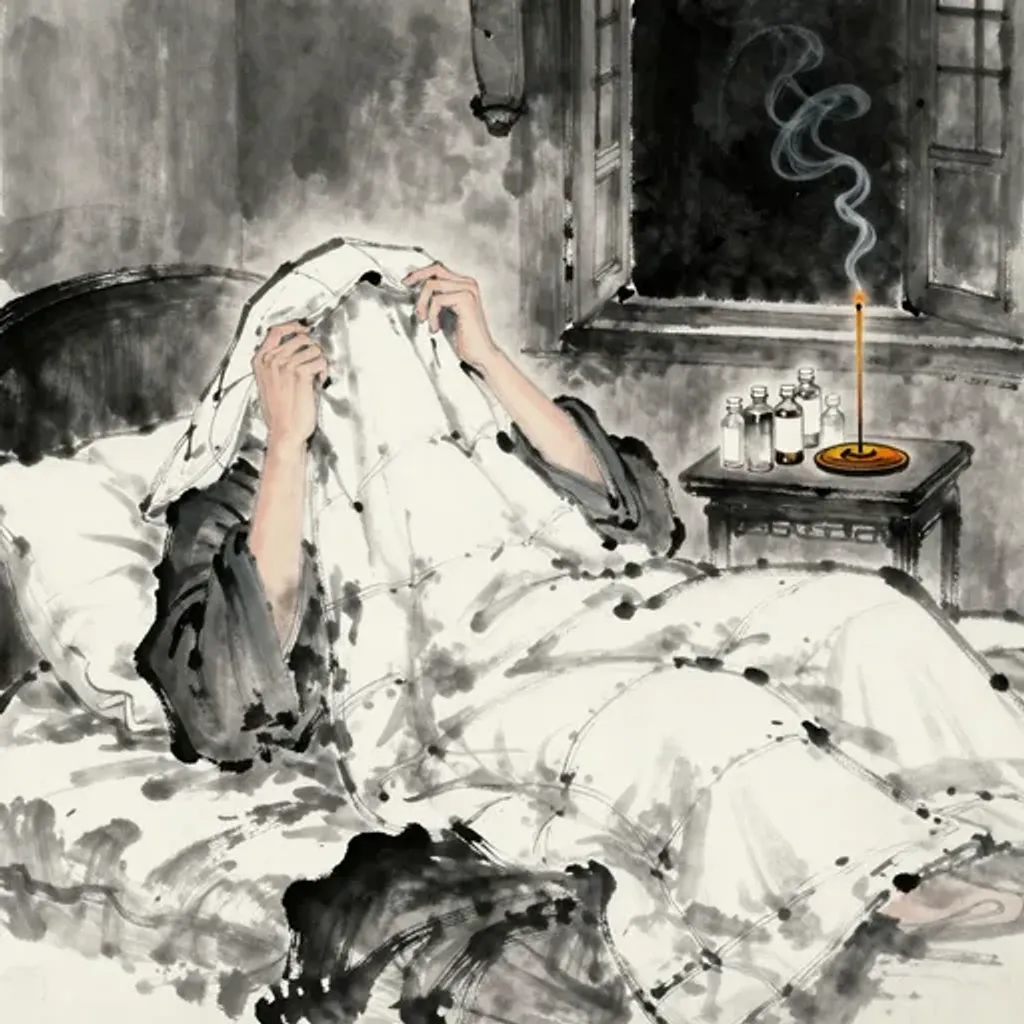
舉被覆目,不見日月;衣裘簟床,就長夜室。
Pulling the quilt over the eyes, seeing neither sun nor moon. Clad in furs upon the mat and bed, one enters the chamber of the long night.
— Jiao Yanshou, Yilin (Forest of Changes), 1st century BC
Commentary
Earth above heaven, Peace's light is deliberately extinguished. A quilt is pulled over the eyes, blocking out sun and moon entirely. Dressed in fur robes upon a bamboo mat, the figure enters the chamber of the long night — a euphemism for the burial room. This is a funeral scene: the deceased is laid out in full garment, sight and light sealed away forever. The verse's tone is ritual rather than tragic, recording the rites of preparation with somber precision. From Peace to Approach, earth above the lake — authority descends to meet what lies below. The transformation captures the paradox of death as the ultimate approach: the living descend toward the dead, and governance of the unseen realm begins.
泰 → 觀
Hexagram 11 → Hexagram 20: Contemplation
Changing lines: 1, 2, 3, 5, 6
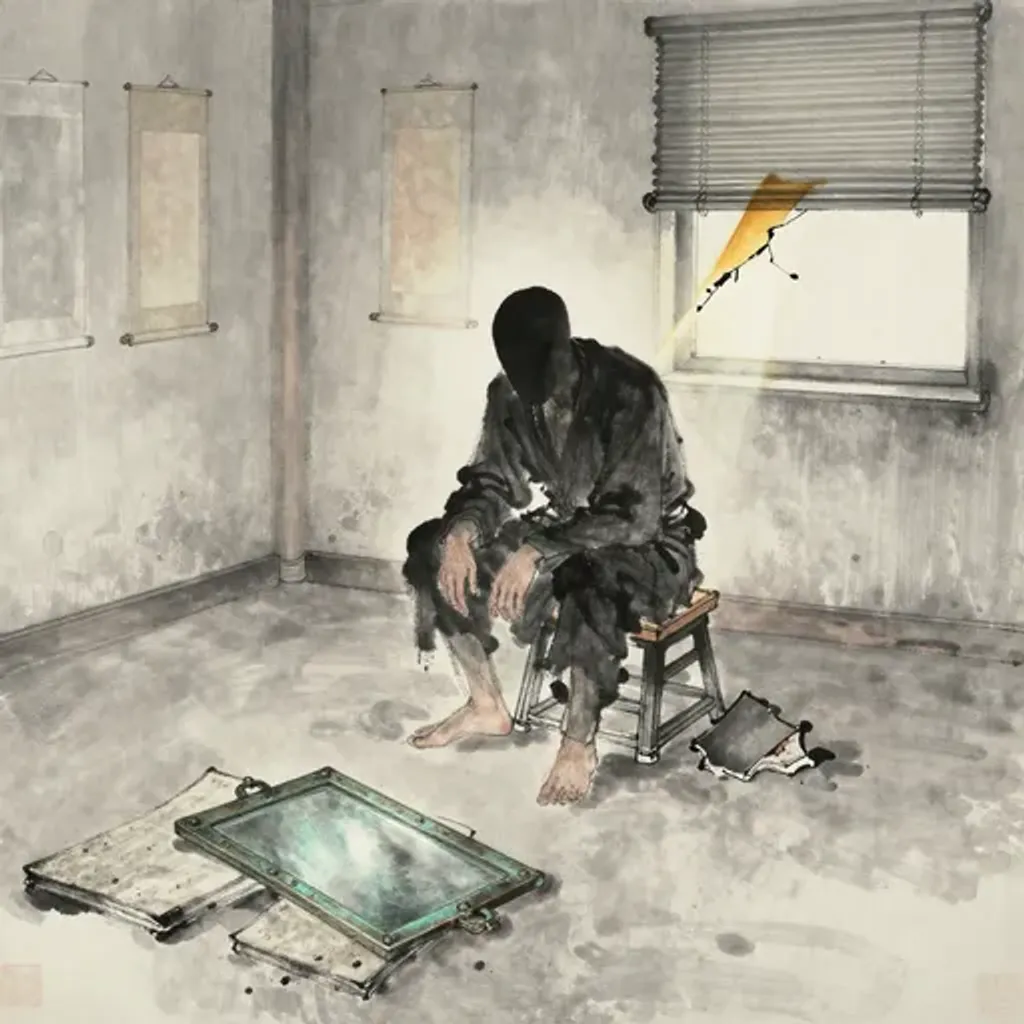
忍醜少羞,無面有頭;虛日以弊,消寡耗減。
Enduring shame with little modesty; faceless yet with a head. Empty days spent in decline; diminished, dwindled, worn away.
— Jiao Yanshou, Yilin (Forest of Changes), 1st century BC
Commentary
Earth above heaven, Peace's open communion degrades into shamelessness. One endures ugliness with little shame — a face devoid of expression, a head without dignity. Days pass in idle decline, wasting away as resources dwindle and diminish. The verse paints a portrait of moral entropy: not dramatic villainy but the slow erosion of standards, where indignity becomes tolerable and decay is simply endured. From Peace to Contemplation, wind sweeps across the earth as the ancient kings surveyed their domains to assess the people. The transformation carries a warning: what the ruler sees from above may not be encouraging. Contemplation reveals the truth that comfort preferred to ignore.
泰 → 噬嗑
Hexagram 11 → Hexagram 21: Biting Through
Changing lines: 2, 3, 4, 6
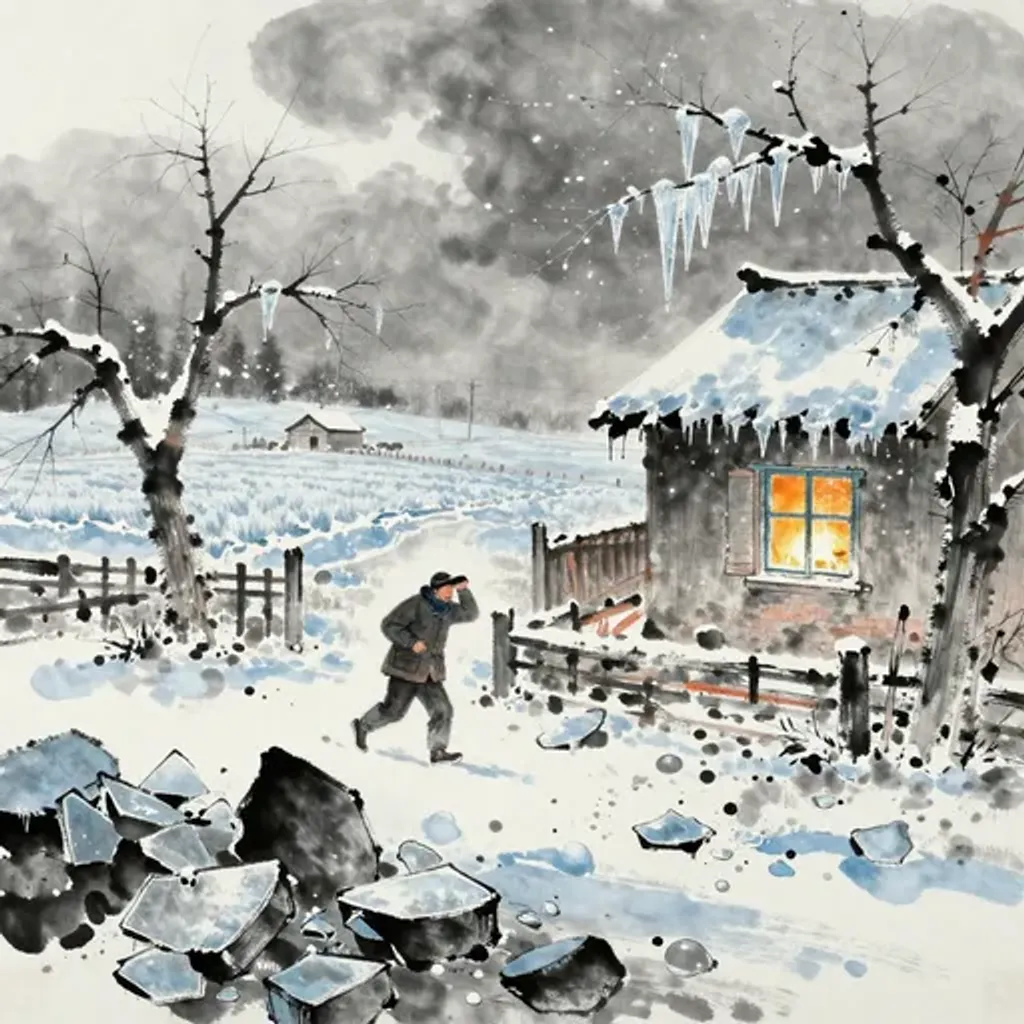
涸陰沍寒,常冰不溫;令人墮怠,雹大為災。
Congealed yin, bitter cold; eternal ice that never warms. It makes one sluggish and idle; great hail becomes a disaster.
— Jiao Yanshou, Yilin (Forest of Changes), 1st century BC
Commentary
Earth above heaven, Peace frozen into extremity. The yin force congeals into bitter cold, ice persists without thaw, and lethargy overtakes all activity. Then hailstones descend as calamity. This is Peace inverted into its meteorological opposite: instead of the warm mingling of heaven and earth, cold solidifies and nothing circulates. The perpetual chill (常陽 here likely a scribal variant for 常陰, as the context demands cold not heat, or it may refer to excessive yang becoming drought) paralyzes initiative. From Peace to Biting Through, fire and thunder combine to enforce law. The transformation suggests that when stagnation reaches its extreme, only decisive judicial force can shatter the ice.
泰 → 賁
Hexagram 11 → Hexagram 22: Grace
Changing lines: 2, 6
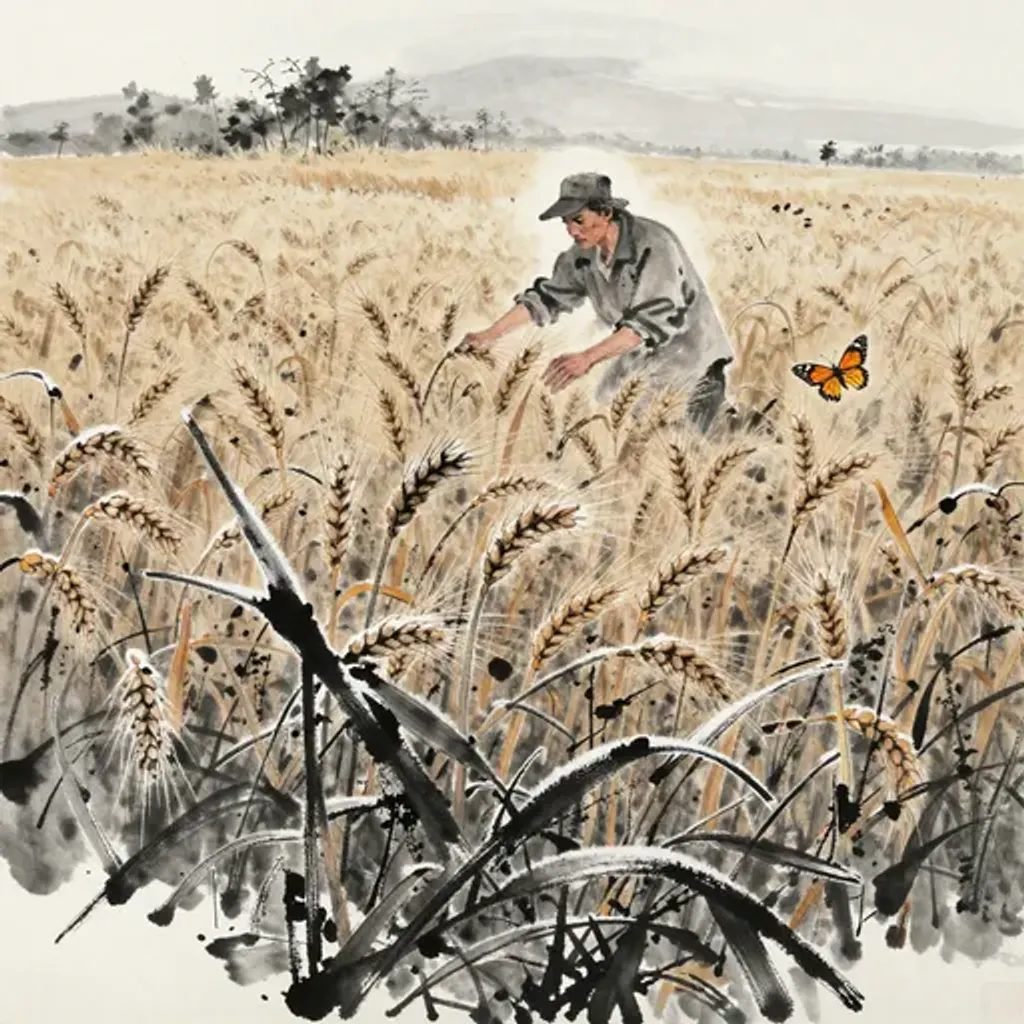
夏麥麩䵃,霜擊其芒;疾君敗國,使民夭傷。
Summer wheat in husk and bran, frost strikes its awns. A sickly lord ruins the state, causing the people to suffer and die young.
— Jiao Yanshou, Yilin (Forest of Changes), 1st century BC
Commentary
Earth above heaven, Peace's harvest destroyed by untimely frost. Summer wheat has formed its bran and husks, but frost strikes the grain tips before they can ripen. A tyrannical lord ruins the state, causing the people to die young and suffer injury. The frost-blighted wheat is a precise agricultural metaphor: the plant has done its work, grain has formed, yet at the critical moment a late frost kills what should have flourished. Unjust governance operates identically — destroying potential just as it approaches maturity. From Peace to Grace, fire beneath the mountain illuminates the surface. The transformation warns that decorative brilliance cannot compensate for a destroyed foundation.
泰 → 剝
Hexagram 11 → Hexagram 23: Splitting Apart
Changing lines: 1, 2, 3, 6
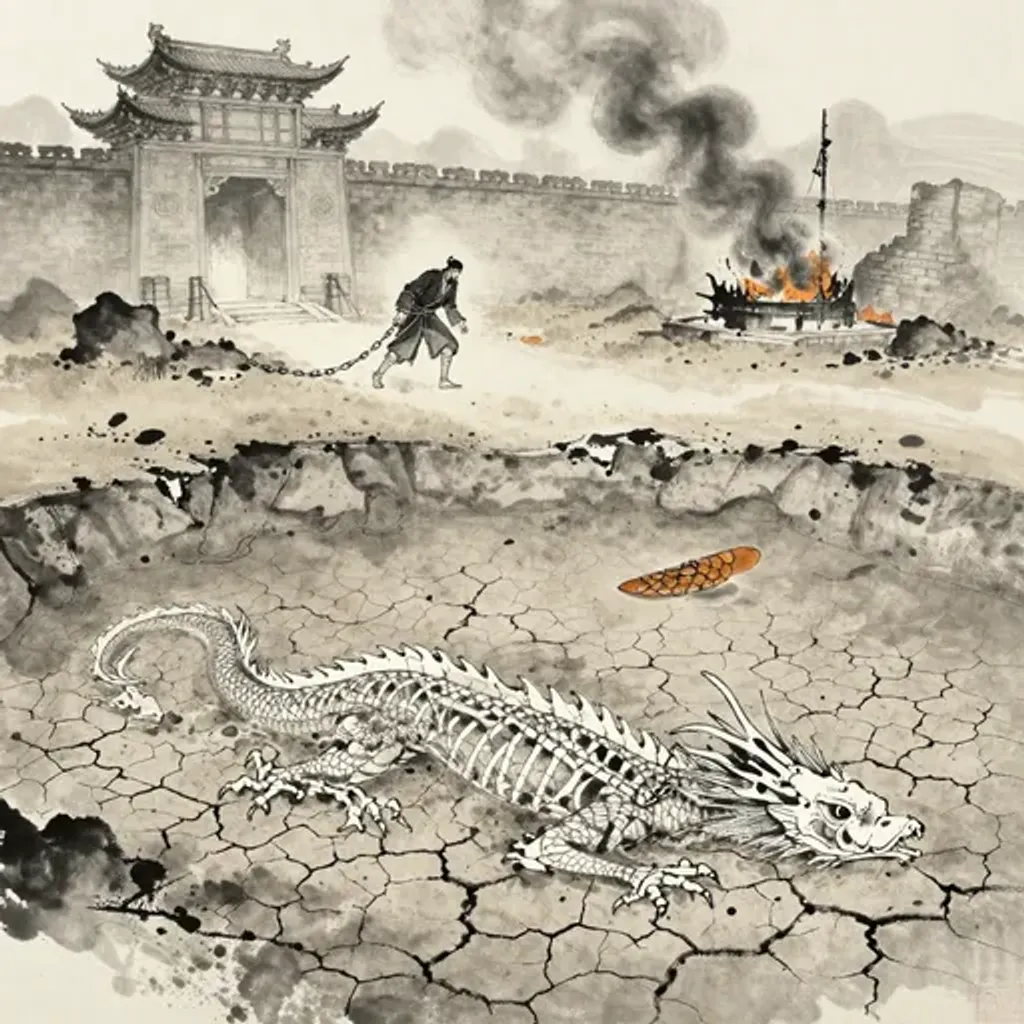
淵涸龍憂,箕子為奴;午叔隕命,殷破其家。
The pool dries up, the dragon grieves; Jizi is made a slave. Wu Shu loses his life; Yin shatters its own house.
— Jiao Yanshou, Yilin (Forest of Changes), 1st century BC
Commentary
Earth above heaven, Peace drains away as the pool runs dry and the dragon despairs. Jizi, the Viscount of Ji, uncle of the Shang tyrant Zhou, is reduced to slavery — feigning madness to survive his nephew's murderous court. 'Wu Shu' likely refers to Bigan (比干), another uncle of King Zhou, who was disemboweled for his remonstrance. Yin is shattered and its ruling house destroyed. The verse catalogs the final collapse of the Shang dynasty through its three loyal ministers' fates. From Peace to Splitting Apart, the mountain crumbles upon the earth. The transformation mirrors the dynasty's disintegration: what was once elevated is stripped layer by layer until nothing remains.
泰 → 復
Hexagram 11 → Hexagram 24: Return
Changing lines: 2, 3
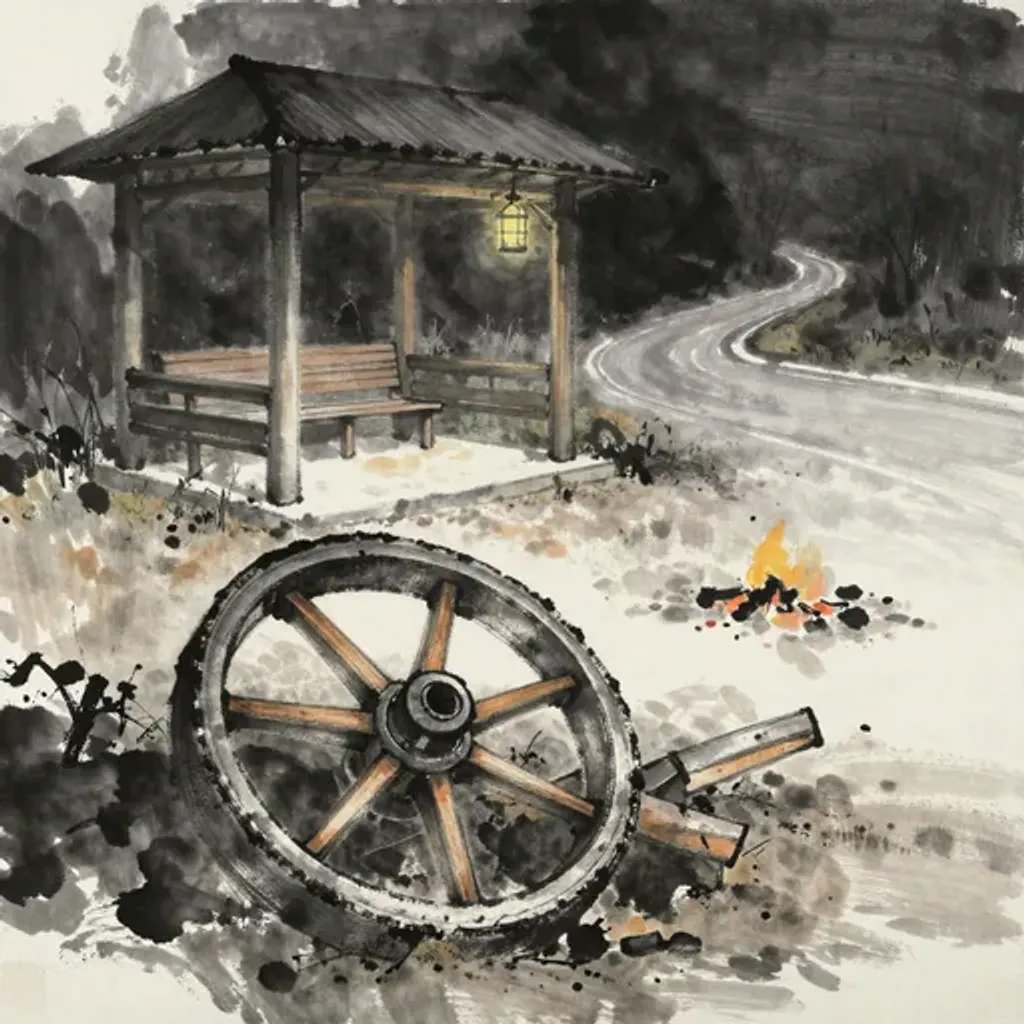
跛踦相隨,日暮牛罷;陵遲後旅,失利亡雌。
The wheel hub snaps; the traveler is stranded at the waystation. The road home has darkened — no lamplight in sight.
— Jiao Yanshou, Yilin (Forest of Changes), 1st century BC
Commentary
Earth above heaven, Peace breaks down on the road. The original verse shows a limping figure and a stumbling companion struggling along together as daylight fades. The ox is exhausted and can go no further. Falling behind the main party, they lose their advantage and are separated. This is the traveler's nightmare: body failing, light dying, companions scattered. From Peace to Return, thunder stirs within the earth at the winter solstice — the first spark of yang returning after total darkness. The transformation offers fragile hope: however complete the collapse, the cycle insists on renewal. The darkest point of the journey is also where the turning begins.
泰 → 无妄
Hexagram 11 → Hexagram 25: Innocence
Changing lines: 2, 3, 4, 5, 6
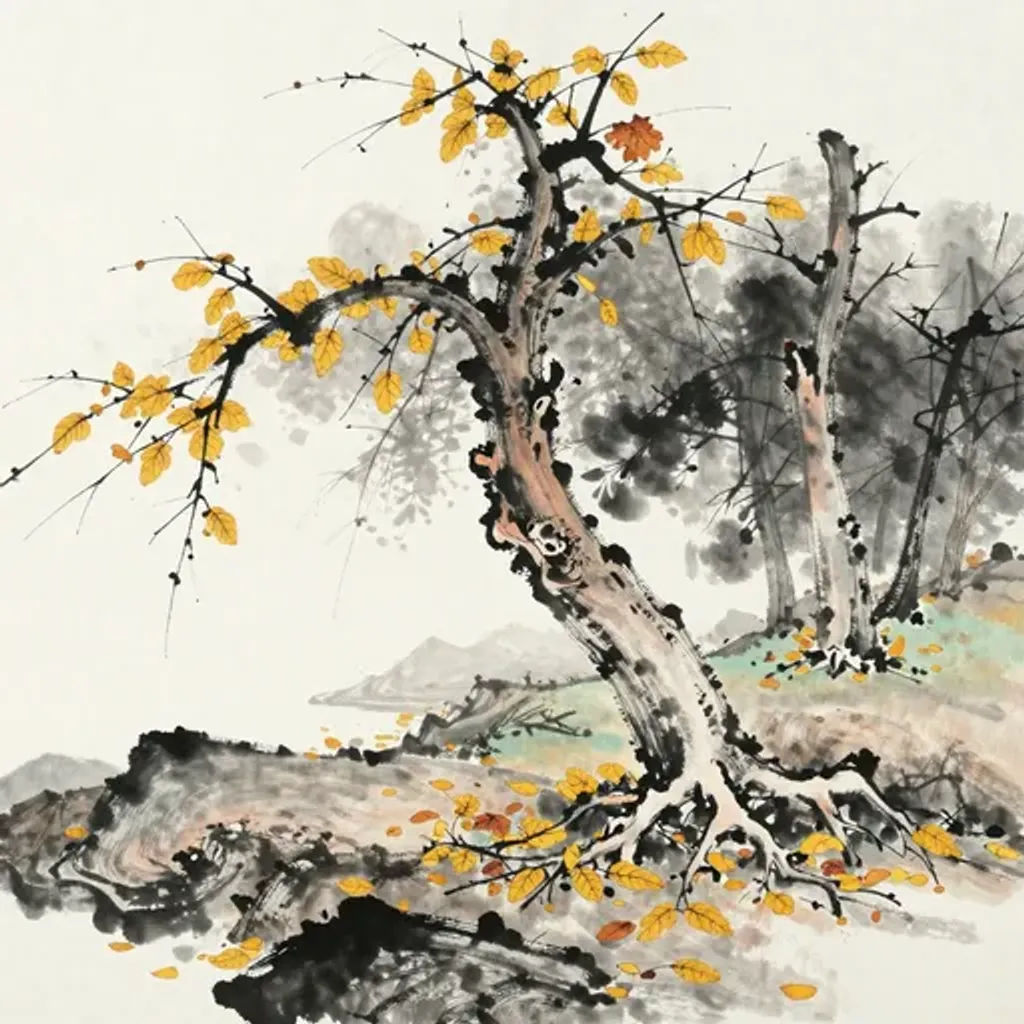
桑之將落,隕其黃葉;失勢傾側,如無所立。
The mulberry is about to fall; its yellow leaves cascade. Losing one's footing, toppling sideways, as if there were nowhere to stand.
— Jiao Yanshou, Yilin (Forest of Changes), 1st century BC
Commentary
Earth above heaven, Peace's green canopy withers. The mulberry tree is about to shed its leaves, yellow foliage falling in cascades. Power is lost, one tilts and staggers as though there is nothing left to stand upon. The mulberry imagery echoes the Shijing's 'Sang Luo' odes, where the mulberry's decline signals the end of a relationship or an era. The yellow leaves are autumn's signature — what was lush becomes brittle. From Peace to Innocence, heaven below thunders without agenda. The transformation is paradoxical: the loss of all pretense and support may strip one to a state of radical innocence, where nothing remains but what is genuinely one's own.
泰 → 大畜
Hexagram 11 → Hexagram 26: Great Taming
Changing lines: 6
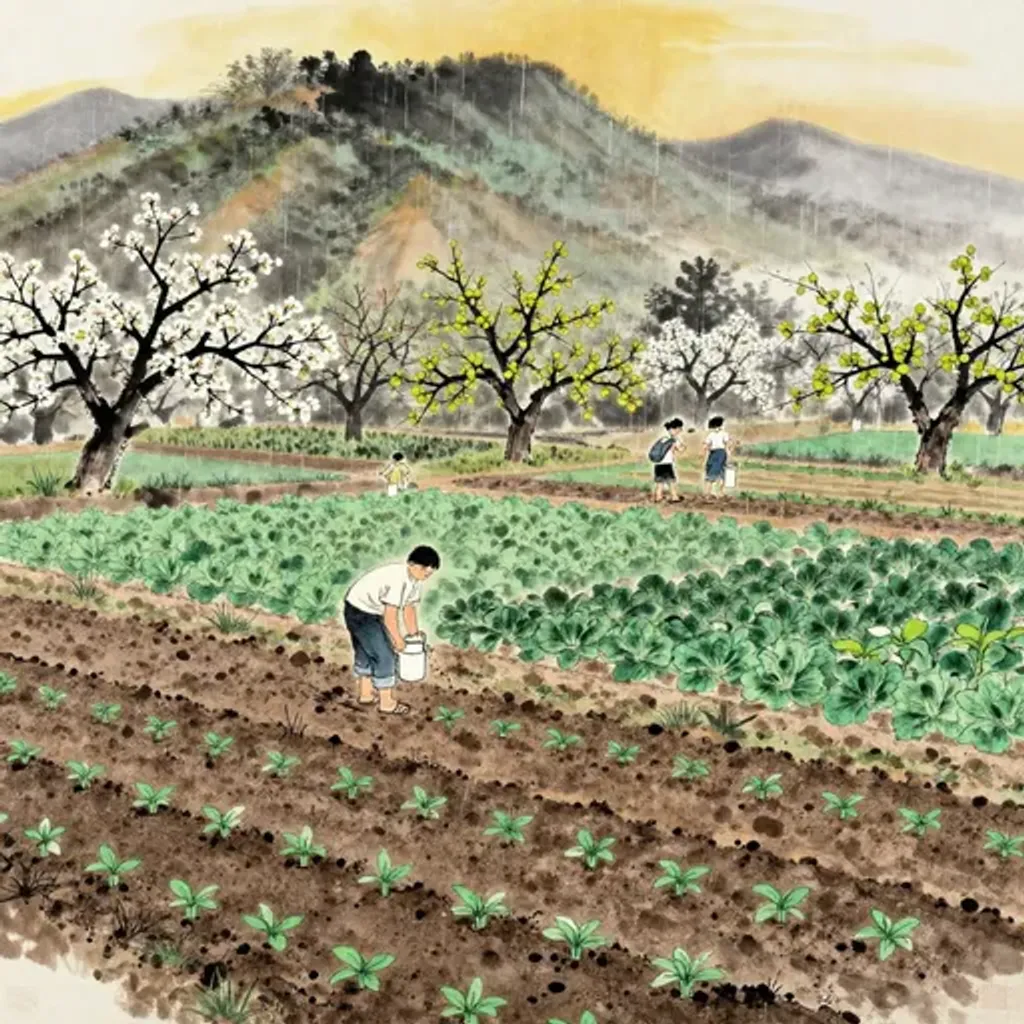
生長以時,長育根本;陰陽和德,歲樂無憂。
Growing in season, nurturing root and stem. Yin and yang blend their virtue; the year is joyful and free of care.
— Jiao Yanshou, Yilin (Forest of Changes), 1st century BC
Commentary
Earth above heaven, Peace's nurturing rhythm expands into storage. All things grow according to their season, roots deepen and stems strengthen. Yin and yang harmonize their virtue, and the year passes in joyful sufficiency without worry. This is the agrarian ideal: cultivation in its proper time, foundation before fruition, the whole cycle completing itself without disruption. From Peace to Great Taming, heaven is stored within the mountain — the gentleman studies the words and deeds of the ancients to accumulate virtue. The transformation shows Peace's generative energy gathered and preserved: seasonal abundance is not consumed but stored, becoming the wisdom that sustains through leaner times.
泰 → 頤
Hexagram 11 → Hexagram 27: Nourishment
Changing lines: 2, 3, 6
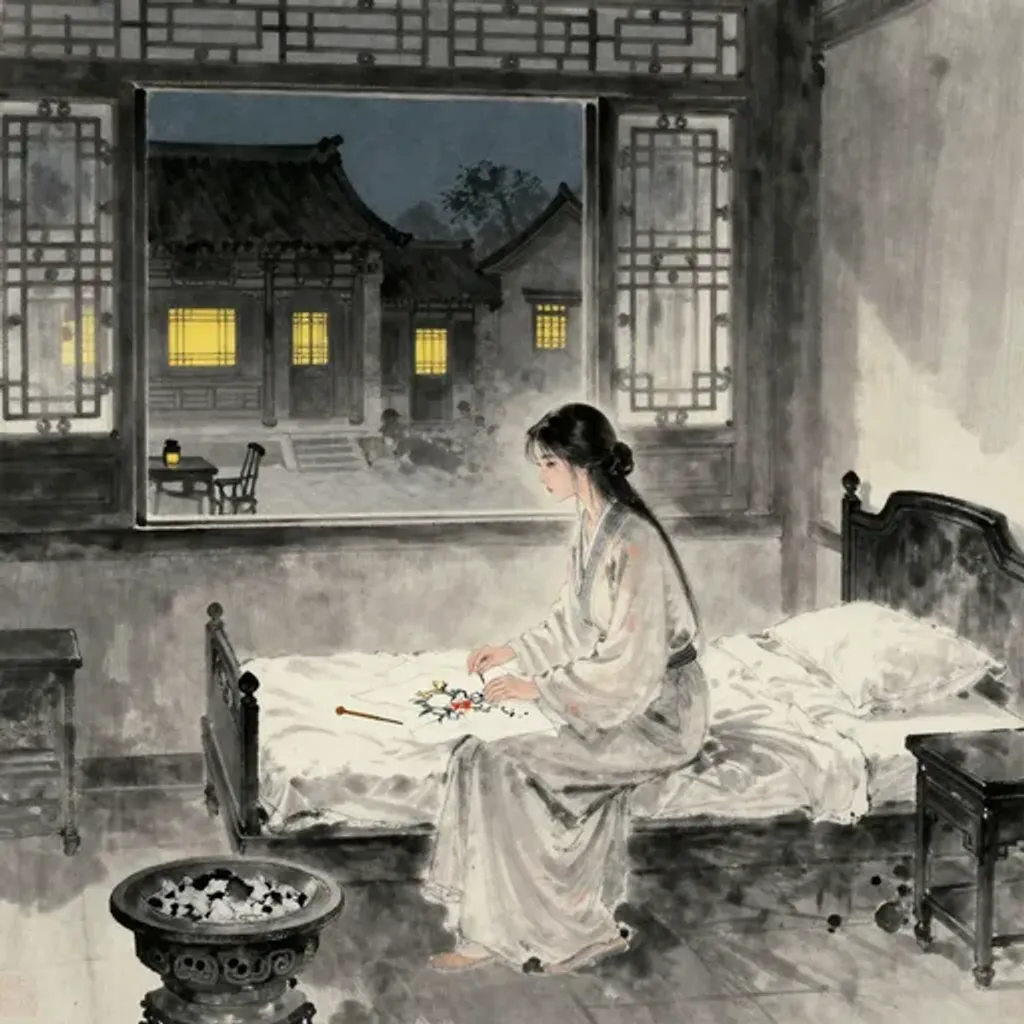
童女無夫,未有匹配;陰陽不和,空坐獨宿。
A young maiden without a husband, not yet matched with a mate. Yin and yang do not harmonize; she sits alone through empty nights.
— Jiao Yanshou, Yilin (Forest of Changes), 1st century BC
Commentary
Earth above heaven, Peace's communion produces no union at the personal level. A young woman has no husband and no proper match; yin and yang fail to harmonize, and she sits alone through empty nights. The cosmic forces that should bring complementary energies together have somehow failed at the human scale. The verse reads less as tragedy than as unfulfilled potential — a readiness that finds no corresponding partner. From Peace to Nourishment, the mountain stands above thunder — one must guard speech and moderate appetite. The transformation suggests that solitude, while painful, may become a form of self-cultivation: when the match does not come, one nourishes oneself.
泰 → 大過
Hexagram 11 → Hexagram 28: Great Exceeding
Changing lines: 1, 4, 5
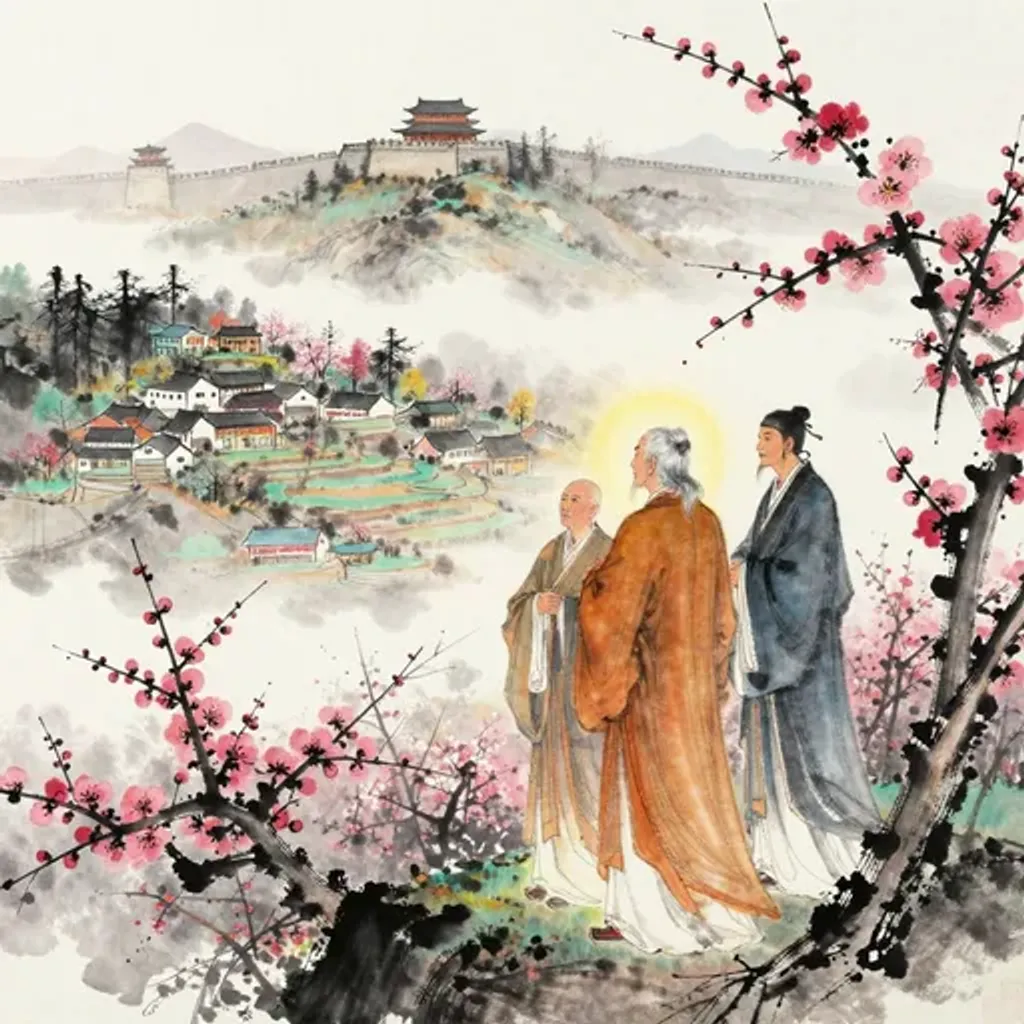
春令原宥,仁德不合;三聖攸同,周國茂興。
Spring's decree pardons and forgives; benevolent virtue is not yet joined. Three sages share one purpose; the Zhou domain flourishes greatly.
— Jiao Yanshou, Yilin (Forest of Changes), 1st century BC
Commentary
Earth above heaven, Peace extends clemency in springtime. Spring is the season of pardons — the ancient kings commuted sentences to align human justice with nature's renewal. Yet 'benevolent virtue does not harmonize,' suggesting the amnesty is only partially effective. The verse then names the Three Sages — traditionally identified as King Wen, King Wu, and the Duke of Zhou — whose combined virtue caused the Zhou state to flourish greatly. From Peace to Great Exceeding, the lake submerges the trees, testing the ridgepole of governance to its limit. The transformation reveals that even sagely virtue operates under structural strain: clemency works only when the beam can bear the weight.
泰 → 坎
Hexagram 11 → Hexagram 29: The Abysmal Water
Changing lines: 1, 3, 5
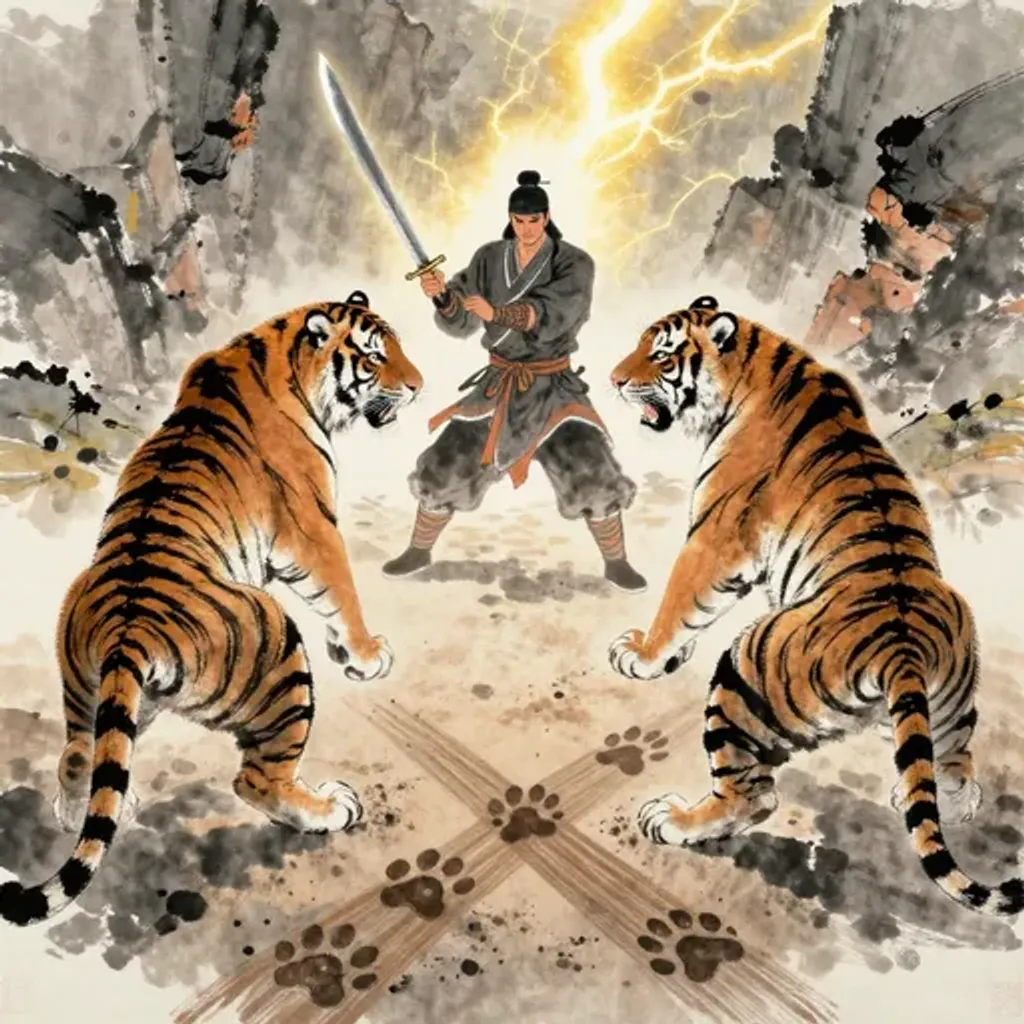
金精耀怒,帶劍過午;兩虎相距,雖驚无咎。
Metal's brilliance flares in wrath, sword belted past the noon hour. Two tigers face off; though alarming, no blame.
— Jiao Yanshou, Yilin (Forest of Changes), 1st century BC
Commentary
Earth above heaven, Peace's equilibrium flashes into metallic confrontation. The essence of metal blazes with fury; a sword is worn past the noon hour, violating the ritual norm that weapons should be sheathed by midday. Two tigers face each other in standoff — terrifying, yet the judgment is 'though alarming, no blame.' The metallic fury and noonday sword echo military omen language: martial energy at its zenith. The two tigers, perfectly matched, neutralize each other. From Peace to The Abysmal, doubled water plunges through danger after danger. The transformation reveals that the confrontation's alarming surface conceals a deeper passage through peril — one that, navigated with constancy, brings no lasting harm.
泰 → 離
Hexagram 11 → Hexagram 30: The Clinging Fire
Changing lines: 2, 4, 6
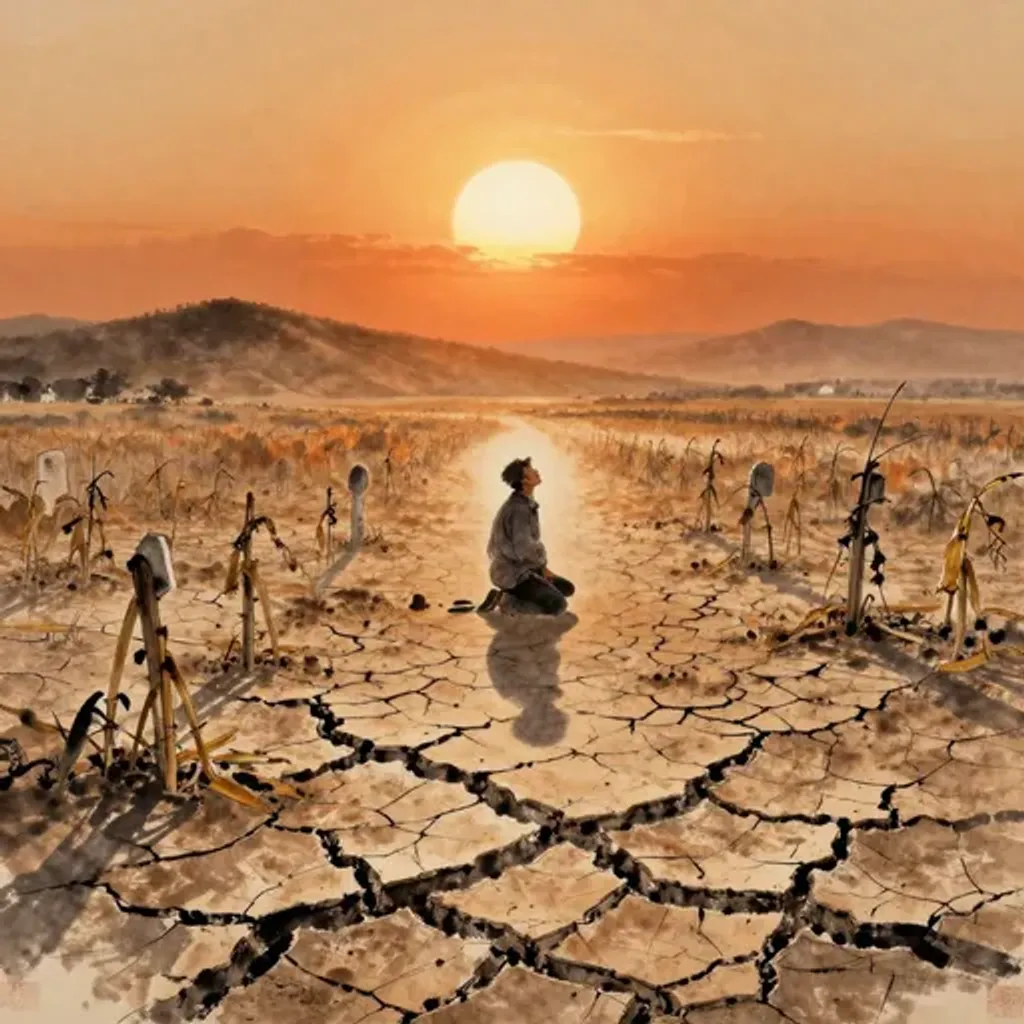
危坐至暮,請求不得;膏澤不降,政戾民忒。
Drought scorches the earth; every seedling withers. The farmer looks upward — the fierce sun is like molten bronze.
— Jiao Yanshou, Yilin (Forest of Changes), 1st century BC
Commentary
Earth above heaven, Peace's rains withheld. The original verse describes sitting upright through the day until dusk, making requests that go unanswered. Moisture and grace refuse to descend; governance becomes perverse and the people suffer disorder. This is a drought of both water and virtue — the ruler's attention never reaches the populace, and supplication avails nothing. The image of patient, futile waiting recalls courtiers denied audience. From Peace to The Clinging, doubled fire burns without relief. The transformation exposes the danger: when heaven and earth cease their exchange, what remains is scorching illumination without nourishment — clarity that parches rather than sustains.
泰 → 咸
Hexagram 11 → Hexagram 31: Influence
Changing lines: 1, 2, 4, 5
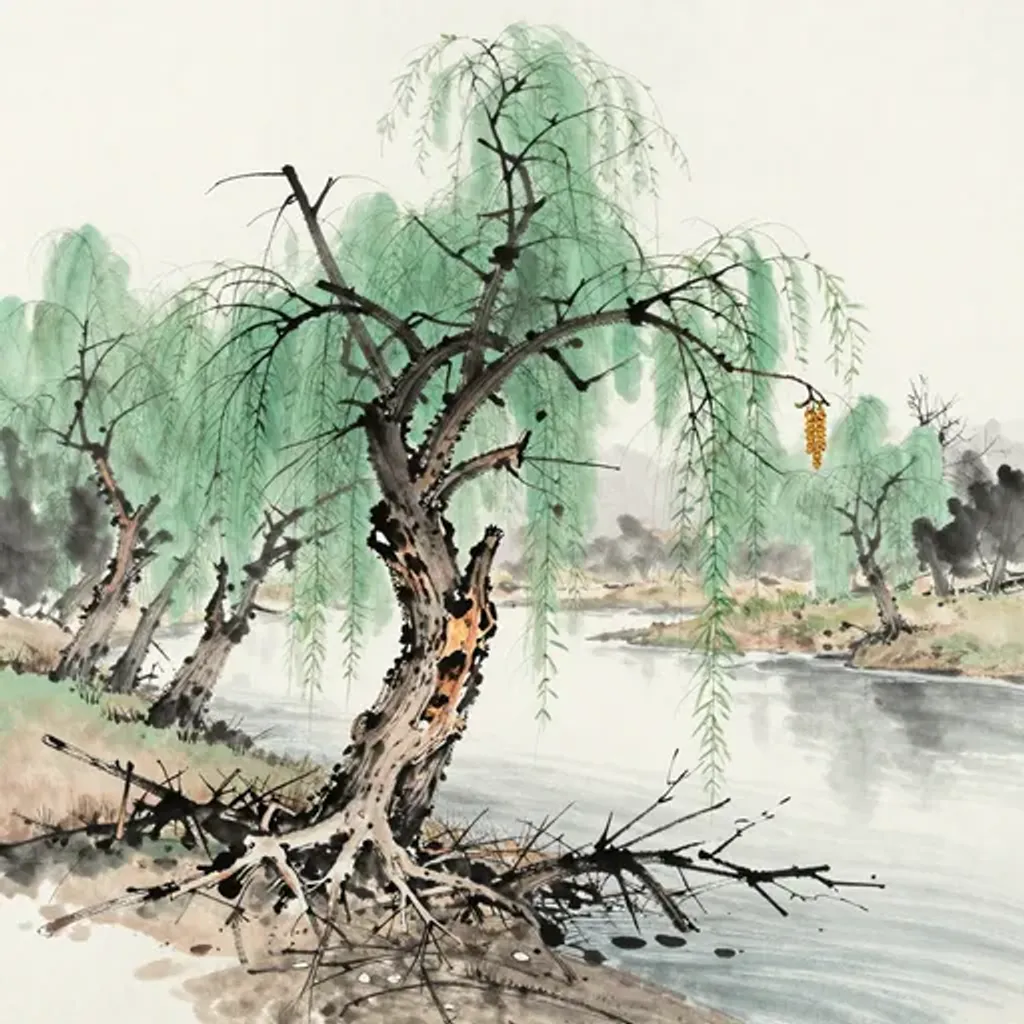
老楊日衰,條多枯枝;爵級不進,日下摧隤。
The old willow daily declines; many branches wither and die. Rank and station do not advance; day by day, it crumbles and falls.
— Jiao Yanshou, Yilin (Forest of Changes), 1st century BC
Commentary
Earth above heaven, Peace declines into senescence. An old poplar weakens day by day, its branches increasingly bare and dry. Official rank does not advance, and with each passing day one sinks lower, broken and diminished. The aging tree is a metaphor for a career that has peaked and entered irreversible decline — no new growth, only the progressive loss of what once flourished. From Peace to Influence, the lake rests atop the mountain, and the gentleman empties himself to receive others. The transformation offers a counterpoint: where the verse laments decline, Influence suggests that hollowing out can itself become receptivity, if one accepts the emptying rather than resisting it.
泰 → 恆
Hexagram 11 → Hexagram 32: Duration
Changing lines: 1, 4
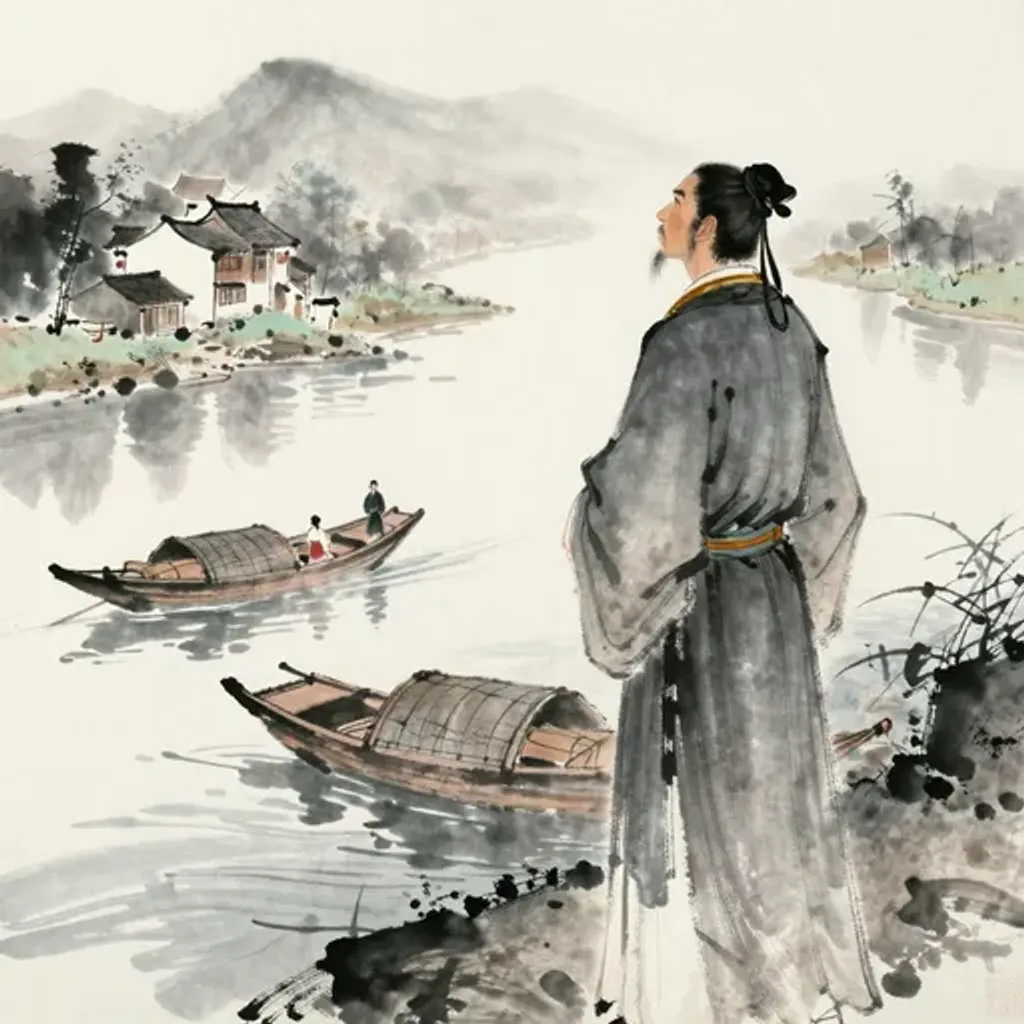
蔡侯適楚,留連江濱;踰時歷月,思其君后。
The Marquis of Cai journeys to Chu, lingering by the river's edge. Months pass beyond the appointed time; he longs for his lord and consort.
— Jiao Yanshou, Yilin (Forest of Changes), 1st century BC
Commentary
Earth above heaven, Peace disrupted by enforced sojourn. The Marquis of Cai visits Chu but is detained along the riverbank, month after month passing without release. He longs for his lord and consort back home. According to the Zuo Zhuan, around 509 BC the Marquis of Cai presented a fine fur coat to the King of Chu, but the powerful minister Zichang coveted his spare coat. When the Marquis refused, Zichang slandered him, and the Chu court detained him for three years. From Peace to Duration, thunder and wind persist without change. The transformation mirrors captivity's essence: an endurance without resolution, where time stretches but circumstances refuse to shift.
泰 → 遯
Hexagram 11 → Hexagram 33: Retreat
Changing lines: 1, 2, 4, 5, 6
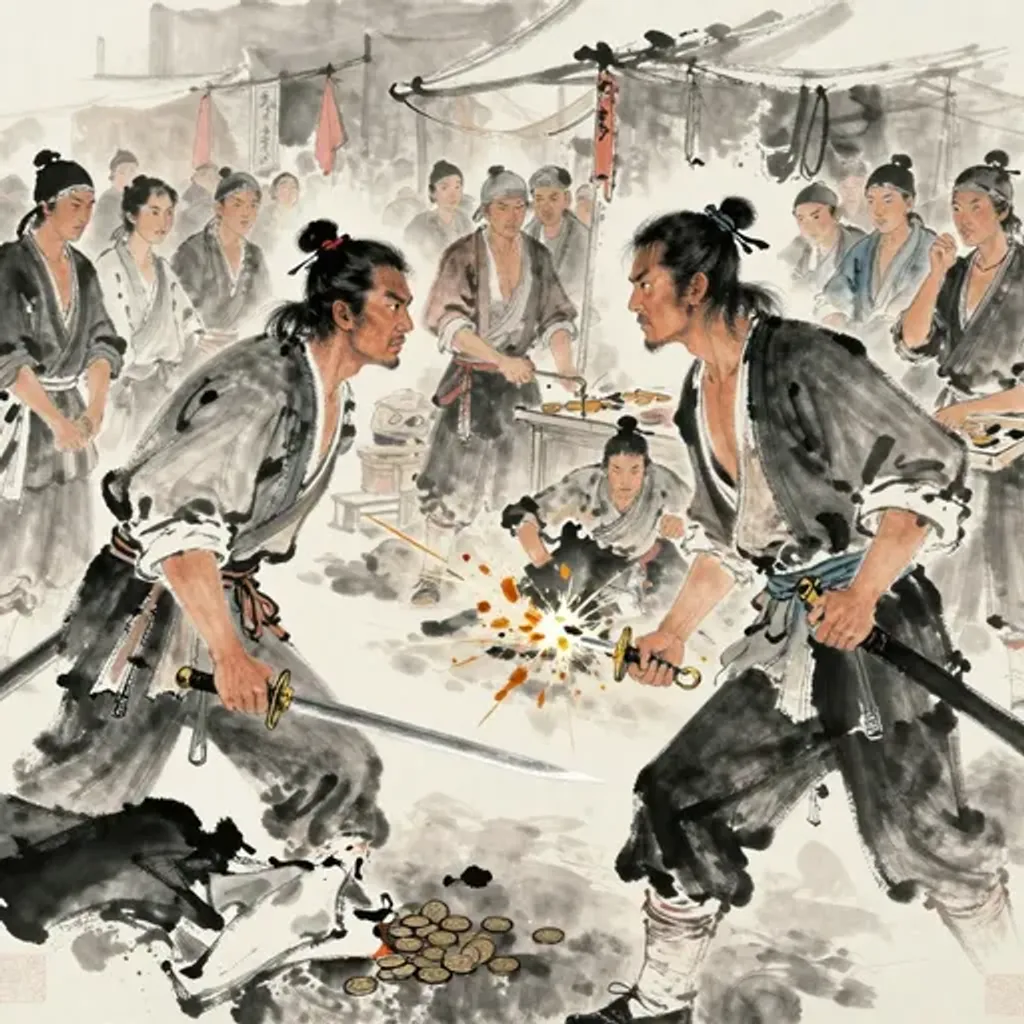
右撫劍頭,左受鉤帶;凶訟不止,相與爭戾。失利市肆。
Right hand grips the sword's pommel; left receives the belt hook. Fierce litigation will not cease; they contend in mutual strife. Profit is lost in the marketplace.
— Jiao Yanshou, Yilin (Forest of Changes), 1st century BC
Commentary
Earth above heaven, Peace dissolves into armed discord. The right hand grips a sword pommel while the left clutches a hooked belt-buckle — a posture of readiness for violence. Fierce litigation continues without cease, adversaries locked in mutual hostility. Trade and profit are lost in the chaos. The verse paints a marketplace turned battlefield: what should be a place of civil exchange becomes a theater of threats and lawsuits. From Peace to Retreat, heaven rises above the mountain, the gentleman distances himself from petty men. The transformation prescribes withdrawal as the only viable response: when commerce itself becomes combat, the wise do not fight — they leave.
泰 → 大壯
Hexagram 11 → Hexagram 34: Great Power
Changing lines: 4
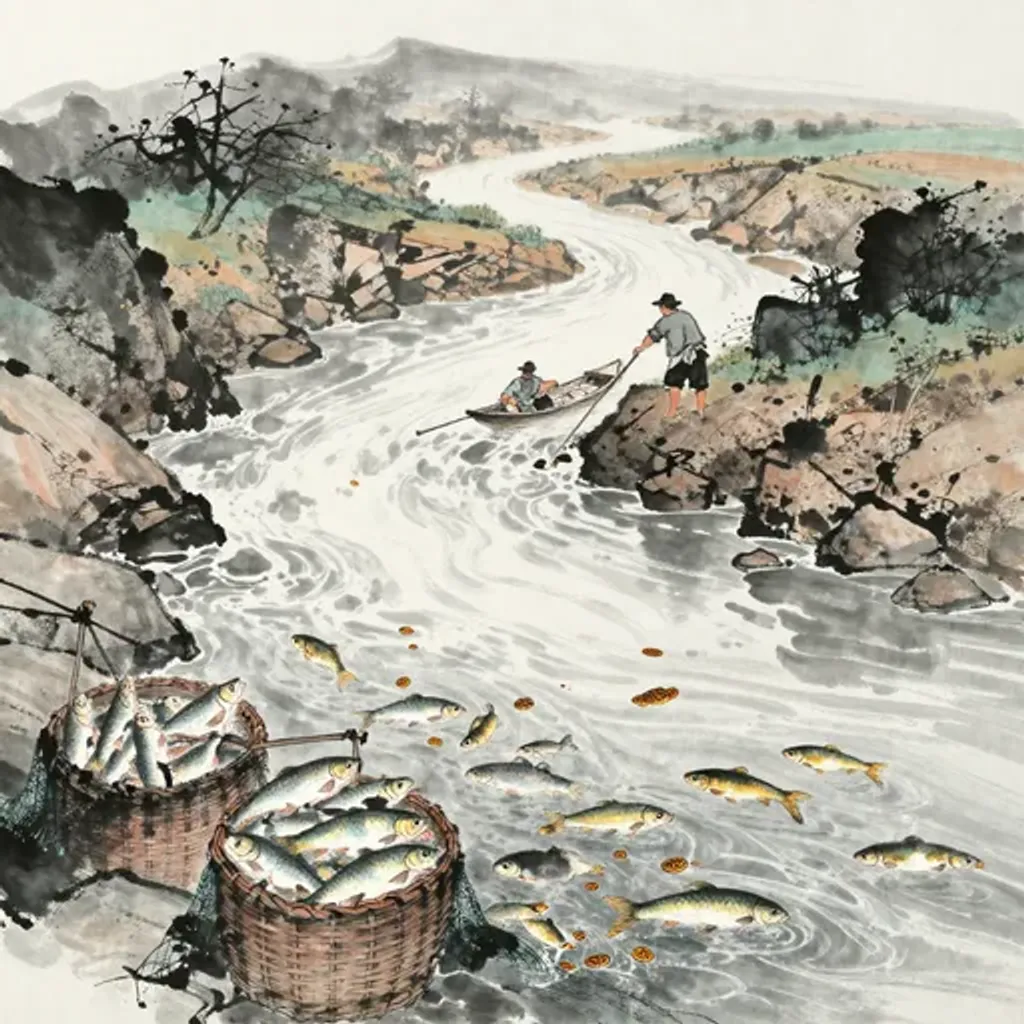
水流趨下,遠至東海;求我所有,買鮪與鯉。
Water flows downward, traveling far to the eastern sea. Seeking what we possess, we buy bream and carp.
— Jiao Yanshou, Yilin (Forest of Changes), 1st century BC
Commentary
Earth above heaven, Peace's energies flow downward to their natural destination. Water courses downhill and travels far to reach the Eastern Sea. One seeks what is already possessed, purchasing sturgeon and carp for the table. The verse captures the effortlessness of following natural momentum: water does not strive to reach the ocean, yet it arrives; the market offers what one needs without struggle. From Peace to Great Power, thunder rolls above heaven — yang at its most vigorous. The transformation shows Peace's gentle flow gathering into unstoppable force: what begins as water seeking its level becomes the thunderous assertion of power moving in its natural direction.
泰 → 晉
Hexagram 11 → Hexagram 35: Progress
Changing lines: 1, 2, 3, 4, 6
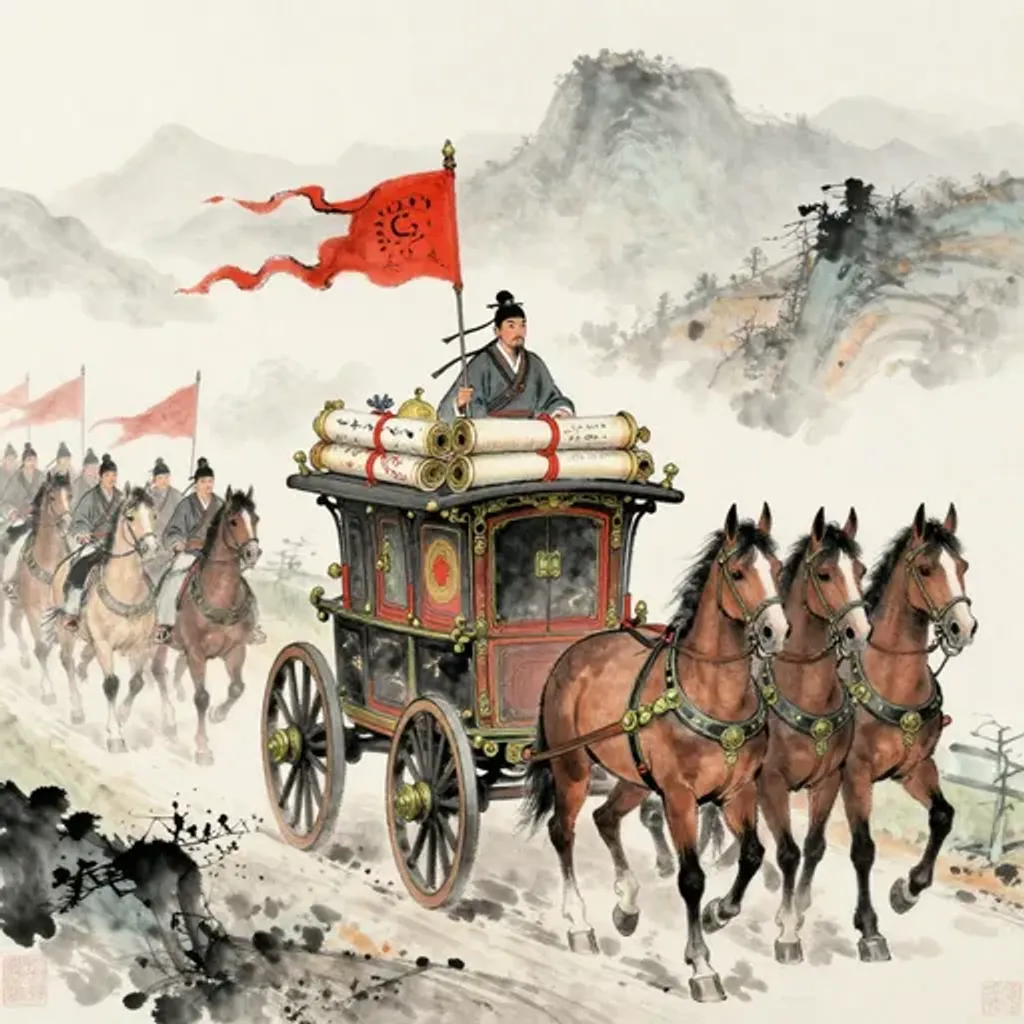
登几上輿,駕駟南遊;合縱散衡,燕秦以強。
Ascending the carriage platform, mounting the four-horse chariot, traveling south. Uniting the vertical alliance, dissolving the horizontal; Yan and Qin thereby grow strong.
— Jiao Yanshou, Yilin (Forest of Changes), 1st century BC
Commentary
Earth above heaven, Peace's diplomatic order takes shape. One ascends the chariot platform, harnesses a four-horse team, and journeys south on a grand tour. Then the verse invokes the great Warring States stratagem: the Vertical Alliance unites weaker states against Qin, scattering the Horizontal Alliance, and thereby Yan and Qin are strengthened. This alludes to the diplomatic campaigns of strategists like Su Qin, who forged multi-state coalitions to balance power. From Peace to Progress, fire emerges above the earth — the gentleman illuminates his own virtue. The transformation shows how diplomatic alignment creates conditions for genuine advancement: alliance precedes ascent.
泰 → 明夷
Hexagram 11 → Hexagram 36: Darkening of the Light
Changing lines: 2
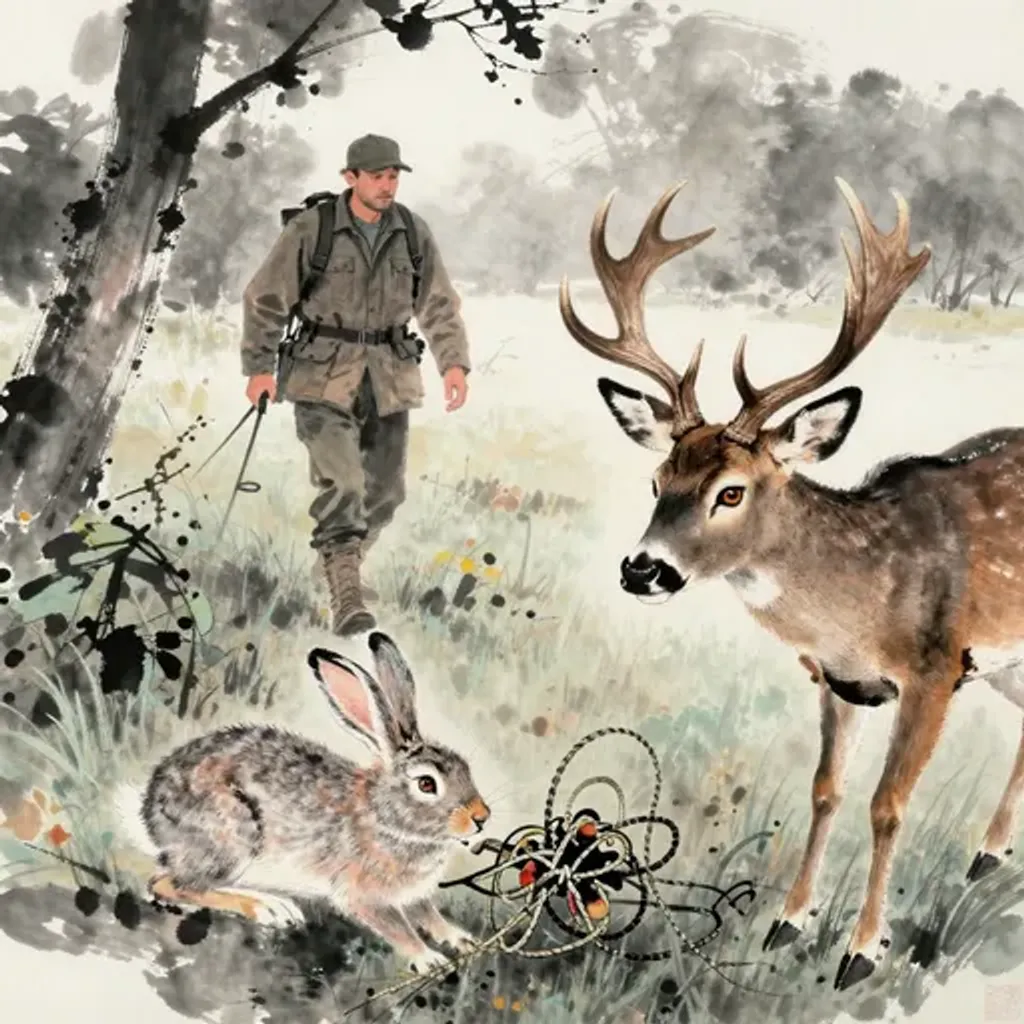
求兔得獐,過其所望;歡以相迎,高位夷傷。
Setting snares for rabbits, one catches a river deer, exceeding all expectation. Greeted with delight and welcome; yet high position brings its own harm.
— Jiao Yanshou, Yilin (Forest of Changes), 1st century BC
Commentary
Earth above heaven, Peace delivers an unexpected prize. Seeking a rabbit, one catches a roe deer instead — surpassing all expectation. The bounty is welcomed with joy, but the verse turns dark: the high position brings injury. Windfall fortune elevates one to a dangerous height. The hunter who exceeds his hopes discovers that abundance itself becomes a target. From Peace to Darkening of the Light, brilliance enters the earth and is buried. The transformation traces the full arc: unexpected gain draws attention, the elevated position attracts hostility, and wisdom demands that one conceal one's light rather than celebrate the surplus. Joy at the catch is premature.
泰 → 家人
Hexagram 11 → Hexagram 37: The Family
Changing lines: 2, 5, 6
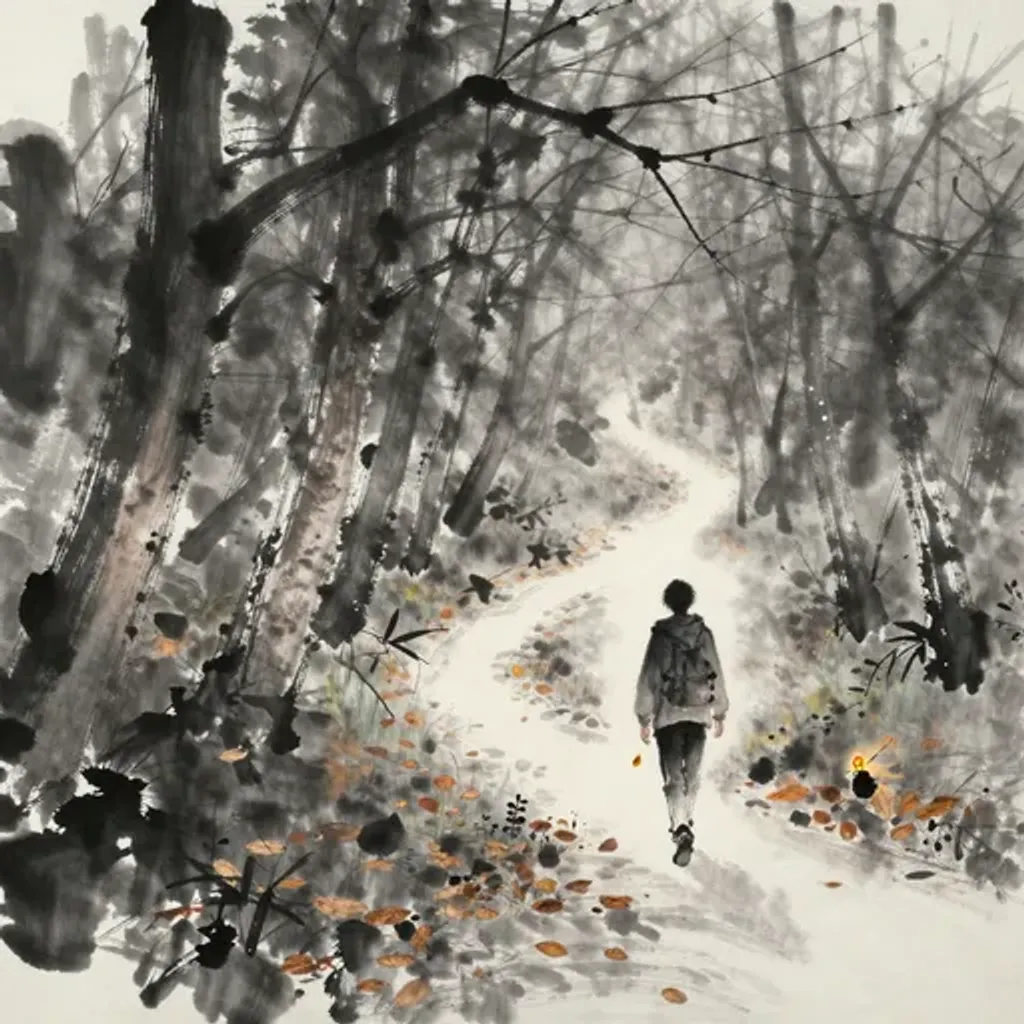
過時不歸,道遠且迷;旅人心悲,使我徘徊。
Past the hour and not returning; the road is far and lost in maze. The traveler's heart is sad; it makes me wander to and fro.
— Jiao Yanshou, Yilin (Forest of Changes), 1st century BC
Commentary
Earth above heaven, Peace cannot reach the one who has gone too far. The proper time for return has passed, the road stretches into bewildering distance, and the traveler's heart fills with sorrow, pacing back and forth in indecision. This is the homesickness of one who has overextended their journey — not exile, but a departure that overstayed. The road is not blocked but confused; direction has been lost. From Peace to The Family, wind emerges from fire, and the gentleman's words carry substance while his conduct maintains constancy. The transformation reveals that the wanderer's remedy lies in rebuilding domestic order: the family is what one returns to, and its warmth is the flame that guides.
泰 → 睽
Hexagram 11 → Hexagram 38: Opposition
Changing lines: 3, 4, 6
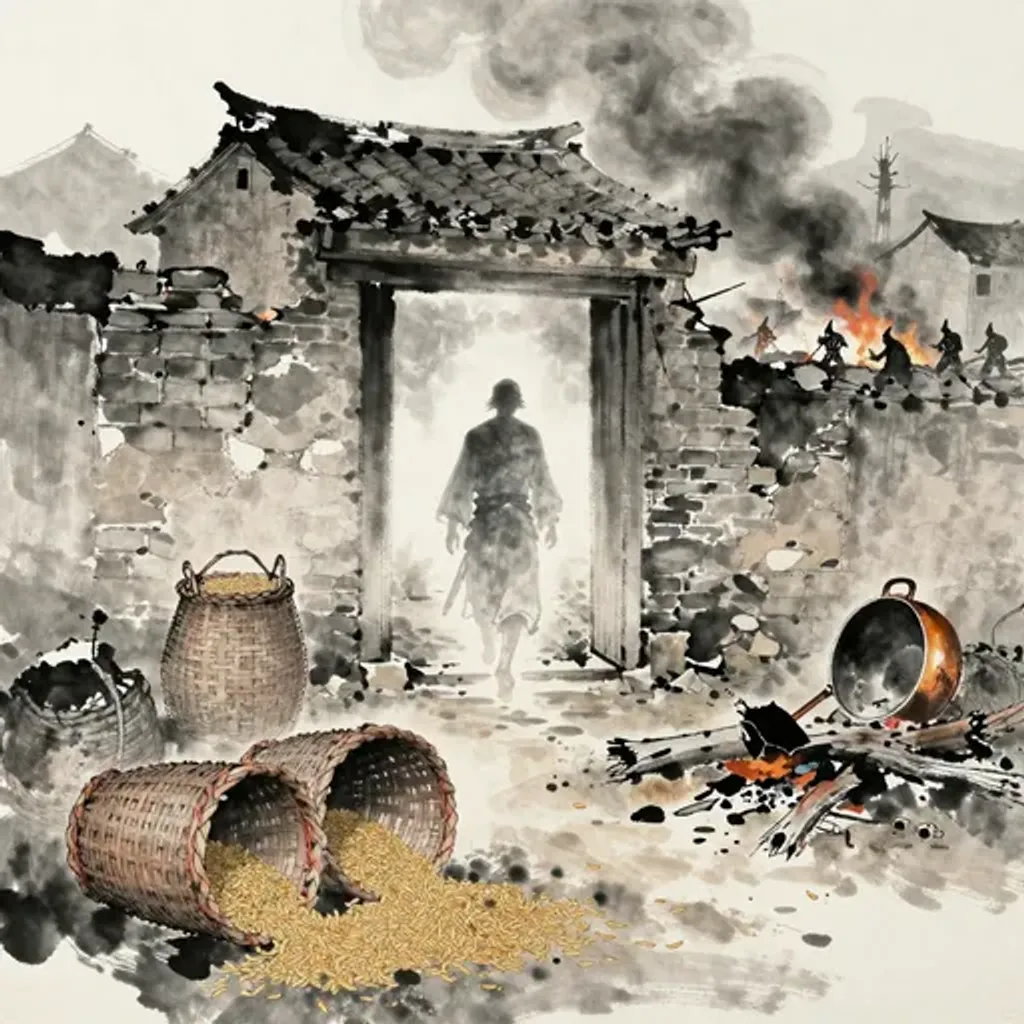
魂孤無室,衘指含食;盜張民饋,見敵失肉。
A homeless spirit without shelter, biting its finger, clutching at food. Bandits seize the people's provisions; facing the enemy, one loses the meat.
— Jiao Yanshou, Yilin (Forest of Changes), 1st century BC
Commentary
Earth above heaven, Peace stripped to its most desolate. A solitary soul has no shelter, sucking its fingers for sustenance — the gesture of an infant or a starving ghost. Bandits spread their nets and intercept the people's offerings; when enemies appear, even the meat is lost. The verse layers deprivation upon deprivation: no home, no food, no safety, and what little remains is seized by thieves. From Peace to Opposition, fire above the lake — heat rises while water sinks, and the two forces diverge. The transformation maps the social rupture: when above and below pull apart, those caught between are left with nothing, reduced to phantom hunger in a world of mutual theft.
泰 → 蹇
Hexagram 11 → Hexagram 39: Obstruction
Changing lines: 1, 2, 5
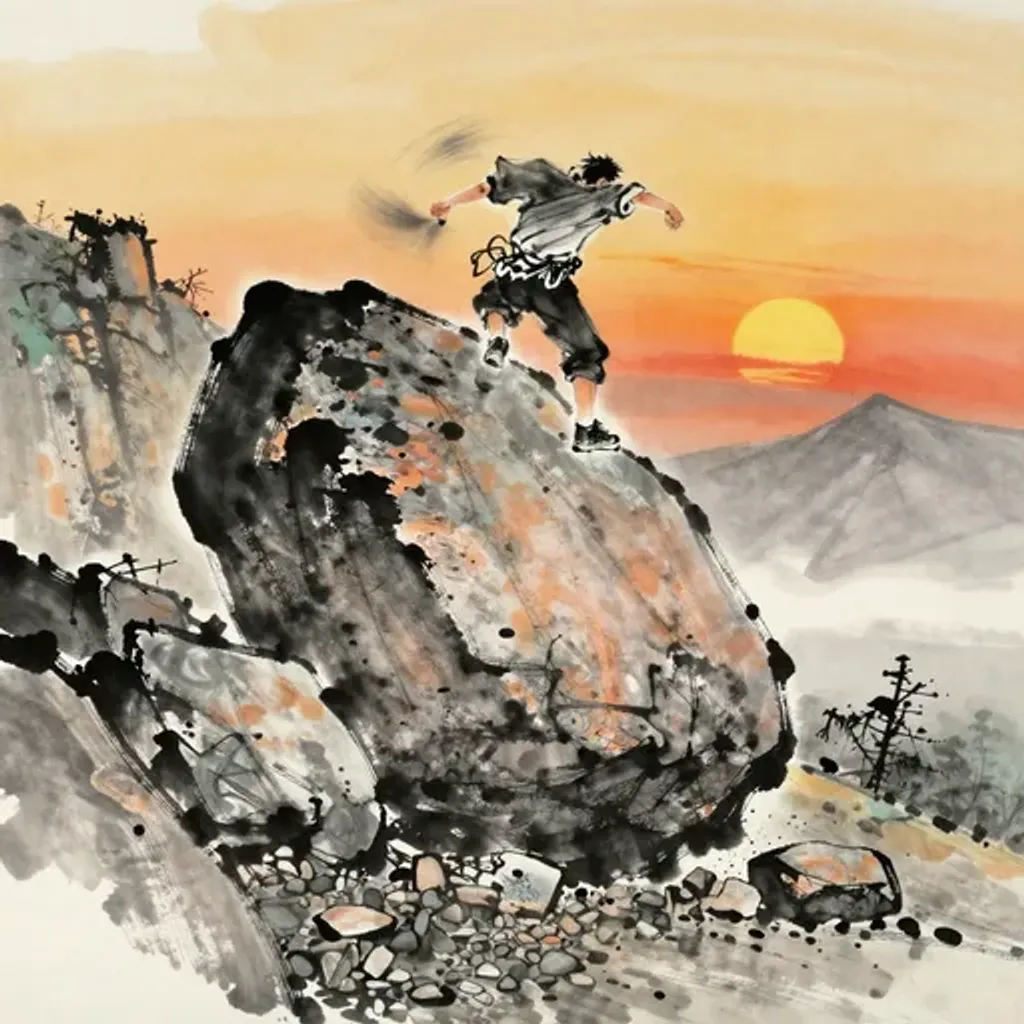
居如轉丸,危不得安;東西不寧,動生憂患。
Dwelling is like a rolling ball; danger allows no peace. East and west find no rest; every move breeds worry and trouble.
— Jiao Yanshou, Yilin (Forest of Changes), 1st century BC
Commentary
Earth above heaven, Peace rendered unstable as a rolling ball. One's dwelling spins like a marble, danger permits no rest. East and west alike offer no tranquility; every movement generates fresh anxiety. The image of living upon a rolling sphere captures radical instability — not a single catastrophic event but a perpetual absence of firm ground. From Peace to Obstruction, water pools atop the mountain, blocking the path forward. The transformation deepens the predicament: the rolling instability of Peace becomes the frozen impasse of Obstruction, where the gentleman turns inward to cultivate virtue because no outward movement is possible. When the ground itself will not hold still, the only stability is internal.
泰 → 解
Hexagram 11 → Hexagram 40: Deliverance
Changing lines: 1, 3, 4
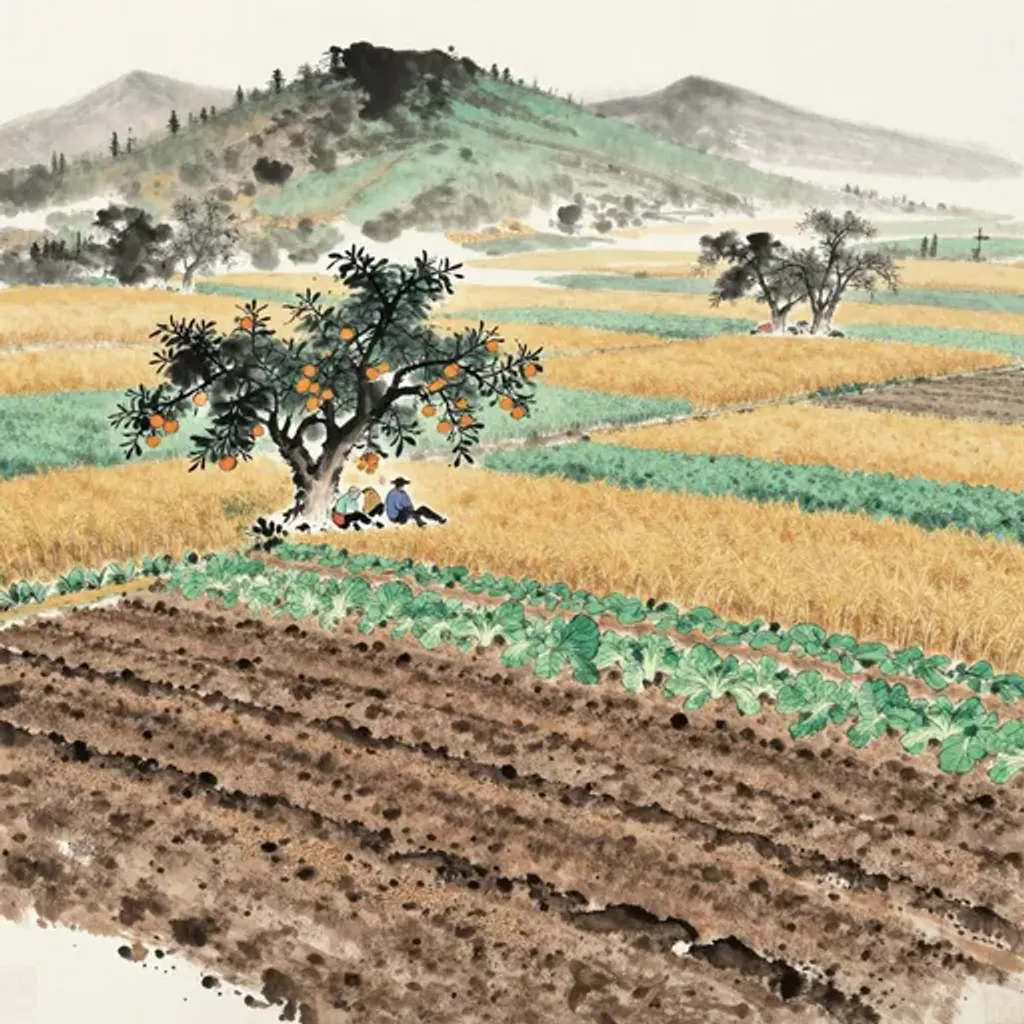
坤厚地德,庶物蕃息;平康正直,以綏大福。
Kun's thick earth virtue; all creatures multiply and thrive. Level, peaceful, upright, and straight; it brings great blessings to completion.
— Jiao Yanshou, Yilin (Forest of Changes), 1st century BC
Commentary
Earth above heaven, Peace fulfills its deepest promise. The thick virtue of Kun — the earth — causes all living things to multiply and flourish. Straightforward, peaceful, and upright: through these qualities, great blessing is secured. The verse directly invokes the Kun trigram's character from the Wenyan commentary: 'direct, square, and great.' This is Peace operating at full capacity — earth's generosity meeting heaven's vitality to produce universal abundance. From Peace to Deliverance, thunder and rain break forth, releasing what was bound. The transformation shows Peace's accumulated virtue naturally dissolving obstacles: when the foundation is genuinely nourishing, liberation follows without force.
泰 → 損
Hexagram 11 → Hexagram 41: Decrease
Changing lines: 3, 6
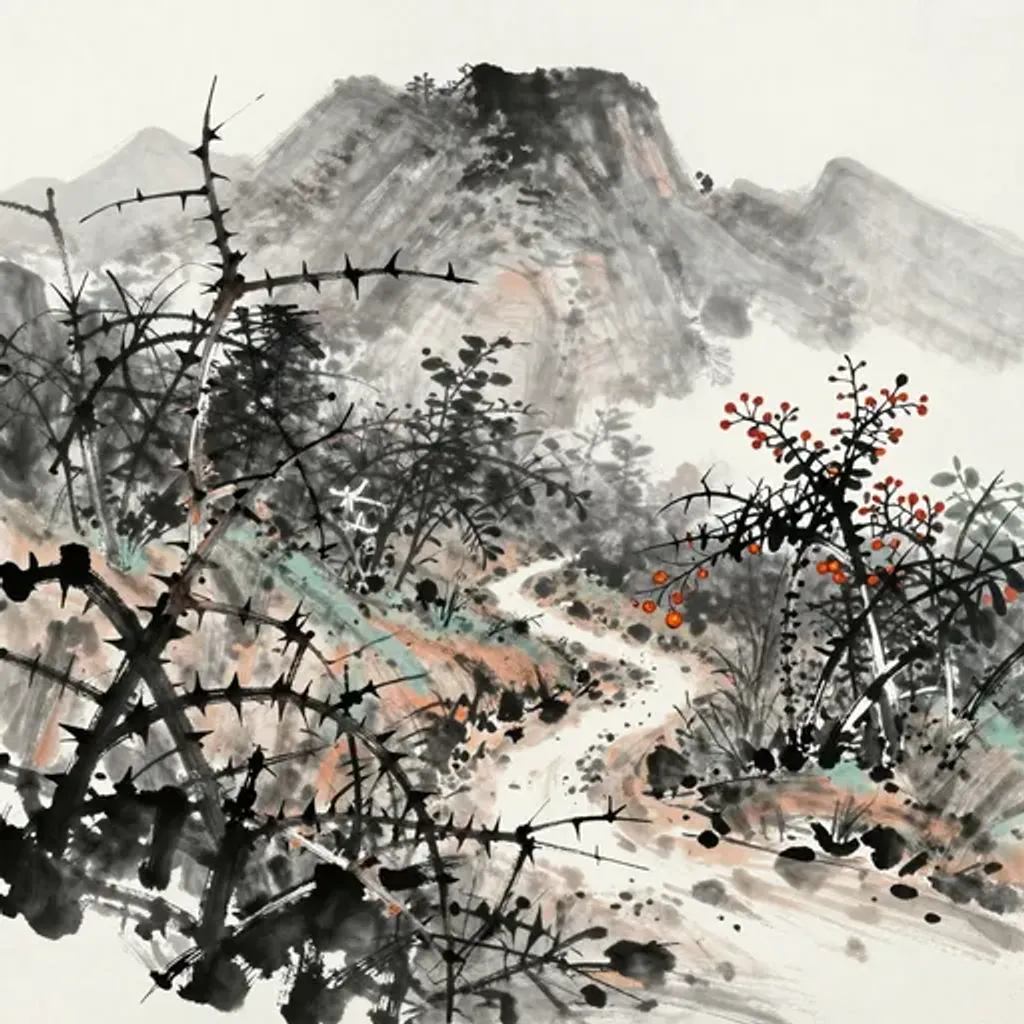
挒蔽牡荊,生賢山傍;仇敵背憎,孰肯相迎?
Thorny shrubs and wild brambles grow beside a remote hillside. Enemies harbor contempt and malice; who would willingly come to greet them?
— Jiao Yanshou, Yilin (Forest of Changes), 1st century BC
Commentary
Earth above heaven, Peace's virtue meets hostility. Thorny bushes crowd and block the chaste tree, yet a worthy person is born beside the mountain, growing despite the obstruction. But enemies and rivals harbor resentment — who among them would come to welcome such a one? Talent emerges in difficult terrain only to face social rejection. The verse contrasts natural growth with human malice: the plant pushes through thorns, but the person finds no society willing to receive them. From Peace to Decrease, the mountain towers above the lake, restraining desire and anger. The transformation suggests that when the world refuses welcome, one must voluntarily reduce expectations rather than force acceptance.
泰 → 益
Hexagram 11 → Hexagram 42: Increase
Changing lines: 2, 3, 5, 6
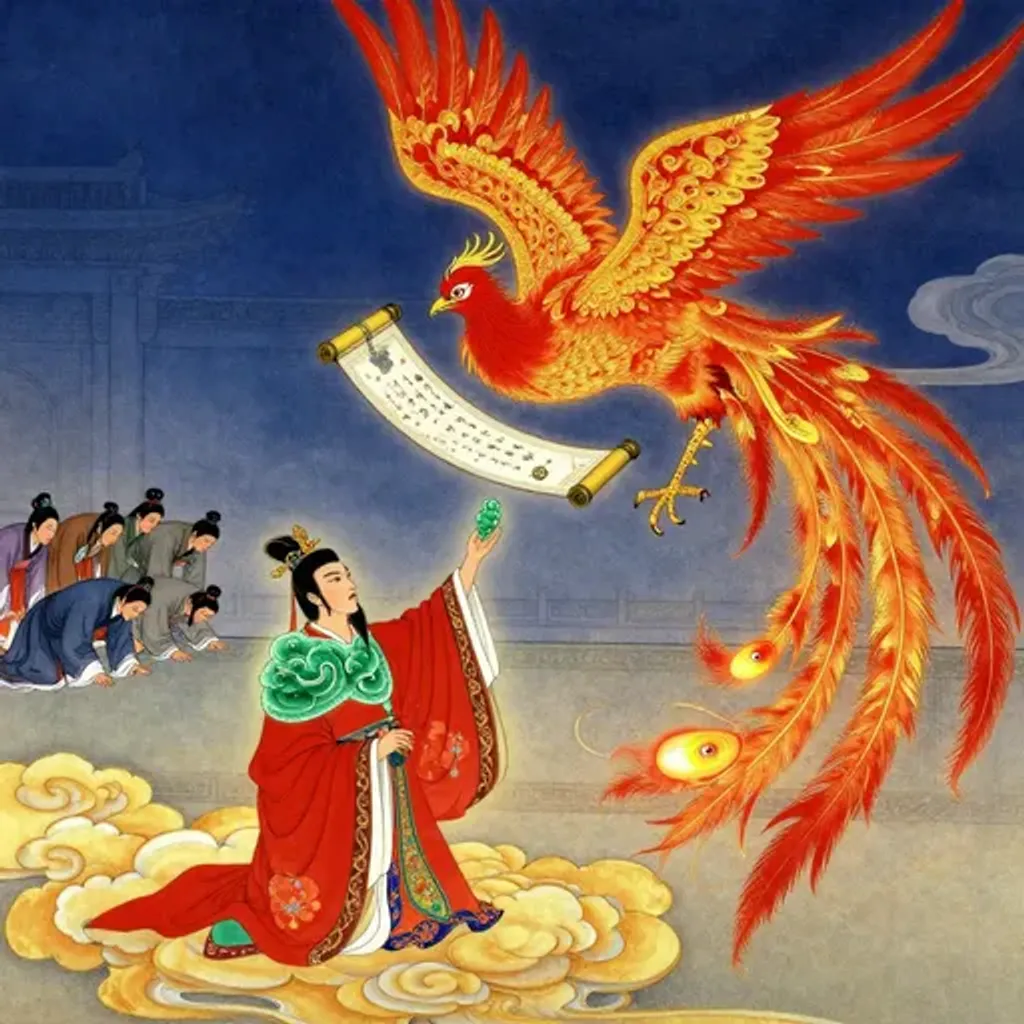
鳳凰衘書,賜我玄珪,封為晉侯。
A phoenix bears a decree in its beak, bestowing a dark jade scepter upon us, enfeoffing us as Marquis of Jin.
— Jiao Yanshou, Yilin (Forest of Changes), 1st century BC
Commentary
Earth above heaven, Peace receives heavenly mandate through auspicious portent. A phoenix carries a written decree in its beak, bestowing a dark jade scepter (玄珪) and the title of Marquis of Jin. The phoenix bearing documents is an omen of dynastic legitimacy — only under sage governance does the phoenix appear. The dark jade scepter was the emblem of investiture granted by the Son of Heaven. According to tradition, Tang Shu Yu, founder of Jin, received his fief through an omen involving a leaf cut into the shape of a jade tablet. From Peace to Increase, wind and thunder collaborate — the gentleman corrects faults upon seeing good. The transformation shows heaven's blessing materialized as concrete political advancement.
泰 → 夬
Hexagram 11 → Hexagram 43: Breakthrough
Changing lines: 4, 5
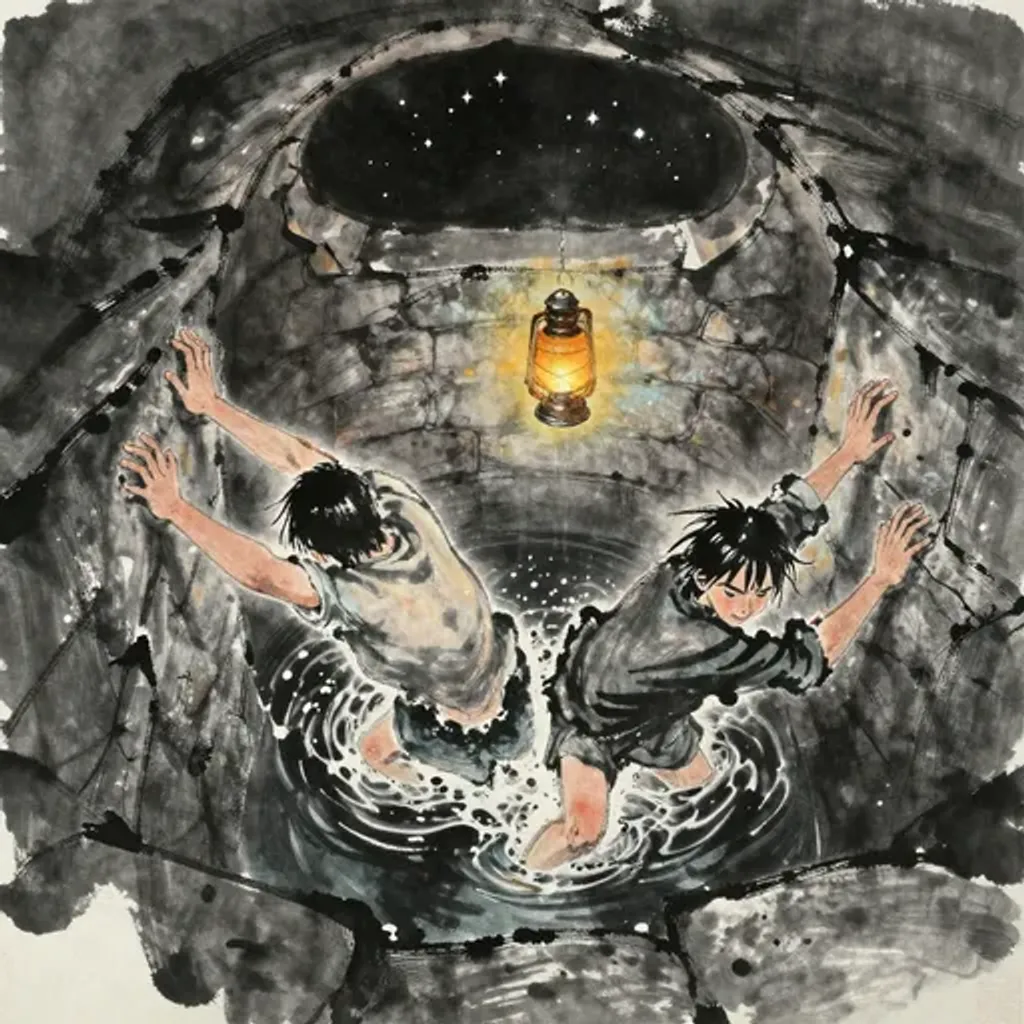
作凶不善,相牽入井;溺陷辜罪,禍至憂有。
Committing evil and doing wrong, they pull each other into the well. Drowning and mired in guilt; disaster arrives and worry follows.
— Jiao Yanshou, Yilin (Forest of Changes), 1st century BC
Commentary
Earth above heaven, Peace perverted into mutual destruction. Those who commit evil and refuse goodness drag each other into the well — a fatal entanglement where wrongdoing pulls accomplices into shared ruin. Drowning and guilt accumulate, disaster arrives, and worry compounds. The well here is not the nourishing well of hexagram 48 but a death trap, a pit entered through collective malice. From Peace to Breakthrough, the lake rises above heaven, and the gentleman distributes blessings below while guarding against complacency. The transformation reveals the paradox: breaking through requires the courage to expose wickedness, but the breakthrough itself is dangerous — one must proclaim truth in the king's court without becoming another victim pulled into the well.
泰 → 姤
Hexagram 11 → Hexagram 44: Coming to Meet
Changing lines: 1, 4, 5, 6
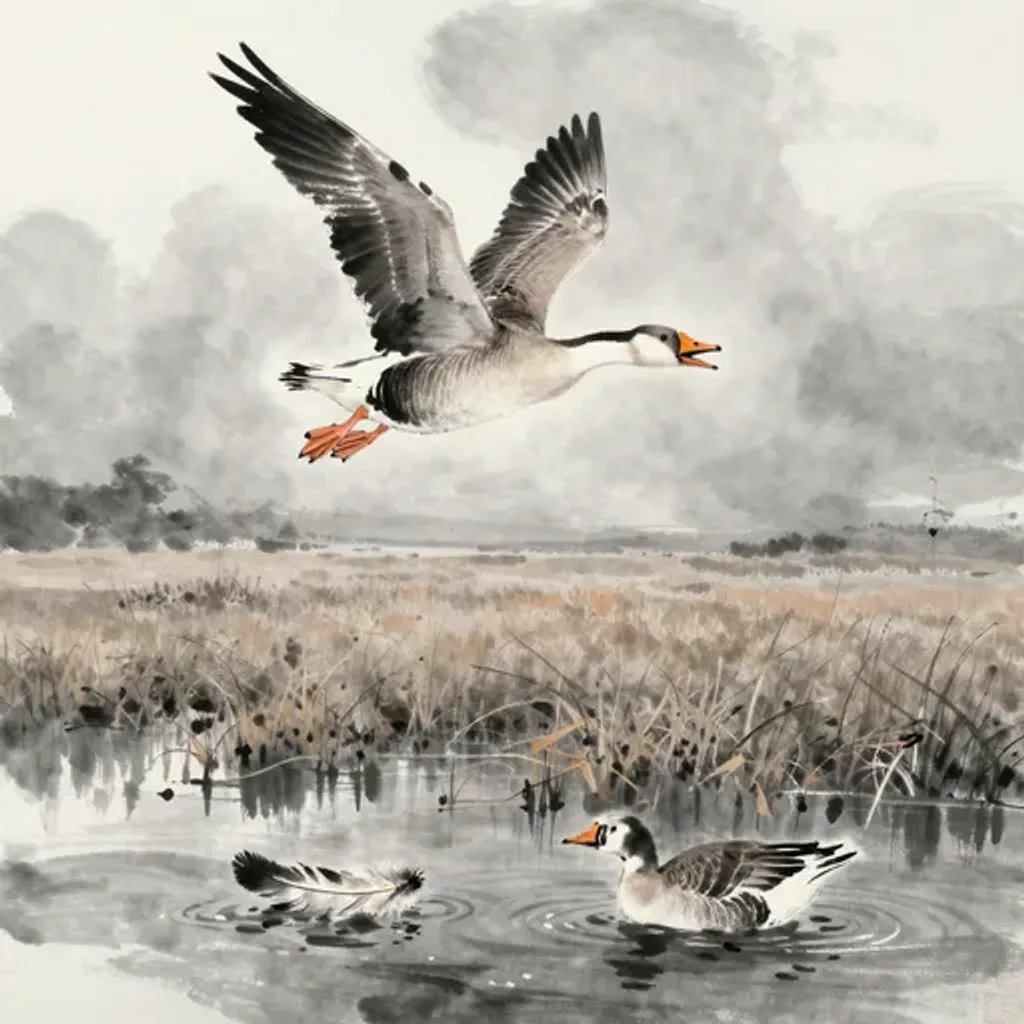
悲鳴北行,失其長兄;伯仲不幸,骸骨散亡。
Wailing and flying northward, having lost an elder brother. The eldest and the second meet misfortune; their bones are scattered and gone.
— Jiao Yanshou, Yilin (Forest of Changes), 1st century BC
Commentary
Earth above heaven, Peace shattered by fraternal loss. A mournful cry sounds as one travels north, having lost an elder brother. Both eldest and second-born meet misfortune — their very bones are scattered and lost. The northward journey toward grief inverts the auspicious southern circuit; north in traditional cosmology is the direction of yin, darkness, and death. The scattering of bones means not just death but denial of proper burial, the ultimate desecration. From Peace to Coming to Meet, heaven above wind — the ruler issues commands to the four quarters. The transformation reveals an encounter with unwelcome fate: what comes to meet one is not blessing but bereavement.
泰 → 萃
Hexagram 11 → Hexagram 45: Gathering Together
Changing lines: 1, 2, 3, 4, 5
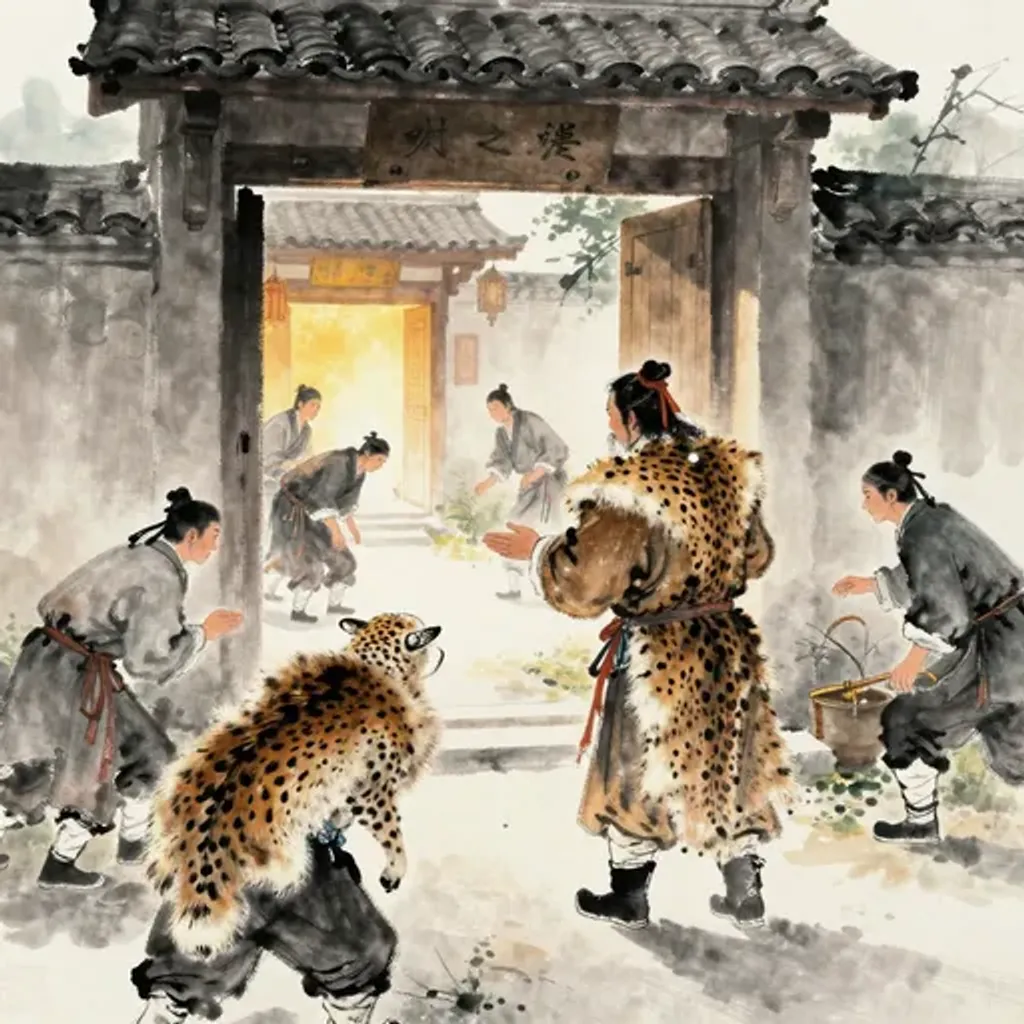
羔衣豹裘,高易我家;君子維好。
In lambskin robe and leopard fur, he ennobles our household. The gentleman maintains fine friendship.
— Jiao Yanshou, Yilin (Forest of Changes), 1st century BC
Commentary
Earth above heaven, Peace's generosity materialized in fine garments. Lambskin coats and leopard-fur cuffs — the attire of a nobleman or a worthy minister, echoing the Shijing ode 'Gao Qiu' where the lamb's fur symbolizes a gentleman's integrity. These fine things elevate one's household, and the gentleman maintains bonds of friendship. The verse is brief and auspicious: material prosperity affirming social harmony. From Peace to Gathering, the lake rises upon the earth, and the gentleman prepares arms to guard against the unexpected. The transformation shows Peace's blessings concentrating: scattered goodwill converges into a gathering of the worthy, where fine garments signal not vanity but earned distinction.
泰 → 升
Hexagram 11 → Hexagram 46: Pushing Upward
Changing lines: 1
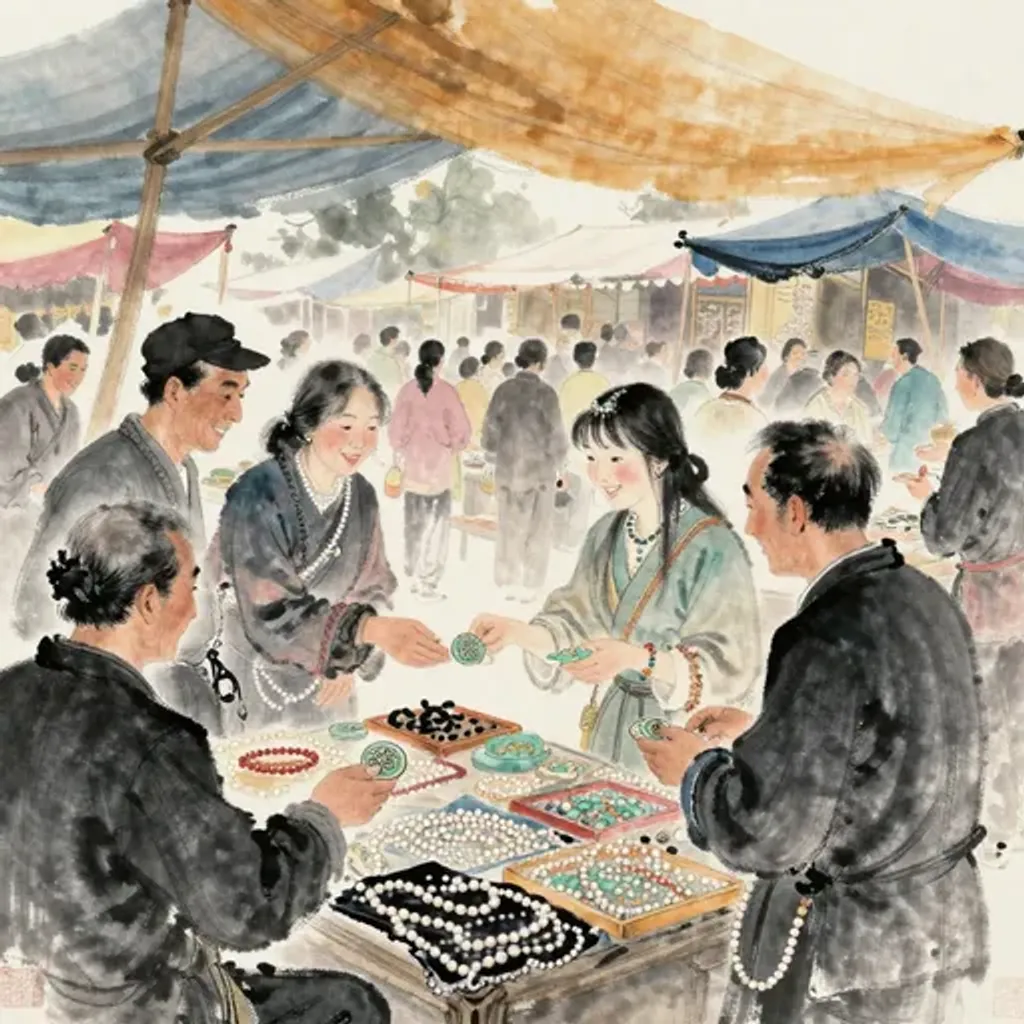
日中為市,各抱所有;交易資貨,貪珠懷寶。心悅歡喜。
At midday the market opens; each brings what they possess. Exchanging goods and wares, coveting pearls, cherishing treasures. The heart is pleased and joyful.
— Jiao Yanshou, Yilin (Forest of Changes), 1st century BC
Commentary
Earth above heaven, Peace finds expression in the marketplace at noon. At the day's zenith, merchants gather, each carrying their wares. Goods and currencies exchange hands, everyone covets pearls and treasures; hearts are filled with delight. This verse directly echoes the Xici Zhuan's description of Shennong establishing midday markets. The noon market is the paradigm of fair exchange — maximum sunlight ensures transparency. From Peace to Pushing Upward, trees grow within the earth, the gentleman accumulates small gains into greatness. The transformation traces how equitable commerce becomes the engine of steady ascent: each fair trade is a root extending deeper, each honest exchange builds upward incrementally.
泰 → 困
Hexagram 11 → Hexagram 47: Oppression
Changing lines: 1, 3, 4, 5
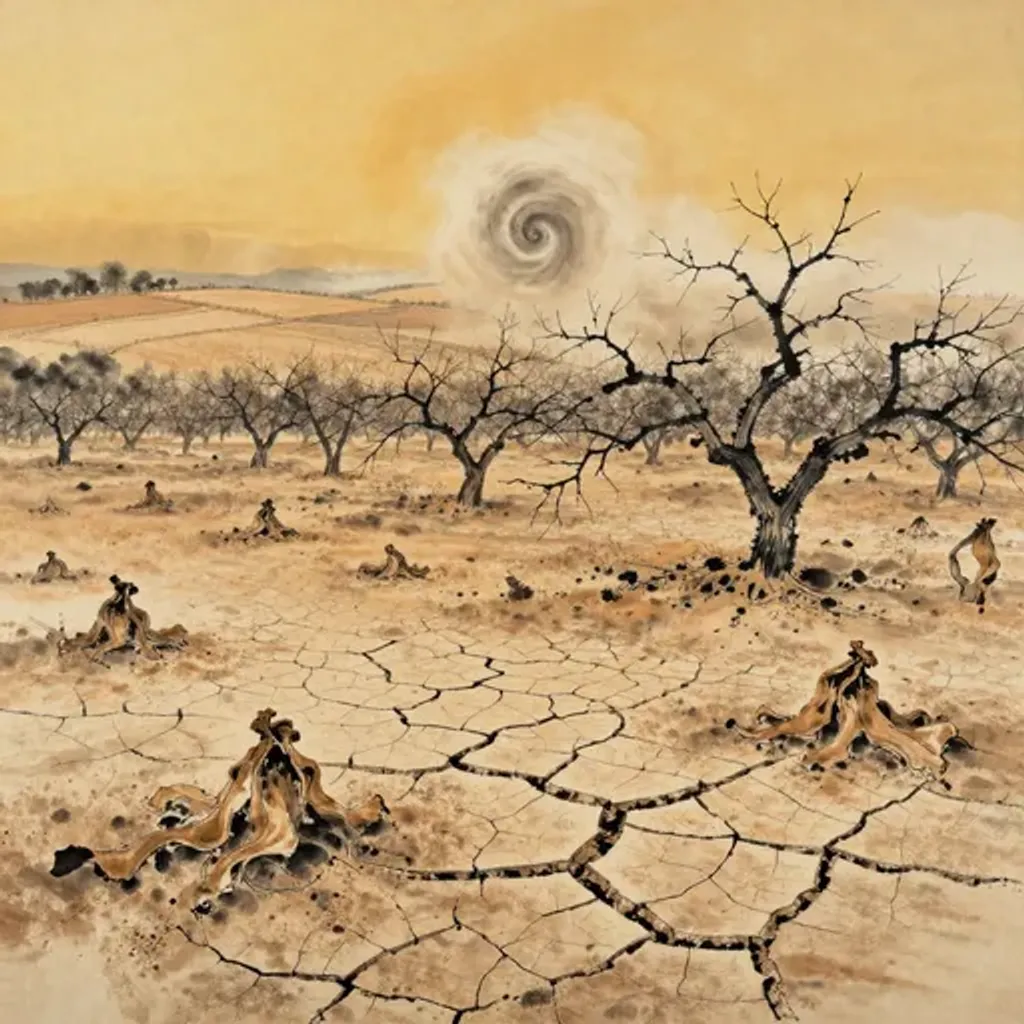
振急絕理,常陽不雨;物病焦乾,華實無有。
Frantic and unraveled beyond reason; unbroken sun without rain. All things sicken, scorched and dry; flower and fruit are nowhere found.
— Jiao Yanshou, Yilin (Forest of Changes), 1st century BC
Commentary
Earth above heaven, Peace's moisture violently expelled. Conditions snap and order collapses; relentless yang dominates without rain. Plants wither and parch; neither flower nor fruit survives. This is drought as systemic failure: not a temporary dry spell but a permanent imbalance where nourishing yin has been entirely banished. The 'constant yang without rain' (常陽不雨) describes a cosmological catastrophe — heaven's energy raging unchecked with no earthly counterpart to moderate it. From Peace to Oppression, the lake drains dry over water that cannot rise. The transformation doubles the drought: what was merely dry becomes utterly exhausted, a waterless lake over a trapped spring.
泰 → 井
Hexagram 11 → Hexagram 48: The Well
Changing lines: 1, 5
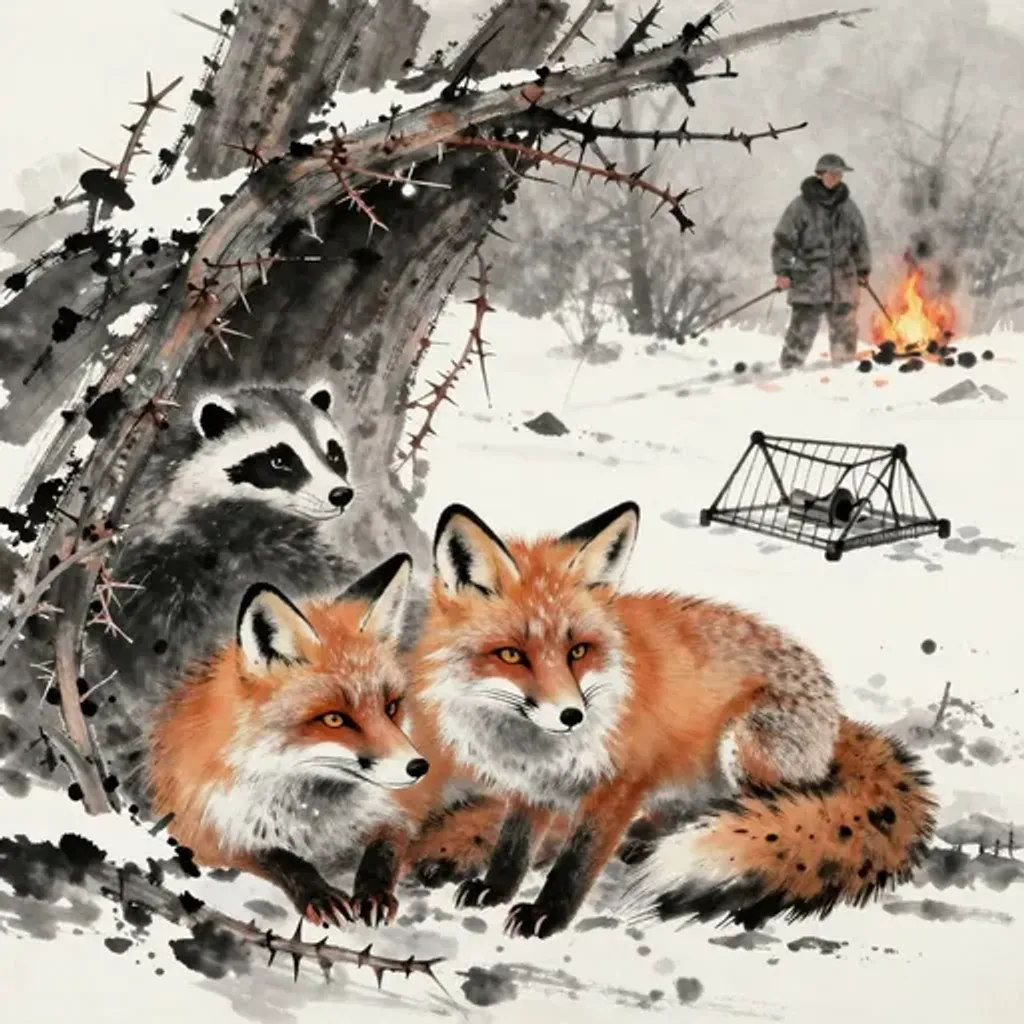
狐貉載剝,徙溫厚蓐;寒棘為疾,有所不足。
Fox and badger are stripped of their pelts, moved to warm thick bedding. Winter's thorns bring affliction; there is something lacking.
— Jiao Yanshou, Yilin (Forest of Changes), 1st century BC
Commentary
Earth above heaven, Peace's warmth wears thin. Fox and badger pelts are stripped and shed, traded for thicker bedding to ward off cold. Yet the biting thorns bring illness, and there remains something insufficient. The fur-bearing animals lose their skins — a sacrifice of one kind of protection for another, yet the replacement is inadequate. Cold penetrates despite precautions. From Peace to The Well, water rises above wood, and the gentleman encourages the people to help one another. The transformation points to communal sustenance: the well's water is inexhaustible when properly maintained, whereas individual resources — like animal pelts — run out. What one person lacks, the community can supply.
泰 → 革
Hexagram 11 → Hexagram 49: Revolution
Changing lines: 2, 4, 5
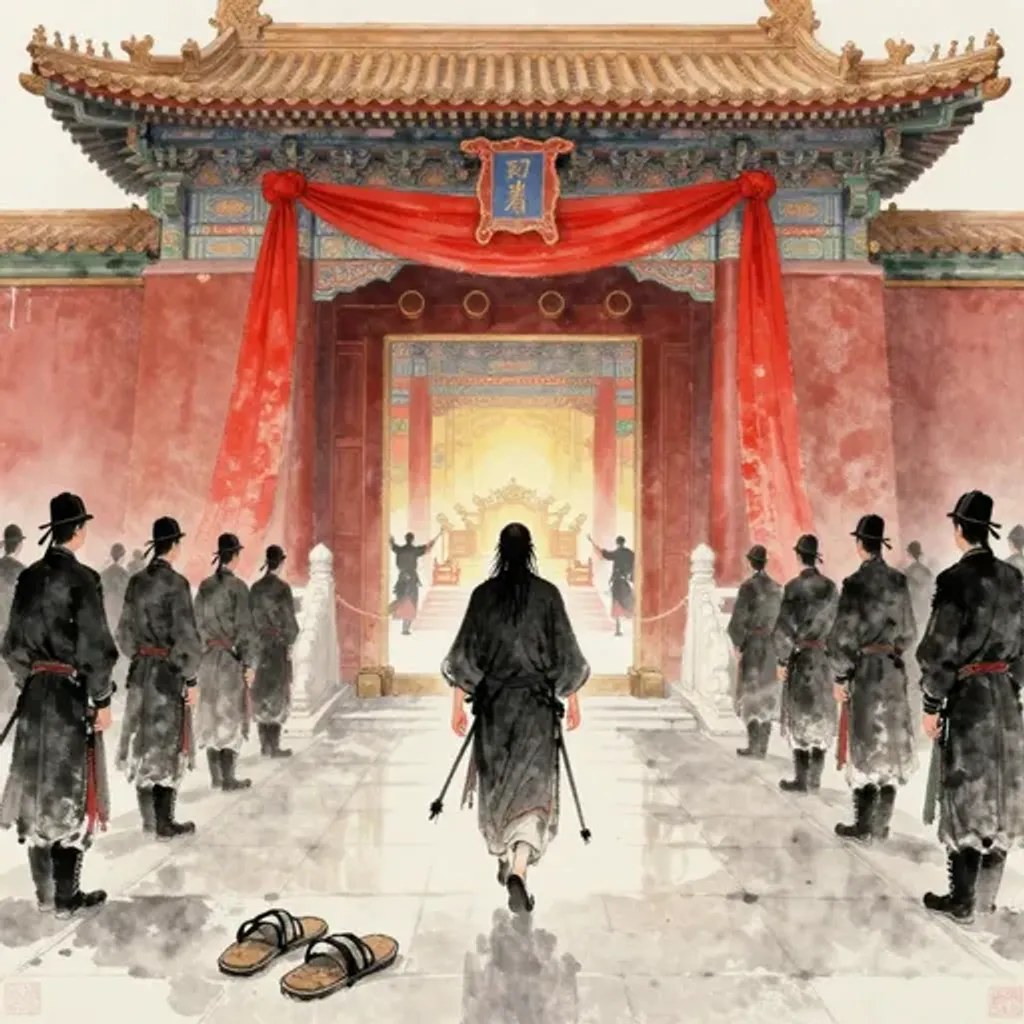
履踐危難,脫執去患;入福喜門,見誨大君。
Treading through peril and hardship, one escapes danger and sheds calamity. Entering the gate of blessing and joy, one is received by the great lord.
— Jiao Yanshou, Yilin (Forest of Changes), 1st century BC
Commentary
Earth above heaven, Peace forged through trial. One treads through perilous difficulty, then sheds one's shackles and escapes disaster. Arriving at the gate of blessings and joy, one receives instruction from the great lord. The verse narrates a complete arc of reversal: danger endured, bonds cast off, and a transformed condition welcomed by legitimate authority. From Peace to Revolution, fire burns within the lake — the gentleman regulates the calendar to clarify the seasons. The transformation captures the essence of revolution as renewal: the old constraints are not merely escaped but transmuted, and the one who passes through the fire emerges authorized to enter the court of power.
泰 → 鼎
Hexagram 11 → Hexagram 50: The Cauldron
Changing lines: 1, 4, 6
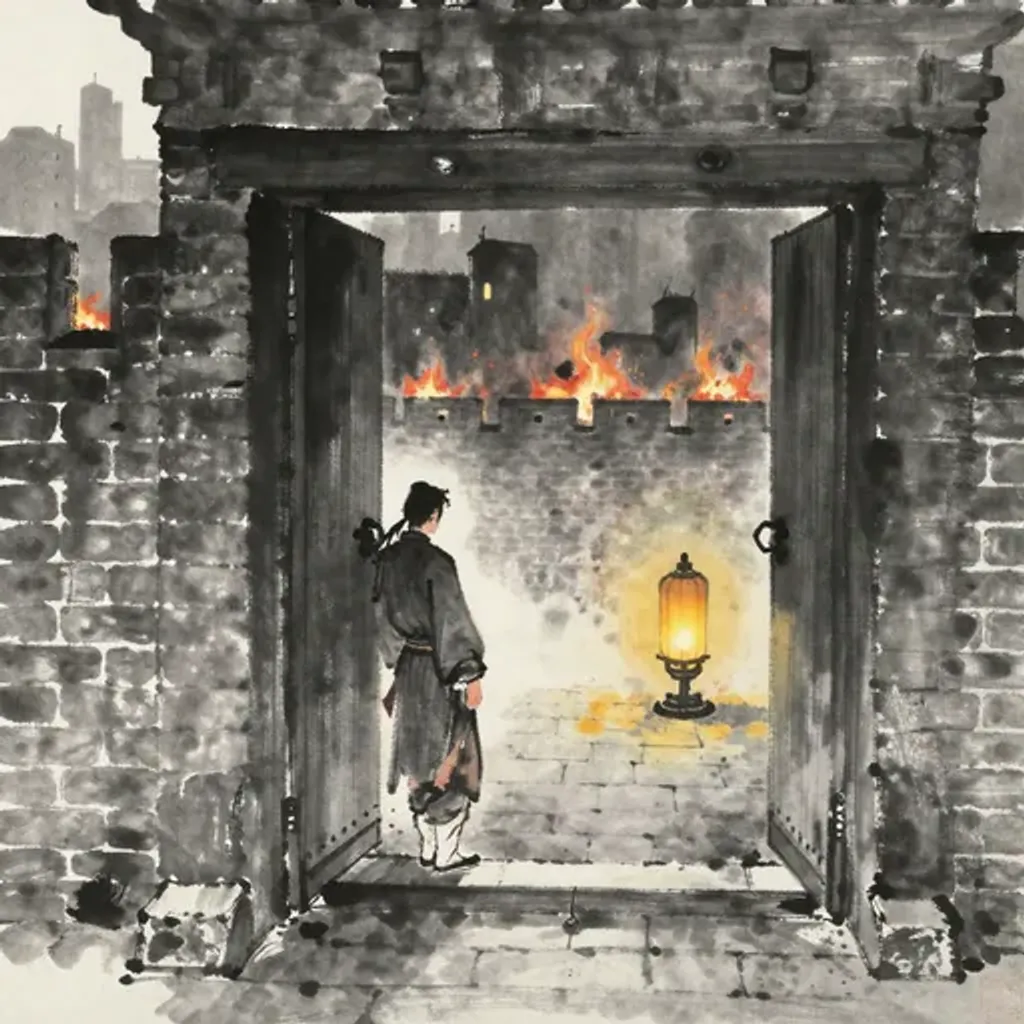
四亂不安,東西為患;退止我足,毋出國城;乃得全完,賴其生福。
Chaos on four sides, no peace; east and west bring trouble. Withdraw and halt my steps; do not venture beyond the city walls. Thus one stays whole and intact, relying on one's living blessing.
— Jiao Yanshou, Yilin (Forest of Changes), 1st century BC
Commentary
Earth above heaven, Peace besieged on all sides. Disorder erupts from every quarter, east and west alike serving as sources of calamity. The response is strategic restraint: withdraw, halt your advance, do not leave the city walls. By staying within the fortified domain, one preserves wholeness and lives to receive blessing. This is the counsel of defensive wisdom — knowing when not to act. From Peace to The Cauldron, fire blazes above wood, and the gentleman rectifies his position to solidify his mandate. The transformation reveals that self-containment is not passivity but the deliberate act of maintaining one's proper station so that one may serve the higher purpose when the time is right.
泰 → 震
Hexagram 11 → Hexagram 51: The Arousing Thunder
Changing lines: 2, 3, 4
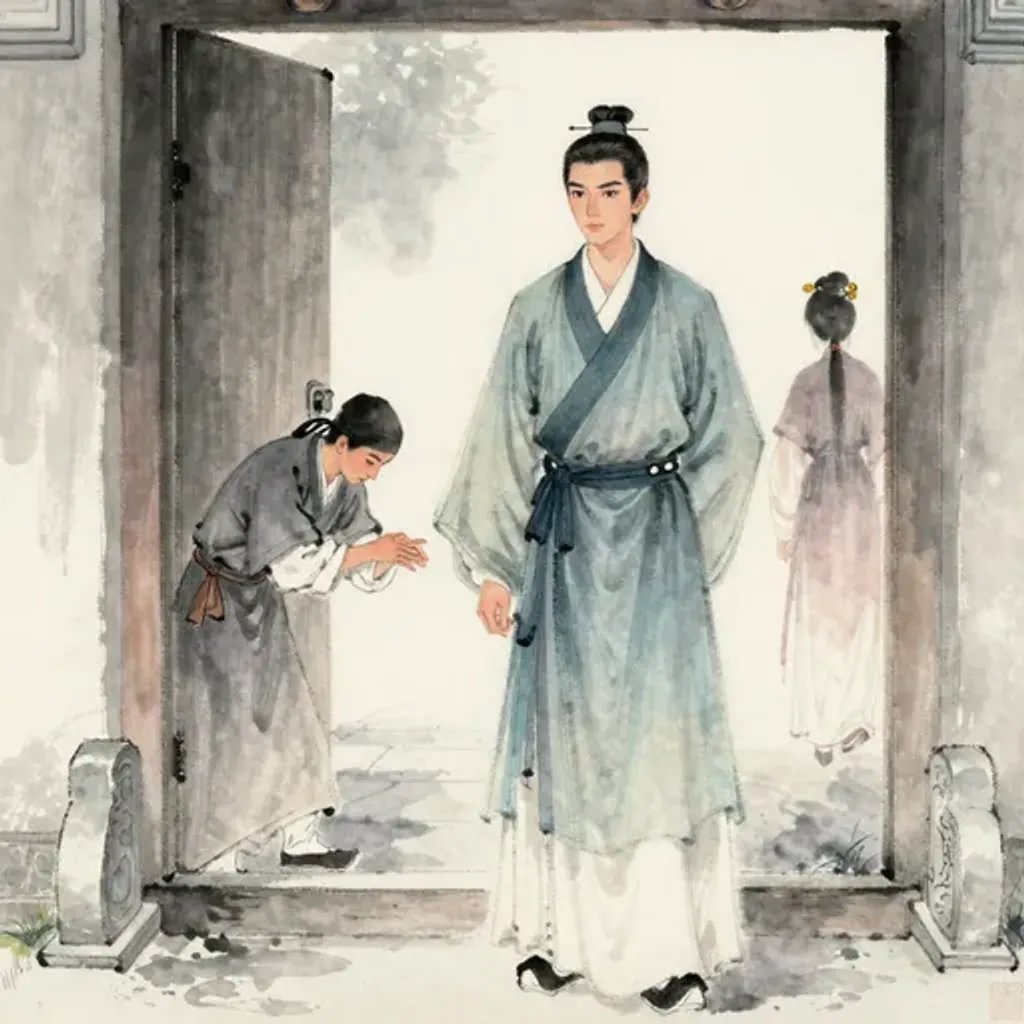
南國少子,才略美好;求我長女,賤薄不與;反得醜惡,後乃大悔。
A young man from the southern realm, talented and fine. He seeks our eldest daughter; deeming him lowly, we refuse. Instead we get an ugly match; later comes great regret.
— Jiao Yanshou, Yilin (Forest of Changes), 1st century BC
Commentary
Earth above heaven, Peace's matchmaking goes awry. A talented and handsome youth from the southern kingdom seeks one's eldest daughter in marriage. Yet the offer is refused as beneath her station. Instead, a less worthy match is accepted — and the family bitterly regrets it afterward. The verse is a parable of misjudged value: a good suitor is dismissed through snobbery, and the replacement brings only grief. From Peace to The Arousing, doubled thunder shakes the world, inspiring self-examination through shock. The transformation suggests that the regret itself is the thunder: a startling realization that one's own pride has produced the disaster, not fate.
泰 → 艮
Hexagram 11 → Hexagram 52: Keeping Still Mountain
Changing lines: 1, 2, 6
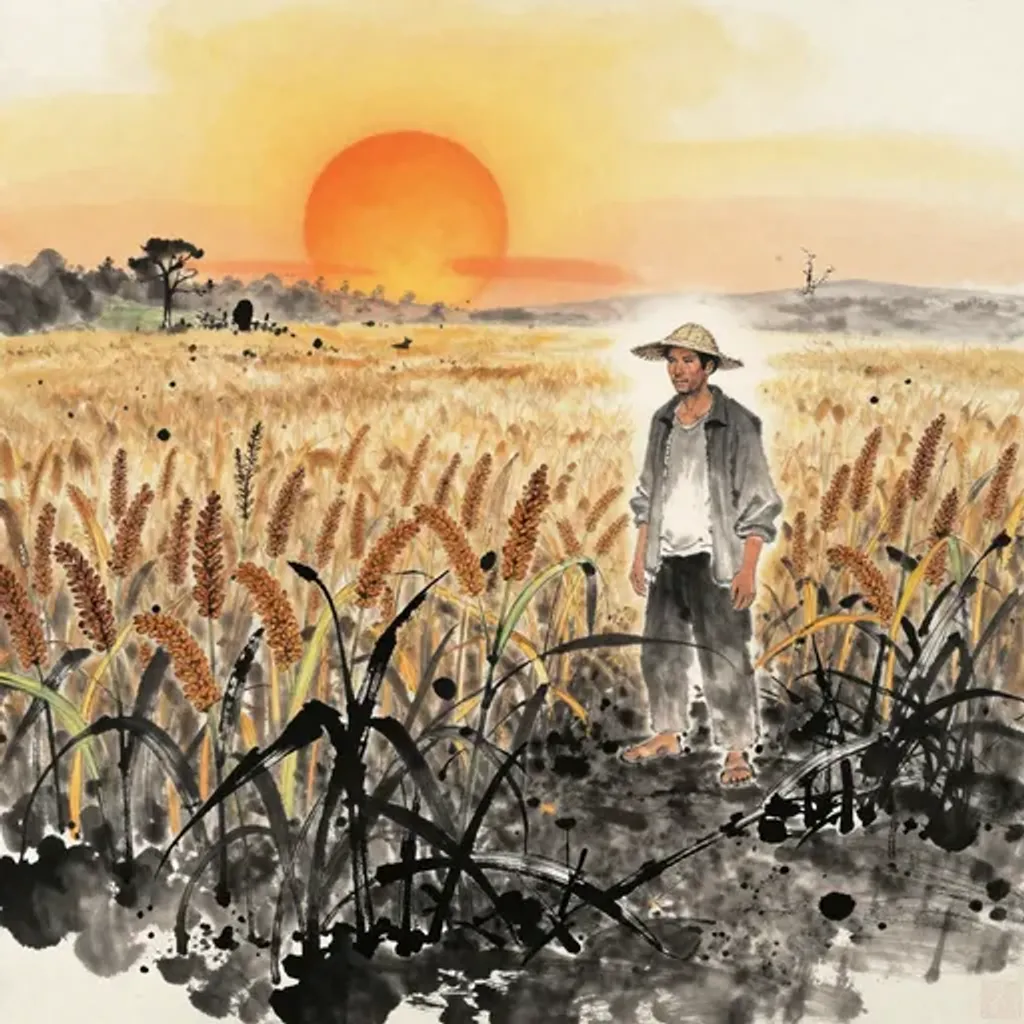
妄怒失理,陽孤無輔;物病焦枯,年飢於黍。
Reckless anger defies all reason; yang stands isolated without aid. All things sicken, scorched and withered; the year's harvest starves for millet.
— Jiao Yanshou, Yilin (Forest of Changes), 1st century BC
Commentary
Earth above heaven, Peace consumed by irrational fury. Senseless rage abandons all principle; the yang force stands isolated without support. Plants wither and burn, and the year's grain crop fails — famine in the millet fields. Anger, once disconnected from reason, becomes a drought that destroys everything within its domain. The solitary yang, unsupported by yin, cannot sustain life; it can only scorch. From Peace to Keeping Still, twin mountains stand in silence, and the gentleman's thoughts do not stray beyond his station. The transformation prescribes the remedy: when rage has burned away all reason, only stillness can arrest the destruction. The mountain does not argue; it simply stops.
泰 → 漸
Hexagram 11 → Hexagram 53: Development
Changing lines: 1, 2, 5, 6
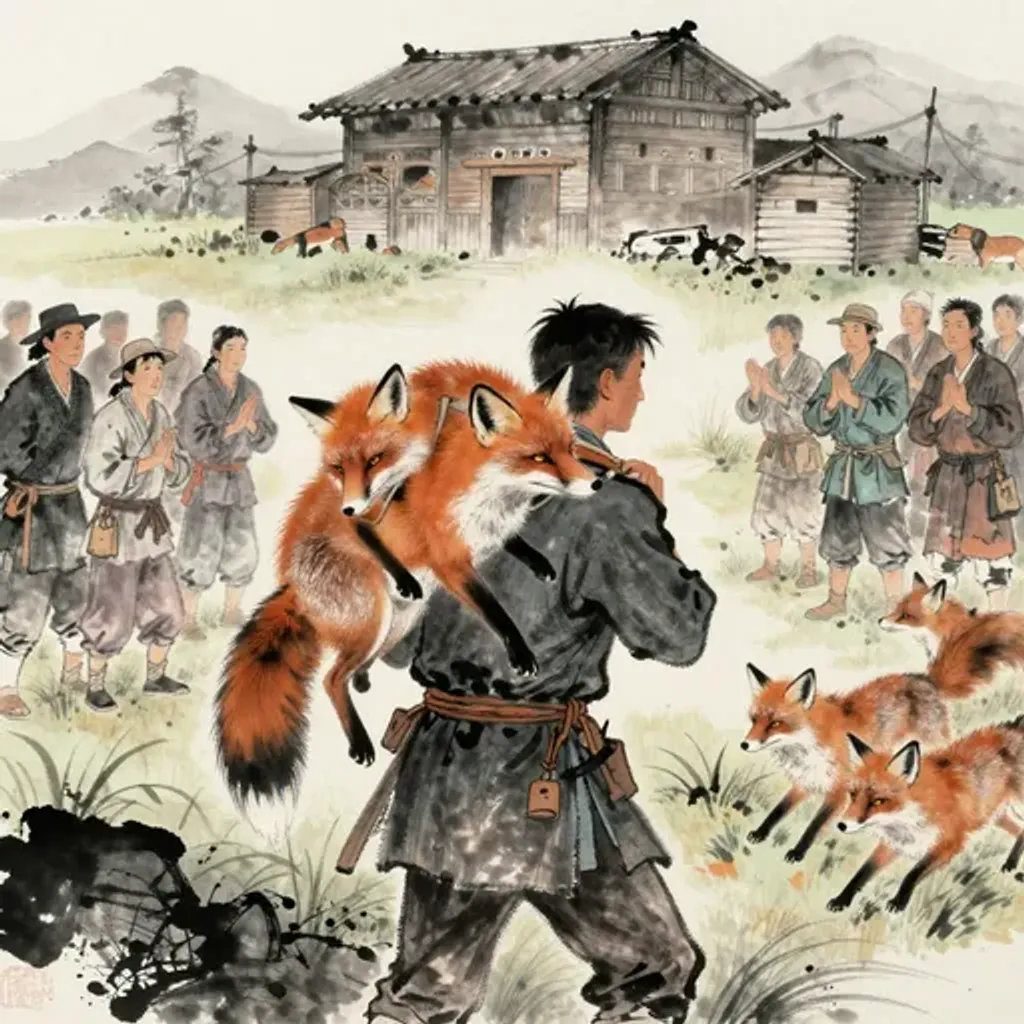
倬然遠咎,避患害早;田獲三狐,見民為寶。
Standing tall and far from blame, avoiding misfortune early. Hunting, one captures three foxes; seeing the people as treasure.
— Jiao Yanshou, Yilin (Forest of Changes), 1st century BC
Commentary
Earth above heaven, Peace maintained through early vigilance. Standing conspicuously upright, one avoids calamity from afar, recognizing danger before it materializes. Hunting in the fields, one catches three foxes — symbols of cunning threats neutralized. The people are revealed as the true treasure. The verse celebrates preemptive wisdom: the person who acts before trouble ripens reaps security. 'Catching three foxes' echoes the I-Ching's own Deliverance hexagram (line nine-two), where foxes represent entrenched problems eliminated. From Peace to Development, trees grow upon the mountain gradually. The transformation shows that early prevention creates the conditions for slow, organic growth — danger cleared away, the tree rises at its natural pace.
泰 → 歸妹
Hexagram 11 → Hexagram 54: The Marrying Maiden
Changing lines: 3, 4
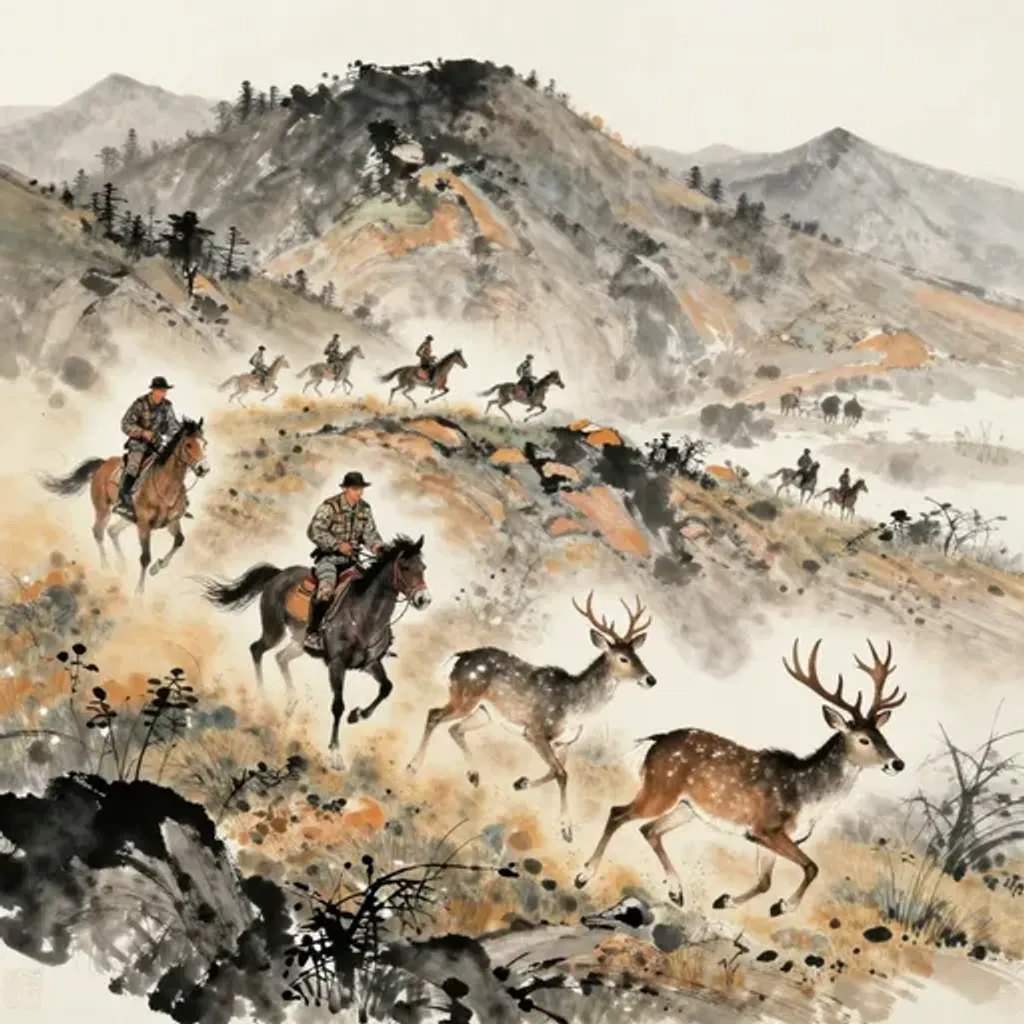
逐鹿山巔,利去我西;維邪南北,無所不得。
Chasing the deer up the mountain ridge; profit departs to our west. Branching out to south and north; there is nothing we do not gain.
— Jiao Yanshou, Yilin (Forest of Changes), 1st century BC
Commentary
Earth above heaven, Peace casts its net wide. Chasing deer across the mountain peak, profit lies to the west. But veering south and north in every direction, there is nothing one cannot obtain. The hunt becomes omnidirectional — not a focused pursuit but a radiating expansion where game is plentiful in all quarters. The mountaintop vantage gives the hunter command of every direction. From Peace to the Marrying Maiden, thunder rolls above the lake, and the gentleman understands endings through their flaws. The transformation introduces a caution: expansive acquisition must end somewhere, and the marrying maiden's position is inherently subordinate. Boundless ambition eventually meets the limit of propriety.
泰 → 豐
Hexagram 11 → Hexagram 55: Abundance
Changing lines: 2, 4
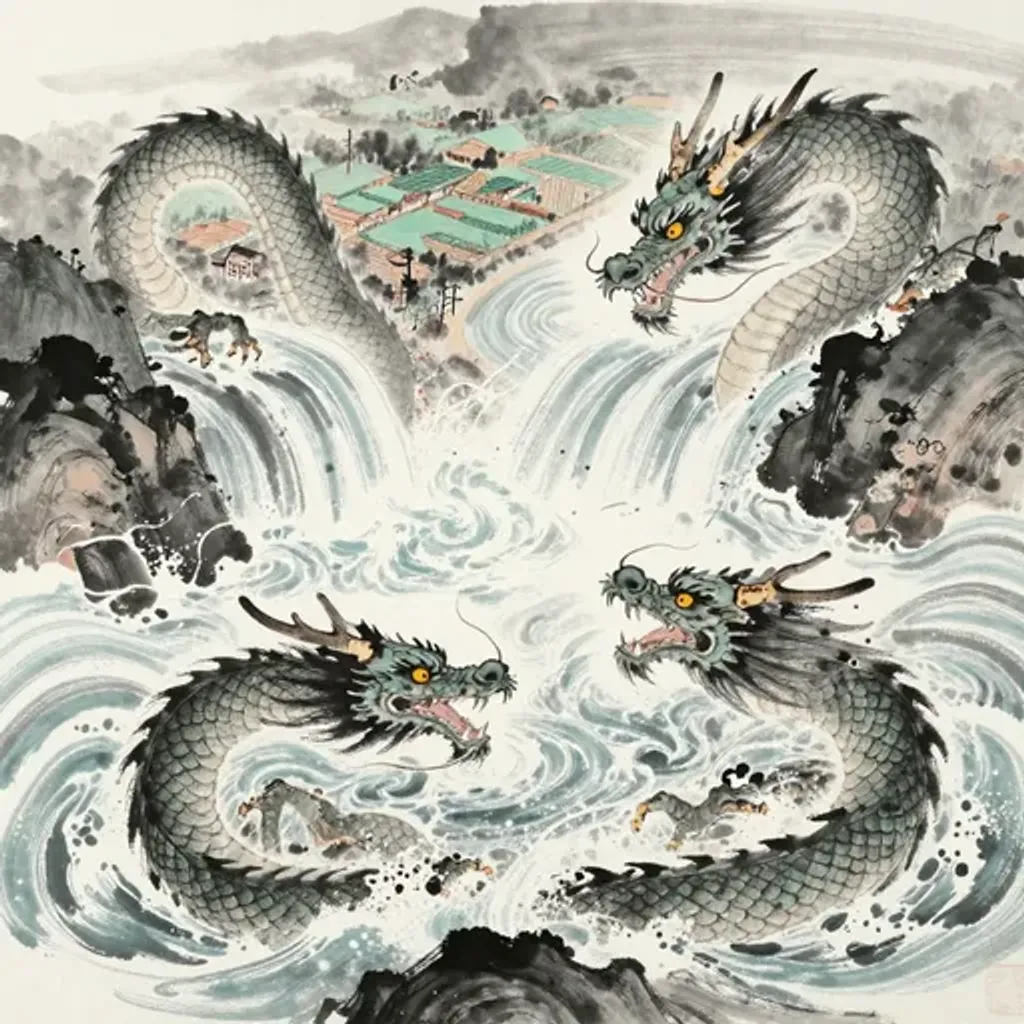
龍蛇所聚,大水來處;滑滑泲泲,使我無賴。
Where dragons and serpents gather, great floods come. Churning and surging; they leave us nothing to rely upon.
— Jiao Yanshou, Yilin (Forest of Changes), 1st century BC
Commentary
Earth above heaven, Peace overwhelmed by serpentine flood. Dragons and snakes gather at the place where great waters converge. Slippery and murky currents surge, leaving one helpless and without recourse. The dragons and snakes suggest elemental forces massing beyond human control — not malicious individually, but collectively overwhelming. The wet, sliding chaos resists every attempt at stable footing. From Peace to Abundance, thunder and lightning arrive together, and the gentleman decides lawsuits and executes punishment. The transformation suggests that the chaotic deluge must be met with the decisive clarity of judicial thunder: when elemental forces converge, only sharp illumination paired with authoritative force can restore order.
泰 → 旅
Hexagram 11 → Hexagram 56: The Wanderer
Changing lines: 1, 2, 4, 6
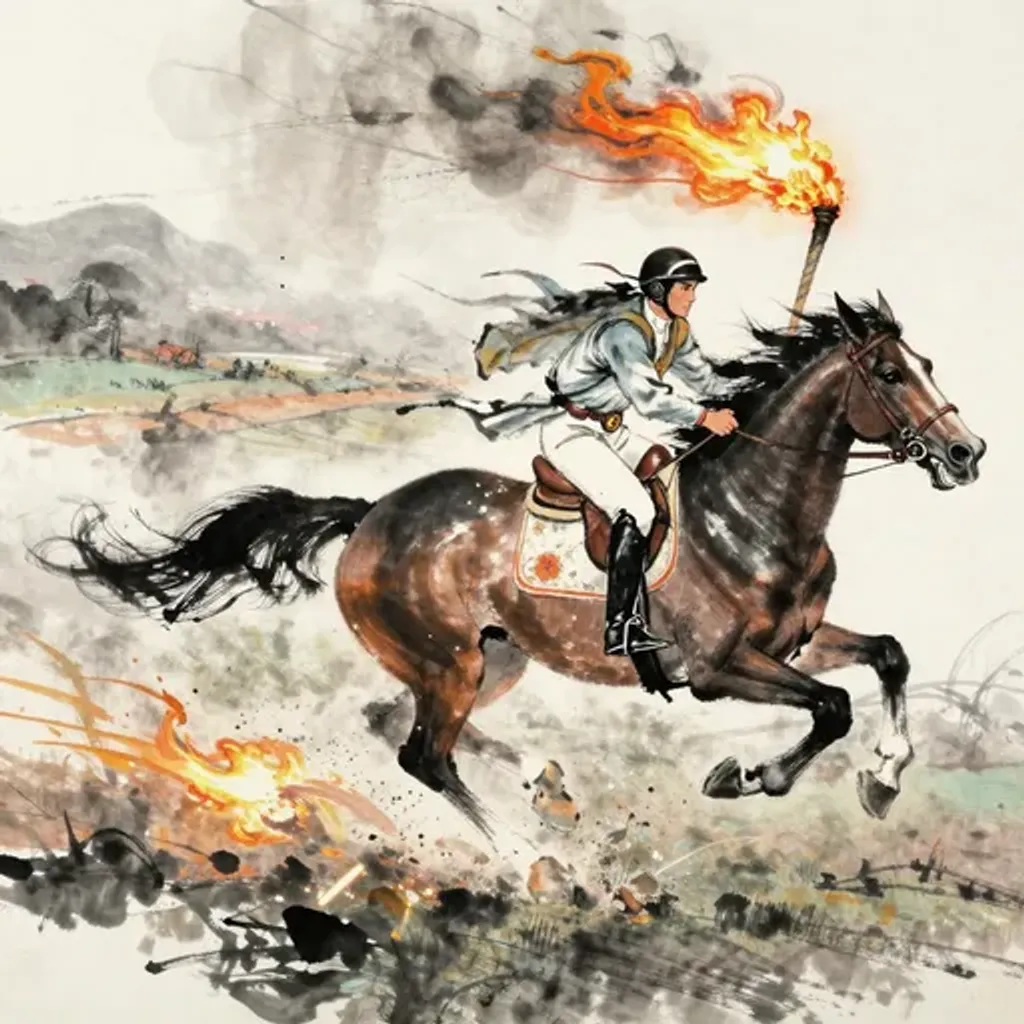
從風吹火,牽騏驥尾;易為功力,因催受福。
Blowing fire with the wind; grasping the thoroughbred's tail. Easy to accomplish with effort; riding momentum, one receives blessing.
— Jiao Yanshou, Yilin (Forest of Changes), 1st century BC
Commentary
Earth above heaven, Peace leveraged through effortless momentum. Blowing with the wind to fan a fire, holding the tail of a thoroughbred horse — everything is accomplished with minimal effort because one has aligned with forces already in motion. Power is borrowed, not generated; the wind was already blowing, the horse already galloping. The result is blessing gained through timely leverage rather than brute labor. From Peace to The Wanderer, fire blazes on the mountain, and the gentleman applies punishments with caution. The transformation shows that borrowed momentum carries one far but eventually one must travel alone — the wanderer who once rode the wind must learn to navigate unfamiliar terrain on foot.
泰 → 巽
Hexagram 11 → Hexagram 57: The Gentle Wind
Changing lines: 1, 5, 6
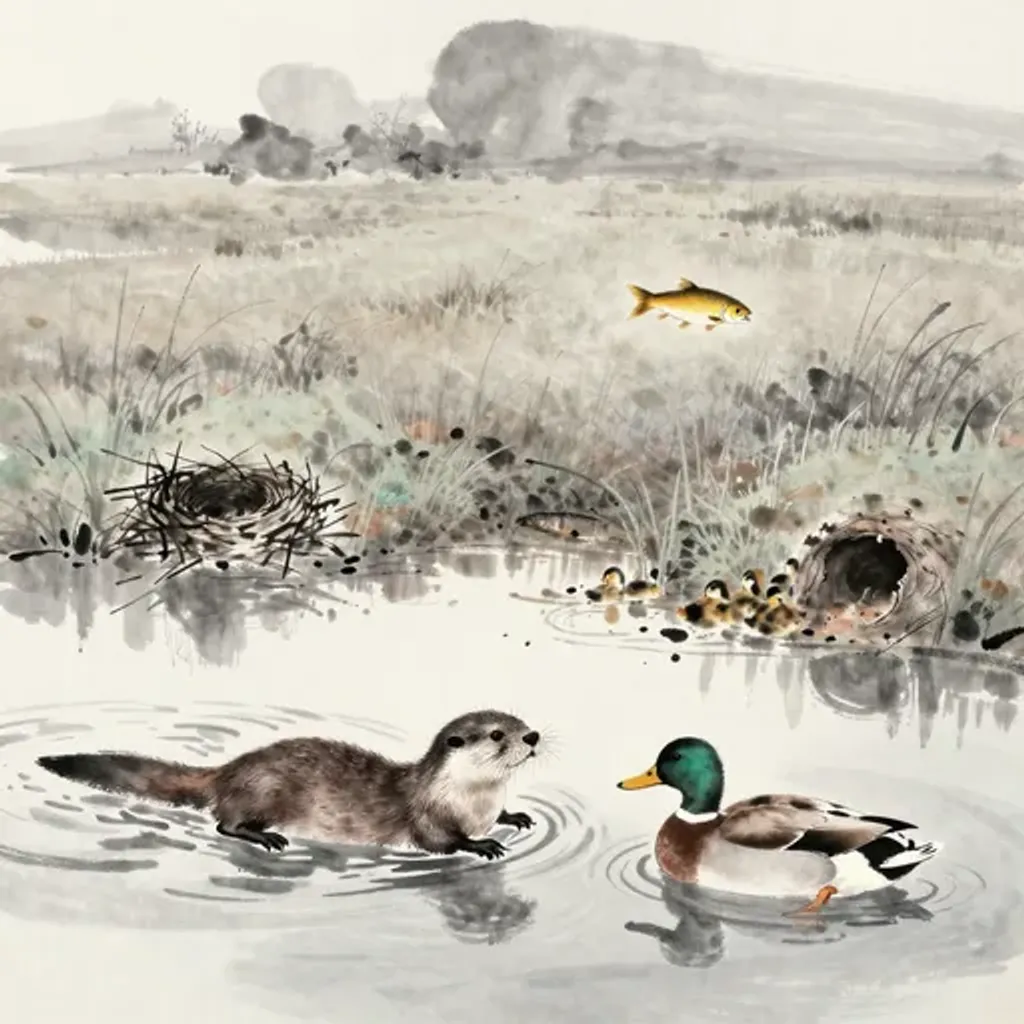
澤狗水鳧,難畜少雛;不為家饒,心其函逋。
Otter and wild duck, hard to raise any brood. They do not enrich the household; their hearts harbor only flight.
— Jiao Yanshou, Yilin (Forest of Changes), 1st century BC
Commentary
Earth above heaven, Peace challenged by undomesticable creatures. Marsh dogs and water ducks are difficult to raise as chicks — their wild nature resists confinement. They contribute nothing to the household's abundance, and their hearts harbor thoughts of escape. The verse uses waterfowl husbandry as a metaphor for attempting to domesticate what is essentially wild: the creatures eat but do not produce, and they dream of open water. From Peace to The Gentle, doubled wind penetrates everywhere with persistent soft influence. The transformation suggests that what force cannot tame, persistent gentle persuasion may gradually accustom — but the wind must be patient, for wild creatures yield only to a touch they barely notice.
泰 → 兌
Hexagram 11 → Hexagram 58: The Joyous Lake
Changing lines: 3, 4, 5
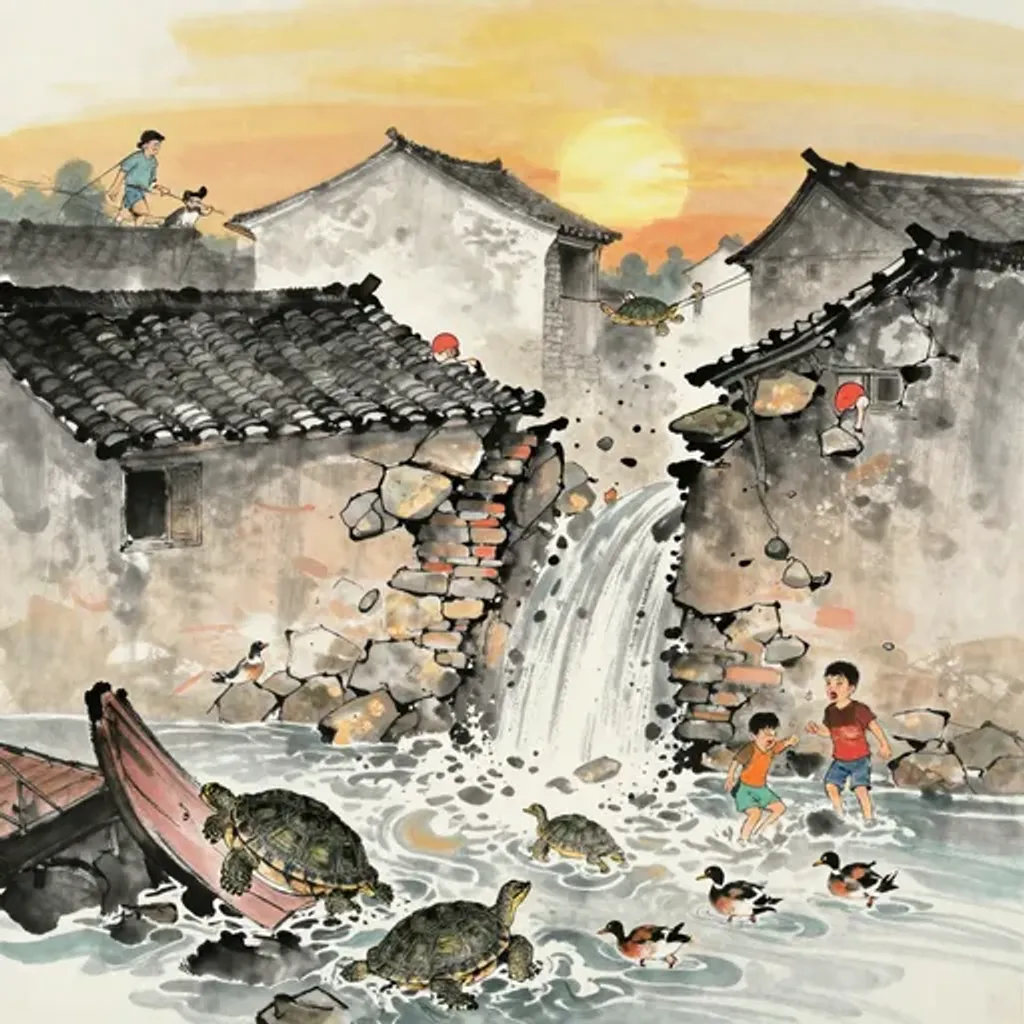
水壞我里,東流為海;龜鳧讙囂,不覩慈母。
Water breaches our village, flowing east to the sea. Turtles and ducks cry in clamor; they cannot see their dear mother.
— Jiao Yanshou, Yilin (Forest of Changes), 1st century BC
Commentary
Earth above heaven, Peace inundated. Floodwaters destroy the village, pouring eastward into the sea. Turtles and wild ducks clamor noisily amid the ruins, and the children cannot find their mother. The scene is devastation after a flood: human habitation replaced by aquatic creatures, family bonds severed by rising waters. The mother-child separation is the verse's emotional core — chaos at its most primal. From Peace to The Joyous, paired lakes commune in mutual delight, and the gentleman gathers friends for learning. The transformation is bitterly ironic: where Joyous promises the pleasures of shared waters, this verse shows waters that shatter rather than unite. Joy requires that the lake be contained; uncontained, it becomes catastrophe.
泰 → 渙
Hexagram 11 → Hexagram 59: Dispersion
Changing lines: 1, 3, 5, 6
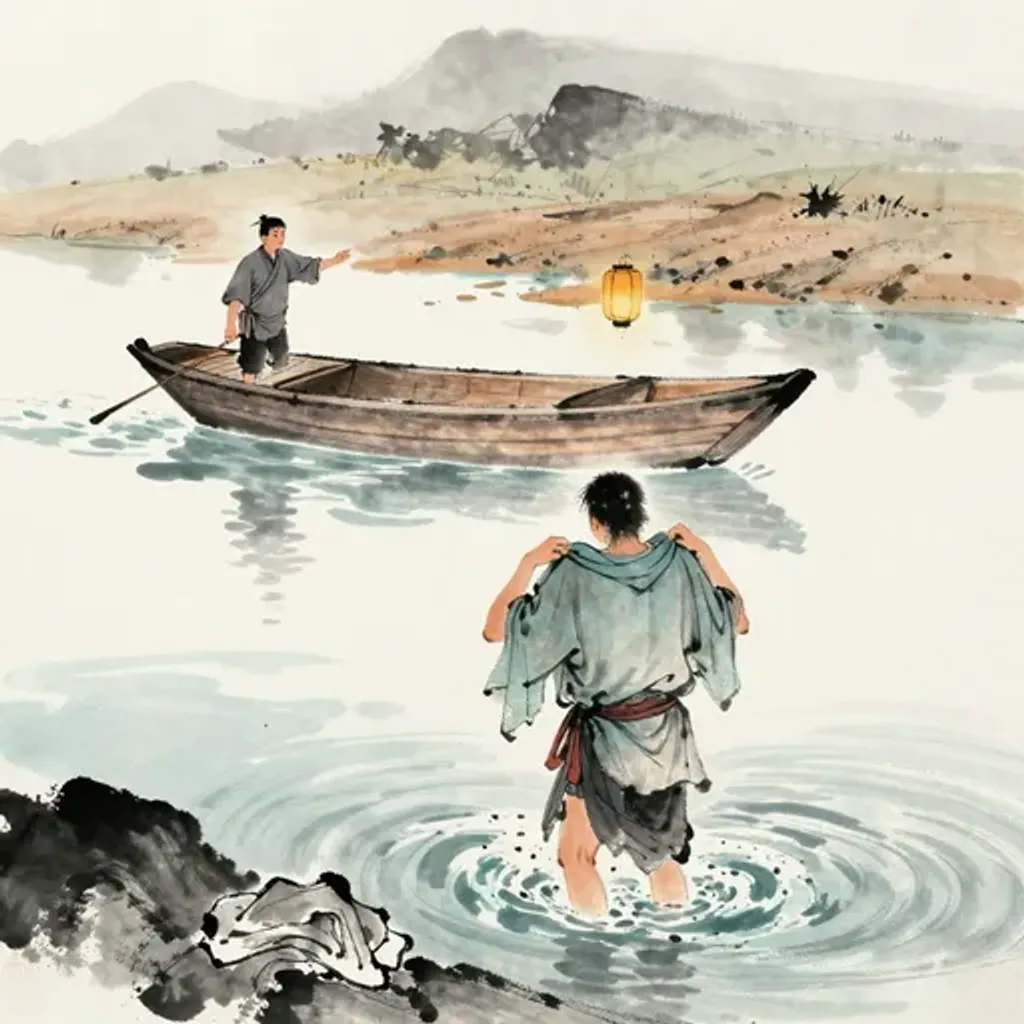
褰衣涉行,水深漬多;賴幸舟子,濟脫無他。
Lifting robes to wade across; the water is deep and soaking. Fortunate to have the boatman; we cross safely without mishap.
— Jiao Yanshou, Yilin (Forest of Changes), 1st century BC
Commentary
Earth above heaven, Peace's crossing attempted on foot. Lifting one's robes to wade through a ford, the water proves too deep, soaking everything. Yet thanks to a fortunate boatman, one is ferried across safely without further incident. The verse narrates a narrow escape: what began as a manageable crossing nearly became a drowning, averted only by unexpected aid. The boatman appears at the critical moment — a figure of grace rather than planning. From Peace to Dispersion, wind moves across the water, and the ancient kings established temples to unite the people's spirit. The transformation shows how individual rescue scales into collective cohesion: the boatman who saves one traveler becomes the ritual that holds a scattered people together.
泰 → 節
Hexagram 11 → Hexagram 60: Limitation
Changing lines: 3, 5
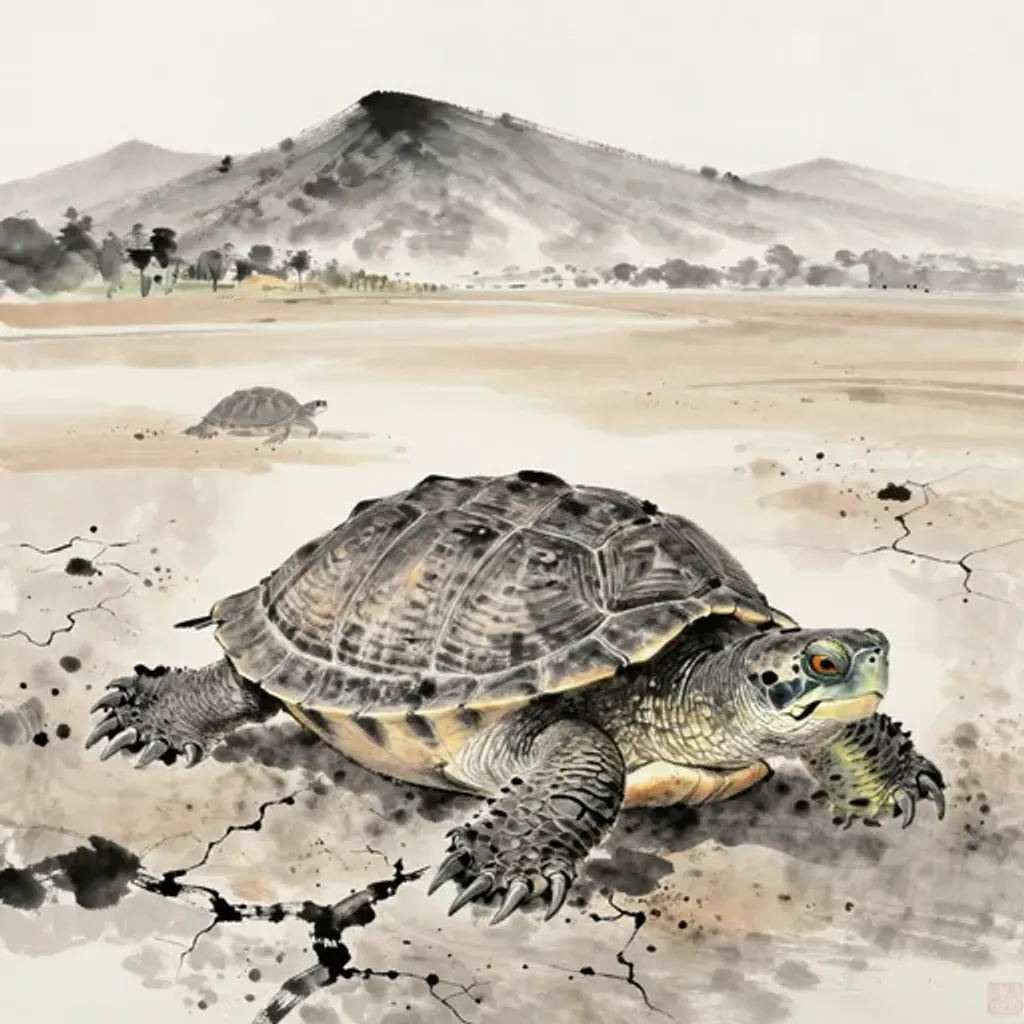
龜厭河海,陸行不止;自令枯槁,失其都市;憂悔為咎,亦無及已。
The turtle wearies of river and sea, walking on land without cease. It brings upon itself withering and desiccation, losing its city and market. Regret and remorse become its blame; nothing can undo it now.
— Jiao Yanshou, Yilin (Forest of Changes), 1st century BC
Commentary
Earth above heaven, Peace's creature abandons its element. A turtle grows weary of rivers and seas, choosing to travel overland without stopping. It desiccates itself, losing its native city. Regret and remorse become its burden, but it is already too late. The turtle — a water creature supreme — forsaking water for land is the image of radical self-destruction through misjudgment. One leaves the environment where one thrives and perishes in alien terrain. From Peace to Limitation, water rests above the lake, and the gentleman sets proper measures. The transformation makes the lesson explicit: the turtle died because it knew no limits. Limitation is not restriction but survival — knowing where one belongs.
泰 → 中孚
Hexagram 11 → Hexagram 61: Inner Truth
Changing lines: 3, 5, 6
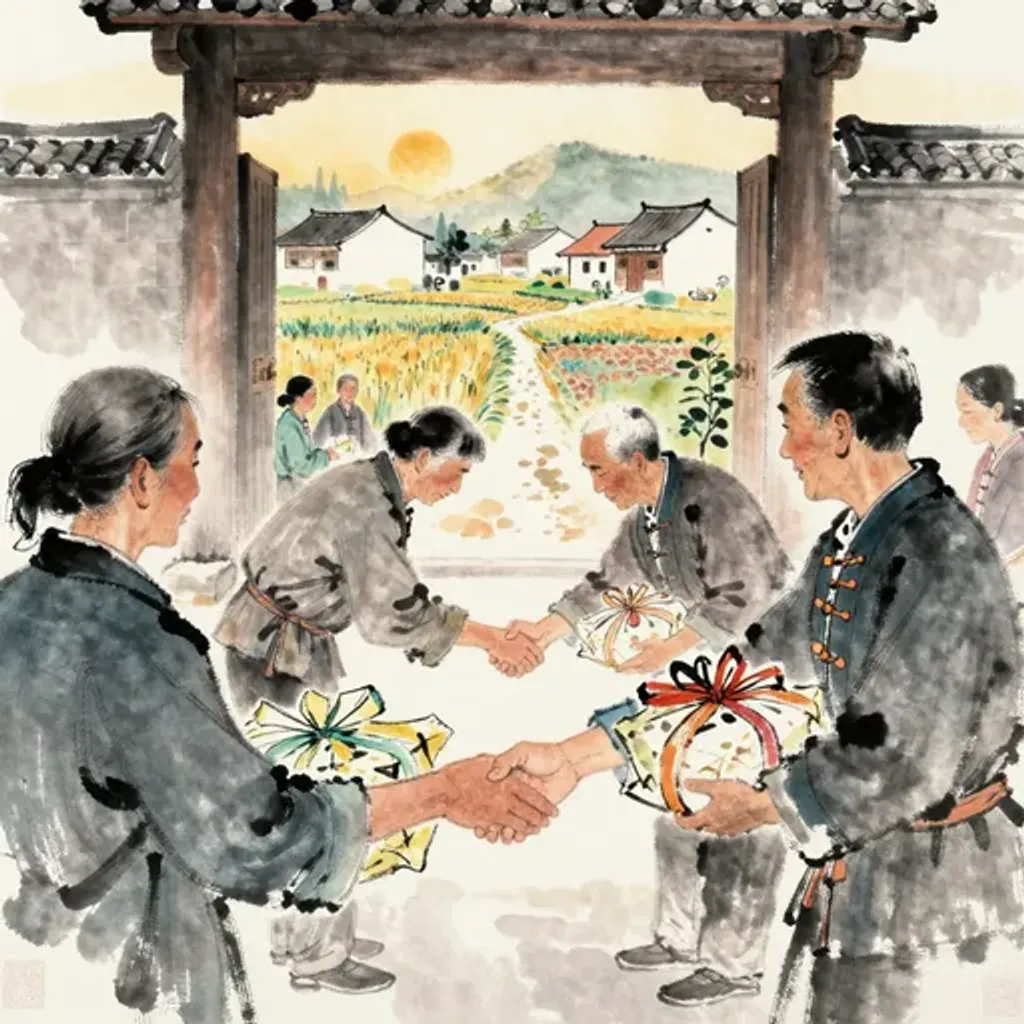
同本異業,樂仁政德;東鄰慕義,來興我國。
Same root, different callings, delighting in benevolence and virtuous rule. The eastern neighbor admires righteousness and comes to prosper our state.
— Jiao Yanshou, Yilin (Forest of Changes), 1st century BC
Commentary
Earth above heaven, Peace radiates moral magnetism. Those of the same root pursue different vocations, yet all delight in benevolent governance and virtue. The eastern neighbor, moved by this righteousness, comes to revitalize one's own state. The verse envisions a polity so well-governed that its virtue attracts voluntary allegiance from neighboring peoples — not through conquest but through the sheer appeal of good order. From Peace to Inner Truth, wind blows above the lake, and the gentleman deliberates cases of punishment with compassion. The transformation shows how outer harmony (Peace) deepens into inner sincerity (Inner Truth): when virtue is genuine, even distant peoples sense it and are drawn to participate.
泰 → 小過
Hexagram 11 → Hexagram 62: Small Exceeding
Changing lines: 1, 2, 4
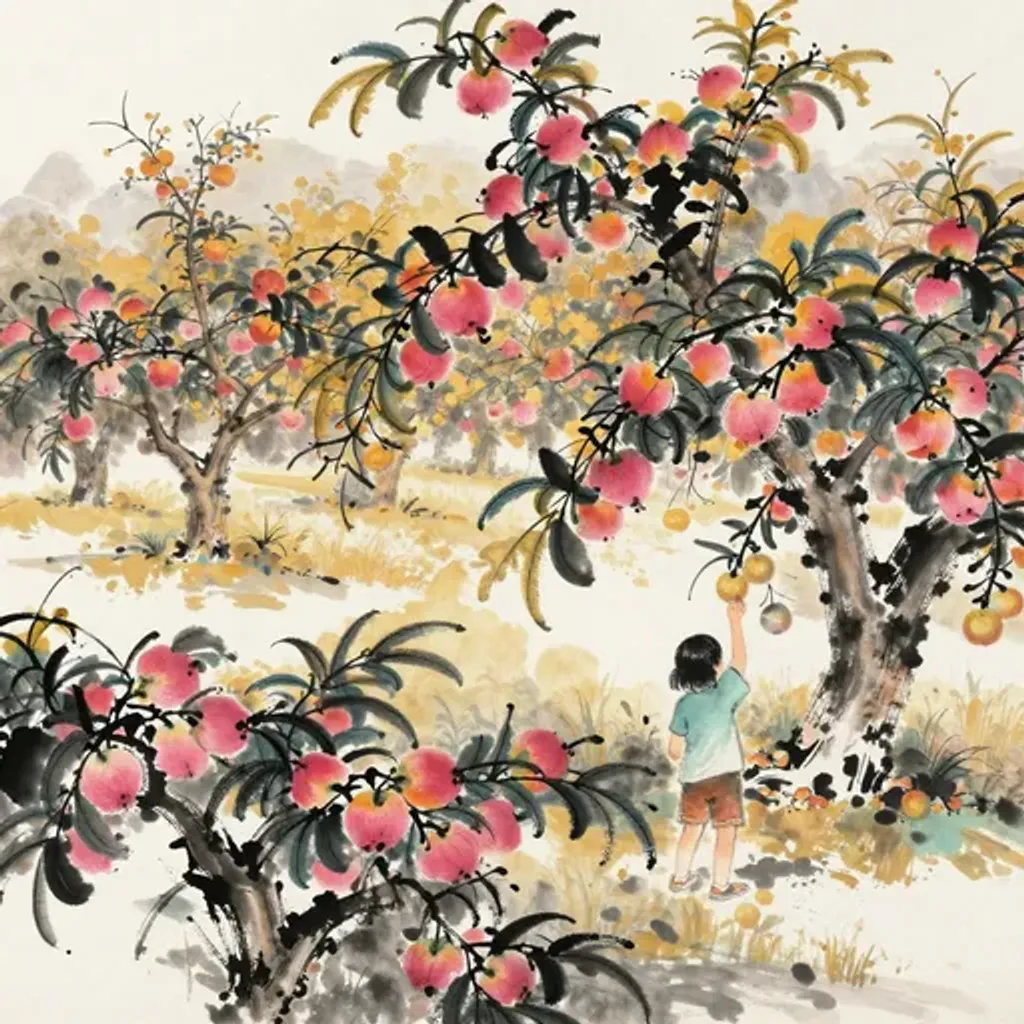
桃李花實,累累日息;長大成熟,甘美可食,為我利福。
Peach and plum bear flower and fruit, swelling day by day. Growing large and ripening; sweet and delicious, fit to eat. They become our blessing and gain.
— Jiao Yanshou, Yilin (Forest of Changes), 1st century BC
Commentary
Earth above heaven, Peace brings the orchard to fruition. Peach and plum trees produce their fruit in abundant clusters, growing larger and ripening day by day until they are sweet and ready to eat, becoming one's blessing and benefit. The verse is purely auspicious — no shadow, no complication, just the natural fulfillment of the growth cycle. Trees planted in fertile soil under favorable conditions produce exactly what they should. From Peace to Small Exceeding, thunder rumbles above the mountain, and the gentleman exceeds in reverence, grief, and frugality. The transformation adds a gentle caution to the abundance: even amid plenty, the small excess of care — a little more humility, a little more restraint — protects the harvest.
泰 → 既濟
Hexagram 11 → Hexagram 63: After Completion
Changing lines: 2, 5
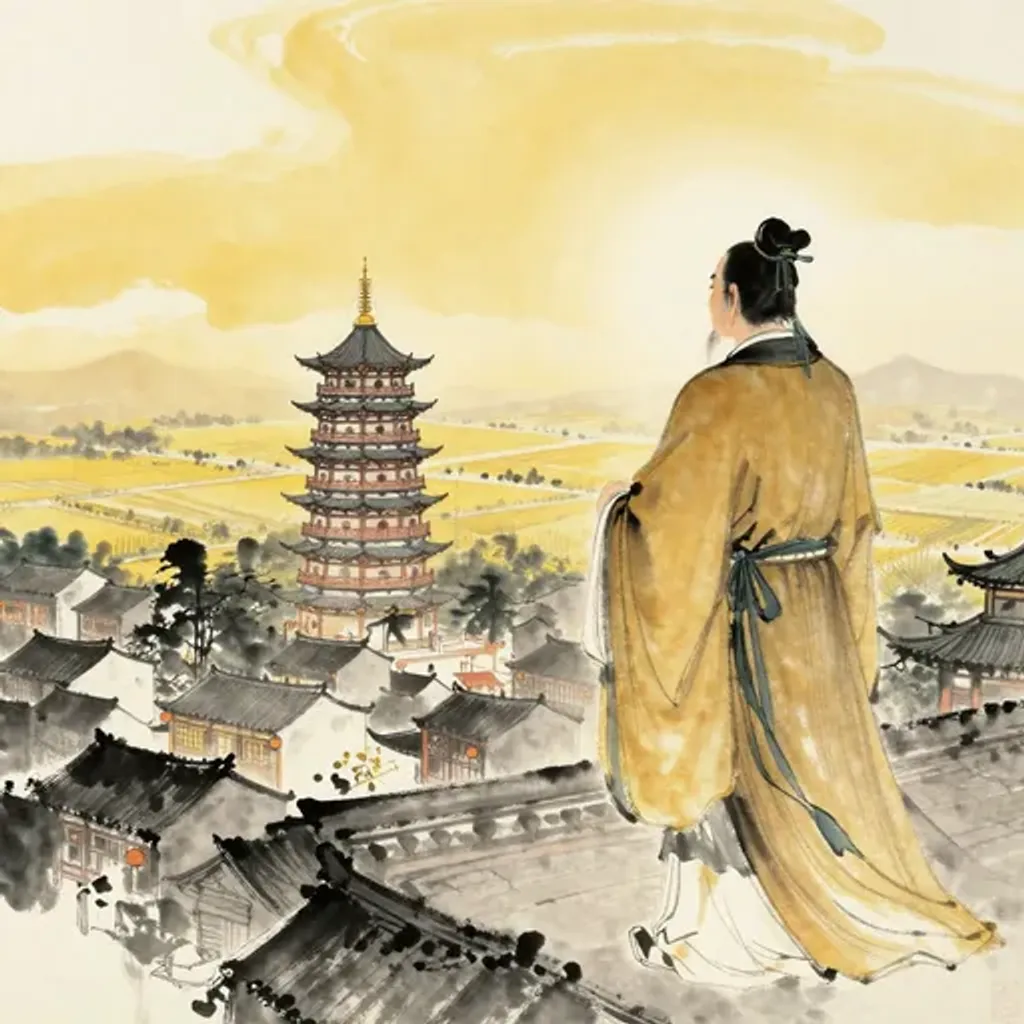
重瞳四乳,聰明順理;無隱不形,微視千里;災害不作,君子集聚。
Double pupils, four breasts, perceptive and wise, following natural order. Nothing hidden fails to appear; subtle vision spans a thousand miles. Disaster and harm do not arise; the worthy gather together.
— Jiao Yanshou, Yilin (Forest of Changes), 1st century BC
Commentary
Earth above heaven, Peace perfected in sage perception. 'Double pupils and four nipples' names the physical signs of Emperor Shun (double pupils) and King Wen (four nipples) — two sage-kings whose extraordinary vision penetrated all concealment. Nothing hidden fails to manifest; subtle perception reaches a thousand li. Calamities do not arise, and gentlemen gather in harmony. The verse combines Shun's clairvoyance with Wen's superhuman discernment to paint an age of total transparency and natural order. From Peace to After Completion, water sits above fire in perfect equipoise. The transformation shows Peace reaching its ideal terminus: every element in its proper place, sages assembled, all under heaven completed.
泰 → 未濟
Hexagram 11 → Hexagram 64: Before Completion
Changing lines: 1, 3, 4, 6
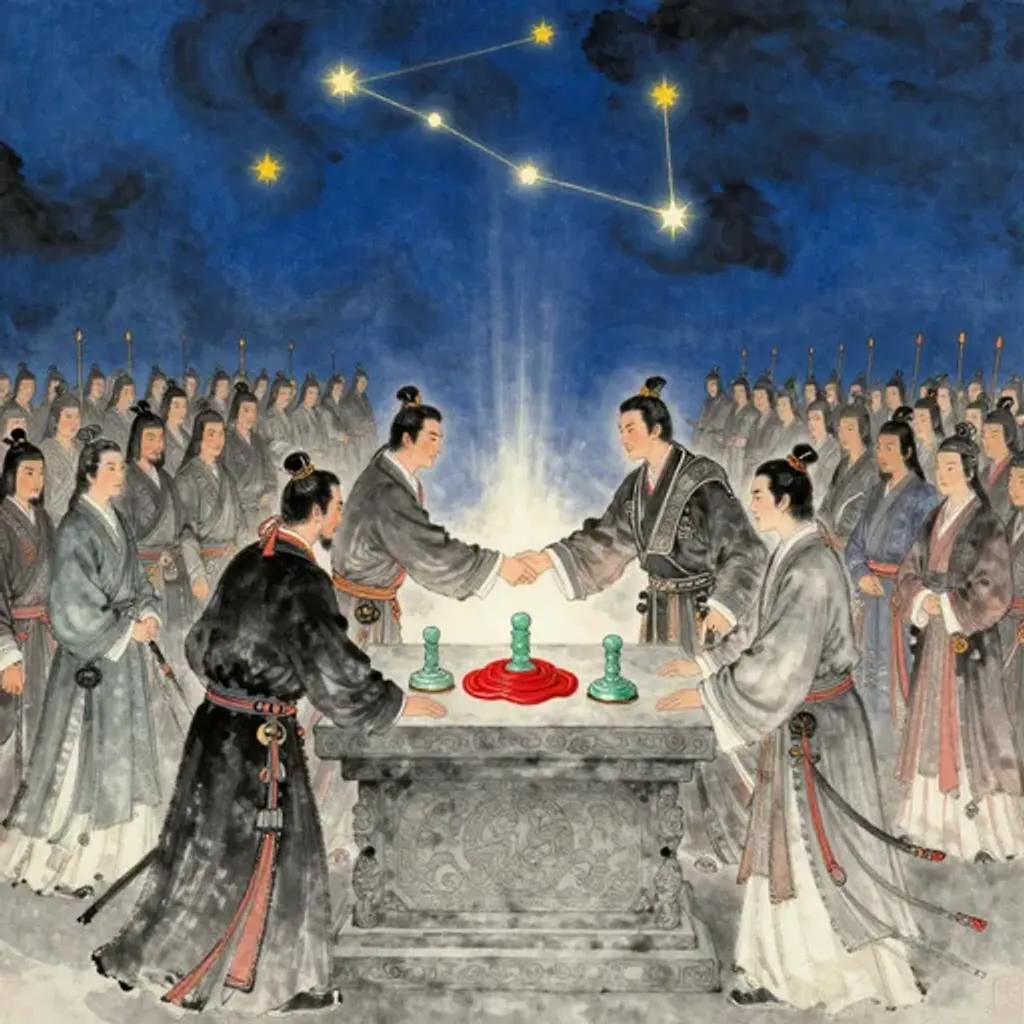
實沈參墟,以義討尤;次止結盟,以成霸功。
Shi Chen and the Shen constellation, by righteousness they punish the offender. Halting to form an alliance; thereby they achieve a hegemon's glory.
— Jiao Yanshou, Yilin (Forest of Changes), 1st century BC
Commentary
Earth above heaven, Peace ratified through astral mandate and alliance. 'Shichen at the Shen constellation's field' invokes the Zuo Zhuan tradition (Duke Zhao Year 1): Shichen, son of the high god Gaoxin, presided over the Shen star, which became the astral patron of the state of Jin. 'By righteousness the offender is punished' — just war is waged under heaven's sanction. The armies halt, a covenant is sealed, and hegemonic achievement follows. From Peace to Before Completion, fire hovers above water, and the gentleman discerns things to place them properly. The transformation shows that even a triumphant alliance remains a work in progress: the covenant is signed, but the final crossing is yet to be made.