Transformations of Hexagram 13
Every line of change out of Hexagram 13 同人 Fellowship, with the Yilin verse for each of the 64 resulting hexagrams, its translation, and the original ink brush artwork.
同人 → 乾
Hexagram 13 → Hexagram 1: The Creative
Changing lines: 2
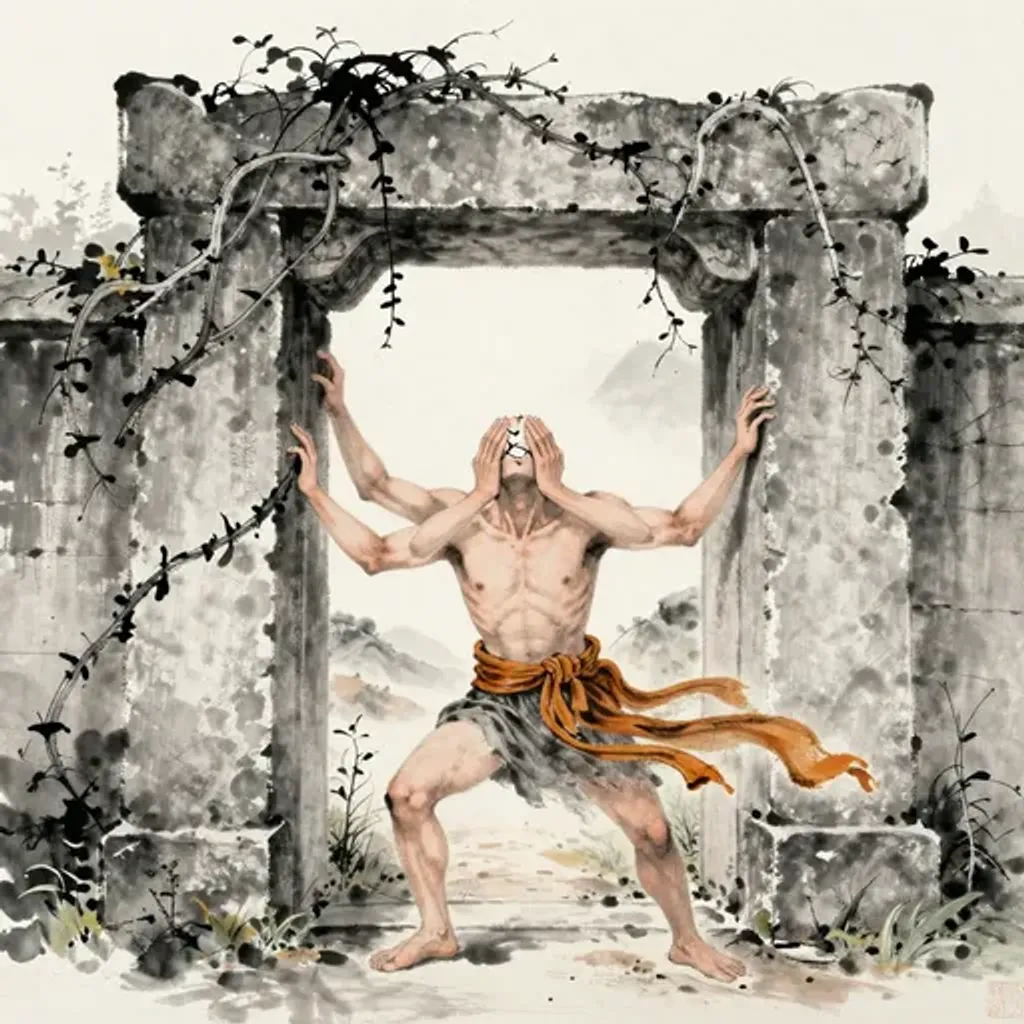
一臂六手,不便於口;莫肯與用,利棄我走。
One arm, six hands, yet none can reach the mouth. No one will lend their use; better to cast me aside and flee.
— Jiao Yanshou, Yilin (Forest of Changes), 1st century BC
Commentary
Heaven and fire rise together in Fellowship, yet here the collective fractures beyond repair. A creature with one arm and six hands cannot feed its own mouth — too many limbs, no coordination, each grasping finger working against the others. No one will cooperate; all abandon the enterprise and flee. The image captures a group so dysfunctional that its very structure defeats its purpose. From Fellowship to the Creative, the transformation is stark: what should become unified self-generating power instead scatters, because fellowship without shared purpose produces only grotesque multiplicity. The Creative's ceaseless strength demands singular will; a six-handed body pulling in every direction achieves nothing.
同人 → 坤
Hexagram 13 → Hexagram 2: The Receptive
Changing lines: 1, 3, 4, 5, 6
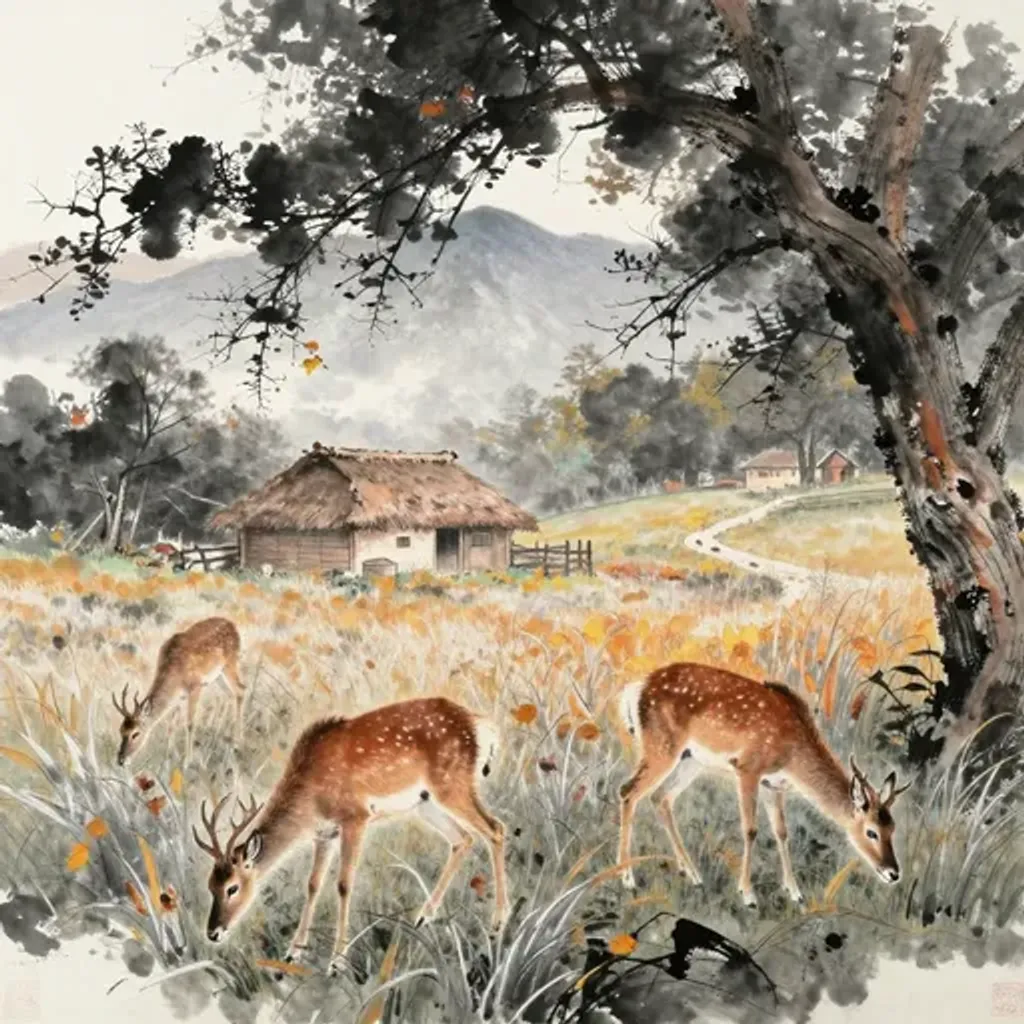
獐鹿逐牧,飽歸其居。安寧無悔。
Deer and antelope follow the pasture, sated, they return to their abode. Peaceful and without regret.
— Jiao Yanshou, Yilin (Forest of Changes), 1st century BC
Commentary
Heaven and fire unite in Fellowship as deer follow their herd to pasture. Deer and roe graze contentedly, then return full-bellied to their dens — peaceful, secure, free of regret. The scene is purely pastoral: animals that move together, feed together, and rest together without anxiety. From Fellowship to the Receptive, the transformation distills community into its gentlest form. Where the Creative strives, the Receptive receives; where fire blazes upward, earth absorbs and sustains. The deer need no ambition, only the thick virtue of the earth that carries all things. Fellowship here finds its quietest expression — not heroic alliance but the simple contentment of creatures sharing ground.
同人 → 屯
Hexagram 13 → Hexagram 3: Difficulty at the Beginning
Changing lines: 3, 4, 6
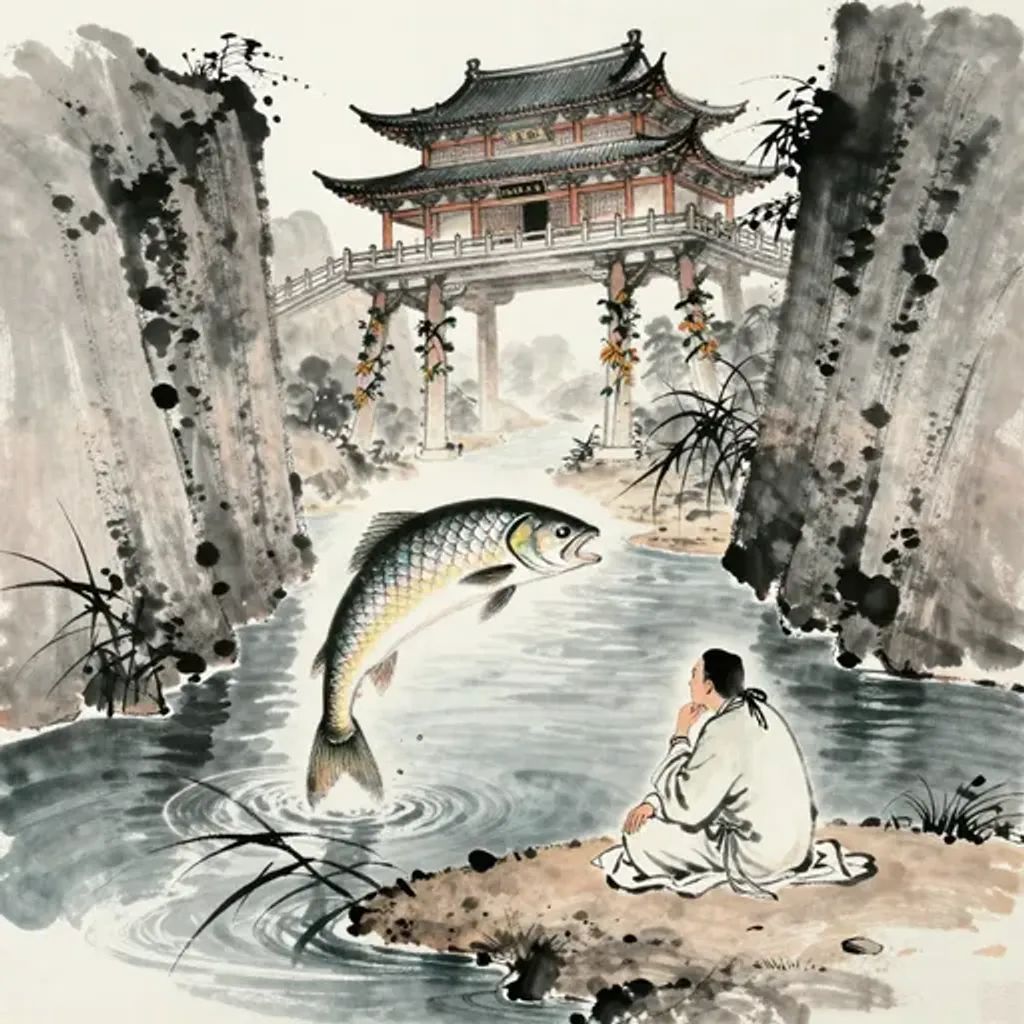
鴻魚逆流,至人潛渚;蓬蒿代柱,大屋顛倒。
Great fish leap against the current; the worthy man hides at the sandbar. Mugwort replaces the pillars; the great hall topples upside down.
— Jiao Yanshou, Yilin (Forest of Changes), 1st century BC
Commentary
Heaven and fire form Fellowship, but here everything runs against its nature. Great fish swim upstream against the current while the wise man submerges himself at a river bend, hiding from chaos. Wormwood and mugwort replace the pillars of a great house, and the structure topples. The imagery is systematic inversion: what should flow downward fights upward; what should support a roof is flimsy brush. From Fellowship to Difficulty at the Beginning, the transformation captures a world where natural order has collapsed. Cloud and thunder churn together as the noble man weaves order from confusion — but here, before that weaving begins, the old structure has already fallen, its supports rotted from within.
同人 → 蒙
Hexagram 13 → Hexagram 4: Youthful Folly
Changing lines: 1, 2, 3, 4, 5
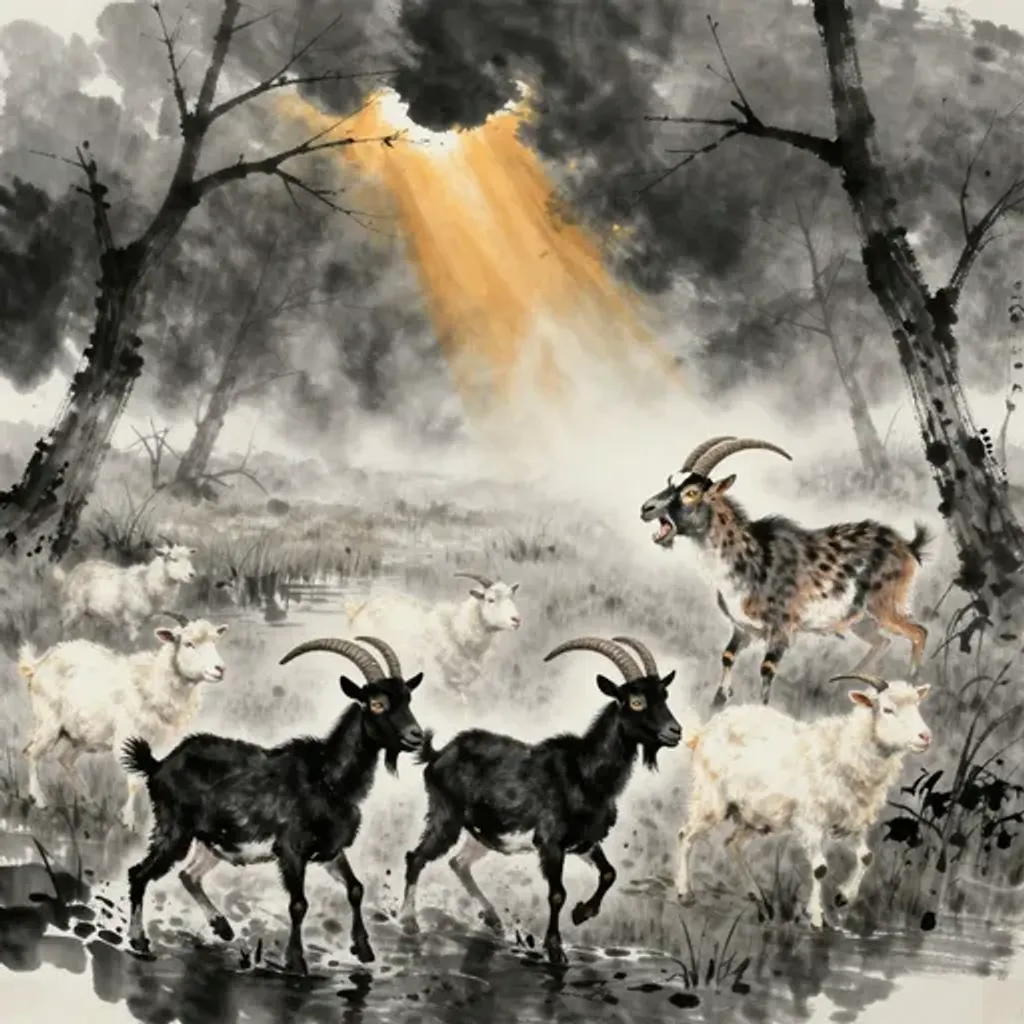
三羖五牂,相隨俱行;迷入空澤,經涉六駮,為所傷賊。
Three black bucks, five white ewes, following one another in a line. Straying into an empty marsh, they pass through dappled beasts and are wounded and preyed upon.
— Jiao Yanshou, Yilin (Forest of Changes), 1st century BC
Commentary
Heaven and fire form Fellowship, but the flock wanders into peril. Three black rams and five ewes travel together, straying into an empty marsh where they encounter the liubo — a fearsome spotted beast of legend. The animals are mauled and harmed. Fellowship degenerates when the group lacks discernment: these sheep follow one another blindly into dangerous terrain. From Fellowship to Youthful Folly, the transformation exposes the cost of naive togetherness. Mountain over water, a spring emerging from beneath a cliff — the young must learn through painful encounter. The flock's collective ignorance leads them precisely where predators wait, and the marsh that seemed empty conceals teeth.
同人 → 需
Hexagram 13 → Hexagram 5: Waiting
Changing lines: 2, 4, 6
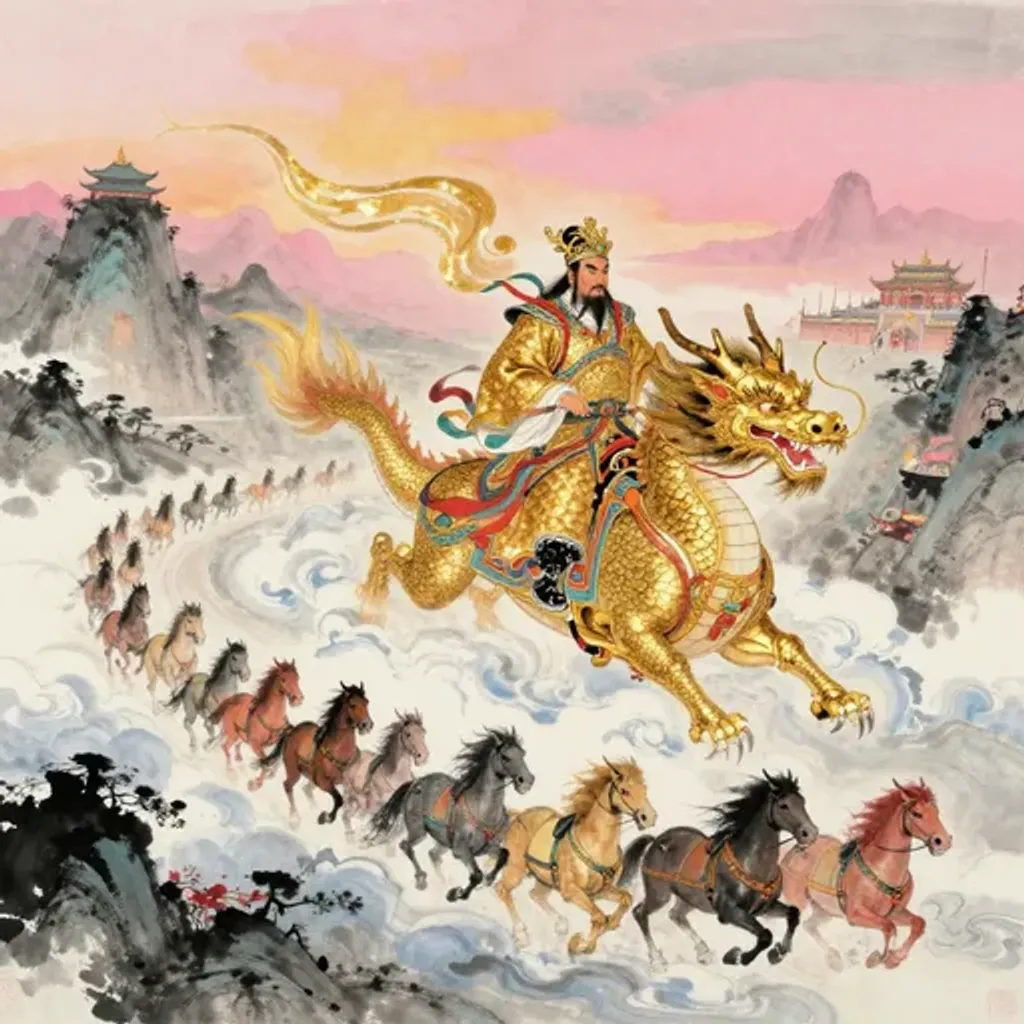
黃帝出遊,駕龍乘馬;東上太山,南過齊魯。邦國咸喜。
The Yellow Emperor sets out on tour, riding dragons and driving horses. East to the summit of Mount Tai; south past Qi and Lu. All the realm rejoices.
— Jiao Yanshou, Yilin (Forest of Changes), 1st century BC
Commentary
Heaven and fire blaze together in Fellowship as the Yellow Emperor sets out on his grand tour. Riding dragons and driving horses, he ascends Mount Tai in the east, then sweeps south through the lands of Qi and Lu. Every state and district rejoices at his passage. This is the primordial inspection tour — the sage-ruler moving through his domain, and the domain responding with spontaneous delight. From Fellowship to Waiting, the transformation shifts from active communion to patient confidence. Clouds gather above heaven in Waiting; the ruler who has already united the realm can afford to pause, feast, and let blessings ripen in their own time.
同人 → 訟
Hexagram 13 → Hexagram 6: Conflict
Changing lines: 1, 2, 3
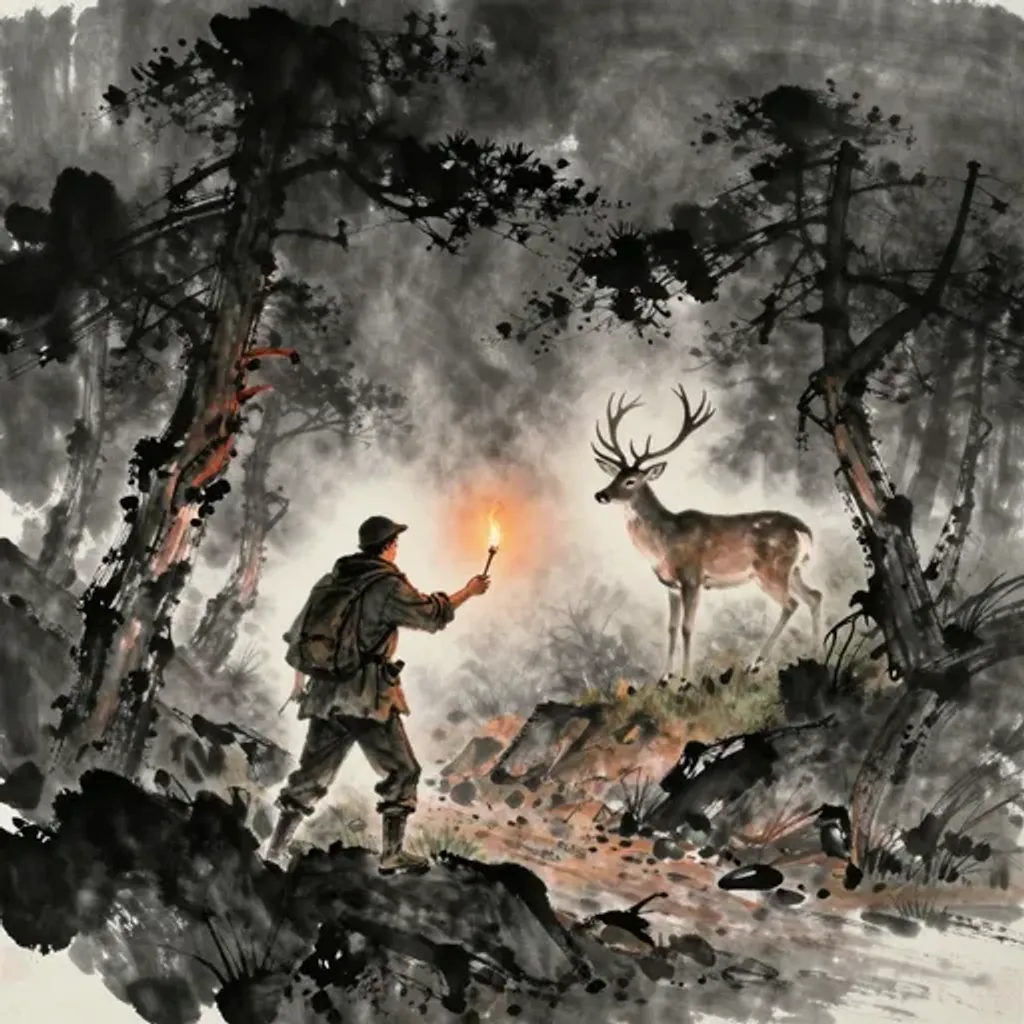
履危不安,心欲東西;步走逐鹿,空無所得。
Treading danger, finding no peace; the heart yearns east and west. Running in pursuit of deer; the chase yields nothing at all.
— Jiao Yanshou, Yilin (Forest of Changes), 1st century BC
Commentary
Heaven and fire form Fellowship, but the ground underfoot is treacherous. Treading on danger, the heart finds no peace, pulled in all directions at once. A man chases a deer at full sprint — east then west, exhausting himself — and catches nothing. The verse captures futile pursuit under duress: the quarry is imaginary, the effort real, and the anxiety corrosive. From Fellowship to Conflict, the transformation reveals how communal purpose curdles into contention. Heaven and water move in opposite directions in Conflict; the gentleman plans carefully at the beginning of every enterprise. Here, no such forethought exists — only desperate running and empty hands.
同人 → 師
Hexagram 13 → Hexagram 7: The Army
Changing lines: 1, 2, 3, 4, 5, 6
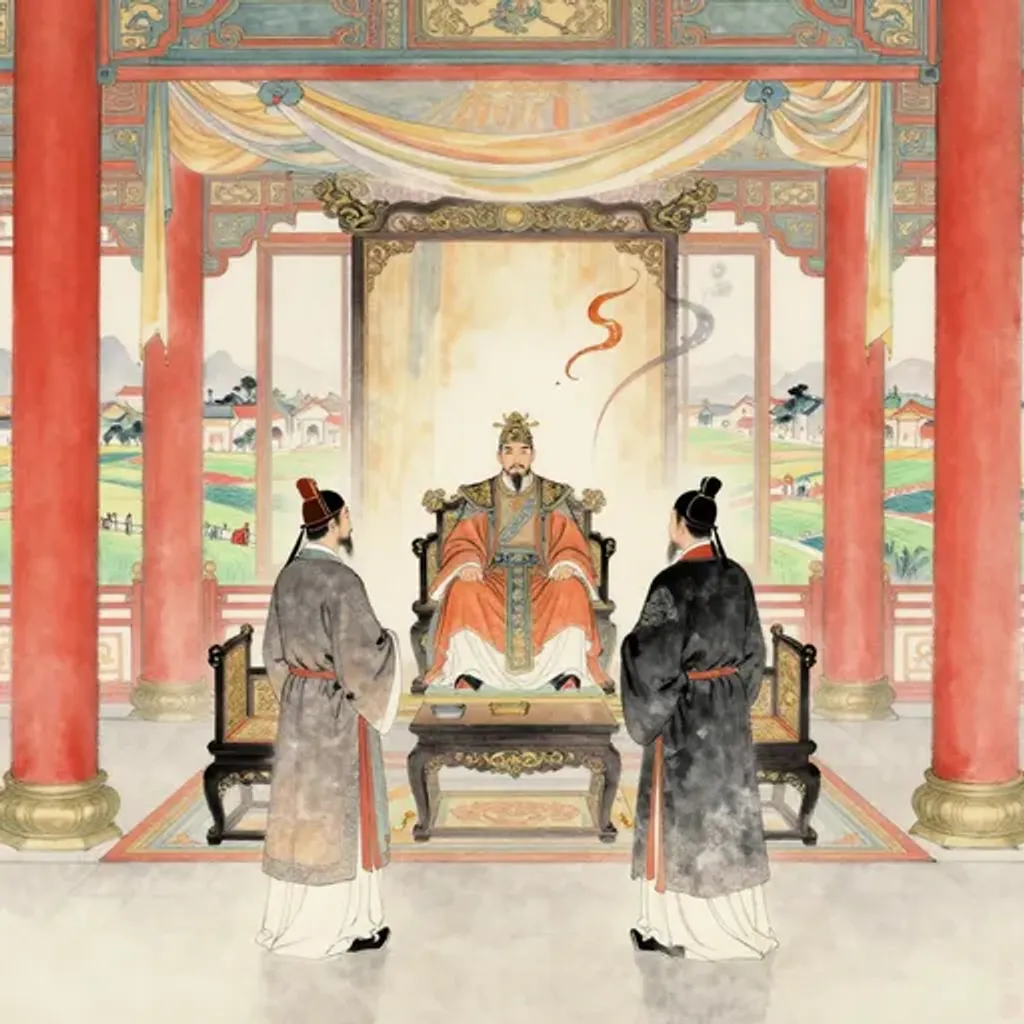
望尚阿衡,太宰周公;藩屏湯武,立為侯王。
Looking up to the esteemed Yi Yin, Grand Steward the Duke of Zhou. Shielding Tang and Wu as bulwark; they were established as feudal lords.
— Jiao Yanshou, Yilin (Forest of Changes), 1st century BC
Commentary
Heaven and fire illuminate Fellowship's noblest form: the sage minister who shields and uplifts the realm. The verse invokes Yi Yin, titled Aheng, who rose from cookery to counsel King Tang of Shang, and the Duke of Zhou, Grand Steward, who stabilized the young Zhou state. These paragons served as 'screens and shields' for Tang and Wu, transforming their lords into true kings. From Fellowship to the Army, the transformation shifts from shared vision to disciplined mobilization. Water hidden within the earth, the Army's image, shows that genuine military power flows from the people's trust — and that trust is built by ministers of the caliber here celebrated.
同人 → 比
Hexagram 13 → Hexagram 8: Holding Together
Changing lines: 1, 3, 4, 6
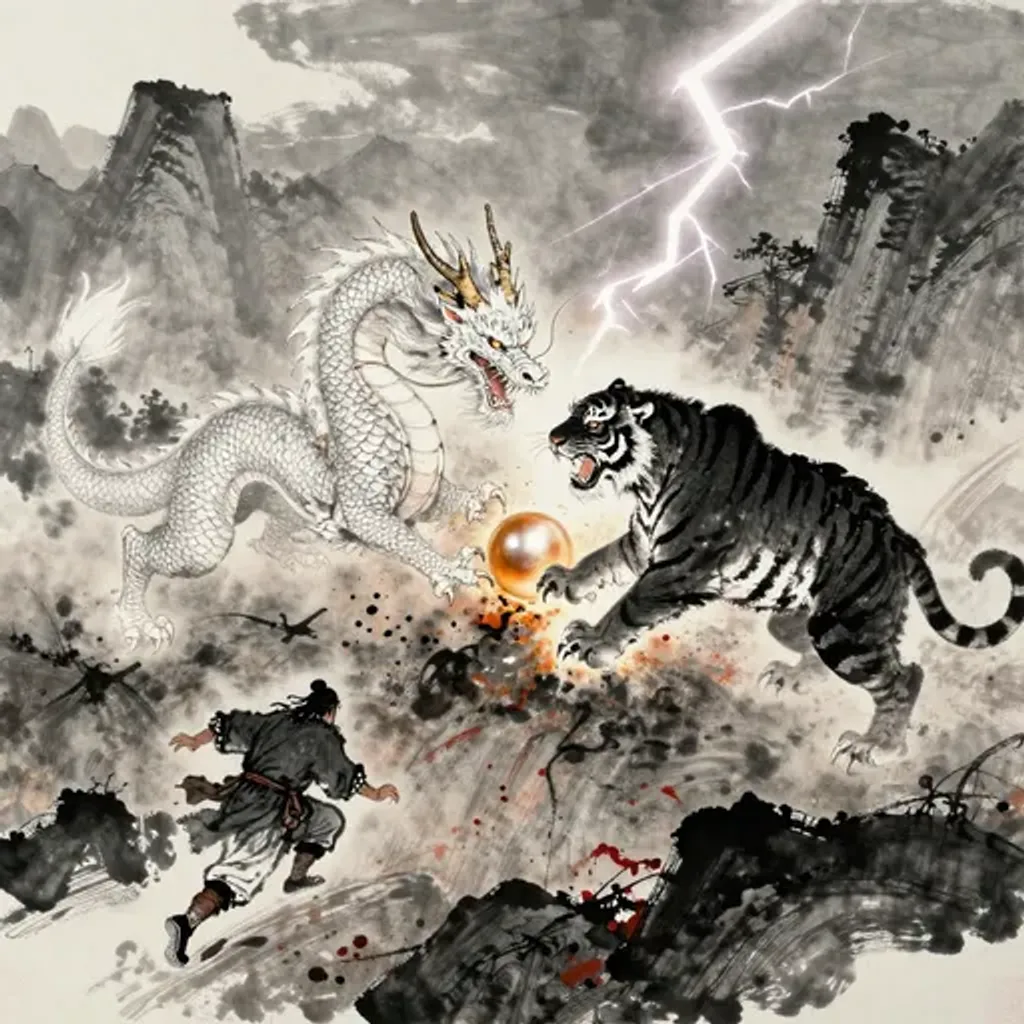
白龍黑虎,起伏俱怒,戰於阪兆;蚩尤走敗,死於魯首。
White dragon, black tiger, both rise in fury. They clash upon the hillside. Chi You flees in defeat and dies at Lushou.
— Jiao Yanshou, Yilin (Forest of Changes), 1st century BC
Commentary
Heaven and fire form Fellowship, but here fellowship is forged through cosmic battle. A white dragon and black tiger rise together in fury, clashing on the slopes. This evokes the Yellow Emperor's primordial war against Chi You — the foundational conflict that established civilization itself. Chi You flees in defeat and dies at Lushou. The violence is not gratuitous but generative: from this battle, order emerges. From Fellowship to Holding Together, the transformation reveals that unity sometimes requires the expulsion of chaos. Water rests upon the earth in Holding Together as the ancient kings established the myriad states. Only after the raging beast is slain can the nations gather in peace.
同人 → 小畜
Hexagram 13 → Hexagram 9: Small Taming
Changing lines: 2, 4
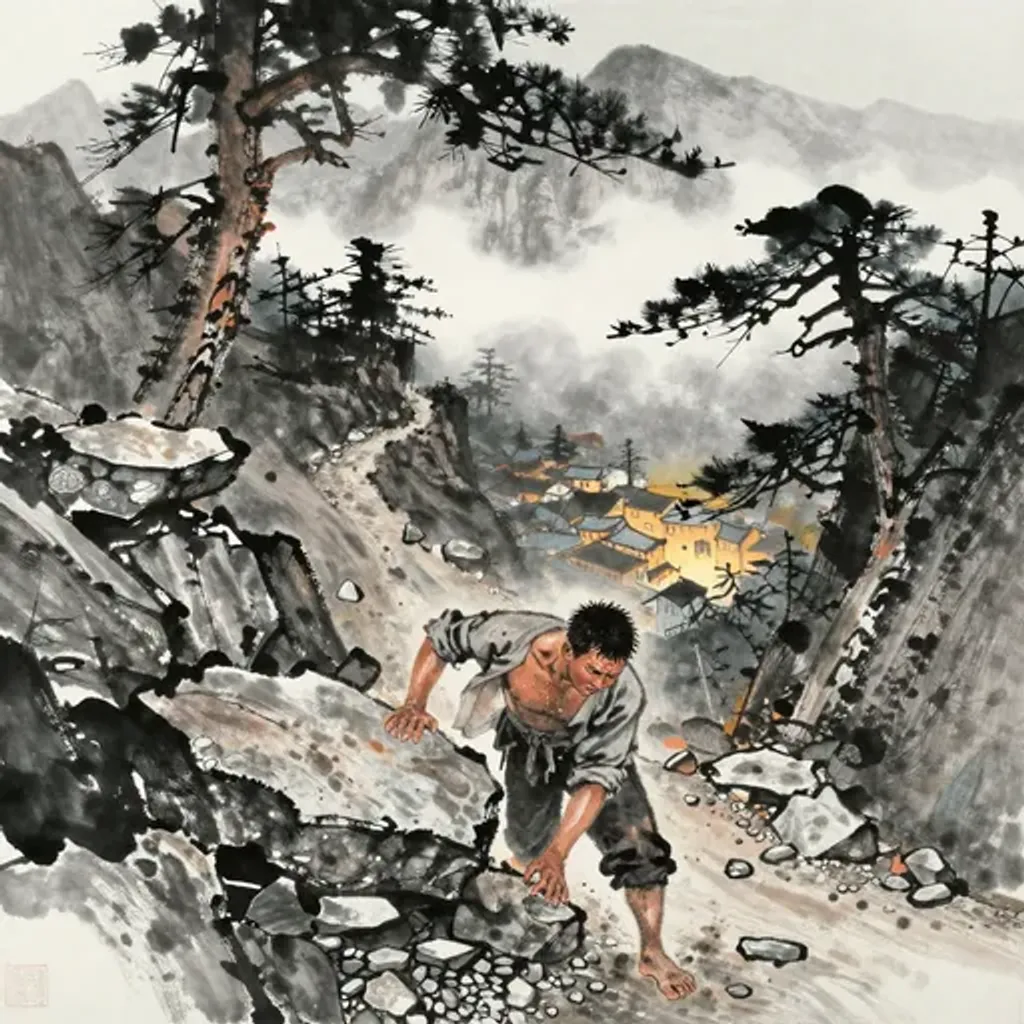
載石上山,步跌不前;嚬眉之憂,不得所歡。
Hauling stones up the mountain; one stumbles and cannot advance. With furrowed brow and worry; one finds no joy.
— Jiao Yanshou, Yilin (Forest of Changes), 1st century BC
Commentary
Heaven and fire form Fellowship, but the burden crushes the will. Carrying stones uphill, the traveler stumbles and cannot advance — brow furrowed deep in worry, joy nowhere to be found. The image is pure Sisyphean labor: a task that defies the body's limits, gravity always winning, each step harder than the last. From Fellowship to Small Taming, the transformation reveals the frustration of gentle restraint applied to overwhelming force. Wind moves across heaven in Small Taming, refining civil virtue through patience. But the verse shows the underside of that patience — when the load exceeds what softness can manage, even fellowship cannot lighten the stone.
同人 → 履
Hexagram 13 → Hexagram 10: Treading
Changing lines: 2, 3
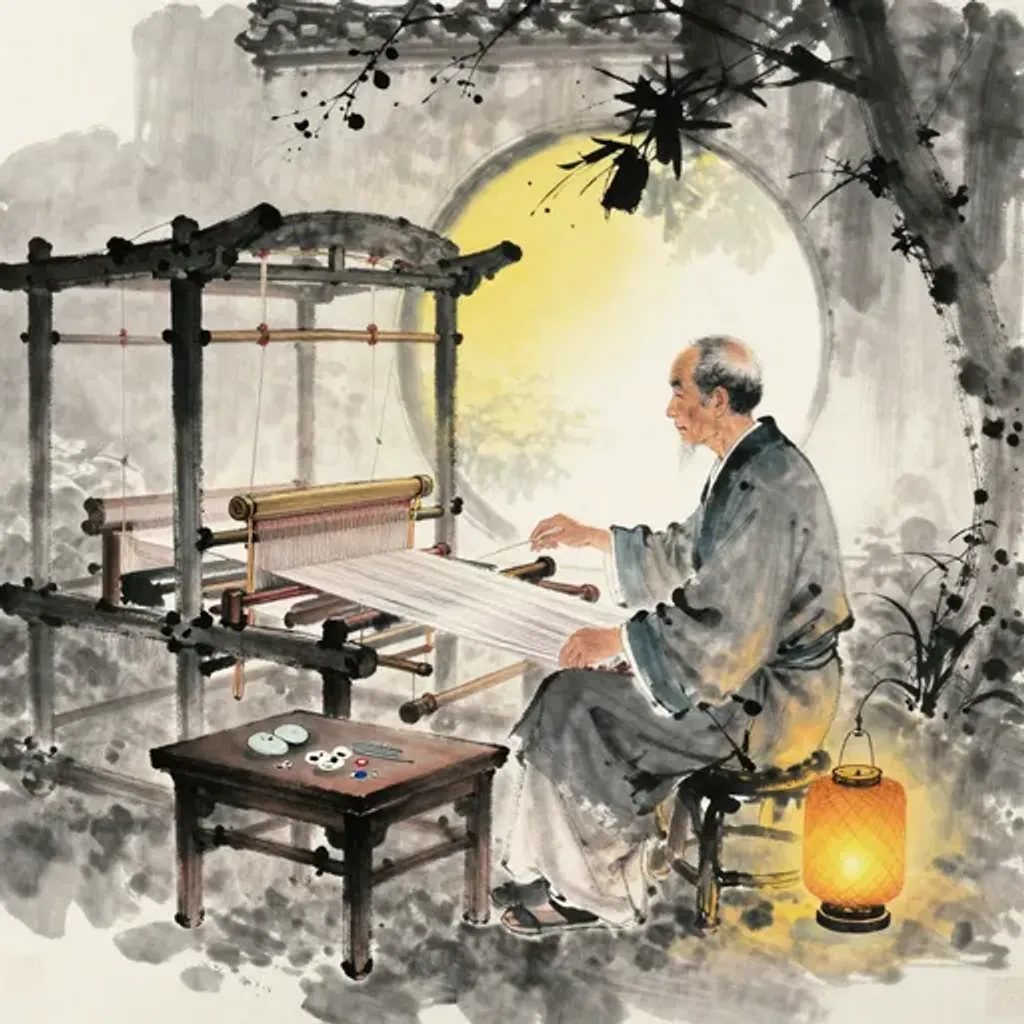
周德既成,杼軸不傾;申酉趺暮,耋老衰去,箴石不祐。
The virtue of Zhou complete; loom and shuttle do not fail. Shen and You bring the twilight of old age; aged and worn, one declines. Acupuncture stones bring no aid.
— Jiao Yanshou, Yilin (Forest of Changes), 1st century BC
Commentary
Heaven and fire form Fellowship, but time undoes what virtue built. The virtue of Zhou is complete, the loom stands upright and does not tip — the state's fabric holds. Then the verse shifts to autumn's decline: by the hours of shen and you the day wanes, and the aged grow frail and depart. Acupuncture stones no longer help; medicine cannot restore what age has taken. From Fellowship to Treading, the transformation captures the passage from communal achievement to individual reckoning. Heaven above the lake, one must distinguish high from low. Zhou's collective virtue endures, but each person must still walk their own path into twilight, and that path does not bend to remedies.
同人 → 泰
Hexagram 13 → Hexagram 11: Peace
Changing lines: 2, 4, 5, 6
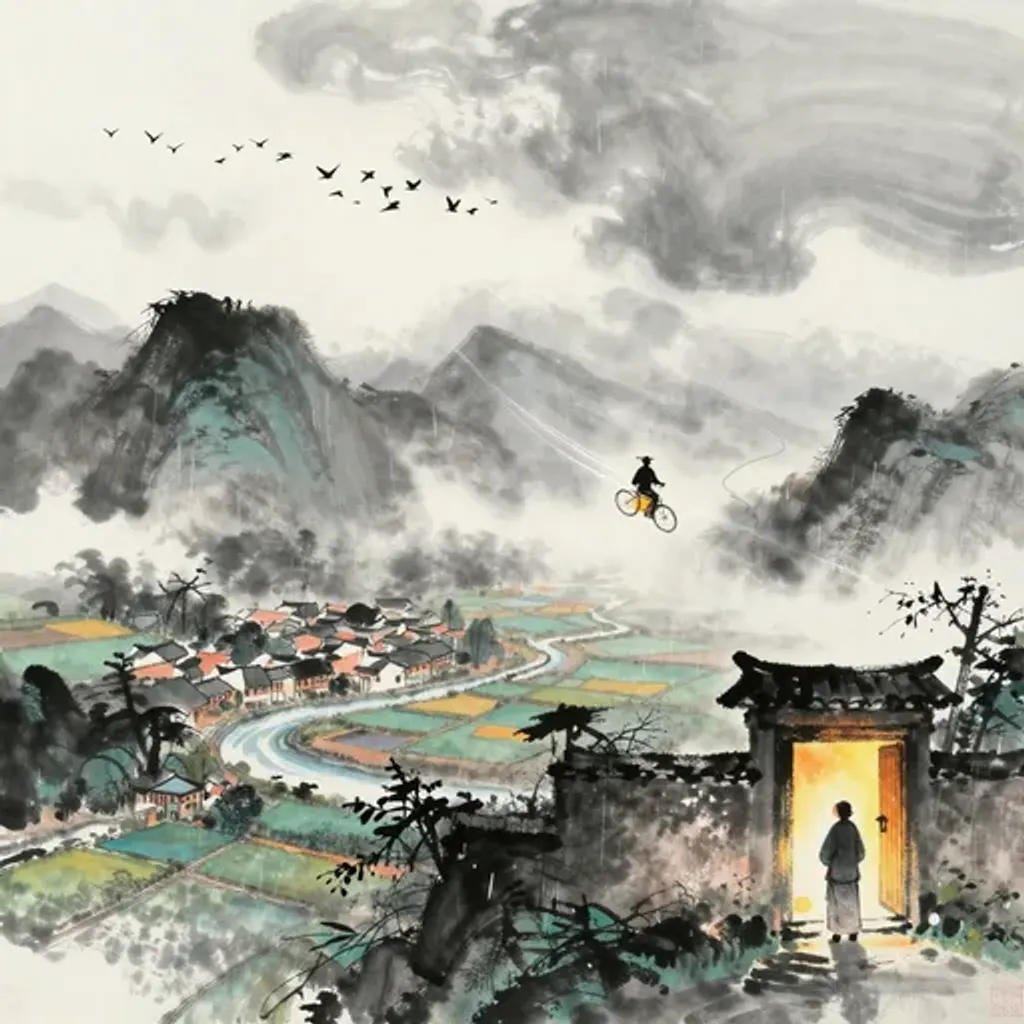
乘雲帶雨,與飛鳥俱;動舉千里,見我慈母。
Riding clouds and bringing rain, traveling with the birds. Moving a thousand miles; one sees one's dear mother.
— Jiao Yanshou, Yilin (Forest of Changes), 1st century BC
Commentary
Heaven and fire form Fellowship, and here that communion takes flight. Riding clouds and trailing rain, soaring alongside birds, covering a thousand li in a single movement — all to reach a beloved mother. The imagery is ecstatic: not earthbound fellowship but aerial reunion, the longing traveler carried by storm and wing toward the one bond that transcends distance. From Fellowship to Peace, the transformation is seamless. Heaven and earth intermingle in Peace as the ruler channels nature's rhythms for the people's benefit. The son riding clouds to his mother enacts that cosmic embrace — heaven descending, earth rising, the two meeting in joyful union.
同人 → 否
Hexagram 13 → Hexagram 12: Standstill
Changing lines: 1, 3
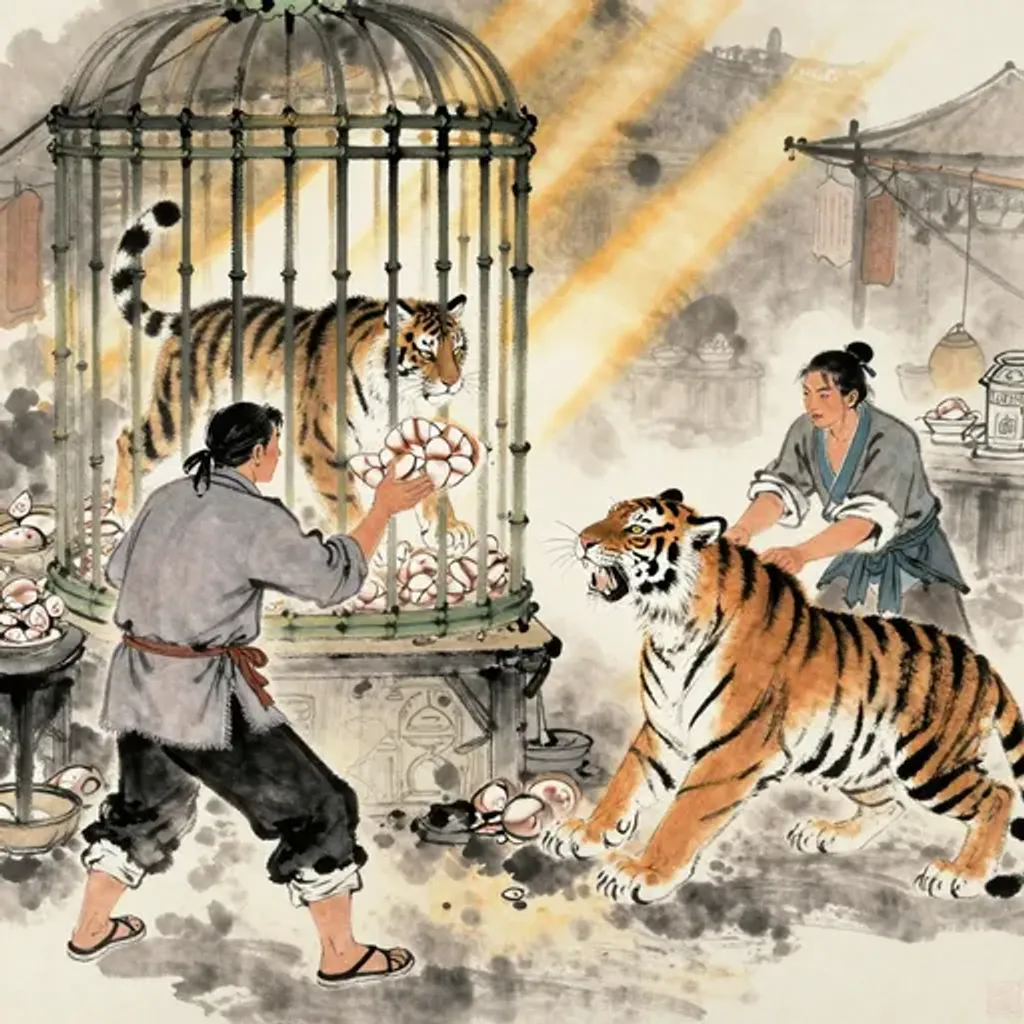
齎貝贖狸,不聽我辭;繫我虎鬚,牽不得來。
Offering cowries to ransom a wildcat; it will not heed my words. Tied to the tiger's whiskers; pull as one might, it will not come.
— Jiao Yanshou, Yilin (Forest of Changes), 1st century BC
Commentary
Heaven and fire form Fellowship, but negotiation here meets immovable resistance. One offers cowrie shells to ransom a civet cat, yet the other party refuses to listen. Then the verse escalates: grasping a tiger by its whiskers, pulling with all one's might, unable to drag it forward. The progression moves from failed trade to futile force — neither persuasion nor strength can compel what will not yield. From Fellowship to Standstill, the transformation is exact. Heaven and earth do not communicate in Standstill; the gentleman conserves virtue and avoids entanglement. Fellowship attempted and rebuffed becomes mutual withdrawal — the tiger's whiskers a perfect image of power that cannot be seized.
同人 → 同人
Hexagram 13 → Hexagram 13: Fellowship
No changing lines — the hexagram is unchanged
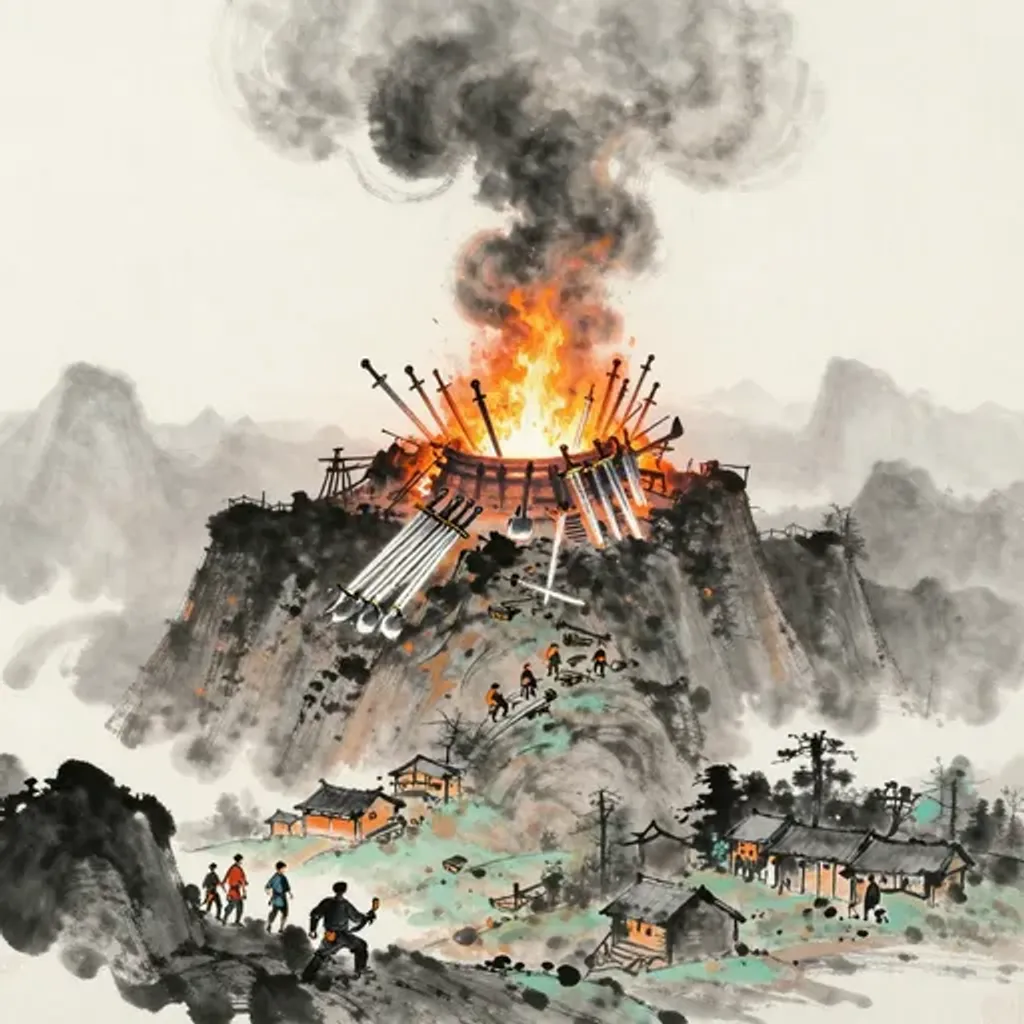
密橐山巔,銷鋒鑄刃;示不復用,天下大勸。
Weapons sealed on the mountaintop; blades melted, edges reforged. Shown never to be used again; all under heaven is greatly inspired.
— Jiao Yanshou, Yilin (Forest of Changes), 1st century BC
Commentary
Heaven and fire form Fellowship, and here Fellowship returns to itself — source and target are the same hexagram. Weapons are sealed in leather bags and hidden on mountaintops; blades are melted down and recast as tools. This gesture declares to the world: arms shall not be used again, and all under heaven are greatly encouraged. The image echoes the ancient ideal of ceasing warfare to cultivate civil virtue. When Fellowship meets Fellowship, the redundancy becomes reinforcement: shared purpose so complete that even the instruments of conflict are permanently retired. Fire rises to heaven and heaven blazes with fire — pure communal illumination, with nothing left to fight over.
同人 → 大有
Hexagram 13 → Hexagram 14: Great Possession
Changing lines: 2, 5
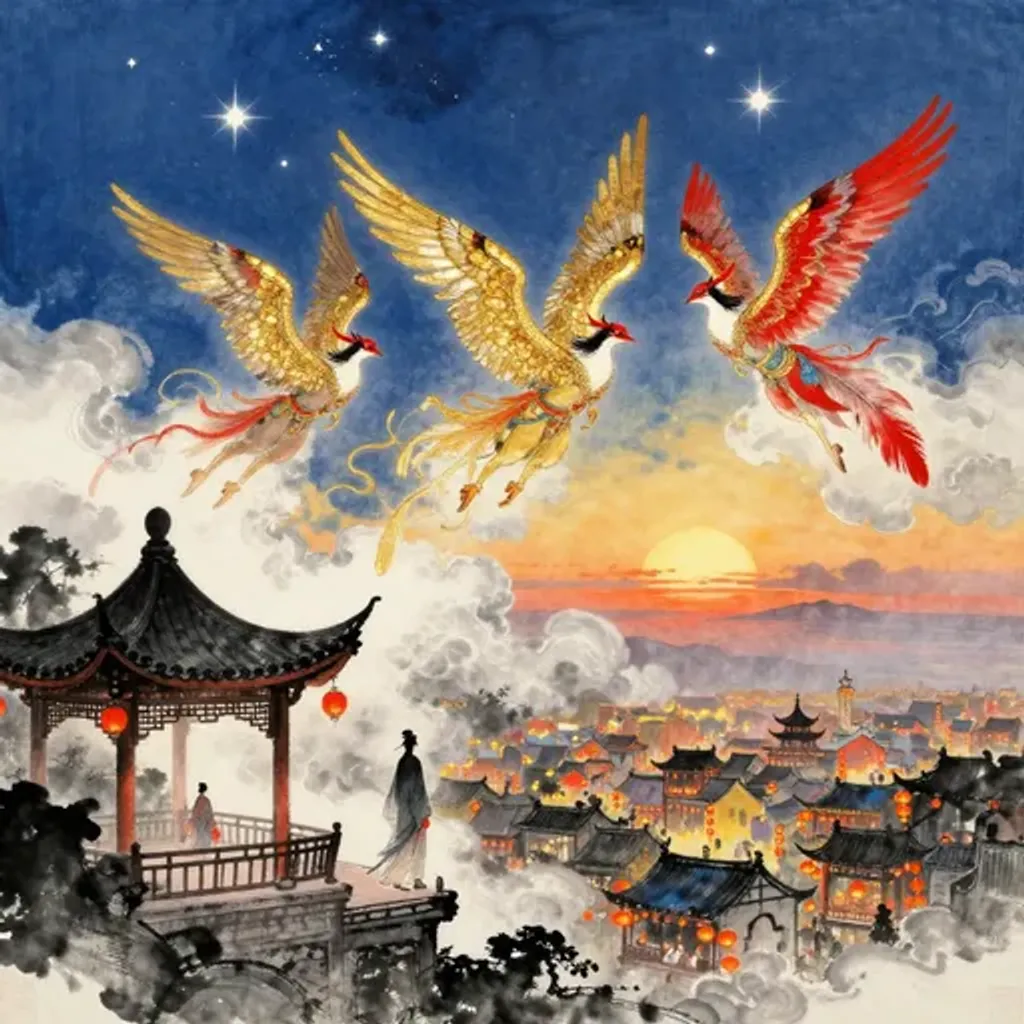
三翼飛來,是我逢時;俱行先至,多得大利。
Three winged ones fly to us; this is our moment of fortune. Traveling together, arriving first; we gain great profit.
— Jiao Yanshou, Yilin (Forest of Changes), 1st century BC
Commentary
Heaven and fire form Fellowship, and here good timing multiplies success. Three winged creatures arrive together — this is my moment of fortune. Traveling in company, arriving first, gaining great profit. The verse is brisk and jubilant: auspicious omens appear in triplicate, timing aligns, and collective effort yields outsized reward. From Fellowship to Great Possession, the transformation is natural amplification. Fire blazes above heaven in Great Possession as the noble man suppresses evil and promotes good. Fellowship's shared endeavor, when it catches the right current, produces abundance — not through hoarding but through the momentum of aligned purpose arriving precisely when the world is ready.
同人 → 謙
Hexagram 13 → Hexagram 15: Modesty
Changing lines: 1, 4, 5, 6
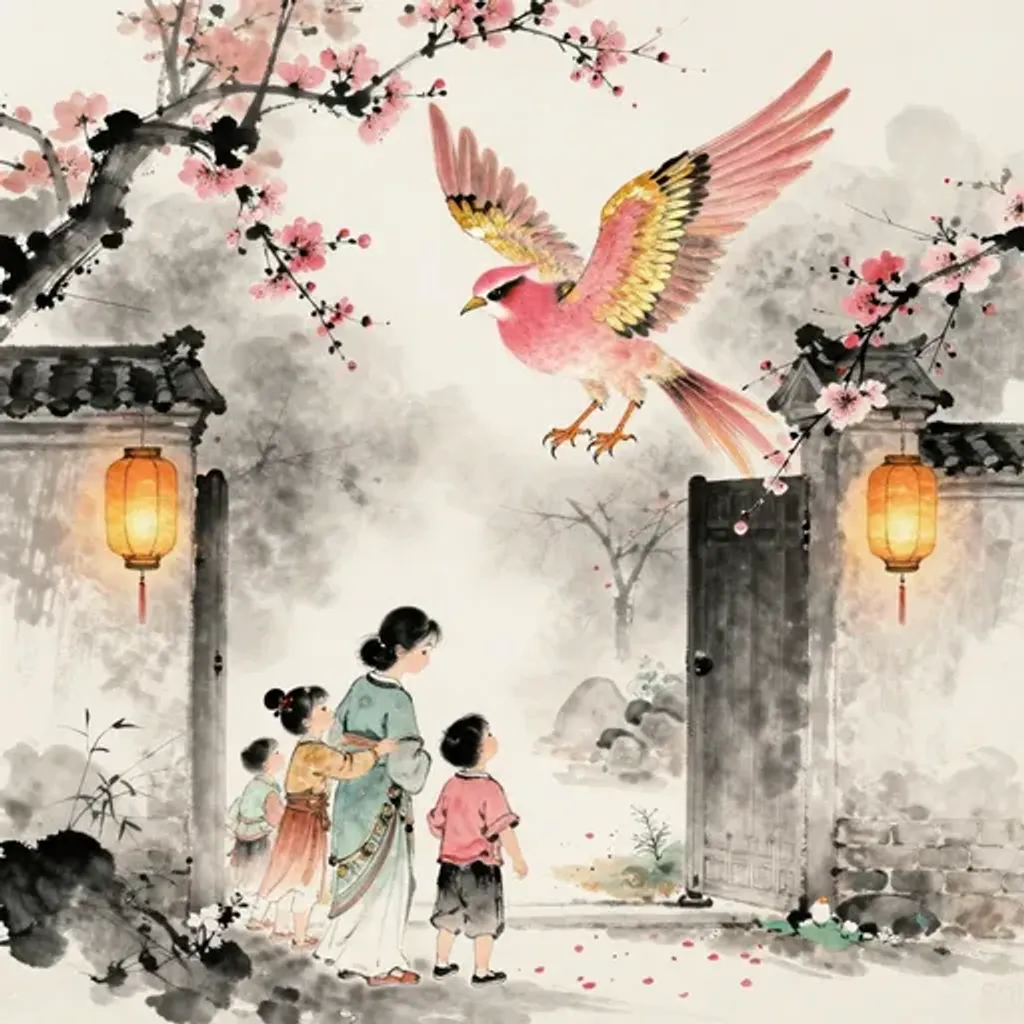
兩足四翼,飛入家國;寧我伯子,與母相得。
Two feet, four wings, flying into our home and realm. It calms our eldest son; reunited with mother once more.
— Jiao Yanshou, Yilin (Forest of Changes), 1st century BC
Commentary
Heaven and fire form Fellowship as a creature with two feet and four wings flies into the homeland. The eldest son is at peace; mother and child are reunited in harmony. The winged figure suggests both speed and grace — arriving not as a conqueror but as a returning family member. From Fellowship to Modesty, the transformation distills communal energy into quiet domestic blessing. Mountain hidden within the earth, Modesty reduces what is excessive and fills what is lacking. Here the cosmic flight of Fellowship lands gently in the household, and the reunion of parent and child embodies modesty's deepest gift: sufficiency without display, love without ostentation.
同人 → 豫
Hexagram 13 → Hexagram 16: Enthusiasm
Changing lines: 1, 3, 5, 6
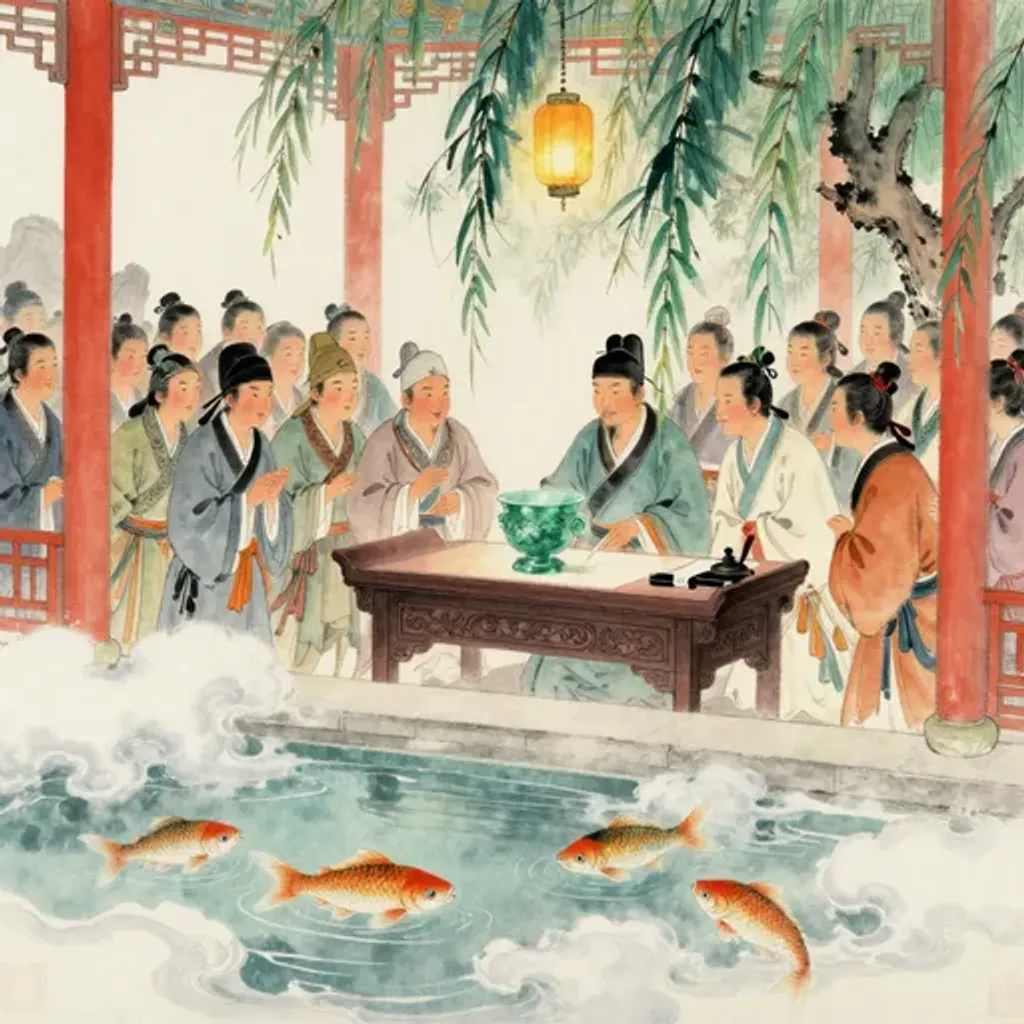
按民呼池,玉盃文案;魚如白雲,一國獲願。
Pressing the people, summoning fish from the pool; jade cups and carved writing desks. Fish like white clouds; a whole nation's wish is granted.
— Jiao Yanshou, Yilin (Forest of Changes), 1st century BC
Commentary
Heaven and fire form Fellowship, and the scene opens onto civic celebration. The people gather around a pool as jade cups grace the ceremonial table; fish rise like white clouds from the waters, so plentiful that the entire state's wishes are fulfilled. The imagery blends ritual elegance with natural abundance — a community feast where heaven's bounty meets human artistry. From Fellowship to Enthusiasm, the transformation channels shared joy into collective ritual. Thunder bursts from the earth in Enthusiasm as the ancient kings made music to honor virtue. The fish-laden pool and jade-set table are precisely this: communal celebration elevated into sacred festivity.
同人 → 隨
Hexagram 13 → Hexagram 17: Following
Changing lines: 3, 6
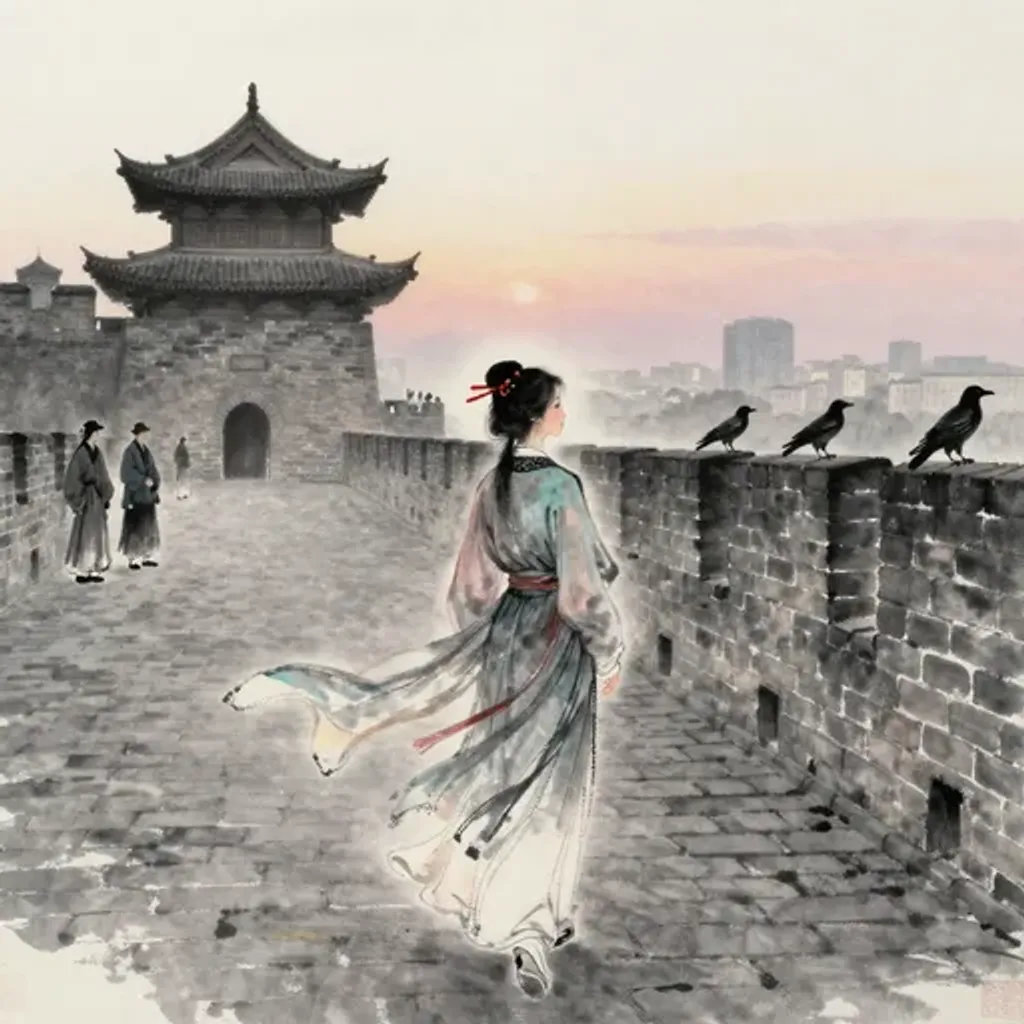
季姬踟躕,望我城隅;終日至暮,不見齊侯。君上無憂。
Lady Ji Jiang paces to and fro, watching from the city wall. From dawn until dusk; she does not see the Lord of Qi. The lord above has no worry.
— Jiao Yanshou, Yilin (Forest of Changes), 1st century BC
Commentary
Heaven and fire form Fellowship, but here the woman waits in vain. Lady Ji hesitates at the city wall, gazing from the corner tower, watching all day until dusk — yet the Lord of Qi never appears. The final line pivots: the ruler above has no cause for worry. Her longing is private; the state is secure. The verse resonates with Shijing imagery of women waiting at walls for absent lords. From Fellowship to Following, the transformation reframes unfulfilled desire as patient acceptance. Thunder rests within the lake in Following; the noble man retreats to rest at nightfall. The waiting woman, though her lord never comes, embodies following's deeper lesson: not all bonds require fulfillment to remain bonds.
同人 → 蠱
Hexagram 13 → Hexagram 18: Work on the Decayed
Changing lines: 1, 2, 4, 5
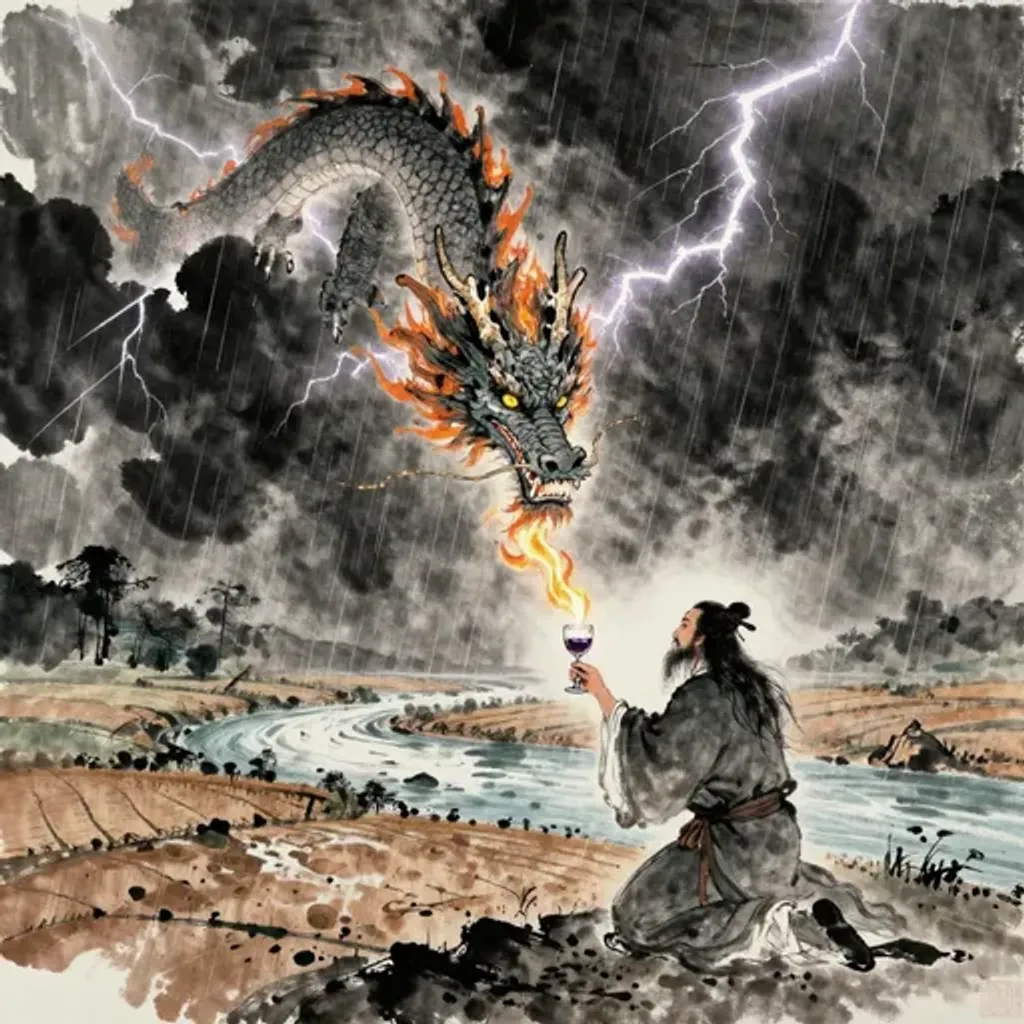
龍渴求飲,黑雲影從;河伯奉觴,跪進酒漿。流潦滂滂。
The dragon, parched, seeks drink; black clouds gather in its wake. The River Lord presents a goblet, kneeling to offer wine and broth. Torrents pour forth in abundance.
— Jiao Yanshou, Yilin (Forest of Changes), 1st century BC
Commentary
Heaven and fire form Fellowship as a thirsty dragon summons the storm. The dragon craves water and dark clouds follow in its wake. The Earl of the River himself kneels to present a goblet, offering wine and spirits to the celestial beast. Then the floodwaters come pouring down. The verse stages a divine audience: the dragon commands, the river god serves, and the heavens open in torrential response. From Fellowship to Work on the Decayed, the transformation shifts from cosmic communion to the grim work of restoration. Wind beneath the mountain in Work on the Decayed stirs up what has stagnated. The dragon's rain, though magnificent, leaves decay in its wake — and decay demands mending.
同人 → 臨
Hexagram 13 → Hexagram 19: Approach
Changing lines: 2, 3, 4, 5, 6
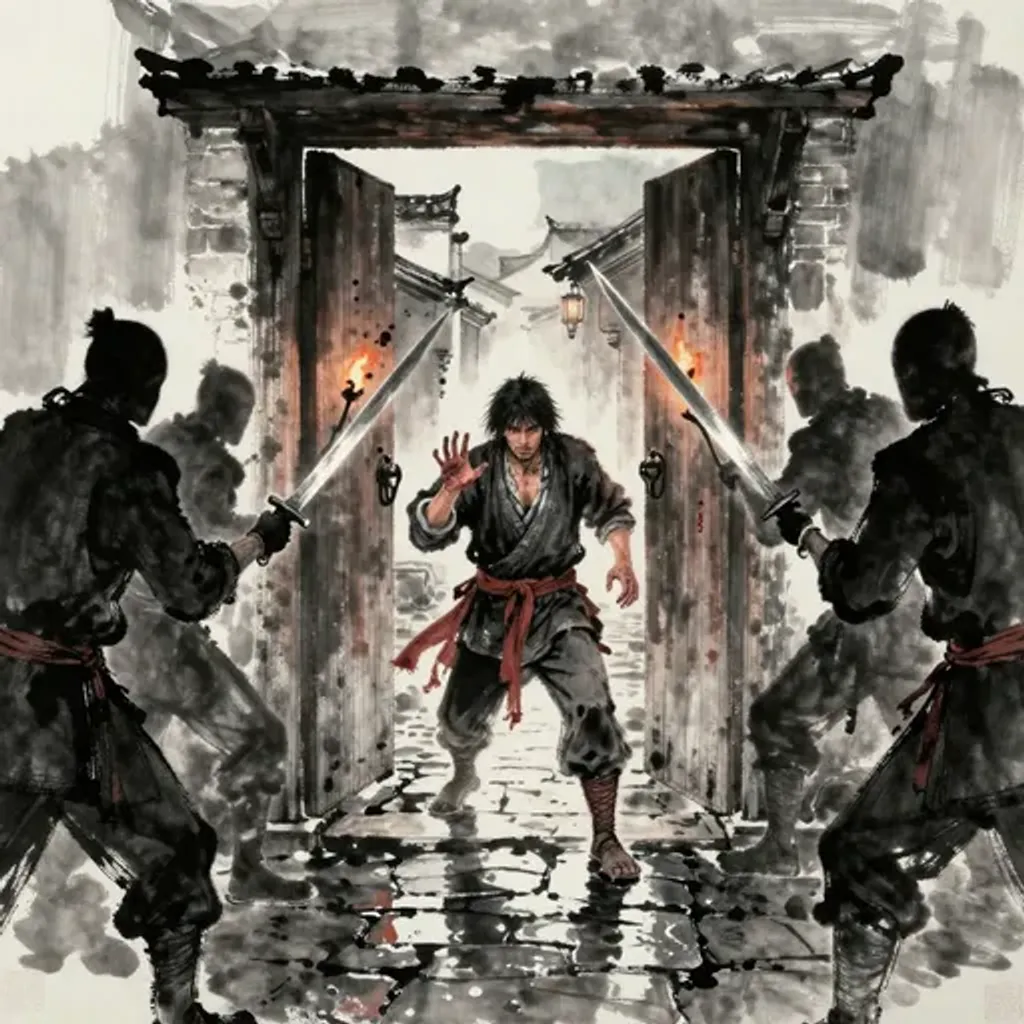
出門逢患,與福為怨;更相擊刺,傷我手端。
Stepping out the gate, one meets disaster; fortune becomes a grudge. Exchanging blows and stabs; my hand is wounded.
— Jiao Yanshou, Yilin (Forest of Changes), 1st century BC
Commentary
Heaven and fire form Fellowship, but stepping outside the door one meets disaster. What should bring fortune turns into enmity; those who should be companions strike and stab at each other, wounding the hand. The verse inverts Fellowship's promise: the open field becomes an ambush, and allies become attackers. From Fellowship to Approach, the transformation carries a bitter irony. Lake beneath the earth in Approach, the ruler draws near to teach and protect without limit. But here the approach is hostile — those drawing near bring blades, not guidance. The wound to the hand suggests agency itself is damaged: one cannot grasp opportunity when the grasping hand is cut.
同人 → 觀
Hexagram 13 → Hexagram 20: Contemplation
Changing lines: 1, 3, 4
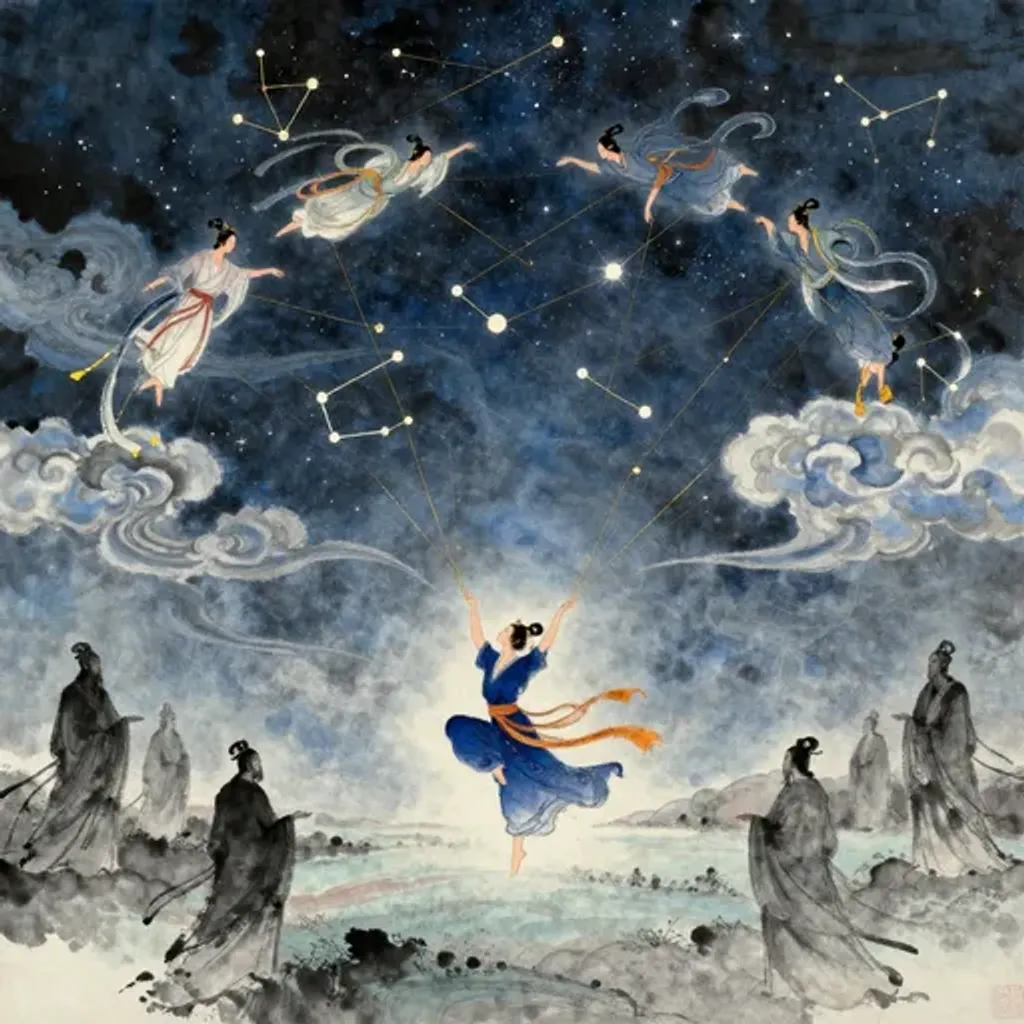
播天舞地,神明所守,安樂無咎。
Sowing across heaven, dancing across earth; the spirits stand guard. Peaceful and joyful, without blame.
— Jiao Yanshou, Yilin (Forest of Changes), 1st century BC
Commentary
Heaven and fire form Fellowship in its most sublime register. Scattering heaven and stirring earth, the cosmic forces are guarded by divine spirits — all is peaceful and without fault. The verse is compressed ritual incantation: three short phrases encompassing creation, protection, and blessing. From Fellowship to Contemplation, the transformation elevates communal vision to cosmic observation. Wind moves across the earth in Contemplation as the ancient kings surveyed the regions and observed the people. Here the fellowship is not among humans but between the human and the divine, the terrestrial and celestial — a sacred communion that leaves no room for blame.
同人 → 噬嗑
Hexagram 13 → Hexagram 21: Biting Through
Changing lines: 3, 5
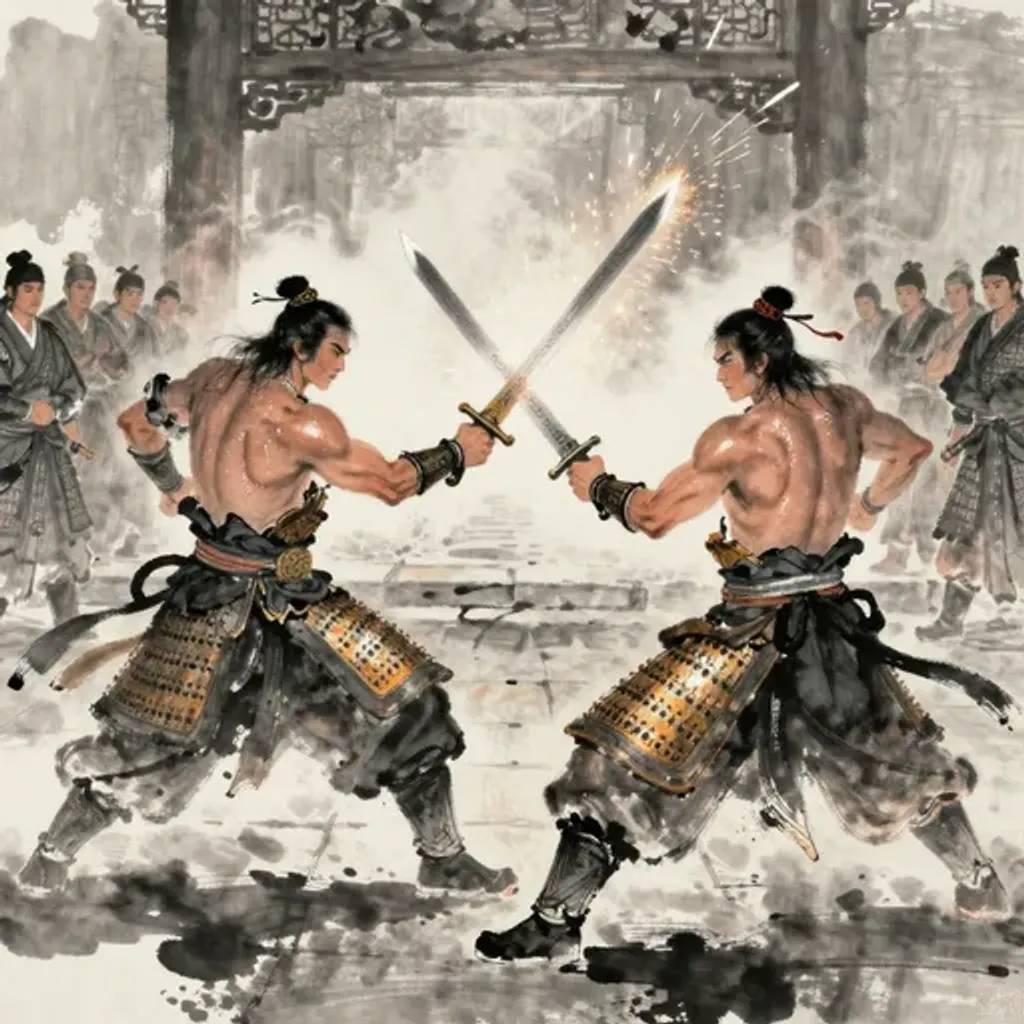
兩金相擊,勇氣鈞敵;終日大戰,不破不缺。
Two metals clash; courage and strength are evenly matched. Fighting all day long; neither breaks nor yields.
— Jiao Yanshou, Yilin (Forest of Changes), 1st century BC
Commentary
Heaven and fire form Fellowship, but here fellowship is the fellowship of combatants. Two metals clash — courage and strength evenly matched — fighting all day long without either breaking or cracking. The duel is perfectly balanced: neither side yields, neither side falls. The image is not tragedy but testament to the quality of both fighters. From Fellowship to Biting Through, the transformation introduces a decisive force into the stalemate. Lightning and thunder in Biting Through; the ancient kings clarified punishments and corrected the law. What endless matched combat cannot resolve, judicial clarity can: the teeth that bite through the obstacle between the jaws end what brute equality could not.
同人 → 賁
Hexagram 13 → Hexagram 22: Grace
Changing lines: 4, 5
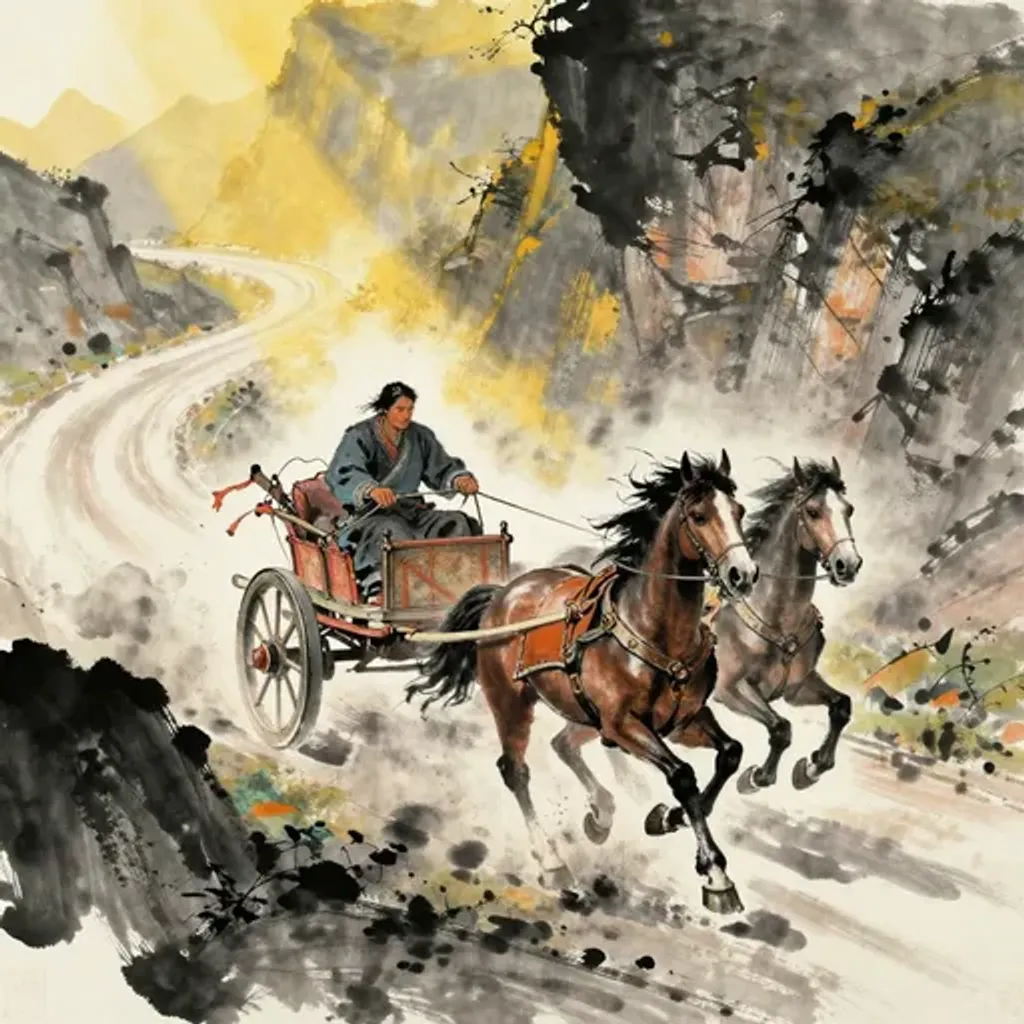
車雖駕,兩紖絕;馬奔出,雙輪脫;行不至,道遇害。
The chariot is harnessed, yet both reins snap. The horses bolt; both wheels fly off. The journey does not arrive; the road meets with harm.
— Jiao Yanshou, Yilin (Forest of Changes), 1st century BC
Commentary
Heaven and fire form Fellowship, but the vehicle of progress disintegrates. The carriage is harnessed, yet both reins snap; the horse bolts and both wheels fly off. The traveler cannot reach the destination — disaster strikes on the road. Every component fails in sequence: control, propulsion, structure. From Fellowship to Grace, the transformation carries an unsettling irony. Mountain beneath the fire in Grace adorns the surface with beauty, yet here there is no surface left to adorn — the chariot has become wreckage. Grace warns that ornamentation cannot substitute for structural integrity. The fellowship that lacks a sound vehicle will never arrive, however beautiful the road.
同人 → 剝
Hexagram 13 → Hexagram 23: Splitting Apart
Changing lines: 1, 3, 4, 5
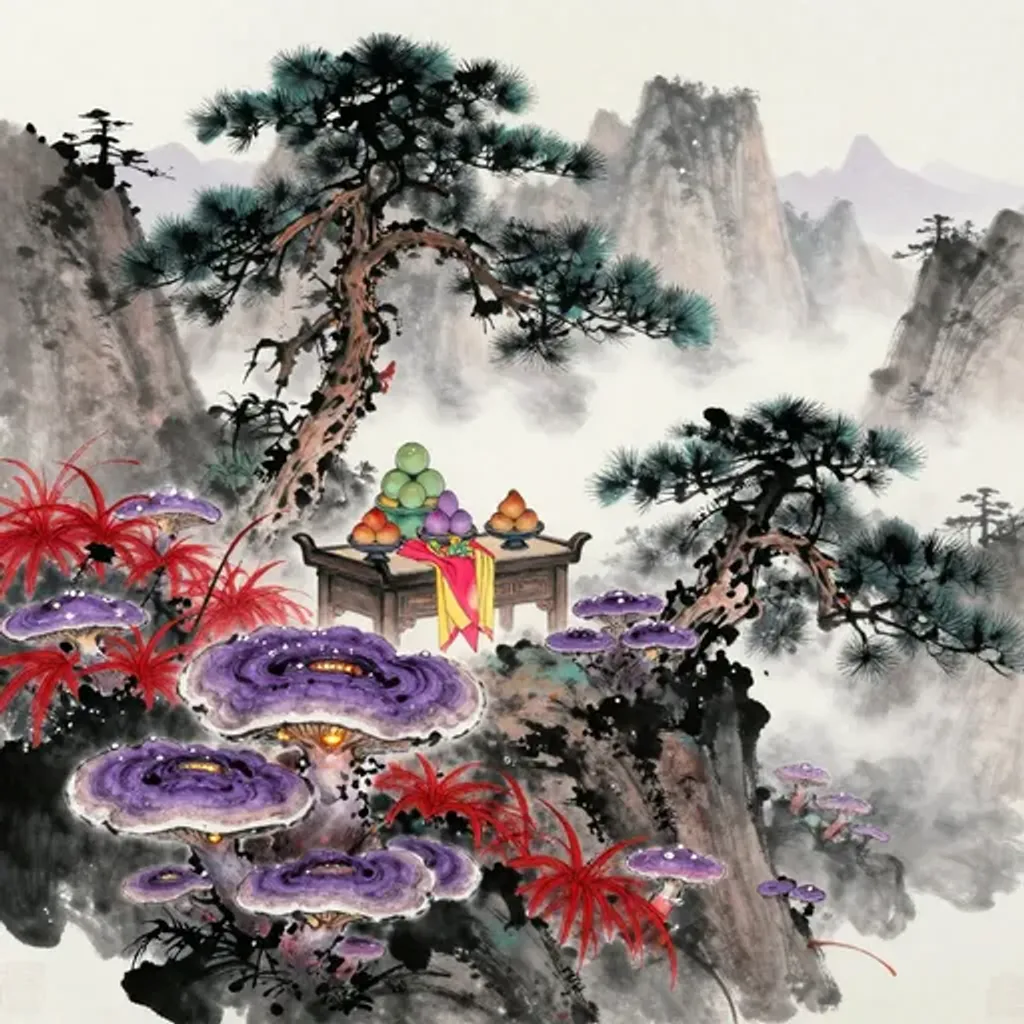
文山紫芝,雍梁朱草;長生和氣,王以為寶;公尸侑食,福祿來處。
Purple lingzhi on Wen Mountain; vermillion grass in Yong and Liang. Growing in life-giving harmony; the king treasures them. The host of the ancestral feast partakes; blessings and bounty come to abide.
— Jiao Yanshou, Yilin (Forest of Changes), 1st century BC
Commentary
Heaven and fire form Fellowship, and here the communion is with the numinous earth itself. Purple zhi fungus grows on patterned mountains; vermilion grass flourishes in the lands of Yong and Liang. These are auspicious plants — harbingers of long life and harmonious qi. The king treasures them; the ancestral representative partakes of the sacred feast, and blessings flow to all. From Fellowship to Splitting Apart, the transformation seems paradoxical: abundance dissolving into erosion. Yet the verse suggests that the sacred herbs and ritual feast create a reservoir of virtue that can sustain the realm even as the mountain crumbles. The mountain rests upon the earth — and what is stored within endures.
同人 → 復
Hexagram 13 → Hexagram 24: Return
Changing lines: 3, 4, 5, 6
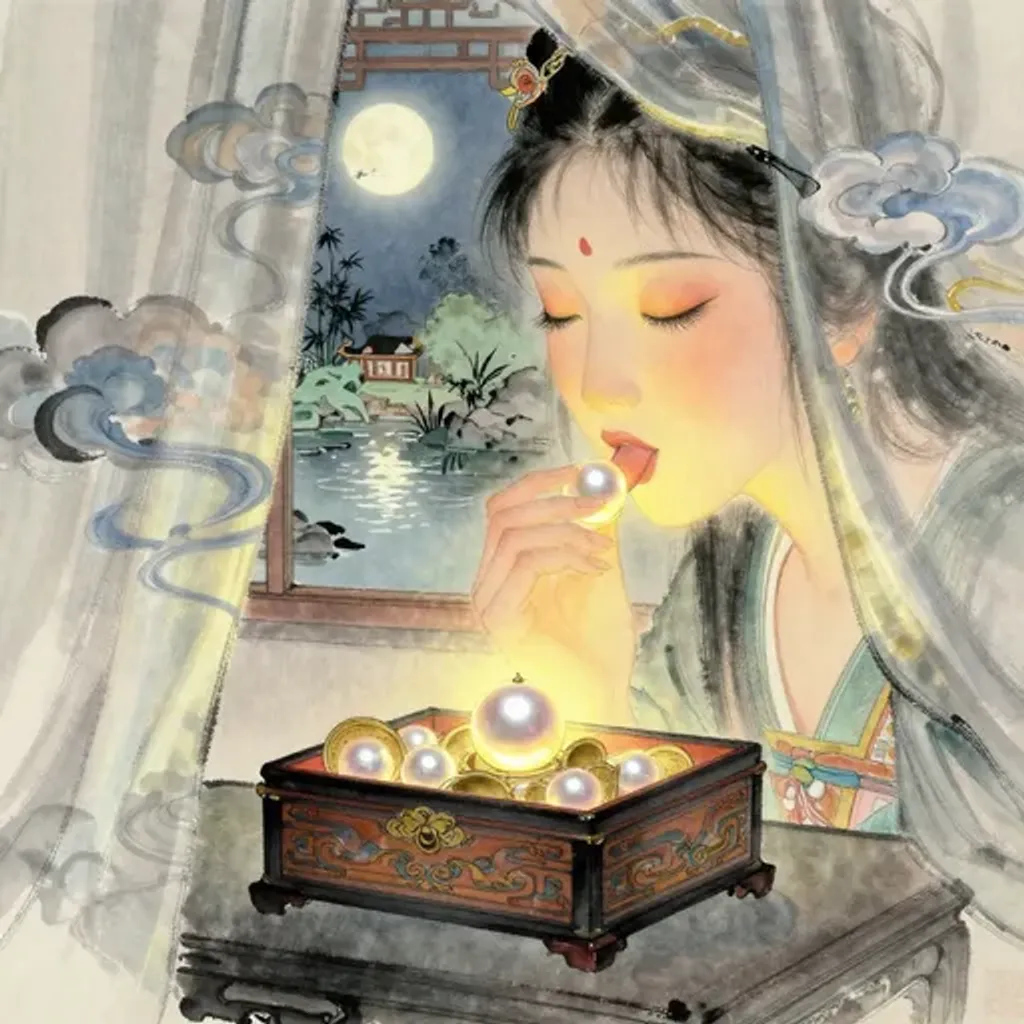
把珠入口,為我畜寶;得吾所有,欣然嘉喜。
Placing a pearl in the mouth; it becomes my stored treasure. Gaining what I possess; I am glad and greatly pleased.
— Jiao Yanshou, Yilin (Forest of Changes), 1st century BC
Commentary
Heaven and fire form Fellowship, and a pearl is placed in the mouth — a treasure stored within the body itself. What one already possesses is recovered, and delight fills the heart. The pearl-in-mouth image evokes the ancient burial practice of placing jade in the deceased's mouth, but here it signifies living wealth: an inner treasure rediscovered. From Fellowship to Return, the transformation completes a circle. Thunder stirs beneath the earth in Return; the solstice moment when yang re-emerges. The pearl was always there — fellowship's gift is not acquisition but recognition. To return is to find what was never truly lost, and that finding brings the purest joy.
同人 → 无妄
Hexagram 13 → Hexagram 25: Innocence
Changing lines: 3
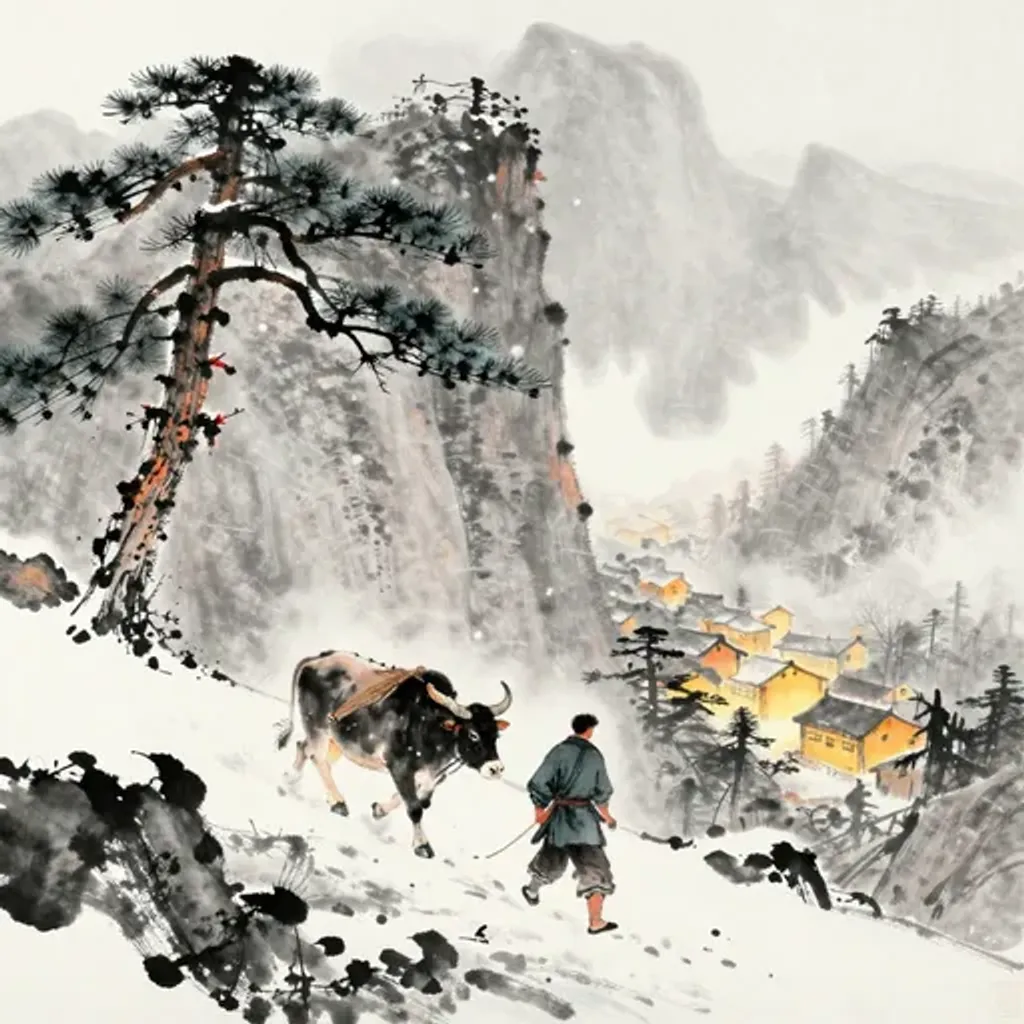
負牛上山,力劣行難;烈風雨雪,遮遏我前;中道復還,憂者得歡。
Bearing an ox up the mountain; strength fails, the way is hard. Fierce wind, rain, and snow block the way before us. Midway one turns back; the worried one finds joy.
— Jiao Yanshou, Yilin (Forest of Changes), 1st century BC
Commentary
Heaven and fire form Fellowship, but the road tests every bond. Shouldering an ox uphill, strength falters and steps stall. Fierce wind, rain, and snow block the way ahead. Then the verse pivots: midway through, one turns back, and those who worried find their joy again. The retreat is not defeat but wisdom — recognizing when the mountain will not yield. From Fellowship to Innocence, the transformation reframes surrender as alignment with heaven's timing. Thunder rolls beneath heaven in Innocence; nature acts without ulterior motive. The return home, abandoning the impossible climb, is itself the innocent act — going where nature allows rather than forcing the path.
同人 → 大畜
Hexagram 13 → Hexagram 26: Great Taming
Changing lines: 2, 4, 5
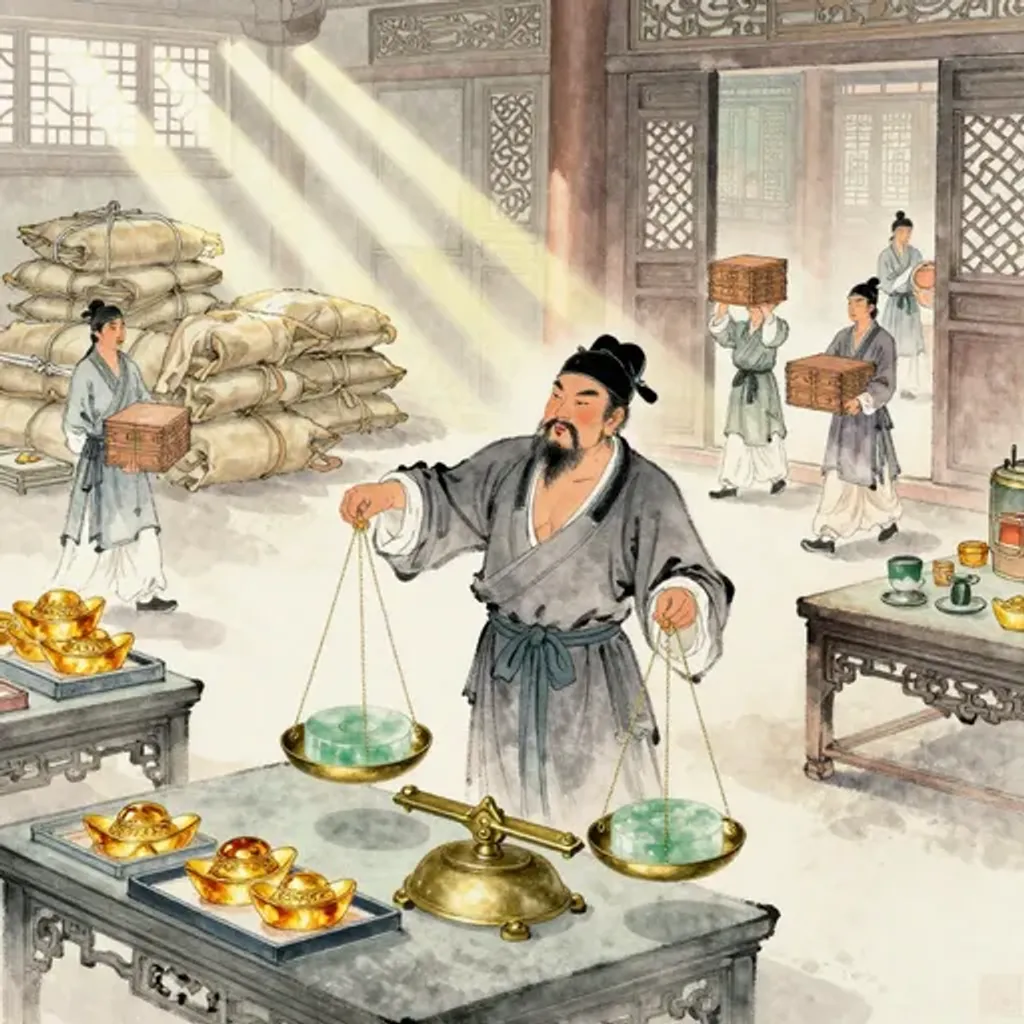
陶朱白珪,善賈息資;三致千金,德施上人。
Tao Zhu and Bai Gui, shrewd merchants who multiplied their capital. Three times they amassed a thousand in gold; their virtue was bestowed upon the highest.
— Jiao Yanshou, Yilin (Forest of Changes), 1st century BC
Commentary
Heaven and fire form Fellowship as two legendary merchants demonstrate the art of wealth through wisdom. Tao Zhu Gong — Fan Li's merchant identity after retiring from statecraft — and Bai Gui of Luoyang, the 'ancestor of commerce,' both mastered the principle of buying what others discard and selling what others covet. Fan Li accumulated a thousand gold three times and three times gave it away, his virtue reaching those above him. From Fellowship to Great Taming, the transformation stores what fellowship has circulated. Heaven held within the mountain, Great Taming preserves the wisdom of past words and deeds. These merchants tame wealth itself, not hoarding but cycling it — and in cycling, accumulating something more durable than coin.
同人 → 頤
Hexagram 13 → Hexagram 27: Nourishment
Changing lines: 3, 4, 5
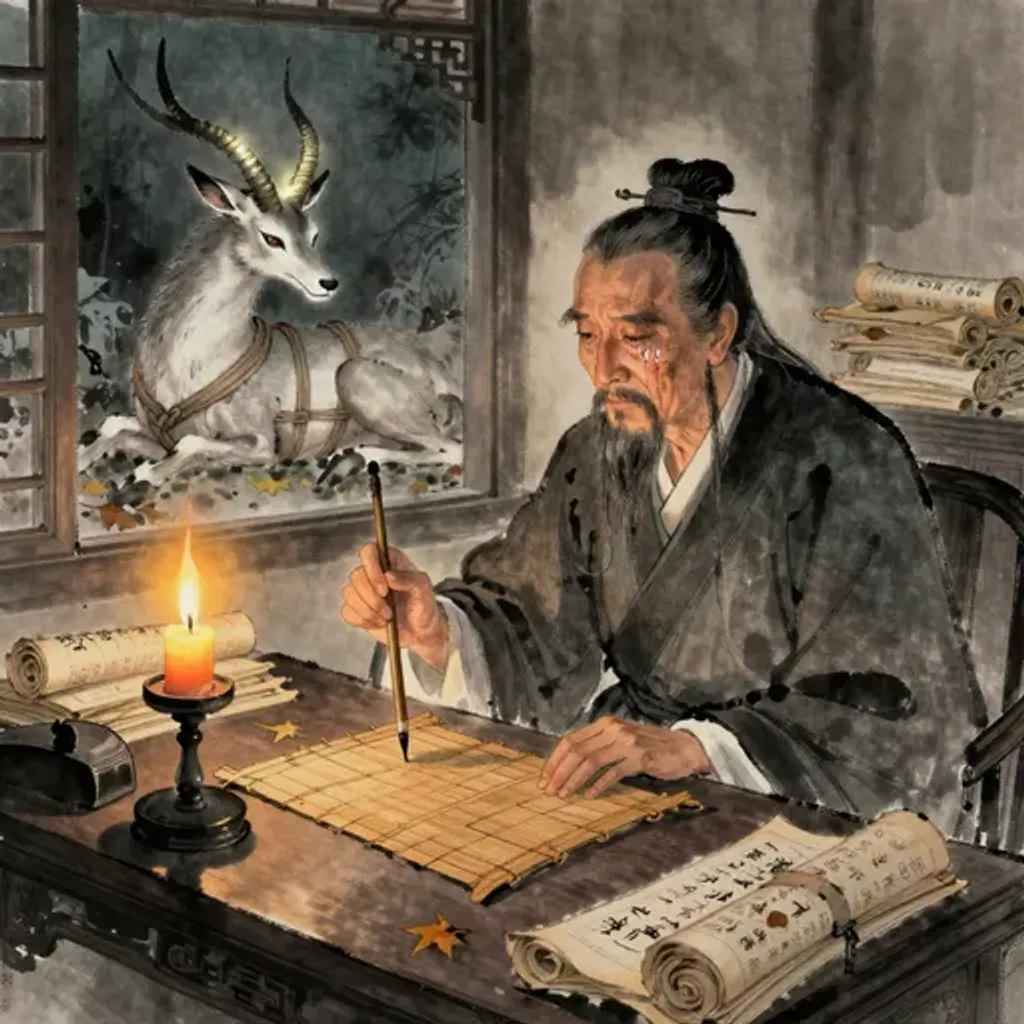
子鉏執麟,《春秋》作元;陰聖將終,尼父悲心。
Zi Chu captures a qilin; the Spring and Autumn Annals begins its chronicle. The hidden sage nears his end; Master Ni's heart is stricken with grief.
— Jiao Yanshou, Yilin (Forest of Changes), 1st century BC
Commentary
Heaven and fire form Fellowship, but the verse records Fellowship's most grievous loss. Zichushang captures the qilin; the Spring and Autumn Annals begin their final reckoning. The hidden sage's era draws to its close, and Father Ni — Confucius — grieves in his heart. In 481 BC, a charioteer of the Shusun clan caught the qilin during a western hunt; Confucius recognized it and wept: 'My Way is exhausted.' This event traditionally marks where Confucius ceased writing the Annals. From Fellowship to Nourishment, the transformation shifts from cosmic communion to careful sustenance. The sage who can no longer feed the world with his teaching turns inward, guarding what remains.
同人 → 大過
Hexagram 13 → Hexagram 28: Great Exceeding
Changing lines: 1, 2, 6
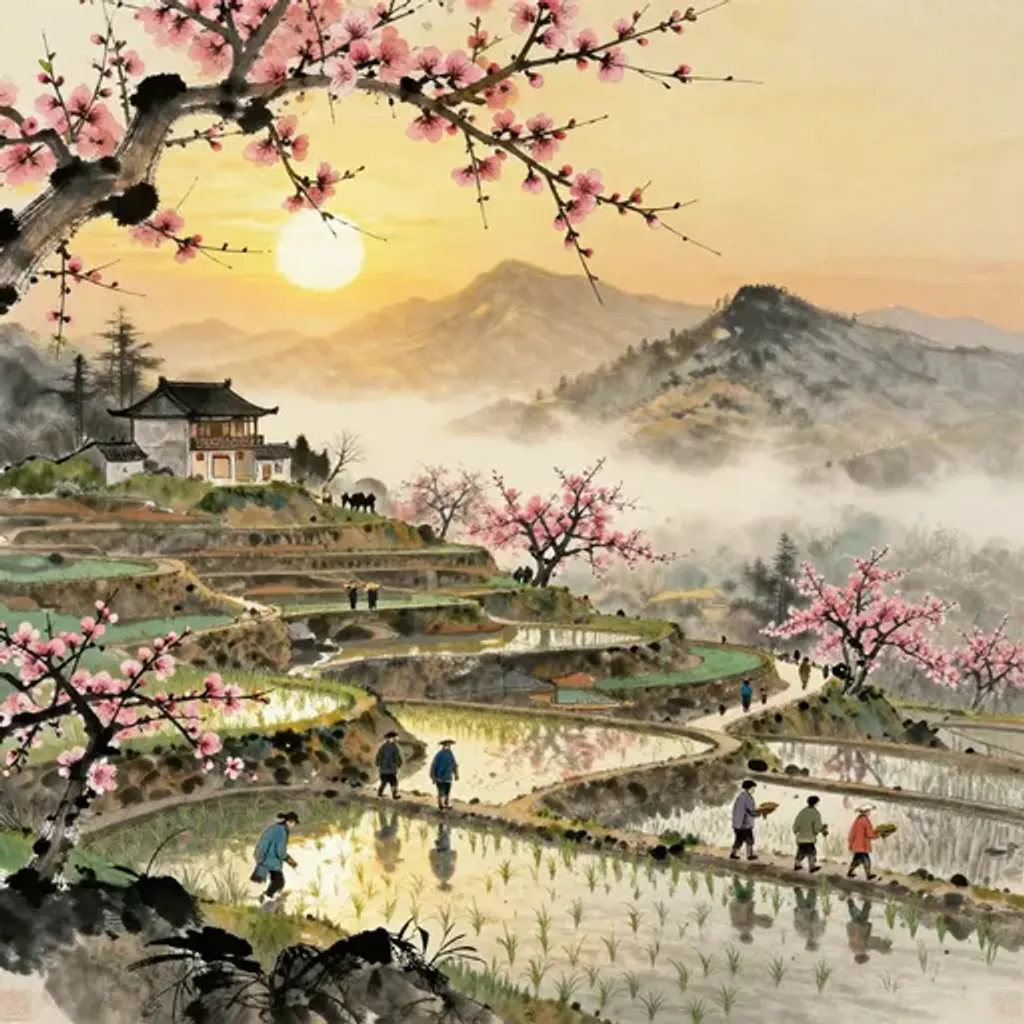
春日載陽,福履齊長;四時不忒,與樂為昌。
Spring sun carries its warmth; blessings and footsteps grow in tandem. The four seasons do not falter; with joy they bring prosperity.
— Jiao Yanshou, Yilin (Forest of Changes), 1st century BC
Commentary
Heaven and fire form Fellowship under spring's warm sun. Blessings and good fortune grow in tandem; the four seasons proceed without error, and all flourishes with joy. The verse is a hymn of seasonal regularity — the cosmic order functioning perfectly, each quarter delivering its proper gifts. From Fellowship to Great Exceeding, the transformation seems paradoxical: perfect harmony leading to excess. Yet the lake submerging the trees in Great Exceeding reminds that even prosperity has a threshold. The noble man stands alone without fear. Spring's promise here is genuine, but the structural pattern warns: what grows without limit eventually tests the ridgepole.
同人 → 坎
Hexagram 13 → Hexagram 29: The Abysmal Water
Changing lines: 1, 2, 3, 4, 6
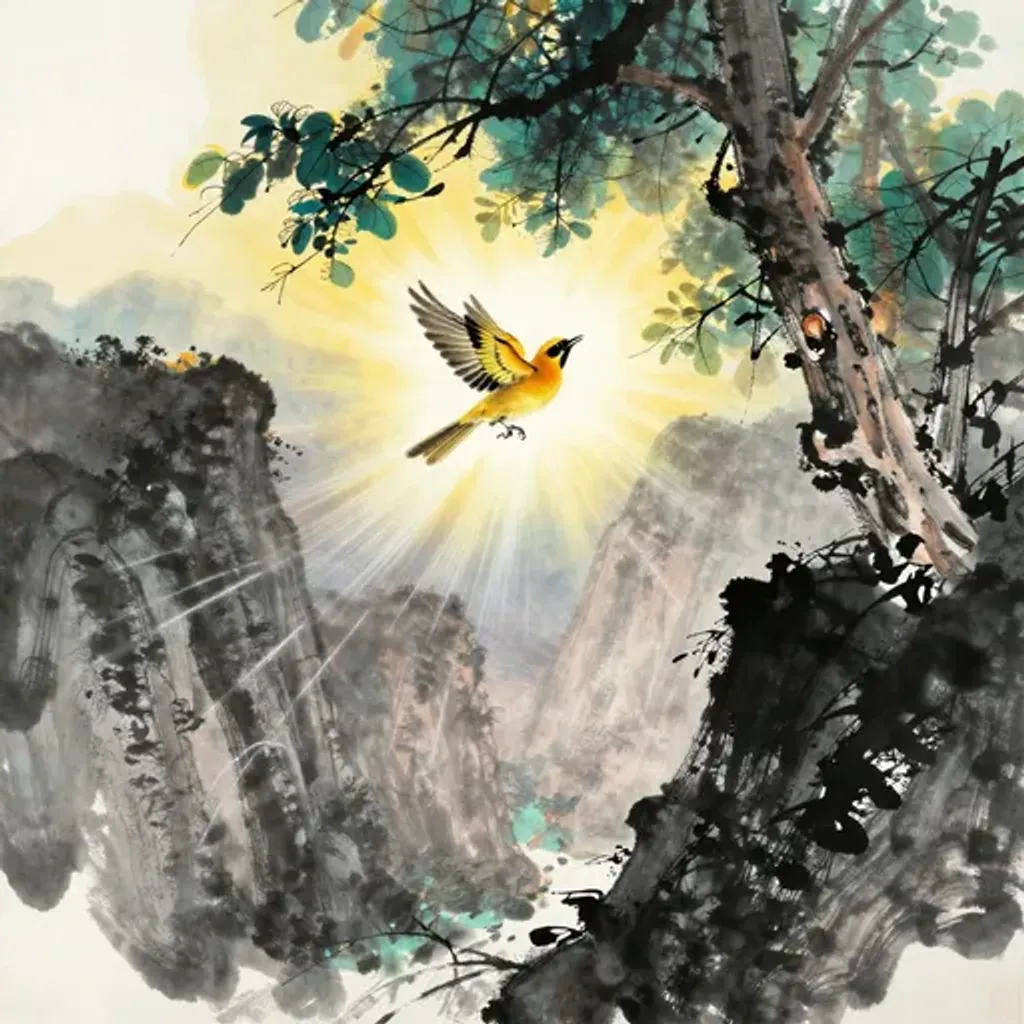
孔德如玉,出於幽谷;飛上喬木,鼓其羽翼,大光照國。
Virtue like fine jade, rising from the shadowed valley. Flying up to the tall tree; spreading its wings in great radiance that illumines the realm.
— Jiao Yanshou, Yilin (Forest of Changes), 1st century BC
Commentary
Heaven and fire form Fellowship as a bird of extraordinary virtue emerges from darkness into brilliance. Virtue luminous as jade rises from the deep valley, soars up to the tall tree, and spreads its wings — a great light shining across the nation. The imagery draws on the Shijing ode of the bird leaving the dark valley for the high wood, a metaphor for talent ascending from obscurity. From Fellowship to the Abysmal, the transformation seems to invert the verse's trajectory. Doubled water, repeated danger — yet the noble man practices constant virtue. The bird's ascent is not negated but contextualized: brilliance that has passed through the abyss carries a different authority than brilliance that has known only light.
同人 → 離
Hexagram 13 → Hexagram 30: The Clinging Fire
Changing lines: 5
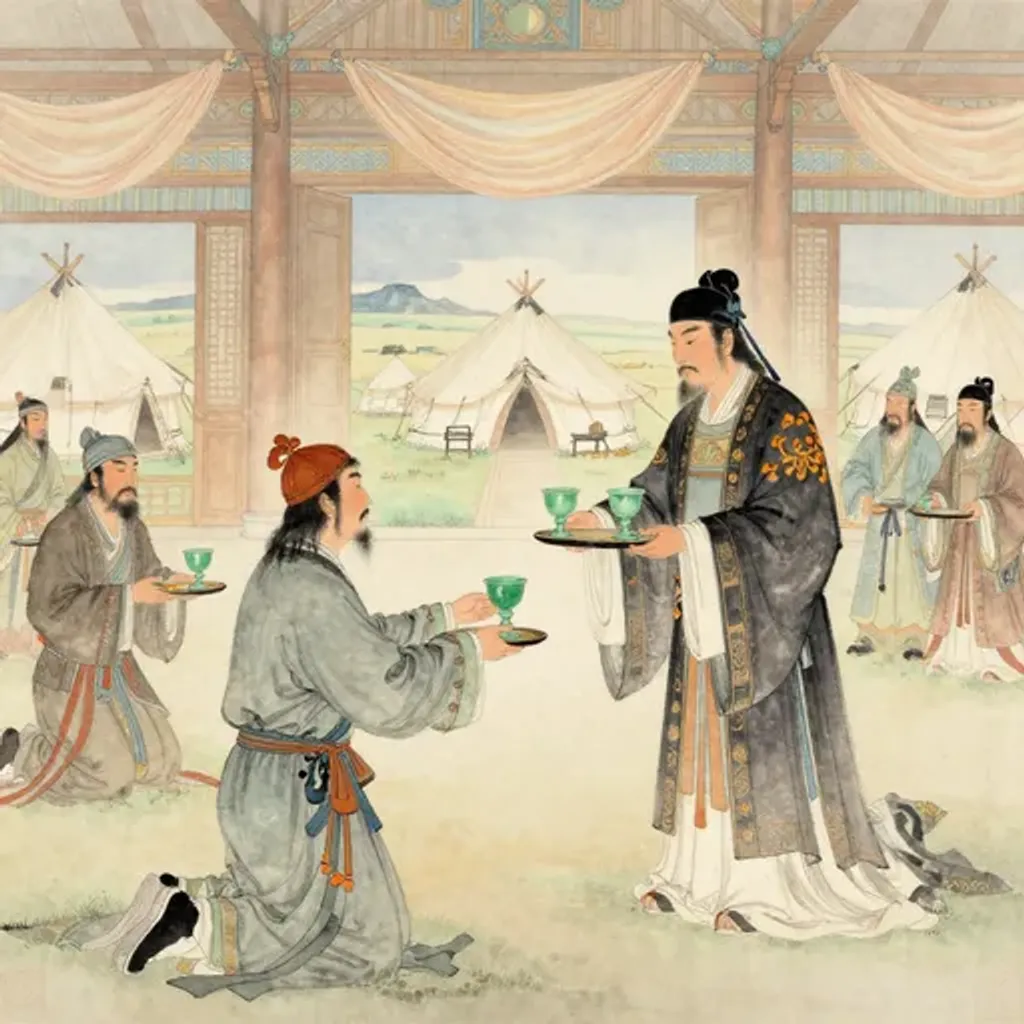
甌脫康居,慕仁入朝;湛露之歡,三爵畢恩;復歸窮廬,以安其居。
Outing, Kangju's border peoples, admiring benevolence, come to pay court. The joy of sweet dew and wine; three goblets fulfill all grace. They return to their humble dwellings to live in peace.
— Jiao Yanshou, Yilin (Forest of Changes), 1st century BC
Commentary
Heaven and fire form Fellowship as distant peoples come to pay tribute. The Outuo frontier lands and the kingdom of Kangju, drawn by benevolent reputation, arrive at court. They are received with the joy of the 'Zhanlu' ode — the Shijing poem celebrating the king's feast for visiting lords — and honored with three ritual goblets of grace. Then they return to their humble dwellings, peacefully settled in their own territory. From Fellowship to the Clinging, the transformation sustains the verse's warmth. Doubled fire in the Clinging, the great man extends illumination to the four directions. The foreign guests come to the light, receive its warmth, and carry it home — a fellowship that radiates outward without demanding permanent attachment.
同人 → 咸
Hexagram 13 → Hexagram 31: Influence
Changing lines: 1, 6
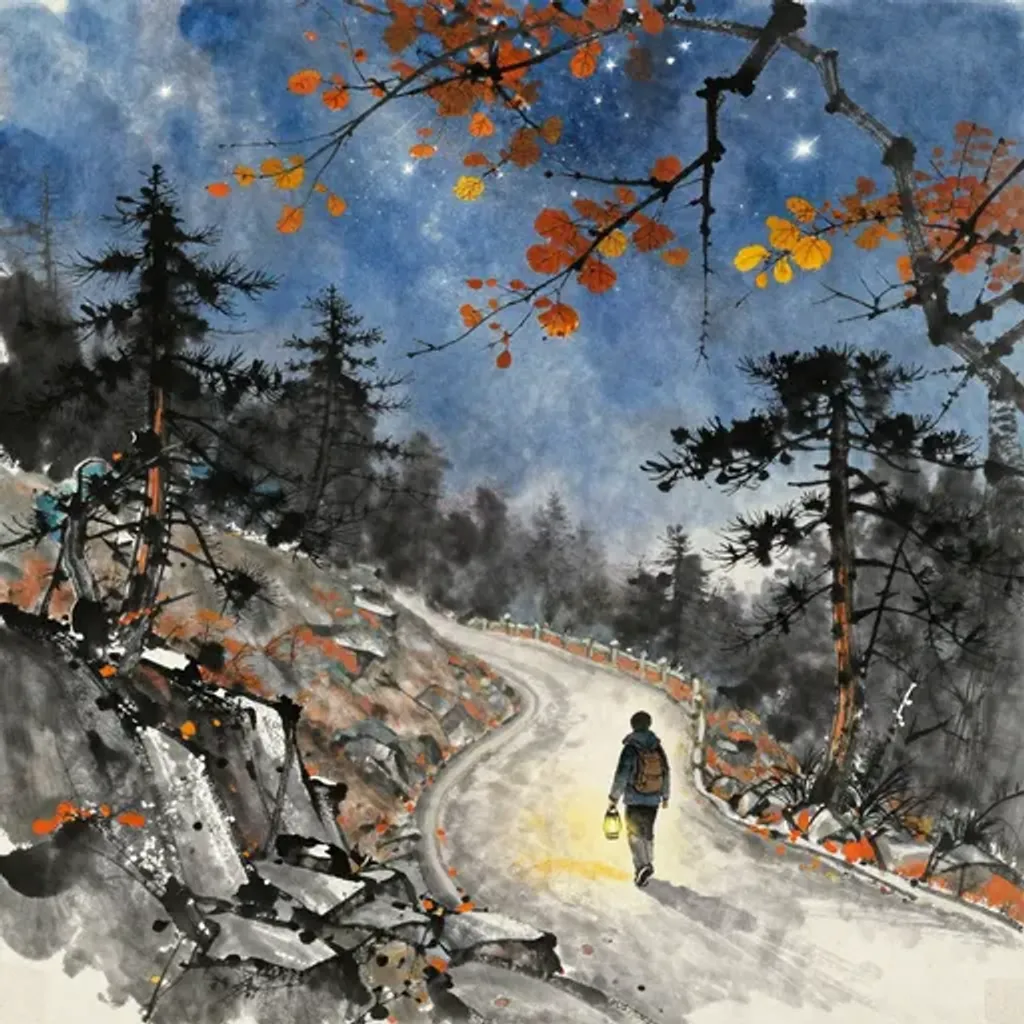
秋冬夜行,照覽星辰;道理利通,終身何患?
Traveling by night in autumn and winter, gazing upon the stars. The way is clear and the road is open; what trouble could one face in life?
— Jiao Yanshou, Yilin (Forest of Changes), 1st century BC
Commentary
Heaven and fire form Fellowship, and the traveler walks confidently through the autumn night. Journeying under winter skies, studying the stars, the path ahead is clear and passable — what lifelong worry could there be? The verse radiates quiet assurance: darkness holds no terror for one who reads the constellations. From Fellowship to Influence, the transformation deepens solitary confidence into mutual responsiveness. Lake resting upon the mountain in Influence, the noble man opens himself to receive others. The stargazer who navigates alone discovers that the cosmos itself is a companion — the stars respond to observation, and the mountain's stillness invites the lake's reflection. Influence begins where self-sufficiency meets openness.
同人 → 恆
Hexagram 13 → Hexagram 32: Duration
Changing lines: 1, 2, 5, 6
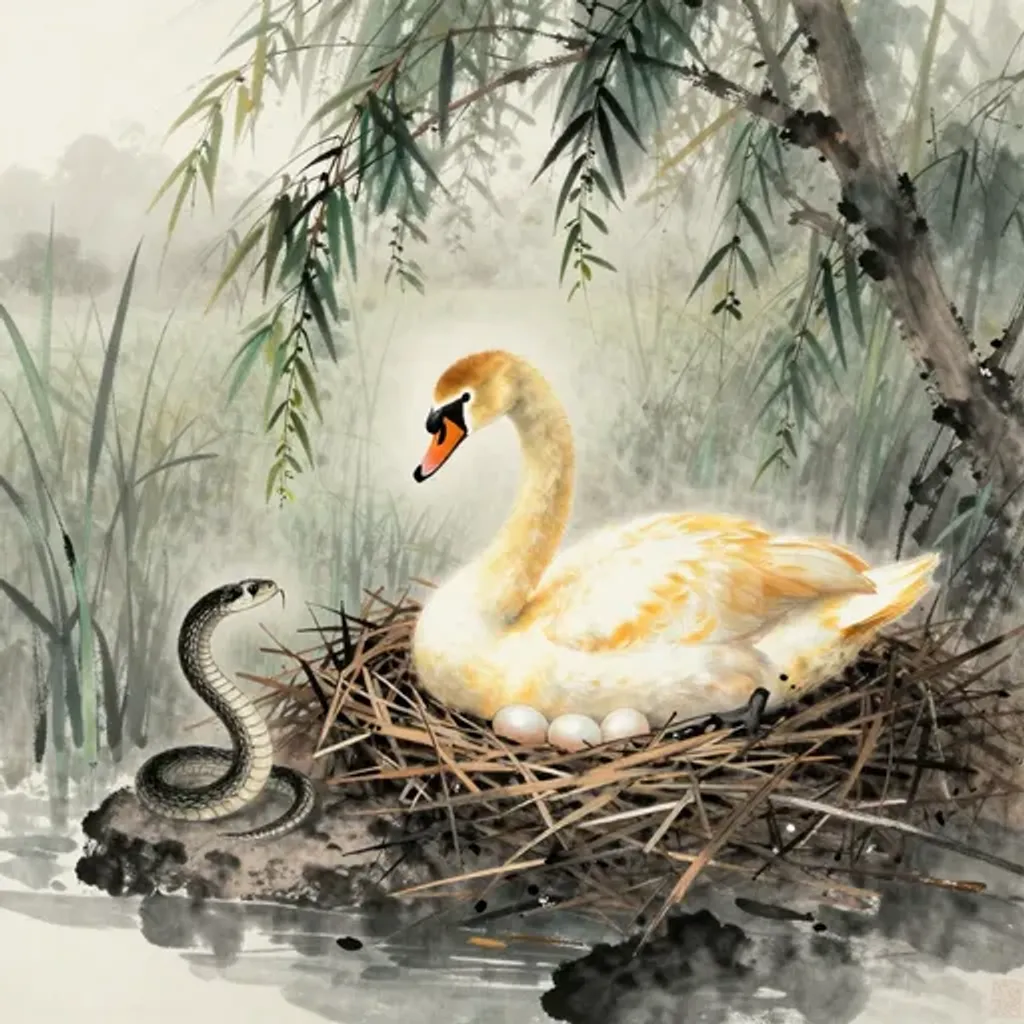
鳴鵠抱子,見虵何咎?室家俱在,不失其所。
The singing swan guards her chick; seeing the snake, what harm? The household is all intact; nothing loses its place.
— Jiao Yanshou, Yilin (Forest of Changes), 1st century BC
Commentary
Heaven and fire form Fellowship as a swan cradles its young. A serpent appears — what harm could it do? The household remains intact; nothing is lost from its proper place. The parent bird's calm in the face of the snake embodies a fellowship so secure that external threats cannot penetrate it. From Fellowship to Duration, the transformation anchors this domestic security in permanence. Thunder and wind reinforce each other in Duration; the noble man stands firm and does not change course. The swan does not abandon its nest at the serpent's approach; the family endures because its members hold their ground. Duration is not rigidity but the steady heartbeat of a household that refuses to scatter.
同人 → 遯
Hexagram 13 → Hexagram 33: Retreat
Changing lines: 1
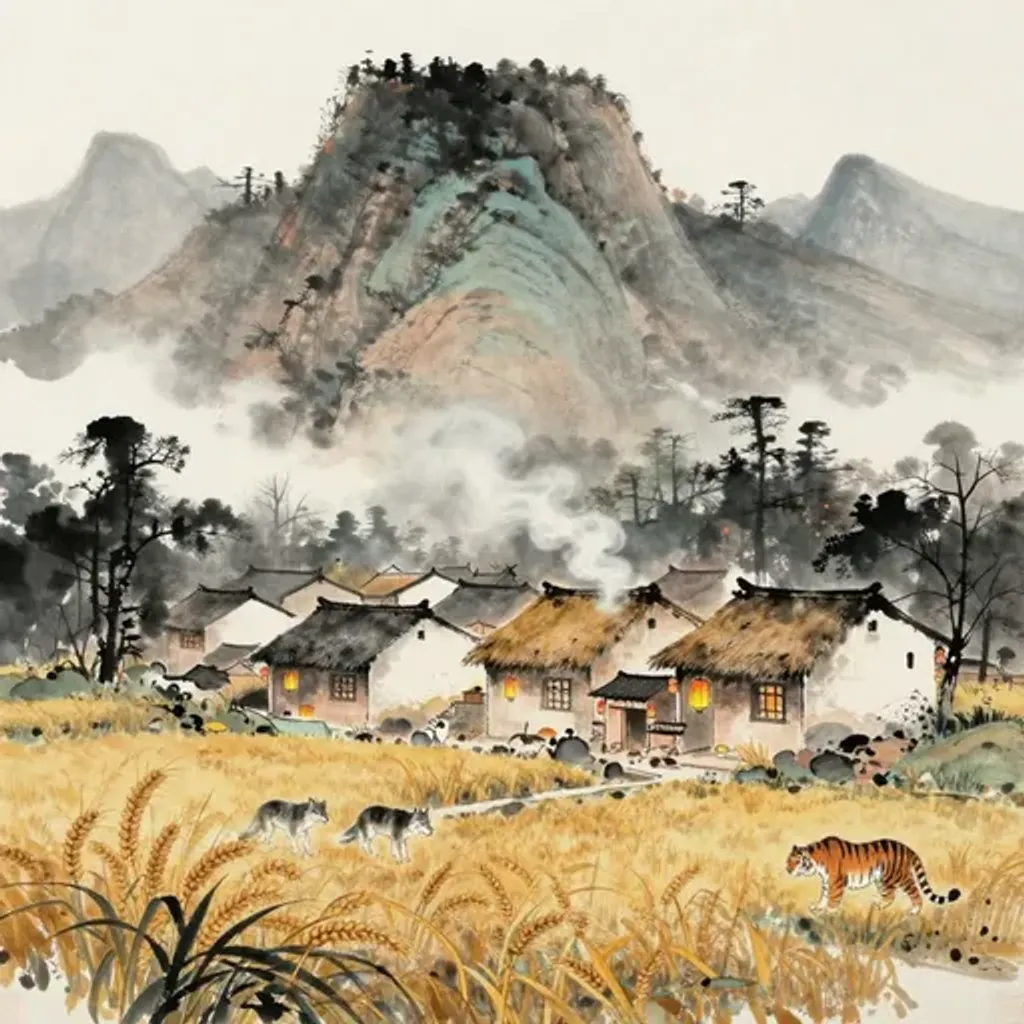
安和泰山,福祿屢臻;雖有豺虎,不能危身。
Peaceful as Mount Tai; blessings and bounty arrive in abundance. Though wolves and tigers roam, they cannot endanger one's person.
— Jiao Yanshou, Yilin (Forest of Changes), 1st century BC
Commentary
Heaven and fire form Fellowship, and here the communion produces imperturbable safety. Settled and at peace like Mount Tai, blessings arrive again and again. Though jackals and tigers prowl, they cannot endanger the body. Mount Tai — the Eastern Sacred Mountain, holiest of the Five Peaks — serves as the image of immovable stability, its authority so absolute that predators shrink before it. From Fellowship to Retreat, the transformation reveals the paradox of strength through withdrawal. Heaven above the mountain in Retreat, the noble man distances himself from the petty without malice. The one who retreats to the mountain's summit need not fear the beasts below — elevation itself is the shield.
同人 → 大壯
Hexagram 13 → Hexagram 34: Great Power
Changing lines: 2, 5, 6
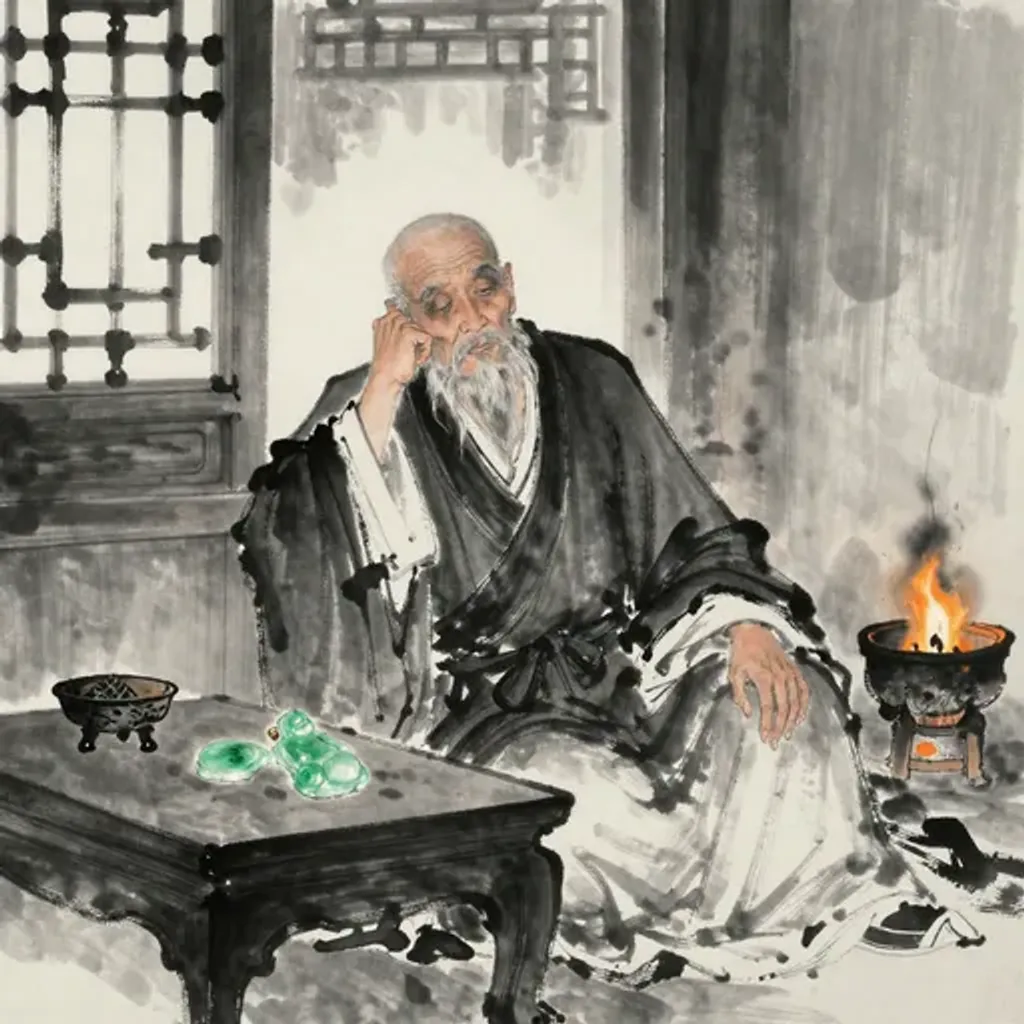
老目瞢眠,不知東西;君失理命,以直為傴。王珍其寶。
Old eyes dim in drowsy sleep, unable to tell east from west. The lord has lost the thread of governance; the straight he mistakes for the bent. He treasures his precious jade.
— Jiao Yanshou, Yilin (Forest of Changes), 1st century BC
Commentary
Heaven and fire form Fellowship, but perception has failed. Old eyes are dim and drowsy, unable to distinguish east from west. The lord loses his grip on governance, mistaking the straight for the crooked. Then a curious pivot: the king treasures what is precious. The verse juxtaposes blindness in office with the residual instinct to value what matters. From Fellowship to Great Power, the transformation intensifies the problem. Thunder roars above heaven in Great Power; the noble man does not act outside propriety. Power without discernment is dangerous — a lord who cannot see straight wields thunder blindly. Yet the treasured jewel hints that even in confusion, something essential may still be recognized if one's values remain uncorrupted.
同人 → 晉
Hexagram 13 → Hexagram 35: Progress
Changing lines: 1, 3, 5
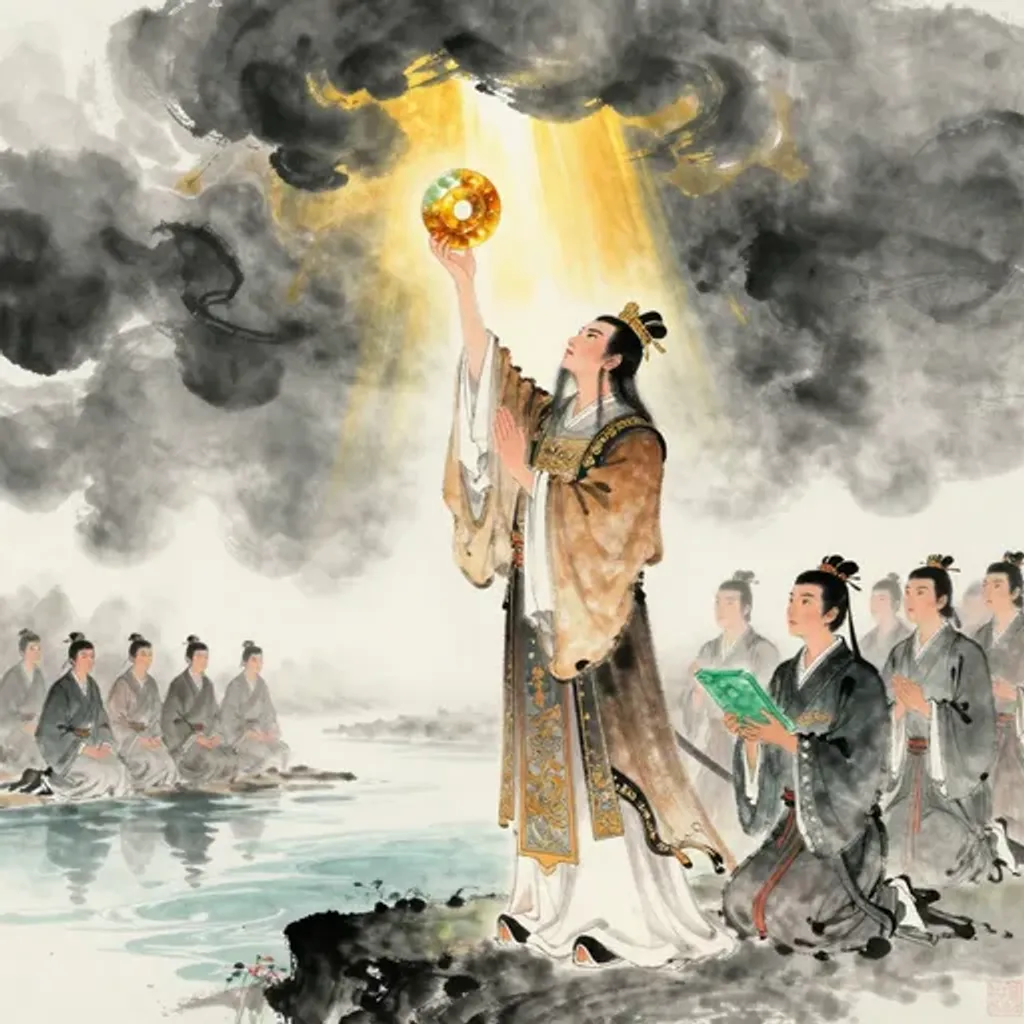
植璧秉珪,請命于河;周公剋敏,沖人瘳愈。
Setting jade discs on the altar, holding jade tablets to the heart; one prays for the king's life by the river. The Duke of Zhou is earnest and devoted; the young king recovers from illness.
— Jiao Yanshou, Yilin (Forest of Changes), 1st century BC
Commentary
Heaven and fire form Fellowship as the Duke of Zhou performs the most selfless act in Chinese political tradition. He plants jade discs and grasps ritual scepters, offering his own life to heaven in place of the ailing King Wu. According to the Shangshu chapter 'Jinteng' (Golden Coffer), Zhou Gong built three altars, stood facing north, and beseeched the ancestors to take him instead. King Wu recovered; the young heir was saved. From Fellowship to Progress, the transformation illuminates the aftermath. Fire rises above the earth in Progress as the noble man brightens his own virtue. Zhou Gong's sacrifice, sealed in a golden coffer, eventually came to light — virtue hidden in darkness advancing into full recognition.
同人 → 明夷
Hexagram 13 → Hexagram 36: Darkening of the Light
Changing lines: 4, 5, 6
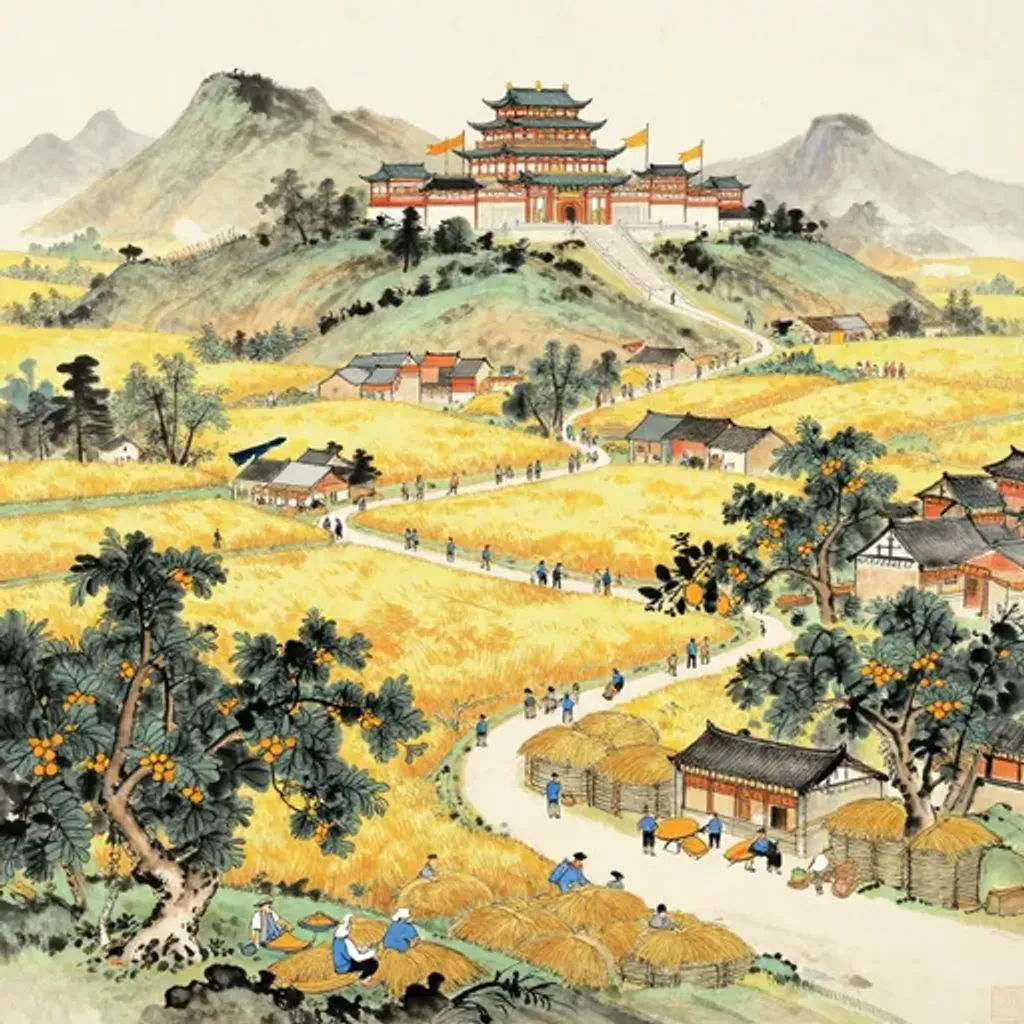
大王執政,歲熟民富;國家豐有,主者有喜。
The great king governs; the harvest is rich, the people prosperous. The state has plenty; the ruler has cause for joy.
— Jiao Yanshou, Yilin (Forest of Changes), 1st century BC
Commentary
Heaven and fire form Fellowship, and a wise ruler's governance bears tangible fruit. A great king holds power with steady hands; the harvests ripen and the people prosper. The state overflows with abundance, and the lord has cause for celebration. The verse is declarative and optimistic — no allusion, no complication, simply good governance producing material prosperity. From Fellowship to Darkening of the Light, the transformation adds an ominous undertone. Light sinks into the earth in Darkening; the noble man governs the multitude by using darkness to preserve clarity. The prosperous realm described here exists at the threshold of eclipse — its very brightness inviting the shadow. The wise ruler anticipates this and dims his display while keeping his vision sharp.
同人 → 家人
Hexagram 13 → Hexagram 37: The Family
Changing lines: 4
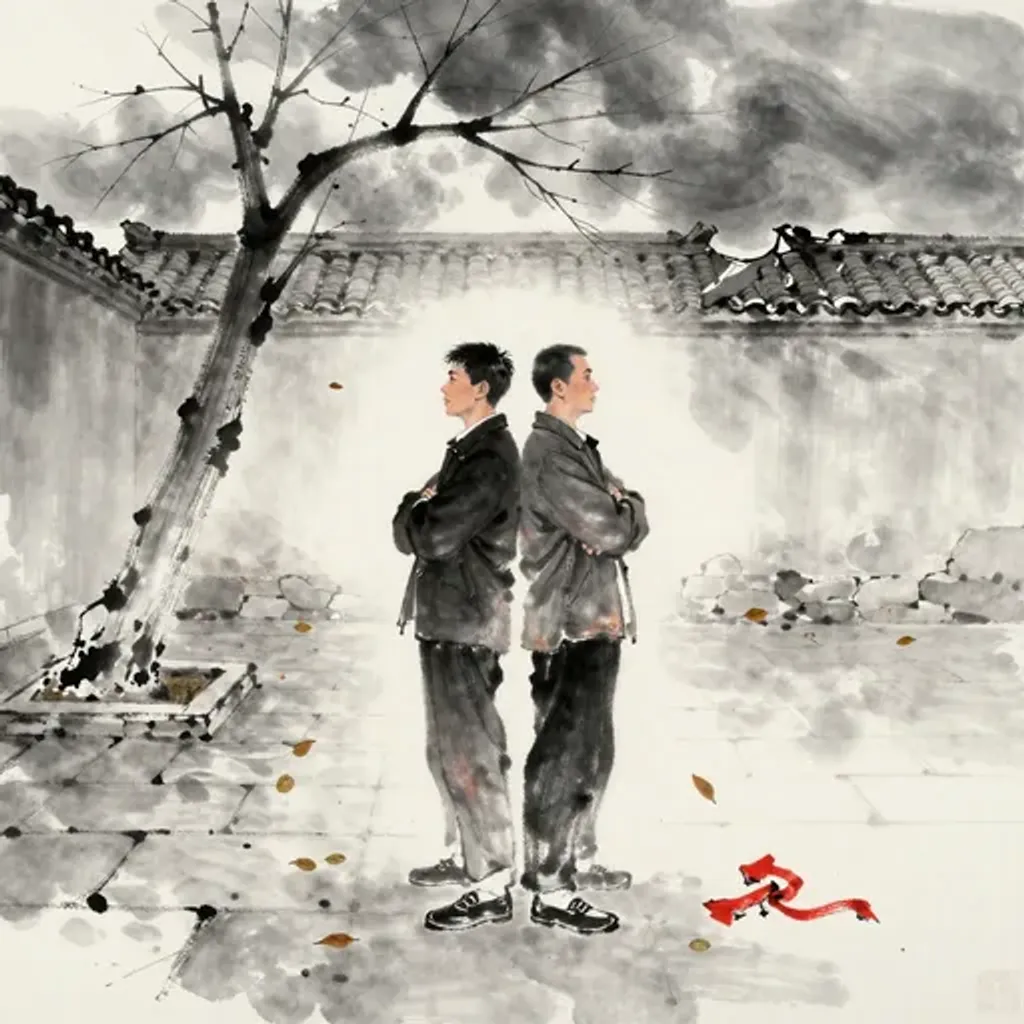
爭訟相背,和氣不處;陰陽俱否,穀風無子。
Quarreling, turning their backs; harmonious spirit finds no home. Yin and yang are both blocked; the valley wind bears no heir.
— Jiao Yanshou, Yilin (Forest of Changes), 1st century BC
Commentary
Heaven and fire form Fellowship, but the bonds have snapped. Litigation and discord drive people apart; harmonious qi cannot settle. Yin and yang are both obstructed — the Shijing ode 'Gufeng' laments a barren marriage, and here the union produces no children. The verse channels the bitterest form of domestic failure: not violence but the slow death of a relationship where warmth has departed. From Fellowship to the Family, the transformation is cruelly ironic. Wind emerging from fire in the Family means that words have substance and actions have constancy. Here, neither condition holds — words are accusations, and the only constancy is mutual estrangement. The family that Fellowship should nourish instead withers from within.
同人 → 睽
Hexagram 13 → Hexagram 38: Opposition
Changing lines: 2, 3, 5
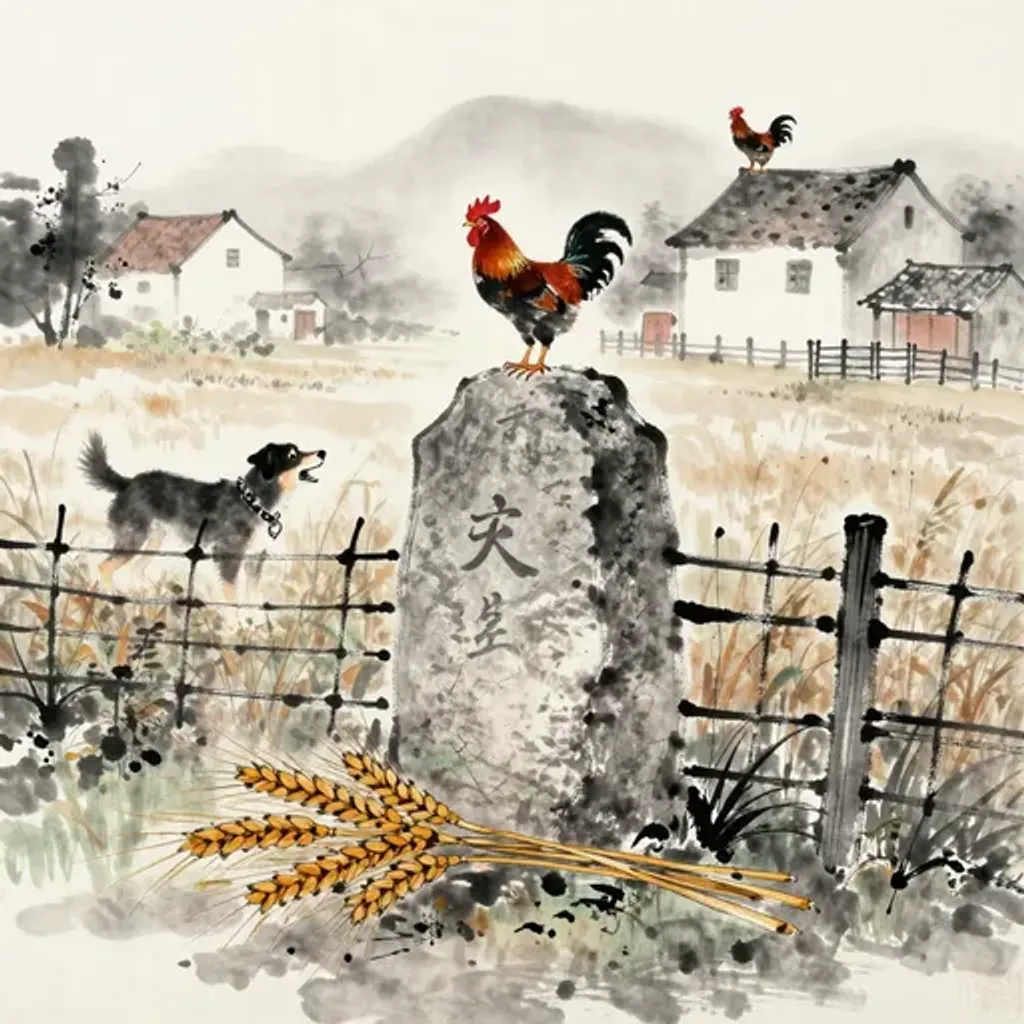
齊魯爭言,戰於龍門;搆怨結禍,三世不安。
Brothers divide the field, boundary stones deeply carved. A dog barks at the eastern fence; a rooster crows from the western house.
— Jiao Yanshou, Yilin (Forest of Changes), 1st century BC
Commentary
Heaven and fire form Fellowship, but this is a verse rewritten in modern style. The original reads: 'Qi and Lu dispute with words, battle at Dragon Gate; enmity breeds calamity through three generations, and peace never returns.' The states of Qi and Lu — neighbors bound by Zhou feudal ties — quarrel at the symbolic Dragon Gate, the gorge carved by Yu the Great. Their feud metastasizes across generations. From Fellowship to Opposition, the transformation is precise: fire above and lake below in Opposition pull apart what should cohere. The noble man seeks unity within difference, but Qi and Lu found only difference within what should have been unity. Three generations of grudges turn brotherhood into vendetta.
同人 → 蹇
Hexagram 13 → Hexagram 39: Obstruction
Changing lines: 1, 4, 6
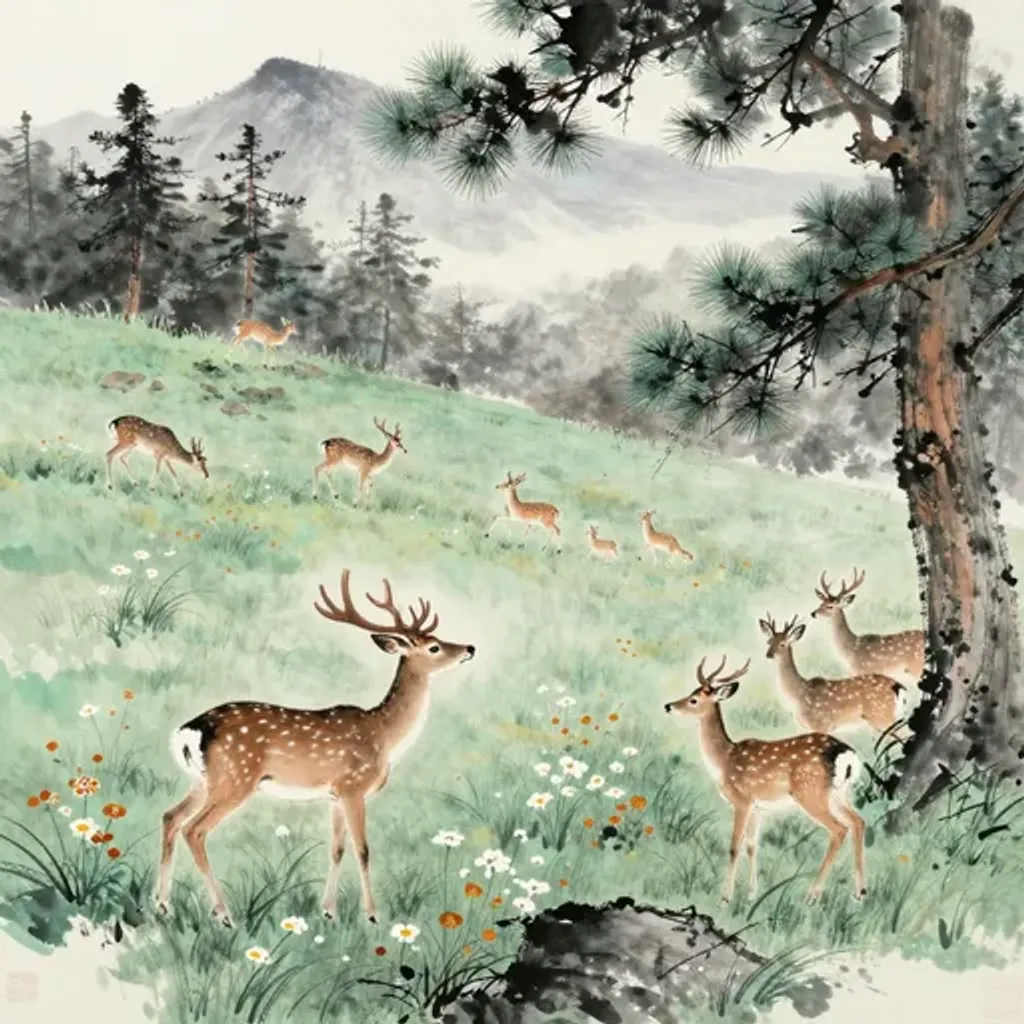
鹿得美草,鳴呼其友;九族和穆,不離邦域。
The deer finds sweet grass and calls to its companions. The nine clans are harmonious and reverent; they do not leave the homeland.
— Jiao Yanshou, Yilin (Forest of Changes), 1st century BC
Commentary
Heaven and fire form Fellowship as a deer finds sweet grass and calls to its companions. The image comes from the Shijing ode 'Luming' — 'The deer cries, feeding on wild grass; I have excellent guests, and the lute and reed-organ play.' The nine clans live in harmony, never leaving the borders of their domain. Fellowship here is natural, generous, and self-contained: the deer that finds abundance shares it instinctively. From Fellowship to Obstruction, the transformation introduces the obstacle that makes such fellowship precious. Water perched atop the mountain in Obstruction; the noble man turns inward to cultivate virtue. The deer's community, secure within its boundaries, is the answer to obstruction — solidarity that does not need to cross the mountain because everything needful lies within.
同人 → 解
Hexagram 13 → Hexagram 40: Deliverance
Changing lines: 1, 2, 3, 5, 6
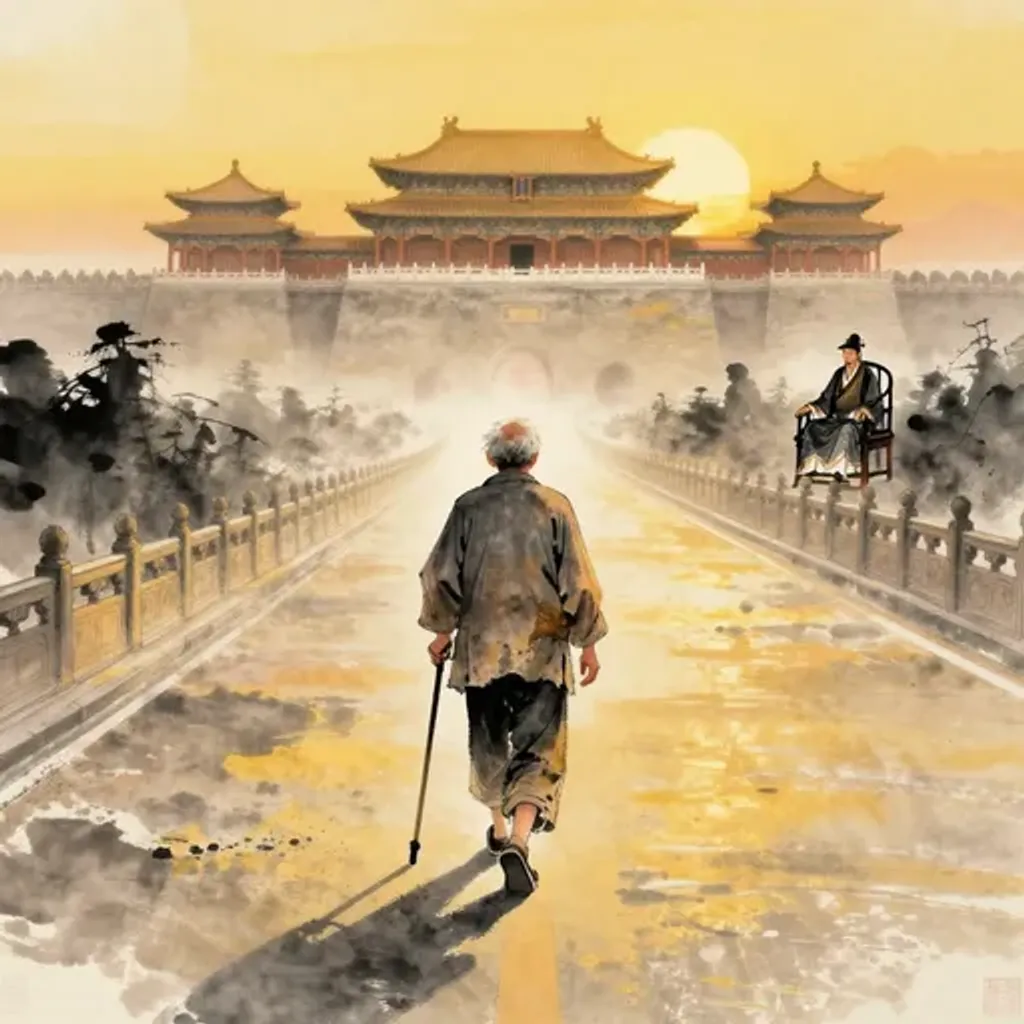
百里南行,雖徵復明;去虞適秦,為穆國卿。
A hundred miles southward; though demoted, one's brilliance returns. Leaving Yu for Qin; one becomes the chief minister of Duke Mu.
— Jiao Yanshou, Yilin (Forest of Changes), 1st century BC
Commentary
Heaven and fire form Fellowship, and here a servant's long journey leads to a minister's seat. Baili Xi travels a hundred li southward — though the road darkens, brightness returns. Leaving the fallen state of Yu, he arrives in Qin to become Duke Mu's chief minister. According to tradition, Baili Xi was captured in war and sold into slavery for five ram skins before Duke Mu recognized his talent. From Fellowship to Deliverance, the transformation resonates perfectly. Thunder and rain in Deliverance release what has been trapped. Baili Xi's liberation from bondage into statecraft enacts Deliverance's central dynamic: the obstruction dissolves, and what was imprisoned finds its proper function at last.
同人 → 損
Hexagram 13 → Hexagram 41: Decrease
Changing lines: 2, 3, 4, 5
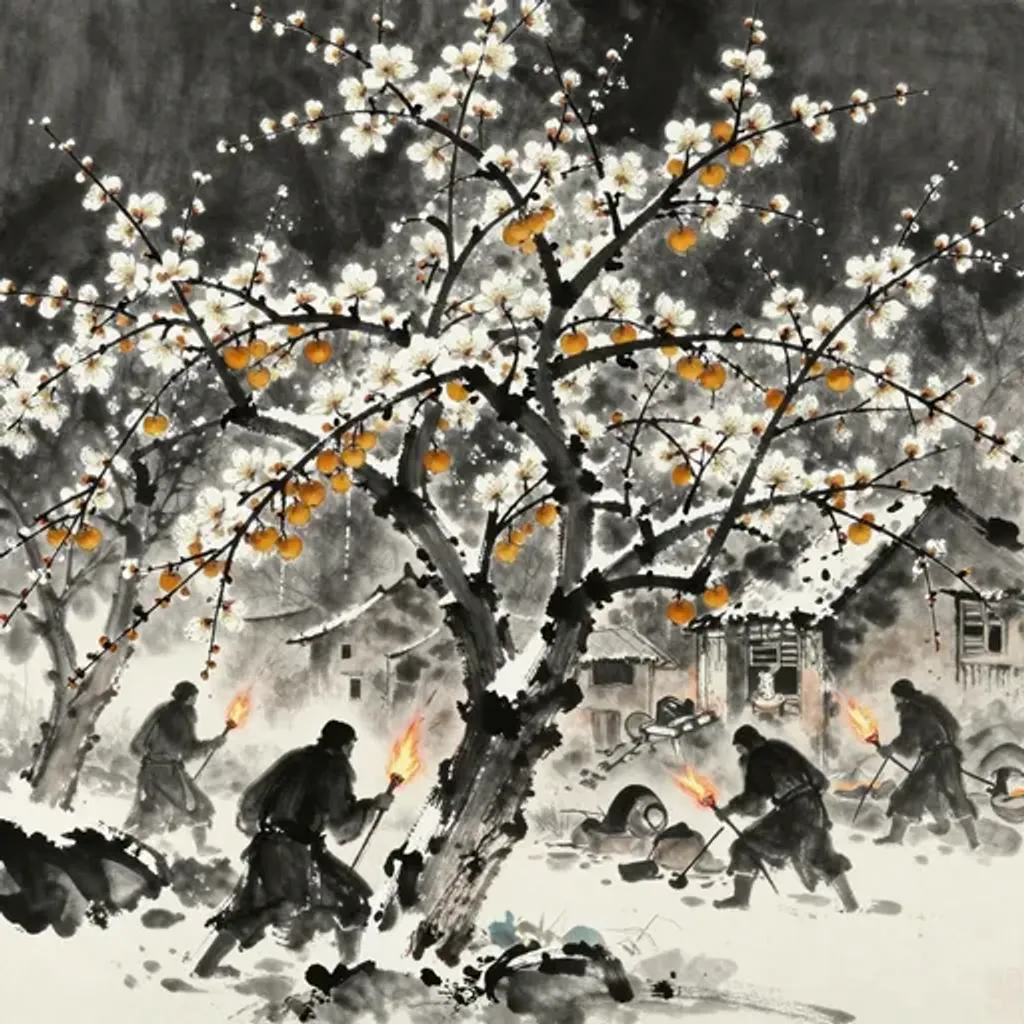
梅李冬實,國多寇賊;亂擾並作,王不能制。
Plum and apricot bear fruit in winter; the state swarms with bandits. Turmoil erupts on every side; the king cannot control it.
— Jiao Yanshou, Yilin (Forest of Changes), 1st century BC
Commentary
Heaven and fire form Fellowship, but nature's calendar has gone awry. Plum and pear trees bear fruit in winter — an unnatural inversion of the seasons. Bandits and raiders multiply throughout the state; disorder erupts on every side, and the king cannot maintain control. When trees fruit out of season, the human world mirrors that disorder: moral and political calendars have lost their rhythm. From Fellowship to Decrease, the transformation strips away the pretense of order. Mountain above the lake in Decrease, the noble man restrains anger and curbs desire. The realm described here has lost all restraint — its fellowship corrupted into collective lawlessness. What should decrease — chaos, greed, banditry — instead multiplies unchecked.
同人 → 益
Hexagram 13 → Hexagram 42: Increase
Changing lines: 3, 4
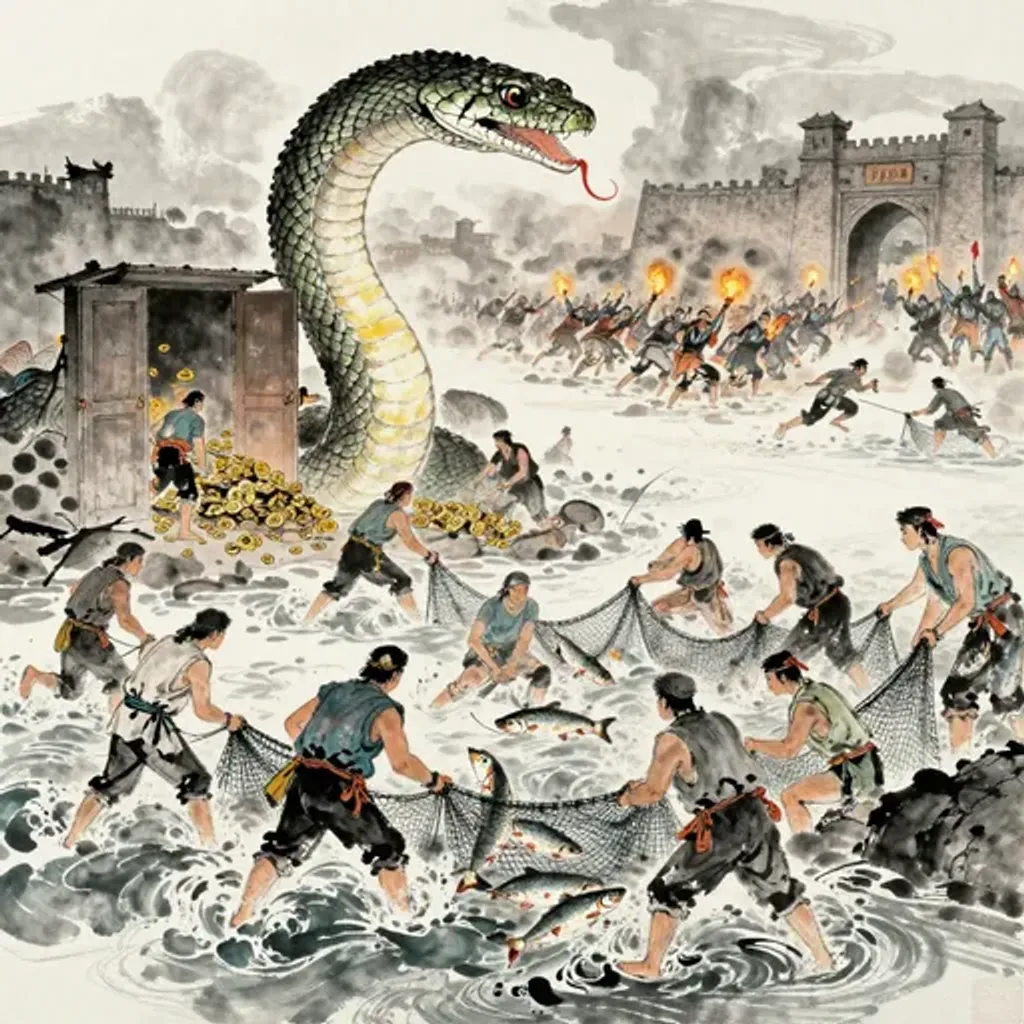
府藏之富,王以賑貸;捕魚河海,苟罔多得,巨蛇大輶。戰於國郊,君遂走逃。
The treasury's riches; the king uses them for relief and loans. Catching fish in river and sea; wide nets bring great hauls, including giant serpents and large boats. Battle at the state's outskirts; the lord thereupon flees.
— Jiao Yanshou, Yilin (Forest of Changes), 1st century BC
Commentary
Heaven and fire form Fellowship in a verse of cascading reversals. The royal treasury brims with wealth, and the king distributes grain in relief; fishermen cast nets into rivers and seas, hauling in enormous catches — great serpents and giant turtles among them. Then the scene ruptures: battle erupts at the capital's outskirts, and the lord himself flees in defeat. Abundance turns to overreach, generosity to chaos, harvest to war. From Fellowship to Increase, the transformation underscores the irony. Wind and thunder in Increase, the noble man corrects faults when he sees goodness. The verse shows Increase's shadow: when resources flow without governance, bounty feeds the very forces that will destroy the state.
同人 → 夬
Hexagram 13 → Hexagram 43: Breakthrough
Changing lines: 2, 6
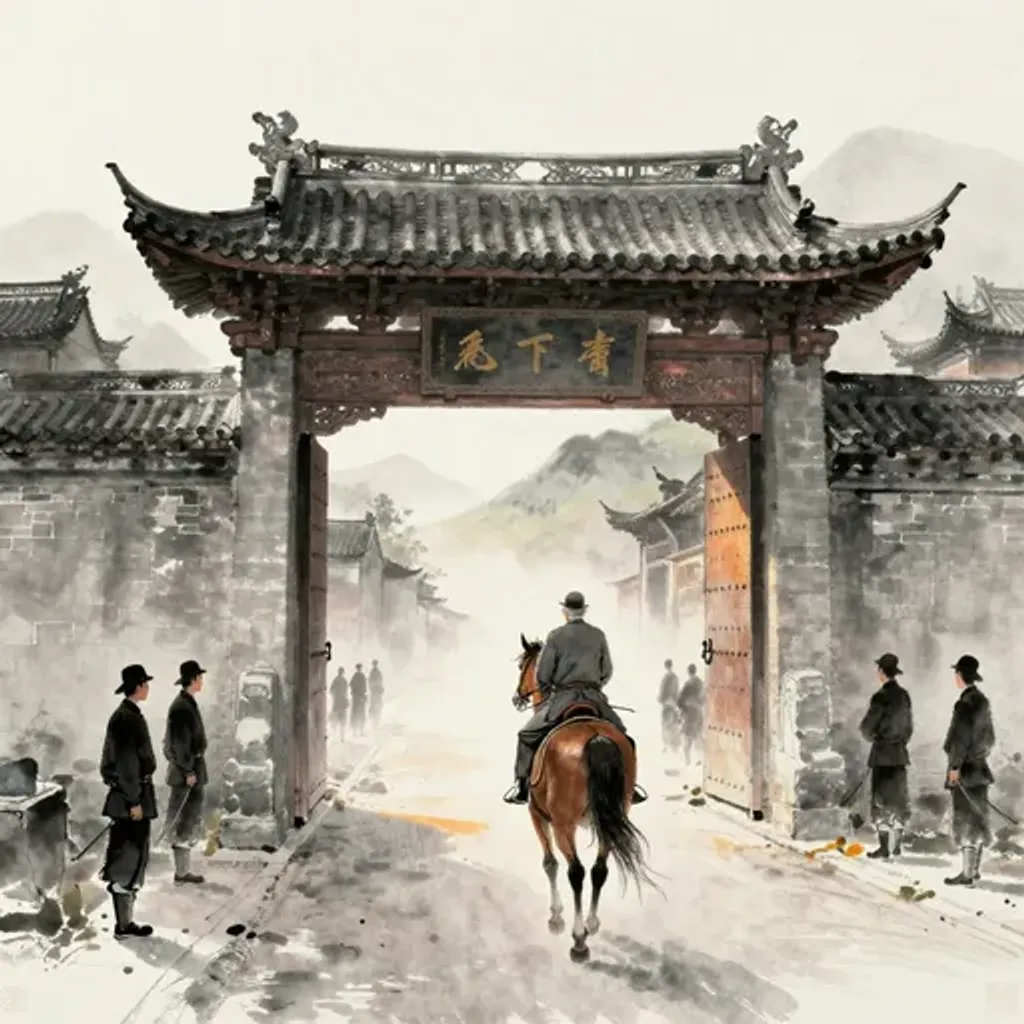
杜飛門啟,患憂大解;去老乘馬,不為身禍。
The gate of misfortune swings shut and opens; anxiety and trouble dissolve at once. Abandoning the old, riding on horseback; it does not become a bodily harm.
— Jiao Yanshou, Yilin (Forest of Changes), 1st century BC
Commentary
Heaven and fire form Fellowship, and the blocked door flies open. What was sealed is now unsealed; anxiety and sorrow dissolve at once. An aged figure mounts a horse and rides away — no longer imperiled, free from bodily harm. The verse reads like an escape narrative compressed to its essentials: confinement, release, departure. From Fellowship to Breakthrough, the transformation is the verse's own mechanism. The lake rises above heaven in Breakthrough as the noble man distributes blessings downward. The sealed door corresponds to accumulated tension; when it breaks, the relief cascades. The old man on horseback embodies the breakthrough's aftermath — not triumph but simple, grateful freedom.
同人 → 姤
Hexagram 13 → Hexagram 44: Coming to Meet
Changing lines: 1, 2
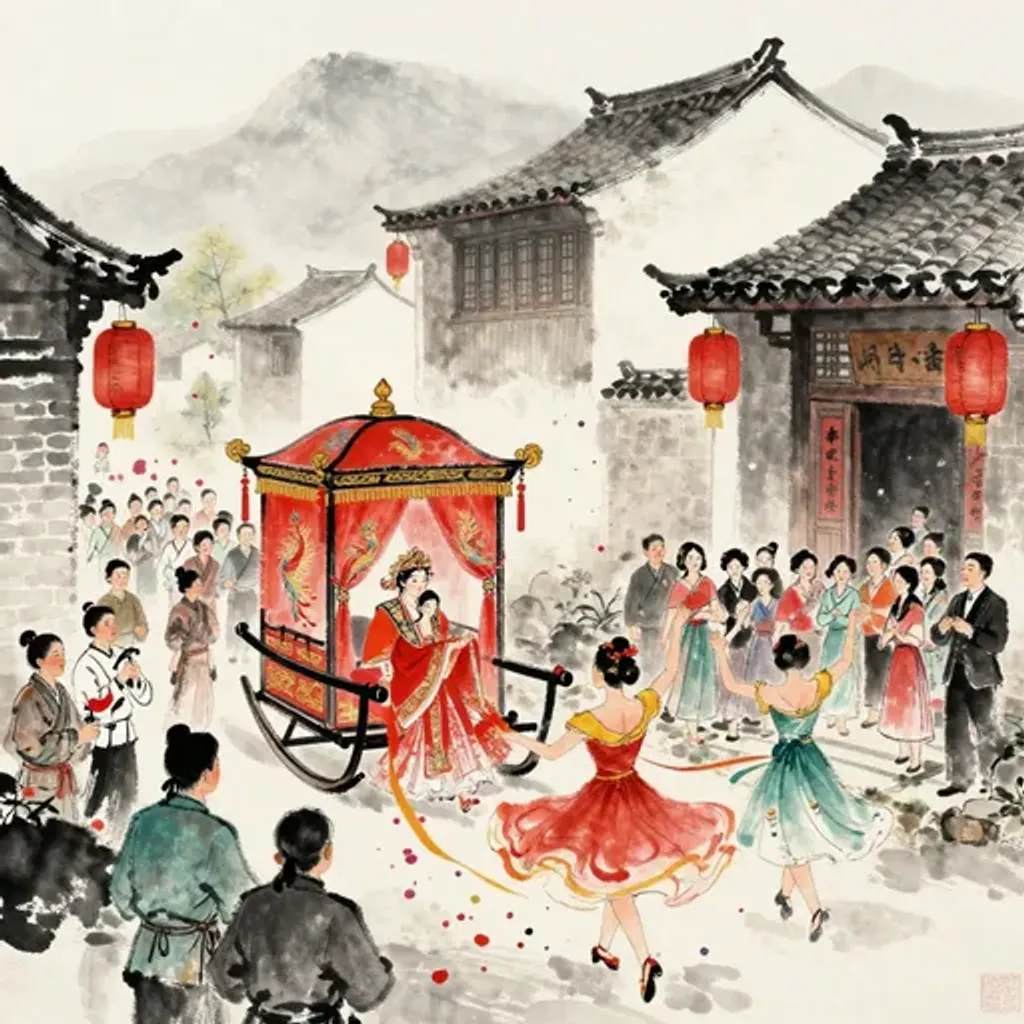
宜昌娶婦,東家歌舞,長樂歡喜。
Fit to prosper, he takes a bride; the eastern house sings and dances. Lasting joy and delight.
— Jiao Yanshou, Yilin (Forest of Changes), 1st century BC
Commentary
Heaven and fire form Fellowship, and the verse is pure wedding joy. It is fitting and propitious to take a bride; the eastern neighbor's household celebrates with song and dance; long-lasting happiness and delight fill the air. No shadows, no complications — the fellowship of marriage at its most auspicious. From Fellowship to Coming to Meet, the transformation shifts from planned union to unexpected encounter. Heaven above the wind in Coming to Meet, the ruler issues proclamations to the four quarters. The bride arrives as wind arrives beneath heaven — a gentle, pervasive presence. Marriage here is not conquest but reception: the household opens its doors and the wind of new life enters.
同人 → 萃
Hexagram 13 → Hexagram 45: Gathering Together
Changing lines: 1, 3, 6
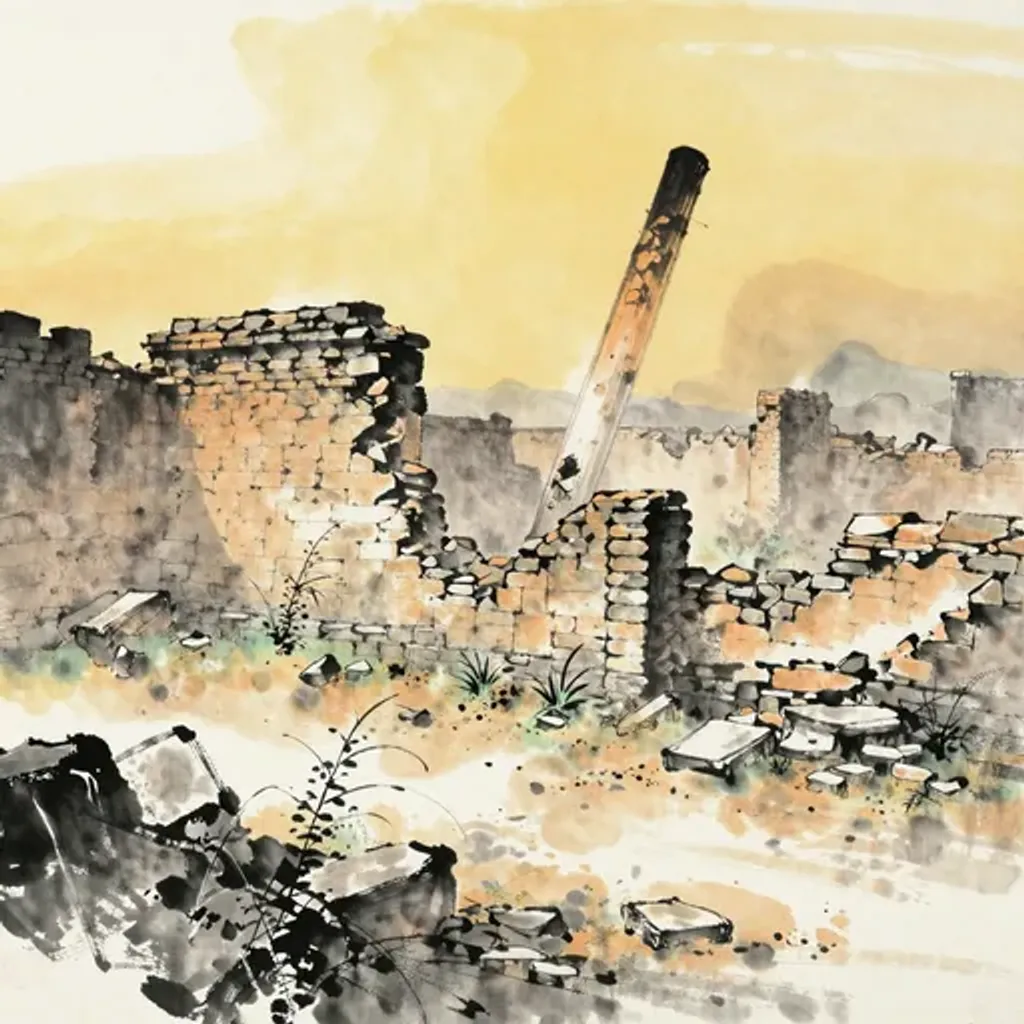
正陽之央,甲氏以亡;禍及留吁,湮滅為墟。
At the zenith of the bright yang; the clan of Jia perishes. Disaster reaches Liu and Yu; they are buried and reduced to ruins.
— Jiao Yanshou, Yilin (Forest of Changes), 1st century BC
Commentary
Heaven and fire form Fellowship, but the blazing center destroys its own periphery. At the height of yang's dominance, the Jia clan is extinguished; calamity reaches Liuyu, reduced to rubble and wasteland. In 593 BC, the state of Jin under its general destroyed the Red Di tribes — Jia, Liuyu, and Duochen — erasing these frontier peoples from the map. From Fellowship to Gathering, the transformation reveals a disturbing logic. The lake gathers upon the earth in Gathering as the noble man prepares weapons against the unexpected. What gathers here is not peaceful assembly but the concentrated force of a powerful state, and what it gathers against are entire peoples. Fellowship wielded as conquest becomes annihilation.
同人 → 升
Hexagram 13 → Hexagram 46: Pushing Upward
Changing lines: 1, 2, 4, 5, 6
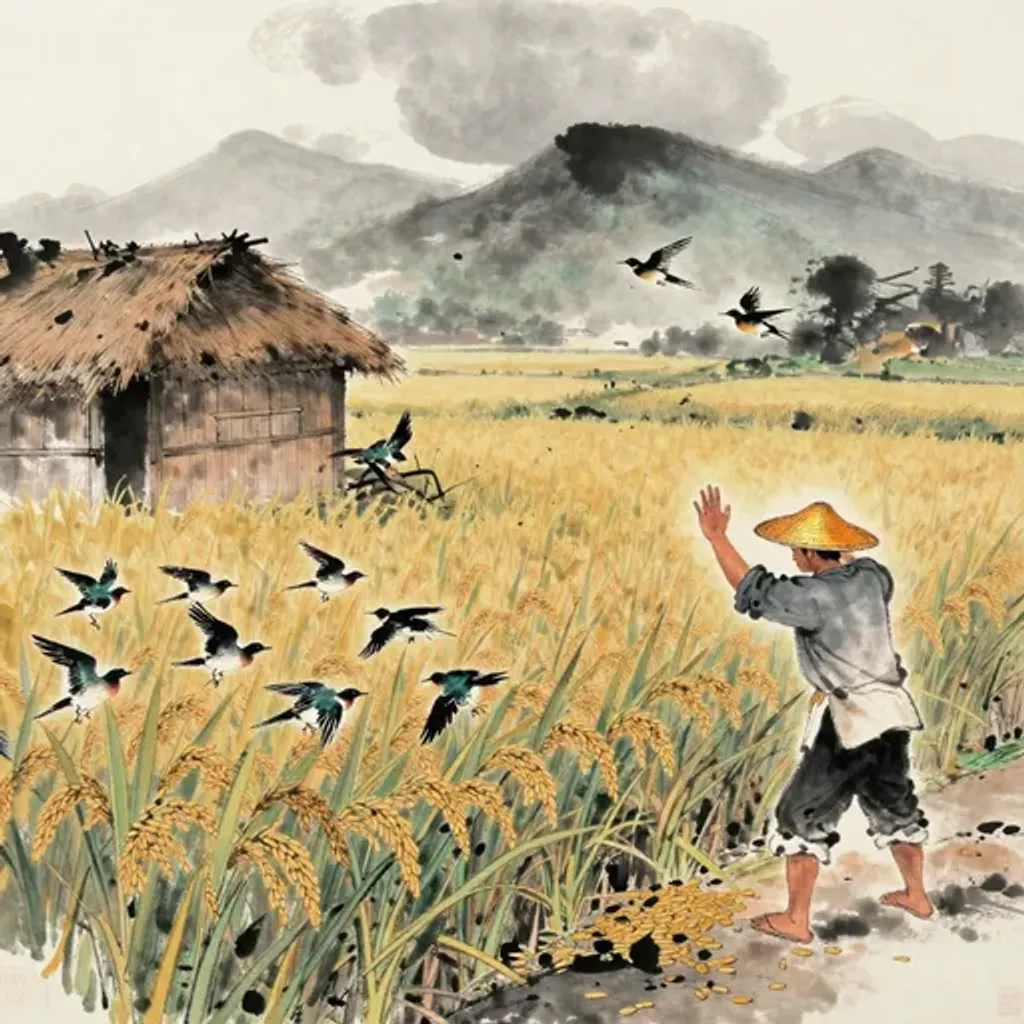
鳥過稻廬,甘樂𪍿鰌;雖驅不去,田畯懷憂。
Birds pass by the rice barn, delighting in grubs and loaches. Though one chases, they will not leave; the farm overseer nurses his worry.
— Jiao Yanshou, Yilin (Forest of Changes), 1st century BC
Commentary
Heaven and fire form Fellowship, but fellowship between birds and farmers is not always welcome. Birds descend on the grain shed, delighting in the loaches and worms of the paddy field. Though the farmer drives them away, they refuse to leave — the field overseer is filled with worry. The scene captures a common agrarian tension: birds are natural allies of the ecosystem but competitors for the harvest. From Fellowship to Pushing Upward, the transformation shifts from horizontal nuisance to vertical growth. Trees rise slowly from within the earth in Pushing Upward, accumulating small gains into great height. The farmer's worry is temporary; what pushes upward — the grain itself — will outgrow the birds' reach in time.
同人 → 困
Hexagram 13 → Hexagram 47: Oppression
Changing lines: 1, 2, 3, 6
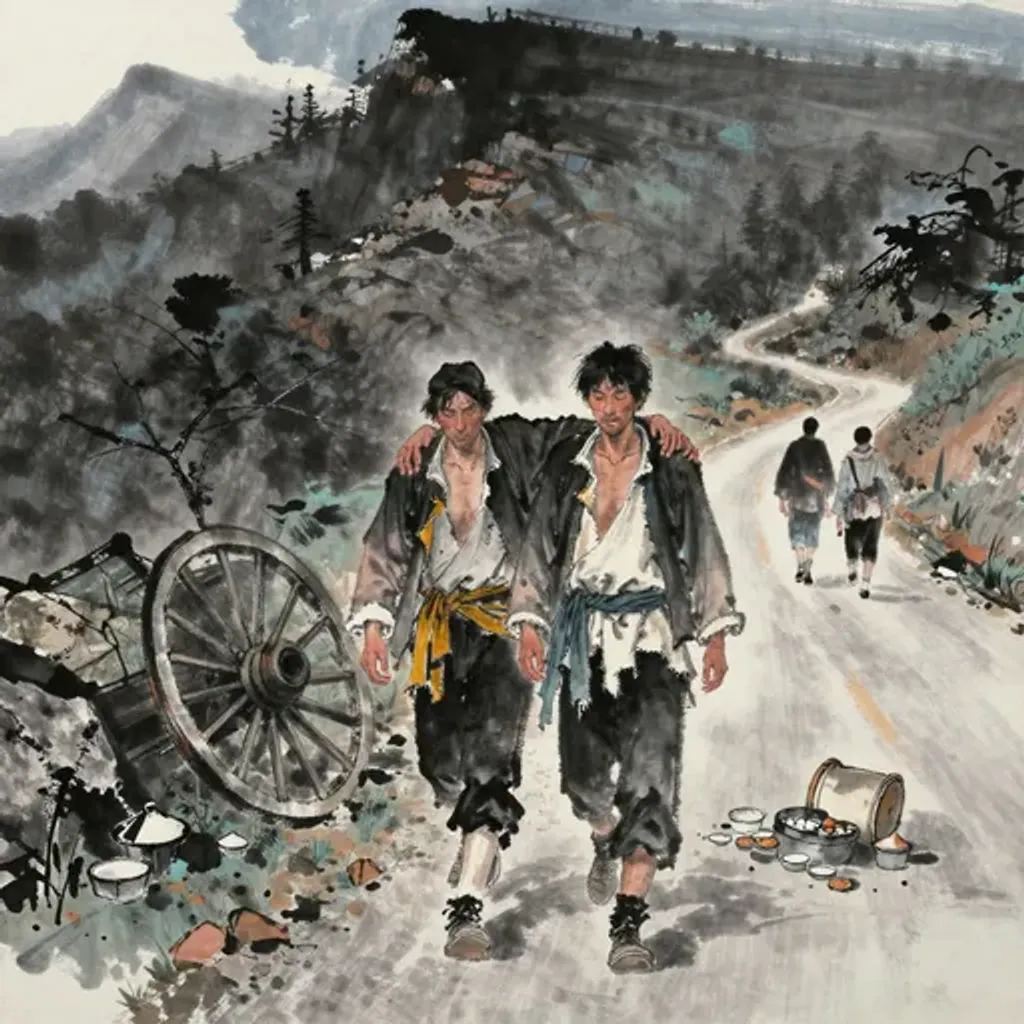
跛踦俱行,日暮車傷,失旅乏糧。
The lame limp along together; at dusk the cart breaks down. They lose the caravan, and provisions run out.
— Jiao Yanshou, Yilin (Forest of Changes), 1st century BC
Commentary
Heaven and fire form Fellowship, but the company limps along in shared misfortune. The lame walk together, hobbling forward; by dusk the cart is broken, the traveling party scattered, provisions exhausted. Every element of the journey fails simultaneously: body, vehicle, companions, sustenance. From Fellowship to Oppression, the transformation distills this collapse. The lake with no water in Oppression — the noble man stakes his life to fulfill his purpose. The fellowship that holds only when conditions are favorable dissolves the moment hardship arrives. Yet Oppression's deeper teaching is that those who persist through depleted circumstances discover a will that fair-weather fellowship never required.
同人 → 井
Hexagram 13 → Hexagram 48: The Well
Changing lines: 1, 2, 4, 6
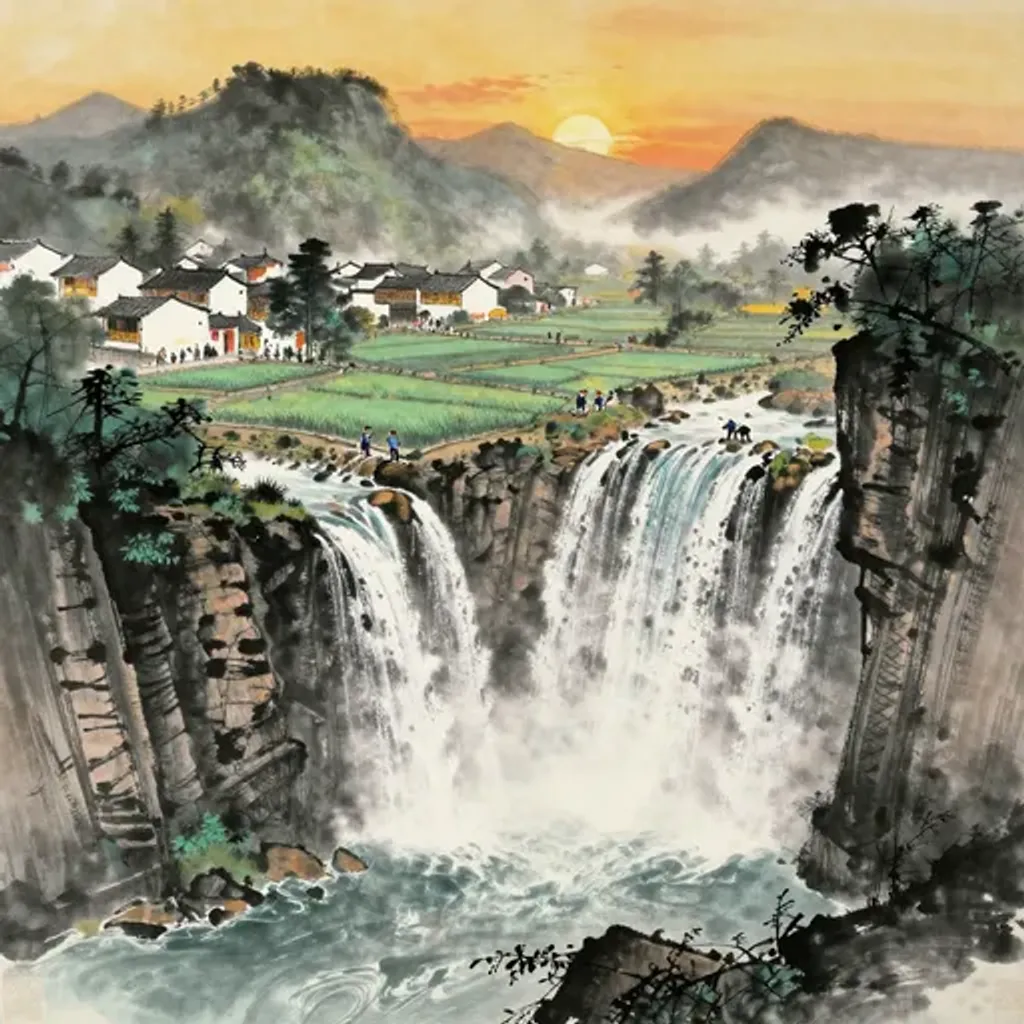
龍門水穴,流行不害;民安其土,君臣相保。
At Dragon Gate's water grotto; the flow proceeds without harm. The people rest secure upon their land; lord and minister safeguard each other.
— Jiao Yanshou, Yilin (Forest of Changes), 1st century BC
Commentary
Heaven and fire form Fellowship, and the Dragon Gate opens not to ambition but to communal well-being. The waters flow through the Dragon Gate's channel without causing harm — Yu the Great's engineering directing the flood into useful currents. The people are settled in their land; ruler and subjects sustain each other. The verse evokes Yu's great work of taming the waters, but refocuses it on the ongoing maintenance of order rather than the heroic act itself. From Fellowship to the Well, the transformation deepens this civic vision. Water drawn up through wood in the Well — the noble man encourages mutual aid among the people. Dragon Gate and Well share the same logic: infrastructure that channels natural forces for communal benefit.
同人 → 革
Hexagram 13 → Hexagram 49: Revolution
Changing lines: 6
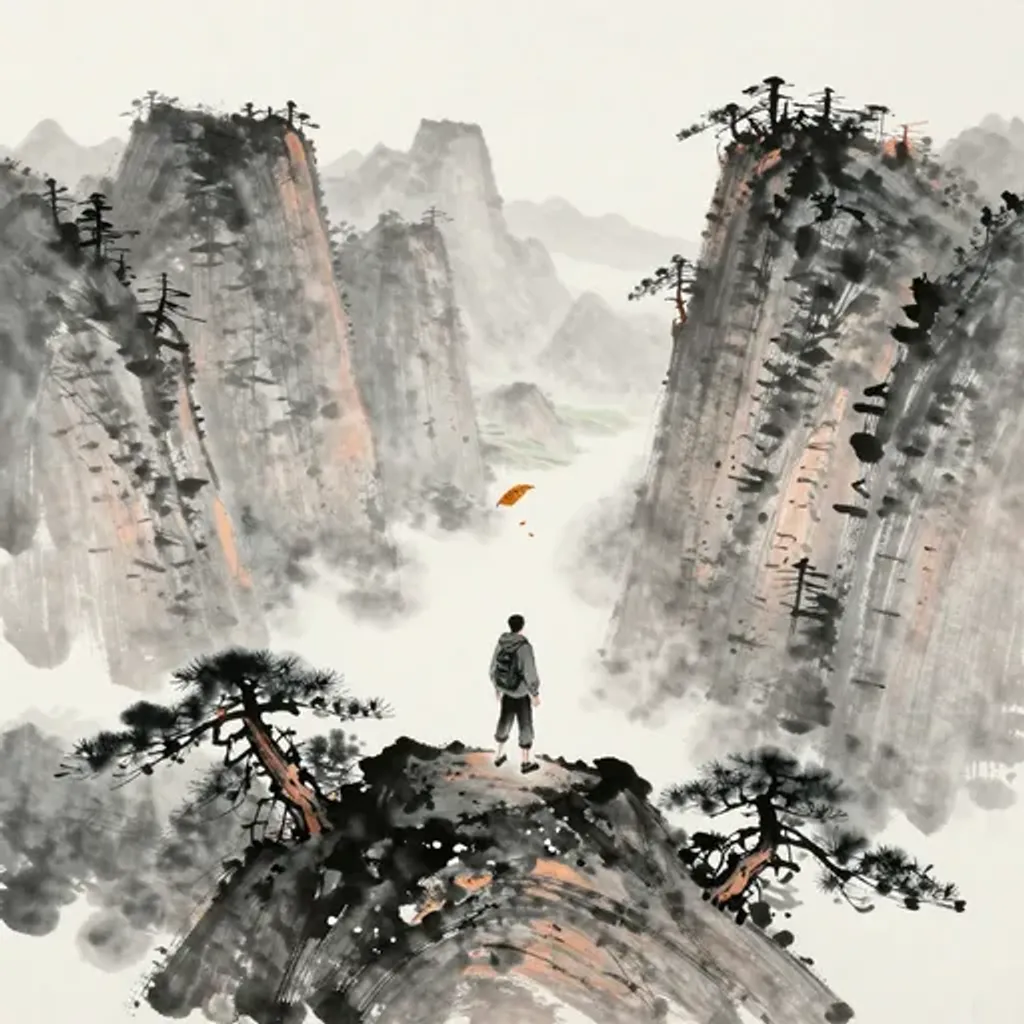
山陵四塞,遏我徑路;欲前不得,復還故處。
Mountain ridges block from four sides; our path is cut off. Wanting to advance, we cannot; we return to where we started.
— Jiao Yanshou, Yilin (Forest of Changes), 1st century BC
Commentary
Heaven and fire form Fellowship, but mountains surround on all four sides, blocking every path. Wanting to advance but unable, the traveler returns to the starting point. The verse is pure spatial frustration: an encirclement with no exit, ambition meeting geography's veto. From Fellowship to Revolution, the transformation introduces the force that can remake the landscape itself. Fire within the lake in Revolution; the noble man regulates the calendar to clarify the seasons. When the existing terrain offers no passage, Revolution does not find a path — it creates one. The traveler who returns to the old place carries with him the knowledge that the old paths are finished, and only radical change will open the way forward.
同人 → 鼎
Hexagram 13 → Hexagram 50: The Cauldron
Changing lines: 1, 2, 5
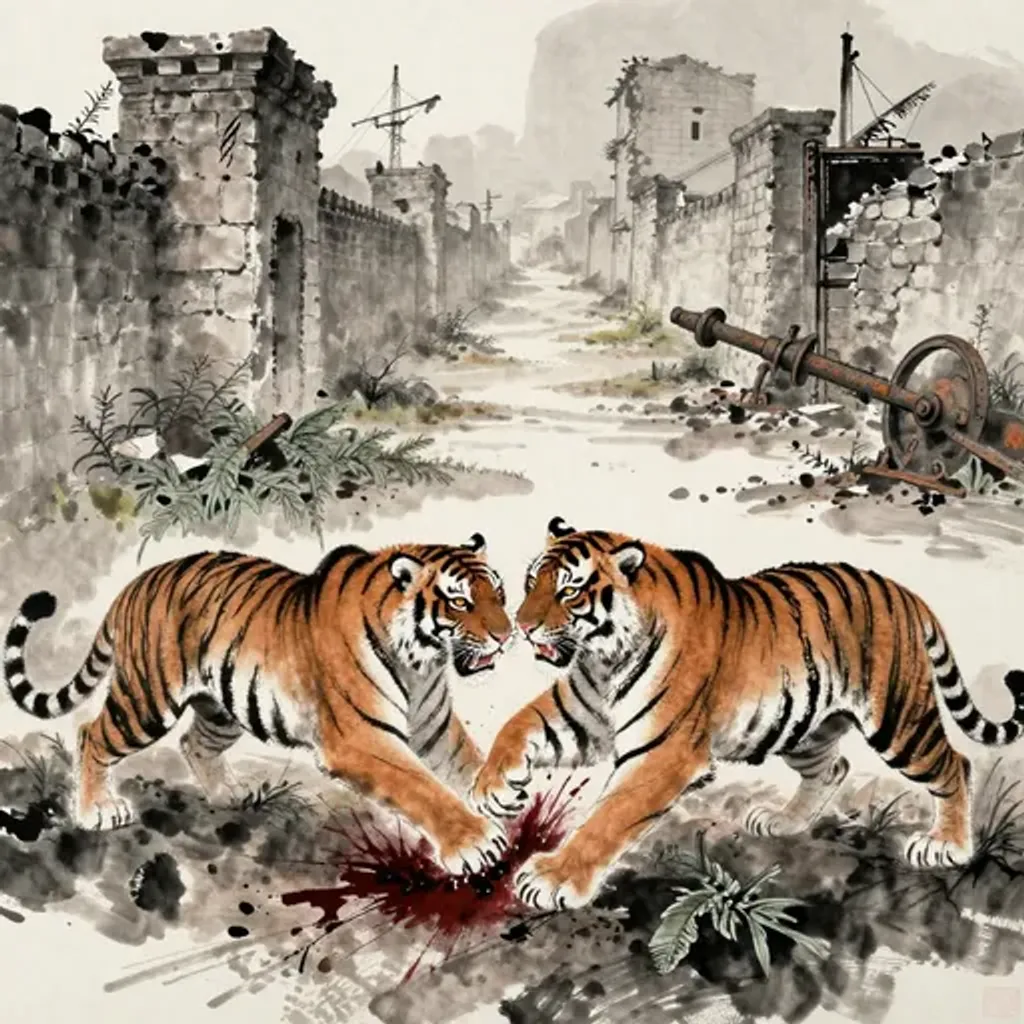
兩虎爭鬭,血流漂杵;城郭空墟,蒿藜塞道。
Two tigers fight to the death; blood flows enough to float a pestle. City walls stand empty; mugwort and weeds choke the roads.
— Jiao Yanshou, Yilin (Forest of Changes), 1st century BC
Commentary
Heaven and fire form Fellowship, but when two tigers fight, the result is desolation. Blood flows until pestles float — the ancient description of the Battle of Muye's carnage. Cities stand empty as ruins; wormwood and thistles choke the roads. The verse collapses fellowship into its darkest shadow: two powers of equal ferocity destroying not just each other but everything around them. From Fellowship to the Cauldron, the transformation offers the possibility of reconstitution after total destruction. Fire above wood in the Cauldron, the noble man stabilizes his position and crystallizes his mandate. The cauldron cooks raw material into nourishment — but first someone must clear the weeds from the ruined roads and begin again.
同人 → 震
Hexagram 13 → Hexagram 51: The Arousing Thunder
Changing lines: 3, 5, 6
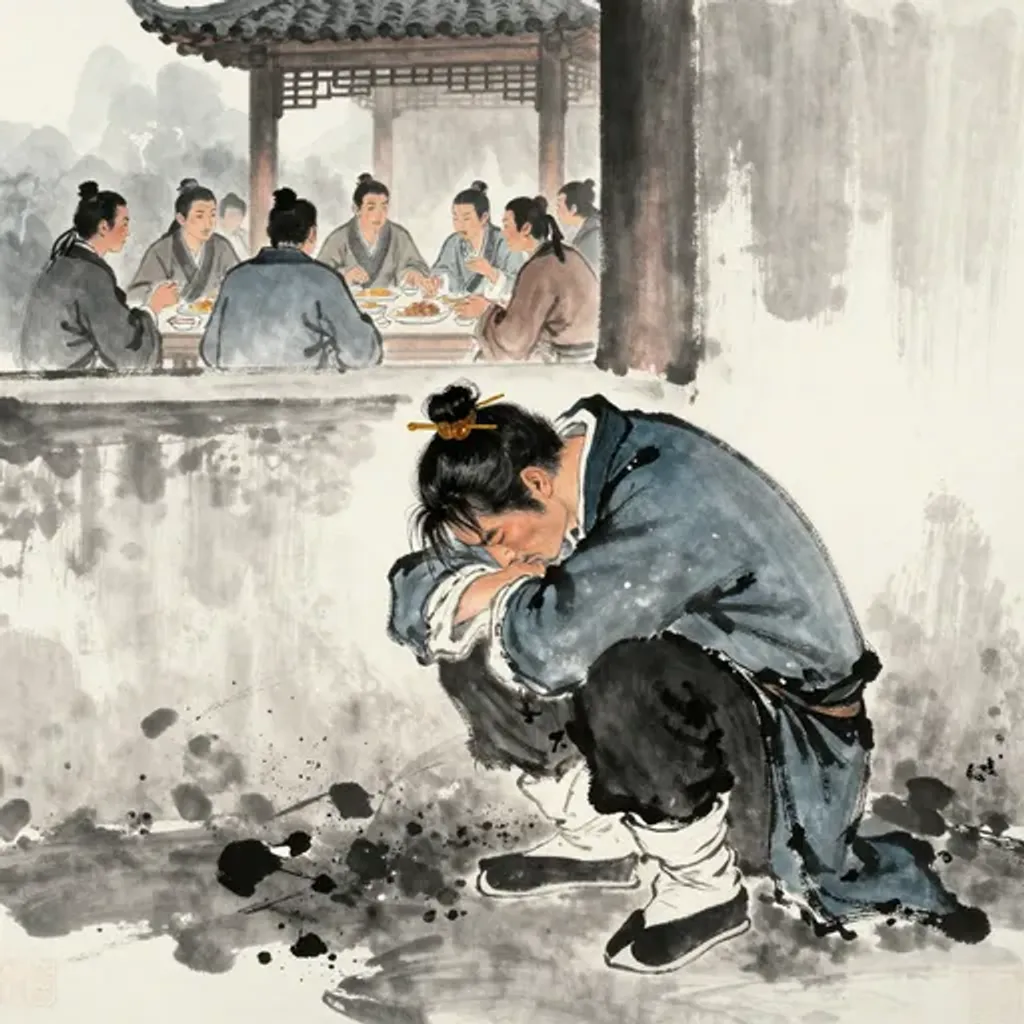
依叔墻隅,志下心勞;楚亭晨食,韓子低頭。
Leaning at the wall's corner; ambition low, heart weary. Eating a dawn meal at the inn of Chu; the nobleman of Han bows his head.
— Jiao Yanshou, Yilin (Forest of Changes), 1st century BC
Commentary
Heaven and fire form Fellowship, but the scene is one of humiliation and dependence. Leaning against a wall in a relative's courtyard, ambition crushed and heart exhausted. At a Chu roadside pavilion, taking a morning meal in haste; a man of Han lowers his head in submission. The verse evokes the indignity of a displaced person eating at another's table — pride sacrificed for survival. From Fellowship to the Arousing, the transformation injects sudden force into this posture of abasement. Doubled thunder shakes the world in the Arousing; the noble man examines himself in fear and trembling. The bowed head may be momentary — thunder has a way of straightening spines. What crouches in dependency gathers the shock that will propel it upright.
同人 → 艮
Hexagram 13 → Hexagram 52: Keeping Still Mountain
Changing lines: 1, 4, 5
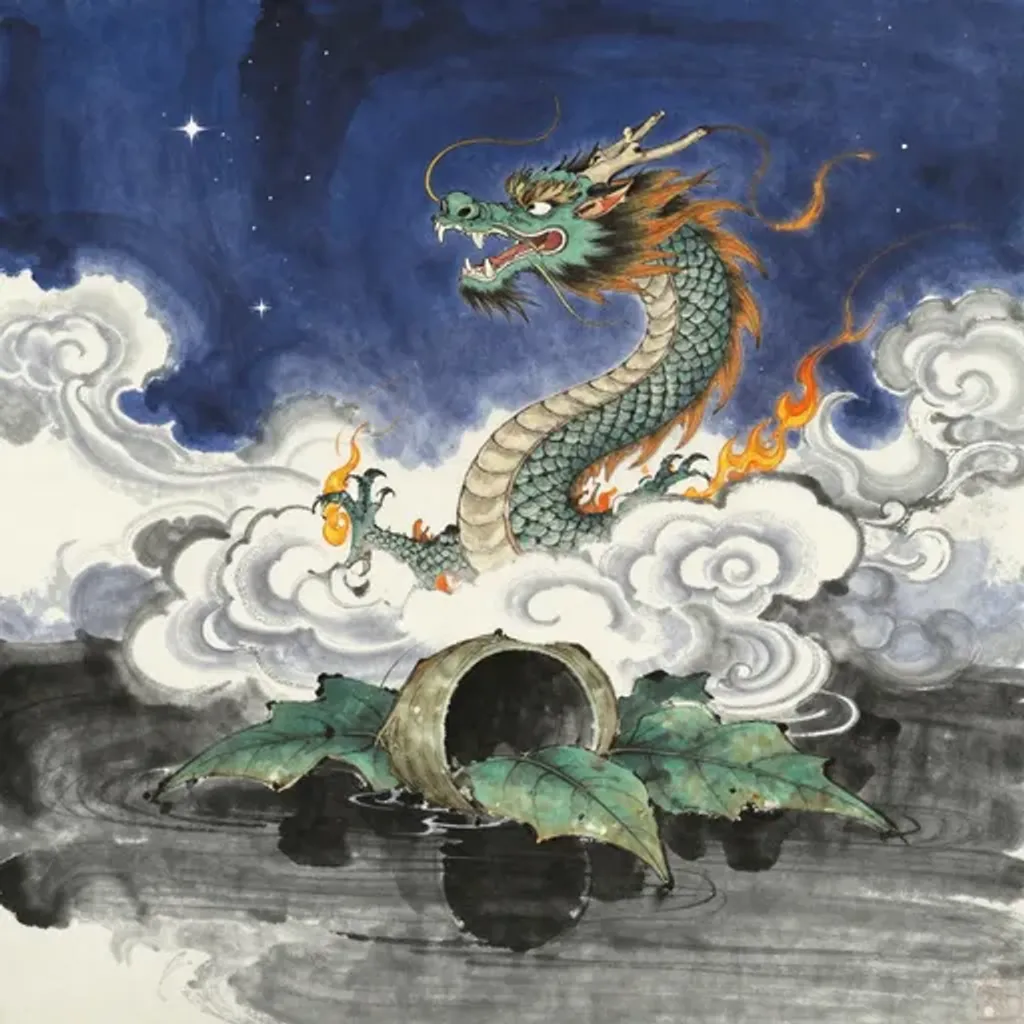
龍生無常,或托空葉;憑乘風雲,為堯立功。
A dragon's birth follows no fixed pattern; it may lodge upon an empty leaf. Mounting wind and cloud; it achieves great merit for Yao.
— Jiao Yanshou, Yilin (Forest of Changes), 1st century BC
Commentary
Heaven and fire form Fellowship as a dragon rises from the humblest beginnings. Born without fixed station, sometimes resting on an empty leaf, the dragon awaits its moment — then mounts the wind and clouds to accomplish great deeds for Emperor Yao. The dragon's origin in nothingness makes its ascent all the more extraordinary: no lineage, no territory, only readiness. From Fellowship to Keeping Still, the transformation arrests this soaring narrative. Twin mountains in Keeping Still; the noble man does not think beyond his position. The dragon that served Yao now rests — not from exhaustion but from completion. Stillness after achievement is the mountain's gift: knowing when to stop moving is as vital as knowing when to fly.
同人 → 漸
Hexagram 13 → Hexagram 53: Development
Changing lines: 1, 4
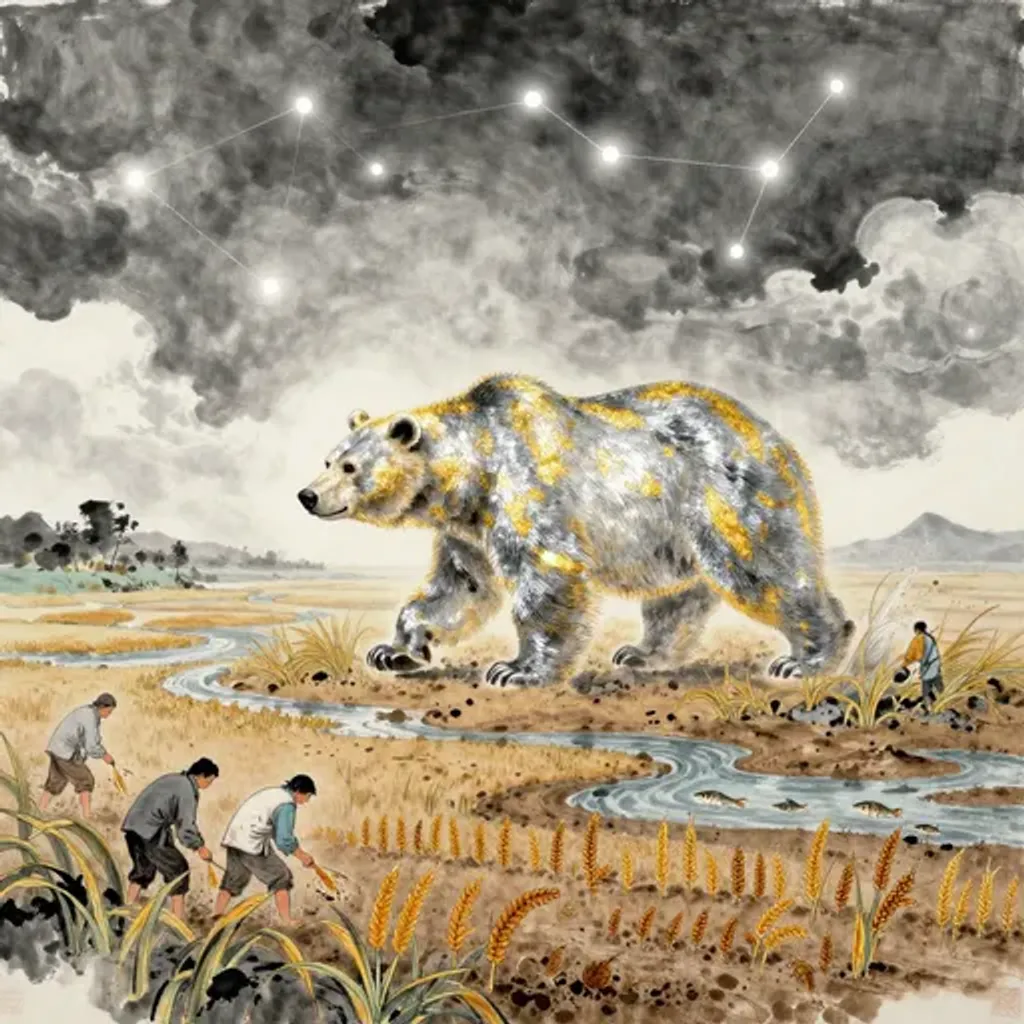
魁行搖尾,逐雲吹水;汙泥為陸,下田為稷。
The Great Bear walks and wags its tail, chasing clouds and stirring waters. Marshland becomes dry land; the low fields are planted with millet.
— Jiao Yanshou, Yilin (Forest of Changes), 1st century BC
Commentary
Heaven and fire form Fellowship as a great creature stirs the waters. A massive form lumbers forward, wagging its tail, chasing clouds and blowing across the water. Muddy marshland becomes dry ground; lowland paddies are planted with millet. The verse stages a primordial act of land reclamation — some immense force transforming wetland into arable field. From Fellowship to Development, the transformation mirrors this gradual conversion. Trees grow upon the mountain in Development; the noble man dwells in worthy virtue and improves customs. Development's patient, stage-by-stage progress matches the verse's agrarian metamorphosis: what begins as chaotic water eventually becomes ordered fields, one layer of sediment at a time.
同人 → 歸妹
Hexagram 13 → Hexagram 54: The Marrying Maiden
Changing lines: 2, 3, 5, 6
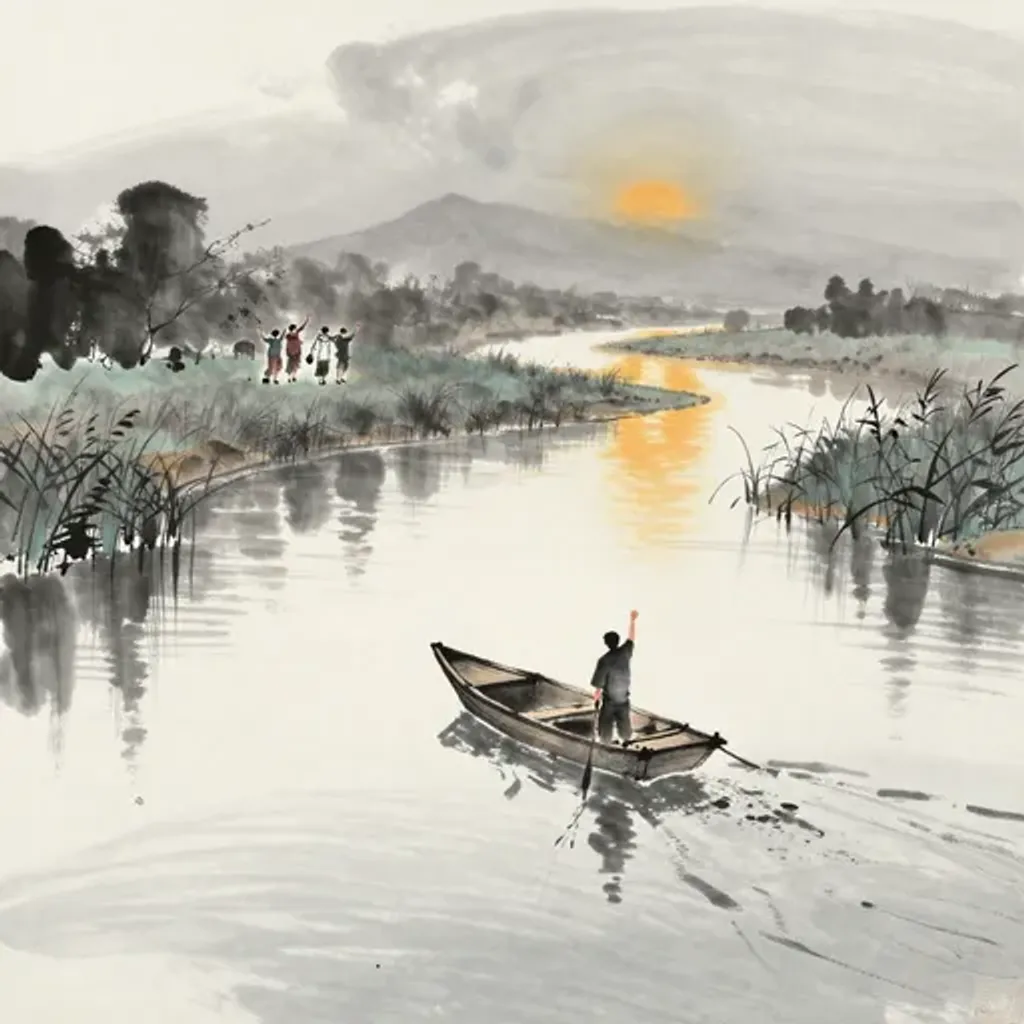
跛踦相隨,日暮牛罷;陵遲後旅,失利亡雌。
Crossing the river, the oar is lost — drifting south with the current. Companions have gone ahead; their calls grow faint.
— Jiao Yanshou, Yilin (Forest of Changes), 1st century BC
Commentary
Heaven and fire form Fellowship, but this verse is rewritten. The original reads: 'The lame walk together; by dusk the ox is spent. Lagging behind the company on declining roads, losing profit and losing the female.' A group of crippled travelers struggles along, their beast of burden exhausted by nightfall. They fall behind their companions on a deteriorating path, suffering losses in goods and kin. From Fellowship to the Marrying Maiden, the transformation traces the cost of ill-matched union. Thunder above the lake in the Marrying Maiden; the noble man understands ruin through lasting consequences. The limping fellowship here is a marriage of weakness to weakness — each partner dragging the other down the slope, arriving nowhere.
同人 → 豐
Hexagram 13 → Hexagram 55: Abundance
Changing lines: 5, 6
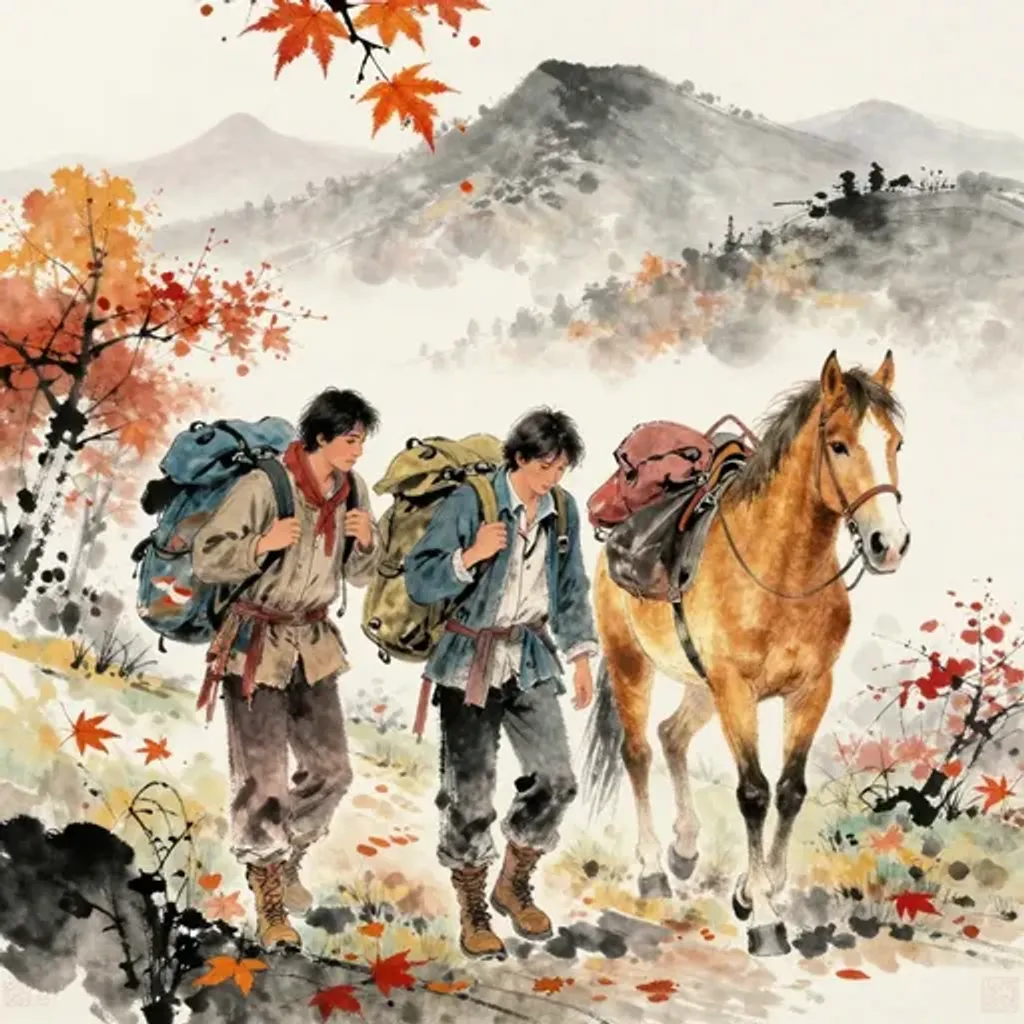
三人俱行,北求大牂;長孟病足,請季負囊;柳下之寶,不失驪黃。
Three men travel together, heading north to seek fine ewes. The eldest is lame; he asks the youngest to carry the pack. The treasure of Liuxia is not lost; the bay horse and chestnut are preserved.
— Jiao Yanshou, Yilin (Forest of Changes), 1st century BC
Commentary
Heaven and fire form Fellowship as three companions journey northward seeking a ram. The eldest brother injures his foot and asks the youngest to carry the pack. Yet the treasure of Liuxia — Zhan Qin's reputation for integrity — is never lost, nor does the company mistake a bay horse for a yellow one. The verse stages a fellowship under strain: injury redistributes the burden, but the group's discernment holds firm. From Fellowship to Abundance, the transformation amplifies what begins as humble cooperation. Thunder and lightning arrive together in Abundance as the noble man renders judgment. The three travelers, though limping, arrive at fullness because they never confuse what matters — the treasure that cannot be dropped is moral clarity.
同人 → 旅
Hexagram 13 → Hexagram 56: The Wanderer
Changing lines: 1, 5
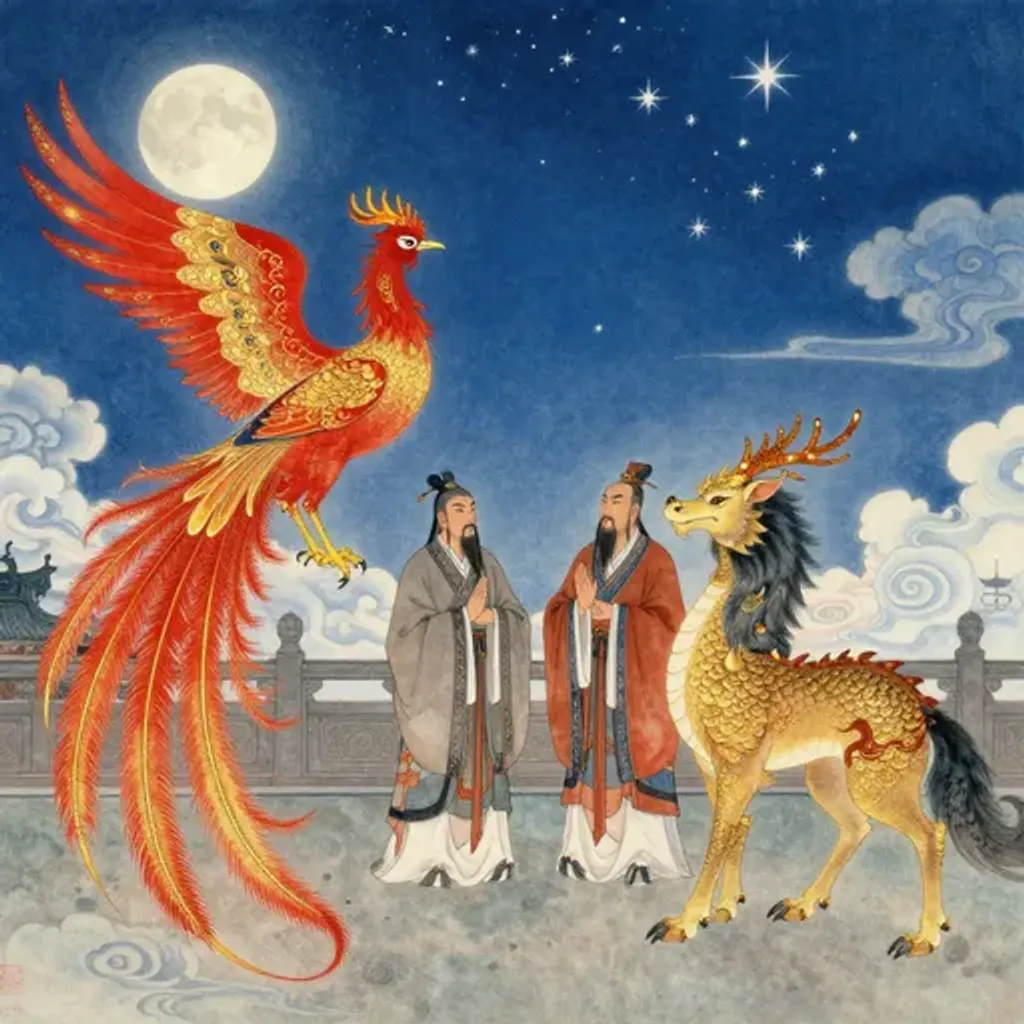
鳳凰在左,麒麟在右;仁聖相遇,伊呂集聚;傷害不至,時無殃咎,福為我母。
Phoenix on the left, qilin on the right. Benevolent sages meet together; Yi Yin and Lyu Shang gather. Harm does not arrive; the season brings no calamity. Blessing is our mother.
— Jiao Yanshou, Yilin (Forest of Changes), 1st century BC
Commentary
Heaven and fire form Fellowship in its most exalted manifestation. The phoenix stands at the left, the qilin at the right — the two supreme auspicious creatures flanking a gathering of sages. The benevolent and the holy meet; Yi Yin and Lü Shang convene — the great ministers of Shang and Zhou united in one vision. No harm can approach; the age is free of calamity, and blessing becomes a nurturing mother. From Fellowship to the Wanderer, the transformation seems incongruous: from perfect assembly to homeless journeying. Yet fire upon the mountain in the Wanderer illuminates distant terrain. The sage assembly described here is portable — its fellowship travels, and wherever it alights, it creates a temporary paradise. Even the wanderer carries blessings.
同人 → 巽
Hexagram 13 → Hexagram 57: The Gentle Wind
Changing lines: 1, 2, 4
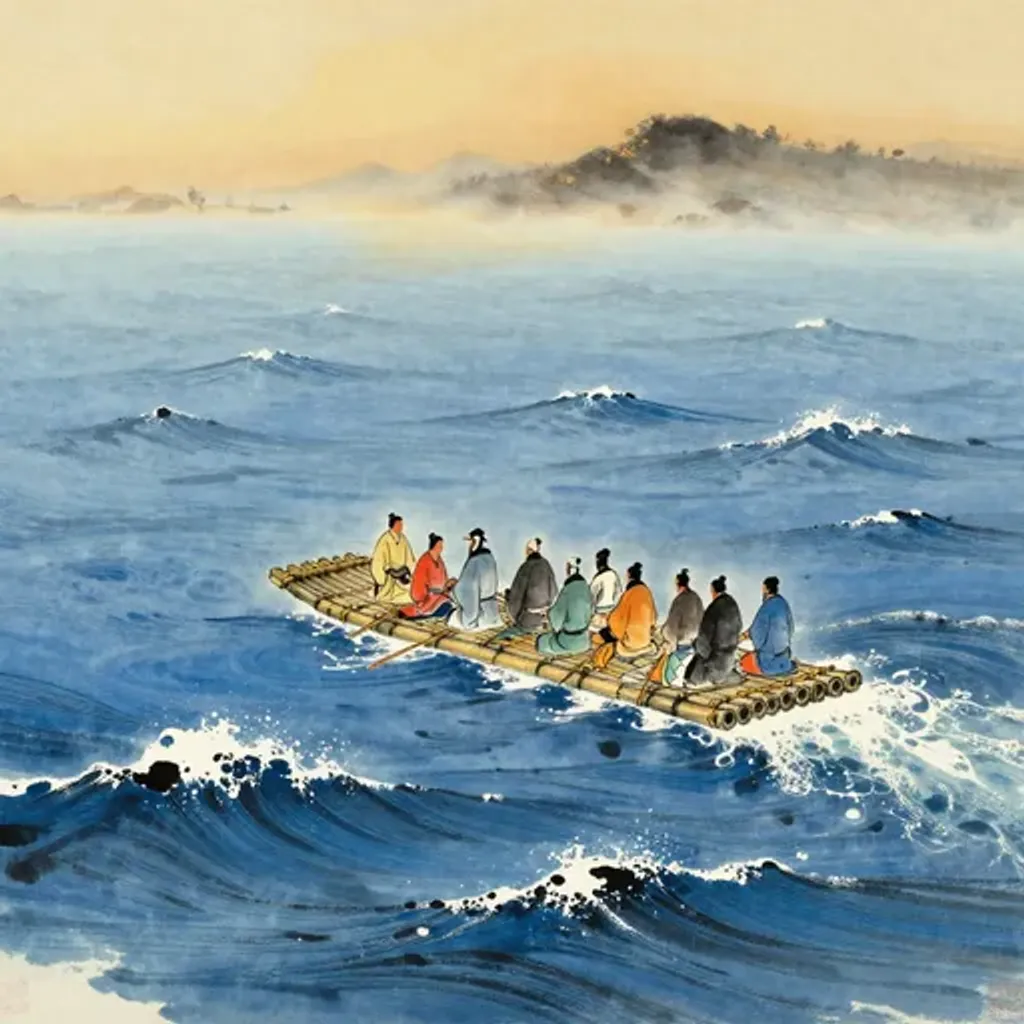
乘筏渡海,雖深不殆;曾孫皇祖,累累具在。
Riding a raft across the sea; though deep, there is no peril. From great-grandson to august ancestor; all generations abide in full.
— Jiao Yanshou, Yilin (Forest of Changes), 1st century BC
Commentary
Heaven and fire form Fellowship as a raft carries its passengers across the deep sea. Though the waters are fathomless, there is no peril — faith in the vessel holds. Then the verse turns to lineage: great-grandsons and august ancestors are all present in unbroken succession, generation upon generation accounted for. The raft is not merely a boat but a family line crossing the abyss of time. From Fellowship to the Gentle, the transformation sustains this passage. Doubled wind in the Gentle; the noble man reiterates his commands. Wind is persistent and penetrating — like ancestral memory carried forward. The raft endures because the wind that fills its sail is the accumulated breath of every generation.
同人 → 兌
Hexagram 13 → Hexagram 58: The Joyous Lake
Changing lines: 2, 3, 6
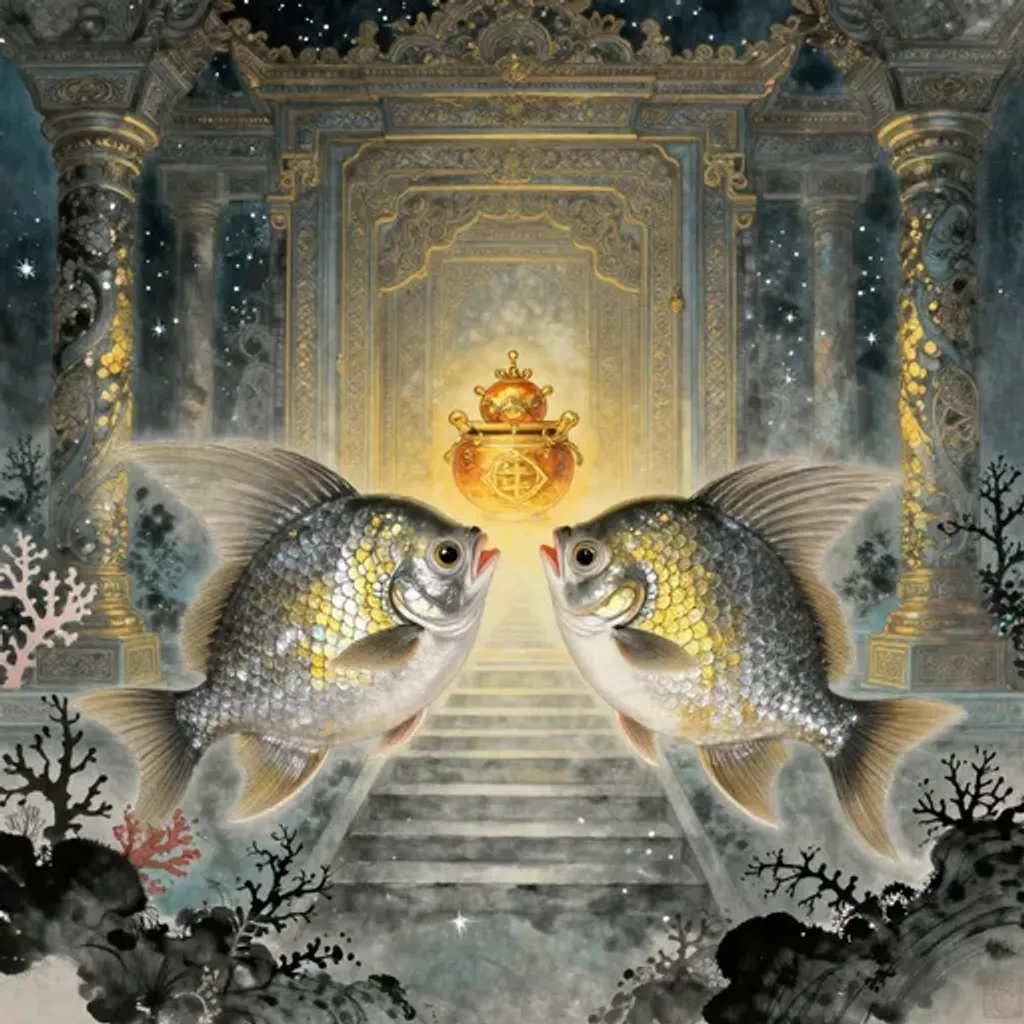
比目四翼,來安吾國;齎福上堂,與我同床。
Paired eyes, four wings; they come to settle our realm. Bearing blessings up to the hall; they share our bed.
— Jiao Yanshou, Yilin (Forest of Changes), 1st century BC
Commentary
Heaven and fire form Fellowship as mythological creatures of mutual dependence arrive to bless the homeland. Paired-eye fish and shared-wing birds — those legendary beings that can only swim or fly together — come to secure the state. They bring blessings up to the hall and share the marriage bed. The image fuses political security with conjugal intimacy: the nation is stabilized by bonds as inseparable as the one-eyed fish that must pair to see. From Fellowship to the Joyous, the transformation brings this union to its emotional peak. Paired lakes in the Joyous; friends study and discuss together. Joy arises from complementarity — two halves that complete each other, whether in the state, in the household, or between the doubled lakes of shared delight.
同人 → 渙
Hexagram 13 → Hexagram 59: Dispersion
Changing lines: 1, 2, 3, 4
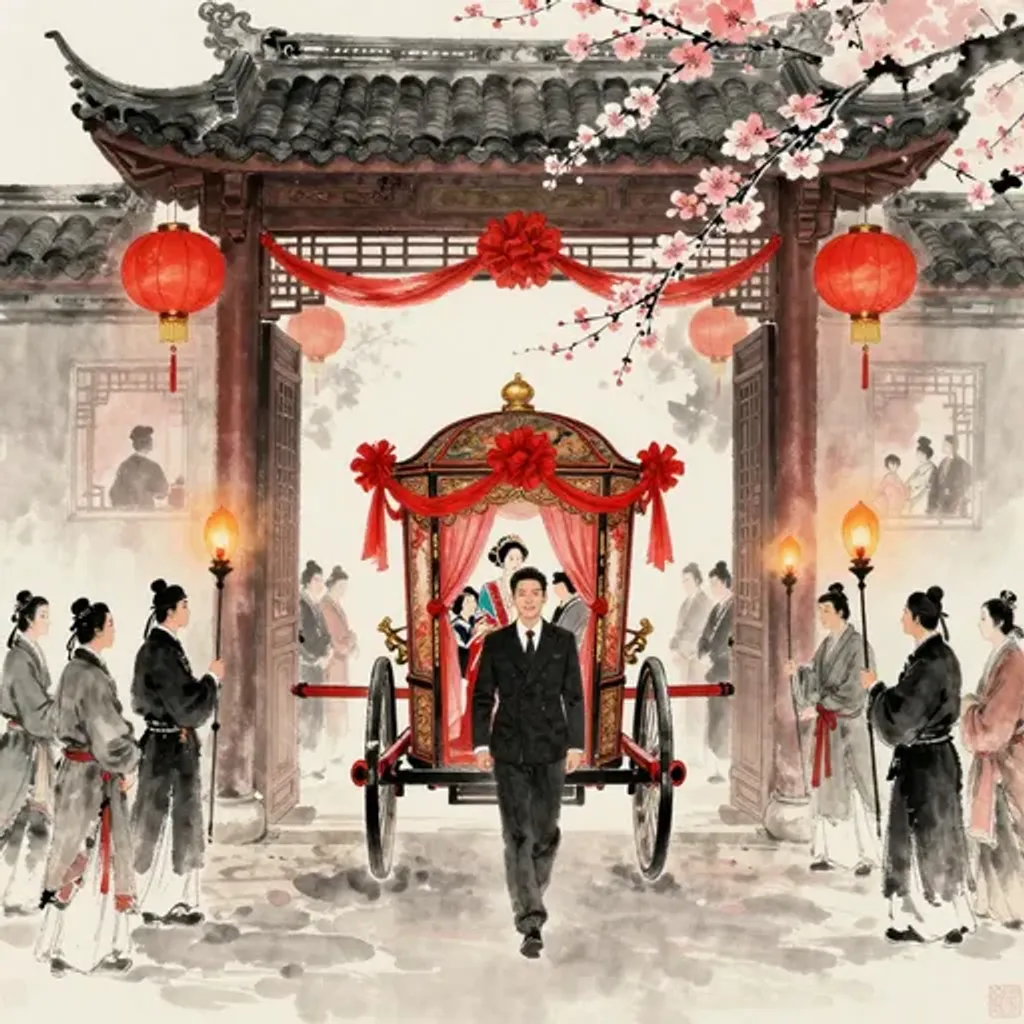
娶於姜呂,駕迎新婦;少齊在門,夫子悅喜。
Marrying a lady of the Jiang and Lyu house; the carriage drives to welcome the bride. The young lady of Qi stands at the gate; the husband is pleased and joyful.
— Jiao Yanshou, Yilin (Forest of Changes), 1st century BC
Commentary
Heaven and fire form Fellowship, and the scene is a wedding procession. The bride comes from the Jiang and Lü clans — the ancient lineage of the Taigong, the Zhou dynasty's founding ally. The carriage is driven to welcome the new wife; the young woman of Qi stands at the gate, and the bridegroom is filled with delight. The Jiang clan intermarriage was the cornerstone of Zhou's political alliances, so this wedding carries both personal joy and dynastic resonance. From Fellowship to Dispersion, the transformation scatters what the wedding gathered. Wind over water in Dispersion; the ancient kings made offerings and built temples. The bride who arrives also disperses old boundaries — her entry into a new household dissolves former separations into shared kinship.
同人 → 節
Hexagram 13 → Hexagram 60: Limitation
Changing lines: 2, 3, 4, 6
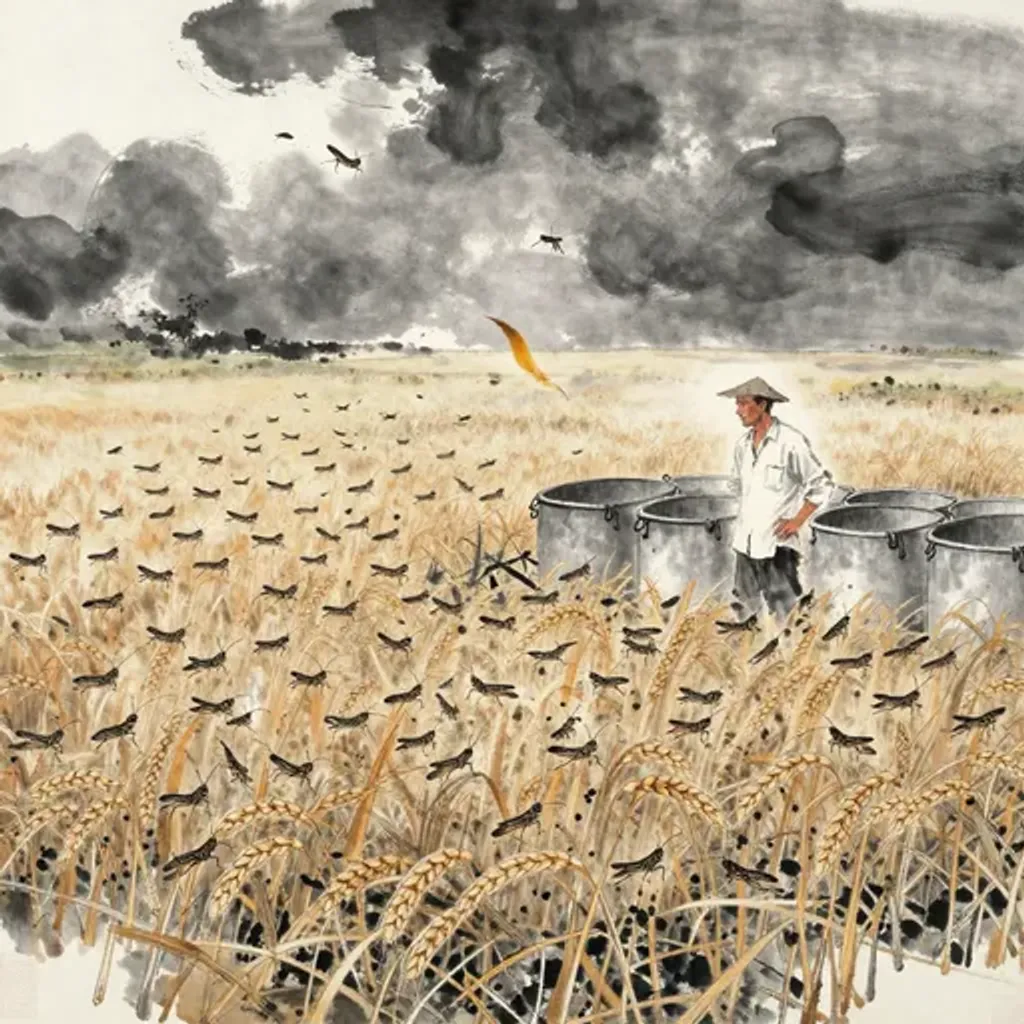
螟䖝為賊,害我稼穡;盡禾單麥,秋無所得。
Caterpillars and grubs become thieves, harming our crops and harvest. They strip the grain and bare the wheat; in autumn there is nothing to reap.
— Jiao Yanshou, Yilin (Forest of Changes), 1st century BC
Commentary
Heaven and fire form Fellowship, but pests devour what the community has labored to grow. Caterpillars and grubs raid the crops, destroying grain and wheat alike; by autumn, nothing remains to harvest. The verse is agricultural catastrophe stripped to its essentials — insects as invaders, the field as a failed state. From Fellowship to Limitation, the transformation prescribes the remedy. Water above the lake in Limitation; the noble man establishes measures and evaluates conduct. The plague of insects is a failure of boundaries — nature's forces entering unchecked. Limitation's numbered measures and regulated conduct are precisely what the ruined harvest lacked: the discipline to contain what devours before it devours everything.
同人 → 中孚
Hexagram 13 → Hexagram 61: Inner Truth
Changing lines: 2, 3, 4
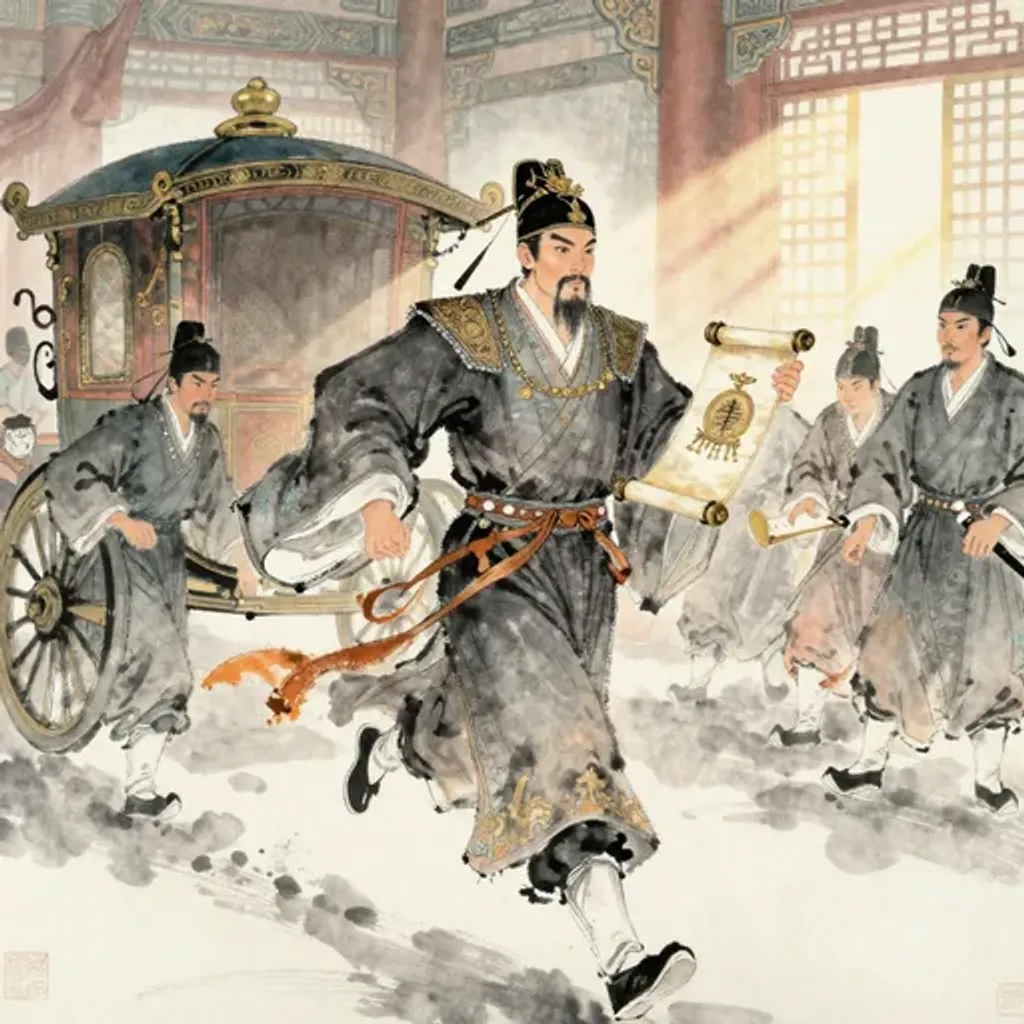
衣裳顛倒,為王來呼;成就東周,邦國大休。
Clothes and cap thrown on in haste, summoned by the king. They establish the Eastern Zhou; the domain and state find great repose.
— Jiao Yanshou, Yilin (Forest of Changes), 1st century BC
Commentary
Heaven and fire form Fellowship as loyal subjects rush to answer the king's summons. Clothes thrown on inside-out in haste — so urgent is the call that dressing properly can wait. The result of this selfless response: the Eastern Zhou is established, and the entire realm celebrates. The image of inverted garments echoes the Shijing ode 'Dongfang Weiming' where lovers dress hastily, but here the urgency is political. The Duke of Zhou's stabilization of the dynasty demanded exactly this: ministers abandoning personal comfort for the state's survival. From Fellowship to Inner Truth, the transformation grounds this urgent action in sincerity. Wind above the lake in Inner Truth — the noble man deliberates on criminal cases with care. Haste born of genuine loyalty produces lasting order.
同人 → 小過
Hexagram 13 → Hexagram 62: Small Exceeding
Changing lines: 1, 5, 6
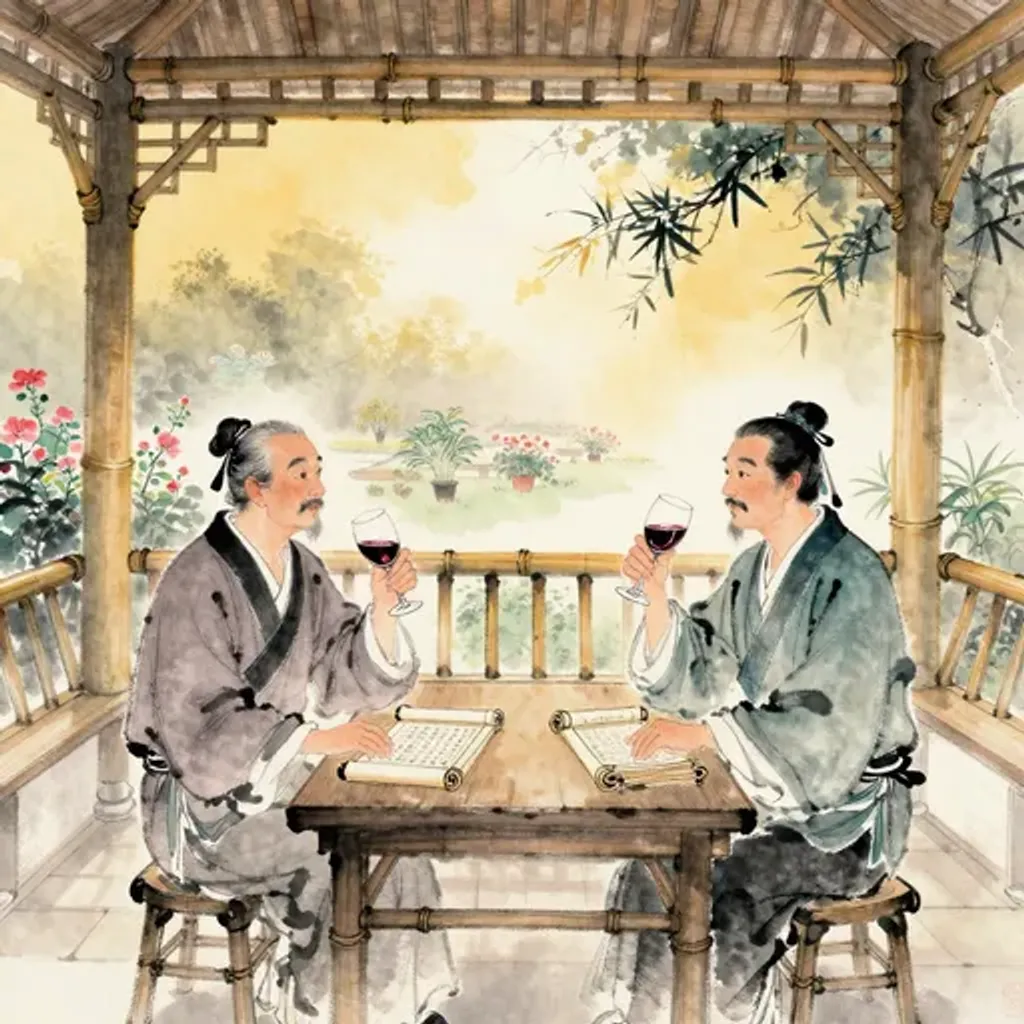
王孫季子,相與為友;明允篤誠,升擢慶舉。
Noble scion and youngest son make friends with one another. Bright, sincere, earnest, and true; they are promoted and raised in celebration.
— Jiao Yanshou, Yilin (Forest of Changes), 1st century BC
Commentary
Heaven and fire form Fellowship as noble companions form a bond of mutual advancement. A prince and a gentleman become friends; their sincerity is bright and their integrity unwavering. Together they are promoted and celebrated. The verse is a compact ode to meritorious friendship — not patronage but genuine fellowship between equals whose combined virtue earns recognition. From Fellowship to Small Exceeding, the transformation tempers this success with caution. Thunder above the mountain in Small Exceeding; the noble man exceeds in reverence, in mourning, and in frugality. Even celebrated friendship must guard against overreach. The pair's elevation is real, but Small Exceeding warns: let conduct be a little too humble rather than a little too proud.
同人 → 既濟
Hexagram 13 → Hexagram 63: After Completion
Changing lines: 4, 6
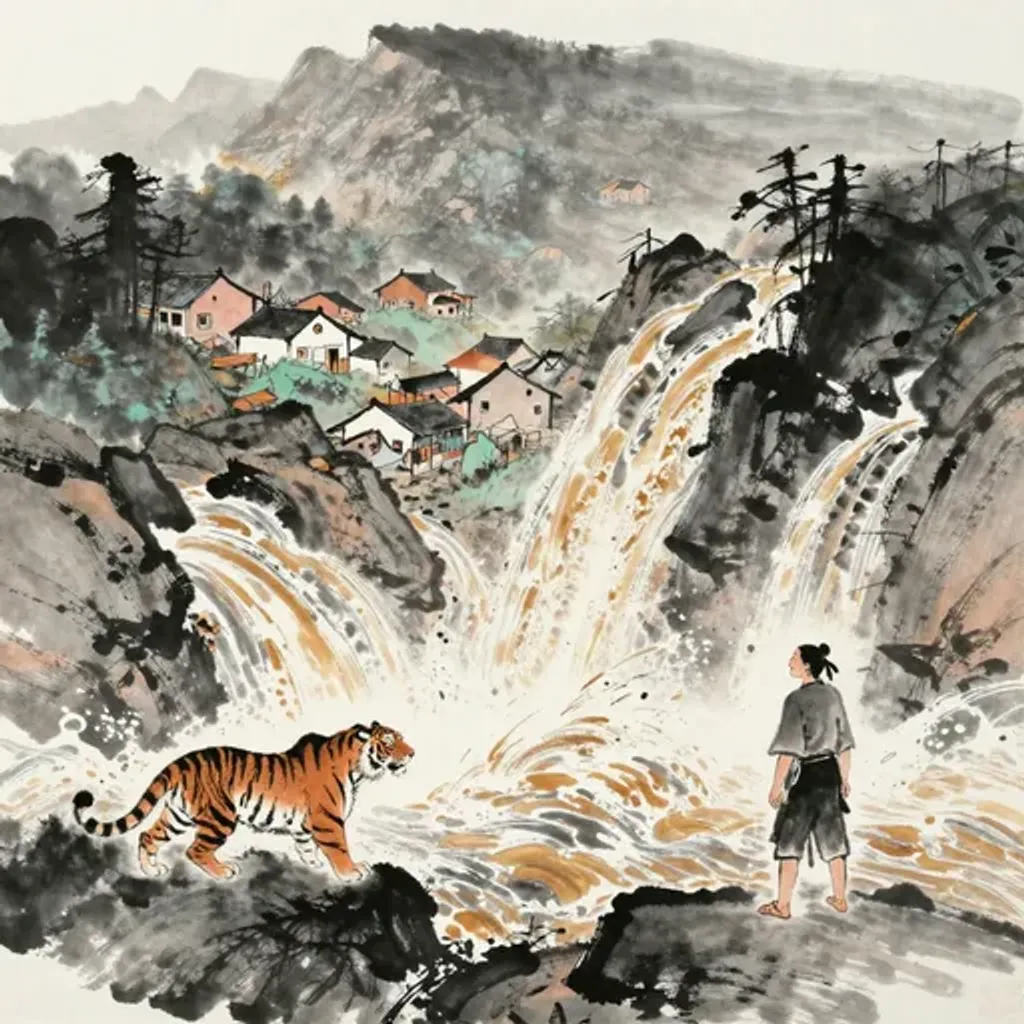
踊泉滑滑,流行不絕;汙為江海,敗毀邑里,家無所處。聞虎不懼,向我笑喜。
A gushing spring flows without cease; the torrent never ends. The marshes become rivers and seas; they destroy villages and towns, leaving no dwelling. Hearing the tiger, one does not fear; it turns to us with smiling joy.
— Jiao Yanshou, Yilin (Forest of Changes), 1st century BC
Commentary
Heaven and fire form Fellowship in a verse of bewildering reversals. A spring gushes and flows ceaselessly; its waters swell into rivers and seas, destroying towns and houses until no family has a dwelling. Then, hearing a tiger's roar, the speaker feels no fear — instead, the tiger approaches with what seems like a smile. Flood devastation followed by an improbable moment of fearless communion with a predator. From Fellowship to After Completion, the transformation suggests that all this turbulence resolves. Water sits properly above fire in After Completion — the noble man anticipates trouble and prepares defenses. The laughing tiger may be the strangest emblem of completion: once everything is destroyed, even danger loses its menace.
同人 → 未濟
Hexagram 13 → Hexagram 64: Before Completion
Changing lines: 1, 2, 3, 5
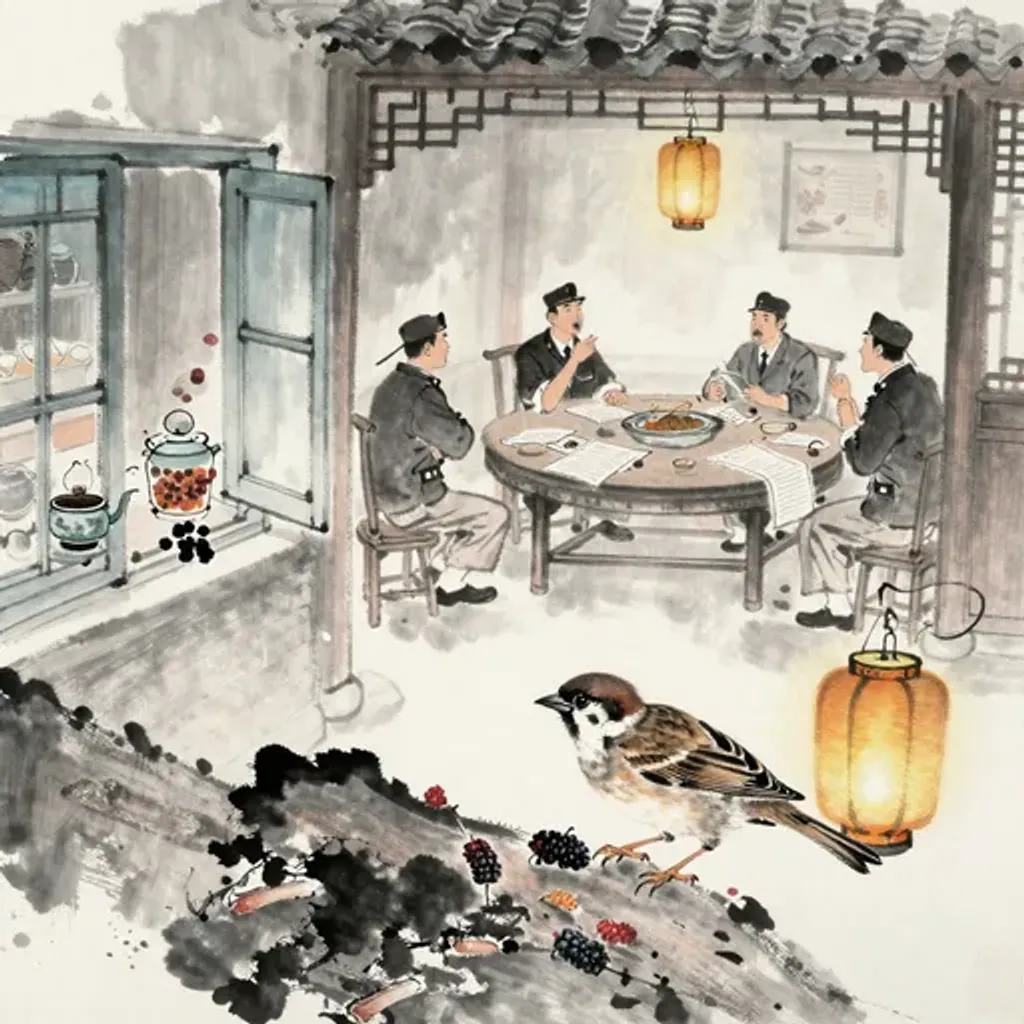
桑戶竊脂,啄粟不宜;亂政無常,使心孔明。
A sparrow pecks at mulberry bark, stealing grain it should not eat. Governance without constancy and order; yet the heart remains keenly aware.
— Jiao Yanshou, Yilin (Forest of Changes), 1st century BC
Commentary
Heaven and fire form Fellowship, but the household is raided by petty thieves and bad counsel. A sparrow steals grease from the mulberry-wood door — pilfering from the home's very threshold. Pecking at grain where it does not belong, the bird transgresses its natural boundaries. Governance loses all consistency; yet the heart remains keenly aware, seeing through the disorder with painful clarity. From Fellowship to Before Completion, the transformation suspends resolution indefinitely. Fire above water in Before Completion; the noble man carefully distinguishes things and places them correctly. The verse's chaos — the thieving sparrow, the inconsistent rule — is precisely the unfinished state that Before Completion names. Awareness without order is the last stage before a new beginning, if one can endure the dissonance.