Transformations of Hexagram 16
Every line of change out of Hexagram 16 豫 Enthusiasm, with the Yilin verse for each of the 64 resulting hexagrams, its translation, and the original ink brush artwork.
豫 → 乾
Hexagram 16 → Hexagram 1: The Creative
Changing lines: 1, 2, 3, 5, 6
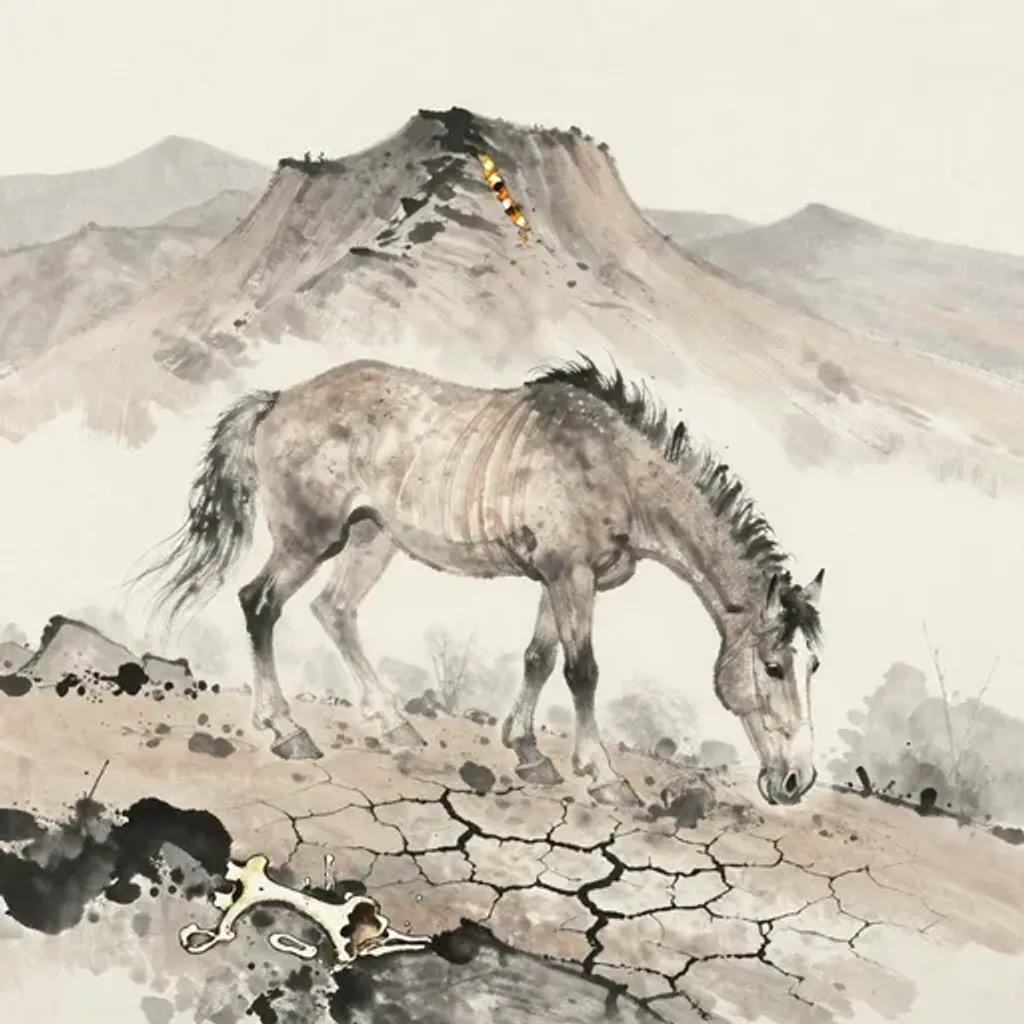
龍馬上山,絕無水泉;喉燋唇乾,口不能言。
Dragon-horse ascends the mountain; utterly without water or spring. Throat scorched, lips parched; the mouth cannot speak.
— Jiao Yanshou, Yilin (Forest of Changes), 1st century BC
Commentary
Thunder breaks from the earth in a burst of enthusiasm, yet the dragon-horse climbs a waterless mountain. This mythic creature — half dragon, half horse — once rose from the Yellow River bearing the Hetu on its back, an omen of sage rule. Here it ascends to barren heights where no spring flows, its throat scorched and lips cracked, unable even to speak. The image inverts the dragon-horse's cosmic promise: heaven's creative power (Qian) demands an inexhaustible wellspring, but the enthusiast who rushes upward without securing resources finds only parched silence. From Enthusiasm to the Creative, the transformation warns that self-generating initiative requires substance beneath its ambition; raw aspiration without nourishment chokes on its own ascent.
豫 → 坤
Hexagram 16 → Hexagram 2: The Receptive
Changing lines: 4
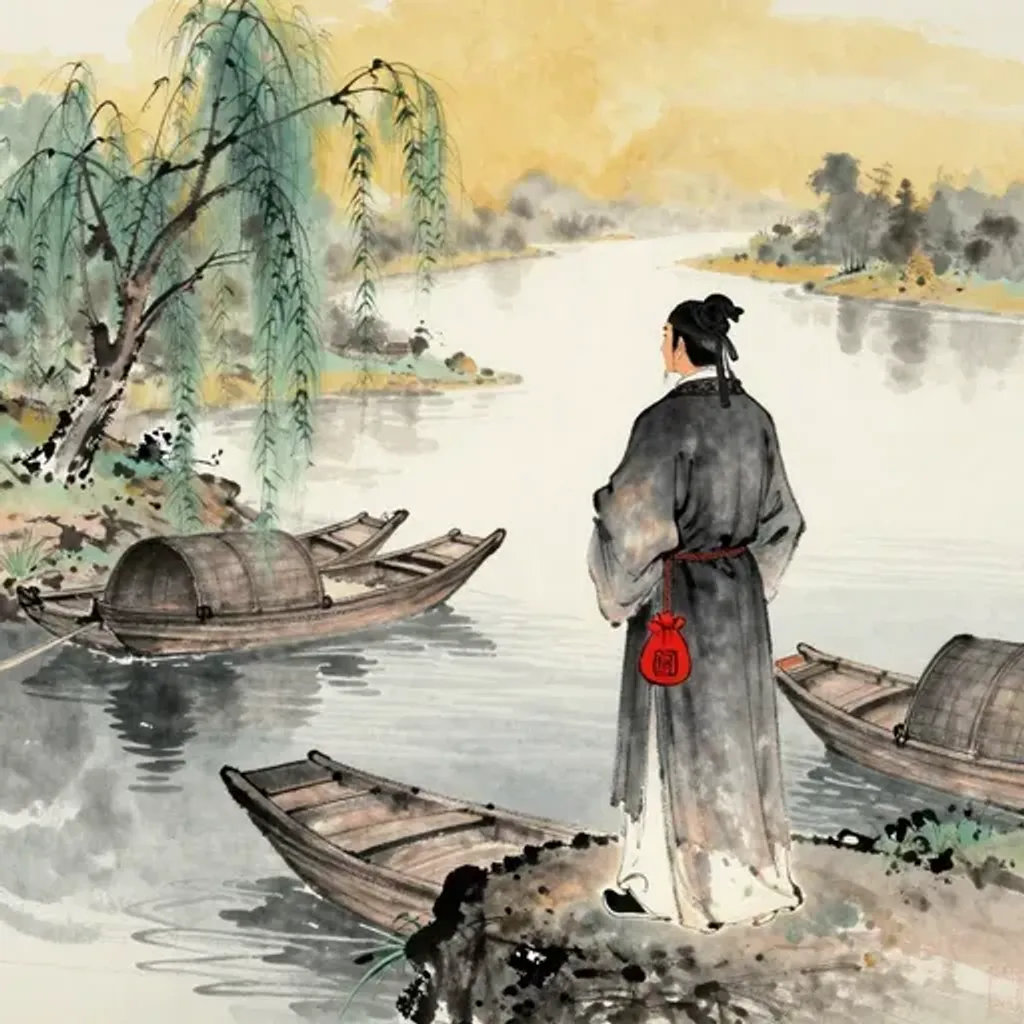
蔡侯朝楚,留連江濱;踰時歷月,思其后君。
The Marquis of Cai attended court in Chu, lingering long at the river edge; months passed beyond the season, longing for his lord back home.
— Jiao Yanshou, Yilin (Forest of Changes), 1st century BC
Commentary
Thunder stirs the earth in joyful ceremony, but the Marquis of Cai finds himself detained at a foreign court. In 509 BC, Marquis Zhao of Cai visited the state of Chu to pay his respects, but the powerful minister Nang Wa coveted his fine furs and, when refused, had him detained for three years along the banks of the Yangtze. Month after month he lingered, longing for his own court and people. The verse captures a vassal's helplessness when enthusiasm for diplomacy meets predatory hospitality. From Enthusiasm to the Receptive, exuberant initiative dissolves into passive endurance: the earth that once rang with thunder now lies still, and the detained lord can only wait, yielding to circumstances beyond his control.
豫 → 屯
Hexagram 16 → Hexagram 3: Difficulty at the Beginning
Changing lines: 1, 4, 5
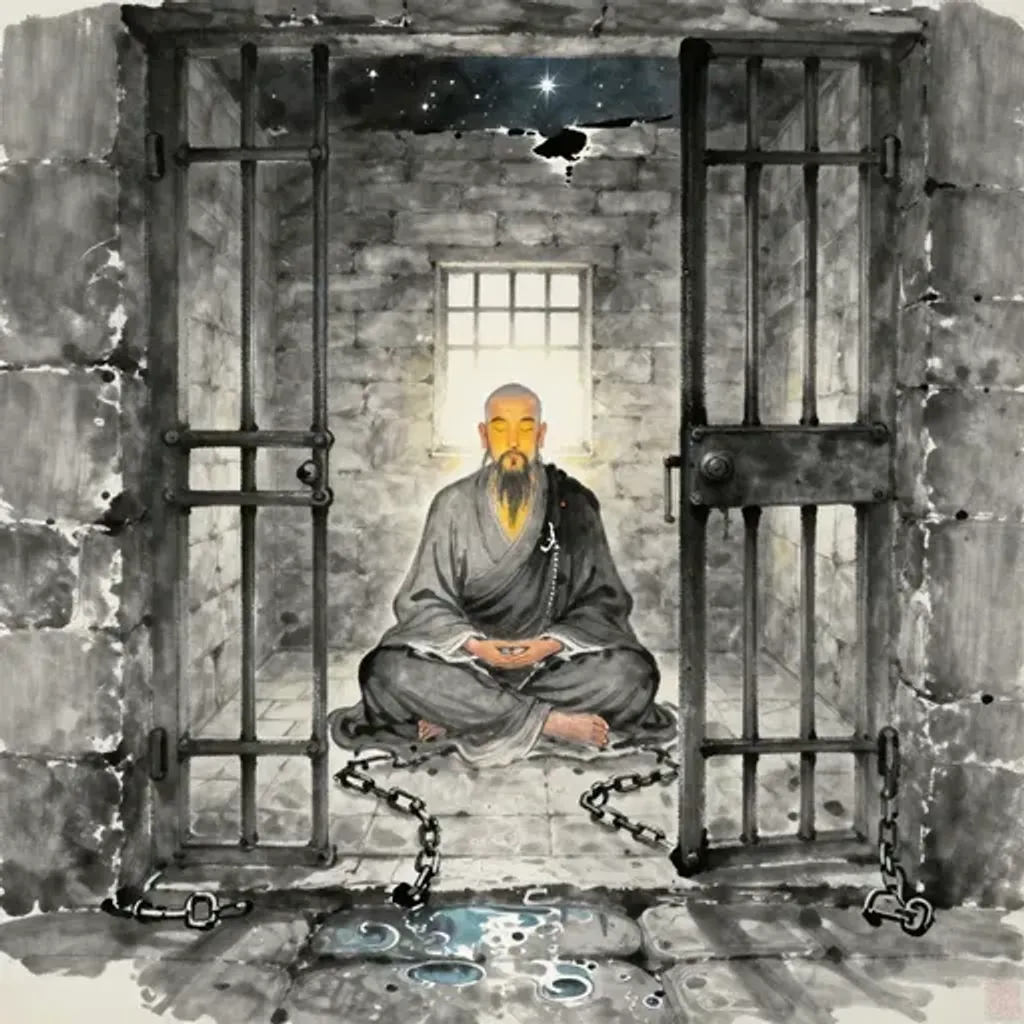
文厄羑里,湯拘夏臺;仁聖不害,數困何憂。
King Wen was imprisoned at Youli; Tang was confined at Xia Tai. The humane and sage are not harmed -- though numbered among the trapped, what cause for worry?
— Jiao Yanshou, Yilin (Forest of Changes), 1st century BC
Commentary
Thunder rises from the earth in jubilation, yet the verse recalls two sages imprisoned unjustly. King Wen languished at Youli under the Shang tyrant; King Tang was held at Xiatai by King Jie of Xia. Both endured confinement before founding great dynasties. The verse's logic is paradoxical comfort: if the benevolent and sagely cannot be ultimately harmed, why worry when fate deals its blows? From Enthusiasm to Difficulty at the Beginning, the transformation maps perfectly: initial exuberance meets the gathering clouds and thunder of a world not yet ordered. Yet within that chaos lies the seed of all that follows — the sage endures the storm precisely because his virtue is the organizing principle the world needs.
豫 → 蒙
Hexagram 16 → Hexagram 4: Youthful Folly
Changing lines: 2, 4, 6
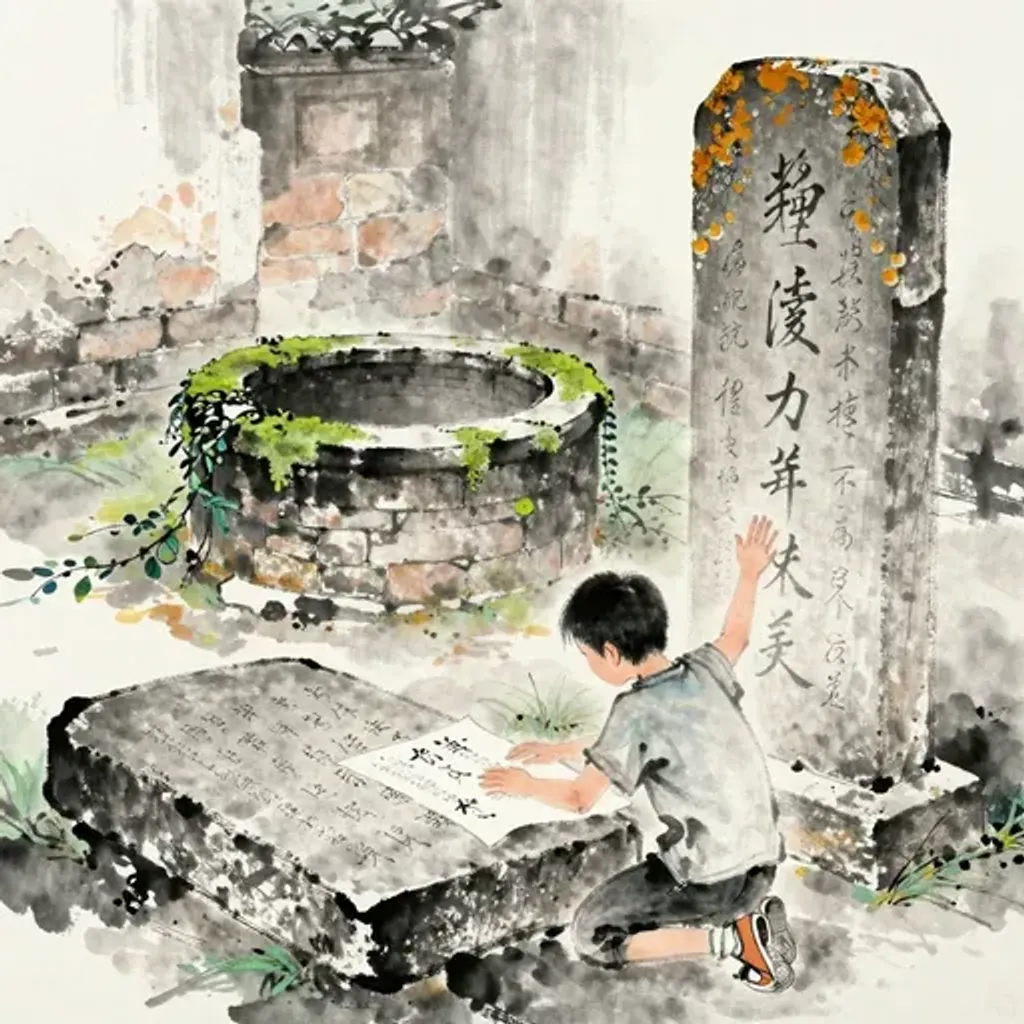
典冊法書,藏在蘭臺;雖遭亂潰,獨不遇災。
An old well sealed with moss, but the stele inscription endures. A child who cannot read it makes a rubbing — and so it is passed down.
— Jiao Yanshou, Yilin (Forest of Changes), 1st century BC
Commentary
Thunder stirs the earth, but this verse speaks of preservation through chaos. The original reads: 'Canonical books and legal texts are stored in the Orchid Terrace archives; though disorder and collapse rage around them, they alone escape disaster.' The Lantai (蘭臺) was the Han imperial library, repository of the realm's accumulated wisdom. Even as the world crumbles, the written record endures unscathed. From Enthusiasm to Youthful Folly, the transformation moves from exuberant action to the mountain spring's quiet emergence: what springs forth from beneath the mountain is not raw energy but the slow seep of knowledge waiting to be discovered. The archives survive not through force but through the sheer persistence of what is written down.
豫 → 需
Hexagram 16 → Hexagram 5: Waiting
Changing lines: 1, 2, 3, 4, 5
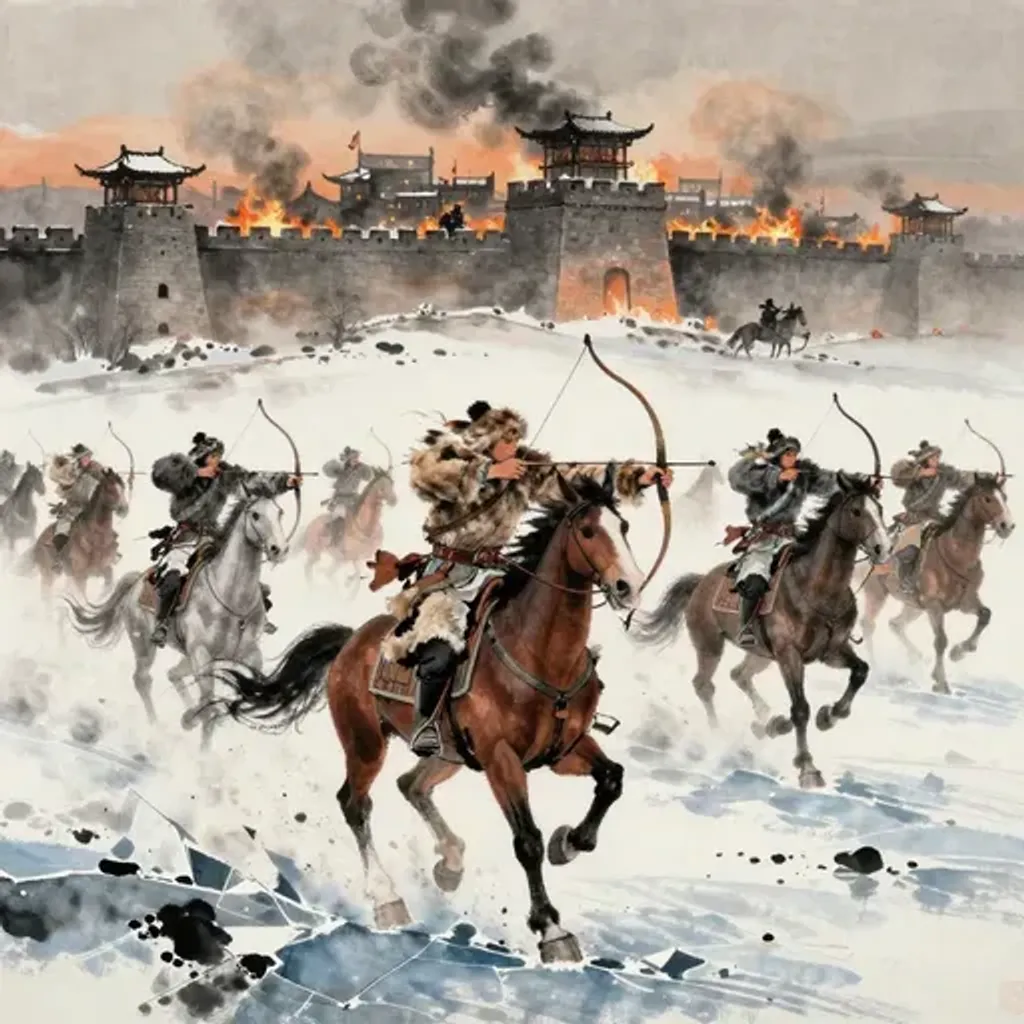
氈裘羶國,文禮不飭;跨馬控弦,伐我都邑。
A land of felt robes and rank mutton, where rites and courtesy are not observed; astride horses, drawing bows, they attack our capital.
— Jiao Yanshou, Yilin (Forest of Changes), 1st century BC
Commentary
Thunder erupts from the earth, but what rises is not music — it is mounted raiders from the northern steppe. Clad in felt and furs, smelling of mutton, knowing nothing of rites or written culture, they cross the frontier on horseback with bows drawn, attacking the capital itself. The verse paints the classic Chinese fear: the barbarian invasion that overwhelms civilization's defenses. From Enthusiasm to Waiting, the transformation is grimly apt. Waiting's image is clouds gathering over heaven — danger approaches but has not yet struck. The raiders' assault transforms joyful preparedness into anxious vigilance, and the proper response is not panic but the composed readiness that Waiting demands: one must nourish oneself and bide the time.
豫 → 訟
Hexagram 16 → Hexagram 6: Conflict
Changing lines: 2, 5, 6
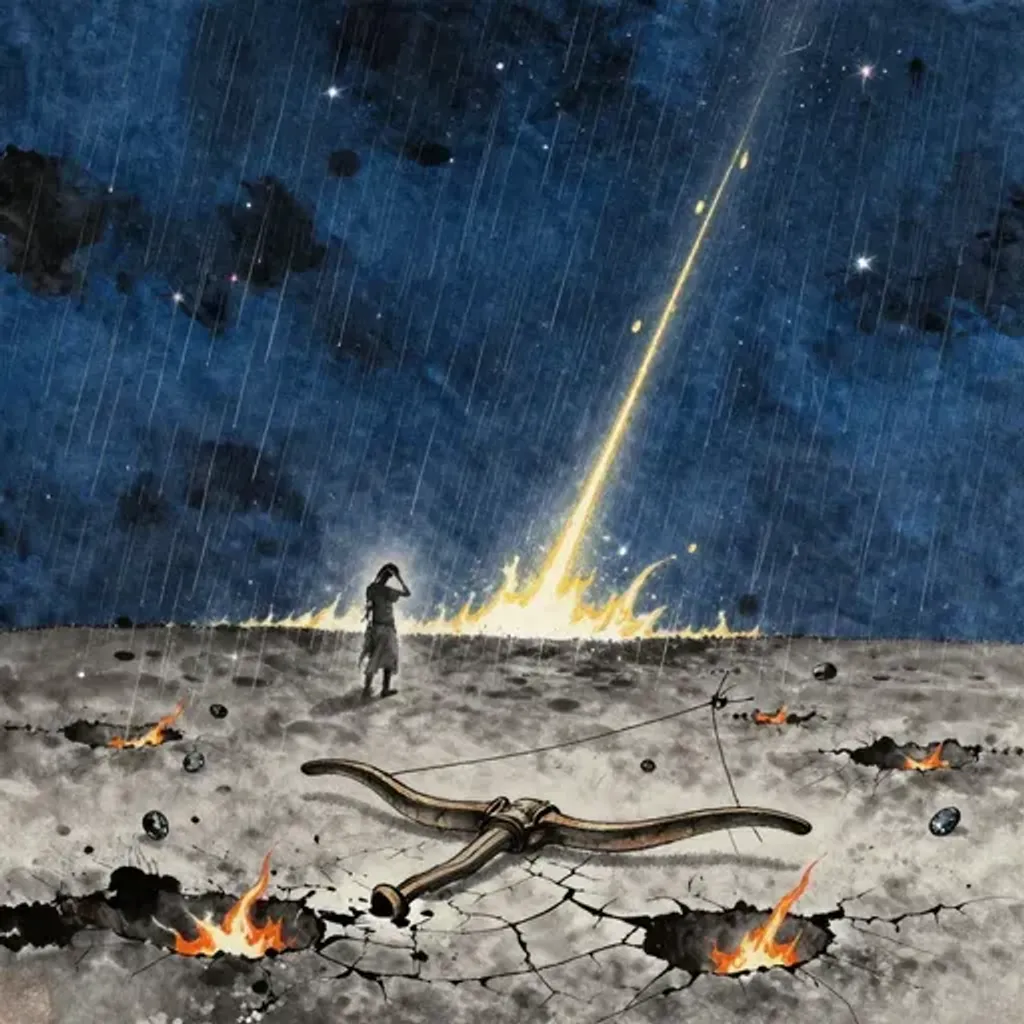
星隕如雨,弓弱無輔,強陽制陰,不得安土。
Stars fall like rain; the bow is weak, without support. The strong yang oppresses the yin -- one cannot find safe ground.
— Jiao Yanshou, Yilin (Forest of Changes), 1st century BC
Commentary
Thunder breaks from the earth, but the sky rains falling stars. The verse evokes a meteor shower — 'stars fall like rain' — while the bow lacks its reinforcing horn, too weak to shoot. Strong yang suppresses yin, and no one can settle peacefully on the land. The celestial portent of falling stars was traditionally read as heaven withdrawing its mandate, a sign of cosmic disorder. The weaponless bow compounds the helplessness: even self-defense is impossible. From Enthusiasm to Conflict, the pattern resonates — heaven and water move in opposite directions, a fundamental mismatch. Joyful momentum collides with structural opposition, and without the means to assert oneself, one is displaced by forces beyond negotiation.
豫 → 師
Hexagram 16 → Hexagram 7: The Army
Changing lines: 2, 4
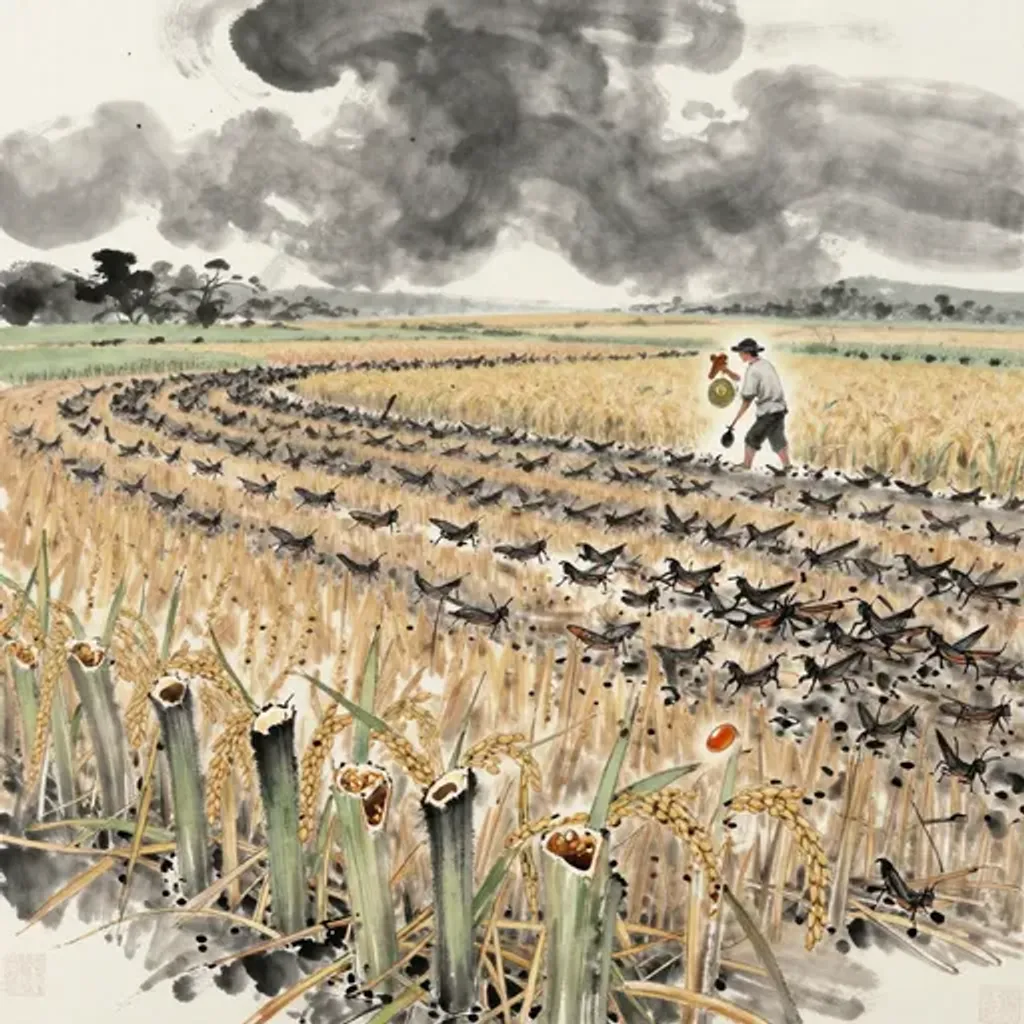
蝗囓我稻,驅不可去;實穗無有,但見空藁。
Locusts gnaw our rice; drive them off, they will not go. Full ears are no more -- only empty stalks remain.
— Jiao Yanshou, Yilin (Forest of Changes), 1st century BC
Commentary
Thunder surges from the earth, yet what emerges is not celebration but catastrophe. Locusts gnaw the rice stalks and cannot be driven away; the grain heads stand empty, nothing left but hollow straw. The image is total agricultural devastation — a swarm that consumes everything and yields to no human effort. From Enthusiasm to The Army, the transformation captures the shift from joyful abundance to disciplined crisis response. The Army's image is water stored within the earth: resources hidden and marshaled beneath the surface. When the harvest is devoured, what remains is the need for organized, collective action — the army that mobilizes not for glory but for survival against an overwhelming natural enemy.
豫 → 比
Hexagram 16 → Hexagram 8: Holding Together
Changing lines: 4, 5
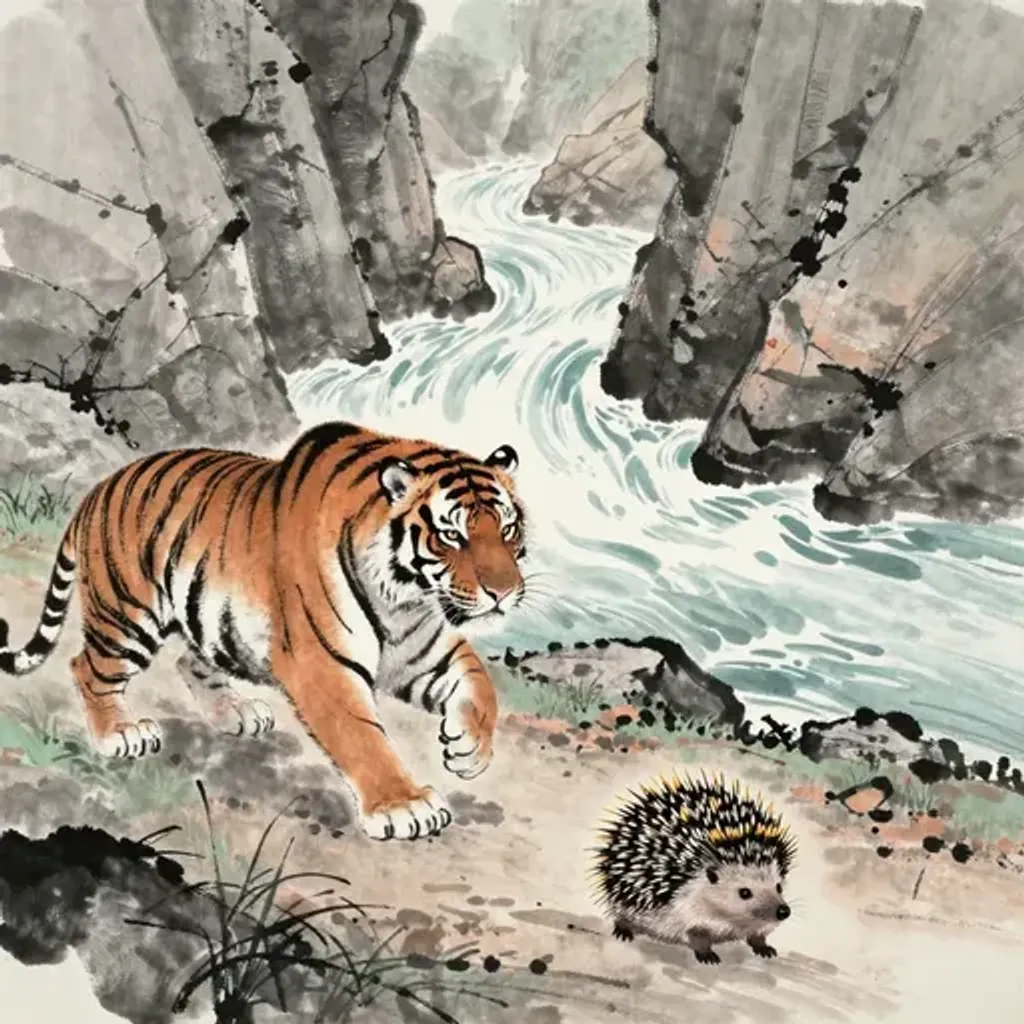
虎飢欲食,為蝟而伏。禹導龍門,辟咎除患,元醜以安。
The tiger, hungry and wanting to eat, crouches before the hedgehog. Yu channeled the waters through Dragon Gate, opening a path to remove calamity and danger; all was set at peace.
— Jiao Yanshou, Yilin (Forest of Changes), 1st century BC
Commentary
Thunder stirs the earth as a hungry tiger crouches, ready to feed — only to be subdued by a hedgehog's bristling defense. Then the scene shifts to Yu the Great carving open Dragon Gate, channeling the floods through the gorge to eliminate disaster and bring peace to the land. The hedgehog restraining the tiger echoes the 'hedgehog as Chief Clerk' motif from the Shiji: small but armored creatures controlling larger predators through defensive capability. Yu's engineering feat at Dragon Gate transformed chaotic floodwaters into navigable channels. From Enthusiasm to Holding Together, the verse traces how raw threats are neutralized and communities unified: water upon earth, the image of alliance, emerges when defensive wisdom and hydraulic mastery turn danger into shared prosperity.
豫 → 小畜
Hexagram 16 → Hexagram 9: Small Taming
Changing lines: 1, 2, 3, 4, 5, 6
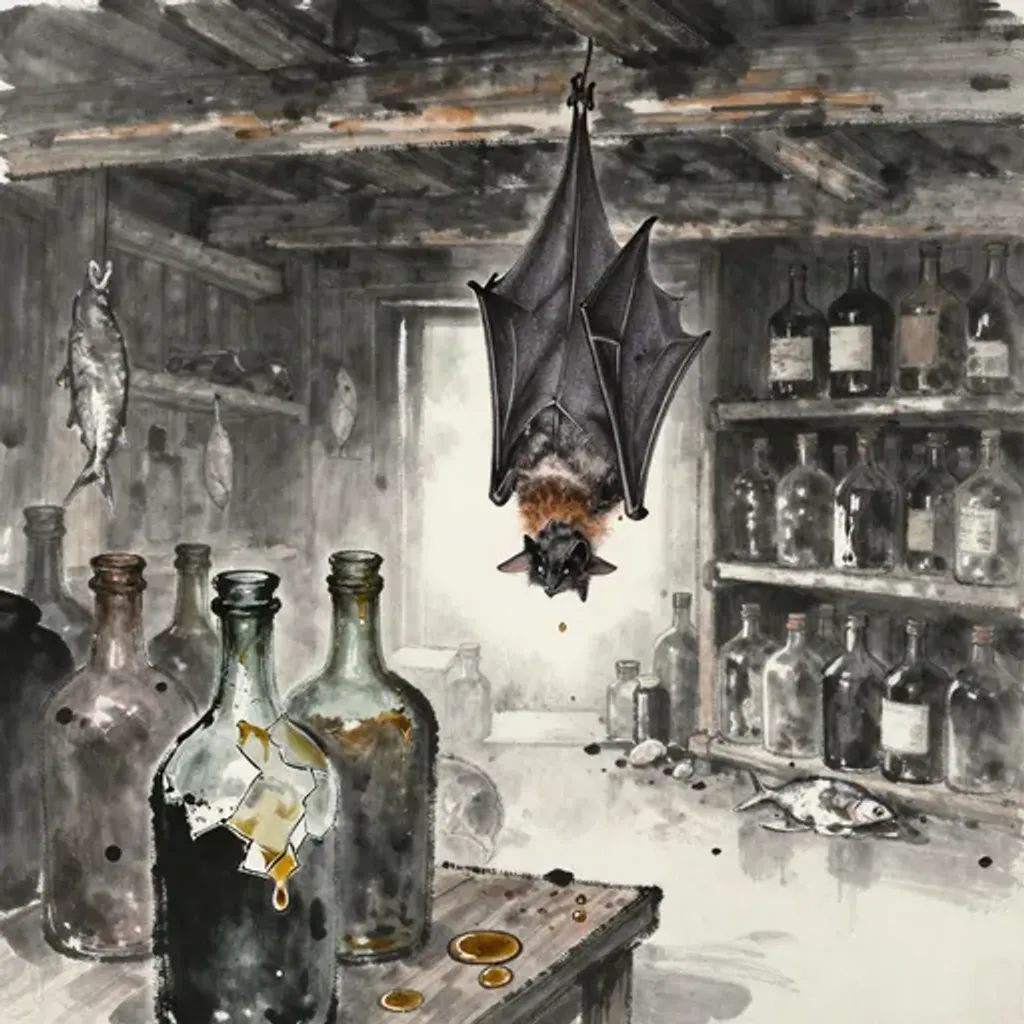
蝙蝠夜藏,不敢晝行。酒為酸漿,魴臭鮑羹。
The bat hides by night, daring not to go abroad by day. Wine has turned to sour whey; bream stinks like salted-fish broth.
— Jiao Yanshou, Yilin (Forest of Changes), 1st century BC
Commentary
Thunder erupts from the earth, but the bat hides by day and dares not venture into sunlight. Wine has soured to vinegar, and the bream stinks in its broth — everything has spoiled. The bat, a creature of twilight, embodies talent that cannot function under scrutiny or in the open. The curdled wine and rotten fish suggest resources gone to waste through neglect or poor timing. From Enthusiasm to Small Taming, the transformation reveals why: wind blows across heaven, gently restraining creative force. The small cannot fully contain the great, and what should be fresh ferments into something foul. Enthusiasm misdirected into hiding produces only decay, as potential curdles without the light needed to refine it.
豫 → 履
Hexagram 16 → Hexagram 10: Treading
Changing lines: 1, 2, 5, 6
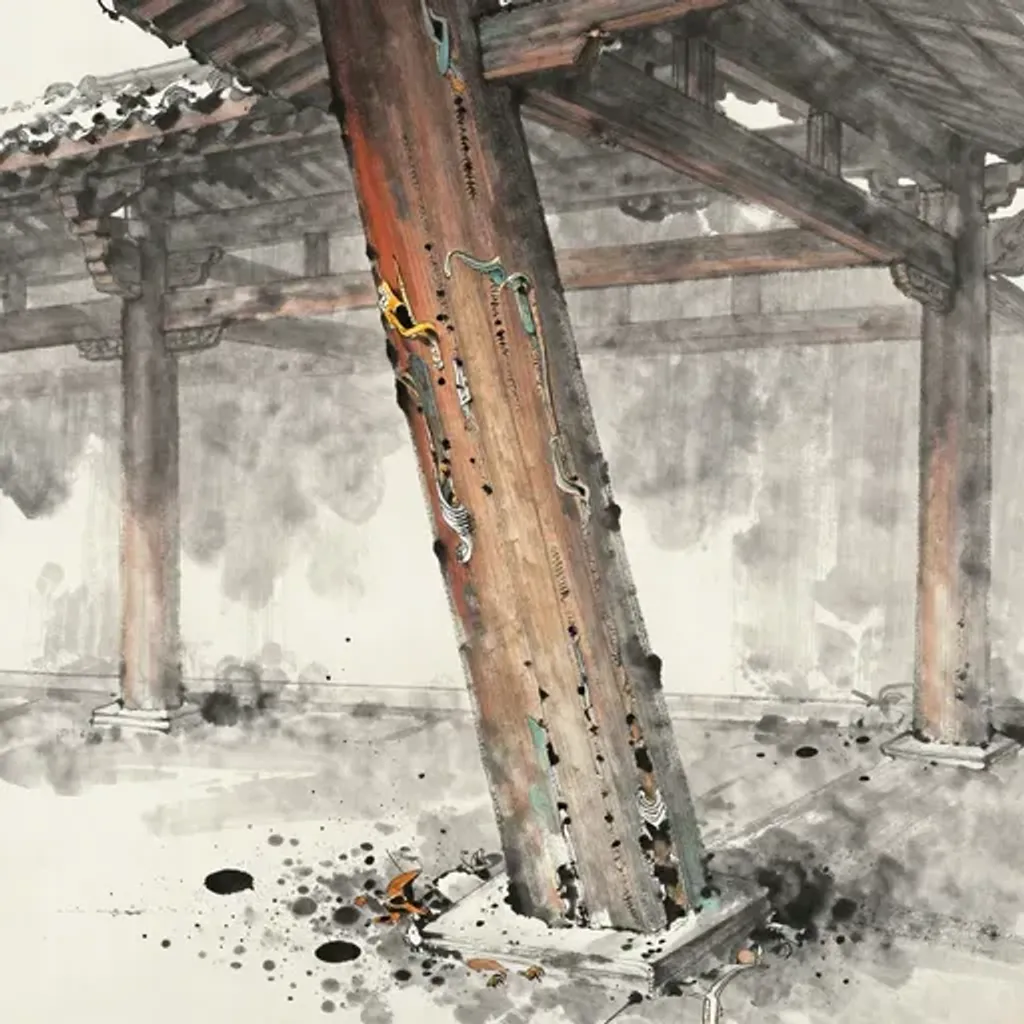
精華墮落,形體醜惡;齟齬挫頓,枯槁腐蠹。
Vital essence fallen away, form grown ugly and vile; ill-fitting and stumbling, withered, decayed, and worm-eaten.
— Jiao Yanshou, Yilin (Forest of Changes), 1st century BC
Commentary
Thunder once shook the earth with vitality, but now all essence has fallen away. The body grows ugly, movements become clumsy and halting, and what remains is withered, rotted, and worm-eaten. The verse traces a complete arc of decline — from vital spirit to hollow husk. Every term intensifies the previous: 'fallen essence' gives way to 'ugly form,' then 'clashing and stumbling,' and finally 'dried rot infested with beetles.' From Enthusiasm to Treading, the transformation is paradoxical: Treading's image is heaven above and lake below, the careful distinction of high and low. When one treads upon the tiger's tail without proper discernment, the result is this bodily collapse — enthusiasm spent recklessly leaves nothing but the shell of what once lived.
豫 → 泰
Hexagram 16 → Hexagram 11: Peace
Changing lines: 1, 2, 3, 4
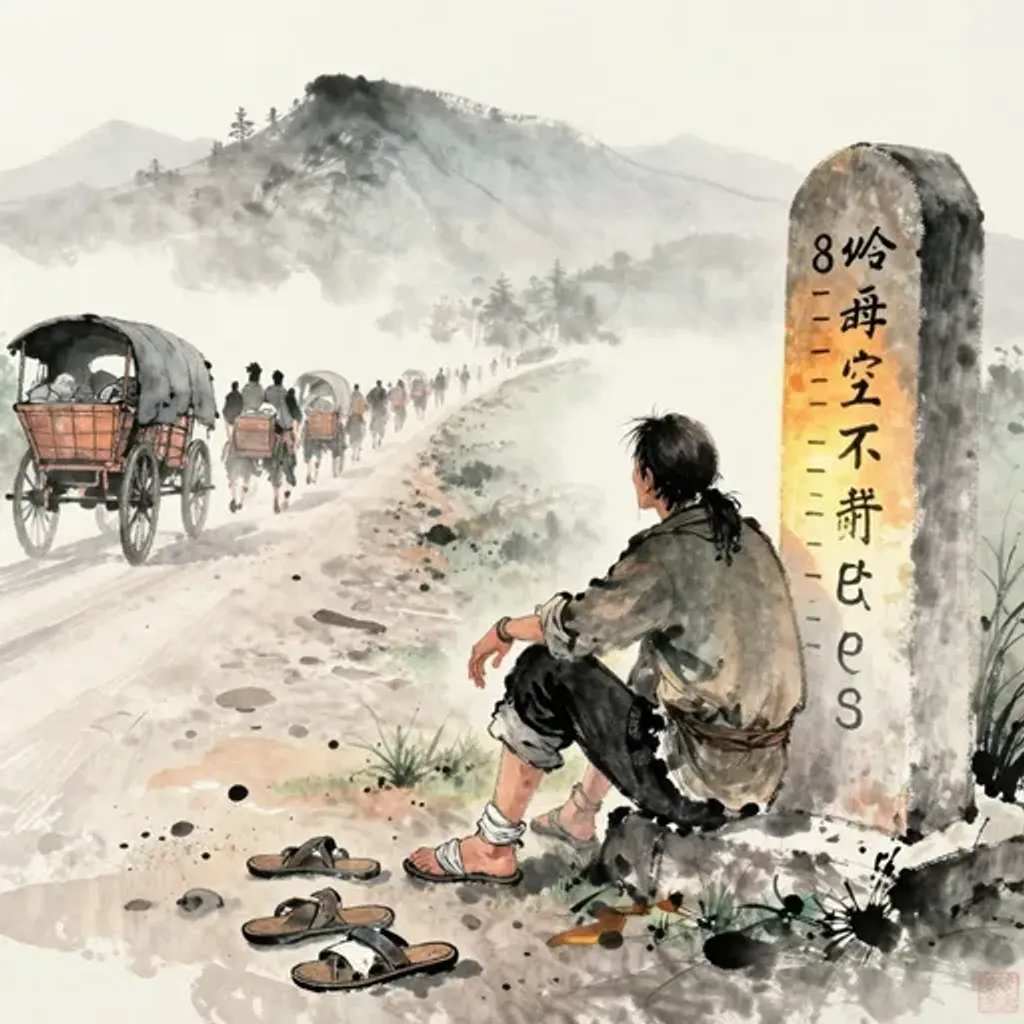
兩足不獲,難以遠行;疾步不能,後旅失時。
Both feet disabled, unable to travel far; walking with haste is impossible -- the rear party misses its time.
— Jiao Yanshou, Yilin (Forest of Changes), 1st century BC
Commentary
Thunder stirs the earth, but the traveler cannot move. Both feet are injured — walking is impossible, let alone a long journey. Hurrying is out of the question, and the rearguard misses its appointed time. The verse depicts a military or diplomatic party crippled at the outset, unable to keep pace or meet its schedule. From Enthusiasm to Peace, the irony sharpens: Peace represents heaven and earth in perfect exchange, the smoothest of all hexagrams. Yet the enthusiast who cannot walk will never reach that harmonious destination. The transformation suggests that Peace requires the capacity for sustained effort, not just initial excitement — and those who rush without securing their footing arrive nowhere at all.
豫 → 否
Hexagram 16 → Hexagram 12: Standstill
Changing lines: 5, 6
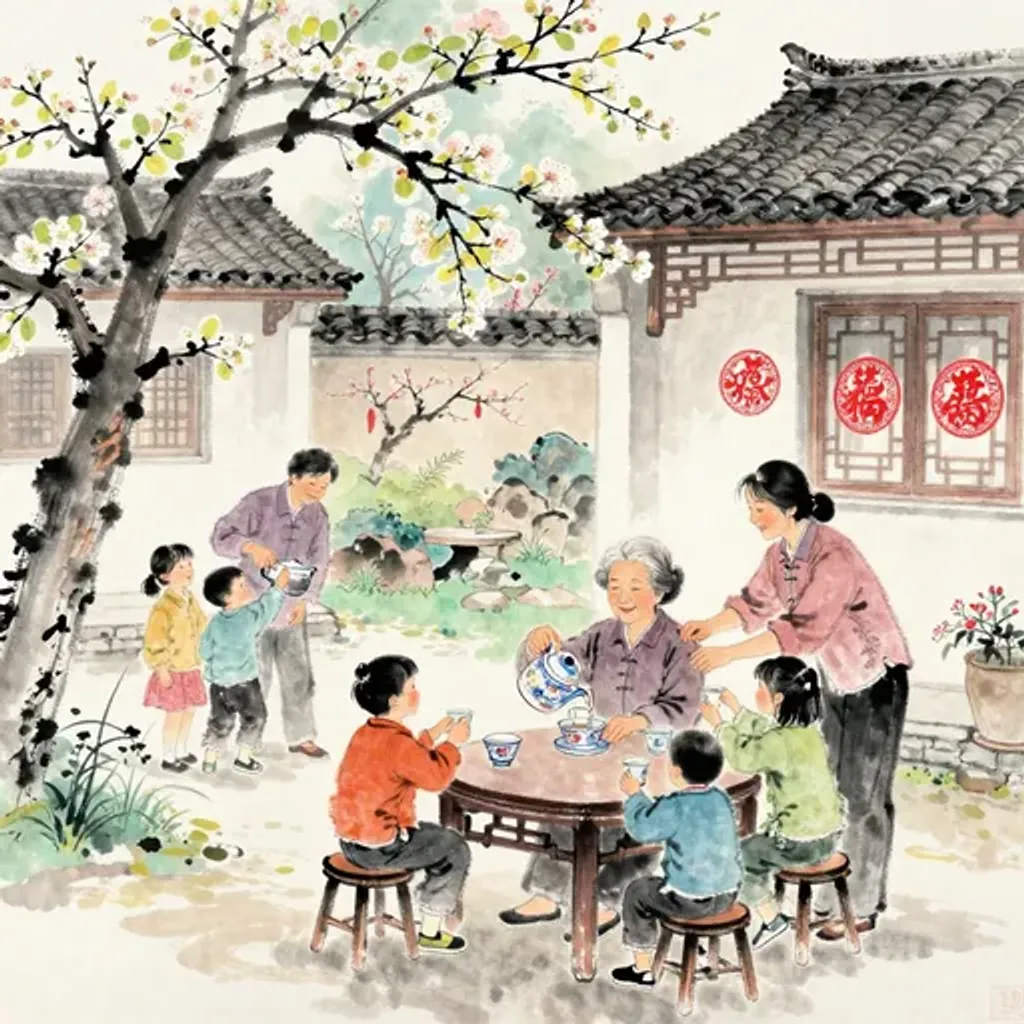
令妻壽母,宜家無咎;君子之歡,得以長久。
A worthy wife, a long-lived mother; the household prospers without fault. The gentleman joy shall endure long.
— Jiao Yanshou, Yilin (Forest of Changes), 1st century BC
Commentary
Thunder rises from the earth in harmonious celebration. A good wife and a long-lived mother grace the household; the family prospers without fault. The gentleman's joy endures for years to come. The verse is straightforwardly auspicious — domestic happiness, filial completeness, and lasting contentment. From Enthusiasm to Standstill, the transformation offers a subtle reading: Standstill depicts heaven and earth failing to communicate, a time when the gentleman must practice frugality and withdraw from public ambition. Yet the verse finds joy precisely in this withdrawal — the domestic sphere flourishes even when the outer world stagnates. True enthusiasm, properly channeled, creates an inner haven that Standstill's blocked energies cannot reach.
豫 → 同人
Hexagram 16 → Hexagram 13: Fellowship
Changing lines: 1, 3, 5, 6
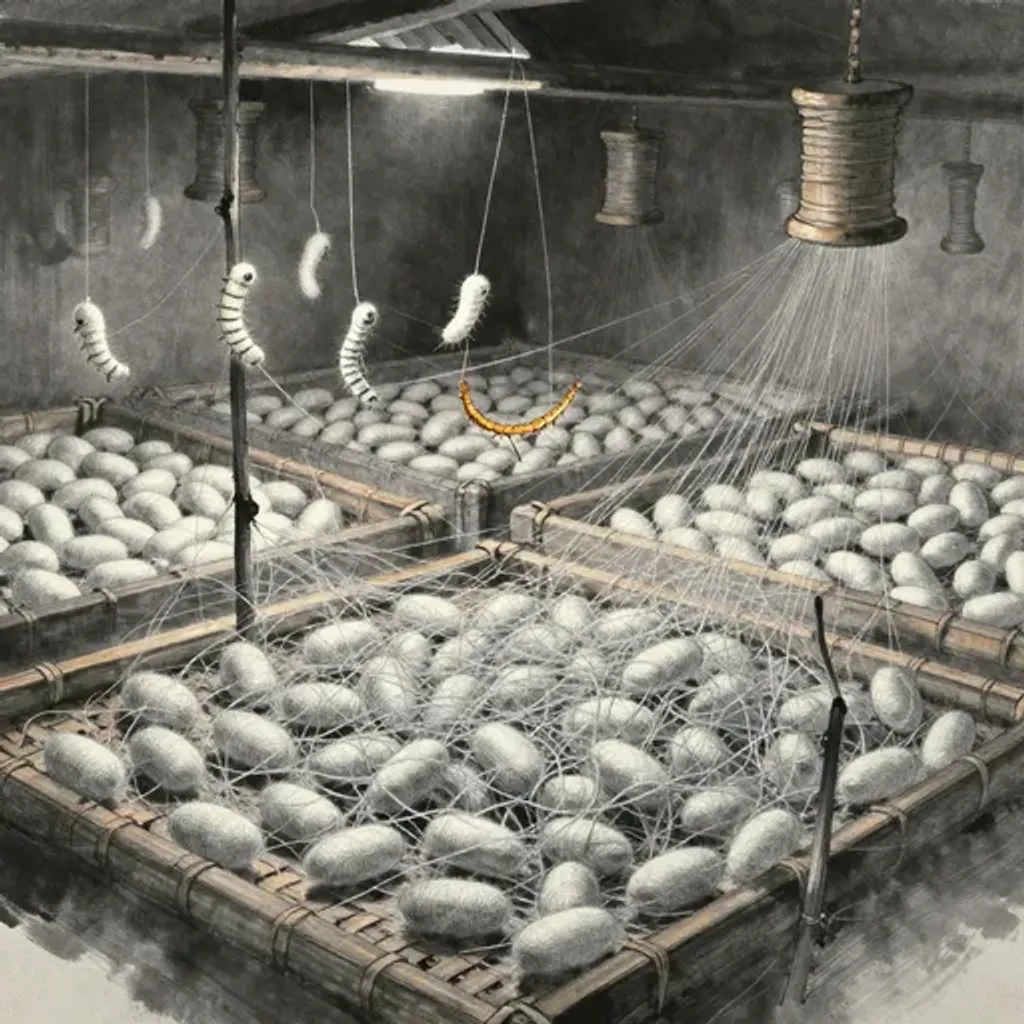
蚕飢作室,昏多亂纏;緒不可得。
Silkworms, hungry, make their chambers; in the dark they tangle wildly. The thread cannot be found.
— Jiao Yanshou, Yilin (Forest of Changes), 1st century BC
Commentary
Thunder bursts from the earth, but the silkworms are starving as they spin their cocoons. In the dim confusion they tangle their threads beyond recovery — no usable silk can be drawn. The image captures effort expended in desperation: hungry silkworms produce chaotic, unusable fiber. From Enthusiasm to Fellowship, the verse reveals a failed attempt at cooperation. Fellowship's image is heaven joined with fire, calling for people to sort by kind and distinguish clearly. Yet these silkworms work in darkness without nourishment, producing only knots. Enthusiasm without proper sustenance and clarity generates entanglement rather than community — the threads that should bind people together become an impenetrable snarl.
豫 → 大有
Hexagram 16 → Hexagram 14: Great Possession
Changing lines: 1, 2, 3, 6
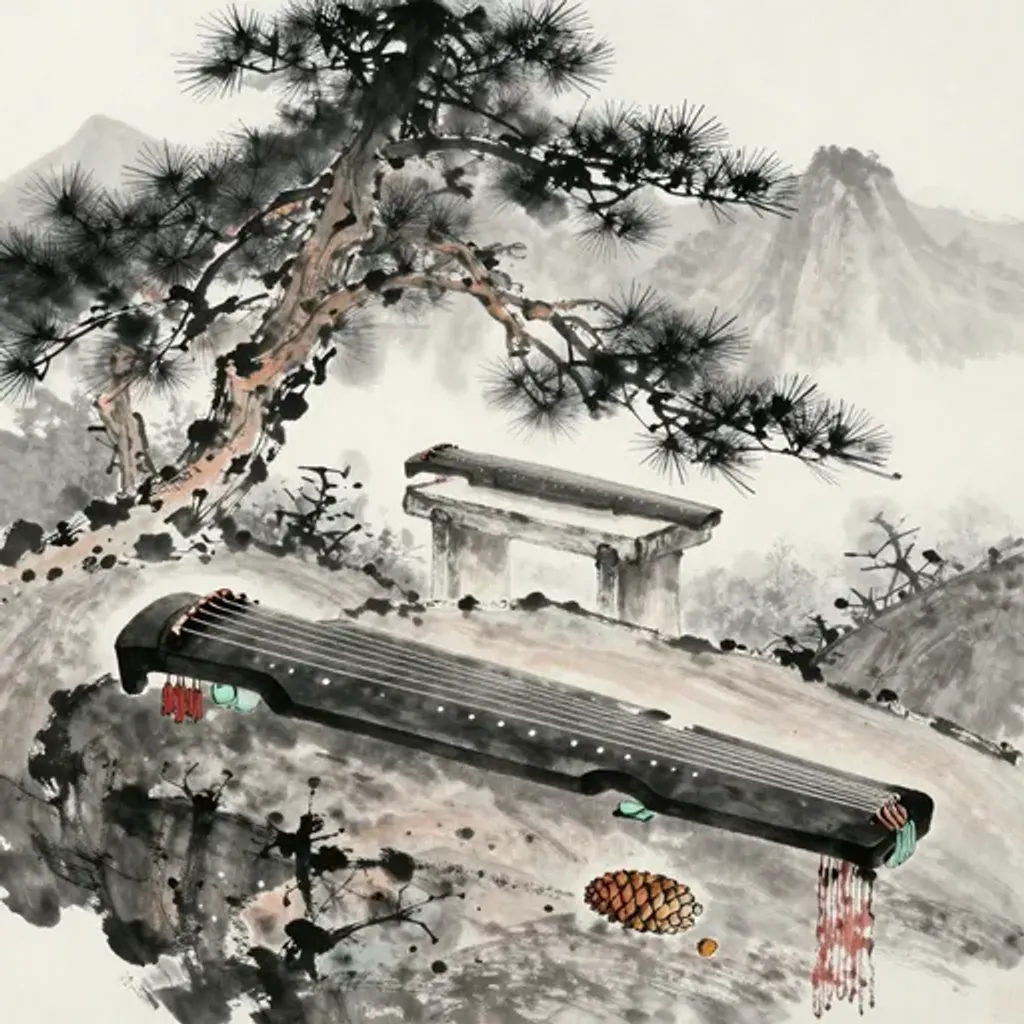
子鉏執麟,《春秋》作元;陰聖將終,尼父悲心。
The ancient qin's string snaps — the one who understood has departed. Wind through pines on an empty mountain — who now comprehends this sound?
— Jiao Yanshou, Yilin (Forest of Changes), 1st century BC
Commentary
Thunder stirs the earth, but the original verse speaks of the capture of the qilin. Zichushang, a charioteer of the Shusun clan, caught the mythical beast during the Western Hunt of 481 BC. Confucius — here called 'Father Ni' — recognized it and wept, for the qilin appears only under sage kings, and its capture in a lawless age meant the Way had reached its end. He ceased writing the Spring and Autumn Annals at this event. From Enthusiasm to Great Possession, the transformation illuminates the paradox: fire blazing above heaven suggests maximum illumination and abundance, yet what has been 'possessed' is a sign of cosmic mourning. The greatest treasure sometimes arrives as the final omen of decline.
豫 → 謙
Hexagram 16 → Hexagram 15: Modesty
Changing lines: 3, 4
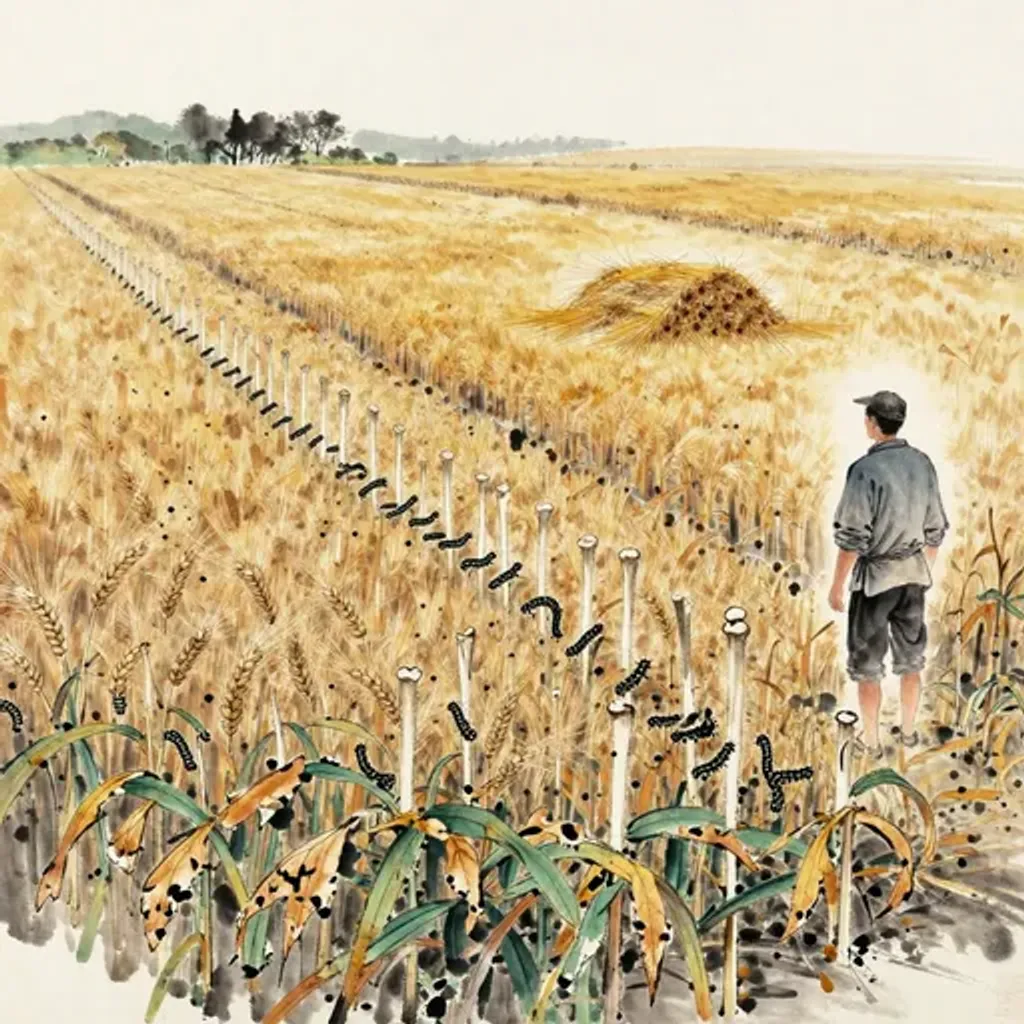
螟虫為賊,害我稼穡;禾殫麥盡,秋無所得。
Caterpillars are the bane, ravaging our crops and grain; wheat exhausted, millet gone -- nothing gained come autumn.
— Jiao Yanshou, Yilin (Forest of Changes), 1st century BC
Commentary
Thunder breaks from the earth, but the harvest is consumed before it can be gathered. Boring insects ravage the crops — grain exhausted, wheat gone, nothing left for autumn's reaping. The spiraling pests devour methodically, leaving the farmer with bare stalks and empty hands. From Enthusiasm to Modesty, the transformation carries a sharp lesson. Modesty's image is a mountain hidden within the earth, greatness concealed beneath humility. The insects strip away everything external — the showy grain, the promising wheat — until only the bare ground remains. What enthusiasm builds, natural forces can level; Modesty teaches that true substance lies below the surface, where no pest can reach.
豫 → 豫
Hexagram 16 → Hexagram 16: Enthusiasm
No changing lines — the hexagram is unchanged
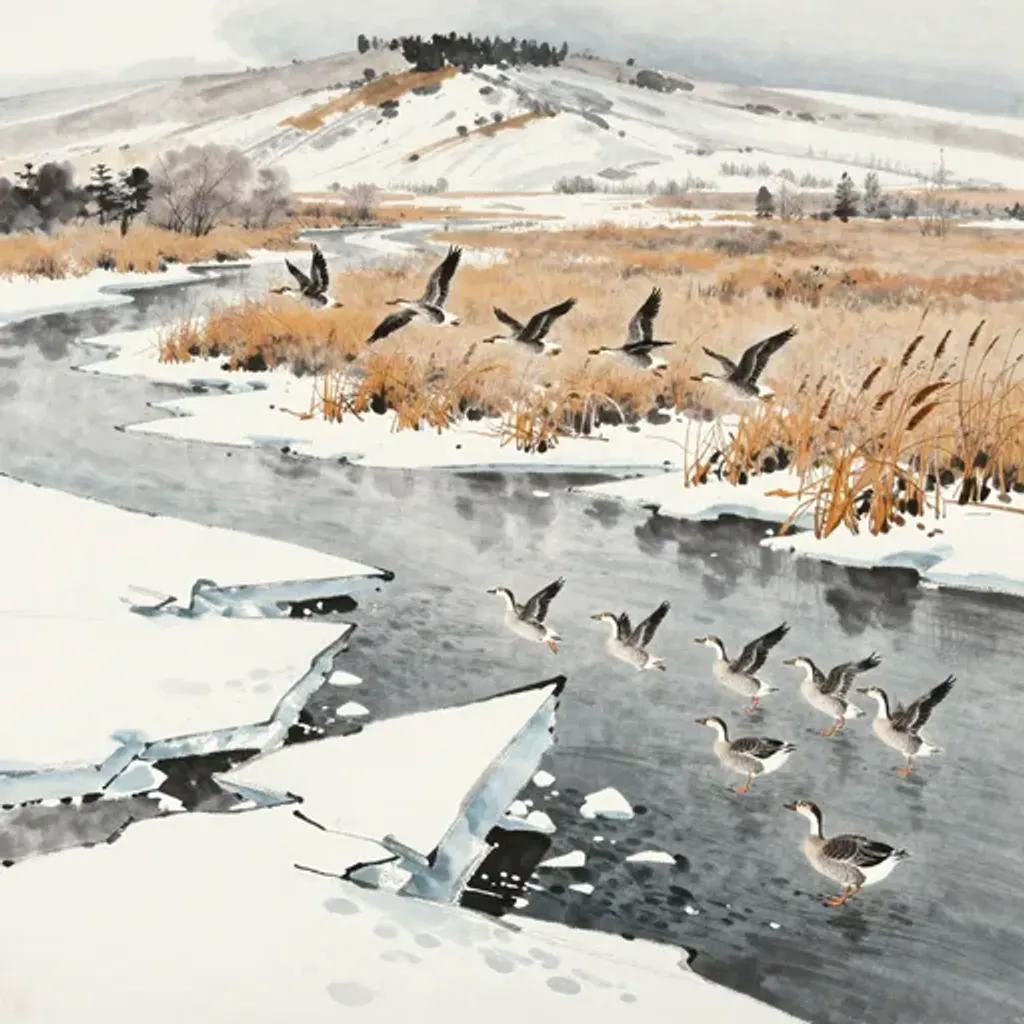
冰將泮散,鳴雁噰噰;丁男長女,可以會同。生育聖人。
Ice is about to melt and scatter; geese honk in harmonious chorus. Grown men and elder daughters may now come together. They shall give birth to a sage.
— Jiao Yanshou, Yilin (Forest of Changes), 1st century BC
Commentary
Thunder surges from the earth as ice begins to thaw and migrating geese cry out in chorus. Young men and women may now gather together freely, and a sage shall be born. The verse celebrates the return of spring: frozen stillness gives way to movement, birdsong fills the air, and the social and biological cycles resume. The honking geese signal the season of courtship and assembly. From Enthusiasm to Enthusiasm — the hexagram returns to itself, and appropriately the verse captures the purest expression of its nature: communal joy, fertile union, cosmic renewal. When the pattern holds steady, its inherent energy simply manifests as what it always was — the earth trembling with new life.
豫 → 隨
Hexagram 16 → Hexagram 17: Following
Changing lines: 1, 5
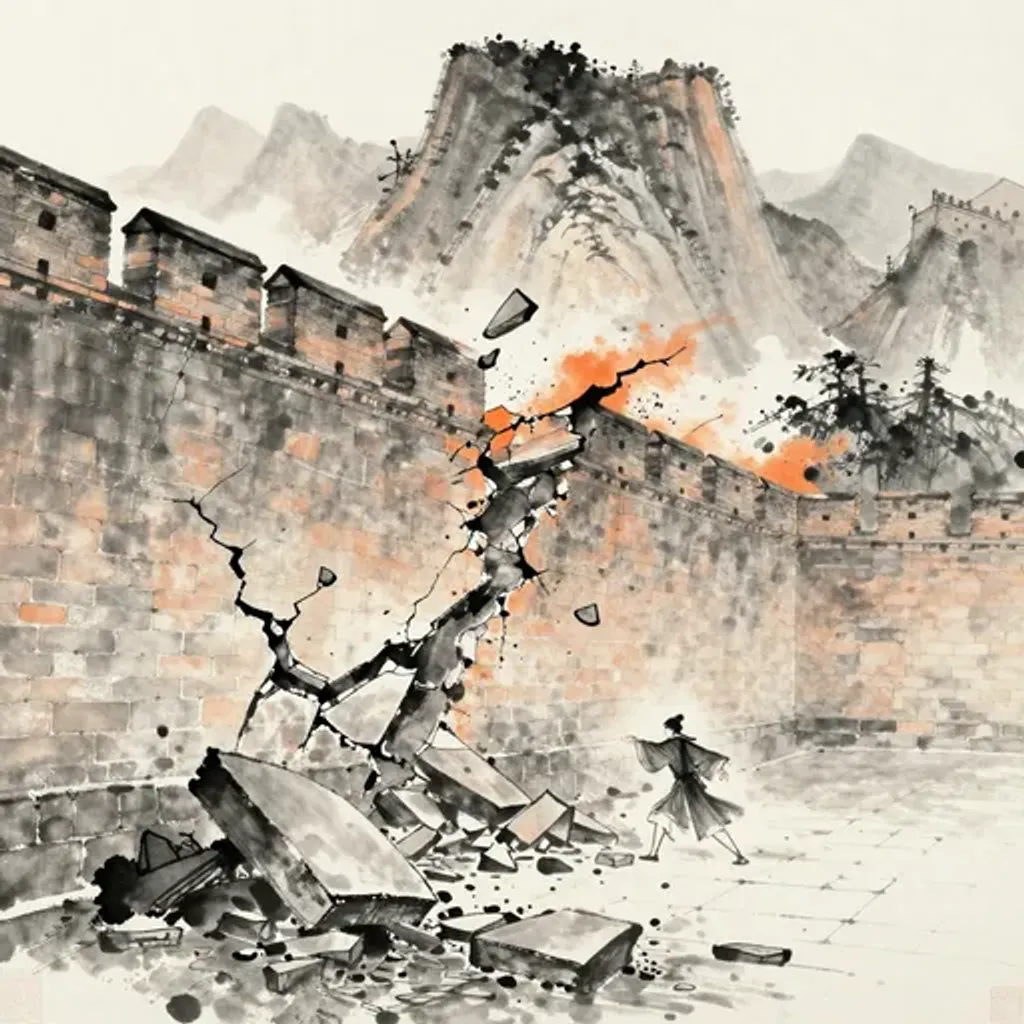
憂在腹內,山崩為疾;禍起蕭墻,竟制其國。
Worry lies within; the mountain collapses into sickness. Disaster rises from inside the walls, and in the end overwhelms the state.
— Jiao Yanshou, Yilin (Forest of Changes), 1st century BC
Commentary
Thunder shakes the earth, but the trouble festers within. Sickness lurks inside the belly; a mountain collapses as disease takes hold. Disaster arises from within the inner walls — the phrase 'trouble at the screen wall' (禍起蕭牆) quotes Confucius's warning from the Analerta about the Ji clan's designs on Zhuanyu: 'I fear the trouble lies not in Zhuanyu but within the screen wall itself.' The internal threat ultimately seizes control of the state. From Enthusiasm to Following, the pattern fits: thunder rests within the lake, waiting. Following requires yielding to what comes, but when what comes is internal decay, following the wrong impulse leads to the state's undoing.
豫 → 蠱
Hexagram 16 → Hexagram 18: Work on the Decayed
Changing lines: 2, 3, 4, 6
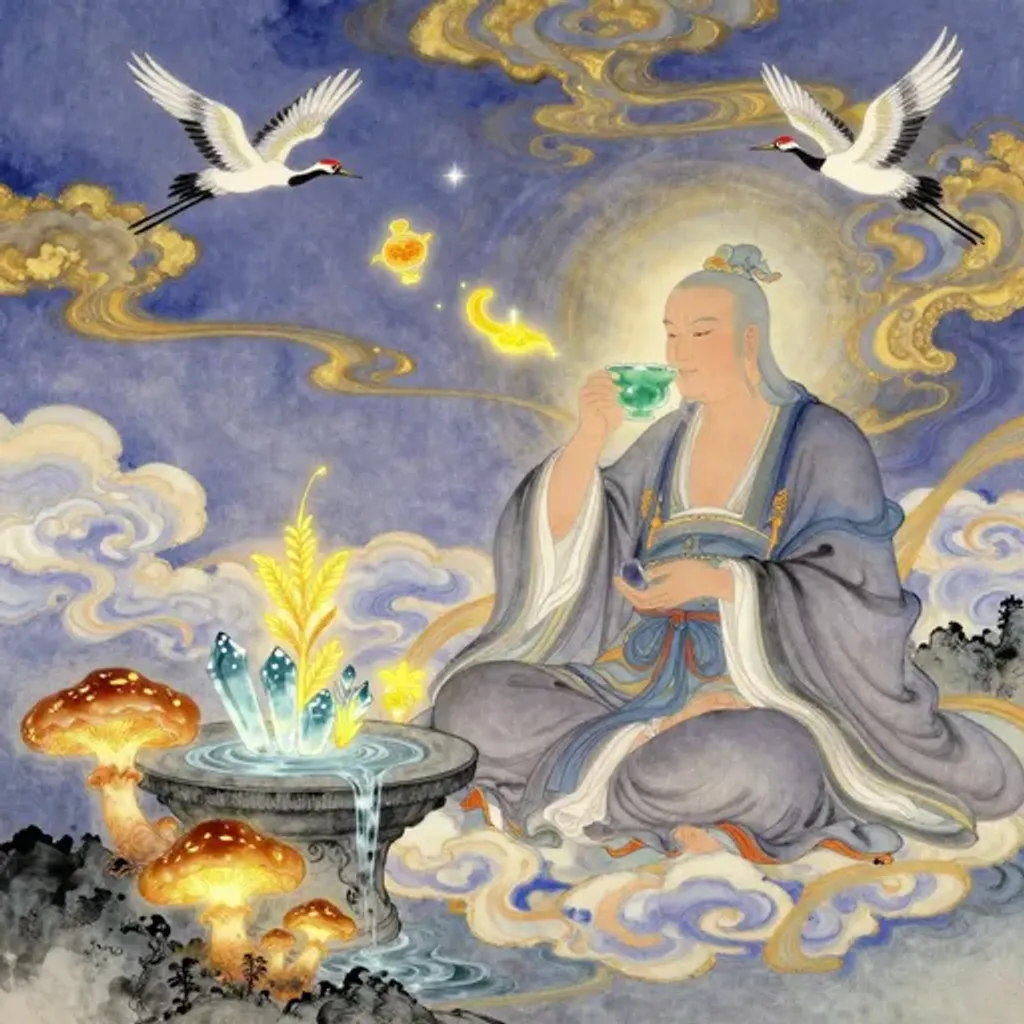
茹芝餌黃,飲食玉瑛;與神流通,長無憂凶。
Eating lingzhi, swallowing the golden elixir, drinking jade essence; communing with the spirits, long free from worry and misfortune.
— Jiao Yanshou, Yilin (Forest of Changes), 1st century BC
Commentary
Thunder breaks from the earth, and the verse ascends into the realm of Daoist cultivation. One eats lingzhi mushrooms and yellow essence, drinks jade nectar and crystal dew, communing freely with the spirits and living forever without misfortune. The diet of the immortals replaces grain with the refined essences of mountain herbs and mineral elixirs. From Enthusiasm to Work on the Decayed, the transformation is surprising yet apt: wind blows beneath the mountain, stirring what has stagnated. The decayed world requires renovation, and the adept's alchemical practice is precisely that — transmuting the body's corruption into spiritual vitality. What enthusiasm initiates, inner cultivation sustains through the patient work of self-transformation.
豫 → 臨
Hexagram 16 → Hexagram 19: Approach
Changing lines: 1, 2, 4
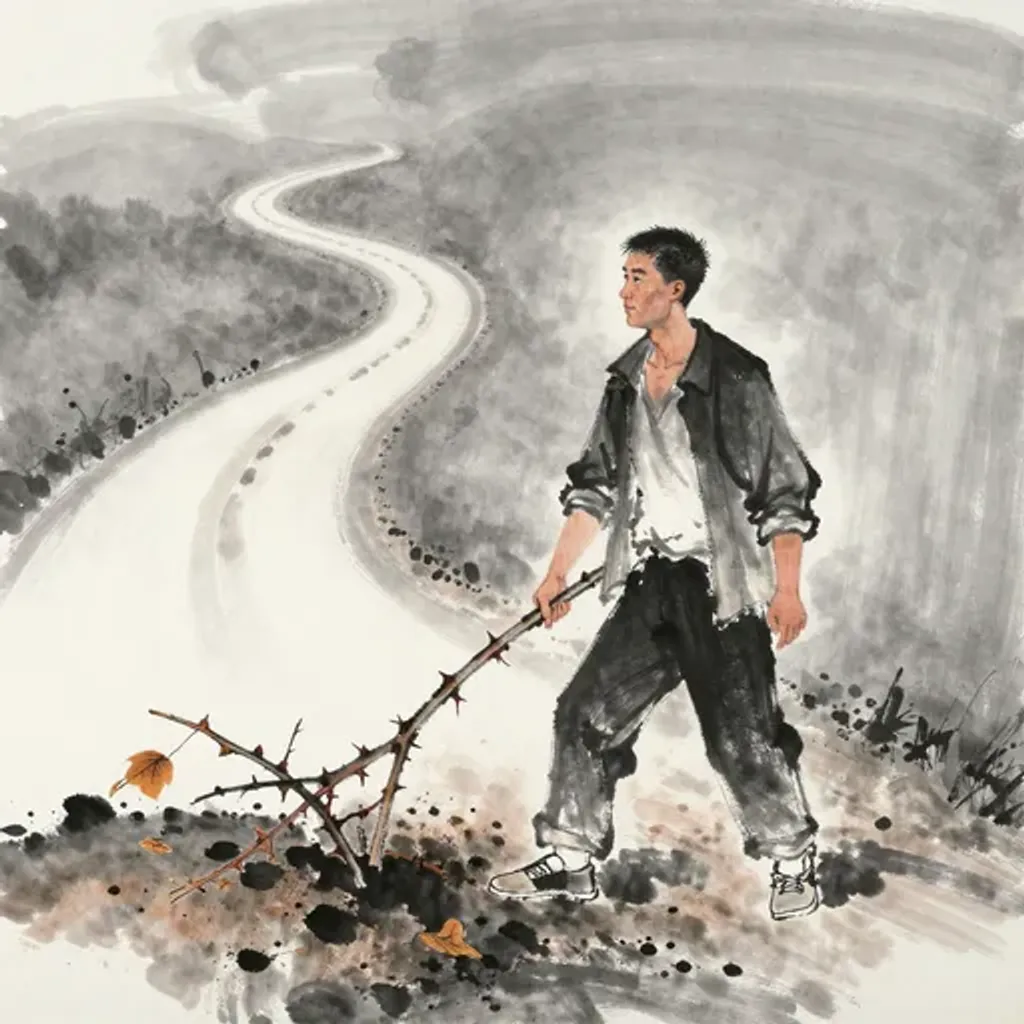
一夫兩心,枝刺不深;所為無功,求事不成。
One man with two minds; the thorn planted without depth. What is done achieves nothing; what is sought does not succeed.
— Jiao Yanshou, Yilin (Forest of Changes), 1st century BC
Commentary
Thunder erupts from the earth, but the man has two hearts in one body — his commitment is divided, and the graft does not take root. Everything he attempts fails; nothing he seeks comes to fruition. A branch forced into alien bark will not grow deep. The image is simple and devastating: half-heartedness guarantees failure. From Enthusiasm to Approach, the irony is pointed. Approach's image is earth above the lake — the ruler descending to meet the people with boundless care and protection. But divided intention cannot approach anything genuinely. Enthusiasm split between competing desires reaches neither goal, and the branch withers because it never committed to a single trunk.
豫 → 觀
Hexagram 16 → Hexagram 20: Contemplation
Changing lines: 4, 5, 6
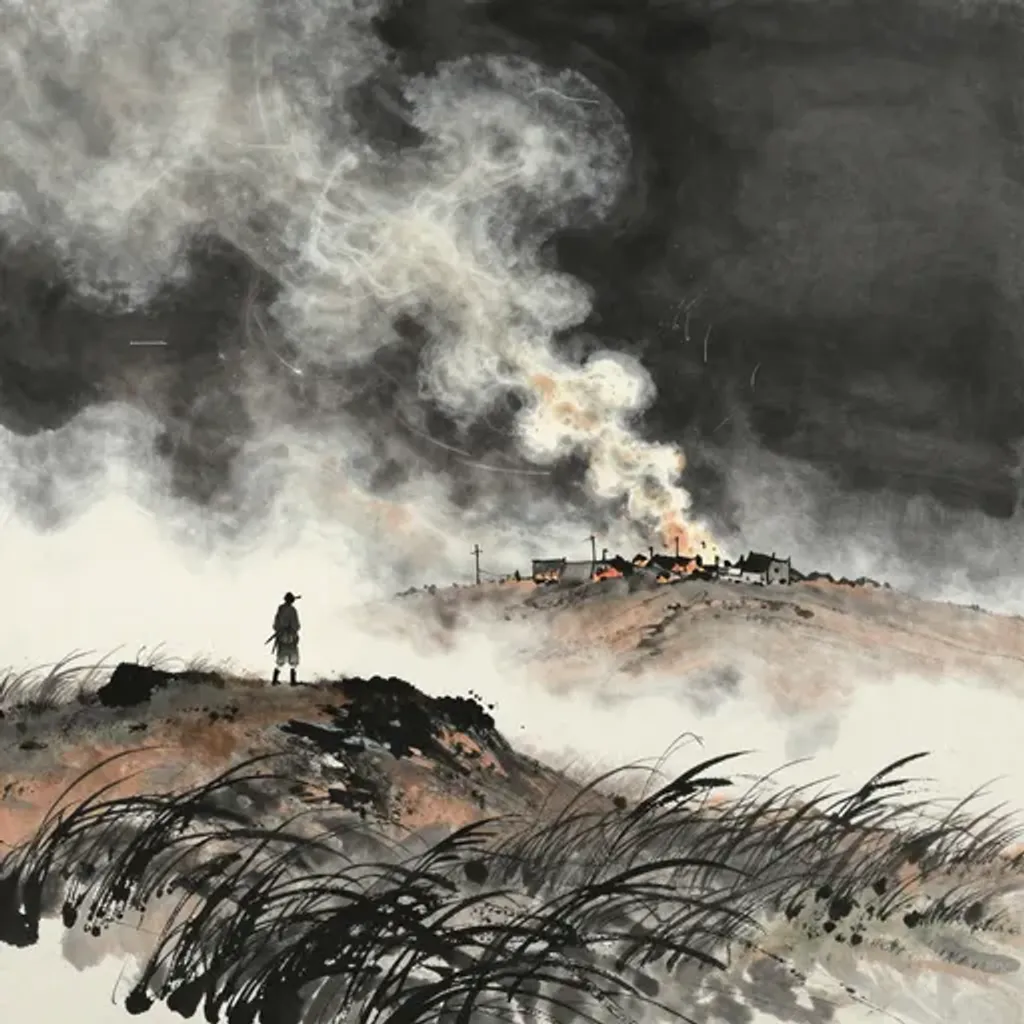
十里望烟,散渙四方;形容滅亡,終不見君。
Gazing at smoke ten li away, it scatters in four directions; form and figure vanish -- in the end the lord is never seen.
— Jiao Yanshou, Yilin (Forest of Changes), 1st century BC
Commentary
Thunder breaks from the earth, but what rises is only smoke — visible from ten miles off, dissolving in all four directions. Forms vanish into nothing; in the end, the lord is never seen again. The verse paints a scene of dissolution: a signal fire or burning camp that produces only dispersing haze, no solid presence. From Enthusiasm to Contemplation, the transformation is hauntingly precise. Contemplation's image is wind moving over the earth, the ancient king touring his realm to observe the people. But here there is nothing left to observe — only scattering smoke where substance once stood. Enthusiasm that produces no lasting form becomes mere spectacle, witnessed from a distance and soon forgotten.
豫 → 噬嗑
Hexagram 16 → Hexagram 21: Biting Through
Changing lines: 1, 6
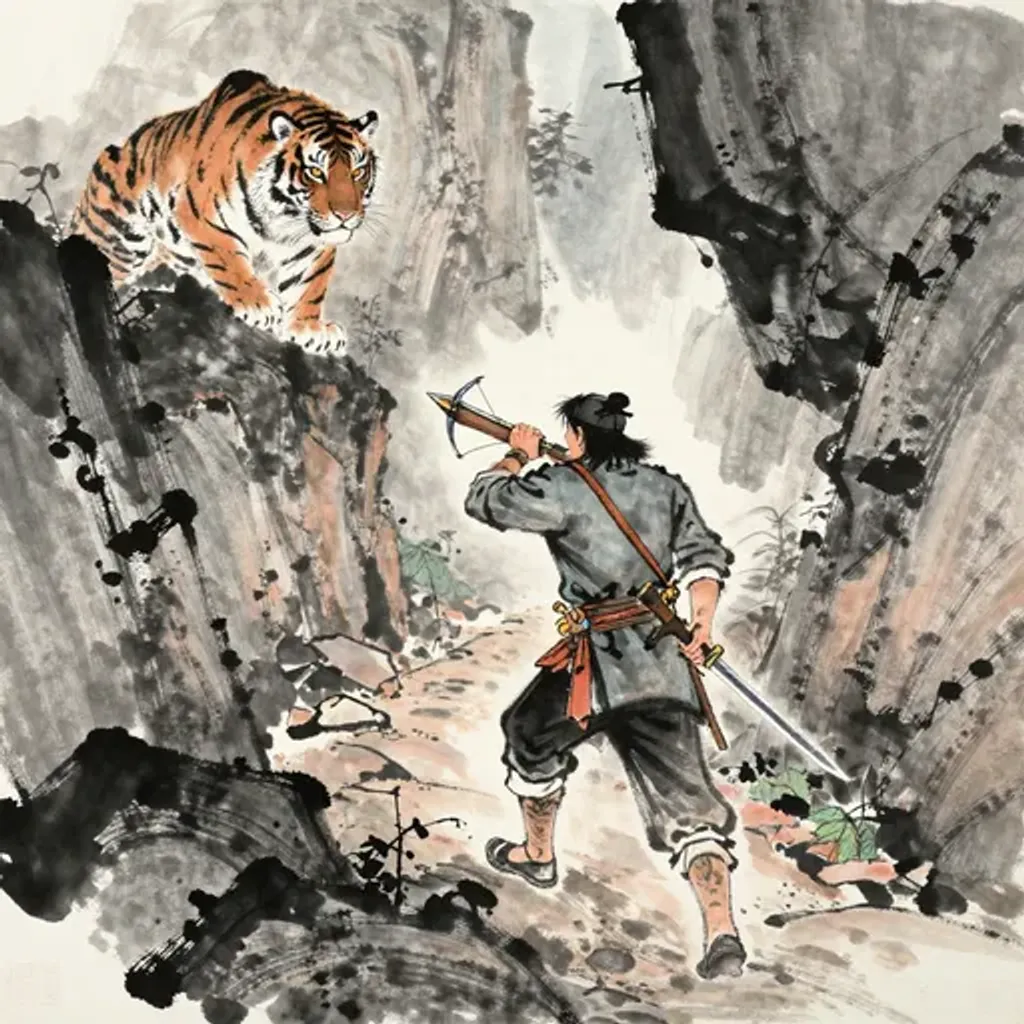
張弓廓弩,經涉山道;雖有伏虎,誰敢害諸。
Drawing the bow, spanning the crossbow, traversing the mountain road; though a tiger lies in ambush, who dares harm him?
— Jiao Yanshou, Yilin (Forest of Changes), 1st century BC
Commentary
Thunder breaks from the earth as bows are strung and crossbows cocked. The armed party traverses mountain roads where tigers lurk in ambush — yet who dares threaten them? The verse radiates confidence: a well-armed force moving through dangerous terrain without fear. The weapons are drawn not in panic but in disciplined readiness. From Enthusiasm to Biting Through, the transformation channels this martial energy into judicial force. Biting Through's image is lightning and thunder together — the ancient kings used this to clarify punishments and enforce law. The armed traveler's boldness becomes the state's righteous authority: danger exists, but preparedness and legitimate power render it harmless.
豫 → 賁
Hexagram 16 → Hexagram 22: Grace
Changing lines: 1, 3, 4, 6
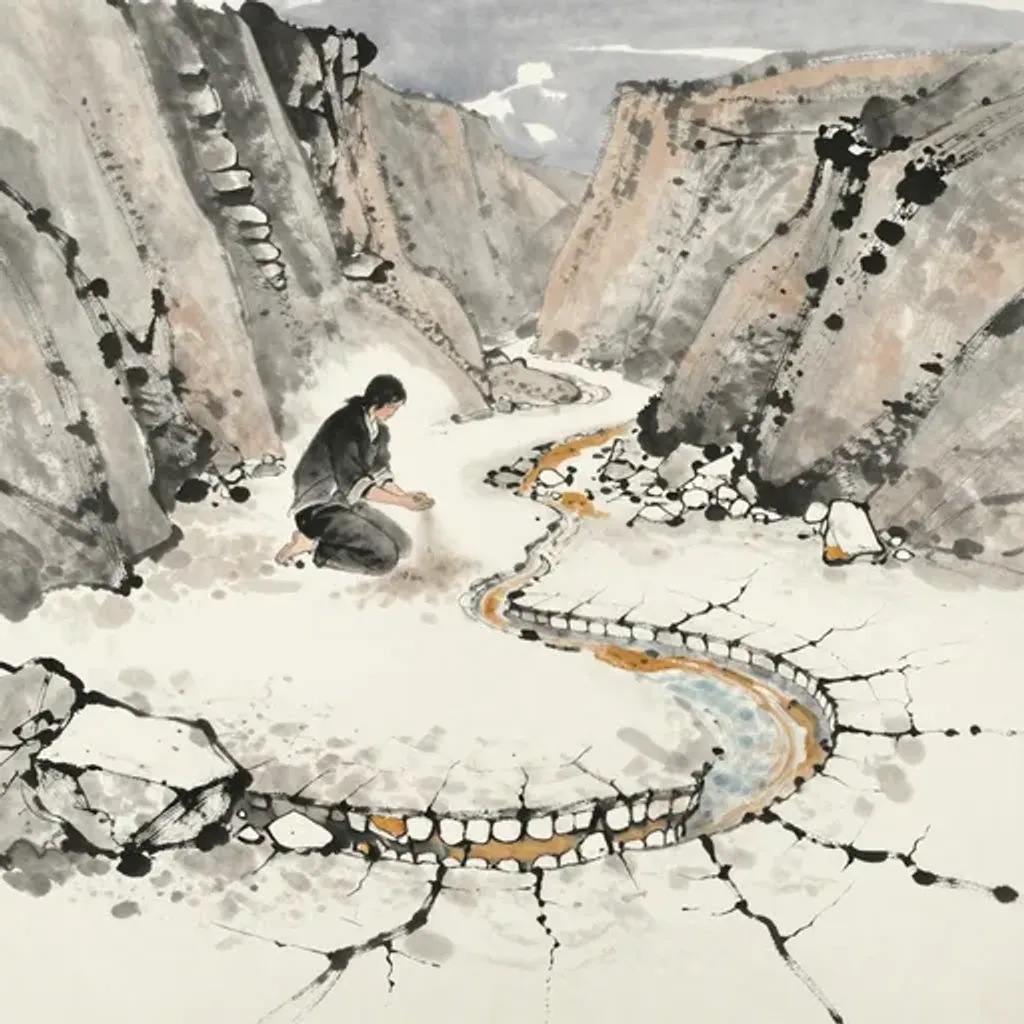
泉閉澤竭,王母飢渴;君子困窮,乃徐有說。
Springs sealed, marshes drained; the Queen Mother thirsts. The gentleman in dire straits -- only slowly does relief come.
— Jiao Yanshou, Yilin (Forest of Changes), 1st century BC
Commentary
Thunder stirs the earth, but the springs are sealed and the marshes have dried. Even the Queen Mother of the West thirsts. The gentleman is reduced to poverty — yet slowly, at last, relief comes. The Queen Mother, dwelling on Mount Kunlun above the Weak Water, guardian of the peaches of immortality, is the last figure one would expect to suffer thirst. If even she goes parched, the drought is cosmic in scale. Yet the verse turns: after extremity, comfort arrives. From Enthusiasm to Grace, the transformation paints fire glowing beneath the mountain — beauty emerging from constraint. The moment of greatest deprivation becomes the threshold of renewal, and the gentleman's patience is adorned with quiet dignity.
豫 → 剝
Hexagram 16 → Hexagram 23: Splitting Apart
Changing lines: 4, 6
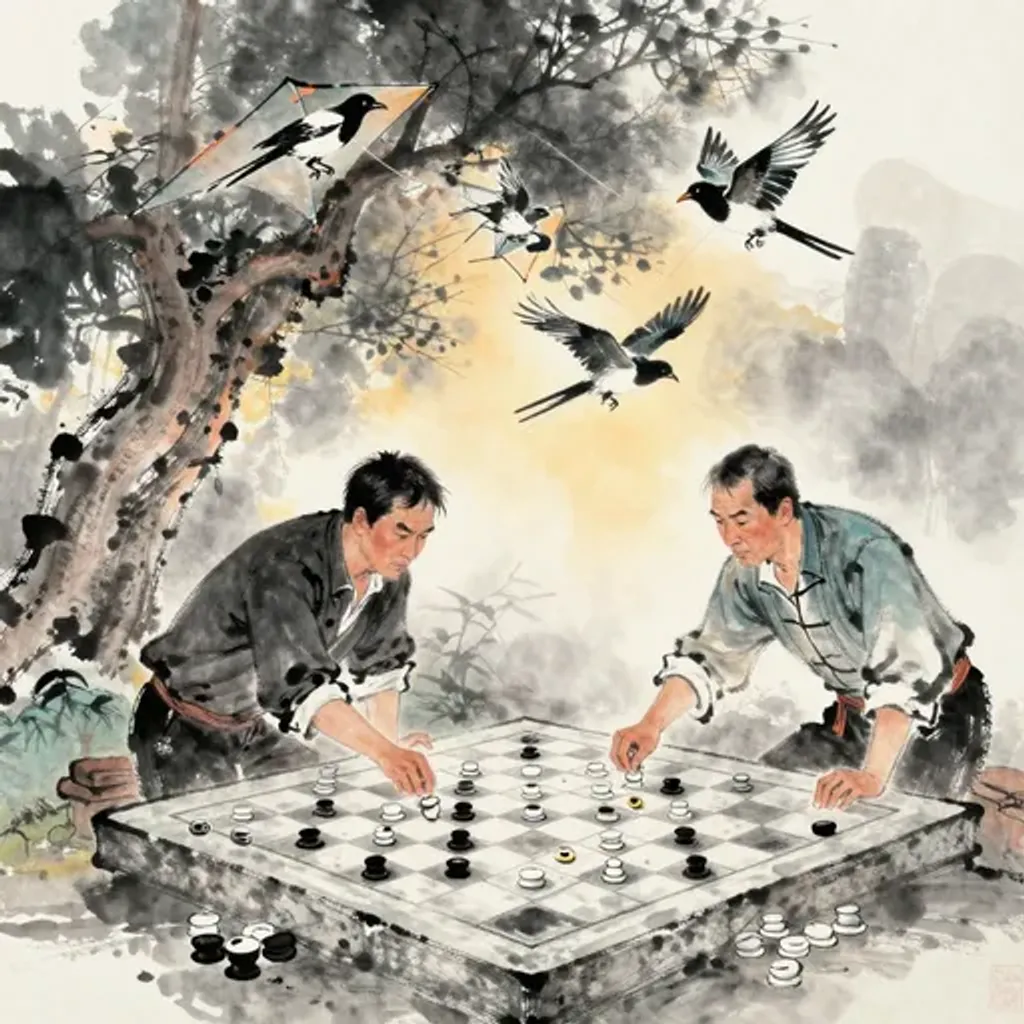
野鳶山鵲,奕棊六博;三梟四散,主人勝客。
Wild kites and mountain magpies play chess and liubo; three owls scatter in four directions -- the host defeats the guest.
— Jiao Yanshou, Yilin (Forest of Changes), 1st century BC
Commentary
Thunder breaks from the earth as wild kites and mountain magpies descend upon a game board. The verse depicts a contest of strategy — chess or liubo, the ancient dice-and-board game. Three pieces are 'owled' (captured) and four scattered; the host defeats the guest. The bird imagery suggests cunning, opportunistic players, while the decisive outcome favors the one who holds the home position. From Enthusiasm to Splitting Apart, the transformation is fitting: the mountain crumbles from the earth as the loser's position disintegrates. In Splitting Apart, yin lines erode yang from below until only the top remains. The defeated guest's forces are systematically dismantled, stripped away piece by piece, exactly as the hexagram describes.
豫 → 復
Hexagram 16 → Hexagram 24: Return
Changing lines: 1, 4
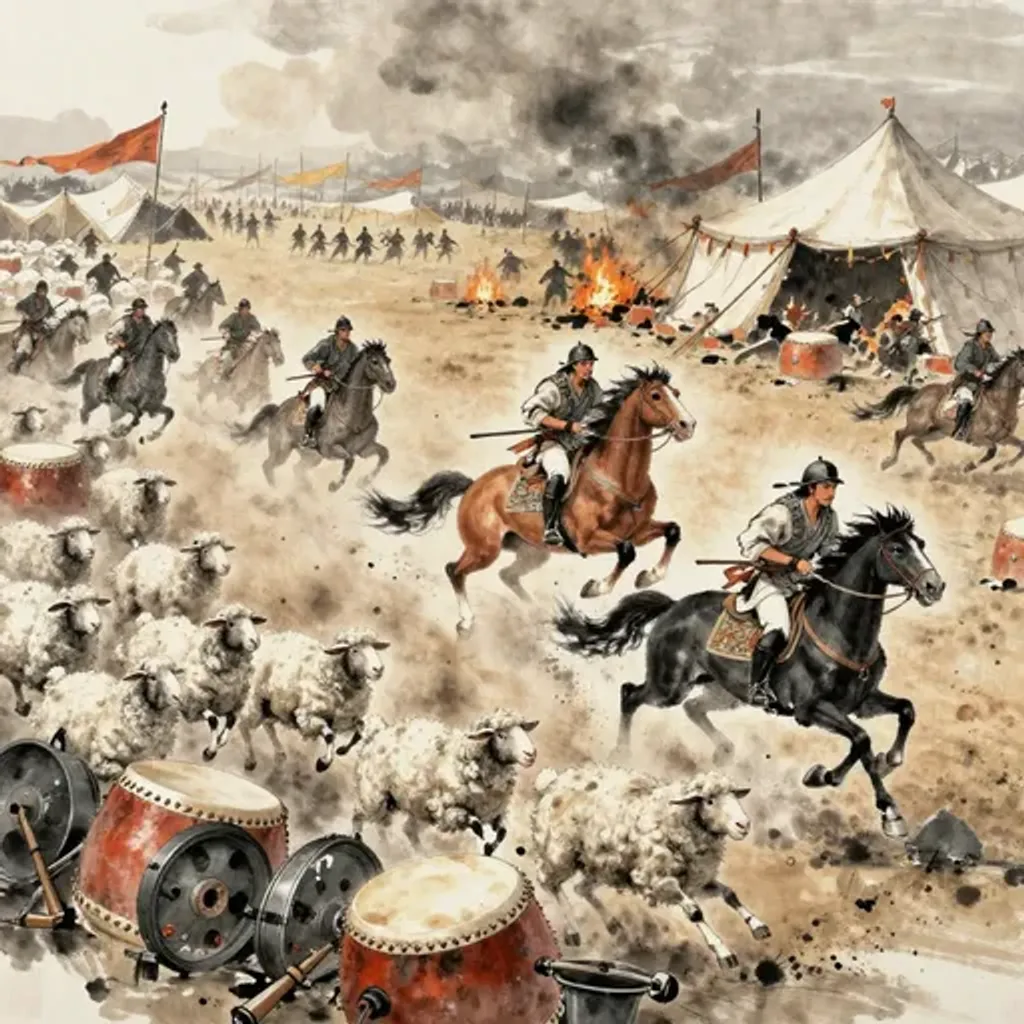
羊驚馬走,上下揮擾;鼓音不絕,頃公奔敗。
Sheep startled, horses bolting, turmoil above and below; drums sound without ceasing -- Duke Qing flees in defeat.
— Jiao Yanshou, Yilin (Forest of Changes), 1st century BC
Commentary
Thunder bursts from the earth as sheep bolt and horses stampede. Chaos reigns above and below; war drums pound without ceasing. Duke Qing of Qi flees in defeat. This alludes to the Battle of An in 589 BC, where Jin forces routed the Qi army. Duke Qing had invaded Lu, provoking a Jin-led coalition response. During the rout, the Duke switched places with his spearman to evade capture, and Jin's chariots pursued the Qi army around the hills in circles. From Enthusiasm to Return, the transformation is fitting: thunder rests within the earth, the first yang line reappearing after total yin. The duke's humiliating defeat strips away all pretense, and what returns is the bare starting point — chastened, reduced, but alive.
豫 → 无妄
Hexagram 16 → Hexagram 25: Innocence
Changing lines: 1, 5, 6
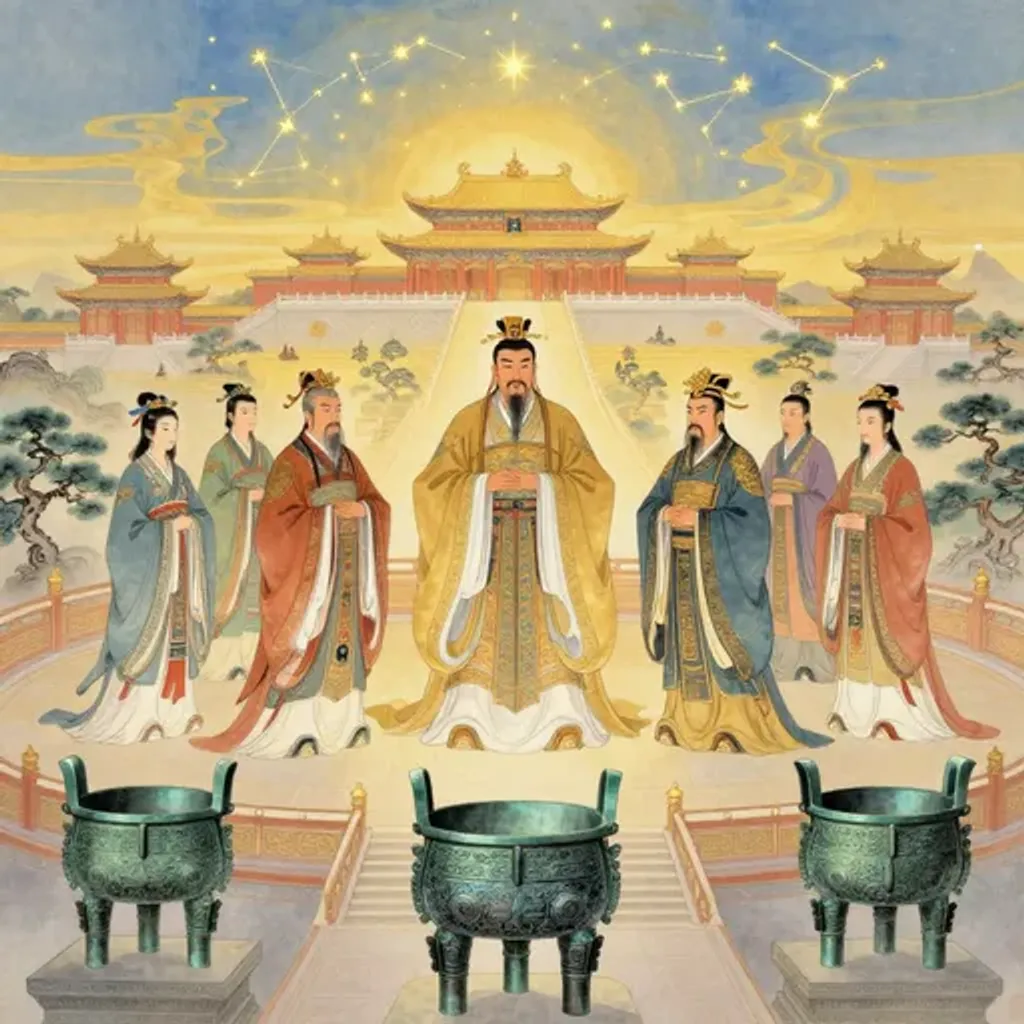
黃帝神明,八子聖聰;俱受大福,天下康平。
The Yellow Emperor, divinely wise; eight sons of sagely brilliance. All received great blessings; the realm was at peace.
— Jiao Yanshou, Yilin (Forest of Changes), 1st century BC
Commentary
Thunder erupts from the earth in sovereign splendor. The Yellow Emperor, luminous and divine, has eight sons of sagely brilliance. Together they receive heaven's greatest blessings, and the realm rests in universal peace. The Yellow Emperor — primordial ancestor of Chinese civilization, victor over Chi You at Zhuolu — here presides over a golden age where his many heirs each embody sagely virtue. The verse is purely auspicious, a vision of cosmic governance fulfilled. From Enthusiasm to Innocence, the transformation resonates: heaven's thunder moves through all things without false intent. Innocence is action aligned with cosmic principle, free of ulterior motive — precisely the state the Yellow Emperor's divine administration represents.
豫 → 大畜
Hexagram 16 → Hexagram 26: Great Taming
Changing lines: 1, 2, 3, 4, 6
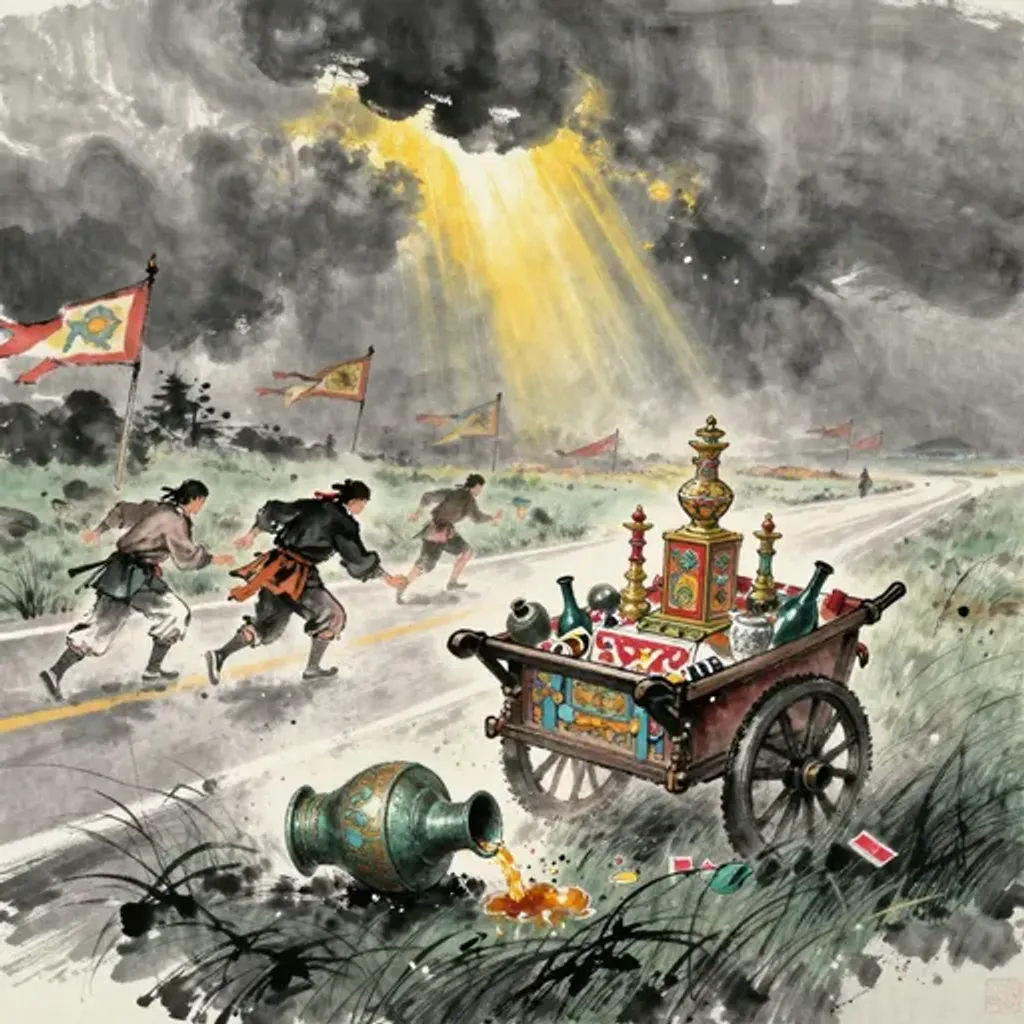
住車醊酒,疾風暴起;泛亂福器,飛揚位草。明神降祿,道無害寇。
Halting the cart to pour a libation, a violent wind suddenly rises; scattering the sacred vessels, blowing offerings into the grass. Yet the bright spirits bestow fortune -- the road holds no harm from brigands.
— Jiao Yanshou, Yilin (Forest of Changes), 1st century BC
Commentary
Thunder breaks from the earth as a roadside libation is disrupted by sudden gale winds. The ritual vessels are scattered, offerings blown into the grass. Yet the verse pivots: a luminous spirit descends with blessings, and the road ahead is free of bandits. The scene captures a sacrificial ceremony interrupted by violent weather — wine poured, wind rising, sacred implements overturned. Despite the chaos, divine favor prevails. From Enthusiasm to Great Taming, the transformation holds: heaven stored within the mountain accumulates virtue through adversity. The storm tests the ritual but cannot nullify its sincerity, and the accumulated merit of proper observance ultimately secures safe passage and divine protection.
豫 → 頤
Hexagram 16 → Hexagram 27: Nourishment
Changing lines: 1, 4, 6
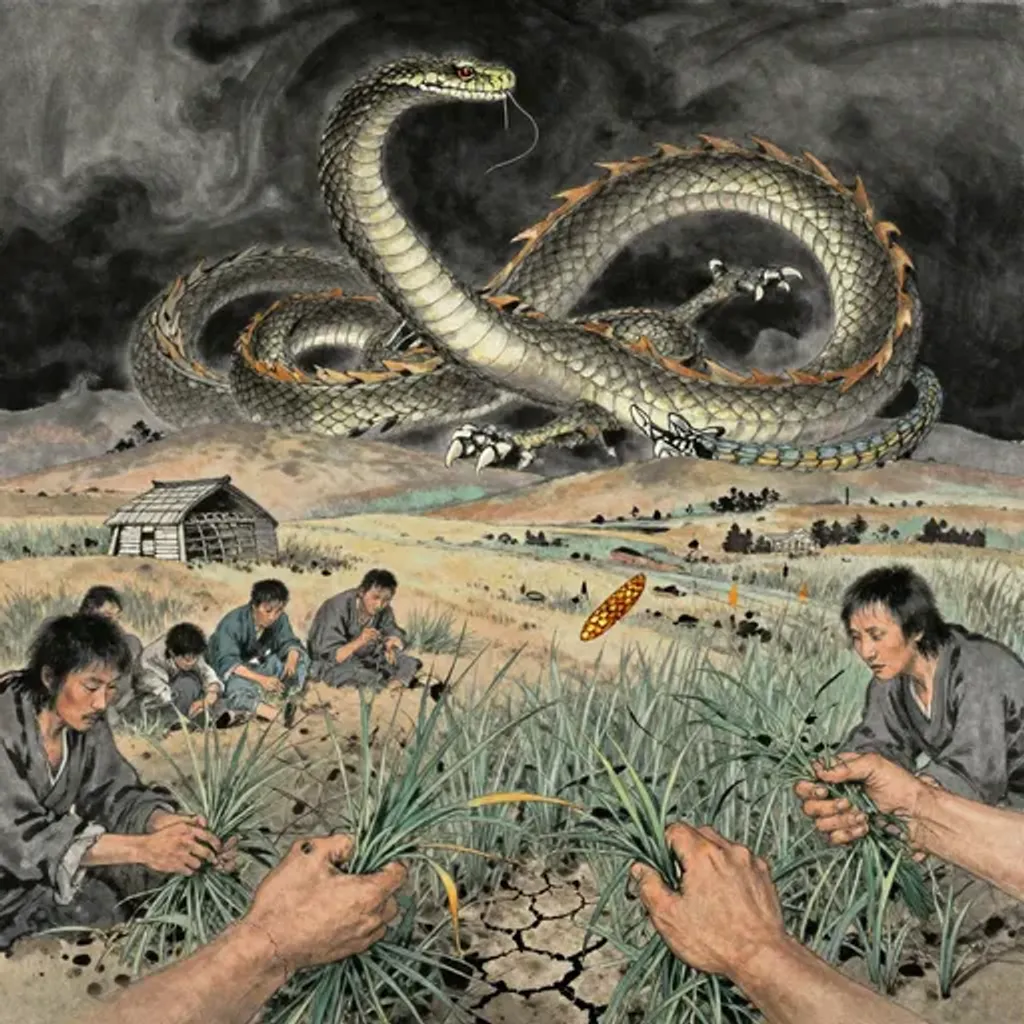
滕虵乘龍,宋鄭飢凶;民食草蓬。
The vine-snake mounts the dragon; Song and Zheng suffer famine and calamity. The people eat wild grasses.
— Jiao Yanshou, Yilin (Forest of Changes), 1st century BC
Commentary
Thunder rises from the earth, but a flying serpent rides upon a dragon — the natural hierarchy inverted, the lesser commanding the greater. The states of Song and Zheng suffer famine, and the people are reduced to eating wild weeds. The 'flying serpent riding the dragon' is a classical omen of misrule: when subordinates usurp their superiors, calamity follows. The famine in Song and Zheng makes the consequences visceral — not abstract political theory but empty stomachs and desperate foraging. From Enthusiasm to Nourishment, the transformation is bitterly apt: mountain over thunder, the image of careful feeding. When governance is inverted and nourishment fails, the people starve. Enthusiasm perverted into misrule produces the opposite of what Nourishment requires.
豫 → 大過
Hexagram 16 → Hexagram 28: Great Exceeding
Changing lines: 2, 3, 5
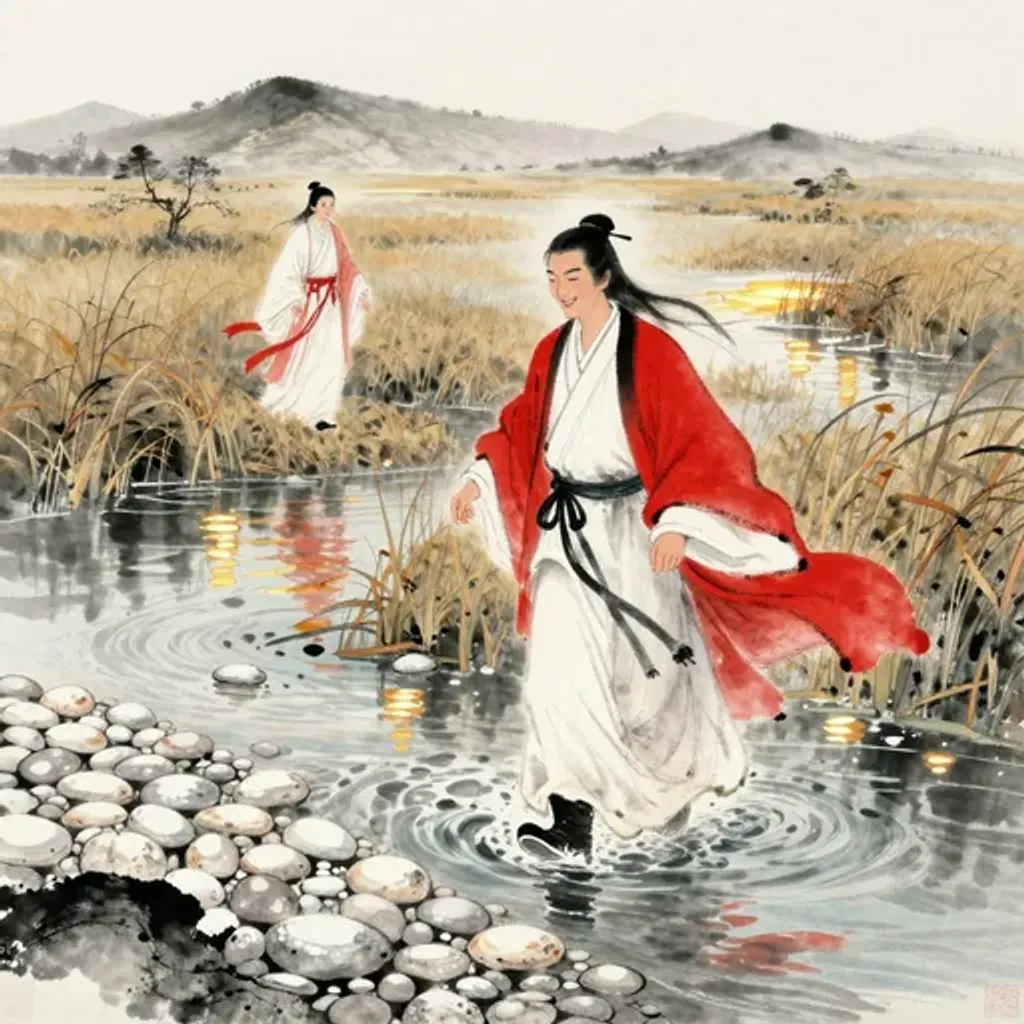
揚水潛鑿,使石潔白。裏素表朱,遨遊皋澤。得君所願。心志娛樂。
Drawing water to delve and polish, making the stone pure white. Silk within, vermillion without, roaming the marshes and wetlands. Gaining what the lord desires; heart and will filled with delight.
— Jiao Yanshou, Yilin (Forest of Changes), 1st century BC
Commentary
Thunder stirs the earth, and water is drawn up to wash stones gleaming white. The garments are plain silk within and vermilion without — inner purity dressed in outward beauty. The wearer roams freely through marshland meadows, obtaining what the heart desires, in full contentment. The image is of purification and adornment working together: the rough stone scoured clean, the robe layered with meaning. From Enthusiasm to Great Exceeding, the transformation pushes to the limit. The lake submerges the trees; the gentleman stands alone without fear. Here the verse captures the liberating excess of someone who has reconciled inner substance with outer display and now moves beyond ordinary constraints, achieving desires that others dare not even name.
豫 → 坎
Hexagram 16 → Hexagram 29: The Abysmal Water
Changing lines: 2, 4, 5
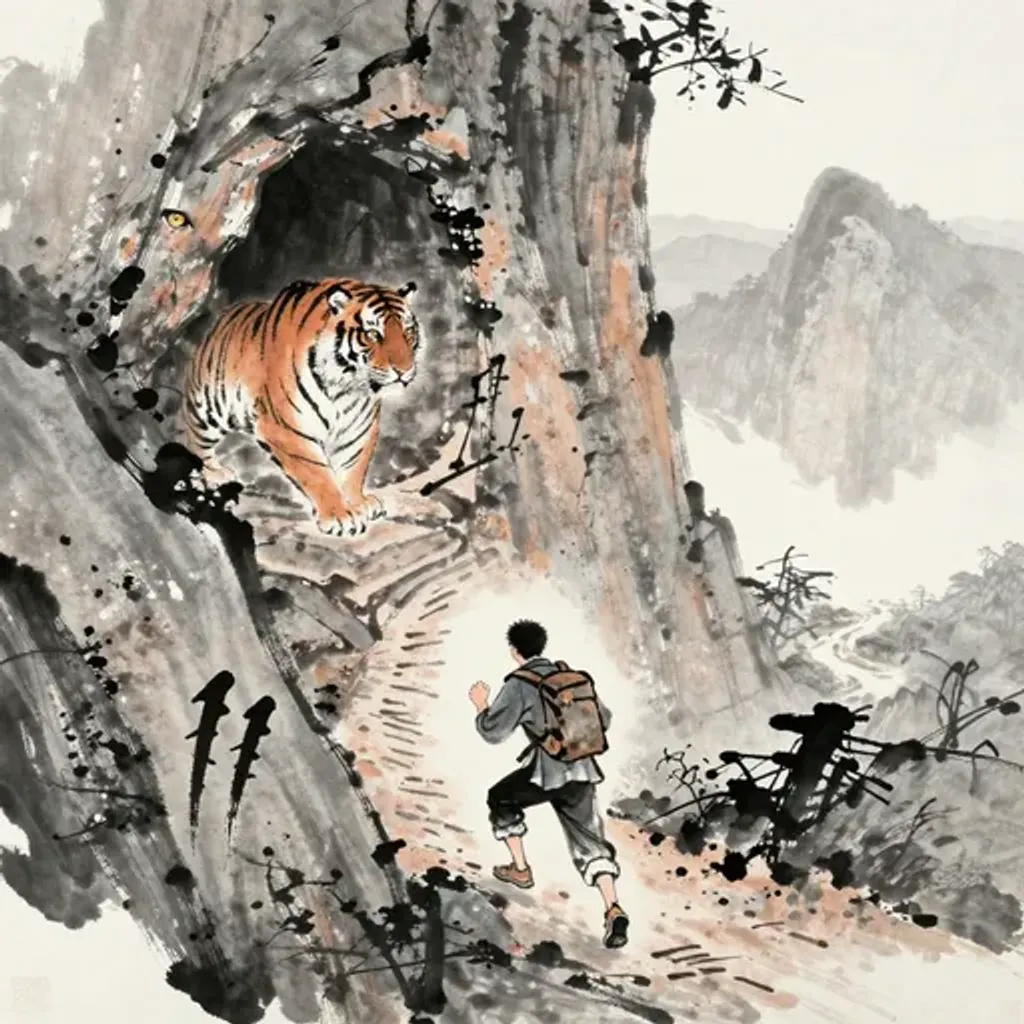
西過虎廬,驚其前樞。雖憂無尤。
Passing west by the tiger den, startling its front threshold. Though there is alarm, there is no blame.
— Jiao Yanshou, Yilin (Forest of Changes), 1st century BC
Commentary
Thunder breaks from the earth, but the traveler passes west by a tiger's lair and startles the beast at its doorstep. Fear grips the heart — yet in the end, there is no fault. The encounter is terrifying but ultimately harmless: the tiger is surprised, the traveler alarmed, but neither suffers injury. From Enthusiasm to The Abysmal, the transformation plunges into doubled water, repeated danger. The verse captures the essence of Kan: passing through peril with sincerity of heart. The tiger's den is the abyss one must traverse; the alarm is real, but the outcome — 'though anxious, no blame' — embodies Kan's teaching that one who maintains inner truth can navigate danger without being consumed by it.
豫 → 離
Hexagram 16 → Hexagram 30: The Clinging Fire
Changing lines: 1, 3, 6
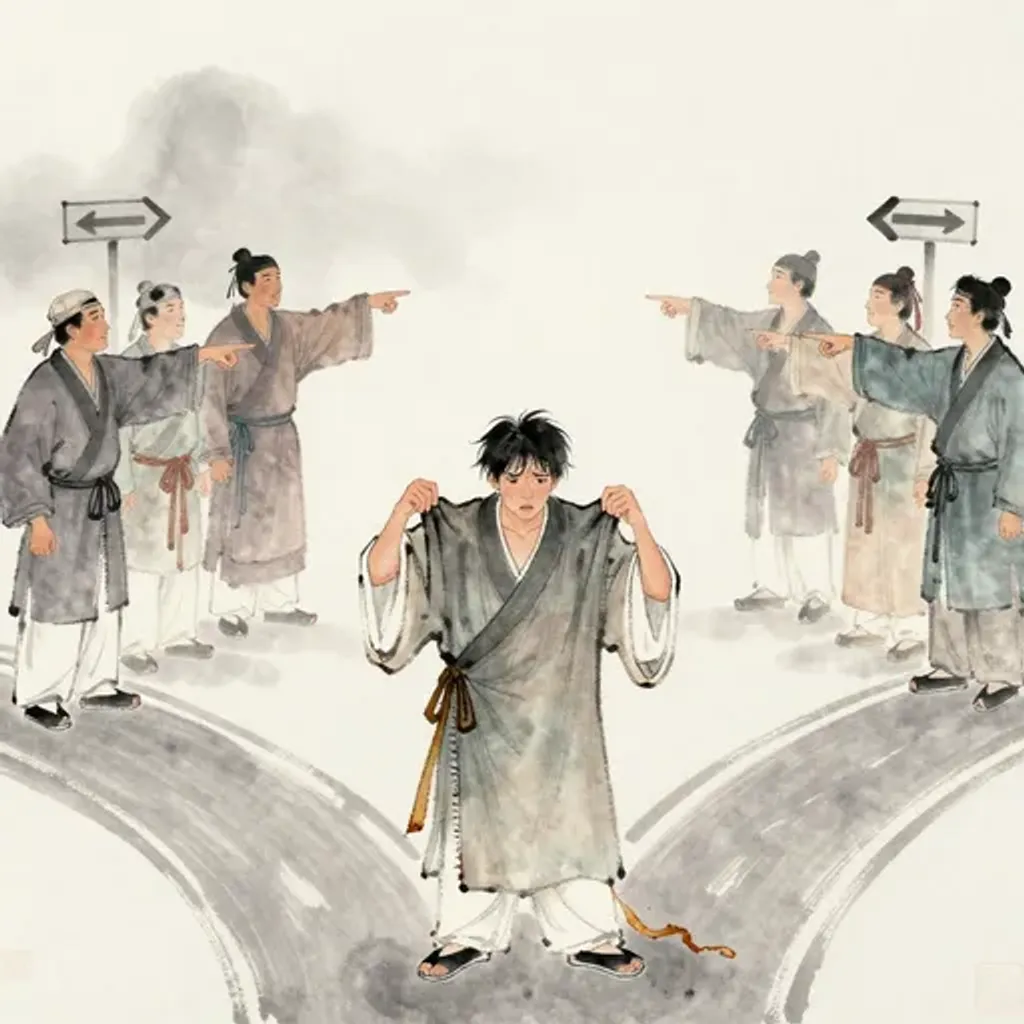
衣成無袖,不知所穿。客指東西,未得便安。
A robe finished but without sleeves -- one knows not how to wear it. Travelers point east and west; comfort is not yet found.
— Jiao Yanshou, Yilin (Forest of Changes), 1st century BC
Commentary
Thunder erupts from the earth, but the garment is finished without sleeves — one cannot figure out how to wear it. A traveler points east and west, unable to find a comfortable place to settle. The sleeveless robe is a perfect image of incompleteness: the essential structure exists but lacks the functional parts that make it usable. The disoriented guest mirrors this — surrounded by options yet fitting into none. From Enthusiasm to The Clinging, the verse inverts the hexagram's promise. Doubled fire should illuminate with perfect clarity, yet here the confused traveler sees light everywhere and recognizes nothing. Enthusiasm that produces form without function creates the peculiar frustration of almost-but-not-quite — visible but unusable, bright but bewildering.
豫 → 咸
Hexagram 16 → Hexagram 31: Influence
Changing lines: 3, 5
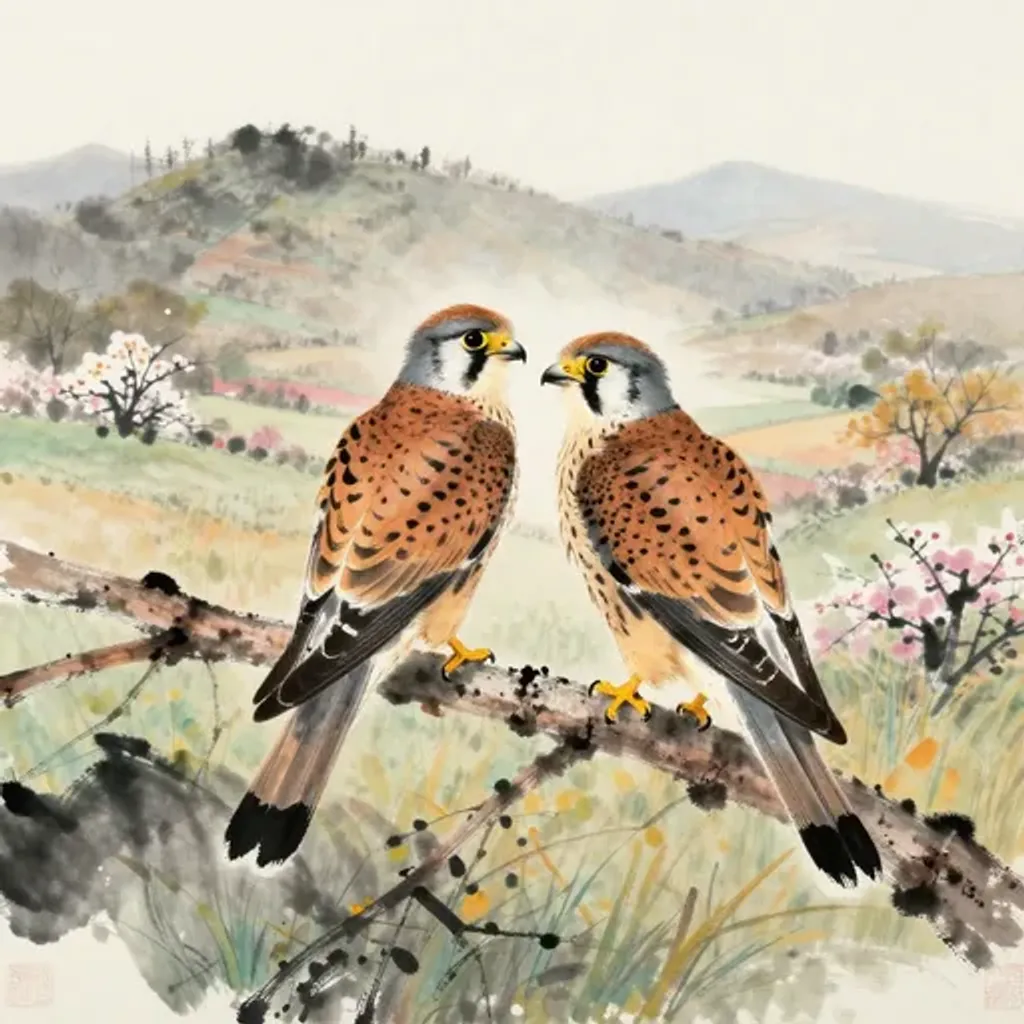
晨風文翰,隨時就溫;雄雌相和,不憂危殆。
Morning wind, patterned plumage, following the warmth with the season; male and female in harmony, free from worry and danger.
— Jiao Yanshou, Yilin (Forest of Changes), 1st century BC
Commentary
Thunder stirs the earth, and a dawn hawk with patterned plumage follows the warmth of the season. Male and female call in harmony, free from danger or distress. The 'morning wind' (晨風) is a kestrel or sparrowhawk from the Shijing, associated with longing and seasonal movement. Here it appears in its ideal state: beautiful, paired, warm, and safe. From Enthusiasm to Influence, the transformation is natural. The lake rests atop the mountain, and the gentleman empties himself to receive others. The harmonious pair of birds embodies mutual attraction — Influence's essence — where neither dominates but both respond to each other's call. Enthusiasm channeled into genuine responsiveness creates paired contentment.
豫 → 恆
Hexagram 16 → Hexagram 32: Duration
Changing lines: 2, 3
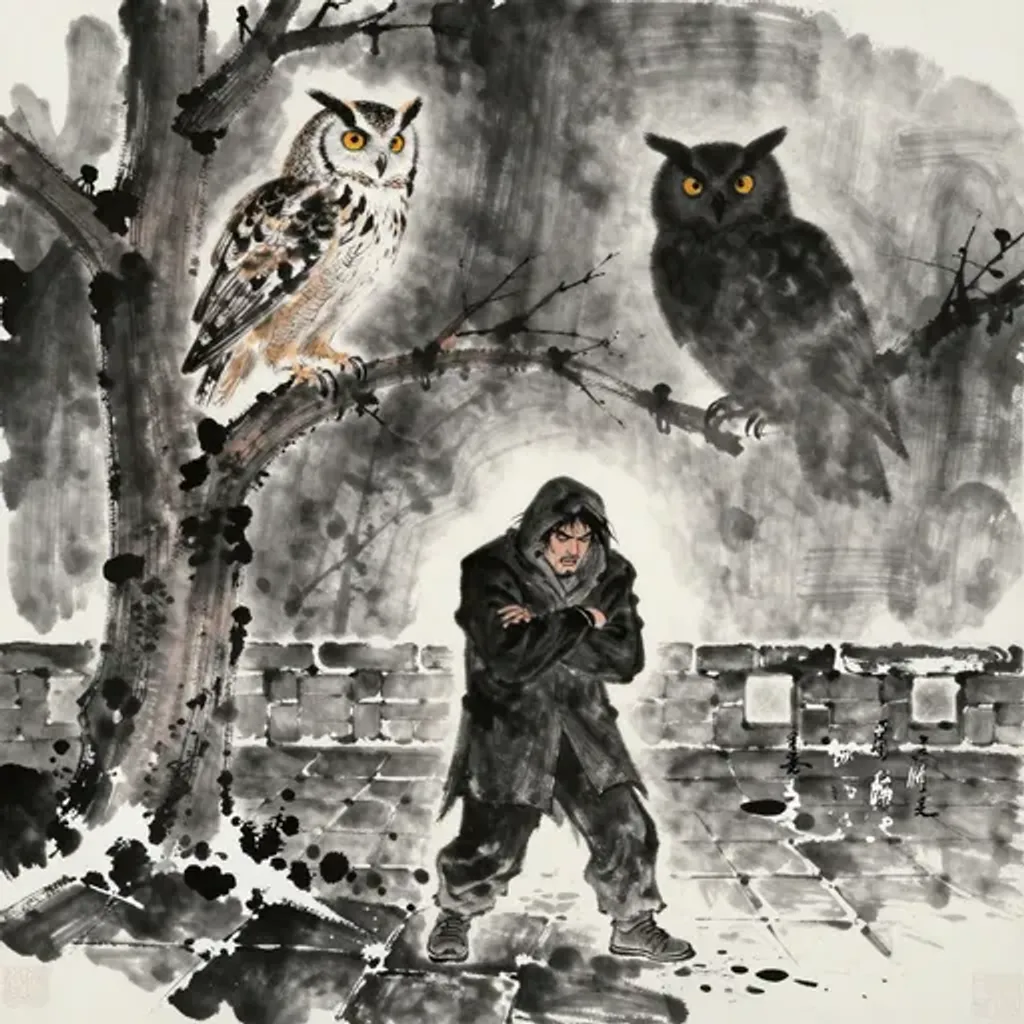
心多恨悔,出言為怪;梟鳴于北,聲醜可惡。請謁不得。
Heart full of resentment and regret; words uttered sound monstrous. An owl cries in the north -- its ugly voice is loathsome. Petitions go unheard.
— Jiao Yanshou, Yilin (Forest of Changes), 1st century BC
Commentary
Thunder breaks from the earth, but the heart is filled with regret and bitterness. Words come out twisted and strange; an owl screeches from the north, its ugly cries repulsive. Petitions go unanswered, audiences denied. The owl's cry was considered the most inauspicious of sounds in Han-dynasty lore, and its northward position suggests cold, yin-dominated darkness. The speaker is trapped in a cycle of self-sabotage: resentment produces distorted speech, which repels the very audience being sought. From Enthusiasm to Duration, the contrast stings. Duration demands consistent virtue and steady purpose — 'the gentleman stands firm without changing direction.' Enthusiasm curdled into resentment becomes the opposite of endurance: an ugly noise that drives away all lasting connection.
豫 → 遯
Hexagram 16 → Hexagram 33: Retreat
Changing lines: 3, 5, 6
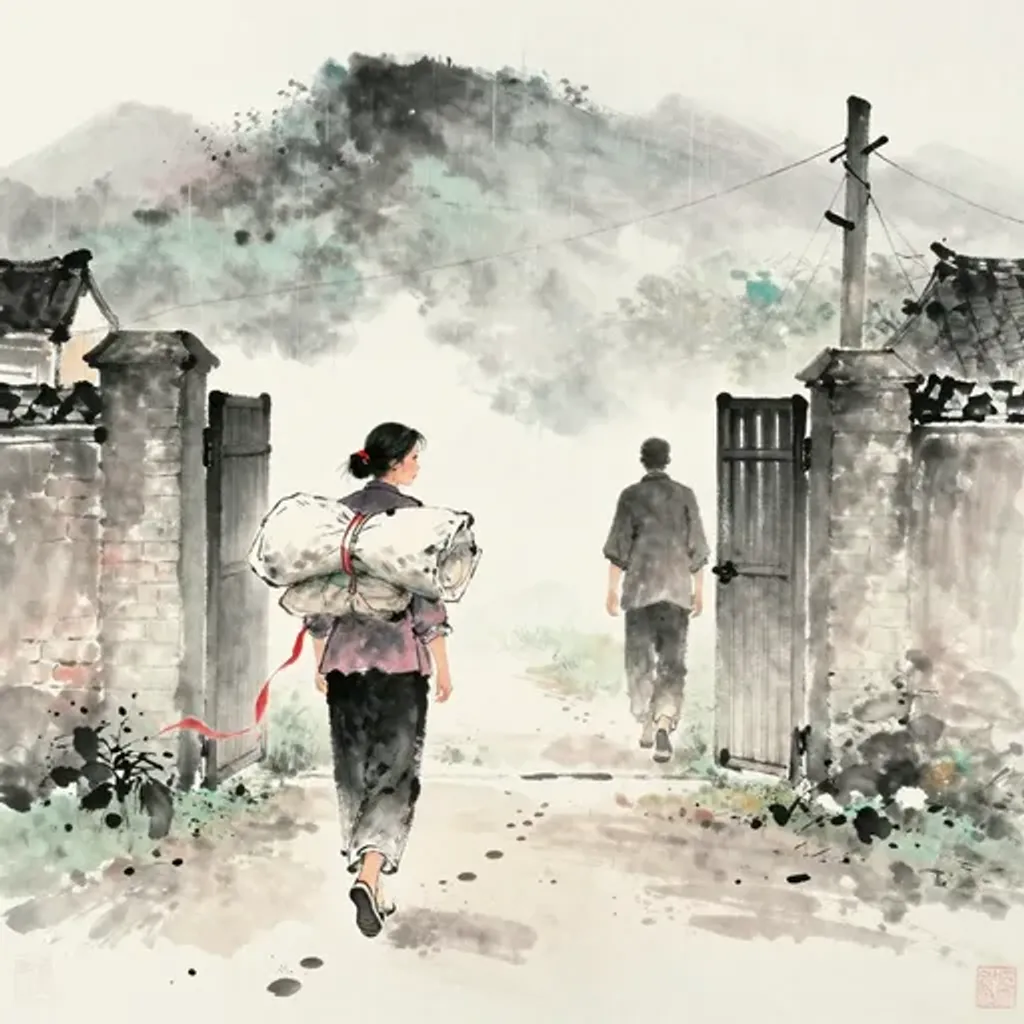
離女去夫,閔思苦憂;齊子無良,使我心愁。
The wife departs from her husband, grieving in bitter sorrow; the young lord of Qi is unworthy -- he makes my heart ache.
— Jiao Yanshou, Yilin (Forest of Changes), 1st century BC
Commentary
Thunder stirs the earth, but a woman has left her husband, consumed by grief and bitter longing. The 'son of Qi' is without virtue, causing endless sorrow. The phrase 'Qi zi wu liang' echoes the Shijing ode 'Nan Shan' from the Qi Feng section, which laments the dissolute conduct of the ruling house of Qi and the suffering it inflicts on wives and families. The woman departs not out of caprice but from genuine mistreatment. From Enthusiasm to Retreat, the transformation carries this emotional logic: heaven withdraws above the mountain, and the gentleman distances himself from the petty. The abandoned wife's departure is itself a form of retreat — withdrawing from what has become harmful, even at the cost of deep sorrow.
豫 → 大壯
Hexagram 16 → Hexagram 34: Great Power
Changing lines: 1, 2, 3
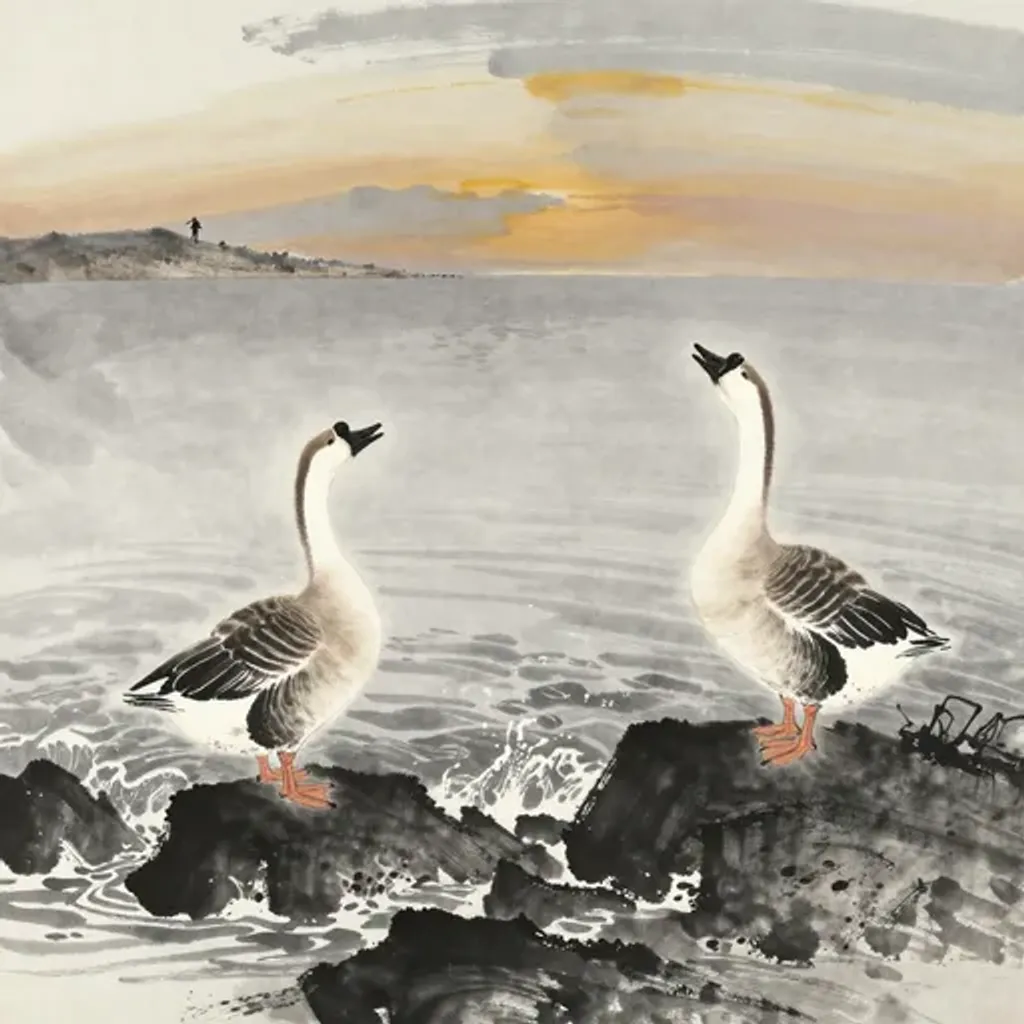
過時不歸,雌雄苦悲;徘徊外國,與叔分離。
Past the season and not returning; male and female grieve bitterly. Wandering in a foreign land, parted from kin.
— Jiao Yanshou, Yilin (Forest of Changes), 1st century BC
Commentary
Thunder rises from the earth, but the season for return has passed. Male and female birds grieve their separation; one wanders among foreign states, parted from a beloved uncle or brother. The verse evokes exile — someone who missed the moment to come home and now drifts in sorrow abroad. The paired birds' mourning intensifies the human pain of familial separation. From Enthusiasm to Great Power, the irony cuts deep. Thunder roars above heaven in Great Power, the image of overwhelming force and propriety observed. Yet the exile possesses none of this: no power to return, no ritual framework to rejoin the family. Enthusiasm that fails to act in time forfeits the very strength it celebrates, and Great Power becomes a mocking mirror of what was lost.
豫 → 晉
Hexagram 16 → Hexagram 35: Progress
Changing lines: 6
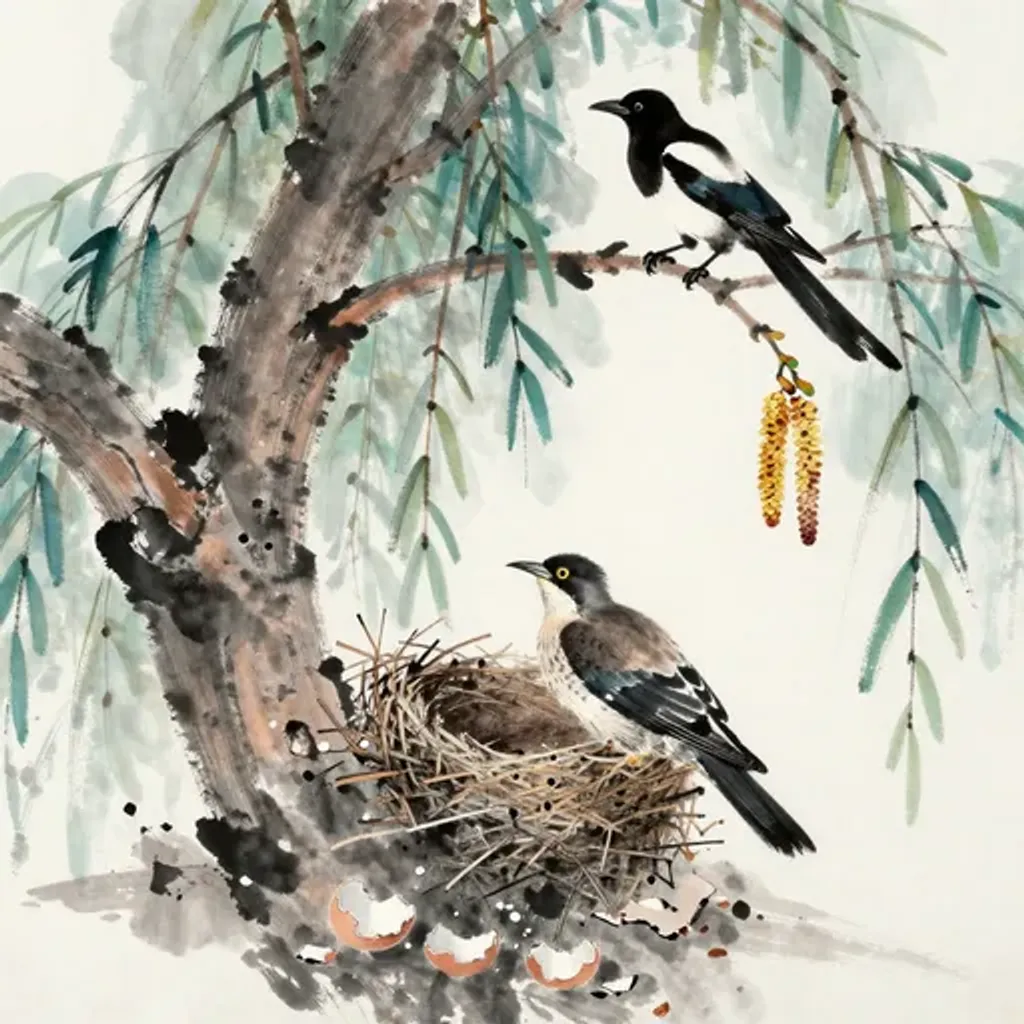
鵲巢柳樹,鳩集其處;任力薄德,天命不佑。
The magpie builds a nest in the willow; the cuckoo takes its place. Relying on force, lacking virtue -- heaven mandate does not bless.
— Jiao Yanshou, Yilin (Forest of Changes), 1st century BC
Commentary
Thunder erupts from the earth, but a magpie builds its nest in a willow tree only to have a dove move in. This echoes the Shijing ode 'Que Chao' — 'The magpie's nest, the dove dwells in it' — a metaphor for usurpation. One creature labors while another claims the result. The verse adds a moral judgment: relying on force while lacking virtue brings no heavenly support. From Enthusiasm to Progress, the transformation exposes a fraud. Progress shows fire rising above the earth, a marquis receiving gifts of horses in broad daylight — legitimate advancement through recognized merit. The dove who occupies the magpie's nest has progressed without earning it, and heaven's mandate will not sustain what force alone has seized.
豫 → 明夷
Hexagram 16 → Hexagram 36: Darkening of the Light
Changing lines: 1, 3, 4
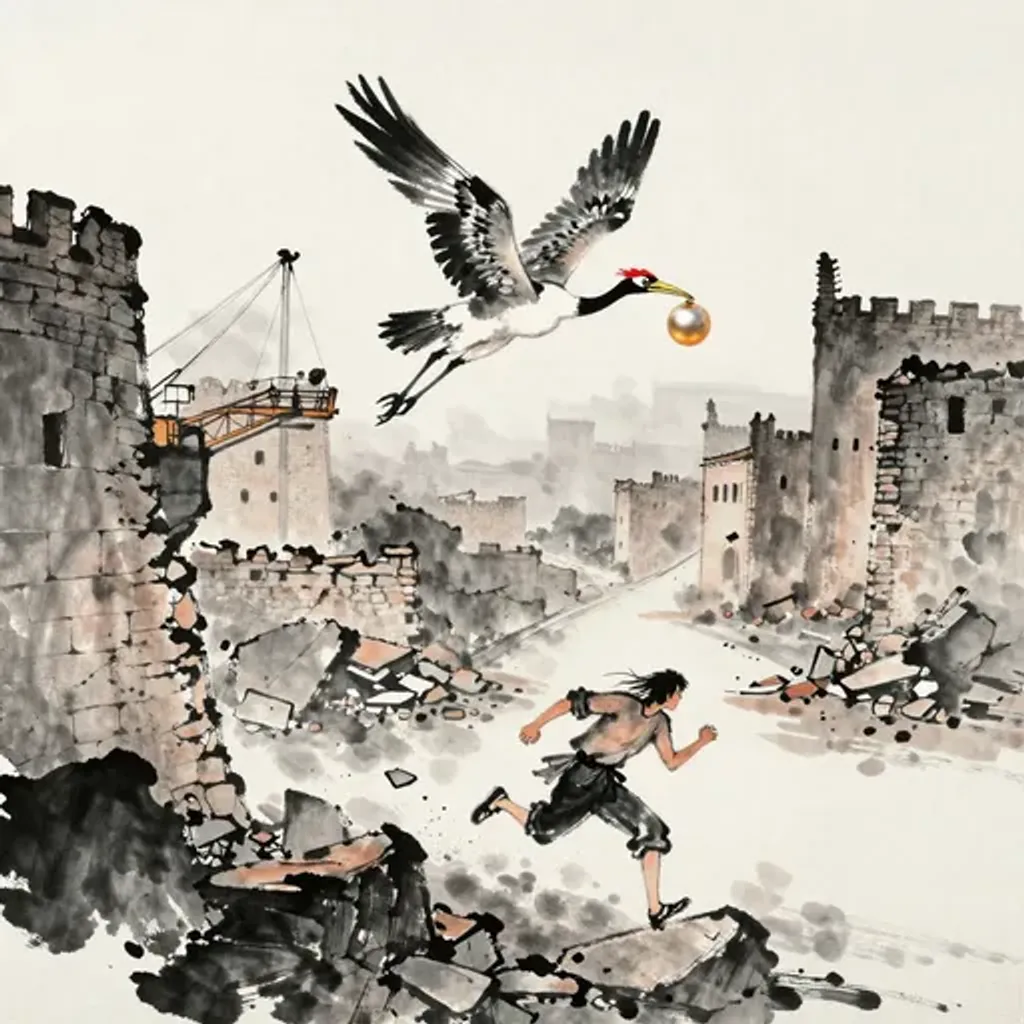
鶴盜我珠,逃於東都;懷怒追求,郭氏之墟。不見蹤跡,使伯心憂。
A crane stole my pearl and fled to the eastern capital; in angry pursuit I sought it, through the ruins of the Guo clan. No trace was found -- it makes the elder heart grieve.
— Jiao Yanshou, Yilin (Forest of Changes), 1st century BC
Commentary
Thunder stirs the earth, but a crane has stolen a pearl and fled to the eastern capital. The owner pursues in anger, arriving at the ruins of the Guo clan's domain, where no trace can be found — and 'the elder brother' is left grieving. The crane-as-thief is a vivid image: a dignified bird carrying away treasure, vanishing into a fallen city. The ruins of Guo evoke the destruction of a once-great house, now just rubble through which the aggrieved party searches in vain. From Enthusiasm to Darkening of the Light, the transformation deepens the loss: brightness enters the earth and is extinguished. The stolen pearl — a point of luminous value — disappears into darkness, and the pursuer's rage yields only the grief of what cannot be recovered.
豫 → 家人
Hexagram 16 → Hexagram 37: The Family
Changing lines: 1, 3, 4, 5, 6
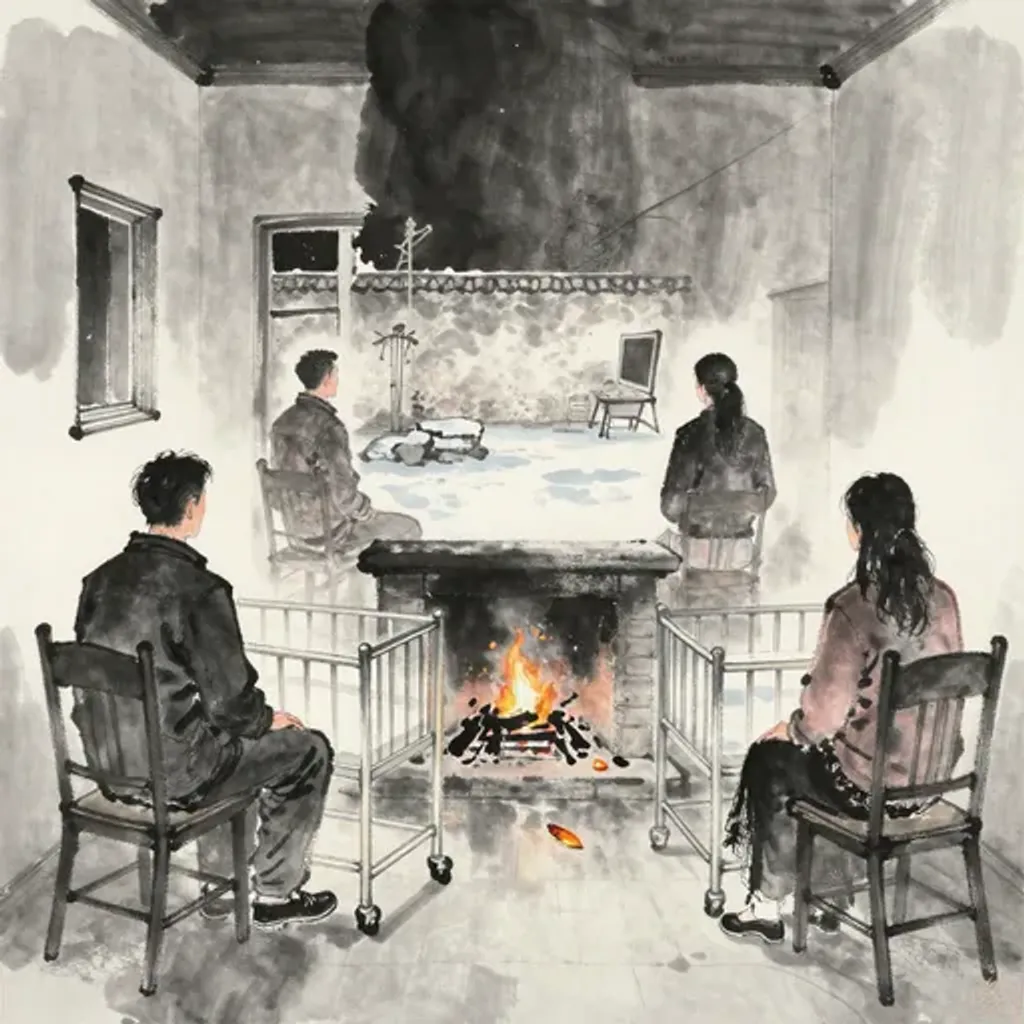
夫婦相背,和氣弗處;陰陽俱否,莊姜無子。
Husband and wife turn their backs; harmonious spirit departs. Yin and yang both blocked -- Lady Zhuang Jiang bears no child.
— Jiao Yanshou, Yilin (Forest of Changes), 1st century BC
Commentary
Thunder rises from the earth, but husband and wife turn their backs on each other and the harmonizing breath departs. Yin and yang both enter standstill — and Lady Zhuang Jiang of Wei bears no children. Zhuang Jiang, celebrated in the Shijing ode 'Shuo Ren' as the most beautiful woman of her age, married Duke Zhuang of Wei yet remained childless. The Zuo Zhuan records: 'She was beautiful but had no sons.' The duke's affection turned to concubines, and the household fractured. From Enthusiasm to The Family, the verse is devastatingly ironic: The Family's image is wind from fire, words with substance and actions with constancy. Yet here the family's foundation — the marital bond — is broken at its core, and no amount of enthusiasm can produce what mutual estrangement has foreclosed.
豫 → 睽
Hexagram 16 → Hexagram 38: Opposition
Changing lines: 1, 2, 6
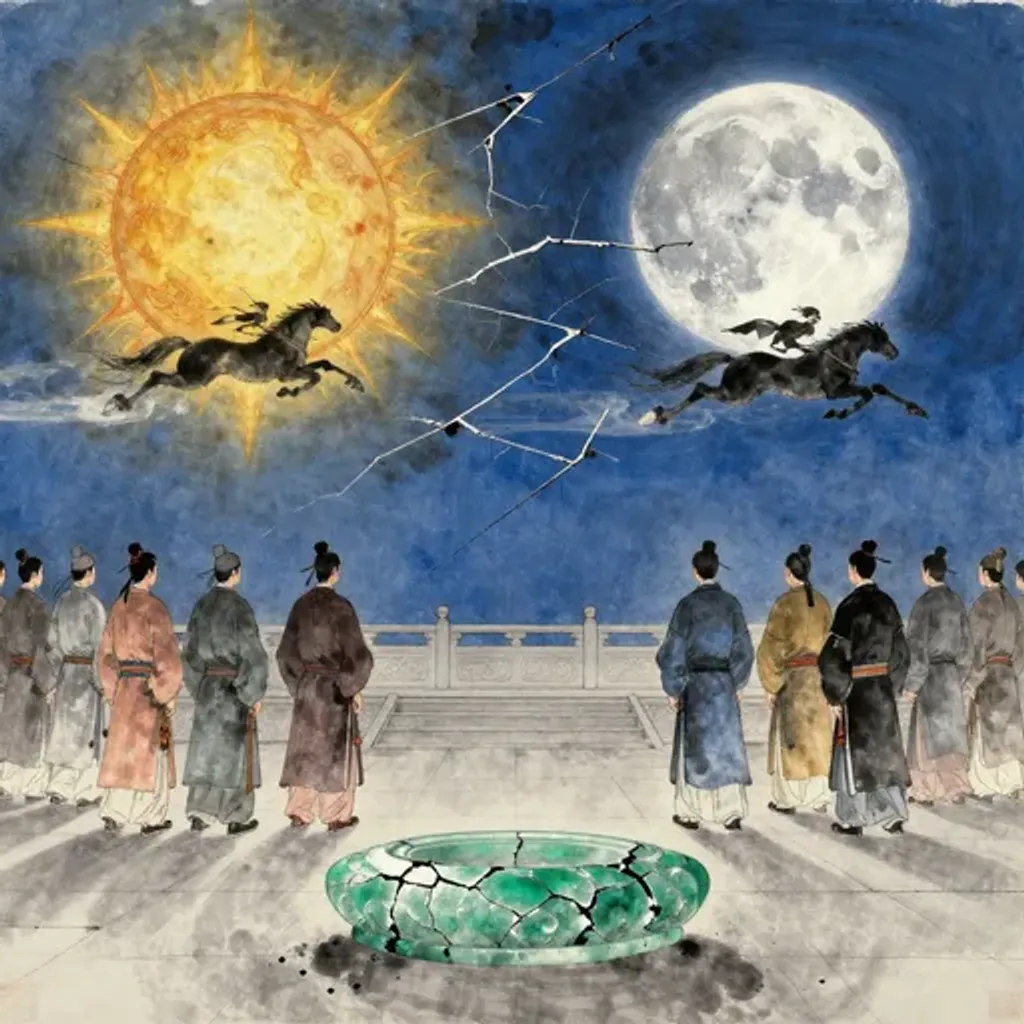
月走日步,逃不同舍;夫妻反目,主君失位。
Moon racing, sun striding, fleeing to separate lodgings; husband and wife at odds, the lord loses his position.
— Jiao Yanshou, Yilin (Forest of Changes), 1st century BC
Commentary
Thunder erupts from the earth, but the moon races and the sun walks — they flee in different directions and never share the same lodging. Husband and wife turn against each other; the ruling lord loses his seat. The celestial bodies in discord mirror domestic and political breakdown: when the two luminaries that should govern day and night cannot coordinate, all order dissolves. From Enthusiasm to Opposition, the transformation fits precisely. Fire above and lake below — heat rises while water sinks, two forces that see the same world differently. Opposition's image is inherent divergence, and the verse dramatizes this as cosmic estrangement: not just disagreement but fundamental incompatibility of path, where each party flees what the other approaches.
豫 → 蹇
Hexagram 16 → Hexagram 39: Obstruction
Changing lines: 3, 4, 5
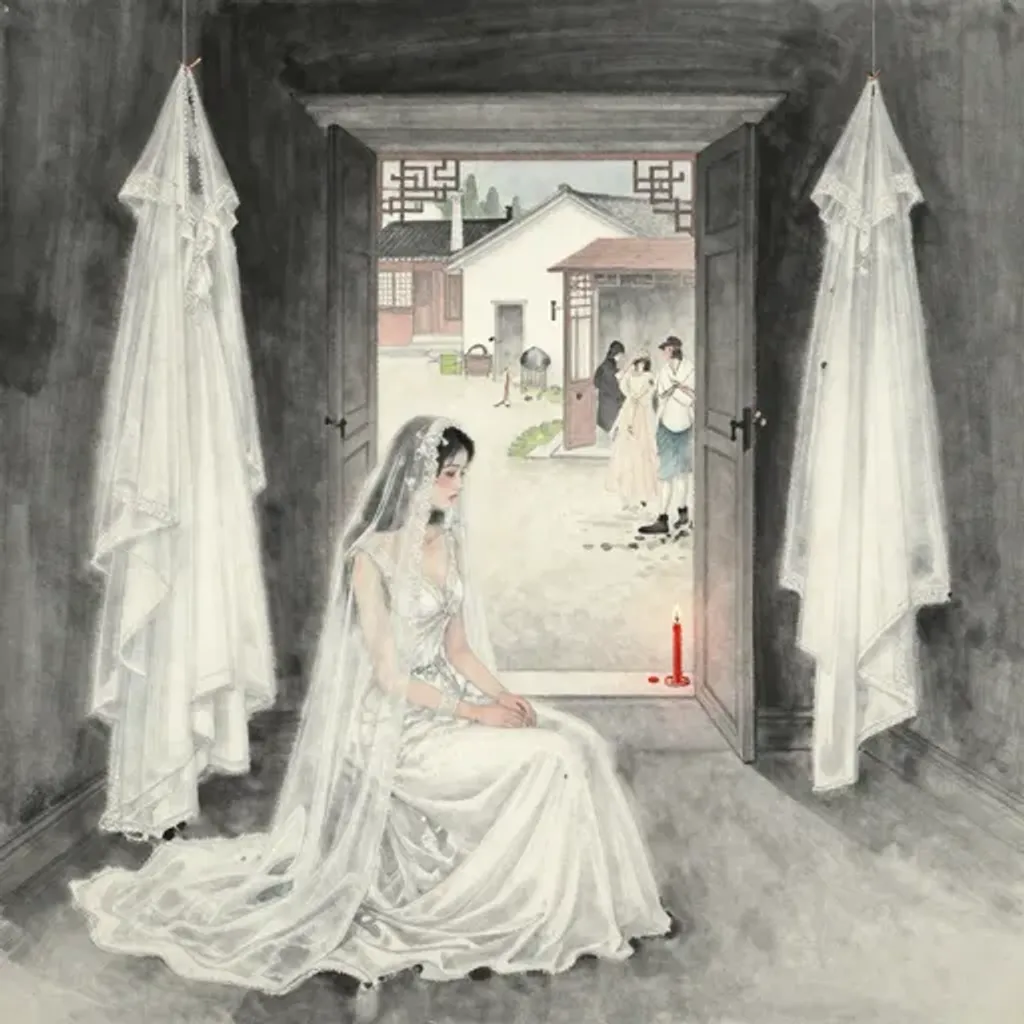
雒陽嫁女,善逐人走;三寡失夫,婦妬無子。
The bride of Luoyang, adept at driving men away; three times widowed, husbandless -- a jealous wife with no children.
— Jiao Yanshou, Yilin (Forest of Changes), 1st century BC
Commentary
Thunder breaks from the earth, but the brides of Luoyang are known for driving husbands away. Three times widowed, the wife has lost her husband, consumed by jealousy and left childless. The verse presents a domestic catastrophe repeated in cycle: a woman whose possessiveness destroys each marriage in succession. Luoyang, the eastern capital, here serves as the setting for urban sophistication turned toxic. From Enthusiasm to Obstruction, the verse maps a path blocked at every turn. Water atop the mountain — Obstruction's image — means the way forward is treacherous and movement only worsens the situation. The gentleman turns inward to cultivate virtue. Three failed marriages embody obstruction internalized: the obstacle is not external but a pattern carried from one attempt to the next.
豫 → 解
Hexagram 16 → Hexagram 40: Deliverance
Changing lines: 2
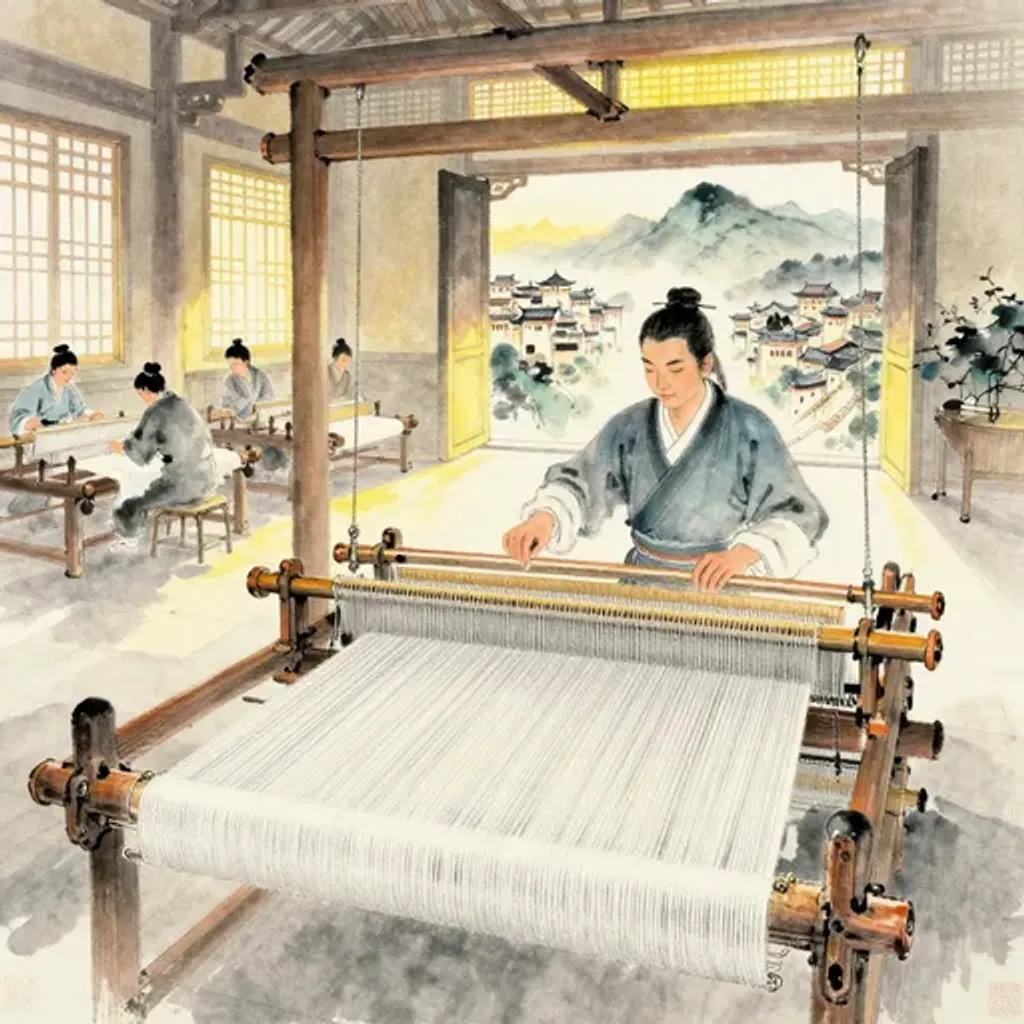
周德既成,杼軸不傾;太宰東西,夏國康寧。
The virtue of Zhou is accomplished; the warp and weft do not tilt. The Grand Steward governs east and west; the Xia realm rests in peace.
— Jiao Yanshou, Yilin (Forest of Changes), 1st century BC
Commentary
Thunder stirs the earth in celebration as Zhou's virtue reaches completion. The loom's shuttle and axle run smoothly without tilting — the warp and weft of governance are even and aligned. The Grand Steward manages affairs east and west, and the Xia realm rests in peace and tranquility. The weaving metaphor captures orderly governance: when the institutional fabric holds straight, the state prospers. 'Zhou de' invokes the accumulated moral capital of the Zhou founders, while 'Xia guo' (the Chinese realm) echoes the civilizational scope of their achievement. From Enthusiasm to Deliverance, the transformation releases accumulated tension: thunder and rain together dissolve what was frozen. The verse celebrates the moment when stored virtue finally delivers its promised liberation — order from chaos, peace from struggle.
豫 → 損
Hexagram 16 → Hexagram 41: Decrease
Changing lines: 1, 2, 4, 6
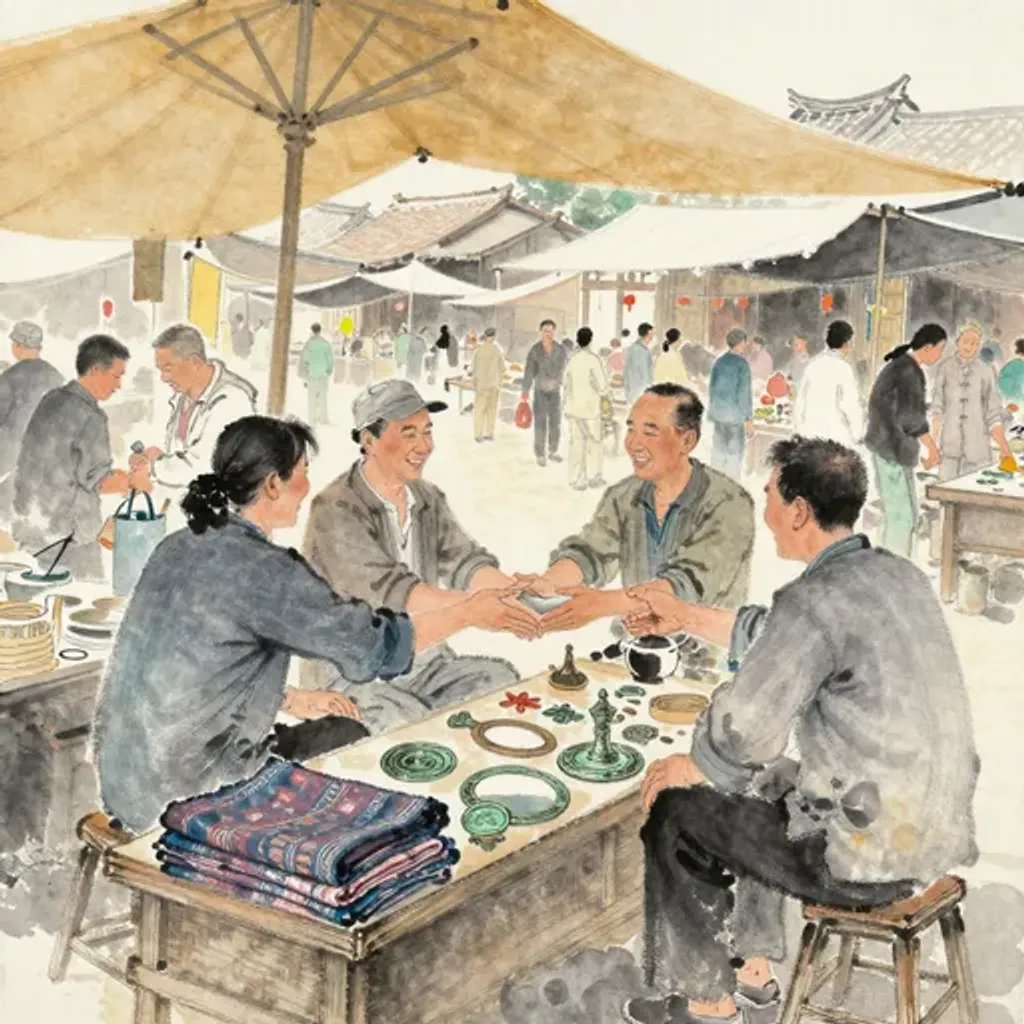
日中為市,交易資寶。各利所有,心悅以喜。
At midday the market convenes; goods and treasures are exchanged. Each profits from what the other has; hearts are pleased and glad.
— Jiao Yanshou, Yilin (Forest of Changes), 1st century BC
Commentary
Thunder breaks from the earth at high noon as the marketplace opens. At midday the people trade their goods and treasures, each profiting from what the other possesses, and all depart with contented hearts. The 'midday market' echoes the Xici Zhuan's account of Shen Nong establishing markets at noon: 'Gather the world's people, collect the world's goods; trade and withdraw, each obtaining what they need.' From Enthusiasm to Decrease, the transformation is subtler than it first appears. Decrease's image is the mountain above the lake — the lower diminished to augment the upper. Yet the market works precisely because decrease and increase are mutual: each party gives up what they have in surplus to gain what they lack, and the transaction itself is the mechanism of Decrease's deeper logic.
豫 → 益
Hexagram 16 → Hexagram 42: Increase
Changing lines: 1, 4, 5, 6
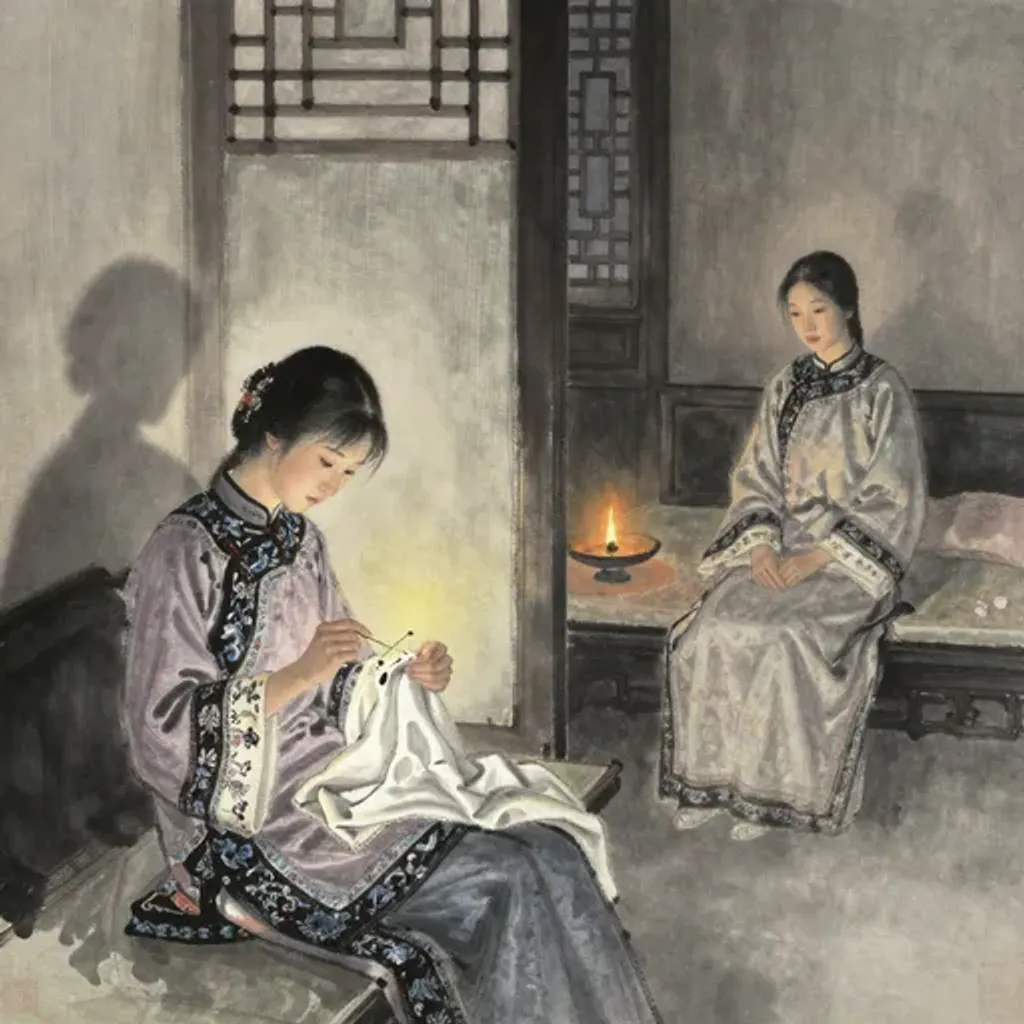
童妾獨宿,長女未室;利無所得。
The young concubine sleeps alone; the elder daughter is still unwed. No profit to be gained.
— Jiao Yanshou, Yilin (Forest of Changes), 1st century BC
Commentary
Thunder stirs the earth, but the young concubine sleeps alone and the eldest daughter remains unmarried. No profit can be gained from this situation. The verse depicts domestic frustration at its most basic: women of marriageable age with no prospects, the household failing to fulfill its generative function. The concubine without a husband's visit and the daughter without a match are parallel images of potential unrealized. From Enthusiasm to Increase, the irony is sharp. Increase's image is wind and thunder together — the gentleman sees good and emulates it, finds fault and corrects it. Yet the verse shows a situation where nothing can be increased because the fundamental pairings have not been made. Enthusiasm without connection yields no return.
豫 → 夬
Hexagram 16 → Hexagram 43: Breakthrough
Changing lines: 1, 2, 3, 5
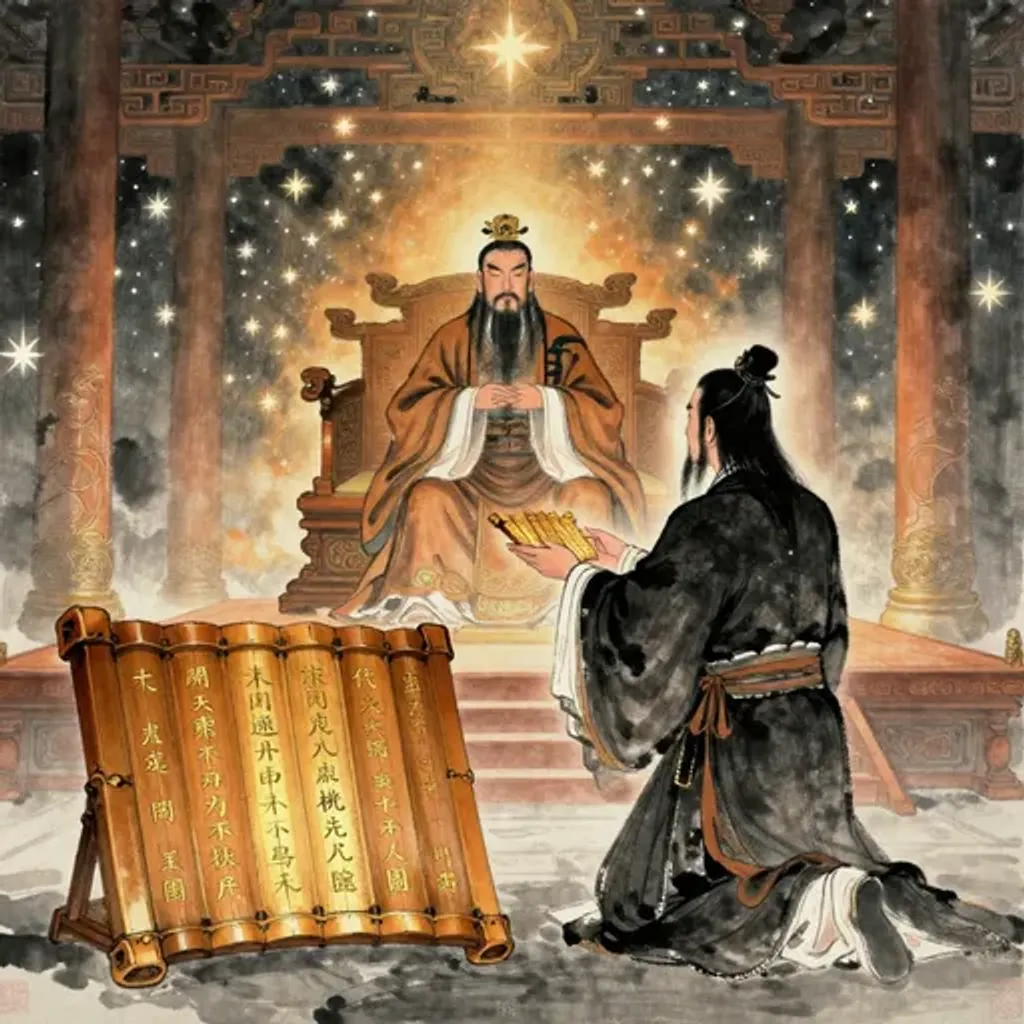
忠言輔成,王政不傾;公劉兆基,文武綏之。
Loyal counsel upholds and completes; the king governance does not topple. Duke Liu laid the foundation; Kings Wen and Wu brought peace.
— Jiao Yanshou, Yilin (Forest of Changes), 1st century BC
Commentary
Thunder erupts from the earth as loyal counsel upholds the throne and royal governance stands firm. Gong Liu laid the foundations of the Zhou clan at Bin, and Kings Wen and Wu brought them to fulfillment. Gong Liu, a descendant of Hou Ji, led the Zhou ancestors to settle in Bin where they developed agriculture and laid the groundwork for what would become a dynasty. Generations later, Wen and Wu completed the mission — one through moral accumulation, the other through righteous conquest. From Enthusiasm to Breakthrough, the transformation channels stored energy into decisive action. The lake rises above heaven, and generosity flows downward. Centuries of patient groundwork culminate in the breakthrough moment when the Zhou mandate is secured through both wisdom and force.
豫 → 姤
Hexagram 16 → Hexagram 44: Coming to Meet
Changing lines: 2, 3, 5, 6
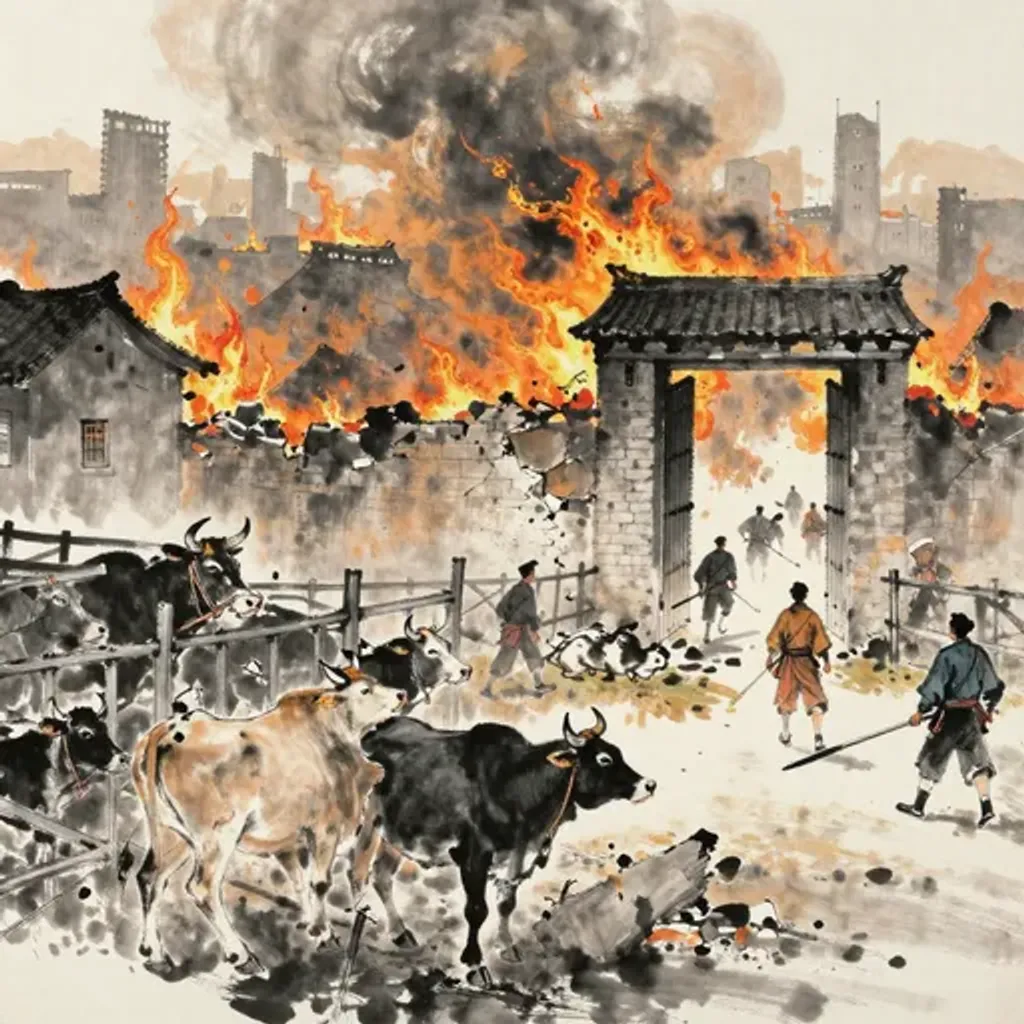
牛驥同堂,郭氏以亡;國破為虛,主君奔逃。
Ox and thoroughbred in the same hall -- the Guo clan perishes thereby. The state falls to ruin; the lord flees in exile.
— Jiao Yanshou, Yilin (Forest of Changes), 1st century BC
Commentary
Thunder breaks from the earth, but the thoroughbred and the ox share the same stall — an idiom for mixing the superior with the inferior until both are degraded. The Guo clan is destroyed; the state collapses into ruin, and its lord flees. 'Niu ji tong tang' is a classical warning against failing to distinguish quality: when a thousand-li horse is stabled with draft oxen, its gifts are wasted and the institution that tolerated this confusion pays the ultimate price. From Enthusiasm to Coming to Meet, the resonance is cautionary. Wind moves beneath heaven, the ruler issuing commands to all quarters. But Coming to Meet also warns of the yin force that enters unbidden — the inferior element that infiltrates through indiscriminate welcome. The Guo state fell because it could not tell its horses from its cattle.
豫 → 萃
Hexagram 16 → Hexagram 45: Gathering Together
Changing lines: 5
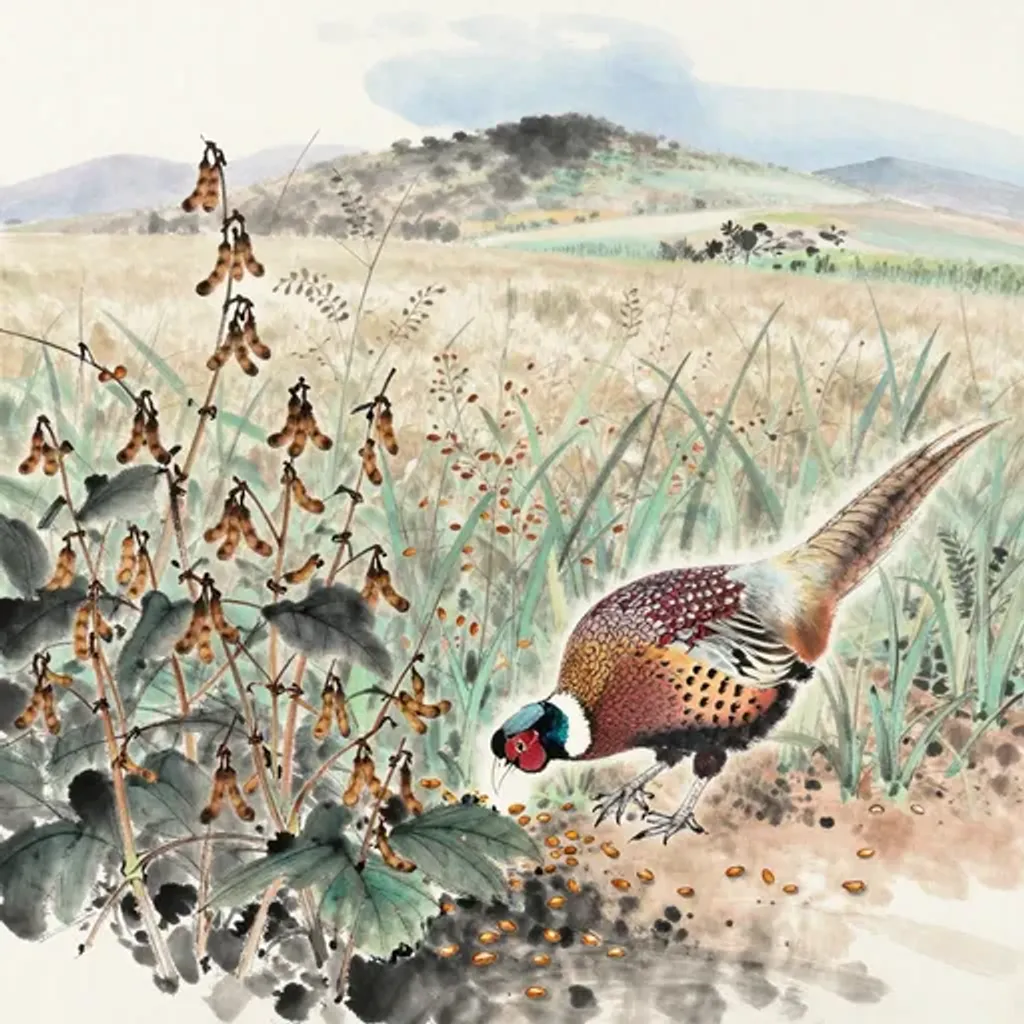
中原有菽,以待雉食。飲御諸友,所求大得。
In the central plain grow beans, waiting for the pheasant to feed. Wine poured for all friends gathered -- what is sought is greatly gained.
— Jiao Yanshou, Yilin (Forest of Changes), 1st century BC
Commentary
Thunder erupts from the earth, and the central plain grows rich with beans awaiting the pheasants that come to feed. Friends are entertained with food and drink, and all that is sought is abundantly obtained. The verse radiates agricultural hospitality: the land produces, creatures gather to eat, and guests are welcomed with generous provisions. The Shijing allusion to 'beans in the central field' evokes the odes of harvest and communal feasting. From Enthusiasm to Gathering, the transformation is seamless. The lake gathers upon the earth as people naturally congregate where abundance flows. Enthusiasm expressed as generosity creates a center of gravity — what the host provides, the guests affirm, and the community crystallizes around shared nourishment.
豫 → 升
Hexagram 16 → Hexagram 46: Pushing Upward
Changing lines: 2, 3, 4
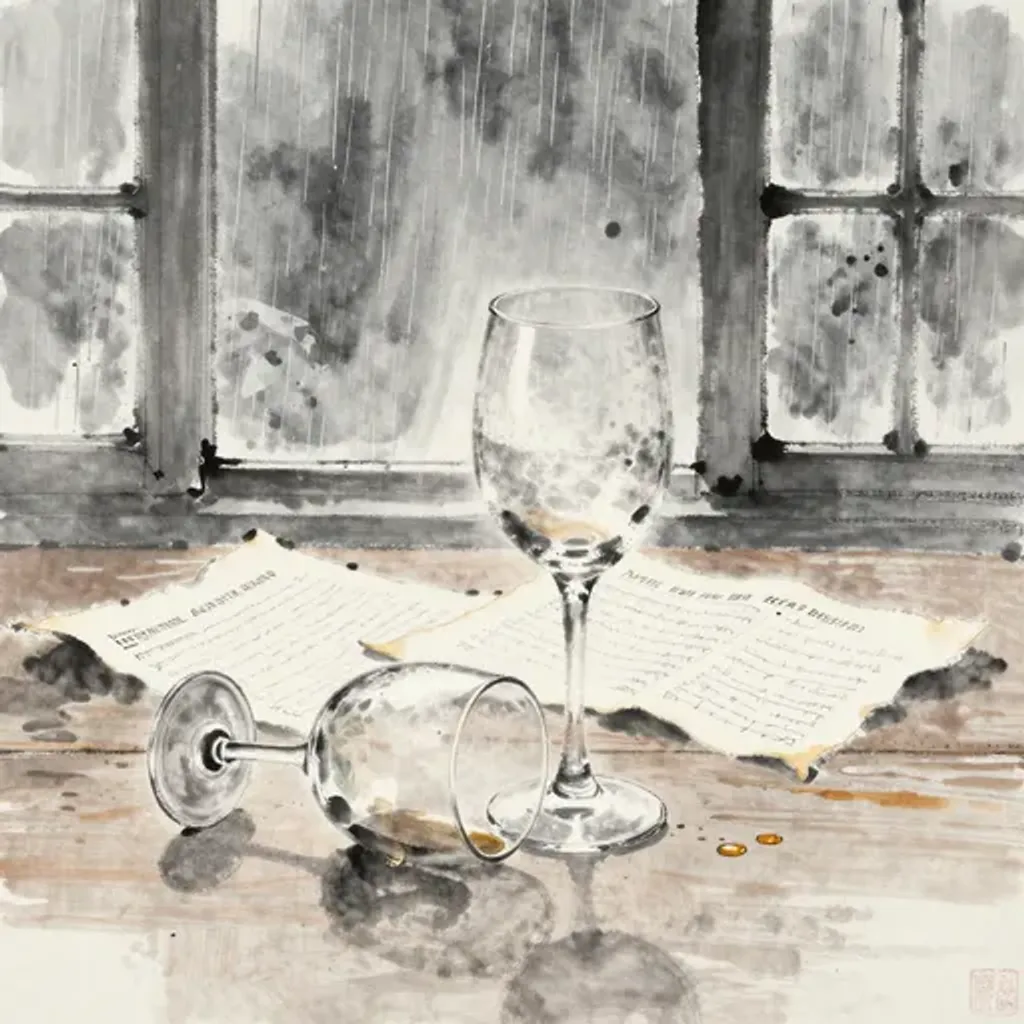
多虛少實,語不可覆;尊虛無酒,飛言如雨。
Much emptiness, little substance; words that cannot be upheld. The wine vessel is empty, without wine; flying words rain down like a storm.
— Jiao Yanshou, Yilin (Forest of Changes), 1st century BC
Commentary
Thunder breaks from the earth, but what fills the air is empty talk, not substance. Words outnumber deeds; promises cannot be honored. The wine vessel stands empty — no wine to pour — while rumors fly thick as rain. The verse depicts an environment of hollow rhetoric: grand gestures without backing, like a banquet announced with empty cups. From Enthusiasm to Pushing Upward, the contrast is instructive. Pushing Upward shows wood growing within the earth, the gentleman accumulating small gains into great stature. Yet the verse's subject has reversed this process — inflating claims while depleting substance. Enthusiasm that spends itself in words alone cannot push upward through the slow, patient growth the hexagram demands.
豫 → 困
Hexagram 16 → Hexagram 47: Oppression
Changing lines: 2, 5
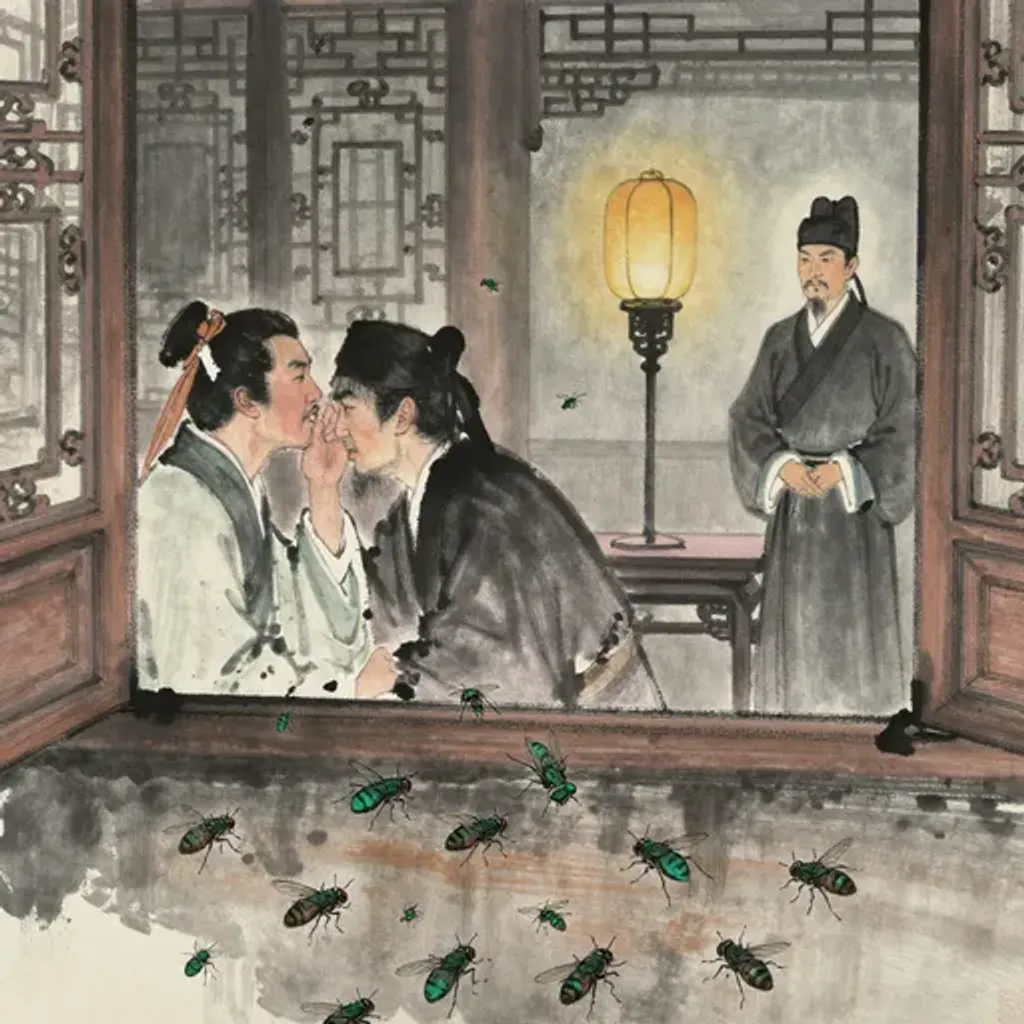
青蠅集蕃,君子信讒;害賢傷忠,患生婦人。
Green flies swarm on the fence; the lord trusts slander. The worthy are harmed, the loyal wounded -- disaster is born from a woman.
— Jiao Yanshou, Yilin (Forest of Changes), 1st century BC
Commentary
Thunder stirs the earth, but green flies swarm on a hedge — the Shijing ode 'Qing Ying' warns of slanderers who buzz around the powerful, turning white to black. The lord believes their calumnies, and worthy ministers are harmed while loyal servants are wounded. Calamity originates from a woman's influence. The 'blue flies' ode from the Xiao Ya section directly addresses the damage done by rumor-mongers at court. From Enthusiasm to Oppression, the transformation is devastating. The lake's water drains away, leaving emptiness — the gentleman stakes his life to fulfill his purpose. Slander oppresses the virtuous by cutting off their access to power, leaving them stranded like a lake without water: the structure remains but the life-giving element has been poisoned away.
豫 → 井
Hexagram 16 → Hexagram 48: The Well
Changing lines: 2, 3, 4, 5
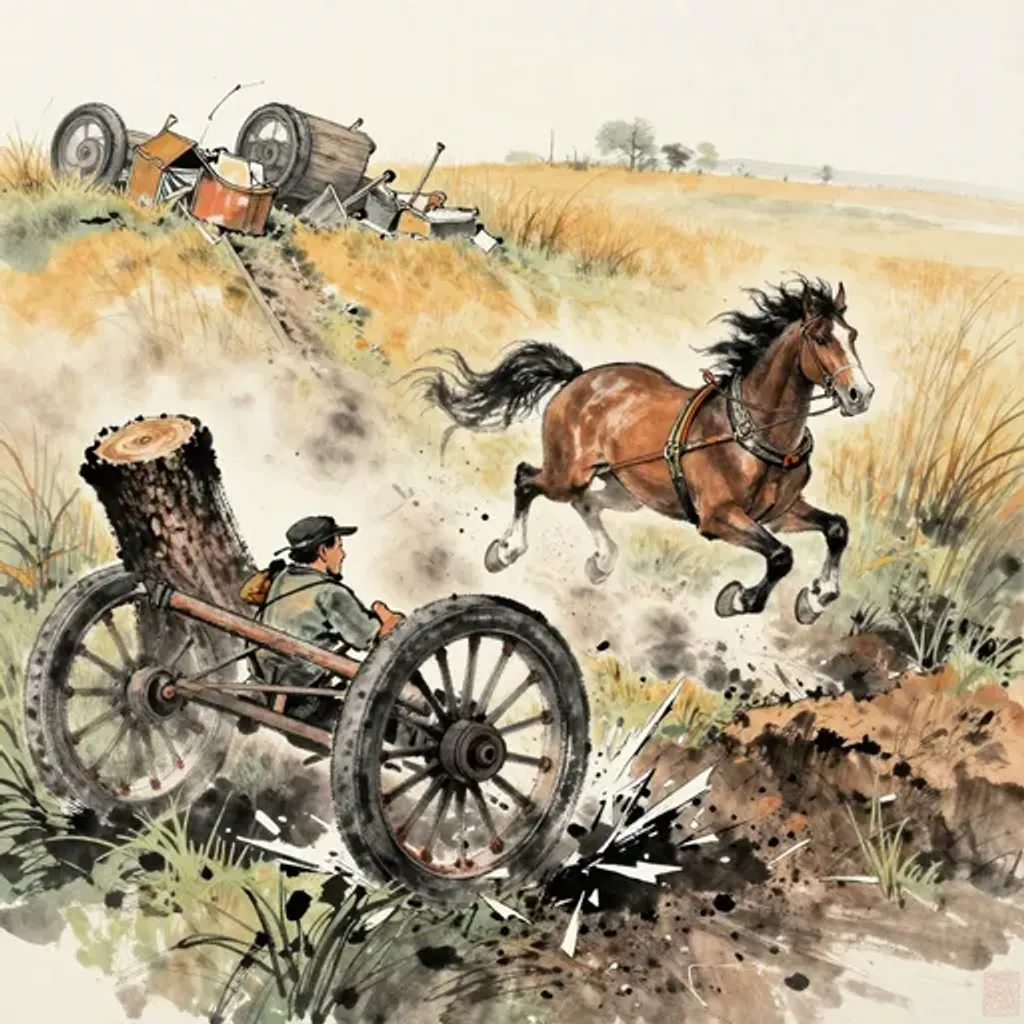
履株覆輿,馬驚傷車,步為我憂。
Stepping on a stump, overturning the cart; the horse startles and damages the carriage -- walking brings me worry.
— Jiao Yanshou, Yilin (Forest of Changes), 1st century BC
Commentary
Thunder erupts from the earth, but the wheel strikes a stump and the carriage overturns. The horse startles and wrecks the vehicle, and now one must proceed on foot, a cause for worry. The image is a sudden accident on the road: a hidden obstacle that upends the traveler's momentum in an instant. From Enthusiasm to The Well, the transformation reframes the disaster. The Well's image is water drawn up through wood — the inexhaustible resource that never moves from its place. The overturned carriage forces the traveler to abandon speed and approach the well on foot, slowly and humbly. What enthusiastic velocity destroyed, the well's patient depth can restore — but only if one accepts the slower pace that walking demands.
豫 → 革
Hexagram 16 → Hexagram 49: Revolution
Changing lines: 1, 3, 5
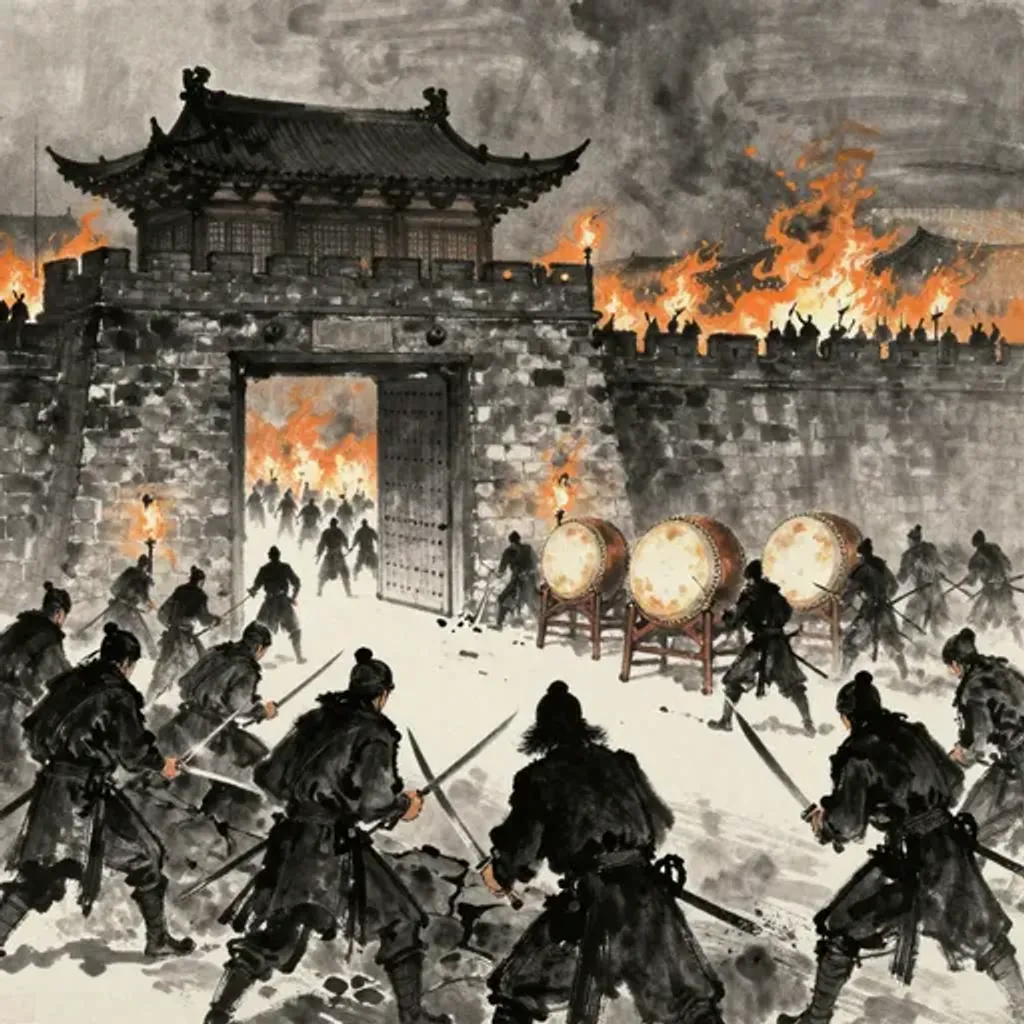
商風召寇。呼我北盜。間諜內應,與我爭鬭。殫已寶藏,主人不勝。
Autumn wind summons raiders, calling in northern bandits. Spies respond from within, contesting with us in battle. Our treasures are spent -- the host does not prevail.
— Jiao Yanshou, Yilin (Forest of Changes), 1st century BC
Commentary
Thunder erupts from the earth, but autumn winds summon raiders from the north. Spies have planted agents inside; the enemy fights from within as well as without. Treasuries are exhausted, and the master of the house cannot prevail. The verse depicts a coordinated assault: external invasion synchronized with internal subversion, the worst nightmare of any ruler. The 'autumn wind' (商風) carries the killing energy of the western Metal phase, associated with warfare and punishment. From Enthusiasm to Revolution, the transformation is harrowing. Fire burns within the lake — the old order is overthrown. Revolution demands that the time be ripe and the cause just, but here the revolution is inflicted by enemies, not chosen by the ruler. Enthusiasm that fails to guard against infiltration is revolutionized from outside.
豫 → 鼎
Hexagram 16 → Hexagram 50: The Cauldron
Changing lines: 2, 3, 6
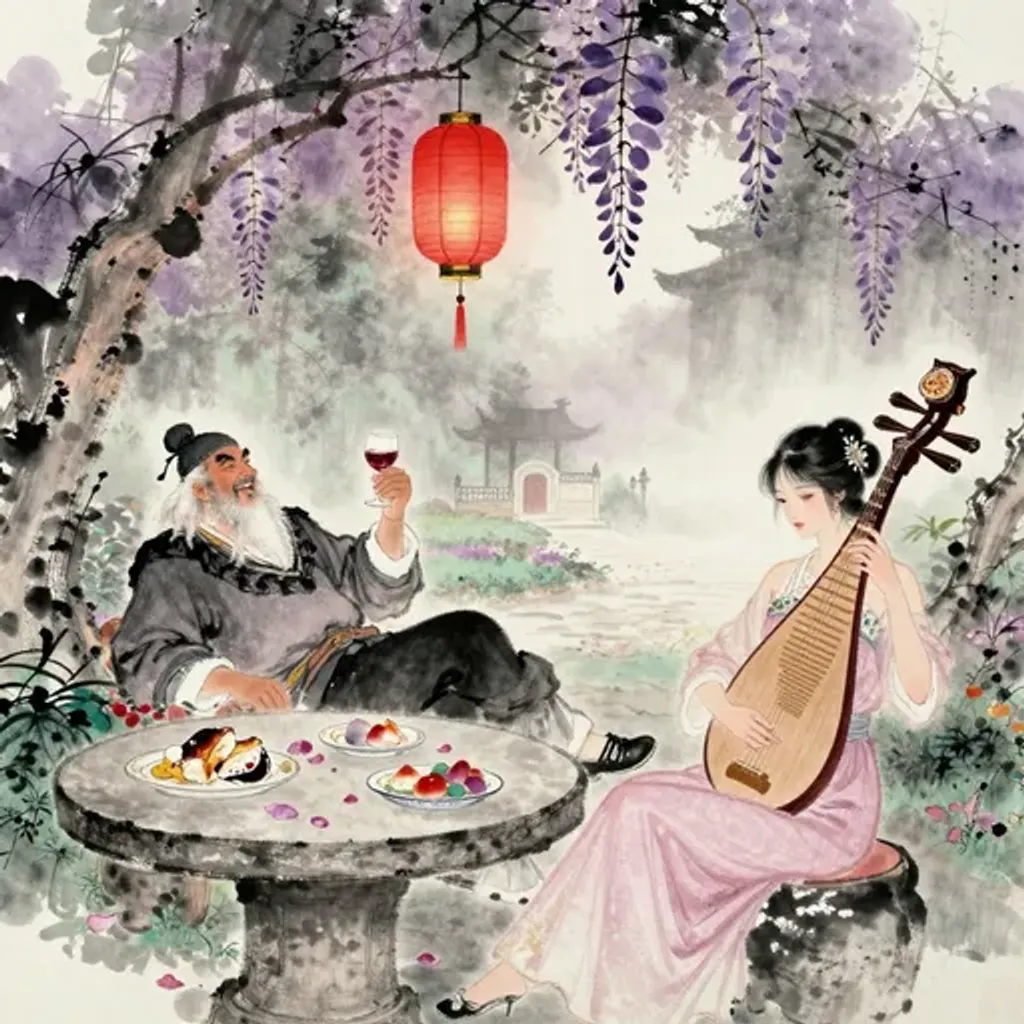
逸豫好遊,不安其家;惑於少姬,久迷不來。
Indulging in ease and fond of roaming, neglecting his own household; beguiled by a young beauty, long astray and never returning.
— Jiao Yanshou, Yilin (Forest of Changes), 1st century BC
Commentary
Thunder stirs the earth in pleasure-seeking abandon. The verse describes someone intoxicated by leisure and wandering, neglecting his household, bewitched by a young concubine named Ji, lost for so long he never returns. This alludes to Duke Huan of Qi's entanglement with Lady Cai (蔡姬): she rocked their boat to tease him, he sent her home in anger, and Cai remarried her elsewhere, triggering a military campaign that ultimately had nothing to do with governance and everything to do with bruised pride. From Enthusiasm to The Cauldron, the irony is rich. The Cauldron transforms raw materials into refined nourishment through fire and discipline, but the pleasure-seeker has abandoned the kitchen entirely — the sacred vessel stands neglected while its master chases distractions abroad.
豫 → 震
Hexagram 16 → Hexagram 51: The Arousing Thunder
Changing lines: 1
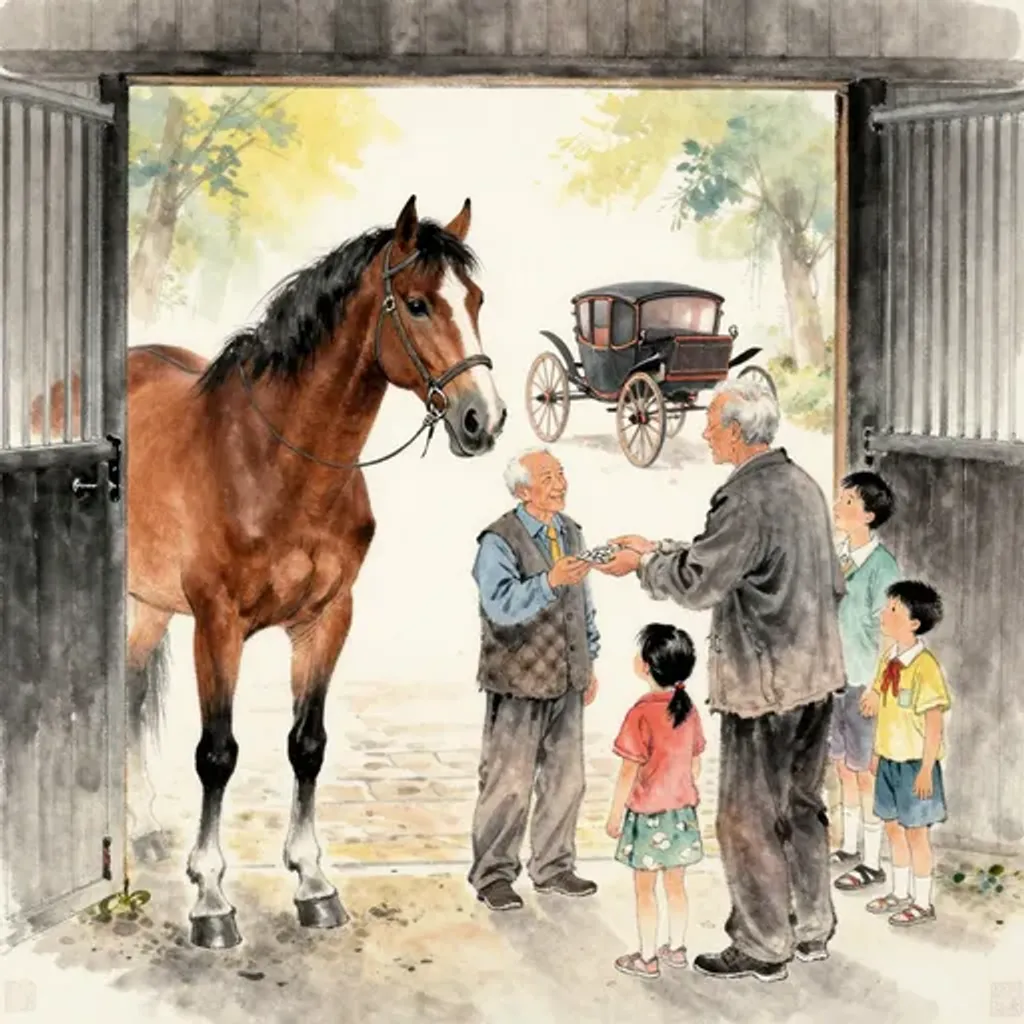
吾有驊騮,畜之以時。東家翁孺,來請我車;價極可與,後無賤悔。
I possess a fine steed, kept and raised in its due season. The eastern neighbor elder and children come to ask for my carriage; the price is high enough to accept -- later there is no cheap regret.
— Jiao Yanshou, Yilin (Forest of Changes), 1st century BC
Commentary
Thunder breaks from the earth in well-timed confidence. 'I possess a fine huali steed and have raised it at the proper season.' The neighbors send their elders to request the use of the carriage; the price is agreed upon and the deal is struck — no regret follows. The verse celebrates patient investment paying off: a horse raised with proper timing, now valuable enough that others come seeking it. From Enthusiasm to The Arousing, the doubled thunder amplifies the original impulse. What began as enthusiastic rearing becomes the startling moment of realization — the asset's worth is recognized, the transaction completed with satisfaction on both sides. Proper timing in cultivation produces the thunderclap of return.
豫 → 艮
Hexagram 16 → Hexagram 52: Keeping Still Mountain
Changing lines: 3, 4, 6
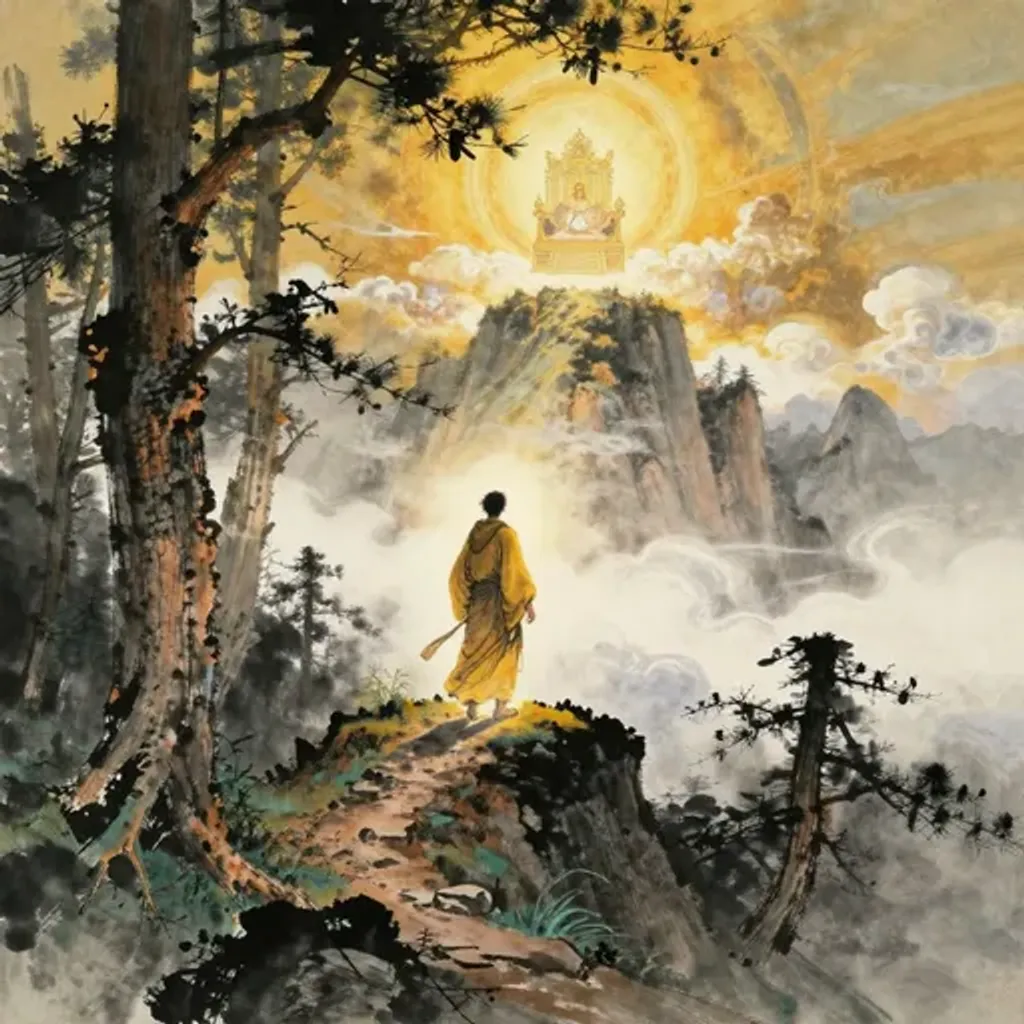
阨窮上通,與堯相逢。登升大麓,國無凶人。
From dire straits one breaks through to the heights, and meets with Yao himself. Ascending the great mountain -- no wicked person remains in the realm.
— Jiao Yanshou, Yilin (Forest of Changes), 1st century BC
Commentary
Thunder erupts from the earth as one who was trapped in dire straits breaks through to the heights. The verse names Emperor Yao directly: from poverty and constriction, one ascends to meet the sage-king himself. 'Ascending the Great Forest' recalls Shun's trial — tested in the Great Forest by Yao before receiving the throne, as recorded in the Shiji. The state is purged of evil, and peace reigns. From Enthusiasm to Keeping Still, the transformation captures the summit after the climb. The doubled mountain stands firm once the peak is reached. The enthusiast's upward burst resolves into stillness — not the stillness of stagnation but of one who has arrived and now rests in the position that was always destined.
豫 → 漸
Hexagram 16 → Hexagram 53: Development
Changing lines: 3, 4, 5, 6
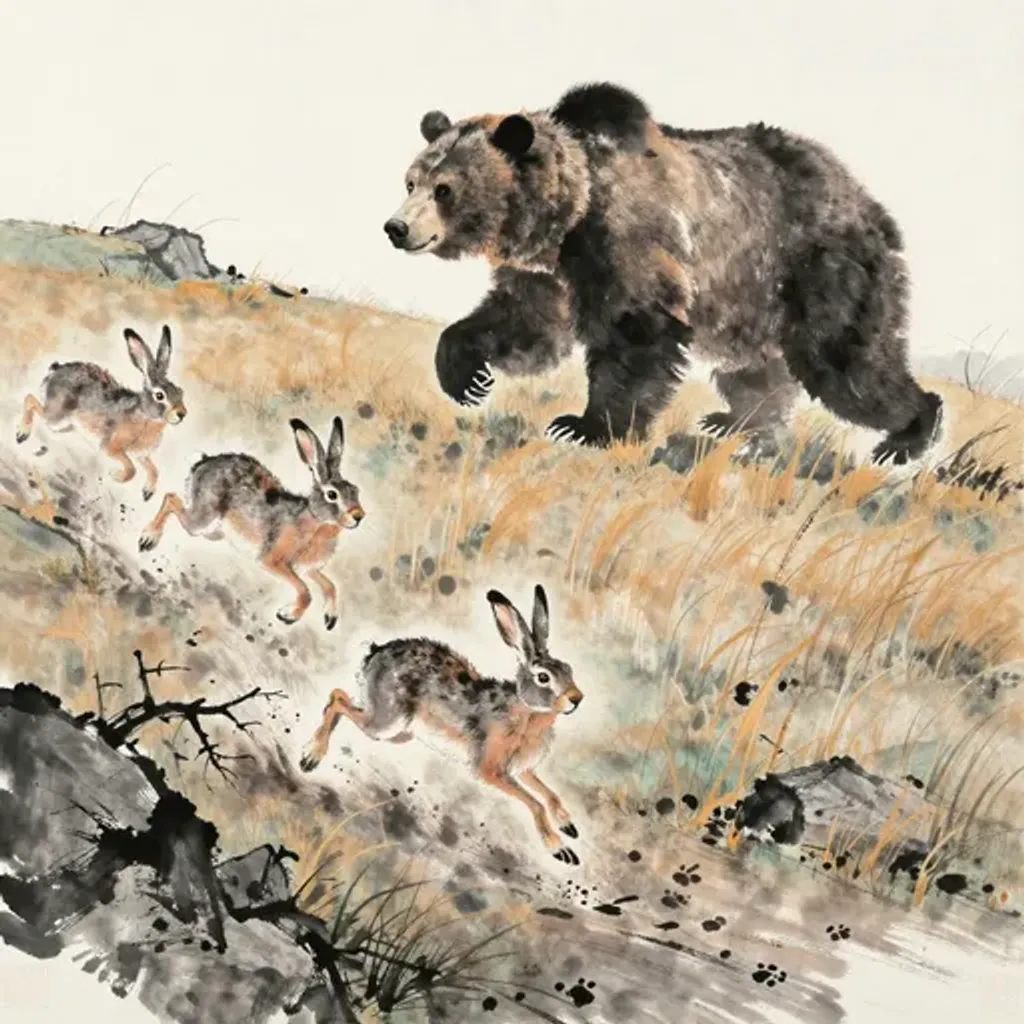
眾兔俱走,熊羆在後;踦不能進,失信寡處。
The herd of rabbits all run; bears and grizzlies follow behind. Limping, unable to advance -- trust is lost, and one dwells alone.
— Jiao Yanshou, Yilin (Forest of Changes), 1st century BC
Commentary
Thunder stirs the earth, but a herd of rabbits scatters in all directions with bears lumbering behind. One stumbles, unable to advance, losing credibility and ending up alone. The image is a failed hunt: the quarry bolts in every direction while the heavy bears cannot keep pace, and one pursuer trips and falls behind. From Enthusiasm to Development, the contrast is pointed. Development shows wind above the mountain — the wild goose gradually advancing through proper stages, the gentleman dwelling in worthy virtue. The verse's stumbling pursuer has abandoned gradual progress for reckless chase, tripping over haste. Enthusiasm that lunges after every fleeing target misses them all, while Development insists that steady, stage-by-stage approach is the only path that holds.
豫 → 歸妹
Hexagram 16 → Hexagram 54: The Marrying Maiden
Changing lines: 1, 2
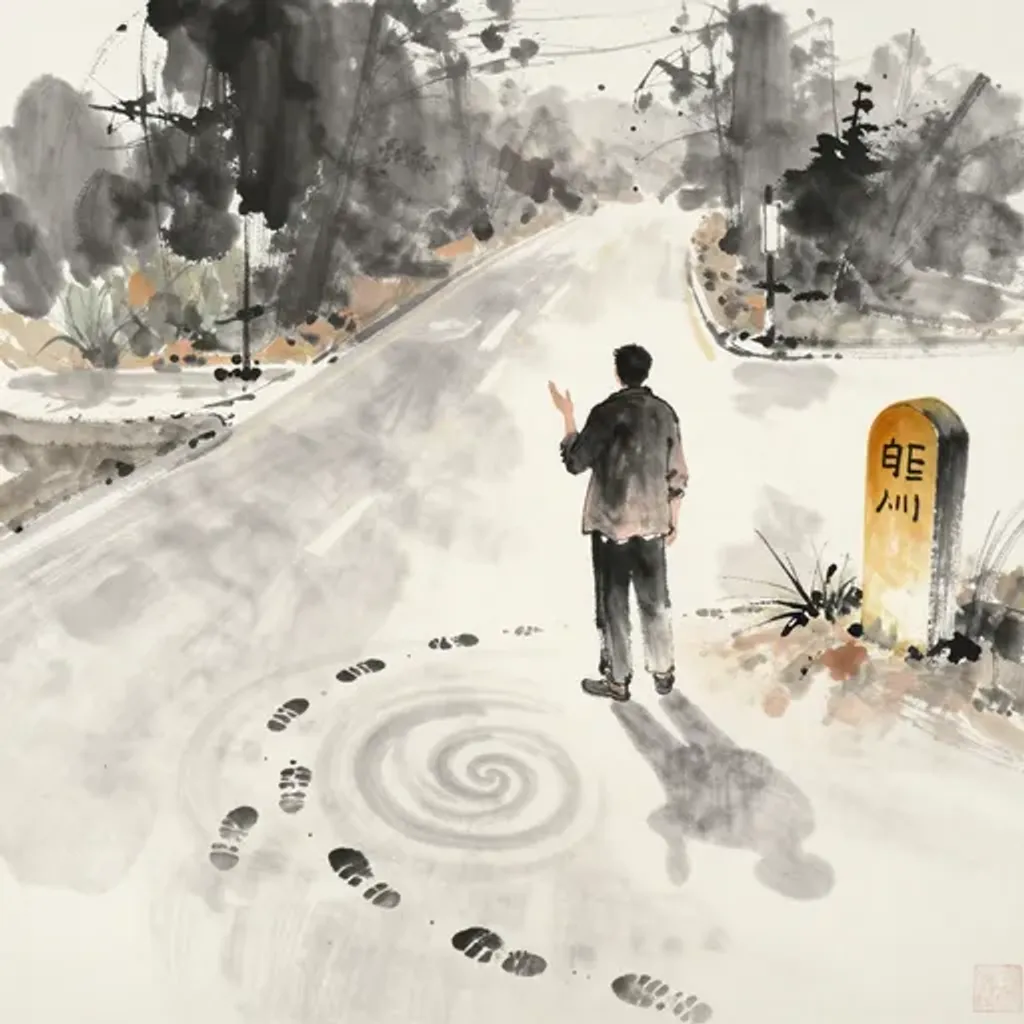
旁行不遠,三思復返。心多畏惡,中日止舍。
Setting out sideways, not getting far; thinking thrice, turning back again. The heart is full of dread -- at midday one halts and lodges.
— Jiao Yanshou, Yilin (Forest of Changes), 1st century BC
Commentary
Thunder breaks from the earth, but the traveler ventures only a short distance before stopping. Three times he considers, three times he turns back. Fear and aversion fill his heart; at midday he halts and takes shelter. The verse captures paralysis by overthinking — the person who starts a journey but cannot commit to it, retreating after every few steps. From Enthusiasm to the Marrying Maiden, the irony deepens. The Marrying Maiden's image is thunder above the lake — a younger sister given in marriage, an irreversible commitment. Yet the verse's subject cannot commit to anything at all. Enthusiasm that reverses itself at every threshold arrives at the Marrying Maiden's gate but cannot step through, trapped between desire and hesitation.
豫 → 豐
Hexagram 16 → Hexagram 55: Abundance
Changing lines: 1, 3
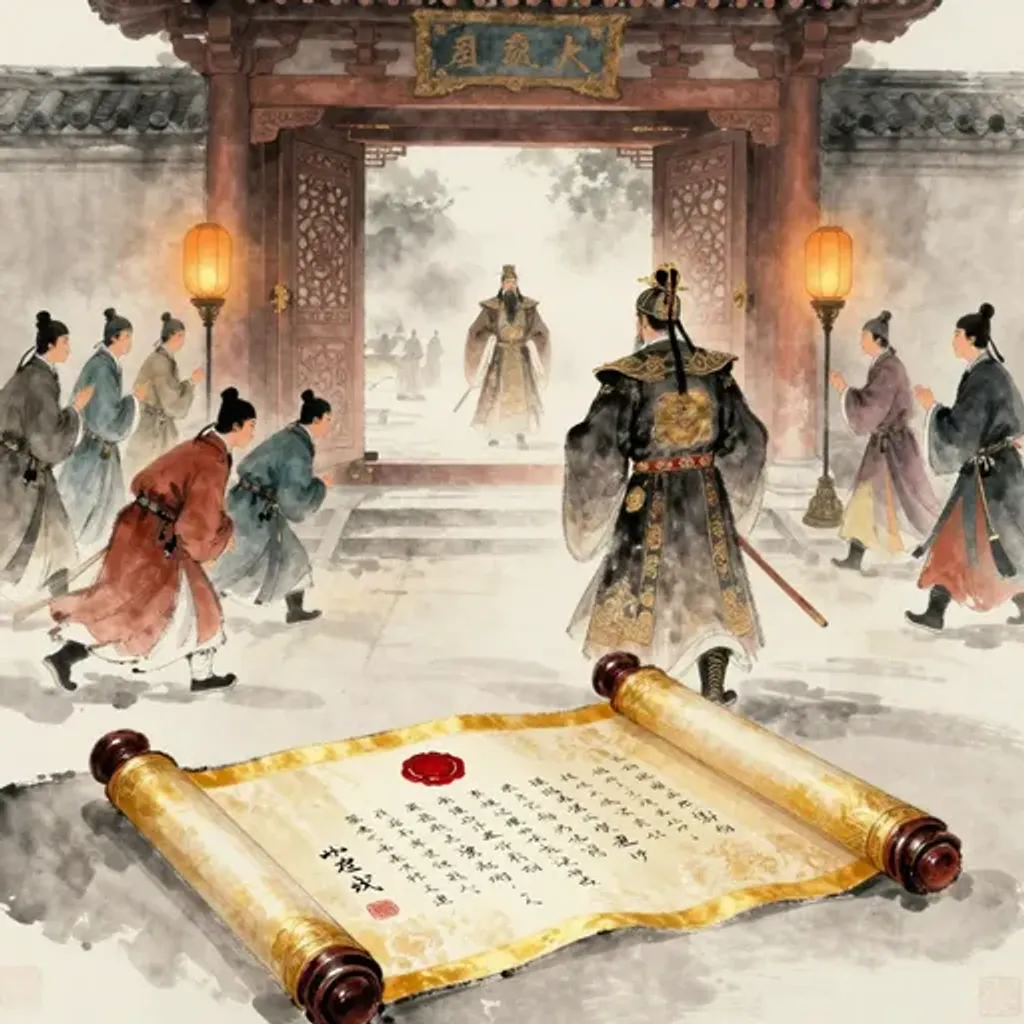
倉唐奉使,中山以孝;文侯悅喜,擊子徵召。
Cang Tang bore the envoy mission; Zhongshan honored filial piety. Marquis Wen was pleased and glad, and summoned young Ji.
— Jiao Yanshou, Yilin (Forest of Changes), 1st century BC
Commentary
Thunder erupts from the earth as Cangtang carries out his diplomatic mission. The state of Zhongshan demonstrates filial piety, and Lord Wen of Wei is delighted, summoning his heir Prince Ji with warmth. According to the Han Shi Waizhuan, Prince Ji of Wei was sealed in Zhongshan but had no contact with his father for three years. His tutor Cangtang volunteered as envoy, bringing gifts of northern hounds and morning geese. Through skillful diplomacy, he reminded Lord Wen that a father should not neglect his son. The lord was moved and recalled his heir. From Enthusiasm to Abundance, the mission succeeds spectacularly: thunder and lightning together illuminate the truth. One well-timed embassy restores a broken bond and floods the court with renewed warmth.
豫 → 旅
Hexagram 16 → Hexagram 56: The Wanderer
Changing lines: 3, 6
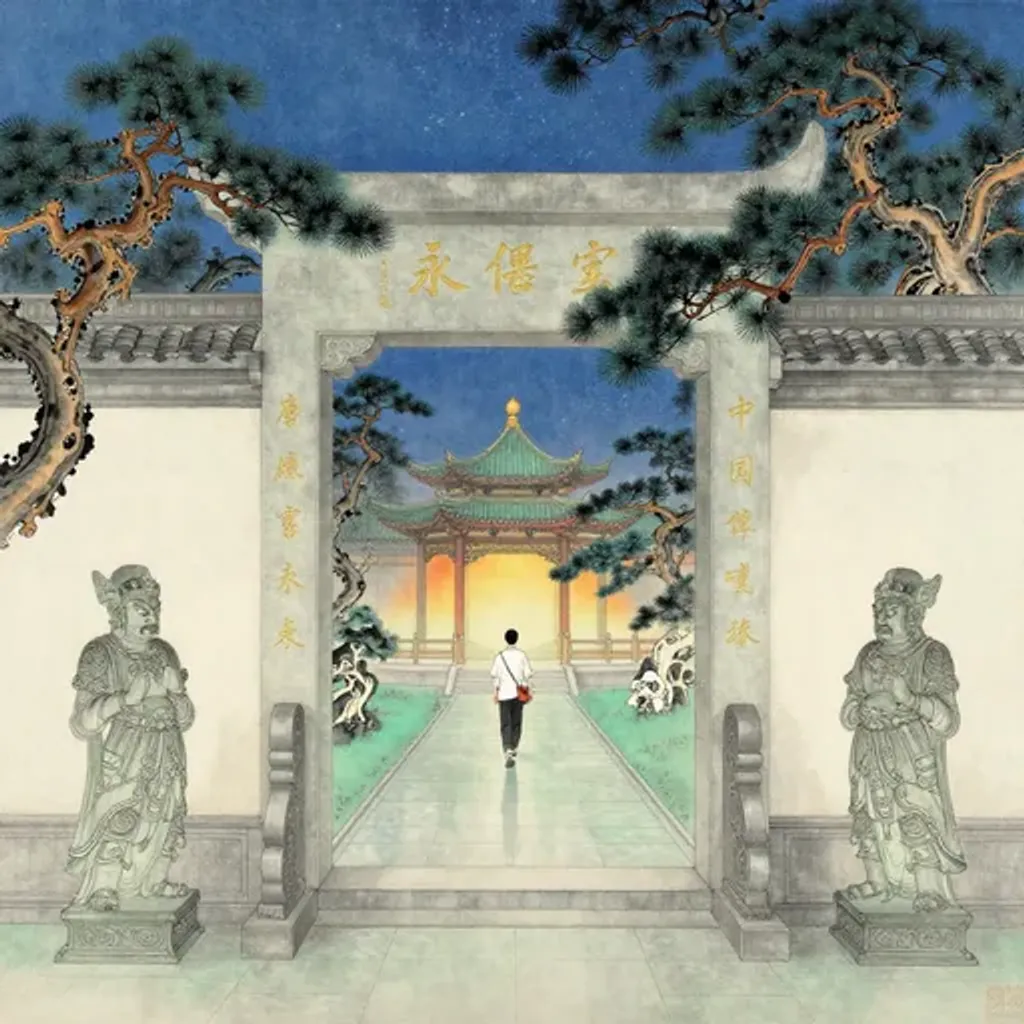
入天門,守地戶;居安樂,不勞苦。
Enter heaven gate, guard earth threshold; dwell in peace and joy, without toil or hardship.
— Jiao Yanshou, Yilin (Forest of Changes), 1st century BC
Commentary
Thunder stirs the earth, and one enters the Gate of Heaven and guards the Door of Earth. Dwelling in peace and comfort, there is no toil or suffering. The verse is cosmological shorthand for occupying the pivotal nodes of the celestial-terrestrial axis — controlling both the entry point of divine energy and the stabilizing base of earthly foundation. This is not hermit's withdrawal but strategic positioning: holding the two poles of existence simultaneously. From Enthusiasm to The Wanderer, the transformation is paradoxical. The Wanderer moves through fire on a mountain, never settling. Yet the verse's subject has found stillness within perpetual transit — guarding heaven's gate and earth's door simultaneously, at home everywhere and therefore at peace while nominally wandering.
豫 → 巽
Hexagram 16 → Hexagram 57: The Gentle Wind
Changing lines: 2, 3, 4, 5, 6
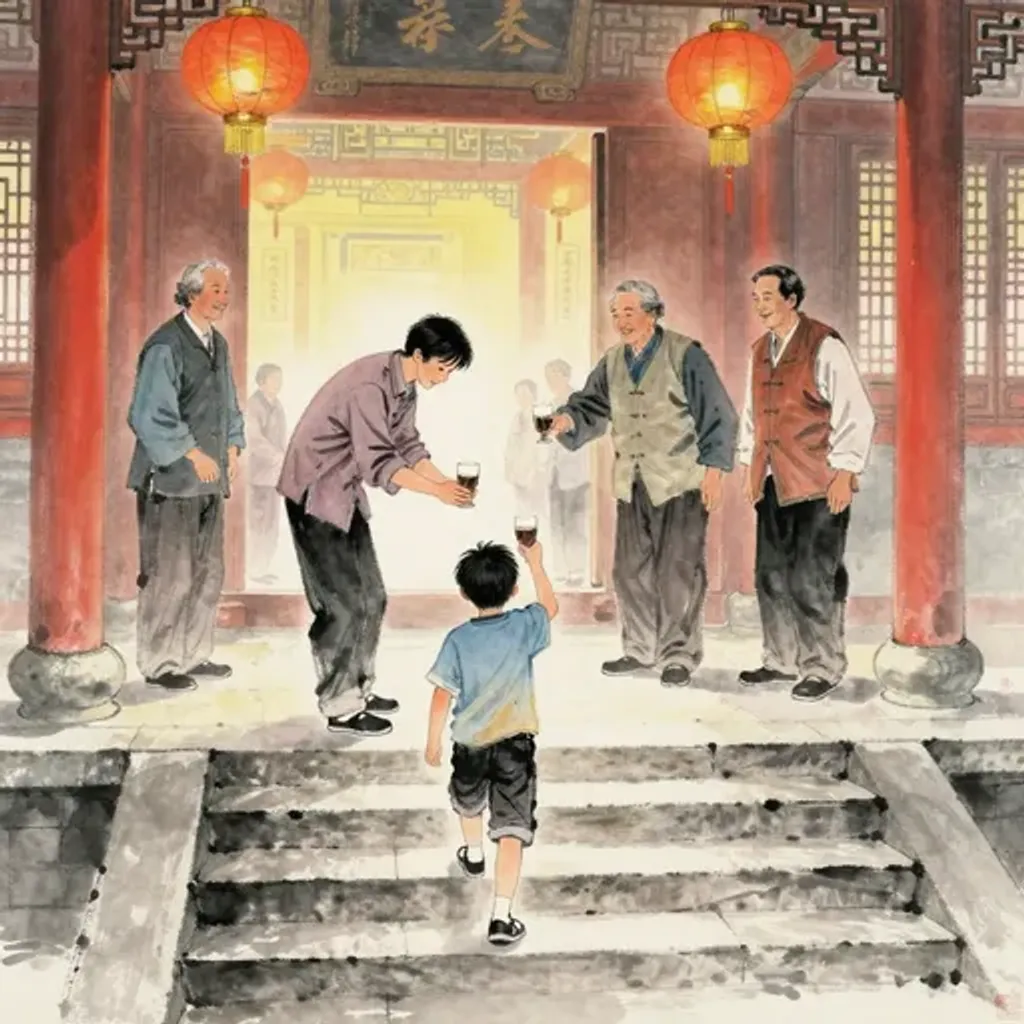
登階上堂,見吾父兄;左酒右漿,與福相迎。
Ascending the stairs, entering the hall, I see my father and brothers; wine on the left, broth on the right -- we welcome blessings together.
— Jiao Yanshou, Yilin (Forest of Changes), 1st century BC
Commentary
Thunder erupts from the earth as one climbs the steps and enters the ancestral hall. There stand father and elder brothers — wine at the left hand, broth at the right — welcoming the returned family member into blessing. The verse radiates homecoming: the ritualized ascent of steps, the formal greeting of elders, the symmetrical placement of offerings signaling proper ceremony and familial warmth. From Enthusiasm to The Gentle, the transformation softens the thunder into wind. Doubled wind penetrates gently and thoroughly, as the ruler repeats and refines his commands. The enthusiast's return to family does not crash through the door but enters through measured steps, ascending gradually into the presence of ancestors — the gentle permeation of blessing received through proper form.
豫 → 兌
Hexagram 16 → Hexagram 58: The Joyous Lake
Changing lines: 1, 2, 5
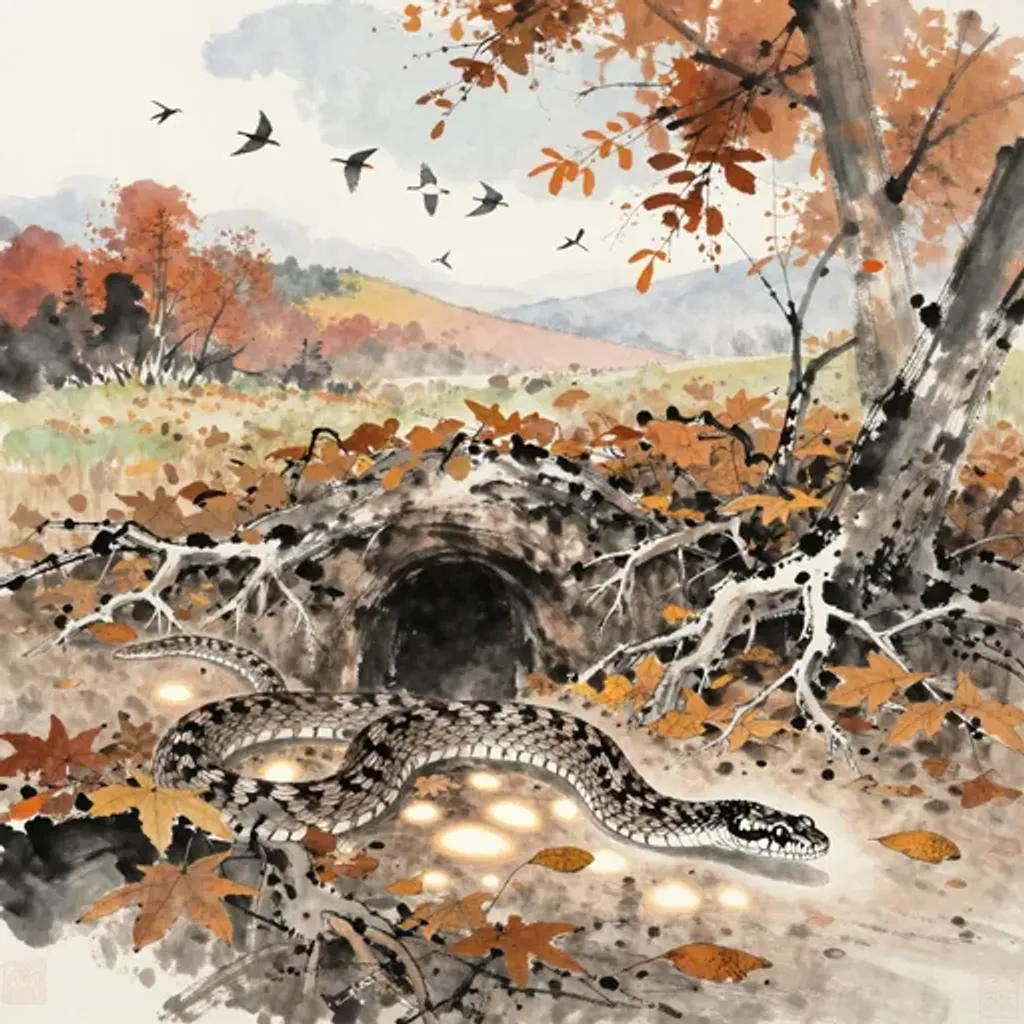
秋虵向穴,不失其節,夫人姜氏,自齊復入。
The autumn serpent heads for its burrow, not straying from its season. Lady Jiang from Qi returned of her own accord.
— Jiao Yanshou, Yilin (Forest of Changes), 1st century BC
Commentary
Thunder stirs the earth as the autumn snake seeks its burrow, perfectly timing its retreat. Lady Jiang, wife of a lord, returns from Qi to her husband's state. The snake entering its hole before winter captures the wisdom of seasonal withdrawal — knowing when to retreat is as vital as knowing when to advance. The lady's return from her natal state of Qi suggests a diplomatic or personal reconciliation, a wife returning to restore the household. From Enthusiasm to The Joyous, the transformation pairs movement with contentment. Paired lakes — friends learning together — create mutual delight. The snake's timely retreat and the lady's return both embody the joy of fitting action: satisfaction comes not from constant activity but from doing the right thing at the right moment.
豫 → 渙
Hexagram 16 → Hexagram 59: Dispersion
Changing lines: 2, 4, 5, 6
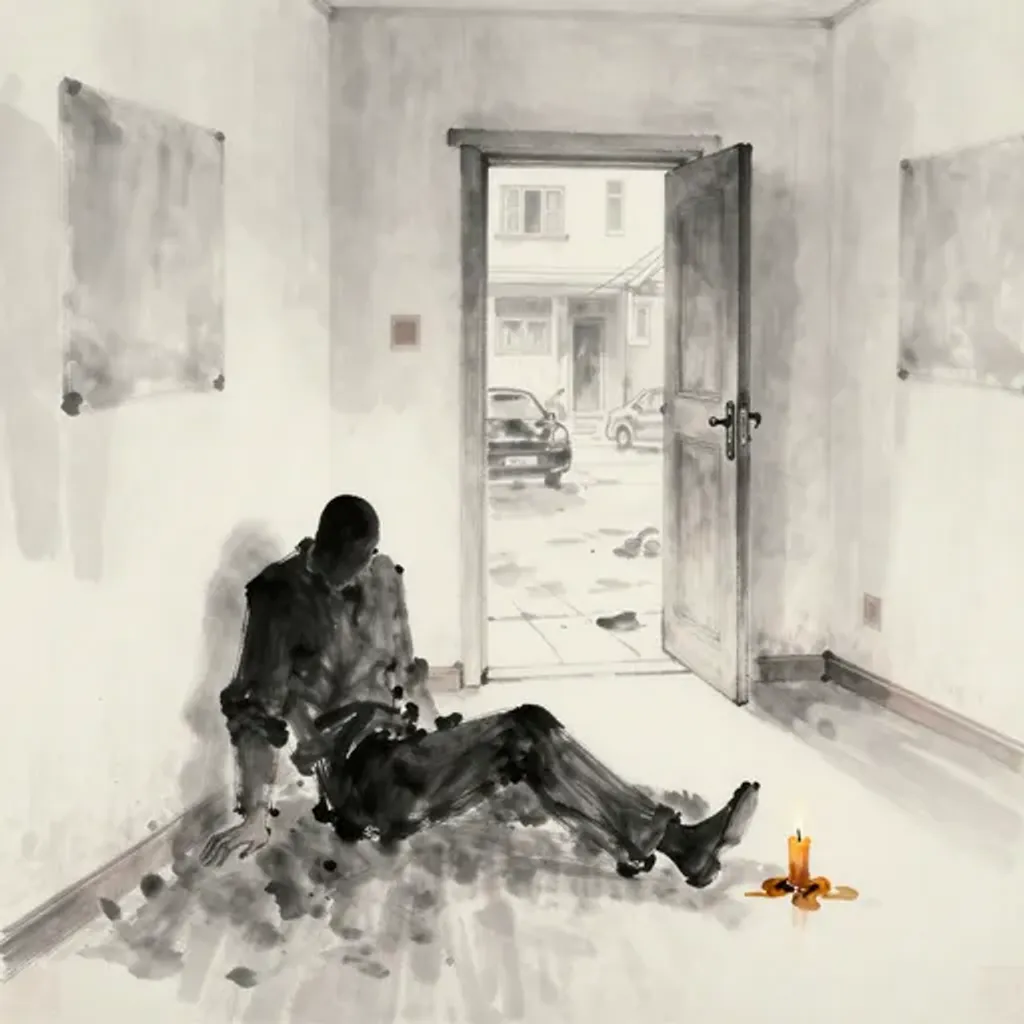
忍醜少羞,無面有頭,滅耗寡虛,日以削銷。
Enduring disgrace with little shame; faceless yet with a head. Wasting and dwindling, meager and hollow -- day by day pared away.
— Jiao Yanshou, Yilin (Forest of Changes), 1st century BC
Commentary
Thunder breaks from the earth, but what emerges is shameful endurance. Swallowing ugliness with little sense of shame, faceless yet headed somewhere — the figure tolerates degradation while pressing forward. Resources dwindle and diminish daily, wasting away through slow attrition. The verse captures the grim momentum of decline accepted: someone who has lost dignity but continues moving, each day smaller than the last. From Enthusiasm to Dispersion, the transformation dissolves what little remains. Wind moves over water, scattering everything. Dispersion's ancient king built temples and made offerings to the supreme deity — reconstituting meaning from scattered fragments. But the verse's subject has nothing left to gather; the dispersion is total, and what enthusiasm once animated now dissolves into diminishing returns.
豫 → 節
Hexagram 16 → Hexagram 60: Limitation
Changing lines: 1, 2, 4, 5
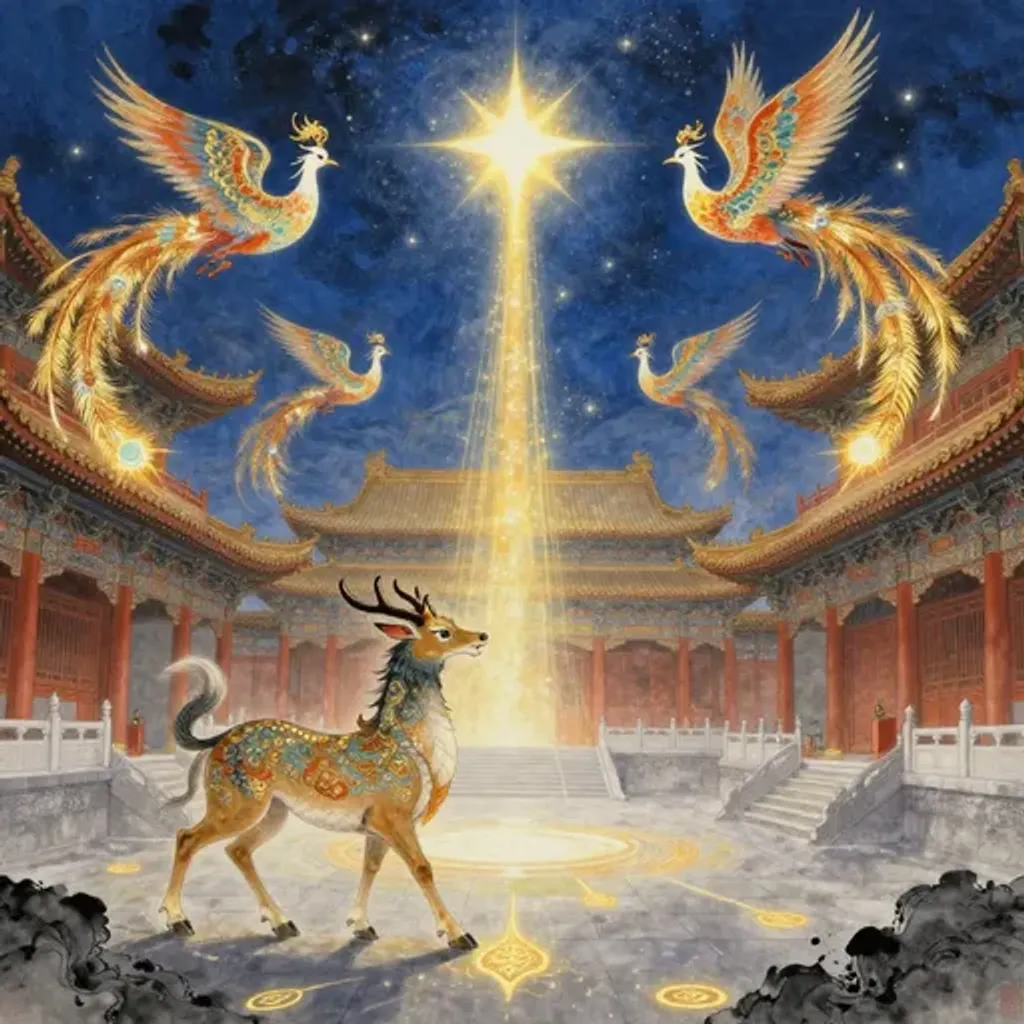
景星照堂,麟鳳遊翔;仁施大行,頌聲以興。
The auspicious star illuminates the hall; qilin and phoenix roam in flight. Benevolence is widely practiced; hymns of praise resound.
— Jiao Yanshou, Yilin (Forest of Changes), 1st century BC
Commentary
Thunder erupts from the earth in its most auspicious form. The Auspicious Star illuminates the hall; the qilin and phoenix roam and soar together. Benevolent governance spreads across the land, and hymns of praise arise in every quarter. The Auspicious Star appears only under sage rulers, while the qilin and phoenix are the supreme terrestrial and aerial omens of cosmic harmony. When all three converge, the age is golden beyond question. From Enthusiasm to Limitation, the transformation reveals why such perfection endures: water atop the lake establishes proper measure. The sage-king's enthusiasm is not unbounded revelry but joy shaped by appropriate limits — music with structure, generosity with proportion, celebration within ritual bounds.
豫 → 中孚
Hexagram 16 → Hexagram 61: Inner Truth
Changing lines: 1, 2, 4, 5, 6
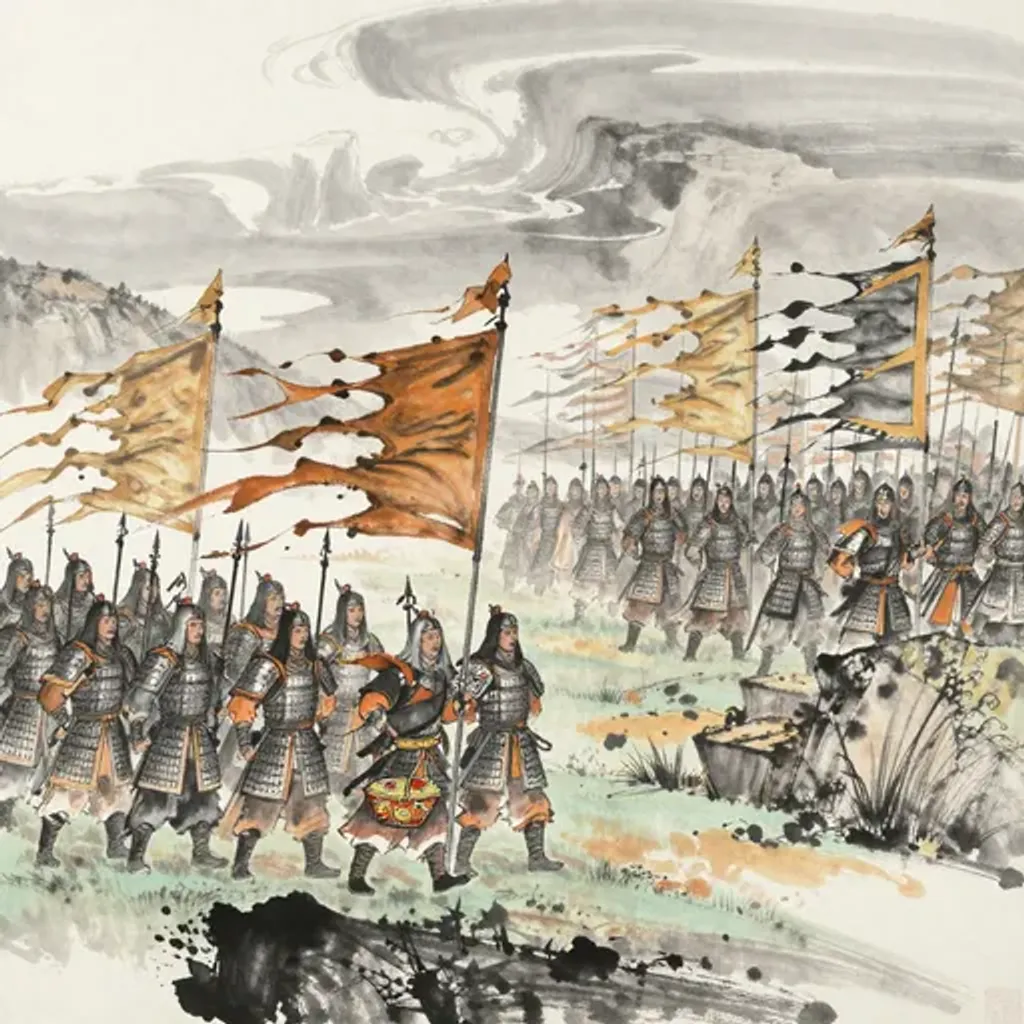
竿旄旌旗,執幟在郊;雖有寶珠,無路致之。
Poles, pennants, banners, and flags -- standards held at the border. Though one possesses precious pearls, there is no road to deliver them.
— Jiao Yanshou, Yilin (Forest of Changes), 1st century BC
Commentary
Thunder erupts from the earth as banners and standards are planted in the suburban fields, their pennants streaming in the wind. Though one possesses precious pearls, there is no road by which to deliver them. The scene evokes a military encampment or ceremonial gathering — flags mark the boundary, but access is barred. The treasure exists but cannot reach its intended recipient, blocked by circumstance rather than by lack of value. From Enthusiasm to Inner Truth, the verse captures the anguish of sincerity unable to communicate. Inner Truth's image is wind over the lake — trust that penetrates even the hardest barriers. Yet here the barrier holds, and the pearl of genuine worth remains undelivered. Enthusiasm that cannot find a channel for its sincerity is the cruelest form of obstruction.
豫 → 小過
Hexagram 16 → Hexagram 62: Small Exceeding
Changing lines: 3
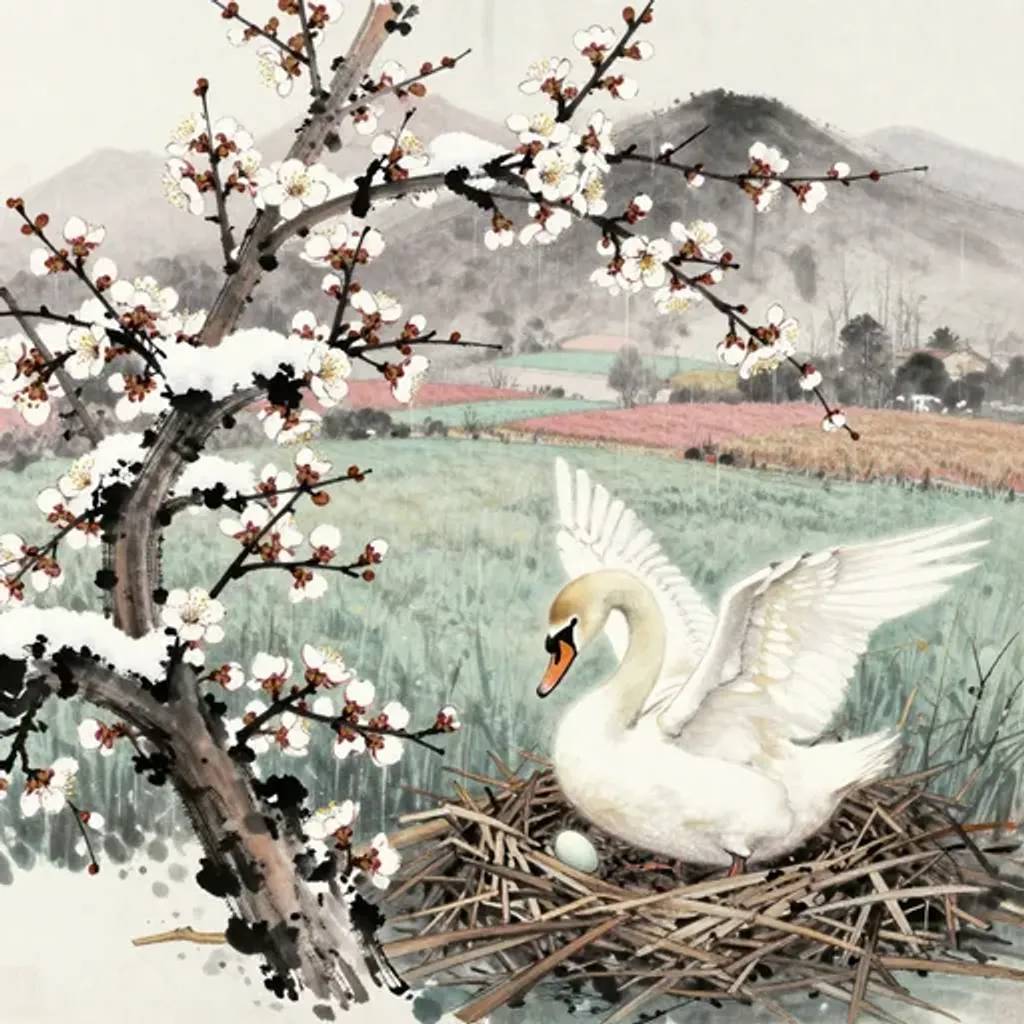
李華再實,鴻卵降集;仁德以興,陰國受福。
The plum tree bears fruit a second time; the great swan egg descends to settle. With humane virtue all flourishes -- the hidden land receives its blessing.
— Jiao Yanshou, Yilin (Forest of Changes), 1st century BC
Commentary
Thunder stirs the earth, and the plum tree fruits a second time — an extraordinary doubling of harvest. Swan goose eggs descend and gather — another prodigious omen. Benevolent virtue rises, and a shadowed state receives blessing. The plum's double fruiting was a classical auspicious portent: nature producing beyond its normal cycle signals cosmic approval of the ruler's virtue. The descending swan eggs likewise suggest heaven showering bounty. From Enthusiasm to Small Exceeding, the transformation matches: thunder above the mountain, a small bird in flight that should descend rather than ascend. The verse's blessings arrive from above — they are not seized but received. Small Exceeding teaches that in certain seasons, exceeding the norm in small, humble ways brings unexpected abundance.
豫 → 既濟
Hexagram 16 → Hexagram 63: After Completion
Changing lines: 1, 3, 4, 5
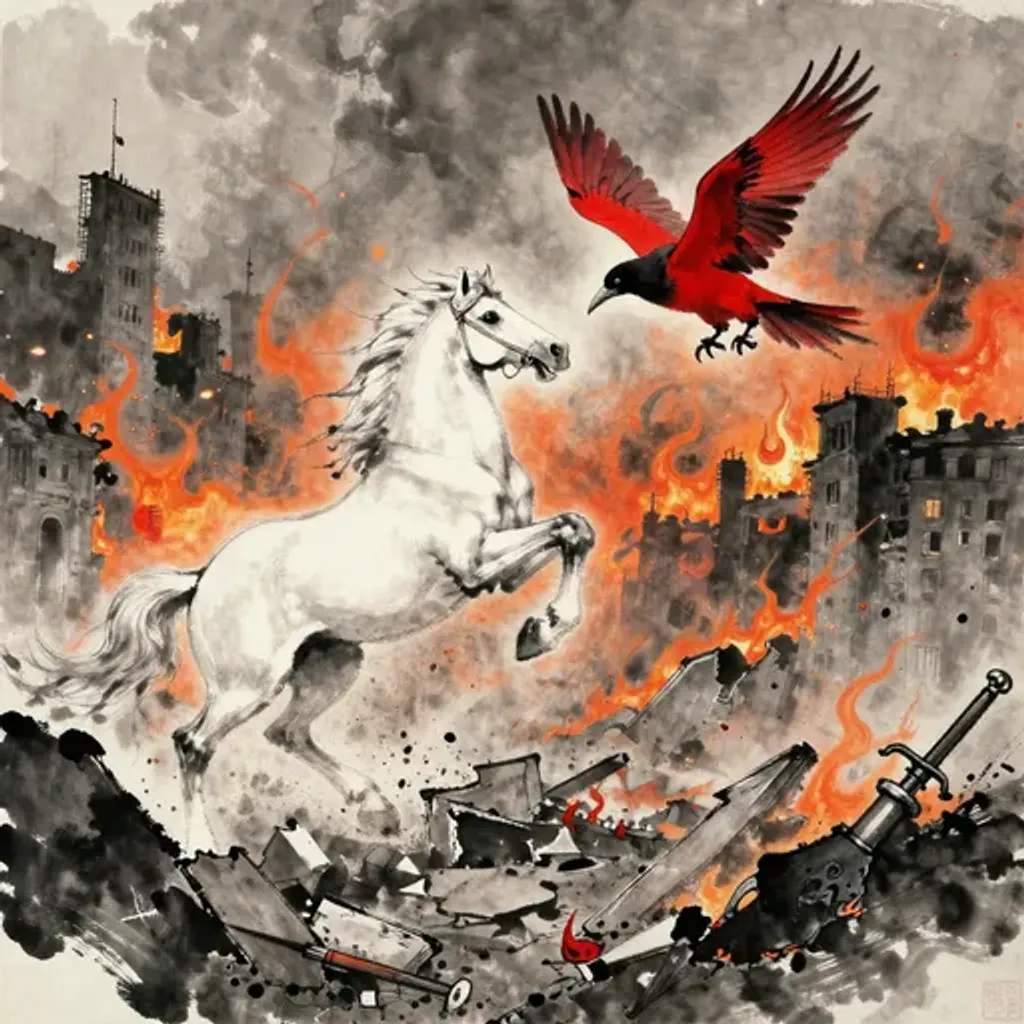
白馬赤烏,戰於東都;天輔有德,敗悔為憂。
White horse, red crow, they battle at the eastern capital; heaven aids the virtuous -- the defeated turn to ruin and woe.
— Jiao Yanshou, Yilin (Forest of Changes), 1st century BC
Commentary
Thunder breaks from the earth as white horses and red crows clash at the eastern capital. Heaven aids the virtuous, and the defeated side is left in regretful worry. 'White horse and red crow' may represent opposing forces — the metal-white cavalry of one kingdom against the fire-red banners of another — contesting the eastern capital, a common epithet for Luoyang. The verse implies a righteous battle in which heaven's favor determines the outcome. From Enthusiasm to After Completion, the transformation captures the moment after the decisive battle: water sits above fire in perfect but precarious balance. Victory has been achieved, yet the hexagram warns that completed order already contains the seed of its reversal. The defeated worry, but the victor should worry too.
豫 → 未濟
Hexagram 16 → Hexagram 64: Before Completion
Changing lines: 2, 6
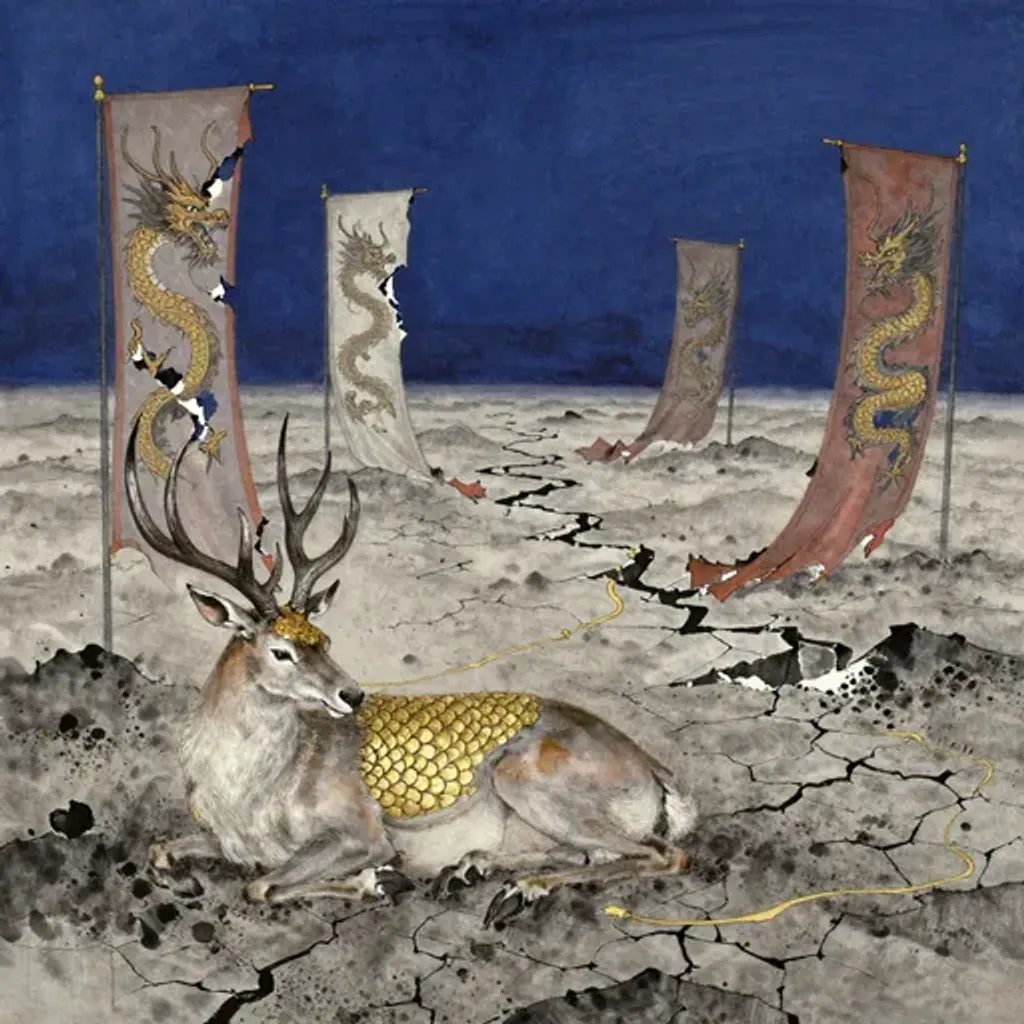
採薪得麟,大命隕顛。豪雄爭名,天下四分。
The land splits — each quarter crowns its own king. The dragon banner is torn into a hundred warlord pennants. A wounded qilin lies in the barren wild — who remembers peace once had a name?
— Jiao Yanshou, Yilin (Forest of Changes), 1st century BC
Commentary
Thunder erupts from the earth one final time, and the original verse speaks its dire prophecy: a woodcutter discovers the qilin, and heaven's great mandate collapses. Heroes contend for fame, and the realm fractures into four parts. The capture of the qilin in 481 BC marked the end of the Spring and Autumn moral order — Confucius's Way exhausted, the world splitting into warring fragments. From Enthusiasm to Before Completion, the transformation is the most fitting of all possible endings: fire sits above water, forever reaching upward while water sinks below, never quite meeting. The enthusiast's final verse acknowledges that some completions never arrive. The qilin lies wounded, the banners are torn, and the name of peace survives only as a memory no one can verify.