Transformations of Hexagram 22
Every line of change out of Hexagram 22 賁 Grace, with the Yilin verse for each of the 64 resulting hexagrams, its translation, and the original ink brush artwork.
賁 → 乾
Hexagram 22 → Hexagram 1: The Creative
Changing lines: 2, 4, 5
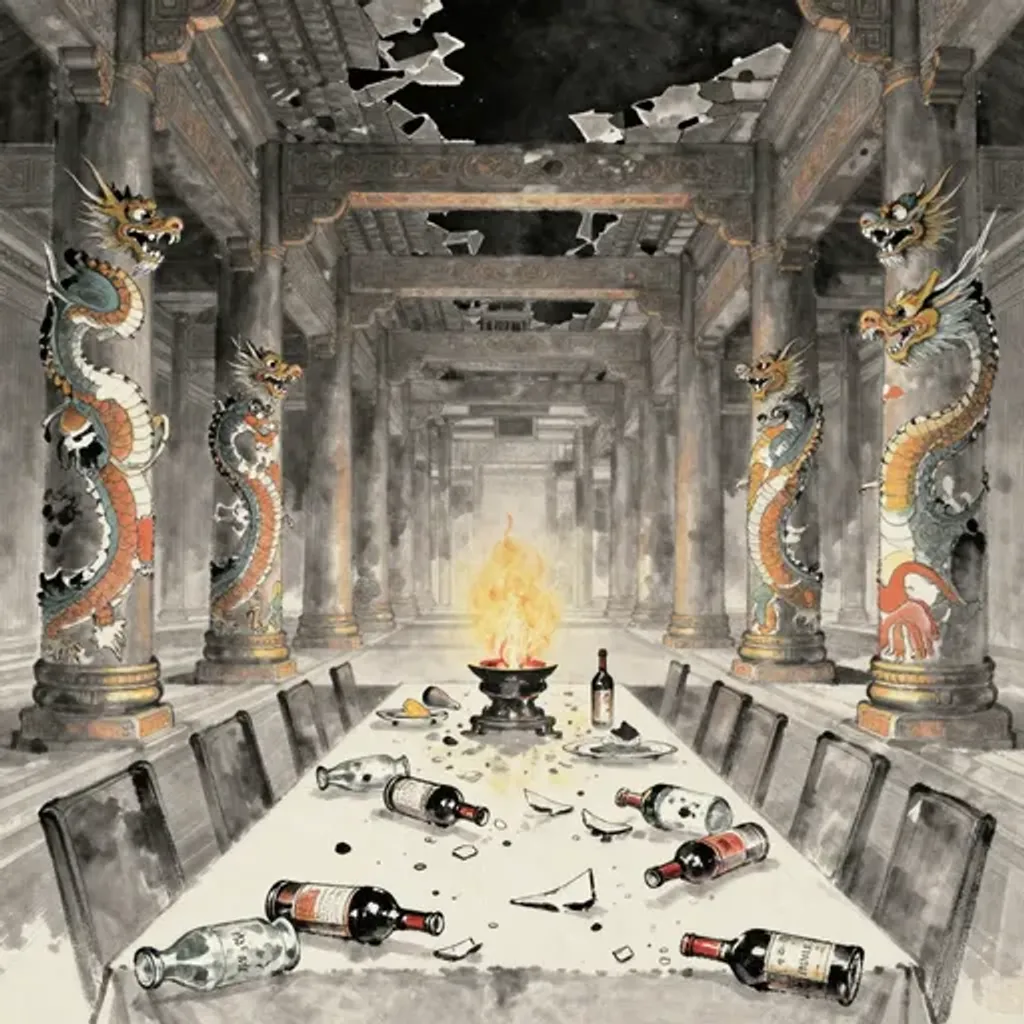
八口九頭,長舌破家;帝辛沉湎,商滅其墟。
Eight mouths, nine heads; long tongues destroy the house. Emperor Xin drowned in debauchery; Shang was reduced to ruins.
— Jiao Yanshou, Yilin (Forest of Changes), 1st century BC
Commentary
Fire beneath the mountain adorns the surface, but heaven's double motion demands substance beyond ornament. Eight mouths and nine heads — a cacophony of gossip and slander — unleash long tongues that shatter a household. The verse then pivots to a historical parallel: Emperor Xin (the tyrant Zhou of Shang) drowns in debauchery, and the Shang capital crumbles to ruins. The connection between domestic destruction by slander and dynastic collapse by indulgence is structural: both begin when appearance replaces integrity. From Grace to the Creative, the transformation strips away all decoration. What remains must be self-generating strength, the ceaseless motion of heaven. Without inner substance, adornment becomes the very weapon that destroys.
賁 → 坤
Hexagram 22 → Hexagram 2: The Receptive
Changing lines: 1, 3, 6
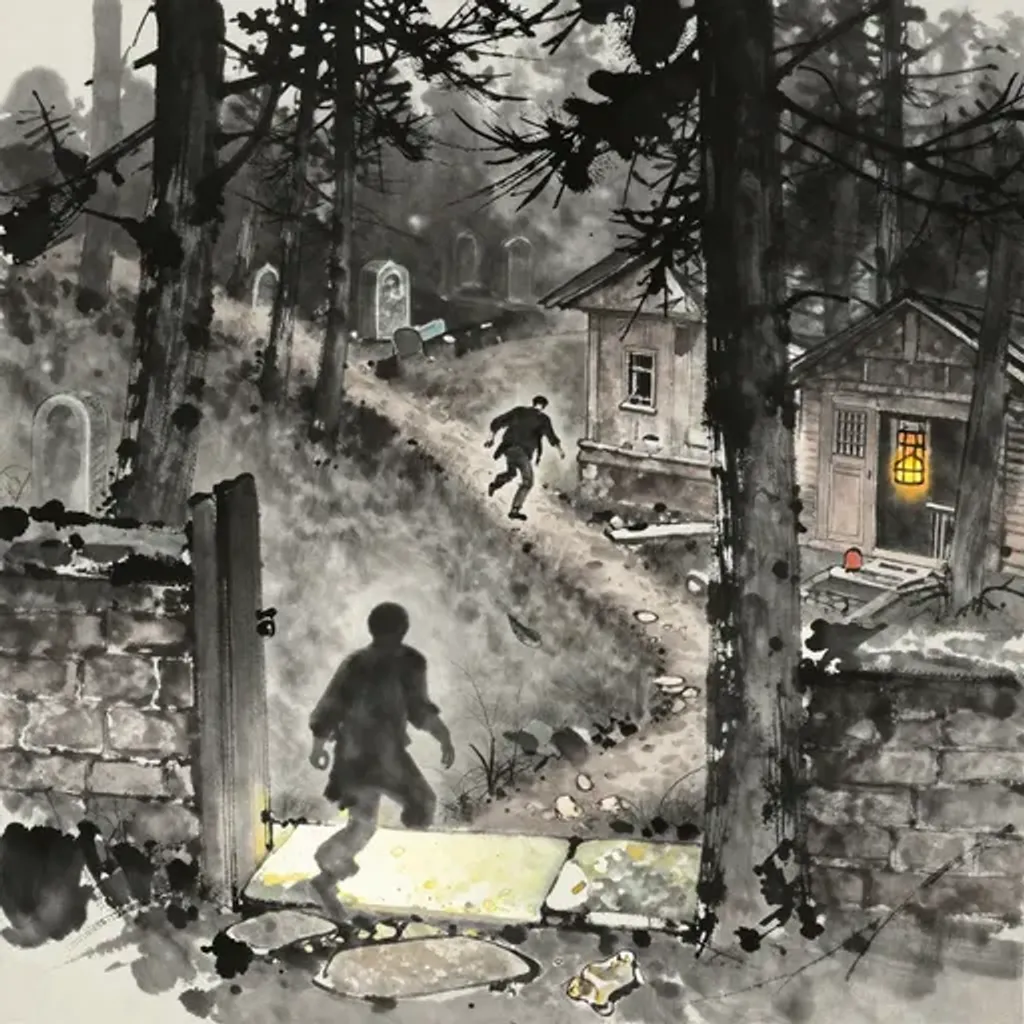
鬼守我門,呼伯入山;去其室家,舍其兆墓。
Ghosts guard my gate; calling the elder into the hills. He leaves his household behind, forsaking his ancestral tombs.
— Jiao Yanshou, Yilin (Forest of Changes), 1st century BC
Commentary
Fire beneath the mountain illuminates the threshold, but ghosts now guard the door. Someone calls for the elder brother to flee into the mountains — the family is abandoned, the ancestral graves forsaken. This is a scene of total dispossession: not merely losing property but severing the bond between the living and the dead, the most fundamental rupture in Chinese ancestral culture. From Grace to the Receptive, adornment dissolves into bare earth. The mountain's decorative fire gives way to the vast, undifferentiated plain of Kun. What was once a household adorned now becomes empty ground — the earth that receives all things, including the forgotten dead.
賁 → 屯
Hexagram 22 → Hexagram 3: Difficulty at the Beginning
Changing lines: 3, 5, 6
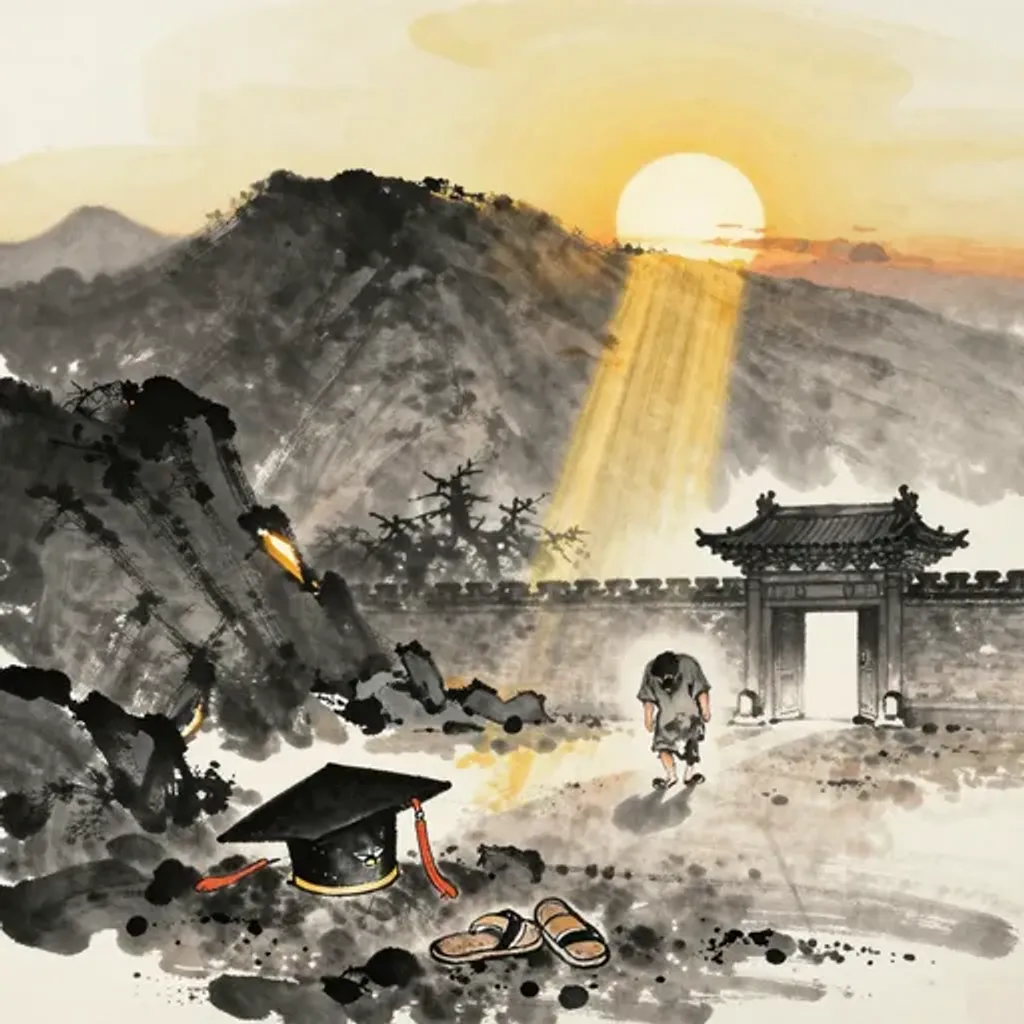
日出阜東,山蔽其明;章甫薦屨,箕子𦍕狂。
The sun rises east of the hill, but the mountain blocks its light. A ceremonial cap offered in place of sandals; Jizi feigned madness.
— Jiao Yanshou, Yilin (Forest of Changes), 1st century BC
Commentary
Fire beneath the mountain should illumine, yet the sun rising east of the mound is blocked by the mountain's mass. The verse then invokes two famous allusions of inversion: using a ceremonial cap to pad common shoes, and the Viscount of Ji feigning madness. When the Shang dynasty fell into tyranny under King Zhou, Ji Zi — uncle to the tyrant — pretended insanity to survive the corrupt court. A scholar's cap reduced to shoe-stuffing and a sage forced to play the fool: both signal a world where values are inverted and virtue must disguise itself. From Grace to Difficulty at Beginning, the adorned surface collapses into the chaos of thunderclouds gathering over water, where new order must struggle to emerge.
賁 → 蒙
Hexagram 22 → Hexagram 4: Youthful Folly
Changing lines: 1, 2, 3
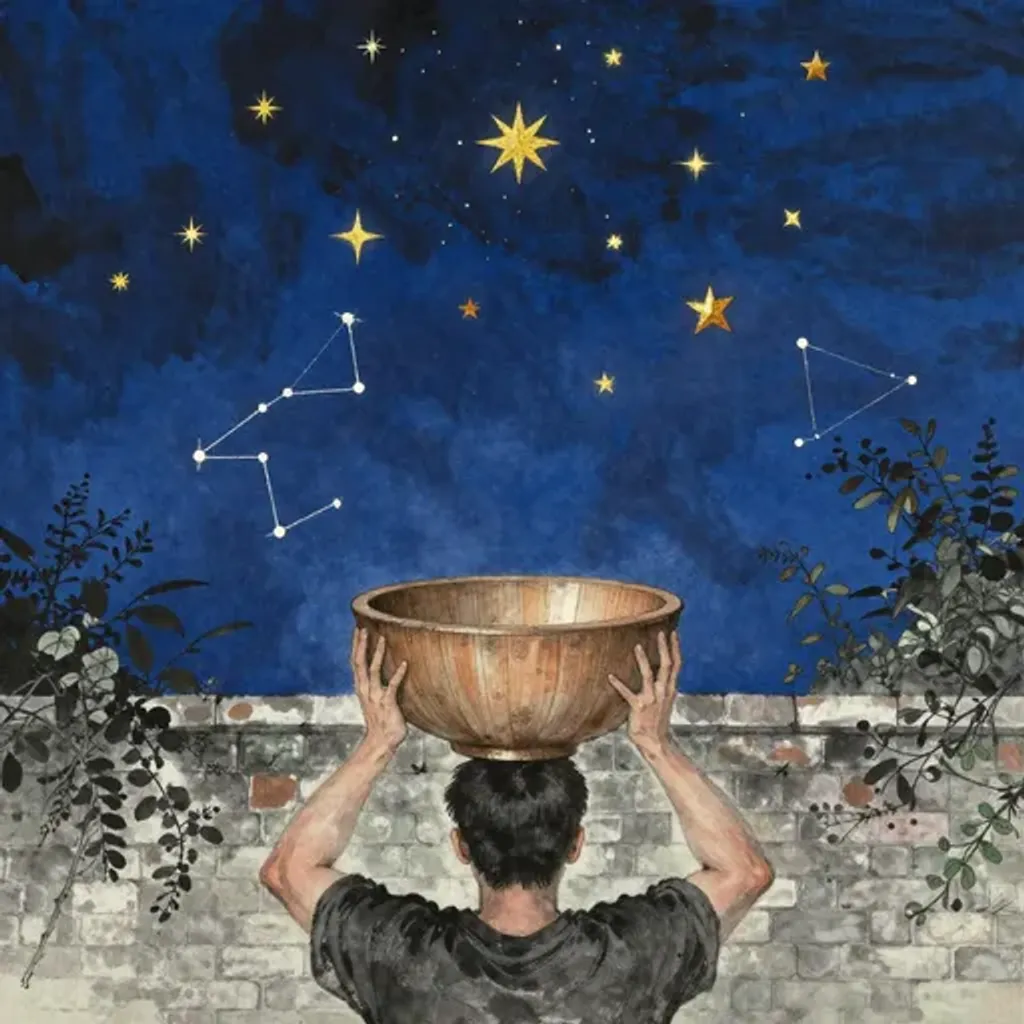
戴盆望天,不見星辰;顧小失大,福逃墻外。
Carrying a basin on the head, gazing up at heaven; one cannot see the stars. Attending to the small, losing the great; fortune flees beyond the wall.
— Jiao Yanshou, Yilin (Forest of Changes), 1st century BC
Commentary
Fire beneath the mountain offers illumination, yet someone balances a basin on their head while trying to gaze at the sky — a proverbial image of self-defeating obstruction. With a basin overhead, one cannot see the stars; fixating on small concerns, one misses the greater fortune that escapes beyond the wall. This is a classic folk saying preserved in the Han Shu: 'Carrying a basin on your head, you cannot see heaven.' The irony cuts both ways: the person seeks light but creates their own darkness. From Grace to Youthful Folly, the mountain remains but fire gives way to the spring at the mountain's base. Adornment blinds; only by removing the basin — abandoning petty fixations — can the spring of genuine understanding be found.
賁 → 需
Hexagram 22 → Hexagram 5: Waiting
Changing lines: 2, 5, 6
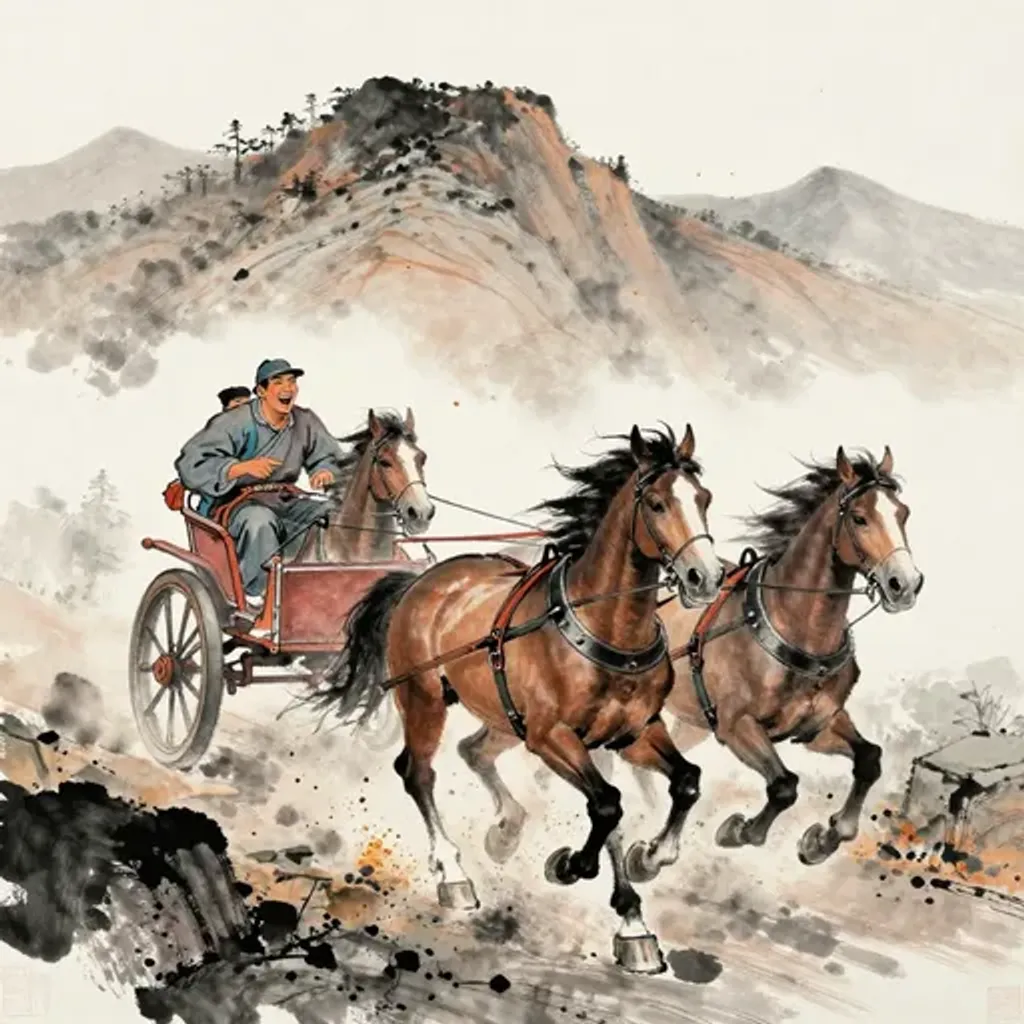
兩輪並轉,南上大阪;四馬共轅,無有重難。與語笑言。
Two wheels turning together, climbing the great southern slope. Four horses share one shaft; there is no grave difficulty. They converse with laughter and cheer.
— Jiao Yanshou, Yilin (Forest of Changes), 1st century BC
Commentary
Fire beneath the mountain brightens the path ahead as two wheels turn in tandem, climbing the great southern slope. Four horses share a single shaft, and no obstacle proves too steep. The journey ends in laughter and easy conversation. This is a verse of effortless momentum: the carriage is well-built, the horses are matched, the road is steep but surmounted without strain. From Grace to Waiting, the adorned surface gives way to clouds rising above heaven — not the anxiety of waiting, but the confident patience of one whose provisions are secure. The mountain's fire, which merely decorates, transforms into the nourishing clouds that will become rain in due season.
賁 → 訟
Hexagram 22 → Hexagram 6: Conflict
Changing lines: 1, 2, 3, 4, 5
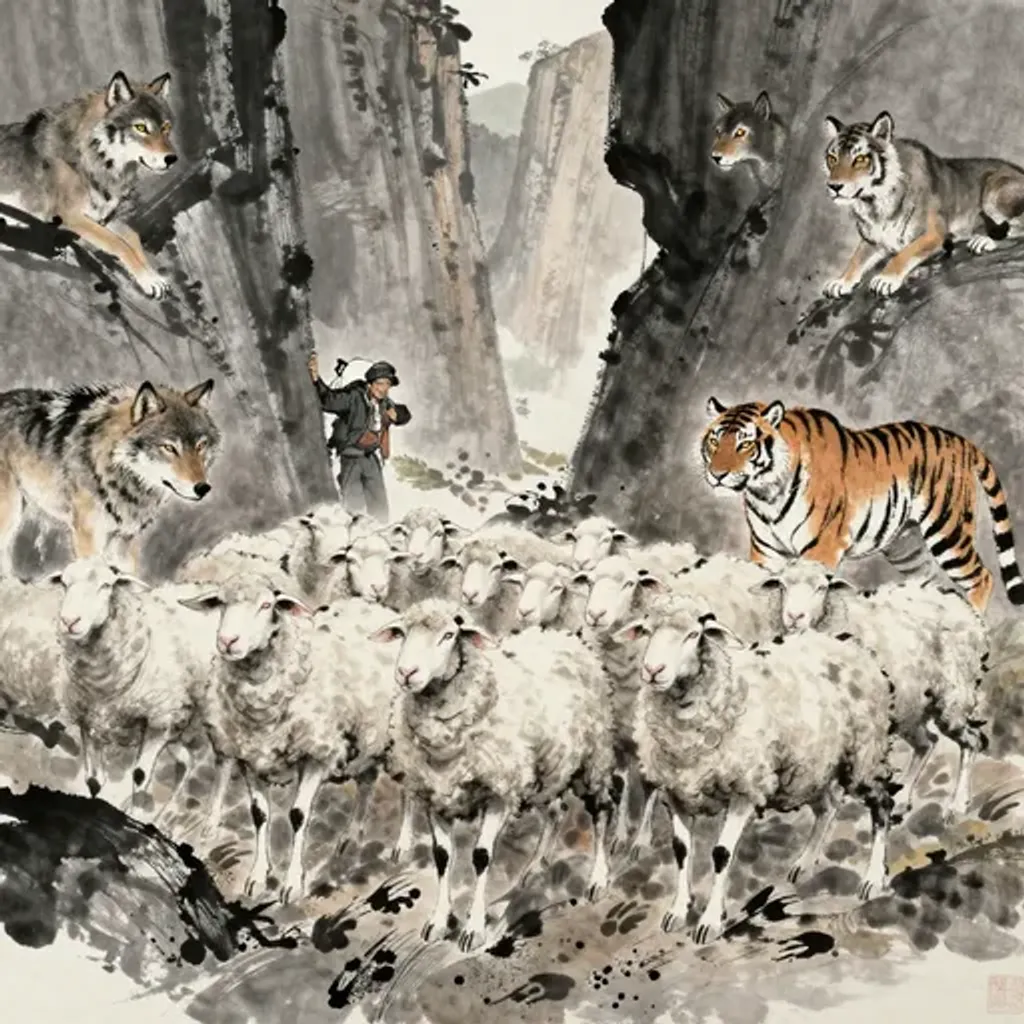
羊驚狼虎,悚耳群聚;行旅稽難,留連愁苦。
Sheep alarmed by wolves and tigers, ears pricked, huddling together. Travelers are delayed and obstructed; they linger on in sorrow and hardship.
— Jiao Yanshou, Yilin (Forest of Changes), 1st century BC
Commentary
Fire beneath the mountain reveals a scene of terror: sheep panic at the scent of wolves and tigers, their ears pricked in alarm as they huddle together. Travelers are delayed and detained on the road, lingering in sorrow and distress. The imagery is stark — prey animals frozen between flight and the instinct to cluster, while human journeys stall in anxiety. From Grace to Conflict, the adorned mountain gives way to heaven and water moving in opposite directions. What was decorative order fractures into opposition: the cosmetic peace of Grace concealed a predatory reality, and now in Conflict that truth surfaces. The traveler's stalled journey mirrors heaven and water pulling apart.
賁 → 師
Hexagram 22 → Hexagram 7: The Army
Changing lines: 1, 2, 3, 6
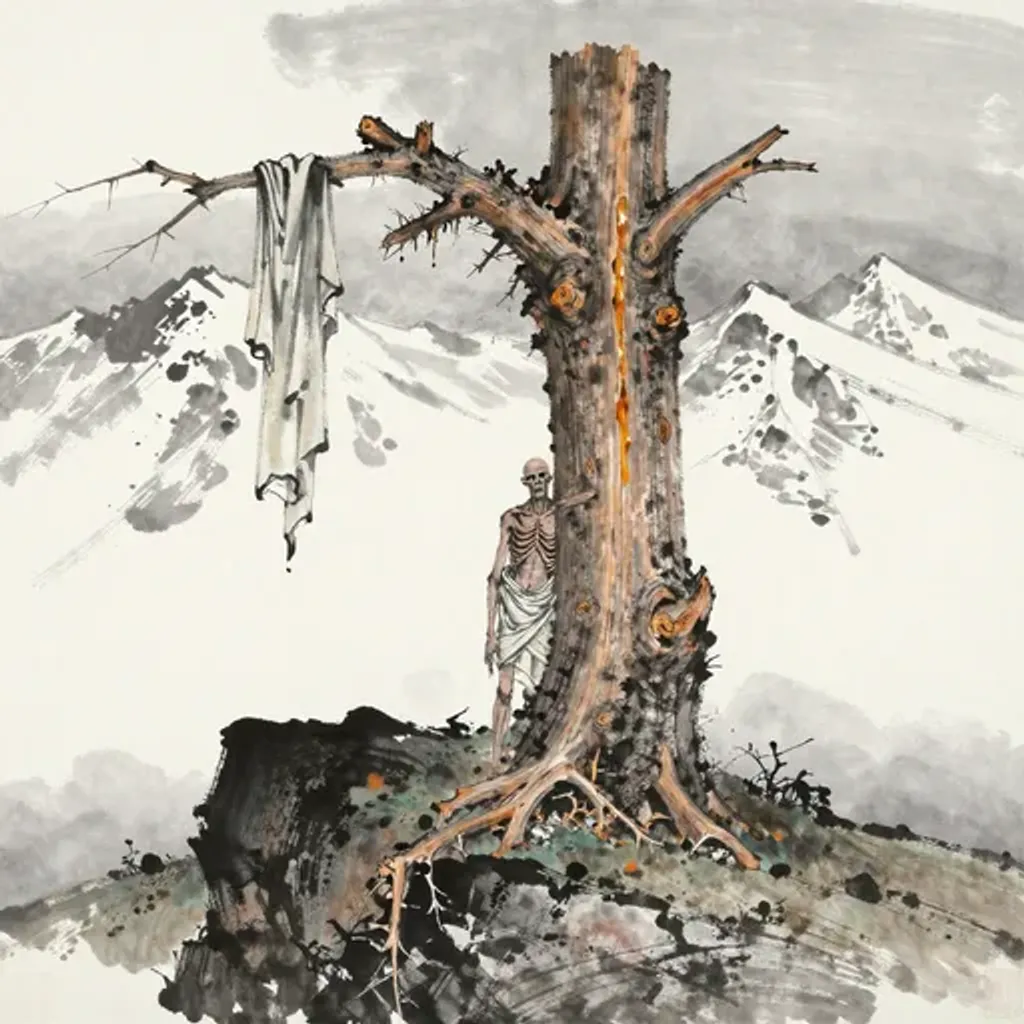
楩生荊山,命制輸班。袍衣剝脫,夏熱冬寒。立餓枯槁,眾人莫怜。
Fine timber grows on Jing Mountain, its fate entrusted to master builders. Robes stripped away, bare to summer heat and winter cold. Standing starved and withered; no one shows pity.
— Jiao Yanshou, Yilin (Forest of Changes), 1st century BC
Commentary
Fire beneath the mountain lights a scene of talent wasted. A pian tree — one of the most precious hardwoods — grows on Jing Mountain, yet its destiny is to be carved by the master craftsman Lu Ban. Despite such noble material and expert hands, the verse turns bitter: robes are stripped away, leaving one exposed to summer heat and winter cold. Standing starved and withered, no one offers pity. The finest timber, even shaped by the greatest artisan, is left to rot if the world has no use for it. From Grace to the Army, water hidden within the earth replaces fire upon the mountain. Adornment yields to disciplined endurance — yet here the army's structure offers no rescue for the solitary sufferer.
賁 → 比
Hexagram 22 → Hexagram 8: Holding Together
Changing lines: 1, 3, 5, 6
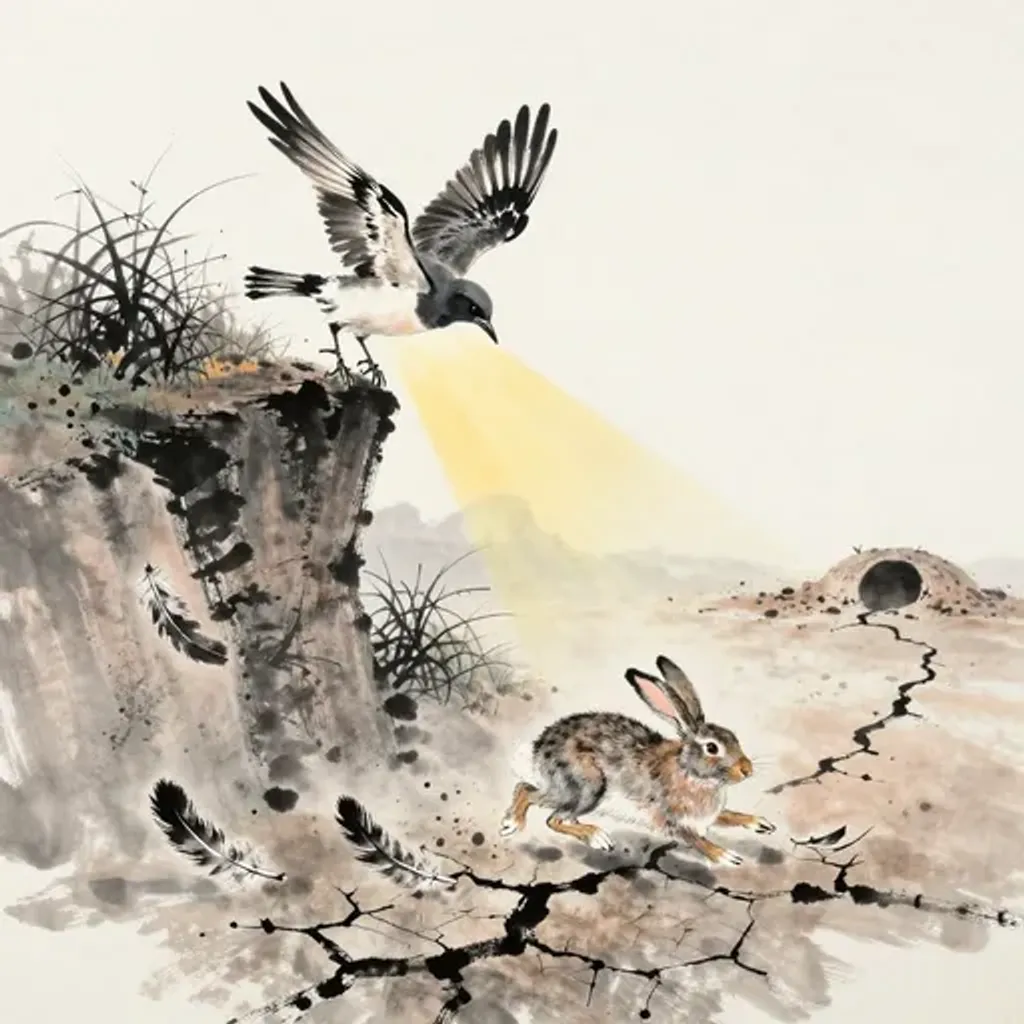
鳥飛無翼,兔走折足。不常其德,自為羞辱。
A bird flies without wings; a rabbit runs with a broken leg. Inconstant in virtue, one brings shame and disgrace upon oneself.
— Jiao Yanshou, Yilin (Forest of Changes), 1st century BC
Commentary
Fire beneath the mountain adorns what cannot sustain itself. A bird tries to fly without wings; a rabbit runs but its legs snap. These are images of fundamental incapacity — not bad luck but structural impossibility. The verse concludes with moral judgment: one who does not maintain constant virtue brings shame upon himself. The wingless bird and broken-legged rabbit are not victims of circumstance; their failure is built into their nature. From Grace to Holding Together, the mountain's decorative fire yields to water resting upon the earth. Where Grace adorns the surface, Holding Together demands genuine bonding. Without inner capacity — without wings, without sound legs, without steady virtue — no amount of adornment can create true union.
賁 → 小畜
Hexagram 22 → Hexagram 9: Small Taming
Changing lines: 2, 5
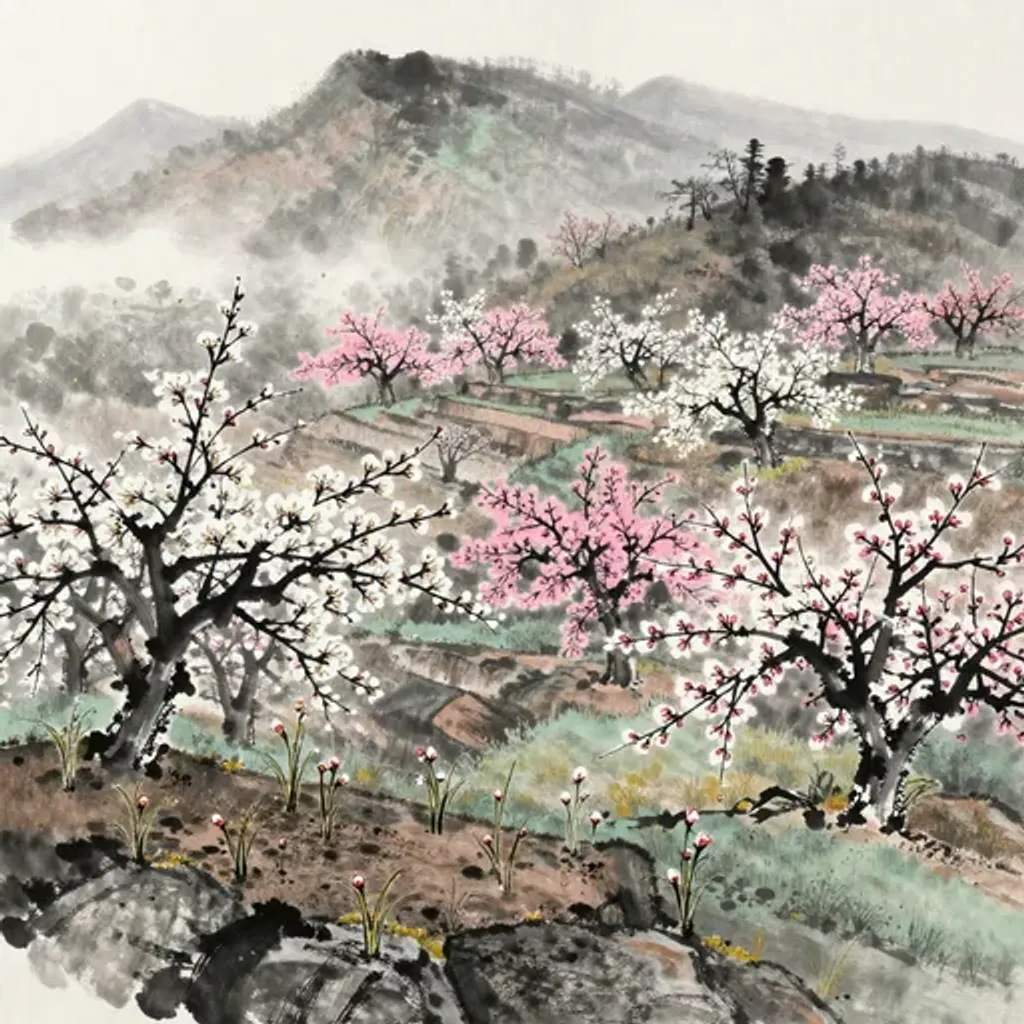
條風制氣,萬物生出。明庶長養,花葉茂榮。
The east wind governs the vital breath; the myriad things come forth. The bright warmth nurtures and nourishes; flowers and leaves flourish in splendor.
— Jiao Yanshou, Yilin (Forest of Changes), 1st century BC
Commentary
Fire beneath the mountain warms into spring. The Tiao wind — the northeast wind of early spring in the ancient eight-wind system — governs the vital breath, and all living things emerge. The Mingchu wind follows, nurturing growth as flowers bloom and leaves flourish in abundance. This verse names two of the classical seasonal winds from the Huainanzi's cosmology: Tiao feng marks the stirring at the start of spring, Mingchu (or Mingshu) the full unfolding of vernal energy. From Grace to Small Taming, fire beneath the mountain transforms into wind traveling across heaven. The gentle wind does not force; it refines. Just as spring's breath coaxes life from the soil, the wind above heaven cultivates virtue through patient, civilizing influence.
賁 → 履
Hexagram 22 → Hexagram 10: Treading
Changing lines: 2, 3, 4, 5
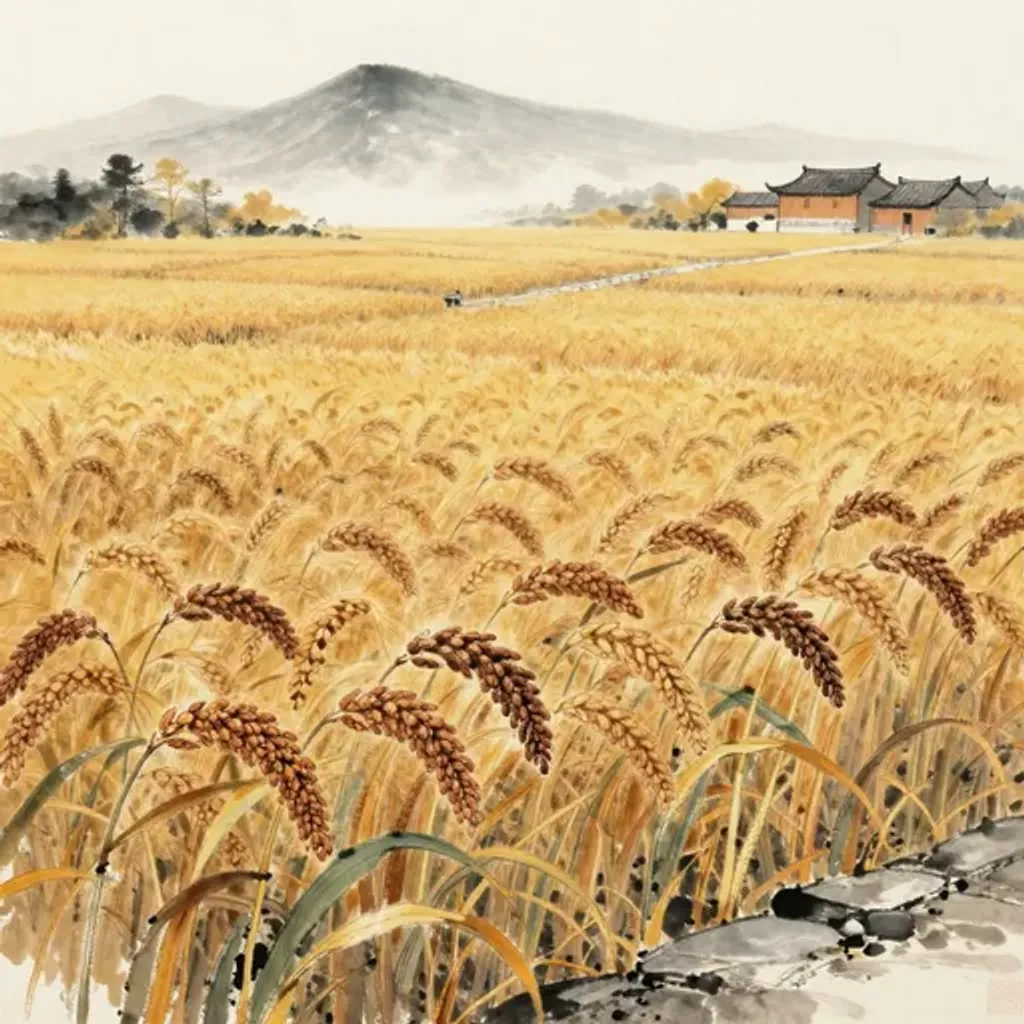
坤厚地德,庶物蕃息;平康正直,以綏大福。
A thousand acres of autumn fields, golden grain bowing low. Wind passes like waves; the granaries will soon be full.
— Jiao Yanshou, Yilin (Forest of Changes), 1st century BC
Commentary
Fire beneath the mountain should illuminate, yet this verse is a rewrite — the original reads: 'Kun's thick earth-virtue lets all creatures multiply and flourish; level, peaceful, and upright, it brings great blessing.' The earth's generous nature (坤厚地德) nurtures abundance without discrimination, and its straightforward quality (平康正直) secures lasting fortune. From Grace to Treading, decorative fire gives way to heaven above the lake. Where Grace adorns, Treading discriminates — distinguishing upper from lower, establishing proper conduct. The original verse's emphasis on Kun's level rectitude resonates with Treading's function: not decoration but correct placement, walking the proper path that stabilizes the people's hearts.
賁 → 泰
Hexagram 22 → Hexagram 11: Peace
Changing lines: 2, 6
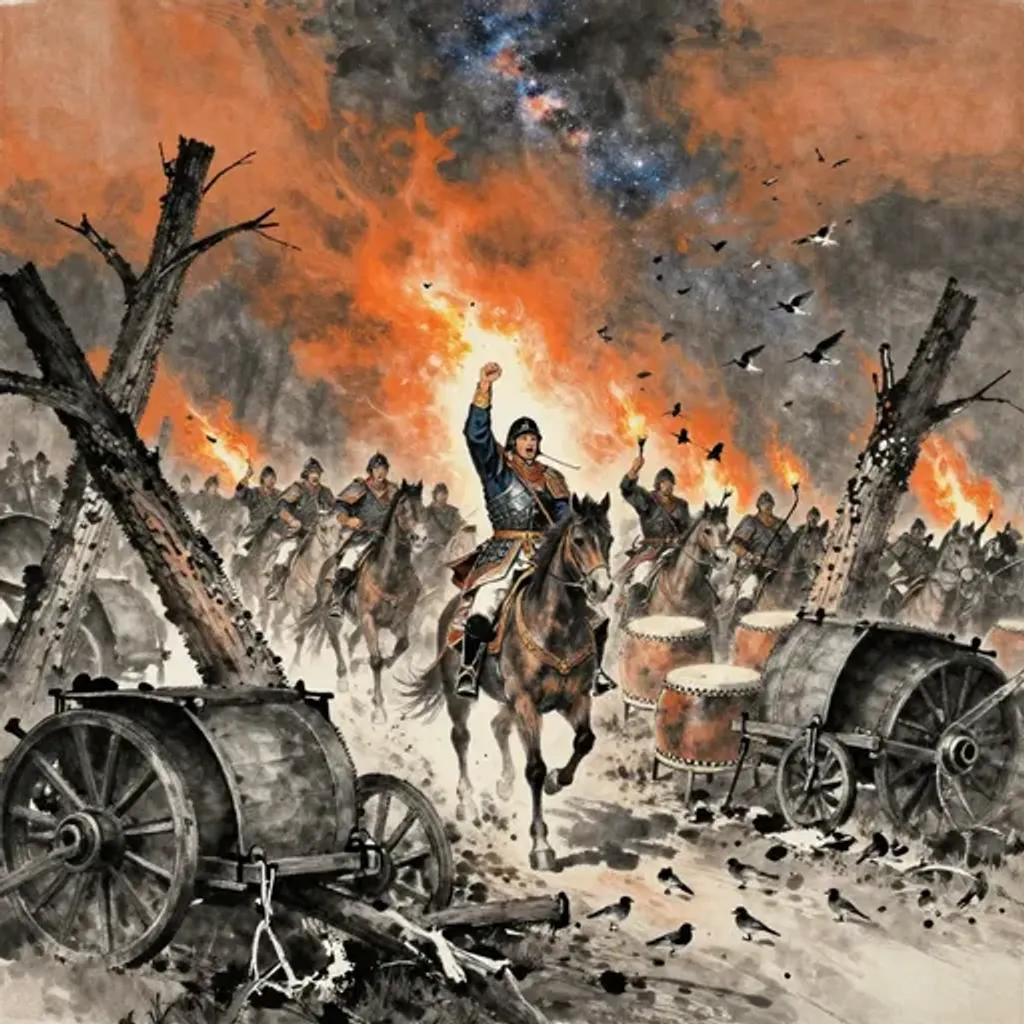
昴畢附耳,將軍求怒。徑路隔塞,燕雀驚駭。
The Pleiades and Hyades press close; the general seeks a fight in fury. The roads are blocked and barricaded; sparrows and swallows scatter in alarm.
— Jiao Yanshou, Yilin (Forest of Changes), 1st century BC
Commentary
Fire beneath the mountain casts shadows among the stars. The Mao and Bi constellations press close to the star Fuer ('Attached Ear'), a celestial configuration the ancients associated with military counsel whispered to a commander. The general seeks to unleash his fury; paths are blocked and barricaded. Sparrows and swallows startle in alarm. In Han-dynasty astrology, the Bi constellation governed border troops and hunting, while Fuer represented the advisor whispering in the ruler's ear. When these stars cluster, it signals military agitation and blocked passage. From Grace to Peace, the mountain's martial fire yields to the free exchange of heaven and earth. What was blocked opens; what was agitated settles into the harmony of Tai.
賁 → 否
Hexagram 22 → Hexagram 12: Standstill
Changing lines: 1, 3, 4, 5
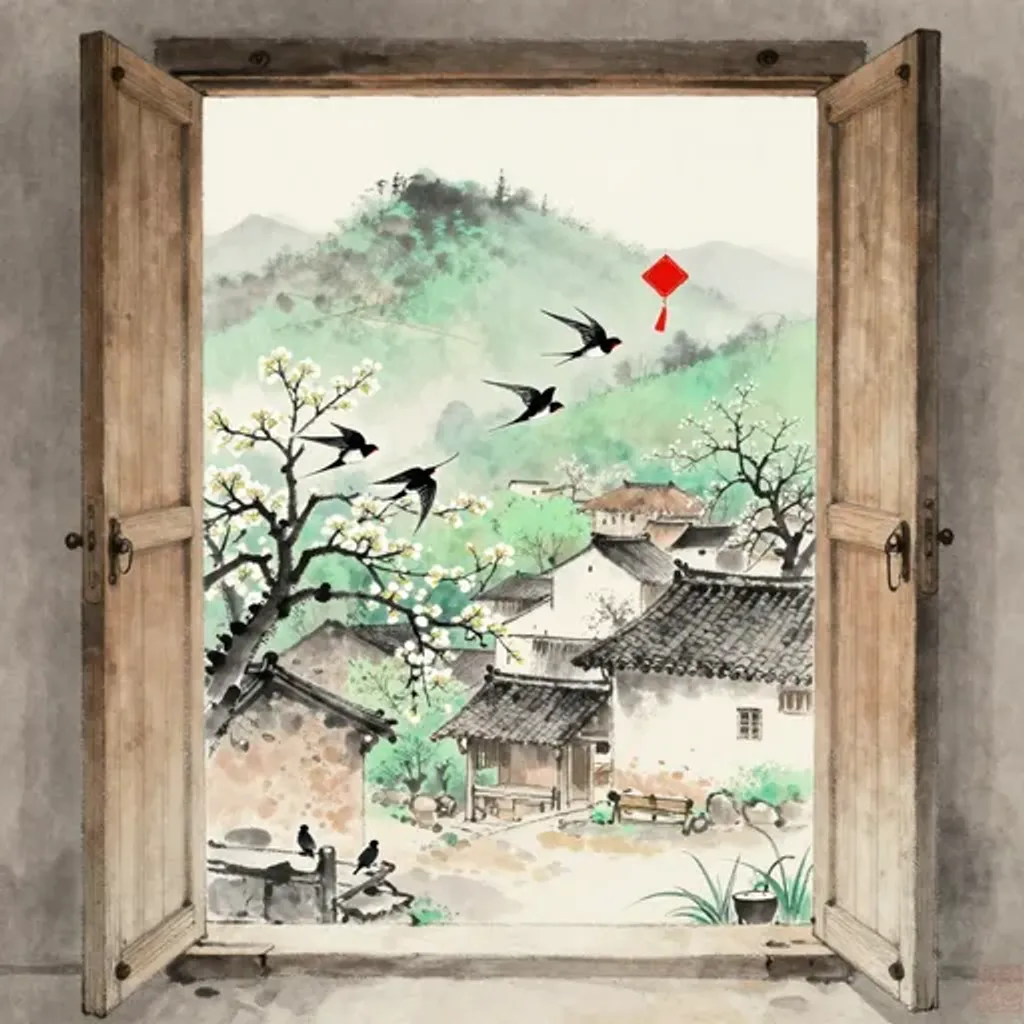
東風啟戶,黔啄翻舞;各樂其類,咸得生處。
The east wind opens the door; dark-capped birds flutter and dance. Each delights in its own kind; all find a place to live.
— Jiao Yanshou, Yilin (Forest of Changes), 1st century BC
Commentary
Fire beneath the mountain yields to the east wind that opens the door. Dark-beaked birds dance and tumble in the breeze — each creature delights in its own kind, and all find a place to live. This verse of simple natural contentment contrasts sharply with the name of its target hexagram. From Grace to Standstill, one would expect blockage and stagnation, yet the verse describes harmony. The paradox suggests that true peace comes precisely when heaven and earth do not interfere with each other — when each being finds its natural station without forced mixing. The Standstill hexagram's image of non-communication, read positively, becomes the Daoist ideal: each in its place, undisturbed.
賁 → 同人
Hexagram 22 → Hexagram 13: Fellowship
Changing lines: 4, 5
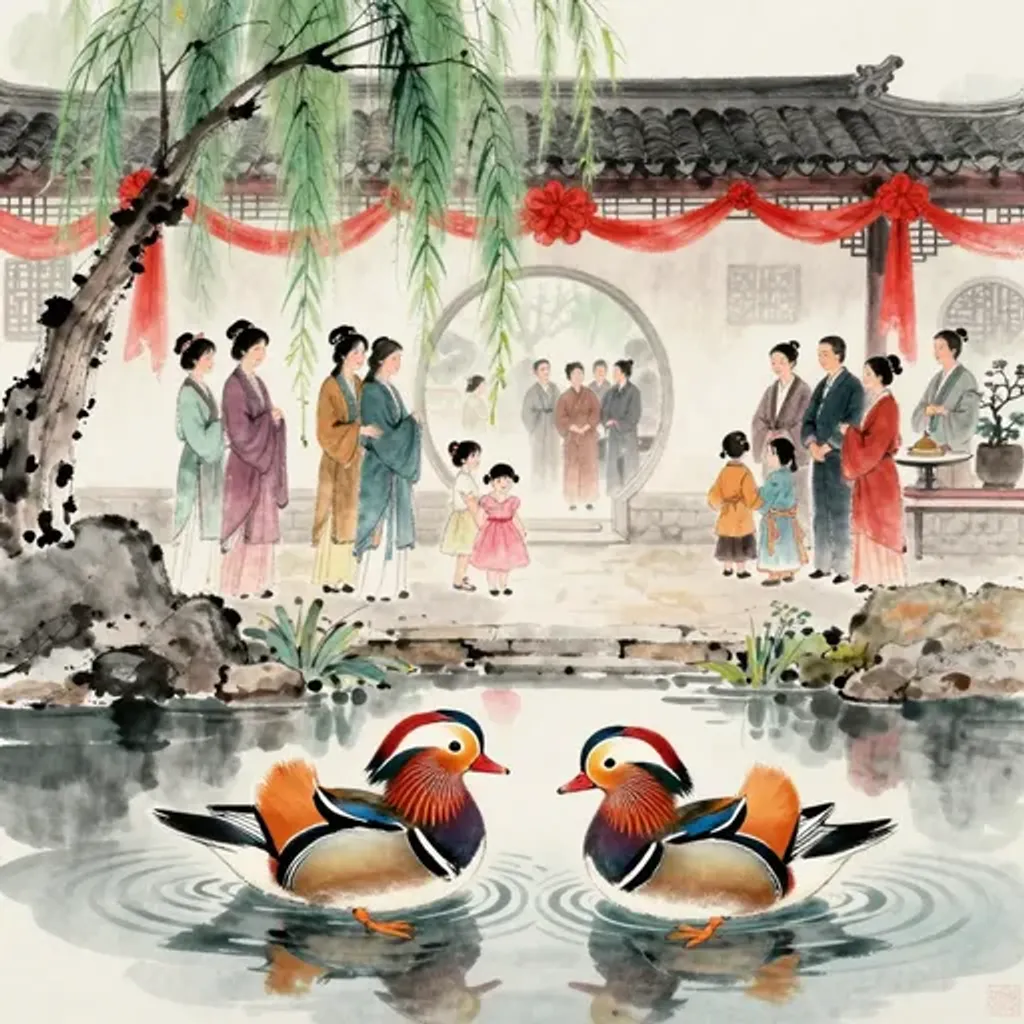
兩足四翼,飛入家國;寧我伯姊,與母相得。
Two feet, four wings; flying into home and country. Comforting my elder sister, who gets along well with mother.
— Jiao Yanshou, Yilin (Forest of Changes), 1st century BC
Commentary
Fire beneath the mountain takes flight. A creature with two feet and four wings soars into the homeland — an image drawn from the shared-wing birds of mythology, creatures that can fly only when paired. Landing home, it brings comfort to elder sister and harmony with the mother. The paired-wing bird (比翼鳥) appears throughout Chinese mythology as a symbol of inseparable partnership. Here, the doubling of wings suggests that reunion completes what was lacking. From Grace to Fellowship, fire beneath the mountain rises to fire beneath heaven. The intimate warmth of family reunion expands into the broader communion of kindred spirits. Fellowship's image — heaven and fire moving together — extends domestic harmony into the world.
賁 → 大有
Hexagram 22 → Hexagram 14: Great Possession
Changing lines: 2, 4
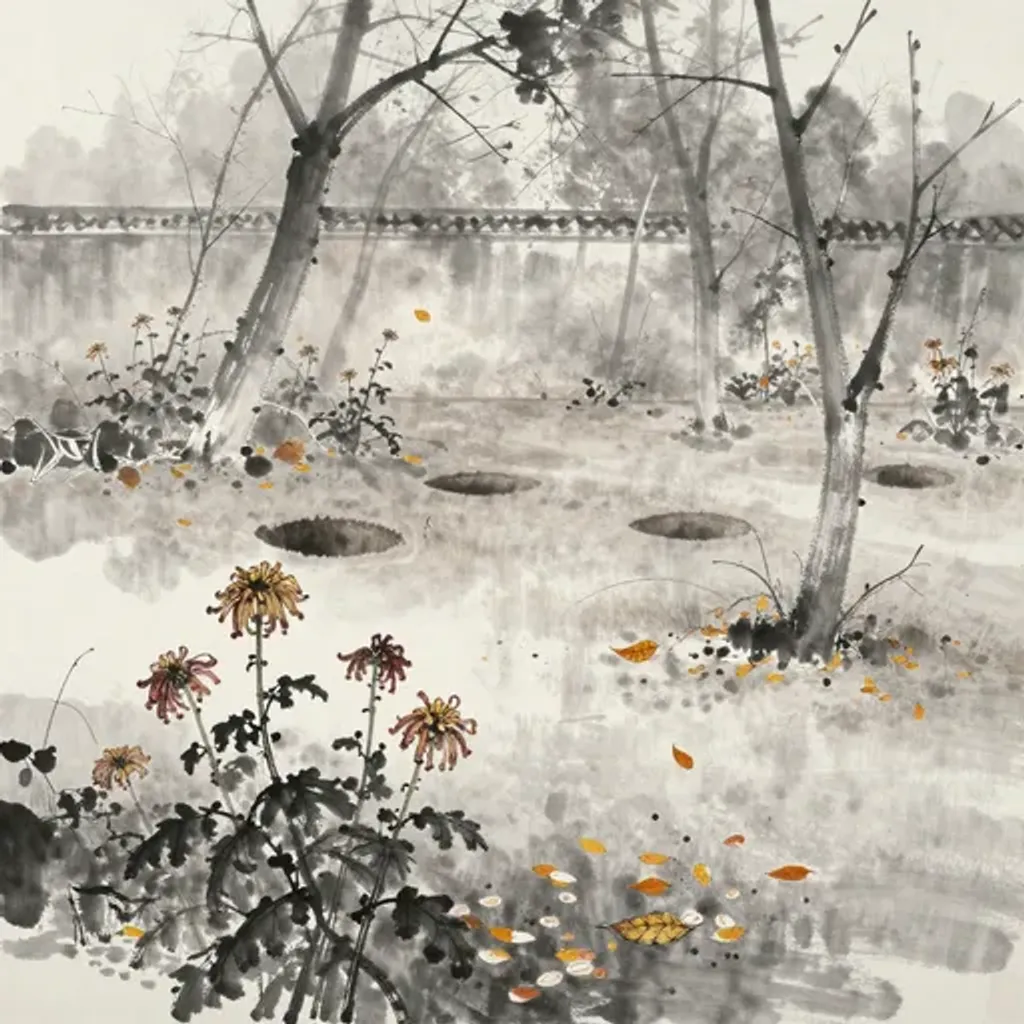
歲暮花落,陽入陰室;萬物伏匿,藏不可得。
At year's end the flowers fall; yang retreats into yin's chamber. The myriad things lie hidden; stored away, impossible to find.
— Jiao Yanshou, Yilin (Forest of Changes), 1st century BC
Commentary
Fire beneath the mountain fades as the year draws to its close. Flowers fall at year's end, and the yang force retreats into the yin chamber. All creatures hide themselves away, concealed beyond finding. This is a portrait of winter's deep withdrawal: not death but strategic dormancy. The seasonal cycle demands that what flourished must now shelter within the earth. From Grace to Great Possession, the paradox sharpens — how does hiding lead to abundance? Because fire in heaven (Great Possession) burns brightest after its period of concealment. The mountain's decorative fire must first retreat underground before it can blaze as heavenly radiance. Concealment is the condition for great possession, not its opposite.
賁 → 謙
Hexagram 22 → Hexagram 15: Modesty
Changing lines: 1, 6
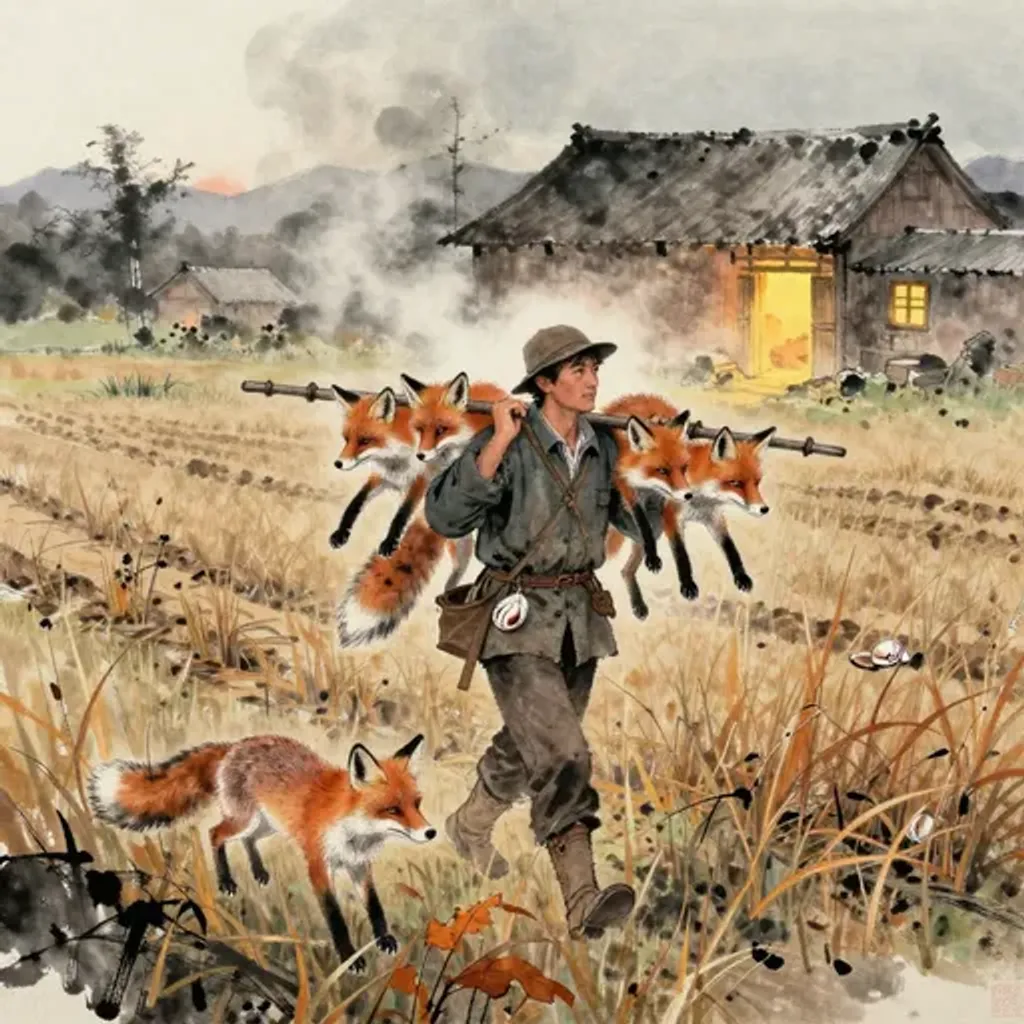
釋然遠咎,避患害早;田獲三狐,以貝為寶。
Released from blame and kept far from fault, avoiding calamity early. Hunting in the field, three foxes are caught; cowrie shells become the treasure.
— Jiao Yanshou, Yilin (Forest of Changes), 1st century BC
Commentary
Fire beneath the mountain illuminates the path of prudent withdrawal. One releases trouble with relief, avoiding harm before it arrives. The hunter catches three foxes in the field and finds cowrie shells — ancient currency — as treasure. The three foxes recall the I-Ching's Jie hexagram (line nine-two), where capturing three foxes and obtaining a yellow arrow symbolizes resolving entanglements. Cowries as treasure suggest modest but genuine wealth, earned through timely action. From Grace to Modesty, the mountain that once displayed fire now hides within the earth. Adornment retreats beneath the surface; what remains is the mountain's hidden mass — substance without show, the essence of Qian's leveling virtue.
賁 → 豫
Hexagram 22 → Hexagram 16: Enthusiasm
Changing lines: 1, 3, 4, 6
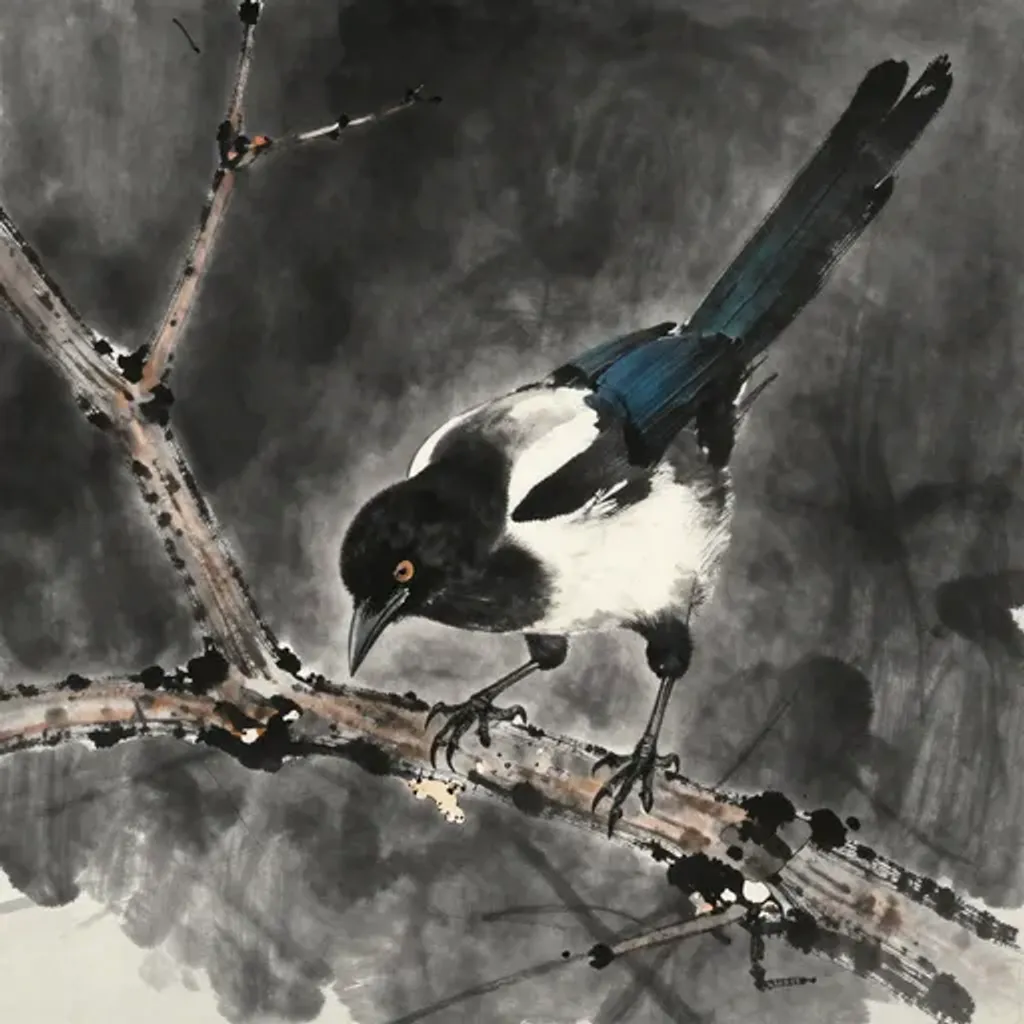
鵲延卻縮,不見頭目;日以困急,不能自復。
The magpie stretches then shrinks back; head and eyes cannot be seen. Day by day more pressed and desperate; unable to recover on its own.
— Jiao Yanshou, Yilin (Forest of Changes), 1st century BC
Commentary
Fire beneath the mountain reveals a magpie stretching forward then shrinking back, its head and eyes lost from sight. Day by day the situation grows more dire and desperate, with no way to recover. The magpie — ordinarily a bird of good omen in Chinese tradition — here is paralyzed, extending and retracting in indecision, unable to commit to any direction. From Grace to Enthusiasm, the mountain's static fire transforms into thunder erupting from the earth. The magpie's frozen hesitation is the antithesis of Yu's galvanizing energy. Where Grace decorates inaction, Enthusiasm demands movement. The verse warns that adorning paralysis only deepens the crisis — what is needed is the thunder's decisive burst.
賁 → 隨
Hexagram 22 → Hexagram 17: Following
Changing lines: 3, 4, 5, 6
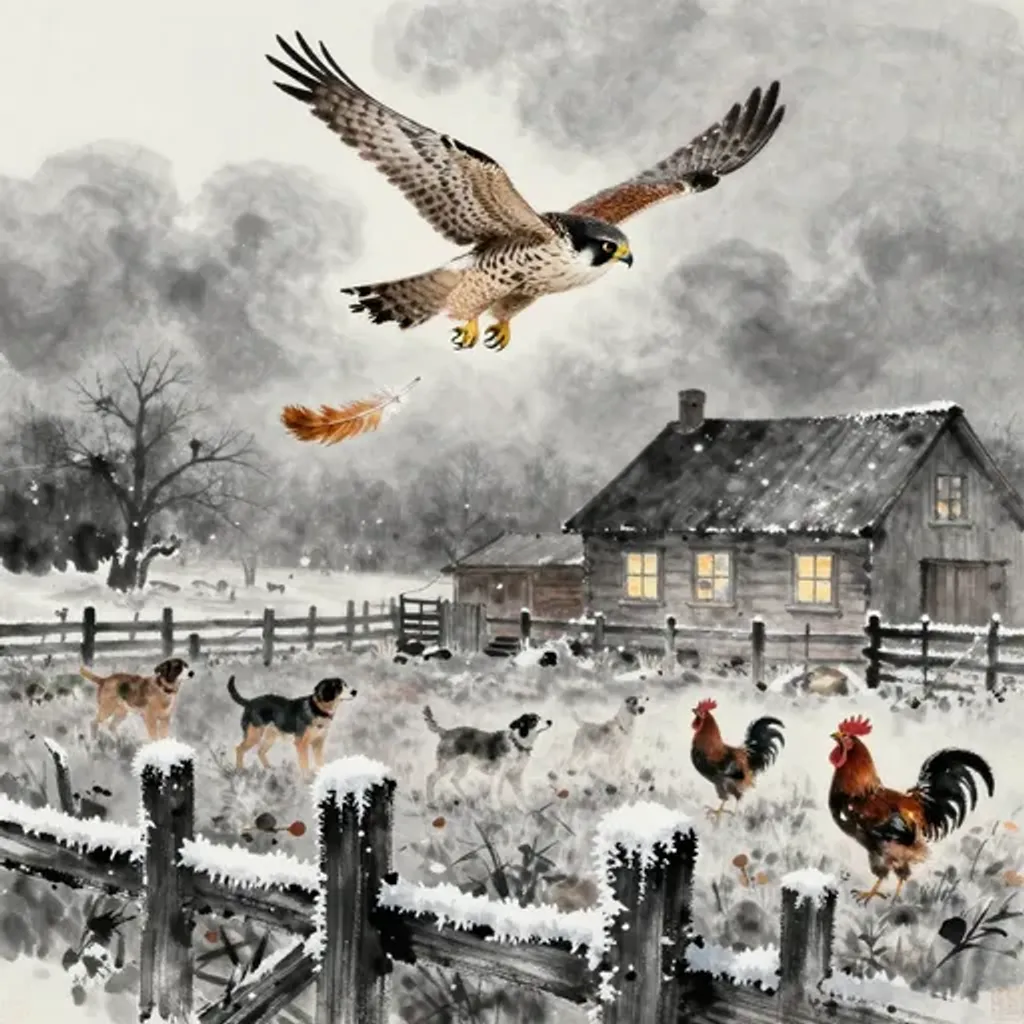
秋隼冬翔,數被嚴霜;雞犬夜鳴,家擾不寧。
The autumn falcon soars in winter, battered again and again by bitter frost. Dogs and roosters cry in the night; the household is disturbed and finds no peace.
— Jiao Yanshou, Yilin (Forest of Changes), 1st century BC
Commentary
Fire beneath the mountain turns cold. An autumn falcon soars into winter, repeatedly beaten by severe frost. Roosters and dogs cry through the night, and the household is restless and disturbed. The falcon — a creature of precision and power — flies against the season and suffers for it. Animals that should be silent at night raise alarm, signaling that the natural order is disrupted. From Grace to Following, the mountain's fire descends into thunder resting within the lake. Following's image suggests yielding to the natural rhythm: at nightfall, one should rest. The falcon fighting winter frost embodies the refusal to follow the season, and the household pays the price in sleepless anxiety.
賁 → 蠱
Hexagram 22 → Hexagram 18: Work on the Decayed
Changing lines: 1, 2
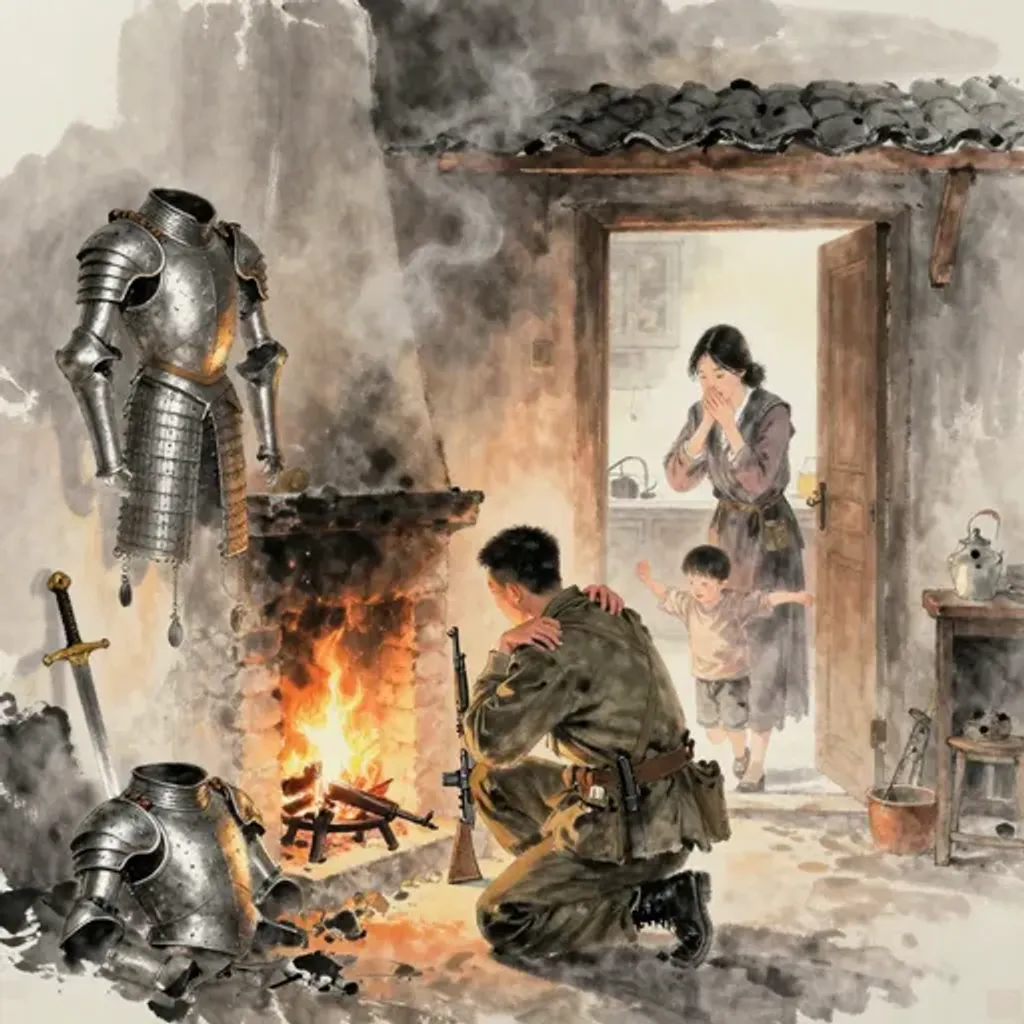
班馬還師,以息勞罷。役夫嘉喜,入戶見妻。
Armor stripped off and hung on the wall; washing away campaign dust, changing into cotton clothes. Wife at the door, child clutching his leg — the hearth is lit again, food smells fill the air.
— Jiao Yanshou, Yilin (Forest of Changes), 1st century BC
Commentary
Fire beneath the mountain is a rewrite — the original verse reads: 'The striped war-horses return with the army, to rest from weariness and toil; the conscript soldiers rejoice, entering their doors to see their wives.' This is a homecoming scene: the army disbands, campaigns end, and exhausted soldiers return to domestic life. The original phrase 'ban ma huan shi' (班馬還師) specifically describes war-horses returning in formation. From Grace to Work on the Decayed, the mountain remains but fire yields to wind beneath. Where Grace adorned the martial exterior, Work on the Decayed addresses what festers in peacetime. The soldier's return marks not an ending but the beginning of repair — restoring what war corroded.
賁 → 臨
Hexagram 22 → Hexagram 19: Approach
Changing lines: 2, 3, 6
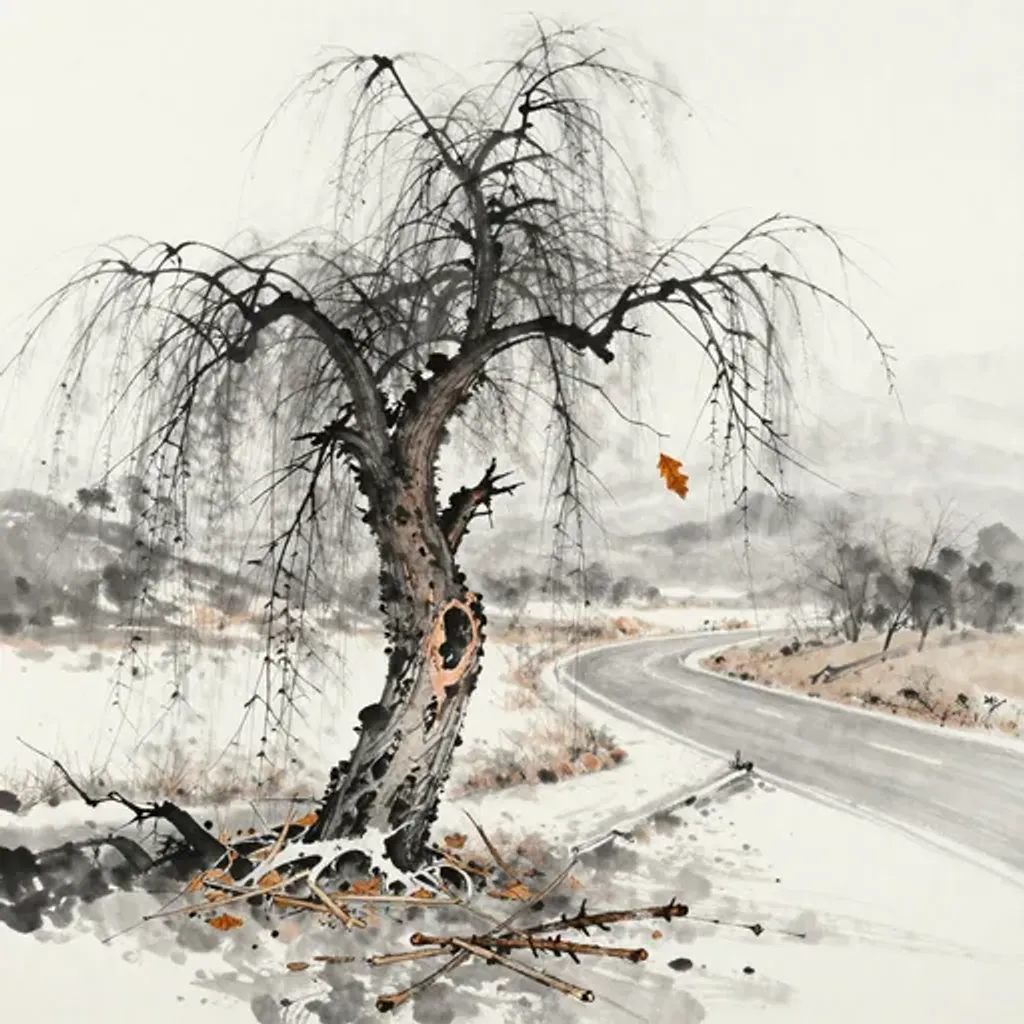
老楊日衰,條多枯枝。爵級不進,逐下摧隤。
The old willow daily declines; its branches grow many dead limbs. Rank and title advance no further; one is driven down and brought low.
— Jiao Yanshou, Yilin (Forest of Changes), 1st century BC
Commentary
Fire beneath the mountain illuminates an aging tree. An old poplar declines day by day, its branches mostly withered and bare. Official rank stalls without advancement, and one is pushed downward into ruin. The poplar's slow decay mirrors the bureaucrat's stalled career — both were once vital, now desiccating beyond recovery. From Grace to Approach, the lake rises beneath the earth, suggesting expansive authority drawing near. Yet the verse offers no such promise: the approach here is approach of decline. The irony deepens the warning — when adornment (Grace) meets the power of Approach without substance to sustain it, the result is not elevation but exposure of one's withered state.
賁 → 觀
Hexagram 22 → Hexagram 20: Contemplation
Changing lines: 1, 3, 5
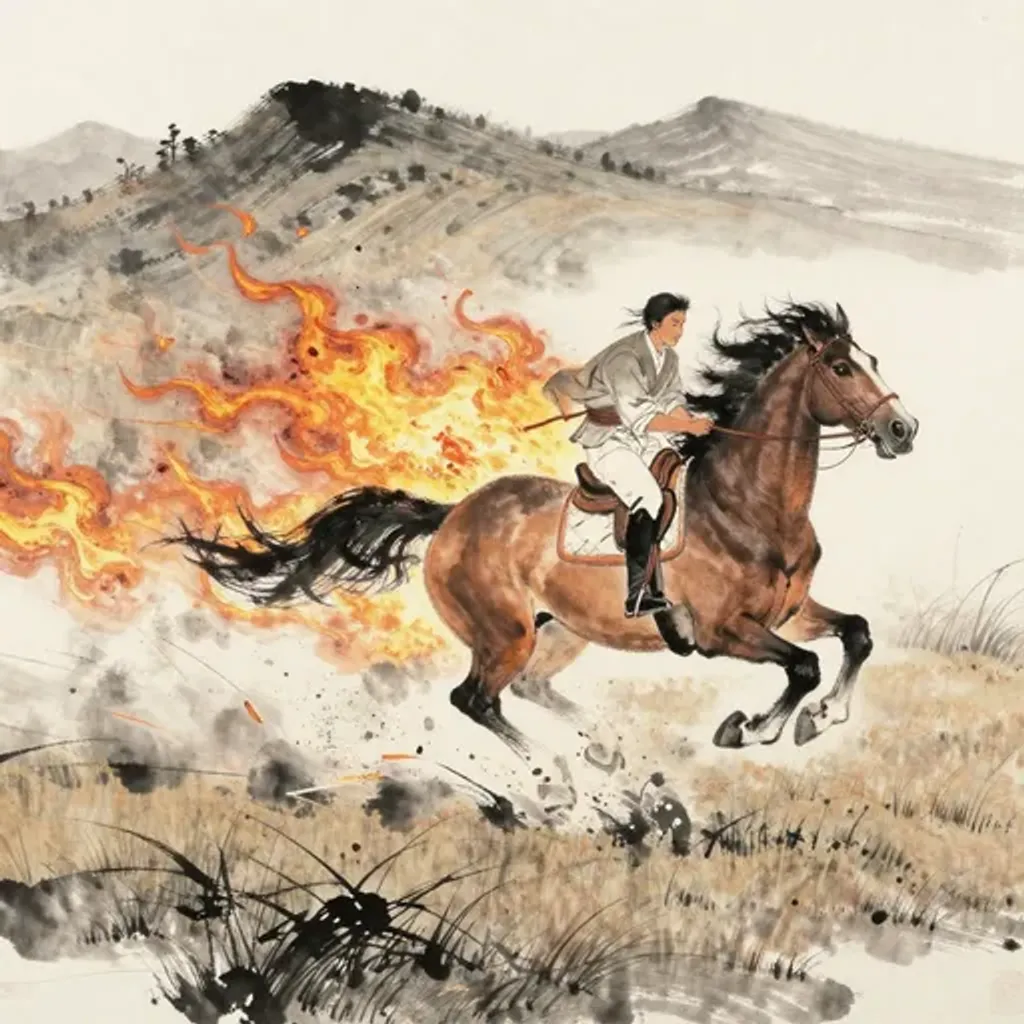
順風吹火,牽騎驥尾。易為功力,因懼受福。
Blowing downwind to fan the fire; grasping the tail of a galloping steed. Easy to accomplish with such force; from apprehension, one receives good fortune.
— Jiao Yanshou, Yilin (Forest of Changes), 1st century BC
Commentary
Fire beneath the mountain fans into effortless action. Blowing with the wind to stoke a fire, grabbing a swift horse by the tail — both images convey leveraging natural momentum rather than fighting against it. The result is easy achievement with minimal effort: through wisely channeling fear, one receives blessing. The folk wisdom here is practical: work with the current, not against it. From Grace to Contemplation, the mountain's fire transforms into wind moving across the earth. Contemplation's image — the ancient kings touring the land to observe the people — captures the same principle: true understanding comes from observing the direction things naturally move, then aligning with that flow.
賁 → 噬嗑
Hexagram 22 → Hexagram 21: Biting Through
Changing lines: 3, 4
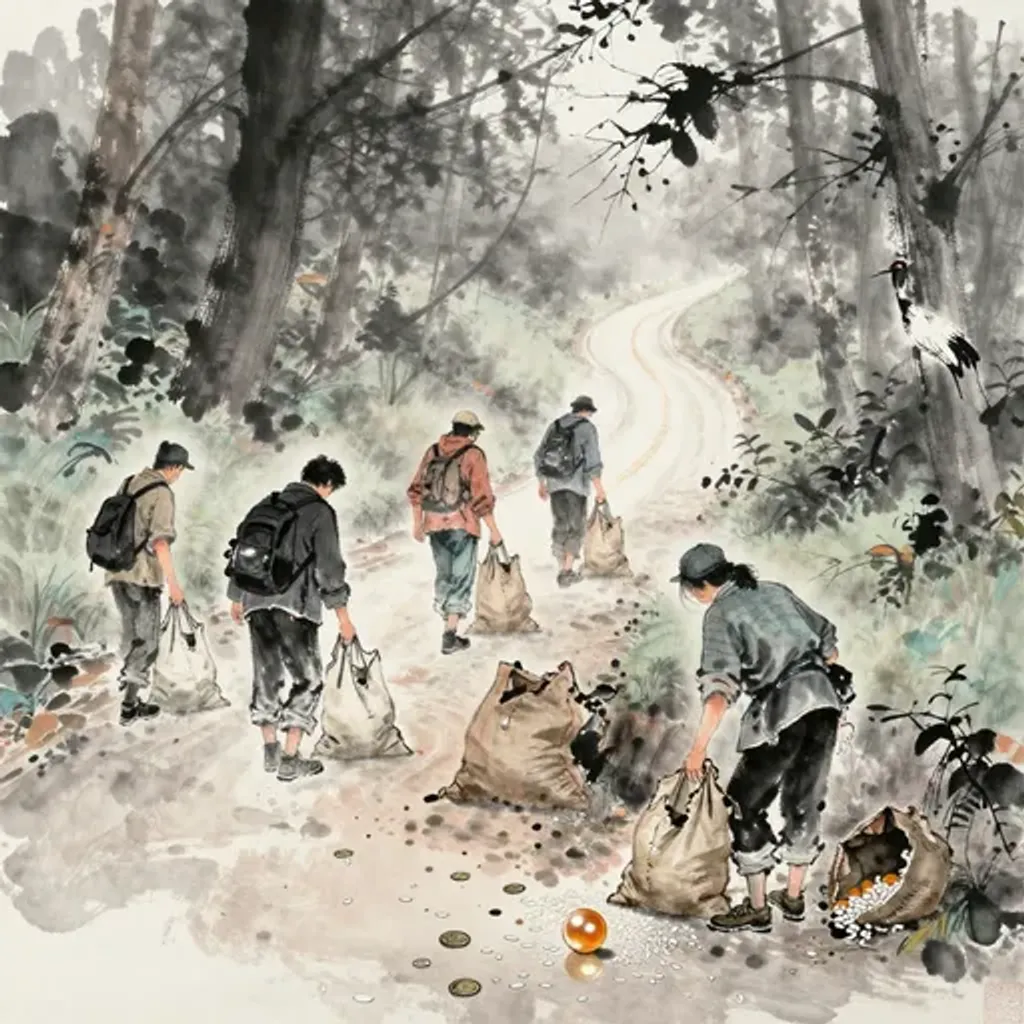
六人俱行,各遺其囊。黃鶴失珠,無以為明。
Six men travel together, each losing his provisions. The yellow crane loses its pearl; it has nothing to shine by.
— Jiao Yanshou, Yilin (Forest of Changes), 1st century BC
Commentary
Fire beneath the mountain reveals six travelers who each lose their pouches along the way. A yellow crane loses its pearl and has nothing left to shine by. The journey strips away all possessions and all sources of light. Six people traveling together yet each individually losing what they carry — this is not robbery but carelessness, a collective failure of attention. The crane's pearl, its source of luminous power, gone. From Grace to Biting Through, the mountain's fire gives way to lightning and thunder. Where Grace decorates, Biting Through enforces — it clears obstruction by decisive action. The lost pouches and lost pearl represent what happens when appearances are maintained without vigilance: the substance drains away unnoticed.
賁 → 賁
Hexagram 22 → Hexagram 22: Grace
No changing lines — the hexagram is unchanged
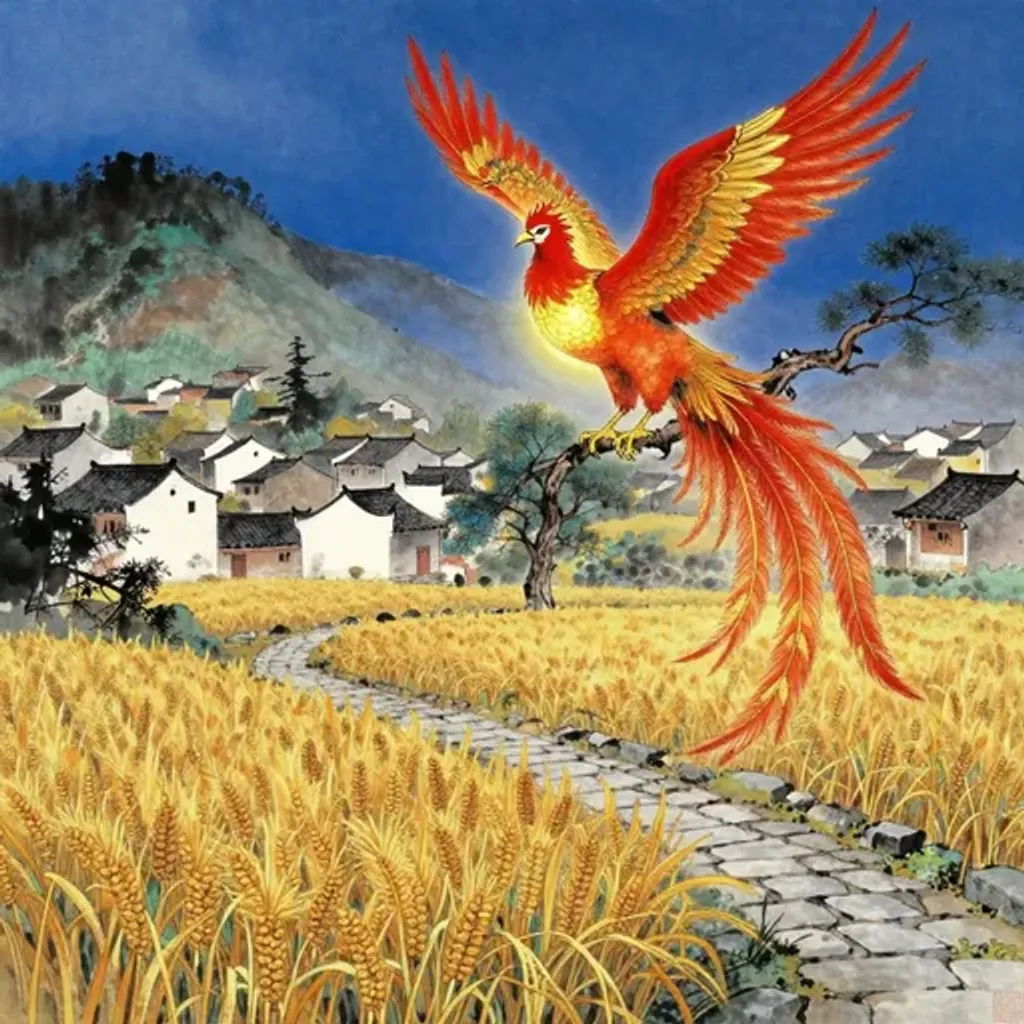
政不暴虐,鳳凰來舍;四時順節,民安其居。
Governance neither cruel nor oppressive; the phoenix comes to dwell. The four seasons follow their proper order; the people rest secure in their homes.
— Jiao Yanshou, Yilin (Forest of Changes), 1st century BC
Commentary
Fire beneath the mountain mirrors itself — Grace transforms into Grace, the hexagram unchanged. When governance is not tyrannical, the phoenix comes to dwell. The four seasons follow their proper rhythm, and the people rest secure in their homes. The phoenix appears only under a sage ruler whose virtue radiates without coercion. This self-referential verse captures Grace's highest potential: adornment as the natural expression of good order, not artifice imposed upon chaos. When the source and target are identical, the message is: this pattern, fully realized, needs no transformation. Civilized beauty at its best is not decoration but the visible form of virtue — the phoenix choosing to settle where it senses authentic grace.
賁 → 剝
Hexagram 22 → Hexagram 23: Splitting Apart
Changing lines: 1, 3
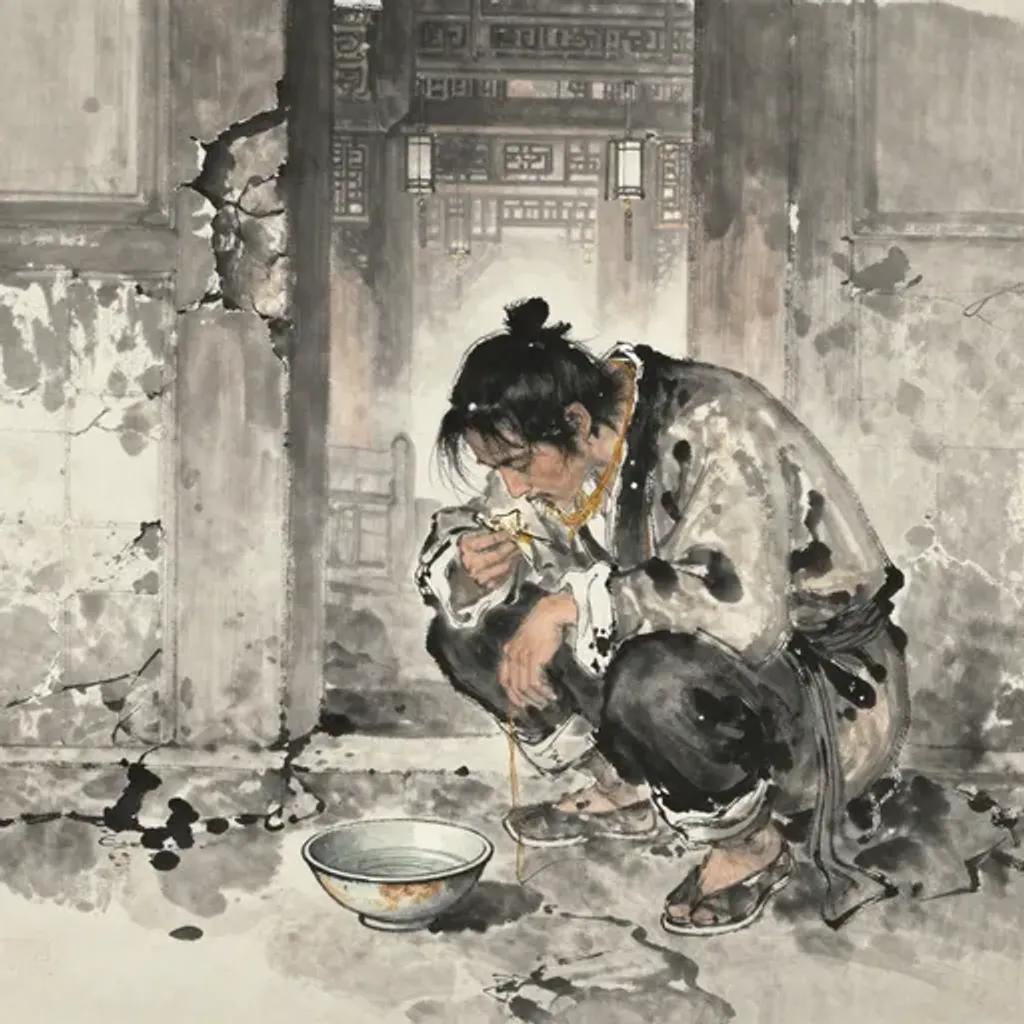
依叔墻隅,志下勞苦。楚相辰食,韓子低頭。
Leaning in the corner of an uncle's wall; one's aspirations are low, toiling in hardship. The Chu minister eats at the wrong hour; Master Han bows his head.
— Jiao Yanshou, Yilin (Forest of Changes), 1st century BC
Commentary
Fire beneath the mountain illuminates a figure leaning against a wall in a corner, ambitions low, laboring in hardship. The Chu minister eats at the appointed hour; the Han prince bows his head. Both images suggest once-powerful figures reduced to subservience — eating on schedule like a dependent, lowering one's head in submission. The 'Chu minister' may allude to a fallen official dining without autonomy; 'Han prince' to one of the many Han royal scions forced into deference. From Grace to Splitting Apart, the mountain crumbles upon the earth. The decorative fire gutters out as the mountain's substance erodes from beneath. Adornment gives way to systematic stripping — position, pride, and agency peeled away layer by layer.
賁 → 復
Hexagram 22 → Hexagram 24: Return
Changing lines: 3, 6
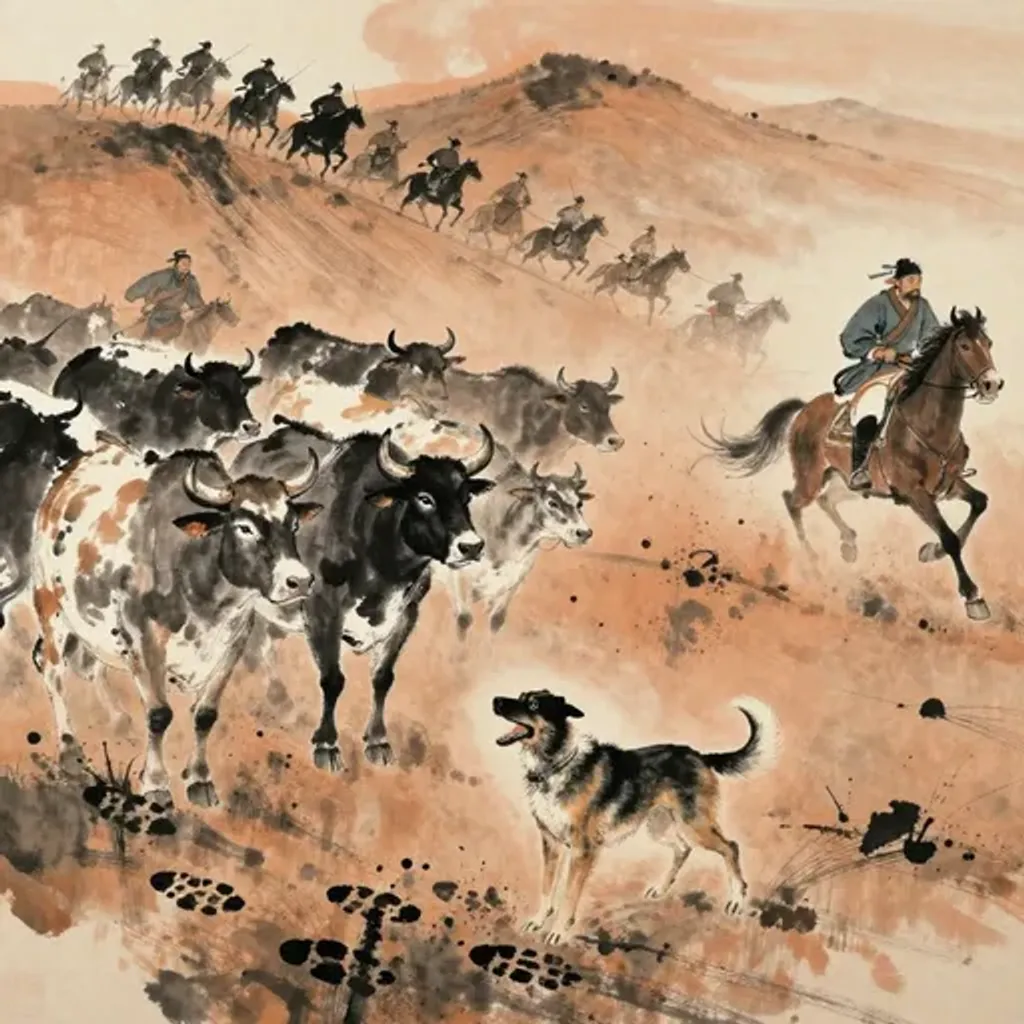
三牛生狗,以戌為母。荊夷上侵,姬伯出走。
Three cows give birth to a dog, taking the eleventh branch as its mother. The Jing and Yi invade from the north; the Ji lord flees in exile.
— Jiao Yanshou, Yilin (Forest of Changes), 1st century BC
Commentary
Fire beneath the mountain throws strange shadows: three oxen give birth to a dog, and the Dog (xu/戌) is treated as mother. This monstrous birth signals a fundamental inversion of natural categories — an omen of dynastic disruption. The verse then shifts to history: the Jing barbarians (Chu) press northward, and a Ji-surnamed lord flees. During the Spring and Autumn period, Chu's expansion repeatedly threatened the Central States, forcing Zhou-lineage rulers to abandon their territories. The unnatural birth presages political upheaval: when proper categories collapse, legitimate rulers lose their seats. From Grace to Return, thunder stirs beneath the earth. The adorned order shatters, but Return promises renewal — the single yang line re-entering from below.
賁 → 无妄
Hexagram 22 → Hexagram 25: Innocence
Changing lines: 3, 4, 5
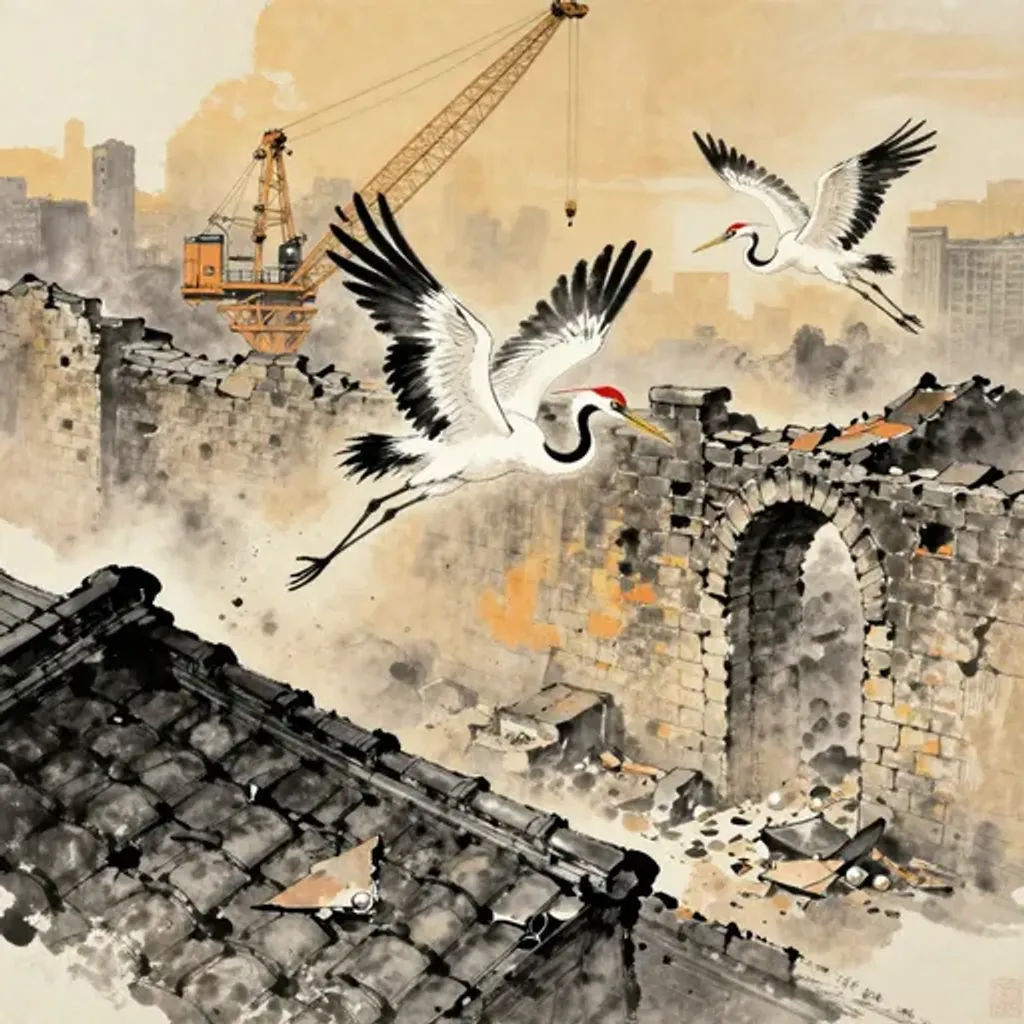
鶴盜我珠,逃於東都。鵠怒追求,郭氏之墟。不見蹤跡,反為患災。
A crane steals my pearl and flees to the eastern capital. The swan goose gives chase in anger, to the ruins of the Guo domain. No trace is found; instead, calamity befalls.
— Jiao Yanshou, Yilin (Forest of Changes), 1st century BC
Commentary
Fire beneath the mountain reveals a theft and a futile chase. A crane steals one's pearl and escapes to the eastern capital. An enraged swan pursues it, reaching the ruins of the Guo state, but finds no trace — and the pursuit itself becomes a disaster. The pearl, once a source of brilliance, is lost to a thief who flies beyond reach. The eastern capital (Luoyang) and the ruins of Guo evoke the collapse of small states destroyed by larger powers during the Spring and Autumn period. From Grace to Innocence, the mountain's fire yields to thunder moving beneath heaven. Innocence (Wuwang) warns against reckless action untethered from reality: the swan's angry chase, driven by righteous fury, produces only calamity. Sometimes the proper response to loss is to stop pursuing.
賁 → 大畜
Hexagram 22 → Hexagram 26: Great Taming
Changing lines: 2
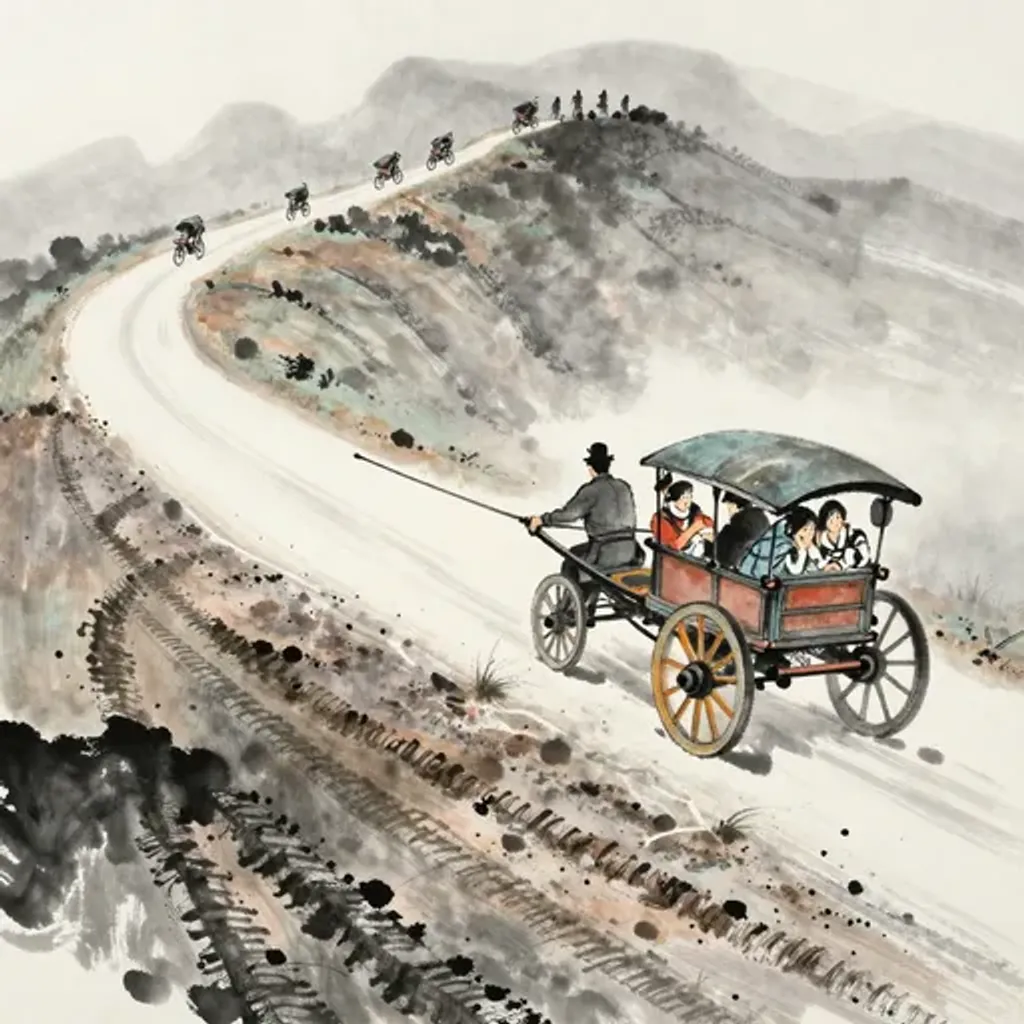
升輿中退,舉事不遂。哺麋毀齒,失其道理。
Mounting the carriage only to retreat; every undertaking fails to succeed. Feeding the elk ruins the teeth; one loses the proper way.
— Jiao Yanshou, Yilin (Forest of Changes), 1st century BC
Commentary
Fire beneath the mountain falters. One mounts the carriage only to retreat midway; undertakings fail to reach completion. Feeding dried meat to a deer ruins the teeth — the wrong sustenance applied to the wrong creature destroys the instrument itself. Everything here is mismatched: advance turns to retreat, nourishment becomes damage, and the proper way is lost. From Grace to Great Taming, fire beneath the mountain transforms into heaven stored within the mountain. Great Taming accumulates and restrains powerful forces, but the verse shows what happens when accumulation is mismanaged: the stored energy turns self-destructive. The carriage that retreats and the teeth that crack warn that improper methods corrupt even what should be nourishing.
賁 → 頤
Hexagram 22 → Hexagram 27: Nourishment
Changing lines: 3
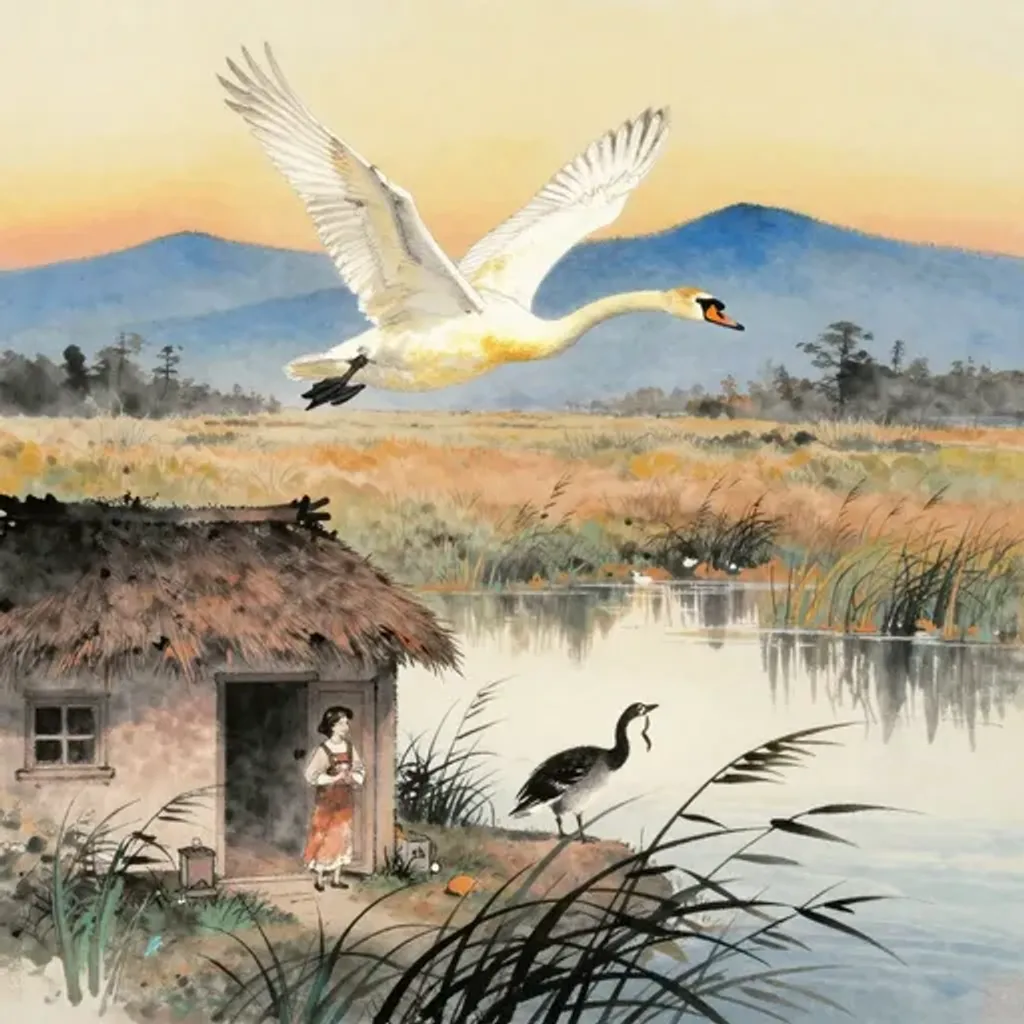
鴻鵠高飛,鳴求其雌。雌來在戶,雄哺嘻嘻。甚獨勞苦,炰鱉膾鯉。
The swan goose flies high, calling for its mate. The female comes to the door; the male feeds her, cooing with delight. So greatly does he toil alone; stewing turtle and slicing carp.
— Jiao Yanshou, Yilin (Forest of Changes), 1st century BC
Commentary
Fire beneath the mountain warms a domestic scene. A wild swan flies high, calling for its mate. The female arrives at the doorway; the male feeds her, clucking with delight. Though the labor is solitary and exhausting, the reward comes as a feast of braised turtle and sliced carp — luxury foods signaling celebration. The verse moves from yearning to reunion to nourishment: a complete arc of longing fulfilled. From Grace to Nourishment, fire beneath the mountain transforms into thunder beneath the mountain. Where Grace adorns the exterior, Nourishment addresses what truly sustains. The swan's patient calling and devoted feeding embody Yi's core teaching: what and how we nourish determines whether we thrive.
賁 → 大過
Hexagram 22 → Hexagram 28: Great Exceeding
Changing lines: 1, 2, 4, 5, 6
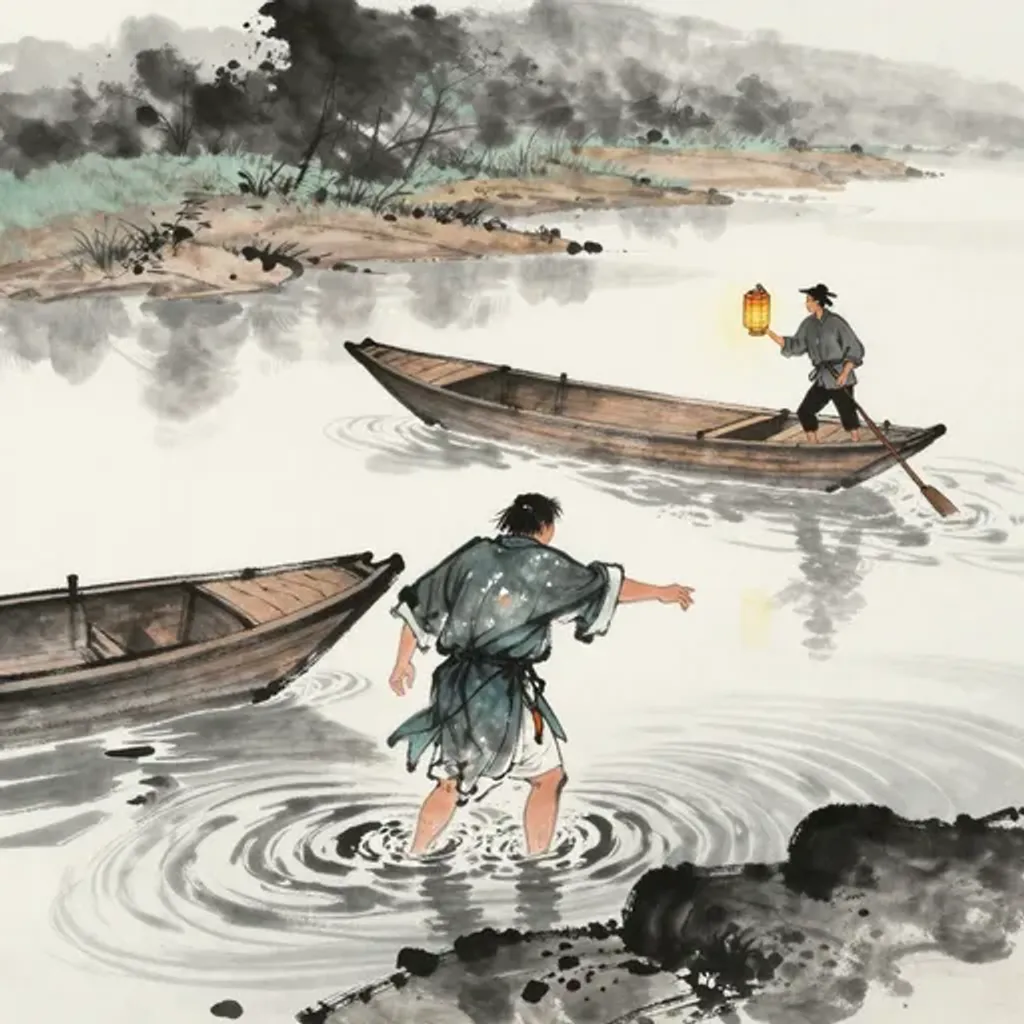
褰衣涉河,水深漬衣。幸賴舟子,濟脫無他。
Lifting one's robes to ford the river, the water is deep and soaks the clothes. Fortunately a boatman comes alongside; one crosses safely without mishap.
— Jiao Yanshou, Yilin (Forest of Changes), 1st century BC
Commentary
Fire beneath the mountain meets deep water. Someone hitches up their garments to wade across a river, but the water is too deep and soaks through the clothes. Fortunately, a boatman appears and ferries the traveler safely across — no further harm done. The verse captures the moment when self-reliance fails and one must accept help. Lifting one's robes is a gesture of cautious preparation, but the river exceeds all preparation. From Grace to Great Exceeding, fire beneath the mountain yields to the lake submerging the trees. Great Exceeding is the hexagram of extraordinary pressure — the ridgepole sags under impossible weight. The boatman's rescue mirrors the hexagram's counsel: in moments of extreme excess, unconventional aid and extraordinary measures are the only salvation.
賁 → 坎
Hexagram 22 → Hexagram 29: The Abysmal Water
Changing lines: 1, 2, 3, 5, 6
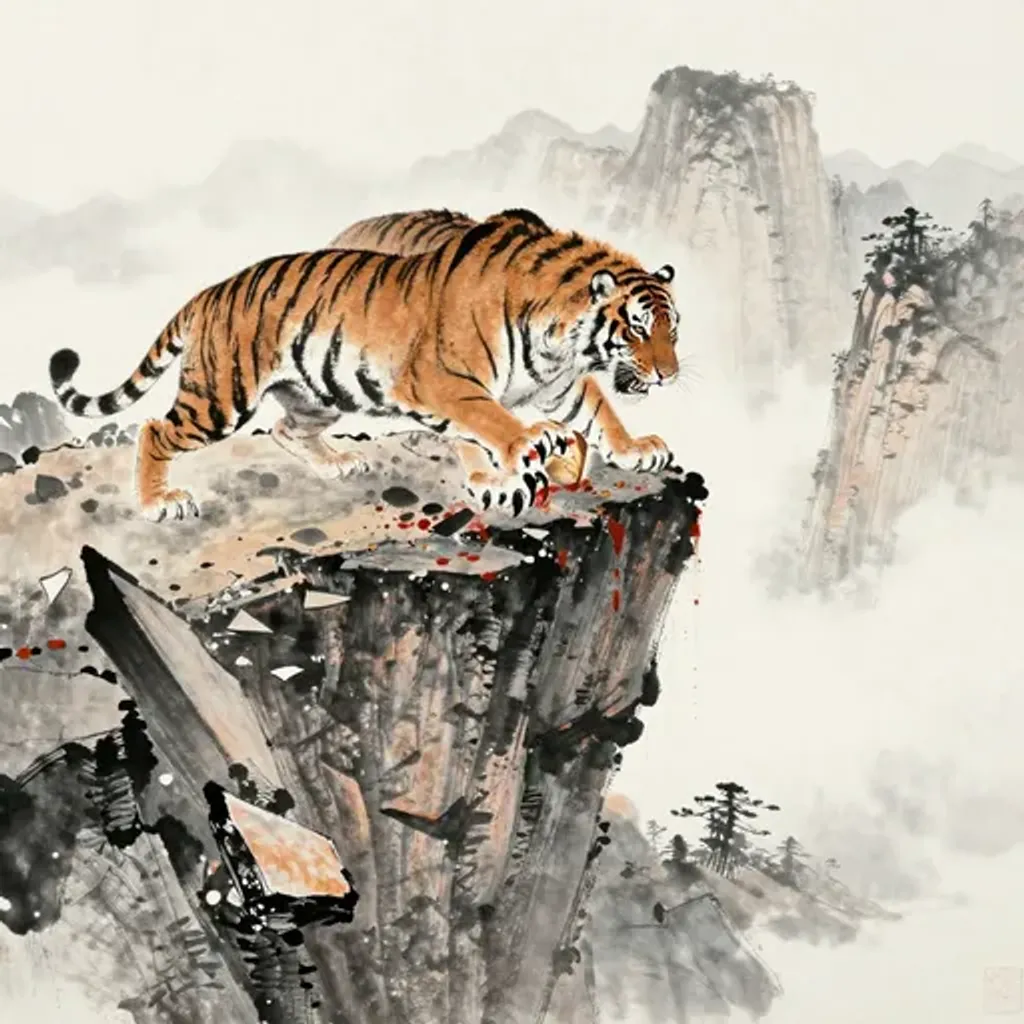
虎齧龍指,太山之崖。天命不佑,不見其雌。
The tiger gnaws the dragon's claw, at the cliff of Mount Tai. Heaven's mandate does not protect; one cannot find its mate.
— Jiao Yanshou, Yilin (Forest of Changes), 1st century BC
Commentary
Fire beneath the mountain illuminates a scene of primal violence. A tiger gnaws a dragon's claw on the cliff of Mount Tai — two supreme forces locked in mutual destruction at the summit of the sacred mountain. Heaven's mandate withdraws its protection, and the male cannot find its female: no union, no continuation, no progeny. The imagery is stark and mythological: dragon and tiger, yang and yang, consuming each other rather than complementing. Mount Tai, the axis of cosmic authority, becomes the arena for this catastrophe. From Grace to the Abysmal, fire beneath the mountain plunges into doubled water. The adorned surface collapses into the abyss — repeated peril with no foothold, where even supreme powers destroy each other.
賁 → 離
Hexagram 22 → Hexagram 30: The Clinging Fire
Changing lines: 4
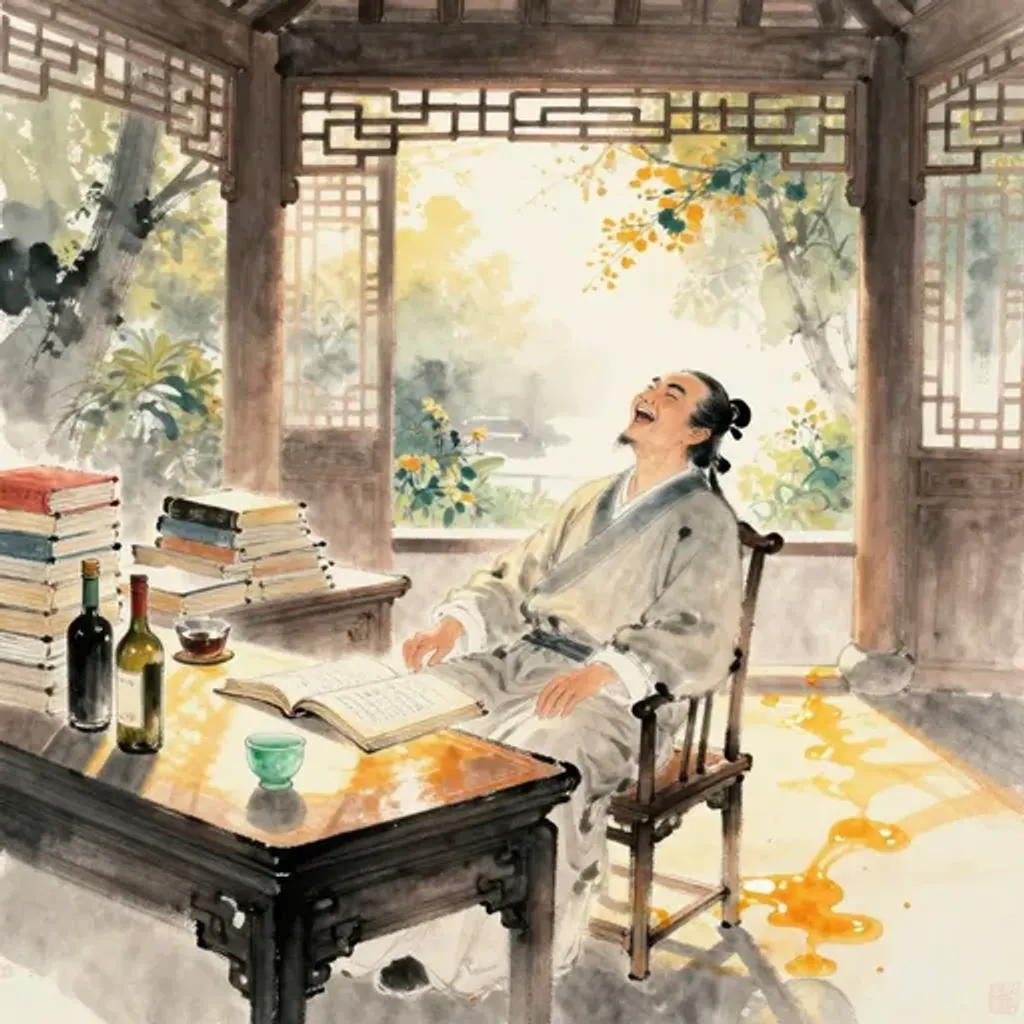
明不處暗,智不履危。終日卒歲,樂以笑歌。
The wise do not dwell in darkness; the clever do not tread on danger. Through all the days and years, they delight in laughter and song.
— Jiao Yanshou, Yilin (Forest of Changes), 1st century BC
Commentary
Fire beneath the mountain declares its own nature: the bright does not dwell in darkness, and the wise does not tread into danger. Through the days and to the year's end, one delights in laughter and song. This is Grace fulfilling its highest promise — clarity that knows where not to go and therefore finds enduring joy. The bright person avoids darkness not through fear but through discernment; the wise person sidesteps danger not through cowardice but through understanding. From Grace to the Clinging, fire beneath the mountain rises into doubled fire. Both hexagrams share fire, but the Clinging's double illumination extends what Grace contained. What was decorative light becomes penetrating clarity — the continuous brightness that illuminates all four directions.
賁 → 咸
Hexagram 22 → Hexagram 31: Influence
Changing lines: 1, 4, 5, 6
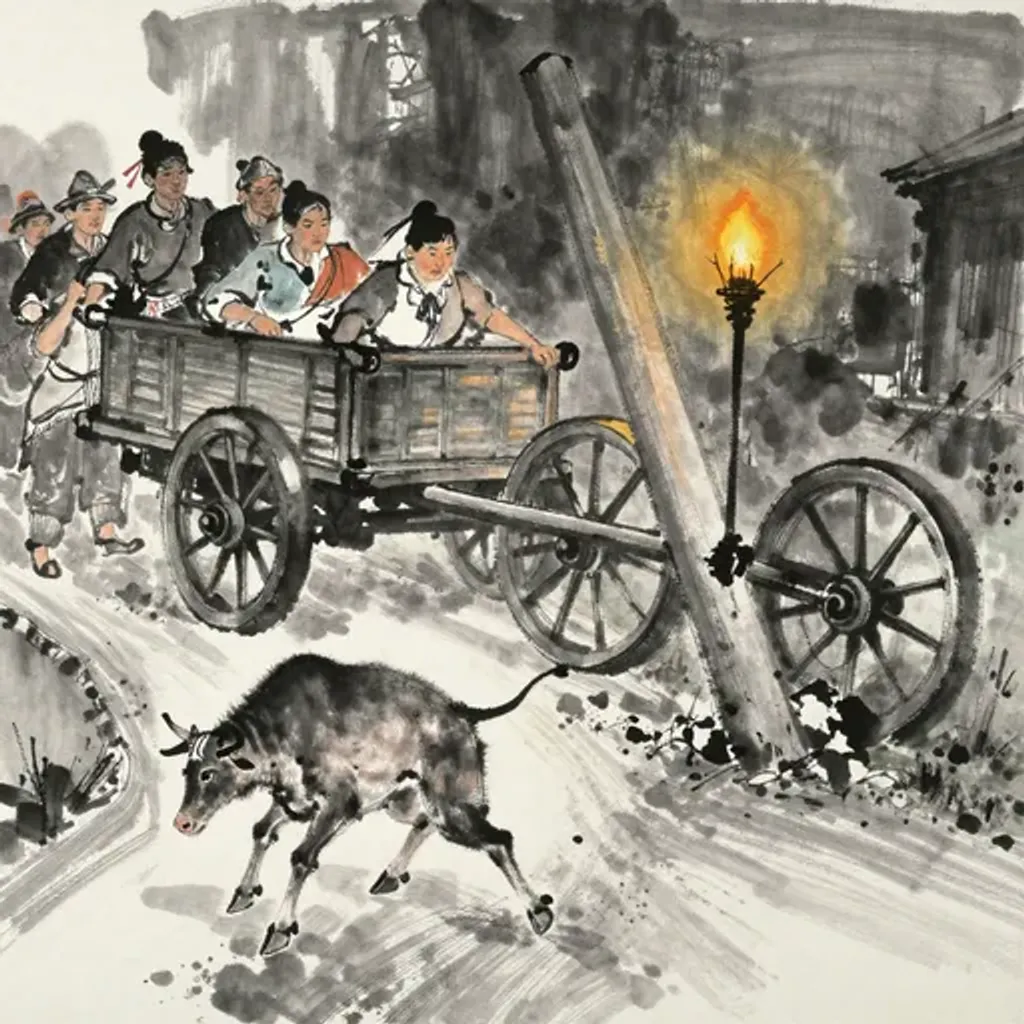
三足俱行,傾危善僵。六指不使,慁累弟兄。樹柱閡車,失其正當。
Three legs walking together, prone to topple and fall. Six fingers one cannot use; a burden and trouble to one's brothers. A pillar set to block the cart; it loses its proper course.
— Jiao Yanshou, Yilin (Forest of Changes), 1st century BC
Commentary
Fire beneath the mountain exposes structural deformity. Three legs walking together topple and fall prone. Six fingers on a hand are useless, burdening one's brothers. A pillar planted in the road blocks the carriage, losing its proper function. Every image here is of excess that impedes rather than helps: the extra leg unbalances, the extra finger encumbers, the misplaced pillar obstructs. From Grace to Influence, the mountain descends beneath the lake. Influence (Xian) is about genuine mutual response — the lake above, the mountain below, moisture descending while the mountain receives. But the verse shows connection gone wrong: superfluities that create burden rather than resonance. True influence requires reduction to essentials, not accumulation of useless parts.
賁 → 恆
Hexagram 22 → Hexagram 32: Duration
Changing lines: 1, 2, 4, 6
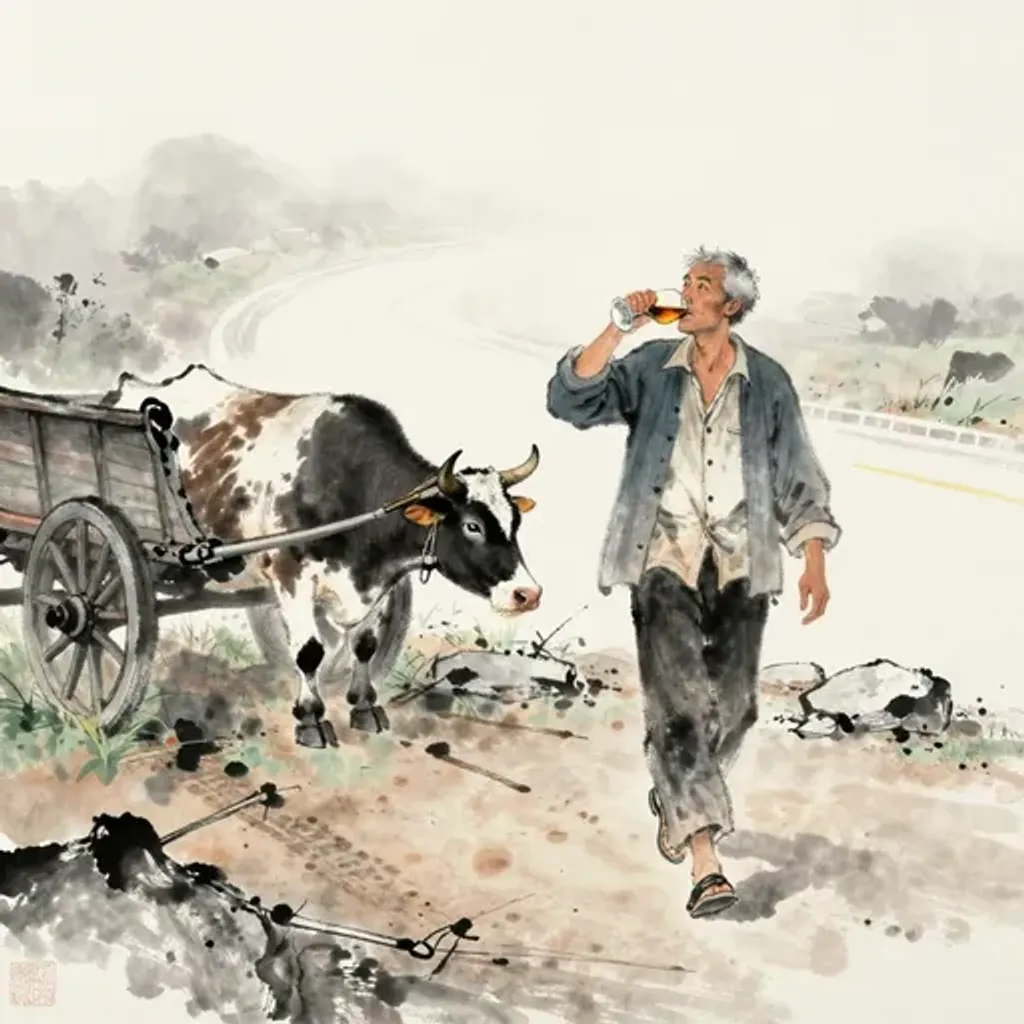
舍車而徒,亡其駮牛。雖喪白頭,酒以療憂。
Abandoning the cart to walk; losing the piebald ox. Though one has lost one's grey head, wine heals the sorrow.
— Jiao Yanshou, Yilin (Forest of Changes), 1st century BC
Commentary
Fire beneath the mountain fades as possessions are lost. Abandoning the carriage to walk on foot, one loses a piebald ox along the way. Though the white-haired elder suffers loss, wine soothes the grief. The progression descends: first the carriage gone, then the prized animal, then only the aging body and a cup of wine for consolation. Yet the verse is not purely tragic — wine as remedy suggests that acceptance, however bitter, brings its own relief. From Grace to Duration, the mountain's fire gives way to thunder and wind reinforcing each other. Duration's teaching is persistence through changing circumstances. The losses accumulate, but the enduring response — drinking to console rather than raging against fate — embodies Duration's steady stance.
賁 → 遯
Hexagram 22 → Hexagram 33: Retreat
Changing lines: 1, 4, 5
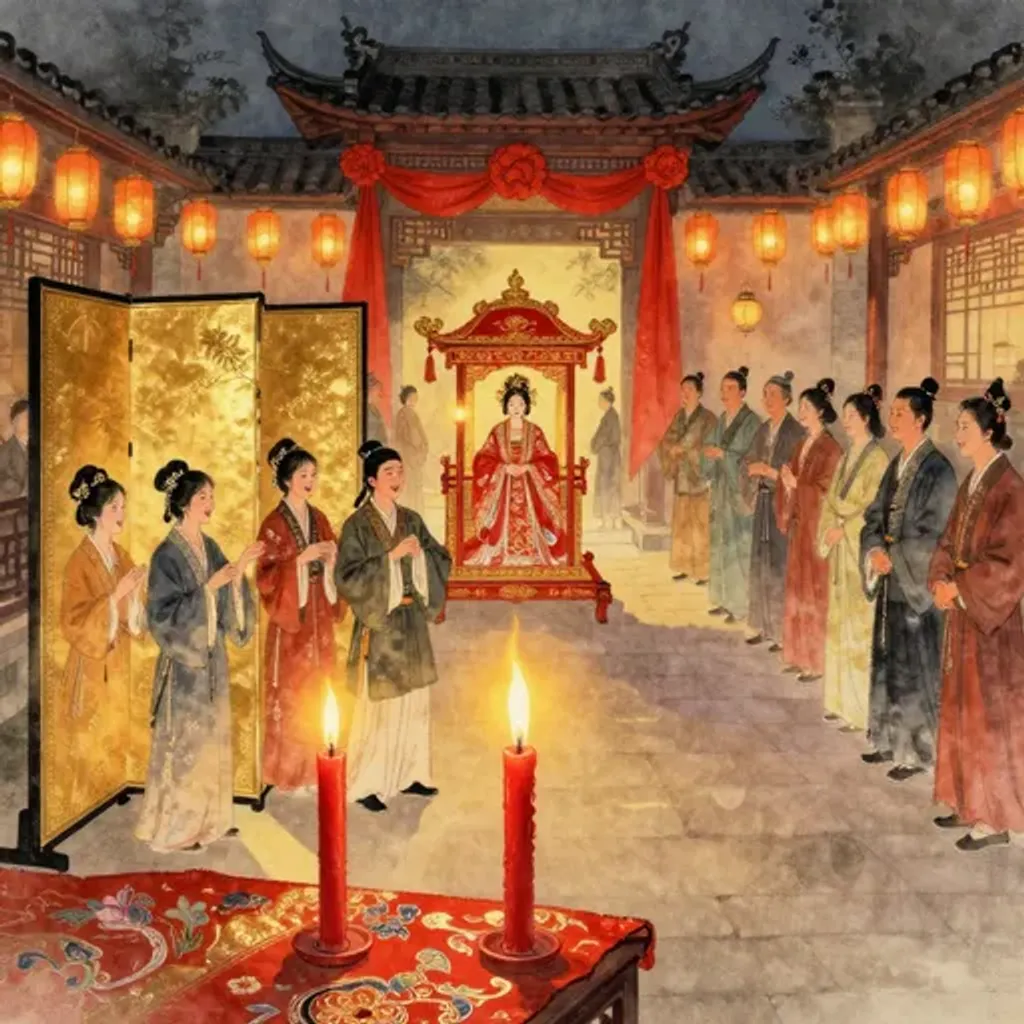
析薪熾酒,使媒求婦。和合齊宋,姜子悅喜。
Red candles blaze high, reflecting off the gold screen. Drums and music in the courtyard escort the betrothal gifts. Cheers from both families echo through the lanes — the shared wedding cup warms the fragrant hall.
— Jiao Yanshou, Yilin (Forest of Changes), 1st century BC
Commentary
Fire beneath the mountain is a rewrite — the original verse reads: 'Splitting firewood to warm the wine, sending a matchmaker to seek a bride; harmonizing Qi and Song, the Jiang maiden is delighted.' This describes a formal betrothal: the groom's family prepares ceremonial wine, dispatches a matchmaker, and the union between two states (Qi and Song, or their ruling clans) is sealed. The 'Jiang maiden' refers to a woman of the Jiang clan — the ruling house of Qi. From Grace to Retreat, fire beneath the mountain yields to heaven above the mountain. The lavish wedding is a moment of display before withdrawal: the bride adorns herself in Grace, then retreats into the propriety of married life. The match itself is a strategic retreat — alliance through marriage rather than conflict.
賁 → 大壯
Hexagram 22 → Hexagram 34: Great Power
Changing lines: 2, 4, 6
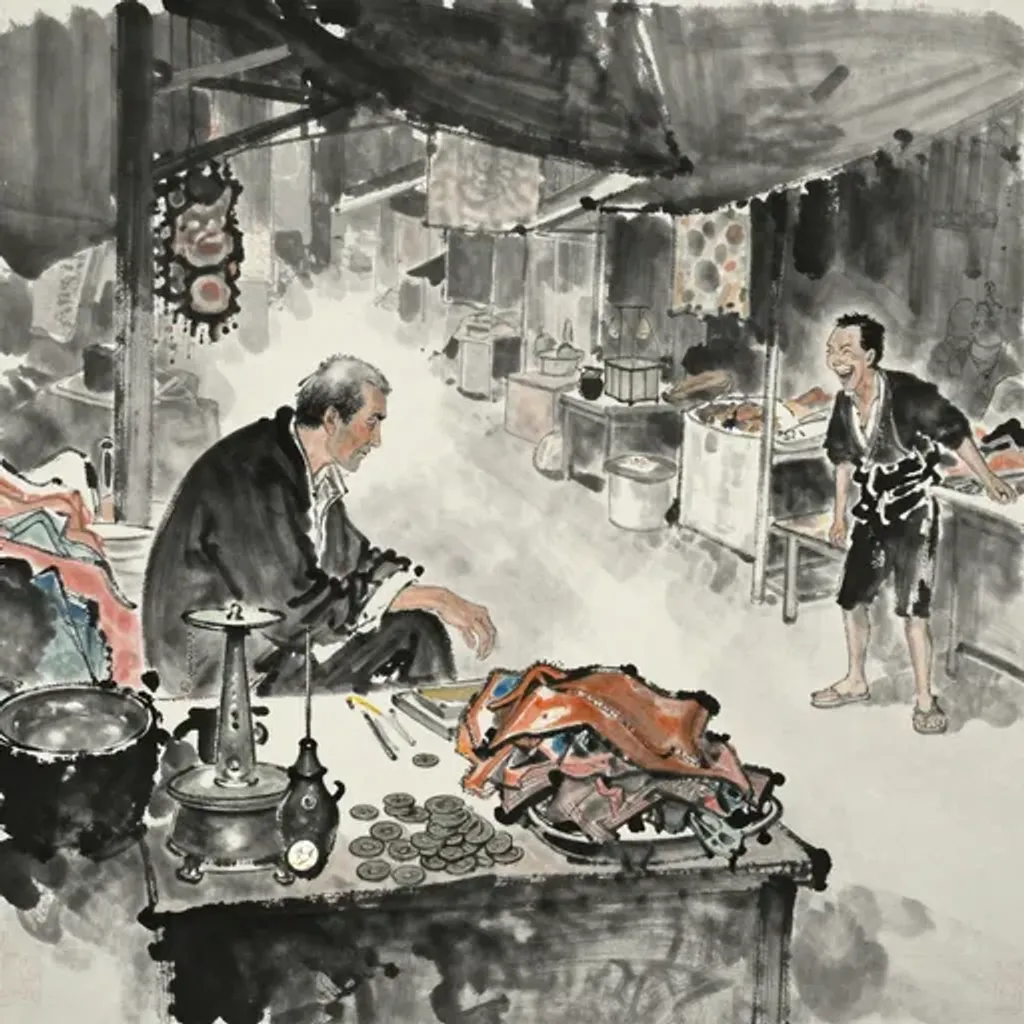
夜視無明,不利賈商。子反笑歡,與市為仇。
Seeing nothing in the dark of night; unfavorable for merchants and trade. Zifan laughs with glee, making the marketplace his enemy.
— Jiao Yanshou, Yilin (Forest of Changes), 1st century BC
Commentary
Fire beneath the mountain fails to illuminate. Night trading has no brightness, and commerce cannot prosper. Then Zi Fan laughs and celebrates, making enemies of the marketplace. Zi Fan was a Chu general known for indulgence — in one famous episode, his servant gave him wine before a decisive battle, leaving him too drunk to fight, which led to his death by forced suicide. Here, a general's revelry directly opposes the merchant's need for clear vision and fair dealing. From Grace to Great Power, fire beneath the mountain transforms into thunder above heaven. Great Power is raw force that must be governed by propriety. Zi Fan's drunken laughter exemplifies power without restraint — energy misapplied, turning potential allies into enemies.
賁 → 晉
Hexagram 22 → Hexagram 35: Progress
Changing lines: 1, 3, 4
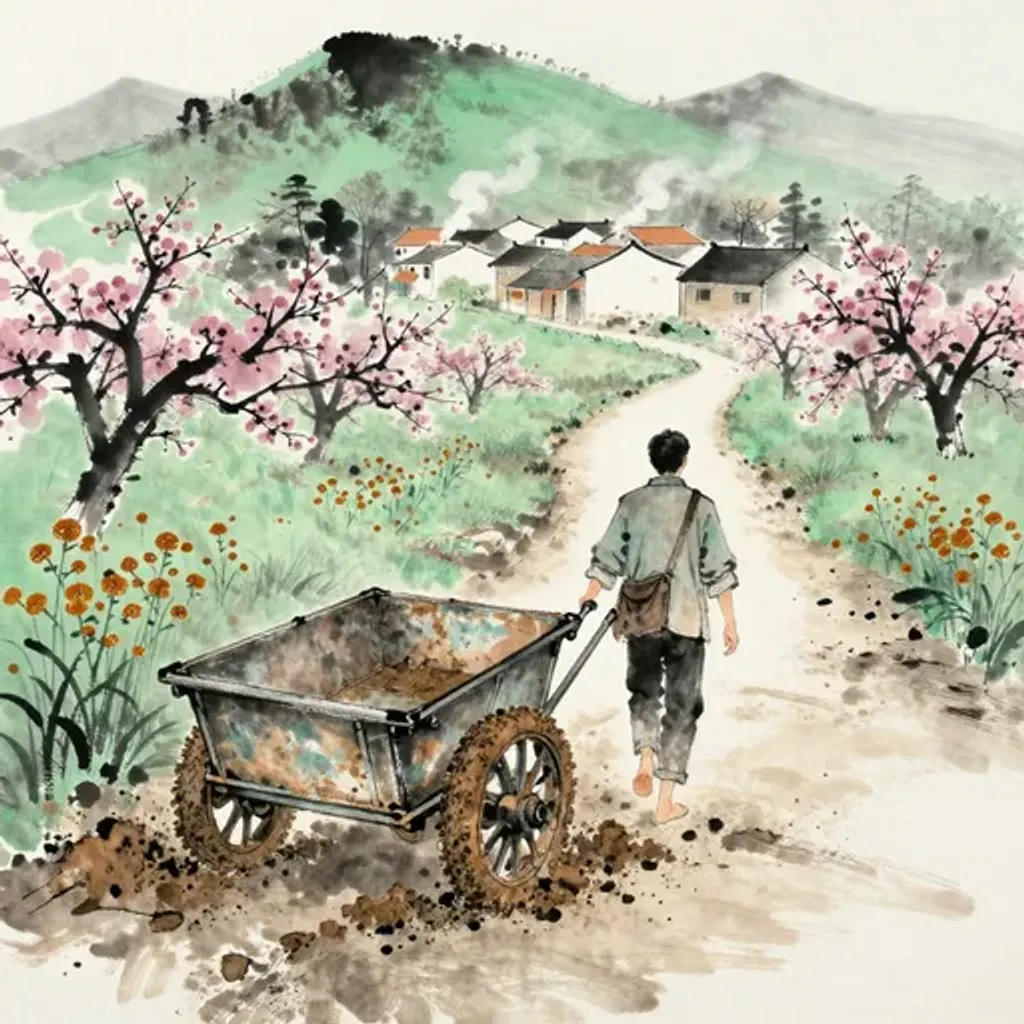
徒行離車,不冒泥塗。利以休居。
Walking on foot, leaving the cart behind; not braving the muddy road. Favorable for resting at home.
— Jiao Yanshou, Yilin (Forest of Changes), 1st century BC
Commentary
Fire beneath the mountain suggests a simpler path. Walking on foot away from the carriage, one avoids the mud and mire. It is better to rest where one is. The verse counsels voluntary simplification: abandon the carriage (symbol of status and speed) rather than risk getting mired. Walking is slower but surer. From Grace to Progress, fire beneath the mountain rises to fire above the earth. Progress shows the sun rising — brightness emerging from the ground. Yet this verse reaches Progress not through ambitious advancement but through tactical retreat. Sometimes the surest progress is to dismount, shed the ornamental trappings of Grace, and proceed on foot. The light that rises from the earth needs no carriage.
賁 → 明夷
Hexagram 22 → Hexagram 36: Darkening of the Light
Changing lines: 6
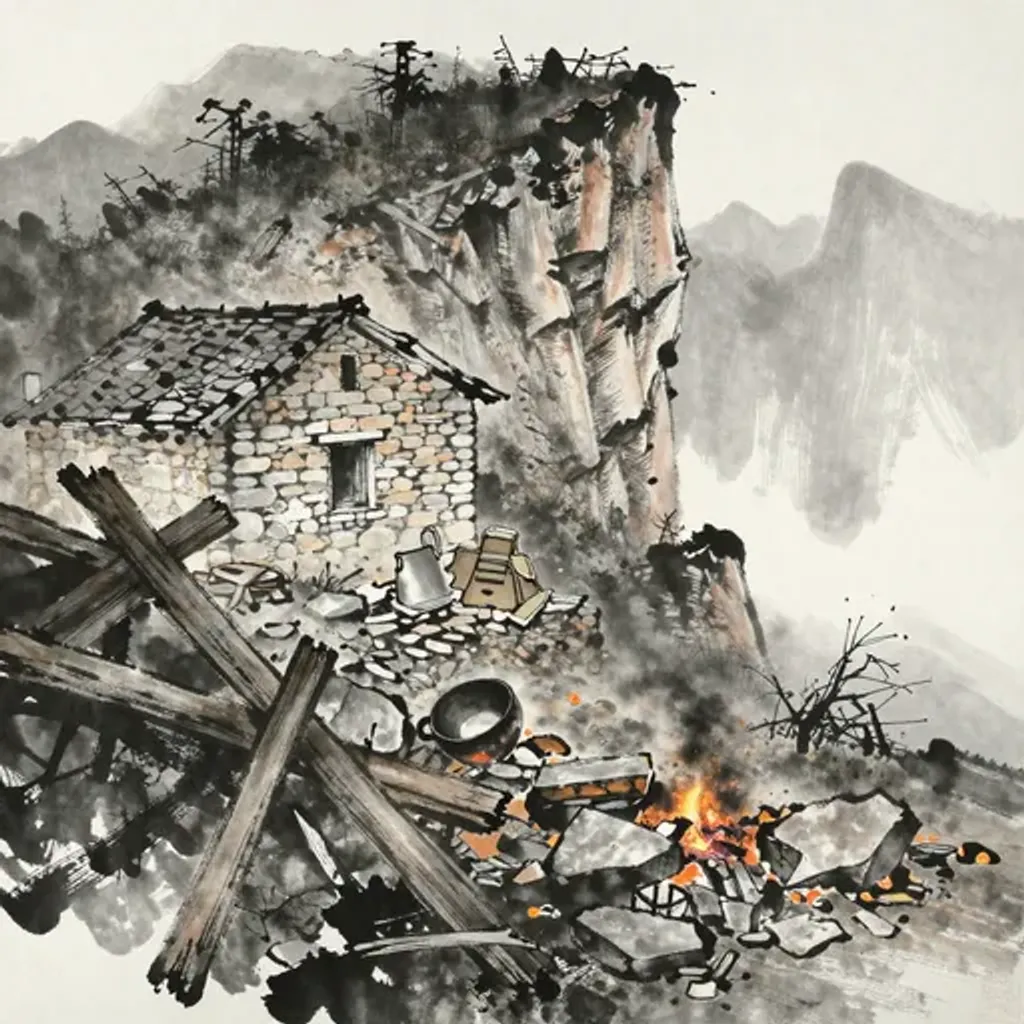
作室山根,人以為安。一昔崩顛,破我壺飱。
Building a house at the mountain's base, people thought it safe. One night the cliff collapses; it shatters our pots and provisions.
— Jiao Yanshou, Yilin (Forest of Changes), 1st century BC
Commentary
Fire beneath the mountain, and now that mountain collapses. A house built at the base of a cliff seems secure to its inhabitants. Then one night the cliff gives way, shattering the cooking pots and destroying the evening meal. The safety was always illusory — the mountain that provided shelter was also the source of destruction. From Grace to Darkening of the Light, fire beneath the mountain sinks into fire buried beneath the earth. What illuminated the surface is now driven underground. The collapse of the cliff-house captures this inversion precisely: the mountain that held fire (Grace) becomes the mass that buries light (Mingyi). Relying on what looks stable without examining the foundation leads to catastrophic reversal.
賁 → 家人
Hexagram 22 → Hexagram 37: The Family
Changing lines: 5
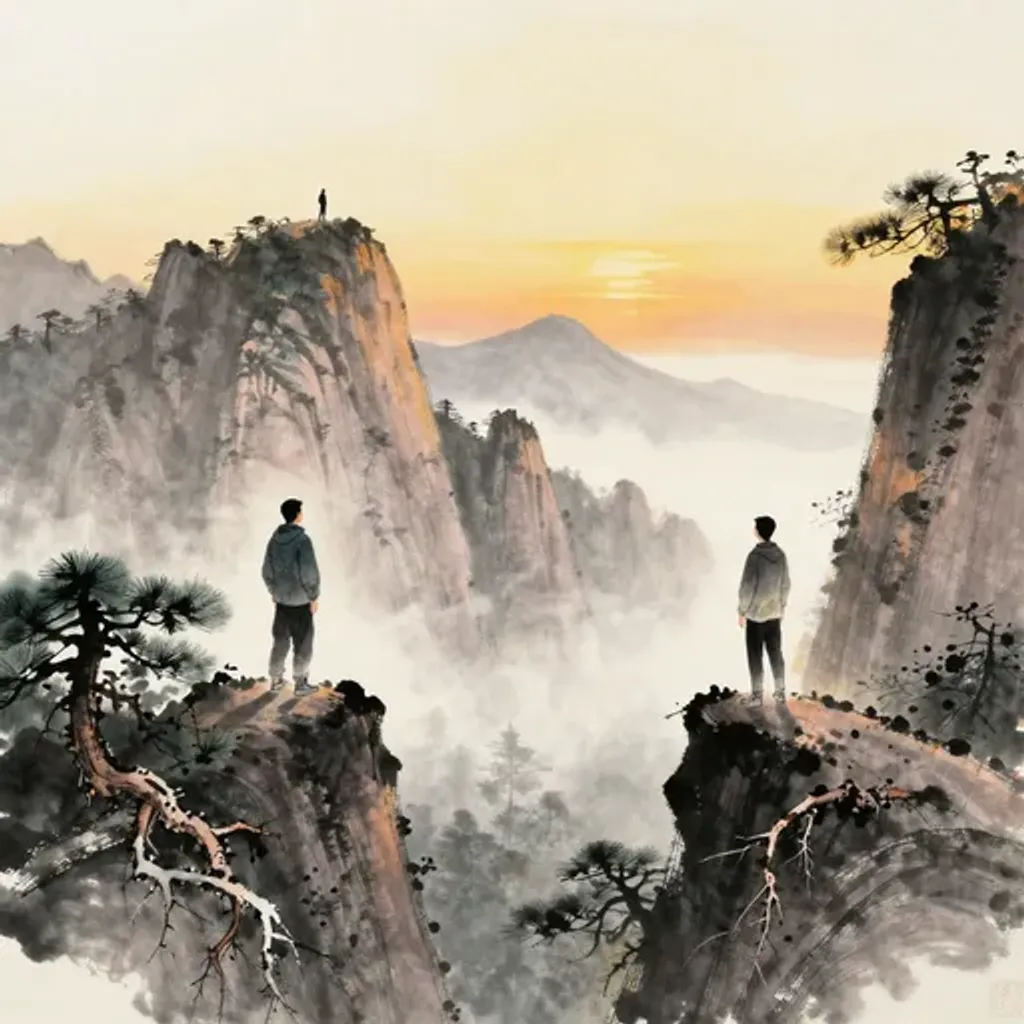
山東山西,各自言安。雖相登望,意未同堂。
East of the mountain, west of the mountain; each proclaims its own peace. Though they climb and gaze toward one another, their thoughts have not yet shared the same hall.
— Jiao Yanshou, Yilin (Forest of Changes), 1st century BC
Commentary
Fire beneath the mountain separates two views. East of the mountain and west of the mountain, each side claims it is at peace. Though they climb and gaze at each other, their hearts never share the same hall. The mountain itself becomes the barrier: what should connect (fire illuminating both slopes) instead divides. Two households or two factions can see each other but cannot unite. From Grace to the Family, the mountain's fire transforms into wind emerging from fire. The Family hexagram demands that words have substance and actions have constancy. This verse diagnoses the problem the Family must solve: proximity without genuine communion. Only when wind carries fire's warmth beyond the mountain can separate camps become one household.
賁 → 睽
Hexagram 22 → Hexagram 38: Opposition
Changing lines: 2, 3, 4
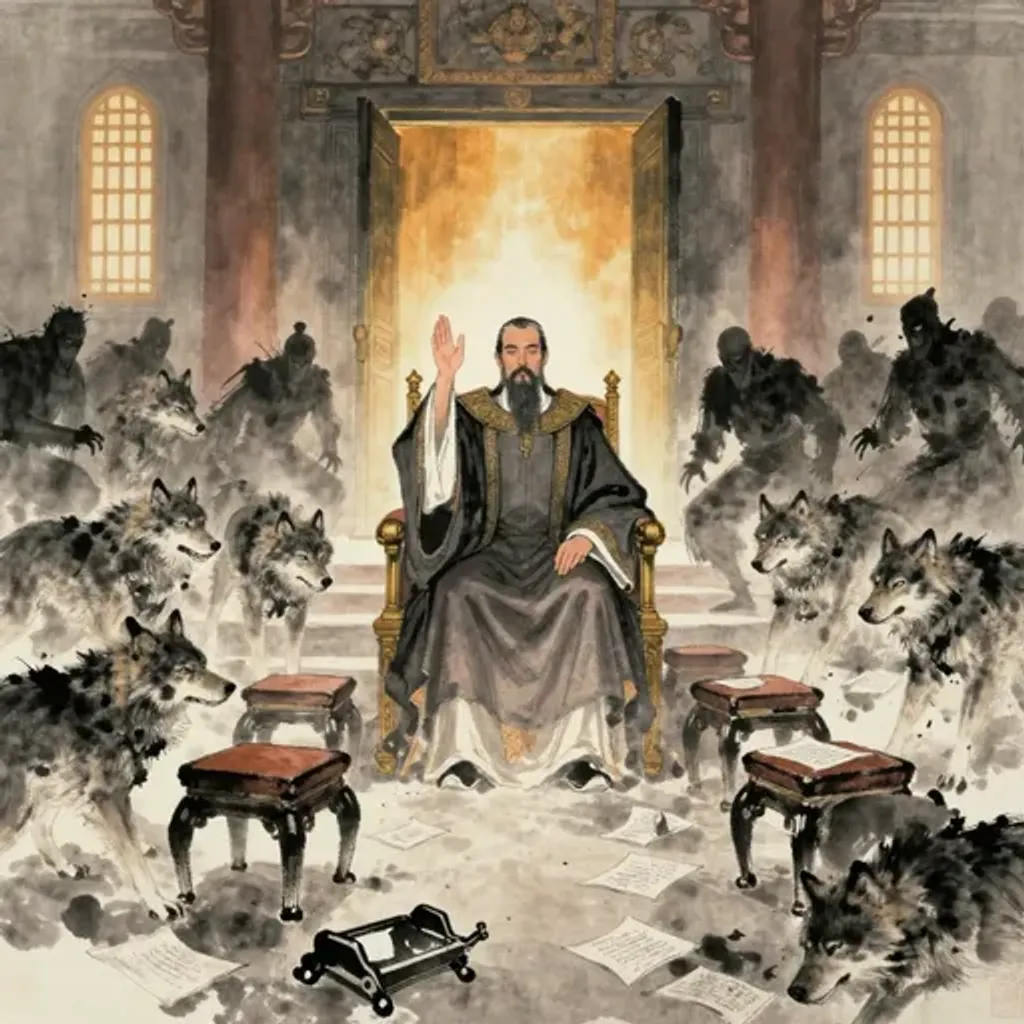
君子在朝,凶言去消。驚駭逐狼,不見英雄。
The noble man is at court; evil words are dispelled. Startling and chasing away the wolves; no heroes are to be seen.
— Jiao Yanshou, Yilin (Forest of Changes), 1st century BC
Commentary
Fire beneath the mountain restores order. When the superior person stands at court, evil words and alarming rumors dissolve. Wolves are chased away in terror, though the hero who drove them off goes unseen. The gentleman's mere presence neutralizes slander and expels predators, yet he receives no recognition. From Grace to Opposition, fire beneath the mountain rises to fire above the lake. Opposition's image — fire and lake pulling in opposite directions — seems to contradict the verse's resolution. But the key lies in the gentleman's invisibility: he resolves the opposition without being credited. In Opposition, the sage finds unity within apparent divergence. The hero's disappearance is itself the resolution — true order needs no visible champion.
賁 → 蹇
Hexagram 22 → Hexagram 39: Obstruction
Changing lines: 1, 5, 6
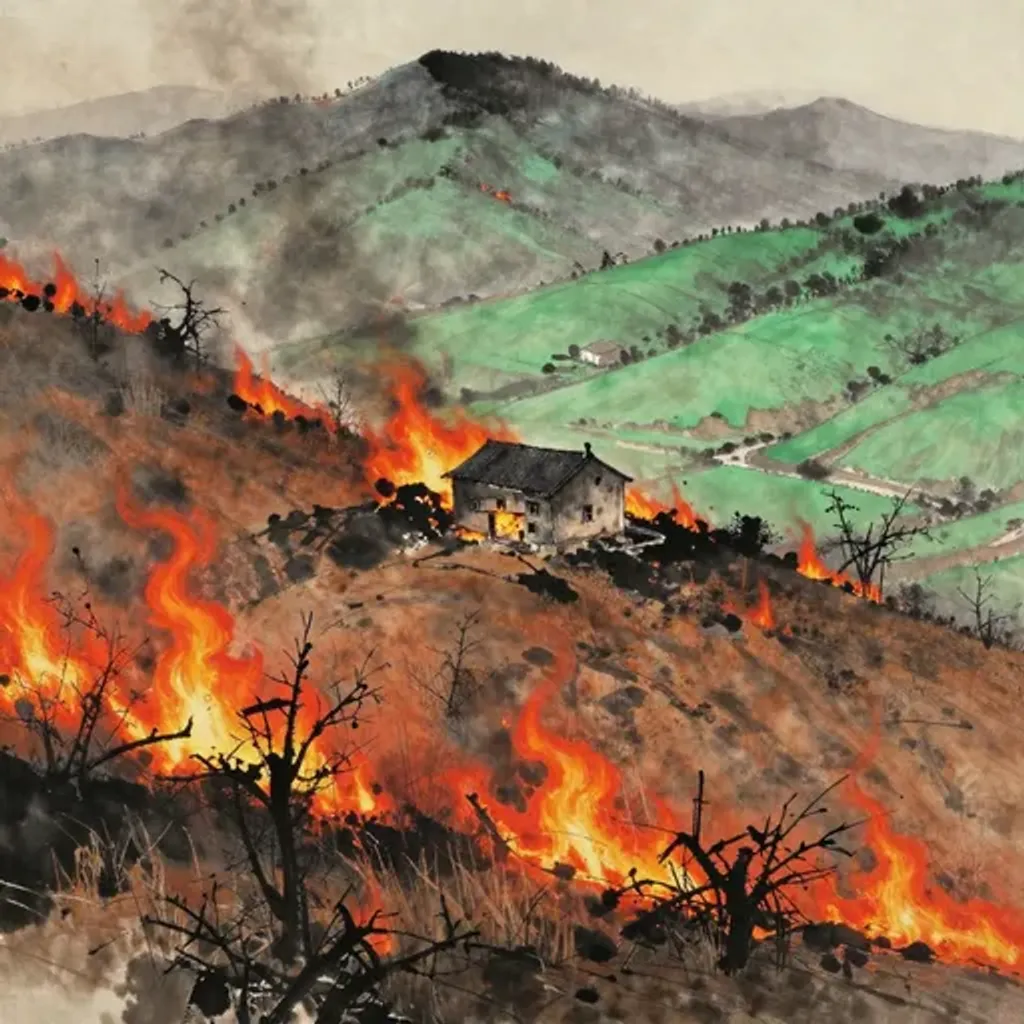
𨏈𨏈墳墳,火燒山根。不潤我鄰,獨不蒙恩。
Rumbling and heaving; fire burns at the mountain's base. It does not nourish my neighbor; alone, I receive no grace.
— Jiao Yanshou, Yilin (Forest of Changes), 1st century BC
Commentary
Fire beneath the mountain turns destructive. Rumbling and churning, fire burns at the mountain's base — but this fire brings no grace, only devastation. It does not moisten the neighbors; one alone receives no blessing. The fire that should adorn instead consumes, and its heat is distributed unfairly: those nearby are scorched while the speaker is left without even the warmth. From Grace to Obstruction, fire beneath the mountain meets water atop the mountain. Where Grace placed fire at the mountain's base as decoration, Obstruction places water at its summit as an impassable barrier. The verse's fire that fails to nourish transforms into the water that blocks all passage. Both positions — fire below, water above — are structurally unstable.
賁 → 解
Hexagram 22 → Hexagram 40: Deliverance
Changing lines: 1, 2, 3, 4, 6
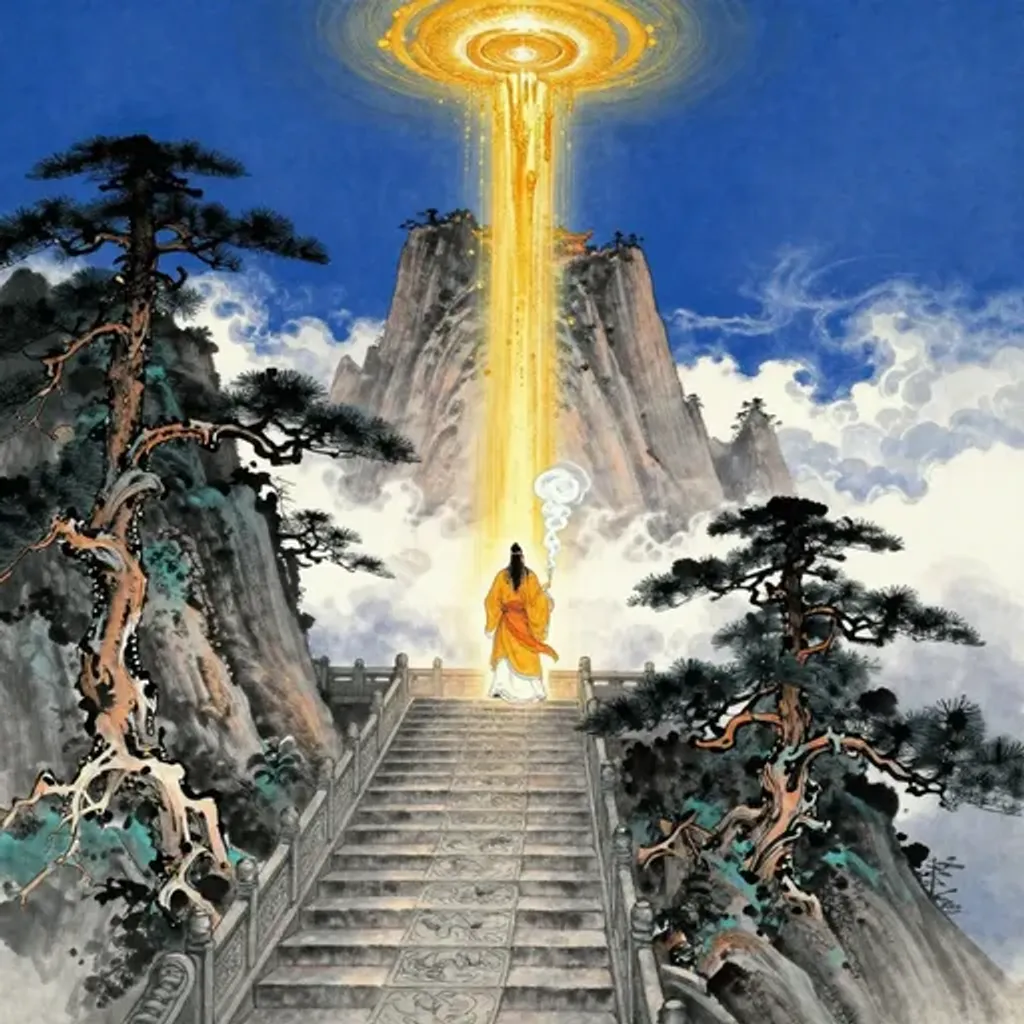
南山之蹊,真人所在。德配唐虞,天命為子。保佑歆享,身受大慶。
On the southern mountain's path, the True Man dwells. His virtue matches Yao and Shun; heaven's mandate makes him its son. Protected with blessings and offerings; the body receives great felicity.
— Jiao Yanshou, Yilin (Forest of Changes), 1st century BC
Commentary
Fire beneath the mountain lights the path to a sage. On the southern mountain's trail dwells a True Person whose virtue matches Tang and Yu — the legendary emperors Yao and Shun. Heaven's mandate claims him as its son; divine blessings and ancestral offerings are enjoyed, and he receives the greatest celebration. The verse traces a complete arc of legitimacy: the sage in the wilderness, the comparison to antiquity's finest rulers, and the bestowal of the heavenly mandate. From Grace to Deliverance, fire beneath the mountain transforms into thunder and rain. Where Grace adorned the surface, Deliverance releases the tension: the thunderstorm breaks, and all is forgiven. The sage's discovery on the mountain trail is itself the moment of release — the right person found at the right time.
賁 → 損
Hexagram 22 → Hexagram 41: Decrease
Changing lines: 2, 3
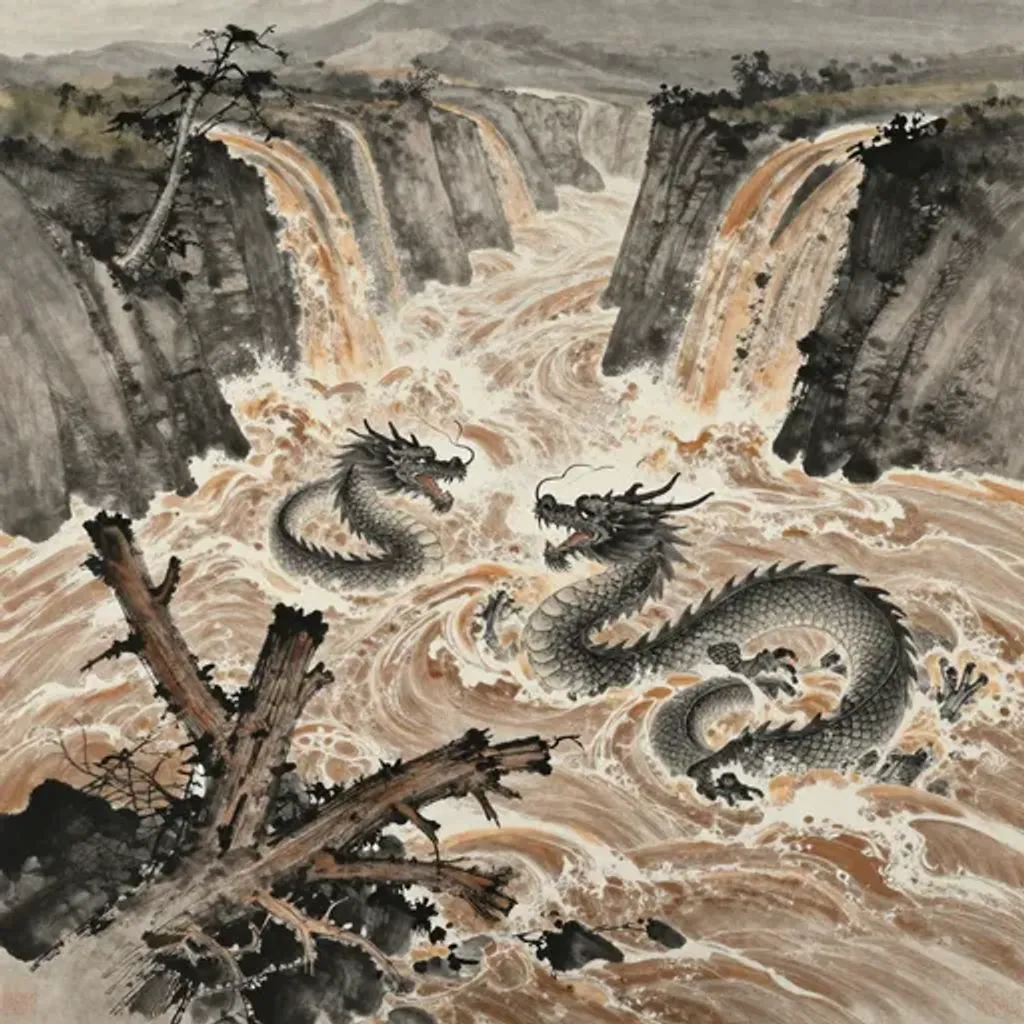
龍虵所聚,大水來處。泱泱濡濡,濙濙礚礚。使我無賴。
Where dragons and serpents gather, great waters come. Surging and soaking, rushing and crashing; they leave me with nothing to rely on.
— Jiao Yanshou, Yilin (Forest of Changes), 1st century BC
Commentary
Fire beneath the mountain gives way to deluge. Where dragons and serpents gather, great waters come. The torrent surges and churns, roaring and crashing, leaving one utterly helpless. Dragons and serpents coiled together suggest primordial chaos — the water-creatures that inhabit the deep gathering in such numbers that the flood becomes inevitable. The onomatopoeia in the original Chinese (泱泱濡濡, 濙濙礚礚) mimics the sound of overwhelming water. From Grace to Decrease, the mountain above the lake takes on a different character: the lake below erodes the mountain's base. Grace's decorative fire is drowned; what remains is the relentless diminution of Decrease. The flood is Decrease made visible — excess water stripping away the mountain's foundation.
賁 → 益
Hexagram 22 → Hexagram 42: Increase
Changing lines: 3, 5
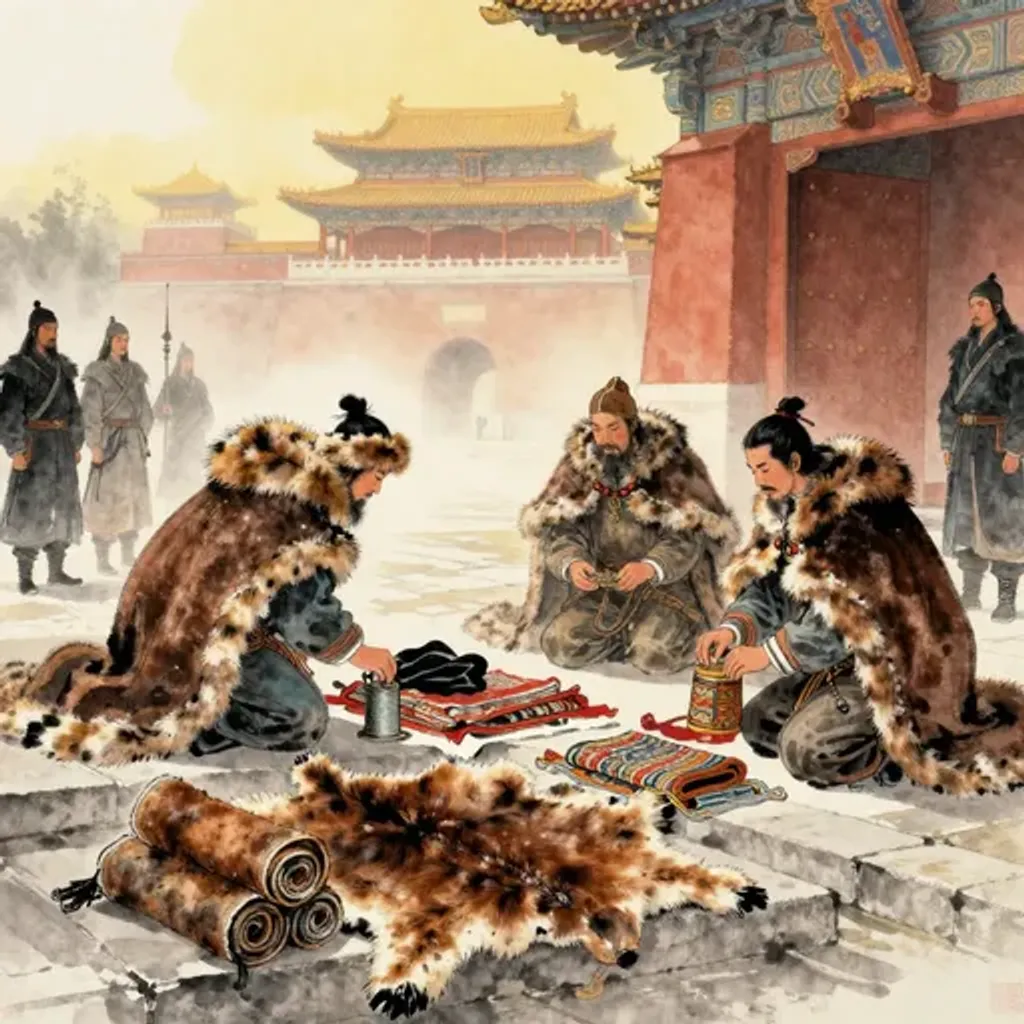
旃裘苫蓋,慕德獻服。邊鄙不聳,以安王國。
Felt cloaks and thatched coverings; admiring virtue, they present tribute. The borders are not alarmed; thereby securing the kingdom.
— Jiao Yanshou, Yilin (Forest of Changes), 1st century BC
Commentary
Fire beneath the mountain extends its warmth to the frontier. Nomads in felt robes and thatch-covered shelters come bearing tribute, drawn by admiration for the kingdom's virtue. The border regions remain calm, unalarmed, and the realm is at peace. The felt-robed visitors represent the northern or western frontier peoples (旃裘 specifically denotes the fur and felt clothing of nomadic cultures). Their voluntary submission through cultural admiration rather than military coercion exemplifies the Confucian ideal of transformative virtue. From Grace to Increase, fire beneath the mountain becomes wind and thunder reinforcing each other. Increase adds from above to below — exactly what happens when a virtuous center radiates outward, enriching even distant peoples without diminishing itself.
賁 → 夬
Hexagram 22 → Hexagram 43: Breakthrough
Changing lines: 2, 4, 5, 6
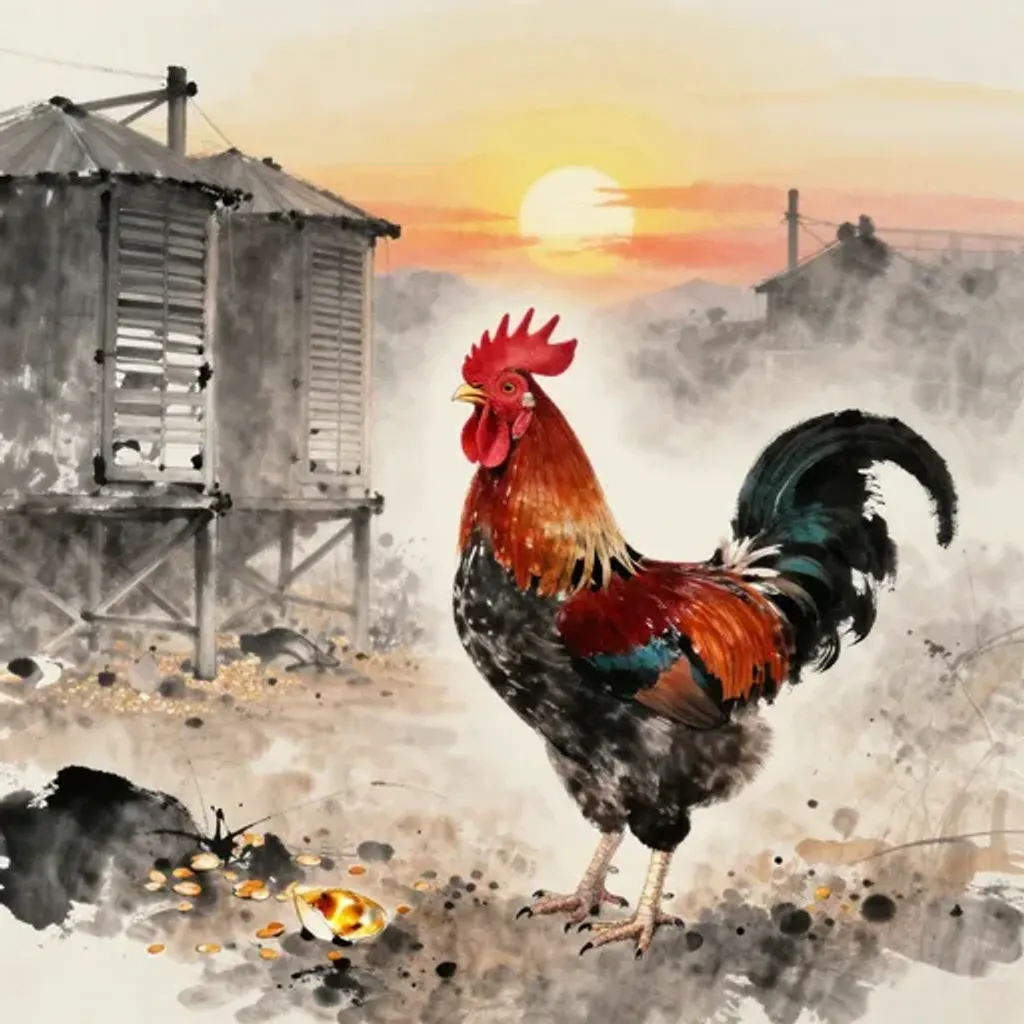
光體春成,陳倉雞鳴。陽明失道,不能自守。消亡為咎。
The radiant body is formed in spring; the rooster of Chencang crows. Yang's brightness has lost its way; it cannot maintain itself. Diminishing into ruin.
— Jiao Yanshou, Yilin (Forest of Changes), 1st century BC
Commentary
Fire beneath the mountain meets the sacred rooster of Chenbao. The light-body completes its spring form, and the Chencang rooster crows — referencing Qin's most revered deity at Chencang, where two spirit children declared 'He who obtains the female shall become hegemon; he who obtains the male shall become king' before transforming into pheasants. Yet the solar bird (yang brilliance) loses its way and cannot maintain its course: dissolution follows as blame. From Grace to Breakthrough, fire beneath the mountain gives way to the lake rising above heaven. Breakthrough is decisive elimination of what is corrupt. The Chenbao rooster crowed with prophetic power, but when yang energy cannot hold its course, even sacred omens lead to ruin. The breakthrough demanded here is cutting away misdirected brilliance.
賁 → 姤
Hexagram 22 → Hexagram 44: Coming to Meet
Changing lines: 1, 2, 4, 5
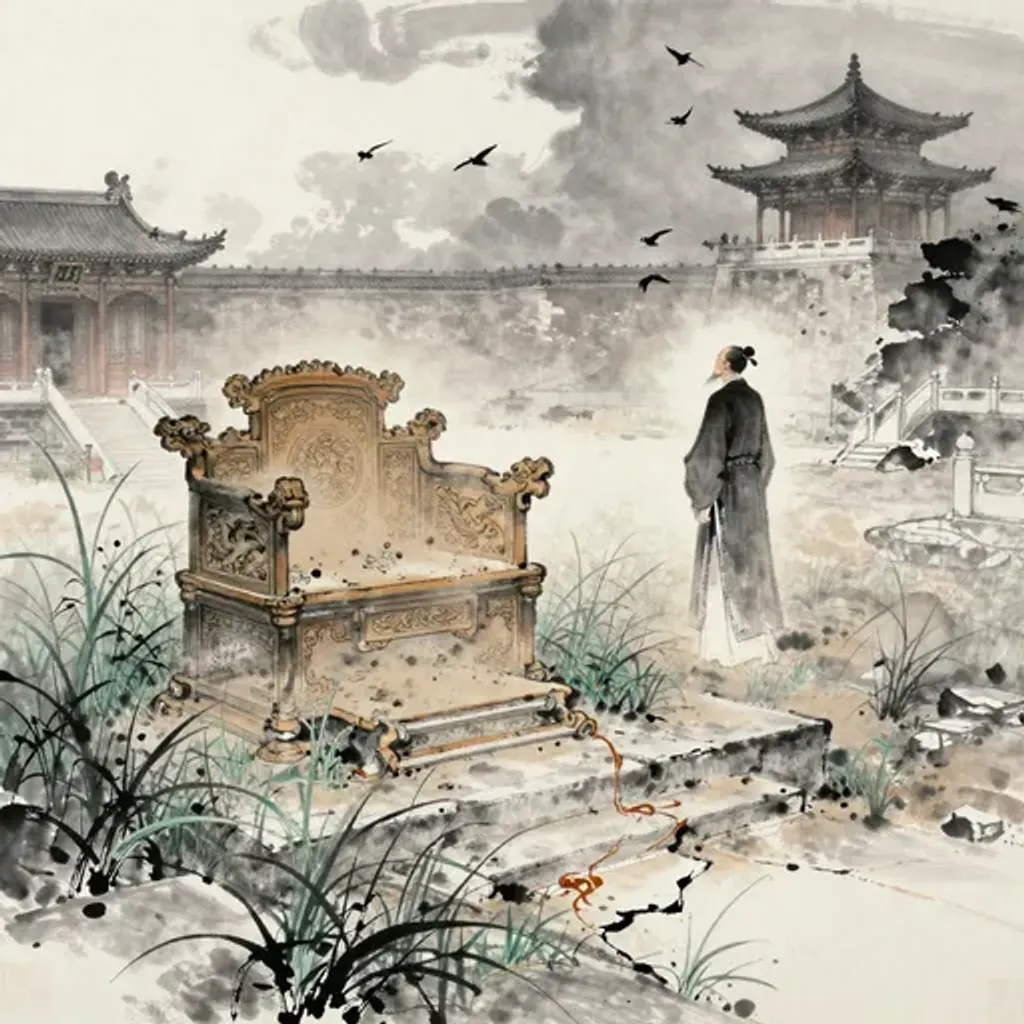
下泉苞稂,十年無王。荀伯遇時,憂念周京。
In the palace courtyard, grass grows knee-high; the throne is dust-covered, dragon patterns hidden. An old minister stands alone, gazing toward the capital — evening crows circle the tower, refusing to alight.
— Jiao Yanshou, Yilin (Forest of Changes), 1st century BC
Commentary
Fire beneath the mountain is a rewrite — the original verse reads: 'Beneath the spring, darnel grows rank; for ten years there has been no king. Lord Xun meets his time; he longs and grieves for the Zhou capital.' This draws on the Shijing ode 'Xia Quan' (曹風·下泉), which laments the decay of royal authority and yearns for a worthy ruler to restore order. The subterranean spring nurturing weeds rather than grain symbolizes perverted nourishment — the state sustaining disorder rather than civilization. From Grace to Coming to Meet, fire beneath the mountain transforms into wind beneath heaven. Coming to Meet warns of an unexpected encounter — often a dark feminine force rising. The original verse's ten-year kinglessness resonates: when authority is vacant too long, what fills the void may not be welcome.
賁 → 萃
Hexagram 22 → Hexagram 45: Gathering Together
Changing lines: 1, 3, 4, 5, 6
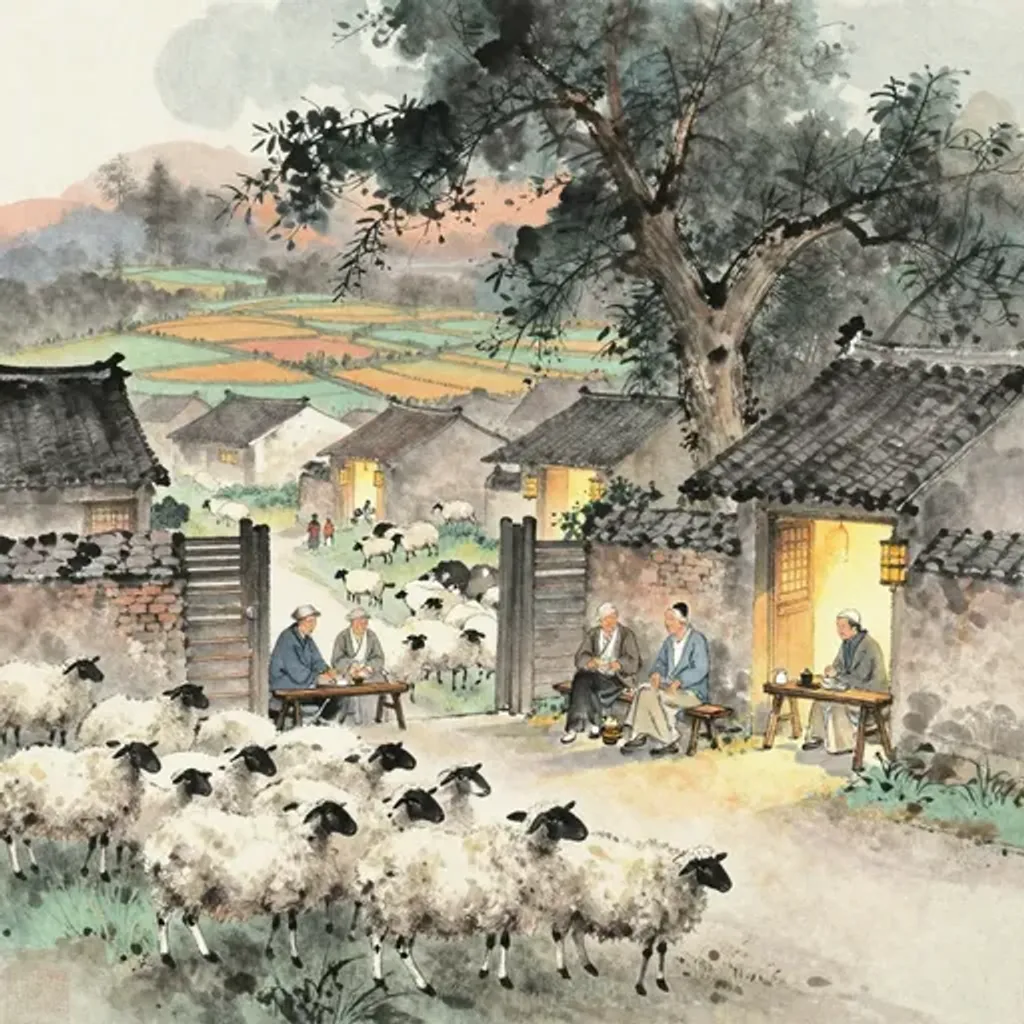
仁德不暴,五精就舍。四牧允釐,民安其居。
Benevolent virtue, never oppressive; the five essences come to dwell. The four shepherds govern justly; the people rest secure in their homes.
— Jiao Yanshou, Yilin (Forest of Changes), 1st century BC
Commentary
Fire beneath the mountain radiates benevolence. Virtue practiced without cruelty draws the five celestial essences to dwell near. The four regional shepherds govern harmoniously, and the people rest secure in their homes. The 'five essences' (五精) likely refer to the spirits of the five directions or five planets — cosmic forces that align only under virtuous governance. The four shepherds (四牧) are the regional administrators of the four quarters. This verse mirrors 22-22's phoenix imagery but substitutes cosmic alignment for the mythological bird. From Grace to Gathering, fire beneath the mountain transforms into the lake rising upon the earth. Where Grace adorns, Gathering assembles: the people naturally congregate where virtue is genuine, like water pooling in a lowland basin.
賁 → 升
Hexagram 22 → Hexagram 46: Pushing Upward
Changing lines: 1, 2, 6
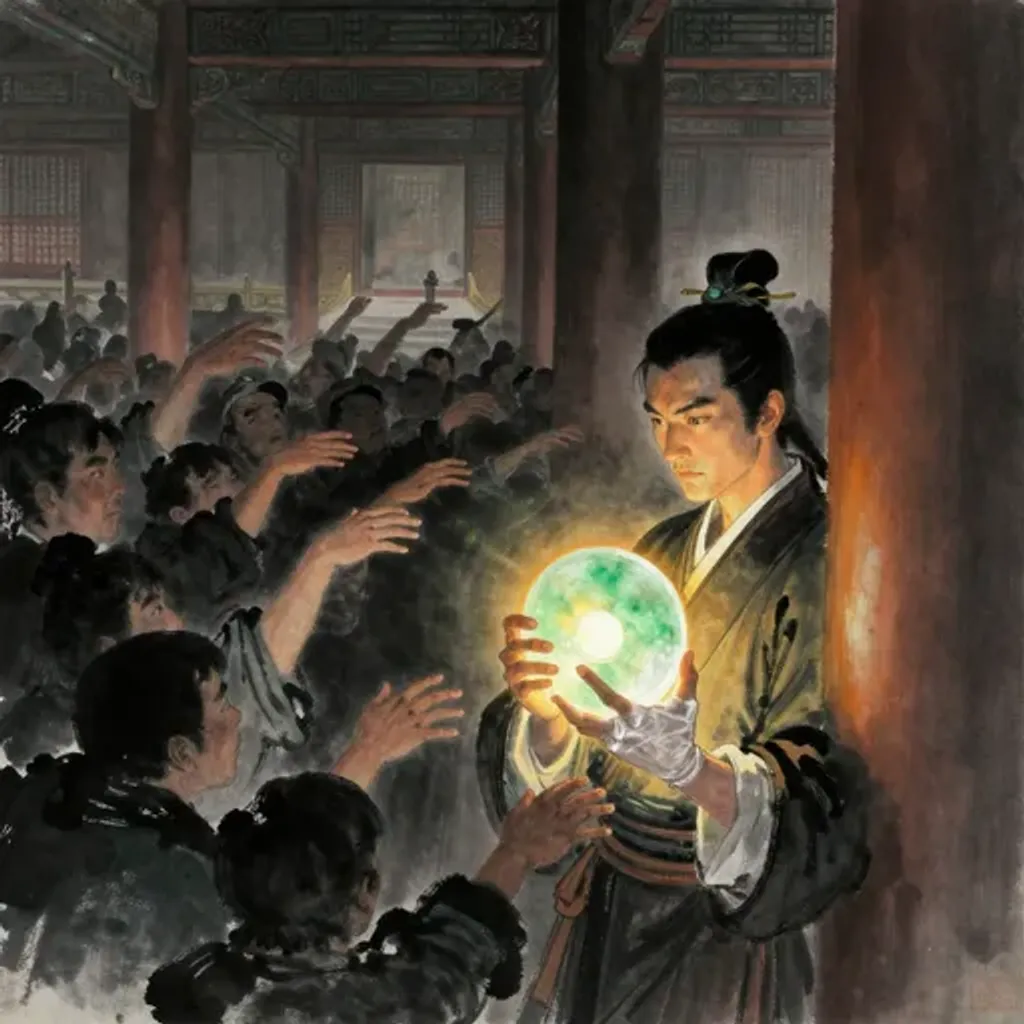
隨和重寶,眾多貪有。相如睨柱,趙王危殆。
The Sui and He are precious treasures; many covet and desire them. Xiangru glares at the pillar; the King of Zhao is in mortal peril.
— Jiao Yanshou, Yilin (Forest of Changes), 1st century BC
Commentary
Fire beneath the mountain guards a treasure. The Sui Pearl and He Jade — the two most precious objects of legend — attract many who covet them. Then Lin Xiangru glares sidelong at the pillar, ready to smash both his own head and the jade against it rather than let Qin steal Zhao's treasure. King Zhao of Qin finds himself in peril — outmaneuvered by a mere envoy's courage. This alludes to the famous 'Returning the Jade Intact to Zhao' episode from the Shiji. From Grace to Pushing Upward, fire beneath the mountain becomes wood growing within the earth. Xiangru's slow, methodical escalation — from diplomatic courtesy to life-or-death confrontation — embodies Pushing Upward's principle: small increments of pressure, steadily applied, can elevate the powerless above the powerful.
賁 → 困
Hexagram 22 → Hexagram 47: Oppression
Changing lines: 1, 2, 3, 4, 5, 6
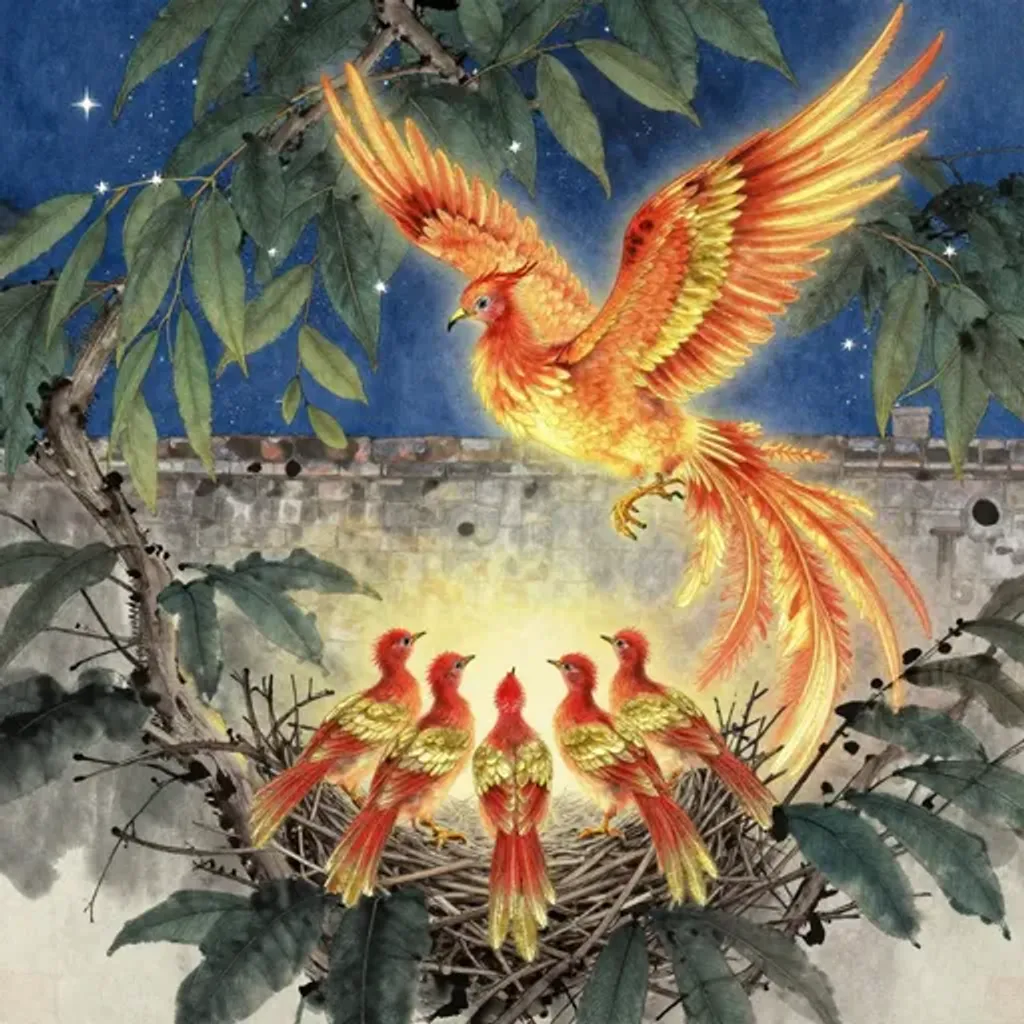
鳳生五雛,長於南郭。君子康寧,悅樂身榮。
The phoenix bears five chicks, raised in the southern quarter. The noble man is at ease and well; delighting in glory and honor.
— Jiao Yanshou, Yilin (Forest of Changes), 1st century BC
Commentary
Fire beneath the mountain nurtures extraordinary life. A phoenix hatches five chicks, raised in the southern quarter of the city. The superior person enjoys health and serenity, delighting in glory and bodily well-being. The phoenix bearing five young is a supreme omen of dynastic flourishing — not one but five heirs to the cosmic bird's virtue. The southern quarter, associated with fire and the vermilion bird, is the natural home for such creatures. From Grace to Oppression, fire beneath the mountain transforms into the lake drained of water. The contrast is stark: the verse's abundance sits against Oppression's image of exhaustion. Perhaps the phoenix's nest in the southern city represents the memory of what was — the joy that preceded the lake going dry.
賁 → 井
Hexagram 22 → Hexagram 48: The Well
Changing lines: 1, 2, 5, 6
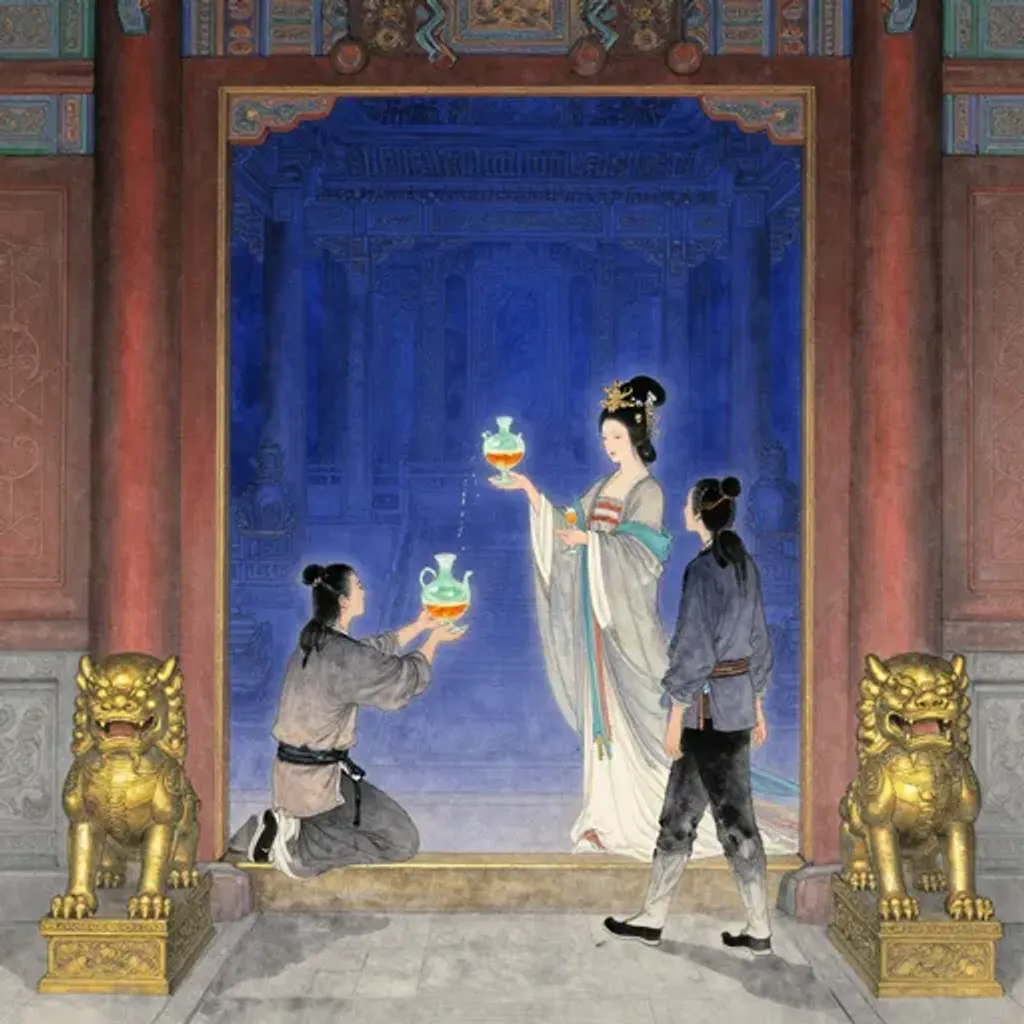
二人為侶,俱歸北海。入門上堂,拜謁王母。勞賜我酒,女功悅喜。
Two companions journey together, both returning to the northern sea. Entering the gate and ascending the hall, they pay respects to the Queen Mother. She graciously bestows wine upon them; the maidservant delights with joy.
— Jiao Yanshou, Yilin (Forest of Changes), 1st century BC
Commentary
Fire beneath the mountain lights a journey to the immortals. Two companions travel north together, reaching the sea. They enter the gate and ascend the hall to pay respects to the Queen Mother — the Queen Mother of the West, supreme goddess of Mount Kunlun, guardian of the peaches of immortality. She graciously offers them wine, and the women of her court rejoice. The pilgrimage to the Queen Mother is one of Chinese mythology's great journeys, most famously undertaken by King Mu of Zhou. From Grace to the Well, fire beneath the mountain becomes water drawn up through wood. The Well's inexhaustible nourishment mirrors the Queen Mother's immortal gift: a source that sustains without depletion, accessible to those who make the journey.
賁 → 革
Hexagram 22 → Hexagram 49: Revolution
Changing lines: 4, 5, 6
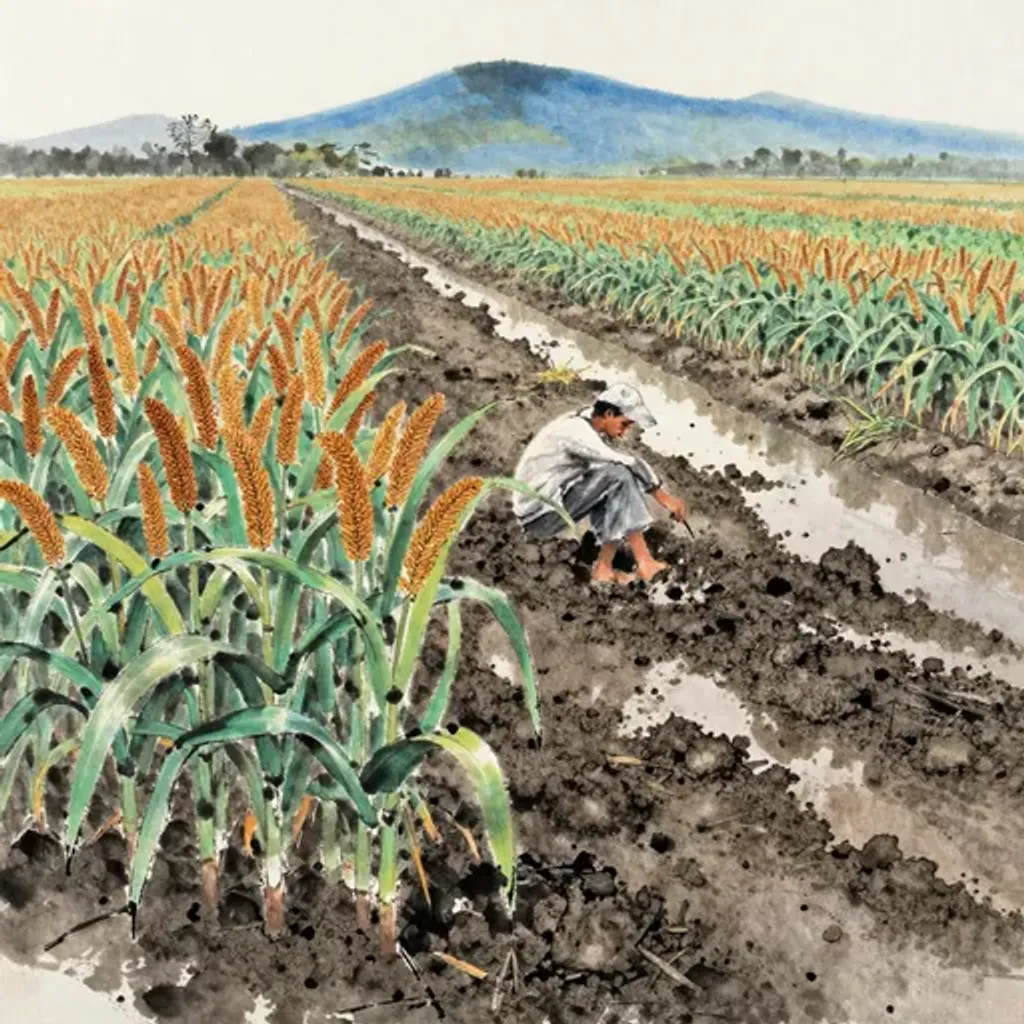
逐憂去殃,洿泥生粱,下田為王。
Driving out worry, banishing calamity; from mire and mud, grain grows. The lowly field becomes a king.
— Jiao Yanshou, Yilin (Forest of Changes), 1st century BC
Commentary
Fire beneath the mountain transforms adversity into sovereignty. Worries are driven off and calamities expelled; from muddy lowland, grain grows tall, and the humble field produces a king. The verse compresses a rags-to-royalty arc into three compact lines: first clearing away the negative, then growing sustenance from the worst soil, and finally ascending to rulership. From Grace to Revolution, fire beneath the mountain meets fire within the lake. Revolution's defining act is the replacement of one order by another — lake and fire in mutual opposition, each trying to extinguish the other. The mud-field-to-king trajectory captures Revolution's essence: what was lowest overturns what was highest. Grace's decorative order is abolished, and from the soil emerges an entirely new authority.
賁 → 鼎
Hexagram 22 → Hexagram 50: The Cauldron
Changing lines: 1, 2, 4
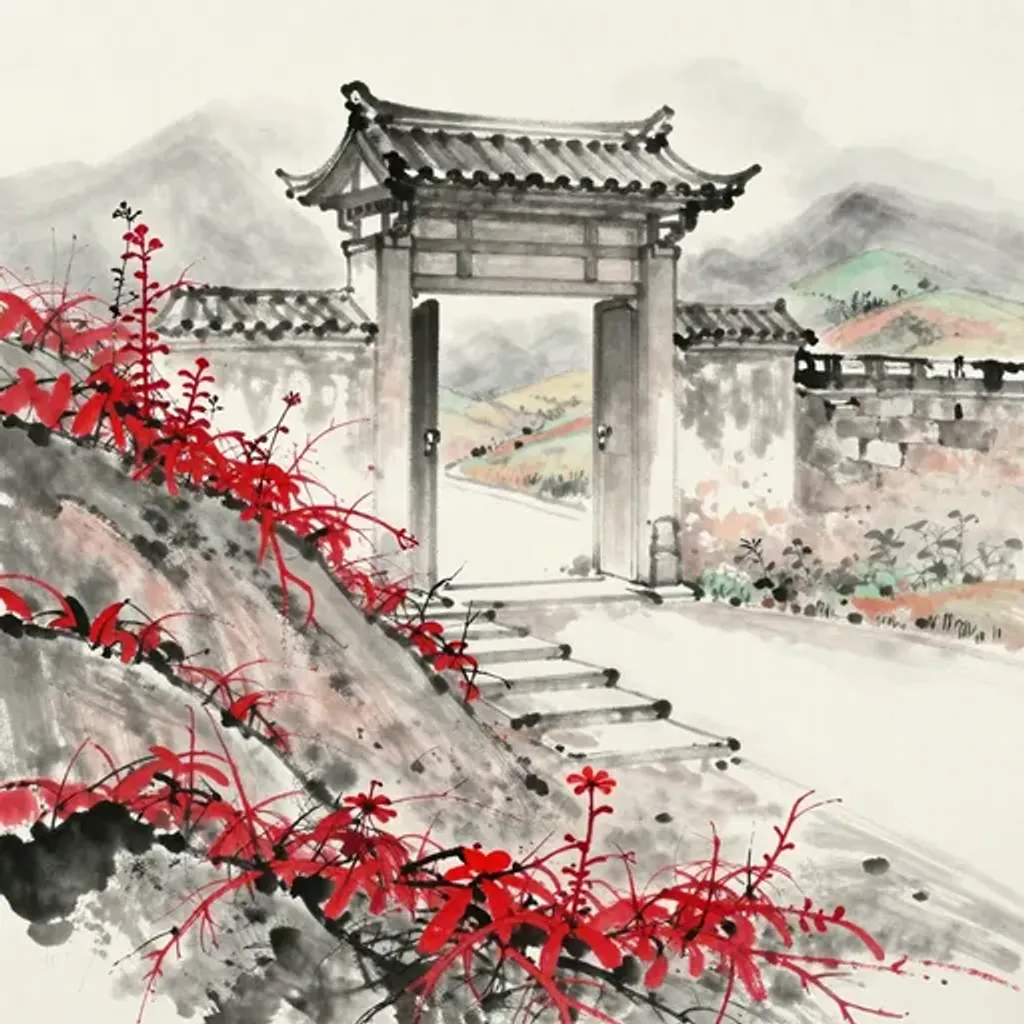
東門之壇,茹藘在坂。禮義不行,與我心反。
The altar by the eastern gate; madder root grows upon the slope. Ritual and propriety are not observed; it runs counter to my heart.
— Jiao Yanshou, Yilin (Forest of Changes), 1st century BC
Commentary
Fire beneath the mountain finds disorder at the eastern gate. On the open ground by the east gate, madder grass grows on the hillside — an image drawn from the Shijing ode 'Dong Men Zhi Shan' (鄭風·東門之墠), a love poem in which a woman lives tantalizingly near yet remains emotionally distant. The verse concludes: propriety and righteousness are not practiced, and all of this runs counter to my heart. The Shijing allusion grounds the lament: the east gate should be a place of proper social meeting, but ritual has collapsed. From Grace to the Cauldron, fire beneath the mountain rises to fire above wood. The Cauldron transforms raw materials through ritual cooking, but here the ingredients are spoiled — without propriety, even the sacred vessel cannot produce a worthy offering.
賁 → 震
Hexagram 22 → Hexagram 51: The Arousing Thunder
Changing lines: 3, 4, 6
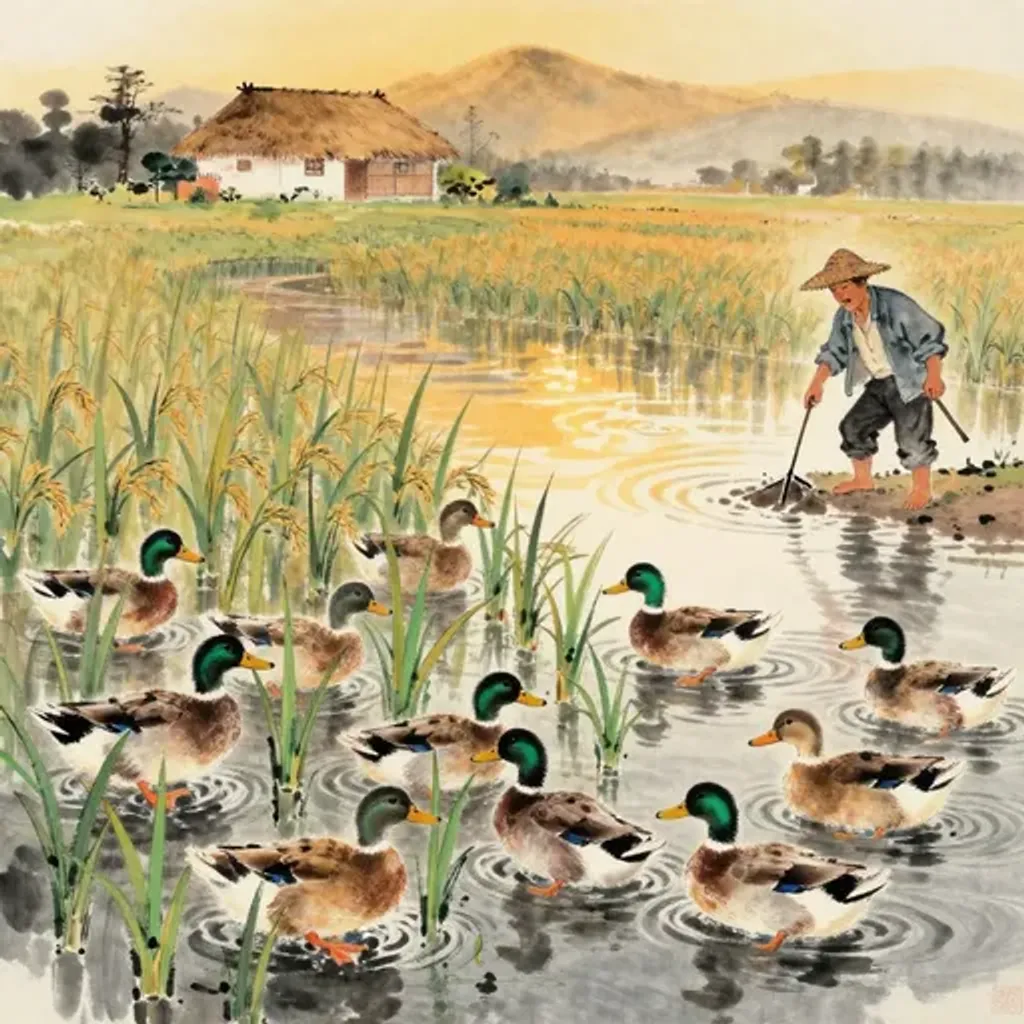
鳧遇稻廬,甘樂趨鰌。雖驅不去。
The wild duck finds a rice field, delighting in the loach below. Though driven away, it will not leave.
— Jiao Yanshou, Yilin (Forest of Changes), 1st century BC
Commentary
Fire beneath the mountain warms an irresistible feast. A wild duck finds a rice storehouse and delightedly chases loaches — though you drive it away, it refuses to leave. The scene is comically vivid: the duck has found paradise and no amount of shooing will dislodge it. This is appetite finding its perfect object, instinct so satisfied that external force cannot override it. From Grace to the Arousing, fire beneath the mountain gives way to doubled thunder. The Arousing brings shock and sudden movement — yet the duck's stubborn immobility is the verse's central joke. Against Thunder's rattling force, the creature that has found abundance simply hunkers down. Sometimes the most powerful arousal is not being moved at all.
賁 → 艮
Hexagram 22 → Hexagram 52: Keeping Still Mountain
Changing lines: 1
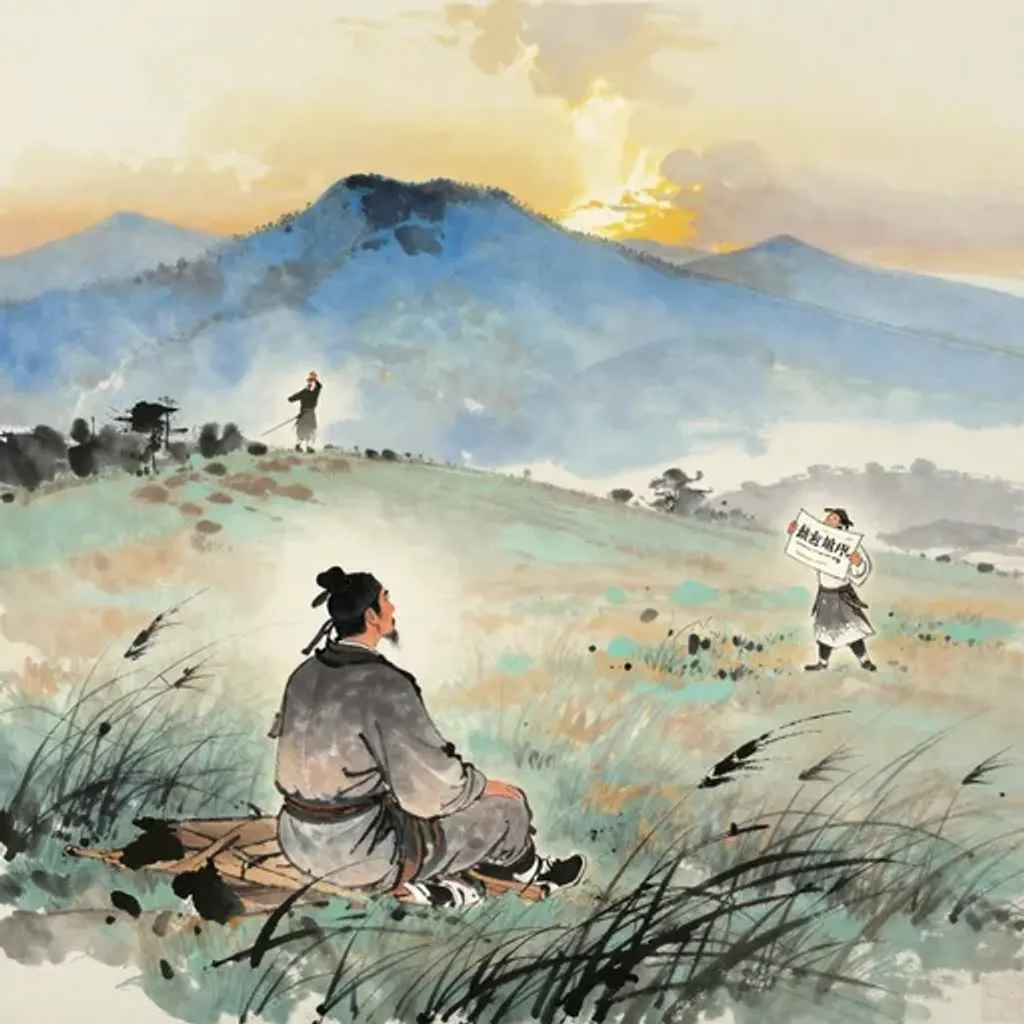
清人高子,久屯外野。逍遙不歸,思我君母。公子奉請,王孫嘉許。
The men of Qing, led by Gaozu, long encamped in the outer wilds. Wandering free, they do not return; they long for their lord and mother. The young lord presents a petition; the noble heir warmly approves.
— Jiao Yanshou, Yilin (Forest of Changes), 1st century BC
Commentary
Fire beneath the mountain reveals soldiers idling far from home. The Men of Qing — Gao Ke's garrison from the Shijing ode 'Qing Ren' — have been stationed on the frontier too long, wandering at leisure and never returning. They think of their lord and mother back home. Then a prince comes bearing a summons, and a noble approves the recall. The Shijing's 'Qing Ren' laments Zheng soldiers stationed uselessly at Qing, their martial energy wasted. From Grace to Keeping Still, fire beneath the mountain meets the doubled mountain. Grace's restless fire settles into the absolute stillness of twin peaks. The garrison's aimless wandering finds resolution in Gen's teaching: stop where you are, think not beyond your station, and wait for the proper summons.
賁 → 漸
Hexagram 22 → Hexagram 53: Development
Changing lines: 1, 5
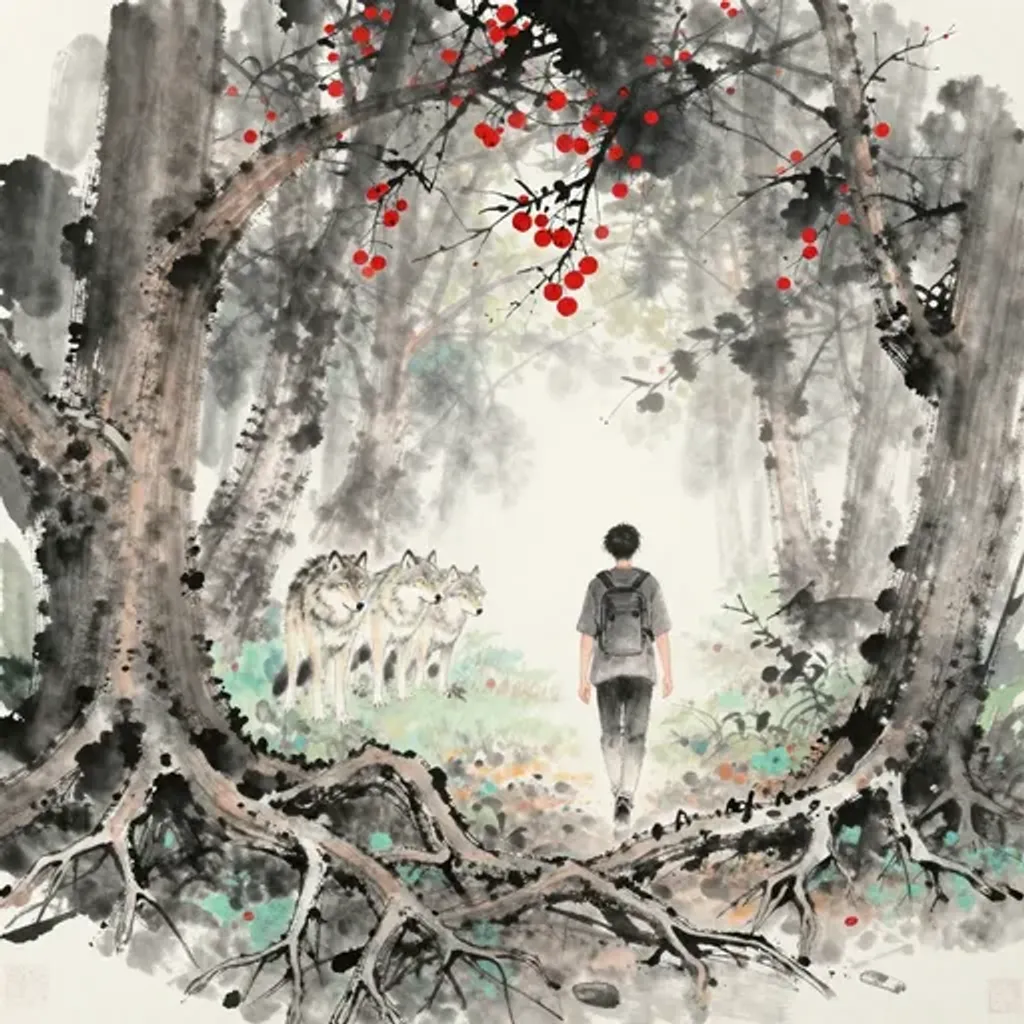
讒人所言,語不成全。虎狼之患,不為我殘。
What slanderers say, their words do not hold together. The peril of wolves and tigers does not bring me harm.
— Jiao Yanshou, Yilin (Forest of Changes), 1st century BC
Commentary
Fire beneath the mountain tests the power of slander. What slanderers say never forms a complete story — their words are fragmentary, inconsistent, unable to cohere into a convincing narrative. Despite the danger of wolves and tigers, they do not manage to destroy. The verse affirms resilience against malicious speech: the slander is attempted but structurally flawed, and the predatory threat, though real, fails to land. From Grace to Development, fire beneath the mountain gives way to trees growing on the mountain. Development (Jian) is gradual, organic growth — the wild goose advancing step by step. Against the hurried violence of slander and predation, Development offers steady, incremental progress that outlasts its attackers. The slanderer's incomplete words cannot overtake what grows naturally.
賁 → 歸妹
Hexagram 22 → Hexagram 54: The Marrying Maiden
Changing lines: 2, 3, 4, 6
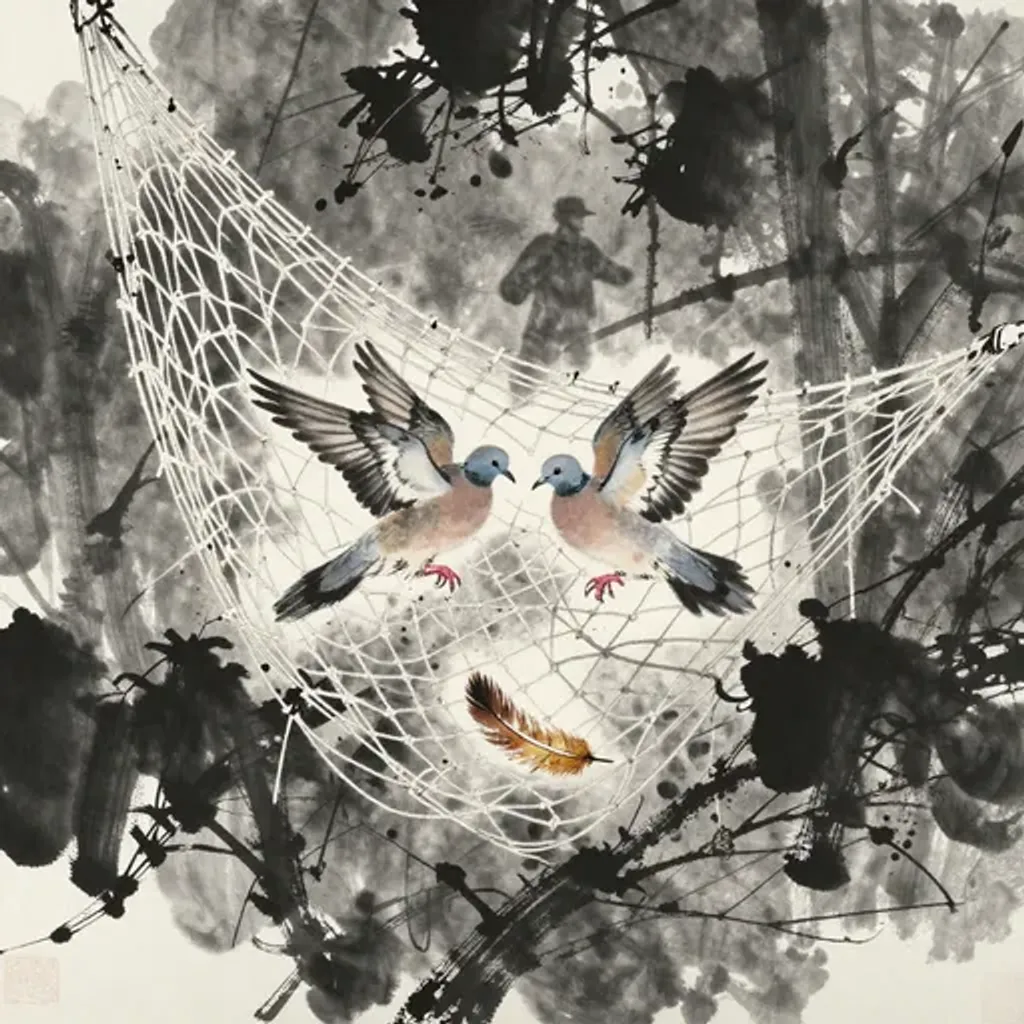
張羅捕鳩,鳥麗其災。雌雄俱得,為罔所賊。
Spreading nets to catch doves; the birds fall into disaster. Male and female are both taken; trapped by the snare.
— Jiao Yanshou, Yilin (Forest of Changes), 1st century BC
Commentary
Fire beneath the mountain sets a trap. Nets are spread to catch doves, and the birds encounter their disaster. Both male and female are snared together, destroyed by the hunter's mesh. The scene is efficient and merciless: the net (罔) does not discriminate, catching both members of the pair. In the marriage context of the target hexagram, this pairing-then-trapping takes on a specific resonance. From Grace to the Marrying Maiden, fire beneath the mountain yields to thunder above the lake. The Marrying Maiden describes a subordinate union — a younger sister given in marriage, often without full agency. The trapped dove-pair mirrors the hexagram's theme: union that is also a kind of captivity, joy shadowed by the net that closes around it.
賁 → 豐
Hexagram 22 → Hexagram 55: Abundance
Changing lines: 4, 6
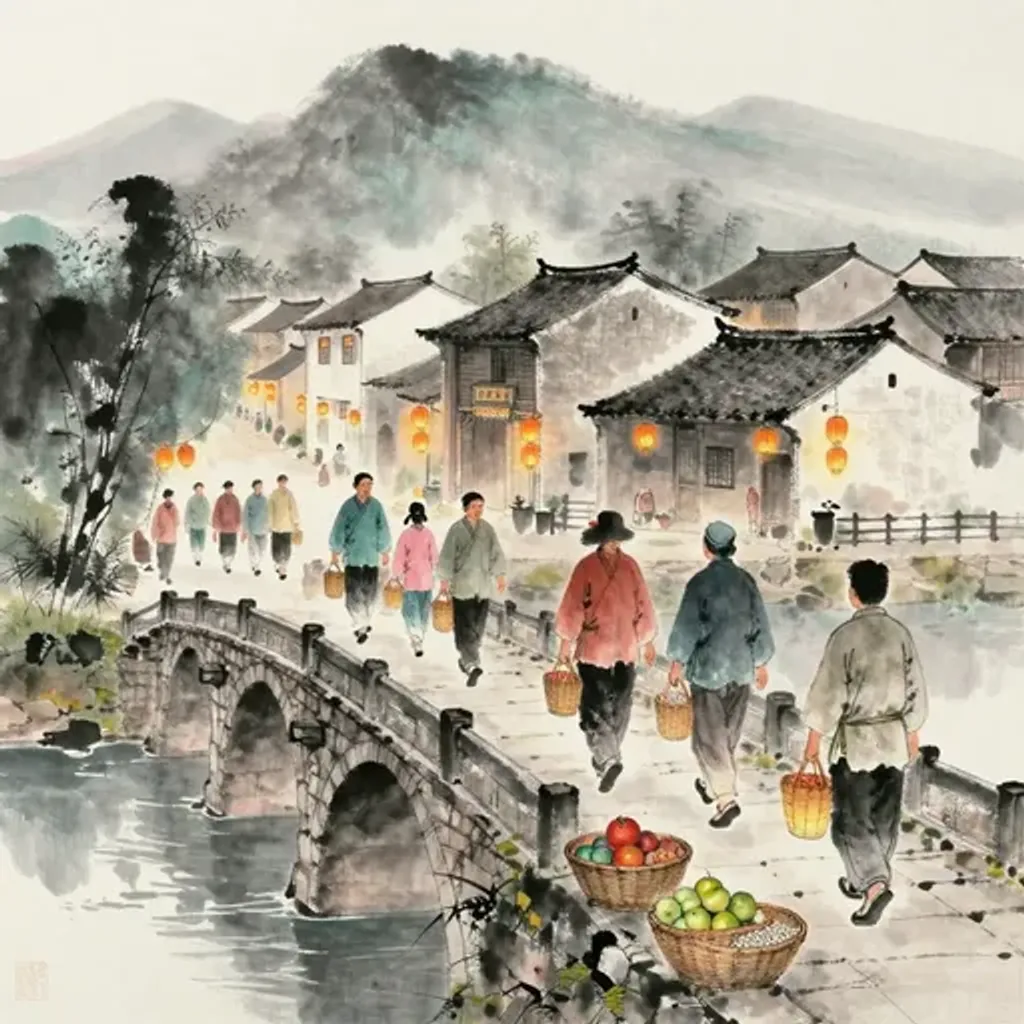
安仁尚德,東鄰慕義,來安吾國。
Settled in benevolence, esteeming virtue; the eastern neighbor admires righteousness and comes to bring peace to our land.
— Jiao Yanshou, Yilin (Forest of Changes), 1st century BC
Commentary
Fire beneath the mountain radiates virtue outward. Practicing benevolence and esteeming virtue, the eastern neighbor admires this righteousness and comes to settle in the kingdom. No armies march; no borders are enforced. The attraction is purely moral — the neighbor sees genuine virtue and voluntarily relocates. This embodies the Confucian ideal of 'transformative virtue' (德化): civilization spreading through example rather than conquest. From Grace to Abundance, fire beneath the mountain rises to thunder and lightning together. Abundance combines illumination with energetic action — the ruler at midday, the kingdom at its zenith. The verse shows how Abundance is properly achieved: not through expansion by force but through the magnetic pull of authentic virtue that draws others willingly.
賁 → 旅
Hexagram 22 → Hexagram 56: The Wanderer
Changing lines: 1, 4
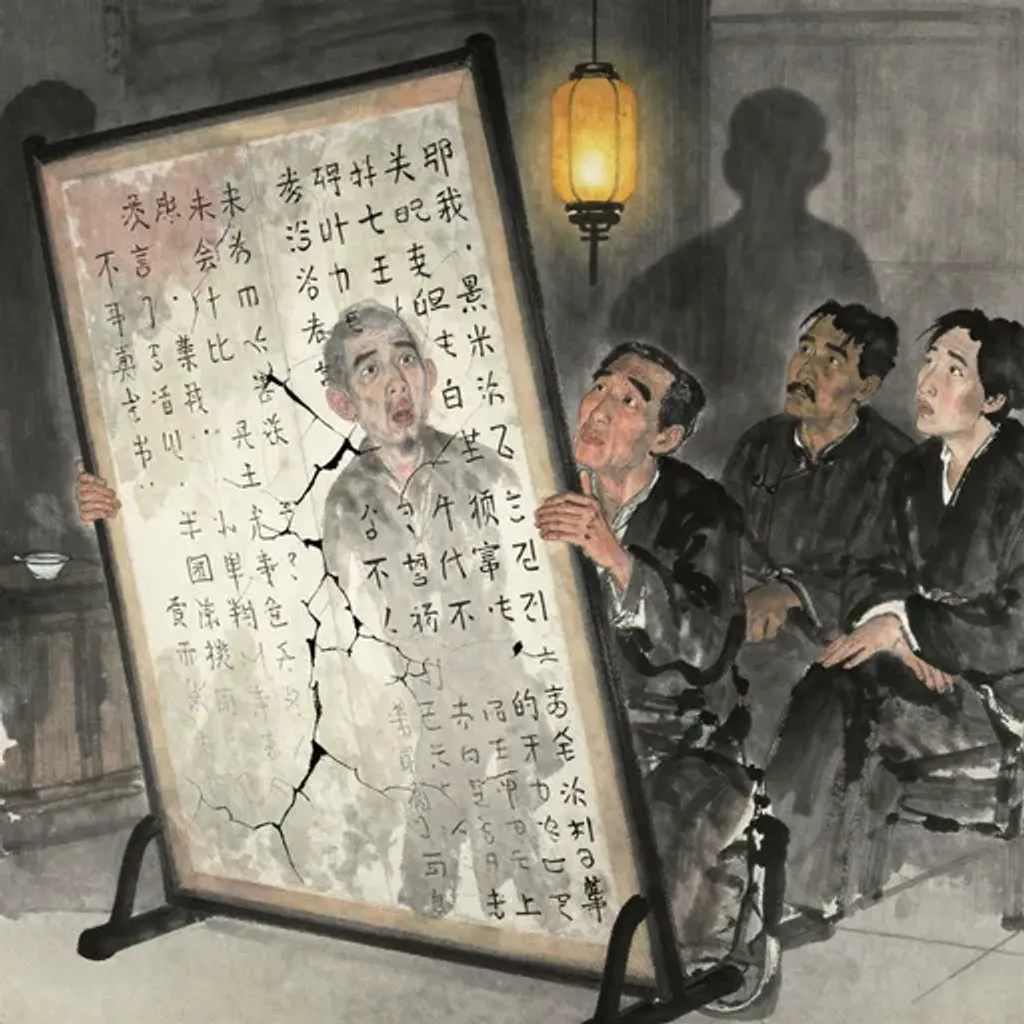
猾醜如誠,前後相違。言如鱉咳,語不可知。
The sly deceiver feigns sincerity; front and back contradict each other. Words are like a turtle's cough; speech cannot be understood.
— Jiao Yanshou, Yilin (Forest of Changes), 1st century BC
Commentary
Fire beneath the mountain fails to expose the truth. A cunning wretch puts on a show of sincerity, but his words before and behind are contradictory. His speech is like the cough of a soft-shelled turtle — unintelligible and impossible to decipher. The turtle's 'cough' is a vivid image of sounds that mimic speech but carry no genuine meaning. The duplicitous person's front-face and back-face are irreconcilable, and no listener can extract truth from the noise. From Grace to the Wanderer, fire beneath the mountain moves to fire atop the mountain. The Wanderer is the outsider, the stranger who must navigate unfamiliar terrain with care. The verse warns the traveler: in foreign territory, appearances deceive most dangerously, and turtle-cough speech is the hallmark of those who cannot be trusted.
賁 → 巽
Hexagram 22 → Hexagram 57: The Gentle Wind
Changing lines: 1, 2, 5
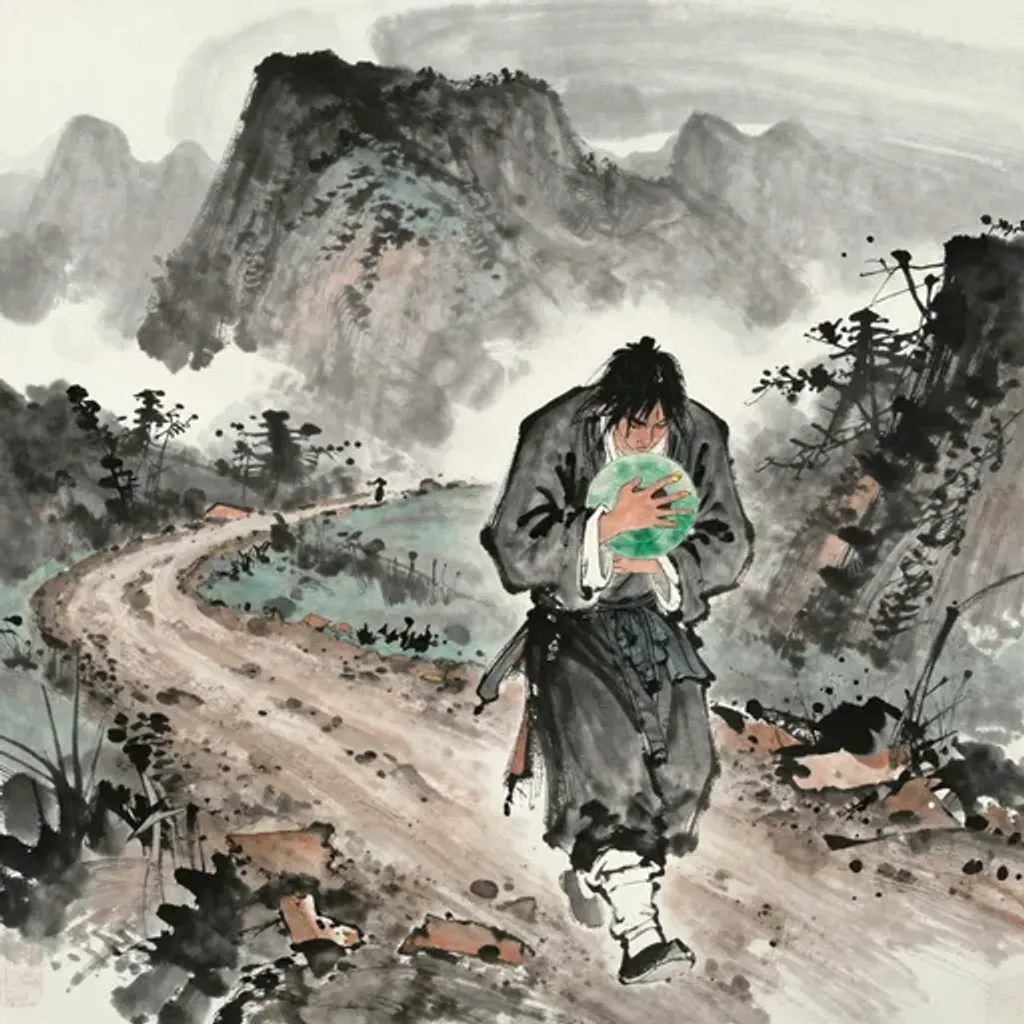
懷璧越鄉,不可遠行。蔡侯兩裘,久苦流離。
Carrying a jade disc across foreign lands, one must not travel far. The Marquis of Cai with his two fur coats; he long suffered exile and wandering.
— Jiao Yanshou, Yilin (Forest of Changes), 1st century BC
Commentary
Fire beneath the mountain illuminates the perils of traveling with treasure. Carrying a jade disc across foreign borders invites danger — one cannot venture far in safety. The Marquis of Cai and his two fur robes suffered long exile and hardship. According to the Zuo Zhuan, when Marquis Zhao of Cai visited Chu around 509 BC, he brought two fine fur robes — one for the Chu king and one for himself. The Chu minister Zi Chang coveted the marquis's robe, and when refused, had him detained for three years. From Grace to the Gentle, fire beneath the mountain transforms into doubled wind. Wind penetrates everywhere — it cannot be blocked or hoarded. The verse warns that visible treasure, like the jade or the robe, attracts predatory attention in a wind-penetrated world where nothing stays hidden.
賁 → 兌
Hexagram 22 → Hexagram 58: The Joyous Lake
Changing lines: 2, 3, 4, 5, 6
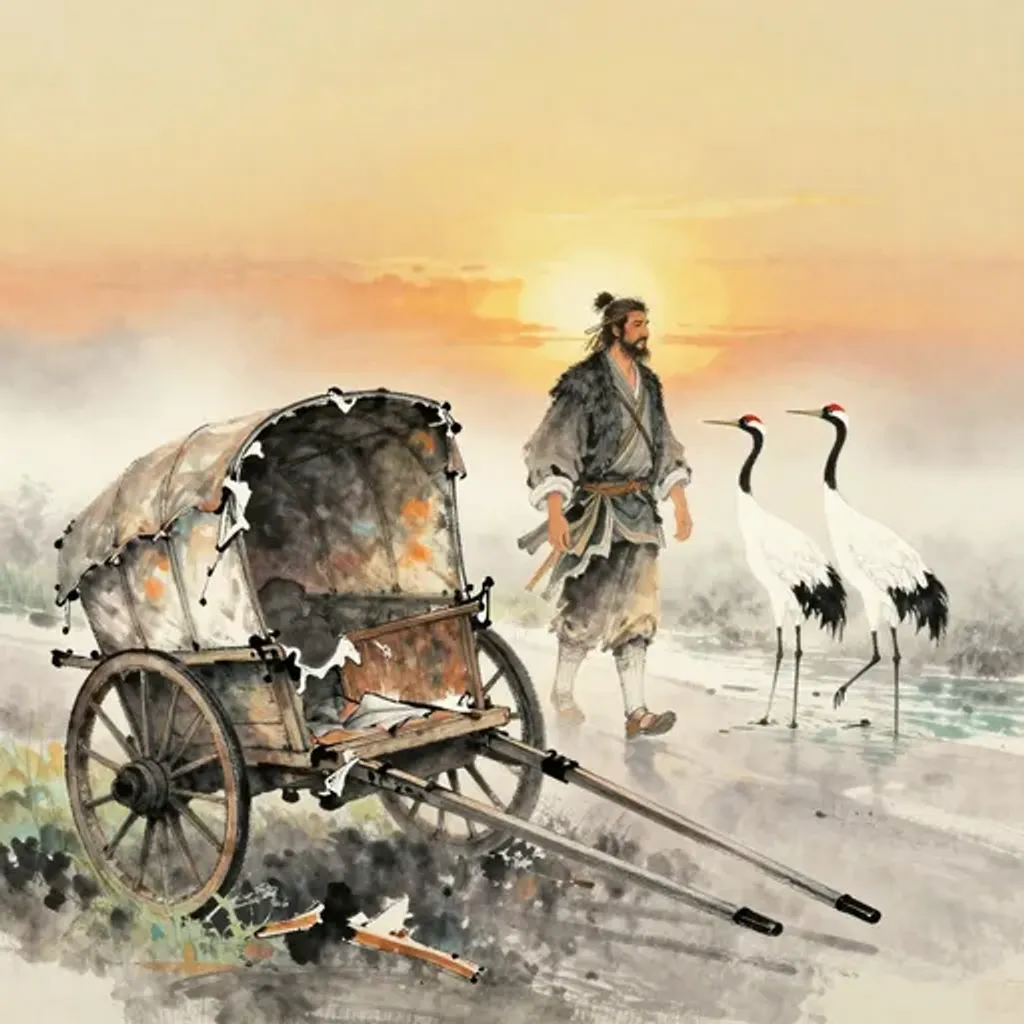
伯氏歸國,多所恨惑。車傾蓋亡,身常驚惶。乃得其願,雌雄相從。
Lord Bo returns to his country, beset by much resentment and doubt. The cart overturns, the canopy is lost; the body is ever startled and fearful. At last the wish is gained; female and male follow together.
— Jiao Yanshou, Yilin (Forest of Changes), 1st century BC
Commentary
Fire beneath the mountain lights a troubled homecoming. A lord returns to his state, burdened with much resentment and confusion. His carriage overturns and its canopy is lost; he lives in constant alarm. Yet finally his wish is fulfilled, and male and female follow each other in harmony. The arc bends from turbulent return through accidents and fear toward eventual reunion. The 'Bo clan' returning to their state may allude to an exiled prince — perhaps Chong Er of Jin or a similar figure — whose homecoming is fraught with danger before finding peace. From Grace to the Joyous, fire beneath the mountain yields to doubled lakes. After all the overturned carriages and constant dread, the Joyous offers what was missing: genuine mutual delight, two lakes reflecting each other's abundance.
賁 → 渙
Hexagram 22 → Hexagram 59: Dispersion
Changing lines: 1, 2, 3, 5
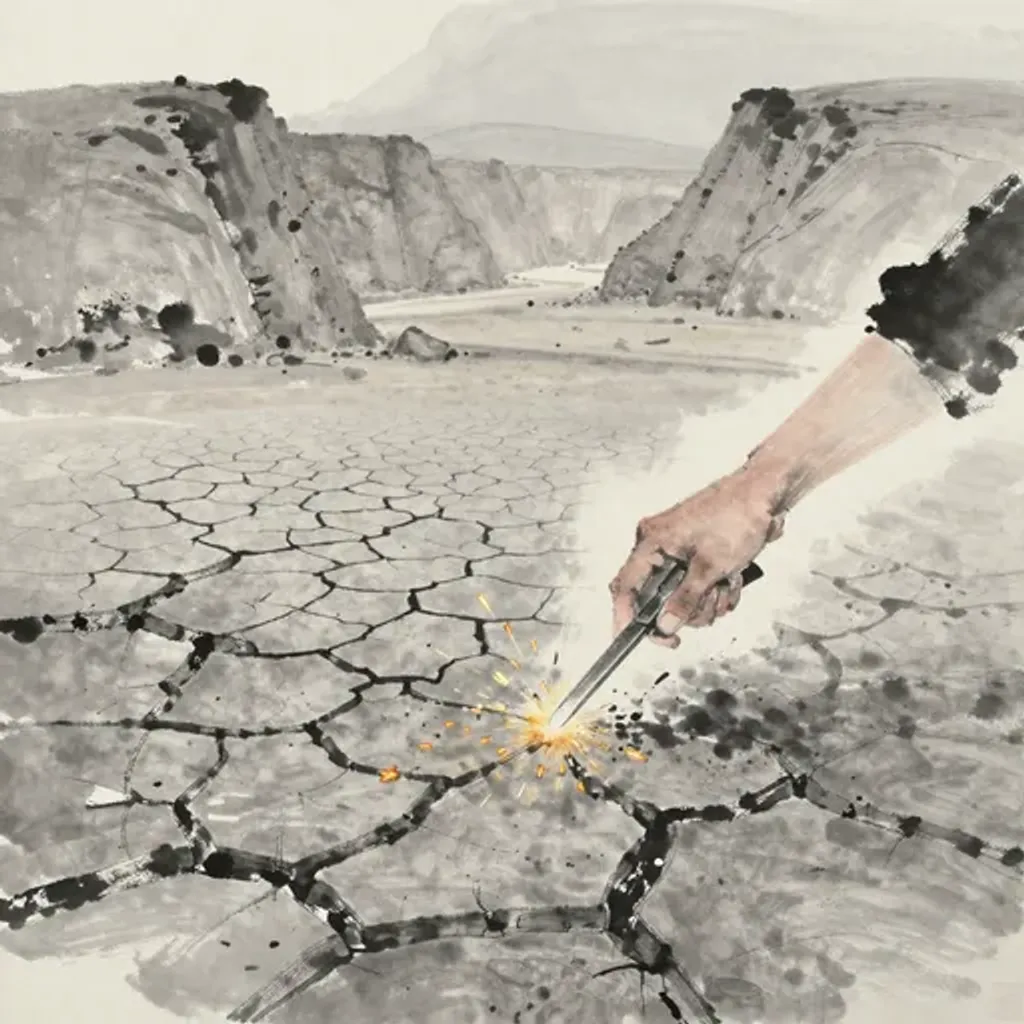
火石相得,乾無潤澤。利少囊縮,秪益促迫。
Fire and stone meet together; dry, without moisture or nourishment. Profit is scarce, the purse shrinks; it only adds to urgency and pressure.
— Jiao Yanshou, Yilin (Forest of Changes), 1st century BC
Commentary
Fire beneath the mountain strikes flint and finds no moisture. Fire and stone meet — they are well-matched — but together they produce only arid heat. Profits shrink as the purse tightens, and the pressure only intensifies. The flint-fire combination is efficient but sterile: it generates sparks without nourishment, heat without sustenance. From Grace to Dispersion, fire beneath the mountain transforms into wind moving across water. Dispersion (Huan) is the principle of scattering accumulated tension — wind dispersing the frozen surface of water. The verse's problem is the opposite: too much friction, too little flow. The fire-stone combination needs what Dispersion provides — the loosening wind, the dissolving water — to break the cycle of shrinking returns and mounting constriction.
賁 → 節
Hexagram 22 → Hexagram 60: Limitation
Changing lines: 2, 3, 5, 6
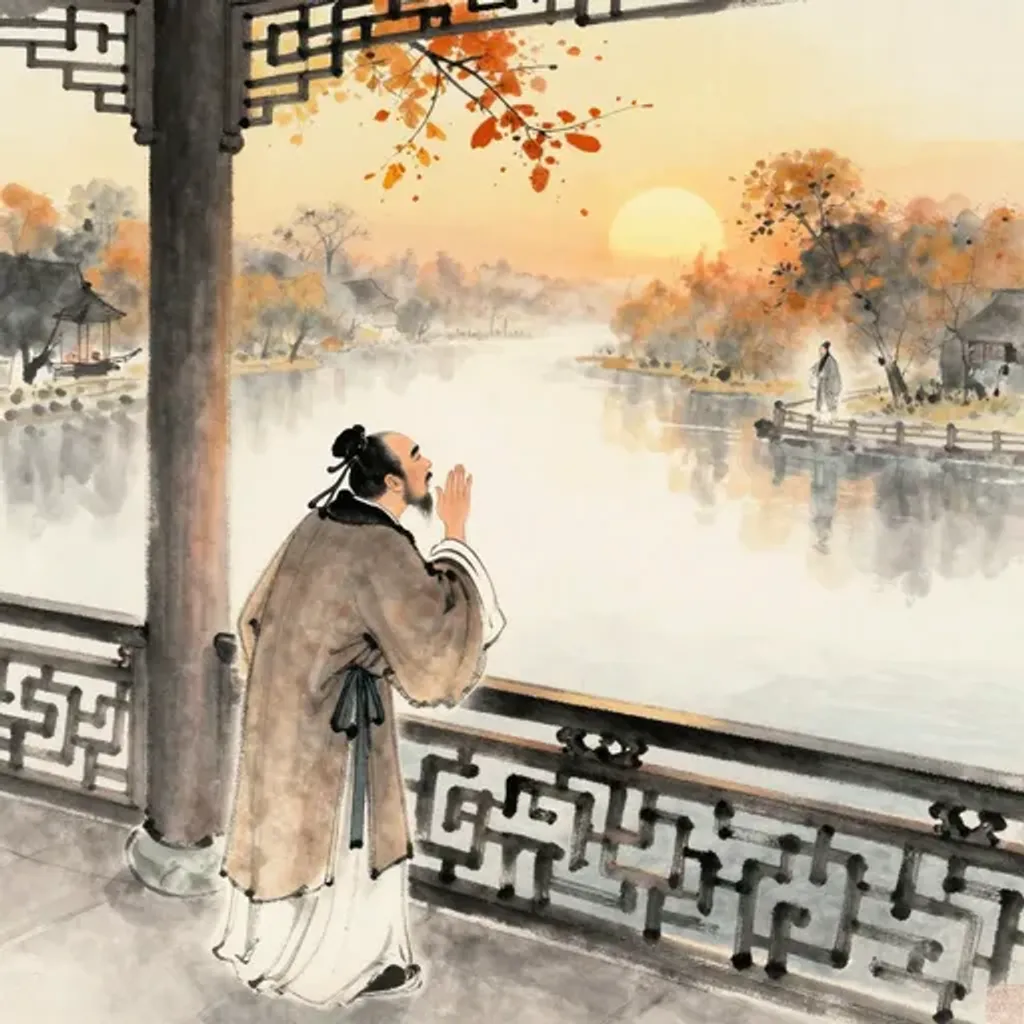
君知聖哲,鳴呼其友。鎮德之徒,可以禮仕。
The lord knows the sage and the wise; he calls out to his friends. Those who uphold virtue; they may serve with propriety.
— Jiao Yanshou, Yilin (Forest of Changes), 1st century BC
Commentary
Fire beneath the mountain reveals a ruler who recognizes wisdom. The sovereign knows the sage and the philosopher, calling out to his worthy companions. Those who anchor their virtue become the kind of followers who can be employed through proper ritual. The verse traces the ideal sequence: recognition of talent, public summoning, and incorporation through established ceremony. From Grace to Limitation, fire beneath the mountain transforms into water resting upon the lake. Limitation's teaching is that measure and proportion define true order — the sage must not only be found but properly placed within institutional bounds. Grace's fire decorates; Limitation's water regulates. The ruler who recognizes the sage and employs him through ritual enacts exactly this transformation: from admiration to structured governance.
賁 → 中孚
Hexagram 22 → Hexagram 61: Inner Truth
Changing lines: 2, 3, 5
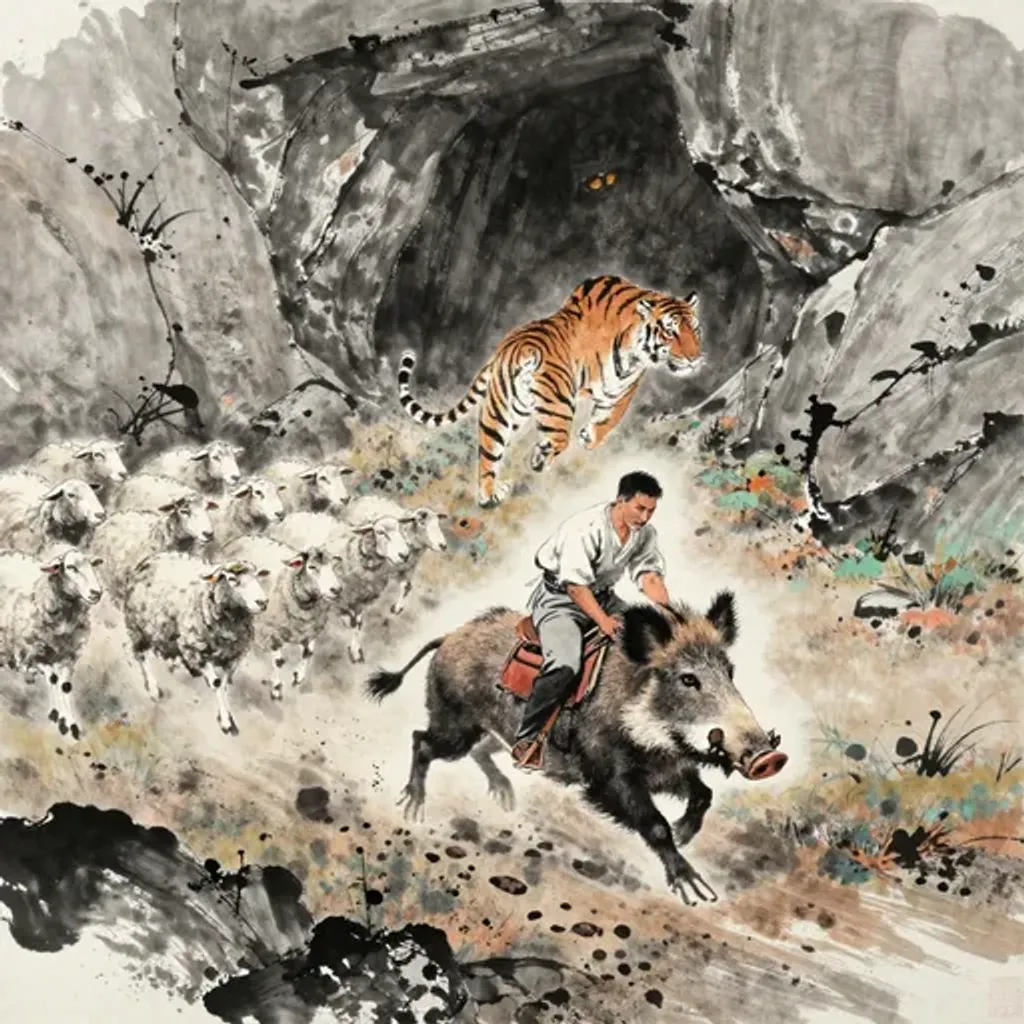
騎豚逐羊,不見所望。經涉虎廬,亡羝失羊。
Riding a boar, chasing sheep; what one hopes for is not found. Passing through the tiger's den; the ram is lost, the sheep are gone.
— Jiao Yanshou, Yilin (Forest of Changes), 1st century BC
Commentary
Fire beneath the mountain sends a rider on a futile chase. Riding a pig to chase sheep — an absurdly mismatched pursuit — one never catches sight of the quarry. Then, passing through a tiger's den, the rams and sheep are all lost. The comedy turns deadly: the wrong mount for the wrong prey leads through the worst possible terrain, and what little one had is devoured. From Grace to Inner Truth, fire beneath the mountain yields to wind above the lake. Inner Truth demands hollowness at the center — genuine emptiness that allows resonance. The pig-mounted sheep-chaser embodies the opposite: a person so misaligned in means and ends that no authentic connection is possible. Truth requires matching the instrument to the purpose.
賁 → 小過
Hexagram 22 → Hexagram 62: Small Exceeding
Changing lines: 1, 4, 6
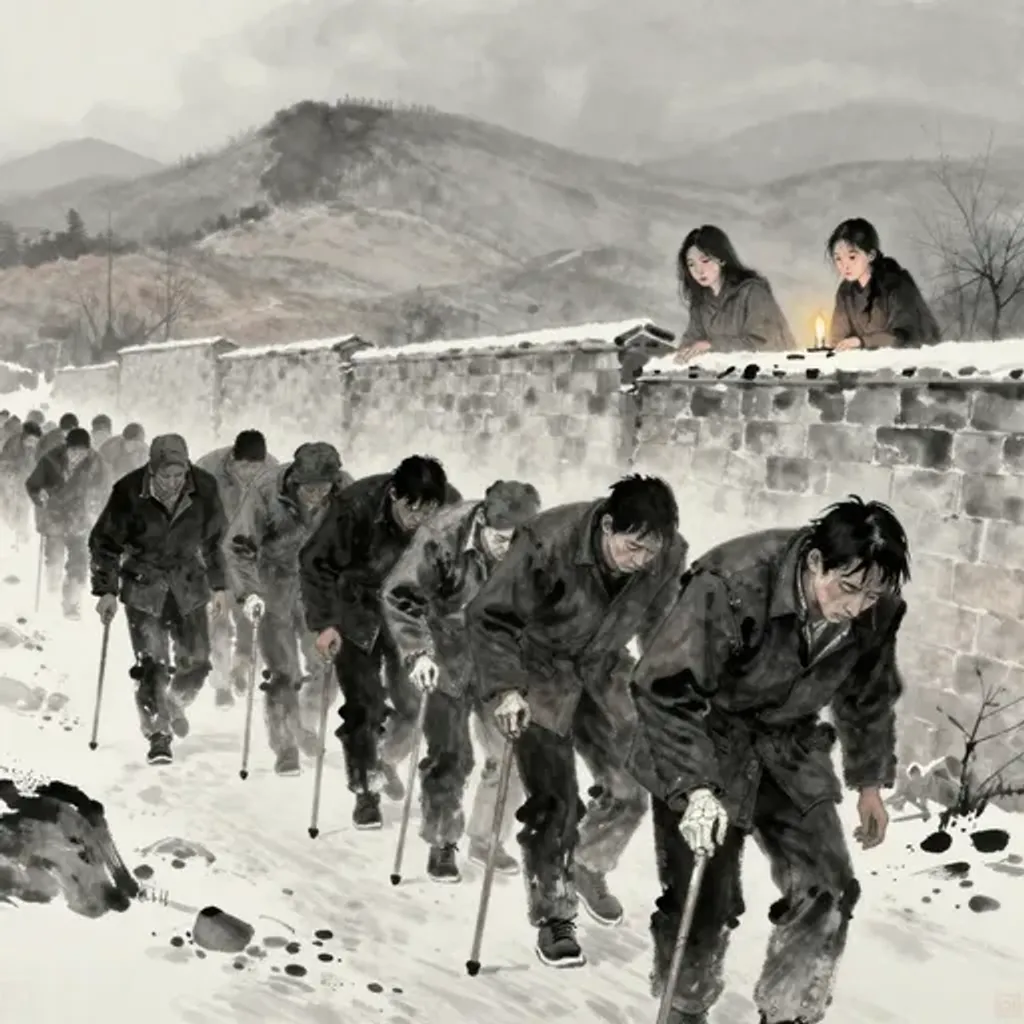
玄黃瘣隤,行者勞罷。役夫憔悴,處子畏哀。
Heaven and earth are sickly and wan; the traveler is weary and spent. The laborers are gaunt and haggard; the young woman is filled with dread and sorrow.
— Jiao Yanshou, Yilin (Forest of Changes), 1st century BC
Commentary
Fire beneath the mountain reveals exhaustion across the land. Heaven and earth are bruised and battered — the phrase 'xuan huang' (玄黃) echoes the Shijing's soldiers' lament and the I-Ching's Kun hexagram (line six-three: 'the dragon battles in the wild, its blood is xuan-yellow'). Travelers are weary and spent, conscript workers haggard, and young women at home grieve in dread. From Grace to Small Exceeding, fire beneath the mountain gives way to thunder above the mountain. Small Exceeding teaches that in times of diminished resources, one should exceed in humility, in mourning, in frugality — but never in ambition. The verse's universal exhaustion is precisely the condition Small Exceeding addresses: when all are spent, only modest excess in care and restraint can carry one through.
賁 → 既濟
Hexagram 22 → Hexagram 63: After Completion
Changing lines: 5, 6
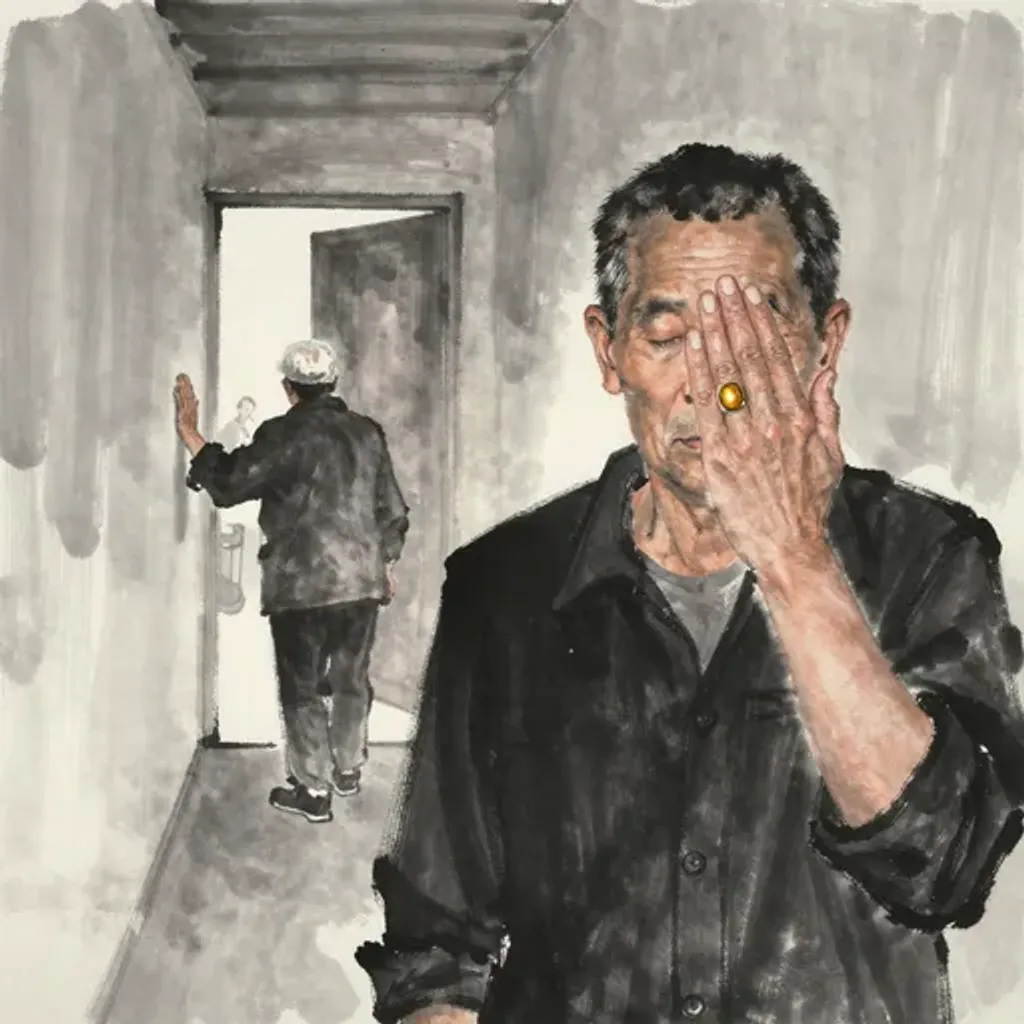
右手掩目,不見長叔。失其所得,悔吝相仍。
The right hand covers the eyes; the elder uncle cannot be seen. What was gained is now lost; regret and misfortune follow upon each other.
— Jiao Yanshou, Yilin (Forest of Changes), 1st century BC
Commentary
Fire beneath the mountain leaves one half-blind. The right hand covers the eye, blocking the view of the elder uncle. What was gained is lost, and regret follows regret in an unbroken chain. The self-inflicted blindness is the key: it is not that the uncle is absent, but that one's own hand blocks the view. Covering one eye while reaching suggests trying to grasp and see simultaneously — a failure of coordination that produces neither. From Grace to After Completion, fire beneath the mountain transforms into water above fire. After Completion is perfect balance — every line in its proper place — yet profoundly fragile. The verse captures the moment just after completion when carelessness undoes everything: the hand that should let go still grasps, covering what it should reveal.
賁 → 未濟
Hexagram 22 → Hexagram 64: Before Completion
Changing lines: 1, 2, 3, 4
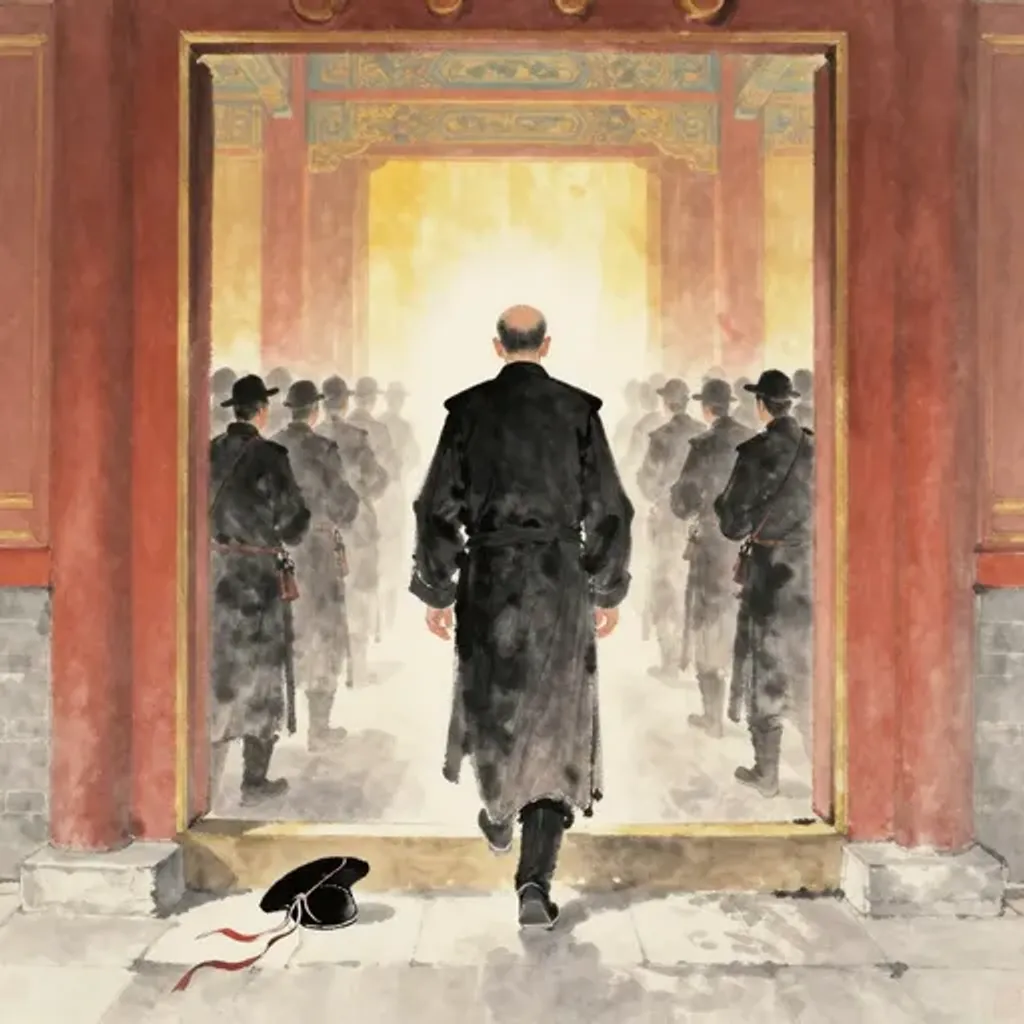
免冠進賢,步出朝門。儀體不正,賊孽為患。
Removing the cap to advance the worthy; he steps out through the court gate. Bearing and form are not upright; rebels and villains bring calamity.
— Jiao Yanshou, Yilin (Forest of Changes), 1st century BC
Commentary
Fire beneath the mountain closes with a failed act of virtue. Removing one's ceremonial cap to recommend a worthy successor, one steps out of the court gate — a gesture of self-effacing humility, ceding one's position to a more deserving person. Yet the bearing is not right; the deportment lacks proper form. Rebels and traitors become the true affliction. The attempt at virtuous abdication is betrayed by sloppy execution, and what should have been noble transfer of power instead opens the door to subversion. From Grace to Before Completion, fire beneath the mountain gives way to fire above water. Before Completion is the perpetual almost — every element present but none in its proper place. The recommender's imperfect ritual enacts this: the right intention, the wrong form, and the resulting chaos.