Transformations of Hexagram 23
Every line of change out of Hexagram 23 剝 Splitting Apart, with the Yilin verse for each of the 64 resulting hexagrams, its translation, and the original ink brush artwork.
剝 → 乾
Hexagram 23 → Hexagram 1: The Creative
Changing lines: 1, 2, 3, 4, 5
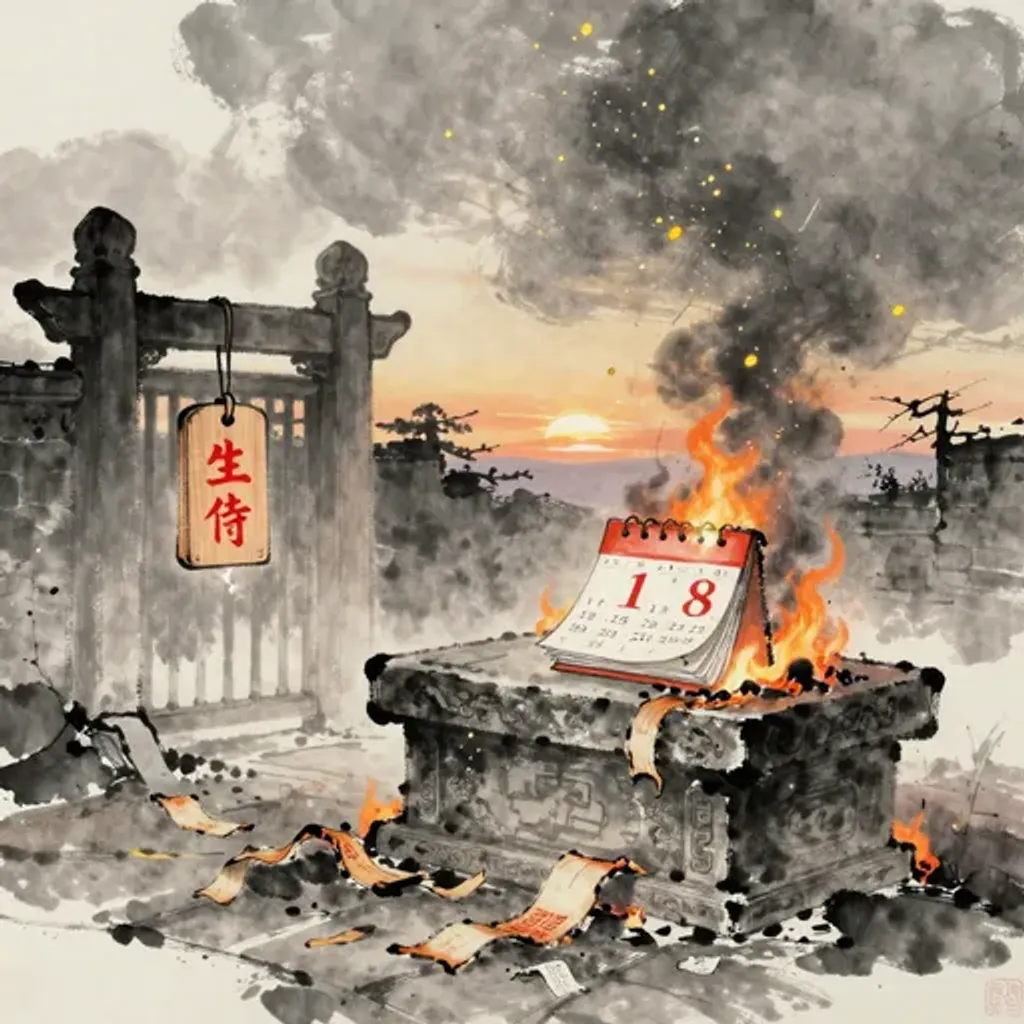
穿胸狗邦,僵離旁舂。天地易紀,日月更始。
The old calendar burns to ash and scatters; new peach-wood charms hang before the gate. The east grows white as stars withdraw — all living things raise their voices to welcome the new beginning.
— Jiao Yanshou, Yilin (Forest of Changes), 1st century BC
Commentary
Mountain rests upon earth, but when the old order strips away, pure heaven emerges. The original verse speaks of cosmic renewal: 'Heaven and Earth reset their records; sun and moon begin anew.' The strange opening — a 'dog with a pierced chest' — evokes the Han custom of hanging a dog above a gate to drive off pestilence at year's end, clearing corruption so that the celestial cycle can restart. The phrase 'tian di yi ji' directly echoes the resetting of the astronomical calendar, the supreme emblem of sovereign authority. From Splitting Apart to the Creative, the transformation is total: when every yin line has been stripped away, the single remaining yang seed becomes six unbroken lines of pure initiative. Decay completed is not death but the precondition for heaven's self-generating power.
剝 → 坤
Hexagram 23 → Hexagram 2: The Receptive
Changing lines: 6
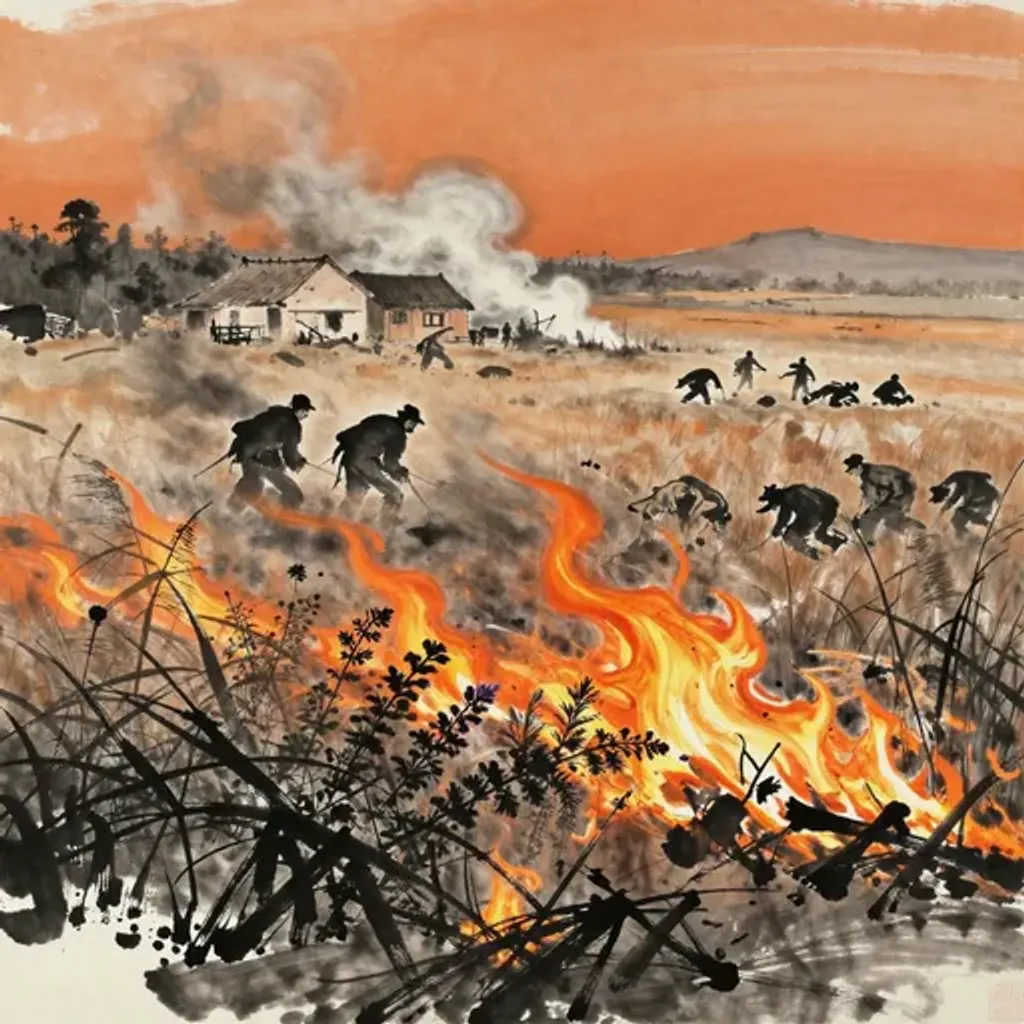
從風縱火,荻芝俱死。三害集房,十子中傷。
Sending fire with the wind; rushes and angelica all die. Three harms gather in the house; ten sons are wounded.
— Jiao Yanshou, Yilin (Forest of Changes), 1st century BC
Commentary
Mountain crumbles upon earth, yielding to doubled earth: from erosion to total receptivity. Fire is driven by wind, and both reed and magic fungus perish alike — no distinction is made when catastrophe sweeps through. Three calamities converge upon the household, and ten sons are wounded. The verse paints a scene of compound disaster: arson fanned by gale, destruction indiscriminate. The 'three harms gathering in one room' suggests a convergence of pestilence, fire, and human malice that leaves nothing standing. From Splitting Apart to the Receptive, the mountain's collapse does not find new ground but sinks into formless earth. When structure dissolves entirely, there is no foothold, only the vast patience of Kun — endurance without initiative, awaiting a leader who has not yet arrived.
剝 → 屯
Hexagram 23 → Hexagram 3: Difficulty at the Beginning
Changing lines: 1, 5, 6
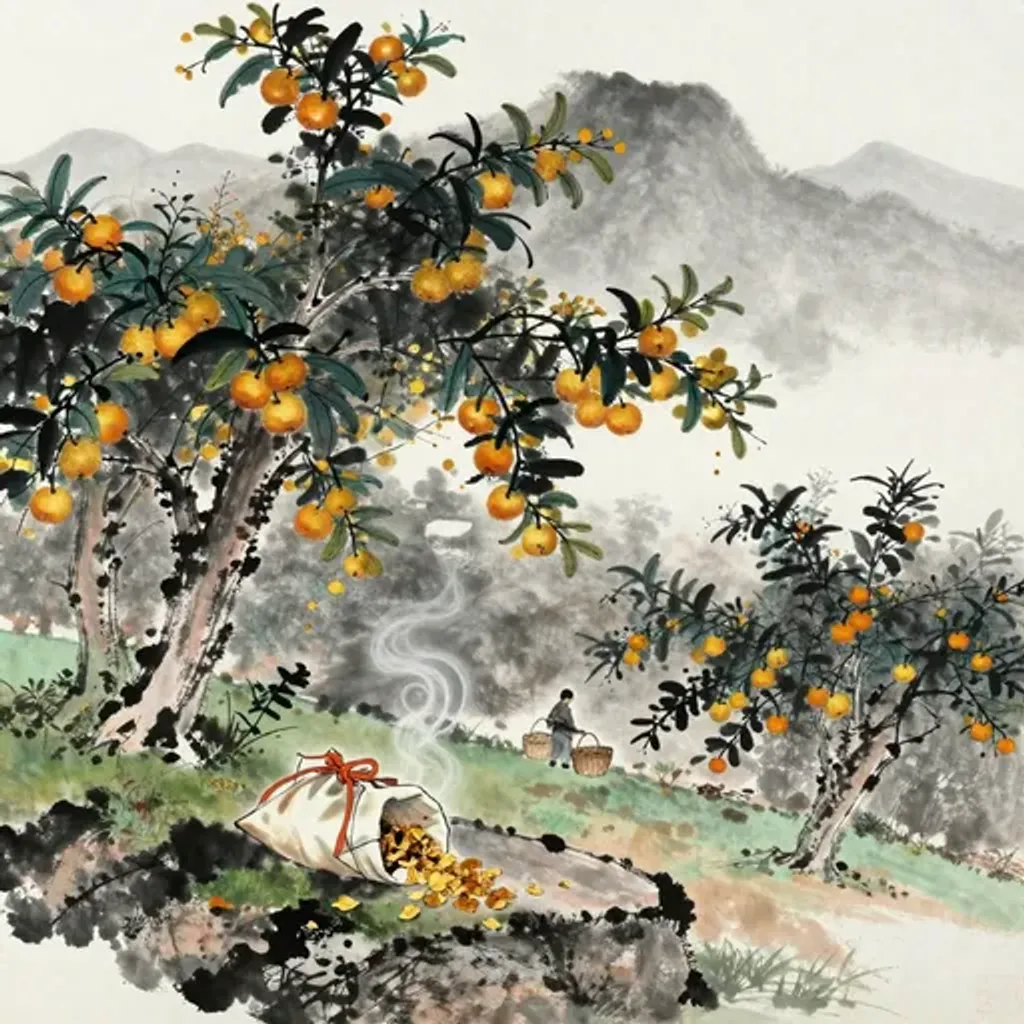
北山有棗,橘柚於聚。荷囊載香,盈我筐筥。
On the northern mountain there are jujubes; tangerines and citrons gathered together. Carrying a pouch laden with fragrance, filling my baskets and hampers.
— Jiao Yanshou, Yilin (Forest of Changes), 1st century BC
Commentary
Mountain attached to earth strips away, but from this barren ground thunder stirs beneath gathering clouds. The verse presents an unexpected harvest: jujubes on the northern hill, tangerines and pomelos clustering together, pouches brimming with fragrance, filling baskets and hampers to overflowing. Against the backdrop of Splitting Apart, this abundance reads as a paradox — the mountain is decaying, yet the land yields its riches precisely because the old structures are clearing. From Splitting Apart to Difficulty at the Beginning, the transformation moves from late-stage erosion into the first stirrings of new life. Thunder beneath water is birth through struggle: the very collapse of the old order scatters seeds that take root in fresh soil.
剝 → 蒙
Hexagram 23 → Hexagram 4: Youthful Folly
Changing lines: 2
齎貝贖狸,不聽我辭。繫於虎鬚,牽不得來。
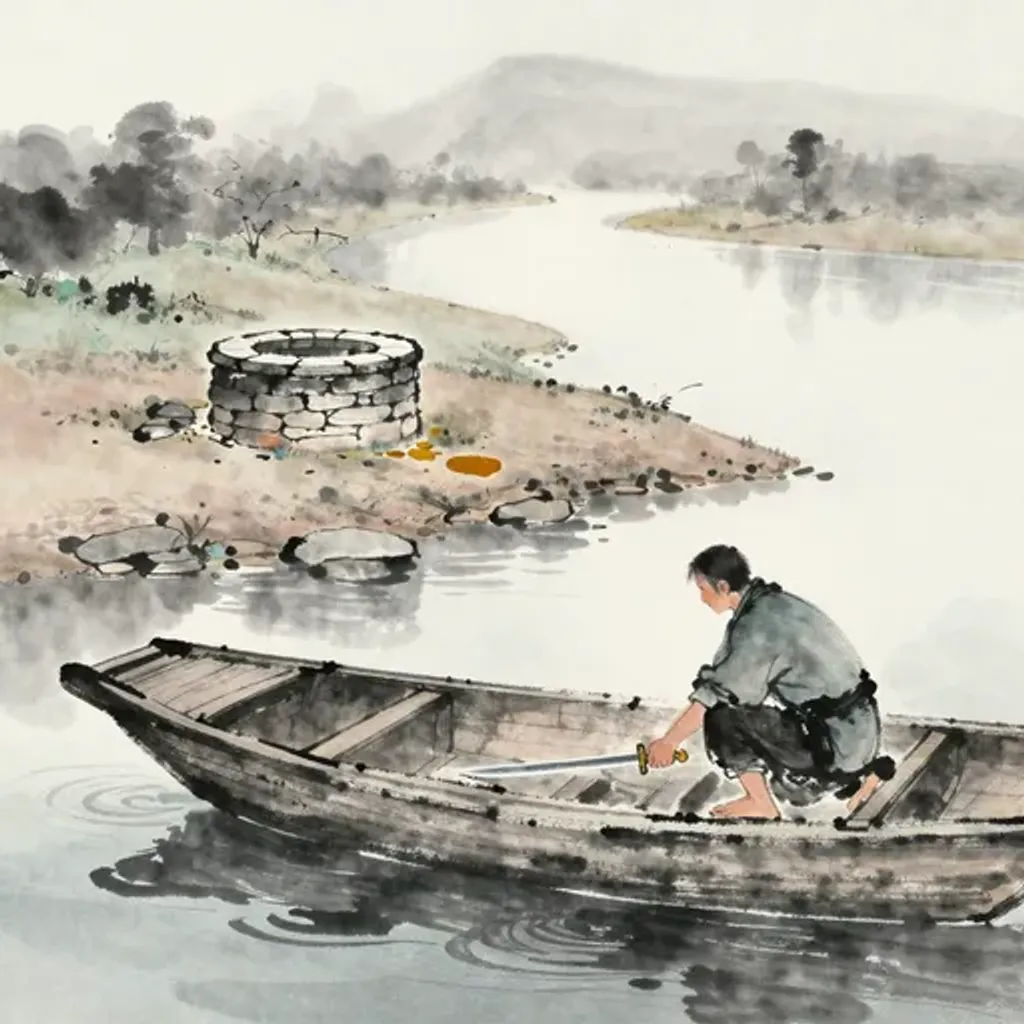
Carving the boat to mark where the sword fell — the river has long since flowed on. Dropping a stone into a dry well — no echo returns.
— Jiao Yanshou, Yilin (Forest of Changes), 1st century BC
Commentary
Mountain upon earth decays into mountain over water — a spring emerges from beneath rock, but the youth cannot yet see clearly. The original verse reads: 'Carrying cowries to ransom a fox-cat, it will not heed my words; tied to a tiger's whiskers, it cannot be pulled free.' One offers treasure to buy back something trivial, but the transaction fails; one grasps at a tiger's beard and cannot let go. Both images capture the futility of applying the wrong method to the wrong problem. The famous allusion 'marking the boat to find the sword' from the rewritten verse reinforces this perfectly. From Splitting Apart to Youthful Folly, decaying certainties give way to bewildered ignorance. The spring beneath the mountain flows, but the fool seeks water where the boat once was, not where the current runs now.
剝 → 需
Hexagram 23 → Hexagram 5: Waiting
Changing lines: 1, 2, 3, 5, 6
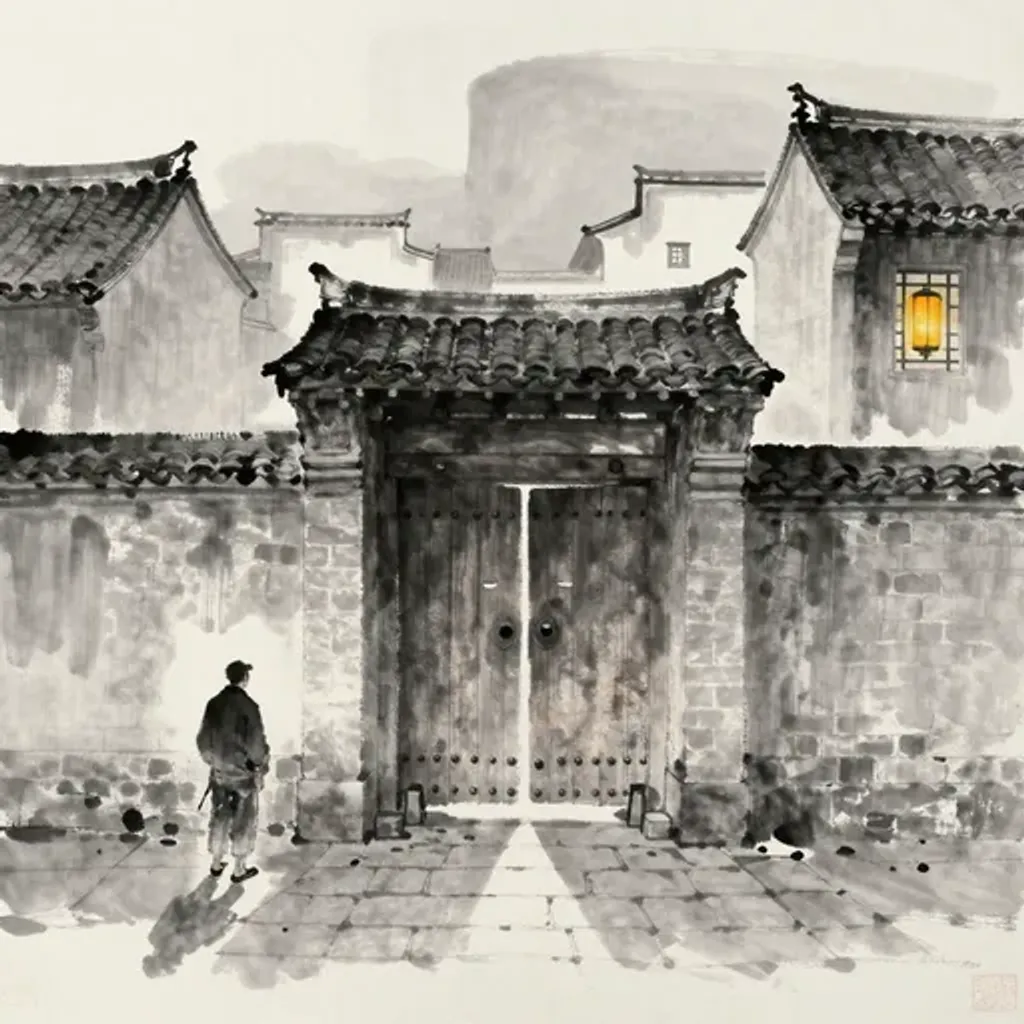
上下惟邪,戾其元夫。歡心隔塞,君子離居。
Above and below all is perverse; estranging her rightful lord. Joyful hearts are blocked and sealed; the noble man dwells apart.
— Jiao Yanshou, Yilin (Forest of Changes), 1st century BC
Commentary
Mountain upon earth crumbles, giving way to clouds rising above heaven — water suspended, awaiting its moment. The verse describes a world where 'above and below are entirely crooked,' and even the upright husband is estranged. Joy and affection are blocked; the gentleman is forced to live apart. This is a court corrupted from top to bottom, where honest men cannot find shelter. The word 'xie' (crooked) appears emphatically, suggesting pervasive moral distortion that separates those who should be together. From Splitting Apart to Waiting, the decay of the old order creates a liminal space: the rain has not yet fallen, danger looms but has not struck. The gentleman's exile is itself a form of waiting — enduring separation until conditions change.
剝 → 訟
Hexagram 23 → Hexagram 6: Conflict
Changing lines: 2, 4, 5
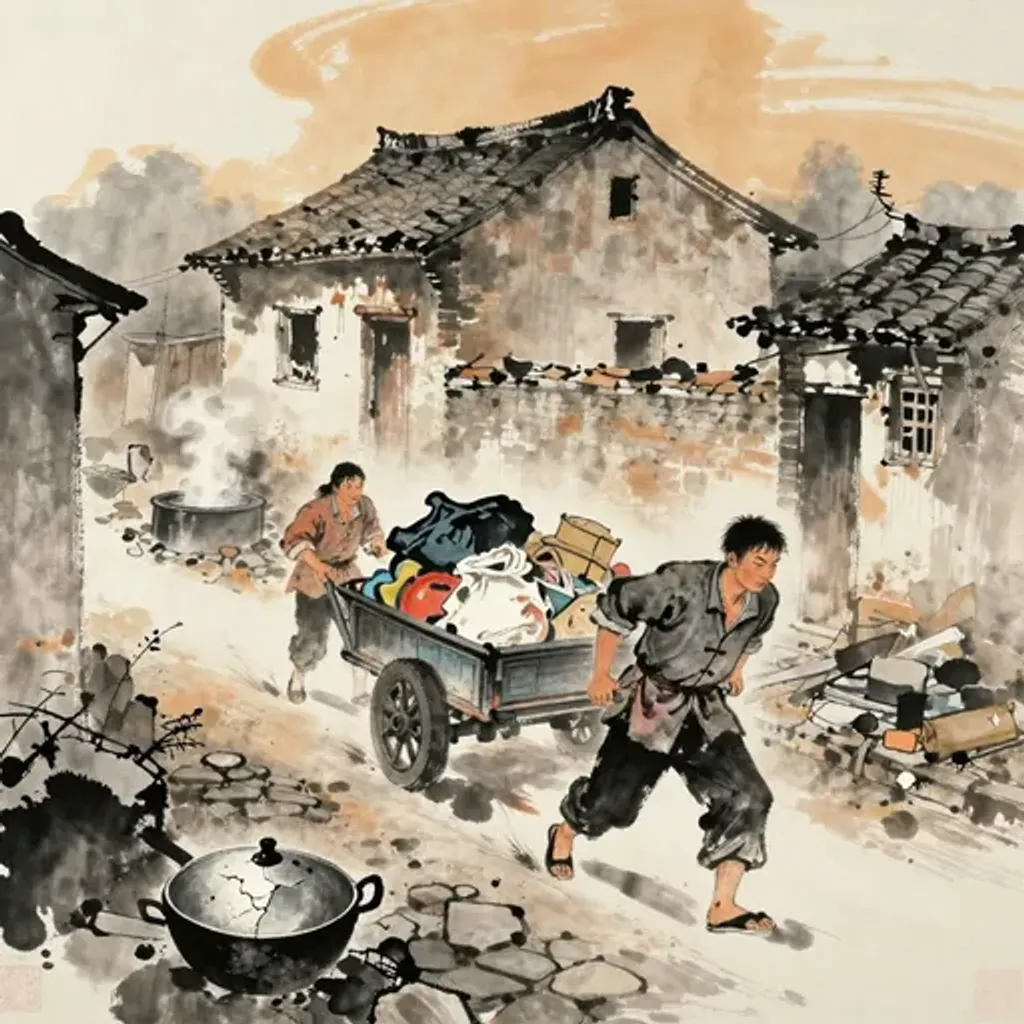
二人輦車,徙去其家。井沸釜鳴,不可安居。
Two men pull a cart, moving away from their home. The well boils, the cauldron roars; one cannot dwell in peace.
— Jiao Yanshou, Yilin (Forest of Changes), 1st century BC
Commentary
Mountain collapses upon earth, and heaven diverges from water — the image of Conflict. Two men push a handcart, hauling their entire household away. The well boils and the cauldron screams: the home has become uninhabitable. These are not metaphors but literal signs of catastrophe in Han belief — a boiling well and a wailing pot signal subterranean disturbance, often read as an omen of imminent upheaval. The household must be abandoned. From Splitting Apart to Conflict, structural decay escalates into open dispute. The mountain's erosion was slow and silent; now the conflict breaks the surface. Heaven and water move in opposite directions, and those who once shared a dwelling must part, dragging what remains down a road that leads only to contention.
剝 → 師
Hexagram 23 → Hexagram 7: The Army
Changing lines: 2, 6
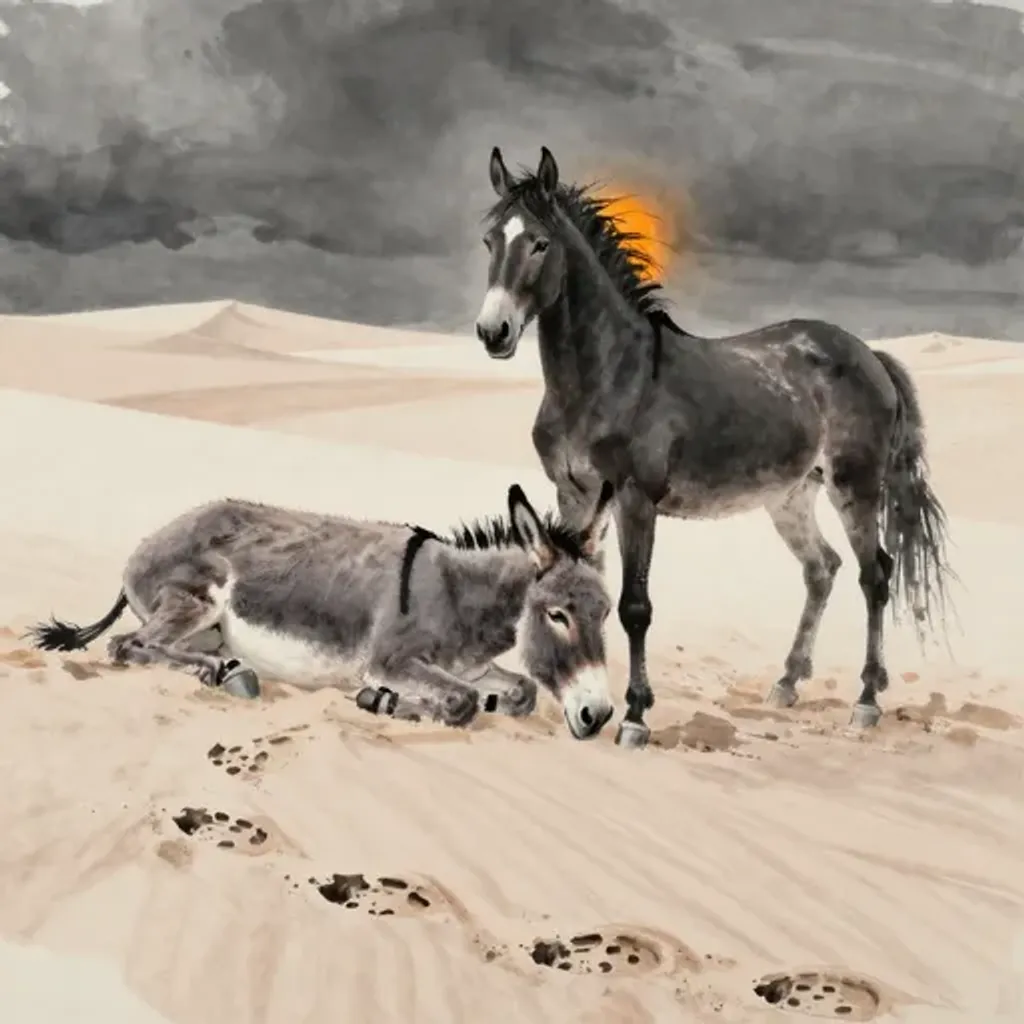
蹇驢不才,俊驥失時。罷於沙丘,筋力勞盡。
A lame donkey, lacking talent; a fine steed, its time lost. Spent upon the sand dunes; sinew and strength exhausted.
— Jiao Yanshou, Yilin (Forest of Changes), 1st century BC
Commentary
Mountain upon earth erodes into water hidden within the earth — the disciplined mass of the Army. A lame donkey has no talent, and even a fine warhorse loses its moment. Both collapse at Shaqiu, sinews spent and strength exhausted. Shaqiu carries historical resonance: it is where the First Emperor of Qin died on his inspection tour, and where the Shang tyrant Zhou built his decadent 'sand mound' terrace. The verse pairs two beasts — one worthless, one excellent — and shows both failing at the same place. Neither talent nor the lack of it matters when timing is wrong and the body is broken. From Splitting Apart to the Army, the mountain's decay demands disciplined collective response, but here both steed and donkey have been ground down before the army can even assemble.
剝 → 比
Hexagram 23 → Hexagram 8: Holding Together
Changing lines: 5, 6
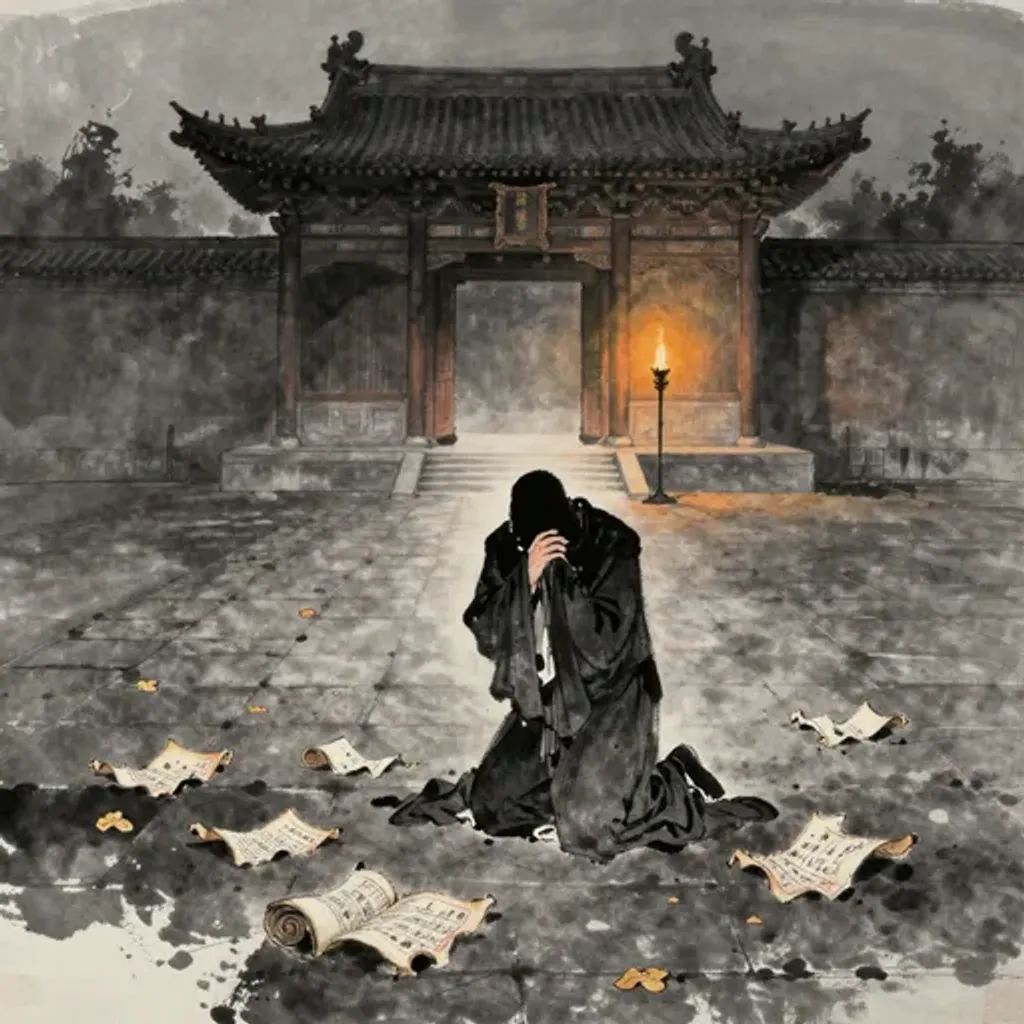
明傷之初,為穆出交,以讒復歸。名曰豎牛,剝亂叔孫,餧於空丘。
At the start of the wounding of brightness, sent forth on Mu's behalf to negotiate, then returned through slander. Named Shu Niu, he brought ruin upon the house of Shusun, left to starve upon an empty hill.
— Jiao Yanshou, Yilin (Forest of Changes), 1st century BC
Commentary
Mountain upon earth gives way to water upon earth — the image of Holding Together, yet here allegiance is weaponized. The verse names Shuniu, illegitimate son of Shusun Bao of Lu. 'At the start of the wounded brightness,' he was sent out to negotiate for Lord Mu, then used slander to engineer his own return. Known as 'Shuniu the Ox-Servant,' he systematically destroyed the Shusun clan: he murdered his half-brother Zhongren, then starved his own father to death, leaving the old man to perish on a barren hill. From Splitting Apart to Holding Together, the verse reveals the darkest perversion of bonds: Shuniu exploited every tie of kinship and loyalty, turning the structure of 'holding together' into the instrument of patricide. When the mountain of authority has already eroded, a parasite can hollow out even blood relations.
剝 → 小畜
Hexagram 23 → Hexagram 9: Small Taming
Changing lines: 1, 2, 3, 5
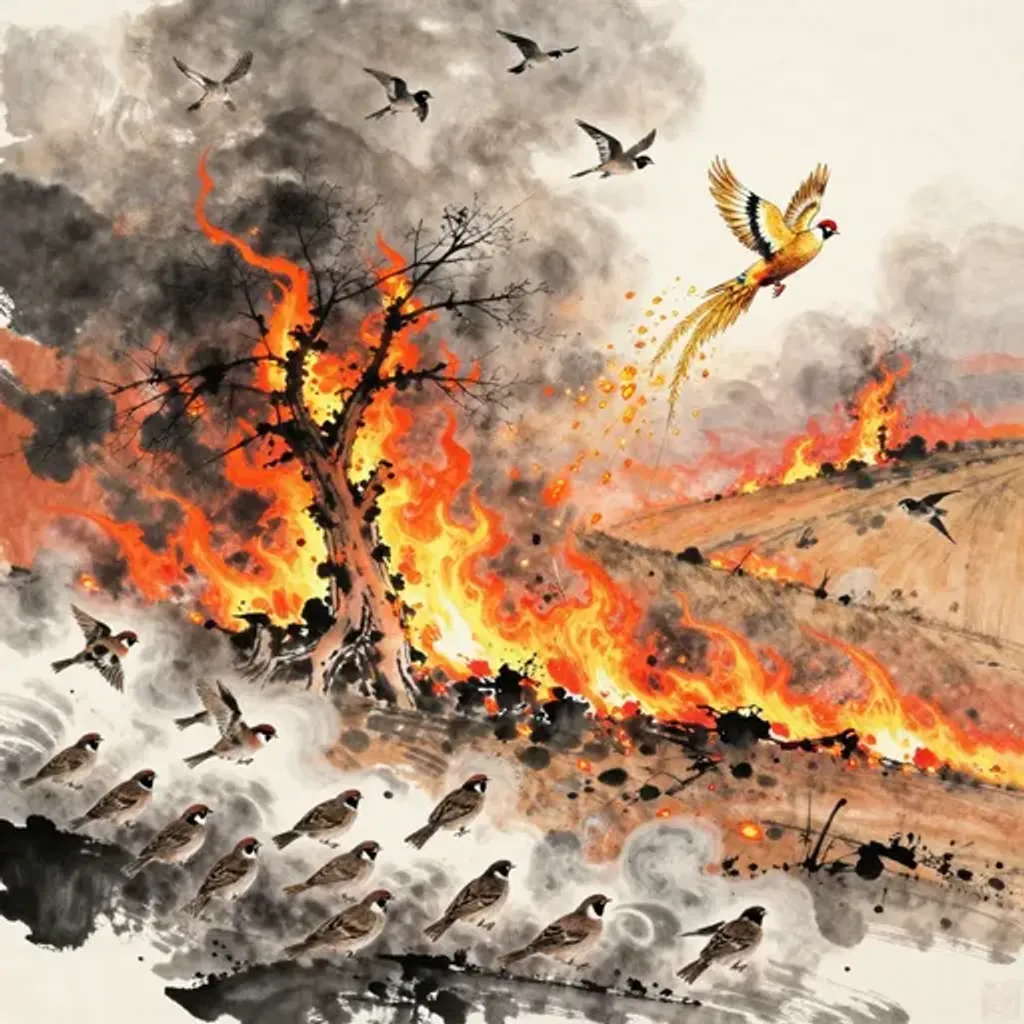
天火大起,飛鳥驚駭。作事不時,自為身咎。
A great fire blazes from heaven; flying birds scatter in alarm. Acting at the wrong time, one brings blame upon oneself.
— Jiao Yanshou, Yilin (Forest of Changes), 1st century BC
Commentary
Mountain upon earth decays, and wind blows across heaven — a gentle restraining force too mild for the crisis. A great fire blazes from the sky, and birds scatter in terror. Actions taken at the wrong moment bring calamity upon oneself. The 'heavenly fire' may allude to a meteor or lightning strike, both read as celestial warnings in Han astrology. The birds, creatures of wind and heaven, should be at home in the sky but find it turned hostile. The verse emphasizes poor timing: 'zuo shi bu shi' — undertaking something out of season. From Splitting Apart to Small Taming, the mountain's collapse unleashes forces that the gentle wind of Xun cannot contain. When structural decay has gone too far, modest restraint is inadequate, and the ill-timed actor becomes the author of his own disaster.
剝 → 履
Hexagram 23 → Hexagram 10: Treading
Changing lines: 1, 2, 4, 5
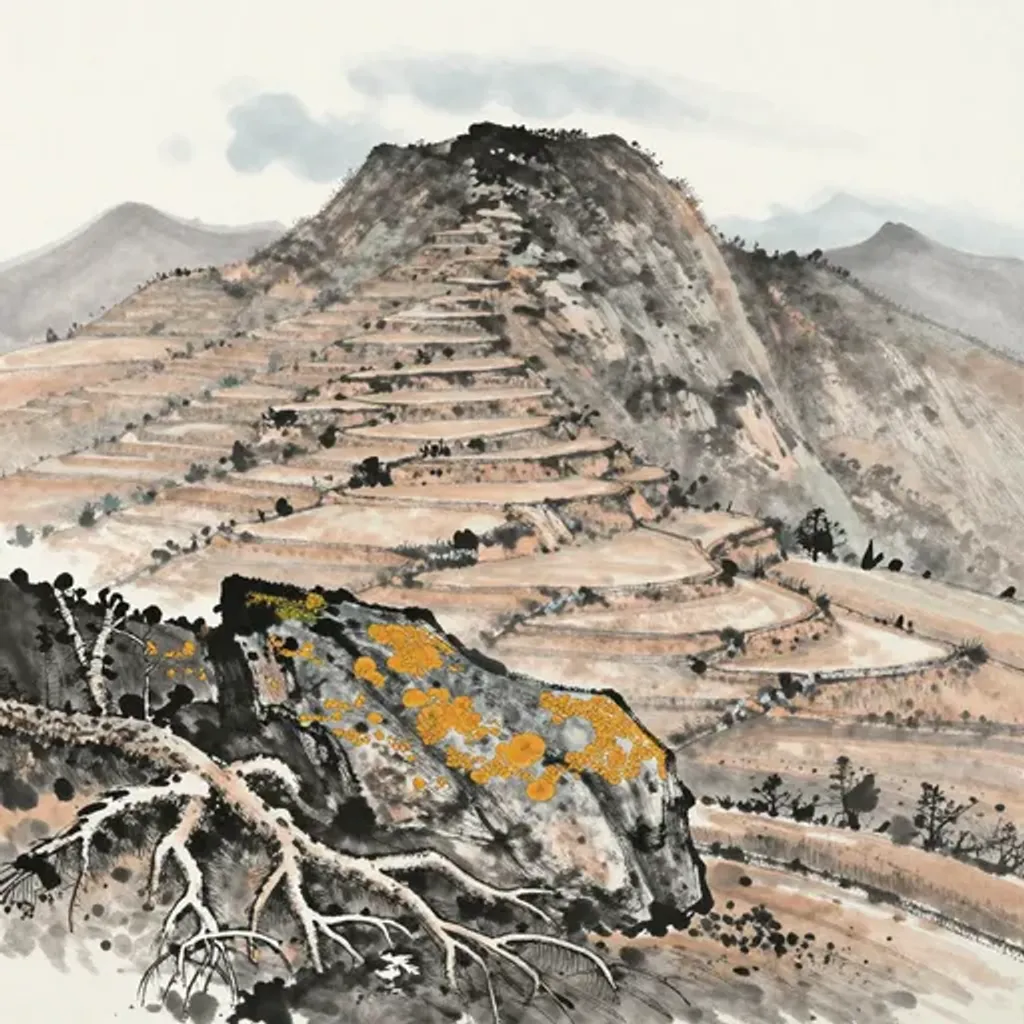
土與山連,共保歲寒。終無災患,萬世長安。
Earth joins with mountain, together enduring the cold of the year. In the end there is no calamity; ten thousand ages of lasting peace.
— Jiao Yanshou, Yilin (Forest of Changes), 1st century BC
Commentary
Mountain upon earth strips away, yielding to heaven above the lake — Treading, the hexagram of careful conduct upon dangerous ground. Earth and mountain are joined together, preserving through the bitter cold of winter. No disasters arise; ten thousand generations enjoy lasting peace. The image is geological: soil and rock fused into a single enduring mass, impervious to frost. Unlike the crumbling mountain of Splitting Apart, here the bond between earth and mountain holds firm. From Splitting Apart to Treading, the transformation suggests that what survives erosion does so through proper alignment — stepping carefully, distinguishing high from low, maintaining the protocols that keep a tiger's jaws from closing. The peace described is not passive but earned through vigilant, correct conduct across ages.
剝 → 泰
Hexagram 23 → Hexagram 11: Peace
Changing lines: 1, 2, 3, 6
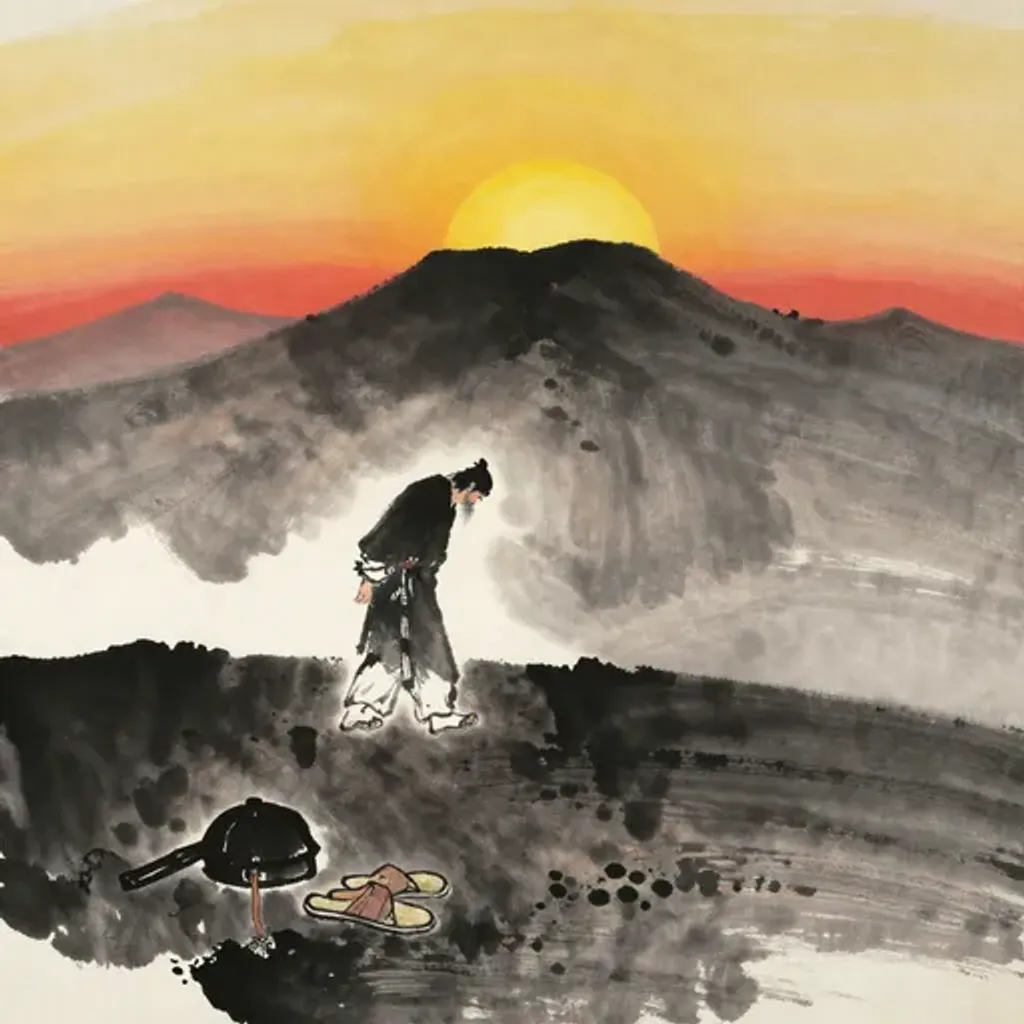
日出阜東,山蔽其明。章甫薦屨,箕子佯狂。
The sun rises east of the hill, but the mountain blocks its brightness. A ceremonial cap offered in place of sandals; Jizi feigns madness.
— Jiao Yanshou, Yilin (Forest of Changes), 1st century BC
Commentary
Mountain upon earth erodes, but earth and heaven exchange places to form Peace. The sun rises east of the hill, yet the mountain blocks its light — brilliance present but obstructed. Then comes the devastating image: a ceremonial cap used as shoe-padding, and the Viscount of Ji feigning madness. The cap-as-insole reverses the proper order of high and low, while Ji Zi — uncle of the tyrant Zhou of Shang — pretended insanity to survive the collapsing dynasty. Both images describe a world turned upside down, where wisdom must disguise itself as folly. From Splitting Apart to Peace, the paradox deepens: true peace requires passing through the inversion. Heaven descends, earth rises, and only by enduring the humiliation of a cap ground underfoot can the sage preserve what matters until the cosmic order rights itself.
剝 → 否
Hexagram 23 → Hexagram 12: Standstill
Changing lines: 4, 5
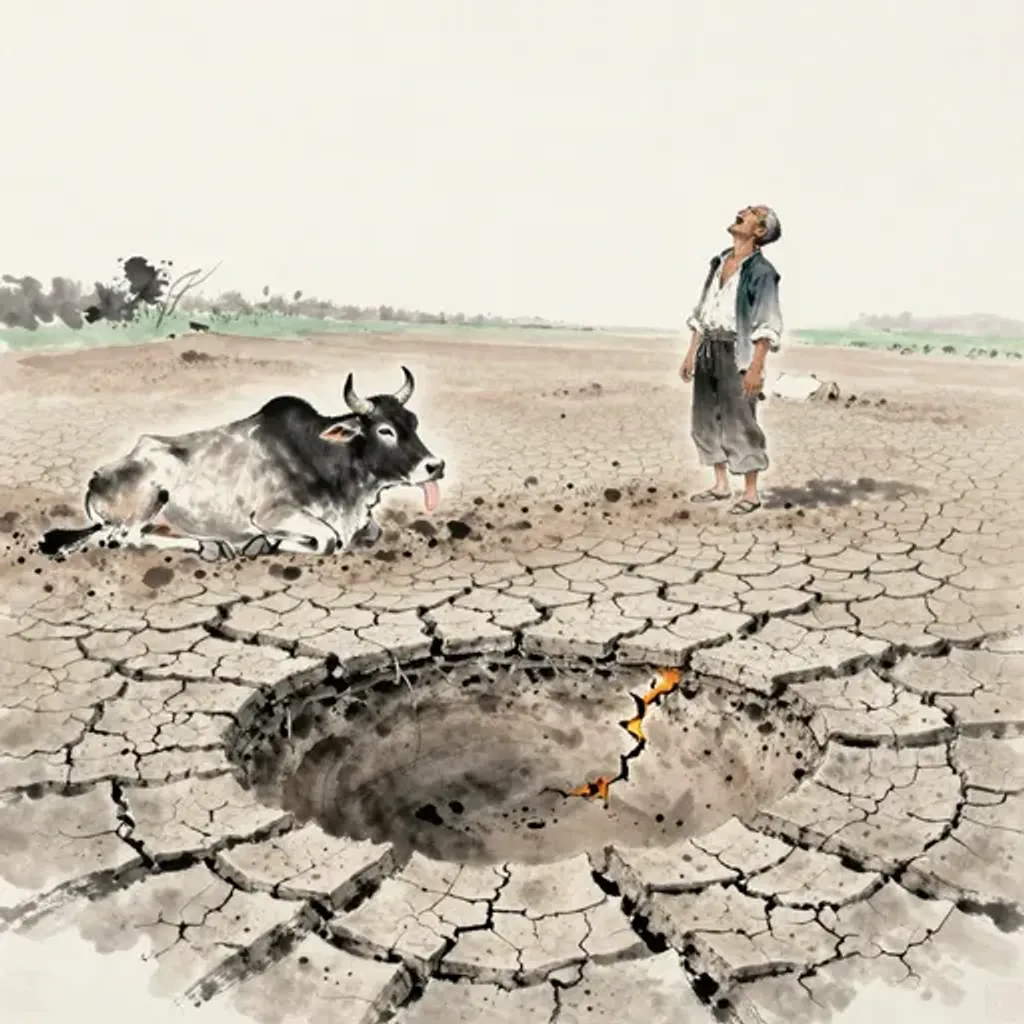
龍馬上山,絕無水泉。喉燋唇乾,口不能言。
Cracked earth for a thousand li — not an inch of green. Well-bottoms are dry mud with turtle-shell patterns. An ox collapses in the field, tongue stiff — the old farmer looks up to the sky and no sound comes.
— Jiao Yanshou, Yilin (Forest of Changes), 1st century BC
Commentary
Mountain upon earth collapses into total blockage — heaven and earth refuse to communicate. The original verse reads: 'A dragon-horse climbs the mountain, finding absolutely no spring; throat scorched and lips parched, the mouth cannot speak.' The creature that should command rain finds only drought at the summit. This is Standstill incarnate: a figure of power rendered mute and helpless, stranded where no nourishment exists. The dragon-horse, emblem of heaven's vitality, is trapped upon a dead mountain without water. From Splitting Apart to Standstill, the erosion of the mountain does not open new possibilities but seals them shut. Heaven retreats upward, earth sinks below, and between them nothing flows. Even the voice of authority is silenced.
剝 → 同人
Hexagram 23 → Hexagram 13: Fellowship
Changing lines: 1, 3, 4, 5
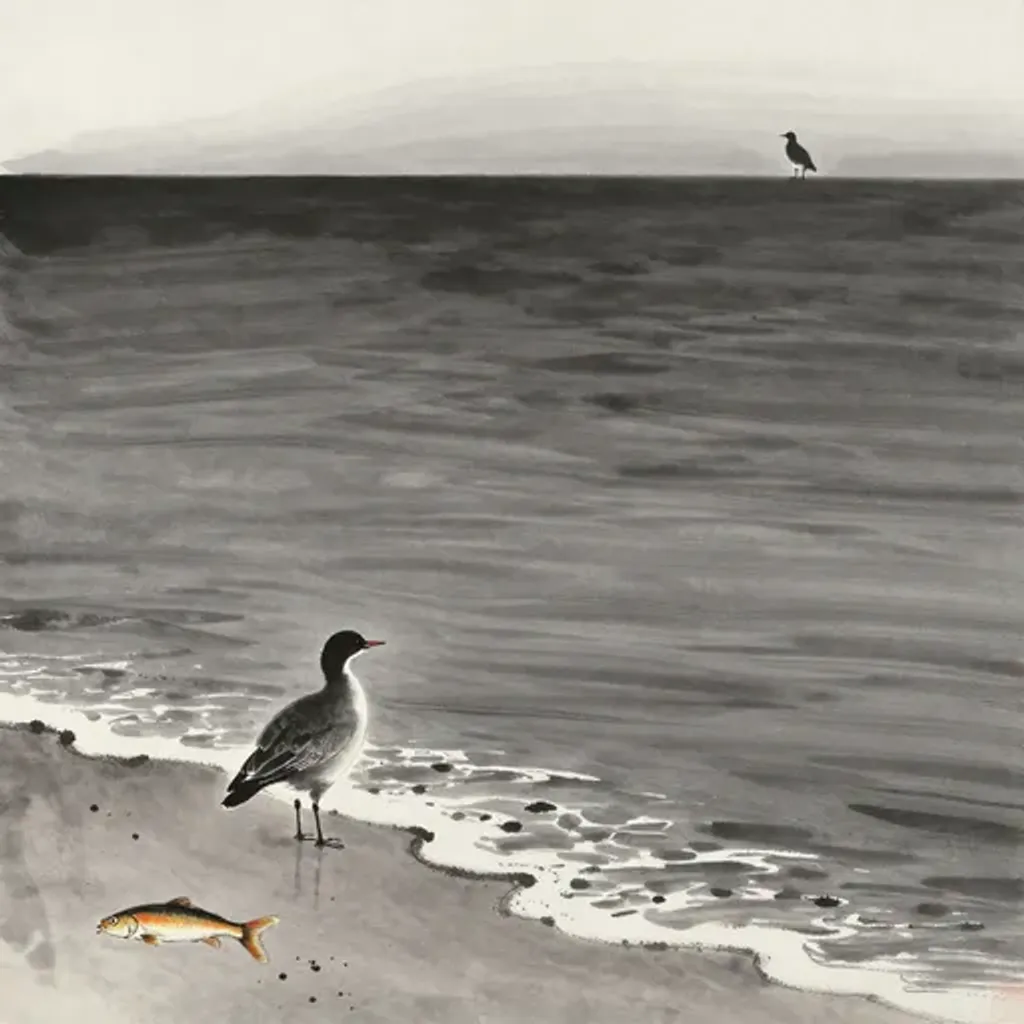
雄處弱水,雌在海濱。別將持食,悲哀於心。
The male dwells by the weak waters; the female at the ocean shore. Parted, each carrying food alone; grief and sorrow in the heart.
— Jiao Yanshou, Yilin (Forest of Changes), 1st century BC
Commentary
Mountain upon earth strips away, revealing heaven and fire moving together — Fellowship, but of the most painful kind. The male bird dwells by the Weak Water, the female at the ocean's edge: two mates separated by impassable distances. A subordinate carries food on a separate journey, grief heavy in the heart. The Weak Water is the mythological river near Kunlun too thin to float even a feather — an absolute barrier. The verse transforms Fellowship's ideal of union through shared purpose into its agonizing negative: those who belong together cannot cross the distance between them. From Splitting Apart to Fellowship, the mountain's erosion scatters what was once joined. True fellowship requires fire and heaven to move in the same direction, but here the paired birds can only face each other across an uncrossable void.
剝 → 大有
Hexagram 23 → Hexagram 14: Great Possession
Changing lines: 1, 2, 3, 4
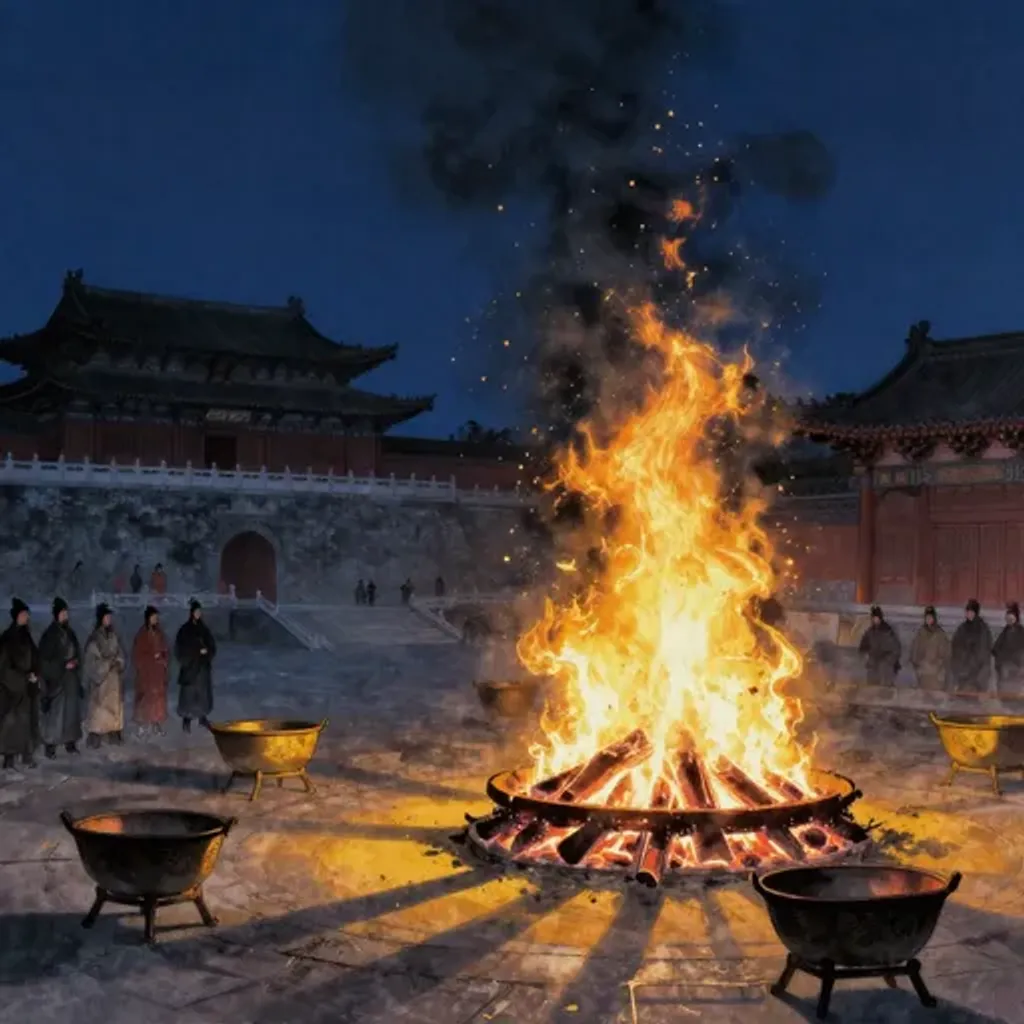
庭燎夜明,追嗣日光。陽軟不制,陰雄坐戾。
Courtyard torches blaze through the night, chasing the daylight's glow. Yang, soft and unable to govern; yin, dominant, sits in transgression.
— Jiao Yanshou, Yilin (Forest of Changes), 1st century BC
Commentary
Mountain upon earth decays into fire blazing in heaven — Great Possession, the hexagram of abundance under illumination. Courtyard torches blaze through the night, chasing the last daylight. But yang is too soft to govern, and yin grows bold in its seat of power. The 'courtyard fire' (ting liao) is a ritual night-flame lit during Zhou court audiences to extend the working day — a sign of diligent governance. Yet the verse reverses its promise: the fire burns not to illuminate but to compensate for a weakening sun. The ruler's light fades while dark forces strengthen unopposed. From Splitting Apart to Great Possession, the mountain's erosion exposes abundant resources, but without strong governance the fire merely reveals how much there is to lose. Brilliance without authority is an invitation to usurpers.
剝 → 謙
Hexagram 23 → Hexagram 15: Modesty
Changing lines: 3, 6
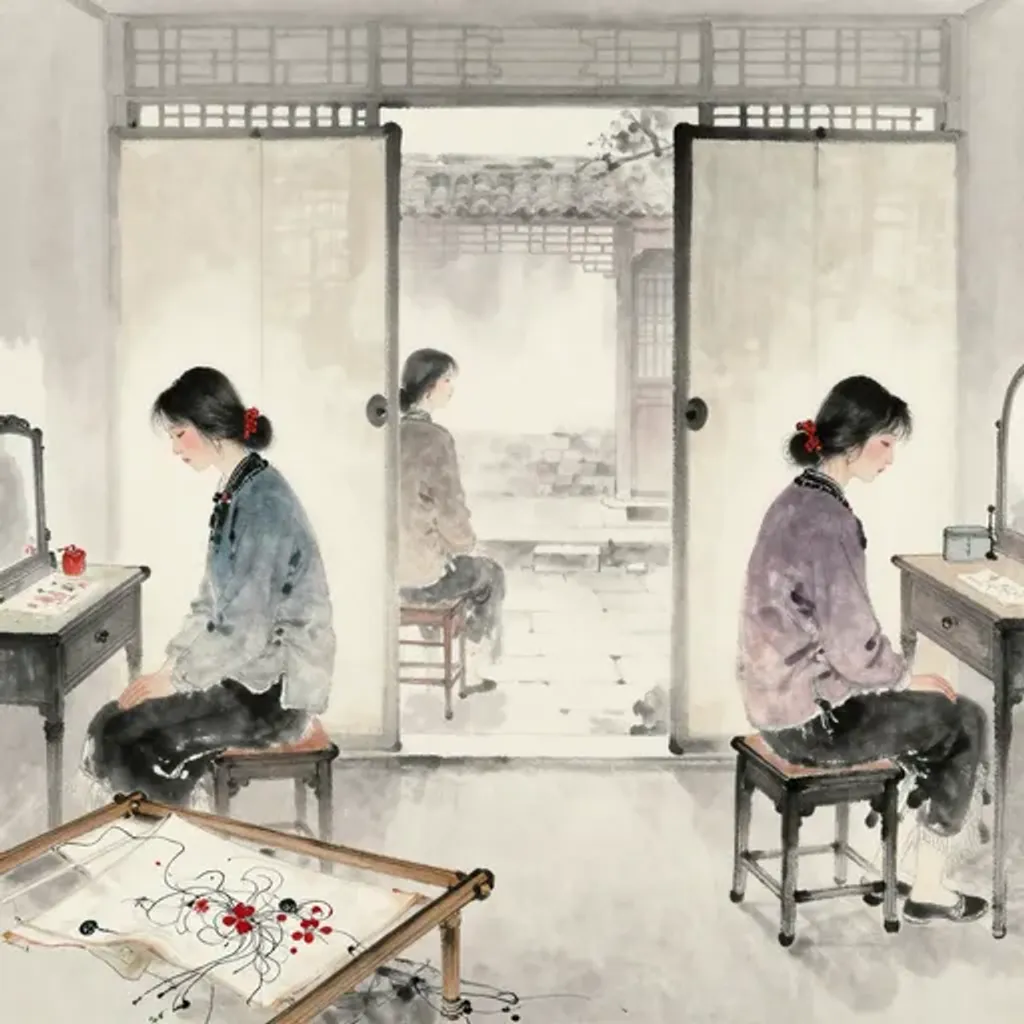
三婦同夫,忽不相思。志恆悲愁,顏色不怡。
Three wives share one husband; suddenly they cease to long for him. Hearts are ever grieving and sorrowful; countenances show no cheer.
— Jiao Yanshou, Yilin (Forest of Changes), 1st century BC
Commentary
Mountain upon earth collapses into earth containing a mountain — Modesty, where the great humbles itself beneath the small. Three women share one husband, yet suddenly cease to think of one another. Their hearts are perpetually sorrowful, their faces never at ease. The domestic arrangement that should embody harmonious hierarchy instead breeds alienation. No one fights openly, but affection has simply evaporated. From Splitting Apart to Modesty, the mountain that once rose above the earth now lies buried within it. The three wives mirror this inverted structure: outwardly they share the same household, but inwardly each is isolated. Modesty at its best equalizes and distributes fairly; here it manifests as emotional leveling — all reduced to the same joyless plane, none favored, none content.
剝 → 豫
Hexagram 23 → Hexagram 16: Enthusiasm
Changing lines: 4, 6
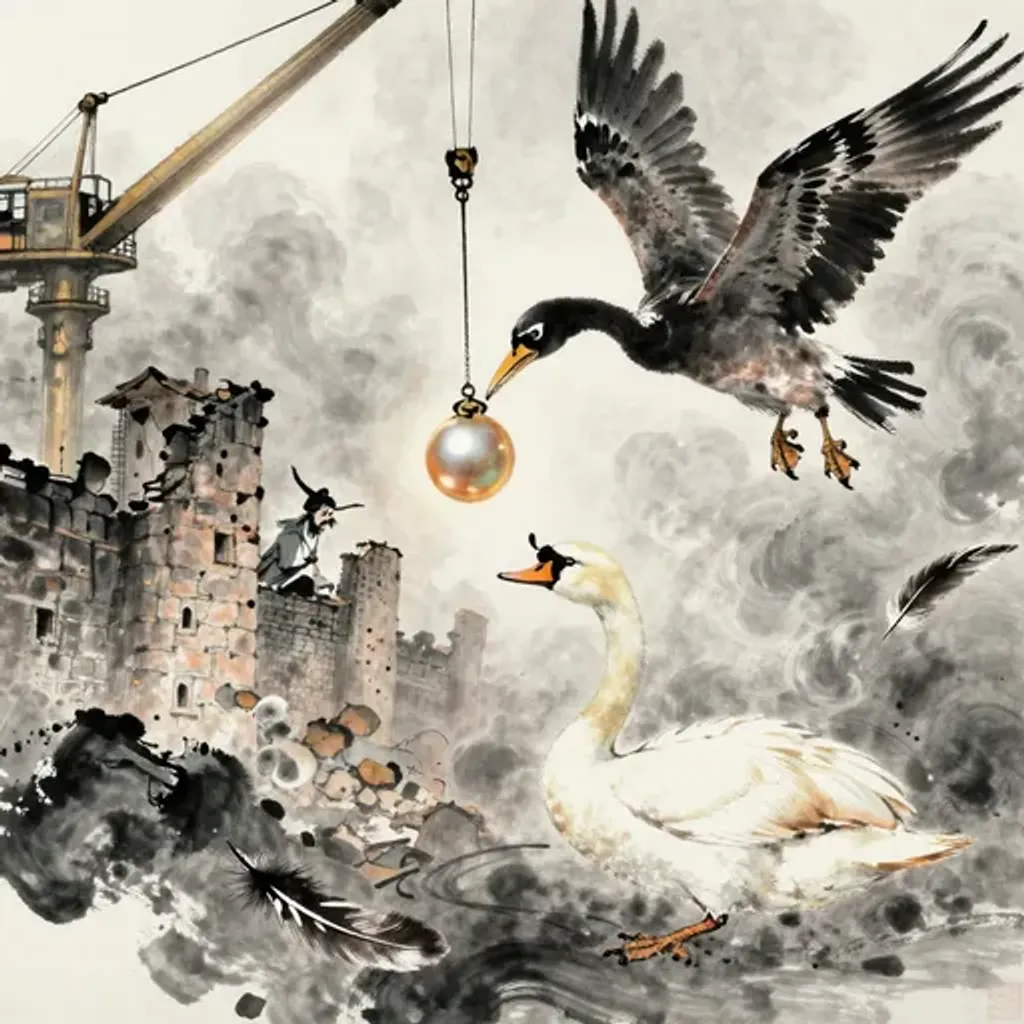
鶴盜我珠,逃於東都。鵠怒追求,郭氏之墟。不見武跡,反為患災。
The crane stole my pearl and fled to the eastern capital. The swan pursued in fury to the ruins of Guo. Finding no trace of the prize, it brought only calamity in return.
— Jiao Yanshou, Yilin (Forest of Changes), 1st century BC
Commentary
Mountain upon earth erodes, and thunder breaks from the ground with exuberant force — Enthusiasm. A crane steals a pearl and flees to the eastern capital. The swan, enraged, gives chase to the ruins of the Guo state. But no trace of the quarry is found, and pursuit brings only disaster. The imagery reads as a fable of misdirected pursuit: the precious thing is stolen by a bird of heaven, and the pursuer rushes headlong into a wasteland. The 'ruins of Guo' recall the destroyed state of Guo, obliterated by Jin in 655 BC — a place where nothing remains. From Splitting Apart to Enthusiasm, the mountain's collapse releases explosive energy, but enthusiasm without a target is merely recklessness. The chaser arrives at ruins and finds neither pearl nor crane — only the consequences of blind momentum.
剝 → 隨
Hexagram 23 → Hexagram 17: Following
Changing lines: 1, 4, 5, 6
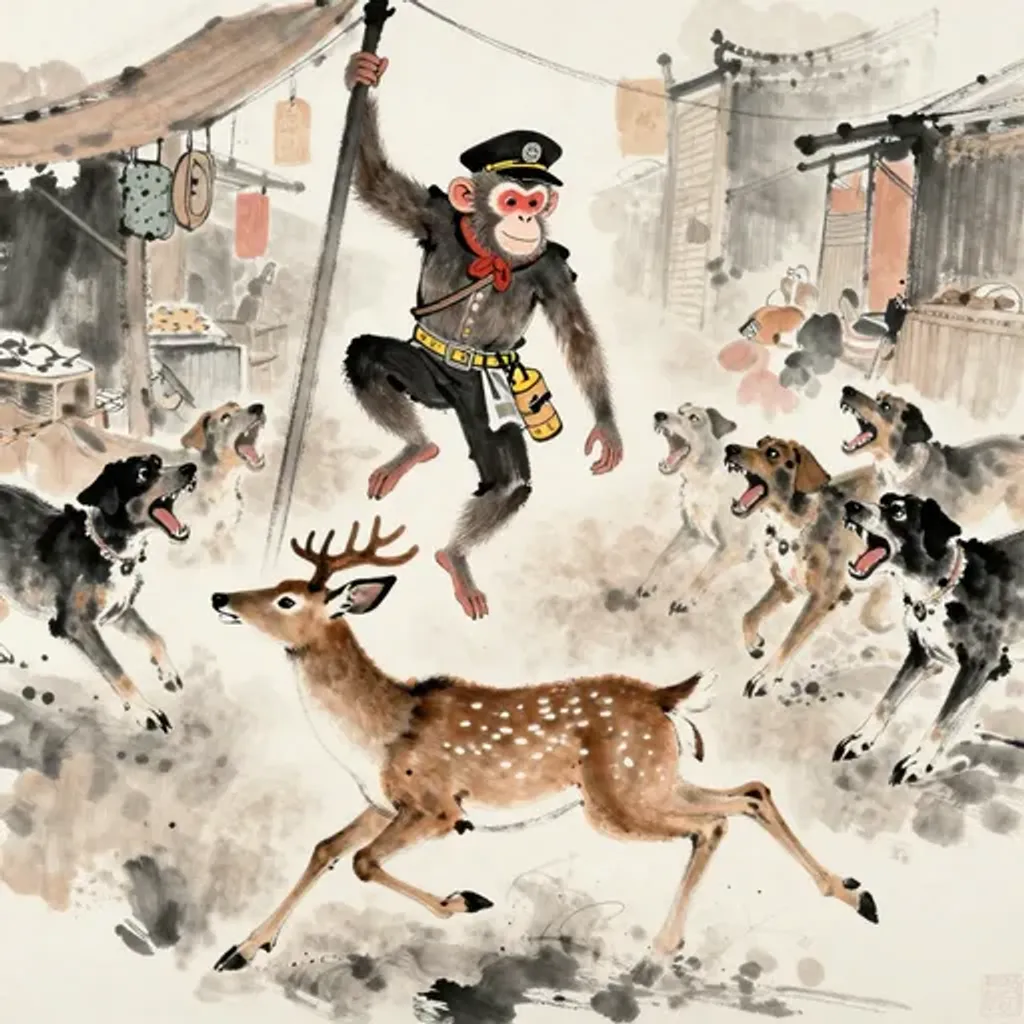
獮猴冠帶,盜載非位。眾犬共吠,麇走蹶足。
A monkey in cap and belt; a thief riding in a place not his own. The pack of dogs bark together; the deer stumbles and falls.
— Jiao Yanshou, Yilin (Forest of Changes), 1st century BC
Commentary
Mountain upon earth strips away, yielding to lake over thunder — Following, where all things rest in the evening stillness. A monkey dons cap and sash, a thief riding in a position that is not his. The pack of dogs bark together, and the deer stampedes and stumbles. The 'capped monkey' (muhou guandai) is one of the most cutting political metaphors in the Chinese canon: an animal dressed in human finery, occupying a station it cannot fill. The dogs — instinctive judges of authenticity — see through the disguise and raise the alarm, while the herd panics. From Splitting Apart to Following, the erosion of legitimate authority creates a vacuum that impostors rush to fill. But Following demands genuine resonance between leader and led; a crowned ape commands only chaos.
剝 → 蠱
Hexagram 23 → Hexagram 18: Work on the Decayed
Changing lines: 2, 3
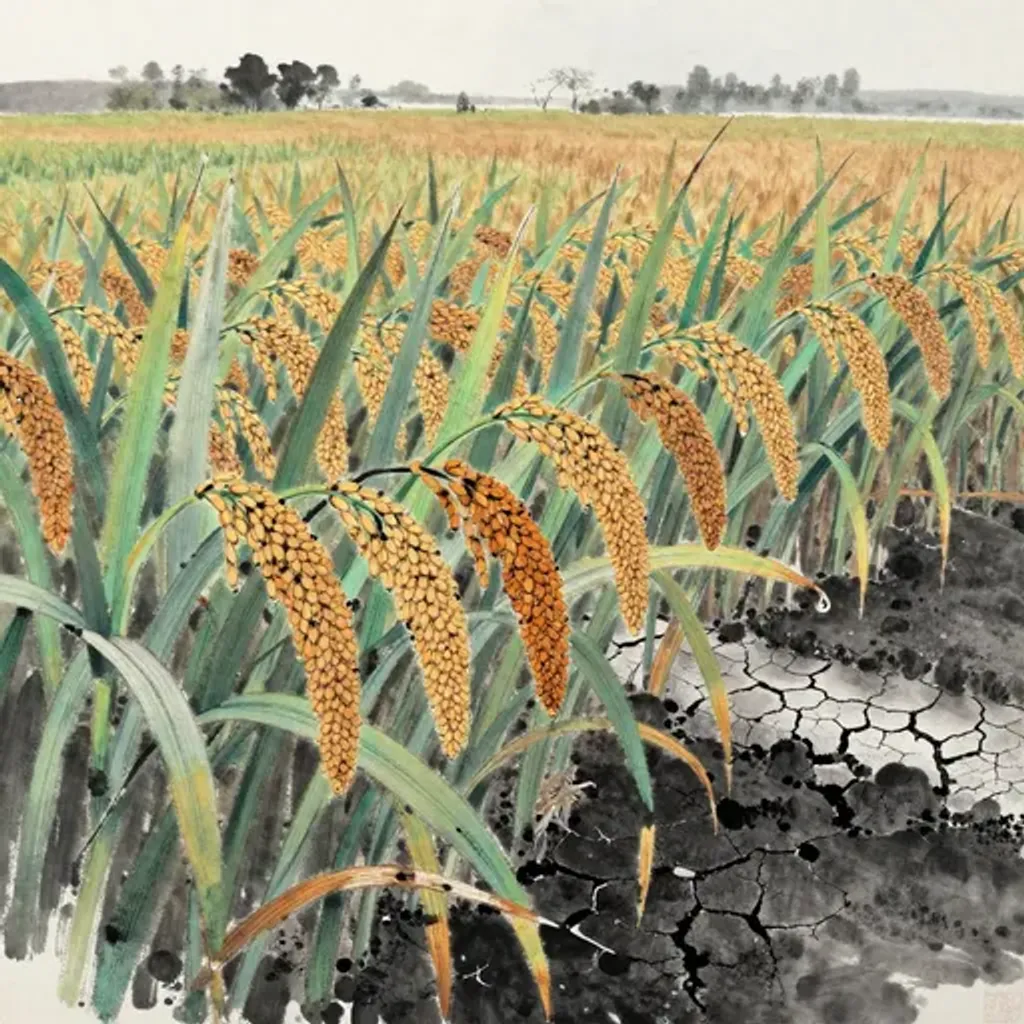
黍稷禾稻,垂畝方好。中旱不雨,傷風病熇。
Millet, grain, rice, and paddy; drooping in the fields, nearly ripe. Midway comes drought without rain; wind-blight and scorching heat wound them.
— Jiao Yanshou, Yilin (Forest of Changes), 1st century BC
Commentary
Mountain upon earth erodes into mountain over wind — decay upon decay, the image of Work on the Decayed. Millet, glutinous millet, grain, and rice all hang heavy in the fields, the harvest looking splendid. Then drought strikes mid-season, the rain never comes, and scorching wind withers everything. This is Gu — the hexagram of corruption and inherited rot — captured in agricultural terms. The grain was healthy and promising; the failure is not in the seed but in the season. Wind trapped beneath the mountain breeds stagnation rather than nourishment. From Splitting Apart to Work on the Decayed, the mountain's external erosion mirrors internal putrefaction: what looked abundant was already vulnerable. Gu's task is to diagnose and repair, but here the diagnosis comes too late, after the harvest has already burned.
剝 → 臨
Hexagram 23 → Hexagram 19: Approach
Changing lines: 1, 2, 6
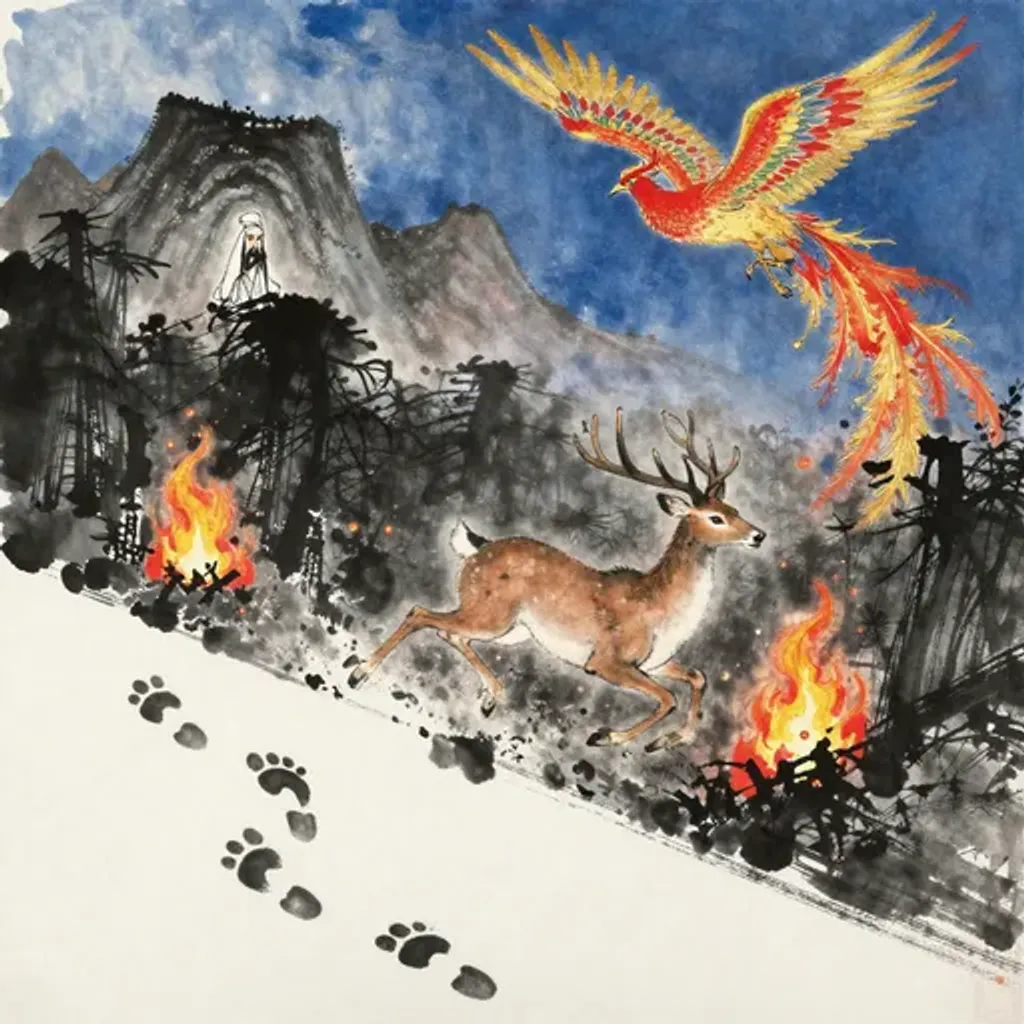
雄聖伏名,人匿麟遠。走鳳飛北,亂禍未息。
The heroic sage conceals his name; men hide, the qilin flees afar. The phoenix flies north; upheaval and disaster have not yet ceased.
— Jiao Yanshou, Yilin (Forest of Changes), 1st century BC
Commentary
Mountain upon earth strips away, and earth opens above the lake — Approach draws near. The sage hero conceals his name; the qilin hides far from the world of men. The phoenix flies northward in distress, and the chaos of rebellion has not yet ceased. This verse echoes the theme of the 'captured qilin' — auspicious creatures fleeing or hiding when the age is corrupt. The sage suppresses his brilliance; the unicorn retreats to the wilderness. Even the phoenix, herald of virtuous rule, flies in the wrong direction. From Splitting Apart to Approach, the verse suggests that drawing near to power in a debased age is perilous. The sage approaches by concealment, preserving virtue in hiding. Approach's promise of teaching and protecting the people cannot be fulfilled while wolves still rule.
剝 → 觀
Hexagram 23 → Hexagram 20: Contemplation
Changing lines: 5
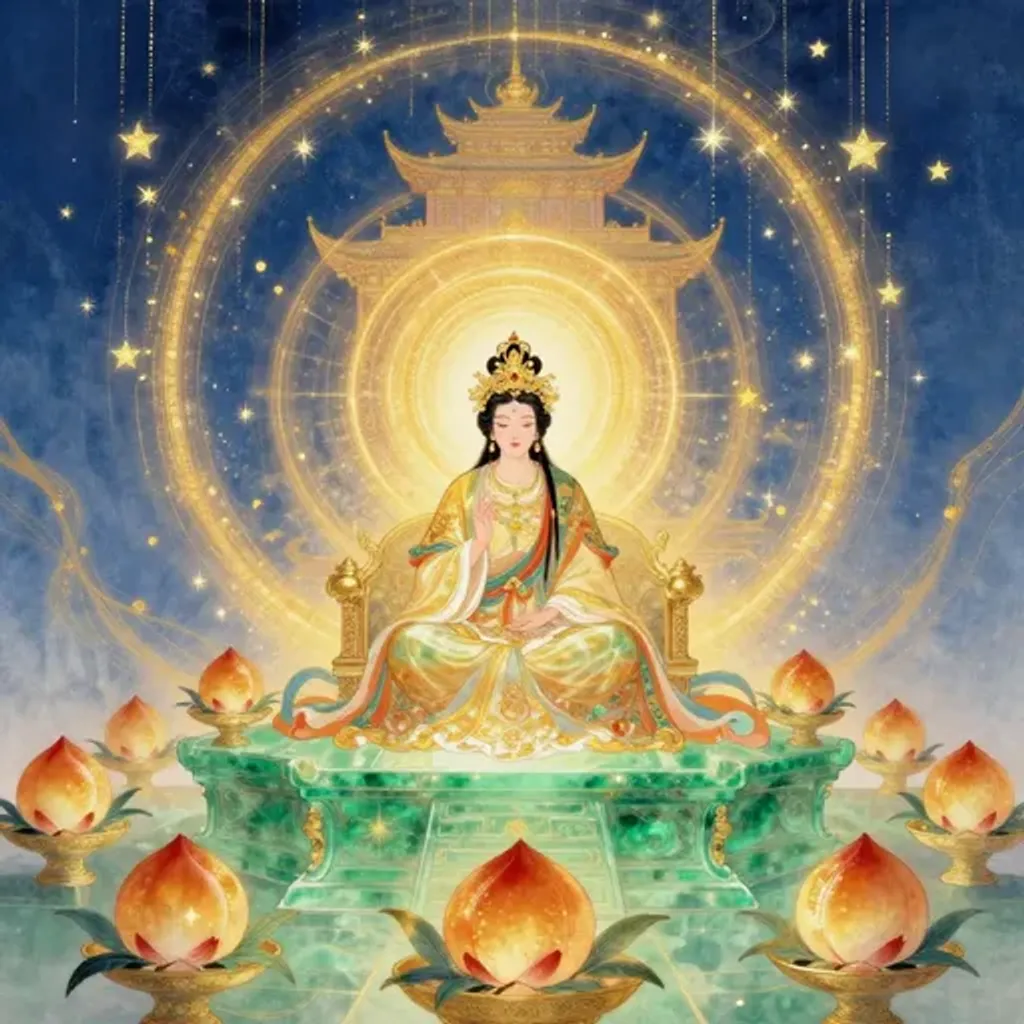
王母多福,天祿所伏。居之寵光,君子有福。
The Queen Mother, rich in blessings; where heaven's bounty rests. Dwelling in splendor and favor; the noble man is blessed.
— Jiao Yanshou, Yilin (Forest of Changes), 1st century BC
Commentary
Mountain upon earth decays, and wind sweeps across the earth — Contemplation, the sovereign surveying his realm. The Queen Mother of the West bestows manifold blessings; heaven's bounty settles here. One dwells in honored radiance, and the gentleman receives his fortune. The Queen Mother (Wang Mu) is the supreme goddess of Kunlun, guardian of immortality's peaches and dispenser of celestial grace. Her presence signals divine favor beyond human contrivance. From Splitting Apart to Contemplation, the mountain that crumbled was man-made order; what replaces it is the cosmic gaze of wind over earth. The gentleman who receives blessing does so not through striving but through alignment with heaven's pattern — the wind observes all, and Wang Mu rewards those who stand in the right place with open hands.
剝 → 噬嗑
Hexagram 23 → Hexagram 21: Biting Through
Changing lines: 1, 4
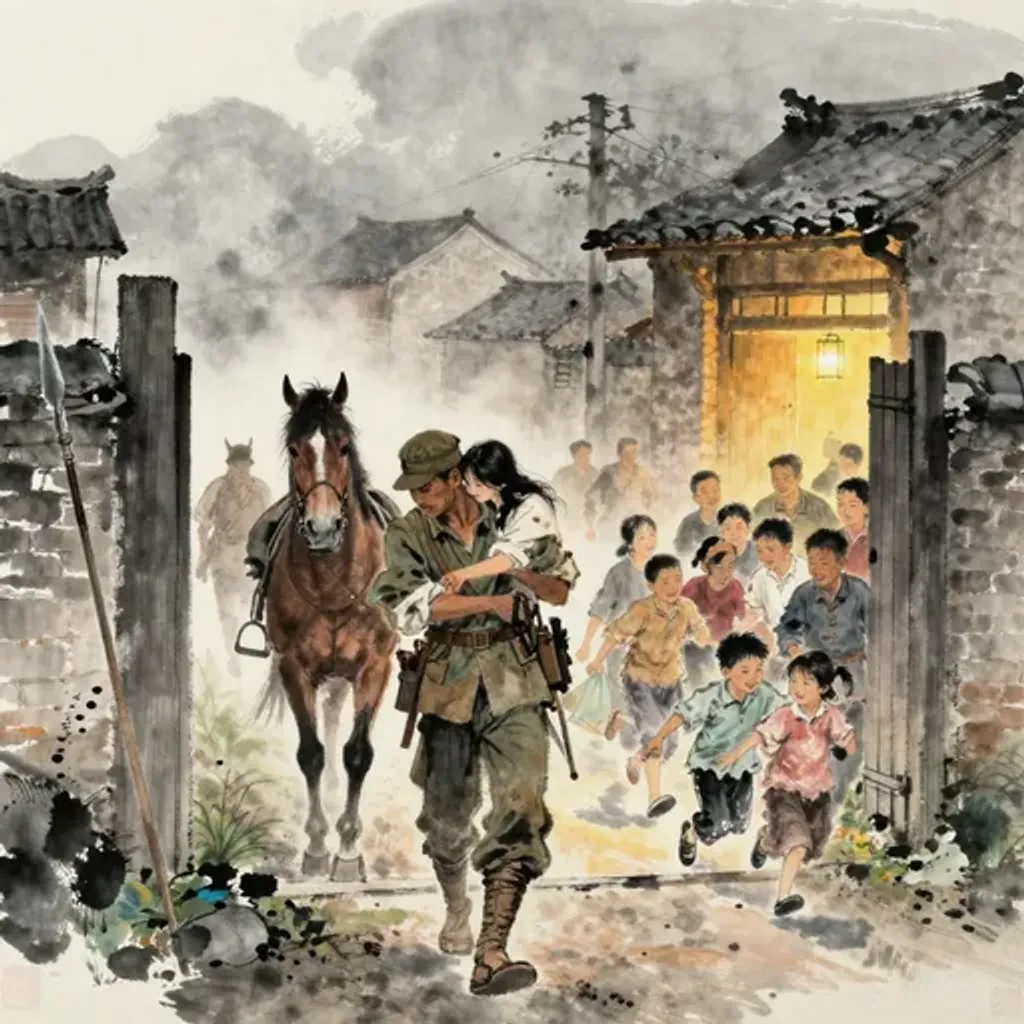
班馬還師,以息勞疲。役夫忻喜,入戶見妻。
The mottled horses return from campaign, to rest from toil and weariness. The conscript rejoices, entering the door to see his wife.
— Jiao Yanshou, Yilin (Forest of Changes), 1st century BC
Commentary
Mountain upon earth erodes into fire and thunder — Biting Through, the hexagram of decisive legal action. The warhorses turn homeward as the army is dismissed to rest its weary bones. The conscript laborers rejoice, entering their doors to see their wives again. The phrase 'ban ma huan shi' — spotted horses returning, the army disbanded — evokes the end of a long and grueling campaign. From Splitting Apart to Biting Through, the transformation is striking: the slow decay of the mountain gives way to the sharp, clarifying bite of thunder and lightning. What was rotting is cut through decisively. The soldiers' homecoming represents justice completed — the obstacle removed, the sentence carried out, the people released. Biting Through restores normalcy by severing what obstructs, and here the obstruction was the campaign itself.
剝 → 賁
Hexagram 23 → Hexagram 22: Grace
Changing lines: 1, 3
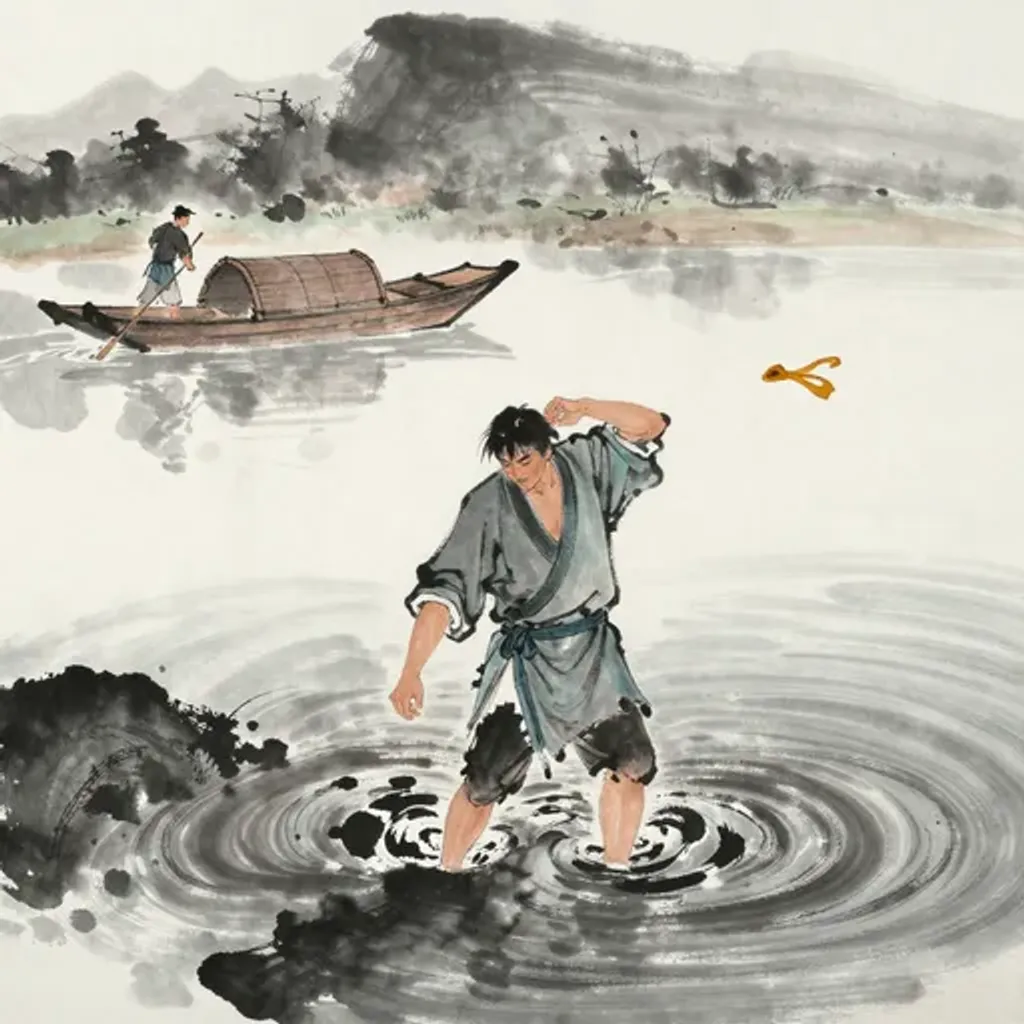
蹇裳涉河,流深漬衣。賴幸舟子,濟脫無他。
Lifting robes to ford the river, the current runs deep and soaks the garments. Fortunately a boatman comes; one crosses safely without mishap.
— Jiao Yanshou, Yilin (Forest of Changes), 1st century BC
Commentary
Mountain upon earth strips away, revealing mountain above fire — Grace, the hexagram of adornment and civilized beauty. One hitches up one's skirts to ford the river, but the current runs deep and soaks the clothing. Fortunately a boatman appears, ferrying one safely across without further harm. The image is of a traveler caught between necessity and danger: the crossing must be attempted, the preparation proves inadequate, but rescue comes from an unexpected quarter. The boatman is pure grace — help that arrives not because it was earned but because it was needed. From Splitting Apart to Grace, the mountain's erosion strips away pretense, and what emerges is not raw wilderness but civilized assistance. The fire beneath the mountain illuminates the path; the boatman adorns the crossing with skill and generosity.
剝 → 剝
Hexagram 23 → Hexagram 23: Splitting Apart
No changing lines — the hexagram is unchanged
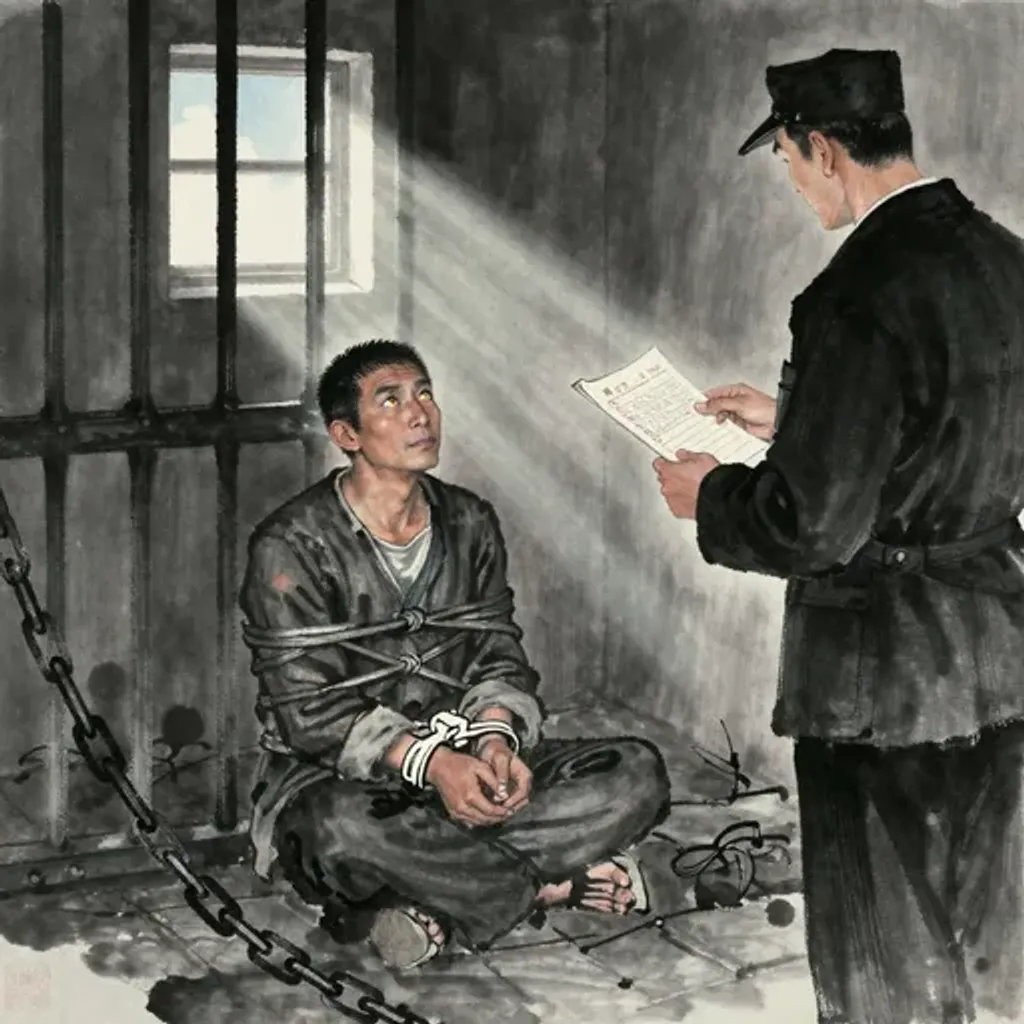
行觸大忌,與司命牾。執囚束縛,拘制於吏。幽人有喜。
Actions transgress a great taboo, offending the Lord of Fate. Seized and bound as a prisoner, restrained in an official's custody. The secluded one finds cause for joy.
— Jiao Yanshou, Yilin (Forest of Changes), 1st century BC
Commentary
Mountain upon earth doubled — Splitting Apart meets itself. One's actions collide with the greatest taboo, offending the Lord of Fate himself. Bound and fettered, one is detained under an official's control. Yet the verse closes with a paradox drawn from the hexagram's own sixth line: 'The secluded person has joy.' To transgress against cosmic authority and be imprisoned by mortal authority is the worst of Splitting Apart's imagery. But confinement, in the Yi's logic, can also be protection. The 'secluded person' who finds joy in captivity has discovered that being stripped of everything external reveals an irreducible inner freedom. From Splitting Apart to itself, the lesson is recursive: at the nadir of dissolution, the single remaining fruit contains the seed of renewal.
剝 → 復
Hexagram 23 → Hexagram 24: Return
Changing lines: 1, 6
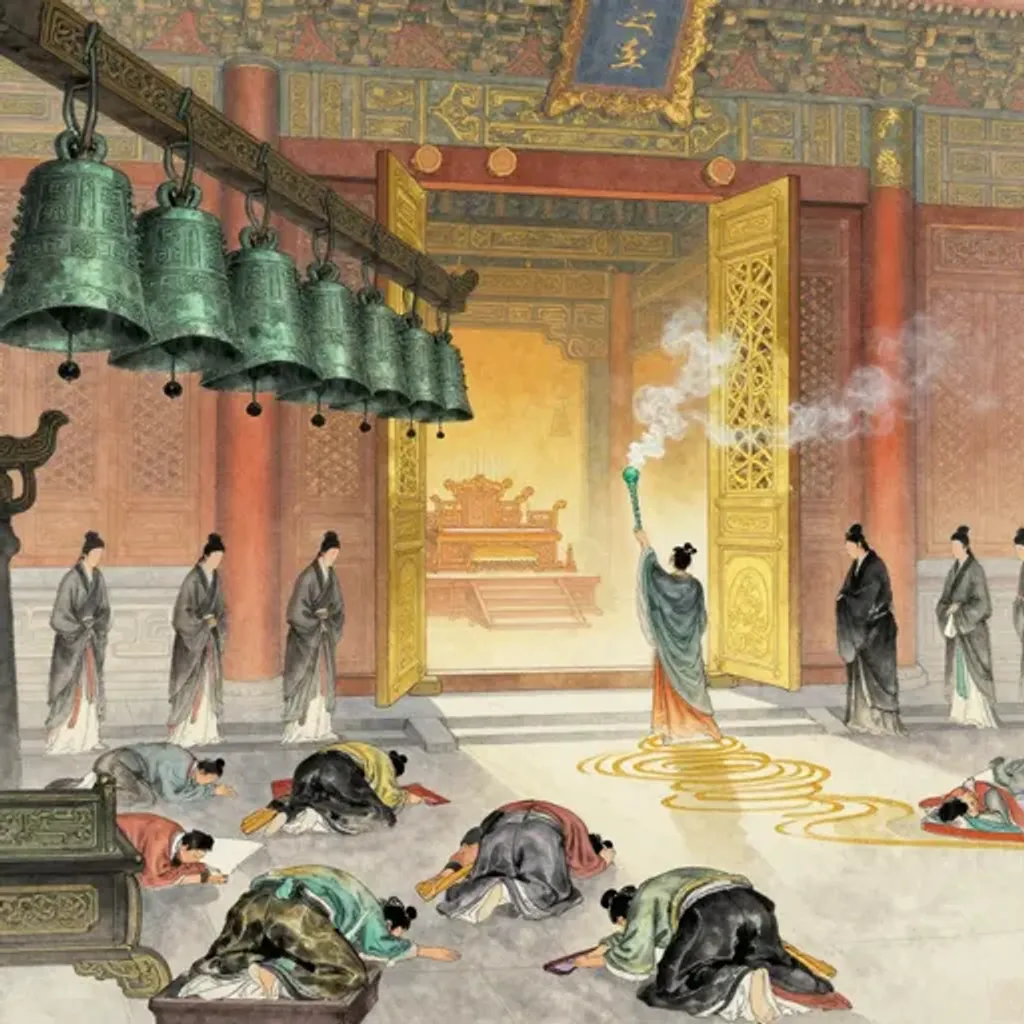
被服文德,升入大麓。四門雍肅,登受大福。
Incense smoke curls around the high altar; jade scepter held in both hands, entering court. Three golden bells ring — all gates open; ten thousand ministers prostrate, hymns echoing afar.
— Jiao Yanshou, Yilin (Forest of Changes), 1st century BC
Commentary
Mountain upon earth strips away completely, and thunder stirs again beneath the earth — Return, the pivotal hexagram of renewal. The original verse speaks of Emperor Shun's investiture: 'Clothed in the patterns of virtue, he ascended into the Great Forest. The four gates stood solemn and harmonious, and he received the greatest blessing.' Shun, the sage-king chosen by Yao for his extraordinary filial piety, was tested in the Great Forest before receiving the mandate. His 'clothing in virtue' rather than armor signals that moral cultivation, not force, earns the throne. From Splitting Apart to Return, the transformation is the Yi's most fundamental cycle: when the last yang line has been stripped away, a new yang is born at the bottom. Shun's humble ascent embodies this perfectly — virtue returns where corruption had reigned.
剝 → 无妄
Hexagram 23 → Hexagram 25: Innocence
Changing lines: 1, 4, 5
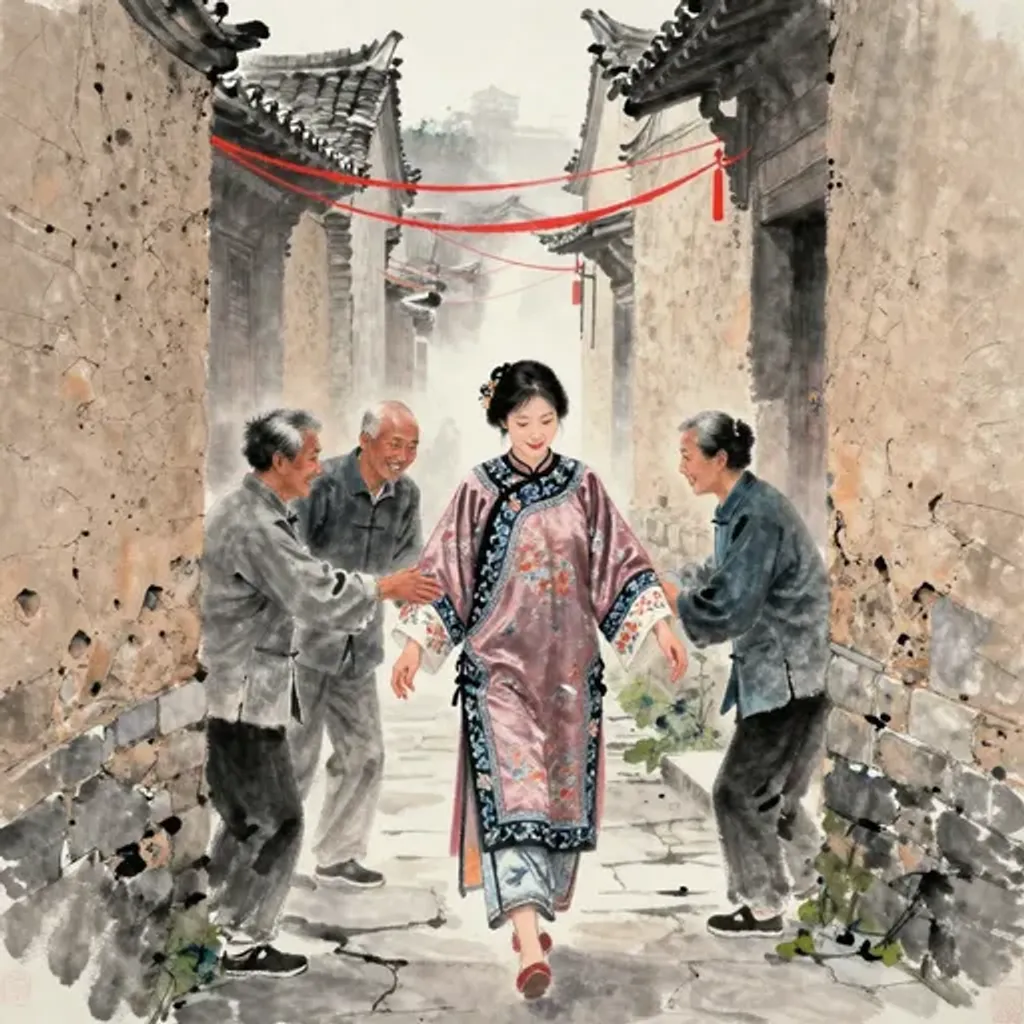
東鄰嫁女,為王妃后。莊公築館,以尊王母。歸于京師,季姜悅喜。
From a humble gate comes nobility; plain cloth is exchanged for brocade. In the old lane, former neighbors clasp hands in recognition.
— Jiao Yanshou, Yilin (Forest of Changes), 1st century BC
Commentary
Mountain upon earth erodes, and heaven sends thunder across the land — Innocence, action aligned with heaven's timing. The original verse tells of an eastern neighbor's daughter who marries and becomes a queen consort. Duke Zhuang of Lu builds a pavilion to honor the king's mother, who returns to the capital; Lady Ji Jiang rejoices. This narrative of a humble woman elevated to the highest station resonates with Innocence's core principle: unexpected fortune that arrives not through scheming but through the natural course of events. From Splitting Apart to Innocence, the mountain's decay clears the ground for heaven's uncontaminated movement. Thunder under heaven acts spontaneously, without calculation — and the neighbor's daughter is swept into royalty not by her own design but by heaven's momentum.
剝 → 大畜
Hexagram 23 → Hexagram 26: Great Taming
Changing lines: 1, 2, 3
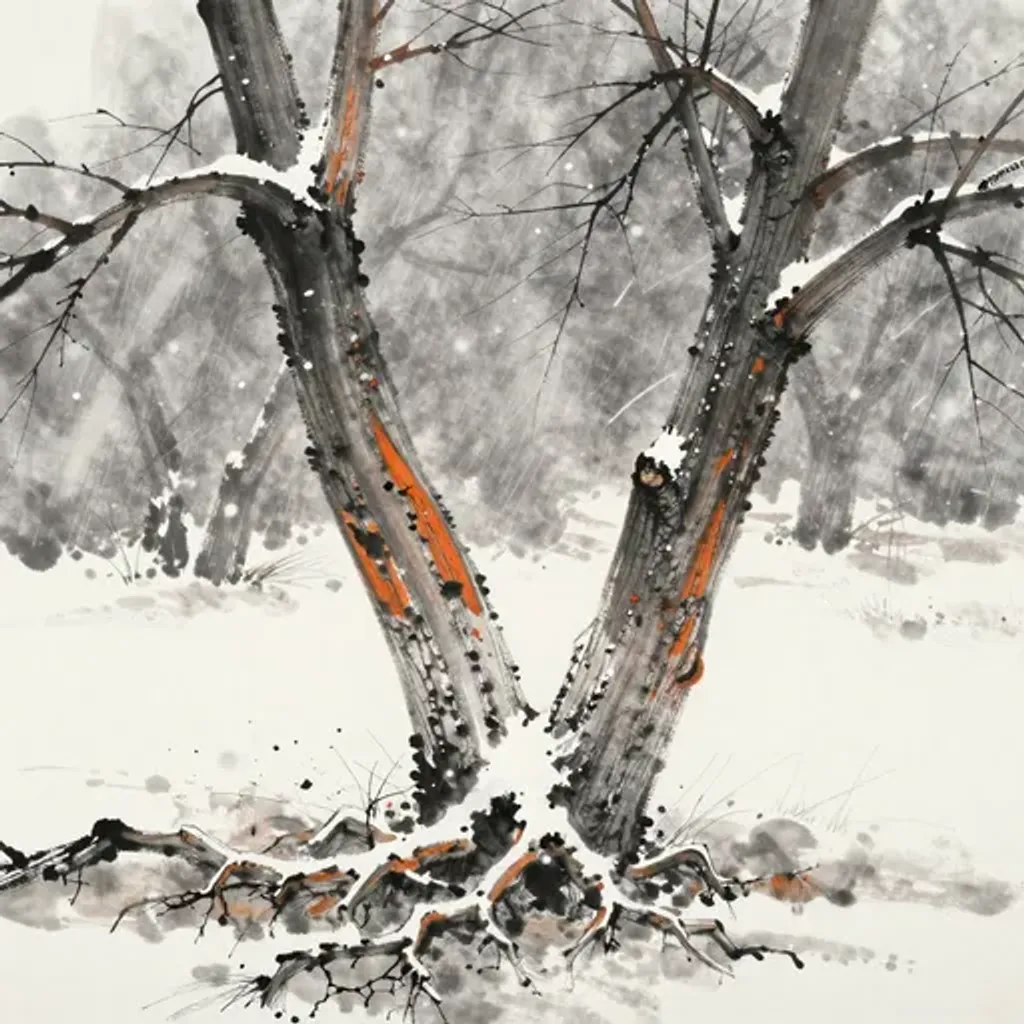
百足俱行,相輔為強。三聖翼事,王室寵光。
Dead trees lean on each other, wind and snow cannot break them. Their roots connect underground, drinking from the same spring vein.
— Jiao Yanshou, Yilin (Forest of Changes), 1st century BC
Commentary
Mountain upon earth erodes into heaven stored within the mountain — Great Taming, where accumulated wisdom restrains creative force. The original verse reads: 'A hundred legs walk together, supporting each other to strength. Three sages wing the enterprise, and the royal house glows with favor.' The 'hundred feet moving in concert' is the centipede, whose synchronized movement symbolizes coordinated collective effort. The 'three sages' likely refers to the Duke of Zhou, Taigong, and the Duke of Shao, who together stabilized the early Zhou dynasty. From Splitting Apart to Great Taming, the crumbling mountain transforms into one that holds heaven within it. What was eroding is now accumulating: the three sages store virtue and knowledge as the mountain stores heaven, building institutional strength that outlasts any individual crisis.
剝 → 頤
Hexagram 23 → Hexagram 27: Nourishment
Changing lines: 1
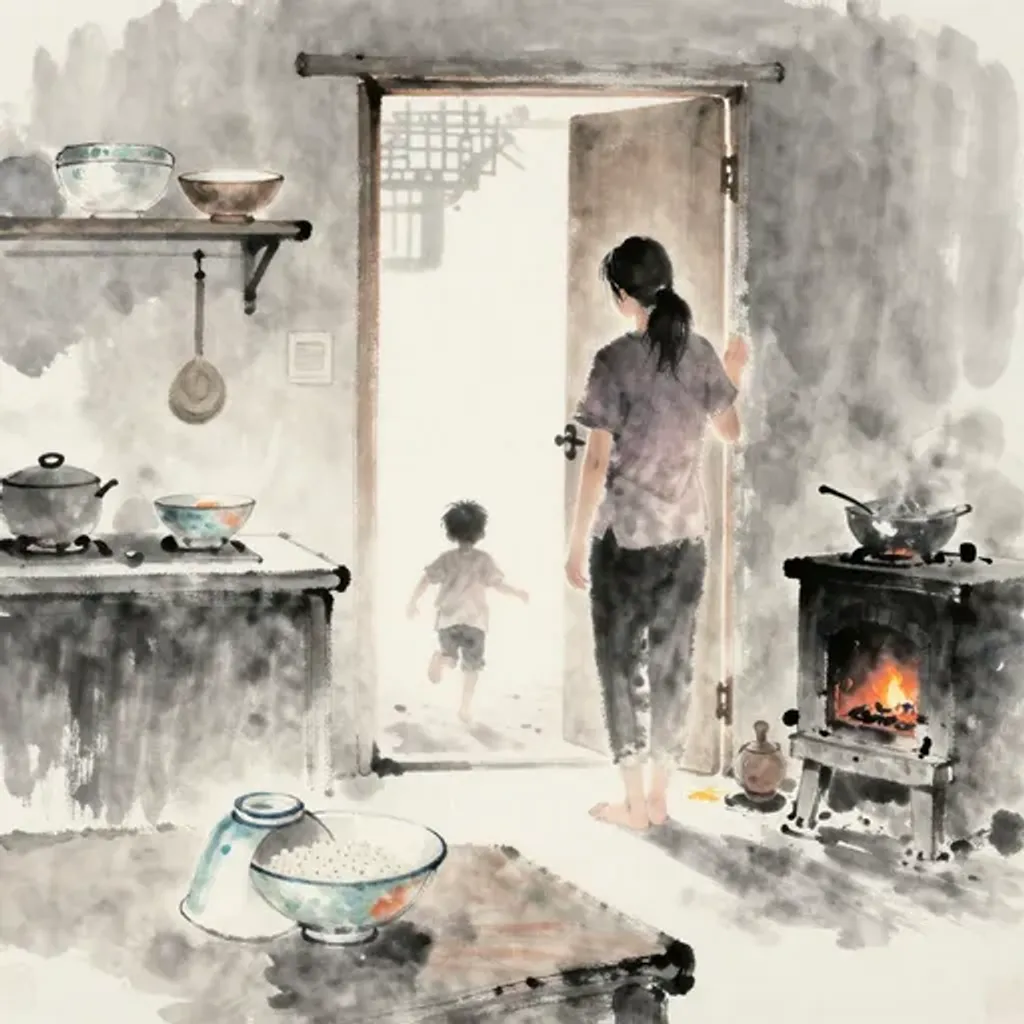
危坐至暮,請求不得。膏澤不降,政戾民忒。
Empty bowls overturned on the table; the stove is cold, ashes chill. A mother calls her children home — there is nothing to serve.
— Jiao Yanshou, Yilin (Forest of Changes), 1st century BC
Commentary
Mountain upon earth erodes into mountain above thunder — Nourishment, the hexagram of what sustains and what starves. The original verse speaks of a minister who sits rigidly until dusk, his petitions denied. Grace and favor do not descend; governance turns cruel and the people suffer. The image of denied nourishment is central: one waits in the proper posture of supplication, but nothing comes. The rewritten verse makes this concrete — empty bowls overturned, a cold stove with dead ashes, a mother calling her child home with nothing to serve. From Splitting Apart to Nourishment, the mountain's decay should yield to the mouth's sustaining function, yet here the mouth is empty. Thunder trapped beneath the mountain cannot break through; nourishment exists in principle but is withheld in practice.
剝 → 大過
Hexagram 23 → Hexagram 28: Great Exceeding
Changing lines: 2, 3, 4, 5, 6
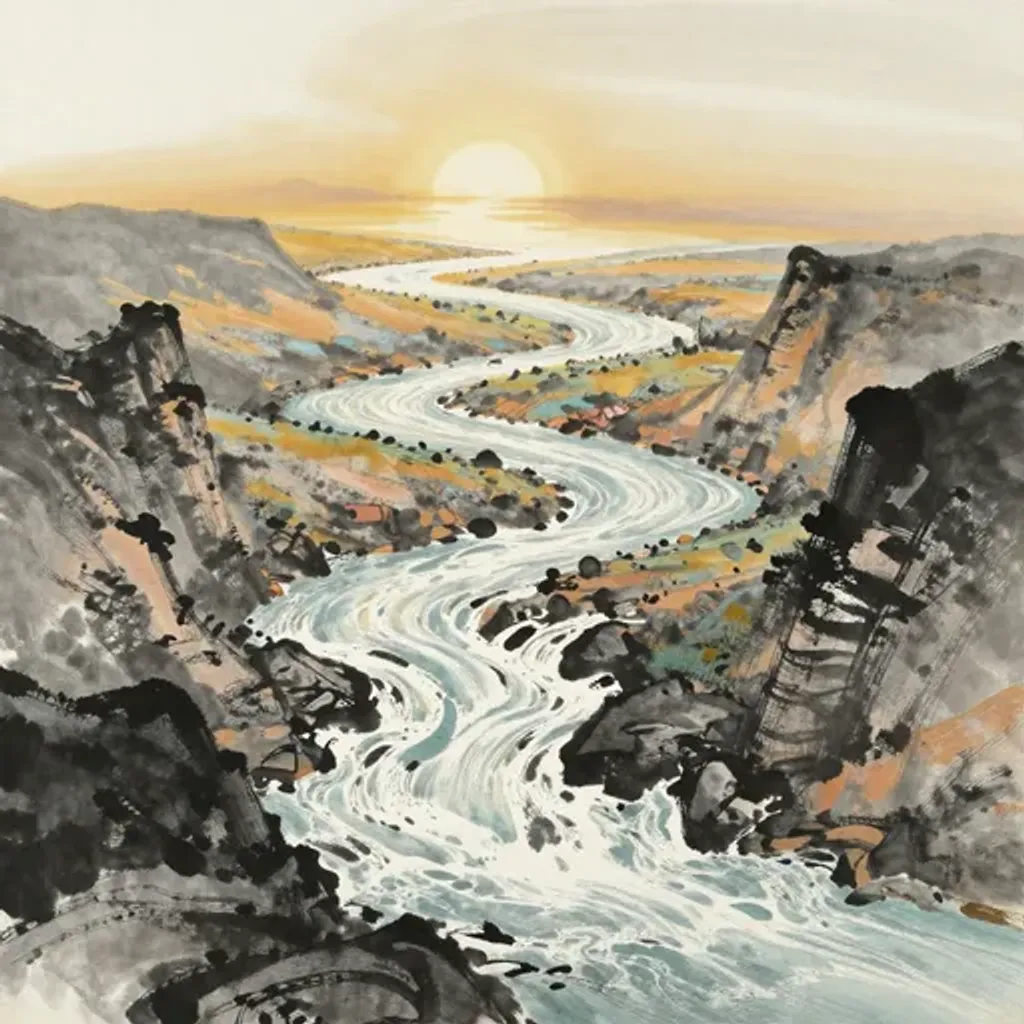
百川朝海,流行不止。路雖遼遠,無不到者。
A hundred streams flow toward the sea, coursing without cease. Though the road be long and far, there is none that does not arrive.
— Jiao Yanshou, Yilin (Forest of Changes), 1st century BC
Commentary
Mountain upon earth strips away, revealing lake above wind — Great Exceeding, the ridgepole bowed under extraordinary weight. A hundred rivers flow toward the sea, their movement ceaseless. Though the road is long and distant, there is nothing that does not arrive. The verse takes Great Exceeding's imagery of overwhelming force and renders it as patient, inevitable convergence. Unlike the hexagram's sagging ridgepole, here the excess is liquid, flowing, unstoppable rather than structurally stressed. Every stream finds the ocean regardless of distance. From Splitting Apart to Great Exceeding, the mountain's collapse releases its substance into motion. What was solid becomes fluid; what was fixed becomes journeying. The gentleman 'stands alone without fear and withdraws from the world without melancholy' — the hundred rivers need no validation, only their own persistent direction.
剝 → 坎
Hexagram 23 → Hexagram 29: The Abysmal Water
Changing lines: 2, 5, 6
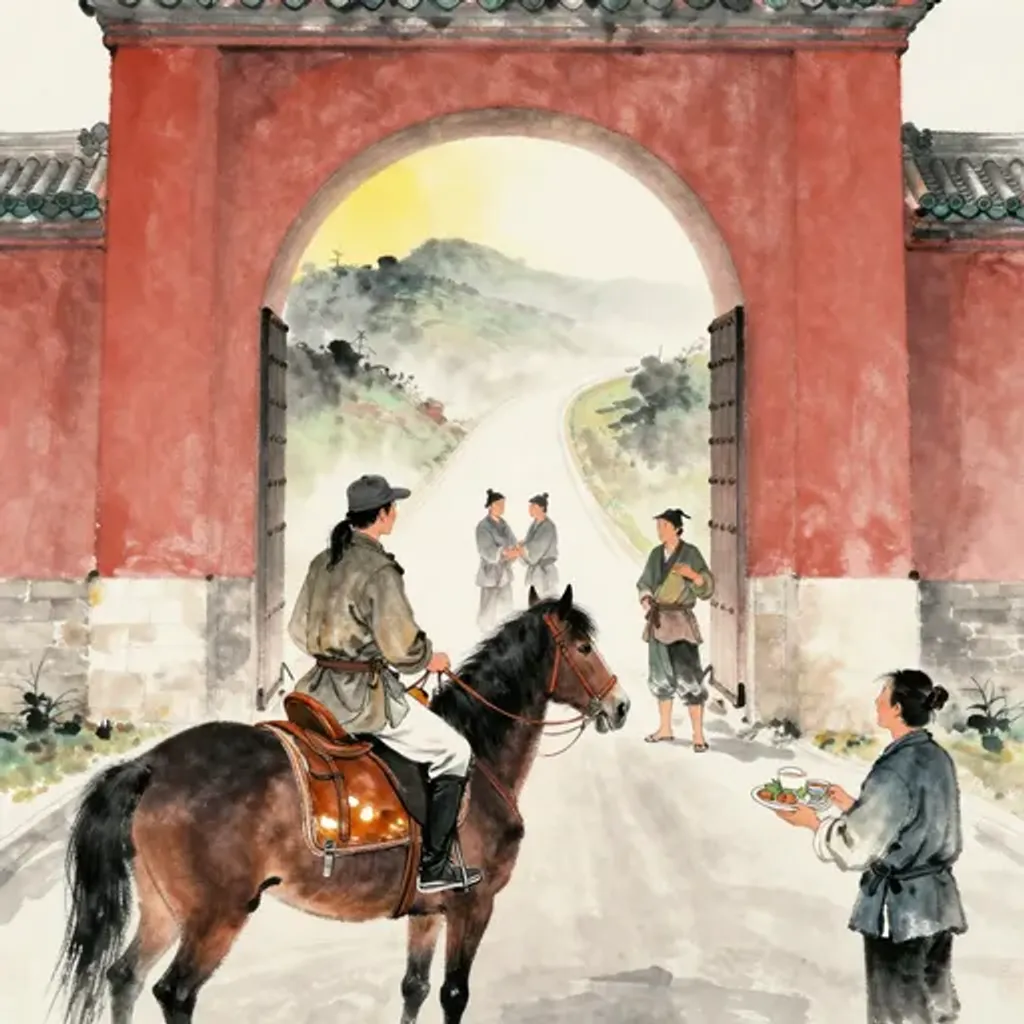
乘騮駕驪,東至于齊。遭遇仁友,送我以資,厚得利歸。
Riding a bay and driving a black, east to the land of Qi. Meeting a benevolent friend, he sends me off with provisions; richly rewarded, I return home.
— Jiao Yanshou, Yilin (Forest of Changes), 1st century BC
Commentary
Mountain upon earth erodes into doubled water — the Abysmal, peril repeated. One drives a dark bay and harnesses a black horse, traveling east to the state of Qi. There, one encounters a benevolent friend who sends one off with provisions, and one returns home with generous profits. The verse defies the Abysmal's reputation for danger: riding through the doubled abyss, the traveler finds not drowning but friendship and wealth. The journey to Qi — the great eastern state renowned for its commerce — suggests a trading venture that succeeds against the odds. From Splitting Apart to the Abysmal, the mountain's collapse plunges one into deep water, but water also forms the roads of commerce. One who maintains inner sincerity through danger, as the Abysmal demands, discovers that the abyss itself can be navigated for profit.
剝 → 離
Hexagram 23 → Hexagram 30: The Clinging Fire
Changing lines: 1, 3, 4
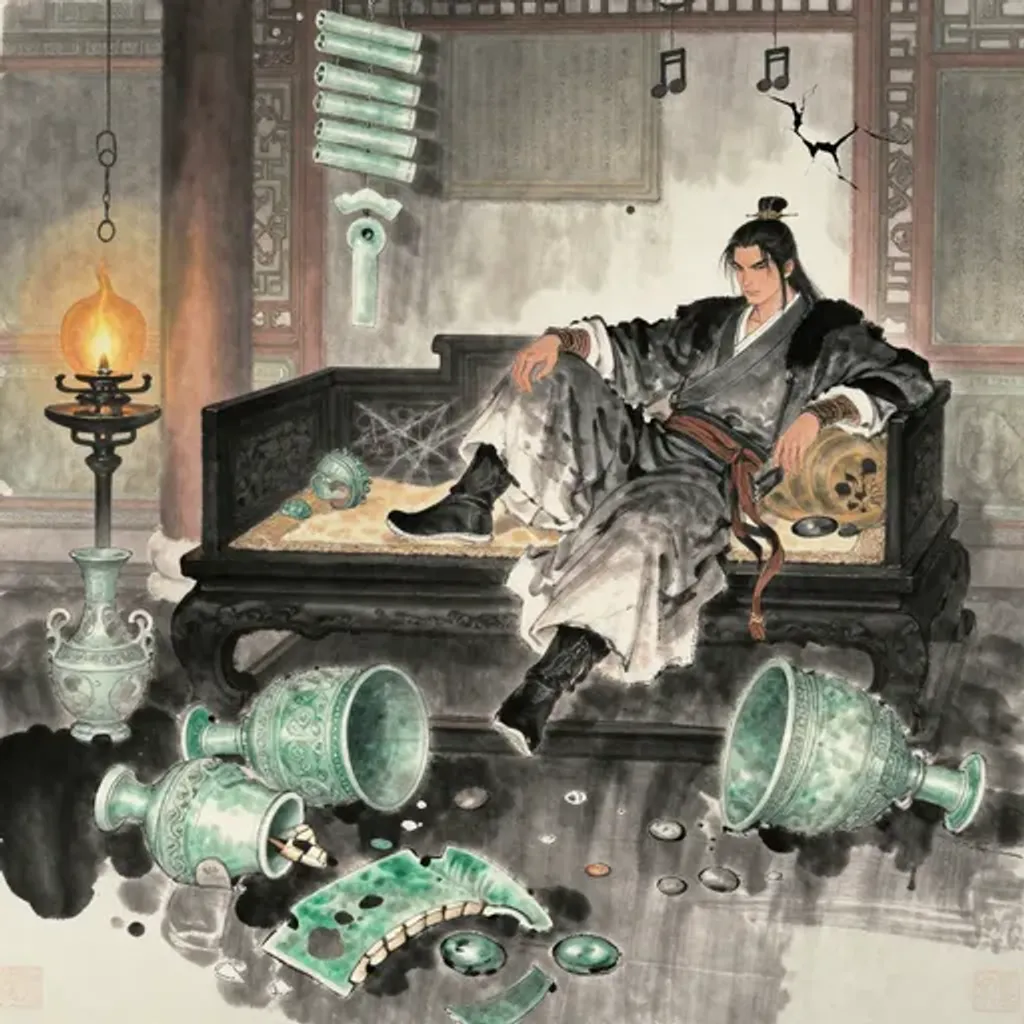
禮壞樂崩,成子傲慢。欲求致理,力疲心爛。陰陽不調,成子驕傲,為簡生殃。
Rites crumble, music collapses; Chengzi is arrogant and rude. Seeking to restore good order, strength is spent and the heart worn through. Yin and yang fall out of balance; Chengzi's pride brings calamity upon Jian.
— Jiao Yanshou, Yilin (Forest of Changes), 1st century BC
Commentary
A mountain crumbling upon the earth gives way to doubled fire: ritual collapses and music falls silent. Tian Chengzi, the powerful minister of Qi, grows arrogant beyond all restraint. In 481 BC he assassinated Duke Jian of Qi, the same year the qilin was captured in Lu, marking the end of the Spring and Autumn moral order. The verse names him twice, stressing his insolence as cause of the disaster. Despite efforts to restore good governance, the state's energy is exhausted and its heart rotten. From Splitting Apart to The Clinging, the transformation reveals how institutional decay exposes raw, destructive brilliance: when the mountain's slow erosion is complete, only fire remains, and fire without structure simply burns everything down.
剝 → 咸
Hexagram 23 → Hexagram 31: Influence
Changing lines: 3, 4, 5, 6
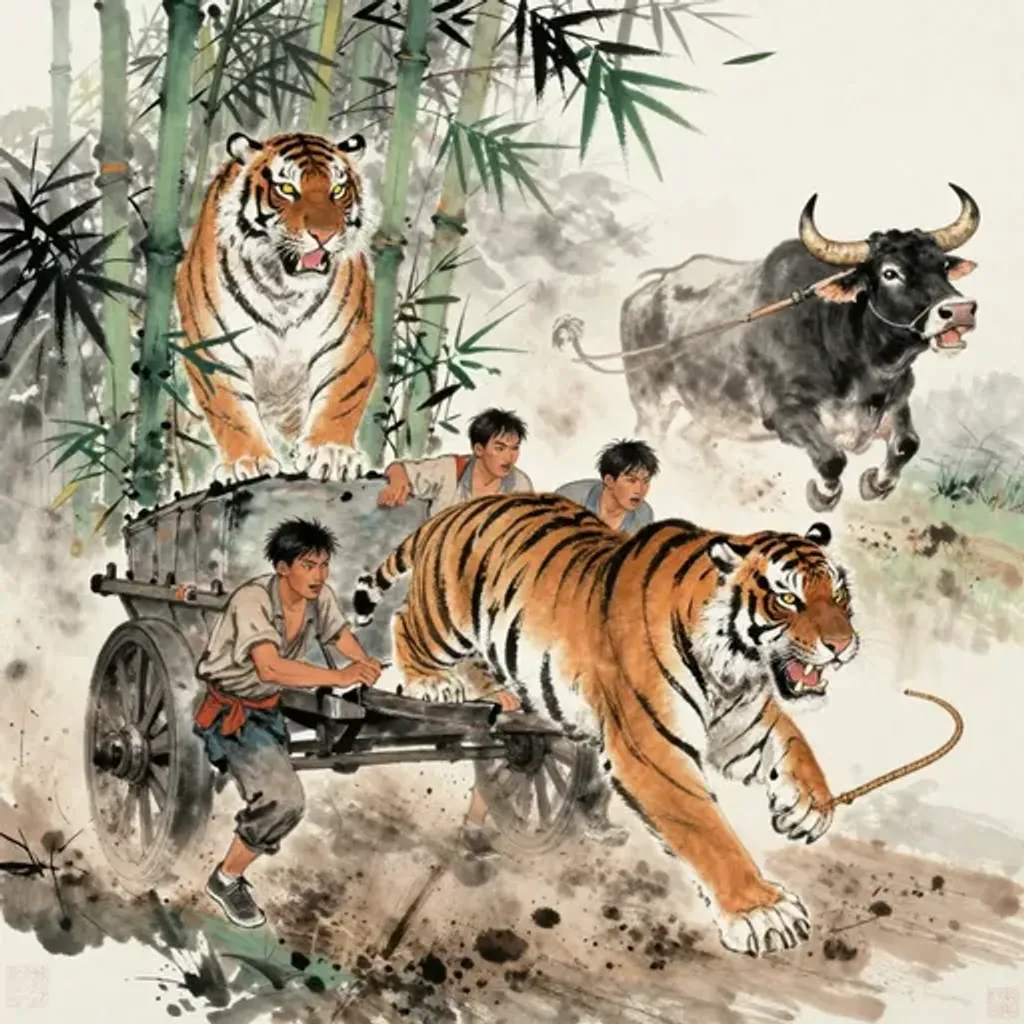
三人輦車,乘入虎家。王母貪叨,盜我犁牛。
Three men pull a cart, riding into the tiger's den. The queen mother, greedy and grasping, steals my plow-ox.
— Jiao Yanshou, Yilin (Forest of Changes), 1st century BC
Commentary
Mountain upon earth decays into lake above mountain — Influence, where openness at the summit invites connection. Three men push a handcart, rolling into the tiger's domain. The Queen Mother grows covetous and steals the plough-ox. The three men entering danger together should evoke mutual support, but what they find is predatory: a 'Wang Mu' figure — here not the celestial goddess but perhaps an overbearing matriarch or local power — seizes the very ox needed for livelihood. The plough-ox represents productive capacity; its theft is an attack on sustenance itself. From Splitting Apart to Influence, the mountain's erosion opens the summit to the lake's receptivity, but receptivity without discernment invites exploitation. Influence works through sensitivity; here that sensitivity is weaponized by the covetous.
剝 → 恆
Hexagram 23 → Hexagram 32: Duration
Changing lines: 2, 3, 4, 6
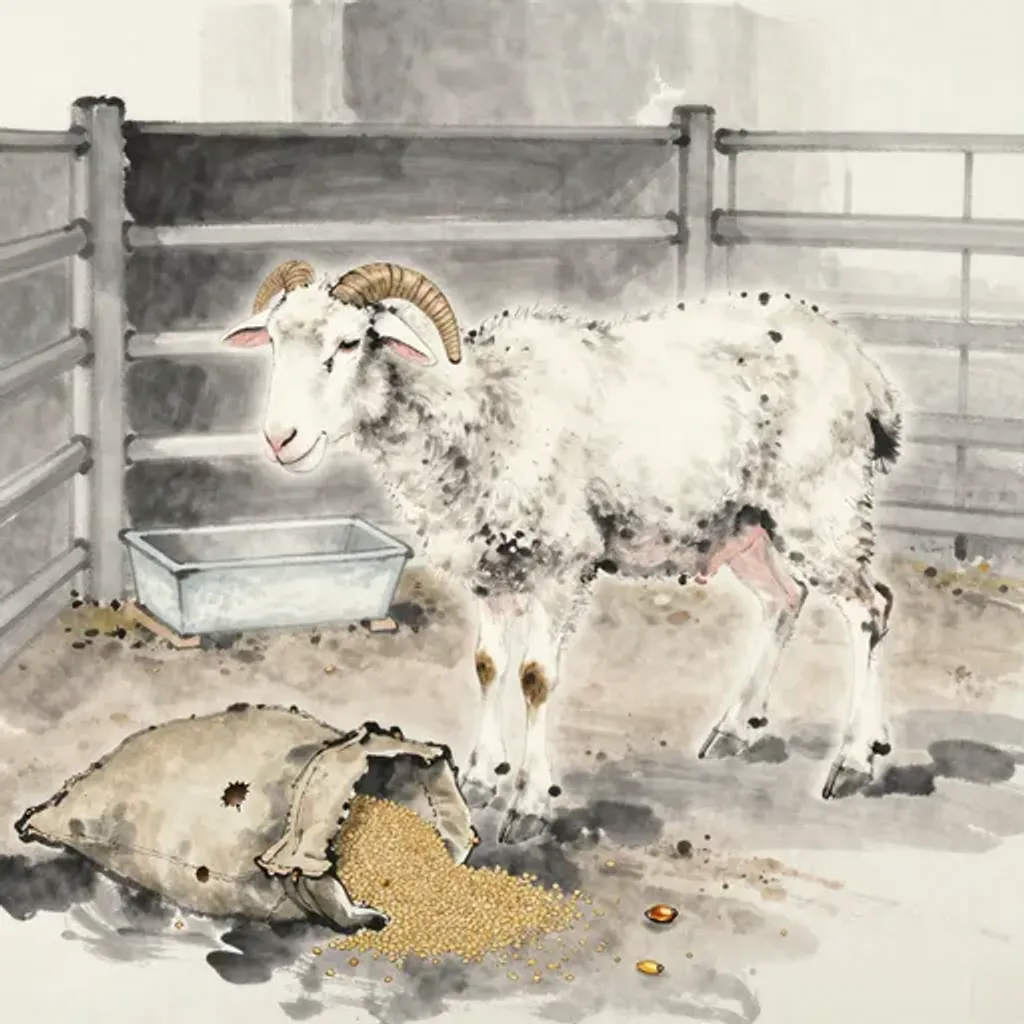
羊頭兔足,少肉不飽。漏囊敗粟,利無所得。
Sheep's head, rabbit's feet; too little meat to sate. A leaking sack, spoiled grain; no profit to be gained.
— Jiao Yanshou, Yilin (Forest of Changes), 1st century BC
Commentary
Mountain upon earth erodes into thunder and wind — Duration, the hexagram of constancy through time. A sheep's head and a rabbit's feet: too little meat to satisfy. A leaking sack loses its grain; no profit can be secured. The verse is relentlessly bleak: every container fails, every promise of sustenance proves hollow. The sheep's head suggests a meager offering; the rabbit's feet imply a creature too quick to catch or too small to eat. The sack with holes is Duration's cruelest parody — constancy in loss. From Splitting Apart to Duration, the mountain's erosion should give way to thunder and wind maintaining their eternal cycle, but here what endures is only deprivation. Duration without substance is merely the persistence of want, a sack that leaks faster than it can be filled.
剝 → 遯
Hexagram 23 → Hexagram 33: Retreat
Changing lines: 3, 4, 5
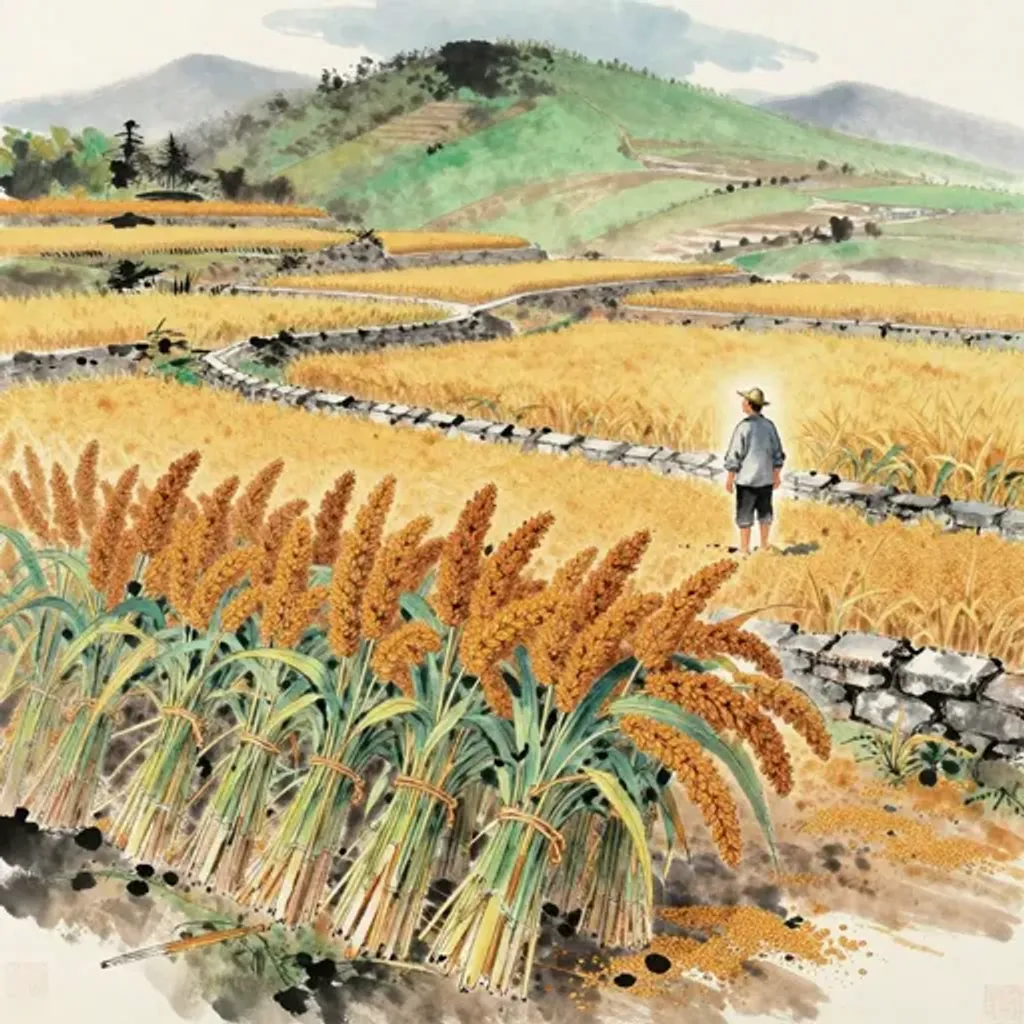
新田宜粟,上農得穀。君子惟好,以紆百福。
New fields suit millet well; the skilled farmer reaps grain. The noble man delights in virtue and so gathers a hundred blessings.
— Jiao Yanshou, Yilin (Forest of Changes), 1st century BC
Commentary
Mountain upon earth strips away, and heaven rises above the mountain — Retreat, the wise withdrawal before overwhelming yin. Freshly cleared fields are perfect for millet; the skilled farmer reaps his grain. The gentleman cherishes what is good and thereby gathers a hundred blessings. The verse is surprisingly auspicious for a pairing that begins with decay: the new field succeeds precisely because old growth was stripped away. The 'upper farmer' — one who reads the land correctly — knows which ground has been properly cleared and plants accordingly. From Splitting Apart to Retreat, the mountain's erosion creates the very conditions for strategic withdrawal into productive solitude. Retreat is not defeat but the selection of better ground. The gentleman who retreats at the right moment harvests what the reckless will never find.
剝 → 大壯
Hexagram 23 → Hexagram 34: Great Power
Changing lines: 1, 2, 3, 4, 6
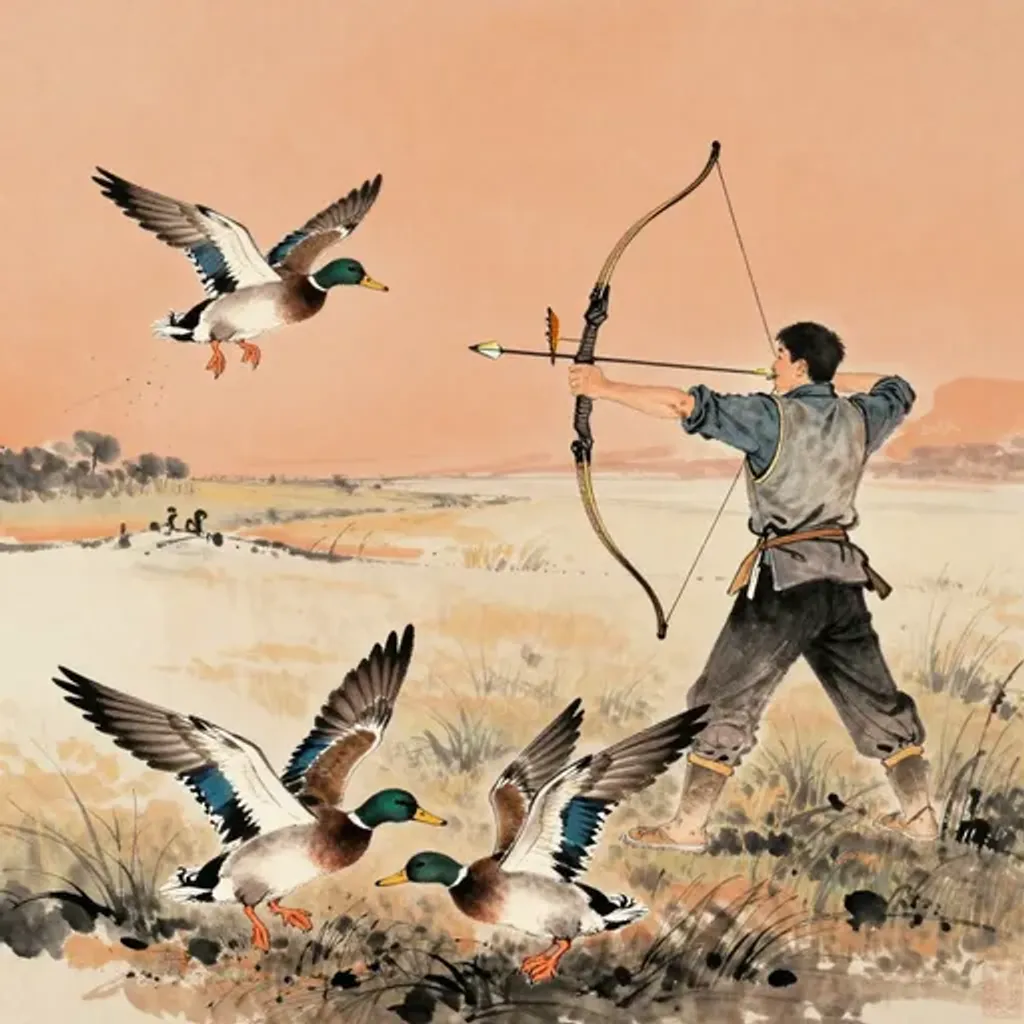
夷羿所射,發輒有獲。雙鳧俱得,利以伐國。
What Yi the archer shoots, each arrow finds its quarry. A pair of wild ducks taken together; profitable for conquest of a state.
— Jiao Yanshou, Yilin (Forest of Changes), 1st century BC
Commentary
Mountain upon earth strips away, and thunder roars above heaven — Great Power, irresistible force unleashed. Archer Yi of the Eastern Barbarians takes aim, and every arrow finds its mark. A pair of wild ducks is brought down with a single volley, the skill proving apt for conquering a state. Yi the archer is the mythological supreme marksman who shot down nine suns; in historical tradition he also refers to the lord of the Youqiong who usurped Xia power. The 'pair of ducks taken together' suggests efficiency that borders on the ruthless — one shot, two kills. From Splitting Apart to Great Power, the mountain's decay releases pent-up yang in a thunderous explosion. Yi's marksmanship embodies Great Power's dynamic: force applied with precision, not merely brute strength. Yet the hexagram warns against overstepping propriety, and Yi's own story ends in betrayal.
剝 → 晉
Hexagram 23 → Hexagram 35: Progress
Changing lines: 4
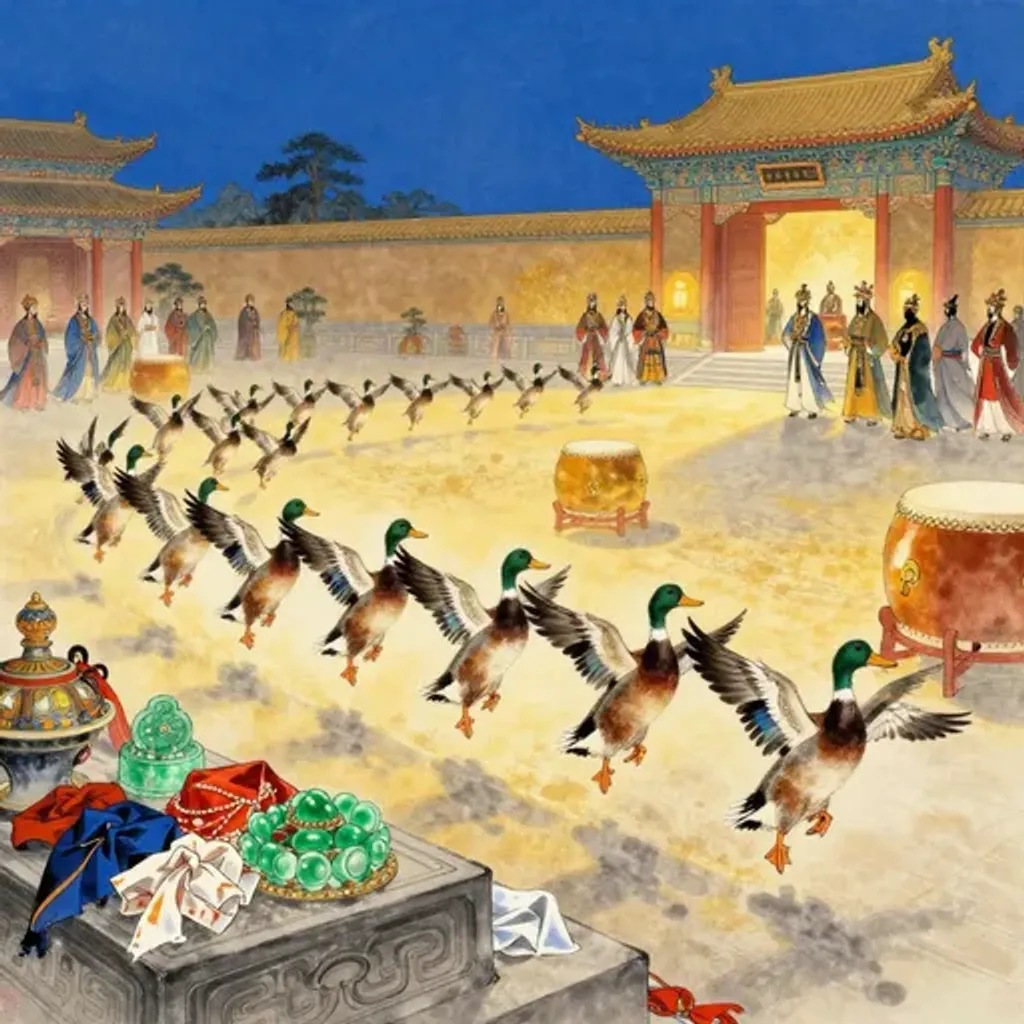
鳧舞鼓翼,嘉樂堯德。虞夏美功,要荒賓服。
Ducks dance and beat their wings, rejoicing in the virtue of Yao. Yu and Xia's splendid achievement; the remote borderlands submit and serve.
— Jiao Yanshou, Yilin (Forest of Changes), 1st century BC
Commentary
Mountain upon earth strips away, and fire emerges above the earth — Progress, brightness ascending. Wild ducks dance and beat their wings, celebrating the virtue of Emperor Yao. The achievements of the Yu and Xia eras are praised, and the remotest barbarian tribes submit as guests. The dancing waterfowl recalls the ancient description of animals responding to sage music — when governance is truly virtuous, even nature rejoices. Yao's virtue and the achievements of Yu and the Xia represent the golden age when civilization radiated outward, civilizing the farthest reaches. From Splitting Apart to Progress, the mountain's decay clears the horizon for the sun to rise unobstructed over the earth. The brightness that was once blocked by the mountain now shines freely, and its warmth reaches even the outermost lands.
剝 → 明夷
Hexagram 23 → Hexagram 36: Darkening of the Light
Changing lines: 1, 3, 6
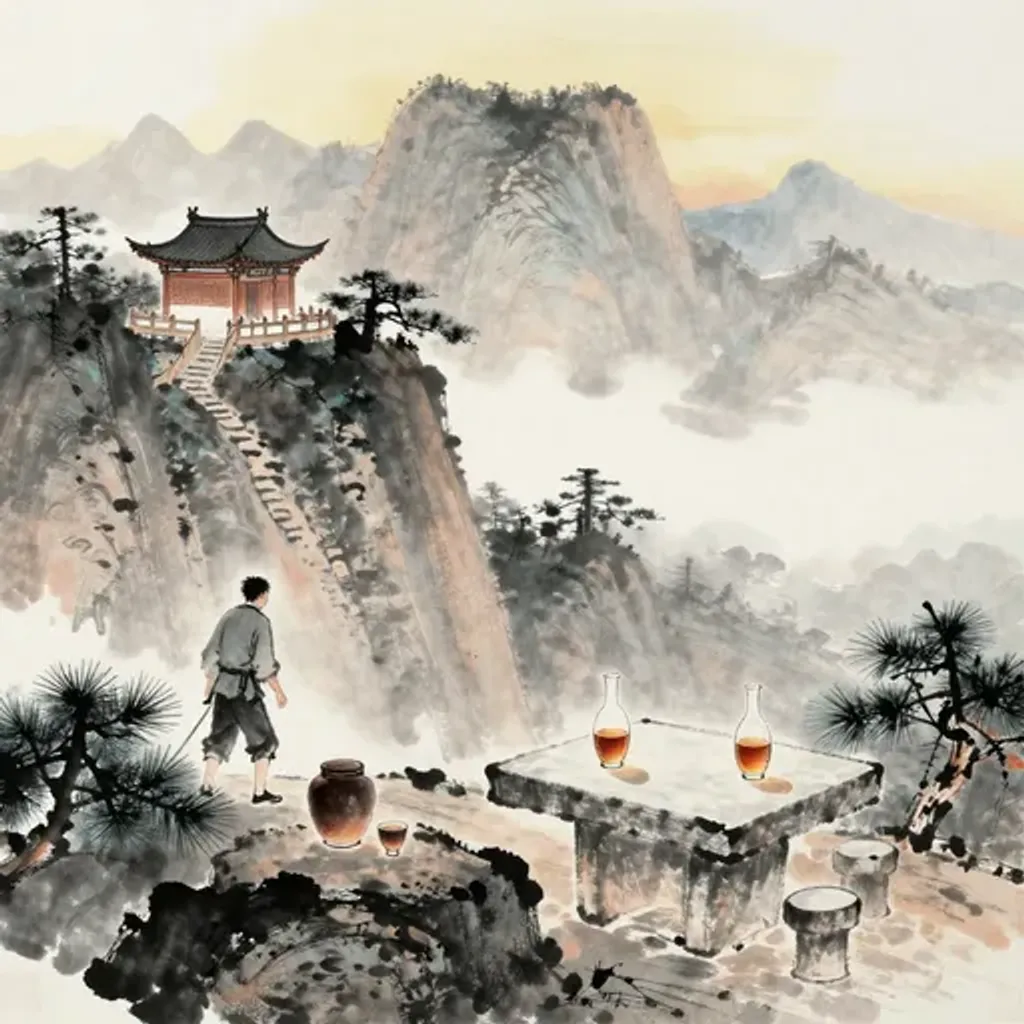
登丘上山,對酒道觀。終年卒歲,優福無患。
Ascending the hill, climbing the mountain; drinking wine at the Daoist temple. Through the year to its very end, blessed and free from misfortune.
— Jiao Yanshou, Yilin (Forest of Changes), 1st century BC
Commentary
Mountain upon earth decays into earth above fire — Darkening of the Light, brightness driven underground. Yet the verse describes an idyll: climbing hills and mountains, drinking wine at a Daoist observatory, living out the year in leisure and blessed freedom from harm. This seeming contradiction is the hexagram's deepest teaching. When light is driven below the earth, the wise do not fight the darkness but retreat into the pleasure of private life. The hilltop wine-drinking and the observatory suggest a scholar who has abandoned the corrupt court for hermit contentment. From Splitting Apart to Darkening of the Light, the mountain's collapse buries the light rather than exposing it. The sage responds by using darkness itself as shelter — 'wielding dimness to preserve brightness,' as the hexagram text instructs.
剝 → 家人
Hexagram 23 → Hexagram 37: The Family
Changing lines: 1, 3, 5
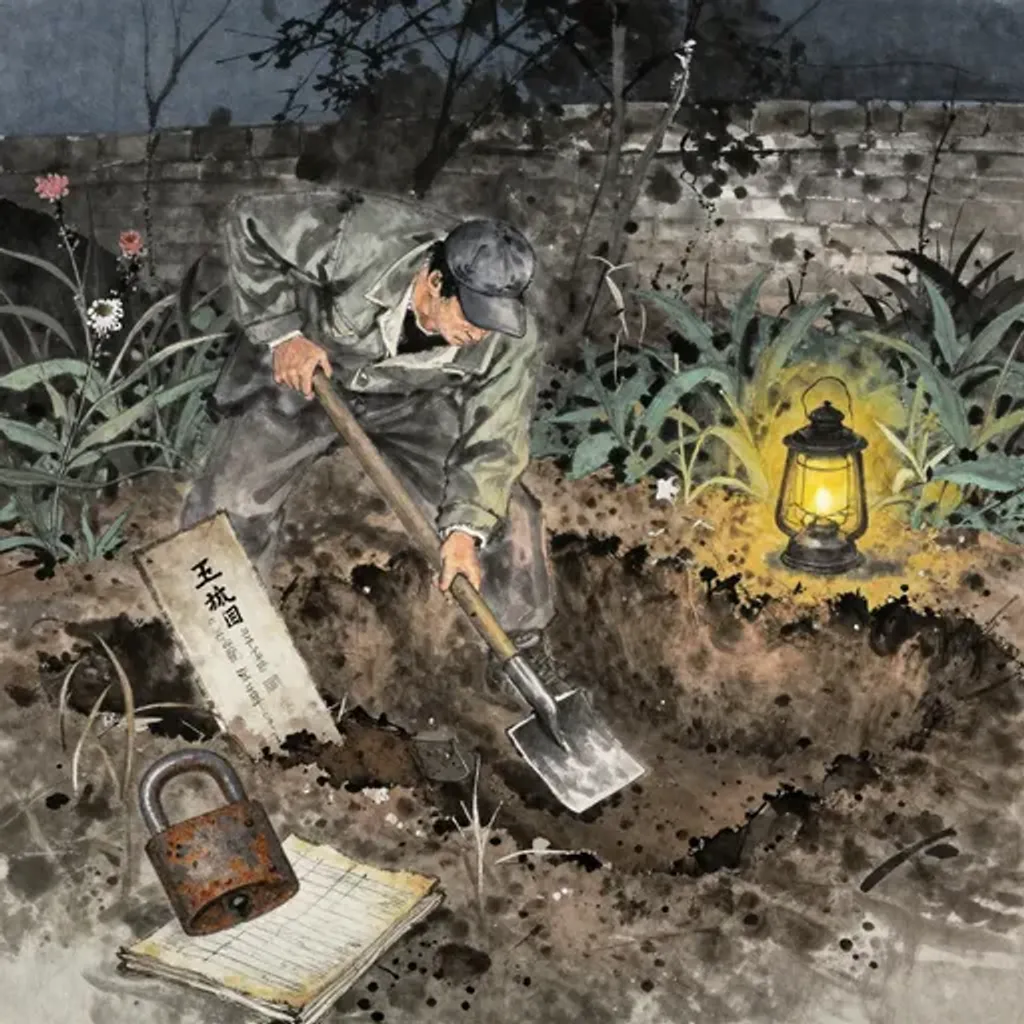
歲暮花落,陽入陰室。萬物伏匿,藏不可得。
The storehouse lock rusts, the key is lost. Ledger ink fades to frost. Gold and silver buried — the marker is gone. Digging up the entire south garden, the cache is never found.
— Jiao Yanshou, Yilin (Forest of Changes), 1st century BC
Commentary
Mountain upon earth decays into wind emerging from fire — the Family, where inner warmth radiates outward as consistent influence. The original verse reads: 'At year's end the flowers fall, yang enters the yin chamber. All things hide and conceal themselves; what is stored cannot be found.' Everything vanishes into winter's dark interior: the flowers are gone, the light retreats indoors, and stored wealth disappears beyond recovery. The rewritten verse makes this vivid with rusted locks, faded ledgers, and buried gold whose markers are lost. From Splitting Apart to the Family, the mountain's decay should kindle the hearth — wind from fire, words with substance, deeds with constancy. But here the household's foundation has rotted: the storehouse is locked and the key is lost. A family that cannot find its own resources cannot radiate any warmth.
剝 → 睽
Hexagram 23 → Hexagram 38: Opposition
Changing lines: 1, 2, 4
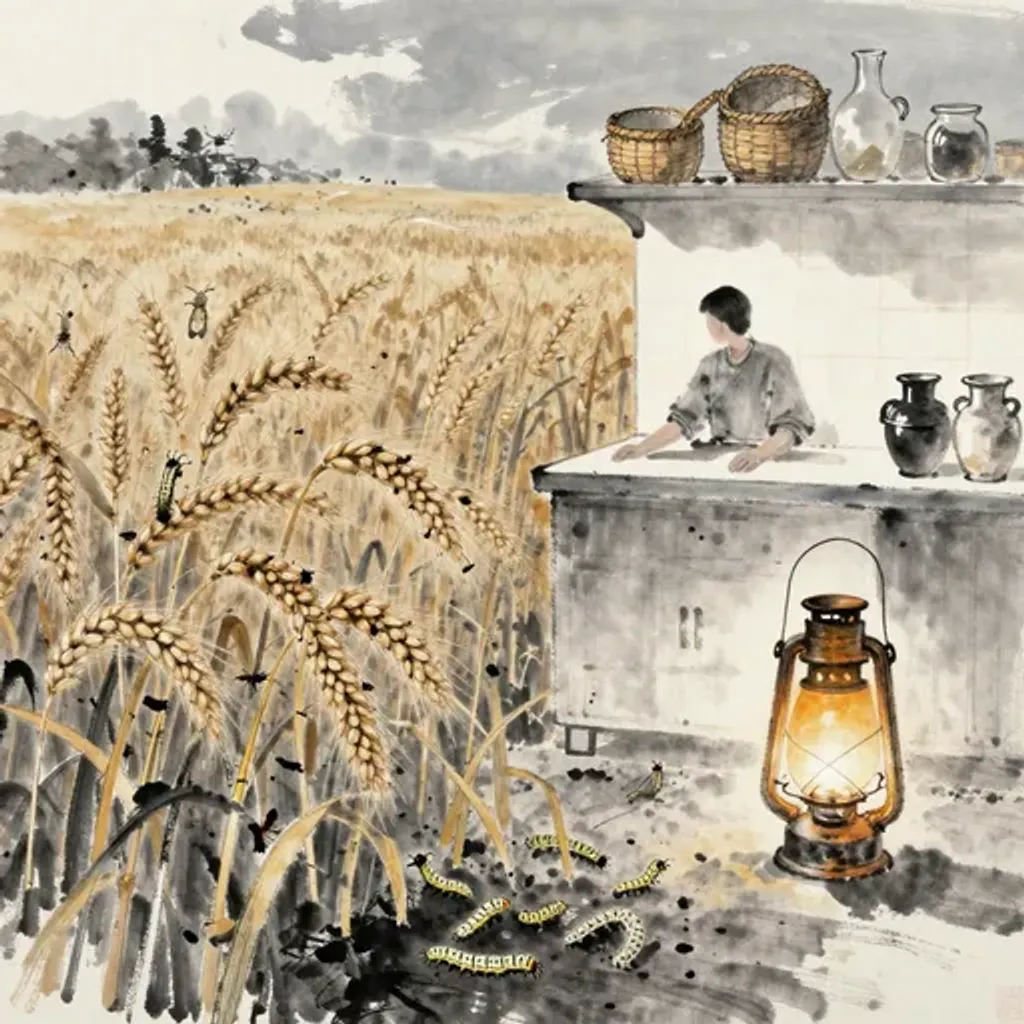
螟䖝為賊,害我禾穀。簞瓶空虛,飢無所食。
Caterpillars and grubs are the bane, ravaging my grain and crops. Bamboo baskets and jars stand empty; there is nothing to eat in hunger.
— Jiao Yanshou, Yilin (Forest of Changes), 1st century BC
Commentary
Mountain upon earth decays into fire above lake — Opposition, where different elements face each other in tension. Caterpillars and grubs become pests, destroying grain and millet. The jars and bottles stand empty; there is nothing to eat in the famine. The pest invasion is a quiet catastrophe — not dramatic fire or flood but the slow, invisible consumption of the harvest by insects. The containers that should hold food are void, a domestic echo of the agricultural ruin outside. From Splitting Apart to Opposition, the mountain's erosion meets the divergence of fire and water. Fire rises while the lake sinks; above and below pull apart. The pests embody this Opposition: they are creatures of the same field as the grain, yet they destroy it. What should nourish and what devours share the same ground but move in opposite directions.
剝 → 蹇
Hexagram 23 → Hexagram 39: Obstruction
Changing lines: 3, 5, 6
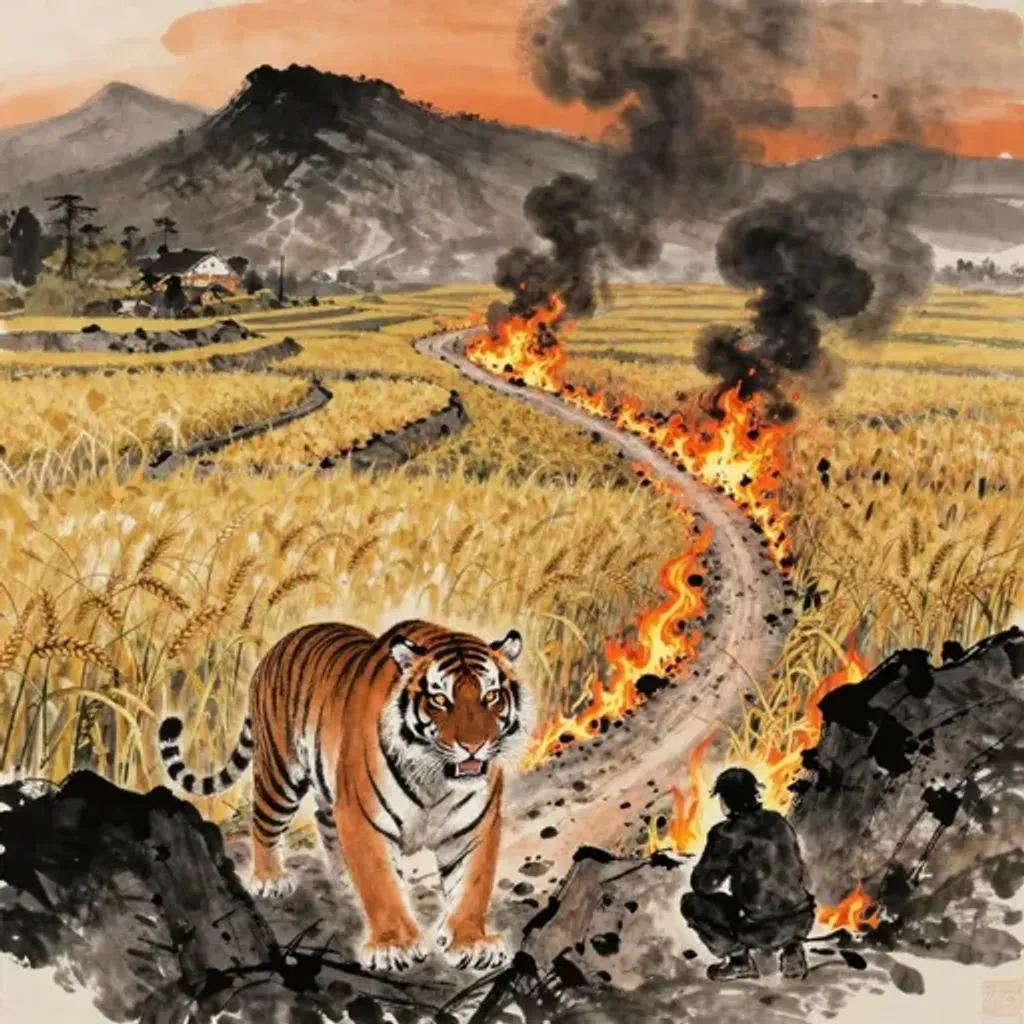
陽虎脅主,使得不通。火離為殃,年穀病傷。
Yang Hu coerces the lord, blocking free passage. Fire departs and brings disaster; the year's grain suffers blight and harm.
— Jiao Yanshou, Yilin (Forest of Changes), 1st century BC
Commentary
Mountain upon earth decays into water above mountain — Obstruction, the hexagram of dangers that block the path. Yang Hu threatens the lord, making governance impossible. Fire from the Li trigram brings catastrophe, and the year's grain harvest is blighted. Yang Hu was the powerful retainer of the Jisun family in Lu who seized control from 504 to 502 BC, attacking the duke's residence and holding the state hostage. The verse links political usurpation to agricultural failure: when a servant masters the master, not only the court but the fields themselves suffer. From Splitting Apart to Obstruction, the mountain that was already crumbling now has water pooled atop it — impassable terrain. Yang Hu's coercion blocks the channels of legitimate governance as water blocks the mountain path.
剝 → 解
Hexagram 23 → Hexagram 40: Deliverance
Changing lines: 2, 4, 6
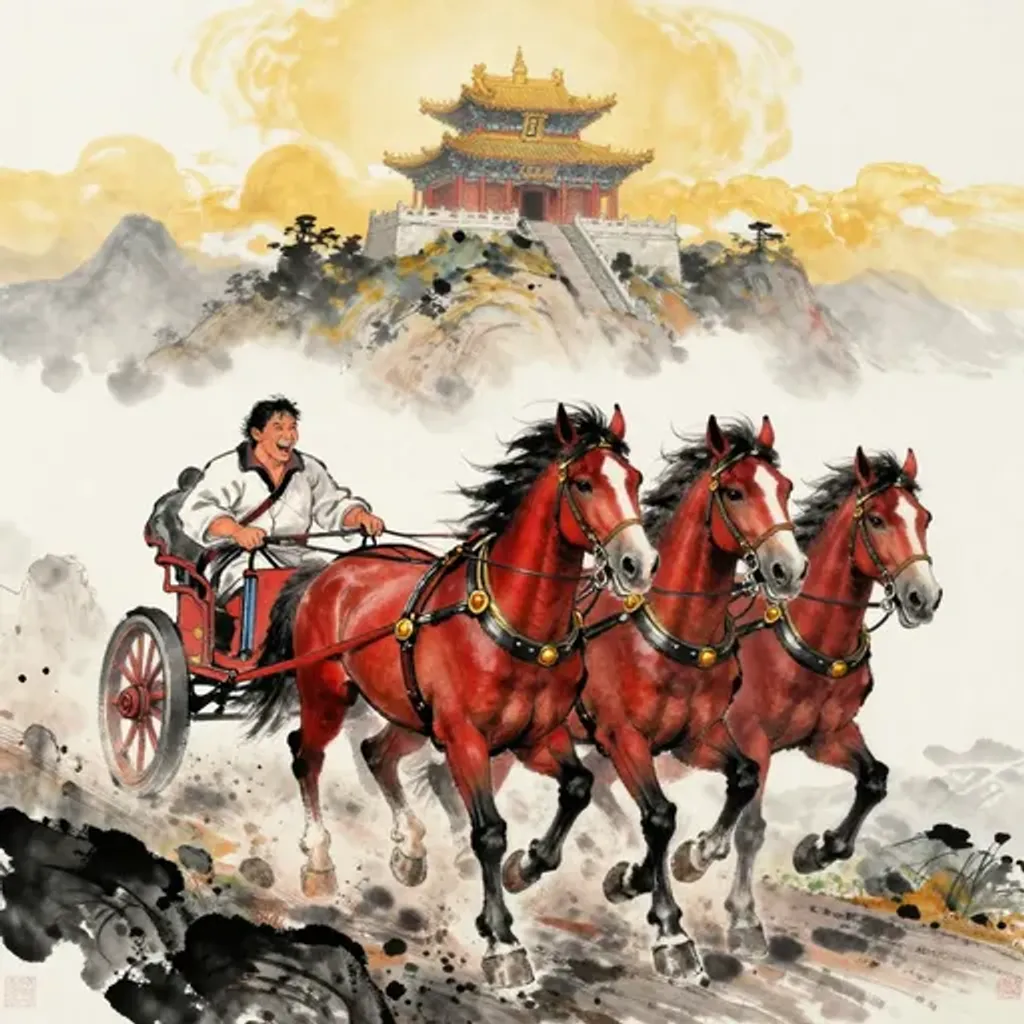
四馬共轅,東上泰山。騂驤同力,無有重難。與君笑言。
Four horses share one yoke, east and up to Mount Tai. Red steeds strain with united strength; no burden is too heavy. Together we laugh and jest.
— Jiao Yanshou, Yilin (Forest of Changes), 1st century BC
Commentary
Mountain upon earth strips away, and thunder and rain arrive together — Deliverance, the release of tension after crisis. Four horses share one yoke, climbing eastward to Mount Tai. The fine steeds pull as one, meeting no heavy obstacles. Lord and companion laugh and converse. Mount Tai, the eastern sacred mountain, is the site of imperial feng-shan sacrifices — the highest ritual affirmation of a ruler's mandate. Four horses pulling in harmony up this sacred slope represents coordinated power ascending toward heaven's recognition. From Splitting Apart to Deliverance, the mountain that was collapsing is replaced by the mountain that is climbed in triumph. Thunder and rain clear the air; what was stuck is freed. The laughter between ruler and minister signals the ease that follows liberation — hardship dissolved, the road ahead open.
剝 → 損
Hexagram 23 → Hexagram 41: Decrease
Changing lines: 1, 2
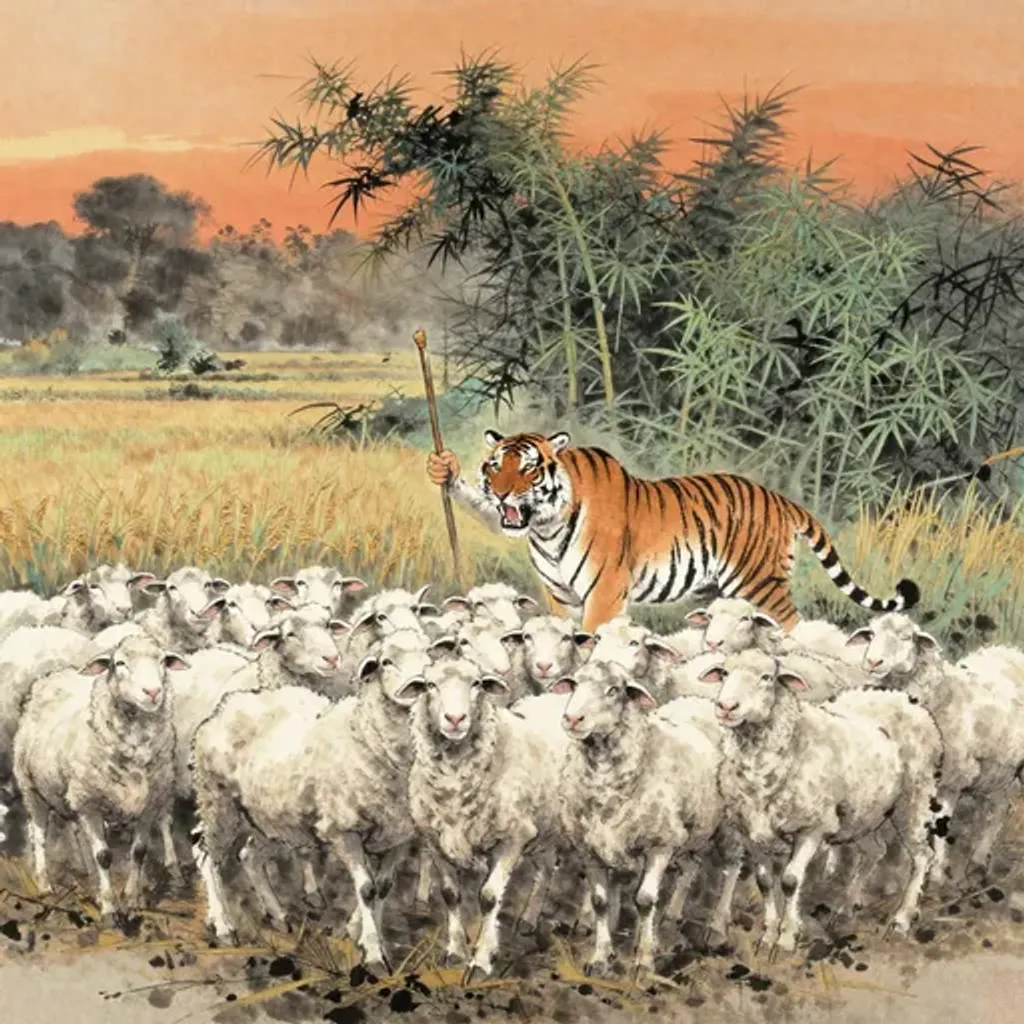
牧羊稻園,聞虎喧嚾。懼畏悚息,終無禍患。
Herding sheep in the rice garden; hearing a tiger's roar. Afraid and holding one's breath; in the end no calamity befalls.
— Jiao Yanshou, Yilin (Forest of Changes), 1st century BC
Commentary
Mountain upon earth strips away, yielding to mountain above lake — Decrease, where the lower is diminished to benefit the upper. A shepherd tends his flock in a rice paddy and hears a tiger roaring nearby. Fear and trembling seize him, yet in the end no disaster comes. The tiger's roar is terrifying but does not materialize into attack. The shepherd's fear itself is the 'decrease' — his peace of mind is sacrificed, but his body and flock survive intact. From Splitting Apart to Decrease, the mountain's erosion opens space for the lake below to be drained upward. The shepherd experiences this as alarm without substance: the threat is real but the loss is only psychological. Decrease teaches that restraining desire and curbing anger protect against actual harm. The tiger roars; the shepherd trembles; nothing else happens.
剝 → 益
Hexagram 23 → Hexagram 42: Increase
Changing lines: 1, 5
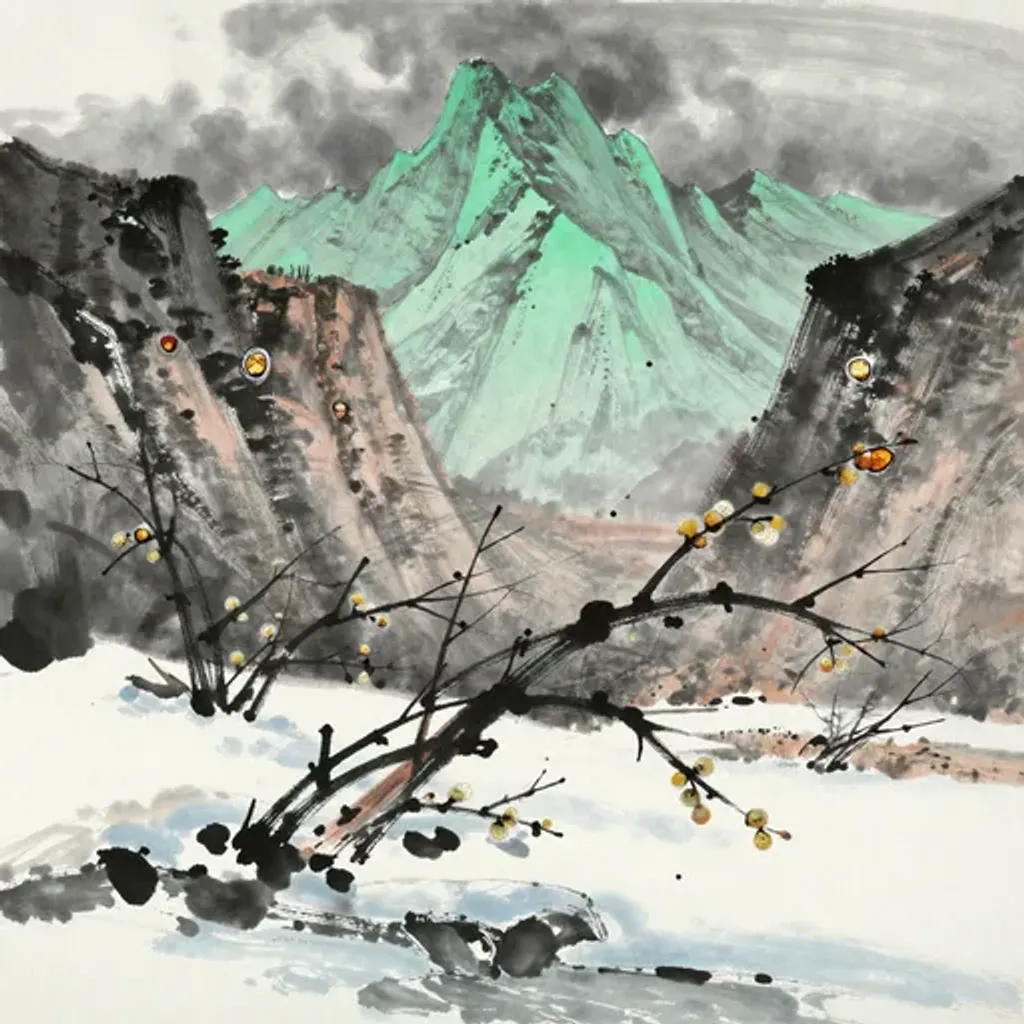
揚花不時,冬實生危,憂多橫賊。生不能服,崑崙之玉,所求必得。
Blossoms scatter out of season; winter fruit faces peril, beset by many troubles and thieves. What is born cannot be tamed; yet the jade of Kunlun — what is sought shall surely be found.
— Jiao Yanshou, Yilin (Forest of Changes), 1st century BC
Commentary
Mountain upon earth erodes into wind and thunder — Increase, where the upper diminishes itself to enrich the lower. Flowers bloom out of season and winter fruit faces danger; worries multiply as brigands strike. Yet those born without the power to subdue such troubles may still seek the jade of Kunlun — and what is sought will certainly be obtained. The verse pivots sharply from hardship to promise. The unseasonal blooming and winter peril describe a world out of phase, but the Kunlun jade represents something of incorruptible value lying beyond the chaos. From Splitting Apart to Increase, the mountain that collapses redistributes its substance downward. Wind and thunder work together to spread benefit widely. The jade of Kunlun — supreme treasure from the axis of the world — rewards those who persist through disorder, embodying Increase's principle that sacrifice from above enriches those below.
剝 → 夬
Hexagram 23 → Hexagram 43: Breakthrough
Changing lines: 1, 2, 3, 4, 5, 6
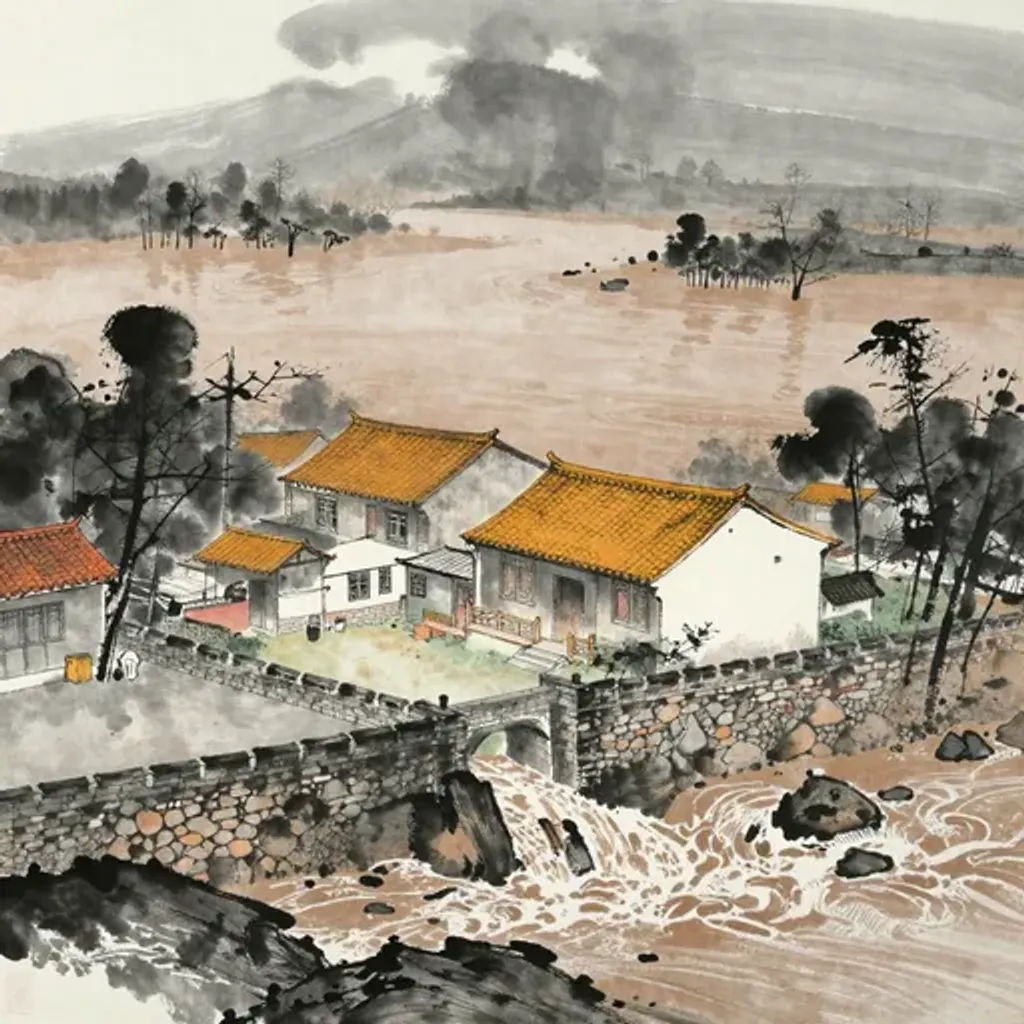
高阜所在,陰氣不臨。洪水不處,為家利寶。
Where the high mound stands, yin vapors do not reach. Floodwaters do not settle there; it is the household's profitable treasure.
— Jiao Yanshou, Yilin (Forest of Changes), 1st century BC
Commentary
Mountain upon earth decays into lake rising above heaven — Breakthrough, the decisive moment when accumulated yin is expelled. High ground stands where yin vapors cannot reach. Floodwaters do not settle here; this place is a family's treasure and protection. The verse describes elevation as salvation: by occupying the high point, one escapes both the miasma of low-lying corruption and the literal flood. The 'gao fu' (high mound) is the antithesis of the collapsing mountain — an eminence that endures because it rises above the destructive. From Splitting Apart to Breakthrough, the mountain that was eroding gives way to the lake bursting through its last restraint. But the wise have already ascended beyond the flood's reach. Breakthrough demands decisive action announced in the king's court; the high ground is the stance from which that announcement is made.
剝 → 姤
Hexagram 23 → Hexagram 44: Coming to Meet
Changing lines: 2, 3, 4, 5
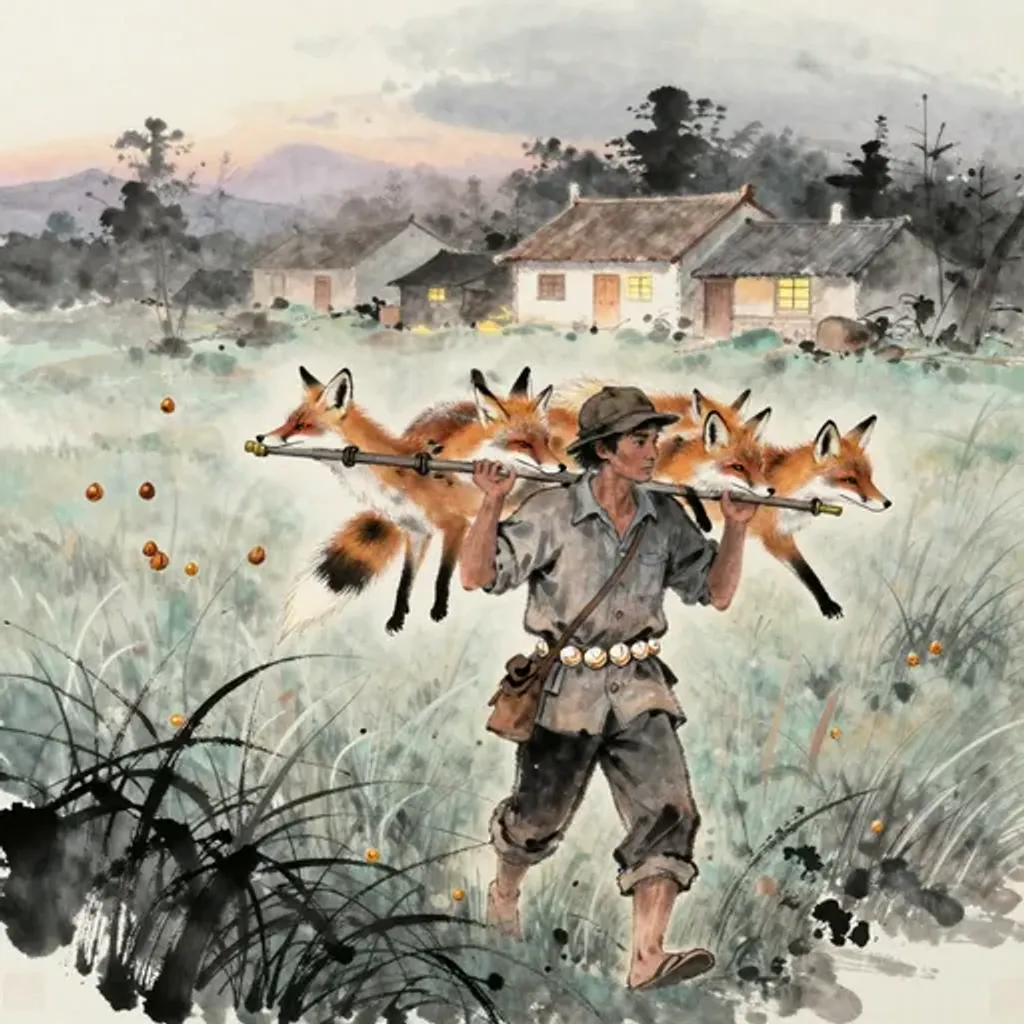
釋然遠咎,辟患害早。田獲三狐,以貝為寶。君子所在,安寧不殆。
Calmly leaving blame behind, avoiding trouble early. Hunting and catching three foxes; taking cowries as treasure. Where the noble man abides, there is peace without peril.
— Jiao Yanshou, Yilin (Forest of Changes), 1st century BC
Commentary
Mountain upon earth strips away, and heaven spreads wind beneath — Coming to Meet, the yin principle rising from below. Calamity is released far away, and misfortune is averted early. In the hunt three foxes are caught, and cowrie shells become the treasure. Where the gentleman dwells, there is peace without danger. The verse reads as a catalog of prudent actions: releasing harm before it arrives, hunting down cunning threats, converting what is caught into wealth. The three foxes — symbols of deception and guile in the Yi — are trapped and neutralized. From Splitting Apart to Coming to Meet, the mountain's erosion opens the ground to wind's penetrating influence. Coming to Meet warns that when yin first appears, it must be recognized immediately. Here the gentleman does exactly that: he meets the threat early, eliminates the foxes, and secures his dwelling.
剝 → 萃
Hexagram 23 → Hexagram 45: Gathering Together
Changing lines: 4, 5, 6
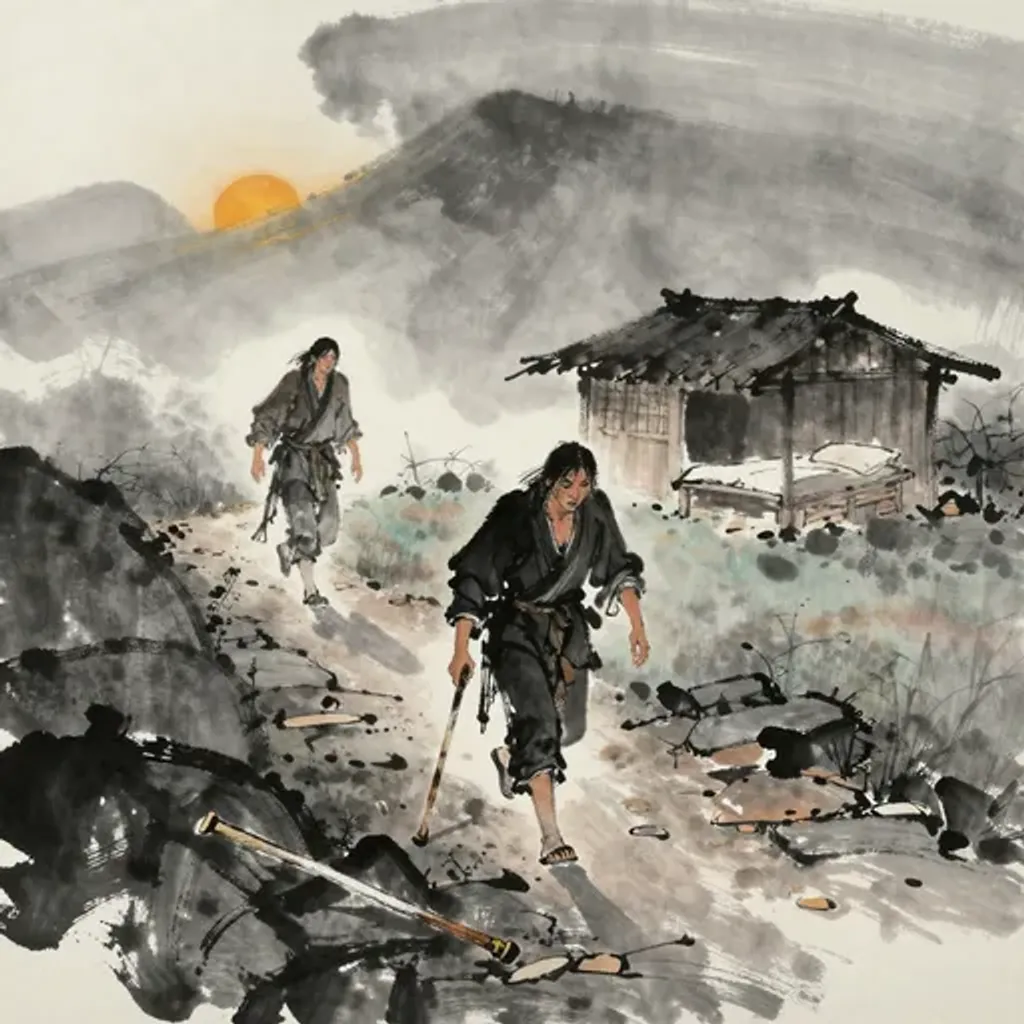
兩目不明,日奪無光。脛足跛曳,不可以行,頓於丘旁。亡妾莫逐,嵬然獨宿。
Both eyes lack sight; day robs the sun of its light. Shins and feet lame and dragging, unable to walk; halted beside the hill. The lost concubine is not pursued; desolate and alone, one sleeps in solitude.
— Jiao Yanshou, Yilin (Forest of Changes), 1st century BC
Commentary
Mountain upon earth decays into lake upon earth — Gathering, where all things converge at the altar. Both eyes are dim, daylight robbed of its radiance. Legs lame and dragging, one cannot walk, collapsing beside a hill. A lost concubine cannot be pursued; one sleeps alone in desolate solitude. The verse accumulates images of incapacity: blindness, lameness, abandonment. The body fails in every dimension — sight, mobility, companionship. This is Splitting Apart enacted upon the person rather than the landscape. From Splitting Apart to Gathering, the mountain's decay should pool into communal assembly, yet here the individual is too broken to join any gathering. The lake upon the earth draws all things together, but one who cannot see, walk, or keep companionship is excluded from the congregation, left stranded on the hill's edge.
剝 → 升
Hexagram 23 → Hexagram 46: Pushing Upward
Changing lines: 2, 3, 6
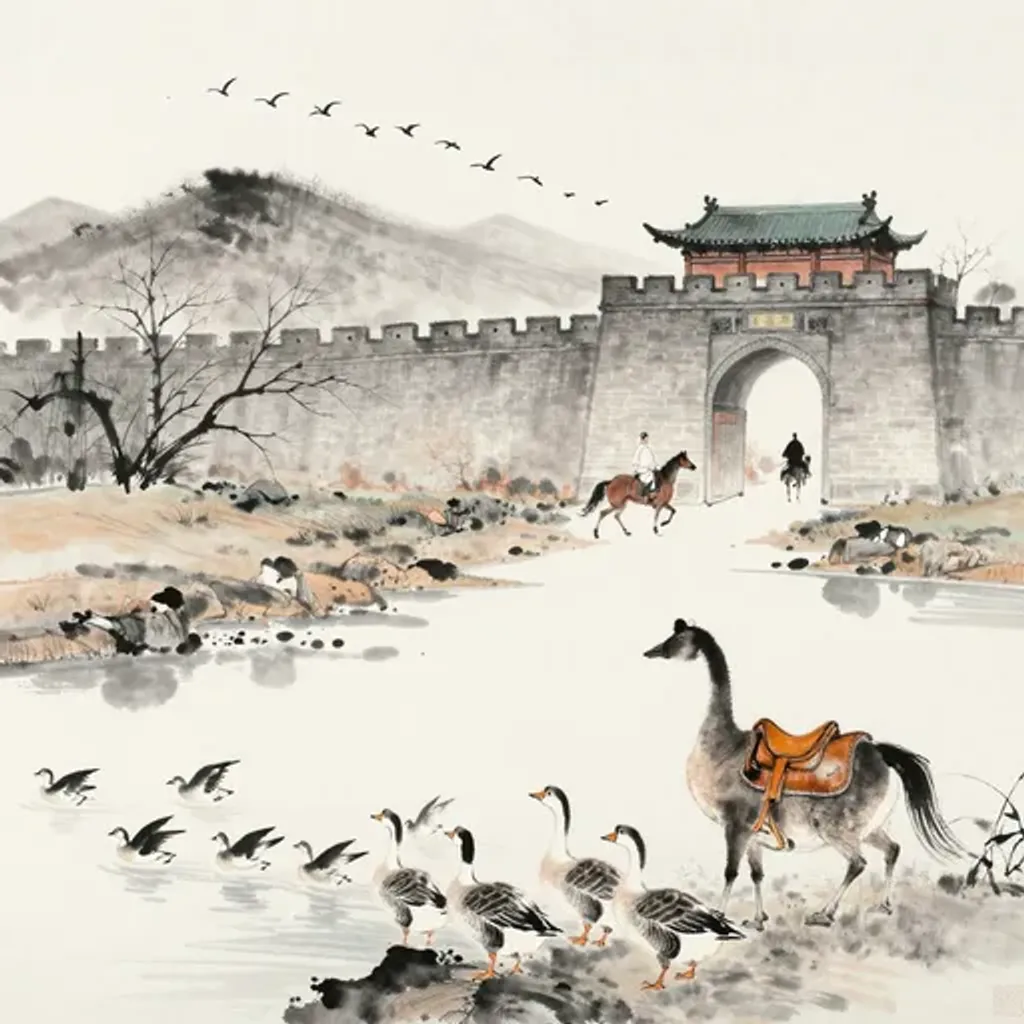
鴻飛循陸,公出不復。伯氏客宿。
The wild goose flies along the land; the duke goes forth and does not return. The elder brother lodges as a guest.
— Jiao Yanshou, Yilin (Forest of Changes), 1st century BC
Commentary
Mountain upon earth erodes, and from within the earth a tree pushes upward — Pushing Upward, the slow and steady rise. A wild goose follows the land on its gradual path. The duke departs and does not return. The elder brother lodges as a guest. The 'hong' (wild goose) is the Yi's emblematic bird of gradual, orderly advancement — it follows the coastline rather than crossing the open sea. But here the duke who leaves never comes back, and the elder must accept the reduced status of a house guest. From Splitting Apart to Pushing Upward, the mountain's collapse opens the soil for wood to grow from below. The goose's patient path resonates with Pushing Upward's step-by-step ascent, yet the verse carries an elegiac note: the one who departed does not return to see the new growth, and those left behind must make do in diminished circumstances.
剝 → 困
Hexagram 23 → Hexagram 47: Oppression
Changing lines: 2, 4, 5, 6
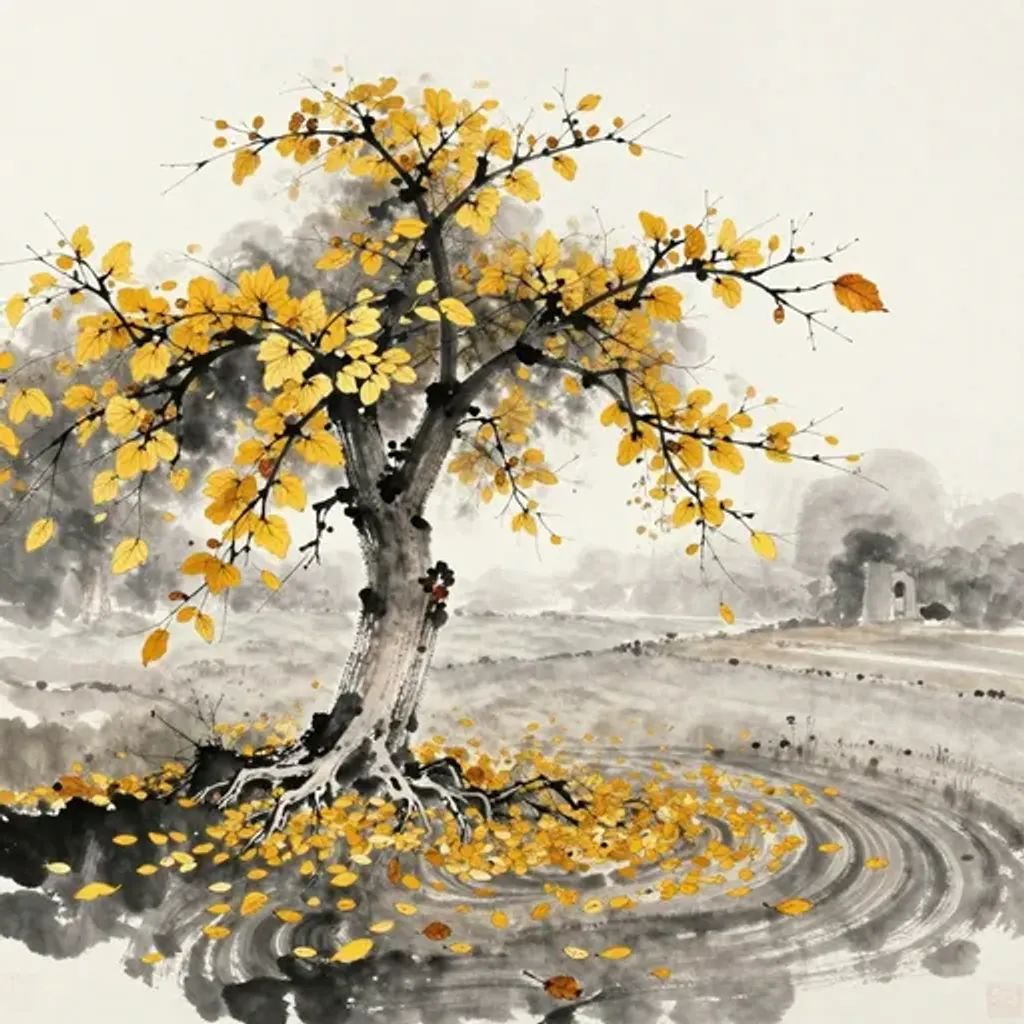
桑芳將落,隕其黃葉。失勢傾側,如無所得。
The mulberry's fragrant bloom is about to fall, shedding its yellow leaves. Losing its footing, tilting to the side; as if gaining nothing at all.
— Jiao Yanshou, Yilin (Forest of Changes), 1st century BC
Commentary
Mountain upon earth decays into lake without water — Oppression, the driest of hexagrams. The mulberry tree, once fragrant, is about to drop its yellowed leaves. Power lost, it tilts and tumbles, as though nothing can be gained. The mulberry is a tree of civilization — its leaves feed silkworms, its presence marks settled agriculture — and its death signals the collapse of the productive order. Yellow leaves falling recall autumn's melancholy, but here the tree has not merely aged; it has 'lost its position' (shi shi), a political term for being deprived of rank. From Splitting Apart to Oppression, the mountain's erosion drains into a lake that holds no water. The mulberry, stripped of leaves and tilting, mirrors the emptied lake: a container from which all sustenance has been removed. Oppression's path is to 'stake one's life to fulfill one's purpose,' but first one must acknowledge the barrenness.
剝 → 井
Hexagram 23 → Hexagram 48: The Well
Changing lines: 2, 3, 5, 6
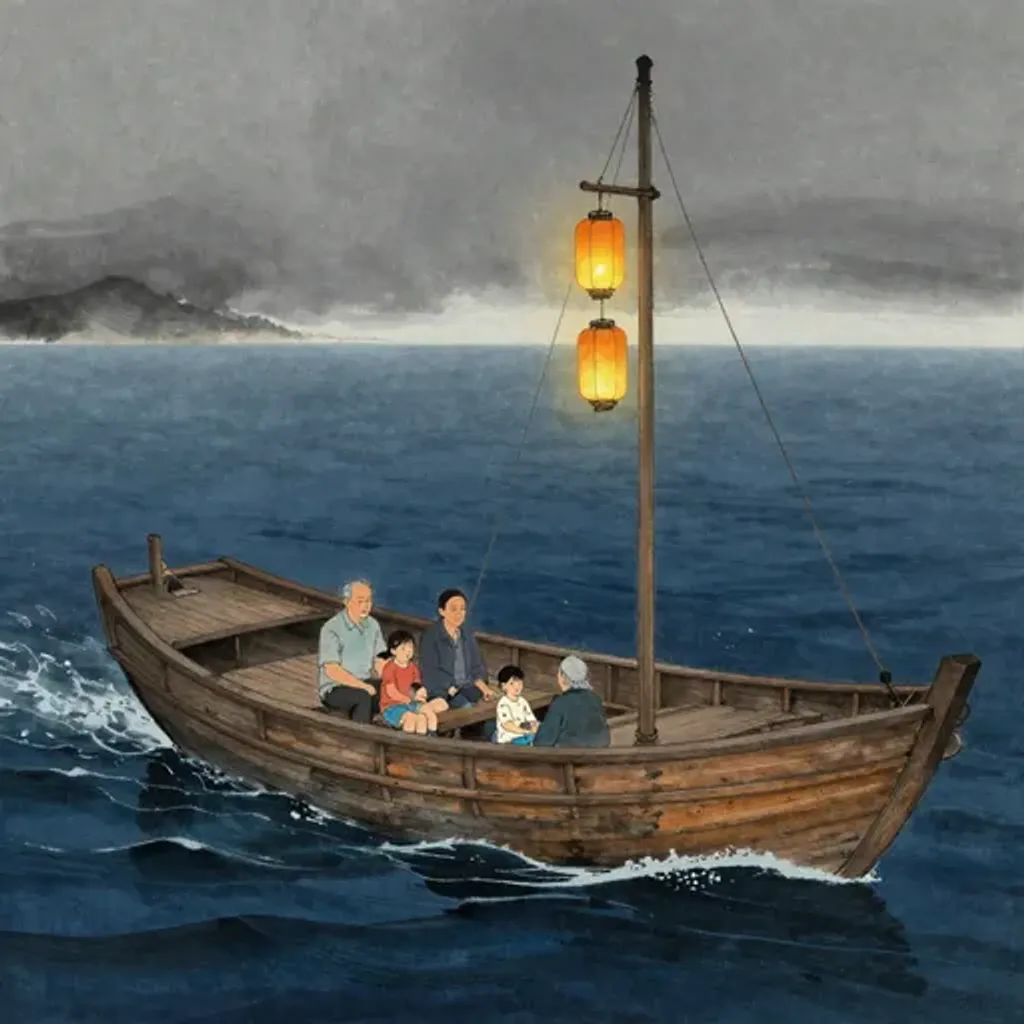
載船渡海,雖深難咎。孫子俱在,不失其所。
Loading a boat to cross the sea; though deep, it is hard to fault. Grandchildren are all present; none loses his place.
— Jiao Yanshou, Yilin (Forest of Changes), 1st century BC
Commentary
Mountain upon earth strips away, revealing water drawn up by wood — the Well, which nourishes without moving from its place. One loads a ship and crosses the sea; though the waters are deep, there is no fault. Grandchildren are all present; nothing is lost from its proper place. The Well hexagram speaks of a resource that remains constant even as communities change around it. The sea voyage is perilous, but the ship holds; the family line continues; nothing essential is displaced. From Splitting Apart to the Well, the mountain that crumbled on land is replaced by the depth of the sea, which the vessel crosses safely. The Well's constancy manifests here as generational continuity — grandchildren survive, the family endures. Like the well that does not move yet serves all who come, the verse promises stability beneath apparent danger.
剝 → 革
Hexagram 23 → Hexagram 49: Revolution
Changing lines: 1, 3, 4, 5, 6
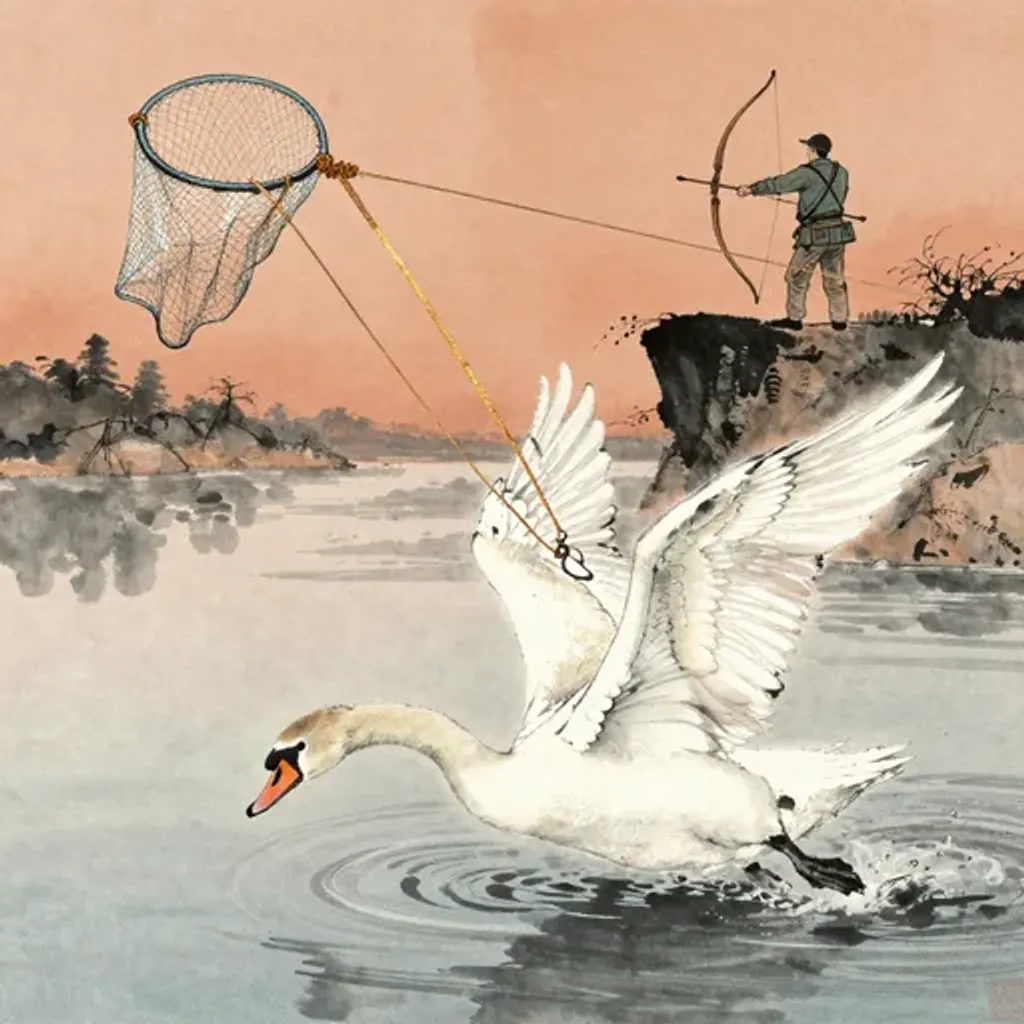
鵠求魚食,道遇射弋。繒加我頸,繳縛羽翼。欲飛不能,為羿所得。
The swan seeks fish to eat but on the road meets an archer. Silk cords bind its neck; snares fetter its wings. Wishing to fly but unable; caught by Yi the bowman.
— Jiao Yanshou, Yilin (Forest of Changes), 1st century BC
Commentary
Mountain upon earth erodes into lake containing fire — Revolution, the hexagram of radical transformation. A swan seeks fish to eat but on the road encounters a hunter's arrow. A silk net wraps around its neck; cords bind its wings. It wants to fly but cannot — captured by Archer Yi. The swan, a creature of sky and freedom, is trapped mid-journey while merely seeking sustenance. The net and cord — tools of human artifice — overwhelm natural strength. Archer Yi's appearance elevates the capture from mundane hunting to mythic subjugation. From Splitting Apart to Revolution, the mountain's decay creates conditions for revolutionary change, but this verse shows revolution from the victim's perspective: the old order is overthrown, and those caught in the transition are as helpless as the netted swan. Revolution requires the right timing; the swan's timing was fatally wrong.
剝 → 鼎
Hexagram 23 → Hexagram 50: The Cauldron
Changing lines: 2, 3, 4
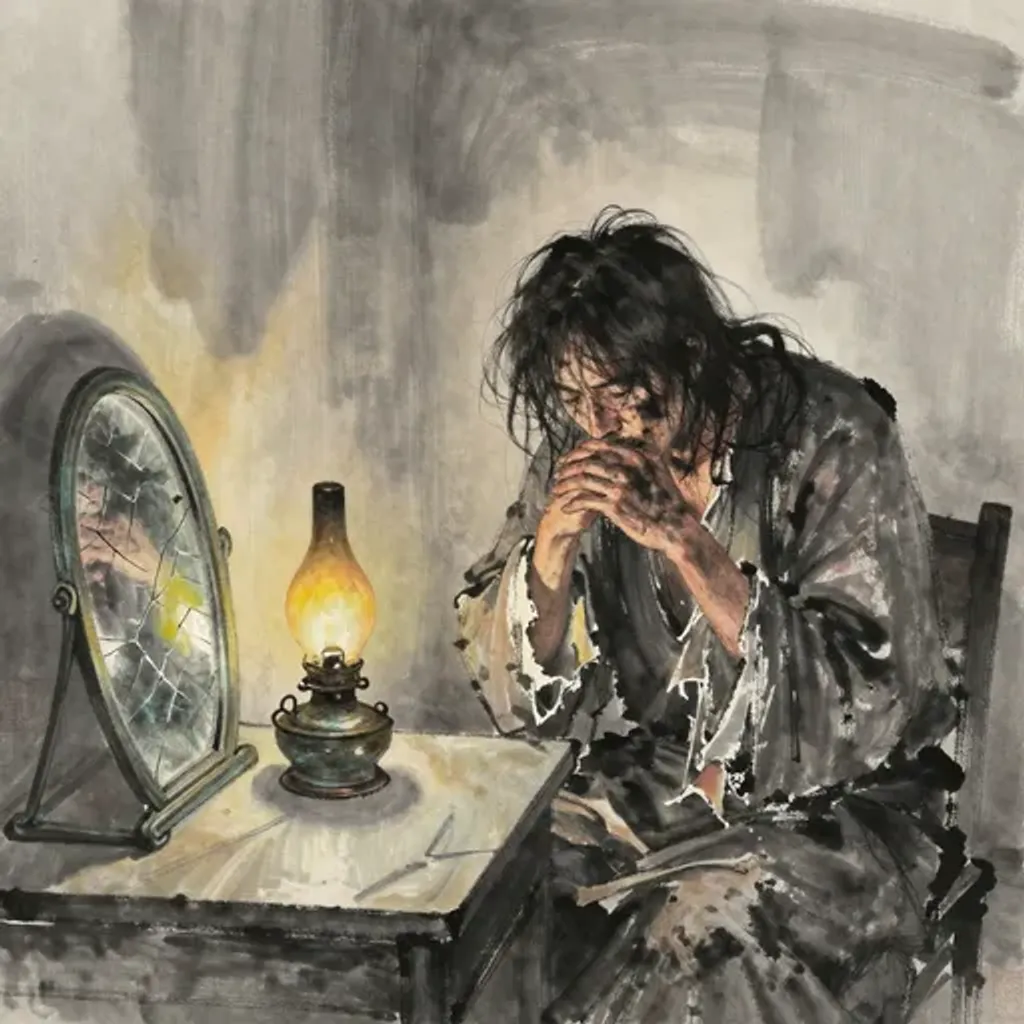
泥面亂頭,忍恥少羞。日以削消,凶其自搯。
Mud on the face, hair in disarray; enduring shame with little modesty. Day by day pared away; the misfortune is of one's own making.
— Jiao Yanshou, Yilin (Forest of Changes), 1st century BC
Commentary
Mountain upon earth strips away, revealing fire above wind — the Cauldron, vessel of civilized transformation. A muddied face and disheveled hair, enduring shame with scarcely any dignity. Day by day one is diminished and consumed; misfortune is self-inflicted. The Cauldron should transform raw material into refined nourishment through the application of fire and wind, but here the person is the one being consumed. Mud on the face and disordered hair are signs of degradation — the loss of the human markers of civilization. The daily 'cutting away' (xiao) echoes Splitting Apart's gradual erosion, now applied to personal dignity. From Splitting Apart to the Cauldron, the mountain's decay should feed the transformative vessel, but instead the person becomes the raw material being burned down. The cauldron's fire, without proper substance, merely destroys.
剝 → 震
Hexagram 23 → Hexagram 51: The Arousing Thunder
Changing lines: 1, 4, 6
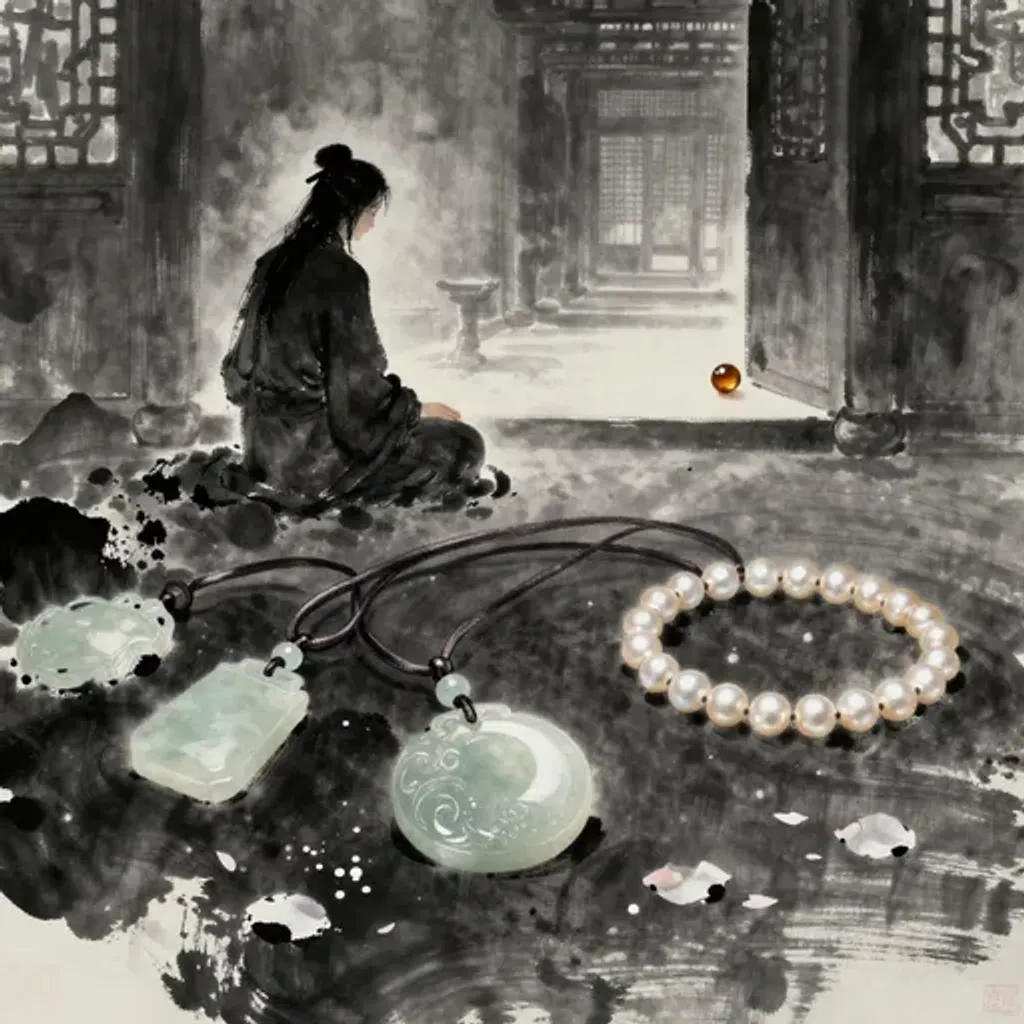
佩玉纍蕊,無以繫之。孤悲獨處,愁哀相憂。
Jade pendants and clustered tassels, with nothing to bind them. Alone in grief and solitude; sorrow and anguish shared with none.
— Jiao Yanshou, Yilin (Forest of Changes), 1st century BC
Commentary
Mountain upon earth erodes into doubled thunder — the Arousing, shock upon shock. Jade pendants hang in clusters like flower buds, but there is nothing to string them on. Alone and grieving, dwelling in solitude, sorrow and worry consuming each other. The jade — precious, beautiful, heavy — cannot be worn because the cord has broken. The ornaments exist but lack the connecting thread that gives them purpose and place. This is loss of structure at the most intimate level: one possesses beauty but cannot display it, has treasures but cannot carry them. From Splitting Apart to the Arousing, the mountain's collapse shakes loose what was once securely mounted. Thunder doubles, and the precious things scatter. The Arousing demands self-examination through fear, but here the fear has already crystallized into lonely grief.
剝 → 艮
Hexagram 23 → Hexagram 52: Keeping Still Mountain
Changing lines: 3
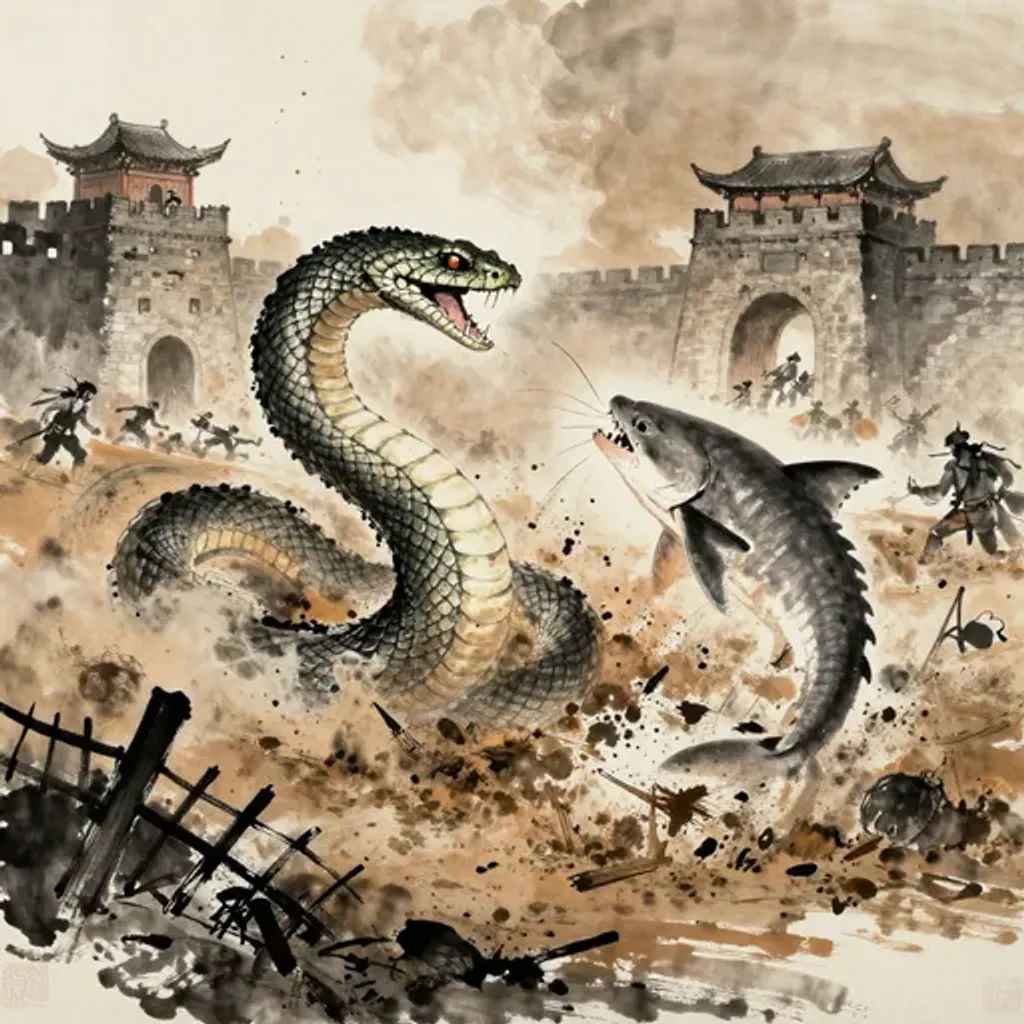
巨虵大鰌,戰於國郊。上下隔塞,逐君走逃。
A great serpent and giant catfish battle in the outskirts of the state. Above and below are blocked and severed; the lord is driven to flee.
— Jiao Yanshou, Yilin (Forest of Changes), 1st century BC
Commentary
Mountain upon earth decays into doubled mountain — Keeping Still, the hexagram of arrested motion. A giant serpent and a great catfish battle at the state's outskirts. Above and below are blocked; the ruler is chased into flight. The combat between serpent and catfish — both creatures of water and darkness — at the city's edge suggests a struggle between two monstrous forces that leaves no room for legitimate authority. The ruler flees not from one enemy but from the chaos of their mutual destruction. From Splitting Apart to Keeping Still, the crumbling mountain yields to twin mountains that should provide stability through stillness. Yet here stillness is not peace but paralysis: the ruler is driven out, the borders are contested by monsters, and the doubled mountain becomes a doubled obstruction. To think beyond one's station when one cannot even hold one's ground is the cruelest irony of Gen.
剝 → 漸
Hexagram 23 → Hexagram 53: Development
Changing lines: 3, 5
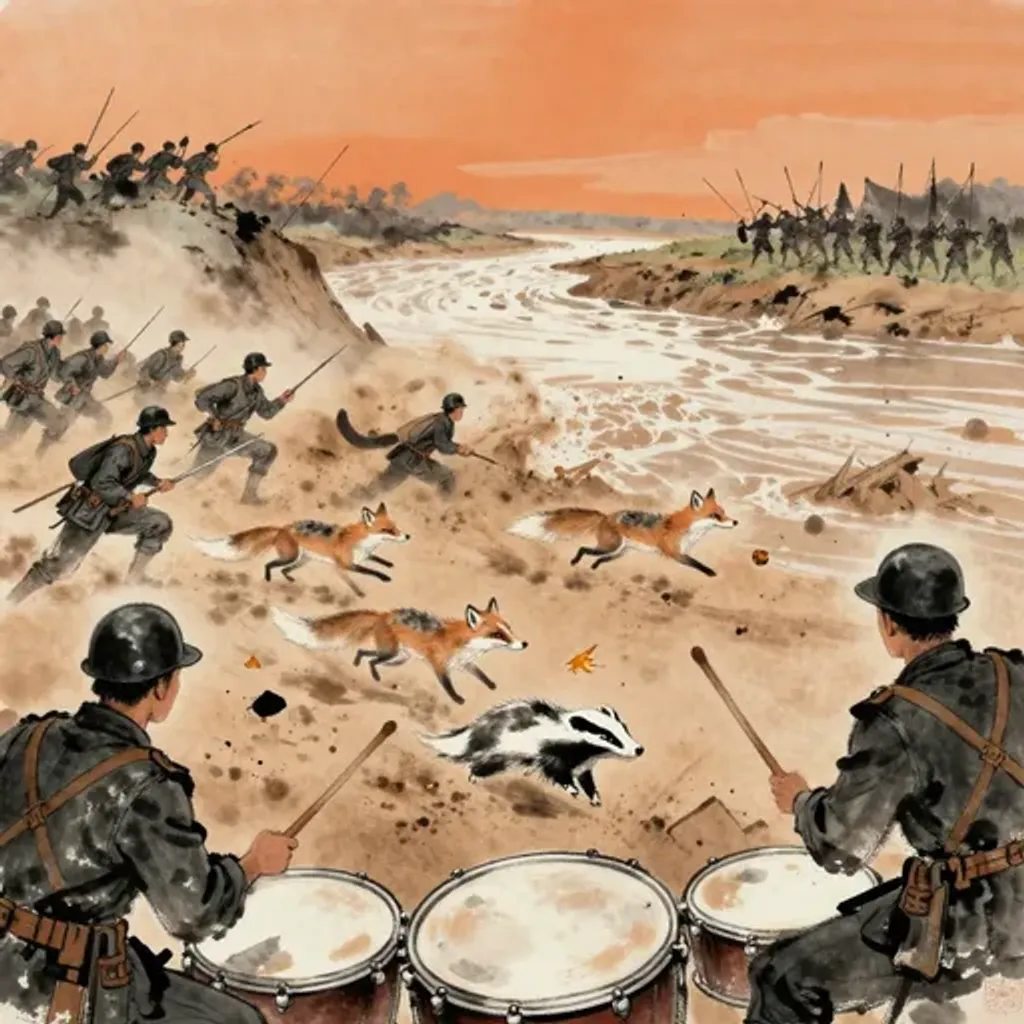
已動死連。商子揚沙,石流狐狢。擾軍鼓振,吏士恐落。
Already stirred, death follows. The Shang prince raises a sandstorm; stones flow, foxes and badgers scatter. The army's drums pound and shake; officers and soldiers tremble in dread.
— Jiao Yanshou, Yilin (Forest of Changes), 1st century BC
Commentary
Mountain upon earth erodes into wind above mountain — Development, the hexagram of gradual, organic progress. Yet the verse opens with death in motion: 'Already stirring, death follows.' A merchant raises sand and dust, stones tumble and foxes scatter. The army drums beat to rally troops, but officers and soldiers fall in terror. According to commentary, the trigrams decode as Gen (sand, stones, foxes) stirred up by Xun (wind, commerce), with Kan (danger) lurking within. The sand-raising merchant disrupts the military order — civilian chaos bleeding into martial discipline. From Splitting Apart to Development, the mountain's erosion should nurture the tree growing upon it, but here the mountain crumbles into windblown sand that buries rather than nourishes. Development's patient gradualism is overwhelmed by the abruptness of cascading failure.
剝 → 歸妹
Hexagram 23 → Hexagram 54: The Marrying Maiden
Changing lines: 1, 2, 4, 6
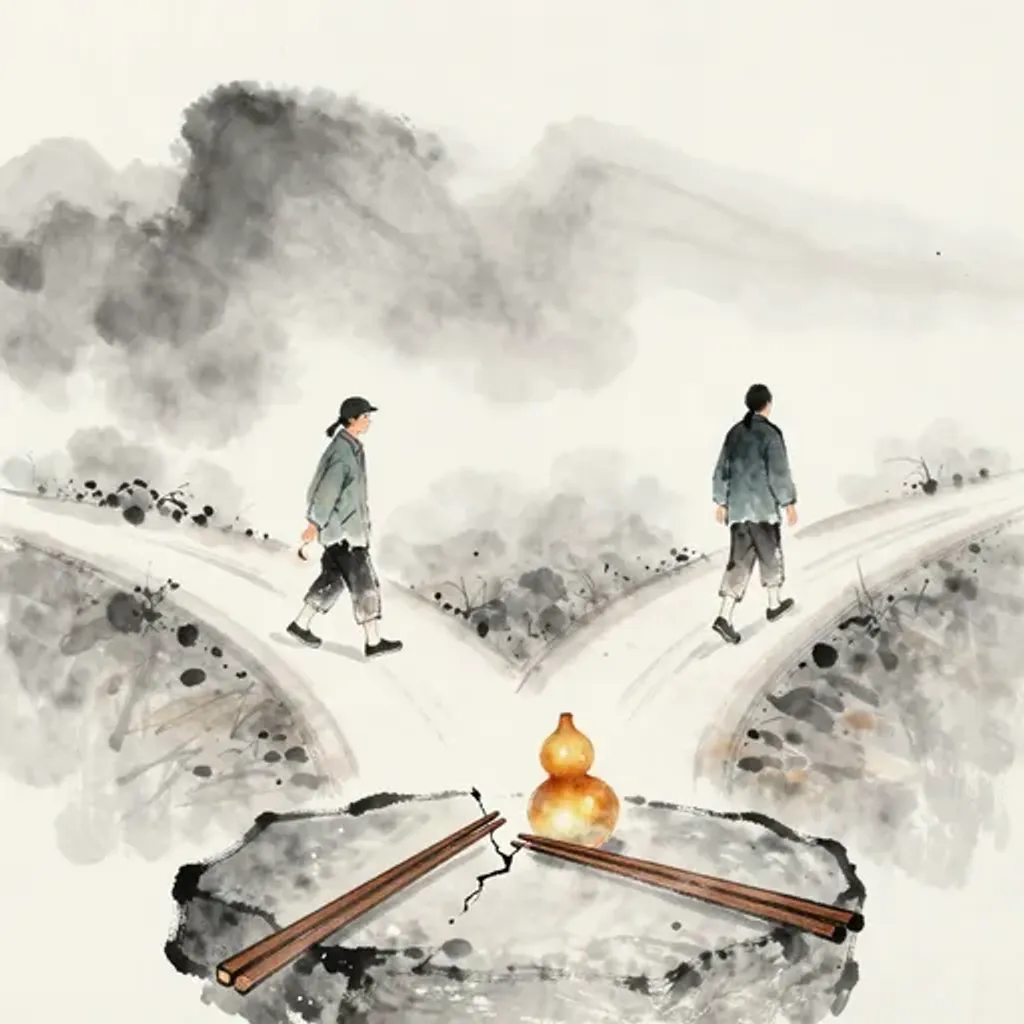
二人俱行,別離特食。一身五心,亂無所得。
Two men travel together, then part to eat apart. One body, five minds; chaos yields nothing gained.
— Jiao Yanshou, Yilin (Forest of Changes), 1st century BC
Commentary
Mountain upon earth strips away, and thunder stirs above the lake — the Marrying Maiden, a union made from a position of weakness. Two people walk together but part to eat separately. One body harbors five conflicting hearts; chaos yields nothing. The companionship is formal but the communion is absent — they travel the same road yet cannot share a meal. The 'five hearts in one body' is a vivid image of internal fragmentation: loyalties split so many ways that no coherent action is possible. From Splitting Apart to the Marrying Maiden, the mountain's decay exposes the vulnerability of dependent relationships. The Marrying Maiden enters a household where she holds no power; these two travelers embody that asymmetry. Forced togetherness without genuine union produces only confusion and mutual incomprehension.
剝 → 豐
Hexagram 23 → Hexagram 55: Abundance
Changing lines: 1, 3, 4, 6
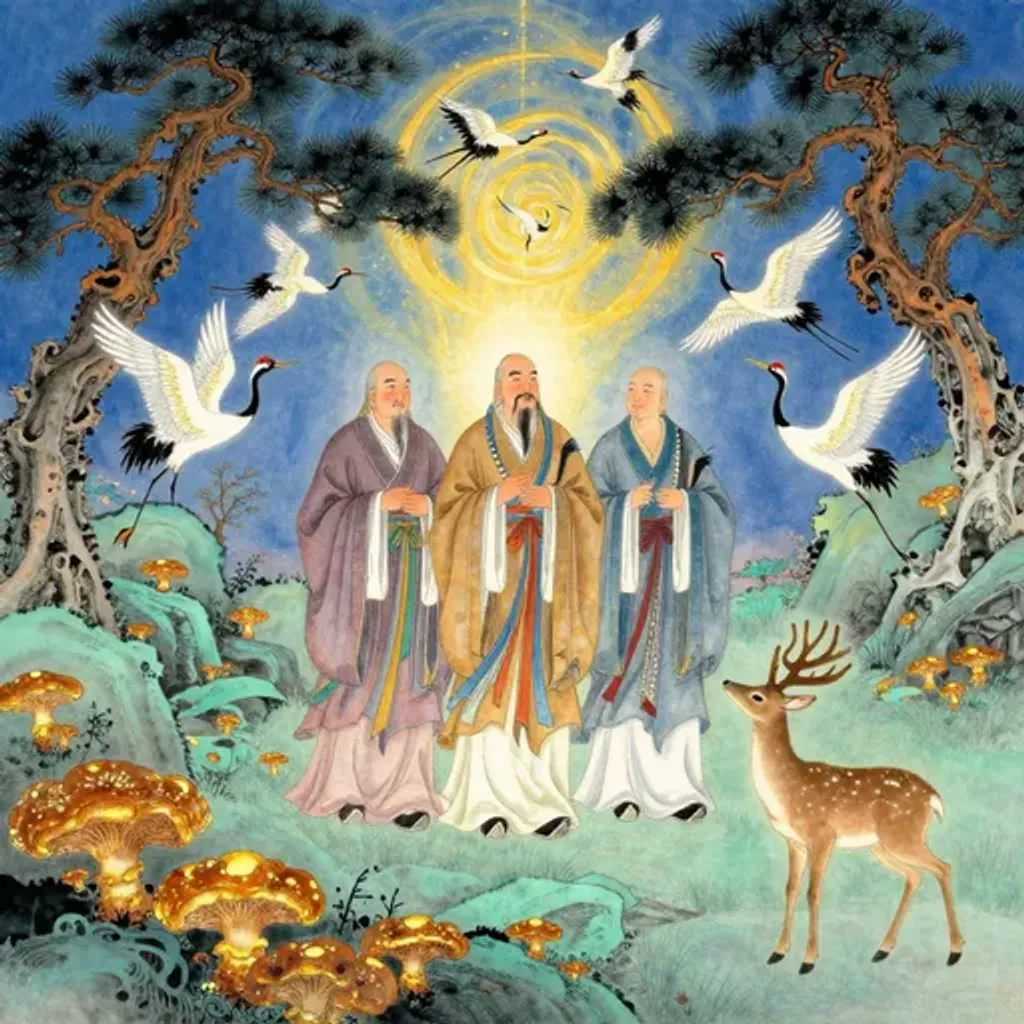
三聖相輔,鳥獸喜舞。安樂富有,三人偕偶。
Three sages assist one another; birds and beasts dance with joy. Peaceful, prosperous, and abundant; three companions joined as one.
— Jiao Yanshou, Yilin (Forest of Changes), 1st century BC
Commentary
Mountain upon earth strips away, and thunder and fire arrive together — Abundance, the zenith of brilliance and power. Three sages assist one another, and birds and beasts dance in joy. Peace, prosperity, and plenty reign; three companions are perfectly matched. The 'three sages' likely refers to the triumvirate of King Wen, the Duke of Zhou, and Taigong — the founding architects of the Zhou dynasty whose collaboration created the most celebrated golden age in Chinese political memory. Birds and beasts dancing echoes the ancient motif of nature responding to virtuous governance. From Splitting Apart to Abundance, the transformation is dramatic: the decaying mountain gives way to the fullest expression of civilized power. Thunder illuminates with lightning; fire roars with thunder. The three sages' cooperation converts the ruins of the old order into peak flourishing.
剝 → 旅
Hexagram 23 → Hexagram 56: The Wanderer
Changing lines: 3, 4
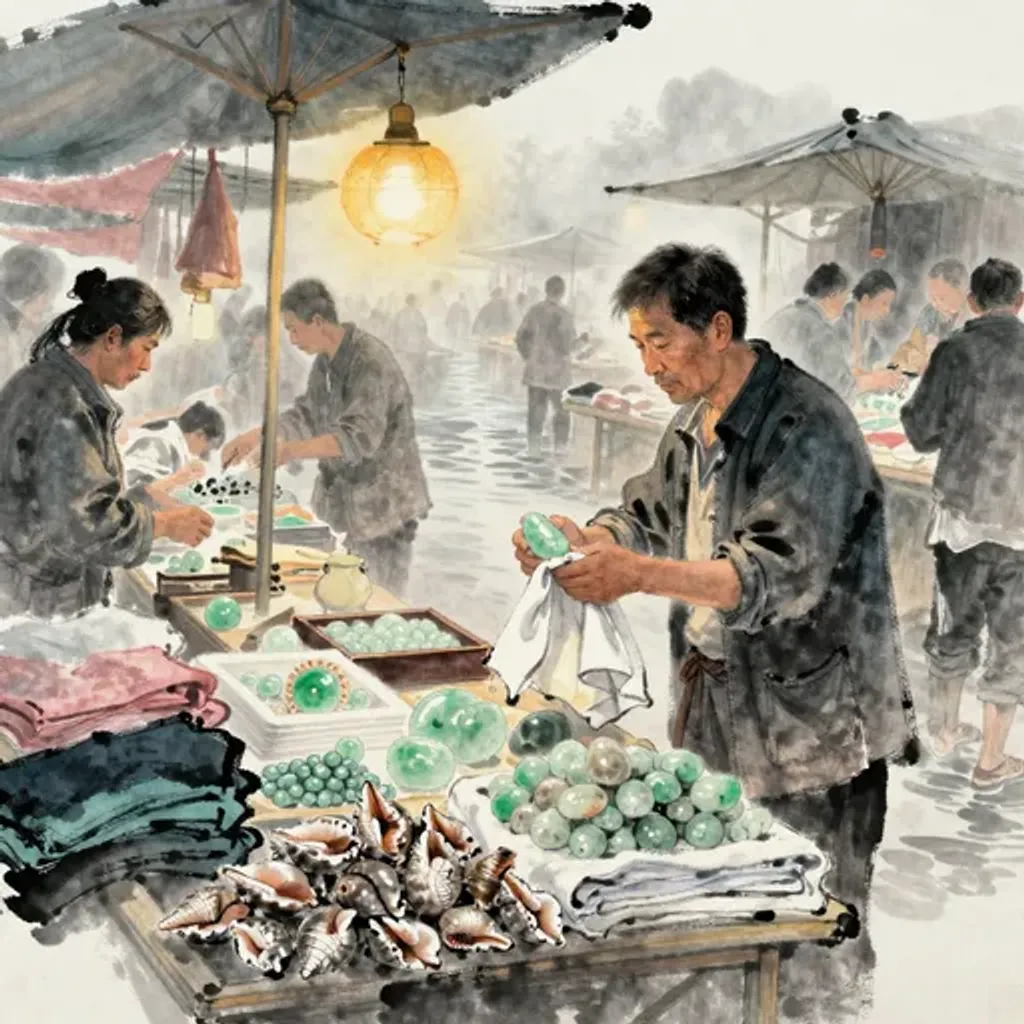
三奇六耦,相隨俱市。王孫善賈,先得利寶。居止不安,洪水為咎。
Three odd, six even; following one another to market. The prince is a shrewd merchant, first to gain the profitable treasure. Yet one's dwelling is not secure; floodwaters bring misfortune.
— Jiao Yanshou, Yilin (Forest of Changes), 1st century BC
Commentary
Mountain upon earth erodes into fire above the mountain — the Wanderer, the hexagram of the traveler who must be careful with what little he carries. Three odd and six even — the numbers of divination itself — follow one another to the marketplace. A prince skilled in trade acquires treasures first. Yet the dwelling is unstable, and floodwaters bring disaster. The verse opens with commercial success: the merchant-prince who reads the market's pattern prospers. But the second half reverses: one cannot settle, and water threatens everything. This is the Wanderer's essential condition — profit without permanence, skill without a home. From Splitting Apart to the Wanderer, the mountain that once provided a fixed abode has crumbled. What remains is the skill of reading patterns and trading wisely, but no ground on which to build lasting shelter.
剝 → 巽
Hexagram 23 → Hexagram 57: The Gentle Wind
Changing lines: 2, 3, 5
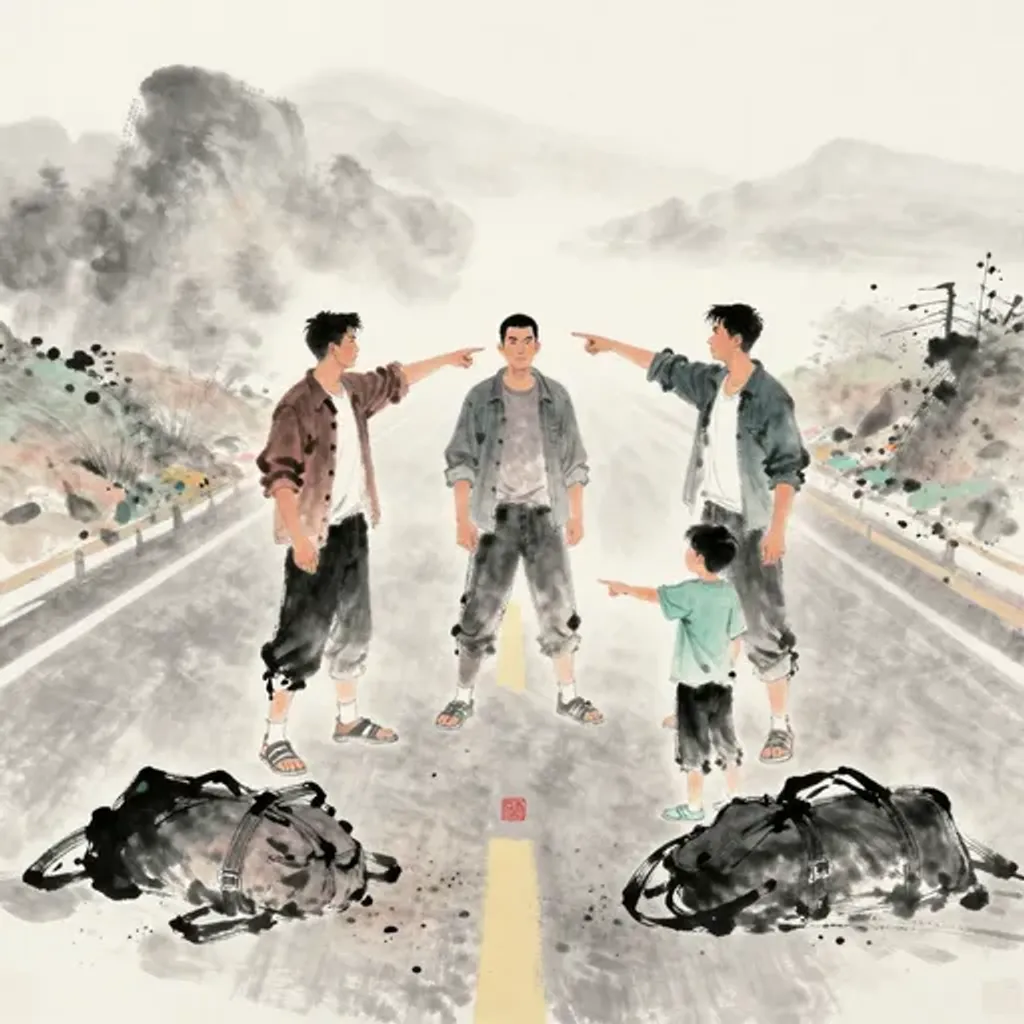
三人俱行,二人言北。伯仲欲南,少叔不得。中路分爭,道鬭相賊。
Three men travel together; two speak for north. The elder and second brother wish to go south; the youngest cannot prevail. Midway they quarrel; on the road they fight and wound each other.
— Jiao Yanshou, Yilin (Forest of Changes), 1st century BC
Commentary
Mountain upon earth strips away, and doubled wind blows — the Gentle, where repeated influence penetrates gradually. Three men travel together; two advocate going north. The eldest and second brother want south, but the youngest cannot prevail. Midway the argument turns violent, and the companions attack one another on the road. The verse is a parable of collective decision-making that fails: three people, two preferred directions, escalating conflict. The doubled wind of Xun should repeat commands until compliance is achieved, but here the repeated argument produces not agreement but a roadside brawl. From Splitting Apart to the Gentle, the mountain's decay should open space for wind's subtle penetration, but wind meeting wind creates turbulence rather than harmony. When authority has been stripped away, even gentle persuasion becomes a weapon.
剝 → 兌
Hexagram 23 → Hexagram 58: The Joyous Lake
Changing lines: 1, 2, 4, 5, 6
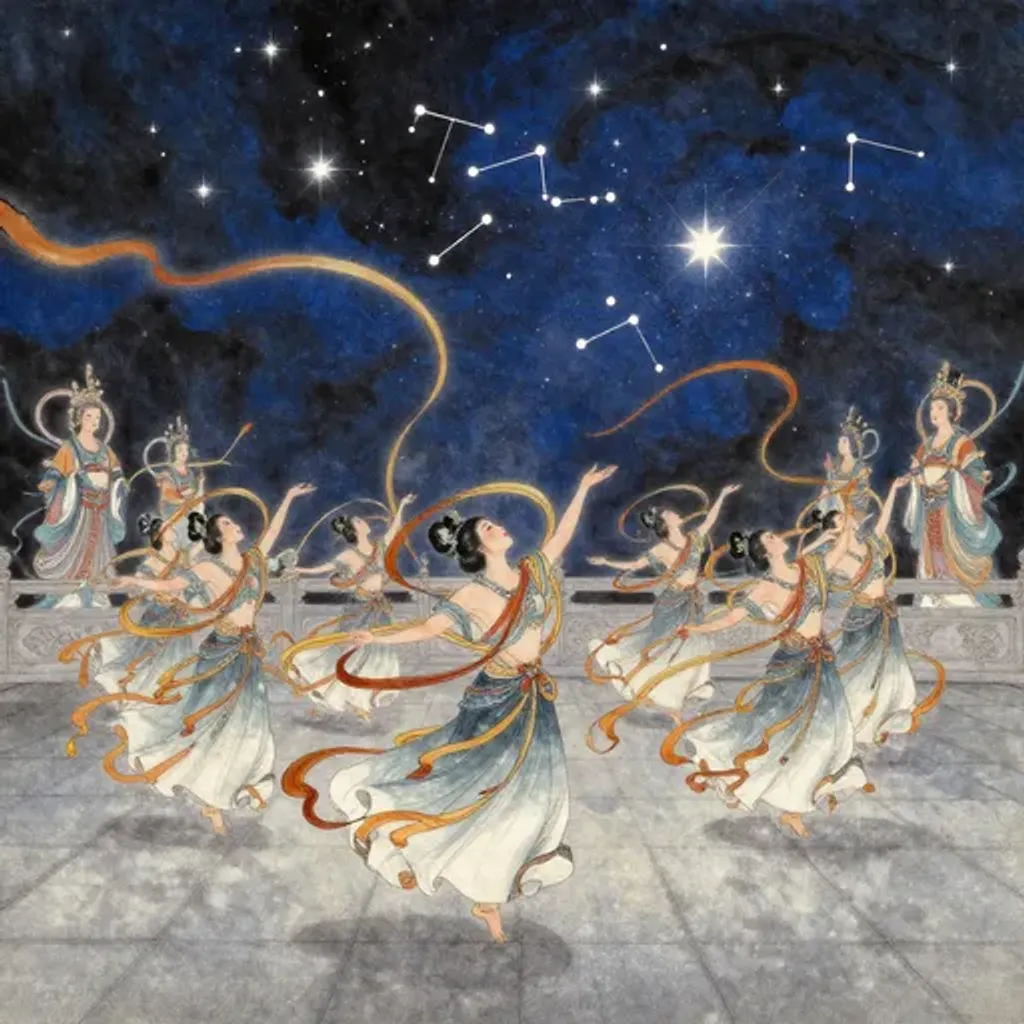
播天舞,光地乳。神所守,樂無咎。言不信誤。
Spreading heaven in dance; light nourishes the earth. Guarded by the spirits; joy without blame. Yet words not trusted lead to error.
— Jiao Yanshou, Yilin (Forest of Changes), 1st century BC
Commentary
Mountain upon earth erodes into doubled lake — the Joyous, where mutual delight flows between companions. Spreading across heaven in dance, light nourishes the earth. What the spirits guard brings joy without fault. Yet the final phrase pivots: 'Words not trusted lead to error.' The verse opens with cosmic celebration — a ritual dance that connects heaven and earth, blessed by guardian spirits. But the coda warns that even in joy, dishonest speech corrupts. From Splitting Apart to the Joyous, the mountain's decay gives way to the lake's open surface, where reflection and exchange become possible. The Joyous at its best is 'friends discussing and practicing together'; at its worst it is flattery and false promises. The spirits guard the joy, but only truthful words can sustain it.
剝 → 渙
Hexagram 23 → Hexagram 59: Dispersion
Changing lines: 2, 5
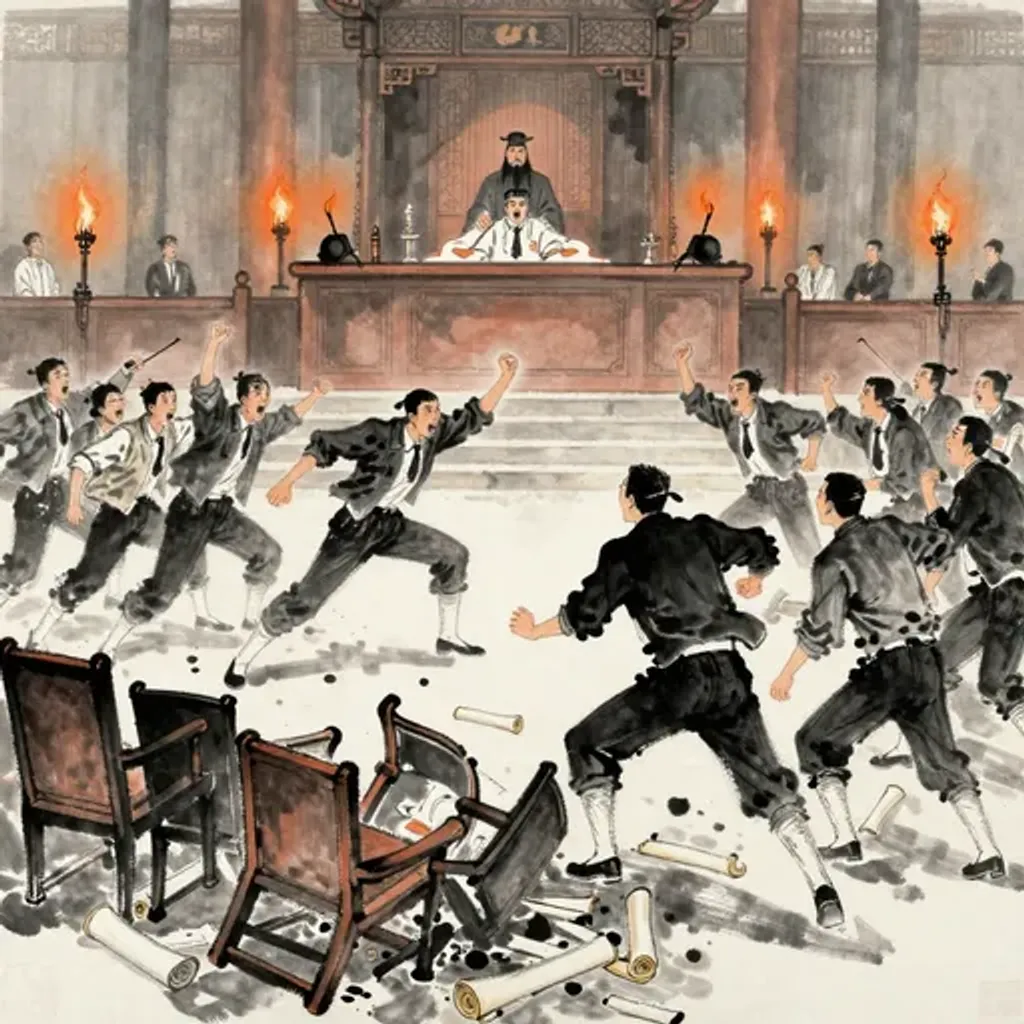
坐爭立訟,紛紛匆匆。卒成禍亂,災及家公。
Quarreling seated, litigating standing; in clamor and haste. At last it becomes upheaval and ruin; disaster reaches the master of the house.
— Jiao Yanshou, Yilin (Forest of Changes), 1st century BC
Commentary
Mountain upon earth erodes into wind above water — Dispersion, where wind scatters what has congealed. Sitting they quarrel, standing they litigate, rushing and bustling without cease. The result is catastrophe and disorder, disaster reaching the head of the household. The verse describes an unbroken escalation: from seated argument to standing lawsuit to full-blown chaos, each stage more public and destructive than the last. The household patriarch is finally engulfed by the consequences. From Splitting Apart to Dispersion, the mountain's decay feeds the wind that scatters everything across the water. Dispersion's purpose is to dissolve rigid structures through gentle permeation — the king's offering at the temple, the gathering at the sacred site. But here what disperses is not ice but social bonds, and the scattering is not healing but ruinous. Quarrels breed lawsuits breed anarchy.
剝 → 節
Hexagram 23 → Hexagram 60: Limitation
Changing lines: 1, 2, 5, 6
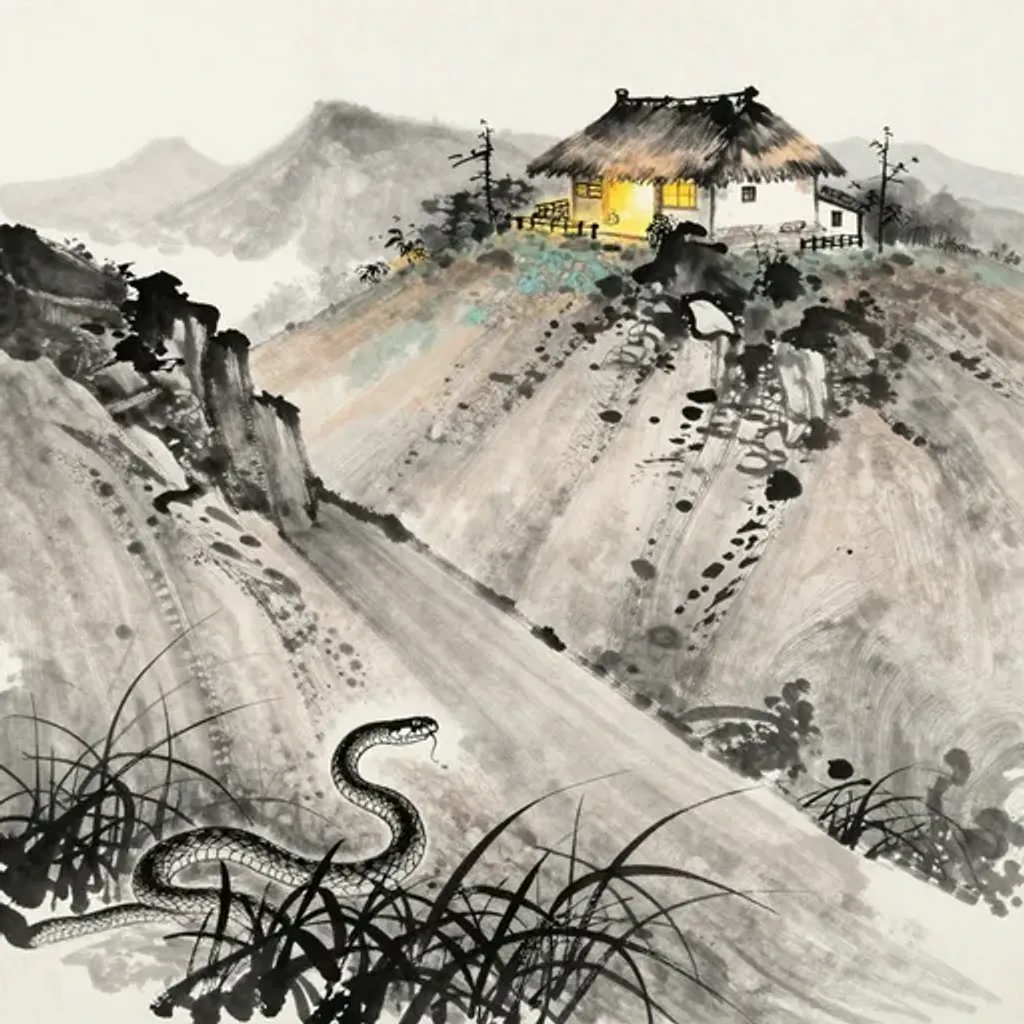
虵行蜿蜒,不能上阪。履節安居,可以無憂。
The serpent winds and slithers, unable to climb the slope. Treading on measure and dwelling in peace, one may be free from worry.
— Jiao Yanshou, Yilin (Forest of Changes), 1st century BC
Commentary
Mountain upon earth strips away, and water rests above the lake — Limitation, the hexagram of knowing where to stop. A snake slithers along but cannot climb the slope. By observing proper limits and dwelling in peace, one may live without worry. The snake — limbless, ground-hugging, sinuous — meets its natural boundary at the hillside. It cannot ascend, and this is not tragedy but fact. The verse does not lament the limitation but pivots to its positive corollary: by 'treading the rhythm of limits and dwelling peacefully,' anxiety disappears. From Splitting Apart to Limitation, the mountain's erosion defines a new boundary. What was once a towering peak is now a modest slope — but that slope is precisely what gives the landscape its usable form. The snake that accepts its limit finds peace; the one that fights it finds only exhaustion.
剝 → 中孚
Hexagram 23 → Hexagram 61: Inner Truth
Changing lines: 1, 2, 5
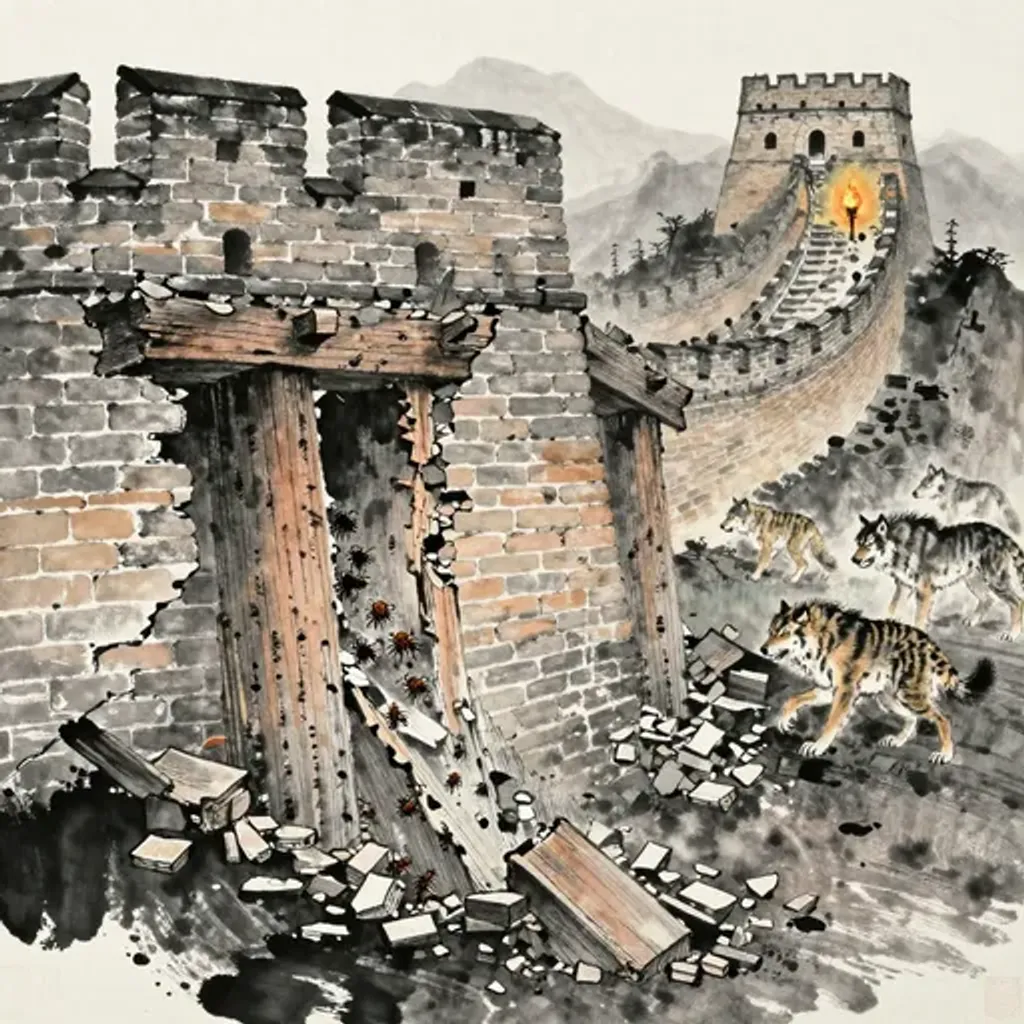
郤大墻壞,蠹眾木折。狼虎為政,天降罪伐。
When the crack is wide the wall crumbles; when the borers are many the wood snaps. Wolves and tigers hold sway; heaven sends down punishment.
— Jiao Yanshou, Yilin (Forest of Changes), 1st century BC
Commentary
Mountain upon earth erodes into wind above lake — Inner Truth, the hexagram of sincerity that reaches even pigs and fishes. The great wall cracks and crumbles; termites swarm and the timber snaps. Wolves and tigers govern as they please, and heaven sends punishment to strike them down. The Xi clan of Jin — whose combined wealth was 'half the ducal treasury' and whose military power was 'half the three armies' — may be the historical echo. When parasites consume the structural wood from within, the wall collapses outward. The wolves and tigers who govern represent officials ruling through predatory force rather than moral authority. From Splitting Apart to Inner Truth, the mountain's external decay mirrors the internal hollowing. Inner Truth demands sincerity that penetrates to the marrow; here the marrow is already eaten by termites. Heaven's punishment falls because sincerity has been entirely replaced by corruption.
剝 → 小過
Hexagram 23 → Hexagram 62: Small Exceeding
Changing lines: 3, 4, 6
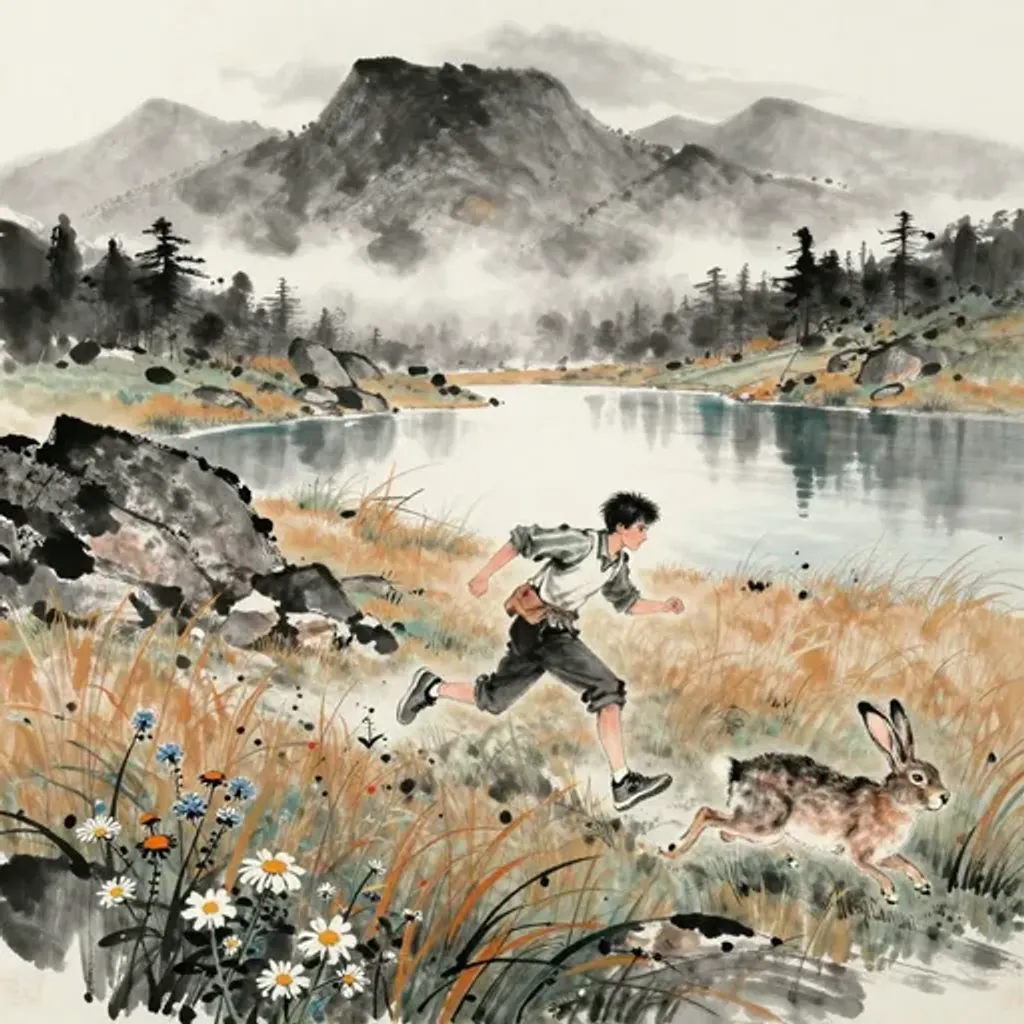
陽不違德,高山多澤。顏子逐兔,未有所得。
Yang does not forsake virtue; high mountains have many marshes. Yanzi chases the rabbit; yet nothing is caught.
— Jiao Yanshou, Yilin (Forest of Changes), 1st century BC
Commentary
Mountain upon earth decays into thunder above mountain — Small Exceeding, the hexagram of the small bird that should not fly too high. Yang does not depart from virtue; high mountains have many marshes. Yan Zi chases a rabbit but catches nothing. The opening line affirms cosmic regularity: yang upholds its moral order, and highland peaks gather moisture in their basins. But then comes Yan Zi — possibly the disciple Yan Hui or a figure named Yan — who pursues a rabbit in vain. The rabbit, quick and earthbound, escapes the one who chases it. From Splitting Apart to Small Exceeding, the mountain's decay leaves a smaller mound over which thunder rumbles disproportionately. Small Exceeding counsels modesty in action: 'In conduct, exceed in reverence; in mourning, exceed in grief; in expenditure, exceed in frugality.' Yan Zi's failed chase illustrates the futility of overreaching one's capacity.
剝 → 既濟
Hexagram 23 → Hexagram 63: After Completion
Changing lines: 1, 3, 5, 6
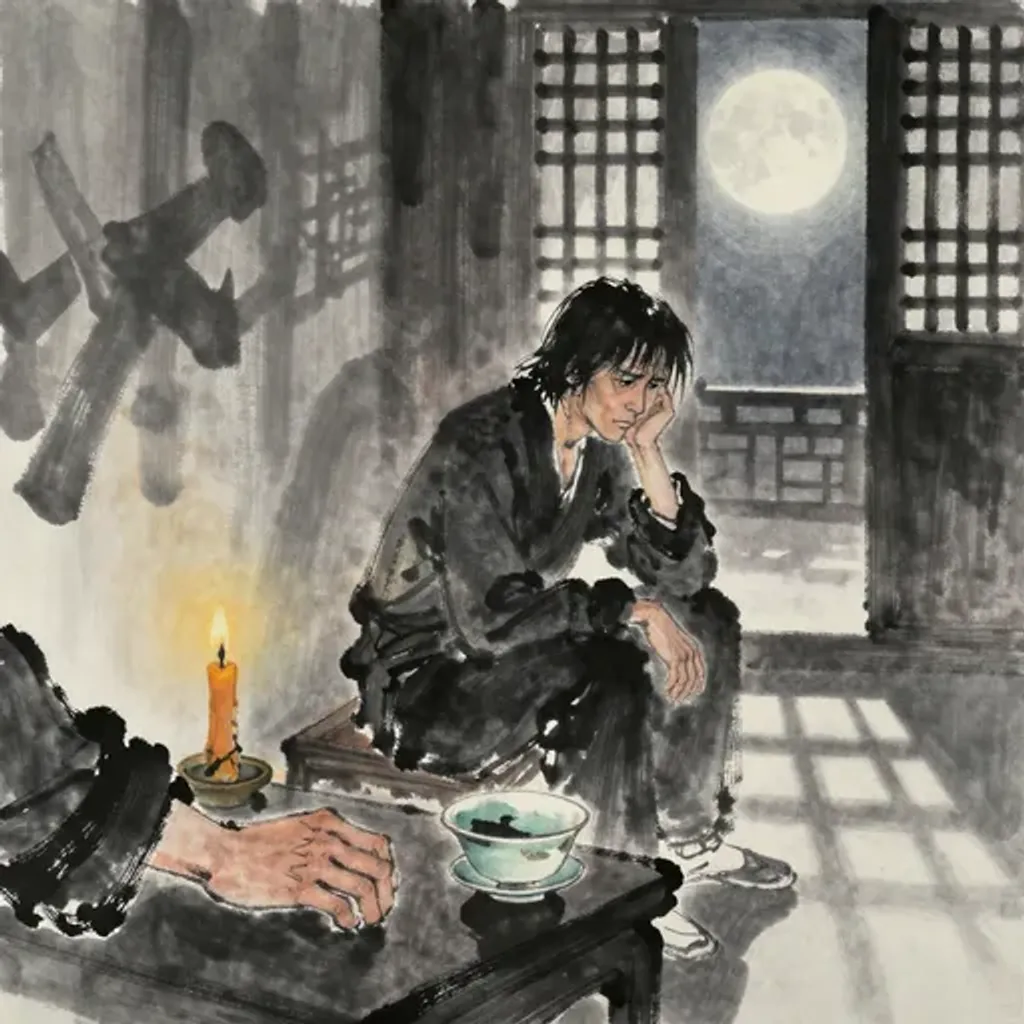
心多畏惡,時愁自懼。雖有小咎,終無大悔。
The heart is full of dread and misgiving; often anxious and self-afraid. Though there be small blame, in the end there is no great regret.
— Jiao Yanshou, Yilin (Forest of Changes), 1st century BC
Commentary
Mountain upon earth decays into water above fire — After Completion, the hexagram of order achieved but already beginning to unravel. The heart is full of dread and loathing, perpetually anxious and self-frightened. Though there are small faults, in the end there is no great regret. The verse captures After Completion's essential mood: everything is in place, yet the awareness of impending decline generates constant unease. The person is not suffering from external catastrophe but from internal apprehension — the knowledge that what is completed must eventually come undone. From Splitting Apart to After Completion, the mountain's erosion paradoxically yields a temporary equilibrium where fire and water are properly aligned. But this alignment is fragile, and the person knows it. Small faults accumulate but do not yet overwhelm. The wisdom lies in 'thinking of calamity and preparing for it in advance.'
剝 → 未濟
Hexagram 23 → Hexagram 64: Before Completion
Changing lines: 2, 4
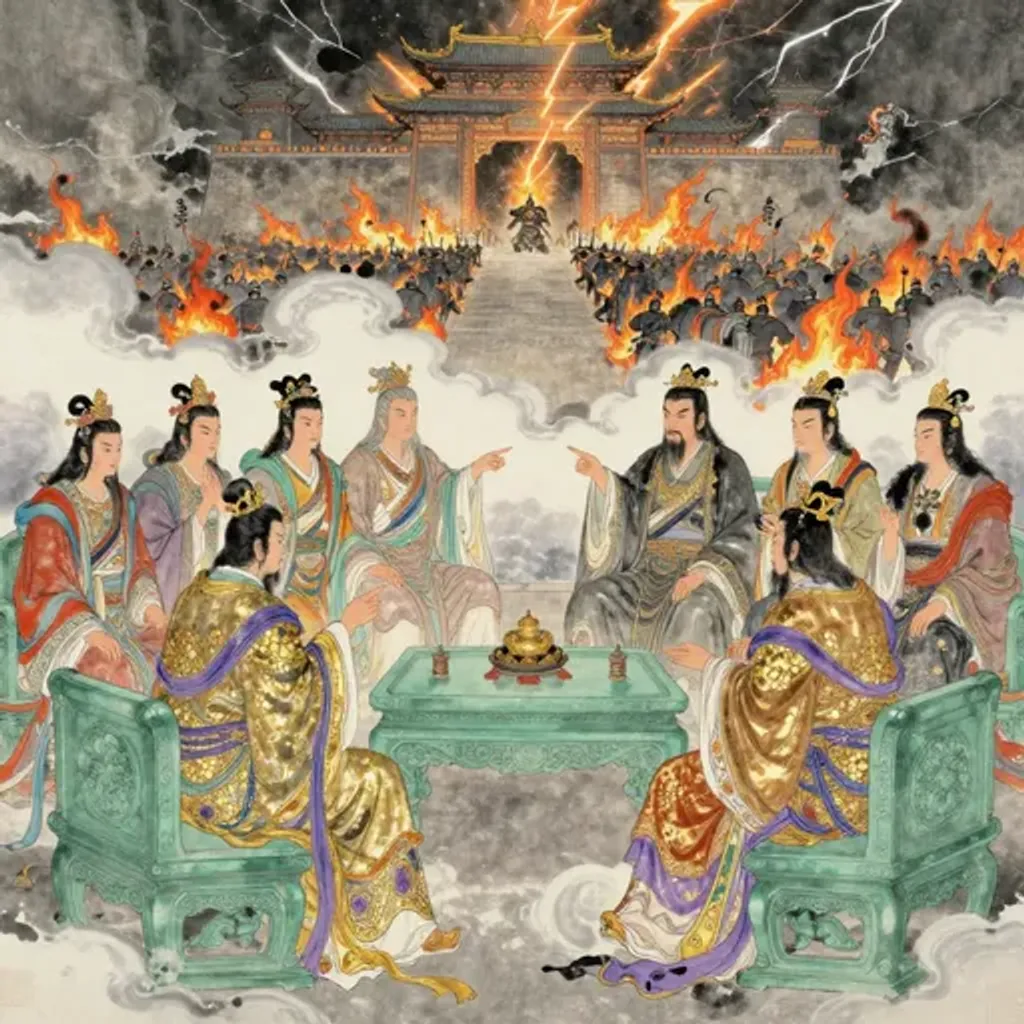
眾神集聚,相與議語。南國虐亂,百姓愁苦。興師征伐,更立賢主。
The assembled spirits convene, deliberating together in counsel. The southern kingdom is cruel and in turmoil; the hundred families grieve and suffer. Raising an army to march in conquest, a worthy lord is installed anew.
— Jiao Yanshou, Yilin (Forest of Changes), 1st century BC
Commentary
Mountain upon earth strips away completely, revealing fire above water — Before Completion, the hexagram of things not yet in place. The assembled spirits gather to deliberate together. The southern kingdom suffers tyranny and chaos; its hundred families grieve in anguish. An army is raised to mount a punitive campaign, and a worthy new ruler is installed. The spirits' council echoes the mythological convention of divine beings debating human fate — heaven itself takes notice when misrule becomes intolerable. The southern tyranny, the people's suffering, and the righteous military intervention form a complete narrative arc of dynastic revolution. From Splitting Apart to Before Completion, the old mountain has been entirely demolished, and the new order has not yet solidified. Fire sits above water — not yet properly arranged — but the campaign against tyranny is the first step toward eventual completion.