Transformations of Hexagram 30
Every line of change out of Hexagram 30 離 The Clinging Fire, with the Yilin verse for each of the 64 resulting hexagrams, its translation, and the original ink brush artwork.
離 → 乾
Hexagram 30 → Hexagram 1: The Creative
Changing lines: 2, 5
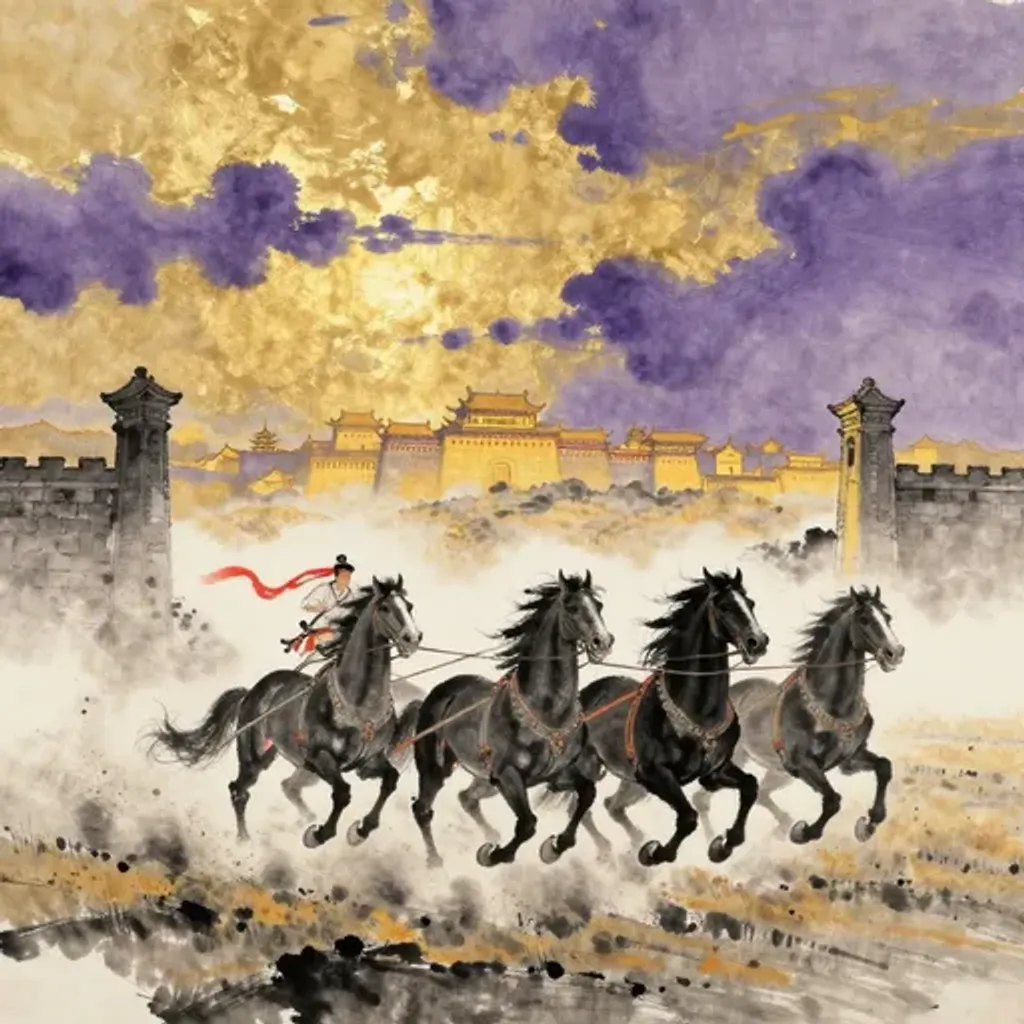
執轡四驪,王以為師。陰陽之明,載受東齊。
Grasping the reins of four black steeds; the king takes him as master. With the clarity of yin and yang, he receives the mandate and goes east to Qi.
— Jiao Yanshou, Yilin (Forest of Changes), 1st century BC
Commentary
Doubled fire gives way to pure heaven: brilliance meets self-generating power. A charioteer grasps the reins of four black steeds, and the king takes him as his commander. The image evokes the appointment of Taigong (Jiang Ziya), who drove King Wen's chariot before being elevated to chief minister and military strategist. 'Mastering yin and yang's light' suggests one who reads the cosmic pattern clearly, and 'receiving the eastern fief of Qi' recalls Taigong's enfeoffment after the Zhou conquest. From The Clinging to The Creative, fire's dependent clarity transforms into heaven's autonomous strength. The charioteer who proves himself in service earns sovereign command, brilliance refined into self-sustaining initiative.
離 → 坤
Hexagram 30 → Hexagram 2: The Receptive
Changing lines: 1, 3, 4, 6
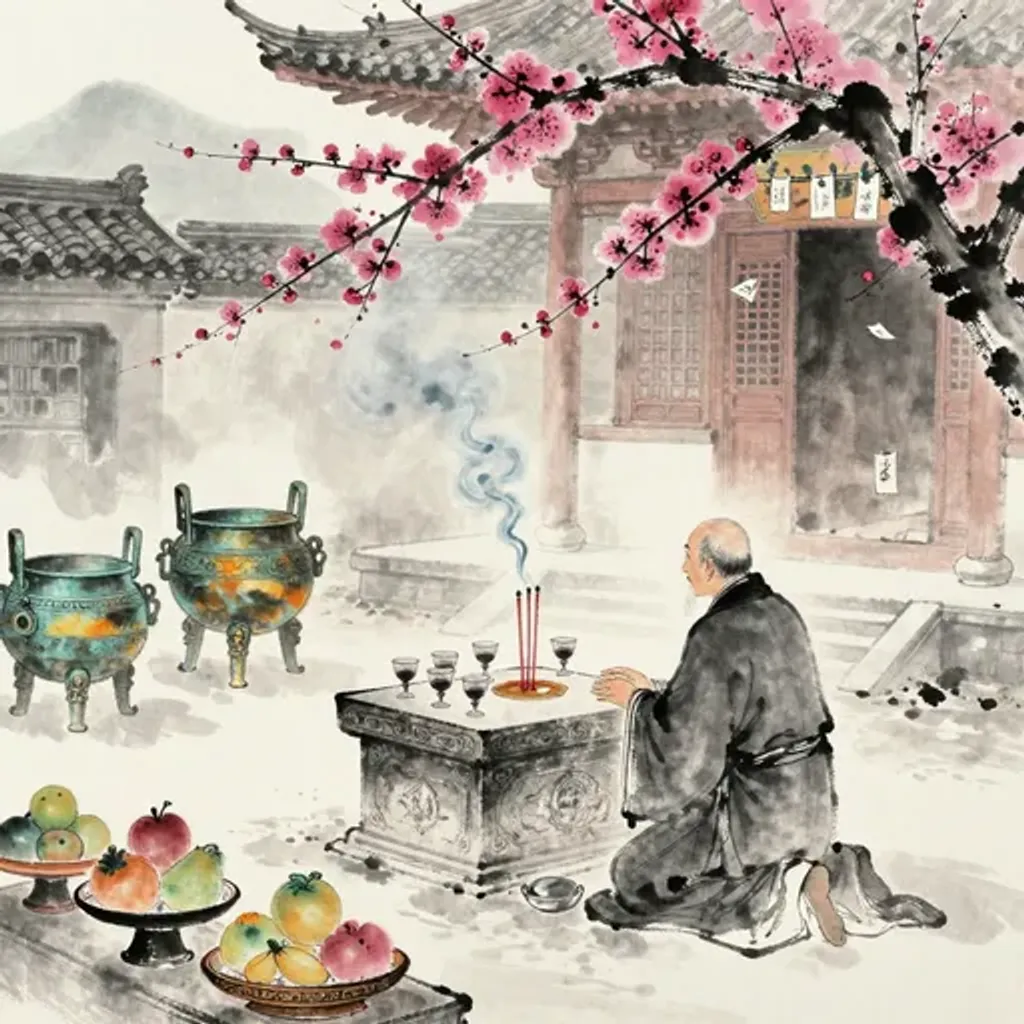
春秋禱祝,解過除憂,君子無咎。
Spring and autumn prayers and supplications; transgressions forgiven, sorrows removed. The noble man is without blame.
— Jiao Yanshou, Yilin (Forest of Changes), 1st century BC
Commentary
Doubled fire descends into the receptive earth: illumination yields to quiet acceptance. Spring and autumn prayers and supplications dissolve misfortune and dispel worry; the noble person incurs no blame. The verse describes seasonal rites of purification, where offerings at the proper time align human action with heaven's rhythm. No specific historical allusion anchors the text; instead it presents the ritual calendar itself as medicine. From The Clinging to The Receptive, fire's restless clarity settles into earth's patient absorption. The gentleman who submits to the seasonal cycle, performing each rite in its proper order, finds that anxiety dissolves not through force but through devoted receptivity to the pattern of time.
離 → 屯
Hexagram 30 → Hexagram 3: Difficulty at the Beginning
Changing lines: 3, 4, 5, 6
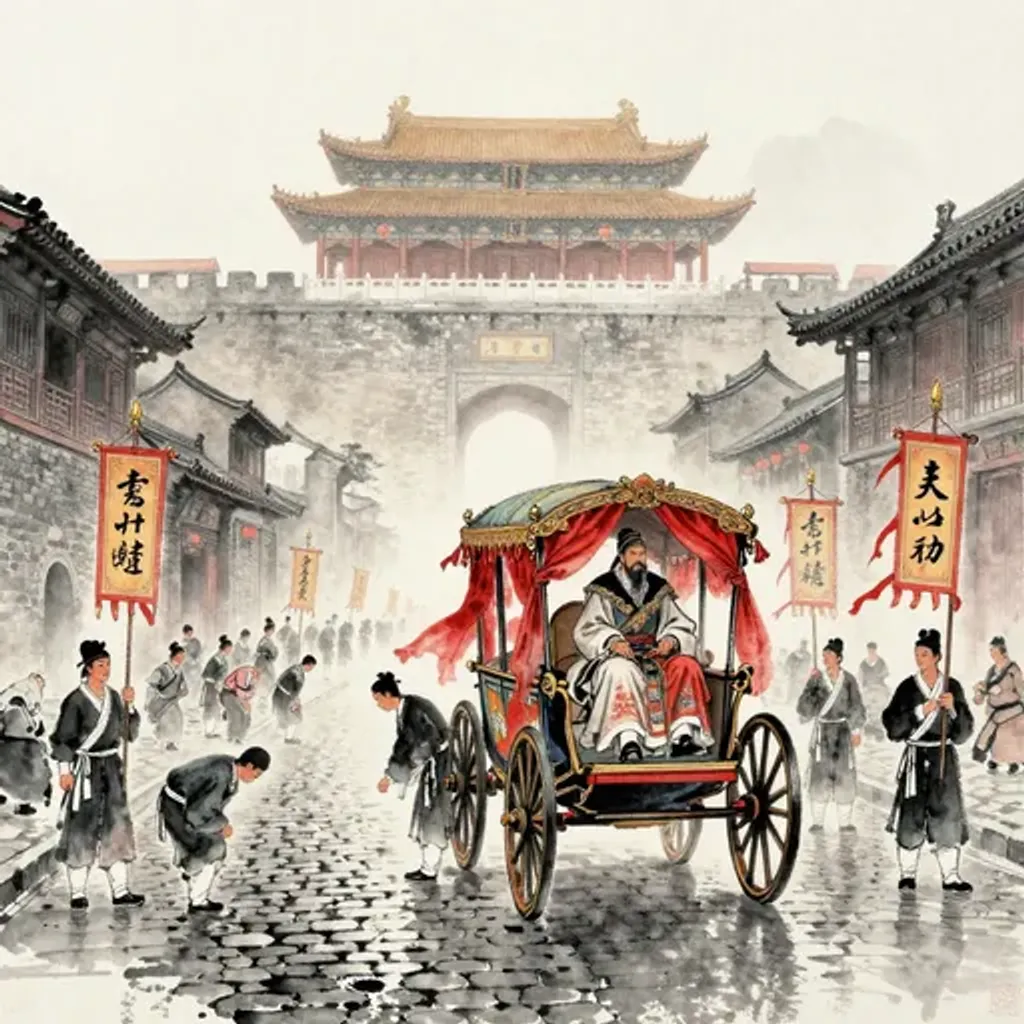
坐車乘軒,據國子民,虞叔受命,和合六親。
Seated in carriage, riding with canopy; holding the state, governing the people. Lord Yu of Shu receives the mandate; harmonizing and uniting the six kinships.
— Jiao Yanshou, Yilin (Forest of Changes), 1st century BC
Commentary
Doubled fire meets cloud and thunder: brilliance enters the struggle of new beginnings. One sits in a grand carriage, commands a state, and governs its people. Yu Shu receives his mandate and harmonizes the six degrees of kinship. According to the Zuo Zhuan, Yu Shu of the state of Yu once coveted a precious jade and attacked his own lord, eventually seizing power. Yet the verse reframes this as legitimate governance: receiving the mandate, riding in state carriages, and uniting kinship bonds. From The Clinging to Difficulty at the Beginning, fire's clarity illuminates the chaotic moment of birth. In the storm of founding, the one who can see clearly through disorder secures the chariot of rule and binds scattered loyalties into a functioning state.
離 → 蒙
Hexagram 30 → Hexagram 4: Youthful Folly
Changing lines: 1, 2, 3, 4
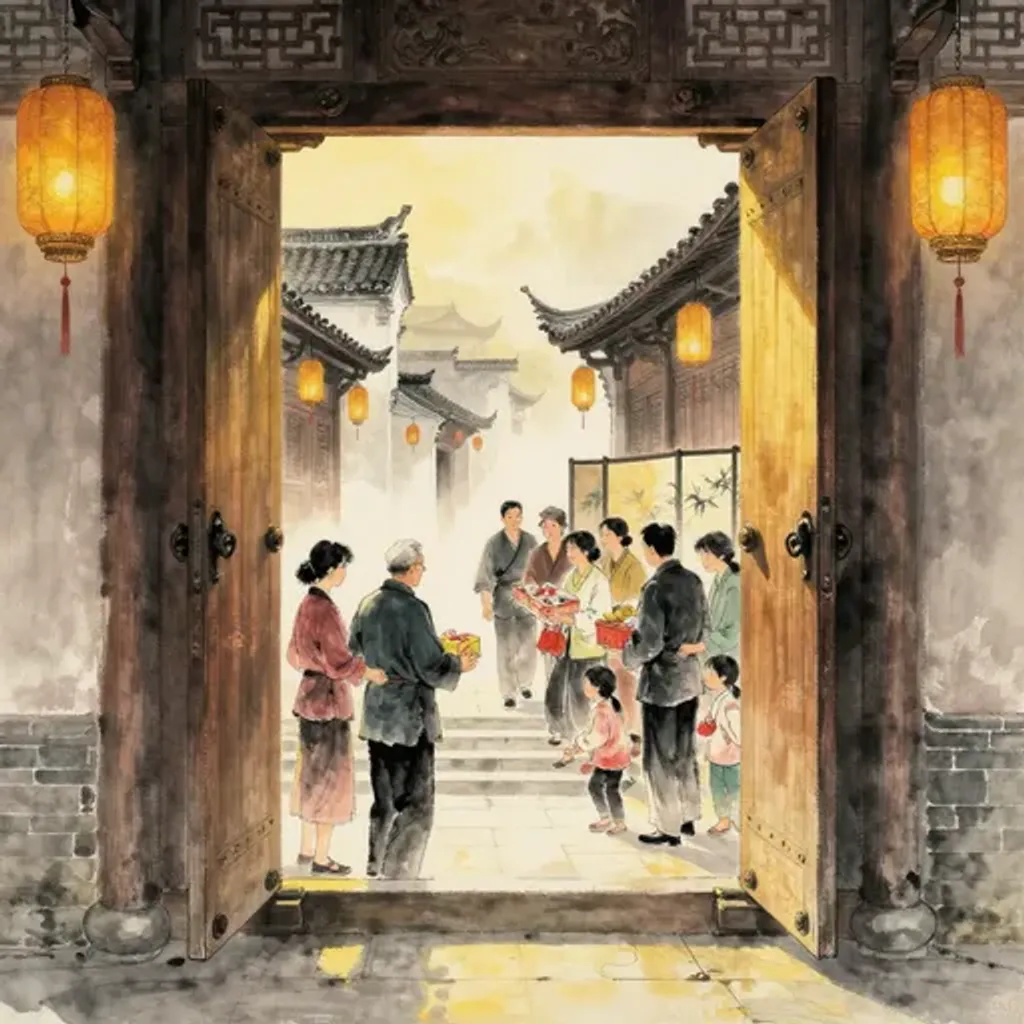
開戶下堂,與福相迎,祿于公室,曾孫以昌。
Opening the door, descending the hall; meeting fortune face to face. Blessings from the ducal house; sons and grandsons shall prosper.
— Jiao Yanshou, Yilin (Forest of Changes), 1st century BC
Commentary
Doubled fire meets the mountain spring of youthful folly: clarity opens the door to blessings that flow across generations. One opens the gate, descends the hall, and meets good fortune face to face. Emolument comes from the ducal house, and great-grandchildren flourish. The verse paints a scene of institutional reward: the household that aligns with proper governance receives blessings that compound over time. No single historical allusion is named; the imagery belongs to the general vocabulary of ancestral merit rewarded through lineage. From The Clinging to Youthful Folly, fire's illumination meets the spring emerging beneath the mountain. What begins as simple clarity, when nurtured with patience and proper conduct, matures into a legacy that sustains descendants for generations.
離 → 需
Hexagram 30 → Hexagram 5: Waiting
Changing lines: 2, 4, 5, 6
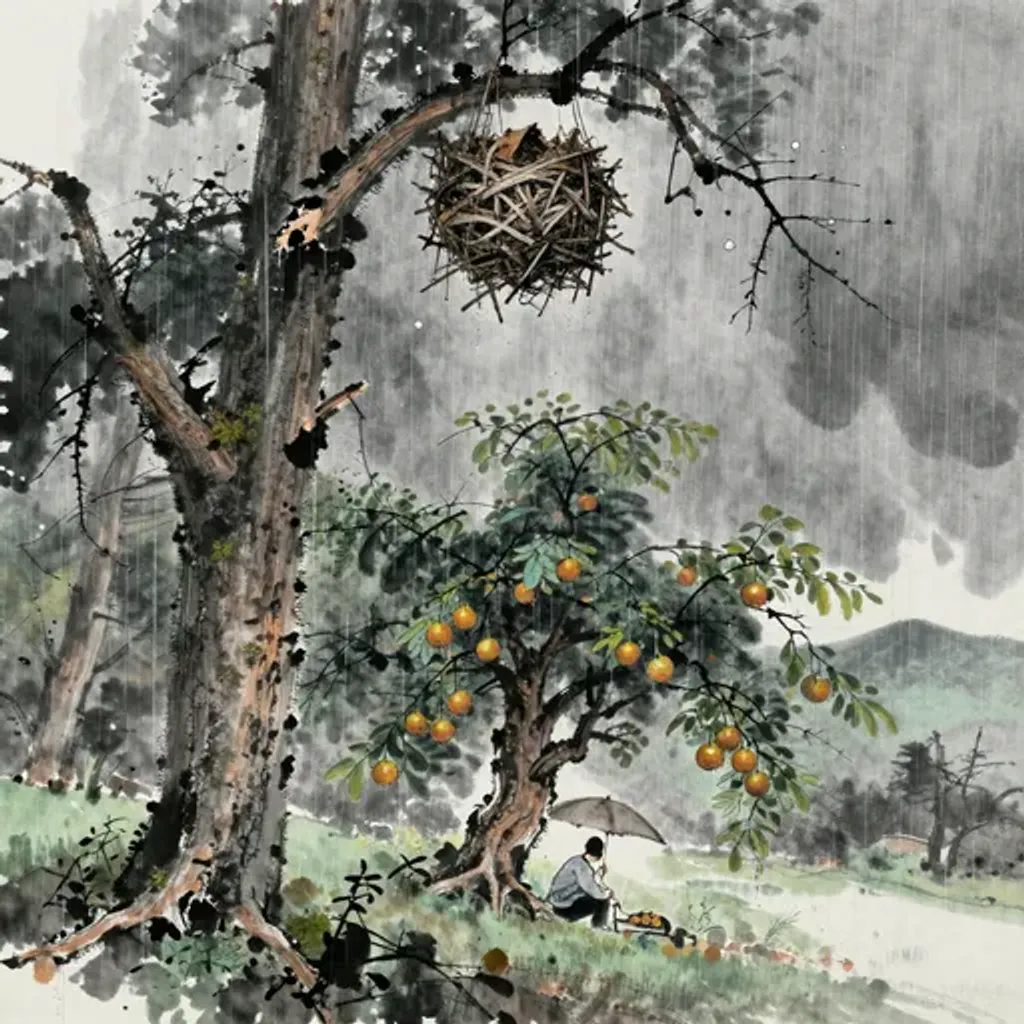
高木腐巢,漏濕難居,不去甘棠,使我無憂。
High wood, a rotting nest; leaking and damp, hard to dwell in. Not leaving the sweet pear tree; it keeps me free from worry.
— Jiao Yanshou, Yilin (Forest of Changes), 1st century BC
Commentary
Doubled fire meets heaven's clouds: brilliance confronts the necessity of patient waiting. A tall tree's nest has rotted, leaking and damp, impossible to inhabit. Yet one refuses to abandon the sweet pear tree, and so remains free from worry. The 'sweet pear tree' (gan tang) echoes the Shijing ode celebrating the Duke of Shao, who dispensed justice beneath such a tree; the people loved him so much they preserved it after his death. The verse contrasts a ruined shelter with the enduring shade of virtuous governance. From The Clinging to Waiting, fire's exposed clarity seeks the patience of clouds gathering before heaven. Rather than fleeing to false refuges, one shelters under the legacy of good governance and waits for the proper moment.
離 → 訟
Hexagram 30 → Hexagram 6: Conflict
Changing lines: 1, 2, 3, 5
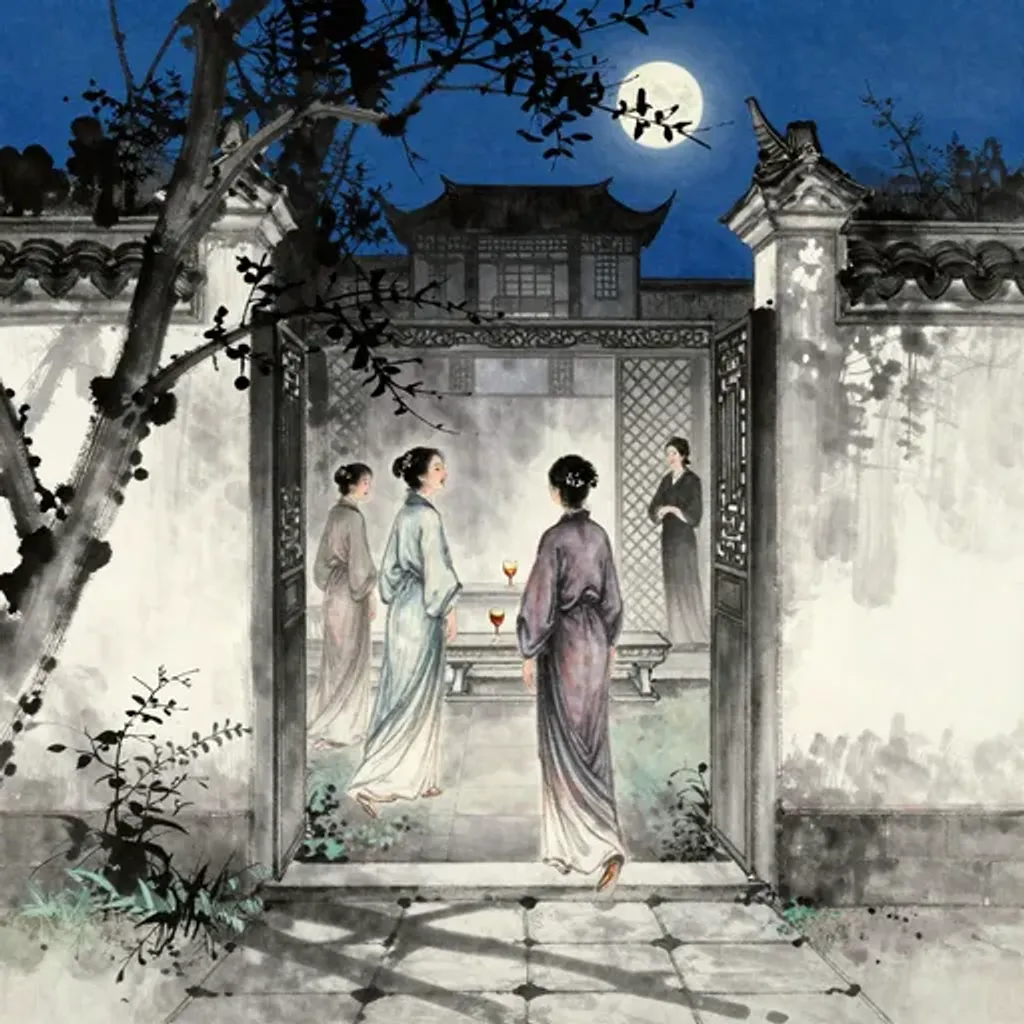
三女為姦,俱遊高園。倍室夜行,與伯笑言。不忍主母,為設歡酒,冤尤誰禱。
Three women conspire in mischief, together roaming the high garden. Leaving the house by night, exchanging laughter with the elder. Unable to face the mistress, they set out wine of appeasement; to whom shall the wronged one pray?
— Jiao Yanshou, Yilin (Forest of Changes), 1st century BC
Commentary
Doubled fire meets heaven and water moving apart: brilliance entangles with conflict. Three women conspire, roaming together through a high garden. They slip from the household at night and exchange laughter with the elder brother. Unable to endure the mistress of the house, they prepare a banquet of poisoned wine; to whom can the wronged one pray? The verse depicts a classic scenario of concubines plotting against the principal wife, a recurring motif in Spring and Autumn court intrigues. From The Clinging to Conflict, fire's clarity splits into opposing currents. When illumination serves scheming rather than truth, the household becomes a battlefield where resentment ferments behind smiling faces and justice finds no arbiter.
離 → 師
Hexagram 30 → Hexagram 7: The Army
Changing lines: 1, 2, 3, 4, 6
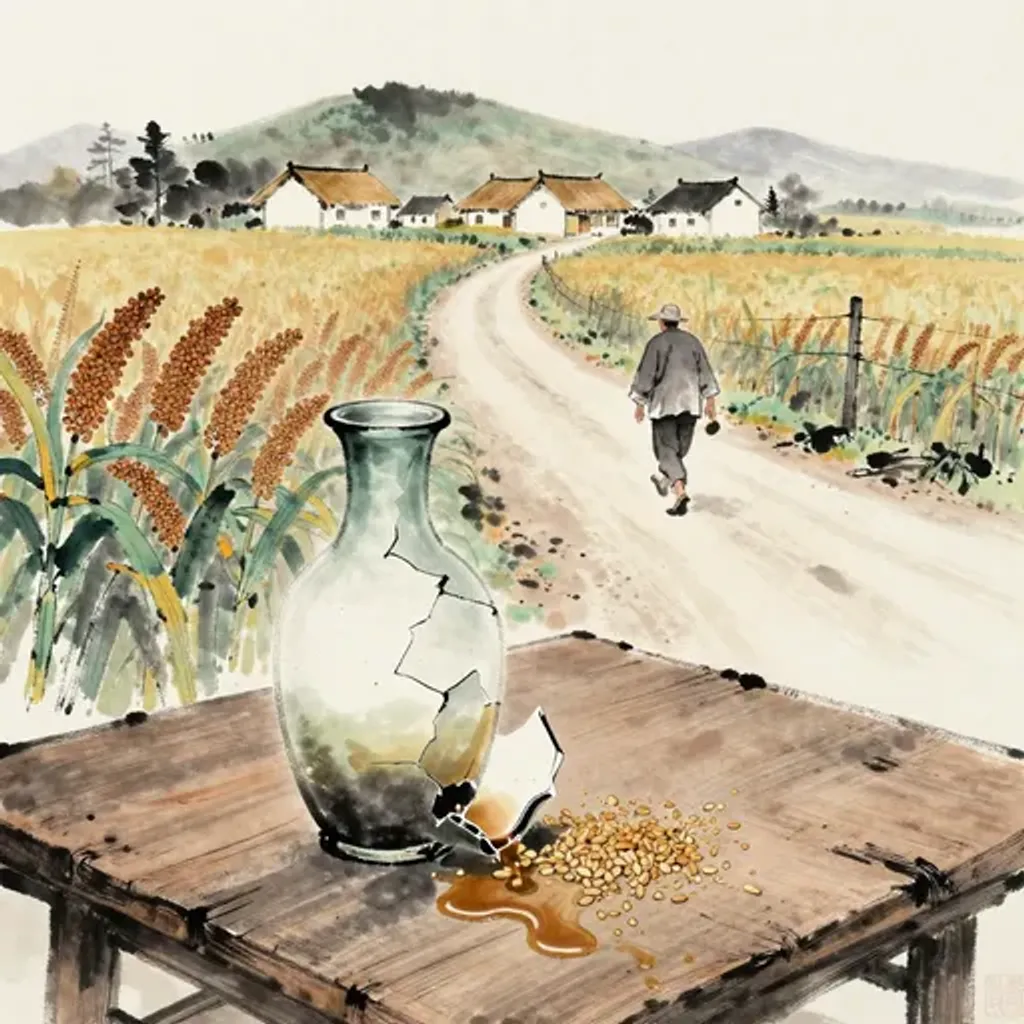
漏巵盛酒,無以養老,春貸黍稷,年歲實有,履道坦坦,平安何咎。
A leaking cup holds wine; nothing to nourish the old. Spring borrows millet and grain; the yearly harvest proves fruitful. Treading the path, smooth and level; peaceful and free, what blame?
— Jiao Yanshou, Yilin (Forest of Changes), 1st century BC
Commentary
Doubled fire meets water held within earth: clarity discovers the discipline of collective provision. A leaking ladle holds wine poorly, insufficient to nourish the elderly. Yet spring loans of grain ensure the year's harvest materializes, and treading a level path brings peace without blame. The verse moves from scarcity to sufficiency through communal management. The 'leaking ladle' suggests individual resources inadequate to the task; the spring loan system, where grain is advanced before harvest, represents organized collective support. From The Clinging to The Army, fire's individual brilliance yields to water marshaled beneath the earth. Just as an army requires disciplined logistics rather than individual heroism, prosperity comes through systematic provision rather than solitary effort.
離 → 比
Hexagram 30 → Hexagram 8: Holding Together
Changing lines: 1, 3, 4, 5, 6
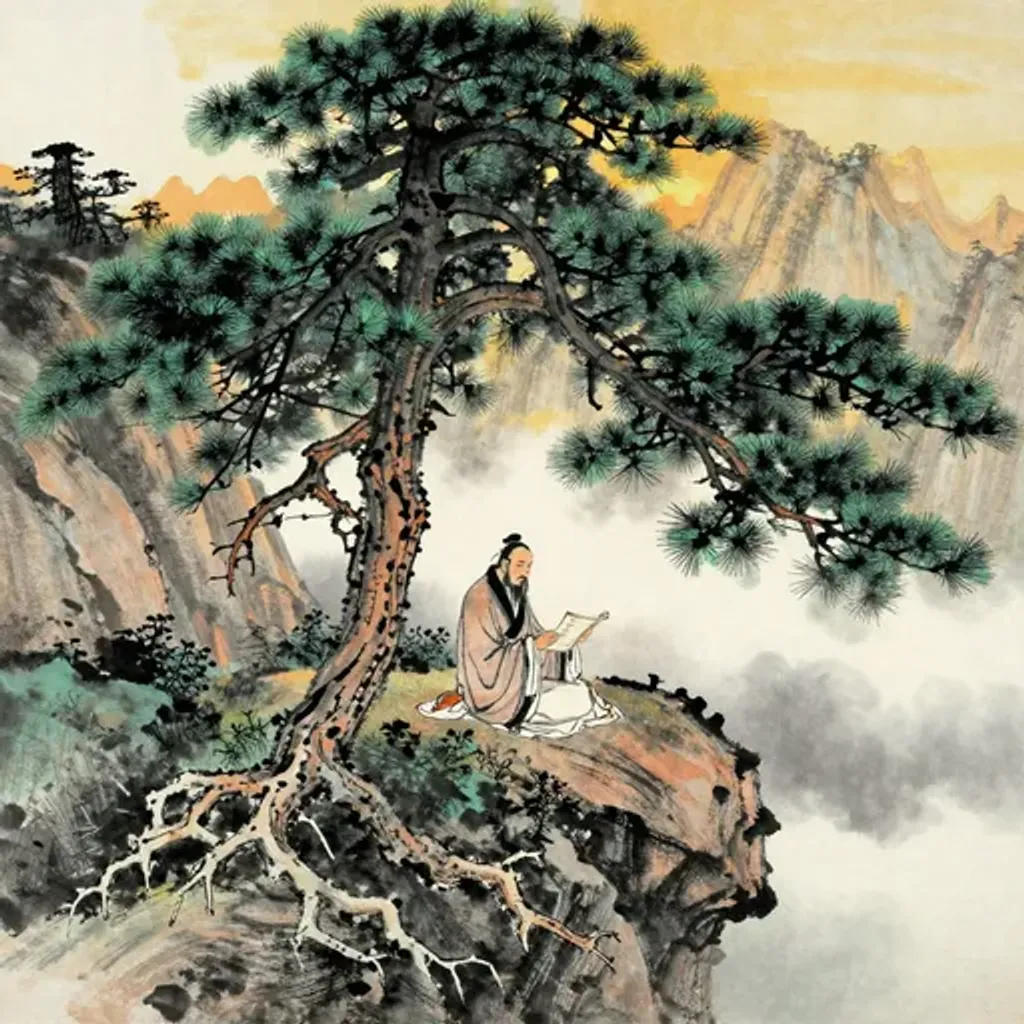
松柏枝葉,常茂不落,君子惟體,日富安樂。
Pine and cypress, branches and leaves; ever flourishing, never falling. The noble man takes this as his model; daily growing wealthy and at ease.
— Jiao Yanshou, Yilin (Forest of Changes), 1st century BC
Commentary
Doubled fire meets water resting upon earth: brilliance finds lasting fellowship. Pine and cypress branches and leaves remain evergreen, never falling. The noble person embodies this constancy, growing richer and more content with each day. Pine and cypress are classical symbols of integrity under adversity, praised in the Analerta: 'Only after the cold season do we know that pine and cypress are last to wither.' The verse presents enduring virtue as the basis of true prosperity. From The Clinging to Holding Together, fire's flickering brightness becomes the steady bond of water upon earth. Loyalty that never wavers, like the evergreen canopy, draws others naturally into its shelter and creates lasting community.
離 → 小畜
Hexagram 30 → Hexagram 9: Small Taming
Changing lines: 2, 4, 5
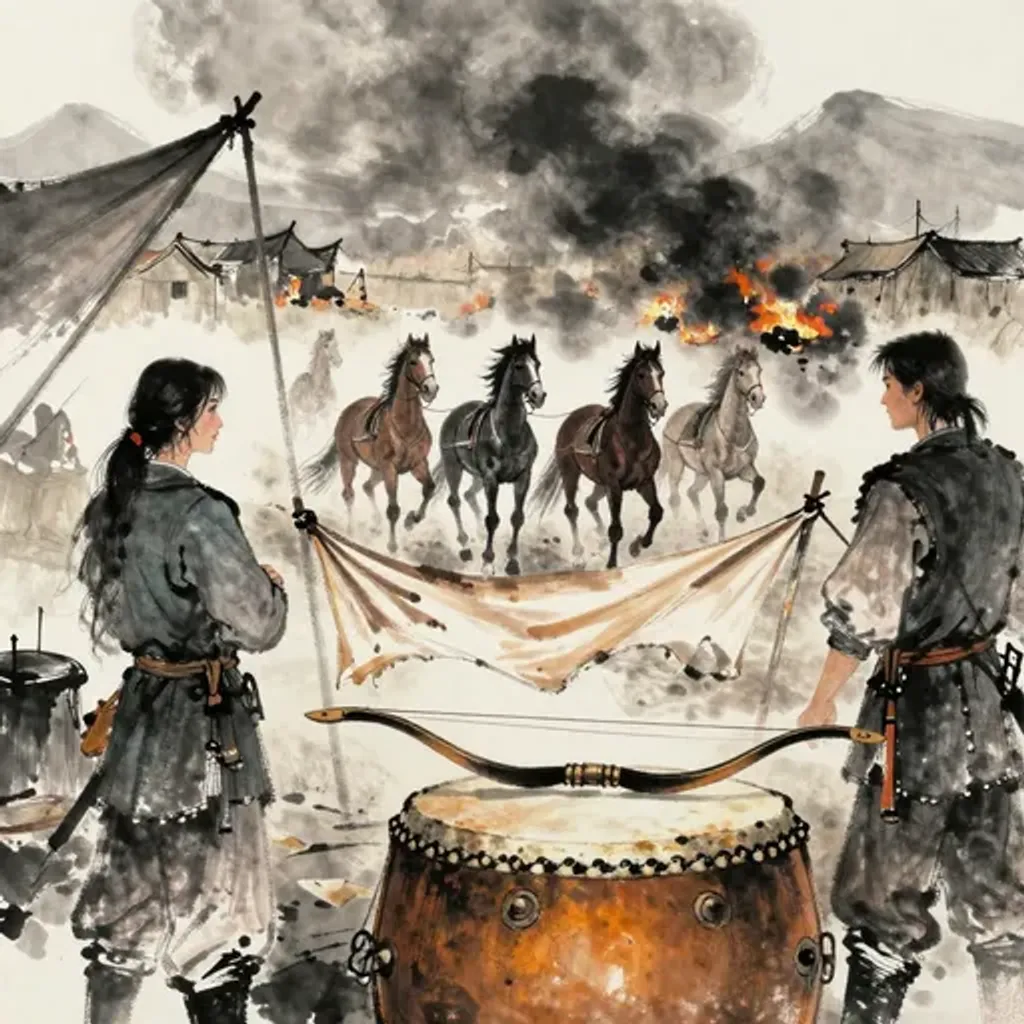
夫婦不諧,為燕攻齊,良弓不張,騎駟憂凶。
Husband and wife in discord; for Yan, they attack Qi. A fine bow unstrung; the four-horse team brings sorrow and misfortune.
— Jiao Yanshou, Yilin (Forest of Changes), 1st century BC
Commentary
Doubled fire meets wind above heaven: brilliance is restrained but strains against its limits. Husband and wife cannot harmonize; it is as if Yan were attacking Qi. A fine bow lies unstrung, and the team of four horses portends misfortune. The allusion to 'Yan attacking Qi' recalls the chronic Spring and Autumn conflict between these neighboring states, where aggression born from proximity repeatedly failed. An unstrung bow wastes its potential; horses without direction bring only danger. From The Clinging to Small Taming, fire's assertive clarity is checked by gentle wind. When the small tries to restrain the great through force rather than moral persuasion, the result is domestic discord writ large, a household and a state alike torn by misaligned ambitions.
離 → 履
Hexagram 30 → Hexagram 10: Treading
Changing lines: 2, 3, 5
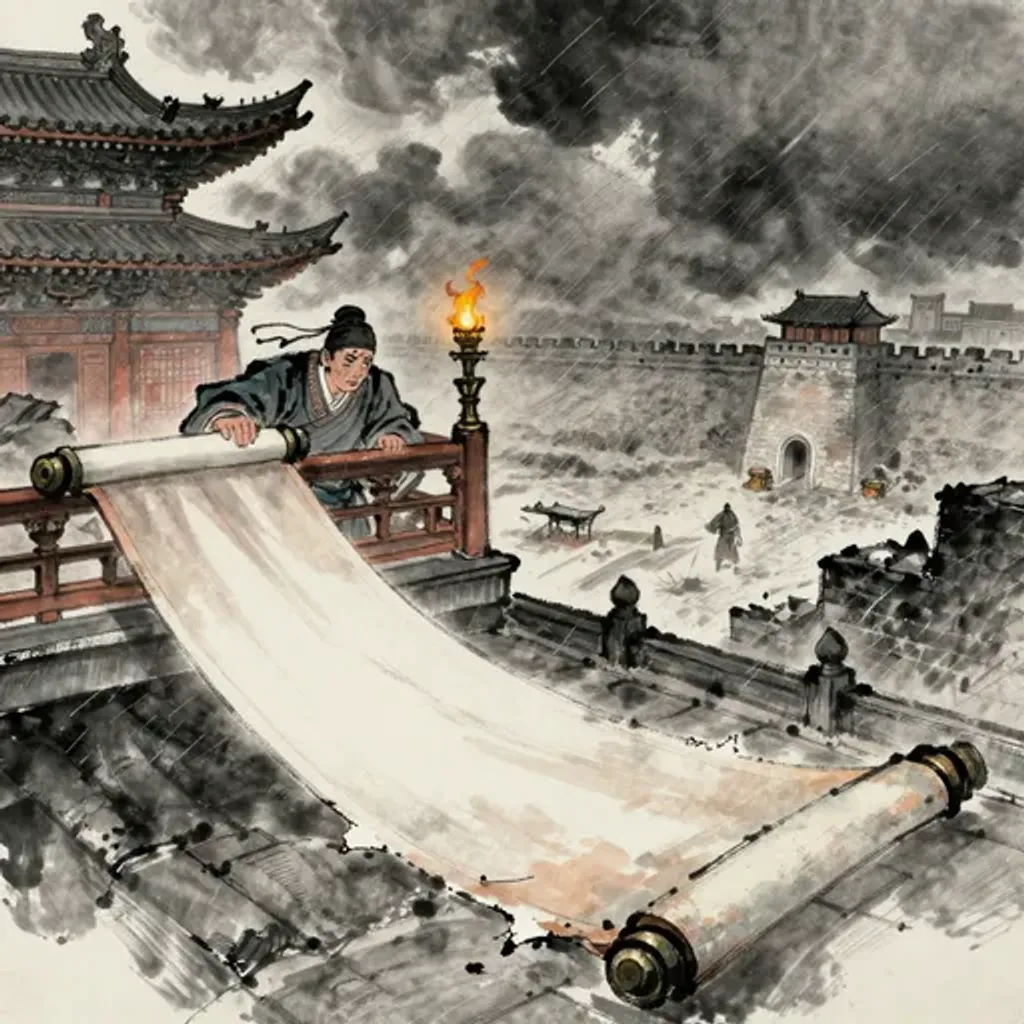
出令不勝,反為大災,強不克弱,君受其憂。
Issuing commands that cannot prevail; turning instead to great calamity. The strong cannot subdue the weak; the lord receives the sorrow.
— Jiao Yanshou, Yilin (Forest of Changes), 1st century BC
Commentary
Doubled fire meets heaven above the lake: brilliance oversteps its proper boundary. Commands are issued but cannot prevail; they rebound as great calamity. The strong fail to subdue the weak, and the ruler bears the consequences. The verse warns against authority exercised without proper standing. When edicts lack moral weight, enforcement collapses and the issuer suffers more than the target. From The Clinging to Treading, fire's assertive light encounters the protocol of treading upon a tiger's tail. The image of heaven over lake defines proper hierarchy, but the verse shows what happens when one treads carelessly: the tiger turns. Power projected without legitimacy does not merely fail; it transforms into the very disaster it sought to prevent.
離 → 泰
Hexagram 30 → Hexagram 11: Peace
Changing lines: 2, 4, 6
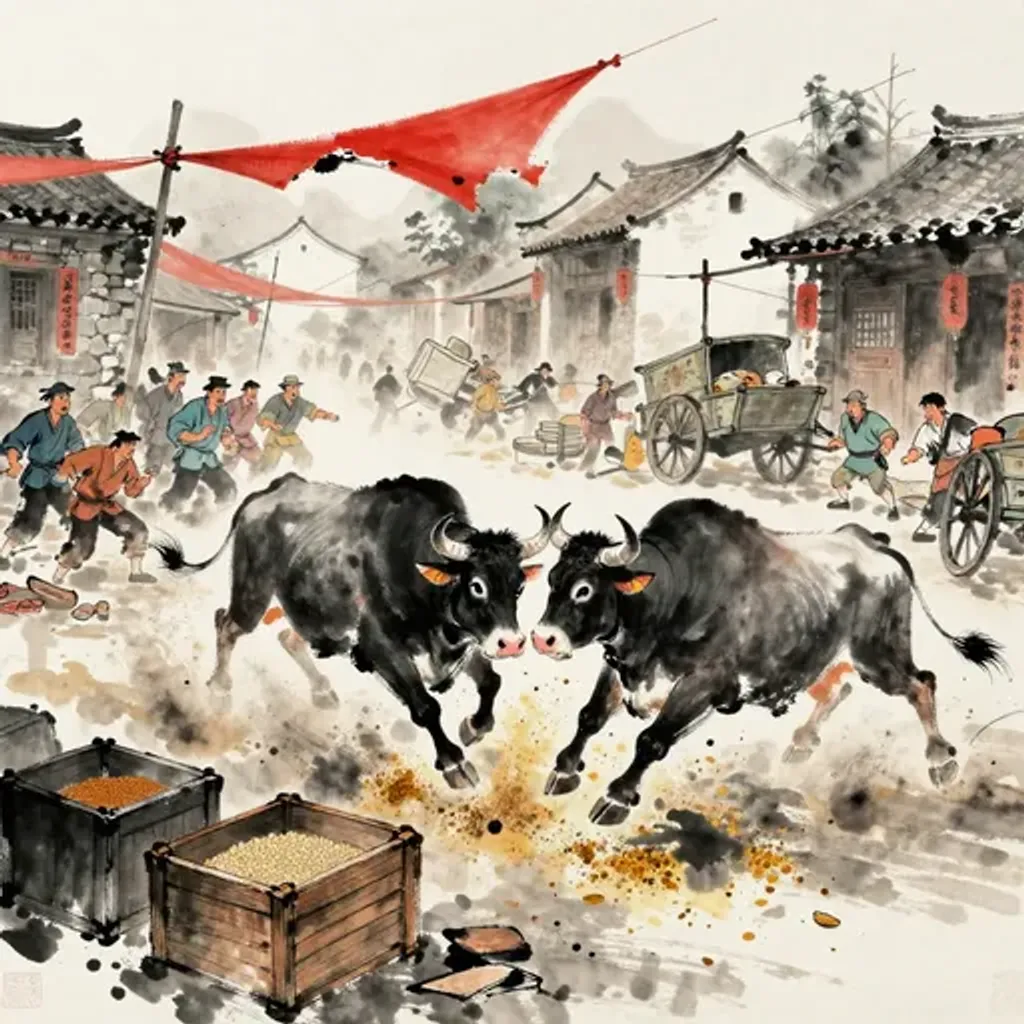
奔牛相錯,敗亂緒業,民不得作。
Stampeding oxen gore each other; defeating and ruining every enterprise. The people cannot go about their work.
— Jiao Yanshou, Yilin (Forest of Changes), 1st century BC
Commentary
Doubled fire meets heaven and earth in exchange: brilliance erupts into the chaos of a stampede. Stampeding oxen collide and tangle, ruining established enterprises, and the people cannot carry on their work. The image of panicked cattle crashing into one another suggests a sudden breakdown of order at the moment when harmony should prevail. Tai, the hexagram of Peace, represents heaven and earth communicating perfectly; yet the verse shows that very exchange perverted into violent collision. From The Clinging to Peace, fire's intensity overwhelms the delicate balance of cosmic interchange. When energy that should circulate gently instead erupts in panic, even the most auspicious configuration collapses, and the common people suffer the consequences of forces beyond their control.
離 → 否
Hexagram 30 → Hexagram 12: Standstill
Changing lines: 1, 3, 5
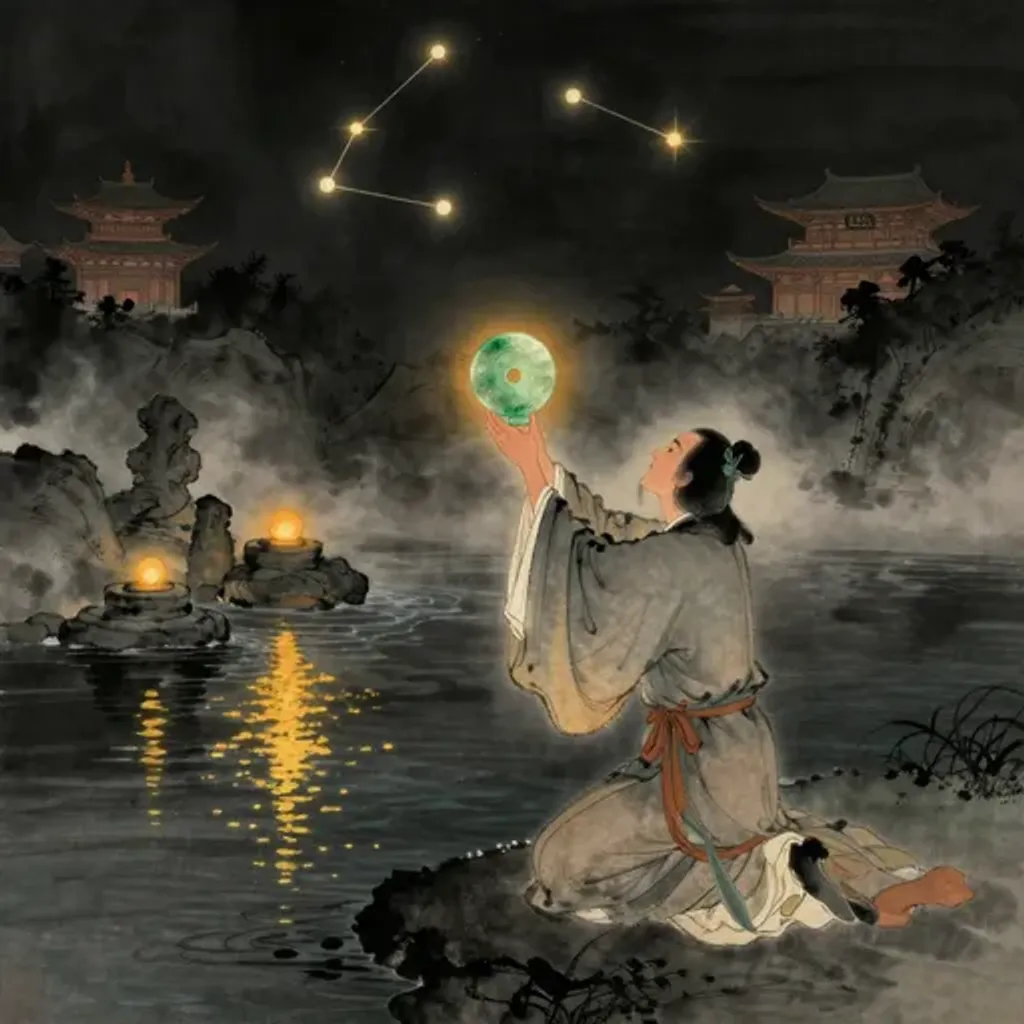
載璧秉珪,請命于河,周公克敏,沖人瘳愈。
Bearing jade disc and jade tablet; petitioning the River for life. The Duke of Zhou was zealous and devoted; the young king recovered and was healed.
— Jiao Yanshou, Yilin (Forest of Changes), 1st century BC
Commentary
Doubled fire meets heaven and earth sealed apart: brilliance persists through cosmic blockage. Bearing jade discs and grasping the gui-scepter, one pleads for life before the River God. The Duke of Zhou, devoted and swift to act, prays that the young king may be healed. This alludes to the Jin Teng chapter of the Book of Documents, where the Duke of Zhou offered himself as substitute when King Wu fell gravely ill, presenting himself at the altar with jade and scepter. The 'young one' (chongren) recovered. From The Clinging to Standstill, fire's clarity endures even when heaven and earth refuse to communicate. The loyal minister's self-sacrificing prayer pierces through blockage, proving that devotion can sustain illumination in the darkest impasse.
離 → 同人
Hexagram 30 → Hexagram 13: Fellowship
Changing lines: 5
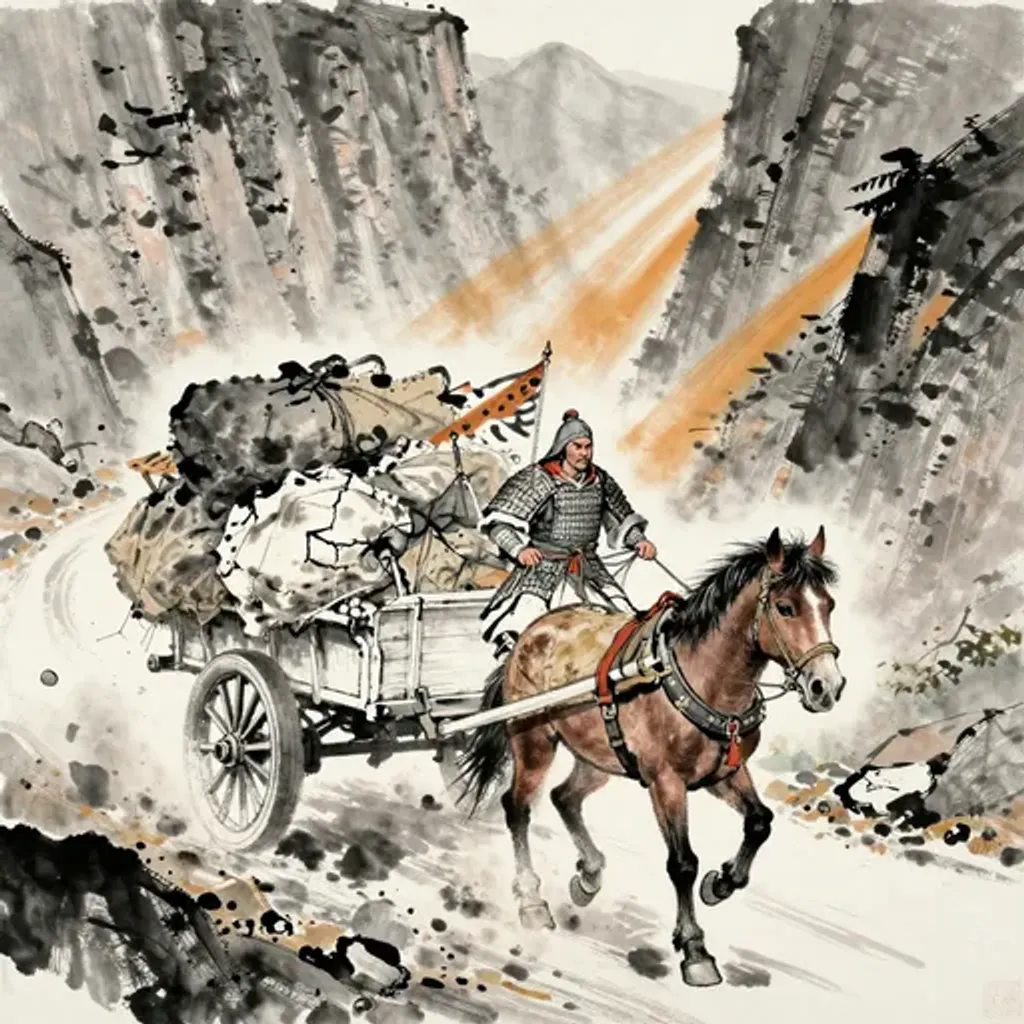
素車偽馬,不任重負,王侯出征,憂危為咎。
An unadorned cart, a counterfeit horse; unfit for heavy burdens. Lords and princes march to war; worry and peril bring blame.
— Jiao Yanshou, Yilin (Forest of Changes), 1st century BC
Commentary
Doubled fire meets heaven and fire together: brilliance joins with fellowship but finds it hollow. A plain cart with counterfeit horses cannot bear heavy loads. When lords and marquises set out on campaign with such equipment, danger and blame inevitably follow. 'Plain cart and false horse' (su che wei ma) is a classical image of inadequate preparation disguised by appearance. The expedition lacks substance behind its show of force. From The Clinging to Fellowship, fire blazes beneath heaven in the image of communal purpose. Yet fellowship built on pretense rather than genuine capability crumbles under pressure. The campaign fails not for lack of allies but for lack of real strength, a warning against mistaking pageantry for preparedness.
離 → 大有
Hexagram 30 → Hexagram 14: Great Possession
Changing lines: 2
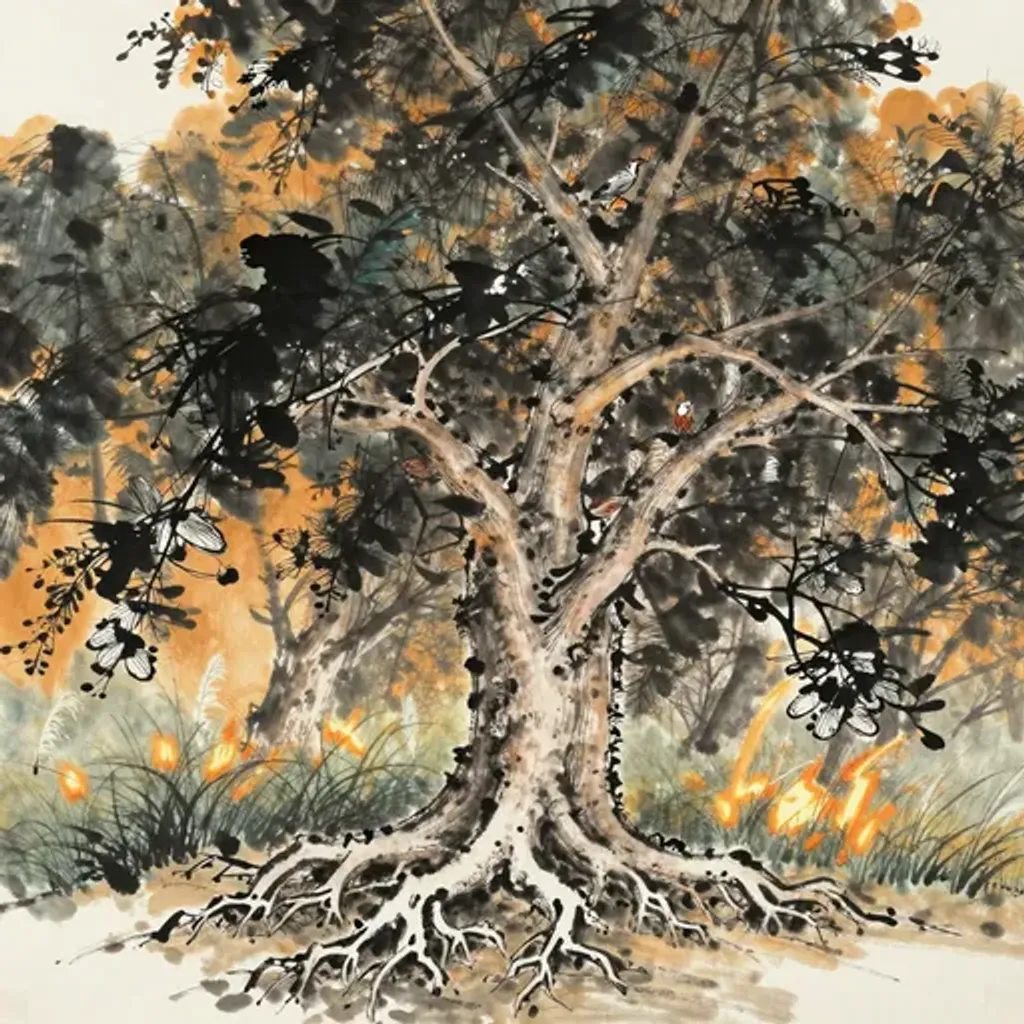
大樹之子,同條共母,比至火中,枝葉盛茂。
Children of a great tree; sharing the same branch, the same mother. Drawing close to fire's heart; branches and leaves flourish all the more.
— Jiao Yanshou, Yilin (Forest of Changes), 1st century BC
Commentary
Doubled fire meets fire blazing in heaven: brilliance amplifies into great possession. Children of a great tree share the same trunk and mother branch. Even when fire sweeps through, the branches and leaves grow more luxuriantly than before. The image draws on the natural phenomenon of fire-adapted trees that regenerate vigorously after burning, their root systems sending up new growth nourished by ash-enriched soil. The shared trunk represents a lineage or institution whose foundation is deep enough to survive catastrophe. From The Clinging to Great Possession, fire upon fire does not consume but catalyzes abundance. What seems destructive becomes generative when the root structure is sound, a vision of prosperity born precisely from the crucible of trial.
離 → 謙
Hexagram 30 → Hexagram 15: Modesty
Changing lines: 1, 4, 6
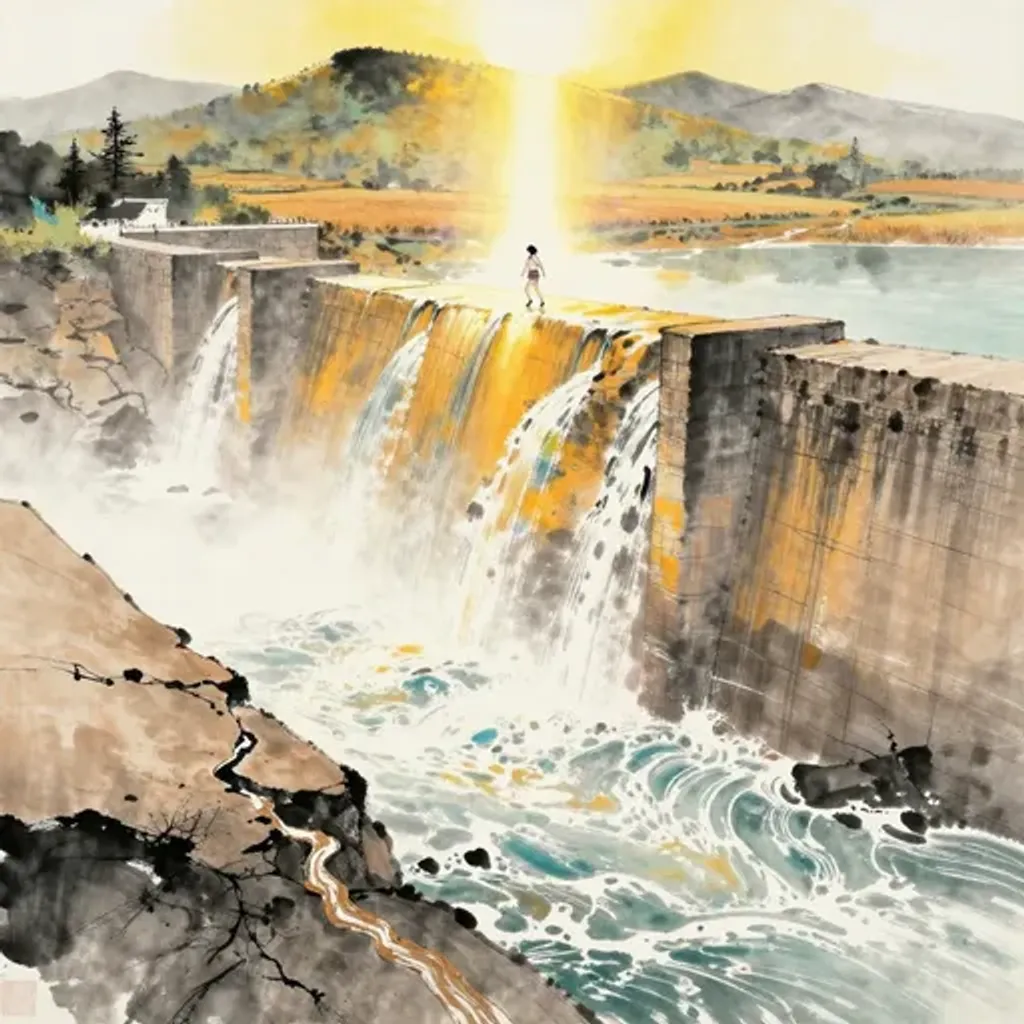
壅遏隄防,水不得行,火盛陽光,陰蜺伏藏,走婦其歸。
Dikes and dams obstruct and block; water cannot flow. Fire blazes with yang's radiance; the shadowed rainbow hides away. The fleeing woman returns home.
— Jiao Yanshou, Yilin (Forest of Changes), 1st century BC
Commentary
Doubled fire meets the mountain hidden within earth: brilliance must learn to lower itself. Dams and embankments block the flow; water cannot pass. Fire blazes in full sunlight while the yin rainbow hides itself, and the runaway wife returns home. The verse maps a landscape of excess yang: too much light, too much heat, too much obstruction. Water, the feminine element, is blocked; the rainbow (an omen of yin-yang imbalance) conceals itself rather than display impropriety. From The Clinging to Modesty, fire's overbearing brightness must descend into the mountain concealed within the earth. True modesty requires the powerful to lower themselves, releasing the blocked flow so balance can be restored and the displaced can return.
離 → 豫
Hexagram 30 → Hexagram 16: Enthusiasm
Changing lines: 1, 3, 6
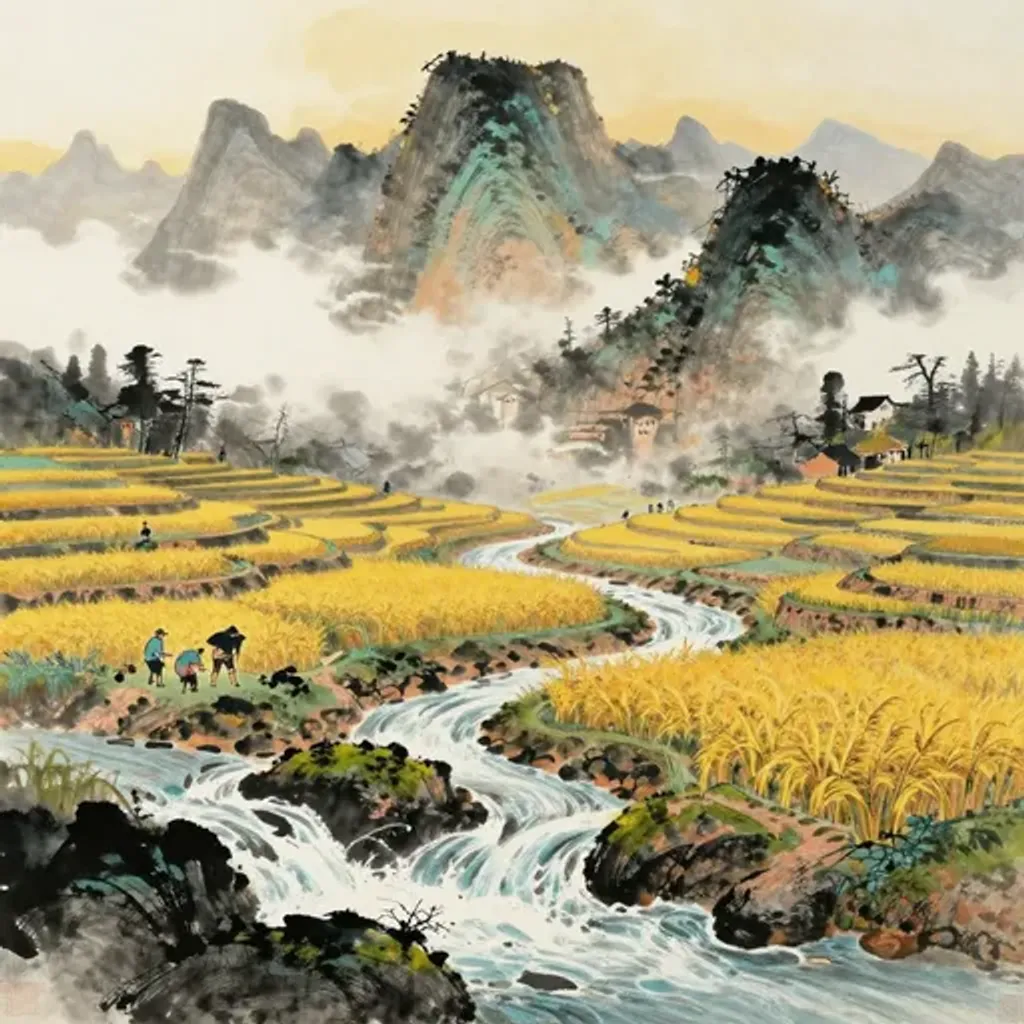
五岳四瀆,合潤為德,行不失理,民賴恩福。
Five sacred peaks and four great rivers; merging their moisture into virtue. Actions never stray from principle; the people rely upon their grace and blessing.
— Jiao Yanshou, Yilin (Forest of Changes), 1st century BC
Commentary
Doubled fire meets thunder rising from the earth: brilliance joins the rhythm of collective celebration. The Five Sacred Mountains and the Four Great Rivers unite their moisture as virtue. Governance proceeds without departing from principle, and the people rely upon this bounty of grace. The Five Mountains and Four Rivers form the sacred geography of the empire, and their harmonious functioning represents the cosmic order underpinning good governance. From The Clinging to Enthusiasm, fire's clarity merges with thunder's galvanizing energy emerging from the earth. When illumination inspires rather than scorches, the result is the joyful momentum of a well-governed realm whose prosperity flows as naturally as rivers nourished by mountains.
離 → 隨
Hexagram 30 → Hexagram 17: Following
Changing lines: 3, 5, 6
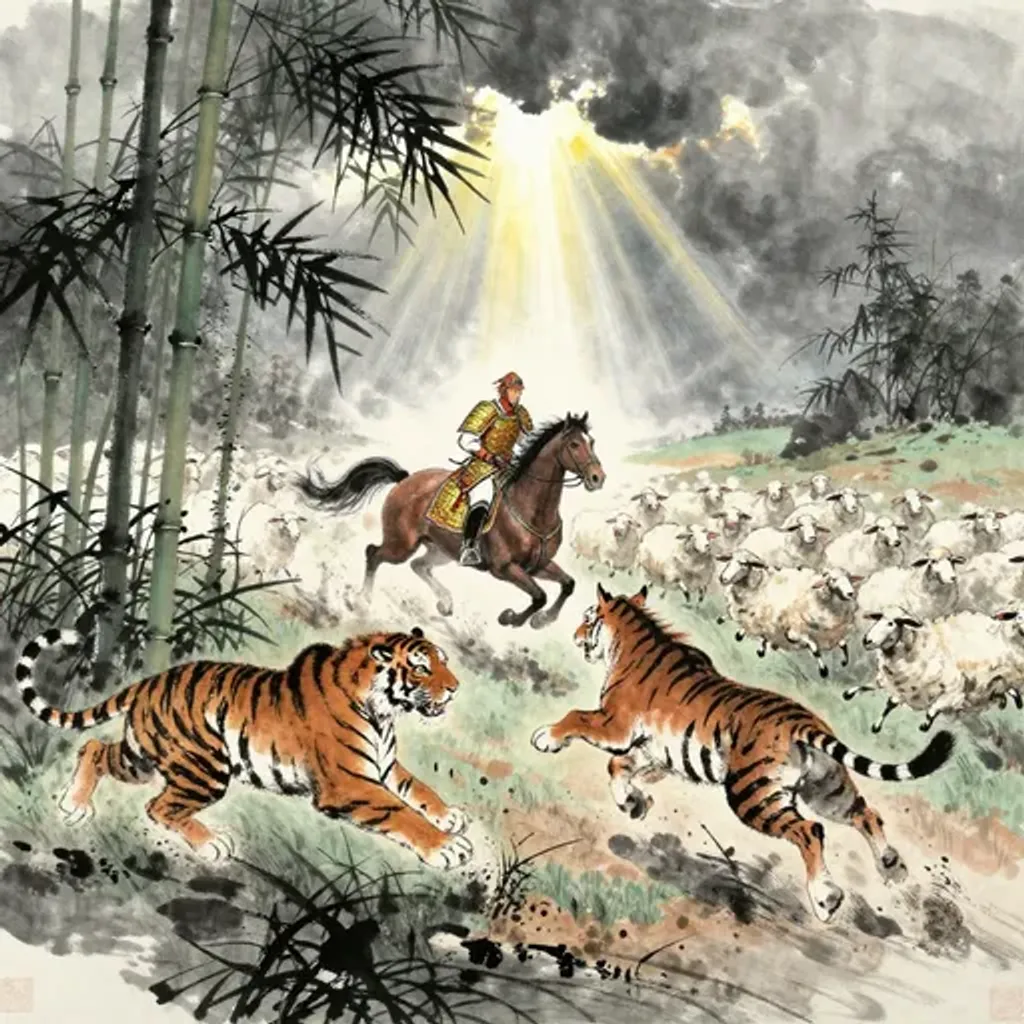
駕駿南遊,虎驚我羊,陰不奉陽,其光顯揚。言之謙謙,奉義解患。
Driving fine steeds, journeying south; a tiger startles my flock. Yin does not serve yang; yet its radiance shines resplendent. Words humble and modest; upholding duty, resolving calamity.
— Jiao Yanshou, Yilin (Forest of Changes), 1st century BC
Commentary
Doubled fire meets thunder within the lake: brilliance discovers the wisdom of adaptive following. Driving fine steeds southward, a tiger startles the flock of sheep. When yin fails to serve yang, the light shines forth all the more brilliantly. Modest words spoken humbly uphold righteousness and resolve the crisis. The verse stages a moment of panic — the tiger among sheep — then resolves it not through force but through humility and moral speech. From The Clinging to Following, fire's assertive clarity yields to the lake's receptive stillness sheltering thunder within. The one who follows the situation rather than imposing upon it finds that gentle persuasion accomplishes what confrontation cannot, and the light of truth emerges precisely through deference.
離 → 蠱
Hexagram 30 → Hexagram 18: Work on the Decayed
Changing lines: 1, 2, 4
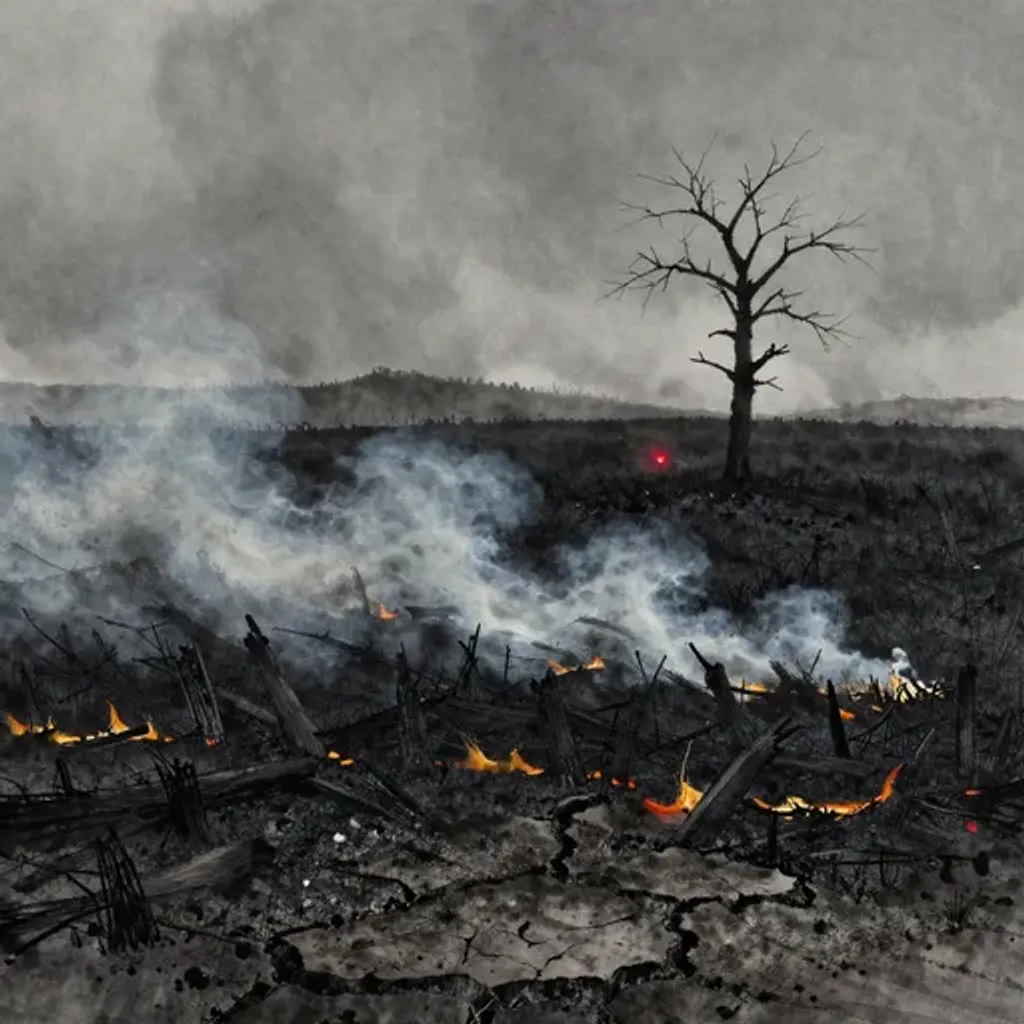
早霜晚雪,傷害禾麥,損功棄力,飢無所食。
Wildfire sweeps across the fields, ashes still warm. No green shoot remains — black earth without a trace.
— Jiao Yanshou, Yilin (Forest of Changes), 1st century BC
Commentary
Doubled fire meets wind beneath the mountain: brilliance confronts decay that must be repaired. This verse is a modern rewrite; the original reads: 'Early frost and late snow injure grain and wheat. Effort is wasted and strength abandoned; there is hunger with nothing to eat.' The original captures agricultural devastation from untimely weather. Frost and snow at wrong seasons destroy crops, rendering all labor futile. From The Clinging to Work on the Decayed, fire's clarity illuminates a system already corrupted at its root. Wind trapped beneath the mountain stirs what has stagnated into decay. The verse confronts the bitter truth that when fundamental conditions are hostile, no amount of diligence can salvage the harvest, and one must begin the painful work of renewal from bare ground.
離 → 臨
Hexagram 30 → Hexagram 19: Approach
Changing lines: 2, 3, 4, 6
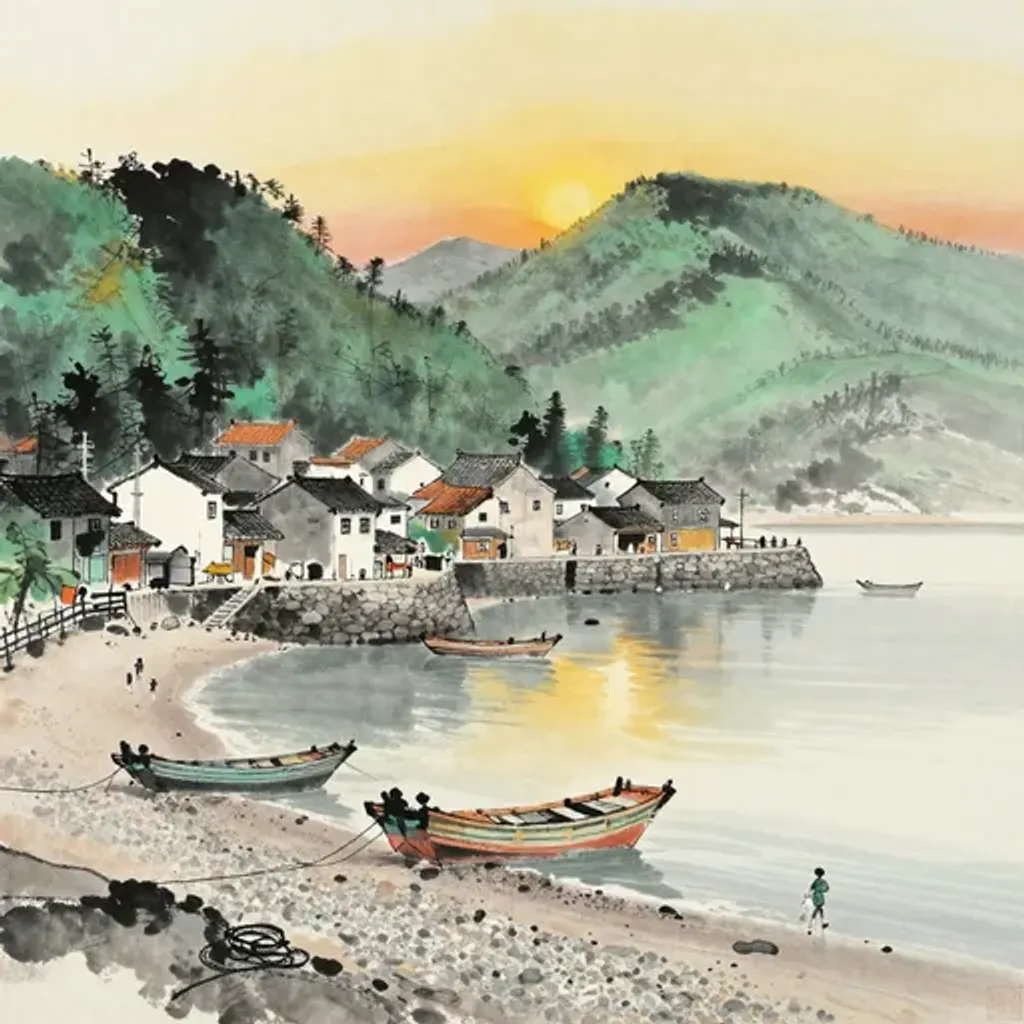
岐周海隅,有樂無憂,可以避難,全身保財。
Qi and Zhou at the sea's corner; there is joy and no sorrow. A place to avoid calamity; preserving oneself and protecting one's wealth.
— Jiao Yanshou, Yilin (Forest of Changes), 1st century BC
Commentary
Doubled fire meets the lake beneath earth: brilliance finds a haven of benevolent authority. The region of Qi and Zhou, a corner by the sea, offers joy without worry. Here one may take refuge from disaster, preserving both person and wealth. Qi-Zhou refers to the ancestral lands of the Zhou people in the Wei River valley, where King Tai (Gugong Danfu) led his people to settle beneath Mount Qi. This remote but fertile corner became the foundation from which the Zhou dynasty arose. From The Clinging to Approach, fire's restless illumination meets the expansive care of earth above the lake. The wise ruler approaches his people with generosity, and even a frontier outpost becomes a sanctuary when governed with benevolent oversight.
離 → 觀
Hexagram 30 → Hexagram 20: Contemplation
Changing lines: 1, 3, 4, 5
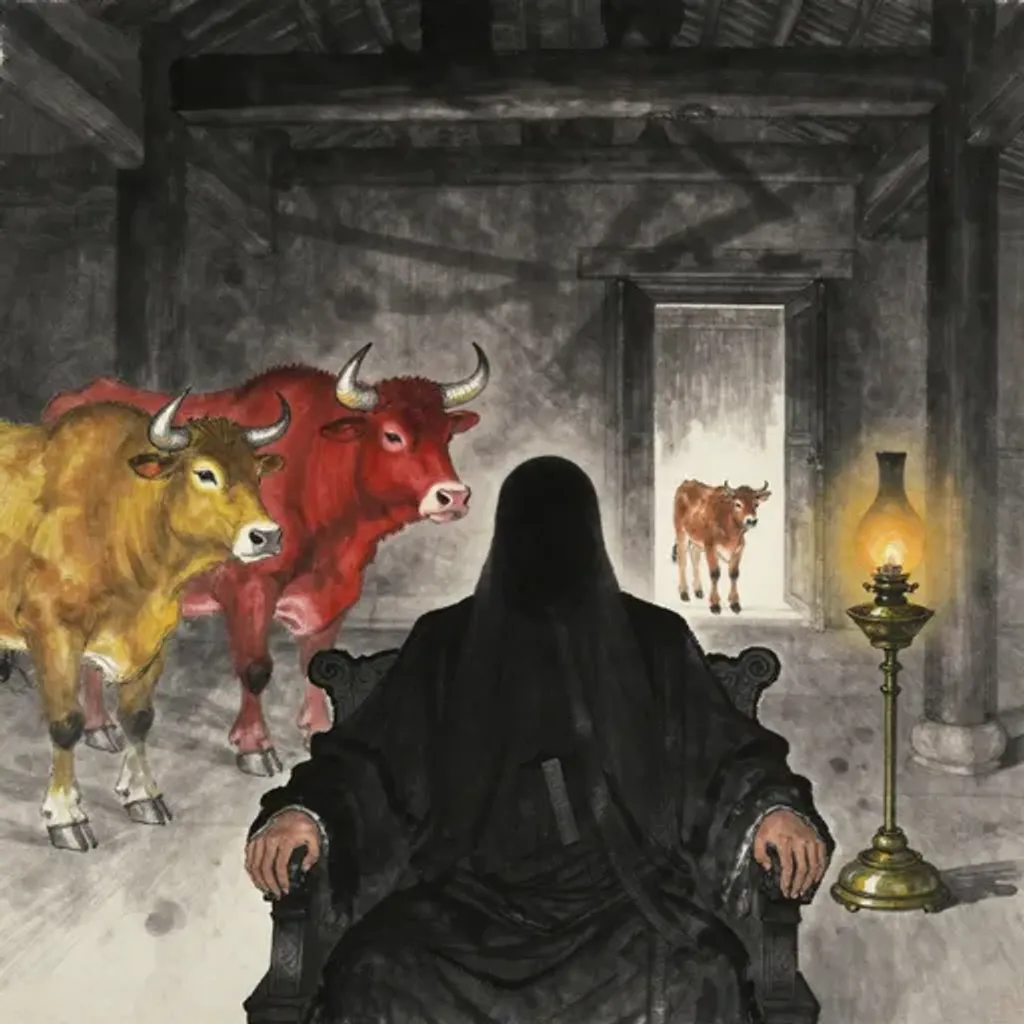
陰蔽其陽,目暗不明,君憂其國,求騂得黃,駒犢從行。
Yin veils the yang; eyes dim, sight unclear. The lord worries for his state; seeking a red sacrifice, he obtains a yellow. A colt and calf follow along.
— Jiao Yanshou, Yilin (Forest of Changes), 1st century BC
Commentary
Doubled fire meets wind moving over earth: brilliance is obscured and must be discerned through careful observation. Yin veils the yang; eyes grow dim and cannot see clearly. The ruler worries for his state. Seeking a red sacrificial beast, he obtains a yellow one instead; a young colt follows along behind. The verse depicts a ruler whose vision has been clouded — seeking one thing but receiving another. The color substitution (red sought, yellow obtained) suggests settling for a compromise that may prove adequate, while the trailing colt hints at unforeseen consequences. From The Clinging to Contemplation, fire's penetrating light submits to the wider perspective of wind surveying the land. When direct vision fails, contemplative observation from a distance reveals what close scrutiny cannot.
離 → 噬嗑
Hexagram 30 → Hexagram 21: Biting Through
Changing lines: 3
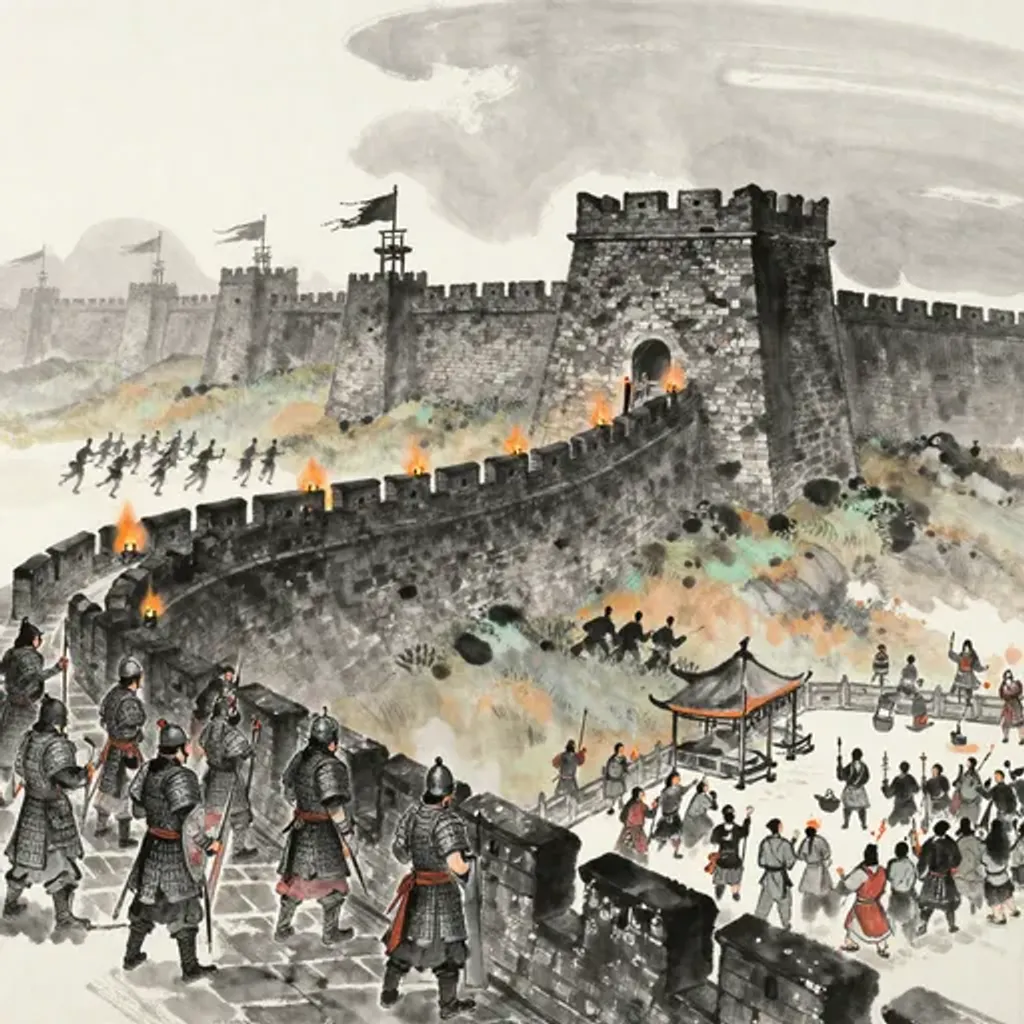
金城鐵郭,上下仝力,政平民歡,寇不敢賊。
A fortress of metal, walls of iron; above and below unite their strength. Governance is just, the people rejoice; bandits dare not plunder.
— Jiao Yanshou, Yilin (Forest of Changes), 1st century BC
Commentary
Doubled fire meets fire and thunder together: brilliance forges an impenetrable order. Walls of metal, ramparts of iron — ruler and subjects unite their strength. Governance is fair and the people rejoice; invaders dare not strike. The 'golden city, iron walls' is a classical metaphor for a state made invincible through internal unity rather than mere fortification. When law is clear and administration just, the people's loyalty itself becomes the strongest defense. From The Clinging to Biting Through, fire's clarity joins thunder's decisive force. Lightning and thunder combined illuminate and punish in a single stroke. The hexagram of law enforcement finds its highest expression not in severity but in the justice that makes walls unnecessary because no enemy would dare approach.
離 → 賁
Hexagram 30 → Hexagram 22: Grace
Changing lines: 4
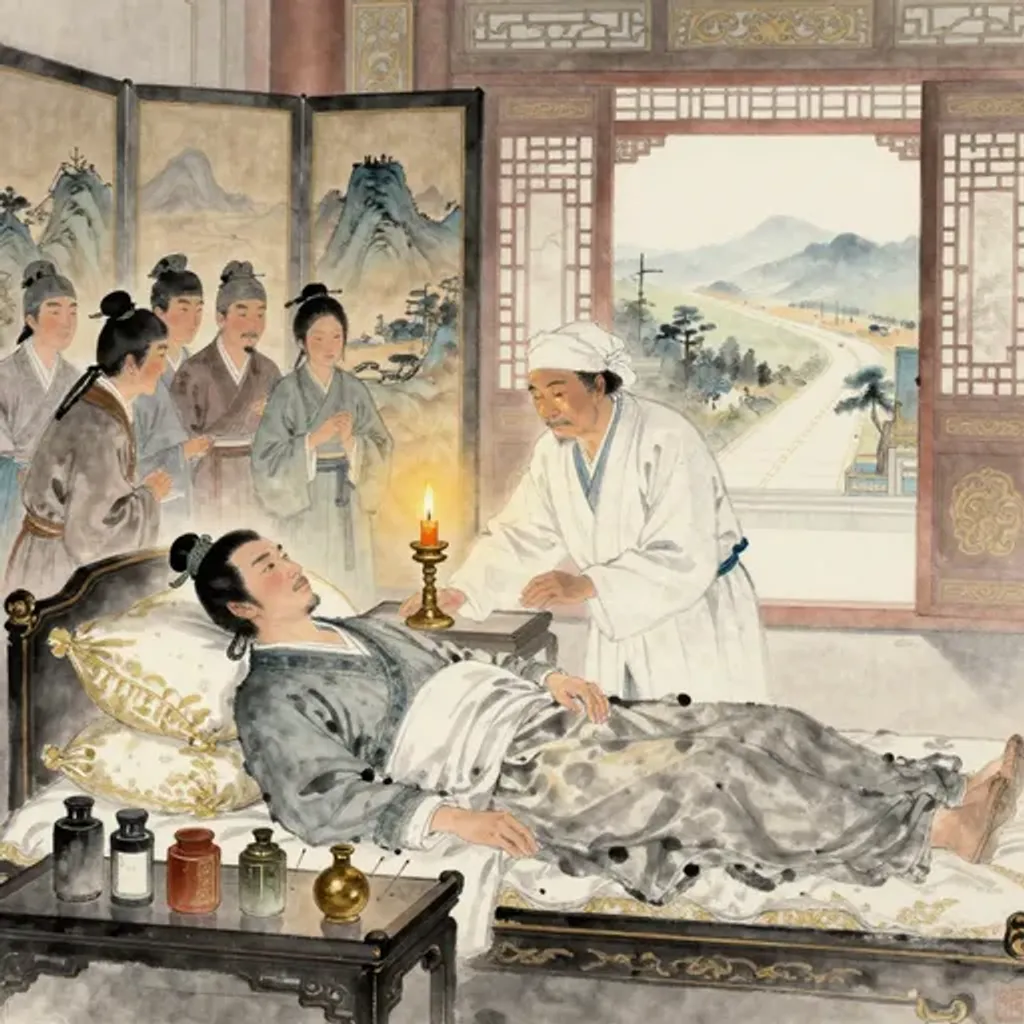
平公有疾,迎醫秦國,和不能知,晉人赴國。
Duke Ping falls ill; a physician is summoned from the state of Qin. Doctor He cannot discern the cause; the men of Jin hasten back to their state.
— Jiao Yanshou, Yilin (Forest of Changes), 1st century BC
Commentary
Doubled fire meets fire beneath the mountain: brilliance adorns the surface but cannot penetrate the illness within. Duke Ping of Jin falls ill and summons a physician from Qin. Doctor He (Yi He) diagnoses the duke's condition but ultimately cannot cure it; the Jin people rush to report the crisis across the state. According to the Zuo Zhuan (Duke Zhao Year 1, 541 BC), Doctor He declared the illness came from excessive indulgence with women, producing a condition 'like bewitchment, neither from ghosts nor food.' From The Clinging to Grace, fire illuminates the mountain's surface with elegant pattern. Yet adornment cannot heal what festers within. The most brilliant physician may see the disease clearly, but when the patient has corrupted himself from the inside, clarity of diagnosis is not the same as cure.
離 → 剝
Hexagram 30 → Hexagram 23: Splitting Apart
Changing lines: 1, 3, 4
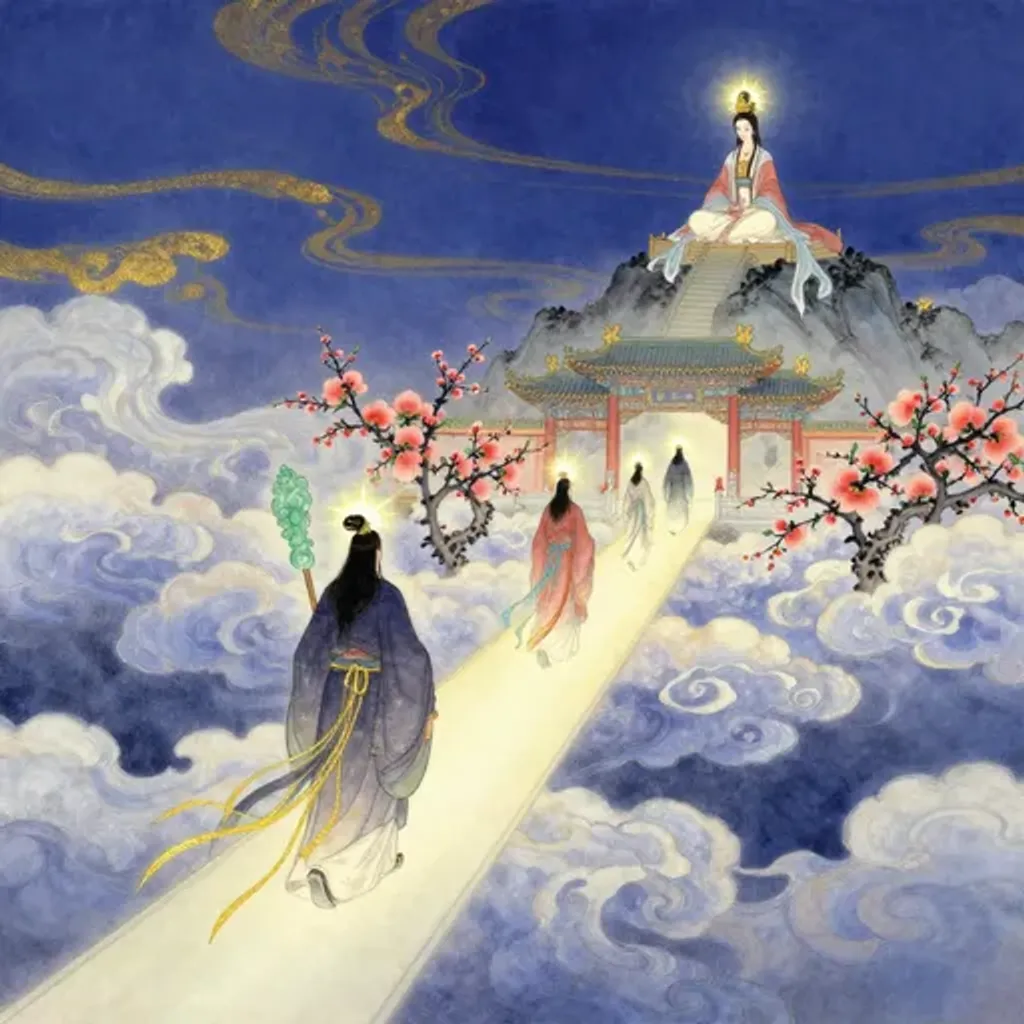
戴堯扶禹,從喬彭祖,西過王母,道里夷易,無敢難者。
Bearing Yao, supporting Yu; following Qiao and Pengzu. Traveling west past the Queen Mother; the road is level and easy. None dare obstruct the way.
— Jiao Yanshou, Yilin (Forest of Changes), 1st century BC
Commentary
Doubled fire meets the mountain resting upon earth: brilliance reveres the ancients to forestall collapse. One carries the legacy of Yao and supports the work of Yu, follows in the footsteps of the noble Pengzu. Journeying west past the Queen Mother of the West, the road is smooth and easy; none dare oppose the way. The verse assembles a pantheon of longevity and sagely protection: Yao the sage-king, Yu the flood-tamer, Pengzu the eight-hundred-year immortal, and the Queen Mother who guards the peaches of eternal life. From The Clinging to Splitting Apart, fire's illumination meets the image of a mountain slowly eroding upon the earth. To prevent the collapse of civilized order, one must invoke the deepest reserves of ancestral wisdom and transcendent protection.
離 → 復
Hexagram 30 → Hexagram 24: Return
Changing lines: 3, 4, 6
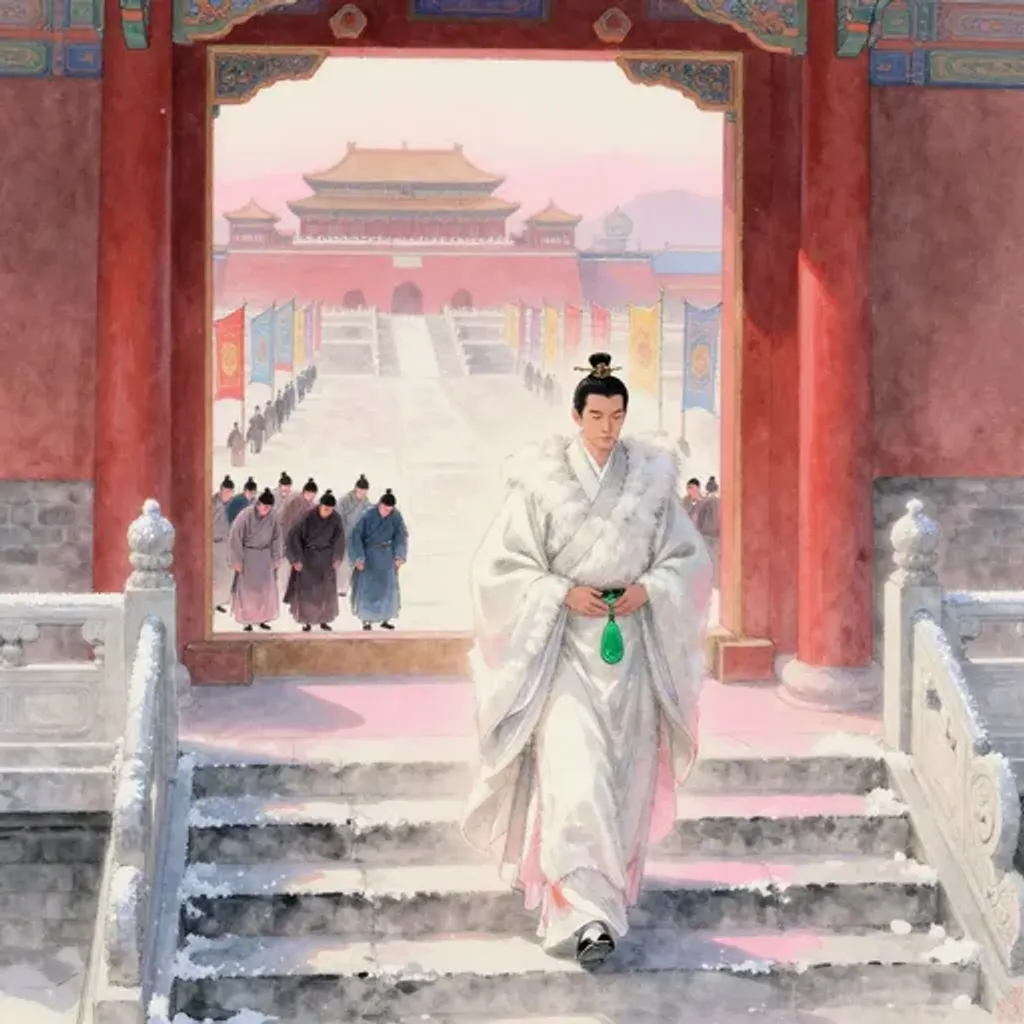
羔羊皮革,君子朝服,輔政天德,以合萬國。
Lambskin robes of soft leather; the noble man's court attire. Assisting governance with heaven's virtue; thereby uniting the ten thousand states.
— Jiao Yanshou, Yilin (Forest of Changes), 1st century BC
Commentary
Doubled fire meets thunder returning within the earth: brilliance rediscovers its primal source. Lambskin garments serve as the gentleman's court attire. Assisting governance with heaven's virtue, he unites the myriad states. The 'lambskin robe' (gaoyang pige) echoes the Shijing ode 'Gao Qiu' praising ministers who dress simply but serve with integrity. Court dress made of humble lambskin rather than elaborate brocade signals a ruler who values substance over display. From The Clinging to Return, fire's restless outward radiance turns inward to find the single yang line stirring beneath the earth. The return to first principles — simple garments, genuine virtue — is what truly unites an empire, not brilliance projected outward but moral light rediscovered at the root.
離 → 无妄
Hexagram 30 → Hexagram 25: Innocence
Changing lines: 3, 5
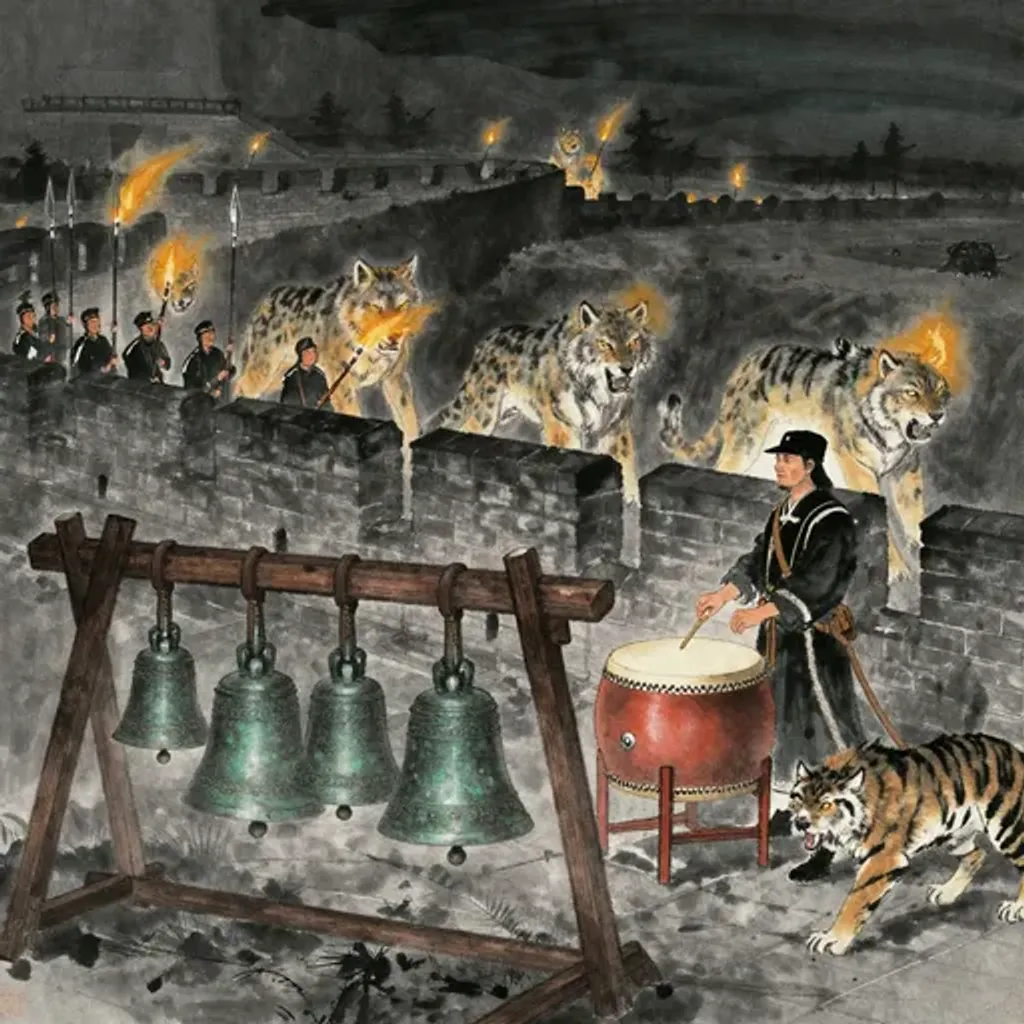
據鐘鼓翼,將軍受福,安帖之家,虎狼與憂,履危不強,師行何咎。
Leaning on bells and drums, spreading wings; the general receives his blessings. Pacifying the household; yet tigers and wolves bring worry. Treading danger without force; what blame in the army's march?
— Jiao Yanshou, Yilin (Forest of Changes), 1st century BC
Commentary
Doubled fire meets thunder beneath heaven: brilliance encounters the unexpected. One takes position by the bells and drums and spreads protective wings; the general receives blessing. His household is pacified, yet wolves and tigers share the worry. Treading danger without forcing the issue, the army marches — what blame can there be? The verse juxtaposes ceremonial authority (bells and drums) with lurking peril (wolves and tigers), suggesting a commander who must maintain both ritual dignity and military readiness. From The Clinging to Innocence, fire's deliberate clarity meets heaven's spontaneous thunder. The true general acts without artifice, responding to each threat as it arises rather than manufacturing conflict, treading through danger with the guileless confidence that heaven rewards the unexpected but sincere.
離 → 大畜
Hexagram 30 → Hexagram 26: Great Taming
Changing lines: 2, 4
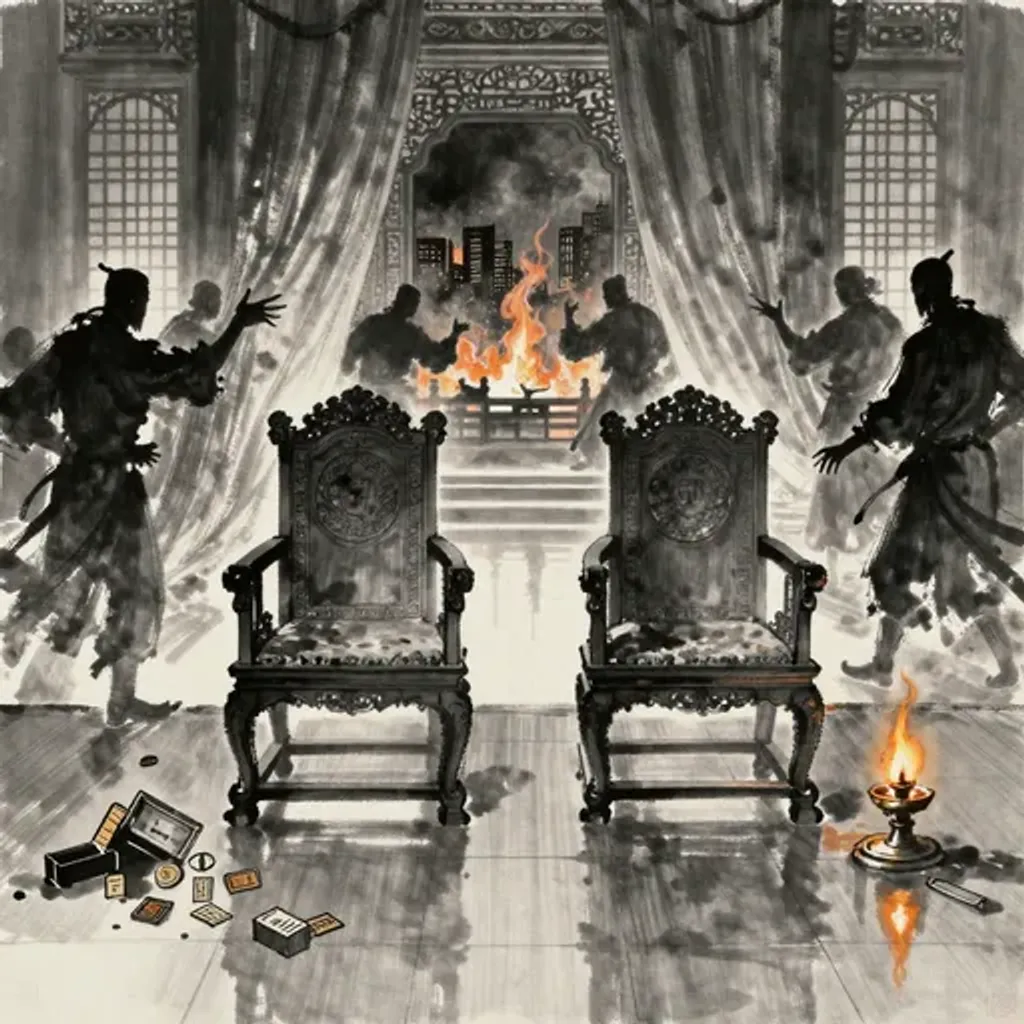
嫡庶不明,孽亂生殃,陳失其邦。
Legitimate and concubine-born unclear; disorder among the heirs breeds calamity. Chen loses its domain.
— Jiao Yanshou, Yilin (Forest of Changes), 1st century BC
Commentary
Doubled fire meets heaven stored within the mountain: brilliance reveals a fatal flaw in what was carefully accumulated. The distinction between legitimate and illegitimate heirs is unclear; disorder among concubines' sons breeds catastrophe, and the state of Chen loses its domain. The verse alludes to the chronic succession crises of the state of Chen, where confusion between principal wives' and concubines' sons repeatedly destabilized the ruling house. Ultimately, internal strife invited Chu's annexation. From The Clinging to Great Taming, fire's penetrating clarity exposes what the mountain sought to contain. Great Taming stores heaven's power within the mountain's discipline, but when the most fundamental distinction — legitimate versus illegitimate — is obscured, the accumulated strength implodes, and the state collapses from within.
離 → 頤
Hexagram 30 → Hexagram 27: Nourishment
Changing lines: 3, 4
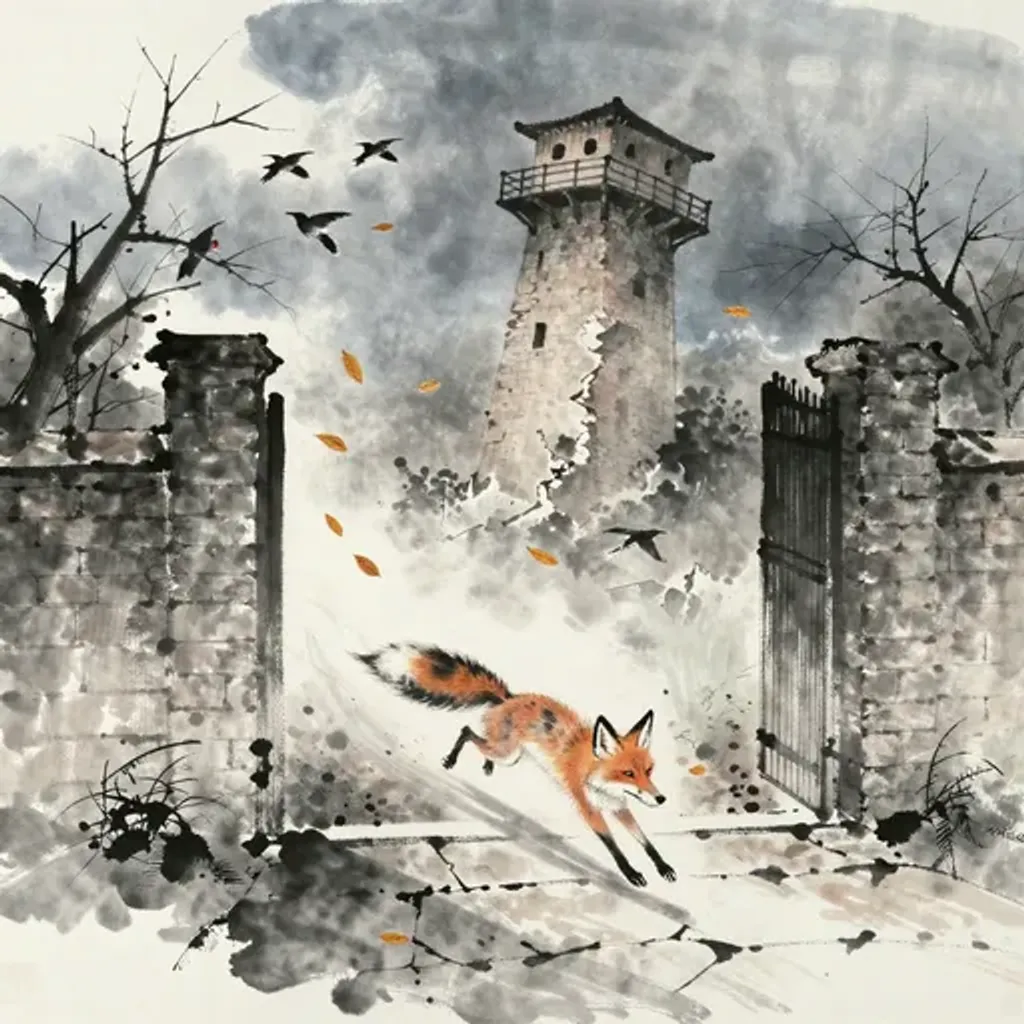
鳥驚狐鴻,國亂不寧,上弱下強,為陰所刑。
Birds startled, foxes and geese in flight; the state is in turmoil, without peace. The higher is weak, the lower is strong; punished by the forces of shadow.
— Jiao Yanshou, Yilin (Forest of Changes), 1st century BC
Commentary
Doubled fire meets the mountain above thunder: brilliance illuminates a realm where nourishment has been perverted. Birds startle, foxes scatter, and the wild goose flees; the state is in turmoil, never at peace. Those above are weak while those below are strong, and the ruler is punished by yin forces. The verse paints a landscape of inverted hierarchy: predators scatter like prey, the sovereign cowers before his ministers, and the feminine principle subjugates the masculine. From The Clinging to Nourishment, fire's clarity reveals the mountain over thunder — an open mouth that should receive sustenance. Yet when the strong occupy the lower position and the weak sit above, nourishment becomes poisonous, and the realm starves even as it feeds on its own disorder.
離 → 大過
Hexagram 30 → Hexagram 28: Great Exceeding
Changing lines: 1, 2, 5, 6
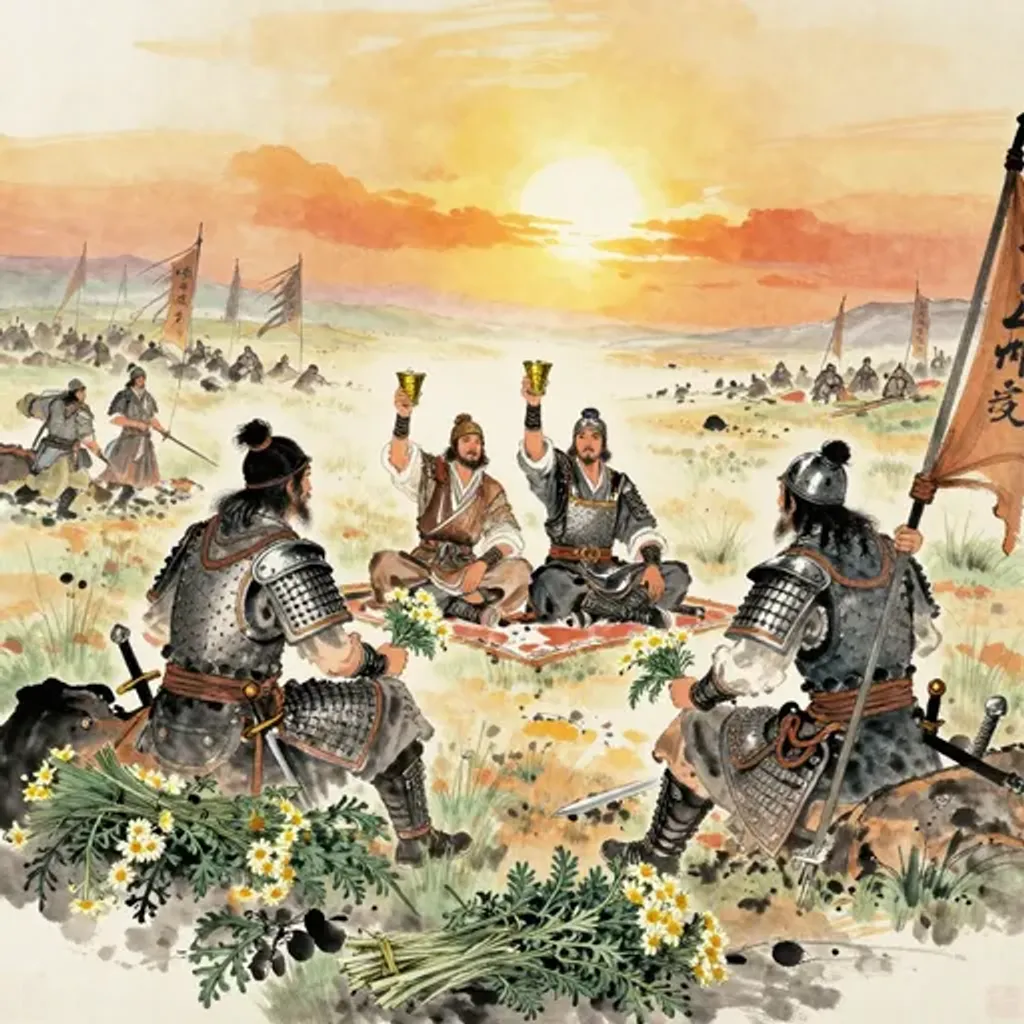
六月采芑,征伐無道,張仲方叔,克勝飲酒。
In the sixth month, gathering artemisia; campaigning to punish the lawless. Zhang Zhong and Fang Shu; victorious, they drink wine together.
— Jiao Yanshou, Yilin (Forest of Changes), 1st century BC
Commentary
Doubled fire meets the lake submerging wind: brilliance pushes beyond ordinary limits. In the sixth month, one gathers the qi-herb and sets forth to punish the unjust. Zhang Zhong and Fang Shu achieve victory and celebrate with wine. This alludes to two Shijing odes from the Xiao Ya section. 'Liu Yue' (Sixth Month) celebrates Yin Jifu's campaign against the Xianyun, with 'Zhang Zhong' praised for filial virtue. 'Cai Qi' celebrates Fang Shu's southern expedition, where gathering the qi-herb signals mustering troops. From The Clinging to Great Exceeding, fire's brilliance drives action beyond the normal framework. The righteous campaign succeeds precisely because it dares to exceed convention, and the victors' wine-drinking marks the extraordinary nature of a mission accomplished against the odds.
離 → 坎
Hexagram 30 → Hexagram 29: The Abysmal Water
Changing lines: 1, 2, 3, 4, 5, 6
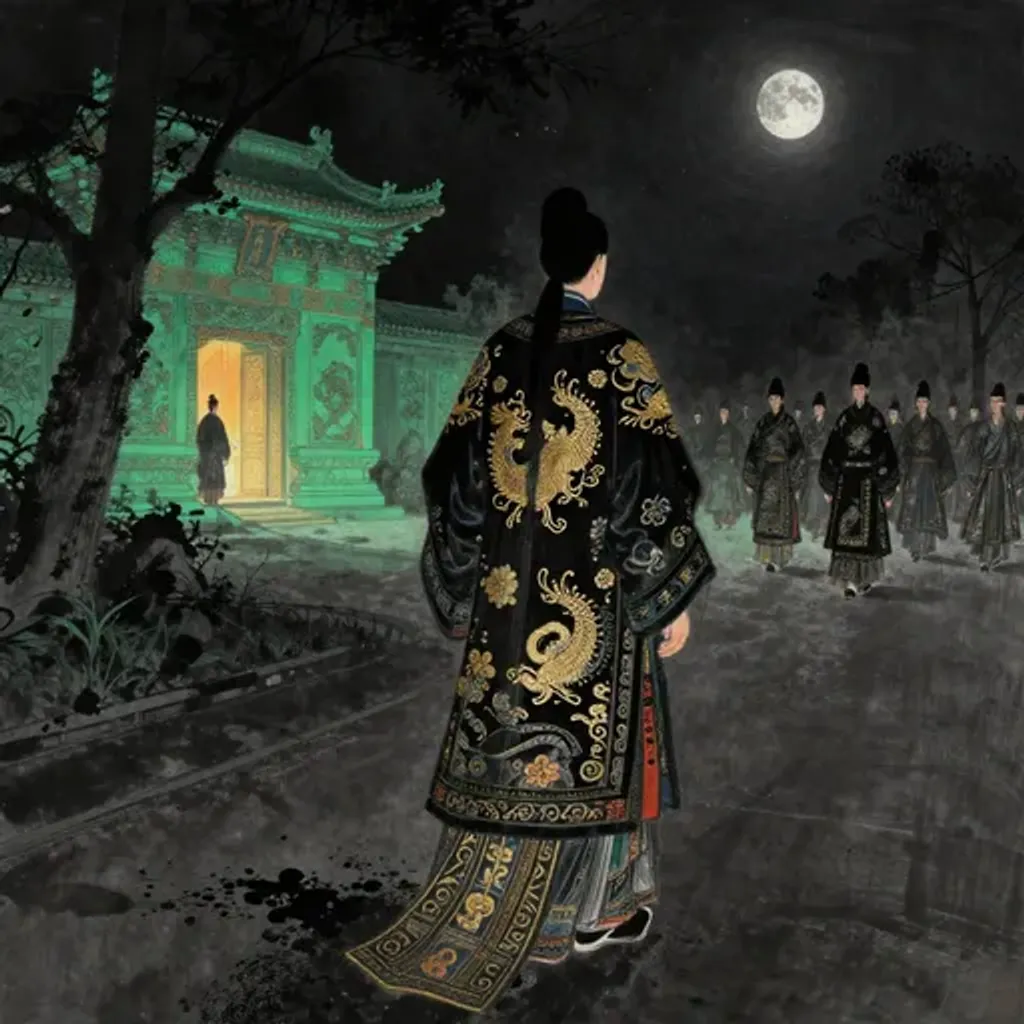
被綉夜行,不見文章,安坐玉堂,乃無咎殃,長子帥師,得其正常。
Wearing brocade, walking by night; the fine patterns go unseen. Sitting calmly in the jade hall; thus there is no blame or misfortune. The eldest son leads the army; he achieves proper order.
— Jiao Yanshou, Yilin (Forest of Changes), 1st century BC
Commentary
Doubled fire meets doubled water: brilliance enters the abyss and must learn to conceal its splendor. Wearing embroidered robes at night, no one can see the patterns. Yet sitting calmly in the jade hall brings no calamity; the eldest son leads the army and achieves proper order. 'Brocade worn at night' (bei xiu ye xing) is a classical image of wasted brilliance — the finest garment invisible in darkness. The verse counsels that in times of danger, restraint surpasses display. From The Clinging to The Abysmal, fire descends into water's repeated peril. The one who accepts that brilliance must sometimes go unseen, who sits still in the hall rather than parading through the dark, preserves both himself and the mission. The eldest son's disciplined command embodies fire's clarity channeled through water's constant practice.
離 → 離
Hexagram 30 → Hexagram 30: The Clinging Fire
No changing lines — the hexagram is unchanged
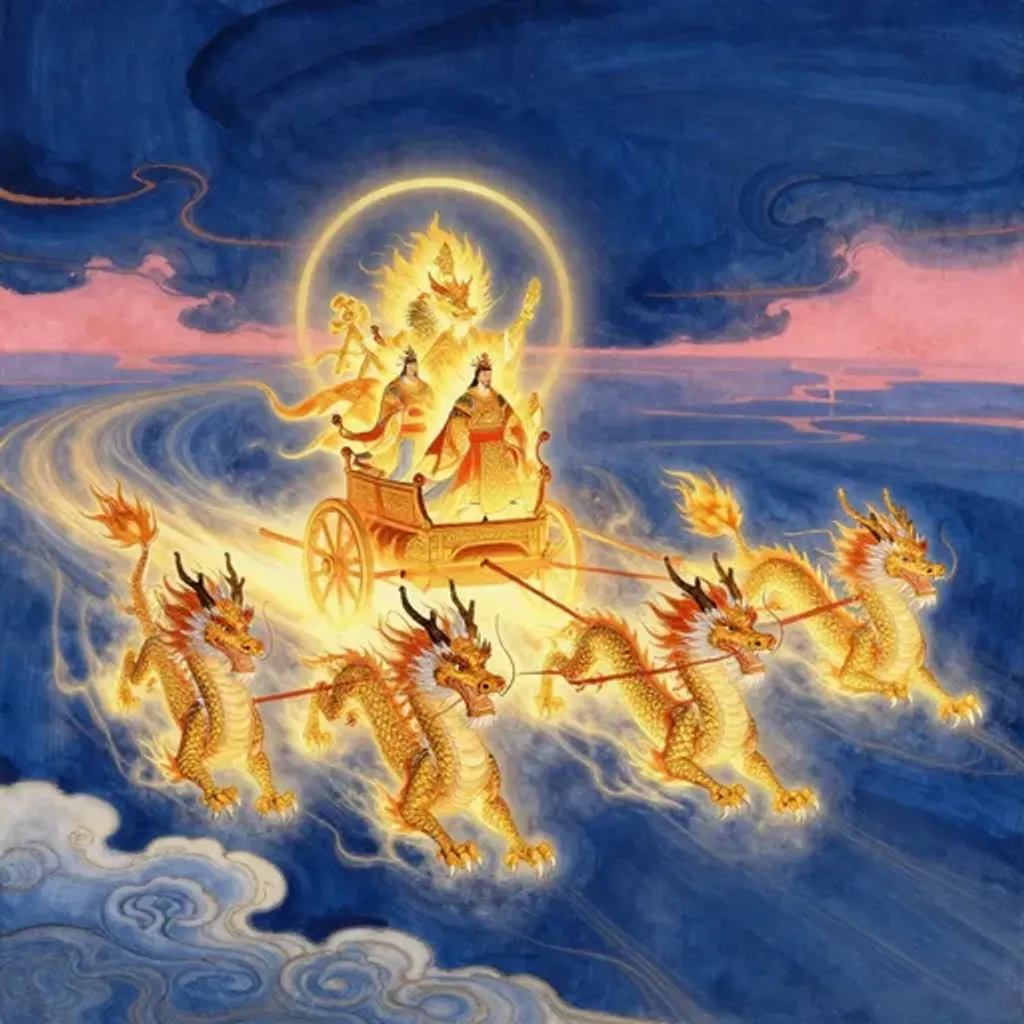
時乘六龍,為帝使東,達命宣旨,無所不通。
Riding the six dragons in season; serving as the emperor's envoy to the east. Proclaiming the mandate, declaring the edict; nothing that does not reach through.
— Jiao Yanshou, Yilin (Forest of Changes), 1st century BC
Commentary
Doubled fire meets itself: pure brilliance sustained. Riding the six dragons in season, one serves as the emperor's envoy to the east, proclaiming mandates and conveying edicts with nothing beyond reach. 'Riding the six dragons in season' quotes directly from the I-Ching's Qian hexagram commentary (Wenyan): the sage rides the six dragons to traverse the heavens. Here the envoy carries imperial light in all directions. From The Clinging to The Clinging, fire renews fire in perpetual succession. The great person 'continues brightness to illuminate the four quarters' — this is the hexagram's own image text made flesh. There is no transformation to manage, only the challenge of sustaining radiance without burnout, which the verse resolves through service: light that travels outward on behalf of another never exhausts itself.
離 → 咸
Hexagram 30 → Hexagram 31: Influence
Changing lines: 1, 5, 6
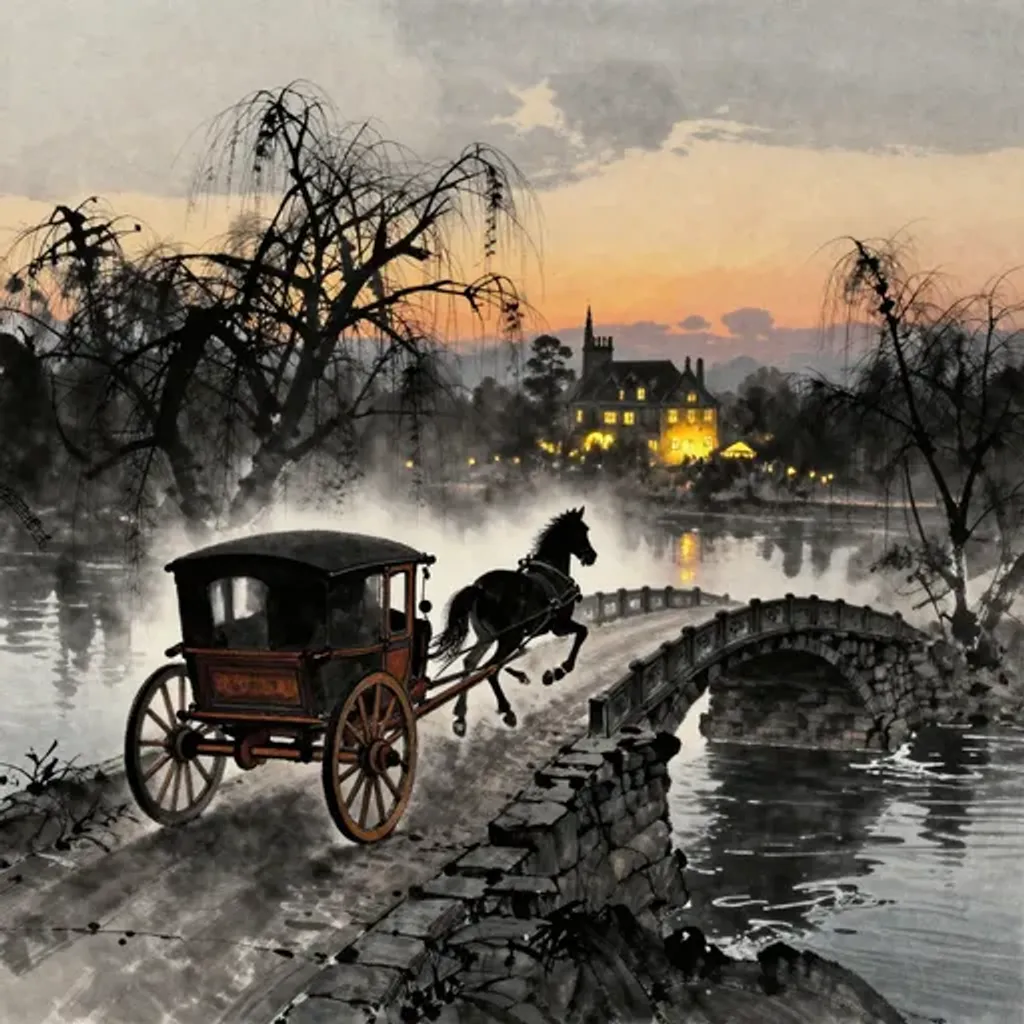
昧暮乘車,東至伯家,踰梁越河,濟脫無他。
At dusk and nightfall, mounting the carriage; traveling east to the elder's house. Crossing beams, fording the river; safely delivered without mishap.
— Jiao Yanshou, Yilin (Forest of Changes), 1st century BC
Commentary
Doubled fire meets the lake upon the mountain: brilliance discovers mutual resonance. In the dim twilight, one boards a carriage and travels east to the elder's house. Crossing bridges and fording rivers, one arrives safely without mishap. The verse describes a journey undertaken at dusk — a moment of vulnerability — yet completed successfully through trust and momentum. Traveling to the 'elder's house' (bo jia) suggests seeking counsel or alliance with a respected figure. From The Clinging to Influence, fire's active clarity meets the lake resting upon the mountain in the image of mutual attraction. The journey through darkness succeeds because both parties are drawn toward connection, the traveler and the host resonating like the mountain and lake that share their moisture.
離 → 恆
Hexagram 30 → Hexagram 32: Duration
Changing lines: 1, 2, 6
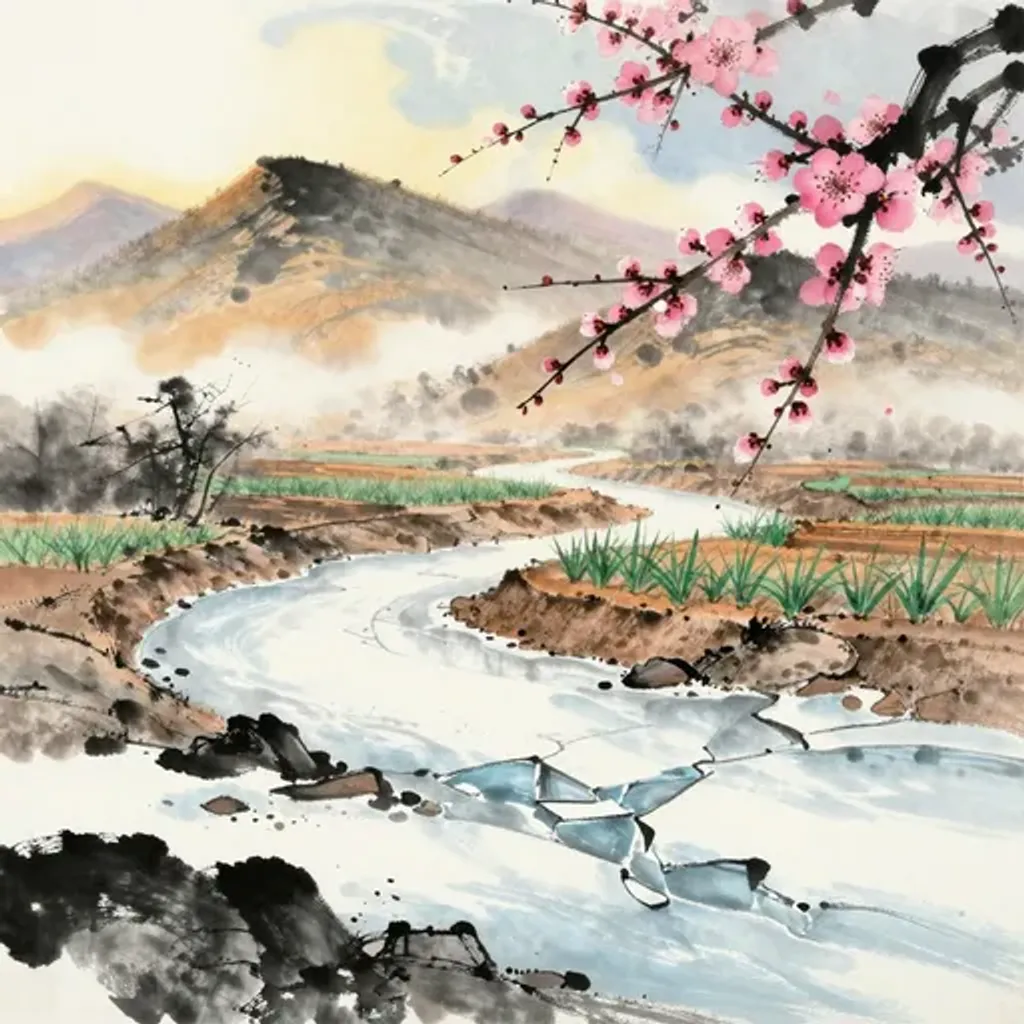
東風解凍,和氣兆升,年歲豐登。
The east wind thaws the ice; warm breath stirs and rises. The harvest year is rich and bountiful.
— Jiao Yanshou, Yilin (Forest of Changes), 1st century BC
Commentary
Doubled fire meets thunder and wind in enduring union: brilliance warms into lasting fertility. The east wind thaws the frozen earth, harmonious energy rises in response, and the harvest year brings abundance. The verse is pure seasonal imagery: the east wind of spring dissolves winter's grip, yang energy ascends, and agricultural prosperity follows naturally. No historical allusion is needed when nature itself provides the lesson. From The Clinging to Duration, fire's warmth sustains the eternal partnership of thunder and wind. The transformation reveals that true constancy is not static preservation but the rhythmic renewal of fire becoming warmth, warmth releasing frozen potential, and released potential yielding abundance — a cycle that endures because it never ceases to move.
離 → 遯
Hexagram 30 → Hexagram 33: Retreat
Changing lines: 1, 5
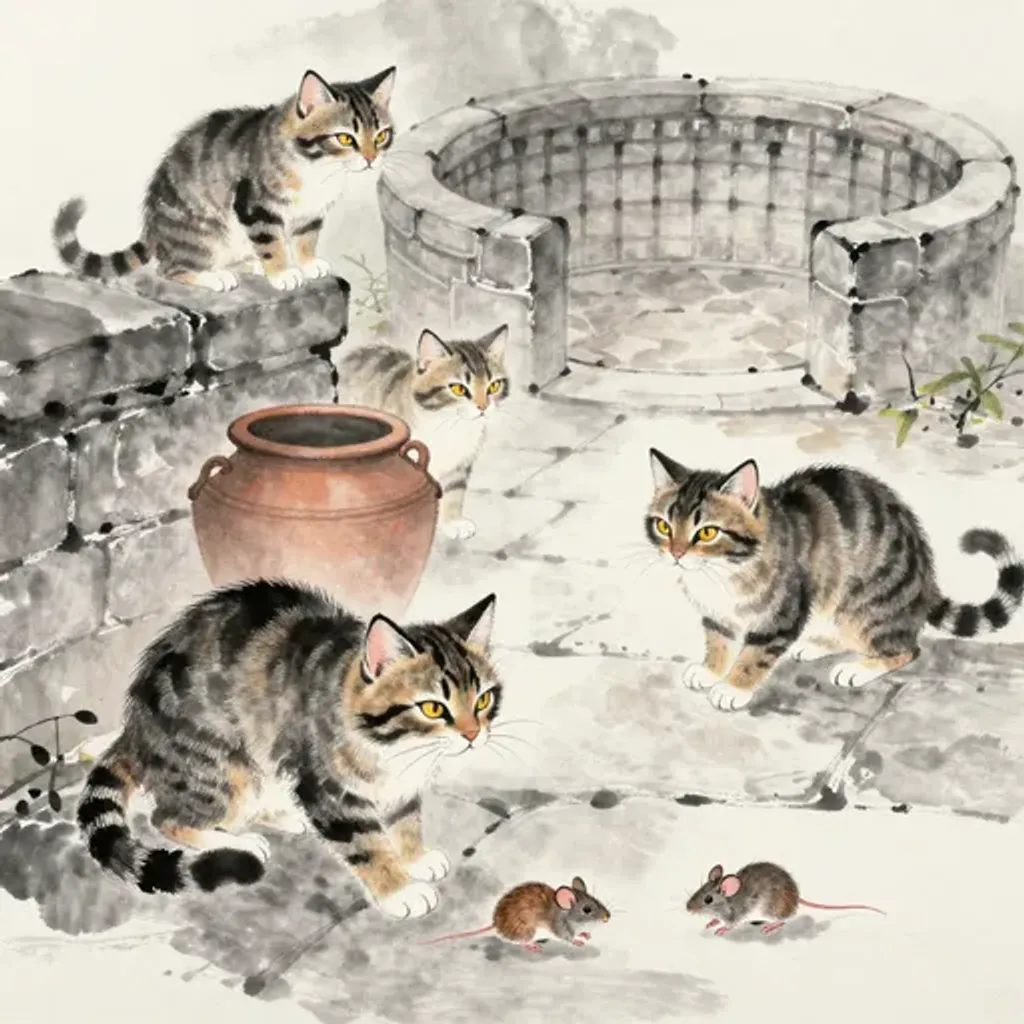
三貍搏鼠,遮遏前後,無於圜域,不得脫走。
Three wildcats hunt the mouse; blocking and trapping front and rear. Within the walled enclosure; it cannot escape and flee.
— Jiao Yanshou, Yilin (Forest of Changes), 1st century BC
Commentary
Doubled fire meets heaven above the mountain: brilliance cannot find its escape. Three wildcats hunt a mouse, blocking its path front and rear. Trapped within the encirclement, the prey cannot break free. The image is stark: three predators closing in on a single victim in a confined space, with all exits sealed. The verse offers no resolution and no rescue. From The Clinging to Retreat, fire's clarity meets the mountain sheltering beneath heaven — the very image of strategic withdrawal. Yet the verse describes the failure of retreat: when one waits too long to withdraw, the encirclement closes and escape becomes impossible. The wildcats represent circumstances that have already outflanked the prey, making the hexagram's counsel of timely retreat a warning arrived too late.
離 → 大壯
Hexagram 30 → Hexagram 34: Great Power
Changing lines: 2, 6
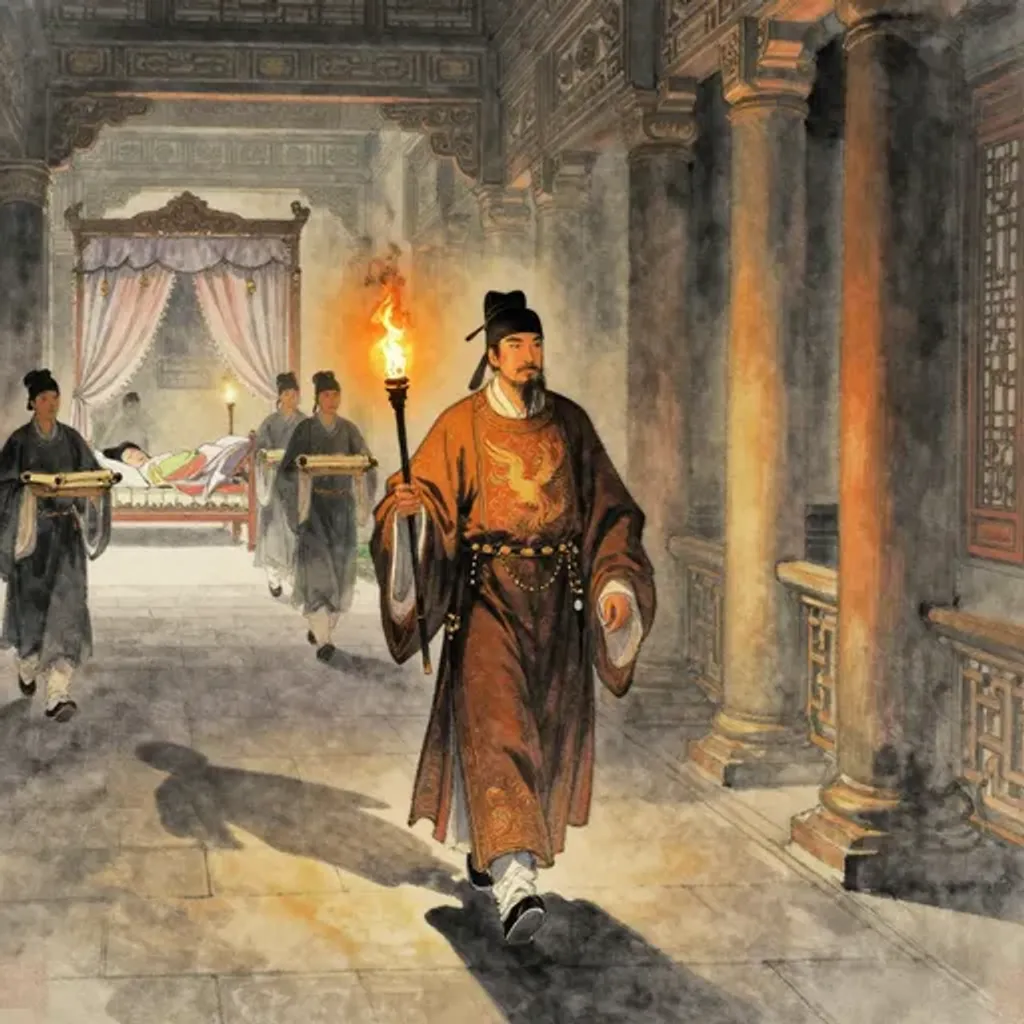
綏德孔明,履祿久長,貴且有光,疾病憂傷。
Cultivating virtue, brilliantly wise; treading the path of fortune, enduring and long. Noble and resplendent; yet illness and sorrow attend.
— Jiao Yanshou, Yilin (Forest of Changes), 1st century BC
Commentary
Doubled fire meets thunder above heaven: brilliance expands into magnificent power. One cultivates virtue with great clarity, treading the path of enduring prosperity — noble and radiant. Yet the verse closes with 'illness and sorrowful distress,' undercutting the splendor. The phrase 'Sui De Kong Ming' evokes the idea of cultivating virtue with Kongming (great brightness), which resonates with the doubled fire of Li. From The Clinging to Great Power, fire's clarity meets thunder roaring above heaven. Great power amplified by fire becomes almost unbearably bright, and the verse warns that even the most magnificent rise carries within it the seed of exhaustion. Radiance pushed to its zenith inevitably encounters decline, and the illness that follows glory is the body's protest against a brilliance that burned too hot.
離 → 晉
Hexagram 30 → Hexagram 35: Progress
Changing lines: 1, 3
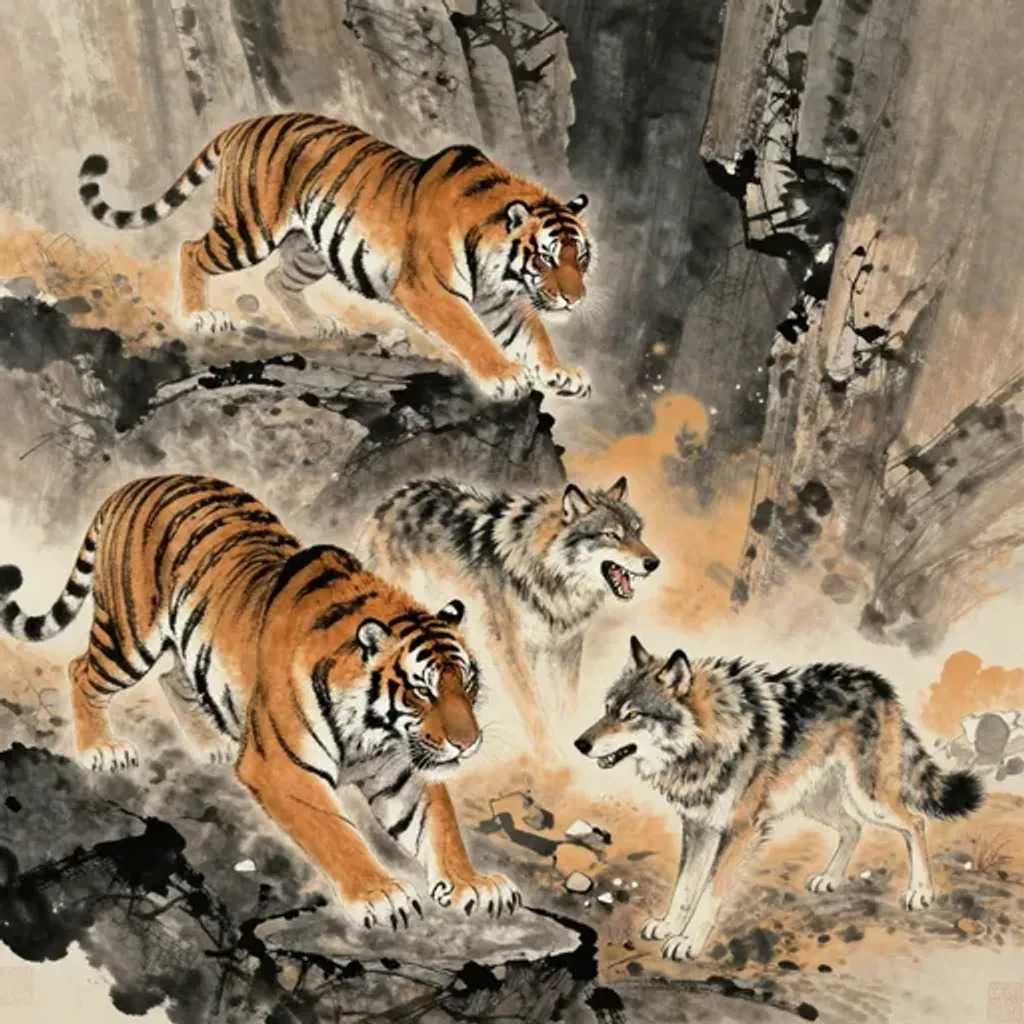
三虎搏狼,力不相當,如摧壅祐,一擊破亡。
Three tigers attack a wolf; the forces are unmatched. Like toppling a dam's support; one strike and it is destroyed.
— Jiao Yanshou, Yilin (Forest of Changes), 1st century BC
Commentary
Doubled fire meets fire rising from the earth: brilliance advances with irresistible momentum. Three tigers set upon a wolf, the disparity of force beyond question. Like smashing through a crumbling barricade, a single strike shatters it to ruin. The verse celebrates overwhelming advantage deployed decisively. Three tigers against one wolf is no contest; the obstacle collapses at the first blow. From The Clinging to Progress, fire's clarity is amplified as it rises above the earth — brightness emerging from darkness in the image of the morning sun. The advance succeeds not through cunning but through superior force concentrated at the decisive point, where hesitation would be the only possible mistake.
離 → 明夷
Hexagram 30 → Hexagram 36: Darkening of the Light
Changing lines: 4, 6
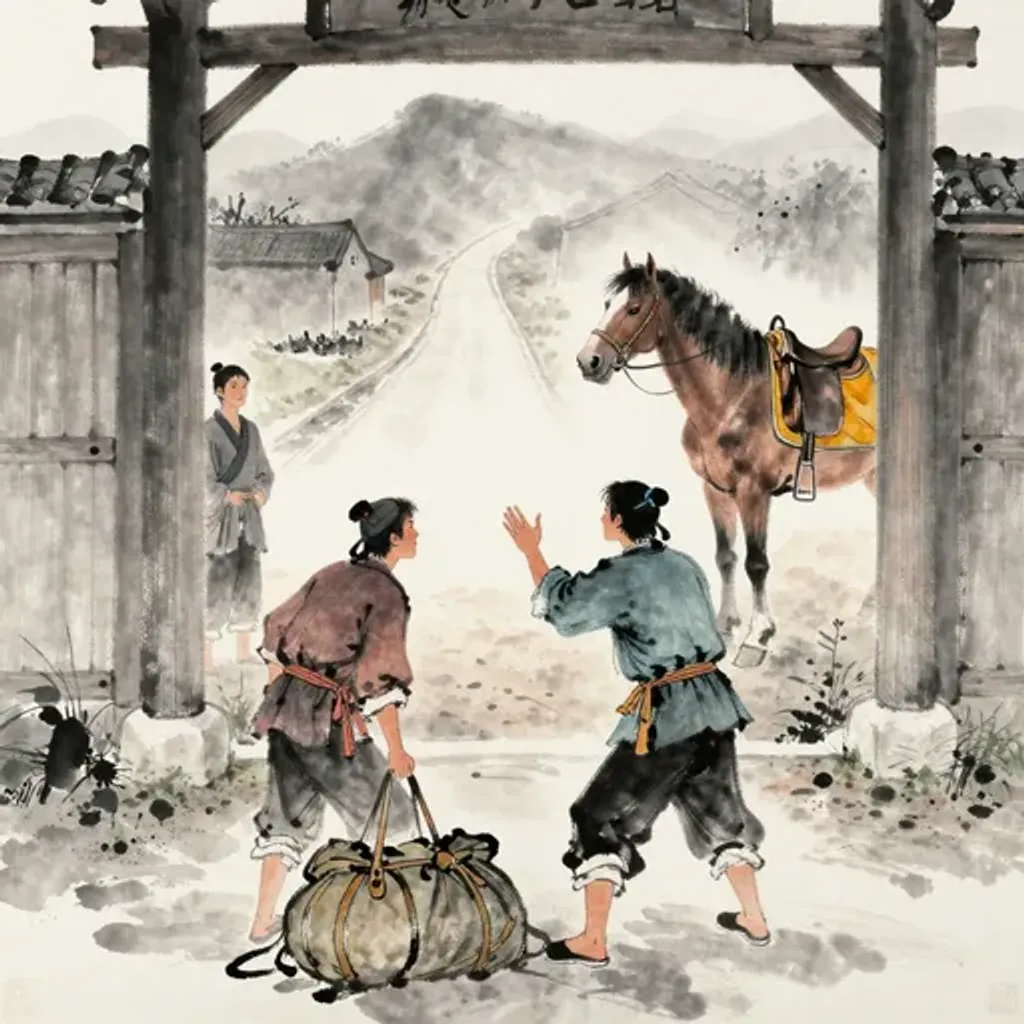
使伯東乘,恨不肯行,與叔爭訟,更相毀傷。
Sending the elder to ride east; resentful, he refuses to go. With the younger brother he quarrels and disputes; each inflicting further harm upon the other.
— Jiao Yanshou, Yilin (Forest of Changes), 1st century BC
Commentary
Doubled fire meets fire sinking into the earth: brilliance descends into darkness. The elder brother is sent eastward on a mission but resents the journey and refuses to go. He quarrels with the younger brother, and the two inflict mutual wounds. The verse depicts fraternal strife born from resentment of duty. One brother refuses his assignment; the other challenges him; both are damaged. From The Clinging to Darkening of the Light, fire's illumination is driven underground. The image of brightness entering the earth suggests a time when clarity itself becomes dangerous — those who see clearly are wounded, and those who resist their calling wound others. The brothers' mutual destruction embodies a household where light has turned against itself, each flame consuming the other.
離 → 家人
Hexagram 30 → Hexagram 37: The Family
Changing lines: 4, 5
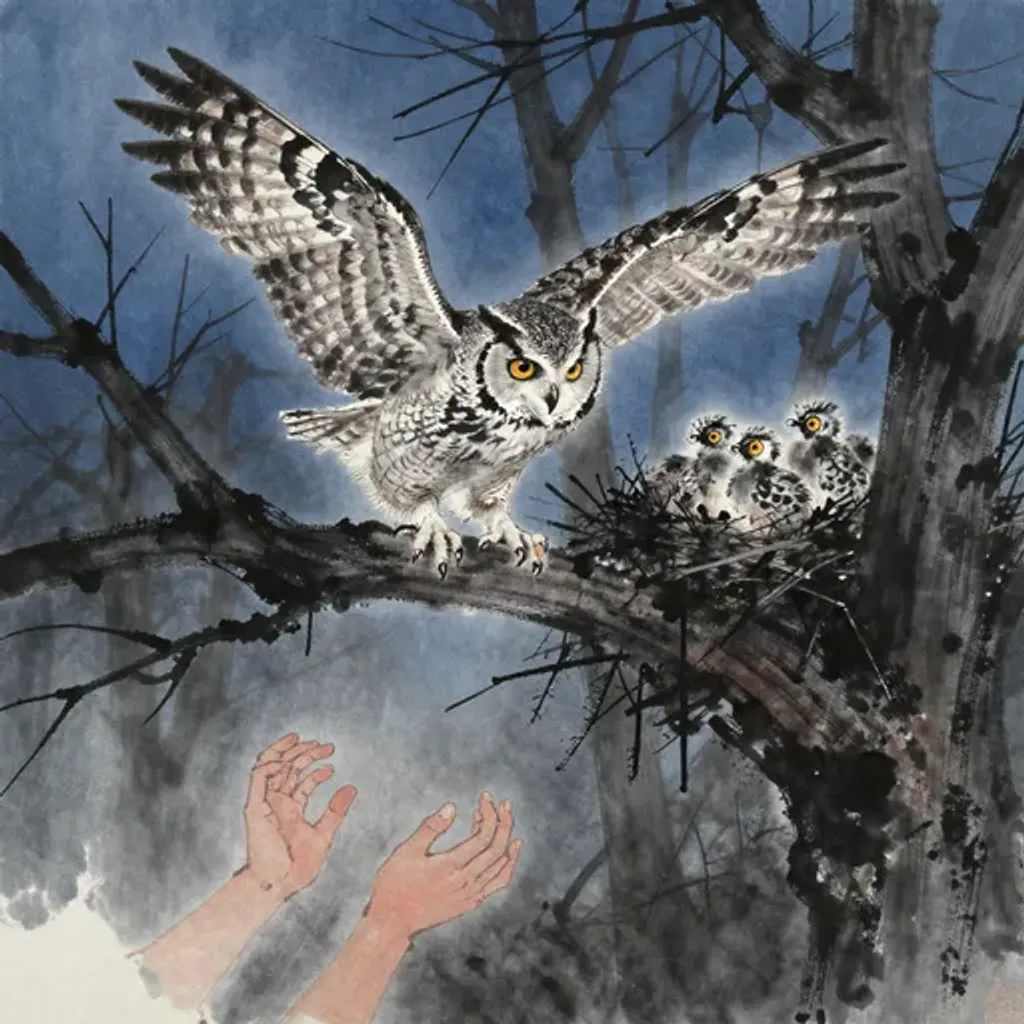
抱空握虛,鴞驚我雛,利去不來。
Embracing emptiness, grasping the void; an owl startles my nestlings. Gain departs and does not return.
— Jiao Yanshou, Yilin (Forest of Changes), 1st century BC
Commentary
Doubled fire meets wind issuing from fire: brilliance seeks household order but grasps only emptiness. Embracing the void and clutching at nothing, an owl startles the nestlings. Profit departs and does not return. The owl in classical Chinese poetry is an ill-omened bird that devours its own mother's young — the Shijing ode 'Chi Xiao' uses it as a metaphor for enemies threatening the Duke of Zhou's fledgling state. Here the owl disrupts the household, scattering the young while the parent grasps at air. From The Clinging to The Family, fire should nurture the wind that carries warmth outward. Yet when the household's inner fire produces only smoke and predators, the family disperses and prosperity vanishes, leaving hands clutching at what was never solid.
離 → 睽
Hexagram 30 → Hexagram 38: Opposition
Changing lines: 2, 3
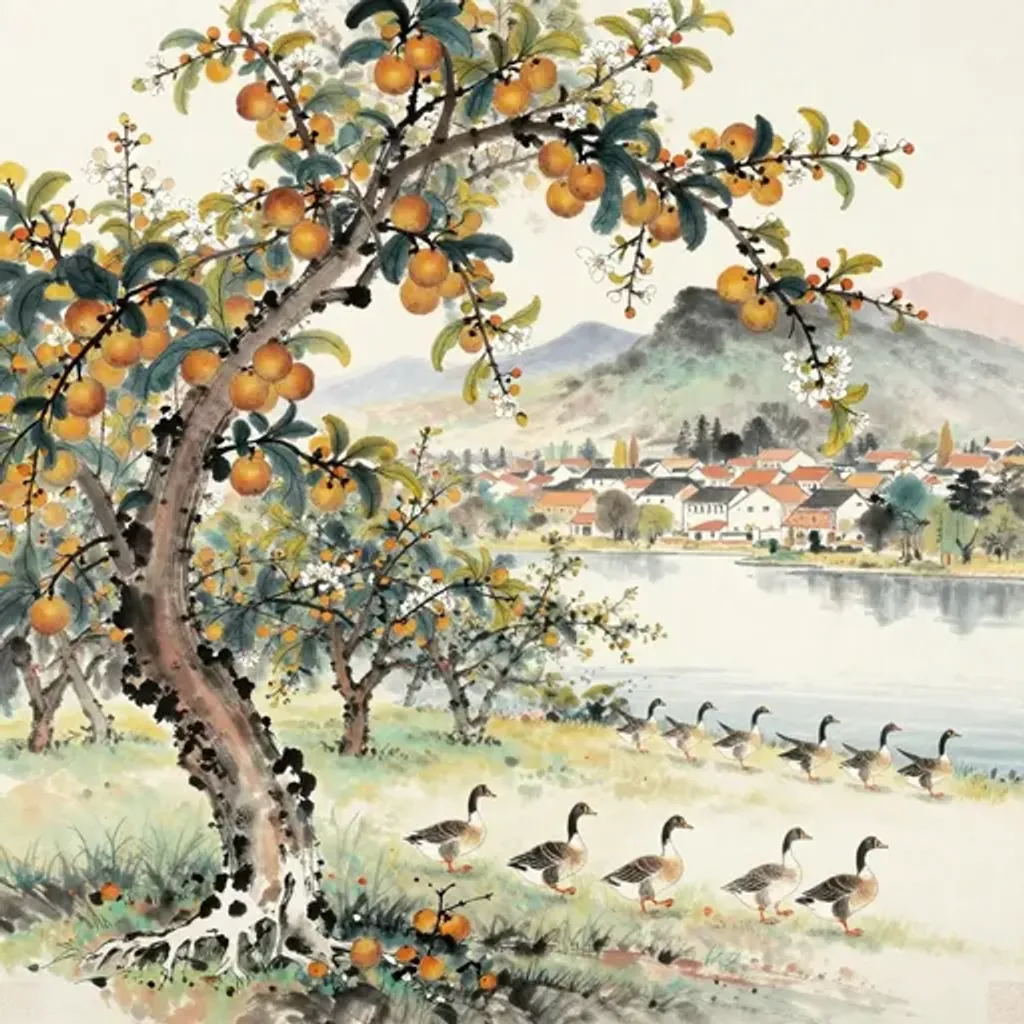
李花再實,鴻升降集,仁哲以興,隆國無賊。
Plum blossoms fruit a second time; wild geese rise and descend in gathering. The benevolent and the wise together flourish; exalting the state, no plunderers come.
— Jiao Yanshou, Yilin (Forest of Changes), 1st century BC
Commentary
Doubled fire meets fire above the lake: brilliance finds unity through apparent opposition. The plum tree bears fruit a second time; the wild goose rises, descends, and gathers. The humane and wise ascend together, elevating the state without threat of harm. A plum tree fruiting twice in one season is an omen of extraordinary fertility — nature exceeding its own cycle. The wild goose's rising and gathering suggests scattered elements returning to order. From The Clinging to Opposition, fire above and lake below move apart yet illuminate each other. The verse reveals that what appears contradictory — a second fruiting, departure followed by return — actually signals a deeper coherence. When the wise govern, even opposites harmonize, and the state flourishes through the creative tension of difference held in unity.
離 → 蹇
Hexagram 30 → Hexagram 39: Obstruction
Changing lines: 1, 4, 5, 6
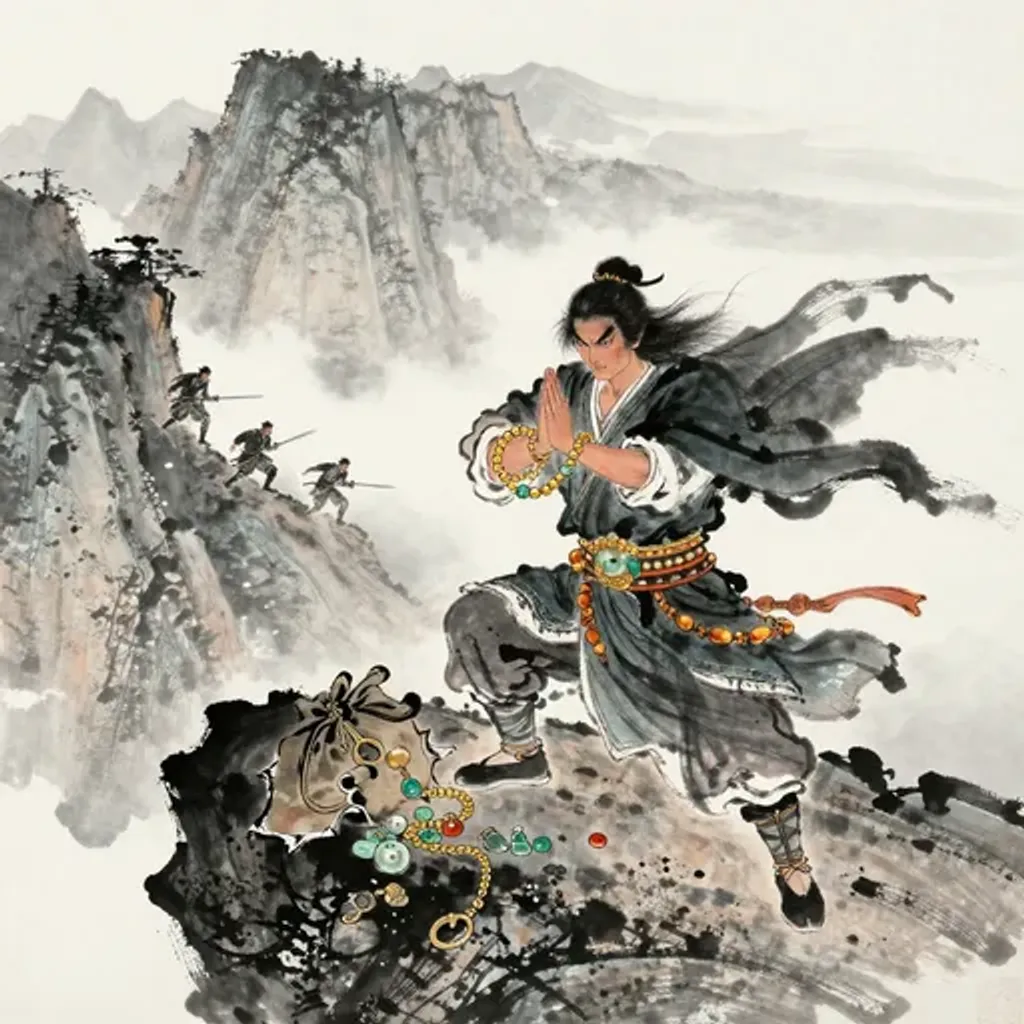
東山皋洛,勇捍不服,金玦玩好,衣為身賊。
East Mountain and Gaoluo; brave and defiant, refusing to submit. Gold rings and fine playthings; garments become the body's undoing.
— Jiao Yanshou, Yilin (Forest of Changes), 1st century BC
Commentary
Doubled fire meets water upon the mountain: brilliance confronts obstruction born of indulgence. The eastern mountains and the Gao-Luo region breed warriors bold and insubordinate. Golden belt-hooks and fine playthings become the body's own enemy — the garments that should protect instead ensnare. The verse warns that luxury corrupts martial virtue. Warriors who deck themselves in gold lose the very toughness that made them formidable. From The Clinging to Obstruction, fire's clarity meets the mountain blocked by water above. The obstruction here is self-inflicted: those who should climb the mountain are weighed down by their own ornaments. Fire that illuminates vanity rather than virtue only deepens the impasse, and the brave who surrender to indulgence become their own worst obstacle.
離 → 解
Hexagram 30 → Hexagram 40: Deliverance
Changing lines: 1, 2, 3, 6
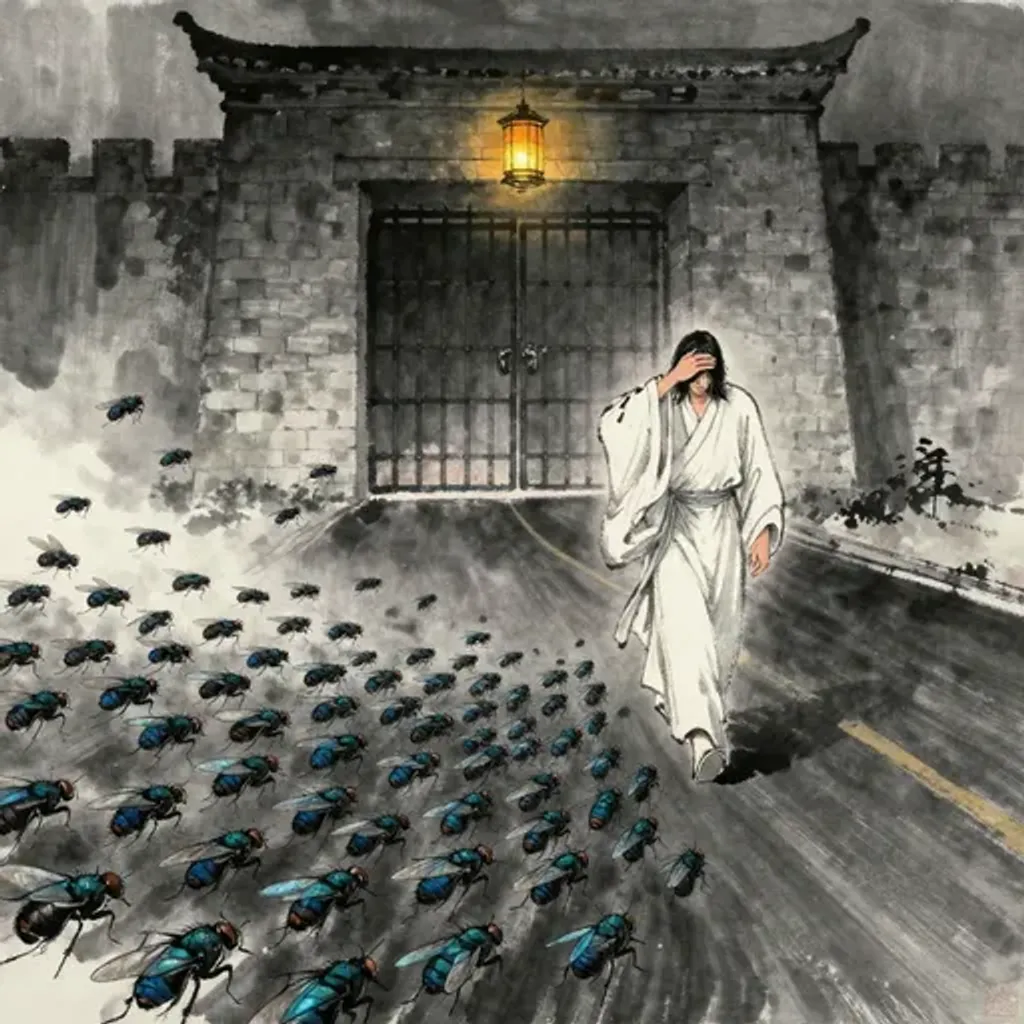
飛文污身,為邪所牽,青蠅分白,貞孝放逐。
Slander stains the person; dragged along by wickedness. Blue-bottle flies confound the white; the loyal and filial are banished.
— Jiao Yanshou, Yilin (Forest of Changes), 1st century BC
Commentary
Doubled fire meets thunder above water: brilliance seeks deliverance from slander. Ornate accusations stain the body; one is dragged down by wicked forces. Green flies confuse white and black, and the loyal and filial are banished. The 'green flies' (qingying) allusion comes from the Shijing ode 'Qing Ying,' which warns that buzzing flies settling on fences represent slanderers who distort truth and sow division between ruler and minister. The loyal are driven out precisely because their brightness attracts the flies' attention. From The Clinging to Deliverance, fire's penetrating clarity meets the liberating force of thunder over water. Deliverance from slander requires the cleansing storm: only when the thunder clears the air can the falsely accused find vindication and return from exile.
離 → 損
Hexagram 30 → Hexagram 41: Decrease
Changing lines: 2, 3, 4
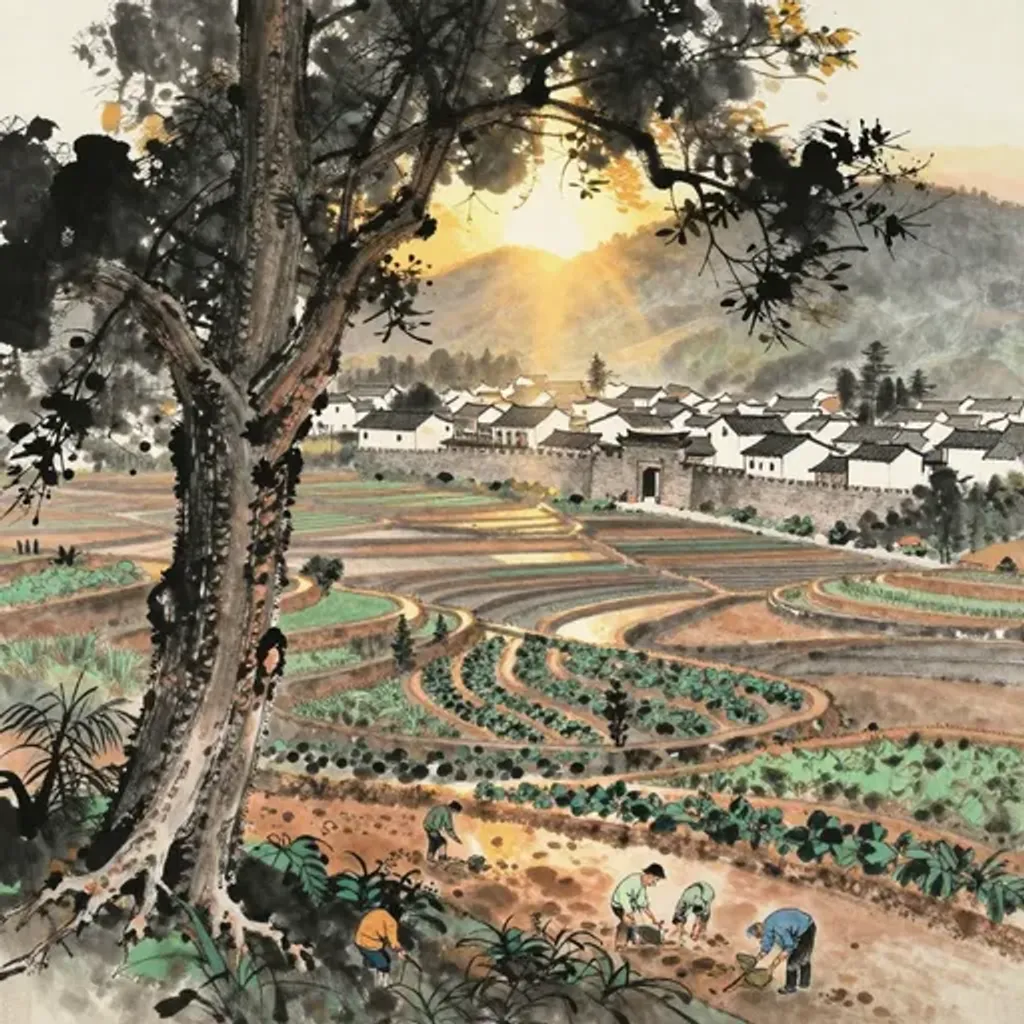
南山大木,文身其目,制命出令,東里田畝,尊主安居,鄭國無患。
Great tree of the southern mountain; patterned bark, watchful eyes. Issuing commands and edicts; eastern village, field and furrow. The honored lord dwells in peace; the state of Zheng is free from trouble.
— Jiao Yanshou, Yilin (Forest of Changes), 1st century BC
Commentary
Doubled fire meets the mountain above the lake: brilliance accepts strategic reduction. A great tree on the southern mountain has patterns carved upon its eye-knots. From this position of authority, commands and edicts issue forth. In the eastern quarter, fields are measured and cultivated; the honored lord resides in peace, and the state of Zheng knows no trouble. The verse evokes Zi Chan's governance of Zheng: reforming agriculture in the eastern fields, issuing clear laws, and maintaining order through disciplined administration. From The Clinging to Decrease, fire's restless brilliance accepts the mountain's counsel to restrain desire. Zi Chan's genius lay in knowing what to reduce — excess, waste, confusion — so that what remained was strong enough to keep Zheng safe between the great powers.
離 → 益
Hexagram 30 → Hexagram 42: Increase
Changing lines: 3, 4, 5
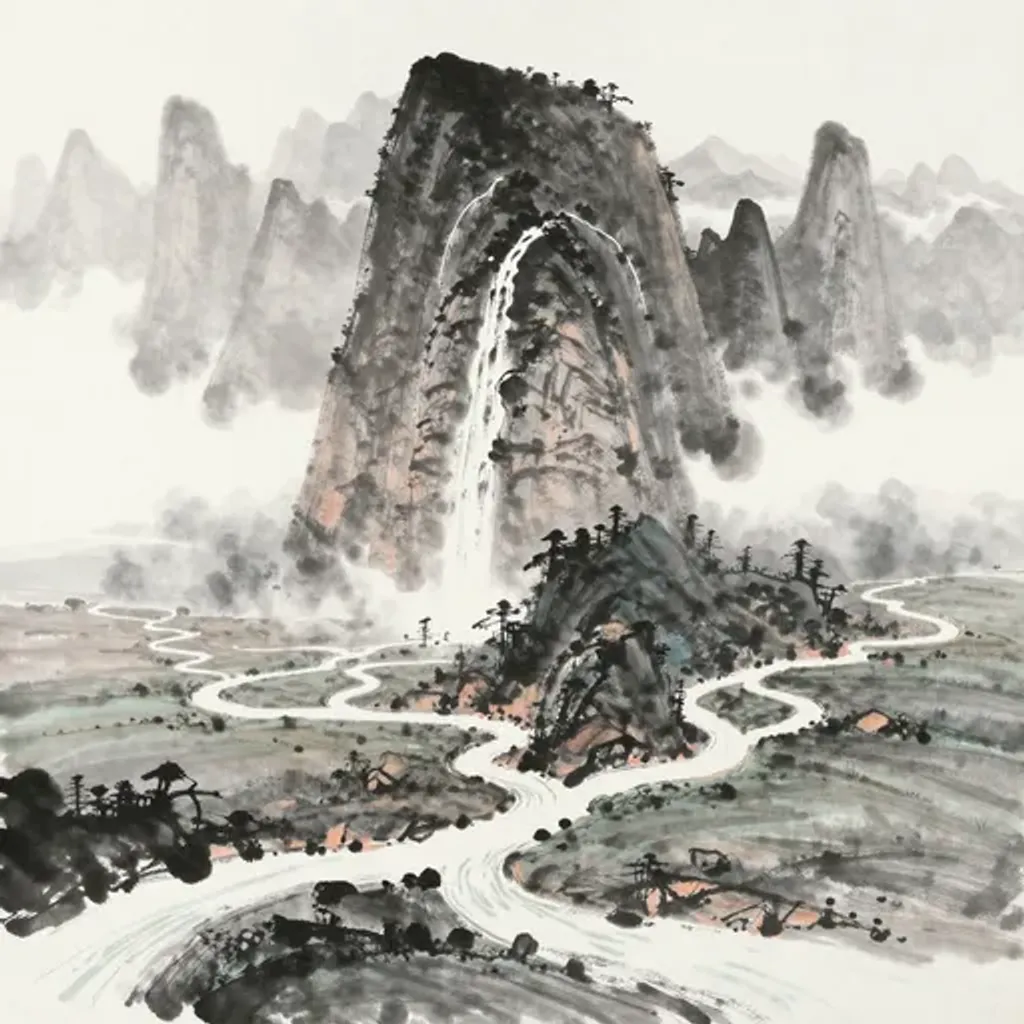
泉起崑崙,東出玉門,流為九河,無有憂患。
Springs arise from Kunlun; flowing east through the Jade Gate. Branching into the Nine Rivers; free from worry and trouble.
— Jiao Yanshou, Yilin (Forest of Changes), 1st century BC
Commentary
Doubled fire meets wind and thunder together: brilliance flows outward in generous increase. Springs rise at Kunlun, flow eastward through the Jade Gate, and branch into the Nine Rivers, bringing no calamity. The verse traces the mythological course of the Yellow River from its legendary source at Mount Kunlun through the Jade Gate Pass and into the nine channels that irrigate the Central Plains. This is pure beneficence: water flowing from the highest source to nourish the widest territory. From The Clinging to Increase, fire's radiance joins wind and thunder in a vision of boundless expansion. The transformation shows that true increase begins at the source and flows downward by natural law, unstoppable and beneficial to all it touches.
離 → 夬
Hexagram 30 → Hexagram 43: Breakthrough
Changing lines: 2, 5, 6
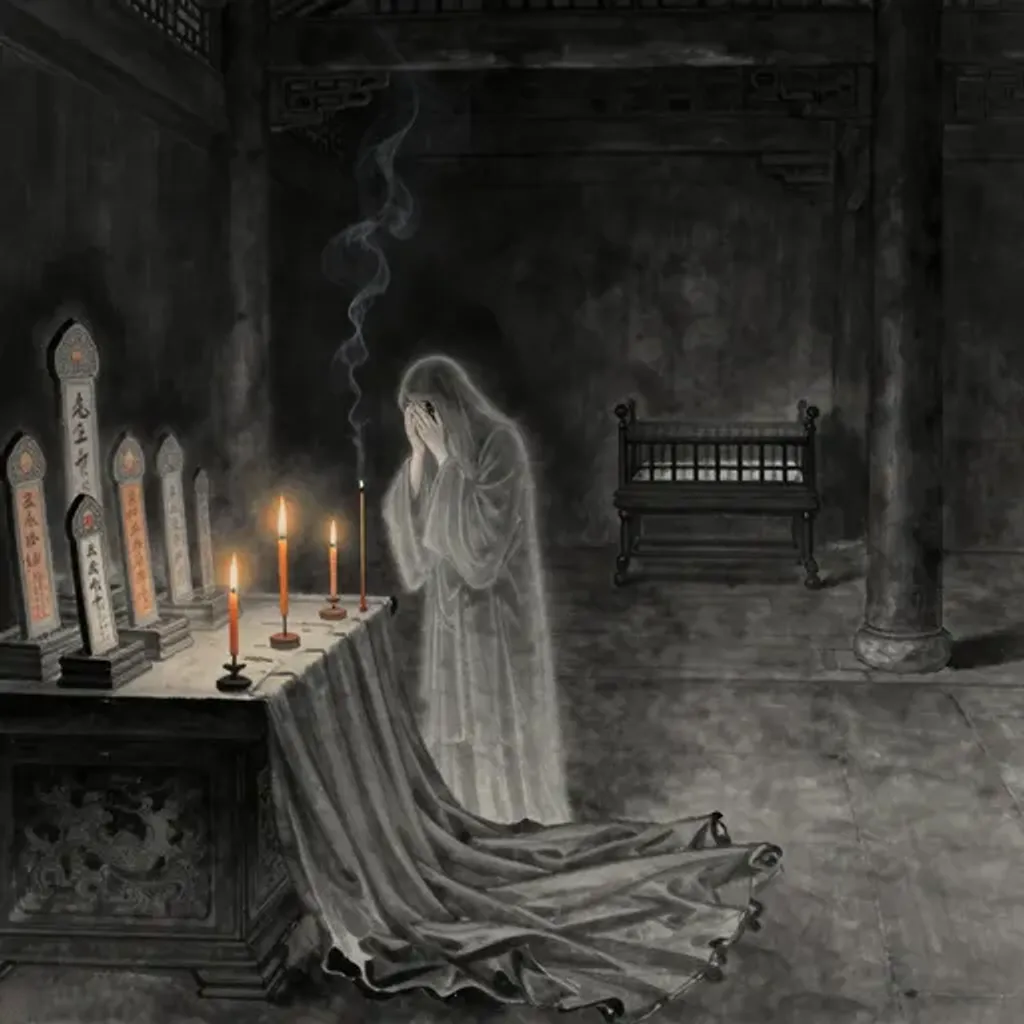
命短不長,中年夭傷,鬼泣哭堂,哀其子亡。
Fate cut short, life not long; in middle years, untimely death. Ghosts weep and wail in the hall; mourning the child that is gone.
— Jiao Yanshou, Yilin (Forest of Changes), 1st century BC
Commentary
Doubled fire meets the lake rising above heaven: brilliance is cut short at its zenith. Life is brief, cut short in middle age. Ghosts weep and wail in the hall, mourning the loss of their child. The verse is starkly about premature death and the grief of ancestors witnessing their line truncated. No historical allusion softens the blow; this is the raw imagery of a household emptied by untimely loss. From The Clinging to Breakthrough, fire's intensity meets the lake overflowing heaven — a volatile, unsustainable configuration. Breakthrough (Guai) demands decisive action to remove what is decayed, but here the decisiveness belongs to death itself, which breaks through life's defenses at the worst possible moment, leaving only the keening of the bereaved.
離 → 姤
Hexagram 30 → Hexagram 44: Coming to Meet
Changing lines: 1, 2, 5
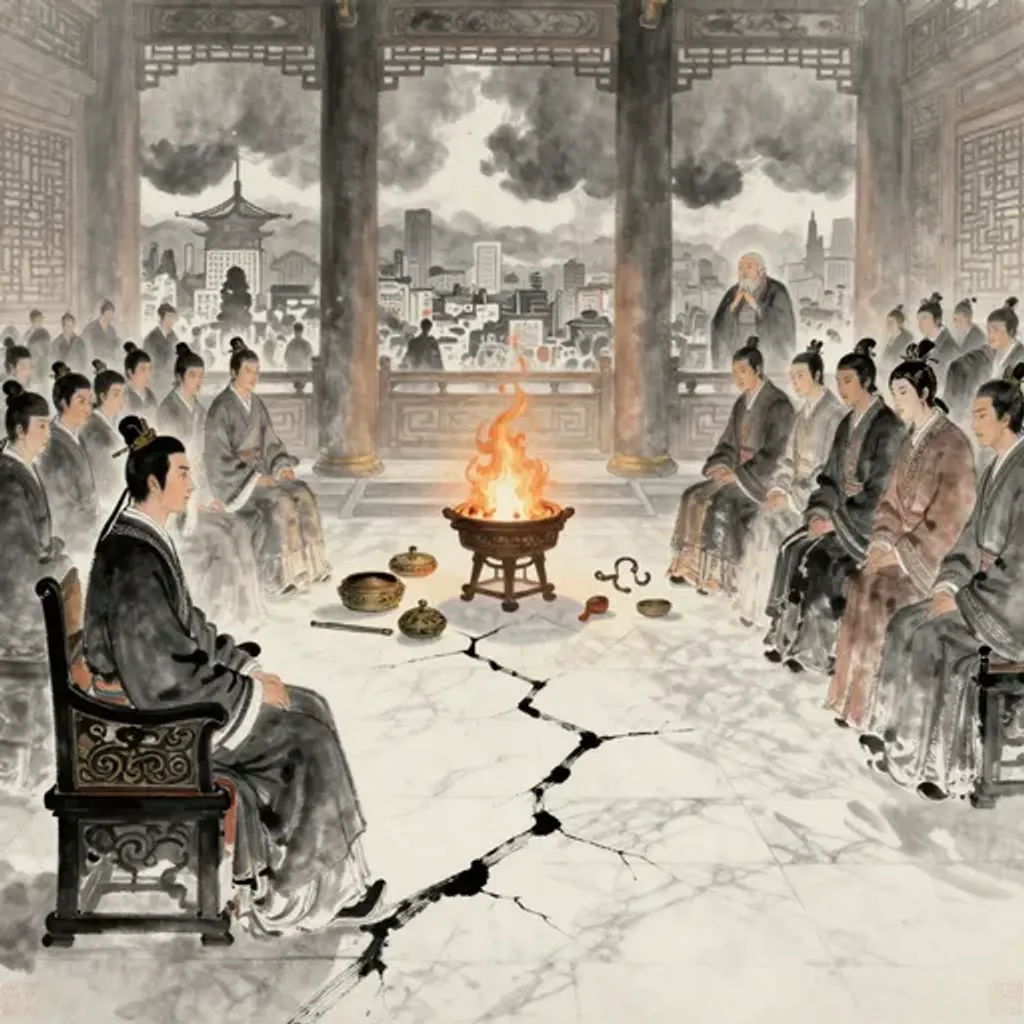
君臣不和,上下失宜,宗子哭歌。
Lord and ministers in discord; above and below lose their proper stations. The head of the clan weeps and sings.
— Jiao Yanshou, Yilin (Forest of Changes), 1st century BC
Commentary
Doubled fire meets heaven above wind: brilliance encounters the intrusion of disorder. Ruler and ministers cannot harmonize; superior and inferior lose their proper relationship. The heir of the lineage alternates between weeping and singing. The dissonance between weeping and singing in a single person suggests emotional collapse — grief and forced merriment mingled in the madness of a court that has lost its center. From The Clinging to Coming to Meet, fire's clarity meets the wind that rises unbidden beneath heaven. Gou represents the unexpected feminine force that intrudes upon an all-yang structure. The verse shows the consequences: when an uninvited disruptive element enters the court, hierarchy collapses, and the very heir of the ruling house oscillates between mourning the old order and performing a hollow celebration of the new.
離 → 萃
Hexagram 30 → Hexagram 45: Gathering Together
Changing lines: 1, 3, 5, 6
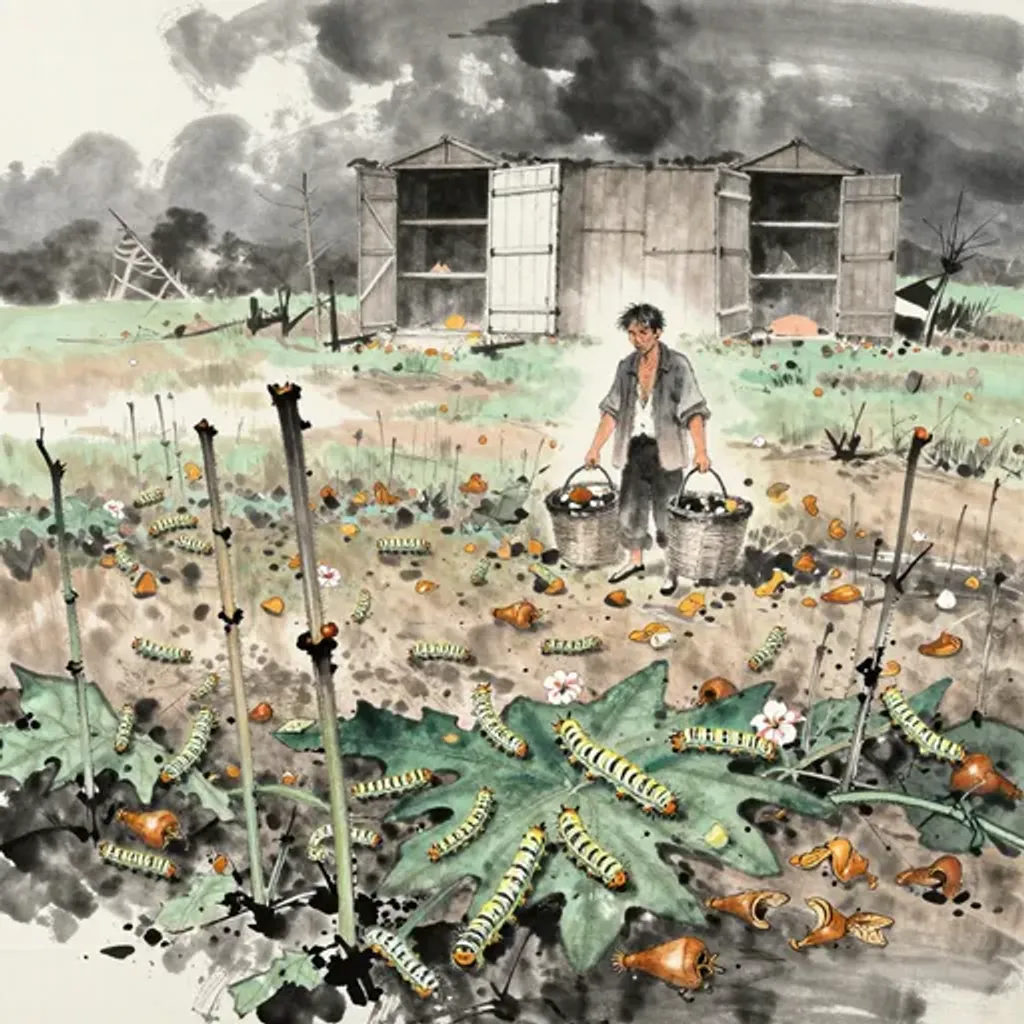
苛政日作,螟食華葉,割下啖上,民被其賊,秋無所得。
Harsh governance grows daily; locusts devour blossoms and leaves. Cutting from below to feed above; the people suffer the plunder. In autumn, nothing is gained.
— Jiao Yanshou, Yilin (Forest of Changes), 1st century BC
Commentary
Doubled fire meets the lake gathering upon earth: brilliance exposes parasitic governance. Harsh taxation grows daily, like leaf-eating caterpillars devouring blossoms. The lower is stripped to feed the upper, and the people suffer this plunder; by autumn, nothing remains to harvest. The caterpillar (ming) consuming flowers and leaves is a Shijing metaphor for rapacious officials who devour the people's substance. The seasonal arc — taxation devouring the growing season so that autumn yields nothing — makes the economic logic brutally clear. From The Clinging to Gathering, fire's clarity illuminates a gathering that has become predatory. The lake upon earth should pool abundance, but here the gathering is extraction, draining the fields so thoroughly that the communal harvest disappears entirely.
離 → 升
Hexagram 30 → Hexagram 46: Pushing Upward
Changing lines: 1, 2, 4, 6
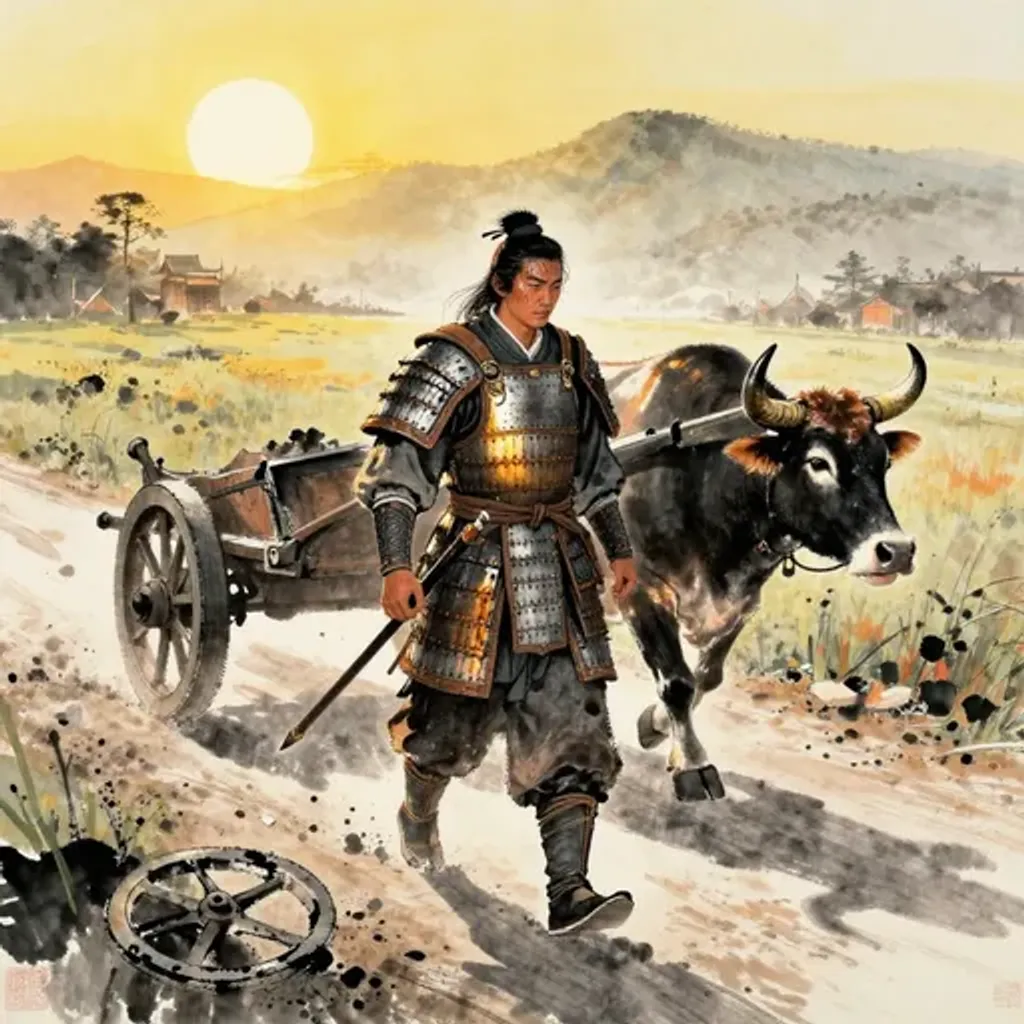
南行戴鎧,登塲九魁,車傷牛罷,日暮咨嗟。
Marching south wearing armor; mounting the field, champion nine times over. The cart breaks, the ox falters; at day's end, lamenting and sighing.
— Jiao Yanshou, Yilin (Forest of Changes), 1st century BC
Commentary
Doubled fire meets wind growing within the earth: brilliance attempts to rise but the ascent exhausts itself. Marching south in armor, one enters the arena and wins the chief prize nine times over. Yet the cart is damaged and the ox spent; at sunset, only sighs remain. The verse begins with martial triumph — nine victories in the tournament — but pivots sharply to exhaustion. The ox that pulled the supply cart has collapsed; the equipment is broken; evening descends on a spent warrior. From The Clinging to Pushing Upward, fire's aspiration meets the slow growth of wood within the earth. The tree pushes upward gradually, accumulating small gains. The verse warns that fire's nature — to blaze upward quickly — is incompatible with Sheng's patient method. Ascent without pacing leads to burnout.
離 → 困
Hexagram 30 → Hexagram 47: Oppression
Changing lines: 1, 2, 3, 5, 6
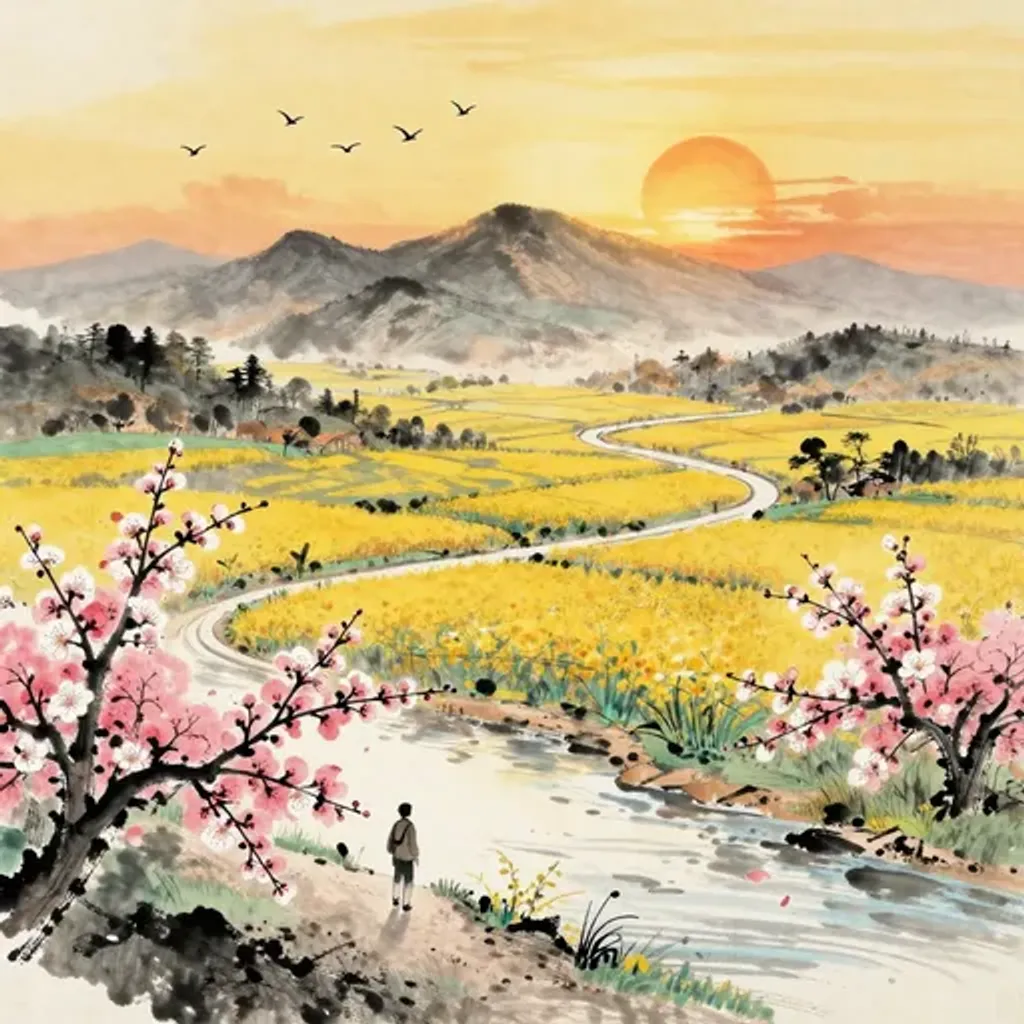
春東夏南,隨陽有功,與利相逢。
Spring in the east, summer in the south; following the sun, achieving merit. Meeting with good fortune.
— Jiao Yanshou, Yilin (Forest of Changes), 1st century BC
Commentary
Doubled fire meets the lake drained of water: brilliance discovers profit within oppression. In spring one turns east, in summer south, following the yang and achieving success — meeting with gain. The verse prescribes directional alignment with the seasons: spring's energy rises in the east, summer's in the south, and one who follows the sun's trajectory prospers. This is cosmological advice at its simplest — move with the light, not against it. From The Clinging to Oppression, fire's clarity enters a lake without water, the image of exhaustion. Yet the verse finds opportunity precisely within depletion: by orienting oneself to follow the yang, even in the driest season one locates the remaining current of vitality. The oppressed who align with natural rhythm discover that profit hides where others see only emptiness.
離 → 井
Hexagram 30 → Hexagram 48: The Well
Changing lines: 1, 2, 4, 5, 6
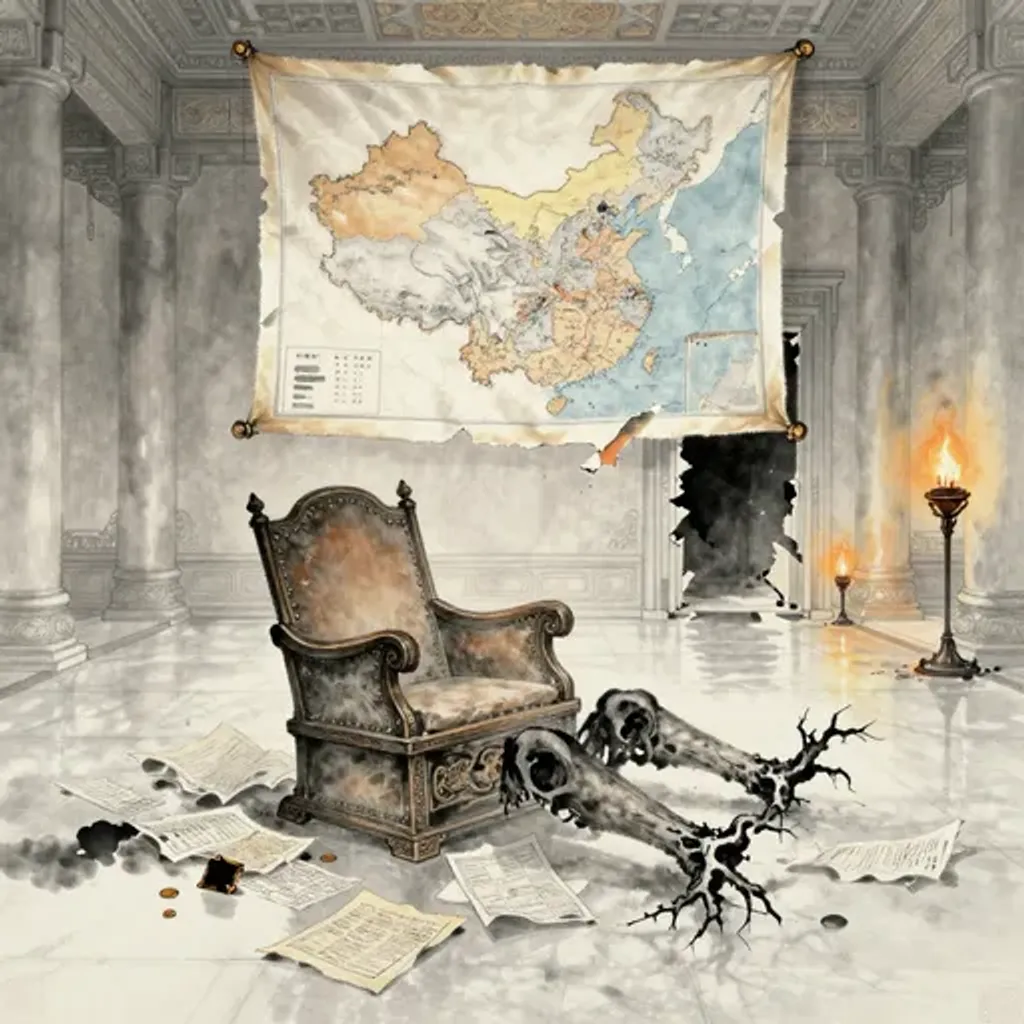
頭尾顛倒,不知緒處,君失其國。
Head and tail overturned; one cannot tell where the threads begin. The lord loses his kingdom.
— Jiao Yanshou, Yilin (Forest of Changes), 1st century BC
Commentary
Doubled fire meets water above wind: brilliance confronts a well whose order has been inverted. Head and tail are reversed; one cannot find the beginning of the thread. The ruler loses his state. The verse describes total disorientation — an inversion of proper sequence so thorough that governance becomes impossible. When you cannot distinguish the beginning from the end, every action tangles the situation further. From The Clinging to The Well, fire's discriminating light enters the well's deep structure of water drawn upward through wood. The well functions only when its mechanisms are correctly ordered: rope, bucket, water, surface. Reverse any element and the well fails. The ruler who loses the thread of governance is like a well drawn backward — effort produces nothing, and the state drains away.
離 → 革
Hexagram 30 → Hexagram 49: Revolution
Changing lines: 5, 6
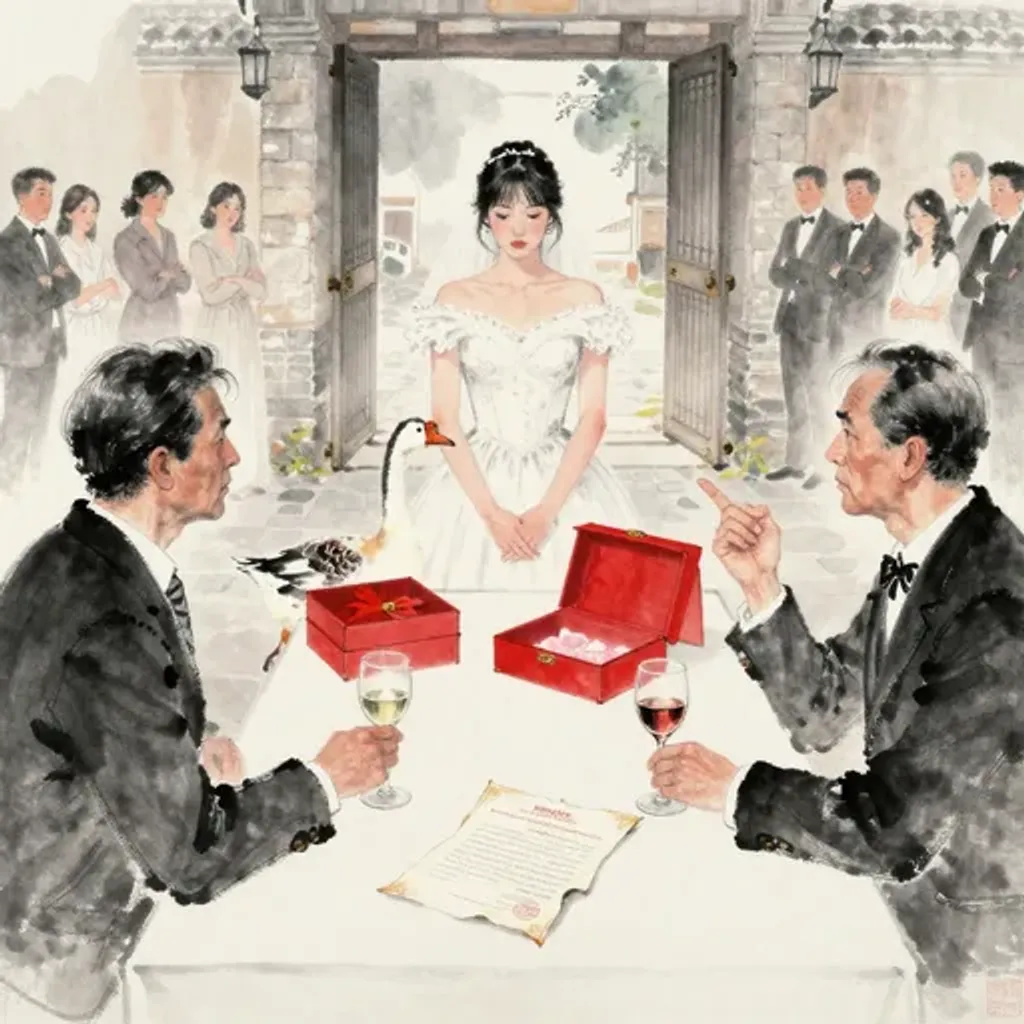
言無要約,不成劵契,殷叔季姬,公孫爭之,強入委禽,不悅子南。
Words without binding promise; no contract is completed. Lord Yin and Lady Shu Ji; the ducal grandson contends for her. Forcing entry to present the betrothal gifts; Master Zinan is displeased.
— Jiao Yanshou, Yilin (Forest of Changes), 1st century BC
Commentary
Doubled fire meets fire within the lake: brilliance fuels revolutionary upheaval. Words lack binding force, no contract is concluded. The Yin clan's younger sister, Lady Ji, becomes the object of a struggle between noble families. One forces his way in with betrothal gifts, displeasing Zi Nan. The verse alludes to marriage disputes among the aristocracy of the Spring and Autumn period, where forcing a betrothal (qiang ru wei qin) against one party's wishes created factional feuds. The phrase 'wei qin' refers to the formal presentation of wild geese as marriage gifts. From The Clinging to Revolution, fire blazes within the lake — the very image of incompatible elements forced into the same vessel. Revolution becomes necessary when agreements are broken and alliances imposed by force rather than consent.
離 → 鼎
Hexagram 30 → Hexagram 50: The Cauldron
Changing lines: 1, 2
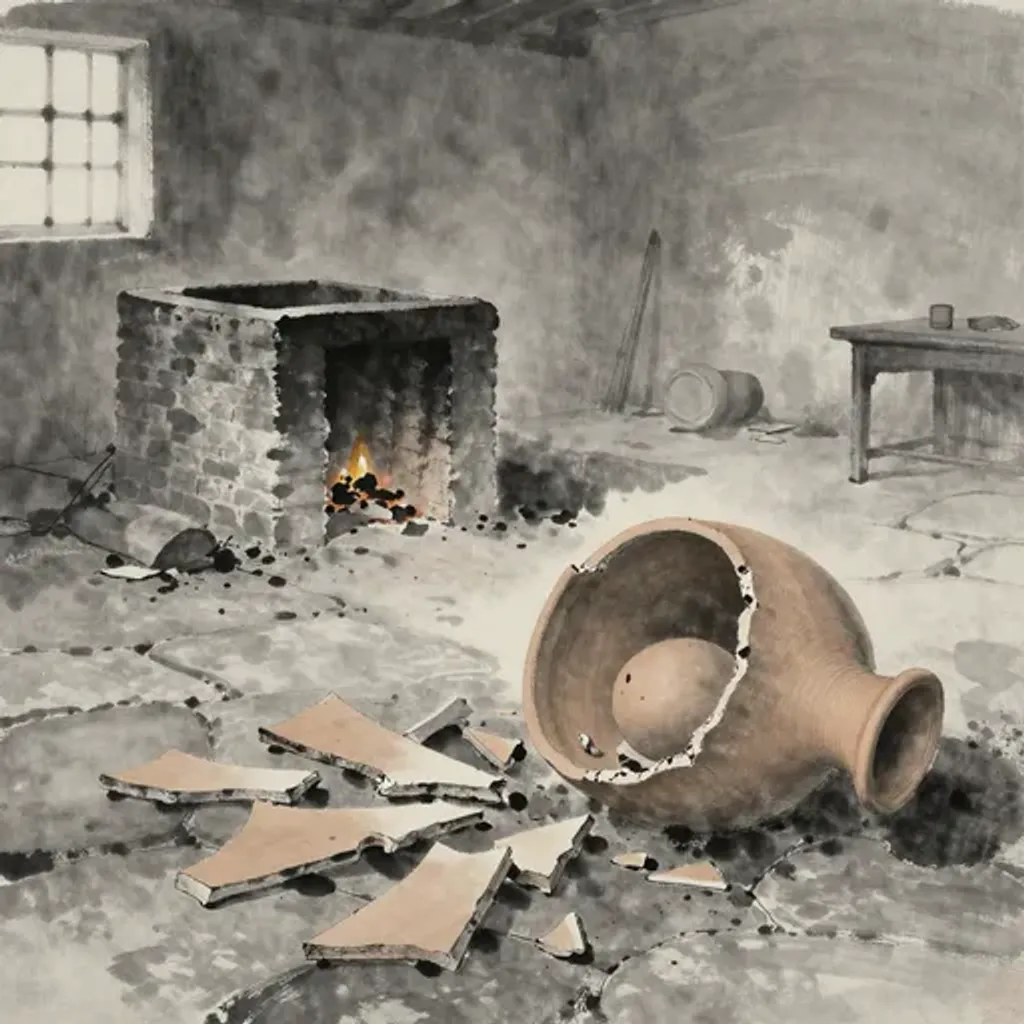
缺破不成,胎卵不生,不見其形。
Broken and incomplete; egg and embryo do not come to life. Their form is never seen.
— Jiao Yanshou, Yilin (Forest of Changes), 1st century BC
Commentary
Doubled fire meets fire beneath wood: brilliance attempts to forge but the vessel is flawed from the start. Cracked and broken, nothing takes form. Embryo and egg fail to develop; the shape never appears. The cauldron (ding) transforms raw materials into refined nourishment, but this verse presents a cauldron too damaged to function. Nothing can gestate within a broken vessel: the egg cracks, the embryo dies, and no recognizable form emerges from the process. From The Clinging to The Cauldron, fire's transformative power meets the ritual vessel that should contain and refine it. Yet a cracked cauldron dissipates fire's energy rather than focusing it. The verse warns that no amount of brilliant heat can compensate for a fundamentally flawed container — the form must be whole before transformation can begin.
離 → 震
Hexagram 30 → Hexagram 51: The Arousing Thunder
Changing lines: 3, 6
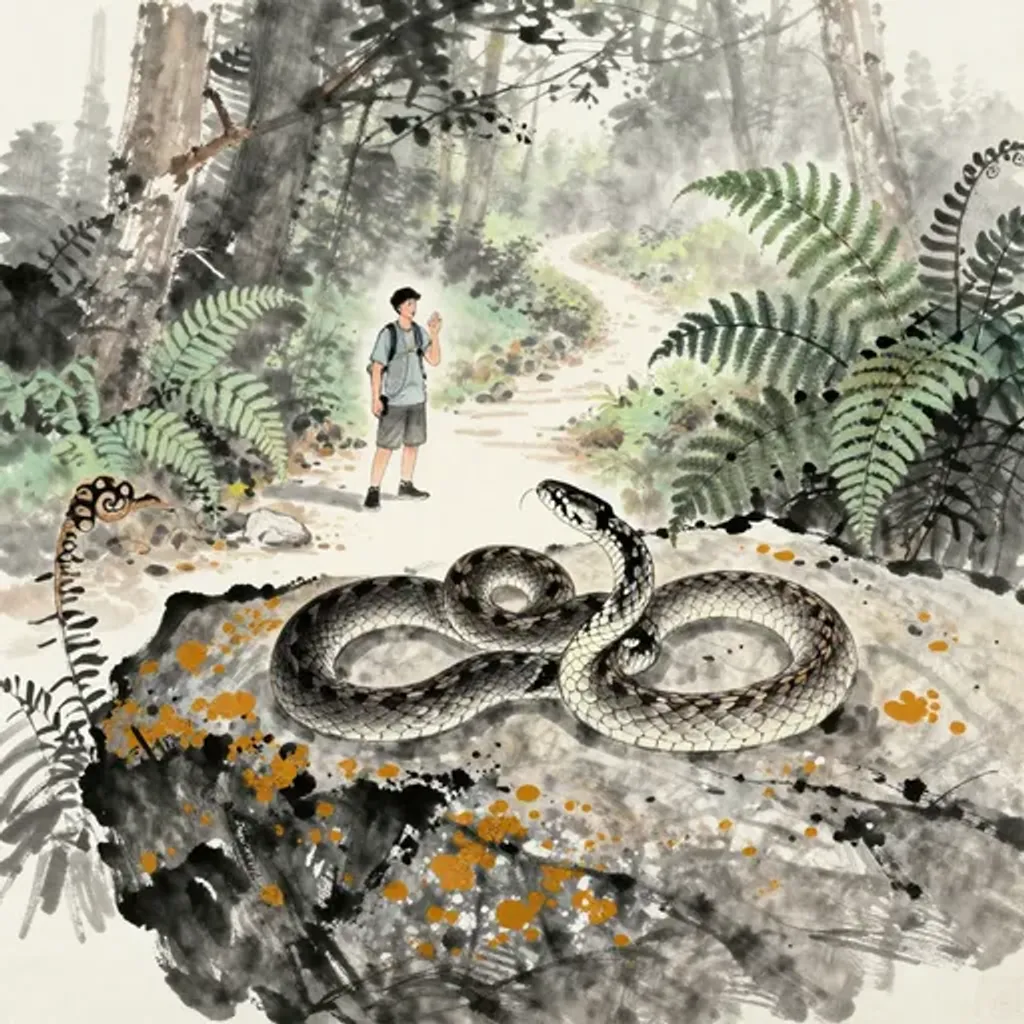
見虵交悟,惜蚖畏惡,心乃無悔。
Seeing serpents intertwined, one is awakened; pitying the small viper, fearing the venomous. The heart then has no regret.
— Jiao Yanshou, Yilin (Forest of Changes), 1st century BC
Commentary
Doubled fire meets doubled thunder: brilliance encounters sudden awakening. One sees intertwined serpents and reaches an insight. Treasuring the small viper yet fearing the monstrous snake, the heart arrives at a state free from regret. The serpent in Chinese symbology carries both regenerative and dangerous associations. 'Seeing intertwined snakes' is an omen requiring interpretation: the observer must distinguish between the small creature worth nurturing and the large one worth fearing. From The Clinging to The Arousing, fire's steady illumination meets thunder's sudden shock. The double thunder of Zhen demands that one respond instantly to what startles. The verse resolves in composure: by accurately reading the omen — cherishing what is small, respecting what is dangerous — one acts correctly and incurs no regret.
離 → 艮
Hexagram 30 → Hexagram 52: Keeping Still Mountain
Changing lines: 1, 4
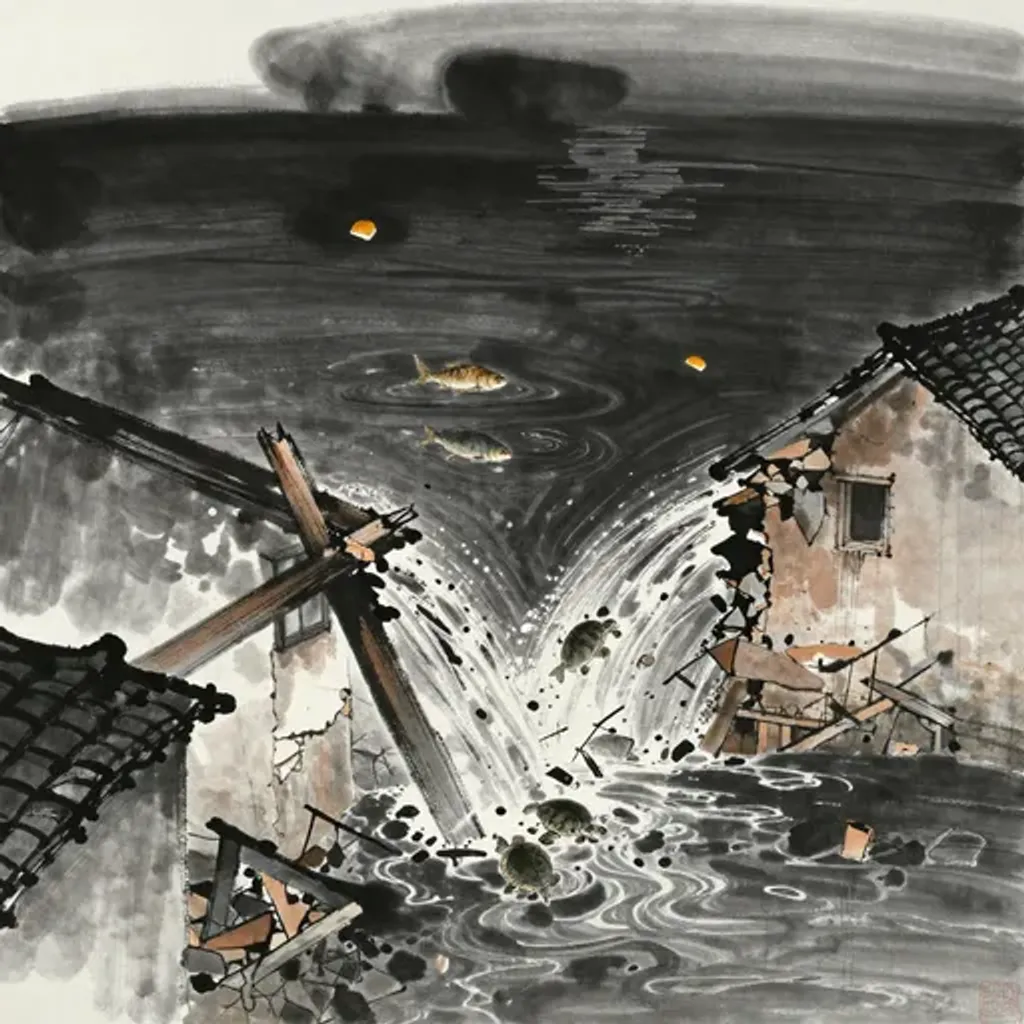
河水孔穴,壞敗我室,水深無涯,魚鱉傾倒。
River water breaches the hole; ruining and destroying my dwelling. The water is deep without limit; fish and turtles topple and overturn.
— Jiao Yanshou, Yilin (Forest of Changes), 1st century BC
Commentary
Doubled fire meets the doubled mountain: brilliance confronts absolute stillness forced by catastrophe. River water bursts through holes and destroys the dwelling. The water is bottomless in depth; fish and turtles tumble and overturn. The verse describes a devastating flood that undermines the very foundation of habitation. The home is not merely damaged but annihilated by water pouring through subterranean channels. From The Clinging to Keeping Still, fire's restless clarity encounters the twin mountains that counsel absolute stillness. Yet the verse shows that when external forces are overwhelming — water erupting from below — even stillness cannot save the structure. The mountain that should stand firm is hollowed from within. Sometimes the wisest response to catastrophe is not to stand still but to recognize that the ground itself has shifted.
離 → 漸
Hexagram 30 → Hexagram 53: Development
Changing lines: 1, 4, 5
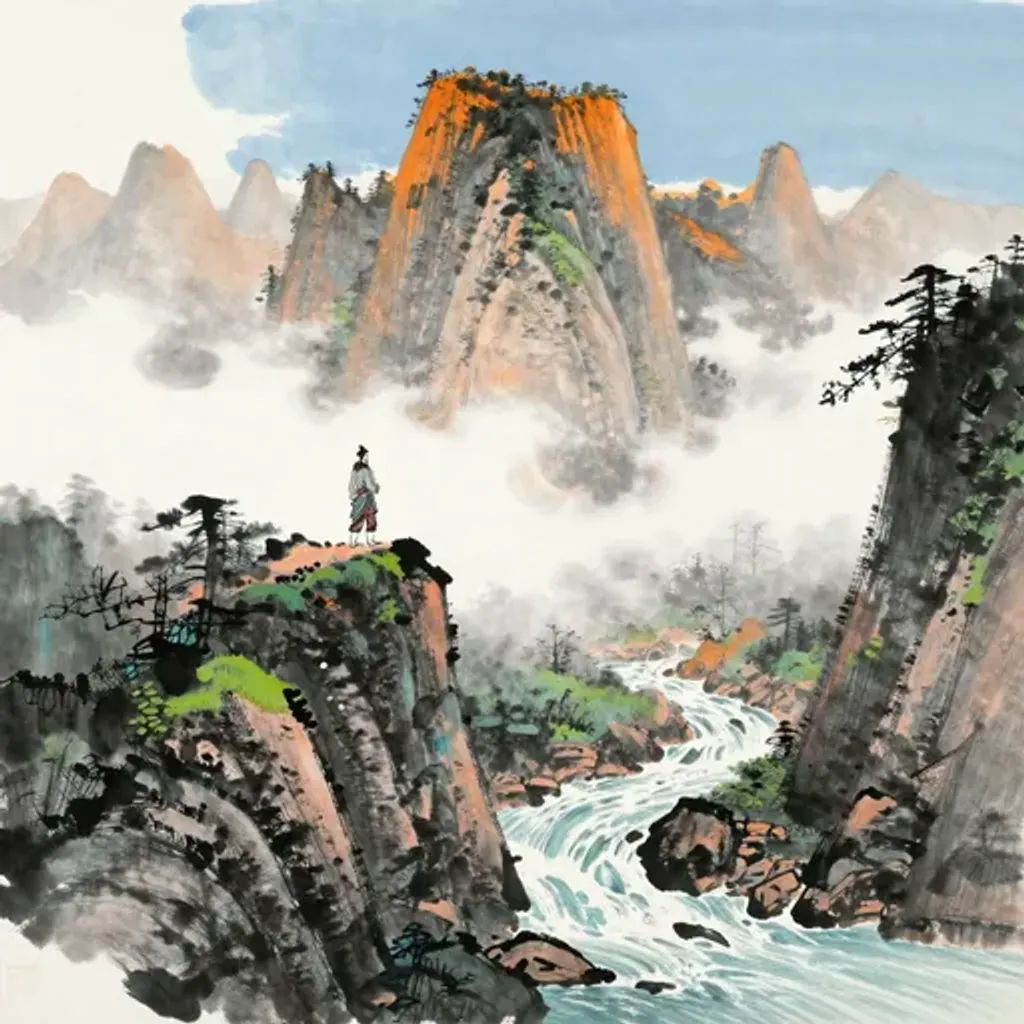
五嶽四瀆,地得以安,高而不危,敬慎避患。
Five sacred peaks and four great rivers; the earth is thereby made secure. Lofty yet not imperiled; reverent and cautious, avoiding calamity.
— Jiao Yanshou, Yilin (Forest of Changes), 1st century BC
Commentary
Doubled fire meets wind above the mountain: brilliance matures into gradual, lasting development. The Five Sacred Mountains and the Four Great Rivers anchor the earth in stability. Standing high without toppling, one maintains respectful caution to ward off disaster. The verse mirrors hexagram 16 (30→16) with similar imagery but a different lesson. Here the mountains and rivers represent not joyful governance but careful stewardship: maintaining height without arrogance, holding power without complacency. From The Clinging to Development, fire's penetrating light meets the tree growing slowly on the mountain. The transformation teaches that elevation is sustainable only through gradual development and constant vigilance. Those who stand high endure not through boldness but through the respectful caution that prevents the summit from becoming a precipice.
離 → 歸妹
Hexagram 30 → Hexagram 54: The Marrying Maiden
Changing lines: 2, 3, 6
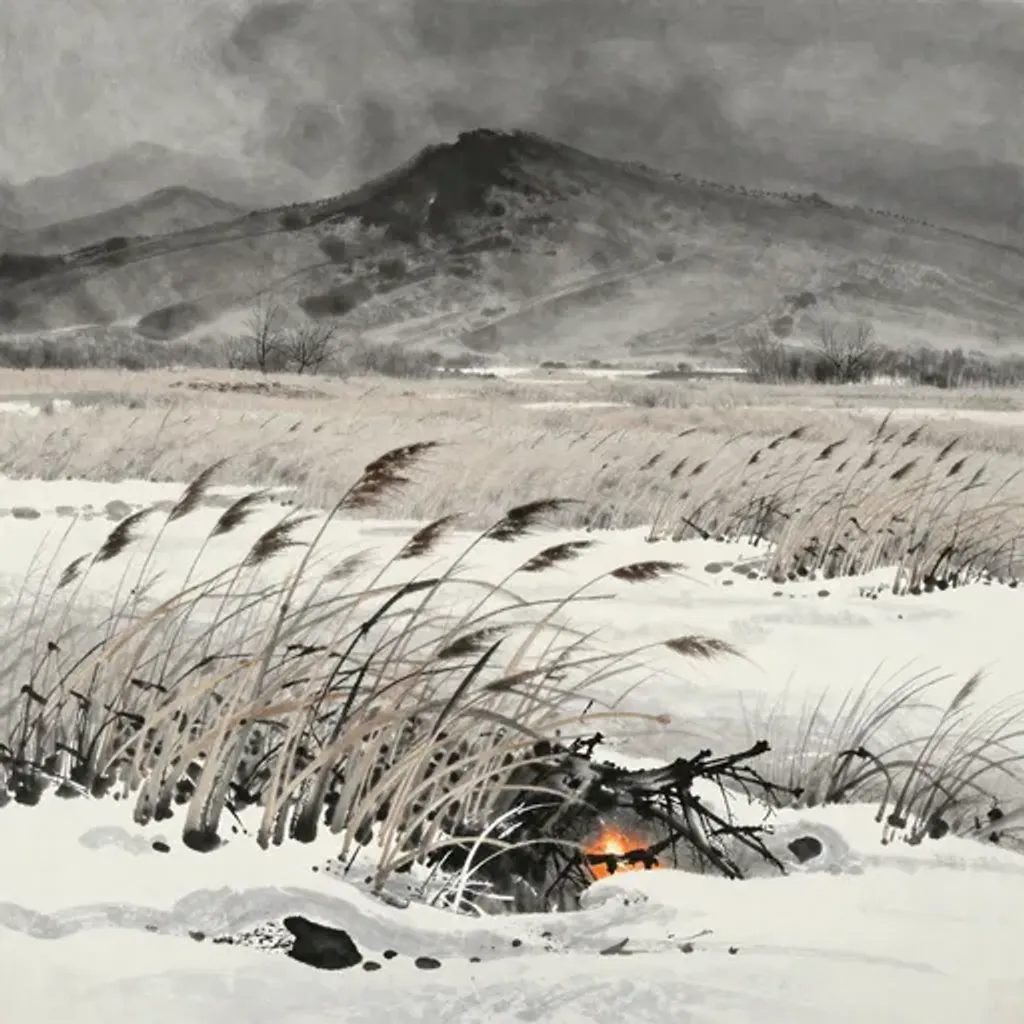
南至之日,陽消不息,北風烈寒,萬物伏藏。
The day of the southern solstice; yang wanes without ceasing. The north wind blows fierce and cold; the ten thousand things lie hidden.
— Jiao Yanshou, Yilin (Forest of Changes), 1st century BC
Commentary
Doubled fire meets thunder above the lake: brilliance reaches its southernmost extreme and reverses. At the day of the winter solstice, yang wanes without ceasing. The north wind blows bitterly cold, and the myriad creatures conceal themselves. The 'southern extreme' (nan zhi) refers to the winter solstice, when the sun reaches its lowest arc — paradoxically its most southern point marks the moment yang begins to decline. The north wind seizes the landscape and all life withdraws. From The Clinging to the Marrying Maiden, fire's brightness encounters the irrevocable commitment of thunder following the lake. The verse captures the moment when fire's radiance has been fully spent in the southward journey, and the world enters a period of necessary concealment — a winter that even brilliance cannot prevent.
離 → 豐
Hexagram 30 → Hexagram 55: Abundance
Changing lines: 6
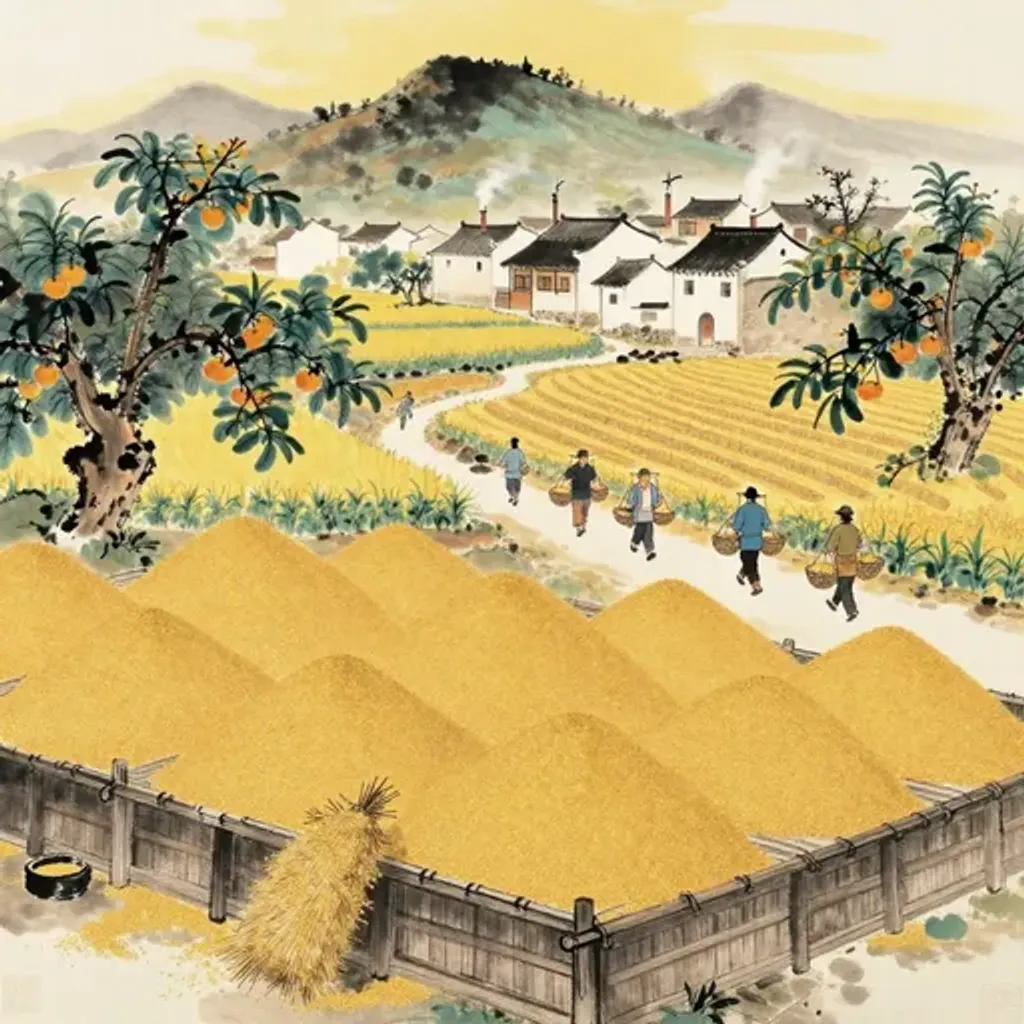
五利四福,俱佃居邑,黍稷盛茂,多獲高積。
Five blessings, four fortunes; all dwelling together in the village. Millet and grain flourish abundantly; a great harvest, piled high.
— Jiao Yanshou, Yilin (Forest of Changes), 1st century BC
Commentary
Doubled fire meets thunder and fire united: brilliance amplifies into overflowing abundance. Five benefits and four blessings converge as all dwell contentedly in their fields and towns. Millet and grain grow luxuriantly, and the harvest is piled high in great stores. The verse is a vision of total agricultural prosperity: every blessing arrives simultaneously, crops thrive, and granaries overflow. No historical allusion is invoked; the imagery speaks directly of an ideal harvest season. From The Clinging to Abundance, fire joins thunder in the image of lightning and thunder arriving together. This is the hexagram of fullness at its zenith — thunder provides the energy, fire provides the clarity, and together they produce a moment of overwhelming plenty that the wise ruler must harvest quickly, knowing such abundance cannot last forever.
離 → 旅
Hexagram 30 → Hexagram 56: The Wanderer
Changing lines: 1
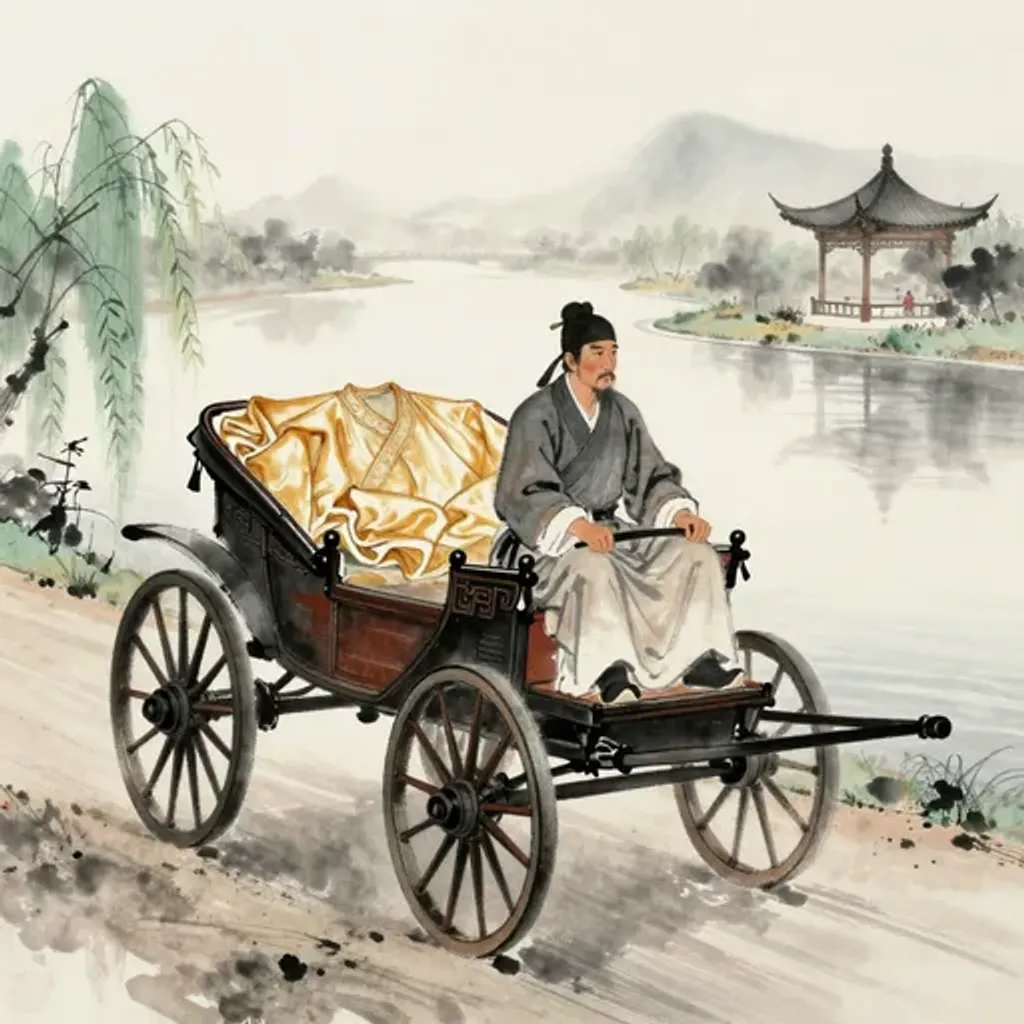
公孫駕車,載遊東齊,延陵子產,遺季紵衣,疾病哀悲。
The ducal grandson drives the carriage; traveling east to tour in Qi. Yanling and Zichan; bequeathing to Ji a garment of ramie. Illness and sorrow and grief.
— Jiao Yanshou, Yilin (Forest of Changes), 1st century BC
Commentary
Doubled fire meets fire upon the mountain: one traveler's brilliance encounters another's journey. A young lord drives his carriage and travels to visit eastern Qi. Ji Zha of Yanling and Zi Chan exchange gifts — a fine linen garment is offered to the season's companion — yet illness brings sorrow and grief. The verse alludes to the famous diplomatic friendship between Ji Zha (Yanling Jizi) of Wu and Zi Chan (Gongsun Qiao) of Zheng. According to the Zuo Zhuan, when Ji Zha visited Zheng, the two met as if they were old acquaintances and exchanged personal garments as tokens of trust. From The Clinging to The Wanderer, fire blazes upon the mountain — bright but transient. The traveler's encounters are rich with meaning but brief, and even the most luminous friendships must part, shadowed by mortality.
離 → 巽
Hexagram 30 → Hexagram 57: The Gentle Wind
Changing lines: 1, 2, 4, 5
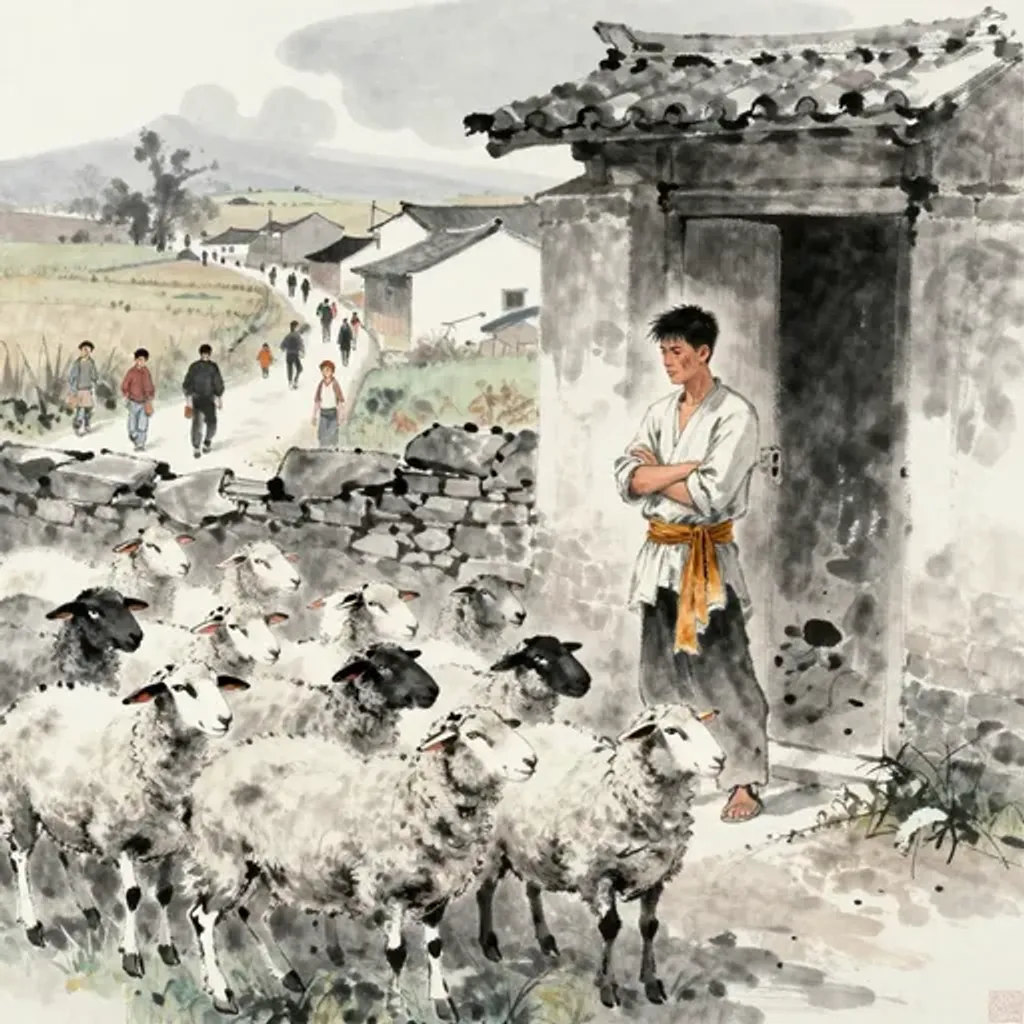
交亂當道,民困愁苦,望羊置群,長子在門。
Turmoil blocks the road; the people are distressed and suffering. Gazing at the sheep, setting them among the flock; the eldest son stands at the gate.
— Jiao Yanshou, Yilin (Forest of Changes), 1st century BC
Commentary
Doubled fire meets doubled wind: brilliance dissolves into pervasive but scattered influence. Turmoil and disorder block the road; the people are exhausted and distressed. One gazes at the scattered flock of sheep and sets them in order; the eldest son stands at the gate. The verse juxtaposes chaos with the beginnings of restoration. The road is blocked, the people suffer, yet someone takes charge of the scattered flock. The 'eldest son at the gate' suggests legitimate authority preparing to reassert itself. From The Clinging to The Gentle, fire's concentrated brightness enters the doubled wind that penetrates everywhere but concentrates nowhere. The wind's power lies in repetition and subtlety, not force. The verse shows recovery beginning not with dramatic intervention but with the quiet, persistent act of gathering what has scattered.
離 → 兌
Hexagram 30 → Hexagram 58: The Joyous Lake
Changing lines: 2, 3, 5, 6
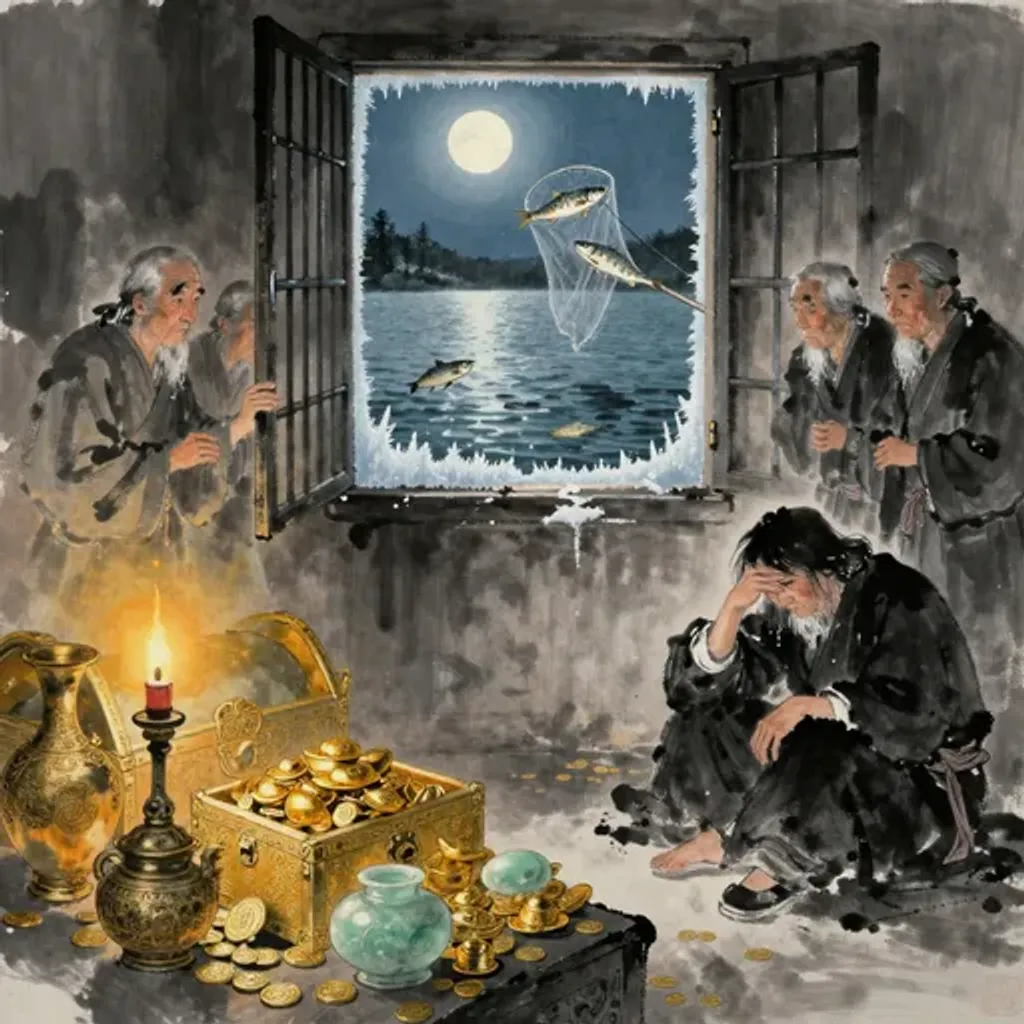
金玉滿室,忠直乘危,三老凍餓,鬼奪其室,求魚河海,網舉必得。
Gold and jade fill the chamber; the loyal and upright ride upon danger. Three elders starve and freeze; ghosts seize their dwelling. Casting nets in river and sea; every haul surely catches.
— Jiao Yanshou, Yilin (Forest of Changes), 1st century BC
Commentary
Doubled fire meets the doubled lake: brilliance meets open expression in all its contradictions. Gold and jade fill the chamber, yet the loyal and upright ride into danger. Three elders freeze and starve while ghosts seize their dwelling. One casts nets in the river and sea, and every haul brings a catch. The verse is a rapid montage of extremes: wealth beside destitution, loyalty beside peril, ghostly dispossession beside abundant harvest. From The Clinging to The Joyous, fire's clarifying light meets the lake's open joy. The doubled lake reflects everything without discrimination — fortune and misfortune alike ripple across its surface. The verse refuses to resolve its contradictions, presenting instead the full spectrum of human experience as the joyous lake reflects it: gleaming gold, frozen elders, and brimming nets all coexist in a single moment of unfiltered reality.
離 → 渙
Hexagram 30 → Hexagram 59: Dispersion
Changing lines: 1, 2, 3, 4, 5
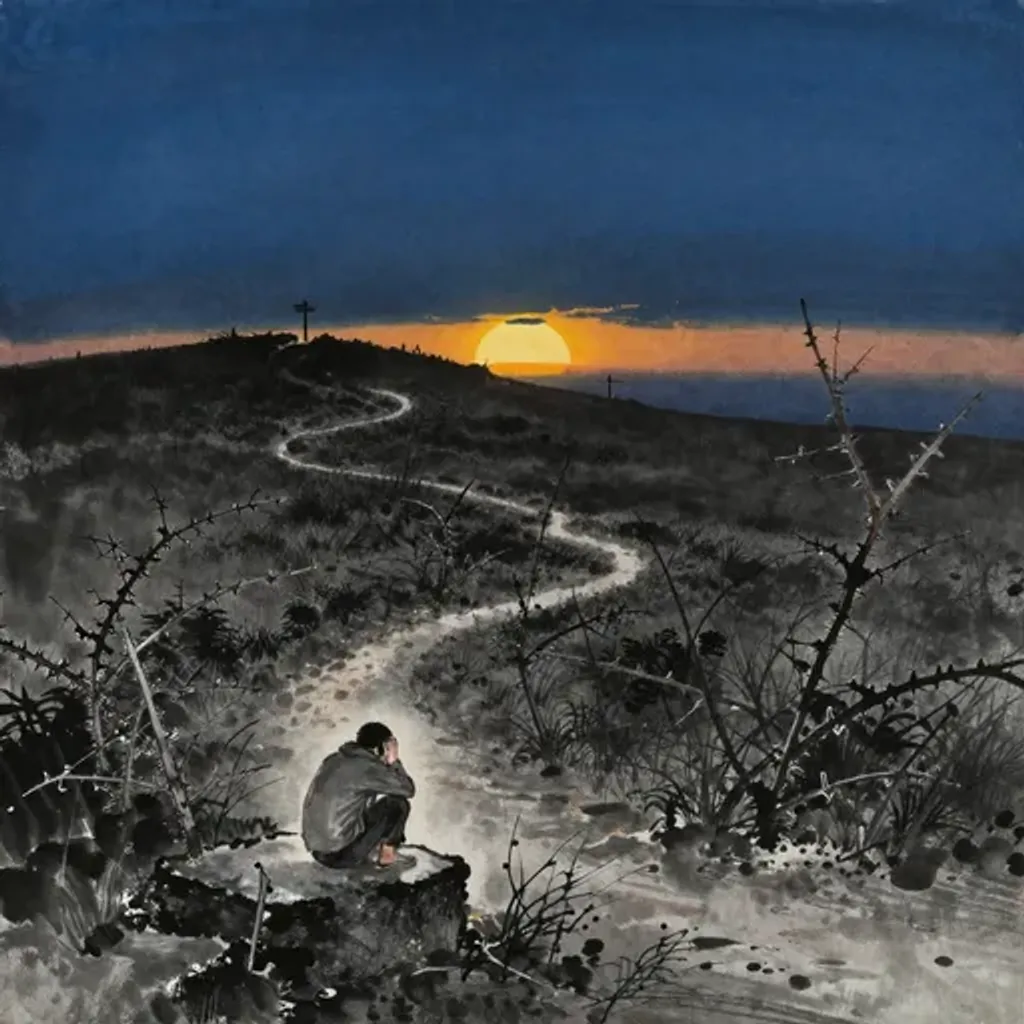
日入幽慝,陽明隱伏,小人勞心,求事不得。
The sun enters the hidden dark; brightness conceals itself. The small man toils in heart; seeking to accomplish, yet gaining nothing.
— Jiao Yanshou, Yilin (Forest of Changes), 1st century BC
Commentary
Doubled fire meets wind above water: brilliance sinks into concealment and dispersal. The sun enters its hidden place; bright yang lies dormant. The petty man labors in anguish, seeking success but finding nothing. The verse captures the moment after sunset when fire's source disappears below the horizon. In this twilight, only the anxious and unworthy are still scurrying, unable to rest because their efforts lack alignment with the natural cycle. From The Clinging to Dispersion, fire's concentrated brightness dissolves as wind scatters water's surface. Huan disperses what has frozen or congealed; here it disperses daylight itself. The petty man's failure lies not in insufficient effort but in working against the cosmic rhythm, pursuing what can only be received, never seized.
離 → 節
Hexagram 30 → Hexagram 60: Limitation
Changing lines: 2, 3, 4, 5, 6
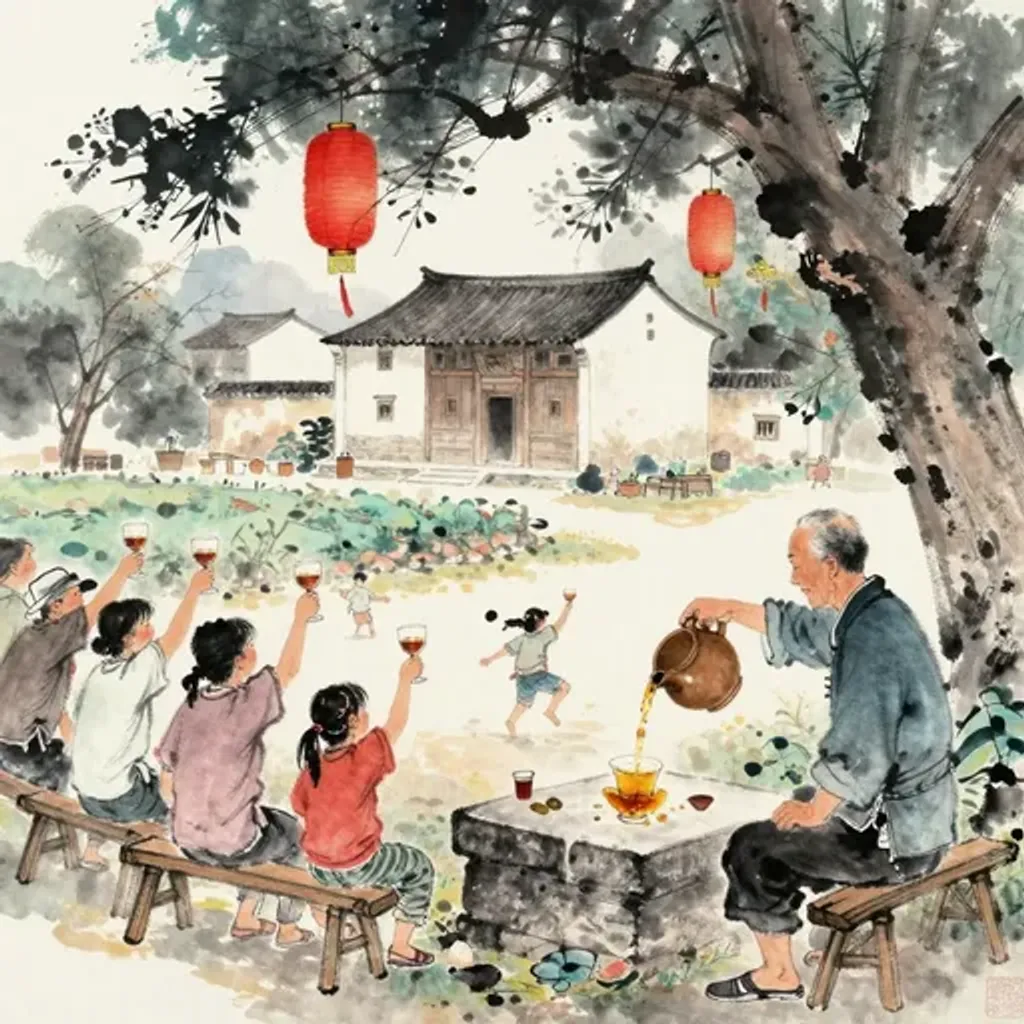
頻逢社飲,失利後福,不如子息,舊居故處,申請必與,乃無大悔。
Frequently attending the village feast; losing profit, gaining later blessing. Better than wandering from one's children; dwelling in the old and familiar place. Petitions are surely granted; thus there is no great regret.
— Jiao Yanshou, Yilin (Forest of Changes), 1st century BC
Commentary
Doubled fire meets water above the lake: brilliance accepts the wisdom of measured restraint. Frequently encountering communal feasts and drinking rites, one first loses profit but later gains blessing. Content with one's descendants, one remains in the ancestral dwelling. When petitions are made with sincerity, they are always granted, and there is no great regret. The verse describes a life of moderate pleasures within proper limits: social drinking at festivals, modest expectations, staying put rather than chasing fortune. From The Clinging to Limitation, fire's boundless radiance encounters the dam of water above the lake. The hexagram teaches that excess must be checked even in joyful things. The verse's protagonist accepts limitation gracefully — drinking but not to excess, losing but recovering — and discovers that measured contentment outperforms ambitious striving.
離 → 中孚
Hexagram 30 → Hexagram 61: Inner Truth
Changing lines: 2, 3, 4, 5
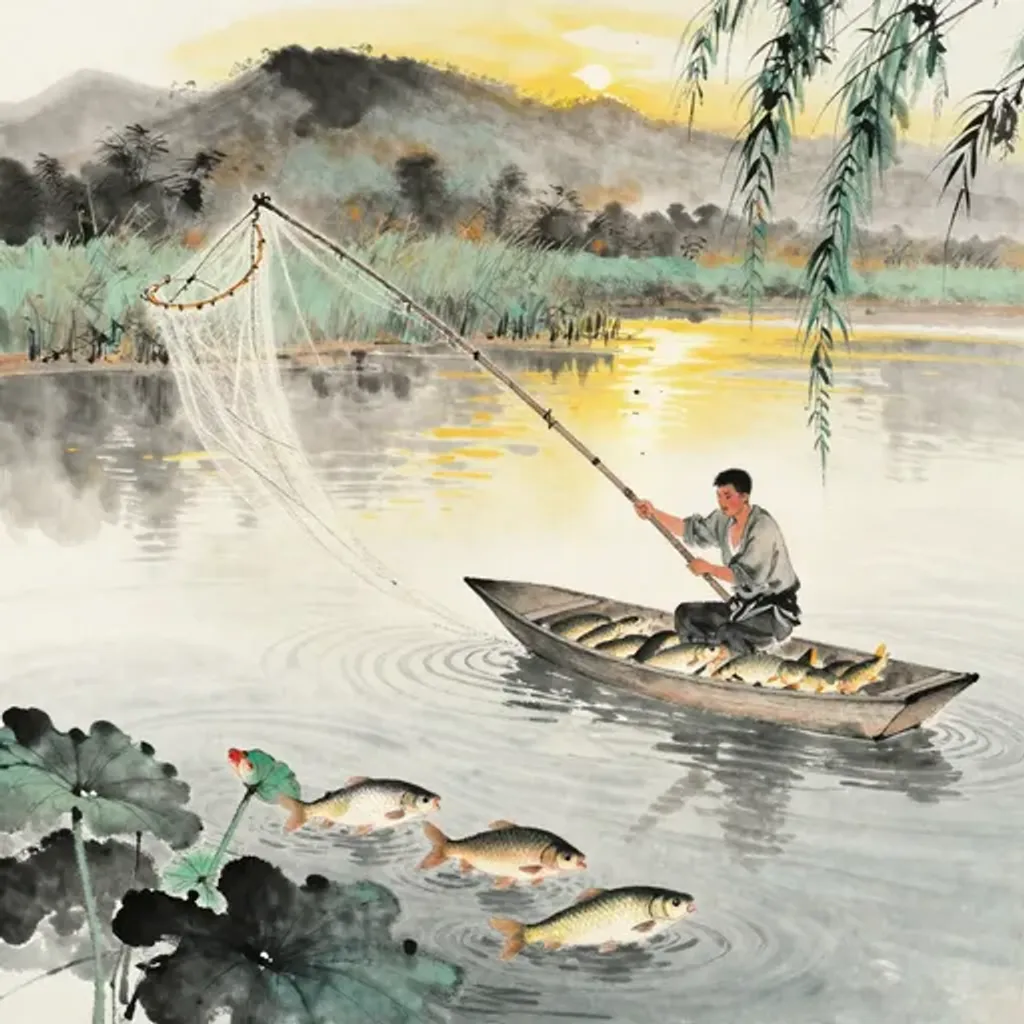
南有嘉魚,駕黃取遊,魴鱮詡詡,利來無憂。
In the south there are fine fish; driving the yellow boat, roaming at will. Bream and carp swim splendidly; profit comes without worry.
— Jiao Yanshou, Yilin (Forest of Changes), 1st century BC
Commentary
Doubled fire meets wind above the lake: brilliance discovers inner truth through natural abundance. In the south, fine fish abound. One harnesses yellow steeds and sets out for a pleasant excursion. Bream and silver carp swim merrily; profit arrives without worry. The verse echoes the Shijing ode 'Nan You Jia Yu' (There are Fine Fish in the South), which celebrates the bounty of a well-governed realm. Fish in classical imagery represent hidden talent and quiet prosperity that surfaces when conditions are right. From The Clinging to Inner Truth, fire's outer clarity meets the wind that stirs the lake into honest responsiveness. The fish come freely because the water is trustworthy. Inner truth, like a well-stocked lake, need not be forced — it attracts abundance naturally through the sincerity of its depths.
離 → 小過
Hexagram 30 → Hexagram 62: Small Exceeding
Changing lines: 1, 6
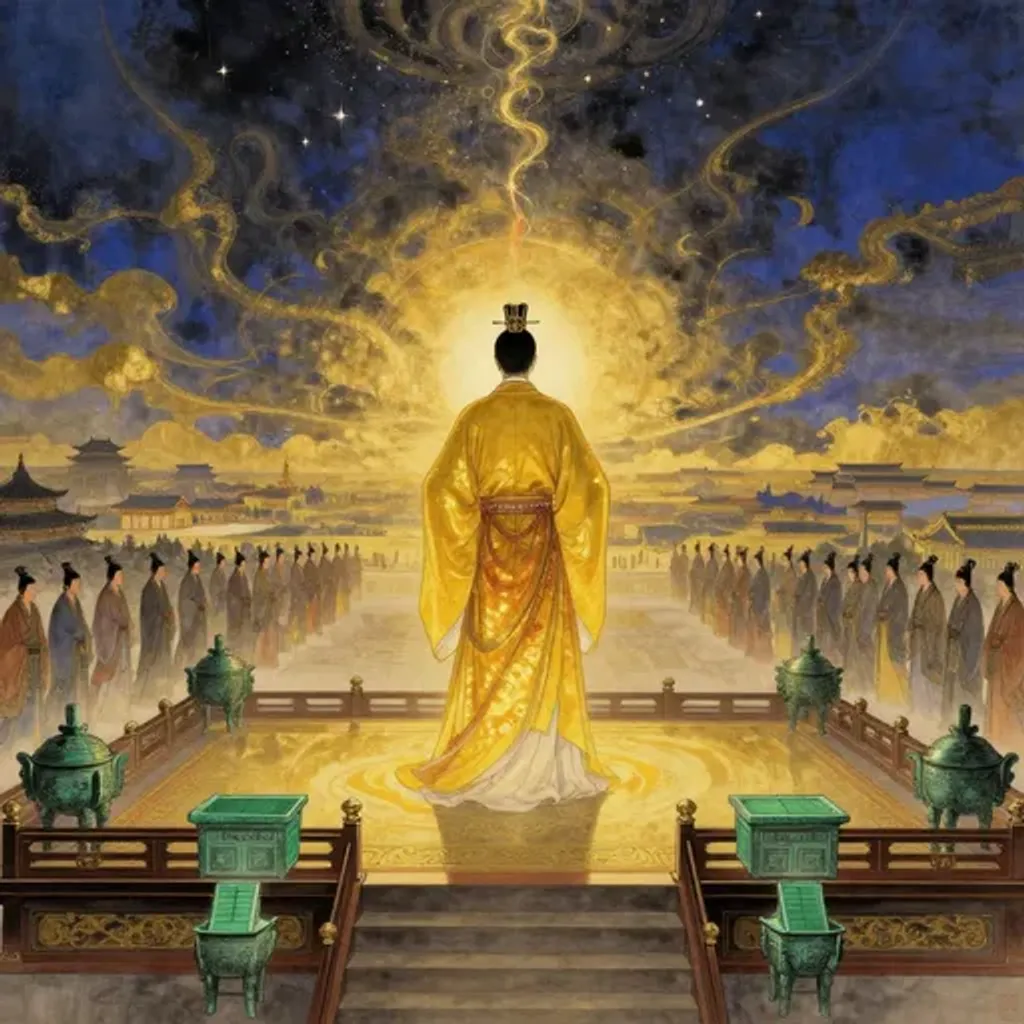
黃裳建元,文德在身,祿祐洋溢,封為齊君,賈市無門,股肱多根。
Yellow lower garment, founding the era; cultured virtue upon his person. Blessings and fortune overflow; enfeoffed as lord of Qi. The marketplace has no gates; limbs and supports are many and firm.
— Jiao Yanshou, Yilin (Forest of Changes), 1st century BC
Commentary
Doubled fire meets thunder above the mountain: brilliance adorns itself with humble excess. The yellow lower garment establishes the epoch; refined virtue resides in one's person. Blessings and favor overflow, and one is enfeoffed as Lord of Qi. Yet the merchant's market has no gate, and the limbs have many roots entangling them. 'Huang chang' (yellow lower garment) alludes to the I-Ching's Kun hexagram, line six-five: 'A yellow lower garment — supremely auspicious,' symbolizing humble virtue in a position of influence. The enfeoffment of Qi recalls Taigong's reward after the Zhou conquest. From The Clinging to Small Exceeding, fire's brilliance accepts the thunder's counsel to exceed in humility rather than grandeur. True excess lies in being excessively reverent, excessively frugal — the small virtues that sustain power longer than grand gestures.
離 → 既濟
Hexagram 30 → Hexagram 63: After Completion
Changing lines: 4, 5, 6
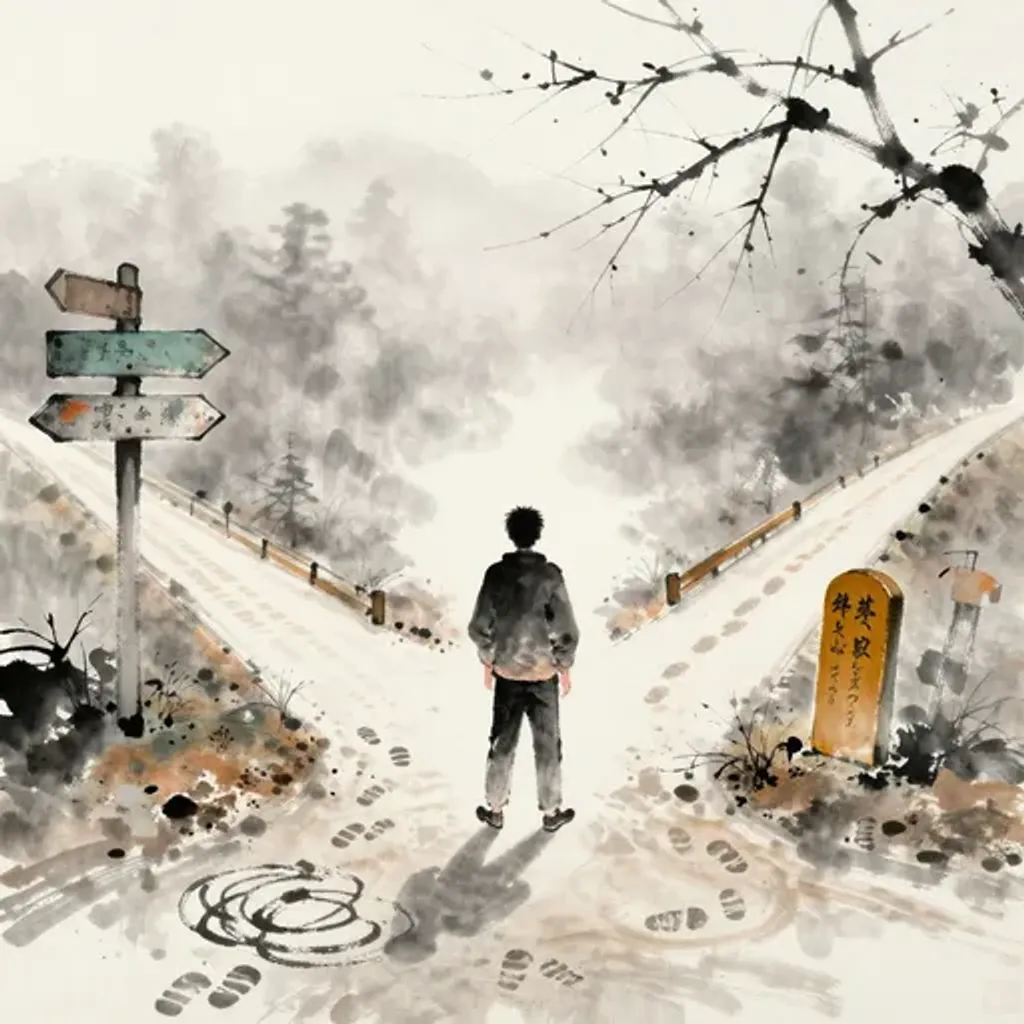
口不從心,欲東反西,與意乖戾,動舉失使。
The mouth does not follow the heart; desiring east, turning west. At odds with one's own intent; every action misses its aim.
— Jiao Yanshou, Yilin (Forest of Changes), 1st century BC
Commentary
Doubled fire meets water above fire: brilliance achieves completion but immediately loses coherence. The mouth does not follow the heart; one wishes to go east but turns west. Intentions and actions diverge, and every initiative misfires. The verse captures the essential paradox of After Completion: everything is in its proper place, yet that very perfection breeds carelessness. When fire below has already heated the water above, the system's work is done, and the next movement naturally tends toward disorder. From The Clinging to After Completion, fire's clarity enters a structure already perfectly arranged. The danger is complacency: when the mind relaxes after achieving order, the hand wanders, words contradict wishes, and the completed work begins to unravel from within.
離 → 未濟
Hexagram 30 → Hexagram 64: Before Completion
Changing lines: 1, 2, 3
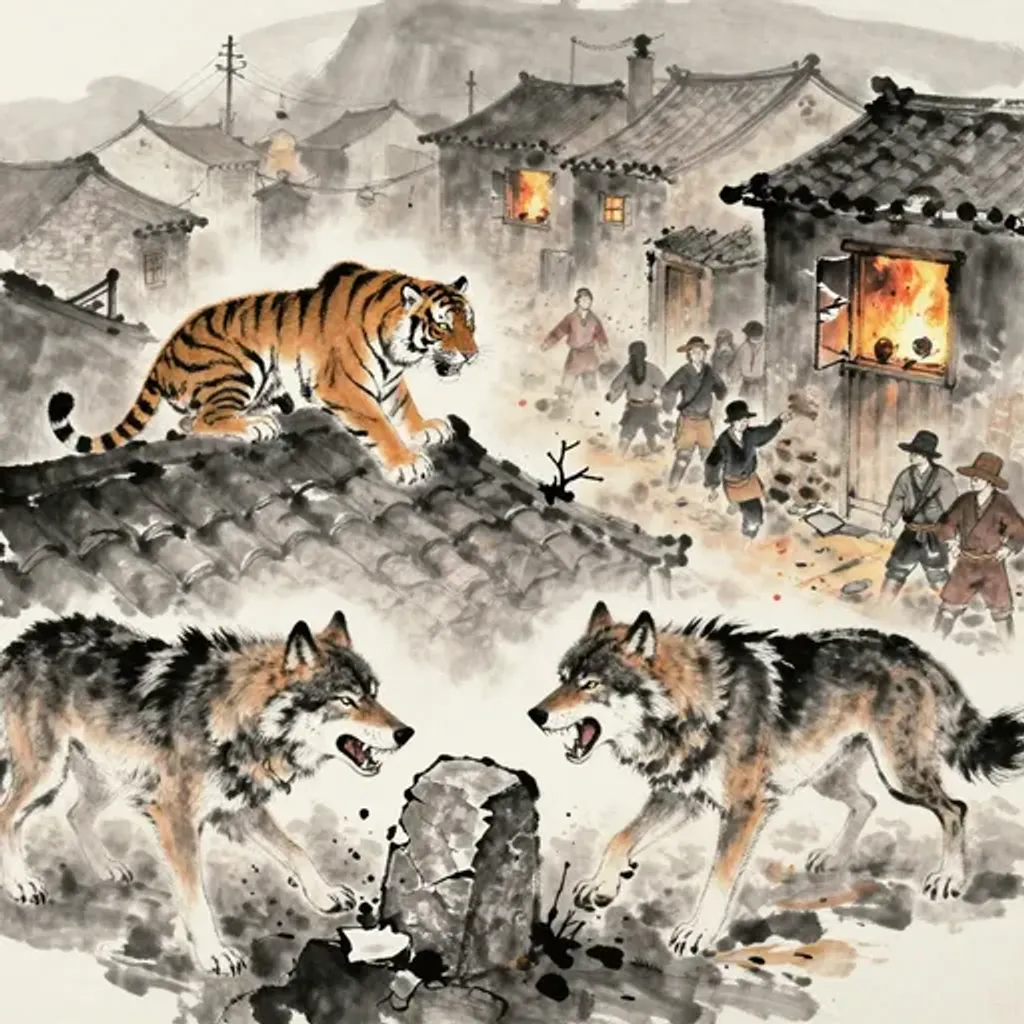
虎狼之鄉,日爭凶訟,叨爾為長,不能定從。
A land of tigers and wolves; daily contending in fierce disputes. Presumptuously claiming the elder's place; unable to settle who shall lead.
— Jiao Yanshou, Yilin (Forest of Changes), 1st century BC
Commentary
Doubled fire meets fire above water: brilliance hovers over an uncrossable gulf. This is the land of tigers and wolves, where daily disputes and violent litigation rage. One is recklessly appointed leader but cannot establish order. The final verse of the hexagram 30 cycle arrives at Before Completion — the last hexagram of the I-Ching — and fittingly depicts a situation of intractable chaos. Tigers and wolves represent predatory power without governance; endless contention without resolution. From The Clinging to Before Completion, fire blazes above water but cannot reach it. The fox has almost crossed the stream but wets its tail at the last moment. The verse embodies this frustration: one is given authority in a lawless territory but lacks the means to bridge the gap between intention and order. Brilliance illuminates the chaos but cannot, by itself, resolve it.