Transformations of Hexagram 33
Every line of change out of Hexagram 33 遯 Retreat, with the Yilin verse for each of the 64 resulting hexagrams, its translation, and the original ink brush artwork.
遯 → 乾
Hexagram 33 → Hexagram 1: The Creative
Changing lines: 1, 2
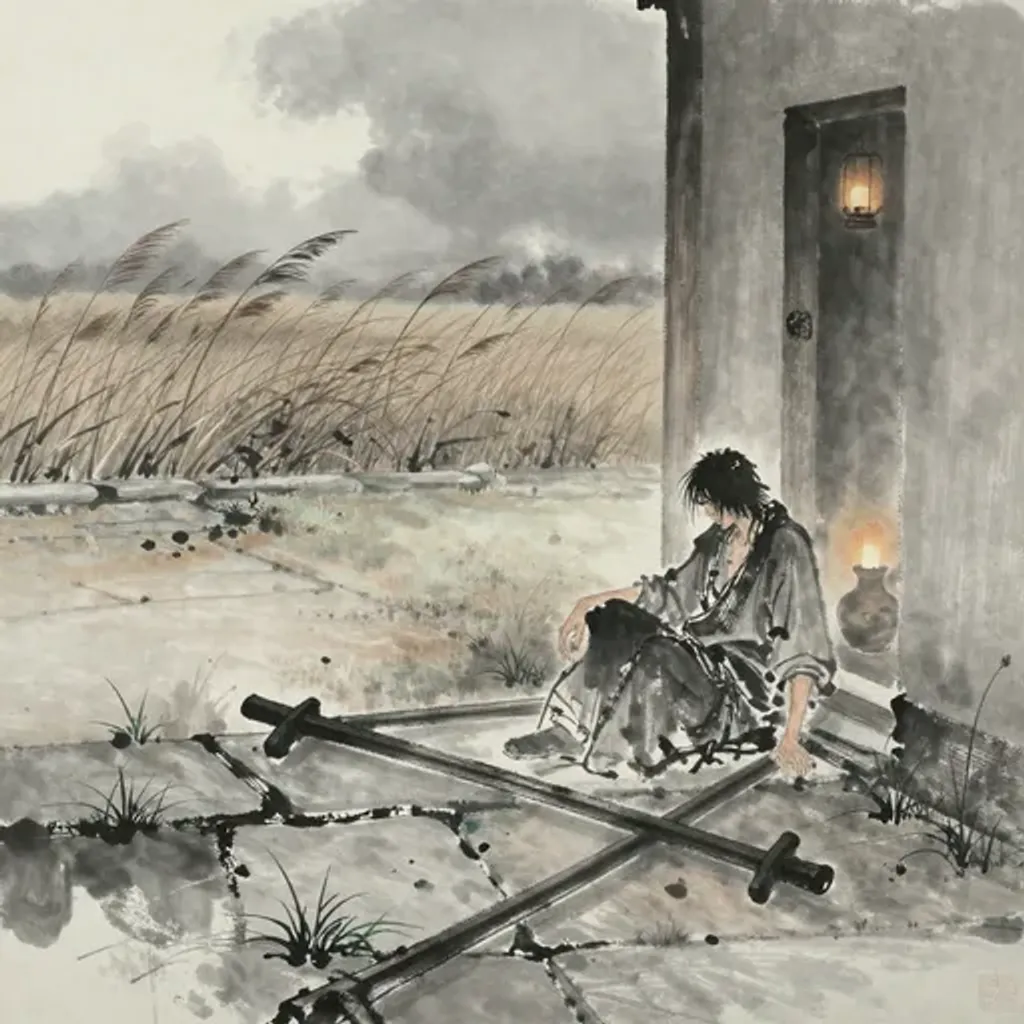
軟弱無輔,不能自理。意在外野,心懷勞苦,雖憂無殆。
Soft and weak, without support; unable to set things right. The heart yearns for the open wild; the mind harbors toil and grief. Though there is worry, there is no peril.
— Jiao Yanshou, Yilin (Forest of Changes), 1st century BC
Commentary
Heaven above the mountain withdraws into pure heaven doubled — the Creative's self-generating strength. The verse opens with vulnerability: weak and without support, unable to manage one's own affairs. The mind yearns for the open wilderness beyond, and the heart labors under burdens. Yet the final line pivots: 'Though there is worry, there is no peril.' Retreat's image is strategic withdrawal — the mountain beneath heaven creates distance from petty entanglements. When this transforms into the Creative, withdrawal becomes self-reliance. The one who retreats is not fleeing but gathering strength. From Retreat to the Creative, the pattern resonates with every exile who traded comfort for autonomy: anxiety persists, but catastrophe is averted because the retreating figure discovers an inner sovereignty no external circumstance can undermine.
遯 → 坤
Hexagram 33 → Hexagram 2: The Receptive
Changing lines: 3, 4, 5, 6
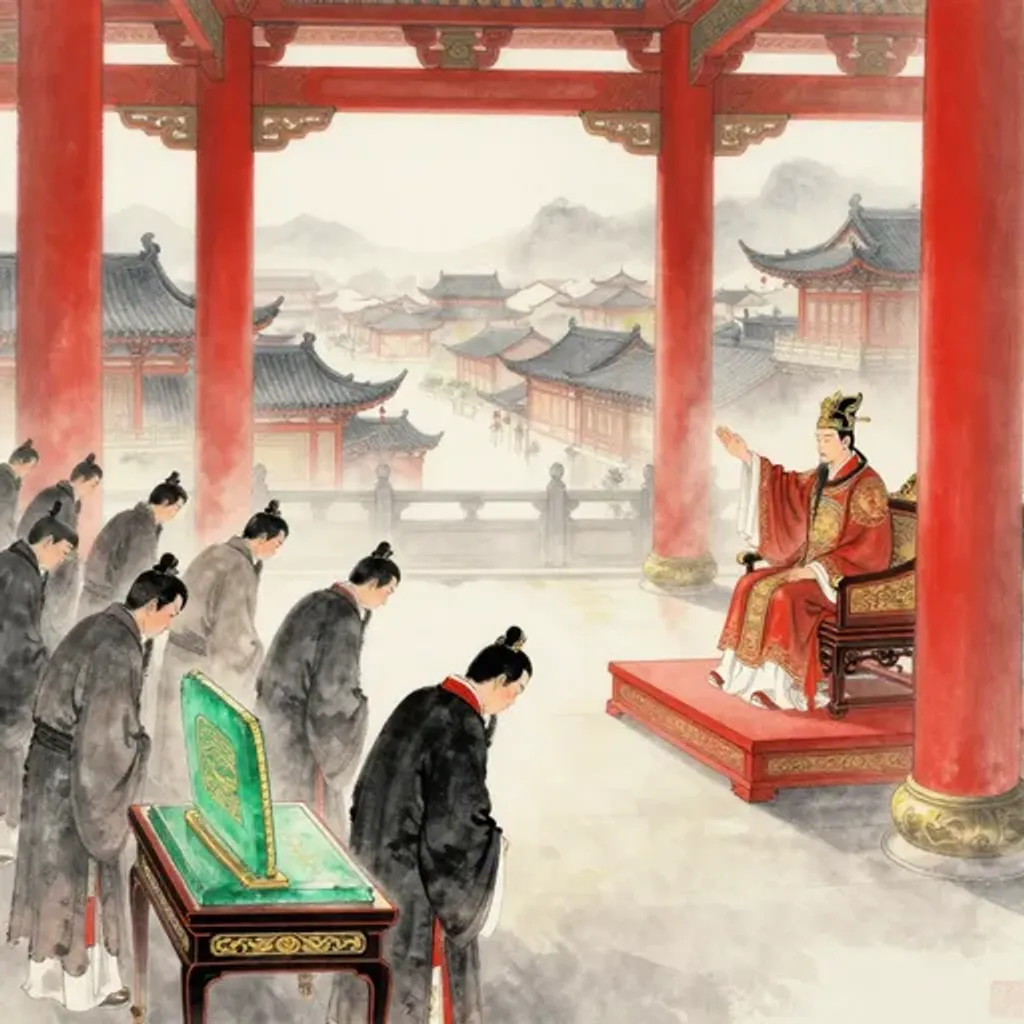
周成之隆,刑措無凶,太宰讚佑,君子作仁。
The flourishing reign of King Cheng of Zhou; punishments set aside, no misfortune. The Grand Chancellor gives aid and praise; the noble man enacts benevolence.
— Jiao Yanshou, Yilin (Forest of Changes), 1st century BC
Commentary
Heaven above the mountain descends into doubled earth — the Receptive's generous stillness. The verse celebrates the golden age of King Cheng of Zhou: punishments are set aside because no crimes arise, and the Grand Steward assists with blessing. Gentlemen practice benevolence throughout the realm. King Cheng, son of King Wu, reigned under the regency of the Duke of Zhou, whose institutional reforms created a period of legendary peace. The 'Grand Steward' likely refers to the Duke of Zhou himself in his administrative capacity. From Retreat to the Receptive, strategic withdrawal paradoxically enables the fullest expression of nurturing governance. The mountain yields to earth: the ruler who knows when to step back — delegating to a trusted minister — creates the conditions for a kingdom where force becomes unnecessary.
遯 → 屯
Hexagram 33 → Hexagram 3: Difficulty at the Beginning
Changing lines: 1, 3, 4, 6
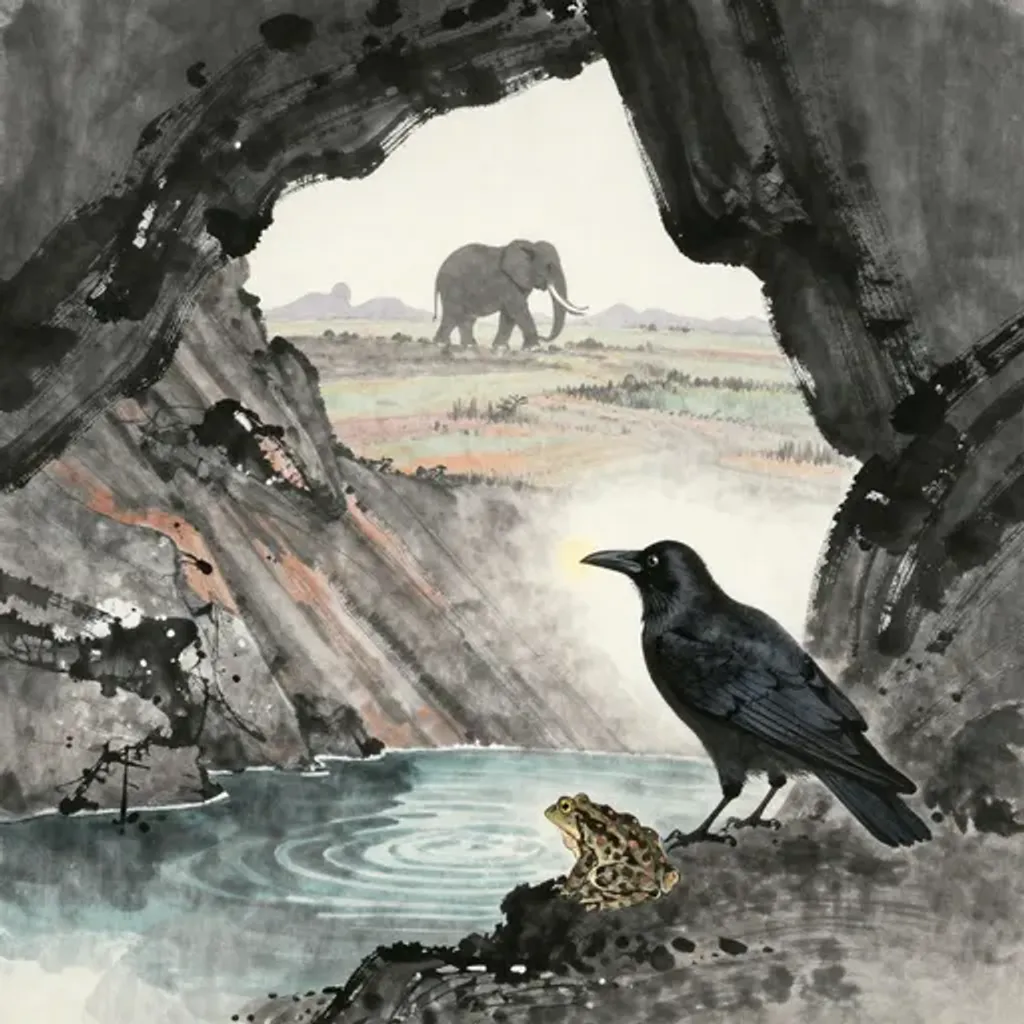
穴有孤烏,坎生蝦蟆,象出萬里,不可得捕。
In the cave, a solitary crow; in the pit, a toad is born. The elephant roams ten thousand li; it cannot be caught.
— Jiao Yanshou, Yilin (Forest of Changes), 1st century BC
Commentary
Heaven above the mountain plunges into cloud and thunder — Difficulty at the Beginning. A lone crow huddles in its hole; a toad spawns in the pit. An elephant roams ten thousand li away, impossible to capture. Each creature inhabits its own realm, unreachable from the others. The verse evokes frustrated pursuit: the quarry is either buried underground, hidden in a burrow, or wandering so far afield that no effort can close the distance. From Retreat to Difficulty at the Beginning, the mountain's withdrawal collapses into primal confusion. Thunder rumbles beneath gathering clouds, but nothing coheres. The one who retreats vanishes utterly, like the distant elephant — and those left behind grope in darkness among crows and toads, unable even to locate what they have lost.
遯 → 蒙
Hexagram 33 → Hexagram 4: Youthful Folly
Changing lines: 2, 3, 4, 5
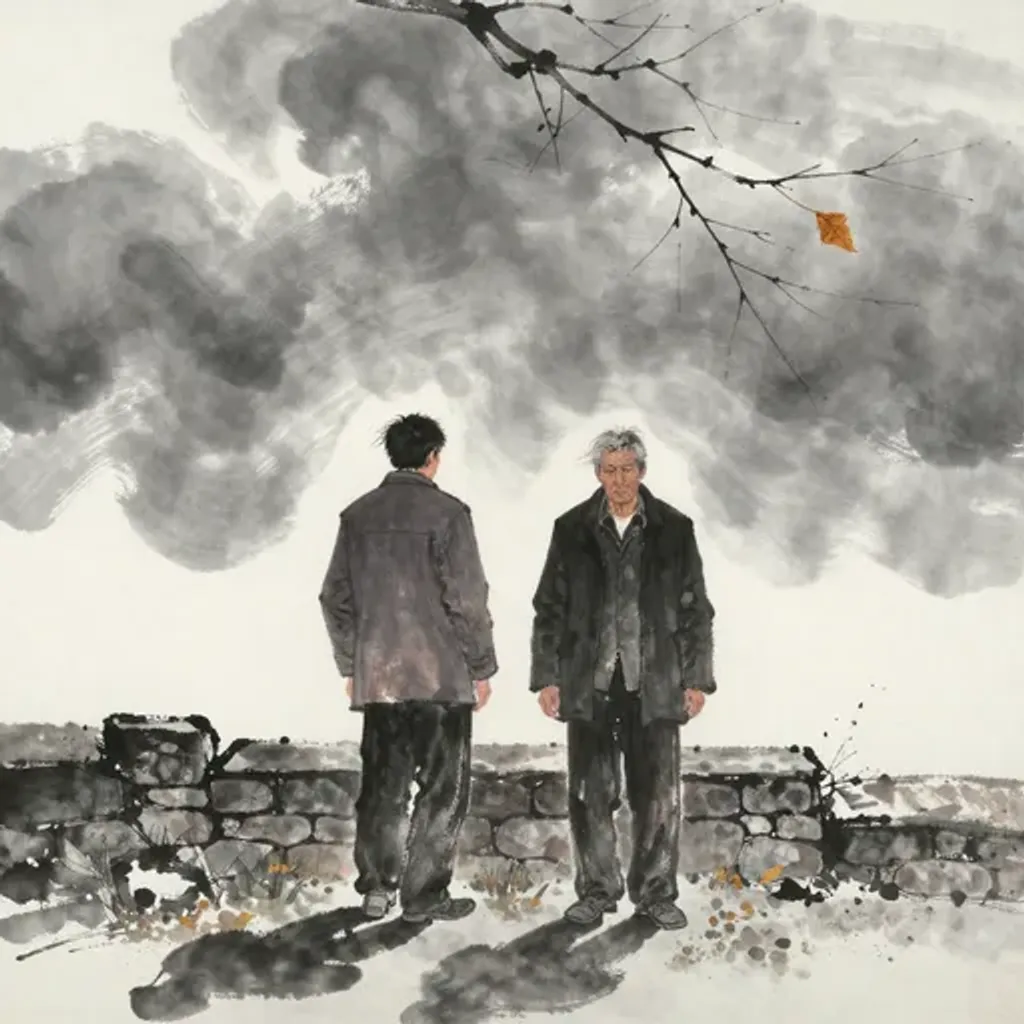
俱為天民,雲過吾西,伯氏嫉妬,與我無恩。
All alike are heaven's people; clouds pass west of me. The elder brother harbors jealousy; he shows me no kindness.
— Jiao Yanshou, Yilin (Forest of Changes), 1st century BC
Commentary
Heaven above the mountain shifts into mountain over water — Youthful Folly's bewildered darkness. All are subjects under heaven, yet clouds drift past to the west without pausing. The elder brother harbors jealousy and shows no kindness. The verse depicts familial estrangement: though bound by common origin, one sibling turns hostile while the other can only watch opportunity pass like drifting clouds. The 'elder brother's jealousy' resonates with numerous Spring and Autumn succession crises where brothers contended for inheritance. From Retreat to Youthful Folly, the mountain's strategic withdrawal encounters the spring that cannot yet find its way. The retreating figure withdraws not from enemies but from kin — the most painful form of retreat, where the folly lies not in ignorance but in the refusal of one's own blood to offer grace.
遯 → 需
Hexagram 33 → Hexagram 5: Waiting
Changing lines: 1, 2, 4, 6
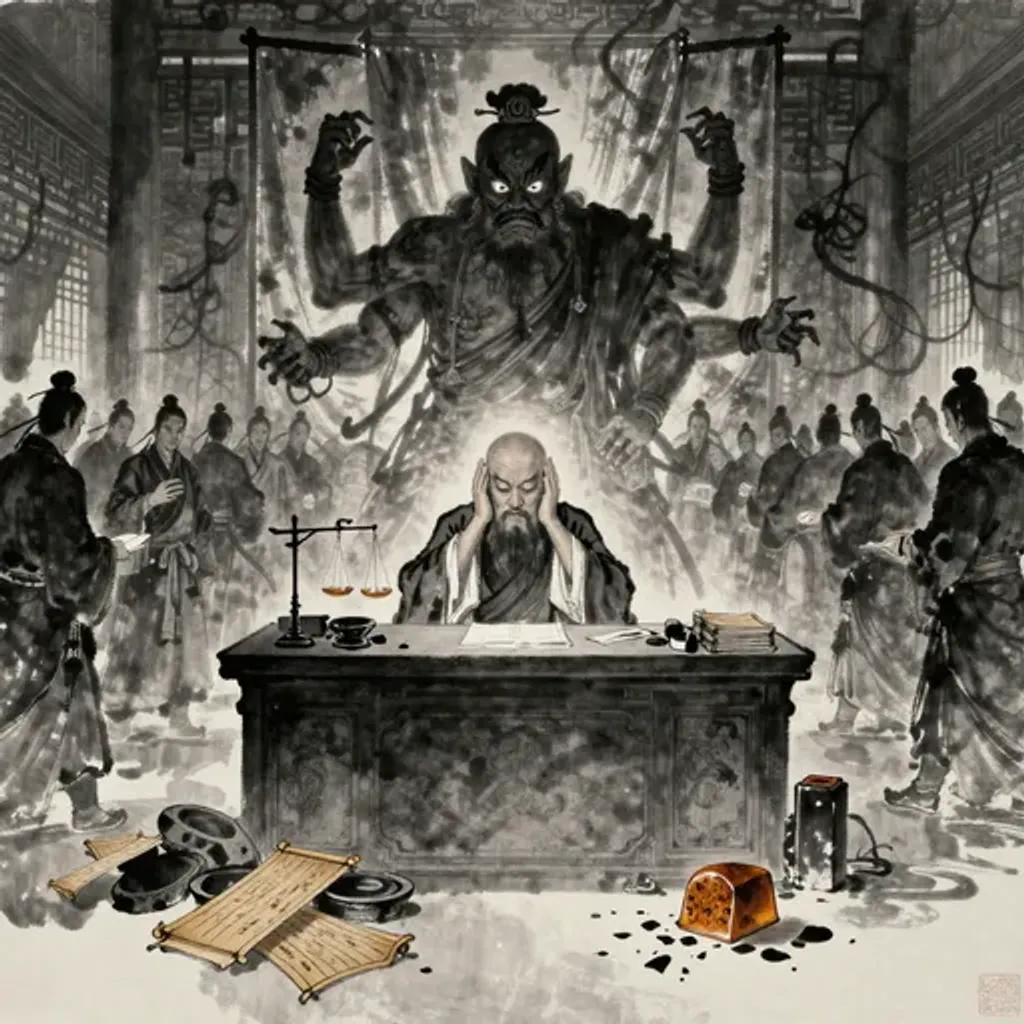
三手六目,政多煩惑,皋陶瘖聾,亂不可從。
Three hands, six eyes; governance is troubled and confused. Gao Yao struck deaf and mute; in chaos, one cannot follow.
— Jiao Yanshou, Yilin (Forest of Changes), 1st century BC
Commentary
Heaven above the mountain dissolves into clouds suspended over heaven — Waiting. Three hands and six eyes: too many decision-makers breed chaos and confusion. Even if Gao Yao, the legendary minister of justice under Shun, were deaf and mute, disorder would be uncontrollable. The verse warns against governance by committee where overlapping authorities paralyze action. Gao Yao represents the ideal of singular, clear-sighted judicial wisdom; the verse invokes him only to negate him — even the greatest judge is powerless when the system itself is incoherent. From Retreat to Waiting, the mountain's disciplined withdrawal gives way to suspended tension. Clouds gather but refuse to rain. The disorder described is not lawlessness but institutional paralysis — too many hands grasping at a single steering wheel.
遯 → 訟
Hexagram 33 → Hexagram 6: Conflict
Changing lines: 2, 3
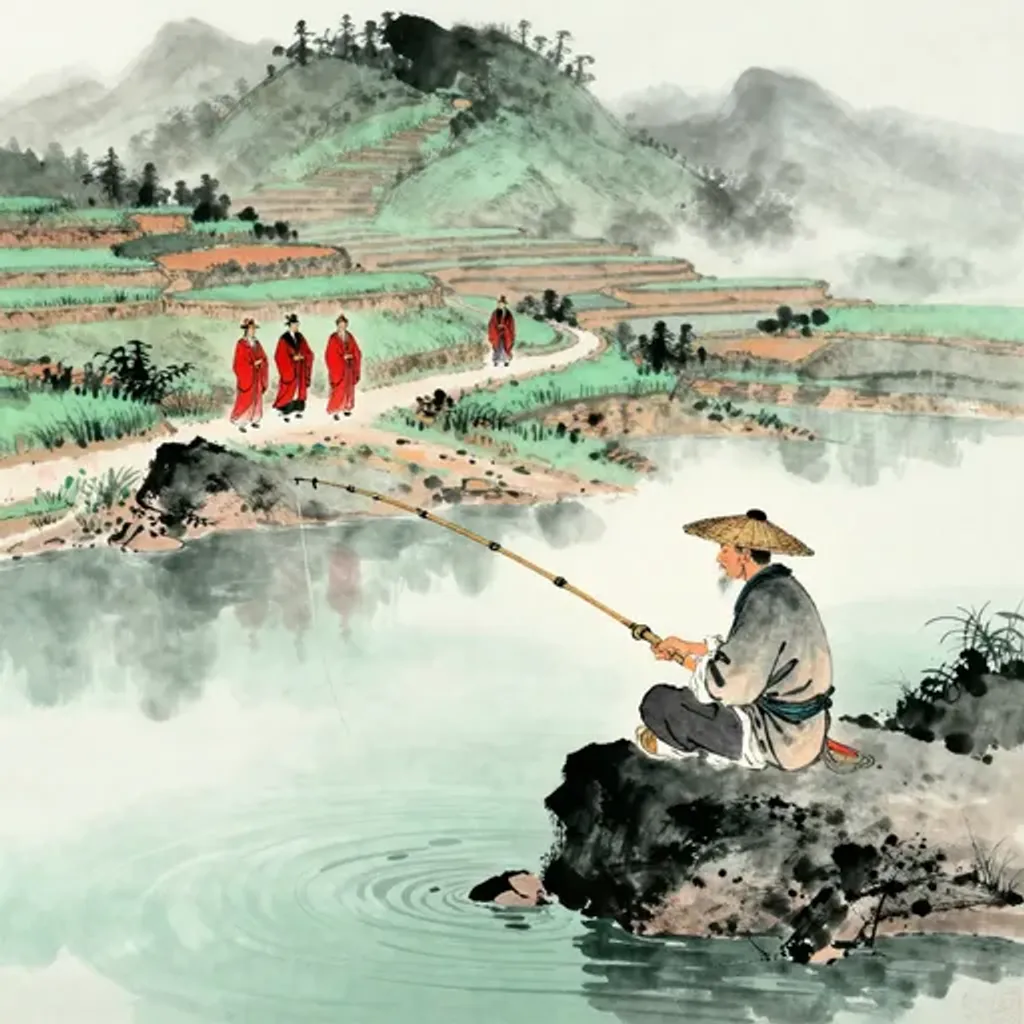
德積不輕,辭王釣耕,三媒不已,大福來成。
Virtue accumulated is not slight; he declines the king to fish and plow. Three matchmakers persist without ceasing; great fortune comes to completion.
— Jiao Yanshou, Yilin (Forest of Changes), 1st century BC
Commentary
Heaven above the mountain transforms into heaven over water — Conflict, where opposing forces must be resolved through deliberation. Virtue accumulated without haste, the sage declines the king's summons and continues fishing and plowing. Three matchmakers persist in their invitations, and at last great fortune arrives. The verse almost certainly alludes to Jiang Ziya (Taigong), who fished at the Wei River until King Wen of Zhou discovered him and invited him to serve as counselor — reportedly after multiple overtures. From Retreat to Conflict, the one who retreats from the world forces the world to come seeking. The transformation reveals how strategic withdrawal creates a different kind of confrontation: not adversarial, but the tension between a ruler's need and a sage's integrity, resolved only when the invitation becomes irresistible.
遯 → 師
Hexagram 33 → Hexagram 7: The Army
Changing lines: 2, 3, 4, 5, 6
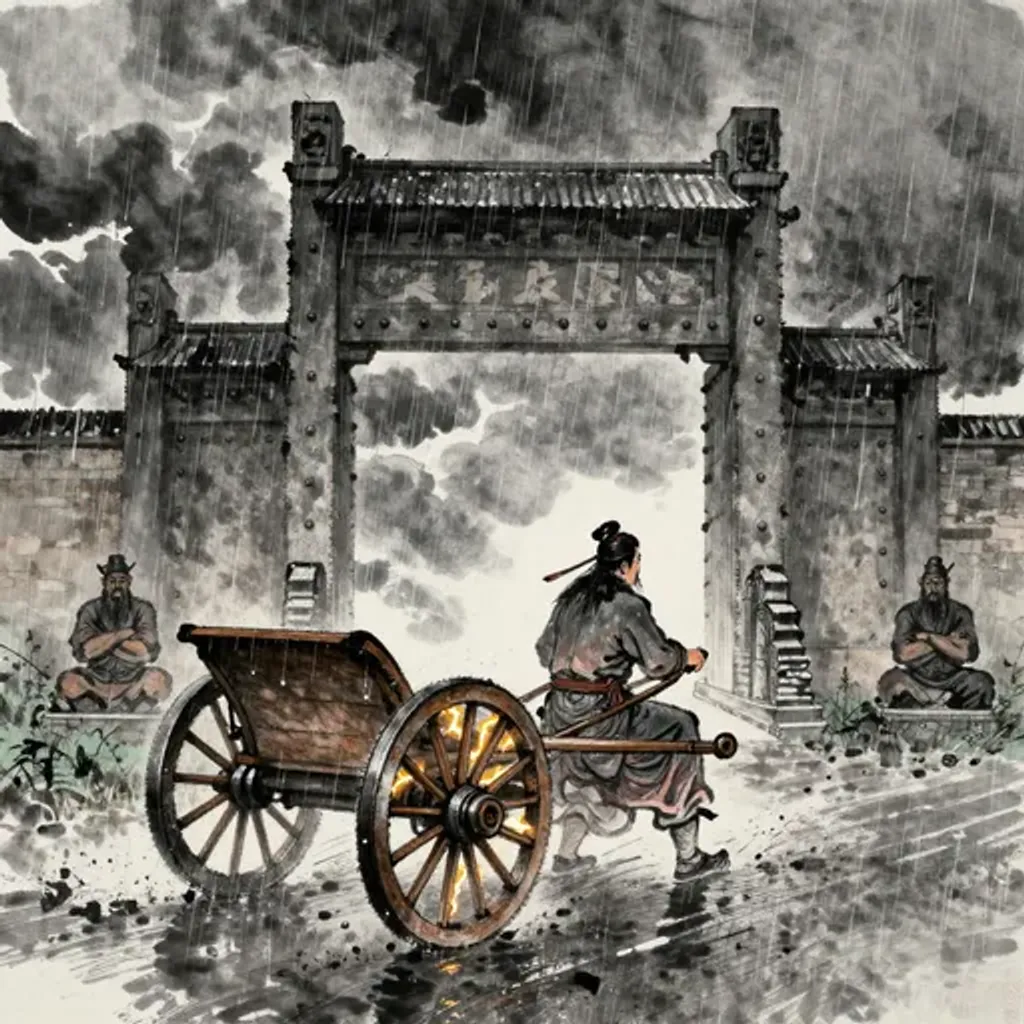
堅固相親,曰篤无患,六體不易,執以安全,雨師駕西,濡我轂輪,張伯李季,各坐關門。
Steadfast bonds, mutual closeness; firm and sure, without calamity. The six limbs do not shift; held fast in safety. The Rain Master drives west, soaking our wheel hubs. Zhang Bo and Li Ji each sit guarding their gates.
— Jiao Yanshou, Yilin (Forest of Changes), 1st century BC
Commentary
Heaven above the mountain withdraws into earth concealing water — the Army's disciplined containment. Bonds are firm and loyal, steadfast and without danger. The six joints of the body remain unshaken, held in secure alignment. Then the Rain Master drives westward, soaking hub and wheel. Zhang Bo and Li Ji each sit guarding their own gates. The verse layers defensive solidarity with watchful isolation: the body politic holds firm while each sentinel mans his post, even as the rain god drenches the roads. From Retreat to the Army, strategic withdrawal crystallizes into military discipline. The retreating force does not scatter — it consolidates. Each officer guards his gate; the formation remains unbroken. The rain merely tests what was already fortified through principled retreat.
遯 → 比
Hexagram 33 → Hexagram 8: Holding Together
Changing lines: 3, 4, 6
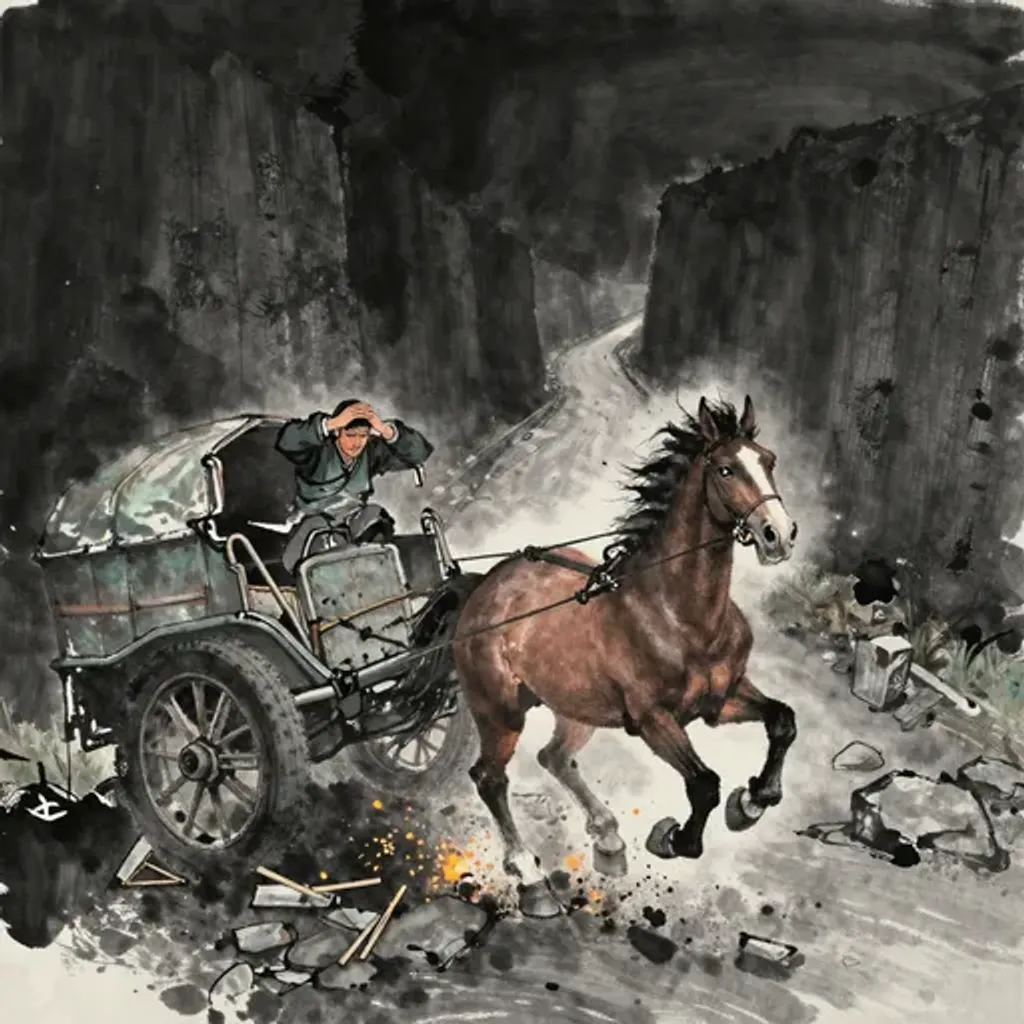
方內不行,輻摧輪傷,馬楚踶甚,受子閔時。
Within these confines, one cannot travel; spokes shattered, wheel broken. The horse kicks savagely in Chu; suffer, child, in this troubled time.
— Jiao Yanshou, Yilin (Forest of Changes), 1st century BC
Commentary
Heaven above the mountain yields to water upon earth — Holding Together. Yet togetherness fails here: the way forward is blocked, spokes snap and wheels shatter. The horse kicks violently, and one endures grief in a troubled time. Every image is one of broken connection — the vehicle that should carry one forward collapses, the animal that should serve turns hostile. From Retreat to Holding Together, the verse captures the bitter irony of withdrawal that seeks alliance but finds only wreckage. The mountain's heaven descends to earth hoping for water's binding flow, but instead encounters fractured conveyance and a bucking mount. Sometimes retreat leads not to safety but to a worse predicament, where the bonds one hoped to forge prove as fragile as cracked spokes.
遯 → 小畜
Hexagram 33 → Hexagram 9: Small Taming
Changing lines: 1, 2, 4
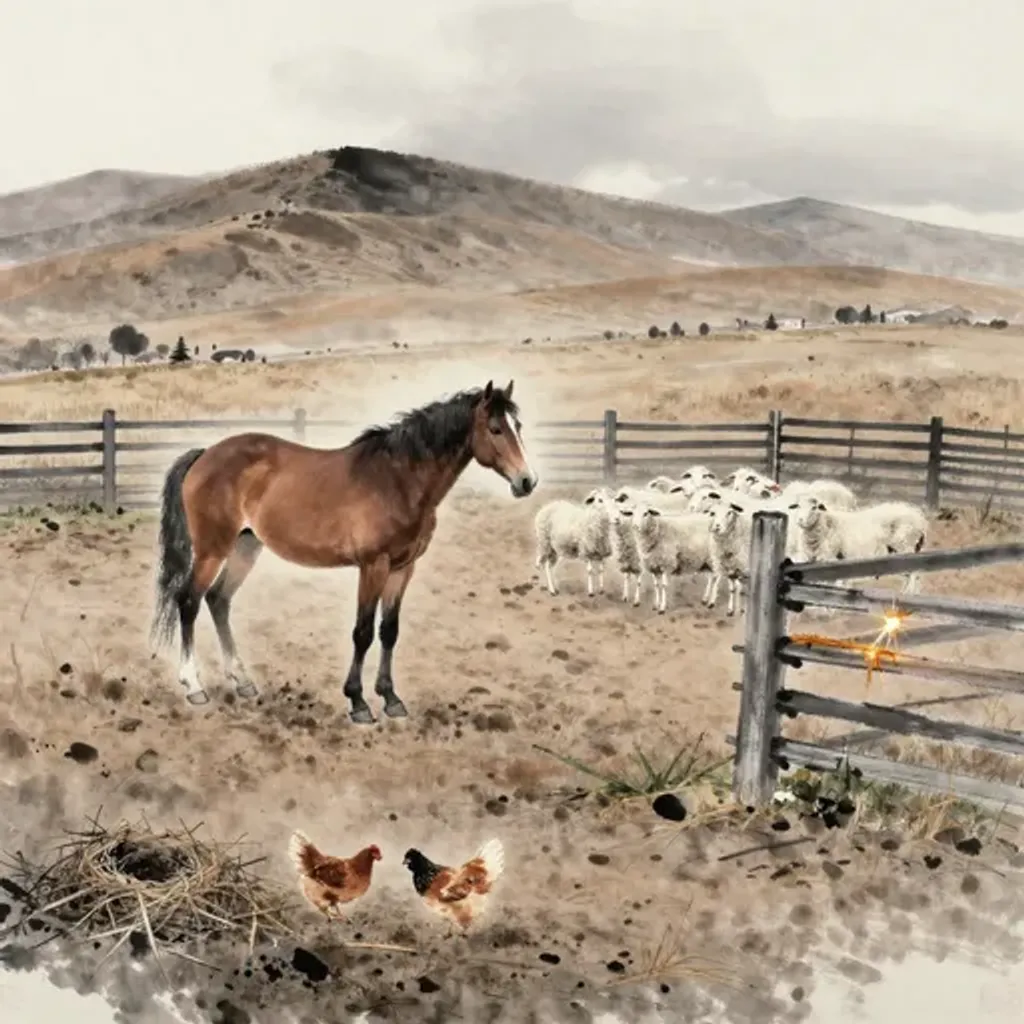
畜牝無駒,養雞不雛,群羊三歲,不生兩頭。
Raise a mare, no foal is born; keep hens, no chicks hatch. A flock of sheep at three years old; not one bears twin young.
— Jiao Yanshou, Yilin (Forest of Changes), 1st century BC
Commentary
Heaven above the mountain disperses into wind blowing across heaven — Small Taming's gentle restraint. A mare kept for breeding produces no foal; hens are raised but hatch no chicks; a flock of sheep reaches three years old without bearing lambs. Every form of husbandry fails. The animals are present, the conditions apparently adequate, yet nothing is generated. From Retreat to Small Taming, the verse describes the frustration of restraint without result. Small Taming's wind across heaven gently holds things in check — but here the restraint has become sterility. The retreat that should preserve productive capacity has instead drained it. What is tamed too lightly produces nothing; what withdraws too far from engagement loses the vitality needed to create.
遯 → 履
Hexagram 33 → Hexagram 10: Treading
Changing lines: 1, 2, 3
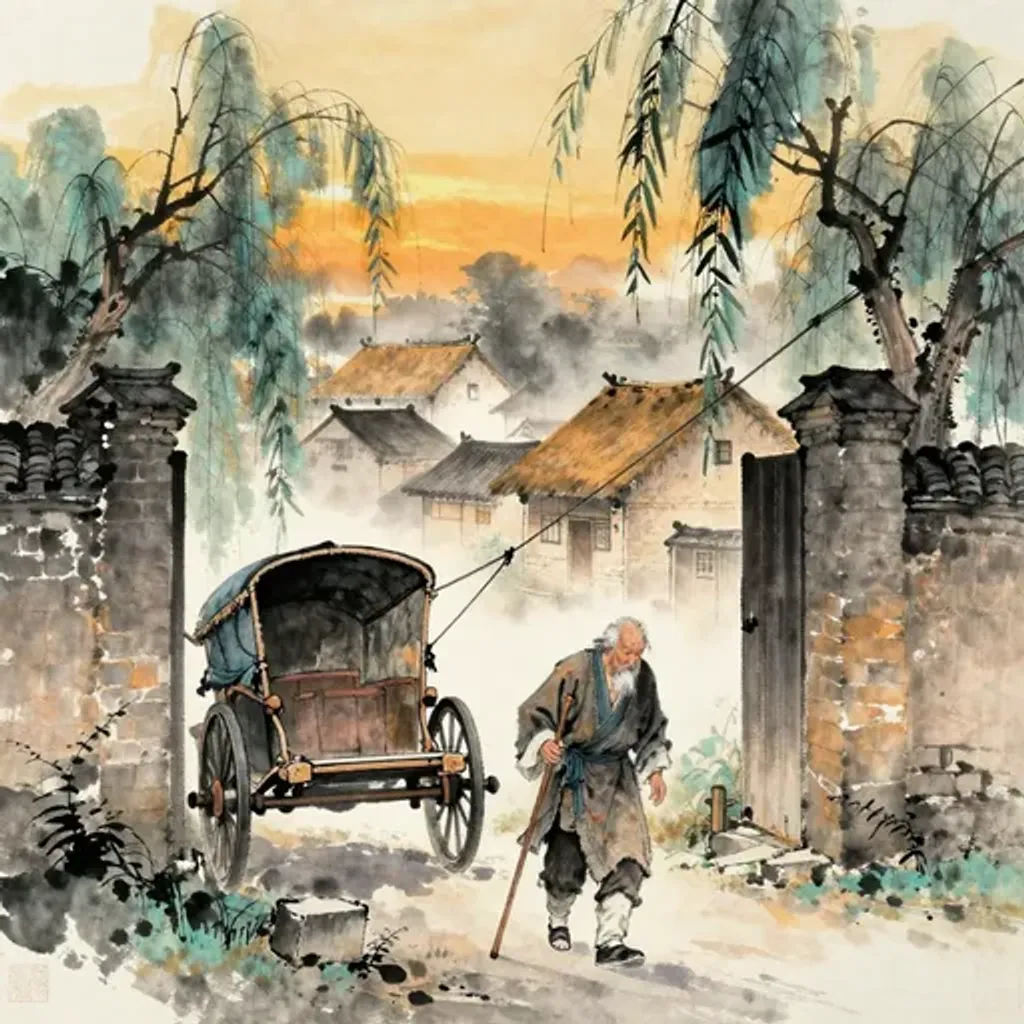
老耄罷極,無取中直,懸輿致仕,得歸鄉里。
Old and exhausted, spent to the limit; no strength left for uprightness. He suspends his carriage and retires from office; finding his way home to his native village.
— Jiao Yanshou, Yilin (Forest of Changes), 1st century BC
Commentary
Heaven above the mountain opens onto heaven over lake — Treading, where one walks carefully upon the tiger's tail. An aged official, exhausted and spent, can no longer find fairness or uprightness within himself. He suspends his carriage and retires from office, returning at last to his native village. The phrase 'suspending the carriage' (懸輿致仕) is a classical expression for retirement: the official literally hangs up the vehicle of his rank. From Retreat to Treading, withdrawal takes on ceremonial dignity. Treading's image is proper conduct — knowing precisely where to place one's feet. The old minister's retirement is the consummate act of treading correctly: knowing when one has lost the capacity to serve and withdrawing before that weakness harms others.
遯 → 泰
Hexagram 33 → Hexagram 11: Peace
Changing lines: 1, 2, 4, 5, 6
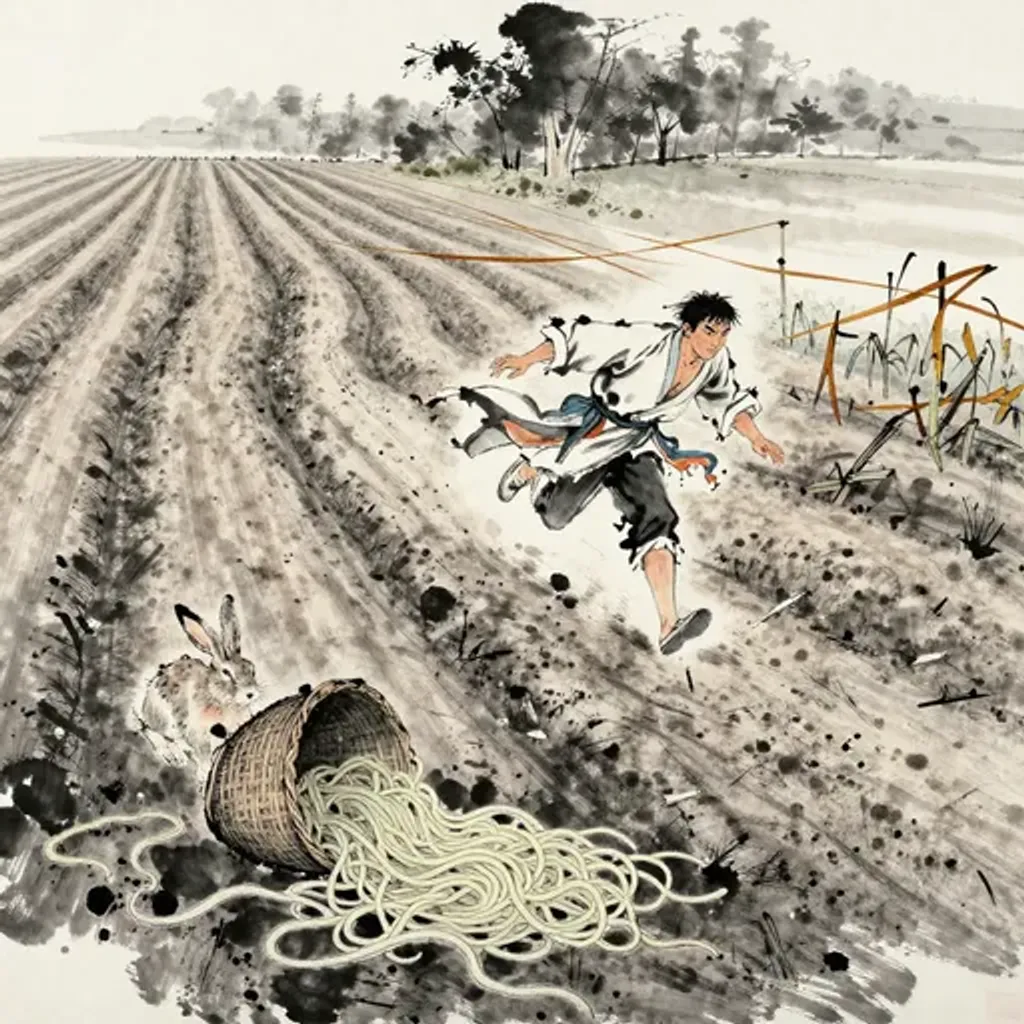
縮緒亂絲,手與為哭。越畝逐兔,斷其襌襦。
Winding thread, tangled silk; hands join in it and weep. Crossing furrows to chase a hare; tearing one's unlined robe.
— Jiao Yanshou, Yilin (Forest of Changes), 1st century BC
Commentary
Heaven above the mountain descends into earth below heaven — Peace, where heaven and earth mingle freely. Yet the verse paints disorder rather than harmony: tangled silk and knotted threads reduce one's hands to tears of frustration. Then the scene shifts to chasing a rabbit across open fields, tearing one's unlined robe in the process. The images capture futile effort — attempts to impose order on chaos and reckless pursuit that destroys what one wears. From Retreat to Peace, the transformation should bring communion between high and low, but here the retreating figure stumbles into confusion rather than harmony. Peace requires more than withdrawal; it demands patient untangling. The torn robe warns that rushing headlong toward resolution undoes whatever protection retreat once provided.
遯 → 否
Hexagram 33 → Hexagram 12: Standstill
Changing lines: 3
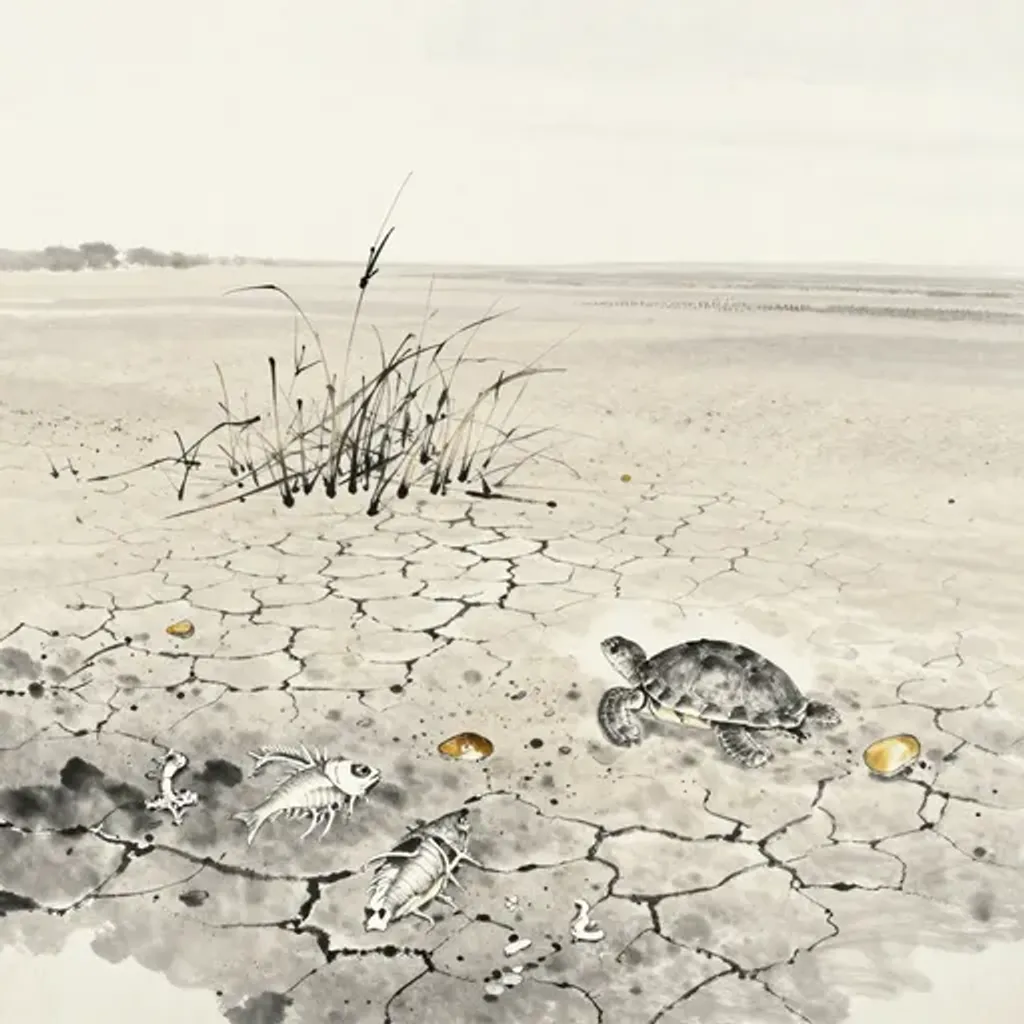
海老水乾,魚鱉盡索,藁落无潤,獨有沙石。
The sea grows old, the water dries; fish and turtles are all exhausted. Withered and parched, no moisture remains; only sand and stones are left.
— Jiao Yanshou, Yilin (Forest of Changes), 1st century BC
Commentary
Heaven above the mountain hardens into heaven over earth — Standstill, where heaven and earth refuse to communicate. The sea grows old and its waters dry up; fish and turtles are exhausted and gone. The shores lie withered and moistureless, leaving nothing but sand and stone. Every image speaks of total depletion: the sea that once teemed with life is now a barren desert. From Retreat to Standstill, withdrawal taken to its absolute extreme becomes isolation — and isolation becomes death. Standstill's image is the refusal of heaven and earth to interact; here, the retreat has severed all connection between the nourishing waters and the creatures that depend on them. The verse warns that retreat without eventual return leads to a landscape where nothing can survive.
遯 → 同人
Hexagram 33 → Hexagram 13: Fellowship
Changing lines: 1
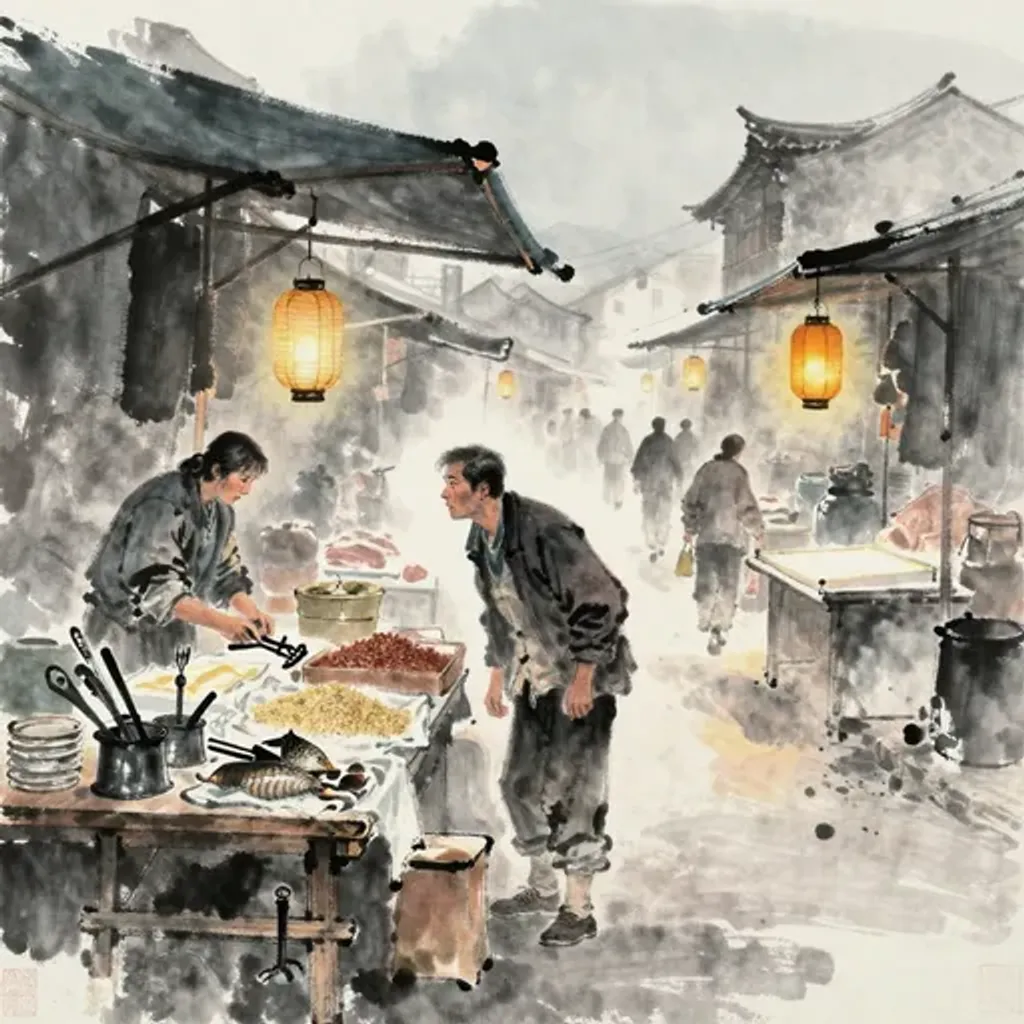
入市求鹿,不見頭足,終日至夜,竟無所得。
Entering the market to seek a deer; neither head nor hoof is seen. From dawn through to nightfall; in the end, nothing is obtained.
— Jiao Yanshou, Yilin (Forest of Changes), 1st century BC
Commentary
Heaven above the mountain shifts into heaven over fire — Fellowship, where like seeks like under heaven's bright gaze. Yet the verse depicts futile searching: entering the marketplace to find a deer, seeing neither head nor hoof. From dawn to nightfall, nothing is gained. The market is a place of human exchange, not wildlife — the search is absurd from the start. From Retreat to Fellowship, the retreating figure attempts to rejoin society but looks for the wrong thing in the wrong place. Fellowship's image is fire ascending toward heaven — clarity of discernment that groups like with like. The failure here lies in misidentification: the one who retreated too long no longer recognizes where genuine fellowship can be found, hunting for deer among merchants.
遯 → 大有
Hexagram 33 → Hexagram 14: Great Possession
Changing lines: 1, 2, 5
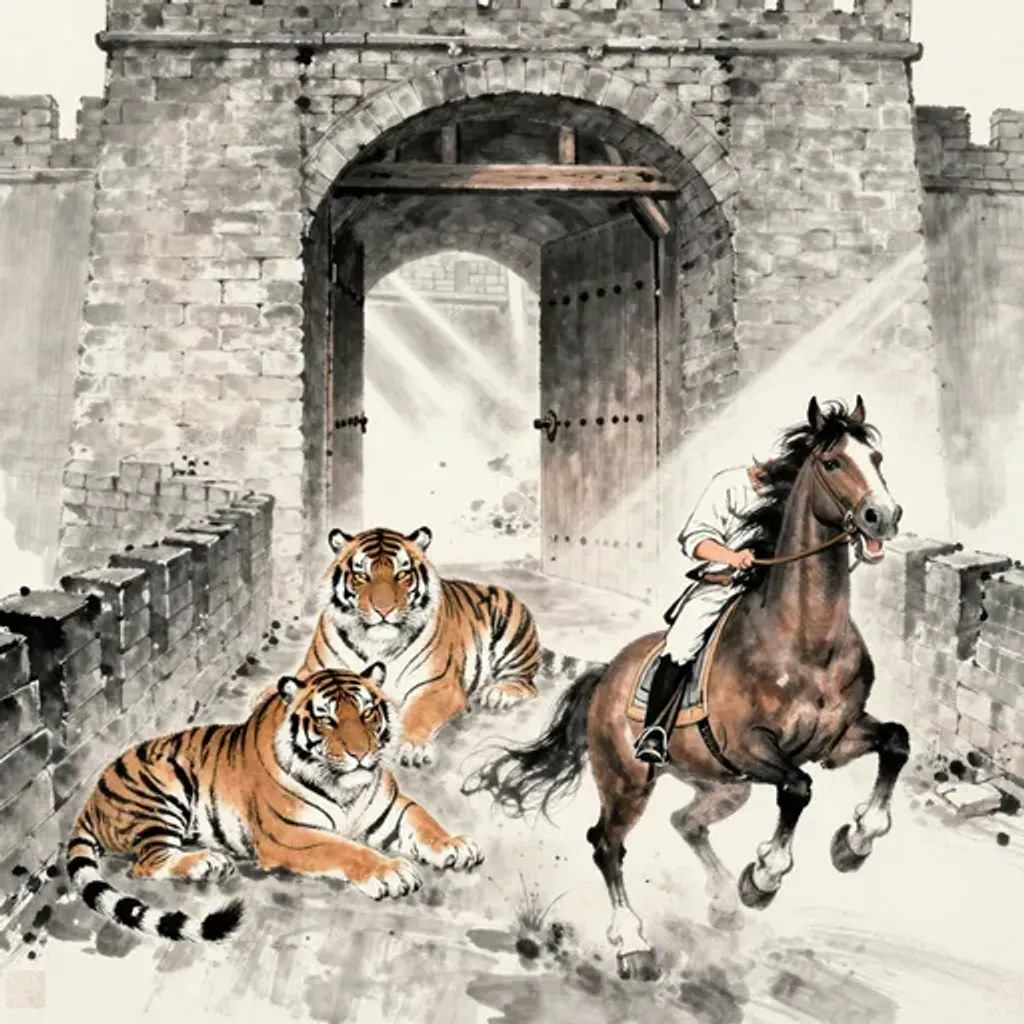
築門壅戶,虎臥當道,驚我驊騮,不利出處。
The gate is built up, the door sealed shut; a tiger lies across the road. It startles my fine steed; it is not favorable to go out.
— Jiao Yanshou, Yilin (Forest of Changes), 1st century BC
Commentary
Heaven above the mountain blazes into fire over heaven — Great Possession's brilliant abundance. But the verse is all obstruction: gates are sealed and doors blocked; a tiger crouches across the road, startling the fine horses, making it impossible to venture forth. Great Possession's image is fire blazing high above heaven — supreme illumination and control. Yet here the path to abundance is guarded by a predator. From Retreat to Great Possession, the transformation suggests that the wealth and power awaiting the retreater are real but fiercely guarded. The tiger on the road is not random danger but territorial sovereignty — one does not simply walk into possession. The retreating figure must first reckon with the guardian at the gate, and the spooked horses reveal an inner terror that no strategic withdrawal has resolved.
遯 → 謙
Hexagram 33 → Hexagram 15: Modesty
Changing lines: 4, 5, 6
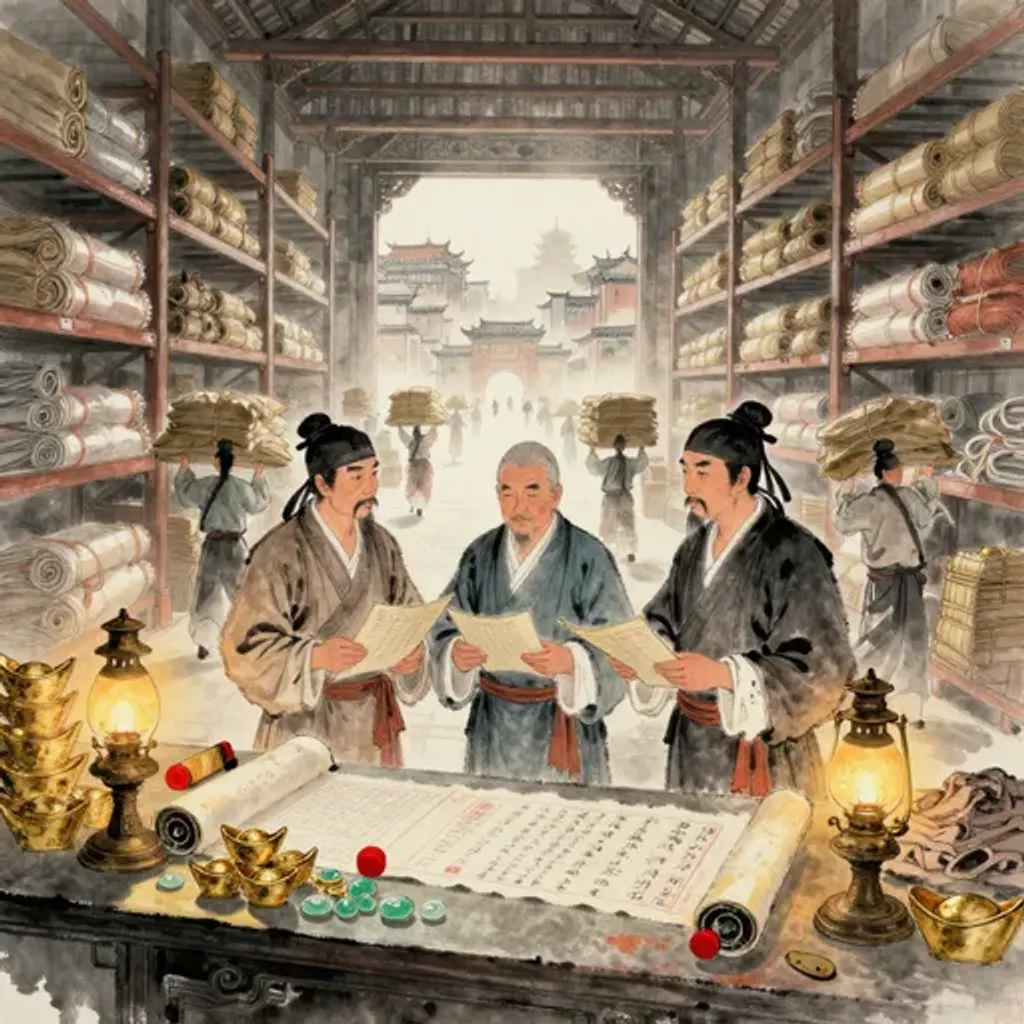
陶朱白圭,善賈息資,公子王孫,富貴不貧。
Tao Zhu and Bai Gui; skilled merchants who multiplied their wealth. Princes and nobles' sons; rich and prosperous, never poor.
— Jiao Yanshou, Yilin (Forest of Changes), 1st century BC
Commentary
Heaven above the mountain sinks into earth concealing mountain — Modesty's quiet power. Tao Zhu Gong and Bai Gui, masters of commerce, trade shrewdly and multiply their wealth. Princes and nobles enjoy riches without poverty. Tao Zhu Gong is Fan Li's merchant name — the strategist who helped Goujian destroy Wu, then vanished into trade and became fabulously wealthy. Bai Gui was a Warring States merchant-philosopher who advocated buying when others sold and selling when others bought. Both embody retreat turned to profit: stepping away from political power and channeling energy into commerce. From Retreat to Modesty, the mountain hidden within the earth mirrors the merchant who conceals his capabilities. Wealth flows to those who withdraw from ostentatious power and operate with unassuming precision.
遯 → 豫
Hexagram 33 → Hexagram 16: Enthusiasm
Changing lines: 3, 5, 6
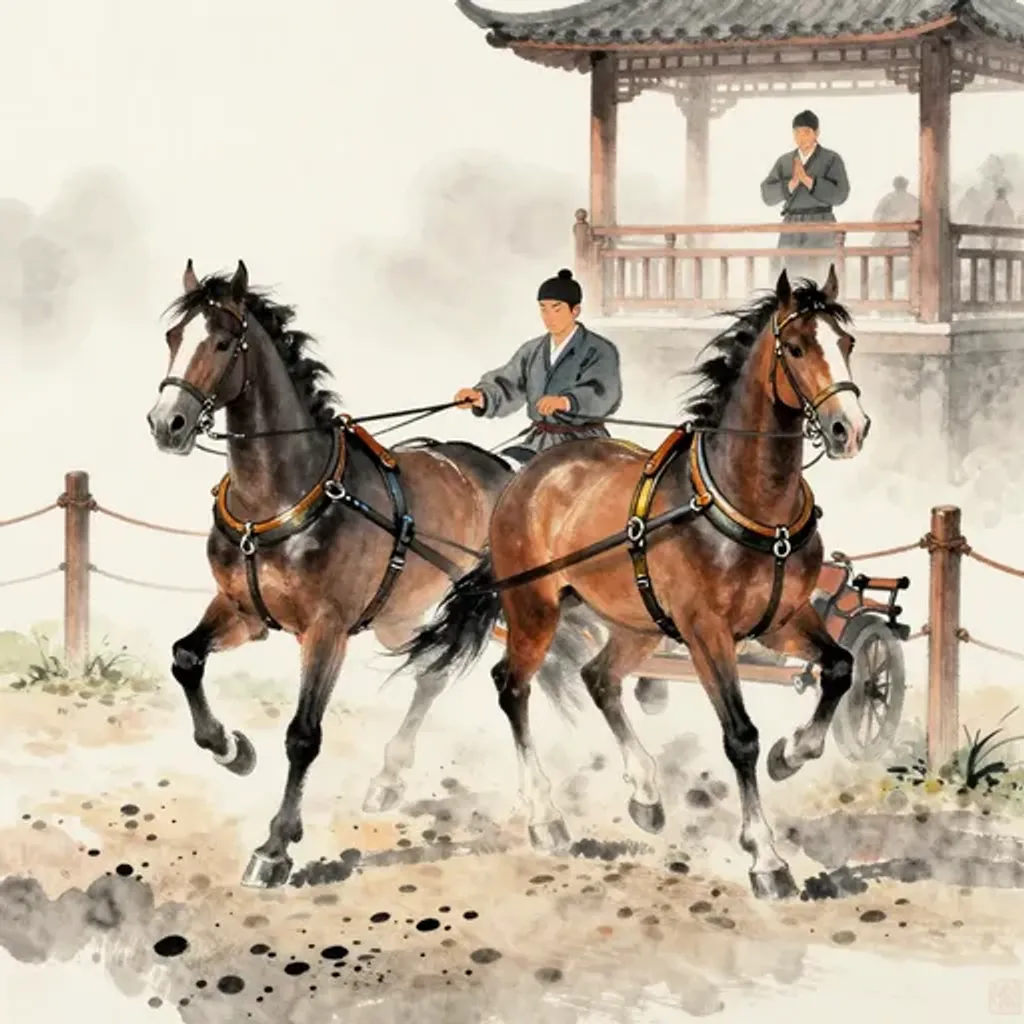
王良善御,伯樂知馬,周旋步驟,行中規矩,止息有節,延命壽考。
Wang Liang excels at driving; Bo Le knows horses. Circling and pacing, their gait follows compass and square. Halting and resting with proper measure; life is prolonged, old age attained.
— Jiao Yanshou, Yilin (Forest of Changes), 1st century BC
Commentary
Heaven above the mountain erupts into thunder above earth — Enthusiasm's joyful momentum. Wang Liang excels at driving chariots; Bole recognizes fine horses at a glance. They circle and pace, advancing and halting, every movement conforming to the compass and square. Rest comes at proper intervals, and life is prolonged in good health. Wang Liang was the legendary charioteer; Bole the supreme judge of horses. Together they represent the perfect pairing of talent and recognition, skill and discernment. From Retreat to Enthusiasm, the mountain's withdrawal gives way to thunder breaking from the earth — stored energy released in measured bursts. The verse celebrates mastery that emerges from disciplined retreat: stepping back, studying the rhythm, then re-engaging with perfect timing. Enthusiasm here is not recklessness but calibrated joy.
遯 → 隨
Hexagram 33 → Hexagram 17: Following
Changing lines: 1, 3, 6
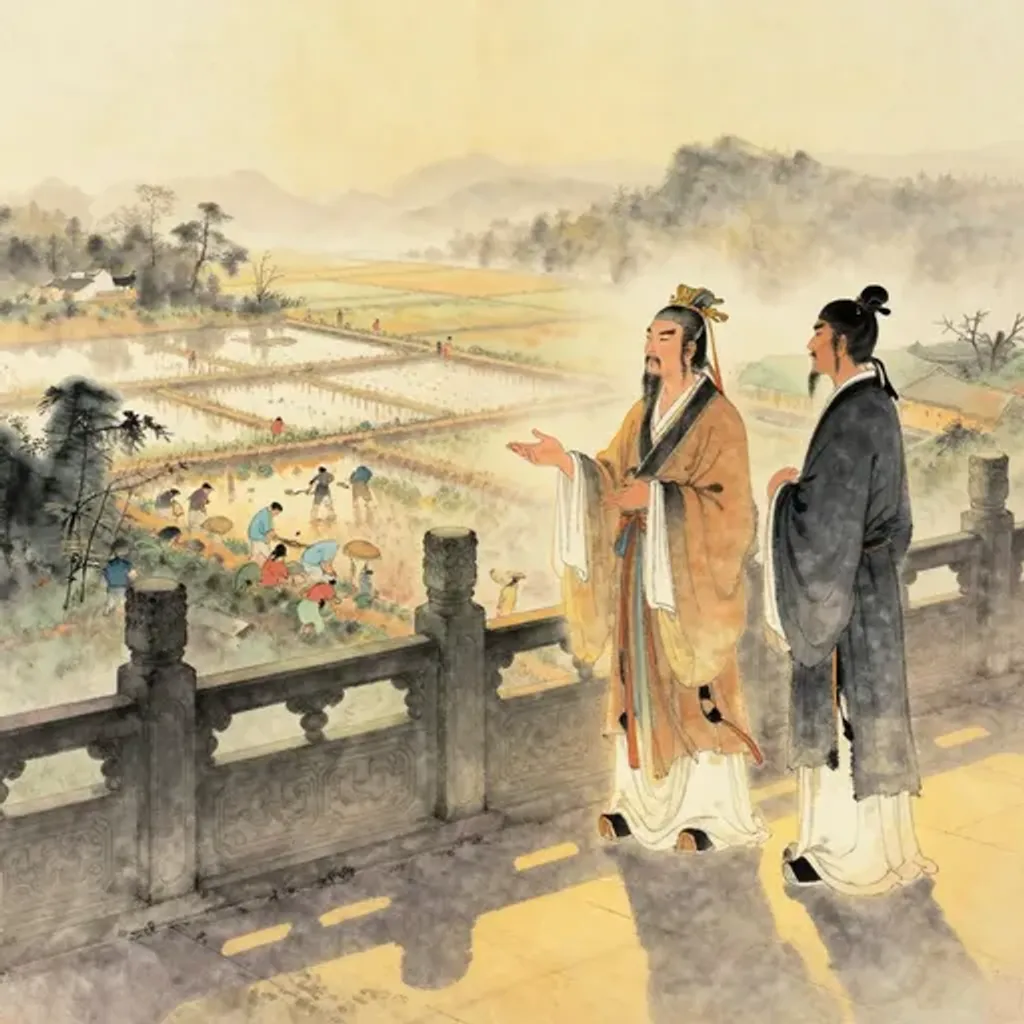
堯問伊舜,聖德增益,使民不懼,安無悚惕。
Yao consults with Shun; sagely virtue increases and grows. The people are made to fear nothing; peaceful and free from dread.
— Jiao Yanshou, Yilin (Forest of Changes), 1st century BC
Commentary
Heaven above the mountain flows into lake over thunder — Following, where one attunes to the rhythm of the times. Yao consults Shun, and sagely virtue multiplies. The people are freed from fear, dwelling in peace without anxiety. The verse envisions the ideal succession: the elder sage-king recognizes the younger's merit and yields authority, amplifying virtue through trust. Yao's abdication to Shun represents the supreme act of political retreat — stepping aside not from weakness but from wisdom. From Retreat to Following, the mountain's withdrawal becomes the lake settling over thunder: joy resting upon movement. The one who retreats creates a current others can follow. Yao's retreat is not abandonment but the founding gesture that enables Shun's benevolent rule.
遯 → 蠱
Hexagram 33 → Hexagram 18: Work on the Decayed
Changing lines: 2, 4, 5
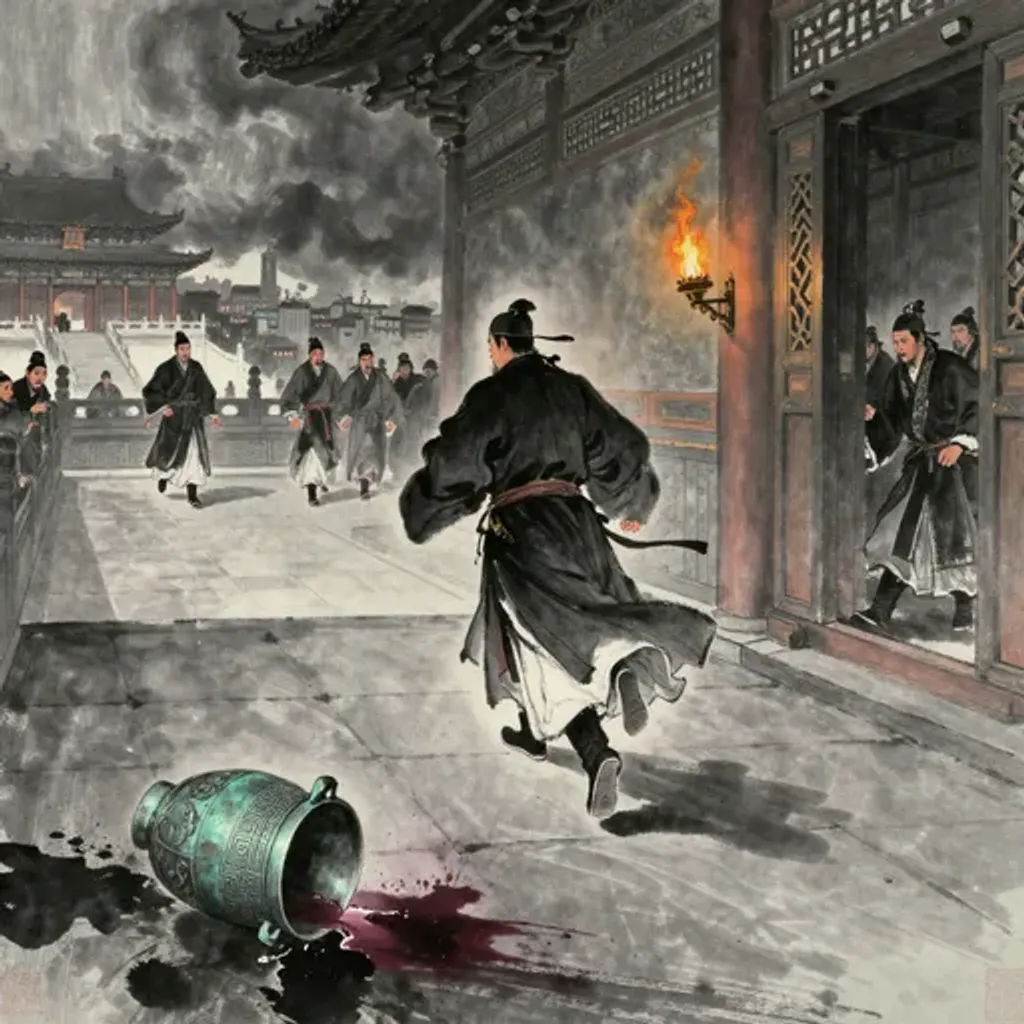
昭公失常,季氏悖狂,遜齊處鄆,喪其寵身。
Duke Zhao lost his proper authority; the Ji clan rebelled in madness. He fled to Qi and dwelt in Yun; losing his favored position.
— Jiao Yanshou, Yilin (Forest of Changes), 1st century BC
Commentary
Heaven above the mountain decays into mountain over wind — Work on the Decayed, where inherited corruption must be confronted. Duke Zhao of Lu loses his bearings; the Ji family acts with unbridled arrogance. The duke flees to Qi and resides at Yun, losing both his state and his person. In 517 BC, Duke Zhao attacked the powerful Ji family but was defeated and forced into exile — first to Qi, then to Yun, where he remained until his death in 510 BC, never regaining his throne. From Retreat to Work on the Decayed, the verse captures retreat as failure rather than strategy. The Gu hexagram demands that one confront inherited decay; Duke Zhao's retreat was the opposite — an escape that left the rot untreated, ensuring his permanent displacement.
遯 → 臨
Hexagram 33 → Hexagram 19: Approach
Changing lines: 1, 2, 3, 4, 5, 6
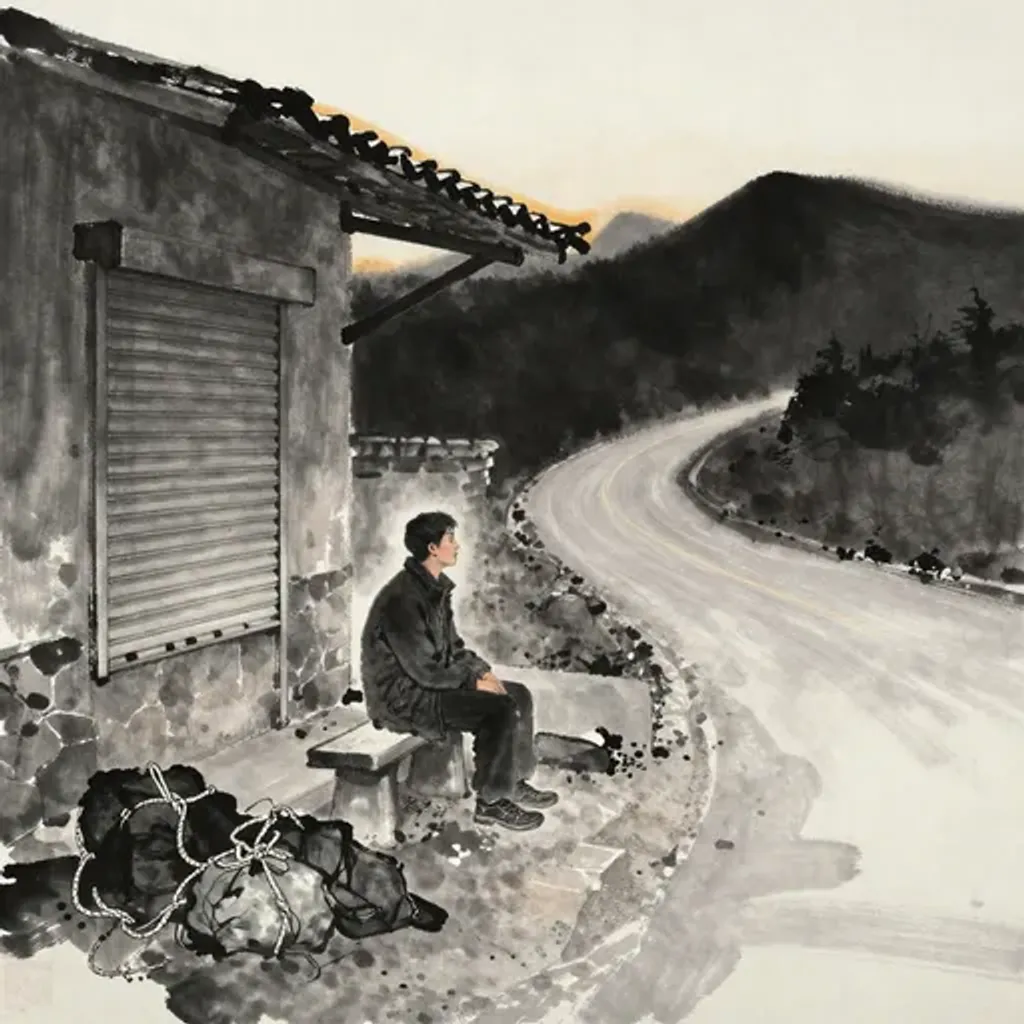
昏暮不行,候待旦明,從住止後,未得相從。
At dusk and nightfall, one cannot travel; wait and watch for the light of dawn. Staying behind, halting and lingering; unable yet to follow.
— Jiao Yanshou, Yilin (Forest of Changes), 1st century BC
Commentary
Heaven above the mountain broadens into earth over lake — Approach, where authority draws near to oversee. Yet the verse describes waiting in paralysis: at dusk the traveler halts, unable to proceed, waiting for dawn's light. Staying behind and stopping short, he cannot keep pace with those ahead. Every line speaks of delay and separation — the journey suspended, the companions gone on without him. From Retreat to Approach, the expected pattern is engagement: the earth draws close to the lake, the ruler descends to meet his people. But the retreating figure is stuck between withdrawal and re-engagement, frozen at the threshold of dusk. Approach demands initiative; the verse captures the agonizing moment when retreat has ended but the courage to re-enter has not yet arrived.
遯 → 觀
Hexagram 33 → Hexagram 20: Contemplation
Changing lines: 3, 4
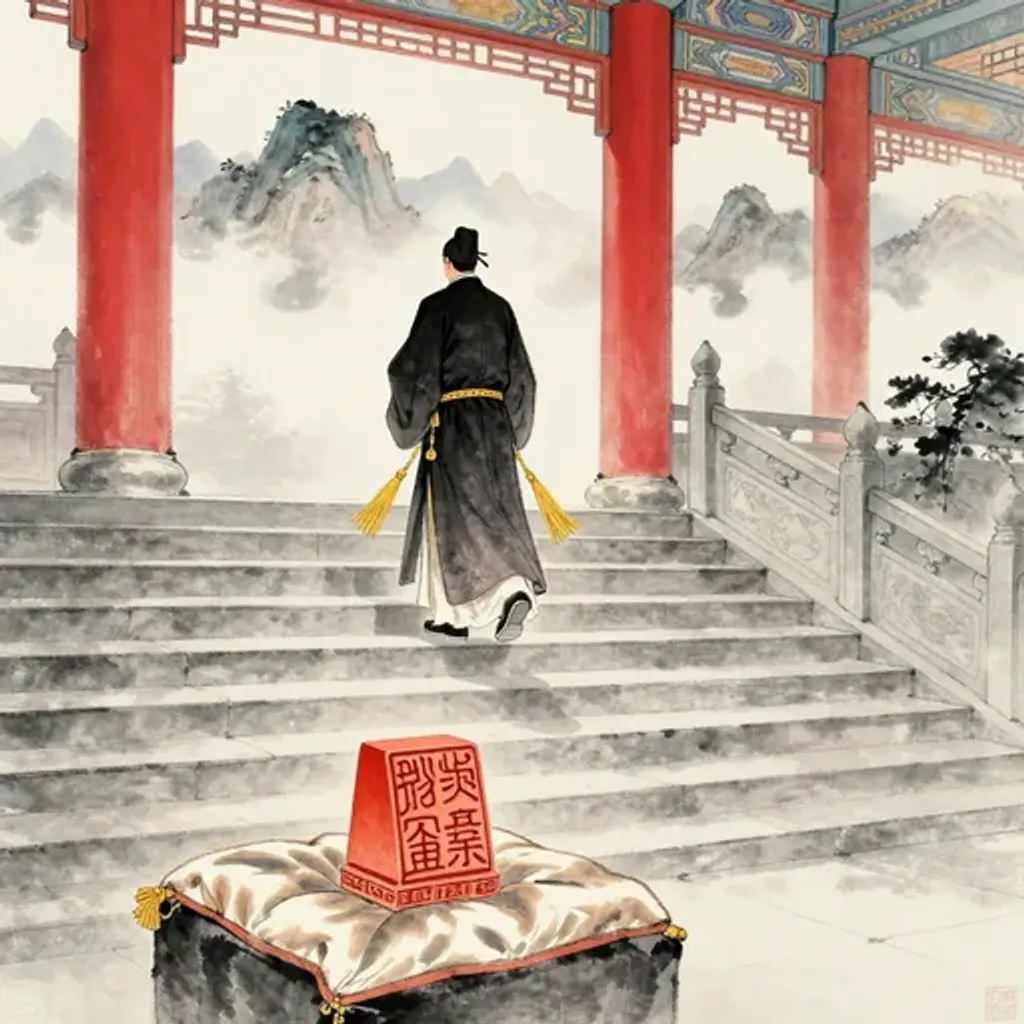
安上宜官,一日九遷,升擢超等,牧養常山。
Secure above, suited for office; nine promotions in a single day. Elevated and advanced beyond rank; sent to govern Changshan.
— Jiao Yanshou, Yilin (Forest of Changes), 1st century BC
Commentary
Heaven above the mountain opens into wind moving over earth — Contemplation, where the ruler surveys his domain from on high. The verse celebrates swift promotion: secure in one's position, well suited for office, promoted nine times in a single day, elevated beyond one's peers, appointed to govern Changshan. The image is of meteoric ascent through bureaucratic ranks — the very opposite of retreat. From Retreat to Contemplation, the mountain's withdrawal transforms into the wind's broad survey. The one who retreated from the world is now placed above it, observing all with the elevated perspective that only withdrawal could have provided. The verse suggests that genuine retreat cultivates the comprehensive vision required for high office — the contemplative eye that sees the whole landscape.
遯 → 噬嗑
Hexagram 33 → Hexagram 21: Biting Through
Changing lines: 1, 3, 5
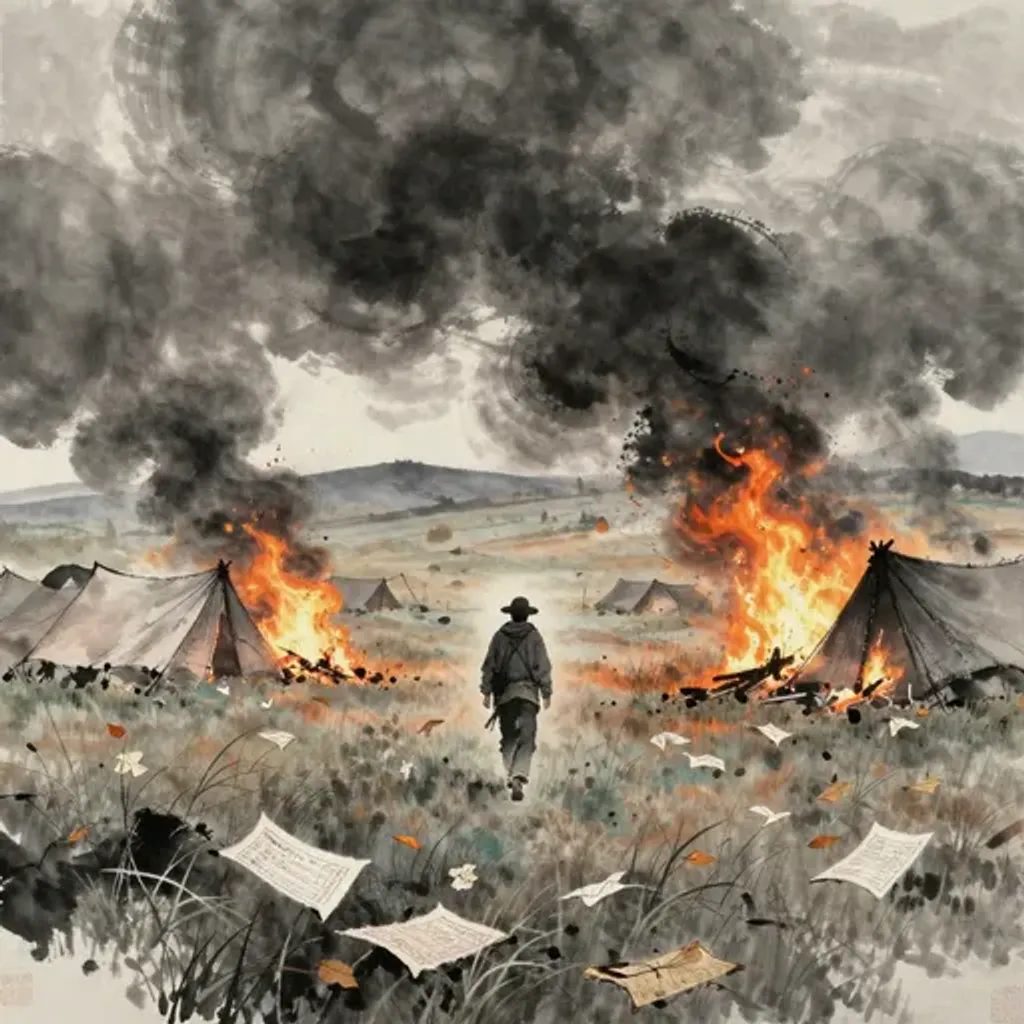
去惡就凶,東西多訟,行者無功。
Leaving evil, meeting misfortune; east and west, much litigation. The traveler achieves nothing.
— Jiao Yanshou, Yilin (Forest of Changes), 1st century BC
Commentary
Heaven above the mountain flashes into fire over thunder — Biting Through, where obstacles are forcibly removed through judicial action. The verse is stark: departing from evil, one encounters worse misfortune. East and west are filled with lawsuits, and the traveler accomplishes nothing. Every direction offers only conflict and futility. From Retreat to Biting Through, the mountain's strategic withdrawal gives way to the lightning bolt of enforced resolution. But the verse suggests that the retreat was merely from one evil into another — the traveler who fled trouble finds litigation everywhere. Biting Through demands decisive intervention to remove what obstructs; here, the retreating figure discovers that withdrawal alone cannot resolve disputes that follow wherever one goes.
遯 → 賁
Hexagram 33 → Hexagram 22: Grace
Changing lines: 1, 4, 5
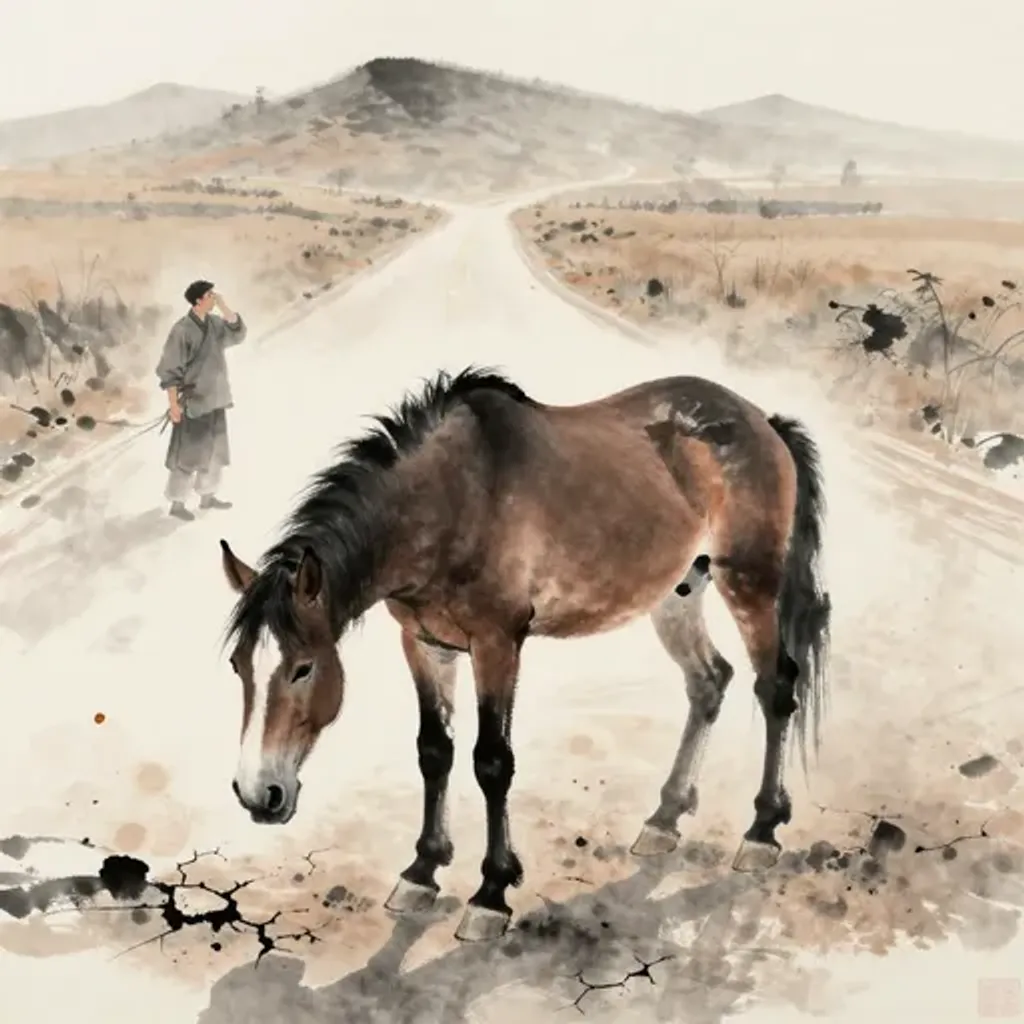
老馬垂耳,不見百里,君子弗恃,商人莫取,無與為市。
The old horse droops its ears; it cannot see a hundred li. The noble man does not rely on it; the merchant will not take it — none will trade for it.
— Jiao Yanshou, Yilin (Forest of Changes), 1st century BC
Commentary
Heaven above the mountain adorns itself as mountain over fire — Grace, where outer beauty illuminates substance. An old horse droops its ears and cannot cover a hundred li. The gentleman does not rely on it; the merchant will not buy it; no one will trade for such a beast. The image is of depleted vitality dressed in no adornment at all — a creature past its useful life that even its surface cannot redeem. From Retreat to Grace, the mountain's withdrawal should yield refinement and ornamentation. But the verse inverts this: the old horse is beyond beautifying. Grace requires something vital beneath the decoration; when the substance has fled, no amount of adornment can restore value. The retreat has lasted too long — what remains is too exhausted to bear even the lightest embellishment.
遯 → 剝
Hexagram 33 → Hexagram 23: Splitting Apart
Changing lines: 3, 4, 5
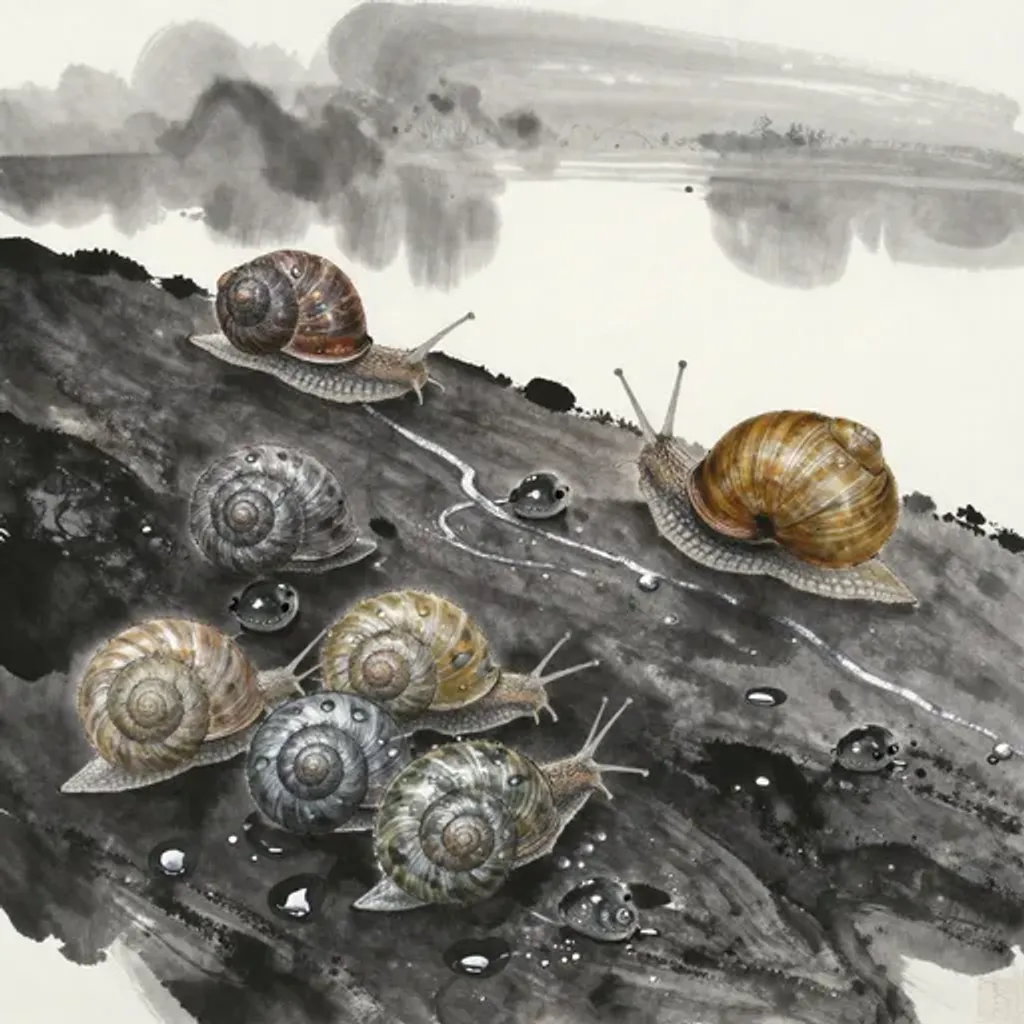
蝸螺生子,深目黑醜,似類其母,雖或相就,眾人莫取。
The snail bears its young; deep-eyed and dark. Resembling their mother in kind; though some may pair with them, the multitude will not take them.
— Jiao Yanshou, Yilin (Forest of Changes), 1st century BC
Commentary
Heaven above the mountain crumbles into mountain over earth — Splitting Apart, where what was built is stripped away layer by layer. Snails spawn offspring with deep-set eyes, dark and ugly, resembling their mother. Though they may draw close to one another, no one else will accept them. The verse's imagery is blunt: the offspring inherit only their parent's worst features, and the wider world rejects them. From Retreat to Splitting Apart, the mountain's withdrawal accelerates into erosion. What retreats too far from the world produces only diminished copies of itself — each generation less adapted, less attractive, less viable. The mountain attached to the earth slowly peels away; the retreating lineage, closed off from outside influence, deteriorates through inbreeding of form and spirit alike.
遯 → 復
Hexagram 33 → Hexagram 24: Return
Changing lines: 1, 3, 4, 5, 6
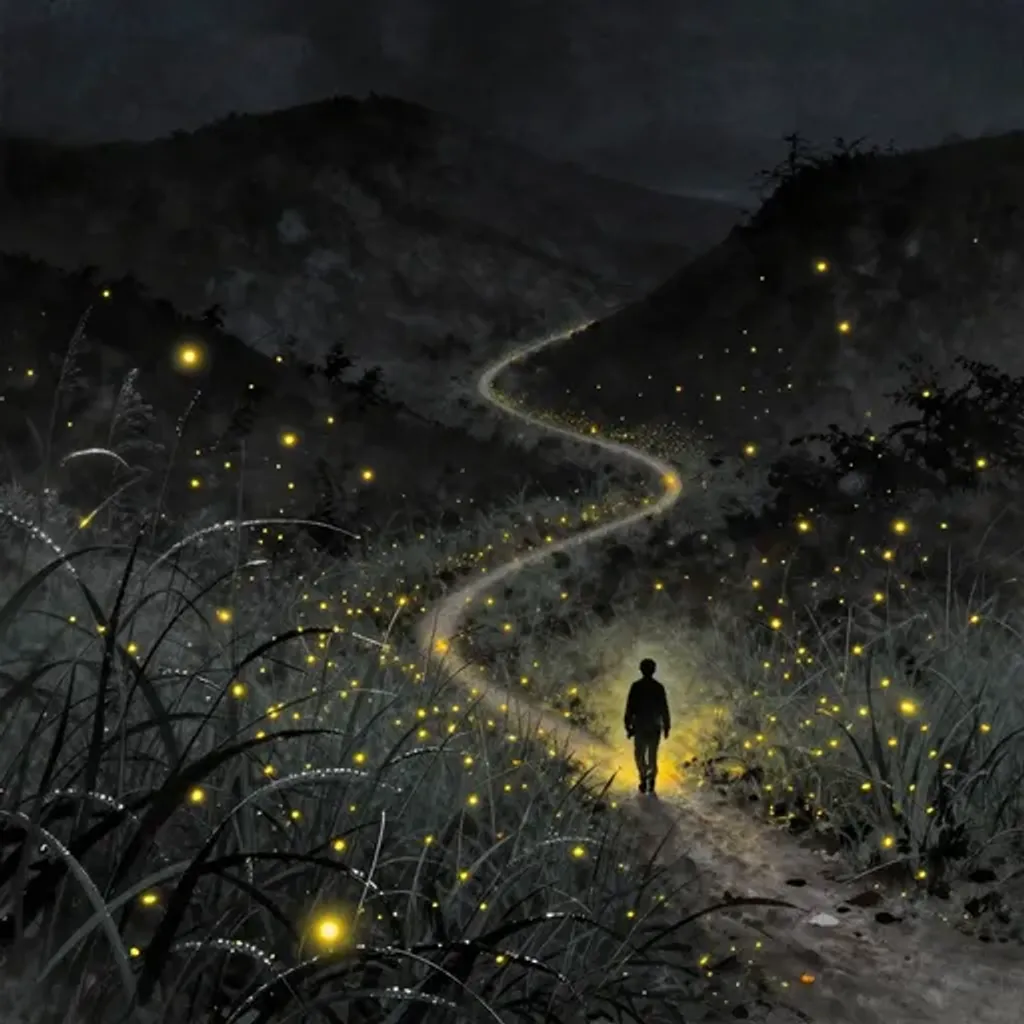
百足俱行,相輔為強,三聖翼事,王室寵光。
A thousand firefly sparks light the way for the returning traveler. Though the dark road is long, many small lights become a lamp.
— Jiao Yanshou, Yilin (Forest of Changes), 1st century BC
Commentary
Heaven above the mountain returns as thunder stirring within the earth — Return, the first pulse of renewal. The original verse reads: 'A hundred feet march together, mutual support makes strength. Three sages assist the enterprise, and the royal house shines with favor.' The hundred-footed creature thrives because each leg supports the others — collective action, not isolated retreat. The 'three sages' likely refers to the Duke of Zhou, the Duke of Shao, and Taigong, who together stabilized the young Zhou dynasty after King Wu's death. From Retreat to Return, the solitary mountain rejoins the rumbling earth. The verse insists that return is not a solo act: it requires allies, a network of mutual reinforcement, and the coordinated effort of multiple sages working as one.
遯 → 无妄
Hexagram 33 → Hexagram 25: Innocence
Changing lines: 1, 3
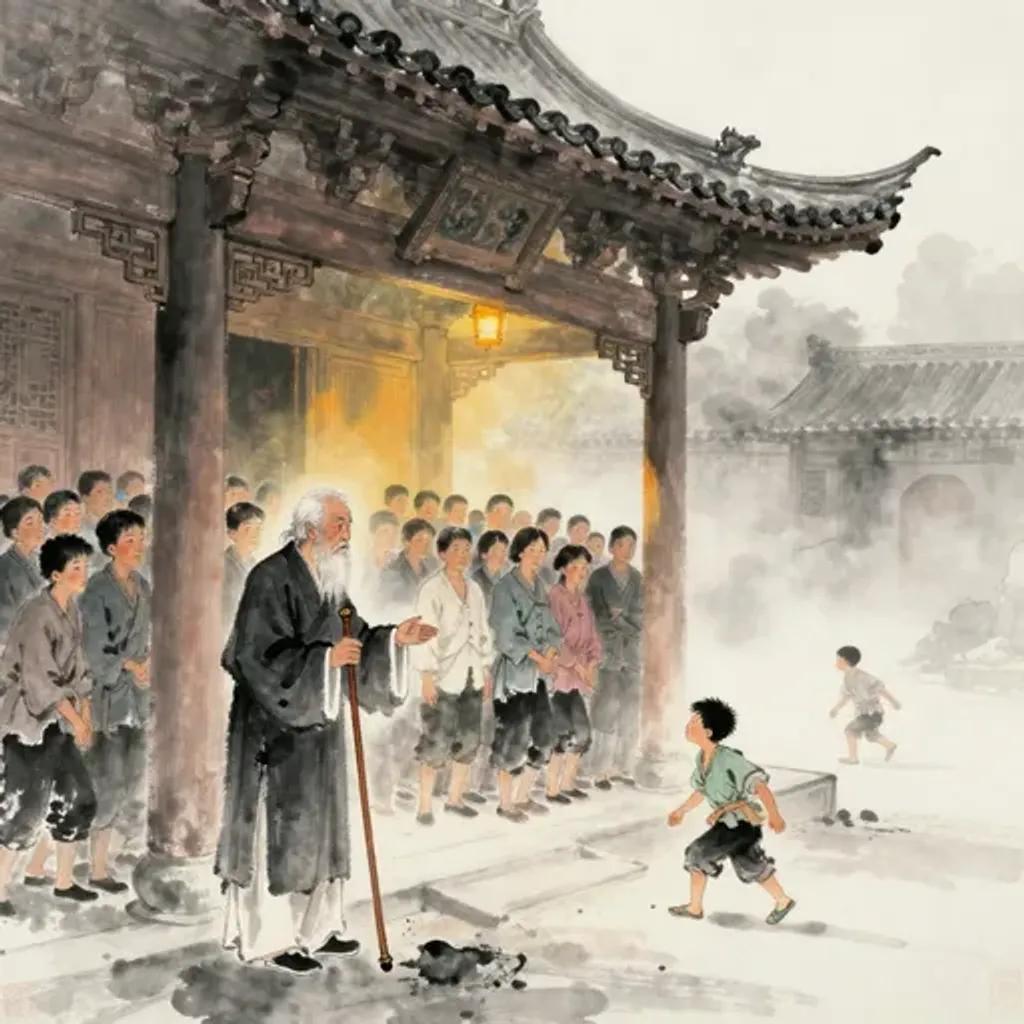
容民畜眾,履德有信,大人受福,童蒙憂惑,利無所得。
Sheltering the people, nurturing the multitude; treading virtue with good faith. The great man receives blessings; the young and ignorant suffer doubt and confusion — no profit is gained.
— Jiao Yanshou, Yilin (Forest of Changes), 1st century BC
Commentary
Heaven above the mountain crystallizes into heaven over thunder — Innocence, where action proceeds from authentic impulse without ulterior calculation. The verse divides sharply: the great man who shelters the multitude, walks in virtue, and acts with faithfulness receives blessing. But the ignorant youth (童蒙) is bewildered and anxious, gaining nothing from the situation. The same cosmic configuration that rewards the virtuous punishes the naive. From Retreat to Innocence, the mountain's strategic withdrawal becomes heaven's spontaneous thunder — action without artifice. The verse warns that innocence is not the same as ignorance. The great man retreats and returns with authentic virtue; the fool retreats and returns with nothing learned. Innocence must be earned through cultivation, not assumed through inexperience.
遯 → 大畜
Hexagram 33 → Hexagram 26: Great Taming
Changing lines: 1, 2, 4, 5
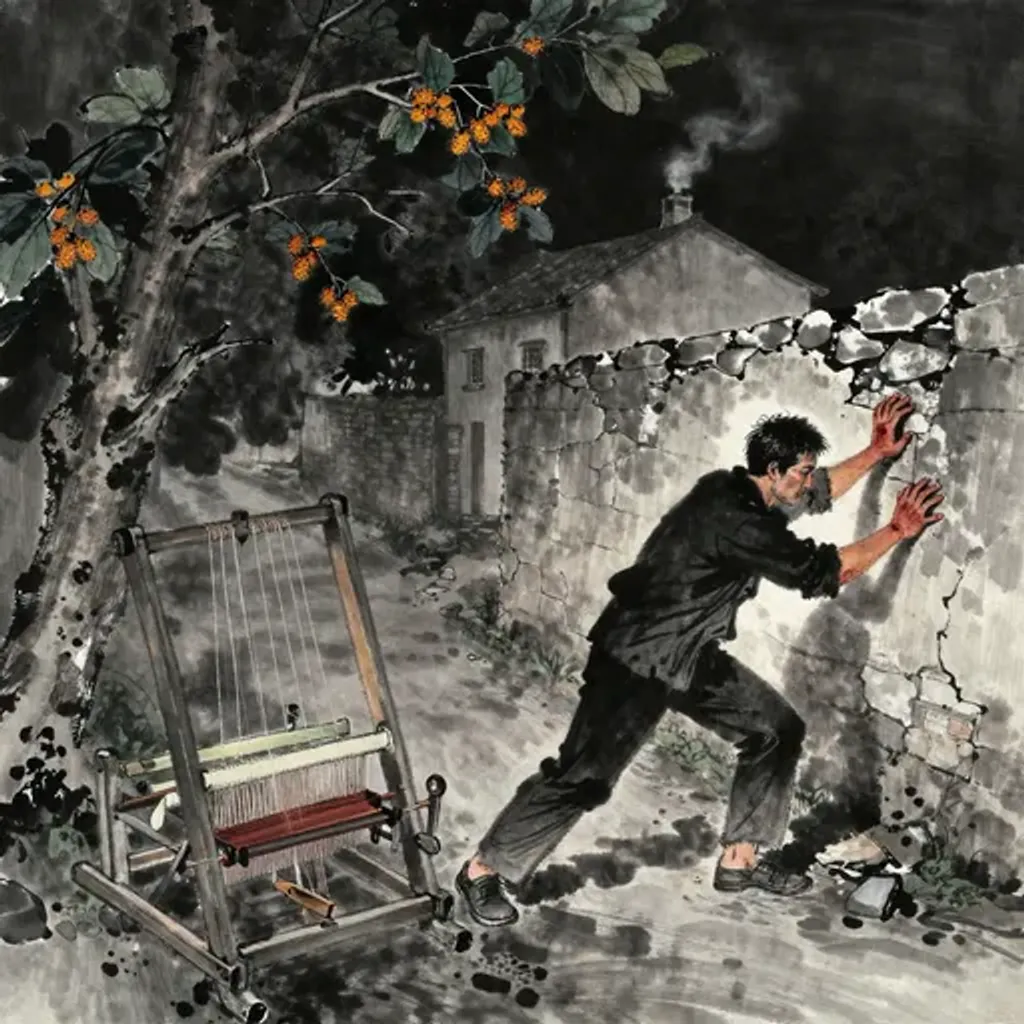
左跌右僵,前躓觸桑,其指據石,傷其弟兄,老蚕不作,家無織帛,貴貨賤身,久留連客。
Stumbling left, falling right; tripping forward into the mulberry. His fingers clutch at stone; injuring his brothers. The old silkworms do not spin; the house has no woven cloth. Prizing goods over self; a lingering guest long detained.
— Jiao Yanshou, Yilin (Forest of Changes), 1st century BC
Commentary
Heaven above the mountain compresses into mountain over heaven — Great Taming, where heaven is stored within the mountain's mass. The verse is a catalogue of misfortune: stumbling left and collapsing right, tripping forward into mulberry trees, fingers clutching stone in desperation. Brothers are injured; old silkworms cease to spin; the household has no silk cloth. Goods are valued but people degraded; guests linger too long and cannot leave. Every image conveys entrapment and resource failure — a household that has accumulated nothing despite retaining everything. From Retreat to Great Taming, withdrawal should produce stored wealth, but here the taming has gone wrong. The mountain holds heaven but crushes it. What was meant to be preserved is instead damaged, and the one who retreated finds himself imprisoned by his own stockpile of misfortune.
遯 → 頤
Hexagram 33 → Hexagram 27: Nourishment
Changing lines: 1, 3, 4, 5
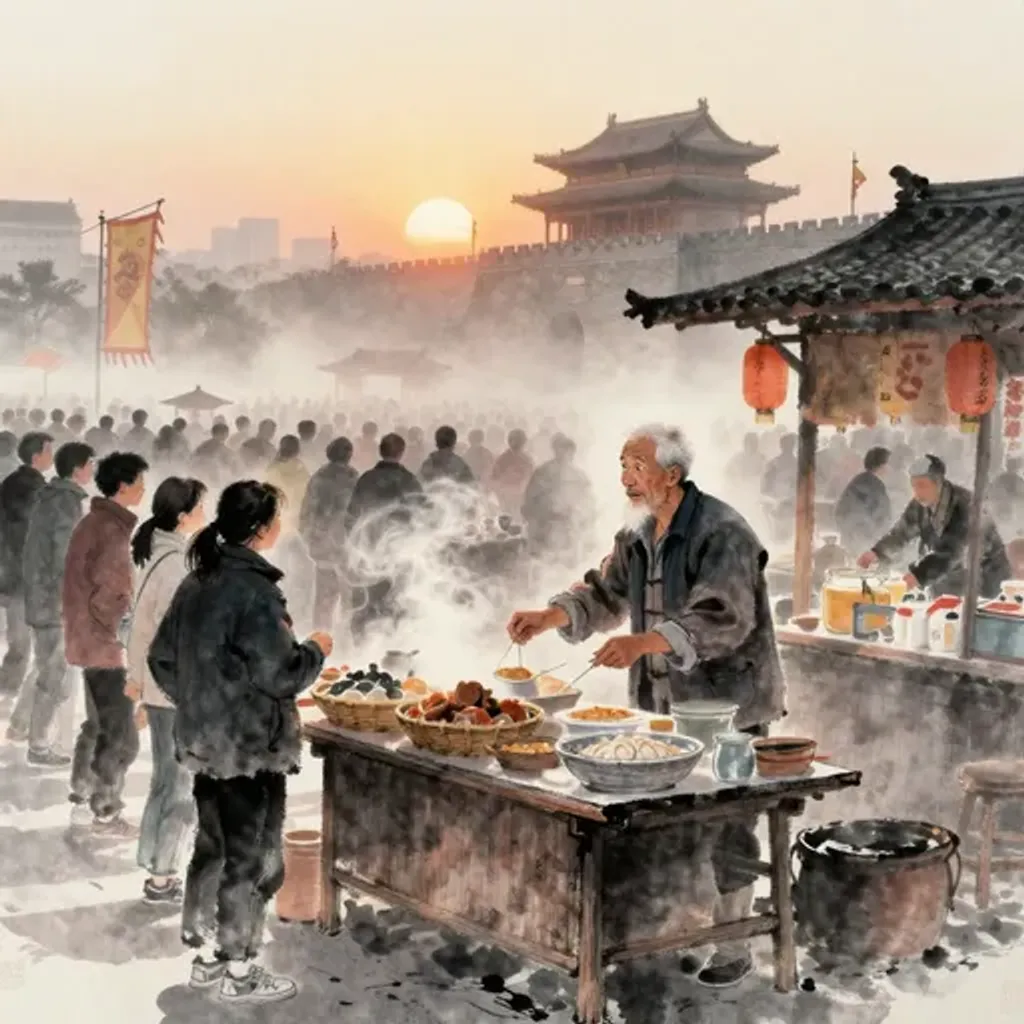
昏人宜明,賣食老昌,國祚東表,號稱太公。
The dim-witted man finds brilliance; selling food, the old man prospers. The dynasty's fortune shines eastward; he is titled Grand Duke.
— Jiao Yanshou, Yilin (Forest of Changes), 1st century BC
Commentary
Heaven above the mountain settles into mountain over thunder — Nourishment, where the mouth opens and closes with care. A man destined for obscurity finds brilliance; a food seller grows old and prosperous. The state's fortune is established to the east, and he is honored as Taigong. The verse alludes to Jiang Ziya (Taigong), who according to tradition was an impoverished butcher or food seller in his old age before King Wen recognized his talent. His title 'Taigong' means 'Grand Duke' — the man who sold food in obscurity became the architect of the Zhou dynasty's eastern campaigns. From Retreat to Nourishment, withdrawal takes the form of the humble food vendor quietly sustaining others until destiny calls. The mountain shelters thunder within — the nourishing mouth conceals the explosive potential of a future kingmaker.
遯 → 大過
Hexagram 33 → Hexagram 28: Great Exceeding
Changing lines: 2, 6
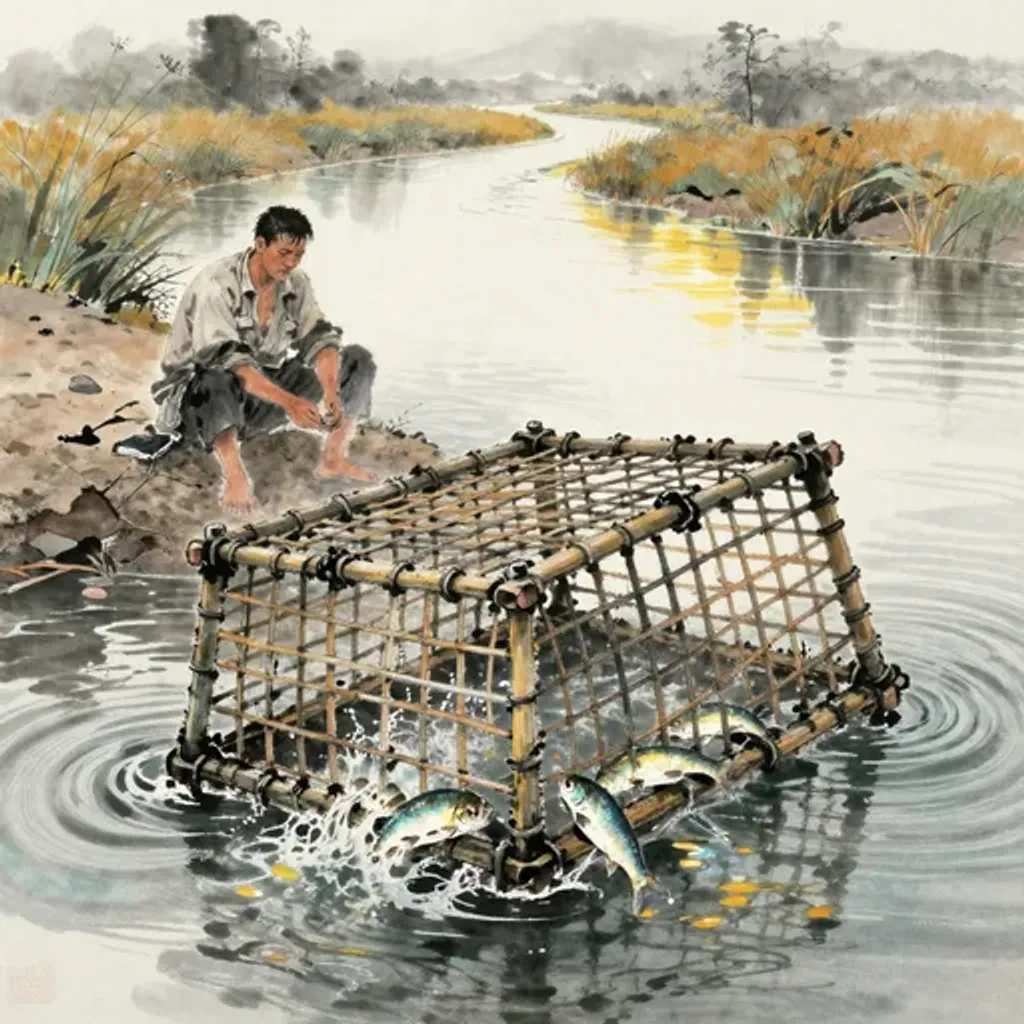
敝笱在梁,魴逸不禁,漁父勞苦,藏空乾口。
The tattered fish-trap sits on the weir; the bream escapes unchecked. The fisherman toils in vain; his stores are empty, his mouth parched.
— Jiao Yanshou, Yilin (Forest of Changes), 1st century BC
Commentary
Heaven above the mountain sinks into lake over wind — Great Exceeding, where the ridgepole bends under unbearable weight. A broken fish trap lies on the weir, and the bream escape unchecked. The fisherman toils in vain, his basket empty, his mouth dry. The broken trap echoes the Shijing ode 'Bi Gou' from the Airs of Qi, which satirizes Duke Zhuang of Lu's inability to control his wife Wenjiang — the fish slip through because the trap is damaged beyond repair. From Retreat to Great Exceeding, the mountain's withdrawal becomes structural failure. The lake overwhelms the trees; the weight exceeds what the frame can bear. The retreating figure finds that his containment mechanisms have decayed during his absence — the trap is broken, the fish are gone, and labor produces nothing.
遯 → 坎
Hexagram 33 → Hexagram 29: The Abysmal Water
Changing lines: 2, 3, 4, 6
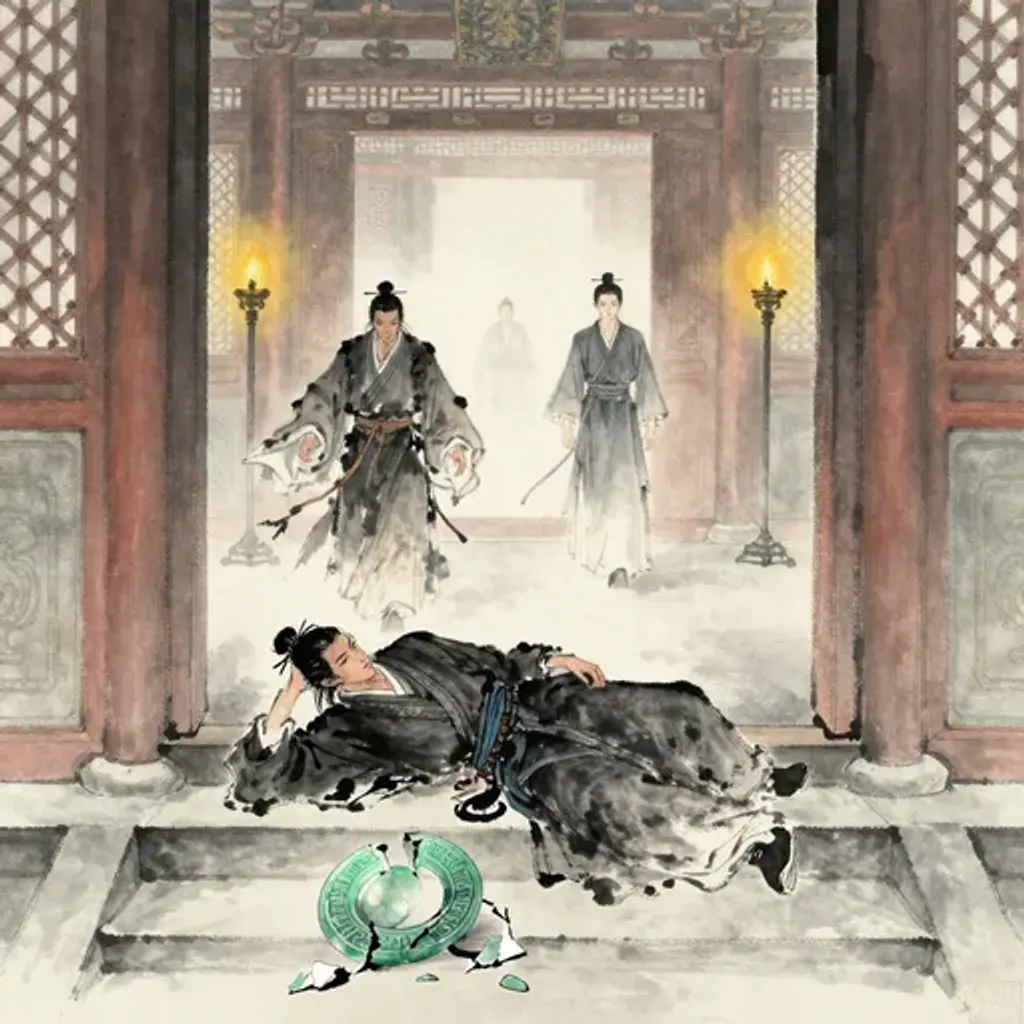
盛中後跌,衰老復掇,盈滿減毀,疾羸肥腯,鄭昭失國,重耳與立。
Prosperous at the height, then stumbling in decline; the wasted recover, the full are diminished. Overflowing fullness leads to ruin; the sick grow stout again. Duke Zhao of Zheng lost his state; Chong'er was restored.
— Jiao Yanshou, Yilin (Forest of Changes), 1st century BC
Commentary
Heaven above the mountain plunges into doubled water — the Abysmal, peril upon peril. Prosperity peaks and then stumbles; the aged and weakened recover briefly. Fullness diminishes and is destroyed; the sickly thin one unexpectedly grows fat. Then the verse names its figures: Duke Zhao of Zheng loses his state, and Chong Er gains his throne. Duke Zhao of Zheng was deposed through foreign interference around 695 BC; Chong Er (Duke Wen of Jin) wandered in exile for nineteen years before returning to become one of the Five Hegemons. From Retreat to the Abysmal, the mountain collapses into the abyss — yet the abyss itself is the crucible of reversal. What rises must fall; what falls may rise. Retreat here is the mechanism of fortune's wheel, not its terminus.
遯 → 離
Hexagram 33 → Hexagram 30: The Clinging Fire
Changing lines: 1, 5
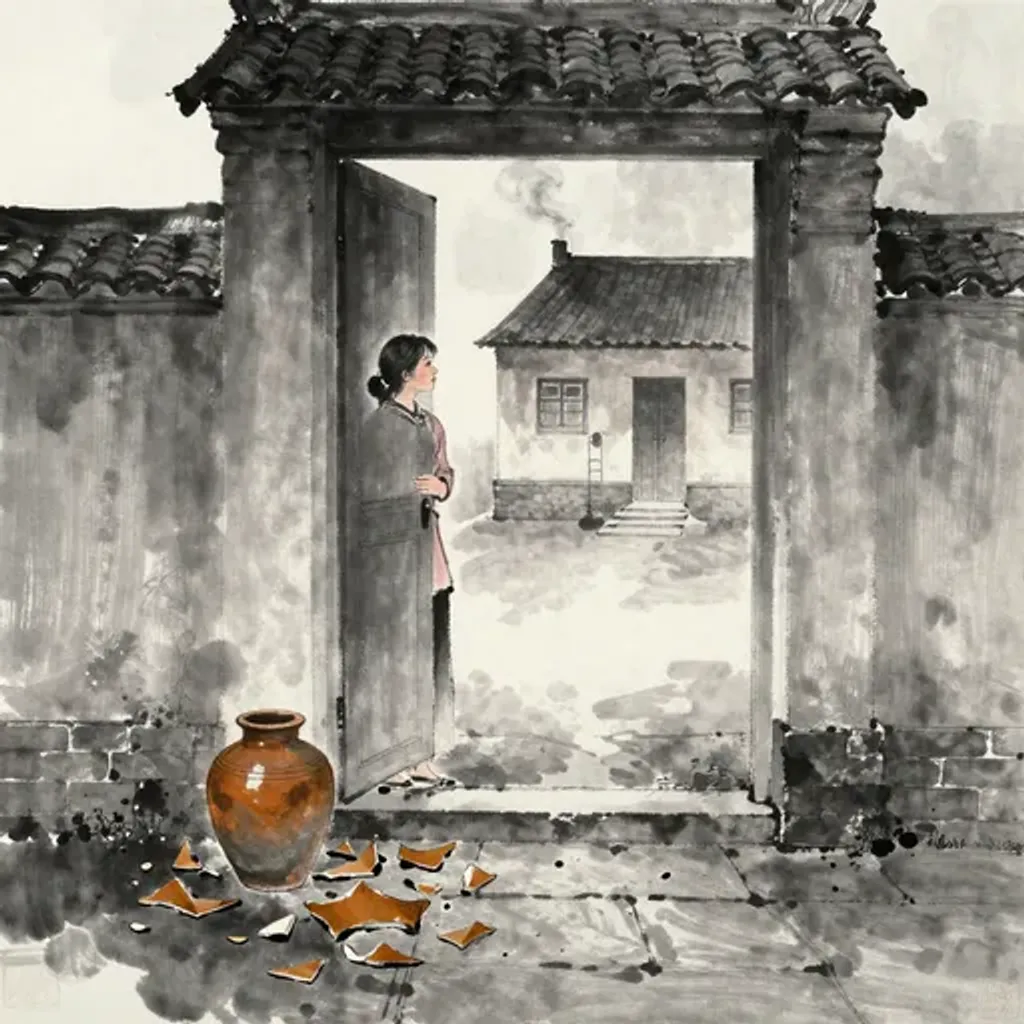
折亡破甕,使我困貧,與母生分,別離異門。
The jar breaks, the vessel shatters; leaving me in poverty. Parted from my mother by fate; separated, through different doors.
— Jiao Yanshou, Yilin (Forest of Changes), 1st century BC
Commentary
Heaven above the mountain blazes into doubled fire — the Clinging, where brightness depends upon something to cling to. A jar shatters and a vessel breaks, plunging the household into poverty. Mother and child are torn apart, separated and sent through different doors. Every image is one of rupture: the container that held sustenance is destroyed, and the family unit that gave meaning to retreat is dissolved. From Retreat to the Clinging, the mountain's withdrawal becomes fire's desperate need for fuel. Fire without substance to attach to consumes itself. The retreating figure has lost not only material possessions but the very relationships that made withdrawal bearable. Separation from one's mother — the most primal bond — represents retreat carried to its most devastating conclusion.
遯 → 咸
Hexagram 33 → Hexagram 31: Influence
Changing lines: 6
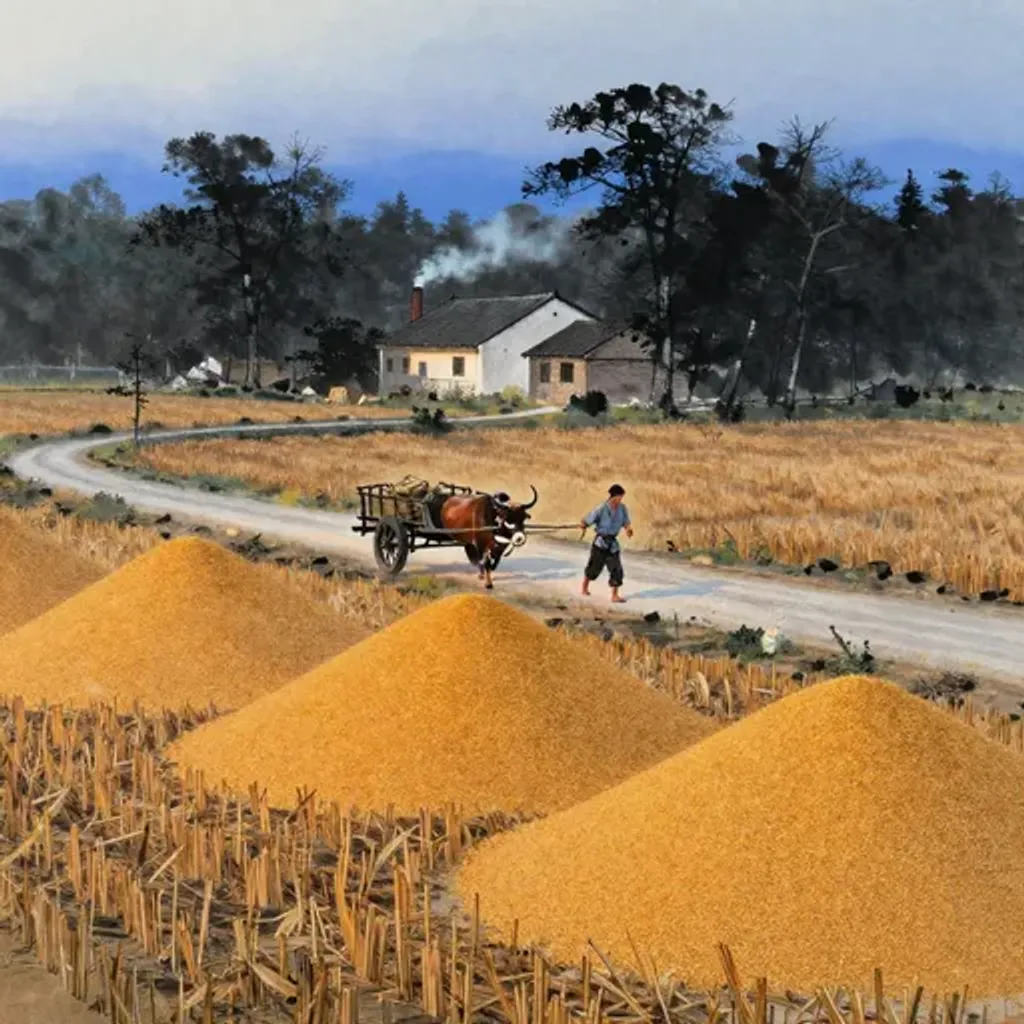
野有積庾,穡人駕取,不逢虎狼,暮歸其宇。
In the fields, grain is heaped and stored; the harvester drives his cart to fetch it. He meets no tiger or wolf; at dusk he returns to his home.
— Jiao Yanshou, Yilin (Forest of Changes), 1st century BC
Commentary
Heaven above the mountain softens into lake resting upon mountain — Influence, where mutual responsiveness flows naturally. Grain lies heaped in the open fields, and the harvester drives out to collect it. No wolves or tigers bar the way; by evening he returns safely to his home. The verse is a pastoral idyll: abundance awaits, the journey is safe, and the laborer comes home before dark. From Retreat to Influence, the mountain's withdrawal becomes the lake upon the mountain — a high reservoir that nourishes from above. The retreating figure discovers that withdrawal has not diminished the world's offerings but preserved them. The grain waited patiently in the field, and the path remained clear. Influence here is quiet receptivity — the open hand that finds the harvest already gathered.
遯 → 恆
Hexagram 33 → Hexagram 32: Duration
Changing lines: 2, 5, 6
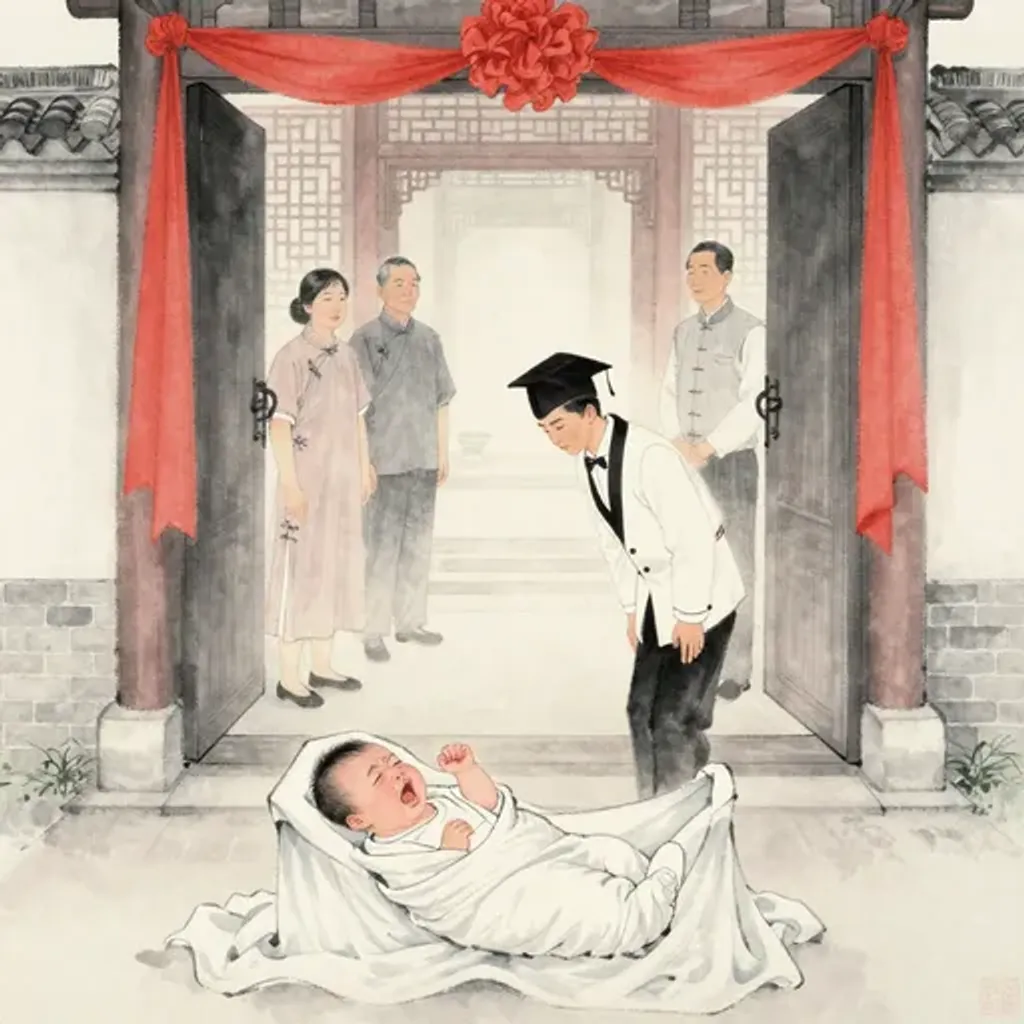
襁褓孩呱,冠帶成家,出門如賓,父母何憂?
In swaddling clothes, the babe cries; capped and sashed, he founds a house. Going out, he greets all as honored guests; what worry have his father and mother?
— Jiao Yanshou, Yilin (Forest of Changes), 1st century BC
Commentary
Heaven above the mountain endures as thunder over wind — Duration, where constancy sustains what has been built. A child in swaddling clothes cries and babbles; in time he dons the cap of manhood and establishes a household. When he leaves home, he conducts himself as courteously as a guest — what have his parents to worry about? The verse traces an entire lifecycle in four brief phrases: from helpless infant to self-possessed adult. The process requires nothing dramatic, only the steady passage of time and consistent nurture. From Retreat to Duration, the mountain's withdrawal becomes the thunder and wind that persist without changing direction. Retreat here is the patience of parenthood — withdrawing gradually as the child grows, until the retreat itself becomes unnecessary because the young man stands firm on his own.
遯 → 遯
Hexagram 33 → Hexagram 33: Retreat
No changing lines — the hexagram is unchanged
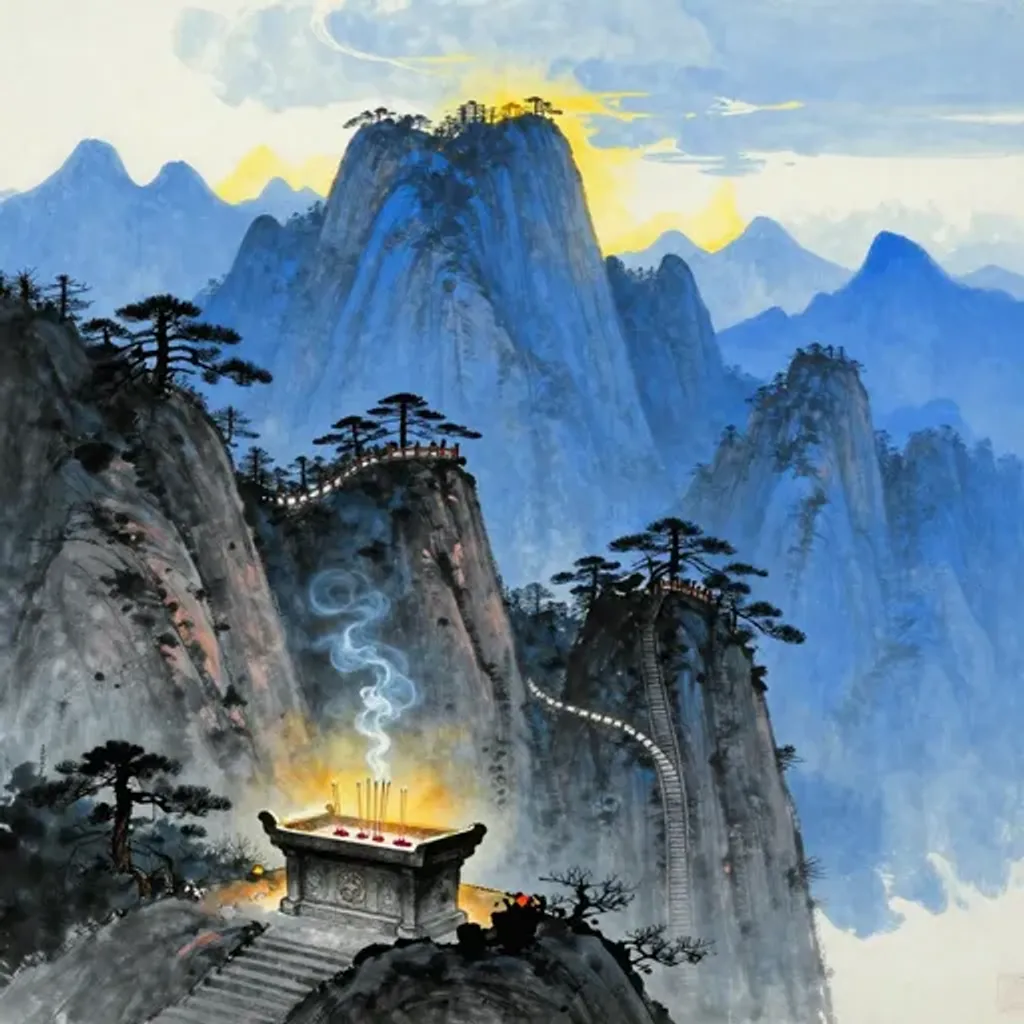
三塗五岳,陽城太室,神明所保,獨無兵革。
The three passes and Five Sacred Peaks; Yangcheng and Taishi Mountain. What the spirits protect and preserve; alone, free from weapons and war.
— Jiao Yanshou, Yilin (Forest of Changes), 1st century BC
Commentary
Heaven above the mountain remains as heaven above the mountain — Retreat doubled, the hexagram reflecting upon itself. The Three Tu passes and the Five Sacred Mountains, Yangcheng and Taishi Peak — these are the sacred precincts that the gods themselves protect, and alone they are spared the ravages of war. The Three Tu refers to the strategic mountain passes near Luoyang; Taishi is the main peak of Mount Song, the Central Sacred Mountain, near the ancient site of Yangcheng. These are the heartland of Chinese sacred geography. From Retreat to Retreat, the verse affirms that the most complete withdrawal is the mountain itself — the divine sanctuary where even armies dare not trespass. When retreat is total and principled, it becomes inviolable, a sacred space that needs no defense because its very nature forbids desecration.
遯 → 大壯
Hexagram 33 → Hexagram 34: Great Power
Changing lines: 1, 2, 5, 6
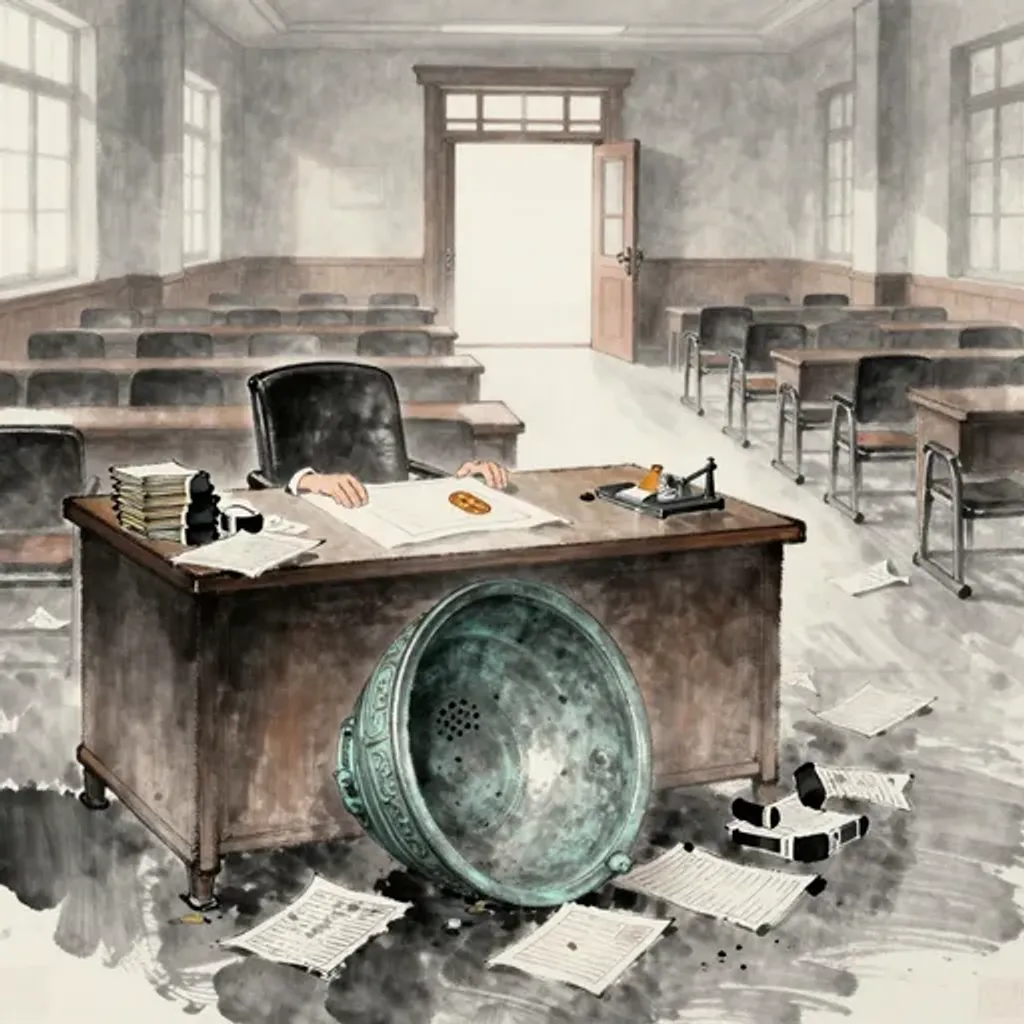
陳力就列,官職並廢,手不勝盆,失其寵門。
Displaying one's ability, taking one's rank; yet office and post are both abolished. The hand cannot hold the basin; he loses his favored position.
— Jiao Yanshou, Yilin (Forest of Changes), 1st century BC
Commentary
Heaven above the mountain erupts as thunder over heaven — Great Power's unstoppable force. Yet the verse describes the collapse of that power: officials display their abilities and vie for position, but offices are abolished wholesale. The hand cannot even lift a basin; the favored household loses its gate of privilege. The phrase 'display abilities and take your place' (陳力就列) comes from the Analerta — Confucius's admonition that one who cannot perform should step down. Here, stepping down is not voluntary but forced. From Retreat to Great Power, the mountain's withdrawal should transform into thunderous strength. Instead, the verse captures power that overreaches and shatters: officials who grasped for position find their posts eliminated, and even basic physical strength deserts them. Great Power misapplied destroys the very platform it stands on.
遯 → 晉
Hexagram 33 → Hexagram 35: Progress
Changing lines: 3, 5
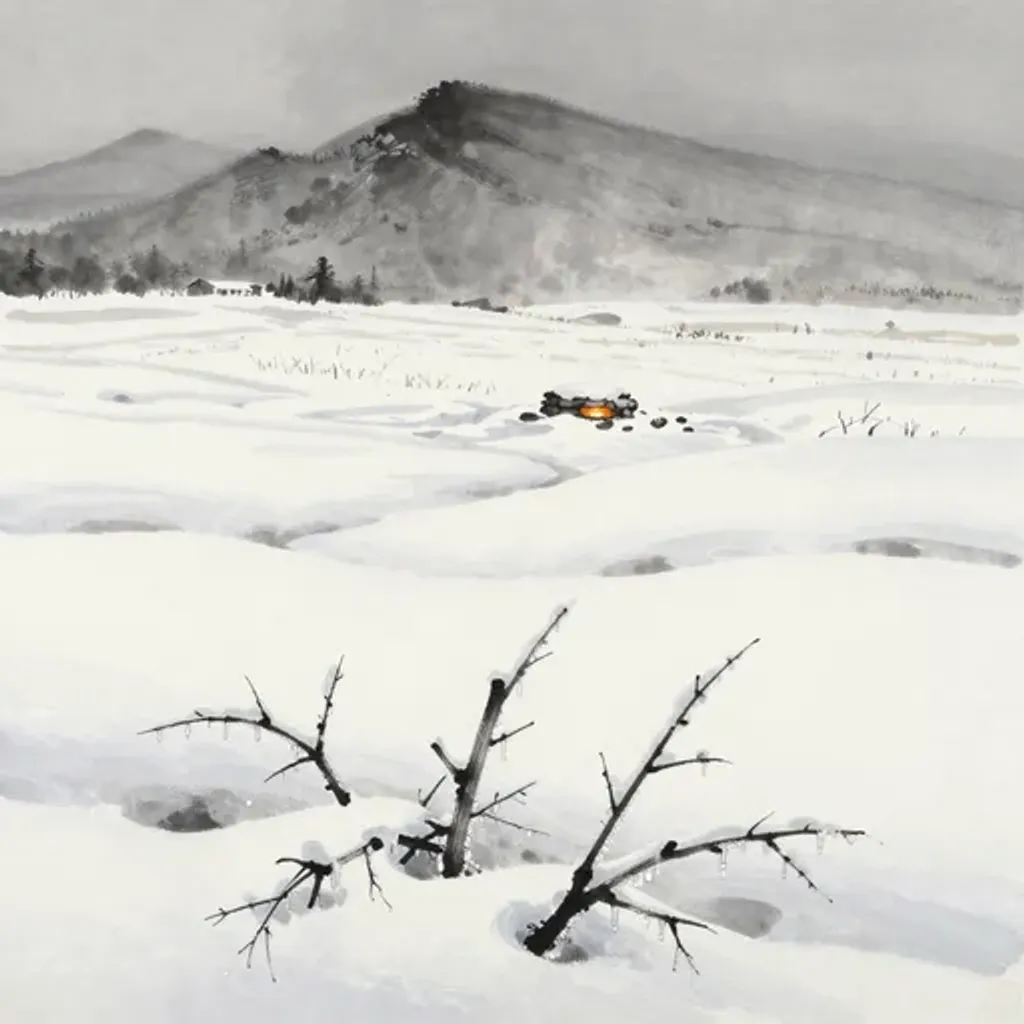
積雪大寒,萬物不生,陰制庶士,時本冬貧。
Deep snow, bitter cold; the ten thousand things do not grow. Yin oppresses all the common folk; the season is truly winter's poverty.
— Jiao Yanshou, Yilin (Forest of Changes), 1st century BC
Commentary
Heaven above the mountain freezes into fire over earth — Progress, where the sun rises above the horizon. Yet the verse describes the opposite: deep snow and bitter cold, nothing grows. Yin energy suppresses all life, and the season itself imposes poverty. The sun of Progress cannot penetrate the accumulated cold; the advance is blocked by winter's dominion. From Retreat to Progress, withdrawal should yield to emergence — light breaking from the earth. But the retreating figure encounters an environment so hostile that even the promise of dawn is frozen solid. The verse captures the moment when retreat has lasted through the hardest season and progress remains theoretical — the sun exists but its warmth cannot reach the buried seeds. Winter's grip must loosen before any advance can begin.
遯 → 明夷
Hexagram 33 → Hexagram 36: Darkening of the Light
Changing lines: 1, 4, 5, 6
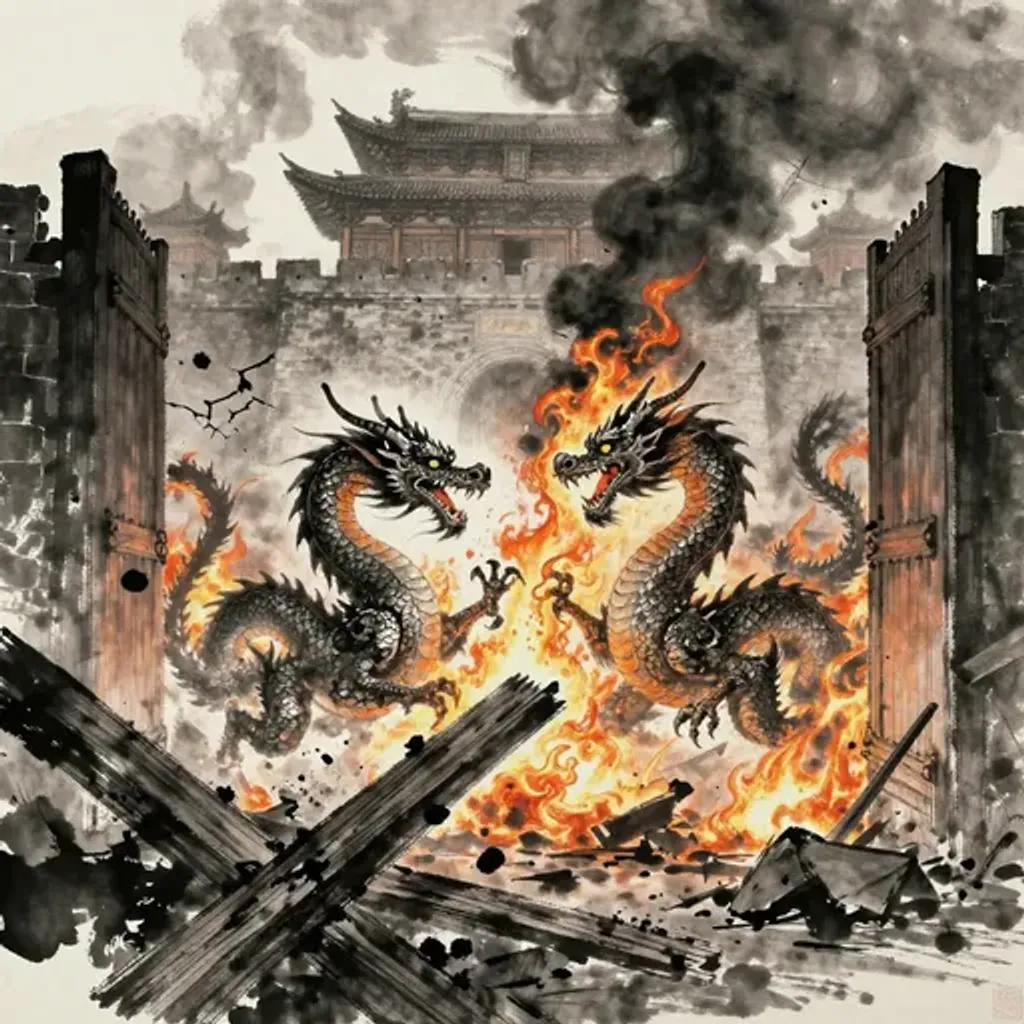
龍鬭時門,失理傷賢,內畔生賊,自為心疾。
Dragons battle at the seasonal gate; reason is lost, the worthy are harmed. Rebellion breeds traitors from within; it becomes a sickness of the heart.
— Jiao Yanshou, Yilin (Forest of Changes), 1st century BC
Commentary
Heaven above the mountain descends into earth concealing fire — Darkening of the Light, where brilliance is driven underground. Dragons battle at the gate, and in the ensuing chaos righteous men are injured. Treachery breeds within the walls, generating its own malady — the disease originates in the heart itself. The battling dragons evoke the I-Ching's Kun hexagram, line six: 'Dragons fight in the wild, their blood is dark and yellow' — an image of yin and yang in destructive collision. From Retreat to Darkening of the Light, the mountain's principled withdrawal collapses into the burial of all illumination. The verse warns that retreat cannot prevent internal corruption: when the enemy is within, no amount of withdrawal helps. The disease festers in the heart — retreat merely seals the infection inside.
遯 → 家人
Hexagram 33 → Hexagram 37: The Family
Changing lines: 1, 4
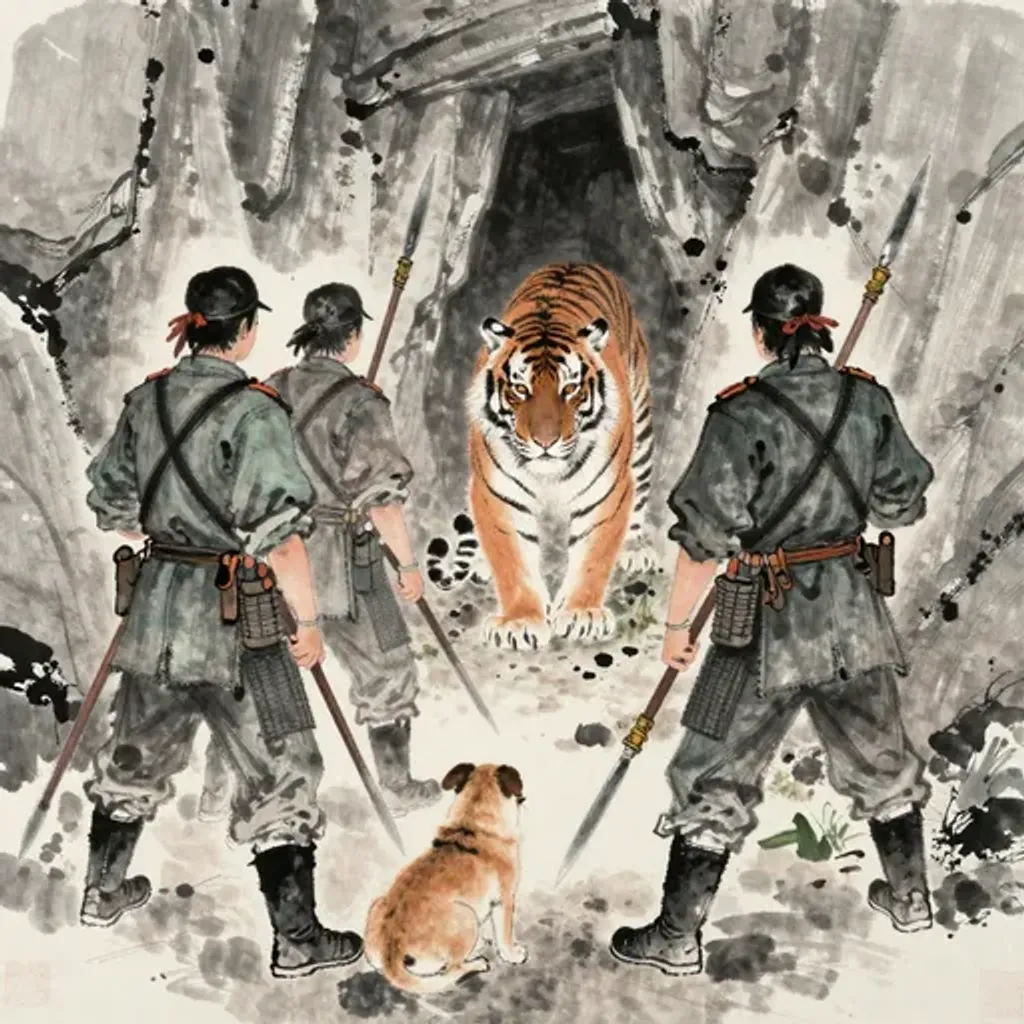
狗畏猛虎,依人為輔,三夫執戟,伏不敢趨,身安无咎。
The dog fears the fierce tiger; it relies on men for protection. Three warriors hold their halberds; crouching low, none dares advance. The body is safe, without blame.
— Jiao Yanshou, Yilin (Forest of Changes), 1st century BC
Commentary
Heaven above the mountain warms into wind emerging from fire — the Family, where inner warmth radiates outward as ordered influence. A dog fears the fierce tiger and relies on humans for protection. Three warriors hold their halberds, crouching low, not daring to advance. The body remains safe and without blame. The verse depicts survival through calculated submission: the dog allies with humans against the tiger; the warriors recognize superior force and hold their ground rather than charging. From Retreat to the Family, the mountain's withdrawal becomes the household's protective structure. Wind from fire — warmth that organizes. The verse reframes retreat as domestication: the wild dog becomes the household guardian, and the warriors who refuse to charge recklessly preserve the family they serve. Safety lies not in fighting or fleeing but in knowing one's place within a protective order.
遯 → 睽
Hexagram 33 → Hexagram 38: Opposition
Changing lines: 1, 2, 3, 5
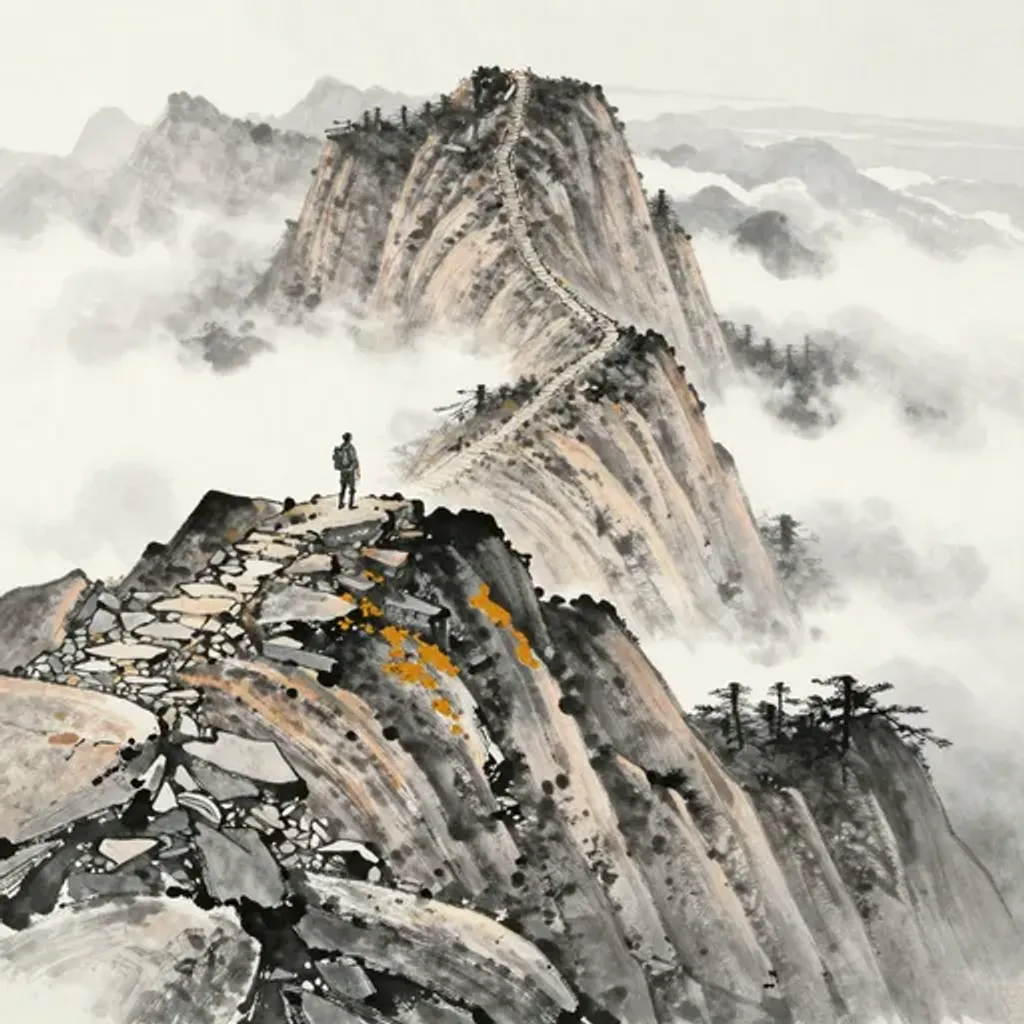
南山高罡,回隤難登,道里遼遠,行者无功。憂不成凶,惡亦消去。
The southern mountain's high ridge; winding and steep, hard to climb. The road is distant and far; the traveler achieves nothing. Worry does not become disaster; evil too shall pass away.
— Jiao Yanshou, Yilin (Forest of Changes), 1st century BC
Commentary
Heaven above the mountain splits into fire over lake — Opposition, where divergent forces strain against each other. The southern mountain rises steep and rugged, its slopes too sheer to climb. The road stretches far beyond reckoning, and the traveler accomplishes nothing. Yet the verse resolves gently: worry does not become disaster, and evil too dissipates. From Retreat to Opposition, the mountain's withdrawal encounters the estrangement of fire and lake — elements that by nature move apart. The verse captures the exhaustion of pursuing goals across irreconcilable terrain: the mountain is too steep, the distance too great, the effort fruitless. But Opposition contains its own mercy — the very distance that prevents progress also prevents catastrophe. Sometimes the best outcome of a failed journey is simply arriving home unharmed.
遯 → 蹇
Hexagram 33 → Hexagram 39: Obstruction
Changing lines: 4, 6
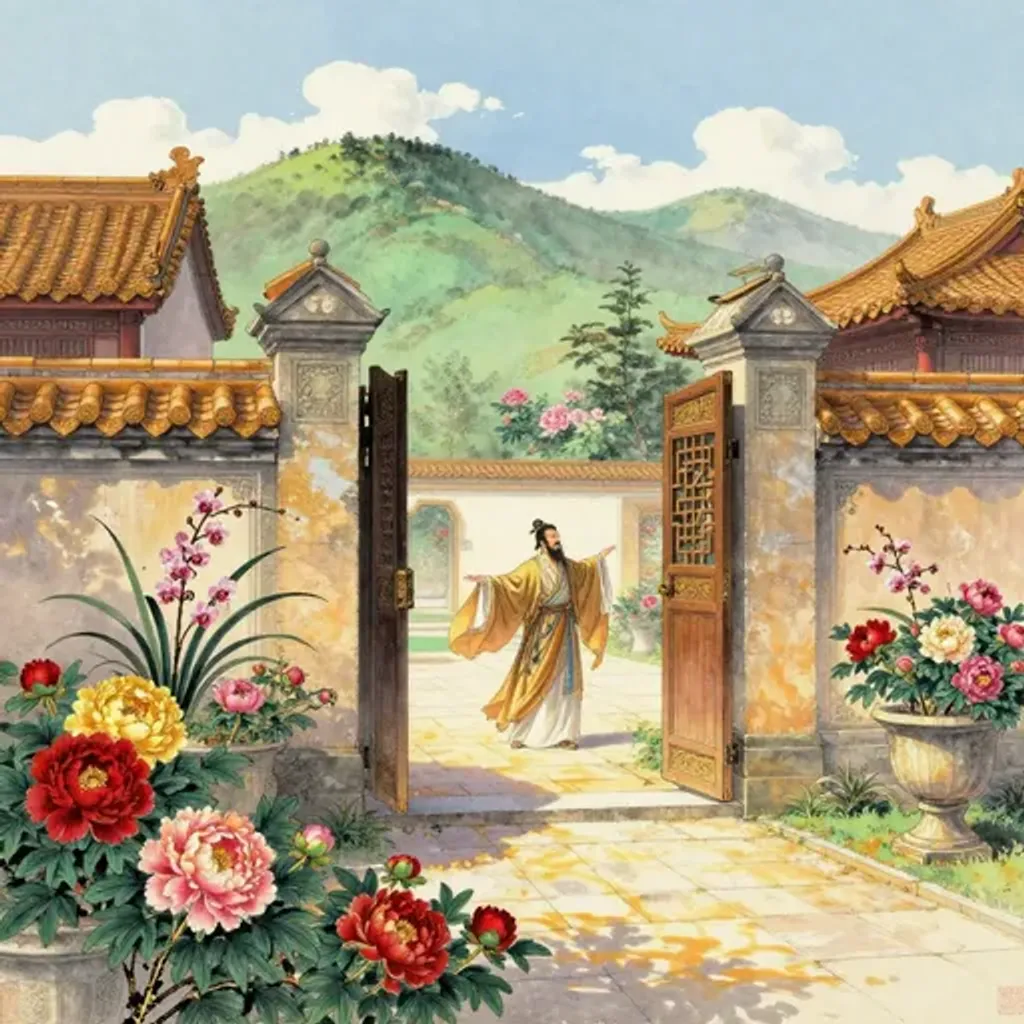
逢時陽遂,富且尊貴。
Meeting the season, the yang prevails; wealthy and moreover honored.
— Jiao Yanshou, Yilin (Forest of Changes), 1st century BC
Commentary
Heaven above the mountain confronts water upon mountain — Obstruction, where the path forward is blocked by perilous terrain. Yet the verse is unexpectedly auspicious: meeting the right moment under yang's ascendancy, one attains both wealth and honor. The brevity is striking — only eight characters — as if the oracle has no need to elaborate when fortune is this clear. From Retreat to Obstruction, the mountain's withdrawal encounters the mountain that blocks. Water pooling atop the mountain creates a treacherous landscape. But the verse insists that timing transforms everything: 'meeting the moment' (逢時) is the key that unlocks obstruction. The retreating figure who encounters difficulty at precisely the right cosmic moment discovers that obstruction itself becomes the elevation — the water on the mountain becomes a lake of blessing.
遯 → 解
Hexagram 33 → Hexagram 40: Deliverance
Changing lines: 2, 3, 5, 6
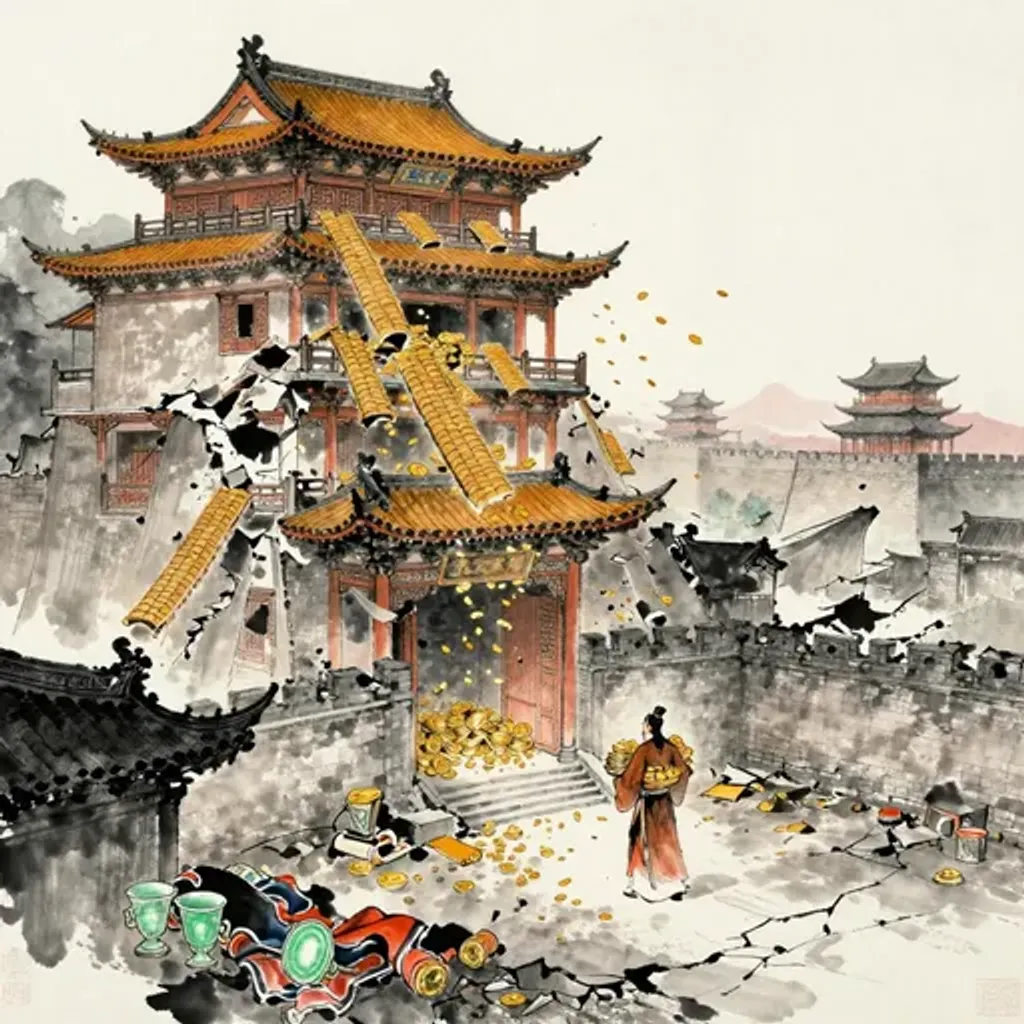
求我所欲,得其利福,終身不辱,盈盛之門,高屋先覆,君失邦國。
Seeking what I desire; gaining its profit and blessing. A life without disgrace; yet the gate of brimming fullness — the tallest house is first to topple. The lord loses his domain.
— Jiao Yanshou, Yilin (Forest of Changes), 1st century BC
Commentary
Heaven above the mountain thunders into thunder over water — Deliverance, where tension is released and bonds are loosened. The verse opens with fulfillment: seeking what one desires, gaining benefit and blessing, living without disgrace. Then it pivots sharply: the gate of fullness and prosperity invites destruction — tall buildings are the first to collapse, and the ruler loses his state. The proverb 'tall buildings are first to topple' warns against the hubris of accumulated success. From Retreat to Deliverance, the mountain's withdrawal should release stored tension. But the verse warns that deliverance from restraint can itself become dangerous: once the bonds are loosened, everything that was held together may fly apart. The ruler who finally gains what he sought discovers that fullness carries its own destruction within it.
遯 → 損
Hexagram 33 → Hexagram 41: Decrease
Changing lines: 1, 2, 3, 4, 5
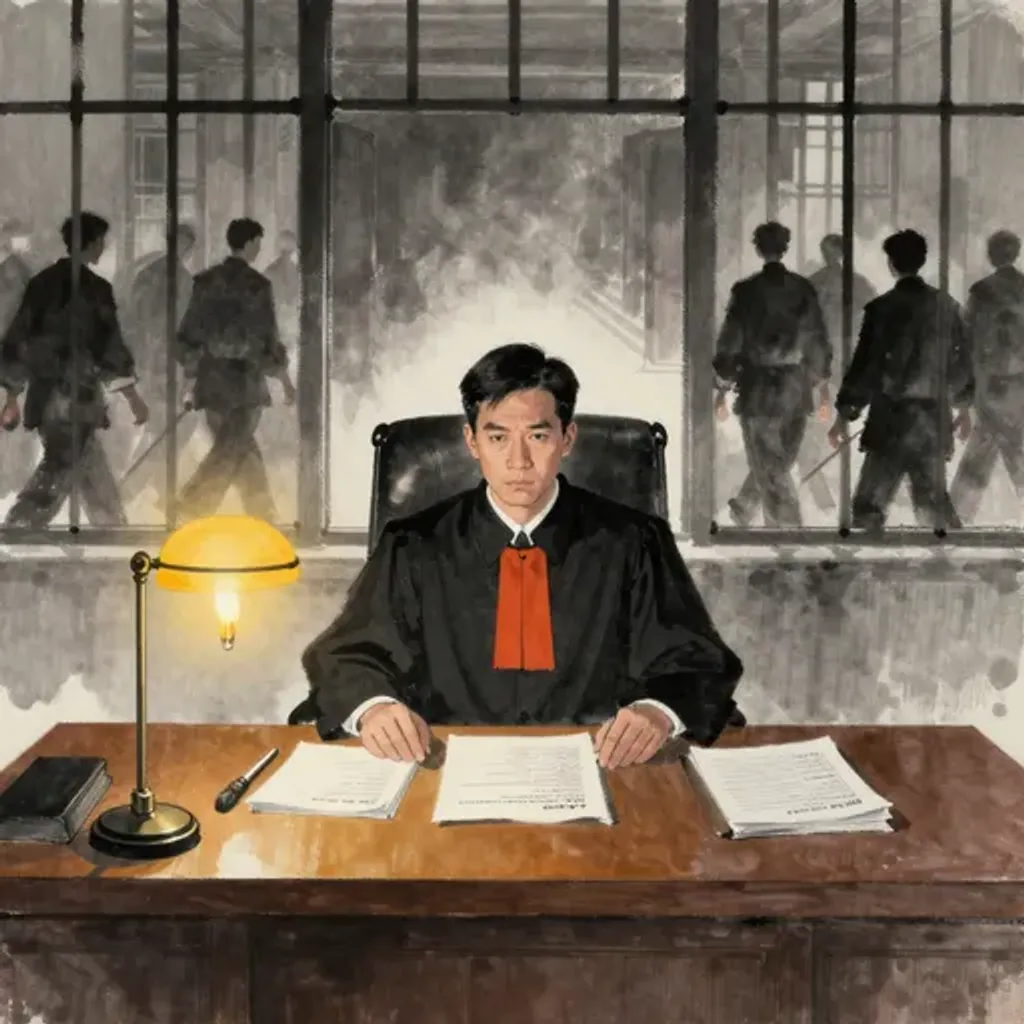
安坐至暮,禍災不到,利詰奸妖,罪人弗赦。
Sitting peacefully until dusk; disaster and calamity do not arrive. Advantageous to interrogate the treacherous; the guilty are not pardoned.
— Jiao Yanshou, Yilin (Forest of Changes), 1st century BC
Commentary
Heaven above the mountain diminishes into mountain over lake — Decrease, where the lower is reduced to benefit the upper. Sitting peacefully until dusk, disaster and calamity do not arrive. It is favorable to interrogate the treacherous and wicked; criminals shall not be pardoned. The verse pairs stillness with stern justice: remaining motionless keeps danger at bay, while evil is pursued and punished without mercy. From Retreat to Decrease, the mountain's withdrawal intensifies into disciplined restraint — the mountain bearing down upon the lake, curbing excess. The retreating figure discovers that withdrawal is not passive; it creates the conditions for moral reckoning. By sitting still, one avoids complicity; by interrogating the wicked, one ensures that retreat does not become complicity in wrongdoing through silence.
遯 → 益
Hexagram 33 → Hexagram 42: Increase
Changing lines: 1, 3, 4
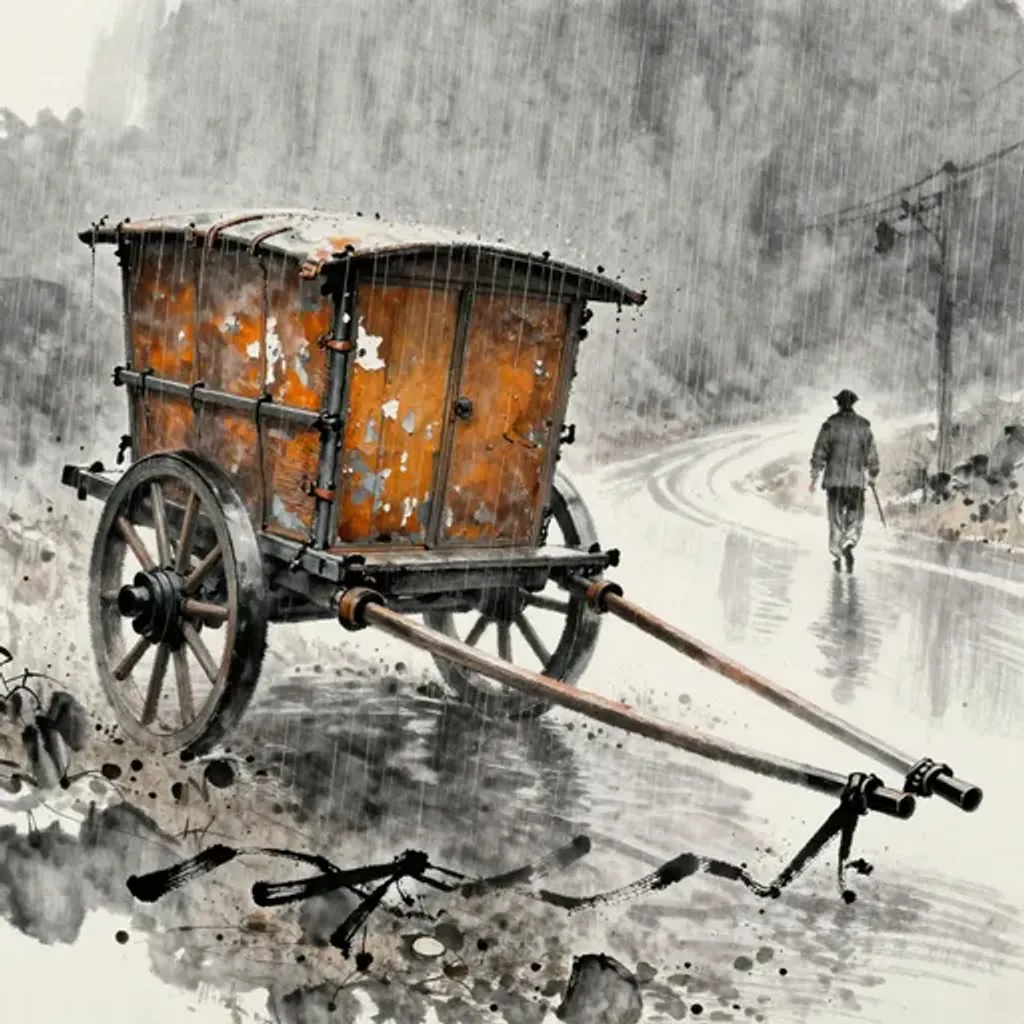
膠車駕東,與雨相逢,五楘解墮,頓輈獨宿,憂為身禍。
The lacquered cart drives east; it meets the rain head-on. The five hub-bindings come loose and fall; the shaft drops, a solitary night. Worry becomes harm to oneself.
— Jiao Yanshou, Yilin (Forest of Changes), 1st century BC
Commentary
Heaven above the mountain swells into wind over thunder — Increase, where benefit flows downward from above. A glue-coated carriage drives east and meets rain on the road. The five leather axle-wrappings dissolve and fall away; the yoke snaps, and the traveler is stranded overnight, worrying that this mishap will bring lasting harm. Glue cannot withstand water — the material was wrong for the conditions. From Retreat to Increase, the mountain's withdrawal should generate beneficial flow. But the verse shows increase gone wrong: the rain that should nourish instead destroys the carriage's bindings. The traveler prepared inadequately, using materials that dissolve under pressure. Increase demands readiness; the retreating figure who rushes back into the world with makeshift preparations finds his vehicle falling apart at the first test.
遯 → 夬
Hexagram 33 → Hexagram 43: Breakthrough
Changing lines: 1, 2, 6
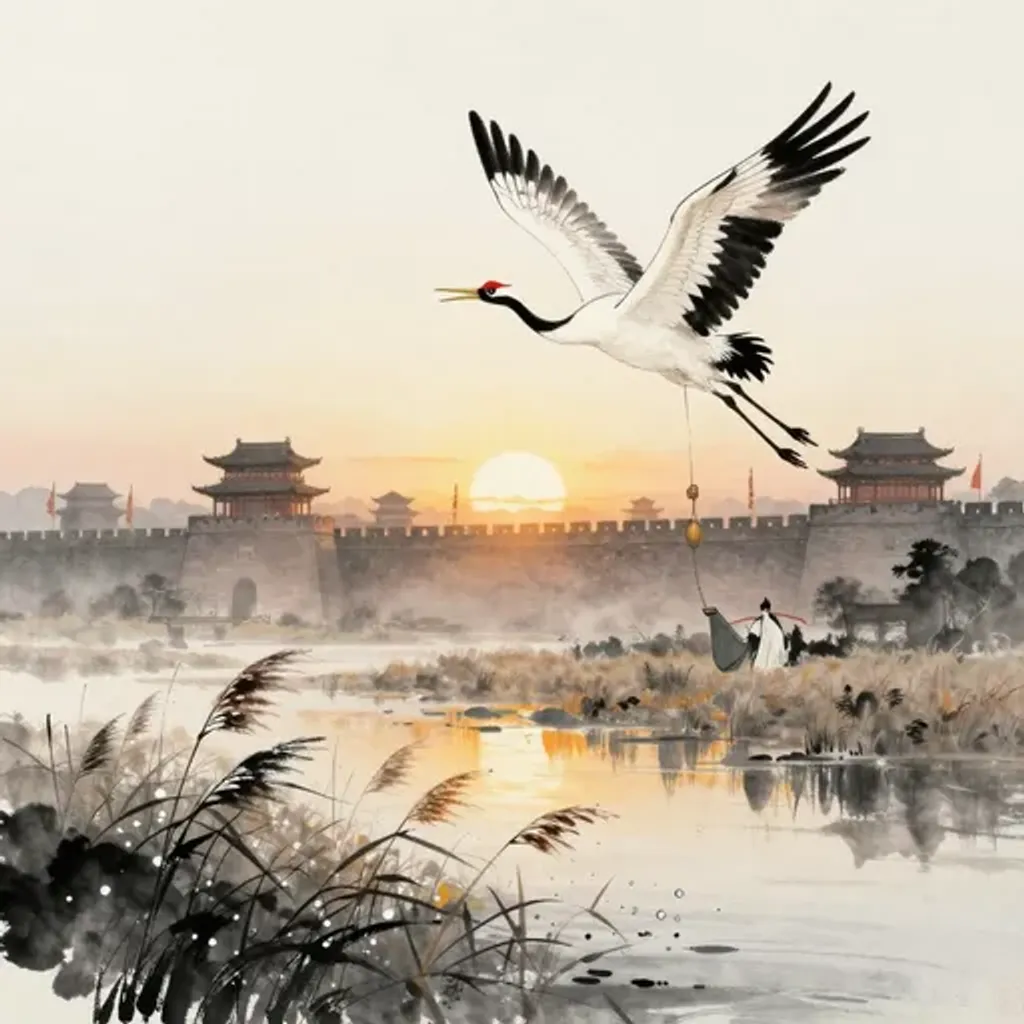
擇日高飛,遂至東齊,見孔聖師,使我和諧。
Choosing an auspicious day, he flies high; and so arrives at Eastern Qi. He meets Confucius, the sagely teacher; who brings him harmony and peace.
— Jiao Yanshou, Yilin (Forest of Changes), 1st century BC
Commentary
Heaven above the mountain surges into lake over heaven — Breakthrough, where stored waters burst upward decisively. Choosing an auspicious day, one flies high and arrives in eastern Qi, where one meets the Sage Confucius as teacher. Harmony and order are restored. The verse celebrates a dramatic departure — picking the right moment to leave and finding the supreme mentor. Flying east to Qi evokes both Confucius's own travels and the tradition of students journeying to find great teachers. From Retreat to Breakthrough, the mountain's withdrawal builds pressure that finally erupts — the lake rising above heaven. The retreating figure transforms withdrawal into a launching platform: one does not merely leave but ascends, choosing the moment of departure as carefully as the destination. Meeting the sage makes the breakthrough complete.
遯 → 姤
Hexagram 33 → Hexagram 44: Coming to Meet
Changing lines: 2
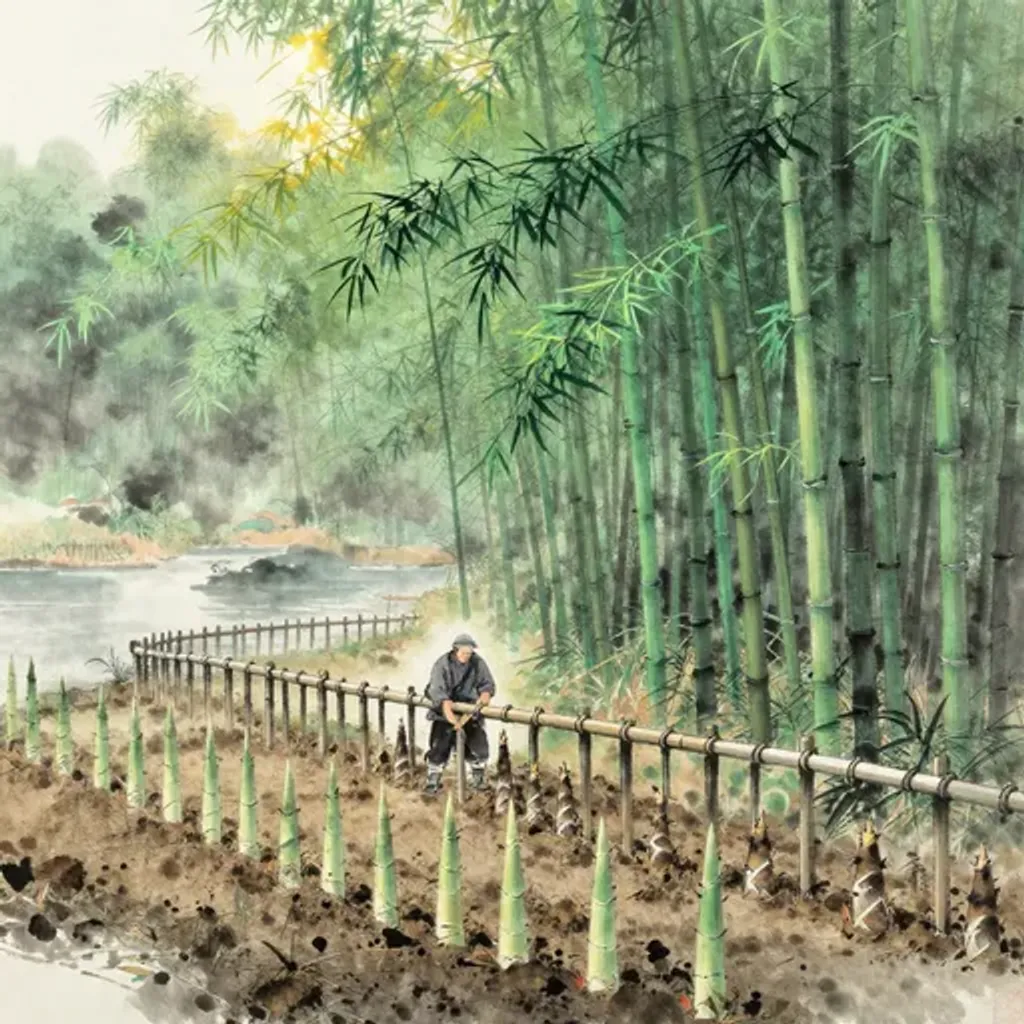
陳媯敬仲,兆興齊姜,乃適營丘,八世大昌。
The exile crosses south, planting bamboo as a fence. Three generations later, a sea of bamboo becomes a garden estate.
— Jiao Yanshou, Yilin (Forest of Changes), 1st century BC
Commentary
Heaven above the mountain encounters heaven over wind — Coming to Meet, where yin rises unexpectedly from below. The original verse reads: 'Chen Gui Jingzhong, through the omen, will flourish with the Qi Jiang clan. He settles at Yingqiu, and after eight generations achieves great prosperity.' Chen Jingzhong (Chen Wan) was a minister of the state of Chen who fled to Qi around 672 BC after internal turmoil. A divination predicted that his descendants would replace the ruling Jiang clan of Qi — and indeed, after eight generations, the Tian family (descended from Chen) formally usurped the throne of Qi in 386 BC. From Retreat to Coming to Meet, the exile's withdrawal becomes a seed planted in foreign soil. The wind stirs beneath heaven: what seems like a chance encounter carries within it a dynastic destiny that will unfold across centuries.
遯 → 萃
Hexagram 33 → Hexagram 45: Gathering Together
Changing lines: 3, 6
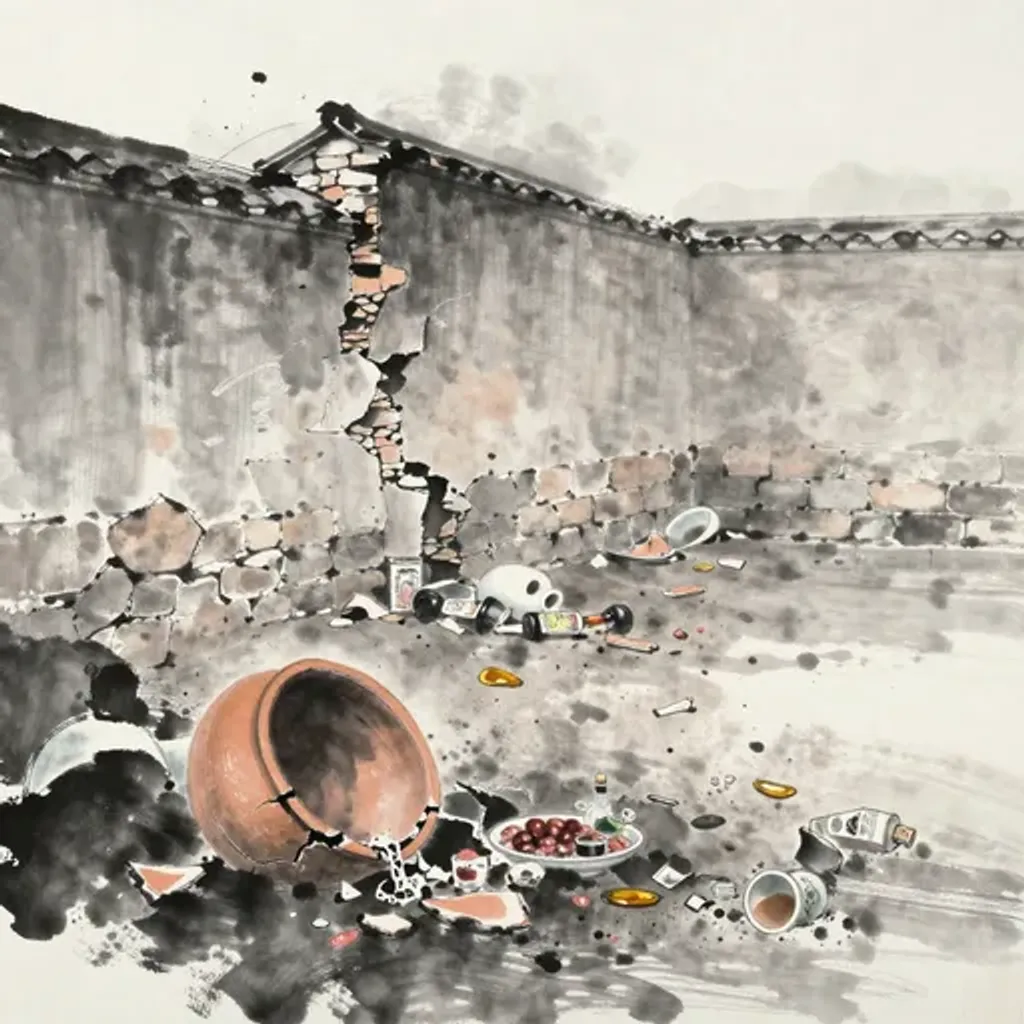
缺埒无墠,難從東西,毀破我盆,泛棄酒食。
The low wall has no terrace; hard to go east or west. My basin is smashed and broken; wine and food cast away.
— Jiao Yanshou, Yilin (Forest of Changes), 1st century BC
Commentary
Heaven above the mountain pools into lake over earth — Gathering, where people and resources converge. Yet the verse depicts scattering rather than assembling: walls are broken and fences gapped, making east-west passage difficult. The basin is smashed, and wine and food are spilled and wasted. Every barrier that should contain is breached, and every vessel that should hold is shattered. From Retreat to Gathering, withdrawal should yield to the assembling of resources at a central point. But the verse shows the infrastructure of gathering in ruins — the spaces that should welcome and contain are destroyed. Gathering requires intact boundaries; when the retreat has left walls crumbling and containers broken, there is nothing to gather into. The community cannot form because its vessels have been neglected beyond repair.
遯 → 升
Hexagram 33 → Hexagram 46: Pushing Upward
Changing lines: 2, 4, 5, 6
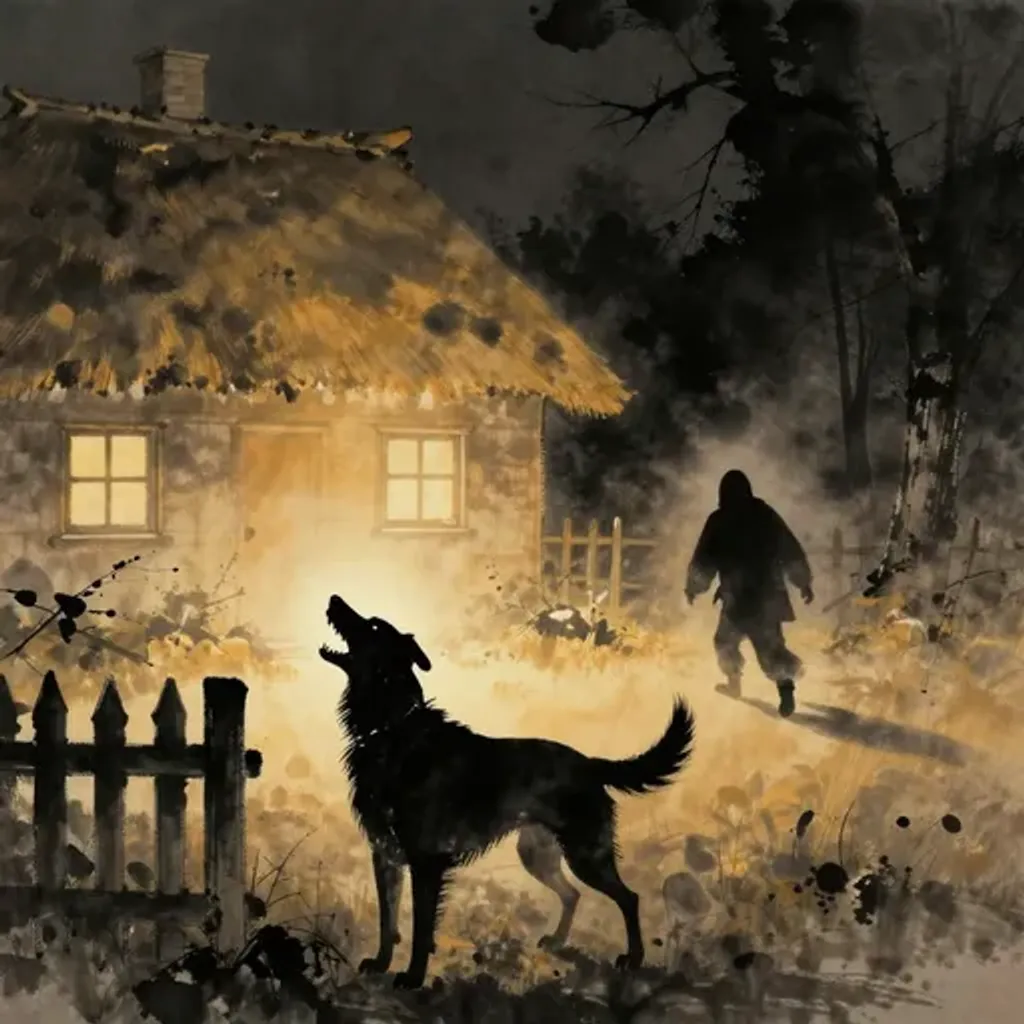
中夜狗吠,盜在廬外,神光祐助,消散解去。
In the depth of night, the dog barks; a thief lurks outside the cottage. Divine light offers aid and protection; the danger disperses and departs.
— Jiao Yanshou, Yilin (Forest of Changes), 1st century BC
Commentary
Heaven above the mountain grows into earth over wind — Pushing Upward, where growth proceeds steadily from below. At midnight dogs bark — a thief lurks outside the cottage. But divine light intervenes and protects; the intruder scatters and departs. The verse captures a nocturnal crisis averted through supernatural aid. The dogs serve as natural alarm; the 'divine light' (神光) suggests either spiritual protection or the sudden revelation that exposes the hidden threat. From Retreat to Pushing Upward, the mountain's withdrawal becomes the tree growing silently within the earth. The retreating figure rests in the dark, vulnerable to intrusion, but unseen forces guard the threshold. Upward growth is not always visible; sometimes it manifests as the quiet protection that drives away what would steal one's foundations.
遯 → 困
Hexagram 33 → Hexagram 47: Oppression
Changing lines: 2, 3, 6
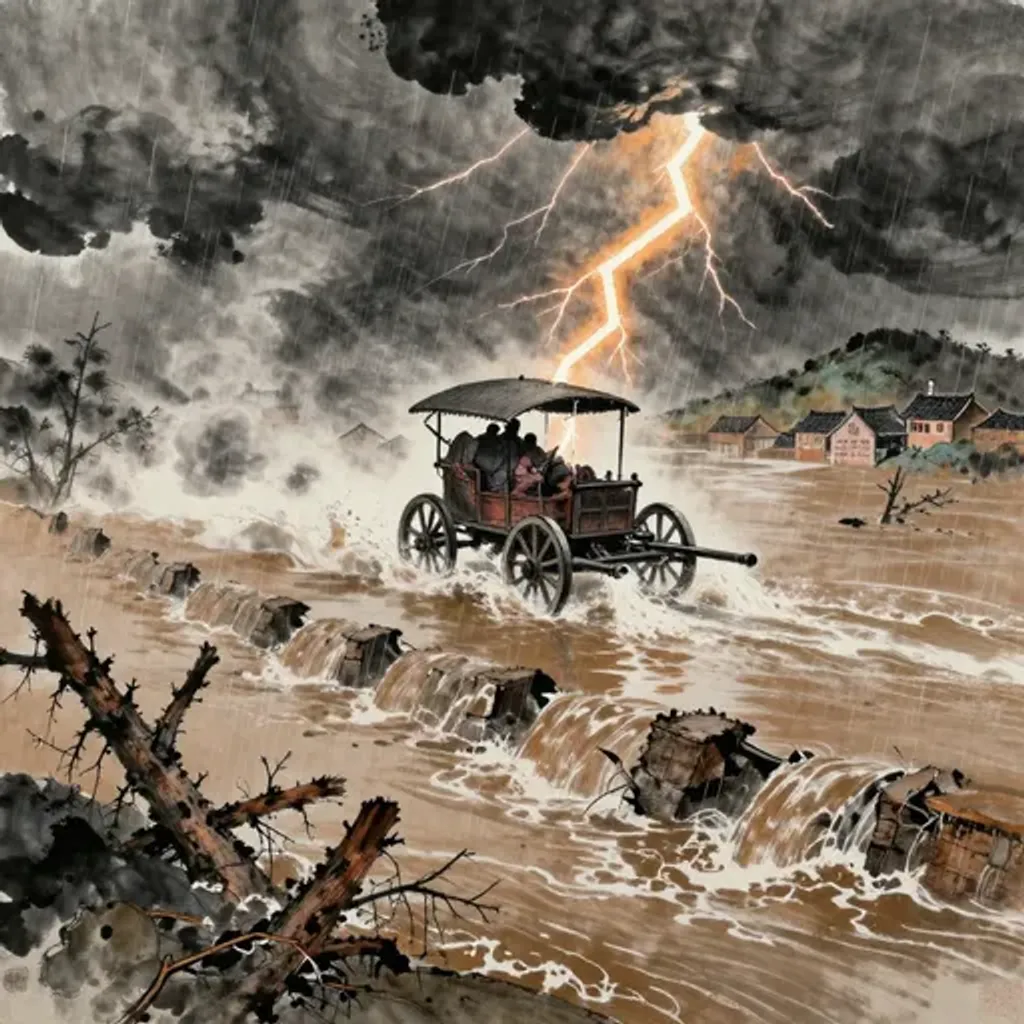
雷車不藏,隱隱西行,霖雨三旬,流為河江,使國憂凶。
The thunder chariot will not be stored; it rumbles westward, hidden. Torrential rain for thirty days; flowing into rivers and streams — bringing the kingdom grief and calamity.
— Jiao Yanshou, Yilin (Forest of Changes), 1st century BC
Commentary
Heaven above the mountain drains into lake over water — Oppression, where resources are exhausted. The thunder chariot cannot be stored away; it rumbles westward with a hidden roar. Torrential rain falls for thirty days, swelling into rivers and flooding the land, bringing calamity to the state. The thunder chariot evokes uncontrollable celestial force — a storm that refuses to abate. Thirty days of rain transforms streams into rivers and rivers into devastation. From Retreat to Oppression, the mountain's strategic withdrawal is overwhelmed by forces beyond containment. The lake has no water — Oppression's image — yet here water is everywhere, destructive and unchecked. The oppression comes not from drought but from drowning: the retreating figure finds that what he tried to contain has broken free and now overwhelms the very state he sought to protect.
遯 → 井
Hexagram 33 → Hexagram 48: The Well
Changing lines: 2, 4, 6
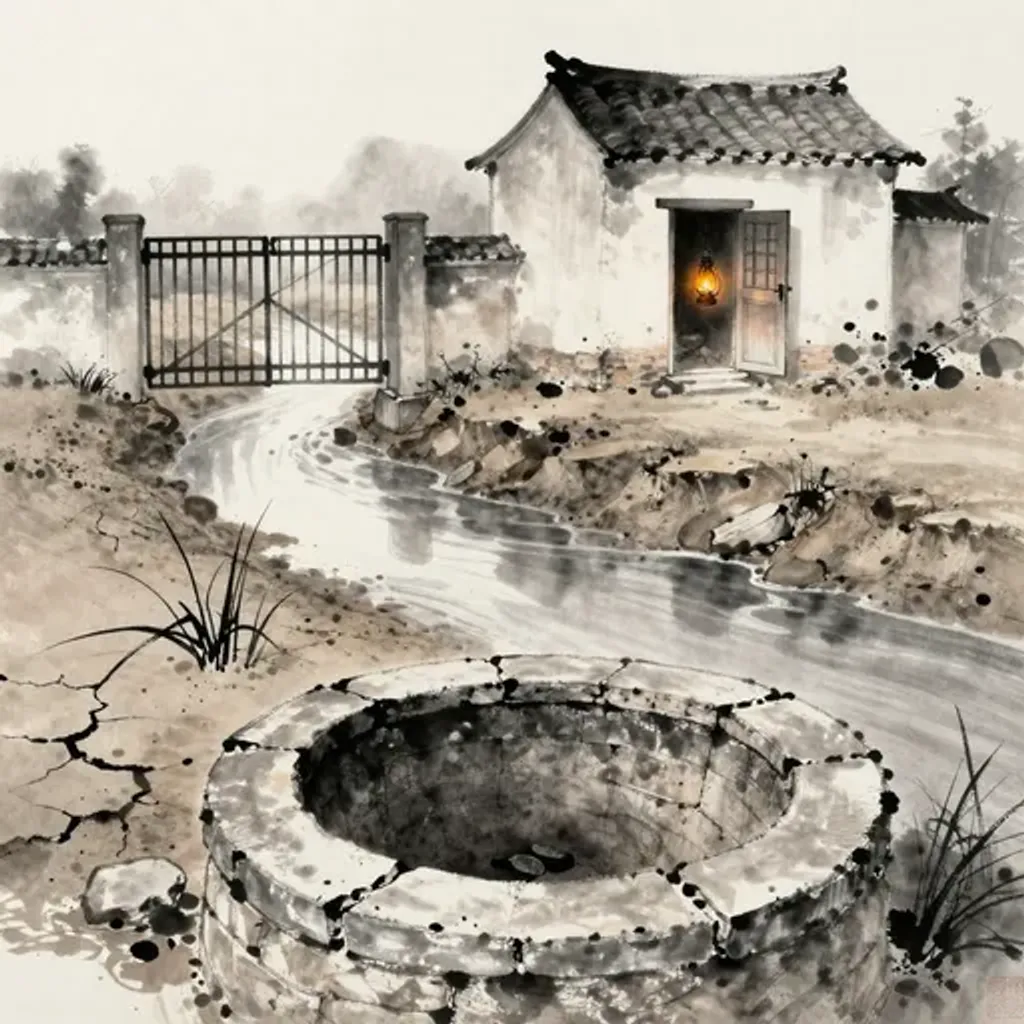
老河虛空,舊井無魚,利得不饒,避患東鄰,禍入我門,使我悔存。
The old river is hollow and empty; the ancient well holds no fish. Profit gained is not generous; fleeing trouble to the eastern neighbor — disaster enters my gate, leaving me in regret.
— Jiao Yanshou, Yilin (Forest of Changes), 1st century BC
Commentary
Heaven above the mountain descends into water over wind — the Well, the inexhaustible communal resource. Yet this well is empty: the old river has run dry, the ancient well contains no fish. Profit and benefit are meager; fleeing trouble to the eastern neighbor only brings disaster through one's own door, leaving one to regret surviving at all. Every image is of exhausted resources and failed escape — the well that should sustain yields nothing, and the retreat from one quarter only invites trouble from another. From Retreat to the Well, the mountain's withdrawal should reach the deep water that nourishes all. But the well is depleted, the river hollow. The retreating figure discovers that the communal infrastructure has decayed beyond use, and running from one neighbor's trouble merely redirects the flood to one's own house.
遯 → 革
Hexagram 33 → Hexagram 49: Revolution
Changing lines: 1, 6
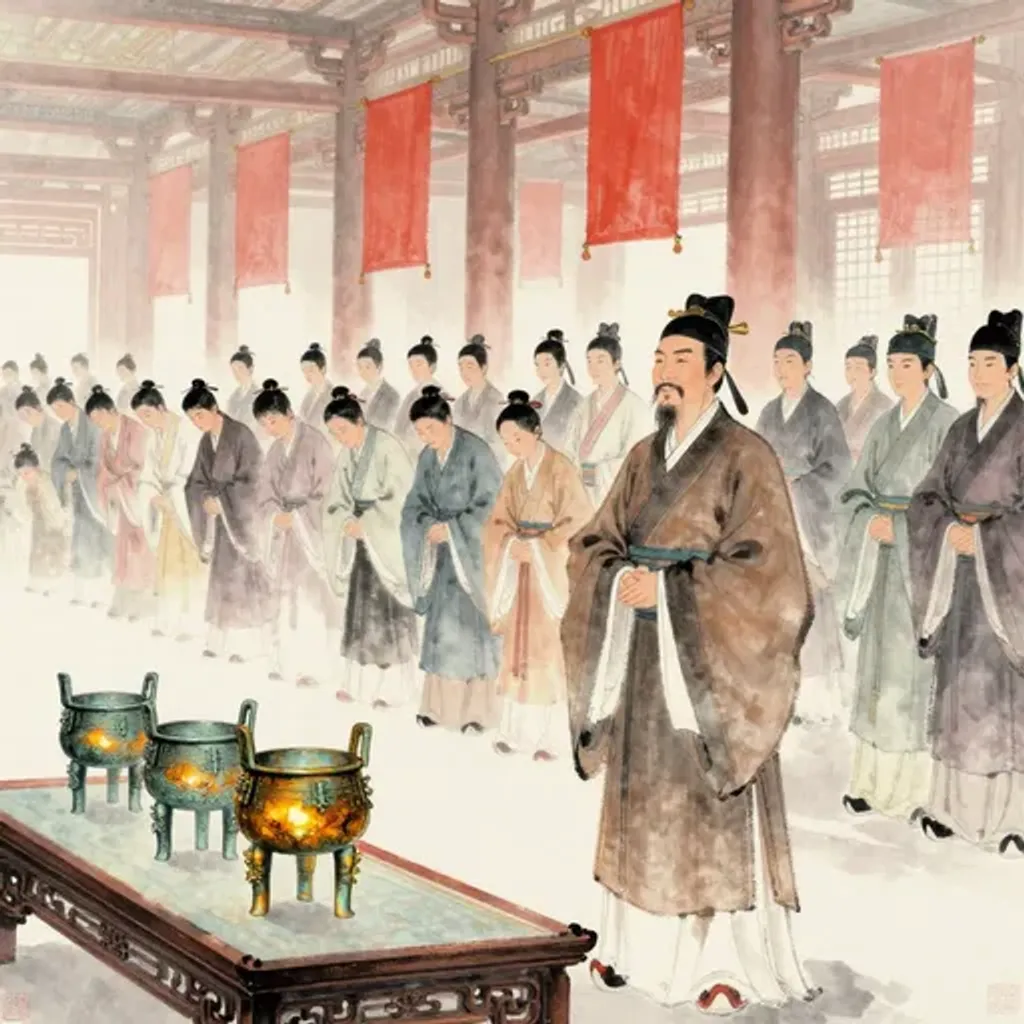
福德之士,歡悅日喜,夷吾相國,三歸為臣,賞流子孫。
A man of fortune and virtue; joyful and glad each day. Yi Wu serves as chancellor; receiving three estates as a minister. His rewards flow down to his descendants.
— Jiao Yanshou, Yilin (Forest of Changes), 1st century BC
Commentary
Heaven above the mountain transforms into lake over fire — Revolution, where the old order is renewed through decisive change. A man of blessing and virtue lives in daily joy. Yi Wu becomes prime minister, receives the 'three returns,' and his rewards flow down to his descendants. Yi Wu is the courtesy name of Guan Zhong, the great minister who helped Duke Huan of Qi achieve hegemony over the feudal states. The 'three returns' refers to the extraordinary privileges the duke granted him — wealth, title, and estates normally reserved for royalty. From Retreat to Revolution, the mountain's withdrawal becomes the radical restructuring of fire and lake. Guan Zhong's story embodies revolution through talent: a man of humble origins who retreated from power struggles, only to return and remake the entire political order of his age.
遯 → 鼎
Hexagram 33 → Hexagram 50: The Cauldron
Changing lines: 2, 5
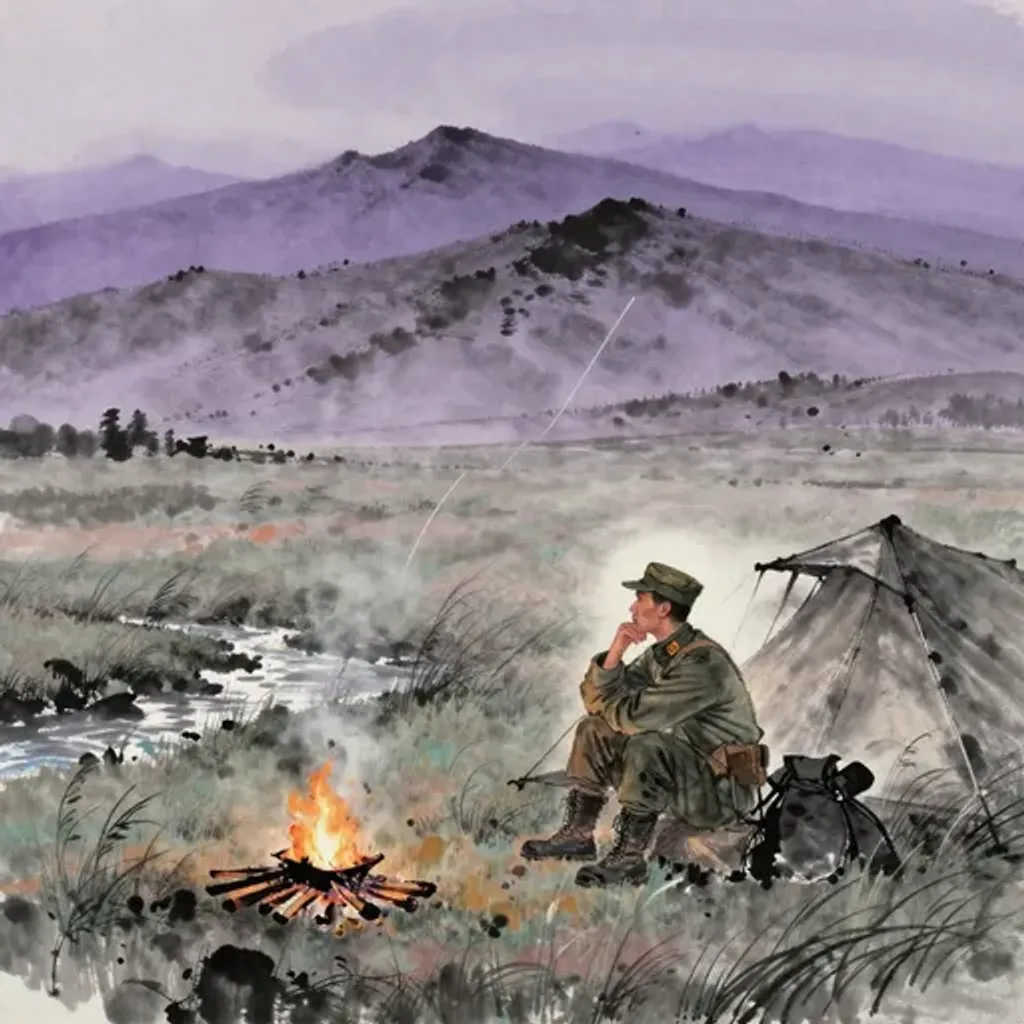
清人高子,久屯外野,逍遙不歸,思我慈母。
The men of Qing, led by Gao Zi; long garrisoned in the outer wilds. Wandering free, they do not return; thinking of their loving mothers.
— Jiao Yanshou, Yilin (Forest of Changes), 1st century BC
Commentary
Heaven above the mountain rises into fire over wind — the Cauldron, where raw material is transformed into civilized nourishment. The Men of Qing — Gao Ke's garrison — are stationed far from home in the open wilderness. They wander idly and do not return, longing for their kind mothers. The verse alludes to the Shijing ode 'Qing Ren' from the Airs of Zheng, which satirizes Gao Ke's troops as warriors left to idle on the frontier, accomplishing nothing. Their homesickness is not for home in general but for their mothers specifically — the most primal form of nourishment. From Retreat to the Cauldron, the mountain's withdrawal becomes the cauldron's transformative fire. But here no transformation occurs: the soldiers sit in the wild untransformed, their raw longing uncooked, their purpose unrefined. The cauldron stands empty while its intended contents wander aimlessly outside.
遯 → 震
Hexagram 33 → Hexagram 51: The Arousing Thunder
Changing lines: 1, 3, 5, 6
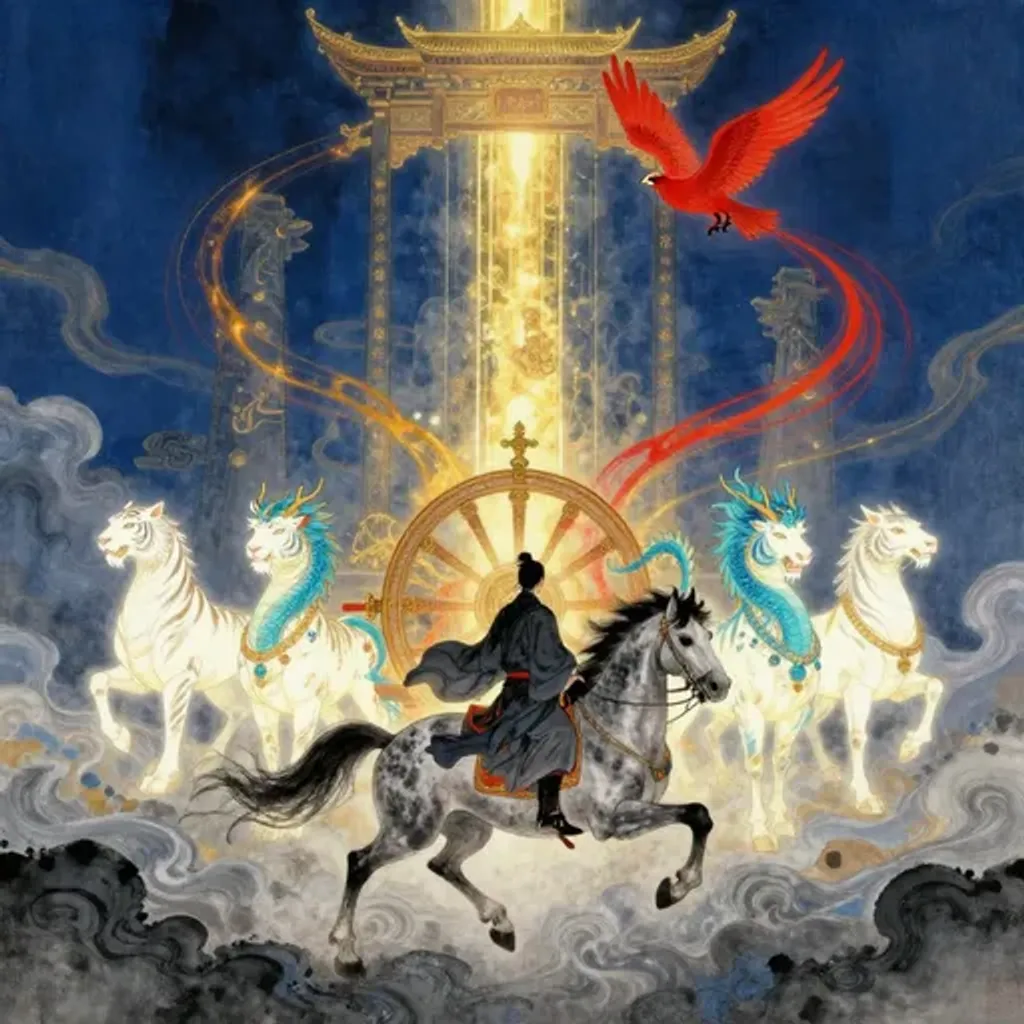
驄𩦞黑𩭳,東歸高鄉,白虎推輪,蒼龍把衡,朱雀導引,虛烏載遊,逐扣天門,入見真君,馬安人全。
A dappled steed with black mane; returning east to the high country. White Tiger pushes the wheel; Azure Dragon holds the crossbar. Vermillion Bird leads the way; the Dark Raven carries them onward. They knock upon the gate of heaven; entering to see the True Lord. Horse safe, rider whole.
— Jiao Yanshou, Yilin (Forest of Changes), 1st century BC
Commentary
Heaven above the mountain shakes into doubled thunder — the Arousing, where shock awakens and mobilizes. A dappled horse with dark mane heads east toward the highlands. The White Tiger pushes the wheel; the Azure Dragon holds the crossbar; the Vermilion Bird guides ahead; the Dark Warrior carries the traveler onward. They knock at heaven's gate and enter to see the True Lord. Horse and rider arrive safe and whole. The verse assembles all Four Celestial Guardians — the sacred animals of the four directions — as an escort for a cosmic journey. From Retreat to the Arousing, the mountain's quiet withdrawal erupts into celestial thunder. The retreating figure does not merely return to the world but ascends to heaven itself, escorted by the very architecture of the cosmos. This is retreat's ultimate reward: withdrawal so profound that it circles back to the throne of heaven.
遯 → 艮
Hexagram 33 → Hexagram 52: Keeping Still Mountain
Changing lines: 4, 5
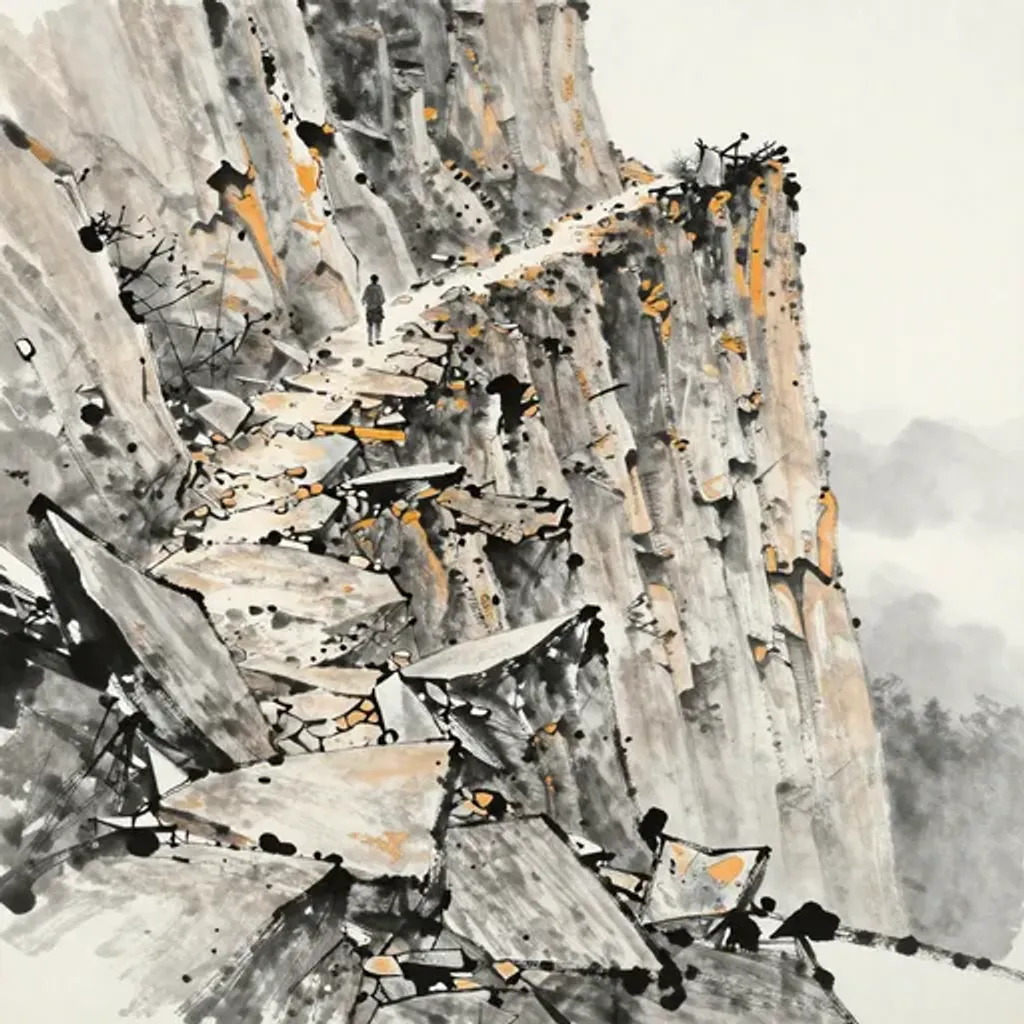
路多枳棘,步刺我足,不利旅客,為心作毒。
Loose rocks and collapsed cliff — the path is severed, no bridge remains. Standing alone at the cliff's edge, unable to advance or retreat.
— Jiao Yanshou, Yilin (Forest of Changes), 1st century BC
Commentary
Heaven above the mountain stills into doubled mountain — Keeping Still, where all motion ceases. The original verse reads: 'The road is thick with thorns and brambles, every step pierces my feet. Unfavorable for the traveler — it poisons the heart.' The path is so overgrown that walking itself becomes an act of suffering. The traveler cannot advance without injury, and the experience breeds bitterness rather than wisdom. From Retreat to Keeping Still, the mountain's withdrawal doubles into absolute immobility. Two mountains face each other with nowhere to go. The verse captures the moment when retreat becomes entrapment: the one who withdrew finds that every path forward is barbed, and staying still is the only option — not from choice but from the impossibility of movement in any direction.
遯 → 漸
Hexagram 33 → Hexagram 53: Development
Changing lines: 4
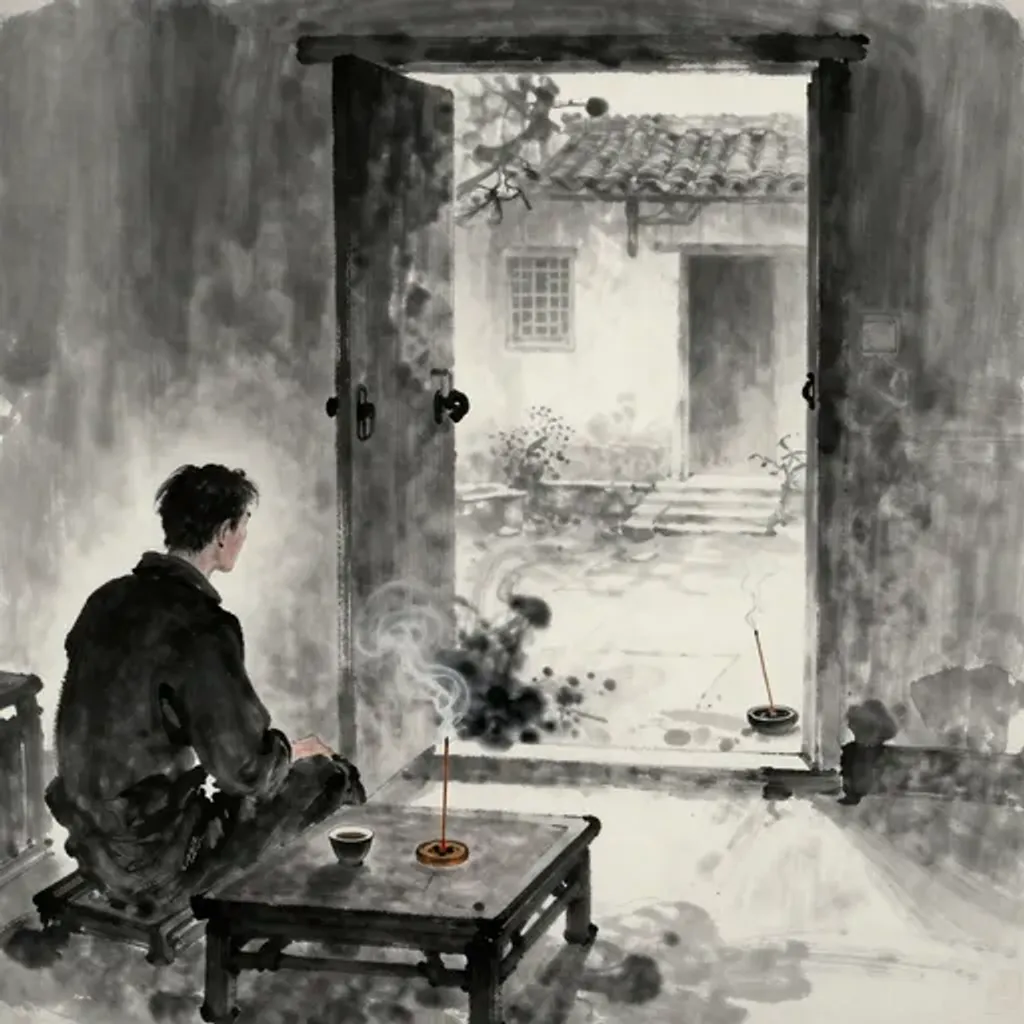
端坐生患,憂來入門,使我不安。
Sitting upright, trouble is born; worry enters through the gate — leaving me with no peace.
— Jiao Yanshou, Yilin (Forest of Changes), 1st century BC
Commentary
Heaven above the mountain develops into wind over mountain — Development, where progress proceeds gradually like a tree growing on a mountainside. Yet the verse is brief and bleak: sitting quietly, trouble arises of its own accord. Worry enters through the door unbidden, destroying one's peace. The verse inverts Development's promise of steady growth: instead of the goose advancing through measured stages, anxiety invades the supposedly safe space. From Retreat to Development, the mountain's withdrawal should yield patient, organic growth. But the verse warns that some troubles do not require one's participation — they arrive while one sits still, entering the house of retreat like an uninvited guest. Development demands engagement with the world at a proper pace; pure withdrawal, the verse suggests, merely leaves the door open for worry to walk in.
遯 → 歸妹
Hexagram 33 → Hexagram 54: The Marrying Maiden
Changing lines: 1, 2, 3, 5, 6
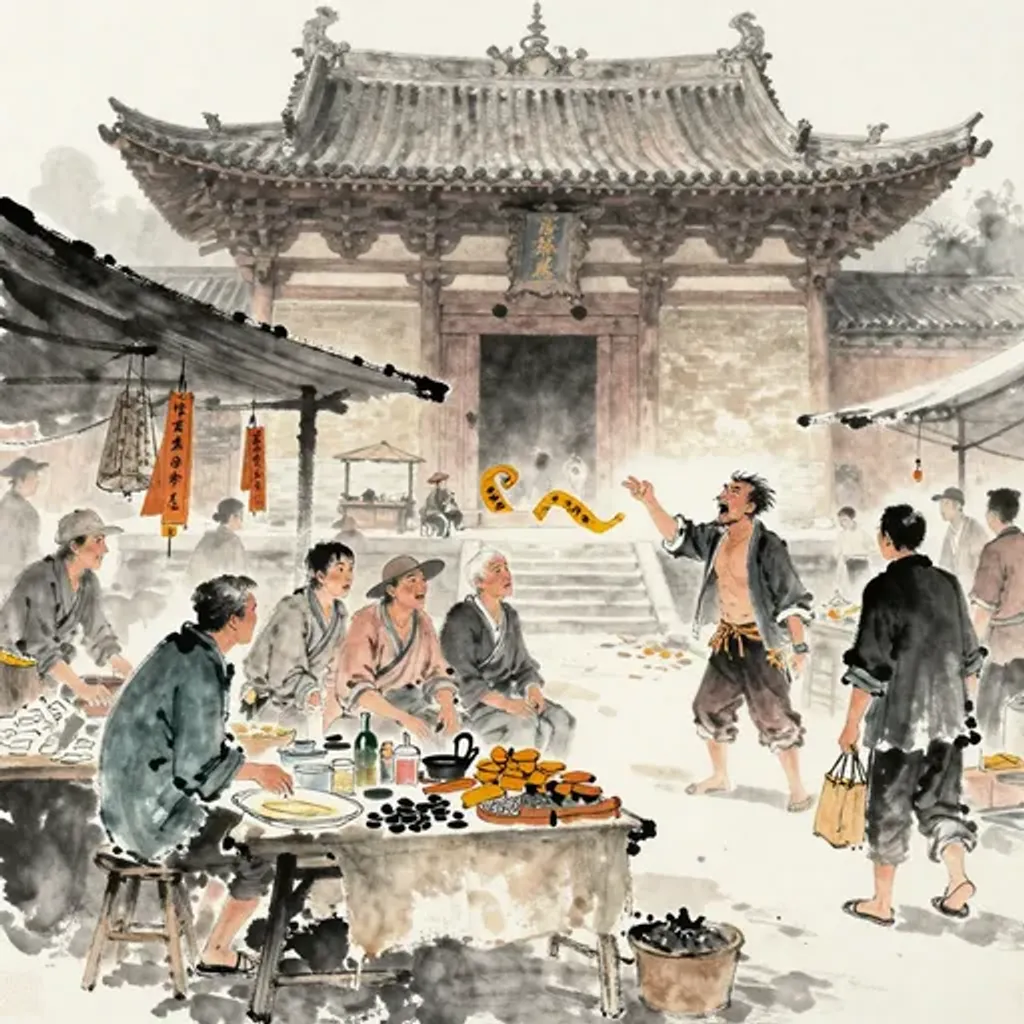
小陬之市,利不足喜,二世積仁,蒙其祖先,匪躬之言,狂悖為患。
The small market of Zou; its profit is not worth celebrating. Two generations of accumulated benevolence; blessed by their ancestors. But reckless words spoken without restraint; wild defiance becomes a calamity.
— Jiao Yanshou, Yilin (Forest of Changes), 1st century BC
Commentary
Heaven above the mountain descends into thunder over lake — the Marrying Maiden, where a subordinate party enters an arrangement with limited agency. A small market in a minor town offers profits not worth celebrating. Two generations accumulate benevolence, sheltered by ancestral merit. But reckless speech — words that defy propriety — brings disaster. The verse contrasts patient multi-generational virtue with the single rash utterance that undoes it all. From Retreat to the Marrying Maiden, the mountain's withdrawal becomes the maiden's constrained entry into a household not her own. The verse warns that inherited virtue, built through decades of careful retreat and accumulation, can be squandered in a moment of unguarded speech. The marrying maiden's position is precarious; one wrong word collapses what ancestors spent lifetimes building.
遯 → 豐
Hexagram 33 → Hexagram 55: Abundance
Changing lines: 1, 5, 6
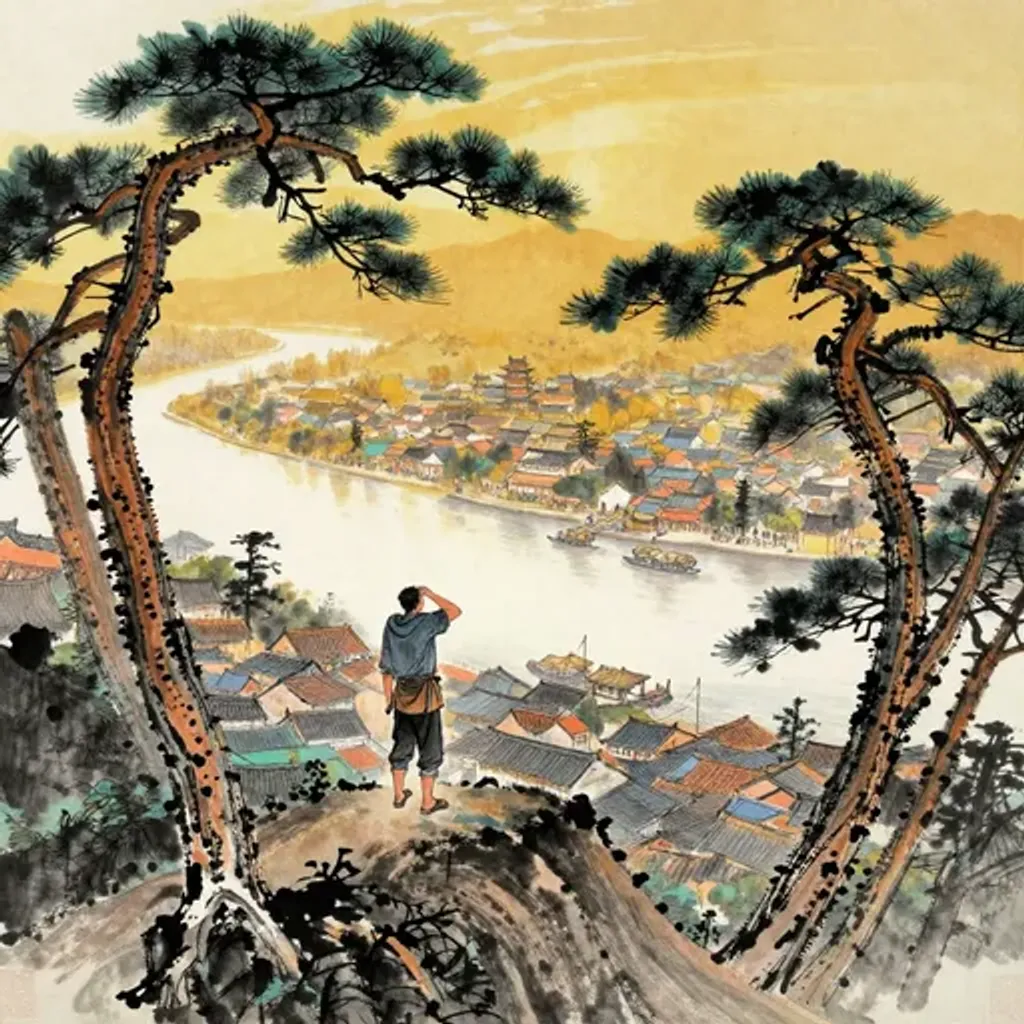
登高望時,見樂无憂,求利南國,與寶相得。
Climbing high to survey the season; seeing joy, free from worry. Seeking profit in the southern kingdom; finding treasure in return.
— Jiao Yanshou, Yilin (Forest of Changes), 1st century BC
Commentary
Heaven above the mountain illuminates as thunder over fire — Abundance, where brilliance and movement unite at their peak. Climbing high to survey the times, one sees joy without worry. Seeking profit in the southern lands, one obtains treasure in return. The verse celebrates the elevated perspective that retreat provides: from the mountaintop, the world below reveals its opportunities. The south was traditionally the direction of abundance and warmth in Chinese cosmology. From Retreat to Abundance, the mountain's withdrawal becomes the thunderbolt that ignites the fire of fullness. The retreating figure climbs high not to escape but to see clearly, and what he sees is opportunity. Abundance here rewards the one who withdrew far enough to gain perspective — the panoramic view that reveals where treasure lies hidden.
遯 → 旅
Hexagram 33 → Hexagram 56: The Wanderer
Changing lines: 5
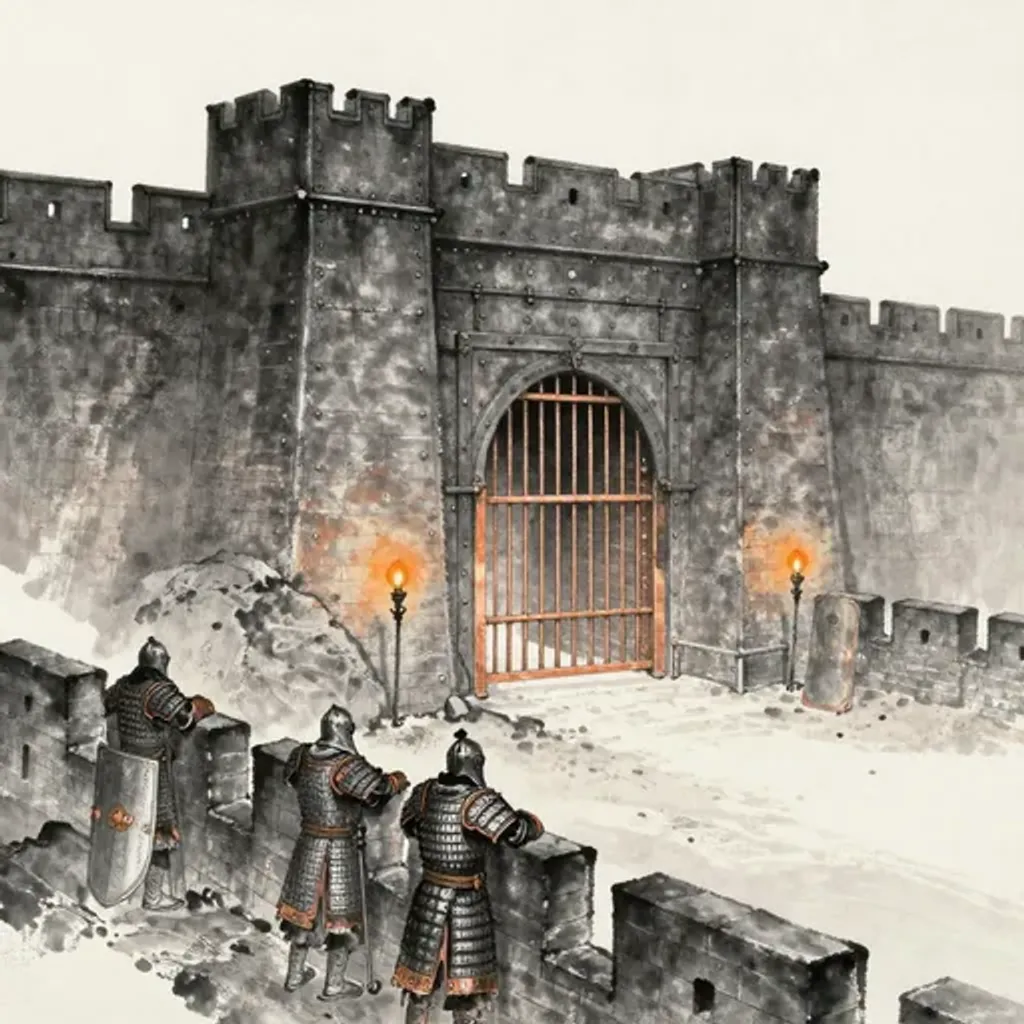
䟽足息肩,有所忌難,金城鐵廓,以銅為關,藩屏自衛,安上無患。
Resting weary feet and easing shoulders; there are things to fear and guard against. Walls of metal, ramparts of iron; gates of bronze. Screens and shields for self-defense; secure above, without calamity.
— Jiao Yanshou, Yilin (Forest of Changes), 1st century BC
Commentary
Heaven above the mountain journeys into fire over mountain — the Wanderer, who carries his home within. Resting weary feet and easing aching shoulders, the traveler faces obstacles he dares not challenge directly. Instead he builds defenses: walls of metal, ramparts of iron, gates cast in bronze. Screens and barriers protect him on all sides; secure above, he has no cause for worry. The verse transforms retreat into fortification — the wanderer who cannot advance builds an impregnable position where he stands. From Retreat to the Wanderer, the mountain's withdrawal becomes the fire on the mountaintop that signals across distances. The wanderer does not flee; he digs in. His retreat is not flight but the construction of a mobile fortress, a position so well defended that even on foreign soil he remains unassailable.
遯 → 巽
Hexagram 33 → Hexagram 57: The Gentle Wind
Changing lines: 2, 4
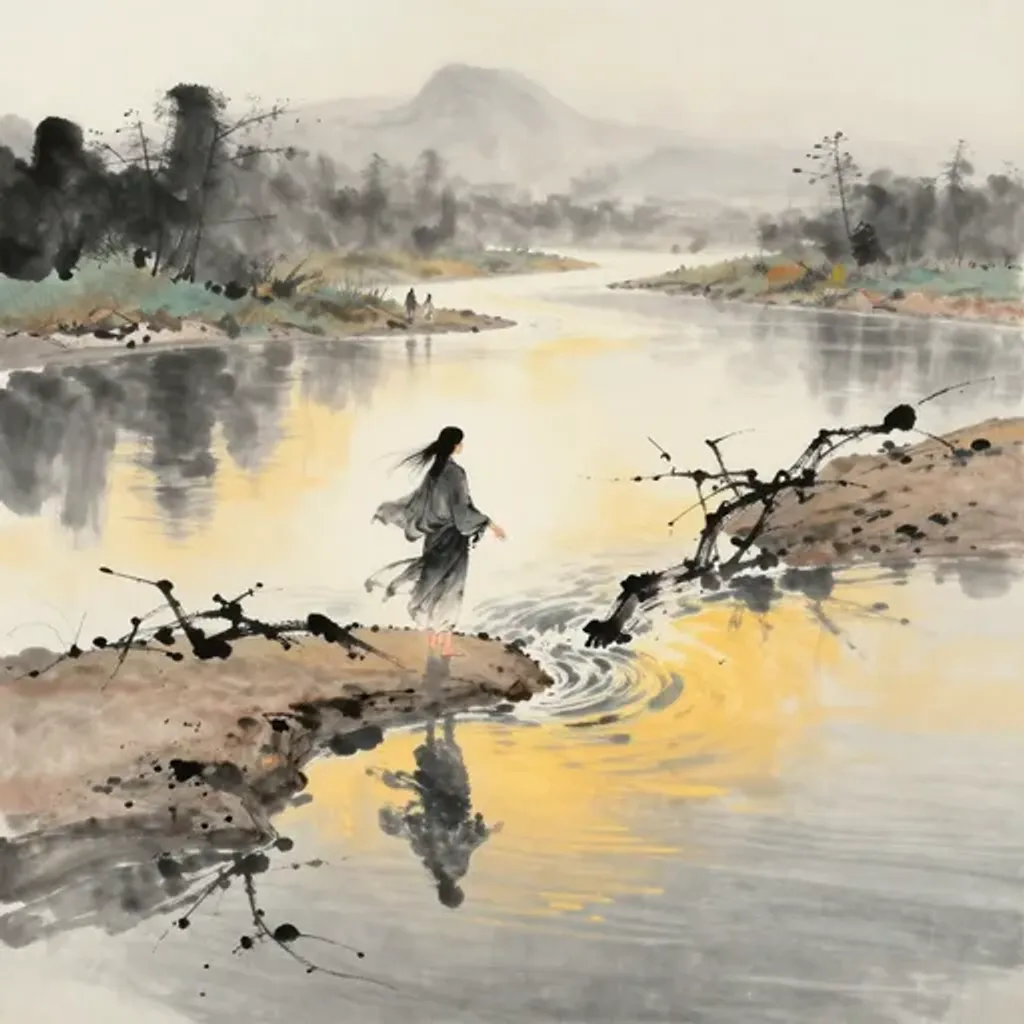
江水沱汜,思附君子,伯仲受歸,不我肯顧,姪娣悔恨。
The river's waters branch at the Tuo and Si; longing to be near the noble man. Elder and younger brothers receive their brides; they will not look back at me. The nieces and younger sisters are left in regret.
— Jiao Yanshou, Yilin (Forest of Changes), 1st century BC
Commentary
Heaven above the mountain flows into doubled wind — the Gentle, where penetration proceeds softly and persistently. The Yangtze divides into its tributaries, the Tuo and the Si. A woman longs to attach herself to a gentleman, but her husband's brothers send her back; he will not look at her. Nieces and younger sisters are left with regret. The verse echoes the Shijing ode 'Jiang You Si' from the Airs of Shao, which describes a woman's anguish over marital rejection — the river branches, and so does her fate. From Retreat to the Gentle, the mountain's withdrawal becomes the wind that divides and separates. The Yangtze's branching mirrors the family's fracture: what should flow together splits apart. Gentleness here is not kindness but the quiet, persistent force of estrangement — love that penetrates but cannot hold.
遯 → 兌
Hexagram 33 → Hexagram 58: The Joyous Lake
Changing lines: 1, 2, 3, 6
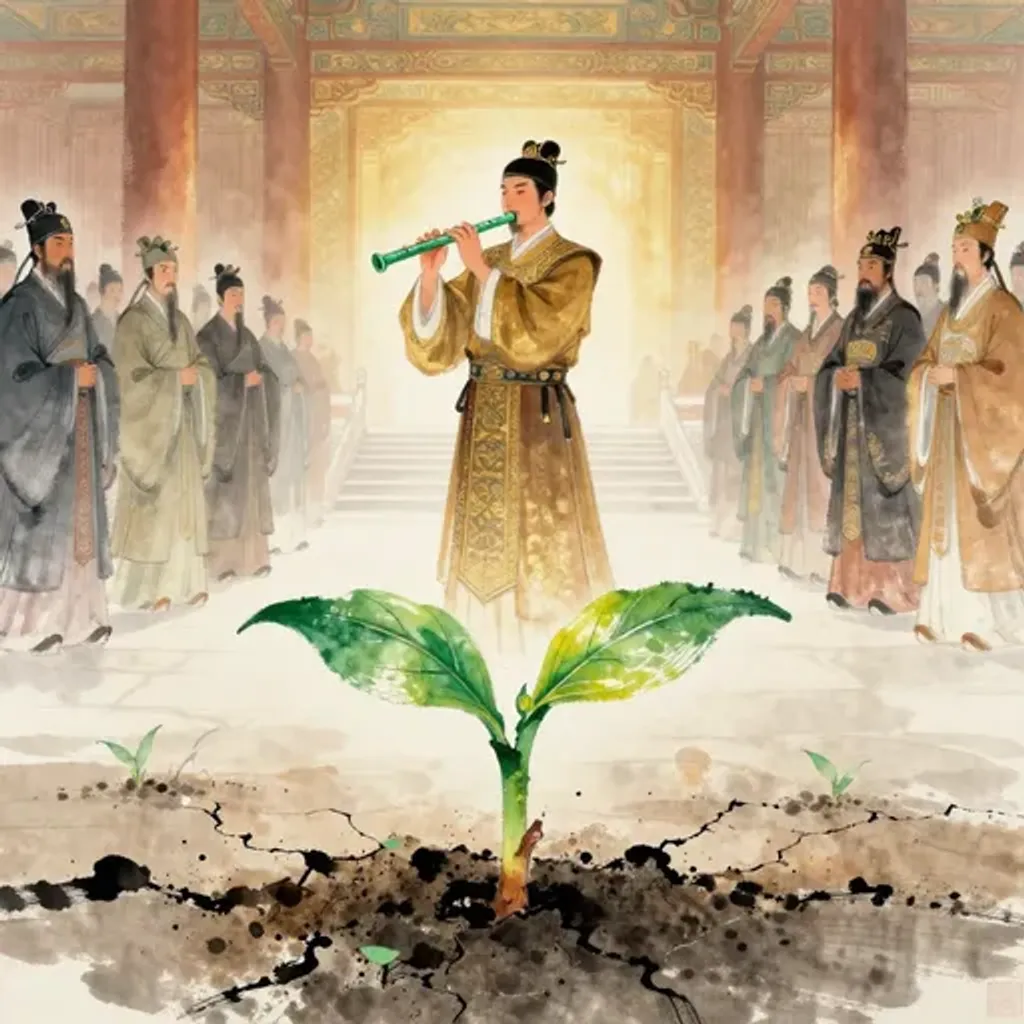
牙蘖生達,陽倡於外,左手執籥,公言錫爵。
Buds and shoots sprout and flourish; the yang exerts itself outward. The left hand holds the flute; the duke announces the bestowing of rank.
— Jiao Yanshou, Yilin (Forest of Changes), 1st century BC
Commentary
Heaven above the mountain opens into doubled lake — the Joyous, where open expression creates communion. Buds and shoots break through the soil and reach the sun; yang energy manifests outward. The left hand holds a flute, and the lord speaks, bestowing a cup of honor. The verse celebrates emergence and recognition: what germinated underground now rises into light, and the musician's performance earns a noble's favor. From Retreat to the Joyous, the mountain's withdrawal yields to the lake's open receptivity. The seeds that retreated into earth now sprout; the talent that withdrew into privacy now performs before an audience. Joy here is the moment when retreat ends and expression begins — the bud's breakthrough, the flute's first note, the cup of honor that rewards the courage to emerge.
遯 → 渙
Hexagram 33 → Hexagram 59: Dispersion
Changing lines: 2, 3, 4
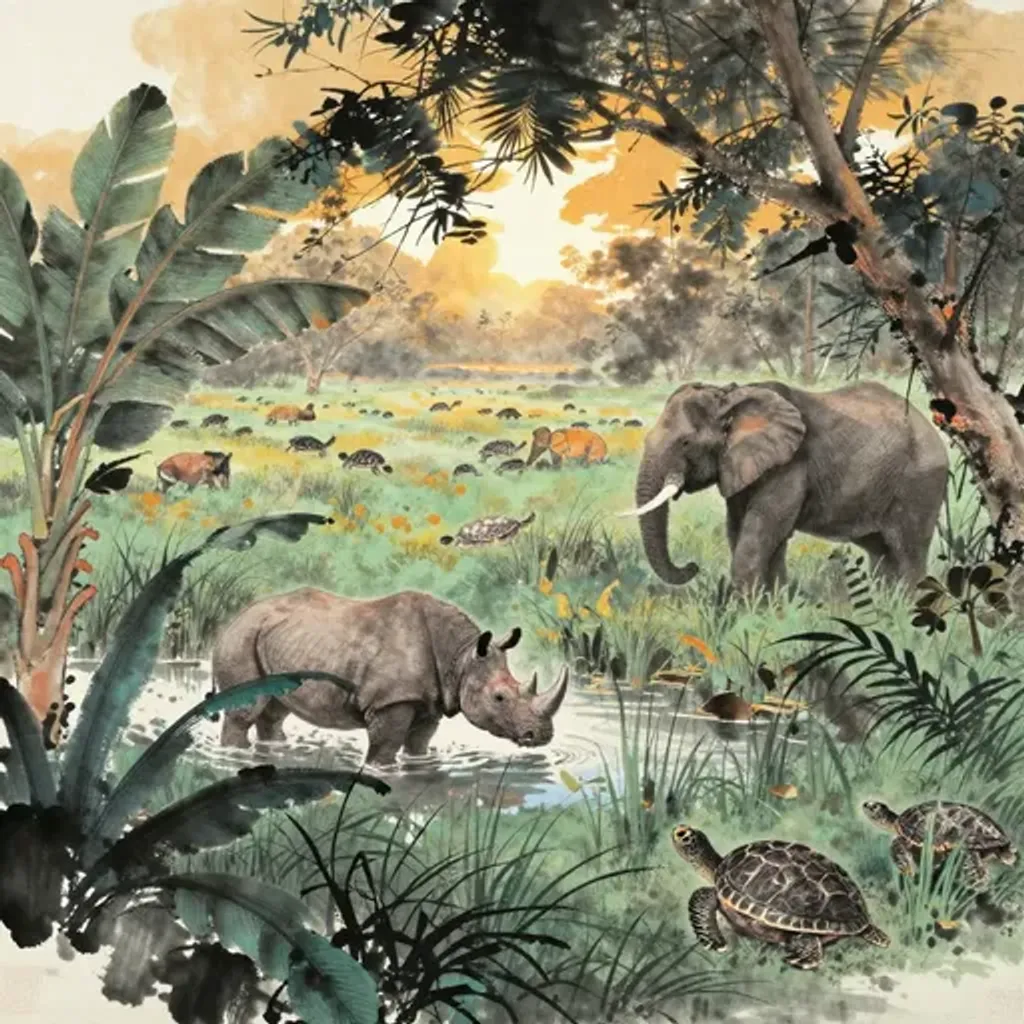
雲夢苑囿,萬物蕃熾。犀象玳瑁,荊人以富。
The Yunmeng park and hunting grounds; the ten thousand creatures flourish and thrive. Rhinoceros, elephants, and hawksbill turtles; by these the men of Chu grow wealthy.
— Jiao Yanshou, Yilin (Forest of Changes), 1st century BC
Commentary
Heaven above the mountain disperses into wind over water — Dispersion, where what was frozen is melted and scattered. The Yunmeng Marshes teem with wildlife; all living things flourish and multiply. Rhinoceros, elephants, and hawksbill turtles abound — through these riches the people of Chu grow wealthy. Yunmeng was the vast royal hunting preserve of the Chu kingdom in modern Hubei, celebrated in Han rhapsodies for its staggering natural abundance. From Retreat to Dispersion, the mountain's concentrated withdrawal gives way to the wind scattering across water — resources distributed widely. The verse celebrates the retreat from accumulation: Chu's wealth is not hoarded in vaults but dispersed across living marshlands. Dispersion here is generosity in its most organic form — nature's own abundance flowing freely to those who dwell within it.
遯 → 節
Hexagram 33 → Hexagram 60: Limitation
Changing lines: 1, 2, 3, 4, 6
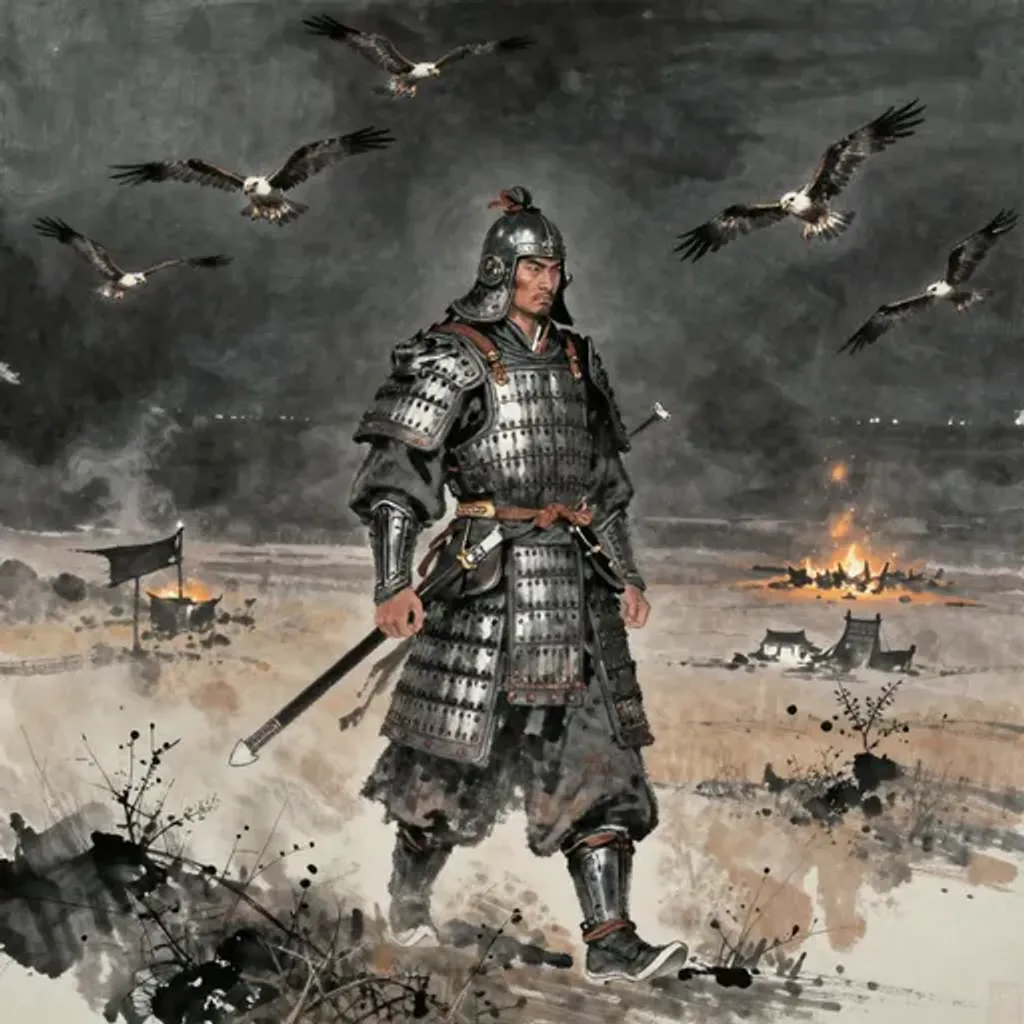
渠戎萬里,晝夜愁苦,櫜甲戎服,雖荷不賊,鷹鸇之殘,害不能傷。
The Qu Rong, ten thousand li away; day and night in grief and hardship. Sheathing armor, donning war garb; though burdened, they are not harmed. The cruelty of hawks and falcons; their harm cannot wound.
— Jiao Yanshou, Yilin (Forest of Changes), 1st century BC
Commentary
Heaven above the mountain restrains as water over lake — Limitation, where boundaries define what can and cannot be done. The Qu Rong frontier stretches ten thousand li; day and night bring only anxiety and suffering. Yet soldiers don their armor and war garments, and though they bear the burden, no harm befalls them. Hawks and falcons are fierce, but their savagery cannot wound. The verse depicts frontier garrison life at the empire's edge — exhausting, terrifying, yet survivable when discipline holds. From Retreat to Limitation, the mountain's withdrawal becomes the measured restraint of water held within the lake's banks. The soldiers endure not because they are strong but because their limits are clearly defined: armor protects, discipline contains, and the predators circle but cannot strike. Limitation transforms retreat from flight into fortified endurance.
遯 → 中孚
Hexagram 33 → Hexagram 61: Inner Truth
Changing lines: 1, 2, 3, 4
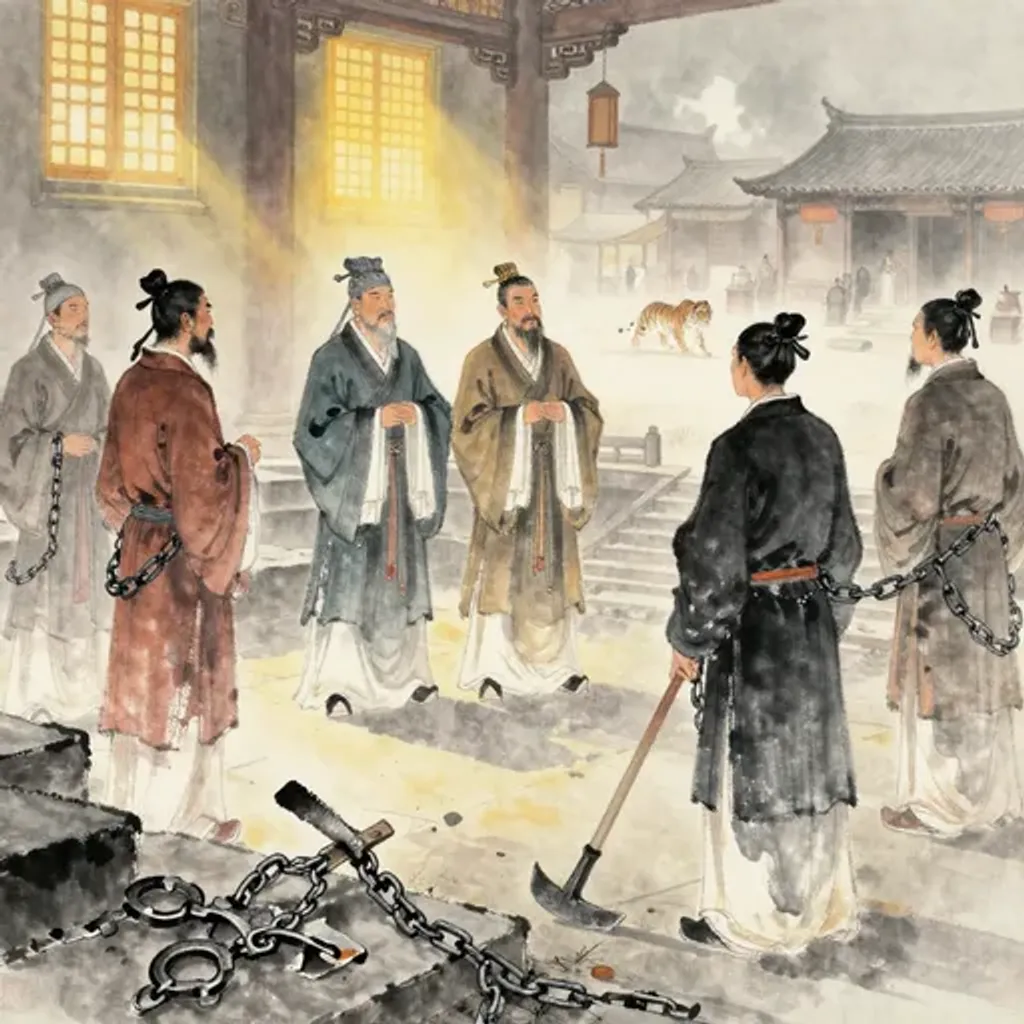
鎡基逢時,稷契皋陶,貞良願得,微子解囚,市空無虎,謾誕妄語。
The hoe meets its season; Ji, Qi, and Gao Yao — upright and virtuous, worthy of trust. Weizi is freed from prison; the market is empty, no tiger. Lies and wild falsehoods, reckless words.
— Jiao Yanshou, Yilin (Forest of Changes), 1st century BC
Commentary
Heaven above the mountain opens into wind over lake — Inner Truth, where sincerity penetrates like wind across water. The verse assembles a dense constellation of references: the plowshare finds its season; Hou Ji, Qi, and Gao Yao — ministers of the sage-kings — are steadfast and good, longing for recognition. Viscount Wei is freed from captivity. Then the verse pivots: the marketplace is empty of tigers; the rumors were reckless lies. The final image alludes to the 'three men make a tiger' parable — if three people claim a tiger walks the market, even the wise begin to believe. From Retreat to Inner Truth, the mountain's withdrawal becomes the wind's sincere penetration. The verse demands discrimination: true ministers deserve recognition; false reports deserve exposure. Inner truth distinguishes the real sage from the phantom tiger.
遯 → 小過
Hexagram 33 → Hexagram 62: Small Exceeding
Changing lines: 5, 6
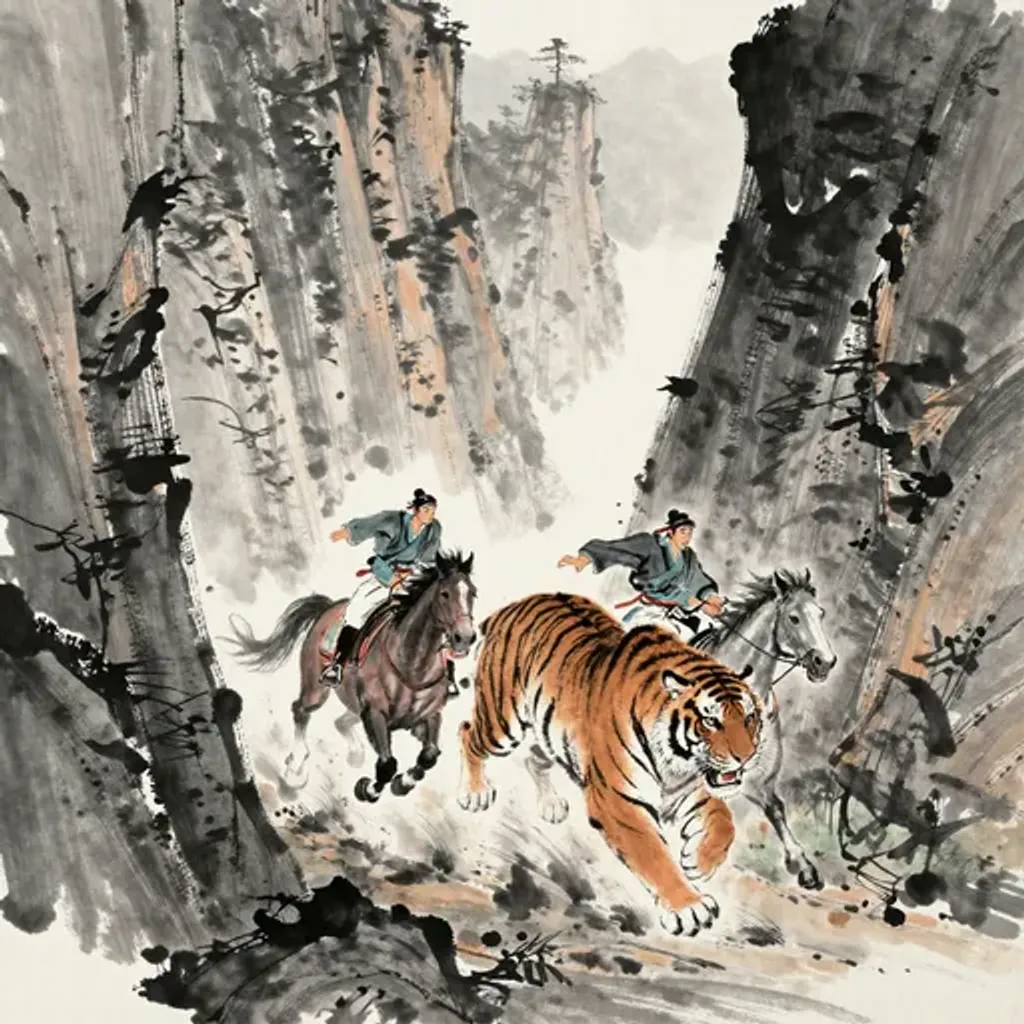
騎騅與蒼,南賈太行。逢駮猛虎,為所吞殤,葬於渭陽。
Riding dappled and grey horses; trading south toward Taihang. They meet a fearsome striped tiger; devoured and slain — buried at the Wei's sunny bank.
— Jiao Yanshou, Yilin (Forest of Changes), 1st century BC
Commentary
Heaven above the mountain exceeds as thunder over mountain — Small Exceeding, where the small oversteps its bounds. Riding a piebald and a dappled horse, one travels south to trade at Taihang Mountain. On the road one meets a fearsome mottled tiger, and is devoured. The burial takes place at Weiyang, south of the Wei River. The verse is a straightforward tale of fatal miscalculation: a merchant ventures into dangerous terrain and encounters a predator he cannot escape. Taihang is the great mountain range dividing the North China Plain from the Shanxi plateau — forbidding territory for a trader with fine horses. From Retreat to Small Exceeding, the mountain's withdrawal becomes the thunder atop the mountain — a small creature overreaching. The merchant who should have retreated further instead advanced into tiger country, and the small exceeded its capacity with lethal consequences.
遯 → 既濟
Hexagram 33 → Hexagram 63: After Completion
Changing lines: 1, 4, 6
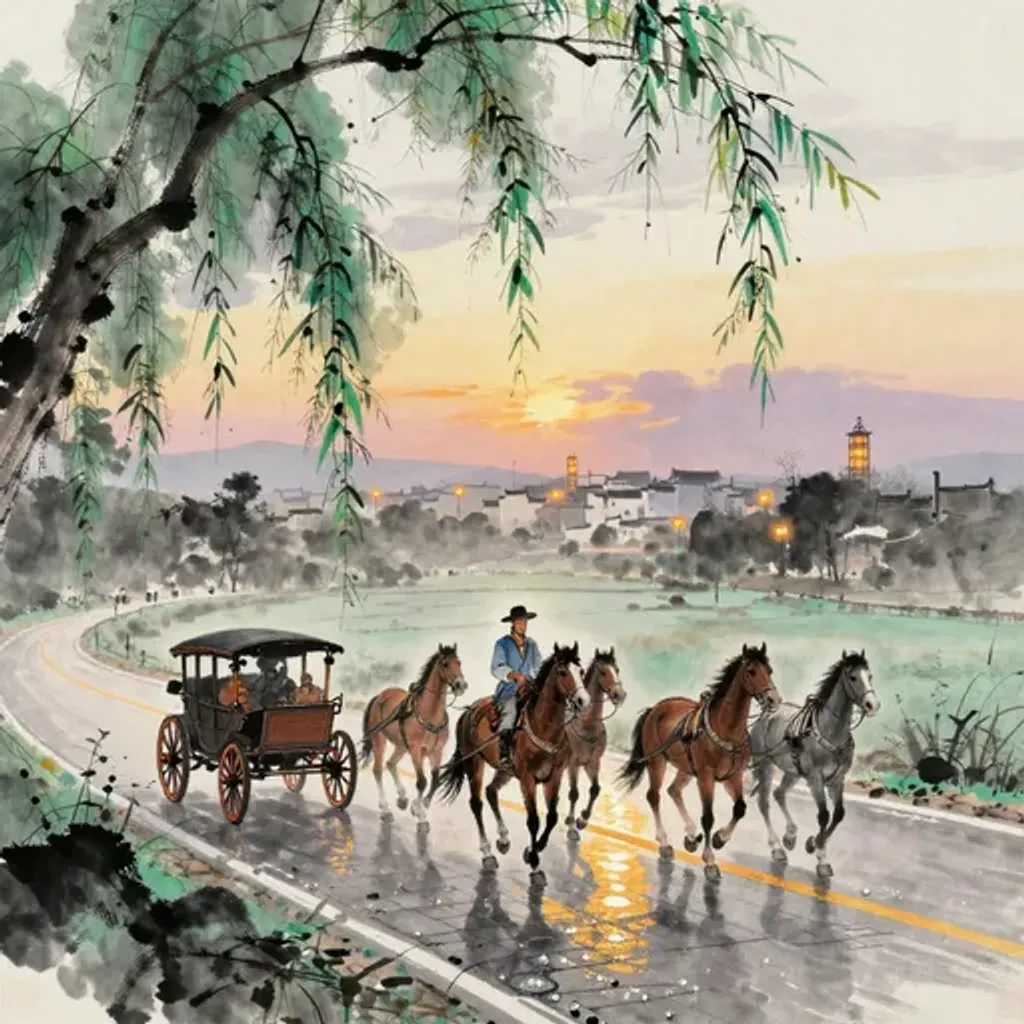
出門東行,日利時良,步騎與駟,經歷宗邦,暮宿北燕,與樂相逢。
Setting out through the gate, heading east; the day is favorable, the hour auspicious. On foot and horseback, with a team of four; passing through the ancestral domain. At evening, lodging in northern Yan; meeting joy along the way.
— Jiao Yanshou, Yilin (Forest of Changes), 1st century BC
Commentary
Heaven above the mountain settles into water over fire — After Completion, where everything has found its proper place. Setting out through the eastern gate on an auspicious day, traveling by foot, horseback, and chariot, one passes through the ancestral homeland. By evening one lodges in northern Yan, and there encounters joy and celebration. The verse traces a journey from departure to arrival, every stage proceeding smoothly — good timing, proper conveyance, familiar territory, and a warm welcome at the end. From Retreat to After Completion, the mountain's withdrawal reaches its fulfillment. Water rests above fire in perfect equilibrium. The retreating figure has passed through every phase of the journey and arrives at completion — not where he started but somewhere new, where celebration awaits. Retreat here is not an ending but the first step of a journey that culminates in harmony.
遯 → 未濟
Hexagram 33 → Hexagram 64: Before Completion
Changing lines: 2, 3, 5
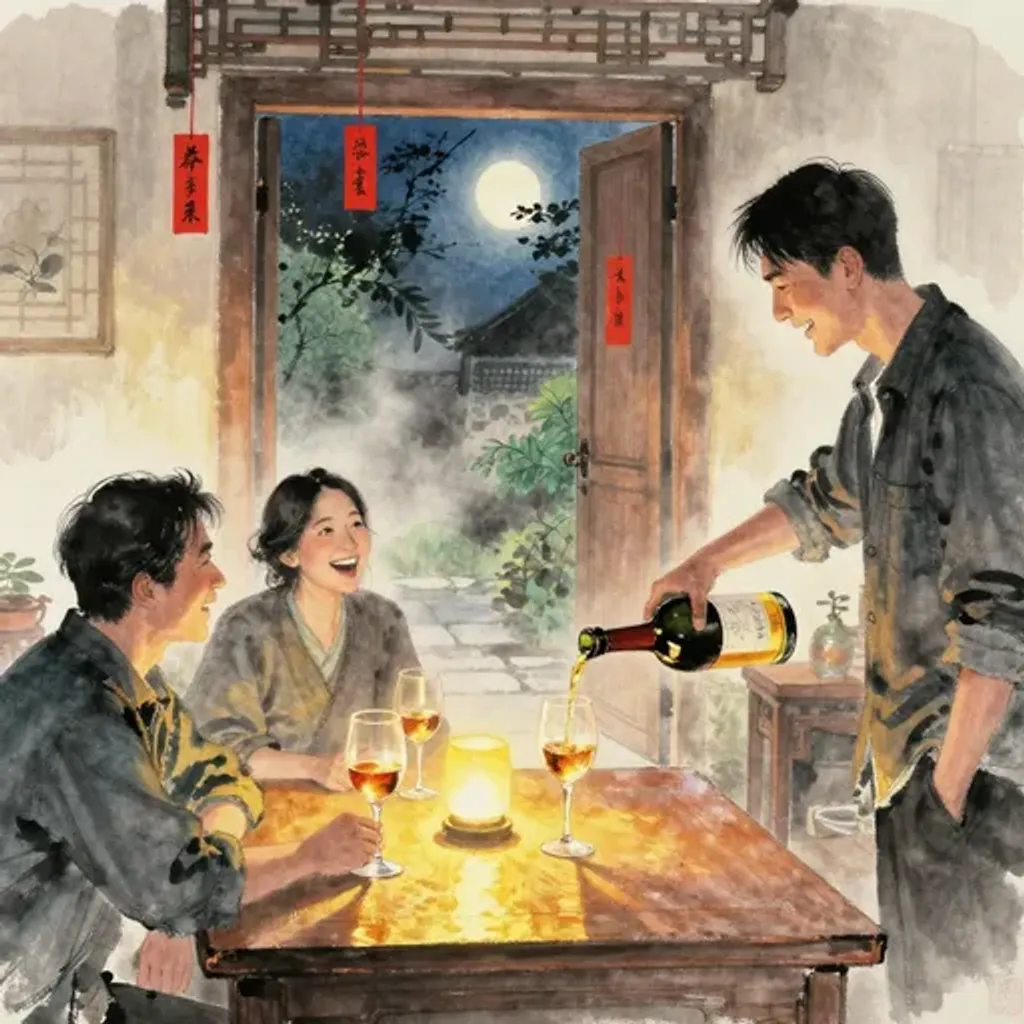
酒為歡伯,除憂來樂,福善入門,與君相索,使我有得。
Wine is the lord of joy; it banishes sorrow and brings delight. Good fortune enters through the gate; it seeks you out, my lord — granting me my gain.
— Jiao Yanshou, Yilin (Forest of Changes), 1st century BC
Commentary
Heaven above the mountain kindles into fire over water — Before Completion, where all elements are present but not yet in their final arrangement. Wine is the lord of joy, dispelling worry and inviting happiness. Blessing and goodness enter through the door; together with the lord, one seeks and finds what was desired. The verse ends the hexagram's cycle on a convivial note: wine flows, anxieties dissolve, fortune arrives. Yet Before Completion's image is fire above water — close to completion but not quite there, each element striving toward its proper place. From Retreat to Before Completion, the mountain's withdrawal encounters the threshold of arrival without crossing it. The wine signals celebration, but the work is not finished. Joy is present, fortune has entered the gate, yet the final step remains untaken.