Transformations of Hexagram 35
Every line of change out of Hexagram 35 晉 Progress, with the Yilin verse for each of the 64 resulting hexagrams, its translation, and the original ink brush artwork.
晉 → 乾
Hexagram 35 → Hexagram 1: The Creative
Changing lines: 1, 2, 3, 5
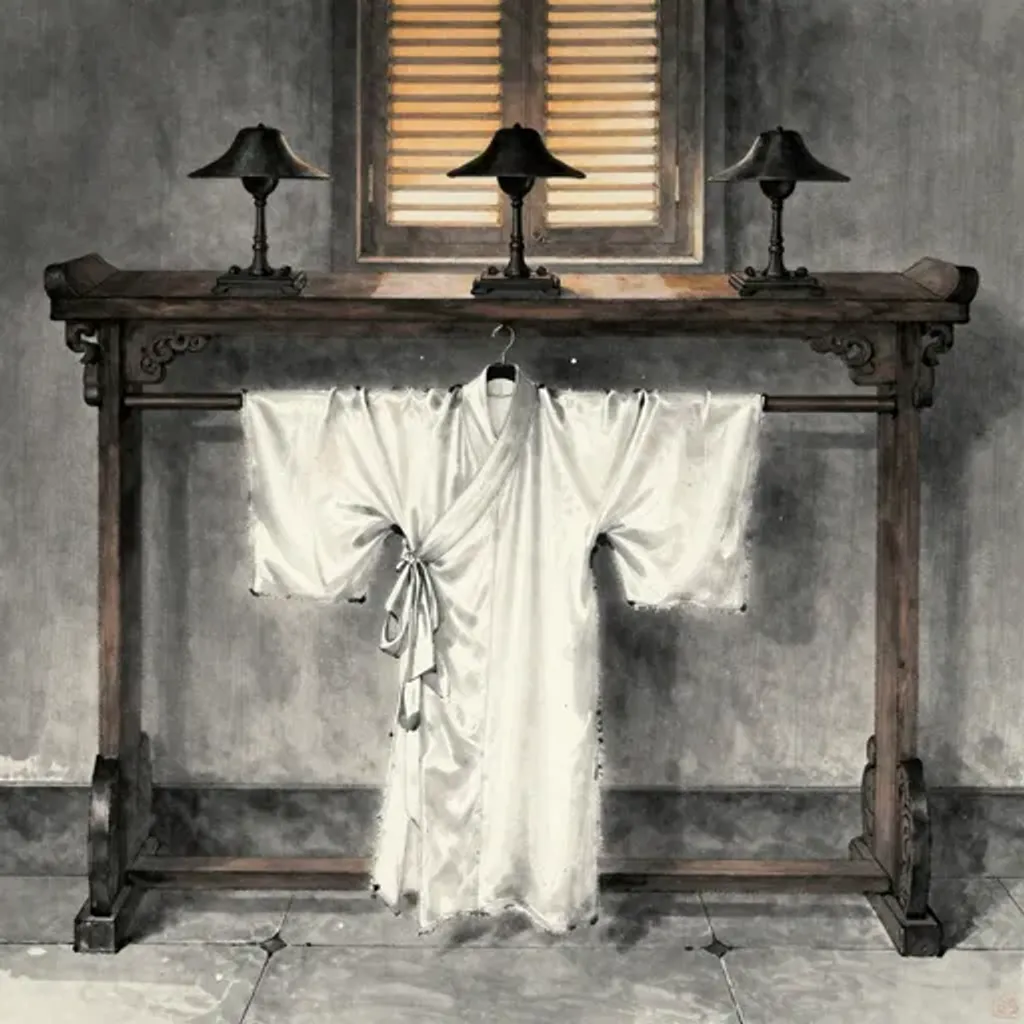
一衣三冠,无所加元,衣服不來,為我災患。
One robe for three caps; nothing to crown the head. Garments do not come; this becomes my calamity.
— Jiao Yanshou, Yilin (Forest of Changes), 1st century BC
Commentary
Fire rises above the earth as brightness advances, yet here the brightness finds no proper crown. One robe serves three caps — resources stretched impossibly thin, the garments never arrive, and disaster follows. The image evokes an official whose investiture remains incomplete: the regalia of rank exists in name only, with no substance to fill it. Progress stalls when outward form cannot match inner capacity, like a flame burning above barren ground with nothing to sustain it. From Progress to the Creative, the transformation warns that heaven's self-generating initiative demands real substance; without proper equipment and preparation, even the most brilliant advance collapses into crisis.
晉 → 坤
Hexagram 35 → Hexagram 2: The Receptive
Changing lines: 4, 6
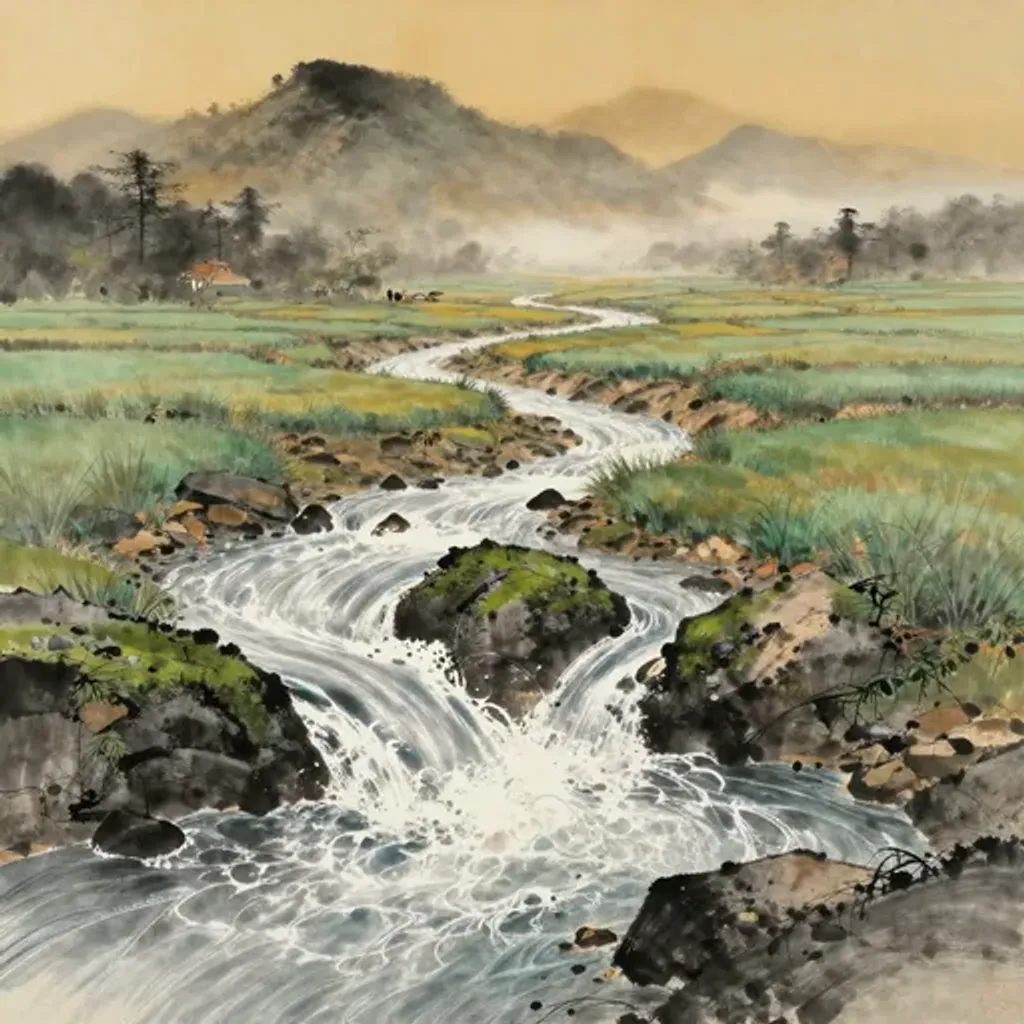
百足俱行,相輔為強,三聖翼事,王室寵光。
A hundred streams flow east, none competing for first or last. They merge into a great marsh, nourishing ten thousand acres.
— Jiao Yanshou, Yilin (Forest of Changes), 1st century BC
Commentary
Fire rises above the earth, illuminating all directions — but this verse looks to the original text, not the rewrite. The original reads: 'A hundred feet walk together, supporting each other in strength. Three sages assist in governance, and the royal house basks in glory.' The hundred-footed centipede moves all its legs in coordination, a metaphor for collective effort. The 'three sages' likely refers to the Duke of Zhou, the Grand Duke, and the Duke of Shao, who together stabilized the early Zhou dynasty. Their coordinated support allowed King Cheng's court to flourish. From Progress to the Receptive, the transformation reveals that brilliant advance finds its fulfillment in earth's receptive capacity: true progress manifests when leadership yields to collaborative support, each sage contributing without competing.
晉 → 屯
Hexagram 35 → Hexagram 3: Difficulty at the Beginning
Changing lines: 1, 4, 5, 6
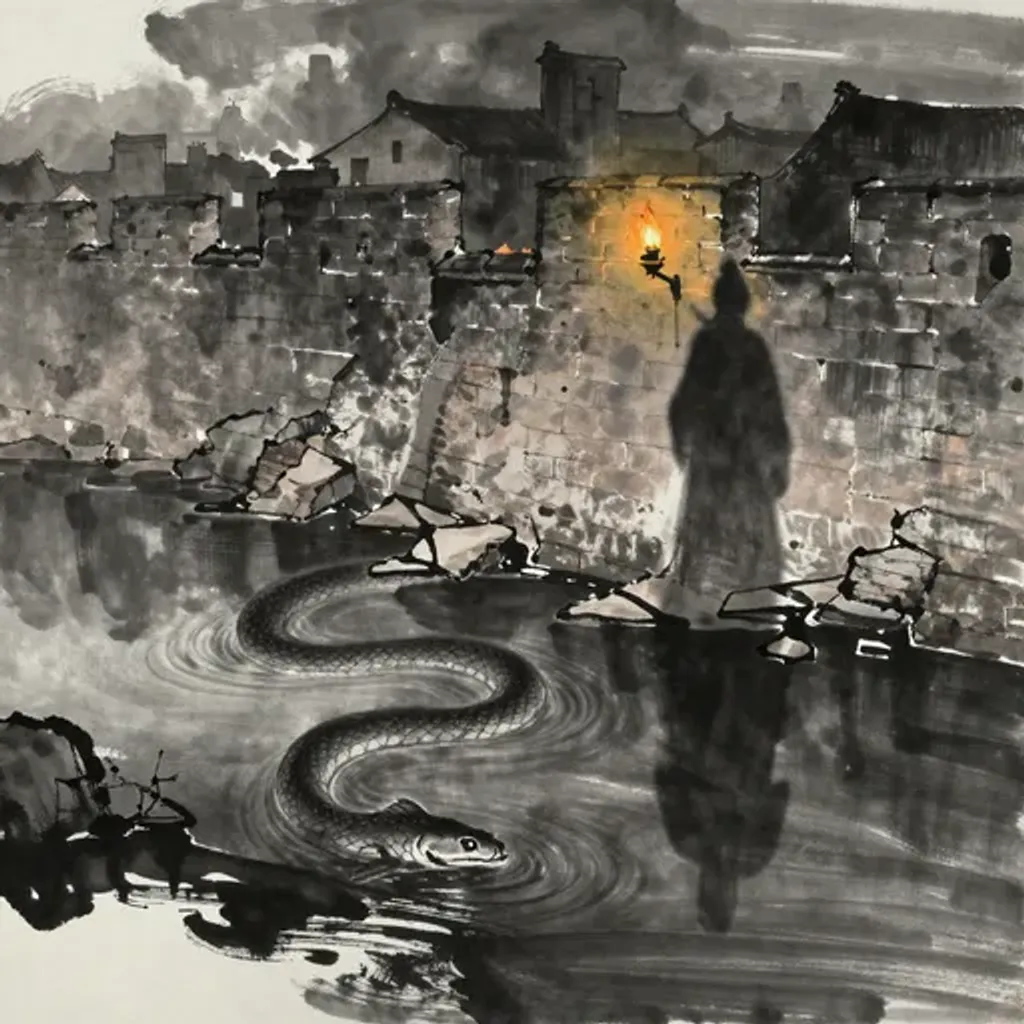
魚蛇之怪,大人憂懼,梁君好城,失其安居。
Monstrous portent of fish and snake; the great man trembles in dread. The lord of Liang loved his walls; yet lost his peaceful dwelling.
— Jiao Yanshou, Yilin (Forest of Changes), 1st century BC
Commentary
Fire rises above the earth, but strange portents trouble the land. Fish and serpents bring monstrous omens, causing great men to tremble with dread. The Lord of Liang delights in building city walls, yet loses his own place of peace. In classical tradition, freakish animal apparitions — fish behaving like snakes, serpents appearing where they should not — signal disorder in the natural and political order. The Lord of Liang, consumed by construction projects, mirrors rulers who pour resources into displays of power while neglecting the foundations of stable governance. From Progress to Difficulty at the Beginning, the transformation captures this precisely: what should be a bright advance dissolves into the chaos of a thunderstorm over newly stirred waters, where misplaced priorities turn initial momentum into confusion.
晉 → 蒙
Hexagram 35 → Hexagram 4: Youthful Folly
Changing lines: 2, 4
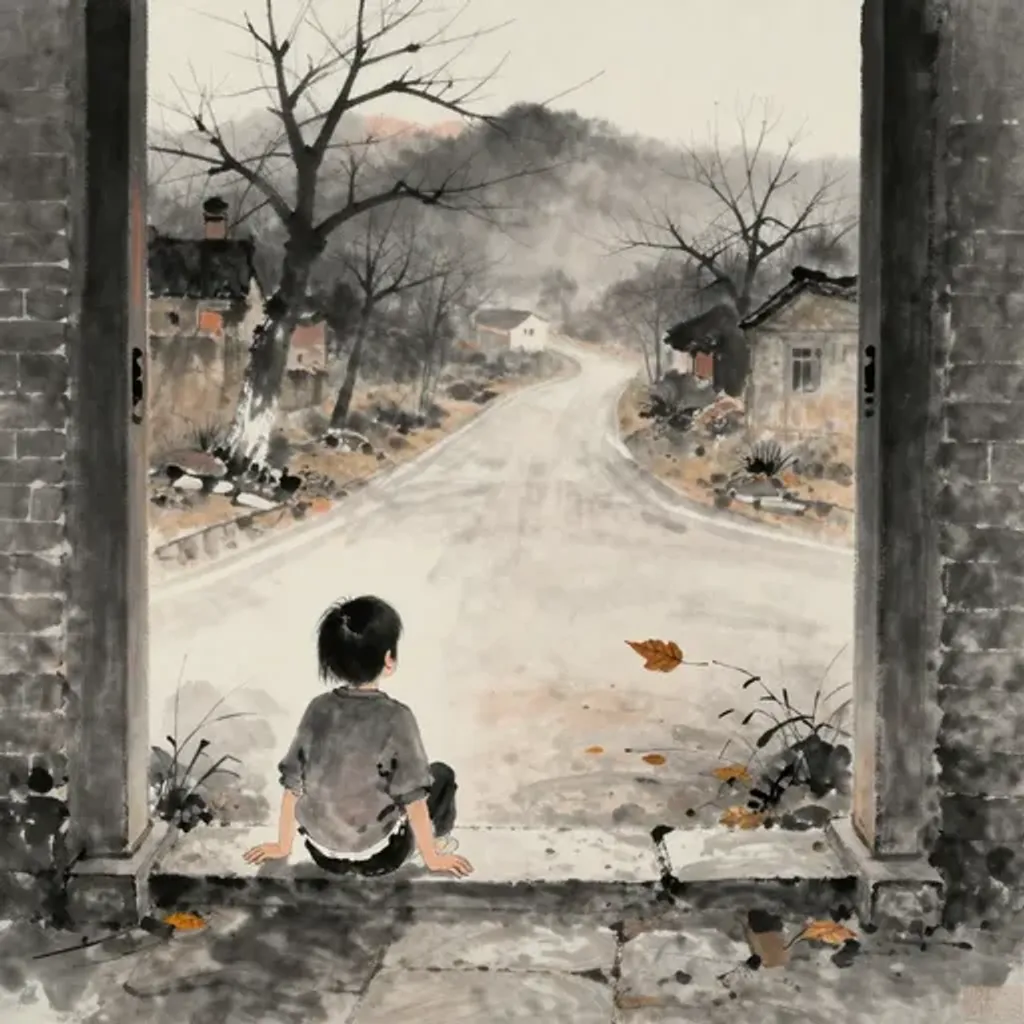
少無強輔,長不見母,勞心遠思,自傷憂苦。
Young, without a strong protector; grown, he never sees his mother. The heart toils in distant longing; he wounds himself with grief and sorrow.
— Jiao Yanshou, Yilin (Forest of Changes), 1st century BC
Commentary
Fire rises above the earth, yet this brightness illuminates only loneliness. Young and without strong support, grown and never seeing one's mother — a figure labors in distant longing, wounded by grief and self-pity. The verse paints the orphan's predicament: no patron in youth to guide advancement, no maternal comfort in maturity to ease the heart. The ache is doubled by distance, the mind reaching toward what cannot be grasped. From Progress to Youthful Folly, the transformation is poignant: the bright advance above earth sinks into a spring trapped beneath the mountain. Without guidance or nurture, progress devolves into bewilderment — the young scholar who advances alone, unmentored, stumbles into the fog of inexperience.
晉 → 需
Hexagram 35 → Hexagram 5: Waiting
Changing lines: 1, 2, 3, 4, 5, 6
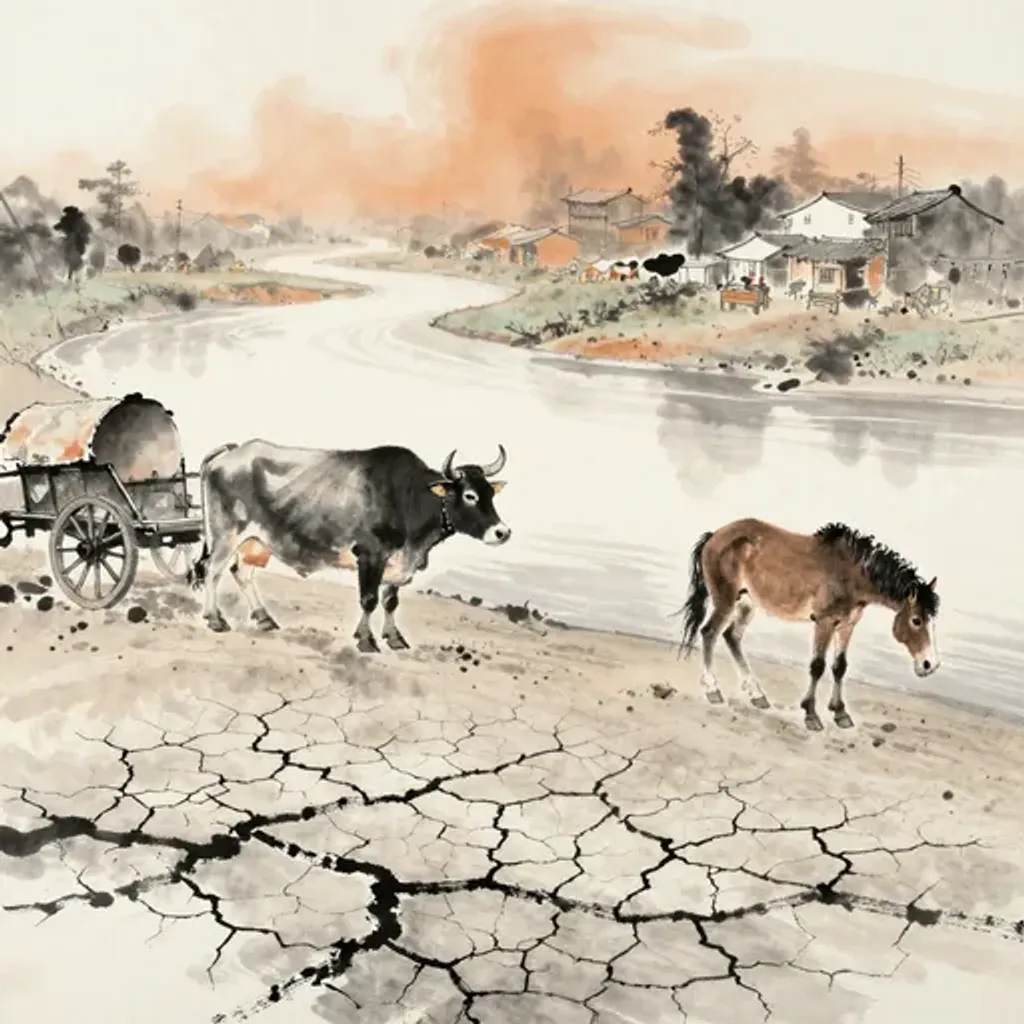
前涉溽暑,解不可取,離河三里,敗我利市,老牛病馬,去之何悔?
Wading forward through sweltering heat; relief cannot be seized. Three li from the river; my profitable market is ruined. An old ox, a sick horse — what regret in letting them go?
— Jiao Yanshou, Yilin (Forest of Changes), 1st century BC
Commentary
Fire rises above the earth, but the traveler advances into sweltering heat with no relief in sight. Wading through midsummer's oppressive humidity, unable to find respite, stranded three li from the river — commerce is ruined and the market trip fails. An old ox and a sick horse: what regret is there in letting them go? The verse layers misfortune upon misfortune, each image of exhaustion compounding the last. The merchant who presses forward at the wrong season, with broken-down animals and no access to water, embodies futile persistence. From Progress to Waiting, the transformation is apt: clouds gather above heaven but the rain has not yet come. True wisdom here lies in patience — knowing when advance is premature and rest is the only profitable course.
晉 → 訟
Hexagram 35 → Hexagram 6: Conflict
Changing lines: 2, 5
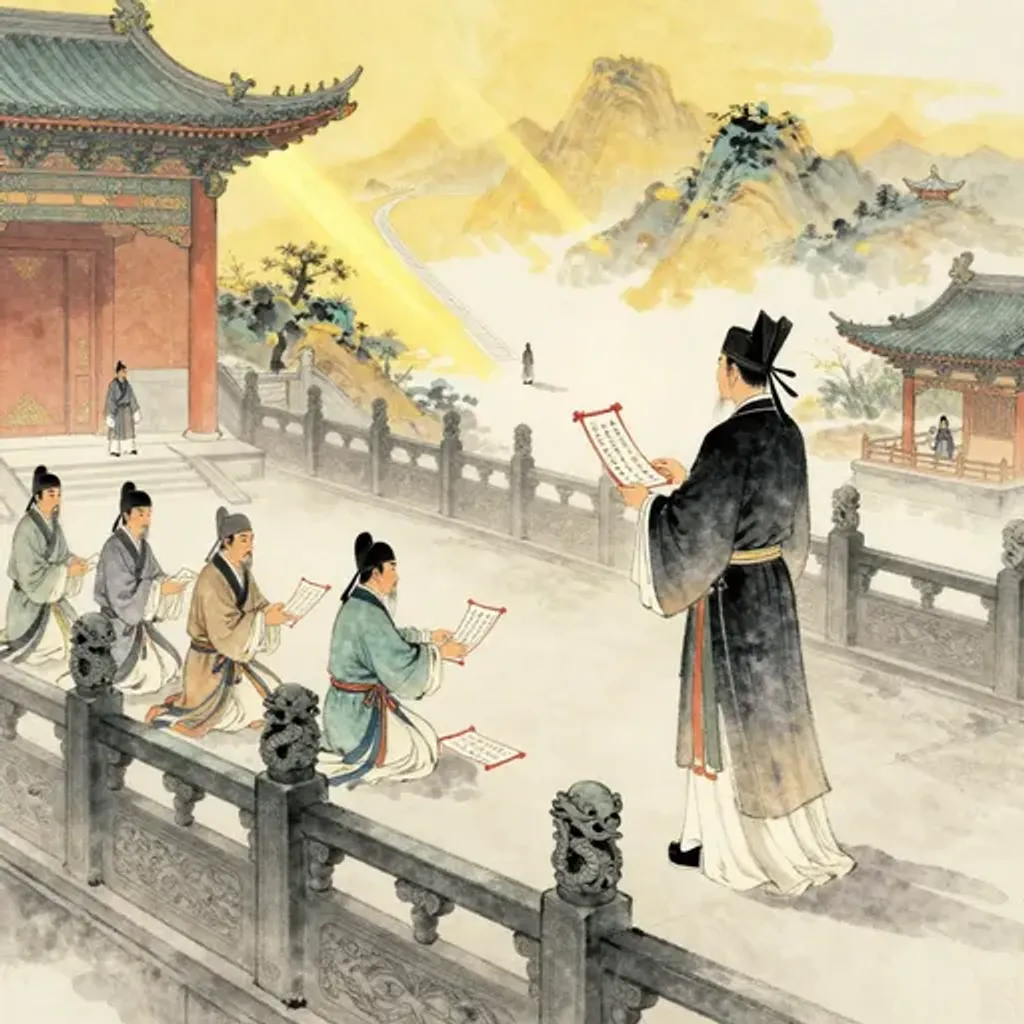
君明有德,登天大祿,布政施惠,以感恩福,中子南遊,翱翔未復。
The lord is wise and virtuous; he ascends to heaven’s great blessing. He spreads governance and bestows grace, inspiring gratitude and fortune. The middle son travels south, soaring free and not yet returned.
— Jiao Yanshou, Yilin (Forest of Changes), 1st century BC
Commentary
Fire rises above the earth, and here the sovereign shines with genuine virtue. The lord is brilliant and possesses true merit; he ascends to heaven's great bounty. He spreads governance and bestows favor, moving all to gratitude and blessing. Yet the middle son wanders south and has not returned. The verse opens with an ideal ruler radiating moral clarity, then pivots: even in such an era, someone dear ventures beyond reach. From Progress to Conflict, the transformation captures this tension precisely — heaven and water move in opposite directions. The sovereign advances in brightness, but the absent son travels against the current, and reunion remains elusive. Beneficent rule does not guarantee that all bonds hold.
晉 → 師
Hexagram 35 → Hexagram 7: The Army
Changing lines: 2, 4, 6
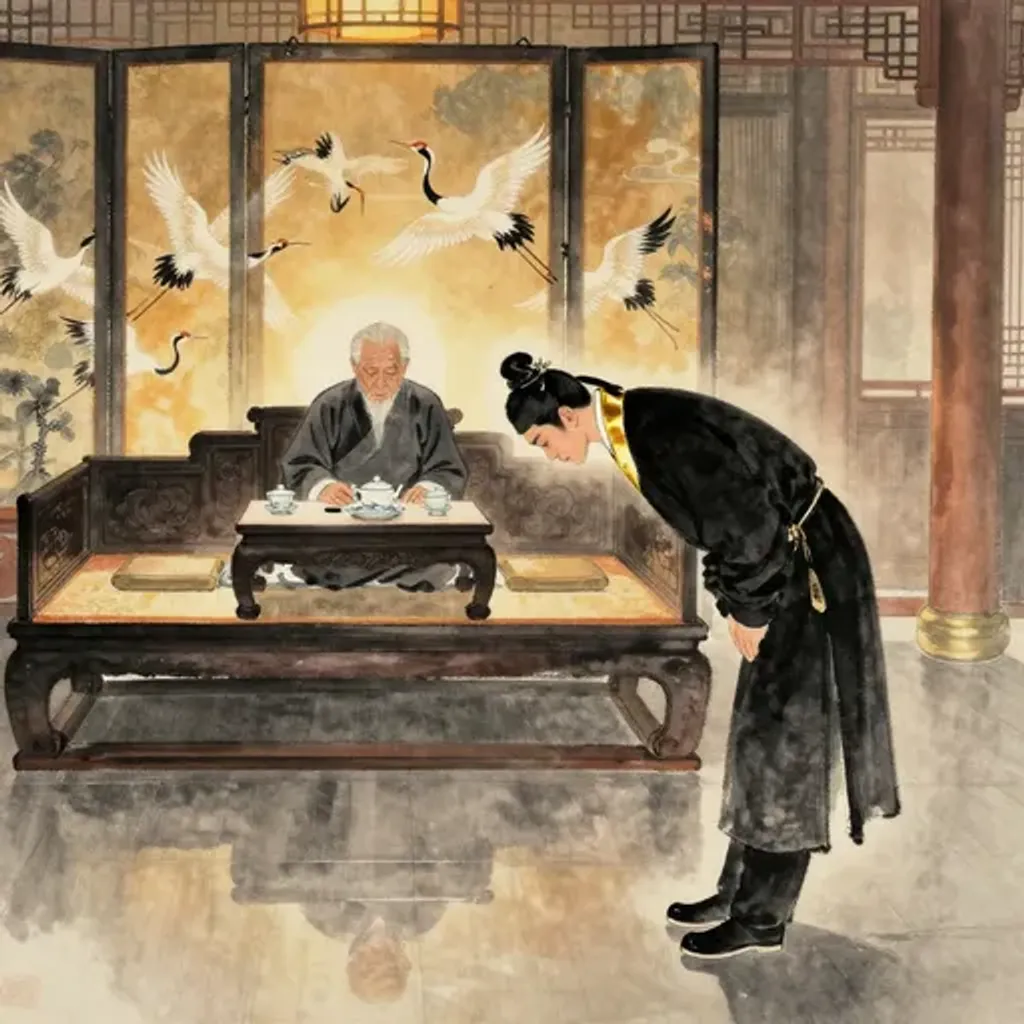
嘵然唯諾,敬上尊客,執恭除患,禦侮致福。
Earnest in assent and compliance; respectful to superiors, honoring guests. Holding to reverence dispels calamity; warding off insult brings fortune.
— Jiao Yanshou, Yilin (Forest of Changes), 1st century BC
Commentary
Fire rises above the earth, and a careful voice answers with respectful compliance. Attentive and deferential, honoring superiors and welcoming guests, the figure maintains disciplined courtesy to ward off trouble and repel insult, thereby securing good fortune. The verse portrays the ideal subordinate: one who advances not through aggression but through scrupulous propriety. Every gesture calibrated, every response measured — humility becomes armor. From Progress to the Army, the transformation reveals how personal discipline scales to collective order. Water contained within the earth mirrors the disciplined masses awaiting direction: the courtier's individual restraint becomes the army's organizational strength, turning deference into strategic advantage.
晉 → 比
Hexagram 35 → Hexagram 8: Holding Together
Changing lines: 4, 5, 6
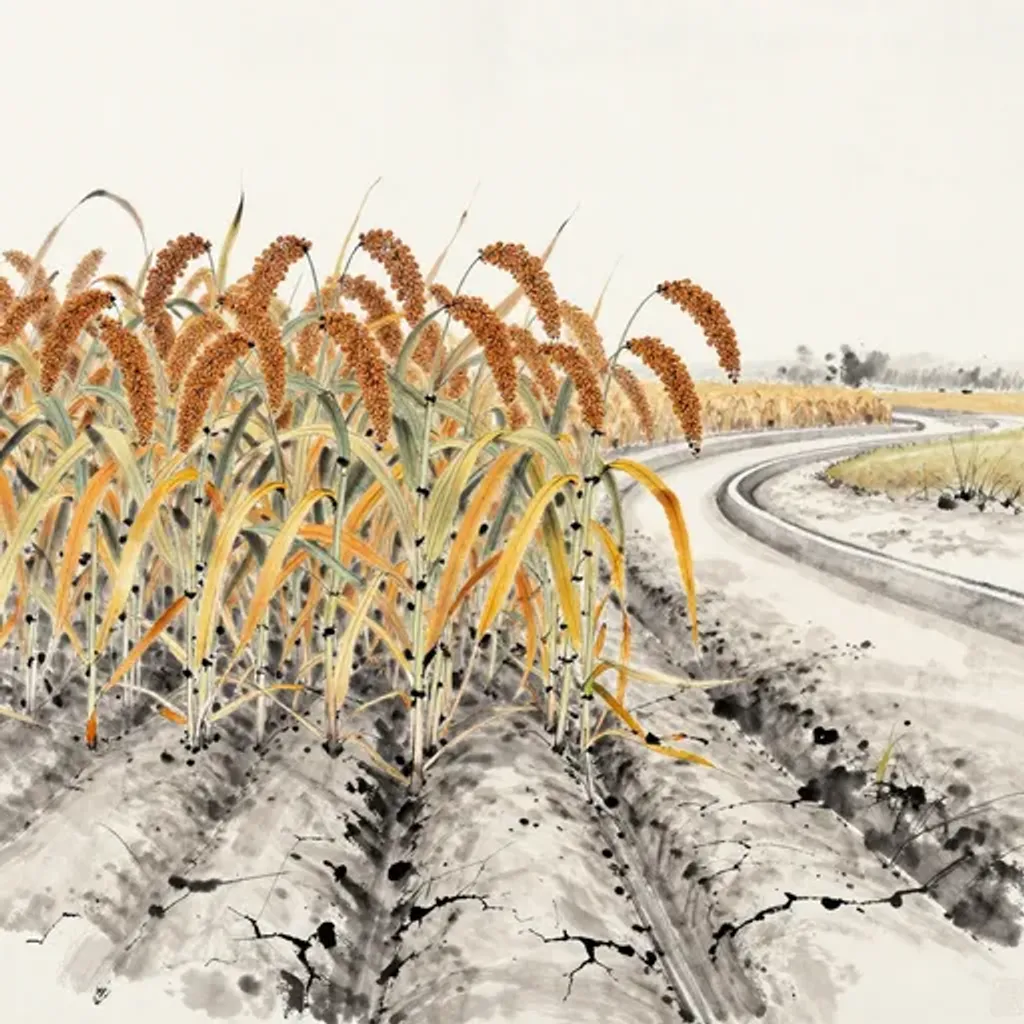
黍稷禾稻,垂秀方造,中旱不雨,傷風病藁。
Millet, grain, rice, and paddy; tassels hang, about to ripen. Midseason drought, no rain; the wind wounds, the stalks wither.
— Jiao Yanshou, Yilin (Forest of Changes), 1st century BC
Commentary
Fire rises above the earth, and the grain stands tall in the field — millet, rice, and wheat all bowing heavy with ripening ears, their harvest nearly ready. Then drought strikes. No rain falls, and the wind carries blight that withers the stalks to dry straw. The verse captures the cruelest timing: abundance visible but snatched away at the threshold of fulfillment. From Progress to Holding Together, the transformation resonates with bitter irony. Water upon earth should nourish, yet here the bond between sky and field has broken. The image of Holding Together asks who will rally around the center — but when the center itself is parched, even solidarity cannot conjure rain.
晉 → 小畜
Hexagram 35 → Hexagram 9: Small Taming
Changing lines: 1, 2, 3, 4, 5
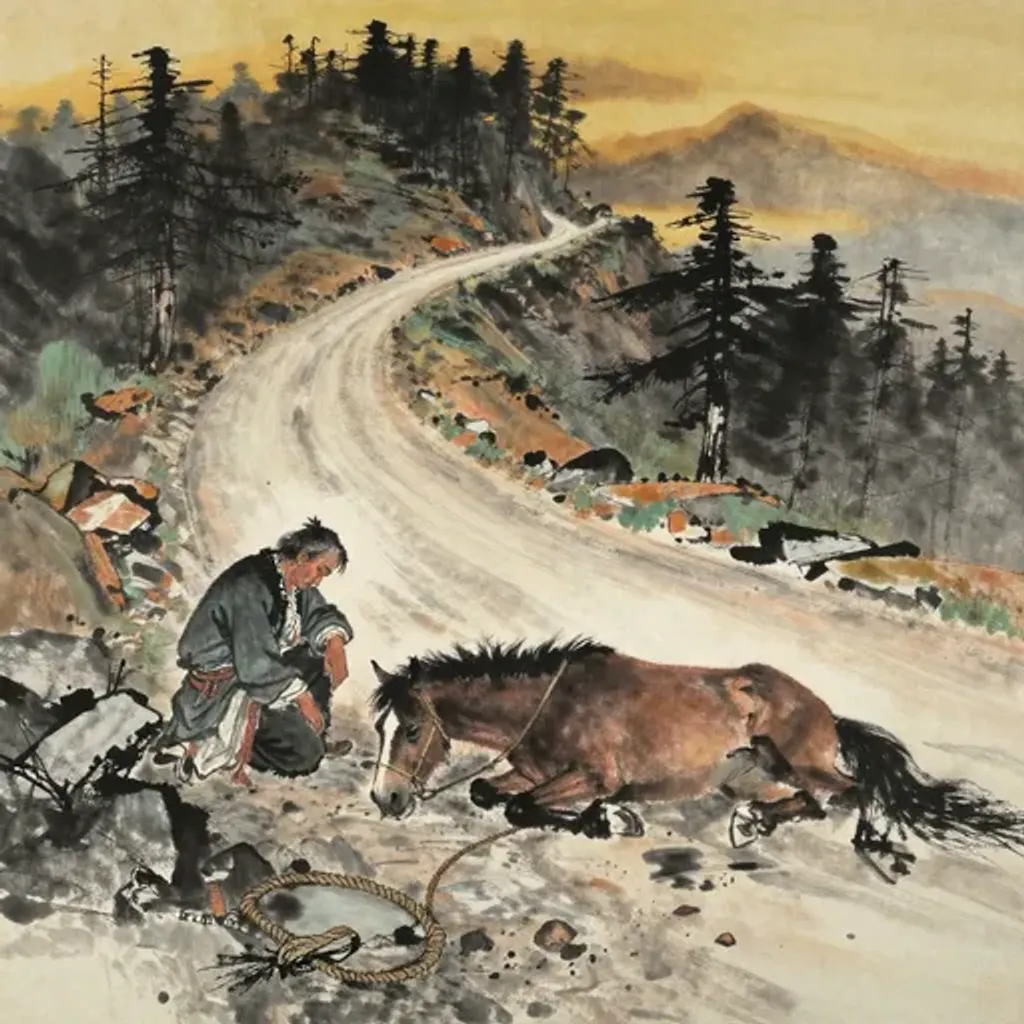
三嬴六罷,不能越跪,東賈失馬,往反勞苦。
Three wins and six defeats; unable even to kneel upright. The eastern merchant loses his horse; going and returning, nothing but toil and hardship.
— Jiao Yanshou, Yilin (Forest of Changes), 1st century BC
Commentary
Fire rises above the earth, but the advance quickly exhausts itself. Three wins and six losses — more defeats than victories — the figure cannot even rise from kneeling. A merchant heading east loses his horse, and the journey back and forth brings only toil and suffering. The arithmetic of this verse is bleak: effort doubled, returns halved. The eastbound trader stripped of his mount must walk home empty-handed. From Progress to Small Taming, the transformation sharpens the lesson. Wind moves across heaven, gently restraining — but here the restraint is too feeble to hold anything together. Small Taming's gentle accumulation cannot offset compounding losses. When the momentum of advance outpaces one's actual resources, even minor setbacks cascade into ruin.
晉 → 履
Hexagram 35 → Hexagram 10: Treading
Changing lines: 1, 2, 5
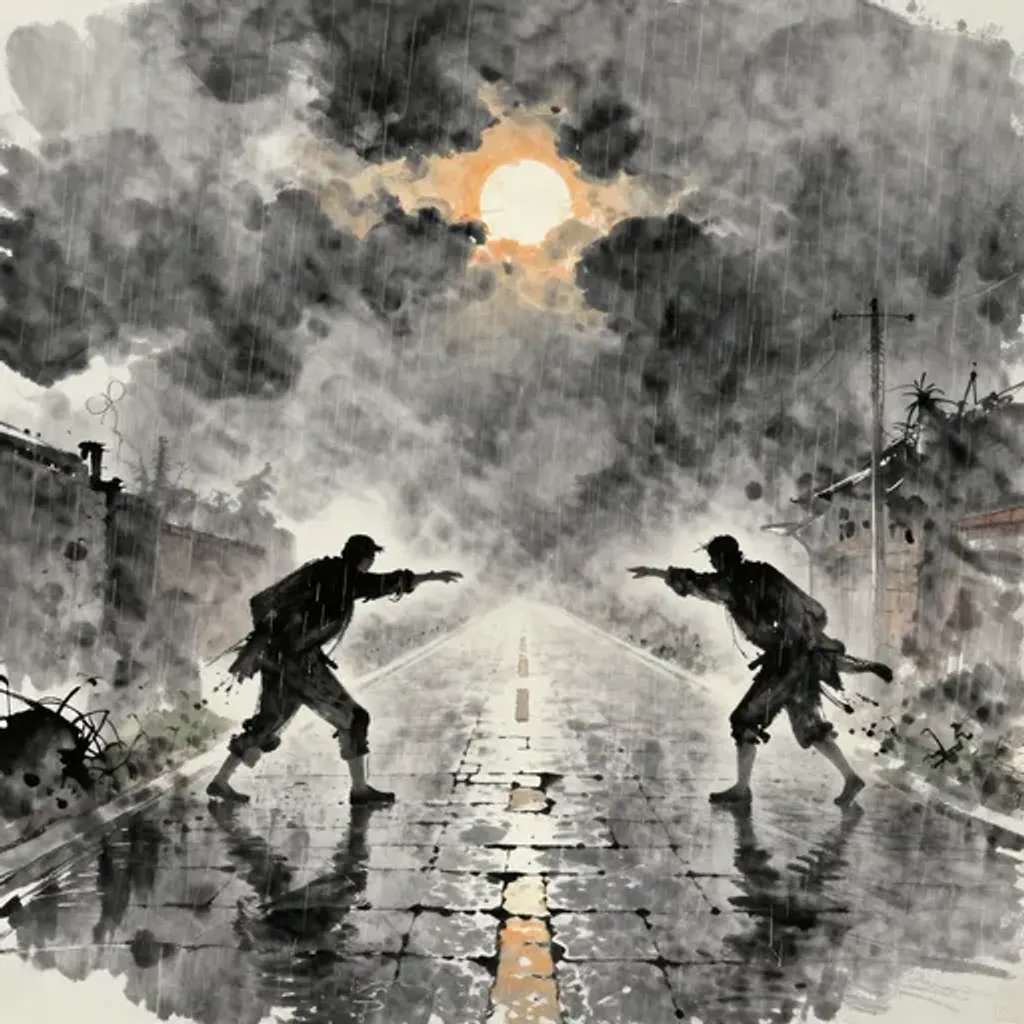
倚立相望,引衣欲莊,陰雲蔽日,暴雨祈集,降我歡會,使道不通。
Leaning and gazing at each other; pulling at robes to look proper. Dark clouds hide the sun; violent rain gathers and falls. It halts our joyful meeting; the road is blocked and impassable.
— Jiao Yanshou, Yilin (Forest of Changes), 1st century BC
Commentary
Fire rises above the earth, and two figures stand at a distance, gazing toward each other, adjusting their robes in anticipation of a meeting. But dark clouds blot out the sun, a sudden downpour gathers, and the joyful reunion they longed for is ruined — the road between them becomes impassable. The verse captures the agony of near-connection severed by circumstance. From Progress to Treading, the transformation reveals the irony: heaven above the lake defines proper boundaries, yet here the boundary is enforced by weather rather than propriety. The path is blocked not by cosmic design but by cruel timing. Treading carefully upon the tiger's tail demands awareness — sometimes the obstacle is not the tiger but the rain.
晉 → 泰
Hexagram 35 → Hexagram 11: Peace
Changing lines: 1, 2, 3, 4, 6
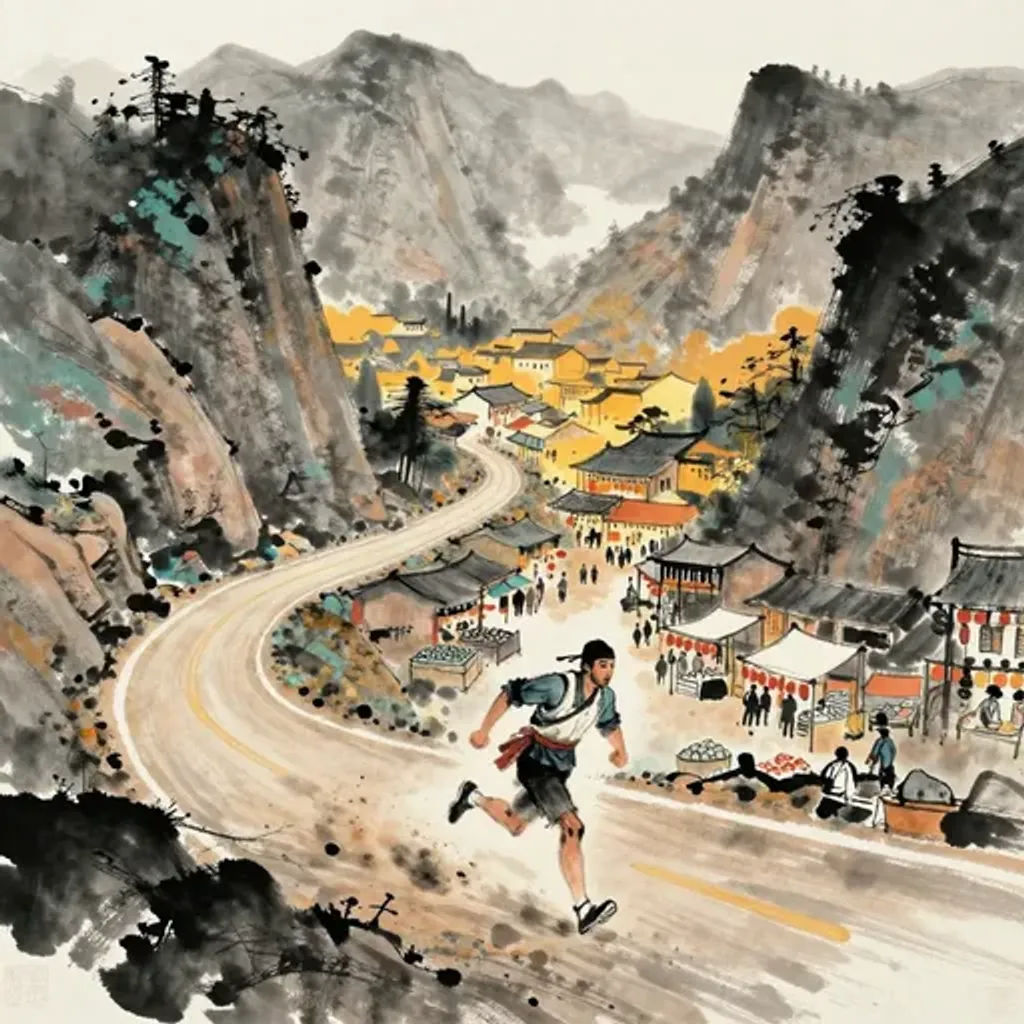
高腳疾步,受肩善趨,日走千里,賈市有得。
Tall legs, swift steps; nimble shoulders, good at running. A thousand li in a day; profit found at market.
— Jiao Yanshou, Yilin (Forest of Changes), 1st century BC
Commentary
Fire rises above the earth, and a figure with long legs takes swift strides, shoulders braced for speed, running a thousand li in a single day. The merchant arrives at market and reaps profit. The verse is pure forward momentum: physical vigor matched by commercial success, every step landing precisely, no wasted motion. From Progress to Peace, the transformation amplifies the theme. Heaven and earth exchange their energies, creating the most harmonious hexagram in the entire system. The swift runner finds not merely a destination but a world where effort and reward align perfectly. When advance meets receptive conditions, a thousand li feel like a morning stroll.
晉 → 否
Hexagram 35 → Hexagram 12: Standstill
Changing lines: 5
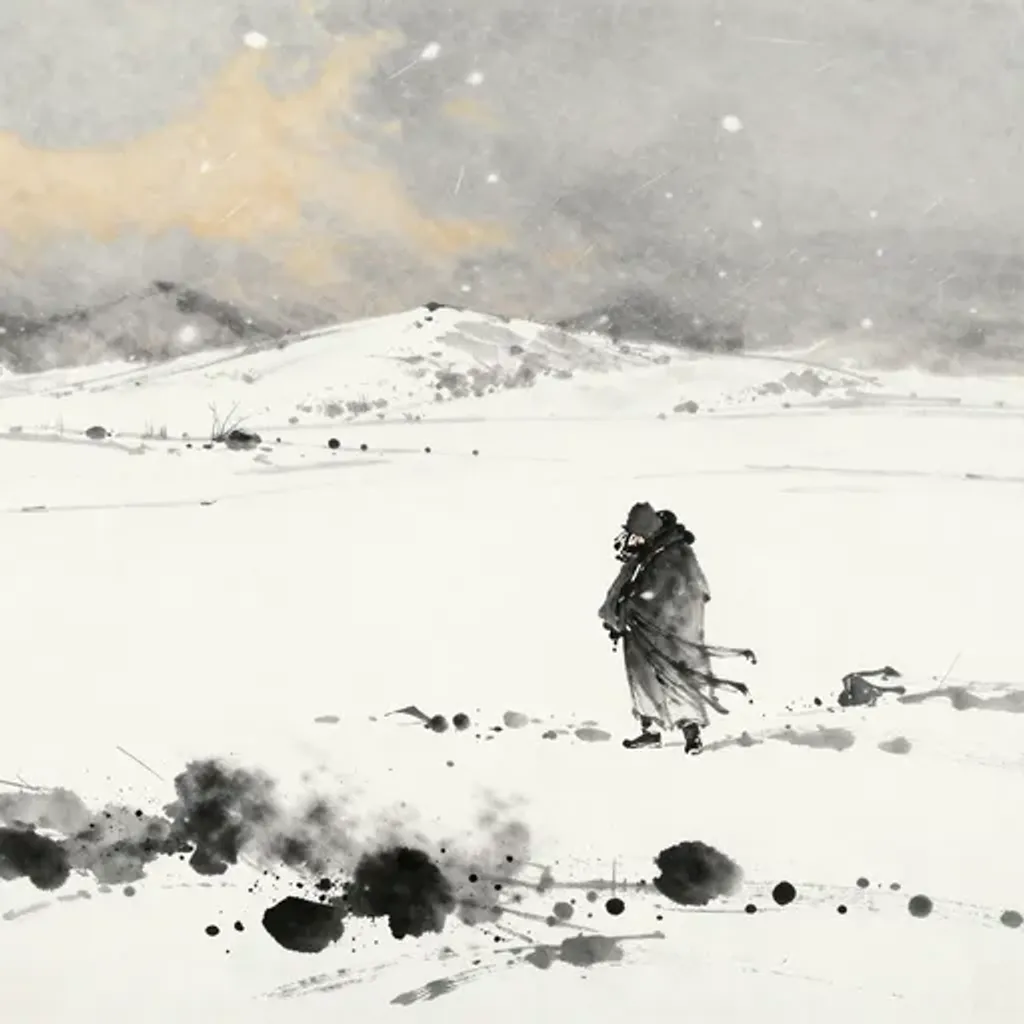
北風寒涼,雨雪益冰,憂思不樂,哀悲傷心。
The north wind blows cold; rain and snow turn to ice. Sorrowful thoughts bring no joy; grief and sadness wound the heart.
— Jiao Yanshou, Yilin (Forest of Changes), 1st century BC
Commentary
Fire rises above the earth, yet the north wind blows bitterly cold. Rain turns to snow, snow thickens to ice, and the heart fills with sorrow beyond consolation. The verse inverts the brightness of Progress entirely: instead of the sun rising over the land, the world is frozen and dark. This echoes the Shijing soldiers' laments — the bitter campaigns in the north where men froze and despaired far from home. From Progress to Standstill, the transformation is the most natural inversion in the Yi: heaven and earth refuse to communicate. The warmth that should rise from the earth is sealed beneath ice; the light that should shine from the sky is buried in cloud. When progress halts, it does not merely pause — it reverses into desolation.
晉 → 同人
Hexagram 35 → Hexagram 13: Fellowship
Changing lines: 1, 3, 5
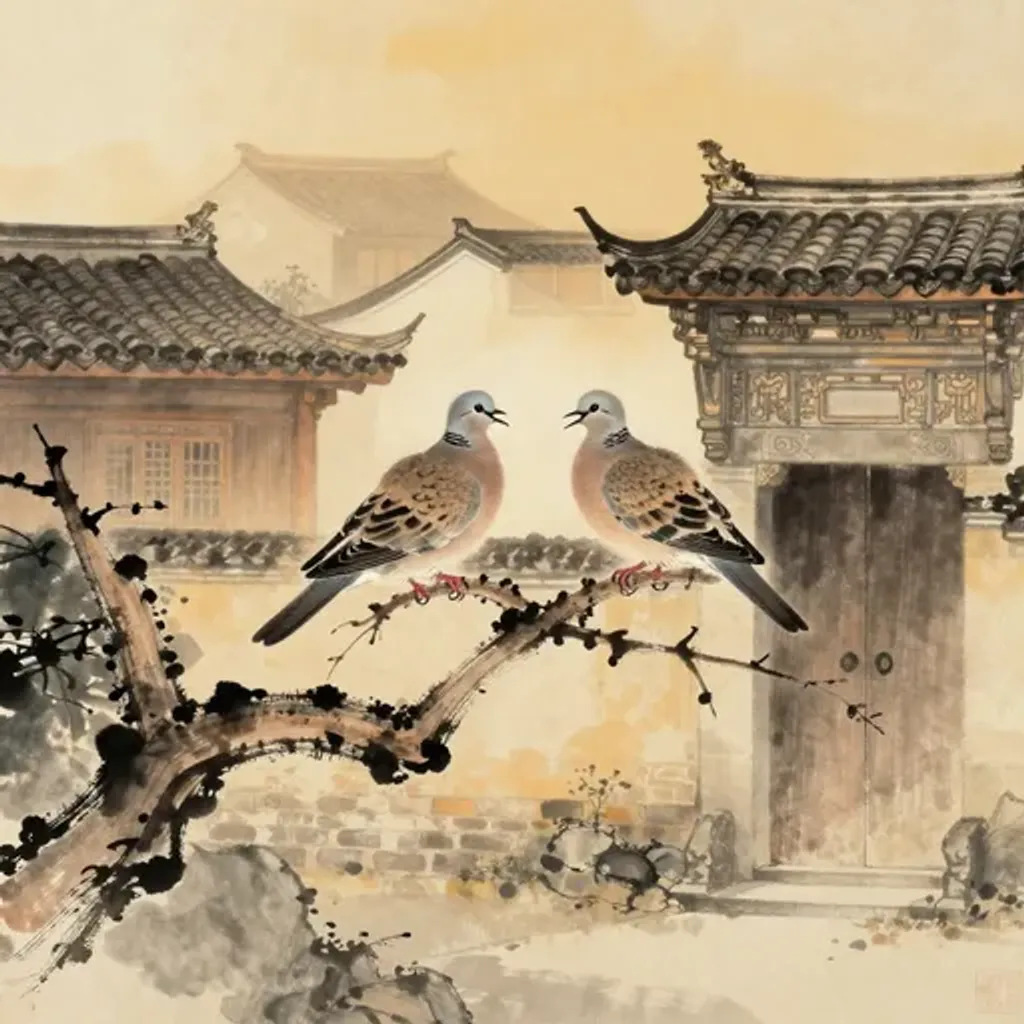
貞鳥鳴鳩,執一无尤。寢門治理,君子悅喜。
The faithful bird, the calling dove; steadfast, without fault. The bedchamber gate is well-governed; the gentleman is pleased and glad.
— Jiao Yanshou, Yilin (Forest of Changes), 1st century BC
Commentary
Fire rises above the earth, and a steadfast bird — the turtledove — calls with unwavering constancy. Holding to one principle without fault, managing the household from the bedchamber door, the gentleman finds delight and satisfaction. The turtledove in classical imagery symbolizes faithfulness: it keeps one mate and one direction, never deviating. The phrase 'holding to one' echoes the Yi's emphasis on constancy as the root of all achievement. From Progress to Fellowship, the transformation unfolds naturally: fire joined with heaven creates shared illumination. The gentleman who governs his own household with integrity radiates outward, drawing like-minded companions. Fellowship begins not in grand assembly but in the quiet discipline of the inner chamber.
晉 → 大有
Hexagram 35 → Hexagram 14: Great Possession
Changing lines: 1, 2, 3
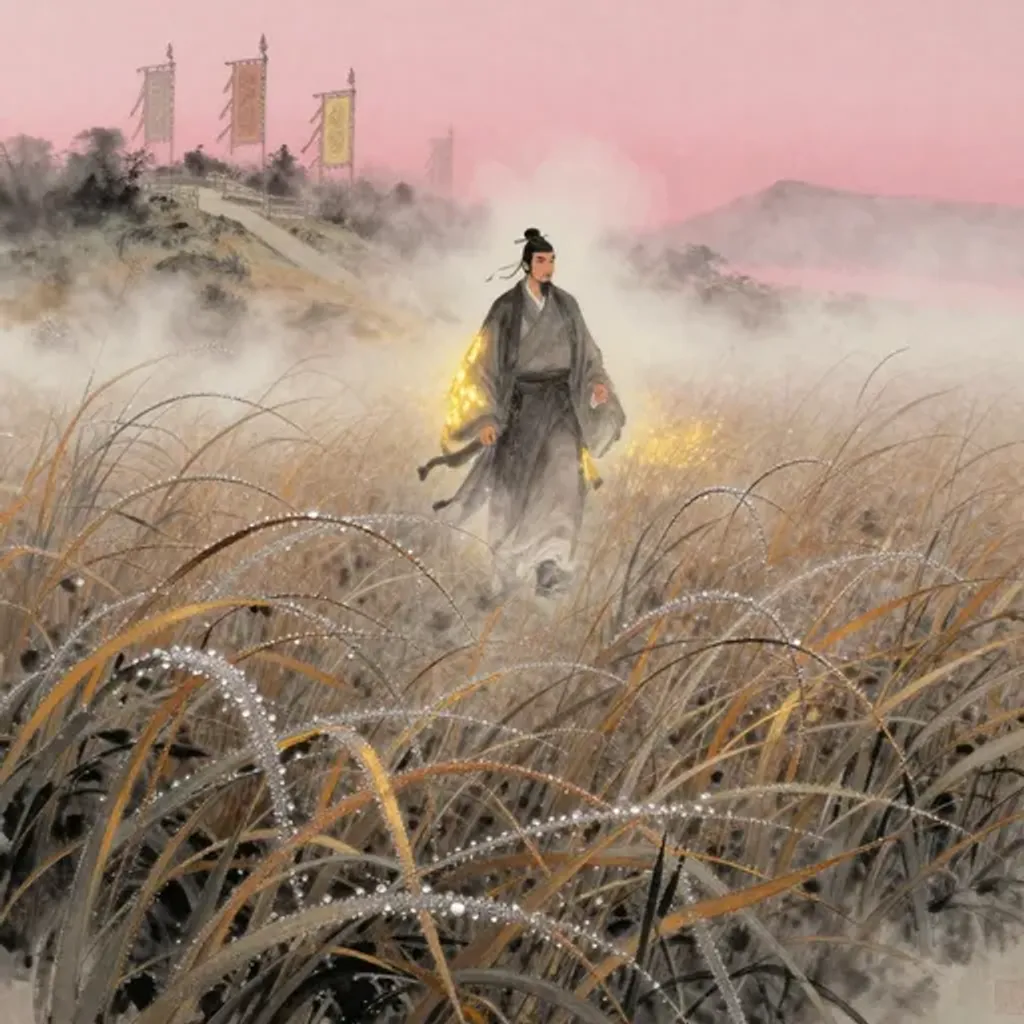
蓼蕭露瀼,君子龍光。鳴鸞雍和,福祿來同。
Artemisia drenched in heavy dew; the gentleman radiates dragon-light. The phoenix-bell chimes in harmony; fortune and blessing arrive together.
— Jiao Yanshou, Yilin (Forest of Changes), 1st century BC
Commentary
Fire rises above the earth, and dew glistens thick upon the polygonum and artemisia — the opening imagery of the Shijing ode 'Liao Xiao,' a celebration of the Son of Heaven feasting his lords. The gentleman radiates dragon-like brilliance. Luan bells chime in harmony, and blessings and bounty arrive together. Every image here signals sovereign grace: the dewy herbs, the ceremonial bells, the luminous presence. From Progress to Great Possession, the transformation is resplendent. Fire above heaven — the most expansive image of abundance in the Yi. The ruler who advances in virtue finds his progress rewarded with the fullness of heaven's gifts. This is Progress at its zenith: advance crowned by legitimate prosperity, shared with those who serve.
晉 → 謙
Hexagram 35 → Hexagram 15: Modesty
Changing lines: 3, 4, 6
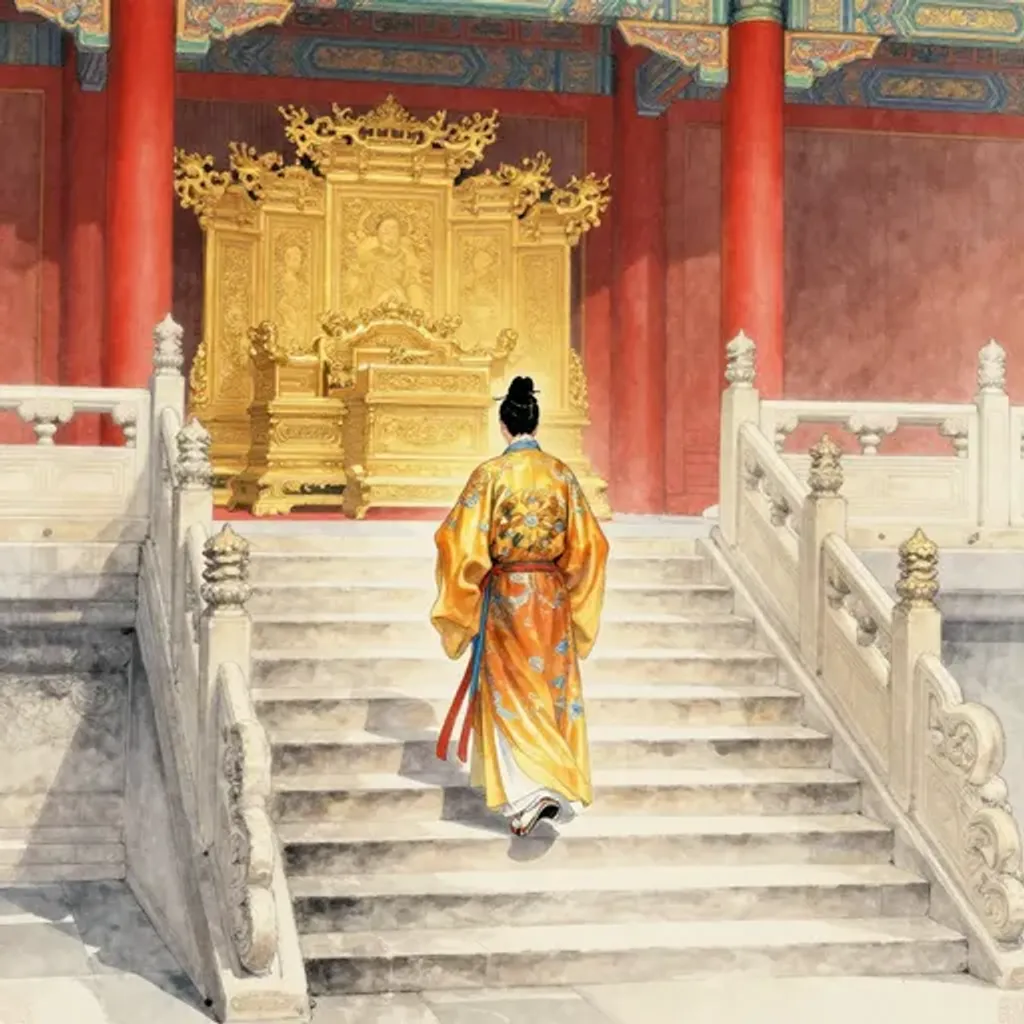
南行求福,與喜相得。封受上賞,鼎足輔國。
A thousand li to the capital, finally granted an audience. In the golden hall, the dragon's countenance brightens. The imperial brush personally inscribes the scroll of merit — a brocade robe draped, ascending the minister's platform.
— Jiao Yanshou, Yilin (Forest of Changes), 1st century BC
Commentary
Fire rises above the earth, and the original verse speaks: 'Travel south to seek fortune, and meet with joy. Receive the highest reward and be enfeoffed, standing as a pillar of state like the legs of a cauldron.' The image of the cauldron's tripod legs supporting the state evokes the three great ministers who stabilize the realm. The figure journeys south — the direction of fire and brilliance in Chinese cosmology — and finds not merely personal gain but structural importance: becoming load-bearing support for the dynasty. From Progress to Modesty, the transformation is instructive. The mountain hidden within the earth embodies the paradox: the greatest elevation achieved through the deepest self-effacement. The rewarded minister who sustains the state does so not through display but through quiet foundational strength.
晉 → 豫
Hexagram 35 → Hexagram 16: Enthusiasm
Changing lines: 6
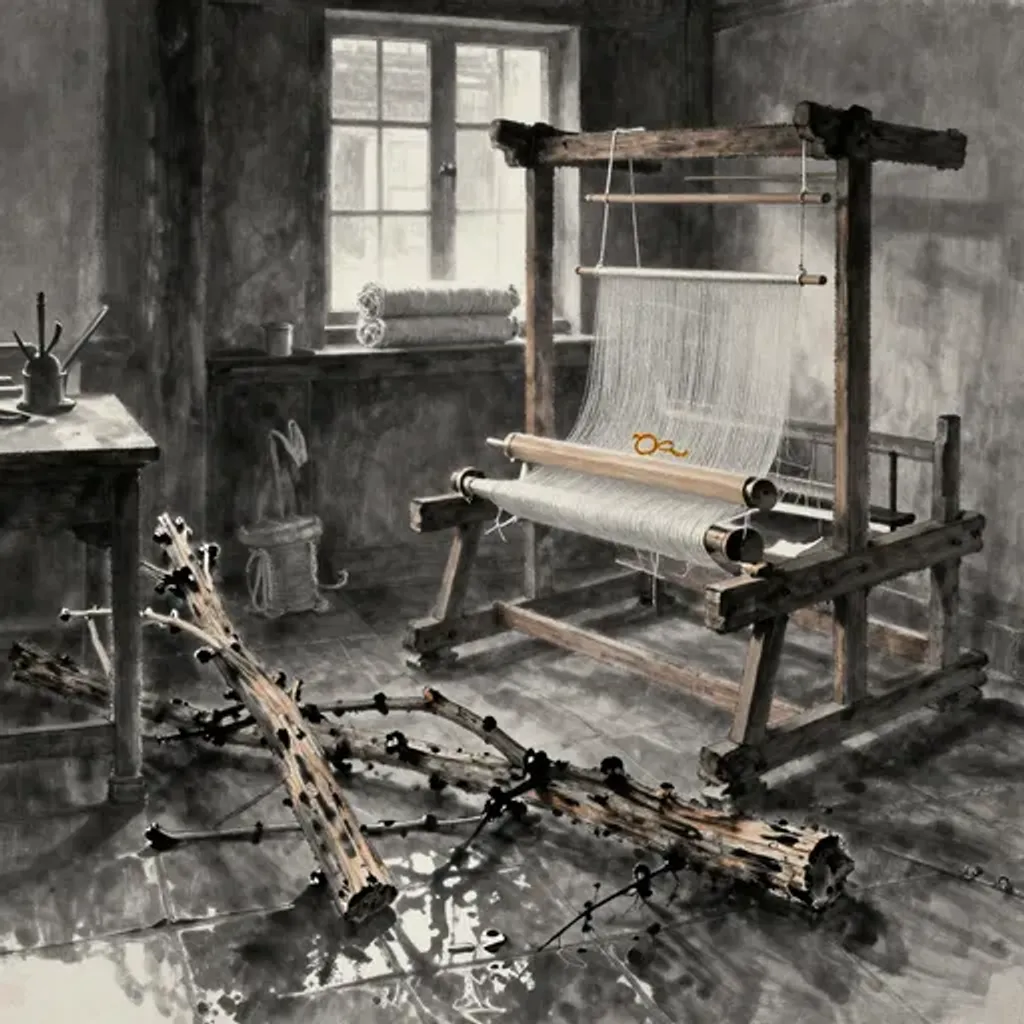
桑華腐蠹,衣弊如絡。女功不成,絲布為玉。
Mulberry blossoms rot with borers; garments tattered like netting. Women’s work left unfinished; silk cloth passes for jade.
— Jiao Yanshou, Yilin (Forest of Changes), 1st century BC
Commentary
Fire rises above the earth, but the mulberry trees have rotted and the silkworms have perished from decay. Clothing is worn to tatters like netting, women's work cannot be completed, and silk cloth is treated as if it were jade — worthless substitutes passed off as precious goods. The verse traces a complete collapse of productive industry: the raw material (mulberry) fails, the labor (weaving) halts, and the economy of value inverts. From Progress to Enthusiasm, the transformation carries an uncomfortable edge. Thunder erupts from the earth in Enthusiasm's image of celebration and music, but here there is nothing genuine to celebrate. When the productive base rots, even the appearance of festivity becomes hollow — drums beating over empty looms.
晉 → 隨
Hexagram 35 → Hexagram 17: Following
Changing lines: 1, 5, 6
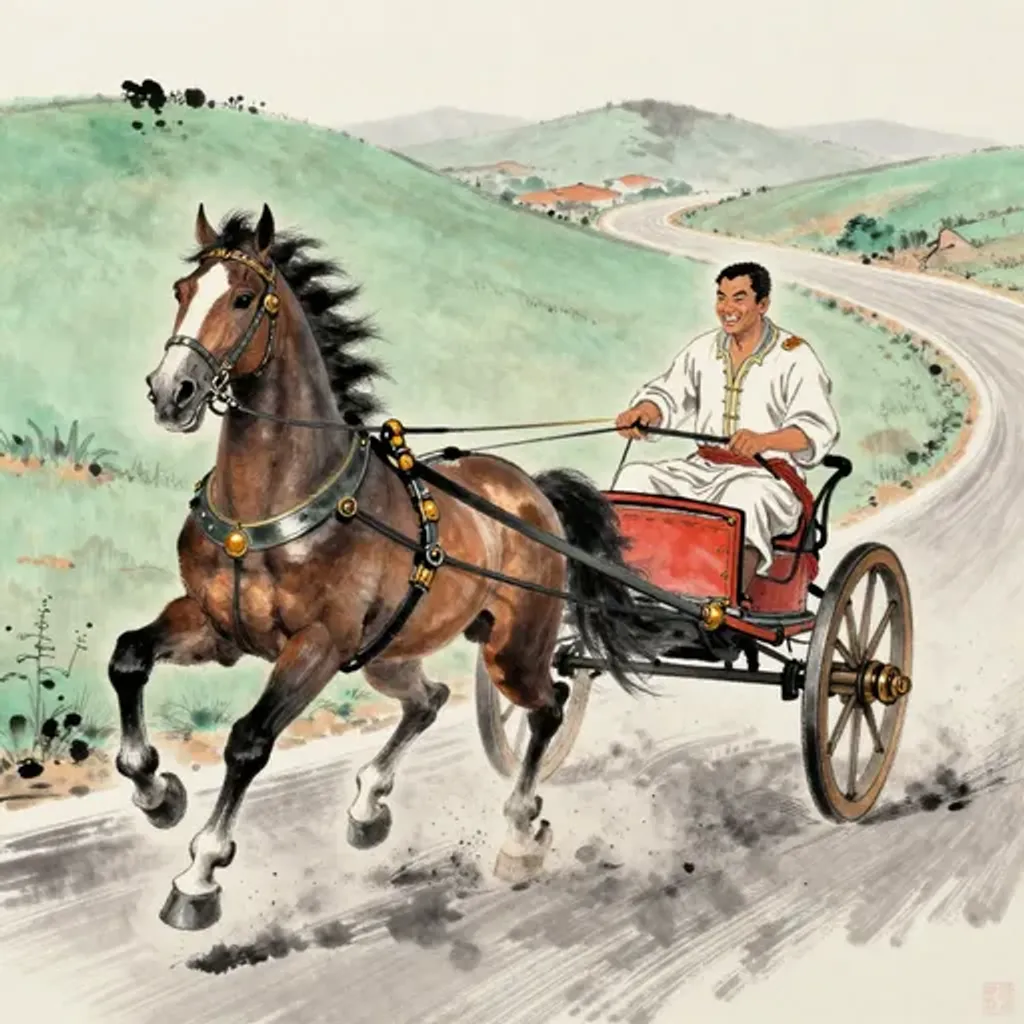
左服易,右王良,心歡嘉,利從己。
The left trace horse is changed; on the right rides Wang Liang. The heart rejoices with delight; fortune follows one’s will.
— Jiao Yanshou, Yilin (Forest of Changes), 1st century BC
Commentary
Fire rises above the earth, and the chariot team is in fine order. The left trace-horse is easily managed, and to the right rides Wang Liang, the legendary charioteer of antiquity whose skill with reins was unmatched. The heart rejoices with delight, and advantage follows one's own direction. Wang Liang represents mastery so complete that control becomes effortless — the horses respond to intent rather than force. From Progress to Following, the transformation embodies this harmony. Thunder rests within the lake: movement yields to stillness at the proper time. The skilled driver follows the horses' natural rhythm rather than fighting it, and thus the journey serves the traveler's will. True leadership is indistinguishable from willing compliance.
晉 → 蠱
Hexagram 35 → Hexagram 18: Work on the Decayed
Changing lines: 2, 3, 4
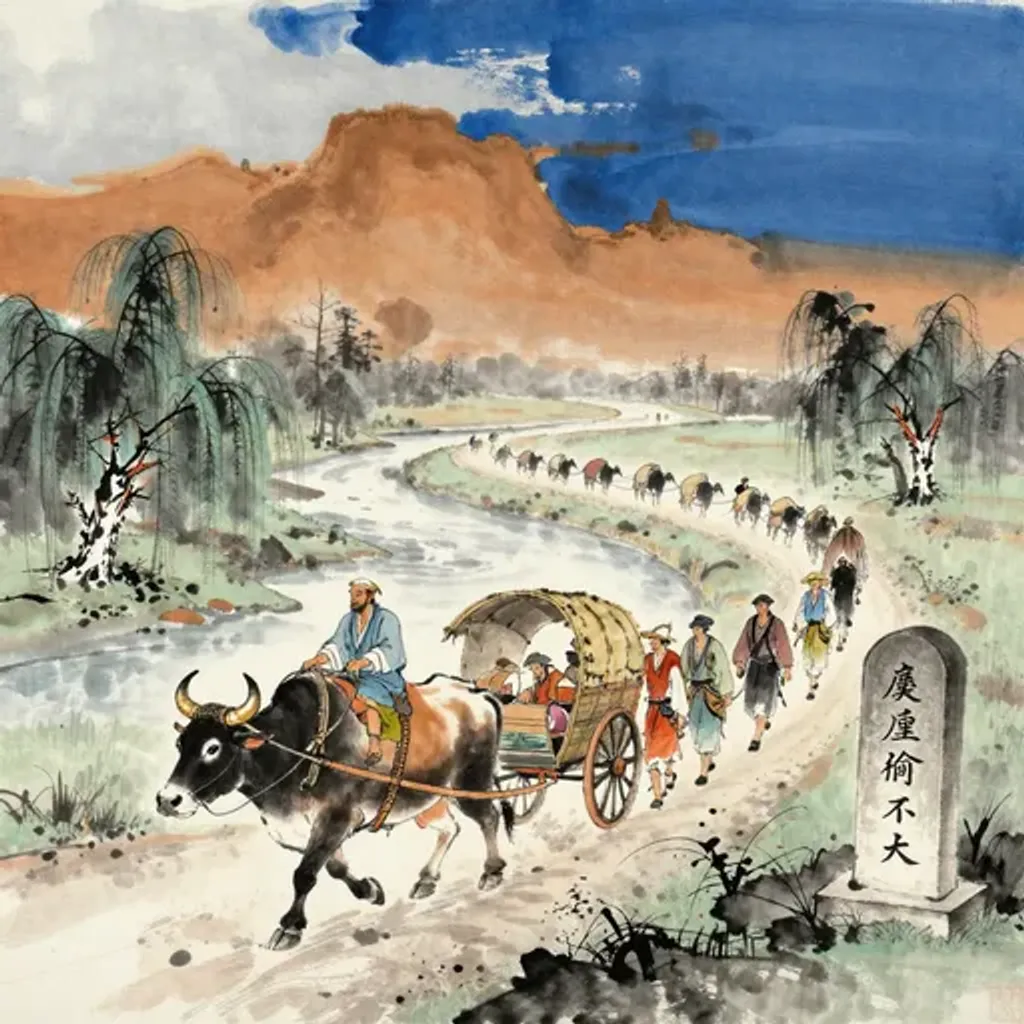
壽考不忘,駕騂東行。之適陳宋,南賈楚荊,得利息長,旅自多罷,畏晝喜夜。
Long life, unforgotten; he drives a red-haired horse eastward. Journeying to Chen and Song; trading south in Chu and Jing. Profit gained and interest grown; yet the traveler is ever weary, fearing daylight, welcoming night.
— Jiao Yanshou, Yilin (Forest of Changes), 1st century BC
Commentary
Fire rises above the earth, and an aged but vigorous traveler harnesses a sorrel-red horse to journey east. He makes his way to Chen and Song, trades southward in the lands of Chu and Jing, and profits grow steadily — yet the journey itself is exhausting. The traveler fears daylight and welcomes night, suggesting clandestine movement or a merchant who must avoid official scrutiny. This complex verse layers commerce with weariness, gain with anxiety. From Progress to Work on the Decayed, the transformation adds depth. Wind stirring beneath the mountain: old structures needing repair, inherited problems demanding attention. The long merchant's route across multiple states mirrors the painstaking work of renovating what has fallen into disrepair — profitable but grueling, with progress measured in increments.
晉 → 臨
Hexagram 35 → Hexagram 19: Approach
Changing lines: 1, 2, 4, 6
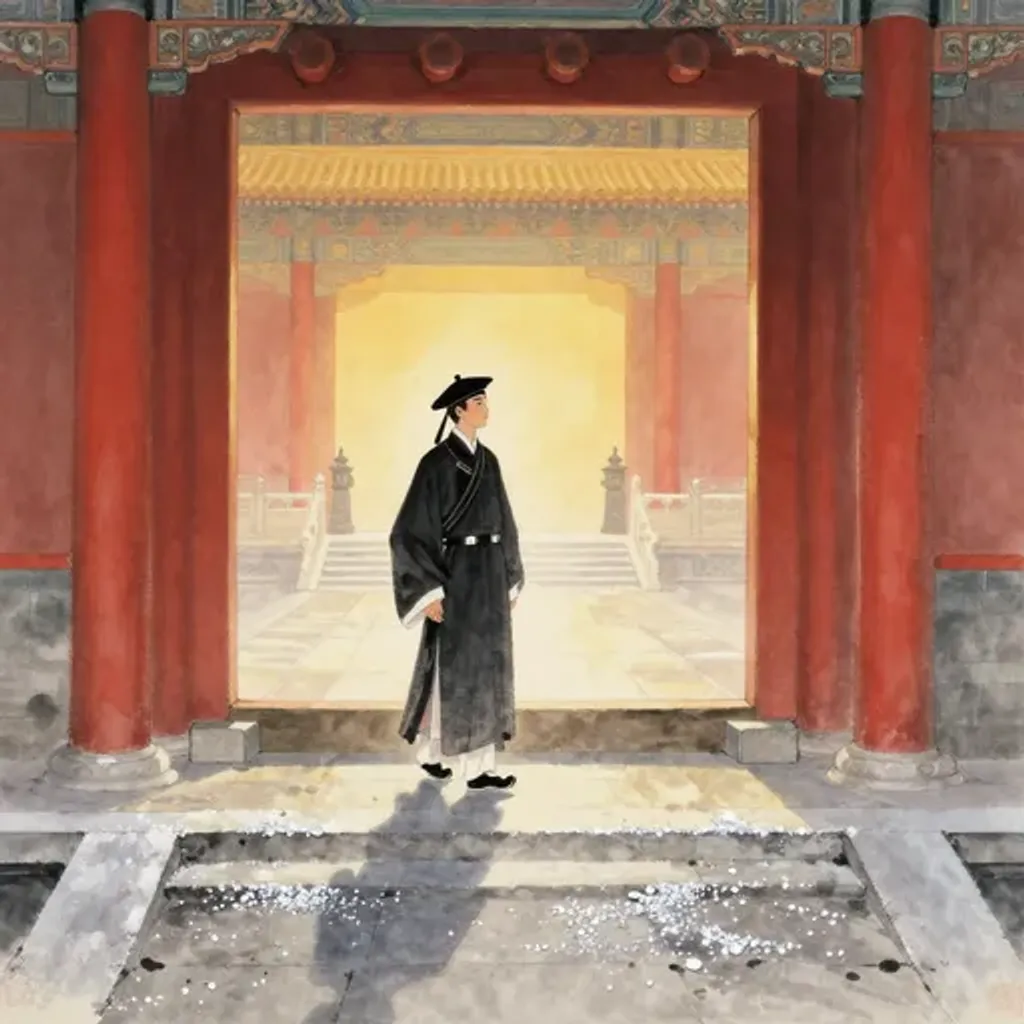
羔羊皮弁,君子朝服,輔政扶德,以合萬福。
Lambskin robe and leather cap; the gentleman’s court attire. Assisting governance, upholding virtue; thereby uniting ten thousand blessings.
— Jiao Yanshou, Yilin (Forest of Changes), 1st century BC
Commentary
Fire rises above the earth, and the gentleman dons his lambskin robe and leather cap — the formal court dress of a Zhou minister. Garbed in proper attire, he assists in governance and upholds virtue, gathering all blessings unto the realm. The lambskin cap (皮弁) was the standard investiture garment for ministers attending court; its mention signals legitimate authority exercised through ritual propriety. From Progress to Approach, the transformation is harmonious. The lake rises toward the earth: authority descends gently, like a sovereign approaching his people with teaching and compassion. The properly dressed minister does not seize power; he approaches governance with the same care he gives to dressing for court — every detail a form of respect.
晉 → 觀
Hexagram 35 → Hexagram 20: Contemplation
Changing lines: 4, 5
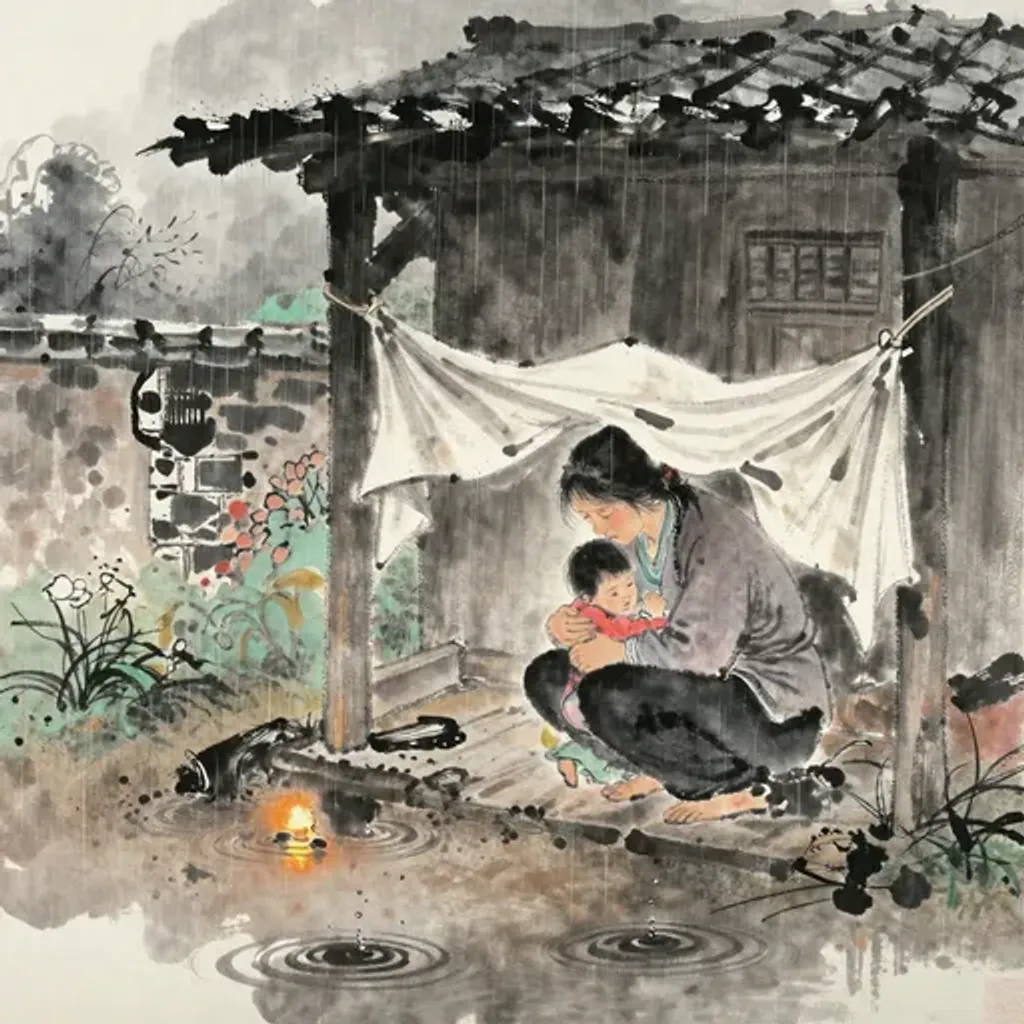
鸇鳩徙巢,西至平州,遭逢雷電,破我葦蘆,室家飢寒,思吾故初。
Autumn wind tears the curtain — the curtain is already torn. Night rain enters the house — the house has no roof. Holding the child, crouching in a corner to escape cold drips — in dreams, still seeing the old courtyard.
— Jiao Yanshou, Yilin (Forest of Changes), 1st century BC
Commentary
Fire rises above the earth, but the original verse tells a darker story: 'The hawk-dove moves its nest westward to Pingzhou, struck by thunder and lightning that destroy its reed hut. The household shivers in hunger and cold, longing for how things were at the start.' A bird forced to relocate its nest only to face nature's violence — the reed shelter torn apart, the family freezing and starving, dreaming of their former home. From Progress to Contemplation, the transformation deepens the pathos. Wind moves across the earth in Contemplation's image: the ruler surveys his realm. But from below, the dispossessed look up at the observer's tower and see only indifference. Progress that displaces the vulnerable becomes merely wind sweeping over bare ground.
晉 → 噬嗑
Hexagram 35 → Hexagram 21: Biting Through
Changing lines: 1
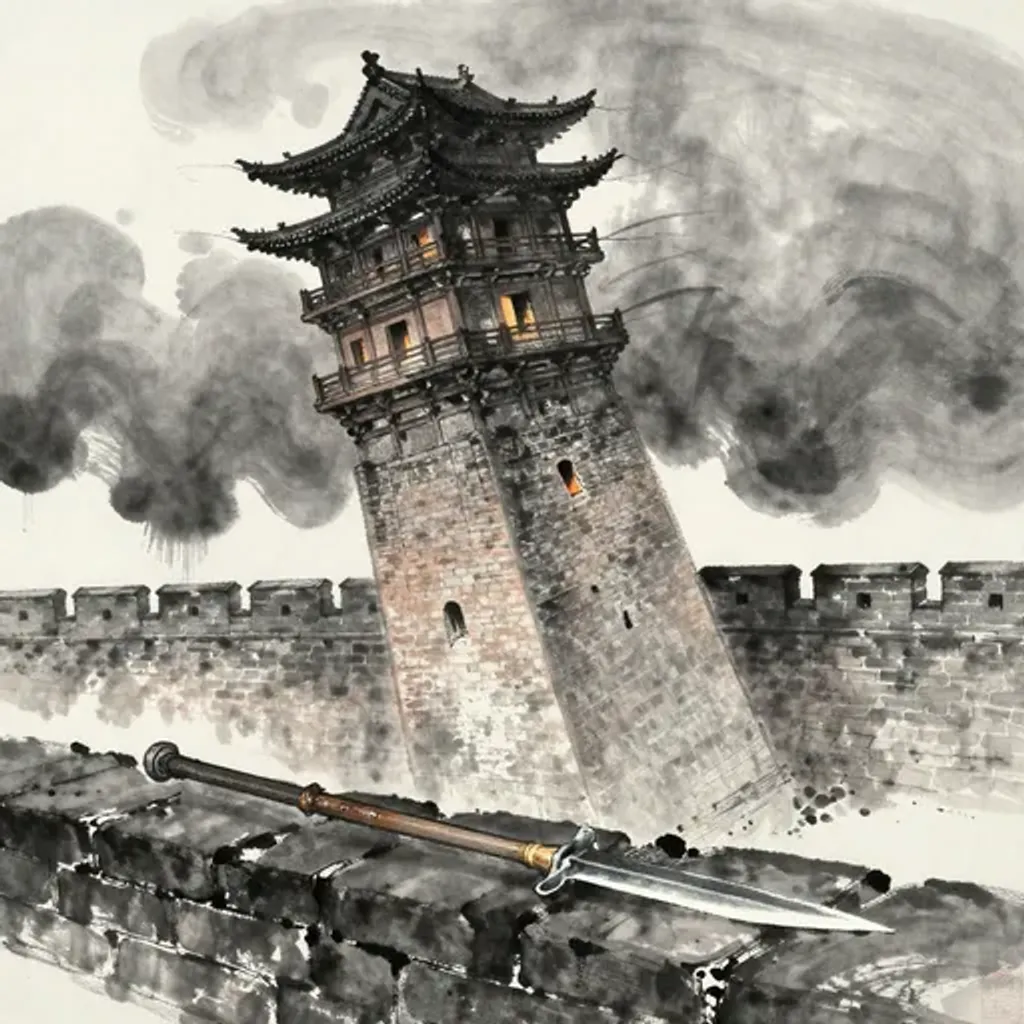
大尾小頭,重不可搖。上弱下強,陰制其雄。
Thick roots, thin branches — fruit struggles to form. Wide foundation, narrow tower — unstable in the wind. The servant holds the seal while the master kneels — wielding a weapon backwards, handing the handle to another.
— Jiao Yanshou, Yilin (Forest of Changes), 1st century BC
Commentary
Fire rises above the earth, but the original verse reveals a structural inversion: 'A large tail and small head, too heavy to move. The lower part is strong while the upper is weak — yin dominates and controls the male.' This echoes the classical warning 'tail too large to wag' from the Zuo Zhuan: when subordinate power outgrows the center, the hierarchy collapses. The servant holds the seal while the master kneels — authority has been completely inverted. From Progress to Biting Through, the transformation prescribes the remedy. Fire and thunder together create the image of judicial force: lightning illuminates wrongdoing and thunder enforces punishment. When the natural order is inverted, only decisive corrective action — biting through the obstruction — can restore proper hierarchy.
晉 → 賁
Hexagram 35 → Hexagram 22: Grace
Changing lines: 1, 3, 4
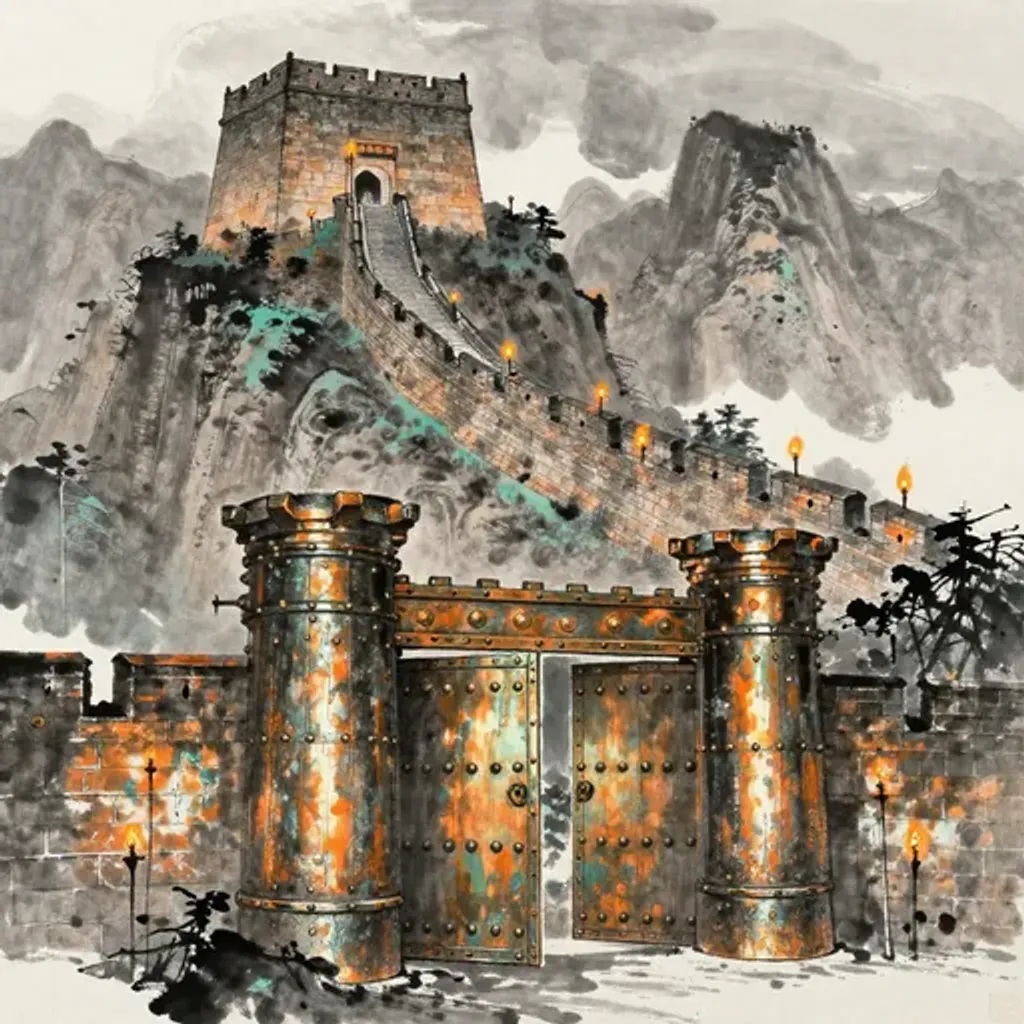
䟽足息肩,有所忌難,金城銅郭,以鐵為關,藩屏自衛,安止无患。
Resting the feet, easing the shoulders; there is something to fear and avoid. Walls of bronze, ramparts of copper, gates forged of iron. Shielding and defending oneself; at peace, at rest, without calamity.
— Jiao Yanshou, Yilin (Forest of Changes), 1st century BC
Commentary
Fire rises above the earth, but the figure halts to rest weary feet and aching shoulders. There are dangers to be wary of, so defenses must be built: walls of gold, ramparts of bronze, gates reinforced with iron. Barriers and screens protect on all sides, and one rests secure without worry. The verse shifts from weariness to fortification — the traveler who has advanced far enough now consolidates position rather than pressing further. From Progress to Grace, the transformation is apt. Fire beneath the mountain creates refined beauty: illumination contained within natural form. The iron-gated city is not merely defensive but aesthetically ordered — each wall a deliberate ornament. True grace emerges when strength knows its boundaries and adorns stillness rather than pursuing endless motion.
晉 → 剝
Hexagram 35 → Hexagram 23: Splitting Apart
Changing lines: 4
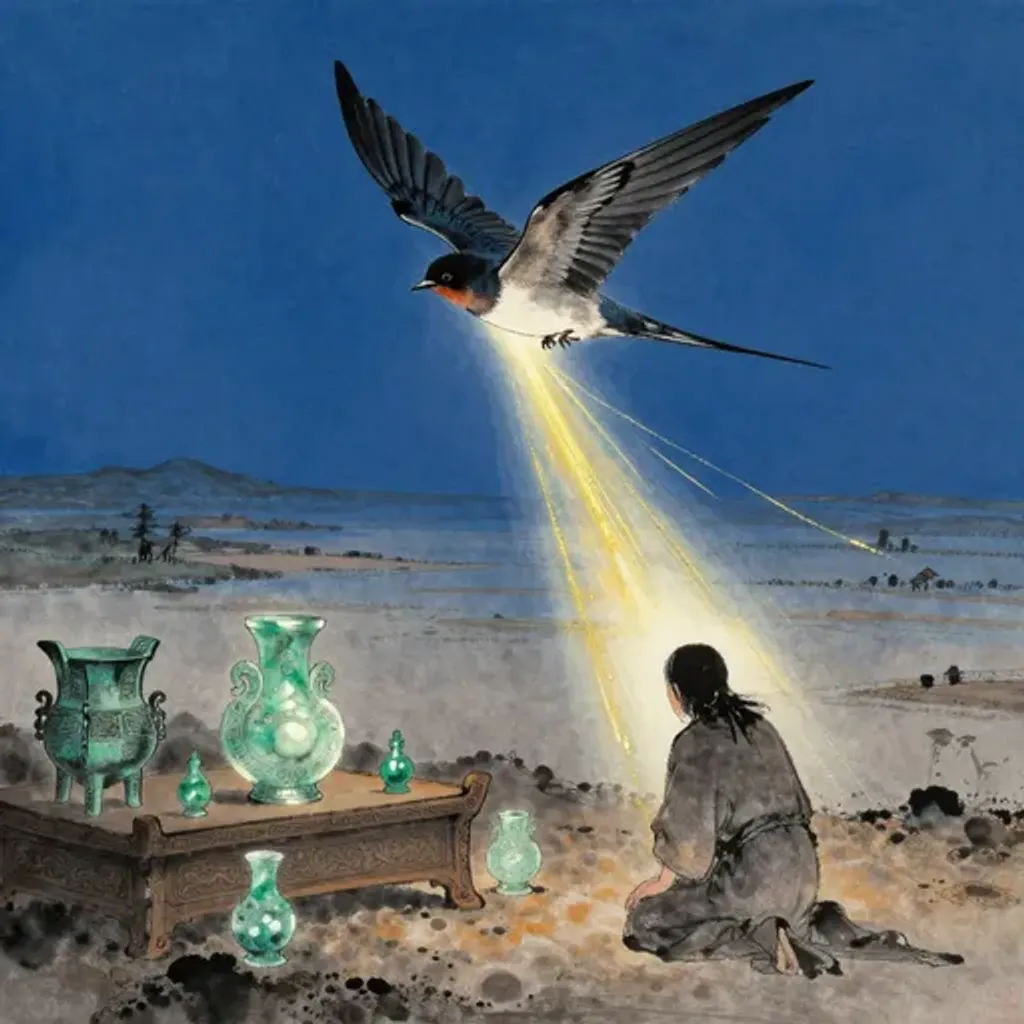
天命玄鳥,下生大商,造定四表,享國久長。
Heaven commanded the dark swallow; it descended to give birth to Great Shang. Establishing order across the four quarters; the kingdom endures long.
— Jiao Yanshou, Yilin (Forest of Changes), 1st century BC
Commentary
Fire rises above the earth, and heaven commands the dark bird to descend and give birth to the great Shang dynasty. This is a direct quotation from the Shijing ode 'Xuan Niao' in the Shang Eulogies, celebrating the mythic origin of the Shang people: the ancestress Jiandi swallowed a dark bird's egg and conceived Xie, founder of the Shang lineage. The dynasty established order across the four quarters and enjoyed a long reign. From Progress to Splitting Apart, the transformation is paradoxical: a founding myth of enduring power paired with the hexagram of erosion. The mountain crumbles upon the earth. Even the mandate of heaven, once so brilliantly bestowed, eventually strips away — dynasty by dynasty, layer by layer.
晉 → 復
Hexagram 35 → Hexagram 24: Return
Changing lines: 1, 4, 6
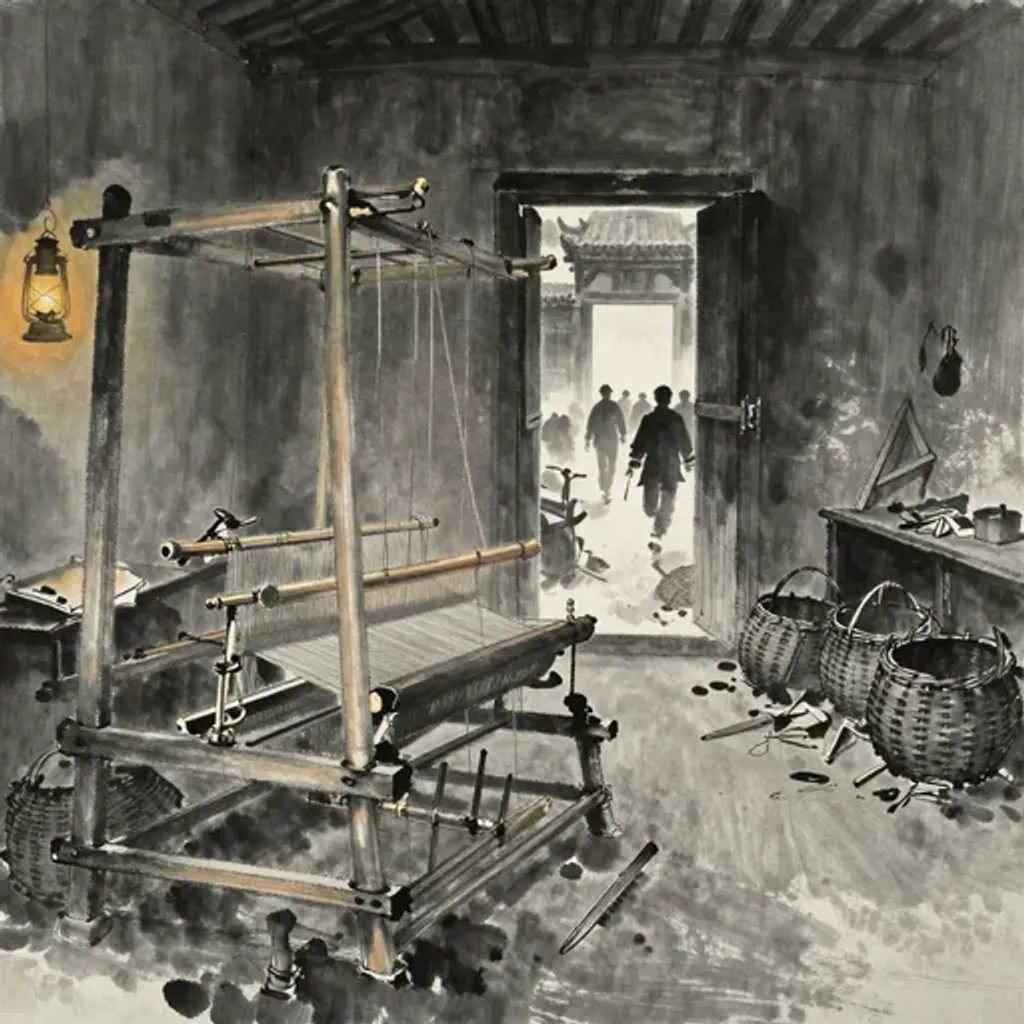
賦歛重數,政為民賊,杼軸空虛,家去其室。
Taxes levied again and again; governance becomes the people’s thief. The loom and shuttle stand empty; families abandon their homes.
— Jiao Yanshou, Yilin (Forest of Changes), 1st century BC
Commentary
Fire rises above the earth, but the light illuminates misgovernance. Taxes are levied repeatedly without restraint, governance becomes a plague upon the people. The loom shuttles are empty, the warp and weft exhausted — households abandon their homes entirely. The verse condemns extractive rule: the state drains its subjects until nothing remains, not even the thread on the loom. 'Zhuzhou kongxu' (杼軸空虛) is a classical image of economic ruin — when a family's loom stands empty, they have literally nothing left to produce. From Progress to Return, the transformation offers the only remedy. Thunder stirs within the earth: the solstice moment when the cycle begins again. After total depletion, the only path forward is to return to the root — abolish oppressive levies and let the people recover.
晉 → 无妄
Hexagram 35 → Hexagram 25: Innocence
Changing lines: 1, 5
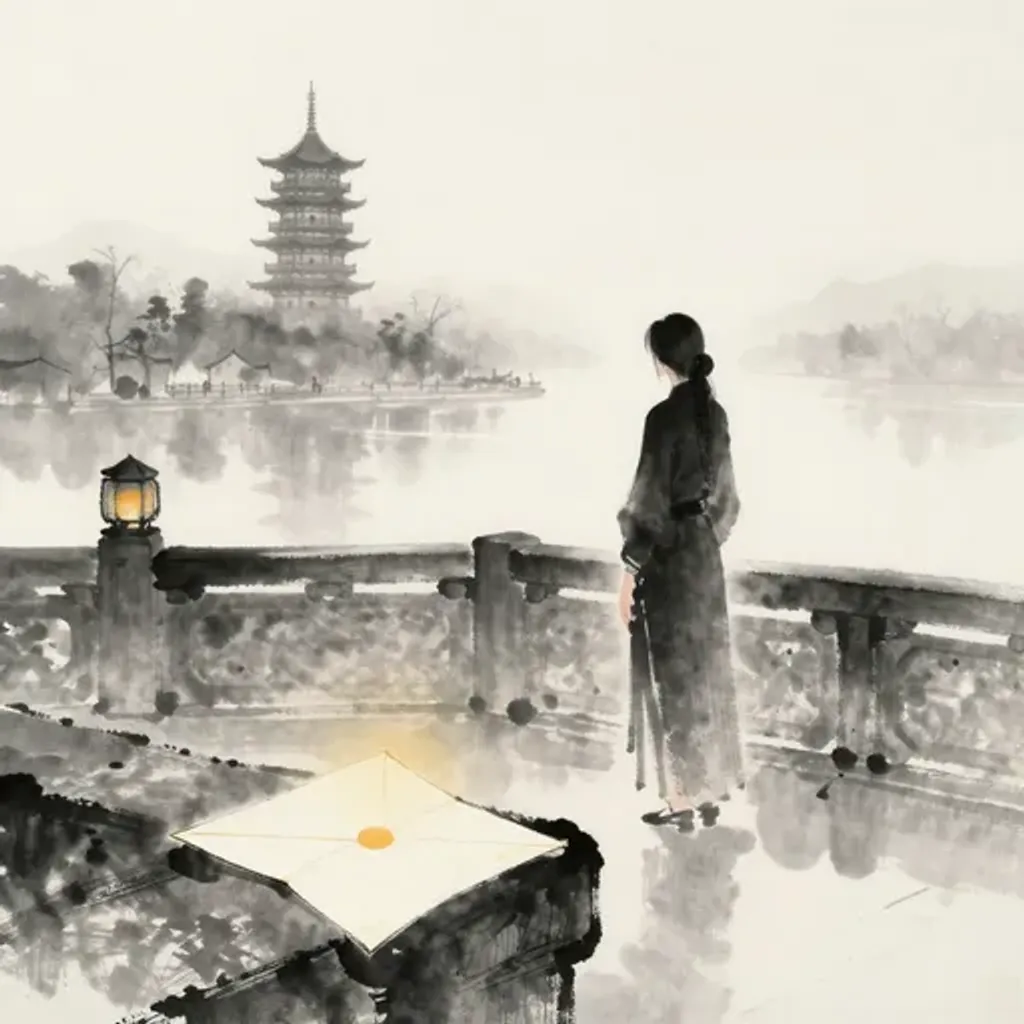
陰陽隔塞,許嫁不荅,宛丘新臺,悔往歎息。
Yin and yang are blocked and divided; the marriage promise goes unanswered. The mound of Wan, the tower of Xin — she looks back with regret and sighs.
— Jiao Yanshou, Yilin (Forest of Changes), 1st century BC
Commentary
Fire rises above the earth, but yin and yang are blocked from meeting. A marriage is promised but goes unanswered. The verse then names two Shijing allusions: 'Wan Qiu' from the Airs of Chen, about frivolous dancing on the hilltop, and 'Xin Tai' from the Airs of Bei, about Duke Xuan of Wei who built a new terrace to intercept his own son's bride. Both poems satirize rulers whose desire corrupted proper unions. The result: regret and sighing over what went wrong. From Progress to Innocence, the transformation deepens the irony. Heaven's thunder moving below should mean natural, unspoiled action — yet here every natural bond has been perverted. When those in power manipulate unions for selfish ends, even heaven's innocence cannot heal the breach.
晉 → 大畜
Hexagram 35 → Hexagram 26: Great Taming
Changing lines: 1, 2, 3, 4
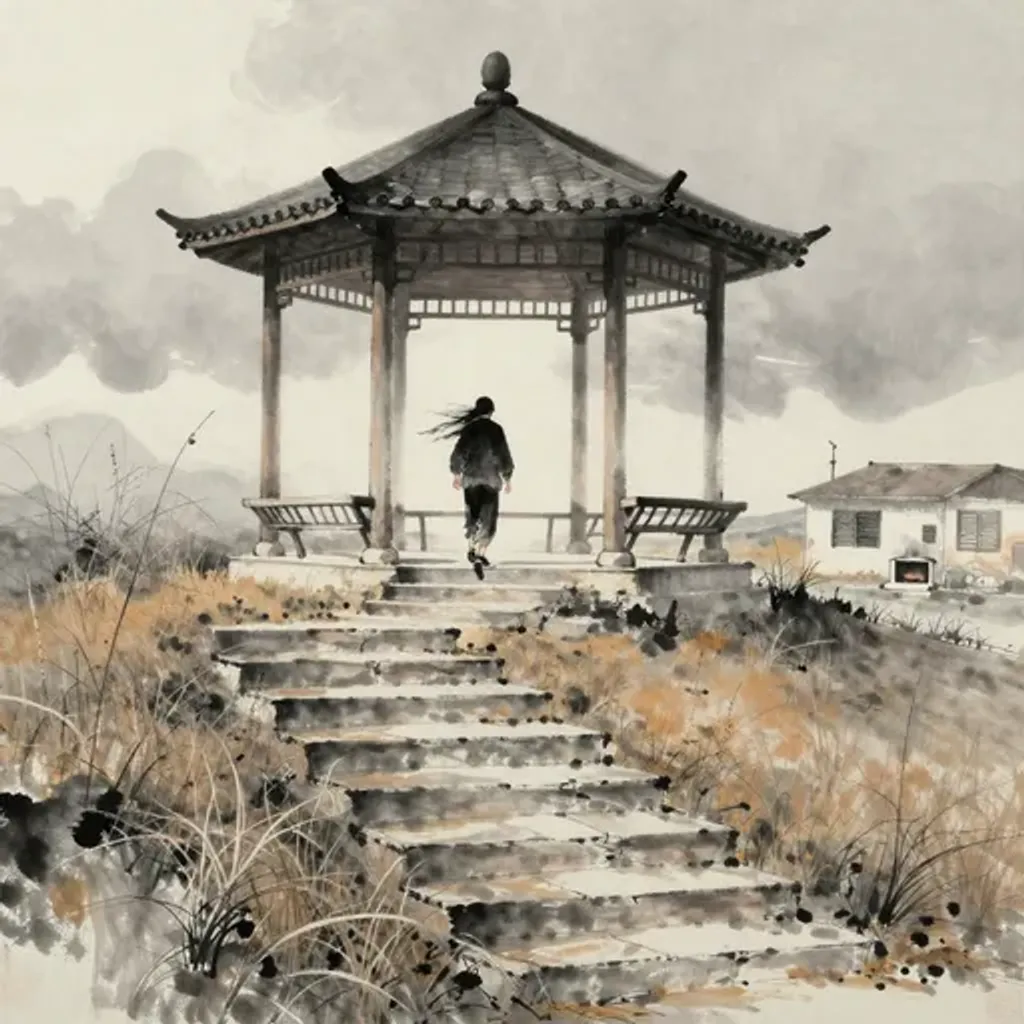
願望登虛,意常欲逃,賈辛醜惡,妻不安夫。
Wishing to climb the heights of emptiness; the heart always longs to escape. The merchant’s wife finds her husband loathsome; the wife is ill at ease with her lord.
— Jiao Yanshou, Yilin (Forest of Changes), 1st century BC
Commentary
Fire rises above the earth, yet the spirit yearns to ascend into emptiness — always wishing to flee. The merchant Jia Xin is ugly and repulsive, and the wife cannot abide her husband. The name 'Jia Xin' may refer to a historical figure, though its primary function here is characterological: the ugly merchant whose wife recoils. The verse captures incompatibility at its rawest — a marriage bound by convention but poisoned by revulsion. From Progress to Great Taming, the transformation is striking. Heaven stored within the mountain suggests vast potential held in check. But here the restraint is not noble discipline; it is a wife trapped in a household she longs to escape. Accumulation without harmony becomes a prison rather than a treasury.
晉 → 頤
Hexagram 35 → Hexagram 27: Nourishment
Changing lines: 1, 4
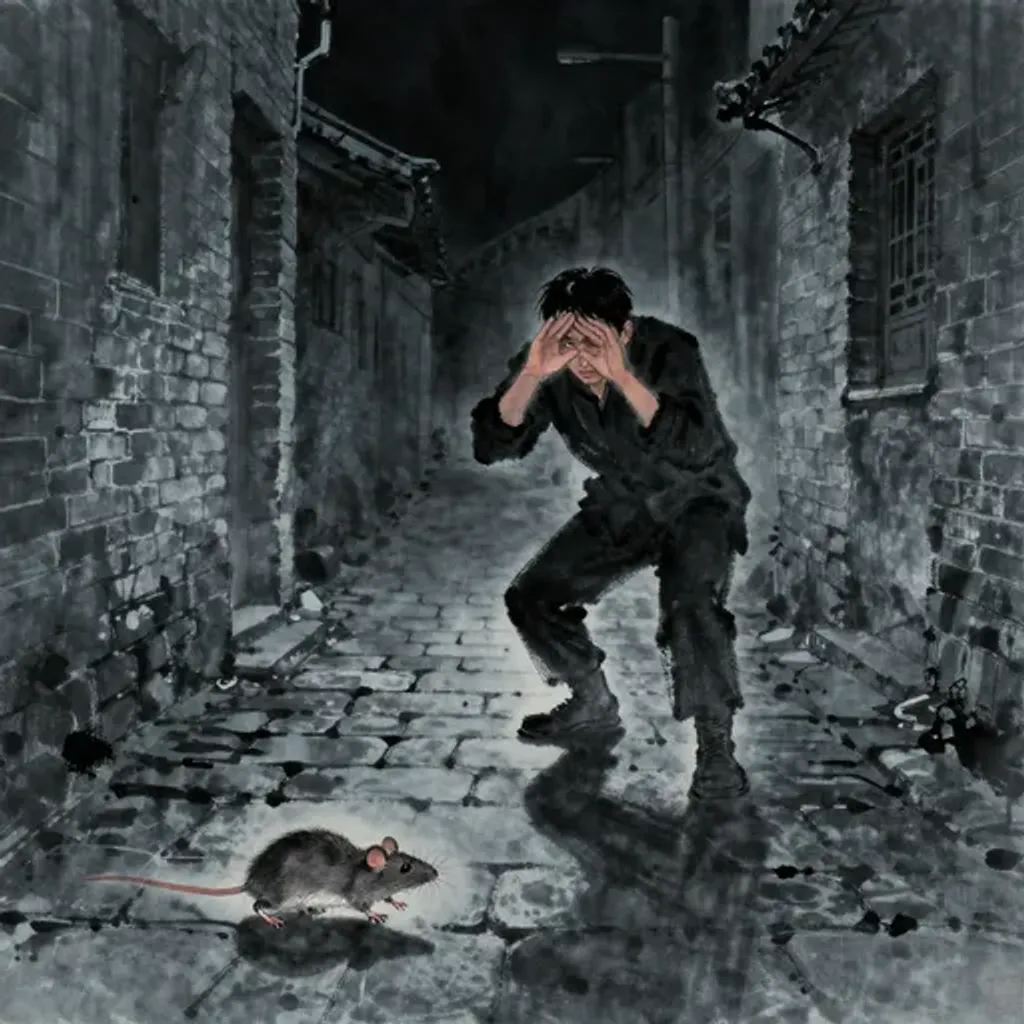
踧行竊視,有所畏避,蔽目伏藏,以夜為利。
Creeping forward, stealing glances; there is something to fear and avoid. Covering the eyes, hiding away; taking the night as advantage.
— Jiao Yanshou, Yilin (Forest of Changes), 1st century BC
Commentary
Fire rises above the earth, but this figure crouches and slinks, stealing glances in every direction. There is something to fear and avoid — eyes shielded, body pressed flat in hiding, treating darkness as an ally. The verse depicts someone moving through hostile territory: a fugitive, a spy, or a disgraced official reduced to creeping through shadows. Every movement is furtive, every glance a calculation of threat. From Progress to Nourishment, the transformation is paradoxical. The mountain above thunder suggests careful attention to what one takes in — guarding speech and regulating appetite. The fugitive who hides by night survives by controlling intake: eating little, speaking less, consuming only what sustains flight. In extremity, nourishment reduces to bare survival.
晉 → 大過
Hexagram 35 → Hexagram 28: Great Exceeding
Changing lines: 2, 3, 5, 6
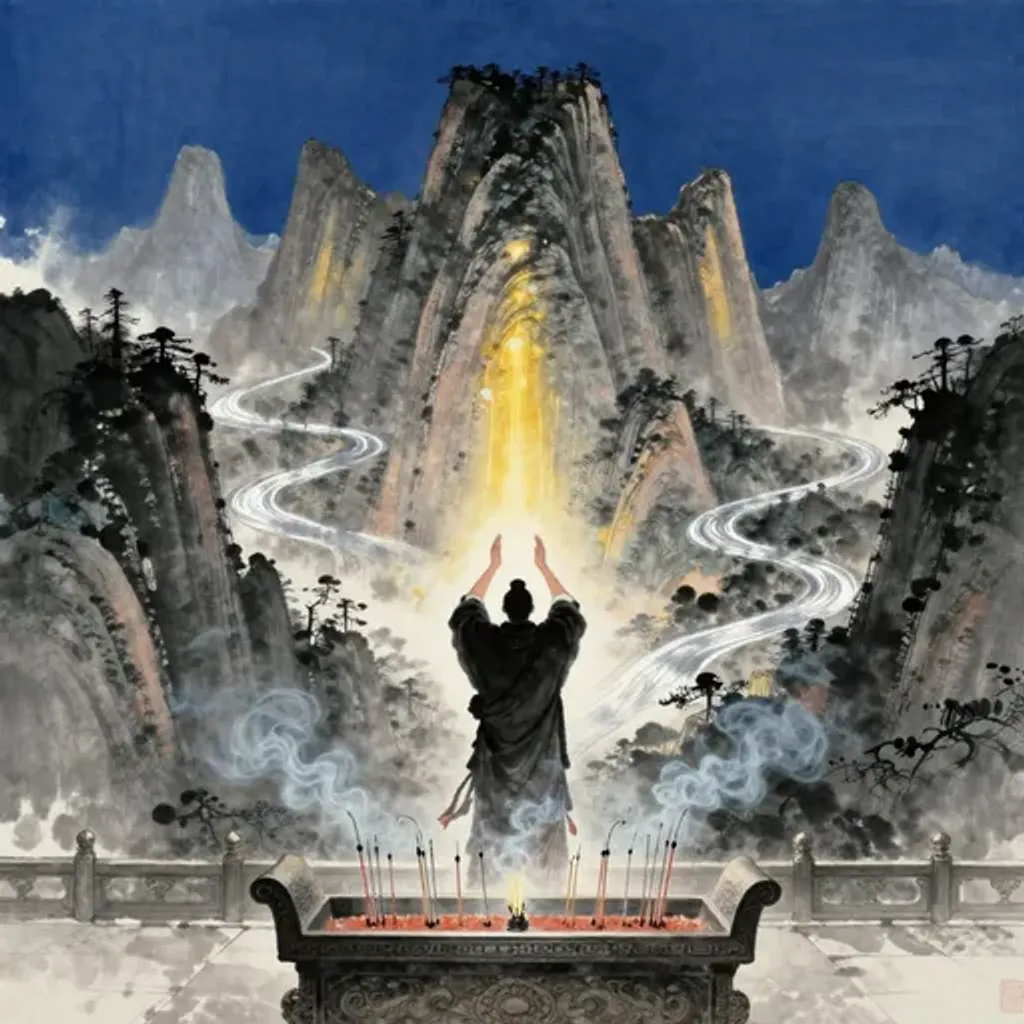
信敏恭謙,敬鬼尊神,五岳四瀆,克厭帝心,受福宜年。
Trustworthy, diligent, reverent, and humble; honoring ghosts, venerating spirits. The Five Peaks and Four Rivers; they fully satisfy the Emperor’s heart. Blessings received, a bountiful year.
— Jiao Yanshou, Yilin (Forest of Changes), 1st century BC
Commentary
Fire rises above the earth, and the figure embodies trustworthiness, sensitivity, reverence, and humility — honoring ghosts and respecting spirits. Sacrifices are offered at the Five Sacred Mountains and the Four Great Rivers, fully satisfying the heart of the emperor above. Blessings descend and a prosperous year follows. The verse describes a ruler or minister who performs the grand rites of heaven and earth with impeccable sincerity: the feng and shan sacrifices at the sacred peaks, libations poured into the great rivers. From Progress to Great Exceeding, the transformation tests whether this piety can sustain extraordinary weight. The lake overwhelms the trees — structures buckle under excess. Even perfect devotion, if it accumulates obligations beyond what the frame can bear, risks toppling the ridgepole.
晉 → 坎
Hexagram 35 → Hexagram 29: The Abysmal Water
Changing lines: 2, 4, 5, 6
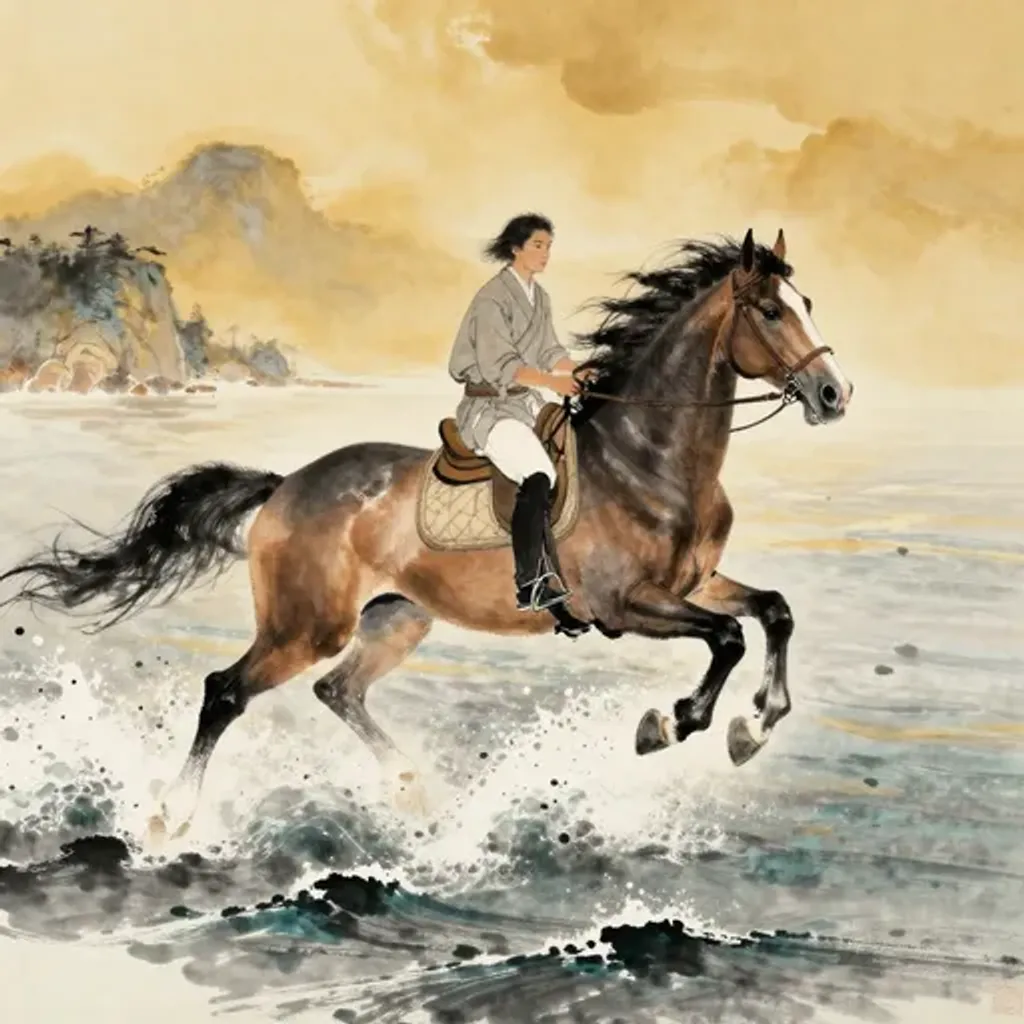
懸懸南海,去家萬里,飛兔腰裊,一日見母,除我憂悔。
Far, far away on the southern sea; ten thousand li from home. The flying hare, the swift steed Yaoniao; in a single day he sees his mother. My grief and regret are lifted.
— Jiao Yanshou, Yilin (Forest of Changes), 1st century BC
Commentary
Fire rises above the earth, but the heart hangs suspended over the distant South Sea, ten thousand li from home. Then the legendary steeds Feitu and Yaoniao appear — ancient horses of supernatural speed — and in a single day the traveler sees his mother again, grief and regret dispelled at once. Feitu ('Flying Hare') and Yaoniao are named in the Lushi Chunqiu as the swiftest horses of antiquity: horses that ran like flying rabbits, collapsing impossible distance into a single day's gallop. From Progress to the Abysmal, the transformation layers peril beneath the rescue. Doubled water, repeated danger — yet the filial heart plunges through every abyss without hesitation. Love for a parent transforms the deadliest crossing into a straight road home.
晉 → 離
Hexagram 35 → Hexagram 30: The Clinging Fire
Changing lines: 1, 3
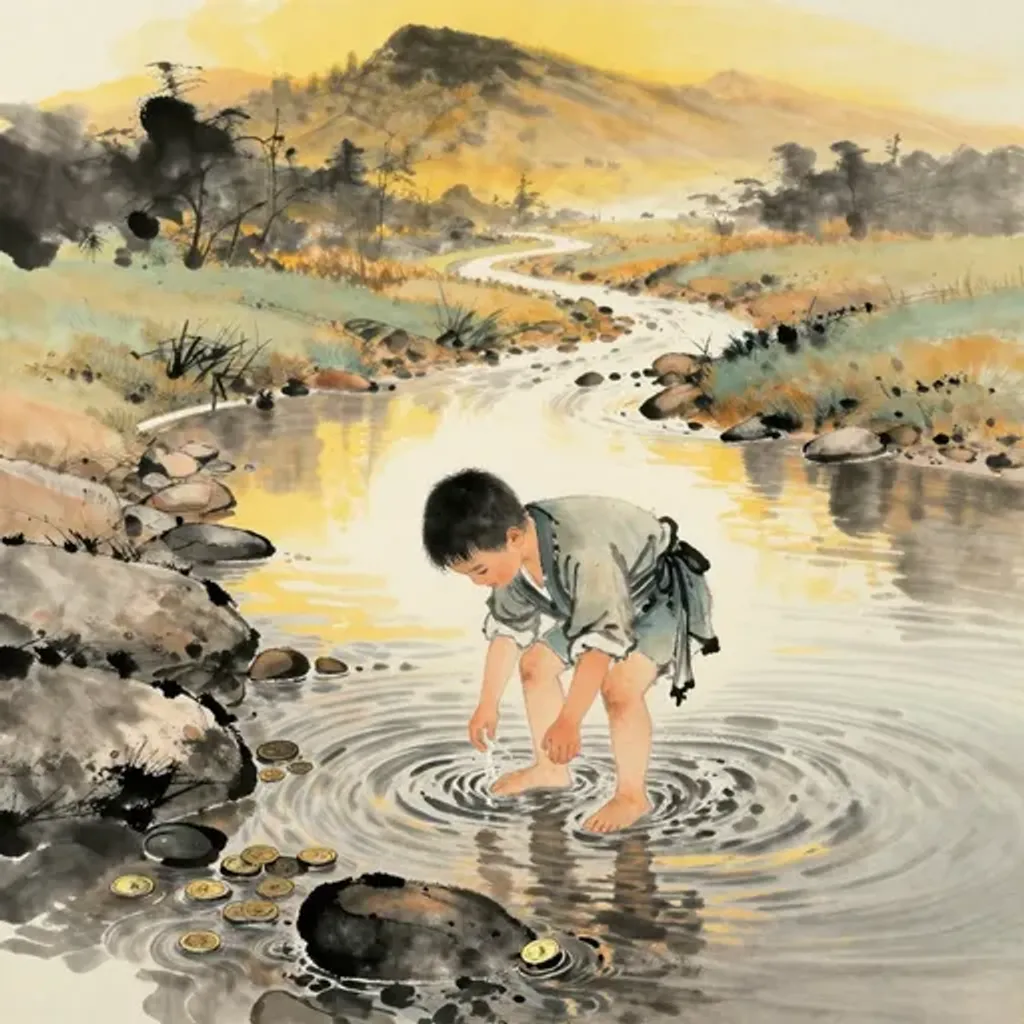
雖污不辱,因何洗足,童子褰衣,五年平復。
Though soiled, not disgraced; why then wash the feet? The child lifts his robe; in five years, all is restored.
— Jiao Yanshou, Yilin (Forest of Changes), 1st century BC
Commentary
Fire rises above the earth, and though one is soiled, the stain brings no lasting shame. Why wash one's feet when the muddy water will clear on its own? A child hitches up his garments to wade across, and within five years all is restored. The verse evokes the patience of one who endures temporary disgrace without forcing premature vindication. The phrase 'though polluted, not dishonored' separates external circumstance from inner worth. From Progress to the Clinging, the transformation doubles the fire: brightness upon brightness, clarity illuminating clarity. The temporary pollution cannot dim a flame that renews itself. Like doubled fire that continually regenerates, the figure's reputation restores naturally — not through defensive washing but through the steady radiance of sustained character.
晉 → 咸
Hexagram 35 → Hexagram 31: Influence
Changing lines: 3, 5, 6
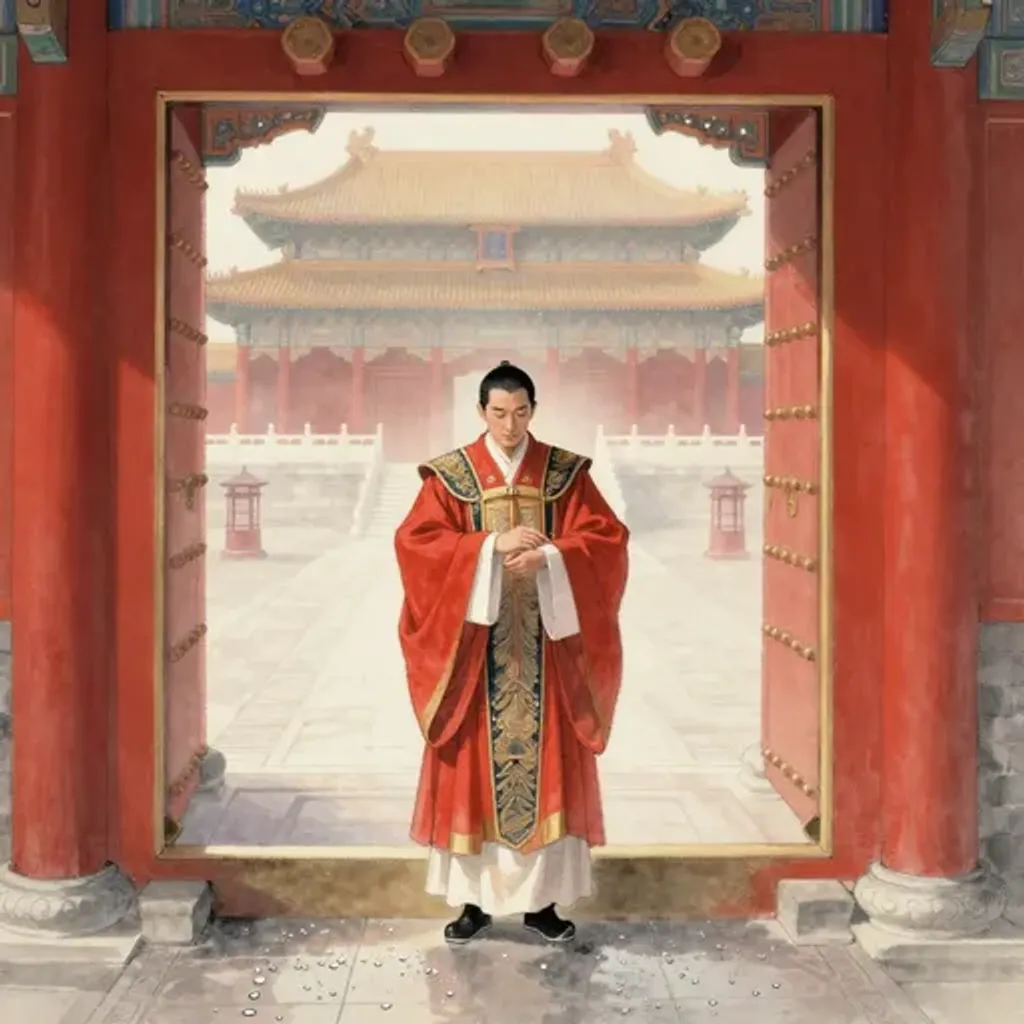
宮城立見,衣就袂裙,恭謙自衛,終无禍尤。
The palace walls stand before him; he arranges sleeves and skirt. Reverent and humble in self-restraint; in the end, no disaster or fault.
— Jiao Yanshou, Yilin (Forest of Changes), 1st century BC
Commentary
Fire rises above the earth, and the palace walls stand visible before one's eyes. Robes are arranged with care, sleeves and skirts adjusted properly. Through reverence and humility the figure guards himself, and in the end no misfortune or blame arises. The verse depicts a courtier who has arrived at the seat of power and navigates it through meticulous propriety: every fold of cloth a statement of self-discipline. From Progress to Influence, the transformation is subtle. The lake rests upon the mountain — mutual responsiveness between high and low. The courtier's careful self-presentation is itself a form of influence: by receiving the court's authority with proper deference, he creates the conditions for genuine connection. Influence flows not from assertion but from the empty receptivity of humility.
晉 → 恆
Hexagram 35 → Hexagram 32: Duration
Changing lines: 2, 3, 6
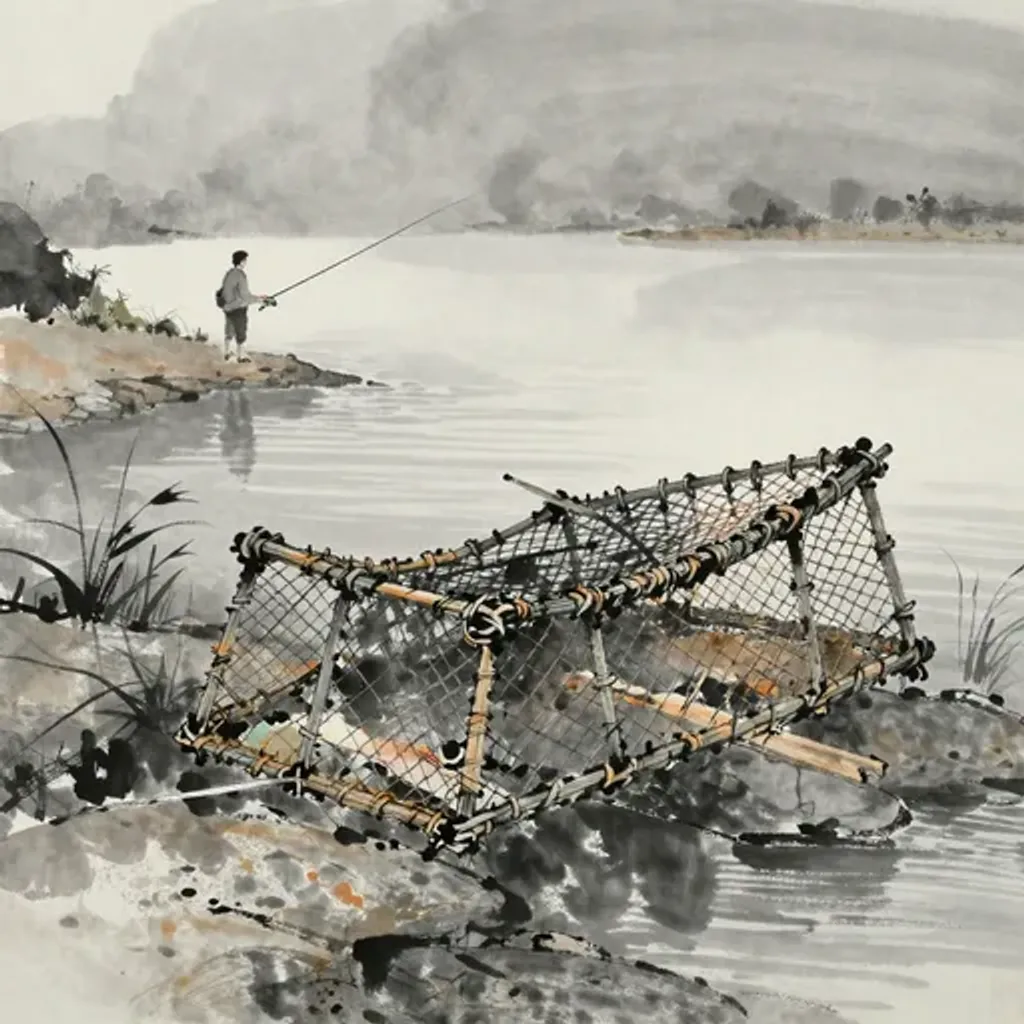
敝笱在梁,不能得魚,望貧千里,所至空虛。
A tattered fish trap on the weir; it cannot catch a fish. Gazing across a thousand li of poverty; wherever one arrives, only emptiness.
— Jiao Yanshou, Yilin (Forest of Changes), 1st century BC
Commentary
Fire rises above the earth, but the fish trap set upon the weir is broken — no fish can be caught. The Shijing ode 'Bi Gou' describes a torn net on the dam through which fish swim freely, satirizing the inability to restrain those who should be governed. Here, the verse extends the metaphor: gazing toward wealth a thousand li away, arriving only at emptiness. Ambition without functional tools yields nothing. From Progress to Duration, the transformation cuts deep. Thunder and wind together create enduring patterns, but duration without substance is merely stubbornness. A broken trap set day after day on the same weir is not persistence — it is the refusal to recognize that one's method has failed. Endurance must be paired with competence.
晉 → 遯
Hexagram 35 → Hexagram 33: Retreat
Changing lines: 3, 5
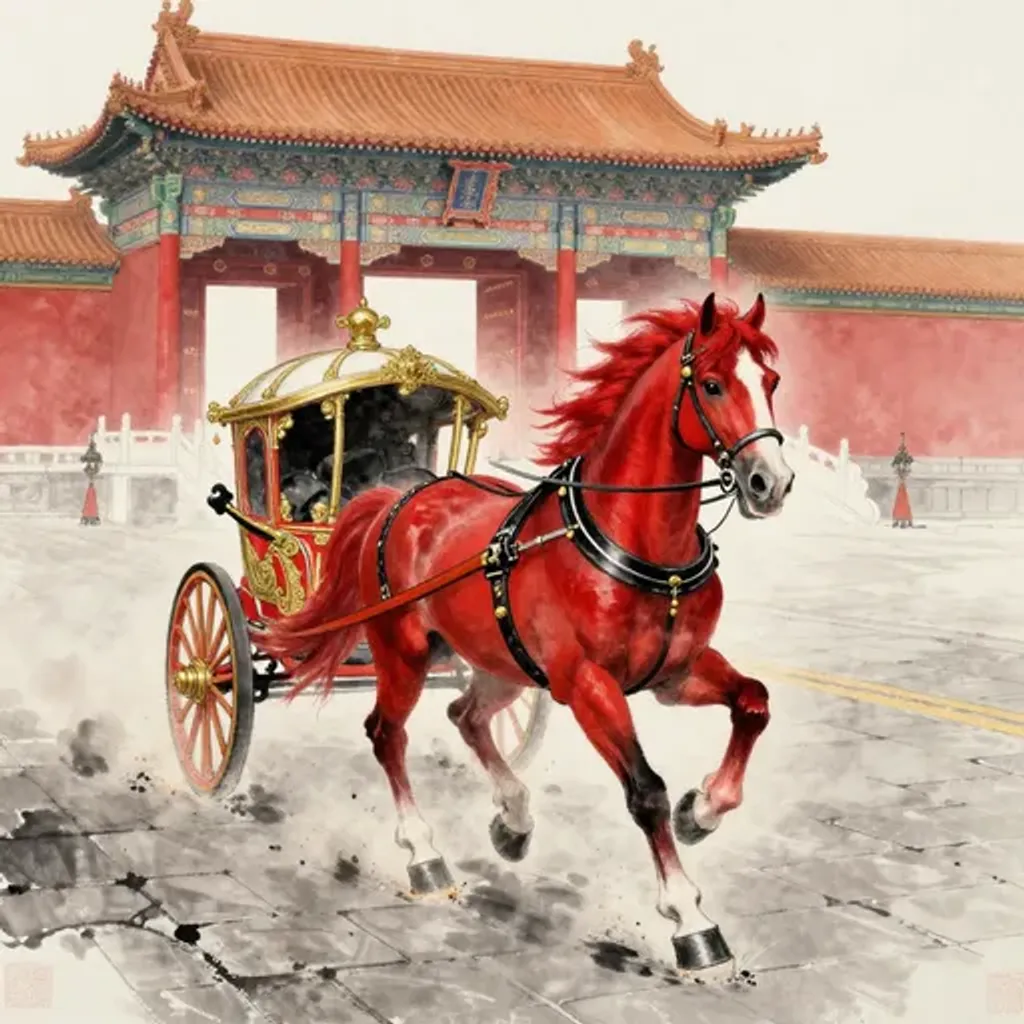
千里騂駒,為王服車,嘉其驪榮,君子有成。
A thousand-li red-maned colt; it pulls the king’s chariot. Praising its splendid glory; the gentleman achieves success.
— Jiao Yanshou, Yilin (Forest of Changes), 1st century BC
Commentary
Fire rises above the earth, and a thousand-li sorrel colt is harnessed to serve the king's chariot. Its glossy dark mane is praised, and the gentleman achieves success. The verse celebrates a fine horse recognized and employed at the highest level — a metaphor for talent discovered and put to worthy use. The sorrel colt running a thousand li echoes the classical trope of the 'thousand-li horse' that requires a Bole to recognize it. From Progress to Retreat, the transformation adds nuance. Heaven above the mountain suggests the gentleman distancing himself from petty men. The horse that serves the king's chariot does so precisely because it knows when to advance and when to withdraw — its value lies not in ceaseless running but in the dignity of measured service.
晉 → 大壯
Hexagram 35 → Hexagram 34: Great Power
Changing lines: 1, 2, 3, 6
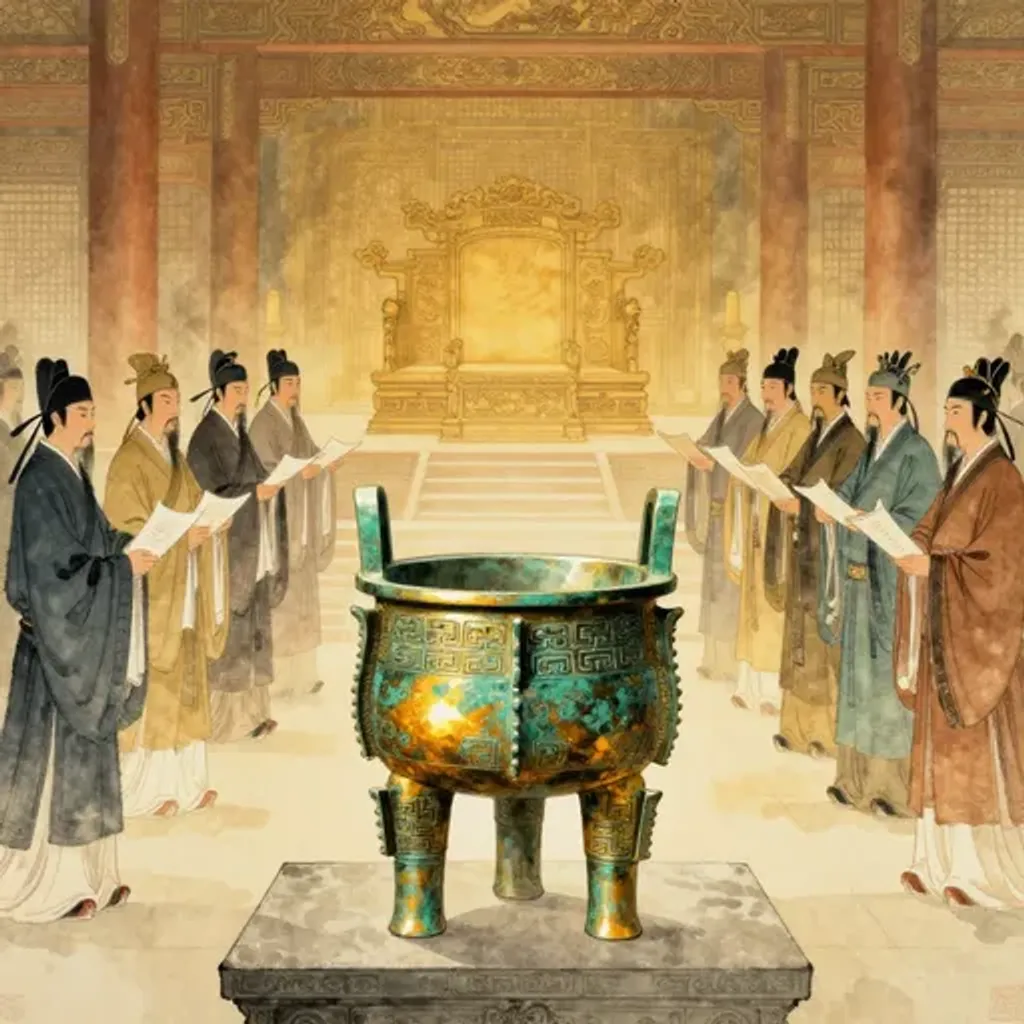
鼎足承德,嘉謀生福,為王開庭,得心所欲。
The tripod’s legs uphold virtue; excellent counsel gives birth to fortune. Opening court for the king; attaining the heart’s desire.
— Jiao Yanshou, Yilin (Forest of Changes), 1st century BC
Commentary
Fire rises above the earth, and the cauldron's three legs bear the weight of virtue. Excellent counsel generates good fortune, the king's court is opened, and the heart's desires are fulfilled. The tripod cauldron (ding) is the supreme symbol of legitimate rule in Chinese political imagery — the vessel that transforms raw offerings into sacred nourishment for the state. 'Ding zu cheng de' places the emphasis on structural support: good ministers upholding the sovereign like the cauldron's legs uphold the vessel. From Progress to Great Power, the transformation charges forward. Thunder above heaven — the most forceful image in the Yi. The well-counseled king whose court rests on solid ministerial support can act with overwhelming, righteous momentum.
晉 → 晉
Hexagram 35 → Hexagram 35: Progress
No changing lines — the hexagram is unchanged
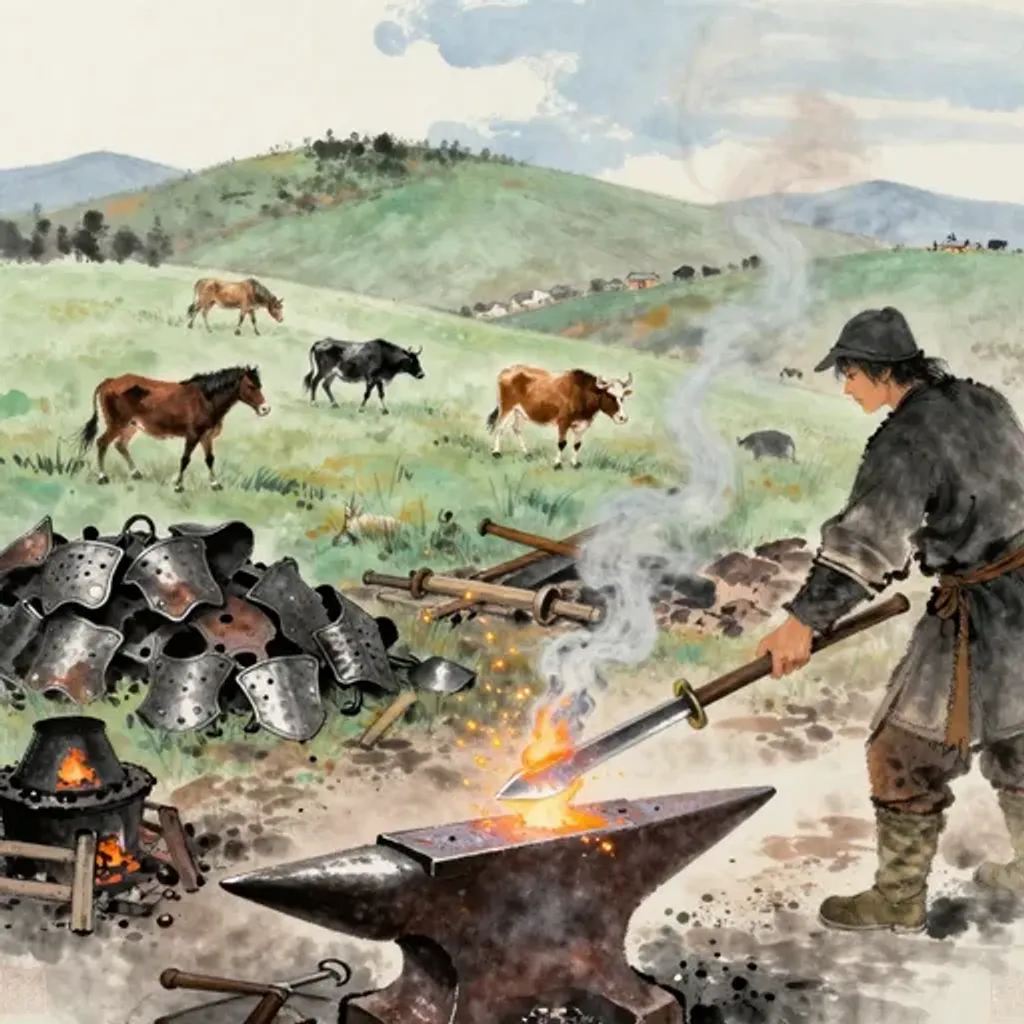
銷鋒鑄耜,休牛放馬,甲兵解散,夫婦相保。
Weapons melted, plowshares cast; oxen rested, horses set free. Armor and soldiers disbanded; husband and wife keep each other safe.
— Jiao Yanshou, Yilin (Forest of Changes), 1st century BC
Commentary
Fire rises above the earth, and the land returns to peace. Weapon points are melted down and recast as plowshares; oxen are rested and horses set free to pasture. Armor and troops are disbanded, and husbands and wives keep each other safe. This verse directly echoes the Shangshu chapter 'Wu Cheng,' describing King Wu of Zhou's demobilization after defeating the Shang: he released war-oxen in the Peach Forest and pastured war-horses on the southern slopes of Mount Hua. From Progress to Progress (the hexagram returning to itself), the transformation embodies fulfillment at rest. The brightest advance is the one that knows when to stop advancing — when the fire that rose above the earth settles into sustained warmth rather than consuming flame.
晉 → 明夷
Hexagram 35 → Hexagram 36: Darkening of the Light
Changing lines: 1, 3, 4, 6
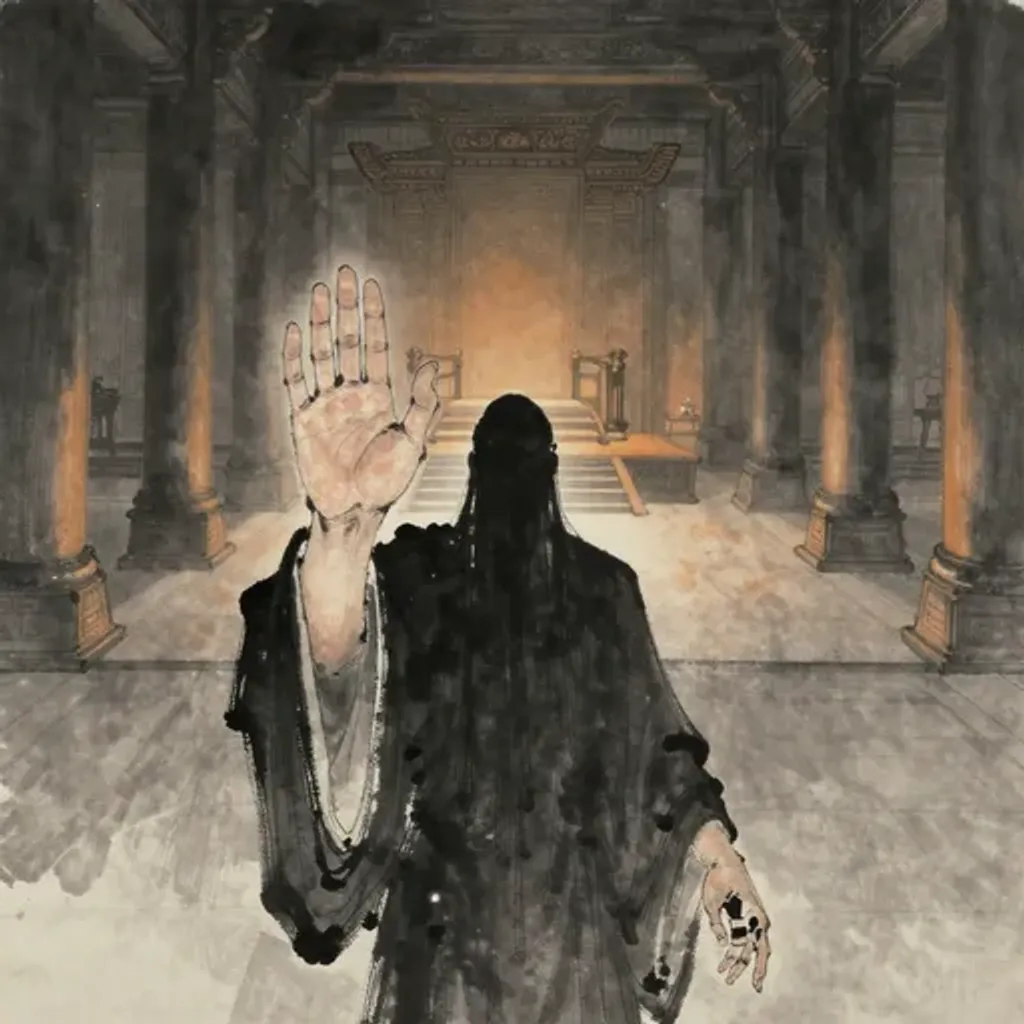
右手無合,獨折左指,禹湯失佐,事功弗立。
The right hand finds no match; alone it breaks the left finger. Yu and Tang lost their ministers; their achievements could not be established.
— Jiao Yanshou, Yilin (Forest of Changes), 1st century BC
Commentary
Fire rises above the earth, yet brightness is about to sink. The right hand finds no partner, and the left finger is broken in solitude. Even Yu and Tang, the sage-founders of the Xia and Shang dynasties, would have failed without capable ministers to assist them — their great works could not have been accomplished alone. The verse stresses the indispensability of partnership: a single hand cannot clap. From Progress to Darkening of the Light, the transformation is the most natural pair in the sequence. Fire sinks into the earth; what was bright becomes hidden. Yu without Yi Yin, Tang without his advisors — the greatest rulers plunged into darkness when stripped of their right hand. Brilliance without support self-extinguishes.
晉 → 家人
Hexagram 35 → Hexagram 37: The Family
Changing lines: 1, 3, 4, 5
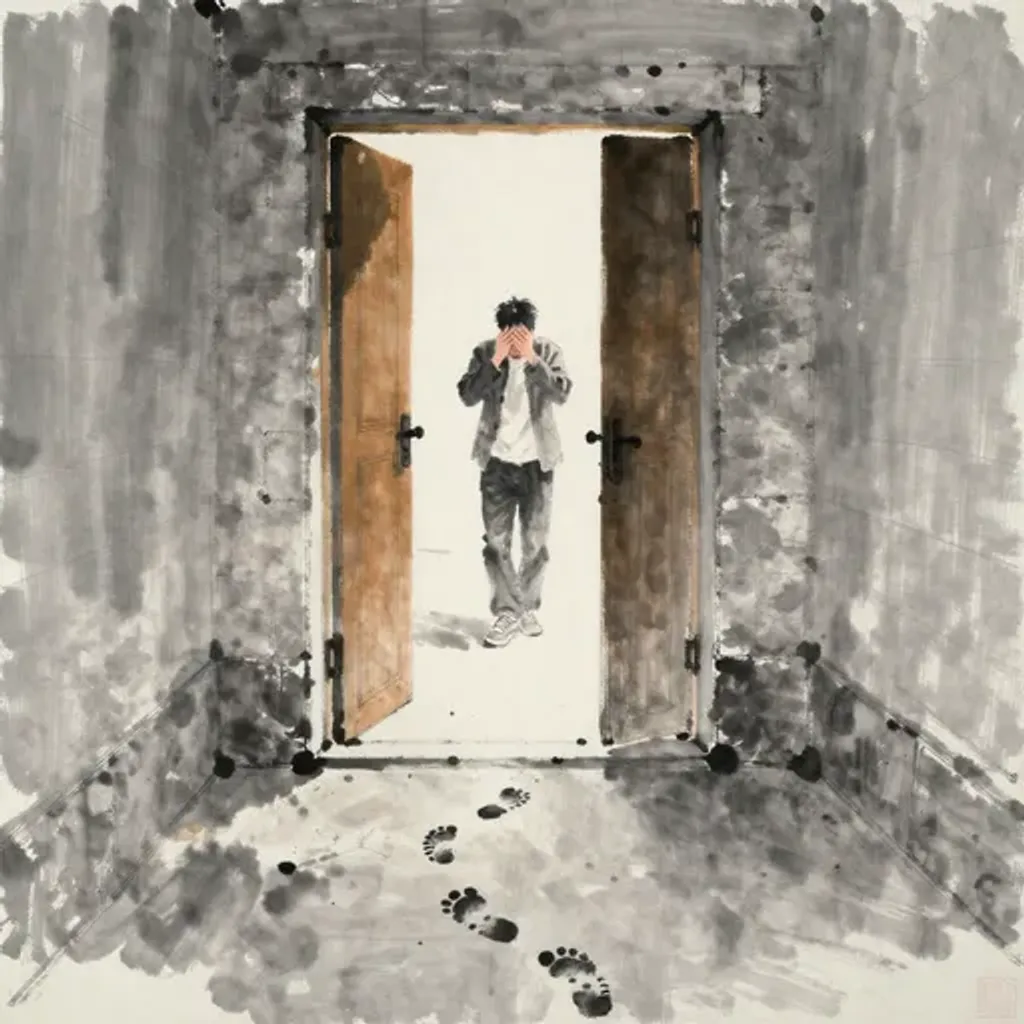
憂凶憎累,患近不解,心意西東,事无成功。
Sorrowful, fearful, loathing the burden; troubles near at hand, unresolved. The heart’s intent pulled east and west; nothing comes to fruition.
— Jiao Yanshou, Yilin (Forest of Changes), 1st century BC
Commentary
Fire rises above the earth, but worry, resentment, and accumulated burdens crowd in. Troubles nearby refuse to dissolve, the mind pulls east and west simultaneously, and nothing reaches completion. The verse captures paralysis through distraction: a person beset by competing anxieties who cannot commit to any single direction. The heart divided between east and west accomplishes precisely nothing. From Progress to the Family, the transformation prescribes the cure through contrast. Wind emerging from fire — words with substance and actions with constancy — this is the hexagram of domestic order. The scattered mind finds healing only when it returns to the household's anchor: consistent daily practice, reliable rhythms, the warmth that radiates outward from a centered hearth.
晉 → 睽
Hexagram 35 → Hexagram 38: Opposition
Changing lines: 1, 2
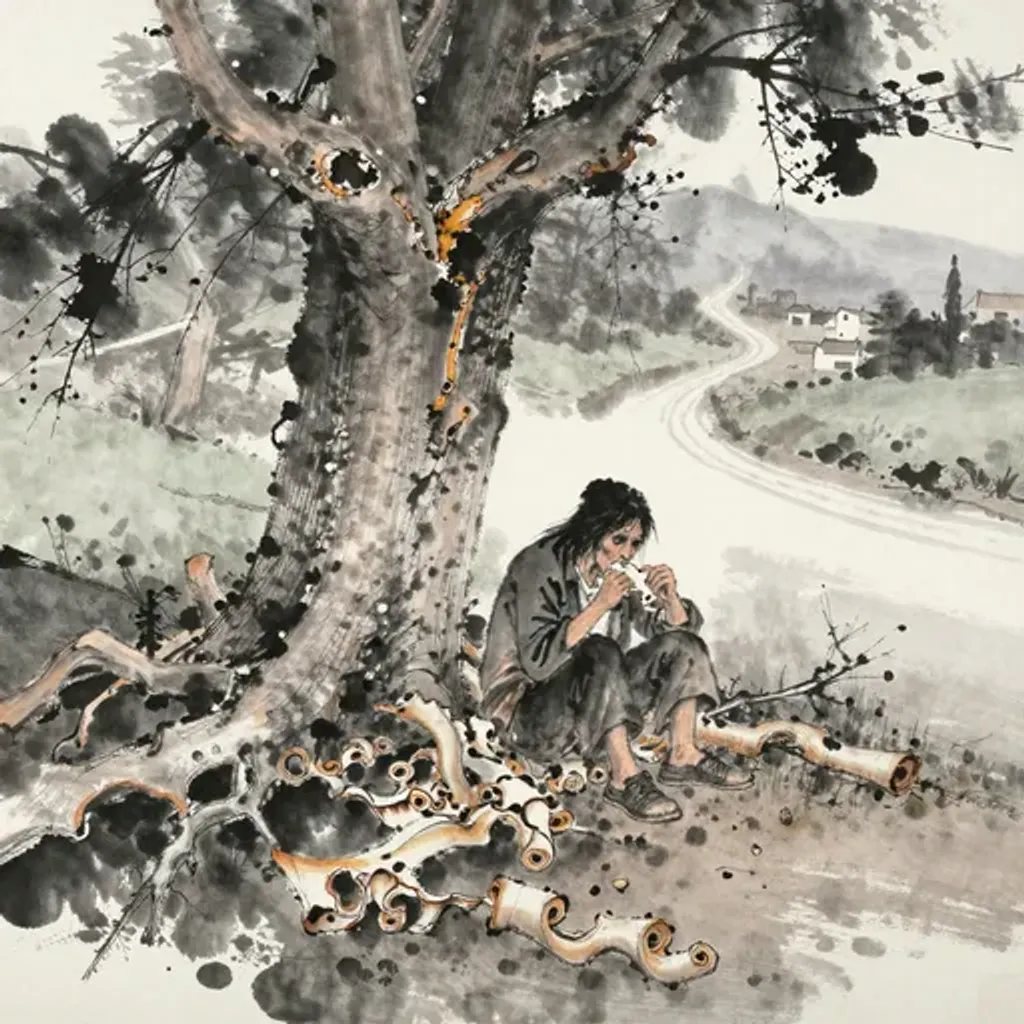
東行食榆,困於枯株,失妻无家,志窮為憂。
Traveling east, eating elm bark; stranded at a withered stump. Wife lost, home gone; ambition exhausted, only sorrow remains.
— Jiao Yanshou, Yilin (Forest of Changes), 1st century BC
Commentary
Fire rises above the earth, yet the traveler heading east finds only elm bark to eat, trapped among dead tree stumps. Wife lost, home gone, ambitions exhausted — nothing but worry remains. Eating elm bark was a classical sign of famine conditions: when even the trees are stripped for sustenance, civilization has collapsed to bare survival. The dead stumps compound the desolation — even the elms have been consumed. From Progress to Opposition, the transformation mirrors the alienation. Fire above and lake below pull in contrary directions, creating the estrangement that defines this hexagram. The man who has lost wife, home, and hope embodies Opposition's central condition: everything that should be united has split apart, and the eye sees only divergence.
晉 → 蹇
Hexagram 35 → Hexagram 39: Obstruction
Changing lines: 3, 4, 5, 6
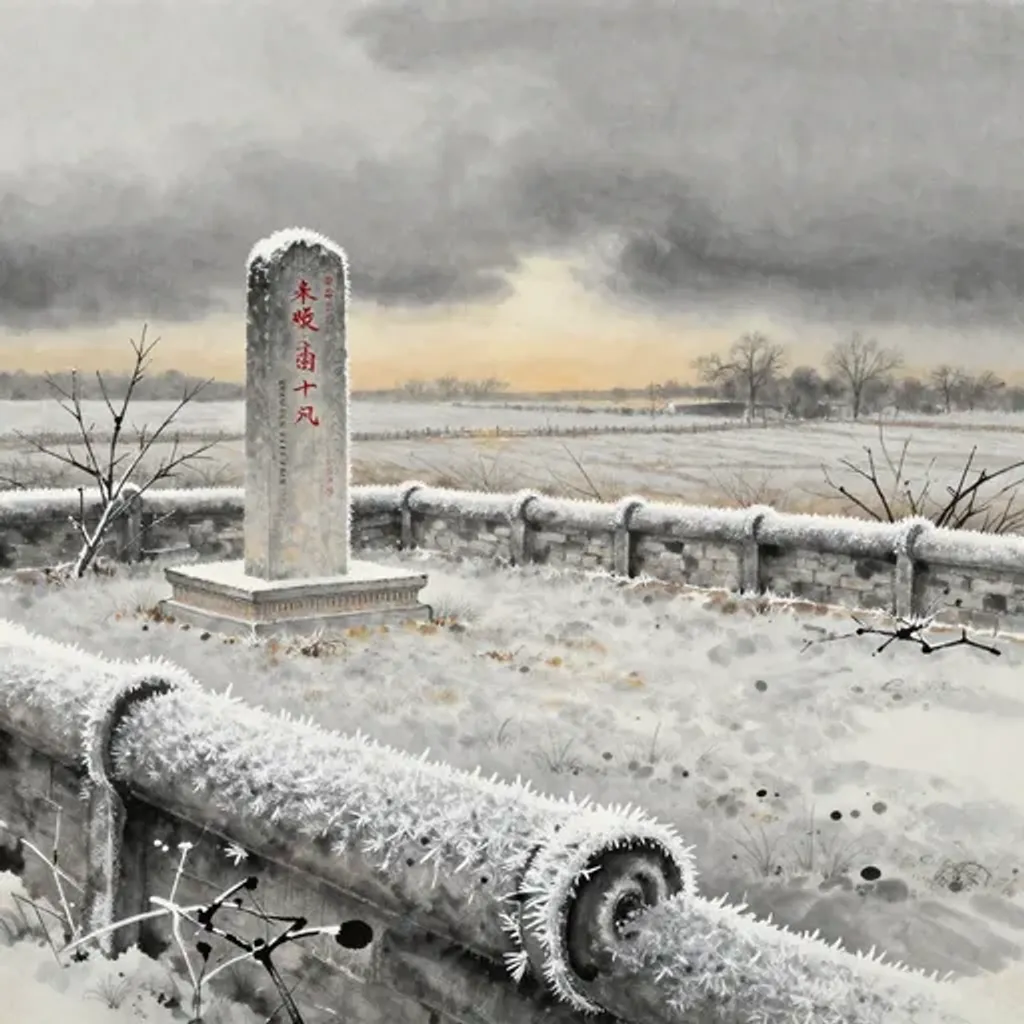
五經六紀,仁道所在,正月繁霜,獨不離咎。
The Five Classics and Six Bonds; where the way of benevolence resides. Yet thick frost falls in the first month; one alone cannot escape blame.
— Jiao Yanshou, Yilin (Forest of Changes), 1st century BC
Commentary
Fire rises above the earth, and the five classics and six principles mark where the Way of humanity resides. Yet frost falls thick in the first month of spring — a severe omen out of season. One cannot escape blame alone. Unseasonal frost in the first month violates the natural order: spring should bring warmth, not killing cold. In Han cosmological thought, such anomalies signaled governance failures — heaven sending warnings through disrupted seasons. The five classics and six principles represent the moral framework that should prevent such disorder. From Progress to Obstruction, the transformation deepens the warning. Water atop the mountain blocks the path forward. When moral principles exist in theory but frost strikes the land regardless, reflection and self-correction become the only viable response.
晉 → 解
Hexagram 35 → Hexagram 40: Deliverance
Changing lines: 2, 6
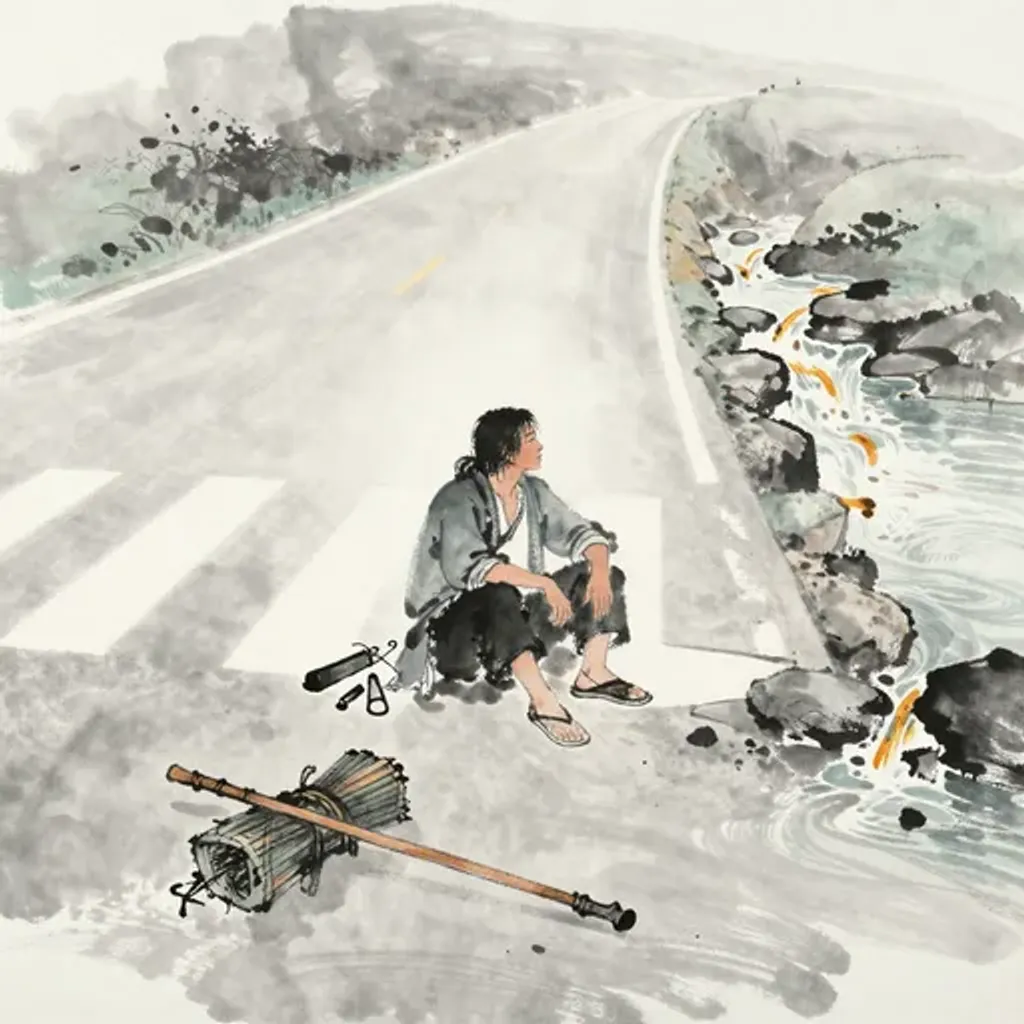
解緩不前,慆怠失便;二至之戎,家无禍凶,刻水象形,聞言不信。
Slack and hesitant, not advancing; idle and lax, the moment is lost. Warriors at the solstice; the house has no disaster. Carving water to make a shape; hearing words but not believing them.
— Jiao Yanshou, Yilin (Forest of Changes), 1st century BC
Commentary
Fire rises above the earth, but the pace slackens and forward motion halts. Laziness and delay cause opportunity to slip away. A military campaign reaches the solstice seasons without incident — the household escapes disaster. Yet someone carves on water to make a shape and, hearing words of warning, refuses to believe them. The verse juxtaposes complacency with futility: the sluggard who avoids catastrophe by luck, not skill, then ignores advice because nothing bad has happened yet. Carving on water — the perfect image of self-deception. From Progress to Deliverance, the transformation offers release, but only for those willing to act. Thunder and rain break the tension; forgiveness flows. Yet the one who will not hear warnings remains trapped in his own dissolving sculpture.
晉 → 損
Hexagram 35 → Hexagram 41: Decrease
Changing lines: 1, 2, 4
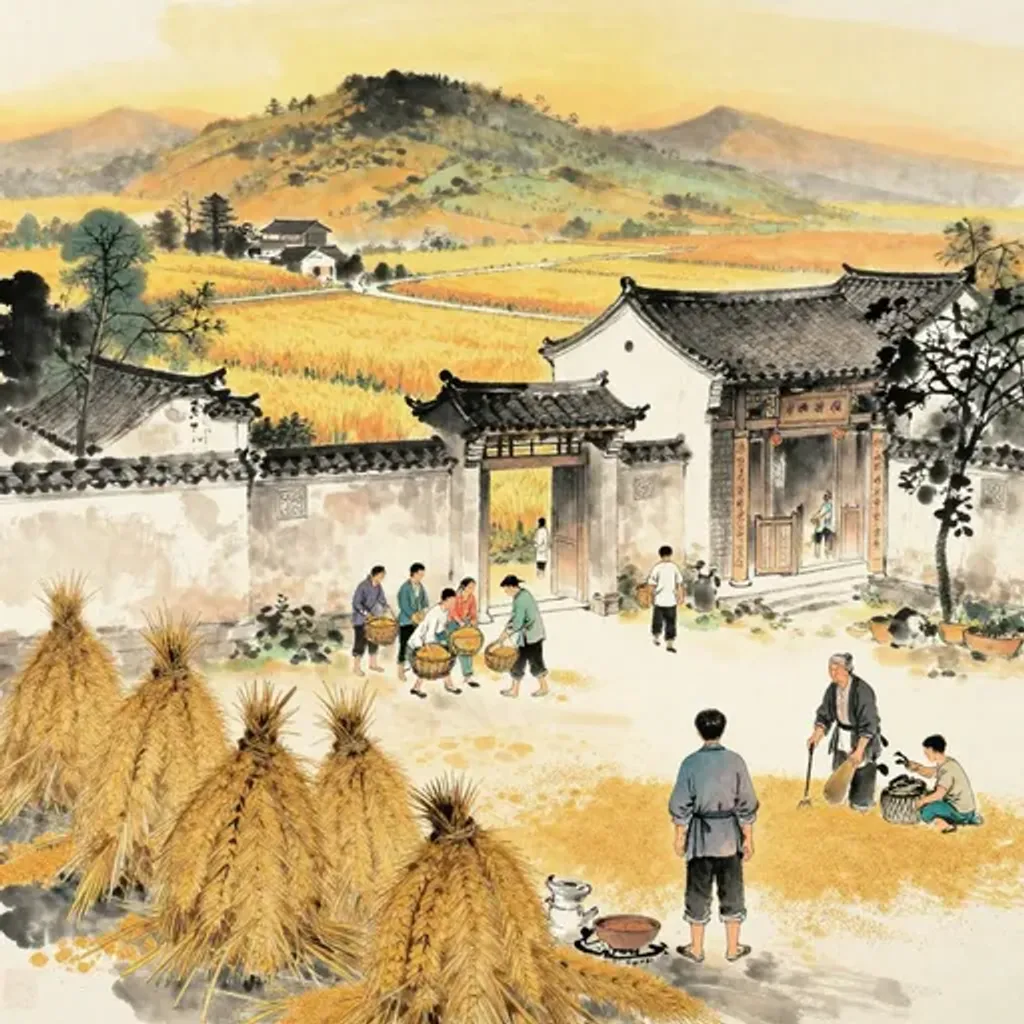
仁愛篤厚,不以所忿,害其所子,從我舊都,日益富有。
Benevolence and love, deep and generous; not letting one’s anger harm one’s children. Following me to the old capital; daily growing richer.
— Jiao Yanshou, Yilin (Forest of Changes), 1st century BC
Commentary
Fire rises above the earth, and a generous heart prevails. Benevolence and devotion run deep — one does not allow personal anger to harm one's own children. Returning to the old capital, wealth increases daily. The verse celebrates magnanimity: the parent who refuses to let resentment spill onto the next generation, choosing instead the steady path of returning to familiar ground and rebuilding. From Progress to Decrease, the transformation seems paradoxical but resolves beautifully. The mountain rises above the lake — the upper diminishes to benefit the lower. True decrease is not loss but redistribution: the father who restrains his anger enriches his household. By giving up vengeance, he gains prosperity. The old capital flourishes precisely because its ruler chose decrease of wrath over increase of conflict.
晉 → 益
Hexagram 35 → Hexagram 42: Increase
Changing lines: 1, 4, 5
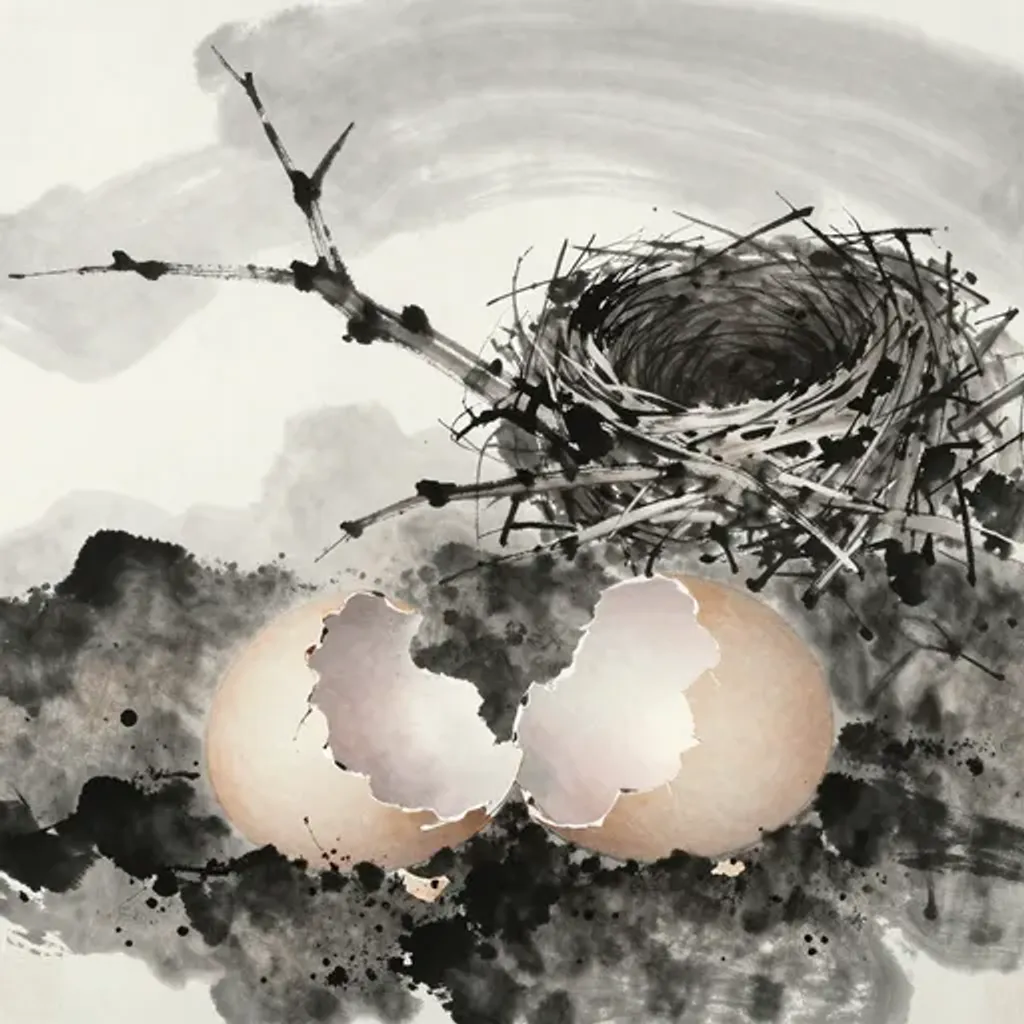
缺破不成,胎卵未生,弗見兆形。
Broken and incomplete; the egg not yet hatched. No sign or form to be seen.
— Jiao Yanshou, Yilin (Forest of Changes), 1st century BC
Commentary
Fire rises above the earth, but what lies ahead is broken and incomplete. The embryo has not formed, the egg has not hatched — no sign of life can yet be discerned. The verse is starkly minimal: three short phrases describing pure potentiality that has not yet crossed the threshold into actuality. Nothing is ready, nothing is visible, nothing can be predicted. From Progress to Increase, the transformation offers hope precisely because of this emptiness. Wind and thunder together stimulate growth — seeing good and moving toward it, recognizing faults and correcting them. The unhatched egg is not failure; it is the moment before Increase begins its work. What appears broken may simply be unfinished, awaiting the wind and thunder that will quicken it to life.
晉 → 夬
Hexagram 35 → Hexagram 43: Breakthrough
Changing lines: 1, 2, 3, 5, 6
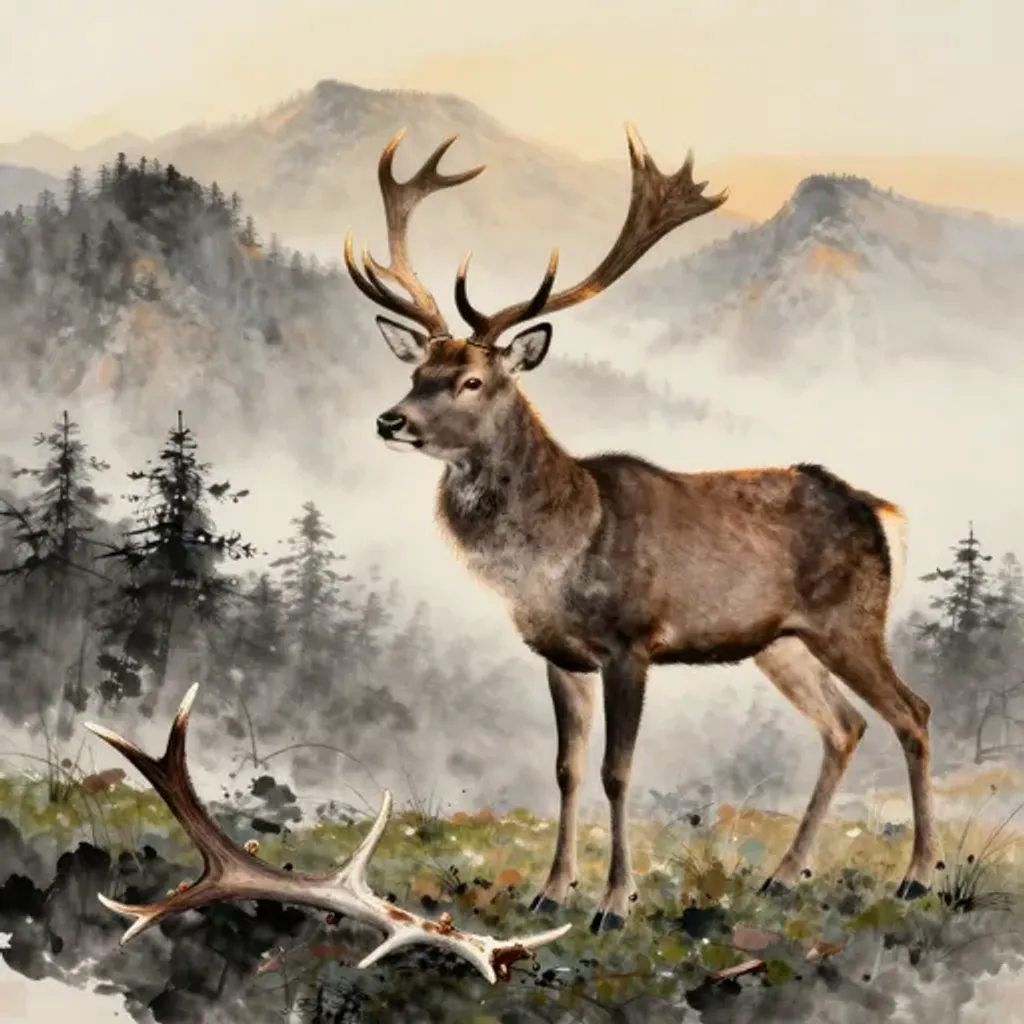
摧角不傷,雖折復長,秉德无騫,老賴榮光。
The horn is broken but not harmed; though snapped, it grows again. Holding fast to virtue without faltering; in old age, one still enjoys glory.
— Jiao Yanshou, Yilin (Forest of Changes), 1st century BC
Commentary
Fire rises above the earth, and a horn is battered but not broken. Though snapped, it grows back again. Holding fast to virtue without faltering, the elder enjoys glory in old age. The horn — symbol of authority and assertion — endures damage yet regenerates, an image of resilient character. The verse praises the person who absorbs setback without losing core integrity, whose moral foundation allows recovery from any blow. From Progress to Breakthrough, the transformation unleashes accumulated force. The lake rises above heaven — the decisive moment when stored water breaches the dam. The elder whose virtue survived repeated testing now channels that accumulated moral capital into a single, definitive expression. Breakthrough is earned, not seized: only unbroken character can sustain it.
晉 → 姤
Hexagram 35 → Hexagram 44: Coming to Meet
Changing lines: 2, 3, 5
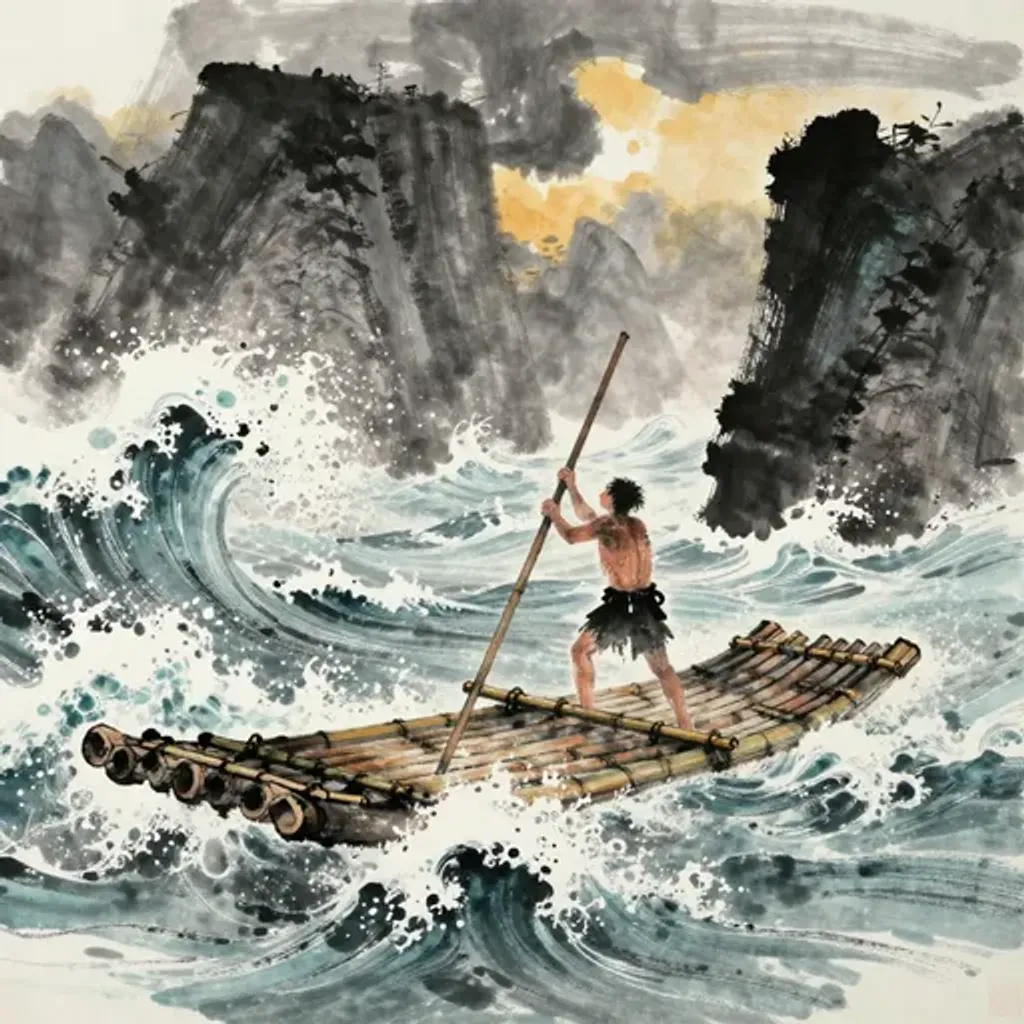
乘桴渡海,免脫厄中,雖困无咎。
Riding a raft across the sea; delivered from the midst of peril. Though beset, no blame.
— Jiao Yanshou, Yilin (Forest of Changes), 1st century BC
Commentary
Fire rises above the earth, and a figure rides a raft across the sea, escaping mortal danger. Though beset by hardship, no blame attaches. The image of 'riding a raft across the sea' carries deep resonance in Chinese thought: Confucius once mused that if the Way could not prevail, he might 'ride a raft upon the sea.' It represents the ultimate withdrawal — abandoning the failed mainland for the unknown deep. From Progress to Coming to Meet, the transformation reveals what waits on the other shore. Wind moves beneath heaven, and the sovereign issues commands to the four directions. The fugitive who escapes by raft does not merely survive — he arrives at a new dispensation. What appears as flight from danger is actually the first step toward an unexpected encounter with renewed authority.
晉 → 萃
Hexagram 35 → Hexagram 45: Gathering Together
Changing lines: 5, 6
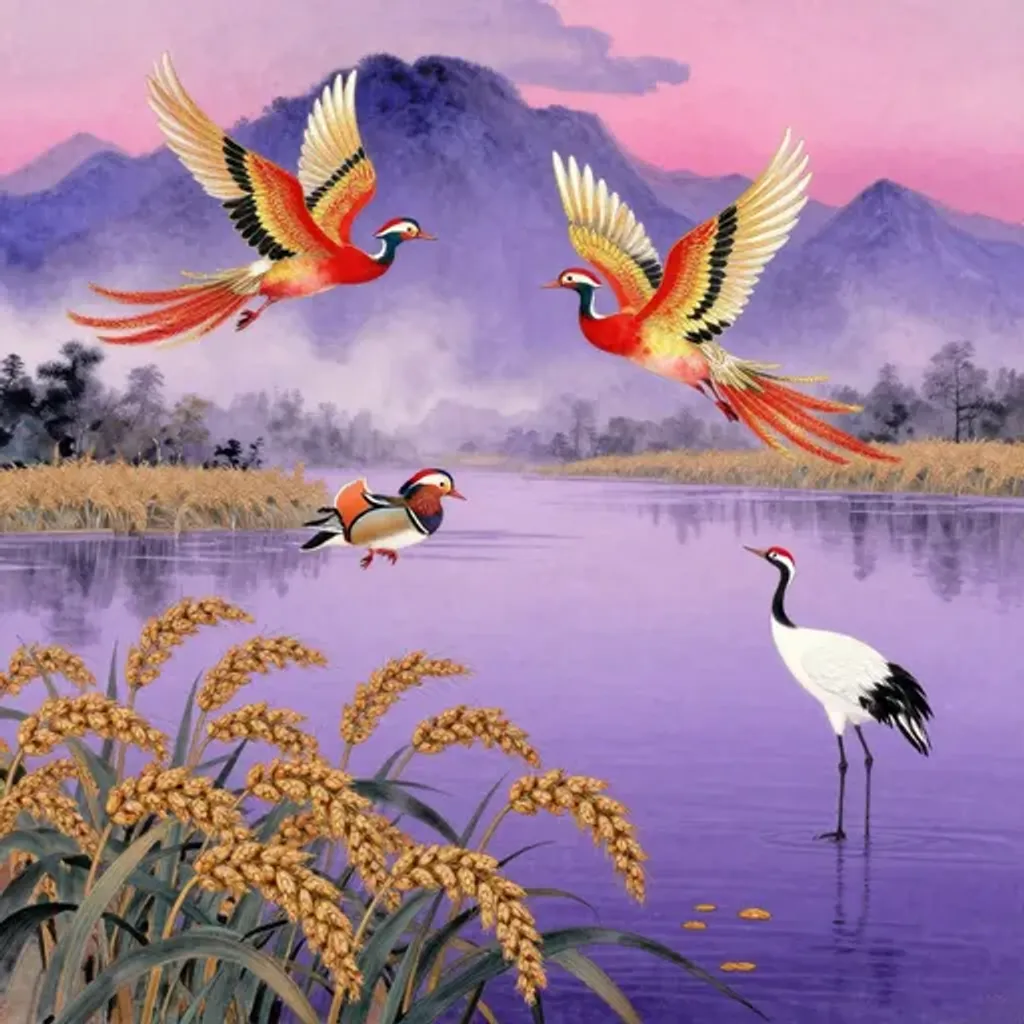
孔鸞鴛雛,鵁鵝鵜鴣,翱翔紫淵,嘉禾之圃,君子以娛。
Peacock, phoenix, mandarin chick; night heron, ibis, turtledove. Soaring above the purple pool; in the garden of fine grain. The gentleman takes his delight.
— Jiao Yanshou, Yilin (Forest of Changes), 1st century BC
Commentary
Fire rises above the earth, and the air fills with auspicious birds: phoenixes, mandarin ducks, fledglings, and waterfowl soar and glide above a purple pool amid gardens of excellent grain. The gentleman takes delight in this spectacle. Every bird in this verse signals blessing: the phoenix appears only under sage rule, mandarin ducks symbolize faithful partnership, and the garden of fine grain represents material abundance. From Progress to Gathering, the transformation completes the image. The lake gathers upon the earth — people and blessings naturally converge. The paradise garden where rare birds congregate is Gathering made visible: when conditions are right, all precious things assemble of their own accord. The gentleman's joy is the recognition that genuine prosperity attracts rather than compels.
晉 → 升
Hexagram 35 → Hexagram 46: Pushing Upward
Changing lines: 2, 3, 4, 6
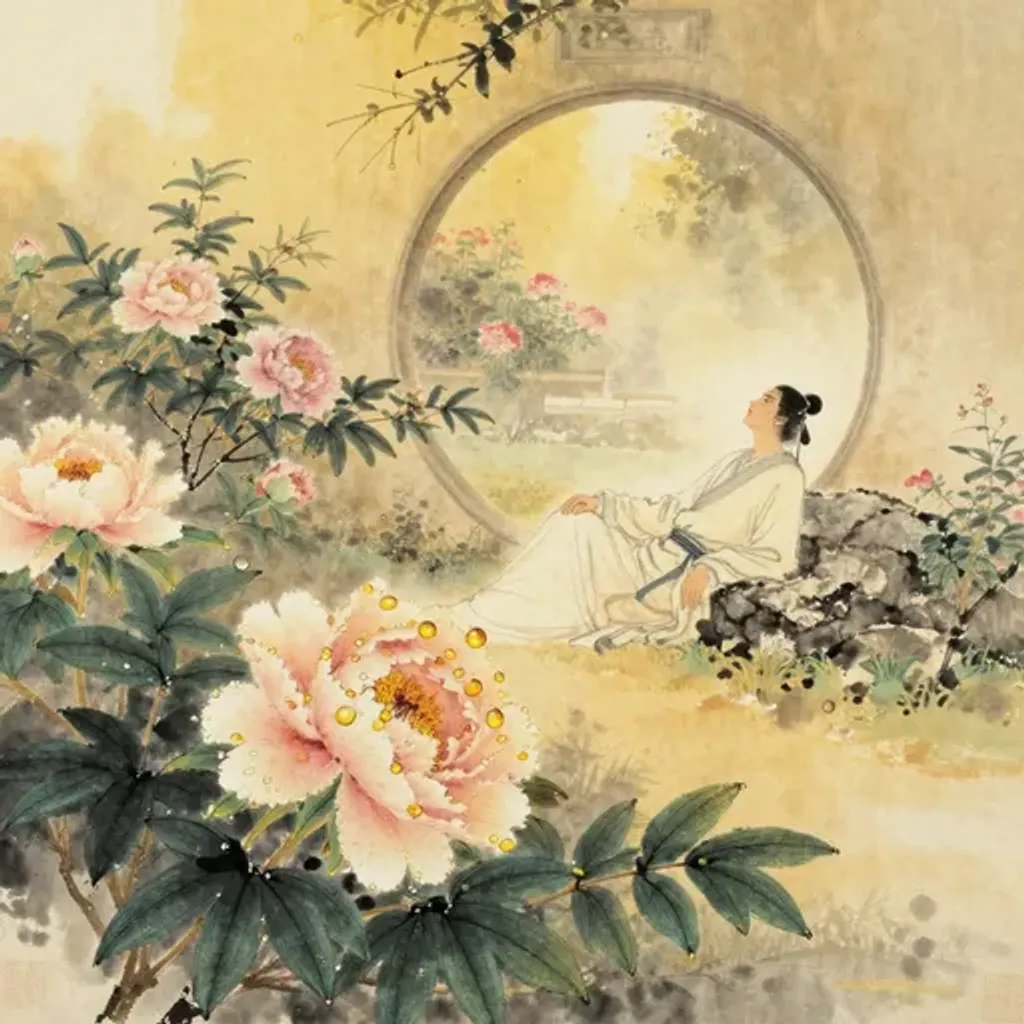
眾來得願,甘露溫潤,樂易君子,不逢禍亂。
The multitudes arrive, wishes fulfilled; sweet dew falls warm and moist. The contented gentleman at ease; he encounters no disaster or upheaval.
— Jiao Yanshou, Yilin (Forest of Changes), 1st century BC
Commentary
Fire rises above the earth, and the multitudes arrive, their wishes fulfilled. Sweet dew descends, warm and nourishing, and the genial gentleman encounters no turmoil or disaster. Sweet dew (ganlu) in Han political cosmology was the ultimate auspicious omen: heaven literally dripping nectar upon a virtuous realm. Its appearance confirmed that the ruler's moral cultivation had harmonized heaven and earth. From Progress to Pushing Upward, the transformation traces the mechanics of this blessing. Wood grows within the earth, rising patiently, accumulating small gains into great height. The sweet dew does not fall upon the ambitious — it falls upon the one who grew steadily upward through accumulated virtue, like a tree that ascends from within the soil without ever forcing its way.
晉 → 困
Hexagram 35 → Hexagram 47: Oppression
Changing lines: 2, 5, 6
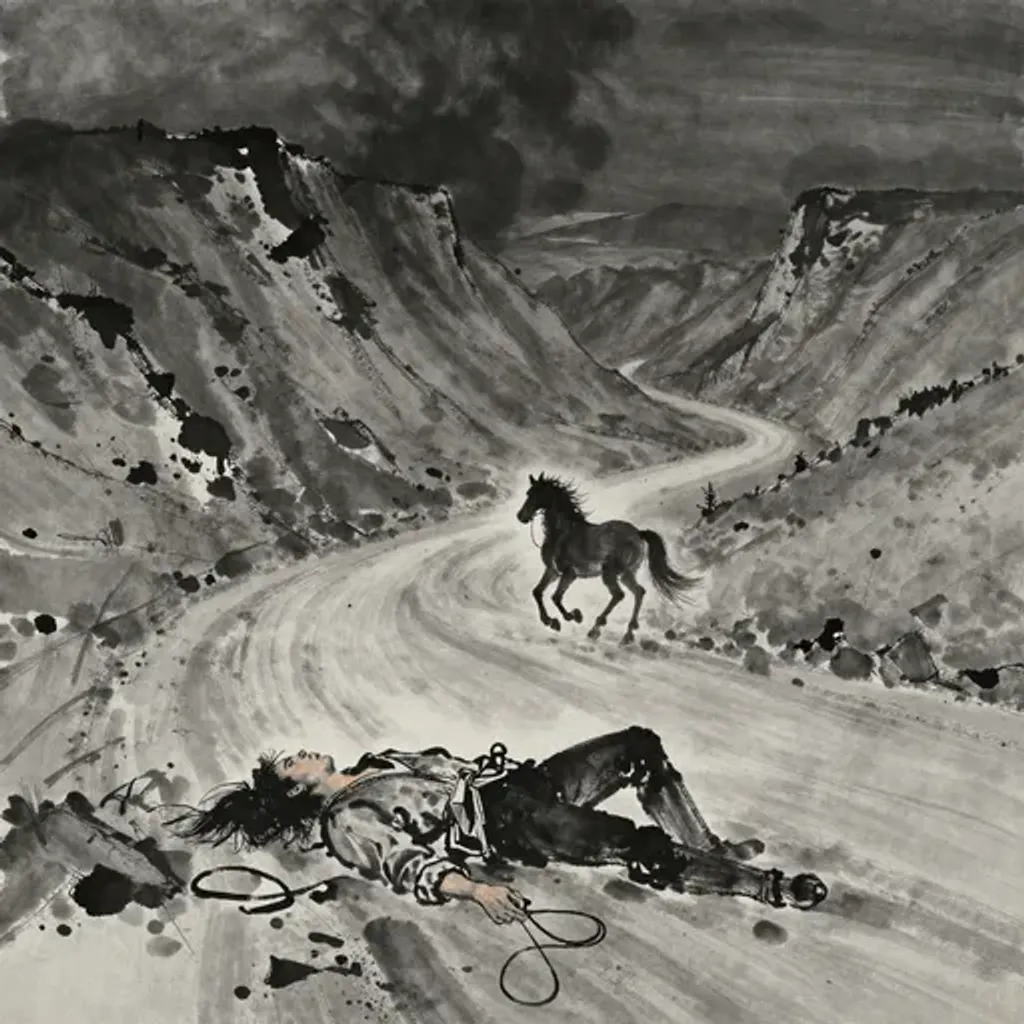
東騎墮落,千里獨宿,高岸為谷,陽失其室。
Riding eastward, thrown and fallen; a thousand li, sleeping alone. The high bank becomes a valley; yang loses its dwelling.
— Jiao Yanshou, Yilin (Forest of Changes), 1st century BC
Commentary
Fire rises above the earth, but the eastbound rider falls from his mount and spends the night alone a thousand li from home. High banks collapse into valleys — the ancient Shijing image of cosmic reversal — and the yang force loses its dwelling. Every image here inverts: the rider thrown, the cliff becoming a gorge, the bright force losing its home. From Progress to Oppression, the transformation enacts the fall. The lake has no water — the most desolate image in the Yi. The rider cast down from his horse a thousand li from anyone mirrors the lake drained of its essence. Oppression's teaching is to maintain one's word even when utterly spent: the gentleman achieves his aim through will alone when every external support has vanished.
晉 → 井
Hexagram 35 → Hexagram 48: The Well
Changing lines: 2, 3, 4, 5, 6
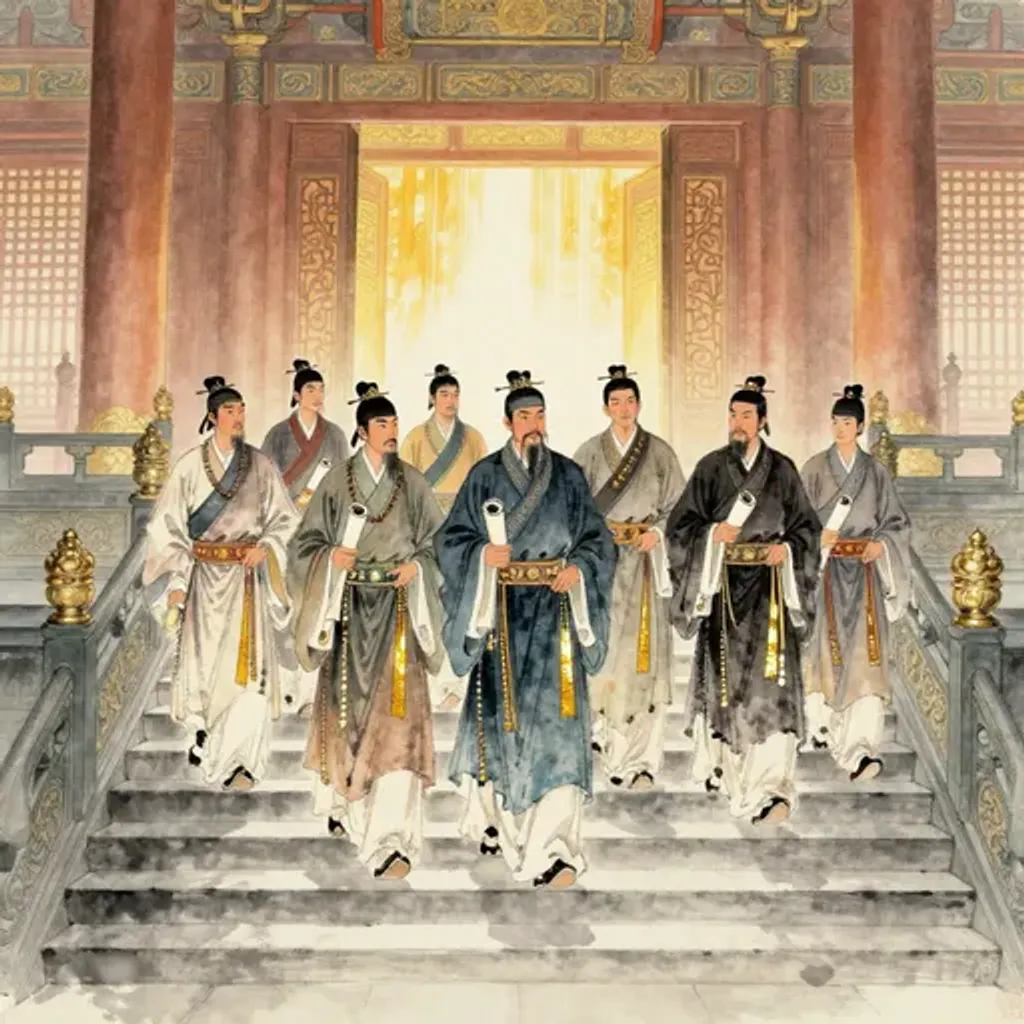
八才既登,以成善功,厖降庭堅,國无憂凶。
Eight talents all ascend; thereby achieving great merit. Pang descends, Ting Jian serves; the state knows no sorrow or misfortune.
— Jiao Yanshou, Yilin (Forest of Changes), 1st century BC
Commentary
Fire rises above the earth, and the eight worthies have ascended to office, accomplishing excellent governance. The 'eight talents' likely refers to the 'Eight Exemplaries and Eight Able Ministers' (八元八愷) of legendary Emperor Shun's reign — sixteen virtuous officials who brought order to the world. Pang descends to the court, upright and firm, and the nation knows neither worry nor misfortune. From Progress to the Well, the transformation reveals the mechanism of enduring prosperity. Water drawn up through wood — the well that never moves yet serves the entire community. Like Shun's ministers who formed the infrastructure of good governance, the well provides nourishment without seeking credit. The state prospers because its institutional foundations run deep and remain in place.
晉 → 革
Hexagram 35 → Hexagram 49: Revolution
Changing lines: 1, 3, 5, 6
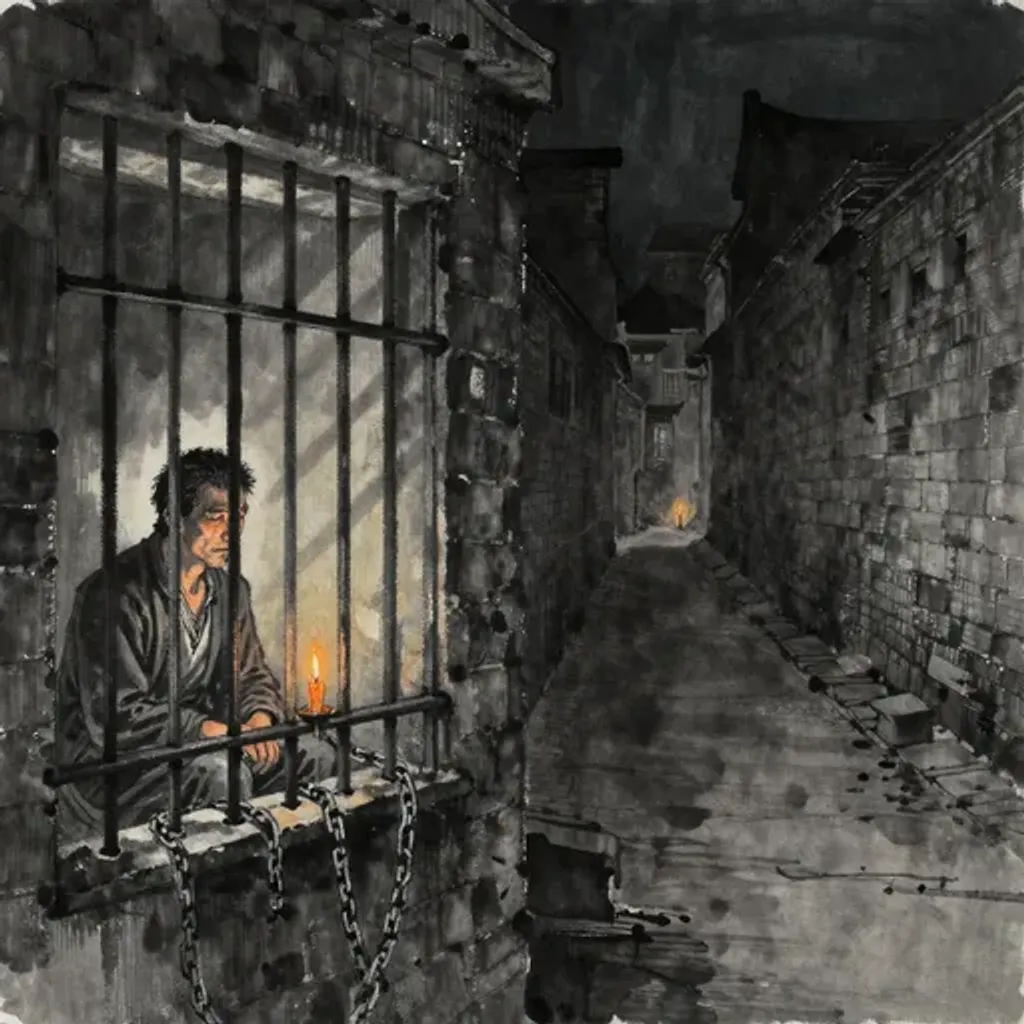
邯鄲反言,父兄生患,竟涉憂恨,卒死不還。
Handan’s words are turned against them; father and elder brother are imperiled. In the end, engulfed in sorrow and resentment; they die and do not return.
— Jiao Yanshou, Yilin (Forest of Changes), 1st century BC
Commentary
Fire rises above the earth, but from Handan come words of betrayal. Father and brother are plunged into crisis; the affair drags through anguish and resentment until death, with no return. Handan, capital of the state of Zhao, was a byword for political treachery during the Warring States period — the site of broken promises, hostage crises, and power struggles. 'Reversing words' (反言) implies promises broken or testimony recanted, generating cascading harm to one's own kin. From Progress to Revolution, the transformation enforces accountability. Fire within the lake — incompatible elements that must resolve through fundamental change. When words are reversed and family bonds shattered, the only path forward is complete upheaval. Revolution demands that the old order be burned away before trust can be rebuilt.
晉 → 鼎
Hexagram 35 → Hexagram 50: The Cauldron
Changing lines: 2, 3
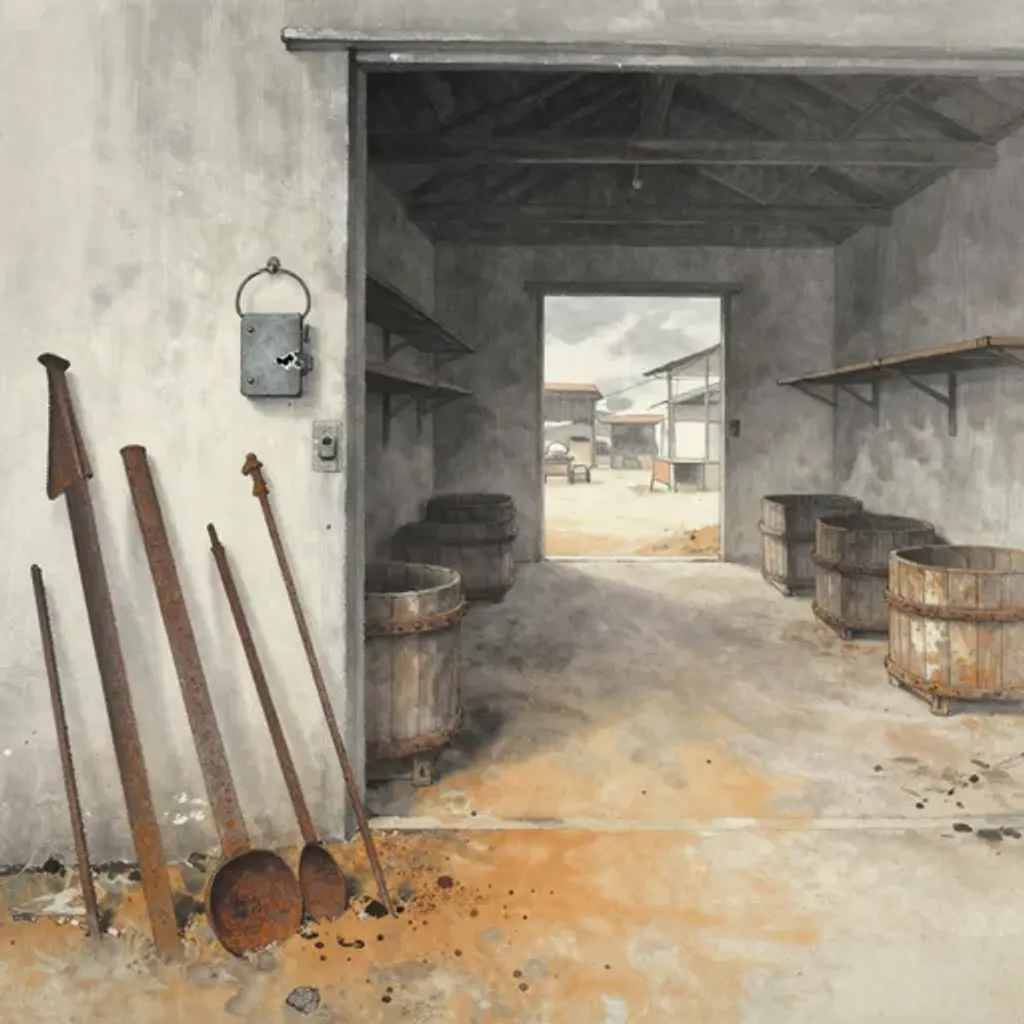
五銳鐵頤,倉庫空虛,賈市无盈,與利為仇。
Five sharp blades, iron jaws; the granaries stand empty. The market holds no profit; with gain it is at war.
— Jiao Yanshou, Yilin (Forest of Changes), 1st century BC
Commentary
Fire rises above the earth, yet the scene below is grim. Five sharp iron blades replace proper jaw-bones — an image of harsh instruments substituted for natural function. Granaries and storehouses stand empty, the market yields no profit, and commerce becomes the enemy of prosperity rather than its engine. The 'five sharp iron jaws' may allude to oppressive taxation or military requisition that strips the economy bare: blades where there should be nourishment, emptiness where there should be abundance. From Progress to the Cauldron, the transformation offers a corrective. Fire above wood in the Cauldron refines raw material into something civilized. But when the raw materials have been consumed by iron jaws, the cauldron has nothing to cook. The vessel of transformation stands empty.
晉 → 震
Hexagram 35 → Hexagram 51: The Arousing Thunder
Changing lines: 1, 6
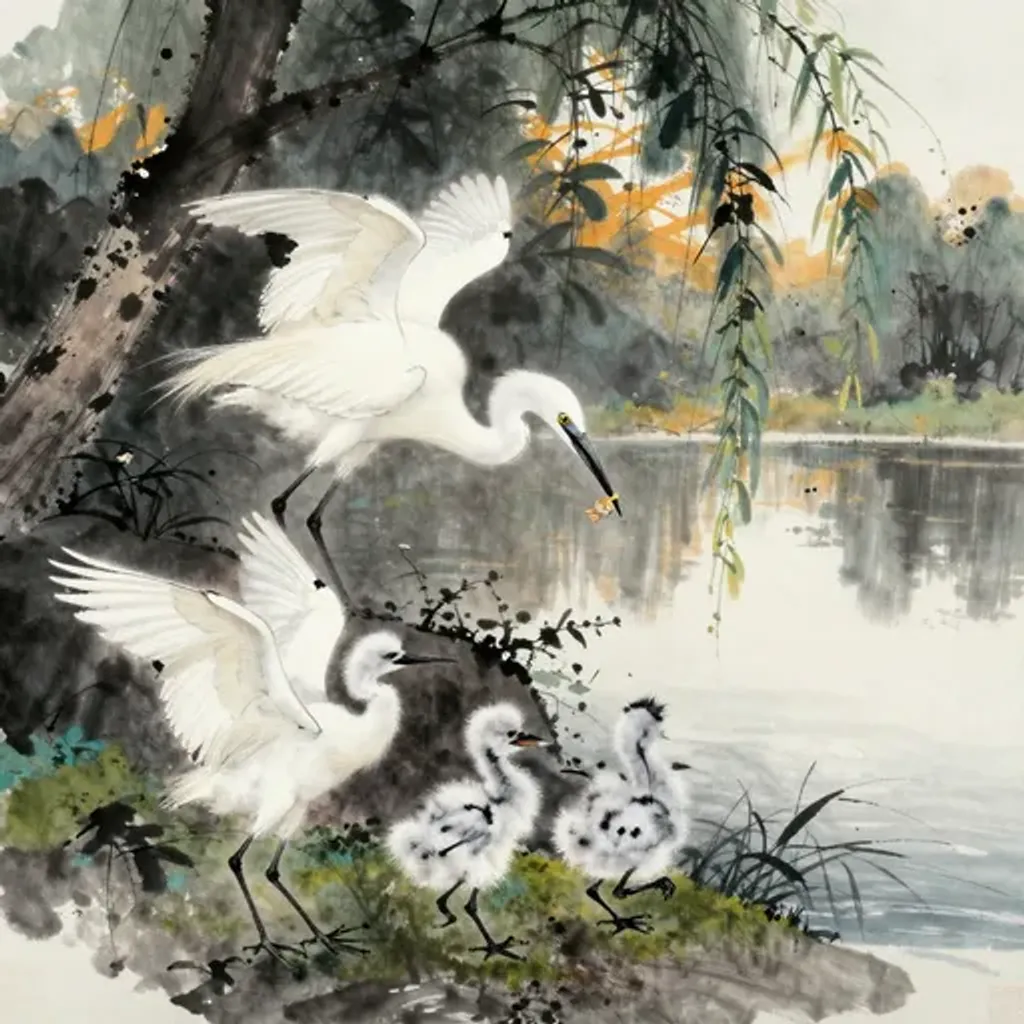
白鳥衘餌,鳴呼其子,施技張翅,來從其母。
The white bird carries food in its beak; it calls out to its young. Spreading their skill, stretching their wings; they come to follow their mother.
— Jiao Yanshou, Yilin (Forest of Changes), 1st century BC
Commentary
Fire rises above the earth, and a white bird carries food in its beak, calling out to its young. It spreads its wings and demonstrates its skills, and the fledglings come flocking to their mother. The verse is a pure domestic idyll: the mother bird teaching her young to fly and feed, the family unit functioning in natural harmony. Every gesture — the call, the offering, the display of technique — serves the next generation. From Progress to the Arousing, the transformation adds sudden energy to this gentle scene. Doubled thunder shakes the ground: the moment the fledglings leave the nest and take their first terrified, exhilarating flight. The mother's patient teaching culminates in the thunderclap of independent action. Nurture prepares; the Arousing ignites.
晉 → 艮
Hexagram 35 → Hexagram 52: Keeping Still Mountain
Changing lines: 3, 4
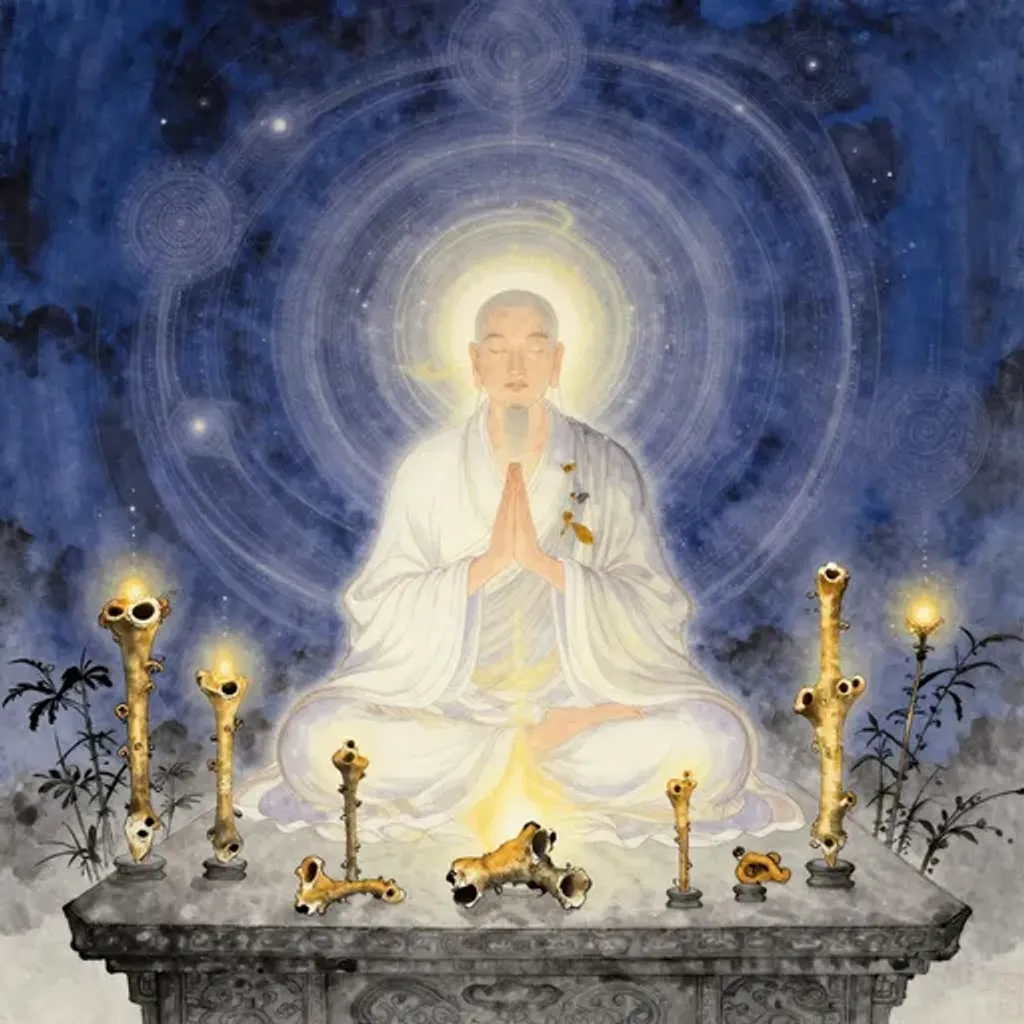
學靈三年,聖且明神。先見善祥,嘉吉福慶,餌吉知來,告我无咎。
Studying the numinous for three years; sagely and divinely illumined. Foreseeing auspicious signs; blessed with good fortune and celebration. Consulting the oracle, knowing what is to come; it tells me there is no blame.
— Jiao Yanshou, Yilin (Forest of Changes), 1st century BC
Commentary
Fire rises above the earth, and after three years of studying the spirit arts, the adept becomes sagely and divinely perceptive. Auspicious signs appear in advance, blessings and good fortune gather, and through ingesting sacred substances one gains foreknowledge of what is to come — 'there will be no blame.' The verse describes a ritual practitioner or diviner whose training has granted genuine insight into the patterns of fate. From Progress to Keeping Still, the transformation clarifies the nature of this wisdom. Twin mountains, perfectly still — thought that does not exceed its proper sphere. The seer who studies for three years does not grasp at omniscience but learns where the boundary of knowledge lies. True divination is stillness recognizing pattern, not ambition seizing control.
晉 → 漸
Hexagram 35 → Hexagram 53: Development
Changing lines: 3, 4, 5
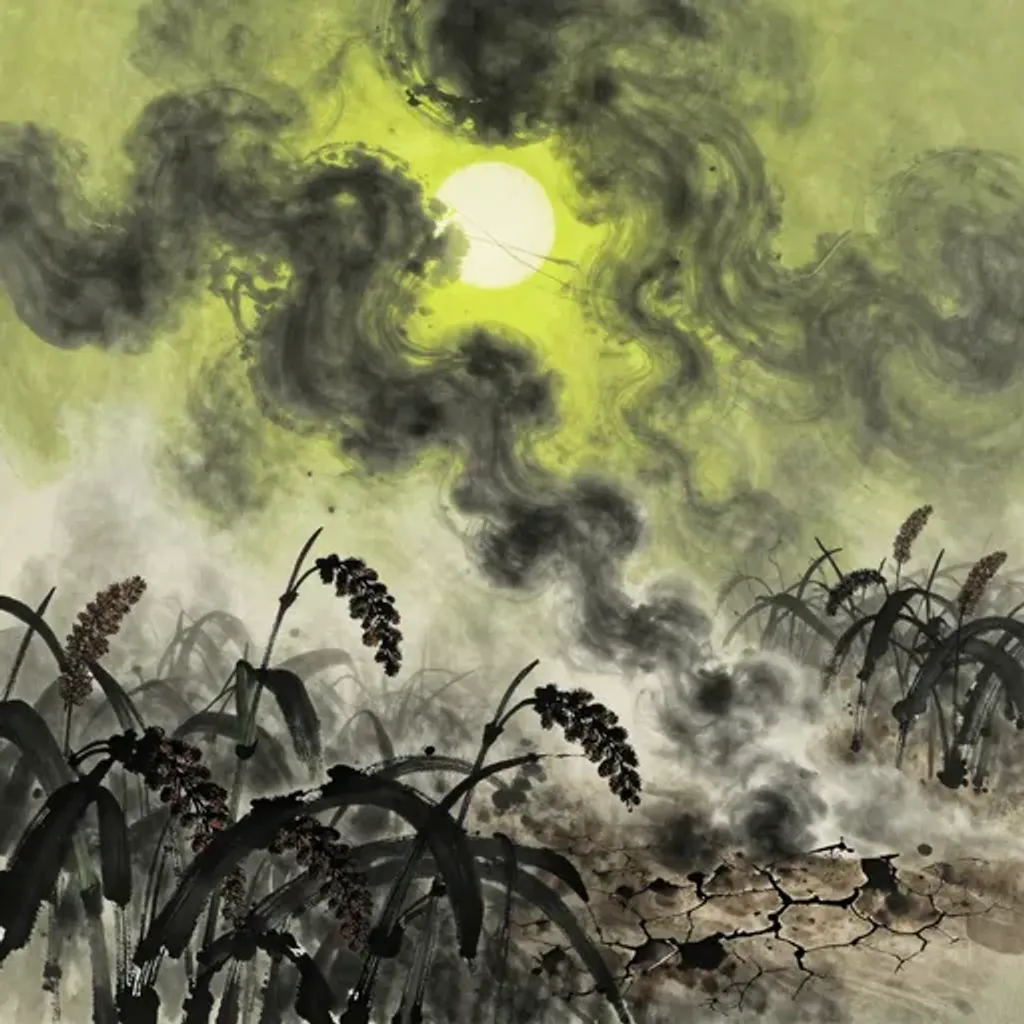
雲孽蒸起,失其道理。傷害年穀,神君之精。
Baleful vapors steam upward; the proper way is lost. The year’s grain is harmed; the spirit lord’s essence is wounded.
— Jiao Yanshou, Yilin (Forest of Changes), 1st century BC
Commentary
Fire rises above the earth, but ominous vapors steam upward, disrupting the natural order. The year's harvest is damaged, and the essence of the spirit lords is disturbed. 'Cloud-omens' (yun nie) in Han cosmology were atmospheric anomalies — strange cloud formations or miasmic vapors — that signaled disruptions in the cosmic balance. When these vapors 'lose their proper pattern,' the agricultural cycle suffers and the spiritual harmony between heaven and earth fractures. From Progress to Development, the transformation suggests the slow repair that must follow. Trees grow gradually upon the mountain in Development's image: patient cultivation over seasons, not dramatic intervention. After the harvest fails and the spirits are disturbed, only the steady, incremental work of restoring natural rhythms can heal the land.
晉 → 歸妹
Hexagram 35 → Hexagram 54: The Marrying Maiden
Changing lines: 1, 2, 6
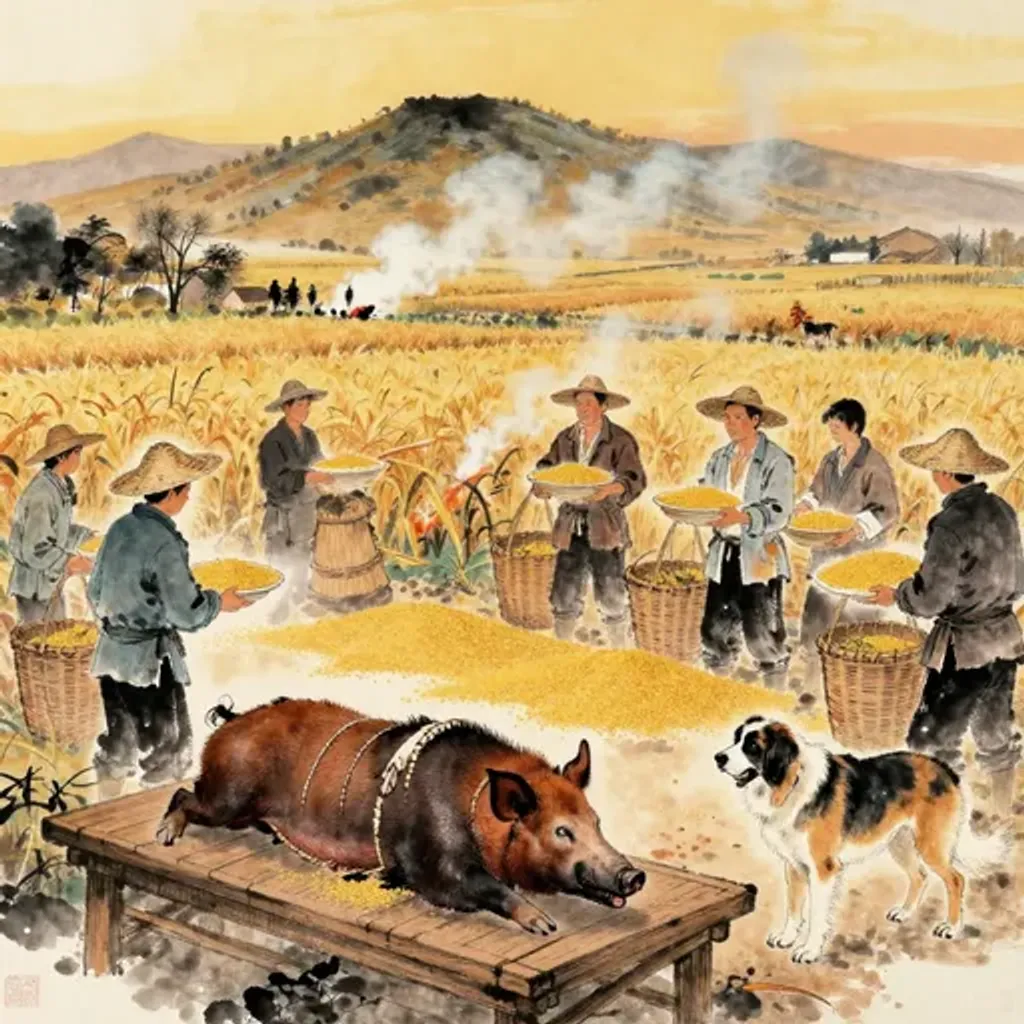
春耕有息,秋入利福。獻𧲨大𤡆,以樂成功。
Spring plowing brings rest; autumn’s harvest yields fortune’s blessing. Offering the great boar and fierce hound; rejoicing in the accomplishment.
— Jiao Yanshou, Yilin (Forest of Changes), 1st century BC
Commentary
Fire rises above the earth, and the seasonal cycle completes its arc. Spring plowing gives way to rest; autumn's harvest brings bounty and blessing. A great beast is offered in sacrifice to celebrate the year's success. The verse follows the agricultural calendar from sowing to reaping to thanksgiving — the rhythm that sustains civilization. The sacrificial animal confirms that abundance is not hoarded but shared with heaven and community. From Progress to the Marrying Maiden, the transformation adds a social dimension to this natural cycle. Thunder above the lake signals the consummation of alliances — the harvest celebration becomes a wedding feast. Just as the agricultural year culminates in offering, social bonds are sealed through ritual exchange. Seasonal progress and human union mirror each other.
晉 → 豐
Hexagram 35 → Hexagram 55: Abundance
Changing lines: 1, 3, 6
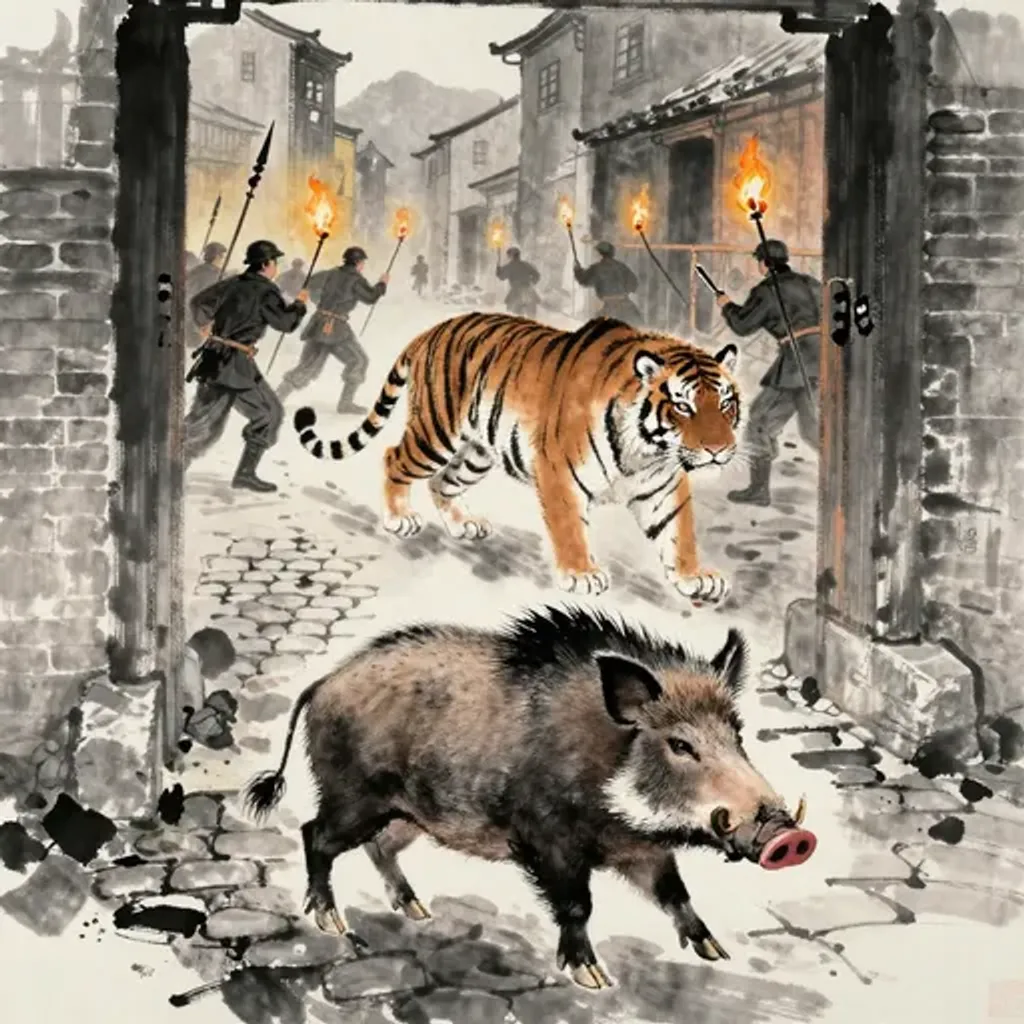
羸豕躑躅,虎入都邑。遮遏左右,國門勑至。
The lean boar stamps and paces; the tiger enters the capital. It blocks the way left and right; an urgent decree reaches the city gate.
— Jiao Yanshou, Yilin (Forest of Changes), 1st century BC
Commentary
Fire rises above the earth, but a scrawny pig stamps its hooves in agitation, and a tiger enters the capital. Roads are blocked on all sides, and an urgent edict arrives at the city gates. The 'lean pig stamping' (lei shi zhizhu) echoes the I-Ching's own hexagram 43 line imagery, suggesting pent-up frustration before a breakthrough — but here the breakthrough is violent. The tiger in the city is among the most alarming images in Chinese omen literature: a wild predator breaching civilized space signals total collapse of order. From Progress to Abundance, the transformation amplifies the crisis to its peak. Thunder and lightning strike simultaneously — the moment of maximum power and maximum danger. Abundance without governance becomes the tiger loose in the streets.
晉 → 旅
Hexagram 35 → Hexagram 56: The Wanderer
Changing lines: 3
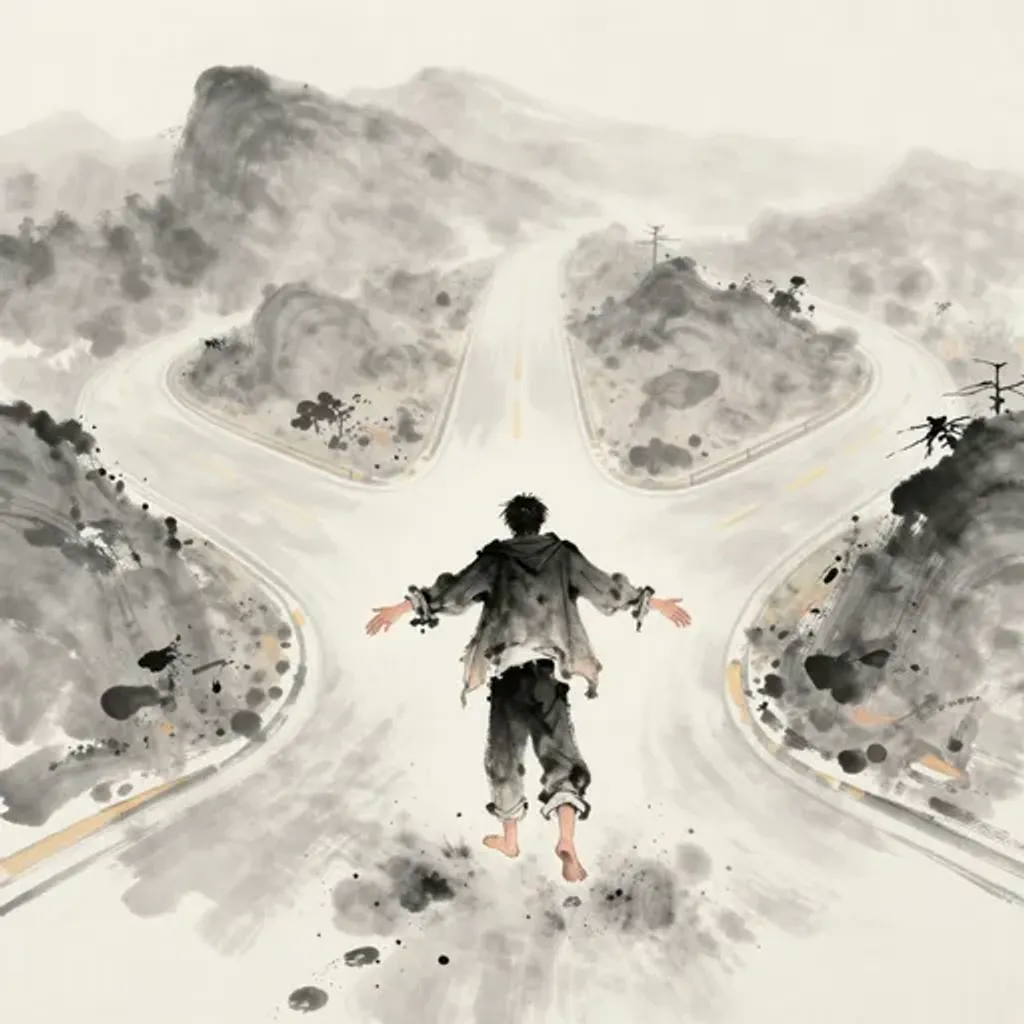
東行西維,南北善迷,逐旅失群,亡我襦衣。
Heading east, veering west; north and south easily confused. Chasing the company, losing the group; my lined jacket and robe are lost.
— Jiao Yanshou, Yilin (Forest of Changes), 1st century BC
Commentary
Fire rises above the earth, but the traveler is hopelessly lost. Heading east yet veering west, going south yet confused with north — wandering without direction. Separated from the caravan, the group lost, even clothing is stripped away. The verse describes complete disorientation: not merely being lost but losing the very capacity to orient oneself. Without companions, without provisions, without even a coat, the wanderer is reduced to bare existence. From Progress to the Wanderer, the transformation doubles the displacement. Fire upon the mountain — the traveler's small flame flickering on a foreign peak. The Wanderer hexagram teaches careful, modest behavior in unfamiliar territory, but this figure has passed beyond even that: lost, alone, stripped bare. Progress that loses its compass becomes pure wandering.
晉 → 巽
Hexagram 35 → Hexagram 57: The Gentle Wind
Changing lines: 2, 3, 4, 5
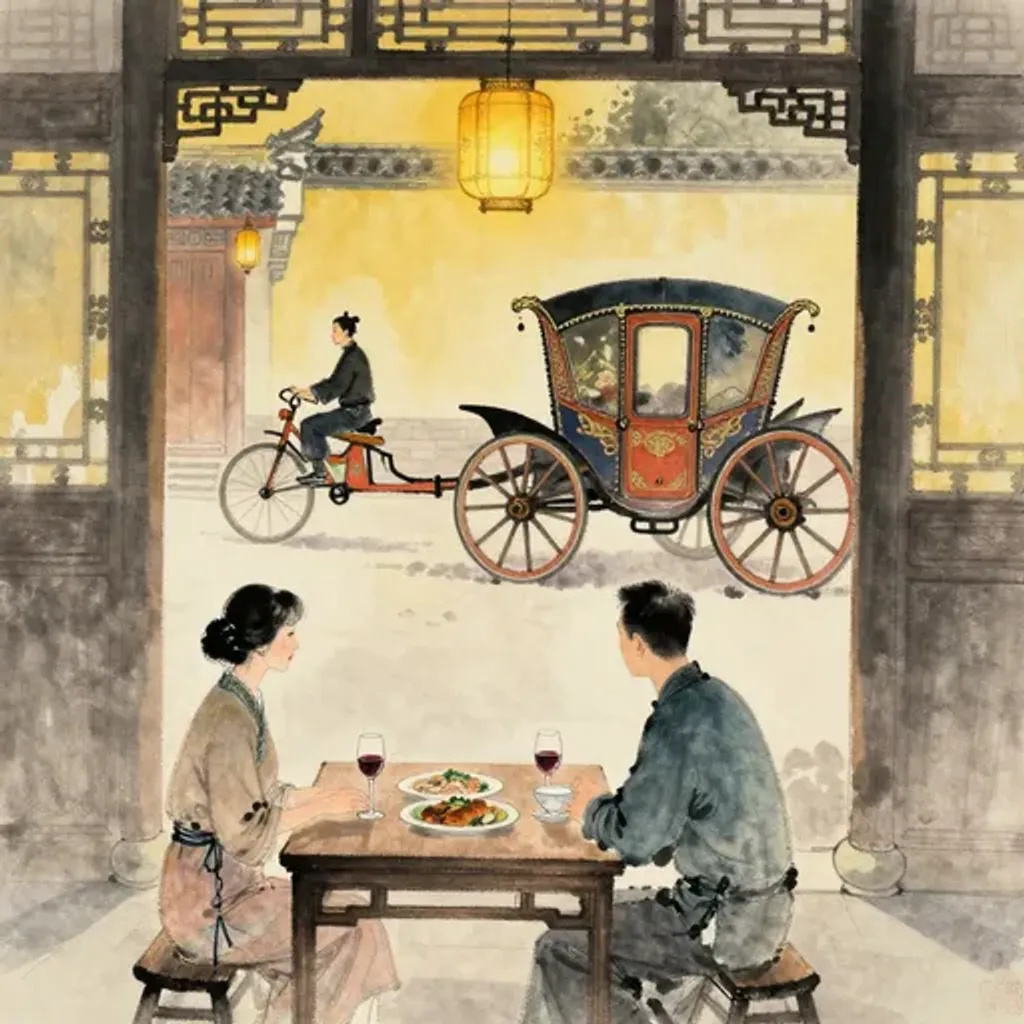
居室之倫,夫婦和親,小人乘車,碩果失豢。
The household in proper order; husband and wife in gentle accord. The petty man rides in the carriage; the great fruit loses its keeping.
— Jiao Yanshou, Yilin (Forest of Changes), 1st century BC
Commentary
Fire rises above the earth, and domestic order prevails: the household maintains proper relations, husband and wife live in affectionate harmony. But then the verse pivots — the petty man rides in a carriage while the great fruit loses its enclosure. When unworthy people rise to positions of visible privilege, the natural order inverts: what should be nourished and protected (the 'great fruit,' shuo guo, echoing the last yang line of hexagram 23) is instead left exposed and lost. From Progress to the Gentle, the transformation operates through quiet infiltration. Doubled wind penetrates everywhere, issuing commands that spread through every crevice. The Gentle's power is subtle: the petty man who rides the carriage does not seize it by force but slips into place gradually, like wind through an unsealed door.
晉 → 兌
Hexagram 35 → Hexagram 58: The Joyous Lake
Changing lines: 1, 2, 5, 6
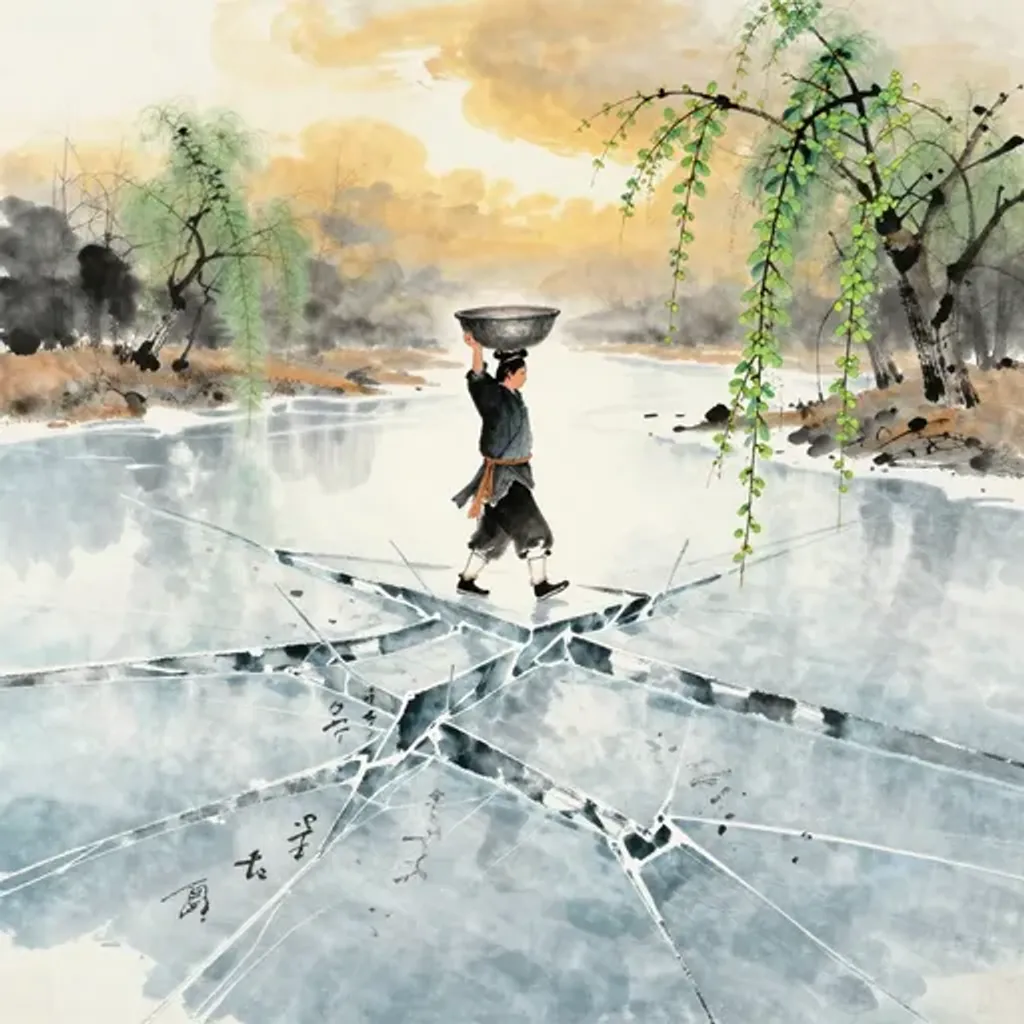
東方孟春,乘冰戴盆,懼危不安,終身所歡。
The east, the first month of spring; treading on ice, carrying a basin. Fearful and uneasy in danger; yet it becomes a lifetime’s joy.
— Jiao Yanshou, Yilin (Forest of Changes), 1st century BC
Commentary
Fire rises above the earth, and the eastern quarter brings the first month of spring. But the ice has not yet melted, and one must walk upon it while balancing a basin on one's head — a precarious feat requiring absolute concentration. Fear and instability pervade the journey, yet the verse resolves: what begins in danger ends as lifelong joy. 'Walking on ice with a basin' captures the essence of transition: spring has officially arrived but winter's hazards remain, demanding extraordinary care. From Progress to the Joyous, the transformation completes the arc from fear to delight. Doubled lakes reflect each other — friends learning together in mutual encouragement. The joy at the end is not despite the danger but earned through it. Those who balance carefully through the thawing season arrive at genuine, lasting happiness.
晉 → 渙
Hexagram 35 → Hexagram 59: Dispersion
Changing lines: 2, 4, 5
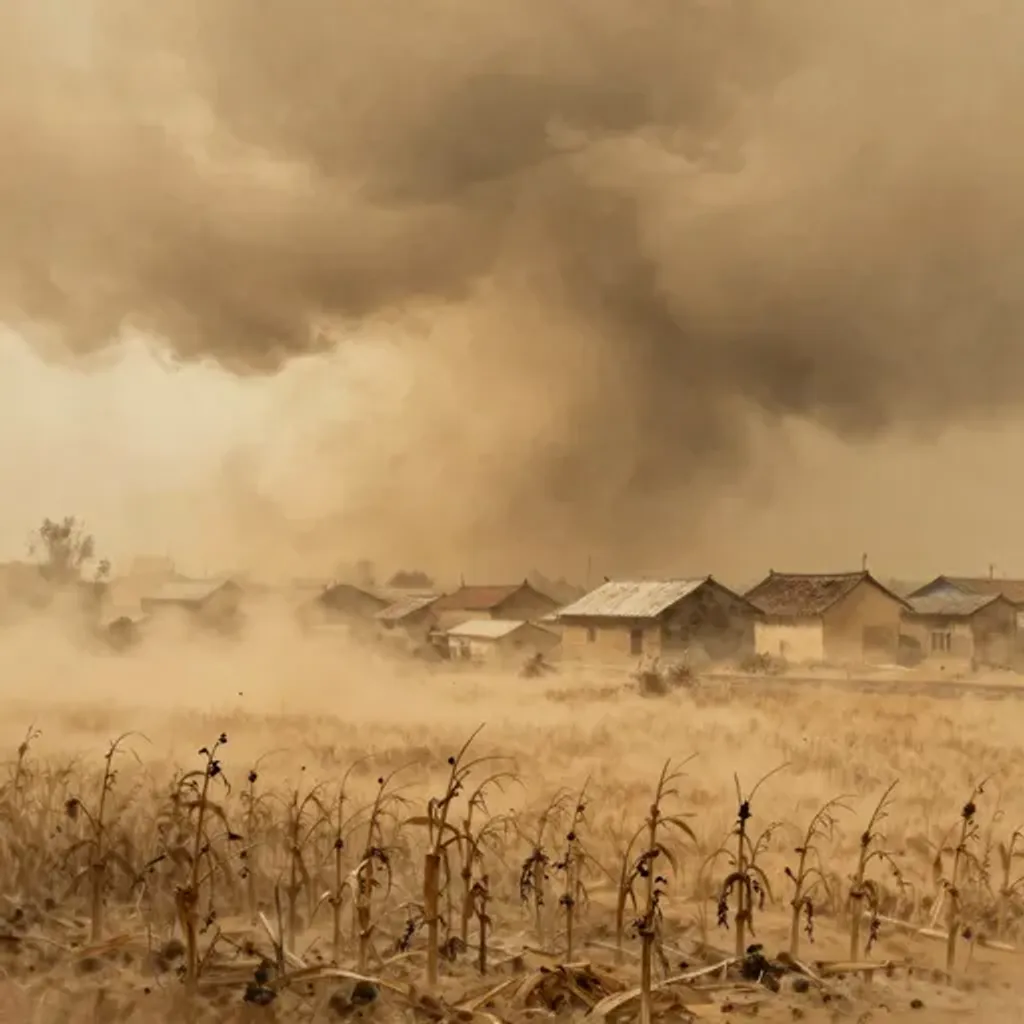
風吹塵起,十里无所,南國年傷,不可安處。
Wind blows, dust rises; for ten li, nothing can be seen. The southern land’s harvest is ruined; no place to settle in peace.
— Jiao Yanshou, Yilin (Forest of Changes), 1st century BC
Commentary
Fire rises above the earth, but the wind lifts dust so thick that nothing can be seen for ten li. The southern lands suffer a bad year, and there is no place of safety. A dust storm obliterating visibility is among the most visceral images of dispersion: everything solid dissolves into choking particulate, landmarks vanish, and orientation fails. The 'southern land' suggests agricultural heartland struck by drought or war — the region that should be most productive rendered uninhabitable. From Progress to Dispersion, the transformation makes the metaphor structural. Wind moves across water, scattering what was gathered. The dust storm is Dispersion incarnate: the wind that should gently spread influence instead destroys cohesion, turning fertile land into a blinding wasteland.
晉 → 節
Hexagram 35 → Hexagram 60: Limitation
Changing lines: 1, 2, 4, 5, 6
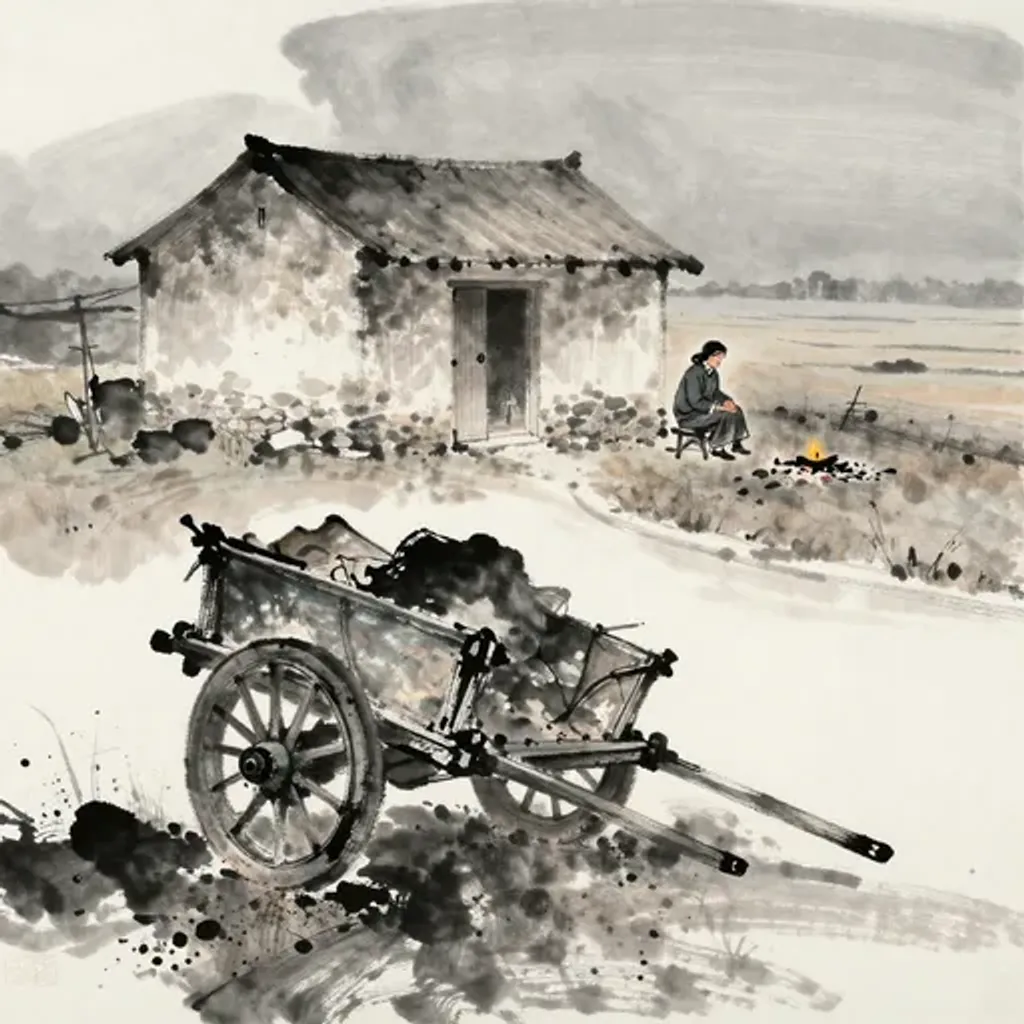
重載傷車,婦失无夫,三十不室,獨坐空廬。
A heavy load breaks the cart; the wife is lost, without a husband. At thirty, still no household; sitting alone in an empty hut.
— Jiao Yanshou, Yilin (Forest of Changes), 1st century BC
Commentary
Fire rises above the earth, but the cart is overloaded and the axle breaks. A wife is lost, the husband gone. At thirty still unmarried, sitting alone in an empty cottage. The verse layers material and personal collapse: the overloaded vehicle that cannot function, the marriage that never formed, the decades spent in solitary poverty. Each image reinforces the last — too much weight, too little support, too long alone. From Progress to Limitation, the transformation prescribes structure for this formless suffering. Water above the lake establishes proper measures and boundaries. The person who has lost everything needs not more freedom but more framework: limits that prevent overloading, rhythms that fill empty rooms, the discipline of measured portions that makes bare sufficiency feel like enough.
晉 → 中孚
Hexagram 35 → Hexagram 61: Inner Truth
Changing lines: 1, 2, 4, 5
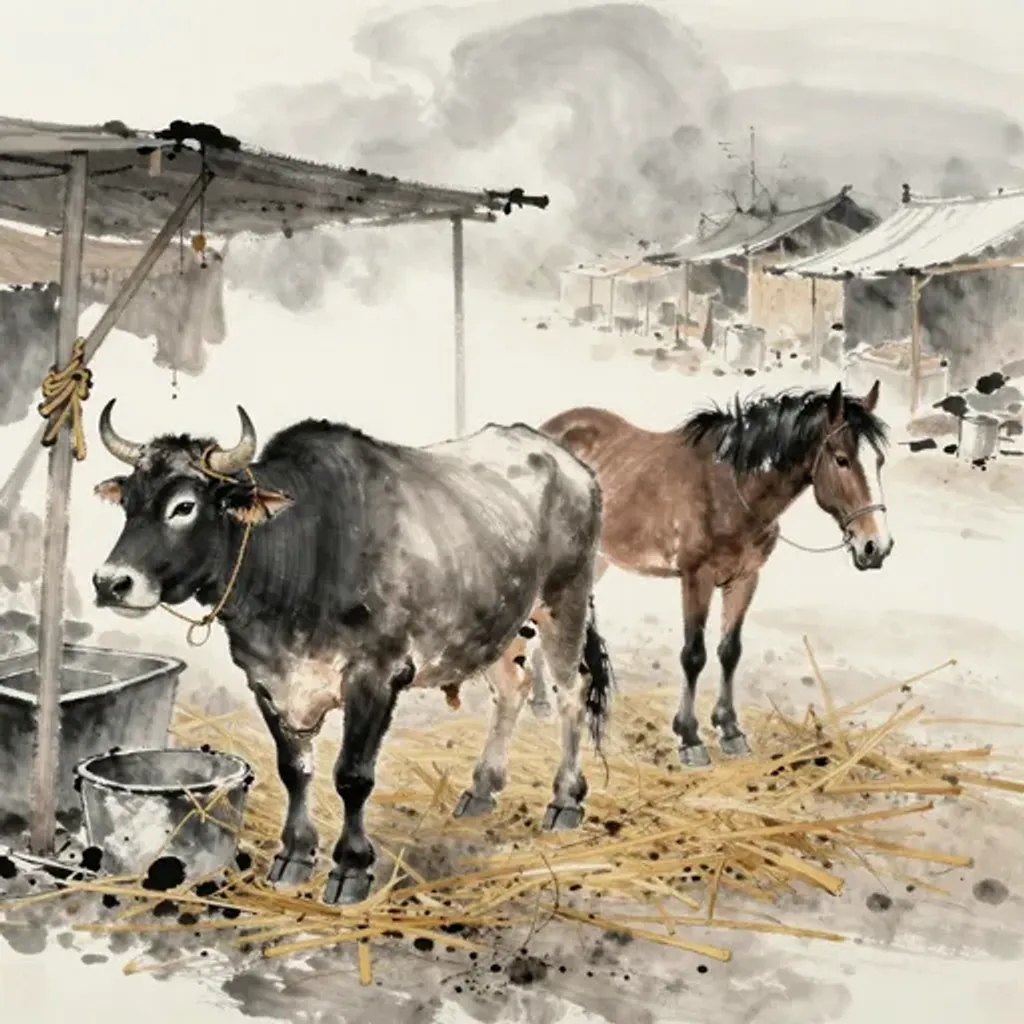
敗牛羸馬,與利為市,不我嘉喜。
A worn-out ox, an emaciated horse; brought to market for trade. It brings me no delight.
— Jiao Yanshou, Yilin (Forest of Changes), 1st century BC
Commentary
Fire rises above the earth, but the merchandise on offer is worthless — worn-out cattle and broken-down horses brought to market. The transaction yields no profit, and nothing pleases. The verse depicts commercial failure at its most basic: the goods are damaged before they reach the buyer, the animals too decrepit to serve. No one delights in purchasing another's castoffs. From Progress to Inner Truth, the transformation offers a devastating critique. Wind above the lake — the hexagram of sincerity that moves even pigs and fishes. Yet here the market transaction is the opposite of inner truth: selling damaged goods implies deception, and the buyer's dissatisfaction signals that the falsehood has been detected. Where sincerity is absent, no transaction — commercial or human — can succeed.
晉 → 小過
Hexagram 35 → Hexagram 62: Small Exceeding
Changing lines: 3, 6
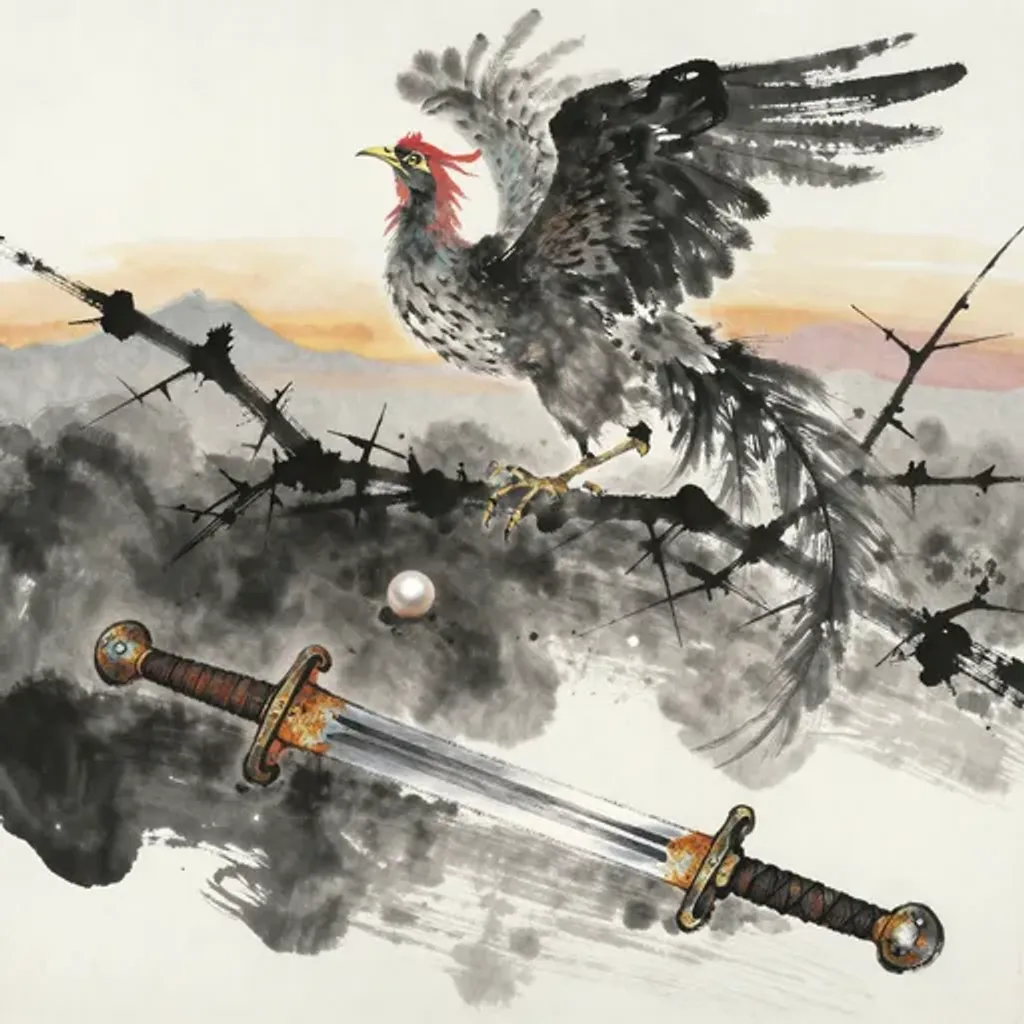
日出阜東,山蔽其明,章甫薦屨,箕子佯狂。
A treasured sword kept in its sheath — rust gradually forms. A bright pearl cast into darkness loses its luster. The phoenix perches on thorns not from inability — in dangerous times it folds its wings, awaiting dawn.
— Jiao Yanshou, Yilin (Forest of Changes), 1st century BC
Commentary
Fire rises above the earth, but the original verse tells a deeper story. 'The sun rises east of the hills, yet the mountain blocks its light. A ceremonial cap is used to pad shoes — the Viscount of Ji feigned madness.' This directly references the fall of the Shang dynasty. The sun (enlightened rule) rises but is immediately obscured by the mountain (tyranny). The allusion to 'cap padding shoes' (zhangfu jian ju) signifies the total inversion of values under a despotic regime. The Viscount of Ji, uncle of the tyrant Zhou, preserved himself by pretending insanity — the wisest response when the world has turned upside down. From Progress to Small Exceeding, the transformation validates his strategy: the small bird that flies too high courts danger; better to exceed in humility, restraint, and grief than in ambition.
晉 → 既濟
Hexagram 35 → Hexagram 63: After Completion
Changing lines: 1, 3, 4, 5, 6
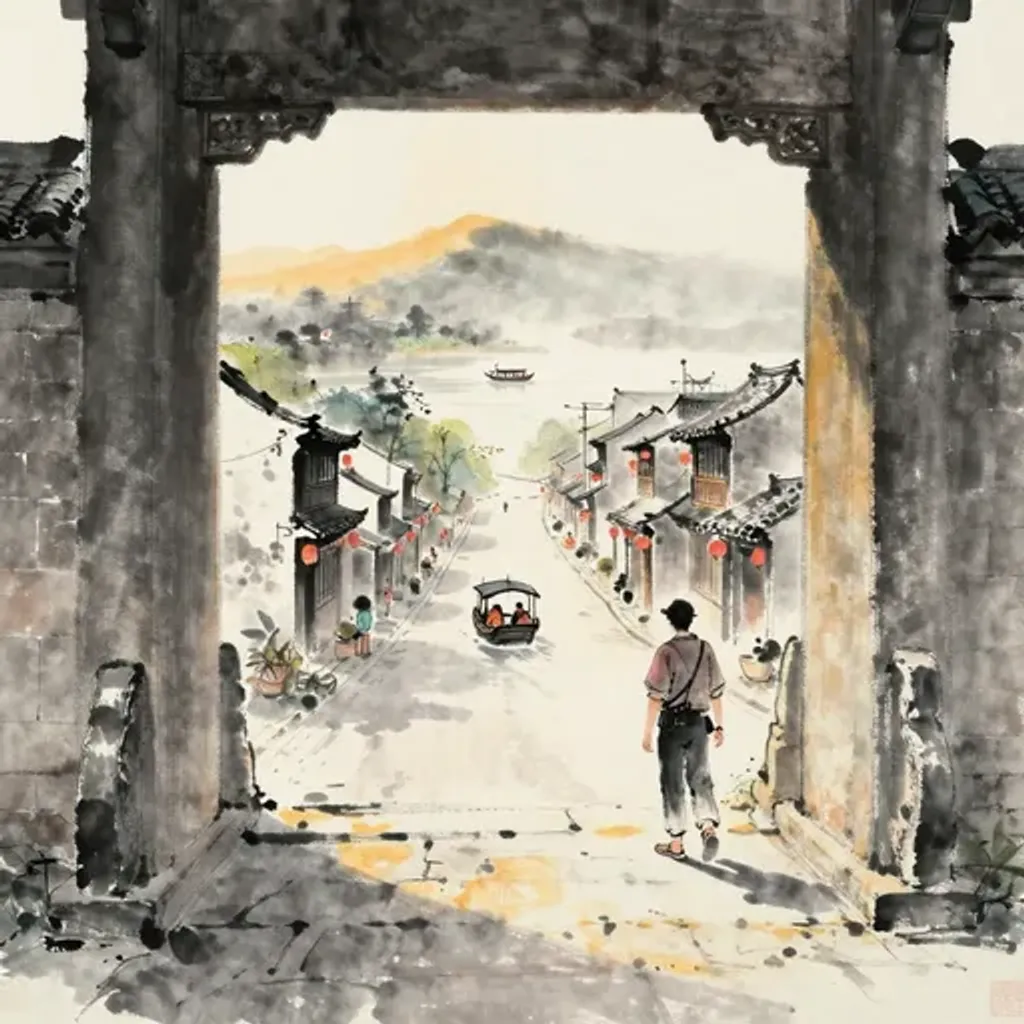
出入門所,與道開通,𣏌梁之信,不失日中,少季渡江,來歸其邦,疾病危亡。
Going out and coming in through the gate; the road opens and is clear. The trust of Qi and Liang; not missing the midday hour. The youngest crosses the river; returning to his homeland. Grave illness, mortal peril.
— Jiao Yanshou, Yilin (Forest of Changes), 1st century BC
Commentary
Fire rises above the earth, and one moves freely through the gates, the road open and clear. The faith of Qi Liang — the warrior who swore at cock-crow and kept his word by midday — stands as a model of trustworthiness. Yet the verse darkens: the youngest brother crosses the river and returns to his homeland, only to face critical illness and mortal danger. The juxtaposition of Qi Liang's perfect fidelity with the young man's perilous return creates a complex portrait: honor is maintained, promises kept, but the homecoming itself brings sickness. From Progress to After Completion, the transformation warns that crossing the finish line is not the end of danger. Water above fire — everything in its proper place, yet the gentleman thinks of calamity and prepares in advance. Completion invites complacency; the wise remain vigilant.
晉 → 未濟
Hexagram 35 → Hexagram 64: Before Completion
Changing lines: 2
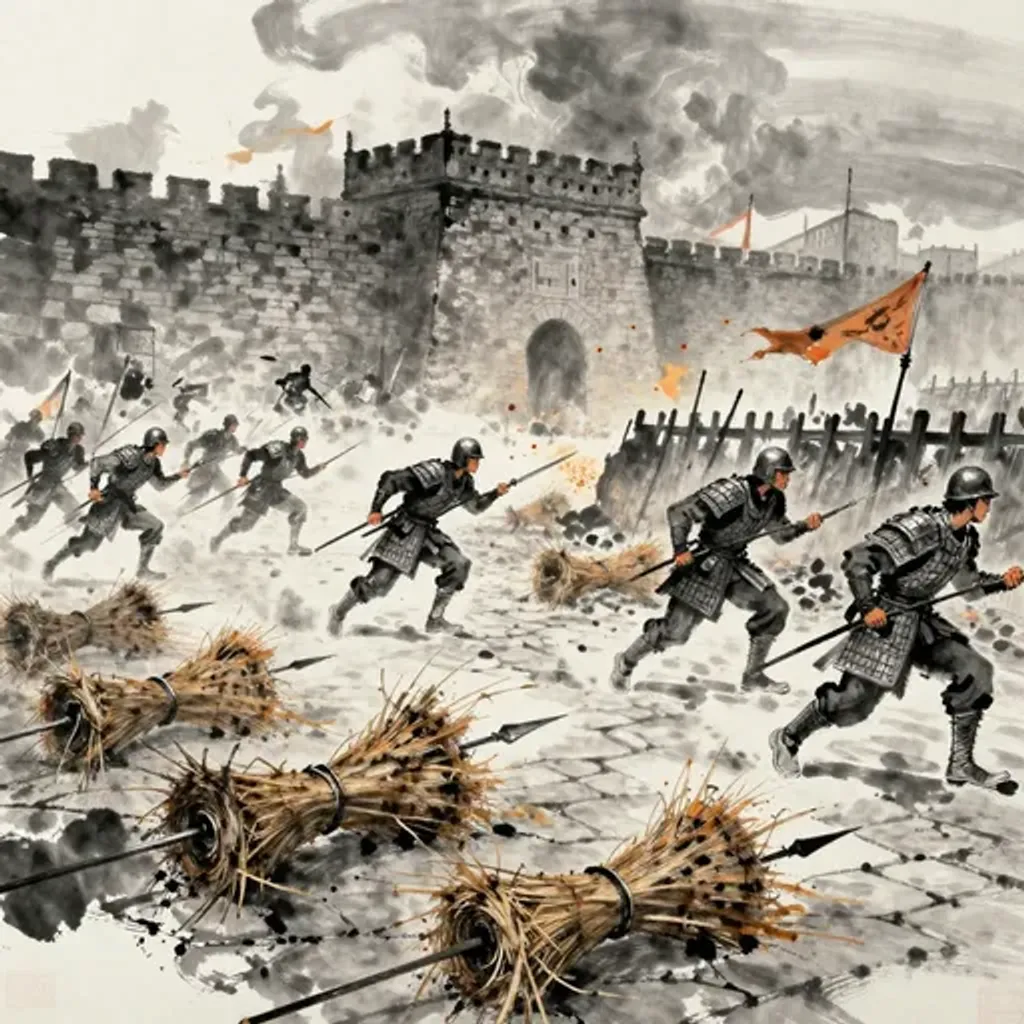
邑兵衛師,如轉蓬時,居之危凶。
City troops guard the army; like tumbleweeds in the turning wind. To dwell here is perilous and dire.
— Jiao Yanshou, Yilin (Forest of Changes), 1st century BC
Commentary
Fire rises above the earth, but the city garrison deploys like tumbleweeds scattered by the wind — directionless, purposeless, dangerous. To remain in such a position is perilous. The tumbling weed (zhuan peng) is one of the most vivid classical images of rootless displacement: a garrison that should protect the city instead whirls about without cohesion, threatening the very people it was meant to defend. From Progress to Before Completion, the transformation leaves everything unresolved. Fire above water — nearly there but not yet across. The garrison that cannot hold formation mirrors the fundamental condition of Before Completion: all the elements exist but they have not yet found their proper arrangement. The fox's tail dips in the water at the last crossing. Danger persists to the very end.