Transformations of Hexagram 36
Every line of change out of Hexagram 36 明夷 Darkening of the Light, with the Yilin verse for each of the 64 resulting hexagrams, its translation, and the original ink brush artwork.
明夷 → 乾
Hexagram 36 → Hexagram 1: The Creative
Changing lines: 2, 4, 5, 6
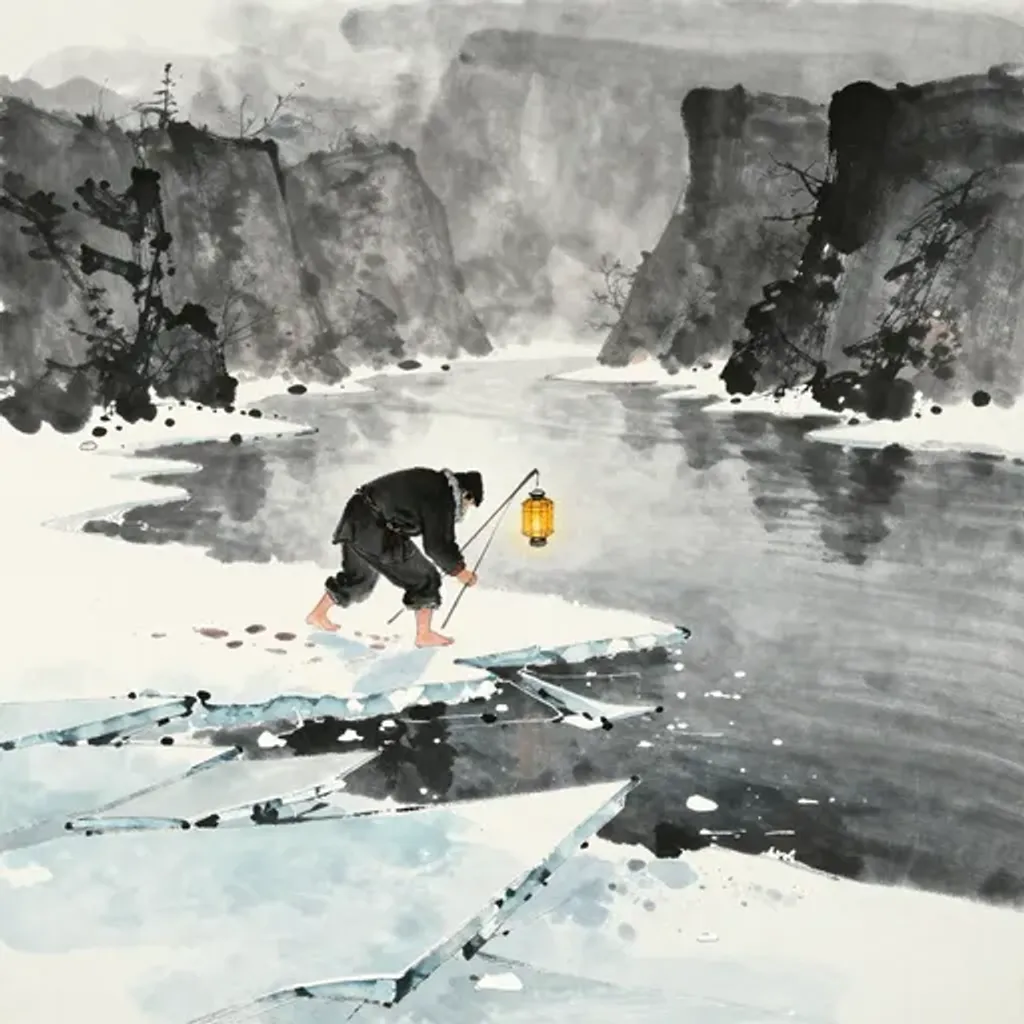
踐履寒冰,十步九尋,雖有苦痛,不為憂病。
Treading on cold ice; ten steps, nine fathoms deep. Though there is bitter pain, it does not become grief or illness.
— Jiao Yanshou, Yilin (Forest of Changes), 1st century BC
Commentary
Fire buried beneath the earth meets pure heaven in unbroken ascent. The verse depicts treading on frost and ice, each of ten steps probing a fathom's depth of danger, yet despite the bitter pain, the traveler refuses to count it as illness. This echoes the opening of the Kun hexagram's line text — 'treading on frost, solid ice will come' — but inverts its counsel of dread into a declaration of resilience. Where Darkening of the Light conceals brilliance underground, the transformation toward the Creative reveals the stance that survives the concealment: self-generating strength that treats adversity as a training ground rather than a sentence. The one who walks on ice without complaint has already internalized heaven's tireless motion.
明夷 → 坤
Hexagram 36 → Hexagram 2: The Receptive
Changing lines: 1, 3
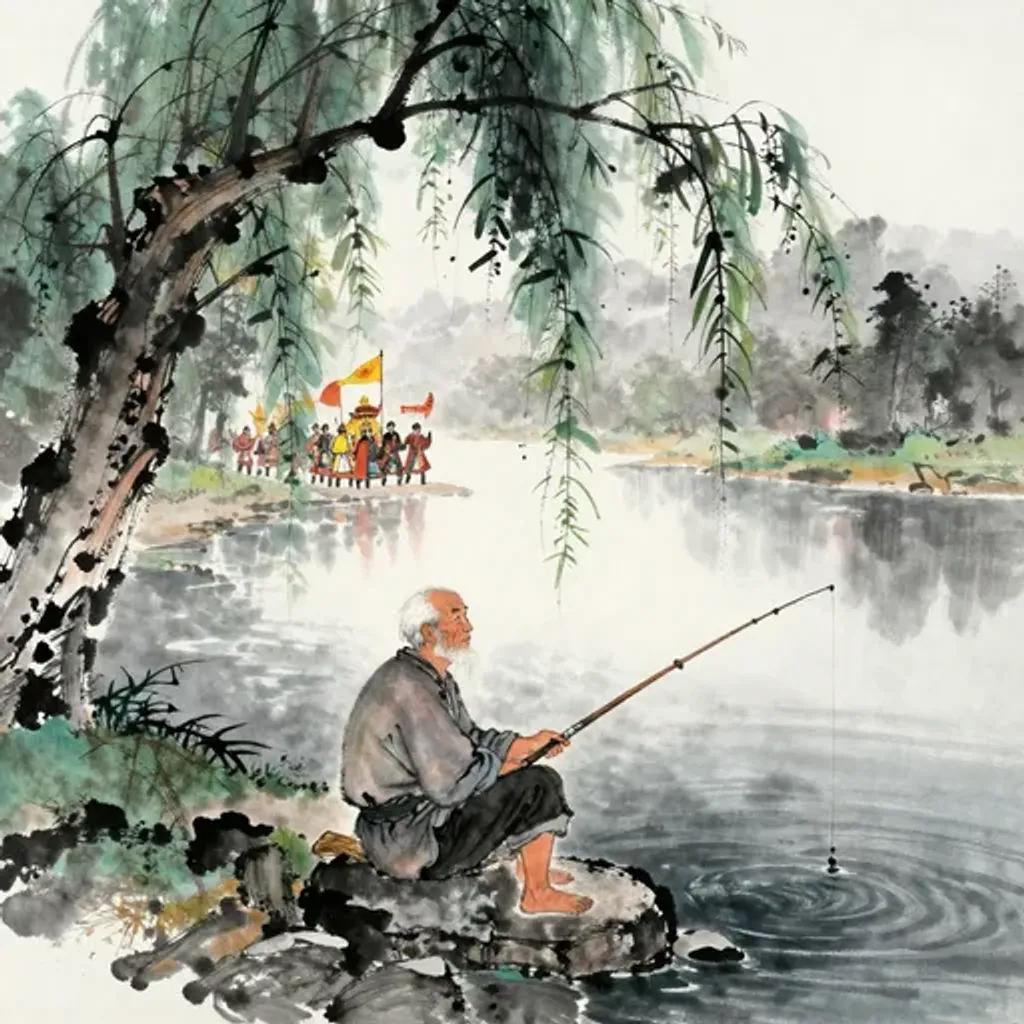
太公避紂,七十隱處,卒逢聖文,為王室輔。
Taigong fled from Zhou Xin; for seventy years he dwelt in hiding. At last he met the sage King Wen, and became pillar of the royal house.
— Jiao Yanshou, Yilin (Forest of Changes), 1st century BC
Commentary
Fire sinks beneath the earth as the sage waits in the receptive darkness. Taigong — Jiang Ziya, the future architect of Zhou — spent seventy years in obscurity, avoiding the tyranny of King Zhou of Shang. He fished at the Wei River, sold goods in markets, and served in menial positions, yet harbored a statesman's vision throughout. Only when King Wen recognized him did his decades of hidden preparation find their purpose. The verse's resolution is emphatic: 'At last he met the sage Wen and became pillar of the royal house.' From Darkening of the Light to the Receptive, the transformation reveals that the deepest yielding — earth upon earth — is not passivity but the patient ground from which a dynasty's foundations are laid.
明夷 → 屯
Hexagram 36 → Hexagram 3: Difficulty at the Beginning
Changing lines: 3, 5
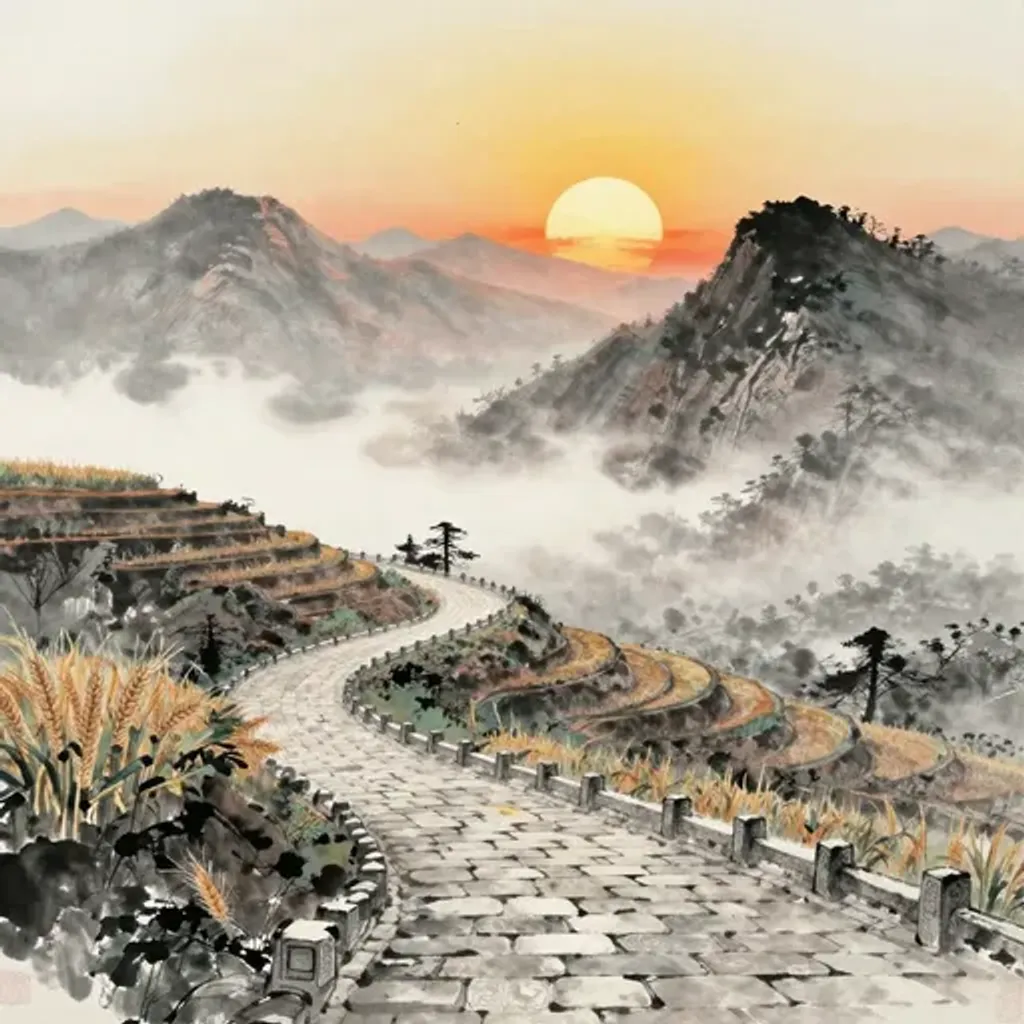
日月之塗,所行必到,无有患悔。
The path of sun and moon; where they travel, they surely arrive. There is no regret or misfortune.
— Jiao Yanshou, Yilin (Forest of Changes), 1st century BC
Commentary
Fire submerged beneath the earth finds its way through cloud and thunder to a difficult new beginning. The verse invokes the path of sun and moon — whatever road they travel, they inevitably arrive — and concludes with no regret. This is a concise statement of cosmic regularity: even when light is suppressed, the celestial bodies continue their circuits. The imagery resonates with the oracle bone tradition where solar eclipses were tracked but never feared as permanent. From Darkening of the Light to Difficulty at the Beginning, the transformation captures how buried luminance re-emerges through struggle. Thunder stirs beneath water, and the first shoots break frozen ground — arrival is certain, though the road passes through hardship.
明夷 → 蒙
Hexagram 36 → Hexagram 4: Youthful Folly
Changing lines: 1, 2, 3, 6
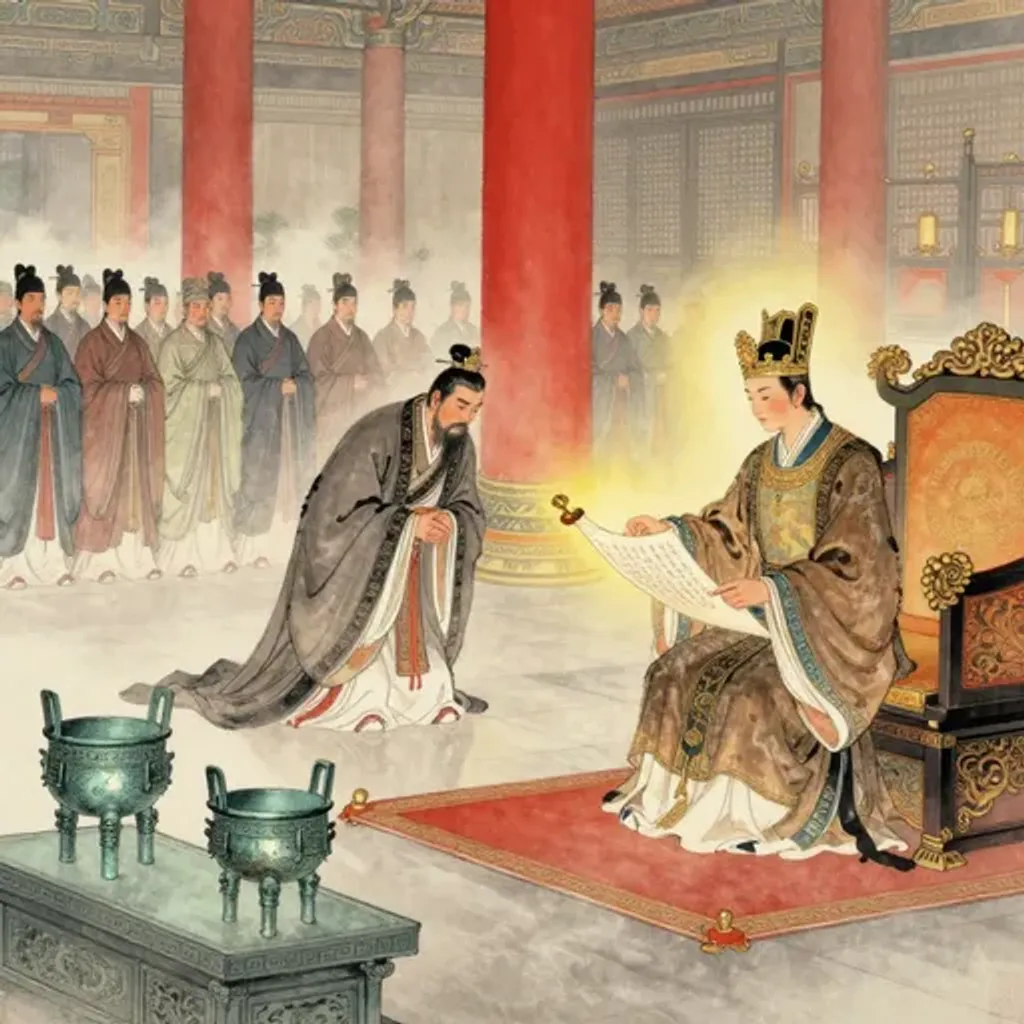
諷德訟功,美周盛隆。旦輔成周,光濟沖人。
He praised virtue and lauded merit; glorifying Zhou's great splendor. The Duke of Dan assisted the house of Zhou, his brilliance sustaining the young sovereign.
— Jiao Yanshou, Yilin (Forest of Changes), 1st century BC
Commentary
Fire concealed beneath the earth gives way to the spring that emerges from the mountain's base — the image of Youthful Folly, where knowledge flows from darkness into light. The verse praises the Duke of Zhou, who 'recited virtue and proclaimed merit, glorifying the splendor of Zhou.' Dan — the Duke of Zhou — served as regent for the young King Cheng, guiding a fledgling dynasty through rebellion and doubt. 'He assisted the completion of Zhou, his brilliance sustaining the young ruler.' The phrase 'chong ren' (沖人) is a ritual self-deprecation used by child-kings, confirming the allusion. From Darkening of the Light to Youthful Folly, the wise regent channels hidden brilliance into patient instruction, nurturing the untutored sovereign as water nourishes what lies downhill.
明夷 → 需
Hexagram 36 → Hexagram 5: Waiting
Changing lines: 2, 5
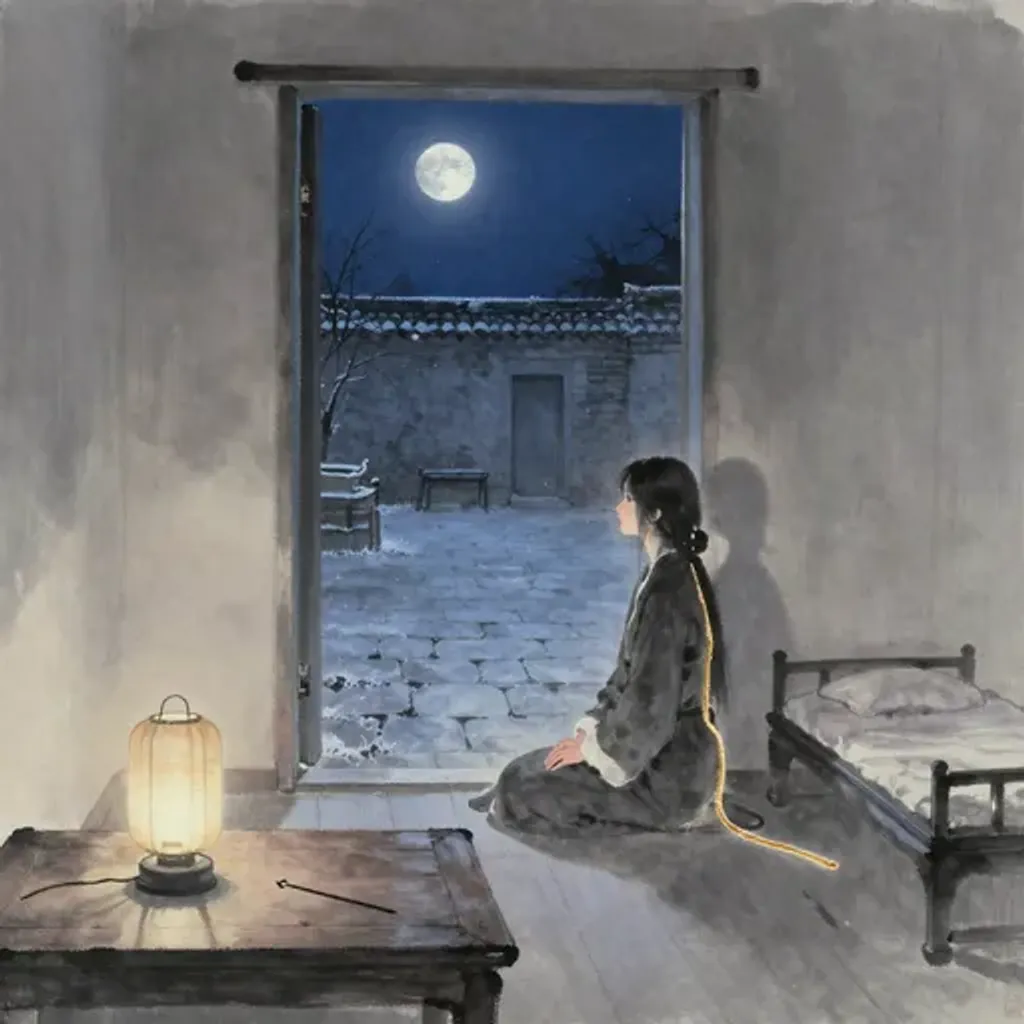
童女无室,未有配合,空坐獨宿。
A young woman without a home; she has no match or union. She sits alone through the empty night.
— Jiao Yanshou, Yilin (Forest of Changes), 1st century BC
Commentary
Fire pressed beneath the earth mirrors a young woman sitting alone, unmatched and waiting. Clouds gather above heaven in the image of Waiting — nourishment will come, but not yet. The verse is spare: 'A maiden without a home, no mate to join her; she sits empty, sleeping alone.' This is the desolation of unrecognized worth, a human echo of Darkening of the Light's buried fire. No allusion adorns the scene; the image is self-sufficient. From Darkening of the Light to Waiting, the transformation insists that what is hidden must endure the interval. The maiden's solitude is not abandonment but the season before clouds yield rain, before heaven's nourishment descends to earth.
明夷 → 訟
Hexagram 36 → Hexagram 6: Conflict
Changing lines: 1, 2, 3, 4, 5, 6
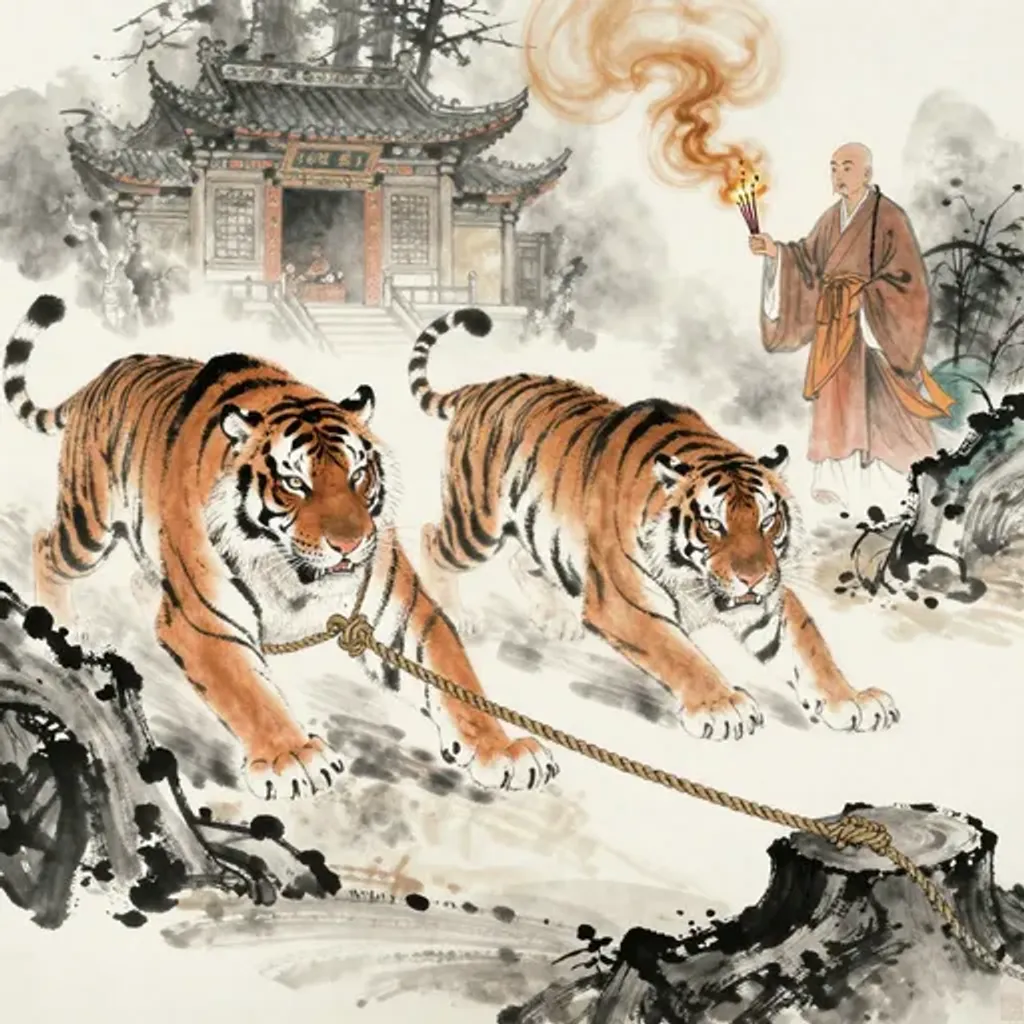
穿鼻繫株,為虎所拘。王母祝祠,禍不成災,遂然脫來。
Pierced through the nose, tied to a stump; held captive by the tiger. The Queen Mother prays at the shrine; the disaster does not become calamity, and at last one breaks free.
— Jiao Yanshou, Yilin (Forest of Changes), 1st century BC
Commentary
Fire vanishes beneath the earth as heaven and water diverge in opposite directions — the image of Conflict. An ox is led by a ring through its nose, tethered to a stake, then seized by a tiger: captivity upon captivity. Yet the Queen Mother of the West intercedes with prayers and offerings, and disaster does not ripen into catastrophe. The captive escapes. The invocation of the Queen Mother draws on Han-dynasty cult practices where she was petitioned to avert calamity and grant longevity. From Darkening of the Light to Conflict, the transformation warns that when light is suppressed, disputes and entrapments multiply — but also reveals that appeals to a higher order, made at the right moment, can untangle even the most dangerous bonds.
明夷 → 師
Hexagram 36 → Hexagram 7: The Army
Changing lines: 1, 2, 3
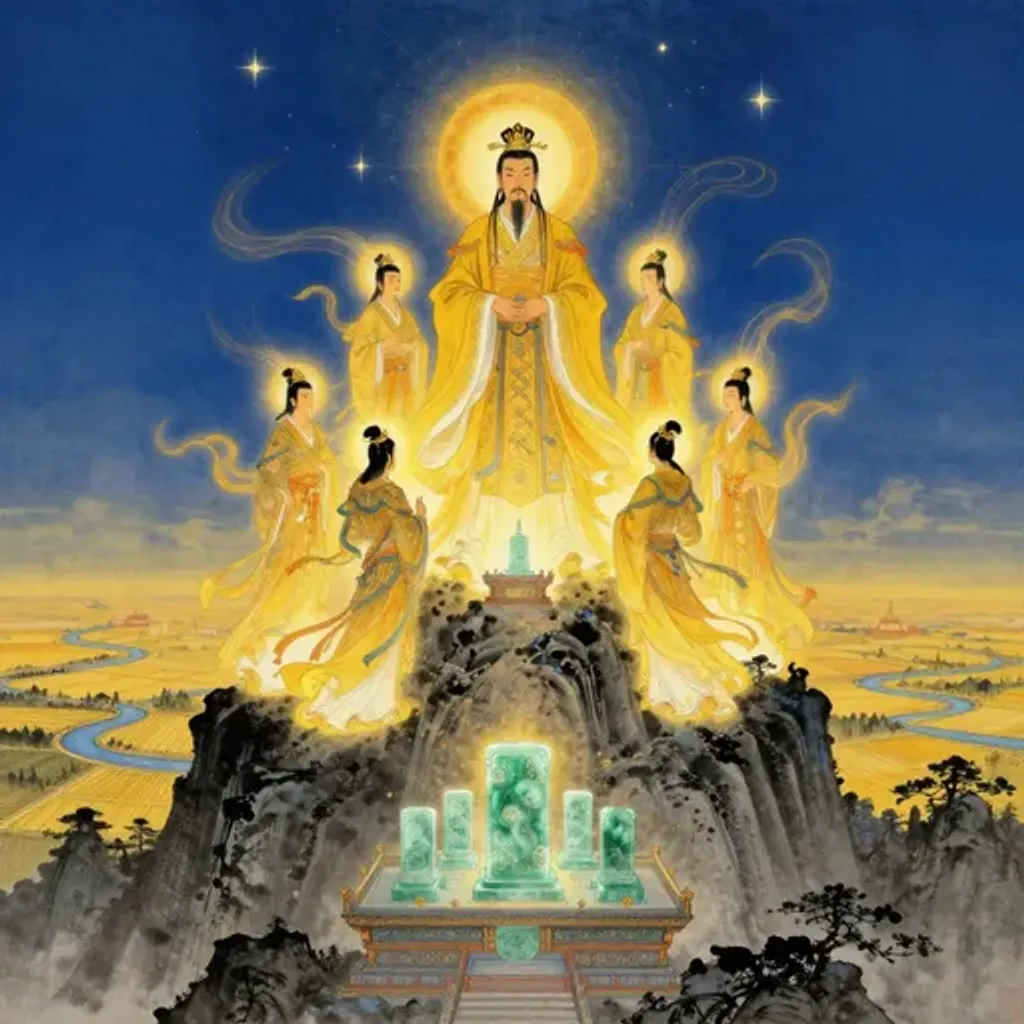
黃帝神明,八子聖聰,佚受大福,天下平康。
The Yellow Emperor, divine and brilliant; his eight sons sages all. They received great blessings in abundance; all under heaven was peaceful and well.
— Jiao Yanshou, Yilin (Forest of Changes), 1st century BC
Commentary
Fire buried beneath the earth encounters water held within the earth — the Army, where disciplined force lies concealed beneath a calm surface. The verse celebrates the Yellow Emperor's divine brilliance and his eight sagely sons, who brought great blessings and peace to the realm. The 'eight sons' likely refers to the tradition that the Yellow Emperor's descendants branched into eight lineages, each governing a territory. This is governance through delegation — the sage ruler's intelligence distributed through worthy subordinates who maintain order without visible force. From Darkening of the Light to the Army, suppressed light is not lost but organized: it becomes the hidden reservoir of water within the earth, disciplined strength deployed through a chain of command.
明夷 → 比
Hexagram 36 → Hexagram 8: Holding Together
Changing lines: 1, 3, 5
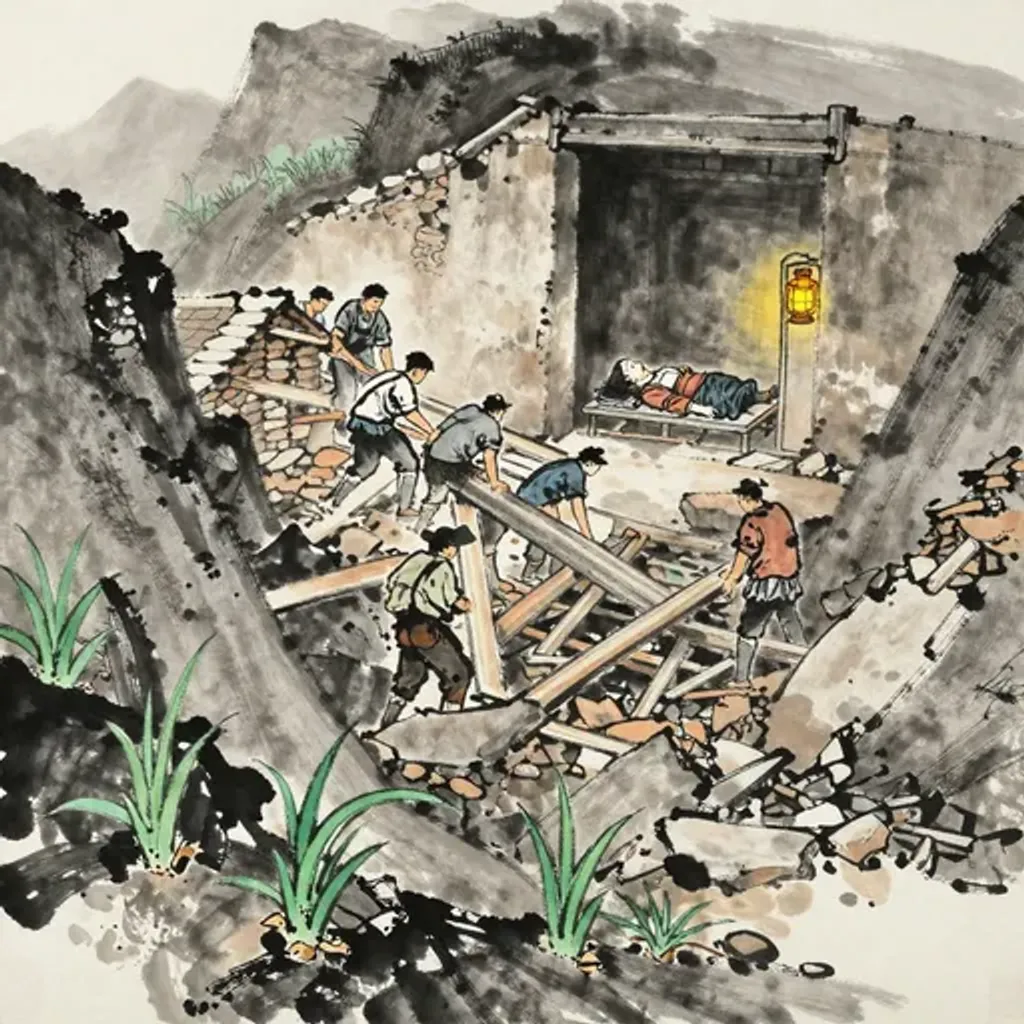
深谷為陵,衰者復興,亂傾之國,民得安息,中婦病困,遂入冥室。
Deep valleys become hills; the fallen are restored again. A disordered, toppled state; the people find rest. The middle wife falls gravely ill, and enters the dark chamber at last.
— Jiao Yanshou, Yilin (Forest of Changes), 1st century BC
Commentary
Fire plunged beneath the earth meets water resting upon the earth — Holding Together, where scattered elements unite under shared allegiance. The verse opens with dramatic reversal: 'Deep valleys become hills, the declining is restored.' A chaotic state finds peace, its people rest at last. Then the tone darkens: 'The middle wife falls ill and enters the chamber of darkness.' Renewal for the collective is shadowed by private loss. The juxtaposition is deliberate — political restoration does not guarantee individual safety. From Darkening of the Light to Holding Together, buried light resurfaces as collective cohesion, yet the transformation also warns: bonding under crisis carries its own costs, and some who serve the restoration will not survive to see its fruits.
明夷 → 小畜
Hexagram 36 → Hexagram 9: Small Taming
Changing lines: 2, 5, 6
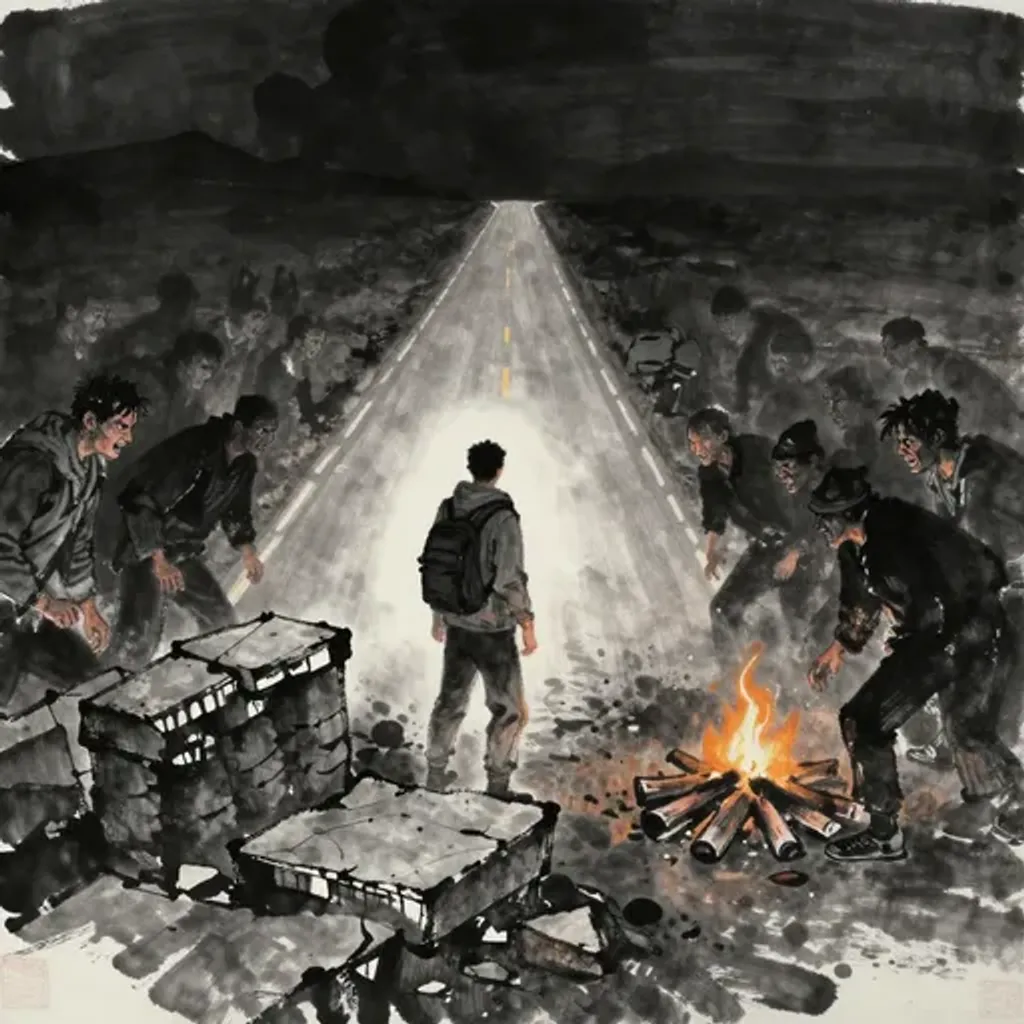
道遠遼絕,路宿多悔,頑囂相聚,生我畏惡。
The road is distant and cut off; lodging on the way brings much regret. Ruffians and scoundrels gather round, breeding fear and loathing in me.
— Jiao Yanshou, Yilin (Forest of Changes), 1st century BC
Commentary
Fire sinks beneath the earth while wind skims across heaven, barely restraining its force — Small Taming, where gentle influence attempts to moderate what it cannot fully contain. The verse describes a road 'distant and desolate,' a journey filled with regret, where 'stubborn rabble gather' and breed fear and loathing. This is exile in hostile territory, the traveler exposed to vulgar company far from home. The imagery resonates with the Shijing's 'Yellow Bird' exile lament. From Darkening of the Light to Small Taming, the transformation reveals the predicament of one whose light has been driven underground: even the attempt to restrain surrounding chaos achieves only partial success, and the cultivated person must endure coarse surroundings while preserving inner refinement.
明夷 → 履
Hexagram 36 → Hexagram 10: Treading
Changing lines: 2, 3, 4, 5, 6
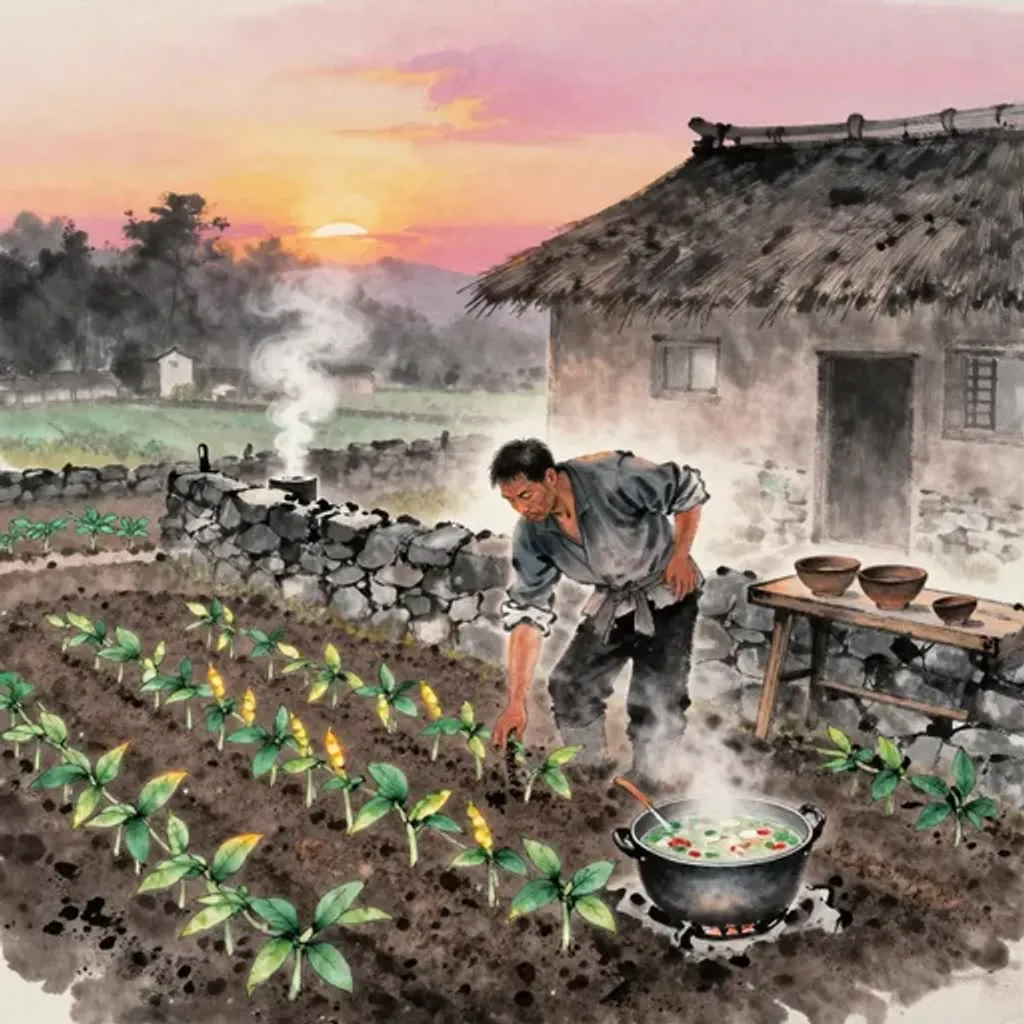
旦樹菽豆,暮成藿羹,心之所樂,志快心歡。
At dawn he plants beans and pulses; by evening they become a stew of greens. What the heart delights in; the will is glad and the spirit joyful.
— Jiao Yanshou, Yilin (Forest of Changes), 1st century BC
Commentary
Fire concealed beneath the earth steps forth onto the path of heaven above the lake — Treading, where one walks carefully among greater powers. The verse paints a scene of humble contentment: 'Plant beans at dawn, by evening enjoy bean-leaf soup. What the heart delights in, the spirit rejoices.' This is the satisfaction of self-sufficiency, where planting and harvesting within a single day symbolize immediate fulfillment from modest effort. No grand ambition, no dangerous climb — just the rhythm of earth yielding its gifts. From Darkening of the Light to Treading, the transformation shows that walking carefully through a darkened world need not be grim. The one who treads lightly finds joy in small harvests, stepping alongside greater forces without provoking them.
明夷 → 泰
Hexagram 36 → Hexagram 11: Peace
Changing lines: 2
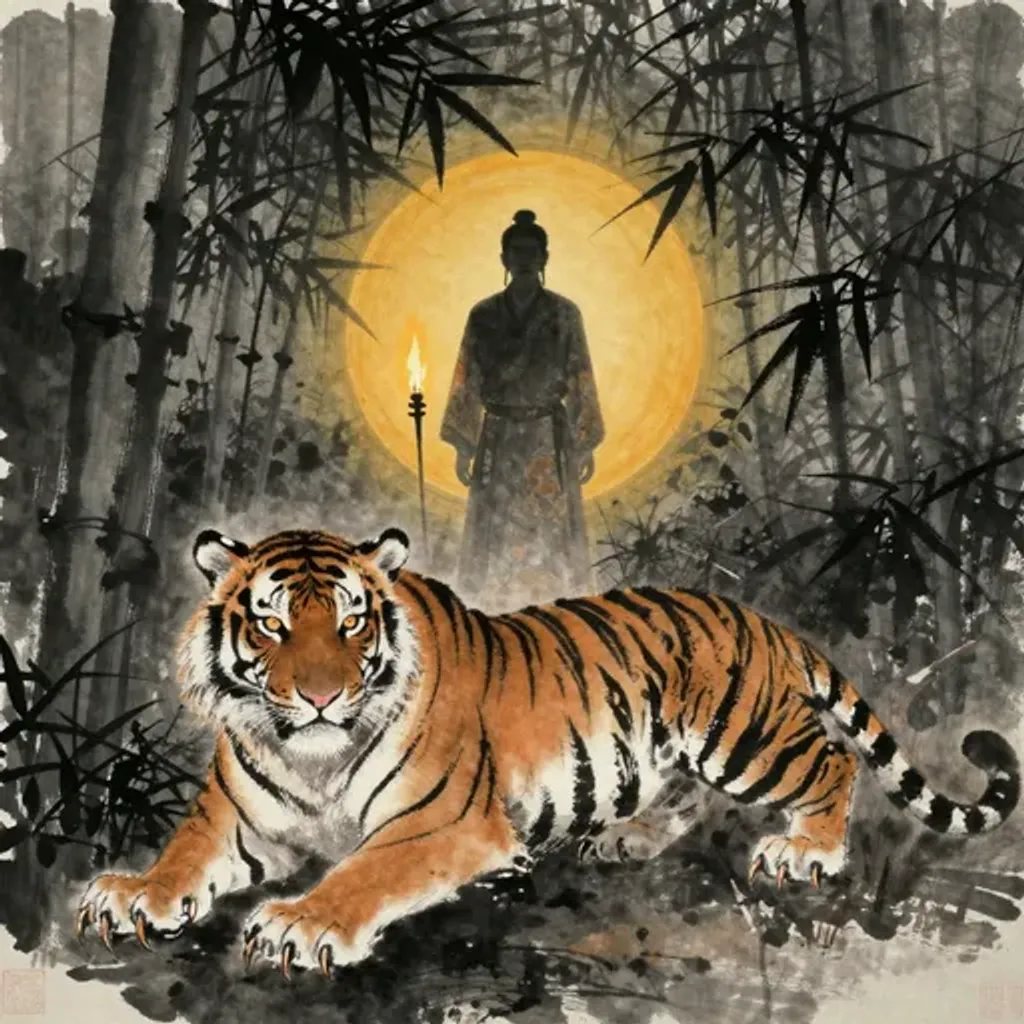
切切之患,凶憂不成,虎不敢齚,利當我身。
Urgent, pressing danger; yet the misfortune does not come to pass. The tiger dares not bite; the benefit falls upon my person.
— Jiao Yanshou, Yilin (Forest of Changes), 1st century BC
Commentary
Fire descends into the earth and heaven rises to meet earth in the great exchange of Peace. Urgent fears press in — 'keen, cutting anxiety' — yet the threat dissolves: misfortune fails to materialize, the tiger dares not bite, and blessings fall upon the traveler. The image of a tiger that cannot attack recalls the Yi's own Treading hexagram, where one treads on the tiger's tail unhurt, but here it serves a different purpose: the worst-case scenario simply will not come to pass. From Darkening of the Light to Peace, the transformation is the most hopeful in the entire cycle. When heaven descends and earth ascends, communication flows between above and below, and even the terrors born of darkness lose their power to harm.
明夷 → 否
Hexagram 36 → Hexagram 12: Standstill
Changing lines: 1, 3, 4, 5, 6
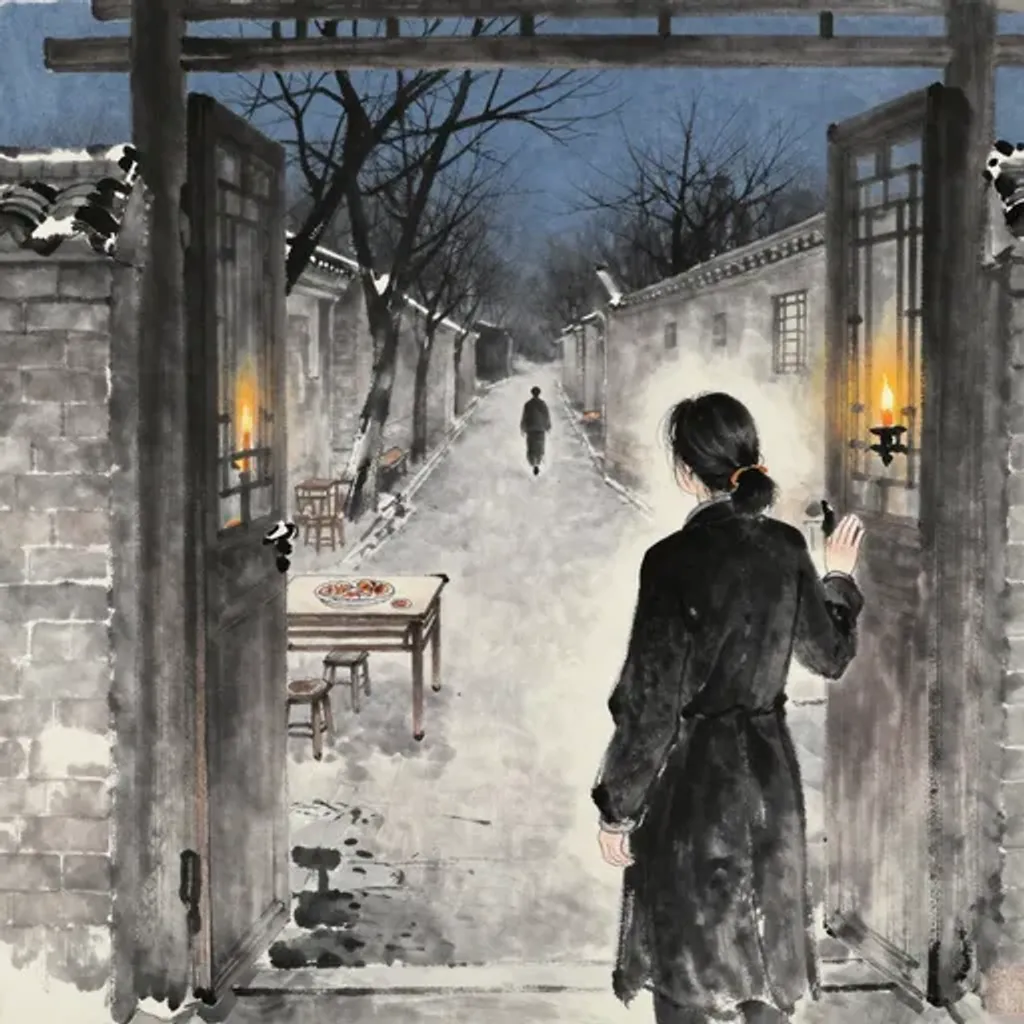
王伯遠宿,長婦在室,異袍恃食,所求不得。
The lord and elder lodges far away; the eldest wife remains at home. She borrows robes and begs for food; what she seeks, she does not obtain.
— Jiao Yanshou, Yilin (Forest of Changes), 1st century BC
Commentary
Fire sinks beneath the earth while heaven and earth stand apart, refusing to communicate — Standstill. The lord travels far and lodges elsewhere; the senior wife remains at home, wearing unfamiliar robes and relying on others' food. What she seeks, she cannot obtain. This is the domestic face of political blockage: separation, estrangement, dependence without dignity. The 'different robes' suggest a status altered by circumstance — perhaps a wife reduced to wearing borrowed clothing, or a household surviving on charity. From Darkening of the Light to Standstill, the transformation doubles the darkness. When light is already suppressed and then communication ceases entirely, isolation becomes absolute. The wife's unfulfilled longing mirrors a state where no appeal can reach those in power.
明夷 → 同人
Hexagram 36 → Hexagram 13: Fellowship
Changing lines: 4, 5, 6
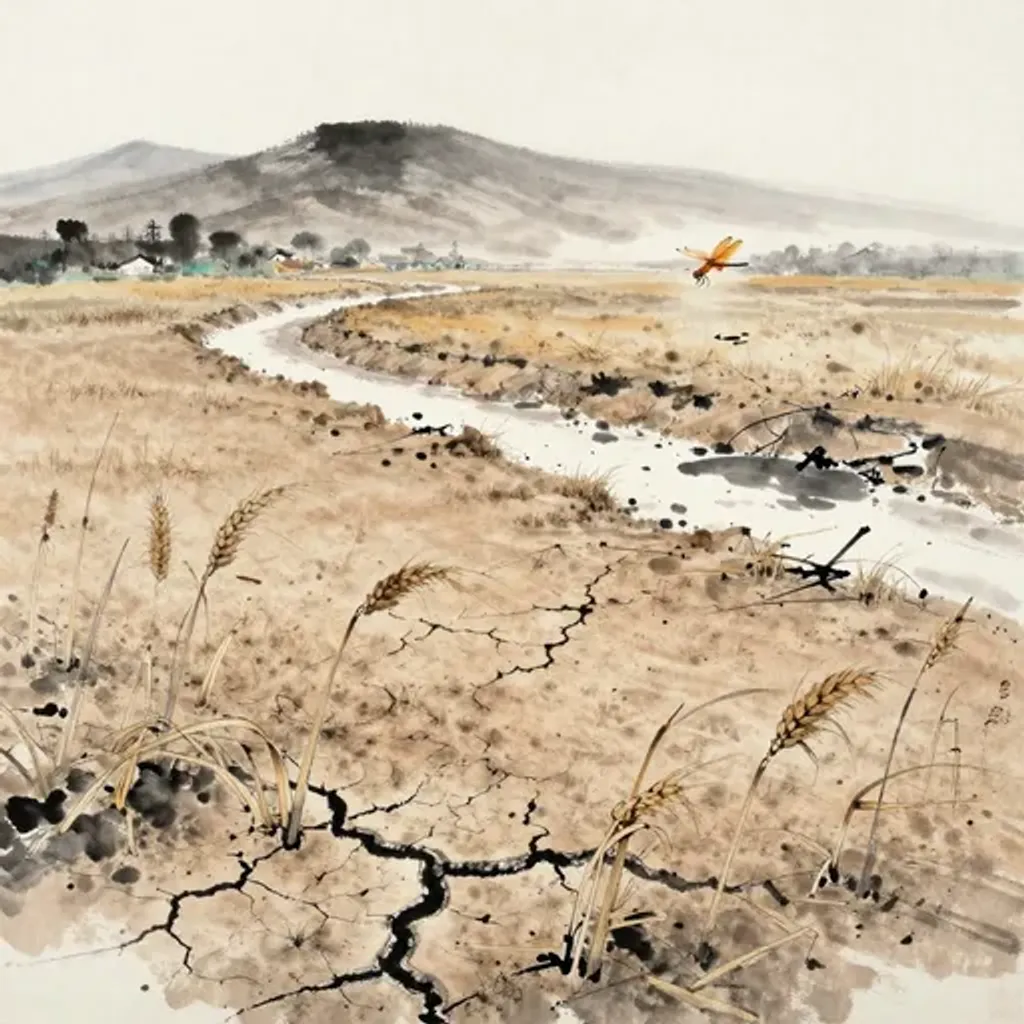
寒燠失時,陽旱為災,雖耗无憂。
Cold and heat lose their seasons; scorching drought brings disaster. Though there is loss, there is no cause for worry.
— Jiao Yanshou, Yilin (Forest of Changes), 1st century BC
Commentary
Fire beneath the earth meets fire beneath heaven — Fellowship, where the flame that was buried now joins a communal blaze. Yet the verse describes seasonal disorder: 'Cold and heat lose their timing, yang-drought becomes disaster.' When the natural rhythm of warm and cool fails, drought scorches the fields. Still, the closing reassurance holds: 'Though there is loss, there is no worry.' The damage is real but not ruinous. From Darkening of the Light to Fellowship, the transformation suggests that even when darkened brilliance re-emerges improperly — as unseasonable heat rather than nurturing light — the bonds of community can absorb the shock. Fellowship's principle of 'classifying by kind' means disruption is contained within a system that recognizes and sorts its elements.
明夷 → 大有
Hexagram 36 → Hexagram 14: Great Possession
Changing lines: 2, 4, 6
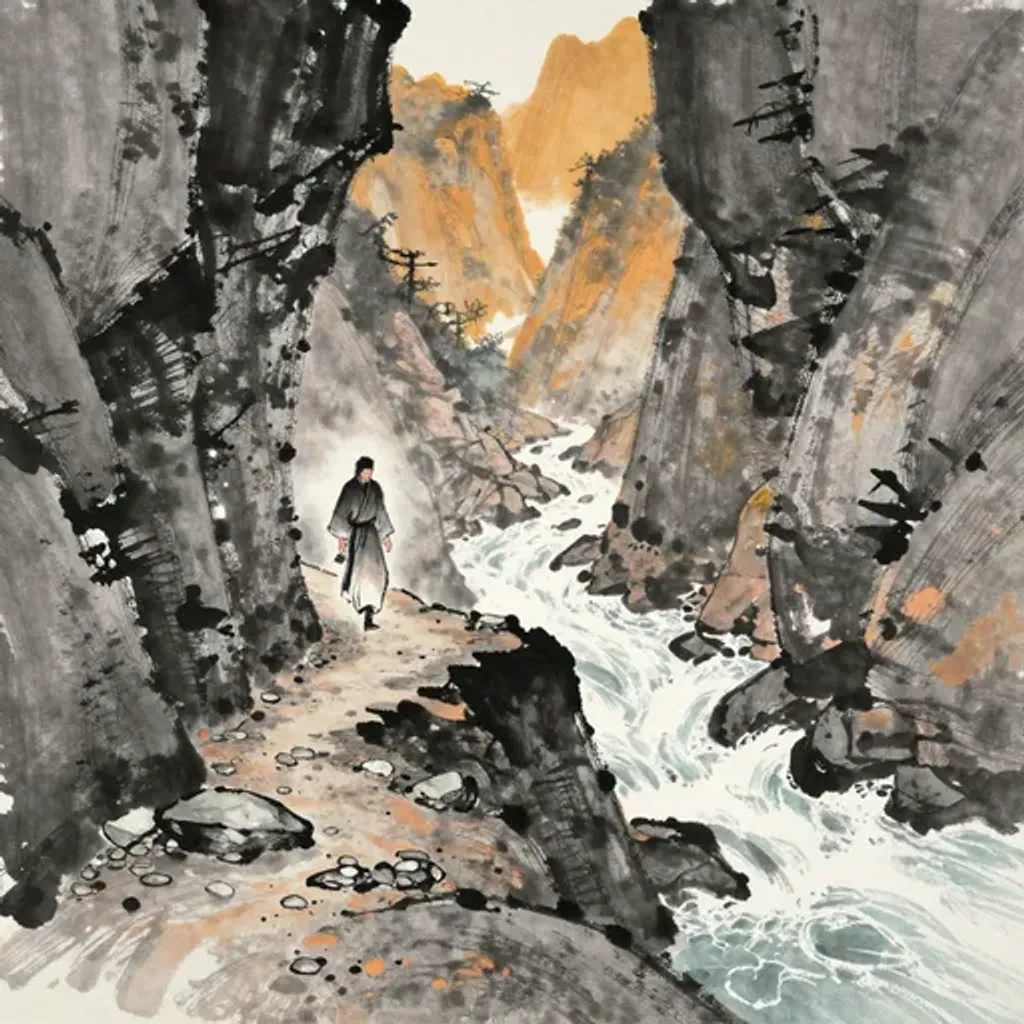
雖窮復通,履危不凶,保其明功。
Though impoverished, one finds passage again; treading danger, yet no misfortune. One preserves one's bright merit.
— Jiao Yanshou, Yilin (Forest of Changes), 1st century BC
Commentary
Fire hidden beneath the earth blazes forth as fire in heaven — Great Possession, the fullest expression of light's return. 'Though impoverished, one breaks through again; though treading danger, no misfortune comes; one preserves the merit of brilliance.' This is the Darkening of the Light's own promise fulfilled: the buried fire was never extinguished but merely waiting for the conditions that would let it illuminate heaven. The verse's three-beat structure — poverty overcome, danger survived, brilliance preserved — reads almost as a manifesto for the hexagram's core teaching. From Darkening of the Light to Great Possession, suppressed fire ascends to its proper place above heaven, and what was once dimmed now radiates without obstruction.
明夷 → 謙
Hexagram 36 → Hexagram 15: Modesty
Changing lines: 1
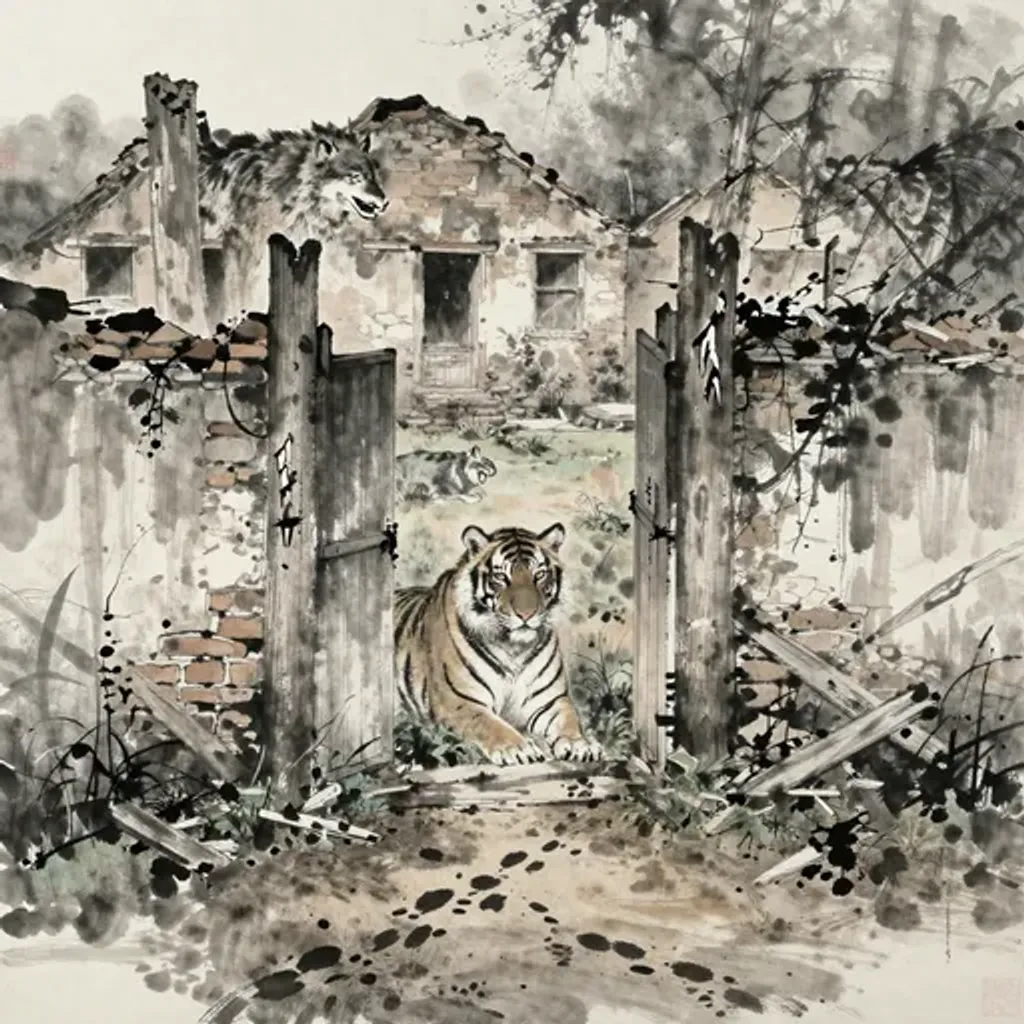
狼虎所宅,不可以居,為我患憂。
A dwelling where wolves and tigers lair; one cannot reside there. It becomes my grief and worry.
— Jiao Yanshou, Yilin (Forest of Changes), 1st century BC
Commentary
Fire descends beneath the earth while the mountain hides within the earth — Modesty, where what is great keeps itself low. The verse presents a predator's lair: 'Where wolves and tigers dwell, one cannot reside; they breed my worry and sorrow.' This is a place made uninhabitable by predatory forces, a direct echo of the Darkening of the Light's political landscape where tyrants like King Zhou of Shang made the court a den of beasts. From Darkening of the Light to Modesty, the transformation prescribes the proper response to such danger: withdraw, keep low, and let the mountain's hidden mass work silently. One cannot fight wolves in their own den; one must level the ground through patient modesty.
明夷 → 豫
Hexagram 36 → Hexagram 16: Enthusiasm
Changing lines: 1, 3, 4
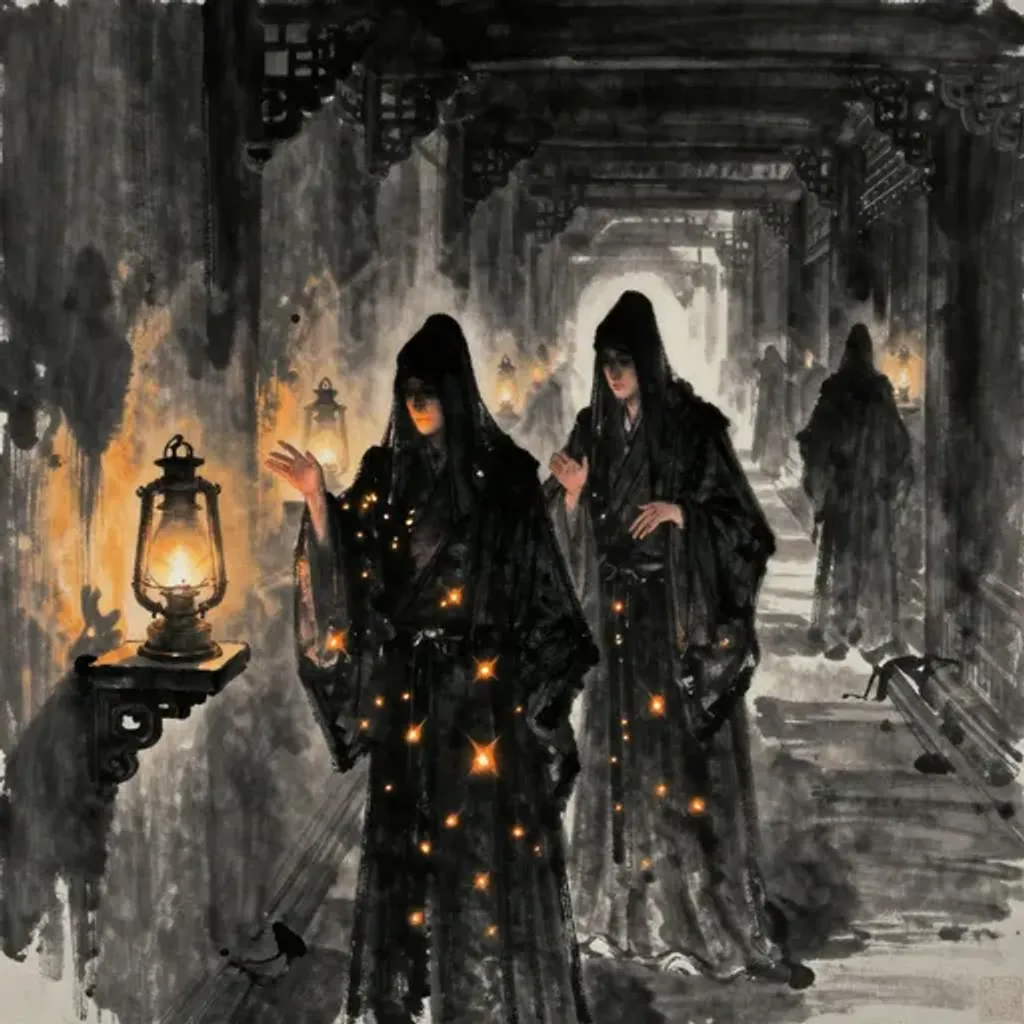
喋囁處耀,昧冥相傳。多言少實,語無成事。
Chattering and gibbering in the glare; darkness passes whispers along. Much talk, little substance; words accomplish nothing.
— Jiao Yanshou, Yilin (Forest of Changes), 1st century BC
Commentary
Fire beneath the earth meets thunder erupting from the earth — Enthusiasm, where the dormant force suddenly stirs with energy. Yet the verse describes the opposite of constructive enthusiasm: 'Murmuring and chattering in the light, passing darkness on in whispers. Many words, little substance; talk without accomplishment.' This is the corruption of Enthusiasm — noise masquerading as action, empty declarations substituting for deeds. When light is already darkened and the thunderous impulse of Enthusiasm produces only chatter, the result is doubly futile. From Darkening of the Light to Enthusiasm, the transformation warns that the first rush of released energy after suppression can easily degenerate into mere spectacle, all sound and no content.
明夷 → 隨
Hexagram 36 → Hexagram 17: Following
Changing lines: 3, 4, 5
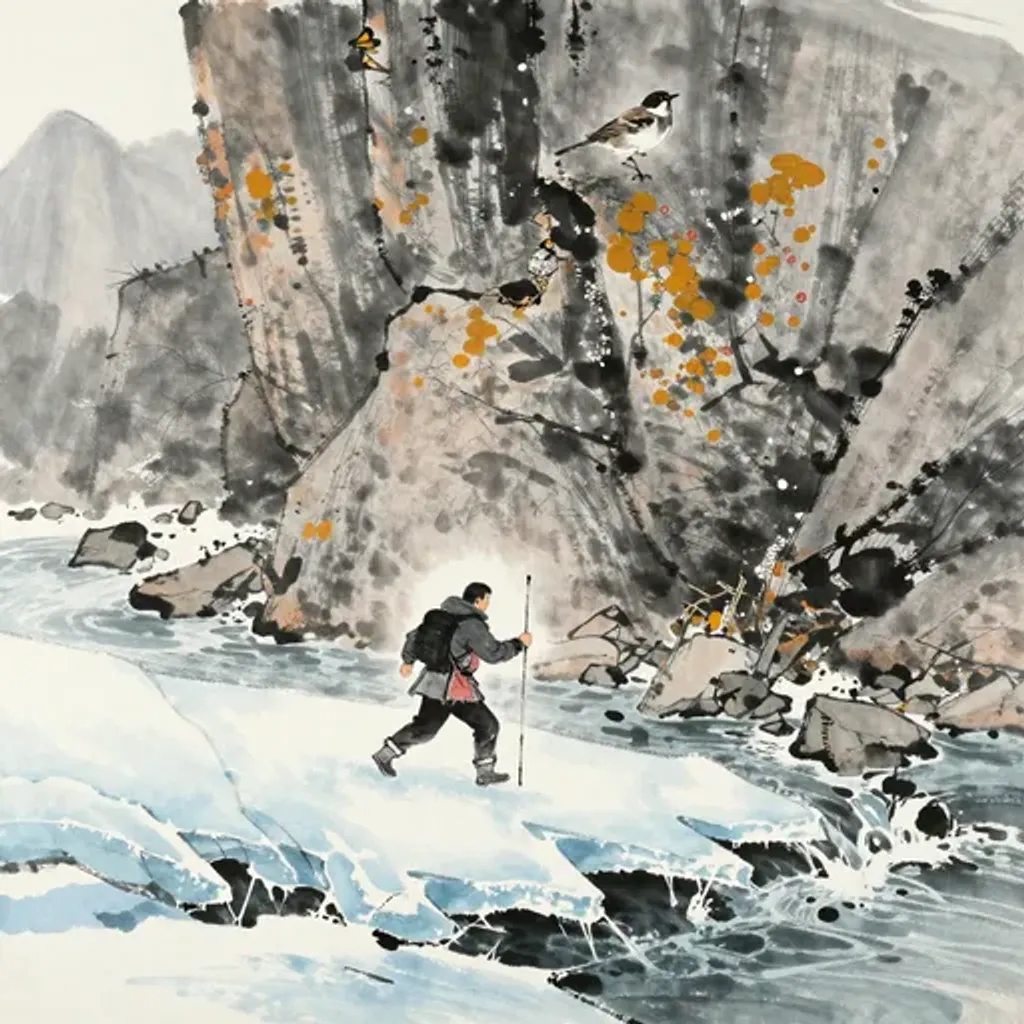
履冰蹈凌,雖困不窮。播雀登巖,卒無憂凶。
Treading on ice, stepping over frost; though beset, not brought to ruin. The sparrow ascends the cliff; in the end there is no grief or misfortune.
— Jiao Yanshou, Yilin (Forest of Changes), 1st century BC
Commentary
Fire buried beneath the earth finds expression as thunder resting in the lake — Following, where one adapts to circumstance and endures. 'Treading on ice and frost, though beset, never exhausted.' The traveler walks through frozen danger yet refuses to be consumed by it. Then the image shifts: 'A sparrow-hawk climbs the cliff, and in the end there is no calamity.' The bird that finds footing on barren rock demonstrates resourceful adaptation. From Darkening of the Light to Following, the transformation shows how buried light survives by moving with conditions rather than resisting them. Thunder beneath the lake at nightfall signals retreat into rest — the gentleman follows the darkening and finds shelter, preserving himself for a brighter hour.
明夷 → 蠱
Hexagram 36 → Hexagram 18: Work on the Decayed
Changing lines: 1, 2, 6
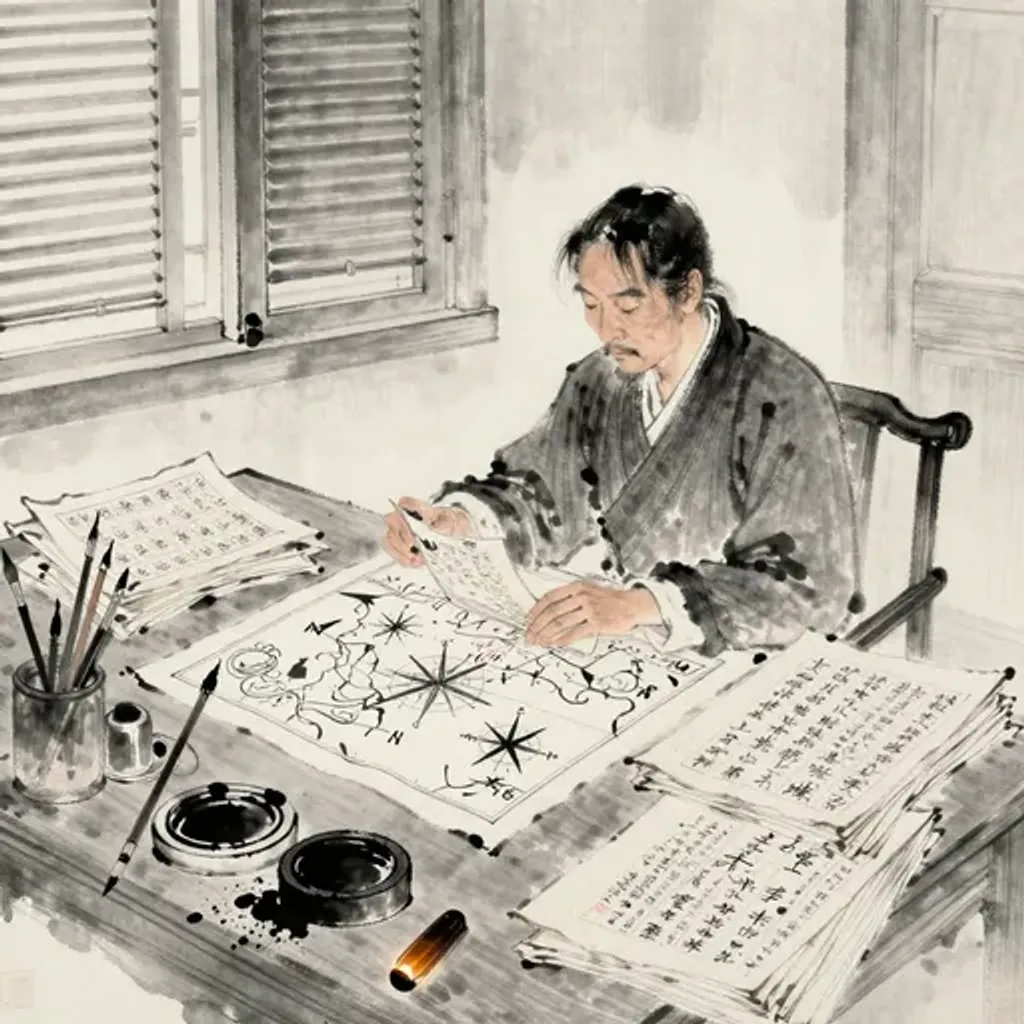
文文墨墨,憂禍相雜。南北失志,東西不得。
Muddled writing, blotted ink; worry and misfortune mingle together. South and north lose their aim; east and west cannot be found.
— Jiao Yanshou, Yilin (Forest of Changes), 1st century BC
Commentary
Fire sinks beneath the earth while wind stirs under the mountain — Work on the Decayed, where corruption must be addressed before renewal. 'Ink and scribbles tangled together, worries and disasters interwoven.' The confusion is both intellectual and moral — nothing can be clearly read or understood. 'South and north lose direction; east and west yield nothing.' Complete disorientation, where every path leads to failure. This is the state of affairs when decay has penetrated so deeply that the buried light cannot find its way out. From Darkening of the Light to Work on the Decayed, the transformation demands that the rot be named before it can be repaired. Wind beneath the mountain suggests hidden corruption that must be exposed and systematically addressed.
明夷 → 臨
Hexagram 36 → Hexagram 19: Approach
Changing lines: 2, 3
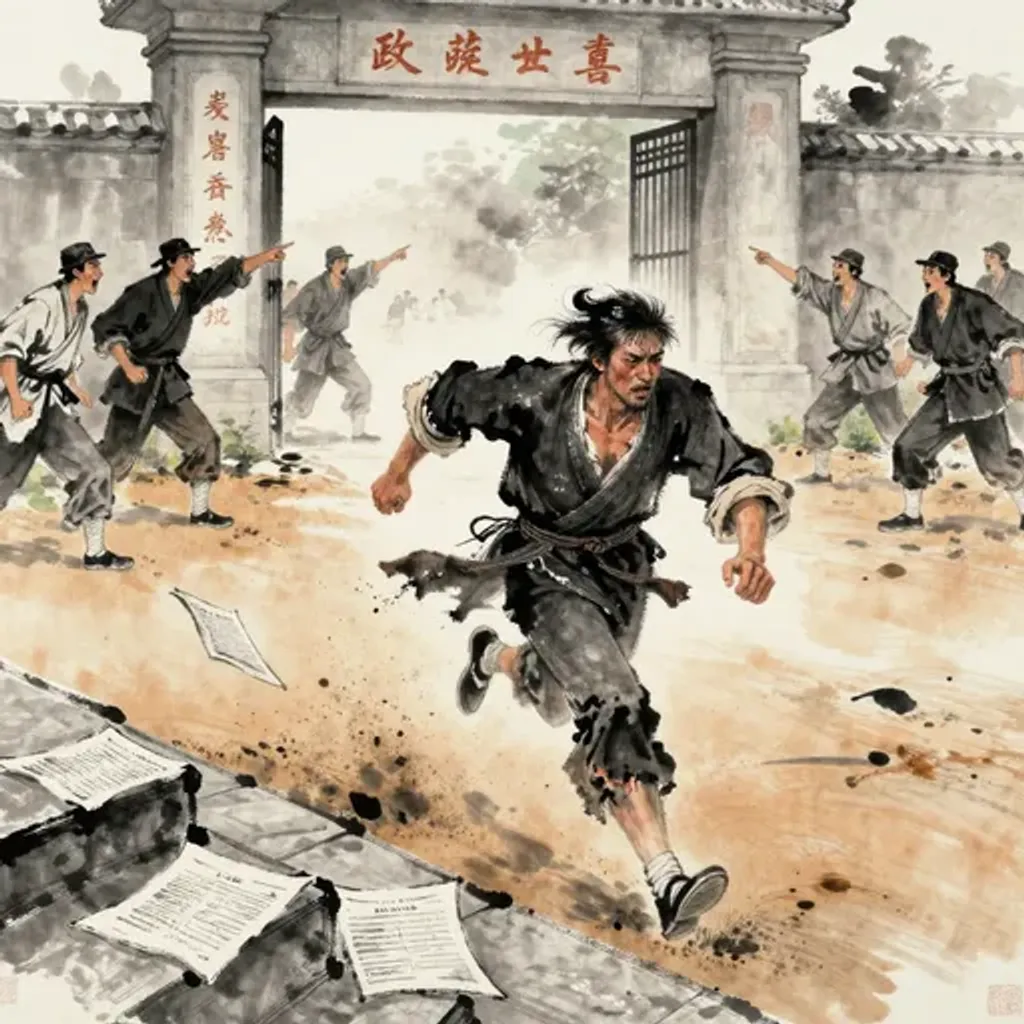
爭訟不已,更相談訽。張季弱日,被髮北走。
Lawsuits without end; each side trading accusations. In Zhang Ji's darkest hour, with hair unbound he fled north.
— Jiao Yanshou, Yilin (Forest of Changes), 1st century BC
Commentary
Fire hidden beneath the earth rises as the lake before the earth — Approach, where authority draws near with both teaching and tolerance. The verse opens with endless litigation: 'Lawsuits without cease, parties accusing one another back and forth.' Then a sudden historical flash: 'Zhang Ji, on a day of weakness, fled northward with hair unbound.' The identity of Zhang Ji remains debated — possibly Zhang Chang, the Han official known for painting his wife's eyebrows, or a figure from an earlier tradition of disgrace and flight. Unbound hair signifies the abandonment of civilized order, a person fleeing in total disarray. From Darkening of the Light to Approach, the transformation juxtaposes the chaos of disputes with the hexagram's promise of oversight: only when legitimate authority approaches can the cycle of accusation and flight be broken.
明夷 → 觀
Hexagram 36 → Hexagram 20: Contemplation
Changing lines: 1, 3, 5, 6
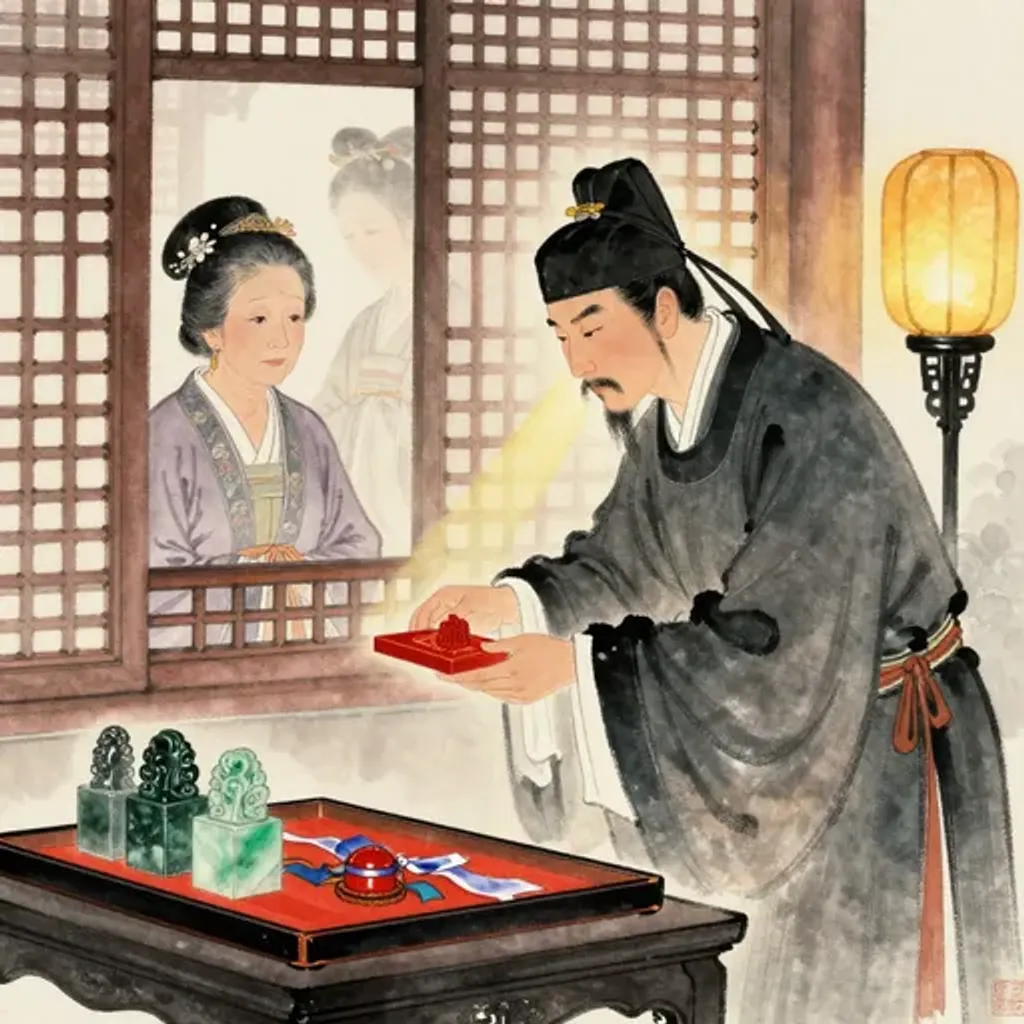
德積逢時,宜其美才。相明輔聖,拜受福休。長女不嫁,後為大悔。
Virtue accumulated meets its time; fitting for one of fine talent. Minister and sage assist the holy king; bowing, they receive blessings and grace. The eldest daughter does not marry; later this becomes great regret.
— Jiao Yanshou, Yilin (Forest of Changes), 1st century BC
Commentary
Fire beneath the earth meets wind moving over the earth — Contemplation, where the ruler surveys the realm from on high. 'Virtue accumulated meets its season; how fitting for such fine talent.' The worthy person gathers merit in obscurity until the moment arrives: 'A brilliant minister assists a sage ruler; blessings are received and honored.' This is the Darkening of the Light's promise for the patient cultivator. Yet the verse pivots with a warning: 'The eldest daughter delays her marriage; later there will be great regret.' Timing is everything — virtue stored too long without deployment becomes wasted opportunity. From Darkening of the Light to Contemplation, the transformation teaches that hidden virtue must eventually be displayed, as wind must eventually blow across the earth for its influence to be felt.
明夷 → 噬嗑
Hexagram 36 → Hexagram 21: Biting Through
Changing lines: 3, 4, 6
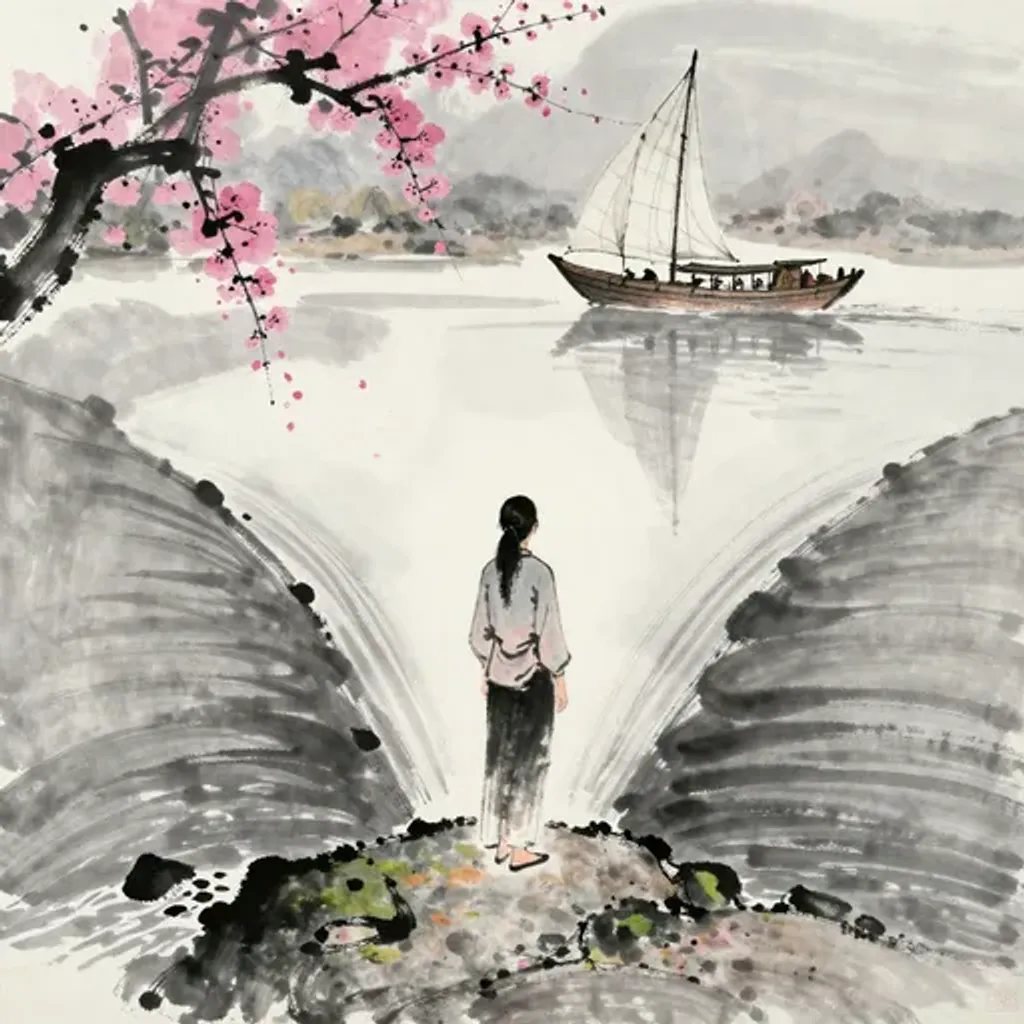
江水沱汜,思附君子。伯仲爰歸,不我肯顧,姪娣恨悔。
The river's waters branch and fork; she yearns to follow her lord. Elder and younger brothers return home, but none will look back at me. Niece and younger sister grieve and repent.
— Jiao Yanshou, Yilin (Forest of Changes), 1st century BC
Commentary
Fire submerged beneath the earth re-emerges as lightning and thunder — Biting Through, where obstacles are decisively removed. The verse quotes the Shijing ode 'Jiang You Si' from the Shao Nan section: 'The river has its branches; this lady returns but does not take me along.' The senior and junior wives depart together, leaving the speaker behind — 'My nieces and sisters-in-law are filled with regret.' This is the pain of being left behind when others find their place, the frustration of the one who remains in darkness while the group moves on. From Darkening of the Light to Biting Through, the transformation suggests that the sting of exclusion demands a forceful resolution — lightning illuminates what thunder clears away, and what was hidden must be confronted directly.
明夷 → 賁
Hexagram 36 → Hexagram 22: Grace
Changing lines: 6
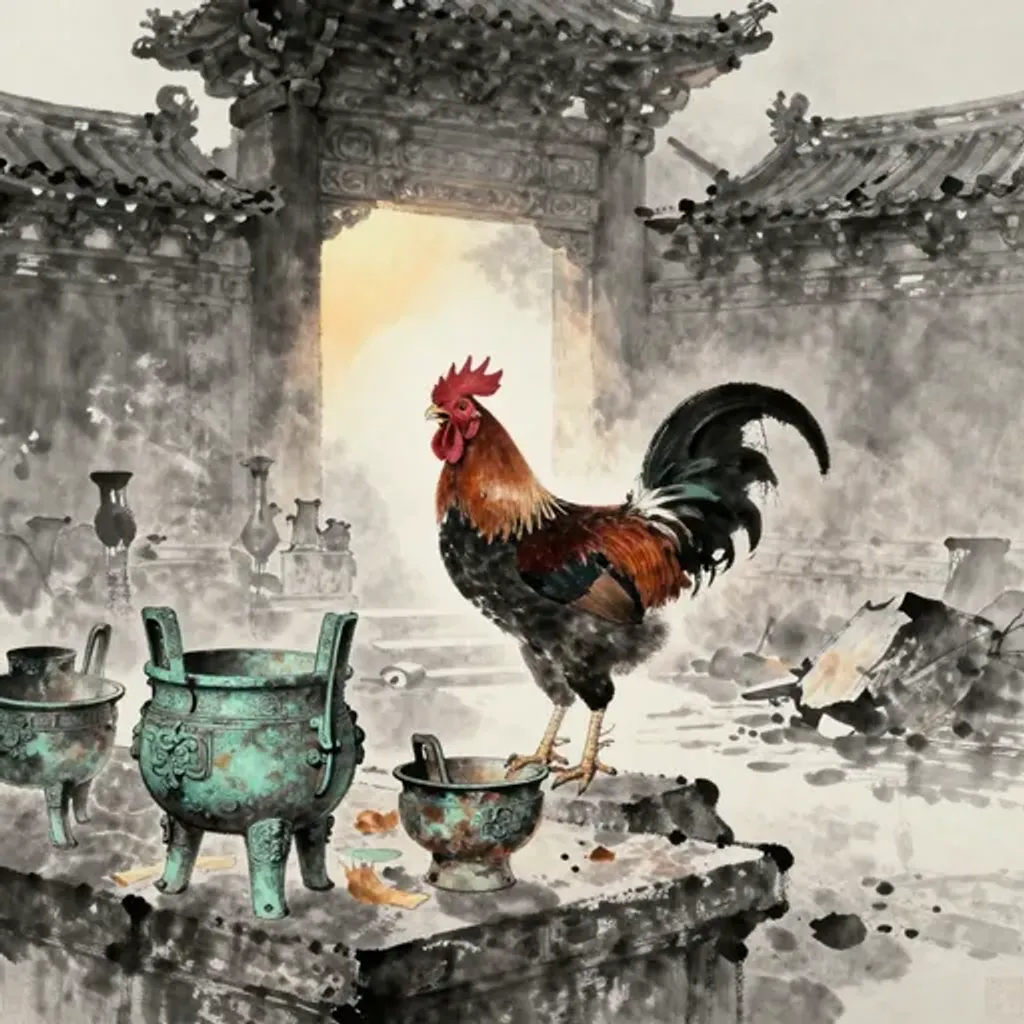
光禮春成,陳寶雞鳴。陽明失道,不能自守,消亡為咎。
Bright rites completed in spring; the treasure of Chen, the crowing rooster. The bright yang loses its way; it cannot preserve itself. Its waning becomes its fault.
— Jiao Yanshou, Yilin (Forest of Changes), 1st century BC
Commentary
Fire buried beneath the earth meets fire beneath the mountain — Grace, where outward adornment conceals deeper structure. 'Light and ritual achieve spring's fullness; the Chenbao rooster crows.' The sacred Chenbao cult of Qin is invoked — divine pheasants that crowed at dawn, signaling heavenly favor. Yet the verse turns: 'The yang brightness loses its way, unable to maintain itself; decline and ruin follow.' Ceremonial splendor without genuine virtue is merely decorative fire on the mountainside — beautiful but directionless. From Darkening of the Light to Grace, the transformation warns that adorning a darkened reality with ritual beauty only delays the reckoning. The Chenbao rooster crows, but if the light it heralds cannot sustain its course, the display is hollow.
明夷 → 剝
Hexagram 36 → Hexagram 23: Splitting Apart
Changing lines: 1, 3, 6
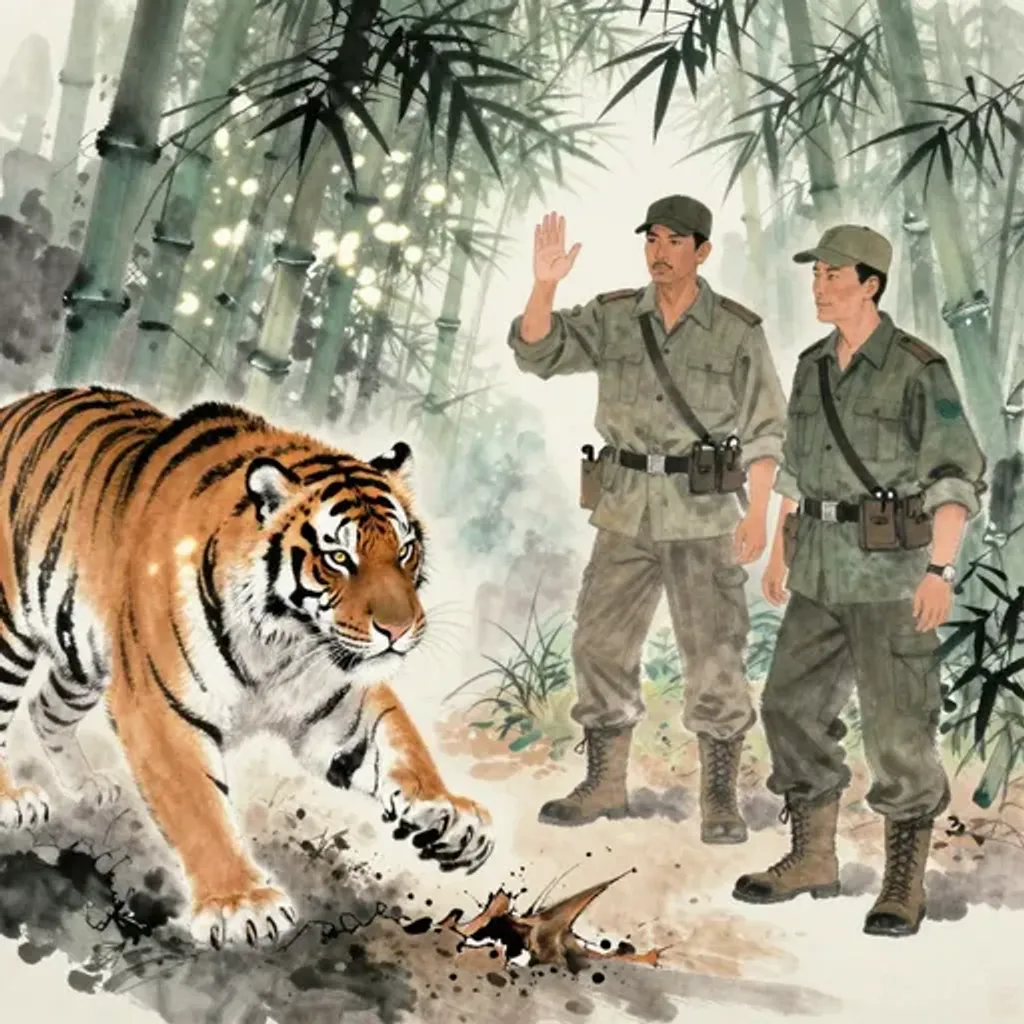
驚虎無患,虞為我言。賴得以安。
The startled tiger brings no harm; the warden speaks on my behalf. Through this I find peace.
— Jiao Yanshou, Yilin (Forest of Changes), 1st century BC
Commentary
Fire plunges beneath the earth as the mountain rests upon the earth — Splitting Apart, where structure erodes from below. Yet the verse offers unexpected comfort: 'The startling tiger poses no danger; a guardian speaks on my behalf, and I am kept safe.' The 'yu' (虞) here likely refers to a warden or protector — an official whose advocacy shields the vulnerable from predatory power. Even as the ground crumbles, a single voice of protection can make the difference between survival and destruction. From Darkening of the Light to Splitting Apart, the transformation doubles the peril — light is buried and the structure above is collapsing — yet demonstrates that even in extremity, having one reliable advocate can secure safety against all expectation.
明夷 → 復
Hexagram 36 → Hexagram 24: Return
Changing lines: 3
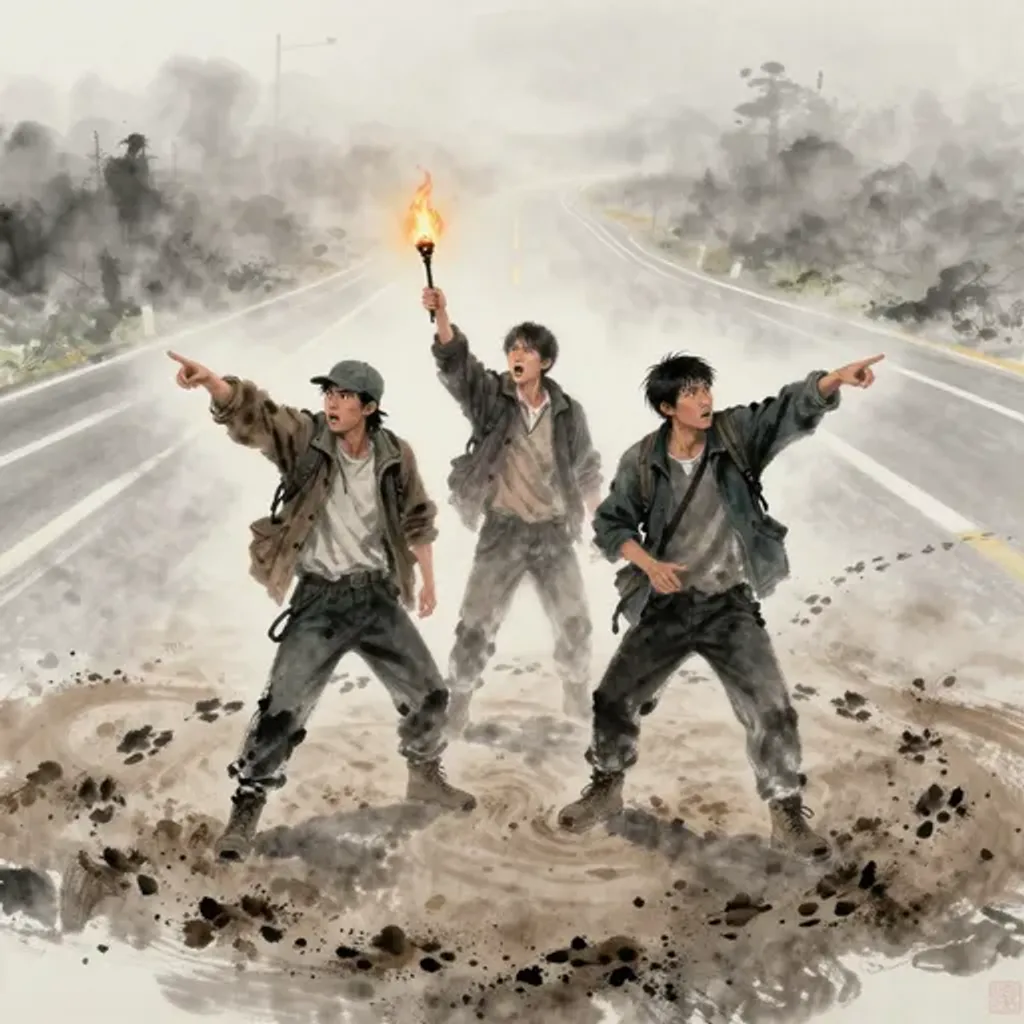
偽言妄語,轉相詿誤,不知狼處。
False words and reckless speech; passed along, leading each other astray. Not knowing where the wolf dwells.
— Jiao Yanshou, Yilin (Forest of Changes), 1st century BC
Commentary
Fire sinks beneath the earth as thunder stirs in the earth — Return, the moment when the first yang line re-enters from below. The verse, however, paints a picture of compounded deception: 'False words and reckless lies, one deception breeding another, not knowing where the wolf lurks.' Return's promise of renewed light is here corrupted by a chain of falsehoods that obscure reality further. The 'wolf' — a classical metaphor for the treacherous minister — cannot be located because deception has made the entire landscape unreadable. From Darkening of the Light to Return, the transformation should offer hope, but the verse warns that if the returning light enters a field of lies, the very mechanism of renewal is poisoned. One must first clear the deceptions before authentic return can occur.
明夷 → 无妄
Hexagram 36 → Hexagram 25: Innocence
Changing lines: 3, 4, 5, 6
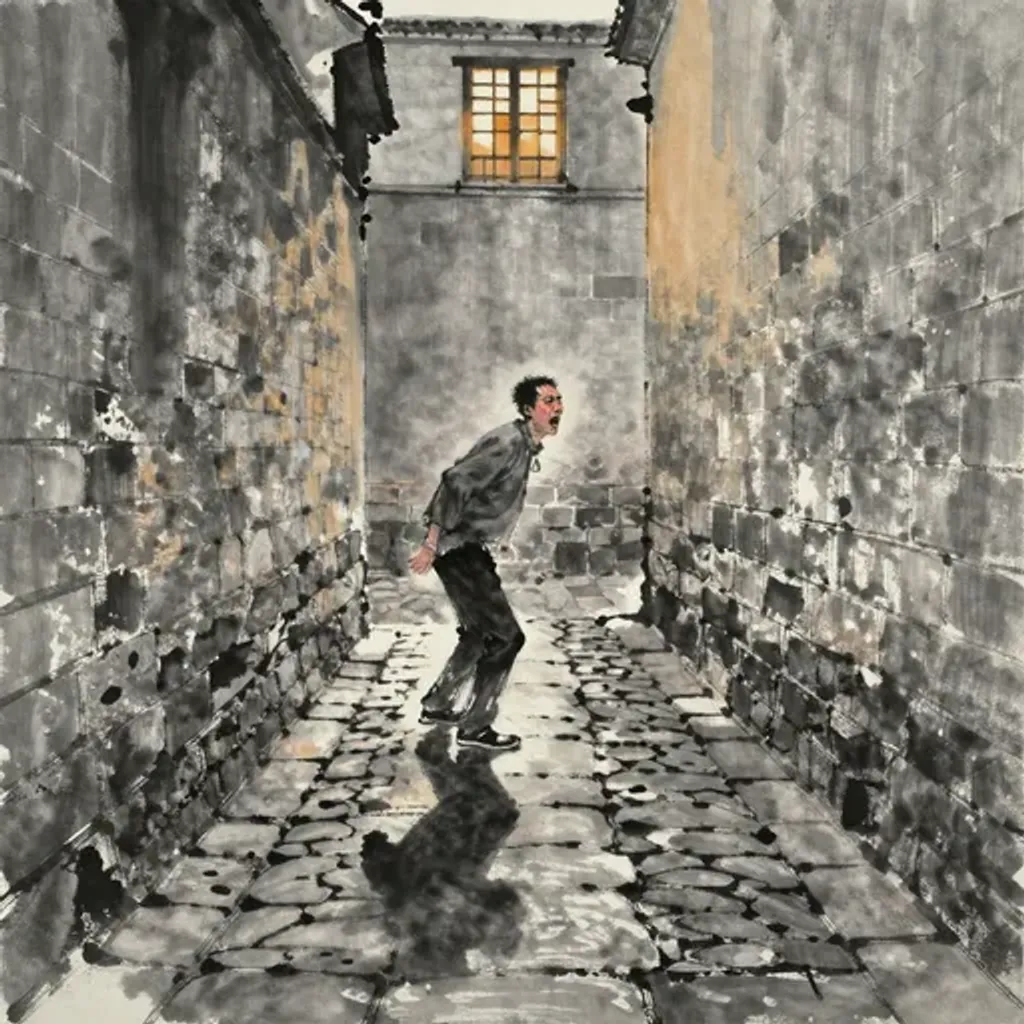
履悖自敵,凶憂來到,痛不能笑。
Treading in rebellion, making enemies of oneself; misfortune and worry arrive. The pain is such that one cannot even laugh.
— Jiao Yanshou, Yilin (Forest of Changes), 1st century BC
Commentary
Fire beneath the earth confronts thunder rolling beneath heaven — Innocence, where the unexpected intrudes without warning. 'Treading perversely, one creates enemies; misfortune and worry arrive; pain that cannot even laugh.' The verse describes self-inflicted disaster: walking crooked paths provokes hostility, and the resulting anguish admits no relief. Under heaven's thunder, all beings move according to their true nature — this is Innocence's mandate. But the speaker has violated that natural order, acting contrary to principle and inviting ruin. From Darkening of the Light to Innocence, the transformation reveals a bitter irony: in a world already darkened, the one who compounds the darkness by acting falsely suffers doubly, because the universe's demand for authenticity is non-negotiable.
明夷 → 大畜
Hexagram 36 → Hexagram 26: Great Taming
Changing lines: 2, 6
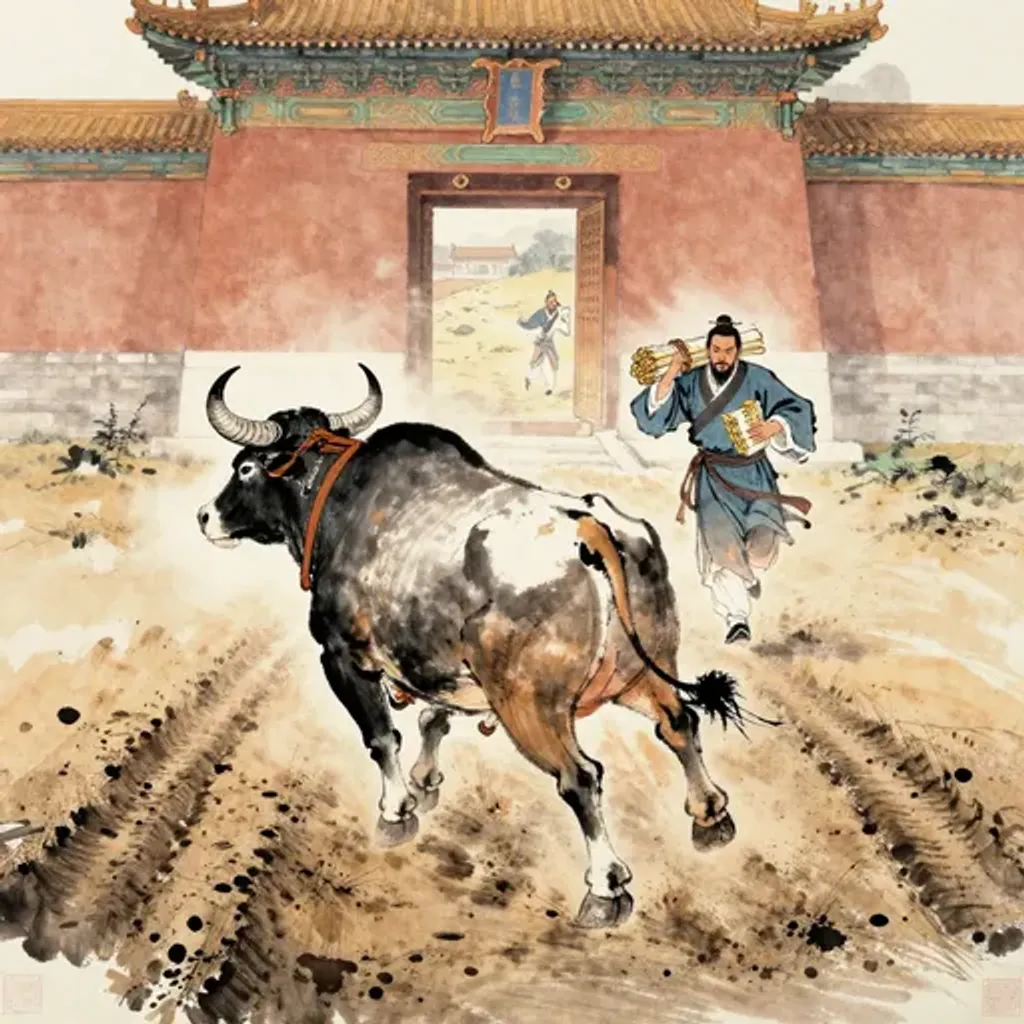
牽尾不前,逆理失臣,惠朔以奔。
Pulling the tail, it will not advance; reason reversed, the minister lost. Hui Shuo thereupon fled.
— Jiao Yanshou, Yilin (Forest of Changes), 1st century BC
Commentary
Fire beneath the earth meets heaven contained within the mountain — Great Taming, where accumulated power is held in check. 'Pulling the tail, unable to advance; going against principle, losing ministers — Hui and Shuo fled.' The verse describes a ruler who, by grasping backward rather than leading forward, violates governance and drives loyal servants into exile. The reference to 'Hui Shuo' most likely points to Duke Hui of Wei (Shuo), who was installed through intrigue and whose misrule provoked rebellion, forcing him to flee in 696 BC. From Darkening of the Light to Great Taming, the transformation warns that accumulated power misapplied becomes a trap: the mountain that stores heaven's force must direct it wisely, or its own ministers will bolt.
明夷 → 頤
Hexagram 36 → Hexagram 27: Nourishment
Changing lines: 3, 6
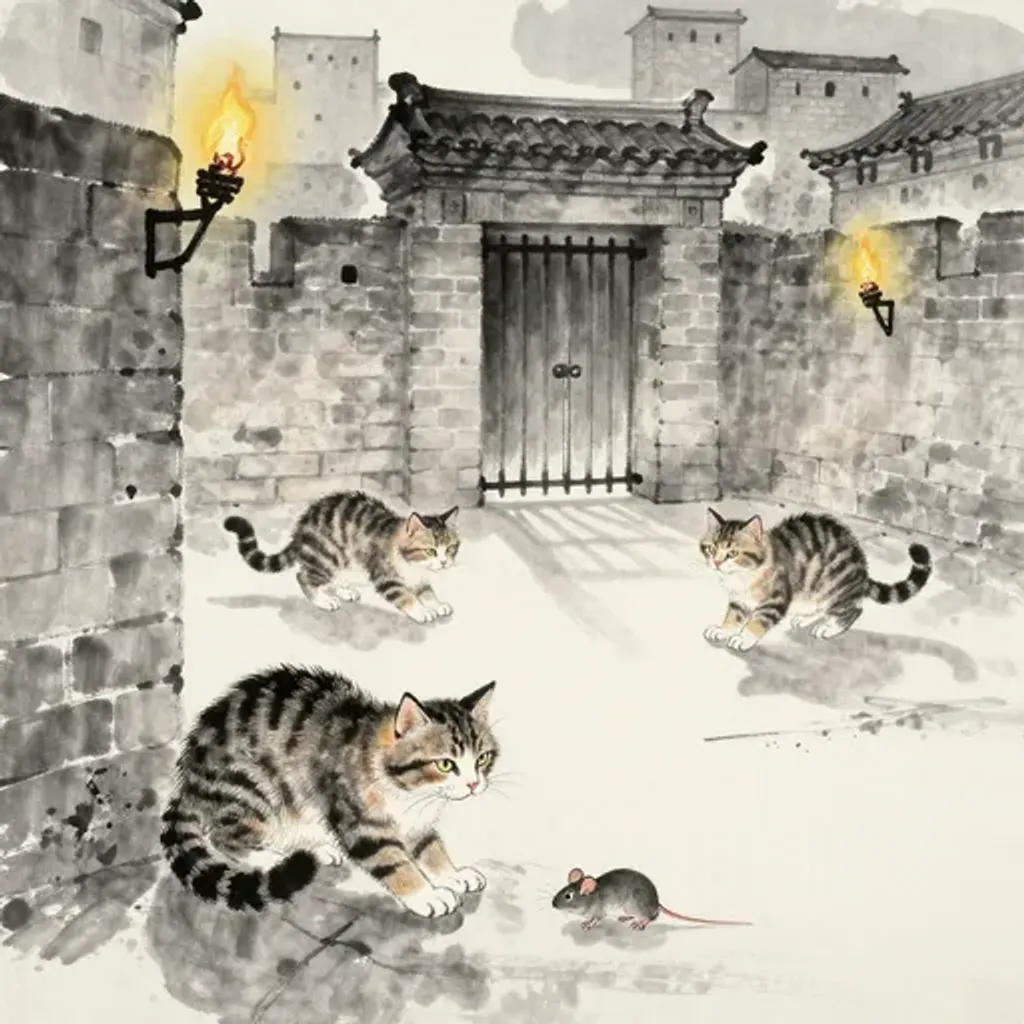
三狸搏鼠,遮遏前後,死於環城,不得脫走。
Three wildcats hunt a mouse; they block its way before and behind. It dies within the walled city; it cannot escape and flee.
— Jiao Yanshou, Yilin (Forest of Changes), 1st century BC
Commentary
Fire sinks beneath the earth as the mountain rests above thunder — Nourishment, where sustenance depends on what enters and exits the mouth. 'Three wildcats catch a mouse, blocking it front and back; it dies within the walled city, unable to escape.' The image is merciless: predators surround their prey in a closed space, cutting off every route. The 'ring-city' (環城) suggests an enclosed fortification, transforming what should be shelter into a killing ground. From Darkening of the Light to Nourishment, the transformation adds a grim dimension: what should nourish instead devours. The mouth that feeds also consumes — those trapped within a corrupted system of sustenance are consumed by the very structure meant to protect them.
明夷 → 大過
Hexagram 36 → Hexagram 28: Great Exceeding
Changing lines: 1, 2, 4, 5
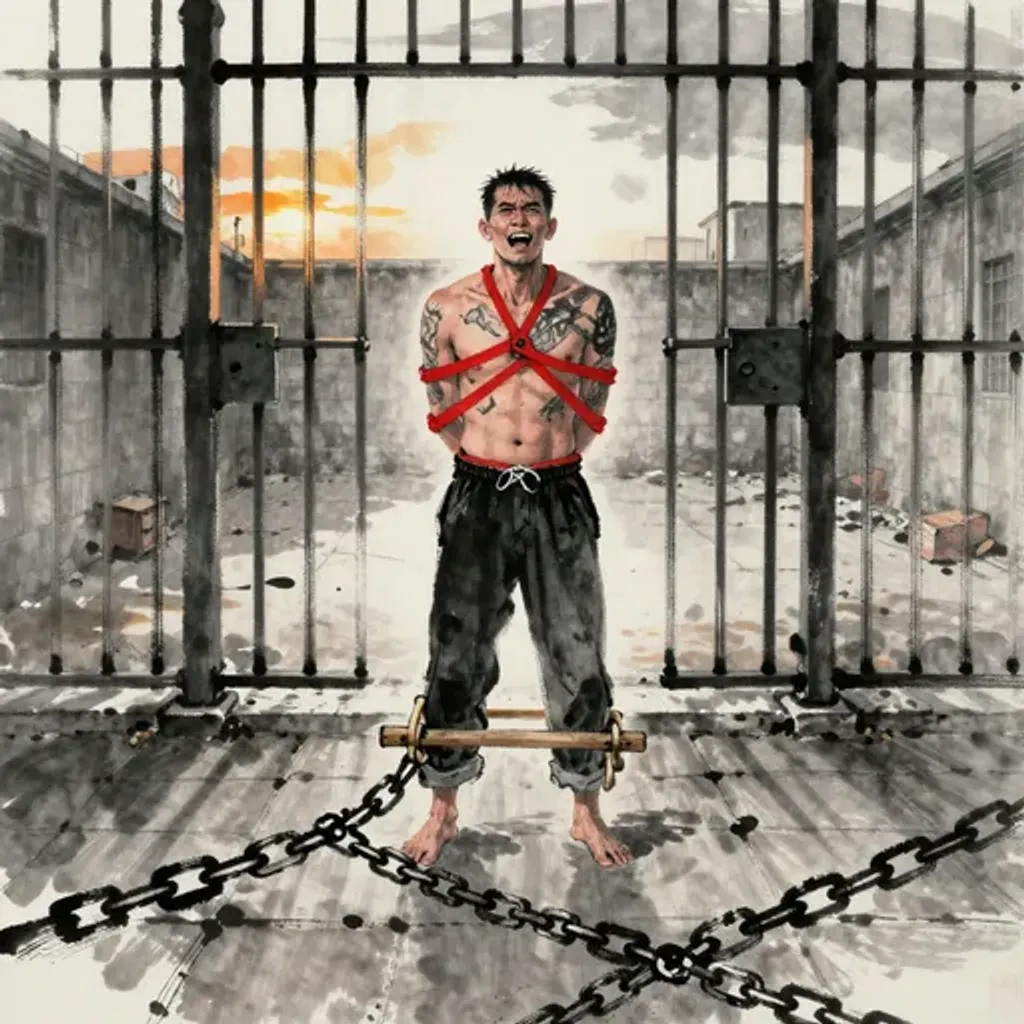
言笑未卒,憂來暴卒。身墨丹索,檻囚裝束。
Laughter and words not yet finished; grief arrives with sudden violence. Body inked, bound in crimson ropes; caged and shackled like a prisoner.
— Jiao Yanshou, Yilin (Forest of Changes), 1st century BC
Commentary
Fire vanishes beneath the earth while the lake submerges the trees — Great Exceeding, where the structure is strained beyond its capacity. 'Laughter not yet finished, worry arrives in a sudden death.' The shift from joy to catastrophe is instantaneous. 'Body inked and roped, confined in a cage, bound like a prisoner.' The imagery of tattooing (墨刑) and shackling paints a scene of judicial punishment — someone dragged from laughter into chains. From Darkening of the Light to Great Exceeding, the transformation reveals how the suppression of light can tip suddenly into total structural collapse. The lake swallows the trees; the ridgepole breaks. What seemed merely oppressive becomes catastrophic without warning, and the one caught mid-laugh is the one who failed to read the signs.
明夷 → 坎
Hexagram 36 → Hexagram 29: The Abysmal Water
Changing lines: 1, 2, 3, 5
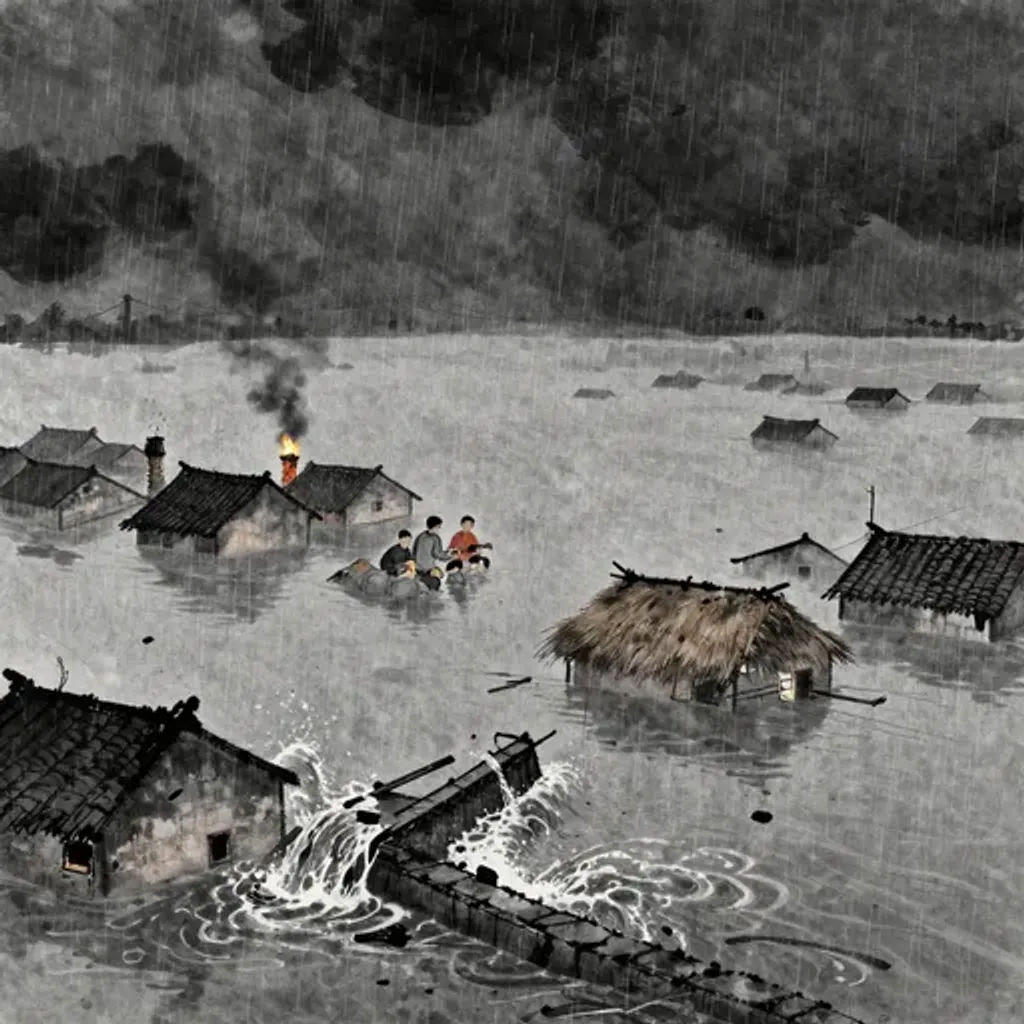
陰積不已,雲作淫雨。傷害平陸,民无室屋。
Yin gathers without ceasing; clouds bring excessive rain. It damages the level plains; the people have no roofs or shelter.
— Jiao Yanshou, Yilin (Forest of Changes), 1st century BC
Commentary
Fire beneath the earth plunges into doubled water — the Abysmal, danger compounded upon danger. 'Yin accumulates without cease; clouds become excessive rain. The flat land is ruined; the people have no shelter.' This is environmental catastrophe as political metaphor: when yin forces gather unchecked — bureaucratic darkness, tyrannical suppression — they eventually flood the very ground people depend on. The destruction of the 'level land' (平陸) suggests the obliteration of stable, ordinary life. From Darkening of the Light to the Abysmal, the transformation is among the most dire: buried fire meets doubled water, and what was merely suppressed now drowns. The verse offers no rescue, only the image of a populace stripped of shelter by forces that began as mere overcast skies.
明夷 → 離
Hexagram 36 → Hexagram 30: The Clinging Fire
Changing lines: 4, 6
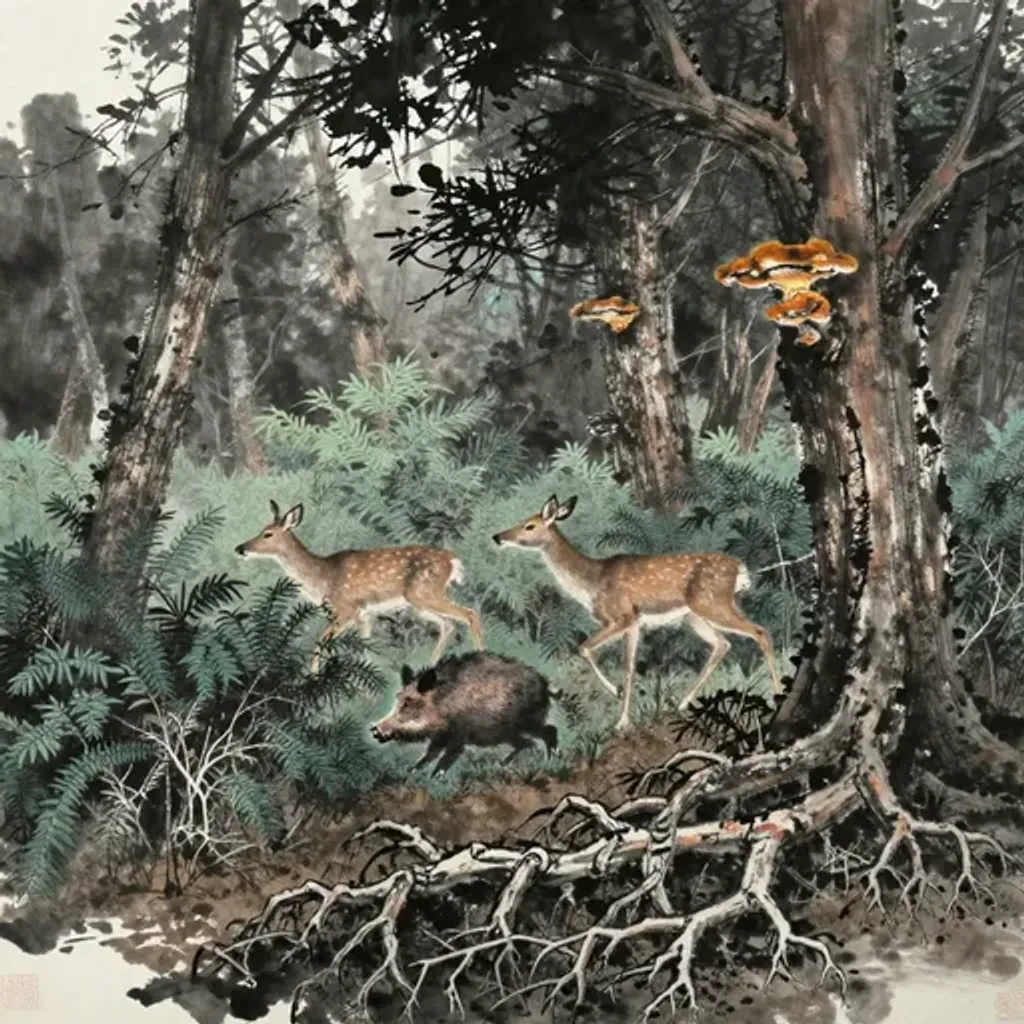
山林麓藪,非人所處。鳥獸无禮,使我心苦。
Mountain forests and foothill marshes; no place for human dwelling. Birds and beasts know no propriety; they make my heart bitter.
— Jiao Yanshou, Yilin (Forest of Changes), 1st century BC
Commentary
Fire beneath the earth meets doubled fire — the Clinging, where brilliance is restored but must find something to cling to. 'Mountain forests and foothills are no place for humans. Birds and beasts know no propriety; they make my heart bitter.' The speaker is exiled to the wilderness, surrounded by creatures that observe no human code. This echoes the experience of Viscount Ji of Shang, who feigned madness under tyranny — the Darkening of the Light's own archetype. From Darkening of the Light to the Clinging, the transformation doubles the fire: the hidden flame re-emerges, but in a place where there is nothing civilized to illuminate. Brilliance without a proper vessel is mere wildfire in an empty forest.
明夷 → 咸
Hexagram 36 → Hexagram 31: Influence
Changing lines: 1, 4, 5
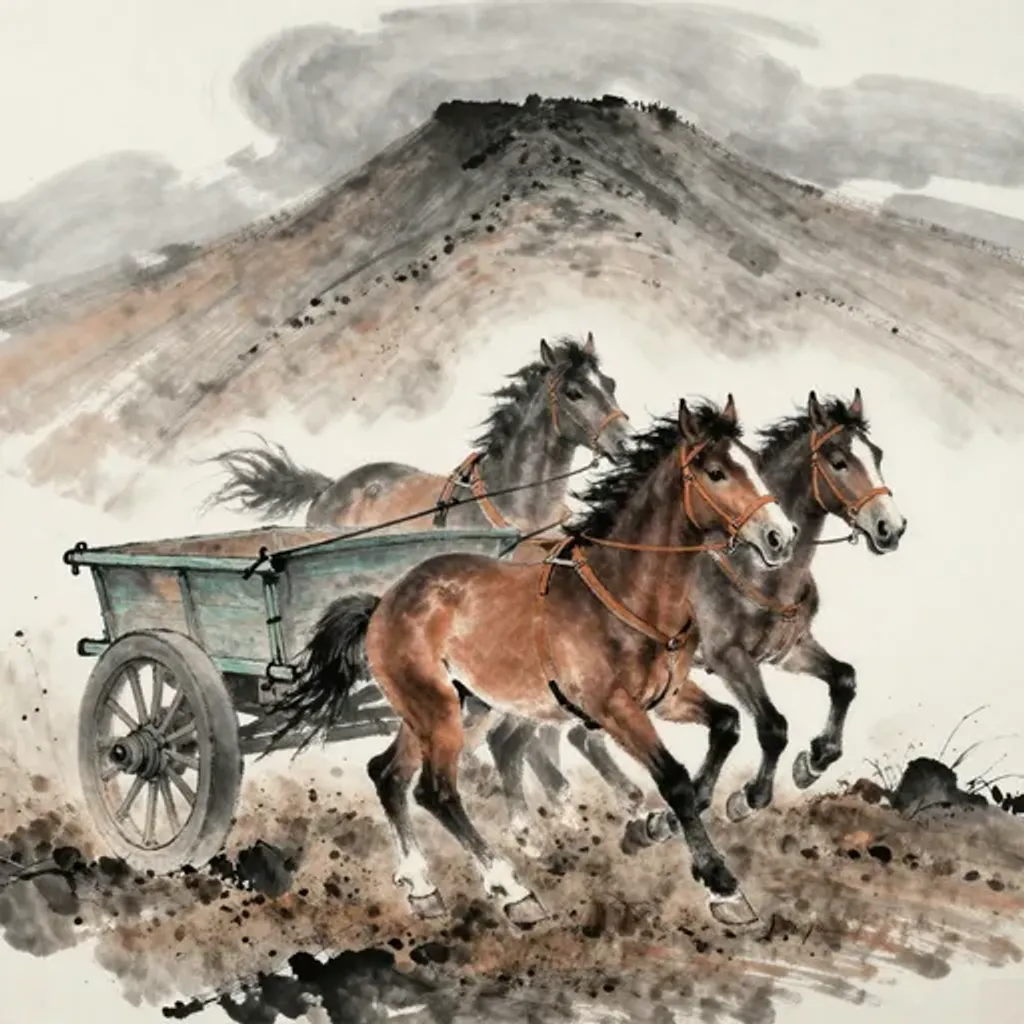
新作初陵,踰蹈難登。三駒推車,跌頓傷頤。
A new mound freshly raised; too steep to climb or cross. Three colts push the cart; they stumble and fall, injuring their jaws.
— Jiao Yanshou, Yilin (Forest of Changes), 1st century BC
Commentary
Fire buried beneath the earth meets the lake upon the mountain — Influence, where mutual responsiveness flows between above and below. Yet the verse describes failed ascent: 'A newly built mound, difficult to climb over and tread upon. Three colts push a cart; they stumble and injure the jaw.' The mound is too fresh to be stable; the young horses lack the strength to haul their load uphill. Influence requires receptivity — the mountain must be open to the lake above — but here the connection misfires. The colts strain and fall, damaging the very organ of nourishment. From Darkening of the Light to Influence, the transformation reveals that premature attempts at connection, launched from a position of suppressed light, are more likely to stumble than to succeed.
明夷 → 恆
Hexagram 36 → Hexagram 32: Duration
Changing lines: 1, 2, 4
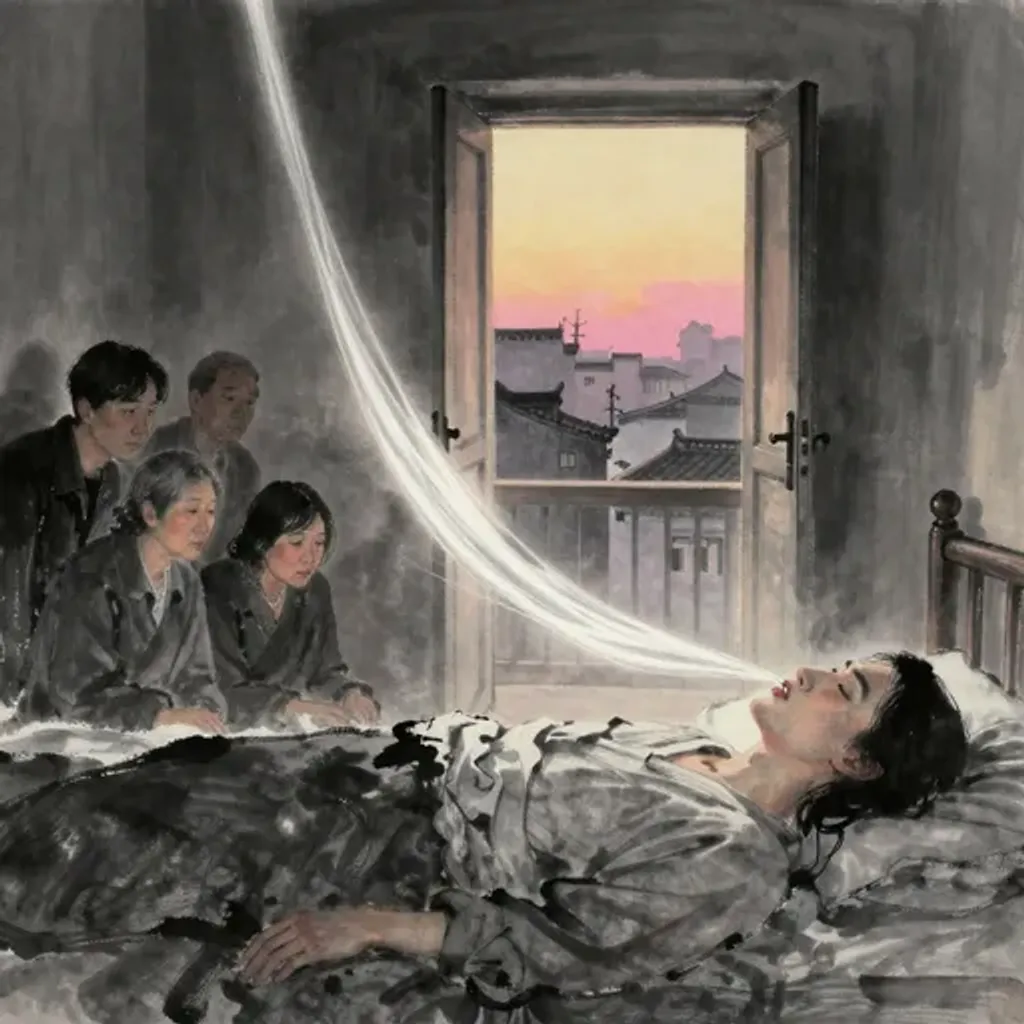
魂微惙惙,行纊聽絕。曠然大通,復更生活。
The soul fades, faint and flickering; silk floss held close, the breath seems gone. Then all at once, a great opening; life stirs and returns again.
— Jiao Yanshou, Yilin (Forest of Changes), 1st century BC
Commentary
Fire beneath the earth transforms into thunder and wind together — Duration, the commitment to persist through all seasons. The verse traces the trajectory from near-death to recovery: 'The soul faintly flickers, barely breathing, tested with silk floss at the lips for signs of life.' This is the ancient deathbed test — holding a strand of silk before the mouth to detect the faintest breath. 'Then suddenly, a great opening — life returns and continues.' The reversal from extremity to renewal is absolute. From Darkening of the Light to Duration, the transformation reveals that what endures is not the strong but the persistent. Thunder and wind reinforce each other ceaselessly, and the soul that barely survived the darkening of light discovers in that very fragility the thread that sustains ongoing life.
明夷 → 遯
Hexagram 36 → Hexagram 33: Retreat
Changing lines: 1, 4, 5, 6
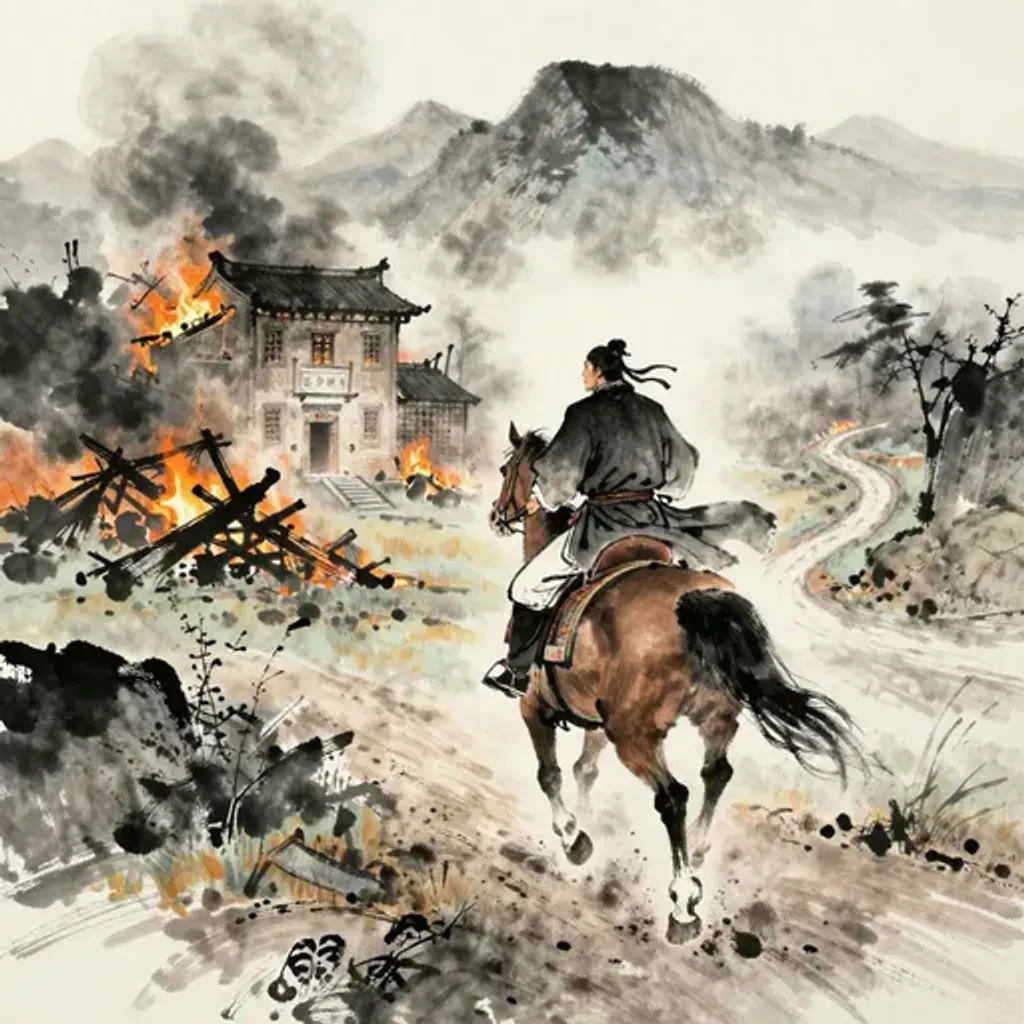
欒子作殃,伯氏誅傷。州犁奔楚,去其邑鄉。
Luan Zi brought calamity; the Bo clan was slain and wounded. Zhou Li fled to Chu, departing from his native town.
— Jiao Yanshou, Yilin (Forest of Changes), 1st century BC
Commentary
Fire beneath the earth retreats into heaven above the mountain — Retreat, where the wise withdraw before the petty advance. The verse names historical figures from the Jin state's internal purges: 'Luan brought calamity; the Bo clan was slaughtered. Zhouli fled to Chu, leaving his home city behind.' According to the Zuo Zhuan, the minister Bozong of Jin was killed by the powerful Xi clan around 576 BC. His son Bo Zhouli (伯州犁) fled to the state of Chu to survive. The Luan clan later fomented further chaos in Jin's factional struggles. From Darkening of the Light to Retreat, the transformation prescribes the only viable response when factional violence engulfs the court: flee, as Zhouli did, preserving life over loyalty to a doomed position.
明夷 → 大壯
Hexagram 36 → Hexagram 34: Great Power
Changing lines: 2, 4
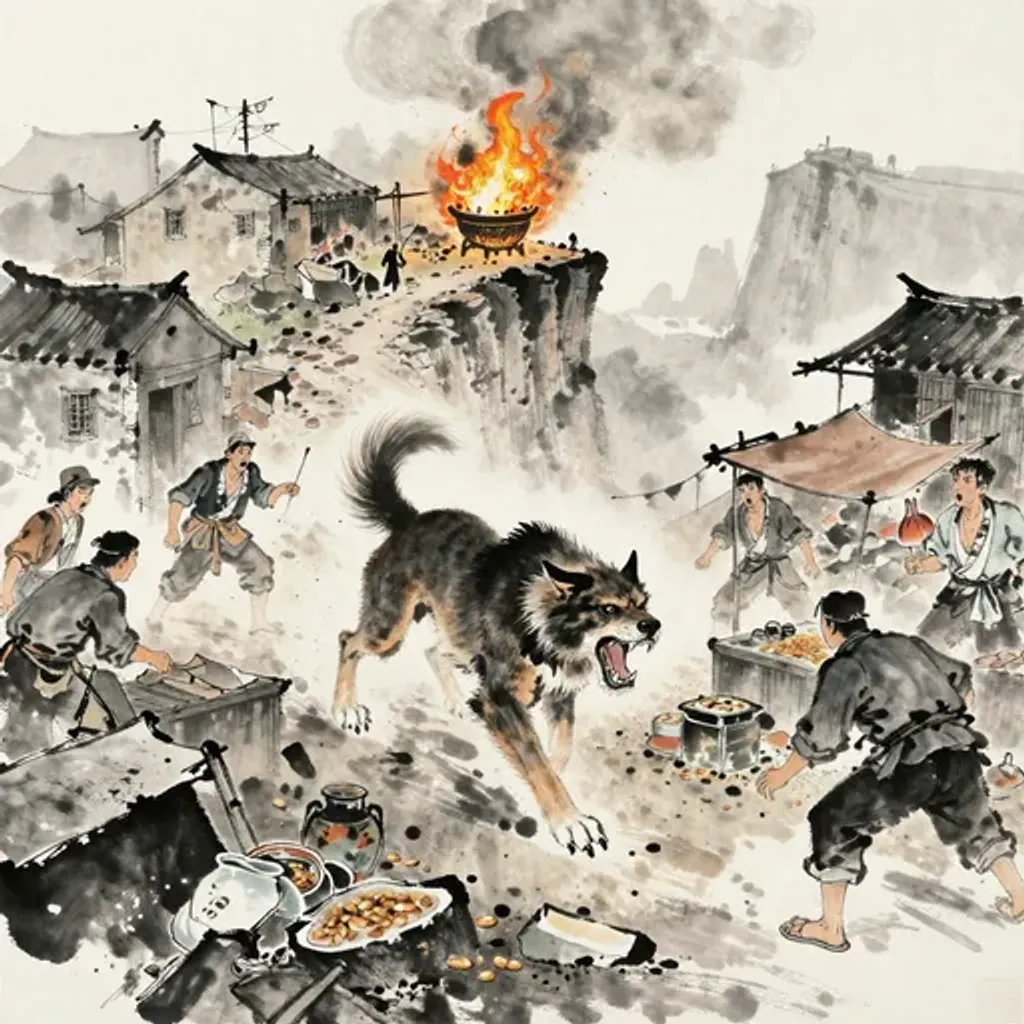
驕胡犬形,造惡作凶。无所能成,還自滅身。
The arrogant barbarian in dog's form; creating evil, working havoc. He accomplishes nothing; in the end he destroys himself.
— Jiao Yanshou, Yilin (Forest of Changes), 1st century BC
Commentary
Fire buried beneath the earth erupts as thunder in heaven — Great Power, where immense force demands disciplined restraint or risks self-destruction. 'An arrogant barbarian in the form of a dog creates wickedness and breeds violence. Nothing is accomplished; in the end it destroys itself.' The 'Jiao Hu' (驕胡) — arrogant barbarian — is cast in bestial form, acting with unrestrained aggression that produces no achievement and consumes only itself. Great Power's image of thunder above heaven warns that even legitimate strength, if wielded without propriety, butts against the wall like a ram tangled in a hedge. From Darkening of the Light to Great Power, the transformation reveals the danger when suppressed energy is finally released without moral guidance — raw force that cannot build, only ruin.
明夷 → 晉
Hexagram 36 → Hexagram 35: Progress
Changing lines: 1, 3, 4, 6
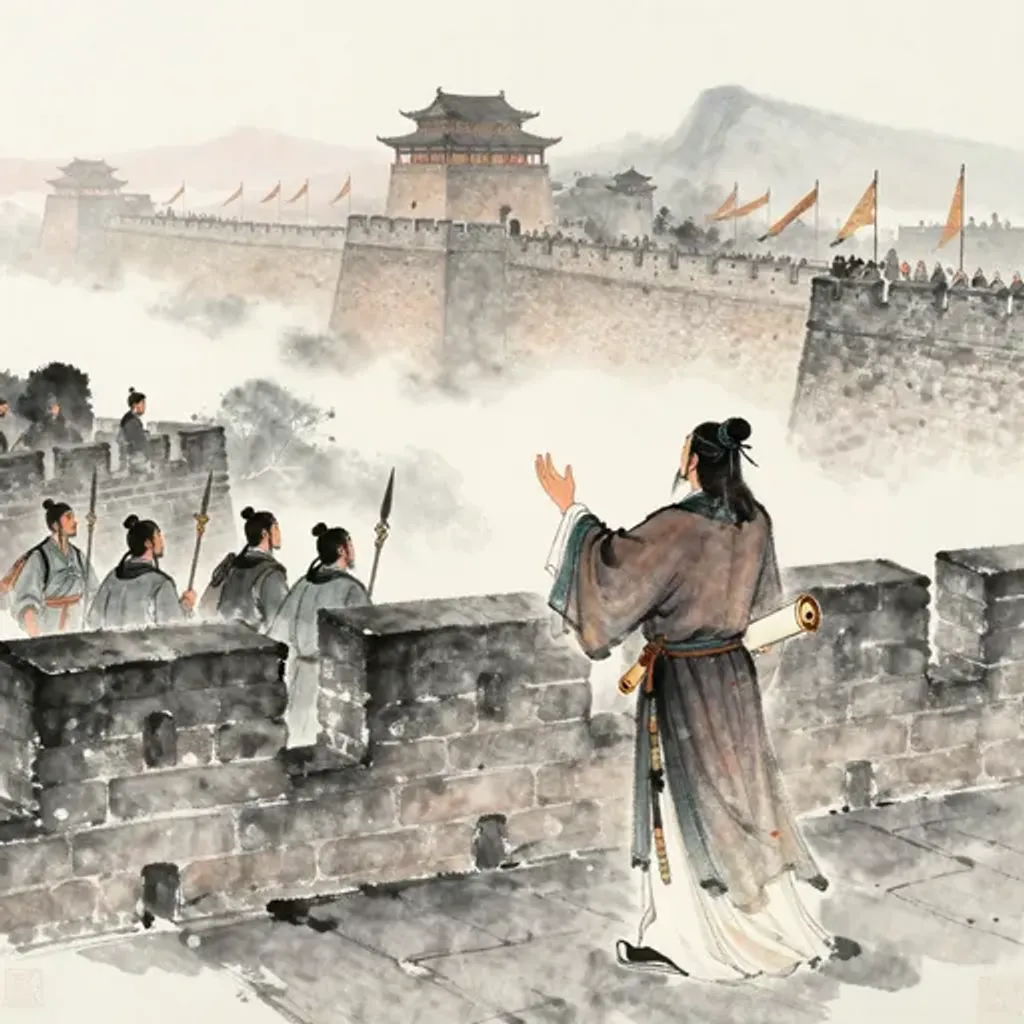
陳辭達城,使安不傾。增榮益譽,以成功名。
He presented his case and secured the city; making it safe, preventing its fall. He increased its glory and honor, and thereby achieved lasting fame.
— Jiao Yanshou, Yilin (Forest of Changes), 1st century BC
Commentary
Fire beneath the earth rises as fire above the earth — Progress, the most natural companion to Darkening of the Light, its structural inverse. 'Presenting eloquent arguments at the city walls, keeping it secure and unshaken. Glory and reputation increase; merit and renown are achieved.' This is the diplomat or counselor whose words preserve a state: rhetoric deployed not for display but for defense. The phrase 'chen ci da cheng' evokes the tradition of persuaders who saved cities through argument alone. From Darkening of the Light to Progress, the transformation is a direct reversal: light that entered the earth now rises above it. The buried fire becomes the sun climbing over the horizon, and the merit of hidden endurance translates into visible achievement.
明夷 → 明夷
Hexagram 36 → Hexagram 36: Darkening of the Light
No changing lines — the hexagram is unchanged
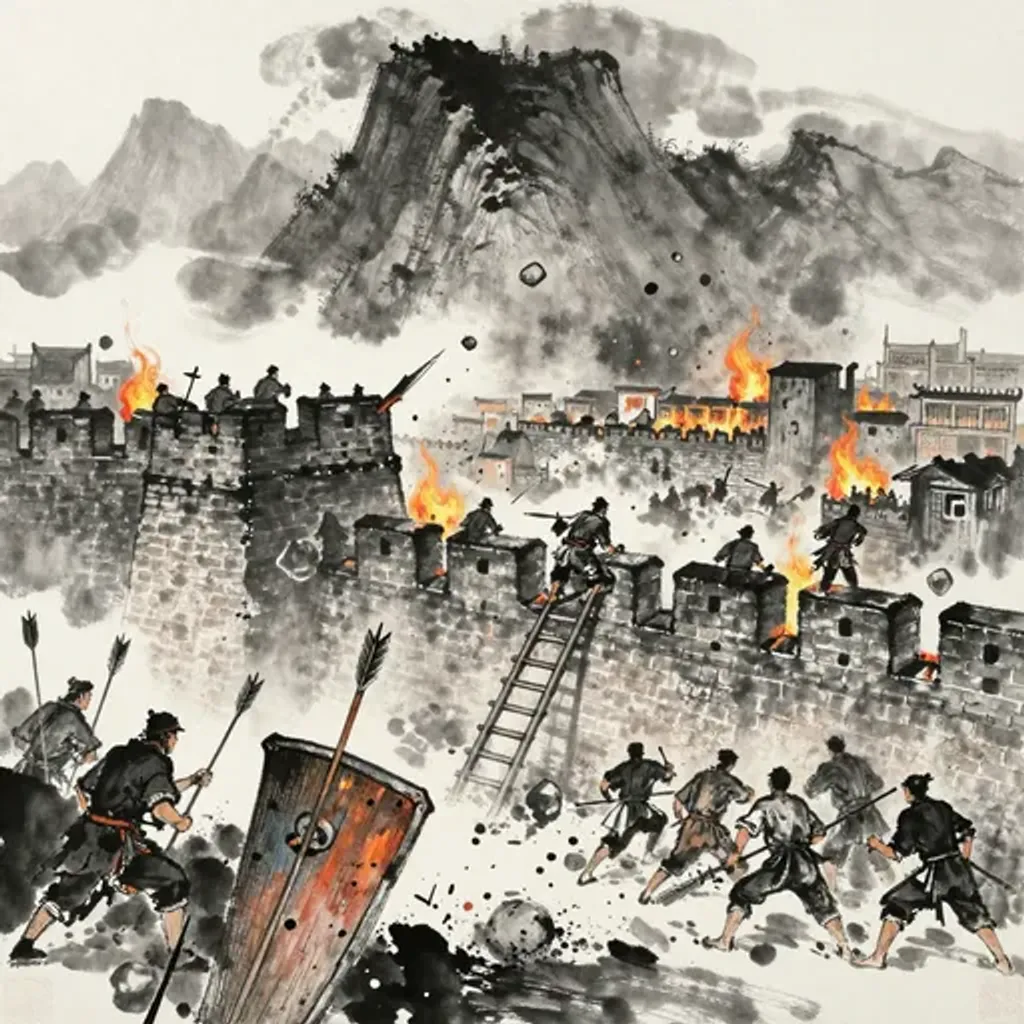
他山之儲,與璆為仇,來攻吾城,傷我肌膚,邦家騷憂。
The stores of another mountain; they make an enemy of fine jade. They come to assault our city, wounding our flesh and skin; the state and house are troubled and grieved.
— Jiao Yanshou, Yilin (Forest of Changes), 1st century BC
Commentary
Fire beneath the earth remains beneath the earth — Darkening of the Light unchanged, the source and target identical. 'Treasure from other mountains becomes an enemy of fine jade; they come to attack our city, wound our flesh, and the state trembles with grief.' When the transformation leads nowhere new, the condition intensifies. External wealth or foreign resources that should complement domestic treasure instead turn hostile. The image of a besieged city with wounded citizens echoes the hexagram's own text about Prince Ji's experience of internal tyranny. From Darkening of the Light to itself, no escape route opens. The only counsel is the hexagram's own: govern the multitude by 'using darkness to preserve light' — survival through deliberate concealment of one's true brilliance.
明夷 → 家人
Hexagram 36 → Hexagram 37: The Family
Changing lines: 5, 6
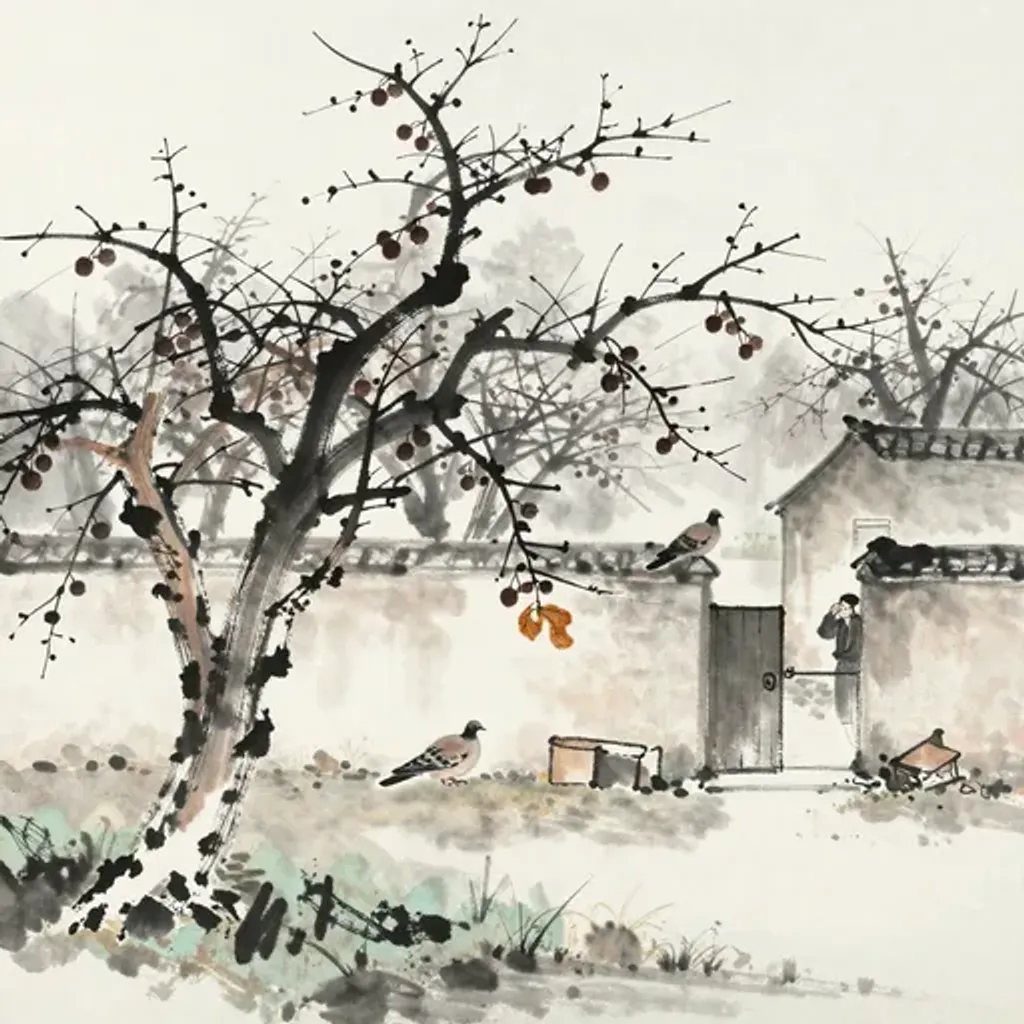
三𣏌无棗,家无積莠。使鳩求婦,頑不我許。
Three wolfberry trees, not a jujube among them; the household has no store of grain. A turtledove is sent to seek a bride; stubbornly, they refuse me.
— Jiao Yanshou, Yilin (Forest of Changes), 1st century BC
Commentary
Fire beneath the earth kindles wind from fire — the Family, where domestic order radiates outward from the hearth. Yet this household has nothing: 'Three medlar trees without jujubes; the family has no stored provisions.' Then a matchmaker is sent — the turtledove, traditional marriage broker of the folk tradition — but 'stubbornly I am refused.' The household that cannot feed itself cannot attract a bride. From Darkening of the Light to the Family, the transformation reveals a painful irony: the hexagram of domestic harmony is reached from a state of deprivation so severe that no family can form. Wind from fire requires a hearth to sustain it, but when the pantry is bare and the match is rejected, no warmth can emerge to create the home.
明夷 → 睽
Hexagram 36 → Hexagram 38: Opposition
Changing lines: 2, 3, 4, 6
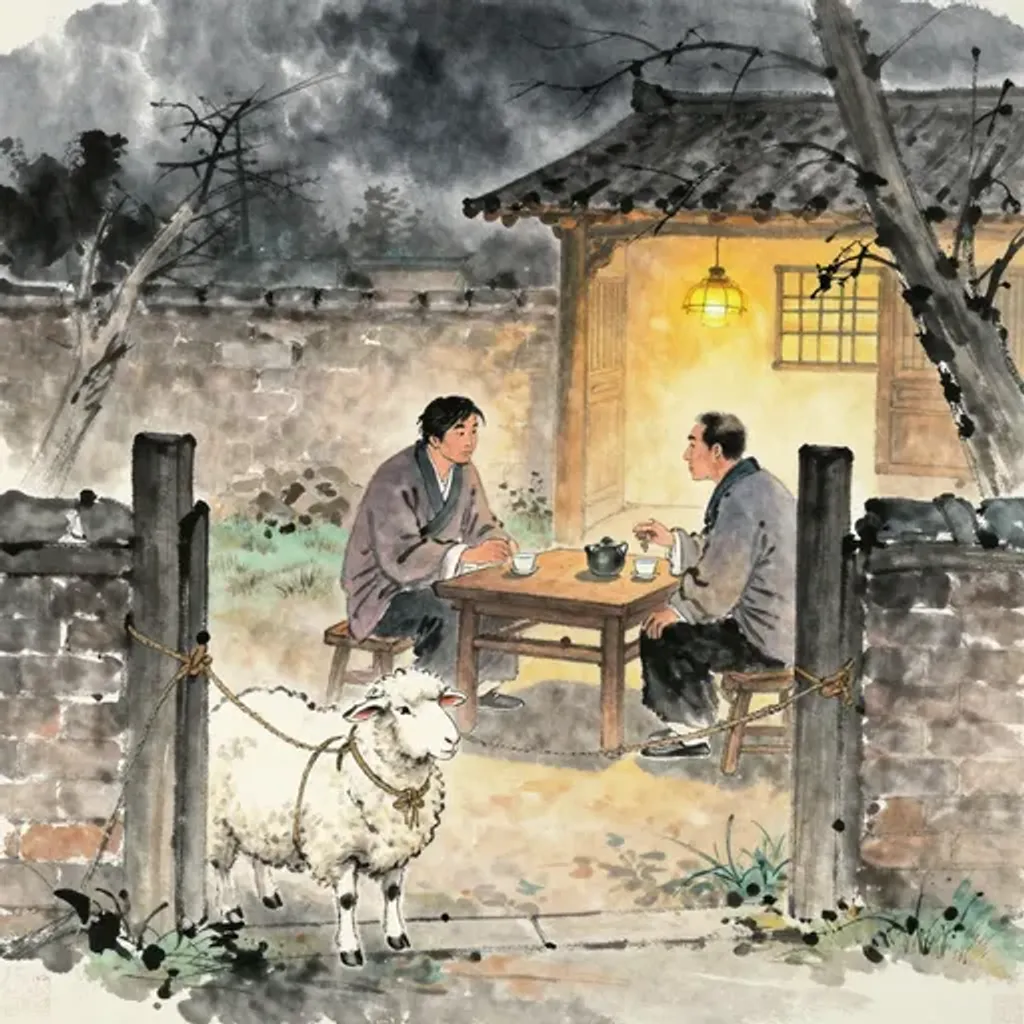
慎禍重病,顏子為友,乃能安存。牢戶繫羊,乃能受慶。
Be cautious of calamity and grave illness; take Yan Hui as your companion, and thus find safety and survival. Secure the gate and pen the sheep; thus may you receive good fortune.
— Jiao Yanshou, Yilin (Forest of Changes), 1st century BC
Commentary
Fire beneath the earth meets fire above the lake — Opposition, where unlike elements coexist in productive tension. 'Guarding against calamity and grave illness, with Yan Hui as a friend, one can survive in safety.' Yan Hui — Confucius's most beloved disciple, who lived in a narrow lane with a gourd of water and a basket of rice yet never lost his joy — represents the friend whose moral constancy sustains one through crisis. The verse then pivots: 'Secure the door and pen the sheep, and blessings can be received.' Opposition's genius lies in finding harmony within difference, and from Darkening of the Light, this transformation shows that when light is dimmed, the right companion and careful vigilance together create the conditions for survival and eventual reward.
明夷 → 蹇
Hexagram 36 → Hexagram 39: Obstruction
Changing lines: 1, 5
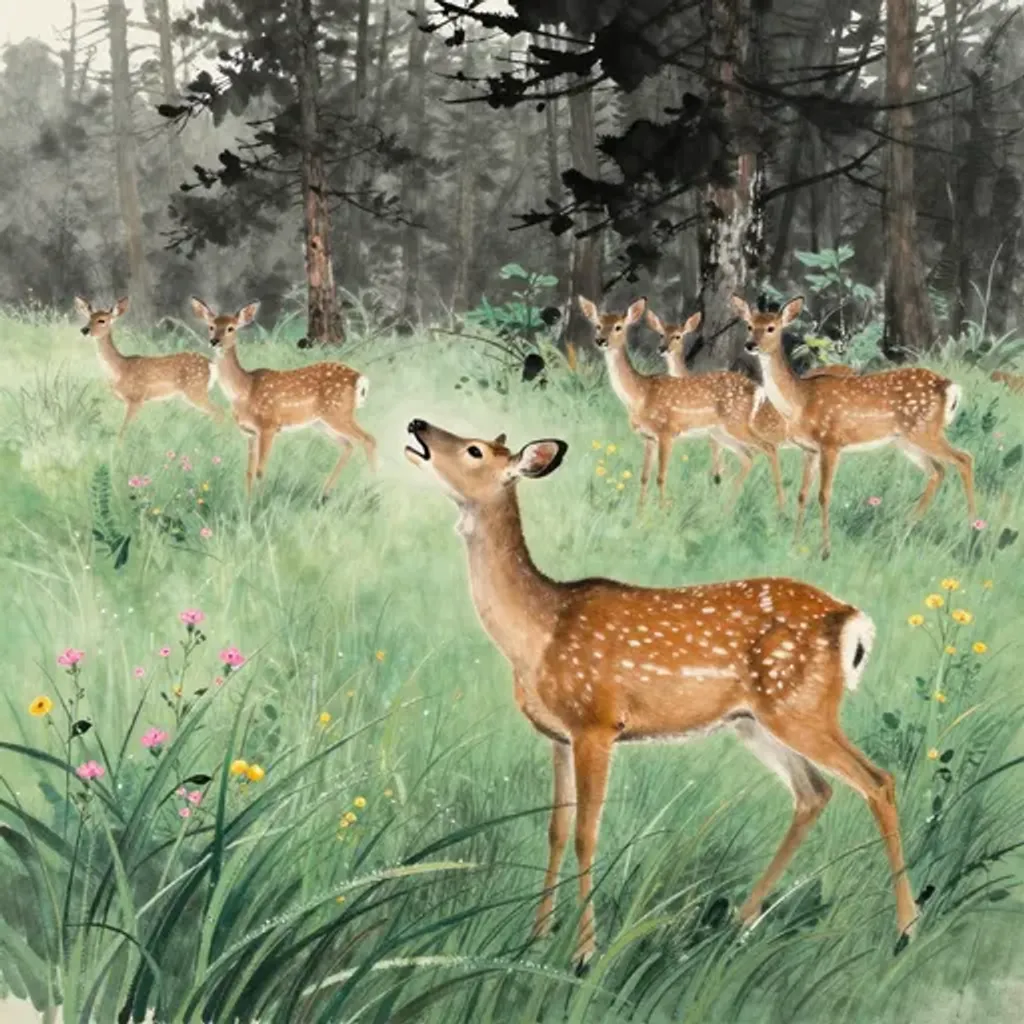
鹿得美草,鳴呼其友。九族和穆,不憂飢乏。
The deer finds fine grass and calls out to its friends. The nine clans dwell in harmony; they do not worry over hunger or want.
— Jiao Yanshou, Yilin (Forest of Changes), 1st century BC
Commentary
Fire beneath the earth meets water upon the mountain — Obstruction, where the path forward is blocked and one must turn inward. Yet the verse sings of abundance: 'A deer finds fine grass and calls out to its companions. The nine clans are harmonious and content; they do not worry about hunger or want.' The deer's generous call — sharing its discovery rather than hoarding — echoes the Shijing's 'Lu Ming' ode, a banquet poem celebrating hospitality among kinsmen. From Darkening of the Light to Obstruction, the transformation reveals that when external progress is impossible, the strength of internal bonds becomes paramount. The deer that calls its friends to the meadow builds the very community that will sustain everyone through the mountain's impassable terrain.
明夷 → 解
Hexagram 36 → Hexagram 40: Deliverance
Changing lines: 1, 2, 3, 4
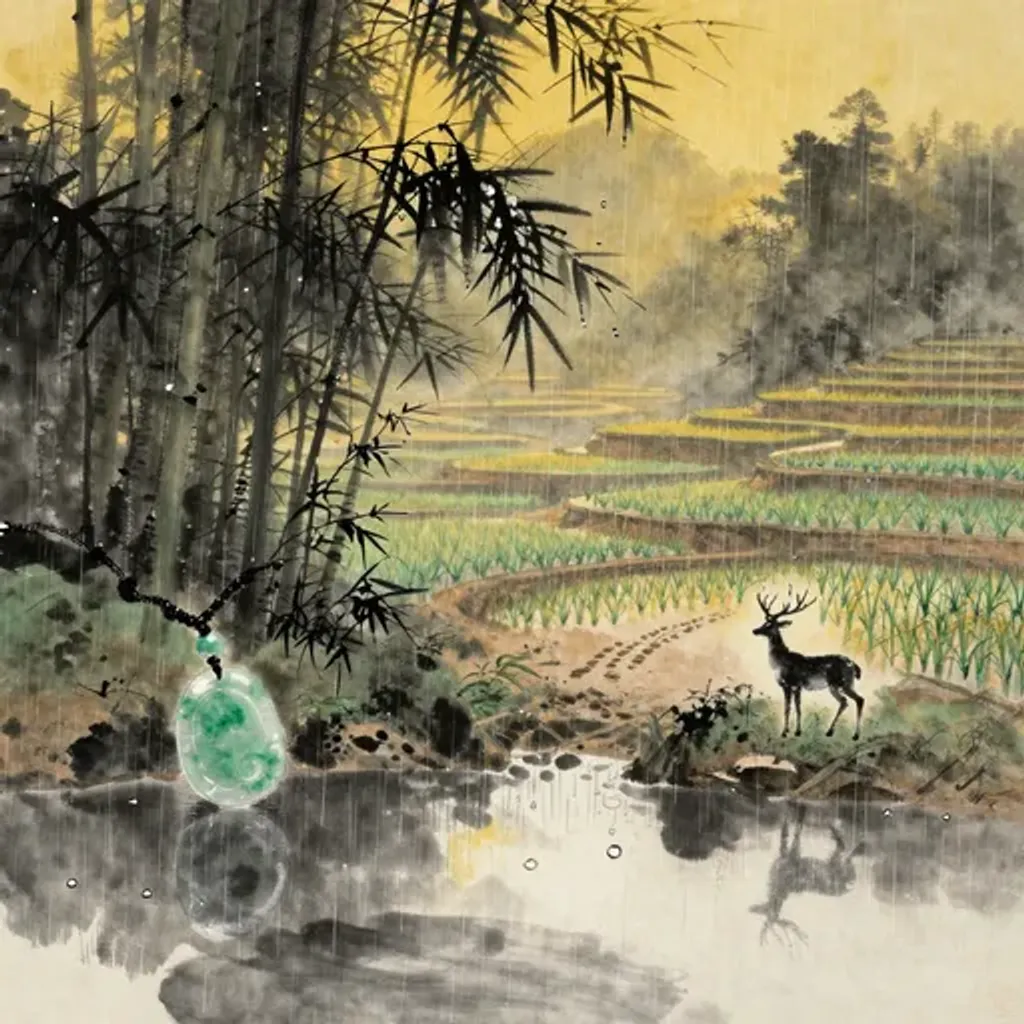
亡玉失鹿,不知所伏。利以避危,全我生福。甘雨時降,年歲有得。
The jade is lost, the deer vanished; one knows not where they hide. It profits one to avoid danger and preserve one's blessed life. Sweet rain falls in its season; the year's harvest is secured.
— Jiao Yanshou, Yilin (Forest of Changes), 1st century BC
Commentary
Fire beneath the earth gives way to thunder above water — Deliverance, where accumulated tension finds release. 'Losing the jade, losing the deer — not knowing where they hide. It is profitable to avoid danger and preserve one's blessed life.' The lost jade and deer are classical symbols of the mandate and the state: when both vanish, the wise person does not search blindly but retreats to safety. Then the tone shifts: 'Sweet rain falls in season; the harvest year yields its bounty.' After the withdrawal, nature provides. From Darkening of the Light to Deliverance, the transformation teaches that release comes not from grasping at what is lost but from strategic withdrawal that allows the natural order to reassert itself — as thunder and rain together dissolve the old impasse.
明夷 → 損
Hexagram 36 → Hexagram 41: Decrease
Changing lines: 2, 3, 6
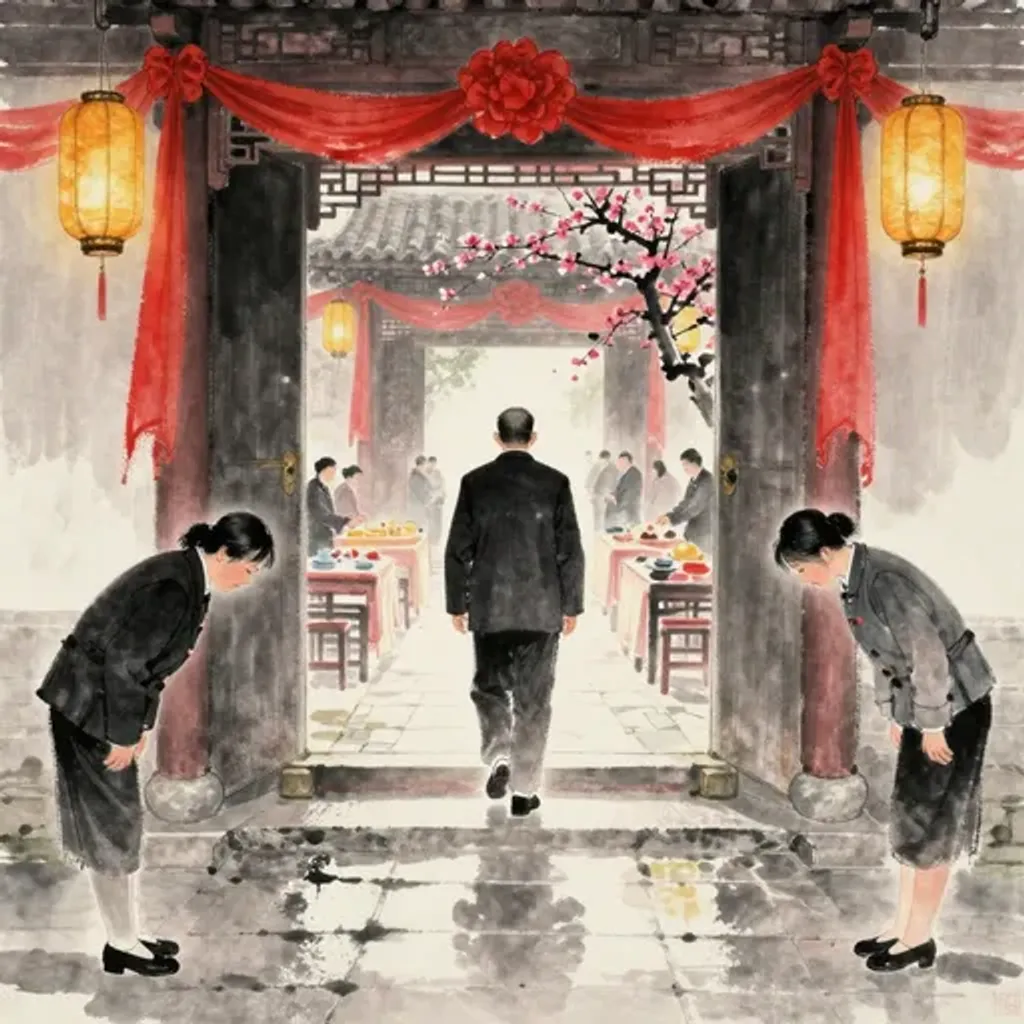
逢時得當,身受福慶。
Meeting the time and finding the moment; one receives blessings and joy.
— Jiao Yanshou, Yilin (Forest of Changes), 1st century BC
Commentary
Fire beneath the earth becomes the mountain above the lake — Decrease, where the lower is diminished to nourish the upper. The verse is the shortest in this batch, a mere eight characters: 'Meeting the moment at the right time, the body receives blessings and joy.' Its brevity is itself the message — Decrease strips away excess until only the essential remains. When one's timing aligns with circumstance, no elaboration is needed; fortune arrives without fanfare. From Darkening of the Light to Decrease, the transformation suggests that what was hidden in darkness emerges not through dramatic revelation but through the quiet shedding of everything unnecessary. The mountain's stillness above the lake's yielding mirrors the economy of the verse itself.
明夷 → 益
Hexagram 36 → Hexagram 42: Increase
Changing lines: 3, 5, 6
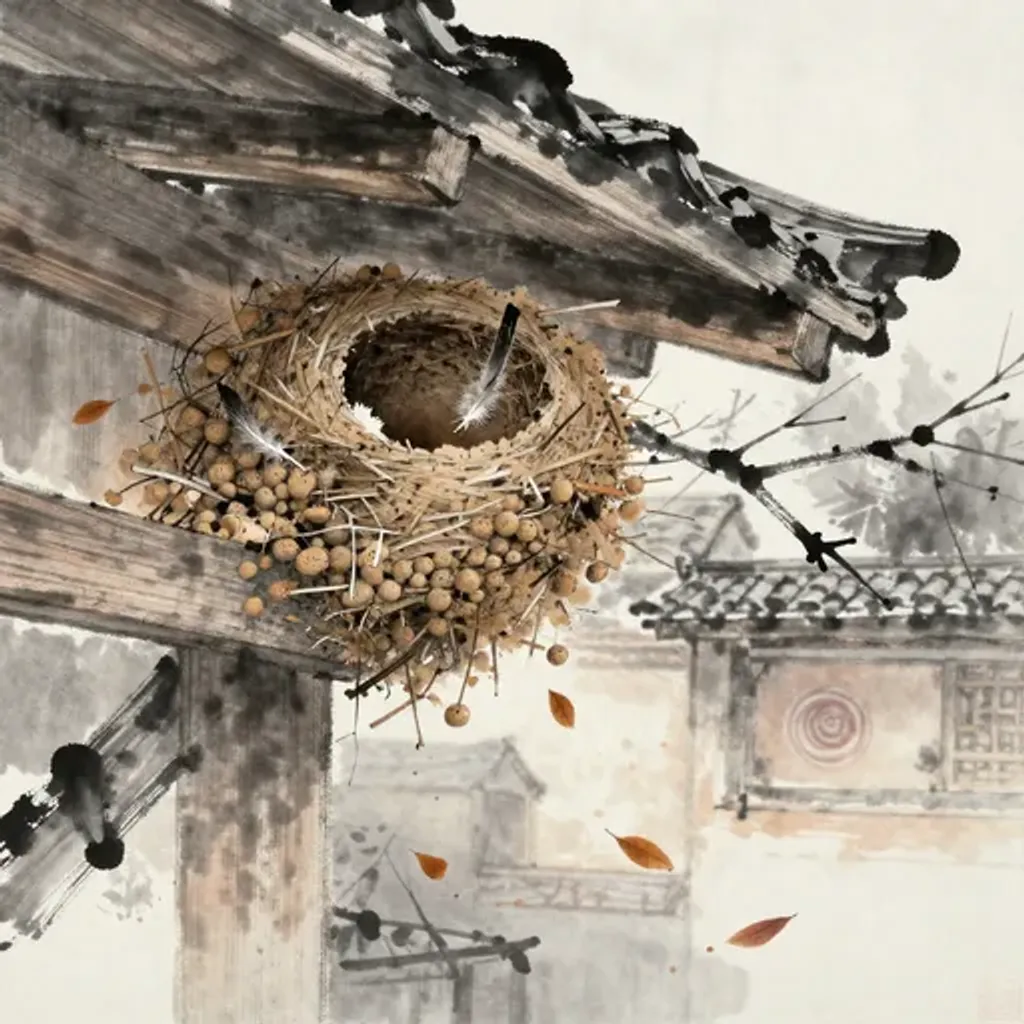
鵠思其雄,欲隨鳳東。順理羽翼,出次須日。中留北邑,復反其室。
The swallow carries mud, building a nest under the south eaves. Autumn wind arrives suddenly — the nest is finished, but the one it was built for has gone.
— Jiao Yanshou, Yilin (Forest of Changes), 1st century BC
Commentary
Fire beneath the earth stirs as wind and thunder together — Increase, where what is above gives to what is below. This verse is marked as rewritten; the original reads: 'The swan-goose longs for her mate, wishing to follow the phoenix east. She readies her plumage, sets out and waits for the day. But she is detained in the northern town and returns to her chamber.' The original depicts a female bird preparing for a grand journey to join a worthy companion, only to be held back and forced home. The longing is real but the flight never happens. From Darkening of the Light to Increase, the transformation promises augmentation — wind and thunder reinforcing each other — but the original verse captures a thwarted increase: the gift of union is offered, the plumage is groomed, yet circumstances conspire to return the bird to where she started.
明夷 → 夬
Hexagram 36 → Hexagram 43: Breakthrough
Changing lines: 2, 4, 5
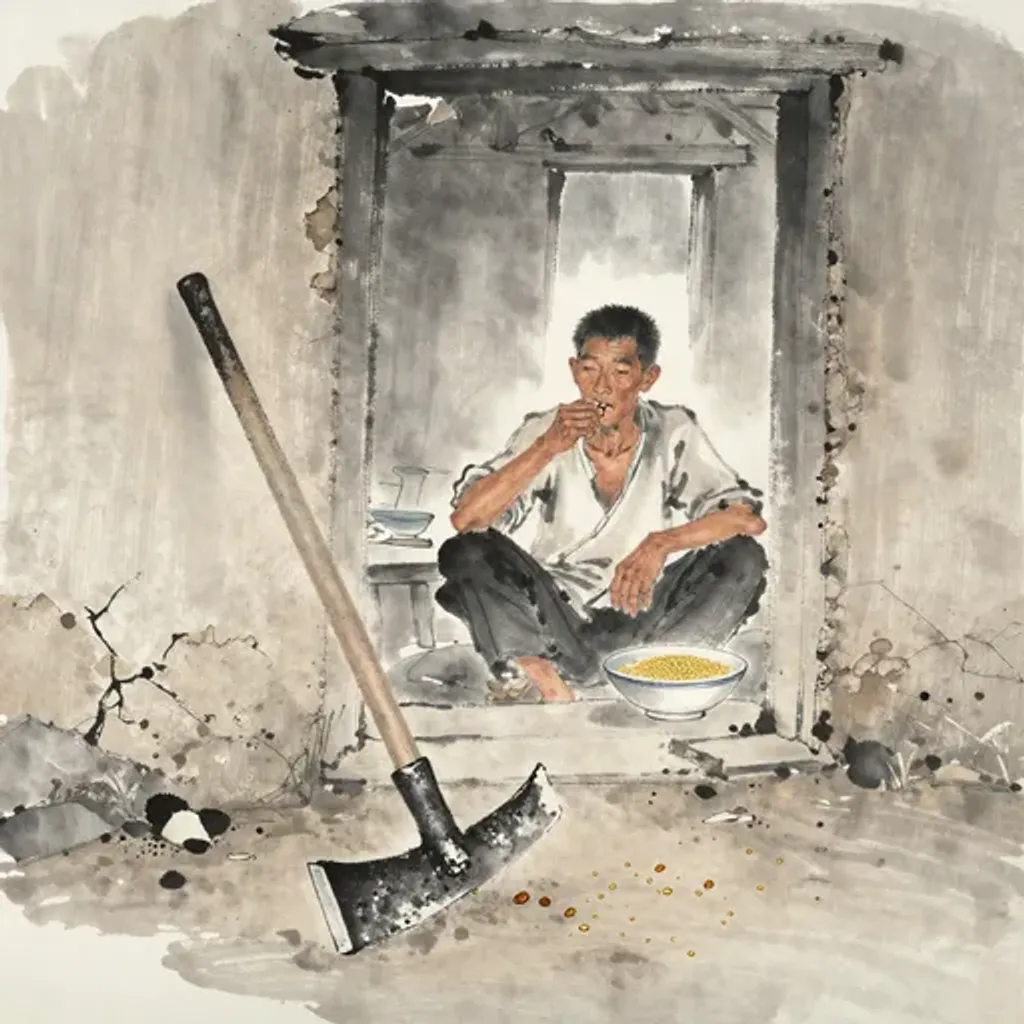
環堵倚鉏,升升屬口。貧賤所處,心寒昨苦。
Within four crumbling walls, leaning on a hoe; scraping mouthful by mouthful to survive. A dwelling of poverty and lowliness; the heart grows cold, the yesterdays bitter.
— Jiao Yanshou, Yilin (Forest of Changes), 1st century BC
Commentary
Fire beneath the earth meets the lake rising to heaven — Breakthrough, where accumulated pressure finally bursts through. Yet the verse describes not triumph but destitution: 'Surrounded by bare walls, leaning on a hoe, barely enough for each mouthful. This is where the poor and lowly dwell; the heart is cold, the past bitter.' The 'ring-walled' (環堵) dwelling of a single room echoes the poverty of Confucius's disciple Yuan Xian, who chose virtue over wealth. From Darkening of the Light to Breakthrough, the transformation presents an ironic challenge: the mechanism of breakthrough exists — the lake presses up to heaven — but when one begins from such abject poverty, what is there to break through to? The verse suggests that the first obstacle to overcome is destitution itself.
明夷 → 姤
Hexagram 36 → Hexagram 44: Coming to Meet
Changing lines: 1, 2, 4, 5, 6
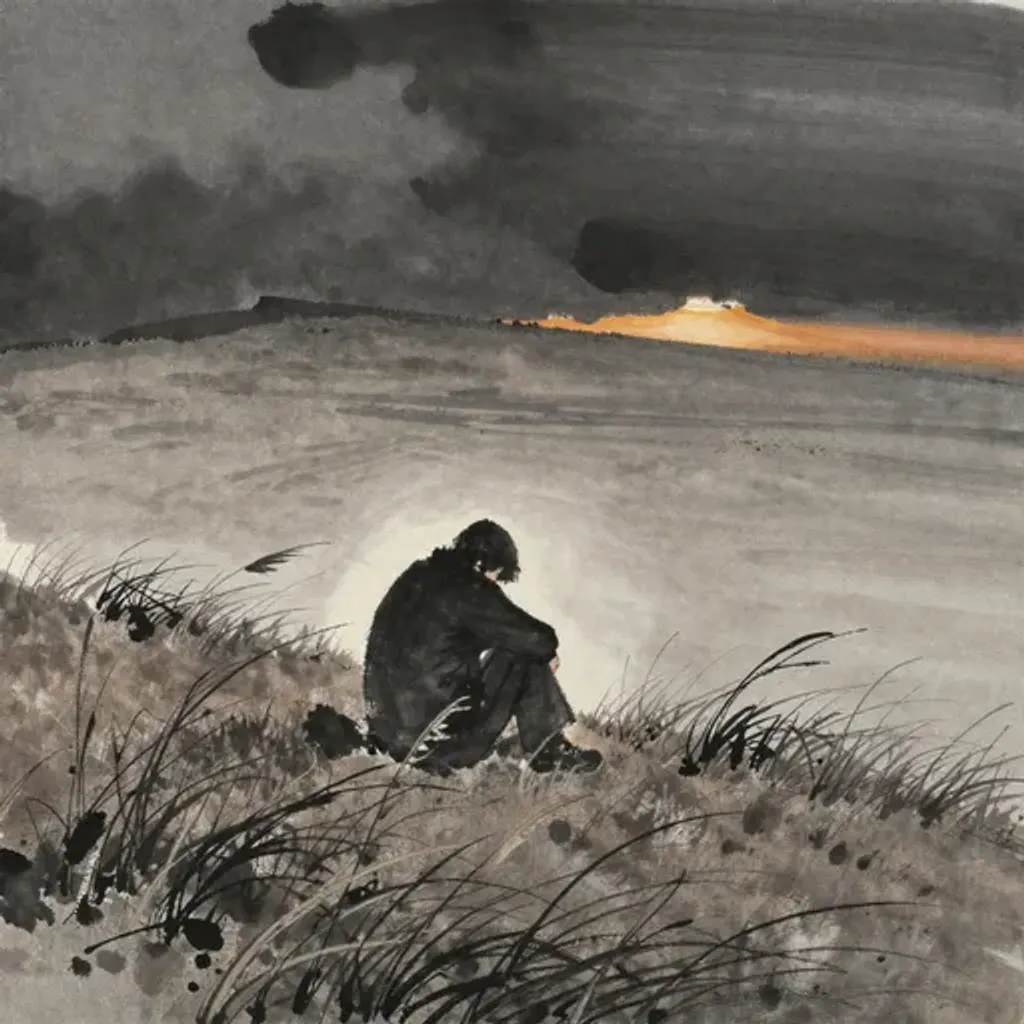
孤獨特處,莫依為輔,心勞志苦。
Alone and solitary, dwelling apart; with none to lean on or aid. The heart toils, the spirit suffers.
— Jiao Yanshou, Yilin (Forest of Changes), 1st century BC
Commentary
Fire beneath the earth encounters wind beneath heaven — Coming to Meet, where the unexpected appears from below. The verse is stark: 'Alone and solitary, with no one to lean on for support; the heart toils, the spirit suffers.' Three short phrases paint complete isolation — no companion, no patron, no refuge. Coming to Meet's image of wind under heaven suggests an encounter that arrives unbidden, but here nothing comes. The person waits in darkness and the wind brings nothing. From Darkening of the Light to Coming to Meet, the transformation holds both warning and faint hope: the very structure of the hexagram promises that an encounter will occur, even if the present moment offers only emptiness. What meets one in the dark may yet prove significant.
明夷 → 萃
Hexagram 36 → Hexagram 45: Gathering Together
Changing lines: 1, 3, 4, 5
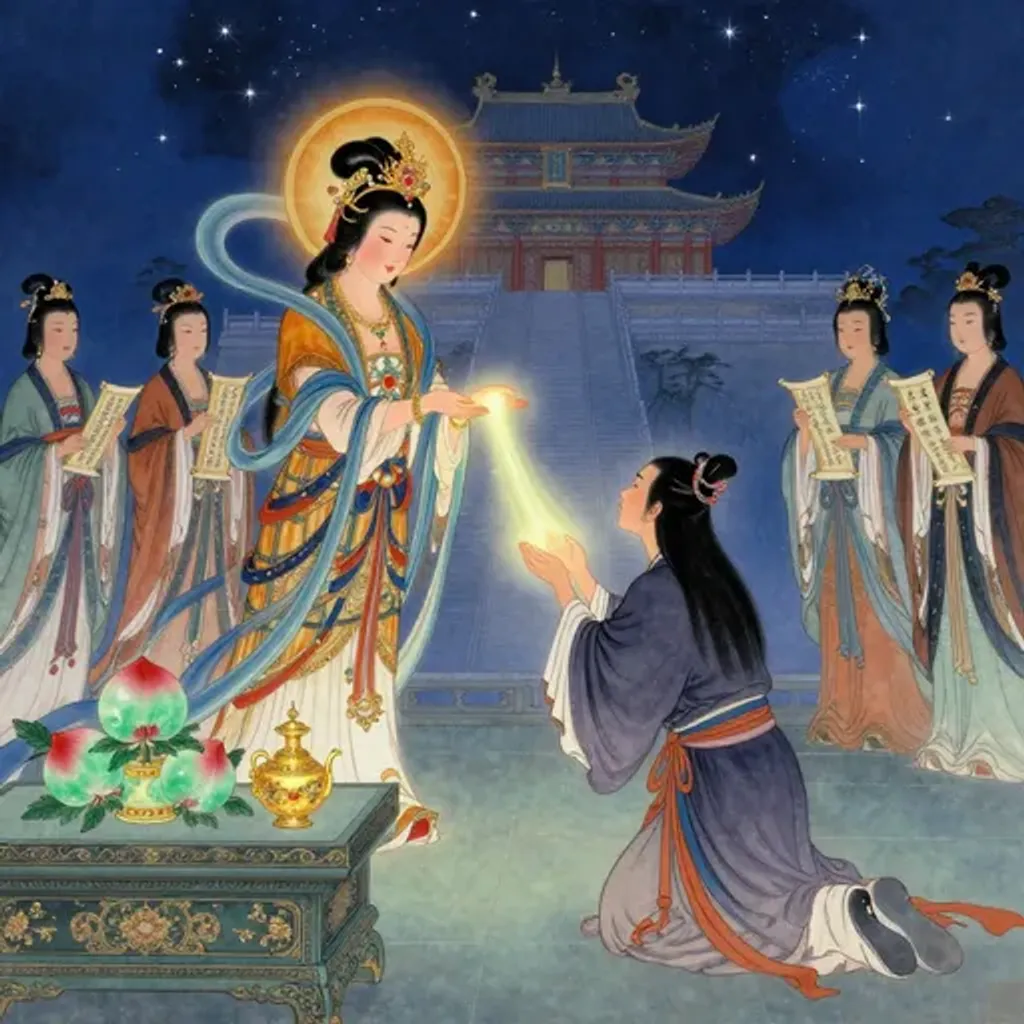
稷為堯使,西見王母。拜請百福,賜我喜子,長樂富有。
Hou Ji was sent by Yao to journey west and see the Queen Mother. Bowing, he asked for a hundred blessings; she granted him a joyful son. Long happiness and abundant wealth.
— Jiao Yanshou, Yilin (Forest of Changes), 1st century BC
Commentary
Fire beneath the earth gives way to the lake resting upon the earth — Gathering, where people and blessings converge. 'Lord Millet, sent by Yao, journeyed west to see the Queen Mother of the West. He bowed and petitioned for a hundred blessings; she granted him a joyful son — long happiness and abundant wealth.' The verse weaves together two mythological registers: the agricultural ancestor Hou Ji acting as Yao's emissary, and the Queen Mother of the West dispensing the blessings of progeny and prosperity. From Darkening of the Light to Gathering, the transformation reveals that when the buried light finally assembles its resources, it does so through pilgrimage and petition — approaching the highest source of blessing and gathering its gifts for the community below.
明夷 → 升
Hexagram 36 → Hexagram 46: Pushing Upward
Changing lines: 1, 2
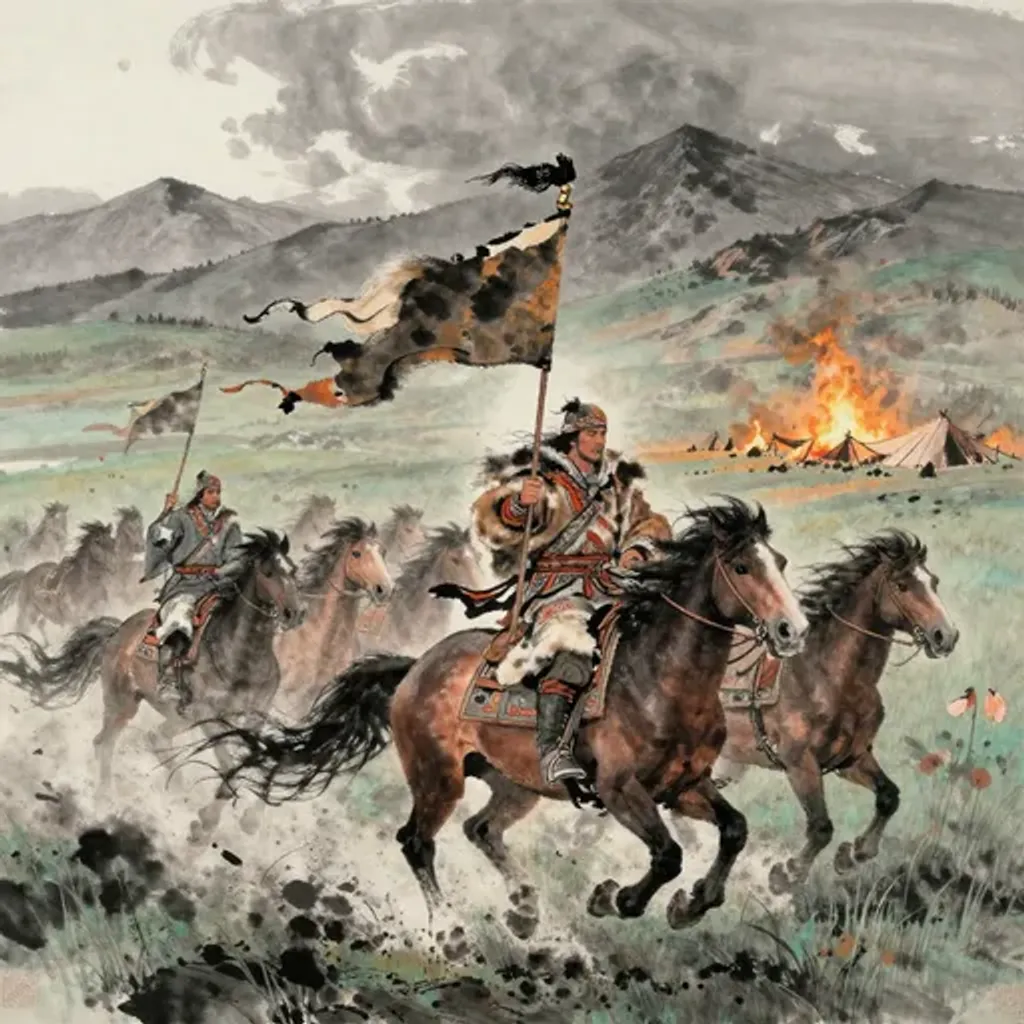
鳴條之郊,北奔犬胡。左衽為長,國號匈奴。王君旄頭,立尊單于。
At the wilds of Mingtiao; northward they fled to the barbarian lands. Left-lapelled garments became the custom; the state was named Xiongnu. The king raised the yak-tail standard, and established the title Chanyu.
— Jiao Yanshou, Yilin (Forest of Changes), 1st century BC
Commentary
Fire beneath the earth transforms into wood growing within the earth — Pushing Upward, the slow, steady rise from below. The verse recounts a remarkable origin tradition: 'At the wilderness of Mingtiao, the defeated fled north to the barbarian lands. Wearing left-folded robes as elders, their nation was called Xiongnu. Their king bore the ox-tail standard and was honored as Chanyu.' According to the Shiji's treatise on the Xiongnu, the nomadic confederation descended from Chunwei, a son of the defeated Xia dynasty's last king Jie, who fled north after the Battle of Mingtiao. From Darkening of the Light to Pushing Upward, the transformation captures how a crushed people, driven underground by defeat, slowly re-emerge as a formidable power — wood growing silently within the earth until it breaks the surface.
明夷 → 困
Hexagram 36 → Hexagram 47: Oppression
Changing lines: 1, 2, 3, 4, 5
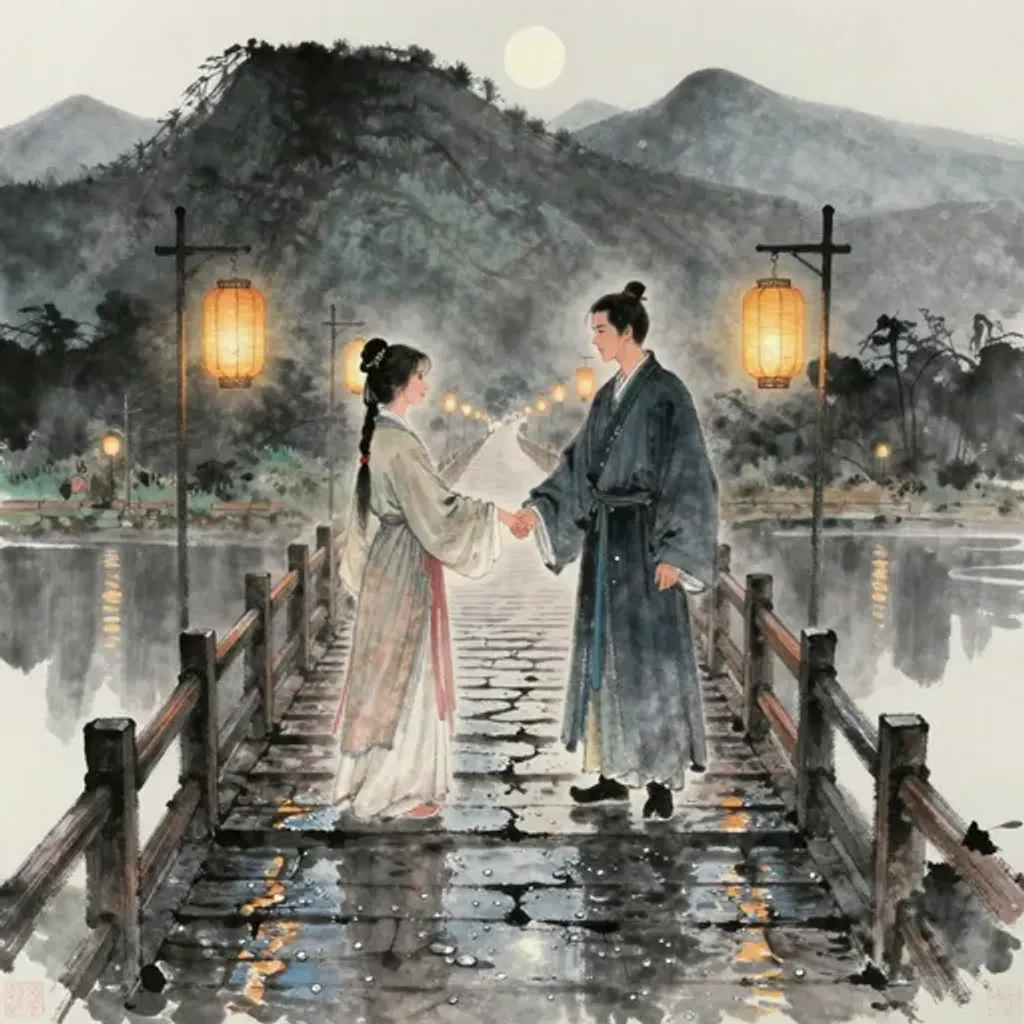
絕而復通,雖達不窮。終得其願,姬姜相從。
Severed yet made whole again; though reaching through, not exhausted. At last the wish is gained; the houses of Ji and Jiang follow together.
— Jiao Yanshou, Yilin (Forest of Changes), 1st century BC
Commentary
Fire beneath the earth meets the lake with no water — Oppression, yet the verse defies expectation with stubborn hope. 'Cut off, then reconnected; though reaching through, never exhausted. At last the wish is fulfilled — the Ji and Jiang clans join together.' The Ji (姬) and Jiang (姜) were the two great surname groups of the Zhou aristocracy, their intermarriage the backbone of feudal alliance. 'To reach one's desire' (得其願) through union of these houses signals political and familial fulfillment against all odds. From Darkening of the Light to Oppression, the doubled constraint — buried light meeting drained resources — paradoxically produces breakthrough, because the very extremity of the situation forces the decisive alliance that neither party would have accepted in easier times.
明夷 → 井
Hexagram 36 → Hexagram 48: The Well
Changing lines: 1, 2, 5
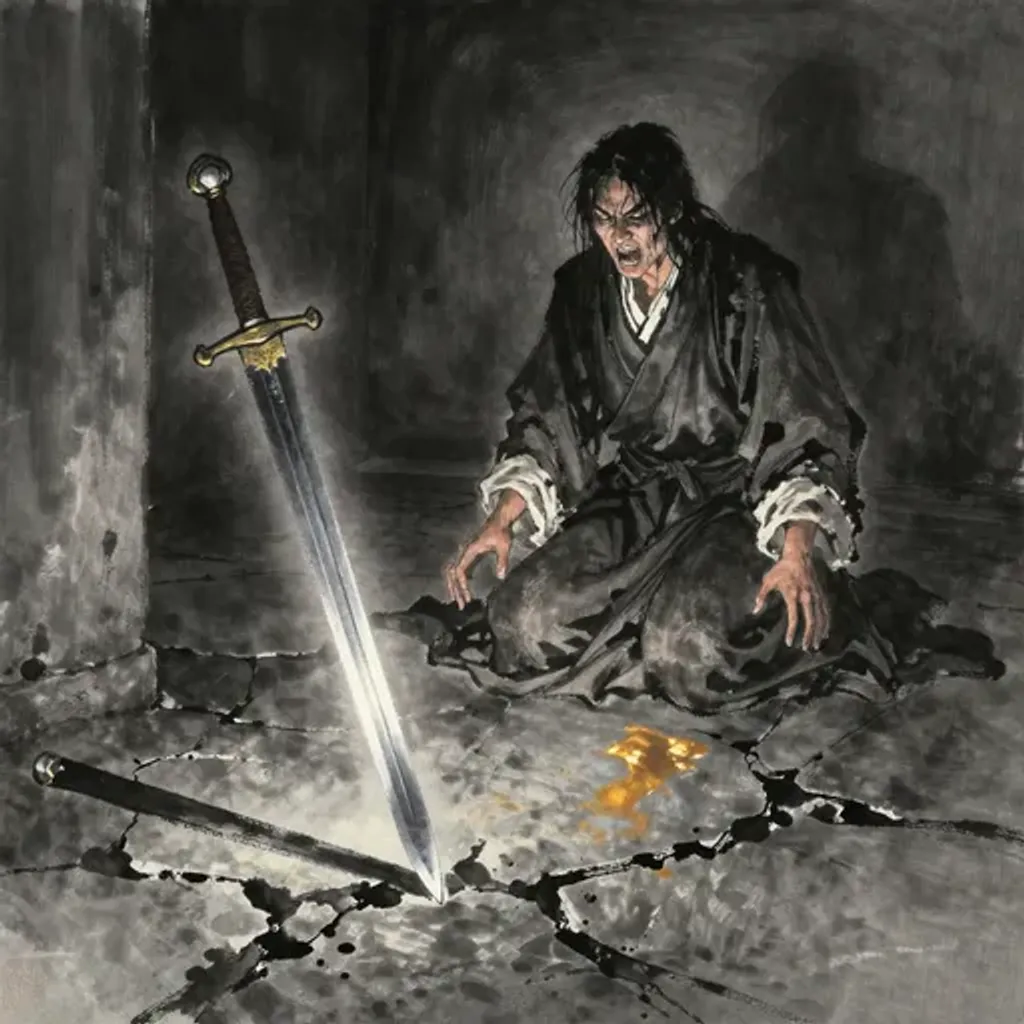
陽并悖狂,拔劍自傷,為身坐殃。
Yang rages in blind madness; he draws his sword and wounds himself. He brings disaster upon his own body.
— Jiao Yanshou, Yilin (Forest of Changes), 1st century BC
Commentary
Fire beneath the earth meets water above wood — the Well, a structure of nourishment that does not move. Yet the verse depicts self-destruction: 'Yang energy turned perverse and mad, drawing a sword to wound itself — the body sits in its own calamity.' The well serves everyone but cannot serve the deranged: when inner disorder reaches the point of self-harm, even the most reliable source of sustenance cannot help. The 'sword drawn on oneself' is among the most violent images in the Yilin — not murder but suicide, rage turned inward. From Darkening of the Light to the Well, the transformation warns that suppressed light, if it festers into madness rather than patient endurance, becomes a force of self-annihilation. The well remains available, but the one who needs it has already turned the blade.
明夷 → 革
Hexagram 36 → Hexagram 49: Revolution
Changing lines: 4, 5
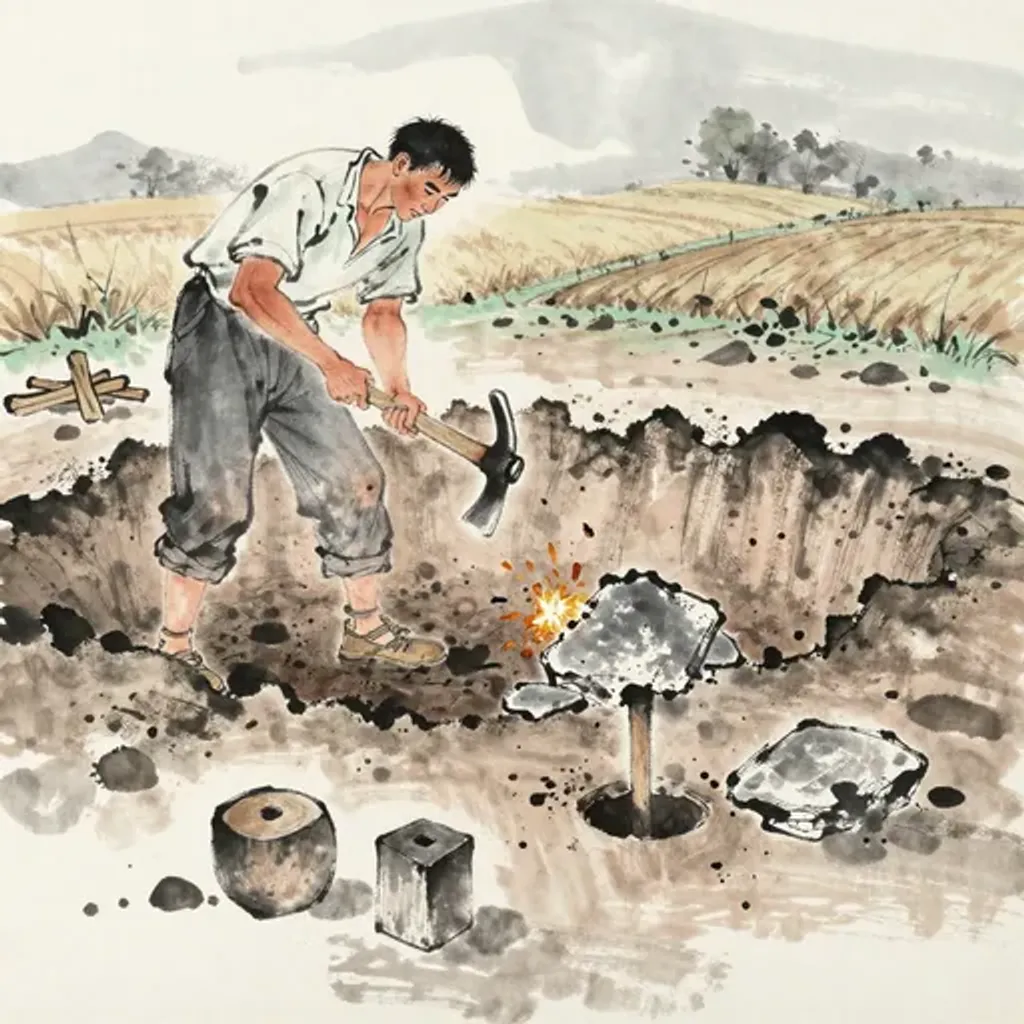
方圓不同,剛柔異鄉。掘井得石,勞而无功。
Square and round do not match; hard and soft belong to different realms. Digging a well, one strikes stone; labor without success.
— Jiao Yanshou, Yilin (Forest of Changes), 1st century BC
Commentary
Fire beneath the earth meets fire within the lake — Revolution, where fundamental change demands the right conditions. 'Square and round do not fit together; hard and soft belong to different realms. Digging a well and striking rock — labor without result.' The verse catalogues incompatibilities: geometric, material, elemental. The well-digger who hits bedrock has expended effort in a place where water will never come. Revolution requires that fire and water interact productively, but here nothing aligns. From Darkening of the Light to Revolution, the transformation reveals that not all darkness can be revolutionized — some conditions are simply mismatched. Attempting to force change where the basic elements are incompatible wastes energy without producing transformation.
明夷 → 鼎
Hexagram 36 → Hexagram 50: The Cauldron
Changing lines: 1, 2, 4, 6
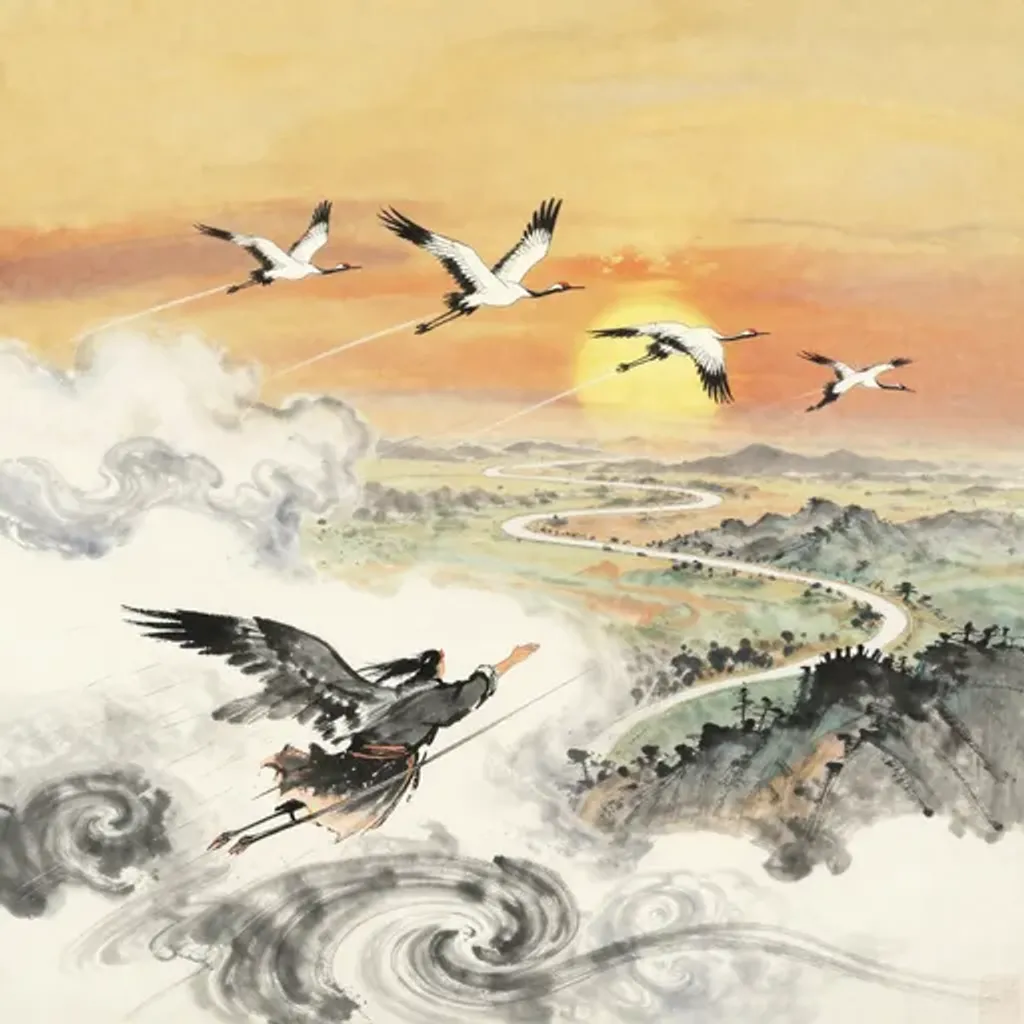
乘風雨會,與飛鳥俱。動舉千里,見我愛母。
Riding wind and rain together; traveling alongside the flying birds. Moving, a thousand miles are crossed; I go to see my beloved mother.
— Jiao Yanshou, Yilin (Forest of Changes), 1st century BC
Commentary
Fire beneath the earth ascends as fire above wood — the Cauldron, vessel of transformation where raw materials become refined sustenance. 'Riding wind and rain together, soaring with the birds. A single movement covers a thousand li — I behold my beloved mother.' The image is one of ecstatic reunion: carried by storm and wing, the traveler traverses vast distance to reach the person who matters most. The Cauldron's function is precisely this kind of transmutation — base elements refined into something nourishing and sacred. From Darkening of the Light to the Cauldron, suppressed fire finally finds its proper vessel: what was buried now blazes beneath the sacrificial cooking, and the one who endured darkness is reunited with the source of love through a transformative journey.
明夷 → 震
Hexagram 36 → Hexagram 51: The Arousing Thunder
Changing lines: 3, 4
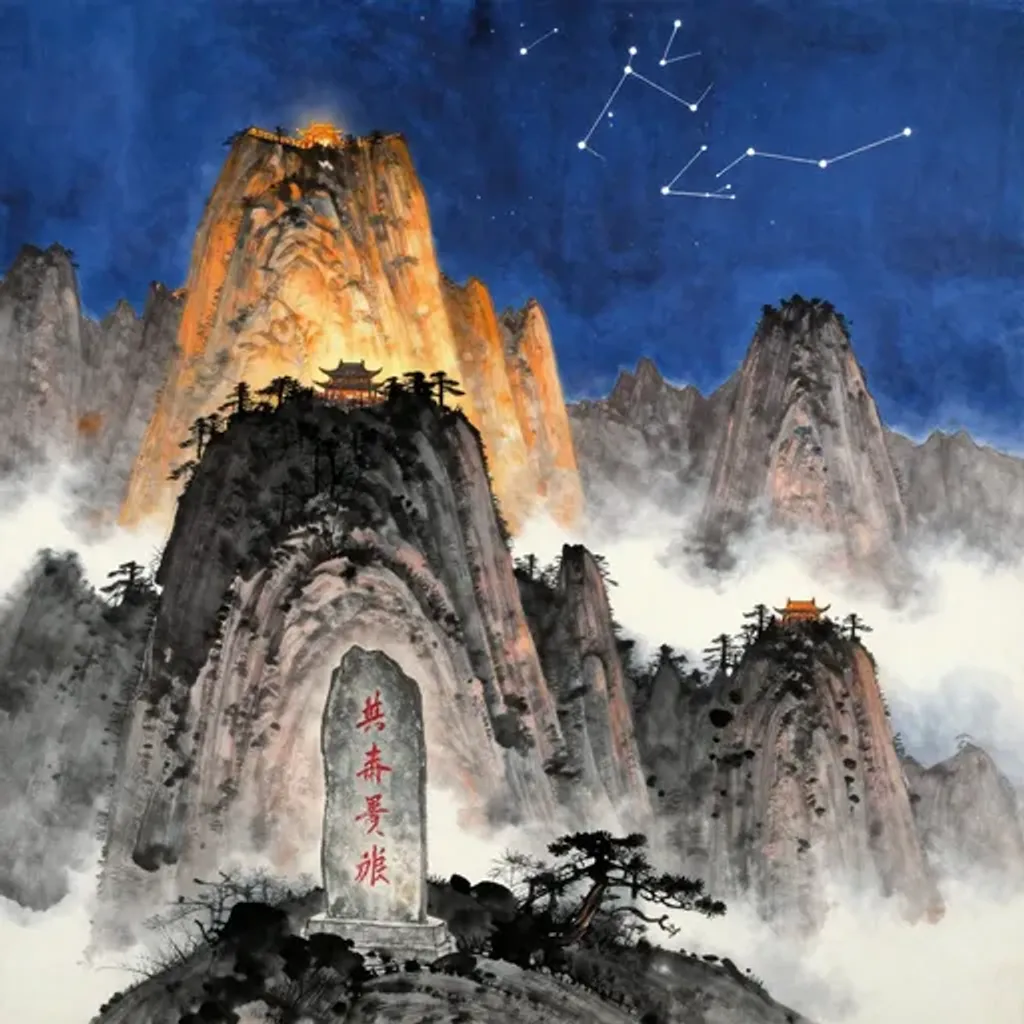
三塗五岳,陽城太室。神明所扶,獨无兵革。
The Three Passes and Five Sacred Peaks; Yangcheng and the Grand Chamber. What the spirits protect; alone it is spared from war and weapons.
— Jiao Yanshou, Yilin (Forest of Changes), 1st century BC
Commentary
Fire beneath the earth meets doubled thunder — the Arousing, sudden awakening that shakes the ground. The verse invokes sacred geography: 'Santu, the Five Sacred Mountains, Yangcheng, and Taishi.' These are the central geographic features of the Zhou heartland — Santu (Three Roads) marks a strategic pass near Luoyang, while Taishi is the great hall of Mount Song, the Central Sacred Mountain. 'Protected by the spirits and gods, alone spared from war.' These sacred sites exist under divine protection, immune to the violence engulfing the world around them. From Darkening of the Light to the Arousing, the transformation suggests that even when thunder shakes everything, certain sanctified spaces remain inviolate — not through human defense but through accumulated spiritual authority.
明夷 → 艮
Hexagram 36 → Hexagram 52: Keeping Still Mountain
Changing lines: 1, 6
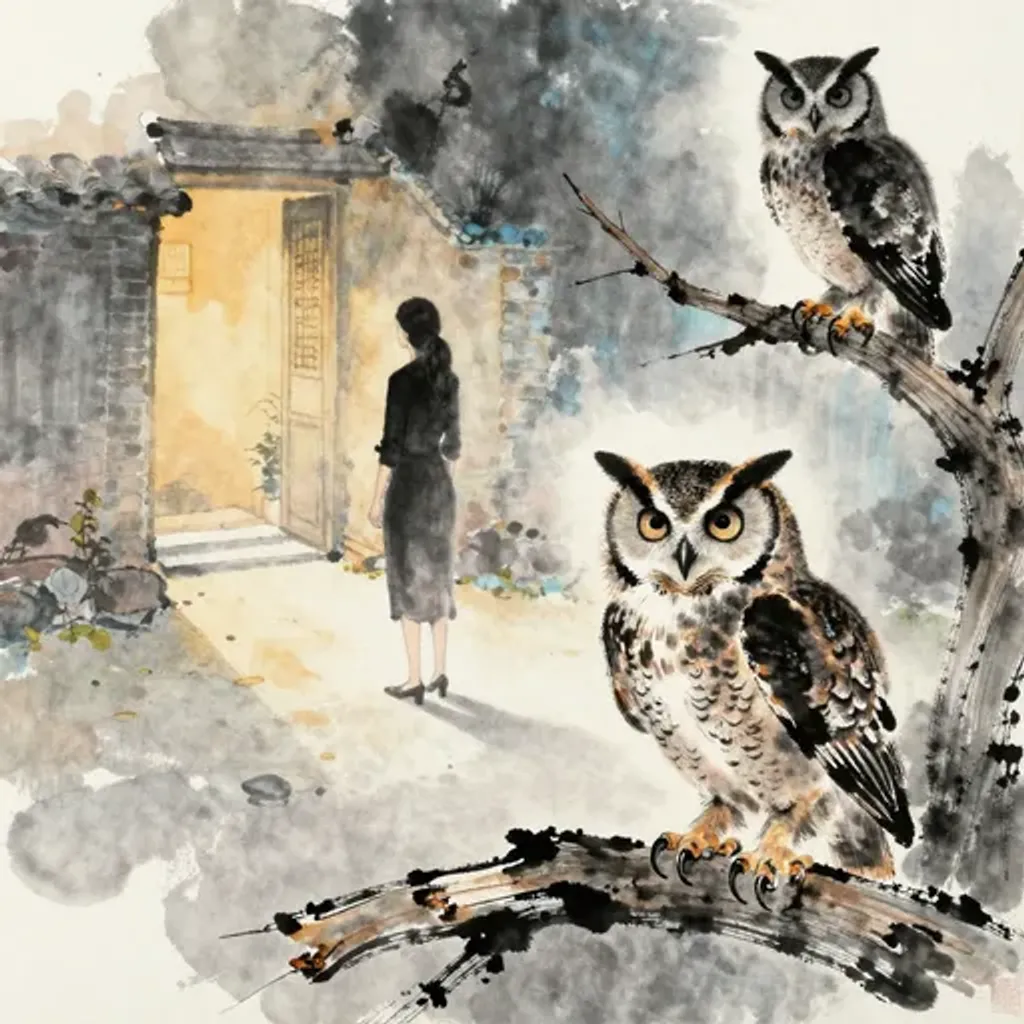
鴟鴞取婦,深目窈身。折腰不媚,與伯相背。
The owl takes a wife; deep-eyed and slender-waisted. She will not bow or flatter; she turns her back on her lord.
— Jiao Yanshou, Yilin (Forest of Changes), 1st century BC
Commentary
Fire beneath the earth meets doubled mountain — Keeping Still, where the mind ceases its restless motion. 'The owl takes a wife — deep-eyed, with a slender body. She does not bend her waist to flatter, and so parts ways with her lord.' The owl (鴟鴞), a bird associated with the Duke of Zhou's ode about enemies threatening the nest, here takes a bride who refuses to submit. Her deep-set eyes and willowy form mark an unconventional beauty, and her refusal to bow — 'fold the waist to please' — signals moral backbone. From Darkening of the Light to Keeping Still, the transformation reveals that stillness is not always serene: sometimes it is the rigid uprightness of one who will not bend, even at the cost of the relationship. The mountain stands because it refuses to yield.
明夷 → 漸
Hexagram 36 → Hexagram 53: Development
Changing lines: 1, 5, 6
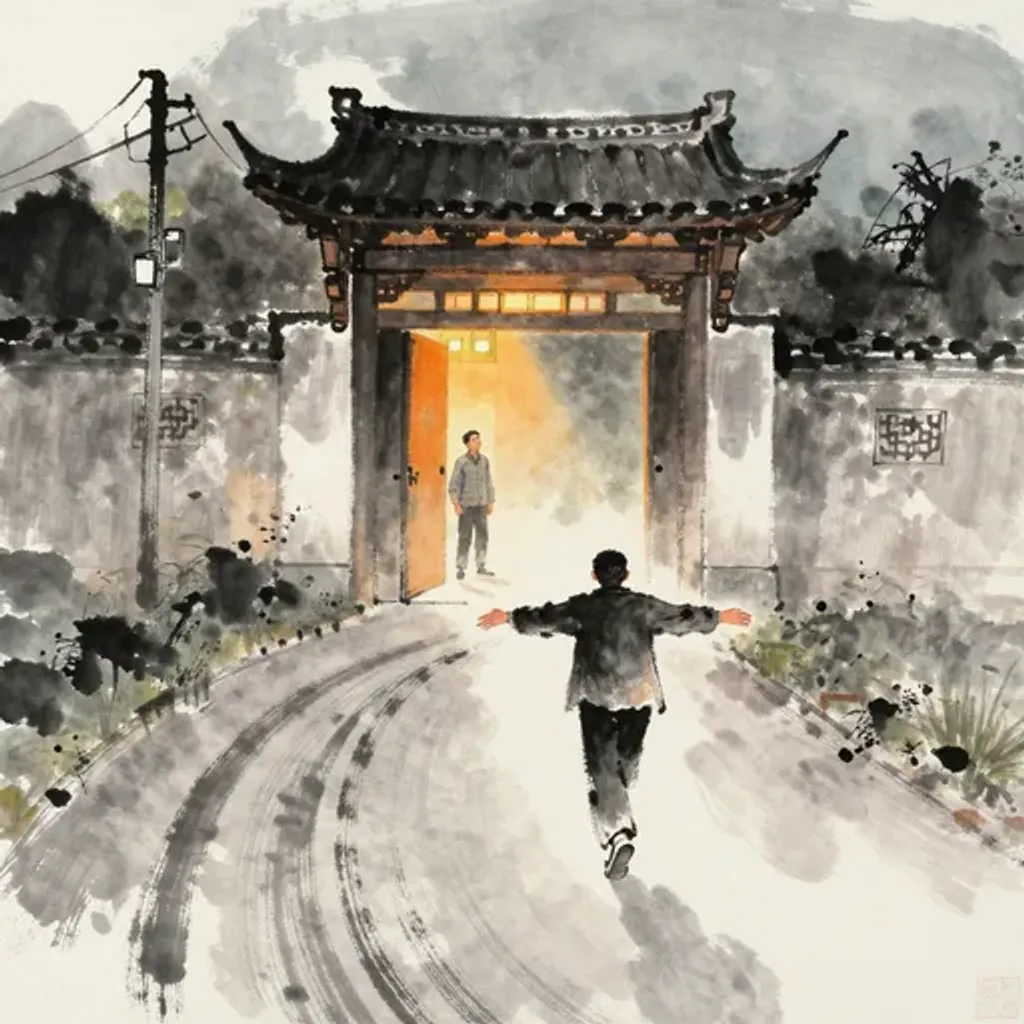
轉行軌軌,行近不遠。旦夕入門,與君笑言。
Wheels turning, track by track; the journey is near, not far. By morning and evening one enters the gate; sharing laughter and words with one's lord.
— Jiao Yanshou, Yilin (Forest of Changes), 1st century BC
Commentary
Fire beneath the earth grows as wood upon the mountain — Development, the gradual advance of a tree growing on a hillside, visible to all and steady in its progress. 'Turning the wheels, rolling smoothly — the journey is near, not far. Morning and evening one enters the gate, sharing laughter and conversation with the lord.' This is the return from exile or estrangement: the road that once stretched endlessly now brings the traveler home in a single day's circuit. From Darkening of the Light to Development, the transformation captures the slow resolution of distance. After the long night of buried light, the gradual approach replaces the dramatic rescue — one simply draws closer each day, until the gate is entered and companionship is restored naturally, like a tree growing toward the sunlight.
明夷 → 歸妹
Hexagram 36 → Hexagram 54: The Marrying Maiden
Changing lines: 2, 3, 4
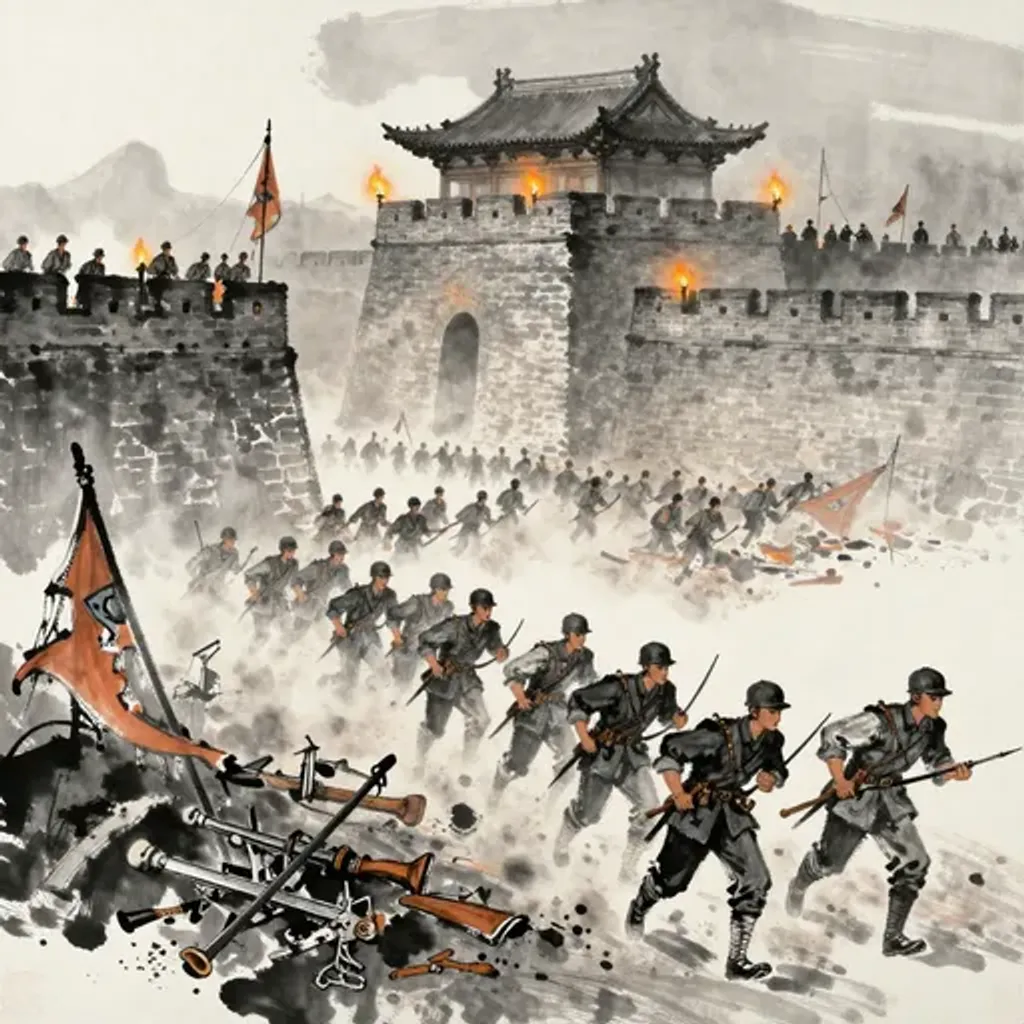
求利難國,逃去我北。復歸其城,不為吾賊。
Seeking profit, they imperiled the state; they fled and went north. They returned to their own city; they did not become our bandits.
— Jiao Yanshou, Yilin (Forest of Changes), 1st century BC
Commentary
Fire beneath the earth becomes thunder above the lake — the Marrying Maiden, where an arranged union carries an undertone of subordination. 'Seeking profit, they troubled the state and fled northward. Returning to their city, they were no longer our enemy.' An aggressor who came seeking advantage is repelled and retreats, eventually settling back where they belong and ceasing hostilities. The verse frames conflict resolution through withdrawal rather than victory — the invader leaves not because defeated but because the venture proved unprofitable. From Darkening of the Light to the Marrying Maiden, the transformation suggests that some relationships, like some alliances, work best when each party returns to their proper place. The maiden goes to her new home knowing the end is already built into the arrangement.
明夷 → 豐
Hexagram 36 → Hexagram 55: Abundance
Changing lines: 4
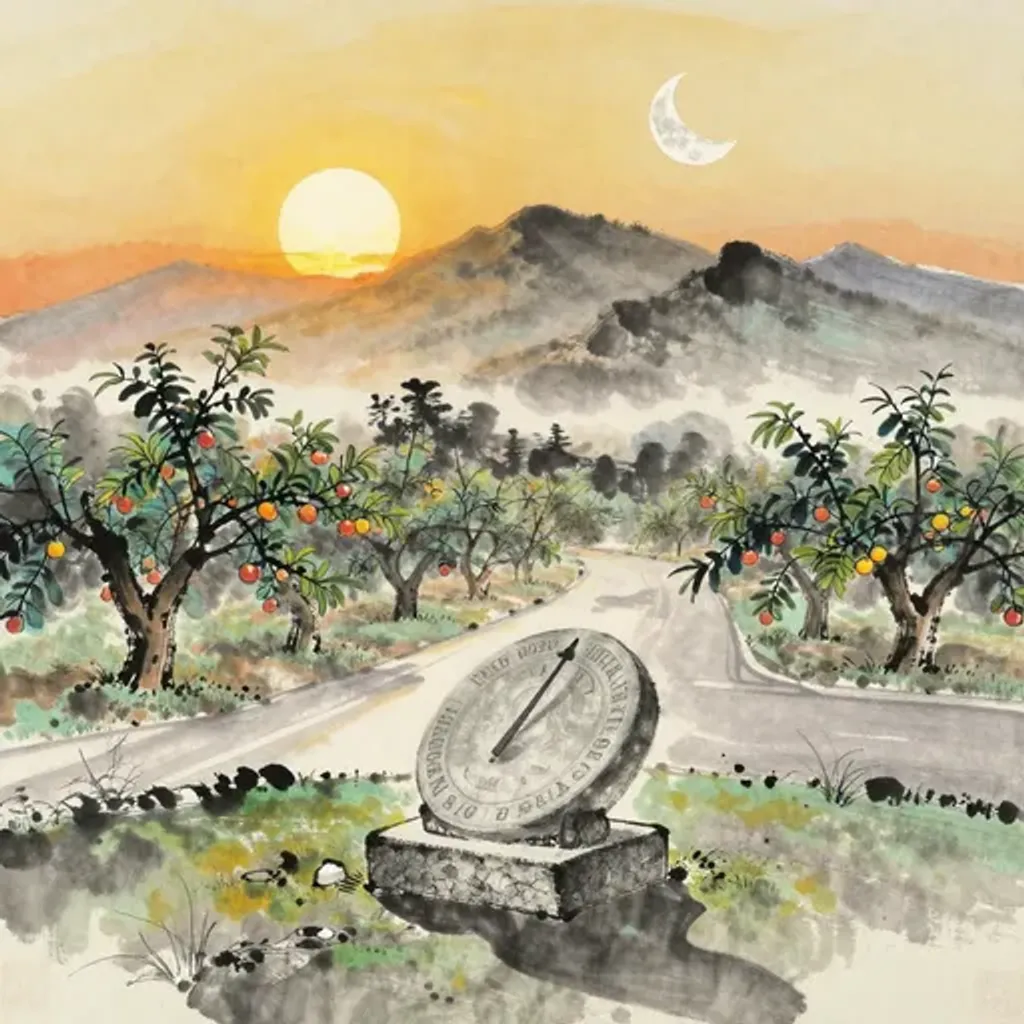
日月之途,所行必到。无凶无咎,安寧不殆。
The path of sun and moon; where they travel, they surely arrive. No misfortune, no blame; peace and safety without peril.
— Jiao Yanshou, Yilin (Forest of Changes), 1st century BC
Commentary
Fire beneath the earth rises as thunder and fire together — Abundance, the fullest expression of light and power combined. 'The path of sun and moon — wherever they go, they inevitably arrive. No misfortune, no blame; peace and security without peril.' This verse closely parallels 36-3 but with a crucial difference: where the earlier verse led to Difficulty at the Beginning, this one leads to Abundance. The same cosmic certainty — the sun and moon completing their courses — here yields not struggle but fullness. From Darkening of the Light to Abundance, the buried fire meets both thunder's force and fire's illumination. The moment when the sun is highest is precisely the moment Abundance warns it must begin to wane, but the verse captures the zenith itself: absolute assurance, total arrival.
明夷 → 旅
Hexagram 36 → Hexagram 56: The Wanderer
Changing lines: 1, 4, 6
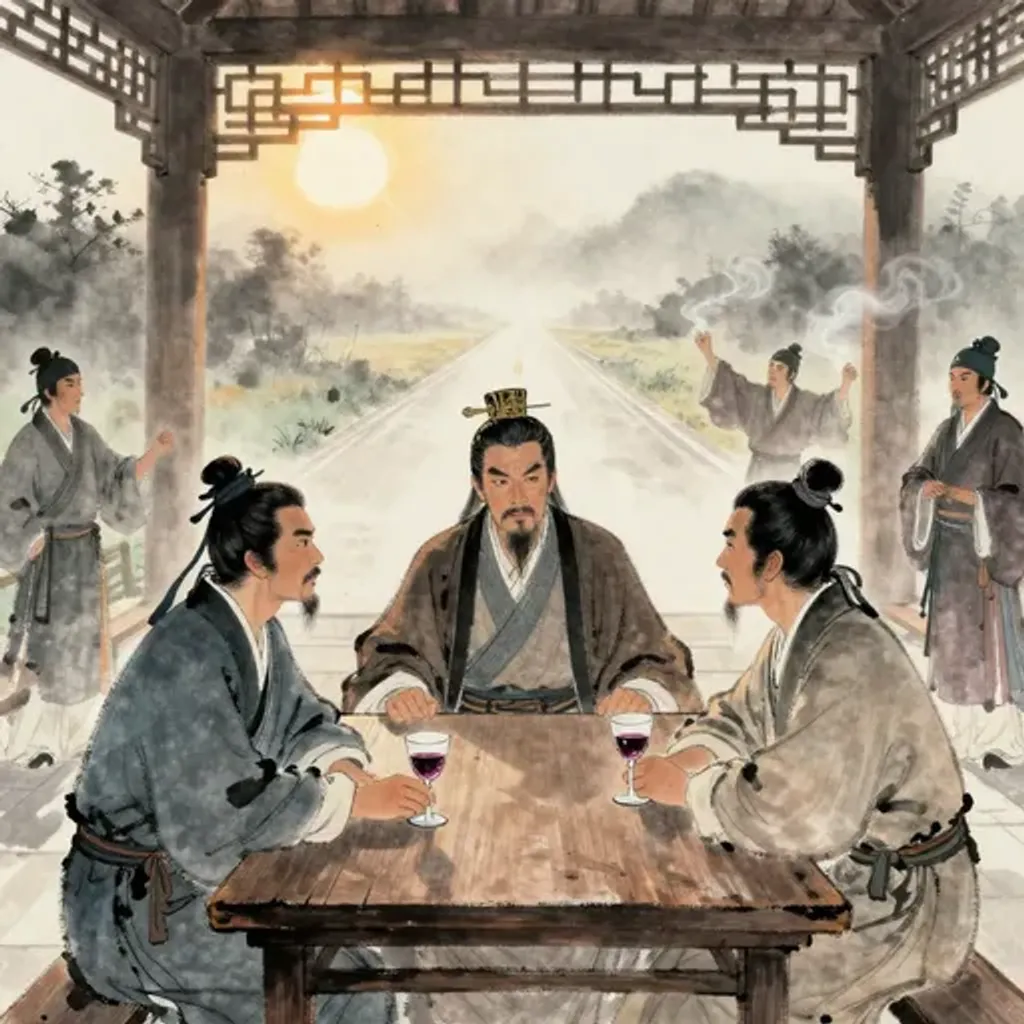
管仲遇桓,得其願歡。膠目啟牢,振冠无憂。笑戲不止,空言妄行。
Guan Zhong met Duke Huan; he obtained his heart's desire and joy. Eyes freed and the prison opened; he straightened his cap without worry. Laughter and jesting without cease; empty words and idle deeds.
— Jiao Yanshou, Yilin (Forest of Changes), 1st century BC
Commentary
Fire beneath the earth blazes as fire upon the mountain — the Wanderer, where the traveler passes through foreign places with only his reputation for protection. 'Guan Zhong encountered Duke Huan and found his heart's desire fulfilled.' Guan Zhong, once a fugitive who had served a rival prince, was recognized by Duke Huan of Qi through the recommendation of Bao Shuya, and together they built Qi's hegemony. Yet the verse pivots: 'Eyes glued shut, the prison opens; the cap is straightened, worry vanishes. Laughter and play without cease — empty words and reckless deeds.' The second half dissolves the first into frivolity. From Darkening of the Light to the Wanderer, the transformation warns that even a great meeting of patron and talent, if followed by complacency, degenerates into aimless wandering.
明夷 → 巽
Hexagram 36 → Hexagram 57: The Gentle Wind
Changing lines: 1, 2, 5, 6
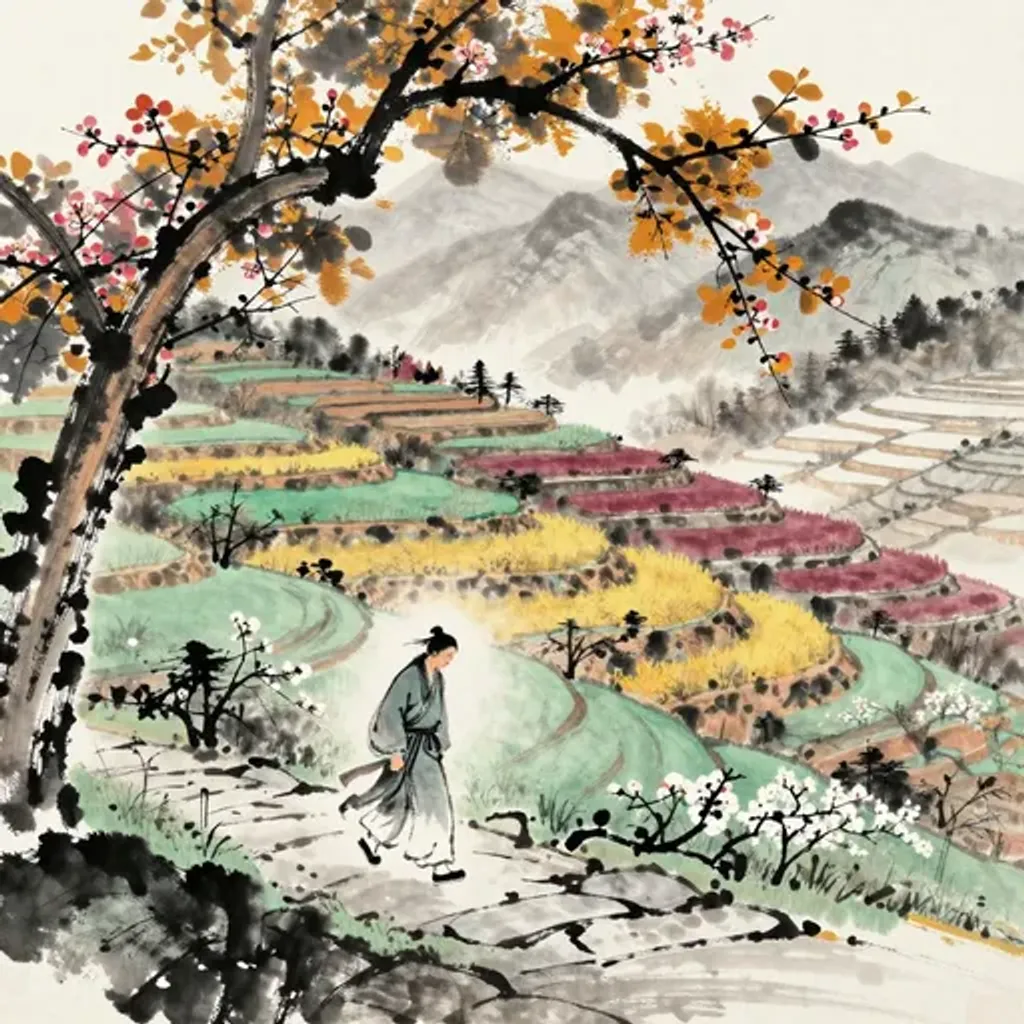
出入蹈踐,動順天時。俯仰有節,禍災不來。
Going out and coming in with care; moving in accord with heaven's seasons. Bowing and rising with proper measure; calamity and disaster do not come.
— Jiao Yanshou, Yilin (Forest of Changes), 1st century BC
Commentary
Fire beneath the earth meets doubled wind — the Gentle, where pervasive influence works through repetition rather than force. 'Going out and coming in with careful steps, moving in accord with heaven's timing. Bowing and rising with proper rhythm — calamity and disaster do not come.' Every action is calibrated to the natural order: steps measured, posture attuned, timing observed. This is the discipline of one who has learned from the darkness not to attract trouble. From Darkening of the Light to the Gentle, the transformation reveals that survival through oppression trains a special sensitivity to timing and propriety. Wind upon wind penetrates everywhere, and the person who moves with this doubled gentleness becomes invisible to harm — not through concealment but through perfect alignment.
明夷 → 兌
Hexagram 36 → Hexagram 58: The Joyous Lake
Changing lines: 2, 3, 4, 5
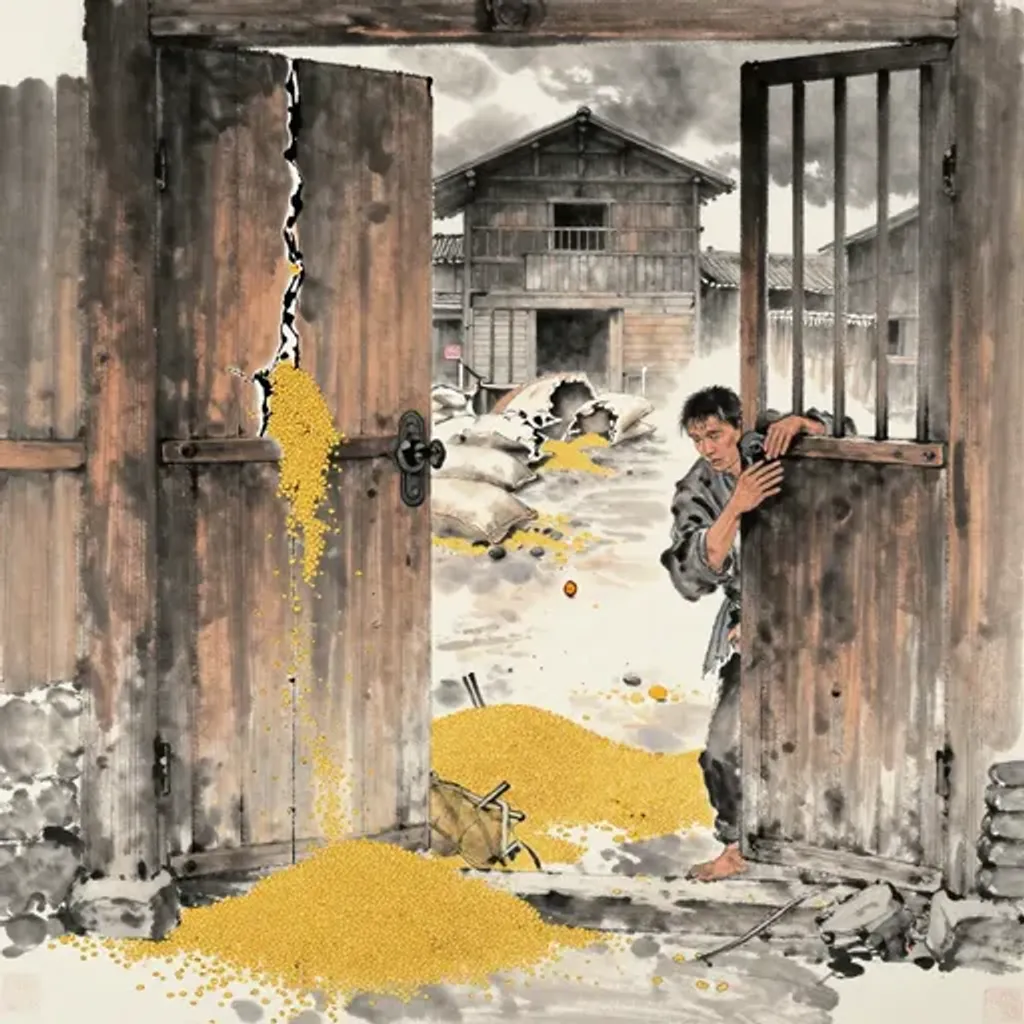
內崩傷中,上亂无恆。雖有美粟,我不得食。
Collapsing within, wounded at the center; above, disorder without constancy. Though there is fine grain, I cannot eat it.
— Jiao Yanshou, Yilin (Forest of Changes), 1st century BC
Commentary
Fire beneath the earth meets doubled lake — the Joyous, where inner truth expresses itself through open exchange. Yet the verse describes the collapse of joy: 'Internally crumbling, wounded at the center; above in chaos without constancy. Though there is fine grain, I cannot eat.' The doubled lake should foster mutual delight, but here the inner structure has given way. Fine millet — material abundance — sits uneaten because the capacity to receive nourishment has been destroyed from within. From Darkening of the Light to the Joyous, the transformation reveals the bitter paradox: joy requires the ability to receive, and when internal devastation is complete, even genuine blessings cannot be absorbed. The lake is full but the mouth will not open.
明夷 → 渙
Hexagram 36 → Hexagram 59: Dispersion
Changing lines: 1, 2, 3, 5, 6
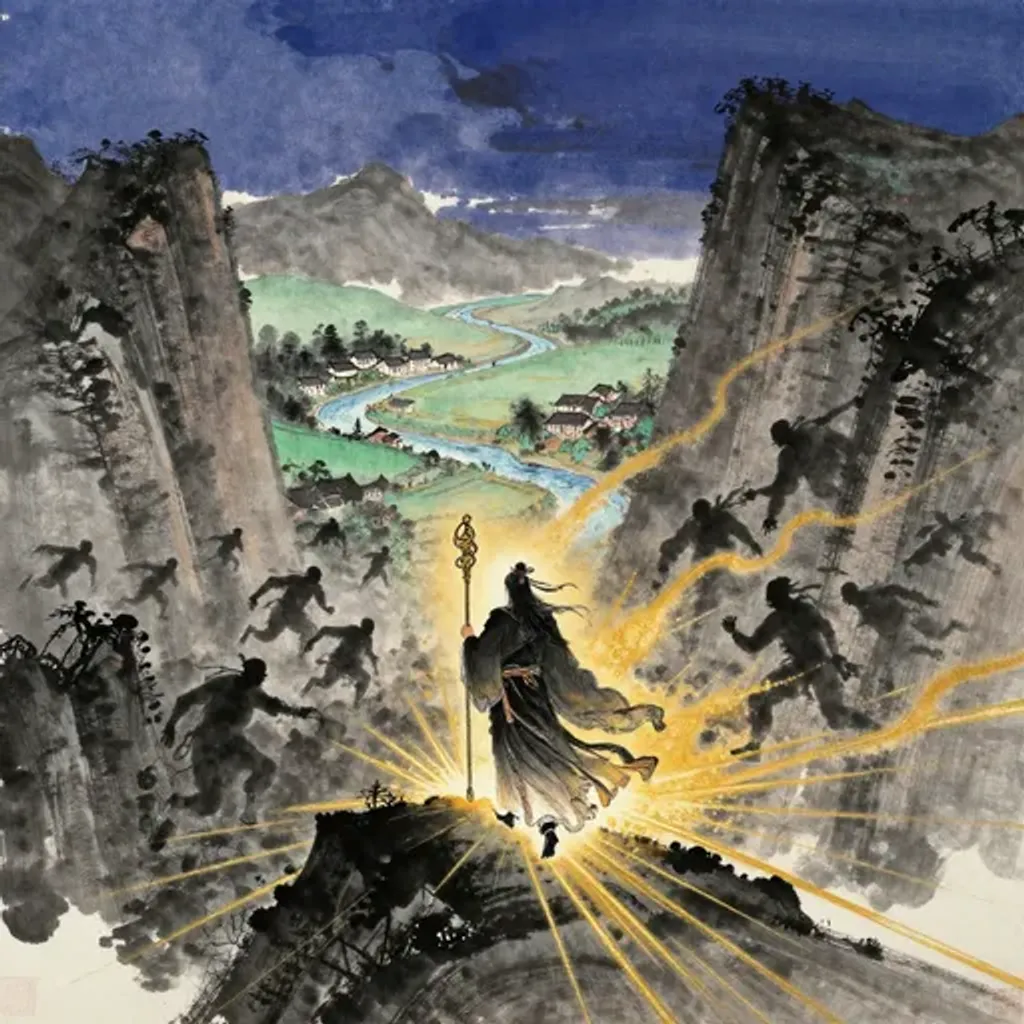
逐禍除患,道德神仙。遏惡萬里,福常在前,身樂以安。
Driving out calamity, banishing harm; the virtuous way of the divine immortal. Warding off evil for ten thousand miles; blessings ever go before. The body is at ease and at peace.
— Jiao Yanshou, Yilin (Forest of Changes), 1st century BC
Commentary
Fire beneath the earth becomes wind upon water — Dispersion, where accumulated stagnation is scattered and dissolved. 'Pursuing calamity, expelling harm — the way of virtue and the immortals. Evil is blocked for ten thousand li; blessings are always before me; the body is joyful and at peace.' This is a vision of spiritual cleansing: malevolent forces are driven away across vast distance by virtuous power, and what remains is unobstructed blessing. The language of 'dao de shen xian' evokes Daoist cultivation traditions where inner refinement produces an aura that repels evil naturally. From Darkening of the Light to Dispersion, the transformation scatters the accumulated darkness as wind breaks up ice on the river — not through force but through the gentle, persistent action of a purified spirit.
明夷 → 節
Hexagram 36 → Hexagram 60: Limitation
Changing lines: 2, 3, 5
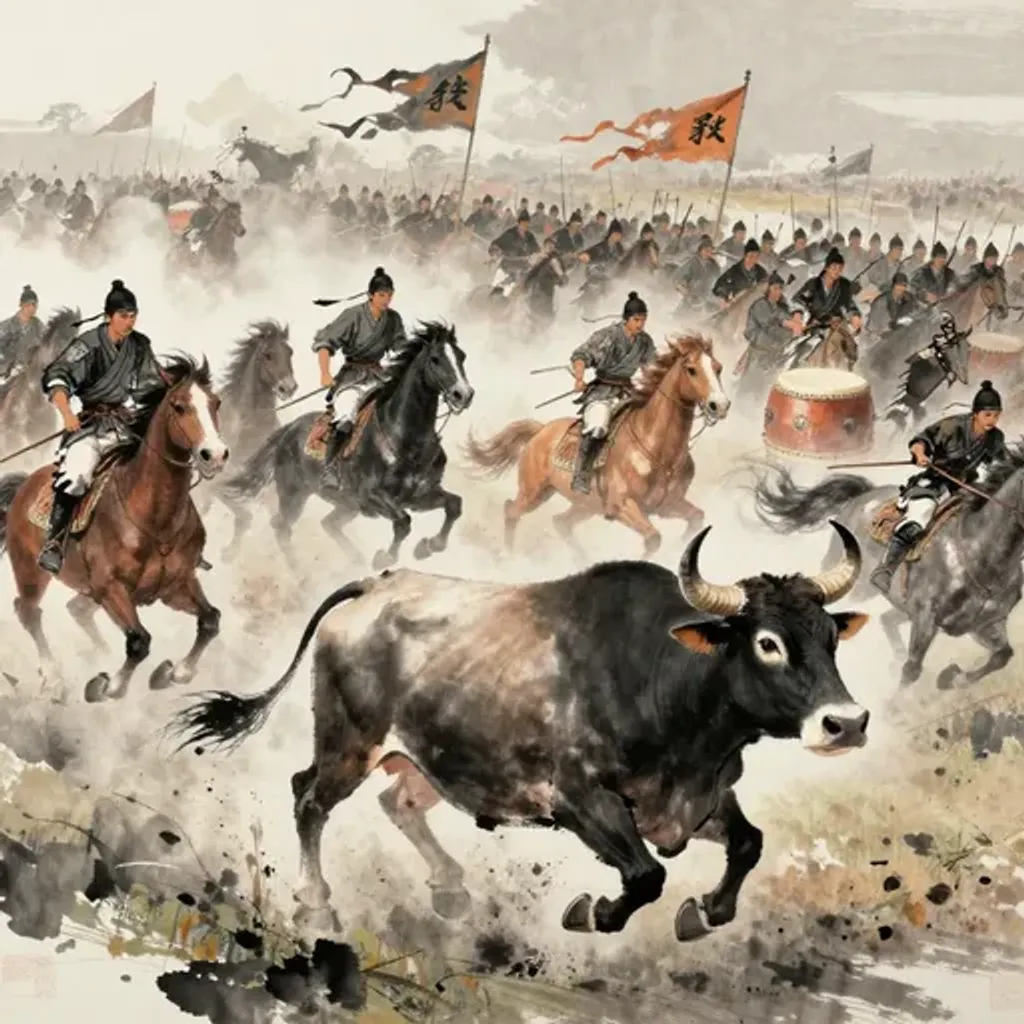
牛驚馬走,上下渾擾。鼓音不絕,頃公奔敗。
Oxen startled, horses bolting; above and below in turmoil. Drum thunder without cease; Duke Qing flees in defeat.
— Jiao Yanshou, Yilin (Forest of Changes), 1st century BC
Commentary
Fire beneath the earth encounters water upon the lake — Limitation, where proper boundaries prevent excess. 'Cattle stampede, horses bolt; above and below all is chaos. The drums never cease; Duke Qing flees in defeat.' The verse alludes to the Battle of An in 589 BC, where Duke Qing of Qi was routed by the Jin army under Xi Ke. According to the Zuo Zhuan, Qi's army panicked and Duke Qing barely escaped by having his minister Feng Chofu swap chariots with him. The unceasing drums represent the din of battle turning to rout. From Darkening of the Light to Limitation, the transformation warns that when proper limits are violated — as Qi overstepped by attacking Jin's allies — the resulting chaos admits no half-measures. Only total defeat imposes the limitation the ruler refused to accept willingly.
明夷 → 中孚
Hexagram 36 → Hexagram 61: Inner Truth
Changing lines: 2, 3, 5, 6
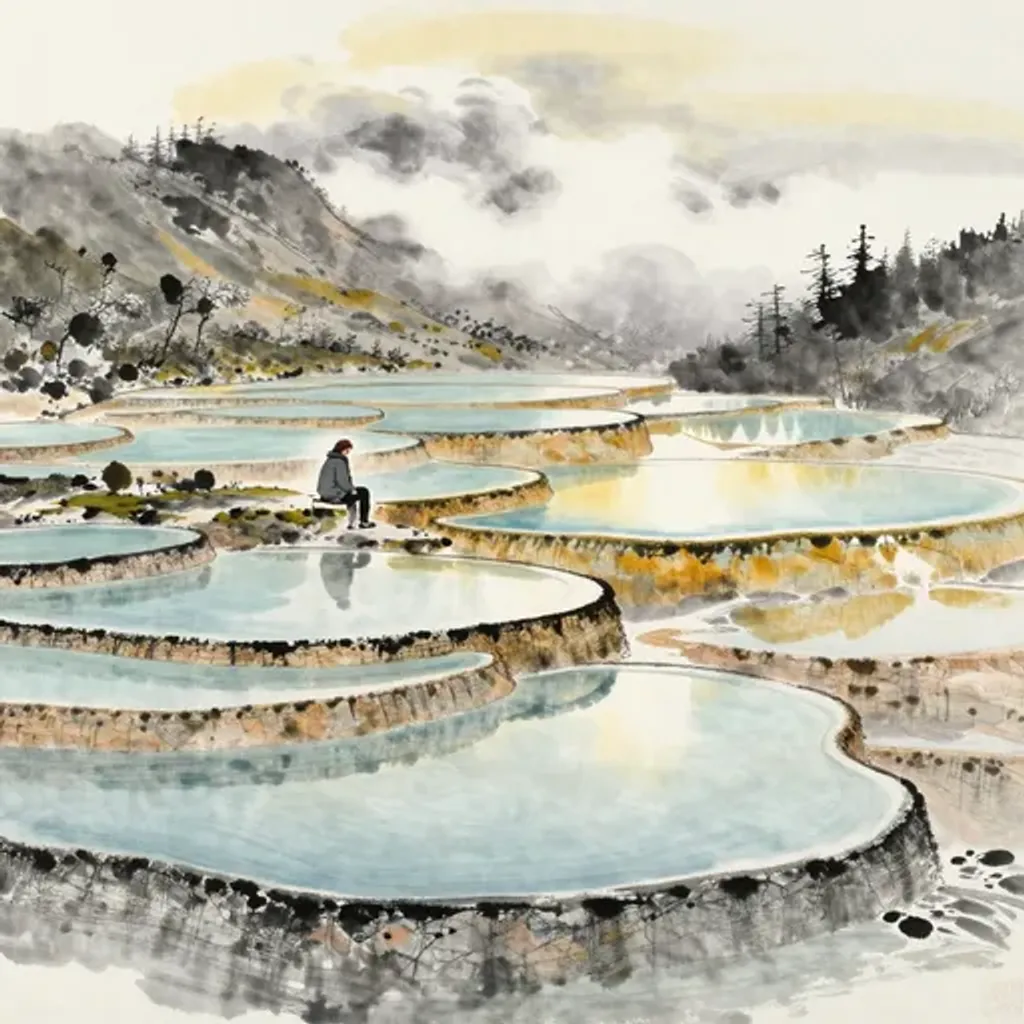
西上九陂,往來留連。止須時日,虛與有德。
Westward, ascending the nine reservoirs; coming and going, lingering on. Halting to await the proper day; emptiness yields to virtue.
— Jiao Yanshou, Yilin (Forest of Changes), 1st century BC
Commentary
Fire beneath the earth meets wind upon the lake — Inner Truth, where sincerity penetrates to the core. 'Ascending westward past nine slopes, lingering back and forth along the way. Stopping to await the right day — offering emptiness to those of virtue.' The journey west past multiple barriers suggests a pilgrimage or diplomatic mission, undertaken with deliberation rather than haste. The closing phrase 'xu yu you de' — offering emptiness (or reserves) to the virtuous — resonates with Inner Truth's hollow center: the open space within the hexagram that allows sincerity to resonate like wind crossing an open lake. From Darkening of the Light to Inner Truth, the transformation reveals that the suppressed light is recovered not through assertion but through receptive sincerity — making space for truth to enter.
明夷 → 小過
Hexagram 36 → Hexagram 62: Small Exceeding
Changing lines: 1, 4
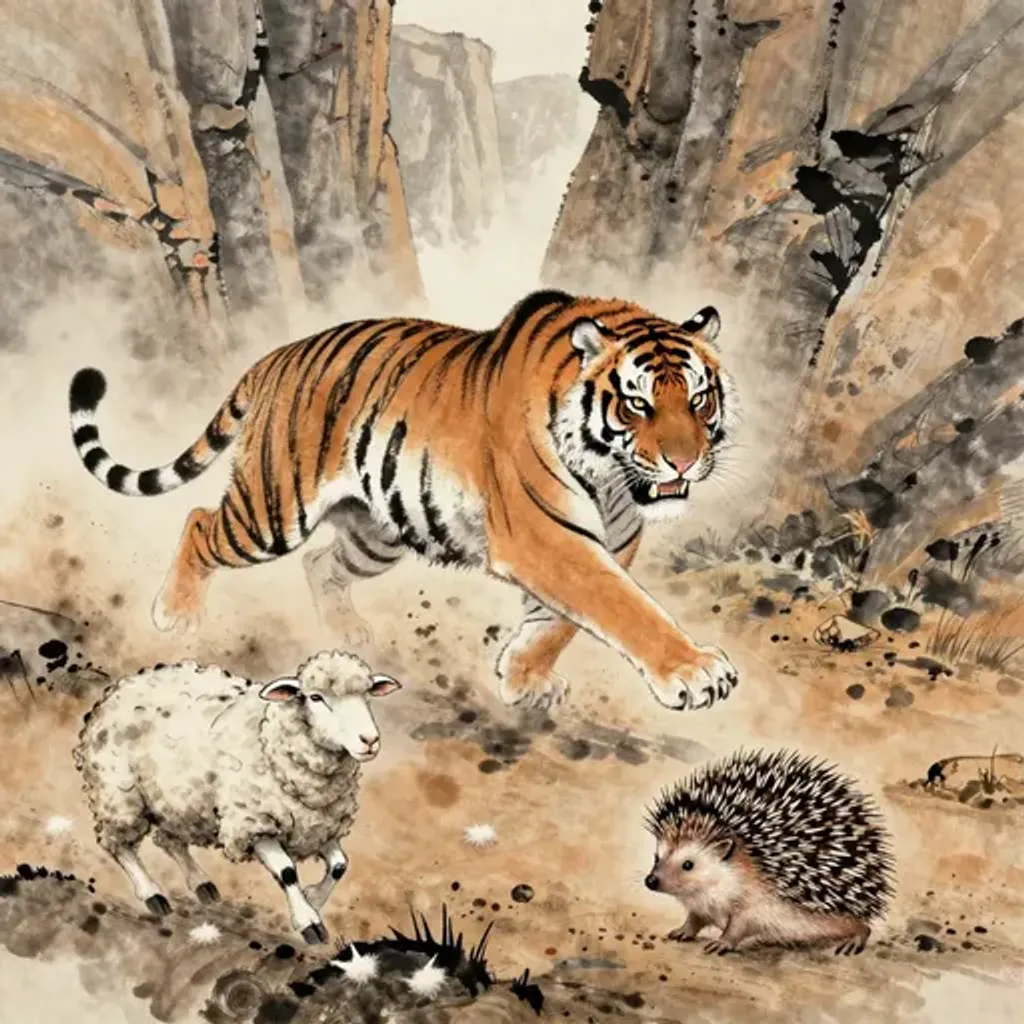
虎怒捕羊,猬不能攘。
The tiger rages and seizes the sheep; the hedgehog cannot fend it off.
— Jiao Yanshou, Yilin (Forest of Changes), 1st century BC
Commentary
Fire beneath the earth meets thunder upon the mountain — Small Exceeding, where modest overstepping is the only viable strategy. The verse is the most compact in the entire batch, just eight characters: 'The tiger rages to seize the sheep; the hedgehog cannot fend it off.' The tiger's fury is overwhelming; the hedgehog's defenses, formidable against lesser threats, are insufficient here. Unlike the 14-6 verse where the hedgehog subdued the tiger, here the scale of violence has tipped past what defensive armor can withstand. From Darkening of the Light to Small Exceeding, the transformation reveals the limits of modest means against disproportionate force. Small Exceeding counsels doing a little more than seems warranted — but when the tiger is this enraged, even exceeding is not enough.
明夷 → 既濟
Hexagram 36 → Hexagram 63: After Completion
Changing lines: 5
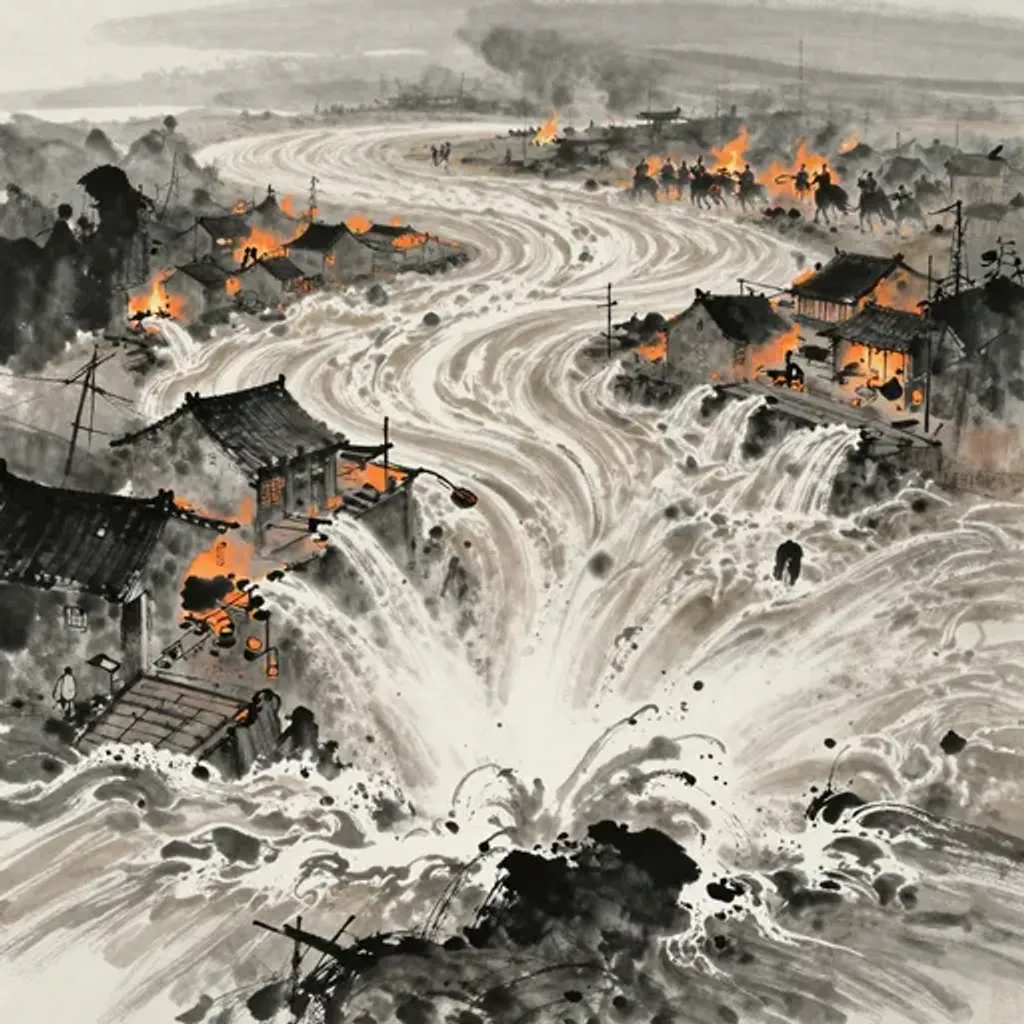
湧泉滈滈,南流不絕。卒為江海,敗壞邑里,家無所處。將帥襲戰,獲其醜虜。
The gushing spring flows and flows, streaming south without end. At last it becomes river and sea, ruining towns and villages; families have nowhere to dwell. The generals launch a raid and capture the wretched prisoners.
— Jiao Yanshou, Yilin (Forest of Changes), 1st century BC
Commentary
Fire beneath the earth transforms into water above fire — After Completion, where every element is in its proper place but the order is fragile. 'Springs gush and surge, flowing south without cease. At last they become rivers and seas, destroying towns and villages — homes have nowhere to stand.' The verse then pivots to military resolution: 'Generals launch raids in battle and capture the barbarian prisoners.' Two scenarios coexist: natural disaster and military response. The springs that nourish also flood; the army that defends also conquers. This is the inherent instability of After Completion — everything is in place, yet the very completeness generates overflow. From Darkening of the Light, the transformation warns that when suppressed light finally achieves order, it must immediately guard against the excess that order itself produces.
明夷 → 未濟
Hexagram 36 → Hexagram 64: Before Completion
Changing lines: 1, 2, 3, 4, 6
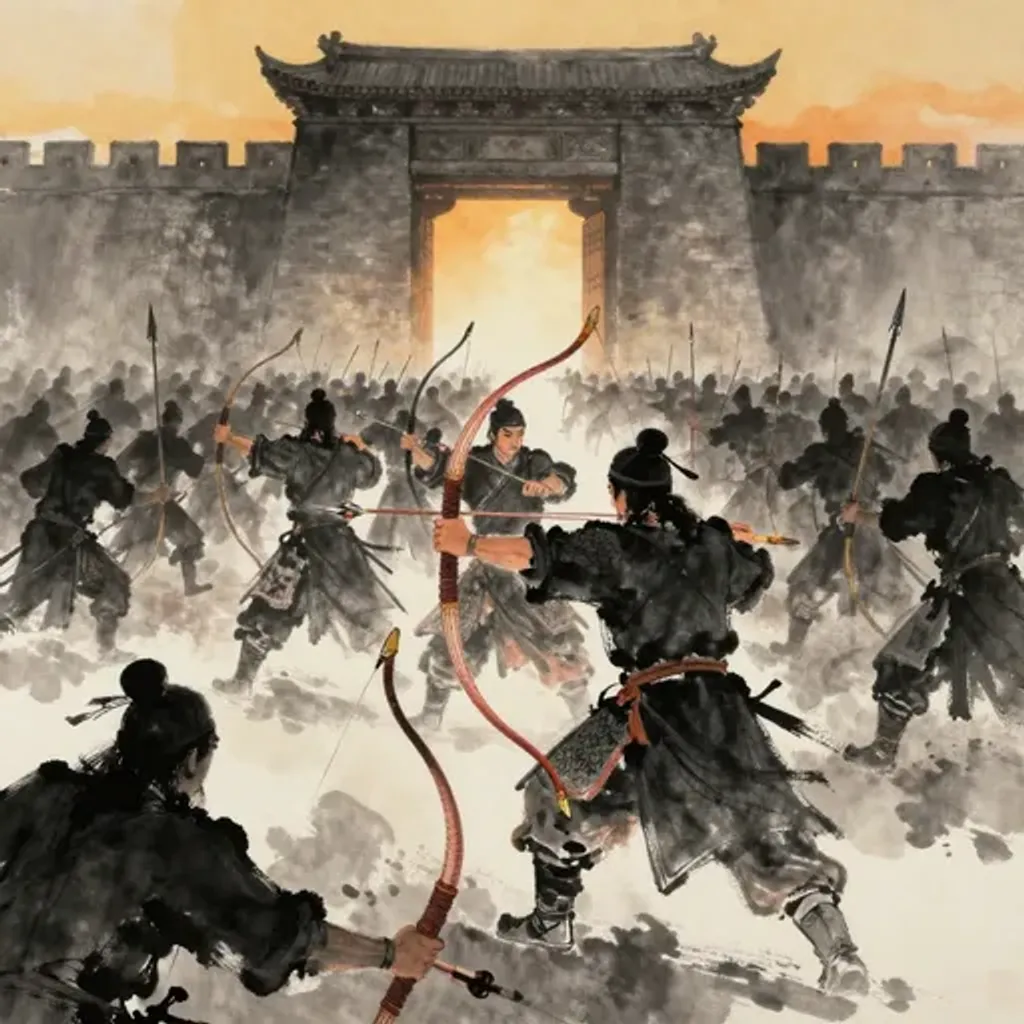
桃弓葦戟,除殘去惡,敵人執服。
Peachwood bows and reed-stalk halberds; they cast out the wicked and expel the evil. The enemy submits and surrenders.
— Jiao Yanshou, Yilin (Forest of Changes), 1st century BC
Commentary
Fire beneath the earth becomes fire above water — Before Completion, the final hexagram, where nothing yet occupies its proper place but the trajectory toward order is visible. 'Peach-wood bows and reed halberds — they eliminate the wicked and remove the evil; the enemy submits and serves.' The peach bow and reed spear are ritual implements of the Nuo exorcism ceremony, the great year-end rite where masked dancers drove out demons and pestilence. These are not weapons of war but instruments of purification — evil is expelled through ritual rather than violence. From Darkening of the Light to Before Completion, the final transformation holds open the promise that the long night ends not in battle but in cleansing. The disorder is real, but the tools to address it are already in hand, waiting for the ceremony to begin.