Transformations of Hexagram 4
Every line of change out of Hexagram 4 蒙 Youthful Folly, with the Yilin verse for each of the 64 resulting hexagrams, its translation, and the original ink brush artwork.
蒙 → 乾
Hexagram 4 → Hexagram 1: The Creative
Changing lines: 1, 3, 4, 5
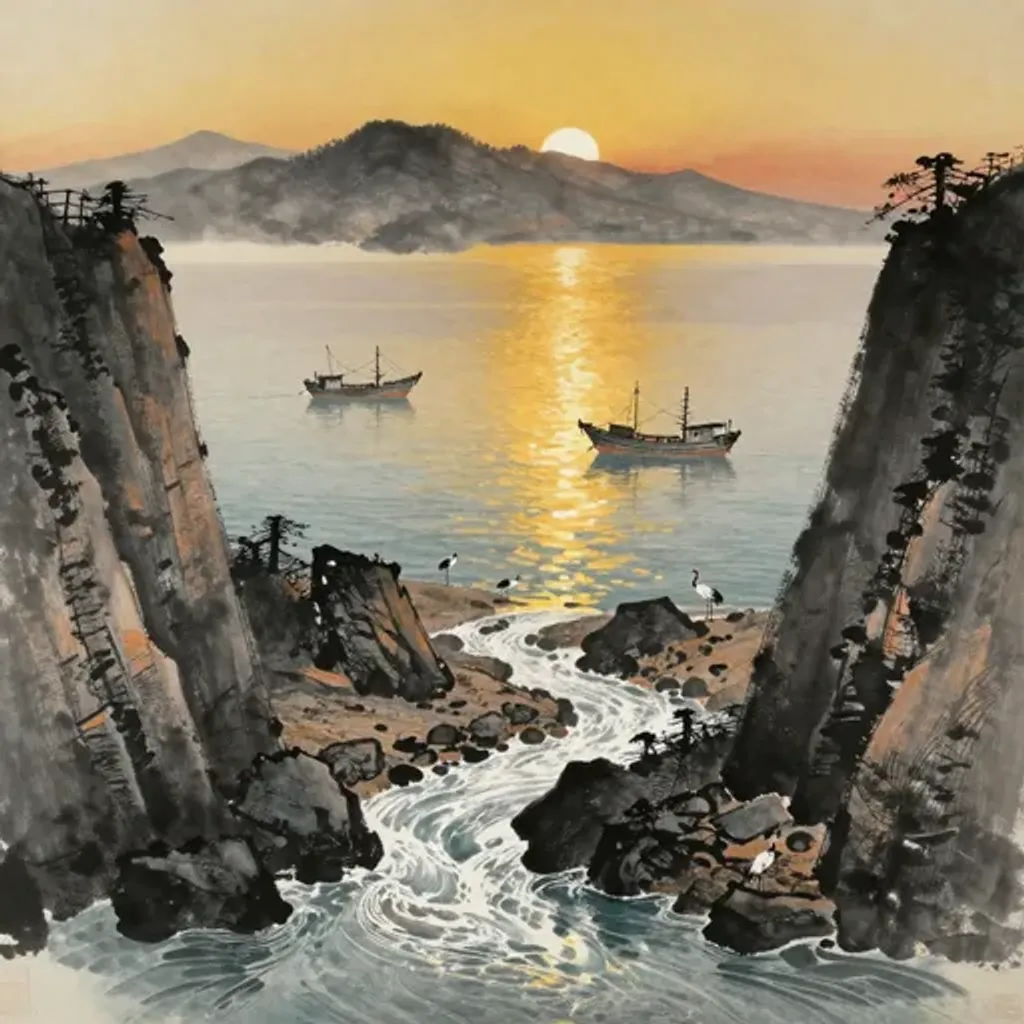
海為水王,聰聖且明。百流歸德,無有叛逆,常饒優足。
The sea is king of all waters, wise and brilliant. A hundred streams return to its virtue; none rebel or resist. Always abundant and sufficient.
— Jiao Yanshou, Yilin (Forest of Changes), 1st century BC
Commentary
A spring emerges beneath the mountain, seeking its way through darkness toward clarity. The sea reigns as king of all waters: wise, perceptive, and luminous. Every river and stream flows toward it in natural allegiance, none rebelling, and abundance never fails. The verse draws on the Daodejing's image of the sea as ruler precisely because it occupies the lowest position — all waters descend to it of their own accord. From Youthful Folly to the Creative, the transformation traces how naive potential, guided by receptive humility rather than force, awakens into the self-generating power of heaven. The spring that begins in mountain darkness gathers tributaries until it becomes the sovereign ocean: leadership achieved not through conquest but through the gravity of accumulated virtue.
蒙 → 坤
Hexagram 4 → Hexagram 2: The Receptive
Changing lines: 2, 6
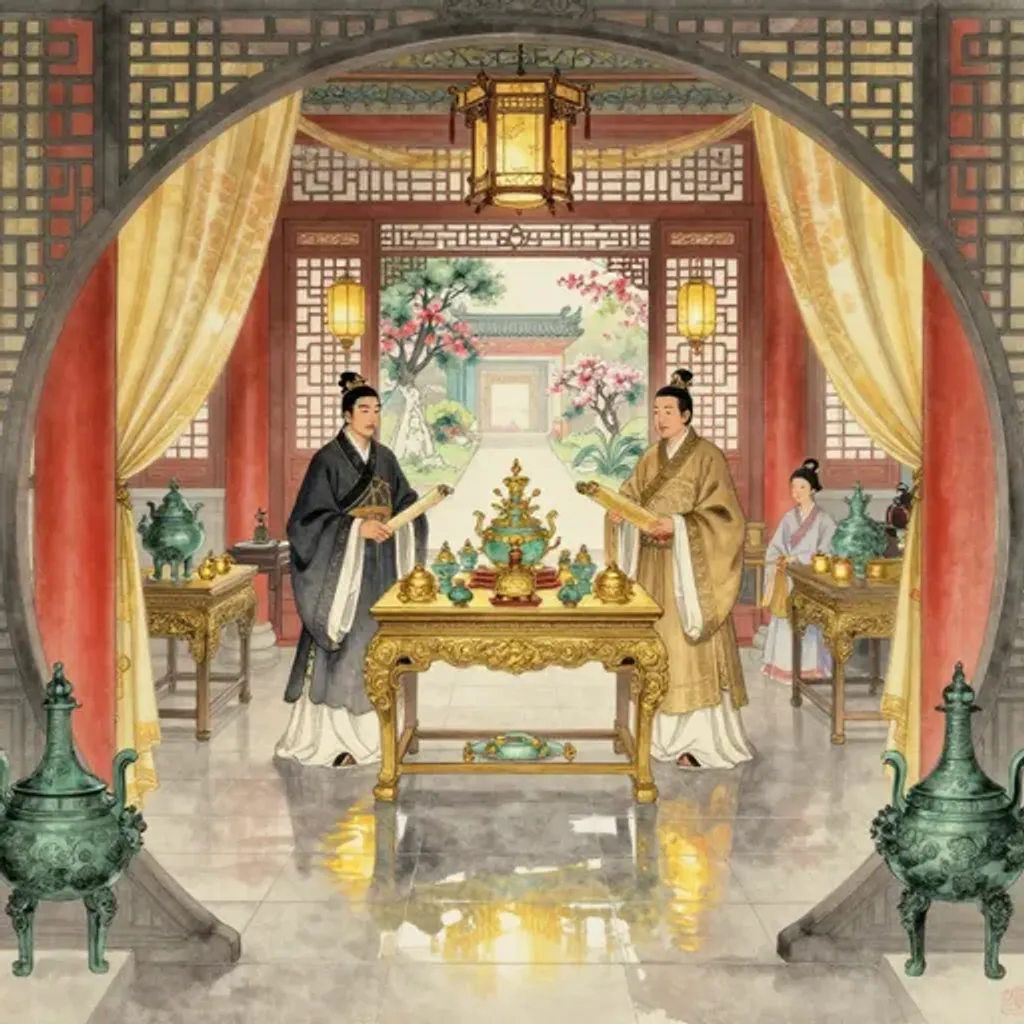
天之所有,禍不過家。左輔右弼,金玉滿堂。常盈不亡,富如敖倉。
What heaven possesses; disaster does not pass beyond the house. Left aide, right support; gold and jade fill the hall. Always brimming, never lost; rich as the granary of Ao.
— Jiao Yanshou, Yilin (Forest of Changes), 1st century BC
Commentary
A spring issues from beneath the mountain into a vision of heaven-blessed prosperity. What heaven bestows keeps misfortune from the household. Left and right counselors assist like pillars, gold and jade fill the hall, perpetually brimming without loss — rich as the great Ao Granary. The Ao Granary, built atop Mount Mang during the Qin dynasty, was the empire's chief storehouse, strategic enough to decide the Chu-Han wars. From Youthful Folly to the Receptive, the transformation reveals how unformed potential, when cradled by earth's boundless capacity, generates wealth that sustains rather than depletes. The mountain spring descends into the broad plain: ignorance does not diminish but opens into the vast receptivity that can hold all things.
蒙 → 屯
Hexagram 4 → Hexagram 3: Difficulty at the Beginning
Changing lines: 1, 2, 5, 6
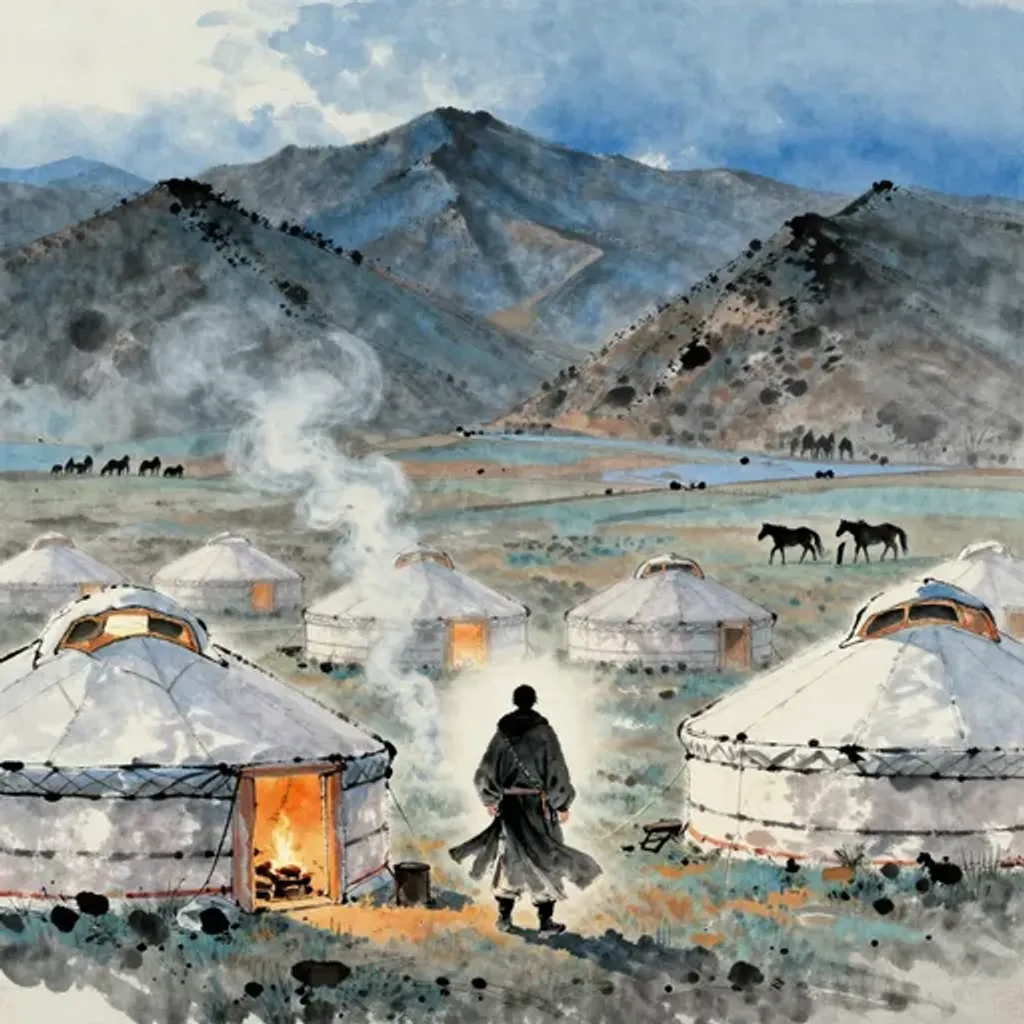
安息康居,異國穹廬。非吾習俗,使我心憂。
Anxi, Kangju—foreign lands of domed tents. These are not my customs; they fill my heart with sorrow.
— Jiao Yanshou, Yilin (Forest of Changes), 1st century BC
Commentary
A spring emerges beneath the mountain only to find itself in alien terrain. Anxi and Kangju — Parthia and Sogdiana — are distant Central Asian kingdoms known to Han-dynasty China through the Silk Road. Their felt tents rise on foreign soil, customs utterly unlike one's own, stirring deep unease. The verse captures the disorientation of exile among nomadic peoples, where even the sky feels different. From Youthful Folly to Difficulty at the Beginning, the transformation mirrors this estrangement: the naive traveler steps out of sheltered ignorance into a world of unfamiliar dangers. Thunder rumbles beneath gathering clouds, and the spring that once flowed freely now struggles to find its course through unknown ground.
蒙 → 蒙
Hexagram 4 → Hexagram 4: Youthful Folly
No changing lines — the hexagram is unchanged
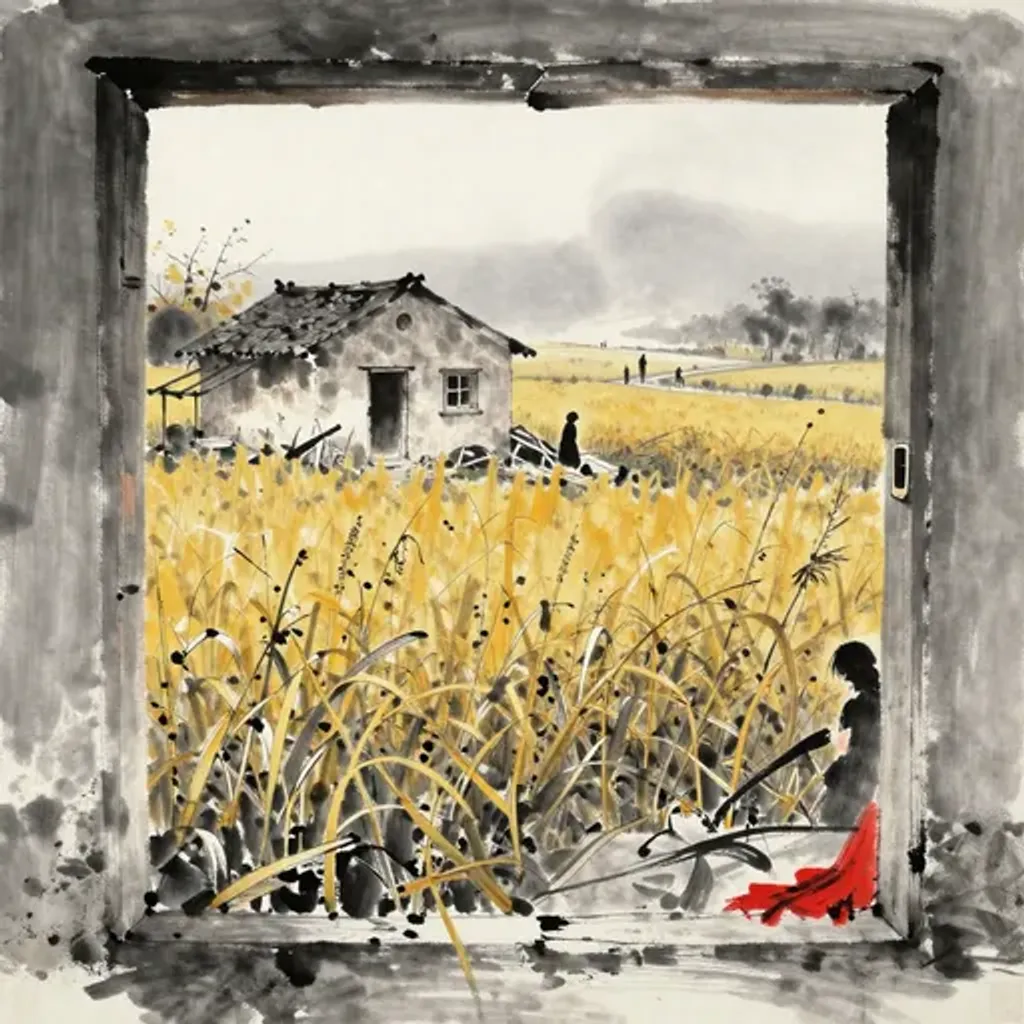
何草不黃,至未盡玄。室家分離,悲愁於心。
What grass is not yellowed? Reaching its end, all turns dark. House and home are parted; grief and sorrow fill the heart.
— Jiao Yanshou, Yilin (Forest of Changes), 1st century BC
Commentary
A spring beneath the mountain returns to the mountain — folly encountering itself. The verse opens by quoting the Shijing soldiers' lament 'He Cao Bu Huang': 'What grass is not yellowed?' — an image of universal exhaustion under endless campaigning. But the withering has not yet reached its darkest extreme. Families are torn apart, grief filling the heart. When the source hexagram meets its own reflection, there is no transformation, only intensification: the naivety that might have been educated instead compounds into deeper confusion. Separation from home and kin is the cruelest form of bewilderment — not ignorance of facts, but loss of the relationships that give knowledge its meaning.
蒙 → 需
Hexagram 4 → Hexagram 5: Waiting
Changing lines: 1, 3, 5, 6
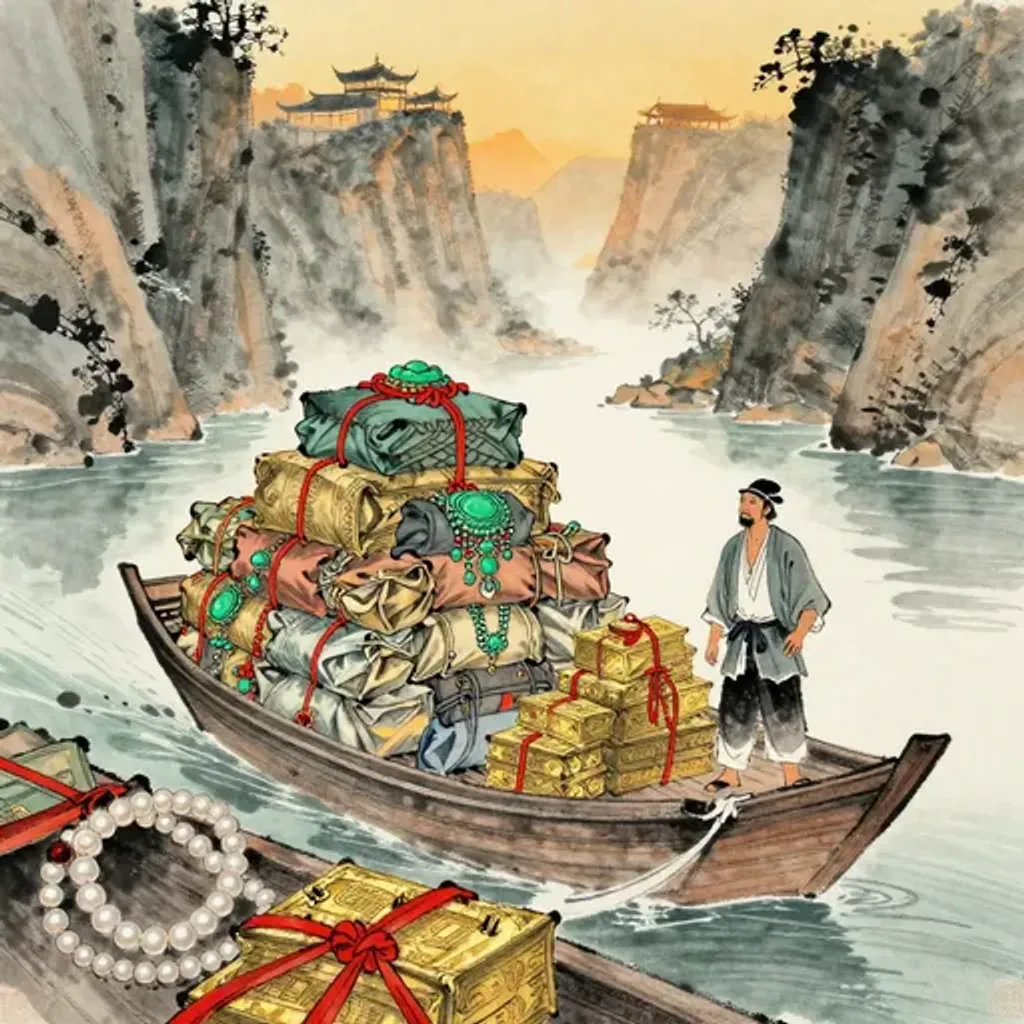
范公鴟夷,善賈飾資。東之營丘,易字子皮。把珠載金,多得利歸。
Lord Fan hides in a leather sack; a shrewd merchant who adorns his capital. Going east to Yingqiu, he takes the name Zipi. Grasping pearls, laden with gold; he returns with great profit.
— Jiao Yanshou, Yilin (Forest of Changes), 1st century BC
Commentary
A spring beneath the mountain flows into waiting abundance. Fan Li, the strategist who helped King Goujian of Yue destroy Wu, disguised himself as 'Chiyi Zipi' — literally 'Owl-Hide Master' — and sailed to Qi, where he traded at Yingqiu under this alias. Carrying pearls and laden with gold, he returned with handsome profit. The verse celebrates the supreme merchant who knew when to withdraw from politics and reinvent himself. From Youthful Folly to Waiting, the transformation mirrors Fan Li's patient calculation: clouds gather above heaven, and the wise person feasts while watching for the right moment. Naivety ripens into commercial shrewdness when one learns to wait for opportunity rather than chase it.
蒙 → 訟
Hexagram 4 → Hexagram 6: Conflict
Changing lines: 4, 5
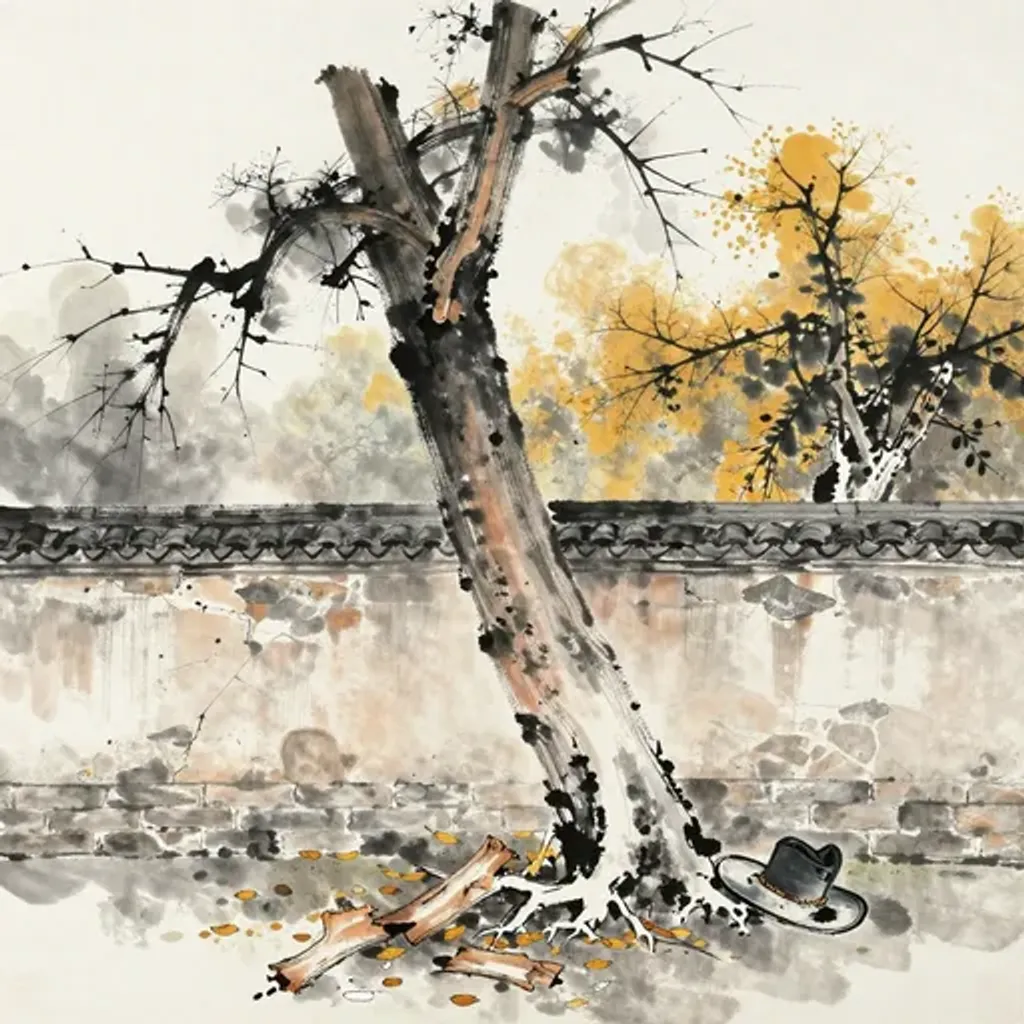
老楊日衰,條多枯枝。爵級不進。遂下摧隤。
The old poplar daily withers; its branches grow many dead twigs. Rank and office do not advance; tumbling downward into ruin.
— Jiao Yanshou, Yilin (Forest of Changes), 1st century BC
Commentary
A spring beneath the mountain runs dry as an aging willow declines. The old poplar weakens day by day, its branches growing more barren and brittle. Rank and title advance no further; instead, everything crumbles downward. The imagery is purely natural — organic decay without remedy. No promotion arrives to reverse the slide; the tree simply hollows from within. From Youthful Folly to Conflict, the transformation exposes what happens when naive ambition meets an indifferent system: heaven and water move in contrary directions, and the petitioner's case finds no hearing. The spring that once promised growth now feeds a dying tree, its energy wasted in a contest it cannot win.
蒙 → 師
Hexagram 4 → Hexagram 7: The Army
Changing lines: 6
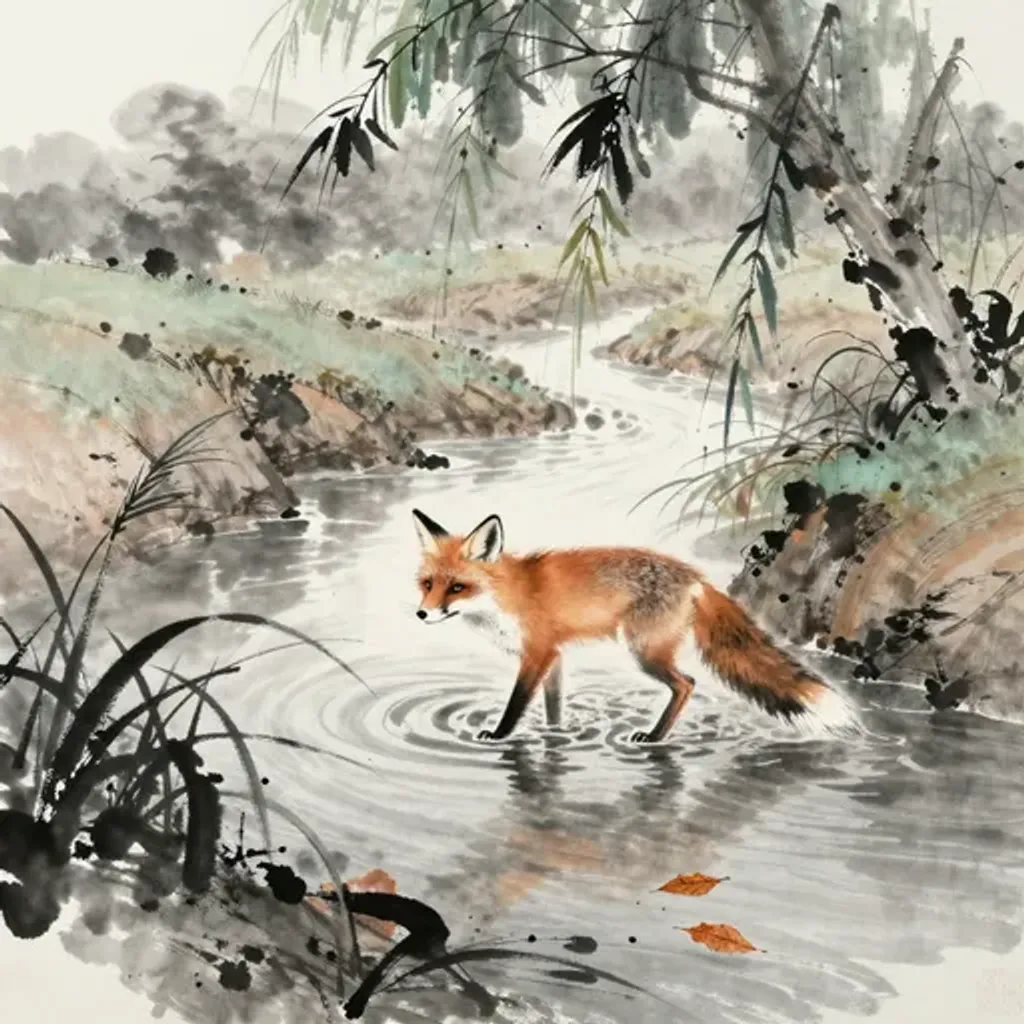
小狐渡水,污濡其尾。利得無幾,與道合契。
The small fox crosses the water, wetting and soiling its tail. The profit gained is hardly worth the effort; yet it accords with the Way.
— Jiao Yanshou, Yilin (Forest of Changes), 1st century BC
Commentary
A spring beneath the mountain watches a small fox attempt to cross the stream. The little fox wades in but wets its tail — gains are meager, yet the outcome aligns with the proper Way. The image of the fox crossing water appears in the I-Ching's final hexagram, Wei Ji (Before Completion), where the young fox nearly crosses but soaks its tail at the last moment. Here the lesson is gentler: small profit, small risk, and the result still accords with principle. From Youthful Folly to The Army, the transformation suggests that discipline emerges from modest failures. Water hidden within the earth marshals its forces quietly; the young fox's wet tail teaches restraint before it commands troops.
蒙 → 比
Hexagram 4 → Hexagram 8: Holding Together
Changing lines: 2, 5, 6
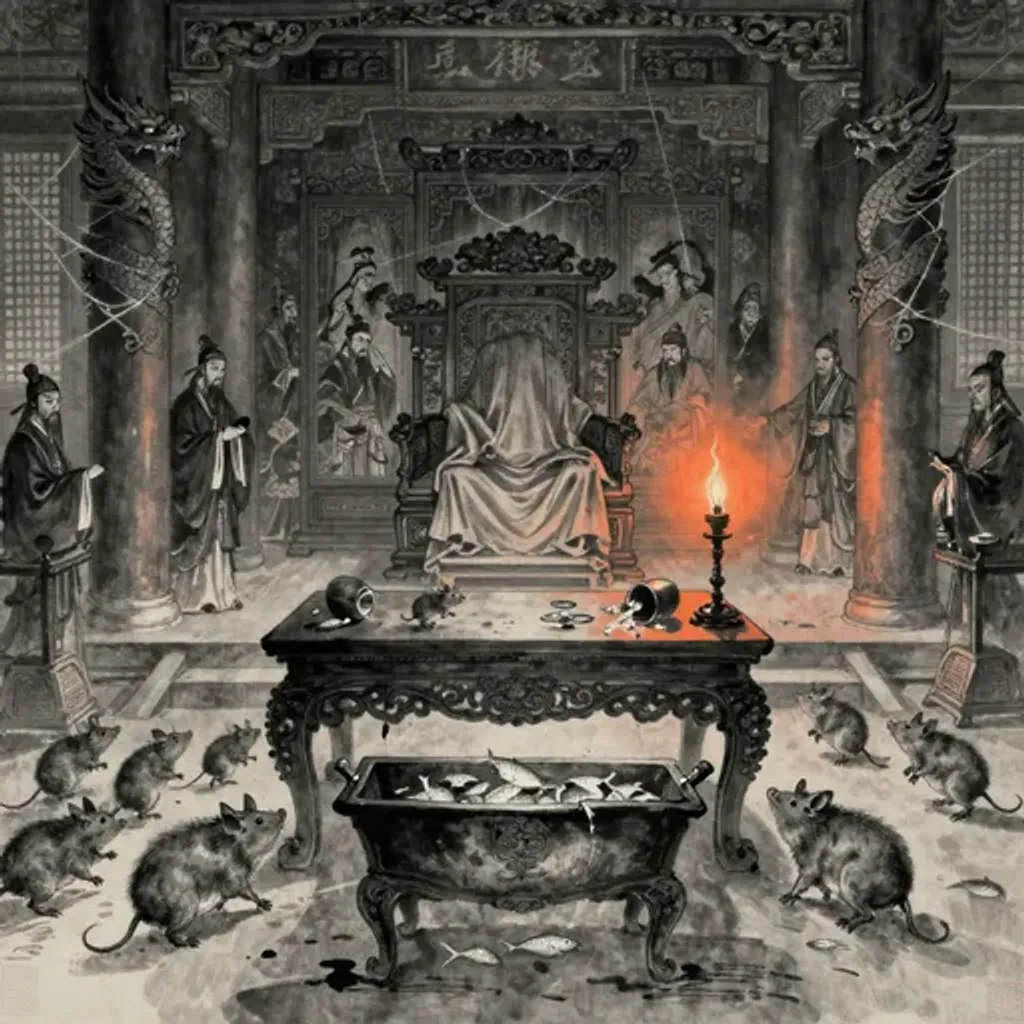
豕生魚魴,鼠舞庭堂。奸佞施毒,上下昏荒,君失其國。
Pigs give birth to bream; rats dance in the courtyard. Treachery and flattery spread their poison; above and below grow dim and reckless. The lord loses his state.
— Jiao Yanshou, Yilin (Forest of Changes), 1st century BC
Commentary
A spring beneath the mountain turns foul as the natural order inverts. Pigs give birth to fish, rats dance in the courtyard — monstrous omens of a world turned upside down. Treacherous ministers spread their poison while ruler and court sink into confusion; the lord loses his state. In Han-dynasty omen theory, animals acting against their nature signal that governance has gone catastrophically wrong. From Youthful Folly to Holding Together, the transformation is deeply ironic: the hexagram of union and allegiance is reached through its perversion. Water upon the earth should nurture bonds between ruler and vassal, but when those bonds form around flattery and poison rather than virtue, unity itself becomes the instrument of ruin.
蒙 → 小畜
Hexagram 4 → Hexagram 9: Small Taming
Changing lines: 1, 3, 5
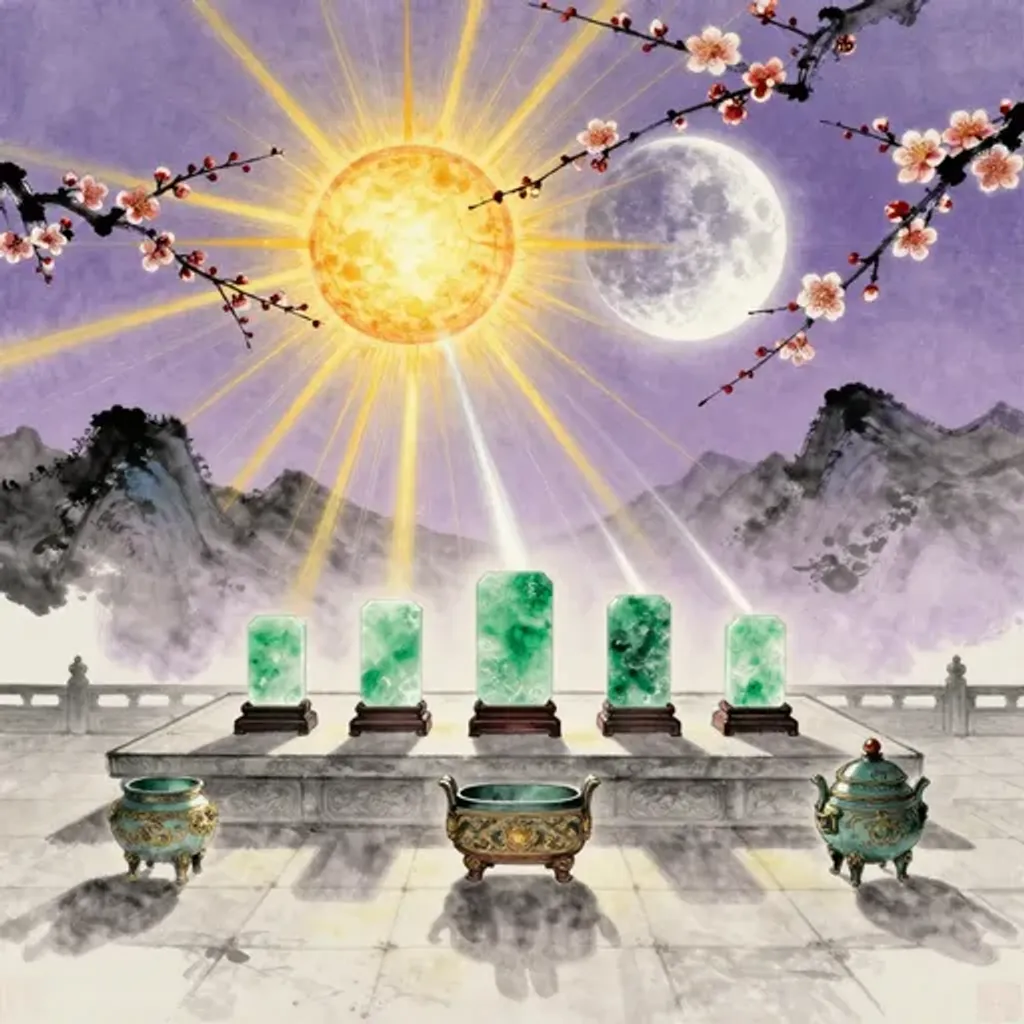
天地配享,六位光明。陰陽順序,以成和平。
Heaven and earth share the offering; the six positions shine bright. Yin and yang follow their order, and harmony and peace are achieved.
— Jiao Yanshou, Yilin (Forest of Changes), 1st century BC
Commentary
A spring beneath the mountain opens onto cosmic harmony. Heaven and earth share offerings at the altar, the six positions radiate light, yin and yang follow their proper sequence, and peace prevails. The 'six positions' echo the I-Ching's own structure — the six lines of a hexagram, each finding its correct place. When every element occupies its rightful station, order emerges without coercion. From Youthful Folly to Small Taming, the transformation traces how raw potential is gently cultivated: wind moves across heaven, refining rather than forcing. The spring's unformed energy, once guided into proper channels, produces not dramatic power but the quiet luminosity of a well-ordered world.
蒙 → 履
Hexagram 4 → Hexagram 10: Treading
Changing lines: 1, 4, 5
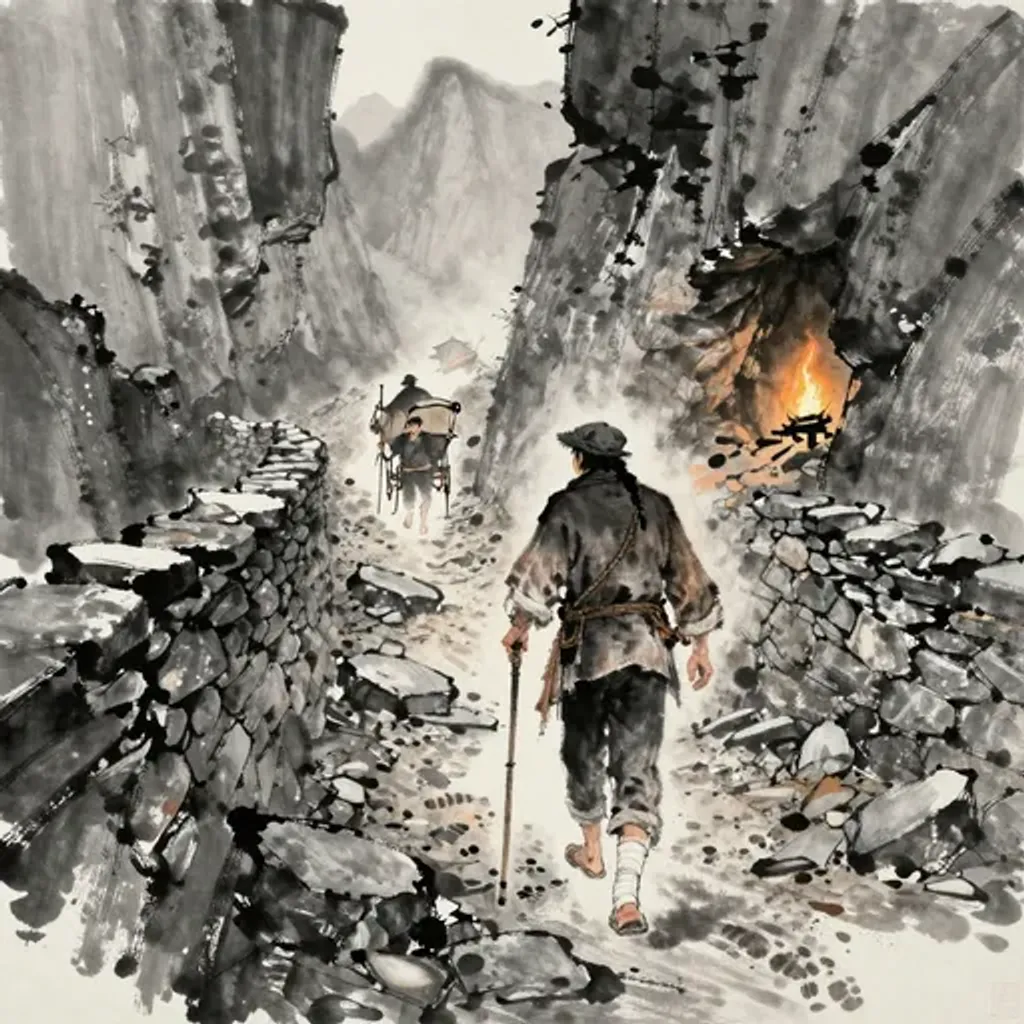
踝踵足傷,右指病癰。失旅後時,利走不來。
Ankle, heel, foot all injured; the right finger festers. Missing the company, behind the hour; profit runs but does not arrive.
— Jiao Yanshou, Yilin (Forest of Changes), 1st century BC
Commentary
A spring beneath the mountain stumbles on rocky ground. Ankles bruised, heels wounded, the right finger swollen with an abscess — the body fails at every joint. The traveler misses the caravan and falls behind schedule; profit flees and refuses to return. Every image is one of impaired movement: the foot that cannot step, the hand that cannot grasp, the journey that cannot keep pace. From Youthful Folly to Treading, the irony is sharp. Treading means walking carefully upon the tiger's tail, yet this figure cannot walk at all. The naif who ventures forward without adequate preparation does not even reach the point of danger — they collapse before the tiger is met.
蒙 → 泰
Hexagram 4 → Hexagram 11: Peace
Changing lines: 1, 3, 6
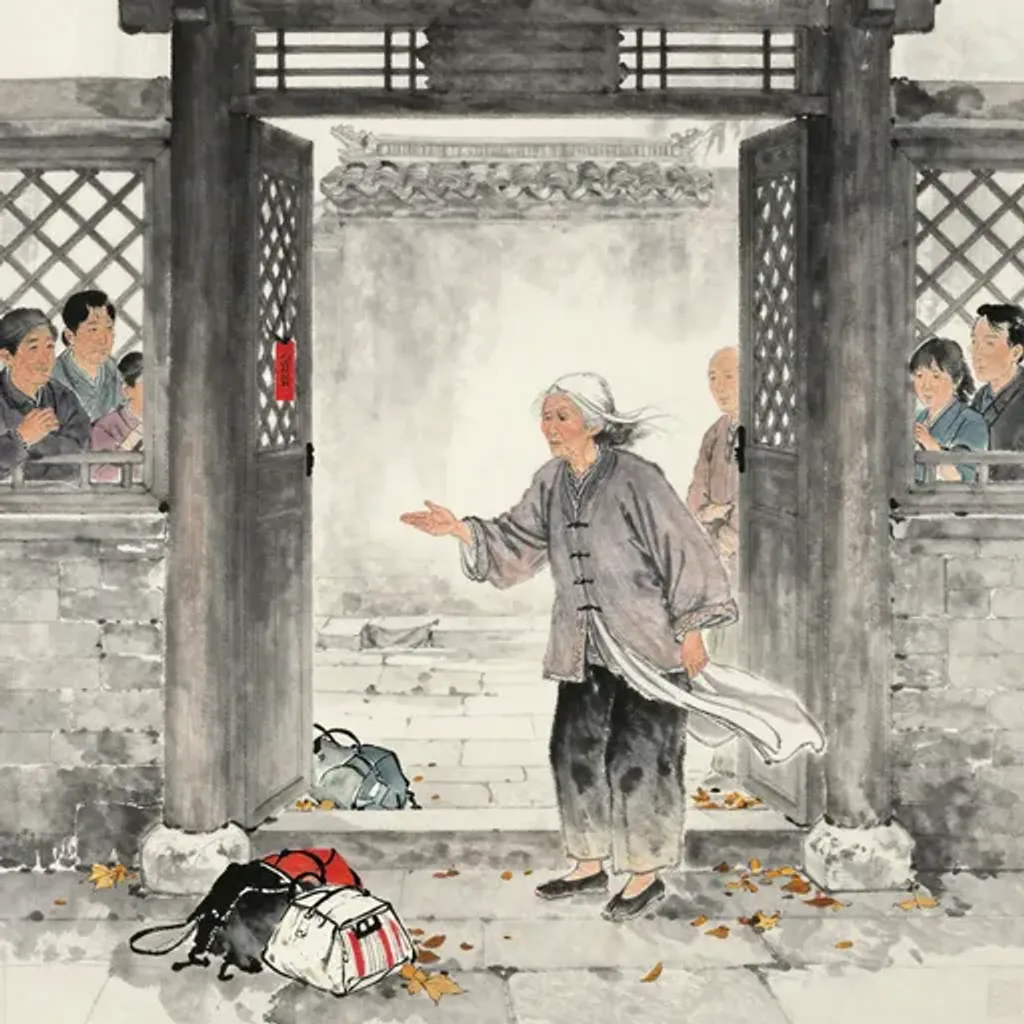
異體殊患,各有所屬。四鄰孤媼,欲寄我室。王母罵詈,求不可得。
Different bodies, different ailments; each belongs to a different place. The widows of four neighbors wish to lodge in my house. The matriarch scolds and curses; what is sought cannot be had.
— Jiao Yanshou, Yilin (Forest of Changes), 1st century BC
Commentary
A spring beneath the mountain encounters the broad expanse of Peace, yet finds no welcome. Bodies differ, troubles differ, each belongs to its own kind. A lonely old widow from the neighboring quarter wishes to lodge in our house, but the matriarch scolds and refuses — the request cannot be granted. The verse captures social exclusion even in an age of supposed harmony: the outsider seeking shelter is turned away by household authority. From Youthful Folly to Peace, the transformation suggests that cosmic harmony does not automatically extend to every individual. Heaven and earth may commune, but the widow still sleeps outside the gate. Peace must be actively distributed, not merely proclaimed.
蒙 → 否
Hexagram 4 → Hexagram 12: Standstill
Changing lines: 2, 4, 5
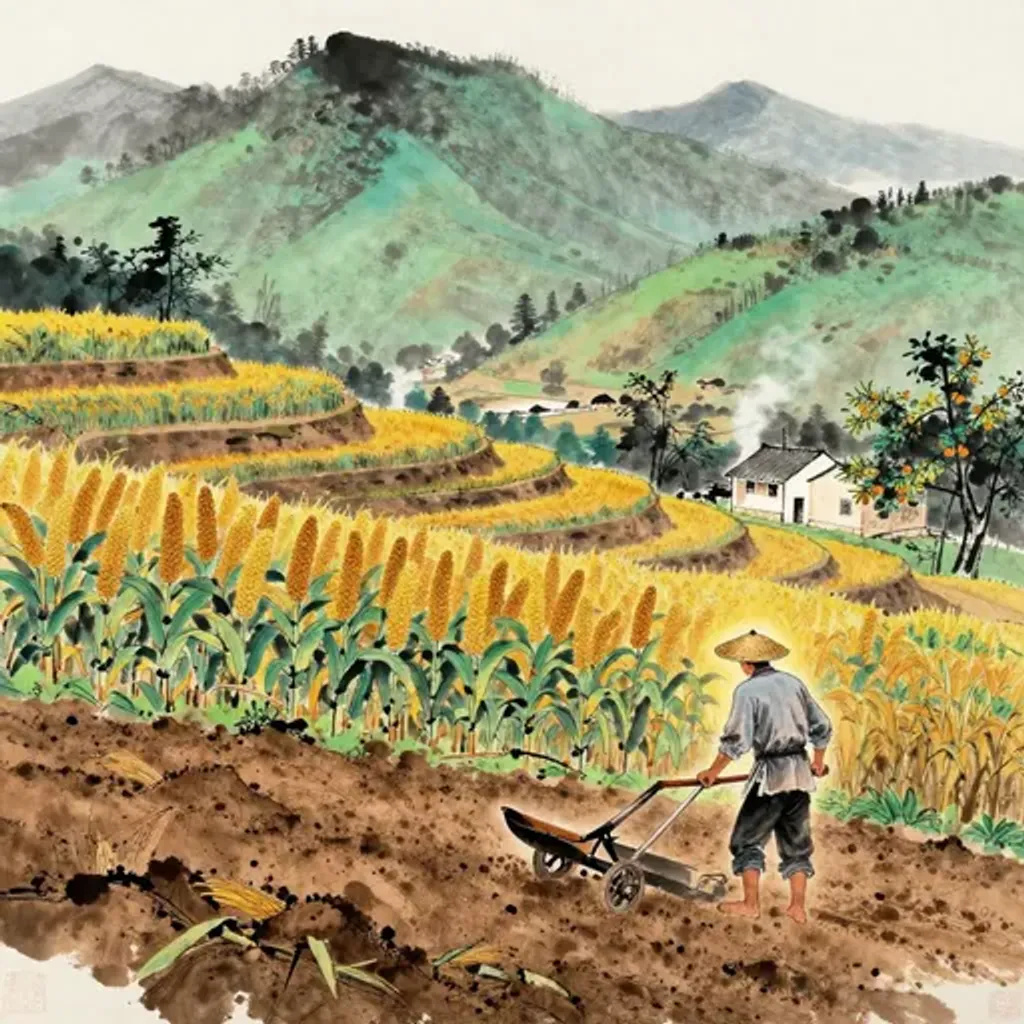
操耜鄉畝,折貨稷黍。飲食充口,安利無咎。
Taking plow to face the furrows; harvesting millet and grain. Food and drink fill the mouth; at peace and profitable, without fault.
— Jiao Yanshou, Yilin (Forest of Changes), 1st century BC
Commentary
A spring beneath the mountain settles into the steady rhythm of the plow. Hands grip the plow handle, facing the furrows, harvesting millet and grain. Food fills the mouth, comfort is found, and no misfortune follows. The verse is a small hymn to agrarian contentment — no ambition beyond the season's crop, no sorrow beyond the weather. From Youthful Folly to Standstill, the pairing seems paradoxical: Standstill means heaven and earth do not communicate, yet here is peaceful sufficiency. The resolution lies in the peasant's self-reliance: when the great systems seize up, the farmer who works the soil still eats. In times of political stagnation, the humble plow offers its own quiet salvation.
蒙 → 同人
Hexagram 4 → Hexagram 13: Fellowship
Changing lines: 1, 2, 3, 4, 5
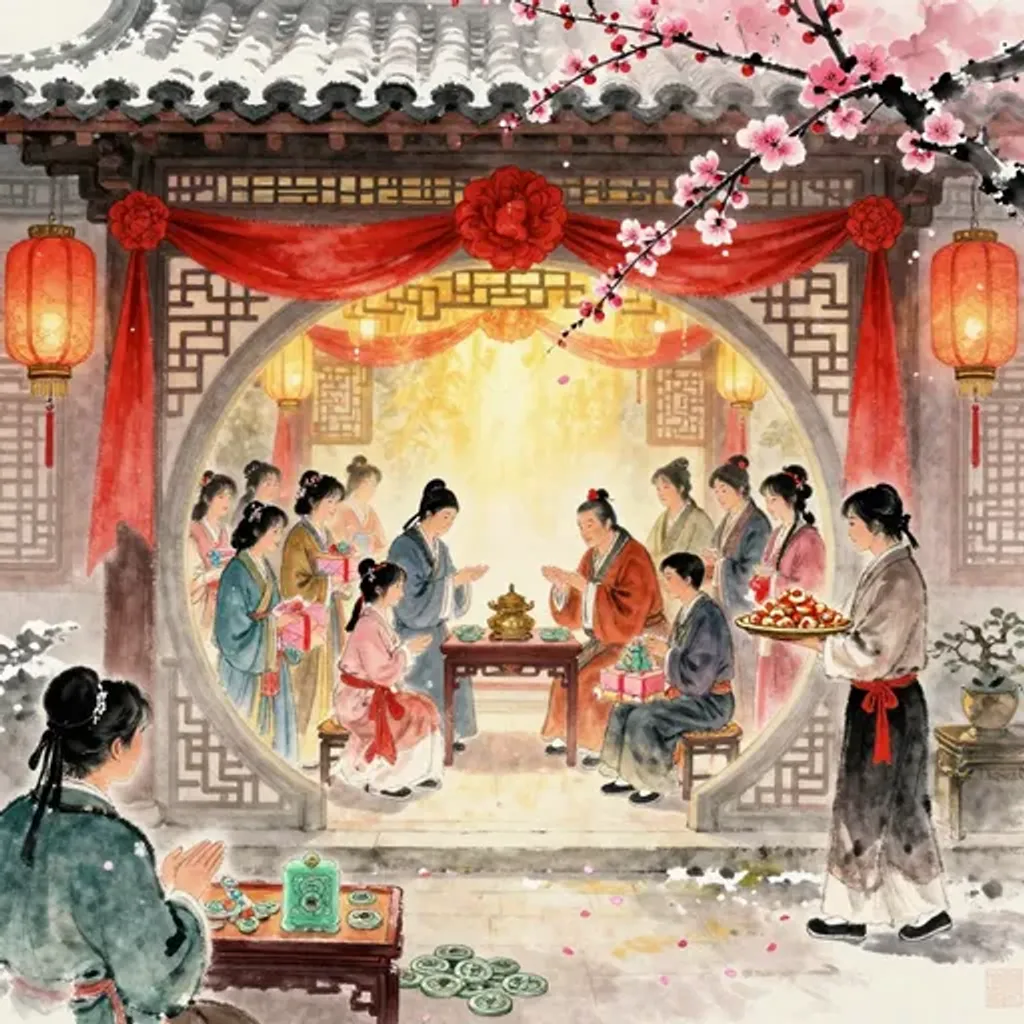
所受大喜,福祿重來。樂且日富,蒙慶得財。
Receiving great joy; blessings and fortune come again. Happy and daily richer; receiving favor and gaining wealth.
— Jiao Yanshou, Yilin (Forest of Changes), 1st century BC
Commentary
A spring beneath the mountain bursts into daylight as blessings arrive in abundance. Great joy is received, fortune and prosperity return in waves. Days grow richer and more joyful; even amid youthful folly, celebration brings wealth. The verse is almost purely auspicious — a cascade of good fortune without qualification. From Youthful Folly to Fellowship, the transformation suggests that when naive openness meets the warmth of community, blessings multiply. Heaven and fire illuminate together, and the spring that once groped in darkness now finds companions who share its light. Fellowship transforms ignorance into shared prosperity, not through instruction but through the simple generosity of belonging.
蒙 → 大有
Hexagram 4 → Hexagram 14: Great Possession
Changing lines: 1, 3, 4
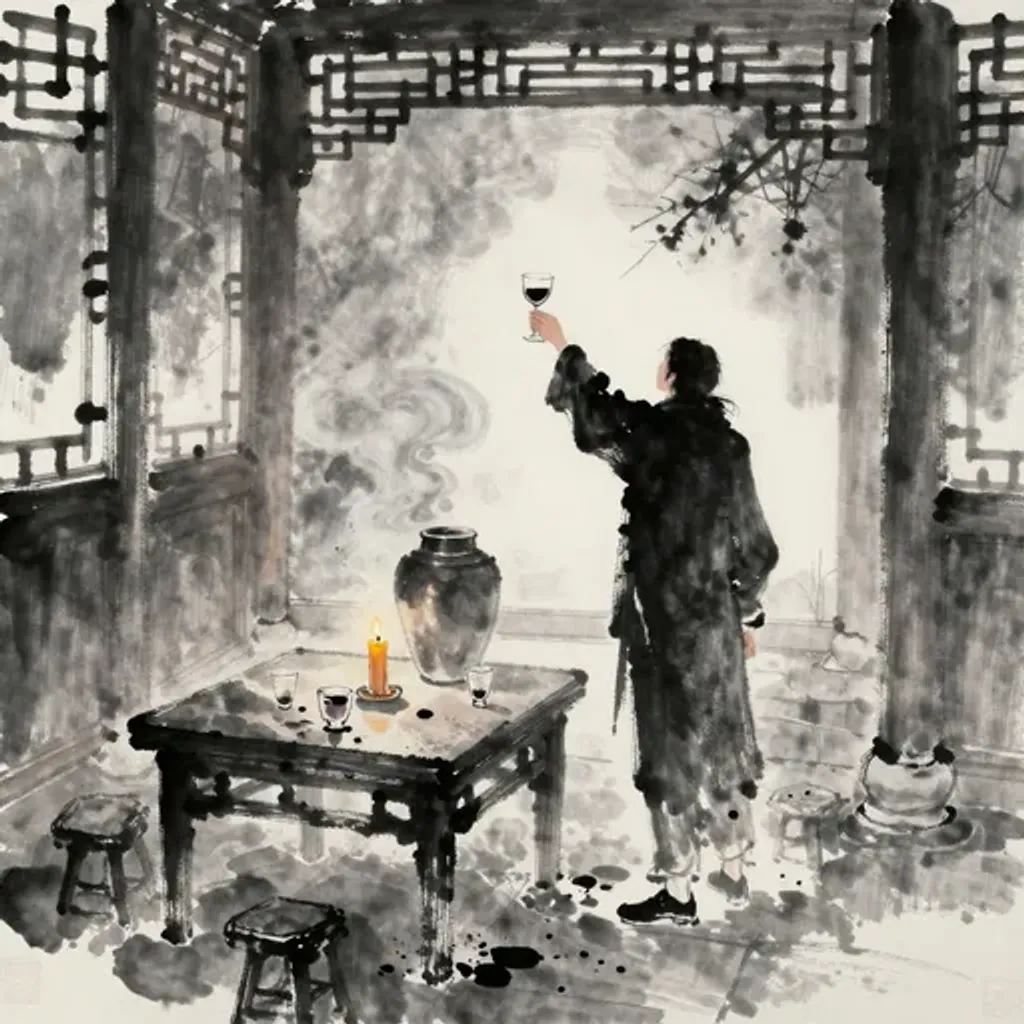
舉盃飲酒,無益溫寒。指直失取,亡利不懽。
Raising the cup to drink wine; it brings no benefit against cold or warmth. Fingers point straight but miss the grasp; losing profit, no joy.
— Jiao Yanshou, Yilin (Forest of Changes), 1st century BC
Commentary
A spring beneath the mountain raises a cup but finds no warmth in it. Wine is lifted to the lips, yet it brings no relief from cold or heat. The finger points stiffly, missing its grasp; profit is lost and joy does not come. Every gesture falls short of its aim — drinking without comfort, reaching without catching. The verse paints futility in domestic miniature: even the simplest pleasures fail to deliver. From Youthful Folly to Great Possession, the irony cuts deep. Fire blazes above heaven in the image of supreme abundance, yet this figure cannot even enjoy a cup of wine. Possessing greatly means nothing when one lacks the capacity to receive what is offered.
蒙 → 謙
Hexagram 4 → Hexagram 15: Modesty
Changing lines: 2, 3, 6
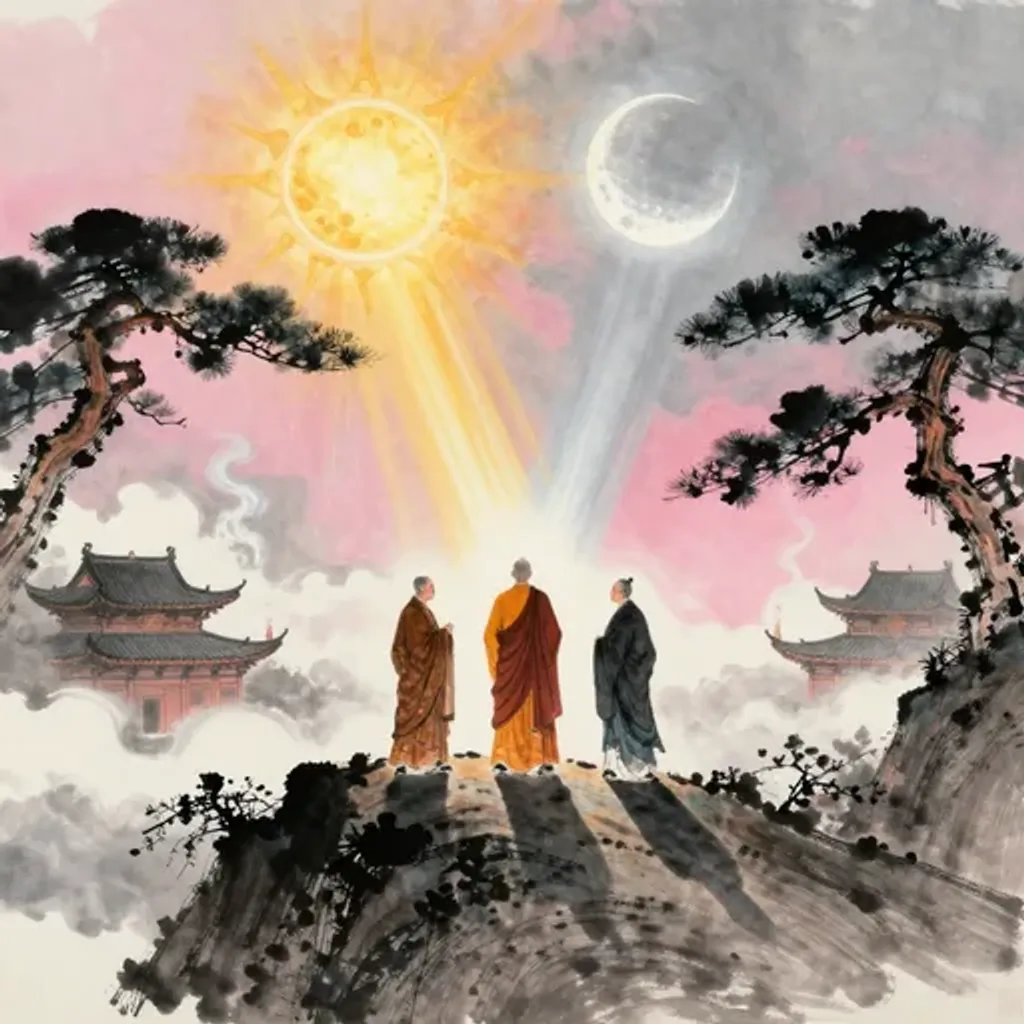
日月相望,光明盛昌。三聖茂承,功德大隆。
Sun and moon gaze upon each other; their light is full and glorious. Three sages vigorously continue; achievements and virtue greatly flourish.
— Jiao Yanshou, Yilin (Forest of Changes), 1st century BC
Commentary
A spring beneath the mountain gazes upward as sun and moon face each other in resplendent light. Three sages carry forward the mandate in flourishing succession, their merit and virtue rising to magnificence. The 'three sages' likely refers to the founding triad of the Zhou dynasty — King Wen, King Wu, and the Duke of Zhou — whose cumulative moral achievement established an enduring civilization. From Youthful Folly to Modesty, the transformation is telling: the mountain hidden within the earth is the humblest of images, yet it contains the greatest inner substance. The most luminous achievements of civilization rest on the modesty of sages who built without ostentation, their brilliance shining precisely because they did not seek to display it.
蒙 → 豫
Hexagram 4 → Hexagram 16: Enthusiasm
Changing lines: 2, 4, 6
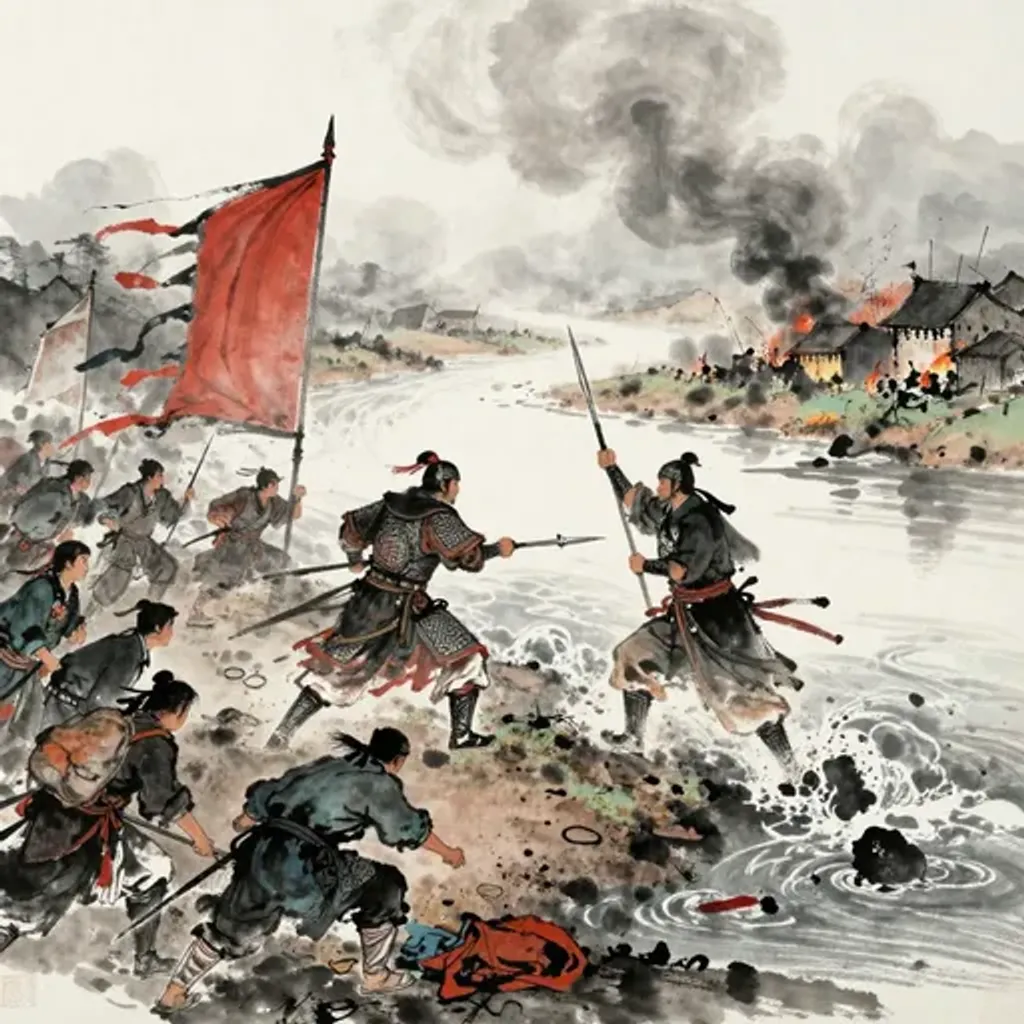
猾夫爭強,民去其鄉。公孫叔子,戰於瀟湘。
Cunning men contend for dominance; the people leave their homes. Lords Gongsun and Shuzi battle at Xiao and Xiang.
— Jiao Yanshou, Yilin (Forest of Changes), 1st century BC
Commentary
A spring beneath the mountain is churned to mud as warlords clash. Cunning strongmen vie for dominance, the people flee their villages. 'Gongsun' and 'Shuzi' — aristocratic titles suggesting feudal lords — do battle in the region of the Xiao and Xiang rivers, a landscape associated with southern exile and lamentation in Chinese poetry. The verse paints civil strife in its most destructive form: not foreign invasion but domestic rivals tearing the land apart. From Youthful Folly to Enthusiasm, the irony is grim. Thunder erupts from the earth in what should be joyous arousal, but here that energy is weaponized into factional warfare. Enthusiasm without guidance becomes violence.
蒙 → 隨
Hexagram 4 → Hexagram 17: Following
Changing lines: 1, 2, 4, 5, 6

猿墮高木,不踒手足。還歸其室,保我金玉。
The ape falls from a tall tree, yet does not break hand or foot. It returns to its den and keeps safe my gold and jade.
— Jiao Yanshou, Yilin (Forest of Changes), 1st century BC
Commentary
A spring beneath the mountain watches an ape tumble from a tall tree — yet land without breaking hand or foot. It returns to its den and safeguards its gold and jade. The ape's fall looks catastrophic but proves harmless; instinct and agility turn disaster into a soft landing. The treasures waiting at home remain intact. From Youthful Folly to Following, the transformation captures the wisdom of yielding to momentum rather than resisting it. Thunder rests within the lake at evening; the gentleman retires to peace. The naif who falls need not panic — sometimes the fall itself carries one home, and what seemed like loss becomes the path back to what matters most.
蒙 → 蠱
Hexagram 4 → Hexagram 18: Work on the Decayed
Changing lines: 3
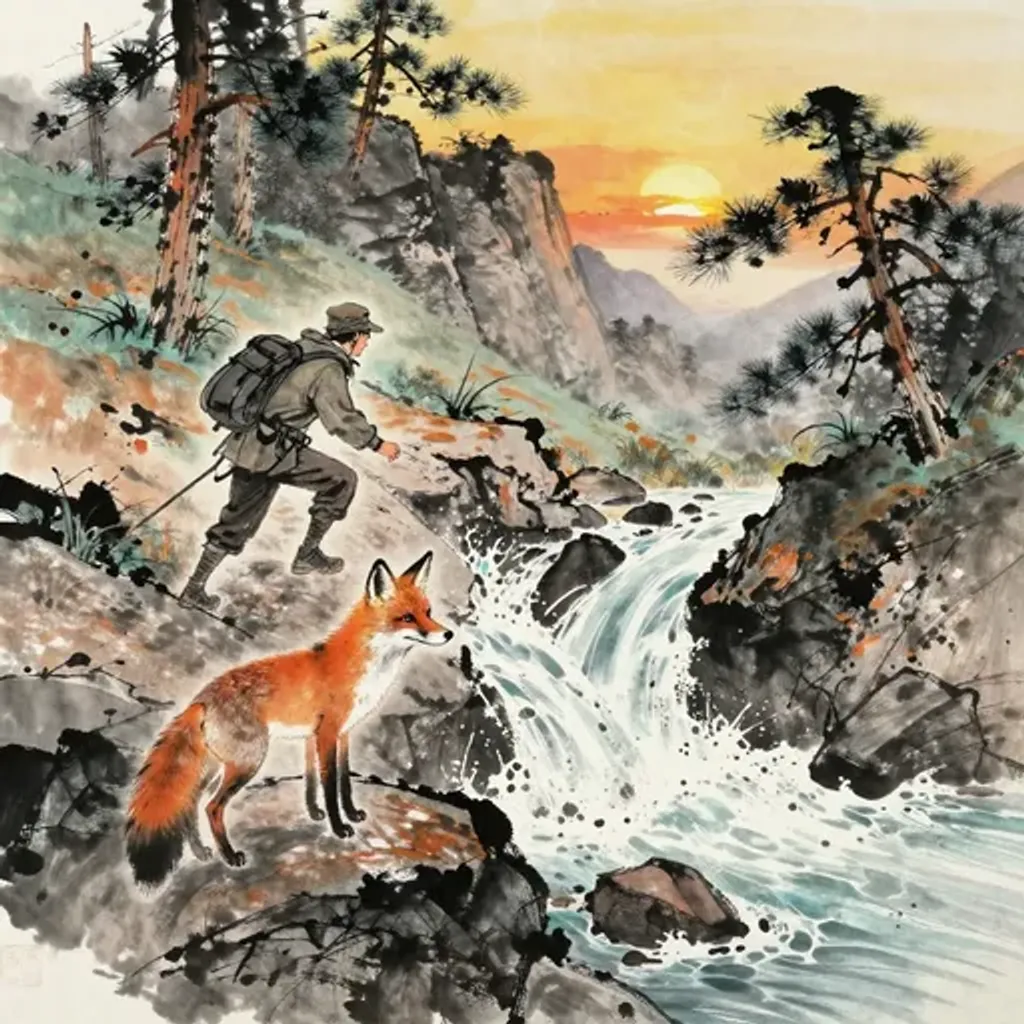
逐狐東山,水遏我前。深不可涉,失利後便。
Chasing a fox on the eastern mountain; water blocks my way. Too deep to wade across; profit is lost, advantage comes too late.
— Jiao Yanshou, Yilin (Forest of Changes), 1st century BC
Commentary
A spring beneath the mountain chases a fox across the eastern hills, but floodwater blocks the path. The river is too deep to wade; profit is lost and convenience forfeited. The fox — often a symbol of cunning or temptation in the Yilin — lures the pursuer into terrain where water halts all progress. From Youthful Folly to Work on the Decayed, the transformation reveals a deeper lesson: wind stirs beneath the mountain, exposing what has rotted. The naif who chases quick gains across unfamiliar ground discovers that the real obstacle is not the water but the decay within the situation itself. What seemed like a profitable hunt was already spoiled before the chase began.
蒙 → 臨
Hexagram 4 → Hexagram 19: Approach
Changing lines: 1, 6
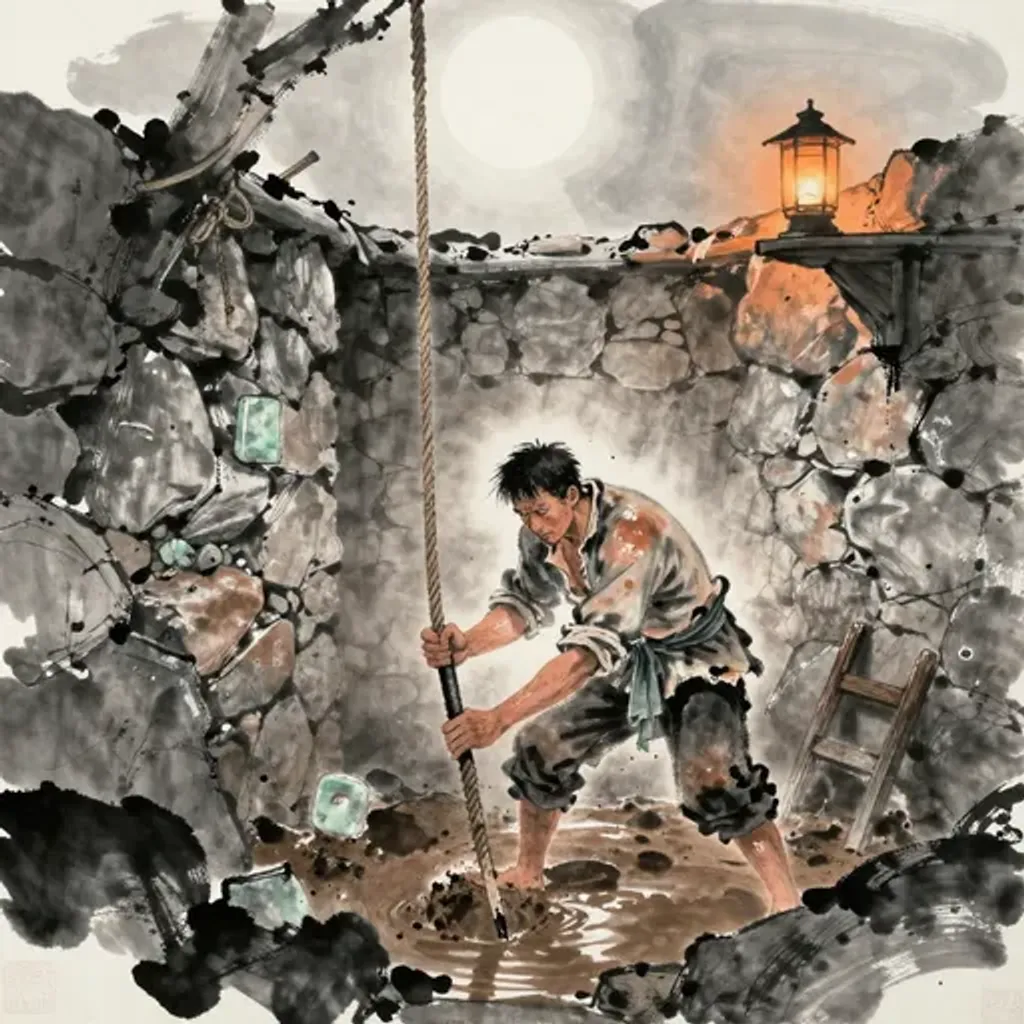
鑿井求玉,非卞氏寶。名困身辱,勞無所得。
Digging a well to seek jade; it is not the treasure of Bian. Reputation ruined, body disgraced; labor yields nothing.
— Jiao Yanshou, Yilin (Forest of Changes), 1st century BC
Commentary
A spring beneath the mountain is diverted into a futile excavation. One drills a well seeking jade, but what emerges is not the treasure of Bian He. Name is disgraced, body humiliated, labor yields nothing. The allusion to Bian He's jade — the He Shi Bi, rejected twice by kings who mistook it for common stone — is inverted here: this seeker finds not misrecognized treasure but genuinely worthless rock. From Youthful Folly to Approach, the transformation carries a warning. Earth above the lake suggests authority drawing near, yet the naif who digs in the wrong place greets that approach empty-handed. Misdirected effort under illusion produces only shame, regardless of how earnestly one labors.
蒙 → 觀
Hexagram 4 → Hexagram 20: Contemplation
Changing lines: 2, 5
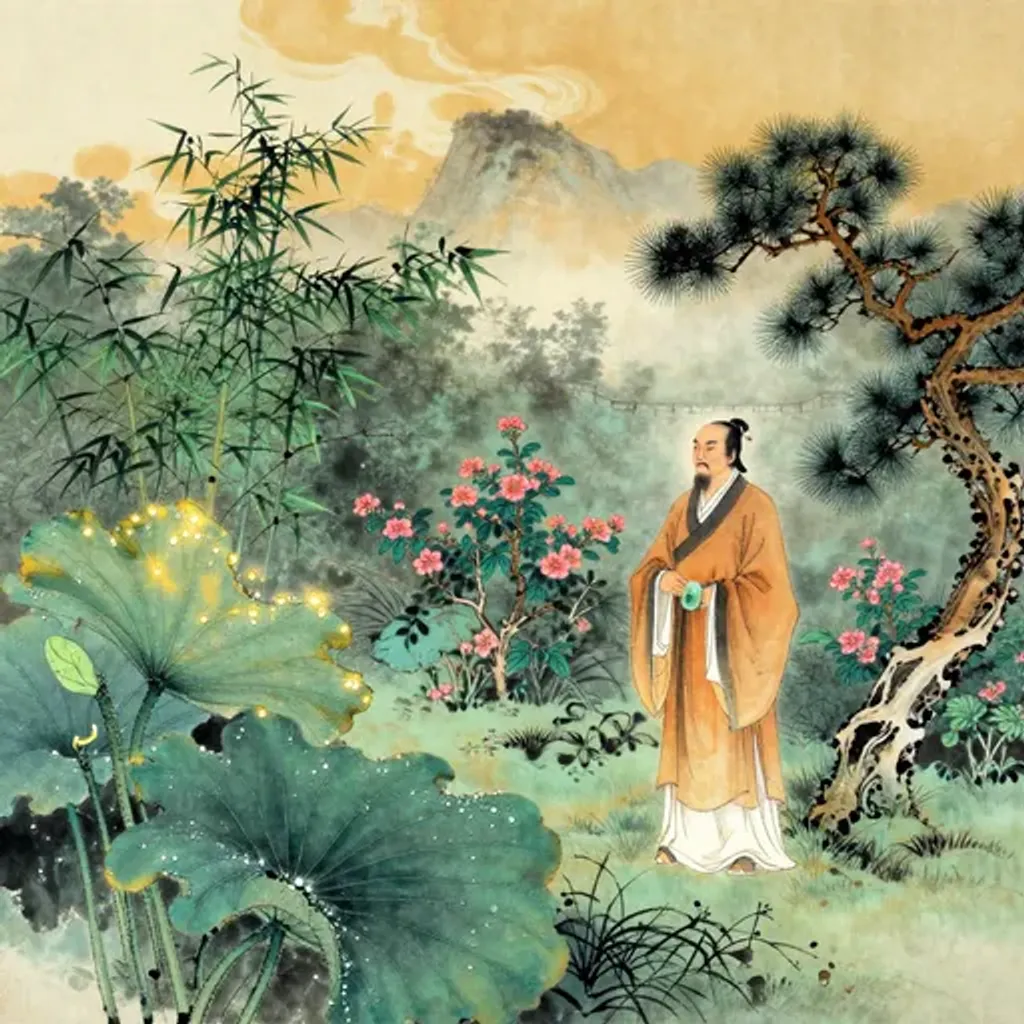
黃玉溫厚,君子所服。甘露溽暑,萬物生茂。
Yellow jade, warm and rich; what the noble man wears. Sweet dew in the summer’s heat; the ten thousand things grow and flourish.
— Jiao Yanshou, Yilin (Forest of Changes), 1st century BC
Commentary
A spring beneath the mountain reveals jade of golden warmth — the kind a gentleman wears close to the body. Sweet dew descends in midsummer heat, and all living things flourish. Yellow jade in Chinese tradition represents inner virtue made visible: warm to the touch, luminous without glare. When heaven sends sweet dew, it confirms that the ruler's virtue has permeated the natural order. From Youthful Folly to Contemplation, the transformation is one of quiet revelation. Wind moves across the earth and the sage-kings observe the people to establish teaching. The naif who wears virtue like warm jade need not seek recognition — the world sees and is nourished, as naturally as plants drink dew.
蒙 → 噬嗑
Hexagram 4 → Hexagram 21: Biting Through
Changing lines: 1, 2, 4
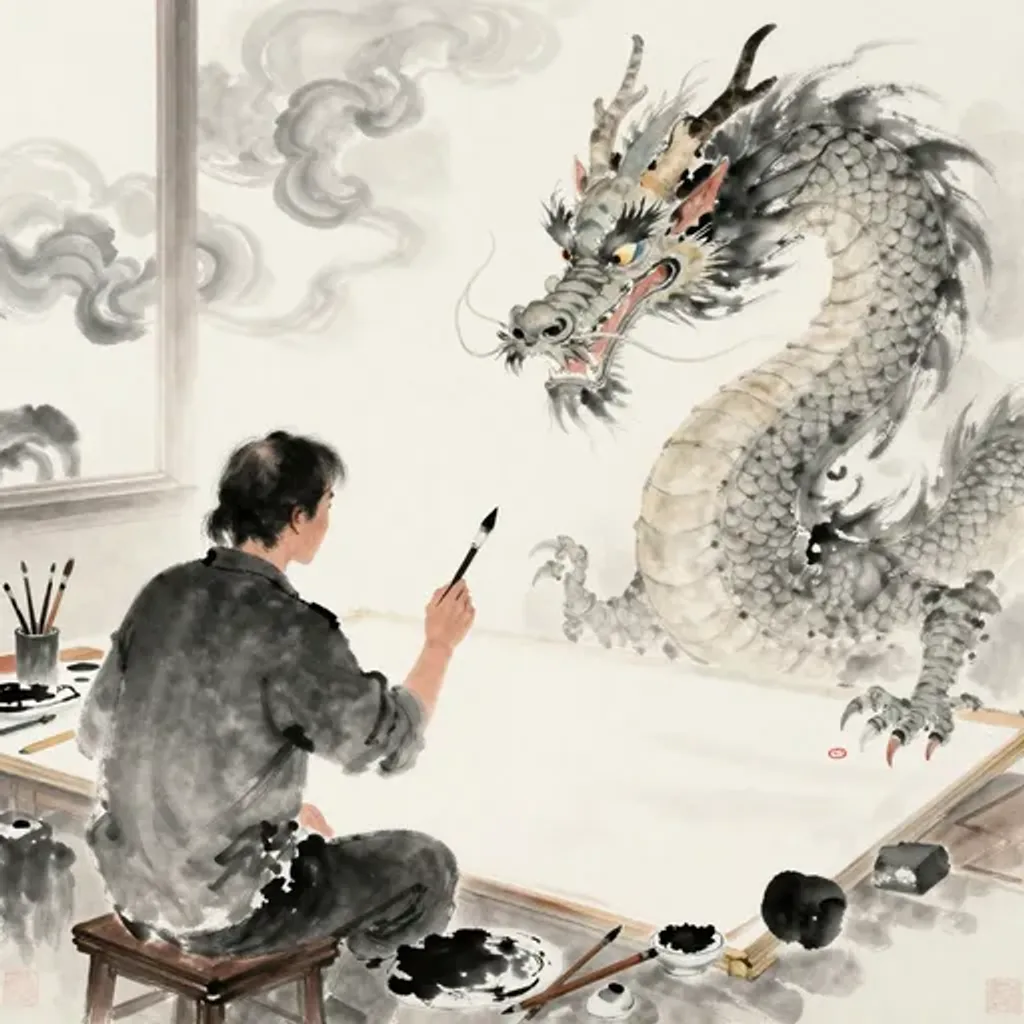
畫龍頭頸,文章不成。甘言善語,說辭無名。
Painting the dragon’s head and neck; the design is never completed. Sweet words and fine speech; eloquence without substance.
— Jiao Yanshou, Yilin (Forest of Changes), 1st century BC
Commentary
A spring beneath the mountain tries to paint a dragon but manages only the head and neck — the composition remains unfinished. Sweet words and clever speech offer persuasive arguments, yet the rhetoric achieves no lasting name. The proverb 'painting a dragon's head and neck' suggests ambitious beginnings that trail off before completion: all flourish, no substance. From Youthful Folly to Biting Through, the transformation is instructive. Lightning and thunder combine in decisive judicial action — biting through obstruction — yet the naif possesses only eloquence without the force to follow through. Where the hexagram demands clear penalties and firm law, this figure offers unfinished art and empty persuasion. Judgment requires more than a painted dragon.
蒙 → 賁
Hexagram 4 → Hexagram 22: Grace
Changing lines: 1, 2, 3
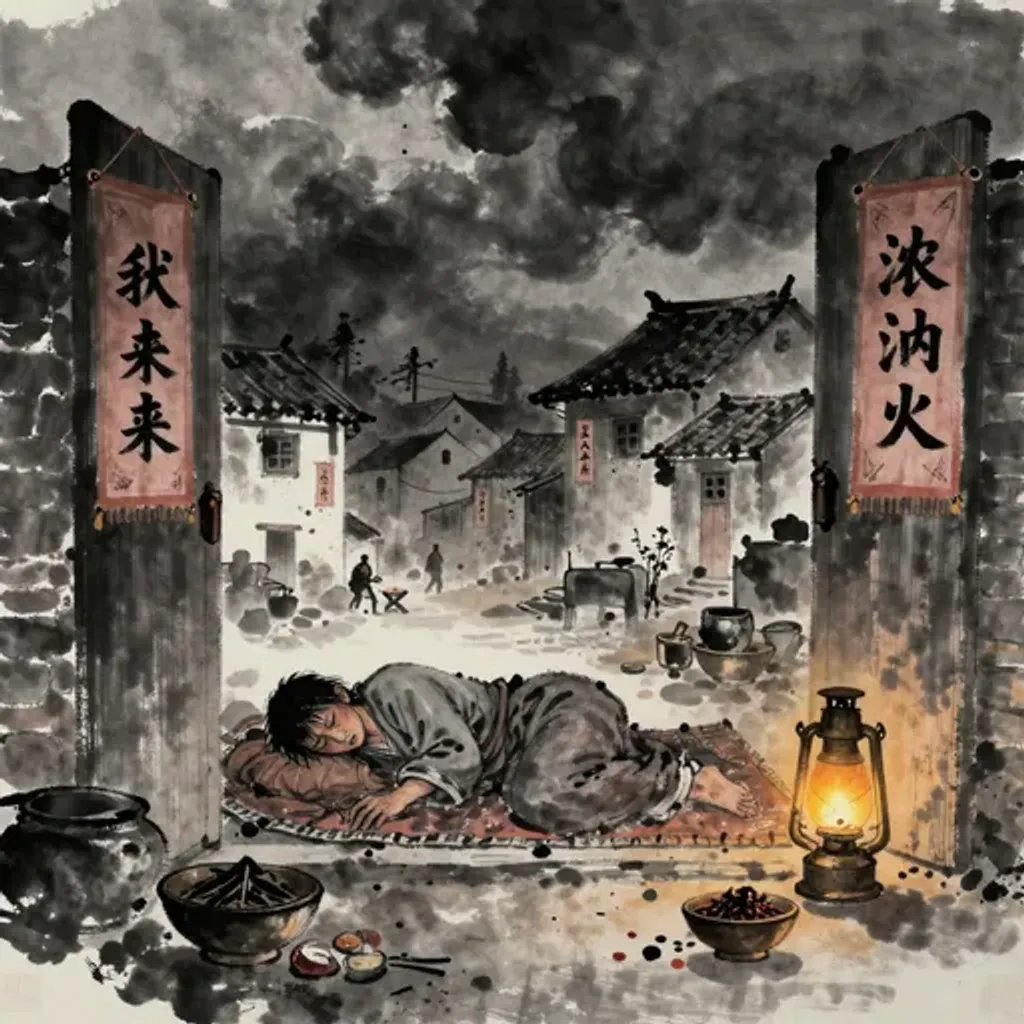
招禍致凶,來弊我邦。病在手足,不得安息。
Inviting disaster, bringing calamity; harming our domain. The affliction is in the limbs; one finds no rest.
— Jiao Yanshou, Yilin (Forest of Changes), 1st century BC
Commentary
A spring beneath the mountain attracts calamity rather than grace. Misfortune is invited, disaster arrives, afflicting the entire state. Illness strikes the limbs; rest becomes impossible. Where Grace (Bi) promises beauty and adornment — fire glowing beneath the mountain — this verse delivers its shadow: the ornamental surface conceals systemic disease. From Youthful Folly to Grace, the transformation warns that superficial refinement without inner health produces only decorated suffering. The mountain adorned by fire looks splendid from a distance, but this body's hands and feet are racked with pain. Beauty that masks decay is worse than plain ugliness, because it prevents the sufferer from seeking the cure.
蒙 → 剝
Hexagram 4 → Hexagram 23: Splitting Apart
Changing lines: 2
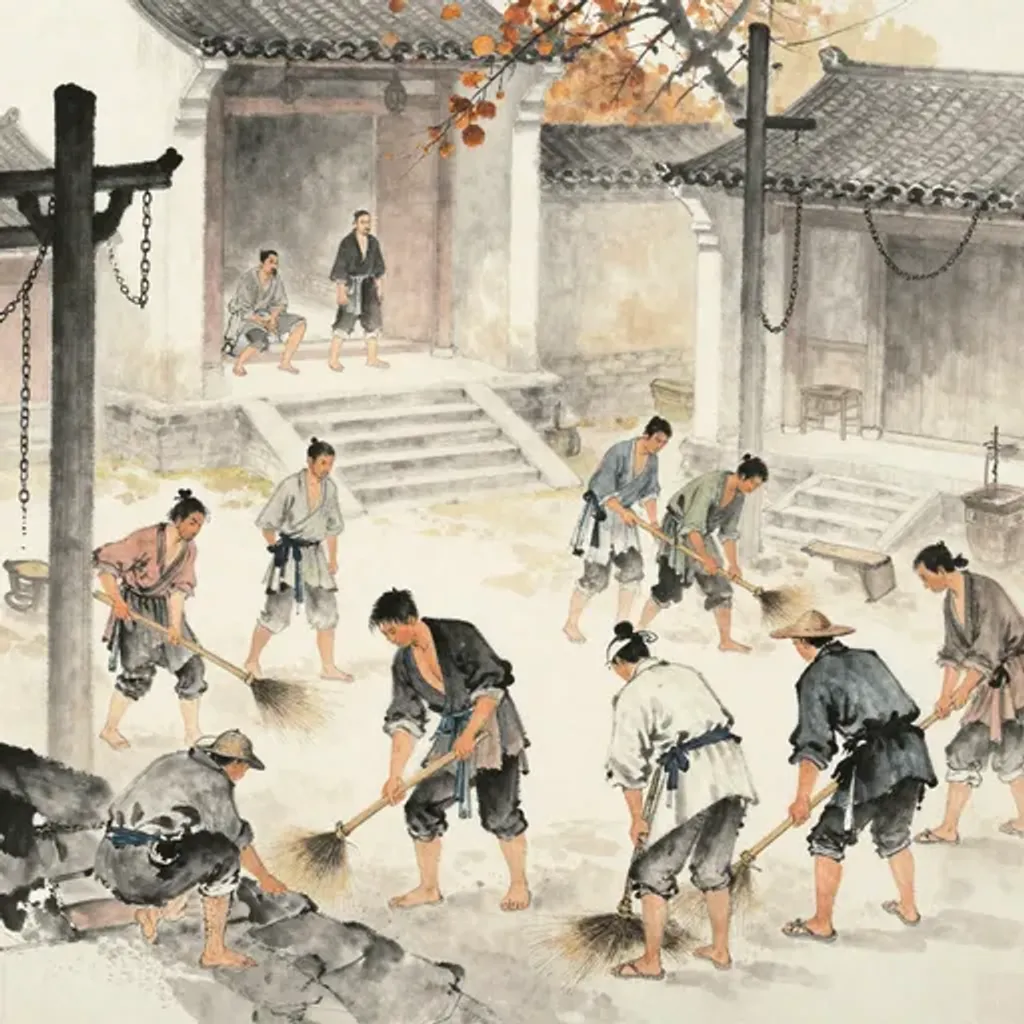
履位乘勢,靡有絕斃。皆為隸圉,與眾庶伍。
Treading in rank, riding on power; never coming to ruin. All become servants and grooms, companions of the common folk.
— Jiao Yanshou, Yilin (Forest of Changes), 1st century BC
Commentary
A spring beneath the mountain flows into a landscape of slow collapse. Those who once held rank and rode power's momentum find no sudden end — yet all become servants and grooms, mingling with the common multitude. The descent is gradual, not catastrophic: no execution, no exile, just the quiet erosion of status until the formerly great stand indistinguishable from those they once commanded. From Youthful Folly to Splitting Apart, the resonance is exact. The mountain rests upon the earth but its base is being stripped away line by line. Aristocrats do not fall in one blow; they are slowly ground down to commoner's rank, their authority peeling away like bark from a tree.
蒙 → 復
Hexagram 4 → Hexagram 24: Return
Changing lines: 1, 2, 6
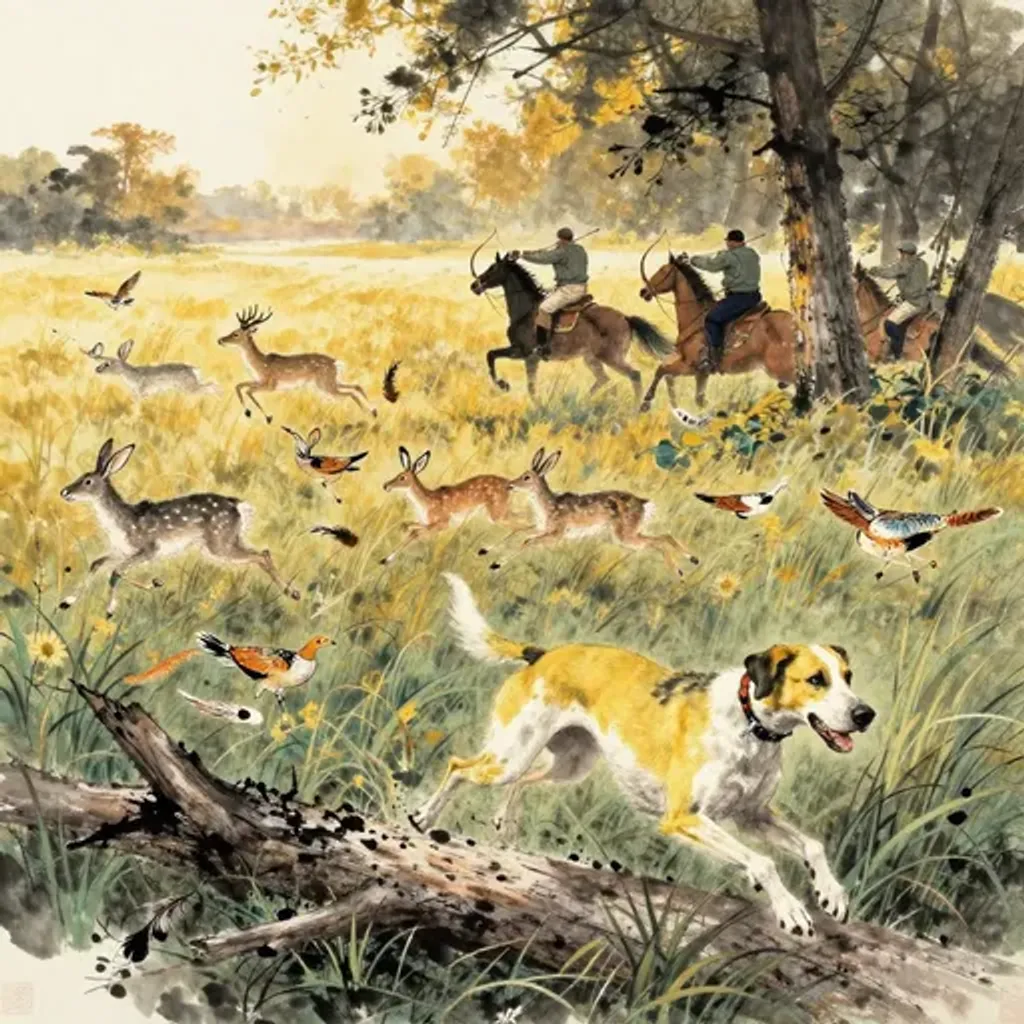
獐鹿雉兔,群聚東囿。盧黃白脊,俱往趨逐。九齚十得,君子有喜。
Roe, deer, pheasant, and rabbit gather in the eastern preserve. Hounds—tawny, yellow, white-backed—all go in pursuit. Of nine that are bitten, ten are caught; the noble man has joy.
— Jiao Yanshou, Yilin (Forest of Changes), 1st century BC
Commentary
A spring beneath the mountain opens onto a royal hunting ground teeming with game. Roe deer, regular deer, pheasants, and hares gather in the eastern park. Hounds of black, yellow, and white-ridged coats chase them down together; nine bites yield ten catches, and the lord rejoices. The imagery is of effortless abundance — prey so plentiful that the hunt succeeds beyond expectation. From Youthful Folly to Return, the transformation captures the moment when latent energy surges back. Thunder stirs beneath the earth at the winter solstice; what was dormant now multiplies. The naif's confusion gives way to instinctive vitality, like hounds released into a park where everything runs toward them.
蒙 → 无妄
Hexagram 4 → Hexagram 25: Innocence
Changing lines: 1, 2, 4, 5
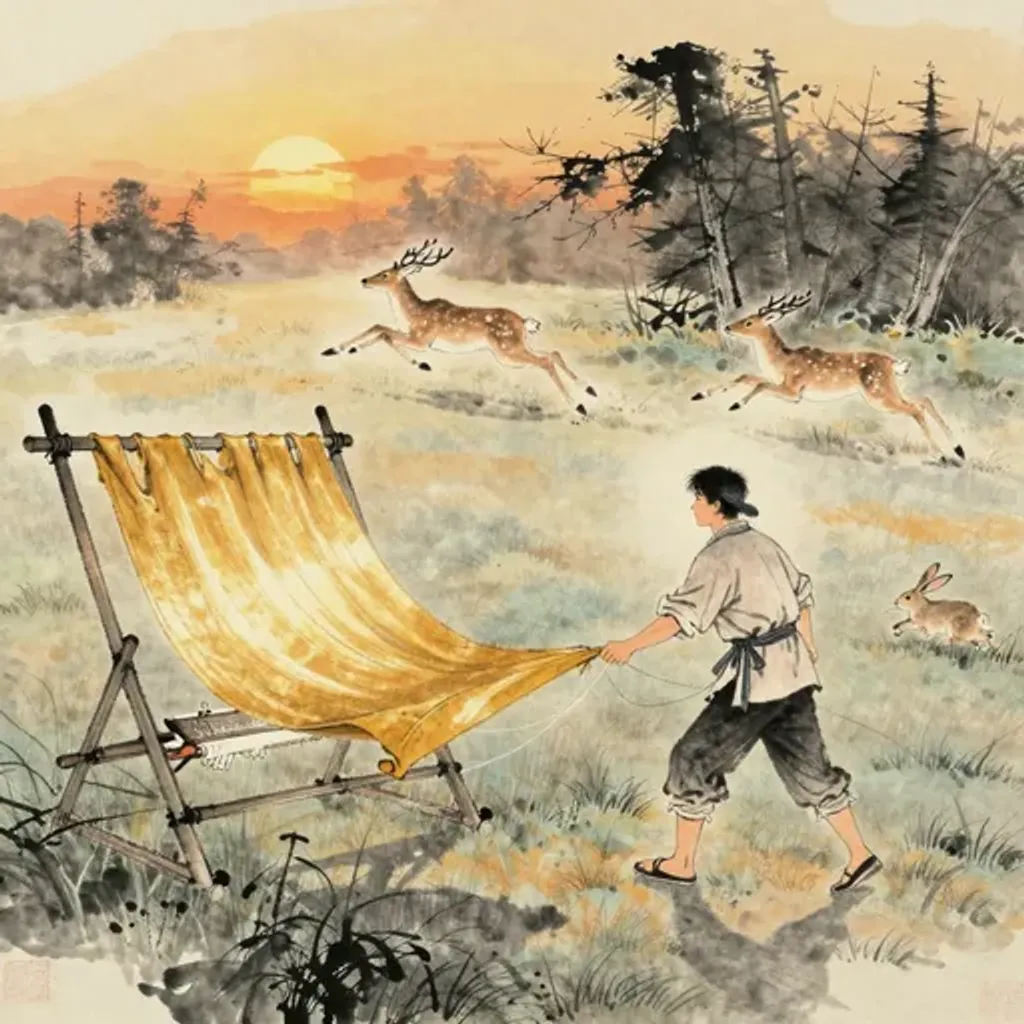
織金未成,緯畫無名。長子逐兔,鹿起失路。後利不得,因無所據。
The golden weave is not yet finished; the weft-pattern has no name. The eldest son chases a rabbit; a deer springs up, and he loses the path. Later profit is not gained; there is nothing to rely upon.
— Jiao Yanshou, Yilin (Forest of Changes), 1st century BC
Commentary
A spring beneath the mountain tangles in unfinished threads. The gold brocade is not yet woven, the weft-pattern has no recognizable design. The eldest son chases a hare but startles a deer and loses his way entirely. Later profit eludes him because he has no ground to stand on. Every image speaks of incompletion and distraction — the loom half-threaded, the hunter swerving between quarries. From Youthful Folly to Innocence, the transformation delivers a sharp lesson: heaven's thunder moves through all things without false intent, yet this figure is scattered in every direction. True innocence means acting without ulterior scheming; chasing two animals at once is the opposite of Innocence — it is calculation without commitment.
蒙 → 大畜
Hexagram 4 → Hexagram 26: Great Taming
Changing lines: 1, 3
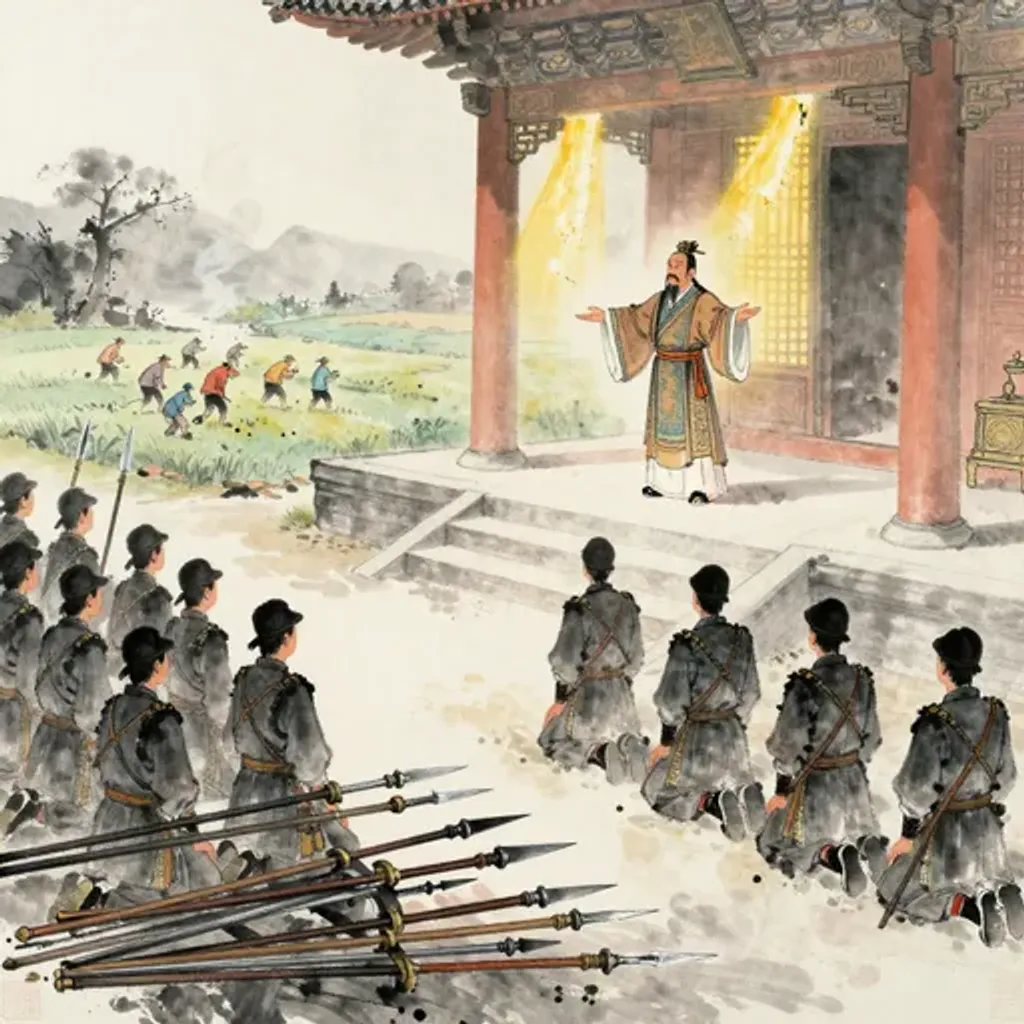
天厭周德,命與仁國。以禮靖民,兵革休息。
Heaven wearies of Zhou’s virtue and bestows the mandate upon a benevolent state. With ritual they pacify the people; weapons and armor are laid to rest.
— Jiao Yanshou, Yilin (Forest of Changes), 1st century BC
Commentary
A spring beneath the mountain carries the weight of heaven's judgment on dynasties. Heaven grew weary of Zhou's virtue and transferred the mandate to a benevolent state. Through rites the people are pacified, and weapons of war fall silent. The verse evokes the ancient theory of the Mandate of Heaven: when one dynasty's moral capital is spent, heaven simply withdraws its favor and bestows it elsewhere. From Youthful Folly to Great Taming, the transformation is profound. Heaven stored within the mountain — the image of Great Taming — means accumulated wisdom preserved across generations. The new recipient of heaven's mandate does not conquer by arms but tames through ritual, storing strength in culture rather than spending it in battle.
蒙 → 頤
Hexagram 4 → Hexagram 27: Nourishment
Changing lines: 1, 2
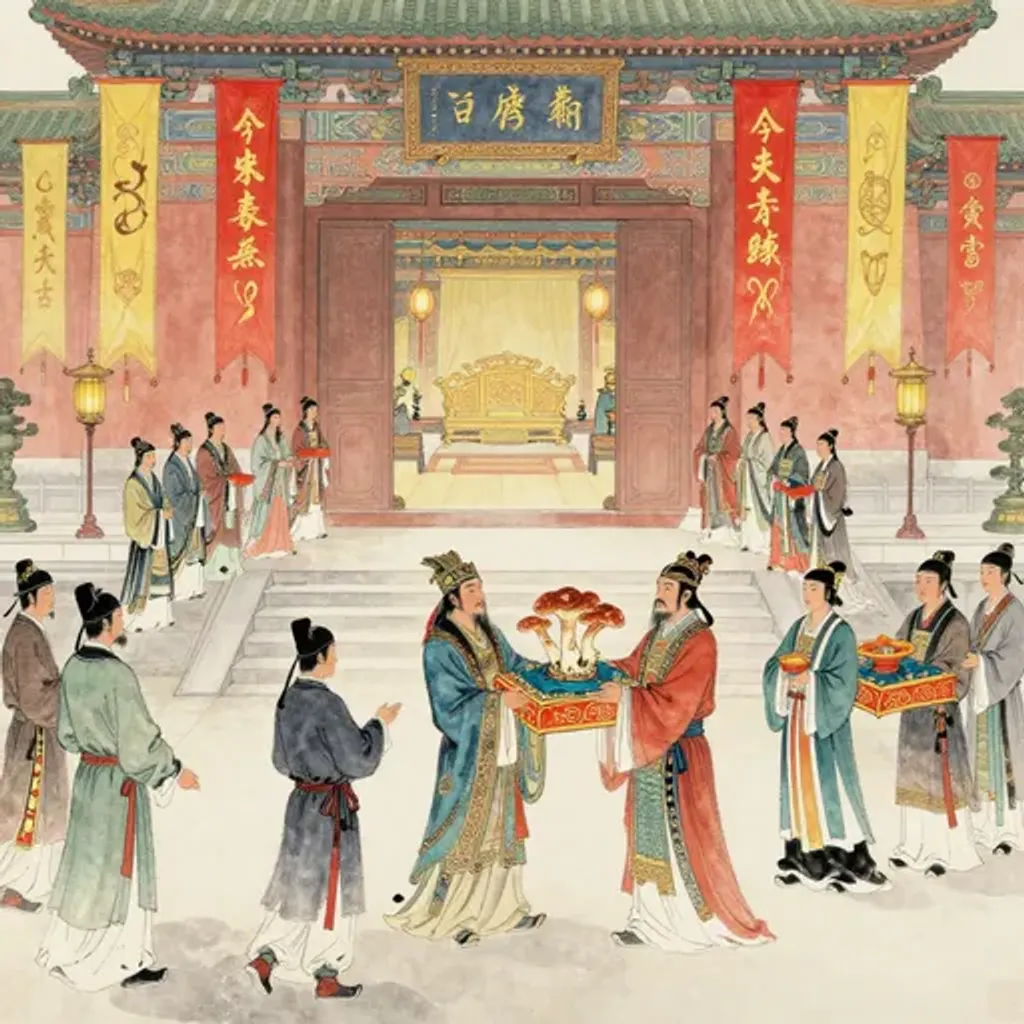
重譯賀芝,來除我憂。善說遂良,與喜相求。
Interpreters from afar bring auspicious fungus, coming to banish our sorrows. Persuasion brings about the good; together with joy they are found.
— Jiao Yanshou, Yilin (Forest of Changes), 1st century BC
Commentary
A spring beneath the mountain receives envoys bearing auspicious fungi from distant lands. Translators relay the tribute through multiple intermediaries — 'double translation' signals that the visitors come from beyond the Chinese cultural sphere. Their arrival dispels worry. Good counsel meets with acceptance, and joy becomes mutual. The auspicious fungus (zhi) was a cosmic omen of virtuous governance, believed to appear only when the ruler's virtue reached the farthest peripheries. From Youthful Folly to Nourishment, the transformation traces how what nourishes comes from unexpected sources. The mountain shelters thunder, cautioning measured speech and moderate diet; wisdom from the far frontier feeds the center precisely because it has not been domesticated.
蒙 → 大過
Hexagram 4 → Hexagram 28: Great Exceeding
Changing lines: 3, 4, 5, 6
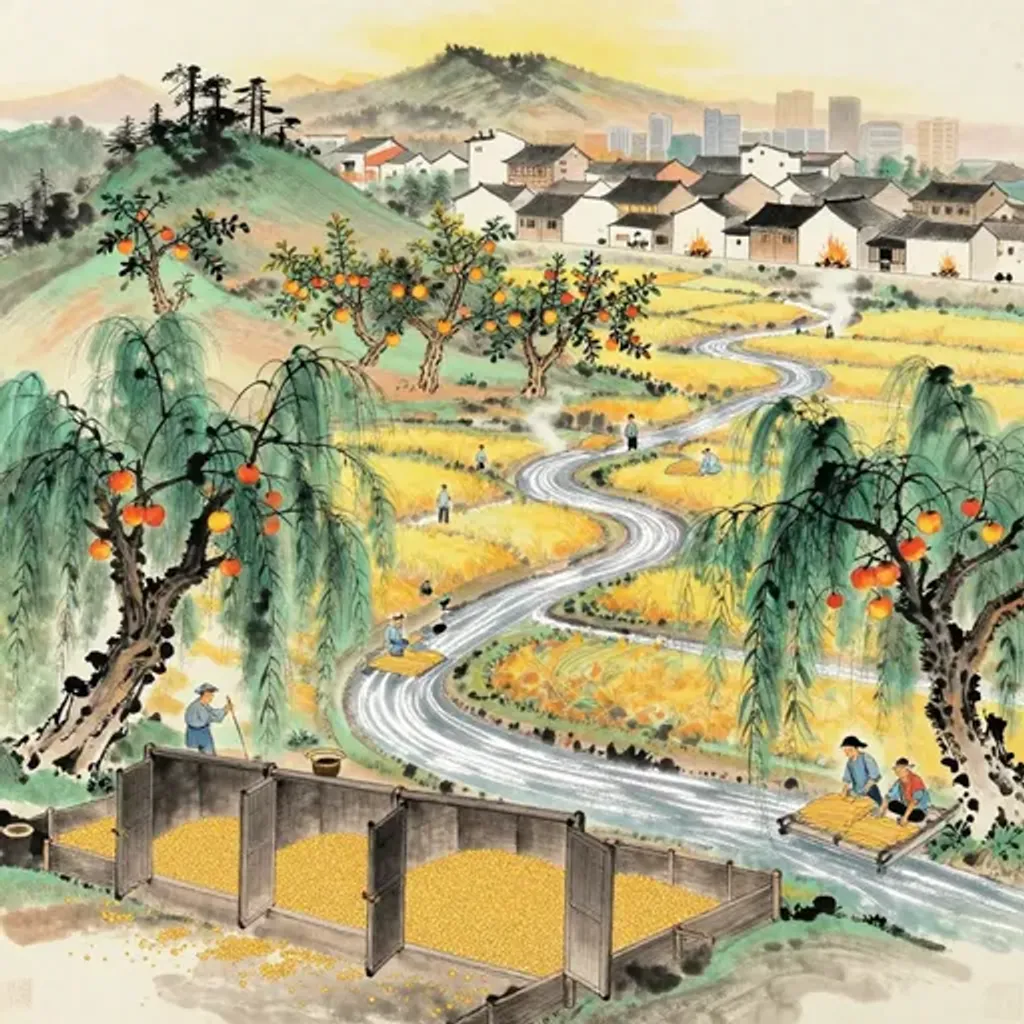
膏澤肥壤,人民孔樂。宜利俱止,長安富貴。
Rich soil, fertile fields; the people are greatly contented. Fit to dwell in profit and rest; long at peace, rich and noble.
— Jiao Yanshou, Yilin (Forest of Changes), 1st century BC
Commentary
A spring beneath the mountain irrigates rich, well-oiled soil, and the people rejoice greatly. All beneficial ventures come to rest here; lasting peace and enduring wealth prevail. 'Chang'an' — 'Eternal Peace' — may allude to the Han capital, symbol of imperial prosperity at its zenith. The land itself is generous: fertile, moist, and yielding abundance without exhaustion. From Youthful Folly to Great Exceeding, the transformation seems paradoxical. The lake submerges the trees, the ridgepole bends — yet here everything thrives. The resolution lies in timing: the verse captures the peak moment before excess tips into collapse. The naif enjoys the feast at its fullest, not yet aware that abundance carried too far becomes the very weight that breaks the beam.
蒙 → 坎
Hexagram 4 → Hexagram 29: The Abysmal Water
Changing lines: 5, 6
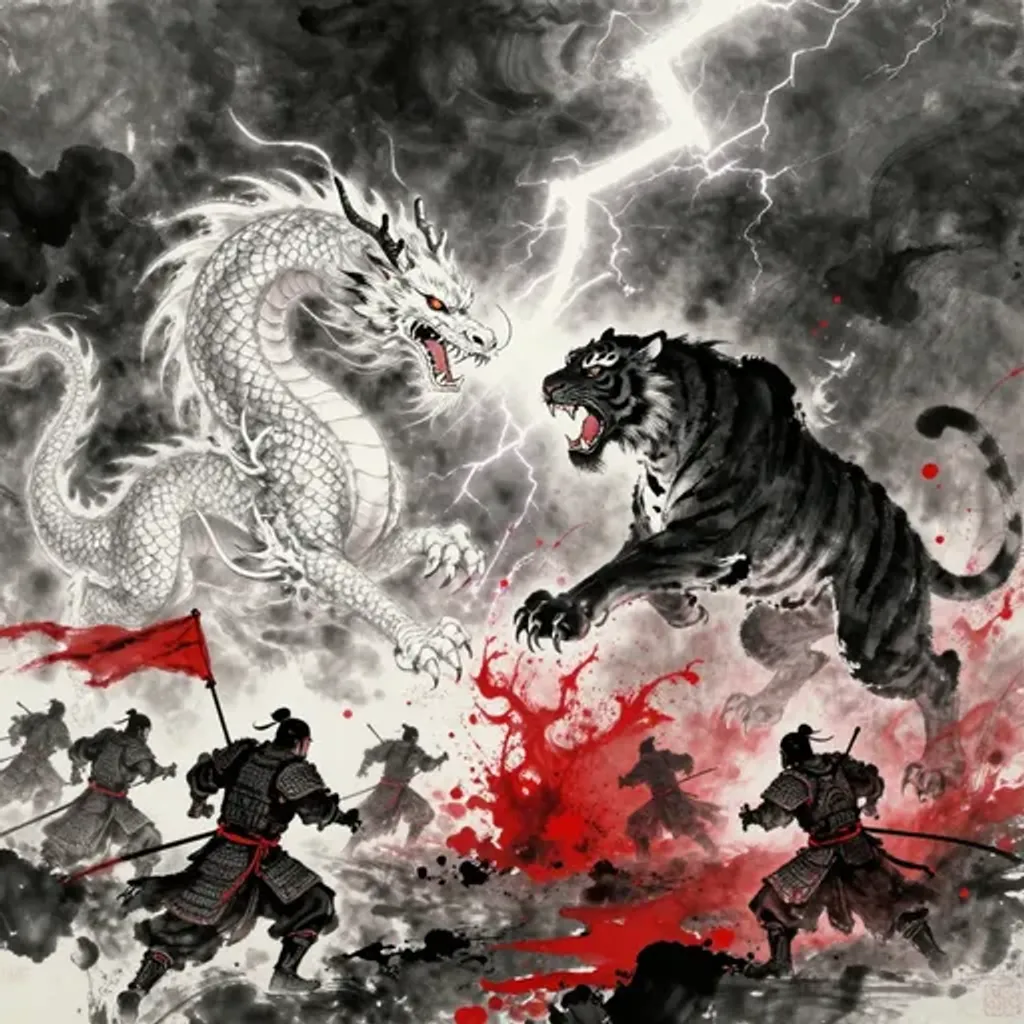
白龍黑虎,起鐐暴怒。戰於涿鹿,蚩尤敗走。居止不殆,君安其所。
White dragon, black tiger; rearing up in furious rage. They battle at Zhuolu; Chiyou is routed and flees. One dwells and stays without peril; the lord is at peace in his place.
— Jiao Yanshou, Yilin (Forest of Changes), 1st century BC
Commentary
A spring beneath the mountain erupts into primordial battle. A white dragon and black tiger rise in fury and clash at Zhuolu — the legendary battlefield where the Yellow Emperor defeated Chi You, founding Chinese civilization. Chi You is routed and flees. Yet the verse resolves in stillness: one dwells in safety, the lord rests secure. The most violent origin myth yields a stable peace. From Youthful Folly to The Abysmal, the doubled water should signal relentless danger, yet the verse's final image is of a sovereign calmly settled. The key is that the battle has already been decided: the abyss is navigated by those who, like the Yellow Emperor, pass through danger once and establish an order that endures.
蒙 → 離
Hexagram 4 → Hexagram 30: The Clinging Fire
Changing lines: 1, 2, 3, 4
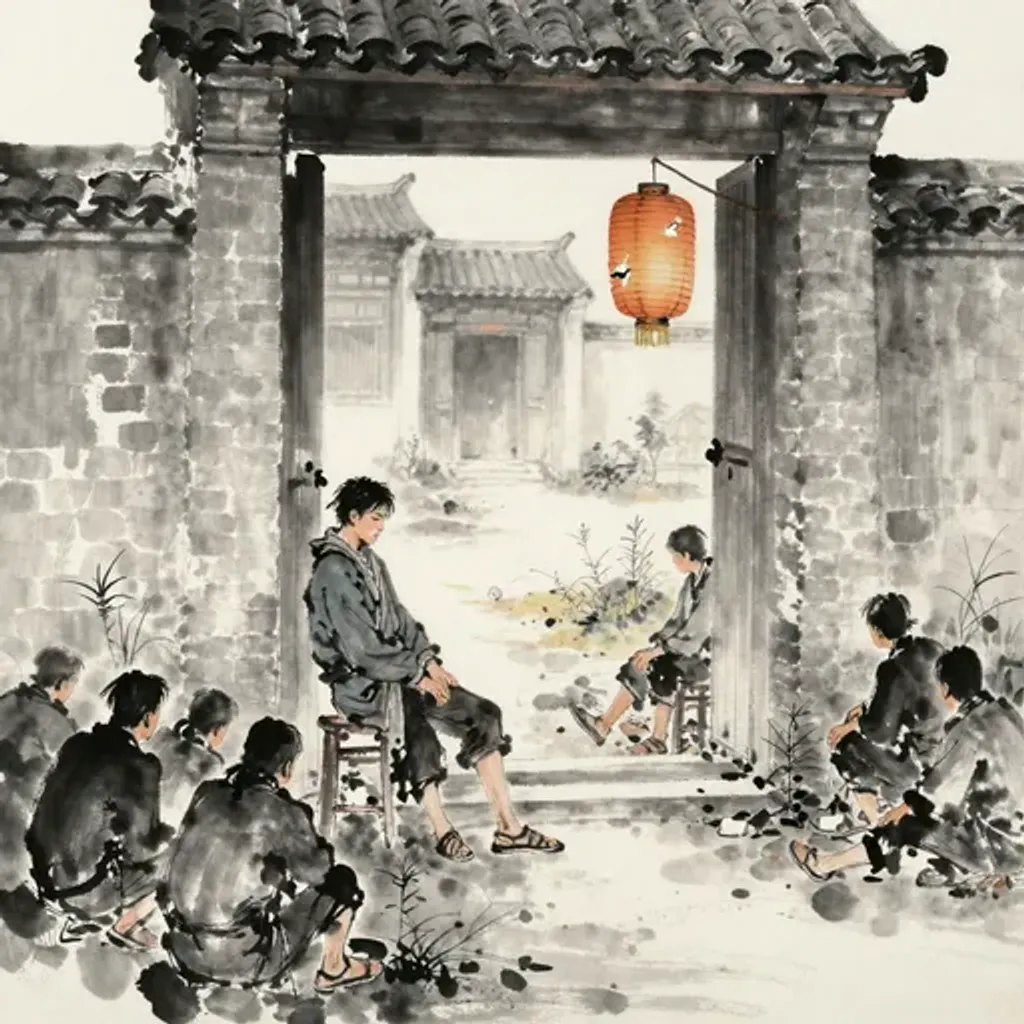
抱關傳語,聾跛摧殆。眾賤無下,災殃所在。
Guarding the gate, passing messages; deaf and lame, broken and spent. The multitude is humble, with none below them; disaster and calamity find their mark.
— Jiao Yanshou, Yilin (Forest of Changes), 1st century BC
Commentary
A spring beneath the mountain descends into squalid misery. A gatekeeper relays messages, but deaf and lame, he stumbles and fails. The lowly are despised beyond measure, and disaster finds its home among them. The verse depicts those trapped at the very bottom of the social order — disabled, degraded, and blamed for their own affliction. From Youthful Folly to The Clinging, the contrast is stark. Doubled fire should illuminate the four directions as the great person continues the work of brightness. Yet here fire's clarity only exposes how cruelly the world treats its most vulnerable. The naif learns that clarity without compassion is merely a searchlight trained on suffering, illuminating without healing.
蒙 → 咸
Hexagram 4 → Hexagram 31: Influence
Changing lines: 2, 3, 4, 5, 6
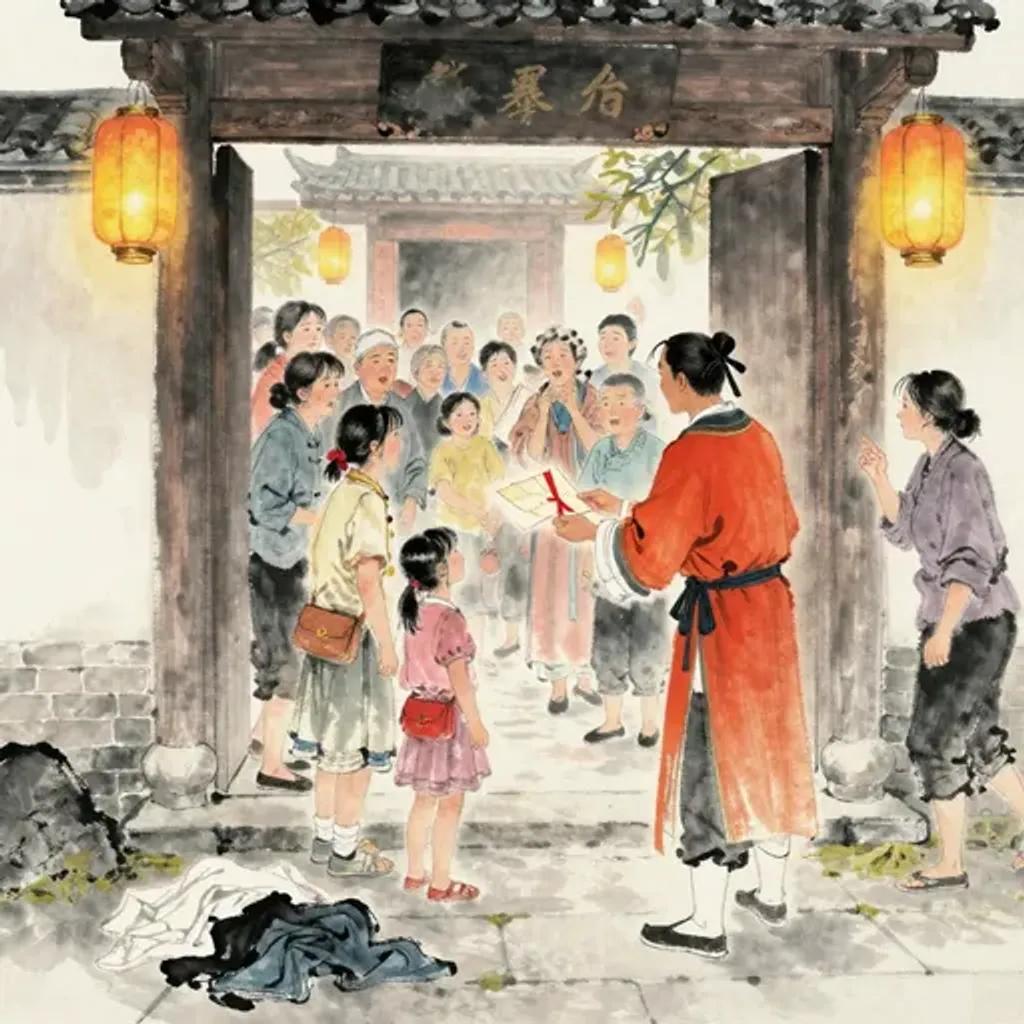
憂禍解除,喜至慶來。坐立歡門,與樂為鄰。
Worry and misfortune are dispelled; joy arrives, celebration comes. Sitting and standing at the gate of gladness; dwelling as neighbors with delight.
— Jiao Yanshou, Yilin (Forest of Changes), 1st century BC
Commentary
A spring beneath the mountain washes grief away as joy arrives. Worry and calamity dissolve; celebration comes bearing blessings. One sits and stands at the gate of happiness, dwelling as a neighbor of delight. The verse is a portrait of relief so complete it becomes its own landscape — joy is not just felt but inhabited, like moving into a house next door to bliss. From Youthful Folly to Influence, the transformation traces how openness produces resonance. The lake rests upon the mountain, and the gentleman empties himself to receive others. The naif who stops clinging to anxiety finds that joy was always adjacent, waiting for the mind to unclasp. Influence begins with receptivity, not effort.
蒙 → 恆
Hexagram 4 → Hexagram 32: Duration
Changing lines: 3, 4, 6
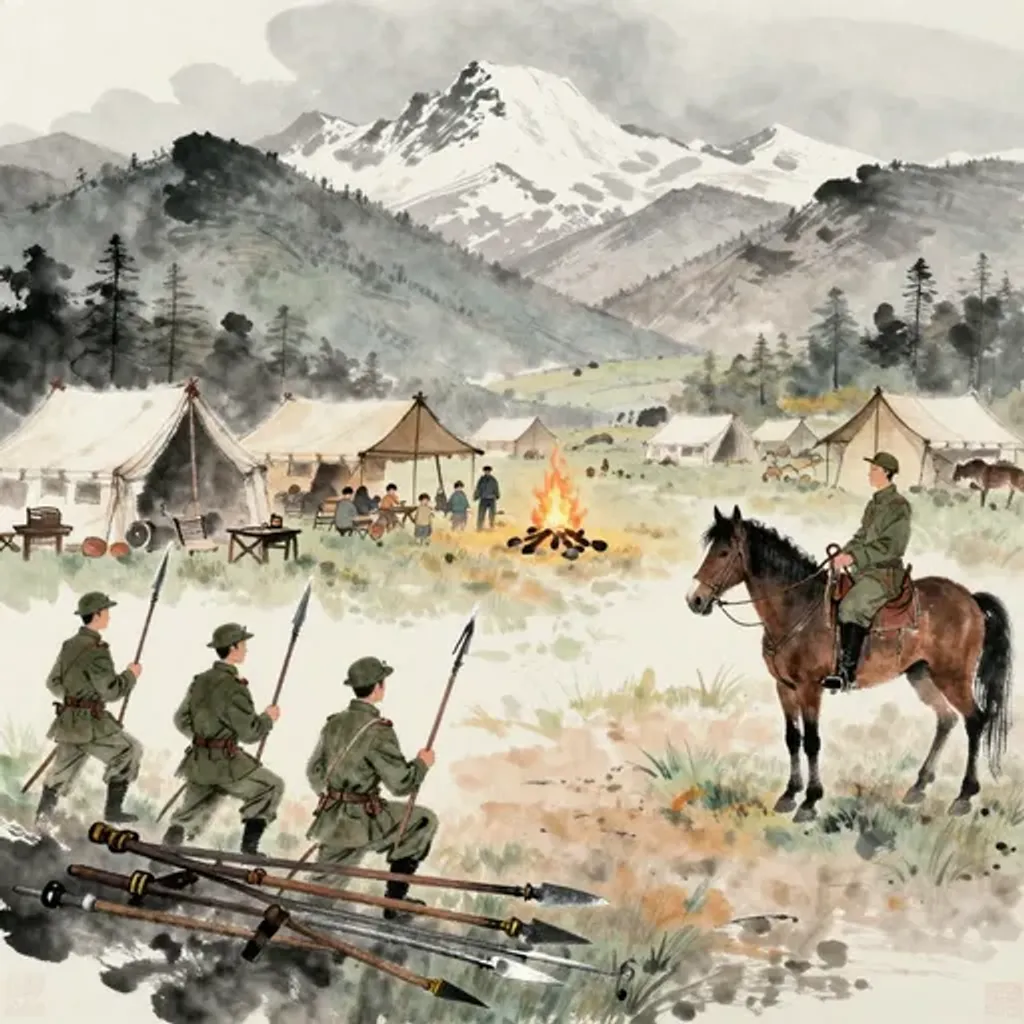
折鋒載殳,輿馬放休。狩軍依營,天下安寧。
Spear-tips broken, halberds stowed; chariots and horses set free to rest. The hunting army returns to camp; all under heaven is at peace.
— Jiao Yanshou, Yilin (Forest of Changes), 1st century BC
Commentary
A spring beneath the mountain finds lasting peace as weapons are laid down. Blades are sheathed, halberds stored on carts, horses released to pasture. The army encamps and rests; the realm is at peace. Every image speaks of the deliberate transition from war to tranquility — not sudden disarmament but an orderly demobilization. From Youthful Folly to Duration, the transformation reveals what endures. Thunder and wind reinforce each other without ceasing; the gentleman stands firm in his direction. The naif discovers that true stability comes not from perpetual vigilance but from the disciplined decision to stop fighting. Duration is maintained not by the sword but by the resolve to keep it sheathed.
蒙 → 遯
Hexagram 4 → Hexagram 33: Retreat
Changing lines: 2, 3, 4, 5
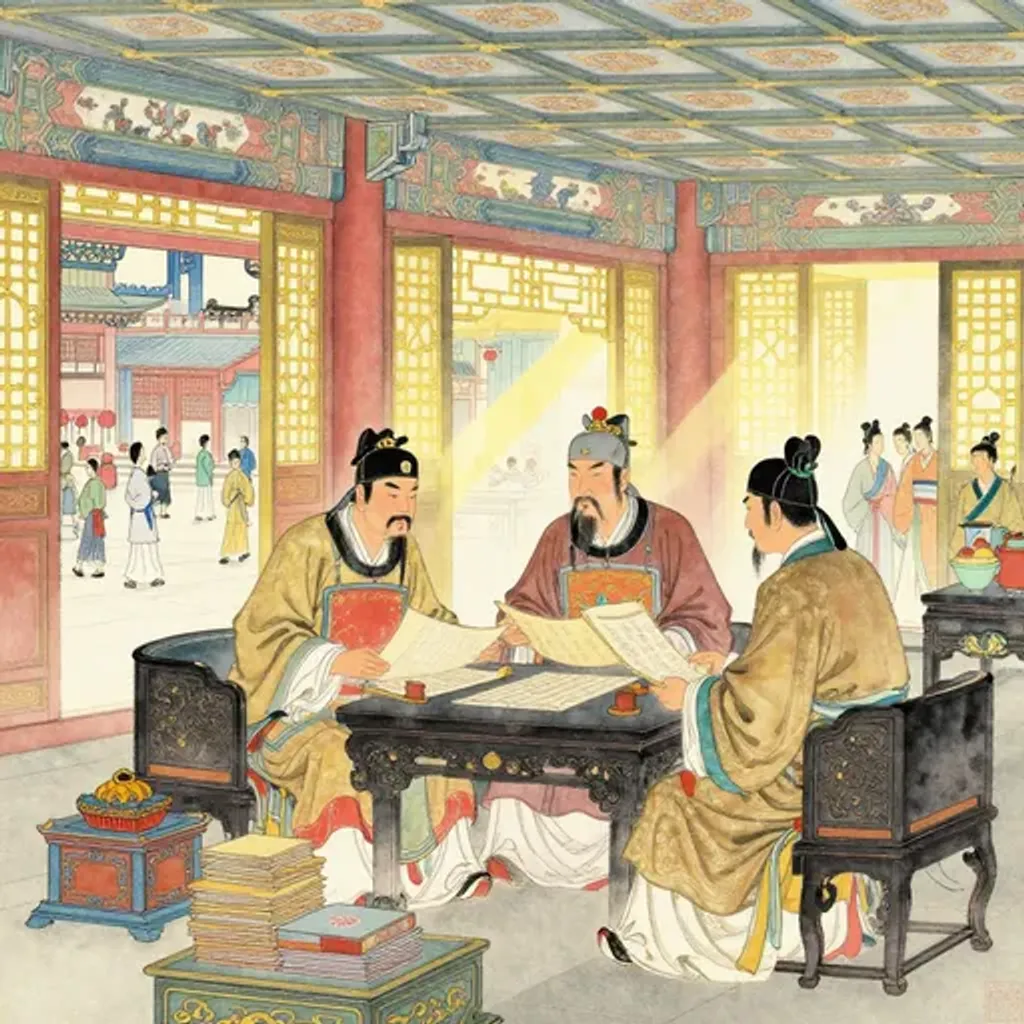
至德之君,仁政且溫。伊呂股肱,國富民安。
A lord of utmost virtue; his benevolent government is also warm. Yi Yin and Lü Shang as his arms and legs; the state is rich, the people at ease.
— Jiao Yanshou, Yilin (Forest of Changes), 1st century BC
Commentary
A spring beneath the mountain flows under the governance of a perfectly virtuous lord. This ruler of supreme virtue governs with benevolence and warmth. Yi Yin and Lu Shang serve as his arms and legs — the sage ministers who respectively founded the Shang and Zhou dynasties now stand as archetypes of loyal counsel. The state grows rich, the people secure. From Youthful Folly to Retreat, the pairing seems paradoxical: why would ideal governance lead to withdrawal? Because the wise ruler, having established perfect order, knows when to step back. Heaven above the mountain distances itself from pettiness; the gentleman retreats from lesser influences not in weakness but from strength. True authority withdraws so that virtue can govern in its place.
蒙 → 大壯
Hexagram 4 → Hexagram 34: Great Power
Changing lines: 1, 3, 4, 6
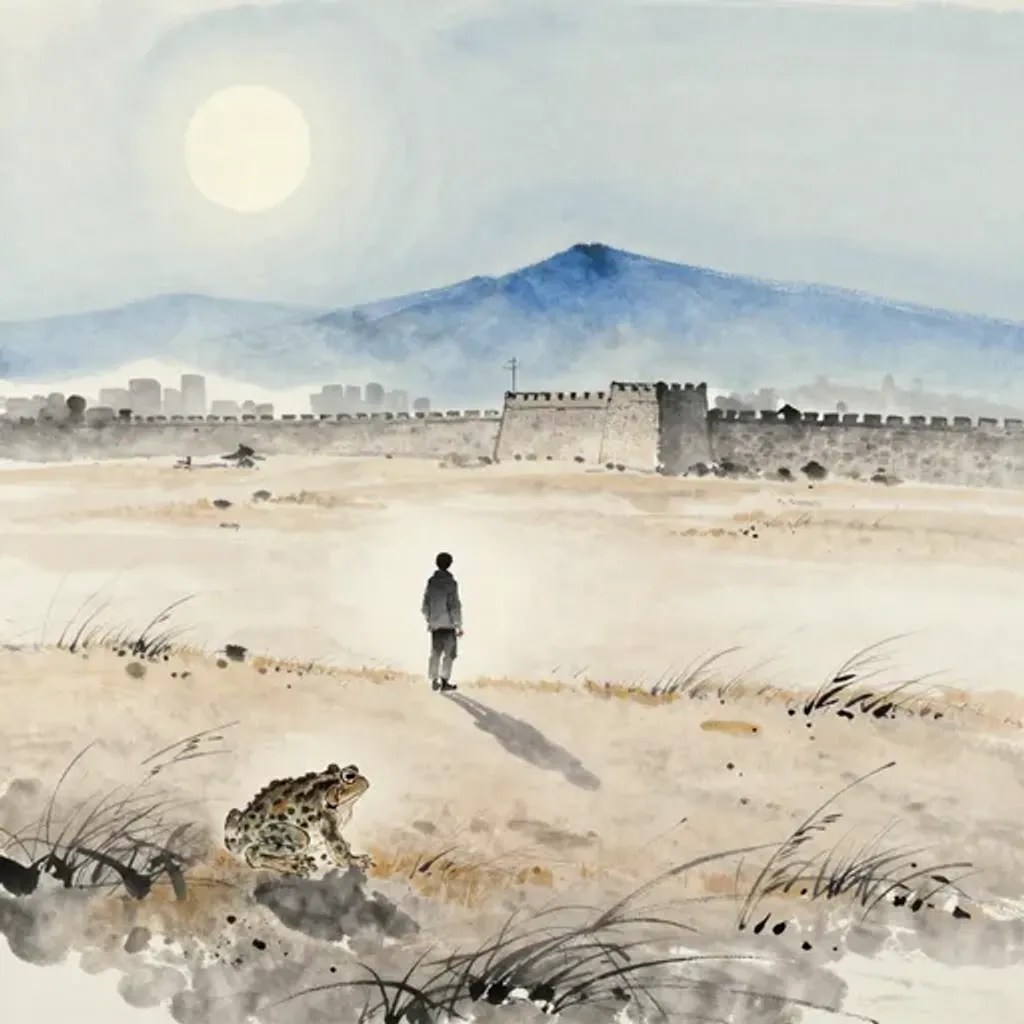
千里望城,不見山青。老兔蝦蟆,遠絕無家。
Gazing a thousand li toward the city; the mountains do not show blue. An old hare, a toad; far removed, without a home.
— Jiao Yanshou, Yilin (Forest of Changes), 1st century BC
Commentary
A spring beneath the mountain peers across a thousand li but cannot see the city walls amid the green of distant hills. An old hare and a toad wander far, utterly without a home. The hare and toad in the moon — traditional inhabitants of the lunar palace — are stranded on earth, cut off from their celestial dwelling. A thousand li of empty distance separates the traveler from any landmark. From Youthful Folly to Great Power, the irony is poignant. Thunder roars above heaven in a display of overwhelming strength, yet these lunar creatures are powerless exiles. Great Power without direction is mere displacement; the naif who wields force without knowing where home lies will wander as aimlessly as the moon-hare on earth.
蒙 → 晉
Hexagram 4 → Hexagram 35: Progress
Changing lines: 2, 4
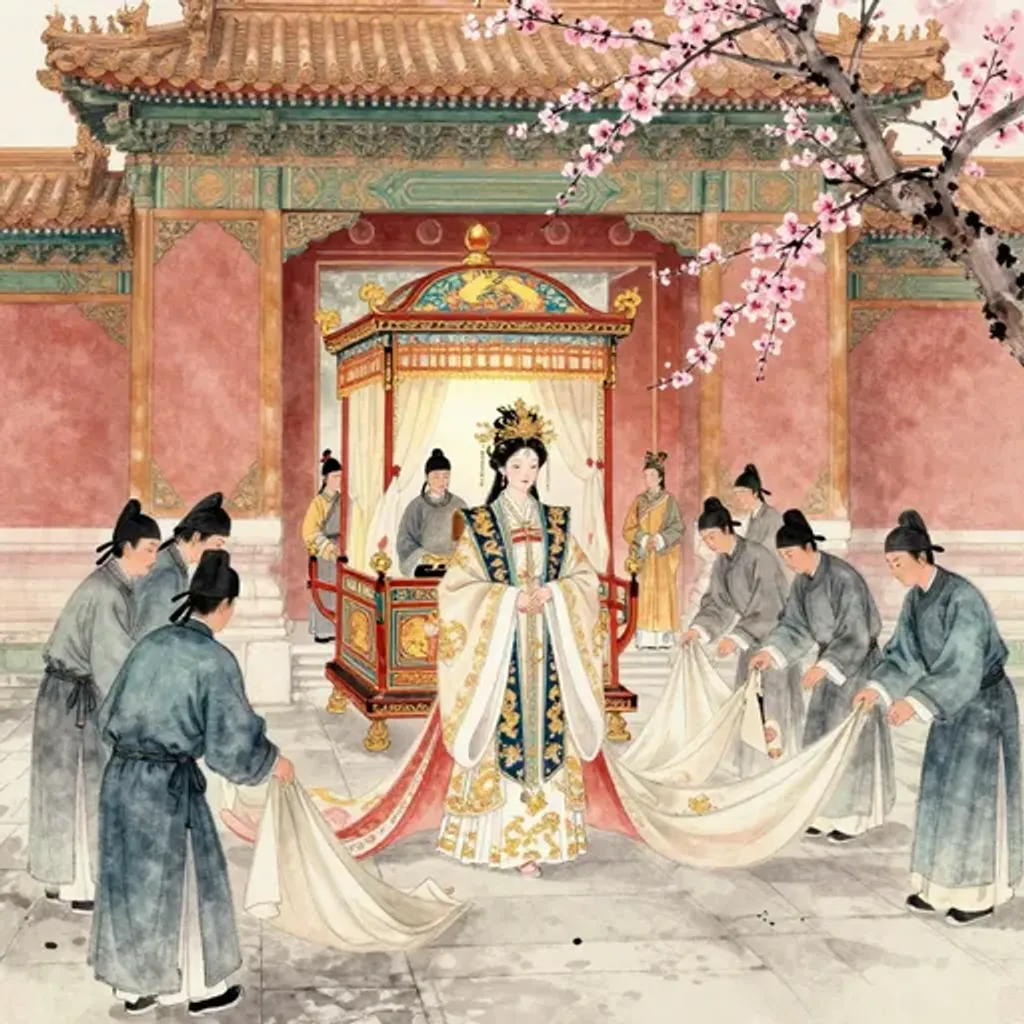
有莘季女,為夏妃后。貴夫壽子,母字四海。
The youngest daughter of Youshen becomes queen consort of Xia. A noble husband, long-lived sons; the mother’s name encompasses the four seas.
— Jiao Yanshou, Yilin (Forest of Changes), 1st century BC
Commentary
A spring beneath the mountain nurtures a maiden destined for greatness. The youngest daughter of the Youxin clan became consort to a lord of Xia — some traditions identify her as the mother who bore Yu the Great's heirs, others link her to King Tang's consort who brought Yi Yin as part of her dowry. She secures a noble husband and long-lived sons; the maternal title extends to all within the four seas. From Youthful Folly to Progress, the transformation traces how hidden merit advances into the light. Fire rises above the earth, illuminating virtue that was formerly obscure. The maiden from a minor clan, once naive and provincial, becomes the mother of an empire — her worth recognized as naturally as dawn breaks over the horizon.
蒙 → 明夷
Hexagram 4 → Hexagram 36: Darkening of the Light
Changing lines: 1, 2, 3, 6
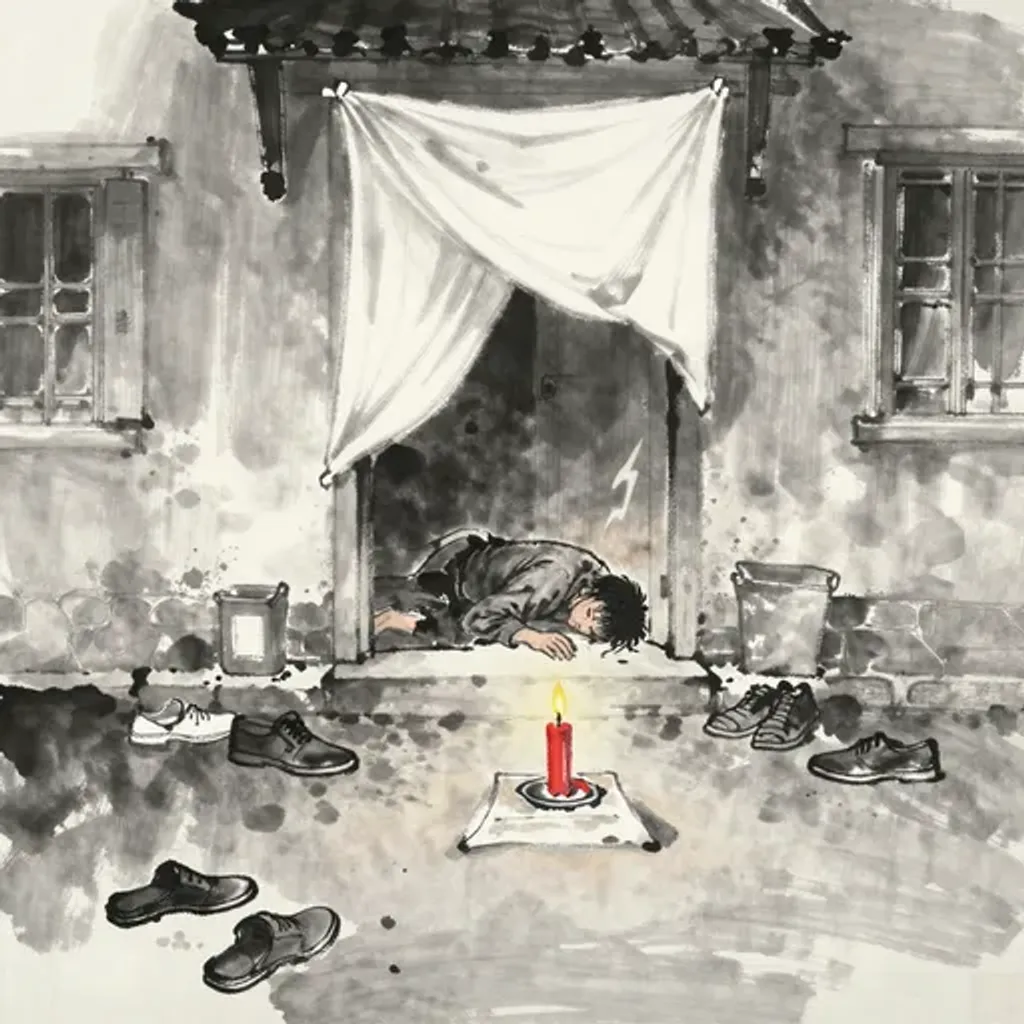
不虞之患,禍至無門。奄忽暴卒,痛傷我心。
Disaster not foreseen; calamity arrives through no gate. Sudden and violent death; wounding our hearts with grief.
— Jiao Yanshou, Yilin (Forest of Changes), 1st century BC
Commentary
A spring beneath the mountain is struck by calamity from nowhere. Unforeseen disaster arrives without warning, entering through no identifiable gate. Death comes sudden and violent, piercing the heart with pain. The verse is a raw cry of grief — no allusion, no metaphor, only the shock of loss that arrives before comprehension. From Youthful Folly to Darkening of the Light, the transformation is harrowing. Fire sinks beneath the earth; brightness is wounded and forced underground. The naif who had not yet learned to anticipate danger is crushed by a blow that even the wise could not have foreseen. In the landscape of Darkening, one must use obscurity skillfully — but first one must survive the initial wound.
蒙 → 家人
Hexagram 4 → Hexagram 37: The Family
Changing lines: 1, 2, 3, 5
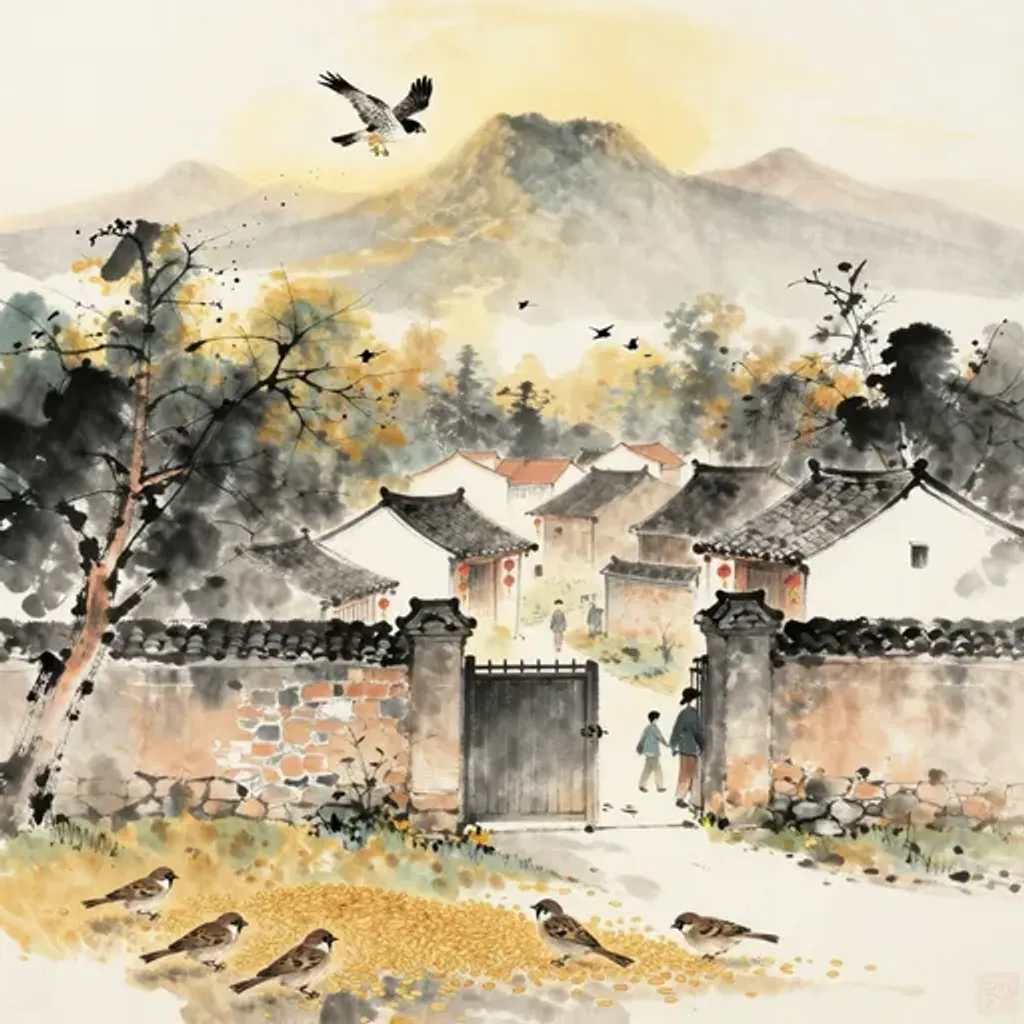
飛鷹退去,不食鄰鳥。憂患解除,君主安居。
The hawk flies away, not feeding on the neighboring birds. Worry and peril are dispelled; the lord dwells in peace.
— Jiao Yanshou, Yilin (Forest of Changes), 1st century BC
Commentary
A spring beneath the mountain watches a hawk retreat without striking. The flying eagle withdraws, refusing to prey upon the neighboring birds. Worry and affliction dissolve; the lord rests securely in his dwelling. The hawk's forbearance is the critical image — a predator capable of violence that chooses restraint. Peace is restored not by defeating the threat but by the threat choosing to depart. From Youthful Folly to The Family, the transformation finds its logic in domestic order. Wind emerges from fire: warmth radiates outward as gentle influence. The household is safe because the predator respects its boundaries. The naif learns that security sometimes depends not on one's own strength but on the restraint of those who could harm you.
蒙 → 睽
Hexagram 4 → Hexagram 38: Opposition
Changing lines: 1, 4
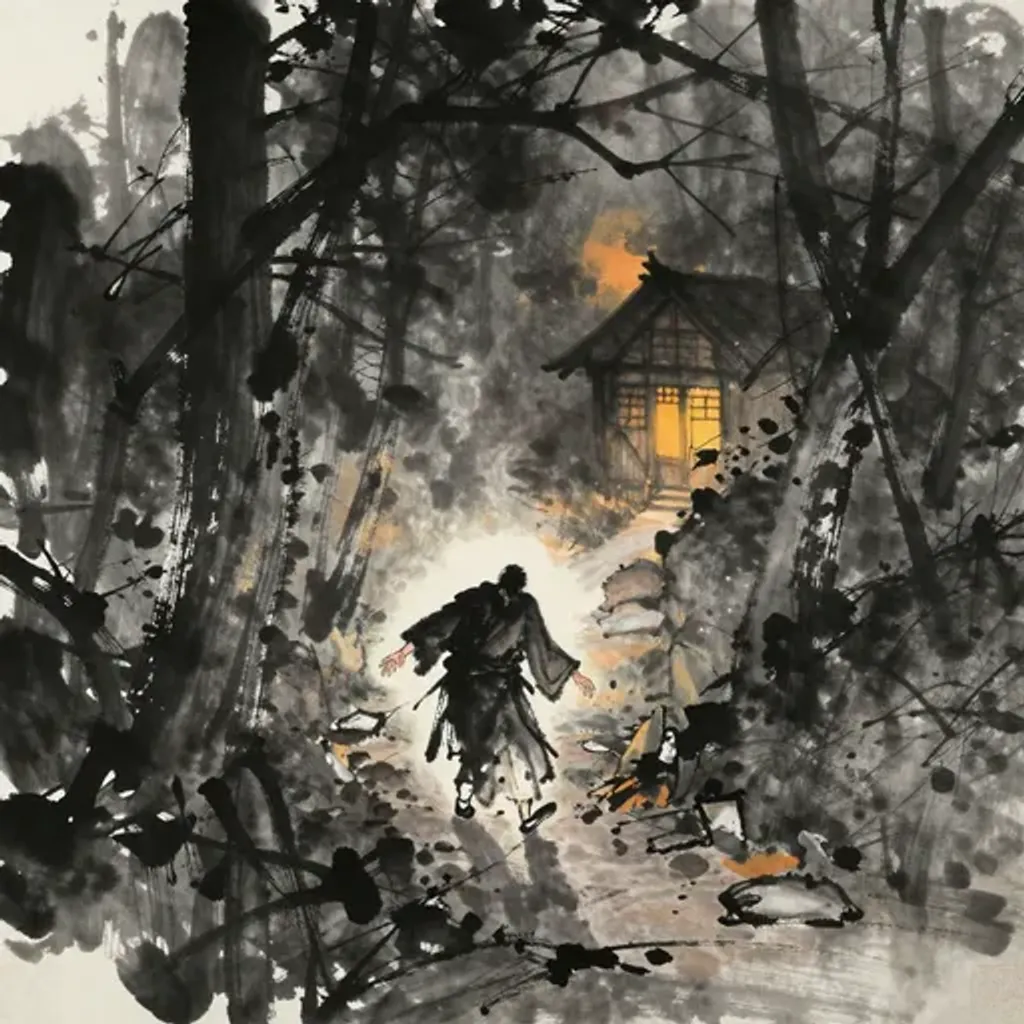
跮蹉側跌,申酉為祟。亥戌滅明,顏子隱藏。
Stumbling and slipping sideways; the shen and you hours bring misfortune. In the hai and xu hours, light is extinguished; the worthy one hides himself away.
— Jiao Yanshou, Yilin (Forest of Changes), 1st century BC
Commentary
A spring beneath the mountain stumbles and falls sideways. Tripping and staggering, the hours of Shen and You bring malign influence. At Hai and Xu, brightness is extinguished, and Yan Hui withdraws into concealment. The Earthly Branches mark a darkening progression through the afternoon and into night. Yan Hui — Confucius's most beloved disciple, famed for living in virtuous poverty with a single bowl of rice and a gourd of water — retreats from view as darkness descends. From Youthful Folly to Opposition, fire and lake pull in contrary directions. The disciple who embodied quiet virtue is forced to hide, just as opposed elements refuse to harmonize. Talent does not always find its moment; sometimes the worthy must simply endure obscurity.
蒙 → 蹇
Hexagram 4 → Hexagram 39: Obstruction
Changing lines: 2, 3, 5, 6
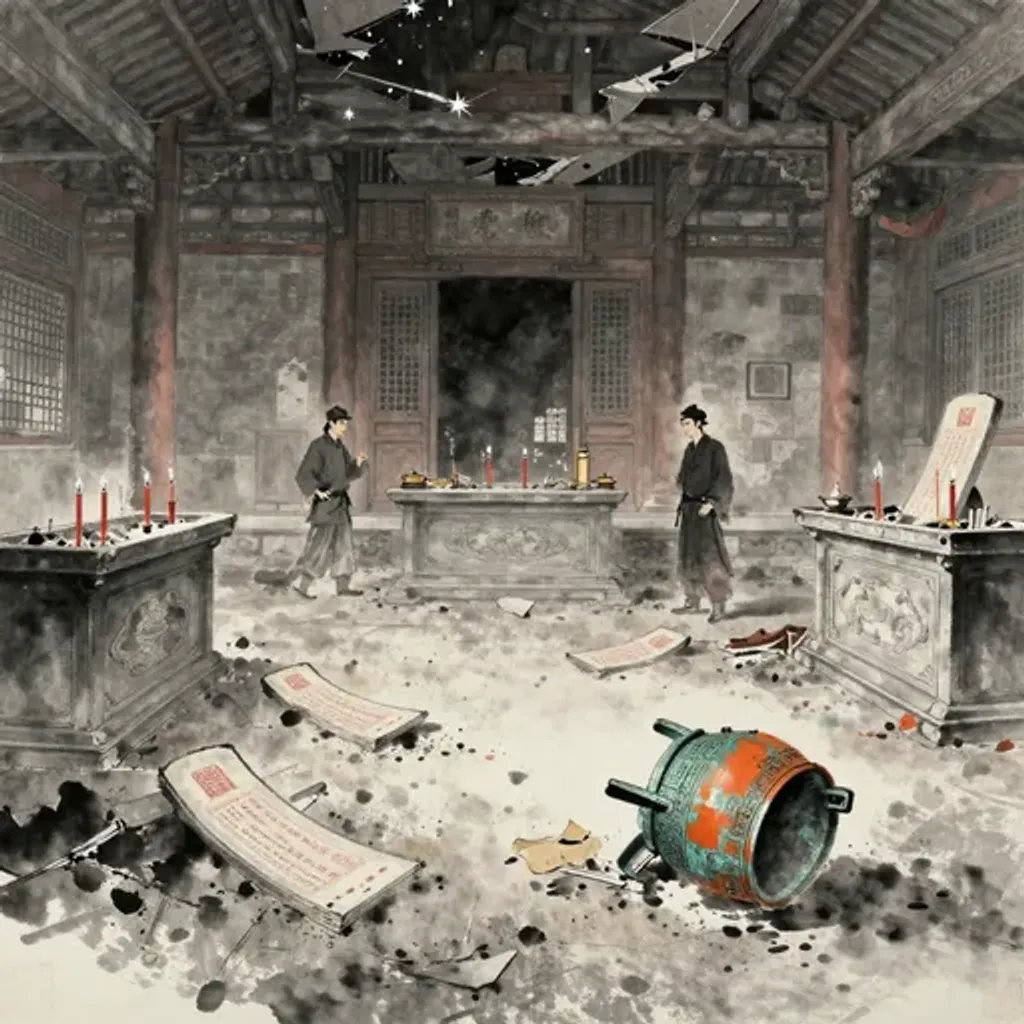
司錄憑怒,謀議無道。商民失政,殷人乏祀。
The Director of Records abuses his anger; counsel and deliberation lack the Way. The Shang people lose good governance; the Yin people’s sacrifices are abandoned.
— Jiao Yanshou, Yilin (Forest of Changes), 1st century BC
Commentary
A spring beneath the mountain runs into bureaucratic cruelty. The Director of Records acts on anger, deliberation abandons principle. The Shang people lose their governance, the Yin folk forfeit their sacrifices — the ancestral rites that sustain a dynasty's connection to heaven are severed. When officials govern by rage rather than by law, the entire sacrificial order collapses. From Youthful Folly to Obstruction, the transformation compounds the crisis: water atop the mountain, impassable and cold. The naif confronts a system where power has been divorced from legitimacy. The Shang's fall serves as perpetual warning: when those who administer justice act without dao, the state does not merely decline — it loses its link to the sacred.
蒙 → 解
Hexagram 4 → Hexagram 40: Deliverance
Changing lines: 4, 6
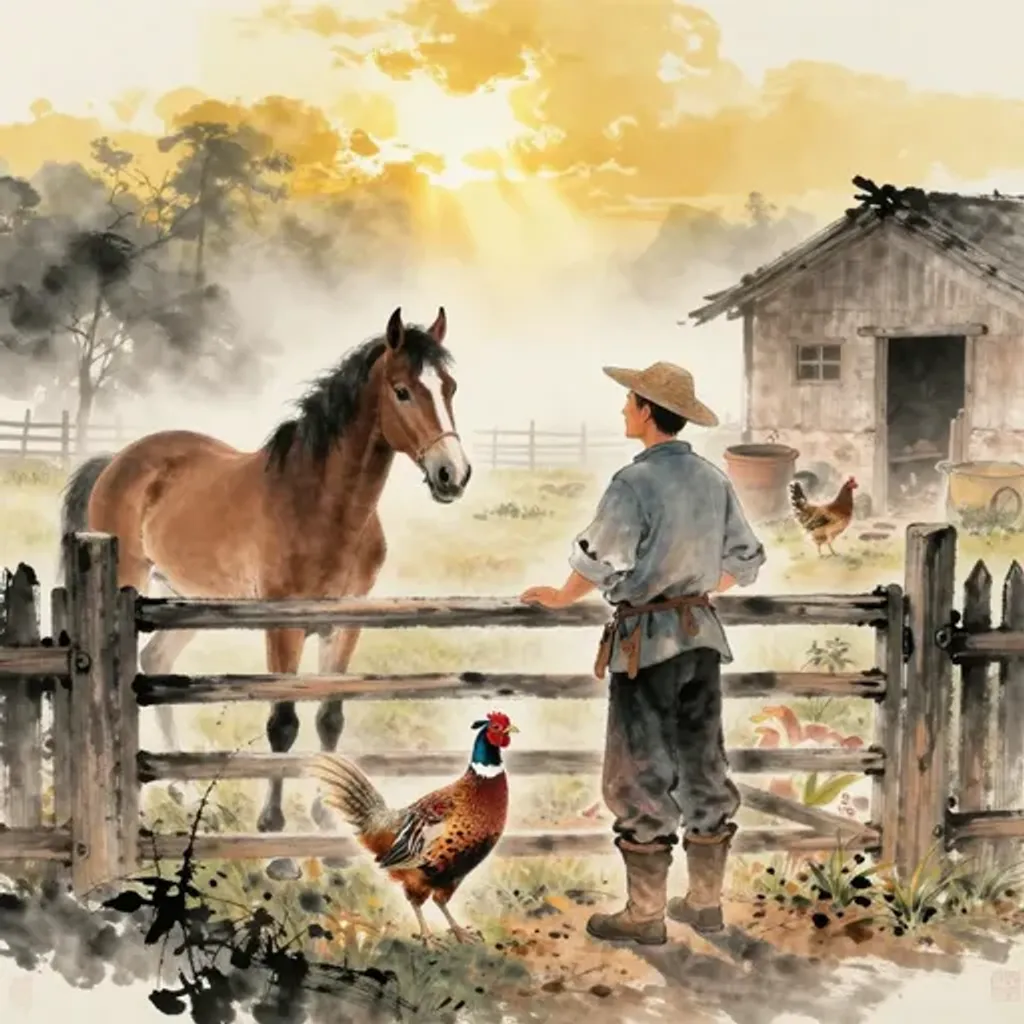
望鷄得雉,冀馬獲駒。大德生少,有瘳從居。
Hoping for a chicken, one gets a pheasant; wishing for a horse, one obtains a colt. Great virtue begets the young; there is healing, and one settles in comfort.
— Jiao Yanshou, Yilin (Forest of Changes), 1st century BC
Commentary
A spring beneath the mountain yields unexpected bounty. One hopes for a chicken but gets a pheasant; one wishes for a horse but obtains a colt. The elder begets a child; illness finds its cure through the comfort of home. Every outcome exceeds or transforms the original expectation — not by delivering what was sought, but by providing something better or more vital. From Youthful Folly to Deliverance, the transformation captures the moment when obstruction breaks. Thunder and rain act together, and the gentleman pardons faults. The naif who expected little discovers abundance in a different form. Deliverance does not always look like the solution one imagined; sometimes the colt that arrives unsought carries one further than the horse one planned to buy.
蒙 → 損
Hexagram 4 → Hexagram 41: Decrease
Changing lines: 1
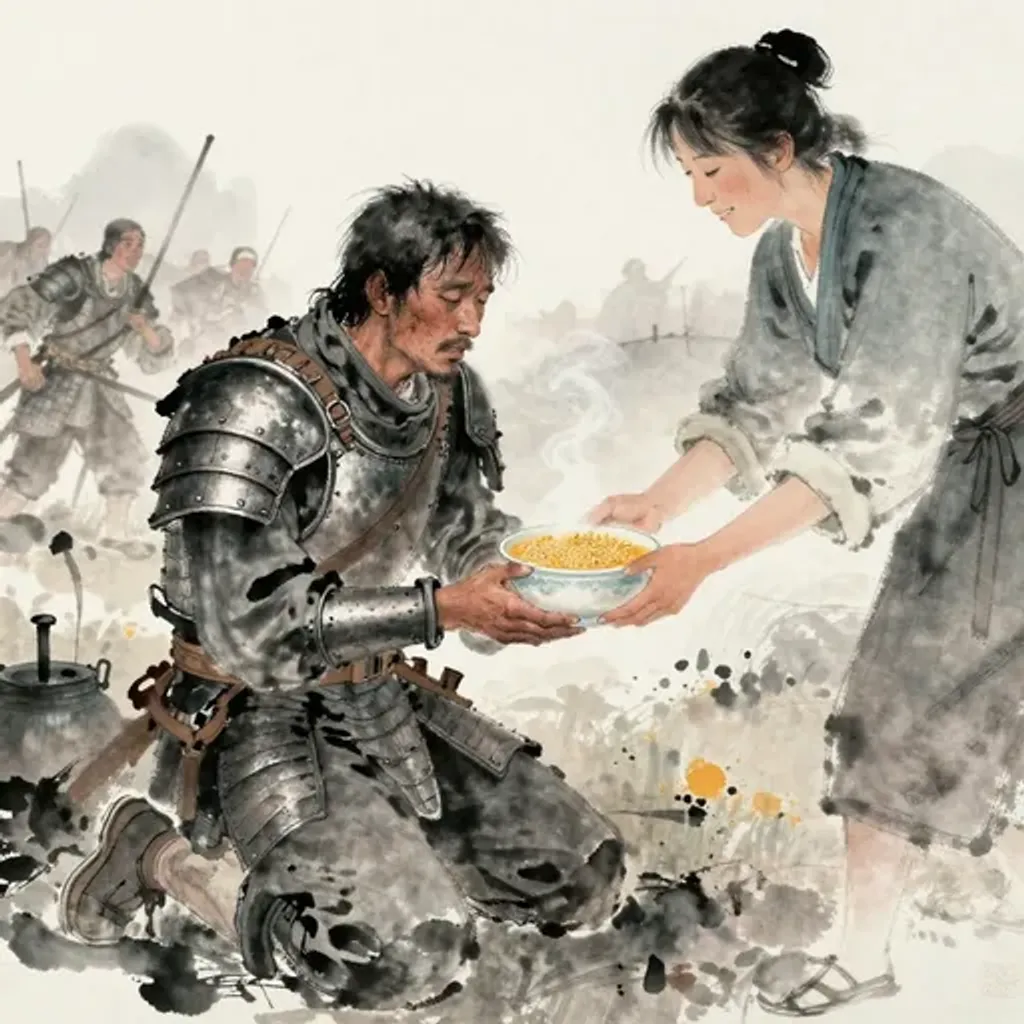
忉忉怛怛,如將不活。黍稷之恩,靈輒以存。
Grieving and anguished, as if one cannot survive. But the grace of millet and grain—Ling Zhe is thereby preserved.
— Jiao Yanshou, Yilin (Forest of Changes), 1st century BC
Commentary
A spring beneath the mountain trembles with mortal dread. Anguished and terrified, as though one will not survive. Yet the grace of millet and grain — Ling Zhe lives because of it. According to the Zuo Zhuan, Zhao Dun of Jin once fed a starving man by the roadside. That man, Ling Zhe, later became a palace guard. When Duke Ling of Jin plotted to assassinate Zhao Dun, Ling Zhe turned against his own lord to save his benefactor, repaying the debt of a single meal. From Youthful Folly to Decrease, the transformation reveals that sacrifice sustains life. The mountain diminishes so the lake may receive; a bowl of millet, given at cost to oneself, returns as salvation when all seems lost.
蒙 → 益
Hexagram 4 → Hexagram 42: Increase
Changing lines: 1, 2, 5
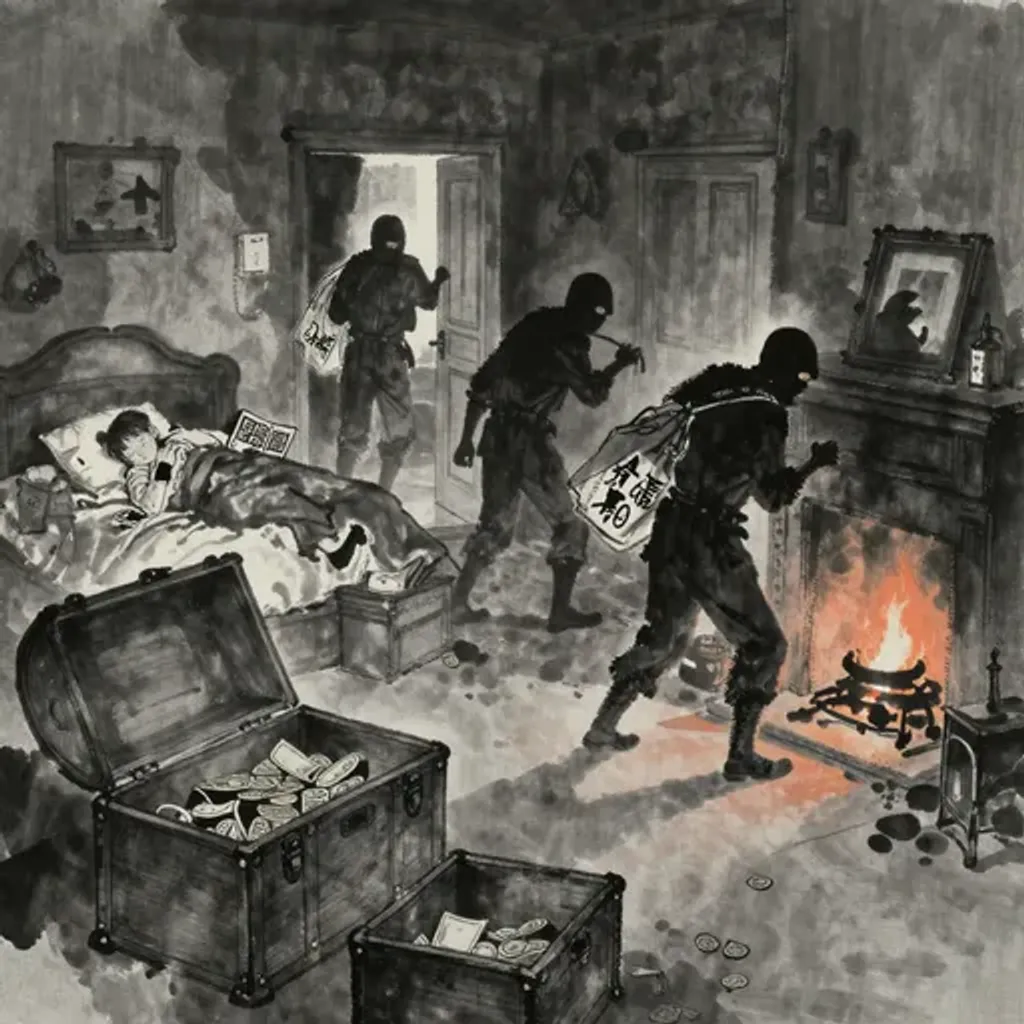
莫莫輯輯,夜作晝匿。謀議我資,來攻我室。空盡我財,幾無以食。
Whispering, conspiring; working by night, hiding by day. They plot against my goods and come to raid my home. Emptying all my wealth; I nearly have nothing to eat.
— Jiao Yanshou, Yilin (Forest of Changes), 1st century BC
Commentary
A spring beneath the mountain is silently plundered. In whispered conspiracy, thieves work by night and hide by day. They plot against my wealth, attack my household, empty my stores until nothing is left to eat. The repetition of 'my' — my resources, my home, my food — makes the violation intensely personal. From Youthful Folly to Increase, the irony is devastating. Wind and thunder should enhance and augment; the gentleman sees goodness and moves toward it. Yet here, 'increase' operates in reverse: it is the thieves who increase while the victim decreases. The naif who does not guard what is his discovers that the same energies meant for growth can be hijacked by those who conspire in darkness.
蒙 → 夬
Hexagram 4 → Hexagram 43: Breakthrough
Changing lines: 1, 3, 4, 5, 6
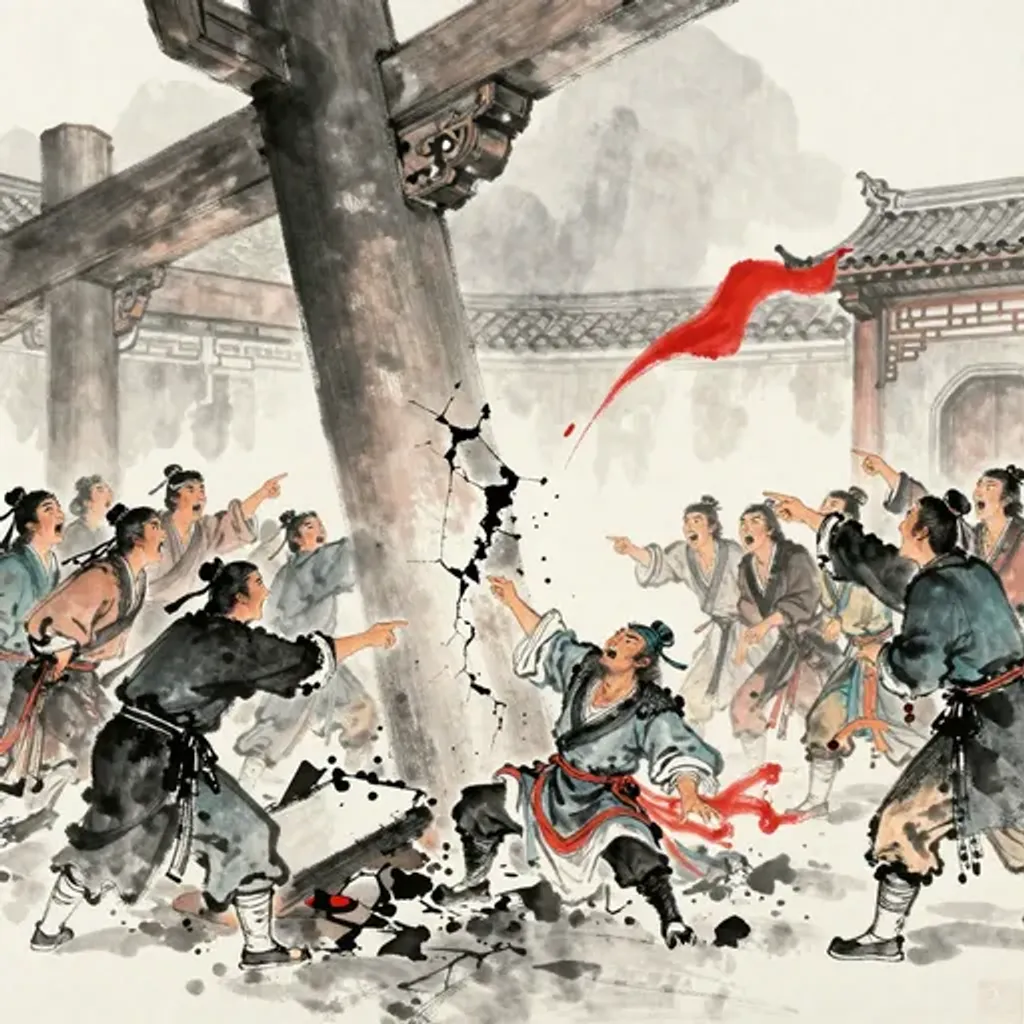
天之所壞,不可強支。眾口指笑,雖貴必危。
What heaven itself would destroy cannot be propped up by force. The crowd points and laughs; though noble, one must come to peril.
— Jiao Yanshou, Yilin (Forest of Changes), 1st century BC
Commentary
A spring beneath the mountain confronts an irreversible collapse. What heaven has decided to ruin cannot be propped up by force. The crowd points and laughs; however exalted one's position, danger is certain. The verse is a stark warning about the futility of resisting a mandate withdrawn. Public mockery confirms what cosmic judgment has already sealed — no amount of rank shields one from the consequences. From Youthful Folly to Breakthrough, the transformation takes the hexagram's decisive energy and turns it into a sentence: the lake rises above heaven, and what must be severed will be severed. The naif learns the harshest lesson: sometimes Breakthrough means being broken through, and the decisive cut falls upon oneself.
蒙 → 姤
Hexagram 4 → Hexagram 44: Coming to Meet
Changing lines: 3, 4, 5
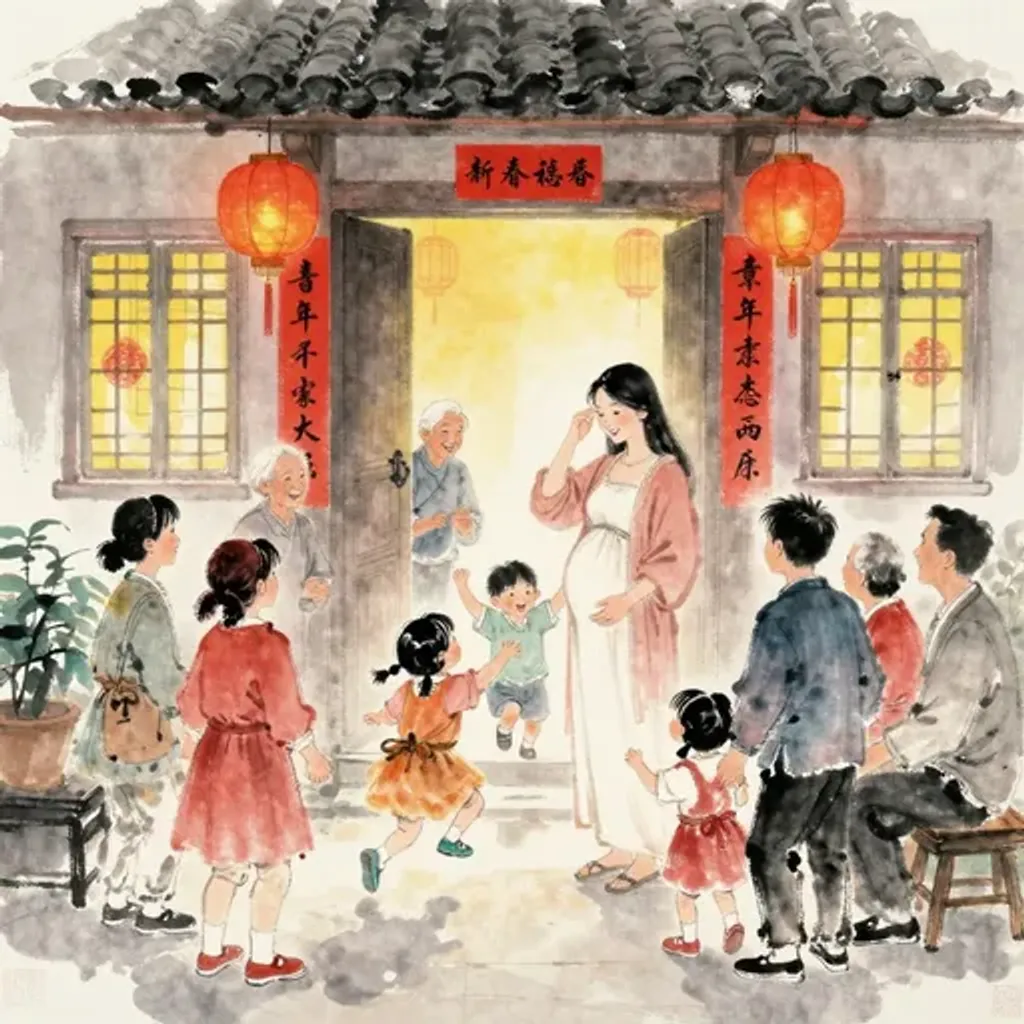
目動睫瞤,喜來加身。舉家蒙歡,吉利無殃。
The eye stirs, the eyelid flutters; joy comes upon the body. The whole household receives delight; auspicious and favorable, without harm.
— Jiao Yanshou, Yilin (Forest of Changes), 1st century BC
Commentary
A spring beneath the mountain quickens with an involuntary sign of fortune. The eye twitches and the eyelid flutters — in Chinese folk physiognomy, a harbinger of approaching joy. Happiness descends upon the body, the whole household shares in celebration, auspicious and free of harm. The omen is entirely somatic: the body knows before the mind, signaling through a physical tremor what reason has not yet grasped. From Youthful Folly to Coming to Meet, the transformation captures the sudden, unbidden encounter. Wind stirs beneath heaven; the ruler issues proclamations to all directions. The naif does not seek good fortune — it arrives unannounced, like an unexpected meeting on the road, and joy permeates the household before anyone can explain why.
蒙 → 萃
Hexagram 4 → Hexagram 45: Gathering Together
Changing lines: 2, 4, 5, 6
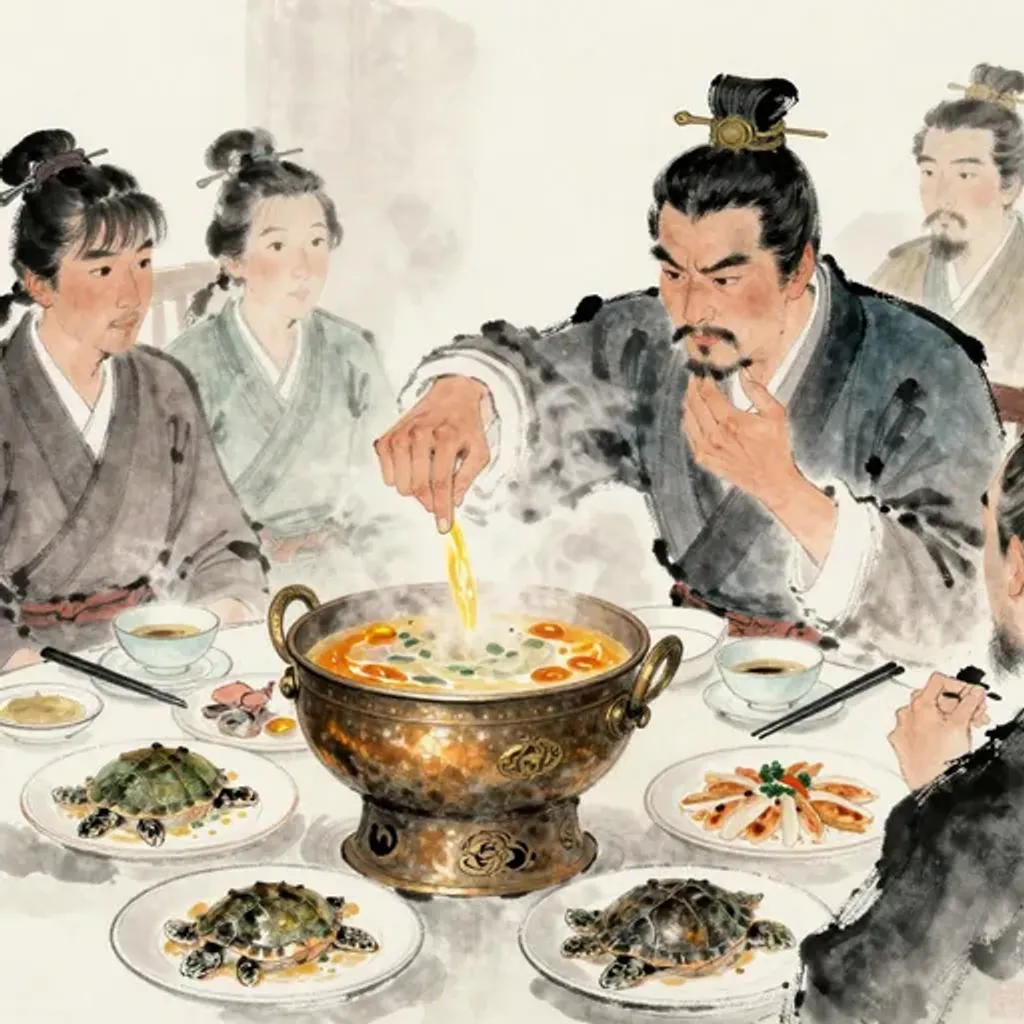
黿羹芬香,染指弗嘗。口飢於手,子公恨饞。
Soft-shell turtle soup, fragrant and rich; one dips a finger but does not taste. The mouth hungers at the hand; Lord Zigong regrets his greed.
— Jiao Yanshou, Yilin (Forest of Changes), 1st century BC
Commentary
A spring beneath the mountain smells the fragrance of turtle stew but cannot taste it. According to the Zuo Zhuan, when Chu presented a great turtle to Duke Ling of Zheng, the minister Zigong's finger twitched — a bodily omen that he would taste a rare delicacy. But the Duke, toying with him, served the soup to everyone except Zigong. Humiliated, Zigong strode forward, dipped his finger into the cauldron, and left. The idiom 'ran zhi' — 'to dip one's finger' — originates here, meaning to seize a taste of what one has been denied. From Youthful Folly to Gathering, the transformation exposes the dangerous politics of inclusion and exclusion. The lake gathers upon the earth, but not everyone is invited to drink.
蒙 → 升
Hexagram 4 → Hexagram 46: Pushing Upward
Changing lines: 3, 6
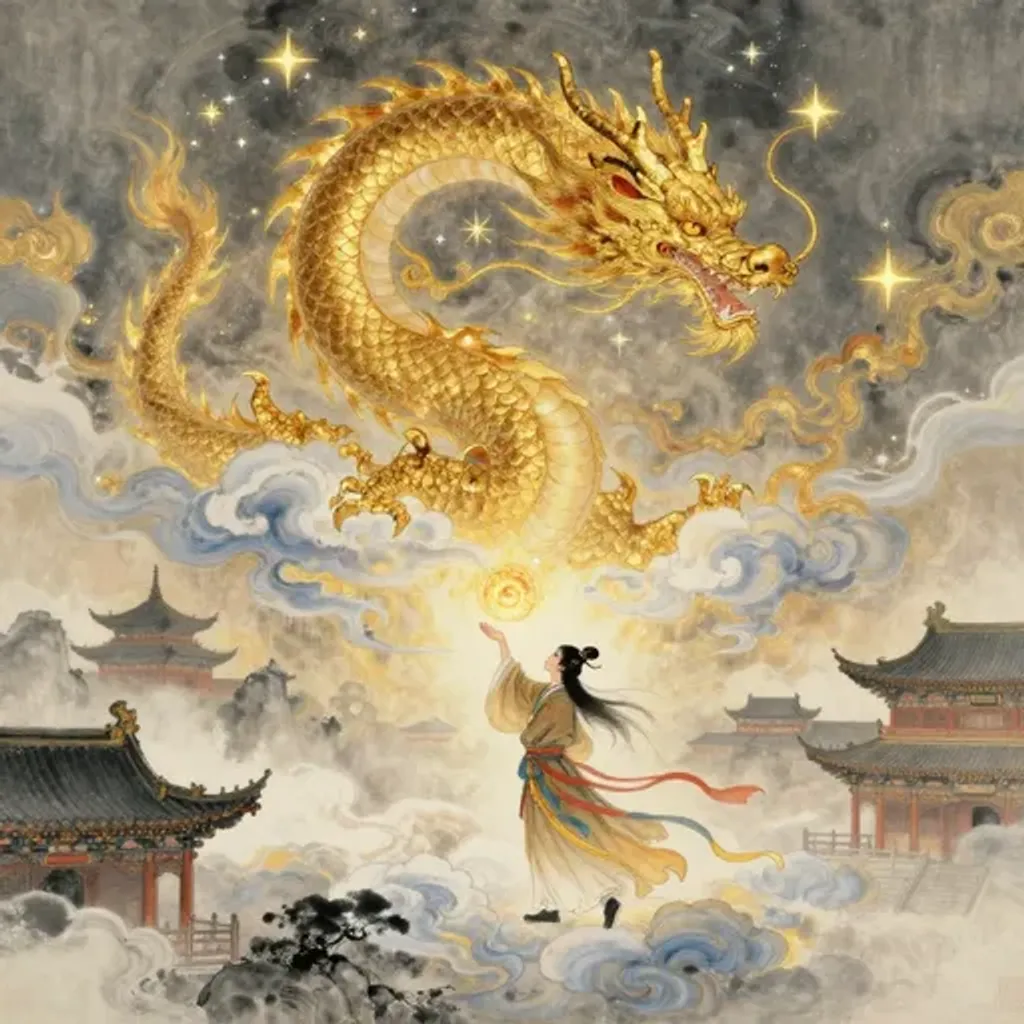
天福所豐,兆如飛龍。成子得志,六三以興。
What heaven’s blessing makes abundant, its omen is like a flying dragon. The heir achieves his ambition; through the six and the three, he rises.
— Jiao Yanshou, Yilin (Forest of Changes), 1st century BC
Commentary
A spring beneath the mountain is blessed by heaven's abundance and rises like a flying dragon. Chengzi achieves his ambition; from the 'six-three' position, he ascends. 'Chengzi' likely refers to Tian Chengzi, whose clan — originally refugees from the state of Chen — gradually accumulated power in Qi across eight generations before formally usurping the throne in 386 BC. The 'six-three' evokes the I-Ching's third line of a hexagram, where yin occupies a yang position: ambition from an unstable station, but here it succeeds. From Youthful Folly to Pushing Upward, the transformation is exact: wood grows within the earth, rising slowly but irresistibly. What begins as a minor refugee lineage pushes upward through generations until it claims the state.
蒙 → 困
Hexagram 4 → Hexagram 47: Oppression
Changing lines: 4, 5, 6
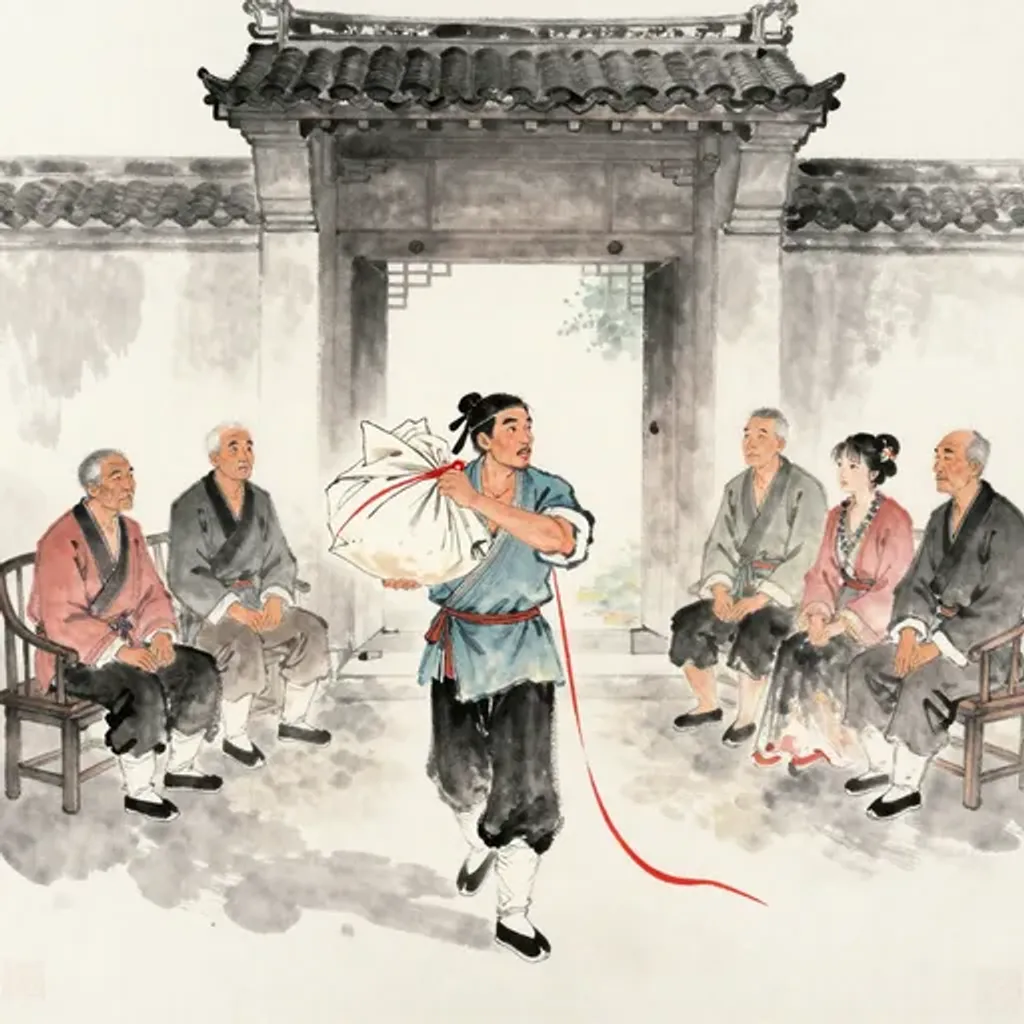
氓伯以婚,抱布自媒。棄禮急情,卒罹悔憂。
The simple man comes to marry, carrying cloth as his own matchmaker. Abandoning ritual, rushing with desire; in the end he suffers regret and sorrow.
— Jiao Yanshou, Yilin (Forest of Changes), 1st century BC
Commentary
A spring beneath the mountain is dammed by impetuous desire. The Shijing's 'Mang' ode tells of a young man who comes carrying cloth, ostensibly to trade for silk, but really to court a girl. He urges her to elope, abandoning proper matchmaking rites. The verse warns: casting aside ritual propriety in the heat of passion leads inevitably to regret and sorrow. From Youthful Folly to Oppression, the transformation tightens the trap. The lake's water has drained away, leaving only dry constraint. The lover who bypassed ceremony finds himself in a marriage without social support — oppressed not by enemies but by the consequences of his own haste. Folly that rejects form discovers that form was the only protection.
蒙 → 井
Hexagram 4 → Hexagram 48: The Well
Changing lines: 3, 5, 6
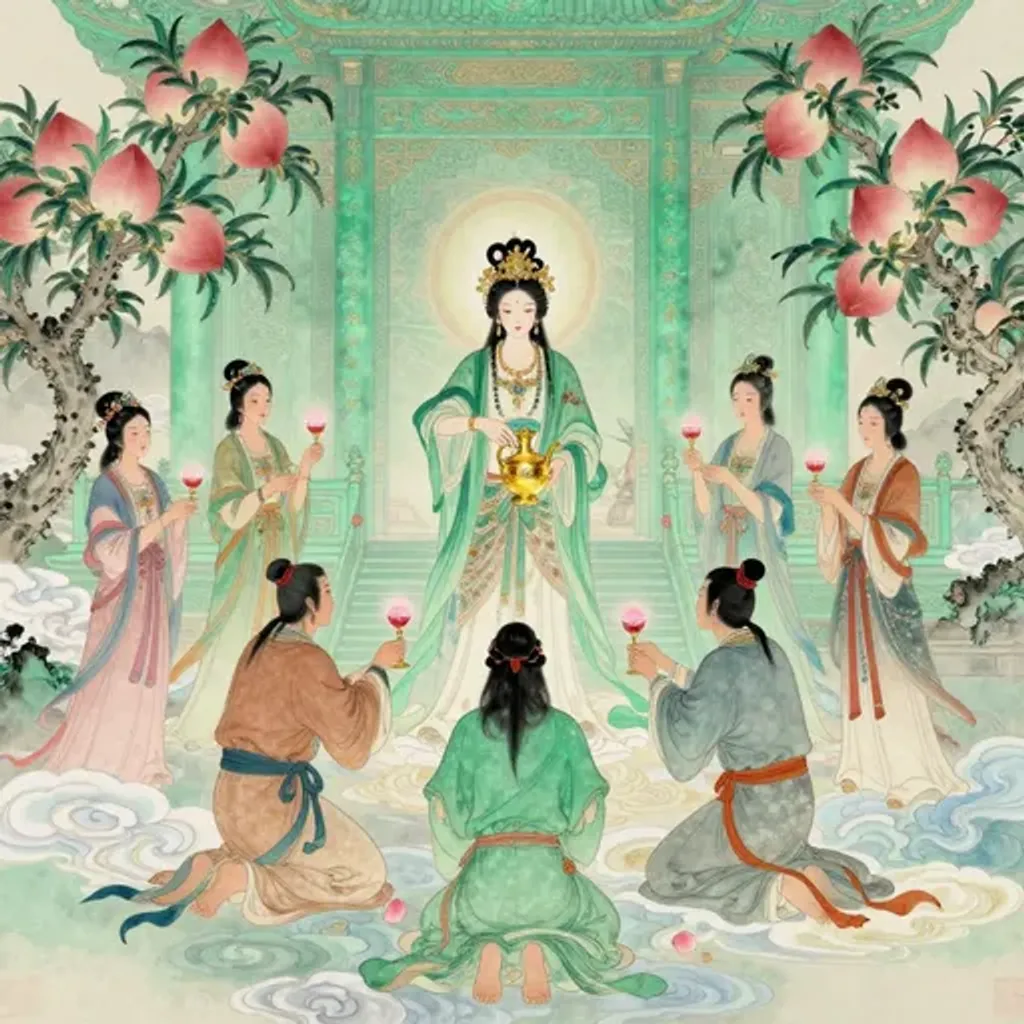
三人為旅,俱歸北海。入門上堂,拜謁王母。勞賜我酒,懽樂無彊。
Three men travel together, all journeying to the northern sea. Entering the gate, ascending the hall, they pay respects to the Queen Mother. She rewards them with wine; joy and delight are boundless.
— Jiao Yanshou, Yilin (Forest of Changes), 1st century BC
Commentary
A spring beneath the mountain joins a party of three who journey together to the northern sea. Entering the gate and ascending the hall, they pay respects to the Queen Mother, who rewards them with wine — joy knows no bounds. The Queen Mother of the West, enthroned on Mount Kunlun above the Weak Water, is guardian of immortality and celestial blessing. A pilgrimage of three companions to her court suggests a fraternal quest for transcendence. From Youthful Folly to The Well, the transformation uncovers inexhaustible nourishment. Water rises through wood — the well serves all who draw from it, never running dry. The naif who journeys far enough discovers that the deepest source of sustenance was always there, waiting to be tapped by those who travel together in good faith.
蒙 → 革
Hexagram 4 → Hexagram 49: Revolution
Changing lines: 1, 2, 3, 4, 5, 6
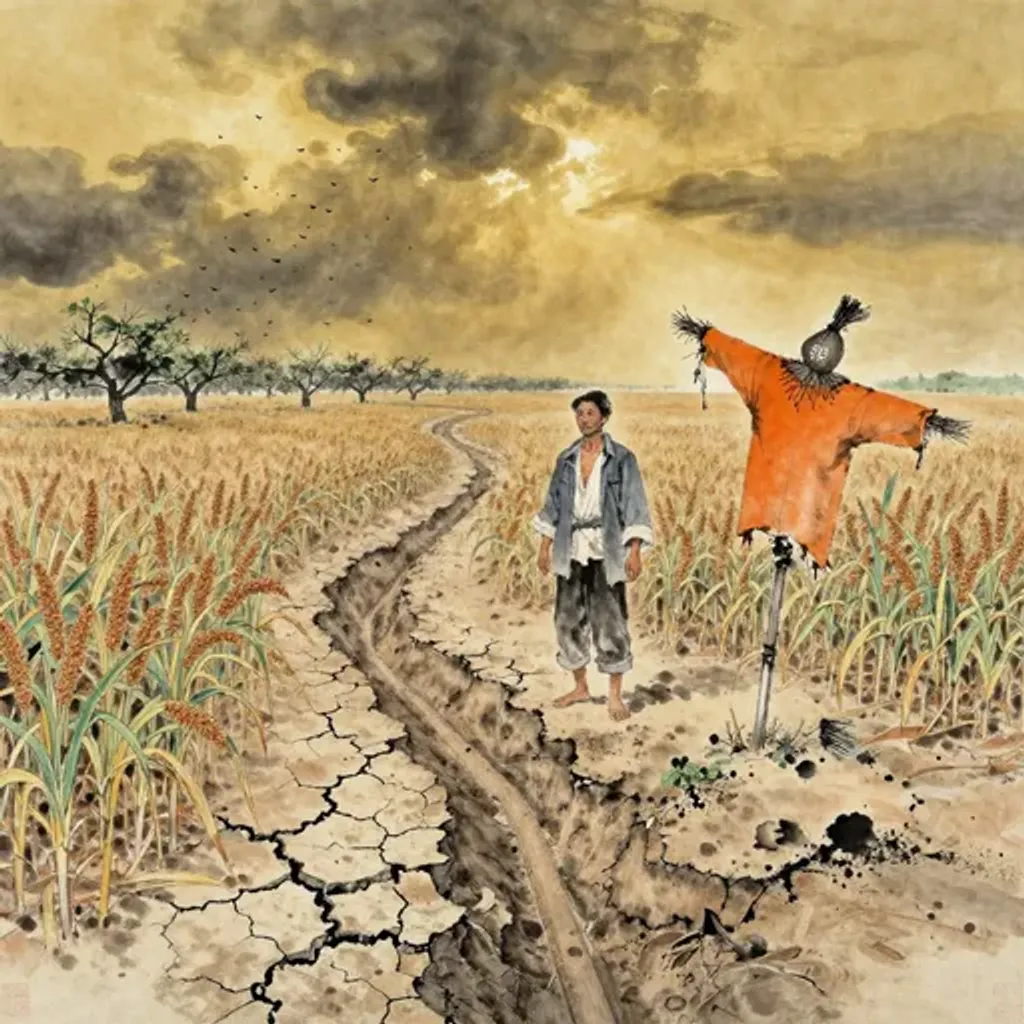
愆淫旱疾,傷害稼穡。喪制病來,農人無食。
Excessive rain and drought and disease; they harm the planting and harvesting. Mourning rites, illness arrives; the farmer has nothing to eat.
— Jiao Yanshou, Yilin (Forest of Changes), 1st century BC
Commentary
A spring beneath the mountain dries as the sky turns hostile. Excessive rain and drought alternate as disease strikes the crops. Mourning ceremonies coincide with illness; farmers have nothing to eat. The verse catalogs agrarian catastrophe in its fullest form — weather, pestilence, and human sorrow converging on the same harvest. When heaven's rhythms go wrong, the entire cycle of planting and reaping collapses. From Youthful Folly to Revolution, the transformation carries a dual edge. Fire within the lake signals the need for radical change — reforming the calendar, correcting the seasons. The naif confronts a broken world where mere endurance is insufficient; only a fundamental restructuring of the order can restore the cycle of growth.
蒙 → 鼎
Hexagram 4 → Hexagram 50: The Cauldron
Changing lines: 3, 4
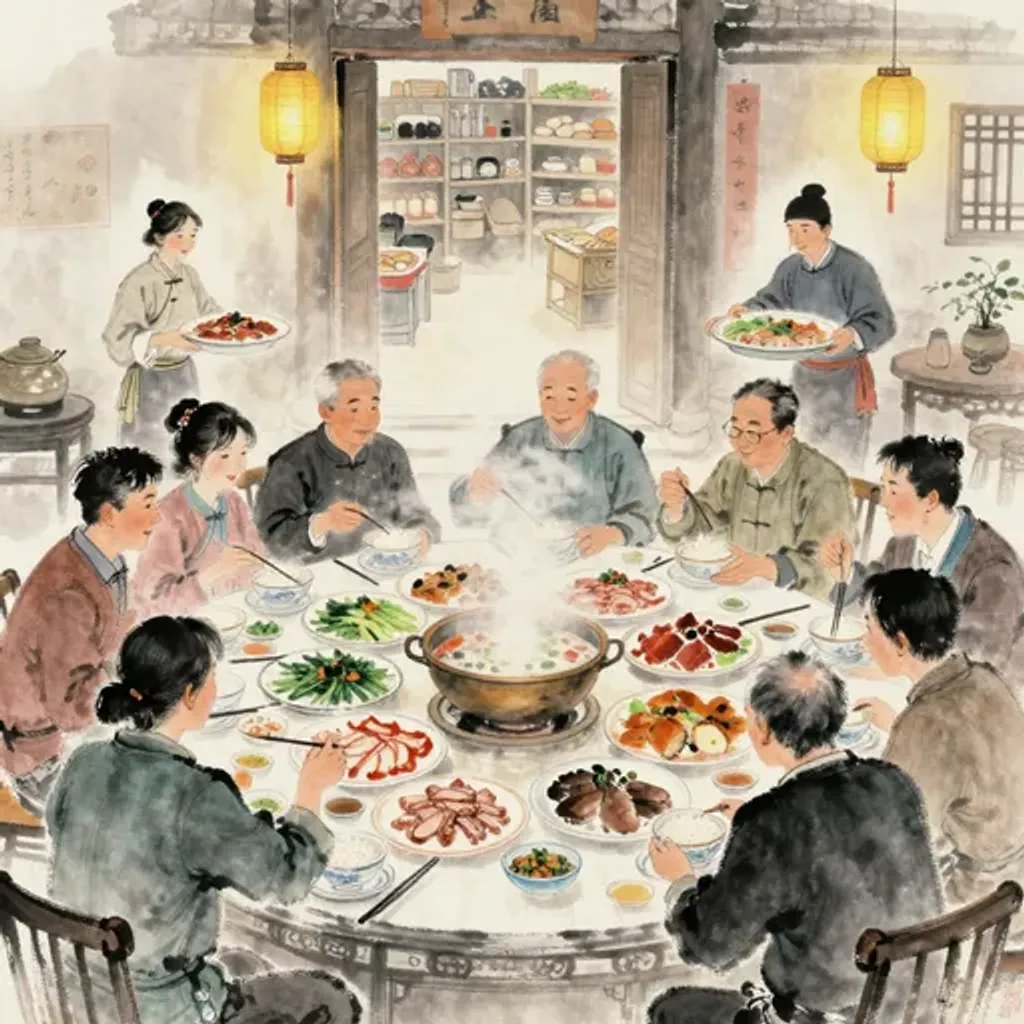
攫飯把肉,以就口食。所往必得,無有虛乏。
Snatching rice, grasping meat; bringing it straight to the mouth to eat. Wherever one goes, one surely obtains; there is never want or lack.
— Jiao Yanshou, Yilin (Forest of Changes), 1st century BC
Commentary
A spring beneath the mountain finds its hands full of nourishment. One snatches rice and grabs meat, bringing it straight to the mouth. Wherever one goes, gain is certain; there is no emptiness or want. The imagery is bluntly physical — not the elegance of a banquet but the urgency of hands seizing food. Yet the tone is joyful: abundance so available it needs no ceremony. From Youthful Folly to The Cauldron, the transformation refines crude sustenance into something sacred. Fire above wood is the image of cooking — transforming raw material into civilized nourishment. The naif begins by grabbing food with bare hands; the cauldron teaches that the same ingredients, properly prepared, become an offering fit for heaven.
蒙 → 震
Hexagram 4 → Hexagram 51: The Arousing Thunder
Changing lines: 1, 2, 4, 6
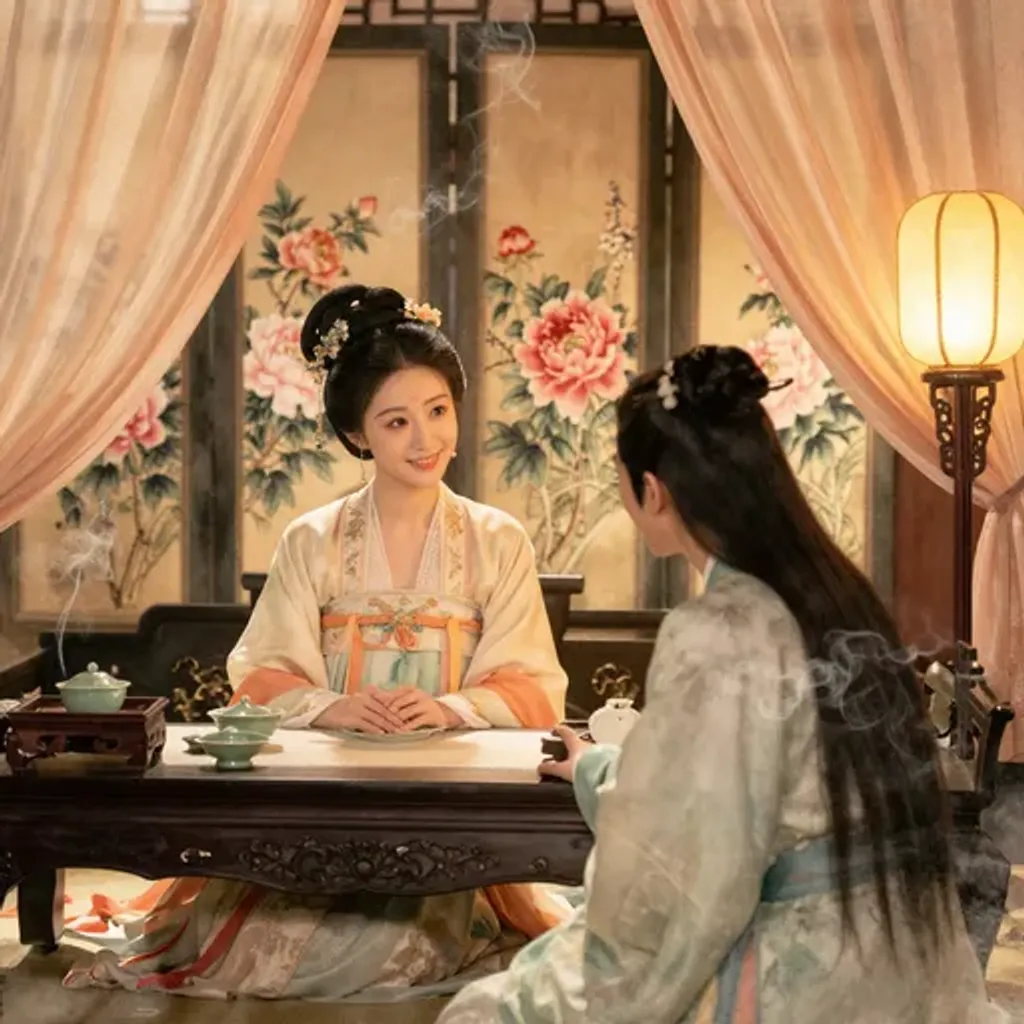
夏姬親附,心聽悅喜。利以搏取,無言不許。
Lady Xia Ji attaches herself willingly; her heart listens and delights. Favorable for seizing and taking; no word is refused.
— Jiao Yanshou, Yilin (Forest of Changes), 1st century BC
Commentary
A spring beneath the mountain encounters an irresistible allure. Lady Xia — Xia Ji of the Spring and Autumn period — drew men to her with fatal magnetism. She intimately attached herself, her heart listening and delighting. Whatever she wished to seize, she obtained; no request was refused. Xia Ji was famed for her devastating beauty: she ruined the state of Chen, caused the death of multiple lovers, and her allure drove the Chu minister Wu Chen to abandon his post and elope with her. From Youthful Folly to The Arousing, doubled thunder shakes the ground. The naif is thunderstruck by desire so powerful it overrides all judgment. The arousal is genuine — but what is shaken loose cannot easily be gathered back.
蒙 → 艮
Hexagram 4 → Hexagram 52: Keeping Still Mountain
Changing lines: 2, 3
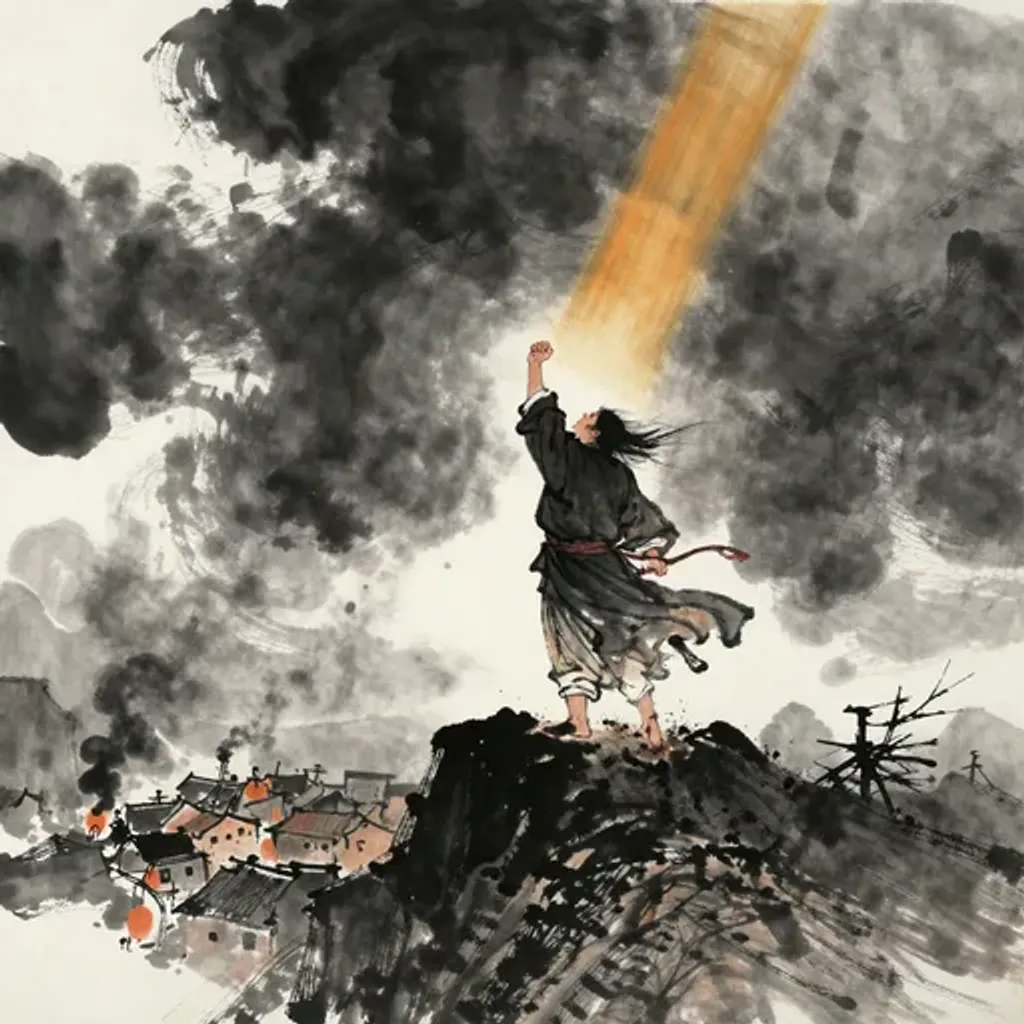
南山昊天,刺政閔身。疾悲無辜,背憎為仇。
The southern mountain, the vast sky; government censured, the body grieved. Sorrow for the guiltless; those one trusted turn to enemies.
— Jiao Yanshou, Yilin (Forest of Changes), 1st century BC
Commentary
A spring beneath the mountain cries out against injustice under a towering sky. 'South Mountain' and 'Great Heaven' invoke the Shijing ode 'Jie Nan Shan,' a fierce critique of King You of Zhou's misgovernance by the minister Jifu. The poem rebukes unjust rule, grieves for the innocent, and laments that those who should be friends have turned to enmity. From Youthful Folly to Keeping Still, doubled mountains stand immovable. The protest rises but meets a wall of stone: the government does not listen, and the aggrieved can do nothing but cry to the vast, indifferent sky. Stillness here is not peace but paralysis — the mountain that refuses to move is also the mountain that refuses to hear.
蒙 → 漸
Hexagram 4 → Hexagram 53: Development
Changing lines: 2, 3, 5
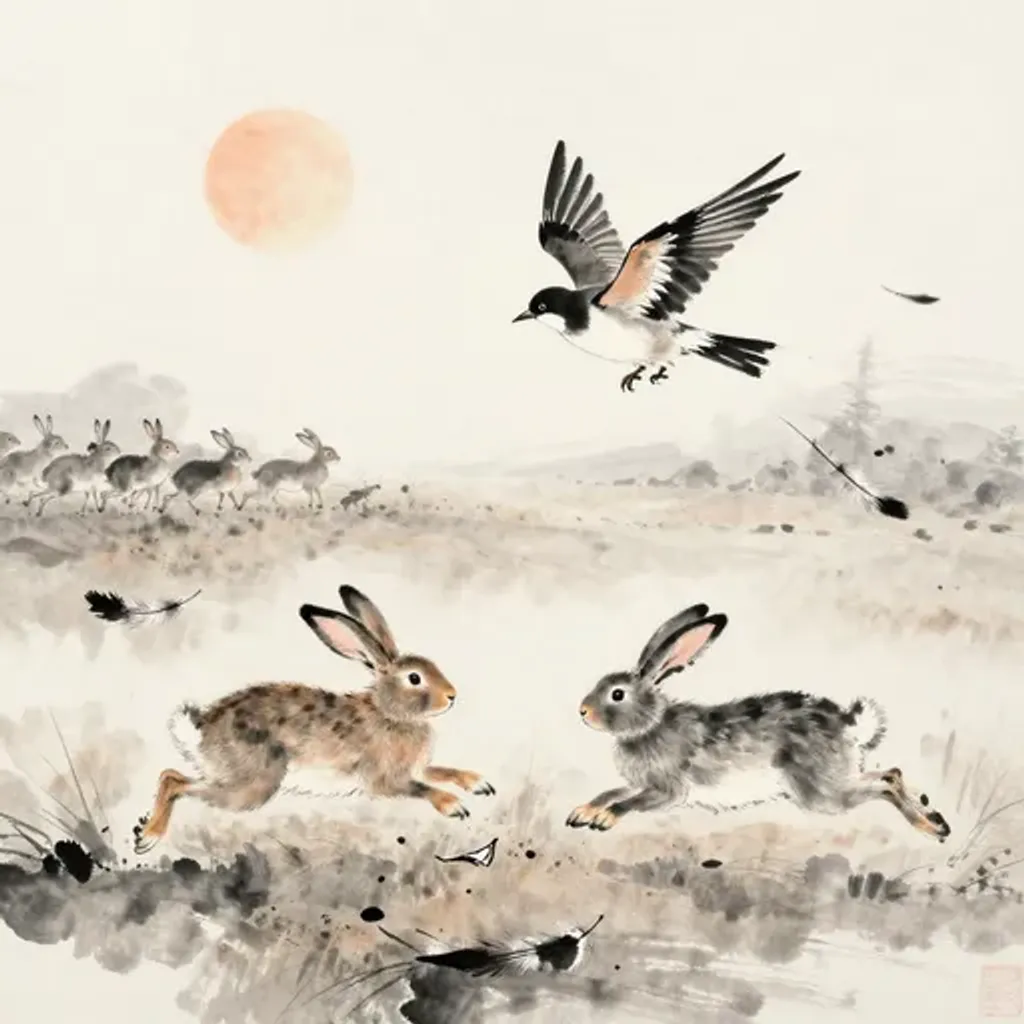
鳥飛無翼,兔走折足。雖欲會同,未得所欲。
A bird tries to fly without wings; a rabbit runs with broken legs. Though they wish to meet and join, they cannot attain what they desire.
— Jiao Yanshou, Yilin (Forest of Changes), 1st century BC
Commentary
A spring beneath the mountain watches helplessly as creatures fail at their most basic functions. A bird tries to fly but has no wings; a hare tries to run but its legs snap. Though one longs to gather with companions, the desired union cannot be achieved. Every capacity is stripped away at the moment of need — flight without feathers, speed without legs. From Youthful Folly to Development, the contrast is painful. Wind atop the mountain should foster the slow, organic growth of trees — gradual development toward maturity. Yet this figure lacks even the minimum apparatus to begin. Development requires a foundation; without wings or working limbs, there is nothing for patience to cultivate. The naif must first acquire the tools before the path of gradual progress can open.
蒙 → 歸妹
Hexagram 4 → Hexagram 54: The Marrying Maiden
Changing lines: 1, 4, 6
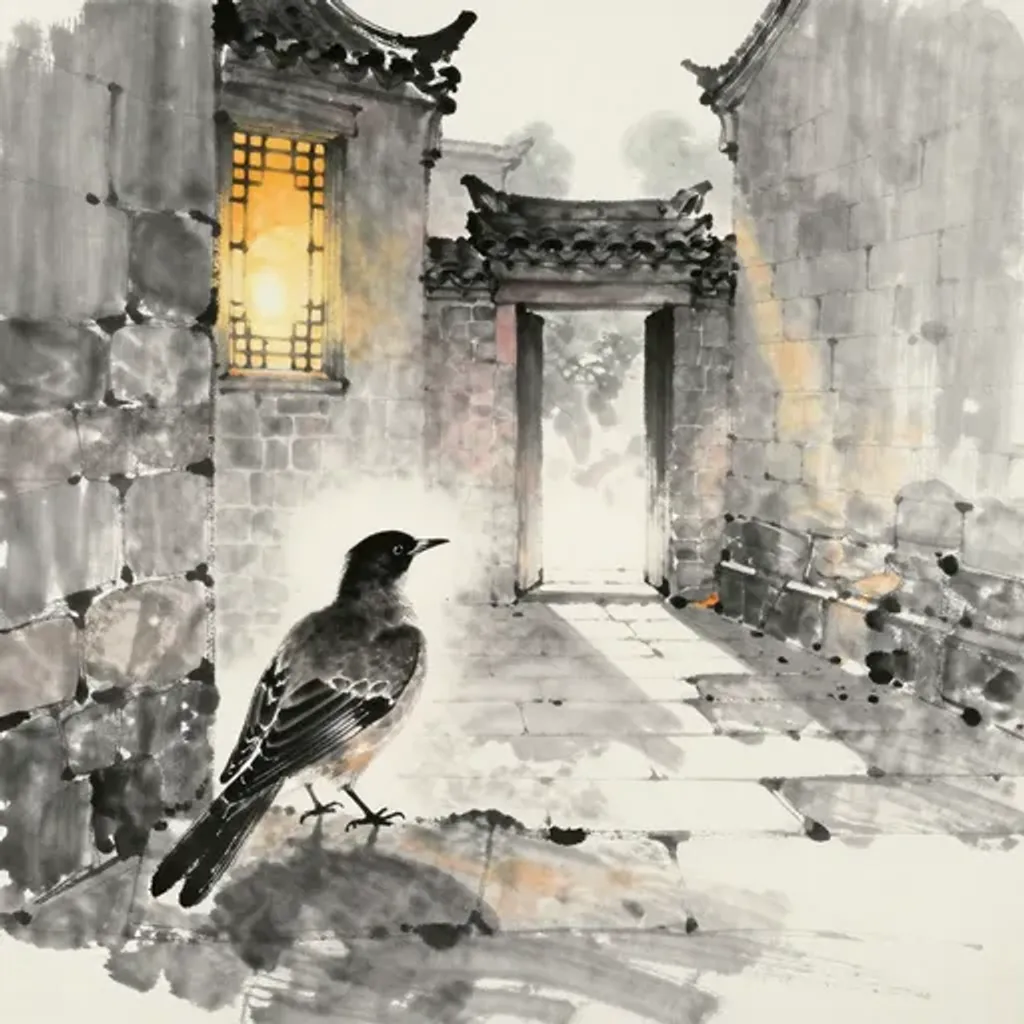
體重飛難,不得踰關,不離室垣。
The body is heavy, flight is difficult; one cannot cross the pass, cannot leave the courtyard wall.
— Jiao Yanshou, Yilin (Forest of Changes), 1st century BC
Commentary
A spring beneath the mountain is trapped by its own weight. The body is too heavy to fly; one cannot cross the pass, cannot leave the courtyard wall. Three images of confinement compress into a single condition: heaviness, the barrier, and the enclosure. There is no villain, no storm — only the inert mass of one's own limitations. From Youthful Folly to the Marrying Maiden, the transformation adds a layer of domestic captivity. Thunder above the lake signals a hasty, perhaps ill-considered union; 'knowing the flaws from the start' is the hexagram's counsel. The naif who cannot even leave the yard has entered an arrangement from which escape is physically impossible. The walls are not high; the body is simply too heavy to clear them.
蒙 → 豐
Hexagram 4 → Hexagram 55: Abundance
Changing lines: 1, 2, 3, 4, 6
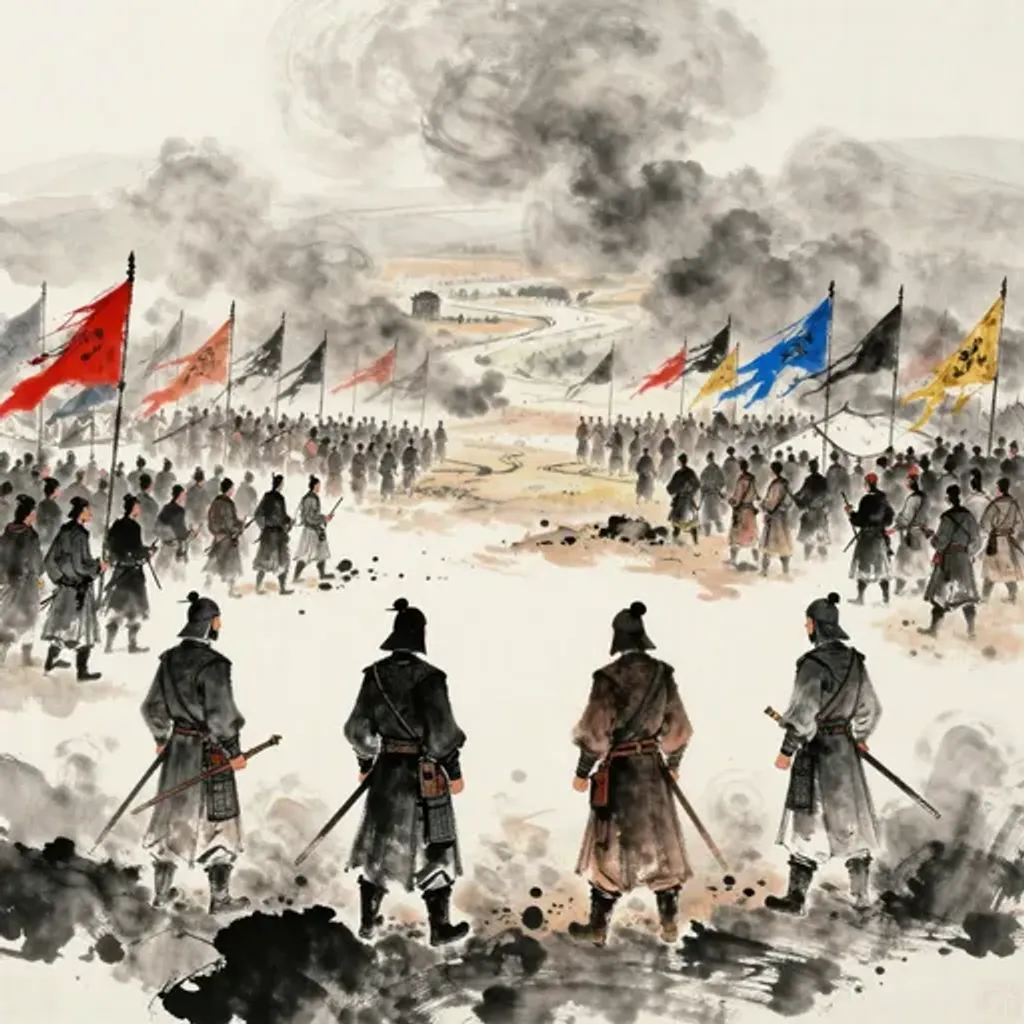
四雄並處,人民愁苦。擁兵西東,不得安所。
Four warlords dwell together; the people grieve and suffer. Mustering armies east and west; none find a place of peace.
— Jiao Yanshou, Yilin (Forest of Changes), 1st century BC
Commentary
A spring beneath the mountain is drowned out by the clash of four rival warlords. Four strongmen occupy the same ground, and the people suffer in misery. Armies march east and west in endless campaigns; no one finds a place to rest. The number four suggests a realm fractured into competing quarters, each powerful enough to terrorize but none strong enough to unify. From Youthful Folly to Abundance, the irony is bitter. Thunder and lightning together should produce the fullness of a just verdict — abundance as the culmination of clarity and power. But here, four thunders roar at once and cancel each other out, producing only chaos. Abundance squandered on factional war is indistinguishable from devastation.
蒙 → 旅
Hexagram 4 → Hexagram 56: The Wanderer
Changing lines: 2, 3, 4
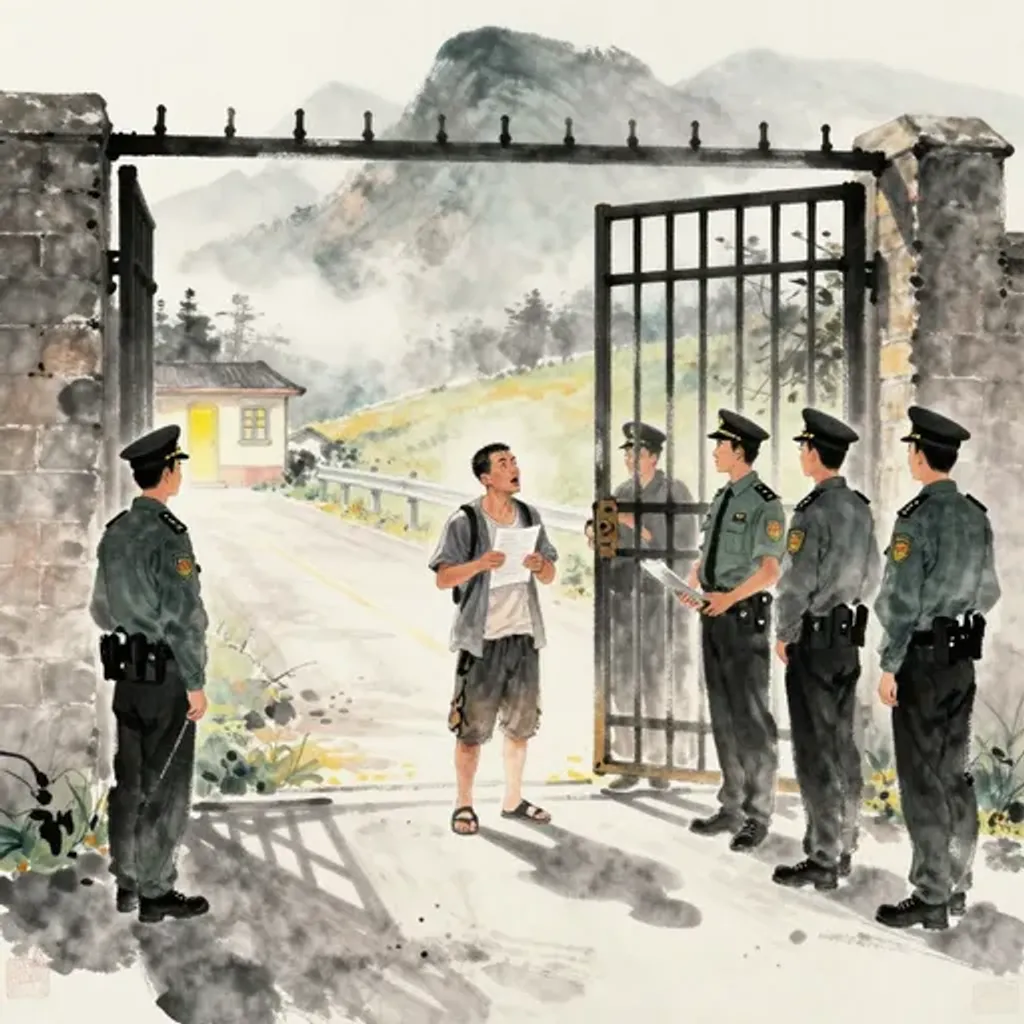
譯重關牢,求解己憂。心感乃成,與喜俱居。
Interpreters pass through heavy gates, seeking to relieve their cares. The heart is moved, and so it is accomplished; dwelling together with joy.
— Jiao Yanshou, Yilin (Forest of Changes), 1st century BC
Commentary
A spring beneath the mountain navigates heavy gates and strong locks, seeking release from its own worries. Through repeated translation and secured barriers, the traveler works to dissolve his troubles. When sincere feeling finally connects, success arrives, and one dwells in joy. The image of 'double translation through locked gates' suggests communication across formidable obstacles — languages, borders, prison bars. From Youthful Folly to The Wanderer, the transformation carries the theme of difficult passage through foreign terrain. Fire upon the mountain illuminates the traveler's path but also exposes vulnerability. The naif discovers that resolution comes not from breaking barriers but from genuine emotional connection — the heart that moves sincerely can pass through walls that force cannot breach.
蒙 → 巽
Hexagram 4 → Hexagram 57: The Gentle Wind
Changing lines: 3, 5
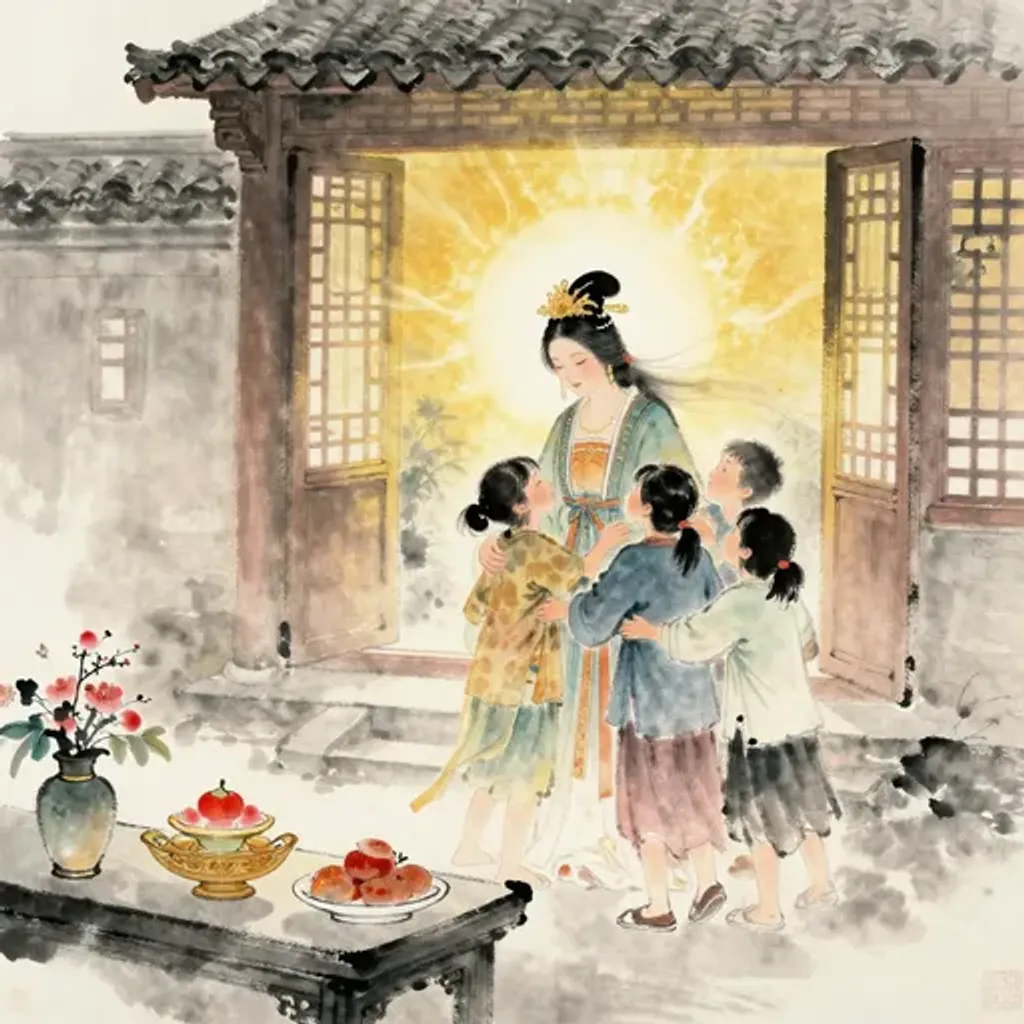
患解憂除,王母相於。與喜俱來,使我安居。
Trouble is resolved, worry removed; the Queen Mother looks after us. Together with joy she comes; granting us peaceful dwelling.
— Jiao Yanshou, Yilin (Forest of Changes), 1st century BC
Commentary
A spring beneath the mountain is soothed by a maternal blessing. Troubles dissolve and worries lift; the Queen Mother intercedes on one's behalf. Joy arrives together with her favor, granting secure dwelling. The Queen Mother of the West — or here possibly a domestic 'wang mu,' the household matriarch — extends her protection, and peace follows immediately. From Youthful Folly to The Gentle, doubled wind penetrates softly and thoroughly. The commander issues orders that permeate every corner without force. The naif who was anxious and lost receives shelter not through dramatic rescue but through gentle, persistent care. Like wind that enters where hammers cannot, the maternal presence quietly restores order from within.
蒙 → 兌
Hexagram 4 → Hexagram 58: The Joyous Lake
Changing lines: 1, 4, 5, 6
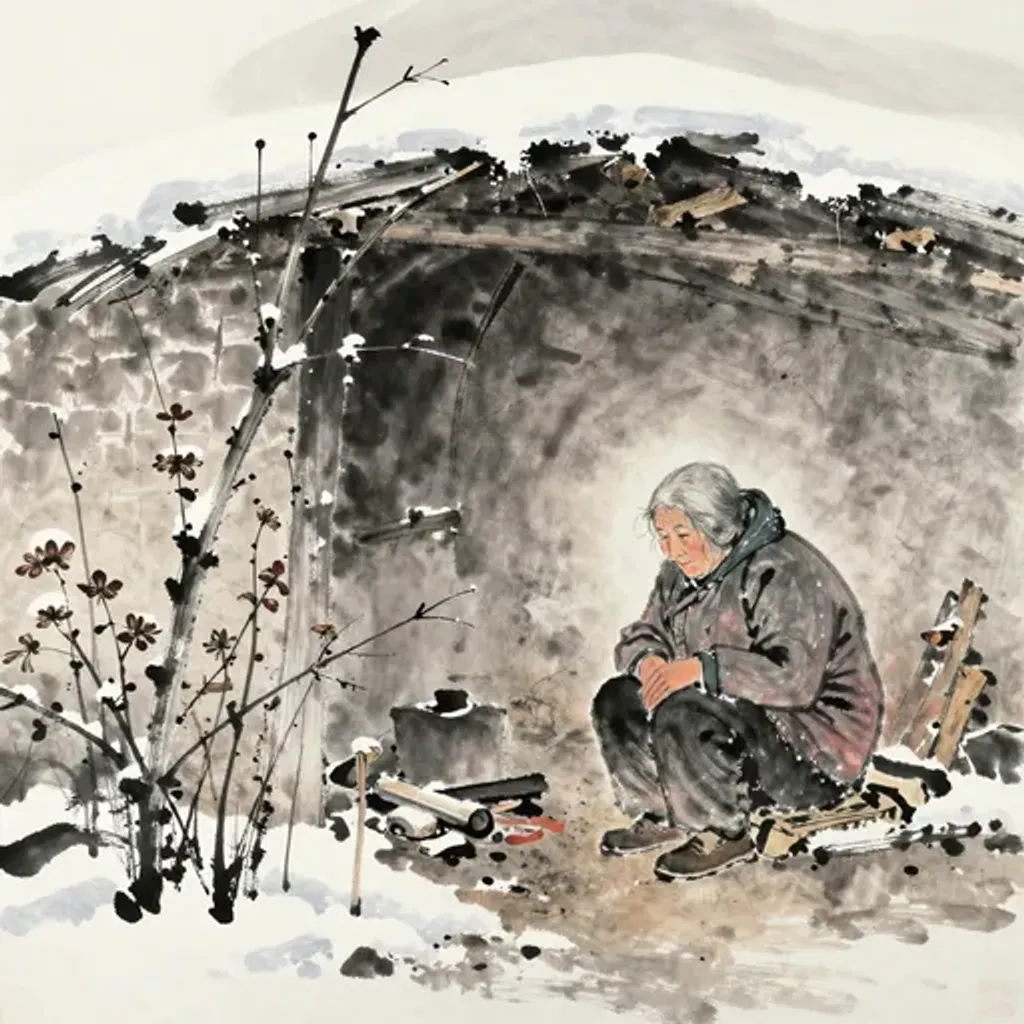
冬生不華,老女無家。霜冷蓬室,更為枯株。
Born in winter, it does not bloom; the old woman has no home. Frost chills the thatched room; all becomes a withered stump.
— Jiao Yanshou, Yilin (Forest of Changes), 1st century BC
Commentary
A spring beneath the mountain freezes in winter's grip. A plant born in winter bears no flowers; an old woman has no home. Frost invades the wormwood hut, reducing it to a dry, dead stalk. Every image compounds desolation: wrong season, wrong age, wrong shelter. The plant that germinates in cold cannot bloom; the woman past her years finds no household to receive her. From Youthful Folly to The Joyous, the contrast is devastating. Paired lakes should bring shared delight — friends studying together, laughter reflecting laughter. Yet this figure is excluded from all warmth. Joy exists somewhere, but not here: the old woman in her frosted hovel is winter's answer to the lake's invitation, reminding us that delight is never universal.
蒙 → 渙
Hexagram 4 → Hexagram 59: Dispersion
Changing lines: 5
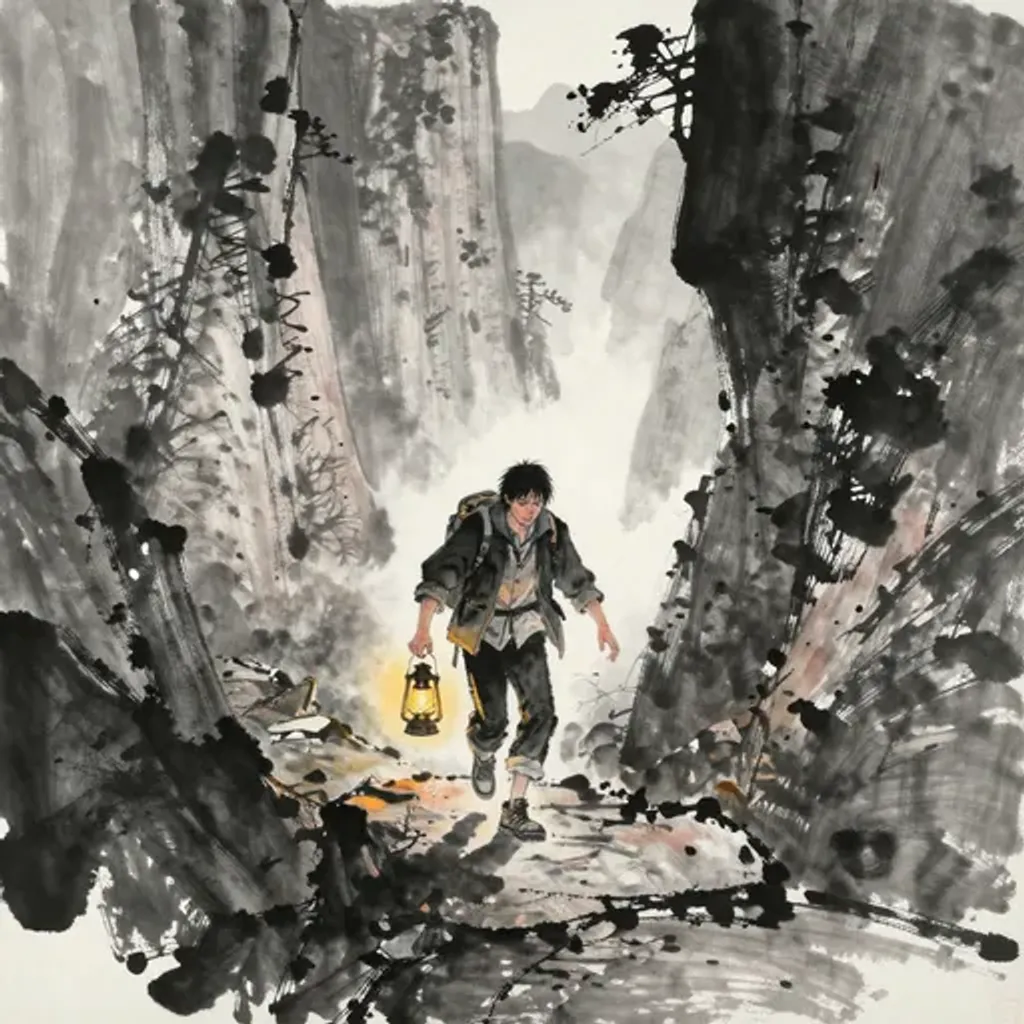
震慄恐懼,多所畏惡。行道留難,不可以步。
Trembling and fearful; much is dreaded and detested. The road ahead is beset with obstacles; one cannot take a step.
— Jiao Yanshou, Yilin (Forest of Changes), 1st century BC
Commentary
A spring beneath the mountain seizes up in terror. Trembling and shaking with fear, dread fills every direction. The road ahead is blocked with difficulty; one cannot even take a step. The verse is a portrait of pure paralysis — not injury or imprisonment, but fear so overwhelming that movement itself becomes impossible. From Youthful Folly to Dispersion, the transformation offers a potential escape. Wind moves across water, scattering what is frozen. The ancient kings built temples and made offerings — acts of communal faith that dissolve personal terror. The naif locked in panic must find something larger than fear to cling to: ritual, community, or the wind that blows across the water and breaks the ice of solitary dread.
蒙 → 節
Hexagram 4 → Hexagram 60: Limitation
Changing lines: 1, 5, 6
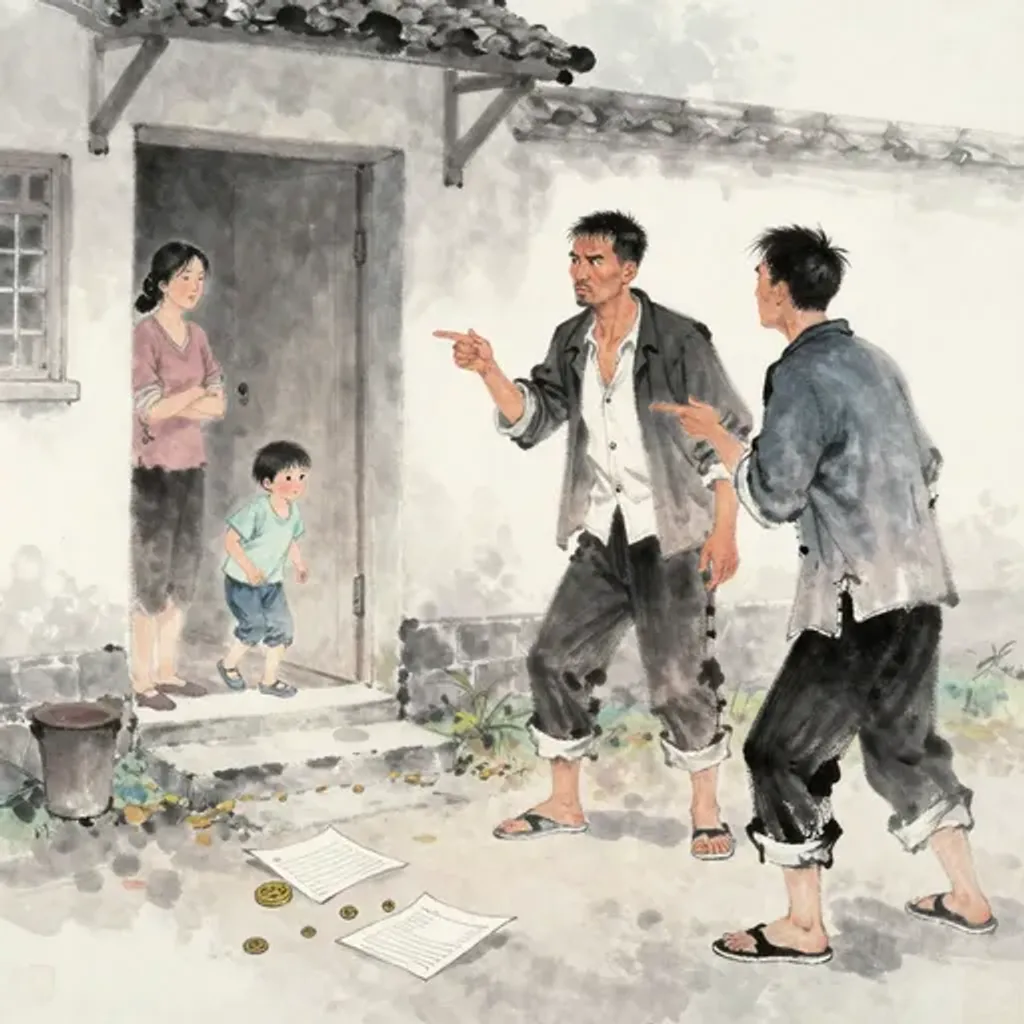
三人共妻,莫適為雌。子無名氏,公不可知。
Three men share one wife; none can be determined as the female. The child has no surname; the father cannot be known.
— Jiao Yanshou, Yilin (Forest of Changes), 1st century BC
Commentary
A spring beneath the mountain is muddied by disorder in the most intimate of relations. Three men share one wife; no one can determine who is the proper mate. The children have no clear surname; the father cannot be identified. The verse depicts a household where the most fundamental distinctions — paternity, lineage, identity — have been abolished through promiscuity. From Youthful Folly to Limitation, the transformation supplies exactly what this chaos lacks: boundaries. Water above the lake establishes measure and proportion; the gentleman sets standards and deliberates on proper conduct. The naif's disorder is not beyond repair, but the cure requires what was most resisted: clear limits on desire, firm lines where none existed before.
蒙 → 中孚
Hexagram 4 → Hexagram 61: Inner Truth
Changing lines: 1, 5
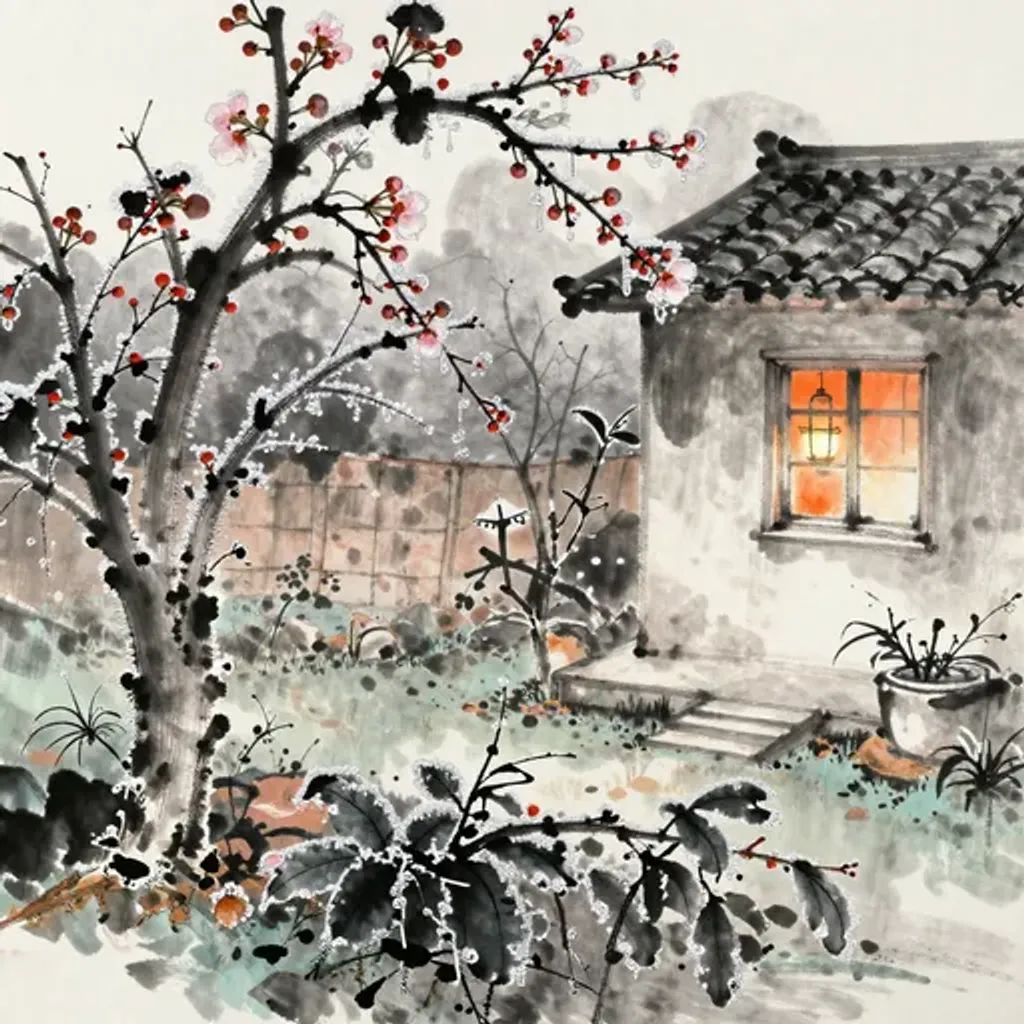
早凋被霜,花葉不長。非時為災,家受其殃。
Struck early by frost; flowers and leaves do not grow. Untimely disaster comes; the household bears its ruin.
— Jiao Yanshou, Yilin (Forest of Changes), 1st century BC
Commentary
A spring beneath the mountain is blighted by untimely frost. Plants wither early, struck by frost before their season; flowers and leaves cannot grow. Disaster arrives at the wrong time, and the household bears the calamity. The verse captures the cruelty of misaligned timing — frost in spring, punishment before the crime, death before maturity. Nature's calendar has been violated, and everything planted perishes. From Youthful Folly to Inner Truth, the transformation is poignant. Wind over the lake penetrates to the core; the gentleman deliberates on criminal cases and delays executions. Inner Truth demands that judgment be carefully timed. The untimely frost is a failure of cosmic sincerity: when heaven's truth is distorted, even the innocent suffer before their time.
蒙 → 小過
Hexagram 4 → Hexagram 62: Small Exceeding
Changing lines: 2, 3, 4, 6
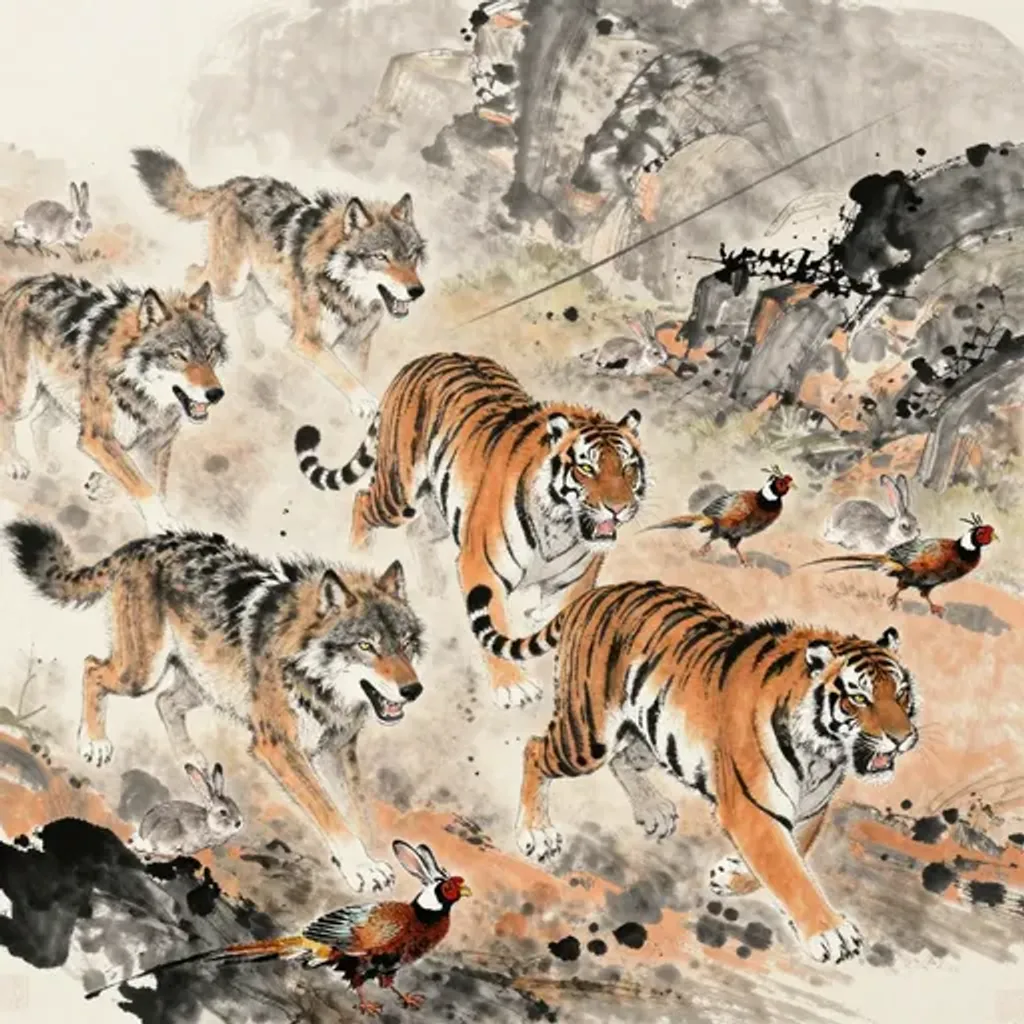
雉兔之東,狼虎所從。貪叨凶惡,不可止息。
Where pheasant and rabbit head east, wolf and tiger follow. Greedy, violent, and cruel; they cannot be stopped.
— Jiao Yanshou, Yilin (Forest of Changes), 1st century BC
Commentary
A spring beneath the mountain runs into predator country. Pheasants and hares head east, but wolves and tigers follow in their tracks. Greed and cruelty rage without restraint, impossible to stop. The prey animals move first; the predators trail behind, turning the same path into a killing ground. The verse is pure menace — no rescue, no moral, only the relentless logic of pursuit. From Youthful Folly to Small Exceeding, thunder atop the mountain should counsel excessive caution — going too far in humility, in mourning, in frugality. Yet here excess takes the form of unchecked predation. The naif discovers that smallness offers no protection when the pursuer exceeds all bounds. In a world where wolves know no limit, even small exceeding becomes existential.
蒙 → 既濟
Hexagram 4 → Hexagram 63: After Completion
Changing lines: 1, 2, 3, 5, 6
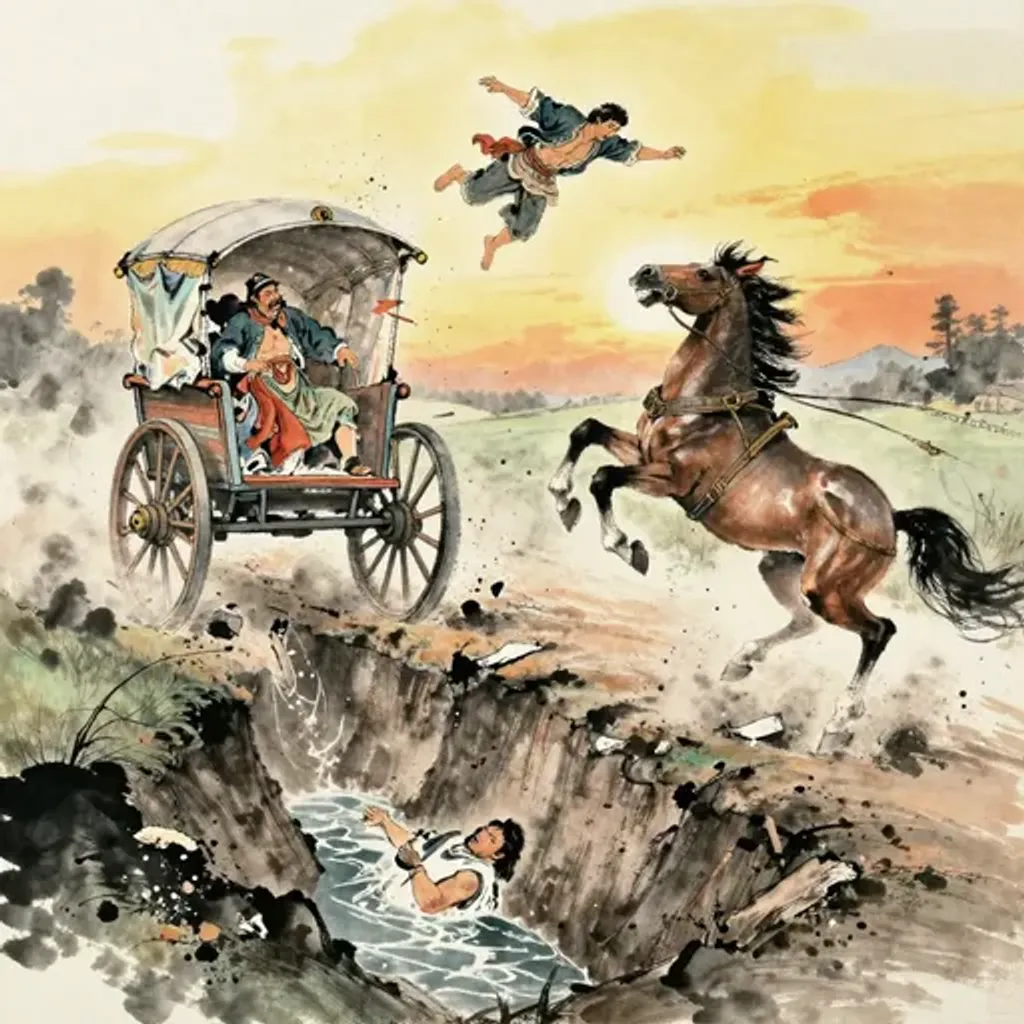
馬驚破車,主墮深溝。身死魂去,離其室廬。
The horse bolts, the carriage shatters; the master is thrown into a deep ditch. Body dead, soul departed; severed from his home.
— Jiao Yanshou, Yilin (Forest of Changes), 1st century BC
Commentary
A spring beneath the mountain ends in a catastrophic wreck. A horse bolts, the carriage shatters, and the driver is hurled into a deep ditch. Body dead, soul departed, severed from hearth and home. The verse is one of the grimmest in the Yilin — a fatal accident rendered with cinematic clarity. There is no allusion to soften the blow, only the naked physics of a spooked horse, a broken vehicle, and a body in a trench. From Youthful Folly to After Completion, the irony is absolute. Water above fire represents a state of perfect, achieved order — everything in its proper place. Yet 'after completion' is also the moment of maximum vulnerability, when vigilance relaxes and the unforeseen strikes. The naif who thought the journey was finished discovers that completion and catastrophe share the same instant.
蒙 → 未濟
Hexagram 4 → Hexagram 64: Before Completion
Changing lines: 4
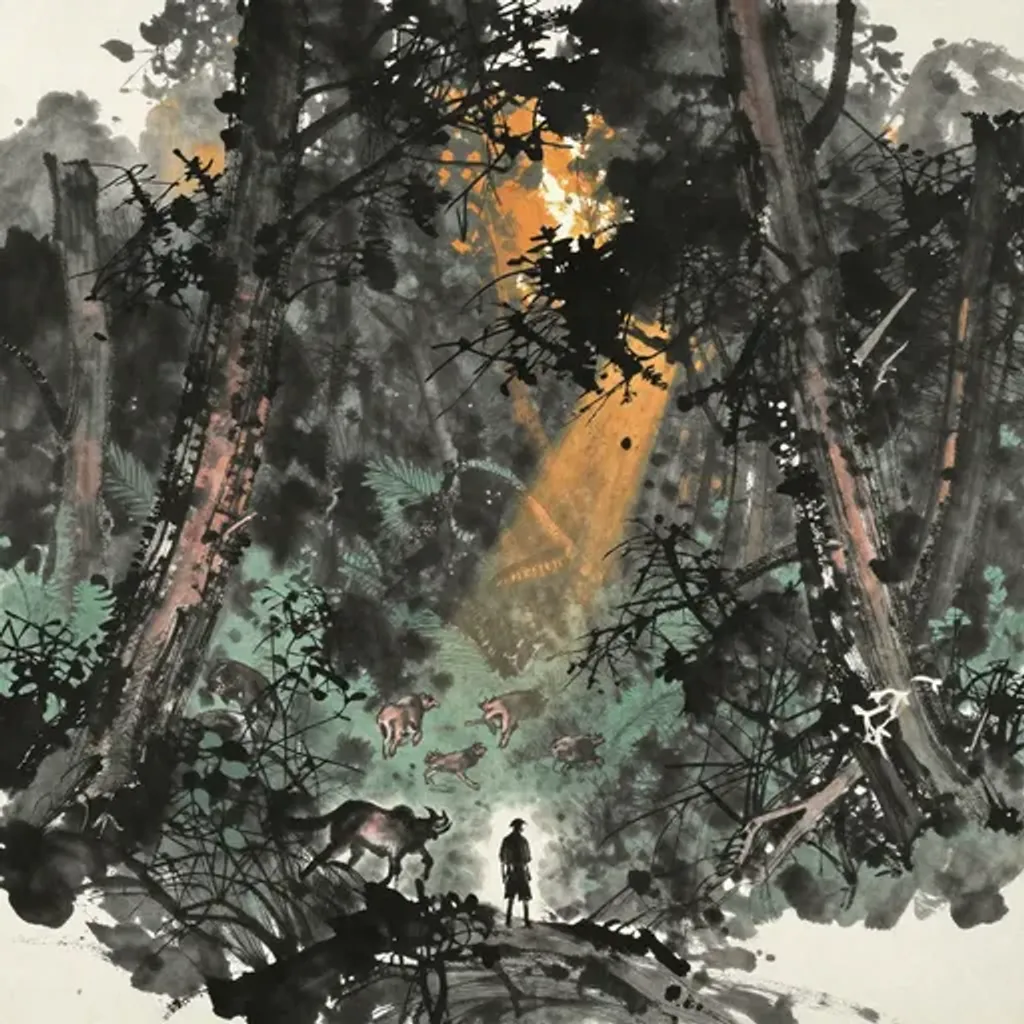
山林麓藪,非人所往。鳥獸無禮,使我心苦。
Mountain forest, foothill marsh; not where people go. Birds and beasts lack propriety; this makes my heart bitter.
— Jiao Yanshou, Yilin (Forest of Changes), 1st century BC
Commentary
A spring beneath the mountain wanders into untamed wilderness. Mountains, forests, foothills, and marshes — places no human frequents. Birds and beasts know no propriety, and this makes the heart bitter. The verse deposits the traveler at the uttermost edge of civilization, where the social codes that sustain human life simply do not exist. Animals obey no rites; the world here is raw and indifferent. From Youthful Folly to Before Completion, fire floats above water without the two elements ever meeting. The naif has arrived at the point where nothing is finished, nothing is ordered, and the very categories of human meaning have yet to be established. This is not tragedy but pre-civilization: the bitter starting point from which all culture must be built.