Transformations of Hexagram 44
Every line of change out of Hexagram 44 姤 Coming to Meet, with the Yilin verse for each of the 64 resulting hexagrams, its translation, and the original ink brush artwork.
姤 → 乾
Hexagram 44 → Hexagram 1: The Creative
Changing lines: 1
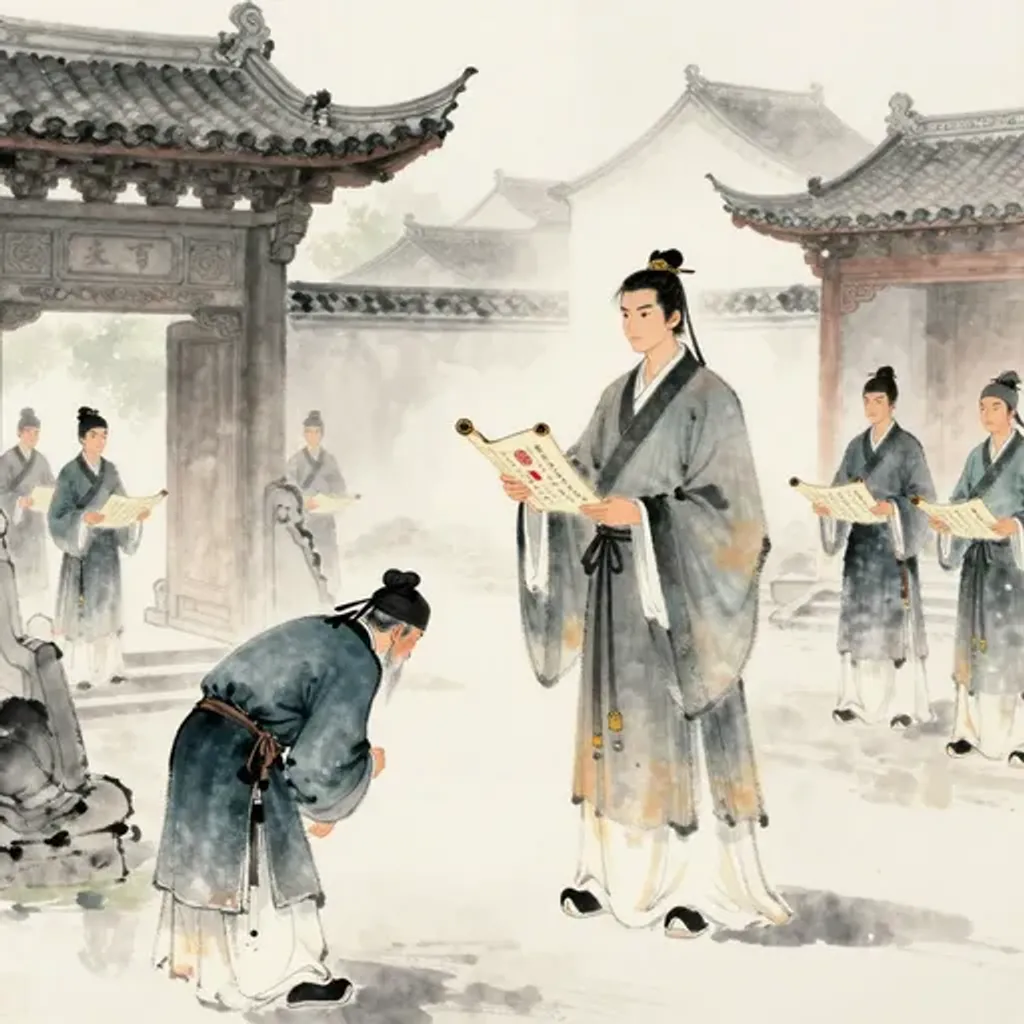
蒙被恩德,長大成就。柔順利貞,君臣合好。
Cloaked in grace and favor, grown to full achievement. Yielding and compliant, steadfast and true; lord and minister joined in harmony.
— Jiao Yanshou, Yilin (Forest of Changes), 1st century BC
Commentary
Wind moves beneath heaven, and an encounter ripens into enduring strength. One who is sheltered by grace in youth grows to full stature, achieving greatness through gentle compliance and correct conduct. The verse envisions a harmonious court where ruler and minister meet in mutual goodwill, each fulfilling their role. 'Soft and yielding, advantageous to be correct' echoes the Kun hexagram's counsel that receptivity, properly channeled, brings lasting gain. From Coming to Meet to the Creative, the transformation distills an initial, seemingly minor encounter into pure self-generating initiative: what began as wind's subtle penetration becomes heaven's ceaseless drive, converting a chance meeting into the foundation of enduring accomplishment.
姤 → 坤
Hexagram 44 → Hexagram 2: The Receptive
Changing lines: 2, 3, 4, 5, 6
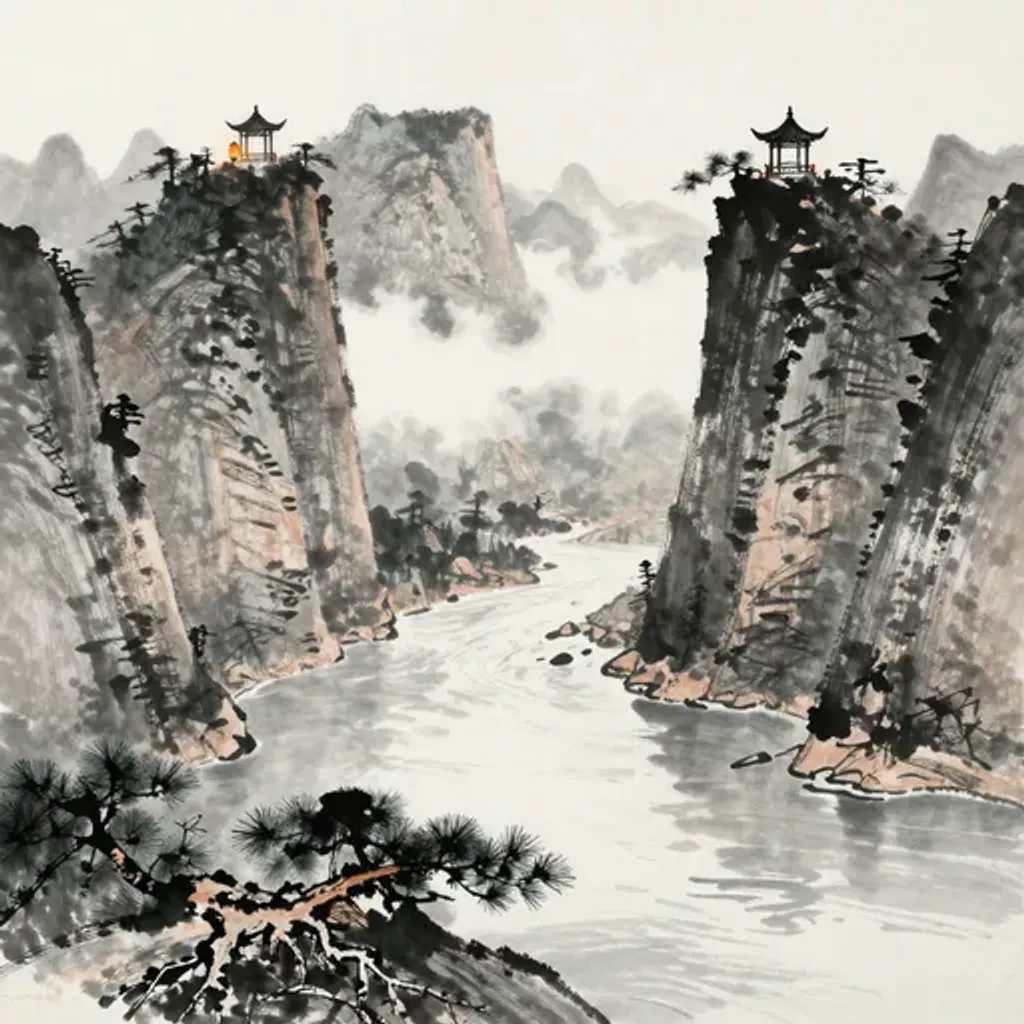
東山西山,各自止安。心雖相望,意不同堂。
East mountain, west mountain; each rests in its own place. Hearts gaze toward one another, yet thoughts dwell not in the same hall.
— Jiao Yanshou, Yilin (Forest of Changes), 1st century BC
Commentary
Wind beneath heaven carries proclamations far, yet mountains on opposite horizons remain forever apart. East Mountain and West Mountain each stand in their own stillness, and though hearts gaze toward one another across the distance, minds never share the same hall. The verse captures the ache of separation without hostility — not conflict, but irreconcilable distance. From Coming to Meet to the Receptive, the transformation reveals how an encounter dissolves into pure yielding earth: what began as heaven's wind reaching downward meets only the vast, passive expanse of earth that absorbs everything yet returns nothing. Longing persists, but no bridge forms between the two peaks.
姤 → 屯
Hexagram 44 → Hexagram 3: Difficulty at the Beginning
Changing lines: 1, 2, 3, 4, 6
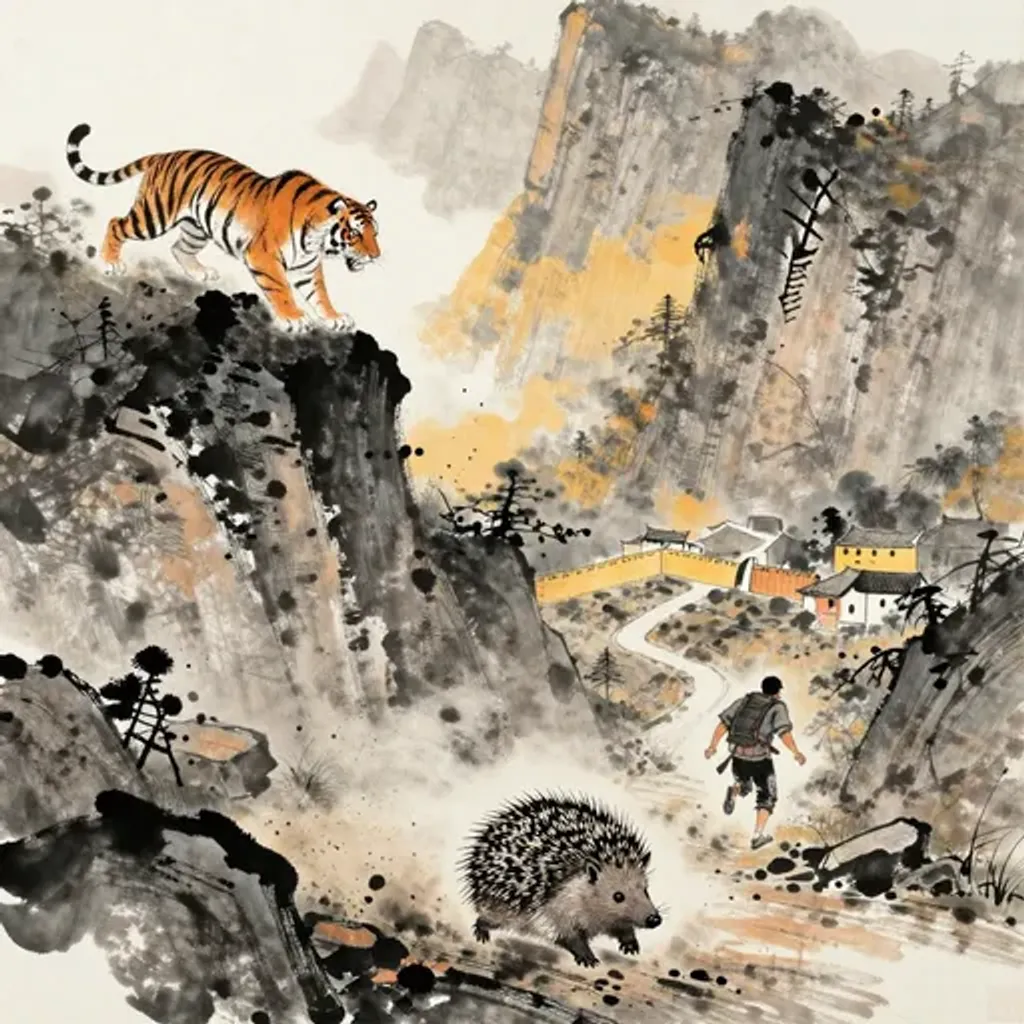
登山上谷,與虎相觸。猬為功曹,班叔奔北,脫之嘉國。
Climbing the mountain, entering the valley; encountering a tiger. The hedgehog serves as marshal; Ban Shu flees north, escaping to the good land.
— Jiao Yanshou, Yilin (Forest of Changes), 1st century BC
Commentary
Wind beneath heaven meets gathering storm clouds. Climbing the mountain into a high valley, one encounters a tiger head-on — mortal danger in wild terrain. Yet the hedgehog serves as Chief Clerk, pinning the beast down through bureaucratic cunning rather than brute force. Ban Shu flees northward and escapes to a safe refuge. The 'hedgehog as Gongcao' draws on natural lore from the Shiji: the spiny hedgehog can subdue even the tiger. The Gongcao was the most powerful local official in Han-era governance. From Coming to Meet to Difficulty at the Beginning, the clouds and thunder of Zhun signal that perilous encounters can be navigated through cleverness and institutional cunning, not raw strength.
姤 → 蒙
Hexagram 44 → Hexagram 4: Youthful Folly
Changing lines: 3, 4, 5
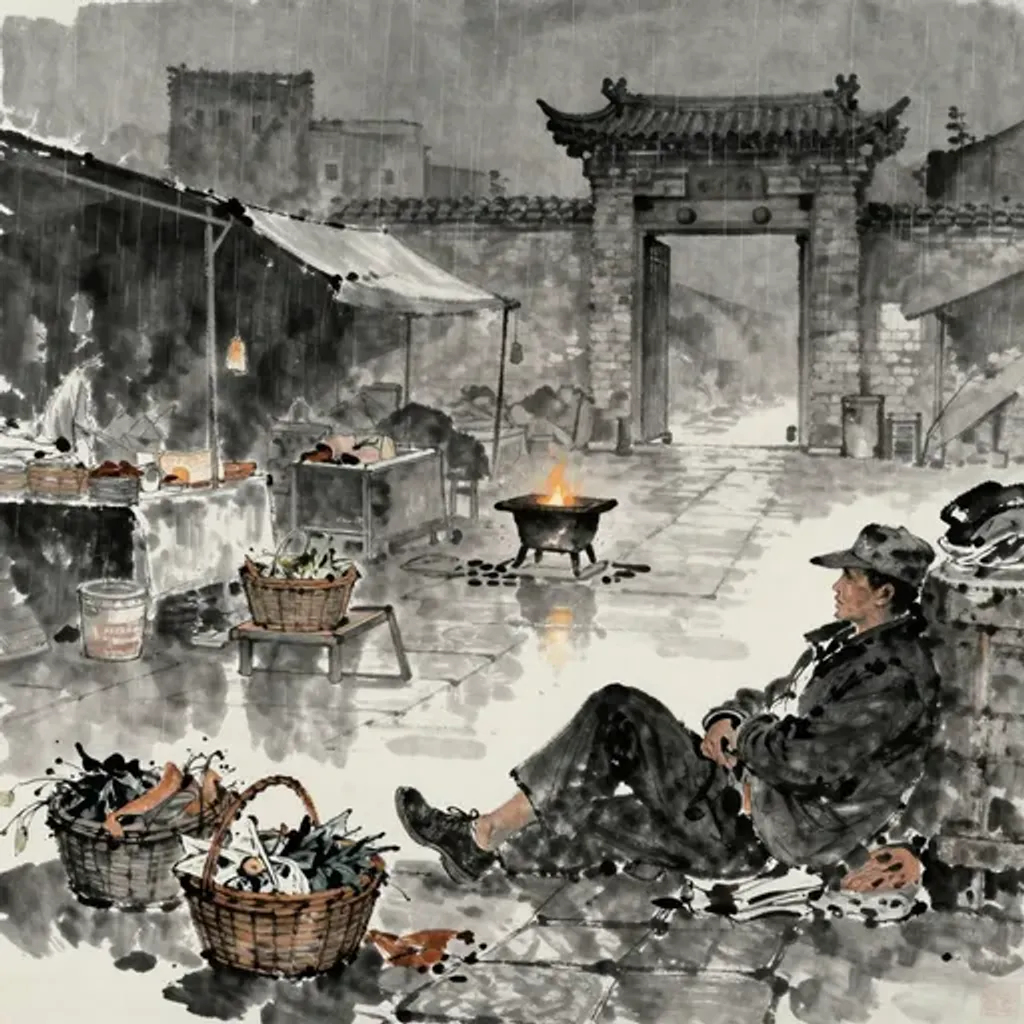
躓跛未起,失利後市。
Stumbling and lame, unable to rise; losing profit at the late market.
— Jiao Yanshou, Yilin (Forest of Changes), 1st century BC
Commentary
Wind beneath heaven encounters an obstacle before it can rise. One stumbles and falls lame, unable to stand; by the time recovery comes, the market has closed and the profit is lost. The verse paints a scene of missed timing with ruthless economy — a merchant too slow to seize opportunity. No allusion adorns the image; it is pure oracular directness. From Coming to Meet to Youthful Folly, the mountain looming above the spring traps the water below in confusion. The encounter that Gou initiates cannot mature when one is unprepared: folly is not stupidity but arriving at the crossroads already crippled, unable to act on what one sees.
姤 → 需
Hexagram 44 → Hexagram 5: Waiting
Changing lines: 1, 4, 6
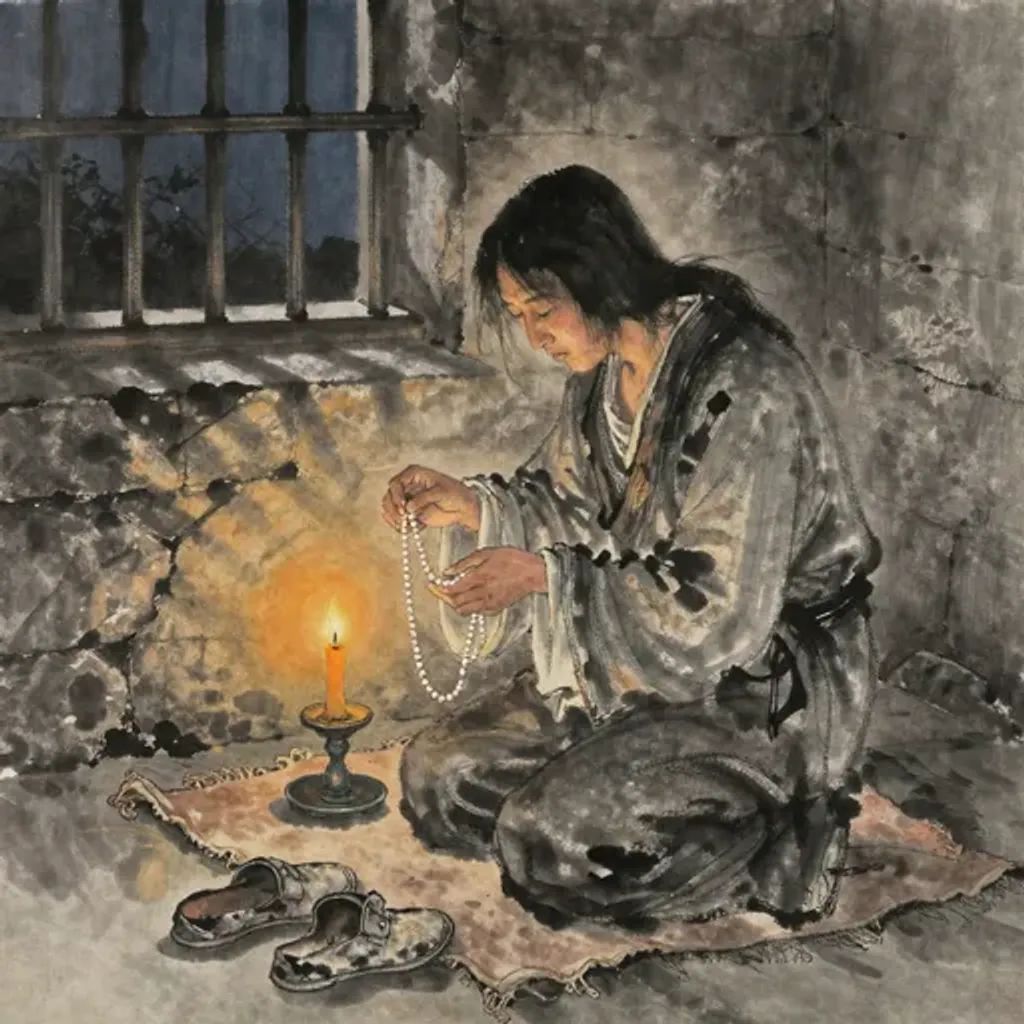
結珠懷履,卑斯以鬼,為君奴婢。
Stringing pearls, cherishing worn shoes; humbled thus by ghosts, made a slave to the lord.
— Jiao Yanshou, Yilin (Forest of Changes), 1st century BC
Commentary
Wind beneath heaven stirs, but what arrives is bondage, not blessing. Pearls are strung and shoes are worn at court, yet the one who carries them is debased by spirits and reduced to a slave. The verse depicts a figure bearing precious tokens of rank — jeweled ornaments and formal footwear — who is nonetheless dragged down into servitude. 'Lowered by ghosts' suggests supernatural misfortune or the machinations of unseen powers. From Coming to Meet to Waiting, clouds gather above heaven: one who waits under threat must endure without acting rashly. The encounter promised by Gou delivers not partnership but subjugation, and the only recourse is patient endurance until the danger passes overhead.
姤 → 訟
Hexagram 44 → Hexagram 6: Conflict
Changing lines: 3
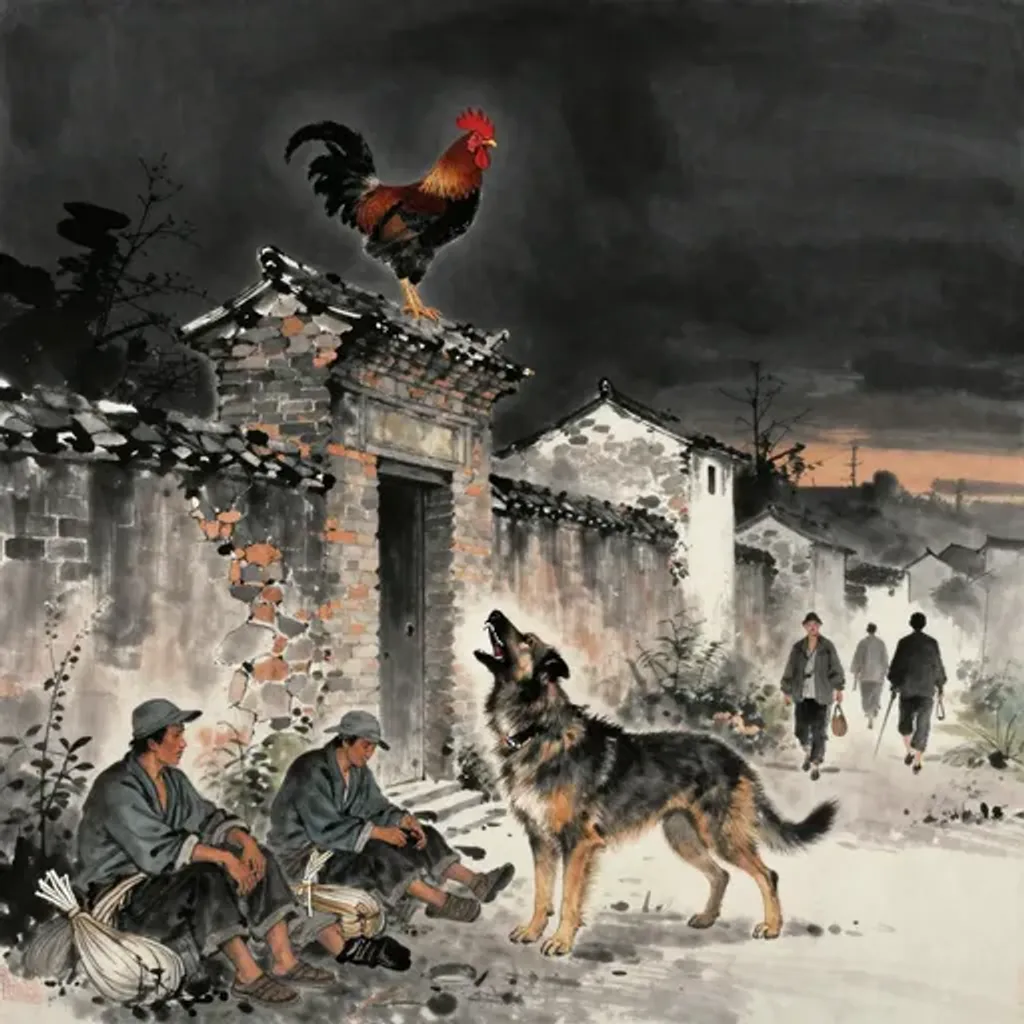
雞鳴失時,民僑勞苦。厖吠有威,行者留止。
The rooster crows out of season; the people toil in exile. The shaggy dog barks with menace; travelers halt in their tracks.
— Jiao Yanshou, Yilin (Forest of Changes), 1st century BC
Commentary
Wind beneath heaven carries confused signals. The rooster crows out of season and the people wander in weary toil, while a shaggy hound barks with such menace that travelers halt in their tracks. When the cock fails its duty as timekeeper, the entire social rhythm breaks down; when a fierce dog guards the road, honest passage becomes impossible. The verse layers two images of disordered authority — the false signal and the illegitimate gatekeeper. From Coming to Meet to Conflict, heaven and water move in opposite directions: the encounter that Gou promised turns adversarial, producing disputes where there should have been cooperation. What was meant to be a meeting becomes a standoff.
姤 → 師
Hexagram 44 → Hexagram 7: The Army
Changing lines: 3, 4, 5, 6
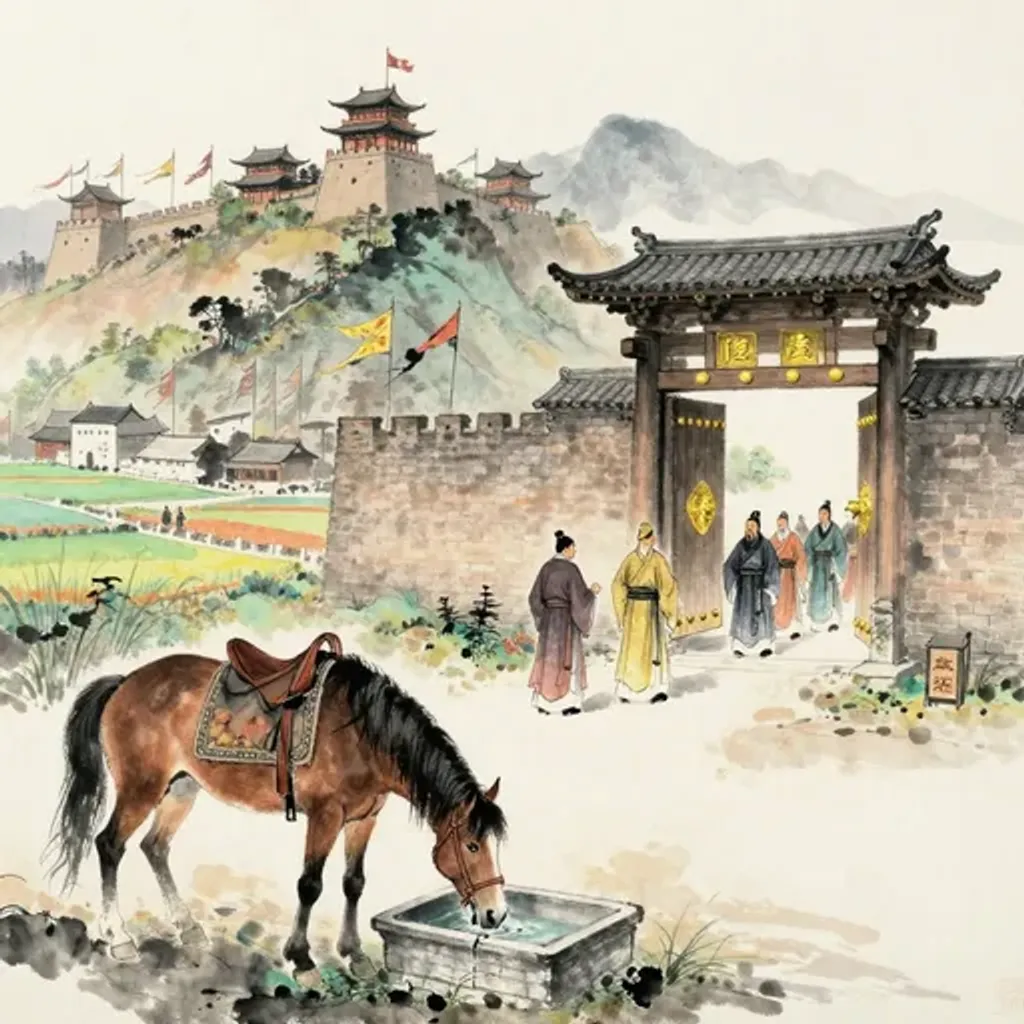
陳媯敬仲,示兆興姜。乃寓營丘,八世大昌。
Chen Gui Jingzhong revealed an omen to prosper the Jiang. He then sojourned at Yingqiu; for eight generations, great flourishing.
— Jiao Yanshou, Yilin (Forest of Changes), 1st century BC
Commentary
Wind beneath heaven carries a fateful encounter across generations. Chen Jingzhong, a minister of the state of Chen, fled to Qi around 672 BC bearing an omen that his descendants would one day thrive through the Jiang clan. He settled at Yingqiu, the ancient Qi capital, and his lineage — the Tian family — prospered for eight generations until they formally replaced the Jiang rulers in 386 BC. The verse reads like a dynastic prophecy fulfilled: a chance refuge becomes the seedbed of revolution. From Coming to Meet to The Army, the encounter crystallizes into disciplined, organized power: earth contains water as a ruler contains his people, and what begins as one man's flight ends as a clan's marshaled conquest of an entire state.
姤 → 比
Hexagram 44 → Hexagram 8: Holding Together
Changing lines: 2, 3, 4, 6
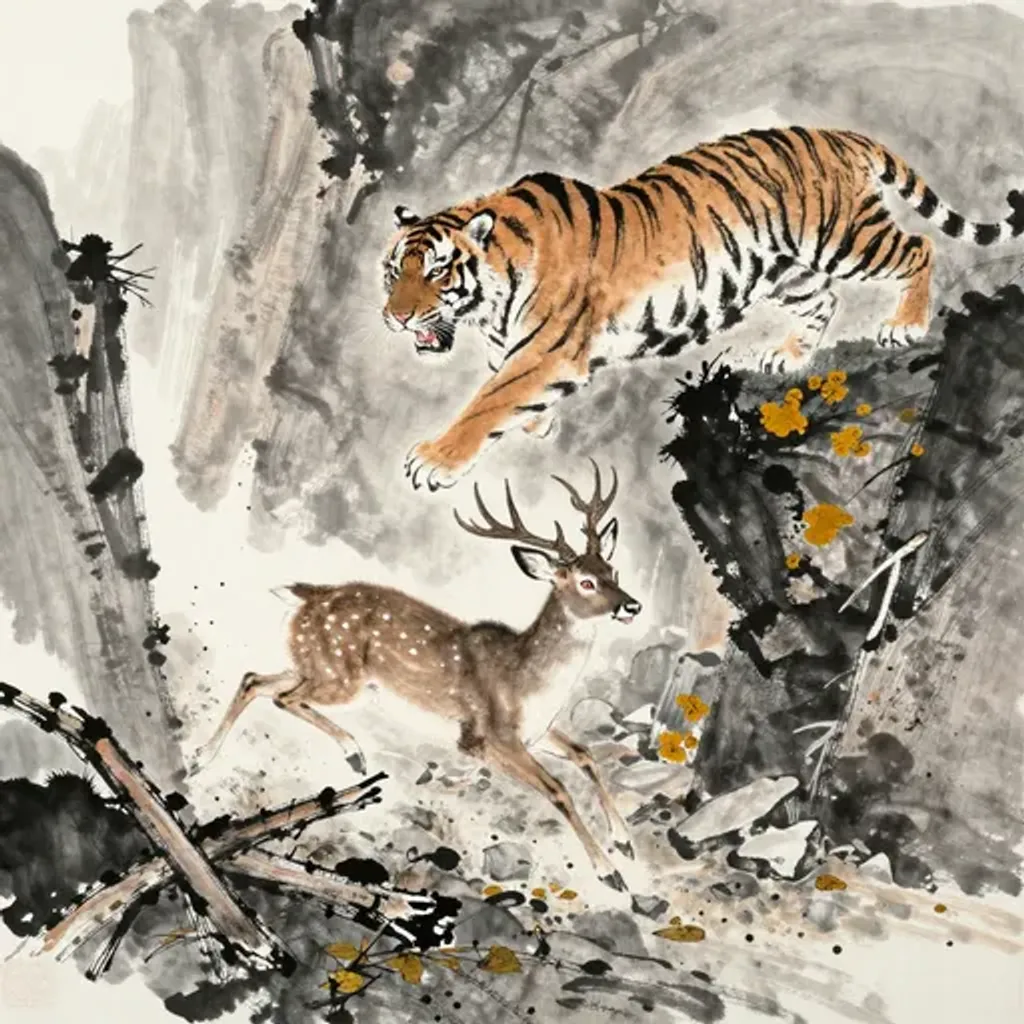
鹿畏人匿,俱入深谷。短命不長,為虎所得,死於牙腹。
The deer, fearing men, hides; both plunge into the deep valley. Its life cut short; seized by the tiger, it dies between fang and belly.
— Jiao Yanshou, Yilin (Forest of Changes), 1st century BC
Commentary
Wind beneath heaven flushes prey from cover. A deer, frightened by human presence, plunges deep into a mountain valley seeking refuge — but its short life finds no safety there. The tiger waits in the ravine, and the deer dies between fang and belly. The encounter that Gou initiates here is fatal: fleeing one danger drives the creature straight into another. From Coming to Meet to Holding Together, water upon earth suggests natural bonding — yet this is the dark inversion, where predator and prey are 'held together' in the intimacy of the kill. The verse warns that panic-driven flight without discernment merely exchanges one peril for a worse one.
姤 → 小畜
Hexagram 44 → Hexagram 9: Small Taming
Changing lines: 1, 4
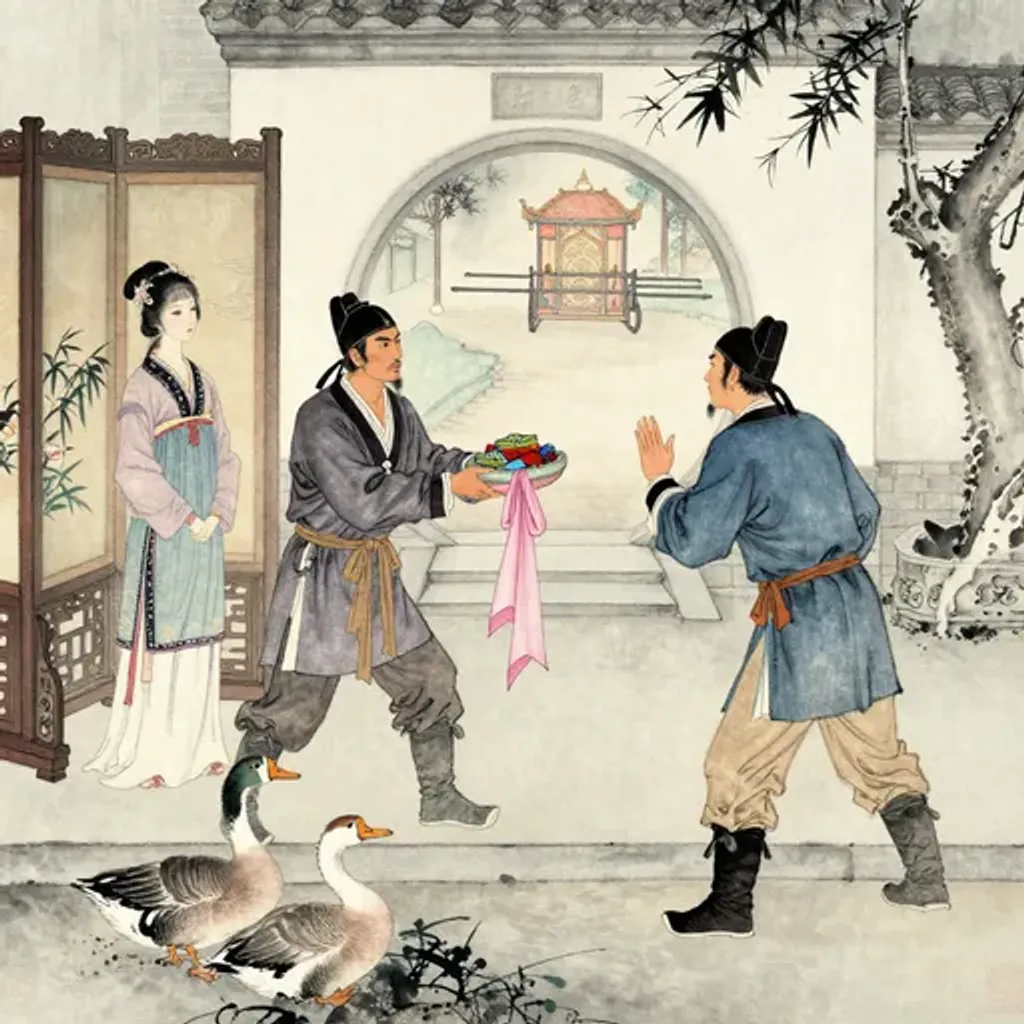
言无約結,不成契劵。殷叔季女,公孫爭之,強入委禽,不悅於心,乃適子南。
Words without binding agreement form no contract. The youngest daughter of Yin; the lords contend for her. Forcing entry with betrothal geese, she is not pleased at heart, and so weds the son of Nan.
— Jiao Yanshou, Yilin (Forest of Changes), 1st century BC
Commentary
Wind beneath heaven stirs a tangled courtship. Words spoken lack binding force and no contract is sealed. The verse alludes to a Spring and Autumn succession dispute: a daughter of the Yin clan's junior branch is fought over by nobles; one forces the betrothal gifts upon her household, but her heart is unwilling, and she ultimately goes to Zinan instead. The story, recorded in the Zuo Zhuan, illustrates how coerced unions breed only resentment. From Coming to Meet to Small Taming, wind rides above heaven — gentle restraint over great force. Yet here the restraint fails: what should have been a cultivated courtship degenerates into an abduction that the weak wind of propriety cannot contain.
姤 → 履
Hexagram 44 → Hexagram 10: Treading
Changing lines: 1, 3
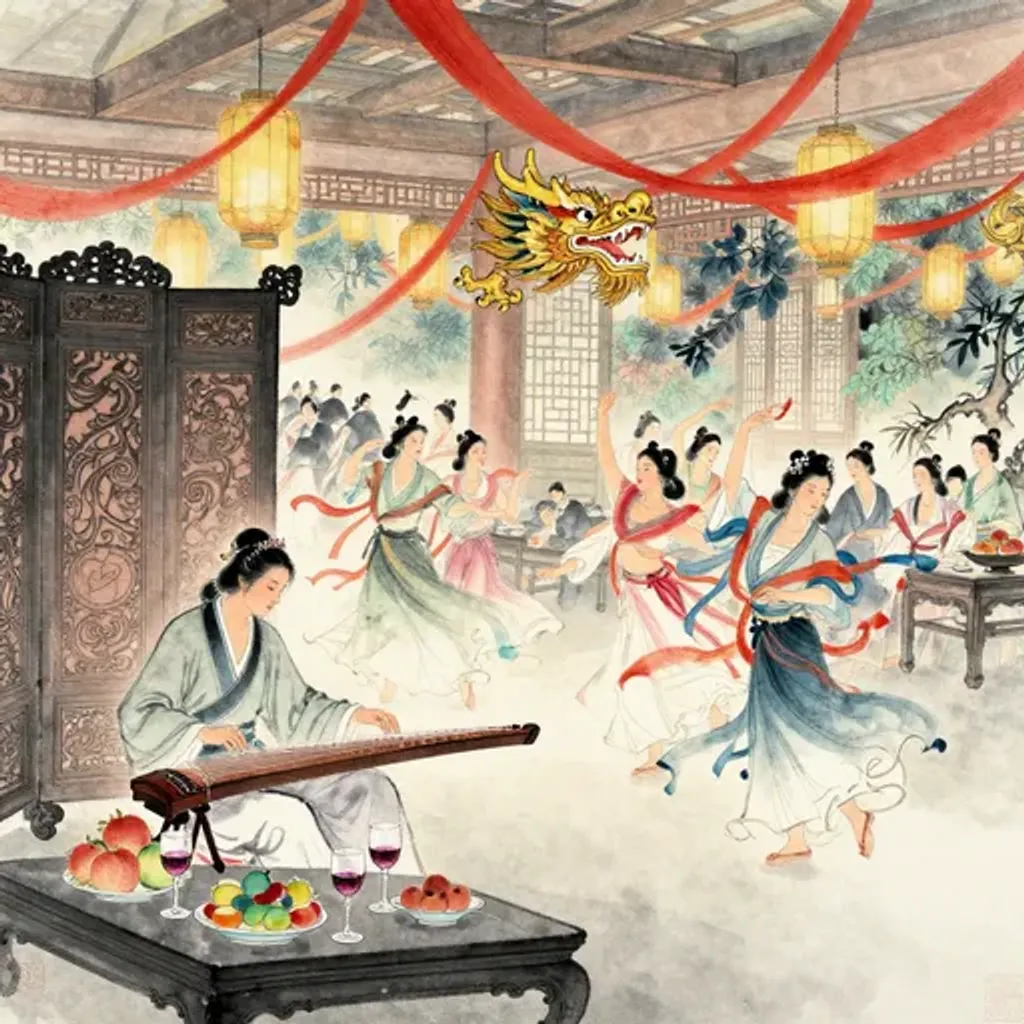
鼓瑟歌舞,懽遺於酒。龍喜張口,大喜在後。
Plucking the zither, singing and dancing; joy poured forth in wine. The dragon delights and opens its mouth; great happiness lies ahead.
— Jiao Yanshou, Yilin (Forest of Changes), 1st century BC
Commentary
Wind beneath heaven announces a celebration. Drums and zithers sound, songs and dances swirl, and joy overflows into wine. A dragon opens its mouth in delight — an omen of coming grandeur. The verse is pure festivity, each image layered upon the last: music, dance, wine, the dragon's gaping smile, and the promise that the greatest happiness lies still ahead. From Coming to Meet to Treading, heaven stands above the lake, establishing proper hierarchy through joyful compliance. The encounter of Gou here delivers its brightest promise: one steps carefully upon the tiger's tail and the tiger does not bite, for this is a moment when heaven and earth align in shared celebration.
姤 → 泰
Hexagram 44 → Hexagram 11: Peace
Changing lines: 1, 4, 5, 6
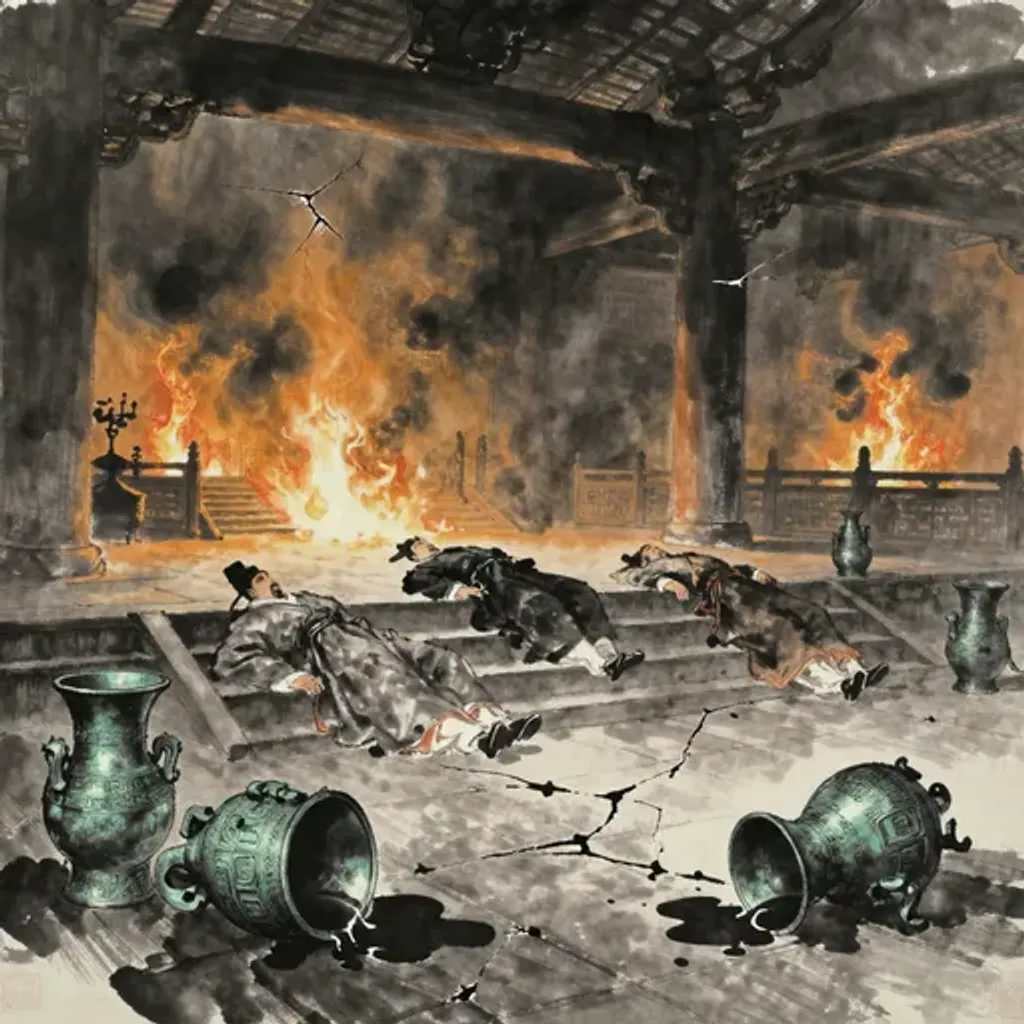
凶憂災殃,日益章明。禍不可救,三郤夷傷。
Dire woe and calamity grow clearer by the day. Disaster cannot be averted; the three Xi are slain and ruined.
— Jiao Yanshou, Yilin (Forest of Changes), 1st century BC
Commentary
Wind beneath heaven carries not glad tidings but gathering calamity. Misfortune and disaster grow more visible day by day, and the ruin proves beyond rescue. The verse names the Three Xi — three powerful ministers of the Xi clan in Jin whose combined wealth rivaled the ducal treasury and whose military power equaled half the state's armies. Their unchecked arrogance provoked Duke Li of Jin to orchestrate their assassination around 573 BC. From Coming to Meet to Peace, earth and heaven exchange places in seeming harmony, yet the verse inverts this: what appears to be a smooth encounter conceals a lethal power imbalance. The Three Xi met their ruler's hospitality and found only slaughter.
姤 → 否
Hexagram 44 → Hexagram 12: Standstill
Changing lines: 2, 3
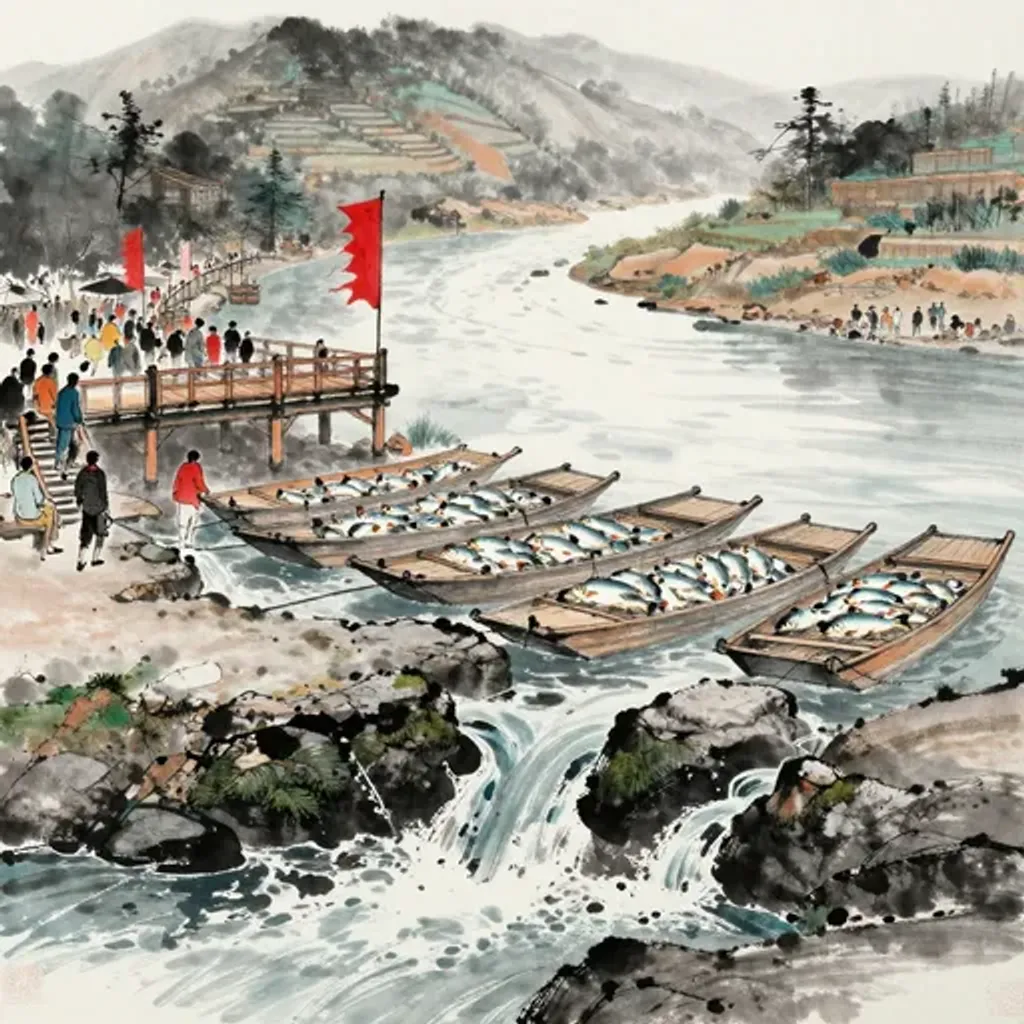
水流趍下,遂成東海。求我所有,買鱣與鯉。
Small streams merge into rivers, rivers merge into the great river — never resting day or night, flowing east. Boats carry a thousand loads of fish and shrimp — the wharf is as noisy as a bustling market.
— Jiao Yanshou, Yilin (Forest of Changes), 1st century BC
Commentary
Wind beneath heaven encounters earth's stubborn closure. This verse is a rewrite; the original reads: 'Water flows downward, finally forming the eastern sea. Seek what I possess — buy sturgeon and carp.' Streams converge into rivers, rivers into the sea, following nature's inevitable course. The imagery is commercial abundance: one who possesses fish for sale meets eager buyers. Yet from Coming to Meet to Standstill, heaven and earth refuse to mingle. The natural flow described in the verse meets a cosmic blockage — abundance exists, but the channels of exchange are severed. What should circulate freely is trapped behind the wall of heaven's withdrawal from earth.
姤 → 同人
Hexagram 44 → Hexagram 13: Fellowship
Changing lines: 1, 2
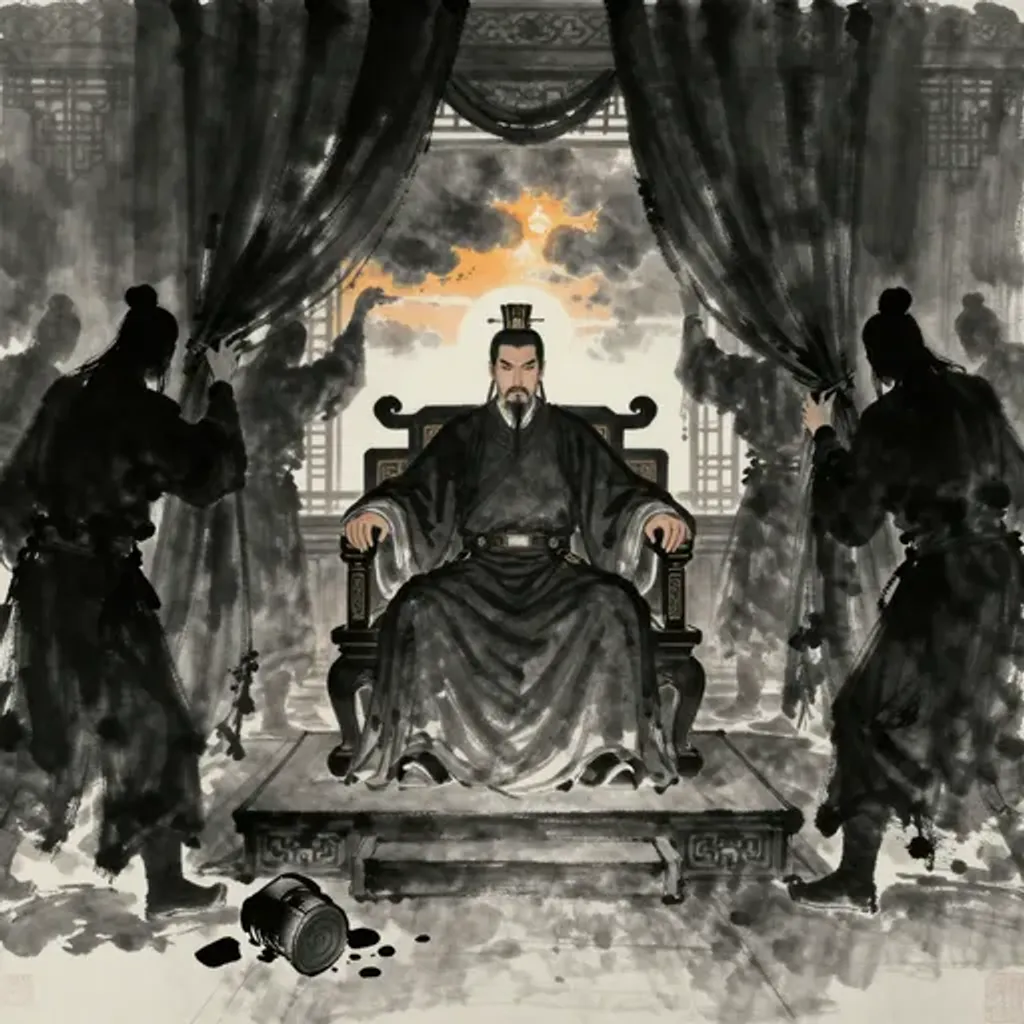
陰為陽賊,君不能剋。舉動失常,利无所得。
Yin is the thief of yang; the lord cannot prevail. Actions lose their proper order; profit is nowhere to be found.
— Jiao Yanshou, Yilin (Forest of Changes), 1st century BC
Commentary
Wind beneath heaven is subverted from within. Yin acts as yang's saboteur, and the ruler cannot overcome the inversion. Every action deviates from the norm, and no advantage can be gained. The verse articulates a core concern of hexagram 44: the single yin line entering from below threatens to undermine the five yang lines above. When the feminine principle becomes predatory rather than receptive, the entire structure of governance loses coherence. From Coming to Meet to Fellowship, heaven and fire blaze together — yet the fellowship here is ironic, for how can like-minded unity form when the enemy wears a friend's face? The encounter delivers a Trojan horse.
姤 → 大有
Hexagram 44 → Hexagram 14: Great Possession
Changing lines: 1, 5
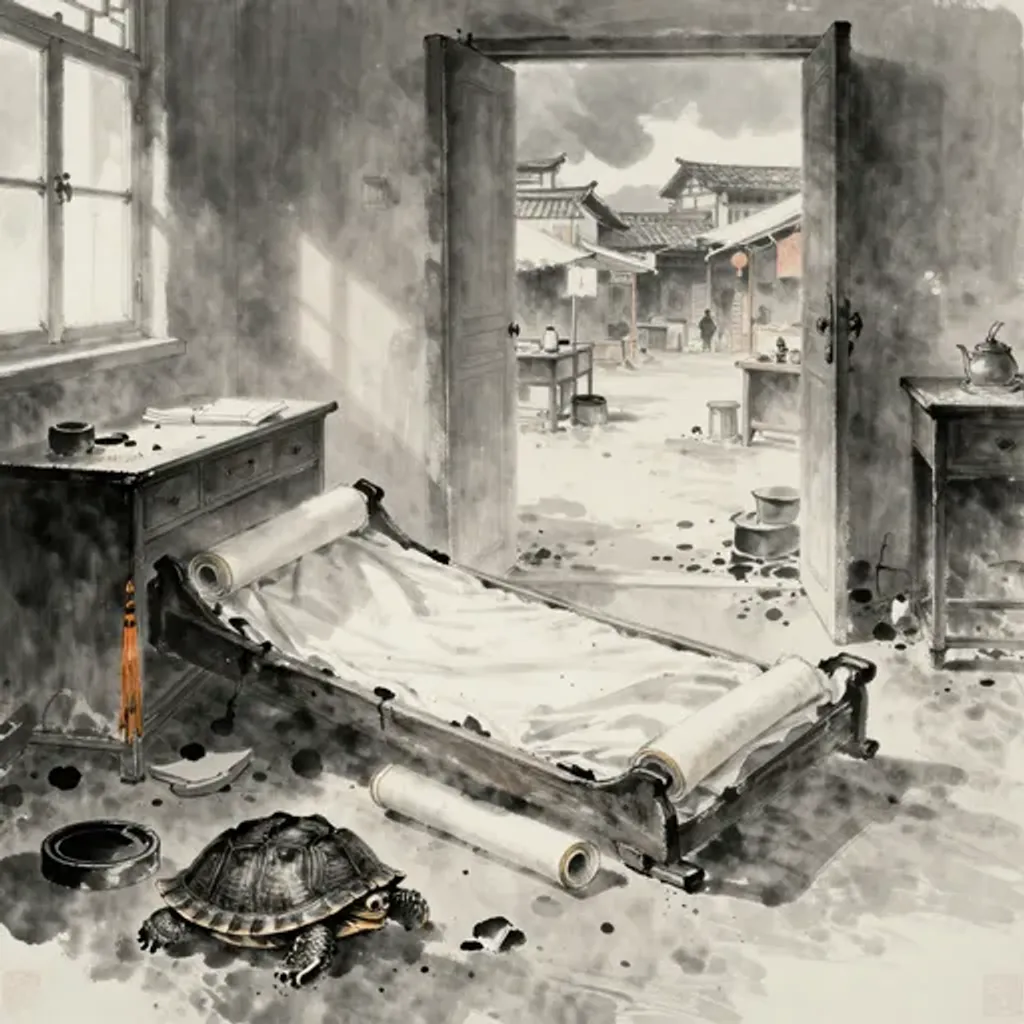
離床失案,龜喪其願。都市无會,叔季懷恨。
Leaving the bed, losing the desk; the tortoise forfeits its wish. The city market holds no gathering; the youngest brothers harbor resentment.
— Jiao Yanshou, Yilin (Forest of Changes), 1st century BC
Commentary
Wind beneath heaven topples what was secure. The bed is lost, the desk overturned; the tortoise oracle forfeits its wish. Markets in the capital hold no gatherings, and the younger generation harbors resentment. Every image speaks of disruption and unfulfilled expectation — furniture displaced, divination failed, commerce stalled, family bonds strained. From Coming to Meet to Great Possession, fire blazes above heaven in supreme brilliance, yet the verse inverts this radiance: what should be a grand meeting of abundant resources instead scatters and embitters. The encounter promised by Gou delivers disorder rather than union, and even the sacred turtle cannot divine a way forward.
姤 → 謙
Hexagram 44 → Hexagram 15: Modesty
Changing lines: 2, 4, 5, 6
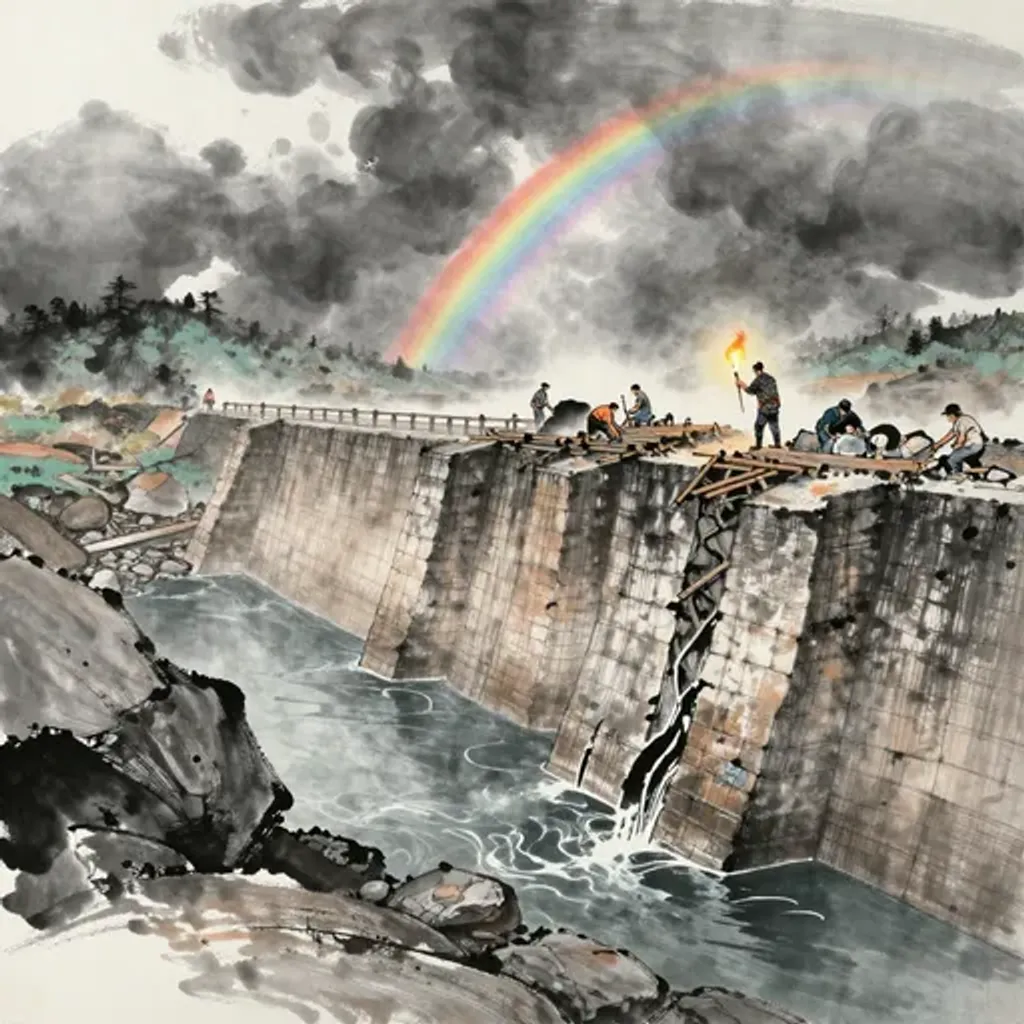
壅遏隄防,水不得行。火慎陽光,陰霓伏藏,走歸其鄉。
Blocked by dike and dam, the water cannot flow. Fire heeds the sun's light; dark mist hides in concealment, fleeing home to its own place.
— Jiao Yanshou, Yilin (Forest of Changes), 1st century BC
Commentary
Wind beneath heaven meets an embankment that blocks its flow. Dams and dikes hold the water back, denying it passage. Fire's bright yang energy is guarded against, while dark mists crouch hidden, eventually fleeing homeward. The verse layers images of containment and concealment: water dammed, fire watched, yin energy crouching low and ultimately retreating. From Coming to Meet to Modesty, the mountain hidden within the earth embodies precisely this dynamic — great power concealed beneath a humble surface. The encounter of Gou is met with deliberate restraint: the yin force that entered is channeled, blocked, and sent back whence it came, all without violence, through the quiet architecture of limits.
姤 → 豫
Hexagram 44 → Hexagram 16: Enthusiasm
Changing lines: 2, 3, 5, 6
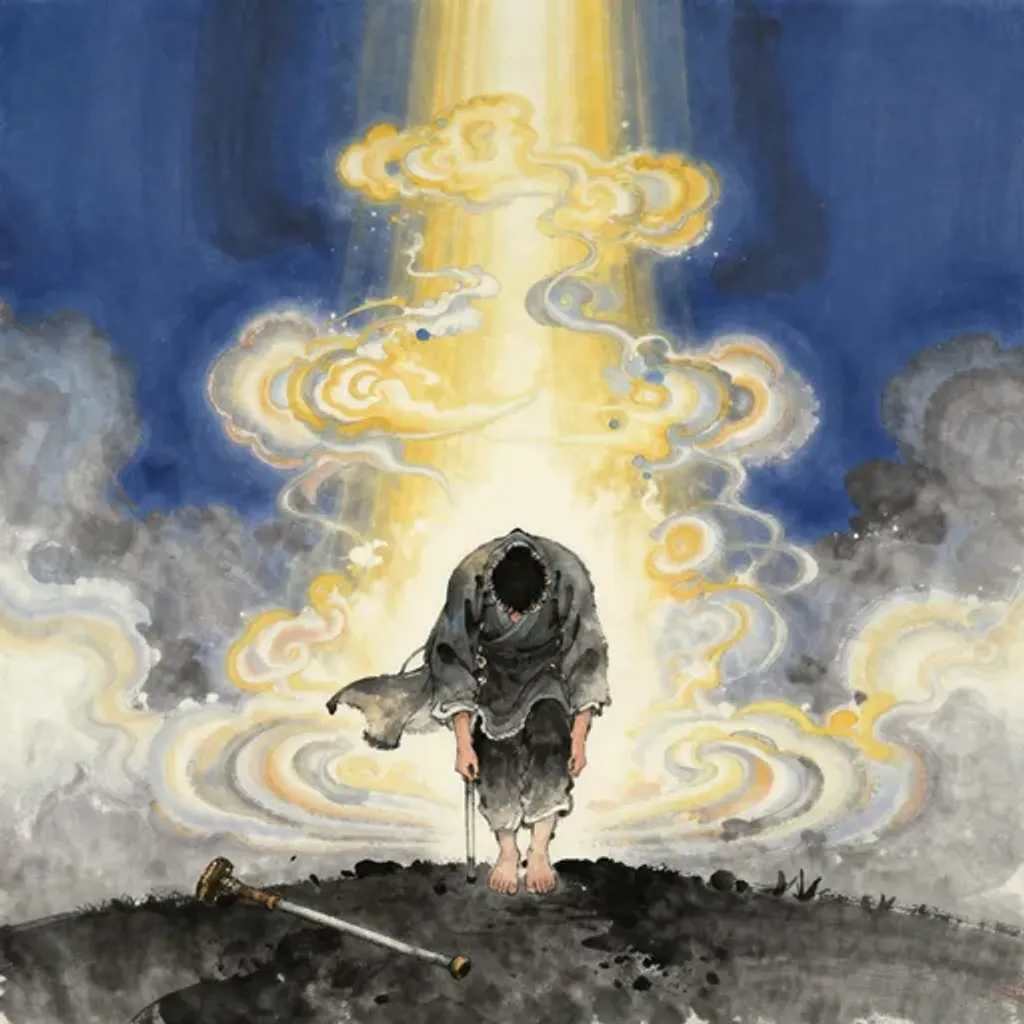
躄屈復伸,本乘浮雲,貴寵毋前。
The crippled one bends, then stretches again; rising at last to ride the drifting clouds. Honor and favor lie no further ahead.
— Jiao Yanshou, Yilin (Forest of Changes), 1st century BC
Commentary
Wind beneath heaven bends low and then springs back. The crippled leg straightens and extends again; what was earthbound now rides the floating clouds. Yet the verse counsels restraint: 'Do not press your favor forward.' One who has been bent by misfortune and now soars must remember that the clouds are borrowed, not owned. From Coming to Meet to Enthusiasm, thunder erupts from the earth in exuberant release — the energy that was compressed now bursts forth. But Gou's warning persists: the yin line's encounter with power is intoxicating, and enthusiasm unchecked by prudence becomes recklessness. Rise, but do not overreach.
姤 → 隨
Hexagram 44 → Hexagram 17: Following
Changing lines: 1, 2, 3, 6
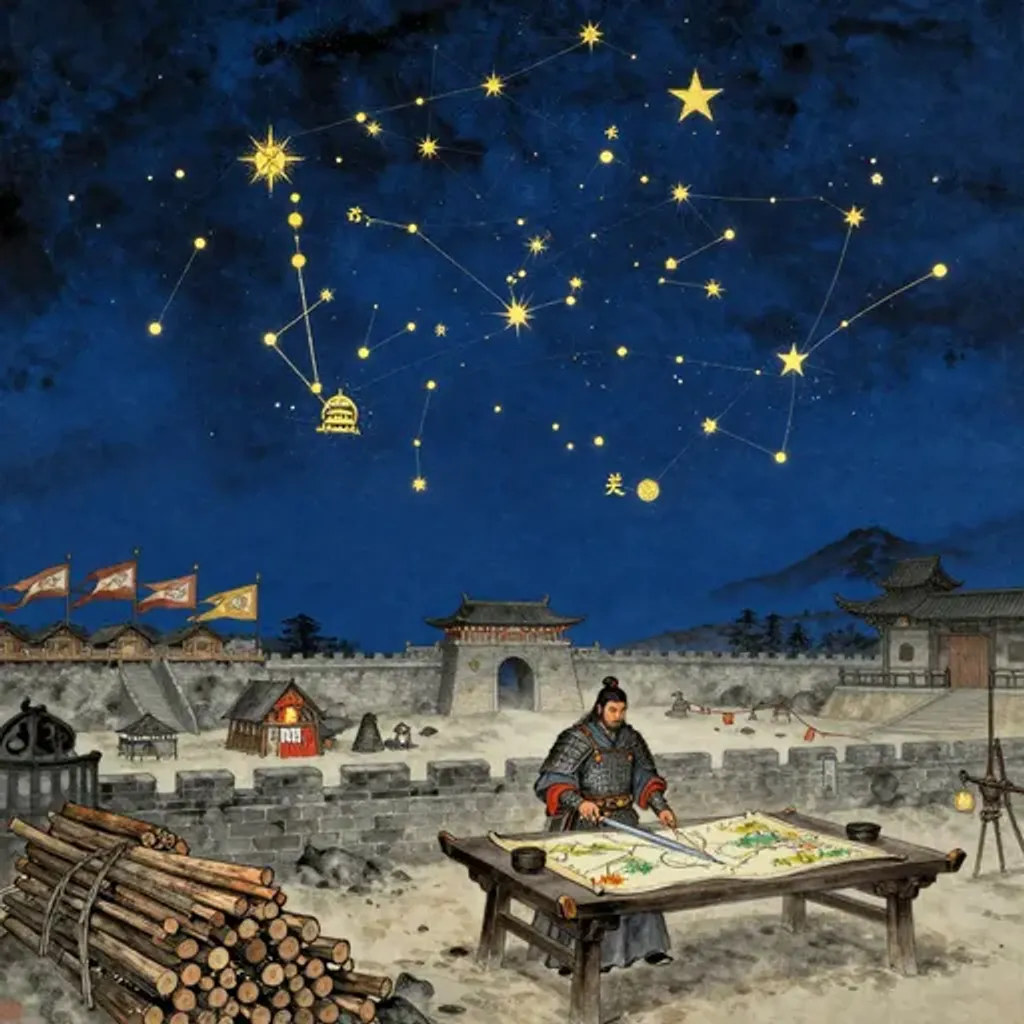
實沉參虛,以義斷割。次陸服薪,成我霸功。
Shi Chen sinks, Shen is void; by righteousness he cuts and divides. Ci Lu gathers firewood; accomplishing our hegemony.
— Jiao Yanshou, Yilin (Forest of Changes), 1st century BC
Commentary
Wind beneath heaven aligns the constellations of statecraft. 'Shichen and Canxu' refer to the lodging stars of the ancient states of Tang (later Jin) and Shang (later Song) — two stellar fields that, according to the Zuo Zhuan, were assigned to warring brothers and could never share the same sky. The verse invokes righteous judgment to cut through inherited enmity, then pivots to 'gathering firewood at the secondary encampment' and achieving hegemonic success. From Coming to Meet to Following, thunder rests within the lake: the leader who commands loyalty does so by adapting to circumstances, following the moment rather than forcing it. The encounter produces not conflict but strategic alignment.
姤 → 蠱
Hexagram 44 → Hexagram 18: Work on the Decayed
Changing lines: 4, 5
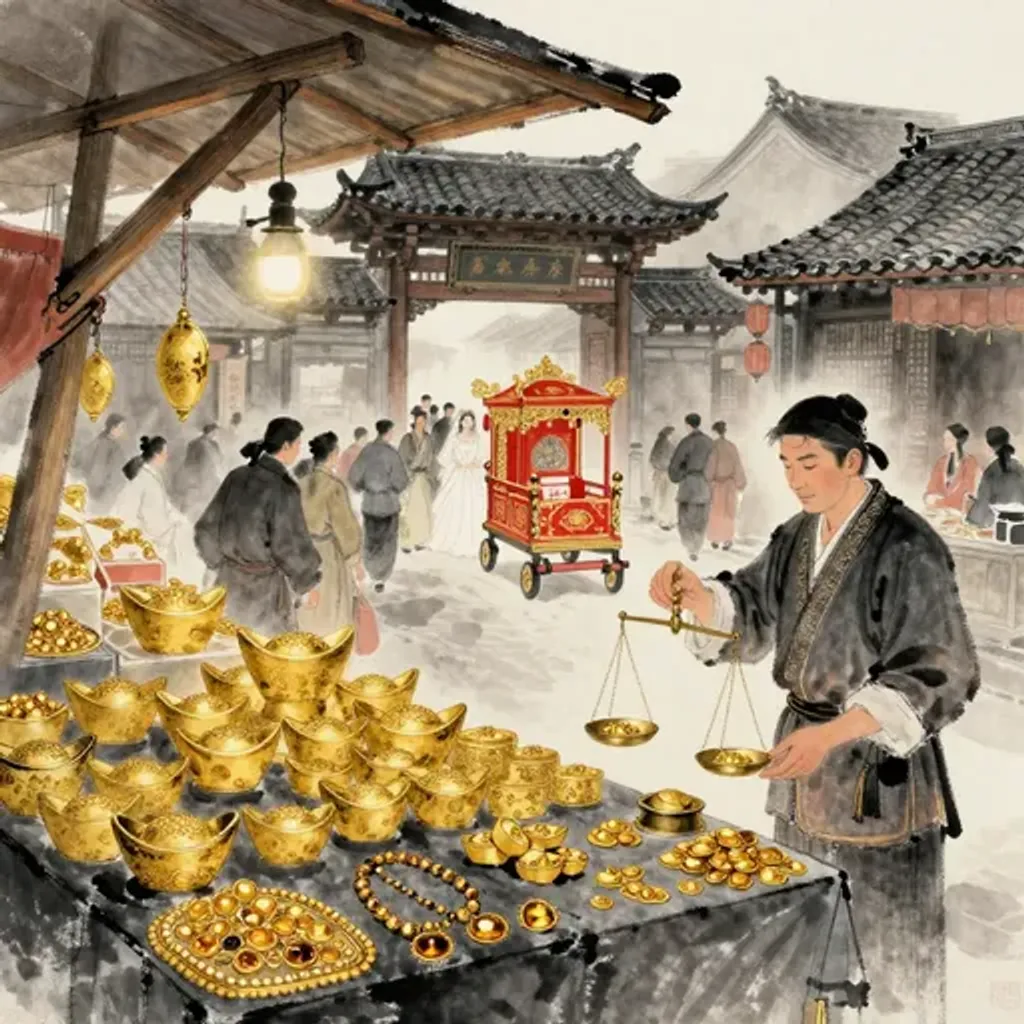
金泉黃寶,宜與我市。娶嫁有息,利得過母。
Golden springs and yellow treasure, fit for my trading. Marriage brings offspring; profit exceeds the mother's.
— Jiao Yanshou, Yilin (Forest of Changes), 1st century BC
Commentary
Wind beneath heaven blows across a prosperous marketplace. Golden springs and yellow treasures are fit for trading; marriage produces offspring, and the profit exceeds the mother's original investment. The verse brims with material abundance and generative increase — precious metals, thriving commerce, fertile unions. Every line points toward multiplication of what one already holds. From Coming to Meet to Work on the Decayed, wind stirs beneath the mountain, ventilating what has grown stale. The encounter of Gou here initiates renewal through exchange: old goods are traded for fresh value, new marriages revitalize aging households. What was decaying is restored through the circulation of wealth and life.
姤 → 臨
Hexagram 44 → Hexagram 19: Approach
Changing lines: 1, 3, 4, 5, 6
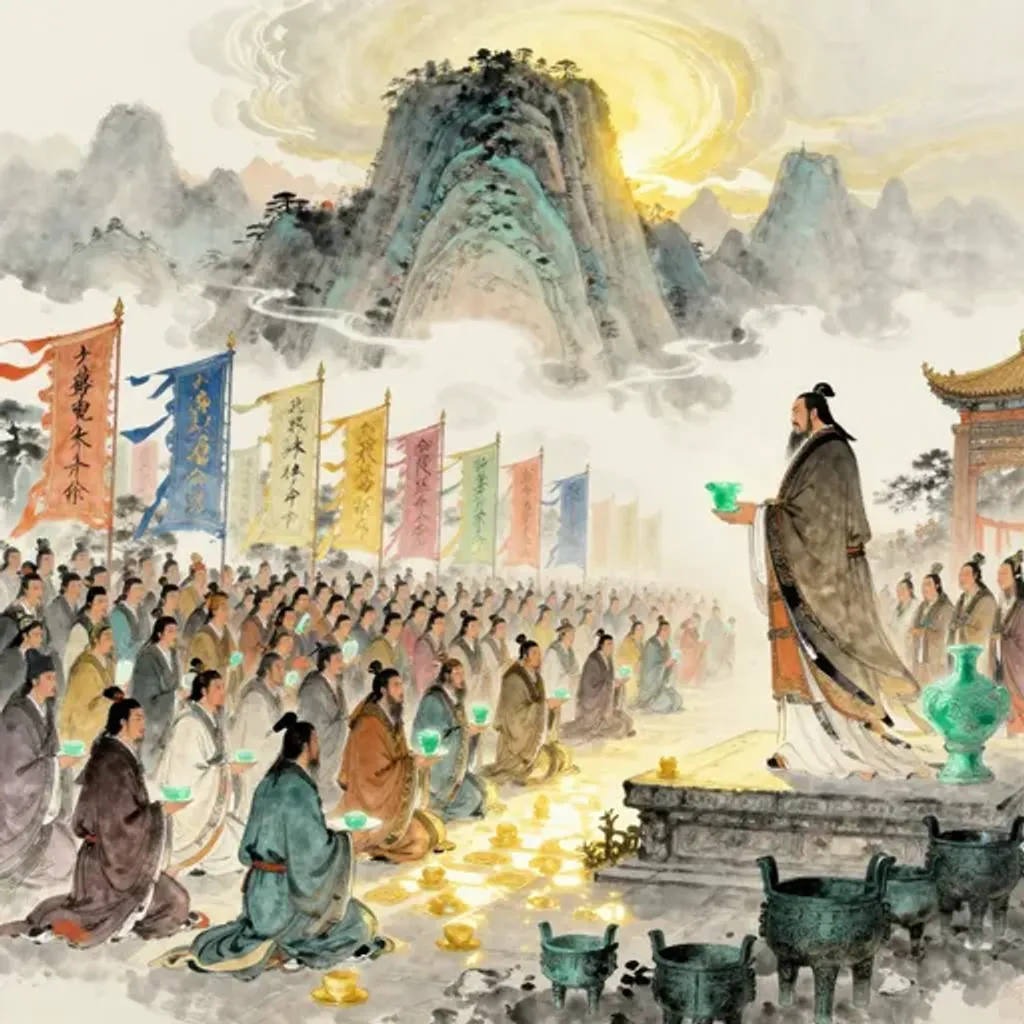
禹召諸侯,會稽南山。執玉萬國,天下康寧。
Yu summoned the lords to assemble at Kuaiji, the southern mountain. Ten thousand states bearing jade; all under heaven at peace.
— Jiao Yanshou, Yilin (Forest of Changes), 1st century BC
Commentary
Wind beneath heaven gathers the lords of ten thousand states. Yu the Great summons the feudal lords to an assembly at Mount Kuaiji, where each presents jade tributes in token of allegiance, and the realm is blessed with lasting peace. This iconic scene recalls the legendary Kuaiji Assembly where Yu demonstrated his mandate by drawing all the lords of the known world to one place through moral authority alone. From Coming to Meet to Approach, earth above the lake draws near with inexorable gentleness — the ruler approaches his people not by force but by gravitational virtue. The encounter initiated by Gou becomes a universal gathering: what begins as heaven's wind issuing a proclamation ends as the entire world converging in voluntary submission.
姤 → 觀
Hexagram 44 → Hexagram 20: Contemplation
Changing lines: 2, 3, 4
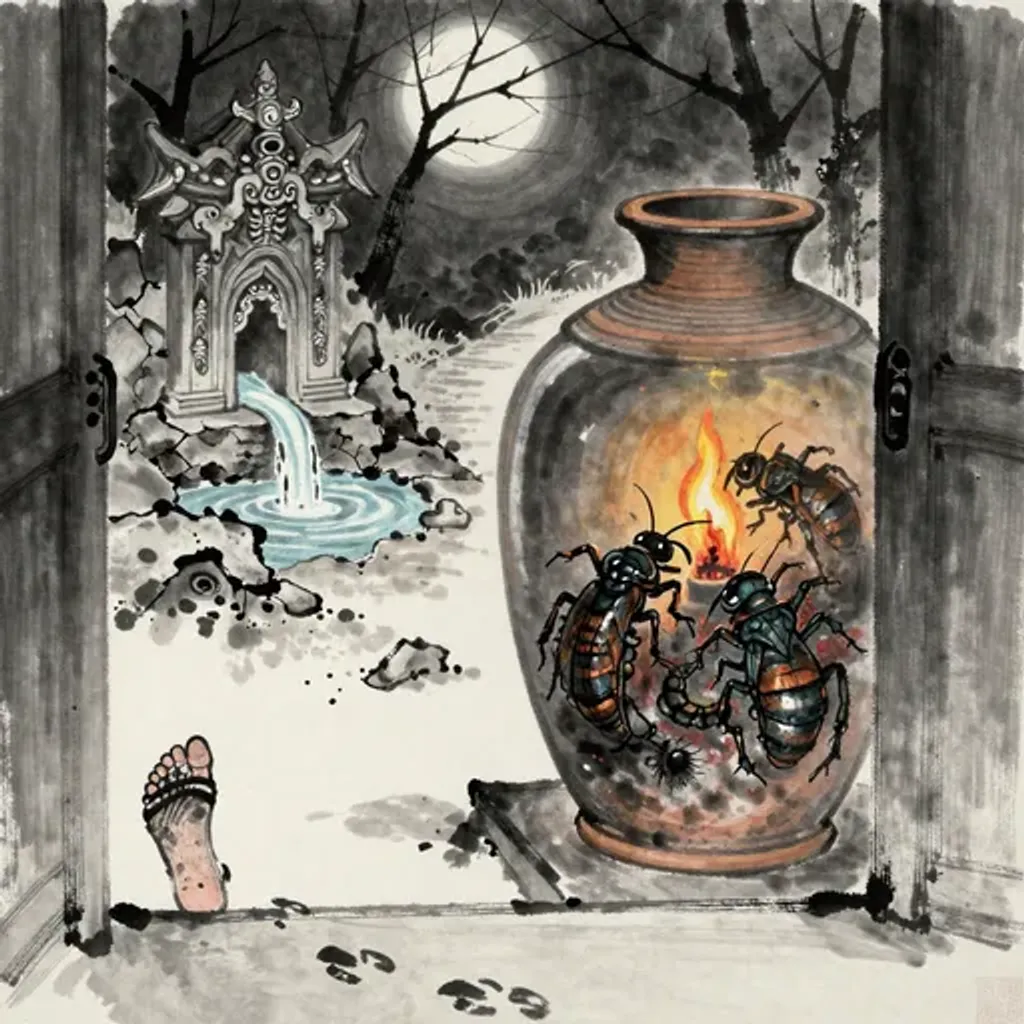
三䖝作蠱,踐跡无與。勝母盜泉,君子不處。
Three insects breed poison; one treads the path but finds no companion. Sheng Mu, Dao Quan: the noble man does not dwell there.
— Jiao Yanshou, Yilin (Forest of Changes), 1st century BC
Commentary
Wind beneath heaven reveals corruption beneath the surface. Three venomous creatures breed gu-poison, and the path one walks leaves no worthy companions. The verse then invokes a famous double allusion: a gentleman will not enter a hamlet called 'Overcoming-Mother' nor drink from a spring called 'Robber's Spring' — places whose inauspicious names alone are enough to repel the virtuous. The pairing of gu-sorcery with the Shengmu-Daoquan allusion warns that certain encounters are contaminated at the root: no good can come from association with them. From Coming to Meet to Contemplation, wind moves across the earth observing all: the sage surveys the moral landscape and knows which paths to avoid entirely.
姤 → 噬嗑
Hexagram 44 → Hexagram 21: Biting Through
Changing lines: 1, 2, 3, 5
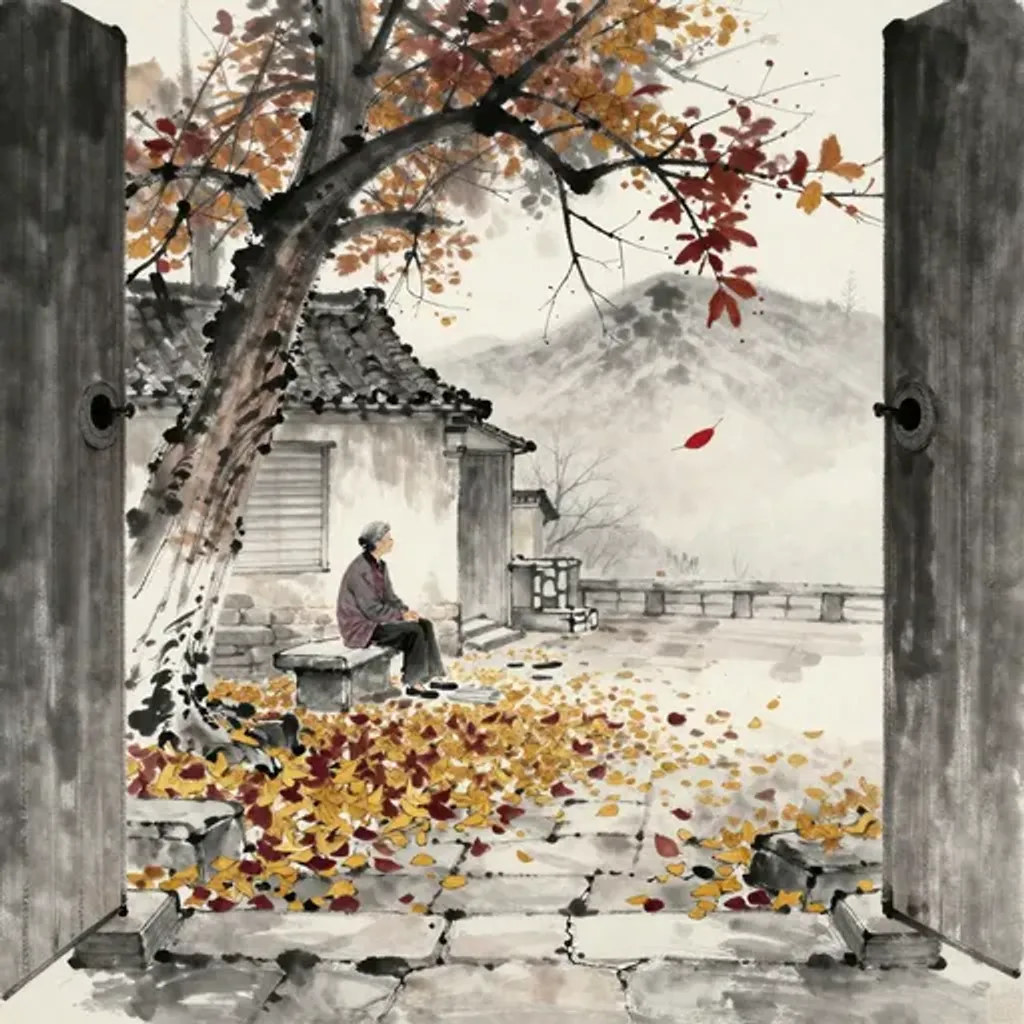
花葉墮落,公歸嫗宅。夷子失民,潔白不食。
Flowers and leaves fall away; the lord returns to the old woman's house. Yi Zi loses the people; pure and white, he does not eat.
— Jiao Yanshou, Yilin (Forest of Changes), 1st century BC
Commentary
Wind beneath heaven strips the branches bare. Flowers and leaves fall away as the lord returns to the old woman's dwelling — an image of retreat to humble origins after the splendor fades. 'Yi Zi lost his people; pure and white, he would not eat' evokes a figure of principled refusal, one who starves rather than compromise integrity. The autumn imagery of falling petals signals the end of a cycle. From Coming to Meet to Biting Through, fire and thunder deliver swift justice: what Gou's encounter exposed as rotten must now be cut through decisively. The falling leaves are not mourned but cleared away so that what remains is honest and unadorned.
姤 → 賁
Hexagram 44 → Hexagram 22: Grace
Changing lines: 1, 2, 4, 5
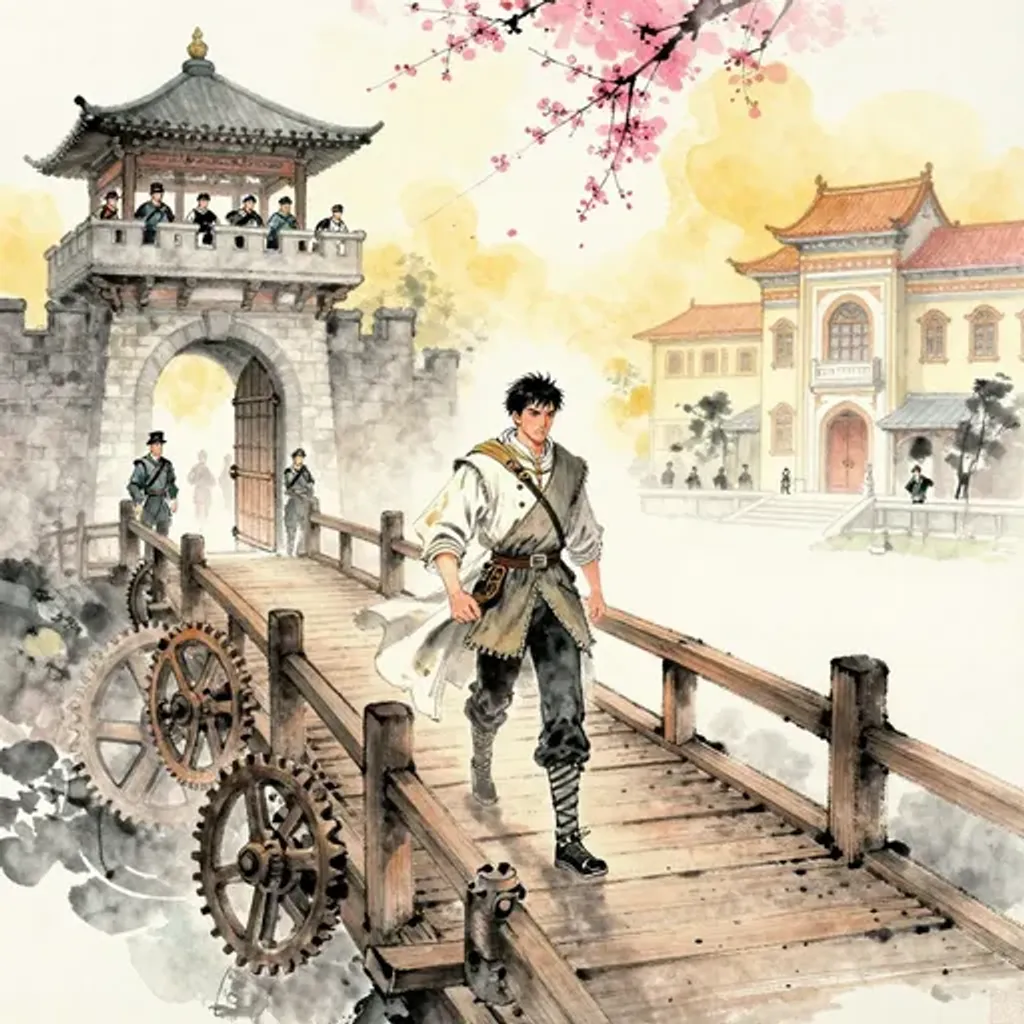
履機懼毀,身王子廢。終得所欲,无有凶害。
Treading the mechanism, fearing ruin; the prince's person is nearly discarded. In the end he gains what he desires; there is no misfortune or harm.
— Jiao Yanshou, Yilin (Forest of Changes), 1st century BC
Commentary
Wind beneath heaven triggers a perilous mechanism. One treads upon a hidden device and fears destruction; a prince's body is nearly cast aside. Yet the verse pivots: 'In the end one obtains what is desired, and there is no misfortune.' The encounter with danger does not destroy but refines. The image of 'treading on a trigger and fearing ruin' may allude to a prince who faces deposition or mortal threat but ultimately survives and achieves his aim. From Coming to Meet to Grace, fire glows beneath the mountain — beauty emerges from constraint. The terrifying encounter of Gou is adorned and transformed: what nearly killed becomes the very trial that burnishes one's worth.
姤 → 剝
Hexagram 44 → Hexagram 23: Splitting Apart
Changing lines: 2, 3, 4, 5
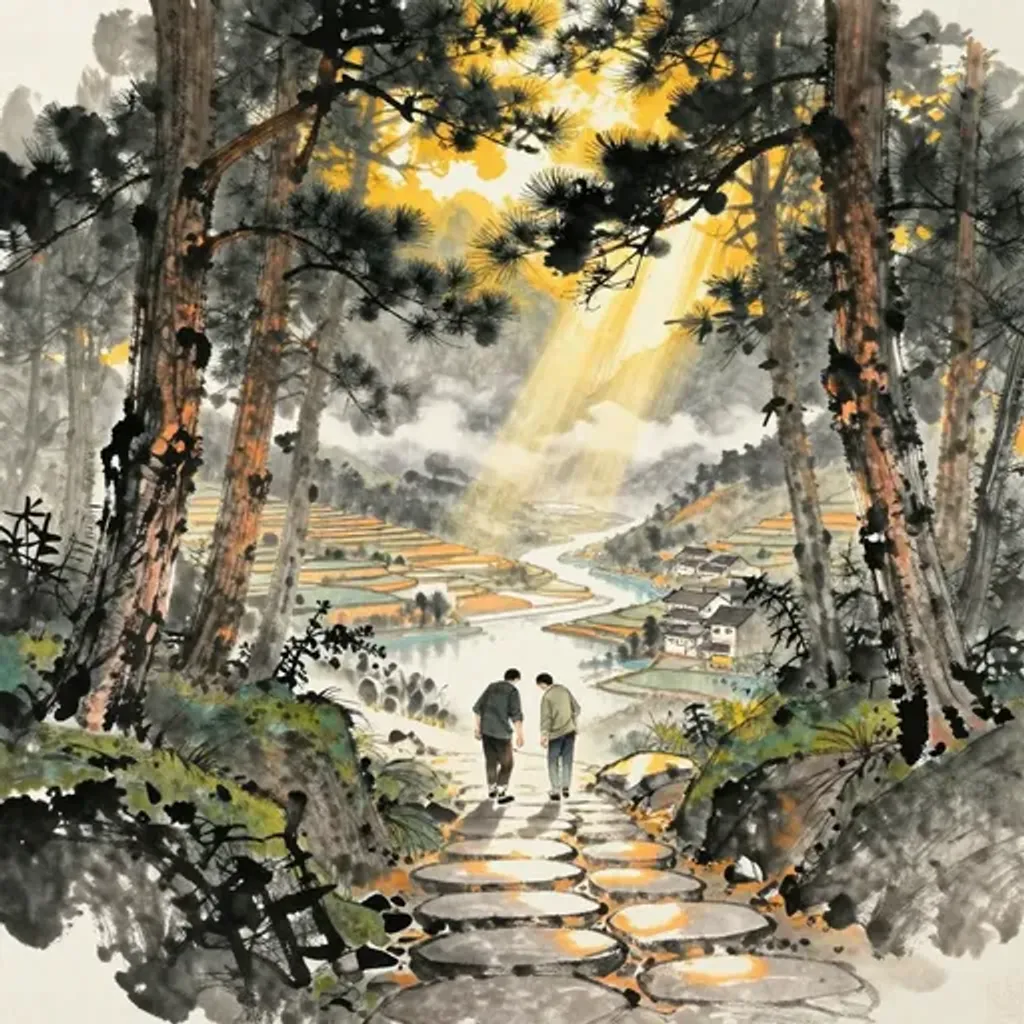
道理和德,仁不相賊。君子攸往,樂有利福。
The Way, principle, and virtue in harmony; benevolence does no injury. Where the noble man goes, there is joy, profit, and blessing.
— Jiao Yanshou, Yilin (Forest of Changes), 1st century BC
Commentary
Wind beneath heaven carries the fragrance of virtue. The Way, moral principle, and benevolence do not harm one another but coexist in mutual support. Where the gentleman goes, there is joy and blessing. The verse is an unambiguous declaration of auspiciousness: when ethics align with circumstance, benefit flows naturally. No historical allusion complicates the image; it is direct oracular affirmation. From Coming to Meet to Splitting Apart, the mountain rests upon the earth — and though Splitting Apart often signals erosion, here the verse asserts the opposite: when dao and de are intact, even the hexagram of dissolution holds no threat. Moral integrity is the one foundation that stripping cannot reach.
姤 → 復
Hexagram 44 → Hexagram 24: Return
Changing lines: 1, 2, 3, 4, 5, 6
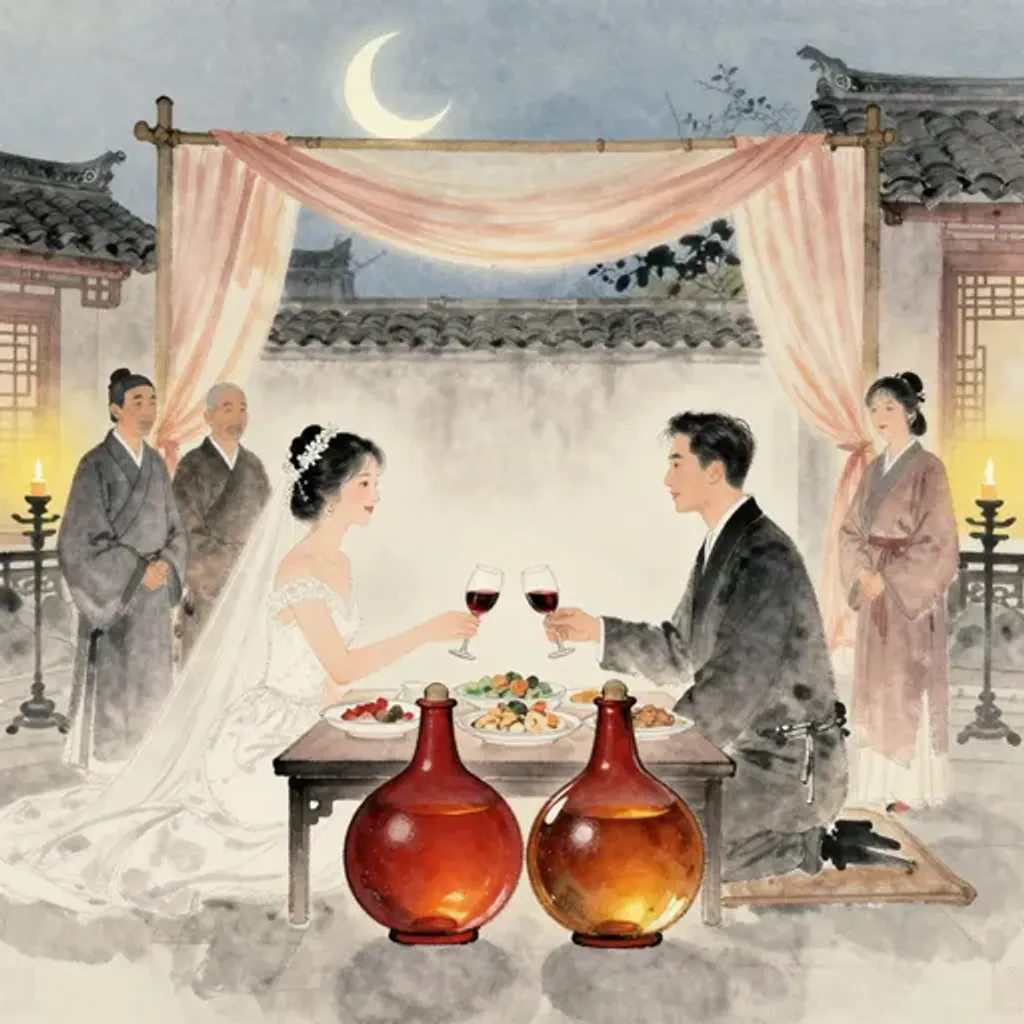
合匏同牢,姬姜並居。
Sharing the joined gourd, eating from the same dish; Ji and Jiang dwell together.
— Jiao Yanshou, Yilin (Forest of Changes), 1st century BC
Commentary
Wind beneath heaven arranges a wedding feast. 'Sharing the gourd and the same feast' refers to the ancient marriage ritual where bride and groom drink from halved gourds and eat from the same sacrificial animal, sealing their union. Ji and Jiang — the two greatest aristocratic surnames of Zhou — dwell together in harmony. The verse condenses the entire marital rite into eight characters of exquisite economy. From Coming to Meet to Return, thunder stirs within the earth as the solstice turns: the encounter of male and female in Gou becomes the cosmic return of yang, the primal seed buried in earth's darkness that will grow into a new cycle of life.
姤 → 无妄
Hexagram 44 → Hexagram 25: Innocence
Changing lines: 1, 2, 3
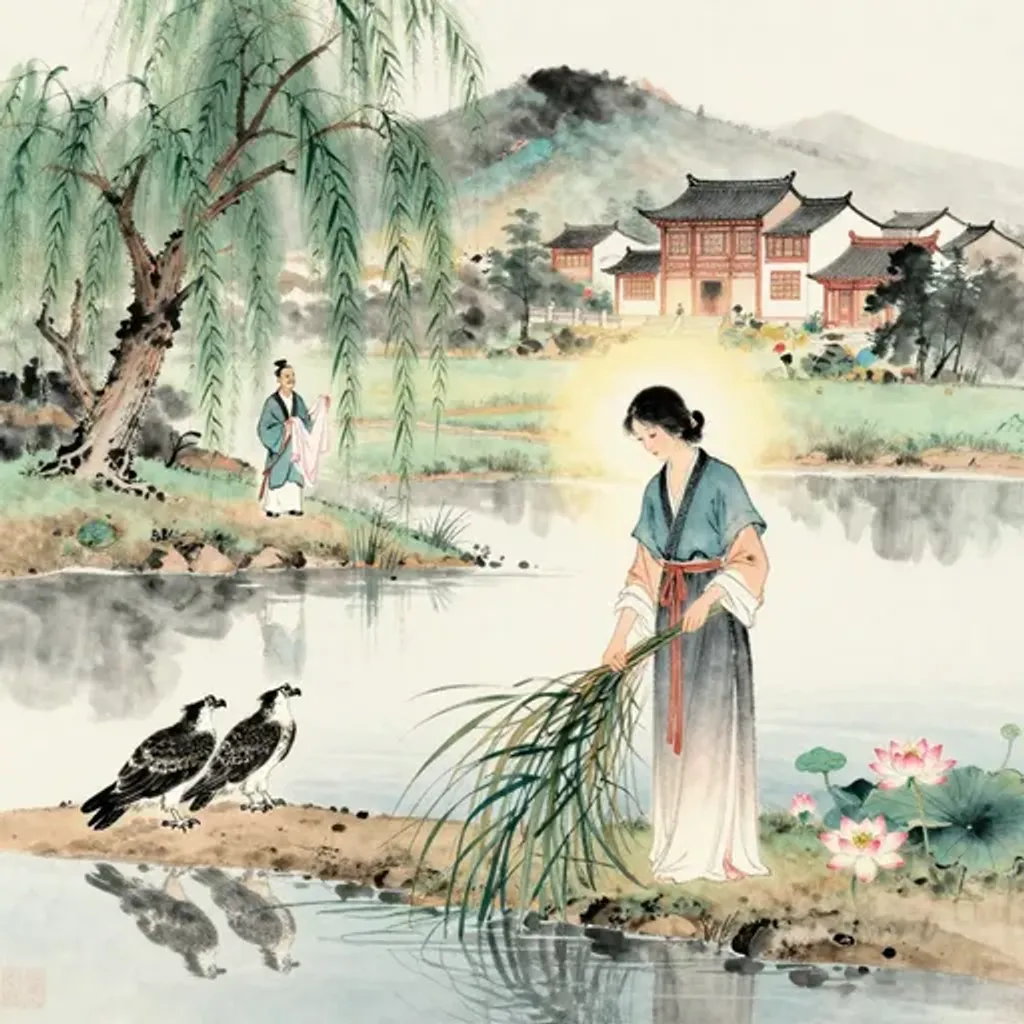
關雎淑女,賢妃聖偶。宜家壽母,福祿長久。
The osprey cries for the virtuous maiden; a worthy consort, a sage's match. She blesses the home and honors the mother; fortune and favor endure long.
— Jiao Yanshou, Yilin (Forest of Changes), 1st century BC
Commentary
Wind beneath heaven heralds a virtuous union. The ospreys cry by the river islet — the opening poem of the Book of Songs celebrates the modest maiden as a fit match for the lord. The verse extends the image: a worthy consort, a sage's partner, one who brings blessing to the household and longevity to the mother-in-law, with fortune and prosperity enduring through the generations. The Guanju allusion signals a marriage founded on propriety and mutual admiration, not mere passion. From Coming to Meet to Innocence, heaven's thunder roars across the earth in natural, unforced movement. The encounter of Gou achieves its highest expression: a meeting conducted with integrity that produces blessings untainted by ulterior motive.
姤 → 大畜
Hexagram 44 → Hexagram 26: Great Taming
Changing lines: 1, 4, 5
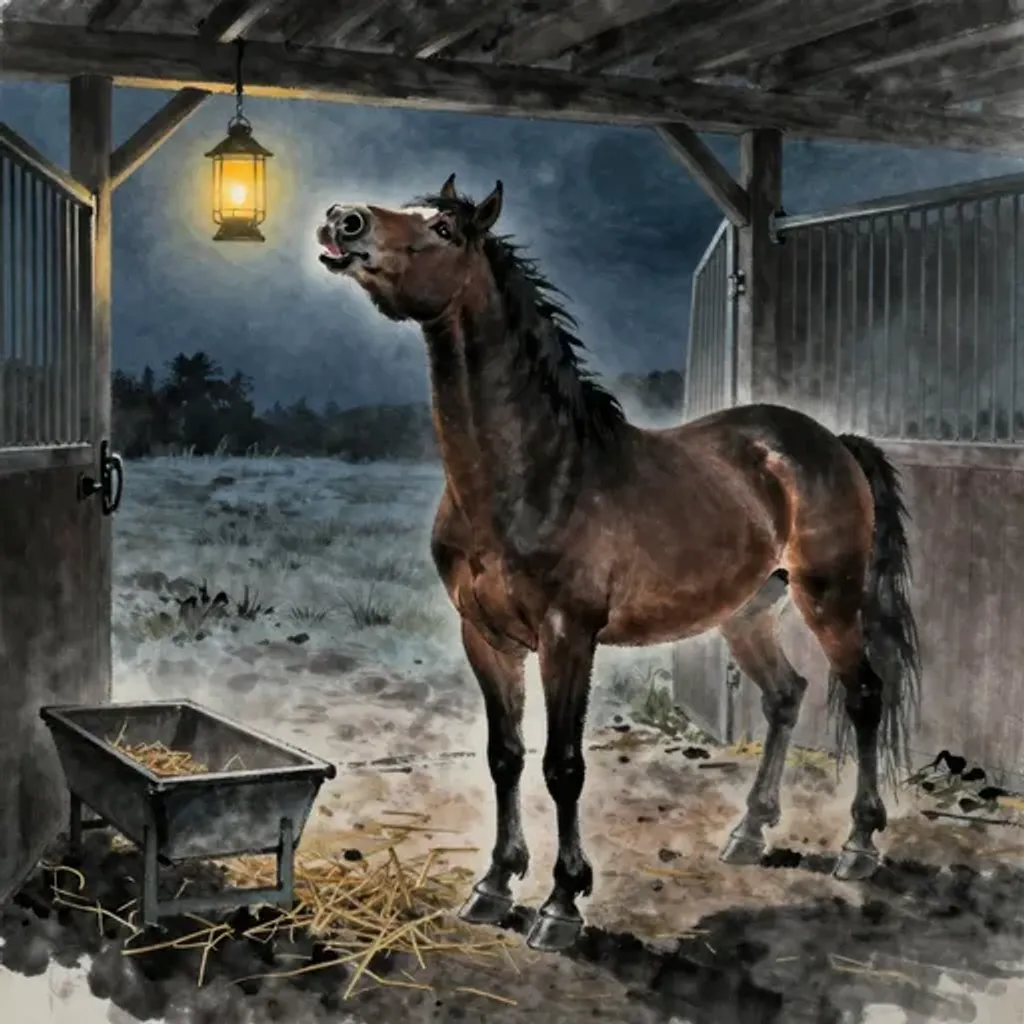
騏驥晚乳,不知子處。旋動悲鳴,痛傷我心。
The fine steed foals late and knows not where her young one lies. She turns and cries in grief; the pain wounds my heart.
— Jiao Yanshou, Yilin (Forest of Changes), 1st century BC
Commentary
Wind beneath heaven carries a mare's anguished cry. A fine thoroughbred foals late in life and cannot find where her offspring has gone. She turns and paces, whinnying in grief, and the sorrow pierces the speaker's heart. The image of a mother horse searching for a lost foal is devastatingly direct — no political allegory, just raw parental anguish. From Coming to Meet to Great Taming, heaven stored within the mountain suggests accumulated strength held in reserve. Yet here the taming energy is inverted: what the mountain contains is not power but pain, a mother's love with nowhere to go. The encounter that Gou promised — the meeting of mare and foal — never materializes.
姤 → 頤
Hexagram 44 → Hexagram 27: Nourishment
Changing lines: 1, 2, 3, 4, 5
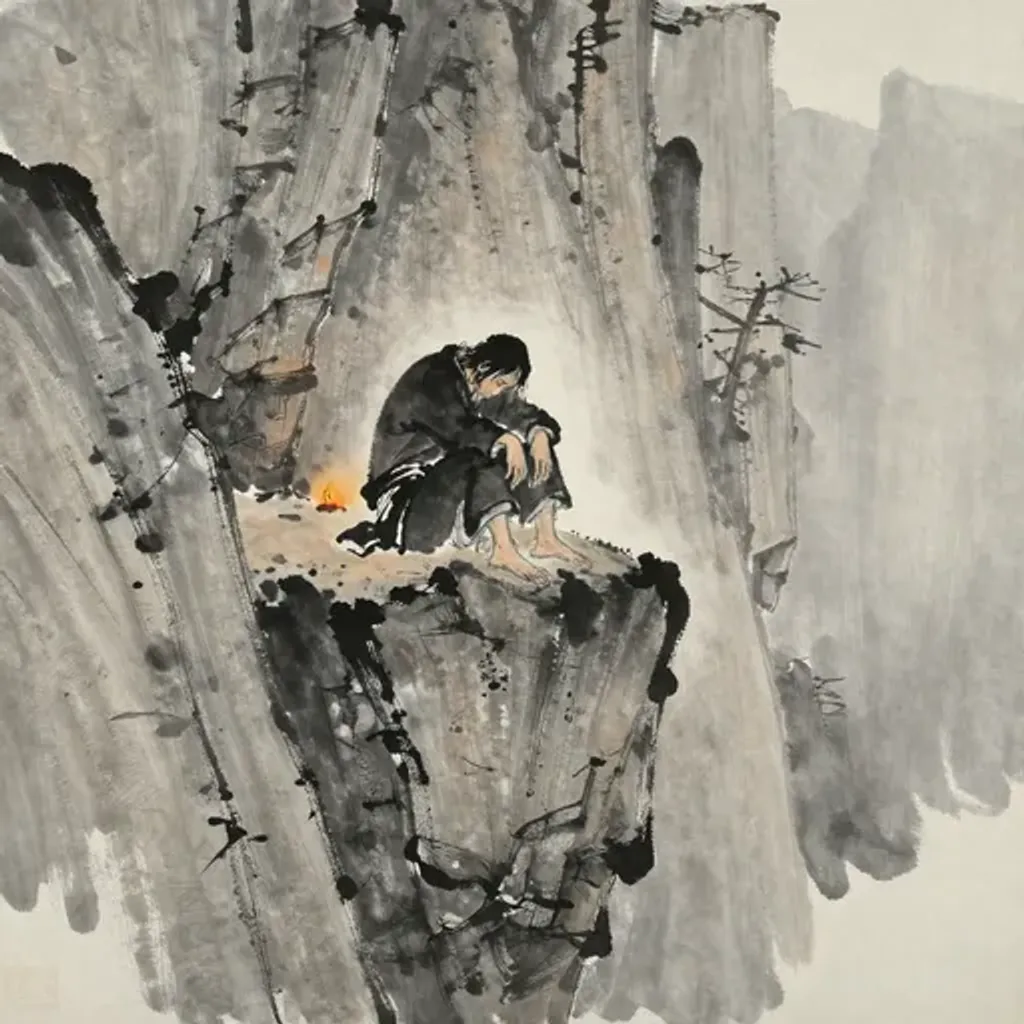
智嵓絕理,陰孽謀生。十日不食,困於申亥。
Wisdom meets a sheer cliff, reason exhausted; dark forces plot to survive. Ten days without food; trapped in the hours of Shen and Hai.
— Jiao Yanshou, Yilin (Forest of Changes), 1st century BC
Commentary
Wind beneath heaven meets an impenetrable cliff face. Wisdom encounters a sheer rock wall where no path leads through; dark forces plot to survive at any cost. For ten days there is no food, and one is trapped between the earthly branches Shen and Hai — metal and water hours of the late afternoon and night, the time when yin energy is most dominant. The verse portrays intellectual brilliance checked by impossible circumstance, then besieged by yin conspiracies and starvation. From Coming to Meet to Nourishment, the mountain stands above thunder — nourishment requires careful speech and restrained appetite. The encounter plunges one into a crisis where the only sustenance is discipline itself.
姤 → 大過
Hexagram 44 → Hexagram 28: Great Exceeding
Changing lines: 6
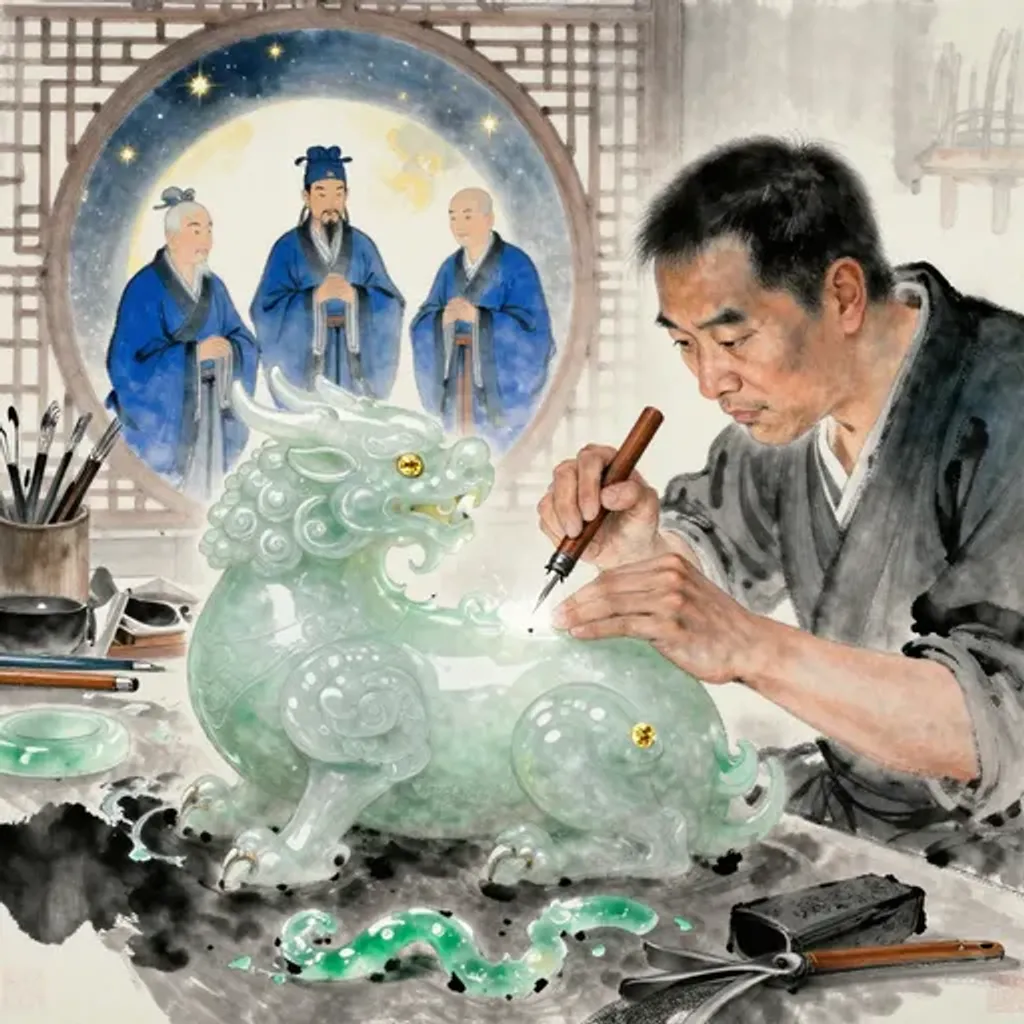
監諸攻玉,无不穿鑿。麟鳳成形,德象君子。三仁翼事,所求必喜。
Inspecting gems, polishing jade; nothing it cannot pierce and carve. Qilin and phoenix take shape; virtue mirrors the noble man. Three sages lend their wings; whatever is sought must bring joy.
— Jiao Yanshou, Yilin (Forest of Changes), 1st century BC
Commentary
Wind beneath heaven polishes raw stone into sacred form. 'Use stones from other mountains to cut jade' — the proverb from the Book of Songs speaks of bringing outside expertise to refine native talent. Through ceaseless carving and boring, qilin and phoenix take shape, their virtue resembling that of the gentleman. The Three Benevolent Ones of Shang — Weizi, Jizi, and Bigan — lend their wings to the enterprise, and whatever is sought brings happiness. From Coming to Meet to Great Exceeding, the lake submerges the trees in an extraordinary crisis that only extraordinary people can navigate. The encounter of Gou here recruits the right craftsmen and the right counselors, transforming raw encounter into enduring artistry.
姤 → 坎
Hexagram 44 → Hexagram 29: The Abysmal Water
Changing lines: 3, 4, 6
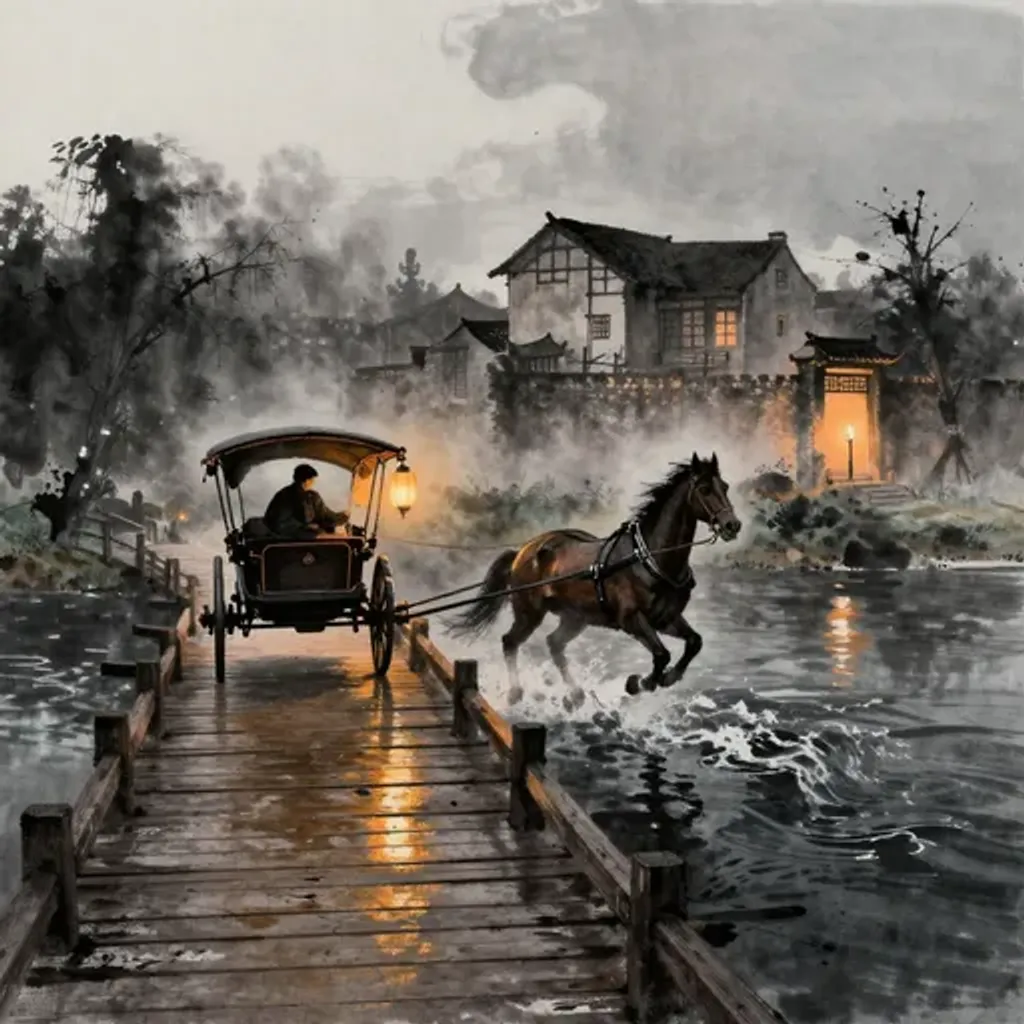
昧暮乘車,以至伯家。踰梁渡河,濟脫无他。
At dim dusk, mounting the carriage, arriving at the elder's house. Crossing the bridge, fording the river; delivered safely, nothing amiss.
— Jiao Yanshou, Yilin (Forest of Changes), 1st century BC
Commentary
Wind beneath heaven hastens a traveler through twilight. At dusk one mounts a carriage and arrives at the elder's house, then crosses a bridge over the river and reaches safety without harm. The verse reads as a narrow escape narrative: traveling at the most dangerous hour, crossing water in darkness, yet emerging unscathed. From Coming to Meet to The Abysmal, doubled water presents peril upon peril — the river crossing is literal and symbolic. Yet the traveler succeeds precisely because the journey is purposeful and the destination clear. Gou's encounter with danger need not end in disaster when one moves with determination and knows where shelter lies.
姤 → 離
Hexagram 44 → Hexagram 30: The Clinging Fire
Changing lines: 1, 2, 5
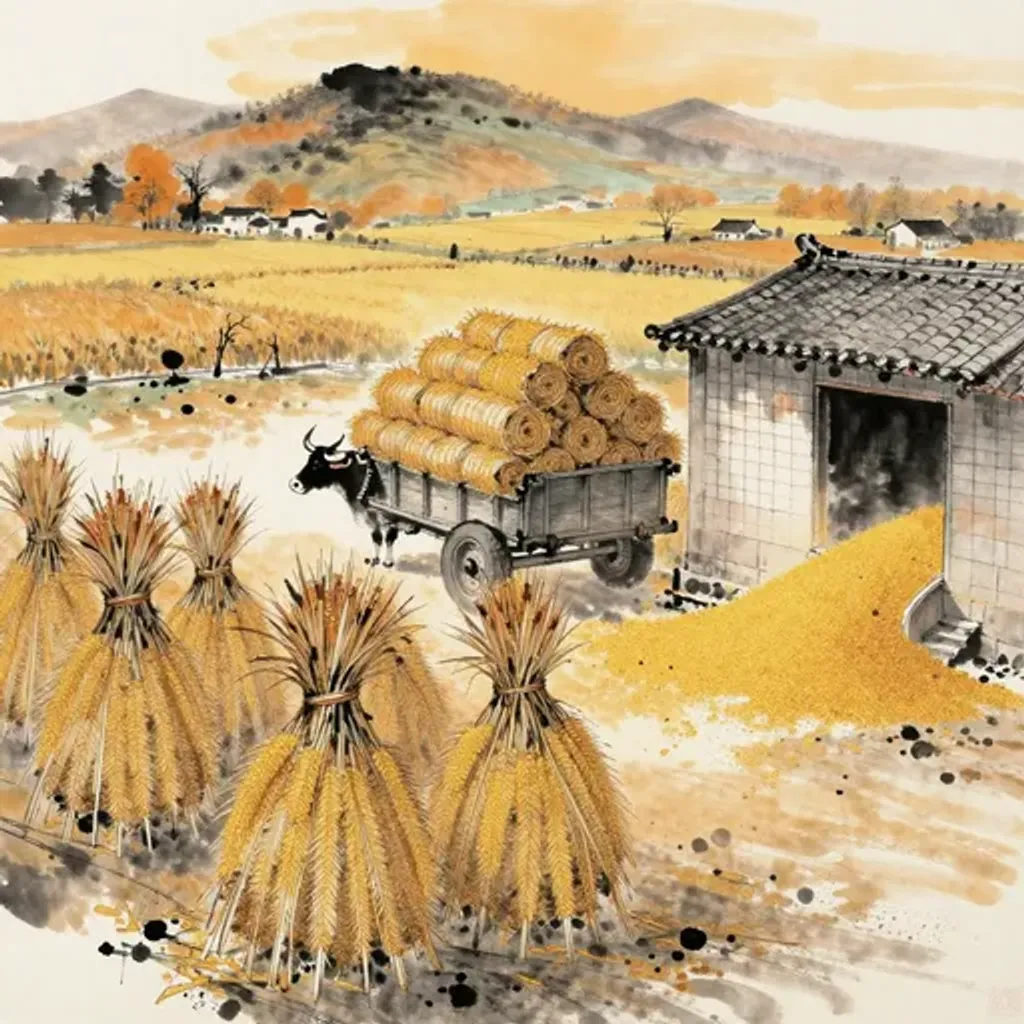
吾有黍粱,委積外塲。有用服箱,運致我藏,富於喜糧。
I have millet and grain, heaped high in the outer yard. With cart and oxen to haul it, I carry it into my stores, rich in joyful provisions.
— Jiao Yanshou, Yilin (Forest of Changes), 1st century BC
Commentary
Wind beneath heaven brings harvest home. 'I possess millet and grain, heaped in the outer threshing ground.' Oxen yoked to carts carry the bounty to my storehouse, enriching it with joyful provisions. The verse is a celebration of agricultural abundance in its most tangible form — grain piled high, carts groaning under loads, the storehouse filling. 'Yoked to the cart' may echo the Shijing ode 'Da Dong' where the Cowherd star is described as unable to pull a load, but here the image is inverted: these oxen serve their purpose perfectly. From Coming to Meet to The Clinging, doubled fire illuminates the harvest. Gou's encounter produces not mere meeting but radiant, sustaining wealth.
姤 → 咸
Hexagram 44 → Hexagram 31: Influence
Changing lines: 2, 6
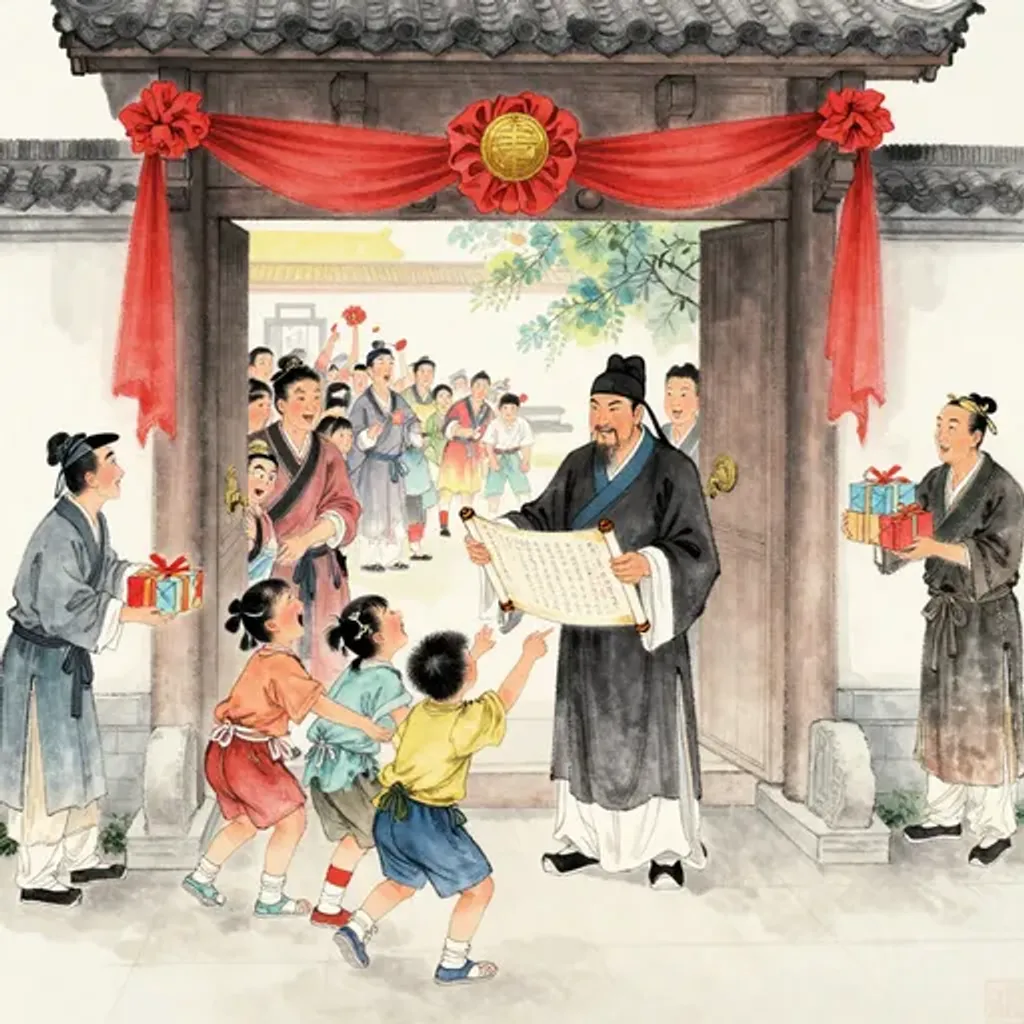
喜笑且語,不能掩口。官爵並至,慶賀盈戶。
Laughing and chatting with delight, unable to cover the mouth. Rank and title arrive together; congratulations fill the household.
— Jiao Yanshou, Yilin (Forest of Changes), 1st century BC
Commentary
Wind beneath heaven announces glad tidings that cannot be contained. Laughter and chatter overflow, mouths unable to close from joy. Official rank and noble titles arrive together, and congratulatory guests fill the doorway. The verse radiates unrestrained happiness — the kind that renders composure impossible. From Coming to Meet to Influence, the lake rests upon the mountain as the youngest daughter draws near to the youngest son: mutual attraction, natural resonance, the empty heart that receives freely. Gou's encounter here achieves its most spontaneous fulfillment. The joy is not performed but irrepressible, and the honors that follow are the natural consequence of a connection that moves others to respond in kind.
姤 → 恆
Hexagram 44 → Hexagram 32: Duration
Changing lines: 5, 6
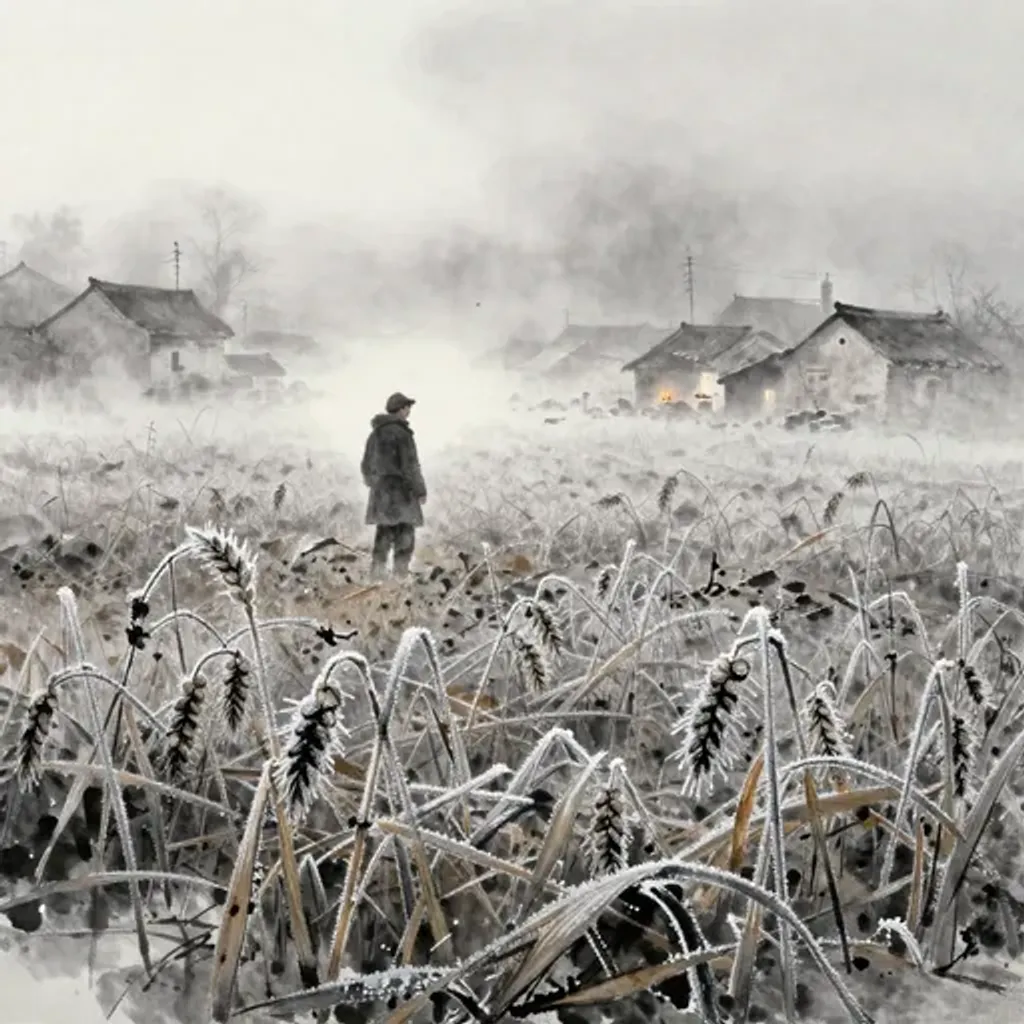
霧露雪霜,日暗不明。陰孽生疾,年穀大傷。
Fog and dew, snow and frost; the sun dims and gives no light. Dark forces breed sickness; the year's harvest suffers great ruin.
— Jiao Yanshou, Yilin (Forest of Changes), 1st century BC
Commentary
Wind beneath heaven turns to fog and frost. Mist, dew, snow, and frost smother the sky, and the sun grows dark. Yin-born pestilence breeds sickness, and the year's harvest suffers grievous damage. The verse is a catalog of yin excess smothering yang vitality — moisture obscuring light, cold killing crops, hidden corruption generating disease. From Coming to Meet to Duration, thunder and wind persist together in their established pattern. Yet here duration becomes entrenchment: the yin force that Gou admitted does not depart but settles in permanently, like fog that refuses to lift. What was a passing encounter calcifies into chronic affliction, and the harvest rots under an unchanging gray sky.
姤 → 遯
Hexagram 44 → Hexagram 33: Retreat
Changing lines: 2
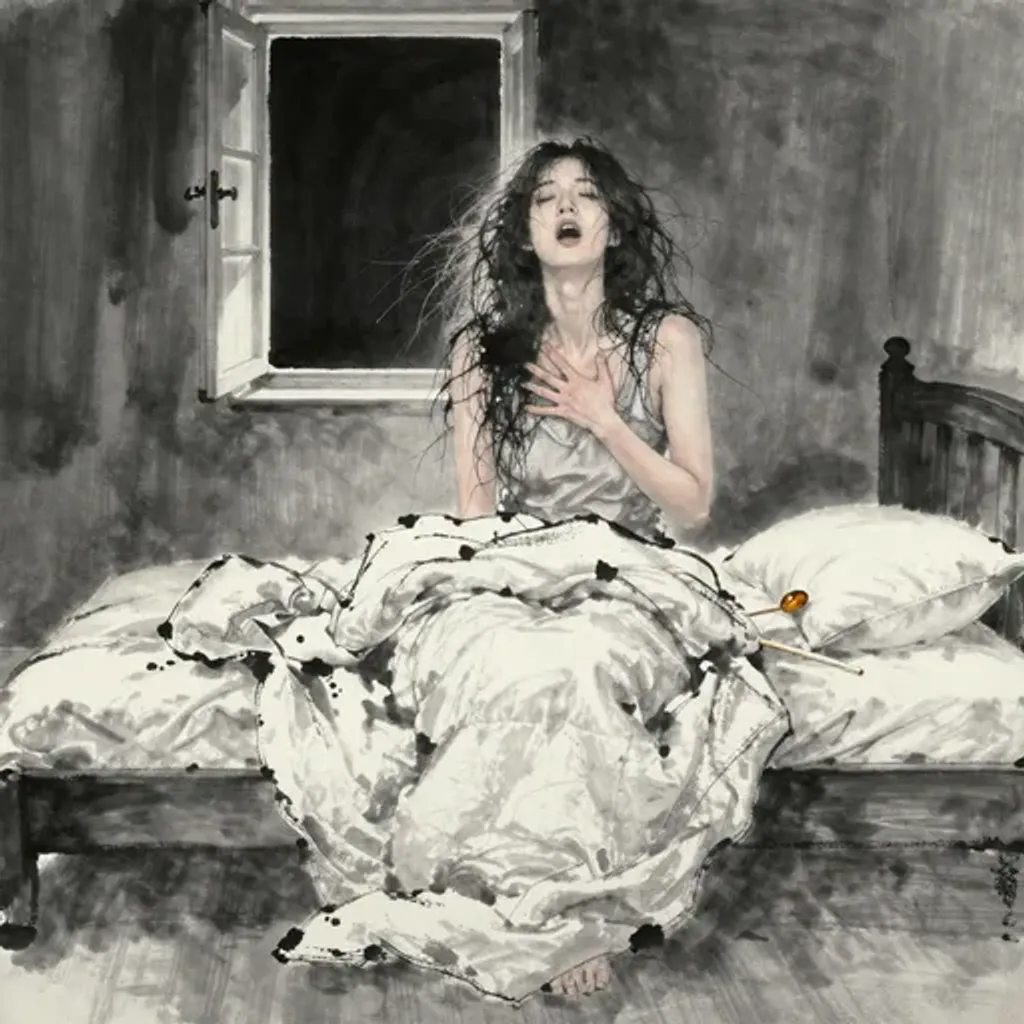
伯去我東,髮擾如蓬。寤寐長歎,展轉空床。內懷悵恨,摧我肝腸。
My lord has gone east from me; hair tangled like tumbling weeds. Waking or sleeping, I sigh long; tossing and turning on the empty bed. Within, I hold bitter grief; it breaks my very liver and bowels.
— Jiao Yanshou, Yilin (Forest of Changes), 1st century BC
Commentary
Wind beneath heaven carries a husband eastward, leaving only longing behind. 'My lord has gone east; my hair tangles like tumbled weeds.' Waking and sleeping, she sighs endlessly, tossing on an empty bed, harboring resentment that crushes liver and gut. The verse is a woman's lament of abandonment, raw and physical — disordered hair, sleepless nights, visceral pain. Every line deepens the desolation. From Coming to Meet to Retreat, heaven withdraws above the mountain: the masculine principle deliberately distances itself from the feminine. Gou's encounter is violently reversed — what met must now separate, and the one left behind has no agency but grief.
姤 → 大壯
Hexagram 44 → Hexagram 34: Great Power
Changing lines: 1, 5, 6
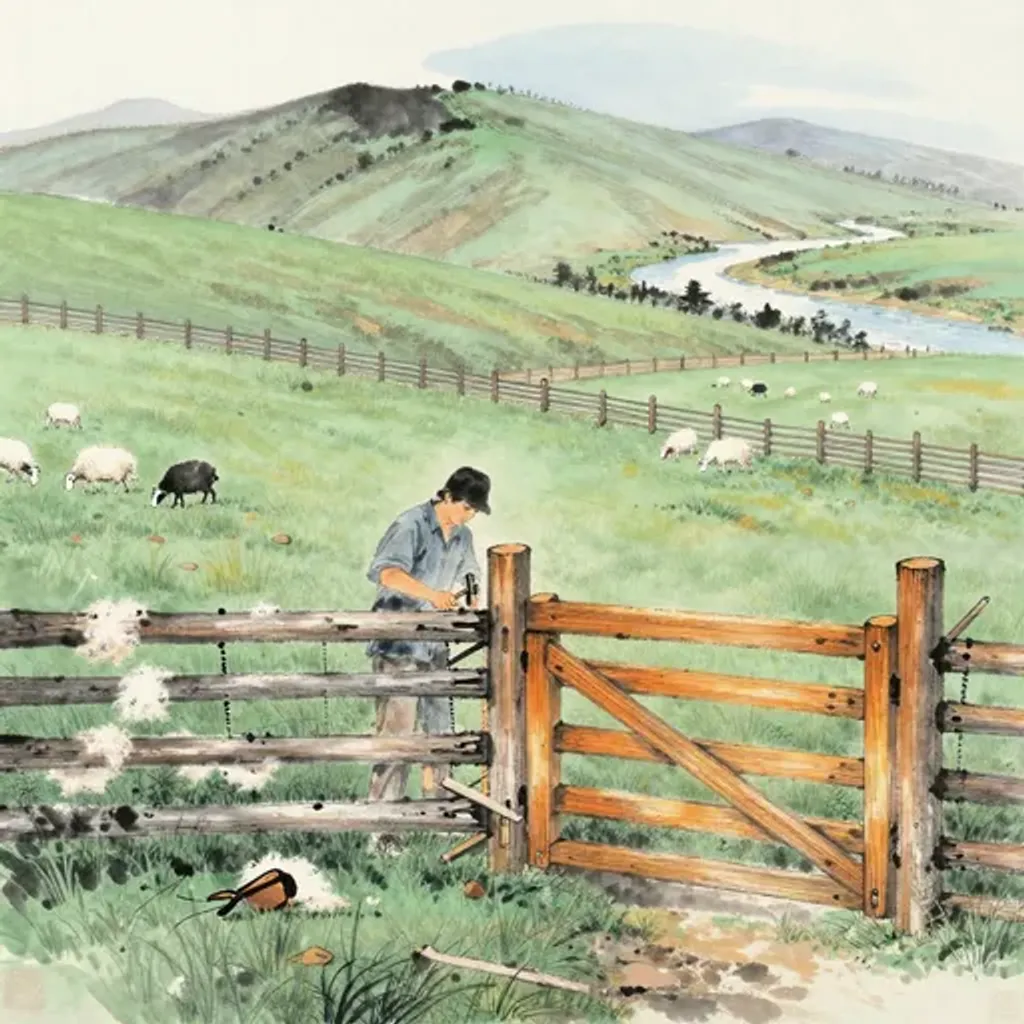
亡羊補牢,毋損於憂。
Mending the pen after losing the sheep; let there be no further grief.
— Jiao Yanshou, Yilin (Forest of Changes), 1st century BC
Commentary
Wind beneath heaven admits the wolf, but the pen can still be mended. 'Mend the fold after losing the sheep — do not compound the loss with worry.' The allusion comes from the Zhanguoce: the minister Zhuang Xin warned King Xiang of Chu that his indulgence would cost him his capital. When Ying indeed fell to Qin, the king recalled Zhuang Xin, who counseled that it was not too late to repair the sheepfold. The verse distills this wisdom into eight characters of crystalline brevity. From Coming to Meet to Great Power, thunder roars above heaven in raw, surging yang energy. Gou's yin intrusion has caused damage, but Da Zhuang's overwhelming strength can still reverse the loss — if corrective action is taken now.
姤 → 晉
Hexagram 44 → Hexagram 35: Progress
Changing lines: 2, 3, 5
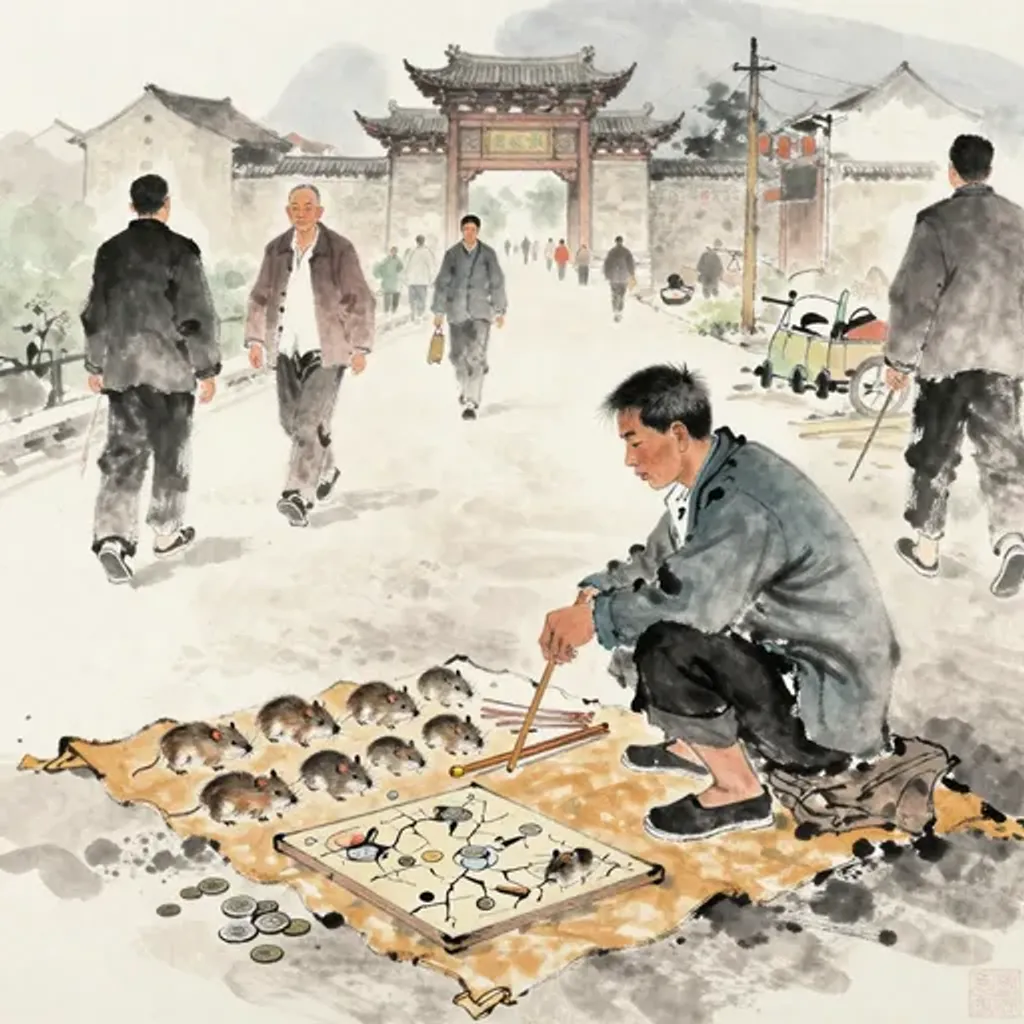
販鼠賣卜,利少无謀,難以得家。
Peddling rats, selling divinations; profit is meager, plans come to nothing. Hard to make a home by such means.
— Jiao Yanshou, Yilin (Forest of Changes), 1st century BC
Commentary
Wind beneath heaven blows through a petty merchant's stall. Selling rats and peddling fortunes, the profit is meager and the plan nonexistent — hardly enough to establish a household. The verse paints a picture of marginal survival: the rat-seller and fortune-teller operate at the lowest rung of commerce, their trades yielding too little to build anything lasting. From Coming to Meet to Progress, fire rises above the earth as the sun emerges at dawn — yet the verse's subject cannot participate in this brightness. The encounter that Gou offers is squandered on trivial schemes. Progress requires vision and substance; petty commerce in dubious goods leads only to stagnation.
姤 → 明夷
Hexagram 44 → Hexagram 36: Darkening of the Light
Changing lines: 1, 2, 4, 5, 6
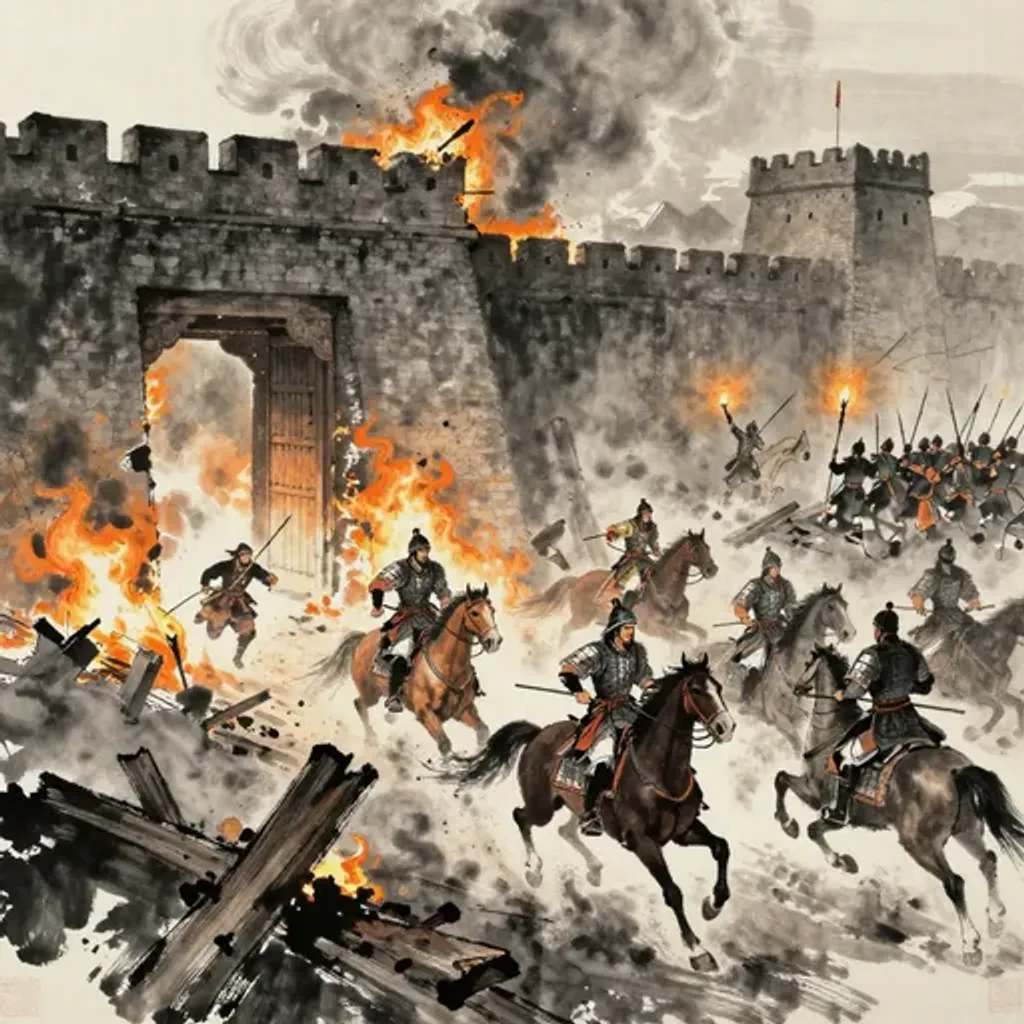
西戎為疾,幽君去室。陳子發難,項伯成就。
The Western Rong bring affliction; the darkened lord abandons his chambers. Chen Zi raises the banner of revolt; Xiang Bo brings it to fruition.
— Jiao Yanshou, Yilin (Forest of Changes), 1st century BC
Commentary
Wind beneath heaven encounters the darkening of light. The Western Rong invade as a plague upon the realm, and the benighted ruler abandons his chambers. Then a 'Master Chen' raises the standard of revolt, while Xiang Bo brings the enterprise to completion. The verse layers multiple periods of crisis: the Western Rong barbarians threatening Zhou, a ruler driven from power, and figures who exploit chaos to forge new order. Xiang Bo, uncle of Xiang Yu, famously aided Liu Bang at the Hongmen Banquet. From Coming to Meet to Darkening of the Light, brightness sinks into the earth — the wise conceal their brilliance to survive. Gou's encounter here is with raw political violence, navigable only through strategic obscurity.
姤 → 家人
Hexagram 44 → Hexagram 37: The Family
Changing lines: 1, 2, 4
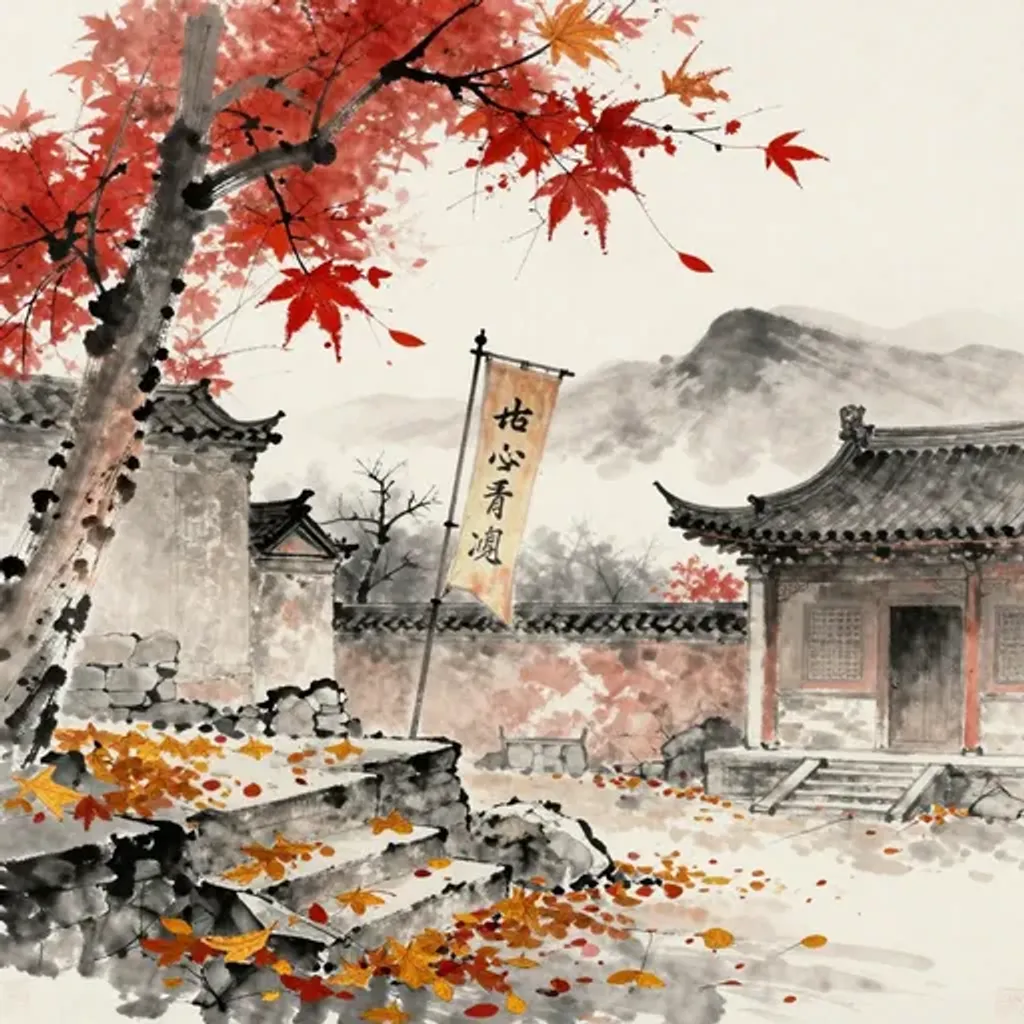
秋風生哀,花落生悲。公室多難,羊舌氏衰。
Autumn wind begets sorrow; falling blossoms beget grief. The ducal house meets many troubles; the Yangshe clan declines.
— Jiao Yanshou, Yilin (Forest of Changes), 1st century BC
Commentary
Wind beneath heaven turns autumnal. Autumn winds bring sorrow; falling blossoms breed grief. The ducal house faces many troubles, and the Yangshe clan declines. The Yangshe were a powerful ministerial family in the state of Jin, most famous for the statesman Shu Xiang. By the late Spring and Autumn period, internal feuds and political purges destroyed the clan entirely. The verse pairs natural imagery of seasonal decay with political disintegration — a great family withering like flowers in cold wind. From Coming to Meet to The Family, wind emerges from fire: words must have substance, actions must have constancy. Yet the Yangshe house failed precisely at sustaining family discipline, and the wind that should warm now scatters.
姤 → 睽
Hexagram 44 → Hexagram 38: Opposition
Changing lines: 1, 3, 5
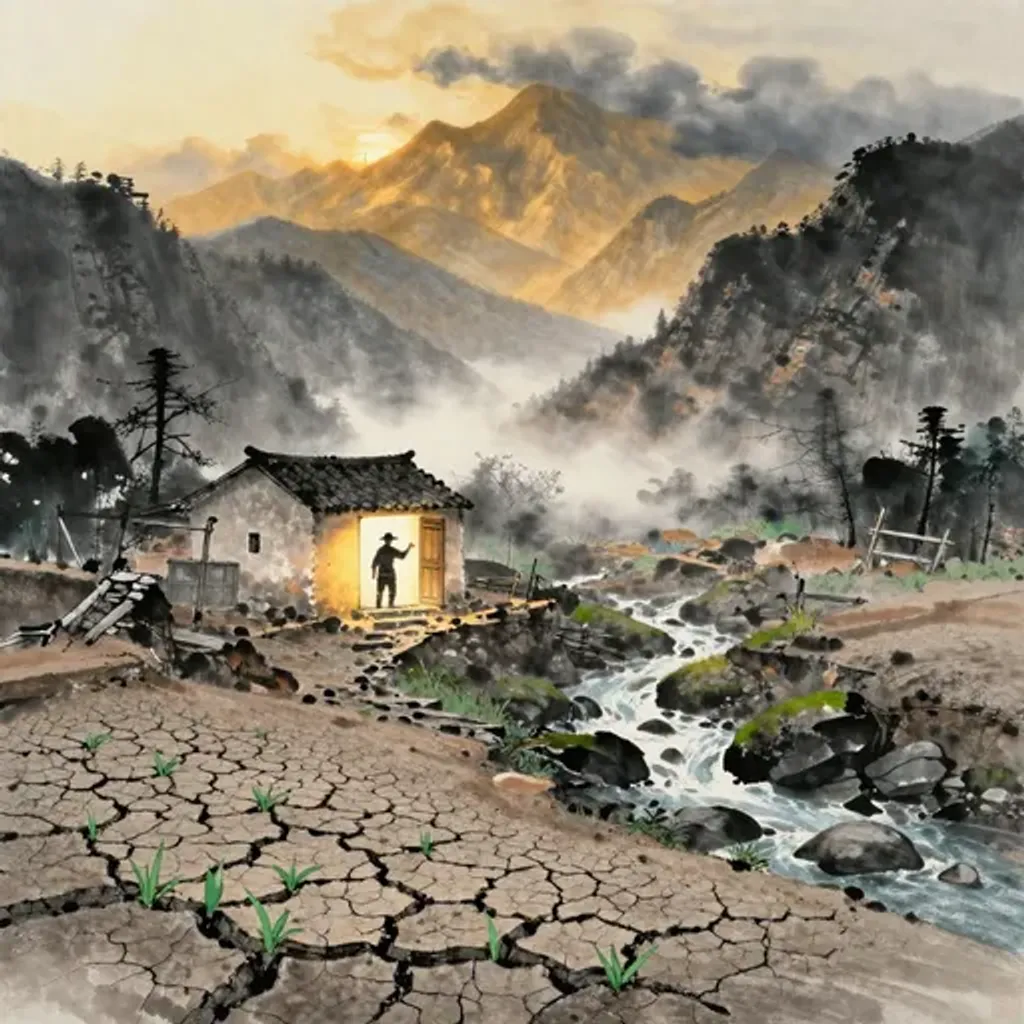
持福厭患,去除天殘。日長夜盡,喜世蒙恩。
Grasping blessings, dispelling calamity; removing heaven's afflictions. Days lengthen, nights wane; the joyful age receives grace.
— Jiao Yanshou, Yilin (Forest of Changes), 1st century BC
Commentary
Wind beneath heaven sweeps away affliction and ushers in grace. One holds fast to blessings and expels calamity, removing heaven's cruelties. Days grow long and nights diminish — the solstice has turned, and yang reasserts itself. The world rejoices and receives benevolence. The verse tracks a decisive reversal: from suffering to relief, darkness to lengthening light, curse to blessing. From Coming to Meet to Opposition, fire blazes above the lake in seeming contradiction — yet the gentleman finds unity within difference. Gou's encounter with the foreign and threatening is here transmuted: what arrived as affliction is repurposed as medicine, and the opposition between day and night resolves in favor of the light.
姤 → 蹇
Hexagram 44 → Hexagram 39: Obstruction
Changing lines: 2, 4, 6
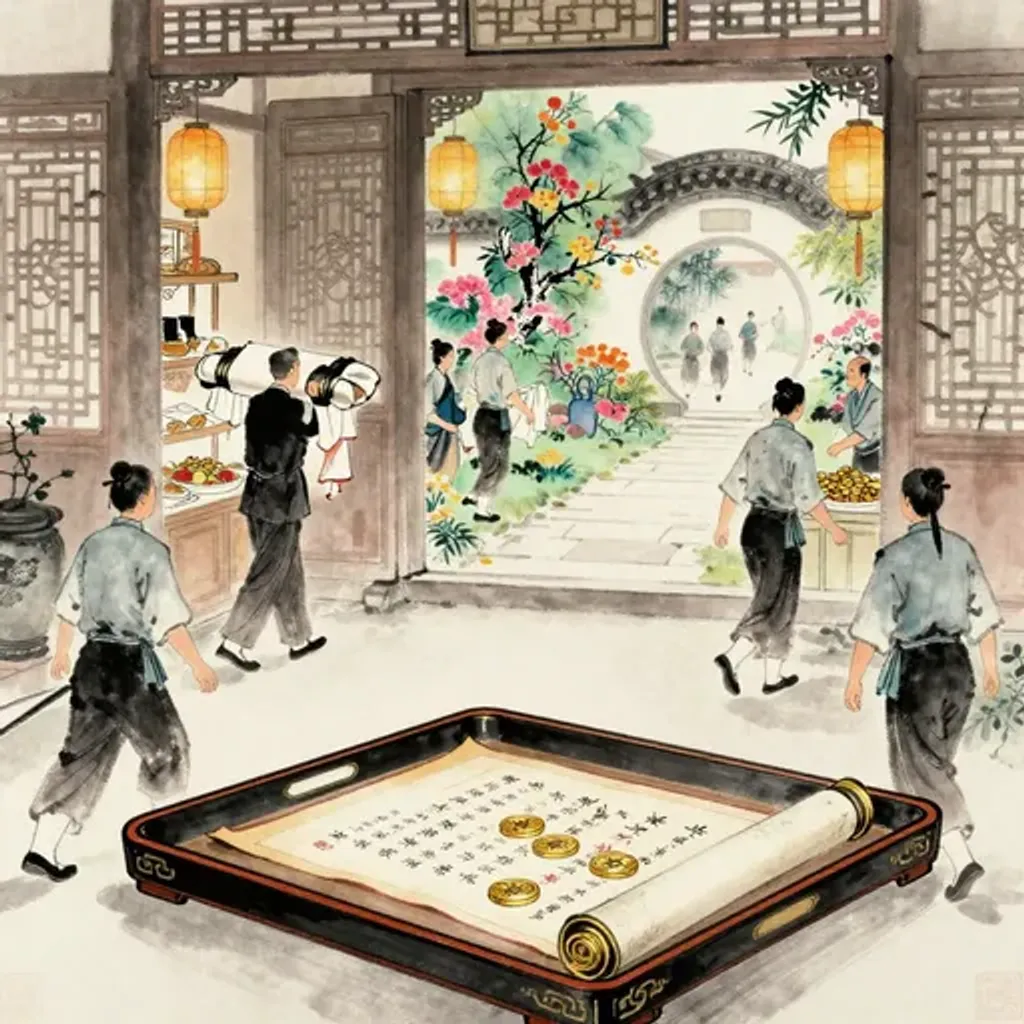
新授大喜,福復重來。樂且日富,是惟豐財。
Newly bestowed, great joy; blessings return again and again. Delighted and daily richer; this is abundant wealth indeed.
— Jiao Yanshou, Yilin (Forest of Changes), 1st century BC
Commentary
Wind beneath heaven delivers unexpected bounty. A new appointment brings great joy; blessings return doubled and redoubled. Each day grows more prosperous, and wealth accumulates abundantly. The verse is an unambiguous oracle of fortune — new honors, returning luck, increasing wealth, overflowing resources. No shadow complicates the picture. From Coming to Meet to Obstruction, water perches dangerously atop the mountain, and the gentleman must turn inward to cultivate virtue. Yet the verse ignores the difficulty implied by the target hexagram, perhaps suggesting that precisely in times of external obstruction, inner fortune can still multiply. The encounter that Gou arranges here arrives as pure gift.
姤 → 解
Hexagram 44 → Hexagram 40: Deliverance
Changing lines: 3, 5, 6
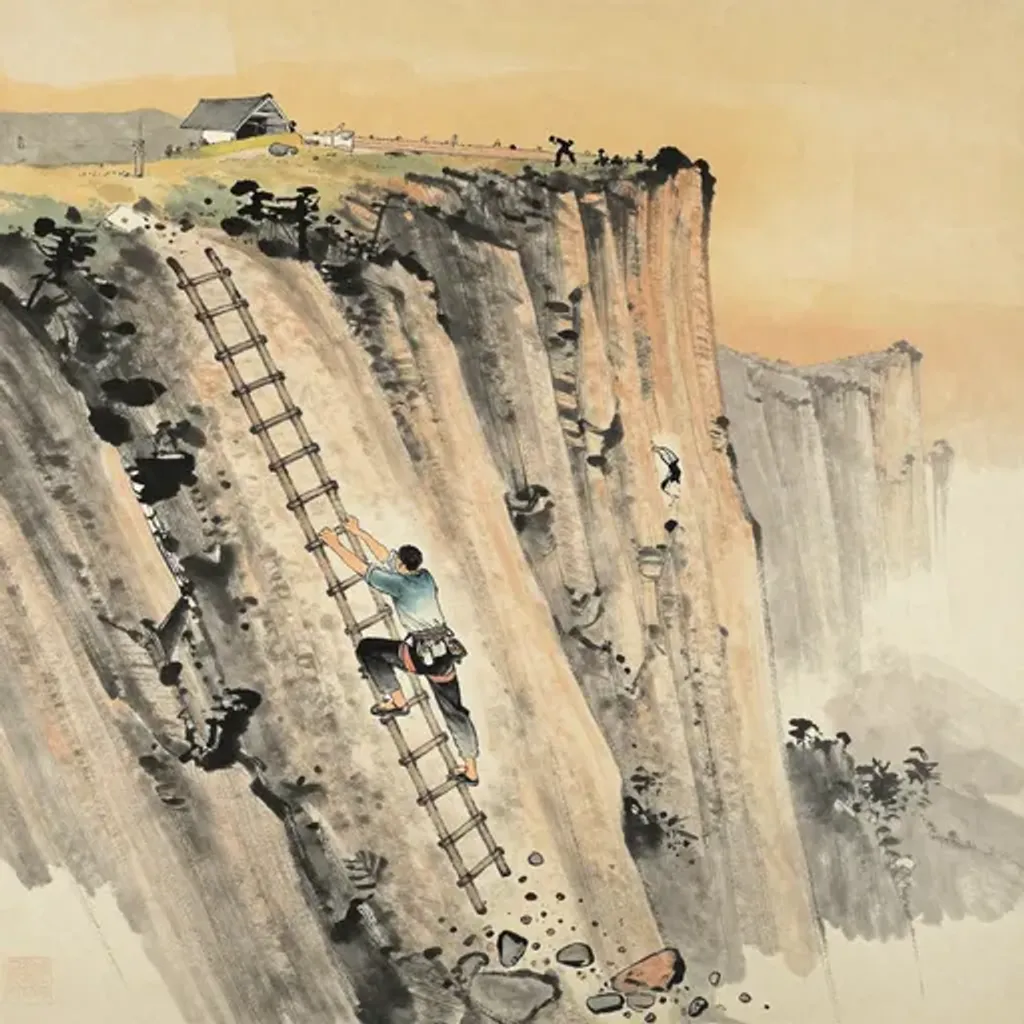
前頓卻躓,左跌右逆。登高安梯,復反來歸。
Stumbling forward, tripping backward; falling left, blocked on the right. Climbing high, steadying the ladder; returning again to come home.
— Jiao Yanshou, Yilin (Forest of Changes), 1st century BC
Commentary
Wind beneath heaven buffets a traveler from every direction. Stumbling forward and tripping back, falling left and lurching right — every step meets an obstacle. Yet the verse resolves: one climbs high by securing a ladder, and in the end returns safely home. The imagery is purely physical — a body battered by misfortune from all angles, yet finding the tool (the ladder) to surmount the final barrier. From Coming to Meet to Deliverance, thunder and rain arrive together in cathartic release. Gou's encounter throws one into violent turbulence, but Deliverance provides the exit: once the storm breaks, the way home clears, and the stumbler becomes the climber.
姤 → 損
Hexagram 44 → Hexagram 41: Decrease
Changing lines: 1, 3, 4, 5
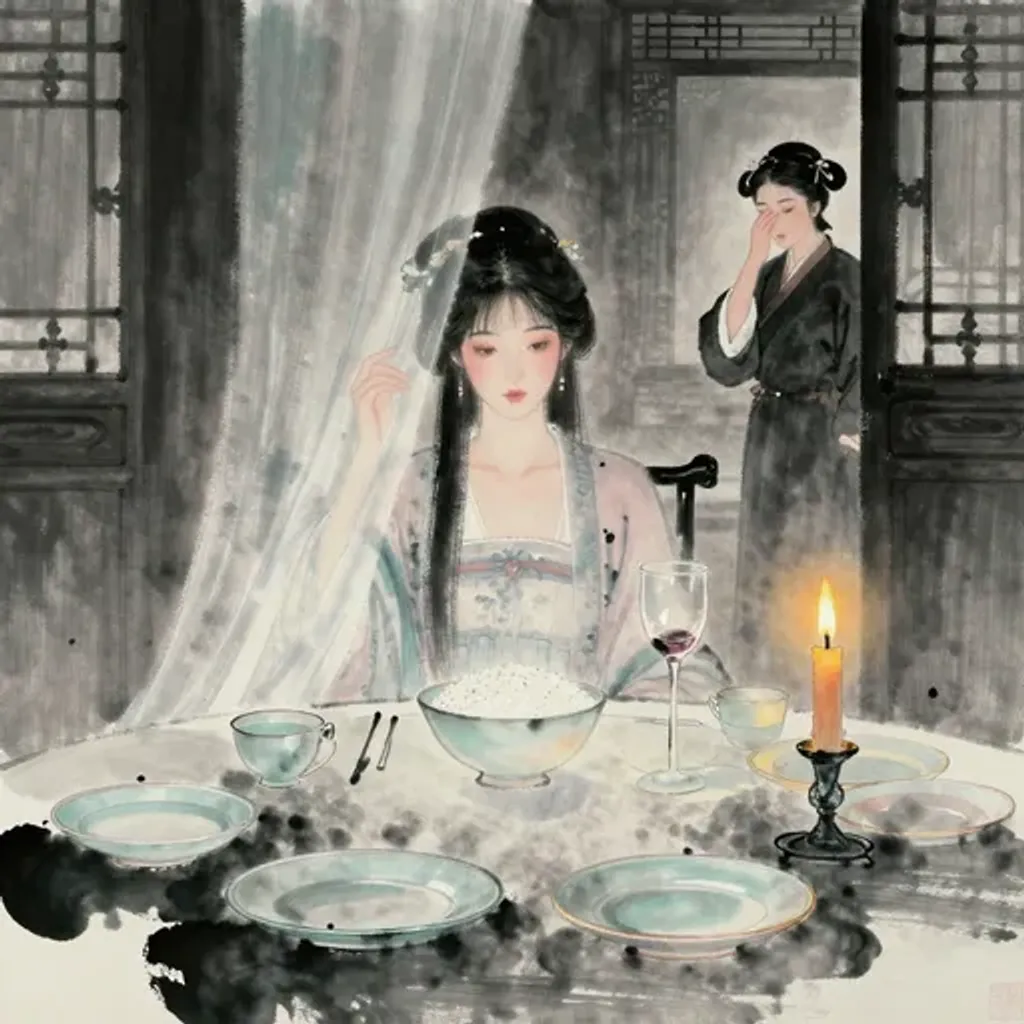
夢飯不飽,酒未入口。嬰女雖好,媒鴈不許。
Dreaming of a meal that does not fill; wine that never reaches the lips. The young woman is lovely, yet the matchmaker's geese are refused.
— Jiao Yanshou, Yilin (Forest of Changes), 1st century BC
Commentary
Wind beneath heaven conjures illusions that vanish upon reaching. Dreaming of a meal that never satiates, wine that never touches the lips; a beautiful maiden admired but the matchmaker's geese are refused. Every image is of desire arrested at the threshold — food that cannot nourish, wine that cannot be tasted, marriage that cannot proceed. The verse is a study in frustrated longing: all the elements of fulfillment are present, yet none can be grasped. From Coming to Meet to Decrease, the mountain rises above the lake as restraint curbs desire. Gou's encounter produces attraction but not consummation; Decrease counsels that wanting less may be wiser than reaching for what perpetually recedes.
姤 → 益
Hexagram 44 → Hexagram 42: Increase
Changing lines: 1, 2, 3, 4
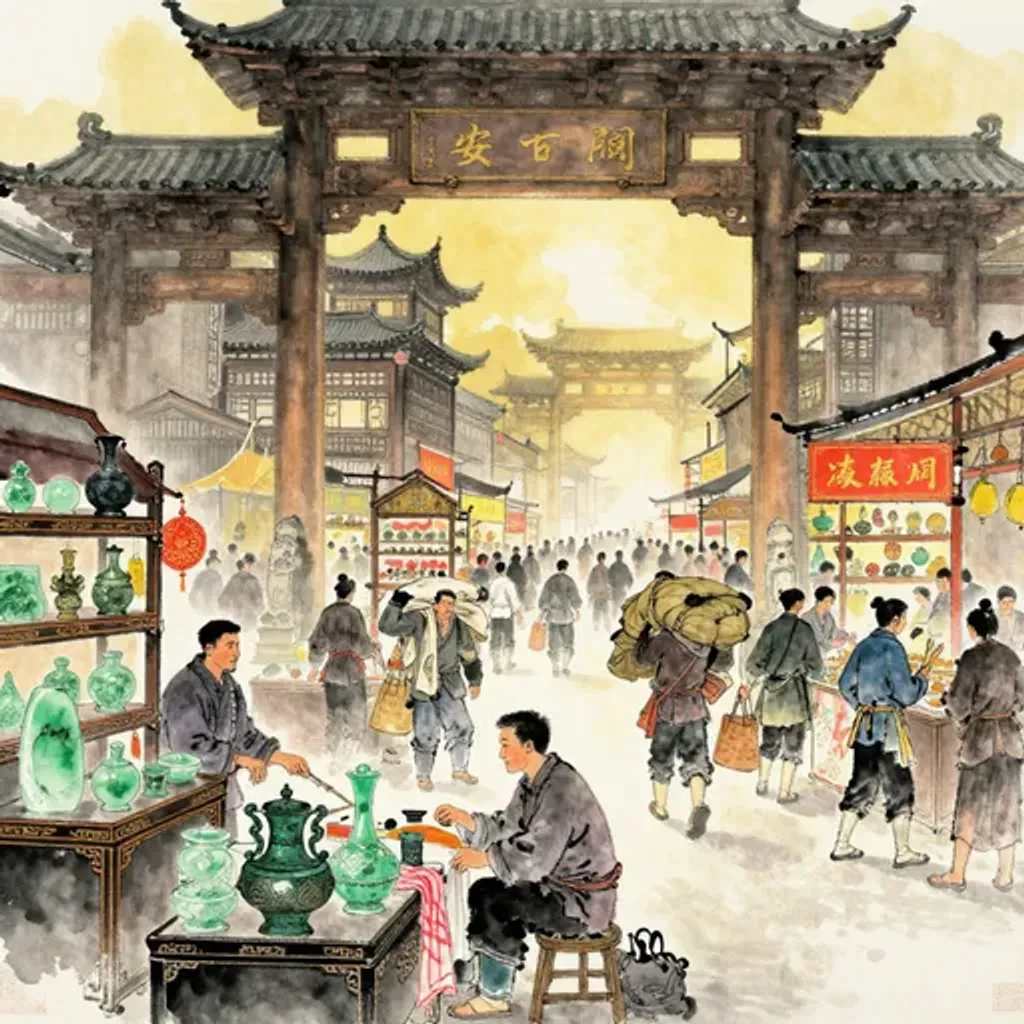
大都王市,稠人多寶。公孫宜賈,資貨萬倍。
The great capital, the king's market; dense crowds, abundant treasure. Lord Sun is skilled at trade; his capital returns ten-thousandfold.
— Jiao Yanshou, Yilin (Forest of Changes), 1st century BC
Commentary
Wind beneath heaven opens a vast marketplace. The great capital and royal bazaar teem with crowds and overflow with treasures. Gongsun is suited to commerce, and his investments return ten-thousandfold. The verse celebrates commercial abundance at its most spectacular — not a village market but the imperial capital's grand bazaar, where fortunes are made overnight. 'Gongsun' may be a generic noble surname used for any well-positioned merchant, or may echo the Shiji's accounts of merchant-statesmen. From Coming to Meet to Increase, wind and thunder move together in mutual enhancement. Gou's encounter becomes an engine of multiplication: what meets combines and amplifies, as goods and capital find their perfect exchange.
姤 → 夬
Hexagram 44 → Hexagram 43: Breakthrough
Changing lines: 1, 6
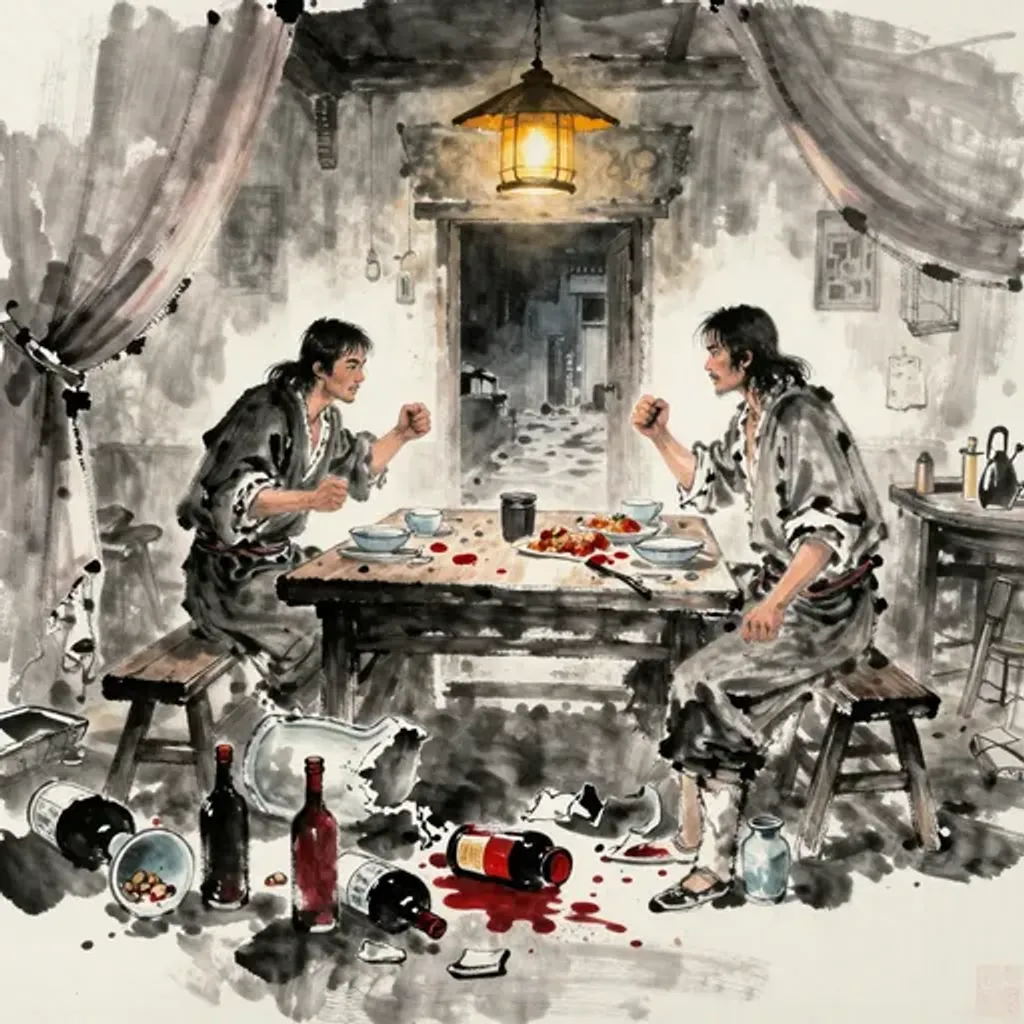
兩人俱醉,相與悖戾。心乖不同,爭訟匈匈。
Drinking together at the same table, voices rising. One word of disagreement — the table is overturned. Wine jars shatter, red covers the floor — yesterday's brothers are today's enemies.
— Jiao Yanshou, Yilin (Forest of Changes), 1st century BC
Commentary
Wind beneath heaven turns convivial encounter into violent rupture. This verse is a rewrite; the original reads: 'Two men both drunk, they grow perverse and contrary. Hearts diverge and disagree; disputes rage fiercely.' The scene is devastatingly simple — drinking companions whose wine-loosened tongues reveal incompatible hearts. What began as shared cups ends in mutual enmity. From Coming to Meet to Breakthrough, the lake rises above heaven in explosive release. Gou's encounter, fueled by alcohol, crosses a threshold that cannot be uncrossed. Breakthrough's image of water overtopping the sky captures the irreversibility: once the quarrel erupts, yesterday's brothers become today's enemies, and no apology can rebottle the spilled wine.
姤 → 姤
Hexagram 44 → Hexagram 44: Coming to Meet
No changing lines — the hexagram is unchanged
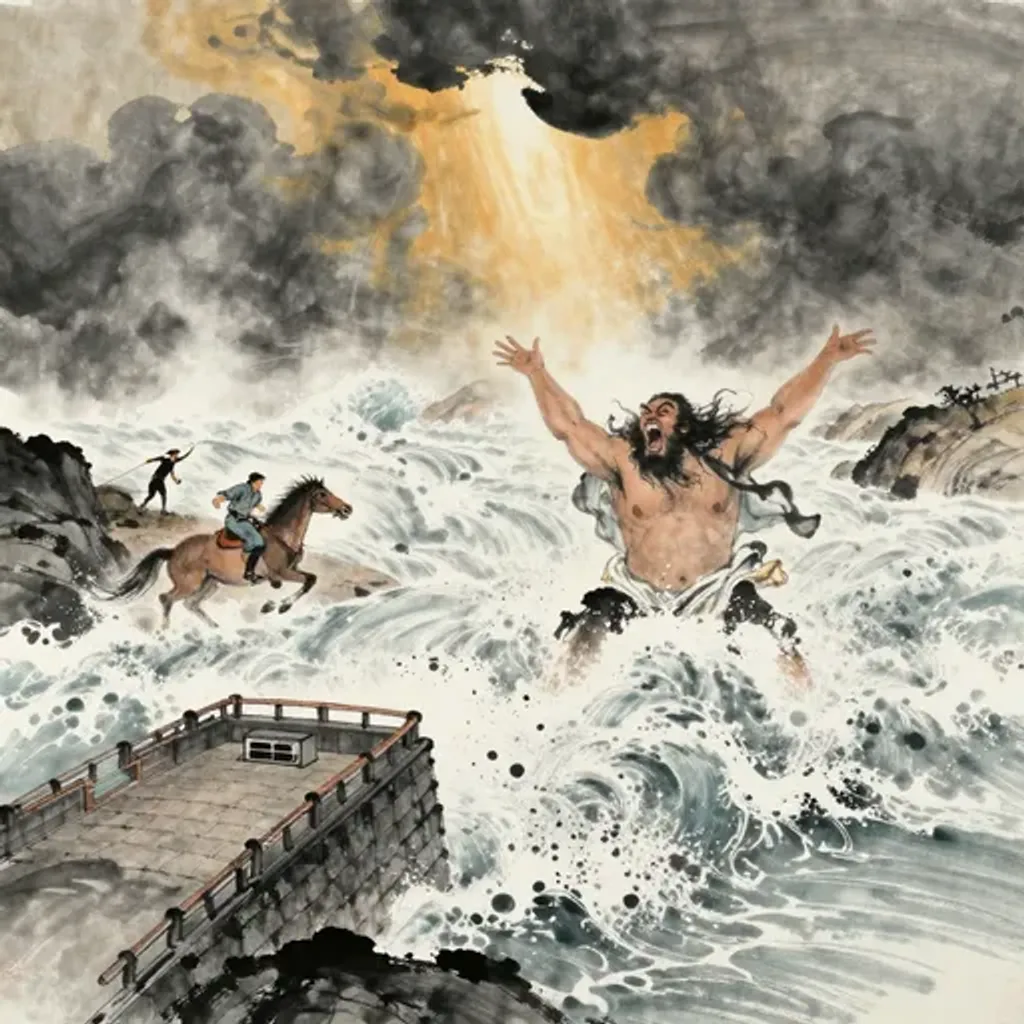
河伯大呼,津不可渡。往復爾故,乃无大悔。
The River Lord cries out in warning; the ford cannot be crossed. Going and returning to one's former way; thus there is no great regret.
— Jiao Yanshou, Yilin (Forest of Changes), 1st century BC
Commentary
Wind beneath heaven doubles upon itself — Gou encountering Gou. The Earl of the River bellows a great cry: the ford cannot be crossed! One goes back and forth, retracing old paths, and thereby avoids great regret. The river god Hebo's warning halts forward movement, and the traveler wisely retreats to familiar ground rather than forcing a dangerous crossing. When the same hexagram meets itself, the pattern reinforces rather than transforms: the encounter remains an encounter, permanently suspended. From Coming to Meet to Coming to Meet, the yin line that entered from below neither advances nor retreats but dwells at the threshold, eternally arriving, never fully arrived.
姤 → 萃
Hexagram 44 → Hexagram 45: Gathering Together
Changing lines: 2, 3, 6
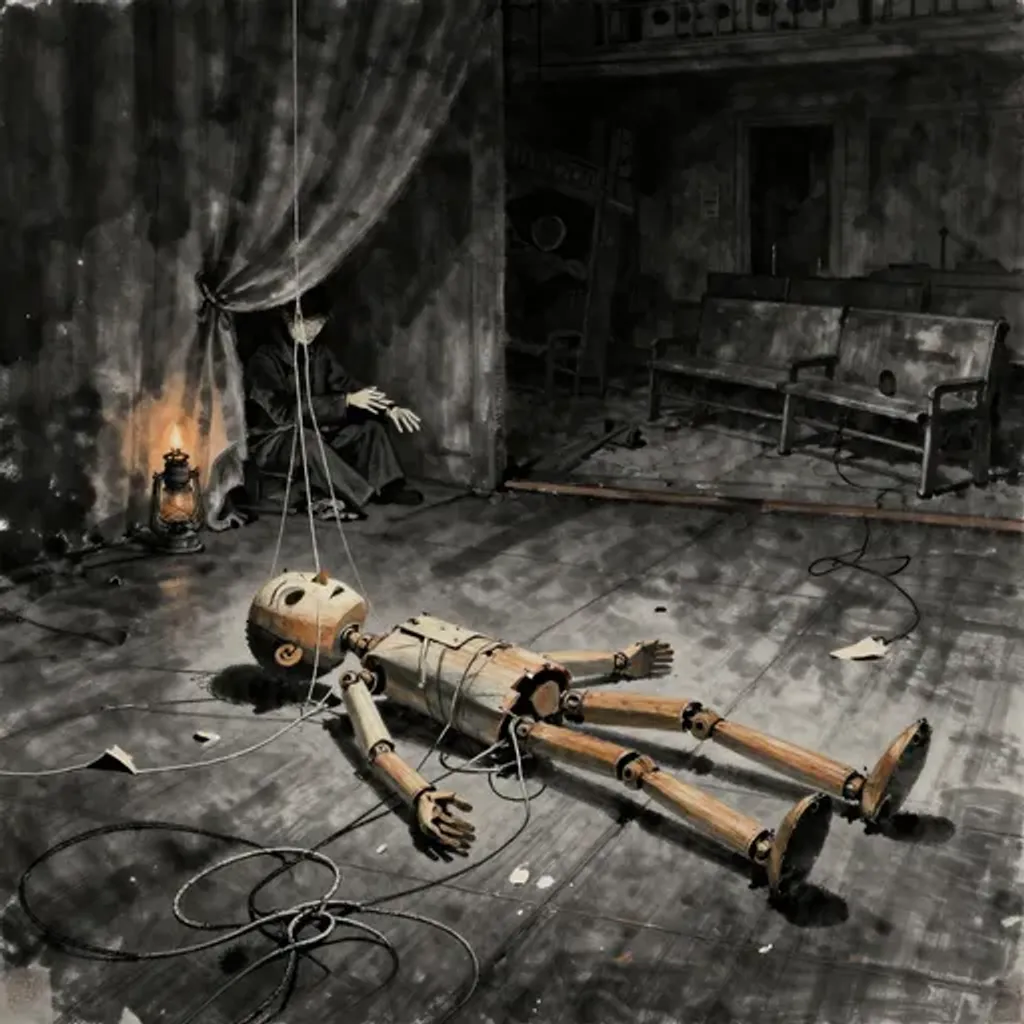
身无頭足,超蹠空乖。不能遠之,中道廢休,失利後時。
A body without head or feet; leaping far, missing the mark. Unable to go the distance, abandoning the endeavor midway; losing the advantage, too late.
— Jiao Yanshou, Yilin (Forest of Changes), 1st century BC
Commentary
Wind beneath heaven produces a body with neither head nor feet. One leaps and stumbles in vain discord, unable to travel far, abandoning the journey midway and missing the opportune moment. The image is grotesque: a torso without direction (no head) and without grounding (no feet), lurching through space in futile spasms. From Coming to Meet to Gathering, the lake upon the earth should pool resources and draw people together — yet this verse depicts the opposite: a figure too malformed to join any assembly. Gou's encounter yields a connection that cannot be sustained; the body politic lacks both leadership and foundation, and the gathering disperses before it forms.
姤 → 升
Hexagram 44 → Hexagram 46: Pushing Upward
Changing lines: 4, 5, 6
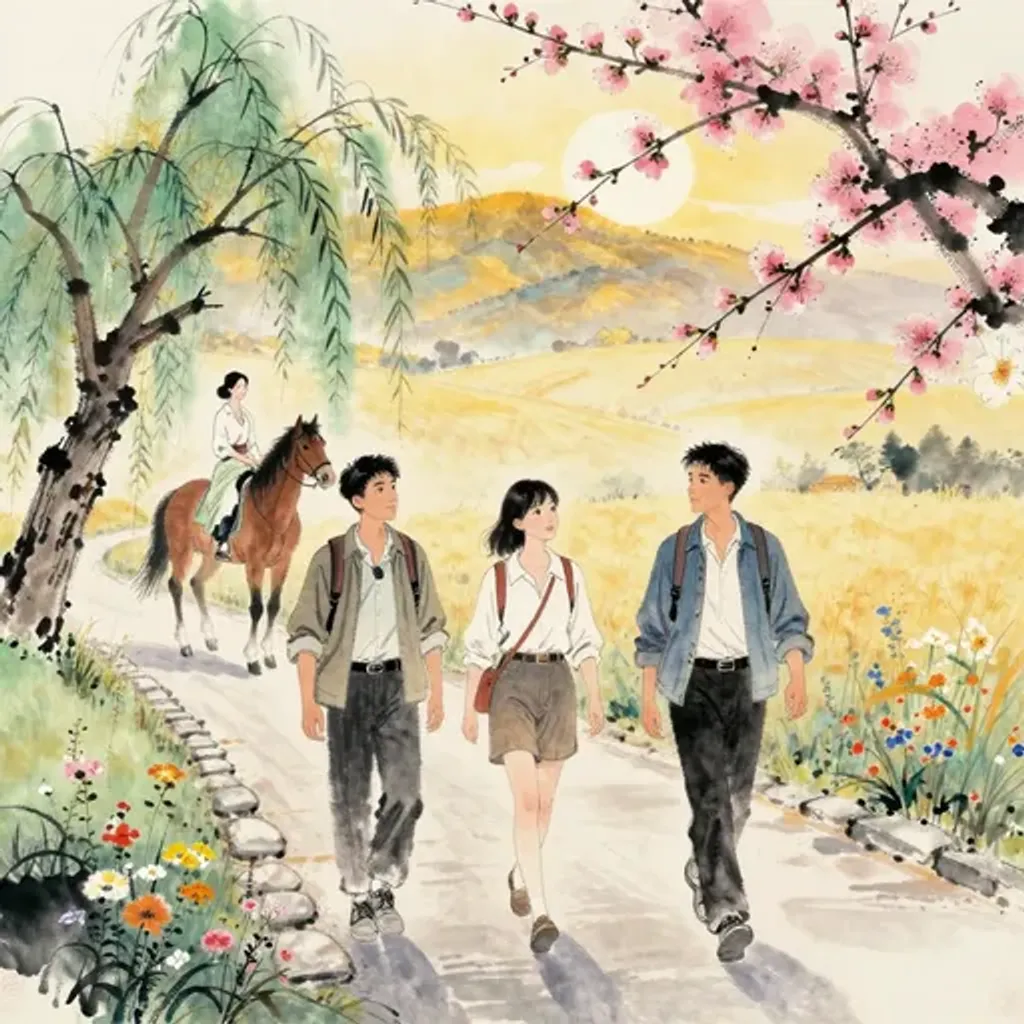
三人俱行,六目光明。道逢淑女,與我驥子。
Three men travel together; six eyes shine bright. On the road they meet a virtuous woman who gives me a fine young steed.
— Jiao Yanshou, Yilin (Forest of Changes), 1st century BC
Commentary
Wind beneath heaven sends three travelers upon a bright-eyed journey. Three companions walk together, six eyes shining with clarity, and on the road they meet a fair maiden who gifts them a fine steed. The verse radiates cooperative good fortune — multiple travelers sharing vision, an auspicious encounter producing tangible reward. The 'three men' may allude to the three founding advisors of early Zhou, though the identification is uncertain. From Coming to Meet to Pushing Upward, a tree grows slowly from within the earth: what begins as an encounter among equals develops into steady, organic ascent. Gou's meeting, shared among friends, multiplies into collective elevation.
姤 → 困
Hexagram 44 → Hexagram 47: Oppression
Changing lines: 3, 6
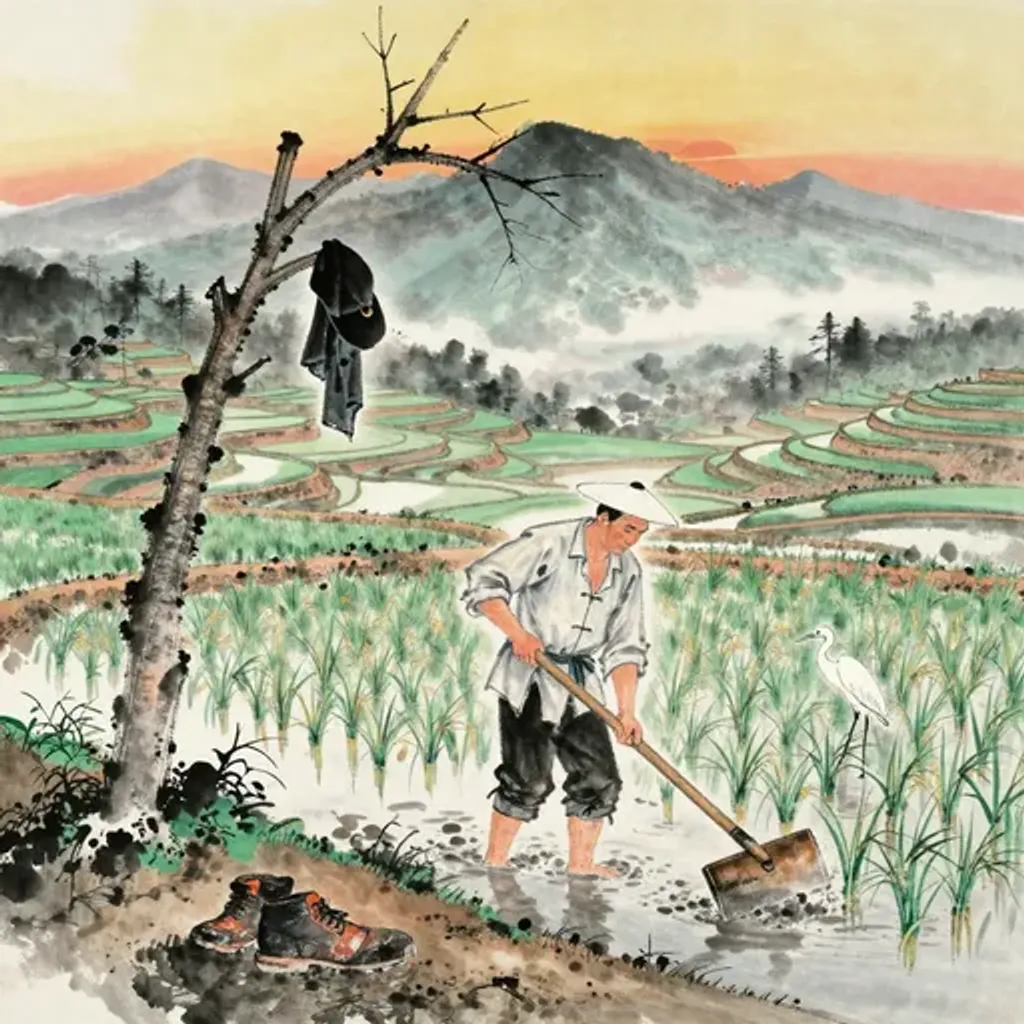
進仕為官,不若復田,獲壽保年。
Advancing to serve as an official is not as good as returning to the fields; thereby one gains long life and preserves one's years.
— Jiao Yanshou, Yilin (Forest of Changes), 1st century BC
Commentary
Wind beneath heaven whispers a quiet counsel: retire. Entering public service and becoming an official is not as good as returning to farm the land, thereby preserving one's years and securing longevity. The verse is a miniature Daoist manifesto — the encounter with political life is weighed against agrarian simplicity, and simplicity wins. The contrast between officialdom's dangers and farming's safety echoes a persistent theme in Chinese thought from Laozi to Tao Yuanming. From Coming to Meet to Oppression, the lake has lost its water: ambition drained dry, one finds that the well of bureaucratic life offers nothing to drink. Better to withdraw and tend one's own soil.
姤 → 井
Hexagram 44 → Hexagram 48: The Well
Changing lines: 4, 6
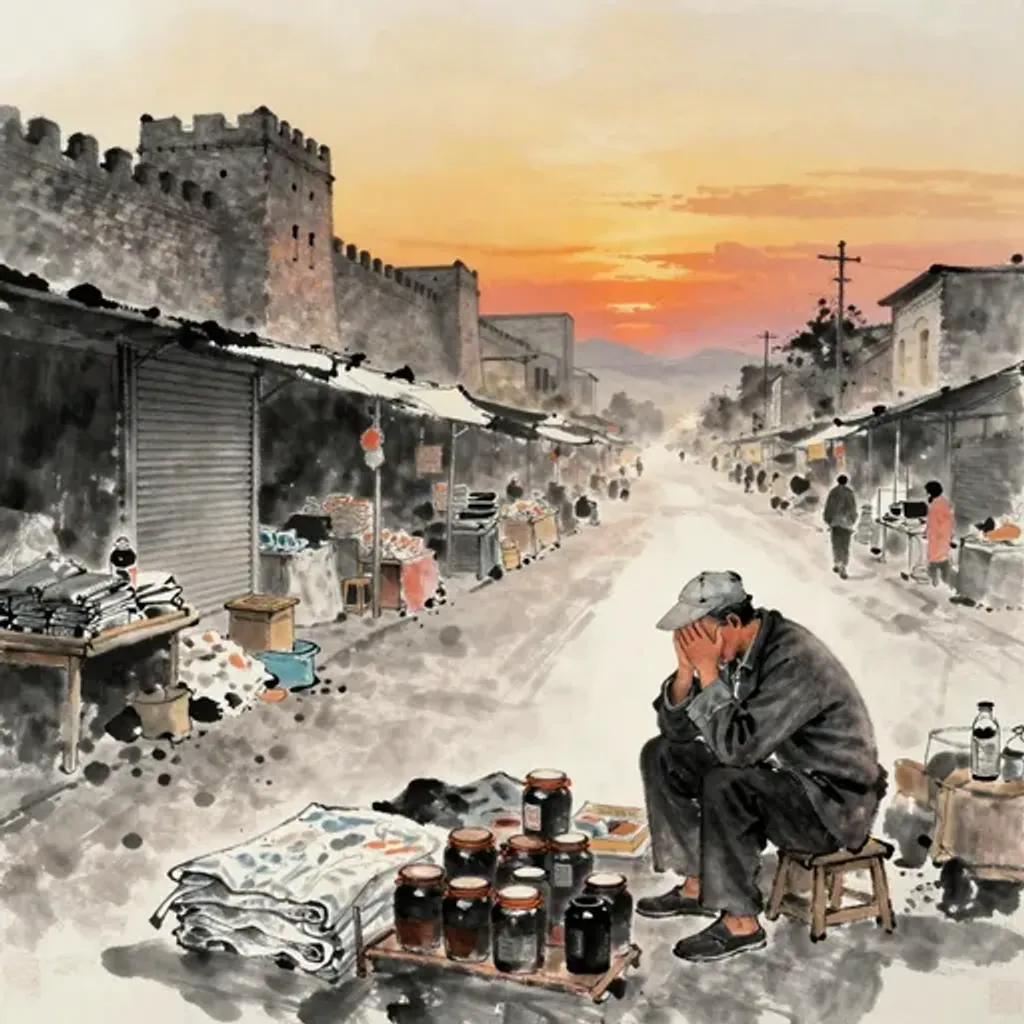
先易後否,失我所市。騷蘇自苦,思吾故土。
Easy at first, then adverse; I lose what I came to trade. Troubled and bitter, suffering alone; I long for my native soil.
— Jiao Yanshou, Yilin (Forest of Changes), 1st century BC
Commentary
Wind beneath heaven shifts from fair to foul. What begins easily ends in denial; the market goods one sought are lost. Restless and self-tormenting, one pines for the homeland left behind. The verse traces a trajectory of commercial or personal migration gone wrong — initial ease gives way to failure, and the exile aches for home. 'Saosao' suggests agitated wandering, a mind that cannot settle. From Coming to Meet to The Well, water rises through wood from the depths: the well nourishes all who come but cannot be moved. The verse's homesickness resonates with the well's fixed nature — what sustains you is rooted in one place, and wandering away from it brings only thirst.
姤 → 革
Hexagram 44 → Hexagram 49: Revolution
Changing lines: 1, 2, 6
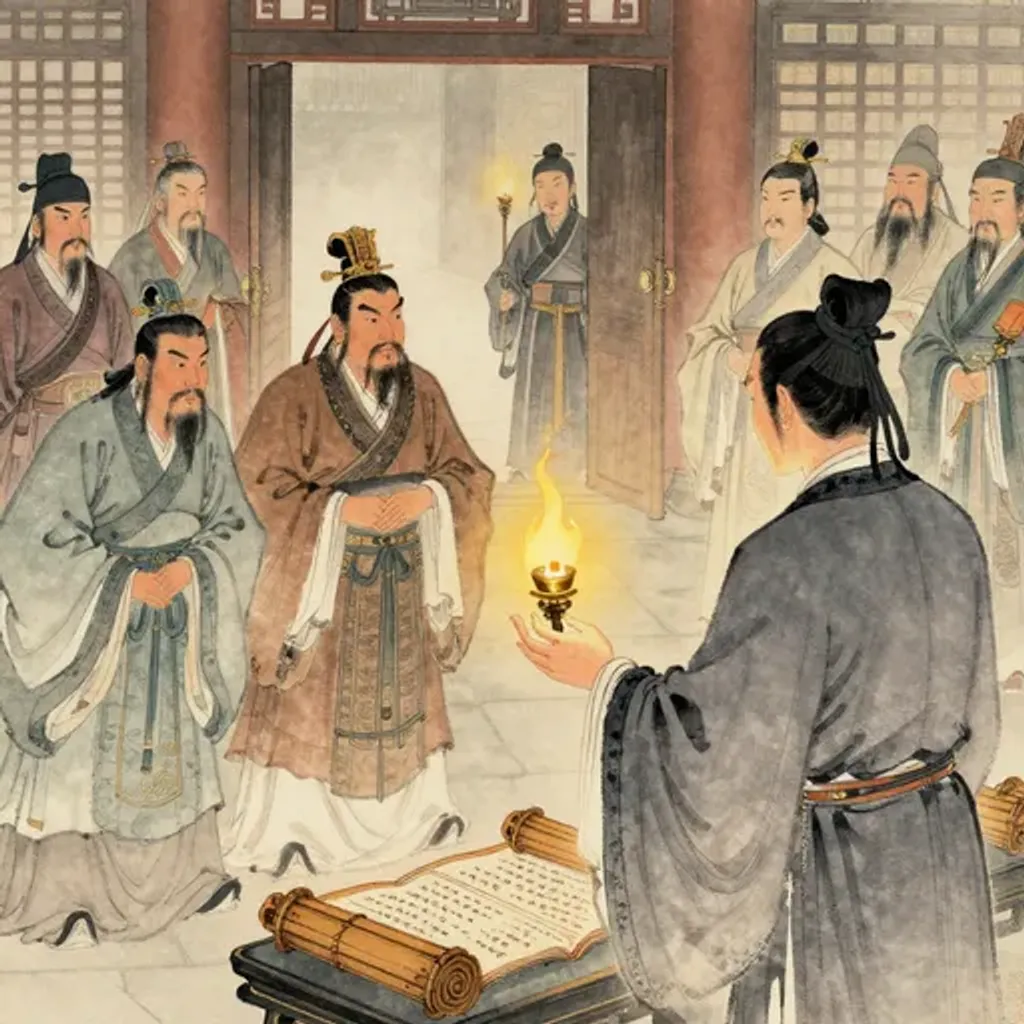
蘇氏發言,韓魏无患。張子馳說,燕齊以安。
Master Su speaks his piece; Han and Wei are freed from peril. Master Zhang gallops forth with argument; Yan and Qi find peace.
— Jiao Yanshou, Yilin (Forest of Changes), 1st century BC
Commentary
Wind beneath heaven dispatches the great persuaders. Master Su speaks, and Han and Wei are freed from danger. Master Zhang gallops with his rhetoric, and Yan and Qi find peace. The verse names the two supreme diplomats of the Warring States: Su Qin, architect of the Vertical Alliance uniting six states against Qin, and Zhang Yi, mastermind of the Horizontal Alliance that broke it apart. Together they represent the power of persuasion to reshape the political map. From Coming to Meet to Revolution, fire burns within the lake, transforming its very nature. Gou's encounter here is the encounter of word with power: a single meeting between a persuader and a ruler can overturn an entire geopolitical order.
姤 → 鼎
Hexagram 44 → Hexagram 50: The Cauldron
Changing lines: 5
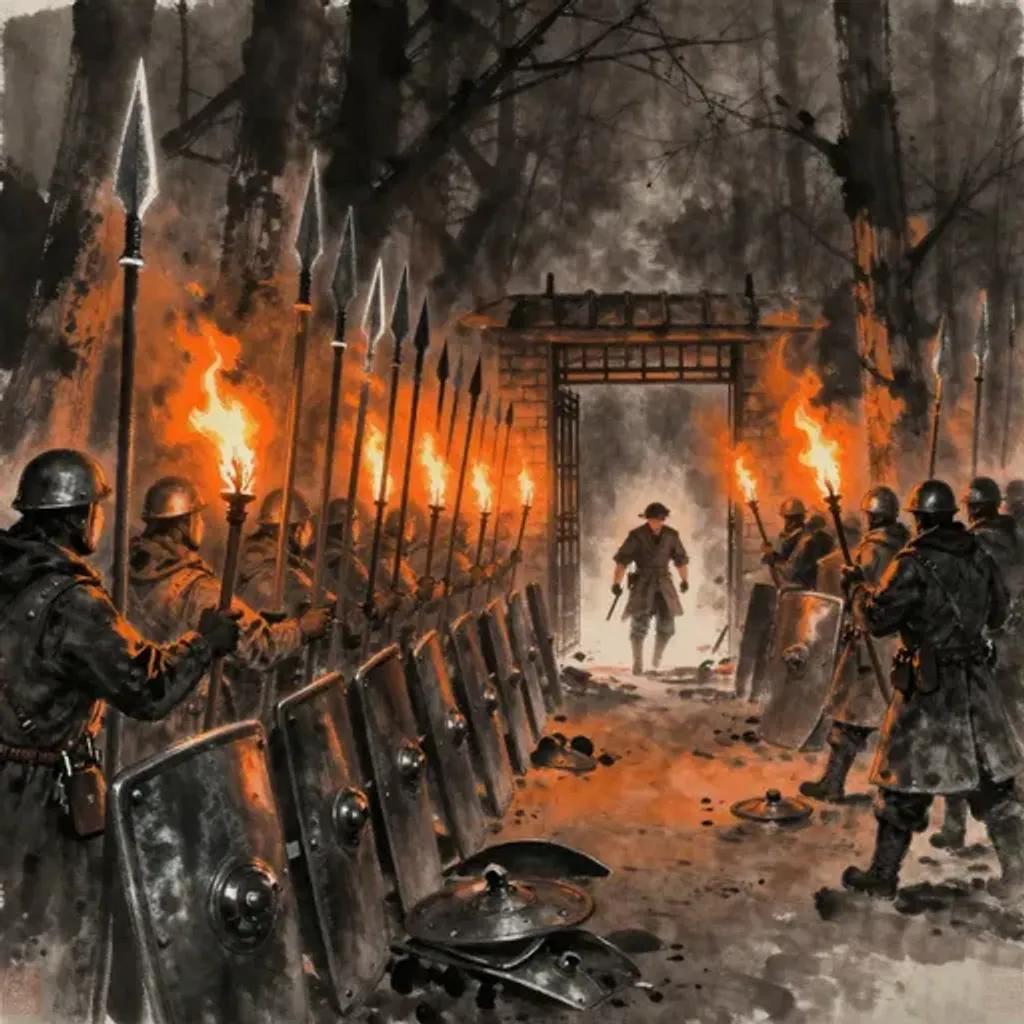
武庫軍府,甲兵所聚。非里邑居,不可舍止。
Iron halberds stand dense as a forest; shields pile up blocking every doorway in shadow. Night patrol torches reflect off blade edges — passing travelers lower their heads and hurry through.
— Jiao Yanshou, Yilin (Forest of Changes), 1st century BC
Commentary
Wind beneath heaven encounters a restricted military zone. This verse is a rewrite; the original reads: 'The armory and military storehouse, where armor and weapons are gathered. This is not a village dwelling — one must not stop or linger here.' The scene is a government arsenal bristling with weapons, emphatically not a place for civilians. The warning is institutional: some encounters are forbidden by design. From Coming to Meet to The Cauldron, fire above wind suggests the transformation of raw materials into refined purpose — yet the raw materials here are weapons, and the refinement is military discipline. Gou's encounter with the arsenal warns that not every meeting invites participation; some thresholds must not be crossed.
姤 → 震
Hexagram 44 → Hexagram 51: The Arousing Thunder
Changing lines: 1, 2, 3, 5, 6
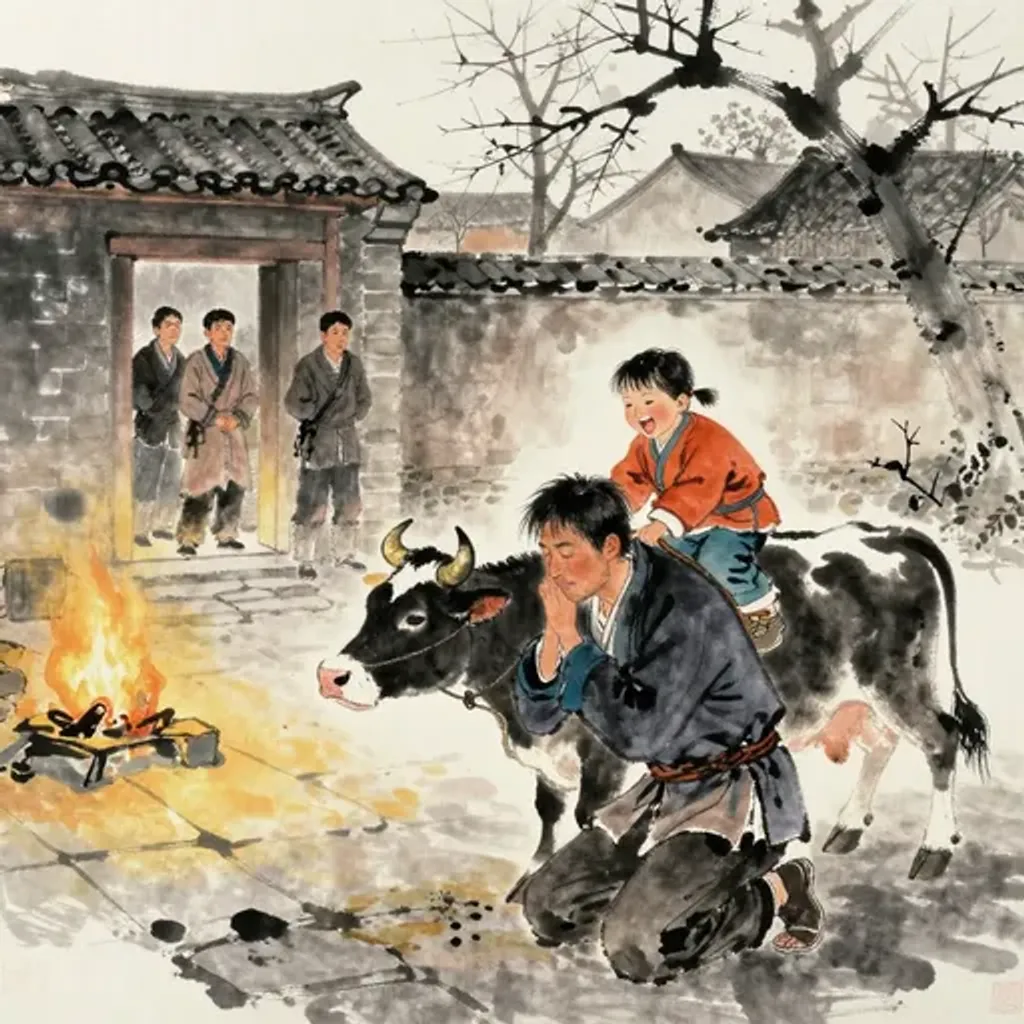
一身三口,莫適所與。為孺子牛,田氏主咎。
One person, three mouths to feed; none to turn to for help. Playing the cow for the young child; the Tian clan bears the blame.
— Jiao Yanshou, Yilin (Forest of Changes), 1st century BC
Commentary
Wind beneath heaven hides a usurper behind a nursemaid's mask. 'One body, three mouths' — three dependents compete for a single patron's resources, and there is no one to give to. The verse then invokes the tale of 'playing ox for the child': Duke Jing of Qi loved his young son Ru so dearly that he would get on all fours and let the boy ride him with a rope in his mouth. The Tian clan exploited this doting weakness, eventually killing the prince and seizing power. From Coming to Meet to The Arousing, doubled thunder shakes the foundations. Gou's encounter with indulgence triggers a violent awakening: what seemed like harmless affection concealed the Tian clan's ambition, and the thunder of their coup shattered the ducal house.
姤 → 艮
Hexagram 44 → Hexagram 52: Keeping Still Mountain
Changing lines: 2, 4, 5
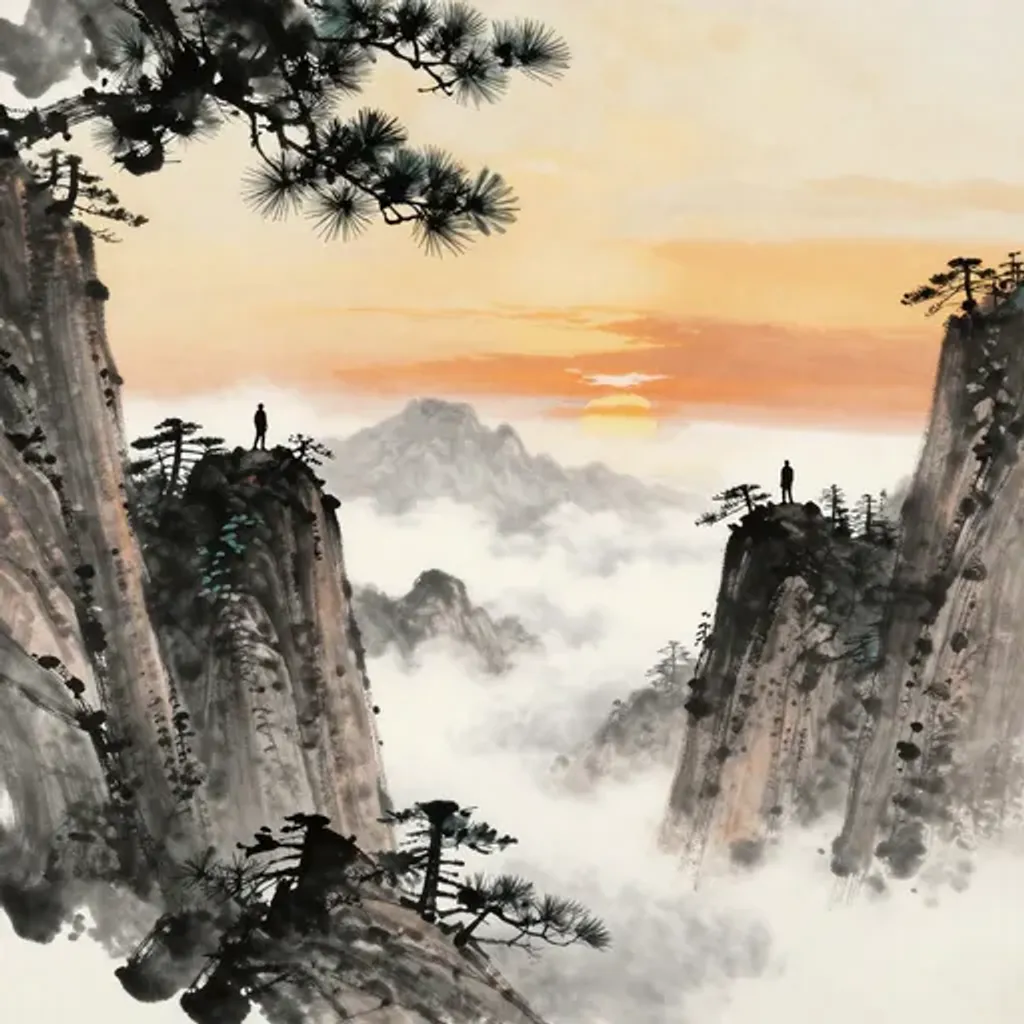
西山東山,各自止安。心雖相望,竟未上堂。
West mountain, east mountain; each rests in its own place. Hearts gaze toward one another, yet in the end none ascends the hall.
— Jiao Yanshou, Yilin (Forest of Changes), 1st century BC
Commentary
Wind beneath heaven subsides into mountain stillness. West Mountain and East Mountain each stand in their own calm, and though hearts gaze toward one another, none ever enters the other's hall. This verse nearly mirrors 44-2 (the Kun transformation), substituting 'West Mountain, East Mountain' for 'East Mountain, West Mountain' and 'never ascended the hall' for 'minds not sharing the same hall.' The symmetry is deliberate: both verses describe longing across impassable distance. From Coming to Meet to Keeping Still, the doubled mountain forbids movement entirely. Where 44-2 dissolved into earth's passive receptivity, here the separation calcifies into stone — not yielding but immovable, each peak frozen in permanent isolation.
姤 → 漸
Hexagram 44 → Hexagram 53: Development
Changing lines: 2, 4
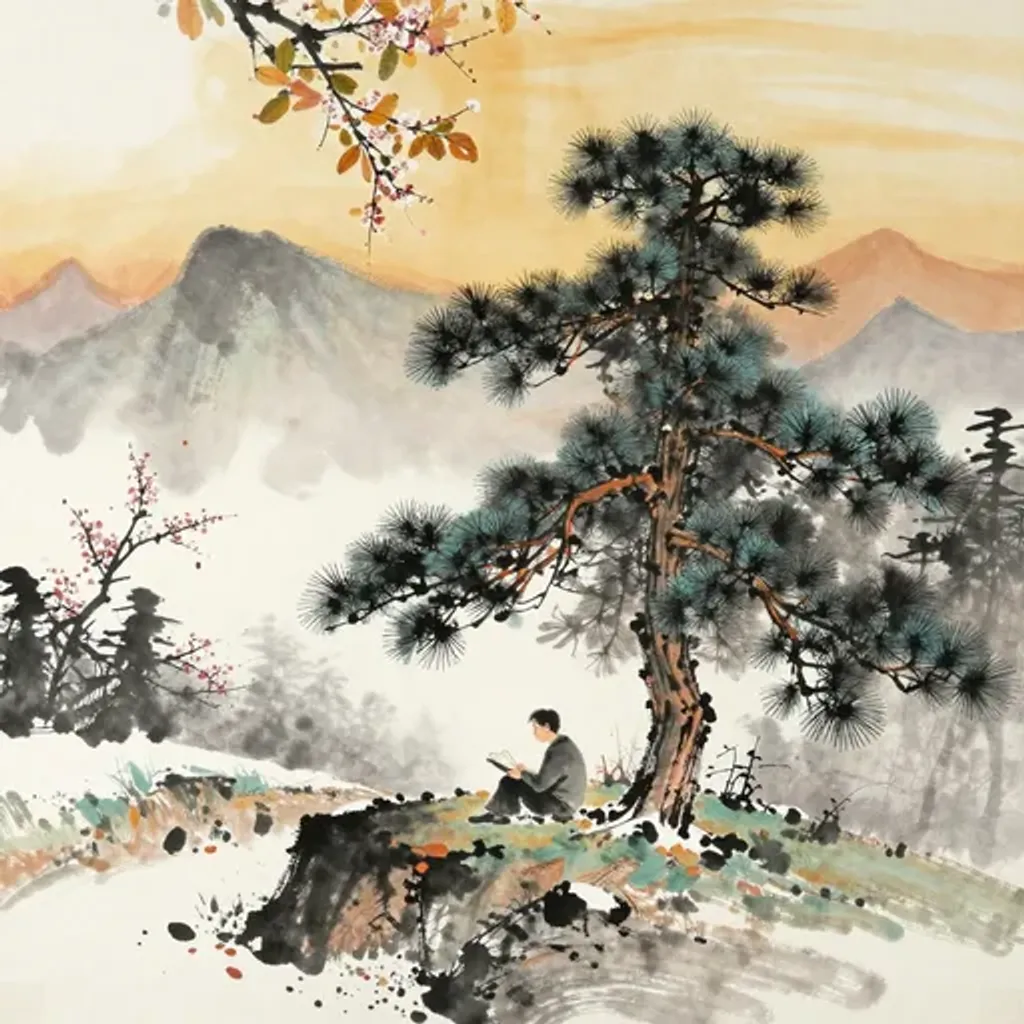
不改柯葉,和氣中適。君子所在,安无怵惕。
Not changing branch or leaf; harmonious energy perfectly balanced. Where the noble man abides, there is peace and no alarm.
— Jiao Yanshou, Yilin (Forest of Changes), 1st century BC
Commentary
Wind beneath heaven preserves its own nature through steady constancy. Branches and leaves remain unchanged, the temperate harmony perfectly balanced. Where the gentleman resides, there is peace without alarm or anxiety. The verse celebrates effortless stability — a tree that keeps its form through the seasons, a person whose equanimity requires no struggle. 'Not changing branch or leaf' suggests an evergreen constancy, immune to the seasonal stripping that afflicts deciduous growth. From Coming to Meet to Development, the tree grows gradually upon the mountain in natural, unhurried progression. Gou's encounter here produces not disruption but gentle adaptation: the meeting integrates smoothly, like a new branch that extends the canopy without disturbing its shape.
姤 → 歸妹
Hexagram 44 → Hexagram 54: The Marrying Maiden
Changing lines: 1, 3, 5, 6
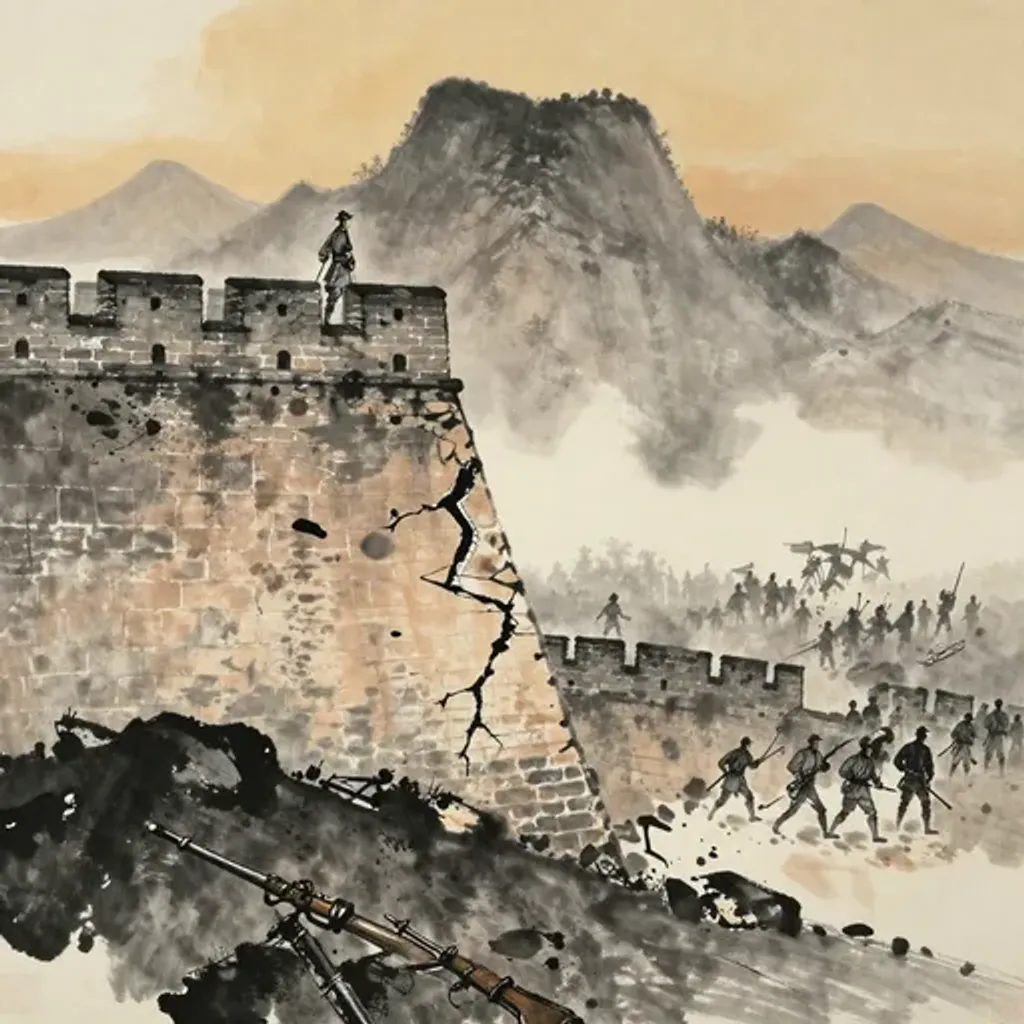
將戌擊亥,陽藏不起。君子散亂,太山危殆。
Xu attacks Hai; the yang hides and will not rise. The noble men scatter in disarray; Mount Tai stands in peril.
— Jiao Yanshou, Yilin (Forest of Changes), 1st century BC
Commentary
Wind beneath heaven dissipates as yin overwhelms yang. 'Xu attacks hai' — the earthly branch xu (dog, yang earth) assaults hai (pig, yin water), marking the transition into deep yin territory in the calendrical cycle. Yang withdraws and cannot rise. The gentleman's order scatters into chaos, and even Mount Tai stands in peril. The imagery combines calendrical symbolism with political collapse: when the yang forces of governance retreat, even the most stable institution (Tai Shan, the Eastern Sacred Mountain) trembles. From Coming to Meet to the Marrying Maiden, thunder above the lake drives a maiden into an improper or subordinate marriage. Gou's fateful encounter precipitates a union that weakens rather than strengthens.
姤 → 豐
Hexagram 44 → Hexagram 55: Abundance
Changing lines: 1, 2, 5, 6
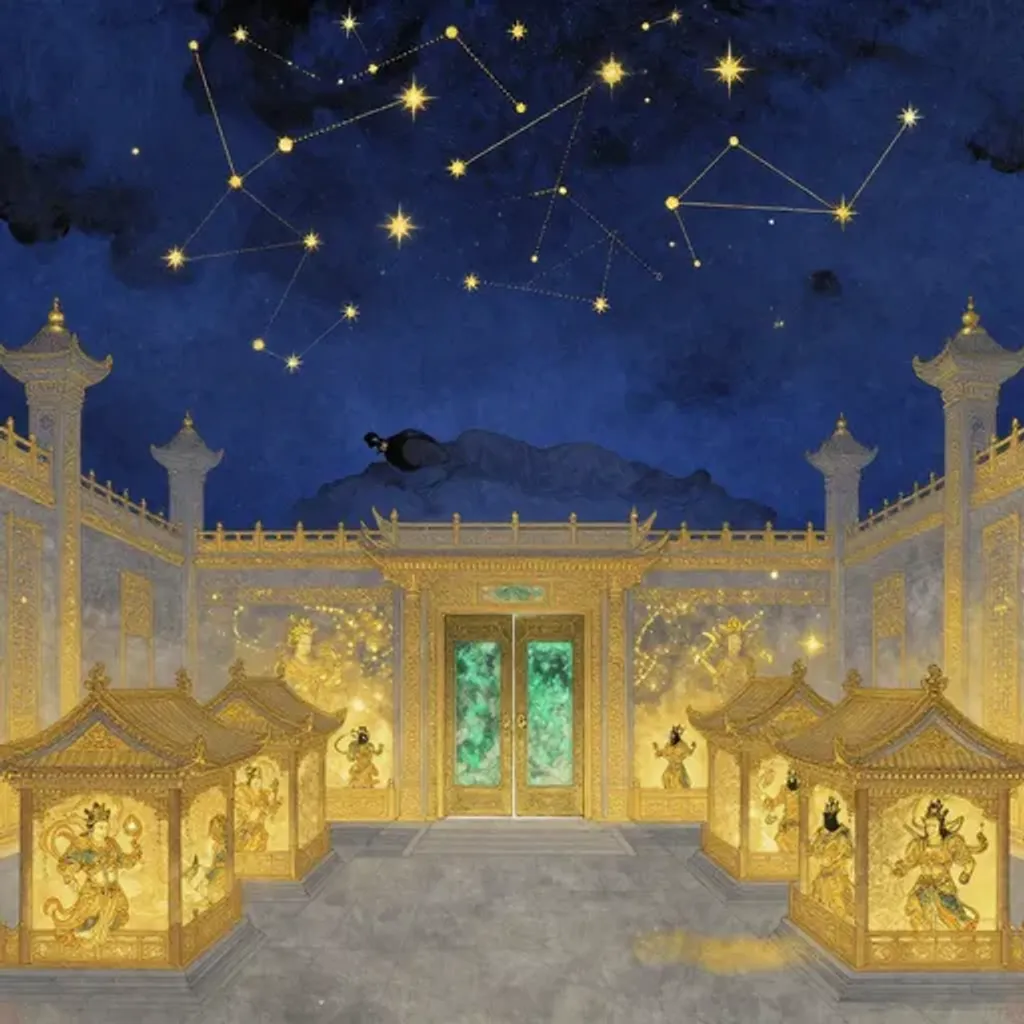
天官列宿,五神舍室。宮關完堅,君安其居。
The celestial offices are arrayed in their lodges; the five spirits dwell in their chambers. The palace gates are strong and secure; the lord rests at ease in his dwelling.
— Jiao Yanshou, Yilin (Forest of Changes), 1st century BC
Commentary
Wind beneath heaven arranges the constellations of security. The celestial offices are set in their proper lodgings, and the five guardian spirits take their places. Palace gates are strong and complete; the ruler rests secure in his dwelling. The verse is an image of cosmic and political order perfectly aligned — each star in its mansion, each deity in its shrine, each gate locked and bolted. Security is not imposed by force but by structure: everything occupies its rightful station. From Coming to Meet to Abundance, thunder and lightning arrive together in overwhelming fullness. Gou's encounter here fulfills the hexagram's highest potential: heaven's wind delivers a proclamation that orders the realm, and abundance is the natural result of such comprehensive governance.
姤 → 旅
Hexagram 44 → Hexagram 56: The Wanderer
Changing lines: 2, 5
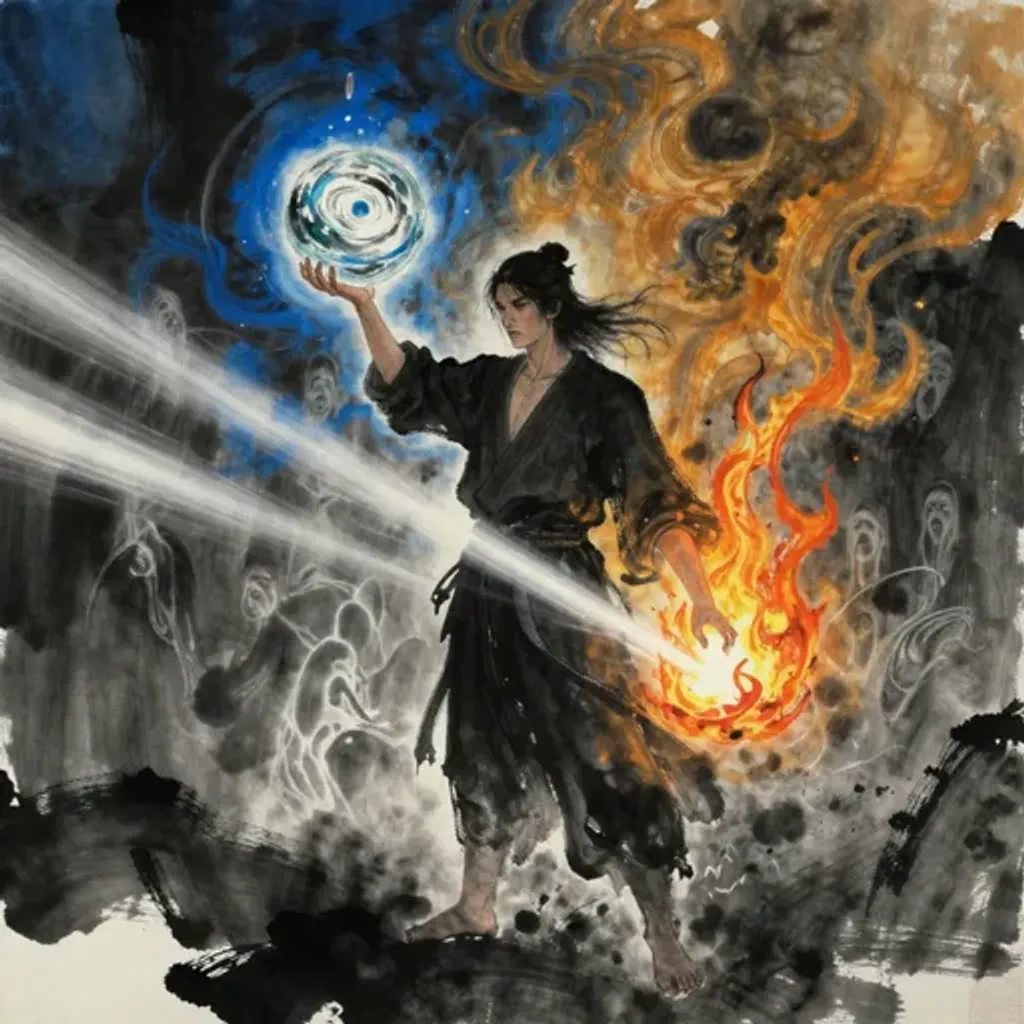
左手把水,右手把火。如光與鬼,不可得從。
Left hand grasping water, right hand grasping fire. Like light and ghosts together; one cannot follow both.
— Jiao Yanshou, Yilin (Forest of Changes), 1st century BC
Commentary
Wind beneath heaven places irreconcilable elements in the same hands. The left hand holds water while the right hand holds fire; like pursuing light alongside ghosts, one cannot follow both paths. The verse depicts an impossible situation — two mutually exclusive forces that the traveler tries to carry simultaneously. Water extinguishes fire; light banishes shadow. The attempt to maintain both produces paralysis. From Coming to Meet to The Wanderer, fire burns upon the mountain as the traveler moves through unfamiliar terrain. Gou's encounter here delivers contradiction rather than union: the meeting of incompatible forces produces not synthesis but bewildered wandering, unable to commit to either direction.
姤 → 巽
Hexagram 44 → Hexagram 57: The Gentle Wind
Changing lines: 4
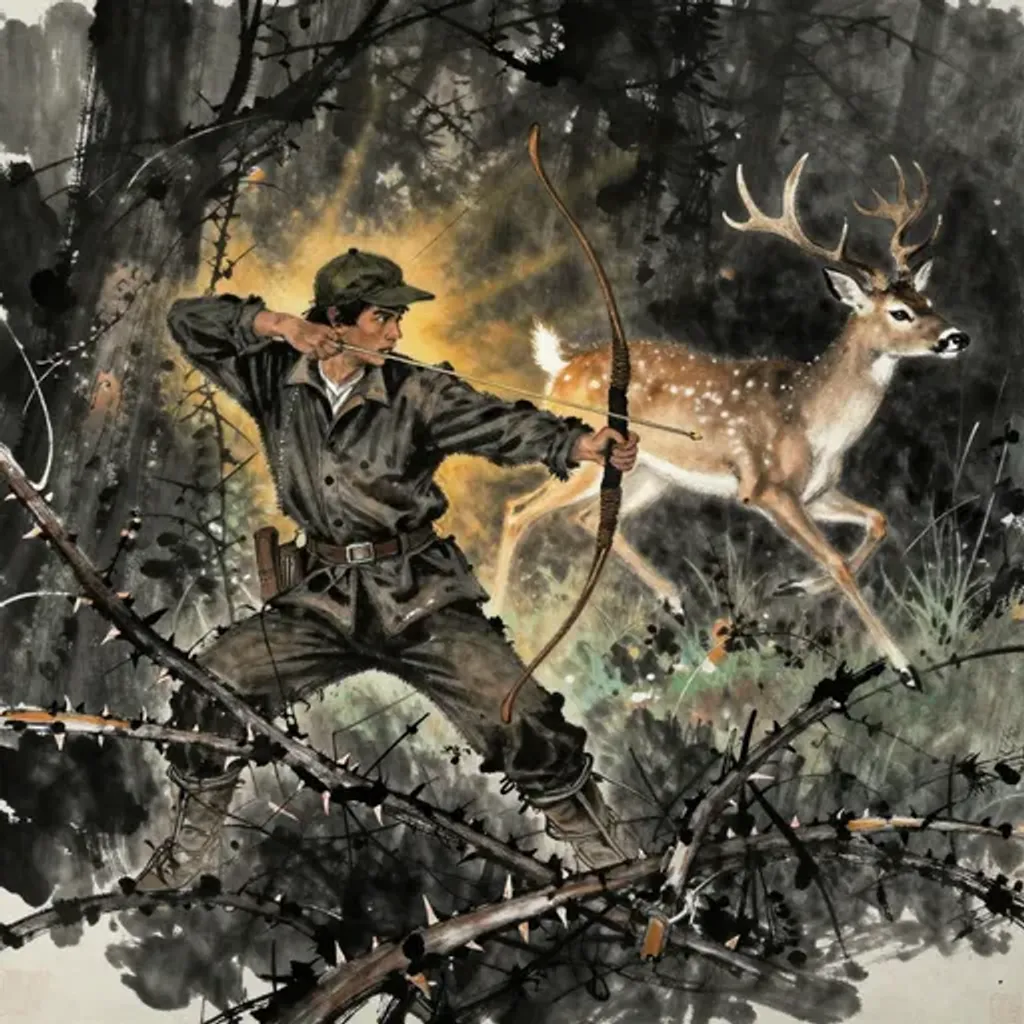
逐狐東山,水遏我前。深不可涉,失利後便。
Chasing a deer into the forest, vines tangle the feet. The deer calls from deep within; the hunter stands empty-handed.
— Jiao Yanshou, Yilin (Forest of Changes), 1st century BC
Commentary
Wind beneath heaven doubles into the gentlest penetration. This verse is a rewrite; the original reads: 'Chasing a fox on the eastern mountain, water blocks my way ahead. Deep and unfordable, I lose the advantage and fall behind.' A hunter pursues quarry but the river cuts the chase short — the fox escapes because terrain intervenes. The encounter with prey is frustrated by natural barriers. From Coming to Meet to The Gentle, doubled wind whispers and infiltrates rather than confronts directly. The original verse's failed hunt resonates: brute pursuit fails where the wind hexagram counsels subtle, repeated penetration. The fox eludes the charging hunter but not the wind.
姤 → 兌
Hexagram 44 → Hexagram 58: The Joyous Lake
Changing lines: 1, 3, 6
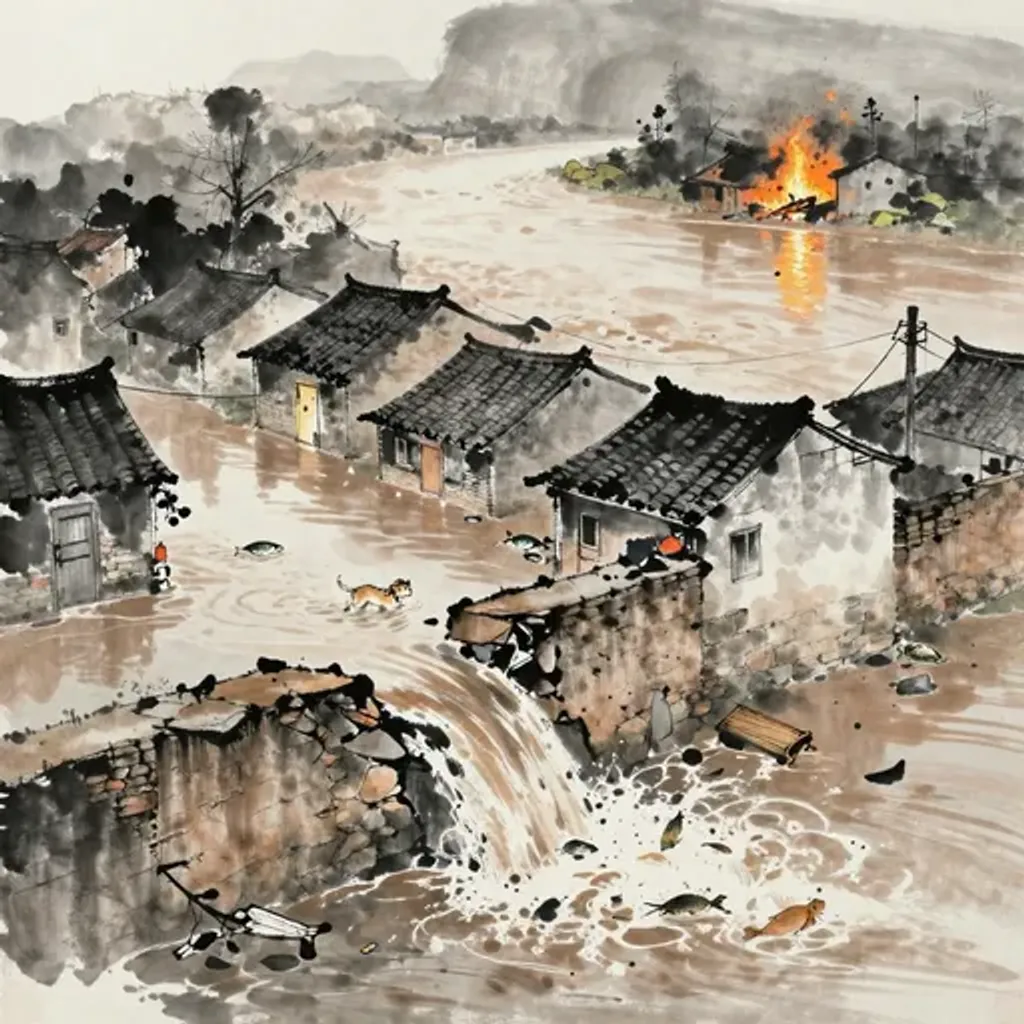
水瀆魚室,來灌吾邑。衝沒我家,與狗俱遊。
The water channel becomes a fish pond; it floods and inundates my village. It submerges and drowns my home; I swim alongside the dog.
— Jiao Yanshou, Yilin (Forest of Changes), 1st century BC
Commentary
Wind beneath heaven releases the flood. Water breaches the drainage channel and the fish ponds, pouring in to inundate my settlement. It overwhelms my home, and I am left swimming alongside the dogs. The verse describes catastrophic flooding with vivid, darkly comic detail — the final image of a person paddling through floodwater beside household dogs captures total domestic destruction with unsentimental clarity. From Coming to Meet to The Joyous, doubled lakes join in mutual delight — yet here that doubling becomes a double dose of water destroying everything in its path. Gou's encounter with the flood element is uncontrollable: when the yin force (water) encounters no barrier, it transforms joy's lake into a sea of ruin.
姤 → 渙
Hexagram 44 → Hexagram 59: Dispersion
Changing lines: 3, 4
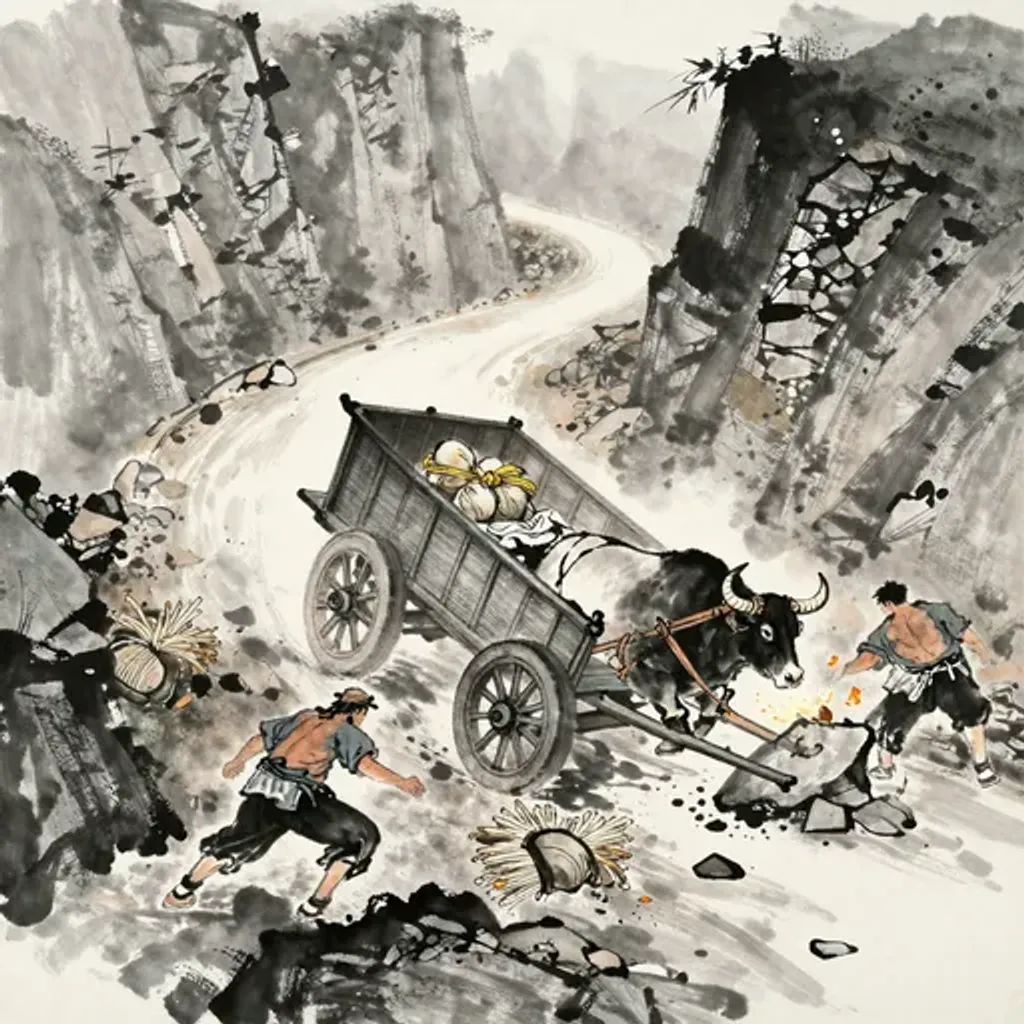
山險難登,澗中多石。車馳轊擊,重載傷軸。擔負善躓,跌踒右足。
Mountain steep, hard to climb; the ravine is full of stones. The cart races, hubs collide; the heavy load breaks the axle. The porter stumbles easily; he trips and injures his right foot.
— Jiao Yanshou, Yilin (Forest of Changes), 1st century BC
Commentary
Wind beneath heaven meets broken terrain. Mountains are steep and hard to climb, the ravine is full of stones. Carts race and collide hub against hub, heavy loads snap the axle. Porters carrying burdens on their backs stumble easily, twisting and injuring the right foot. Every image compounds the hazard: the mountain resists the climber, the stones wreck the cart, the load breaks the axle, the porter falls. From Coming to Meet to Dispersion, wind scatters across the water's surface, dissipating what was gathered. Gou's encounter with this terrain does not build but dismantles — each obstacle strips away another resource until the traveler is left broken on the mountainside.
姤 → 節
Hexagram 44 → Hexagram 60: Limitation
Changing lines: 1, 3, 4, 6
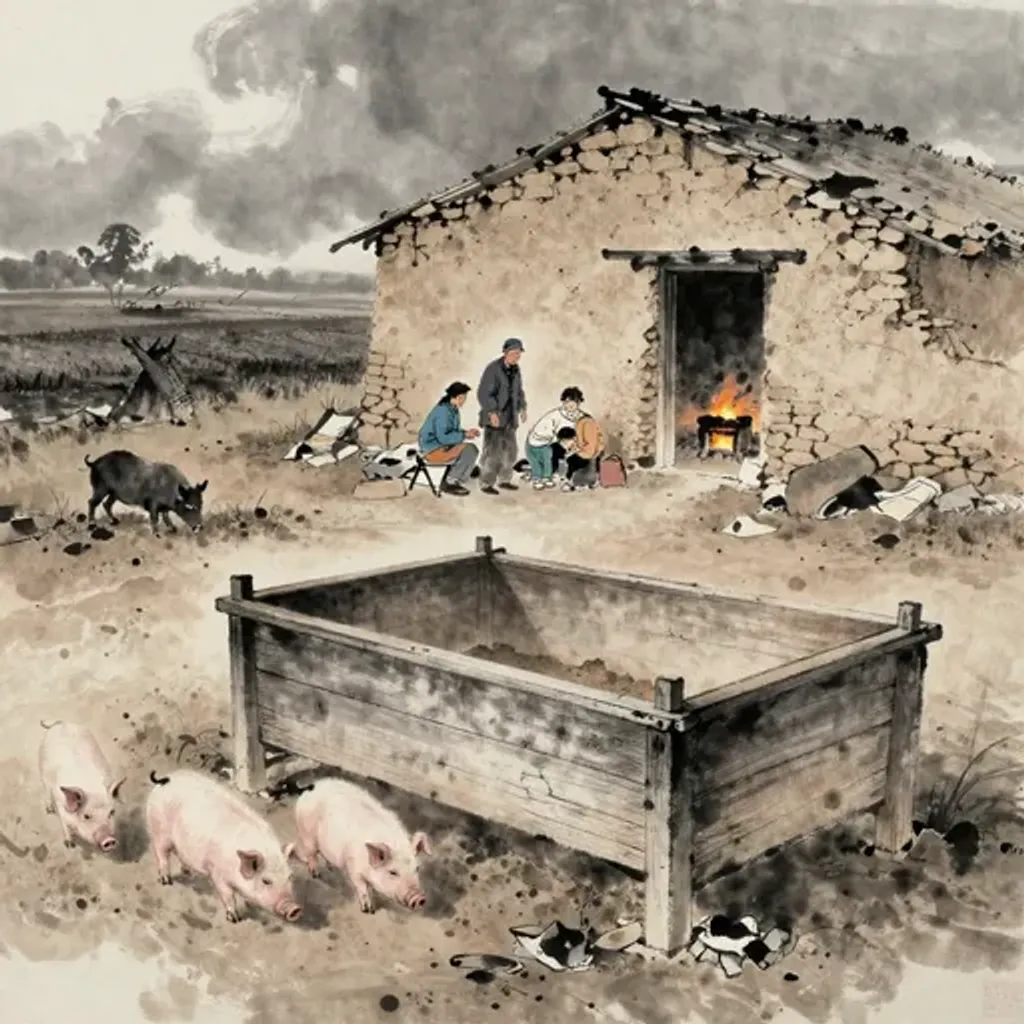
槽空无實,豚彘不食。庶民屈竭,離其居室。
The trough is empty, nothing inside; the pigs and swine do not eat. The common people are drained and exhausted; they leave their homes and chambers.
— Jiao Yanshou, Yilin (Forest of Changes), 1st century BC
Commentary
Wind beneath heaven blows through empty troughs. The feeding trough holds nothing, and the pigs and hogs will not eat from it. The common people are exhausted and depleted, driven from their homes and dwellings. The verse traces a chain of deprivation from barnyard to household: when the animals cannot be fed, the agricultural economy collapses; when the economy collapses, the people flee. From Coming to Meet to Limitation, water stands above the lake, establishing necessary boundaries — yet here the limitation has become deprivation. The encounter that Gou brings is with scarcity itself: the wind that should carry heaven's proclamations finds only famine, and the limits that should structure life have squeezed it dry.
姤 → 中孚
Hexagram 44 → Hexagram 61: Inner Truth
Changing lines: 1, 3, 4
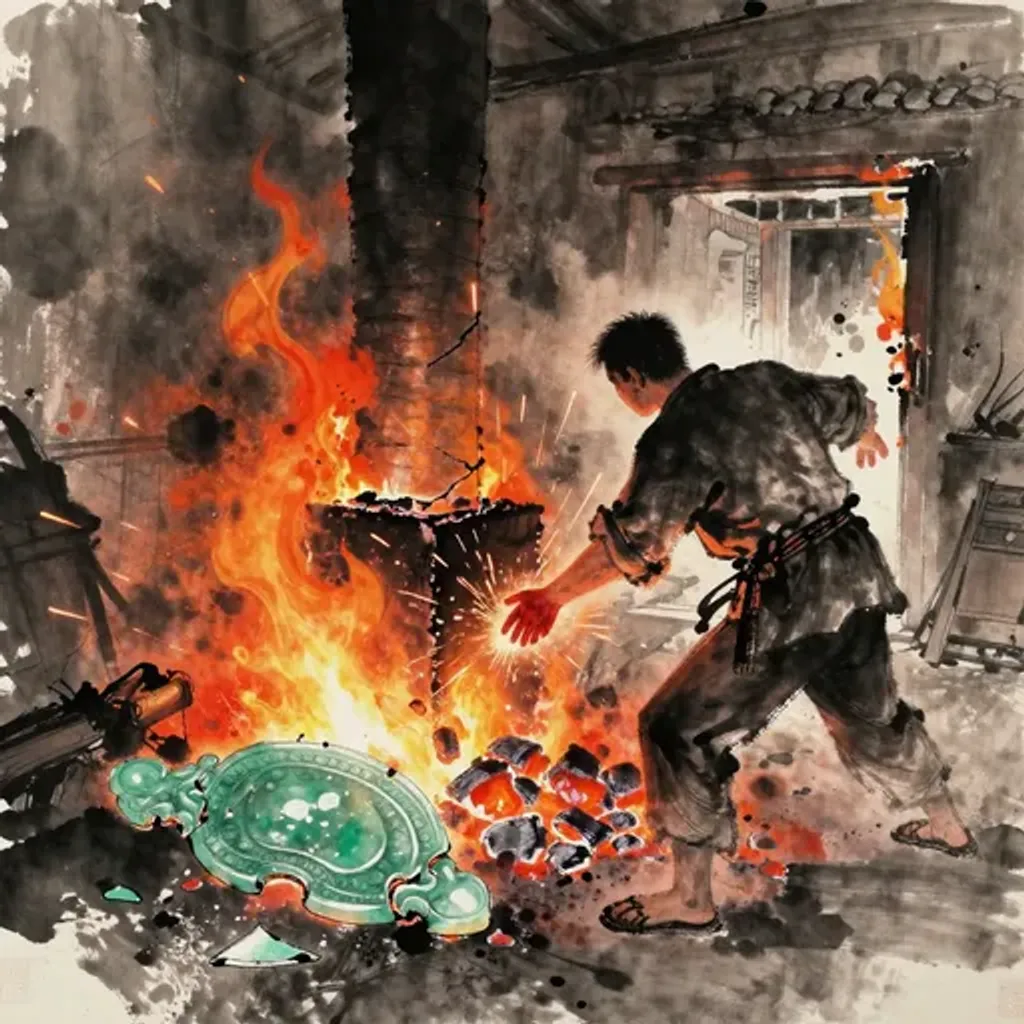
執熱爛手,火為災咎。公孫无賴,敗我玉寶。
Grasping what is hot, the hands burn; fire is the source of calamity. The reckless lord has no scruples; he destroys my precious jade.
— Jiao Yanshou, Yilin (Forest of Changes), 1st century BC
Commentary
Wind beneath heaven delivers scorching misfortune. Grasping at hot things sears the hands; fire becomes the agent of disaster. A Gongsun — a nobleman without scruples — proves utterly unreliable, destroying my precious jade. The verse pairs physical burning with moral betrayal: fire injures the body, while a treacherous associate ruins one's treasures. 'Gongsun wulai' literally means 'Gongsun the rogue,' naming a class of aristocratic swindlers. From Coming to Meet to Inner Truth, wind stirs above the lake as the gentleman deliberates matters of justice and mercy. The encounter that Gou delivers here is with false trust: the inner truth of Zhongfu is violated by a person who looks trustworthy but burns everything he touches.
姤 → 小過
Hexagram 44 → Hexagram 62: Small Exceeding
Changing lines: 2, 5, 6
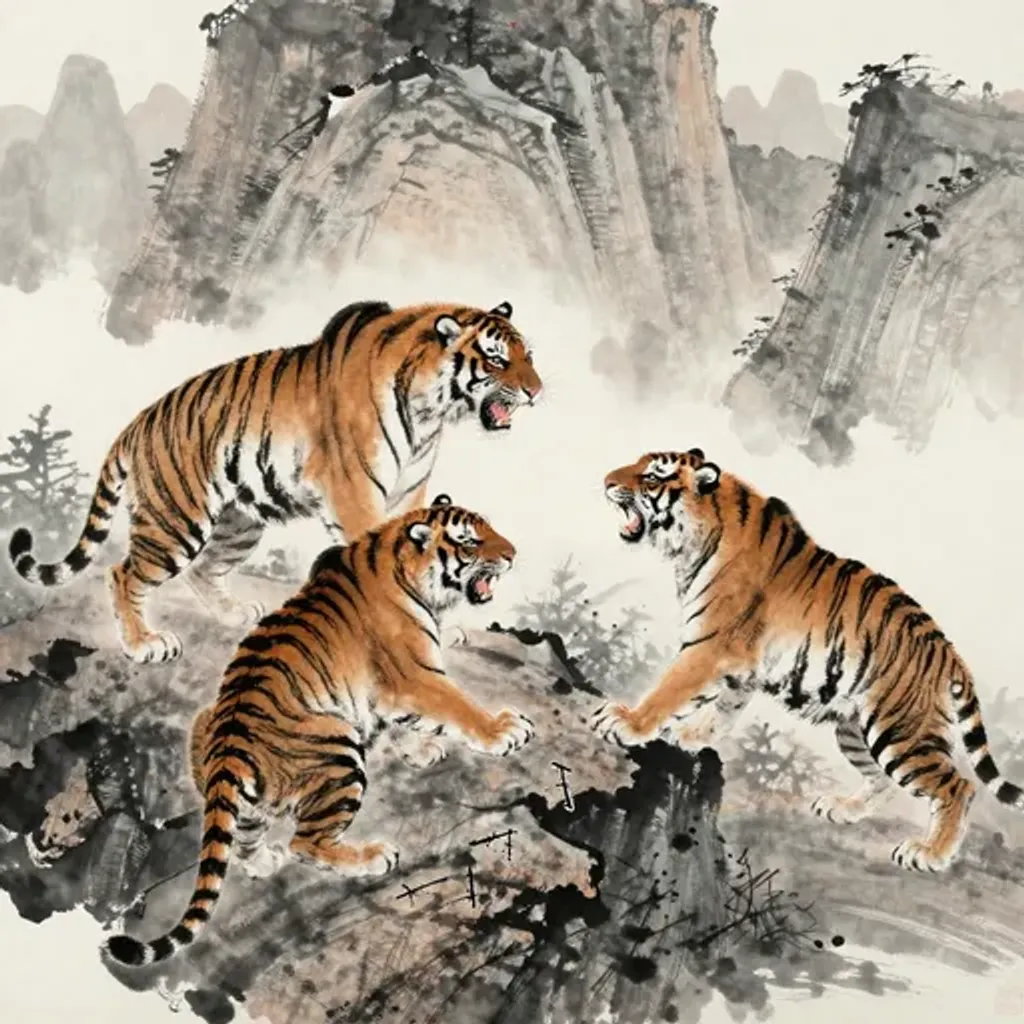
三虎上山,更相噬囓。心志不親,如仇與怨。
Three tigers ascend the mountain, biting and tearing at one another. Hearts and wills know no kinship; like enemies and foes.
— Jiao Yanshou, Yilin (Forest of Changes), 1st century BC
Commentary
Wind beneath heaven drives three tigers up a single mountain. Confined to the same territory, they tear at one another: hearts are not close, and their bond is that of enemies and grudge-holders. The image is stark — apex predators forced into proximity, competing for the same resources, their mutual hostility escalating to violence. There is no prey to hunt; they hunt each other. From Coming to Meet to Small Exceeding, thunder perches atop the mountain in precarious excess — the small overstepping the great. Gou's encounter packs too much power into too small a space. Three tigers on one mountain is a political metaphor for rival strongmen sharing a domain that can sustain only one.
姤 → 既濟
Hexagram 44 → Hexagram 63: After Completion
Changing lines: 1, 2, 4, 6
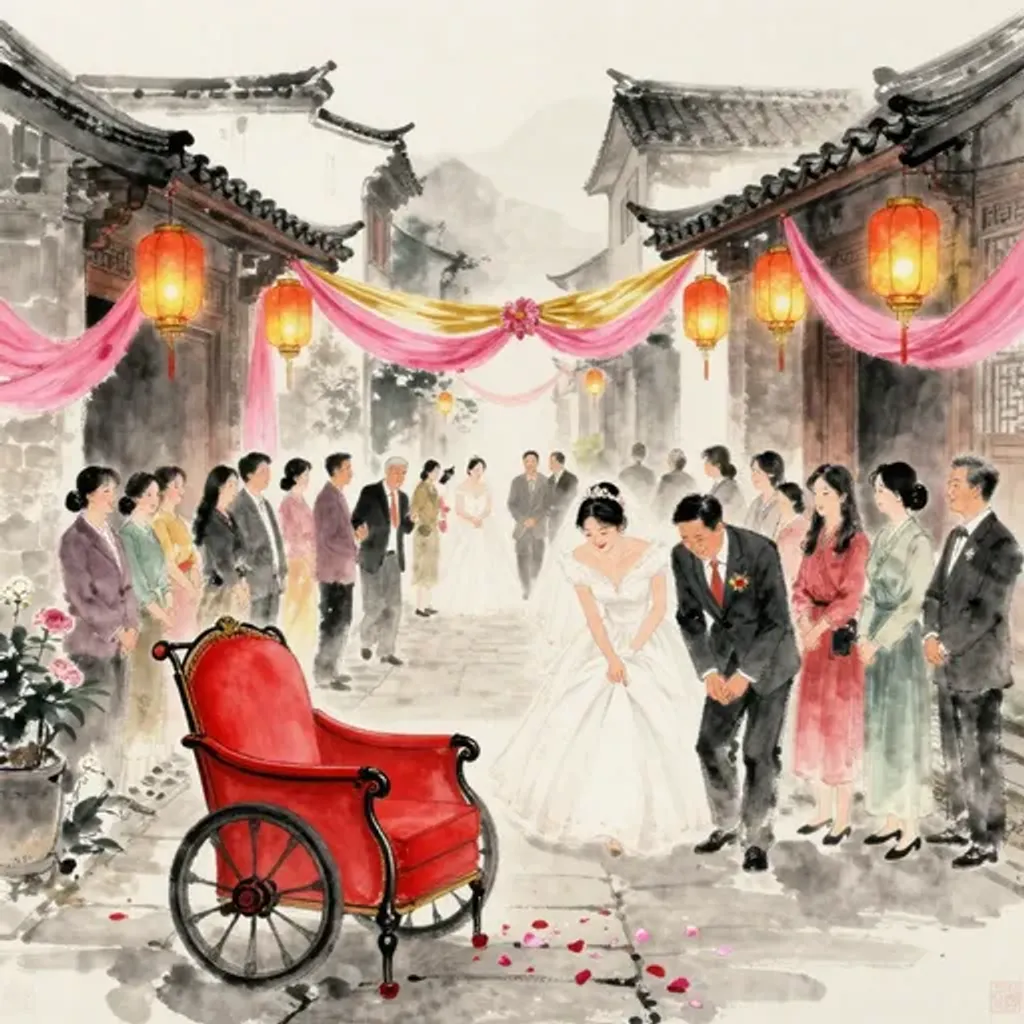
西家嫁子,借鄰送女。嘉我淑姬,賓主俱喜。
The western house marries off a son; borrowing neighbors to escort the daughter. Blessed is our virtuous lady; host and guest alike rejoice.
— Jiao Yanshou, Yilin (Forest of Changes), 1st century BC
Commentary
Wind beneath heaven arranges a perfect match across the neighborhood wall. The family to the west marries off a son; the neighbors lend a hand to send the daughter along. 'How fine is our gentle bride! Host and guest alike rejoice.' The verse is a miniature celebration of communal harmony centered on marriage — not just two families but an entire neighborhood participating in the joy. From Coming to Meet to After Completion, water settles above fire in stable equilibrium, each element in its proper place. Gou's encounter achieves the rarest outcome: complete and harmonious fulfillment, where every party receives what they wished for and no loose thread remains.
姤 → 未濟
Hexagram 44 → Hexagram 64: Before Completion
Changing lines: 3, 5
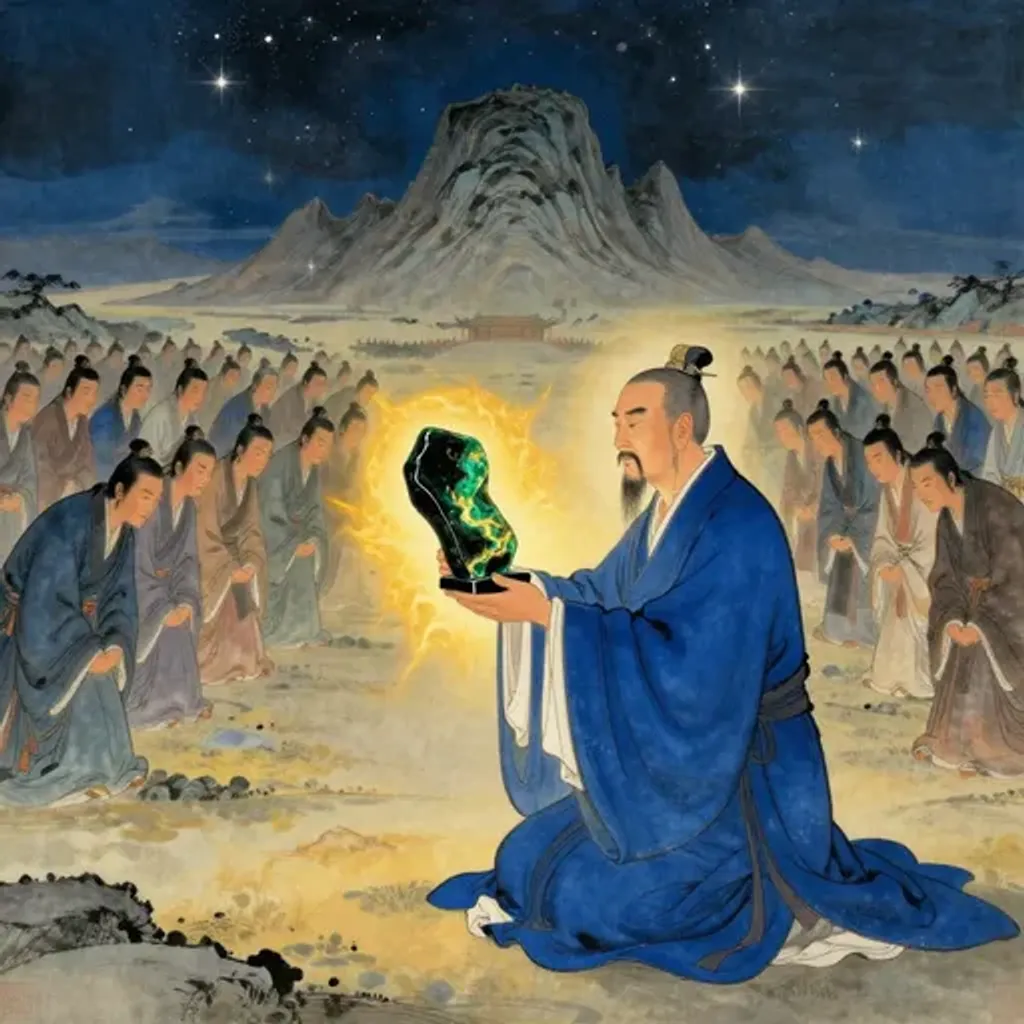
克身潔己,逢禹巡狩。錫我玄圭,拜受福祉。
Disciplining the self, purifying one's person; meeting Yu on his royal progress. He bestows upon me the dark jade tablet; I bow and receive this blessing.
— Jiao Yanshou, Yilin (Forest of Changes), 1st century BC
Commentary
Wind beneath heaven conducts a royal audience. One disciplines the body and purifies the self, then encounters Yu the Great on his inspection tour of the realm. Yu bestows a dark jade tablet — the xuangui, symbol of the highest imperial favor — and one bows to receive this blessing. The encounter with Yu represents the meeting of personal moral cultivation with sovereign recognition: only one who has 'conquered the self and purified conduct' merits the sage-king's acknowledgment. From Coming to Meet to Before Completion, fire sits above water in a state not yet resolved. The dark jade is received, yet the journey is unfinished: Gou's most exalted encounter points forward, promising what is earned but not yet fully realized.