Transformations of Hexagram 49
Every line of change out of Hexagram 49 革 Revolution, with the Yilin verse for each of the 64 resulting hexagrams, its translation, and the original ink brush artwork.
革 → 乾
Hexagram 49 → Hexagram 1: The Creative
Changing lines: 2, 6
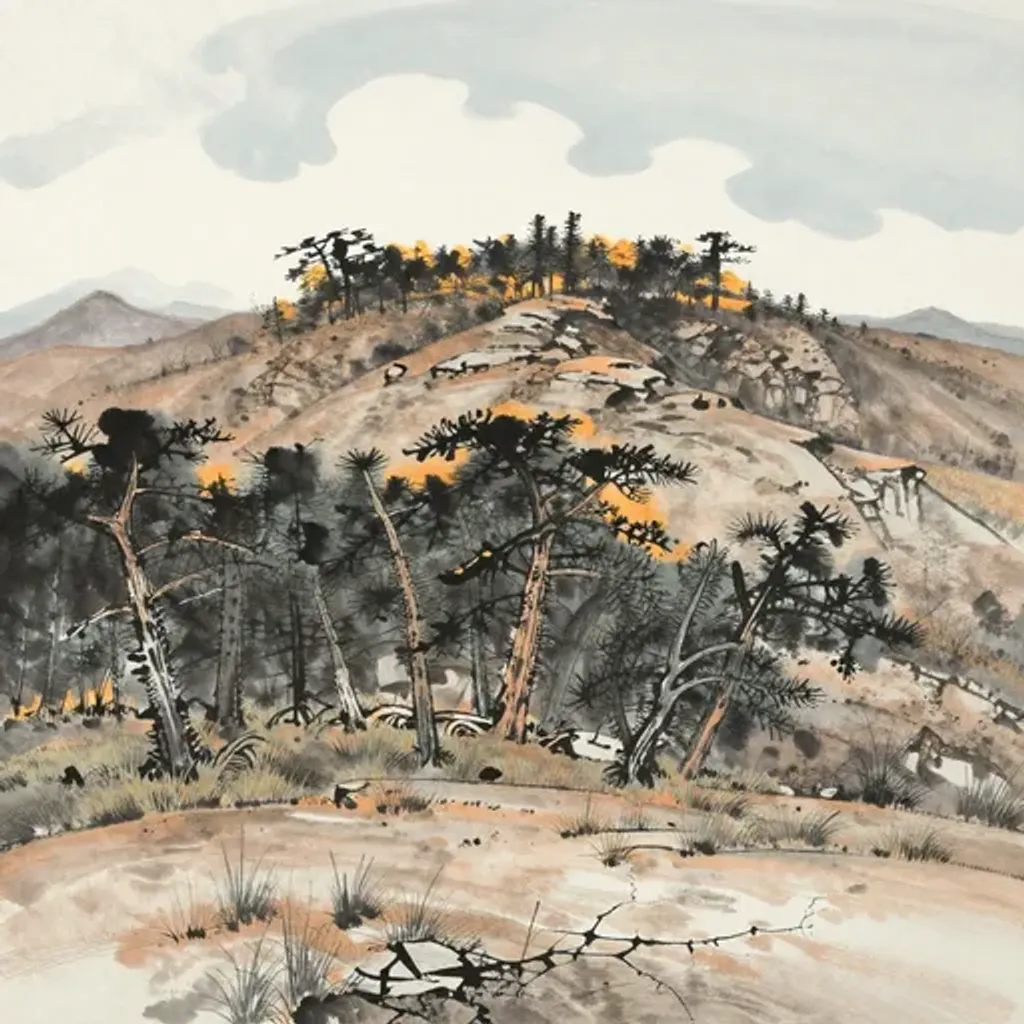
高原峻山,陸土少泉。草木林麓,嘉得所蓄。
High plateau, steep mountain; the upland soil has few springs. Grasses, trees, and forest at the foothills; blessed to store what is gathered.
— Jiao Yanshou, Yilin (Forest of Changes), 1st century BC
Commentary
Fire within the lake rises to meet pure heaven. High plateaus and steep mountains stand where springs are scarce, yet grasses and trees flourish at the mountain's foot, gathering their nourishment from whatever the land stores. Revolution strips away the old; the Creative replaces it with self-generating vitality. Even on arid heights, vegetation finds what it needs and thrives. The transformation from Revolution to the Creative captures this dynamic: once the old order is shed, heaven's ceaseless initiative fills the space, and what was barren becomes lush through its own momentum. The landscape needs no irrigation — it draws from reserves already present beneath the surface.
革 → 坤
Hexagram 49 → Hexagram 2: The Receptive
Changing lines: 1, 3, 4, 5
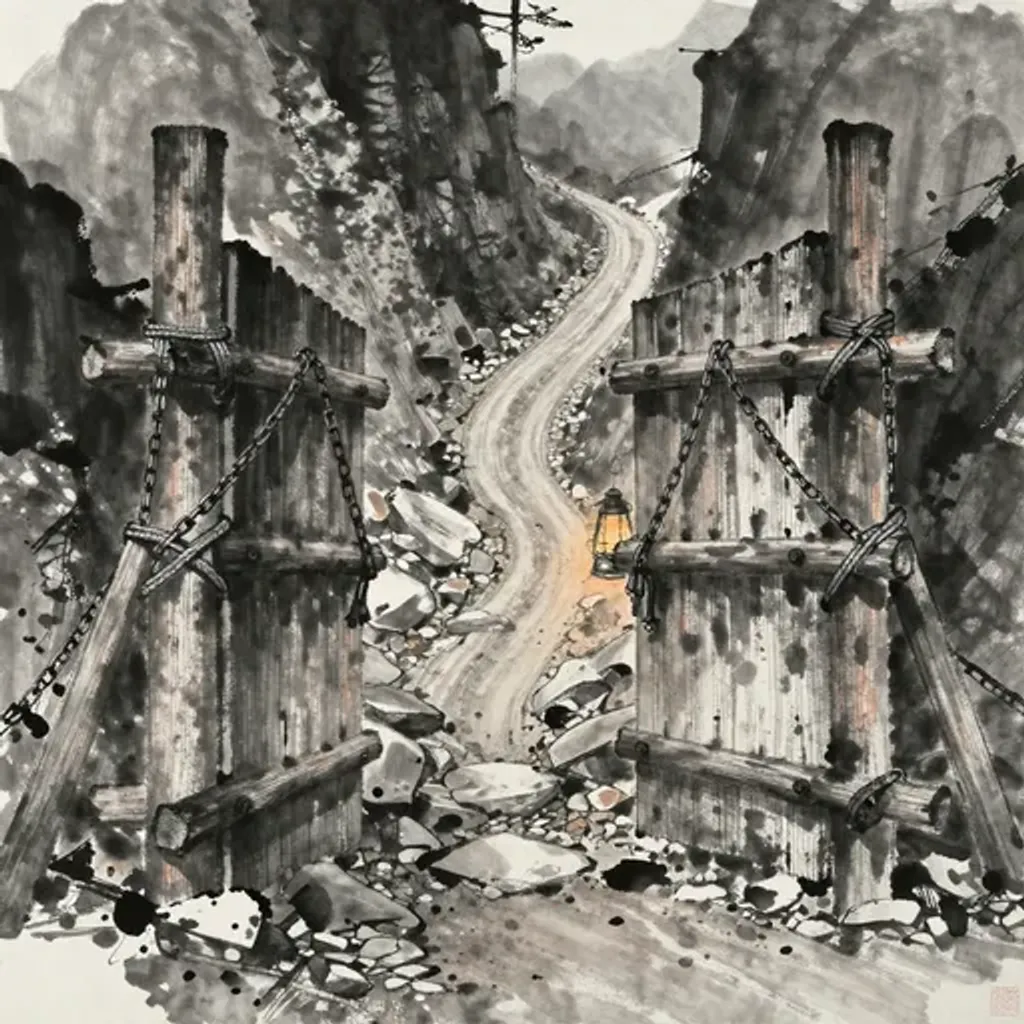
一門二關,結緝不便。峻道異路,日暮不到。
One gate, two barriers; bound and knotted, passage is not easy. The steep road diverges; by nightfall, one cannot arrive.
— Jiao Yanshou, Yilin (Forest of Changes), 1st century BC
Commentary
Fire within the lake gives way to pure earth, receptive and vast. One gate guards two barriers; the knots and fastenings resist smooth passage. The road is steep and the routes diverge — by dusk, the destination remains unreached. Revolution promises renewal, but the Receptive demands patient submission to circumstance. The terrain itself is hostile: barriers doubled, paths confused, daylight failing. From Revolution to the Receptive, the transformation warns that dismantling the old does not guarantee arrival at the new. When the road forks and the light fades, one must yield to conditions rather than press forward blindly into the gathering dark.
革 → 屯
Hexagram 49 → Hexagram 3: Difficulty at the Beginning
Changing lines: 3, 4
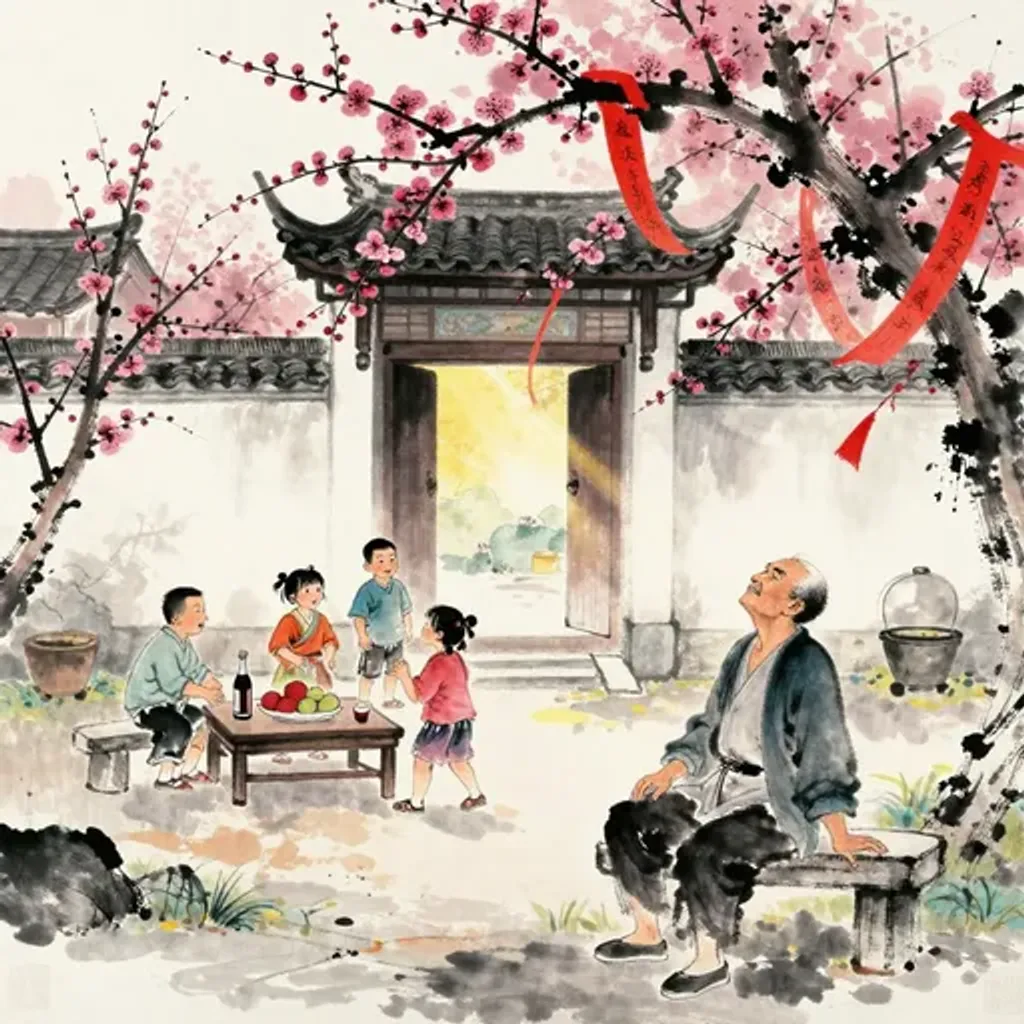
憂禍解除,喜至慶來。坐立懽門,與樂為鄰。
Worry and misfortune dispelled; joy arrives, blessings come. Seated and standing at the gate of gladness, dwelling as a neighbor to delight.
— Jiao Yanshou, Yilin (Forest of Changes), 1st century BC
Commentary
Fire within the lake transforms into thunder stirring beneath gathering clouds. Worries and calamities dissolve; joy arrives and celebration follows. One sits and stands at the gate of delight, neighboring happiness itself. Revolution clears the crisis, and what emerges is the fresh turbulence of Difficulty at the Beginning — not yet order, but the birth-pangs of something new. The mood here is relief after danger: the old threat is gone, and though the path ahead is tangled, the emotional register is festive. From Revolution to Difficulty at the Beginning, the pattern is unmistakable: destruction of the old releases a burst of optimism that carries one through the initial chaos of rebuilding.
革 → 蒙
Hexagram 49 → Hexagram 4: Youthful Folly
Changing lines: 1, 2, 3, 4, 5, 6
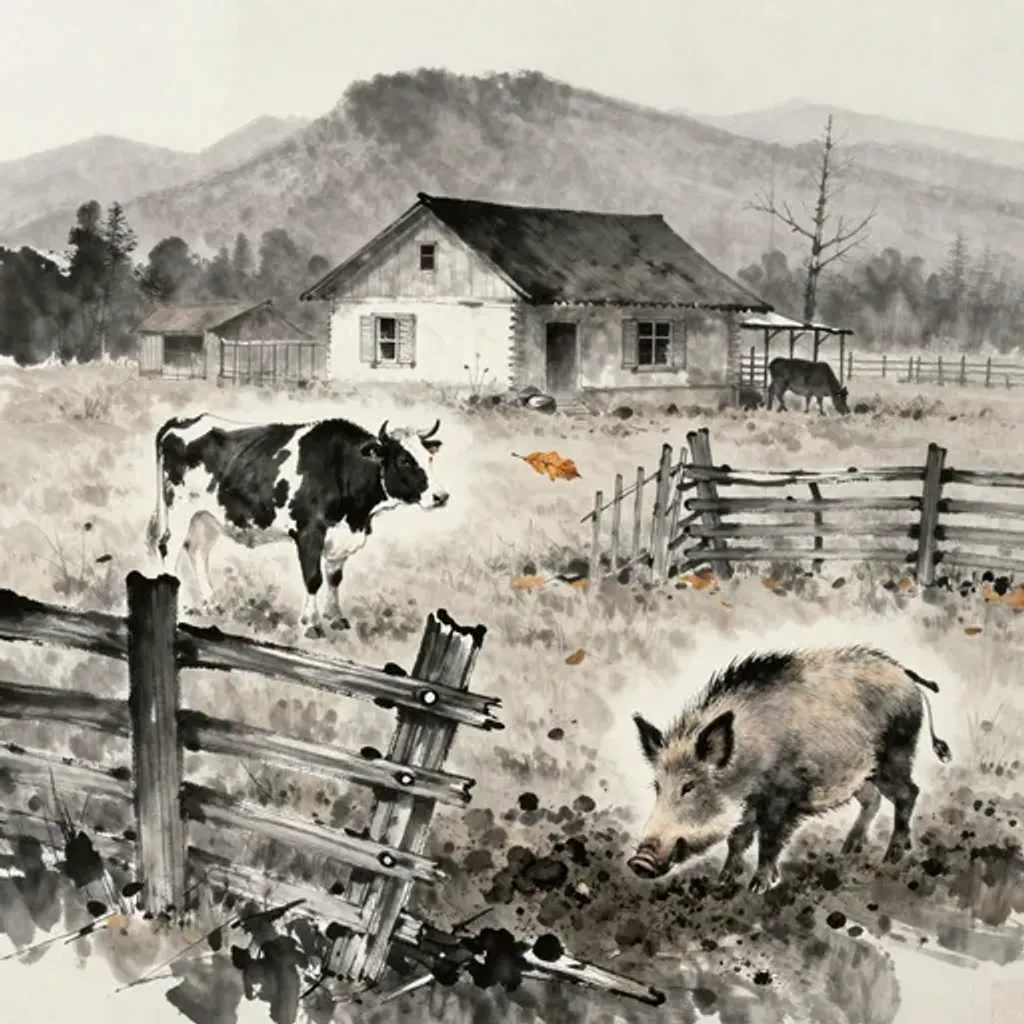
殊類異路,心不相慕。牝牛牡猳,鰥无室家。
Different kinds on separate paths, hearts bearing no longing for each other. The cow and the boar; the widower without a household.
— Jiao Yanshou, Yilin (Forest of Changes), 1st century BC
Commentary
Fire within the lake yields to a spring emerging beneath the mountain — water unclear, path uncertain. Different kinds travel different roads; their hearts feel no mutual longing. A cow here, a boar there; the widower has no household. Revolution severs old bonds, and Youthful Folly inherits the confusion. When incompatible natures are forced together — or when compatible ones are torn apart — no union forms. The bachelor without a family embodies this isolation. From Revolution to Youthful Folly, the transformation reveals what happens when change outpaces understanding: categories scramble, pairings fail, and one wanders alone in the fog of a world not yet reordered.
革 → 需
Hexagram 49 → Hexagram 5: Waiting
Changing lines: 2, 4
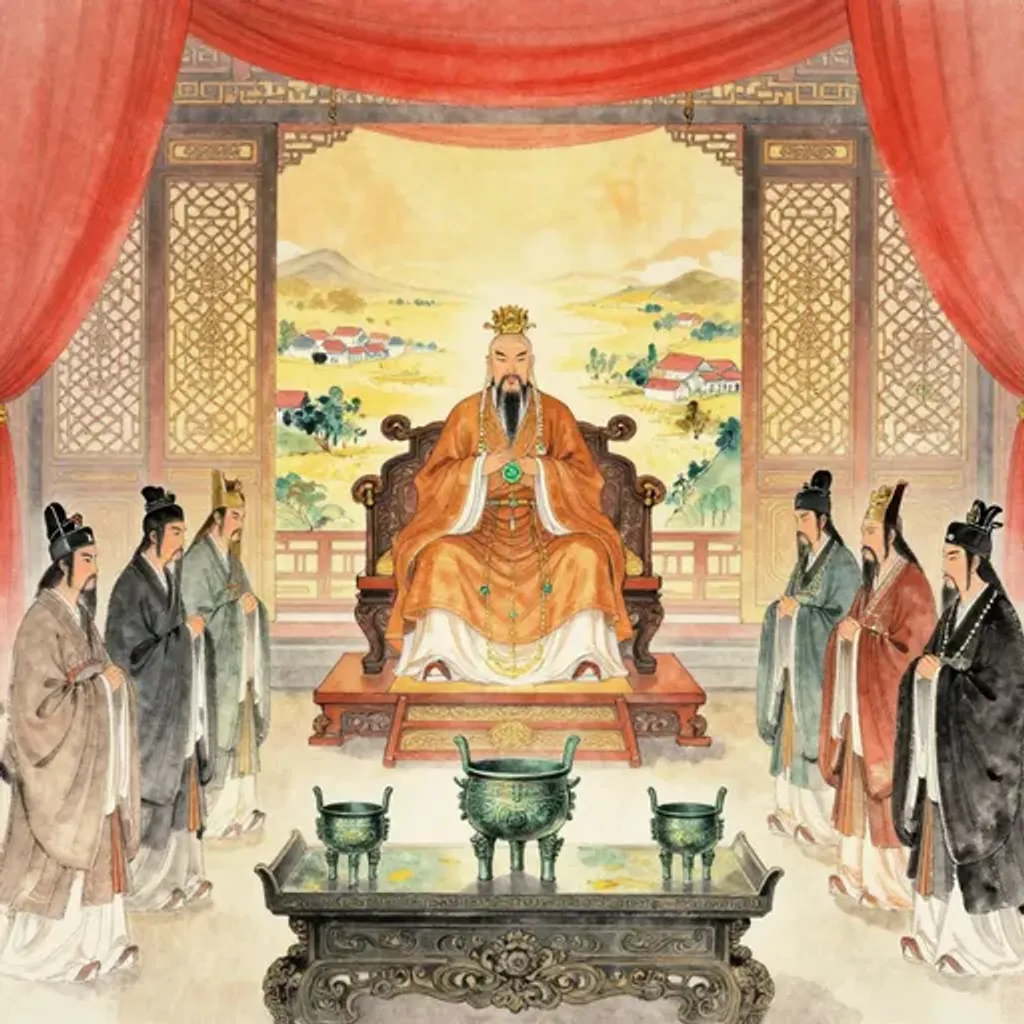
太王為父,王季孝友。文武聖明,仁政興起。旦隆四國,載福綏厚。
Great King was the father; King Ji was filial and brotherly. Wen and Wu were sagely and wise; benevolent rule arose. Dan brought the four states to greatness, bearing blessings rich and deep.
— Jiao Yanshou, Yilin (Forest of Changes), 1st century BC
Commentary
Fire within the lake transforms into clouds gathering over heaven — abundance waits in readiness. King Tai served as patriarch, King Ji practiced filial devotion and fraternal love, and Kings Wen and Wu brought sage wisdom and benevolent rule. The Duke of Zhou elevated four neighboring states, spreading fortune thick and deep. This verse traces the Zhou royal lineage across four generations: from Taiwang (King Tai, the Great King) through Wang Ji, to Wen and Wu, culminating in the Duke of Zhou's consolidation. Revolution here is not violent overthrow but generational cultivation. From Revolution to Waiting, the transformation shows that the greatest changes unfold over lifetimes, patient as clouds forming before rain.
革 → 訟
Hexagram 49 → Hexagram 6: Conflict
Changing lines: 1, 2, 3, 6
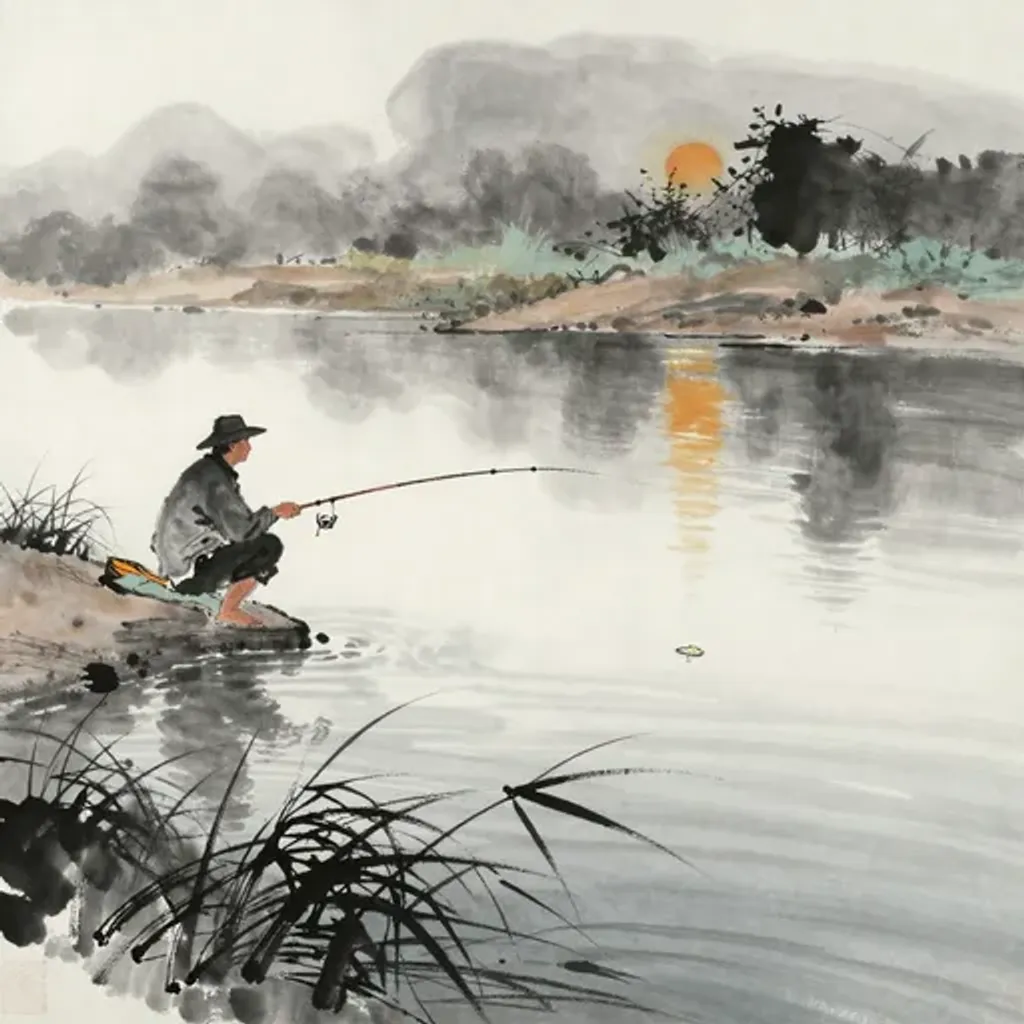
臨河求鯉,燕婉失餌。屏氣攝息,不得鯉子。
Approaching the river to seek carp; poised and graceful, yet losing the bait. Holding breath, suppressing every stir; still no carp is caught.
— Jiao Yanshou, Yilin (Forest of Changes), 1st century BC
Commentary
Fire within the lake meets heaven moving against water — conflict inherent in the approach. One goes to the river seeking carp, poised and gentle with the bait, holding breath and stilling motion. Yet the carp refuses to come. Revolution demands decisive action, but Conflict arises when desire and method work at cross-purposes. The fisherman's excessive caution — suppressing breath, freezing in place — defeats the very suppleness that fishing requires. From Revolution to Conflict, the transformation illuminates how overthinking undermines execution: wanting change so badly that one paralyzes the process, grasping at the prize while the prize slips away.
革 → 師
Hexagram 49 → Hexagram 7: The Army
Changing lines: 1, 2, 3, 4, 5
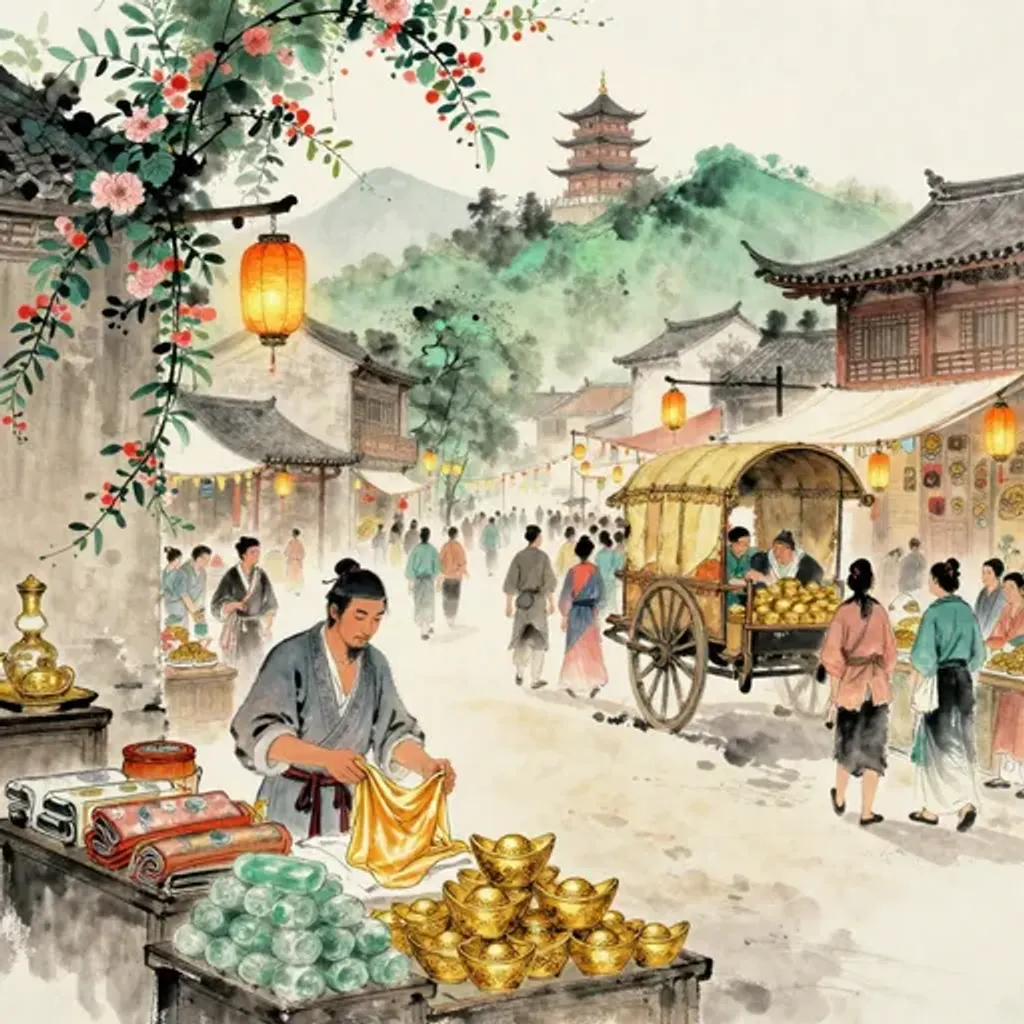
買利求福,莫如南國。仁德所在,金玉為寶。
Seeking profit and blessing, none compares to the southern land. Where benevolence and virtue reside, gold and jade are the treasure.
— Jiao Yanshou, Yilin (Forest of Changes), 1st century BC
Commentary
Fire within the lake transforms into water held within the earth — the hidden reserves of disciplined order. Seeking profit and fortune, nothing compares to the southern kingdom, where benevolence and virtue reside, and gold and jade serve as its treasure. Revolution overturns the old; the Army organizes what follows. The verse points south — in Chinese cosmology, the direction of fire, culture, and flourishing — and declares that true wealth lies not in plunder but in moral governance. From Revolution to the Army, the transformation shows that after upheaval, prosperity comes through disciplined administration, not through further raiding. Virtue itself is the treasury.
革 → 比
Hexagram 49 → Hexagram 8: Holding Together
Changing lines: 1, 3, 4
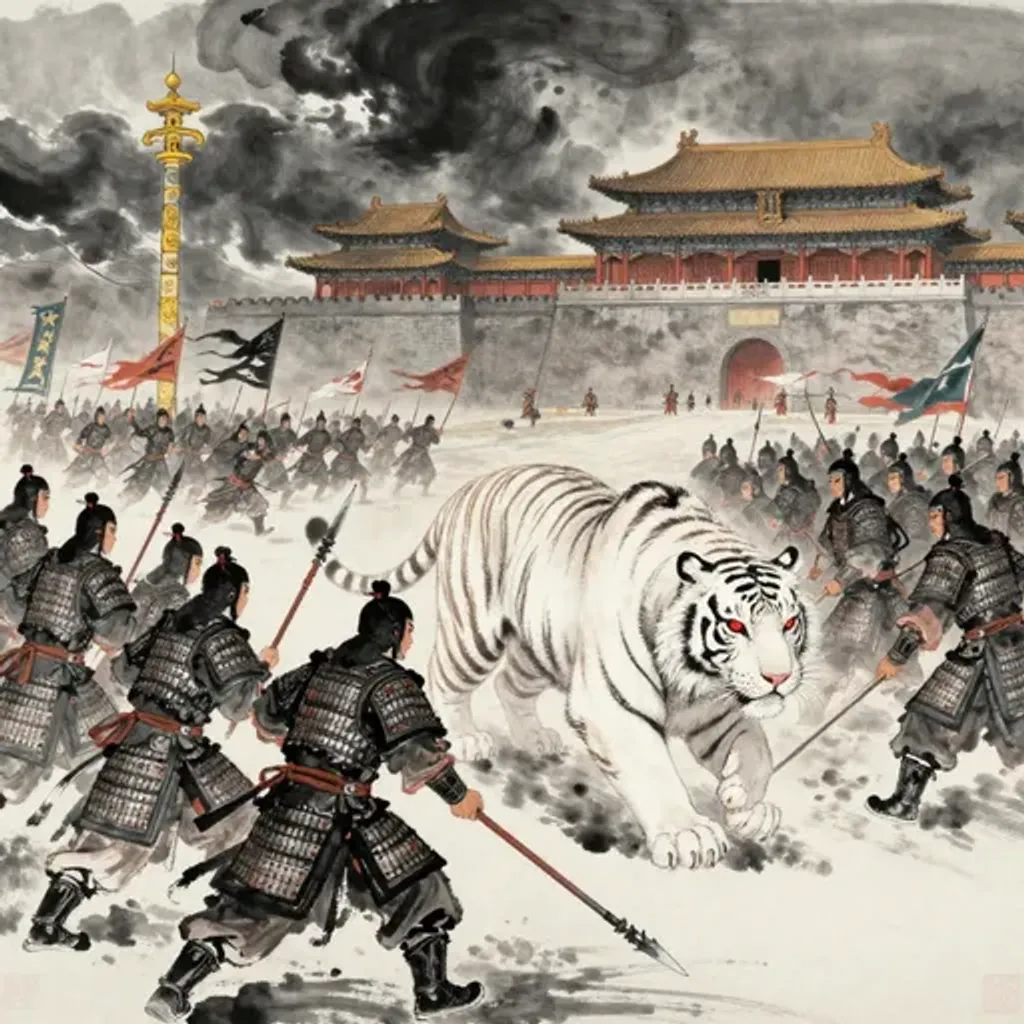
白虎赤憤,闚觀王庭。宮闕被甲,大小出征。天地煩憒,育不能嬰。
The white tiger rages crimson, peering at the royal court. Palace halls are clad in armor; great and small march to war. Heaven and earth in turmoil; even nurturing cannot keep the infant safe.
— Jiao Yanshou, Yilin (Forest of Changes), 1st century BC
Commentary
Fire within the lake erupts as the White Tiger rages crimson with fury, glaring into the royal court. Palace and watchtower don armor; great and small march to war. Heaven and earth churn in turmoil; even nurturing an infant becomes impossible. The White Tiger — celestial guardian of the west, lord of autumn and metal — here embodies martial violence spilling into the seat of government. Revolution has gone too far: instead of renewal, it produces universal mobilization and chaos so total that even the most basic human act, raising a child, fails. From Revolution to Holding Together, the grim irony emerges: forced unity under arms is no unity at all.
革 → 小畜
Hexagram 49 → Hexagram 9: Small Taming
Changing lines: 2, 4, 6
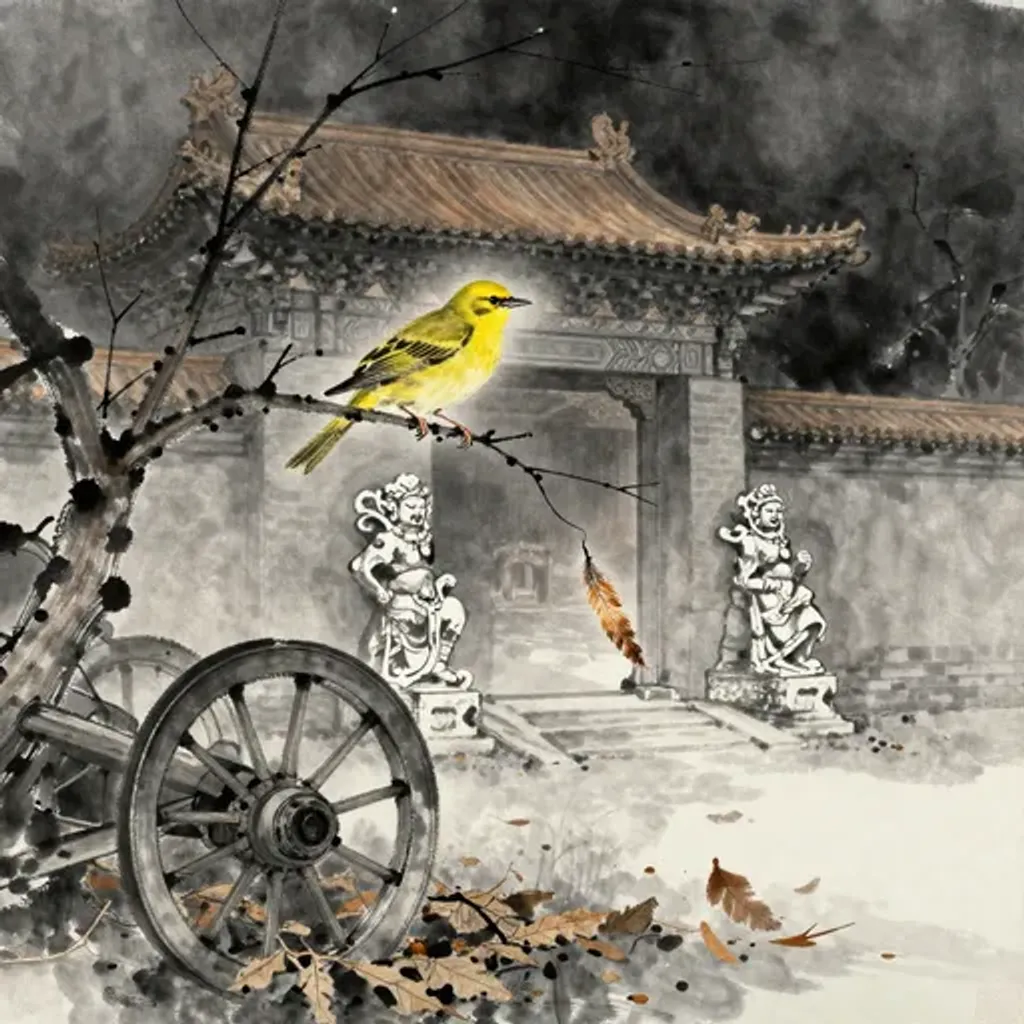
子車鍼虎,善人危殆。黃鳥悲鳴,傷國无輔。
Ziche, Zhen, and Hu; good men brought to peril. The yellow bird cries in sorrow; the state is wounded, bereft of its pillars.
— Jiao Yanshou, Yilin (Forest of Changes), 1st century BC
Commentary
Fire within the lake gives way to wind above heaven — a gentle force that cannot restrain what has been lost. The Ziche brothers Zhenhu and his kin were good men brought to peril. The yellow birds cry in grief, mourning a state robbed of its pillars. This alludes to the burial alive of Duke Mu of Qin's three loyal retainers from the Ziche clan — Yanxi, Zhonghang, and Zhenhu — in 621 BC. The Shijing lament 'Yellow Bird' cries: 'That azure heaven! It destroys our good men.' From Revolution to Small Taming, the transformation warns that revolutionary zeal may consume the very talents it needs: wind above heaven can polish virtue, but it cannot restore the dead.
革 → 履
Hexagram 49 → Hexagram 10: Treading
Changing lines: 2, 3, 6
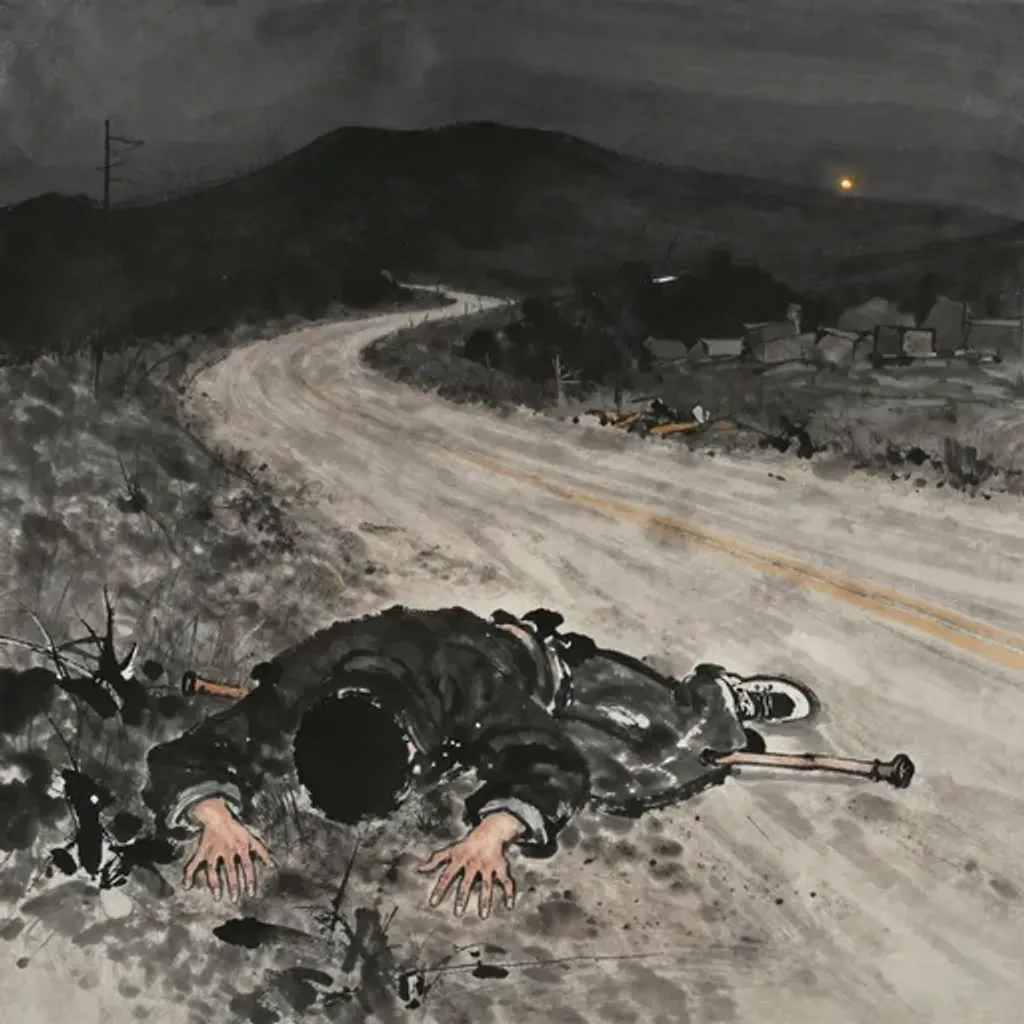
兩目失明,日暮无光。脛足跛步,不可以行,頓於丘傍。
Both eyes lost to blindness; at nightfall, no light remains. With lame legs and halting steps, one cannot walk, and collapses beside the hill.
— Jiao Yanshou, Yilin (Forest of Changes), 1st century BC
Commentary
Fire within the lake yields to heaven above the lake — the path of proper conduct. Yet both eyes have lost their sight, and by dusk no light remains. Legs and feet limp and stumble; one cannot walk, and collapses beside a hillock. Revolution has stripped away the old, but what follows is Treading — the hexagram of walking carefully upon a tiger's tail. Here the walker is doubly incapacitated: blind and lame, unable to see the path or travel it. The transformation from Revolution to Treading reveals the danger of change without capacity: the old structure is gone, but the body that must navigate the new terrain is broken. One falls not from malice but from sheer inability.
革 → 泰
Hexagram 49 → Hexagram 11: Peace
Changing lines: 2, 4, 5
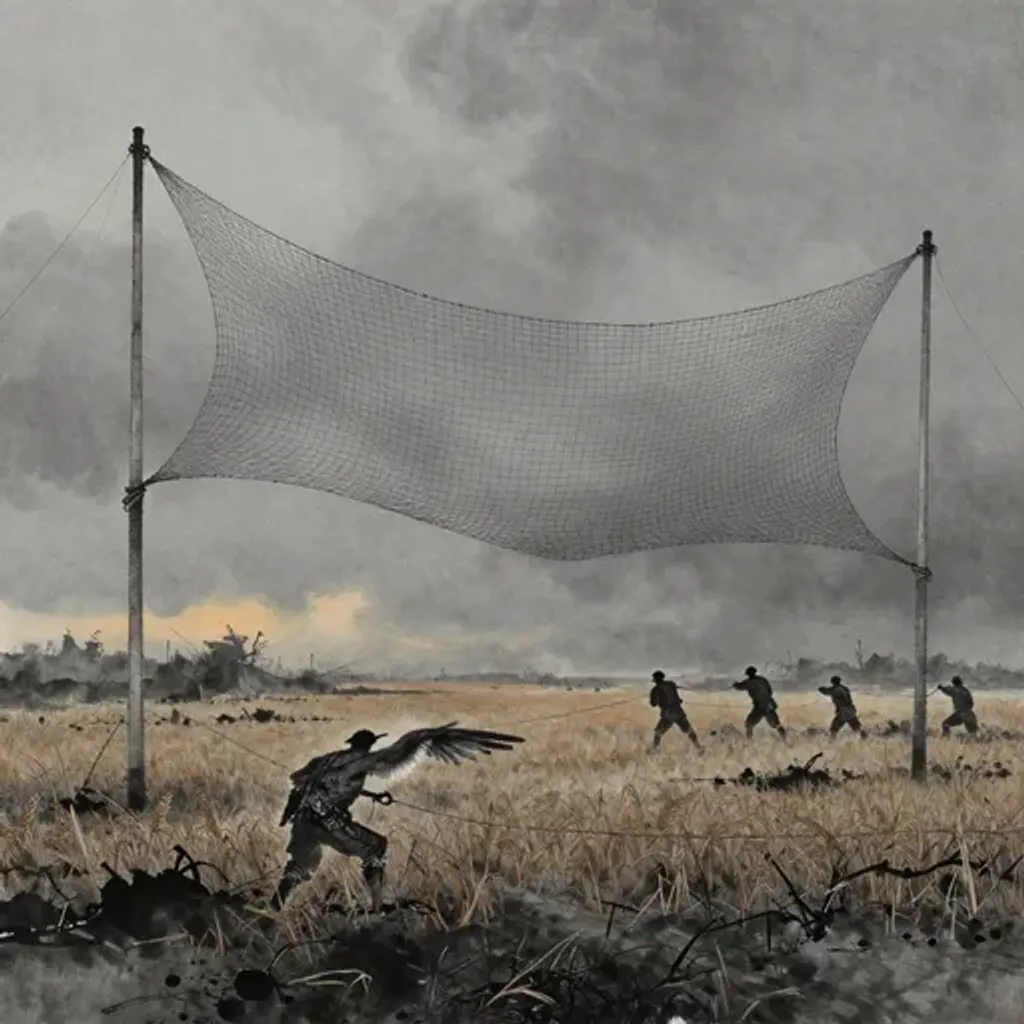
羅網四張,鳥无所翔。伐征困極,飢窮不食。
Snare-nets spread in every direction; the birds have nowhere to fly. Campaign and conquest pushed to the extreme; starving and destitute, unable to eat.
— Jiao Yanshou, Yilin (Forest of Changes), 1st century BC
Commentary
Fire within the lake yields to earth above heaven — the communion of Peace. Yet the verse inverts this promise. Nets are spread in all four directions; birds have nowhere to fly. Campaigns of conquest exhaust everything; the starving and impoverished cannot eat. Revolution should yield renewal, and Peace should mean heaven and earth in harmonious exchange. Instead, the old regime's final act is total encirclement: every escape blocked, every resource consumed by war. From Revolution to Peace, the bitter irony is that the transition to cosmic harmony must first pass through the darkest hour, when the collapsing order squeezes out its last measure of oppression before finally breaking apart.
革 → 否
Hexagram 49 → Hexagram 12: Standstill
Changing lines: 1, 3, 6
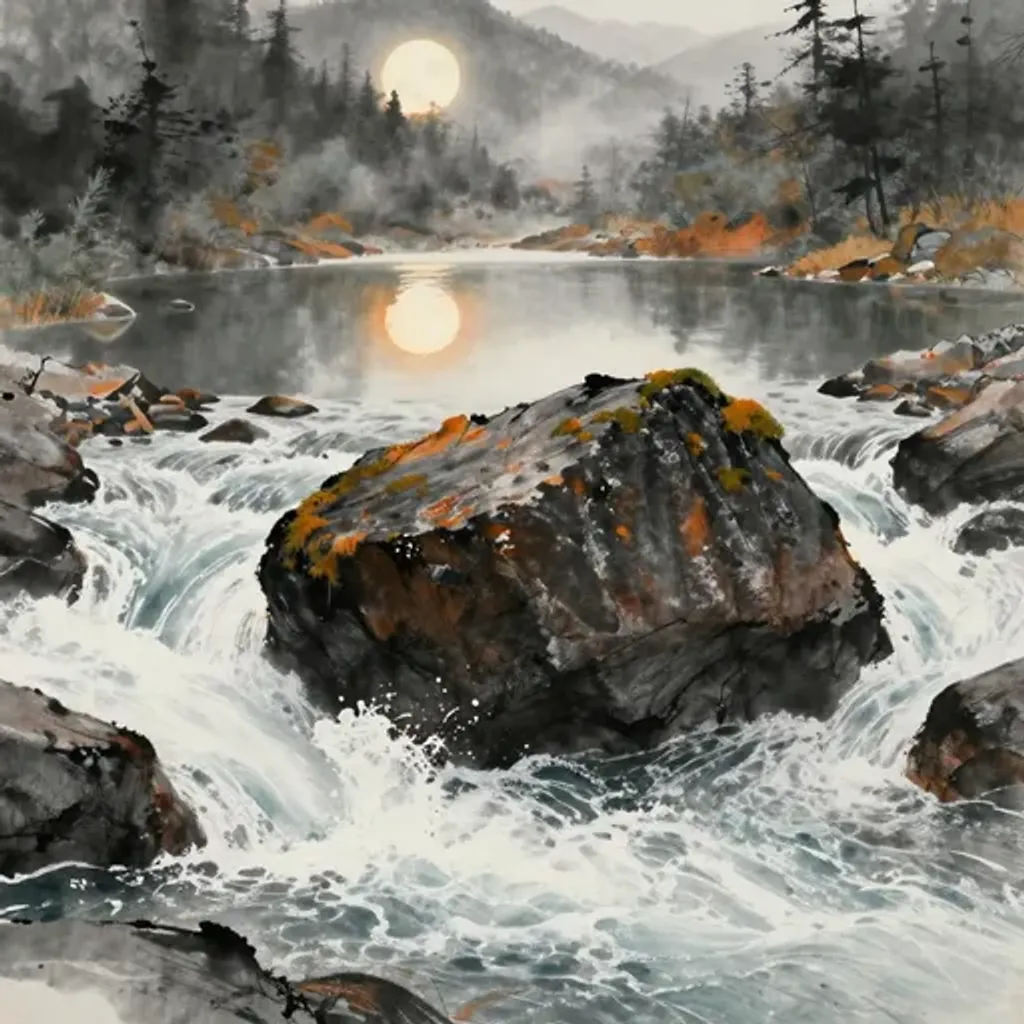
伯夷叔齊,貞廉之師。以德防患,憂禍不存。
The great stone does not move; the rushing current flows around it. The clear stream reflects the moon; muddy water muddies only itself.
— Jiao Yanshou, Yilin (Forest of Changes), 1st century BC
Commentary
Fire within the lake transforms into heaven above earth — Standstill, where the two realms refuse to mingle. The original verse names Boyi and Shuqi, paragons of incorruptible integrity who refused to eat Zhou grain and starved on Mount Shouyang. They are called 'teachers of steadfast purity,' using virtue to prevent calamity so that worry and misfortune cannot take root. From Revolution to Standstill, the transformation captures a principled withdrawal: when the world turns upside down, the truly virtuous do not compromise but separate themselves entirely. Boyi and Shuqi chose death over moral contamination — the ultimate Standstill, where heaven and earth part ways rather than accept a tainted union.
革 → 同人
Hexagram 49 → Hexagram 13: Fellowship
Changing lines: 6
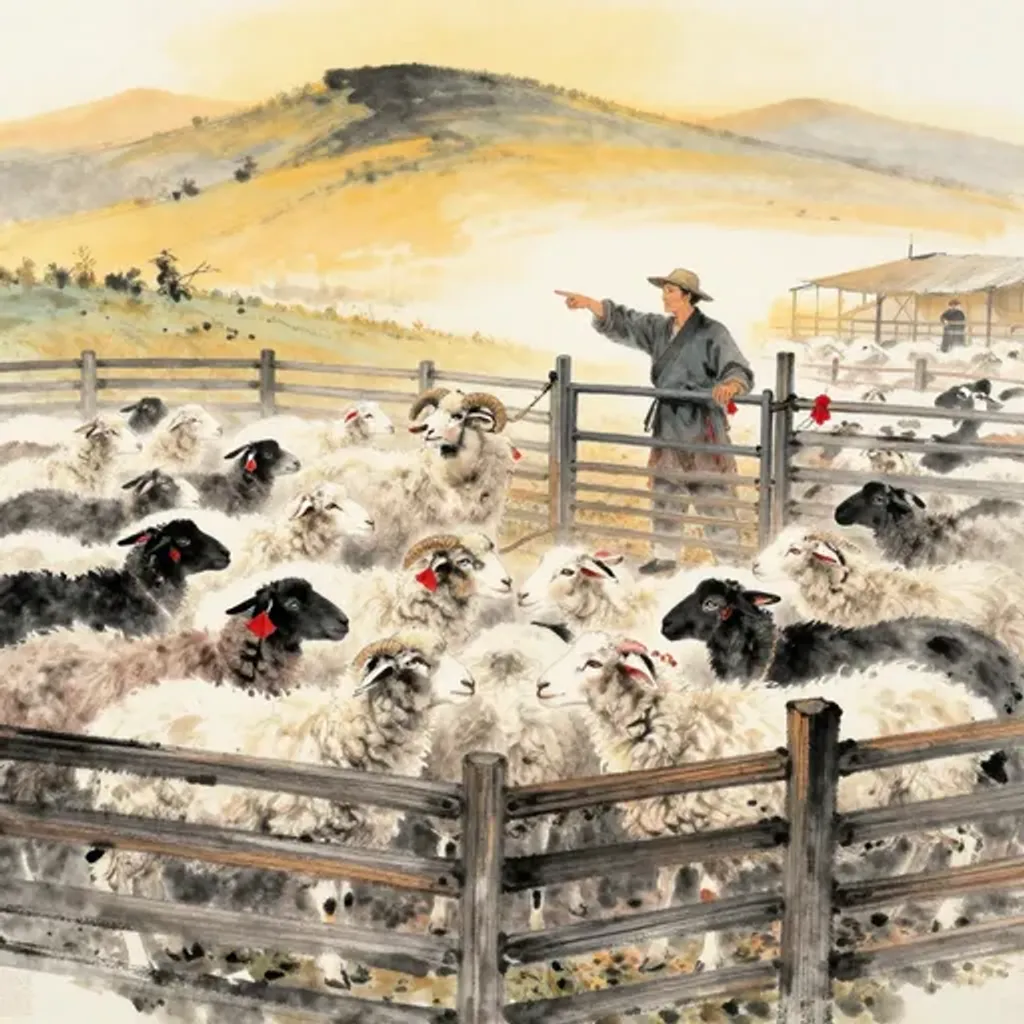
疾貧望幸,使伯行販。開牢擇羊,多得大䍧。
Sick with poverty, hoping for fortune; sending Bo to trade abroad. Opening the pen to choose a sheep, he finds many a fine large ram.
— Jiao Yanshou, Yilin (Forest of Changes), 1st century BC
Commentary
Fire within the lake meets heaven and fire together — Fellowship, where like recognizes like. Pressed by poverty and hoping for luck, one sends an elder to trade. Opening the pen to select sheep, many fine rams are obtained. Revolution creates opportunity for those bold enough to seize it, and Fellowship ensures that the venture succeeds through proper social channels. The merchant dispatched is no random agent but a respected senior whose standing opens doors. From Revolution to Fellowship, the transformation shows that after upheaval, prosperity returns through communal exchange: opening the fold, picking the best, and finding abundance where scarcity once reigned.
革 → 大有
Hexagram 49 → Hexagram 14: Great Possession
Changing lines: 2, 5, 6
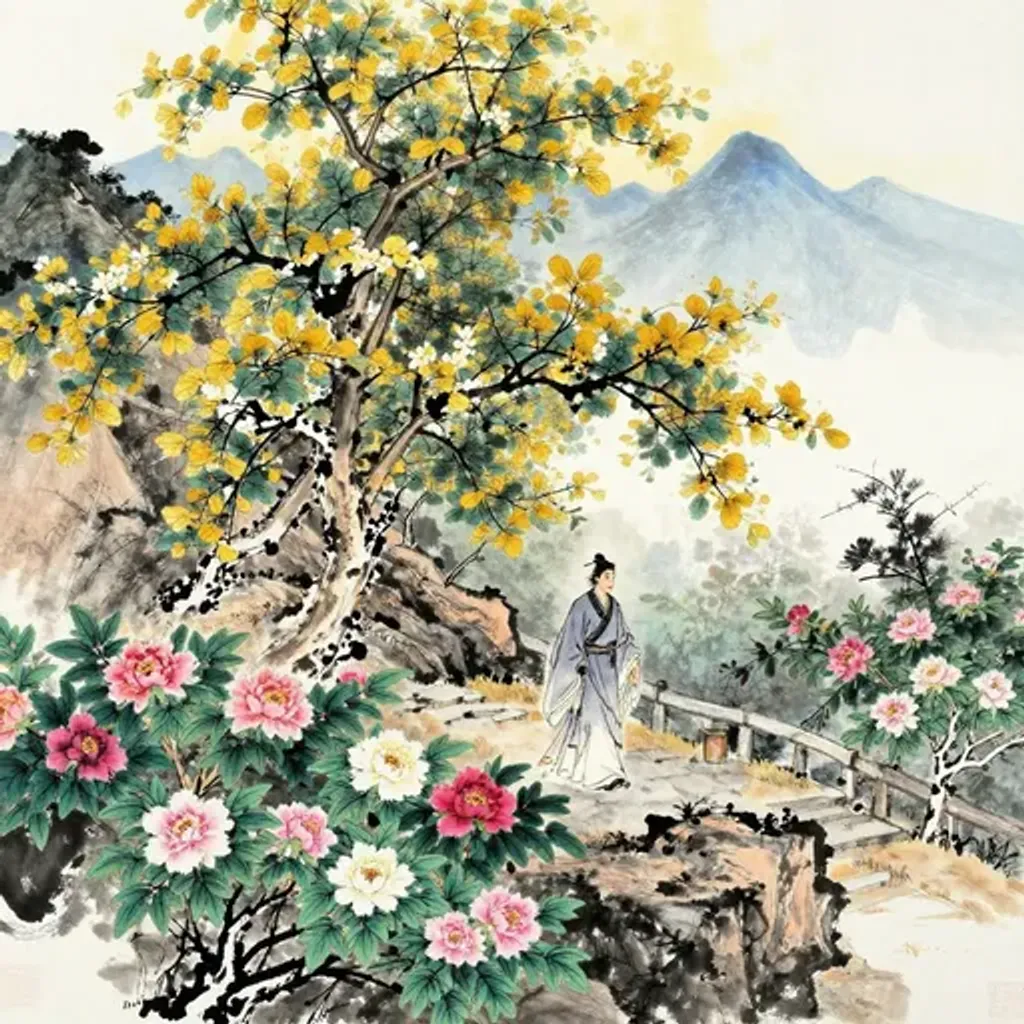
南山之陽,華葉鏘鏘。嘉樂君子,為國寵光。
On the sunny slope of the southern mountain, blossoms and leaves ring splendidly. The admirable and joyful gentleman is the honored glory of the state.
— Jiao Yanshou, Yilin (Forest of Changes), 1st century BC
Commentary
Fire within the lake rises to become fire blazing in heaven — Great Possession, radiant and abundant. On the southern slope of the mountain, leaves flourish with a brilliant sheen. The worthy gentleman brings glory and favor to his state. South-facing slopes receive the fullest sun; vegetation there grows lushest. The 'worthy gentleman' honored by his nation evokes the Shijing's celebrations of virtuous ministers whose very presence blesses the realm. From Revolution to Great Possession, the transformation is luminous: the fire that once consumed the old order now illuminates from the highest heaven, and the one who endures revolution with virtue becomes the nation's radiance.
革 → 謙
Hexagram 49 → Hexagram 15: Modesty
Changing lines: 1, 4, 5
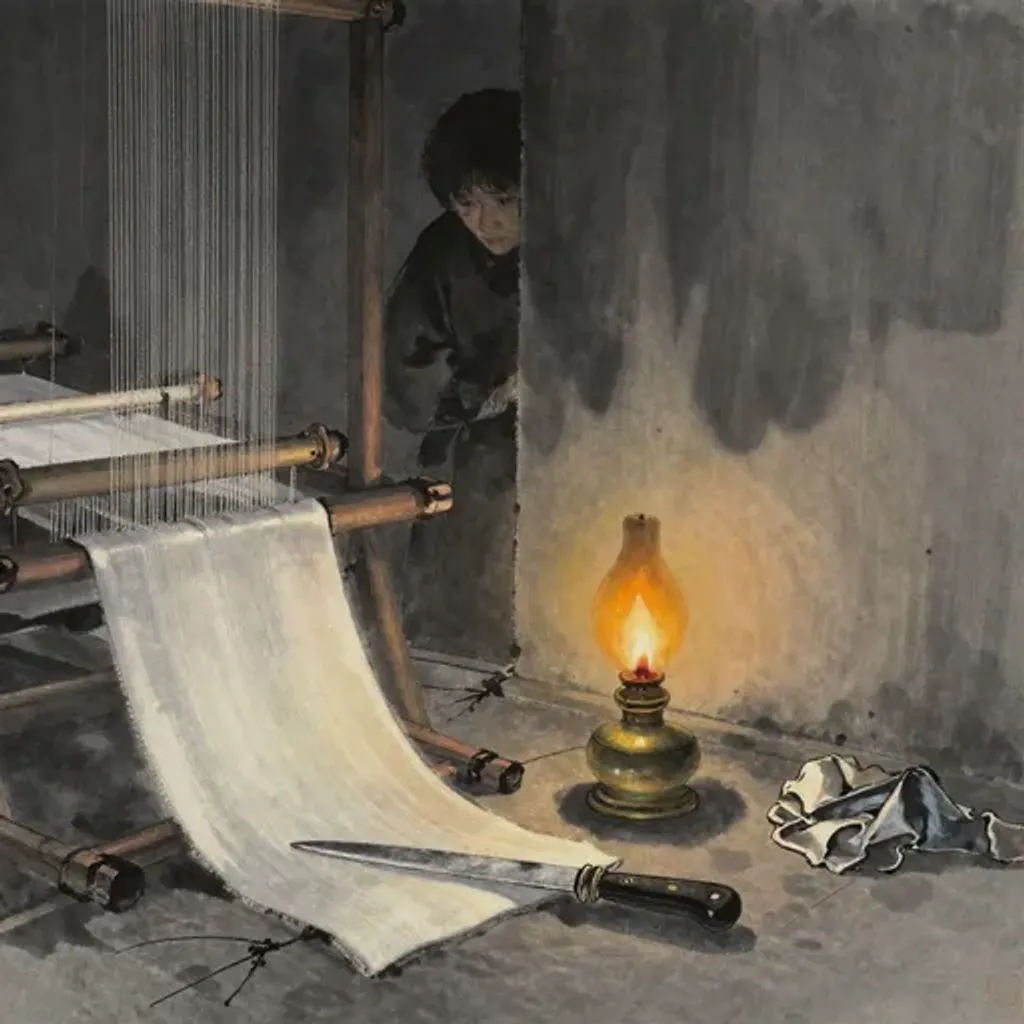
東壁餘光,數暗不明。主母嫉妬,亂我業事。
A guttering lamp like a bean, shadows swaying on the wall. In the dark, someone watches me work. Half the cloth is woven — then a knife comes to cut it. A night's labor, cold on the floor.
— Jiao Yanshou, Yilin (Forest of Changes), 1st century BC
Commentary
Fire within the lake subsides into a mountain hidden beneath the earth — Modesty, where greatness conceals itself. The original verse reads: 'A remnant lamp on the east wall, its light dim and fading. The mistress of the house, consumed by jealousy, disrupts my work.' A concubine or secondary wife labors through the night, only to have her efforts sabotaged by the jealous primary wife. The faint lamp on the eastern wall — barely enough to see by — becomes the emblem of suppressed talent working under hostile scrutiny. From Revolution to Modesty, the transformation reveals that even after upheaval, the humble worker remains vulnerable to those above who feel threatened by her diligence.
革 → 豫
Hexagram 49 → Hexagram 16: Enthusiasm
Changing lines: 1, 3, 5
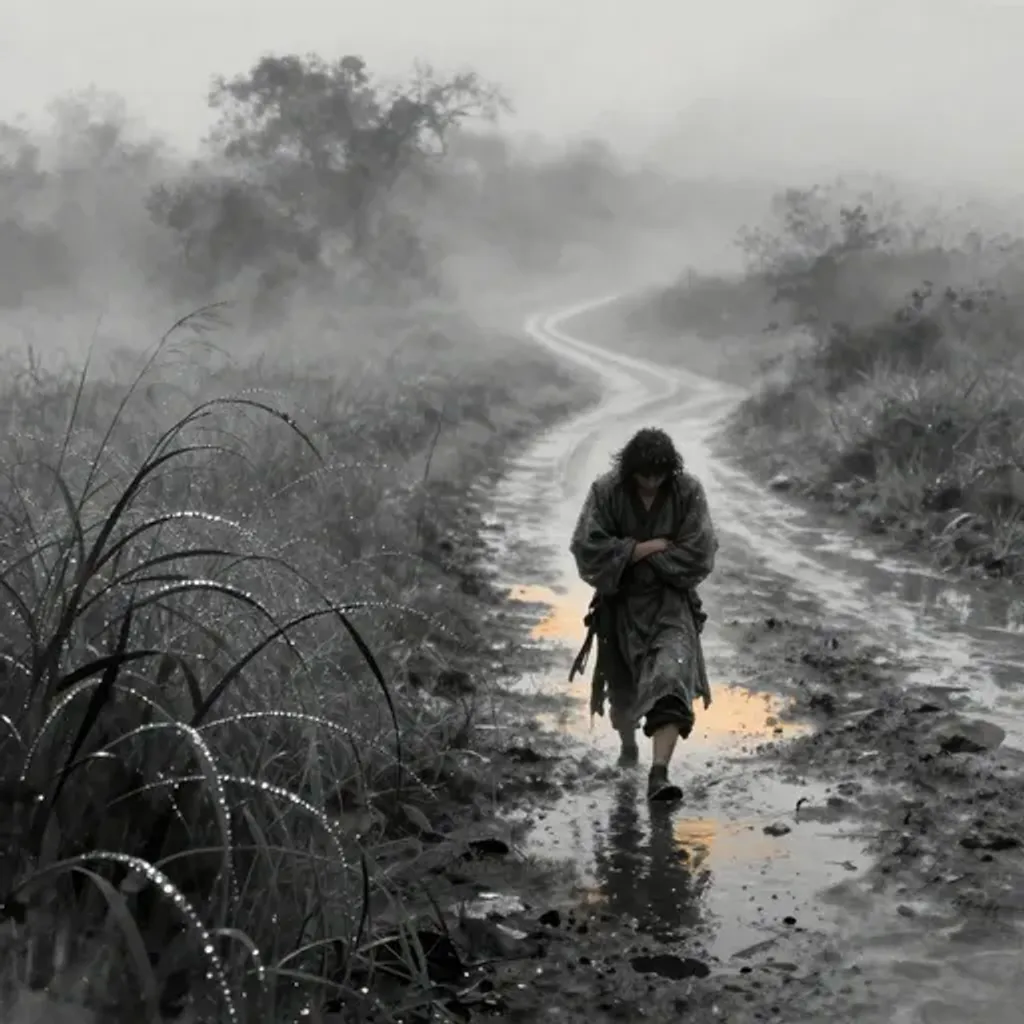
迷行晨夜,道多湛露。瀸我袴襦,重不可涉。
Wandering lost through dawn and night, the road heavy with deep dew. It soaks my trousers and tunic; the weight too great to ford onward.
— Jiao Yanshou, Yilin (Forest of Changes), 1st century BC
Commentary
Fire within the lake transforms into thunder above the earth — Enthusiasm, the surge of joyful energy. Yet the verse tells a different story. Lost in travel through dawn and dusk, the road is thick with dew. Garments are soaked through — trousers, jacket — too heavy to continue fording. Revolution clears the way, but Enthusiasm's thunder-burst arrives as a sodden march: the traveler who set out in revolutionary fervor finds the road impassable, dew-soaked and weighted down. From Revolution to Enthusiasm, the ironic resonance is that exuberance without preparation leads to exhaustion. The thunder may stir the earth, but the walker is too waterlogged to dance.
革 → 隨
Hexagram 49 → Hexagram 17: Following
Changing lines: 3
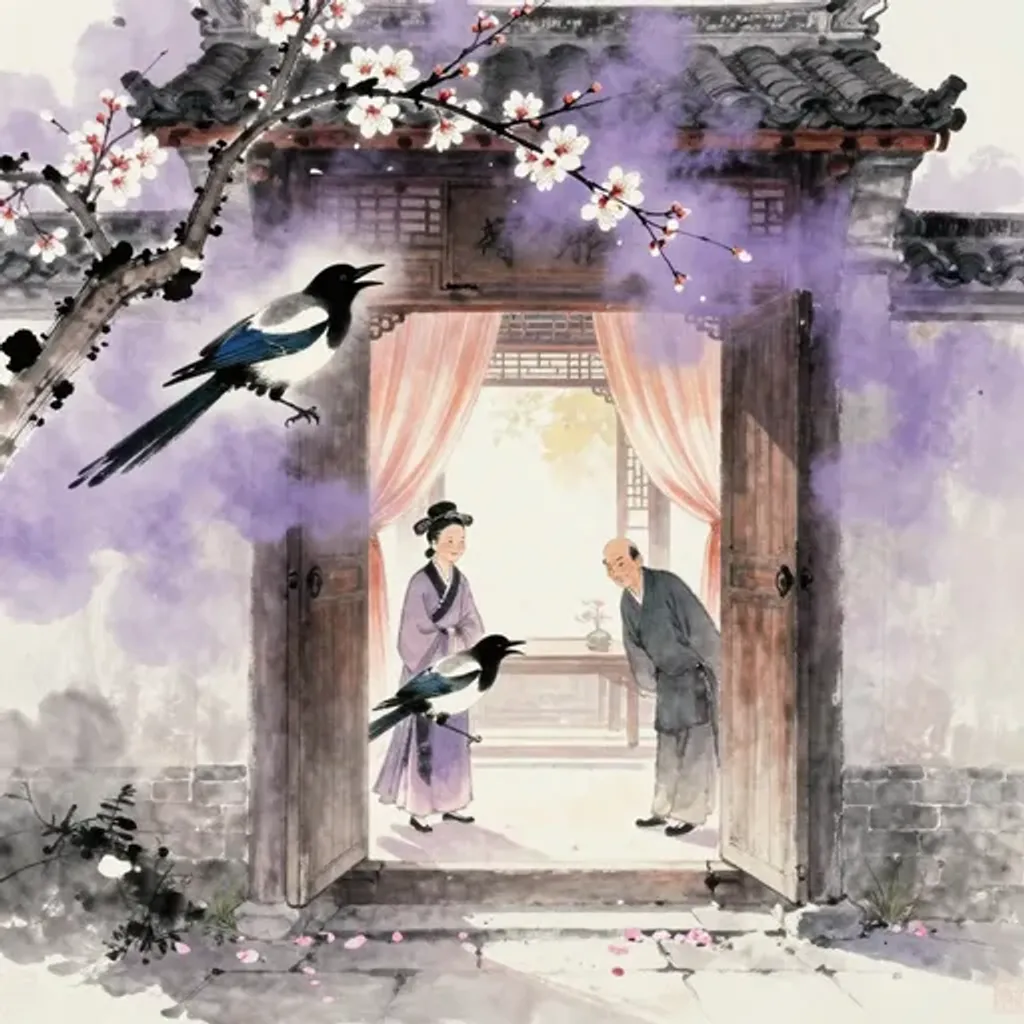
目瞤足動,喜如其願,舉家蒙寵。
A magpie calls from the branch-top; purple qi rises in the courtyard. The door opens to welcome a noble guest — the whole room feels the spring wind.
— Jiao Yanshou, Yilin (Forest of Changes), 1st century BC
Commentary
Fire within the lake yields to thunder resting within the lake — Following, where one moves in natural response to the moment. The original verse reads: 'Eyes twitch, feet stir — joy arrives as wished, and the whole household receives favor.' Bodily omens announce good fortune: the flickering eyelid and restless foot signal that change is coming, and when it arrives, it brings exactly what was hoped for. The entire family benefits. From Revolution to Following, the transformation captures the moment when revolutionary upheaval resolves into something one can willingly embrace — not forced compliance, but the body itself recognizing and welcoming what comes next.
革 → 蠱
Hexagram 49 → Hexagram 18: Work on the Decayed
Changing lines: 1, 2, 4, 5, 6
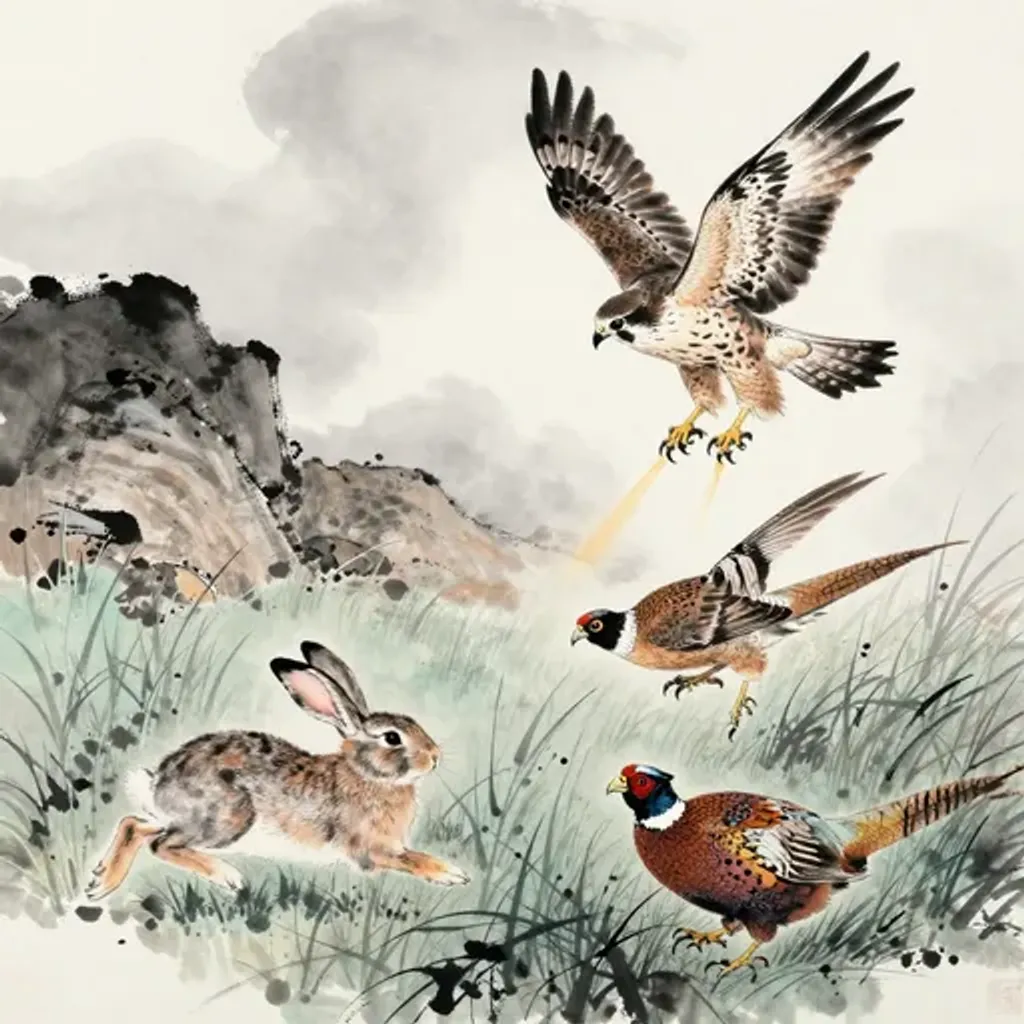
鷹鷂欲食,雉兔困急。逃頭見尾,為害所賊。
The hawk and sparrowhawk hunger for prey; pheasant and rabbit are hard-pressed. Fleeing head-first, tail exposed; harmed by the very peril they sought to escape.
— Jiao Yanshou, Yilin (Forest of Changes), 1st century BC
Commentary
Fire within the lake yields to wind beneath the mountain — decay breeding beneath a still surface. Hawks and sparrowhawks hunger for prey; pheasants and hares are driven to desperation. Hiding the head exposes the tail; harm finds its mark regardless. Revolution has torn away protective cover, and what follows is the corruption of Decay: predators circle, and the prey cannot hide. The pheasant that ducks its head only reveals its tail — a vivid image of futile evasion. From Revolution to Work on the Decayed, the transformation warns that after upheaval, old corruption resurfaces as predation. The vulnerable discover that revolution removed their shelter without removing their enemies.
革 → 臨
Hexagram 49 → Hexagram 19: Approach
Changing lines: 2, 3, 4, 5
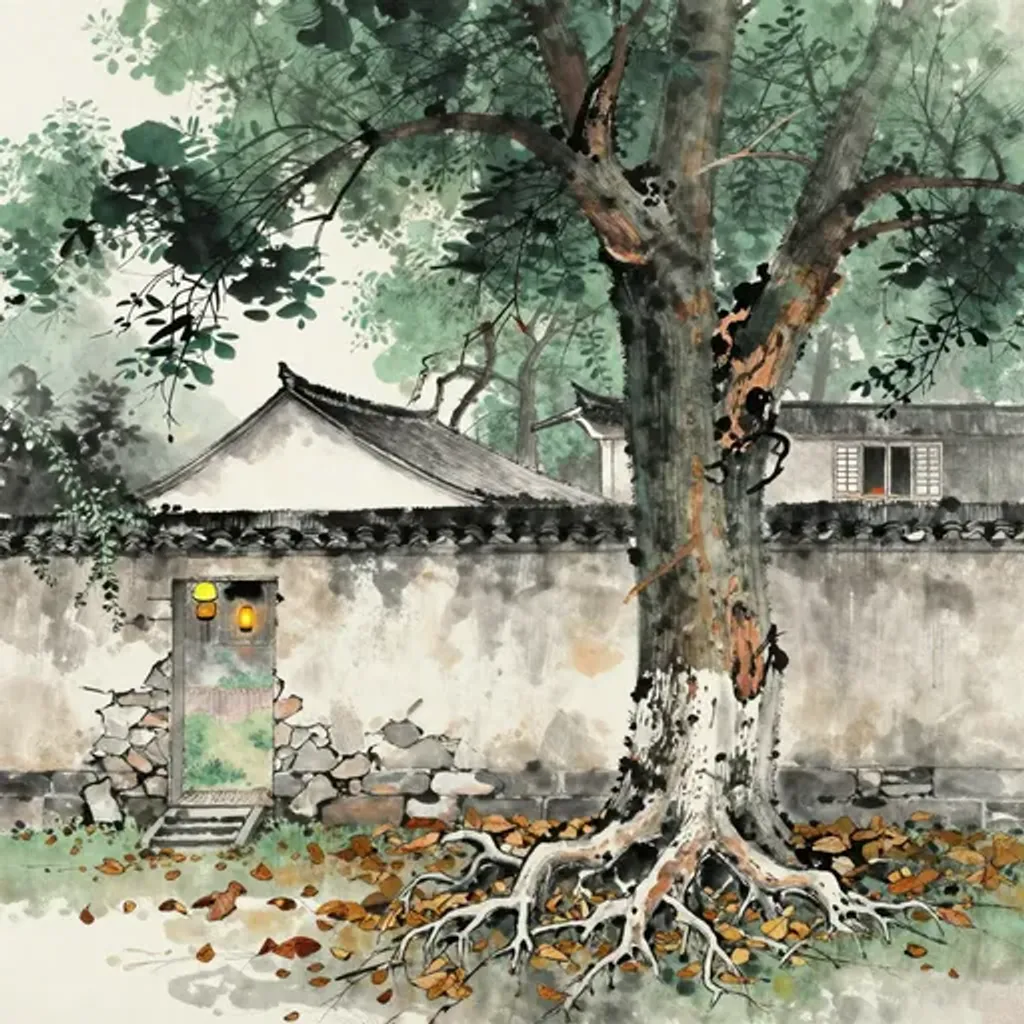
鼻移在項,枯葉傷生。下朽上榮,家擾不寧,失其金城。
The nose shifted to the nape; withered leaves harm the living. Below rotten, above flourishing; the household is troubled and restless, losing its fortress of gold.
— Jiao Yanshou, Yilin (Forest of Changes), 1st century BC
Commentary
Fire within the lake transforms into earth above the lake — Approach, where authority draws near. The nose has migrated to the back of the neck; withered leaves wound the living branch. Below rots while above still flourishes; the household is in turmoil, and its golden fortress is lost. Everything here is inverted: the nose, organ of discernment, sits where it cannot function. Dead foliage chokes the living shoot. The foundation decays while the crown appears healthy — a false prosperity concealing structural collapse. From Revolution to Approach, the dark resonance emerges: authority approaching a disordered system only hastens its ruin. The golden stronghold falls because its own structure is upside down.
革 → 觀
Hexagram 49 → Hexagram 20: Contemplation
Changing lines: 1, 3, 4, 6
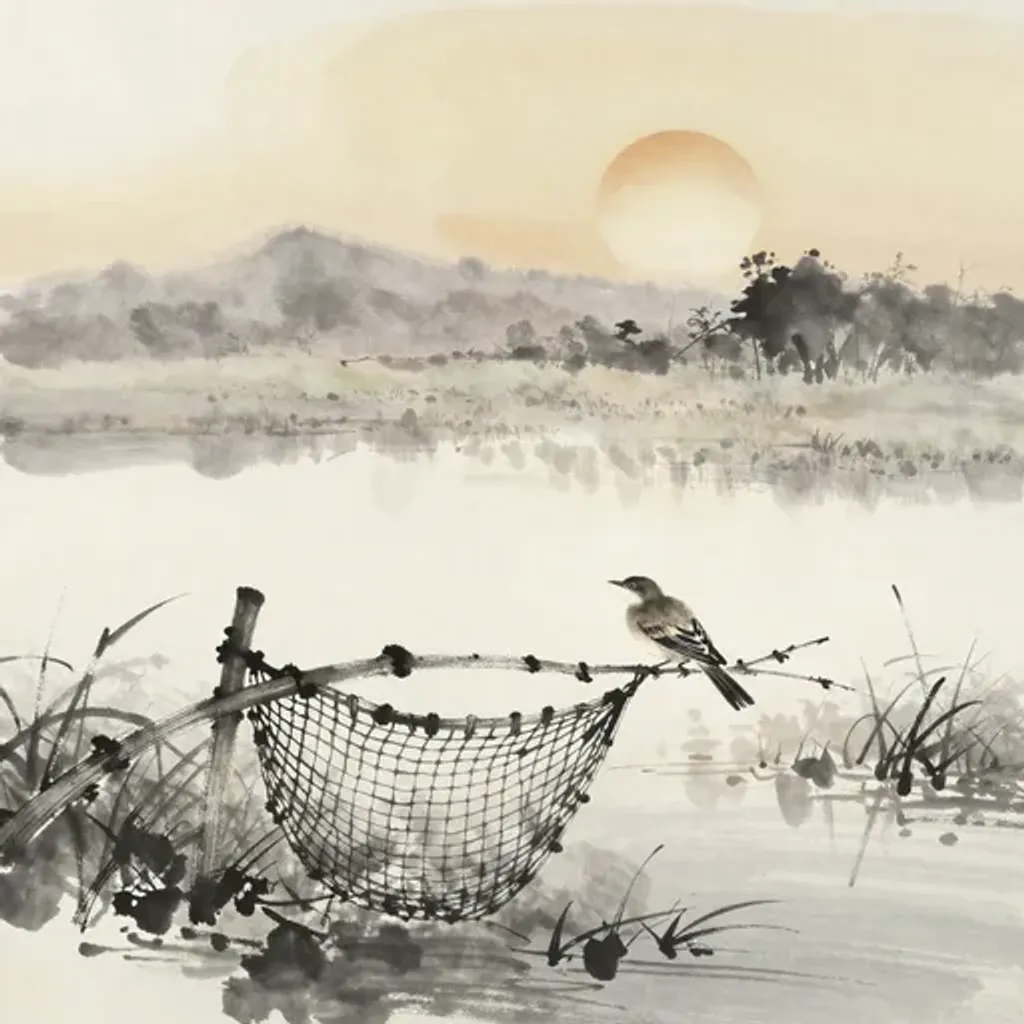
飛不遠去,法為罔待,祿養未富。
It flies but does not go far; the law's net lies in wait. Salary and sustenance remain meager.
— Jiao Yanshou, Yilin (Forest of Changes), 1st century BC
Commentary
Fire within the lake rises to wind moving over the earth — Contemplation, the view from above. Yet the bird cannot fly far; laws and nets wait to entrap it. Salary and sustenance remain insufficient. Revolution promises liberation, but Contemplation reveals the limits of that freedom. The bird that should soar after its cage is broken finds new constraints: regulations, traps, and meager provisions. It can see the horizon but cannot reach it. From Revolution to Contemplation, the transformation discloses a sobering truth: the view after revolution may be wide, but the capacity to act on what one sees remains constrained. Freedom observed is not yet freedom lived.
革 → 噬嗑
Hexagram 49 → Hexagram 21: Biting Through
Changing lines: 3, 5, 6
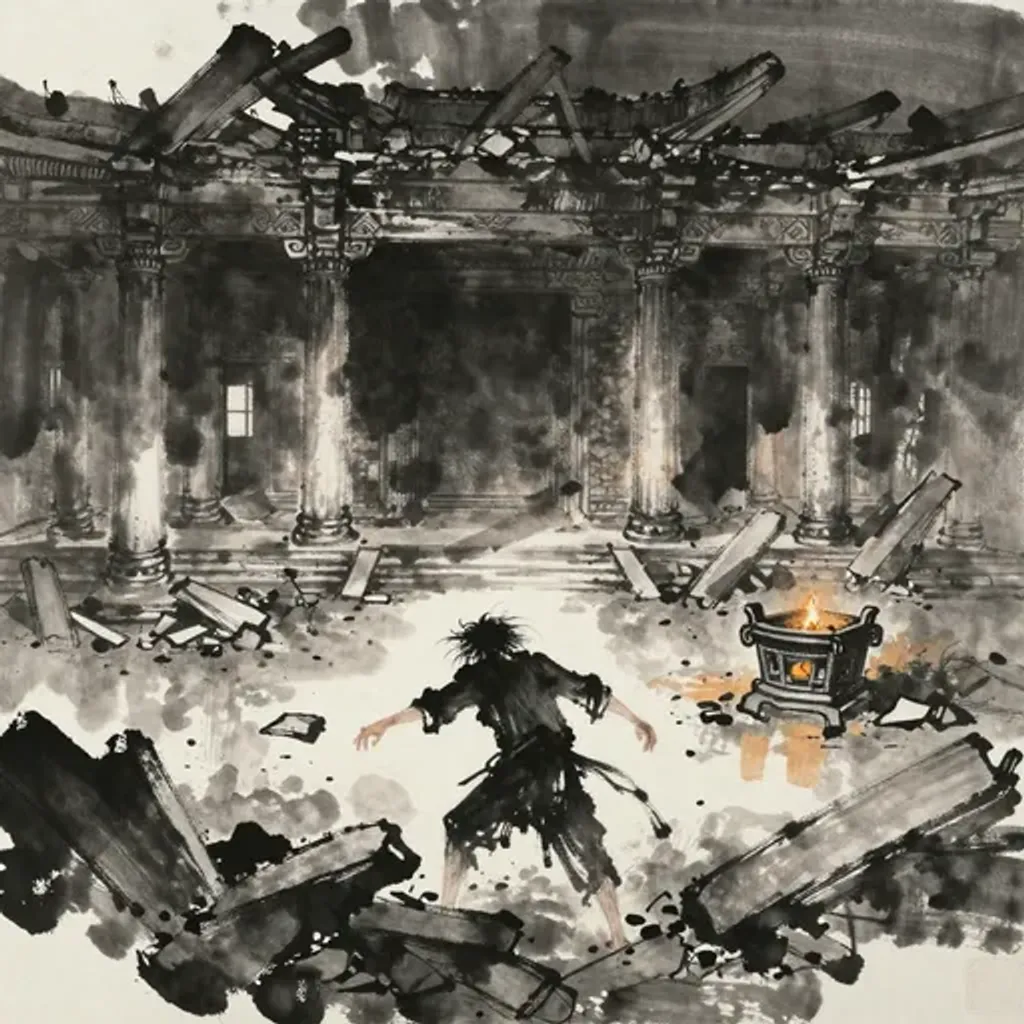
倒基敗宮,重舌作凶。被髮長夜,迷亂相誤,深亡吉居。
Foundations overturned, the palace ruined; a double tongue works its evil. Hair unbound through the long night; lost in confusion and mutual error, the auspicious dwelling sinks into oblivion.
— Jiao Yanshou, Yilin (Forest of Changes), 1st century BC
Commentary
Fire within the lake gives way to thunder and lightning — Biting Through, the hexagram of criminal justice. Foundations topple and palaces collapse. A double tongue works mischief. Hair loose and unbound through the long night, confusion and error compound one another until the auspicious dwelling is deeply lost. Revolution devolves into judicial chaos: slander ('double tongue') accelerates the destruction, and social norms unravel (unbound hair signals the abandonment of ritual propriety). From Revolution to Biting Through, the transformation warns that when revolution exposes wrongdoing, the rush to punish can itself become anarchic — the court of justice turns into a ruin.
革 → 賁
Hexagram 49 → Hexagram 22: Grace
Changing lines: 4, 5, 6
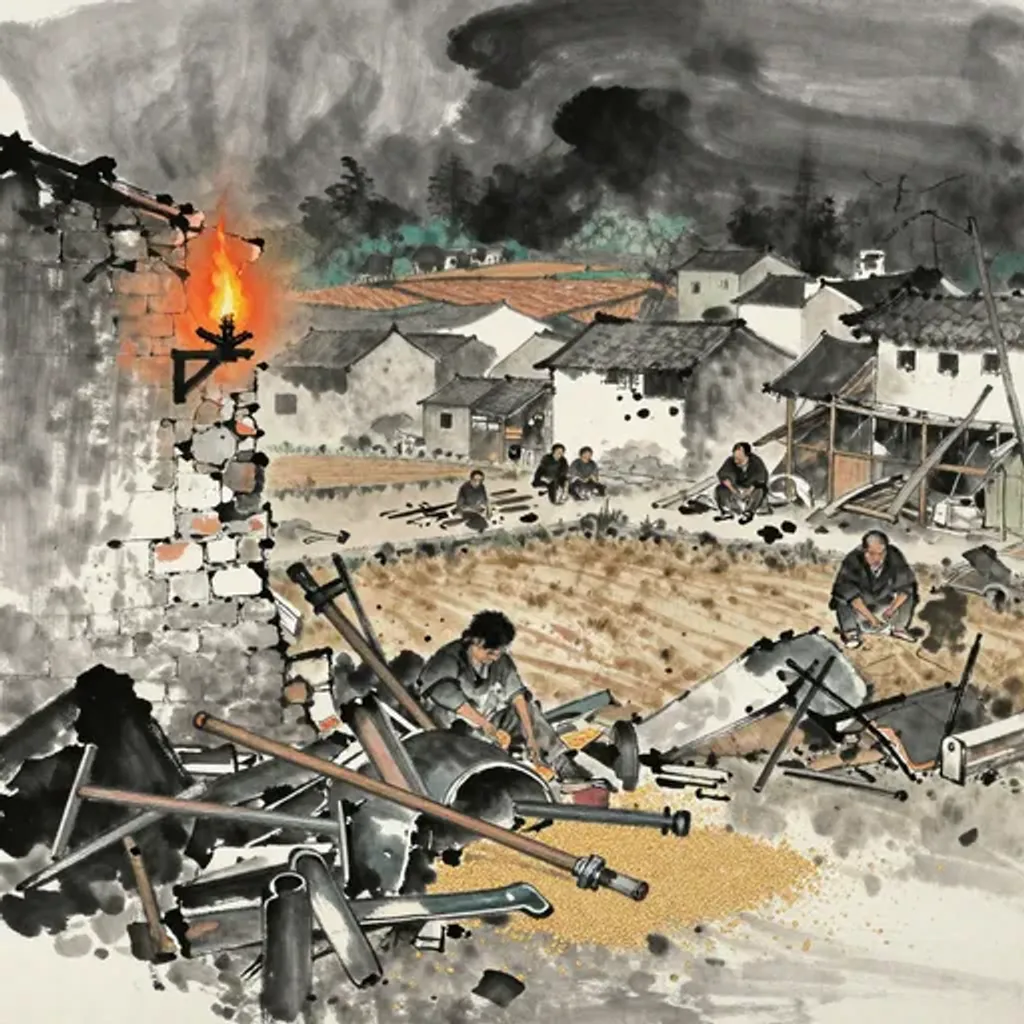
亥午相錯,敗亂緒業,民不得作。
Hai and Wu clash in error; enterprises fail and fall to ruin. The people cannot carry out their work.
— Jiao Yanshou, Yilin (Forest of Changes), 1st century BC
Commentary
Fire within the lake yields to fire beneath the mountain — Grace, the hexagram of cultural adornment. Yet the Earthly Branches hai and wu clash in disastrous error, disrupting inherited enterprises, leaving the people unable to work their fields or tend their crafts. Hai (pig/water) and wu (horse/fire) stand in fundamental opposition: water extinguishes fire, and their collision symbolizes timing gone catastrophically wrong. The elegance that Grace promises is undermined when cosmic rhythms conflict. From Revolution to Grace, the transformation reveals that outward beauty cannot compensate for structural disharmony. When the calendar itself is in error, no amount of ornamentation can restore productive order.
革 → 剝
Hexagram 49 → Hexagram 23: Splitting Apart
Changing lines: 1, 3, 4, 5, 6
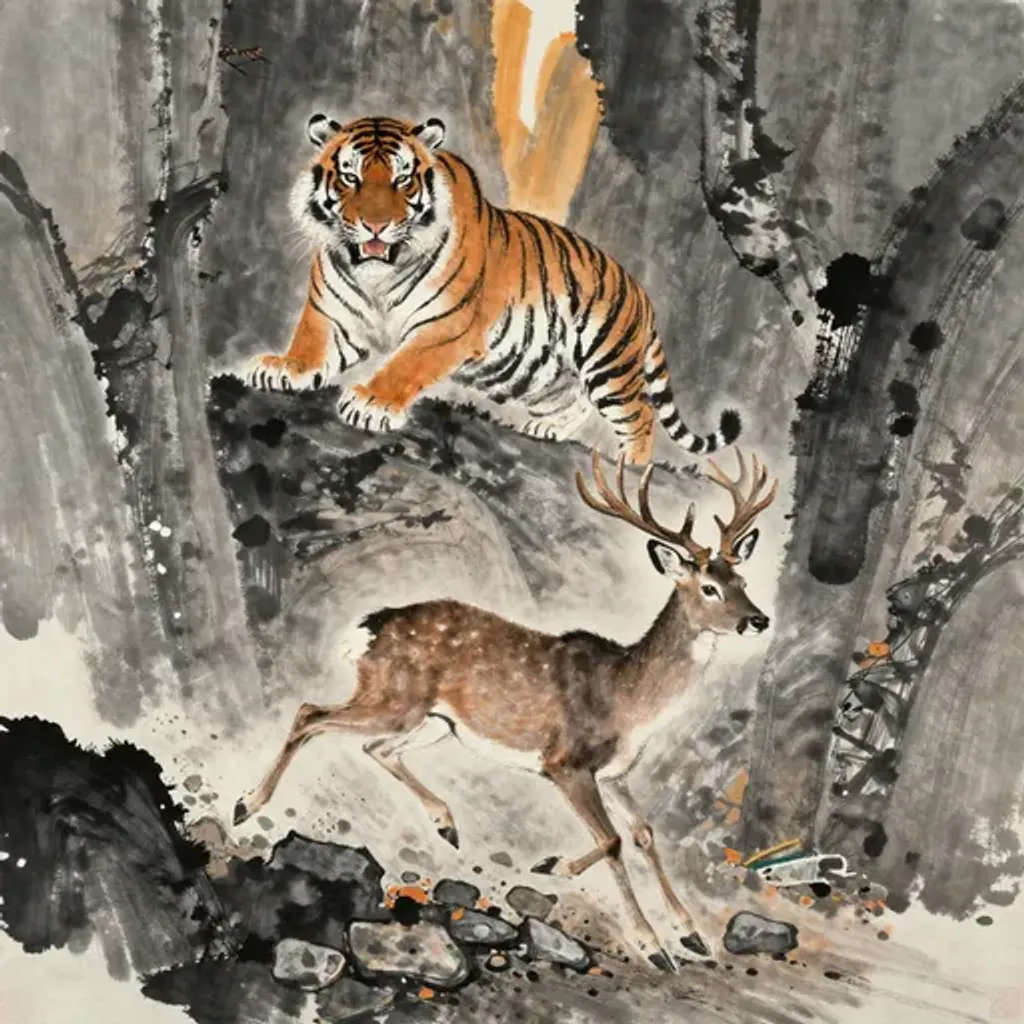
野麋畏人,俱入山谷。命短不長,為虎所得,死於牙腹。
The wild deer fears men and together they plunge into the mountain valley. Its life cut short; seized by the tiger, it dies between fang and belly.
— Jiao Yanshou, Yilin (Forest of Changes), 1st century BC
Commentary
Fire within the lake yields to a mountain resting upon the earth — Splitting Apart, where structure erodes from below. Wild deer fear humans and flee together into the mountain valleys. But their fate is short: the tiger catches them, and they die in its jaws. Revolution drives the vulnerable into flight, but the mountain that should shelter them harbors the predator. The deer's flight into the valley mirrors a common pattern after upheaval: refugees seeking safety in precisely the place where danger waits. From Revolution to Splitting Apart, the transformation shows how the collapsing order strips away all refuge, leaving the weak exposed to those who thrive in chaos.
革 → 復
Hexagram 49 → Hexagram 24: Return
Changing lines: 3, 4, 5
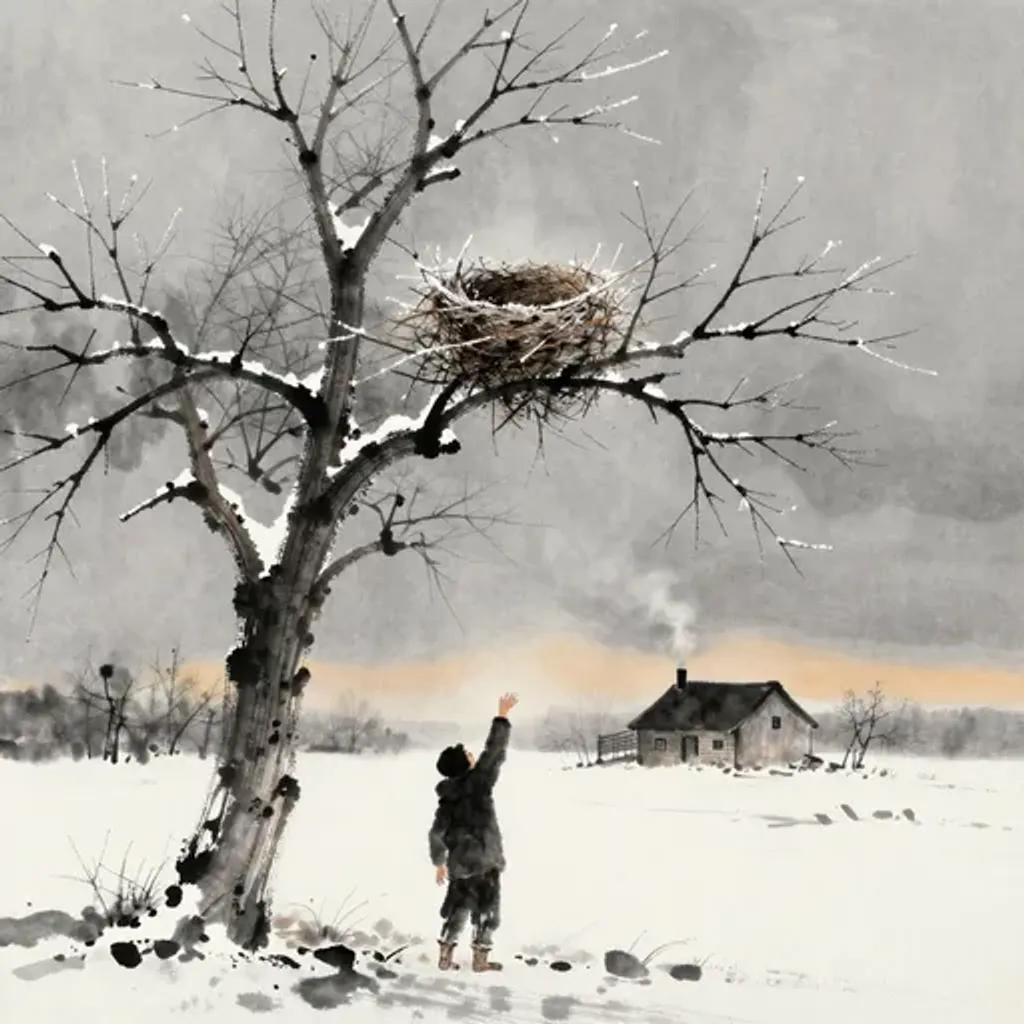
秋冬探巢,不得鵲鶵。衘指北去,愧我少姬。
Searching the nest in autumn and winter, no magpie chick is found. Biting a finger, heading north; ashamed before my young bride.
— Jiao Yanshou, Yilin (Forest of Changes), 1st century BC
Commentary
Fire within the lake gives way to thunder dormant beneath the earth — Return, the first stirring of renewal. In autumn and winter one searches the nest but finds no magpie chicks. Biting one's finger in regret, one heads north, ashamed before one's young bride. The season is wrong: magpies breed in spring, so searching in autumn yields only empty nests. The shame before the 'young bride' (少姬) suggests a promise unfulfilled, a homecoming without the gift one swore to bring. From Revolution to Return, the transformation reveals that returning too late — or at the wrong season — finds the nest already bare. Revolution's timing must align with nature's rhythms, or the return is empty-handed.
革 → 无妄
Hexagram 49 → Hexagram 25: Innocence
Changing lines: 3, 6
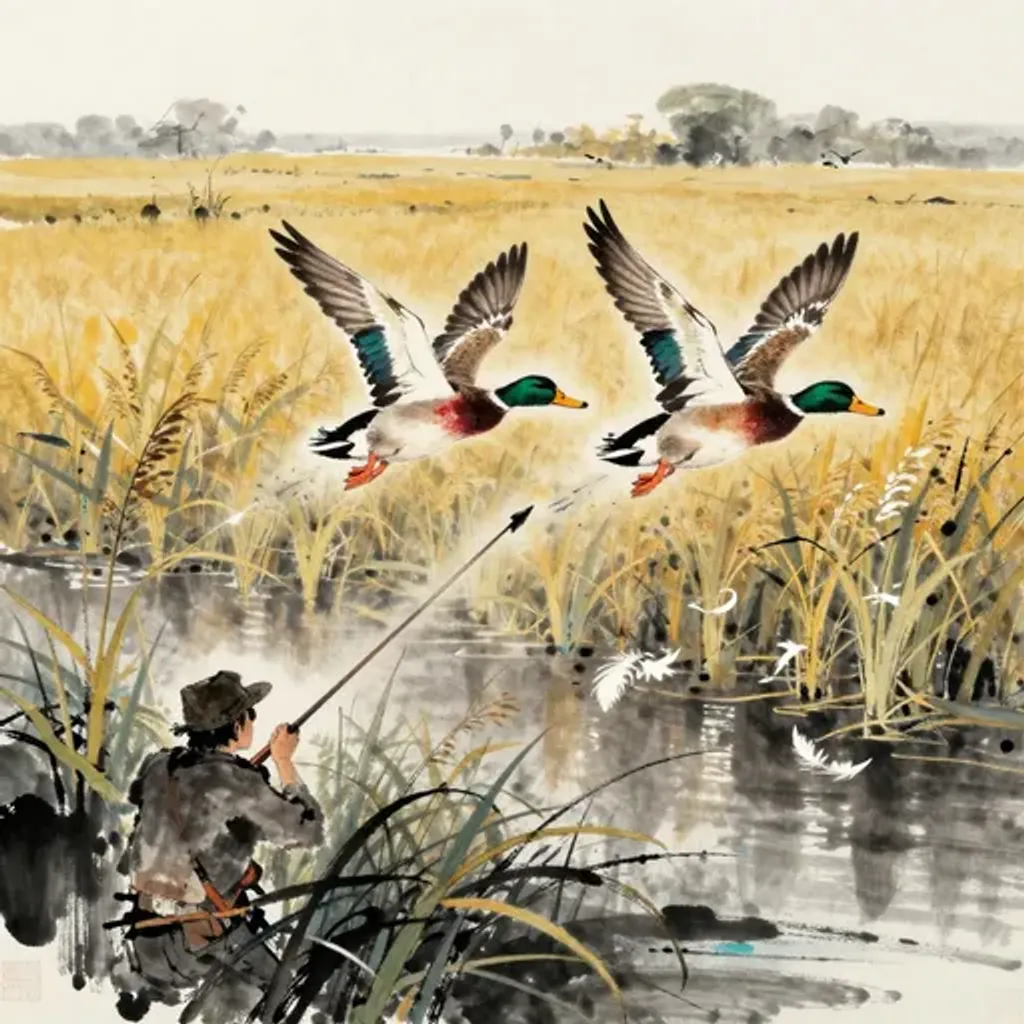
雙鳧俱飛,欲歸稻池。經涉雚澤,為矢所射,傷我胸臆。
A pair of wild ducks fly together, longing to return to the rice pond. Passing through the reed marsh, struck by an arrow; it wounds my breast and heart.
— Jiao Yanshou, Yilin (Forest of Changes), 1st century BC
Commentary
Fire within the lake transforms into thunder beneath heaven — Innocence, where disaster strikes without cause. A pair of wild ducks fly together, longing to return to the rice pond. Passing through the reedy marshes, they are struck by arrows, piercing chest and ribs. The ducks' only desire is to go home; the marshland they must cross conceals the hunter. This is the essence of Innocence: misfortune that arrives through no fault of one's own, simply because the path home passes through danger. From Revolution to Innocence, the transformation captures the cruelty of transition — those fleeing upheaval toward familiar safety are sometimes cut down precisely because they follow the obvious route.
革 → 大畜
Hexagram 49 → Hexagram 26: Great Taming
Changing lines: 2, 4, 5, 6
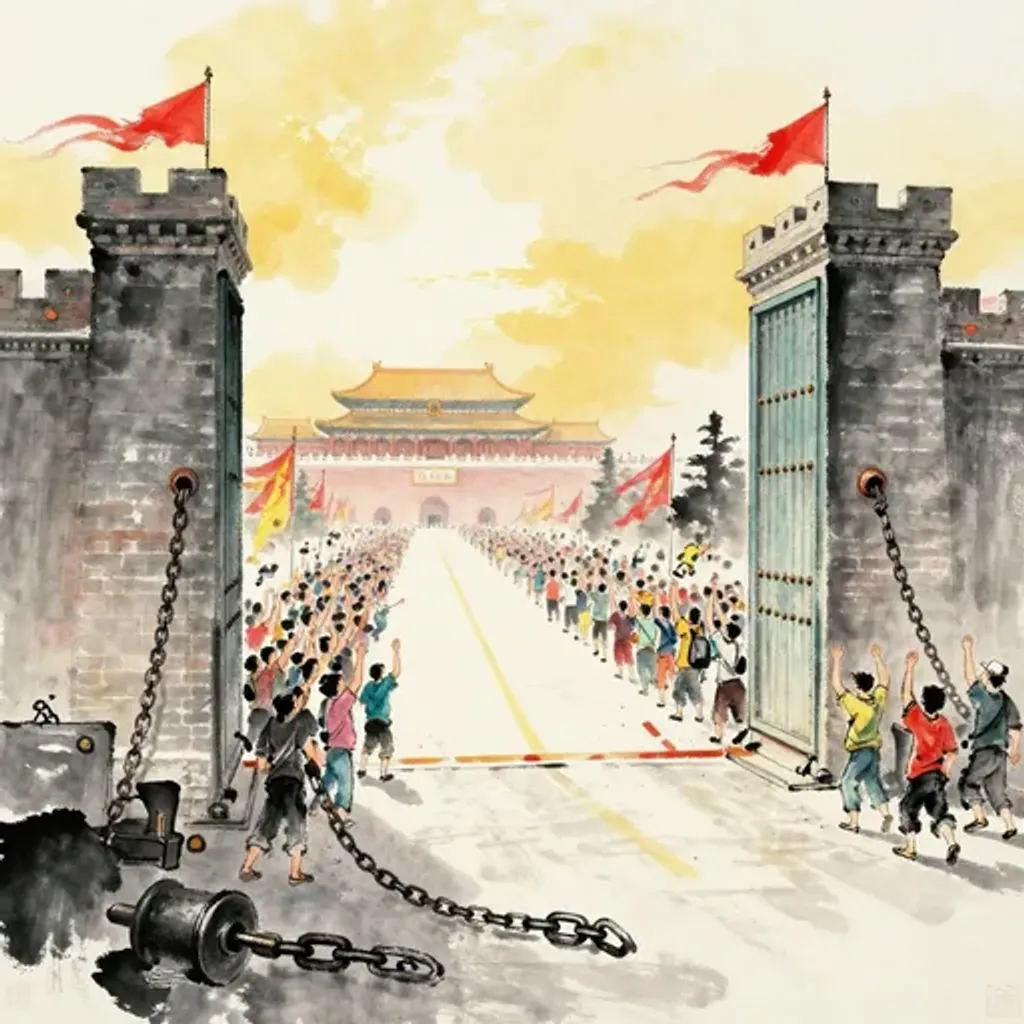
天門開闢,牢戶寥廓,桎梏解脫,拘囚縱釋。
The city gate bursts open; banners billow like clouds. Ten thousand citizens line the road, welcoming the new lord.
— Jiao Yanshou, Yilin (Forest of Changes), 1st century BC
Commentary
Fire within the lake transforms into heaven stored within the mountain — Great Taming, where power is accumulated and held. The original verse reads: 'Heaven's gate opens wide; prison doors stand vast and empty. Fetters and shackles are removed; the imprisoned are set free.' Revolution achieves its most dramatic result: liberation. The gates of heaven swing open as earthly prisons empty, chains fall away, and captives walk free. From Revolution to Great Taming, the transformation reveals that true containment of power begins with release: the mountain stores heaven not by constricting it but by providing a frame vast enough to hold it. Freedom, properly channeled, becomes the greatest accumulation of virtue.
革 → 頤
Hexagram 49 → Hexagram 27: Nourishment
Changing lines: 3, 4, 5, 6
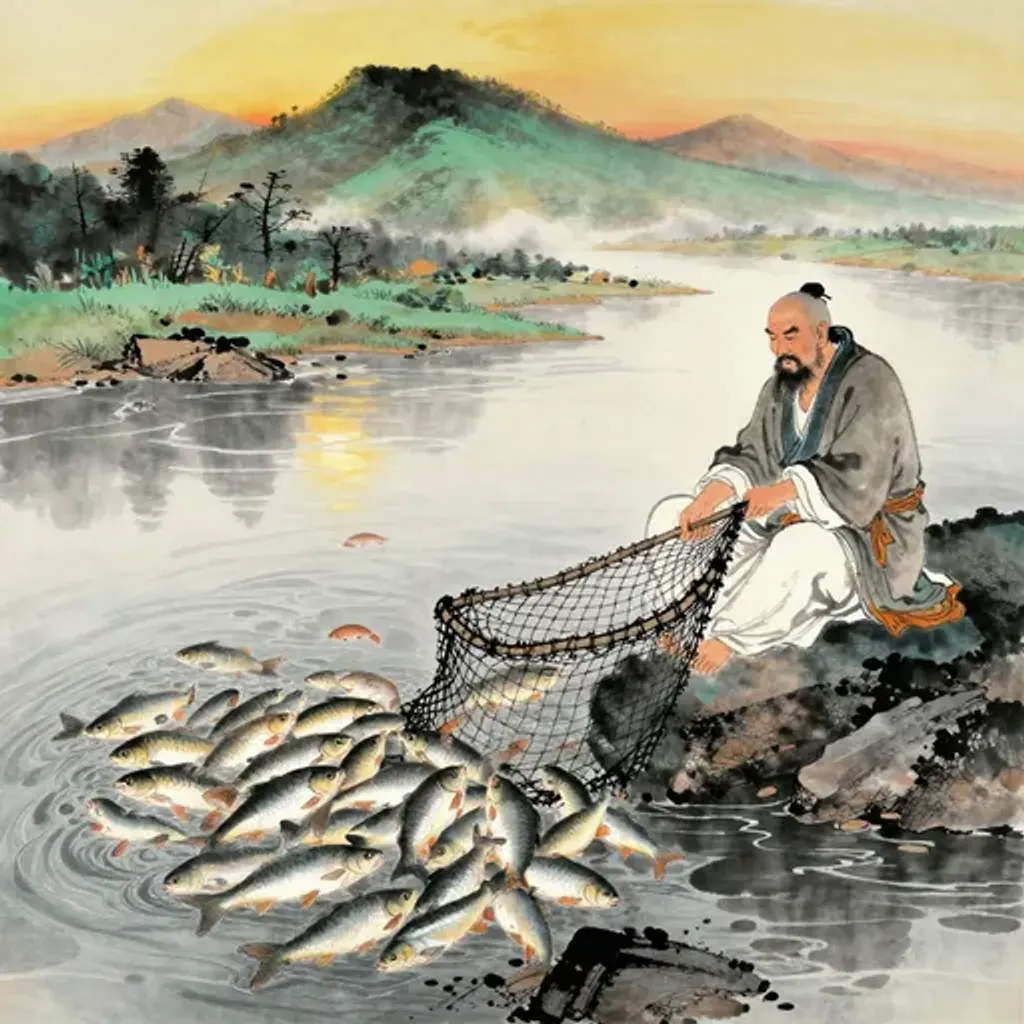
尼父孔丘,善釣鯉魚。羅釣一舉,得獲萬頭,富我家居。
Father Ni, Kong Qiu, skilled at angling for carp. One cast of his net, he catches ten thousand head, enriching my household.
— Jiao Yanshou, Yilin (Forest of Changes), 1st century BC
Commentary
Fire within the lake yields to the mountain above thunder — Nourishment, where what enters the mouth sustains the spirit. Father Ni, Confucius himself, proves a master angler of carp. One cast of the net brings in ten thousand heads, enriching the household. The image of Confucius as supreme fisherman is striking: the sage who feeds minds here feeds bodies. The carp — auspicious in Chinese culture, associated with abundance and the Dragon Gate — arrives in overwhelming quantity. From Revolution to Nourishment, the transformation shows that after upheaval, a sage's single well-placed effort can produce abundance beyond measure. The net captures what the revolution made available.
革 → 大過
Hexagram 49 → Hexagram 28: Great Exceeding
Changing lines: 1, 2
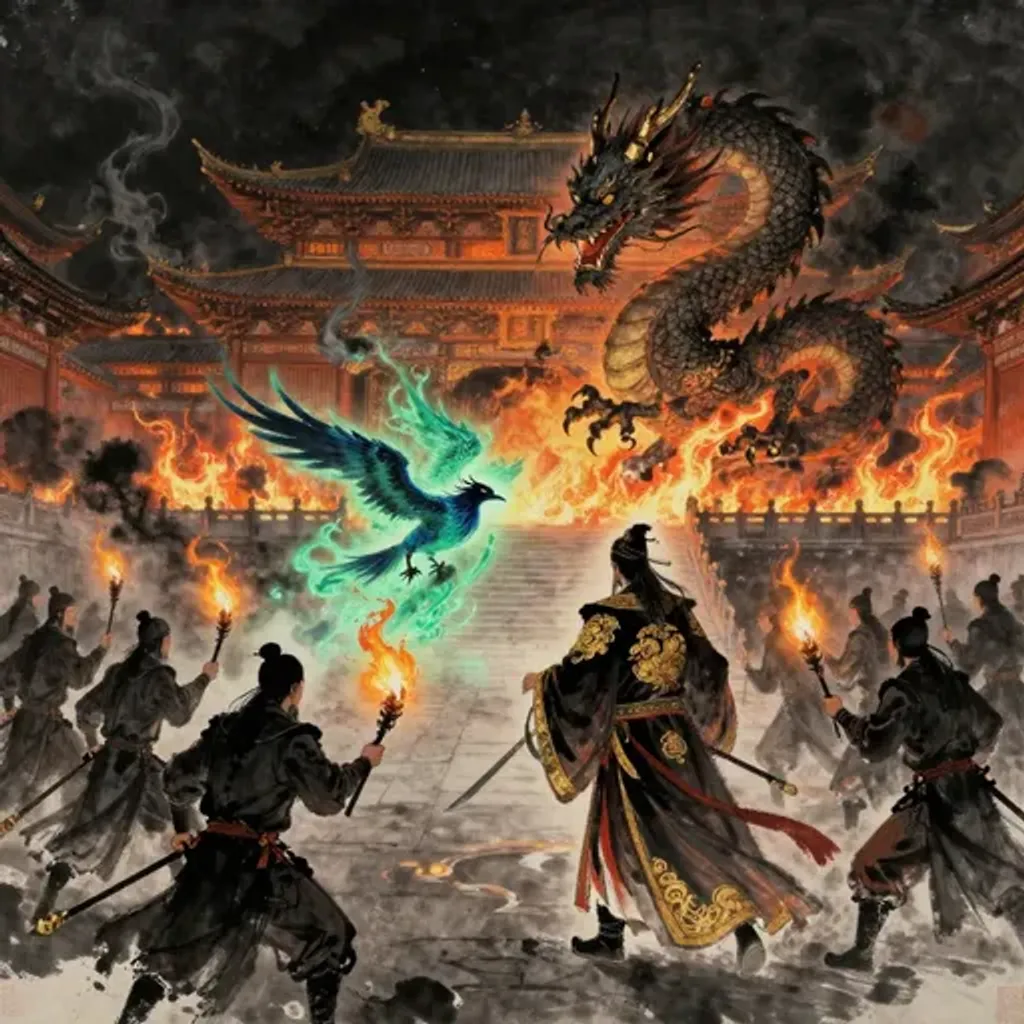
彭君為妖,暴龍作災。盜堯衣裳,聚跖荷兵。青禽照夜,三日夷亡。
Lord Peng works his evil; the violent dragon brings disaster. Stealing the robes of Yao, gathering bandits like Zhi under arms. The blue-green bird illuminates the night; in three days, the Yi are destroyed.
— Jiao Yanshou, Yilin (Forest of Changes), 1st century BC
Commentary
Fire within the lake gives way to the lake submerging wind — Great Exceeding, where the structure buckles under extraordinary pressure. Peng Sheng becomes a demon; a violent dragon wreaks havoc. Someone steals Yao's robes and gathers Robber Zhi's armed bands. A blue bird illuminates the night; within three days the Yi perish. According to tradition, Peng Sheng was a strongman of Qi whom Duke Xiang ordered to murder Duke Huan of Lu, then killed to silence. His ghost later appeared as a wild boar, terrifying Duke Xiang to death. The verse layers usurpation upon usurpation: stealing a sage-king's garments to cloak banditry. From Revolution to Great Exceeding, the beam snaps when revolution is hijacked by monsters wearing borrowed legitimacy.
革 → 坎
Hexagram 49 → Hexagram 29: The Abysmal Water
Changing lines: 1, 2, 3, 4
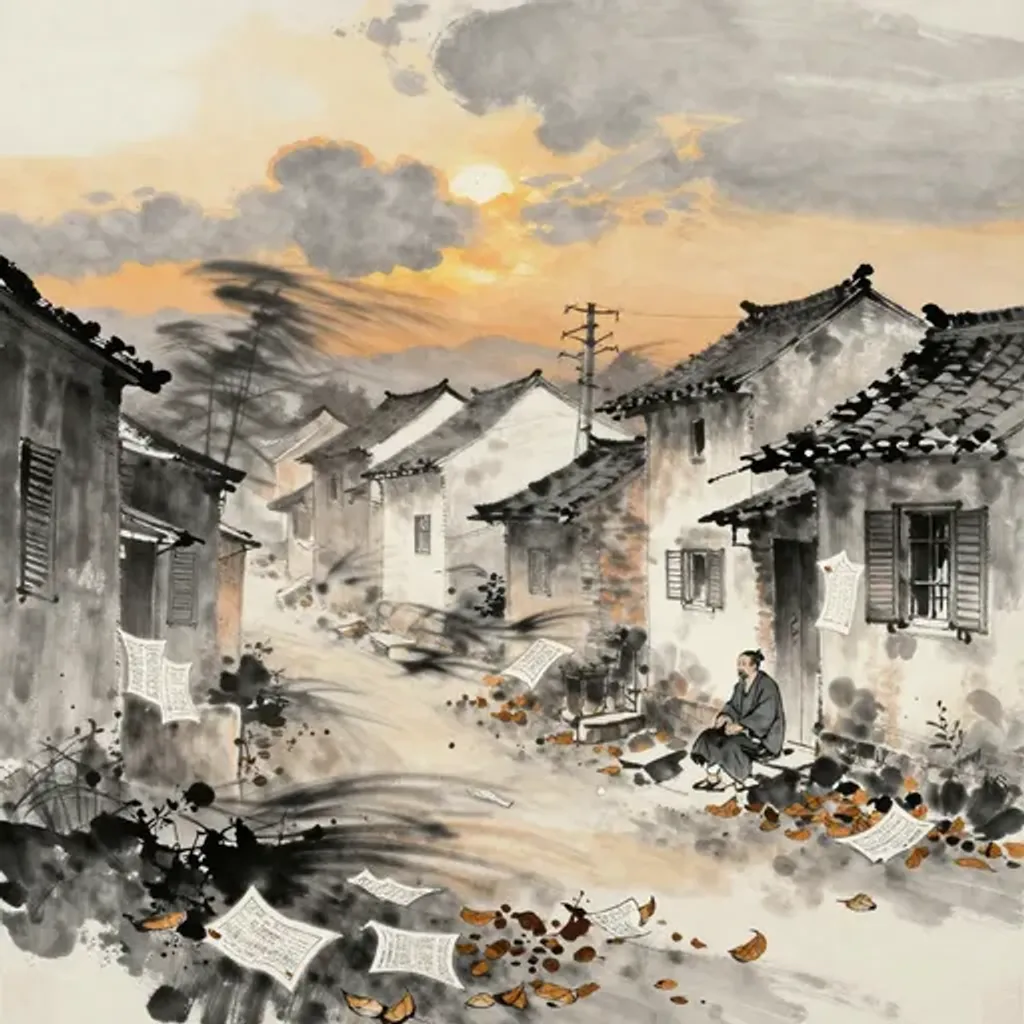
華言風語,亂相狂誤。終无凶事,安寧如故。
Flowery words and windy talk stir confusion and wild error. In the end, no calamity befalls; peace and calm remain as before.
— Jiao Yanshou, Yilin (Forest of Changes), 1st century BC
Commentary
Fire within the lake sinks into doubled water — the Abysmal, peril upon peril. Flowery words and winds of gossip throw everything into frenzied confusion. Yet in the end no calamity occurs; peace and stability remain as before. Revolution stirs up turmoil, and the Abysmal doubles the danger with its repeated pits. But this verse offers an unexpected resolution: the chaos is all noise. Rumors swirl, panic spreads, yet when the dust settles, nothing has actually changed. From Revolution to the Abysmal, the reassuring resonance is that not every crisis is real. Sometimes the deepest-looking abyss is merely turbulent air — alarming but ultimately harmless.
革 → 離
Hexagram 49 → Hexagram 30: The Clinging Fire
Changing lines: 5, 6
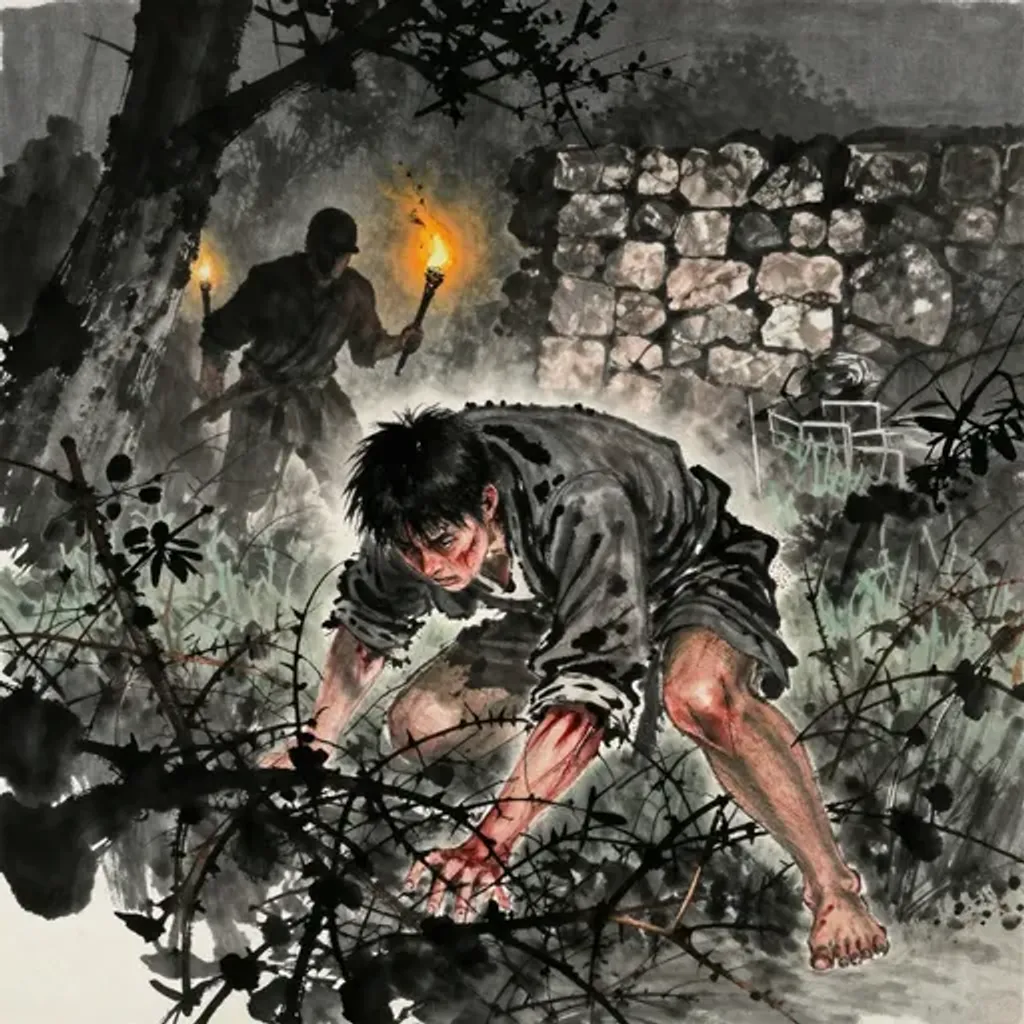
逃頸見足,身困不辱。欲隱避仇,為害所賊。
Fleeing, head hidden but feet exposed; the body is cornered yet not disgraced. Seeking to hide and escape the foe, one is harmed by the very peril pursued.
— Jiao Yanshou, Yilin (Forest of Changes), 1st century BC
Commentary
Fire within the lake doubles into fire upon fire — the Clinging, where brightness attaches to brightness. Hiding the neck exposes the feet; the body is trapped but not dishonored. One wishes to hide and evade an enemy, but harm finds its mark regardless. Double fire means double exposure: there is nowhere to hide when everything is illuminated. The fugitive who conceals one part reveals another — a body that cannot be wholly withdrawn from sight. From Revolution to the Clinging, the transformation warns that after revolution strips away all cover, the attempt to hide in plain light only highlights vulnerability. Fire clings to whatever it touches, and enemies see everything.
革 → 咸
Hexagram 49 → Hexagram 31: Influence
Changing lines: 1
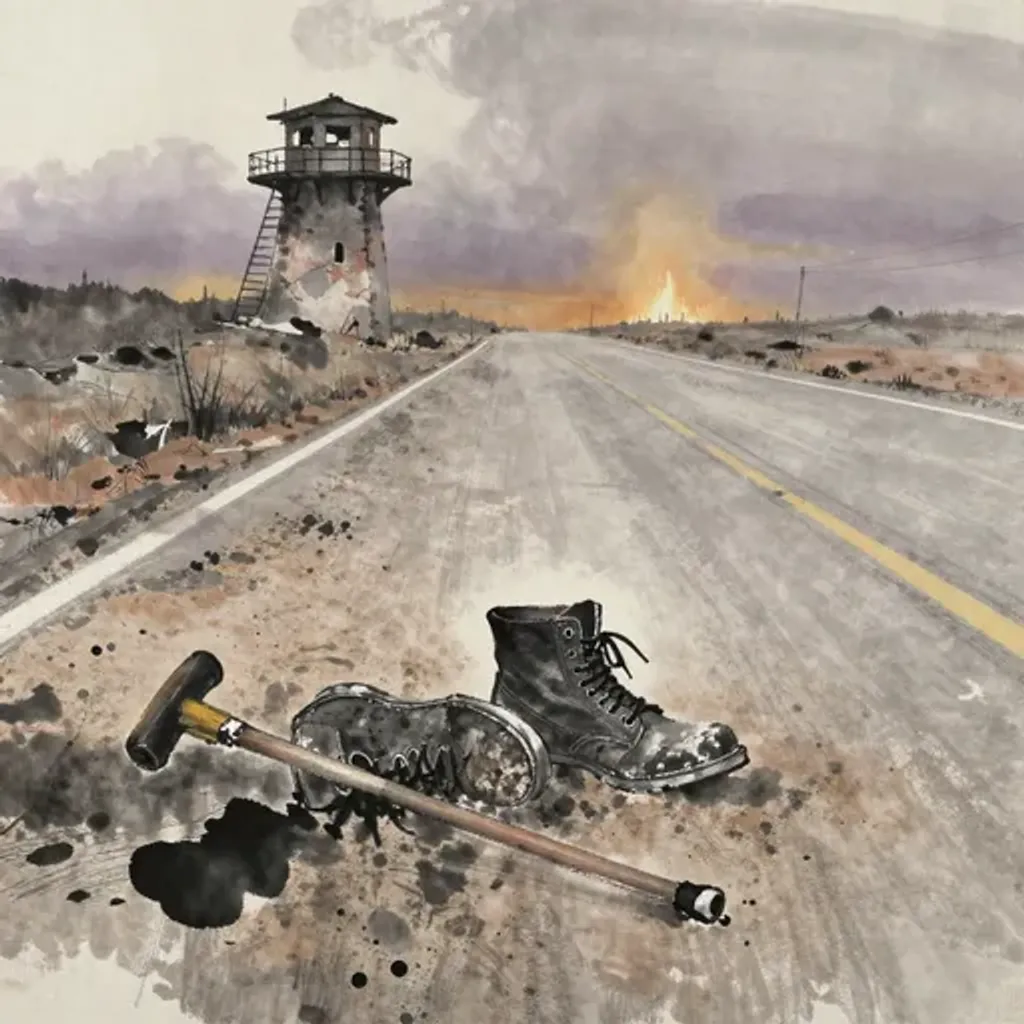
无足斷跟,居處不安。凶惡為殘。
Without feet, the heels cut away; the dwelling place knows no peace. Cruelty and evil leave only ruin.
— Jiao Yanshou, Yilin (Forest of Changes), 1st century BC
Commentary
Fire within the lake yields to the lake resting upon the mountain — Influence, where sensation passes between what is above and what is below. But here the feet are severed and the heels cut; one's dwelling place offers no peace. Cruelty and evil leave only mutilation. Revolution was meant to liberate, yet what follows is the crippled body of Influence — a hexagram about mutual feeling between upper and lower that cannot function when the lower body is destroyed. Without feet there is no standing, no walking, no grounding. From Revolution to Influence, the grim transformation shows that when violence severs the connection between ruler and ruled, no mutual sympathy can form.
革 → 恆
Hexagram 49 → Hexagram 32: Duration
Changing lines: 1, 2, 5
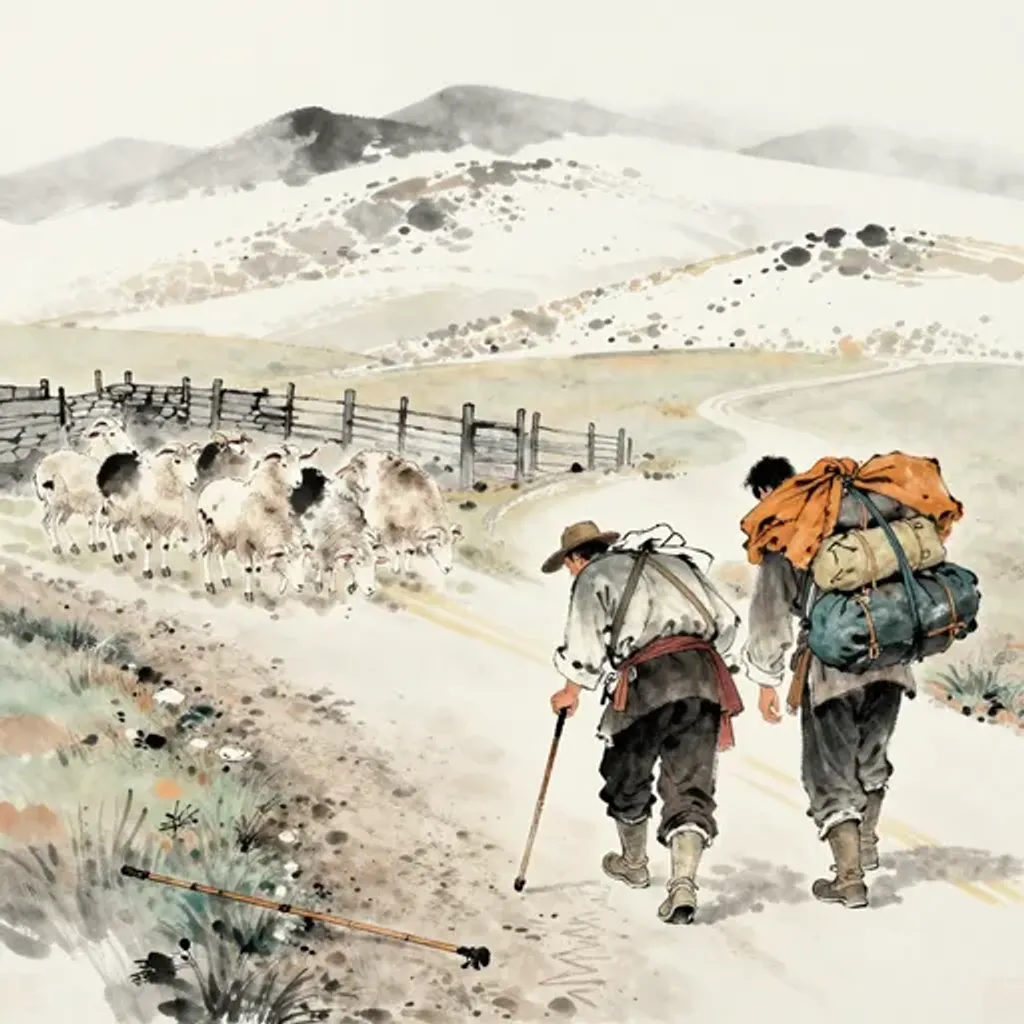
三人俱行,北求大䍧。長孟病足,倩李負囊。柳下之貞,不失我糧。
Three men travel together, heading north to seek fine rams. The eldest, Meng, has a lame foot; he asks Li to carry the bags. With the constancy of Liuxia, we do not lose our provisions.
— Jiao Yanshou, Yilin (Forest of Changes), 1st century BC
Commentary
Fire within the lake yields to thunder above wind — Duration, the hexagram of constancy through long effort. Three men travel together northward seeking fine rams. The eldest, Meng, injures his foot, so they ask Li to carry the provisions. With the steadfastness of Liuxia Hui, they do not lose their grain. Liuxia Hui, the sage of Lu famed for unwavering integrity — Mencius called him 'the sage of accommodation' — lends his name to a principle: hold firm to provisions and purpose regardless of hardship. From Revolution to Duration, the transformation shows that after upheaval, the journey continues only through mutual support, stubborn constancy, and the refusal to abandon what sustains the group.
革 → 遯
Hexagram 49 → Hexagram 33: Retreat
Changing lines: 1, 6
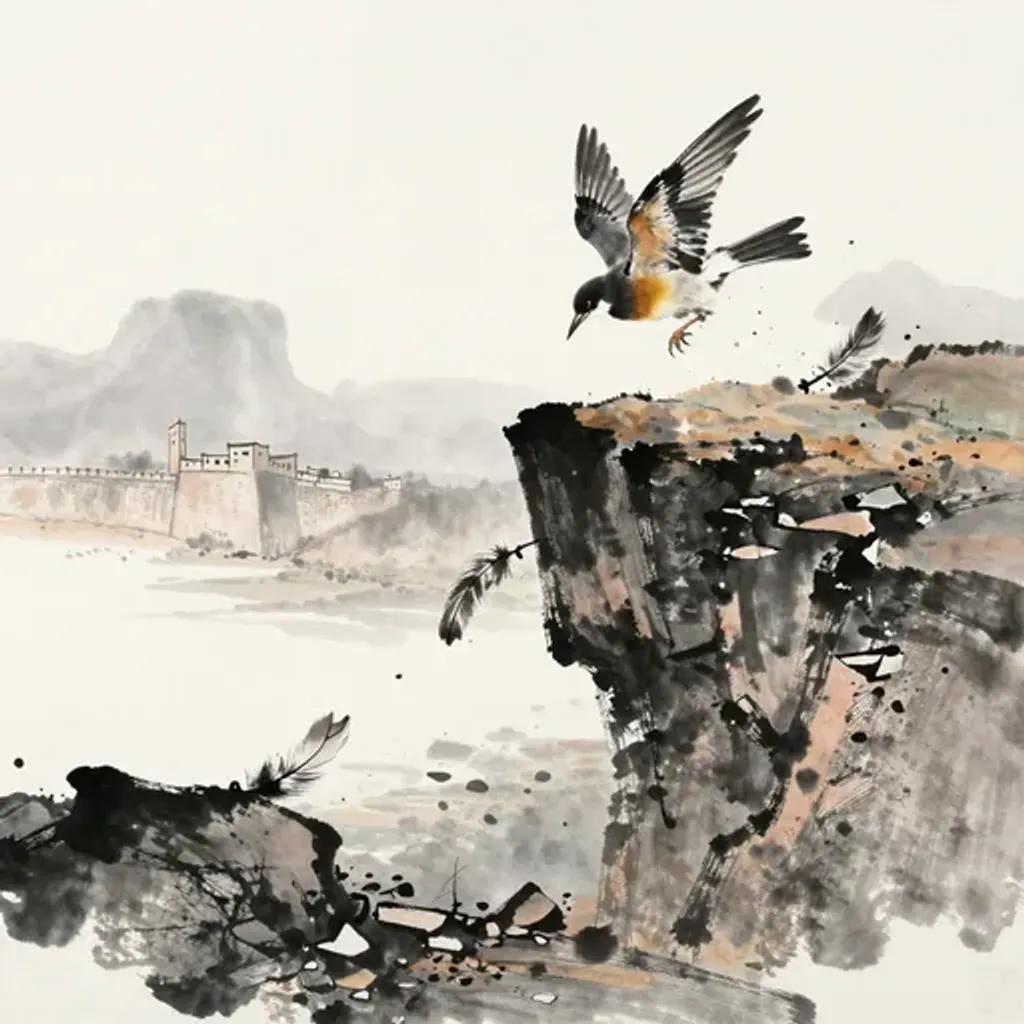
退飛見祥,傷敗毀墜。守小失大,功名不遂。
Retreating in flight, an omen appears; wounded, ruined, and falling. Guarding the small, losing the great; merit and fame remain unfulfilled.
— Jiao Yanshou, Yilin (Forest of Changes), 1st century BC
Commentary
Fire within the lake transforms into heaven above the mountain — Retreat, the strategic withdrawal. Birds fly backward, an omen portending injury and ruin. Guarding the small, one loses the great; merit and reputation go unfulfilled. In Chinese omen lore, birds flying backward signal reversed fortune. What should advance retreats; what should grow contracts. The verse names this failure precisely: clinging to minor gains while larger opportunities slip away. From Revolution to Retreat, the transformation warns that a botched withdrawal is worse than no retreat at all. The gentleman retreats to preserve his integrity, but here the retreat is accidental, chaotic — more collapse than strategy.
革 → 大壯
Hexagram 49 → Hexagram 34: Great Power
Changing lines: 2, 5
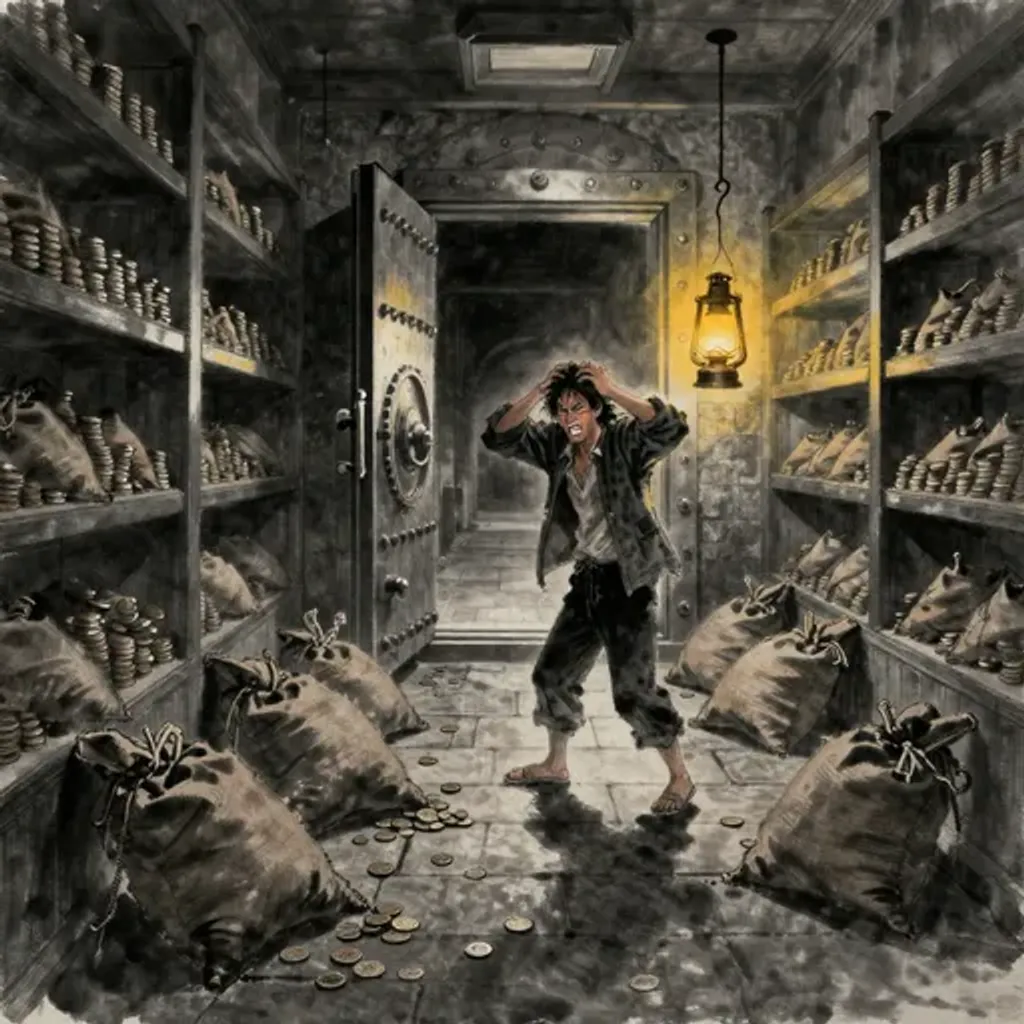
持心懼怒,善數搖動。不安其處,散災府藏,无有利得。
The heart held in dread and rage, ever shaking and unsettled. Finding no rest in its place, the treasury's stores scatter; there is no gain to be had.
— Jiao Yanshou, Yilin (Forest of Changes), 1st century BC
Commentary
Fire within the lake transforms into thunder above heaven — Great Power, where strength surges beyond containment. The heart is gripped by fear and anger, constantly agitated and shaken. Unable to settle in one place, disasters scatter the treasury, and no profit remains. Great Power's thunder in heaven should be majestic force properly directed. Instead, the verse describes inner turbulence — a heart oscillating between terror and rage — that radiates outward as financial ruin. The treasury scatters because the mind cannot hold steady. From Revolution to Great Power, the transformation reveals that revolutionary energy without emotional stability becomes self-destructive: the ram that butts the fence with excessive force entangles its own horns.
革 → 晉
Hexagram 49 → Hexagram 35: Progress
Changing lines: 1, 3, 5, 6
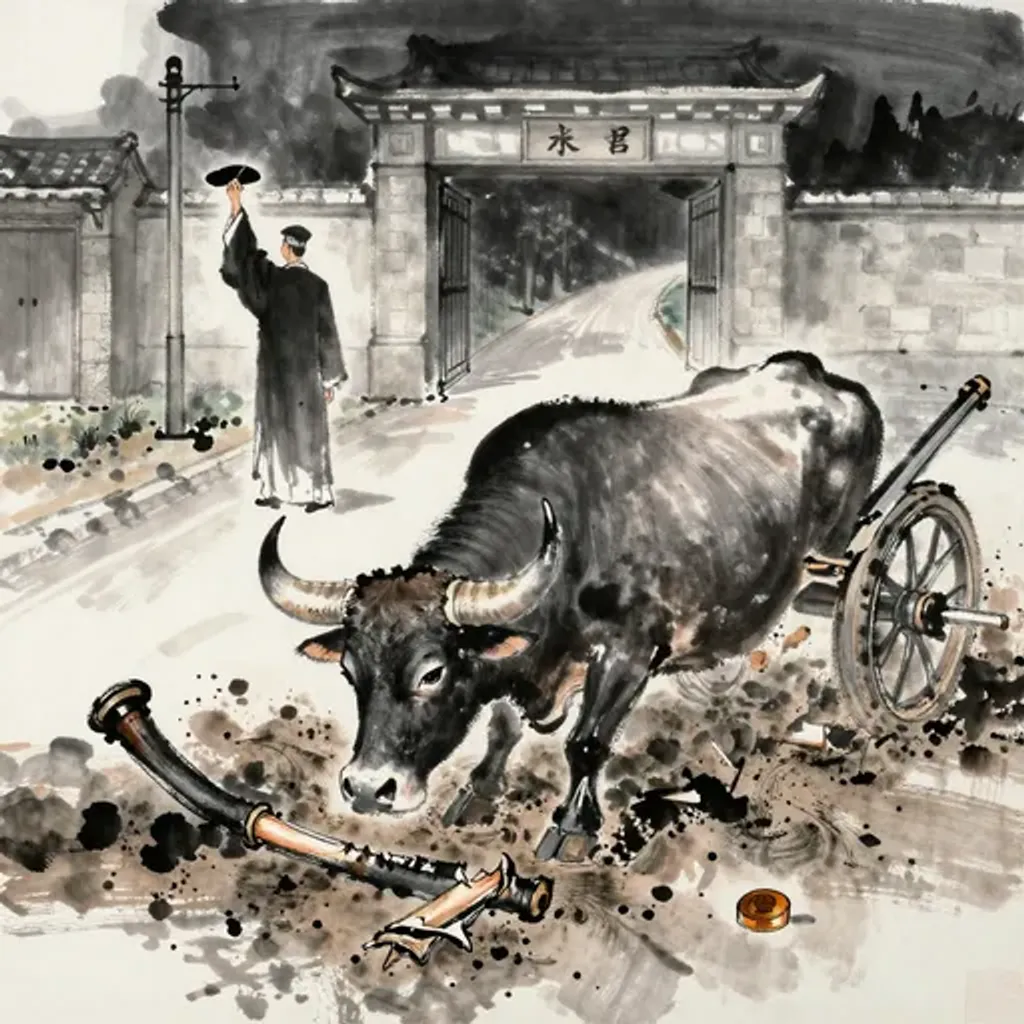
牽尾不前,逆理失臣。惠朔以奔。
The plow-ox won't budge, the whip is broken. The cart sinks in deep ruts — pushing is useless. The loyal minister remonstrates bitterly but the lord won't listen — removing his seal, hanging up his cap, he leaves the city by night.
— Jiao Yanshou, Yilin (Forest of Changes), 1st century BC
Commentary
Fire within the lake transforms into fire above the earth — Progress, where the sun rises to illuminate all. The original verse reads: 'Pulling the tail, it won't advance; reason is reversed, and the minister is lost. Hui and Shuo therefore flee.' A minister's counsel falls on deaf ears — the ox refuses the whip, the cart sinks in its rut. The loyal adviser, frustrated beyond endurance, resigns his seal and departs the city by night. From Revolution to Progress, the painful irony emerges: the sun rises over the earth, but the ruler refuses its light. When a court rejects its wisest voices, progress becomes self-defeating — the dawn illuminates an empty hall.
革 → 明夷
Hexagram 49 → Hexagram 36: Darkening of the Light
Changing lines: 4, 5
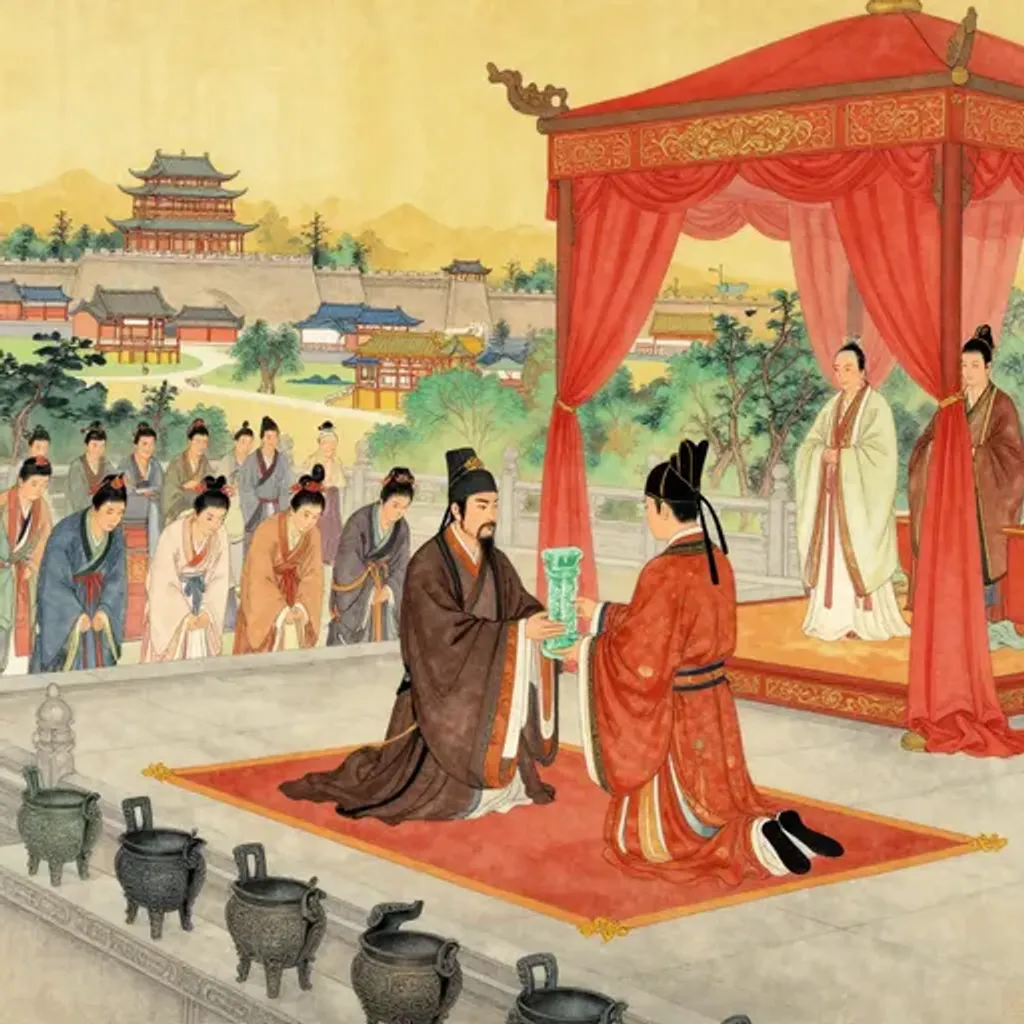
祿如周公,父子俱封。
Emoluments like those of the Duke of Zhou; father and son both enfeoffed.
— Jiao Yanshou, Yilin (Forest of Changes), 1st century BC
Commentary
Fire within the lake yields to earth burying fire — Darkening of the Light, where brilliance must conceal itself. Yet the verse speaks of reward, not suffering: 'Emoluments like those of the Duke of Zhou — father and son both enfeoffed.' The Duke of Zhou, regent for the young King Cheng, was granted the fief of Lu, and his son Bo Qin governed it. In an age of darkened light, this verse recalls that even when the sun descends into the earth, the most faithful ministers receive their due. From Revolution to Darkening of the Light, the resonance is counterintuitive: revolutionary loyalty, like the Duke of Zhou's, earns lasting honor precisely in the darkest hour.
革 → 家人
Hexagram 49 → Hexagram 37: The Family
Changing lines: 4, 6
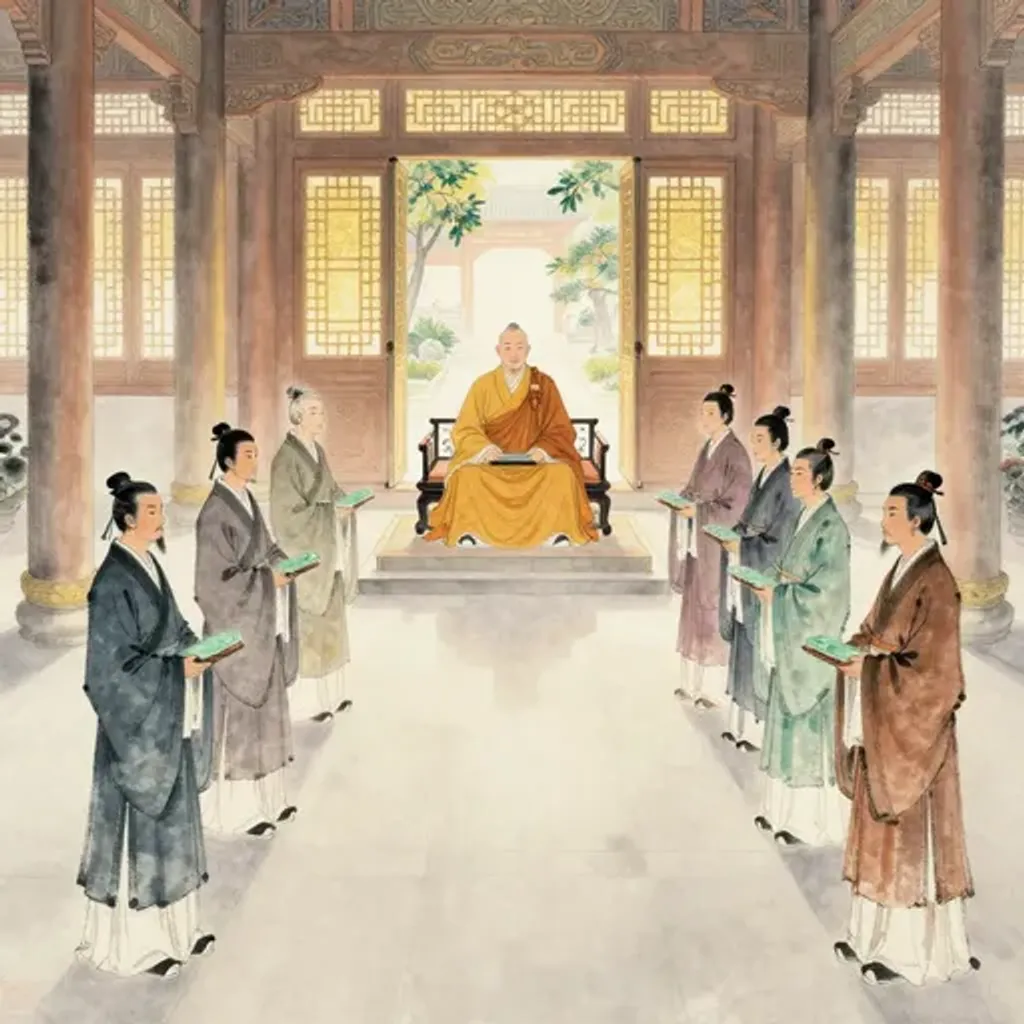
吾有八人,信允篤誠,為堯所舉。
I have eight men, trustworthy, sincere, and earnest; they were raised up by Yao.
— Jiao Yanshou, Yilin (Forest of Changes), 1st century BC
Commentary
Fire within the lake yields to wind emerging from fire — the Family, where inner warmth radiates outward as gentle influence. 'I have eight men, trustworthy and sincere, recommended by Yao.' This alludes to the legendary 'Eight Worthies' (八元) raised by Emperor Yao — or possibly the combined Sixteen (八元八愷), the virtuous ministers whom the sage-king elevated to bring order to the realm. From Revolution to the Family, the transformation reveals that after upheaval, governance is rebuilt through trusted personnel. Wind from fire: the warmth of a well-ordered household radiates outward when its members are chosen for integrity, not for faction.
革 → 睽
Hexagram 49 → Hexagram 38: Opposition
Changing lines: 2, 3, 5, 6
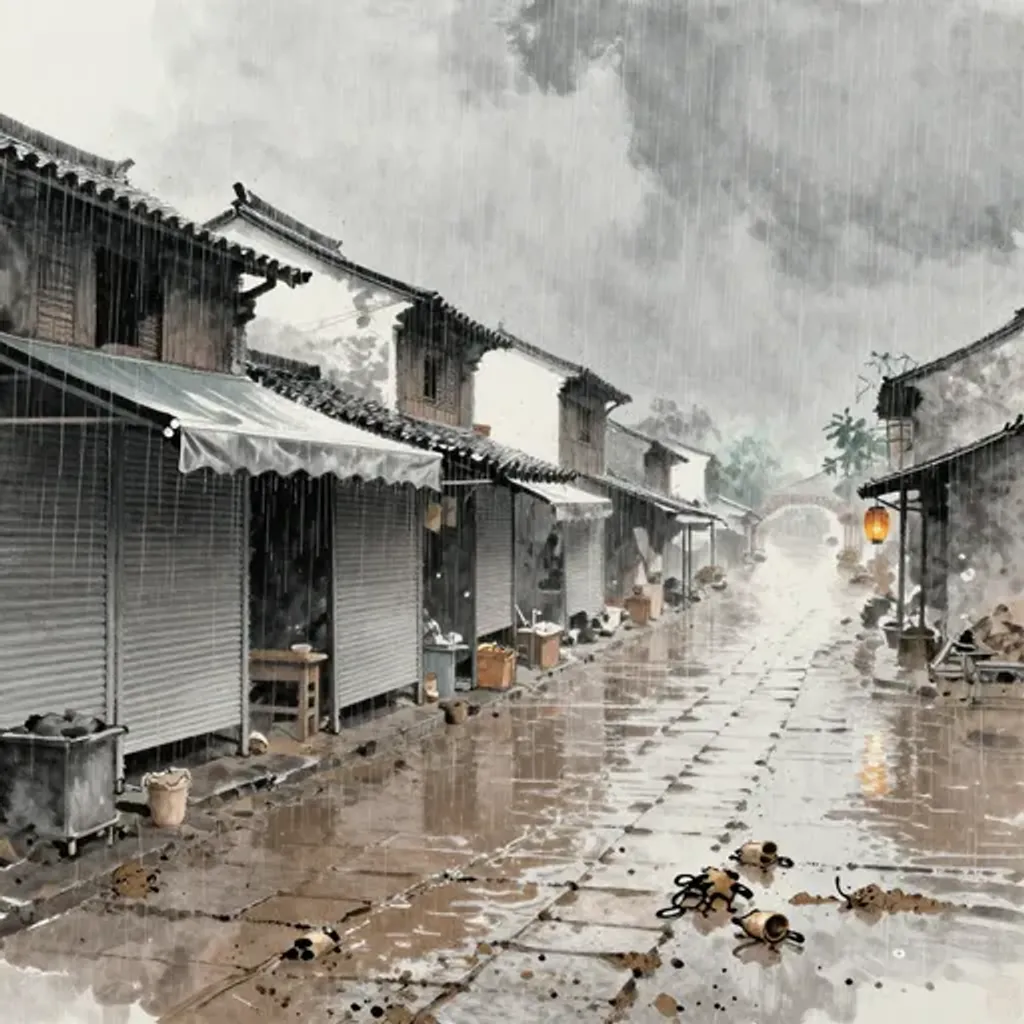
久陰霖雨,泥塗行潦。商人休止,市空无寶。
Long yin-rains fall without ceasing; mud and mire flood the roads. The merchants halt their business; the market stands empty, devoid of treasure.
— Jiao Yanshou, Yilin (Forest of Changes), 1st century BC
Commentary
Fire within the lake transforms into fire above the lake — Opposition, where two forces see each other but cannot unite. Long rains and overcast skies turn roads to mud and standing water. Merchants cease their business; the market stands empty, devoid of goods. Revolution has torn apart the old commercial order, and Opposition ensures that nothing reconnects. Fire and water gaze at each other across the lake but move in opposite directions. The rain that should nourish instead drowns commerce. From Revolution to Opposition, the transformation captures a stalled economy after upheaval: producers and consumers can see each other but cannot meet, separated by impassable mud.
革 → 蹇
Hexagram 49 → Hexagram 39: Obstruction
Changing lines: 1, 4
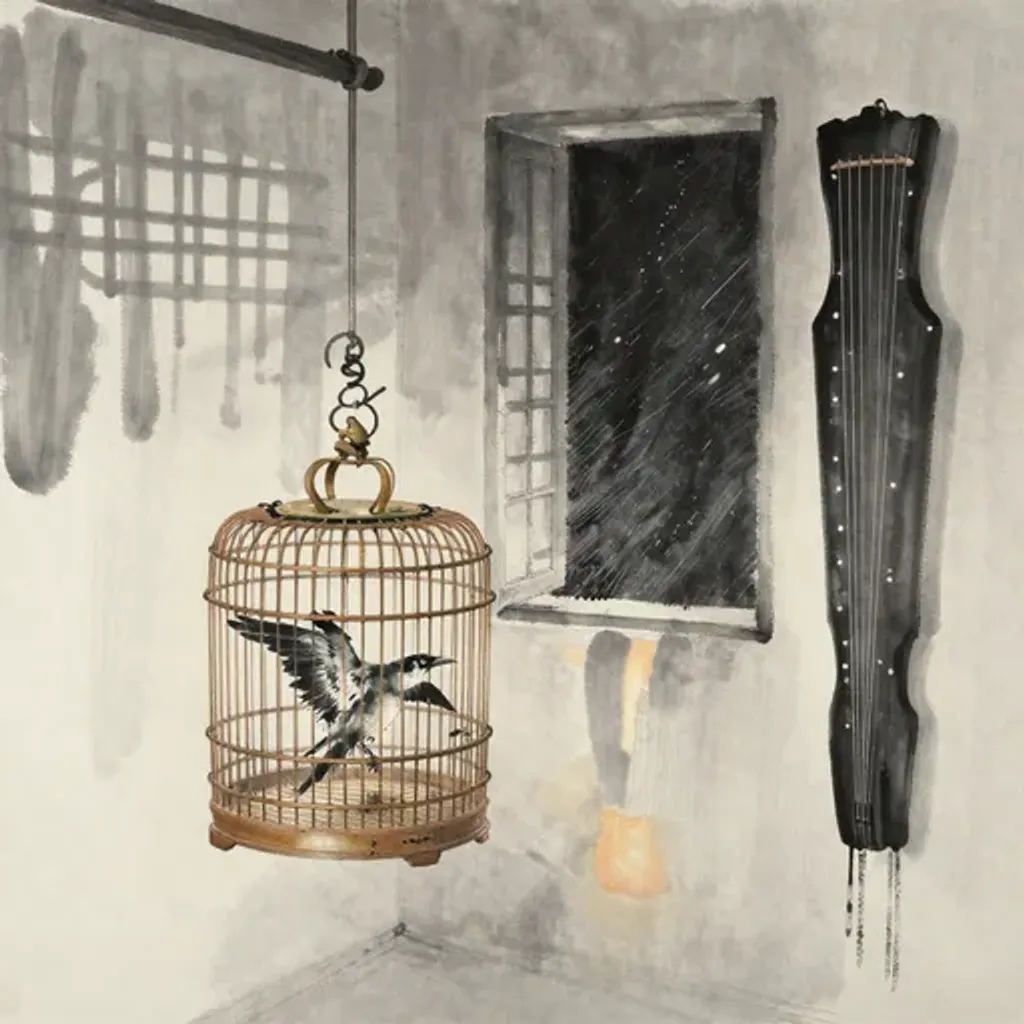
无足斷跟,居處不安,凶惡為殘。
A broken-winged bird trapped in a cage; a snapped-string qin hangs empty on the wall. Blades on all four walls, nowhere to lean — sitting or standing, no peace, wind every night.
— Jiao Yanshou, Yilin (Forest of Changes), 1st century BC
Commentary
Fire within the lake encounters water above the mountain — Obstruction, where every path is blocked. The original verse reads: 'Without feet, heels severed — one's dwelling place offers no peace. Cruelty and evil leave only mutilation.' Identical to verse 49-31, this repetition underscores the severity: Revolution devolving into Obstruction produces a body broken beyond movement. The mountain has water above it — danger pouring down on immovable stone. From Revolution to Obstruction, the transformation intensifies: not merely blocked but crippled, not merely delayed but permanently impaired. The sage's counsel for Obstruction is 'turn inward and cultivate virtue,' but this verse offers no such consolation.
革 → 解
Hexagram 49 → Hexagram 40: Deliverance
Changing lines: 1, 2, 3, 5
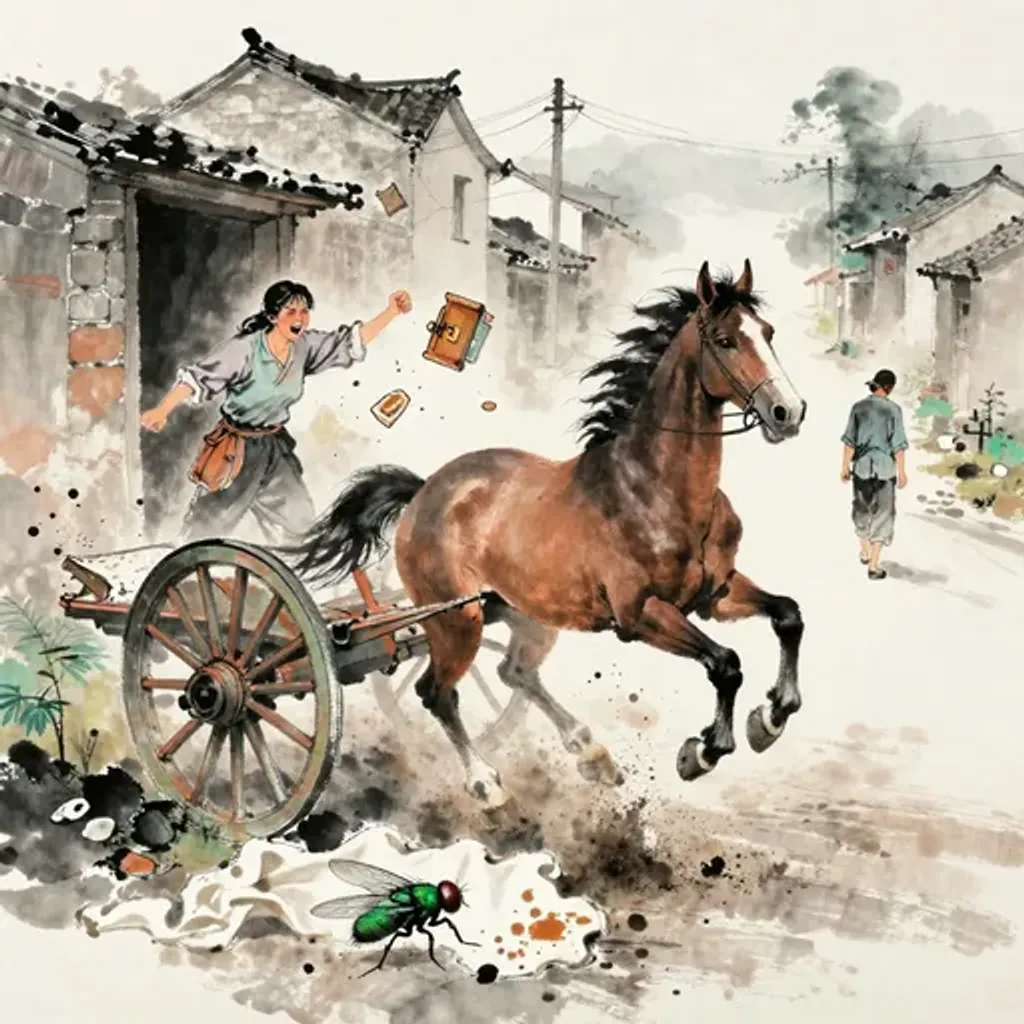
馬蹄躓車,婦惡破家。青蠅污白,恭子離居。
The horse stumbles on the cart; the shrewish wife destroys the household. Green flies stain the white; the dutiful son is driven from his home.
— Jiao Yanshou, Yilin (Forest of Changes), 1st century BC
Commentary
Fire within the lake yields to thunder above water — Deliverance, where the storm breaks and tension is released. A horse stumbles and wrecks the cart; a wicked wife destroys the household. Blue flies stain what is white; the respectful son is driven from his home. The 'blue flies' (青蠅) come from the Shijing ode warning against slander: 'Buzzing blue flies settle on the fence — kind gentlemen, do not believe slanderous words.' Slander stains the innocent, and a virtuous son is exiled by false accusation. From Revolution to Deliverance, the irony is sharp: the storm that should release tension instead releases destructive forces — stumbling horses, scheming wives, and slanderous flies.
革 → 損
Hexagram 49 → Hexagram 41: Decrease
Changing lines: 2, 3, 4, 5, 6
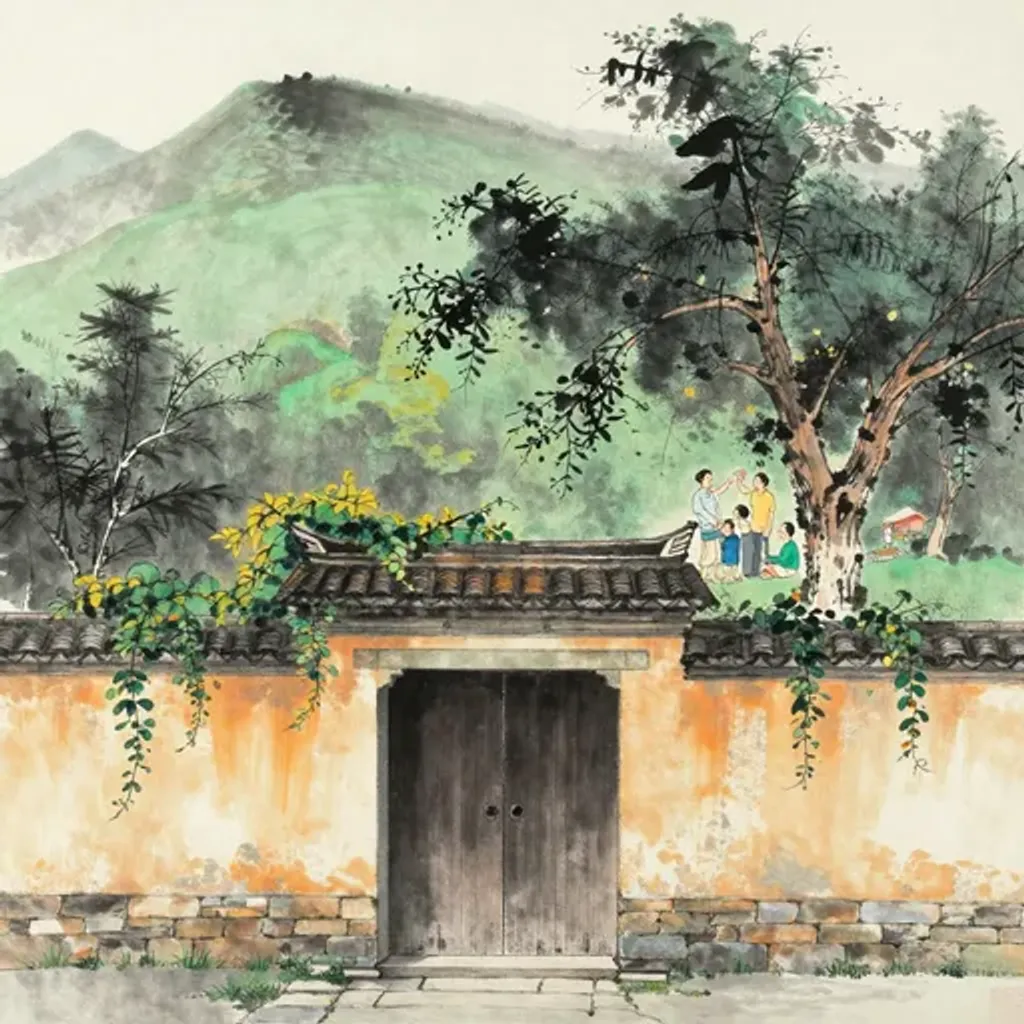
噂噂所言,莫如我垣。懽樂堅固,可以長安。
Let them whisper what they will; none compares to my wall. Joyful and strong, it can bring lasting peace.
— Jiao Yanshou, Yilin (Forest of Changes), 1st century BC
Commentary
Fire within the lake yields to the mountain above the lake — Decrease, where the lower is reduced to enrich the upper. People whisper and gossip, but none compares to my wall. Joy and contentment are solid and firm; one may dwell in lasting peace. The wall here serves as both physical shelter and metaphor for boundaries: let others talk, but behind my wall I am safe. Decrease asks for willing sacrifice, and this verse answers with domestic contentment — what is given up in outward standing is recovered in inner stability. From Revolution to Decrease, the transformation reveals that after upheaval, sometimes the wisest course is to build a wall, reduce exposure, and find joy in what remains.
革 → 益
Hexagram 49 → Hexagram 42: Increase
Changing lines: 3, 4, 6
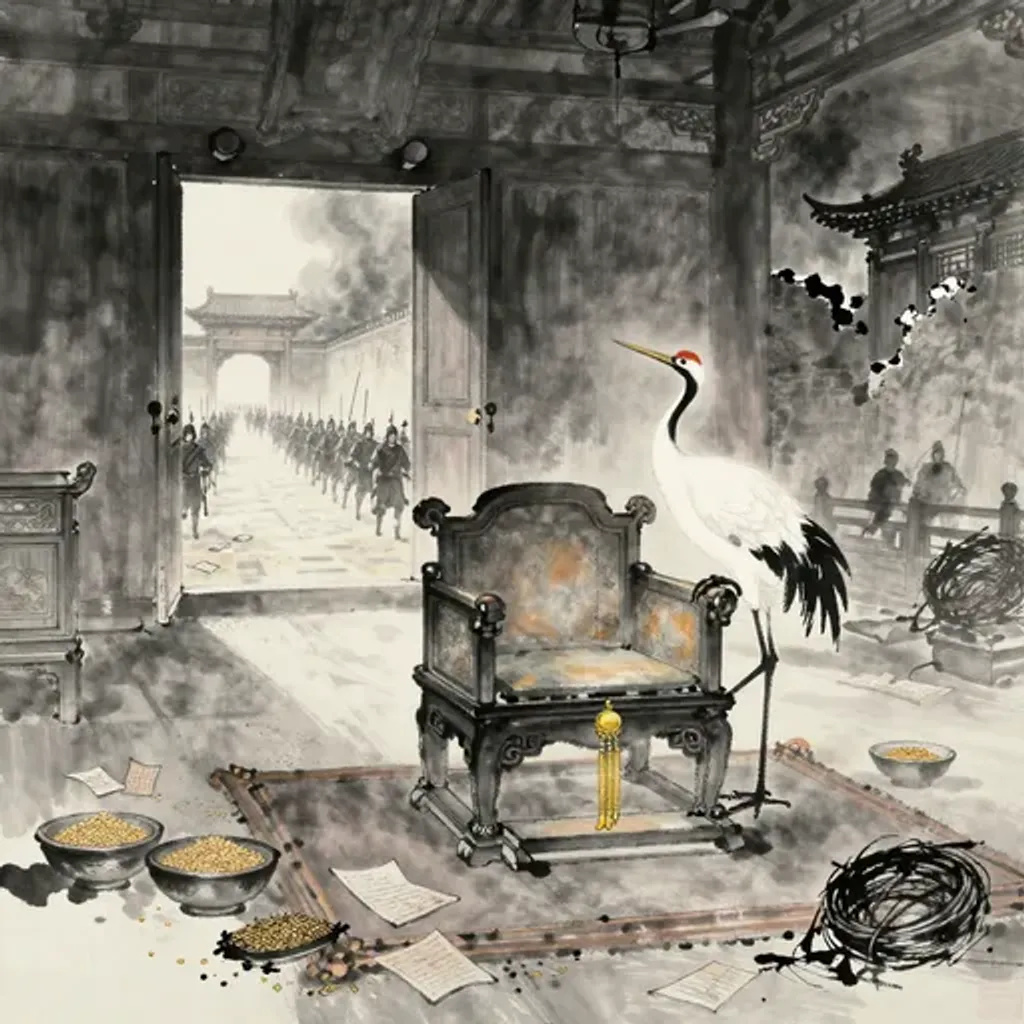
懿公淺愚,不深受謀。无援失國,為狄所賊。
Raising cranes while abandoning the people — the people scatter. Feeding birds while neglecting governance — the state gradually topples. Enemy troops enter the border, no one defends. The jade throne stands empty — only the cranes cry mournfully.
— Jiao Yanshou, Yilin (Forest of Changes), 1st century BC
Commentary
Fire within the lake transforms into wind and thunder — Increase, where the upper diminishes itself to benefit the lower. The original verse reads: 'Duke Yi, shallow and foolish, refused sound counsel. Without allies he lost his state, destroyed by the Di barbarians.' Duke Yi of Wei (r. 669-660 BC) was infatuated with cranes, granting them official ranks and carriages while his people starved. When the Di invaded in 660 BC, his soldiers refused to fight, saying: 'Let the cranes defend the state — they have the salaries.' The Duke died in battle and Wei was nearly extinguished. From Revolution to Increase, the devastating irony: Increase demands that rulers sacrifice to benefit the people, but Yi sacrificed the people to benefit his birds.
革 → 夬
Hexagram 49 → Hexagram 43: Breakthrough
Changing lines: 2
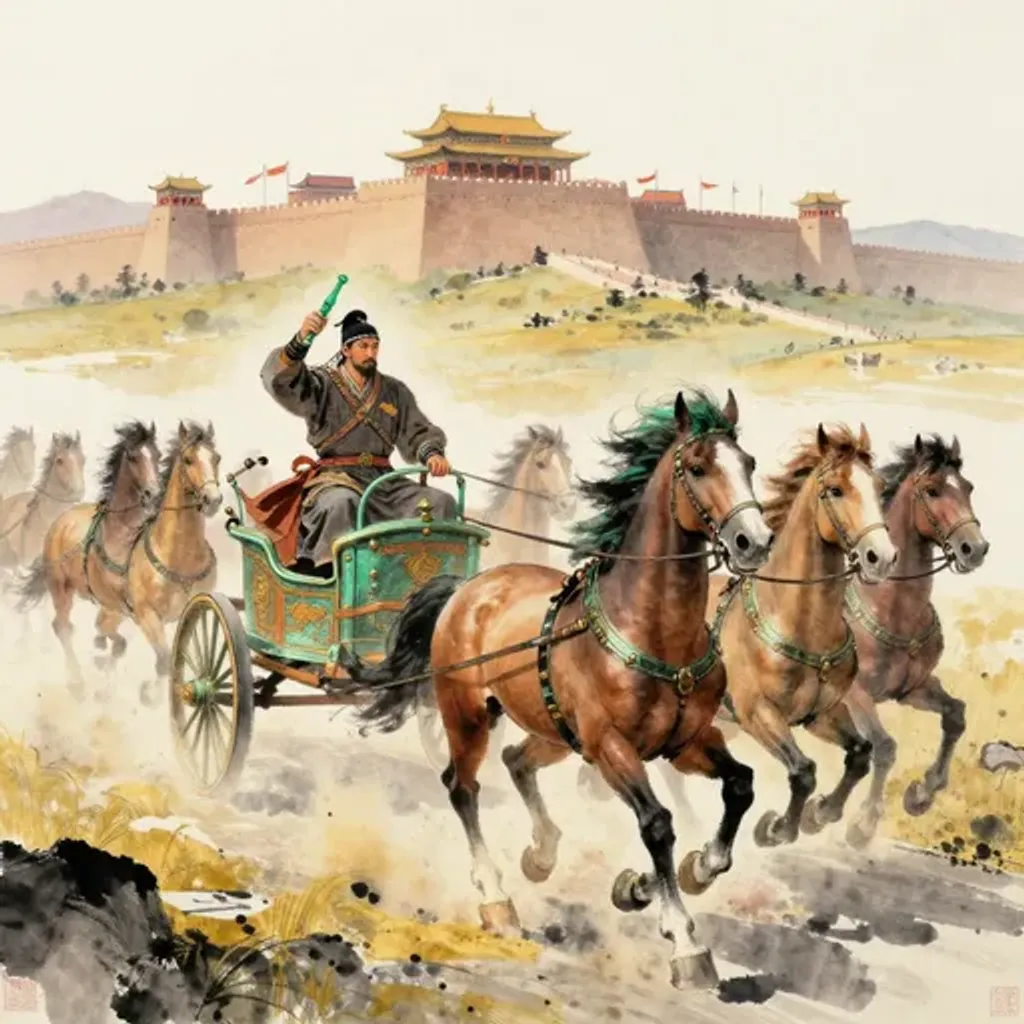
騏驥綠耳,章明造父。伯夙奉獻,襄續厥緒,佐文成伯,為晉元輔。
The steeds Qiji and Lu'er, famed under the hand of Zaofu. Bo Su made his offering; Xiang continued the lineage, assisting Wen to become lord, chief minister of Jin.
— Jiao Yanshou, Yilin (Forest of Changes), 1st century BC
Commentary
Fire within the lake transforms into the lake rising above heaven — Breakthrough, where accumulated pressure finally crests the dam. The famed steeds Qiji and Lu'er pull the chariot, their glory illuminating Zaofu the charioteer. Boshu offered loyal service, and Xiang continued the legacy, assisting Duke Wen to establish hegemony, becoming Jin's chief minister. Zaofu was the legendary charioteer of King Mu of Zhou, who drove the eight famous horses — including Lu'er ('Green Ear') — a thousand li in a single day. The verse then pivots to Jin's political dynasty. From Revolution to Breakthrough, the transformation shows how exceptional talent, once harnessed, breaks through all barriers — fine horses paired with a master driver create unstoppable momentum.
革 → 姤
Hexagram 49 → Hexagram 44: Coming to Meet
Changing lines: 1, 2, 6
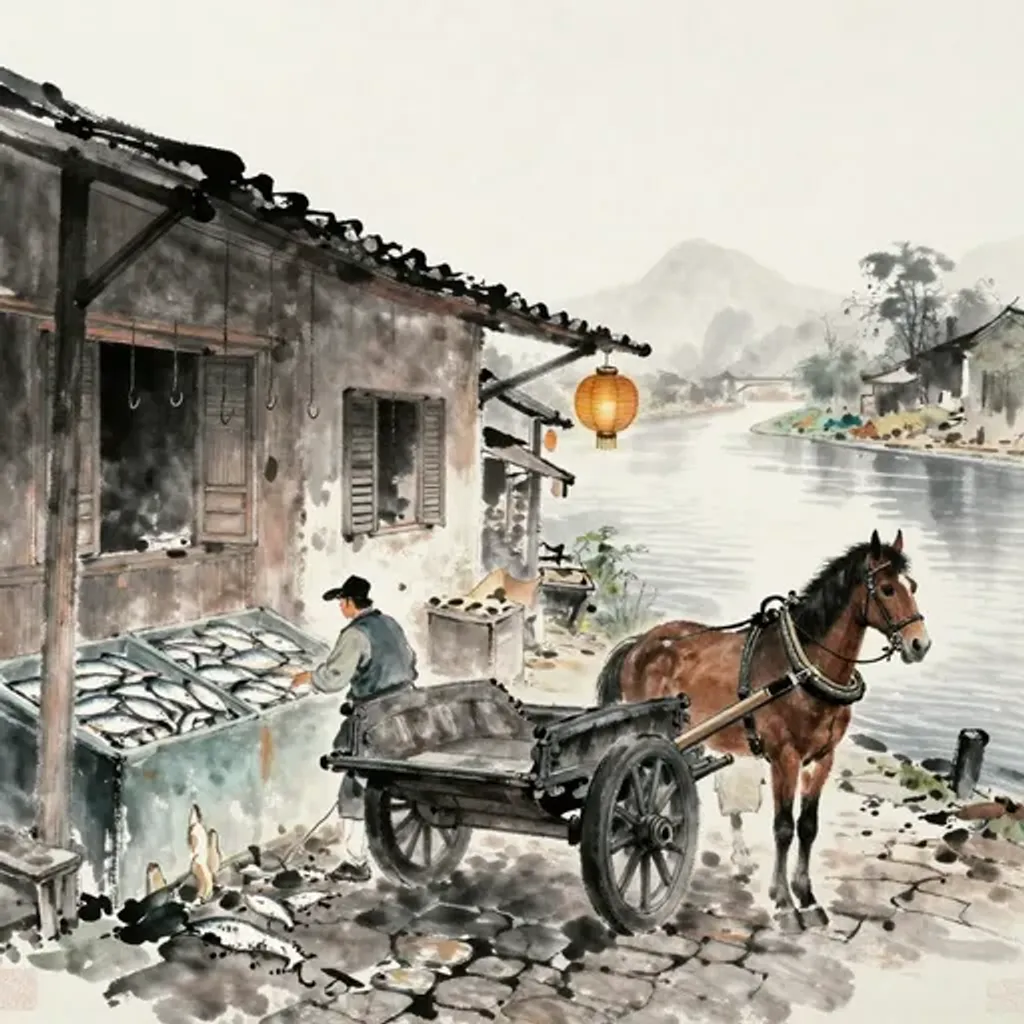
駕車入里,求鮮魴鯉。非其肆居,自令後市。
Driving a cart into the village, seeking fresh bream and carp. This is not the market where they sell; one arrives only after the market has closed.
— Jiao Yanshou, Yilin (Forest of Changes), 1st century BC
Commentary
Fire within the lake yields to heaven above wind — Coming to Meet, where an unexpected encounter alters everything. One drives a cart into the village seeking fresh bream and carp, but this is not where the fish market stands — one has arrived too late for the market. The fishmonger is elsewhere, the timing wrong, the location mistaken. Coming to Meet requires that the encounter be natural, not forced. The eager buyer who drives to the wrong village misses the catch entirely. From Revolution to Coming to Meet, the transformation warns that after upheaval, opportunities present themselves on their own terms. Pursuing them to the wrong address guarantees disappointment.
革 → 萃
Hexagram 49 → Hexagram 45: Gathering Together
Changing lines: 1, 3
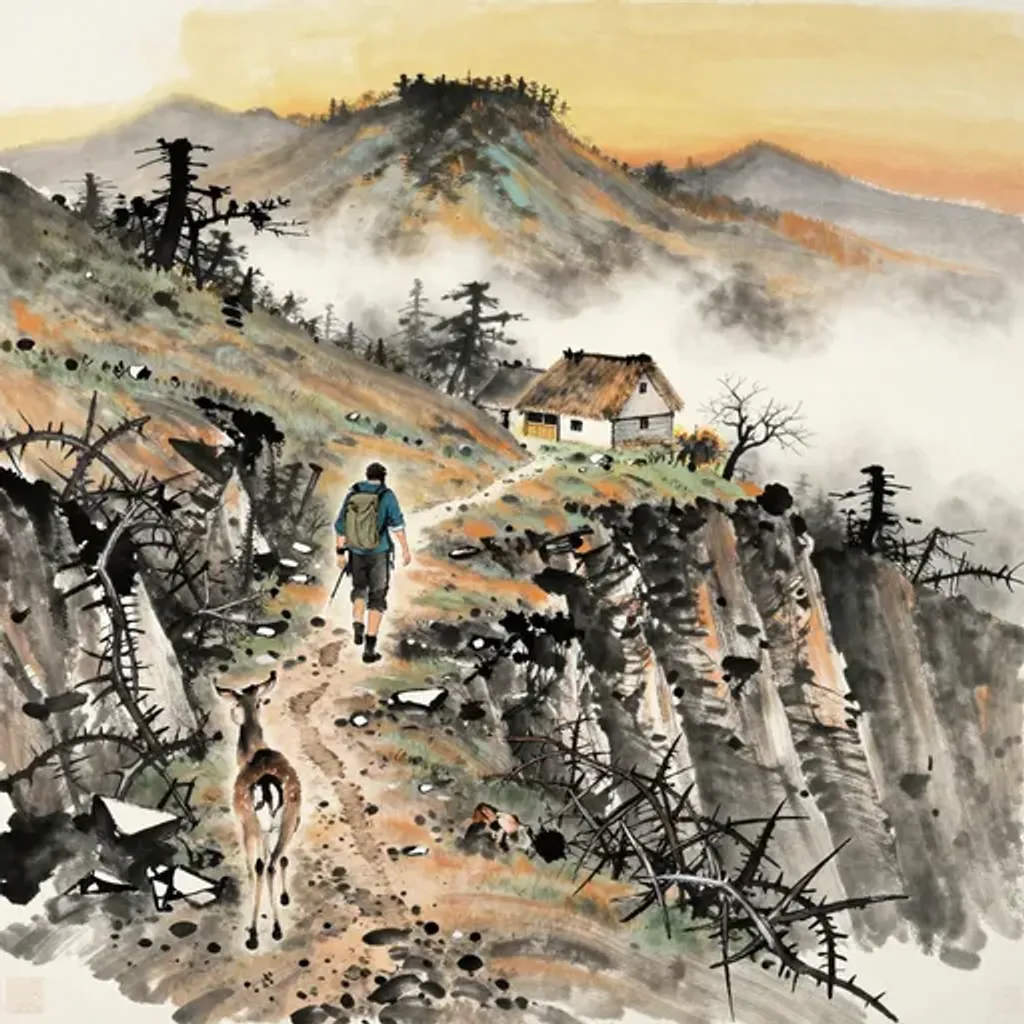
求麞嘉鄉,惡地不行。道止中遷,復反其床。
Seeking the deer in a fair land, refusing to travel the wicked ground. The road halts, one moves midway; turning back to one's own bed.
— Jiao Yanshou, Yilin (Forest of Changes), 1st century BC
Commentary
Fire within the lake transforms into the lake upon the earth — Gathering, where people and resources naturally converge. One seeks musk deer in a good district but refuses to travel through bad terrain. Midway, the road forces a change of course, and one returns to one's own bed. The hunter who insists on ideal conditions never completes the journey. The musk deer (麞) dwells in fine territory, but reaching it requires crossing unpleasant ground. From Revolution to Gathering, the transformation suggests that true congregation demands compromise: the gathering place may be inviting, but the road there is not. Those who turn back at the first rough patch gather nothing.
革 → 升
Hexagram 49 → Hexagram 46: Pushing Upward
Changing lines: 1, 2, 4, 5
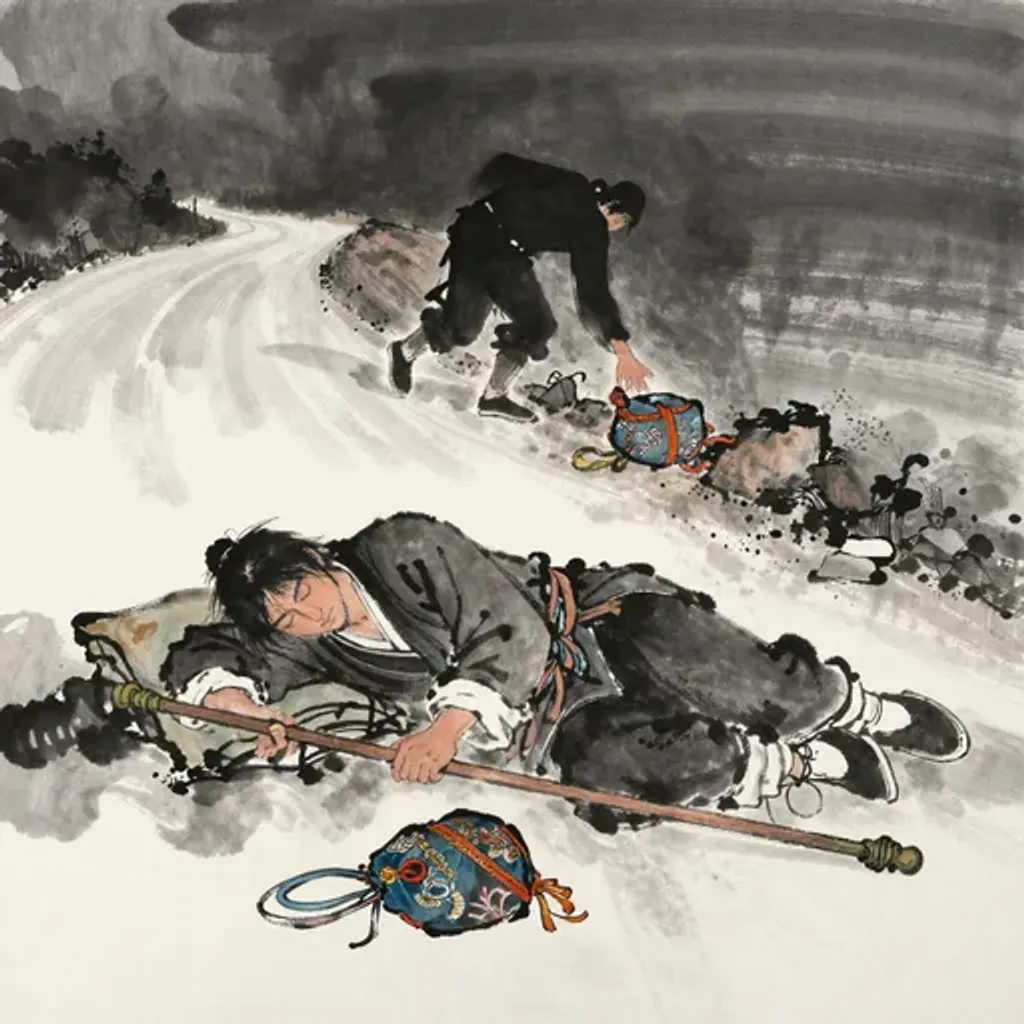
仗鳩負裝,醉臥道傍。不知何公,竊我錦囊。
Leaning on a staff, bearing one's pack; drunk, collapsed by the roadside. Not knowing what stranger has stolen my brocade pouch.
— Jiao Yanshou, Yilin (Forest of Changes), 1st century BC
Commentary
Fire within the lake transforms into earth above wind — Pushing Upward, where wood grows slowly through soil toward light. Leaning on a dove-staff, carrying baggage, one lies drunk by the roadside. Not knowing what stranger has stolen one's brocade satchel. The dove-staff (仗鳩) was traditionally carried by elders, suggesting a figure of some dignity reduced to drunken collapse. The brocade bag — symbol of accumulated wealth or documents — vanishes while the owner sleeps in a stupor. From Revolution to Pushing Upward, the irony is piercing: upward growth requires alertness and steady effort, but this traveler has drunk himself into oblivion and lost everything to an unknown thief.
革 → 困
Hexagram 49 → Hexagram 47: Oppression
Changing lines: 1, 2, 3
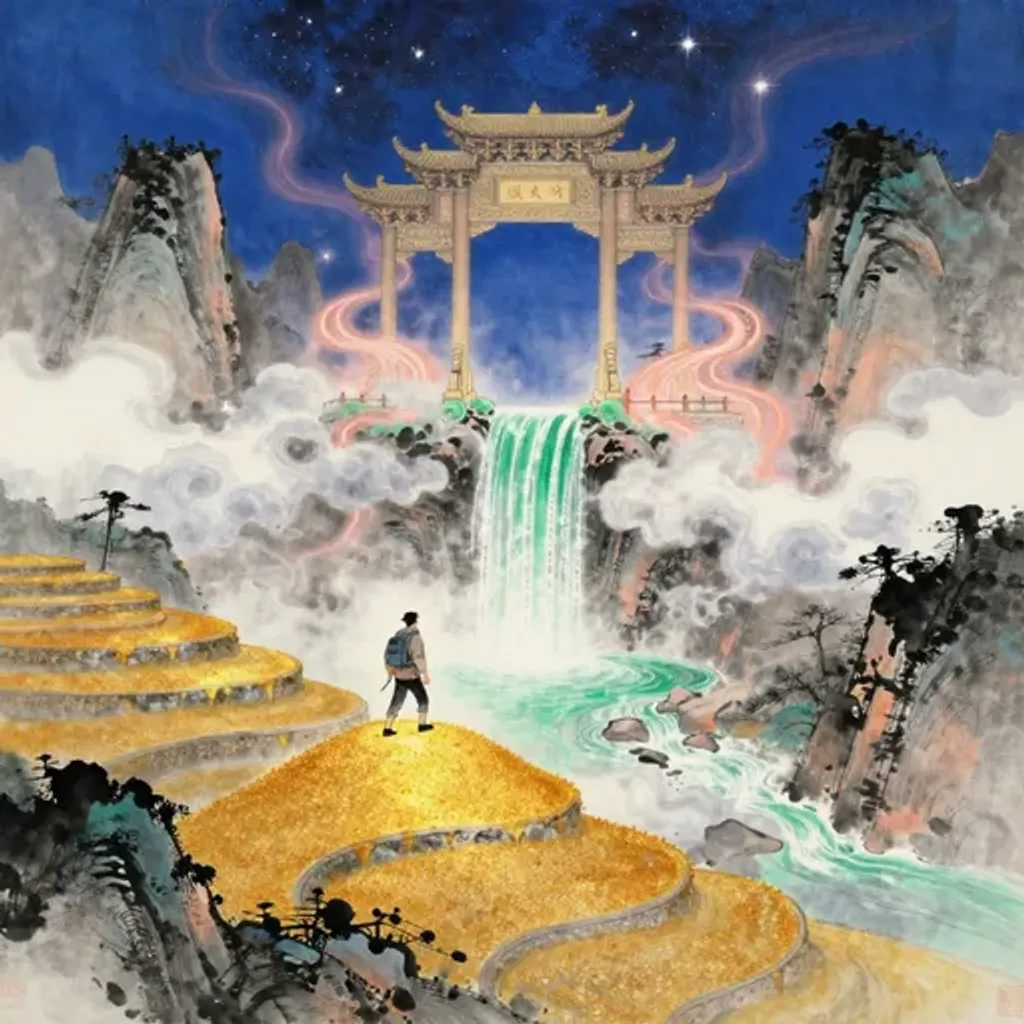
登崑崙,入天門,過糟丘,宿玉泉,同惠歡,見欣君。
Climbing Kunlun, entering the heavenly gate; passing the mound of grain, lodging at the Jade Spring. Sharing in gracious joy, beholding the lord of delight.
— Jiao Yanshou, Yilin (Forest of Changes), 1st century BC
Commentary
Fire within the lake yields to the lake drained of water — Oppression, where resources are exhausted and one must rely on inner conviction. Yet this verse is unexpectedly joyful: one ascends Kunlun, enters the gate of heaven, passes the Hills of Grain, lodges at the Jade Spring, shares delight with a companion, and meets a gracious lord. This is the mythological journey to the Queen Mother of the West's paradise — Kunlun Mountain, where immortals dwell above the Weak Water. From Revolution to Oppression, the paradoxical resonance emerges: when the lake runs dry and worldly resources fail, the spirit ascends to celestial realms. Oppression of the body frees the soul to travel where flesh cannot follow.
革 → 井
Hexagram 49 → Hexagram 48: The Well
Changing lines: 1, 2, 4
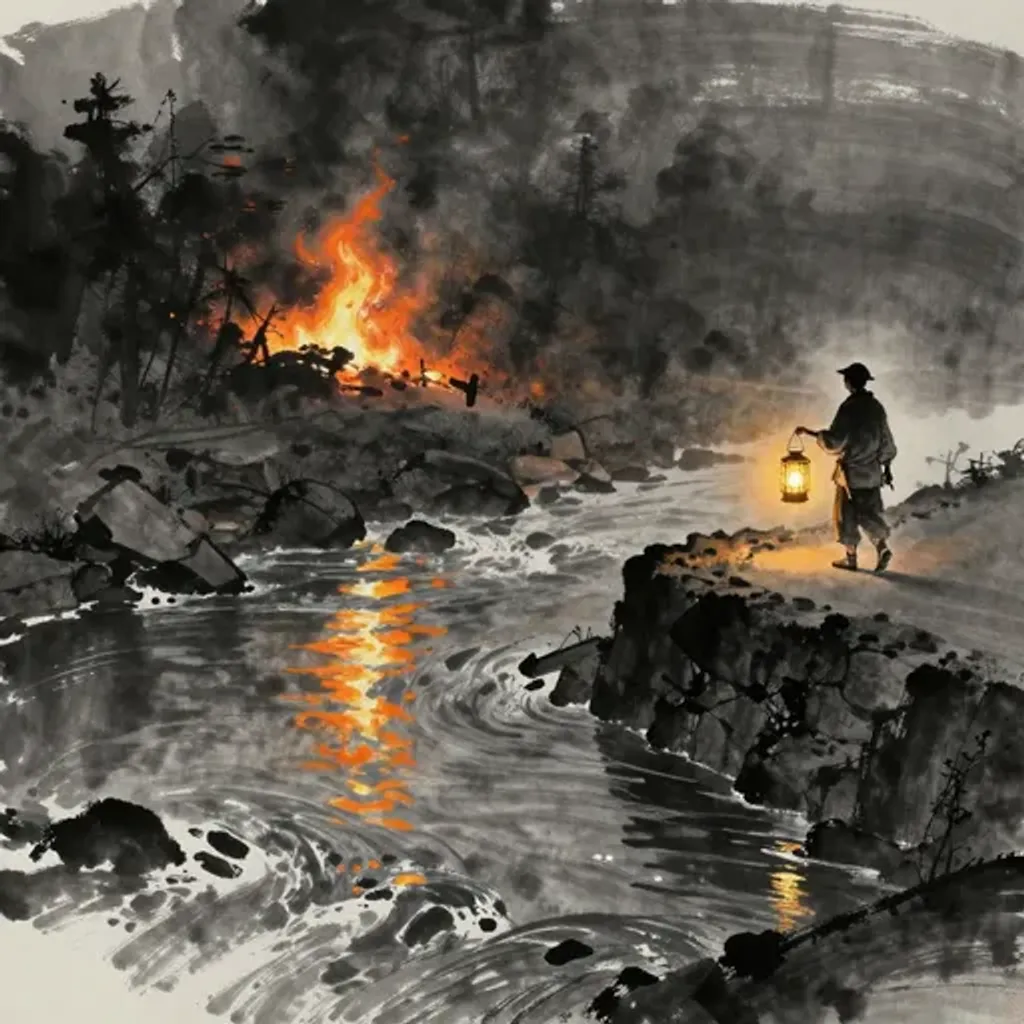
水為火壯,患厭不起。季伯夜行,與喜相逢。
Water is strengthened by fire; the affliction is suppressed and will not rise. Ji Bo travels by night and meets with joy along the way.
— Jiao Yanshou, Yilin (Forest of Changes), 1st century BC
Commentary
Fire within the lake yields to water above wind — the Well, an inexhaustible source that serves all who draw from it. Water empowered by fire grows strong, yet illness and worry keep one from rising. Ji Bo travels by night and encounters joy on the road. The opening line plays on Revolution's own trigram composition — fire and water in creative tension. The Well's water rises through the wood of the windlass, nourishing the community. The nocturnal journey of 'Ji Bo' suggests one who persists through darkness to find unexpected good fortune. From Revolution to the Well, the transformation shows that beneath upheaval lies an inexhaustible source: those who draw from it through patient effort find renewal even in the dead of night.
革 → 革
Hexagram 49 → Hexagram 49: Revolution
No changing lines — the hexagram is unchanged
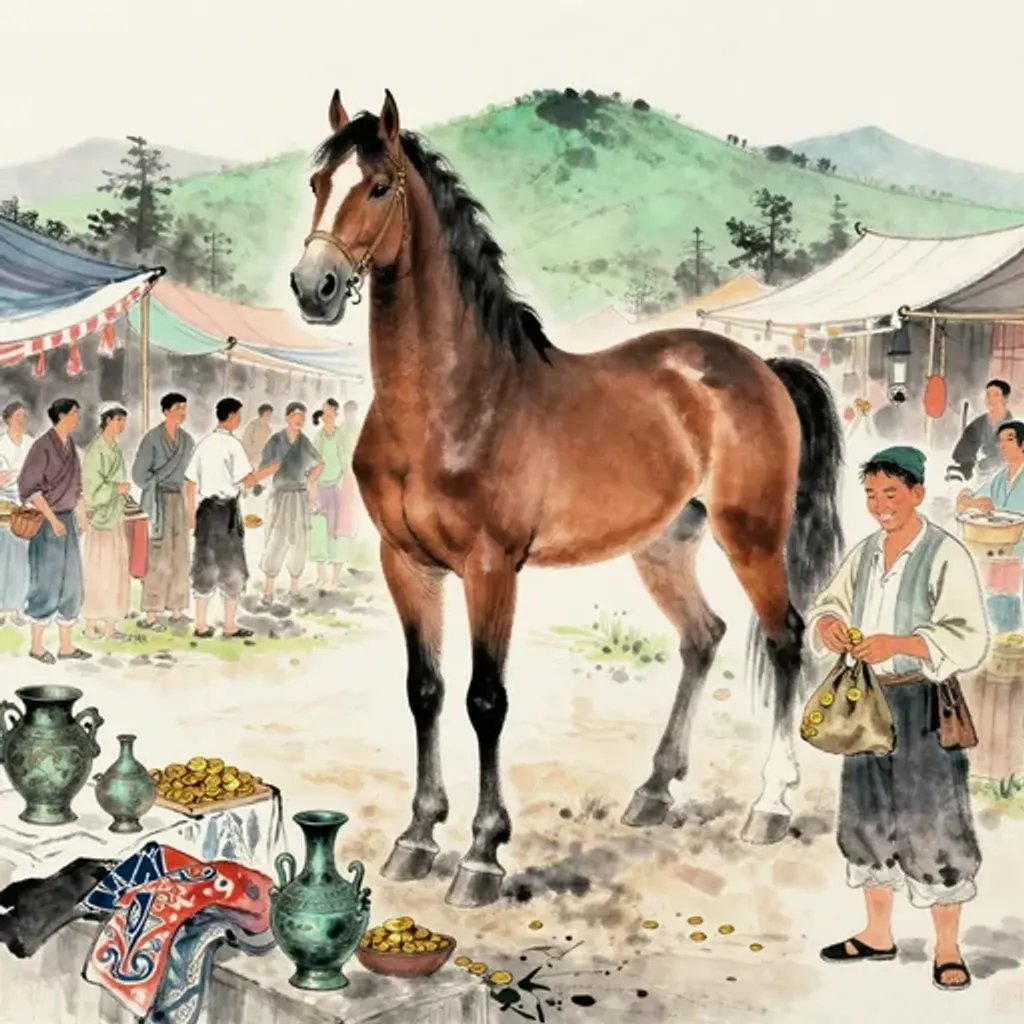
馬服長股,宜行善市。蒙祐諧偶,獲金五倍。
The horse, tall with long legs, is fit for travel and good for market. Blessed with favor and a worthy match, the gold earned is fivefold.
— Jiao Yanshou, Yilin (Forest of Changes), 1st century BC
Commentary
Fire within the lake returns to fire within the lake — Revolution unchanged, the pattern repeating itself. Long-legged horses well suited to their harness, good for travel and commerce. Blessed with fortune and matched with a partner, one gains gold fivefold. When Revolution meets itself, the dynamic is pure transformation without destination: constant molting, constant renewal. The horse with long legs is built for the road; the merchant who matches goods to markets multiplies wealth. There is no resistance, no friction — the pattern flows. From Revolution to Revolution, the message is that some natures are made for change itself: the perpetual trader, the born adapter, profits precisely because nothing stays still.
革 → 鼎
Hexagram 49 → Hexagram 50: The Cauldron
Changing lines: 1, 2, 5, 6
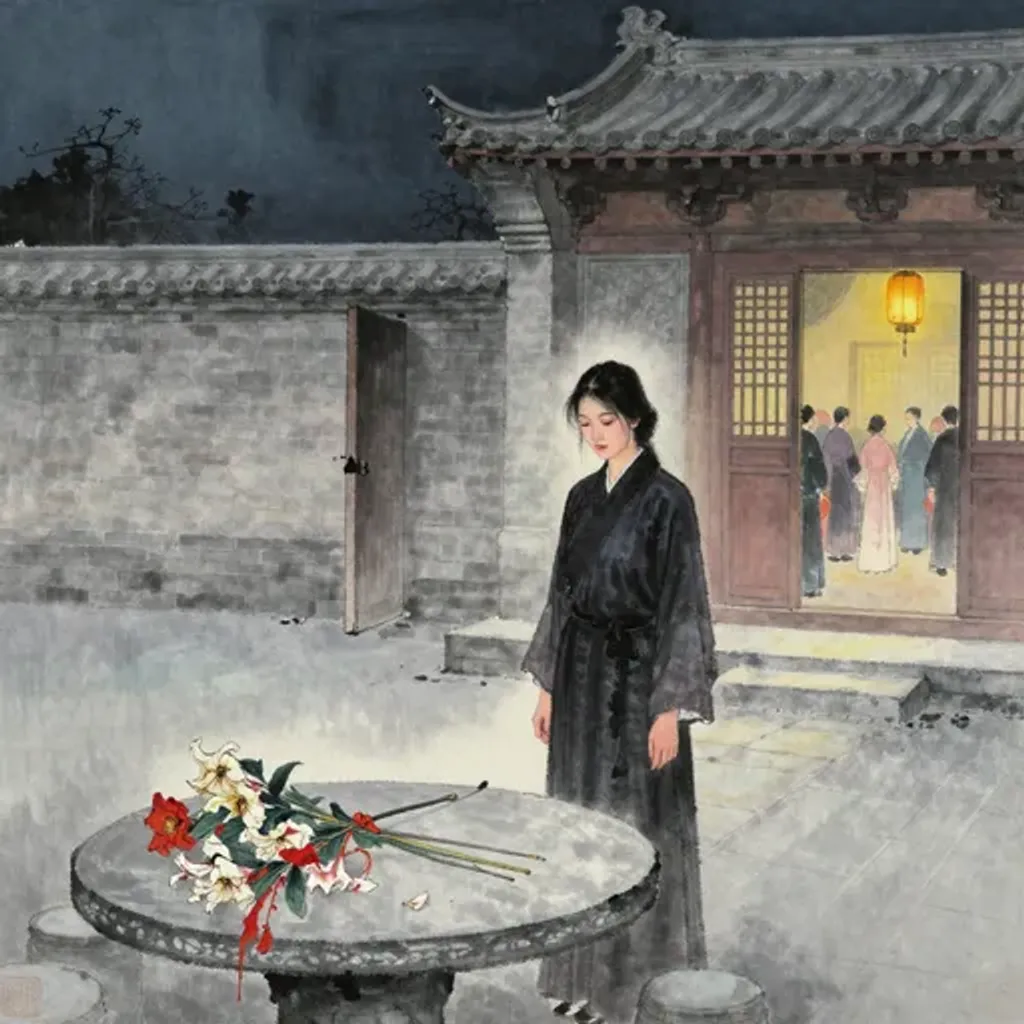
烏孫氏女,深目黑醜。嗜欲不同,過時无耦。
The Wusun woman, deep-eyed and dark of face. Their desires are not the same; the season passes with no match.
— Jiao Yanshou, Yilin (Forest of Changes), 1st century BC
Commentary
Fire within the lake transforms into fire above wind — the Cauldron, where raw materials are refined into civilized nourishment. The woman of the Wusun clan has deep-set eyes and dark features; her desires differ from the norm, and past her prime she remains unmatched. The Wusun were a Central Asian people on the Silk Road whose physical features — deep-set eyes, prominent noses — struck Han Chinese observers as strikingly foreign. This verse captures cultural misrecognition: what one people considers beautiful, another finds alien. From Revolution to the Cauldron, the transformation suggests that the refining process cannot proceed when the ingredients refuse to blend. Difference without integration yields solitude.
革 → 震
Hexagram 49 → Hexagram 51: The Arousing Thunder
Changing lines: 3, 5
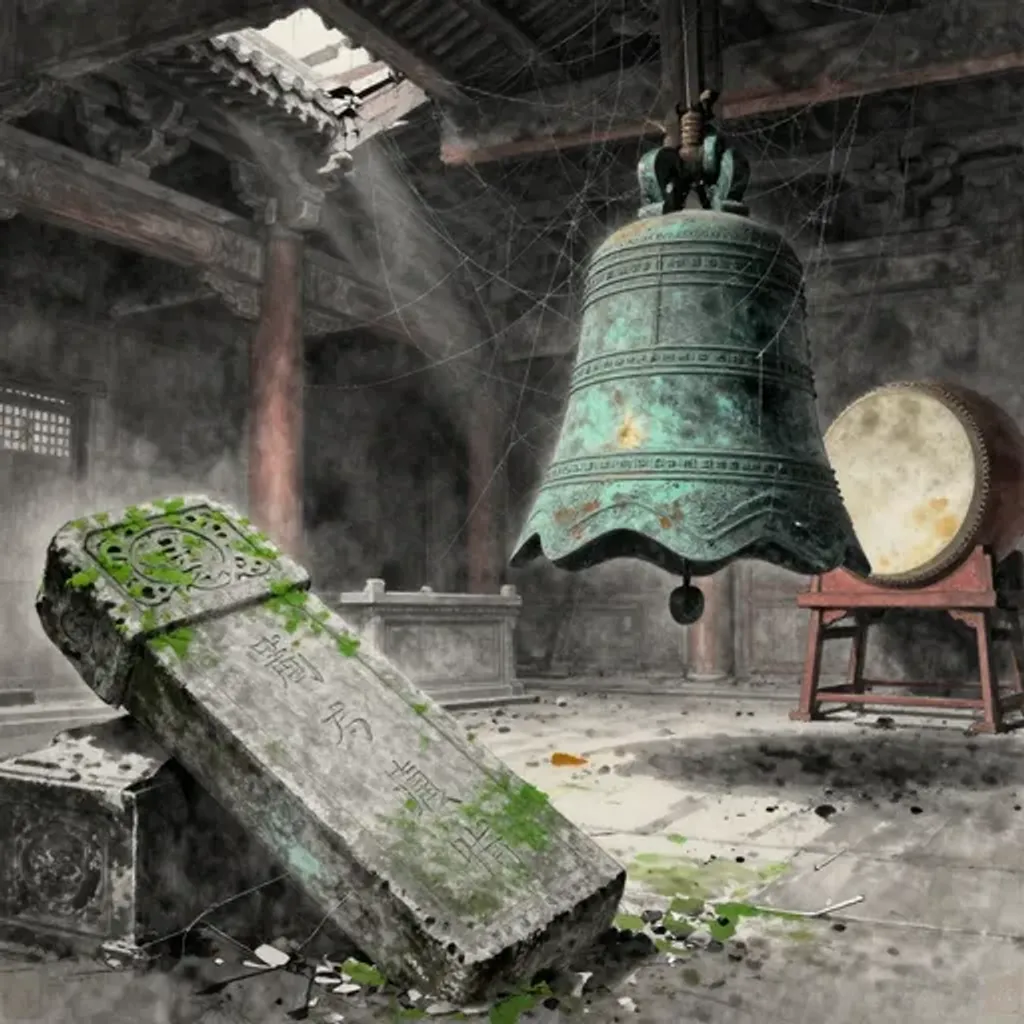
子鉏執麟,《春秋》作元。陰聖將終,尼父悲心。
Cobwebs fill the temple hall; bells and drums are silent. A broken stele lies toppled — its moss-covered characters nearly illegible.
— Jiao Yanshou, Yilin (Forest of Changes), 1st century BC
Commentary
Fire within the lake gives way to doubled thunder — the Arousing, where shock upon shock jolts the world awake. The original verse reads: 'Zichushang captured the qilin; the Spring and Autumn chronicle was composed. The sage's era was ending; Father Ni grieved in his heart.' In 481 BC, the charioteer Zichushang captured a qilin during a hunt in the Great Marsh. Confucius identified the wounded creature and wept: 'My Way is exhausted!' This event traditionally marks the end of the Spring and Autumn Annals. From Revolution to the Arousing, the transformation captures the ultimate shock: even revolution cannot save a dying era. The thunder that should signal renewal instead tolls a sage's grief.
革 → 艮
Hexagram 49 → Hexagram 52: Keeping Still Mountain
Changing lines: 1, 4, 5, 6
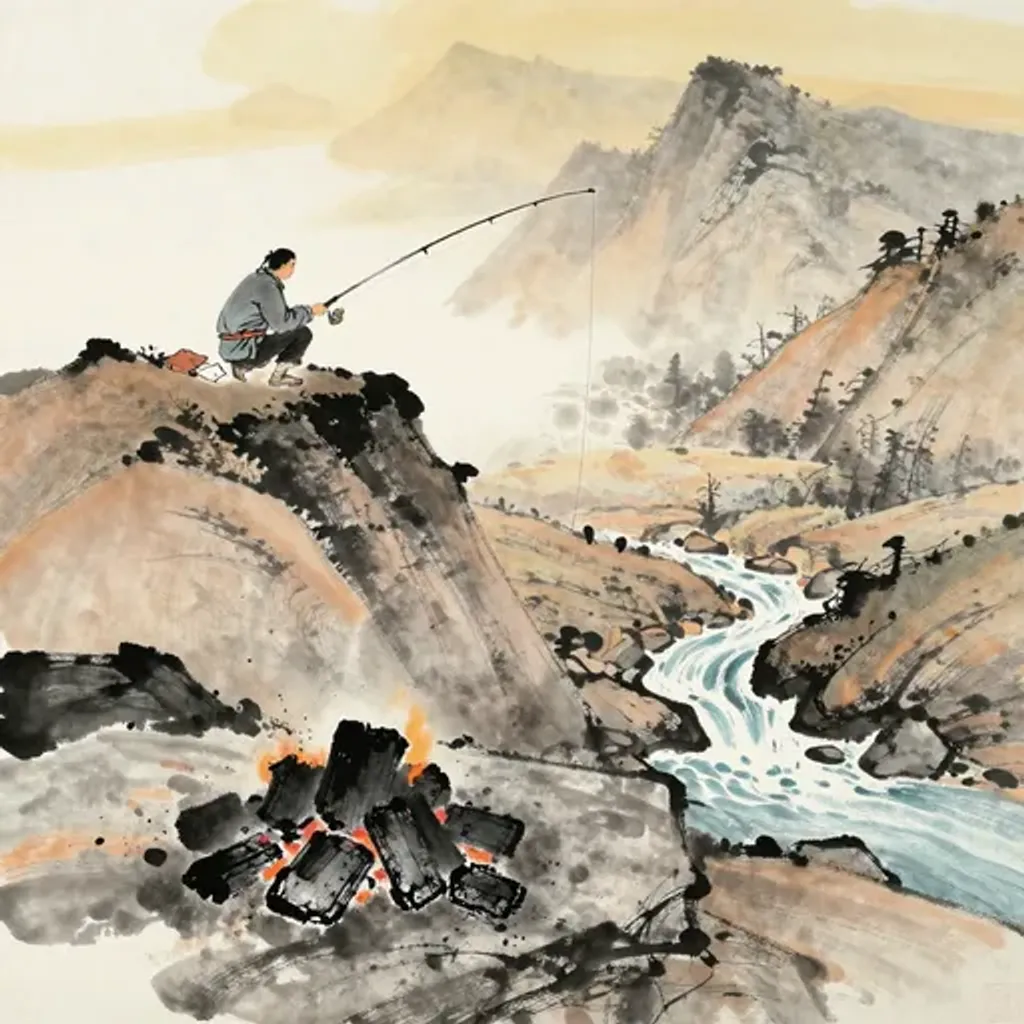
灼火泉原,釣魴山巔。魚不可得,炭不可燃。
Lighting a fire at the spring's source, angling for bream on the mountaintop. The fish cannot be caught; the charcoal cannot be burned.
— Jiao Yanshou, Yilin (Forest of Changes), 1st century BC
Commentary
Fire within the lake yields to doubled mountain — Keeping Still, where everything halts at its proper boundary. One tries to build a fire at a spring's source and fish for bream on a mountaintop. The fish cannot be caught; the charcoal cannot ignite. Every action here is categorically wrong: fire and water, fish and summit, are placed where they cannot function. Keeping Still's wisdom is knowing where to stop, but this verse illustrates the folly of not knowing where to start. From Revolution to Keeping Still, the transformation warns that after upheaval, misdirected effort is worse than no effort at all. The mountain stands still because it knows its place — these attempts fail because they do not.
革 → 漸
Hexagram 49 → Hexagram 53: Development
Changing lines: 1, 4, 6
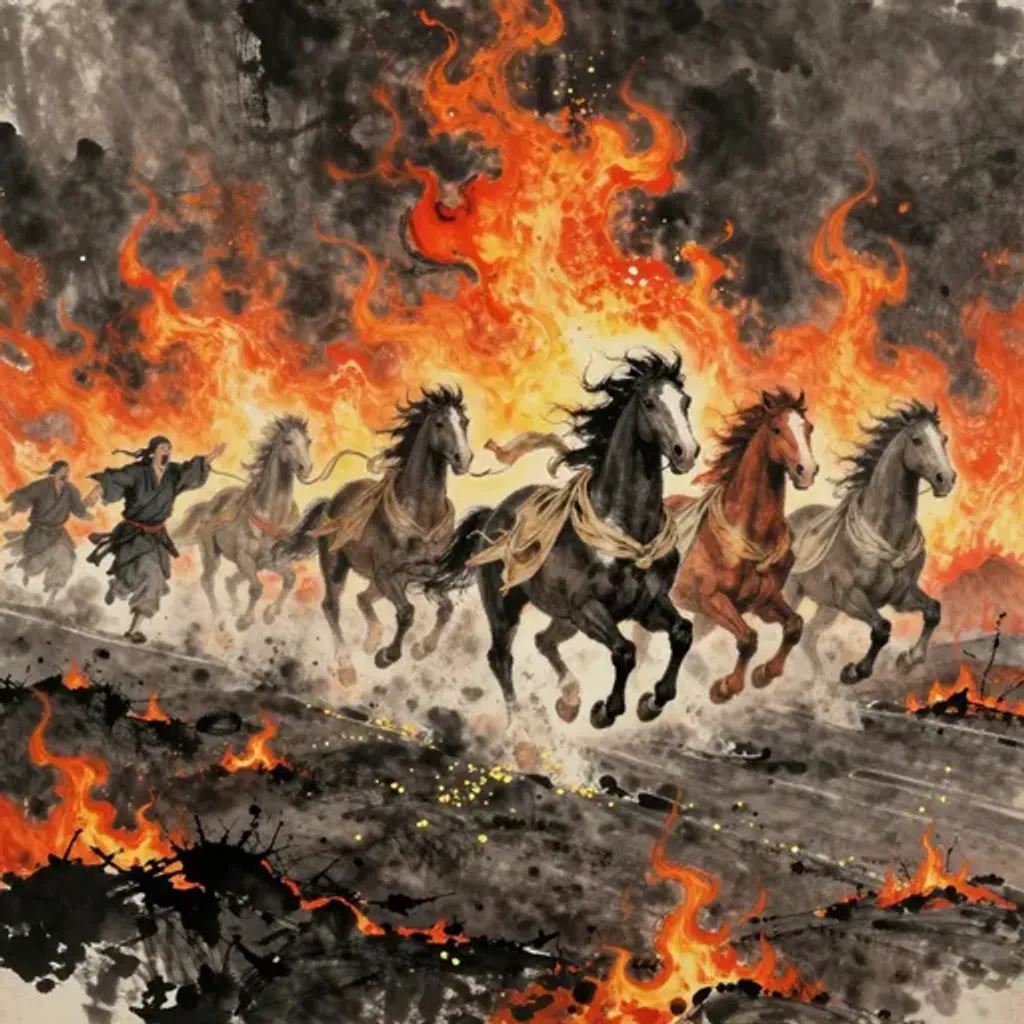
天馬五道,炎火久處。往來上下,非文釣已。衣衰絲麻,相隨在歌,凶惡如何。
The celestial horse runs five courses; the blazing fire lingers long. Going and coming, ascending and descending; this is no civil pursuit of the scholar's hook. Clad in mourning silk and hemp, following one another in lamentation; how dire the calamity.
— Jiao Yanshou, Yilin (Forest of Changes), 1st century BC
Commentary
Fire within the lake yields to wind above the mountain — Development, the gradual advance of a wild goose in steady stages. Heavenly horses traverse five paths; flames have long dwelt in this place. Going and coming, up and down, it is no ordinary angling that has ceased. One wears mourning garments of hemp and silk, following along in song — what evil could befall? This obscure verse resists easy parsing. The 'heavenly horses' may reference celestial movements; 'mourning garments' suggest ritual transition. From Revolution to Development, the gradual, step-by-step nature of true progress stands in tension with the verse's swirling imagery — some transformations are too complex for a single reading.
革 → 歸妹
Hexagram 49 → Hexagram 54: The Marrying Maiden
Changing lines: 2, 3, 5
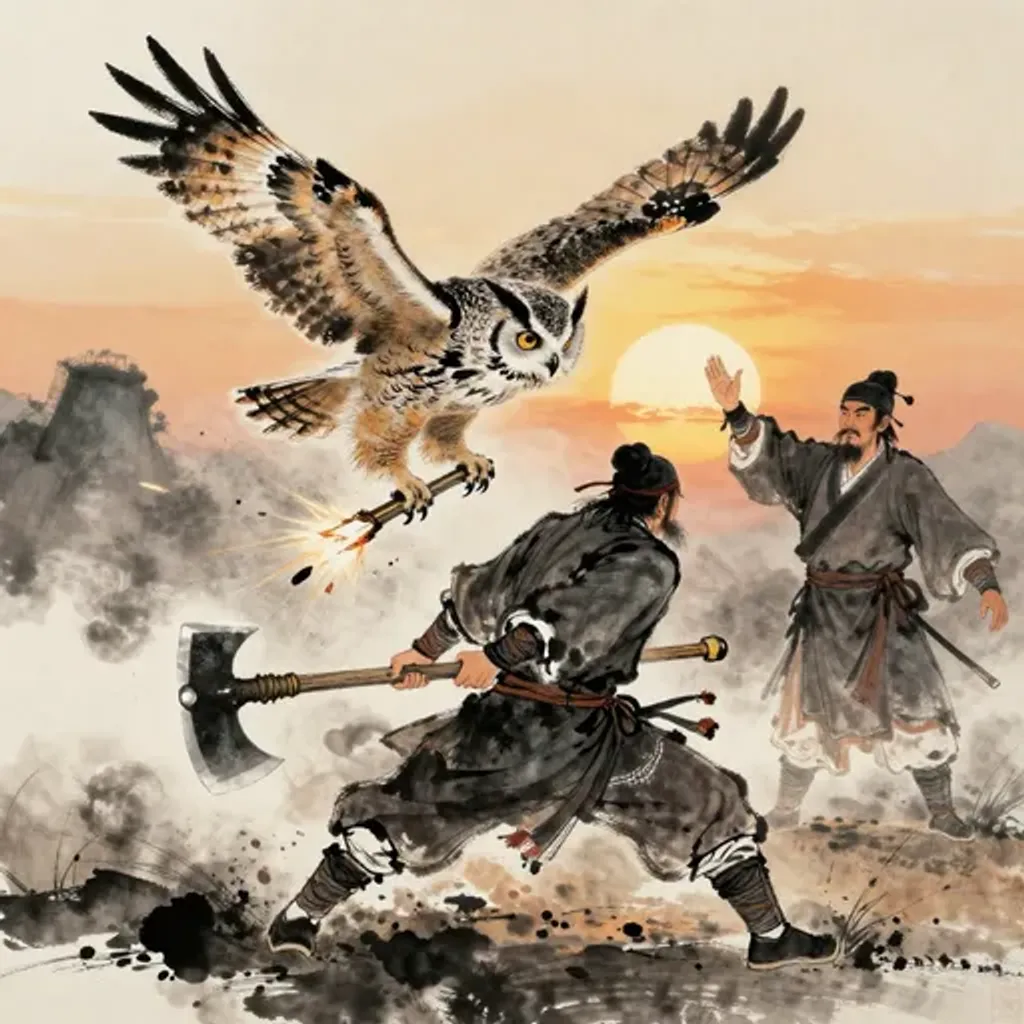
鴟鴞破斧,沖人危殆。賴旦忠德,轉禍為福,傾危復立。
The owl shatters the axe; it assails the people with peril. Relying on Dan's loyal virtue, disaster is transformed into blessing; the toppling is set upright again.
— Jiao Yanshou, Yilin (Forest of Changes), 1st century BC
Commentary
Fire within the lake transforms into thunder above the lake — the Marrying Maiden, where a younger sister follows the elder in an unequal union. Owl and hawk shatter the axe; the people face mortal danger. Thanks to the Duke of Zhou's loyal virtue, disaster turns to fortune, and what was toppling stands upright again. This directly quotes two Shijing poems from the Bin Odes: 'Chixiao' (The Owl), the Duke of Zhou's plea to King Cheng, and 'Po Fu' (Broken Axe), celebrating the eastern campaign against the rebels Guan and Cai. The Duke salvaged a dynasty on the verge of collapse. From Revolution to the Marrying Maiden, the resonance is clear: loyalty in a subordinate position — the younger sibling serving the elder — can rescue an entire state from ruin.
革 → 豐
Hexagram 49 → Hexagram 55: Abundance
Changing lines: 5
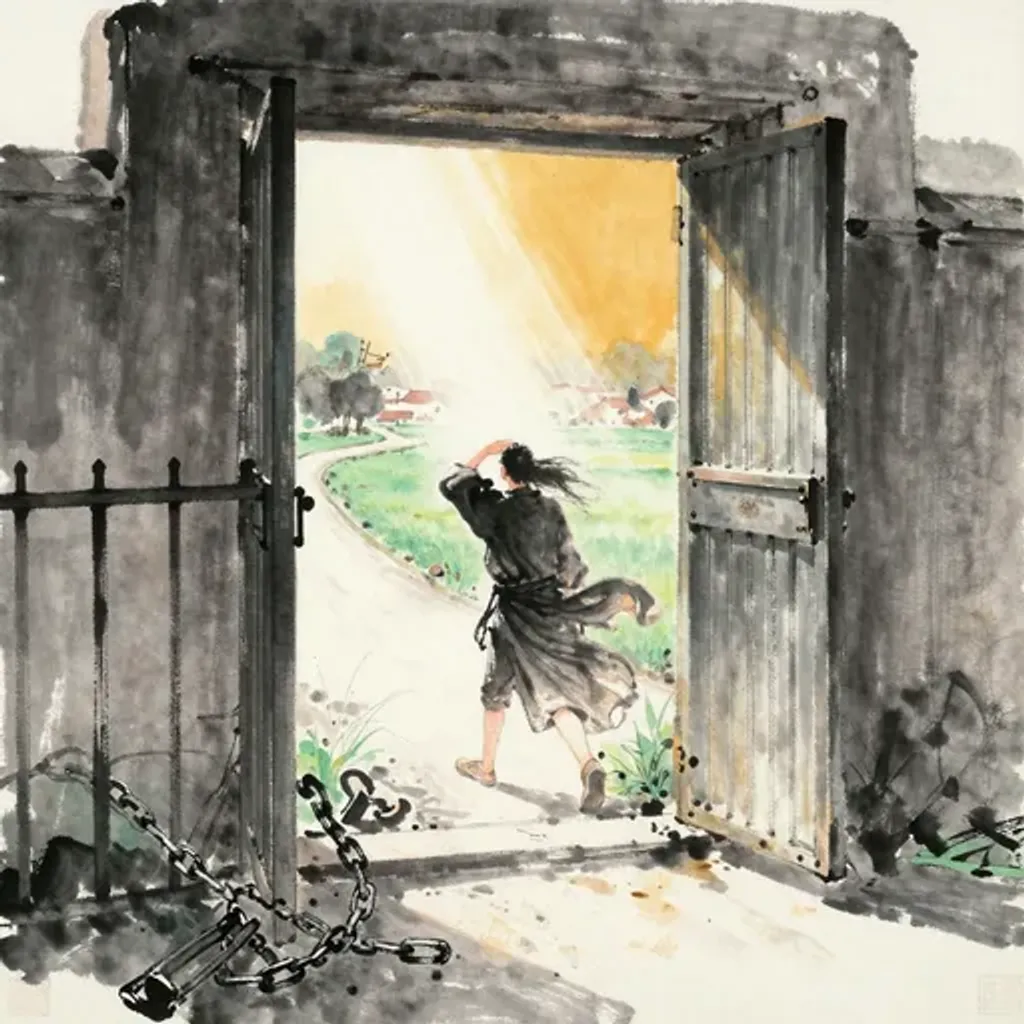
杜飛門啟,憂患大解,不為身禍。
The blocked gate flies open; worry and trouble dissolve at once. No harm befalls the person.
— Jiao Yanshou, Yilin (Forest of Changes), 1st century BC
Commentary
Fire within the lake transforms into thunder and fire together — Abundance, where power and clarity unite at their zenith. 'Du flies off and the gate opens; worries and calamities dissolve utterly, bringing no harm to oneself.' The character 杜 (du) means 'to block' or 'to close' — when the blockage flies away, the gate opens freely. This is revolutionary liberation at its most concentrated: the obstacle simply vanishes, and the floodgates of relief swing wide. From Revolution to Abundance, the transformation captures the apex of revolutionary success: the moment when obstruction lifts, light and power converge, and one walks through the open gate unscathed.
革 → 旅
Hexagram 49 → Hexagram 56: The Wanderer
Changing lines: 1, 5, 6
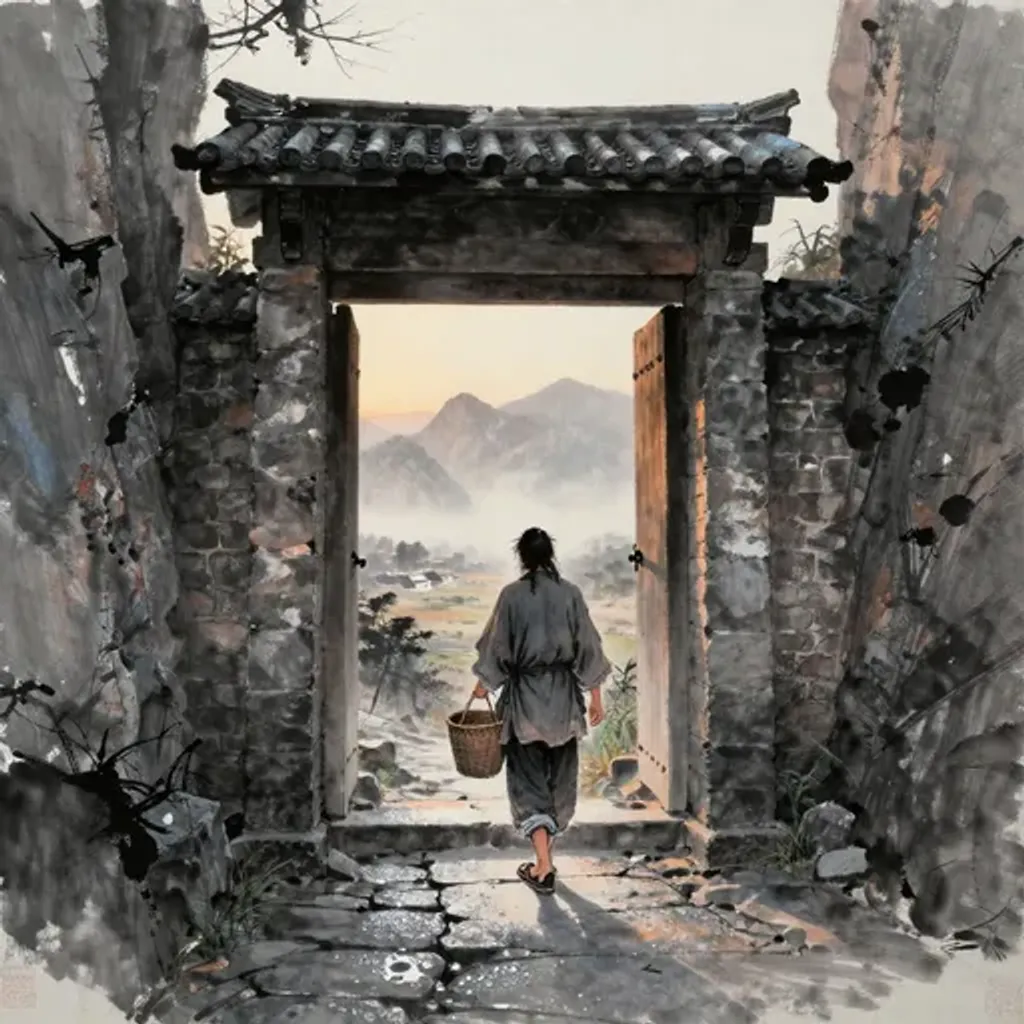
石門晨開,荷蕢疾貧。遁世隱居,竟不逢時。
The stone gate opens at dawn; bearing a basket, sick with poverty. Withdrawing from the world to live in hiding, in the end never meeting one's time.
— Jiao Yanshou, Yilin (Forest of Changes), 1st century BC
Commentary
Fire within the lake yields to fire above the mountain — the Wanderer, who travels light and far from home. The Stone Gate opens at dawn; one who carries a basket endures poverty. Withdrawing from the world to live in seclusion, one ultimately never meets one's time. The 'Stone Gate at dawn' echoes the Analerta passage where Zilu sleeps at the Stone Gate and the gatekeeper remarks: 'Is that the man who knows it cannot be done and keeps trying?' The 'basket carrier' (荷蕢) is another Analerta hermit who criticized Confucius's stubborn engagement with a doomed world. From Revolution to the Wanderer, the transformation captures the recluse who opts out of upheaval — principled withdrawal, but at the cost of never finding an era worthy of one's gifts.
革 → 巽
Hexagram 49 → Hexagram 57: The Gentle Wind
Changing lines: 1, 2, 4, 6
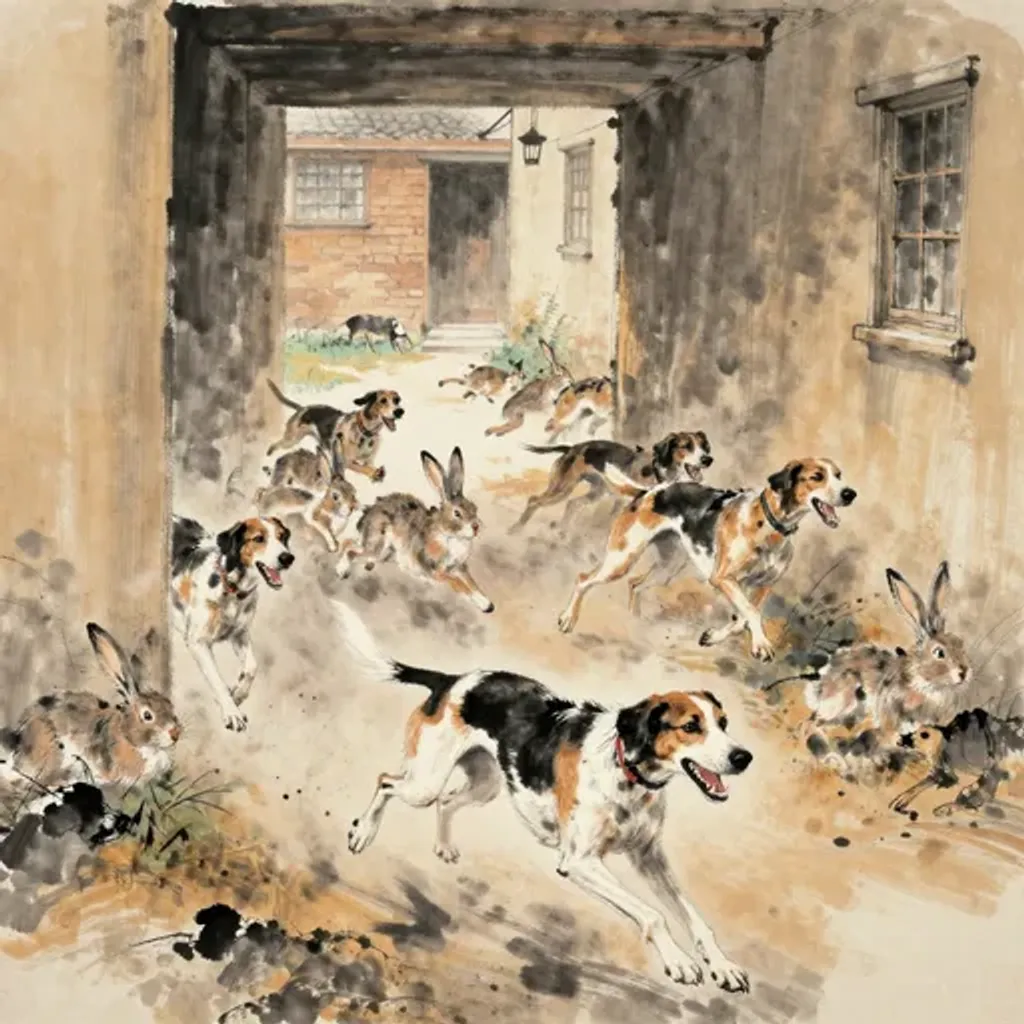
兔聚東廊,眾犬俱獵。圍缺不成,无所能獲。
Rabbits gather in the eastern corridor; many hounds hunt together. The ring is broken, the encirclement fails; nothing can be caught.
— Jiao Yanshou, Yilin (Forest of Changes), 1st century BC
Commentary
Fire within the lake doubles into wind upon wind — the Gentle, where persistent penetration achieves what force cannot. Rabbits gather in the eastern corridor; a pack of dogs gives chase. But the encirclement has a gap and fails to close; nothing can be caught. The Gentle's doubled wind should infiltrate every crack, but here the hunters leave an opening. The dogs pursue but the net is incomplete — a failure of coordination, not of effort. From Revolution to the Gentle, the transformation reveals that after upheaval, gentle persistence must be thorough to succeed. A revolution with holes in its execution lets the quarry escape through the very gaps left by incomplete planning.
革 → 兌
Hexagram 49 → Hexagram 58: The Joyous Lake
Changing lines: 2, 3
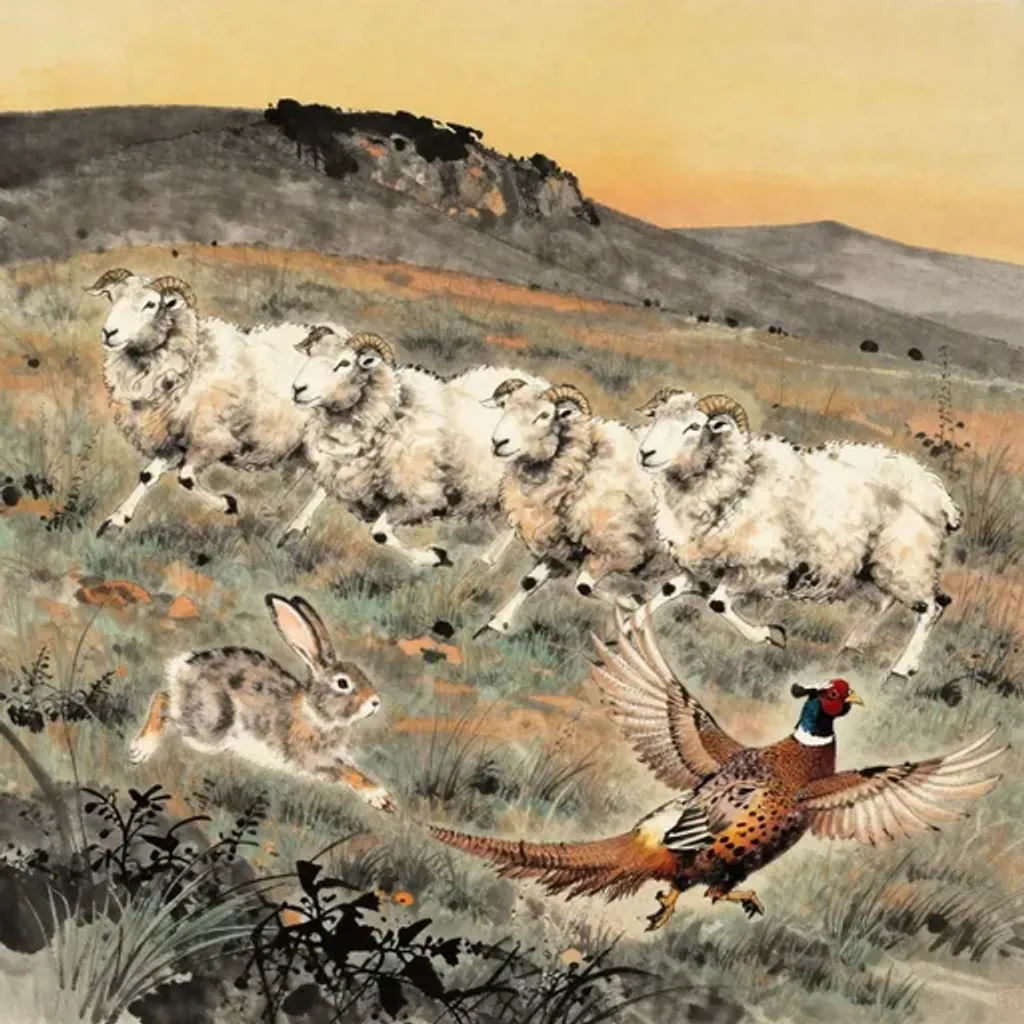
三羊群走,雉兔驚駭。非所畏懼,自令勞苦。
Three rams run in a flock; pheasant and rabbit are startled. What they flee is nothing to fear; they only bring toil upon themselves.
— Jiao Yanshou, Yilin (Forest of Changes), 1st century BC
Commentary
Fire within the lake doubles into lake upon lake — the Joyous, where mutual delight flows between friends. Three goats run together in a flock; pheasants and hares scatter in alarm. But the frightened creatures have nothing to fear — they have only made themselves weary for nothing. The goats are not predators; the pheasants' panic is baseless. Joy's doubled lake should bring shared pleasure, but here the other animals mistake playfulness for threat. From Revolution to the Joyous, the transformation captures a common aftermath of upheaval: the lingering reflex of fear even when danger has passed. The revolution is over; the goats are just goats. But the pheasants cannot stop running.
革 → 渙
Hexagram 49 → Hexagram 59: Dispersion
Changing lines: 1, 2, 3, 4, 6
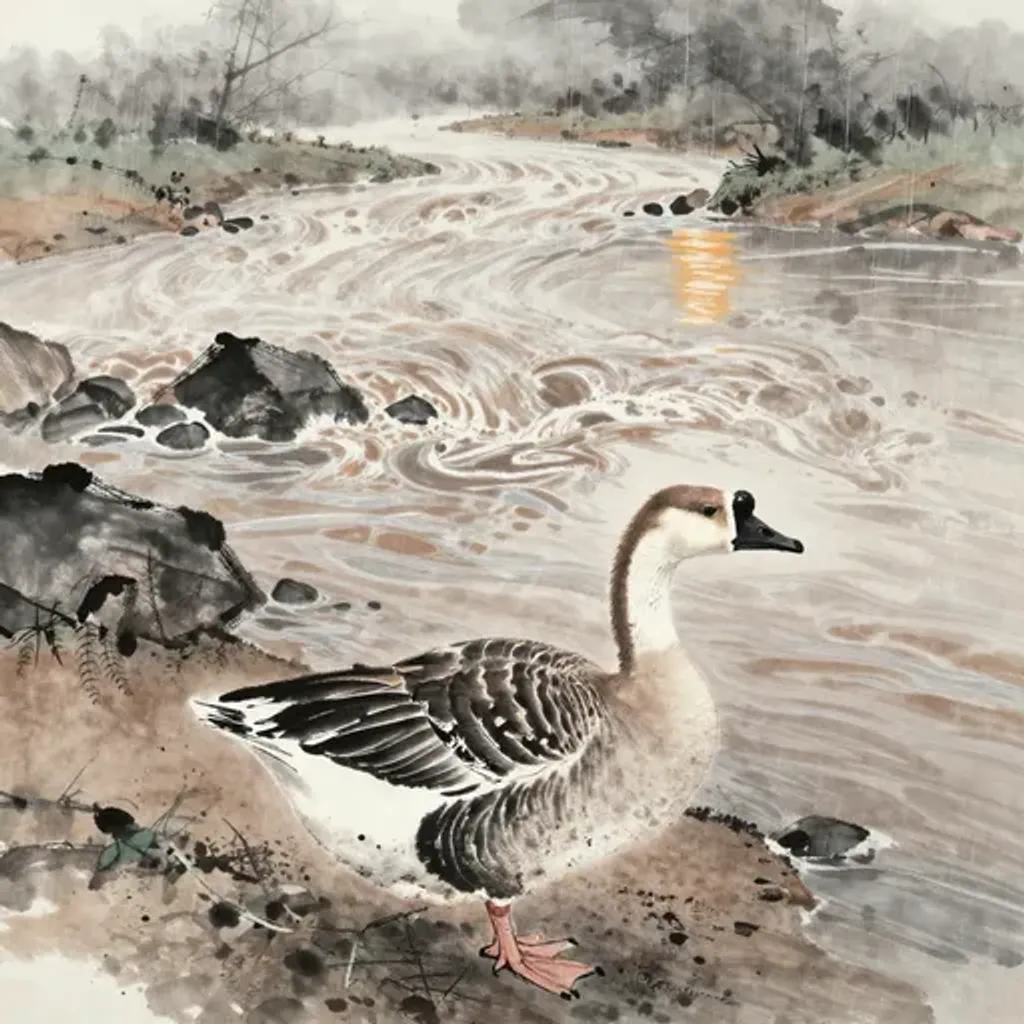
羽翮病傷,无以為強。宋公德薄,敗於水泓。
Wings and pinions sick and wounded, unable to summon strength. Duke Song, thin in virtue, was defeated at the waters of Hong.
— Jiao Yanshou, Yilin (Forest of Changes), 1st century BC
Commentary
Fire within the lake yields to wind above water — Dispersion, where rigid structures dissolve. Wings and feathers are injured and broken; there is no strength left to be strong. Duke Xiang of Song, thin on virtue, was defeated at the River Hong. In 638 BC, Duke Xiang of Song faced a Chu army crossing the Hong River. His minister urged him to attack during the crossing, but the Duke refused, insisting on chivalric conduct — waiting until the enemy had formed ranks. The Chu army promptly destroyed his forces, and the Duke himself was wounded. He died the following year. From Revolution to Dispersion, the transformation reveals how misplaced principle dissolves military coherence: the Duke's rigid honor scattered his own army like wind dispersing water.
革 → 節
Hexagram 49 → Hexagram 60: Limitation
Changing lines: 2, 3, 4
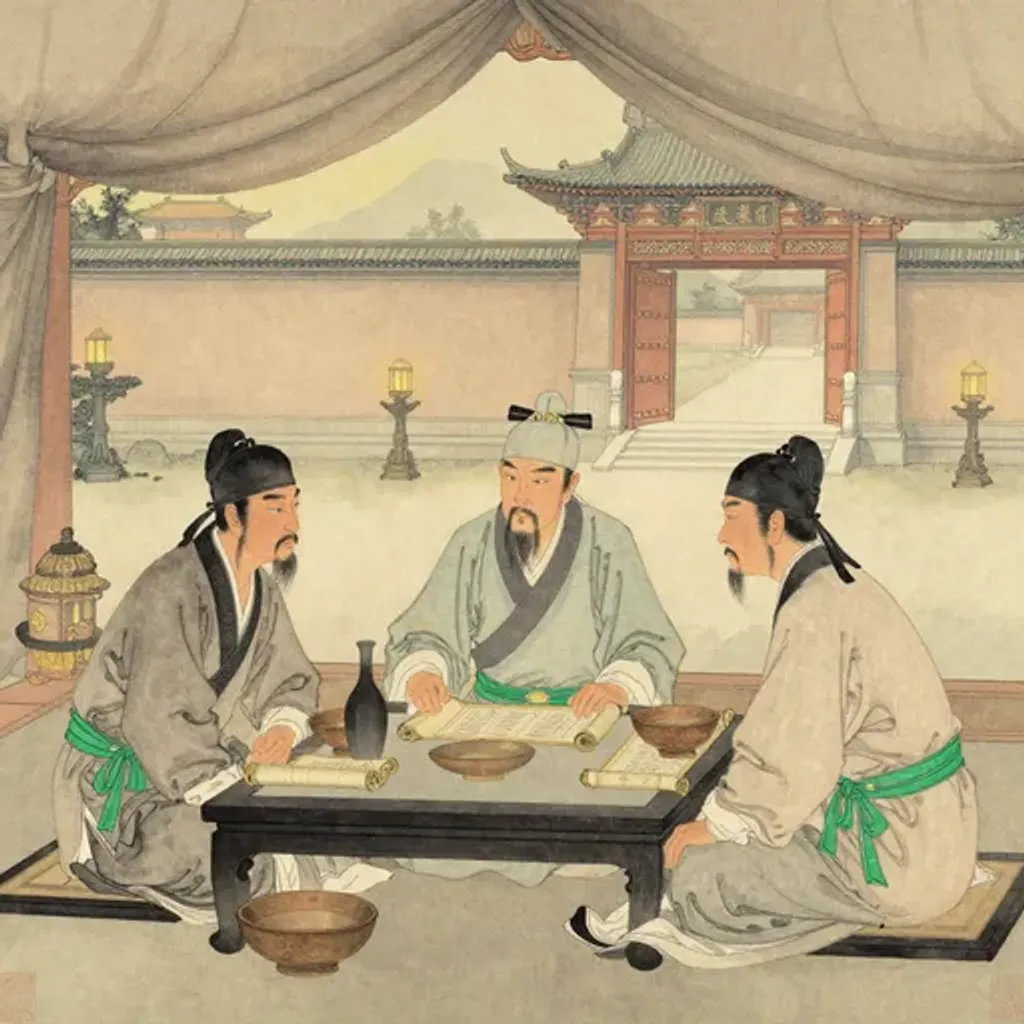
姬姜雅叔,三人偶食。論仁義福,以安王室。
Ji, Jiang, and the worthy Shu; three men share a meal together. Discussing benevolence, duty, and blessing, to bring peace to the royal house.
— Jiao Yanshou, Yilin (Forest of Changes), 1st century BC
Commentary
Fire within the lake yields to water above the lake — Limitation, where boundaries define what is sustainable. Ji and Jiang, the elegant Shu — three persons dine together, discussing benevolence, righteous fortune, and the means to stabilize the royal house. Ji and Jiang are the two great surname clans of Zhou-era aristocracy (Ji being the Zhou royal house, Jiang the clan of the Taigong). Their shared meal embodies civilized negotiation: adversaries breaking bread, debating virtue, and aligning their interests for the stability of the realm. From Revolution to Limitation, the transformation shows that after upheaval, sustainable order comes through negotiated boundaries — not unlimited ambition but measured agreement among stakeholders.
革 → 中孚
Hexagram 49 → Hexagram 61: Inner Truth
Changing lines: 2, 3, 4, 6
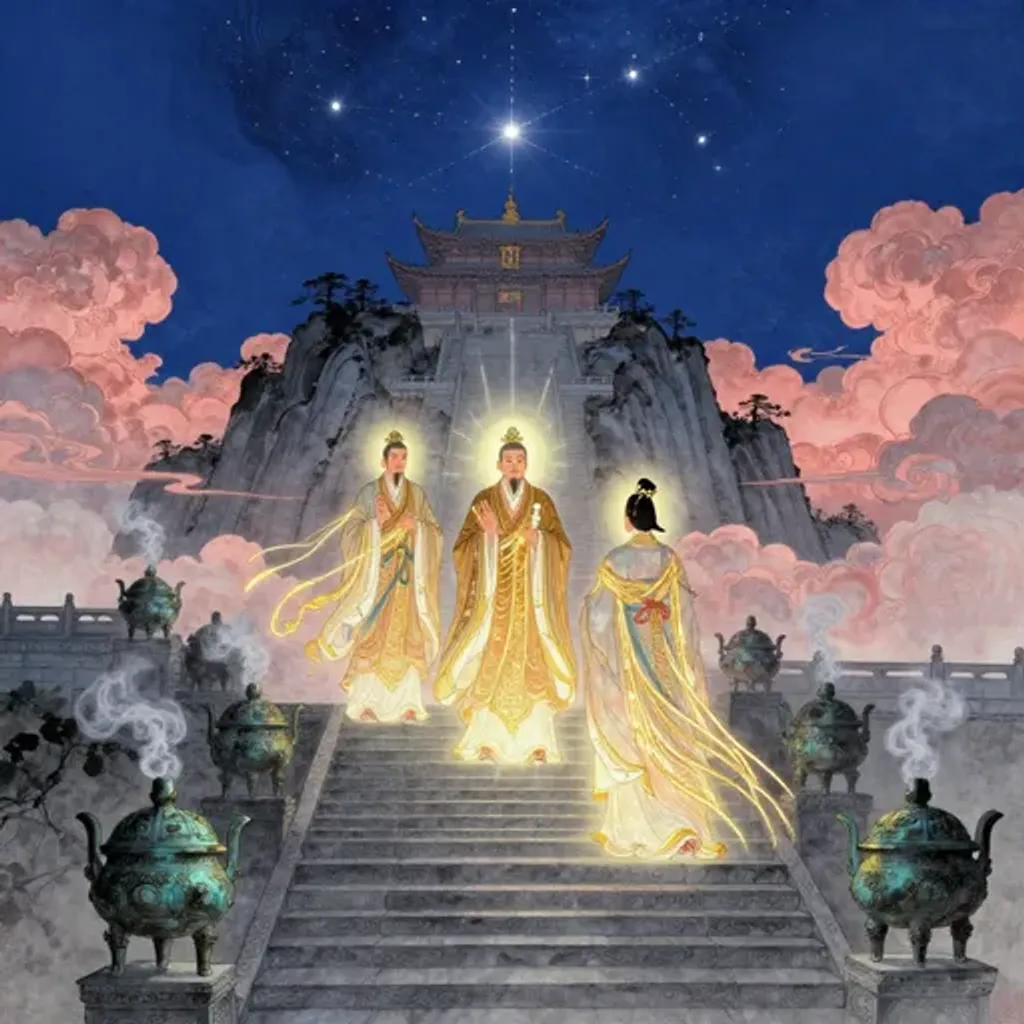
精誠所在,神為人輔。德教之中,彌世長久。三聖乃興,多受福祉。
Where sincerity resides, the spirits aid humankind. Within the teaching of virtue, the world endures long. Three sages arise, receiving abundant blessings.
— Jiao Yanshou, Yilin (Forest of Changes), 1st century BC
Commentary
Fire within the lake transforms into wind above the lake — Inner Truth, where sincerity reaches even pigs and fishes. Utmost sincerity draws the spirits themselves to assist mortals. Within the teaching of virtue and morality, this influence endures across generations. Three sages arise, receiving abundant blessings. The 'three sages' most likely refers to the Zhou founding triad — Wen, Wu, and the Duke of Zhou — whose accumulated virtue built a dynasty that lasted eight centuries. Inner Truth's hallmark is sincerity so deep it moves the numinous. From Revolution to Inner Truth, the transformation reveals that lasting revolution succeeds not through force but through moral conviction so genuine that heaven itself responds.
革 → 小過
Hexagram 49 → Hexagram 62: Small Exceeding
Changing lines: 1, 5
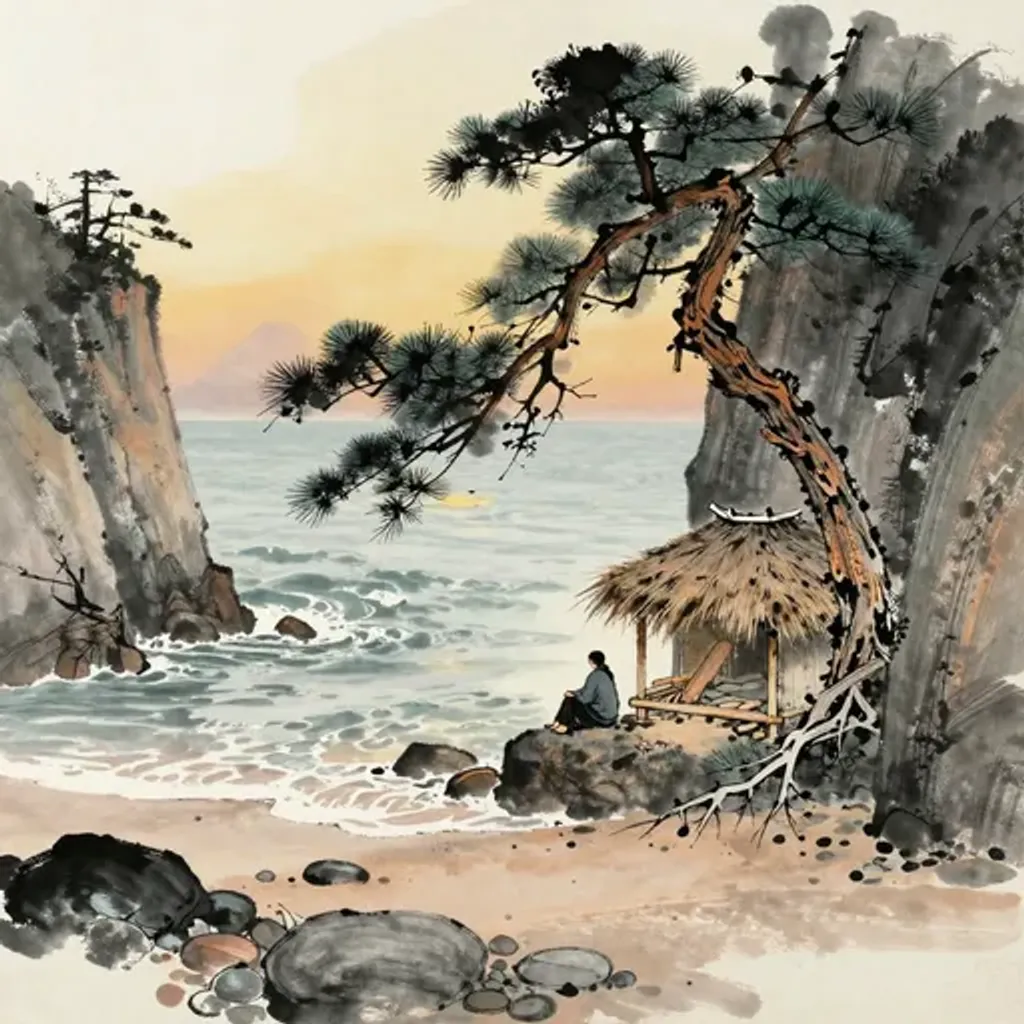
岐周海隅,獨樂不憂。可以避難,全身保才。
At Qi and Zhou, by the sea's corner; alone in joy, without worry. Here one may escape calamity, preserving the self and protecting one's gifts.
— Jiao Yanshou, Yilin (Forest of Changes), 1st century BC
Commentary
Fire within the lake yields to thunder above the mountain — Small Exceeding, where one must exceed slightly in the small things: humility, thrift, and grief. Qi and Zhou mark the far corners — from the Zhou heartland in the west to the sea's edge. There one finds solitary joy without worry, a place to avoid disaster, preserving one's person and protecting one's talent. The verse describes a refuge at the margins: the Zhou ancestral land of Qishan and the distant coast. Like the Small Exceeding bird that must fly low to survive, one retreats to modest shelter. From Revolution to Small Exceeding, the transformation counsels that after upheaval, survival lies in staying small, staying quiet, and staying at the periphery where the storm cannot reach.
革 → 既濟
Hexagram 49 → Hexagram 63: After Completion
Changing lines: 4

孤獨特處,莫依為輔,心勞志苦。
Rowing a small boat alone, not knowing north from south. The fog-sea is vast and featureless — no shore to lean toward.
— Jiao Yanshou, Yilin (Forest of Changes), 1st century BC
Commentary
Fire within the lake transforms into water above fire — After Completion, where every element is in its proper place but stability is precarious. The original verse reads: 'Alone and isolated, with no one to rely on for support; the heart is weary, the will is bitter.' After Completion should be the moment of fulfilled order — water sits atop fire, the meal is cooked, everything aligns. Yet this figure is utterly alone, exhausted in heart and bitter in purpose. The perfection of After Completion contains its own loneliness: when the revolution succeeds and the new order is set, the revolutionary finds no role left to play. From Revolution to After Completion, the bittersweet transformation: the work is done, but the worker is spent and solitary.
革 → 未濟
Hexagram 49 → Hexagram 64: Before Completion
Changing lines: 1, 2, 3, 5, 6
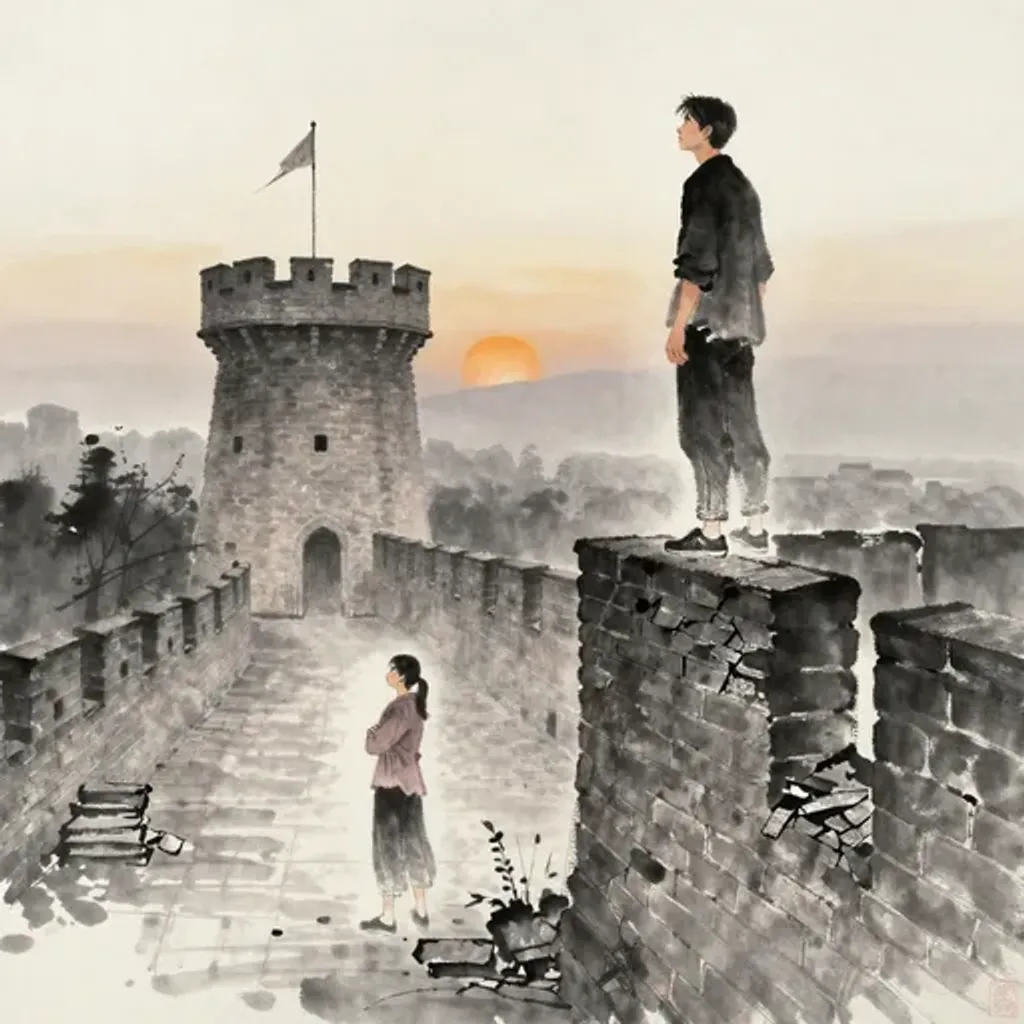
顧望登臺,意常欲逃,賈辛醜惡,妻不安夫。
Looking about and climbing the tower, the heart ever longing to escape. Jia Xin, ugly and loathsome; the wife finds no peace with her husband.
— Jiao Yanshou, Yilin (Forest of Changes), 1st century BC
Commentary
Fire within the lake transforms into fire above water — Before Completion, where everything is still in transit and nothing has settled. One gazes about from a high terrace, heart constantly longing to flee. Jia Xin is ugly and repulsive; the wife cannot abide her husband. The verse ends the hexagram 49 cycle on a note of unfinished revolution: an unhappy marriage, a restless desire to escape, and a figure so repugnant that domestic harmony is impossible. Before Completion is the eternal almost — the fox with its tail still in the water. From Revolution to Before Completion, the final transformation admits that some revolutions never fully resolve. The fire burns above the water, never quite boiling it, and the discontented spouse forever looks for the exit.