Transformations of Hexagram 5
Every line of change out of Hexagram 5 需 Waiting, with the Yilin verse for each of the 64 resulting hexagrams, its translation, and the original ink brush artwork.
需 → 乾
Hexagram 5 → Hexagram 1: The Creative
Changing lines: 4, 6
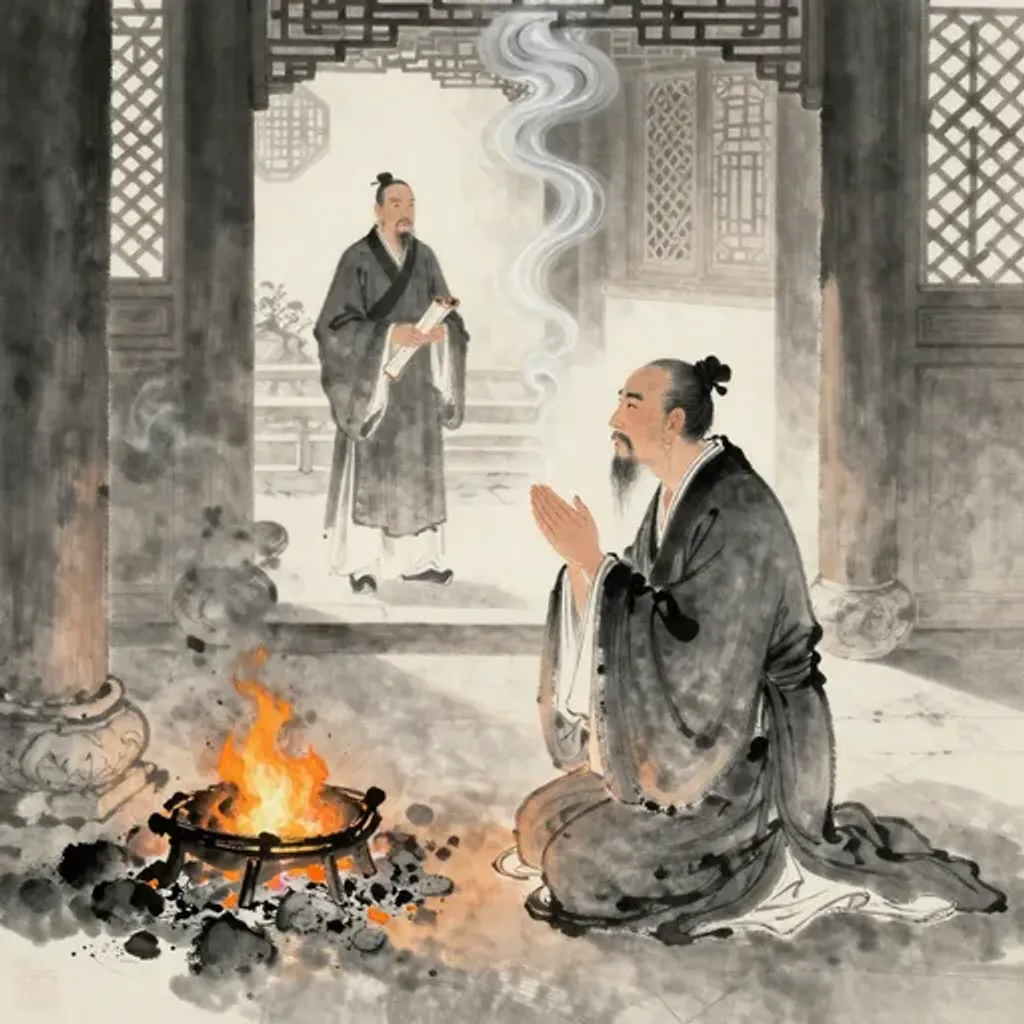
火滅復息,君明其德。仁人可遇,身受利福。
The fire dies and rests again; the lord makes bright his virtue. A benevolent man may be met; the body receives profit and blessing.
— Jiao Yanshou, Yilin (Forest of Changes), 1st century BC
Commentary
Clouds gather above heaven, waiting for the moment to nourish. A fire burns out and subsides, allowing clarity to return: the ruler shines forth in virtue, attracting the humane. The verse presents a world after crisis — flames extinguished, stillness restored — where a virtuous sovereign emerges and those of goodness naturally draw near. 'Humane persons may be encountered' suggests that benevolence is not pursued but met along the way when conditions align. From Waiting to The Creative, patient endurance gives way to self-generating initiative: what was held back now moves of its own accord, and the one who waited receives both benefit and blessing through the active power of undivided heaven.
需 → 坤
Hexagram 5 → Hexagram 2: The Receptive
Changing lines: 1, 2, 3, 5
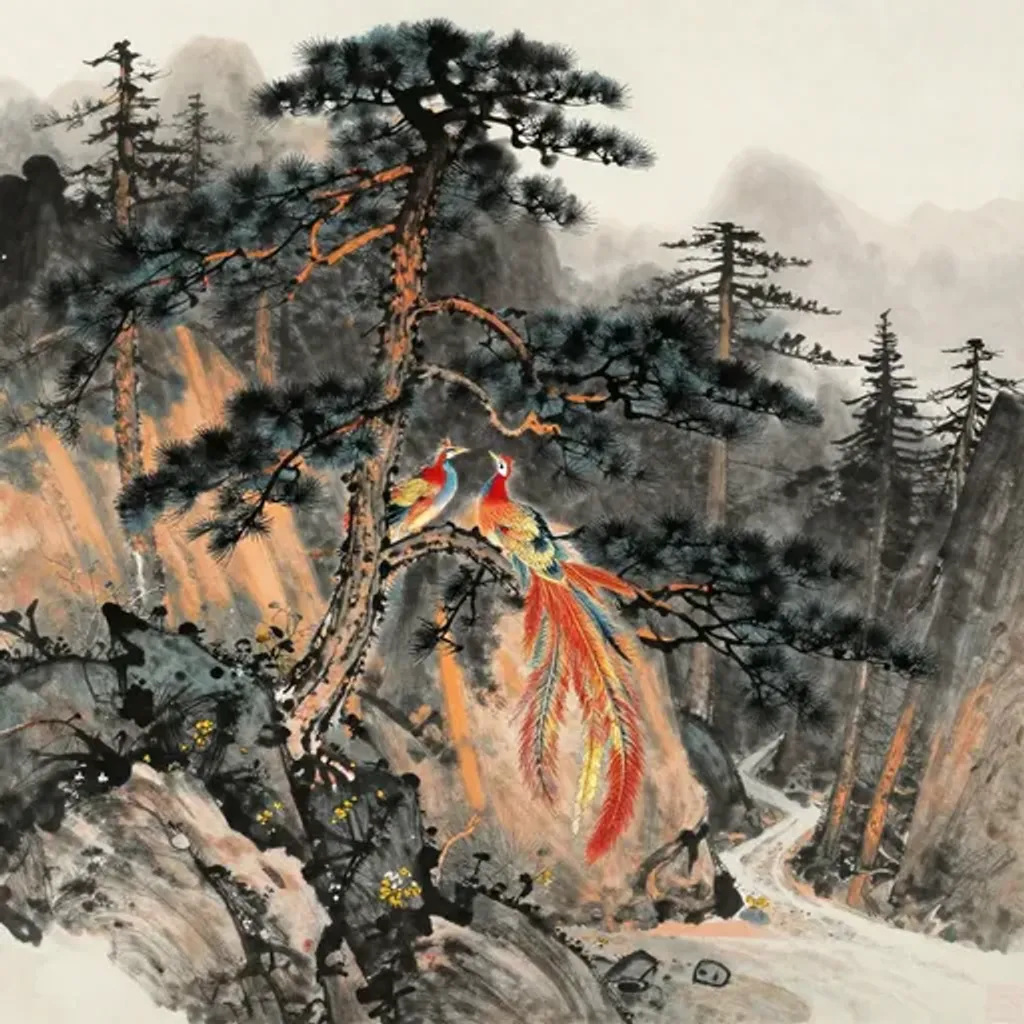
溫山松柏,常茂不落。鸞凰以庇,得其歡樂。
Warm mountain pines and cypresses, ever flourishing, never falling. The luan and the phoenix shelter therein, finding their delight.
— Jiao Yanshou, Yilin (Forest of Changes), 1st century BC
Commentary
Clouds gather above heaven as pines and cypresses stand evergreen upon a warm mountain, their foliage never falling. The luan bird and phoenix shelter beneath them, finding delight and repose. Pines and cypresses are classical symbols of constancy through adversity — they endure frost and snow while lesser trees wither. The luan and phoenix, auspicious creatures that appear only in times of harmony, choosing these trees as refuge signals that steadfast virtue draws celestial blessing. From Waiting to The Receptive, nourishment transforms into the earth's boundless capacity to sustain: the mountain's warmth mirrors the earth's quiet generosity, sheltering all who come without preference or exhaustion.
需 → 屯
Hexagram 5 → Hexagram 3: Difficulty at the Beginning
Changing lines: 2, 3
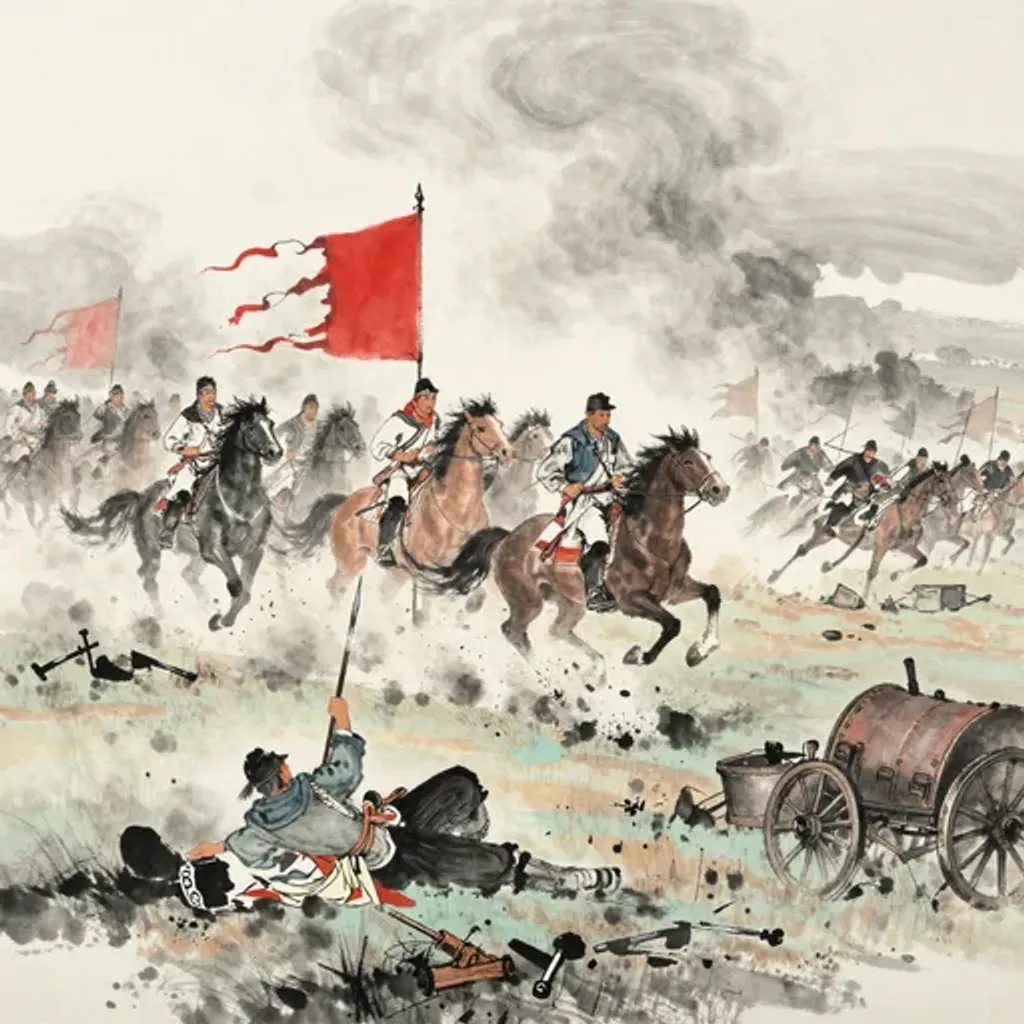
西誅不服,恃強負力。倍道趨敵,師徒敗覆。
Campaigning west to punish the unsubmissive; relying on strength and force. Doubling the march to rush the enemy; the army is defeated and overturned.
— Jiao Yanshou, Yilin (Forest of Changes), 1st century BC
Commentary
Clouds above heaven promise nourishment, but a western campaign against rebels wastes it all. Relying on brute strength and trusting superior force, the army doubles its marches to close with the enemy — and is annihilated. The phrase 'doubled marches' (倍道) echoes the classic military blunder of overextending supply lines, leaving troops exhausted before battle begins. Haste and arrogance undo what patience might have preserved. From Waiting to Difficulty at the Beginning, the transformation is sharp: the nourishing pause of Xu gives way to the churning chaos of clouds and thunder, where premature action tangles every thread into a knot that cannot be undone.
需 → 蒙
Hexagram 5 → Hexagram 4: Youthful Folly
Changing lines: 1, 3, 5, 6
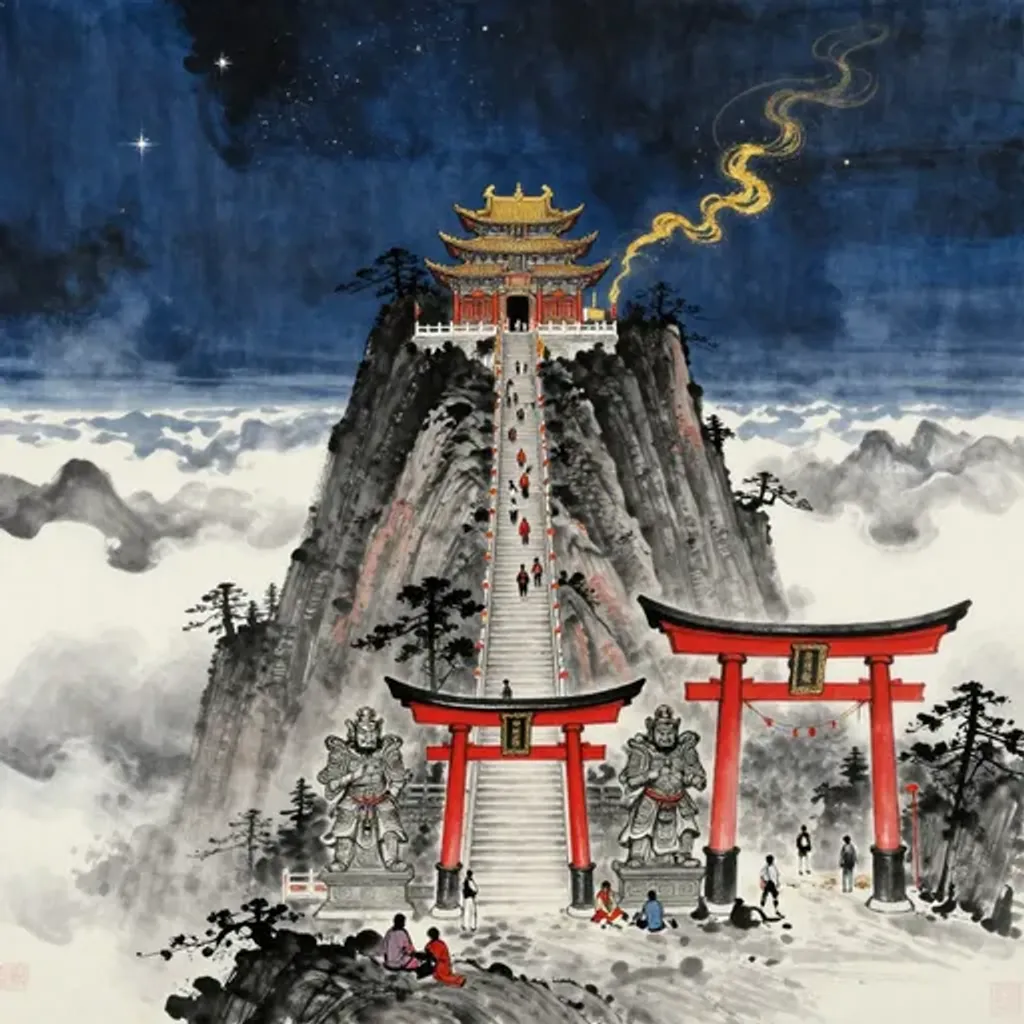
三塗五岳,陽城太室。神明所伏,獨無兵革。
The Three Passes, the Five Sacred Peaks; Yangcheng, the Grand Chamber. Where the spirits dwell in hiding; alone free of war and weapons.
— Jiao Yanshou, Yilin (Forest of Changes), 1st century BC
Commentary
Clouds above heaven open onto sacred geography: the Three Paths, the Five Sacred Mountains, Yangcheng, and the Grand Chamber of Mount Song. These are the ritual heartlands of ancient China — Yangcheng where Yu the Great reportedly convened the feudal lords, and Taishi (Grand Chamber), the central peak of the sacred Songshan range. Where spirits and gods dwell, war does not reach. The verse maps a landscape of divine protection: sacred space repels violence by its very nature. From Waiting to Youthful Folly, the transformation moves from patient trust to the spring emerging from beneath the mountain — clear water finding its way through darkness, guided not by force but by the terrain's own hidden wisdom.
需 → 需
Hexagram 5 → Hexagram 5: Waiting
No changing lines — the hexagram is unchanged
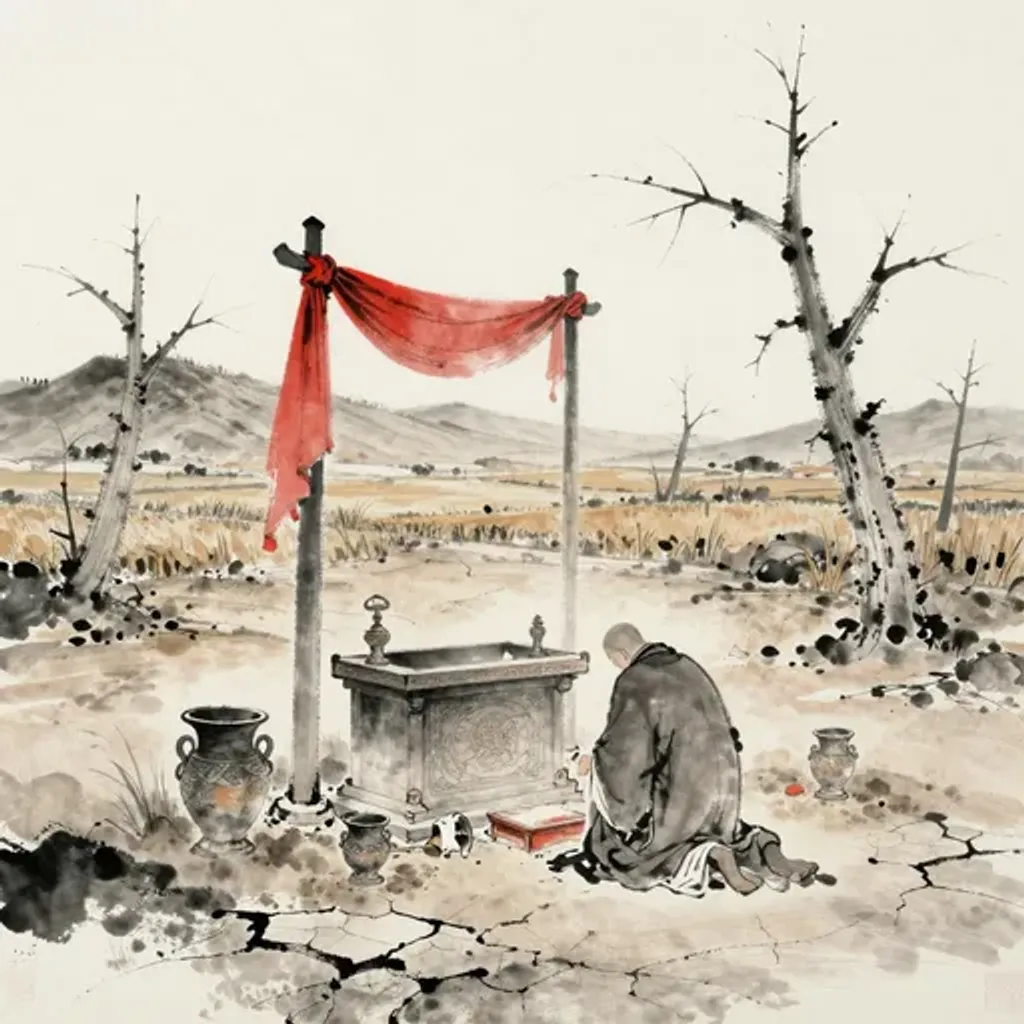
久旱三年,草木不生。粢盛空之,無以供靈。
Drought for three long years; grass and trees do not grow. The grain vessels stand empty; there is nothing to offer the spirits.
— Jiao Yanshou, Yilin (Forest of Changes), 1st century BC
Commentary
Clouds above heaven, yet no rain falls — Waiting doubled upon itself. A drought of three years scorches the earth: grasses and grain refuse to grow, the ritual vessels stand empty, and there is nothing to offer the spirits. This is the nightmare inversion of the hexagram's own image, which promises that the gentleman may eat, drink, and feast in ease. When waiting yields nothing, even the sacred bond between human and heaven frays — without grain, no sacrifice; without sacrifice, no communion with the divine. The same pattern repeating produces stagnation, not renewal. Xu upon Xu warns that patience without agency becomes paralysis.
需 → 訟
Hexagram 5 → Hexagram 6: Conflict
Changing lines: 1, 3, 4, 6
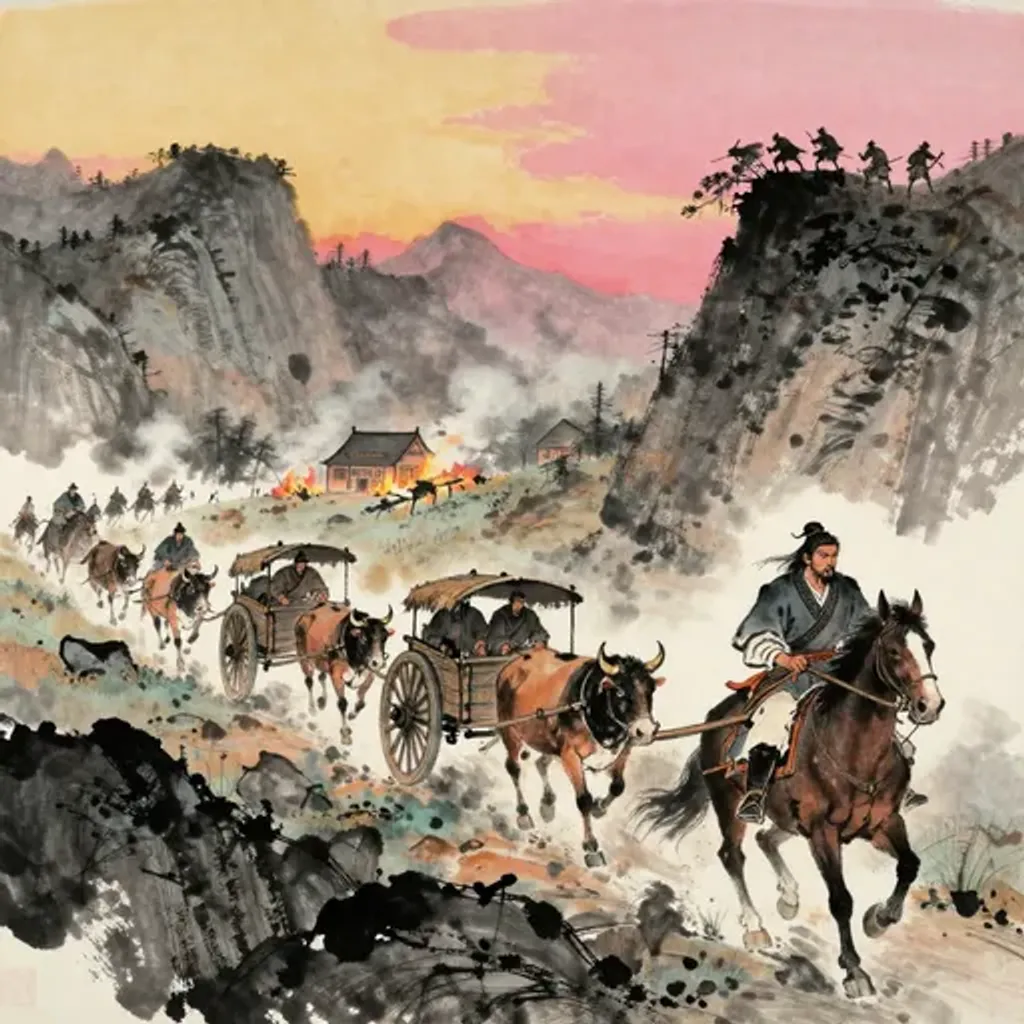
二牛生狗,以戌為母。荊夷上侵,姬伯出走。
Two oxen give birth to dogs, taking the xu-branch as mother. The Jing barbarians invade from the south; the lord of Ji flees.
— Jiao Yanshou, Yilin (Forest of Changes), 1st century BC
Commentary
Clouds above heaven shift to heaven and water pulling apart in Conflict. Two oxen birth a dog, taking the xu-dog as mother — an omen of categorical confusion, things producing what they should not. When natural order inverts, political disaster follows: the Jing barbarians press northward, and the Ji lords are forced to flee. The 'Ji lords' may allude to the many Ji-surnamed Zhou vassal states overrun during the Spring and Autumn period as Chu expanded aggressively into the Central Plains. Anomalous births were standard omen-lore portending dynastic upheaval. From Waiting to Conflict, the nourishing clouds curdle into opposition: heaven and water move in contrary directions, and what should sustain instead destroys.
需 → 師
Hexagram 5 → Hexagram 7: The Army
Changing lines: 1, 3, 5
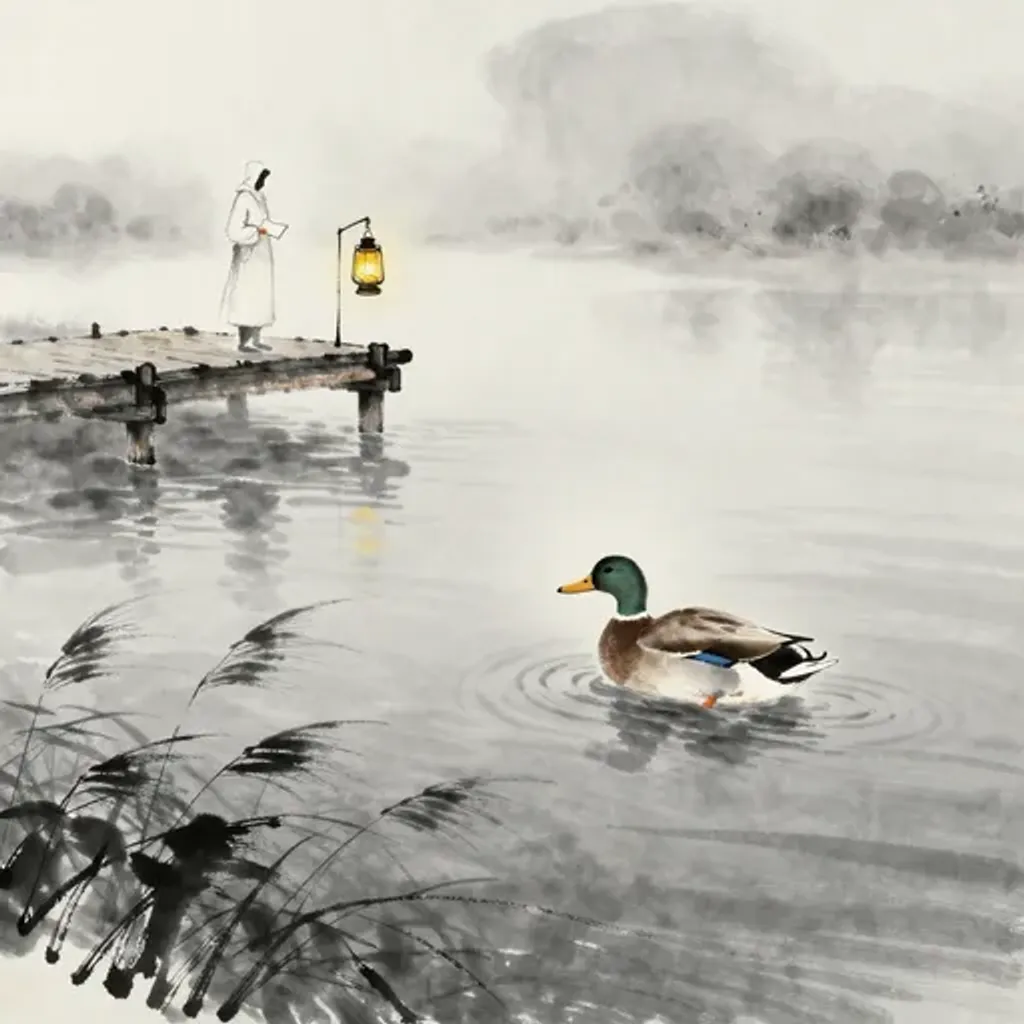
鳧遊江海,役行千里。以為死亡,復見空素。長主凶憂。
The wild duck roams the rivers and seas; sent on a journey of a thousand li. Thought to be dead; but one sees again the empty message. For the lord, a long sorrow.
— Jiao Yanshou, Yilin (Forest of Changes), 1st century BC
Commentary
Clouds above heaven dissolve into water hidden within the earth — the Army's concealed reserves. A wild duck roams the rivers and seas while a conscript marches a thousand leagues, presumed dead by those at home. Then, unexpectedly, he reappears — 'a white letter is seen again,' the cloth of mourning reversed into the garment of return. Yet the final phrase darkens: 'the elder lord suffers misfortune and grief.' Reunion is incomplete; someone in authority pays the cost. From Waiting to The Army, nourishment transforms into disciplined mobilization: the waters that gathered patiently beneath the clouds now flow underground, marshaled as the hidden strength of the people under collective command.
需 → 比
Hexagram 5 → Hexagram 8: Holding Together
Changing lines: 1, 2, 3
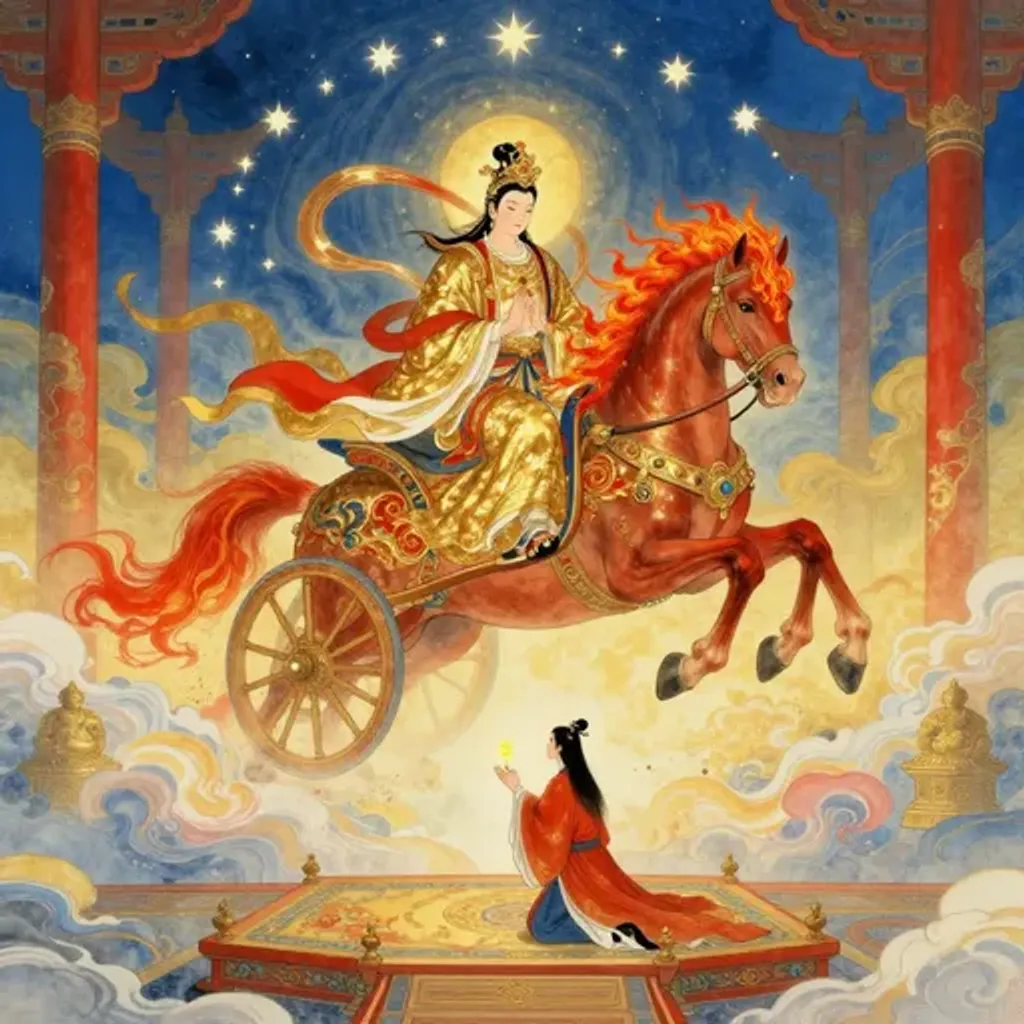
太乙駕騮,從天上來。徵君叔季,封為魯侯。無有凶憂。
The Great Unity rides a bay horse, coming down from heaven. He summons my younger uncles and enfeoffs them as Marquis of Lu. Without ill omen or sorrow.
— Jiao Yanshou, Yilin (Forest of Changes), 1st century BC
Commentary
Clouds above heaven part to reveal the Supreme One descending on a black-maned steed. Taiyi, the highest celestial deity of the Han cosmos, rides down from heaven itself, summoning a worthy gentleman of the youngest branch to be enfeoffed as Marquis of Lu — free from all misfortune. The verse likely alludes to the Duke of Zhou's line receiving the fief of Lu after the Zhou conquest, a reward for supreme loyalty and service. 'Youngest branch' (叔季) fits the Duke of Zhou as a younger brother of King Wu. From Waiting to Holding Together, the nourishing clouds condense into the waters that bond people to earth: divine mandate descends and the bonds of feudal loyalty are sealed.
需 → 小畜
Hexagram 5 → Hexagram 9: Small Taming
Changing lines: 6
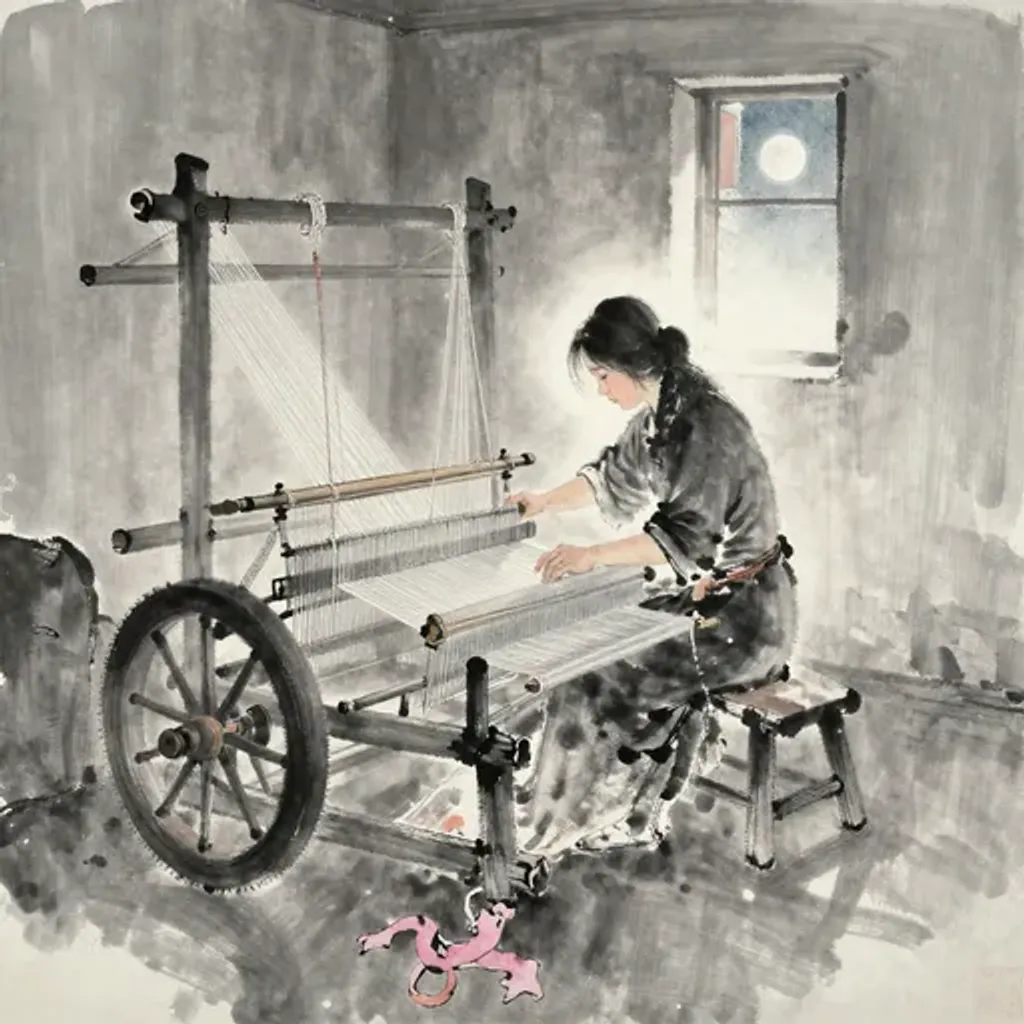
紝績獨居,寡處無夫。陰陽失忘,為人僕使。
Spinning and weaving in solitary dwelling; living alone without a husband. Yin and yang are forgotten and lost; one becomes a servant to others.
— Jiao Yanshou, Yilin (Forest of Changes), 1st century BC
Commentary
Clouds above heaven, yet below a woman weaves alone, dwelling in solitude without a husband. The balance of yin and yang is lost and forgotten; she is reduced to serving others. The verse paints domestic desolation — a spinner at her loom with no household to sustain, her labor exploited rather than nourishing a home. The disruption of conjugal harmony (陰陽失忘) signals a broader failure of natural pairing. From Waiting to Small Taming, the nourishing potential of clouds encounters wind that scatters without releasing rain: gentle influence restrains heaven's power but cannot yet bring it to fruition, leaving abundance suspended and the solitary figure unreached.
需 → 履
Hexagram 5 → Hexagram 10: Treading
Changing lines: 3, 4, 6
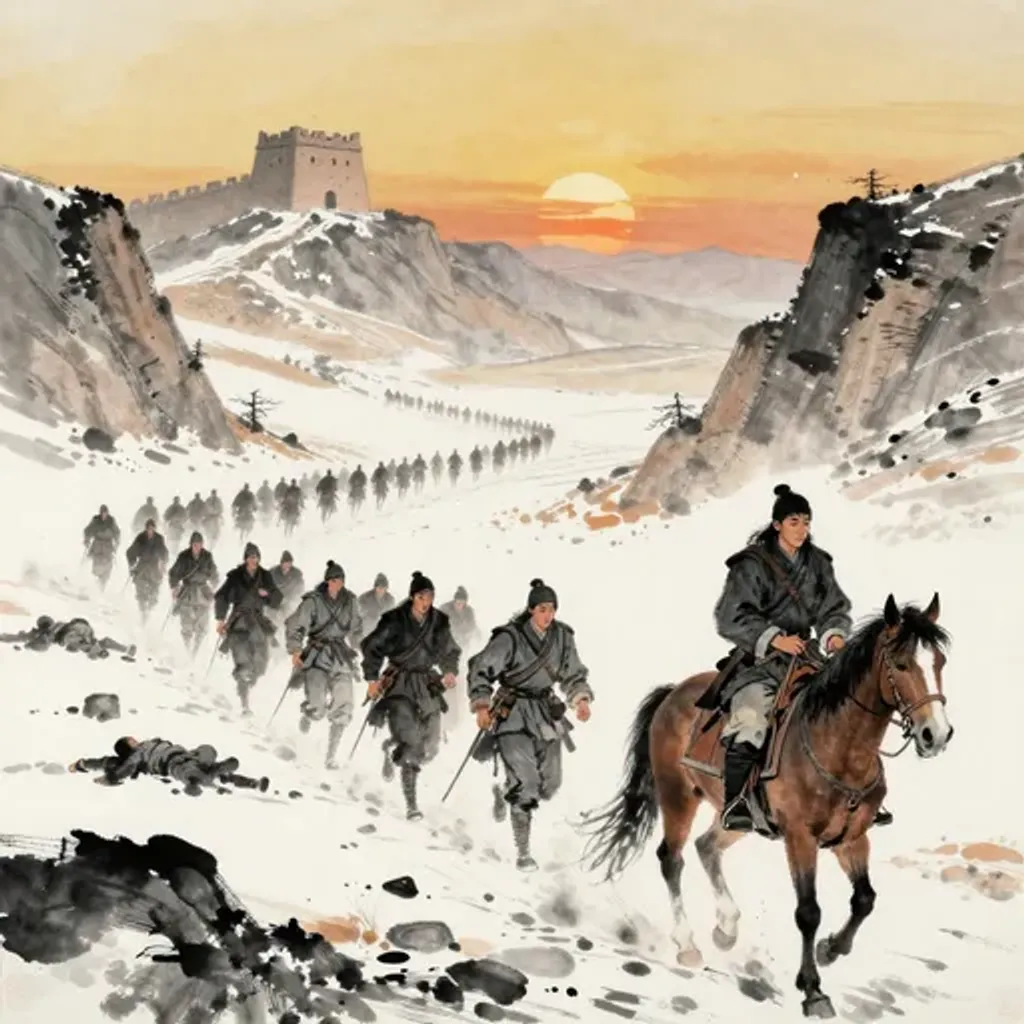
兵征大宛,北出玉門。與胡寇戰,平城道西。七日絕糧,身幾不全。
The army campaigns against Dayuan, going north out through Jade Gate. Battling the Xiongnu raiders west of Pingcheng; seven days without grain, the body nearly lost.
— Jiao Yanshou, Yilin (Forest of Changes), 1st century BC
Commentary
Clouds above heaven darken into the perils of a distant campaign. Troops are dispatched against Dayuan, marching north beyond the Jade Gate Pass. They clash with the Xiongnu raiders west of Pingcheng — an allusion that conflates two Han military disasters: Emperor Wu's Dayuan campaign under Li Guangli and Emperor Gaozu's encirclement at Baideng near Pingcheng, where Han forces were besieged for seven days without provisions, the emperor barely escaping alive. The verse compresses these episodes into a single image of reckless overreach. From Waiting to Treading, patience is abandoned for the perilous step of treading on the tiger's tail: one who ventures beyond heaven's shelter walks where destruction waits.
需 → 泰
Hexagram 5 → Hexagram 11: Peace
Changing lines: 5
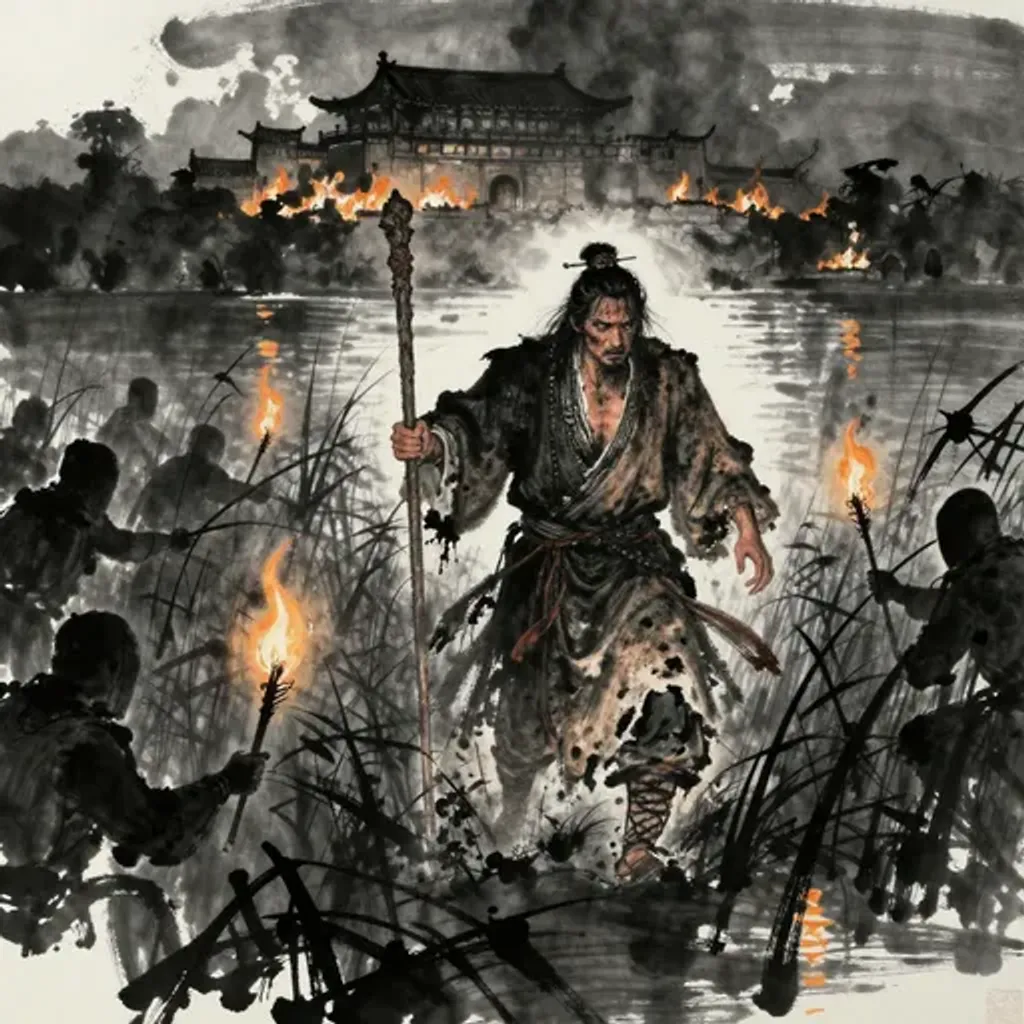
楚靈暴虐,罷極民力。禍起乾溪,棄疾作毒。扶仗奔逃,身死亥室。
King Ling of Chu was cruel and oppressive, exhausting the people’s strength. Disaster arose at Qianxi; Qiji brewed his poison. Leaning on his staff, the king fled; he died in the chamber of Hai.
— Jiao Yanshou, Yilin (Forest of Changes), 1st century BC
Commentary
Clouds above heaven shift to earth and heaven in communion — yet through cataclysm, not harmony. King Ling of Chu, brutal and extravagant, exhausted his people's strength with grandiose building projects. Disaster erupted at Qianxi, where he had built his lavish Zhanghua Terrace: his brother Qiji ('Abandoned Sickness') staged a coup, and the king fled on foot with a walking stick, only to die at the home of the officer Shenhai. According to tradition, he hanged himself in the room of a servant named Hai. The tyrant's fall paradoxically opens the way to renewal. From Waiting to Peace, the transformation reveals that true communion of heaven and earth requires the removal of what blocks their meeting.
需 → 否
Hexagram 5 → Hexagram 12: Standstill
Changing lines: 1, 2, 3, 4, 6
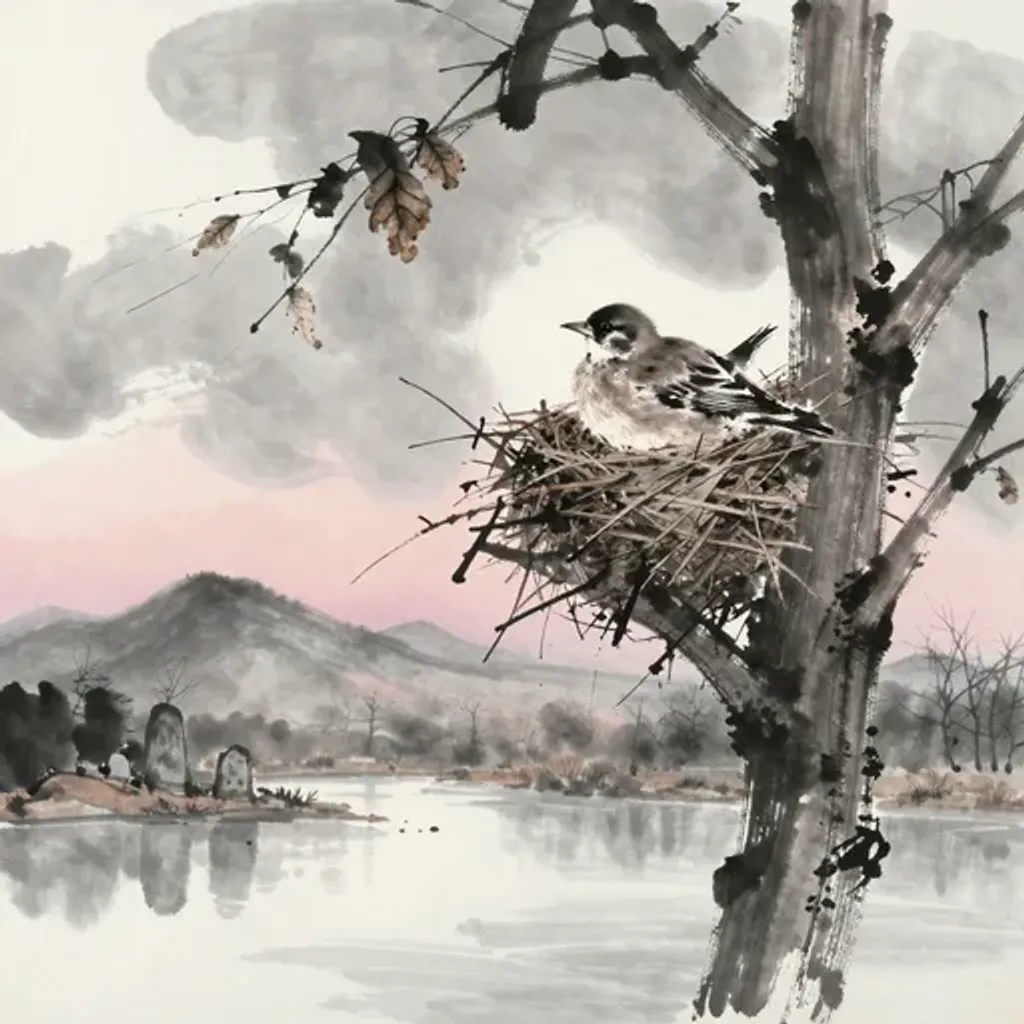
雌單獨居,歸其本巢。毛羽憔悴,志如死灰。
The female bird dwells alone, returning to her old nest. Feathers haggard and worn; her spirit is as dead ash.
— Jiao Yanshou, Yilin (Forest of Changes), 1st century BC
Commentary
Clouds above heaven yield to the stagnation of heaven and earth refusing to meet. A lone female bird returns to its nest, feathers bedraggled, spirit like dead ashes — the Zhuangzian image of a mind so defeated it has ceased to respond. Without its mate, the bird has no purpose for its plumage; solitude strips away even the instinct to preen. From Waiting to Standstill, the nourishing promise of clouds gives way to total blockage: heaven ascends, earth descends, and the two never meet. The bird's desolation mirrors the hexagram's cosmic divorce — yin and yang sealed apart, life draining toward inertia.
需 → 同人
Hexagram 5 → Hexagram 13: Fellowship
Changing lines: 2, 4, 6
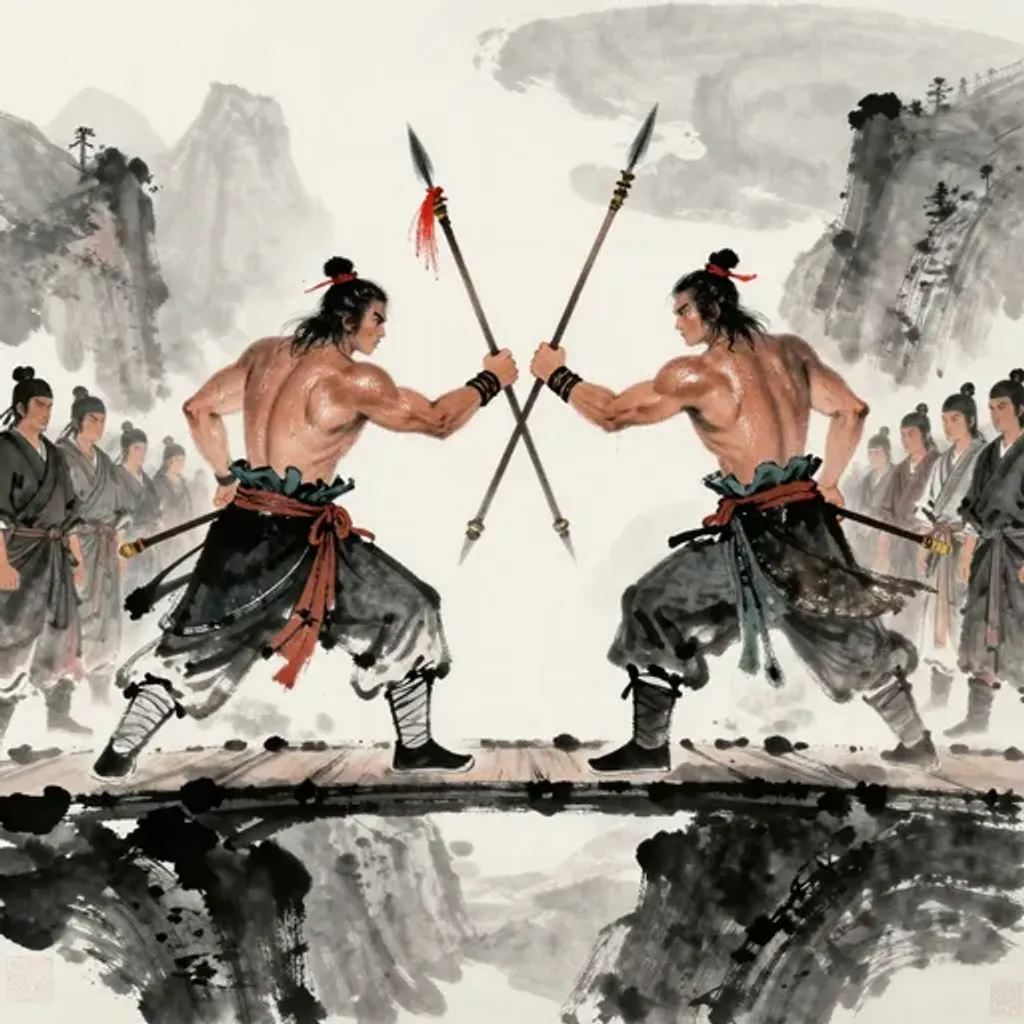
兩矛相刺,勇力鈞敵。交綏結和,不破不缺。
Two spears thrust at each other; their courage and strength are evenly matched. They exchange flags and make peace; nothing is broken or damaged.
— Jiao Yanshou, Yilin (Forest of Changes), 1st century BC
Commentary
Clouds above heaven give way to fire and heaven joined in fellowship. Two spears thrust at each other — warriors of equal courage and matched strength lock in combat. Yet instead of mutual destruction, they withdraw into a truce: 'crossing silk banners and binding peace, nothing broken, nothing lost.' The phrase 交綏 means to exchange retreat signals, a dignified disengagement when neither side can prevail. The verse celebrates the wisdom of recognizing a peer and choosing accord over annihilation. From Waiting to Fellowship, patience transforms into the conscious choice to unite: equals who could destroy each other discover that shared fire illuminates further than contested ground.
需 → 大有
Hexagram 5 → Hexagram 14: Great Possession
Changing lines: 4, 5, 6
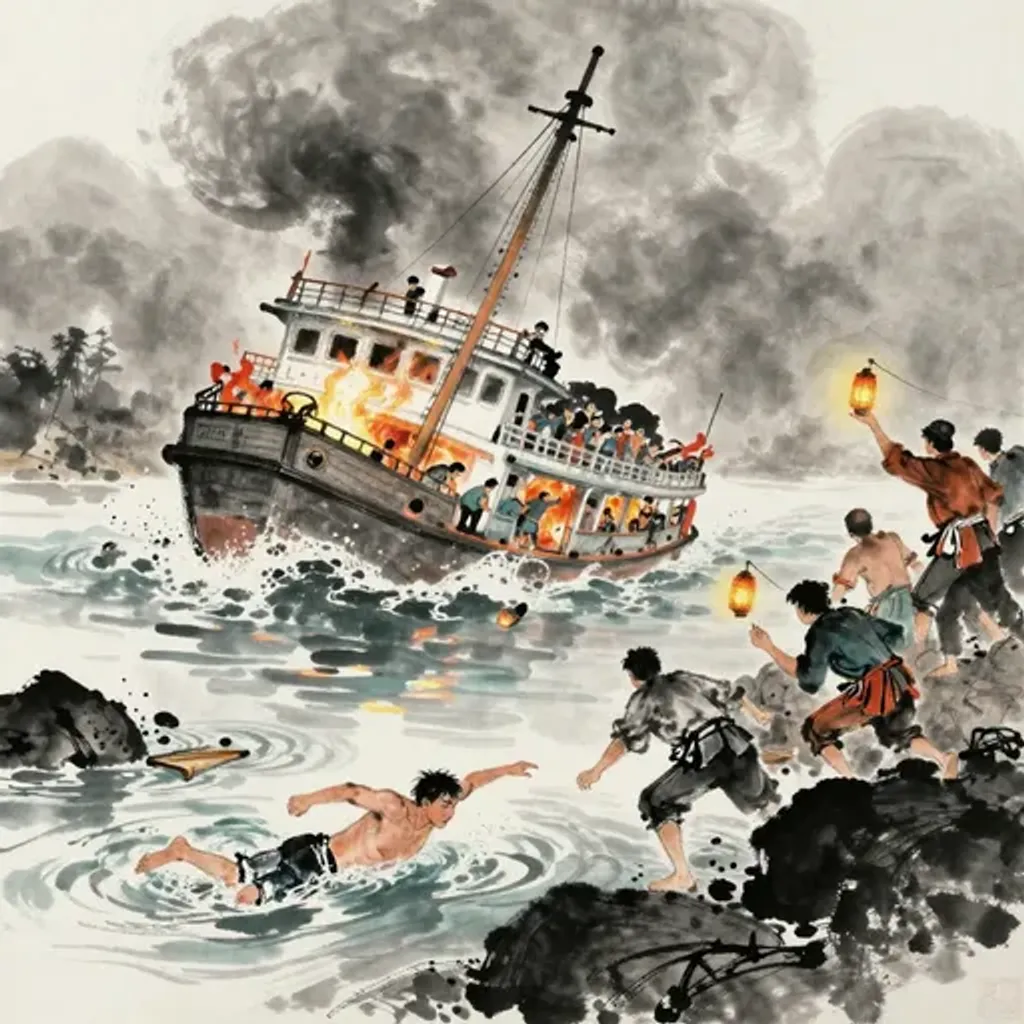
乘船渡濟,載水逢火。賴幸免禍,蒙我生全。
Boarding the boat to cross; carrying water, one meets fire. By fortunate grace, disaster is escaped; one is blessed to survive whole.
— Jiao Yanshou, Yilin (Forest of Changes), 1st century BC
Commentary
Clouds above heaven, and below a boat crosses a river carrying water yet encountering fire — a paradox of elements. One rides through danger upon danger, yet escapes through fortune's grace: 'blessed by luck, spared from disaster, granted the fullness of life.' The image layers water (the crossing), water (the cargo), and fire (the unexpected hazard) into a scene where destruction seems inevitable but does not arrive. From Waiting to Great Possession, the transformation makes sense of the miracle: fire blazing in heaven is the image of supreme abundance. Passing through peril without harm, one emerges into the condition of having greatly — fortune not earned by caution but granted by alignment with heaven's generosity.
需 → 謙
Hexagram 5 → Hexagram 15: Modesty
Changing lines: 1, 2, 5
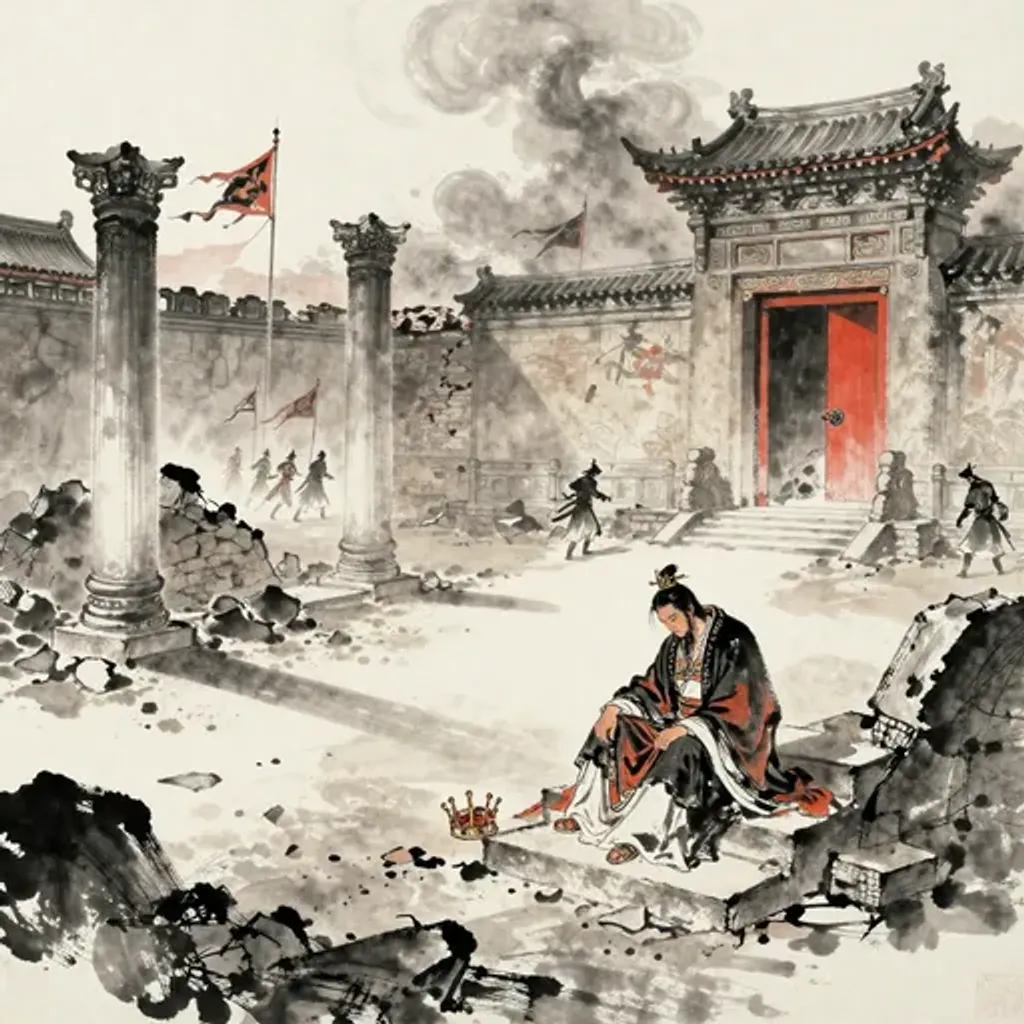
喪寵溢尤,政傾家覆。我宗失國,秦滅周室。
Favor lost, excess blamed; governance toppled, household overturned. Our lineage loses its state; Qin annihilates the house of Zhou.
— Jiao Yanshou, Yilin (Forest of Changes), 1st century BC
Commentary
Clouds above heaven curdle into a scene of political collapse. Favor is lost, excess breeds disaster, governance topples the household itself. 'Our lineage lost its state; Qin extinguished the house of Zhou.' This directly references the fall of the Zhou dynasty: the Eastern Zhou kings gradually lost all real power until Qin formally abolished the Zhou royal house in 256 BC. The verse reads as a lament from within the doomed lineage, watching centuries of accumulated decline reach their final term. From Waiting to Modesty, the transformation is bitterly ironic: the mountain hidden within the earth represents humility, yet the Zhou fell precisely because they could not accept their diminished stature, clinging to nominal authority while real power ebbed away.
需 → 豫
Hexagram 5 → Hexagram 16: Enthusiasm
Changing lines: 1, 2, 3, 4, 5
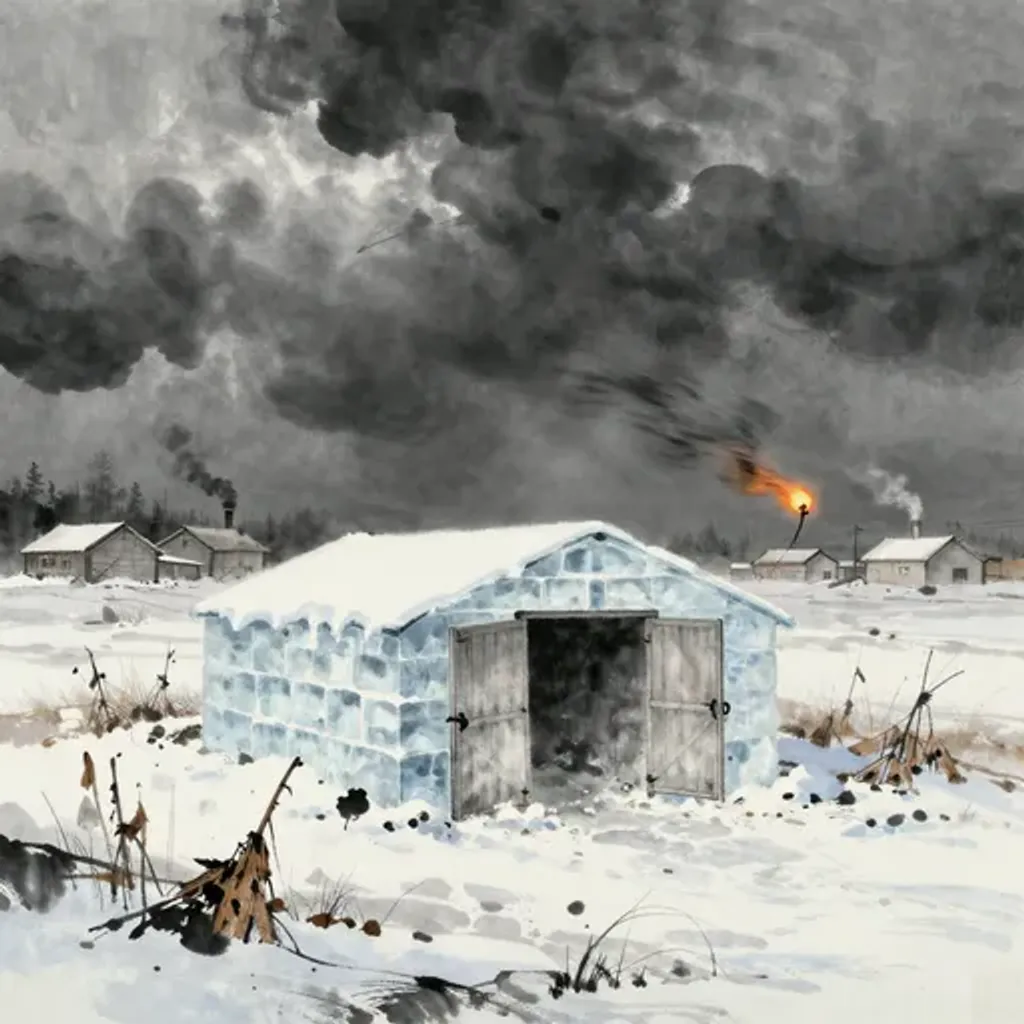
冬無藏冰,春陽不通。陰流為賊,國被其殃。
In winter, no ice is stored; in spring, the yang cannot flow. Yin becomes a hidden thief; the state bears its ruin.
— Jiao Yanshou, Yilin (Forest of Changes), 1st century BC
Commentary
Clouds above heaven shift to thunder bursting from the earth in Enthusiasm. Winter passes without stored ice; spring's yang energy cannot circulate properly. When the seasonal rhythm breaks, yin flows unchecked and becomes pestilential, and the state suffers calamity. The verse draws on the Liji's 'Monthly Ordinances': the Son of Heaven must store ice in winter for summer rituals; failure to do so disrupts the cosmic order. Ice storage was governance made tangible — a ruler who neglects seasonal duties invites natural and political disorder alike. From Waiting to Enthusiasm, the nourishing clouds should have become joyous thunder, but mismanaged timing turns celebration into catastrophe.
需 → 隨
Hexagram 5 → Hexagram 17: Following
Changing lines: 2, 3, 4
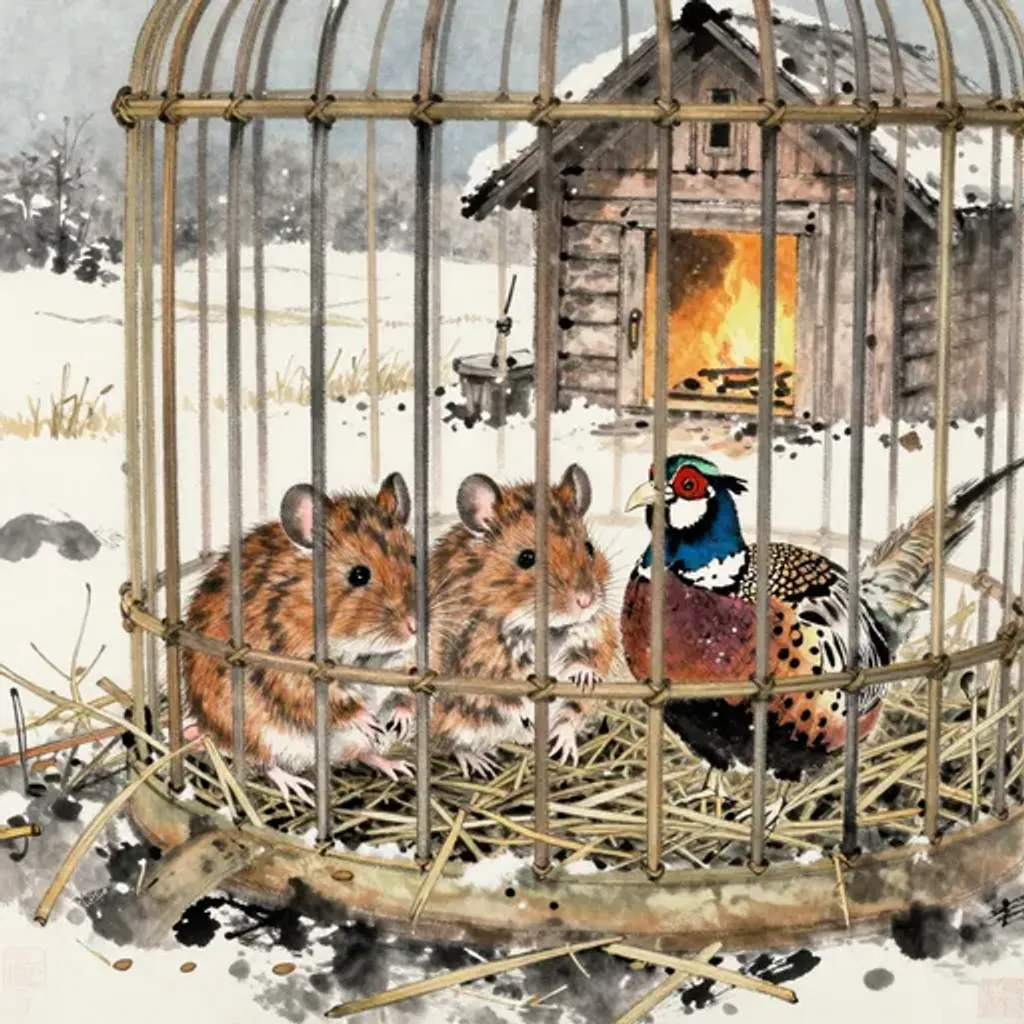
田鼠野雞,意常欲逃。拘制籠檻,不得動搖。
Field mouse and wild pheasant; their desire is always to escape. Confined in cage and pen; they cannot stir or move.
— Jiao Yanshou, Yilin (Forest of Changes), 1st century BC
Commentary
Clouds above heaven give way to thunder resting within the lake — Following's image of yielding to the time. A field rat and a wild pheasant ceaselessly desire to escape, yet they are confined in cage and pen, unable to stir. The creatures' natural instinct is movement and freedom, but circumstance holds them fast. This is not cruelty but the condition of being caught in a system that permits no deviation. From Waiting to Following, the nourishing pause becomes a different kind of stillness: not patient anticipation but enforced compliance. Thunder submerged in the lake suggests energy restrained by its surroundings — one follows not from choice but from the impossibility of resistance.
需 → 蠱
Hexagram 5 → Hexagram 18: Work on the Decayed
Changing lines: 1, 5, 6
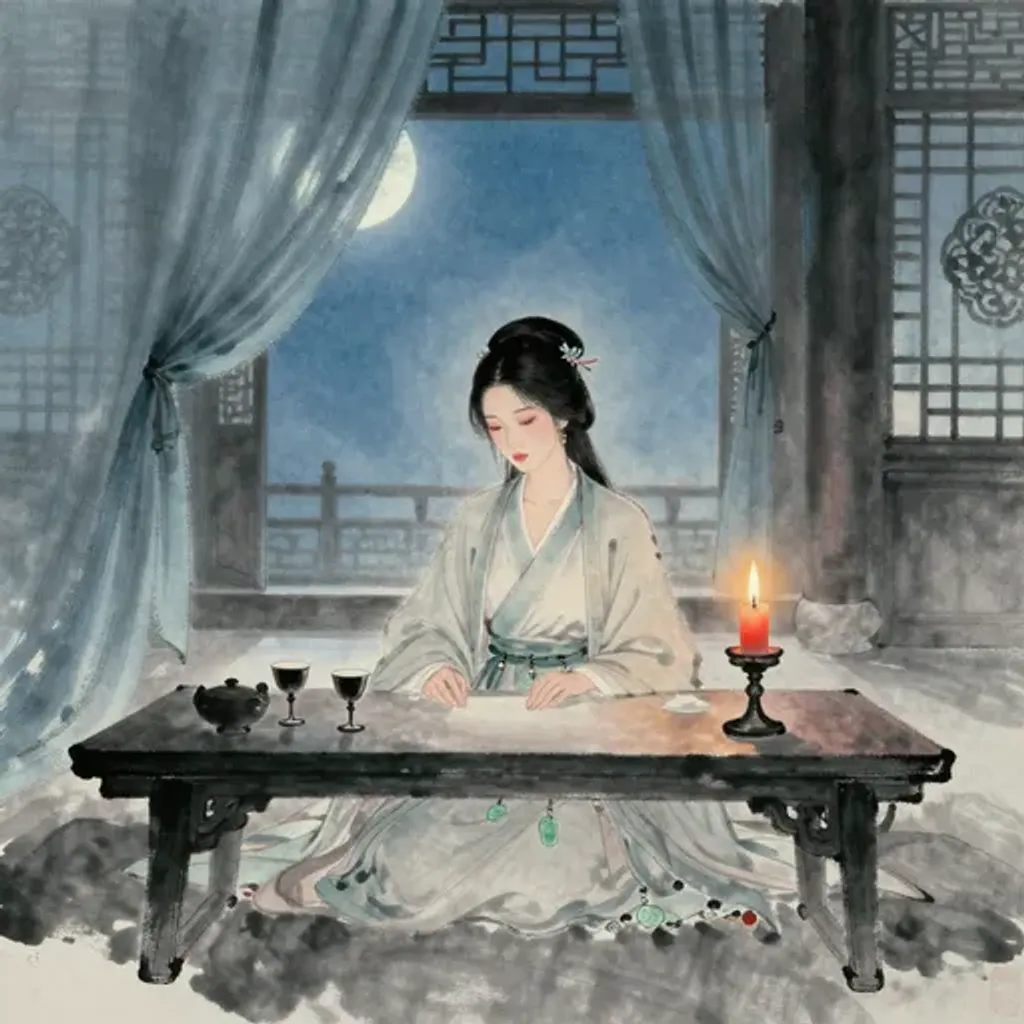
佩玉蕊兮,無所繫之。旨酒一盛,莫與笑語。孤寡獨特,常愁憂苦。
Wearing jade and garland pendants; nowhere to hang them. A full cup of fine wine; none to laugh and talk with. Orphaned and alone; always grieving and sorrowing.
— Jiao Yanshou, Yilin (Forest of Changes), 1st century BC
Commentary
Clouds above heaven yield to wind stirring beneath the mountain — decay in what should be nourishing. Jade pendants hang from a sash with nowhere to fasten; fine wine fills a vessel with no one to share laughter and conversation. Orphaned, widowed, alone and singular, one dwells in perpetual sorrow. The verse is pure lament: every element of social ritual — the ornaments of rank, the wine of fellowship — exists in form but lacks the human bonds that give them meaning. Adornment without occasion, wine without company. From Waiting to Work on the Decayed, what once nourished has rotted from within: relationships have collapsed, and the solitary figure amid useless finery embodies the corruption that must be repaired.
需 → 臨
Hexagram 5 → Hexagram 19: Approach
Changing lines: 3, 5
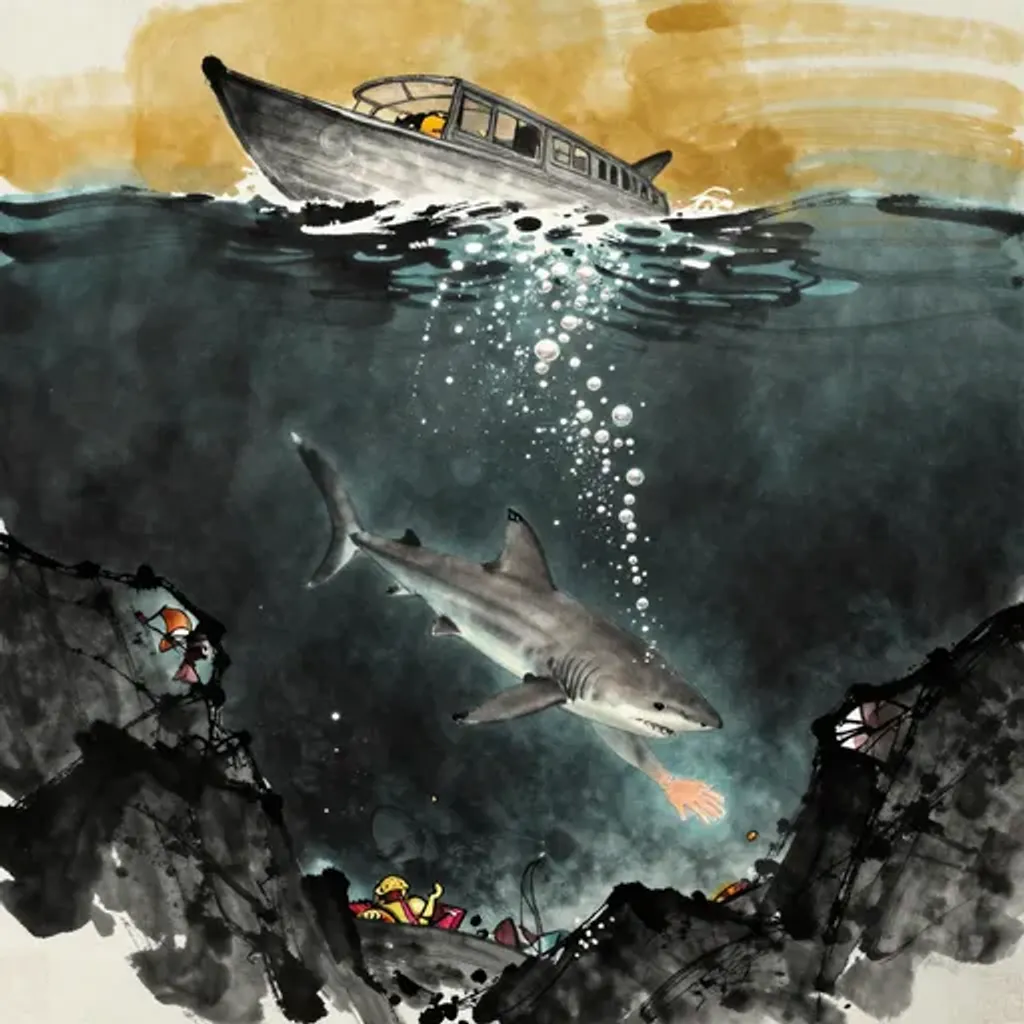
沒游源口,求鮫為寶。家危自懼,復出生道。
Diving to the source’s mouth, seeking the shark as treasure. The household endangered, oneself afraid; but one emerges again on the road of life.
— Jiao Yanshou, Yilin (Forest of Changes), 1st century BC
Commentary
Clouds above heaven give way to the lake's edge where the earth watches over rising waters. A diver plunges into the mouth of a spring, seeking a shark-pearl as treasure. The household faces danger and one grows afraid, yet a path of survival opens and one emerges alive. The 'shark-pearl' (鮫) references the mermaid-pearls of southern legend — treasures found only in the deepest, most perilous waters. Risk taken at the extremity of need yields a way out. From Waiting to Approach, the patient clouds become the earth overlooking the lake: one who descends into danger and returns brings back not just survival but the authority of direct experience, which is precisely what 'approach' demands — drawing near to what matters.
需 → 觀
Hexagram 5 → Hexagram 20: Contemplation
Changing lines: 1, 2, 3, 6
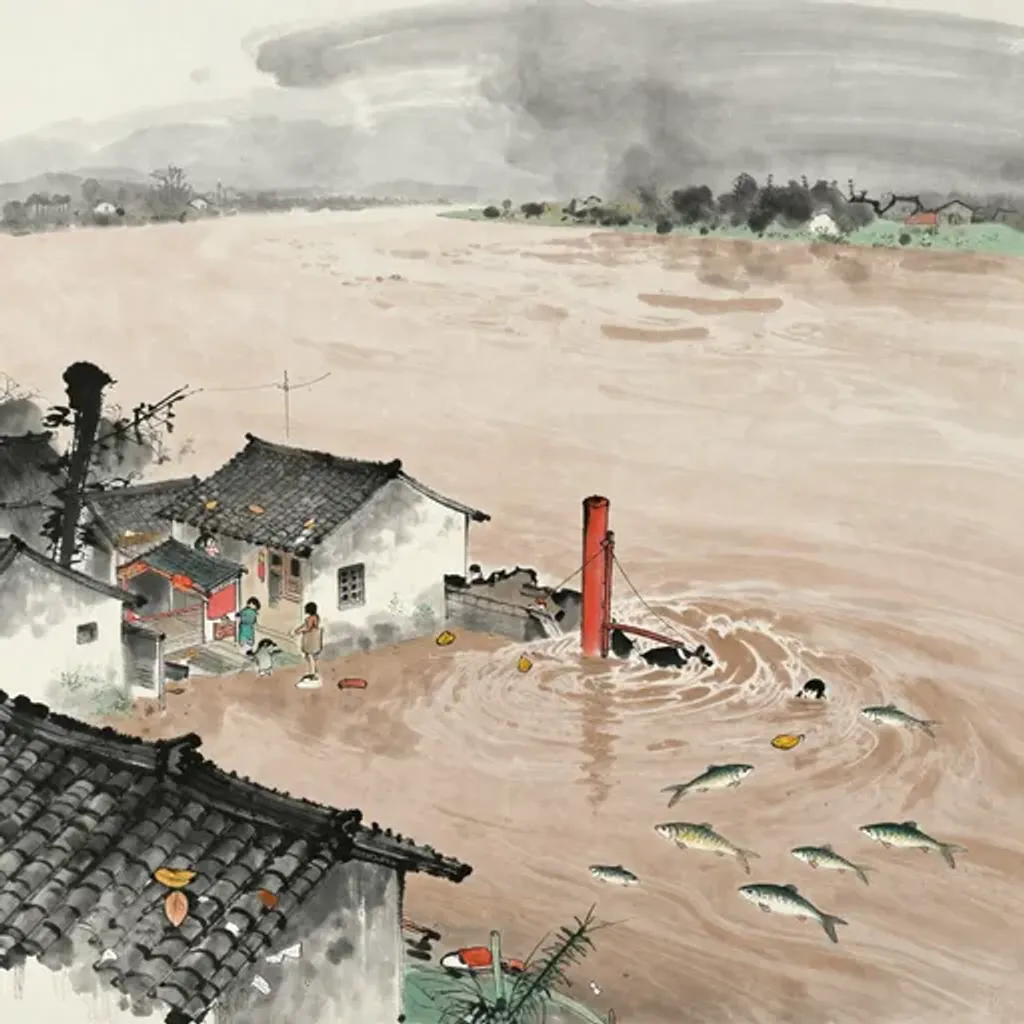
河水孔穴,壞敗我室。水深無岸,魚鱉傾側。
River water breaches the hole, wrecking and ruining my house. The water is deep, with no shore; fish and turtles are tossed about.
— Jiao Yanshou, Yilin (Forest of Changes), 1st century BC
Commentary
Clouds above heaven become wind sweeping over the earth in Contemplation — but what is observed here is devastation. River water bursts through openings and breaches, destroying our dwellings. The water deepens until no bank remains; fish and turtles tumble sideways in the torrent. The verse depicts a flood beyond containment: not the nourishing rain promised by Waiting's clouds, but a catastrophic overflow that obliterates the boundary between river and land. From Waiting to Contemplation, the transformation asks: what do you see when you truly look? Wind over earth surveys all without obstruction — and what it surveys here is ruin. Contemplation without the power to act becomes helpless witness to destruction.
需 → 噬嗑
Hexagram 5 → Hexagram 21: Biting Through
Changing lines: 2, 3, 4, 5, 6
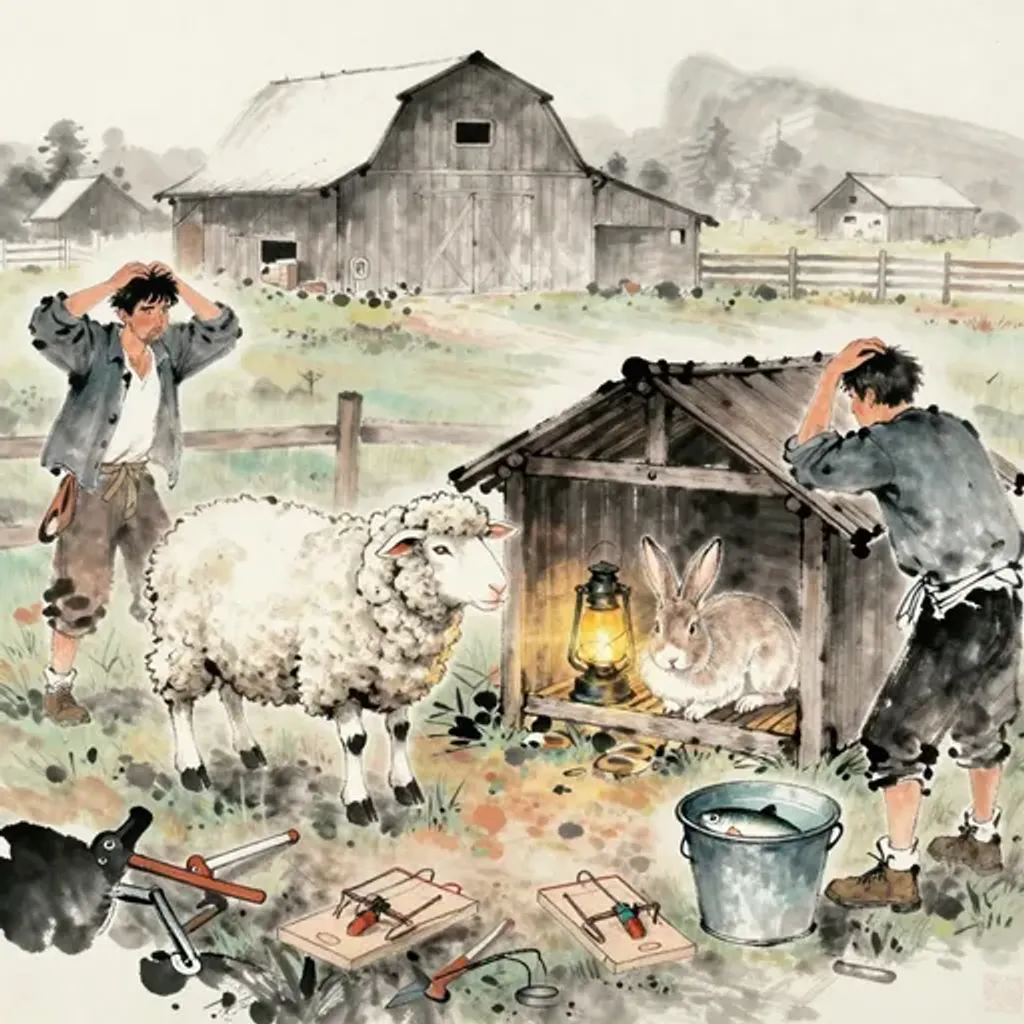
教羊牧兔,使魚捕鼠。任非其人,費日無功。
Teaching sheep to herd rabbits; sending fish to catch mice. Appointing the wrong person; days are wasted to no avail.
— Jiao Yanshou, Yilin (Forest of Changes), 1st century BC
Commentary
Clouds above heaven give way to lightning and thunder biting through obstacles — yet the wrong teeth are applied. Teaching sheep to herd rabbits, sending fish to catch mice: every creature is assigned a task contrary to its nature. 'Employing the wrong person for the role wastes days without result.' The verse is a crisp parable of misgovernance: competence misplaced is competence destroyed. From Waiting to Biting Through, the transformation highlights the gap between having the mechanism of justice and wielding it correctly. Biting Through's image is lightning clarifying what thunder enforces — but when the enforcer is a fish chasing mice, the system bites nothing at all.
需 → 賁
Hexagram 5 → Hexagram 22: Grace
Changing lines: 2, 5, 6
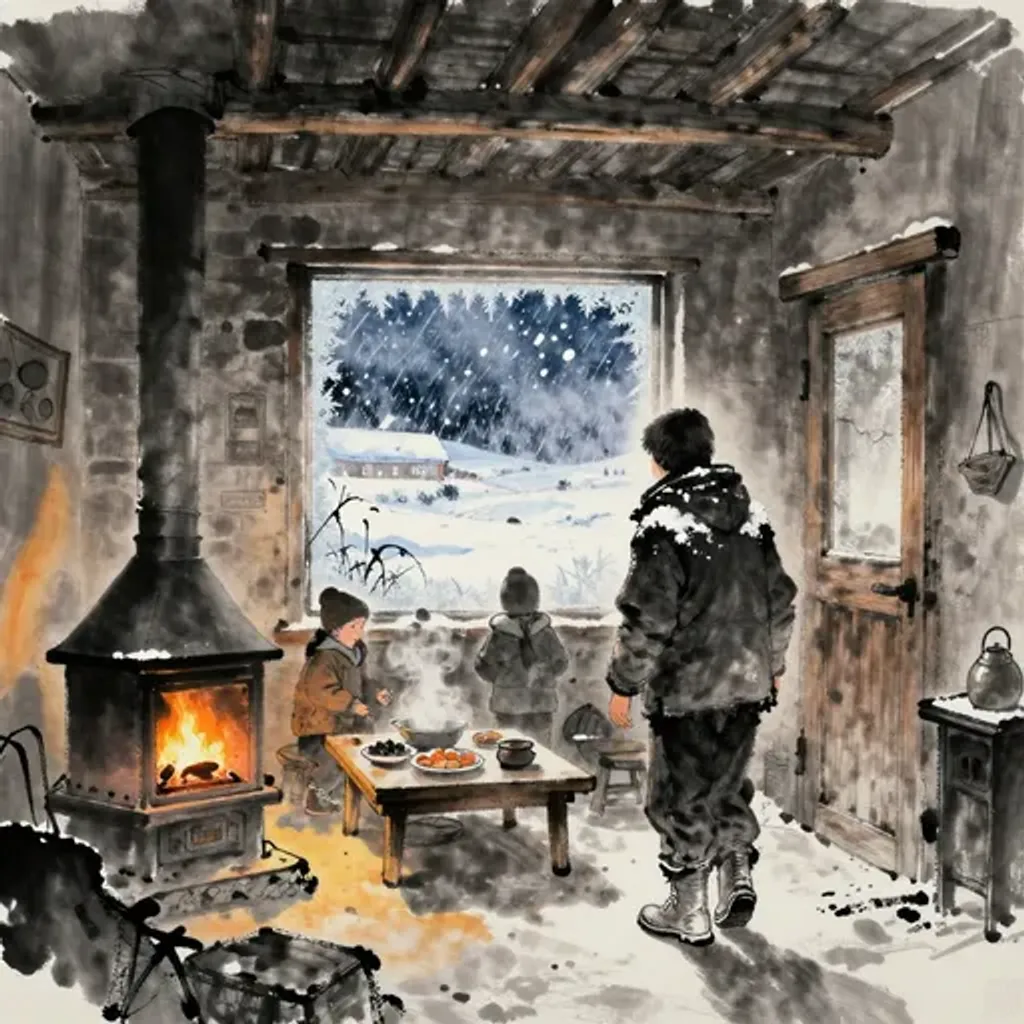
升戶入室,就溫燠食。冰凍北陸,不能相賊。
Ascending the steps, entering the room; approaching warmth and eating. The ice freezes on the northern road; it cannot cause harm.
— Jiao Yanshou, Yilin (Forest of Changes), 1st century BC
Commentary
Clouds above heaven yield to fire glowing beneath the mountain — Grace adorning what shelter provides. One ascends the threshold, enters the chamber, and draws near the warmth to eat. Outside, ice grips the northern roads, yet the cold cannot harm those within. The verse celebrates the simple grace of domestic refuge: a warm room, food on the table, winter locked outside. The contrast between inner comfort and outer severity is the essence of adornment understood rightly — not decoration for show, but beauty that serves life. From Waiting to Grace, nourishment finds its form: the fire beneath the mountain illuminates a sheltered interior where waiting ends in the quiet satisfaction of being fed and warmed.
需 → 剝
Hexagram 5 → Hexagram 23: Splitting Apart
Changing lines: 1, 2, 3, 5, 6
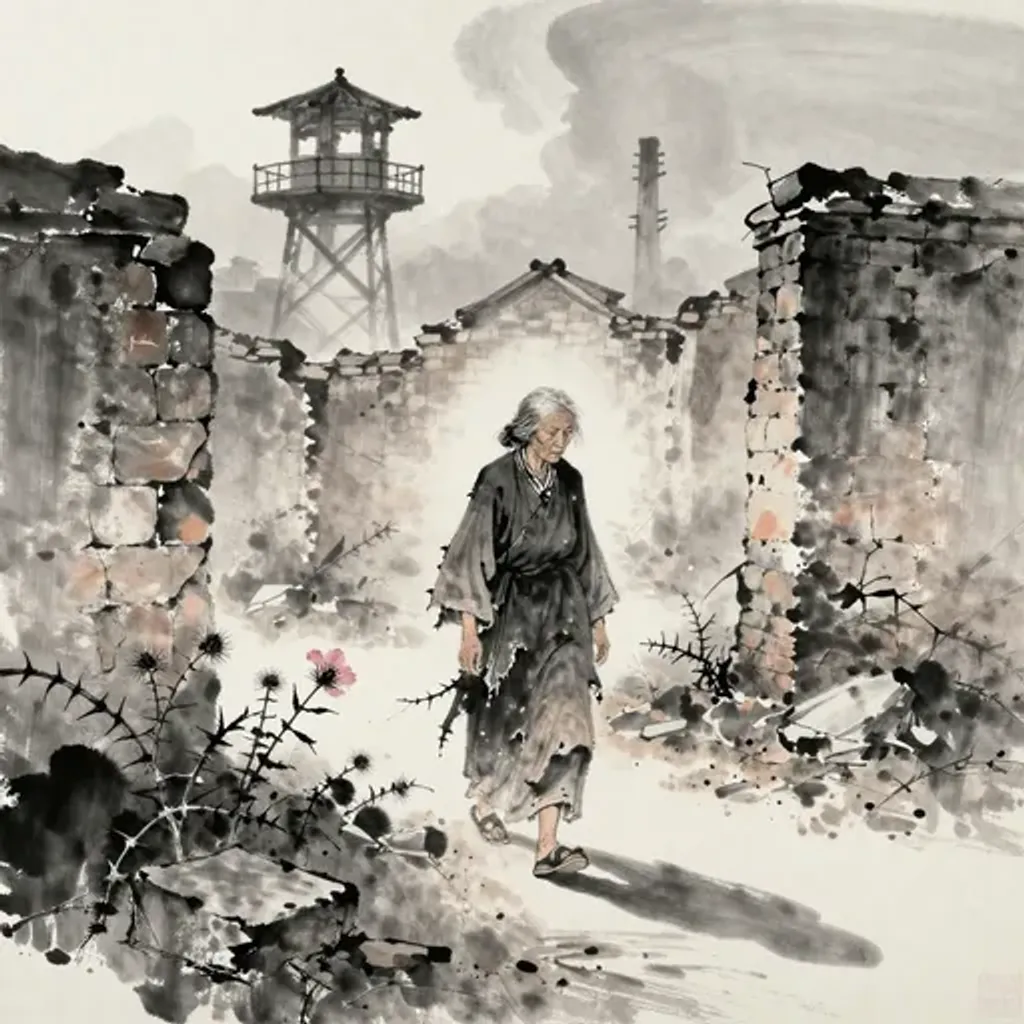
孤竹之墟,老婦无夫。傷於蒺藜,不見少妻。東郭堂姜,武氏破亡。
The ruins of Guzhu; an old woman without a husband. Wounded by caltrops; the young wife unseen. Dongguo Tang Jiang; the Wu clan is destroyed.
— Jiao Yanshou, Yilin (Forest of Changes), 1st century BC
Commentary
Clouds above heaven crumble into the mountain splitting from the earth. The ruins of Guzhu — homeland of Boyi and Shuqi — become a desolate widow's landscape: an old woman without a husband, wounded by thorns, unable to find a young wife for her household. Then the verse pivots to another tale of desire and destruction: Tangjiang of the Eastern Wall and the downfall of the Wu clan. Tangjiang was the beautiful widow of Lord Tang of Qi, whose remarriage to the powerful minister Cui Zhu led to an affair with Duke Zhuang of Qi, culminating in the duke's assassination and Cui Zhu's own ruin. From Waiting to Splitting Apart, the nourishing order erodes completely: beauty misplaced becomes the agent of collapse.
需 → 復
Hexagram 5 → Hexagram 24: Return
Changing lines: 2, 3, 5
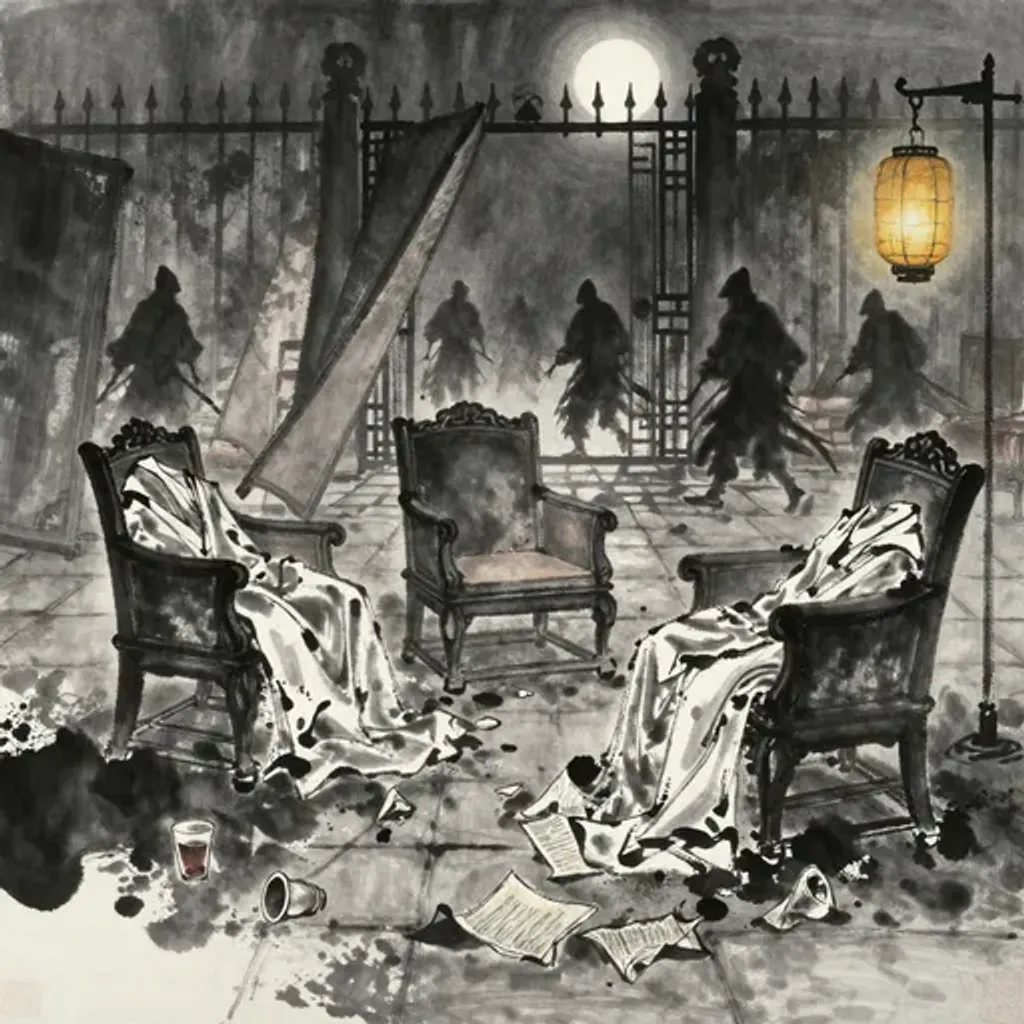
凶禍災殃,日益明彰。福不可釐,三郤夷傷。
Calamity and disaster; daily growing more manifest. Blessings cannot be had; the three Xi are wounded and brought low.
— Jiao Yanshou, Yilin (Forest of Changes), 1st century BC
Commentary
Clouds above heaven give way to thunder returning within the earth. Misfortune and calamity grow clearer by the day, their evidence mounting. Blessings cannot be restored, and the Three Xi are wounded and destroyed. The 'Three Xi' refers to Xi Qi, Xi Chou, and Xi Zhi — three powerful ministers of the Xi clan in Jin who held three of the state's highest military commands simultaneously. In 574 BC, Duke Li of Jin conspired with Luan Shu to have all three assassinated on a single day, eliminating a dangerously overgrown faction. From Waiting to Return, the thunder buried in the earth stirs: what seemed dormant erupts, and the return is not of good fortune but of consequences long accumulating beneath the surface.
需 → 无妄
Hexagram 5 → Hexagram 25: Innocence
Changing lines: 2, 3, 4, 6
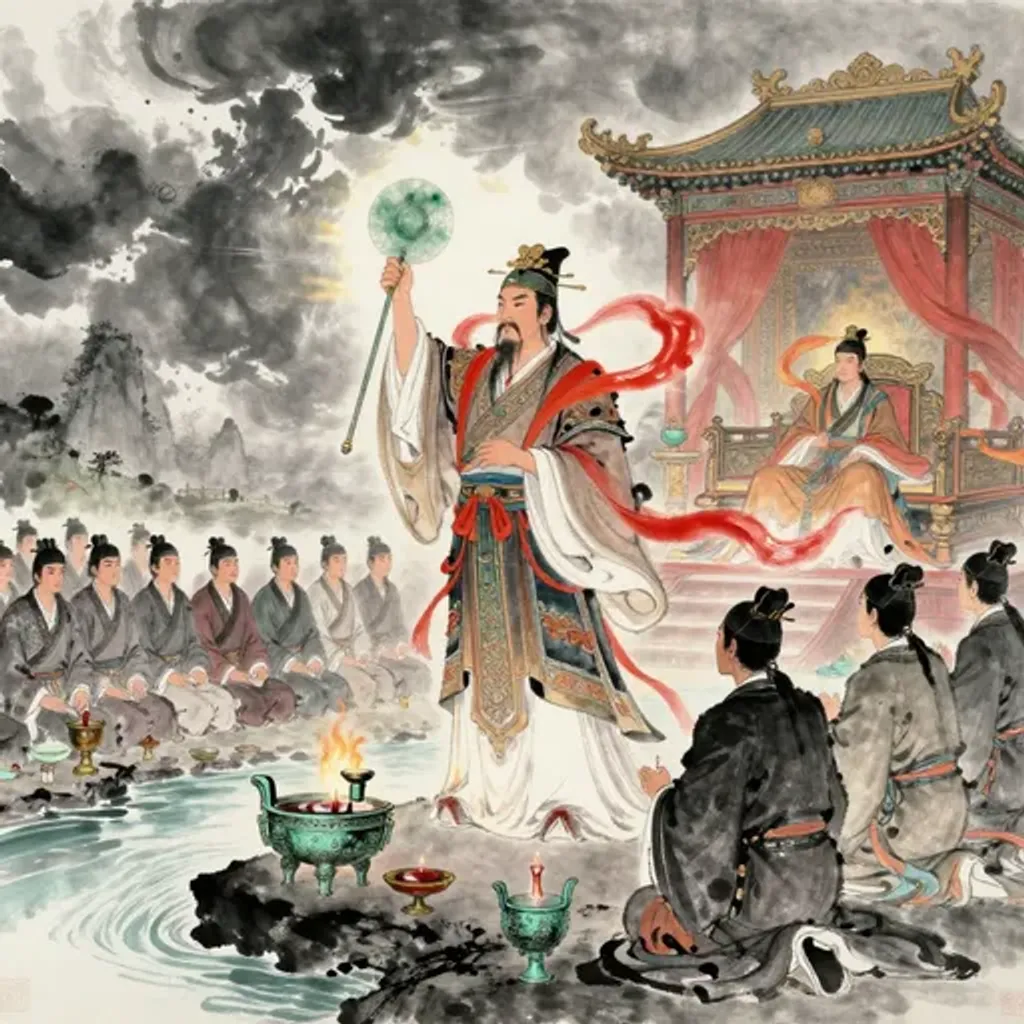
載璧秉珪,請命于河。周公作誓,沖人瘳愈。
Bearing jade disc and scepter; offering prayers at the river. Duke Zhou composed the oath; the young king was healed.
— Jiao Yanshou, Yilin (Forest of Changes), 1st century BC
Commentary
Clouds above heaven align with thunder moving beneath heaven in Innocence — the purest alignment of inner and outer. Bearing jade bi and holding the gui scepter, one entreats the spirits at the River altar. The Duke of Zhou composes his oath, and the young king recovers from illness. This directly references the 'Jinteng' (Metal-Bound Casket) chapter of the Book of Documents: when King Wu fell gravely ill, the Duke of Zhou set up three altars, held bi and gui, and offered his own life in exchange for his brother's. The divination was thrice auspicious; the king recovered the next day. From Waiting to Innocence, patient trust becomes active sincerity without calculation — the only force that moves heaven.
需 → 大畜
Hexagram 5 → Hexagram 26: Great Taming
Changing lines: 5, 6
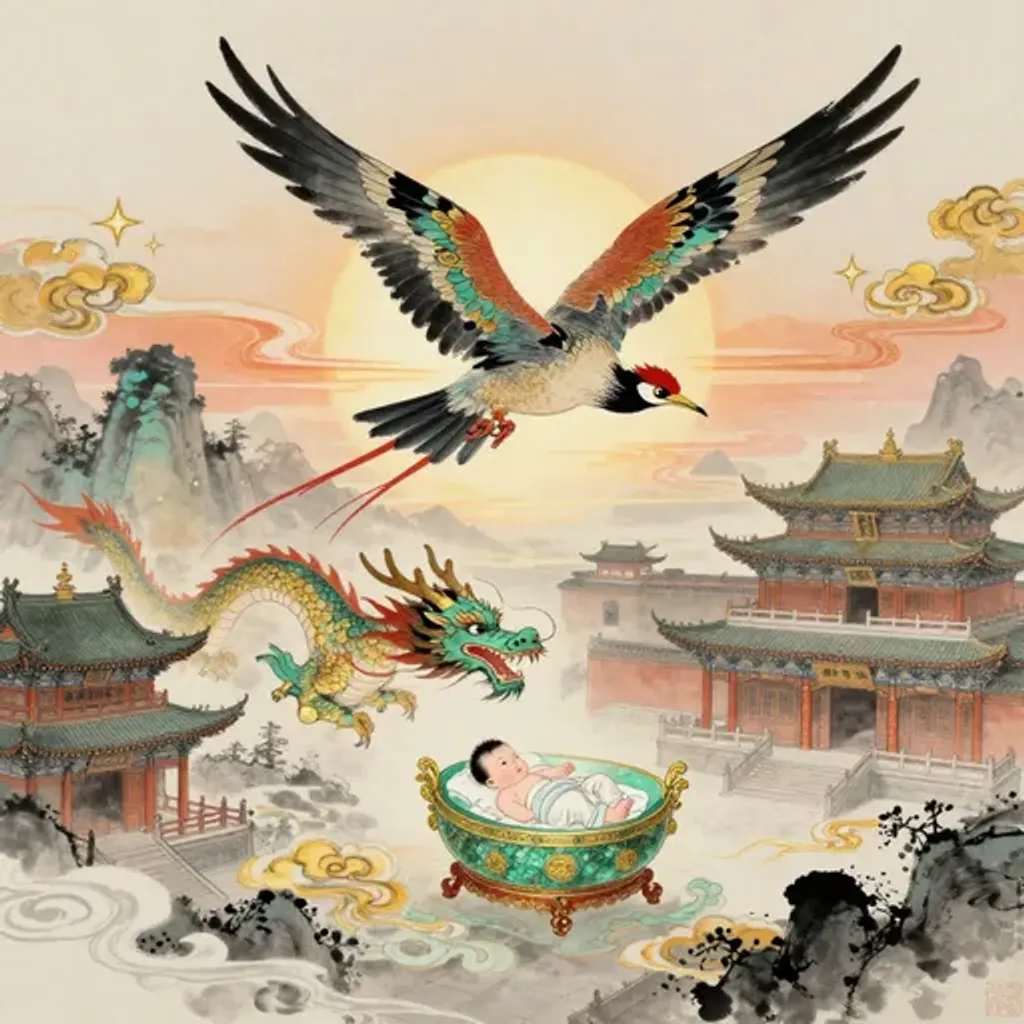
鳥升鵲舉,照臨東海。龍降庭堅,為陶叔後。封圻英六,履祿綏厚。
The bird soars, the magpie rises; shining over the Eastern Sea. The dragon descends at Tingjian; becoming ancestor of Lord Taoshu. Enfeoffed at Ying and Liu; treading on blessings, emolument thick and generous.
— Jiao Yanshou, Yilin (Forest of Changes), 1st century BC
Commentary
Clouds above heaven concentrate into heaven stored within the mountain — Great Taming's vast reserve. Birds ascend and magpies rise, their light shining over the Eastern Sea. A dragon descends to Tingjian, becoming the ancestor of Lord Tao, whose descendants were enfeoffed at Ying and Liu with rich emoluments. The verse traces a lineage from celestial omen to earthly reward: Tingjian likely refers to Gao Yao (皋陶), the legendary minister of justice whose descendants received the fiefdoms of Ying and Liu. 'Lord Tao' may be a variant title for this lineage. From Waiting to Great Taming, patient nourishment transforms into accumulated virtue across generations — heaven stored in the mountain as ancestral merit laid down for posterity.
需 → 頤
Hexagram 5 → Hexagram 27: Nourishment
Changing lines: 2, 3, 5, 6
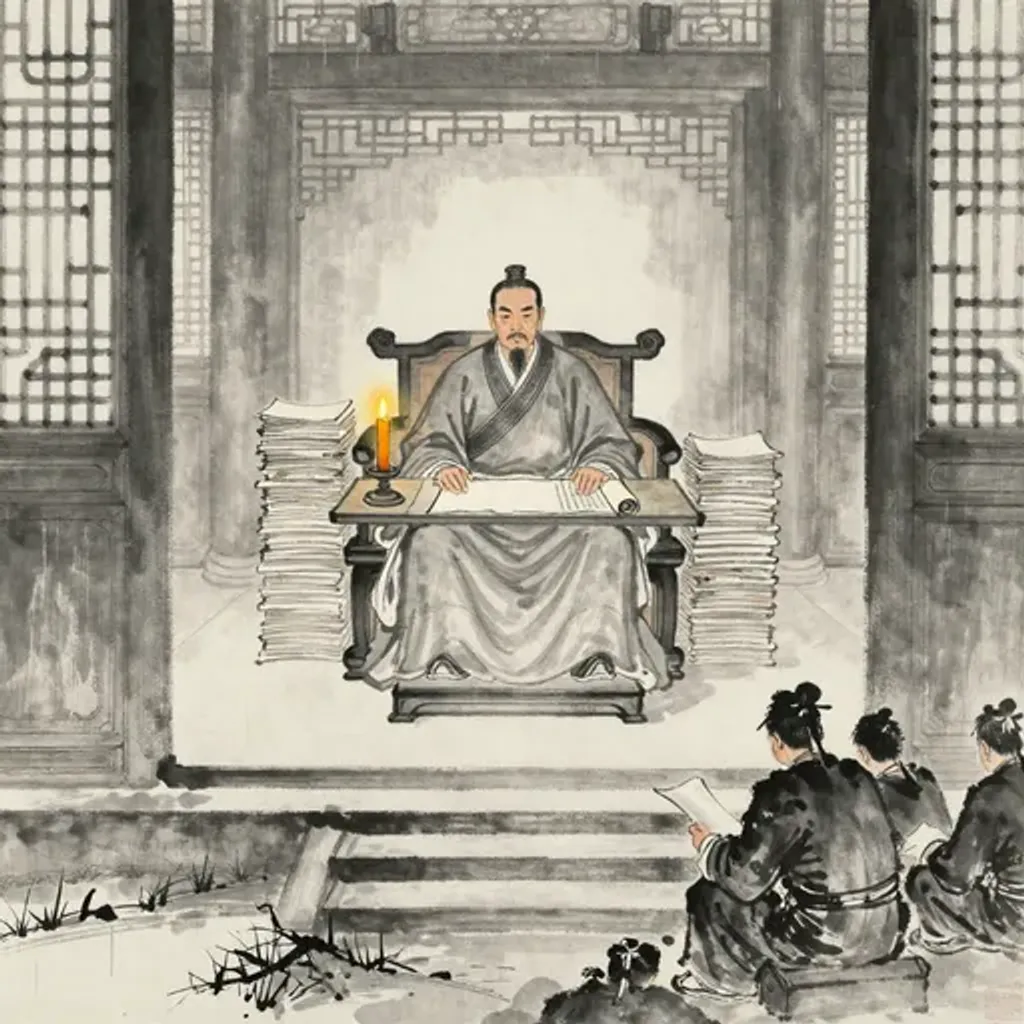
危坐至暮,請求不得。膏澤不降,政戾民忒。
Sitting upright until nightfall; petitions are not granted. Rich bounty does not descend; governance errs, the people go astray.
— Jiao Yanshou, Yilin (Forest of Changes), 1st century BC
Commentary
Clouds above heaven descend to the mountain holding still above thunder — Nourishment's image of careful tending. Yet here the feeding fails: one sits upright in formal posture until evening, petitioning without success. Nourishing moisture does not fall; governance goes astray and the people suffer. The image is of a supplicant waiting in rigid ceremony for relief that never comes — a ruler or official who follows form but produces no substance. 'Rich dew does not descend' inverts the promise of Waiting's clouds. From Waiting to Nourishment, the irony is precise: the hexagram of feeding is reached, but nothing is fed. The mountain sits upon the thunder, and the mouth that should nourish remains shut.
需 → 大過
Hexagram 5 → Hexagram 28: Great Exceeding
Changing lines: 1, 4
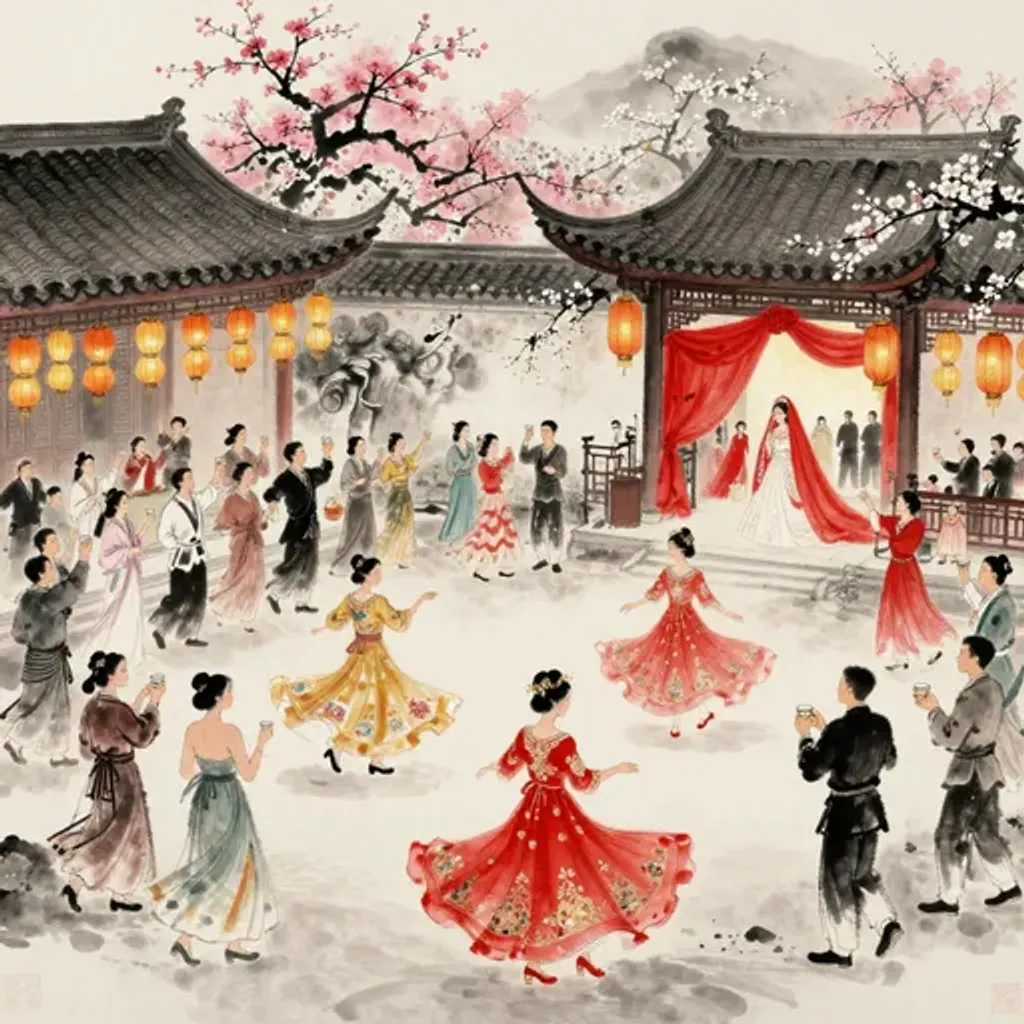
宜昌娶婦,東家歌舞。宴樂有序,長樂嘉喜。
It is fitting to marry and take a bride in prosperous times; the eastern household sings and dances. Banquets and joy are in proper order; long happiness and fine delight.
— Jiao Yanshou, Yilin (Forest of Changes), 1st century BC
Commentary
Clouds above heaven part to reveal the lake submerging the trees — Great Exceeding's image of extraordinary weight and moment. Yet the verse sings of joy: 'It is fitting and auspicious to take a bride; the eastern house dances and sings. Feasting proceeds in proper order; lasting joy and excellent delight.' Marriage, celebration, and ritual harmony fill the scene. The name 'Yichang' may simply mean 'fitting prosperity.' Great Exceeding often marks a threshold — events of unusual magnitude, whether crisis or triumph. Here the excess is joyous: a wedding so abundant it strains the ordinary frame. From Waiting to Great Exceeding, patient nourishment culminates in a moment that exceeds the everyday — the extraordinary feast that crowns long anticipation.
需 → 坎
Hexagram 5 → Hexagram 29: The Abysmal Water
Changing lines: 1, 3
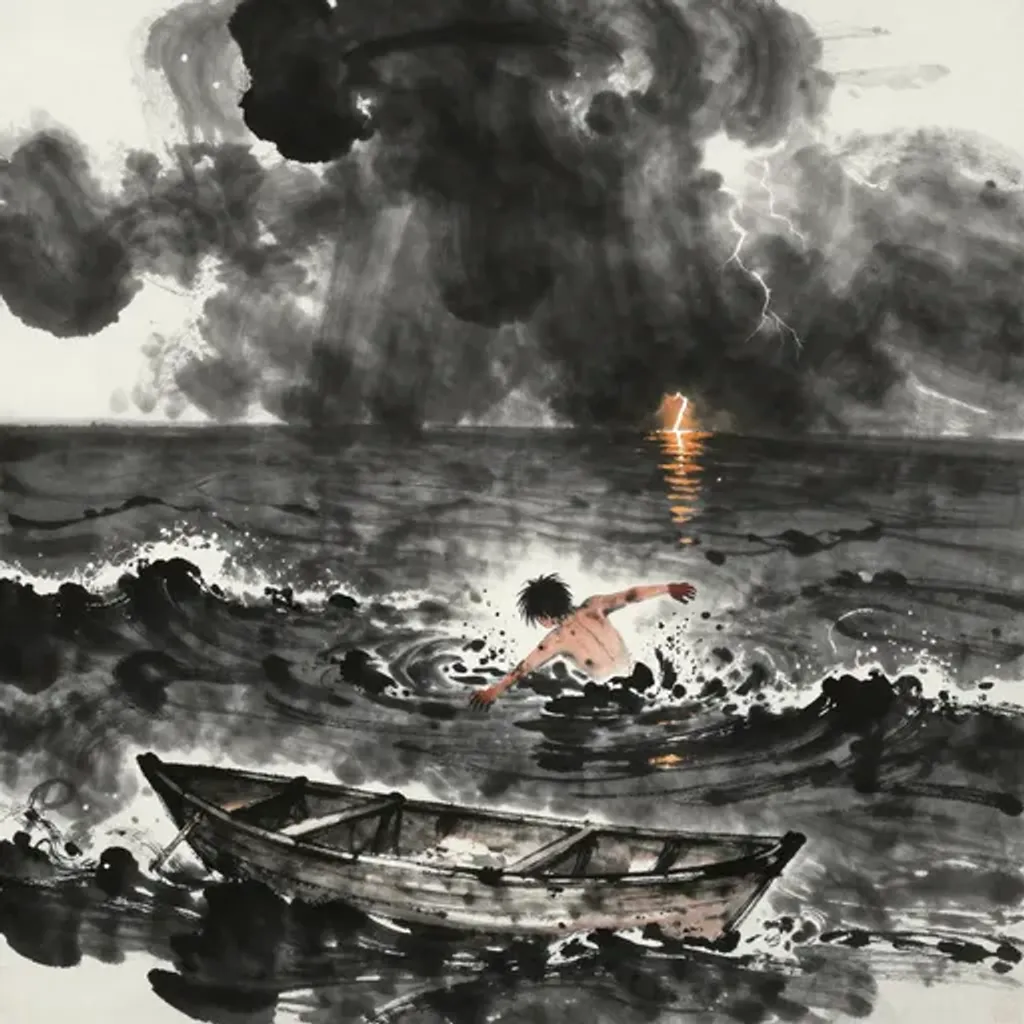
鑿井求玉,非卞氏寶。名困身辱,勞無所得。
Fishing for a needle on the sea floor — wasting all one's time. Hands wounded, fingers split — not a single thing recovered.
— Jiao Yanshou, Yilin (Forest of Changes), 1st century BC
Commentary
Clouds above heaven plunge into doubled water — the Abysmal upon the Abysmal. The original verse reads: 'Drilling a well in search of jade — this is not Bian He's treasure. Fame is trapped, the body disgraced; labor yields nothing.' Bian He thrice presented his uncut jade to kings who punished him for fraud, losing both feet before the stone was finally recognized as priceless. Here the seeker digs in the wrong medium entirely: jade is not found in wells. The allusion inverts the Sui-He treasures motif — effort misdirected not once but systematically. From Waiting to The Abysmal, patience falls into a pit: the nourishing waters become the abyss one drowns in when seeking treasure where none exists.
需 → 離
Hexagram 5 → Hexagram 30: The Clinging Fire
Changing lines: 2, 4, 5, 6
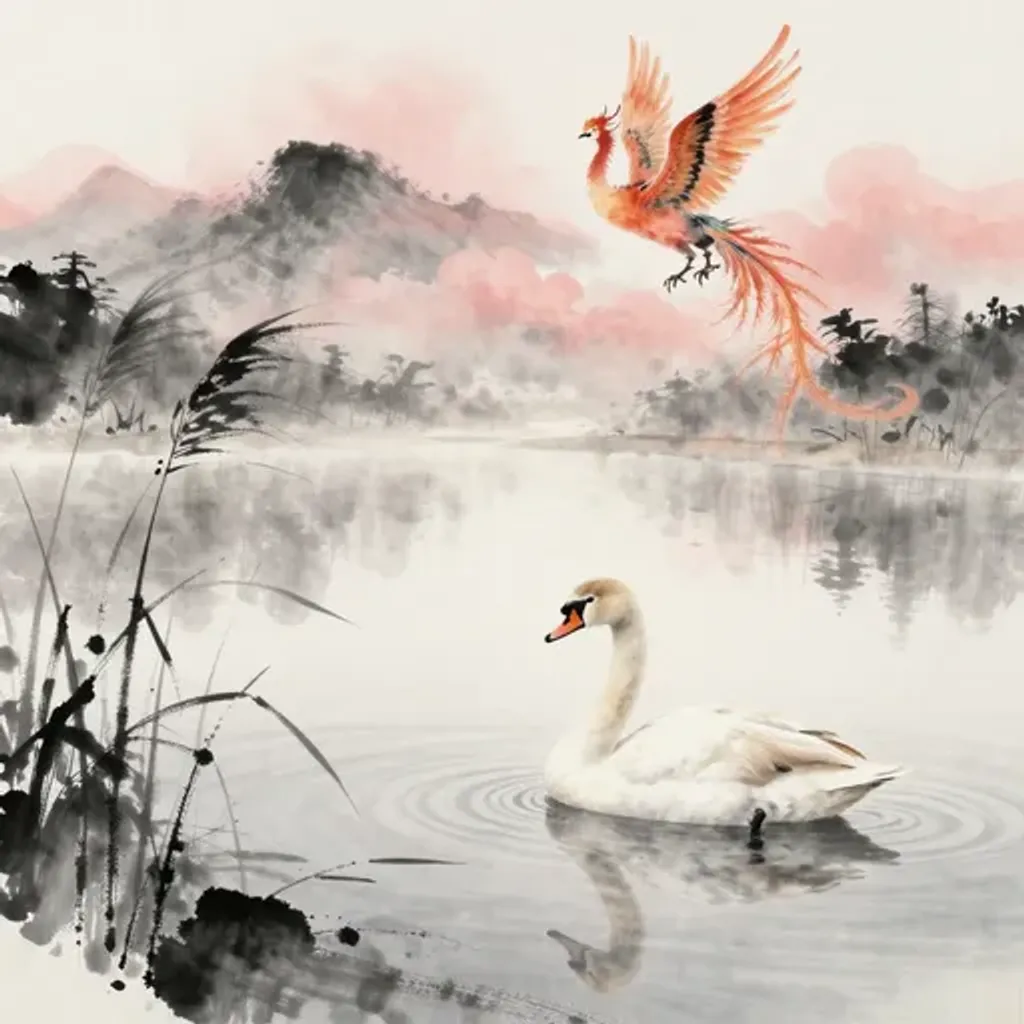
鵠思其雄,欲隨鳳東。順理羽翼,出次須日。中留北邑,復反其室。
The swan-goose yearns for her mate and would follow the phoenix east. She grooms and preens her feathers; she goes out, then waits for the right day. Lingering at a northern town, she returns again to her home.
— Jiao Yanshou, Yilin (Forest of Changes), 1st century BC
Commentary
Clouds above heaven give way to doubled fire — the Clinging's twin brightness. A female swan longs for her mate and wishes to follow the phoenix eastward. She preens her feathers and wings, prepares to depart, and awaits the proper day. Yet midway she lingers at a northern settlement and returns to her own chamber. The longing is genuine, the preparation real, but the journey is abandoned. The 'phoenix' she would follow represents an ideal companion or destiny; the 'northern settlement' where she pauses represents the pull of the familiar. From Waiting to The Clinging, nourishment becomes illumination — but double fire also means one flame reflecting another. She sees clearly what she desires yet clings to what she knows, light without forward motion.
需 → 咸
Hexagram 5 → Hexagram 31: Influence
Changing lines: 1, 2, 4
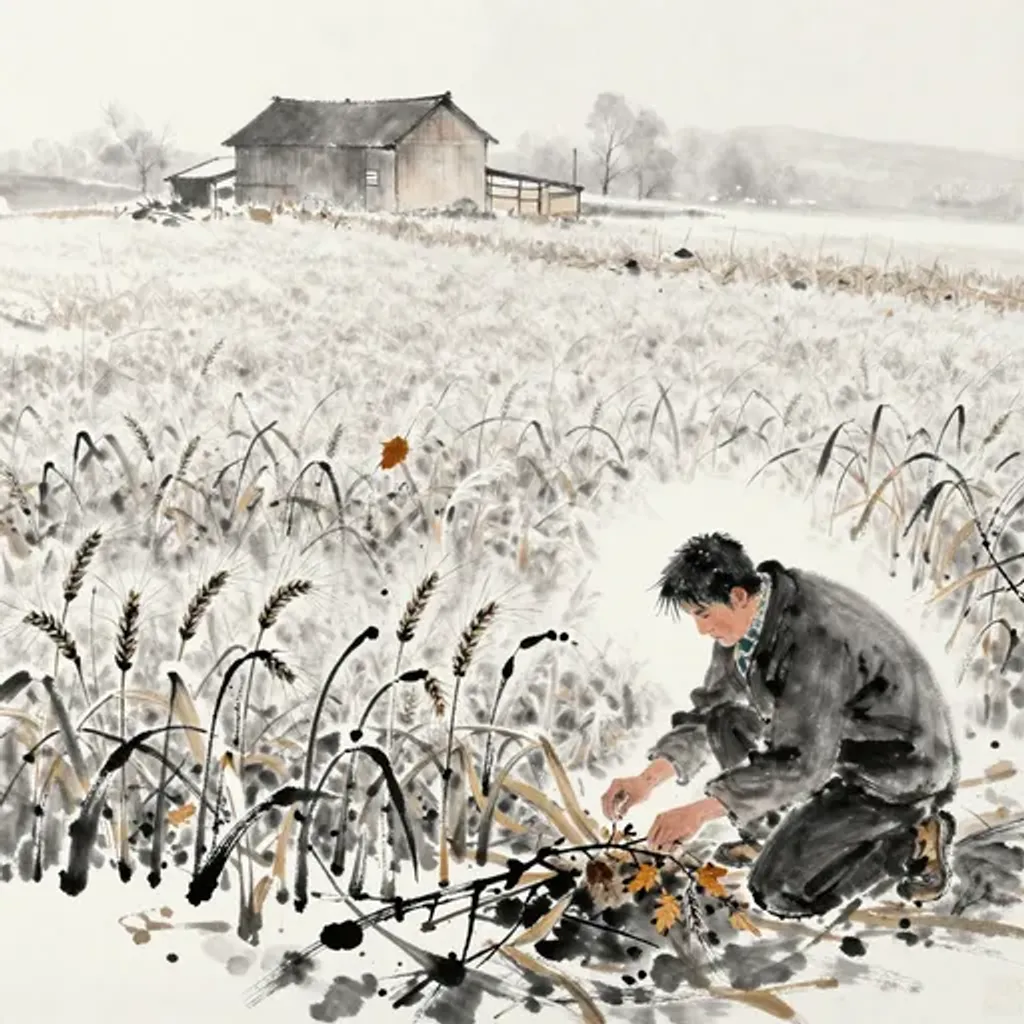
早霜晚雪,傷害禾麥。損功棄力,飢無所食。
Early frost, late snow; they harm the grain and wheat. Effort is lost, labor discarded; starving, there is nothing to eat.
— Jiao Yanshou, Yilin (Forest of Changes), 1st century BC
Commentary
Clouds above heaven meet the lake resting upon the mountain — Influence's image of mutual responsiveness. But here the response is destructive: early frost and late snow damage grain and wheat. Effort is wasted, strength squandered; hungry, there is nothing to eat. The verse describes a season where cold comes at both ends, bracketing the growing period with killing frost. The crops that Waiting's clouds should have nourished are instead destroyed by mistimed weather. From Waiting to Influence, the connection that should be life-giving becomes lethal: heaven and earth respond to each other, but the response is punishing cold rather than gentle warmth. Sensitivity without kindness is simply a more efficient way to wound.
需 → 恆
Hexagram 5 → Hexagram 32: Duration
Changing lines: 1, 4, 5
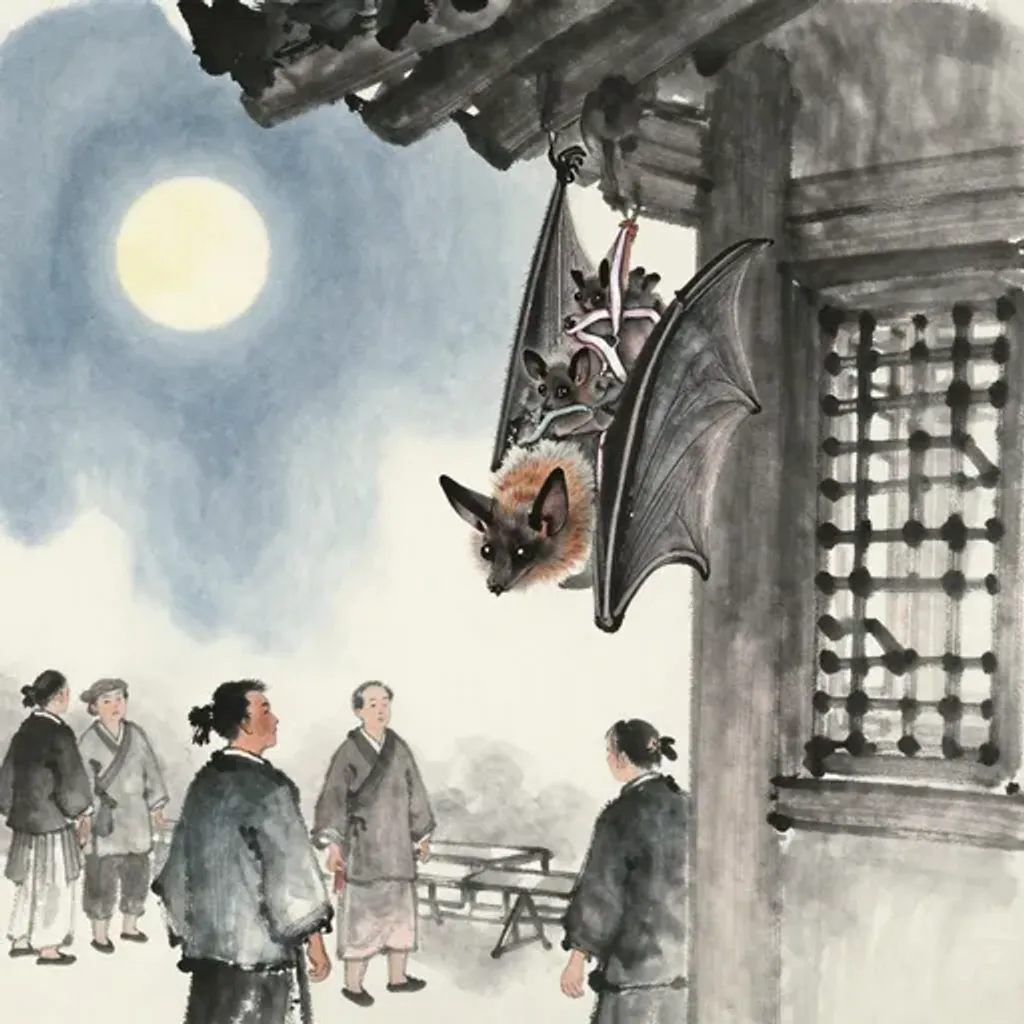
蝙螺生子,深目黑醜。雖飾相就,眾人莫取。
The bat gives birth; the offspring are deep-eyed and ugly. Though adorned and dressed up for display, no one will take them.
— Jiao Yanshou, Yilin (Forest of Changes), 1st century BC
Commentary
Clouds above heaven harden into thunder and wind in Duration — the persistence of fixed patterns. A bat-snail bears offspring with deep-set eyes, dark and ugly. Though adorned and brought forward to be matched, no one will have them. The creature's grotesque progeny cannot be beautified by cosmetics or social effort; the defect is inherent and enduring. Duration here means the persistence of an unappealing condition that no amount of surface treatment can alter. From Waiting to Duration, patient nourishment calcifies into unchanging form: what was meant to develop instead fixes in place, and the thunder-wind pattern that should sustain becomes the repetition of the same unlovely shape, generation after generation.
需 → 遯
Hexagram 5 → Hexagram 33: Retreat
Changing lines: 1, 2, 4, 6
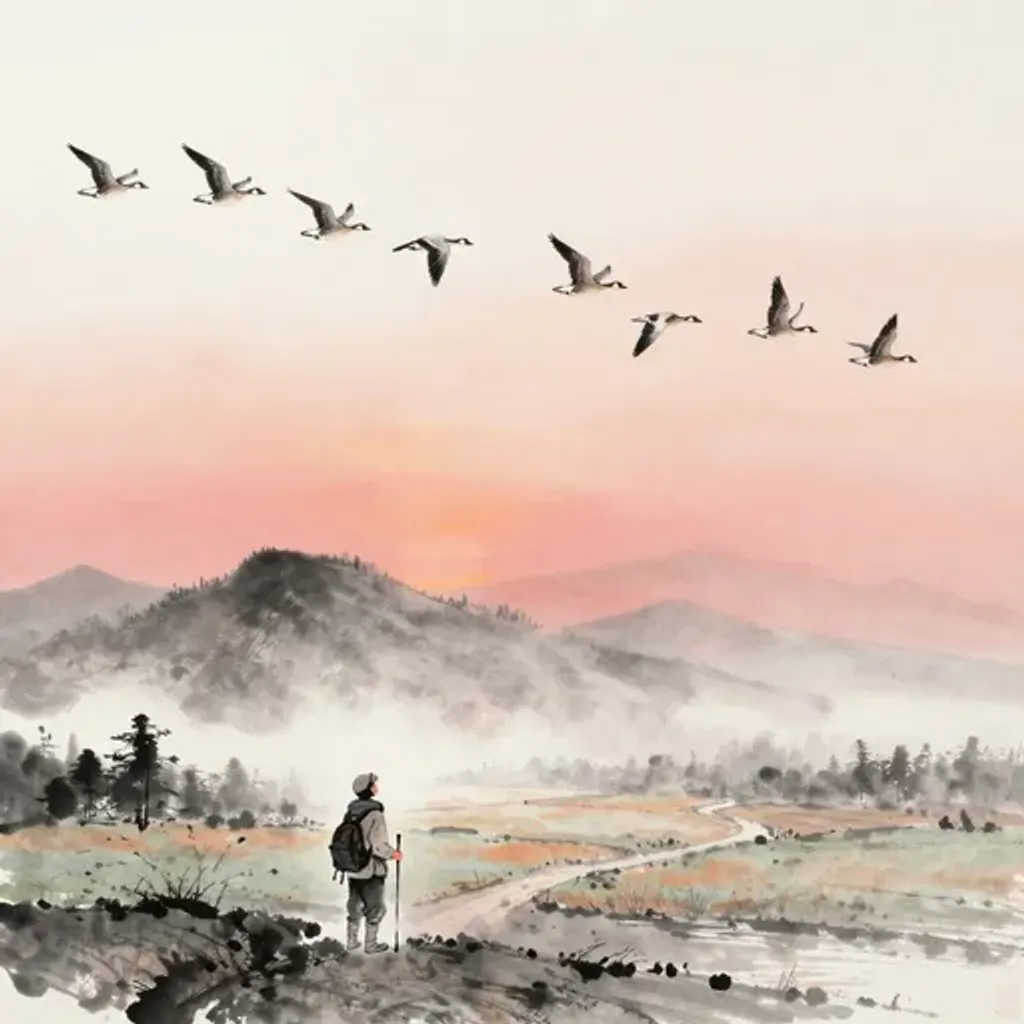
去如飛鴻,避凶且東。遂得全脫,與福相逢。
Departing like a wild goose in flight, fleeing misfortune toward the east. Thus one escapes and breaks free; meeting blessing along the way.
— Jiao Yanshou, Yilin (Forest of Changes), 1st century BC
Commentary
Clouds above heaven shift to heaven towering above the mountain — Retreat's spacious withdrawal. One departs like a flying wild goose, avoiding danger and heading east. Through swift departure, one achieves complete escape and encounters good fortune. The wild goose, the Yijing's emblem of gradual progress and timely movement, here becomes the image of well-judged flight from peril. The verse is unambiguous: when the moment demands retreat, the wise move fast and far. 'Eastward' may simply mean 'toward safety' or invoke the direction of renewal. From Waiting to Retreat, the nourishing patience of Xu transforms into the wisdom of knowing when to stop waiting and leave — retreat as the highest form of self-preservation.
需 → 大壯
Hexagram 5 → Hexagram 34: Great Power
Changing lines: 4, 5
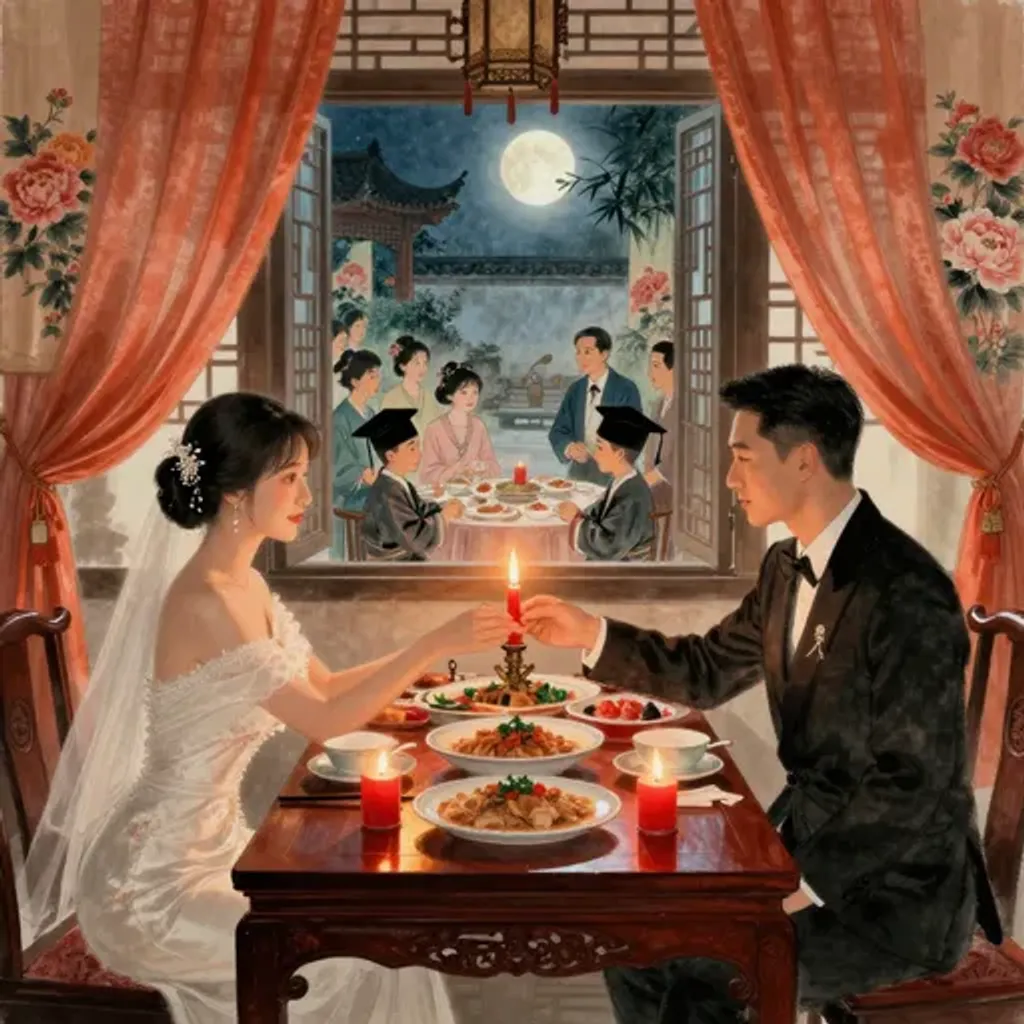
婚姻合配,同枕共牢。以降休嘉,子孫封侯。
Marriage well matched; sharing pillow and bridal feast. Bringing down fine auspiciousness; sons and grandsons enfeoffed as marquises.
— Jiao Yanshou, Yilin (Forest of Changes), 1st century BC
Commentary
Clouds above heaven build into thunder in heaven — Great Power's surging vitality. Marriage is well-matched; husband and wife share pillow and ritual feast together. Blessings of joy and excellence descend, and their descendants are enfeoffed as marquises. The 'shared feast' (同牢) refers to the ancient wedding ritual where bride and groom eat from the same sacrificial animal, sealing their union. The verse traces a line from conjugal harmony to dynastic success across generations. From Waiting to Great Power, patient nourishment becomes thunderous strength: the waiting was not passive but generative, building the foundation from which descendants rise to power and honor through the momentum of a well-founded household.
需 → 晉
Hexagram 5 → Hexagram 35: Progress
Changing lines: 1, 2, 3, 4, 5, 6
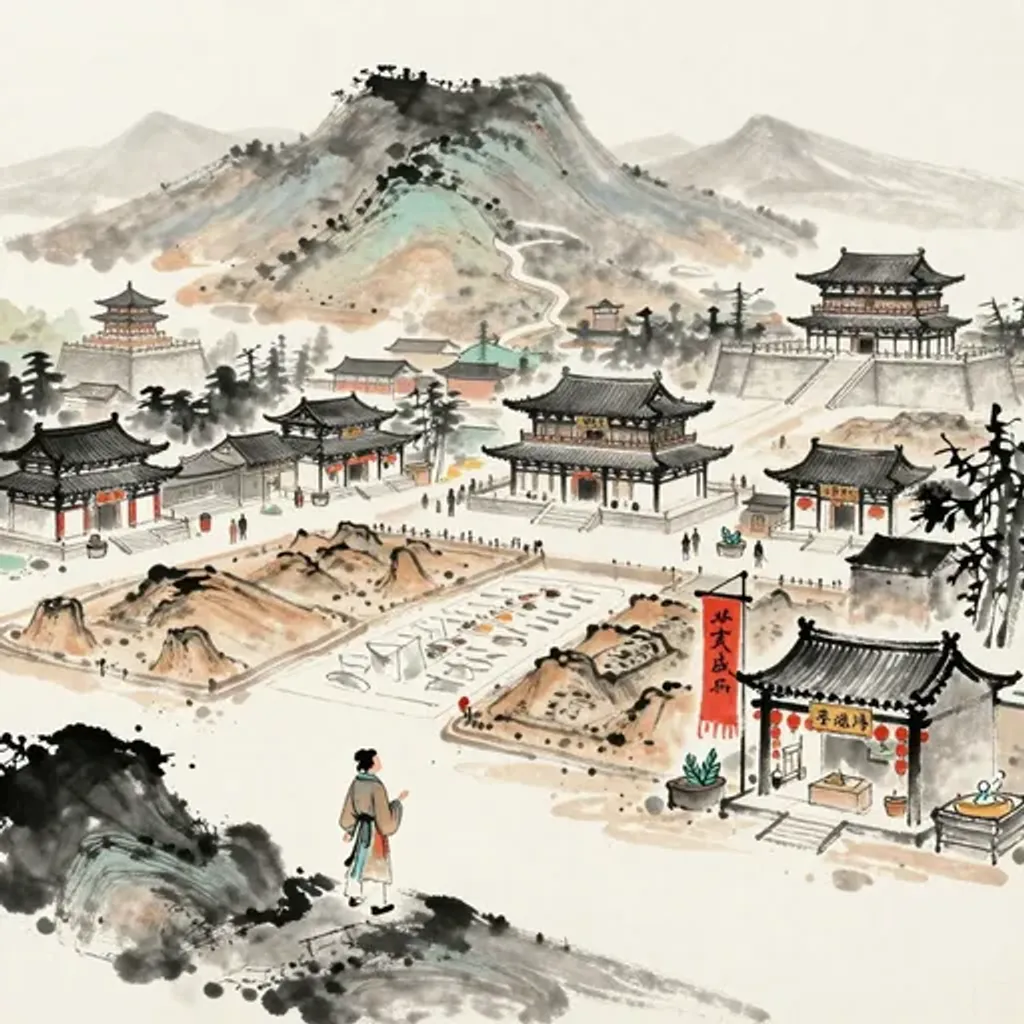
咸陽辰巳,長安戌亥。丘陵生止,非魚鰌市。不可辭阻,終無悔咎。
Xianyang at the chen-si hours; Chang’an at the xu-hai hours. Hills and mounds produce and stand; not a market for fish and eels. One need not refuse or resist; in the end, no regret or fault.
— Jiao Yanshou, Yilin (Forest of Changes), 1st century BC
Commentary
Clouds above heaven part as the sun rises above the earth in Progress. Xianyang at the chen-si hours, Chang'an at the xu-hai hours — two imperial capitals named with their astrological timings, mapping the rhythm of governance onto the cycle of the day. Hills and mounds produce stillness, not a market for fish and eels: the terrain yields what is proper to it, not what one might wish. One cannot refuse or resist this natural order, and in the end there is no regret or blame. From Waiting to Progress, patient nourishment unfolds as the steady advance of light over earth: each thing in its proper place and time, neither forced nor denied. Progress here is accepting the landscape's own logic rather than imposing one's desires upon it.
需 → 明夷
Hexagram 5 → Hexagram 36: Darkening of the Light
Changing lines: 2, 5
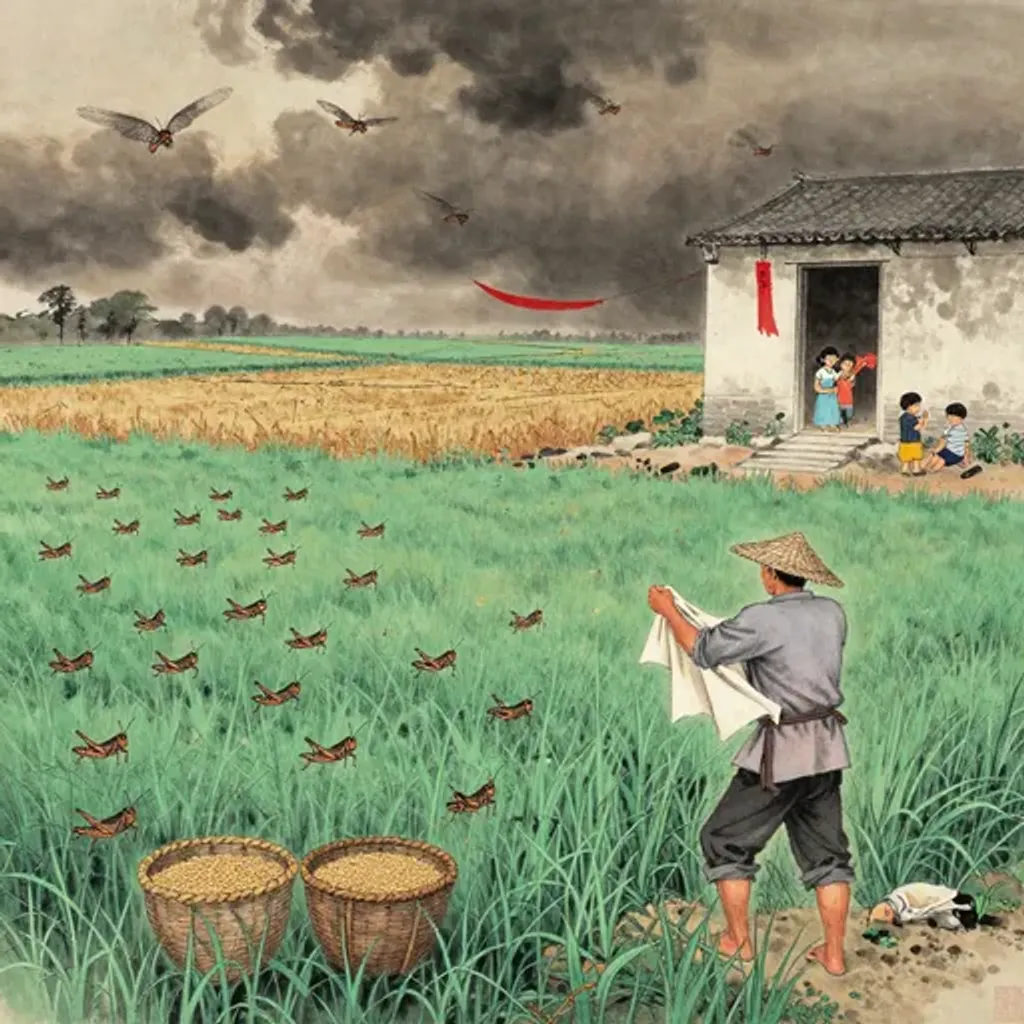
螟䖝為賊,害我五穀。簞食空虛,家無所食。
Crop-eating insects are the bandits; they harm my five grains. The food baskets stand empty; the family has nothing to eat.
— Jiao Yanshou, Yilin (Forest of Changes), 1st century BC
Commentary
Clouds above heaven sink into the earth burying the light. Locusts and caterpillars become the thieves, destroying the five grains. The grain baskets stand empty; the household has nothing to eat. The verse is stark agricultural catastrophe: insect plagues devour the harvest, leaving ritual vessels and family larders alike barren. In classical thought, pestilence was both natural disaster and moral omen — heaven withdrawing its favor manifests as plagues that consume what should nourish. From Waiting to Darkening of the Light, the clouds that promised rain instead produce the conditions for swarming pests. The light that should illuminate is driven underground; what should feed is consumed by what creeps and devours.
需 → 家人
Hexagram 5 → Hexagram 37: The Family
Changing lines: 2, 6
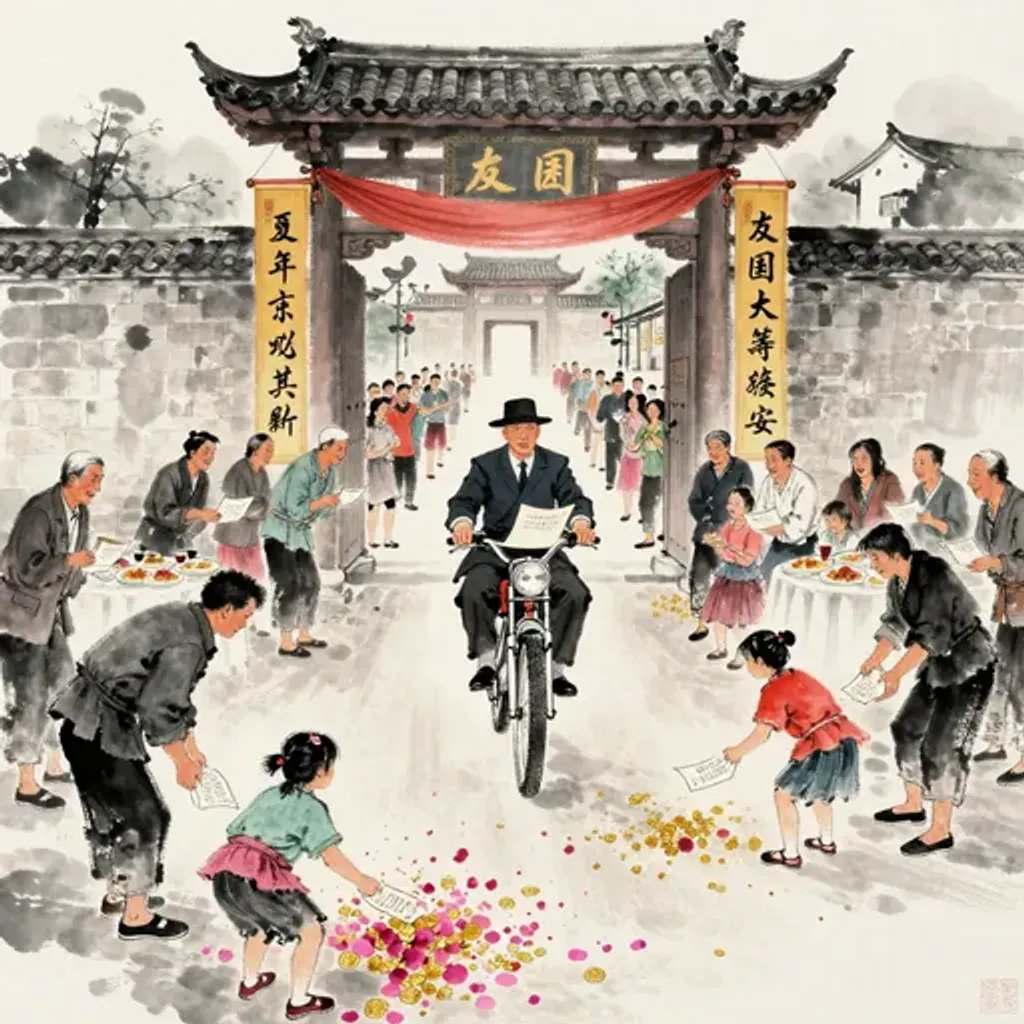
謀恩拜德,東歸吾國。慷慨宴笑,歡樂有福。
Planning grace, offering thanks; returning east to our homeland. Generous feasting and laughter; joy and happiness bring blessing.
— Jiao Yanshou, Yilin (Forest of Changes), 1st century BC
Commentary
Clouds above heaven become wind rising from fire — the warm radiance of The Family. Planning gratitude and honoring virtue, one returns east to one's homeland. Generous feasting and laughter fill the homecoming with joy and blessing. The verse reads as the happy resolution of an exile or mission: favors acknowledged, debts of honor repaid, and the traveler welcomed home with banquets. 'East' is the direction of return and origin. From Waiting to The Family, patient nourishment transforms into the warmth that emanates from a well-ordered household: wind from fire means the inner flame of domestic harmony radiating outward as influence. The one who waited now comes home to the place where nourishment is most genuine.
需 → 睽
Hexagram 5 → Hexagram 38: Opposition
Changing lines: 3, 4, 5, 6
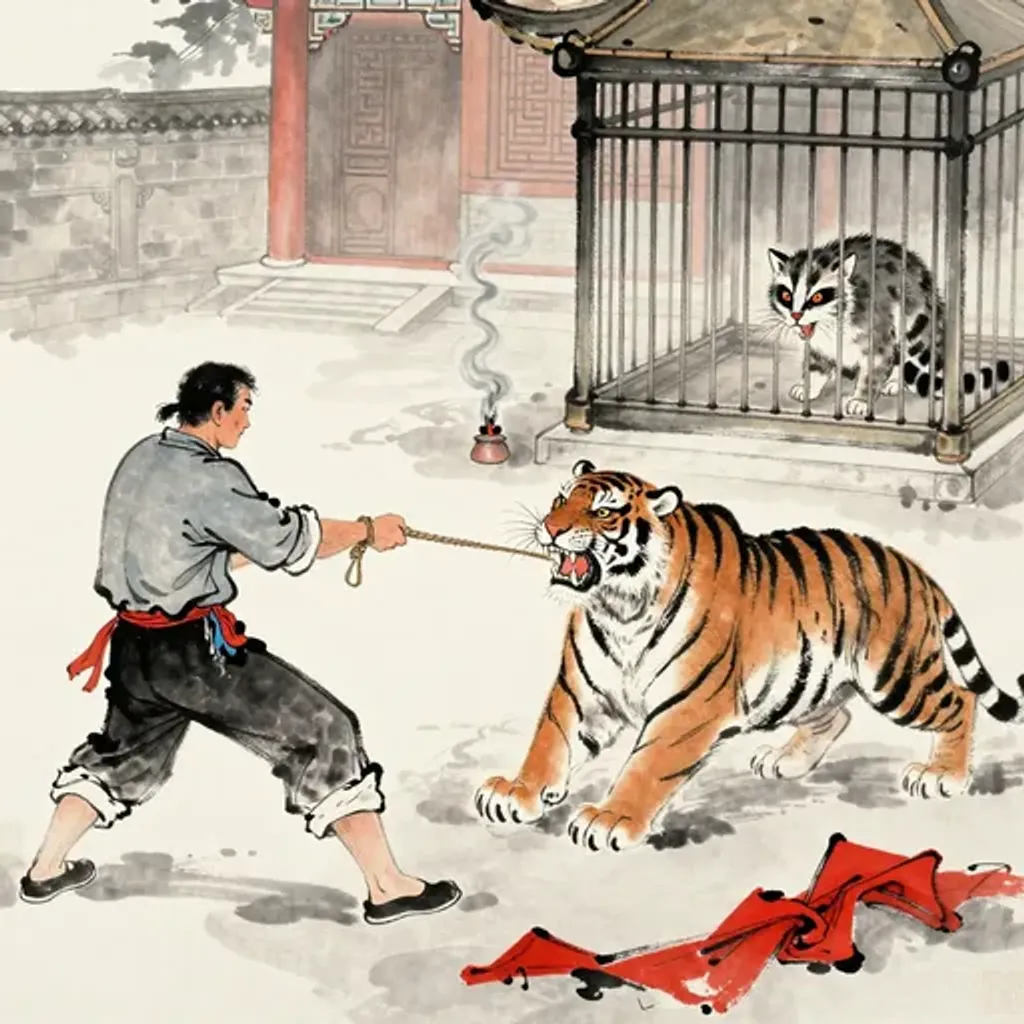
齋具贖狸,不聽我辭。係於虎鬚,牽不得來。
Preparing the offering to ransom the civet cat; it does not heed my words. Tied to the tiger’s whiskers; pulling, it will not come.
— Jiao Yanshou, Yilin (Forest of Changes), 1st century BC
Commentary
Clouds above heaven give way to fire and lake pulling apart in Opposition. Ritual goods are prepared to ransom a wildcat, but it refuses to heed one's words. Tied to a tiger's whiskers, the beast cannot be dragged forward. The scene is absurd and vivid: one attempts a solemn transaction with an uncooperative animal, then finds oneself entangled with something far more dangerous than intended. The wildcat (狸) resists negotiation; the tiger's whiskers resist force. From Waiting to Opposition, patient trust dissolves into mutual incomprehension: fire rises, lake descends, and nothing meets. Every approach is rebuffed — neither ceremony nor brute pulling can bridge a fundamental opposition of natures.
需 → 蹇
Hexagram 5 → Hexagram 39: Obstruction
Changing lines: 1, 2
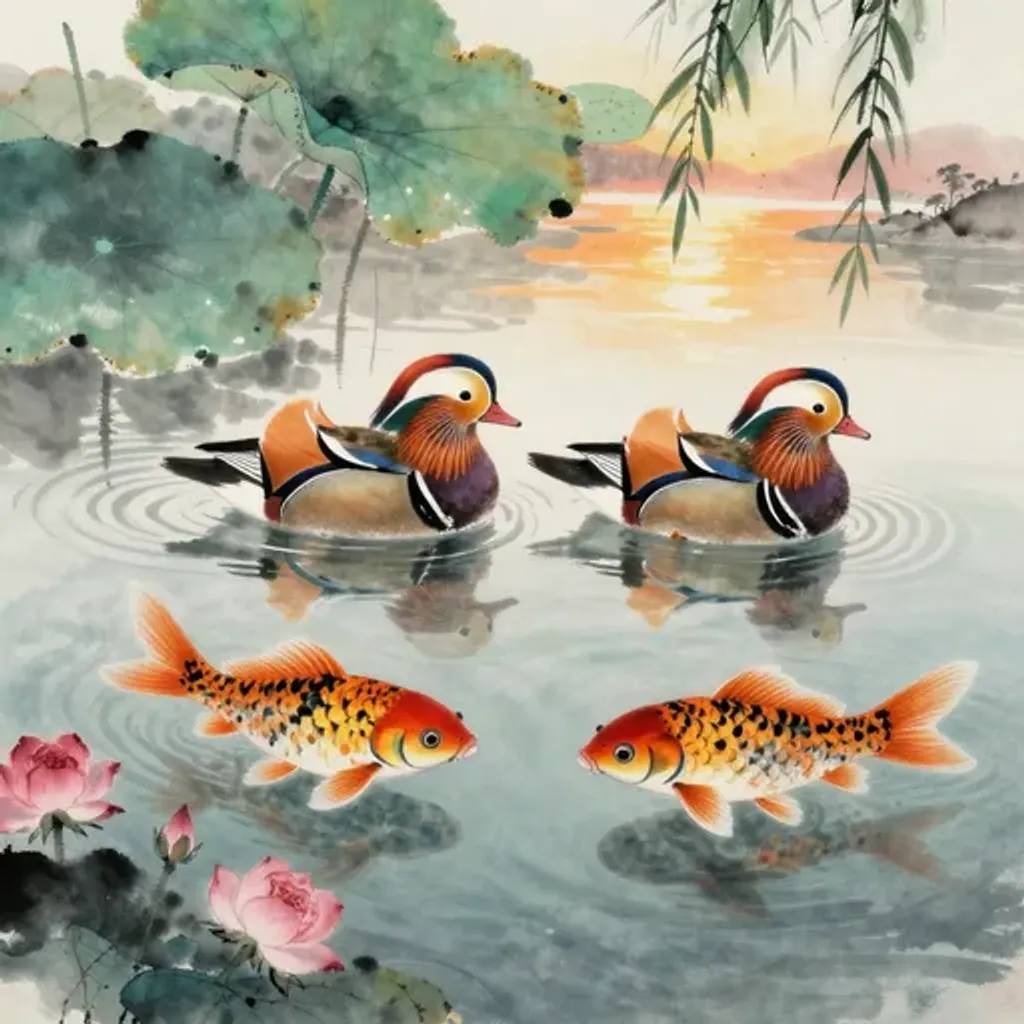
比目附翼,歡樂相得。行止集周,終不離忒。
Paired eyes and joined wings; joyfully found together. Going and staying in complete accord; they never part or err.
— Jiao Yanshou, Yilin (Forest of Changes), 1st century BC
Commentary
Clouds above heaven meet water upon the mountain — Obstruction's terrain of difficulty. Yet the verse sings of union: paired-eye fish and shared-wing birds, joyfully suited to each other. They move and rest in perfect accord, never once parting or faltering. The 'paired-eye fish' (比目魚) can only swim in pairs, each having one eye; the 'shared-wing birds' (比翼鳥) can only fly together, each having one wing. These mythological creatures embody inseparable love and mutual dependence. From Waiting to Obstruction, the paradox is that the hardest terrain produces the deepest bonds: water on the mountain cannot flow freely, yet this very constraint makes companions cling together all the more closely, finding joy precisely where difficulty demands partnership.
需 → 解
Hexagram 5 → Hexagram 40: Deliverance
Changing lines: 1, 3, 4, 5
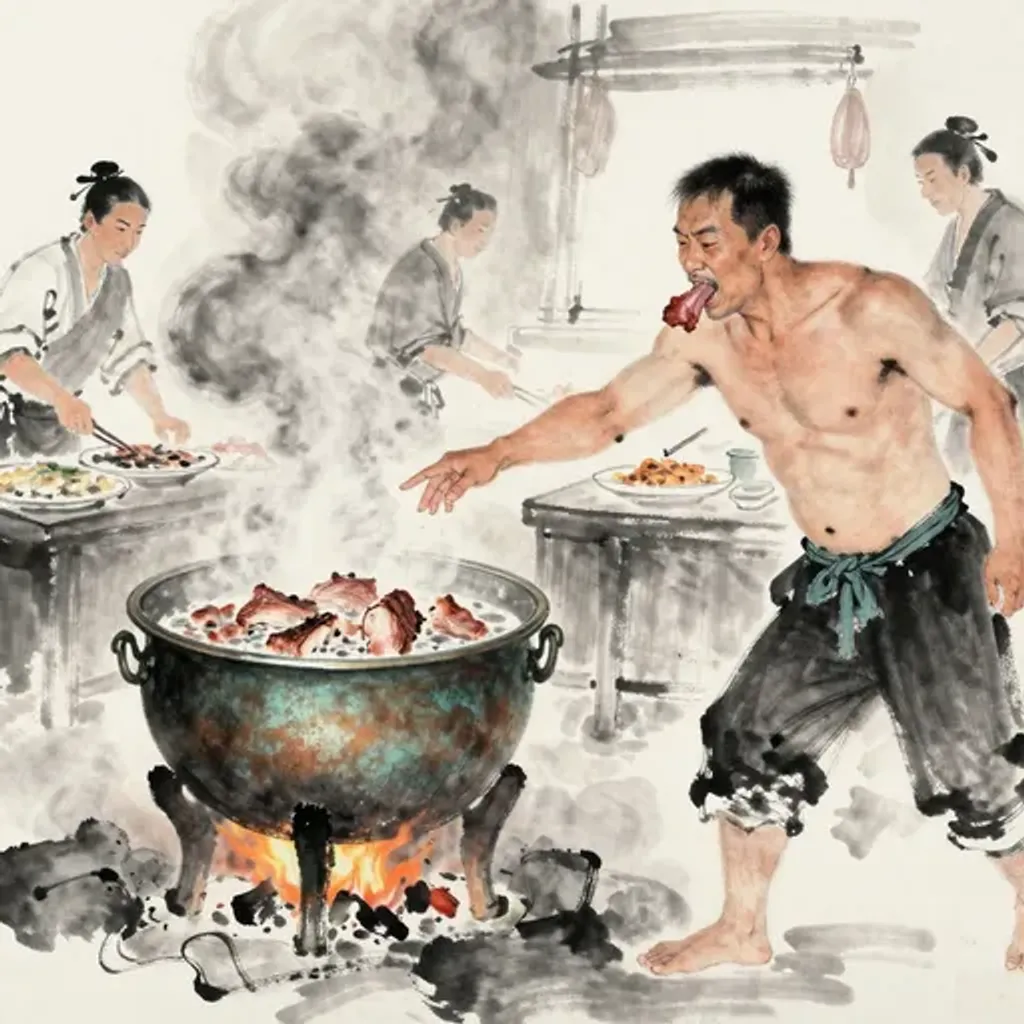
一指食肉,口無所得。染其鼎鼐,舌饞於腹。
One finger reaches for meat; the mouth gets nothing. Dipping into the cauldron; the tongue craves what the belly cannot have.
— Jiao Yanshou, Yilin (Forest of Changes), 1st century BC
Commentary
Clouds above heaven yield to thunder rising above water — Deliverance's release after tension. A single finger dips into meat, yet the mouth gets nothing. One stains the great cauldron, the tongue greedy but the belly empty. The image is of someone who touches abundance without truly receiving it: a finger smeared with the juices of a feast that never reaches the stomach. The 'great cauldron' (鼎鼐) invokes state ritual — tampering with the sacred vessel for a taste rather than a proper portion. From Waiting to Deliverance, the knot should be untied, yet here the release is partial: one is freed from waiting only to encounter a feast one cannot properly partake of. Greed glimpses plenty but grasps only residue.
需 → 損
Hexagram 5 → Hexagram 41: Decrease
Changing lines: 3, 5, 6
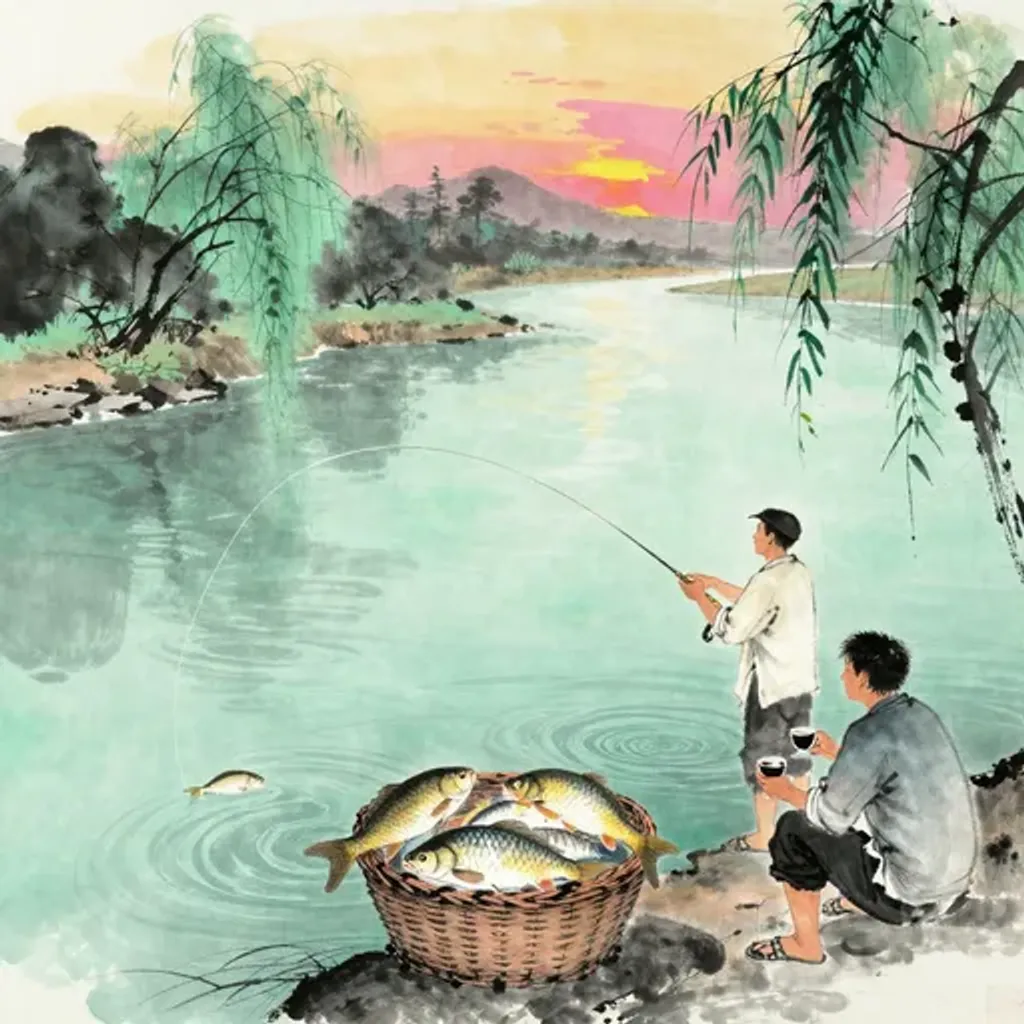
曳綸江海,釣挂魴鯉。王孫得利,以享仲友。
Casting the line into rivers and seas; hooking bream and carp. The prince gains profit, and shares the feast with his friends.
— Jiao Yanshou, Yilin (Forest of Changes), 1st century BC
Commentary
Clouds above heaven descend to the mountain above the lake — Decrease's image of the high enriching the low. Trailing fishing lines across rivers and seas, one hooks bream and carp. A noble scion profits from the catch and shares the feast with friends. The verse celebrates generous abundance flowing downward: the fisher's skill yields plenty, and the 'king's grandson' (王孫) redistributes it among companions. 'Zhongyou' (仲友) may refer to a close friend or the 'middle friend' in a fellowship. From Waiting to Decrease, nourishment is deliberately given away: what the mountain loses, the lake gains. The catch is not hoarded but shared — decrease for one becomes increase for all, the authentic logic of generosity.
需 → 益
Hexagram 5 → Hexagram 42: Increase
Changing lines: 2, 3, 6
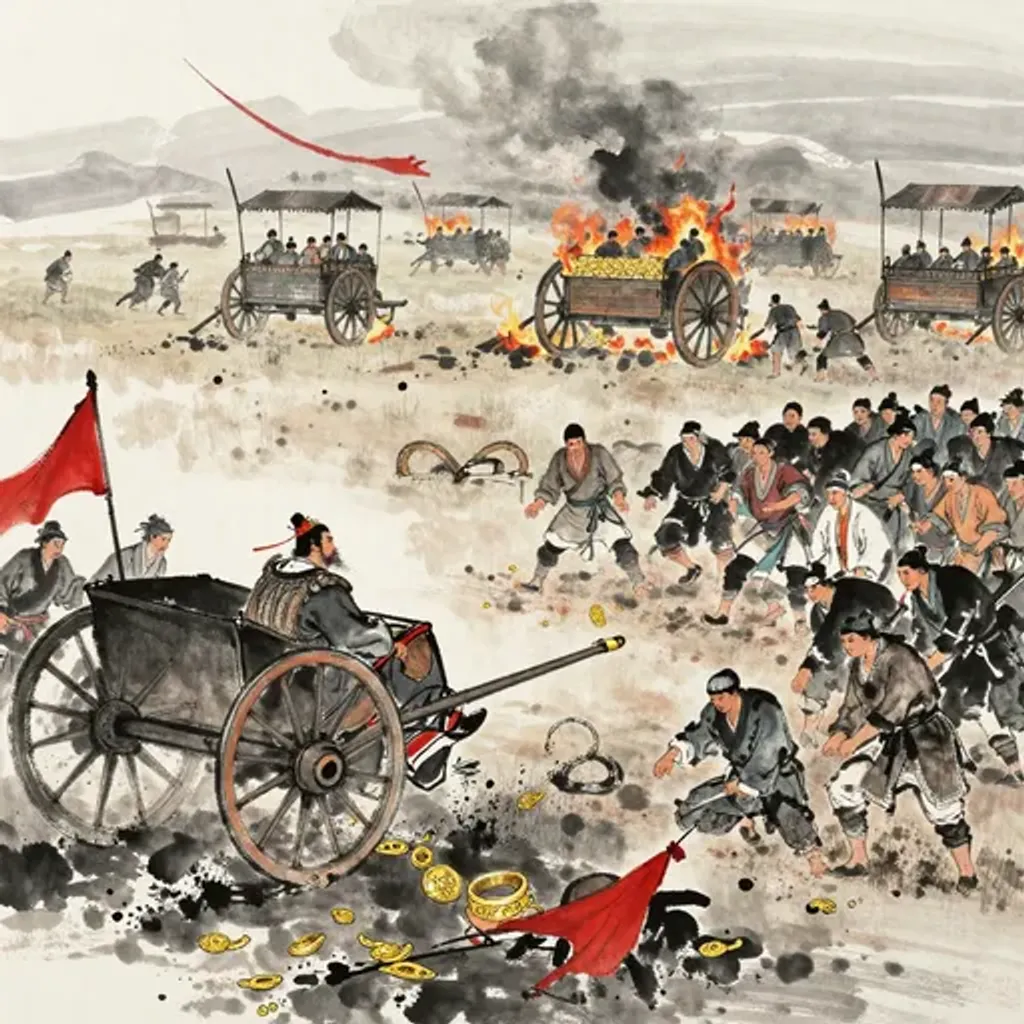
商紂牧野,顛敗所在。賦斂重數,黎元愁苦。
Shang Zhou at the Battle of Muye; overthrown and defeated there. Levies and taxes heaped without measure; the common people grieve and suffer.
— Jiao Yanshou, Yilin (Forest of Changes), 1st century BC
Commentary
Clouds above heaven shift to wind and thunder in mutual Increase — yet the verse speaks of ruin, not growth. King Zhou of Shang at Muye: this is where his dynasty collapsed. Heavy levies and repeated taxation leave the common people wretched and suffering. The Battle of Muye in 1046 BC ended the Shang when King Zhou's own forces turned against him. His downfall was rooted in extravagance funded by crushing exactions from the people. From Waiting to Increase, the transformation is cautionary: Increase promises that seeing good one should pursue it, and having faults one should correct them. King Zhou did neither. The potential for increase existed, but tyrannical extraction turned increase into its opposite — what should have built the state instead destroyed it.
需 → 夬
Hexagram 5 → Hexagram 43: Breakthrough
Changing lines: 4
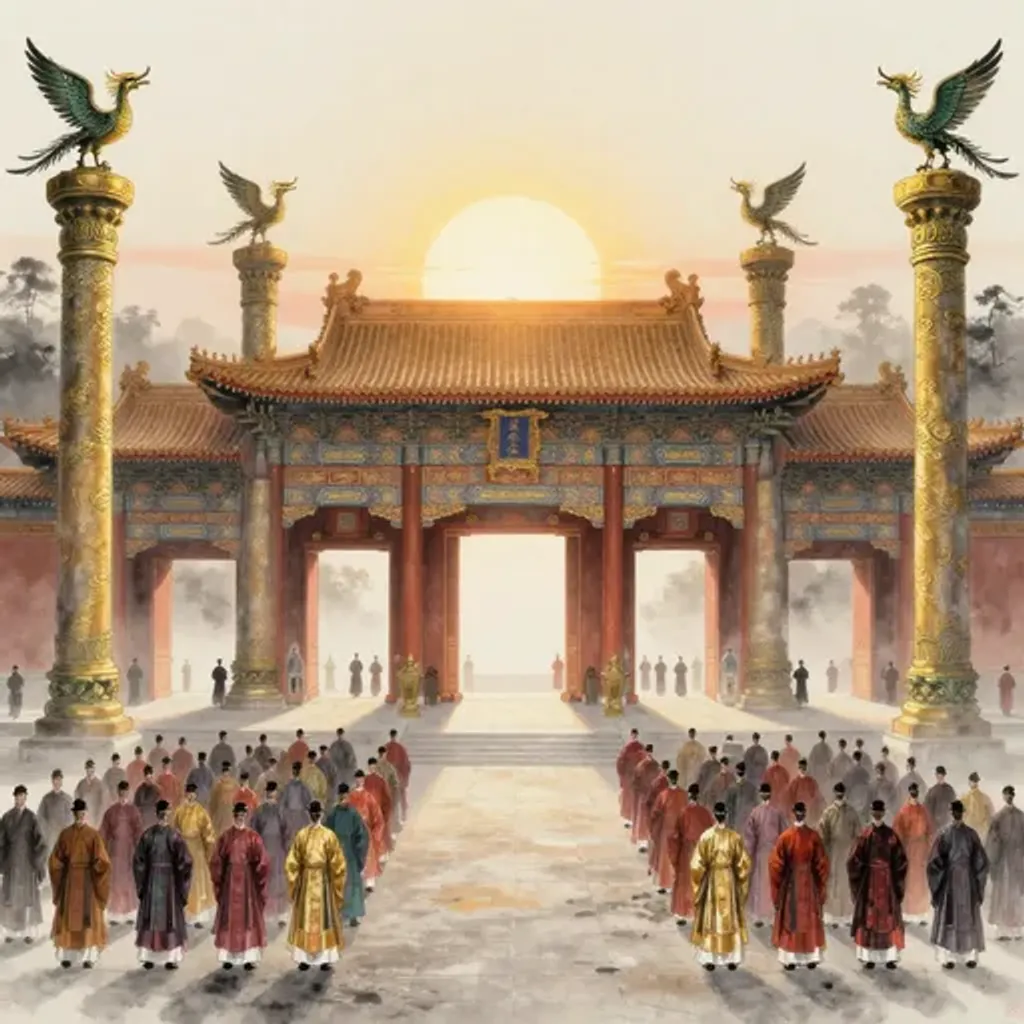
北辰紫宮,衣冠立中。含和建德,常受天福。
The Hall of Light stands open and lofty, four gates open to the morning. Bronze birds on the eave-corners call toward the sun.
— Jiao Yanshou, Yilin (Forest of Changes), 1st century BC
Commentary
Clouds above heaven burst through as the lake rises to heaven in Breakthrough. The original verse reads: 'The Pole Star and Purple Palace — robed and capped one stands at the center. Harboring harmony and establishing virtue, one forever receives heaven's blessing.' The Purple Palace (紫宮) is the celestial enclosure of the pole star, corresponding to the earthly emperor's court. Standing robed at the cosmic center, the ruler embodies virtue and harmony, receiving perpetual heavenly mandate. From Waiting to Breakthrough, patient accumulation reaches the point of decisive release: the lake breaks through to heaven, accumulated merit is proclaimed, and what was gathered in stillness now radiates as sovereign authority.
需 → 姤
Hexagram 5 → Hexagram 44: Coming to Meet
Changing lines: 1, 4, 6
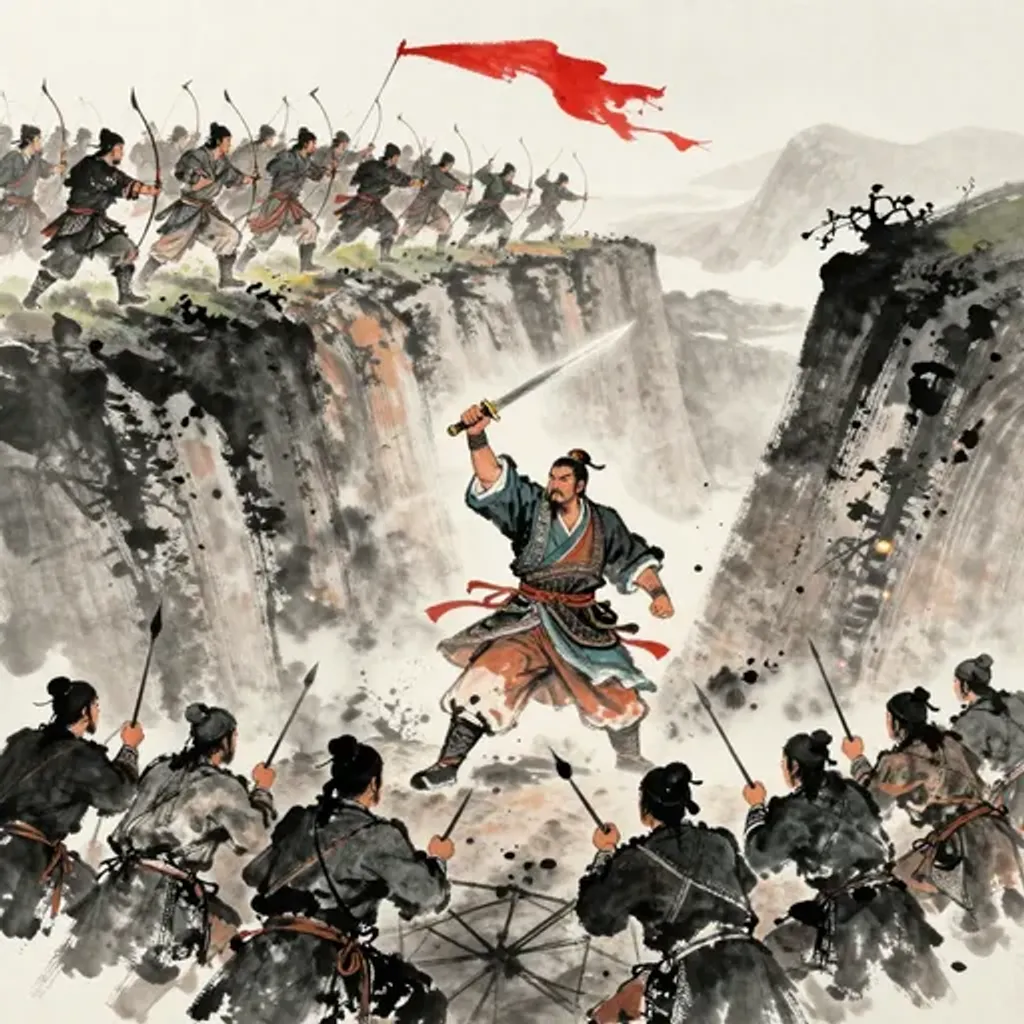
輕戰尚勇,不知兵權。為敵所制,從師北奔。
Recklessly fighting, esteeming bravery; not understanding the art of war. Outmaneuvered by the enemy; the army flees northward.
— Jiao Yanshou, Yilin (Forest of Changes), 1st century BC
Commentary
Clouds above heaven shift to wind beneath heaven in Coming to Meet — the unexpected encounter. One rushes into battle prizing only courage, ignorant of military strategy. Controlled by the enemy, the army flees northward with its commander. 'Not knowing the weights of warfare' (不知兵權) condemns the leader who mistakes bravery for generalship. The verse is a compact lesson in military failure: charging forward without understanding terrain, supply, or tactics guarantees defeat. From Waiting to Coming to Meet, the gentle wind beneath heaven encounters what it did not prepare for. Coming to Meet warns that what approaches may be dangerous — the bold commander meets the enemy's trap because he rushed toward what he should have cautiously assessed.
需 → 萃
Hexagram 5 → Hexagram 45: Gathering Together
Changing lines: 1, 2, 3, 4
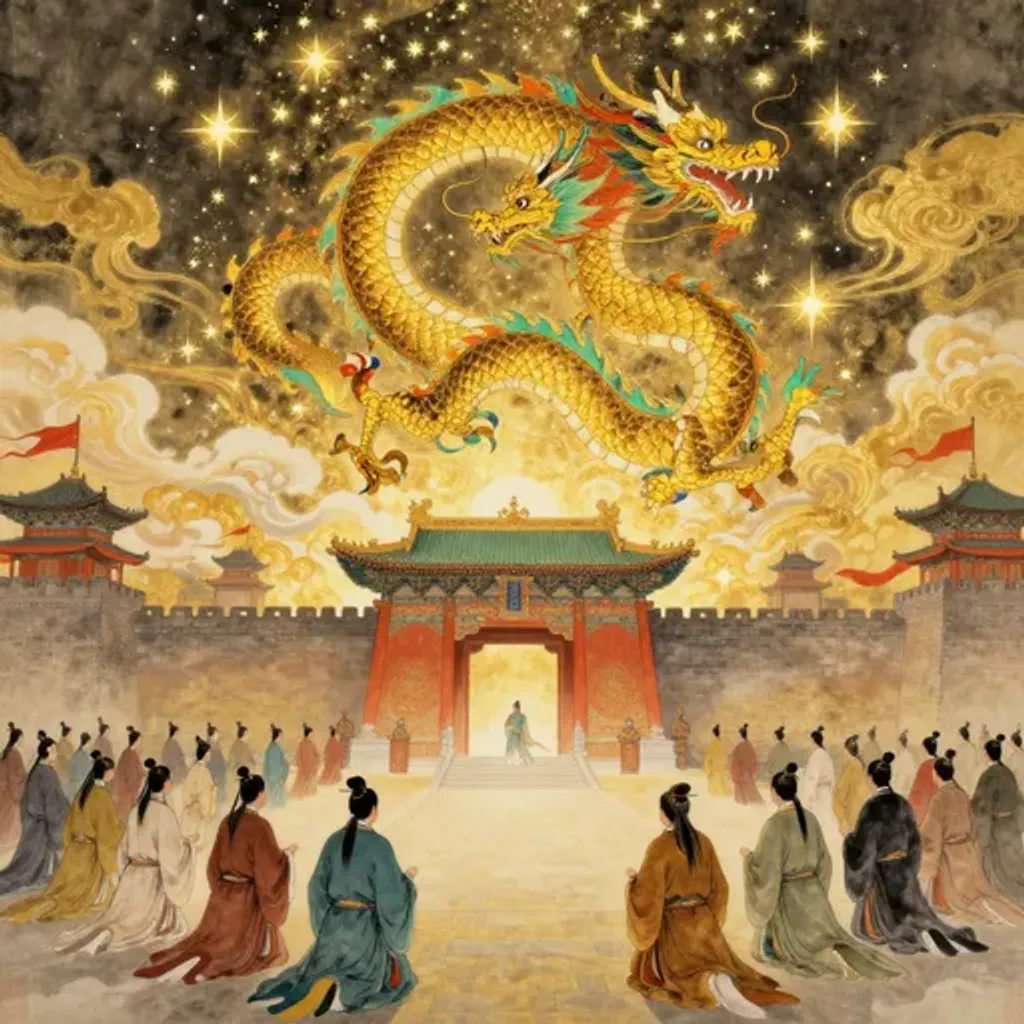
大口宣舌,神使仲言。黃龍景星,出應德門。與福上天,天下安昌。
A great mouth proclaims with authority; the spirits send Zhong to speak. The yellow dragon and auspicious star appear in answer at the gate of virtue. Rising together with blessing to heaven; all under heaven prospers.
— Jiao Yanshou, Yilin (Forest of Changes), 1st century BC
Commentary
Clouds above heaven gather as the lake collects upon the earth in Gathering. A great mouth opens wide, and spirits command their spokesman to declare: the Yellow Dragon and Auspicious Star appear at the Gate of Virtue. Blessing rises to heaven, and all under heaven prospers. The Yellow Dragon and Auspicious Star are twin omens of sage governance — celestial confirmations that the ruler has achieved harmony with the Way. 'The Gate of Virtue' (德門) is where cosmic signs manifest for the virtuous. From Waiting to Gathering, patient nourishment draws all things together: the lake upon the earth is natural congregation, and when virtue reaches its fullness, even heaven responds by sending its most magnificent portents to where the people assemble.
需 → 升
Hexagram 5 → Hexagram 46: Pushing Upward
Changing lines: 1, 5
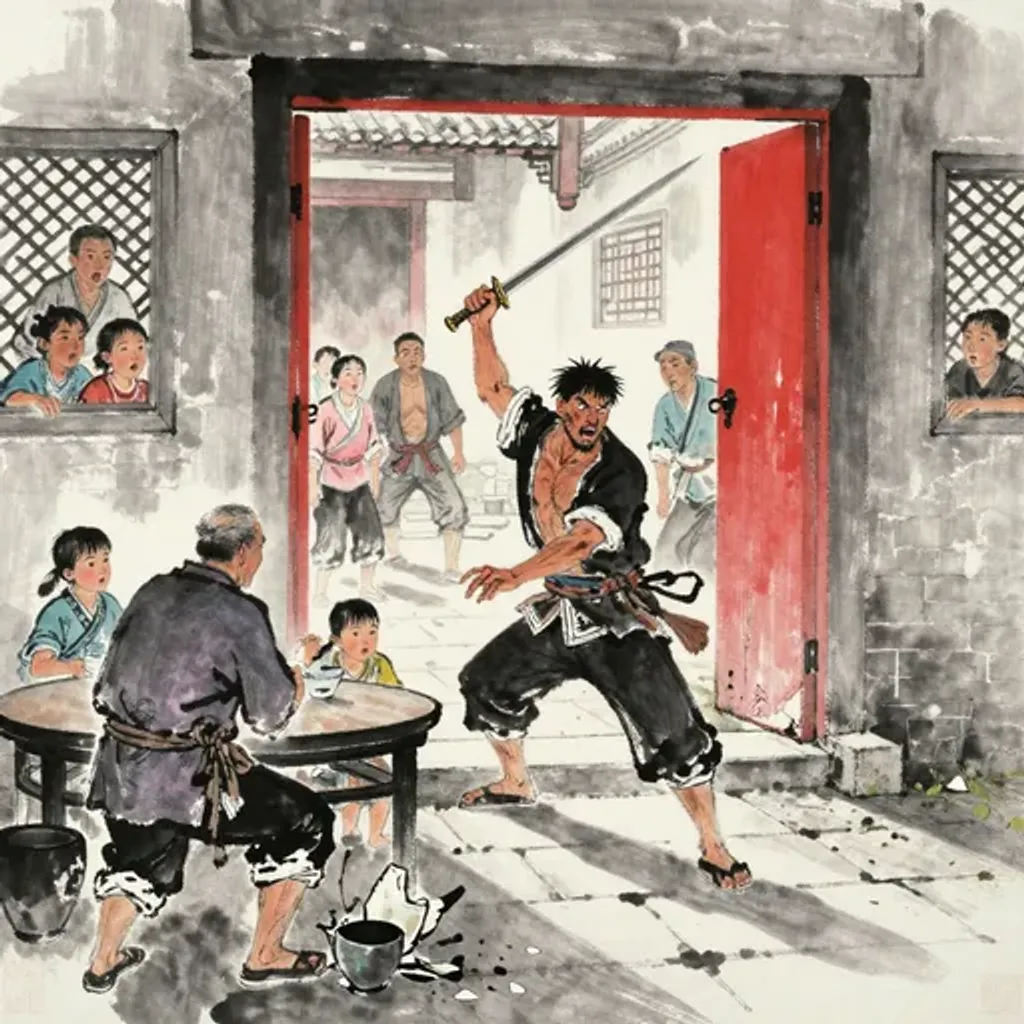
凶子禍孫,把劍向門。凶訟讙囂,驚駭我家。
Vicious son, ruinous grandson; grasping sword, facing the gate. Violent dispute and uproar; they terrify my household.
— Jiao Yanshou, Yilin (Forest of Changes), 1st century BC
Commentary
Clouds above heaven meet wood growing upward through the earth in Pushing Upward — yet what rises here is violence, not virtue. Wicked sons and cursed grandsons brandish swords at the gate. Lawsuits rage with shouting and clamor, terrifying our household. The verse inverts Pushing Upward's promise of gradual, organic ascent: instead of a tree growing steadily from the earth, armed descendants menace the family threshold. 'Pushing upward' becomes the escalation of domestic conflict into armed threat. From Waiting to Pushing Upward, the nourishment that should have produced an ordered household instead produces feral offspring whose rising is not growth but aggression — the family's own increase turned against itself.
需 → 困
Hexagram 5 → Hexagram 47: Oppression
Changing lines: 1, 3, 4
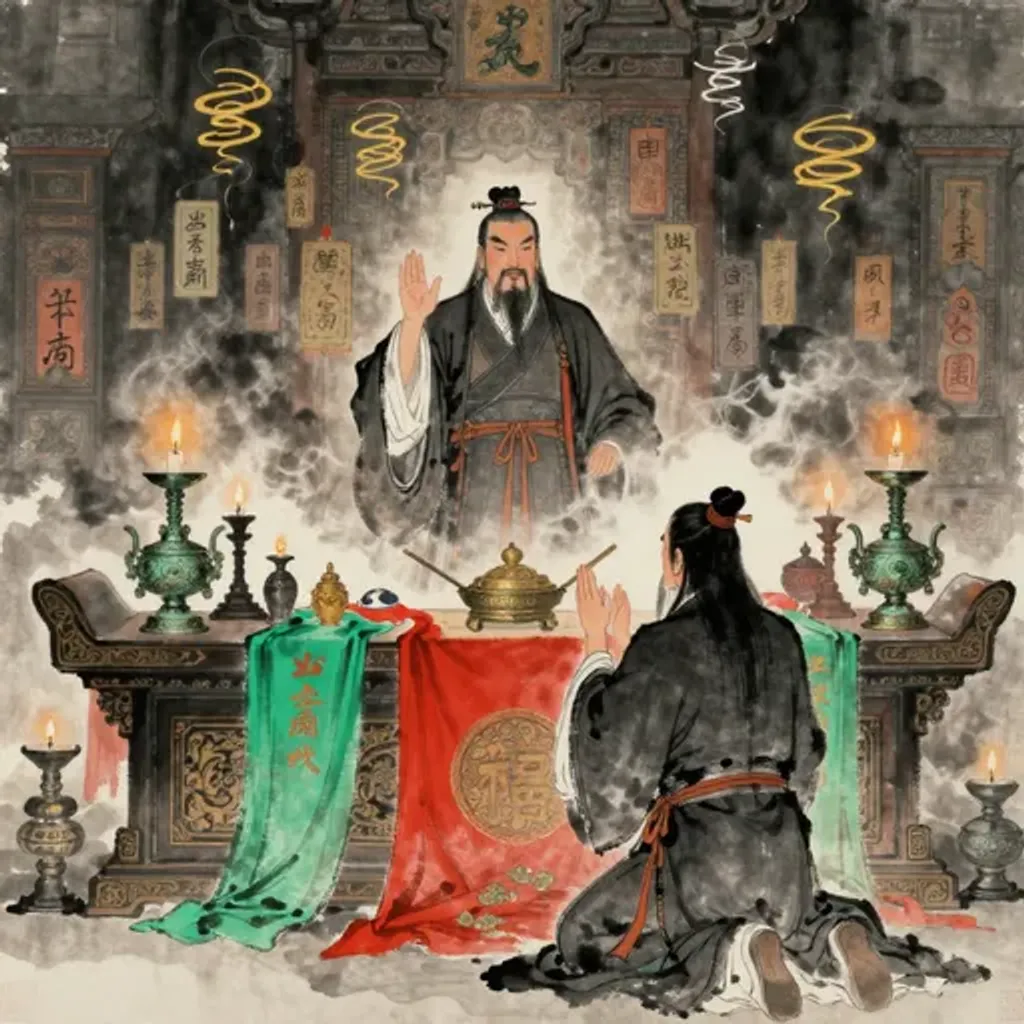
祝伯善言,能事鬼神。辭祈萬歲,使君延年。
Lord Zhu’s fine words; he can serve the ghosts and spirits. His prayers invoke ten thousand years; granting the lord long life.
— Jiao Yanshou, Yilin (Forest of Changes), 1st century BC
Commentary
Clouds above heaven meet the lake drained of water in Oppression. Yet the verse finds solace in the sacred: 'Invocator Bo excels at eloquent speech, able to serve spirits and gods. His prayers and petitions invoke ten thousand years of life, extending the lord's lifespan.' The 祝伯 (Invocator Bo) is a priestly official whose words bridge human and divine. Even within oppression — the dried lake that cannot sustain — ritual language maintains the connection to heaven. From Waiting to Oppression, nourishment meets its limit: the waters have receded and physical resources are exhausted. What remains is the power of articulate prayer — words addressed to the unseen that transcend material scarcity and invoke blessings beyond the reach of ordinary means.
需 → 井
Hexagram 5 → Hexagram 48: The Well
Changing lines: 1
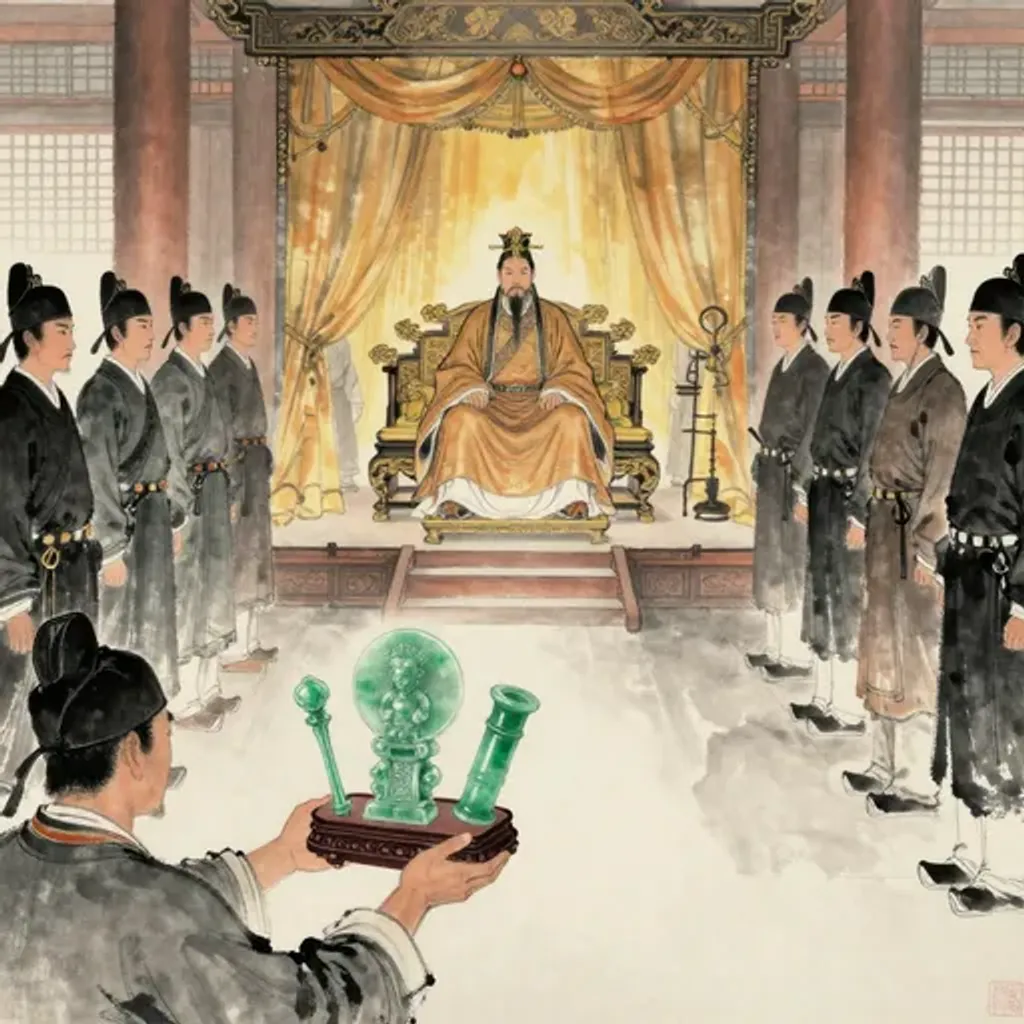
珪璧琮璋,執贄見王。百里甯戚,應聘齊秦。
Jade disc, jade tube, jade scepter; bearing tribute to see the king. Baili Xi and Ning Qi; answering the summons of Qi and Qin.
— Jiao Yanshou, Yilin (Forest of Changes), 1st century BC
Commentary
Clouds above heaven descend into the well's water drawn upward by wood — nourishment's most essential form. Bearing gui and bi jade scepters, one presents ritual credentials before the king. Baili Xi and Ning Qi answered the call of Qi and Qin — two men of hidden talent elevated from obscurity to the highest offices. Baili Xi was ransomed from slavery for five ram skins to become chief minister of Qin; Ning Qi sang while feeding cattle until Duke Huan of Qi recognized his worth. From Waiting to The Well, nourishment becomes inexhaustible source: the well draws from depths that never run dry. Talent submerged in lowly circumstance, when properly drawn up, serves the state like water serves the people — always available, always renewing.
需 → 革
Hexagram 5 → Hexagram 49: Revolution
Changing lines: 2, 4
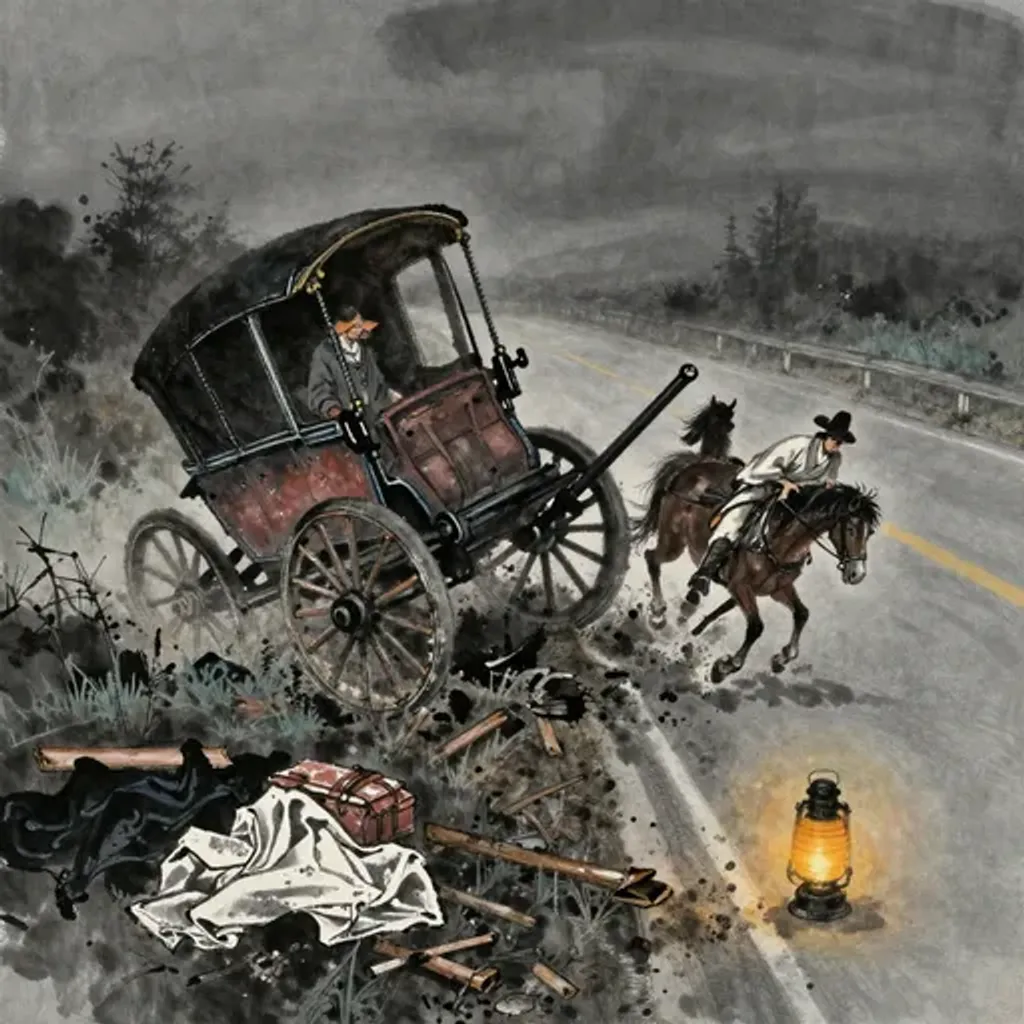
昧旦乘車,履危蹈溝。亡失裙襦,摧折兩軸。
Setting out in darkness by carriage; treading danger, falling into ditches. Losing skirt and tunic; both axles snap and break.
— Jiao Yanshou, Yilin (Forest of Changes), 1st century BC
Commentary
Clouds above heaven meet the lake with fire within it — Revolution's transformative upheaval. Setting out before dawn by carriage, one stumbles into danger and falls into a ditch. Skirts and jackets are lost; both axles snap. Everything about this journey goes wrong: the timing (predawn darkness), the terrain (rutted and treacherous), the vehicle (broken beyond repair). Haste before the proper hour produces not transformation but wreckage. From Waiting to Revolution, the patient clouds give way to the fire-in-the-lake that demands radical change — but revolution attempted without preparation destroys the vehicle of change itself. The broken axles cannot carry one forward; the lost garments signal the stripping away of all dignity.
需 → 鼎
Hexagram 5 → Hexagram 50: The Cauldron
Changing lines: 1, 4, 5, 6
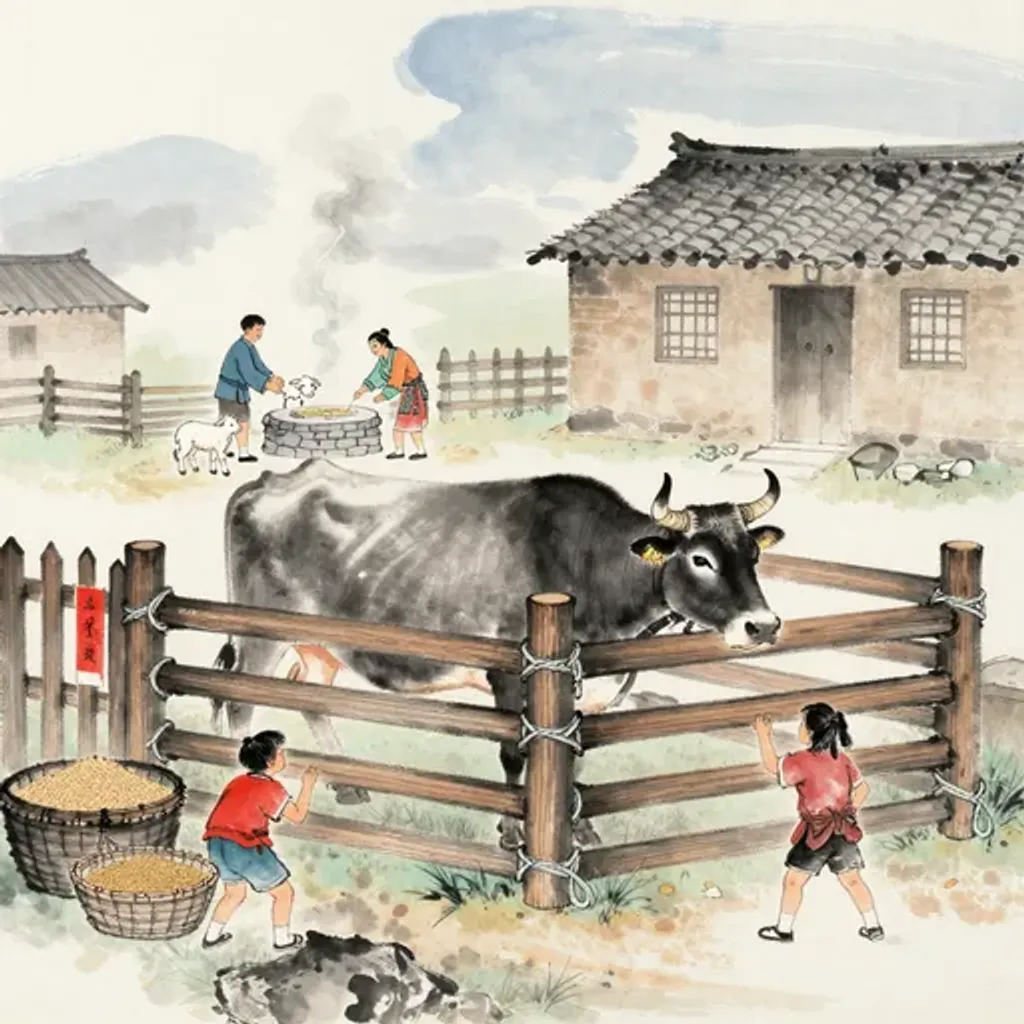
膠著木連,不出牛欄。斯饗羔羊,家室相安。
Glued and fastened, wood joined; not leaving the cattle pen. Feasting on lamb; house and family dwell in peace.
— Jiao Yanshou, Yilin (Forest of Changes), 1st century BC
Commentary
Clouds above heaven become fire upon wind — The Cauldron's image of cooking and transformation. Glued fast and fastened by wood, an ox cannot leave its pen. Yet this confinement proves benign: a lamb is offered as a feast, and the household rests in peace. The ox held in place is not suffering but settled — kept from wandering so that the domestic order can function. The lamb sacrifice suggests a completed ritual cycle of nourishment. From Waiting to The Cauldron, patient accumulation transforms into the vessel that refines raw material into something sacred: fire upon wind cooks what was raw into what sustains. The ox stays, the lamb is offered, and the household eats — a small scene of ritual economy working as intended.
需 → 震
Hexagram 5 → Hexagram 51: The Arousing Thunder
Changing lines: 2, 3, 4, 5
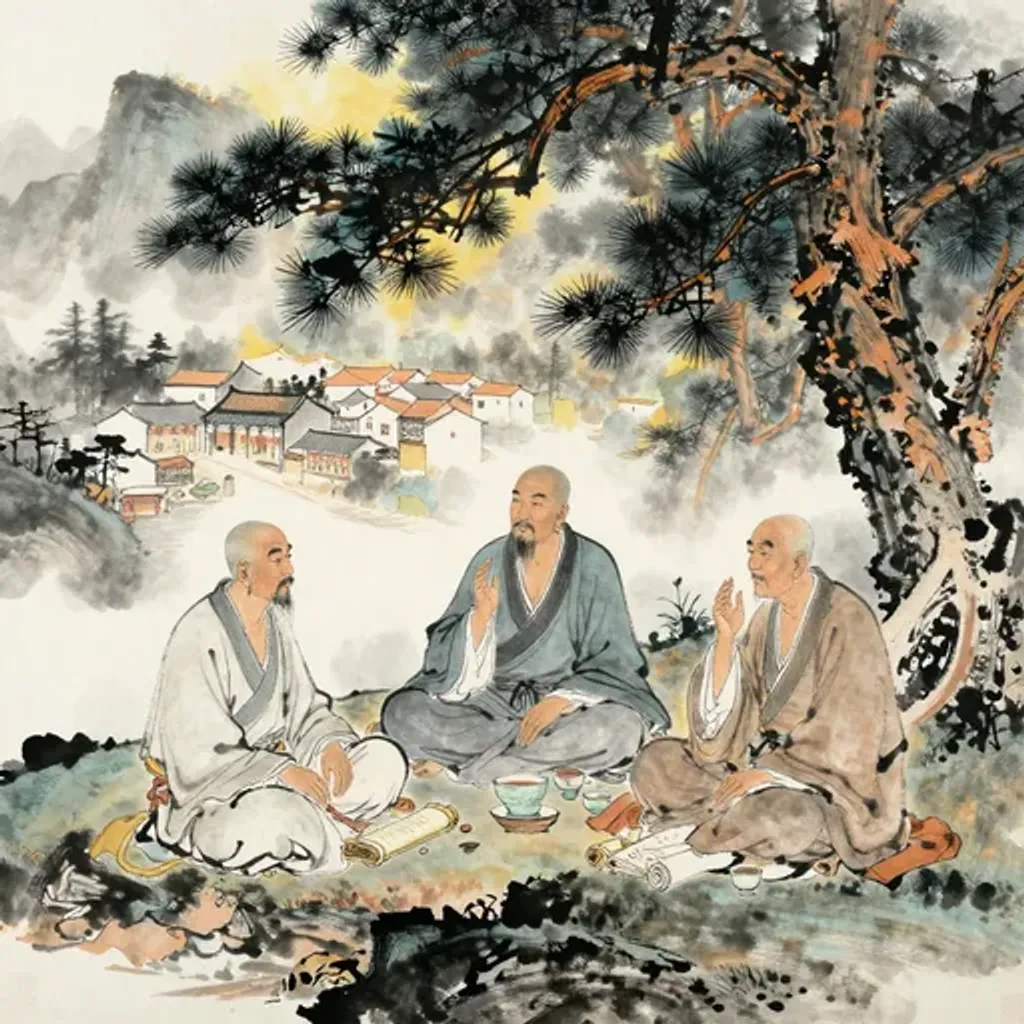
卷領遁世,仁德不舍。三聖攸同,周家茂興。
In rolled collars, withdrawing from the world; benevolent virtue is not abandoned. The three sages act together; the house of Zhou thrives and flourishes.
— Jiao Yanshou, Yilin (Forest of Changes), 1st century BC
Commentary
Clouds above heaven meet doubled thunder — the Arousing's explosive emergence. One who wraps his collar and retreats from the world nevertheless does not abandon benevolent virtue. The 'Three Sages' are united in purpose, and the house of Zhou flourishes. The 'wrapped collar' (卷領) suggests a figure in humble garb withdrawing from public life, yet his virtue endures. The 'Three Sages' likely refers to the founding trio of Zhou: King Wen's moral foundation, King Wu's martial decisive action, and the Duke of Zhou's institutional consolidation. Their combined virtues propelled Zhou from a small western fief to dynastic supremacy. From Waiting to The Arousing, hidden virtue gathers until it can no longer be contained — like thunder that accumulates underground before shaking the world awake.
需 → 艮
Hexagram 5 → Hexagram 52: Keeping Still Mountain
Changing lines: 1, 2, 5, 6
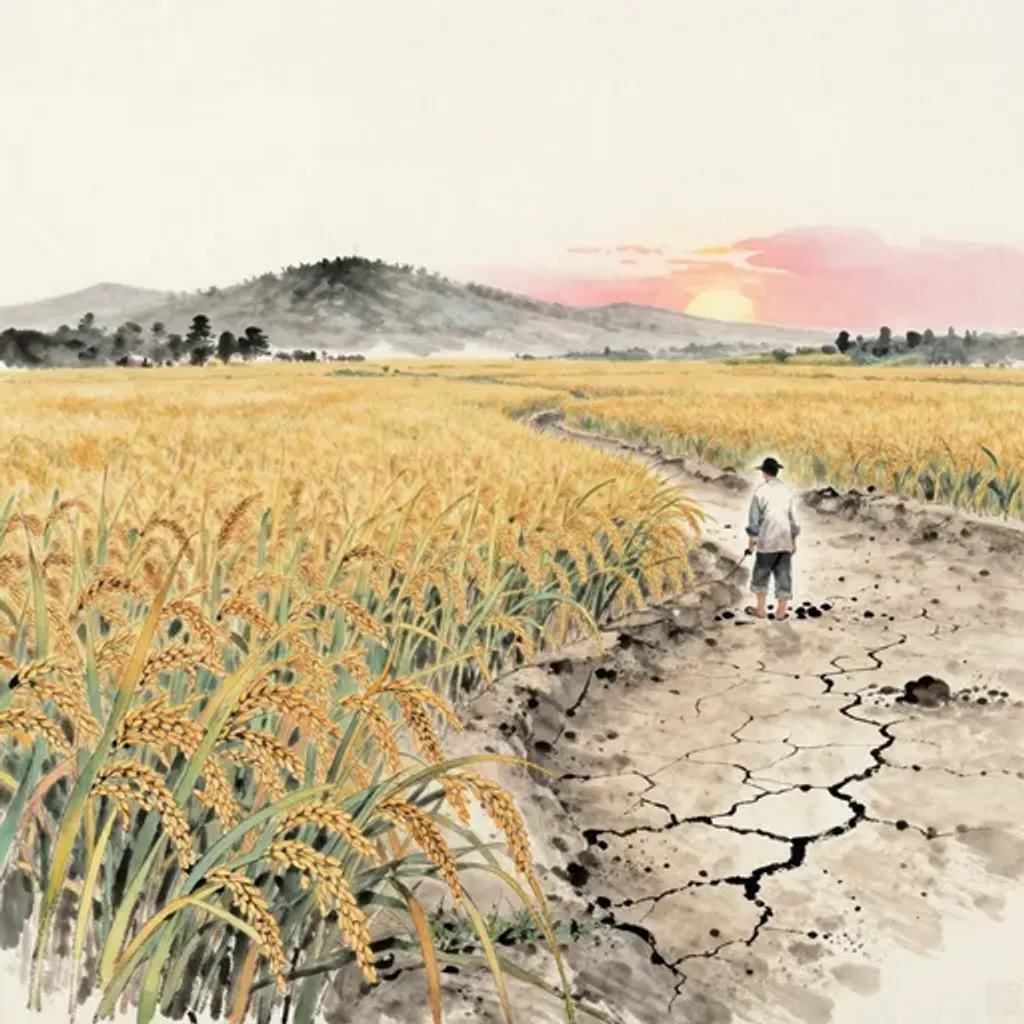
黍稷苗稻,垂秀方造。中旱不雨,傷風枯槁。
Millet, grain, rice seedlings, and paddy; grain-heads form and begin to swell. Mid-season drought with no rain; blighted by wind, they wither and dry.
— Jiao Yanshou, Yilin (Forest of Changes), 1st century BC
Commentary
Clouds above heaven solidify into the doubled mountain of Keeping Still. Millet, grain, rice, and paddy hang heavy with ripening ears, just approaching fullness — when a midsummer drought strikes. No rain falls; the crops are scorched by hot wind and wither to husks. The verse captures agriculture's cruelest timing: destruction arriving at the very moment of near-completion. All the patient growing that Waiting's clouds promised is undone in the final stretch. From Waiting to Keeping Still, the double mountain stops everything: growth halts, movement ceases, and what was almost ripe is frozen in permanent incompletion. Stillness here is not serenity but the paralysis of drought — nature refusing to complete its own cycle.
需 → 漸
Hexagram 5 → Hexagram 53: Development
Changing lines: 1, 2, 6
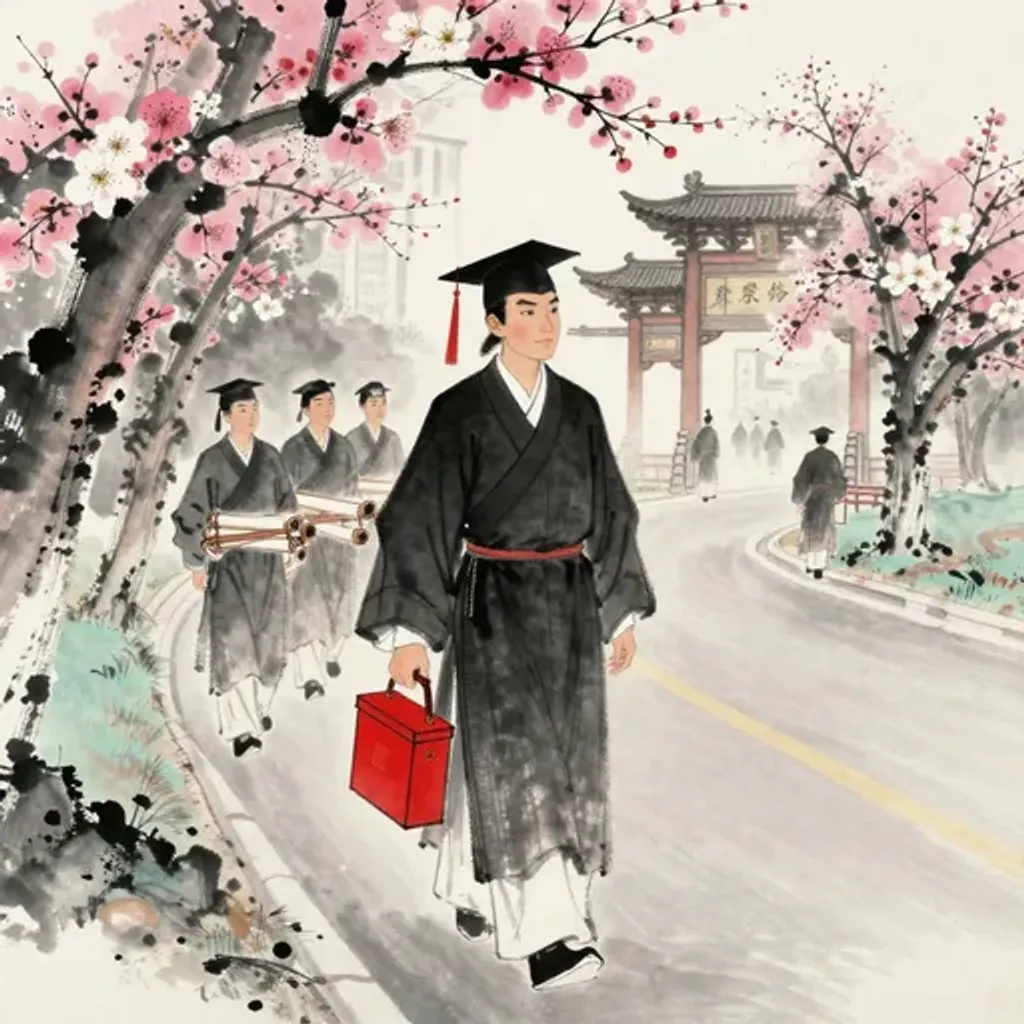
冠帶南遊,與福喜逢。期於嘉貞,拜為公卿。
Capped and sashed, traveling south; meeting blessing and joy along the way. Expecting auspiciousness at the perfect hour; appointed to the rank of duke and minister.
— Jiao Yanshou, Yilin (Forest of Changes), 1st century BC
Commentary
Clouds above heaven unfold into wind upon the mountain — Development's gradual, stately advance like the wild goose ascending. Donning cap and sash, one journeys south, meeting good fortune along the way. 'Destined for auspicious constancy,' one is appointed to the rank of duke or minister. The verse traces a career trajectory from hopeful departure to high office: proper attire signals readiness for officialdom, and the southward journey meets its reward. From Waiting to Development, nourishment becomes the slow, ordered progress of a tree growing on the mountain — each step placed deliberately, each stage completed before the next begins. The appointment crowns a journey of patient, graduated ascent.
需 → 歸妹
Hexagram 5 → Hexagram 54: The Marrying Maiden
Changing lines: 3, 4, 5
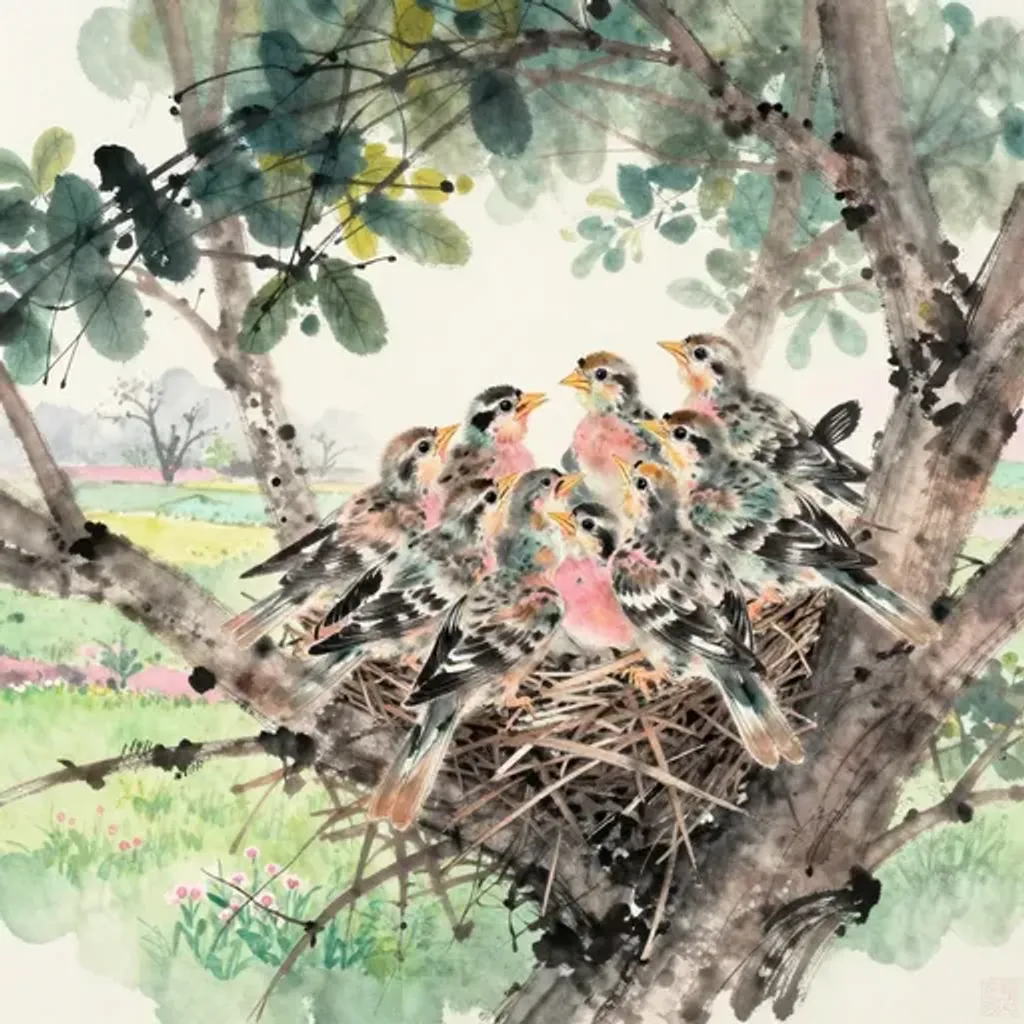
一巢九子,同公共母。柔順利貞,出入不殆,福祿所在。
One nest, nine chicks; sharing a father and mother. Gentle and obedient, upright and true; going out and coming in without peril. Blessings and fortune reside therein.
— Jiao Yanshou, Yilin (Forest of Changes), 1st century BC
Commentary
Clouds above heaven yield to thunder over the lake — the Marrying Maiden's image of the younger sister given in marriage. One nest holds nine chicks, sharing the same father and mother. Gentle compliance brings benefit through constancy; going out and coming in without peril, blessings reside here. The image of a single brood, numerous and harmonious under shared parentage, is a vision of familial abundance at its simplest. Nine chicks in one nest suggest prolific fertility blessed by good order. From Waiting to Marrying Maiden, patient nourishment produces the next generation: thunder stirs the lake, the younger follows the elder, and the household's increase is secured through the natural order of family life — 'knowing what endures through what decays.'
需 → 豐
Hexagram 5 → Hexagram 55: Abundance
Changing lines: 2, 4, 5
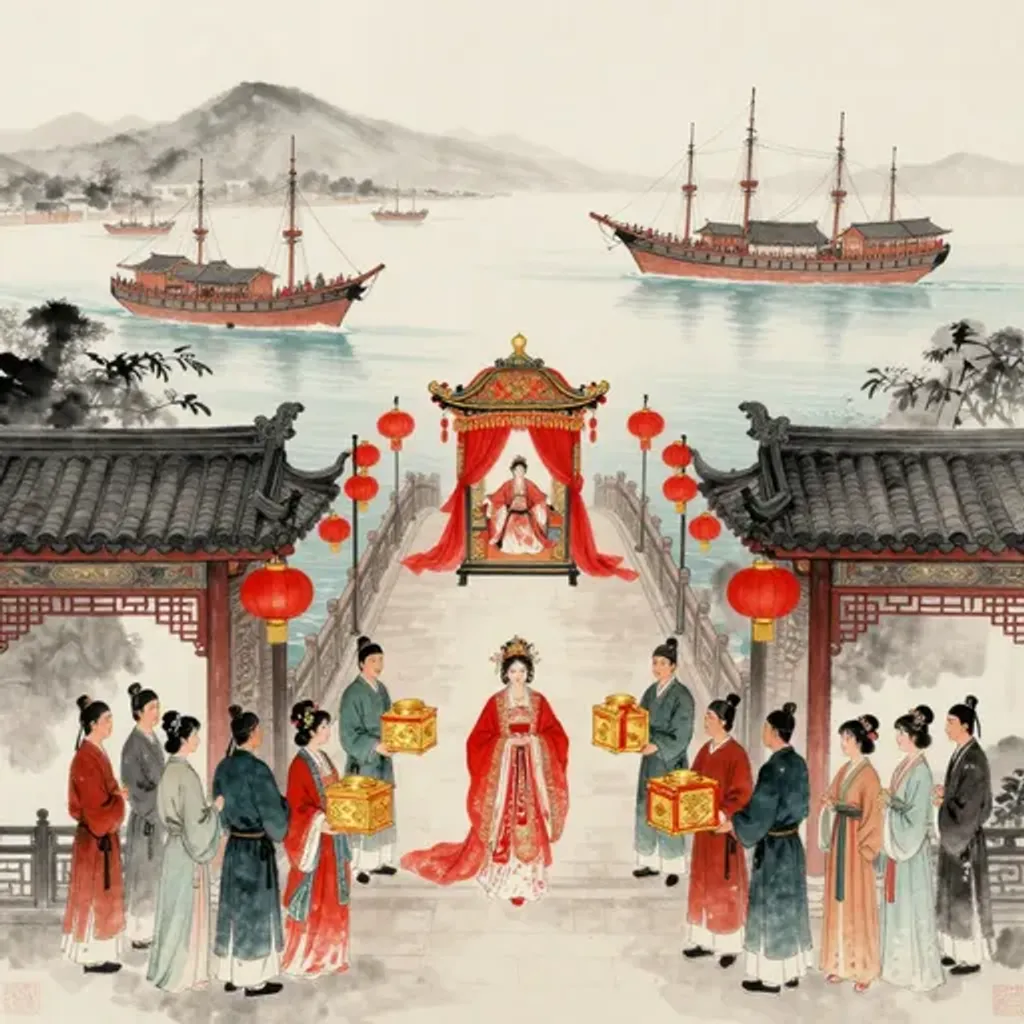
韓氏長女,嫁於東海。宜家富主,柔順以居。利得過倍。
The eldest daughter of the Han clan, married by the Eastern Sea. A fitting wife for a wealthy lord; gentle and obedient in her dwelling. Profit gained exceeds the double.
— Jiao Yanshou, Yilin (Forest of Changes), 1st century BC
Commentary
Clouds above heaven become thunder and lightning blazing together in Abundance. The eldest daughter of the Han clan is married to the Eastern Sea. She enriches her household and serves its master with gentle compliance. Her profits double what was expected. The verse is a celebration of a prosperous match: a well-born woman married to a distant, wealthy household, whose capable management multiplies the family's fortune. The 'Eastern Sea' signals both geographical distance and the vastness of opportunity. From Waiting to Abundance, patient nourishment builds to its fullest expression: thunder and lightning together illuminate and energize, and the capable woman becomes the vessel through which household wealth blazes into its maximum brightness.
需 → 旅
Hexagram 5 → Hexagram 56: The Wanderer
Changing lines: 1, 2, 4, 5, 6
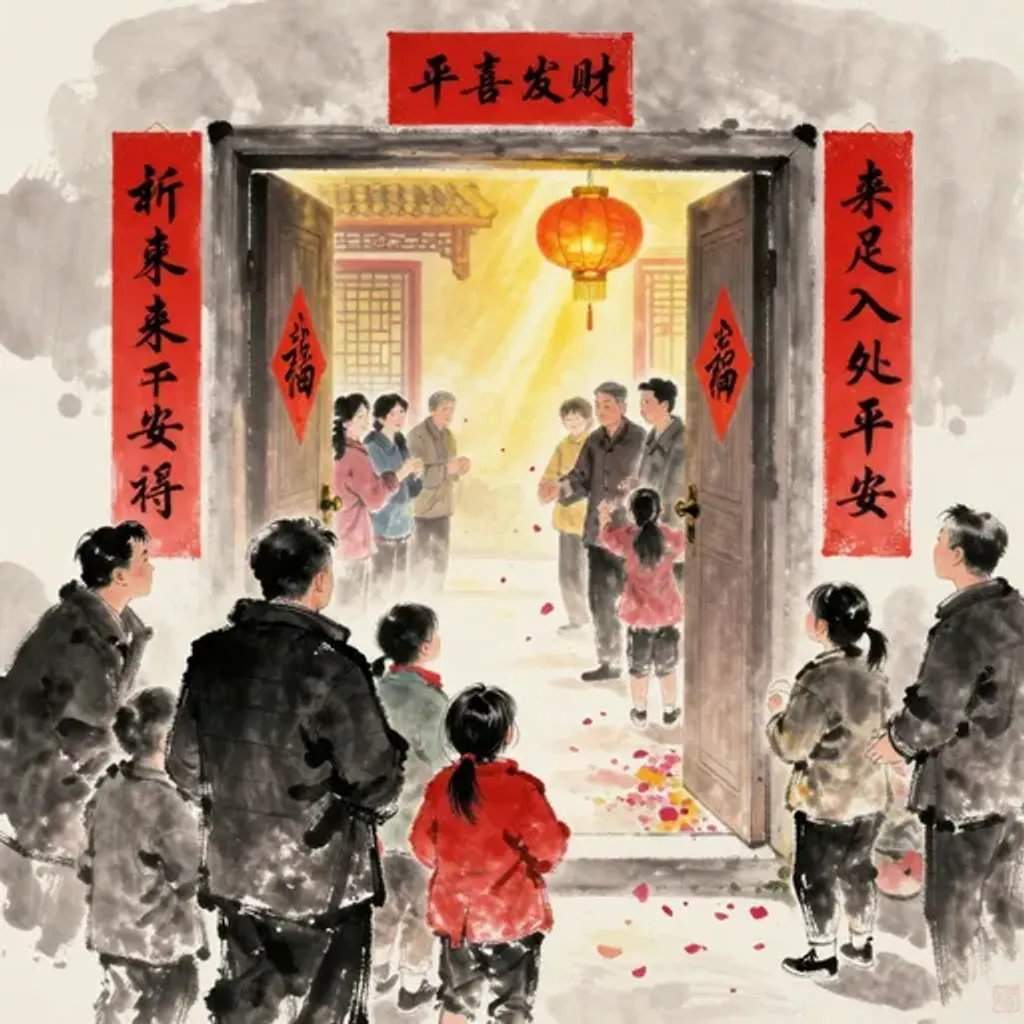
因禍受福,喜盈我室,所願必得。
Through misfortune, blessings are received; joy fills my house. Whatever is wished for, surely obtained.
— Jiao Yanshou, Yilin (Forest of Changes), 1st century BC
Commentary
Clouds above heaven become fire upon the mountain — the Wanderer's flickering light in a strange land. Yet this wanderer fares well: 'Through disaster one receives blessing; joy fills my chamber; every wish is fulfilled.' The verse is paradoxically brief and wholly auspicious for a hexagram associated with displacement and transience. Misfortune reverses into fortune, and the wanderer finds abundance precisely in the condition of being abroad. From Waiting to The Wanderer, nourishment finds an unexpected home: fire on the mountain moves and does not settle, yet even the traveling flame can illuminate a room. The one who endured calamity discovers that the road itself delivers what the homestead could not.
需 → 巽
Hexagram 5 → Hexagram 57: The Gentle Wind
Changing lines: 1, 6
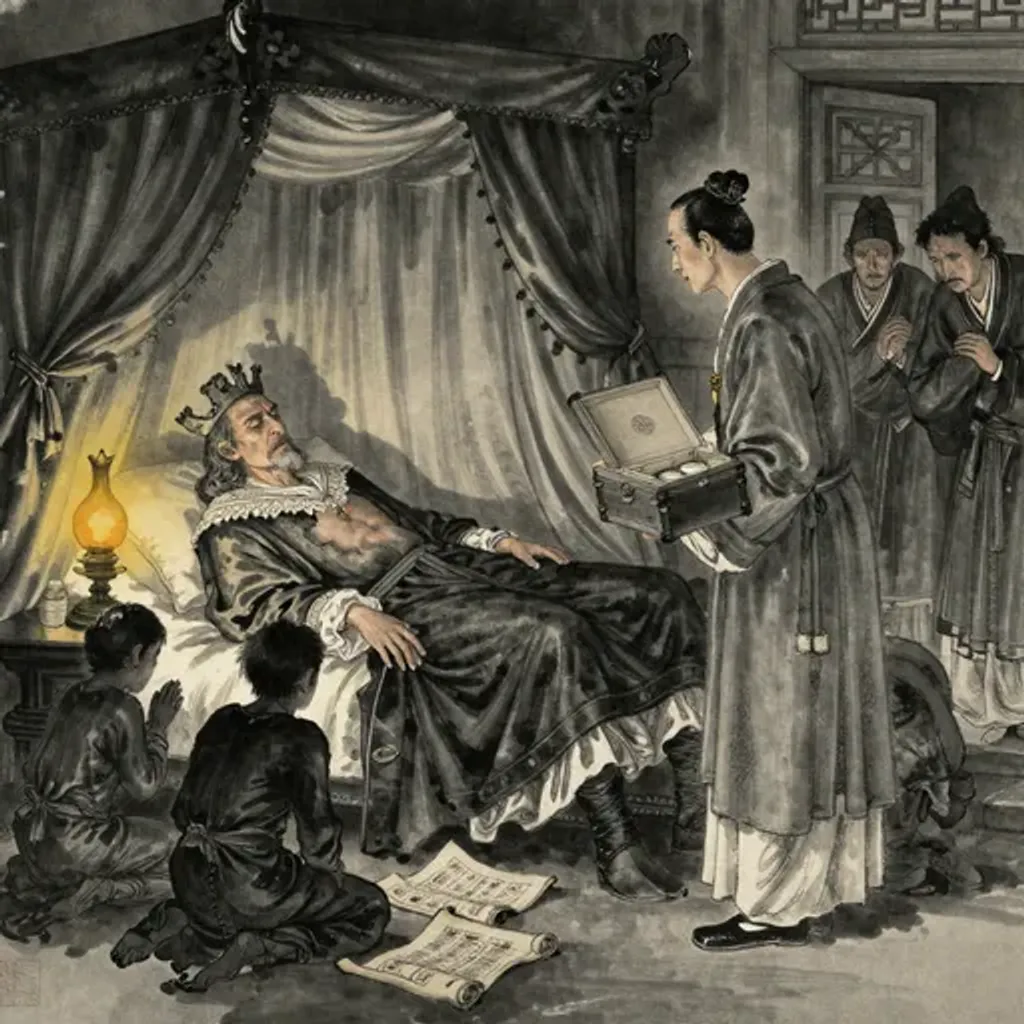
晉平有疾,迎醫秦國。病乃大患,分為兩豎。逃匿膏盲,和不能愈。
Duke Ping of Jin fell ill; he summoned a physician from Qin. The illness proved a great affliction, splitting into two demon-children. They hid below the heart and above the diaphragm; the healer could not cure it.
— Jiao Yanshou, Yilin (Forest of Changes), 1st century BC
Commentary
Clouds above heaven dissolve into doubled wind — the Gentle's penetrating influence. Duke Ping of Jin falls ill and sends for a physician from Qin. The sickness proves dire: it splits into two little demons who flee to hide between the vital membranes (膏肓), where no needle can reach and no medicine can penetrate. Even the physician He cannot cure it. The verse conflates two famous Jin medical episodes: the physician Yi He who diagnosed Duke Ping's illness as incurable excess, and the physician Yi Huan whose patient Duke Jing dreamed of two child-demons hiding in the unreachable space between heart and diaphragm. From Waiting to The Gentle, nourishment should penetrate like wind — yet even the wind's subtlest entry cannot reach where the disease has lodged.
需 → 兌
Hexagram 5 → Hexagram 58: The Joyous Lake
Changing lines: 3, 4
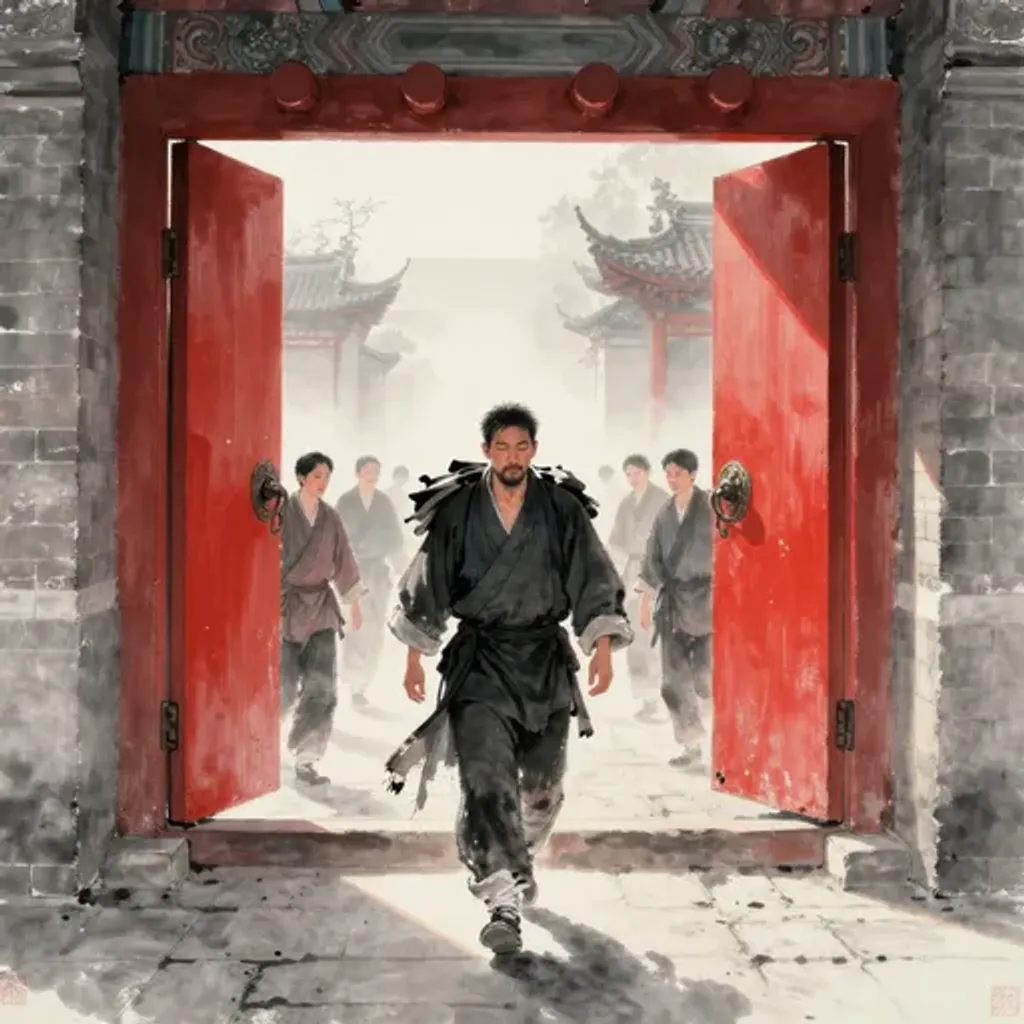
杜飛門啟,患憂大解。脩福行善,不為身禍。
The closed gate opens; worry and trouble are greatly resolved. Cultivating blessings, practicing virtue; one does not bring calamity upon oneself.
— Jiao Yanshou, Yilin (Forest of Changes), 1st century BC
Commentary
Clouds above heaven become paired lakes in The Joyous — friends sharing what they have learned. A closed door flies open; worry and anguish dissolve completely. Cultivating blessings and practicing goodness, one avoids bringing calamity upon oneself. The verse reads as pure relief: an obstruction that seemed permanent suddenly gives way, and the passage from darkness to light is instantaneous. The 'closed door opening' (杜飛門啟) is vivid — what was shut tight now springs wide. From Waiting to The Joyous, nourishment culminates in shared delight: the doubled lake is generosity flowing between equals. Joy comes not from acquiring more but from the dissolution of what blocked its arrival. Goodness practiced during the dark period is what opened the door.
需 → 渙
Hexagram 5 → Hexagram 59: Dispersion
Changing lines: 1, 3, 6
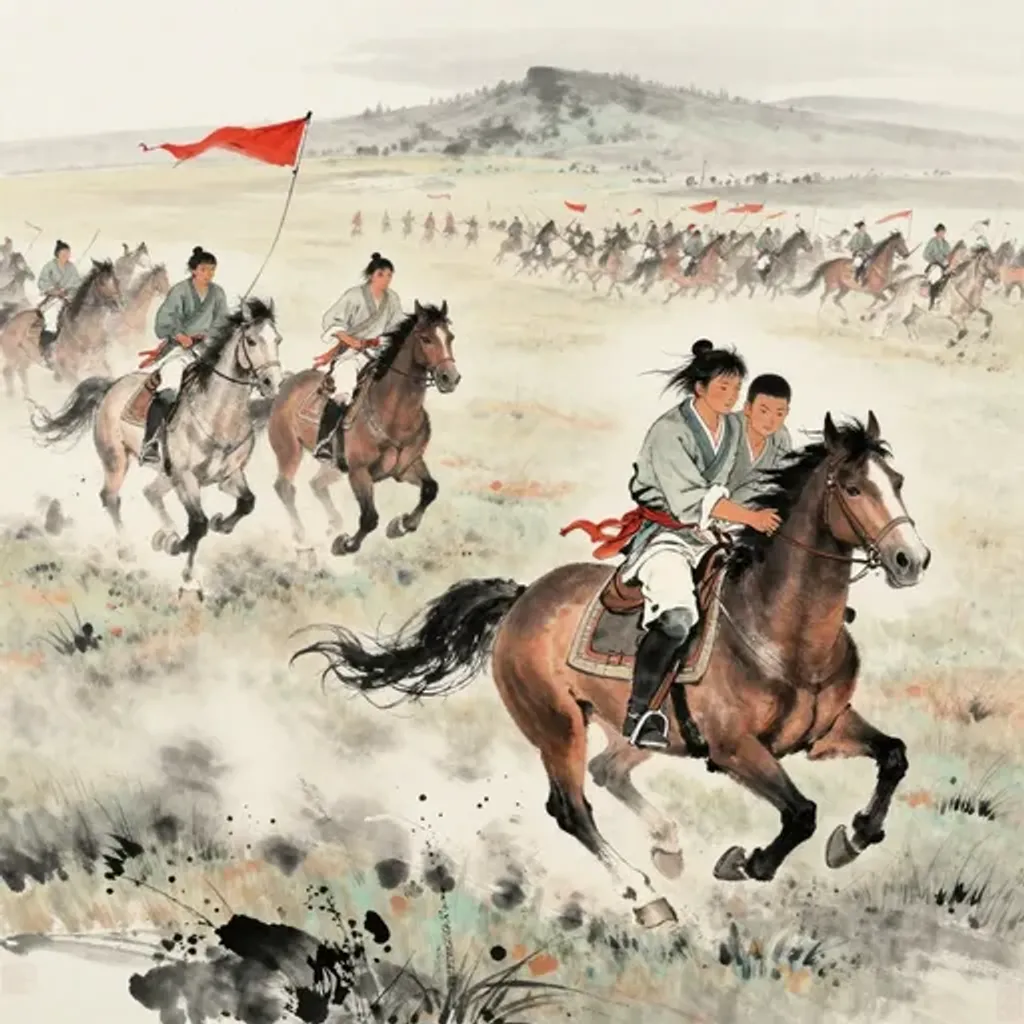
追亡逐北,至止而得。稚叔相呼,反其室廬。
Chasing the fleeing, pursuing those who retreat; reaching the destination, one succeeds. The youngest and the uncle call to each other; they return to their home.
— Jiao Yanshou, Yilin (Forest of Changes), 1st century BC
Commentary
Clouds above heaven scatter as wind moves over water in Dispersion. Pursuing the fleeing enemy northward, one catches them at the point of halting. Young brothers call to each other and return to their homes. The verse begins as military pursuit — chasing routed forces — but resolves into domestic reunion. The scattered are gathered, the dispersed return. 'Young and old call to one another' suggests family members separated by conflict finding each other in the aftermath. From Waiting to Dispersion, the paradox completes itself: what scatters also liberates. Wind over water breaks up rigidity, and in this breaking-apart, separated kin rediscover the path home. Dispersion, rightly timed, restores what accumulation had frozen in place.
需 → 節
Hexagram 5 → Hexagram 60: Limitation
Changing lines: 3
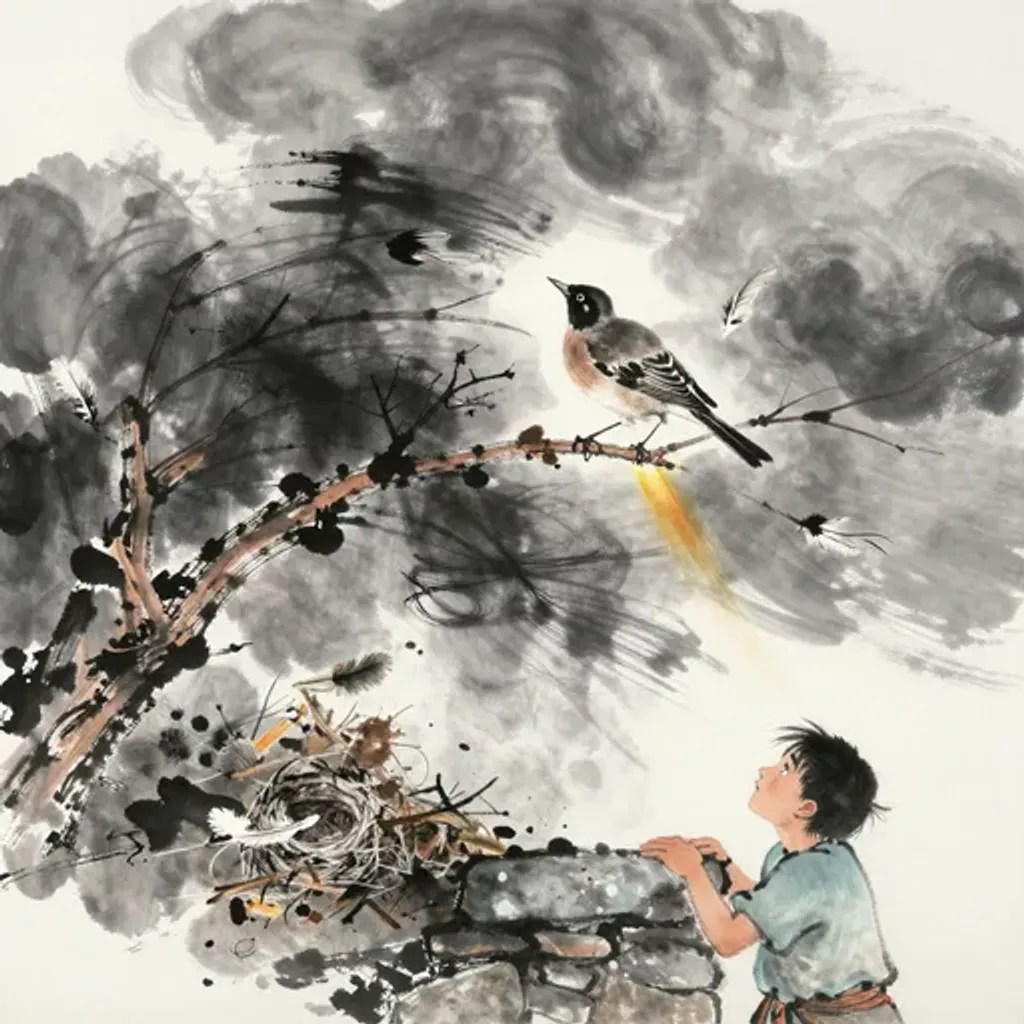
鳥鳴既端,一呼三顛。動搖東西,危慄不安。疾病無患。
The bird cries from its perch; one call, three tumbles. Shaken and tossed east and west; trembling and uneasy. Yet the illness brings no lasting harm.
— Jiao Yanshou, Yilin (Forest of Changes), 1st century BC
Commentary
Clouds above heaven settle into water upon the lake — Limitation's measured restraint. A bird's cry comes sharp and clear, then one call triggers three tumbles. Shaken east and west, one trembles in fearful unease. Yet the final phrase reverses everything: 'illness — no harm.' The verse enacts the experience of limitation itself: alarm, disorientation, the sensation of losing control — followed by the discovery that the crisis was smaller than it felt. The bird's cry is the signal that initiates panic, but panic does not equal destruction. From Waiting to Limitation, nourishment learns its proper measure: water upon the lake defines how high the water may rise. Fear sharpens attention, and the illness that seemed mortal proves manageable within bounds.
需 → 中孚
Hexagram 5 → Hexagram 61: Inner Truth
Changing lines: 3, 6
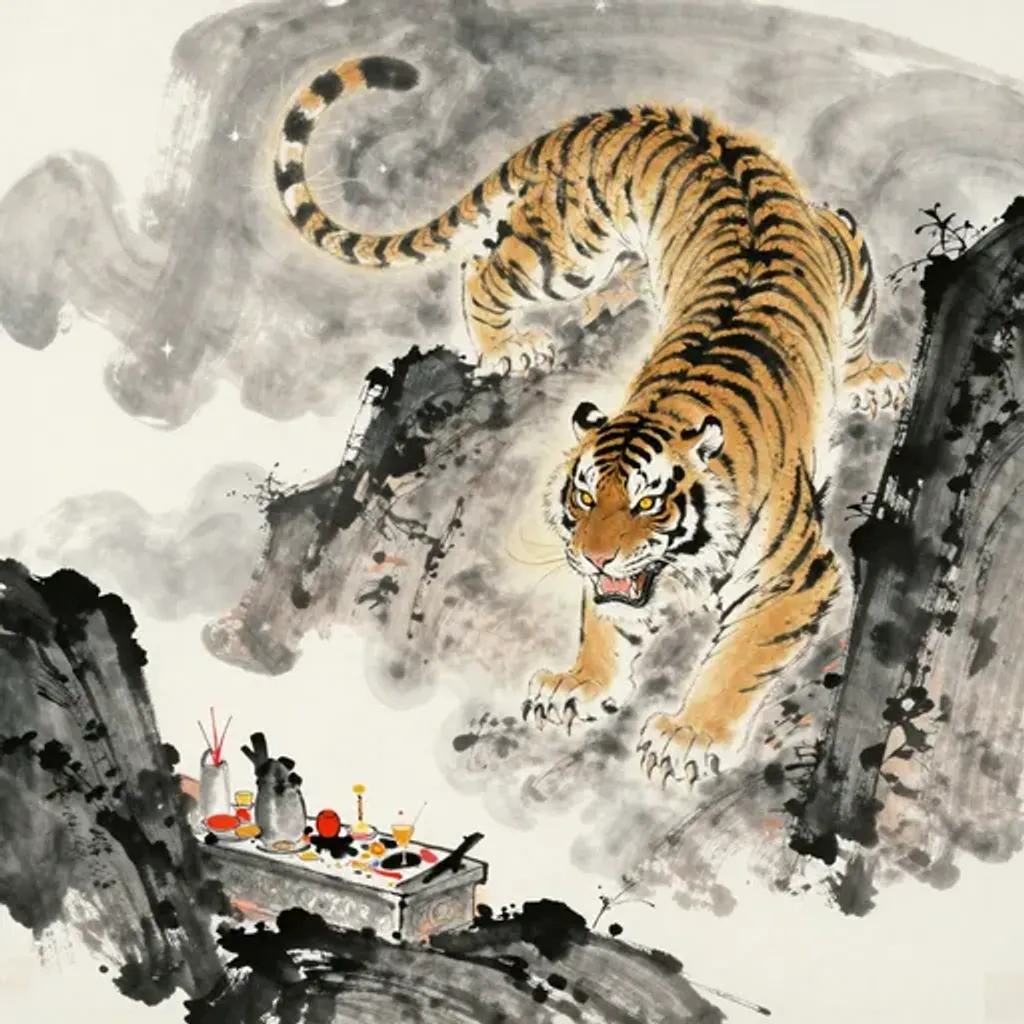
龍化為虎,泰山之陽。眾多從者,莫敢救藏。
The dragon transforms into a tiger on the southern slope of Mount Tai. Its many followers; none dare to rescue or hide.
— Jiao Yanshou, Yilin (Forest of Changes), 1st century BC
Commentary
Clouds above heaven yield to wind over the lake — Inner Truth's hollow center that resonates with sincerity. A dragon transforms into a tiger on the southern slope of Mount Tai. Followers are many, yet none dares offer shelter or concealment. The dragon-to-tiger metamorphosis signals a shift from celestial to terrestrial power — from the sky-dwelling dragon to the mountain-ruling tiger. On the yang side of the sacred mountain, this transformation commands awe: many follow but none can protect. The image evokes a powerful figure whose very presence overwhelms those around him. From Waiting to Inner Truth, the transformation reveals that genuine power need not seek shelter — its truth radiates like wind over the lake, stirring responses from the depths without requiring any external support.
需 → 小過
Hexagram 5 → Hexagram 62: Small Exceeding
Changing lines: 1, 2, 4, 5
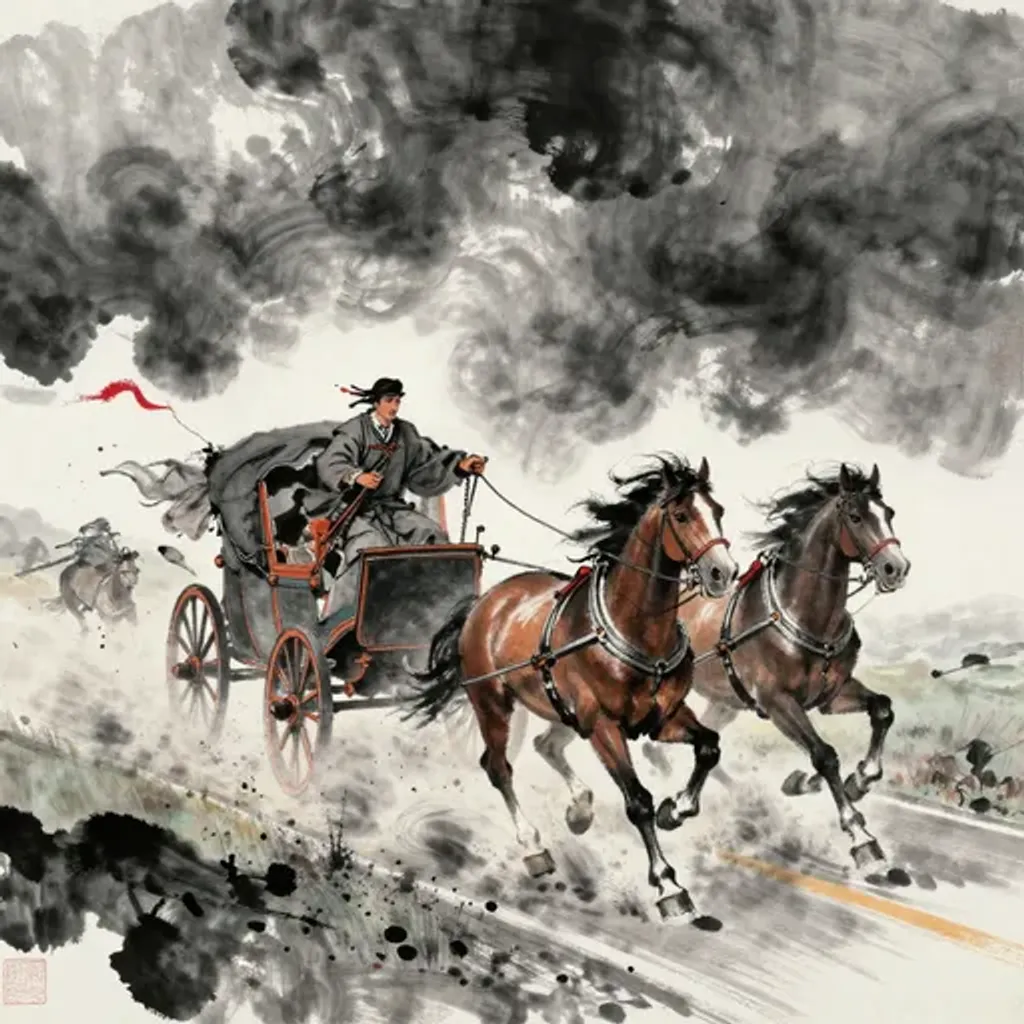
焱風忽起,車馳揭揭。棄名追亡,失其和節,憂心惙惙。
A sudden storm erupts; the carriage races, rattling and swaying. Abandoning reputation to chase what is lost; harmony and rhythm are broken. The heart aches with anxious dread.
— Jiao Yanshou, Yilin (Forest of Changes), 1st century BC
Commentary
Clouds above heaven descend to thunder atop the mountain — Small Exceeding's bird that should fly low, not high. A violent windstorm erupts; chariots race wildly, wheels rattling. One abandons reputation to pursue the fleeing, losing harmony and proper rhythm, the heart fluttering in distress. Everything about this scene is out of measure: the wind too sudden, the pursuit too reckless, the cost too great. The verse enacts the very excess that Small Exceeding warns against — going beyond what is appropriate in small matters until everything unravels. From Waiting to Small Exceeding, patience snaps into overreaction: the small bird overshoots its mark, and what began as minor urgency becomes a full-scale loss of composure and purpose.
需 → 既濟
Hexagram 5 → Hexagram 63: After Completion
Changing lines: 2
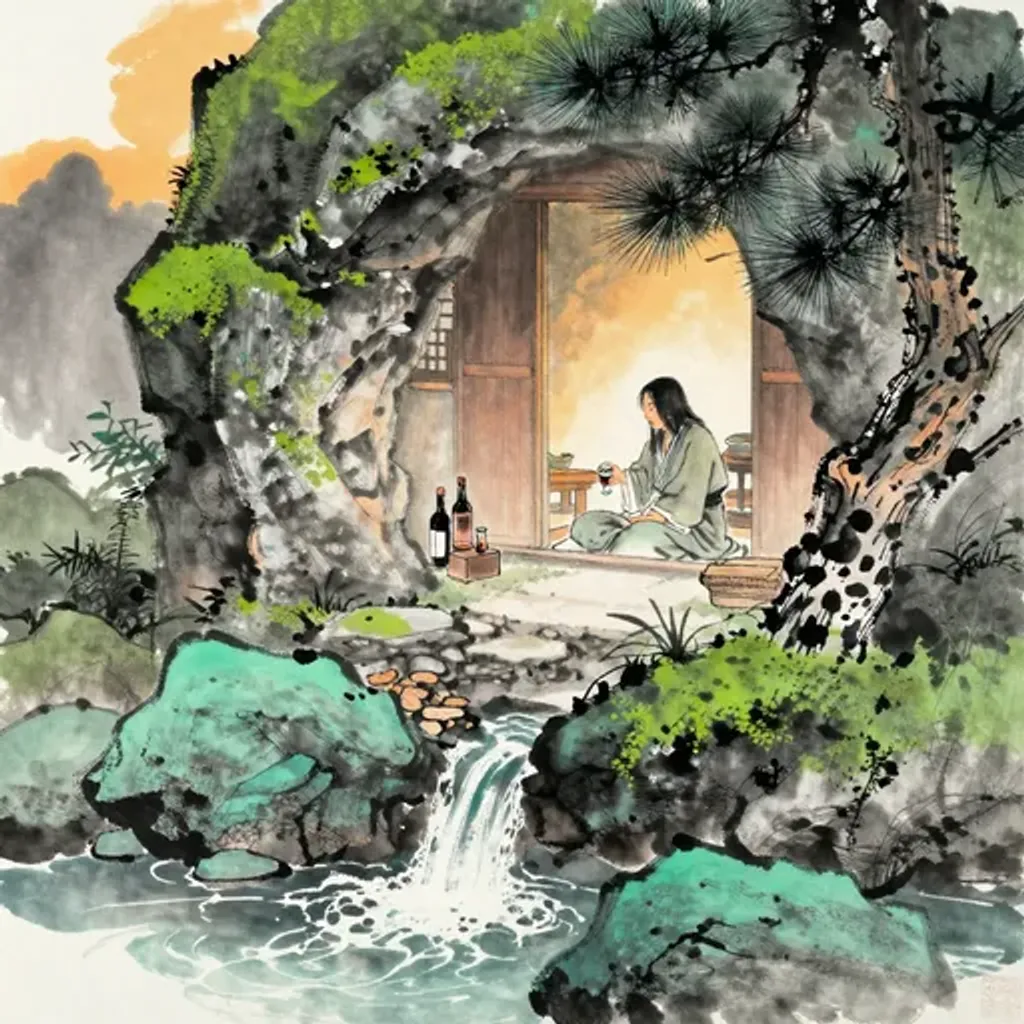
遊居石門,祿安身全。受福西鄰,歸飲玉泉。
Roaming and dwelling at Stone Gate; fortune and safety protect the body. Receiving blessings from the western neighbor; returning to drink at the Jade Spring.
— Jiao Yanshou, Yilin (Forest of Changes), 1st century BC
Commentary
Clouds above heaven settle into water above fire — After Completion's perfect but precarious balance. 'Dwelling at leisure by the Stone Gate, emoluments secure and person whole. Receiving blessings from the western neighbor, one returns to drink from the Jade Spring.' The Stone Gate may allude to Confucius's gatekeeper at the Stone Gate who recognized the sage's futile persistence, or simply a rocky retreat of safety. The 'western neighbor' echoes the Jici hexagram's famous line about the western neighbor's simple offering outweighing the eastern neighbor's grand sacrifice. The Jade Spring suggests paradisiacal water — pure, sustaining, perhaps immortal. From Waiting to After Completion, every element finds its place: water cools fire, security is achieved, and one drinks deeply from the source of lasting nourishment.
需 → 未濟
Hexagram 5 → Hexagram 64: Before Completion
Changing lines: 1, 3, 4, 5, 6
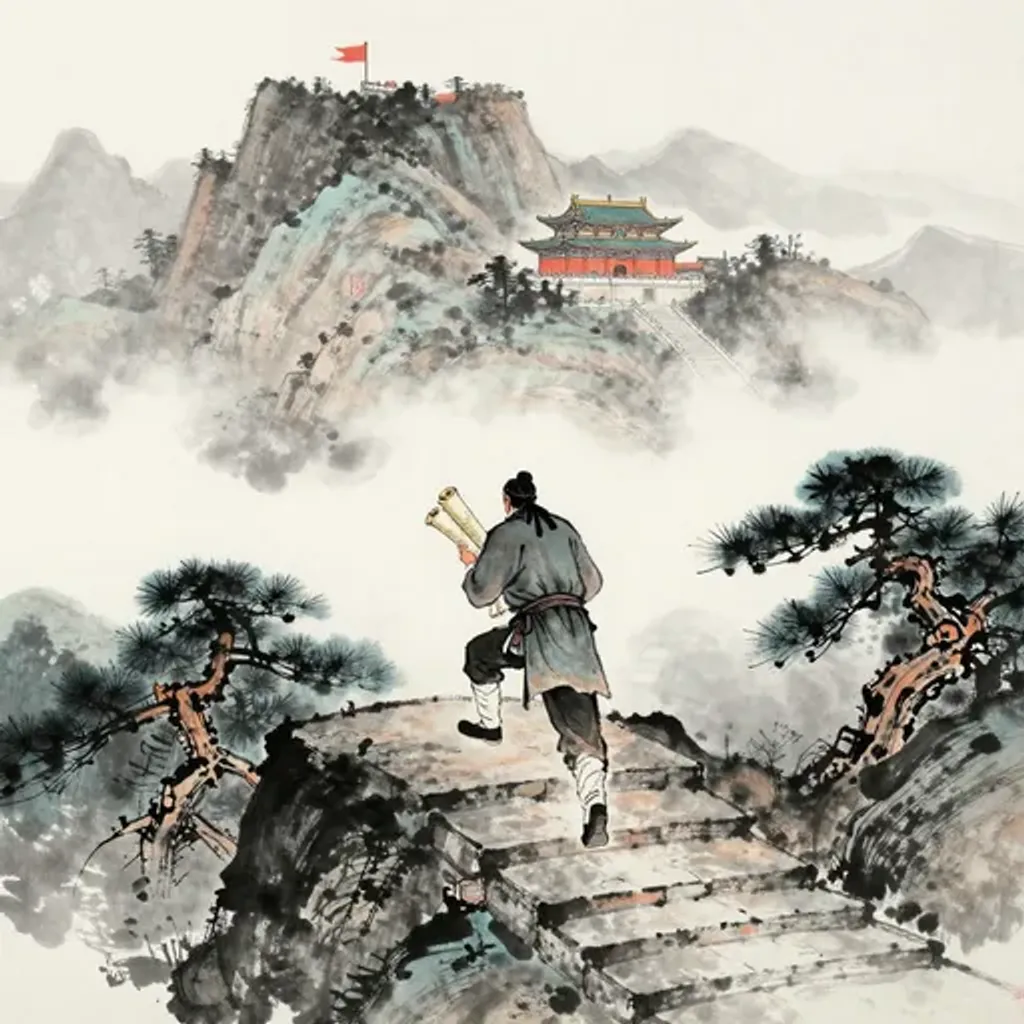
登高上山,見王自言。申理我讒,得職蒙恩。
Climbing high, ascending the mountain; seeing the king, speaking for oneself. Setting right the slander against me; one gains a post and receives grace.
— Jiao Yanshou, Yilin (Forest of Changes), 1st century BC
Commentary
Clouds above heaven give way to fire above water — Before Completion's final incompletion, where everything is still in transit. Climbing high up the mountain, one sees the king and speaks directly. 'Clarify the slander against me' — vindication is sought by ascending to the highest point and appealing in person. One receives an appointment and is graced with favor. The verse enacts the journey from obscurity to recognition: the slandered official who climbs to the seat of power, presents his case, and is restored. From Waiting to Before Completion, the crossing is not yet finished but the direction is clear. Fire above water means the elements have not yet found their proper positions — but the very act of ascending to speak truth moves them closer to where they belong.