Transformations of Hexagram 52
Every line of change out of Hexagram 52 艮 Keeping Still Mountain, with the Yilin verse for each of the 64 resulting hexagrams, its translation, and the original ink brush artwork.
艮 → 乾
Hexagram 52 → Hexagram 1: The Creative
Changing lines: 1, 2, 4, 5
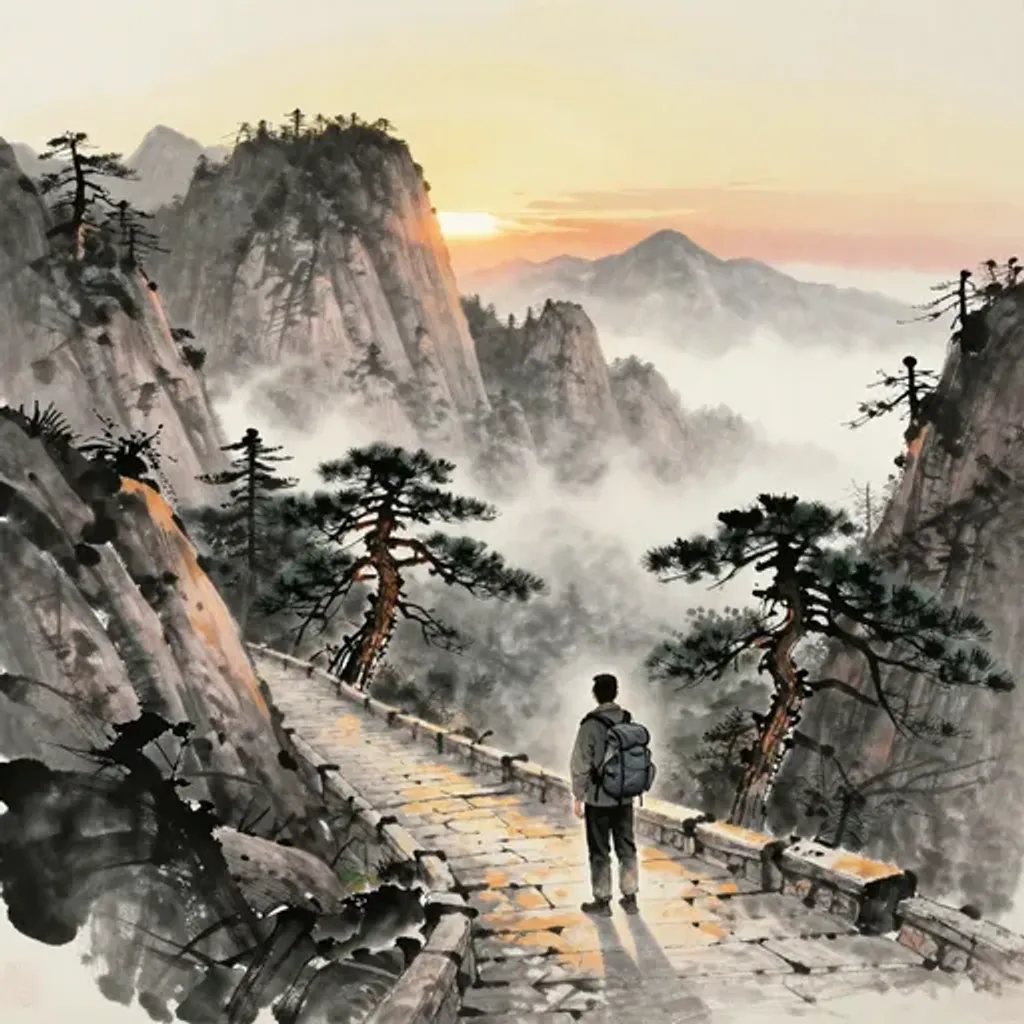
憂驚已除,禍不為災,安全以來。
Worry and alarm already removed; calamity does not become disaster. Safety arrives at last.
— Jiao Yanshou, Yilin (Forest of Changes), 1st century BC
Commentary
Twin mountains stand still, yet all worry dissolves into heaven's self-generating vigor. Alarm and dread have already departed; calamity does not become disaster, and safety arrives of its own accord. The verse reads like a diviner's reassurance after a period of anxiety: the threat was real, but its force is spent. From Keeping Still to the Creative, the doubled mountain gives way to doubled heaven. What was held in rigid stillness now releases as pure initiative. The mountain's restraint was never passive; it was the discipline that allowed heaven's energy to gather unseen, until the moment arrived to act. Safety here is not the absence of danger but the completion of a cycle in which stillness prepared the ground for sovereign motion.
艮 → 坤
Hexagram 52 → Hexagram 2: The Receptive
Changing lines: 3, 6
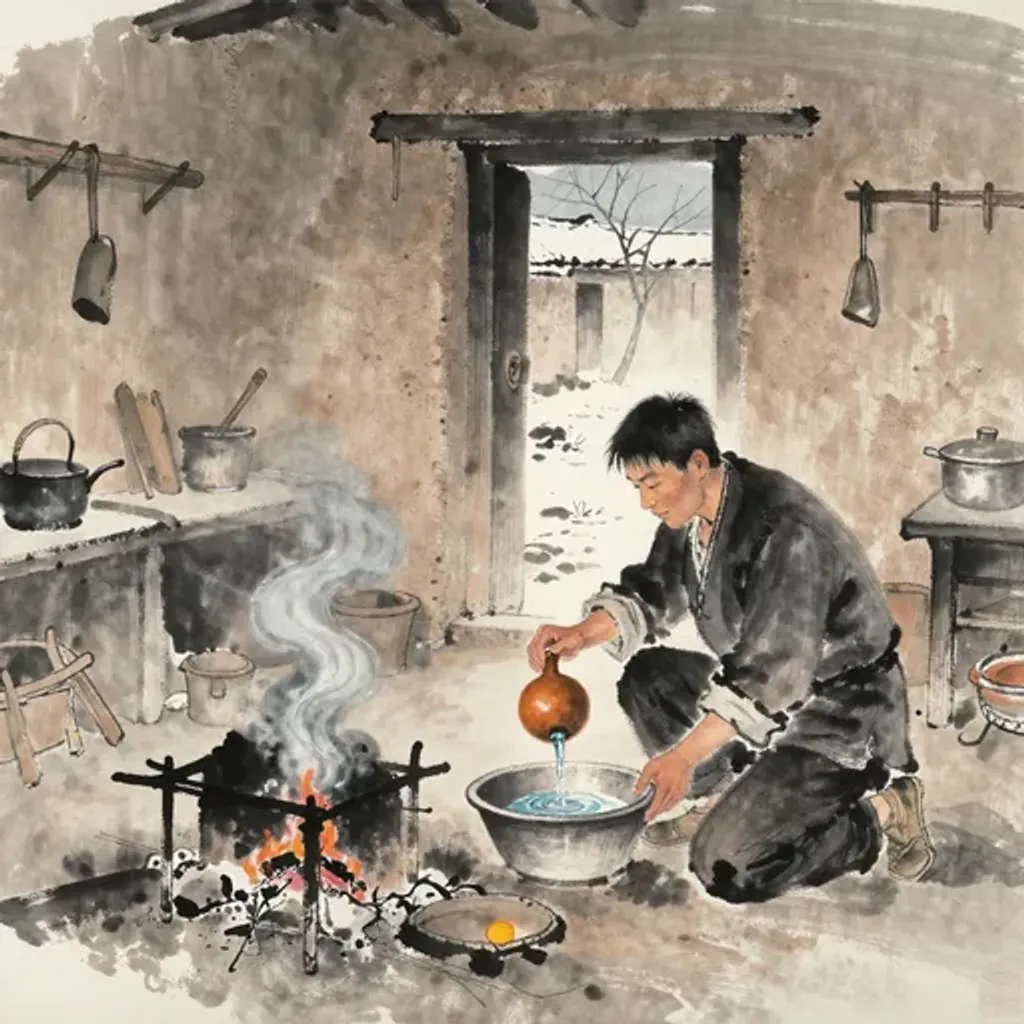
穿匏挹水,篝銕燃火。勞疲力竭,飢渴為禍。
Scooping water with a hollowed gourd, kindling fire in an iron basket. Toil spent, strength exhausted; hunger and thirst become the calamity.
— Jiao Yanshou, Yilin (Forest of Changes), 1st century BC
Commentary
Twin mountains stand still, yet here stillness collapses into exhaustion. One scoops water with a punctured gourd and lights a fire in a wire cage over iron — every tool is broken, every effort futile. Labor drains the body; hunger and thirst compound into real harm. The imagery is elemental subsistence pushed beyond endurance: containers that cannot hold, fuel that cannot sustain. From Keeping Still to the Receptive, doubled mountain yields to doubled earth. The mountain's restraint, taken to its extreme, becomes the earth's passive acceptance of suffering. Where stillness should have been strategic withdrawal, here it has frozen into helplessness, and the ground simply absorbs one blow after another without the strength to respond.
艮 → 屯
Hexagram 52 → Hexagram 3: Difficulty at the Beginning
Changing lines: 1, 3, 5, 6
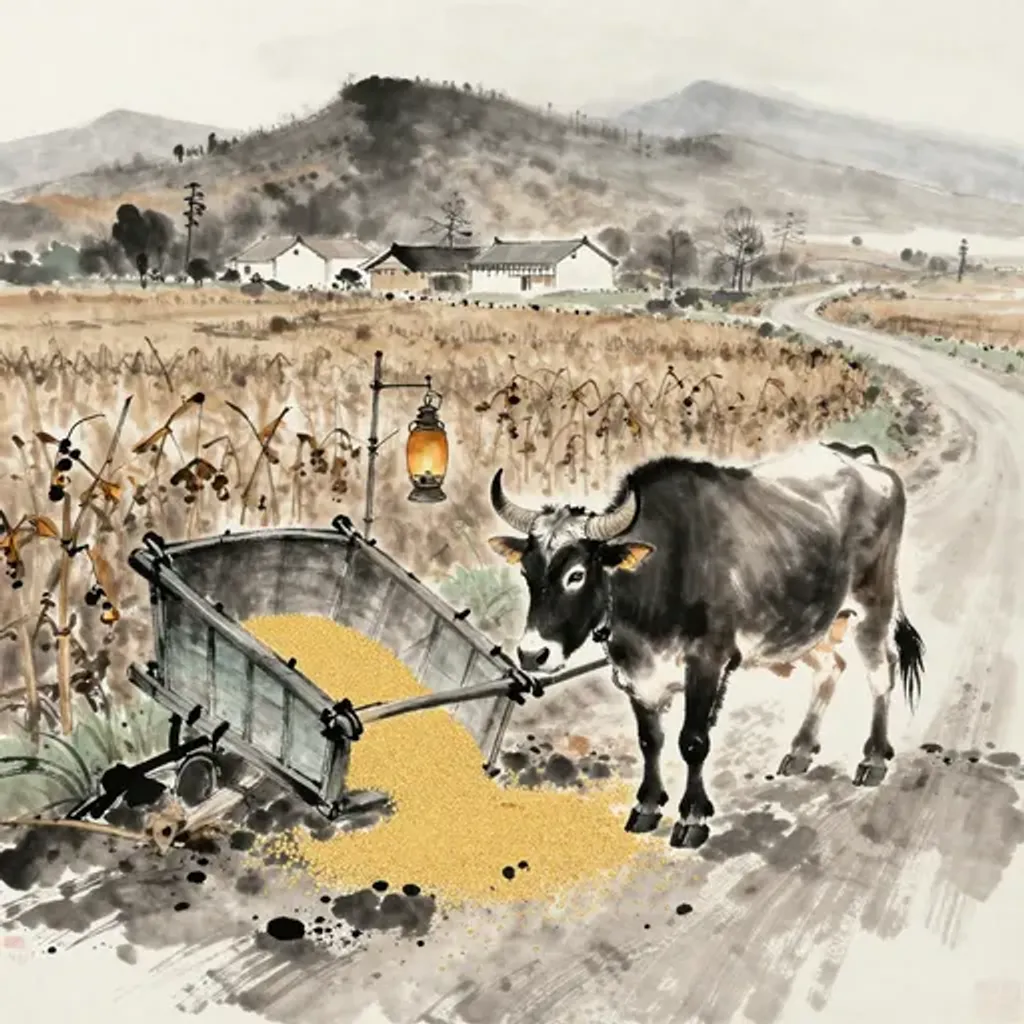
蹇牛折角,不能載粟。災害不避,年歲无穀。
A lame ox with broken horn cannot carry the grain. Disaster unavoided; the year yields no harvest.
— Jiao Yanshou, Yilin (Forest of Changes), 1st century BC
Commentary
Twin mountains hold still, but the lame ox has already broken its horn and cannot carry the grain. Disaster is not averted; the year yields no harvest. The ox — the farmer's most essential asset — is doubly impaired: hobbled in its legs, shattered in its horn. Transport fails, and the harvest rots. From Keeping Still to Difficulty at the Beginning, the mountain's restraint meets the turbulence of thunder beneath water, clouds gathering with no release. The verse captures the cruelty of timing: when the beast of burden falters at precisely the moment the grain must move, stillness is no longer patience but paralysis. Initiative (thunder) churns beneath obstruction (water), and the season passes without yield.
艮 → 蒙
Hexagram 52 → Hexagram 4: Youthful Folly
Changing lines: 2, 3
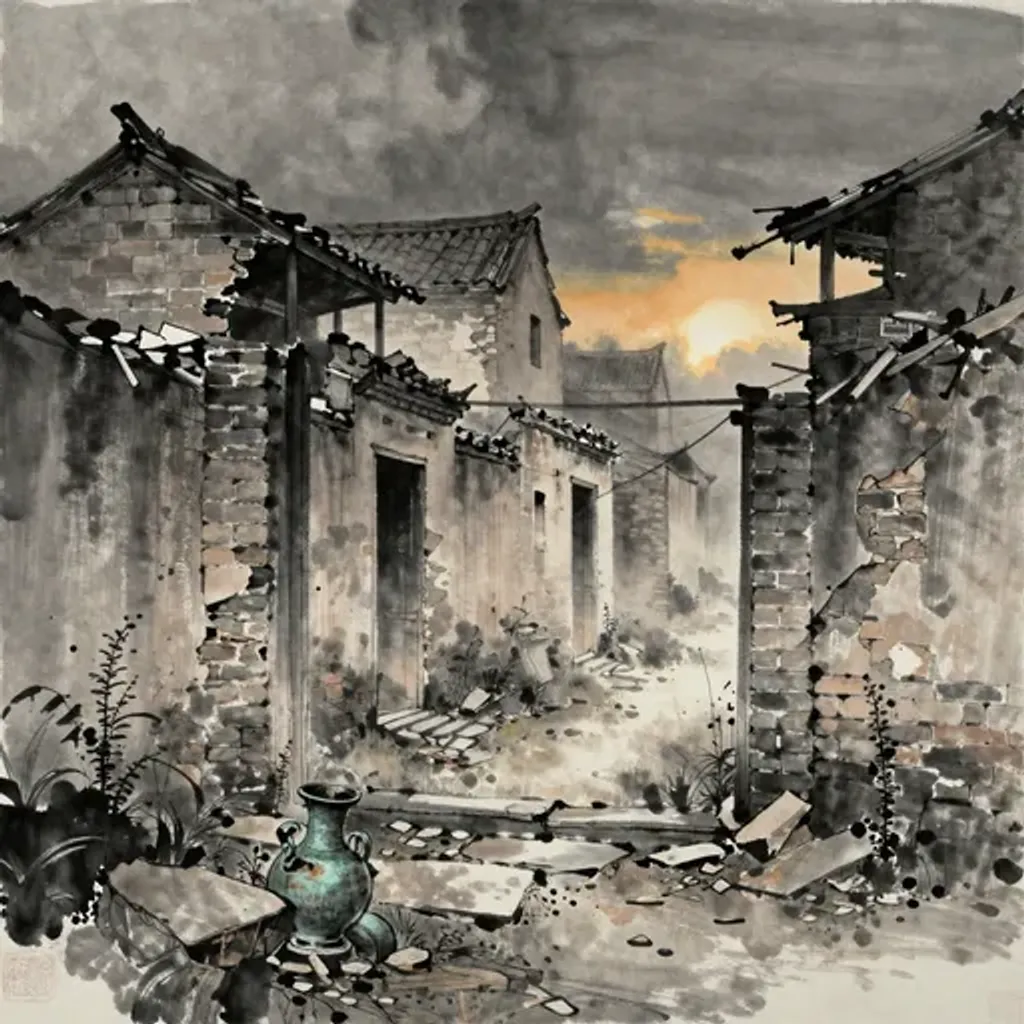
邑將為虛,居之憂危。
The town shall become a ruin; to dwell there brings worry and peril.
— Jiao Yanshou, Yilin (Forest of Changes), 1st century BC
Commentary
Twin mountains stand still as the settlement empties into ruin. The town is about to become a wasteland; those who dwell there live in dread. The verse is starkly brief — two lines that compress an entire cycle of civic decline into a single image. From Keeping Still to Youthful Folly, doubled mountain yields to water emerging beneath a mountain. The spring that should nourish instead erodes from below. Stillness that once meant stability now means stagnation: no trade, no fresh blood, no renewal. The mountain above the spring suggests that wisdom exists somewhere beneath the surface, but folly prevails because no one has the will to seek it. A community frozen in place becomes its own ghost.
艮 → 需
Hexagram 52 → Hexagram 5: Waiting
Changing lines: 1, 2, 5, 6
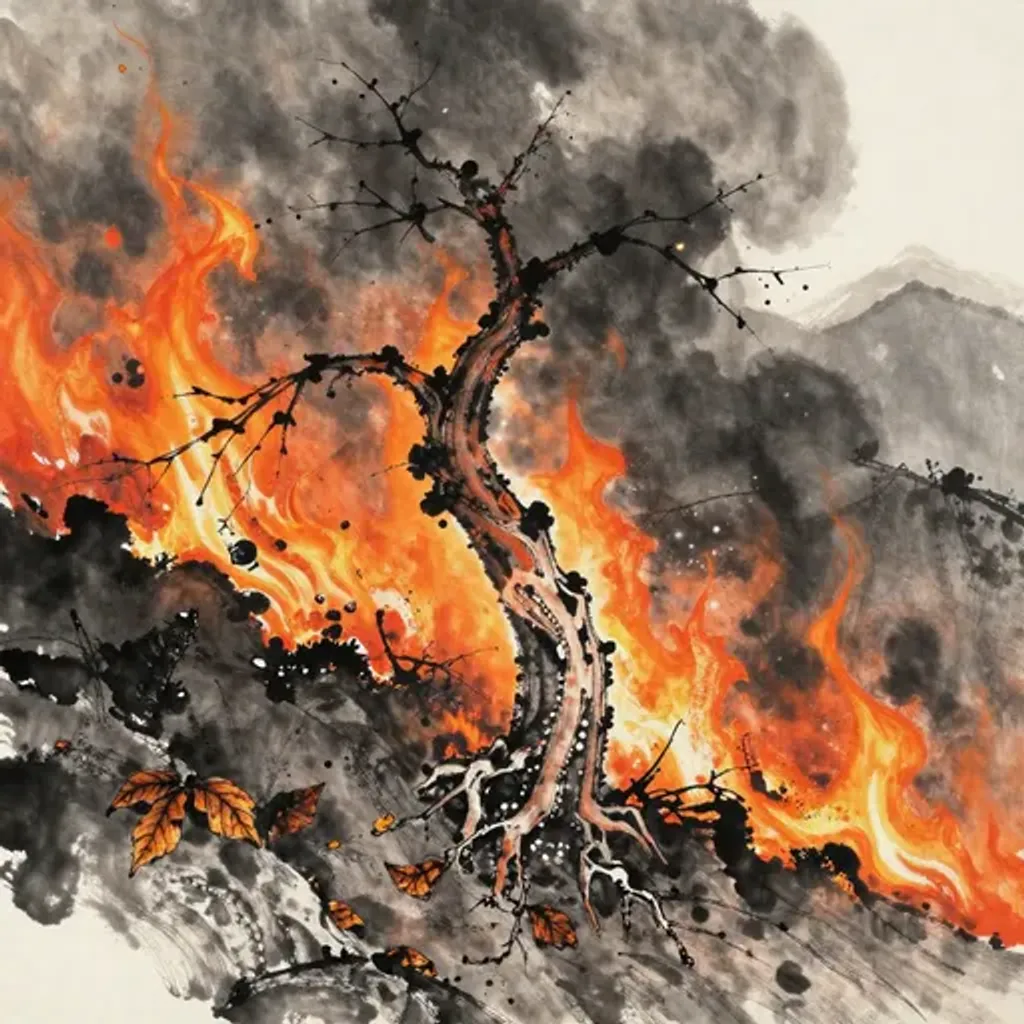
根刖殘樹,花葉落去。卒逢火焱,隨風僵仆。
A felled, mutilated tree, its flowers and leaves fallen away. Suddenly meeting a blaze of fire, it topples stiff with the wind.
— Jiao Yanshou, Yilin (Forest of Changes), 1st century BC
Commentary
Twin mountains stand still, but the tree is already stripped bare — roots hewn, flowers and leaves fallen. Then fire strikes suddenly, and the trunk topples with the wind. The image is of complete vulnerability: a living thing reduced to dead timber, then consumed. From Keeping Still to Waiting, mountain transforms into water suspended above heaven. Waiting implies that danger hangs overhead, visible but not yet fallen. The tree that has lost its roots cannot wait; it has no reserves left. The verse warns that stillness without nourishment is not patience but exposure. When the fire arrives, there is nothing left to protect, and the wind finishes what neglect began.
艮 → 訟
Hexagram 52 → Hexagram 6: Conflict
Changing lines: 2, 3, 4, 5
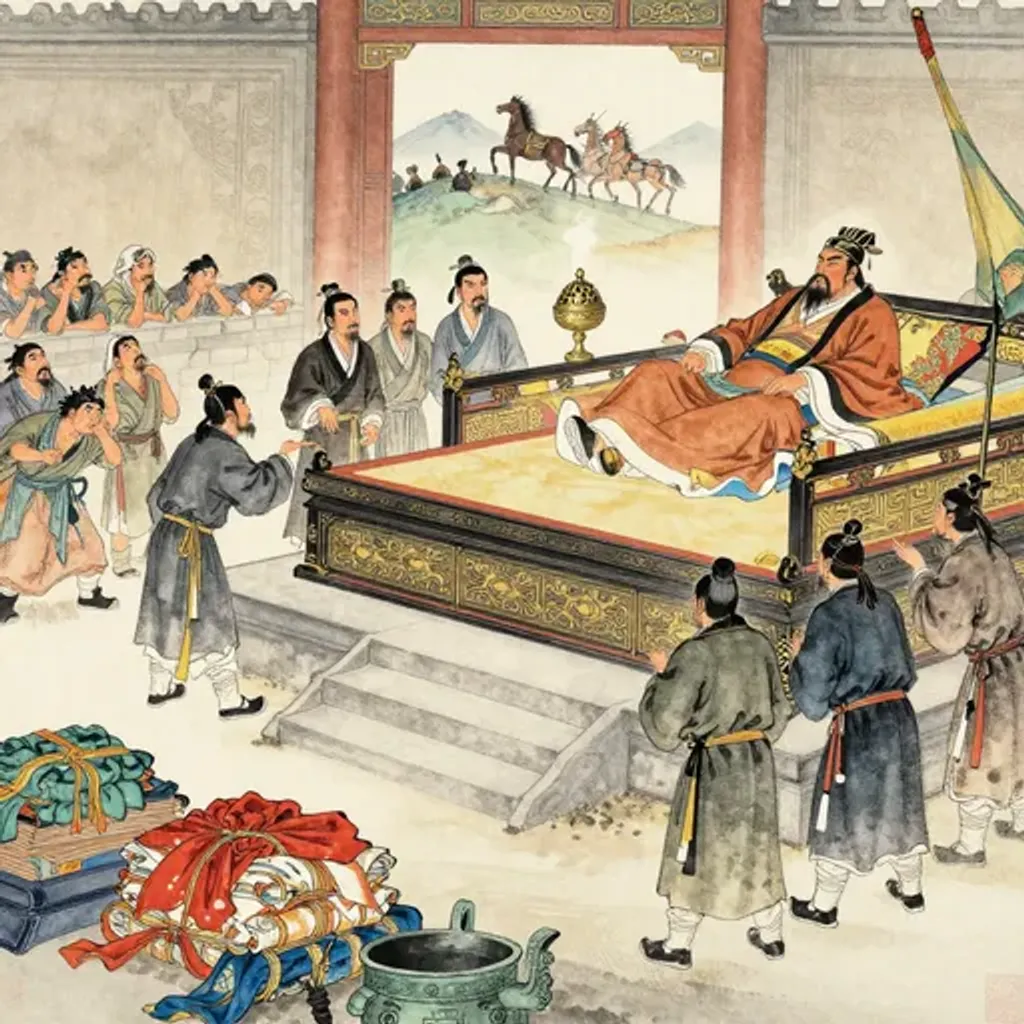
元后貪欲,窮極民力。執政乖互,為夷所偪。
The sovereign, greedy with desire, exhausts the people's strength. Those in power conflict and oppose one another; pressed hard by the barbarians.
— Jiao Yanshou, Yilin (Forest of Changes), 1st century BC
Commentary
Twin mountains stand still, but the sovereign himself has become the problem. The ruler is consumed by greed, draining the people's strength to its limit. Those who govern pull in opposite directions; the state is pressed by foreign enemies. The verse diagnoses a political crisis from the top: when the head of state is rapacious, administration becomes incoherent, and barbarian pressure exploits the resulting weakness. From Keeping Still to Conflict, doubled mountain gives way to heaven moving against water. Conflict arises when above and below diverge. The mountain's stillness, which should have been contemplative restraint, has become a tyrant's immovability — deaf to counsel, blind to collapse, while heaven and water race in opposing directions below him.
艮 → 師
Hexagram 52 → Hexagram 7: The Army
Changing lines: 2, 3, 6
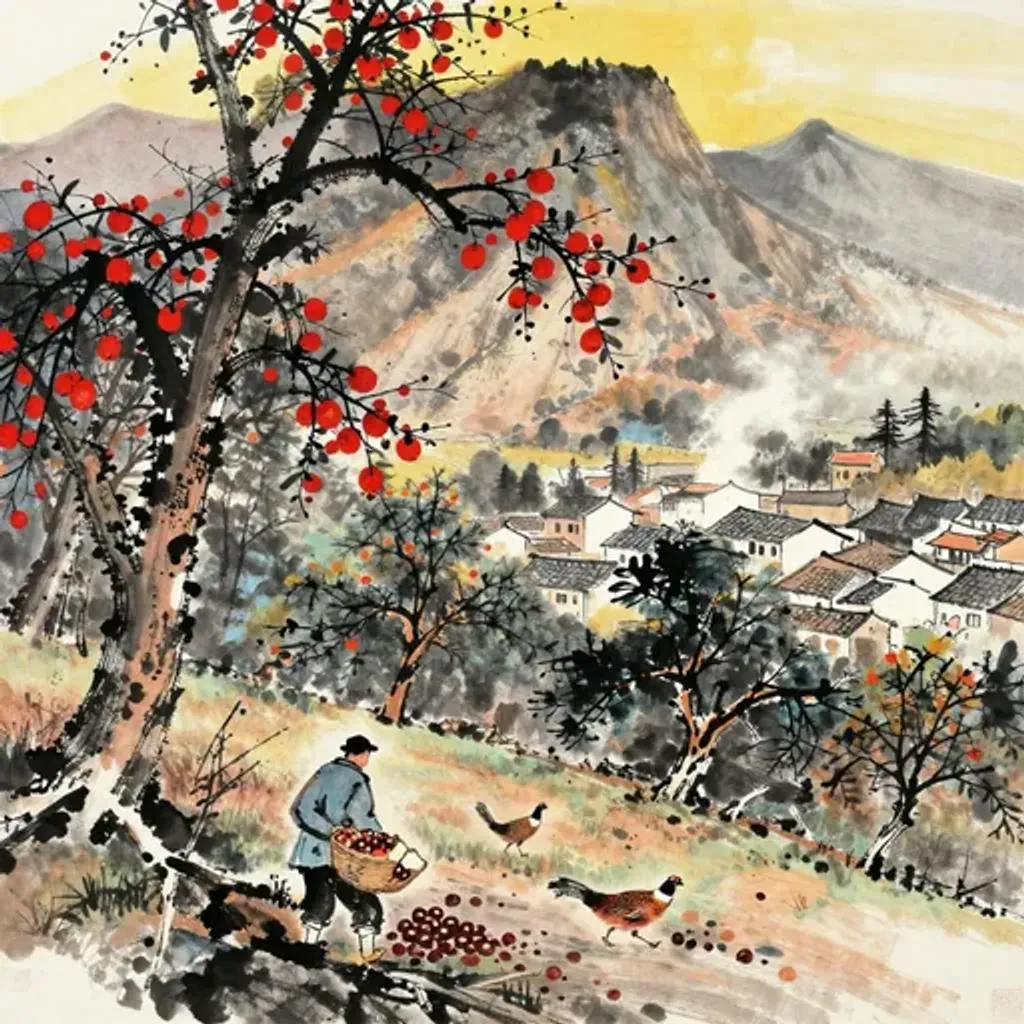
北山有棗,使叔壽考。東領多栗,宜行賈市。陸梁雌雉,所至利害。
The north mountain has jujubes, granting the uncle long life. The eastern ridge abounds in chestnuts, fit for trade at market. A bold hen-pheasant — wherever it goes, gain and harm follow.
— Jiao Yanshou, Yilin (Forest of Changes), 1st century BC
Commentary
Twin mountains stand still, and from their slopes come sustenance and commerce. The north mountain bears jujubes that grant Uncle long life; the eastern ridge is rich with chestnuts, inviting traders to market. Then a hen-pheasant struts boldly, and wherever she goes, fortunes shift between profit and harm. The verse catalogs mountain resources — food, trade goods, wildlife — but ends with an ambiguous creature whose movements bring unpredictable consequences. From Keeping Still to the Army, doubled mountain transforms into water hidden within the earth. The Army's image is disciplined containment: masses organized beneath the surface, resources marshaled. The mountain's bounty only becomes strength when properly administered, like a general surveying terrain before deploying troops.
艮 → 比
Hexagram 52 → Hexagram 8: Holding Together
Changing lines: 3, 5, 6
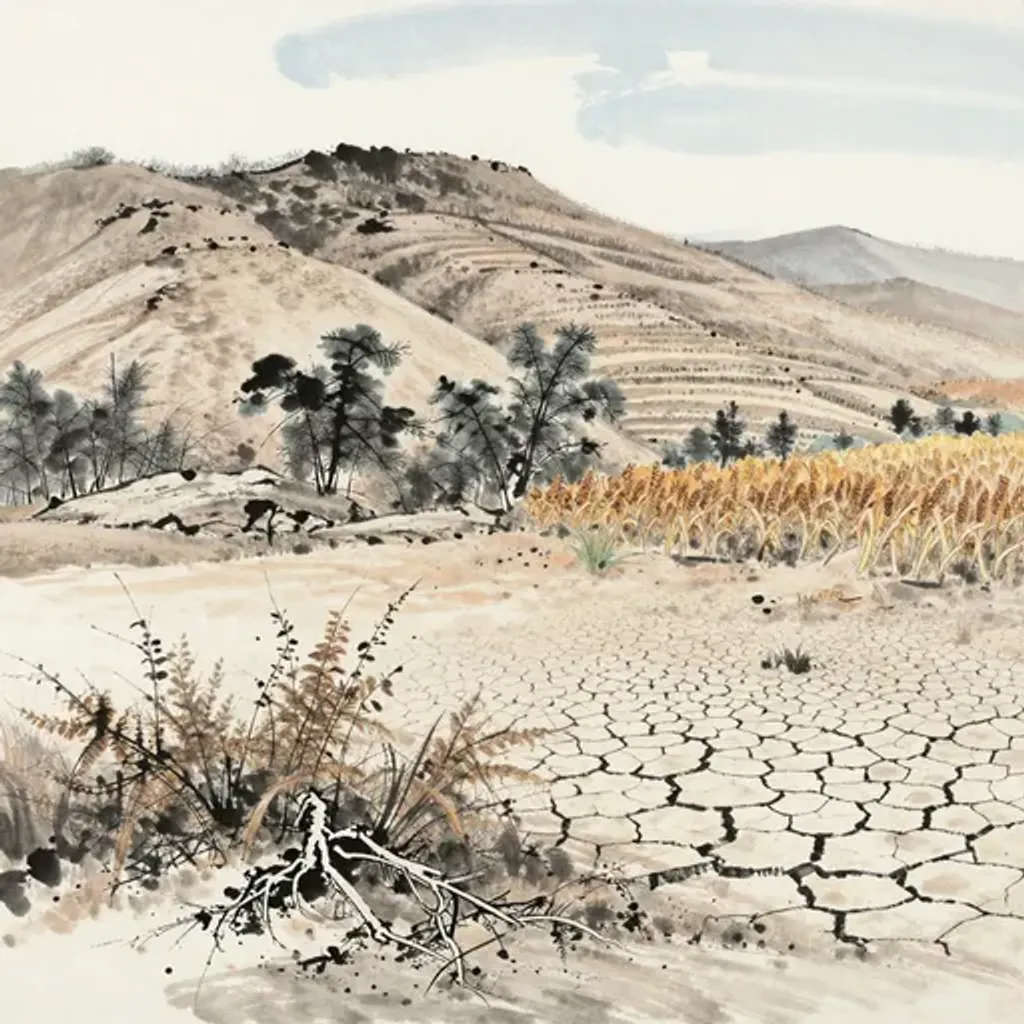
高原峻山,陸土少泉。草木林麓,嘉禾所炎。
High plateau, steep mountain; the inland soil has few springs. Grass and trees line the foothills, yet fine grain is scorched there.
— Jiao Yanshou, Yilin (Forest of Changes), 1st century BC
Commentary
Twin mountains stand still upon high plateaus where springs are scarce. The terrain is elevated and dry — lofty ground with little water. Trees and forests blanket the foothills, but the fine grain scorches under drought. From Keeping Still to Holding Together, doubled mountain gives way to water above the earth, the image of union and mutual support. The verse captures the paradox: the mountain stands proud but cannot sustain growth alone. Its high plateau lacks the nourishing water that only flows when barriers are lowered. The transformation suggests that isolation, however majestic, starves the harvest. Only when the mountain yields and water spreads across the land can the community flourish.
艮 → 小畜
Hexagram 52 → Hexagram 9: Small Taming
Changing lines: 1, 2, 5
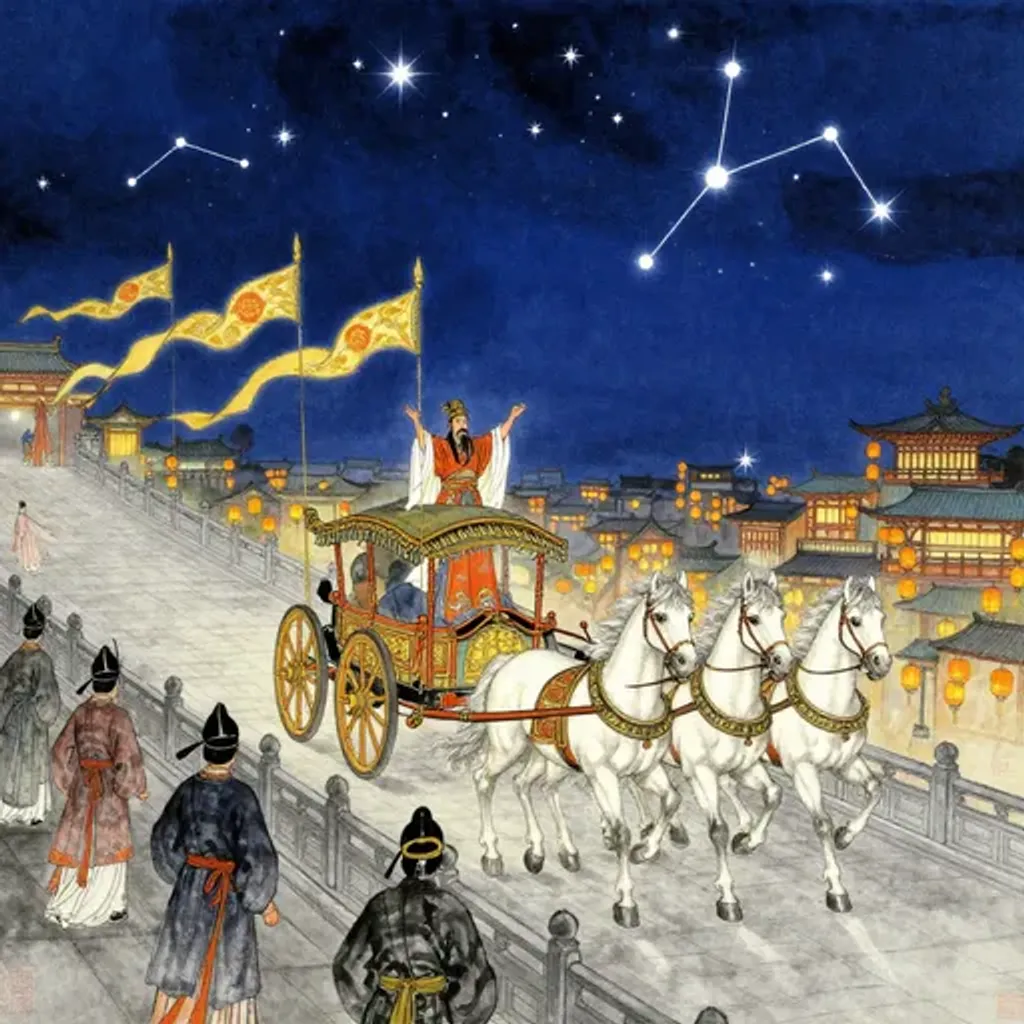
辰次降婁,王駕巡時。廣祐德惠,國安无憂。
The star-lodge rests at Jianglou; the king's chariot tours the season. Broadly bestowing virtue and grace, the realm is peaceful and free from worry.
— Jiao Yanshou, Yilin (Forest of Changes), 1st century BC
Commentary
Twin mountains stand still as the celestial calendar aligns with the lodge of Jianglu, and the king sets forth on his seasonal inspection. Under this auspicious conjunction, broad protection and virtuous grace extend across the realm, and the state rests free from worry. Jianglu (降婁) is one of the twelve Jupiter stations in Han-dynasty astrology, marking a propitious time for royal progress. From Keeping Still to Small Taming, mountain yields to wind moving above heaven. The wind's gentle influence refines what heaven has already set in motion. The king's tour is not conquest but cultivation — like a breeze that polishes virtue into brilliance. Stillness releases into soft, pervasive influence.
艮 → 履
Hexagram 52 → Hexagram 10: Treading
Changing lines: 1, 2, 3, 4, 5
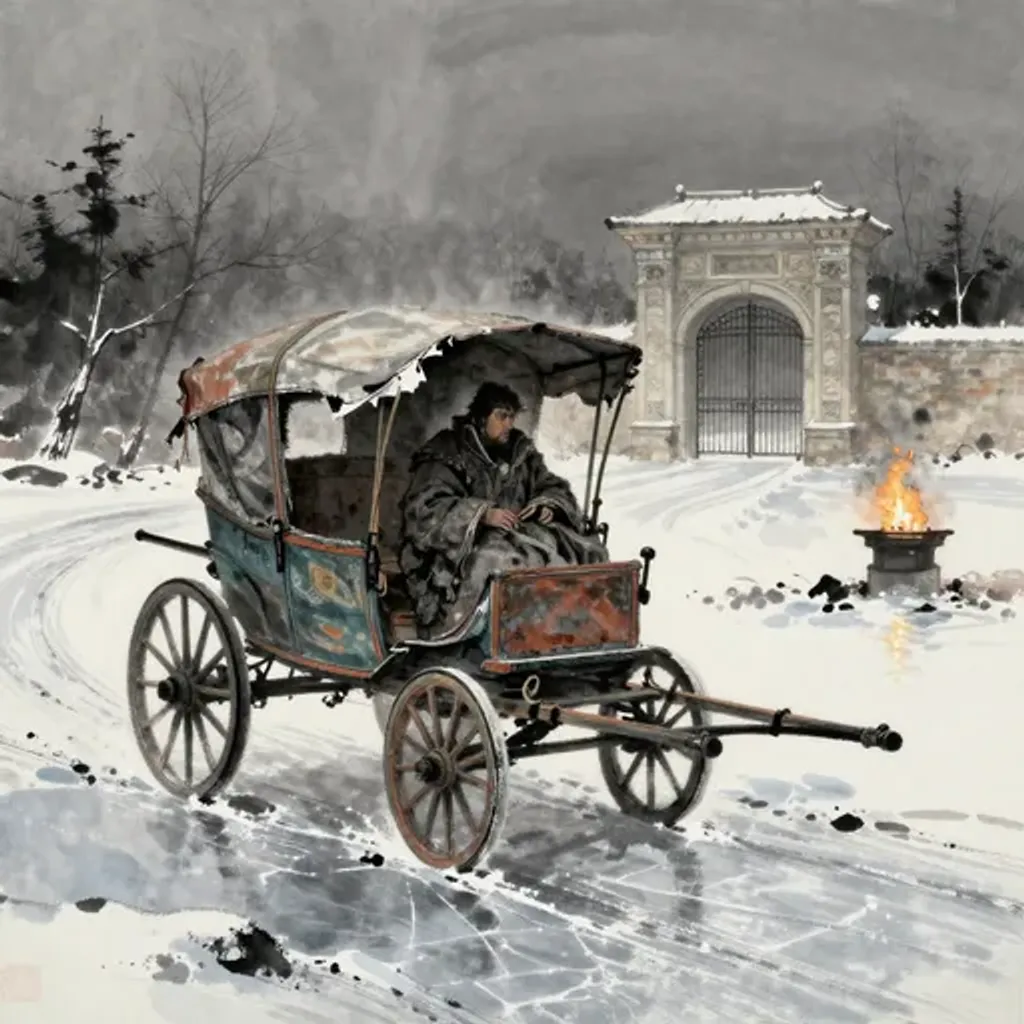
䡘䡘轠轠,歲暮偏弊。寵名損棄,君衰於位。
Rattling, rumbling; the year's end brings ruin. Favor and fame cast aside; the lord declines upon his throne.
— Jiao Yanshou, Yilin (Forest of Changes), 1st century BC
Commentary
Twin mountains stand still, but the wheels rattle and grind as the year draws to its close, everything worn and fraying. Favor and reputation are discarded; the lord weakens upon his seat. The sound of rattling wheels evokes a state carriage in decline — the vehicle of authority itself is breaking down. From Keeping Still to Treading, doubled mountain gives way to heaven above the lake, the image of proper conduct and hierarchical distinction. Yet the verse inverts that promise: instead of walking correctly upon the tiger's tail, the sovereign stumbles. The mountain's stillness should have been dignified restraint, but here it has calcified into irrelevance. Authority maintained too long without renewal becomes its own dissolution.
艮 → 泰
Hexagram 52 → Hexagram 11: Peace
Changing lines: 1, 2, 6
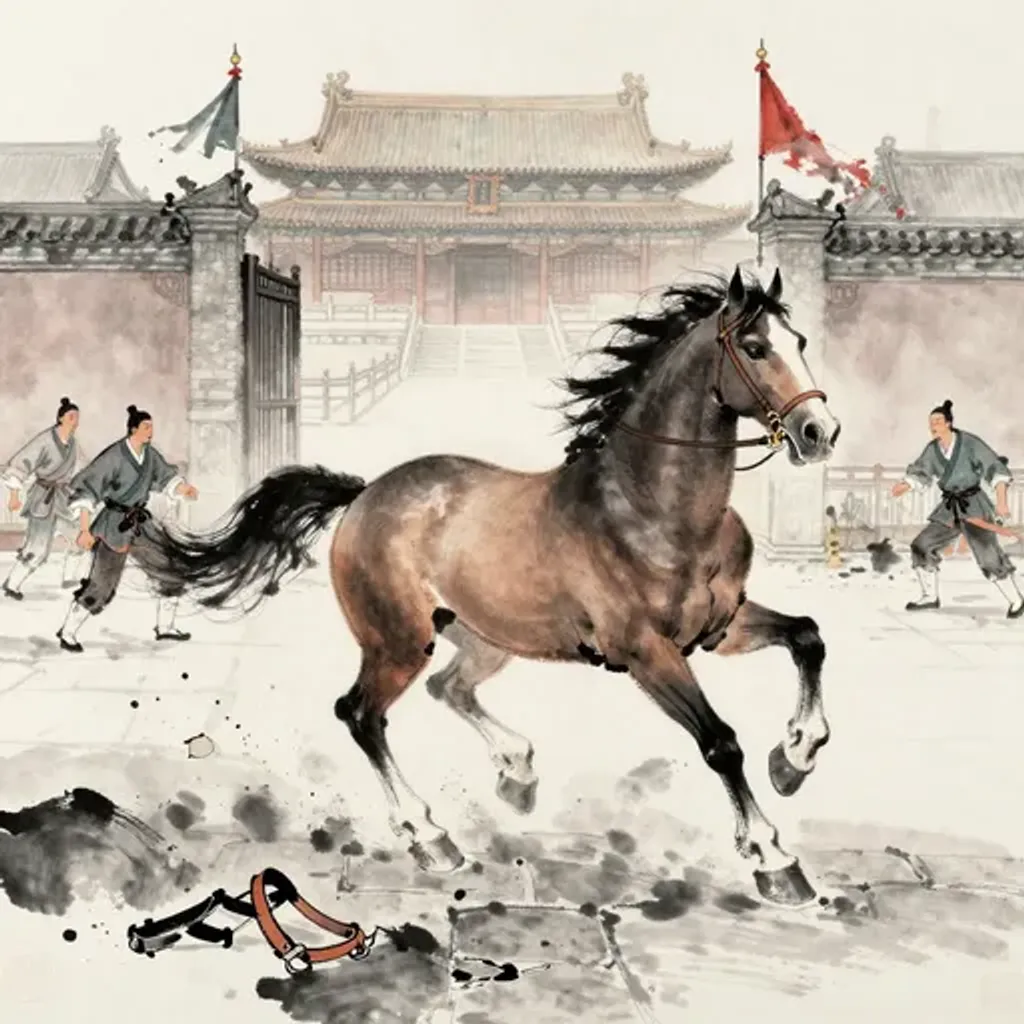
放衘委轡,奔亂不制。法度无恆,君失其位。
Bit cast off, reins abandoned; bolting in chaos, uncontrolled. Laws and measures have no constancy; the lord loses his throne.
— Jiao Yanshou, Yilin (Forest of Changes), 1st century BC
Commentary
Twin mountains stand still, but the reins are dropped and the bridle abandoned — the horse bolts in chaos, utterly uncontrolled. Laws and standards lack constancy; the ruler loses his seat. The image is a chariot whose driver has released every constraint, reducing governance to a stampede. From Keeping Still to Peace, doubled mountain should yield to the harmonious interchange of heaven and earth. Yet the verse presents the grotesque parody of peace: total collapse of discipline mistaken for openness. Peace requires heaven below and earth above, each reaching toward the other. Here the mountain's stillness was merely rigidity, and when it finally broke, there was no structure to catch the fall — only the runaway horse of unchecked power.
艮 → 否
Hexagram 52 → Hexagram 12: Standstill
Changing lines: 3, 4, 5
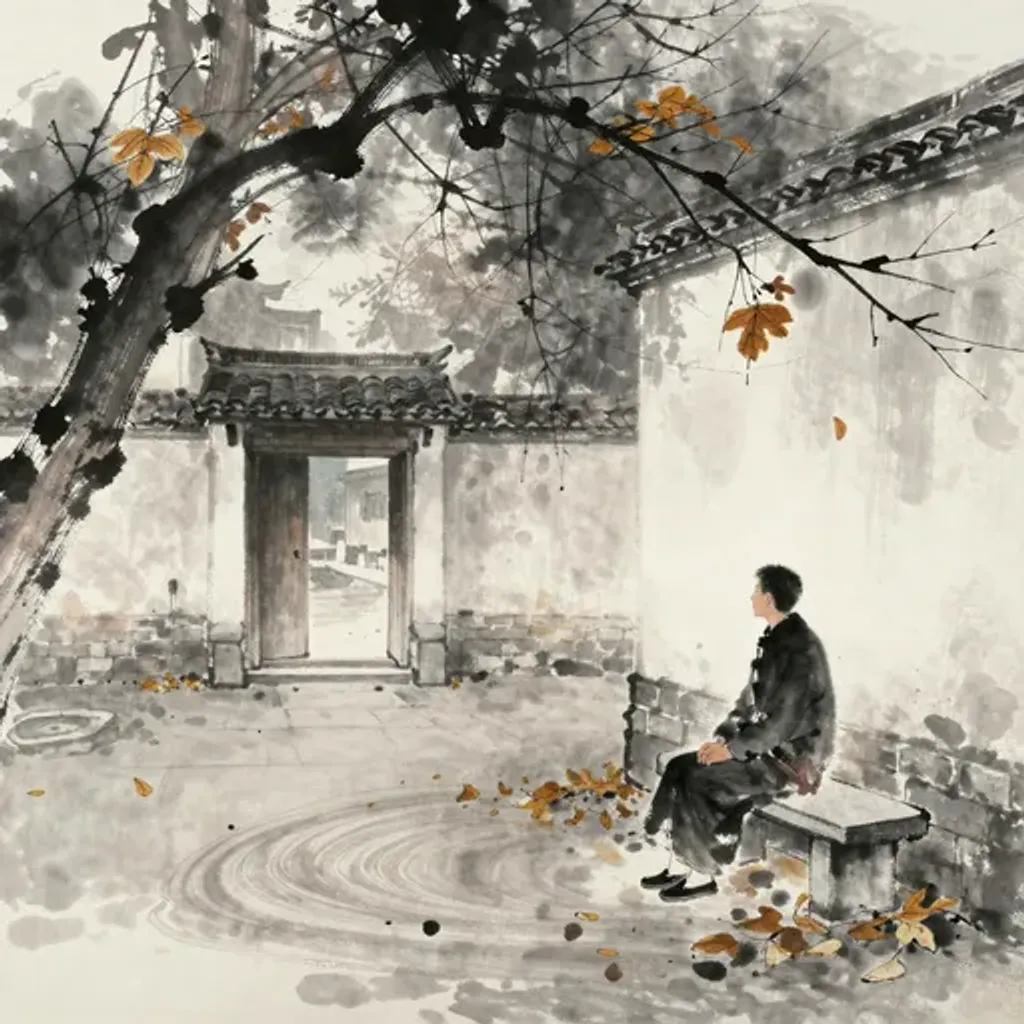
獨坐西垣,莫與言笑。秋風多哀,使我心悲。
Sitting alone by the western wall, none to share in speech or laughter. The autumn wind carries much sorrow; it makes my heart grieve.
— Jiao Yanshou, Yilin (Forest of Changes), 1st century BC
Commentary
Twin mountains stand still, and one sits alone by the western wall with no companion for talk or laughter. The autumn wind carries only sorrow, filling the heart with grief. The image is desolation refined to its essence: a single figure, a crumbling wall, a cold season, and silence. From Keeping Still to Standstill, mountain yields to the absolute separation of heaven and earth. In Standstill, heaven rises and earth sinks — there is no communication between above and below. The verse embodies this perfectly: a person frozen in place while the season of decay blows through. Stillness here is not discipline but abandonment, the mountain's solitude stripped of its dignity and left as pure loneliness.
艮 → 同人
Hexagram 52 → Hexagram 13: Fellowship
Changing lines: 1, 4, 5
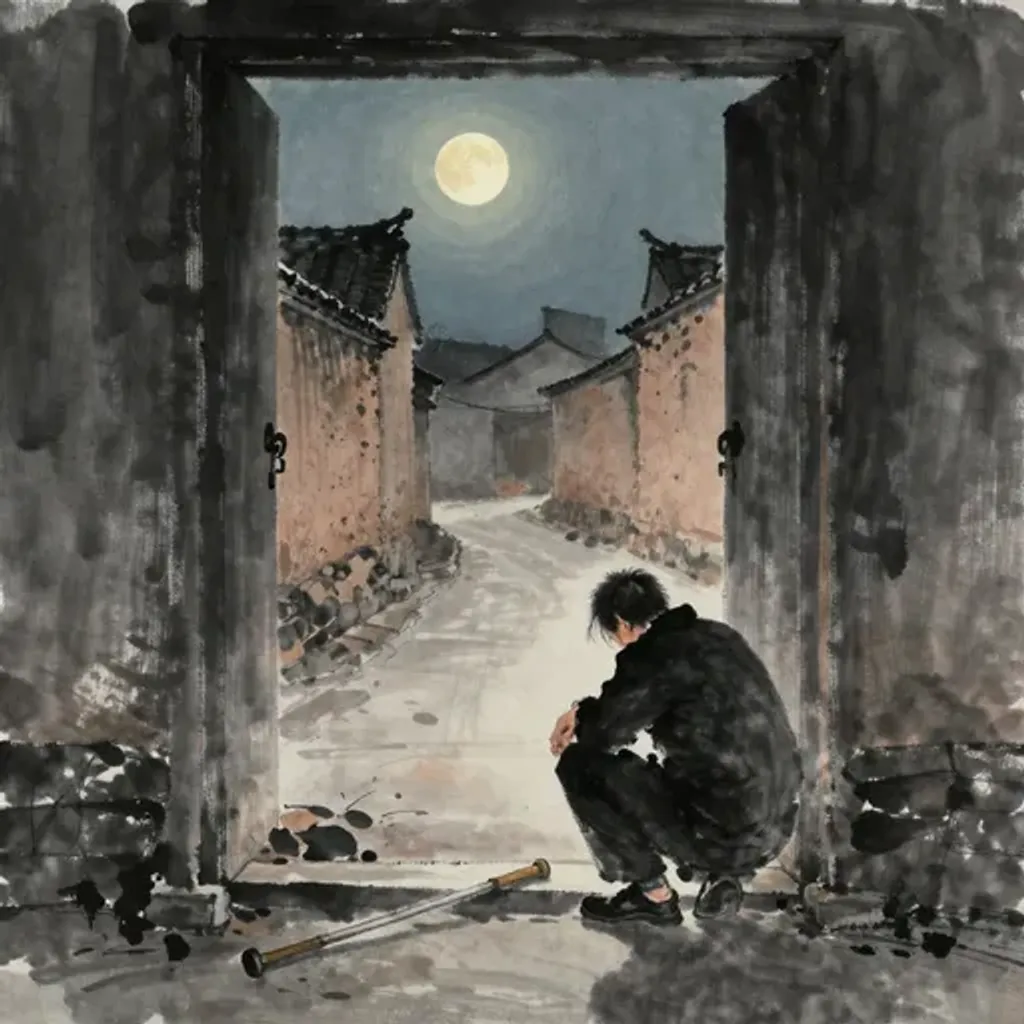
脛急股攣,不可出門。暮速歸旅,必為身患。
Calves cramped, thighs knotted; one cannot pass through the gate. Hastening home at dusk will surely bring bodily affliction.
— Jiao Yanshou, Yilin (Forest of Changes), 1st century BC
Commentary
Twin mountains stand still, and the body itself enforces the stopping. Calves cramp and thighs seize — one literally cannot step through the door. Venturing out at dusk invites bodily harm. The hexagram of Keeping Still famously speaks of 'stopping the back' and 'not obtaining the body,' and this verse drives the point home with visceral physical symptoms. From Keeping Still to Fellowship, doubled mountain should yield to heaven joined with fire, the image of like minds gathering under a shared sky. Yet the crippled legs prevent any such union. The verse warns that enforced isolation — whether by the body's failure or circumstance — inverts fellowship into its opposite. One cannot join what one cannot reach.
艮 → 大有
Hexagram 52 → Hexagram 14: Great Possession
Changing lines: 1, 2, 4
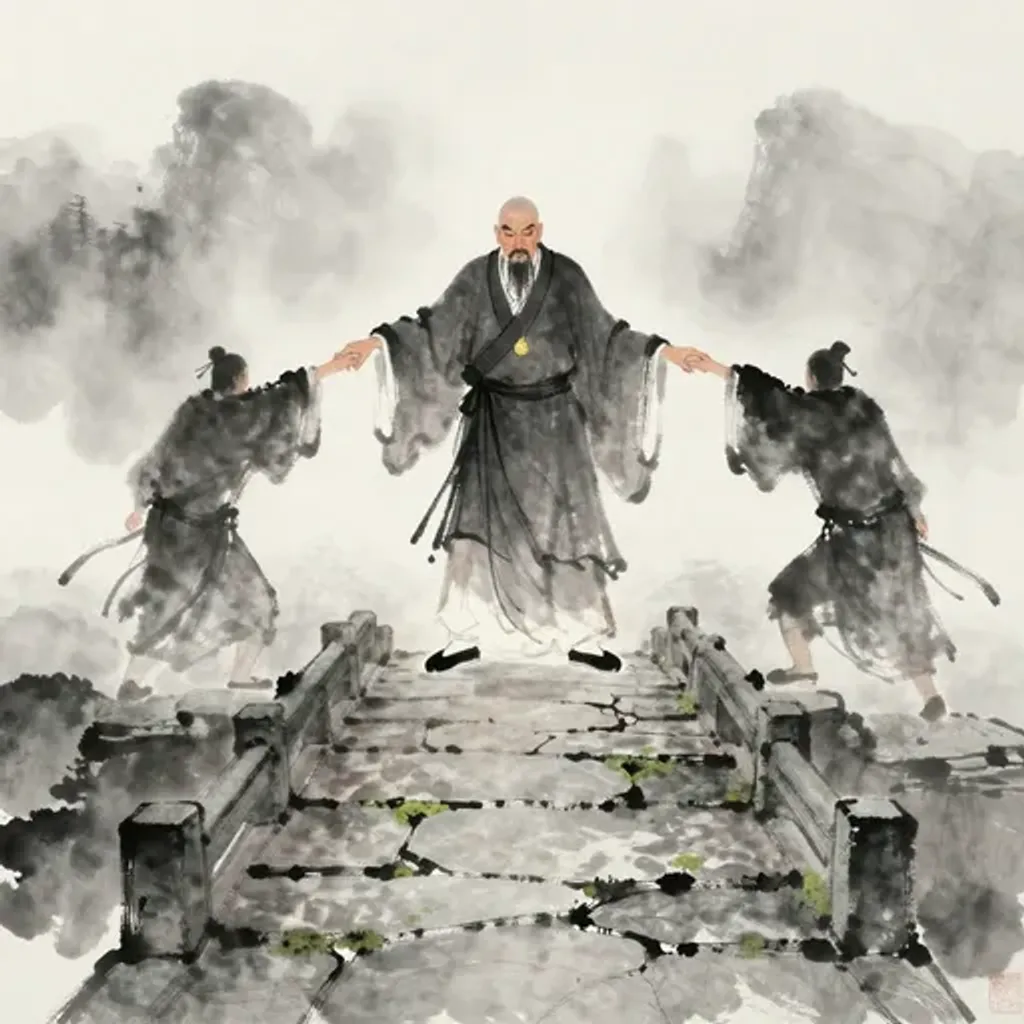
情偽難知,使我偏頗。小人在位,雖聖何咎?
Truth and falsehood are hard to discern; they pull me off course. Petty men hold office — though a sage, what blame can avail?
— Jiao Yanshou, Yilin (Forest of Changes), 1st century BC
Commentary
Twin mountains stand still, but truth and falsehood are tangled beyond recognition, skewing judgment. Petty men occupy positions of power — what blame can even a sage bear? The verse raises a painful question: when deception has infiltrated every level, even the wisest cannot act effectively. Sincerity cannot be distinguished from fraud. From Keeping Still to Great Possession, mountain should yield to fire blazing in heaven, illuminating all below. Yet the verse denies that clarity. The mountain's stillness here is not contemplation but bewilderment — the sage stands frozen not in discipline but in futility, unable to sort real from counterfeit. Great Possession demands clear sight from above, and the verse admits that sight has been corrupted.
艮 → 謙
Hexagram 52 → Hexagram 15: Modesty
Changing lines: 6
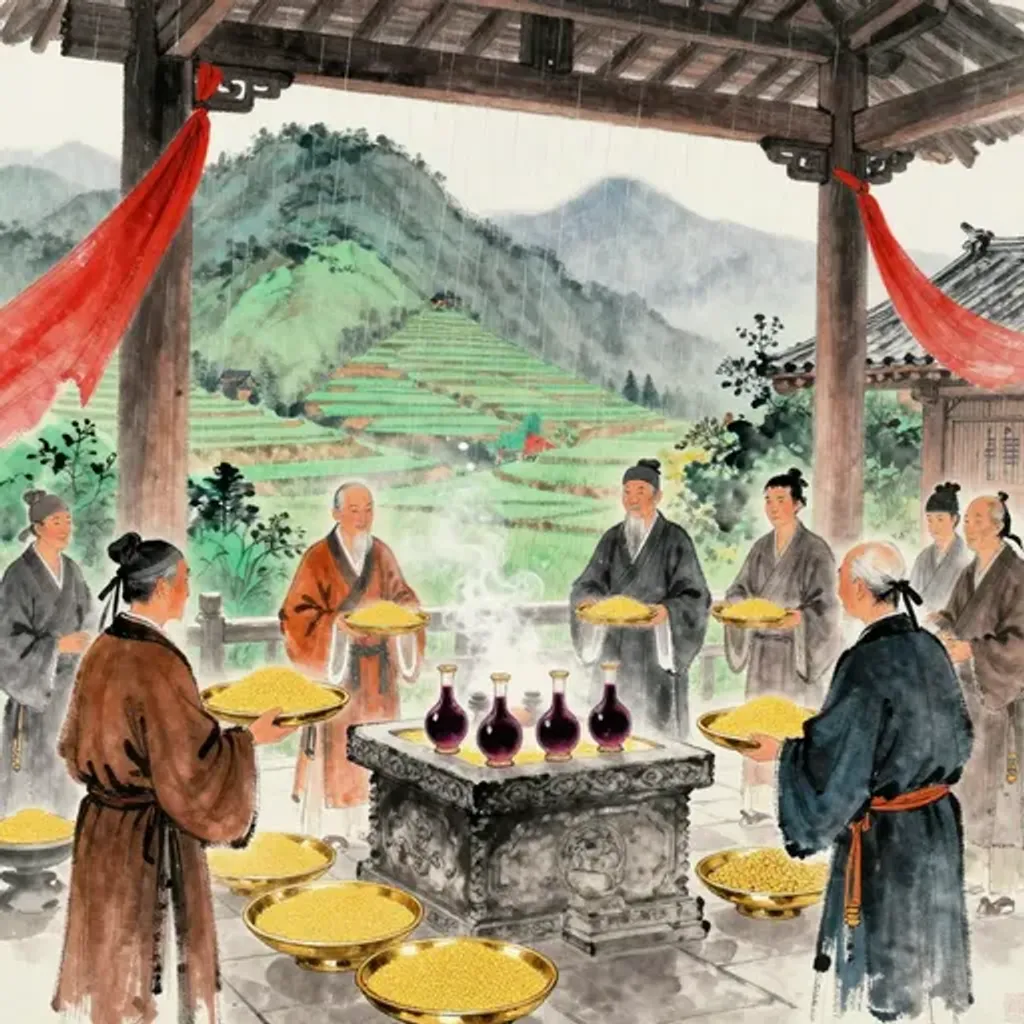
黍稷醇醲,敬奉山宗。神嗜飲食,甘雨嘉降。庶物蕃廡,時无災咎。
Millet and grain, rich and pure, reverently offered to the mountain ancestor. The spirits savor the food and drink; sweet rain descends in blessing. All living things flourish abundantly; the season is free from calamity.
— Jiao Yanshou, Yilin (Forest of Changes), 1st century BC
Commentary
Twin mountains stand still as offerings of millet and rich ale are reverently presented to the mountain ancestor. The spirit savors the feast, and in return sweet rain descends in blessing. All living things flourish abundantly; the season passes without calamity. This is mountain worship at its most direct: the doubled mountain of Gen is itself the altar, and the ritual performed upon it is met with divine reciprocity. From Keeping Still to Modesty, the mountain descends within the earth. Modesty's image — earth containing a mountain — is the humble mountain that enriches from below rather than towering above. The verse enacts this transformation: pious offering yields not pride but gentle, sustaining rain that nourishes all equally.
艮 → 豫
Hexagram 52 → Hexagram 16: Enthusiasm
Changing lines: 3, 4, 6
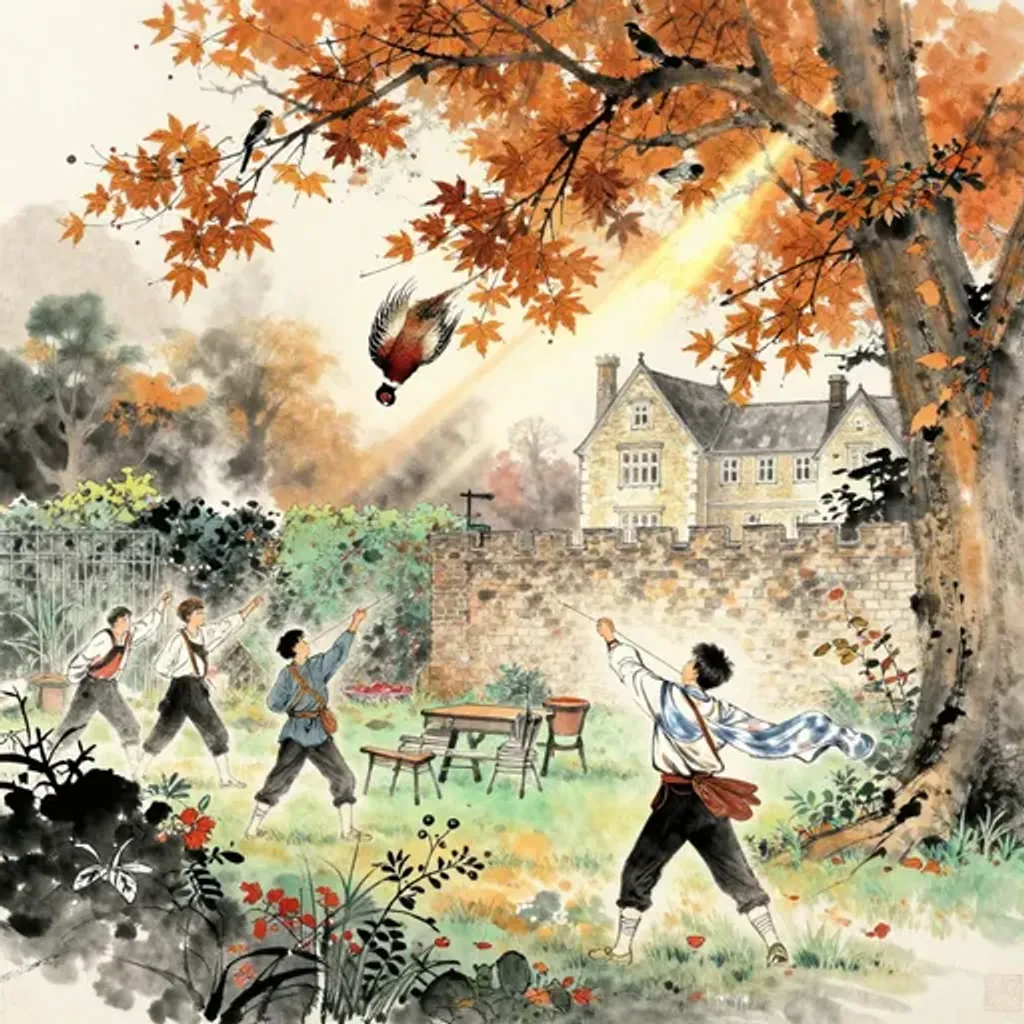
公子王孫,把彈攝丸。發輒有獲,室家饒足。
Princes and noble sons, grasping slingshots and rolling pellets. Each shot finds its mark; the household enjoys abundance.
— Jiao Yanshou, Yilin (Forest of Changes), 1st century BC
Commentary
Twin mountains stand still, yet young lords and princes take slingshots in hand, launching clay pellets at game. Every shot finds its mark; the household grows rich and well supplied. The image is of aristocratic ease: hunting not from necessity but from the confident surplus of privilege. From Keeping Still to Enthusiasm, mountain yields to thunder bursting from the earth, the explosive release of gathered energy. The mountain held the tension; now it erupts as joyous action. The slingshot's arc mirrors this dynamic — drawn back in stillness, then flung forward with precise abandon. Enthusiasm channeled through skill produces abundance, and the household feasts on what disciplined patience has stored.
艮 → 隨
Hexagram 52 → Hexagram 17: Following
Changing lines: 1, 3, 4, 5, 6
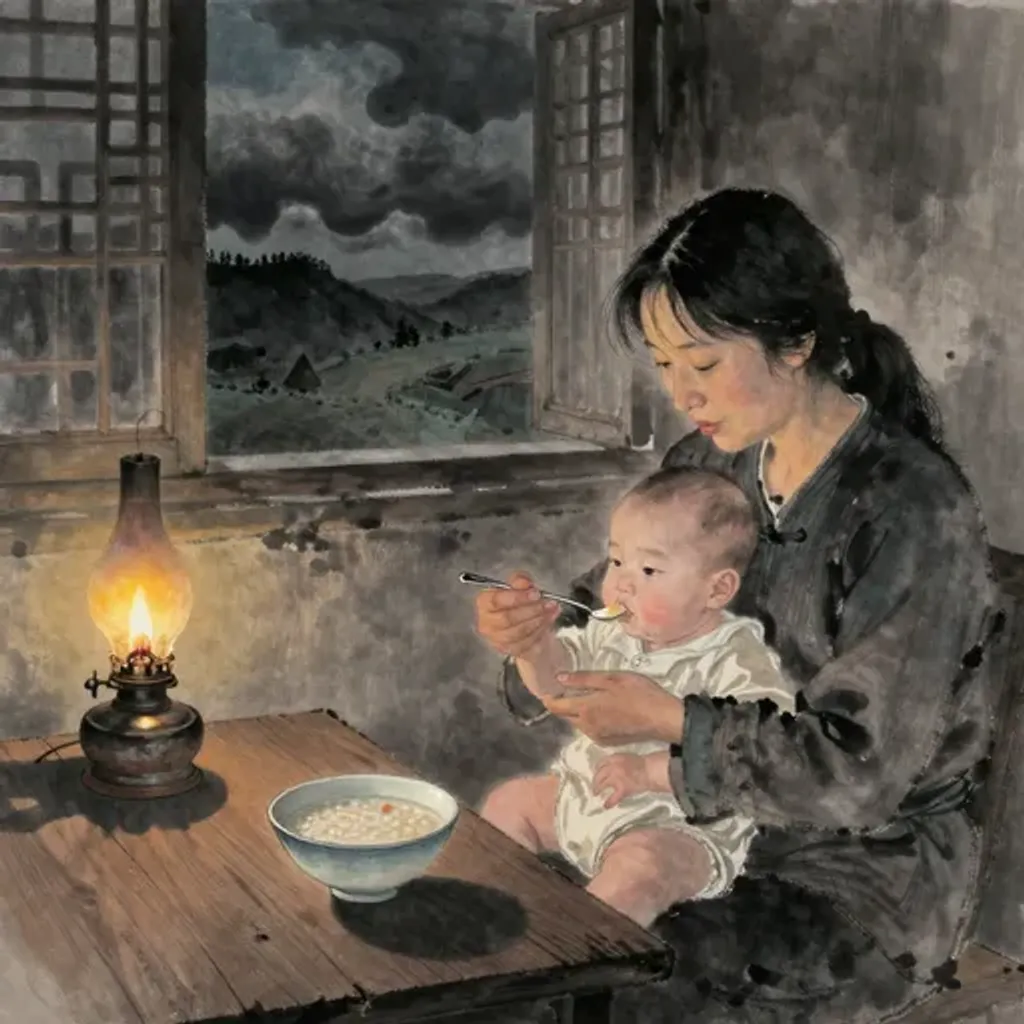
陰升陽伏,舜失其室。慈母赤子,相餧不食。
Yin ascends, yang lies hidden; Shun lost his household. A loving mother and her suckling child — they feed one another yet neither eats.
— Jiao Yanshou, Yilin (Forest of Changes), 1st century BC
Commentary
Twin mountains stand still as yin rises and yang retreats — Shun loses his household. A devoted mother feeds her infant, yet the child refuses to eat. The verse alludes to Emperor Shun's troubled domestic life: despite his legendary virtue, his father Gu Sou and stepmother repeatedly tried to kill him. According to tradition, Shun 'lost his household' because filial devotion could not dissolve the hostility within his own family. The nursing scene intensifies the pathos: even the most natural bond — mother and child — is disrupted. From Keeping Still to Following, mountain yields to lake above thunder. Following requires yielding to the moment, but when the household itself is poisoned, following only leads deeper into sorrow.
艮 → 蠱
Hexagram 52 → Hexagram 18: Work on the Decayed
Changing lines: 2
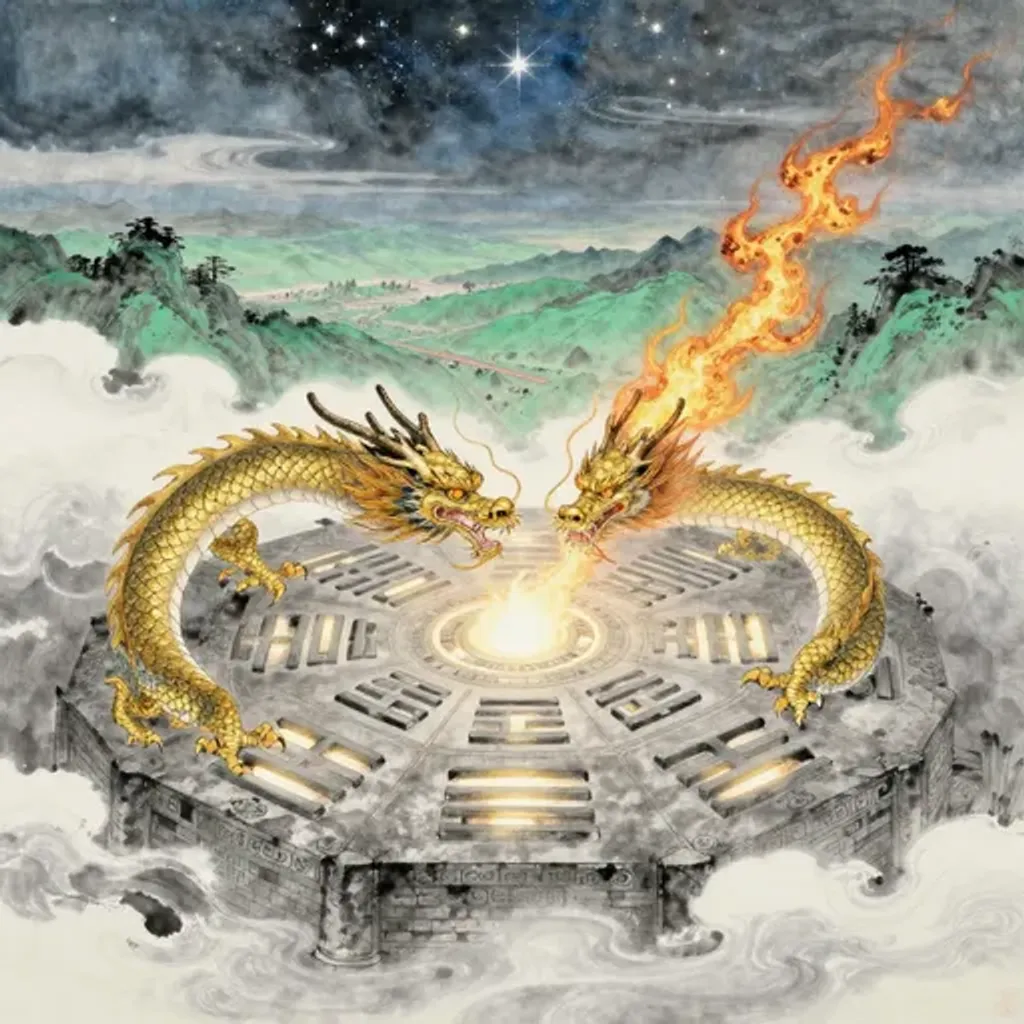
七竅龍身,造易八元。法則天地,順時施恩,利以長存。
Seven-orificed dragon body, creator of the Changes and the eight primal forces. Taking heaven and earth as model, bestowing grace in accord with the seasons, profit endures forever.
— Jiao Yanshou, Yilin (Forest of Changes), 1st century BC
Commentary
Twin mountains stand still, and a seven-orificed dragon body fashions the Yi through the Eight Primal Forces. The laws model heaven and earth; blessings are dispensed in accordance with the seasons, and all endures. The 'seven orifices' likely allude to a sage or dragon-like figure — perhaps Fu Xi, who observed heaven and earth to create the trigrams. The 'eight yuan' may reference the eight trigrams or the Eight Worthies of antiquity. From Keeping Still to Work on the Decayed, mountain above yields to wind beneath the mountain, the image of stirring stagnation through renewal. The verse presents the original act of cosmic ordering: from absolute stillness, a sage discerns the pattern and reforms what has decayed, ensuring long survival.
艮 → 臨
Hexagram 52 → Hexagram 19: Approach
Changing lines: 1, 2, 3, 6
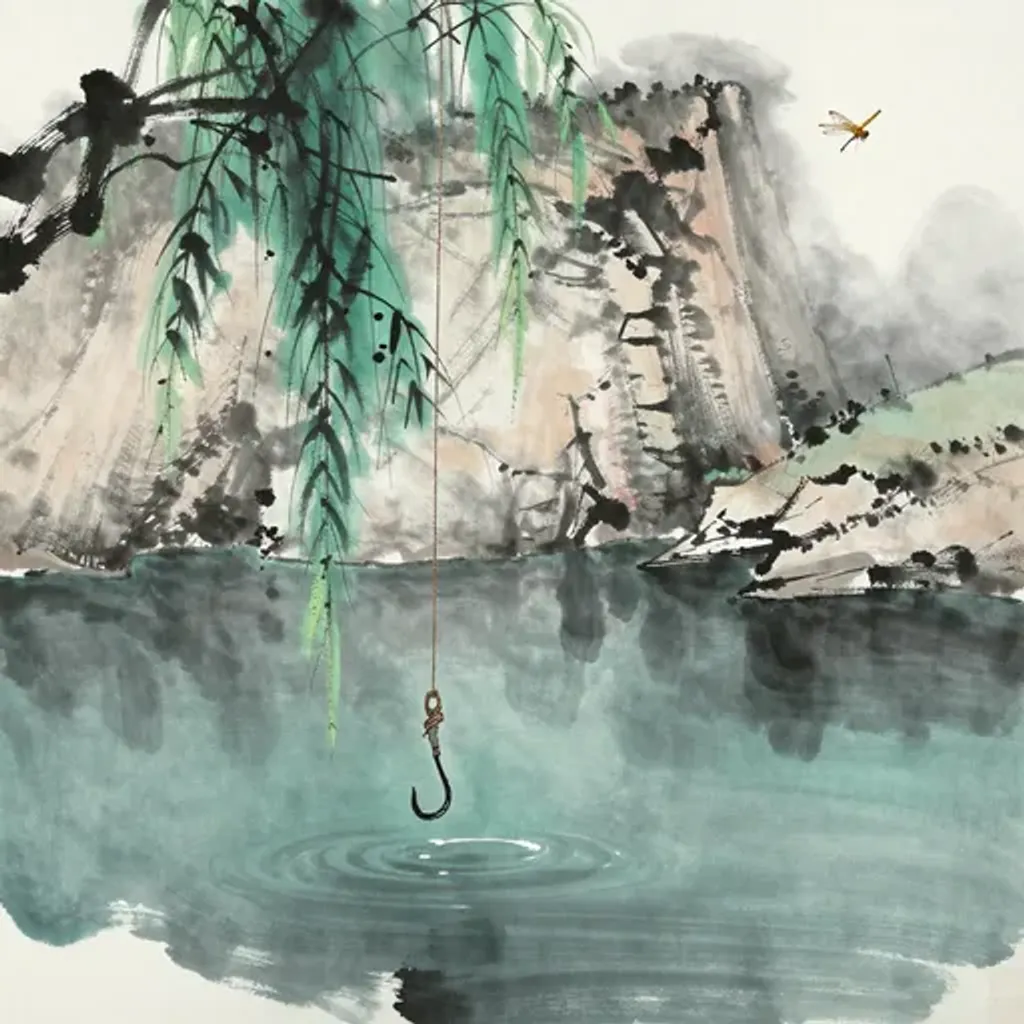
逐狐東山,水遏我前。深不可涉,失利後便。
Fishing, the line snaps — the catch sinks into the green pool. The water's depth is unfathomable; the bare hook still dangles.
— Jiao Yanshou, Yilin (Forest of Changes), 1st century BC
Commentary
Twin mountains stand still. The original verse reads: chasing a fox on the eastern mountain, water blocks the way ahead. The depth is impassable; one loses advantage and falls behind. The fox — cunning and elusive — leads the hunter to a barrier of deep water, and the pursuit ends in frustration. From Keeping Still to Approach, doubled mountain yields to earth above the lake, where authority draws near from above. Yet the verse denies approach: the water is too deep, the quarry escapes, and the pursuer is left worse off than before. The mountain's stillness should have counseled patience, but the hunter moved too eagerly. Approach works only when the ground is prepared; rushing forward into uncharted depths forfeits the initiative.
艮 → 觀
Hexagram 52 → Hexagram 20: Contemplation
Changing lines: 3, 5
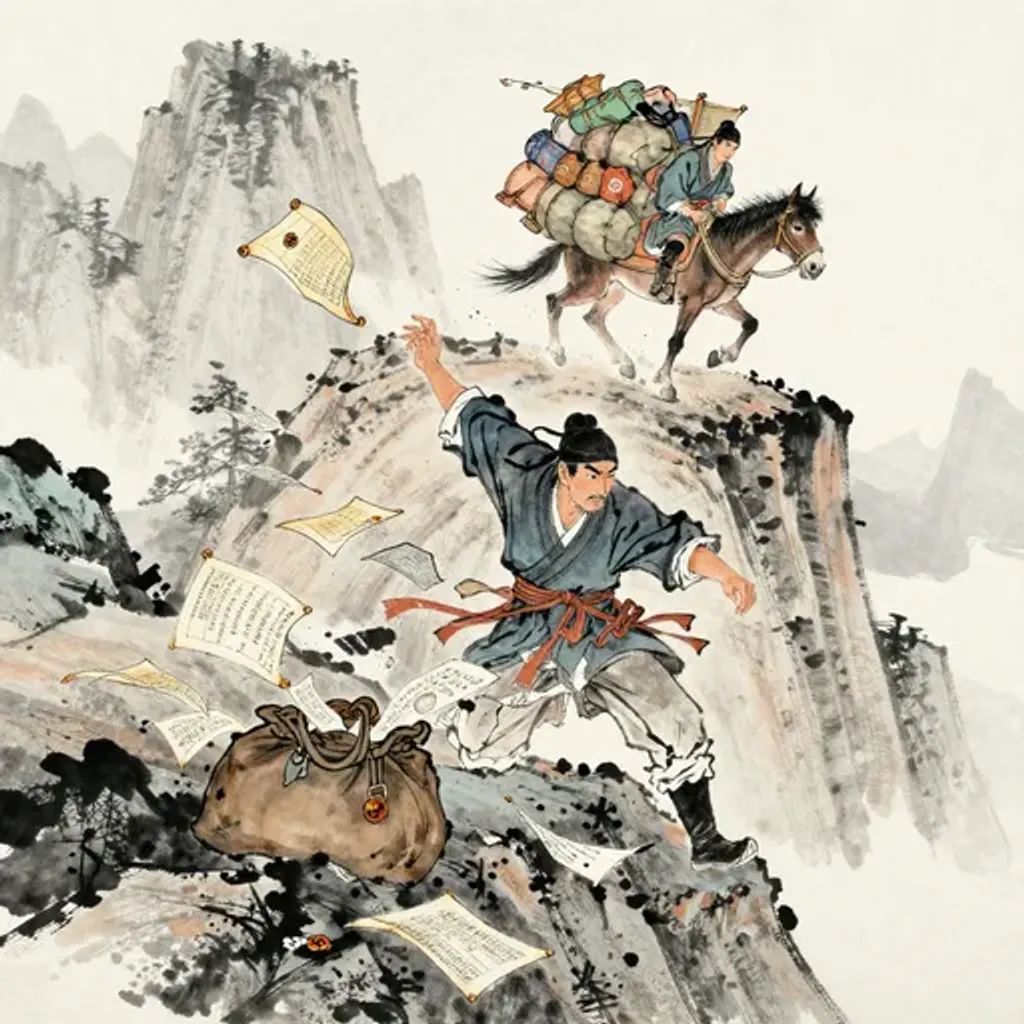
衘命辱使,不堪其事。中墜落去,更為負載。
Bearing a mandate as lowly envoy, unequal to the task. Midway, it drops and falls away; replaced with yet heavier burdens.
— Jiao Yanshou, Yilin (Forest of Changes), 1st century BC
Commentary
Twin mountains stand still, but the envoy sent on a humiliating mission cannot bear the burden. Midway he stumbles and falls, then is forced to carry an even heavier load. The verse describes diplomatic disgrace: a messenger dispatched under degrading terms who collapses under the weight of his charge, only to have more piled upon him. From Keeping Still to Contemplation, doubled mountain yields to wind moving across the earth, the sage-king's image of observing the people to guide instruction. Yet the verse inverts that gentle overview: instead of contemplative authority surveying from above, there is a broken figure crushed from below. The mountain's height should grant perspective, but here it only measures how far one has fallen.
艮 → 噬嗑
Hexagram 52 → Hexagram 21: Biting Through
Changing lines: 1, 3, 4
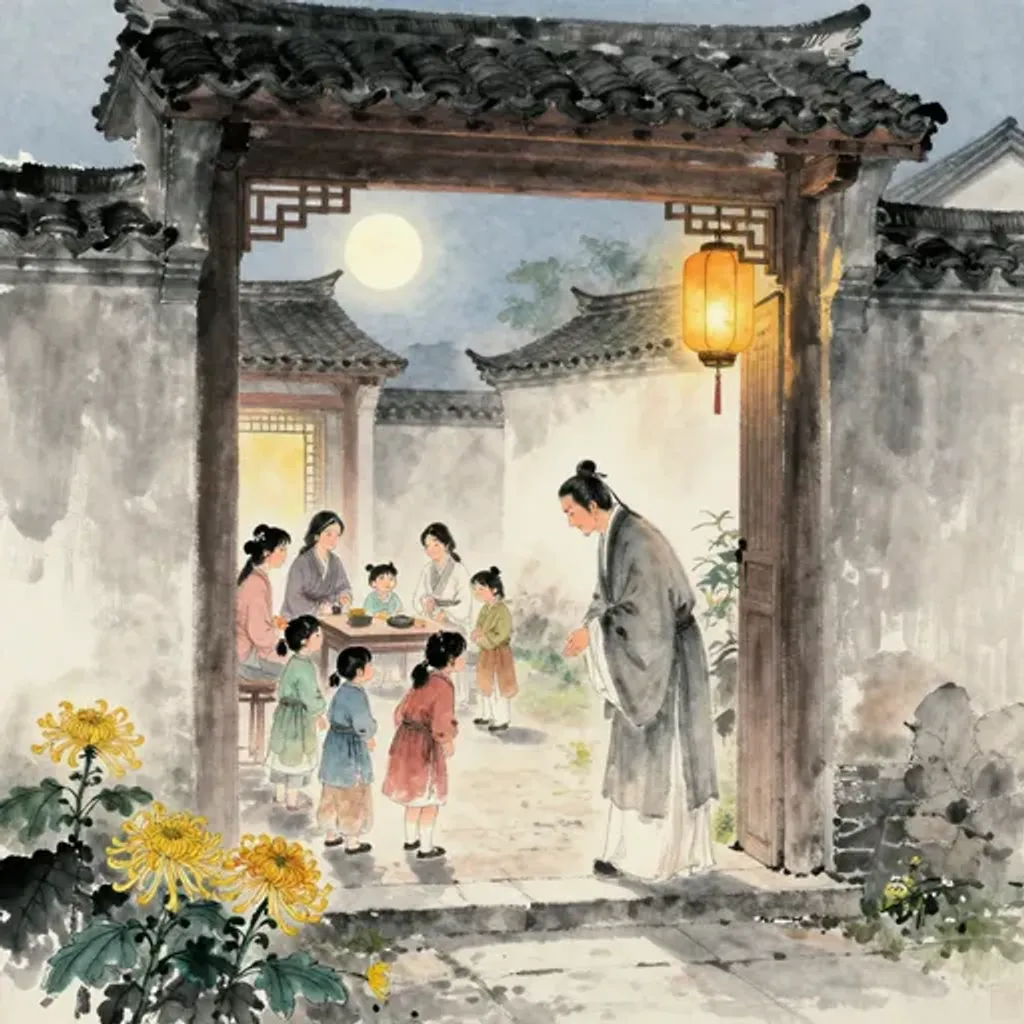
溫仁君子,忠孝所在。入閨為儀,禍災不處。
A warm and benevolent gentleman, where loyalty and filial piety reside. Entering the inner chambers as a model; calamity and disaster do not dwell there.
— Jiao Yanshou, Yilin (Forest of Changes), 1st century BC
Commentary
Twin mountains stand still, sheltering a man of warmth and benevolence. This gentleman dwells in loyalty and filial devotion. When he enters the inner chambers, he brings propriety and good order; calamity and disaster dare not reside where he stands. The verse is a character portrait: the Confucian ideal of the cultivated person whose moral gravity clears a space around him. From Keeping Still to Biting Through, mountain yields to thunder and lightning — the law that bites through obstruction to restore justice. The gentleman's stillness is not inertia but moral weight so concentrated that disorder retreats on contact. His entry into the household brings the same decisive clarity that lightning brings to a clouded sky.
艮 → 賁
Hexagram 52 → Hexagram 22: Grace
Changing lines: 1
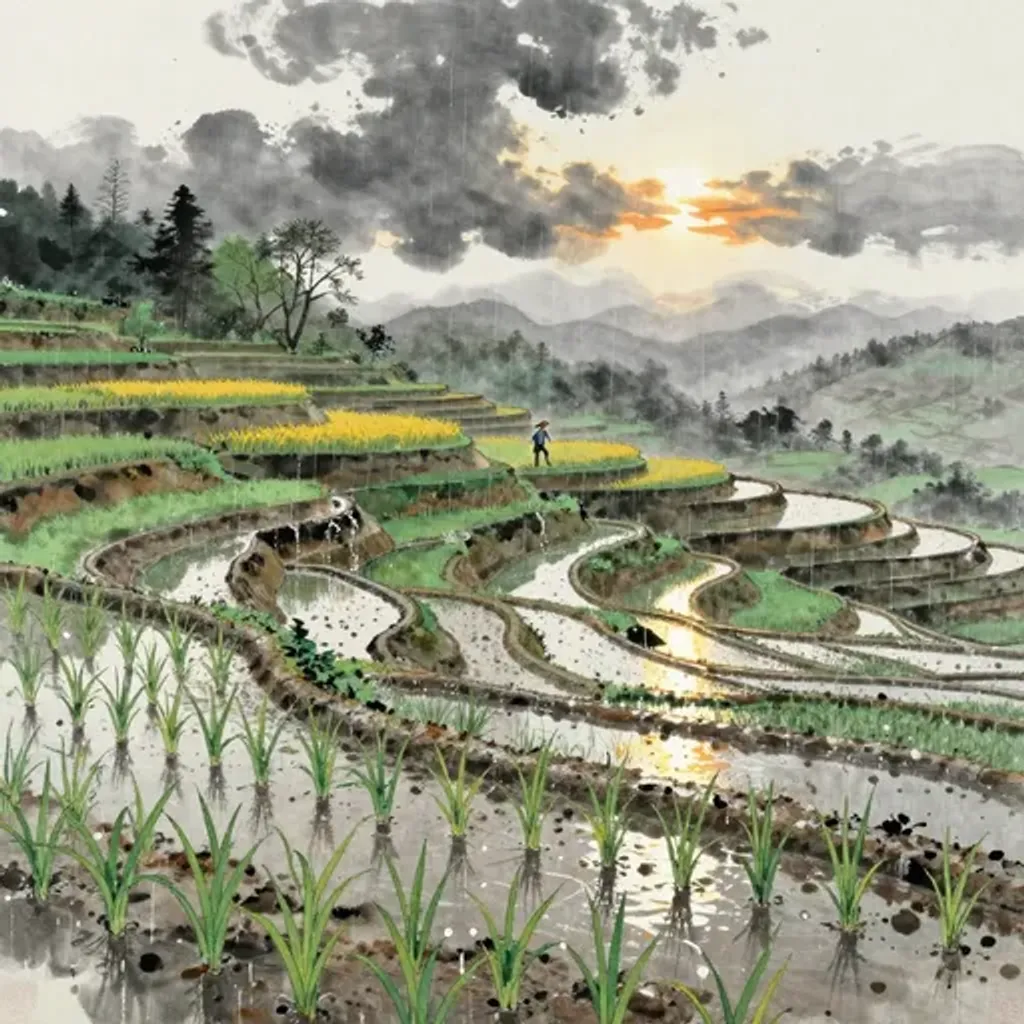
春多膏澤,夏潤優渥。稼穡成熟,畝獲百斛。師行失律,霸功不遂。
Spring abounds in rich rain; summer's moisture is generous. Crops ripen to harvest, each acre yielding a hundred bushels. The army marches without discipline; the hegemon's work goes unfinished.
— Jiao Yanshou, Yilin (Forest of Changes), 1st century BC
Commentary
Twin mountains stand still through a season of agricultural abundance — spring brings rich moisture, summer deepens the blessing, and the harvest yields a hundred bushels per mu. Then the verse pivots sharply: the army marches out of order and hegemonic ambitions collapse. The contrast is deliberately jarring — natural prosperity undone by military hubris. From Keeping Still to Grace, mountain gives way to fire beneath the mountain, where surface beauty adorns deeper structure. Grace insists that the gentleman governs wisely and refrains from rash judgment. The verse's two halves embody that standard and its violation: patient cultivation produces bounty, but ill-disciplined force squanders it. Adornment without substance is failure dressed as ambition.
艮 → 剝
Hexagram 52 → Hexagram 23: Splitting Apart
Changing lines: 3
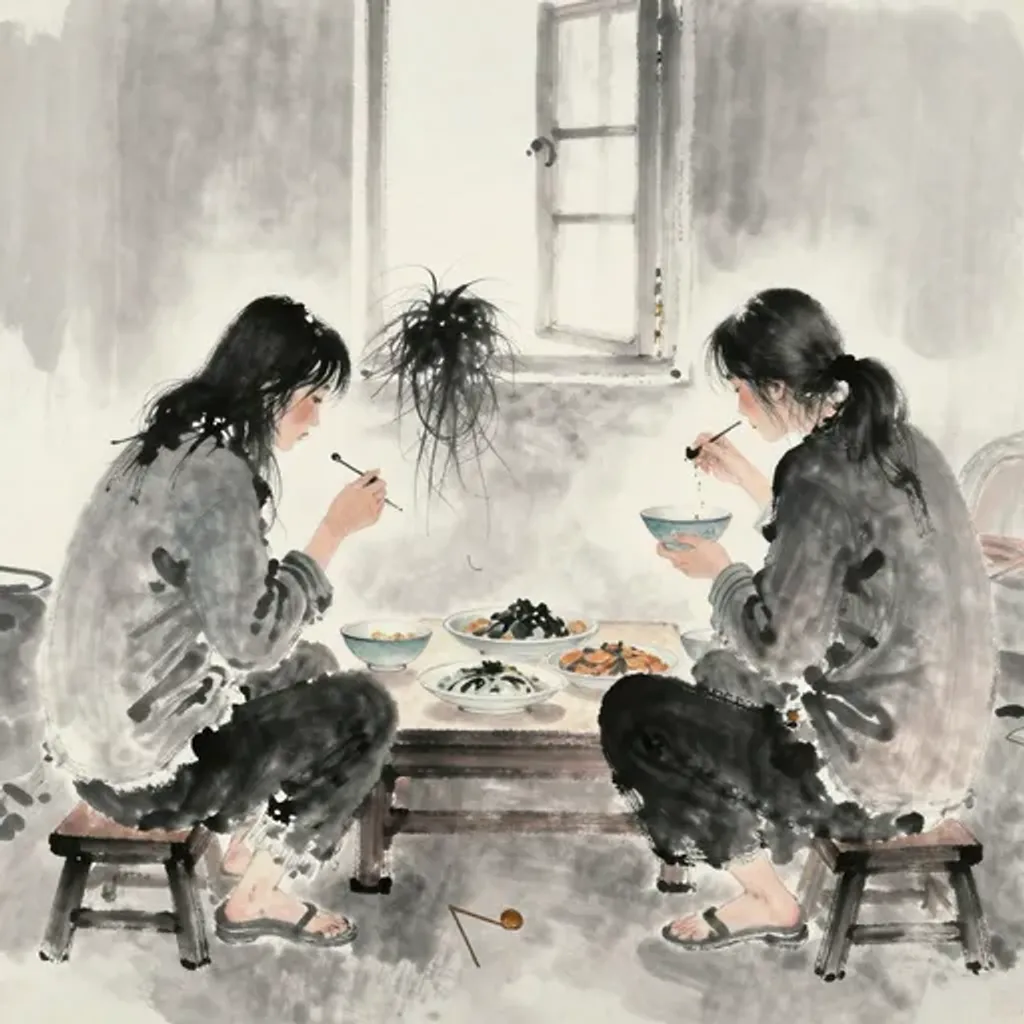
二女共室,心不聊食。首髮如蓬,憂常在中。
Two women share a room, their hearts too troubled to eat. Hair like tangled weeds; worry dwells constantly within.
— Jiao Yanshou, Yilin (Forest of Changes), 1st century BC
Commentary
Twin mountains stand still, but within the chamber two women share a room, their hearts so troubled they cannot eat. Hair disheveled like tangled weeds, anxiety lives permanently in their breast. The image recalls the Shijing's domestic tension: women confined together in jealousy or grief, each the other's rival or mirror of misery. From Keeping Still to Splitting Apart, mountain rests upon the earth but its base is eroding. Splitting Apart strips away support layer by layer until only the topmost line remains. The two women's mutual misery is this erosion made human — each presence diminishes the other, and the shared dwelling becomes a site of slow collapse rather than shelter.
艮 → 復
Hexagram 52 → Hexagram 24: Return
Changing lines: 1, 3, 6
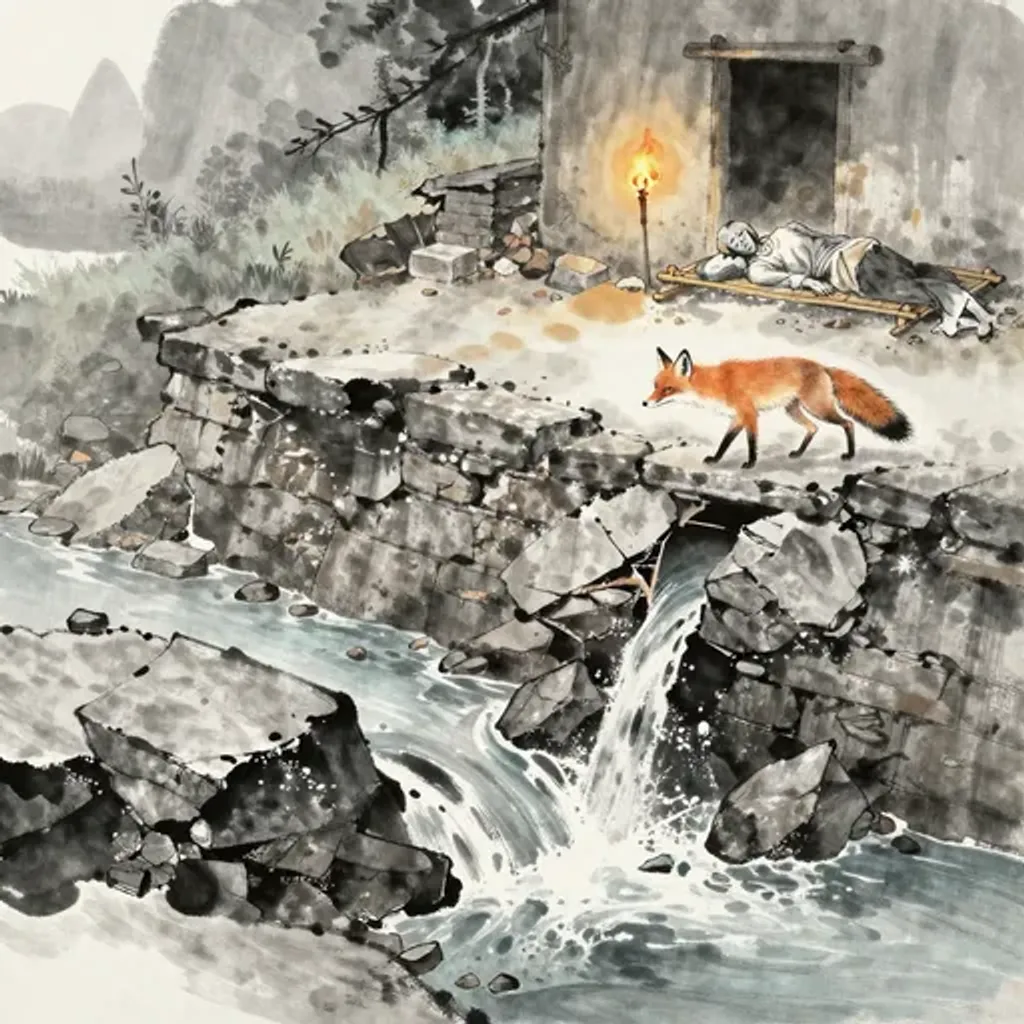
築關石顛,立本泉源。疾病不安,老狐為鄰。
Building a dam at the rocky summit, establishing the foundation at the spring's source. Illness brings no peace; the old fox becomes one's neighbor.
— Jiao Yanshou, Yilin (Forest of Changes), 1st century BC
Commentary
Twin mountains stand still as one builds a barrier at the stony ridge and establishes foundations at the headwater spring. But illness brings unrest, and the old fox becomes a neighbor. The verse pairs construction with decay: ramparts raised at the heights, waterworks set at the source, yet disease creeps in and a sinister creature settles nearby. The old fox is a classical omen of desolation — foxes inhabit ruins. From Keeping Still to Return, mountain yields to thunder stirring beneath the earth, the solstice moment when one yang line re-enters at the bottom. Return promises renewal, yet the verse warns that the ground must be cleared of its old fox before the first shoot of spring can safely emerge.
艮 → 无妄
Hexagram 52 → Hexagram 25: Innocence
Changing lines: 1, 3, 4, 5

欲避凶門,反與禍鄰。顛覆不制,痛薰我心。
Seeking to flee the gate of ill fortune, one instead becomes calamity's neighbor. Overturned, uncontrolled; pain sears my heart.
— Jiao Yanshou, Yilin (Forest of Changes), 1st century BC
Commentary
Twin mountains stand still, but the one who tries to flee misfortune runs straight into its arms. Wanting to avoid the gate of calamity, one finds oneself neighbor to disaster instead. Overthrown and out of control, anguish sears the heart. The verse captures the cruelest irony of fate: evasion itself becomes the trap. From Keeping Still to Innocence, mountain should yield to thunder moving beneath heaven — the energy of what comes without contrivance. Innocence means acting without ulterior motive, letting heaven's initiative take its course. The verse's figure fails precisely because he acts from fear rather than trust. Fleeing calamity is already a contrivance; the mountain's lesson was to stand still and let the storm pass, but panic chose otherwise.
艮 → 大畜
Hexagram 52 → Hexagram 26: Great Taming
Changing lines: 1, 2
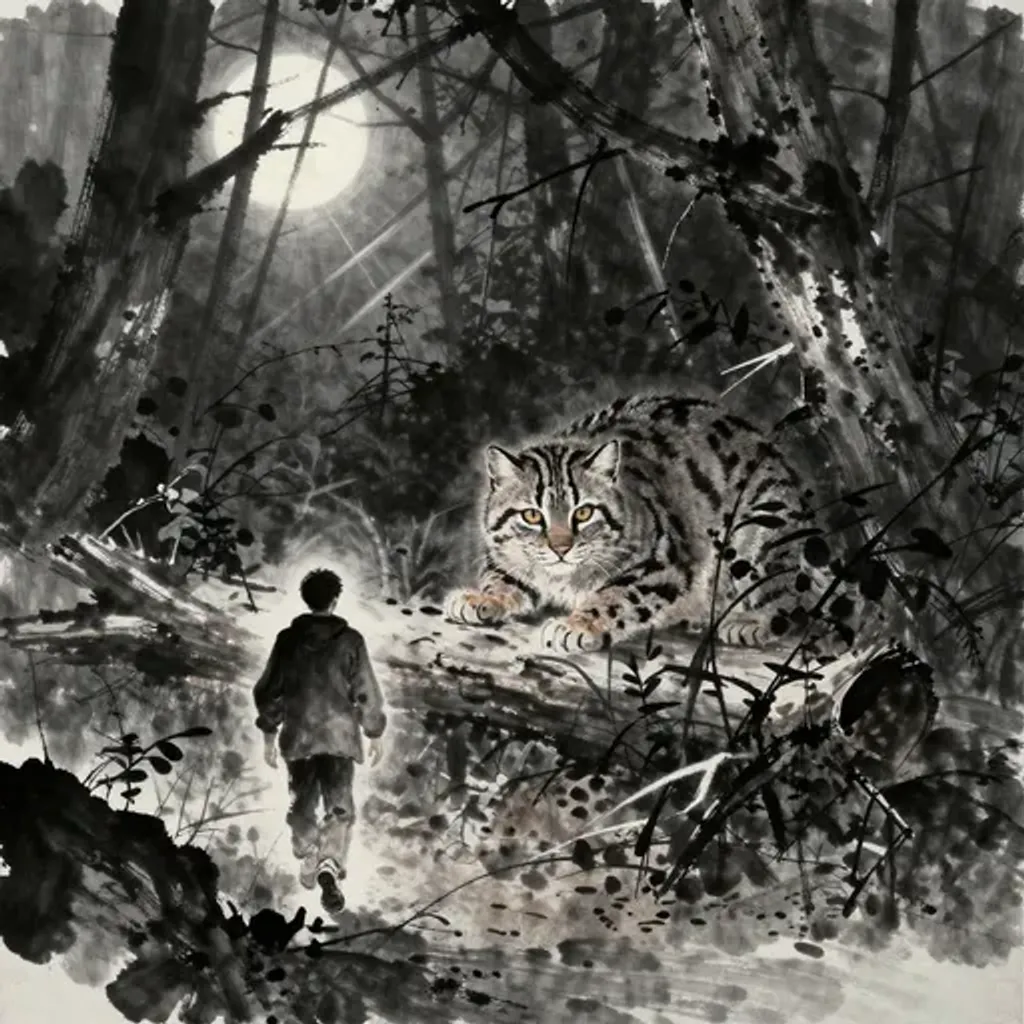
踧行竊視,有所畏避。狸首伏藏,以夜為利。
Creeping forward, stealing glances, something to fear and to shun. The wildcat hides and lies in wait, taking the night for its advantage.
— Jiao Yanshou, Yilin (Forest of Changes), 1st century BC
Commentary
Twin mountains stand still, and beneath their shadow a figure creeps with furtive steps and stolen glances, avoiding something feared. Like a wildcat, head low, it hides by day and uses the night to its advantage. The verse paints a creature — or person — reduced to stealth by overwhelming threat. Every movement is cautious; visibility is danger. From Keeping Still to Great Taming, mountain yields to heaven stored within the mountain. Great Taming accumulates power through patient restraint, studying the past to build moral reserves. The verse's skulking figure is the dark inversion of this: instead of storing virtue in stillness, it stores only fear. Concealment without cultivation is survival without dignity.
艮 → 頤
Hexagram 52 → Hexagram 27: Nourishment
Changing lines: 1, 3
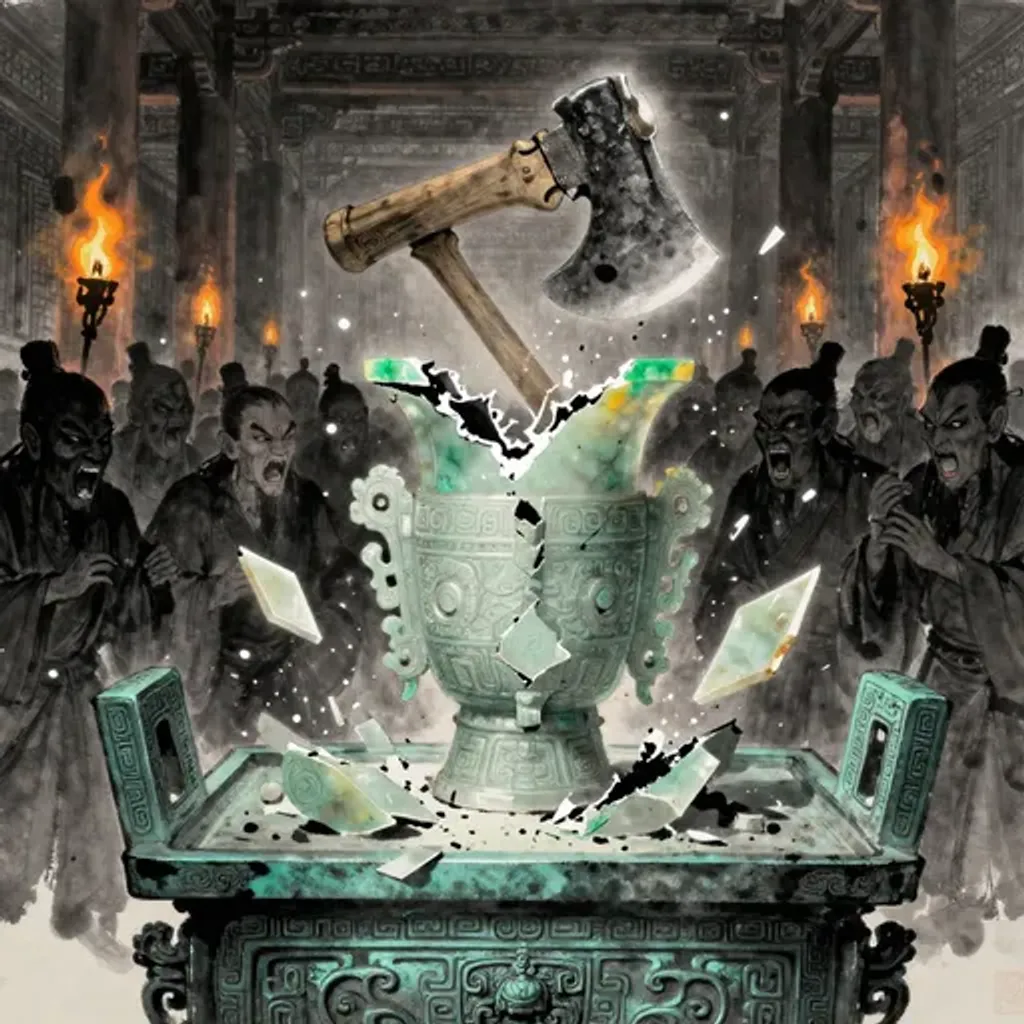
八面九口,長舌為斧。劈破瑚璉,殷商絕後。
Eight faces, nine mouths; the long tongue serves as an axe. It cleaves the precious vessel; the house of Yin-Shang is cut off with no heir.
— Jiao Yanshou, Yilin (Forest of Changes), 1st century BC
Commentary
Twin mountains stand still, but the mouth does not. Eight faces with nine mouths — the long tongue serves as an axe, hacking apart the sacrificial jade vessel and severing the Shang lineage. The 'long tongue' is a classical image of slander from the Shijing, where wagging tongues destroy reputations and kingdoms. The huchuo (瑚璉) is a precious ritual jade of the ancestral temple, here smashed by malicious speech. The destruction of Yin-Shang's succession evokes the downfall brought by counselors with poisonous words. From Keeping Still to Nourishment, mountain yields to mountain above thunder — the mouth's proper use is careful speech and measured sustenance. This verse is its grotesque opposite: the mouth as weapon, nourishment perverted into annihilation.
艮 → 大過
Hexagram 52 → Hexagram 28: Great Exceeding
Changing lines: 2, 4, 5, 6
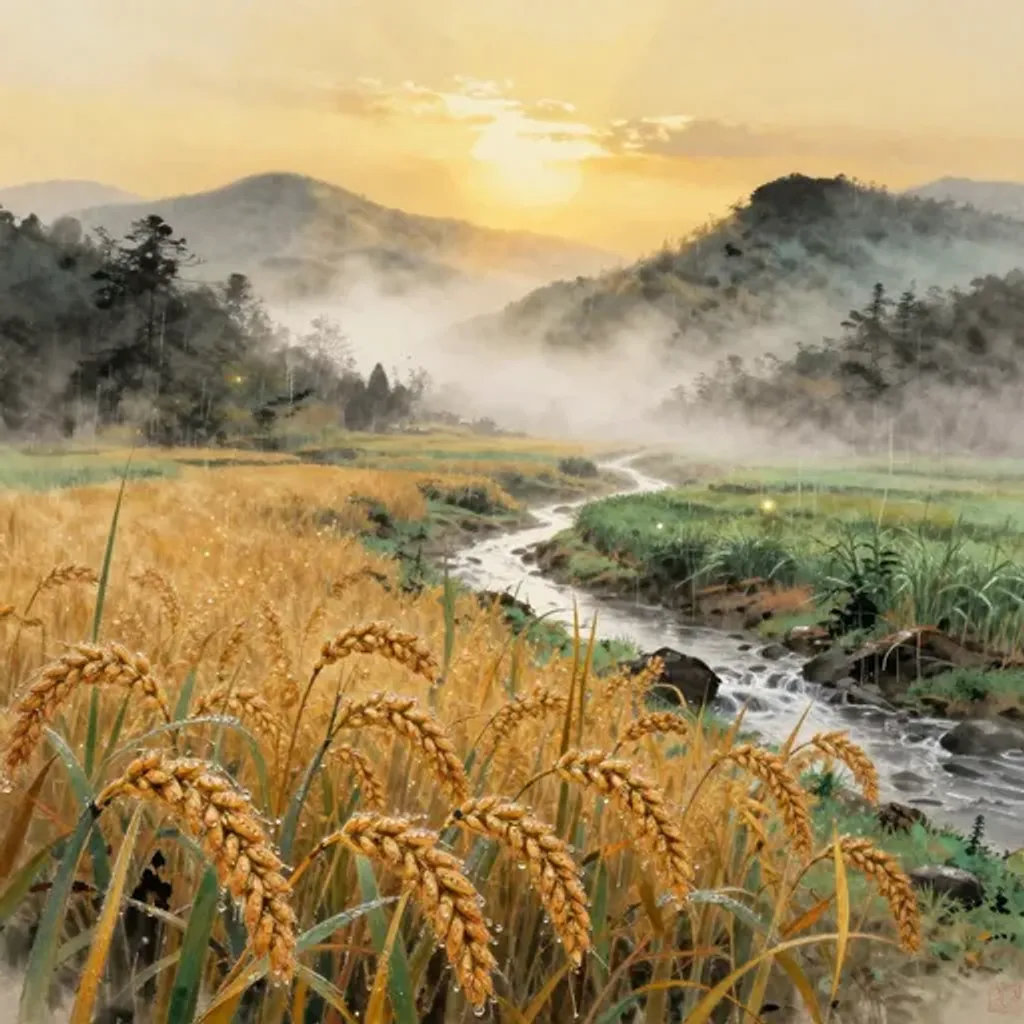
和氣相薄,膏澤津液,生我嘉穀。
Harmonious vapors mingle and gather; rich moisture and dew nourish and bring forth our fine grain.
— Jiao Yanshou, Yilin (Forest of Changes), 1st century BC
Commentary
Twin mountains stand still as harmonious vapors gather and press together. Sweet dew condenses into nourishing moisture, giving birth to fine grain. The verse is entirely about fecundity through atmospheric convergence: gentle forces meeting, condensing, and producing abundance. No historical allusion is named; the imagery is cosmological and agricultural. From Keeping Still to Great Exceeding, doubled mountain yields to lake submerging the trees — a structure pushed beyond its normal limits. Yet here the excess is beneficent: the harmony of complementary forces generates more than the ordinary frame can hold. The mountain's patience allowed the vapors to converge naturally rather than being forced, and the harvest overflows its expected measure.
艮 → 坎
Hexagram 52 → Hexagram 29: The Abysmal Water
Changing lines: 2, 3, 5, 6
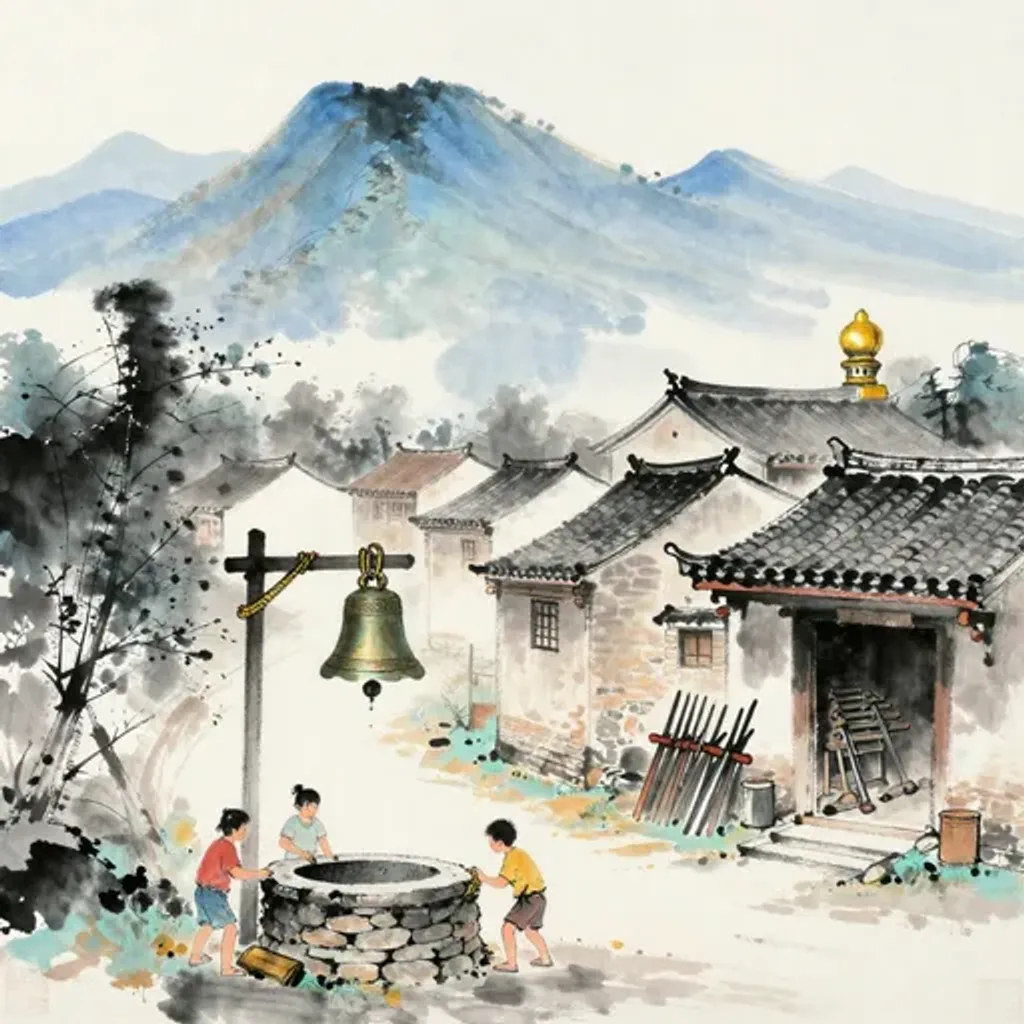
消金猒兵,雷車不行,民安其鄉。
Weapons melted down, arms despised; the thunder-chariots do not march. The people dwell at peace in their homeland.
— Jiao Yanshou, Yilin (Forest of Changes), 1st century BC
Commentary
Twin mountains stand still as weapons are melted down and soldiers stand at ease. Thunder chariots no longer roll; the people live peacefully in their villages. The verse describes the aftermath of pacification: bronze is smelted back from blades, war drums go silent, and the common folk return to agrarian life. From Keeping Still to the Abysmal, doubled mountain yields to doubled water — danger upon danger. Yet the verse presents the hopeful inversion: stillness has already neutralized the peril. The mountain's restraint dissolved the threat before it could compound. When arms are consumed and war machines dismantled, the double danger of the Abysmal is preempted. Peace is achieved not by crossing the abyss but by draining it of its power.
艮 → 離
Hexagram 52 → Hexagram 30: The Clinging Fire
Changing lines: 1, 4
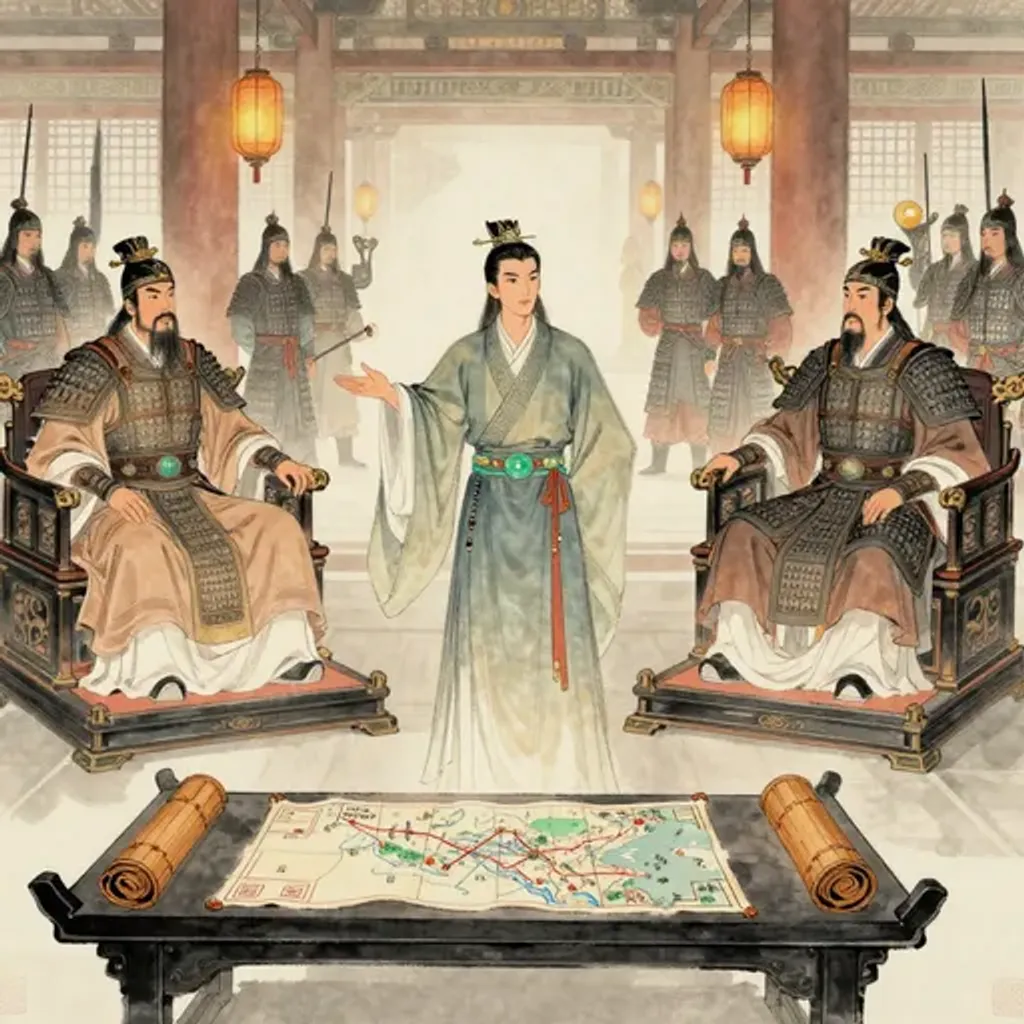
秦儀機言,解其國患。一說燕下,齊襄以權。
Zhang Yi, with cunning words, resolved his kingdom's peril. One speech brought Yan to submission; Duke Xiang of Qi gained the advantage.
— Jiao Yanshou, Yilin (Forest of Changes), 1st century BC
Commentary
Twin mountains stand still, and Zhang Yi's cunning rhetoric resolves his state's crisis at a stroke. With one persuasive argument Yan capitulates, and Duke Xiang of Qi yields his authority. Zhang Yi was the foremost strategist of the Horizontal Alliance, serving Qin by breaking the coalition of opposing states through diplomatic cunning rather than military force. His tongue was sharper than any blade — he could dissolve alliances in a single audience. From Keeping Still to the Clinging, mountain yields to doubled fire, the brilliance of articulate clarity. The mountain's stillness was the long study before the speech; the fire is the speech itself — illuminating, persuasive, and impossible to resist. Rhetoric, deployed at the right moment, achieves what armies cannot.
艮 → 咸
Hexagram 52 → Hexagram 31: Influence
Changing lines: 4, 5, 6
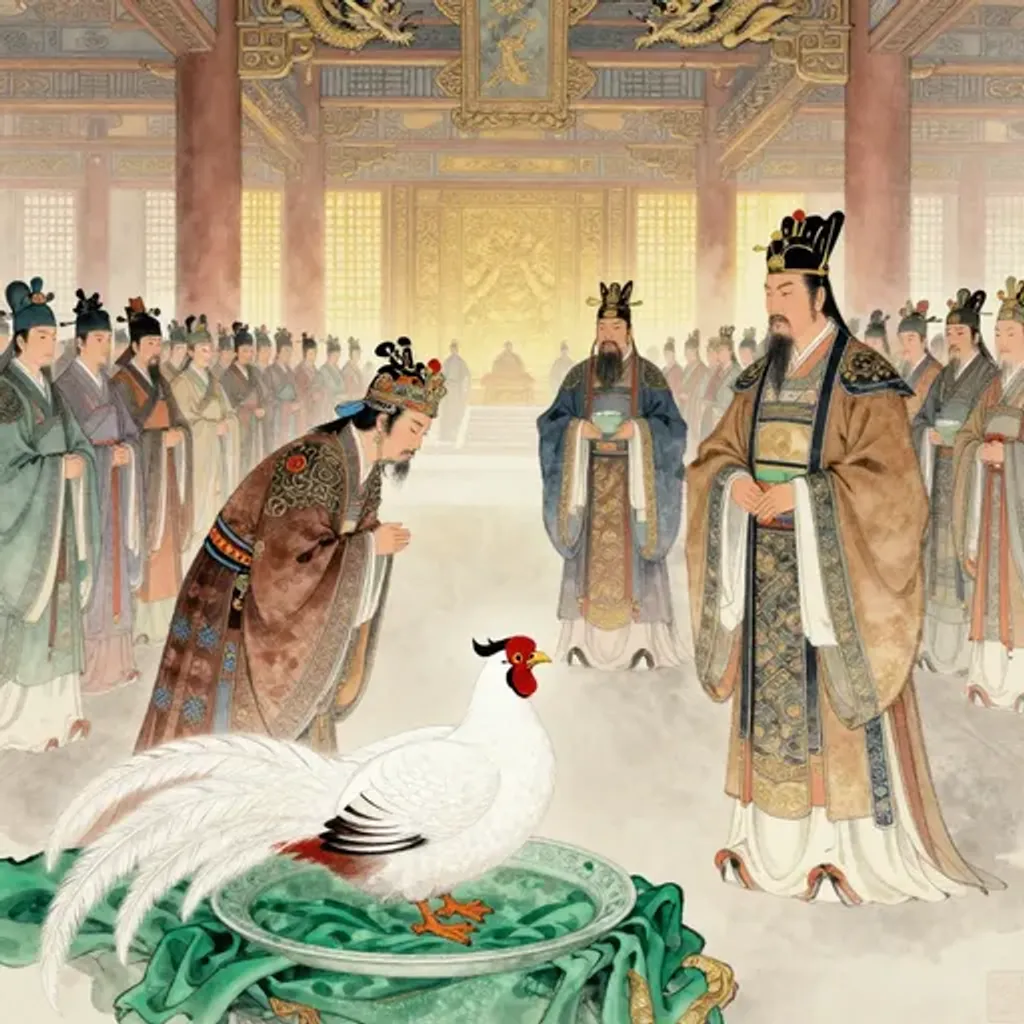
旦奭王輔,周德孔明。越裳獻雉,萬國咸康。
Dan and Shi, the king's pillars; the virtue of Zhou shines bright. Yuechang offers a pheasant in tribute; the ten thousand states are all at peace.
— Jiao Yanshou, Yilin (Forest of Changes), 1st century BC
Commentary
Twin mountains stand still, and the Duke of Zhou and Duke of Shao serve as pillars of the royal house. Zhou's virtue shines brilliantly, and the distant Yueshang people send white pheasants as tribute — all nations find peace and prosperity. According to tradition, during the Duke of Zhou's regency for the young King Cheng, the realm was so well governed that the Yueshang, a people from beyond the southern seas, crossed multiple translation barriers to present a white pheasant, saying they recognized a sage in the Central Kingdom. From Keeping Still to Influence, mountain meets lake atop the mountain. Influence operates through receptive openness — the mountain's firm stillness paired with the lake's yielding surface creates a resonance that draws distant peoples of their own accord.
艮 → 恆
Hexagram 52 → Hexagram 32: Duration
Changing lines: 2, 4, 6
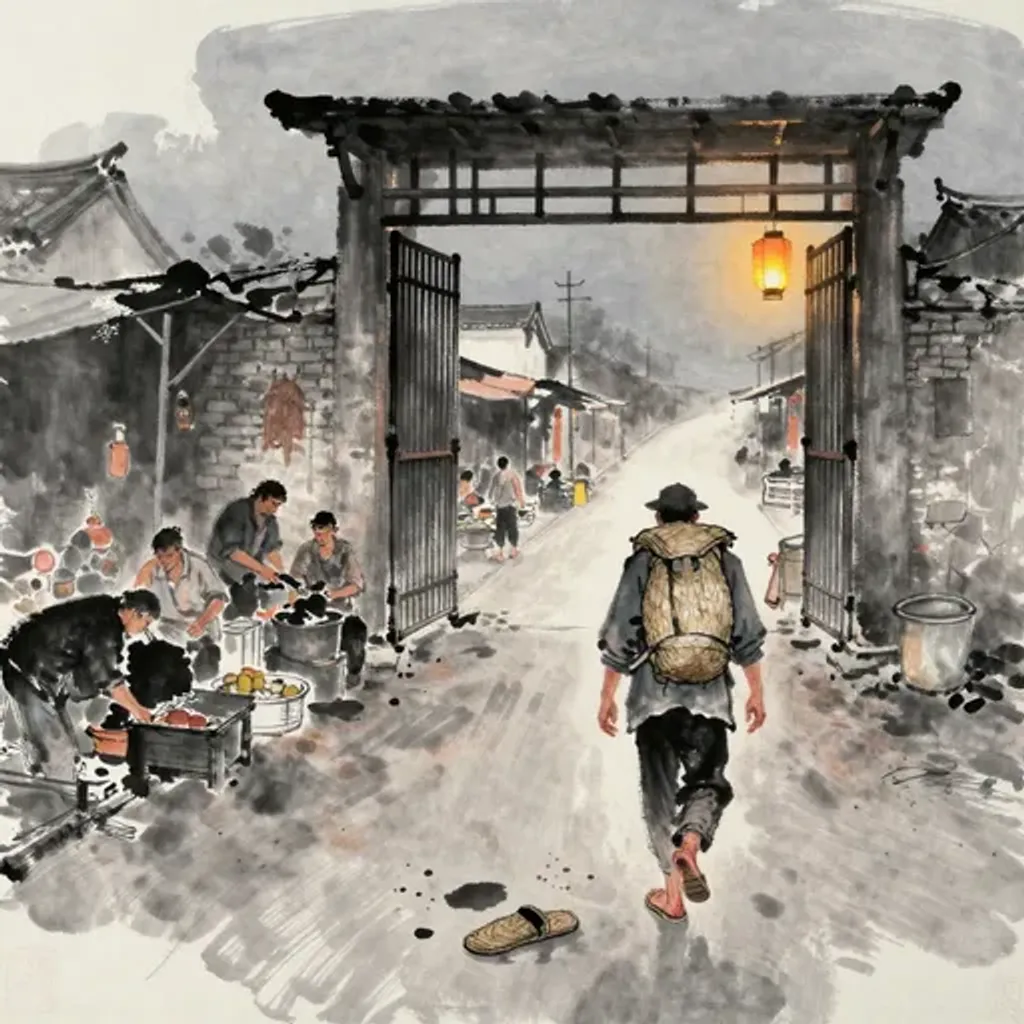
弱足刖跟,不利出門。賈市无盈,折亡為患。
Weak-footed, heel cut short; unfit to pass through the gate. At market, no profit gained; loss and ruin become the affliction.
— Jiao Yanshou, Yilin (Forest of Changes), 1st century BC
Commentary
Twin mountains stand still, but the feet are crippled and the heels are cut — one cannot step outside the door. Trade yields no profit; loss and ruin become constant afflictions. The injury evokes the punishment of yue (刖) — amputation of the foot, one of the Five Punishments of antiquity. A merchant who cannot walk cannot trade; a traveler who cannot travel cannot gain. From Keeping Still to Duration, mountain should yield to thunder above wind, the enduring constancy of complementary forces. Yet the verse presents Duration's shadow: a condition of permanent impairment that endures not as strength but as suffering. What should be steady persistence becomes an unbreakable cycle of deficit.
艮 → 遯
Hexagram 52 → Hexagram 33: Retreat
Changing lines: 4, 5
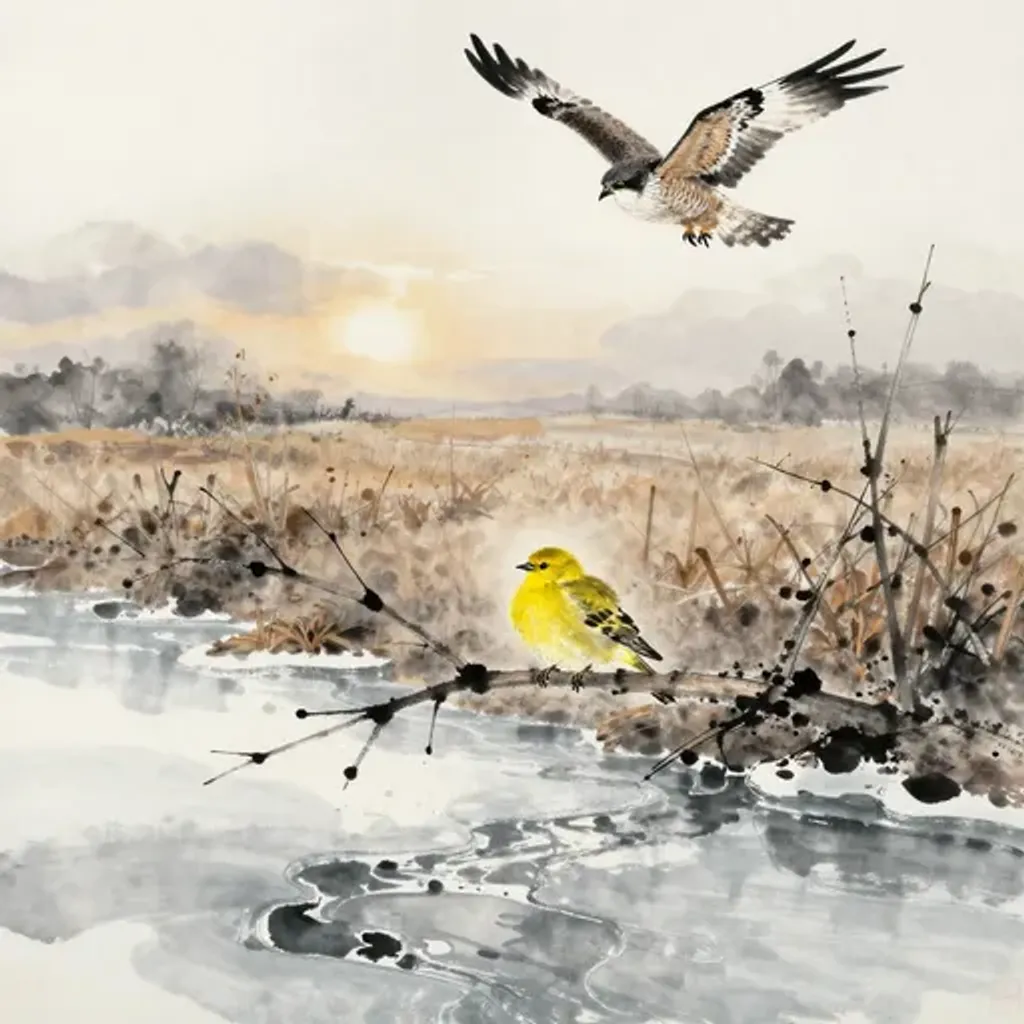
堅冰黃鳥,帝哀悲愁。不見白粒,但覩藜蒿。數驚鷙鳥,為我心憂。
Hard ice, a yellow bird; the emperor grieves in sorrow. No white grain to be seen, only goosefoot and wormwood. Raptor birds startle again and again, making my heart ache.
— Jiao Yanshou, Yilin (Forest of Changes), 1st century BC
Commentary
Twin mountains stand still under hard ice as a yellow bird sings — the sovereign grieves in sorrow. No white grain appears, only weeds of goosefoot and mugwort. Raptors startle repeatedly, deepening the heart's worry. The yellow bird may echo the Shijing exile lament of Xiao Ya, where the bird settling in foreign trees represents the displaced stranger. The frozen ground, absent grain, and predatory birds compound into a landscape of deprivation and fear. From Keeping Still to Retreat, mountain yields to heaven above the mountain. Retreat counsels strategic withdrawal from petty forces. The verse enacts this in reverse — one who should retreat has nowhere left to go, and the ice-locked mountain offers no path of dignified withdrawal.
艮 → 大壯
Hexagram 52 → Hexagram 34: Great Power
Changing lines: 1, 2, 4, 6
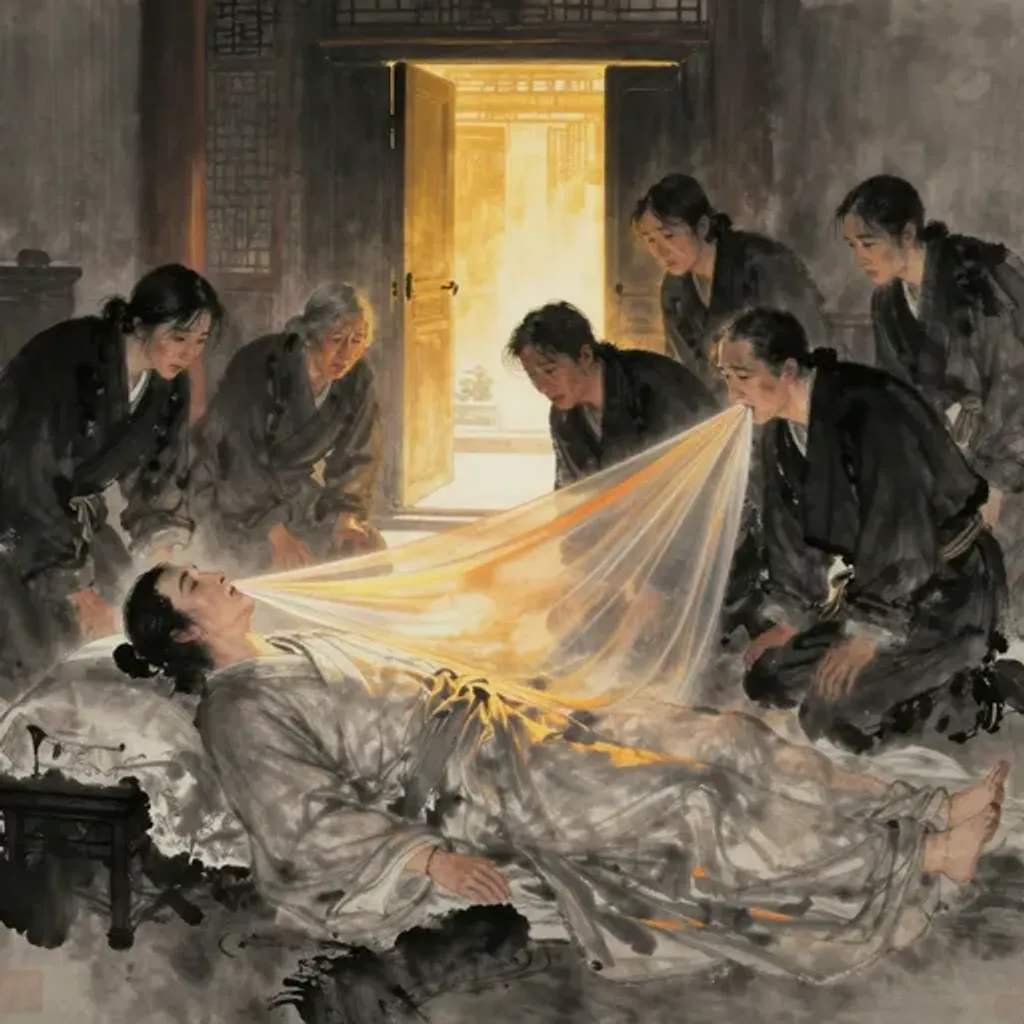
魂微惙惙,屬纊聽絕。曠然大通,復更生活。
The soul flickers, faint and failing; placing silk floss to listen for the final breath. Then vast and open, all is clear again; life returns once more.
— Jiao Yanshou, Yilin (Forest of Changes), 1st century BC
Commentary
Twin mountains stand still at the threshold between life and death. The soul flickers faintly; silk floss is placed by the nose to detect the last breath. Then suddenly — vast openness, a great unblocking — life returns, renewed. The 'silk floss at the nose' (屬纊) is the ancient Chinese ritual for testing whether someone has truly died: a thread of silk held before the nostrils to detect breathing. From Keeping Still to Great Power, mountain yields to thunder roaring above heaven — explosive vitality. The transformation is dramatic: absolute stillness at the edge of extinction becomes thunderous resurgence. What seemed death was only the deepest possible gathering of force before its release. The mountain did not die; it was reloading.
艮 → 晉
Hexagram 52 → Hexagram 35: Progress
Changing lines: 3, 4
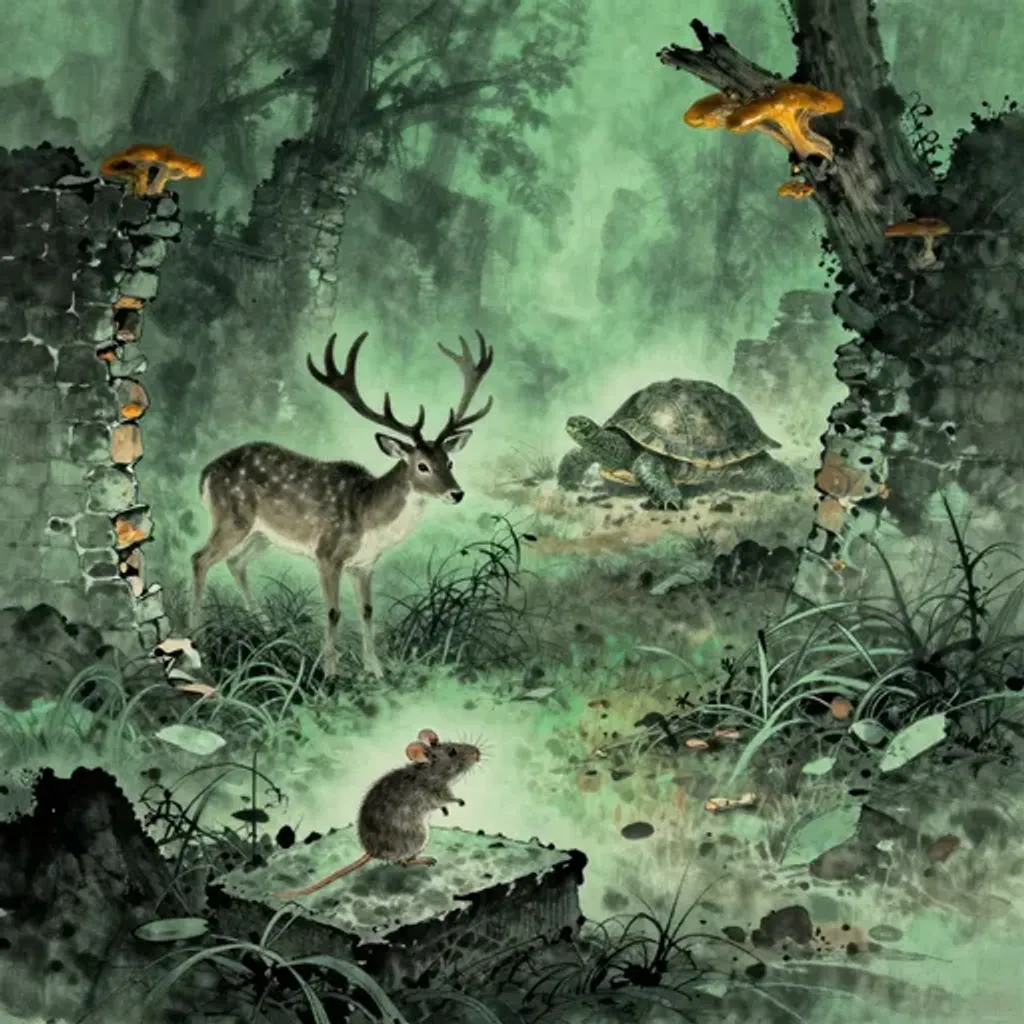
陰生麞鹿,鼠舞鬼谷,靈龜陸處。
In the yin, deer and roe are born; rats dance in the ghost valley. The spirit turtle dwells on dry land.
— Jiao Yanshou, Yilin (Forest of Changes), 1st century BC
Commentary
Twin mountains stand still as yin energy spawns deer and roe in the valleys. Rats dance in the demon gully, and the sacred turtle drags itself onto dry land. The verse conjures a world of natural omens gone wrong: animals in the wrong places, the numinous turtle beached where it cannot divine. In Han-dynasty lore, the turtle's power depends on water; stranded on land, it is impotent. From Keeping Still to Progress, mountain yields to fire blazing above the earth, the sun rising over the horizon. Progress promises advancing brightness, yet the verse's displaced creatures suggest that the advance is disordered. Fire emerging from earth illuminates what it finds — and here it finds an ominous menagerie scrambling in confusion.
艮 → 明夷
Hexagram 52 → Hexagram 36: Darkening of the Light
Changing lines: 1, 6
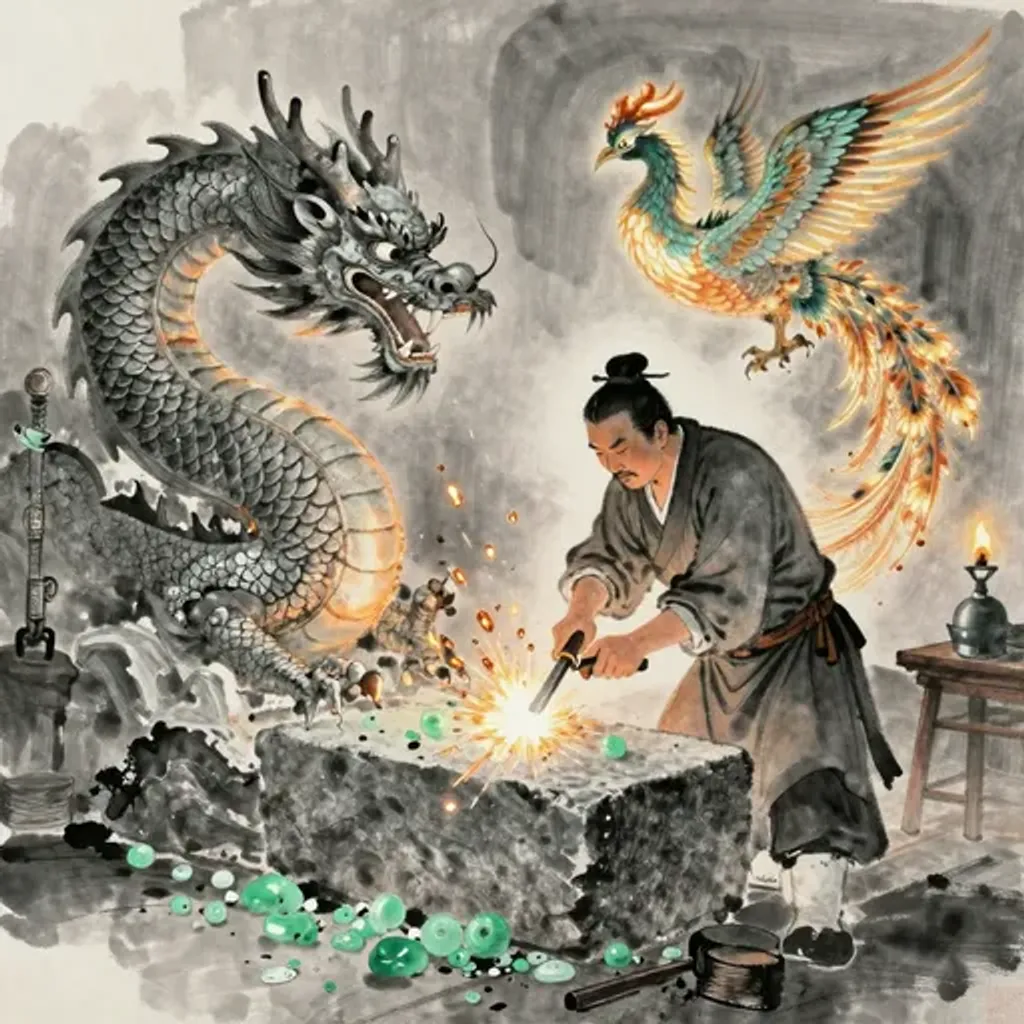
諸石攻玉,无不穿鑿。龍體吾舉,魯班為輔。麟鳳成形,德象君子。
Many stones may fashion jade, nothing that cannot be pierced and carved. The dragon's form I raise aloft, Lu Ban as my aide. Qilin and phoenix take shape — virtue's image, a gentleman's emblem.
— Jiao Yanshou, Yilin (Forest of Changes), 1st century BC
Commentary
Twin mountains stand still, and from their stone, jade is shaped — no material resists the patient chisel. A dragon-bodied form is raised aloft, with Lu Ban himself assisting the work. Qilin and phoenix take shape in stone, their virtue mirroring the gentleman. Lu Ban, the legendary master carpenter, here lends his genius to sculpture rather than carpentry — crafting mythical beasts whose moral beauty transcends their material. From Keeping Still to Darkening of the Light, mountain yields to fire buried beneath the earth. Brilliance enters darkness. The verse's artisan works within the mountain itself, carving luminous forms that will endure even when the light above is extinguished. True craft preserves virtue through the darkest season.
艮 → 家人
Hexagram 52 → Hexagram 37: The Family
Changing lines: 1, 5
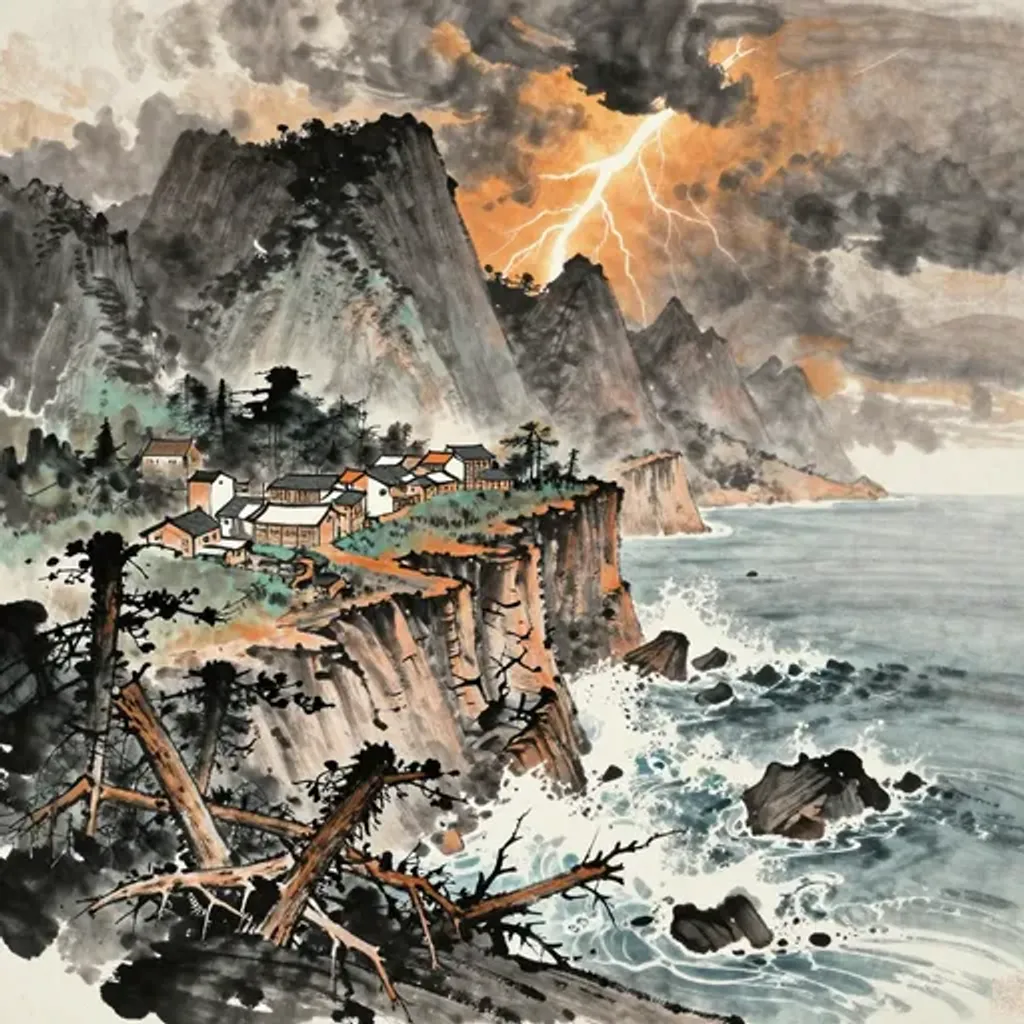
山作天時,陸為海口,民不安處。
Mountains become the sky's weather; land becomes the sea's mouth. The people cannot dwell in peace.
— Jiao Yanshou, Yilin (Forest of Changes), 1st century BC
Commentary
Twin mountains stand still, but the natural order inverts catastrophically. Mountains usurp the weather of heaven; dry land becomes the mouth of the sea. The people can find no safe place to dwell. The verse describes cosmic upheaval: geography itself is rearranged, categories collapse, and habitability vanishes. From Keeping Still to the Family, mountain yields to wind emerging from fire — the warmth of the household radiating outward as gentle instruction. Yet the verse depicts the annihilation of domestic stability: when mountains become storms and fields become ocean floors, no family structure can survive. The transformation suggests that Family order depends on cosmic order; when the latter dissolves, the former has no ground to stand on.
艮 → 睽
Hexagram 52 → Hexagram 38: Opposition
Changing lines: 1, 2, 3, 4
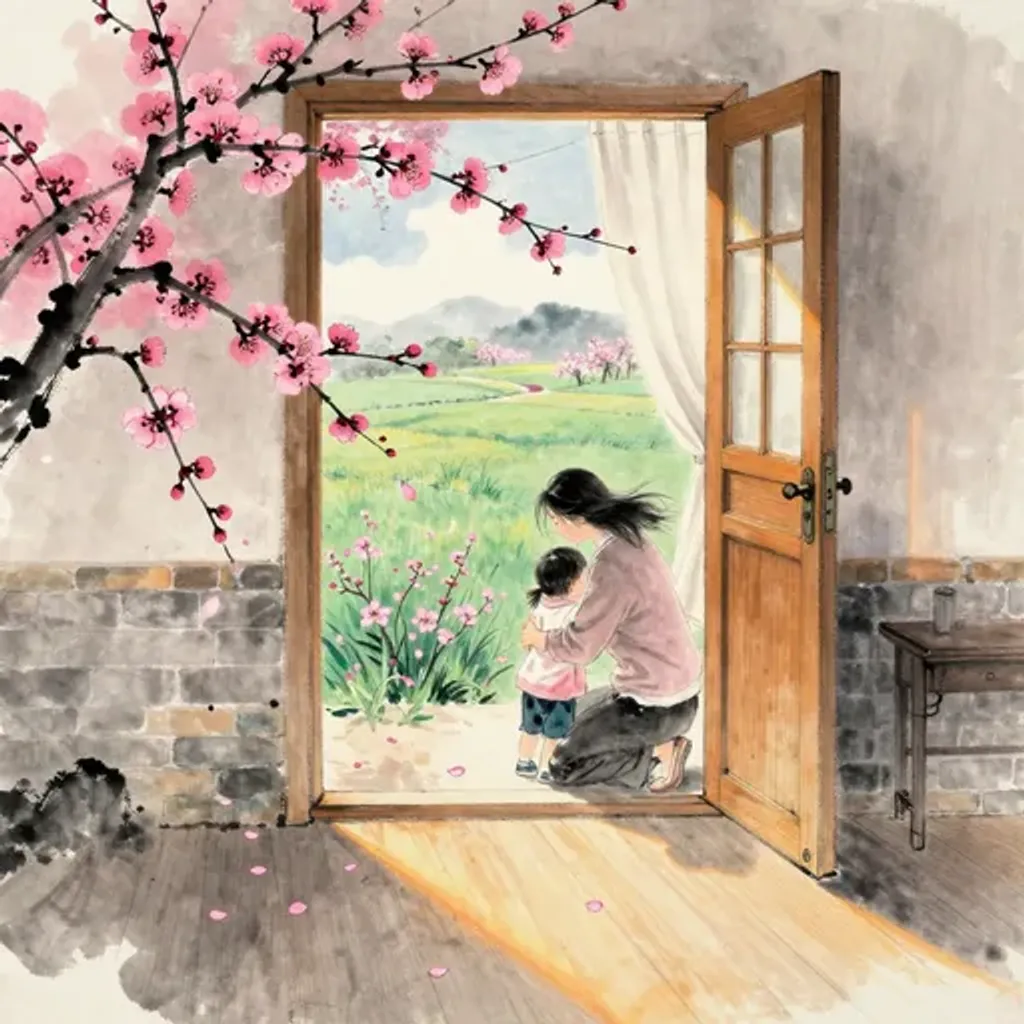
東風啟戶,隱伏懽喜。萌庶蒙恩,復得我子。
The east wind opens the door; hidden joy stirs within. The common folk receive grace; I recover my child once more.
— Jiao Yanshou, Yilin (Forest of Changes), 1st century BC
Commentary
Twin mountains stand still, then the east wind opens the door. Hidden things stir with joy; the common people receive grace, and a lost child is recovered. The east wind is the wind of spring, the classical harbinger of renewal. What was concealed through winter now emerges. From Keeping Still to Opposition, mountain yields to fire above the lake, elements that seem to oppose yet serve a common purpose. Opposition's wisdom lies in finding unity within difference. The verse enacts this: stillness yields to its seeming opposite — movement, warmth, reunion — yet the child who returns was always part of the household. The mountain's long winter was not loss but gestation, and the east wind simply reveals what was already growing in the dark.
艮 → 蹇
Hexagram 52 → Hexagram 39: Obstruction
Changing lines: 5, 6
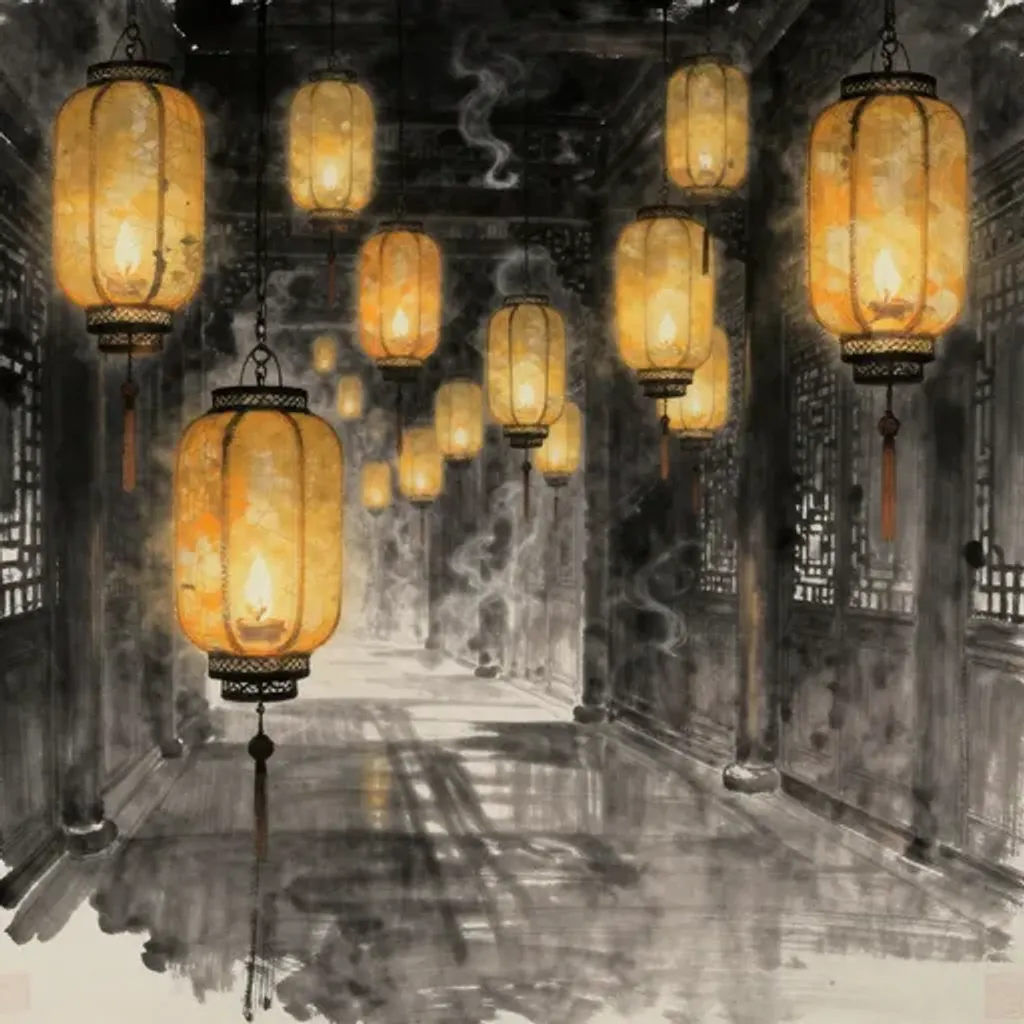
華燈百杖,稍暗衰微。精光欲盡,奄如灰靡。
A hundred splendid lanterns, gradually dimming and declining. Their fine radiance nearly spent, suddenly extinguished like ash and dust.
— Jiao Yanshou, Yilin (Forest of Changes), 1st century BC
Commentary
Twin mountains stand still as a grand chandelier of a hundred lamps begins to dim and fade. Its radiance is spent; it gutters into ash. The image is theatrical — a great hall's lighting slowly dying, flame by flame, until darkness claims the space. From Keeping Still to Obstruction, doubled mountain yields to water upon the mountain. Obstruction places danger (water) directly atop difficulty (mountain), creating an impassable barrier. The verse's fading lights enact this: the mountain's stillness was once illuminated, but now each lamp that fails adds another layer of obstruction. The counsel of Obstruction is to 'turn inward and cultivate virtue,' but the verse suggests the light for such self-examination is itself running out.
艮 → 解
Hexagram 52 → Hexagram 40: Deliverance
Changing lines: 2, 3, 4, 6
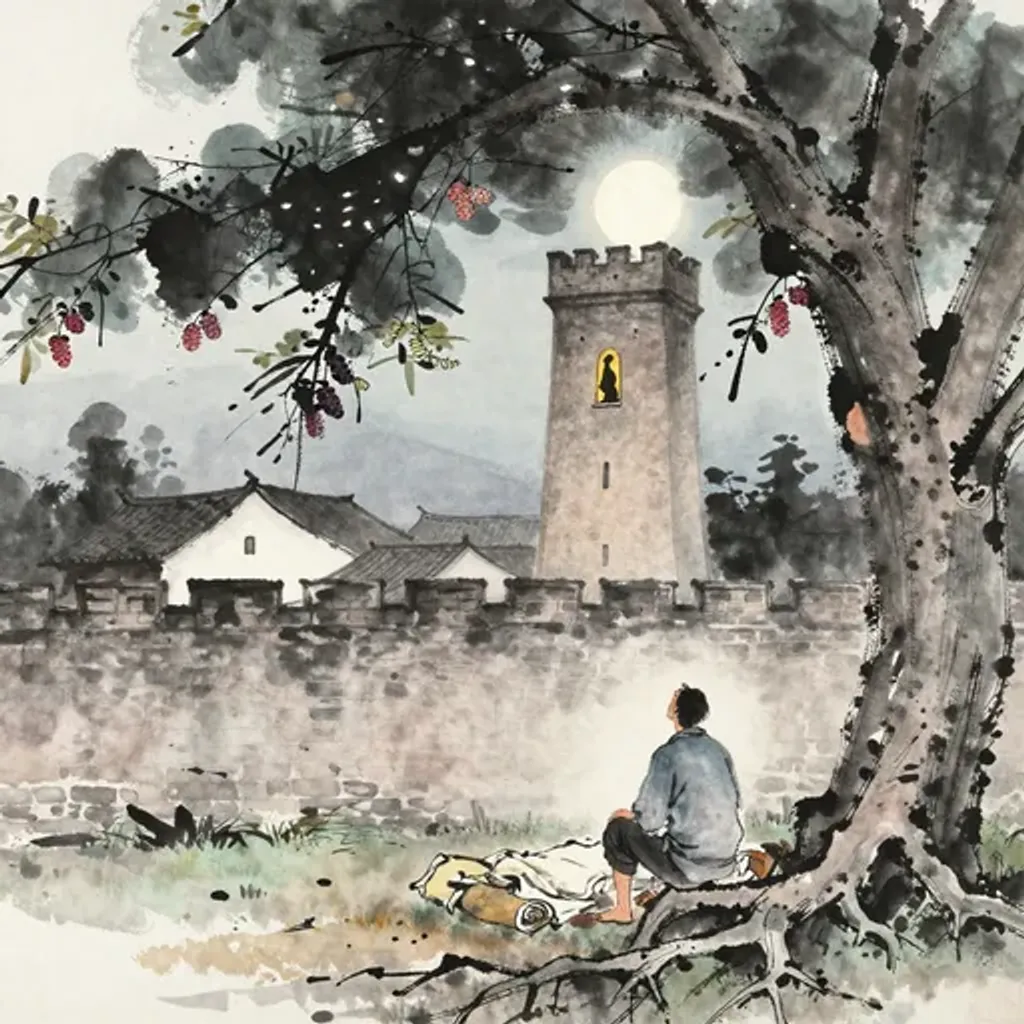
三十无室,寄宿桑中。上宮長女,不得來同,使我失期。
At thirty, without a home, lodging among the mulberries. The eldest daughter of the upper palace cannot come to join me, causing me to miss our time.
— Jiao Yanshou, Yilin (Forest of Changes), 1st century BC
Commentary
Twin mountains stand still, and a man of thirty without a household lodges among the mulberries. The elder daughter of the upper palace cannot come to him, causing him to miss his appointed time. The phrase 'sangzhong' (桑中) echoes the Shijing ode about illicit trysts beneath the mulberry trees. The 'upper palace elder daughter' (上宮長女) may allude to the song's place of assignation. From Keeping Still to Deliverance, mountain yields to thunder above water — the storm that breaks the impasse. Yet the verse denies that release: the woman does not come, the period passes, and the man remains stuck among the mulberries. Deliverance promises that obstacles dissolve, but here the obstacle is absence itself — what never arrives cannot be unblocked.
艮 → 損
Hexagram 52 → Hexagram 41: Decrease
Changing lines: 1, 2, 3
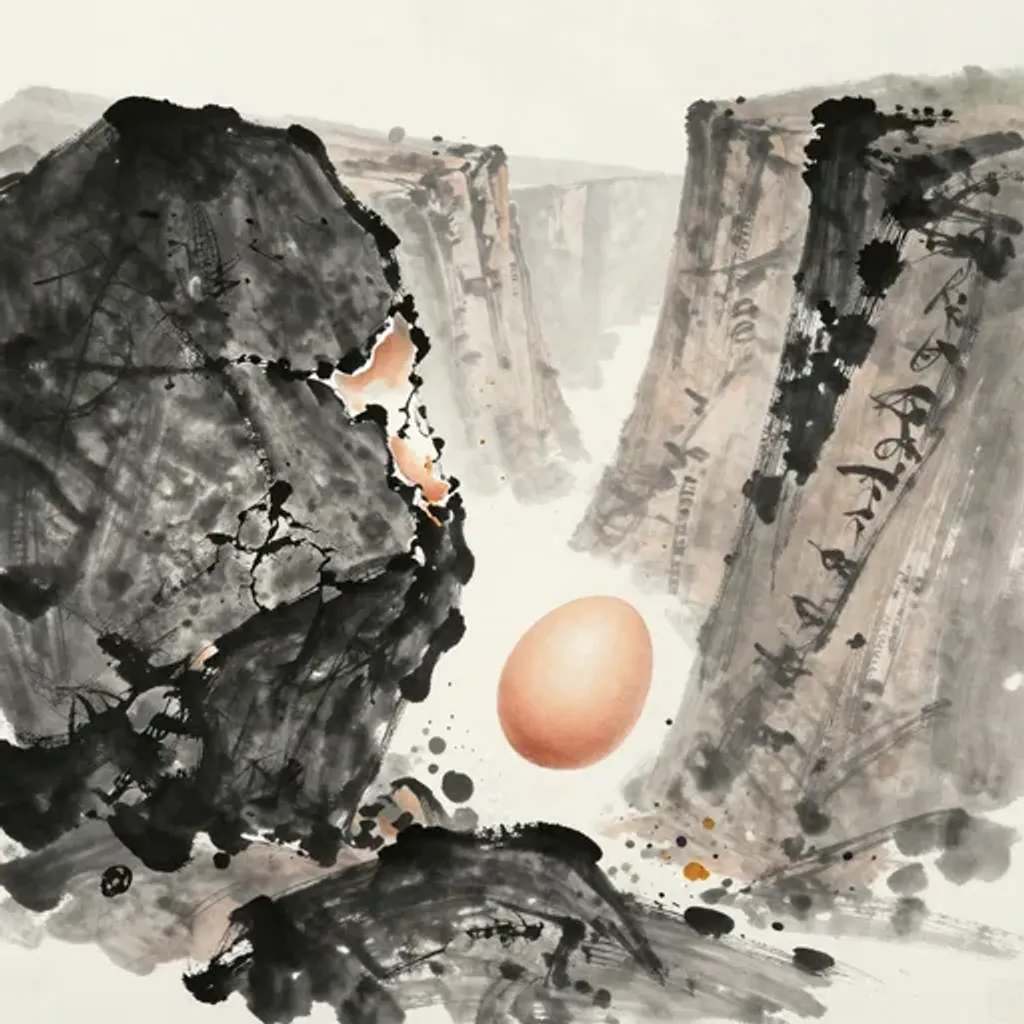
卵與石鬭,麋碎無疑。動而有悔,出不得時。
An egg contends with a stone; it will shatter beyond doubt. Acting, there is regret; setting forth at the wrong time.
— Jiao Yanshou, Yilin (Forest of Changes), 1st century BC
Commentary
Twin mountains stand still, but the egg dares to fight the stone — it will be crushed beyond doubt. To move is to invite regret; to venture out is to miss the moment. The 'egg against stone' proverb (以卵擊石) is one of the most ancient Chinese images of catastrophic miscalculation, appearing in the Mozi and Xunzi. From Keeping Still to Decrease, mountain yields to mountain above the lake, where excess is pared away to nourish what lies below. Decrease counsels restraint of anger and desire. The verse is its negative example: the egg's reckless challenge is pure, unchecked impulse — the refusal to accept limitation. What the mountain's stillness should have taught, the egg ignores, and the result is self-inflicted annihilation.
艮 → 益
Hexagram 52 → Hexagram 42: Increase
Changing lines: 1, 3, 5
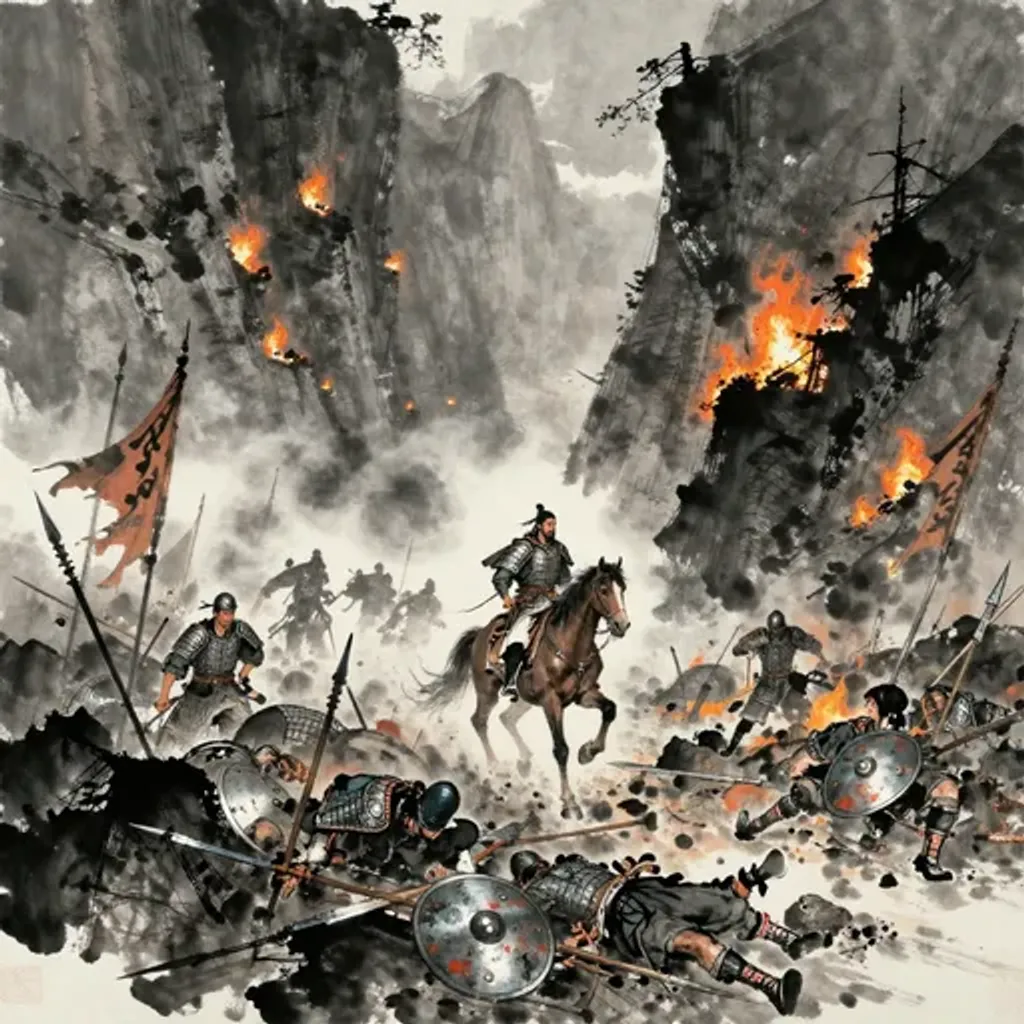
秦兵爭強,失其貞良,敗於郩鄉。
Qin's soldiers vie for supremacy, but lose their upright and loyal. Defeated at the village of Gui.
— Jiao Yanshou, Yilin (Forest of Changes), 1st century BC
Commentary
Twin mountains stand still, but Qin's armies contend for dominance and lose their most upright men, suffering defeat in the countryside. The verse names Qin's militarism as the source of its undoing: in pursuing strength through aggression, it sacrificed the loyal and virtuous who were its true foundation. The place name is obscure but suggests a specific engagement in which Qin's forces overextended and were routed. From Keeping Still to Increase, mountain yields to wind above thunder — the image of self-correction through observing good and reforming error. The verse implies that Qin refused this lesson: rather than increasing virtue through self-examination, it increased only its appetite for conquest, and the defeat was the inevitable rebuke.
艮 → 夬
Hexagram 52 → Hexagram 43: Breakthrough
Changing lines: 1, 2, 4, 5, 6
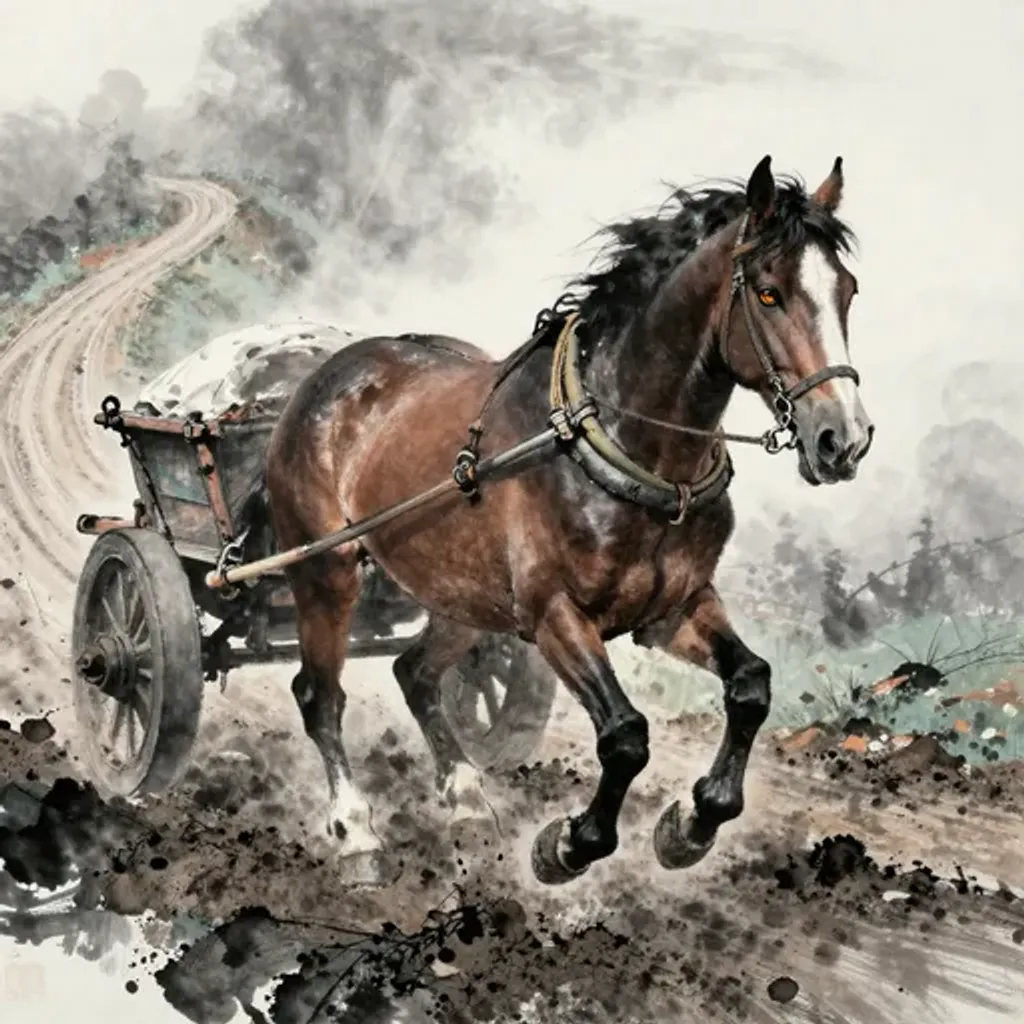
虐除善猛,難為攻醫。驥窮鹽車,困於衘箠。
Cruelty removes goodness, ferocity; hard to attack or cure. A thoroughbred exhausted on the salt cart, trapped by bit and whip.
— Jiao Yanshou, Yilin (Forest of Changes), 1st century BC
Commentary
Twin mountains stand still as cruelty expels the good and fierce remedies are hard to administer. A thoroughbred horse, exhausted from hauling a salt cart, suffers under bit and whip. The 'thoroughbred yoked to a salt cart' (驥窮鹽車) is a famous allusion: the great horse Bole would have recognized is instead ground down in menial labor, its extraordinary nature wasted. The story appears in the Zhanguo Ce and Han Feizi. From Keeping Still to Breakthrough, mountain should yield to lake surging above heaven — decisive action that sweeps away corruption. Yet the verse shows Breakthrough frustrated: the talented are abused, the virtuous expelled, and the instrument of change is itself shackled. Liberation cannot come while the liberator is in chains.
艮 → 姤
Hexagram 52 → Hexagram 44: Coming to Meet
Changing lines: 2, 4, 5
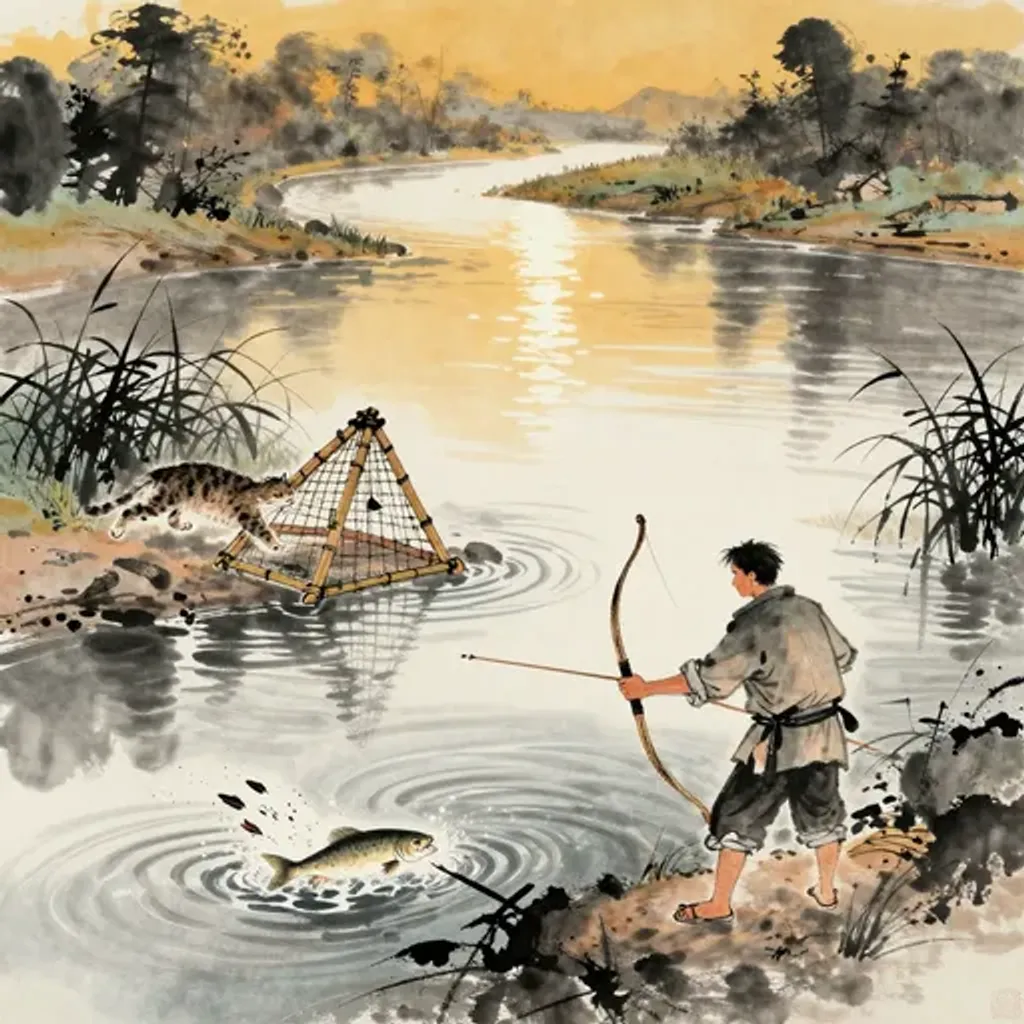
操笱搏狸,荷弓射魚。非其器用,自令心勞。
Wielding a fish trap to catch a wildcat, shouldering a bow to shoot fish. Not the proper tool for the use; it only makes the heart toil.
— Jiao Yanshou, Yilin (Forest of Changes), 1st century BC
Commentary
Twin mountains stand still, but the tools are all wrong. One takes a fish trap to catch a wildcat, and a bow to shoot fish — none of the implements match their purpose. The result is not failure through weakness but failure through categorical error: competence misdirected. From Keeping Still to Coming to Meet, mountain yields to wind beneath heaven, the unexpected encounter. Coming to Meet warns of the yin principle arising unbidden — something appears that was not sought. The verse's mismatched tools resonate: when one prepares for the wrong encounter, the meeting itself becomes absurd. The mountain's stillness should have been a time for correct preparation, but instead, the wrong equipment was chosen, and effort becomes self-exhausting futility.
艮 → 萃
Hexagram 52 → Hexagram 45: Gathering Together
Changing lines: 3, 4, 5, 6
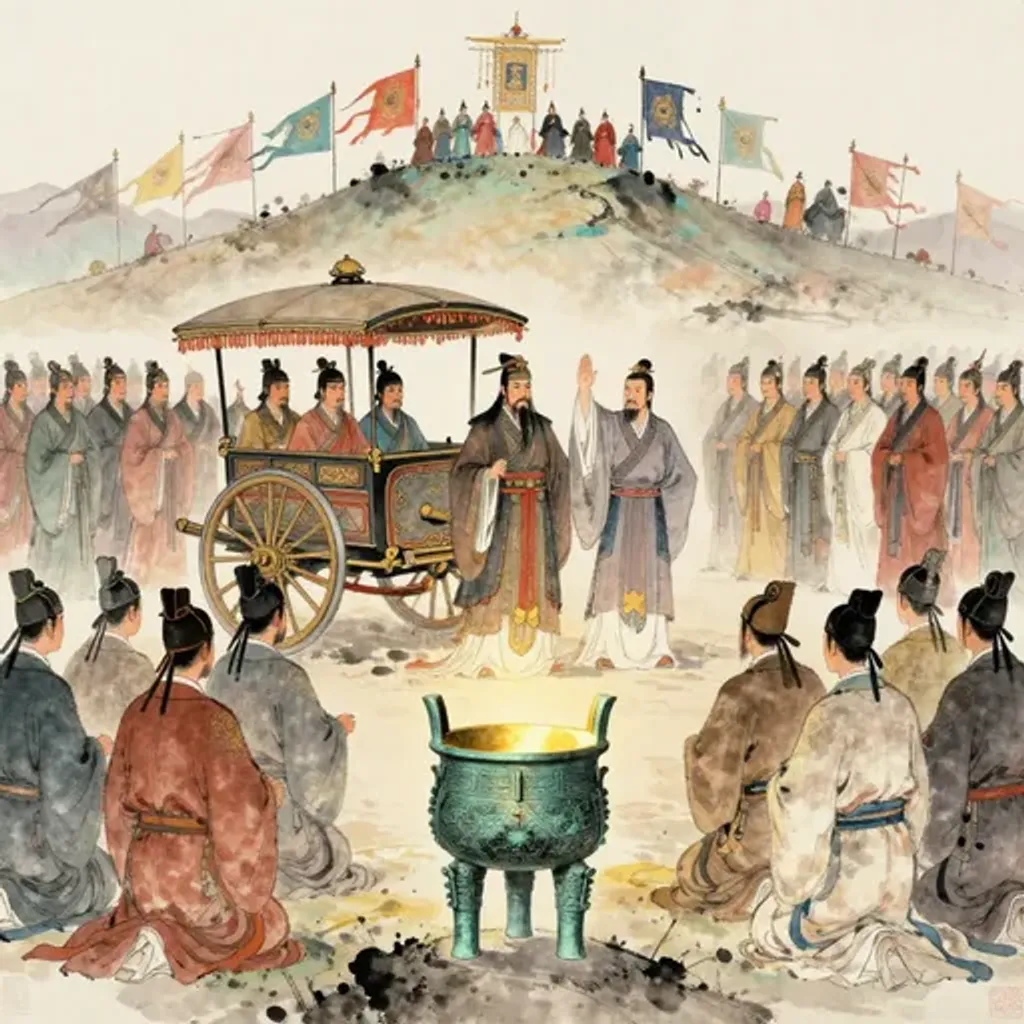
葵丘之盟,晉獻會行。見太宰辭,復為還輿。
At the covenant of Kuiqiu, Duke Xian of Jin attended the assembly. Meeting the Grand Steward's refusal, he turned his chariot and departed.
— Jiao Yanshou, Yilin (Forest of Changes), 1st century BC
Commentary
Twin mountains stand still as the covenant at Kuiqiu unfolds. Duke Xian of Jin dispatches an envoy to attend, but upon meeting the Grand Steward is turned away and the carriage returns home. The Kuiqiu covenant of 651 BC was Duke Huan of Qi's defining moment of hegemony, where the Zhou Son of Heaven himself acknowledged Qi's leadership. Duke Xian of Jin, then gravely ill, sent a representative but the delegation was rebuffed — Jin's internal turmoil disqualified it from the alliance. From Keeping Still to Gathering, mountain yields to the lake above the earth, where people congregate. The verse captures exclusion from that gathering: one arrives at the assembly only to be denied entry. Stillness becomes not dignity but isolation from the collective.
艮 → 升
Hexagram 52 → Hexagram 46: Pushing Upward
Changing lines: 2, 6
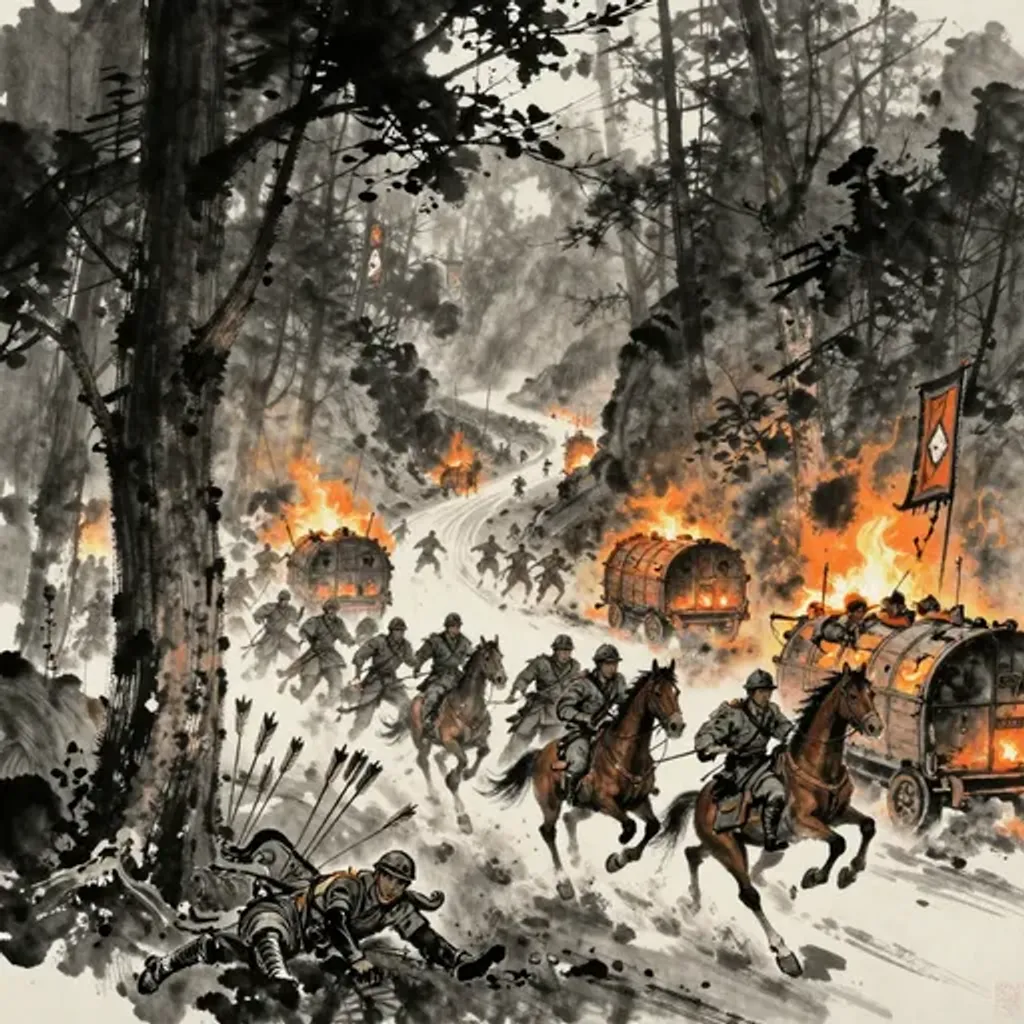
臏詐龐子,夷竈盡毀。兵伏卒發,矢至如雨。魏師驚亂,將獲為虜,涓死樹下。
Sun Bin deceived Pang Juan; the cooking-fires were dismantled and destroyed. Troops concealed, suddenly unleashed; arrows fell like rain. Wei's army, shocked and broken — the general was captured as prisoner. Juan died beneath a tree.
— Jiao Yanshou, Yilin (Forest of Changes), 1st century BC
Commentary
Twin mountains stand still, but beneath the surface a stratagem unfolds. Sun Bin feigns retreat, reducing his army's cooking fires night after night to simulate desertion. His rival Pang Juan, the Wei general who once had Sun Bin's kneecaps removed out of jealousy, takes the bait and pursues with light cavalry into Maling Pass. There, Sun Bin has stripped a tree and inscribed it: 'Pang Juan dies beneath this tree.' When Pang Juan lights a torch to read the words, ten thousand crossbows fire at once, arrows falling like rain. The Wei army collapses; Pang Juan dies under that very tree. The transformation from Keeping Still to Pushing Upward captures this perfectly: patient stillness conceals the slow, methodical rise that destroys the reckless pursuer.
艮 → 困
Hexagram 52 → Hexagram 47: Oppression
Changing lines: 2, 3, 4, 5, 6
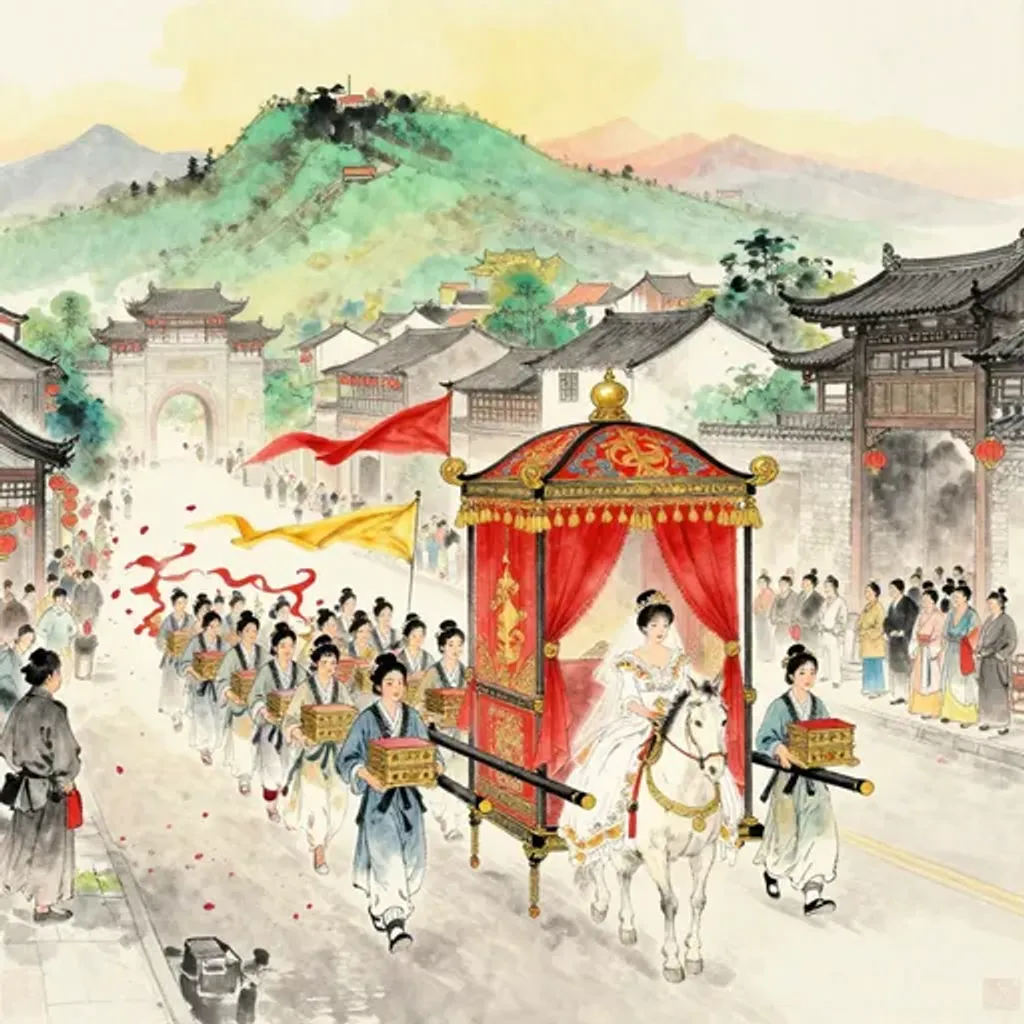
南行出城,世得天福。王姬歸齊,賴其所欲。
Traveling south, departing the city; the age receives heaven's blessing. The royal princess is married off to Qi, finding what was desired.
— Jiao Yanshou, Yilin (Forest of Changes), 1st century BC
Commentary
Twin mountains stand still, then the journey turns south through the city gate. The world receives heaven's blessing; a Zhou princess goes to Qi in marriage, and both sides obtain what they desire. The 'wang ji' (王姬) is a daughter of the Zhou royal house. Royal marriages to major states like Qi were diplomatic instruments that cemented alliances and conferred legitimacy. From Keeping Still to Oppression, mountain yields to the lake drained of its water — emptiness and constraint. Yet the verse is unexpectedly positive: the princess's departure is not loss but strategic gift. From the mountain's perspective, sending forth something precious is indeed a diminishment, but from the alliance's perspective, it fills the empty lake. Oppression is navigated by giving rather than hoarding.
艮 → 井
Hexagram 52 → Hexagram 48: The Well
Changing lines: 2, 5, 6
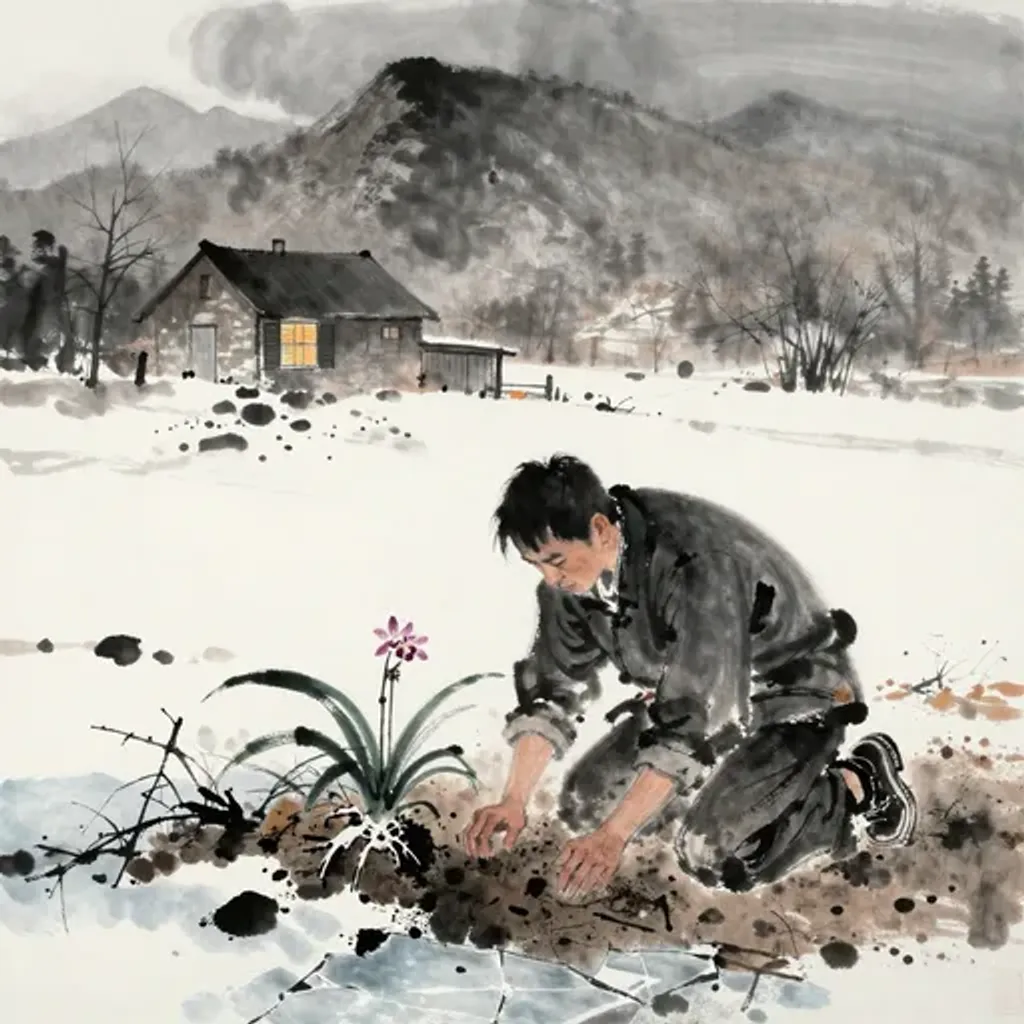
冬采微蘭,地凍堅難。利走室北,暮无所得。
Gathering orchids in winter; the ground is frozen and unyielding. Better to hasten to the north chamber; by evening, nothing is gained.
— Jiao Yanshou, Yilin (Forest of Changes), 1st century BC
Commentary
Twin mountains stand still in the dead of winter as one gathers orchids from frozen ground — the earth is locked solid, yielding nothing. Hurrying north to the back of the house brings no reward by nightfall. The verse is seasonal futility: the wrong task at the wrong time in the wrong place. Orchids bloom in warmth; seeking them in winter is an act of beautiful desperation. From Keeping Still to the Well, mountain yields to water above wind — the image of the well that nourishes the community. The Well serves all who draw from it, but its water must be reached. The verse's frozen ground is the well sealed by ice: the resource exists but the season forbids access. Patience, not effort, is the remedy.
艮 → 革
Hexagram 52 → Hexagram 49: Revolution
Changing lines: 1, 4, 5, 6
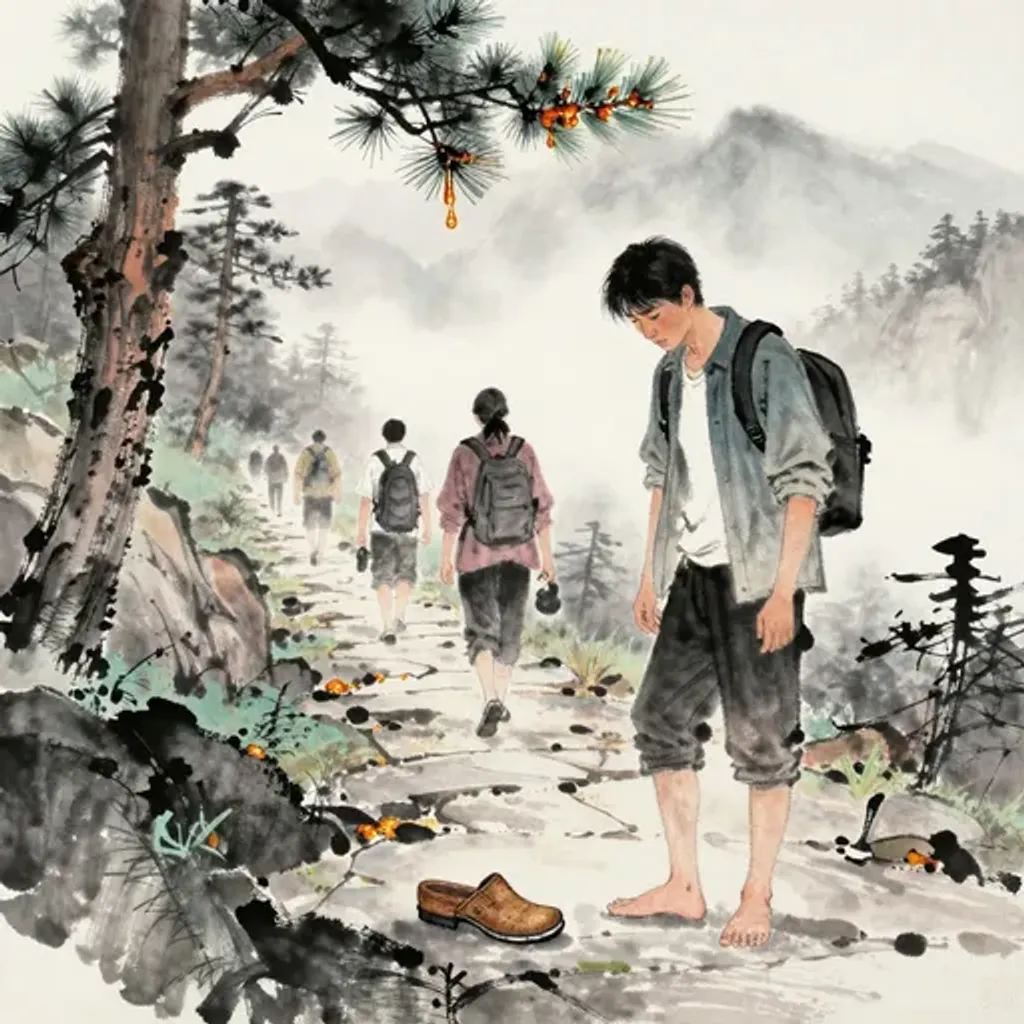
王喬无病,狗頭不痛。亡屐失履,乏我送從。
Wang Qiao has no illness; the dog's head feels no pain. Losing one's clogs and shoes; lacking any who follow or attend me.
— Jiao Yanshou, Yilin (Forest of Changes), 1st century BC
Commentary
Twin mountains stand still as Wang Qiao has no illness, and the dog's head feels no pain — there is nothing wrong, yet everything needed is missing. Clogs are lost and shoes gone; no one accompanies the journey. Wang Qiao is the immortal prince who ascended to heaven, leaving behind only his shoes. In one tradition, his paired shoe-ducks flew to the court but one was captured, revealing itself as a shoe. The verse's logic is paradoxical: perfect health but no means of movement. From Keeping Still to Revolution, mountain yields to fire within the lake, the radical transformation that sweeps away the old. Yet without shoes, one cannot walk toward revolution. The spirit is ready but the ground-level equipment is absent — a transformation imagined but not enacted.
艮 → 鼎
Hexagram 52 → Hexagram 50: The Cauldron
Changing lines: 2, 4
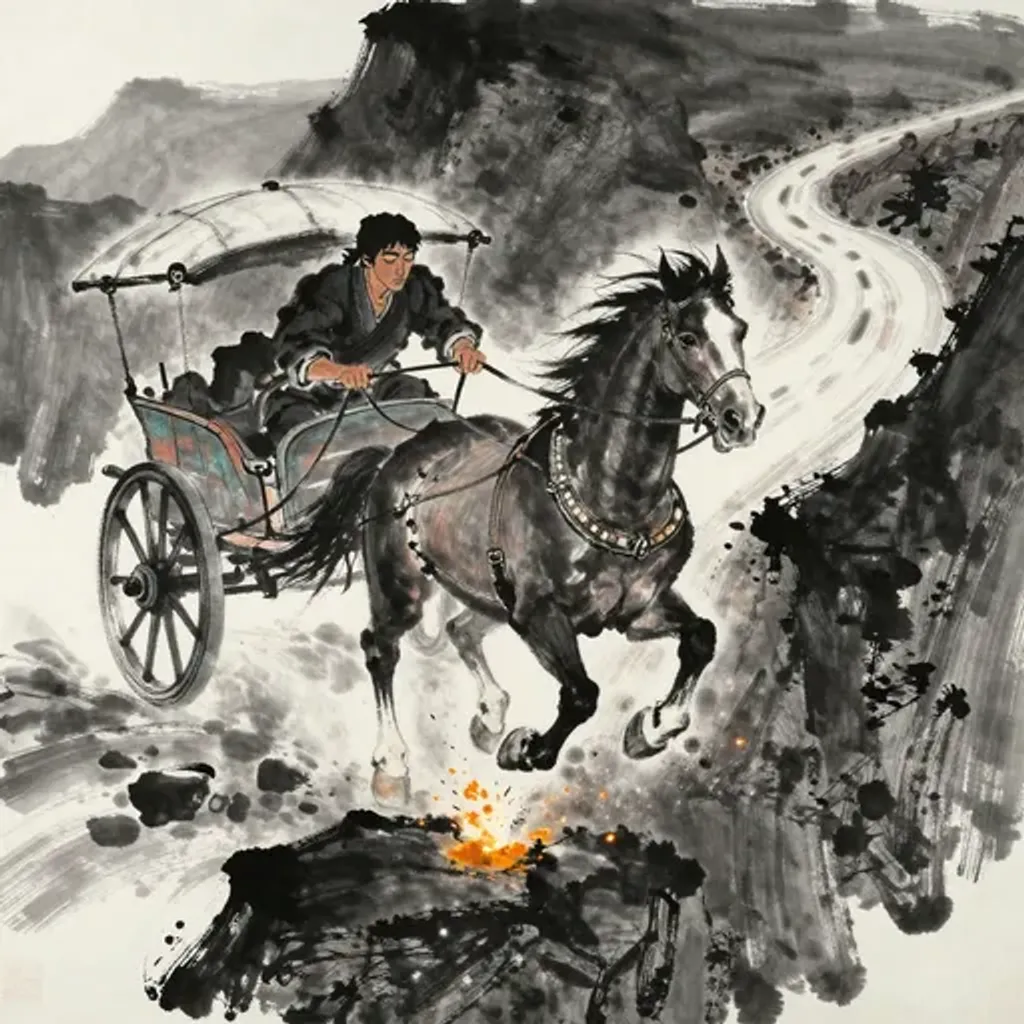
宛馬疾步,盲師坐御。目不見路,中宵弗到。
A fine horse of Wan gallops swiftly; a blind driver sits at the reins. Eyes cannot see the road; by midnight, the destination is not reached.
— Jiao Yanshou, Yilin (Forest of Changes), 1st century BC
Commentary
Twin mountains stand still as a fine horse from Wan gallops swiftly, but a blind charioteer sits at the reins. Eyes that cannot see the road ensure the destination is never reached by midnight. The pairing is deliberately absurd: an excellent horse, a terrible driver. Speed without guidance is worse than immobility. From Keeping Still to the Cauldron, mountain yields to fire above wind — the sacred vessel that transforms raw material into refined offering. The Cauldron demands precision: the right heat, the right timing, the right hands. The blind charioteer is the anti-Cauldron: powerful resources managed by incompetent leadership. The mountain's stillness would have been preferable to motion governed by blindness.
艮 → 震
Hexagram 52 → Hexagram 51: The Arousing Thunder
Changing lines: 1, 3, 4, 6
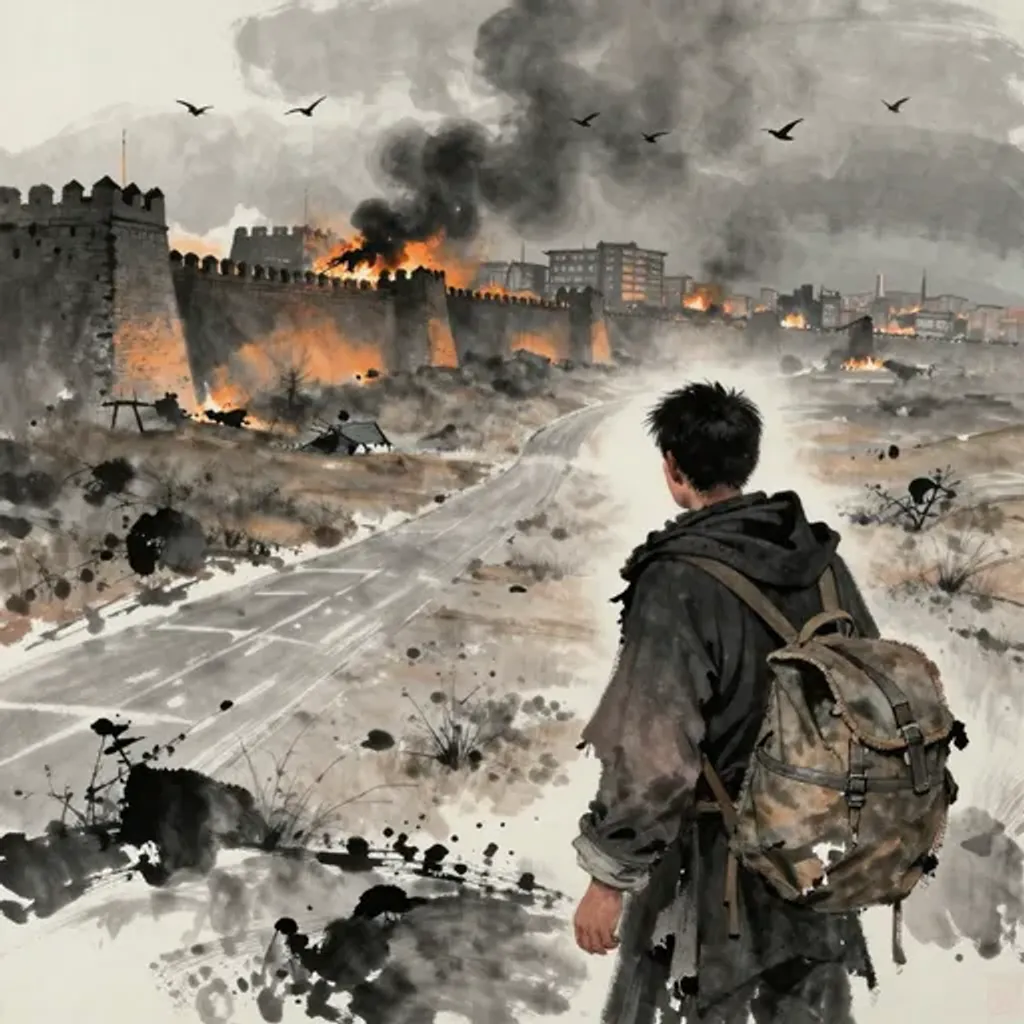
求利難國,亡去我北。憂歸其城,反為吾賊。
Seeking gain in the troubled state, fleeing north from my land. Returning in sorrow to that city, it turns and becomes my enemy.
— Jiao Yanshou, Yilin (Forest of Changes), 1st century BC
Commentary
Twin mountains stand still, but the pursuit of profit embroils a nation. One flees northward in worry, then returns to the city only to find that the returnee has become the enemy. The verse traces a circular trap: leaving home to seek gain, retreating in anxiety, returning to find oneself treated as a traitor. The journey was pointless; the homecoming is hostile. From Keeping Still to the Arousing, mountain yields to doubled thunder — shock upon shock. The Arousing terrifies but ultimately clarifies, like lightning that reveals the landscape. The verse's double reversal embodies this: the shock of discovering that one's own city has become dangerous is the thunder's first crack. Whether it leads to renewed awareness or final ruin depends on how one receives the shock.
艮 → 艮
Hexagram 52 → Hexagram 52: Keeping Still Mountain
No changing lines — the hexagram is unchanged
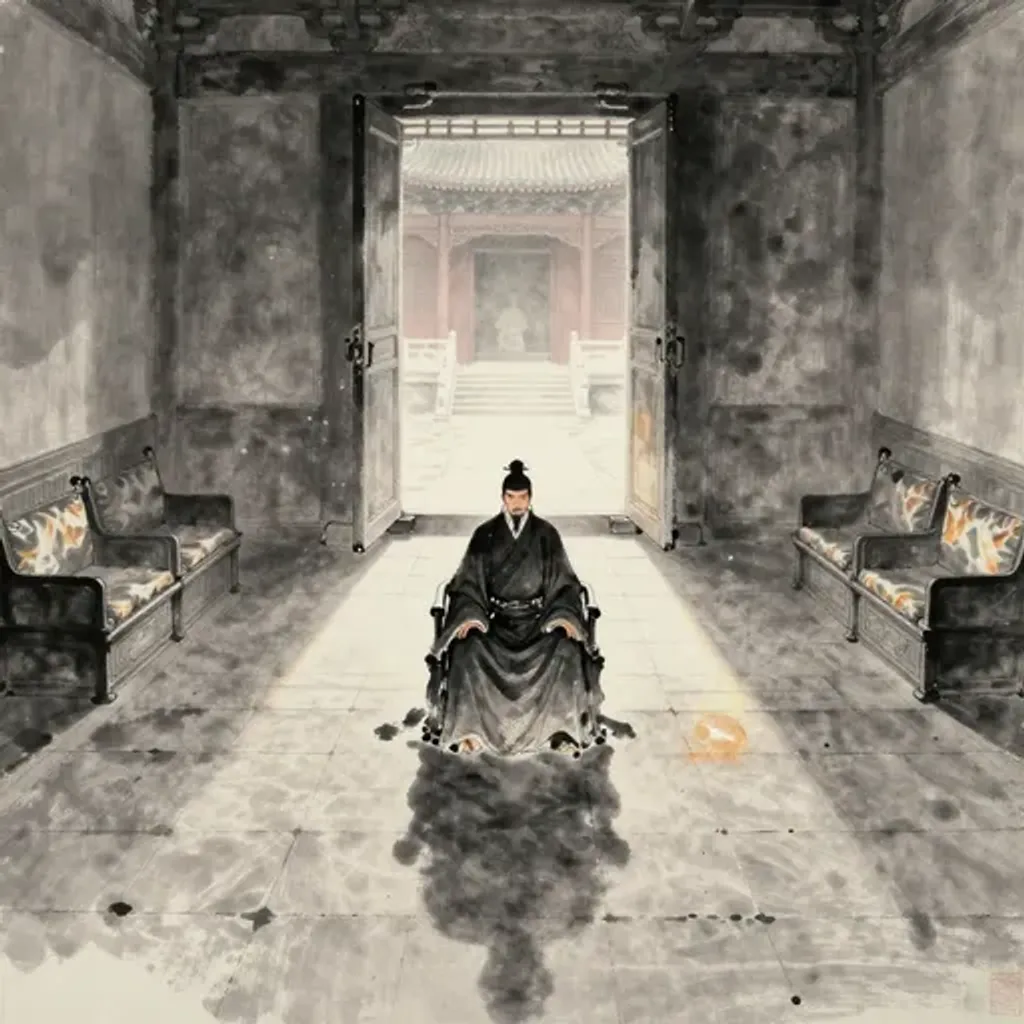
君孤獨處,單弱无輔,名曰困苦。
The lord sits alone in solitude, weak and without support; its name is called hardship and suffering.
— Jiao Yanshou, Yilin (Forest of Changes), 1st century BC
Commentary
Twin mountains stand doubled into absolute stillness — the same hexagram returns to itself. The ruler dwells in isolation, alone and without support; this condition is called suffering. When Gen transforms into Gen, nothing changes: the mountain remains the mountain, and the person who stops remains stopped. There is no release, no new energy, no complementary force to break the stasis. From Keeping Still to Keeping Still, the image is pure recursion. The verse names this plainly: solitude without allies, weakness without reinforcement, the name of which is hardship. The mountain's great virtue is knowing when to stop, but when stopping is the only option and the only outcome, virtue curdles into mere endurance.
艮 → 漸
Hexagram 52 → Hexagram 53: Development
Changing lines: 5
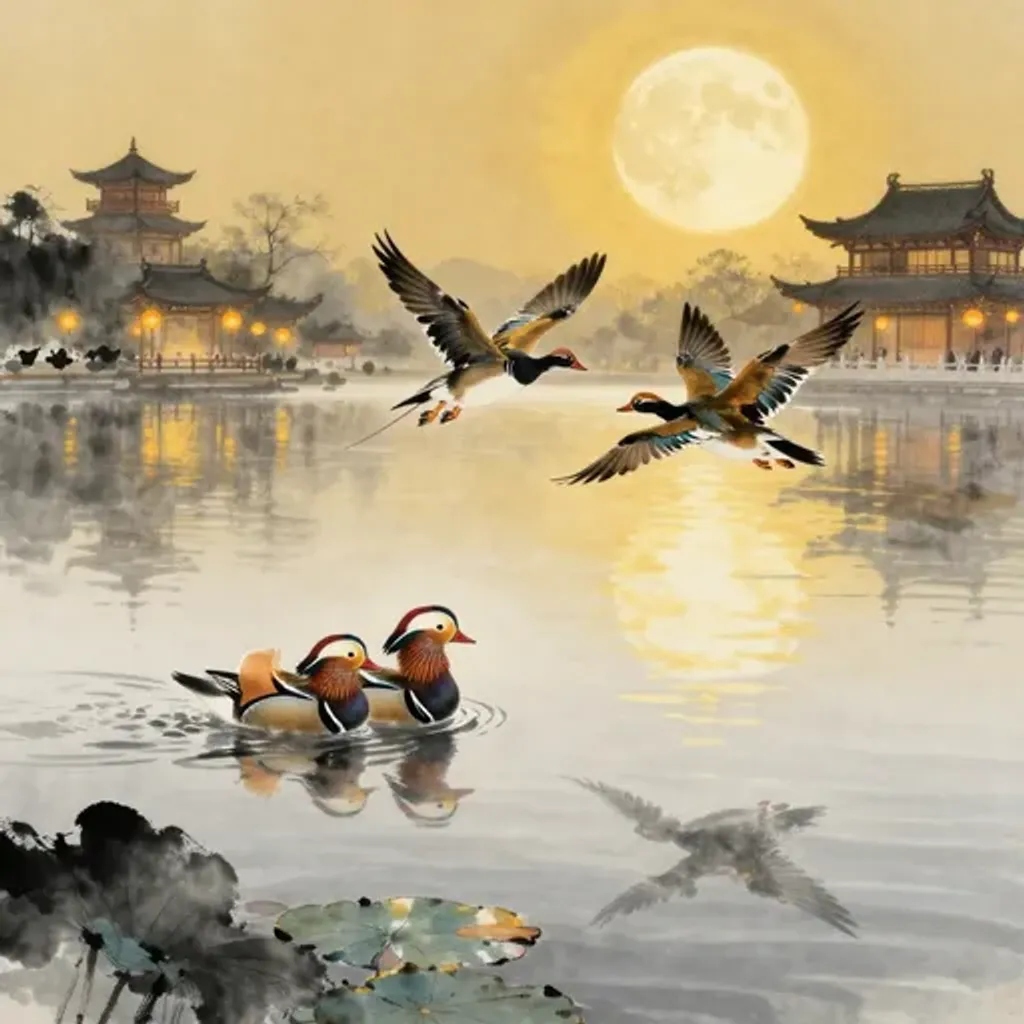
比目四翼,安我邦國。上下无患,為吾喜福。
Paired eyes, four wings; they bring peace to our realm. Above and below, no affliction — this is our joy and blessing.
— Jiao Yanshou, Yilin (Forest of Changes), 1st century BC
Commentary
Twin mountains stand still, sheltering paired-eye fish and shared-wing birds that bring peace to the nation. Above and below are free from trouble; these creatures become a source of joyous blessing. The 'bimu' fish and 'siyi' birds are mythological creatures that can only function in pairs — one-eyed fish that swim together, one-winged birds that fly as one. They symbolize perfect complementarity and inseparable partnership. From Keeping Still to Development, mountain yields to wind above the mountain — the tree growing gradually on the hillside. Development proceeds step by step, each stage building on the last. The verse's paired creatures embody this gradual progress: not solitary brilliance but cooperative growth, each half completing the other as the tree climbs the slope.
艮 → 歸妹
Hexagram 52 → Hexagram 54: The Marrying Maiden
Changing lines: 1, 2, 3, 4, 6
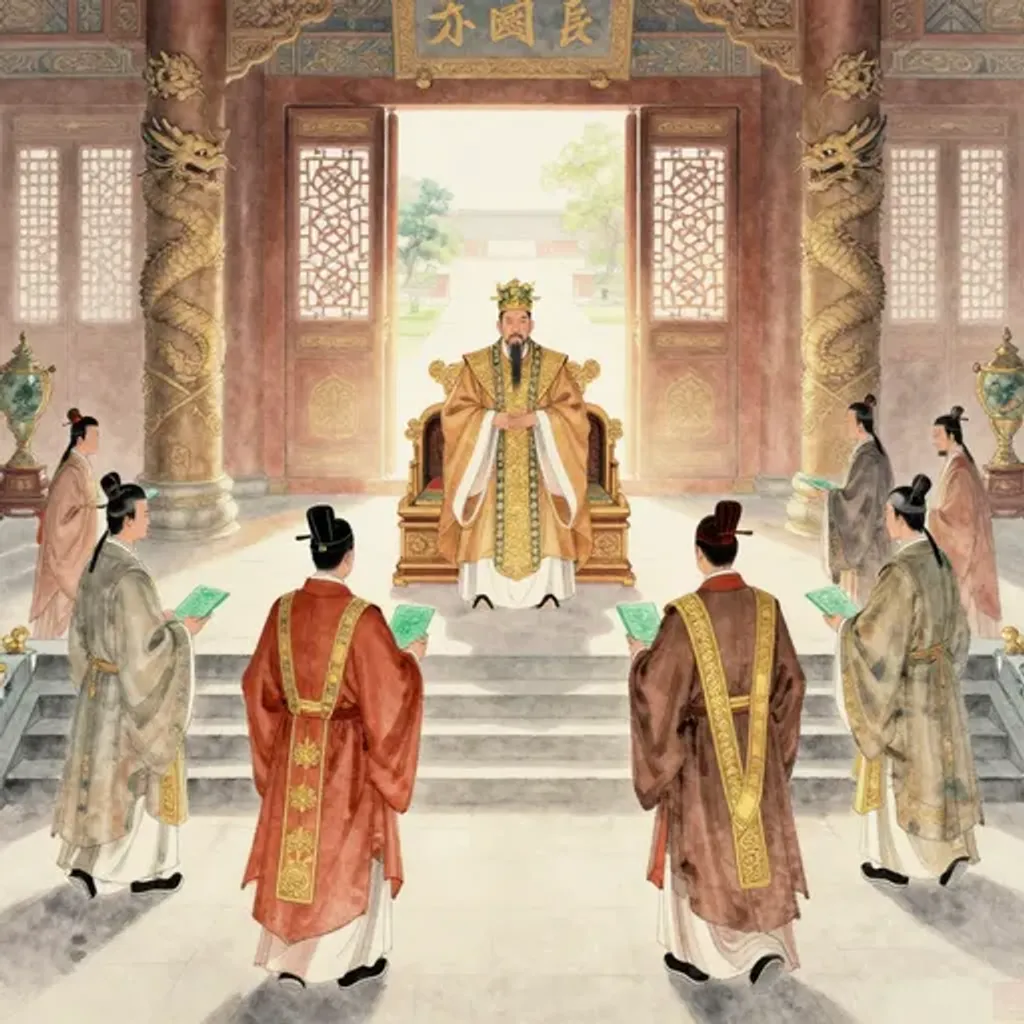
八材既登,以成股肱。厖降庭堅,國无災凶。
The eight talents have all ascended, becoming arms and legs of state. Pang and Jian descend to the court; the realm is free of calamity and misfortune.
— Jiao Yanshou, Yilin (Forest of Changes), 1st century BC
Commentary
Twin mountains stand still as the eight materials are assembled and shaped into the pillars of governance. Pang and Tingjian descend to serve, and the state knows neither disaster nor misfortune. The 'eight materials' (八材) likely refer to eight categories of talent or resource needed for sound governance. 'Pang' (厖) and 'Tingjian' (庭堅) may allude to Zhuanxu's descendants, ministers of legendary virtue in the era of Shun and Yu — Pang Jiang and Tingjian were among the 'Eight Worthies' (八元) said to have assisted in ordering the realm. From Keeping Still to the Marrying Maiden, mountain yields to thunder above the lake. The Marrying Maiden concerns proper alignment in subordinate relationships. The verse suggests that when the right people are placed in the right roles, even an inherently delicate arrangement produces stability.
艮 → 豐
Hexagram 52 → Hexagram 55: Abundance
Changing lines: 1, 4, 6
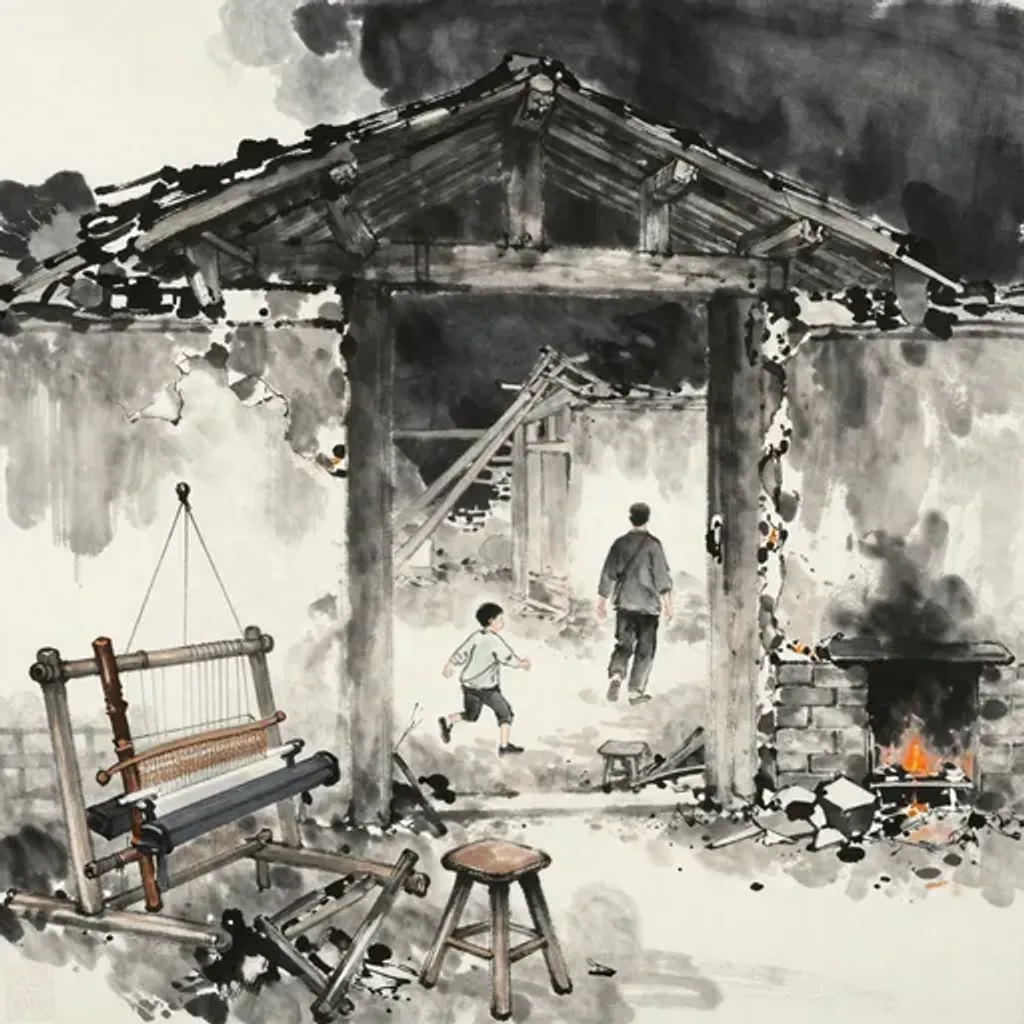
稍弊穿空,家莫為宗。奴婢逃走,子西父東,為身作凶。
Gradually worn through, pierced with holes; the household has no head. Servants and slaves flee; the son goes west, the father east — bringing ruin upon themselves.
— Jiao Yanshou, Yilin (Forest of Changes), 1st century BC
Commentary
Twin mountains stand still, but the household is falling apart at the seams. Things fray and develop holes; the family lacks a proper head. Servants flee; sons scatter west while fathers drift east, each bringing ruin upon themselves. The verse is domestic disintegration at its most visceral: the physical structure decays while its inhabitants disperse in every direction. From Keeping Still to Abundance, mountain yields to thunder above fire — the overwhelming fullness of lightning and thunder arriving simultaneously. Abundance should mean plenitude, but the verse presents its dark inversion: when the household has no center, even abundance becomes chaos. Thunder and fire without a structure to contain them are not prosperity but conflagration. The mountain that should have anchored the family has crumbled.
艮 → 旅
Hexagram 52 → Hexagram 56: The Wanderer
Changing lines: 4
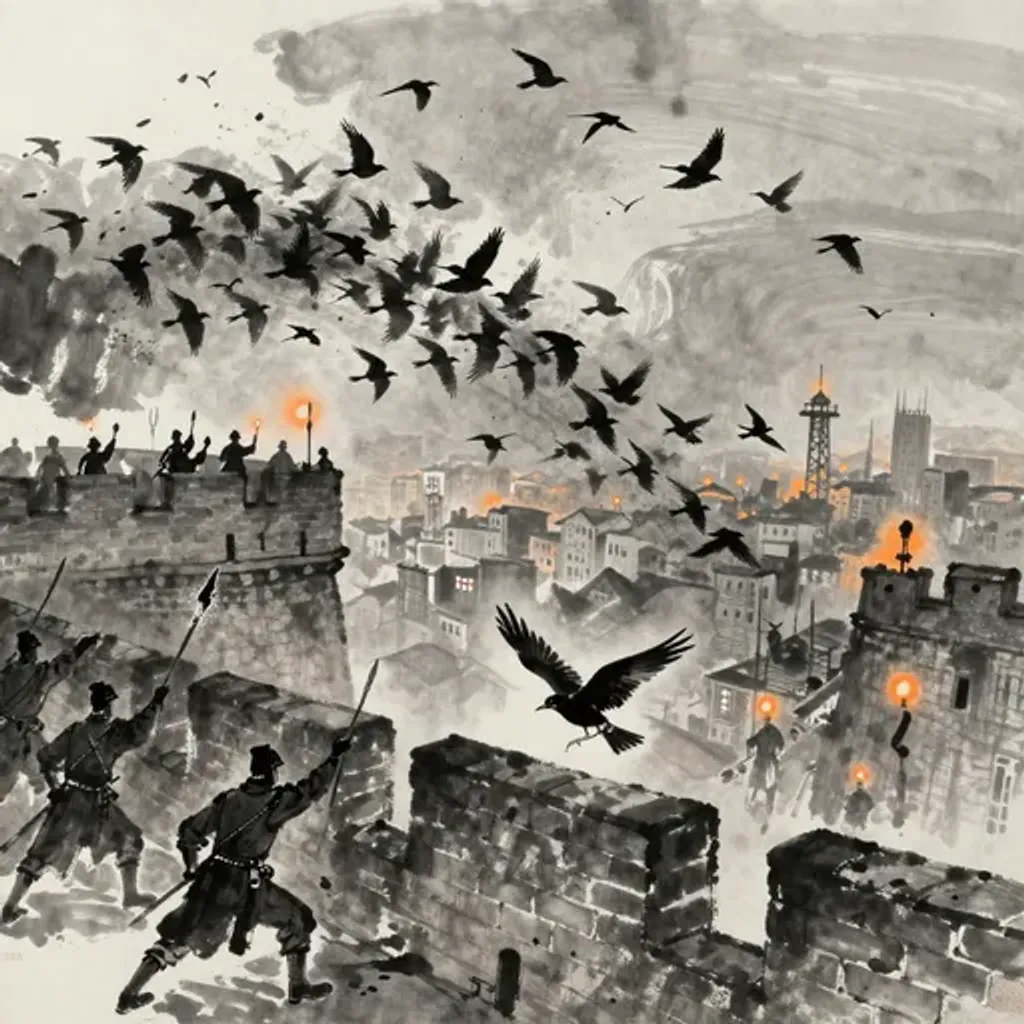
鳥舞國城,邑懼卒驚。仁德不脩,為下所傾。
Birds dancing above the city walls; the town trembles with sudden alarm. Benevolent virtue goes uncultivated; overthrown by those below.
— Jiao Yanshou, Yilin (Forest of Changes), 1st century BC
Commentary
Twin mountains stand still as birds dance upon the city walls — an omen that startles the capital. When humane virtue is not cultivated, the ruler is toppled by those below. In Han-dynasty omen lore, birds behaving strangely on city walls presaged political upheaval; the natural order's disruption mirrors the social order's collapse. From Keeping Still to the Wanderer, mountain yields to fire above the mountain. The Wanderer is the traveler who has lost his home — fire atop a mountain is brilliant but rootless, burning through and moving on. The verse's overthrown ruler becomes this wanderer: his mountain seat was not cultivated with virtue, so the fire that should have warmed his halls instead consumed his authority, leaving him homeless.
艮 → 巽
Hexagram 52 → Hexagram 57: The Gentle Wind
Changing lines: 2, 5
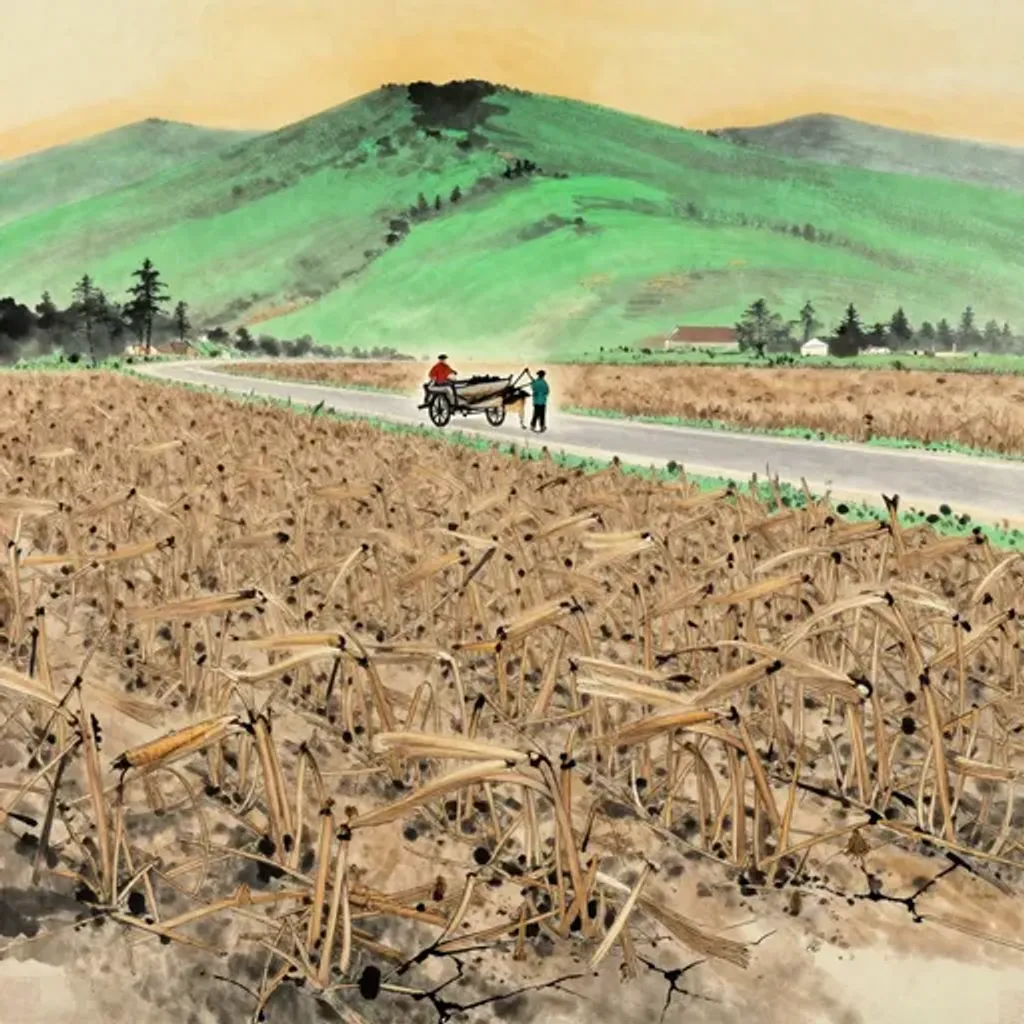
五穀不熟,民苦困急。亟之南國,嘉樂有得。
The five grains do not ripen; the people suffer hardship and want. Hasten to the southern land; there, joy and gain are found.
— Jiao Yanshou, Yilin (Forest of Changes), 1st century BC
Commentary
Twin mountains stand still, but the five grains will not ripen and the people suffer in desperate straits. The remedy: hasten south to another land, where joy and bounty await. The verse prescribes migration as the answer to famine — when one's own ground fails, one must seek sustenance elsewhere. From Keeping Still to the Gentle, mountain yields to doubled wind, the image of repeated, penetrating commands. The Gentle operates through persistent, subtle influence rather than force. The verse's journey south enacts this: not a dramatic upheaval but a steady movement toward what nourishes. The mountain's stillness, which could not produce grain, yields to the wind's capacity to carry seeds — and people — to more fertile ground.
艮 → 兌
Hexagram 52 → Hexagram 58: The Joyous Lake
Changing lines: 1, 2, 3, 4, 5, 6
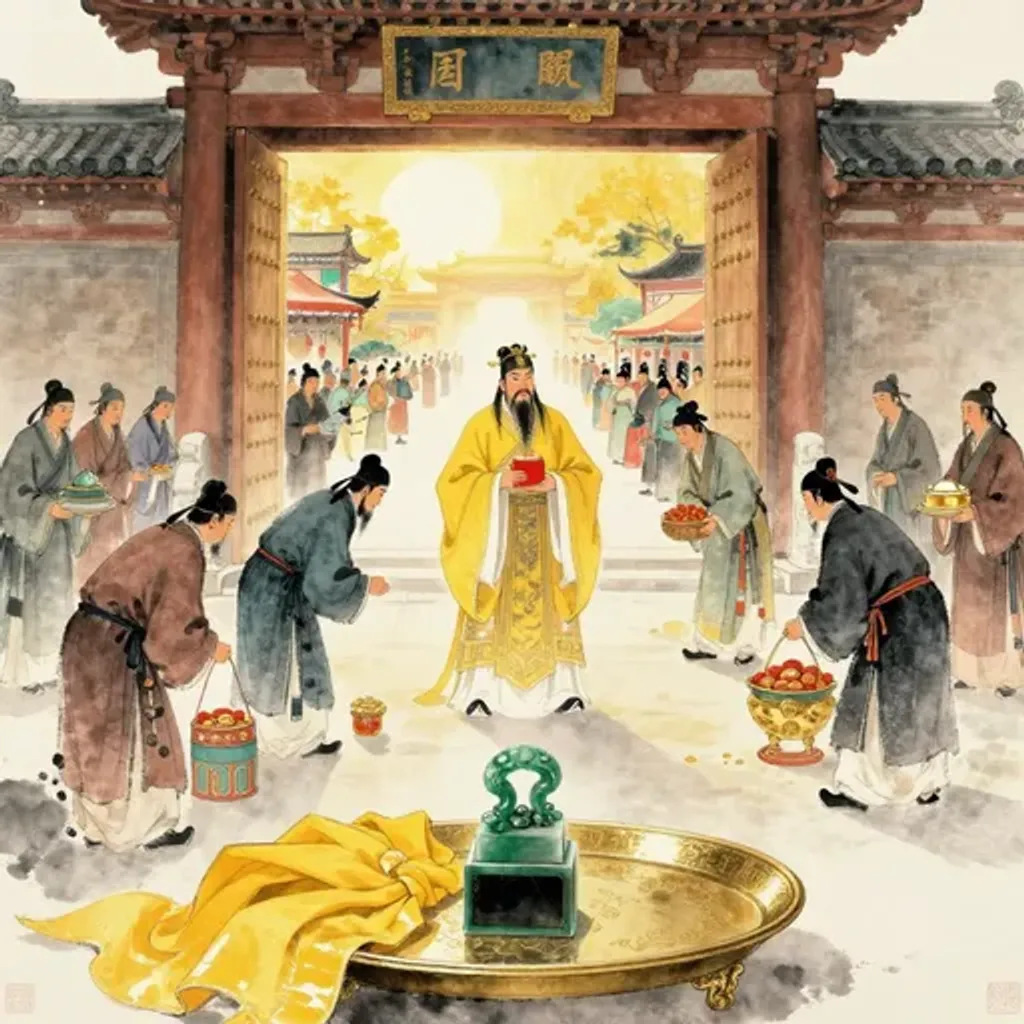
黃裳建元,福德在身。祿祐洋溢,封為齊君。賈市无門,富寶多飱。
Yellow robes inaugurate a new era; fortune and virtue upon his person. Blessings and favor overflow; enfeoffed as Lord of Qi. Trade flourishes without obstruction; wealth and fine provisions abound.
— Jiao Yanshou, Yilin (Forest of Changes), 1st century BC
Commentary
Twin mountains stand still, and a figure in yellow robes inaugurates a new era. Blessings and virtue rest upon him; fortune and favor overflow as he is enfeoffed as lord of Qi. The market needs no gates — wealth and food abound. 'Yellow lower garment' (黃裳) quotes the Kun hexagram's fifth line: the golden mean of receptive excellence. 'Establishing the primal year' (建元) signals the founding of a new reign. The figure may allude to the Taigong (Jiang Ziya), who was enfeoffed at Qi after the Zhou conquest. From Keeping Still to the Joyous, mountain yields to doubled lake — shared delight, open exchange. The mountain's contained power flows outward as communal prosperity, markets so abundant they need no walls.
艮 → 渙
Hexagram 52 → Hexagram 59: Dispersion
Changing lines: 2, 3, 5
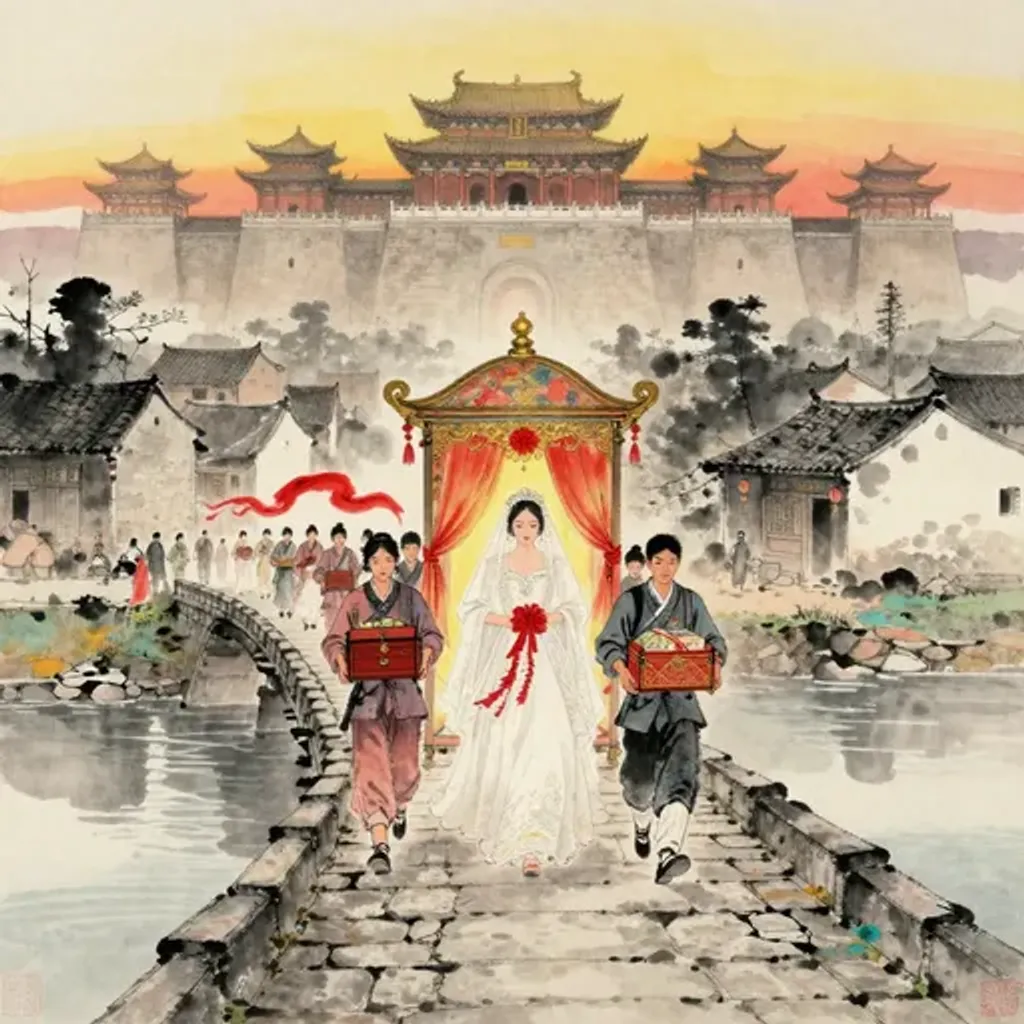
齊東郭廬,嫁於洛都。驪婦美好,利得過倍。
From Dongguo Lu in Qi, married off to the capital of Luo. The beautiful Li bride, fine and lovely; profit gained is doubled and more.
— Jiao Yanshou, Yilin (Forest of Changes), 1st century BC
Commentary
Twin mountains stand still as a woman from Qi's eastern suburb marries into the capital at Luo. The beautiful bride brings profit doubled beyond expectation. The verse celebrates a marriage that crosses regional boundaries — a Qi woman going west to the Zhou capital, her beauty and dowry enriching both households. The name 'Dongguo Lu' (東郭廬) suggests a specific neighborhood of Qi, while Luo is Luoyang, the eastern Zhou capital. From Keeping Still to Dispersion, mountain yields to wind above water. Dispersion scatters what was gathered, but here the scattering is beneficent: the bride disperses from her mountain home, and her movement across water and wind carries prosperity to a new place. Stillness releases its treasure through a well-timed departure.
艮 → 節
Hexagram 52 → Hexagram 60: Limitation
Changing lines: 1, 2, 3, 5, 6

安床厚褥,不得久宿。棄我嘉宴,困於南國。投杼之憂,不成禍災。
A peaceful bed with thick quilts, yet one cannot linger long. Abandoning the fine banquet, stranded in the southern land. The worry of the thrown shuttle does not become true disaster.
— Jiao Yanshou, Yilin (Forest of Changes), 1st century BC
Commentary
Twin mountains stand still upon a well-made bed with thick cushions, yet one cannot stay long. The fine banquet is abandoned; one is trapped in the southern land. Then the worry of 'the shuttle thrown down' — but it does not become real disaster. The 'thrown shuttle' (投杼) alludes to the story of Zeng's mother: told three times her son had killed someone, she finally threw down her shuttle and fled. Here the panic is triggered but the feared outcome never materializes. From Keeping Still to Limitation, mountain yields to water above the lake — measured restraint. The verse enacts Limitation's lesson: anxiety exaggerates danger, but proper boundaries contain it. The comfortable bed was always safe; it was the rumor that drove one away.
艮 → 中孚
Hexagram 52 → Hexagram 61: Inner Truth
Changing lines: 1, 2, 3, 5
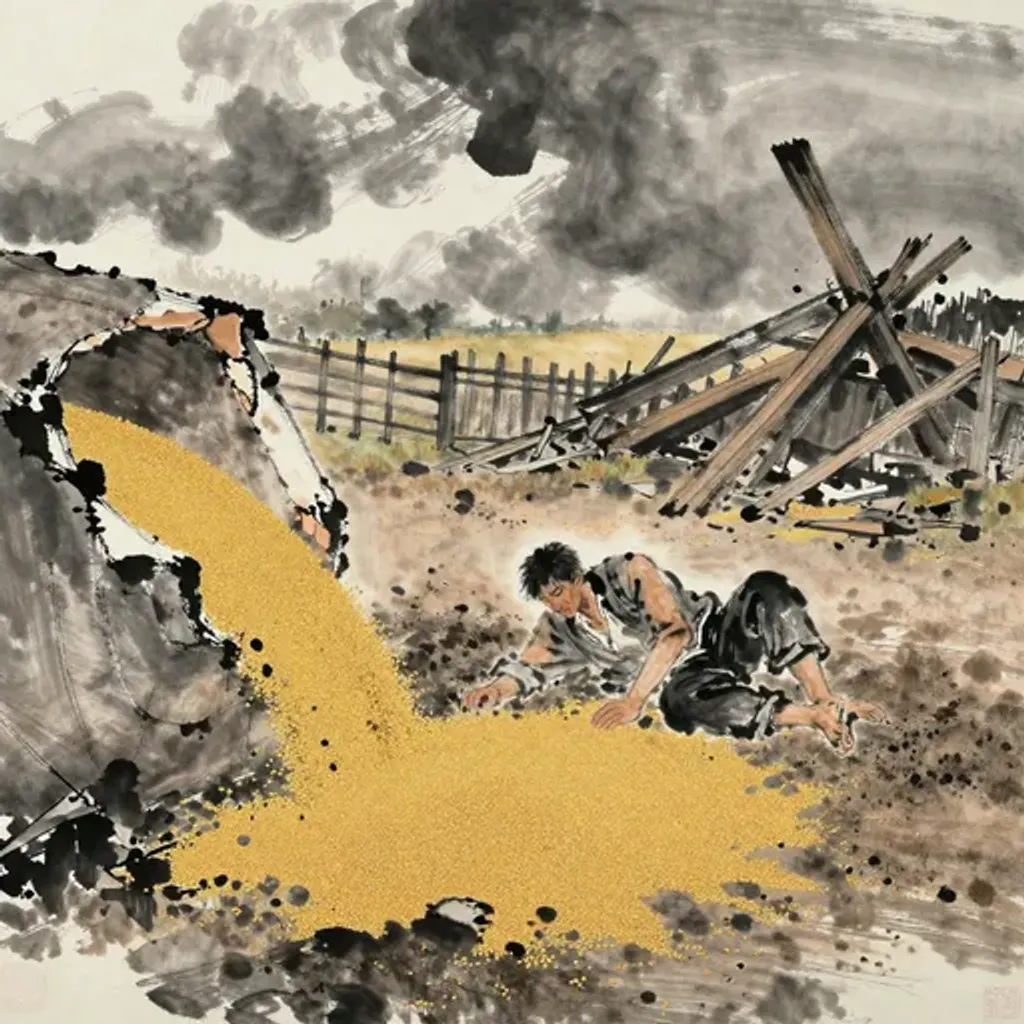
內崩身傷,中亂无常。雖有美粟,不我食得。
Collapsing within, the body is harmed; disorder in the center, nothing constant. Though there be fine grain, I cannot eat of it.
— Jiao Yanshou, Yilin (Forest of Changes), 1st century BC
Commentary
Twin mountains stand still, but within, the body collapses and sustains injury. Internal chaos has no constancy; though fine millet is at hand, one cannot eat it. The verse describes a figure whose own constitution has turned against him — not external attack but internal disintegration. Food exists but the body refuses it, as if the organism has lost the ability to receive nourishment. From Keeping Still to Inner Truth, mountain yields to wind above the lake, where sincerity penetrates to the hollow center. Inner Truth requires emptiness at the core to resonate — but here the core is not receptive hollowness but wounded collapse. The mountain's stillness, which should produce centered clarity, instead conceals an interior in ruins.
艮 → 小過
Hexagram 52 → Hexagram 62: Small Exceeding
Changing lines: 4, 6
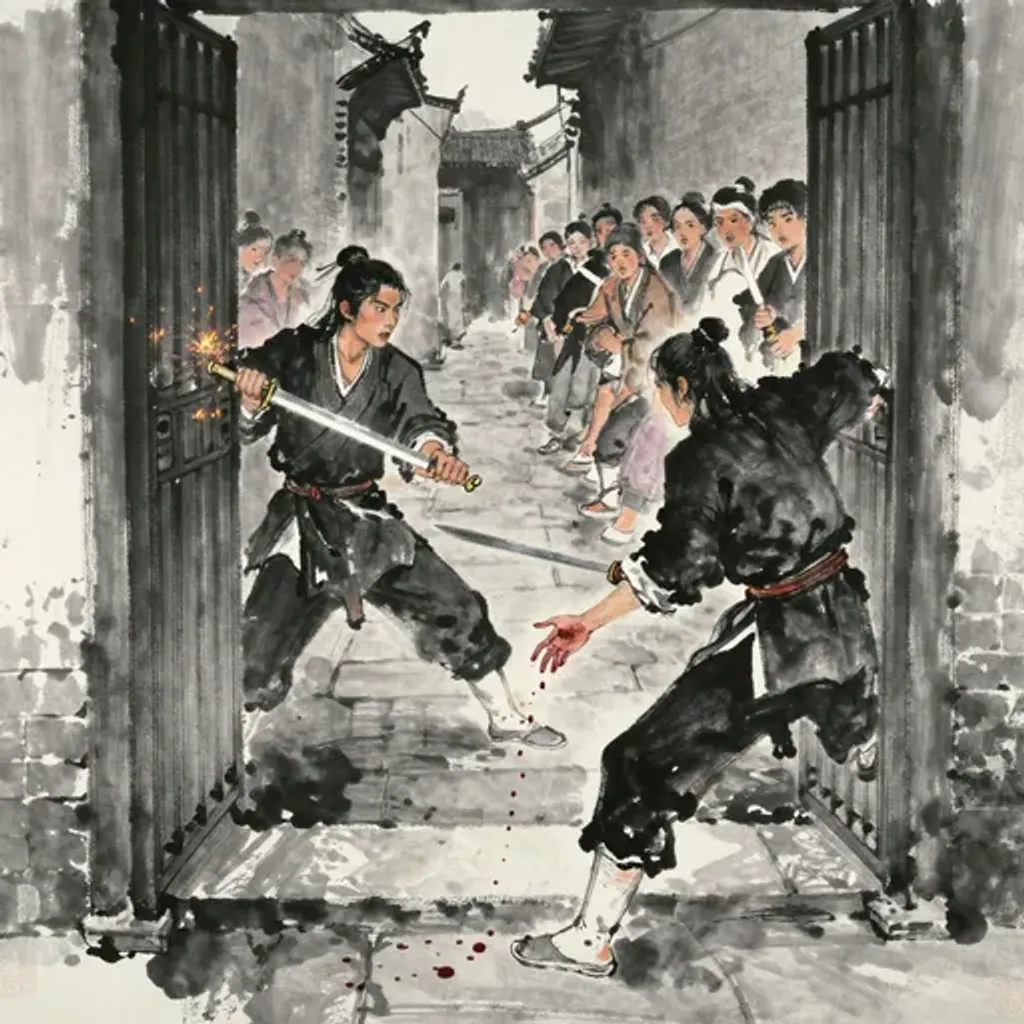
出門逢患,與禍為怨。更相擊刺,傷我指端。
Stepping out the gate, meeting calamity; becoming enemies with disaster. Striking and stabbing one another, wounding the tips of my fingers.
— Jiao Yanshou, Yilin (Forest of Changes), 1st century BC
Commentary
Twin mountains stand still, but stepping outside the door one encounters trouble immediately. Colliding with misfortune, hostility erupts on all sides. Blows are traded and blades cross, wounding the fingertips. The verse compresses violence into the smallest possible space: the moment of crossing the threshold, the instant of contact, the injury to the extremity. From Keeping Still to Small Exceeding, mountain yields to thunder above the mountain — the small bird that flies too high and falls. Small Exceeding counsels: exceed in reverence, in frugality, in grief, but never in ambition. The verse's figure exceeds the mountain's boundary by a single step and pays for it at the fingertips. The smallest transgression of stillness triggers disproportionate harm.
艮 → 既濟
Hexagram 52 → Hexagram 63: After Completion
Changing lines: 1, 5, 6
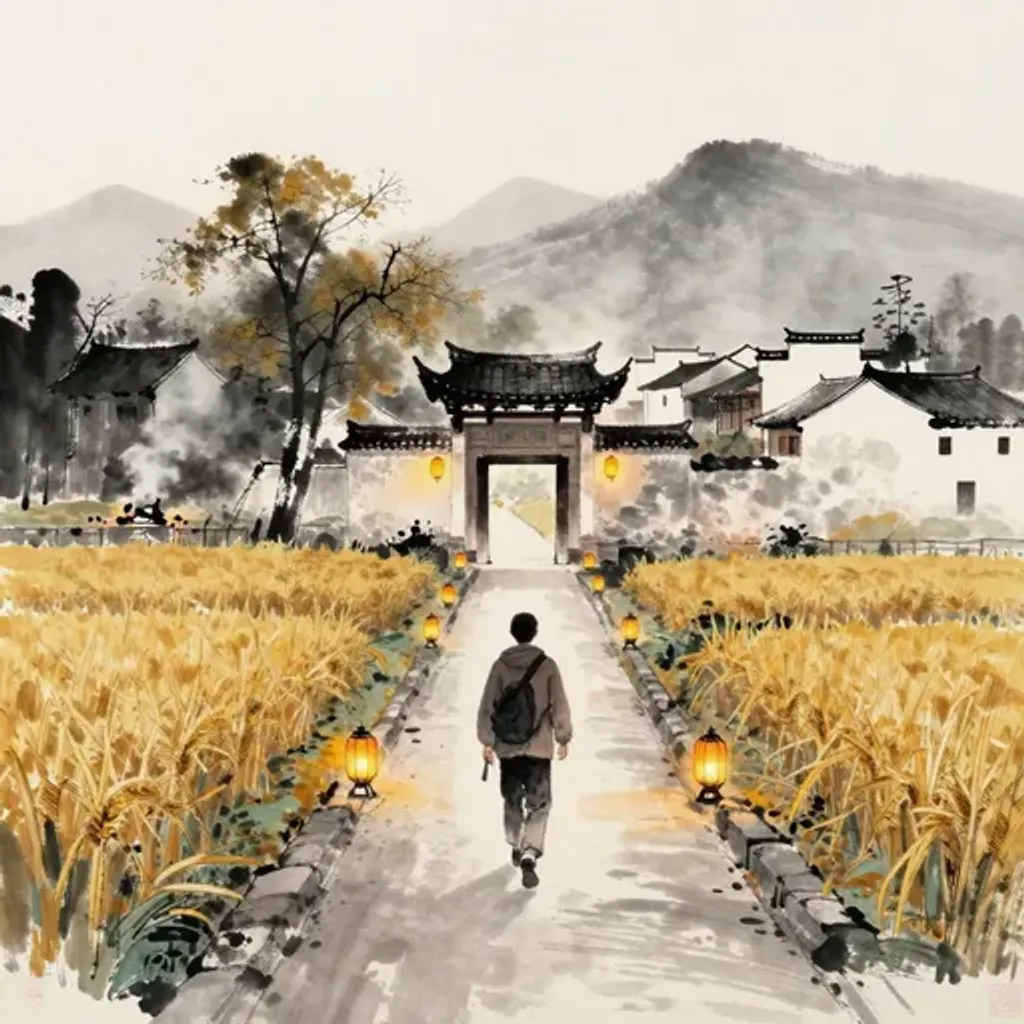
出入節時,南北无憂。行者函至,在外歸來。
Coming and going in measured season; south and north, no worry. The traveler arrives with his letter; from abroad, he returns home.
— Jiao Yanshou, Yilin (Forest of Changes), 1st century BC
Commentary
Twin mountains stand still, and movement follows the rhythm of the season. Going out and coming in observe their proper times; journeying south or north brings no worry. The traveler arrives with a letter; the one abroad returns home. The verse is a portrait of harmonious circulation: departures and arrivals in perfect tempo, correspondence bridging distance, reunion completing the cycle. From Keeping Still to After Completion, mountain yields to water above fire — everything in its proper place, each element checking and balancing the other. After Completion is the rare moment when all hexagram lines are correctly positioned. The verse mirrors this: stillness has produced not stagnation but perfect timing, and every movement flows from and returns to its appointed station.
艮 → 未濟
Hexagram 52 → Hexagram 64: Before Completion
Changing lines: 2, 3, 4
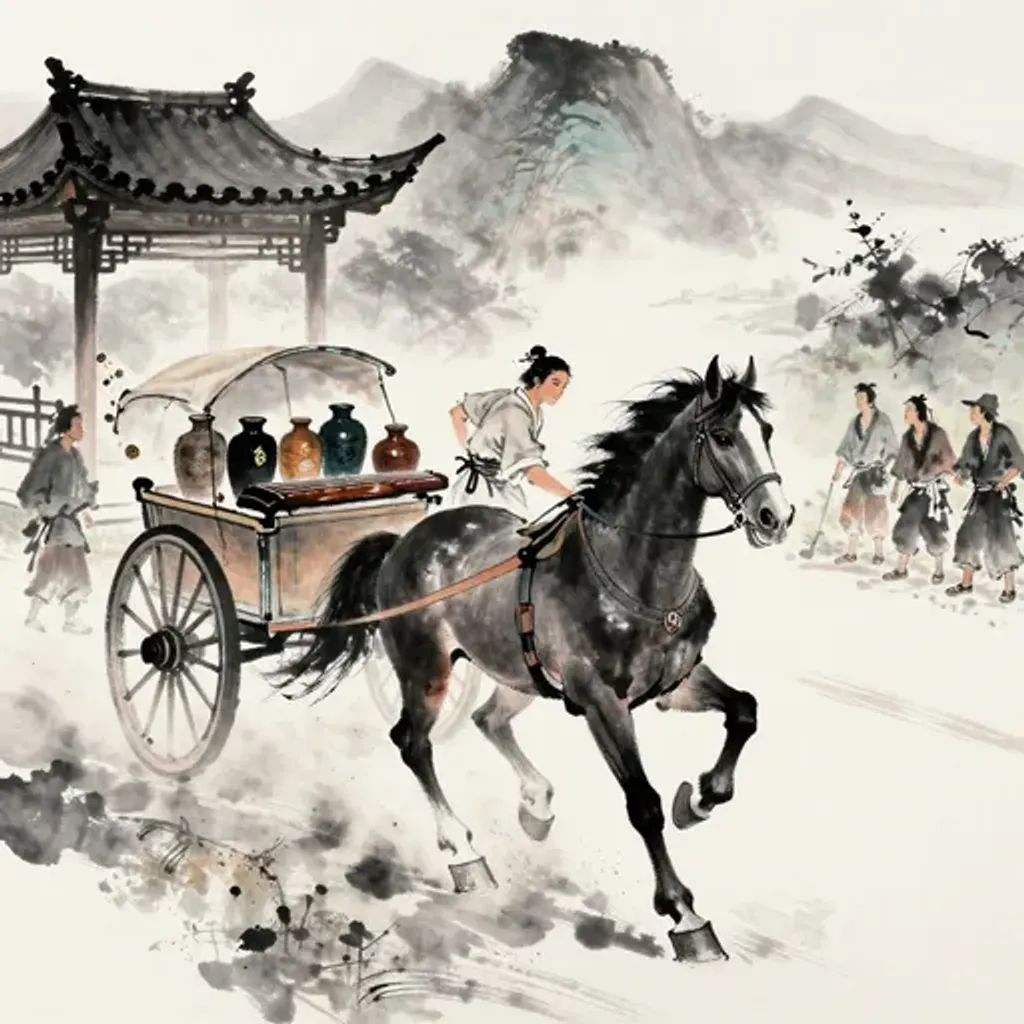
公孫駕驪,載遊東齊。延陵說產,遺季紵衣。
The black colt gallops past the wayside pavilion. In the carriage, a qin, wine, and classics. Along the way, scattering wealth to aid the poor — returning with an empty cart, the name lighter still.
— Jiao Yanshou, Yilin (Forest of Changes), 1st century BC
Commentary
Twin mountains stand still. The original verse reads: Gongsun drives a black horse east to Qi. Ji Zha of Yanling gives away his estate and presents a ramie garment to a friend. The verse pairs two exemplars of aristocratic generosity. Ji Zha, the prince of Wu who repeatedly declined the throne, was renowned for integrity and selfless giving. According to the Zuo Zhuan, he exchanged garments with Zi Chan of Zheng during a diplomatic visit in 544 BC — a gesture of mutual respect between two of the era's finest statesmen. From Keeping Still to Before Completion, mountain yields to fire above water, elements not yet aligned. The verse's generous departures embody this unfinished quality: gifts given and journeys begun, but the destination still distant. Generosity is the first act of a transformation whose completion lies beyond the frame.