Transformations of Hexagram 56
Every line of change out of Hexagram 56 旅 The Wanderer, with the Yilin verse for each of the 64 resulting hexagrams, its translation, and the original ink brush artwork.
旅 → 乾
Hexagram 56 → Hexagram 1: The Creative
Changing lines: 1, 2, 5
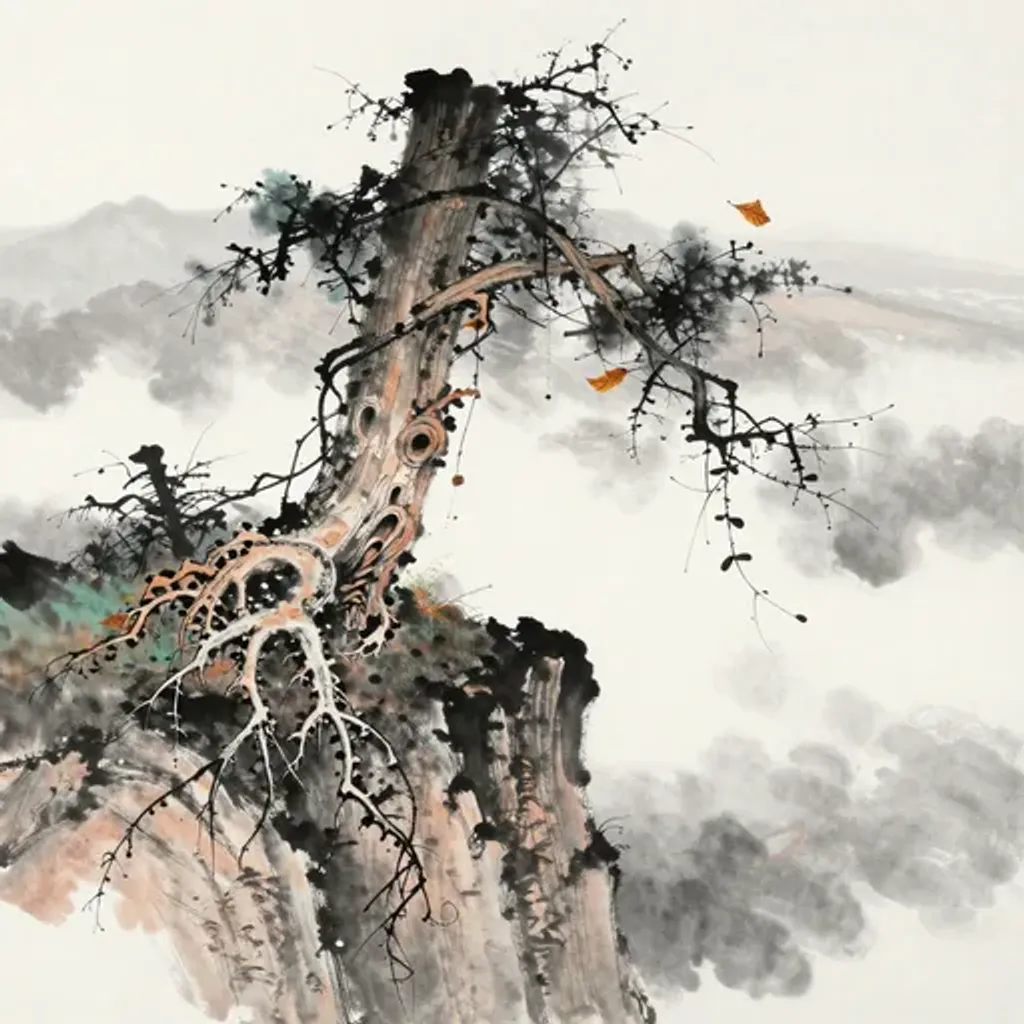
寄生无根,如過浮雲。立本不固,斯須落去,更為枯樹。
A parasite without roots, like a passing cloud. Its foundation unsteady; in a moment it falls away, becoming a withered tree.
— Jiao Yanshou, Yilin (Forest of Changes), 1st century BC
Commentary
Fire on the mountain illuminates the wanderer's path, but a parasite without roots drifts like a passing cloud. The verse paints a vivid image of rootlessness: a climbing plant that clings to its host without establishing its own foundation. It sprouts briefly, seems to flourish, then topples and withers into a dead tree. The imagery warns against building on borrowed ground — position without substance, status without self-reliance. From The Wanderer to Creative, the transformation is stark: one who wanders without anchor cannot access heaven's self-generating power. The Creative demands that initiative spring from an authentic core; without roots of one's own, even the most vigorous display crumbles into barren wood.
旅 → 坤
Hexagram 56 → Hexagram 2: The Receptive
Changing lines: 3, 4, 6
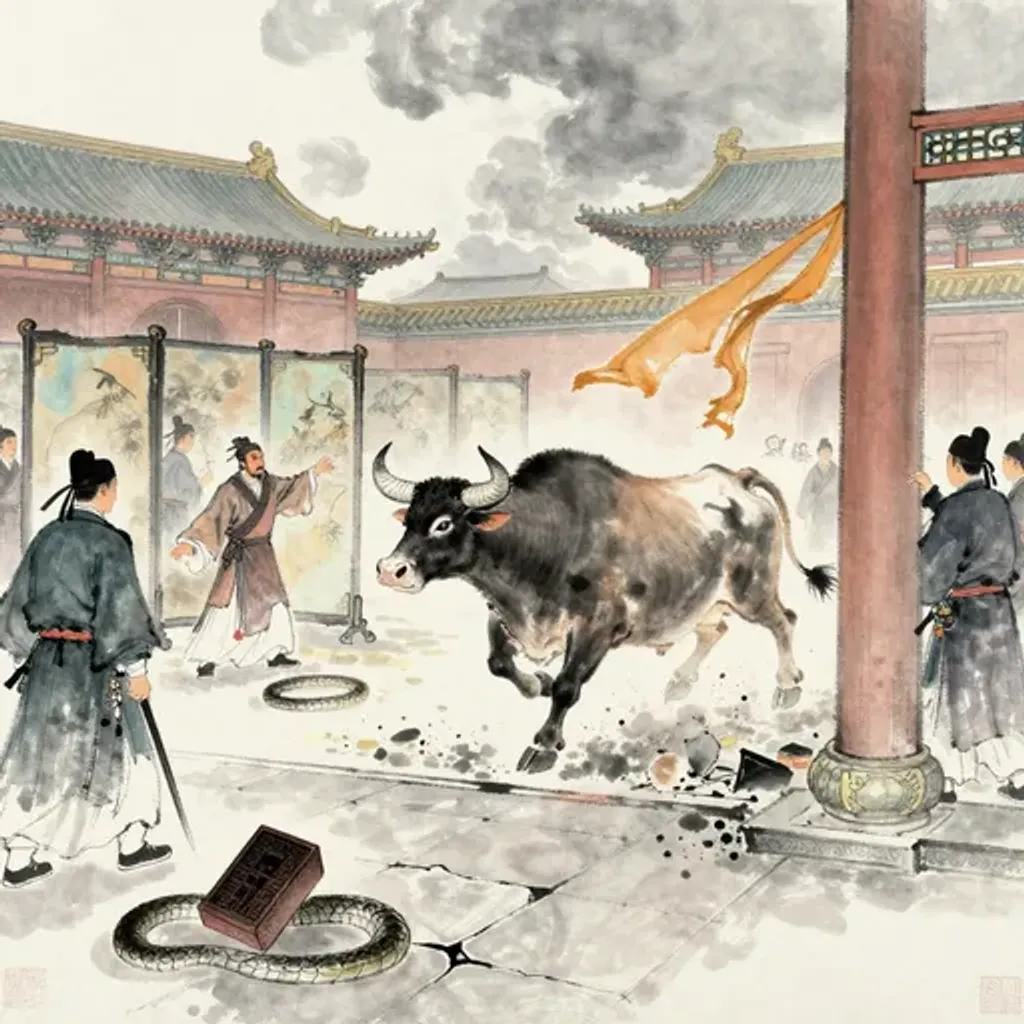
人无定法,綬降牛出,虵雄走趨。陽不制陰,宜其家國。
Men lack fixed principles; the seal descends, the ox escapes, the male serpent runs forth. When yang cannot restrain yin, such becomes the state of home and country.
— Jiao Yanshou, Yilin (Forest of Changes), 1st century BC
Commentary
Fire on the mountain sweeps across rootless terrain, and all governance dissolves into chaos. When people abandon proper standards, seals of office drop from their cords and oxen wander free; serpents usurp the dominant position. The verse invokes the ancient warning against yin overwhelming yang — the 'hen crowing at dawn' from the Book of Documents, signaling a household where authority has been inverted. Yet the final line reads with bitter irony: 'fitting indeed for such a house and state.' From The Wanderer to Receptive, the traveler who abandons structure encounters pure earth without heaven's ordering principle. The Receptive thrives through devoted following, but when yang fails to lead, receptivity becomes mere vacancy, and the state collapses into formlessness.
旅 → 屯
Hexagram 56 → Hexagram 3: Difficulty at the Beginning
Changing lines: 1, 3, 4, 5, 6
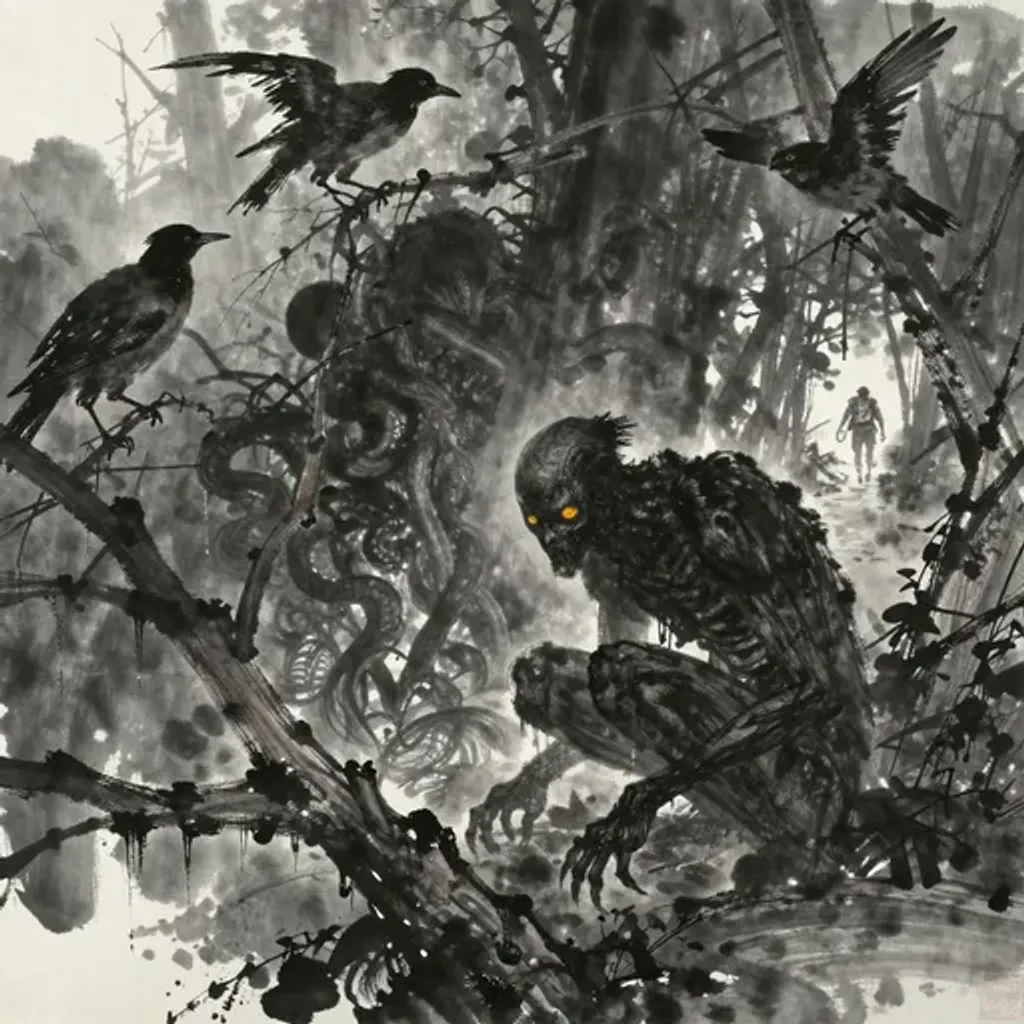
眾鳥所聚,中有大怪,九身无頭。魂驚魄去,不可以居。
Where the flock gathers, amid them lurks a great horror: nine bodies without a head. The soul is startled, the spirit flees; one cannot dwell there.
— Jiao Yanshou, Yilin (Forest of Changes), 1st century BC
Commentary
Fire on the mountain reveals a gathering of birds harboring something monstrous within — a creature with nine bodies but no head. The image is nightmarish: what appears to be a flock conceals a headless abomination, and the soul flees in terror. This dwelling is unfit for habitation. The 'nine bodies without a head' may allude to a state with many factions but no central authority, a polity that has fragmented beyond recognition. From The Wanderer to Difficulty at the Beginning, the traveler stumbles into primordial chaos — thunder beneath gathering storm-clouds. Yet where Difficulty at the Beginning normally promises new birth through perseverance, this verse offers only horror: the new beginning is stillborn, its multiplicity monstrous rather than fertile.
旅 → 蒙
Hexagram 56 → Hexagram 4: Youthful Folly
Changing lines: 2, 3, 4
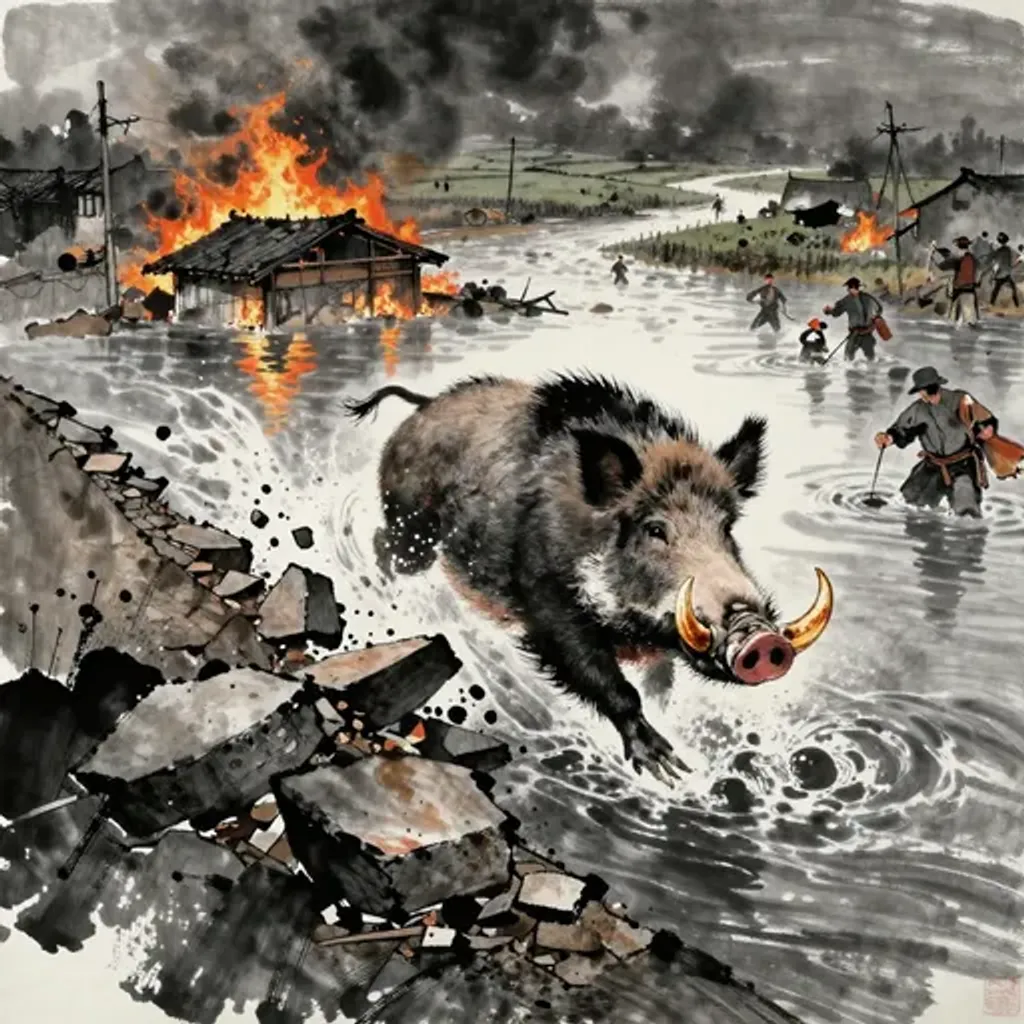
封豕溝瀆,灌潰國邑。火宿口中,民多疾病。
The great boar breaches the ditch; floods overwhelm the city. Fire lodges in its maw; the people suffer plague and sickness.
— Jiao Yanshou, Yilin (Forest of Changes), 1st century BC
Commentary
Fire on the mountain blazes down upon a land ravaged by flood and pestilence. The 'great boar in the ditches' evokes the classical idiom of the monstrous swine that devastates waterways — a figure for rapacious, uncontrolled power bursting through dikes to inundate towns and fields. The Fire Star lodging in the mouth suggests a baleful conjunction: the star Antares (Heart, or Fire Star) positioned ominously, bringing plague upon the people. From The Wanderer to Youthful Folly, the fire that once lit the traveler's path descends into the spring beneath the mountain, where water runs dark and unclear. Folly here is not innocent ignorance but the bewilderment of a population overwhelmed by simultaneous disasters — flood, fire, and disease converging.
旅 → 需
Hexagram 56 → Hexagram 5: Waiting
Changing lines: 1, 2, 4, 5, 6
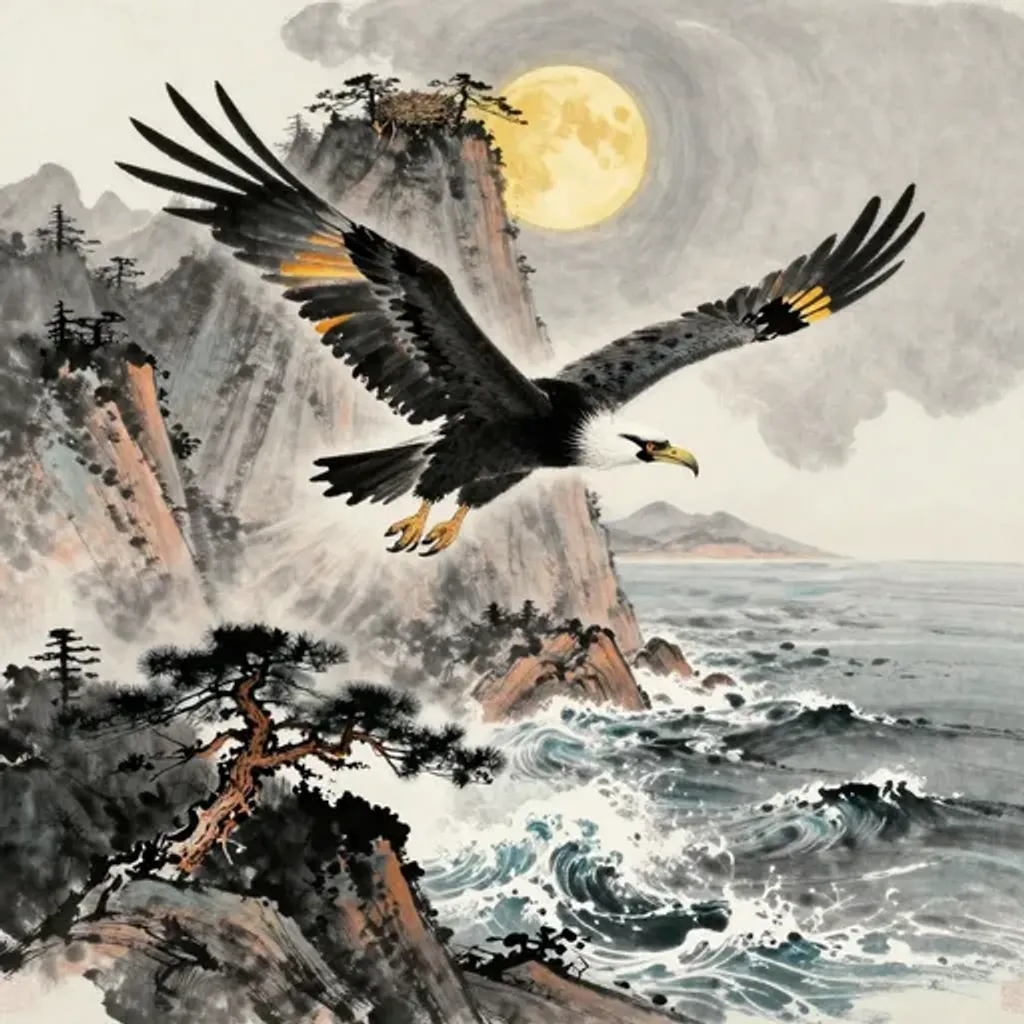
奮翅鼓翼,翱翔外國。逍遙徙倚,來歸溫室。
The great Peng spreads its wings three thousand li, crossing mountains and seas without tiring. Having seen all the flowers and snow at the world's edge — returning to the old nest, the moon is perfectly full.
— Jiao Yanshou, Yilin (Forest of Changes), 1st century BC
Commentary
Fire on the mountain releases a great bird into the open sky. The original verse — 'Spreading wings and beating plumes, soaring through foreign lands; wandering at ease, returning to the warm chamber' — captures the arc of a confident traveler abroad. The bird ranges far and wide across unfamiliar territories but never loses its homing instinct. This is the wanderer at full power: venturing boldly yet knowing when to return. From The Wanderer to Waiting, the restless fire settles into patience. Clouds gather above heaven, promising nourishment. The bird's return to its warm roost mirrors Waiting's counsel: after bold exploration, the wise traveler rests, feasts, and lets fortune arrive in its own time rather than chasing endlessly.
旅 → 訟
Hexagram 56 → Hexagram 6: Conflict
Changing lines: 2, 3, 5
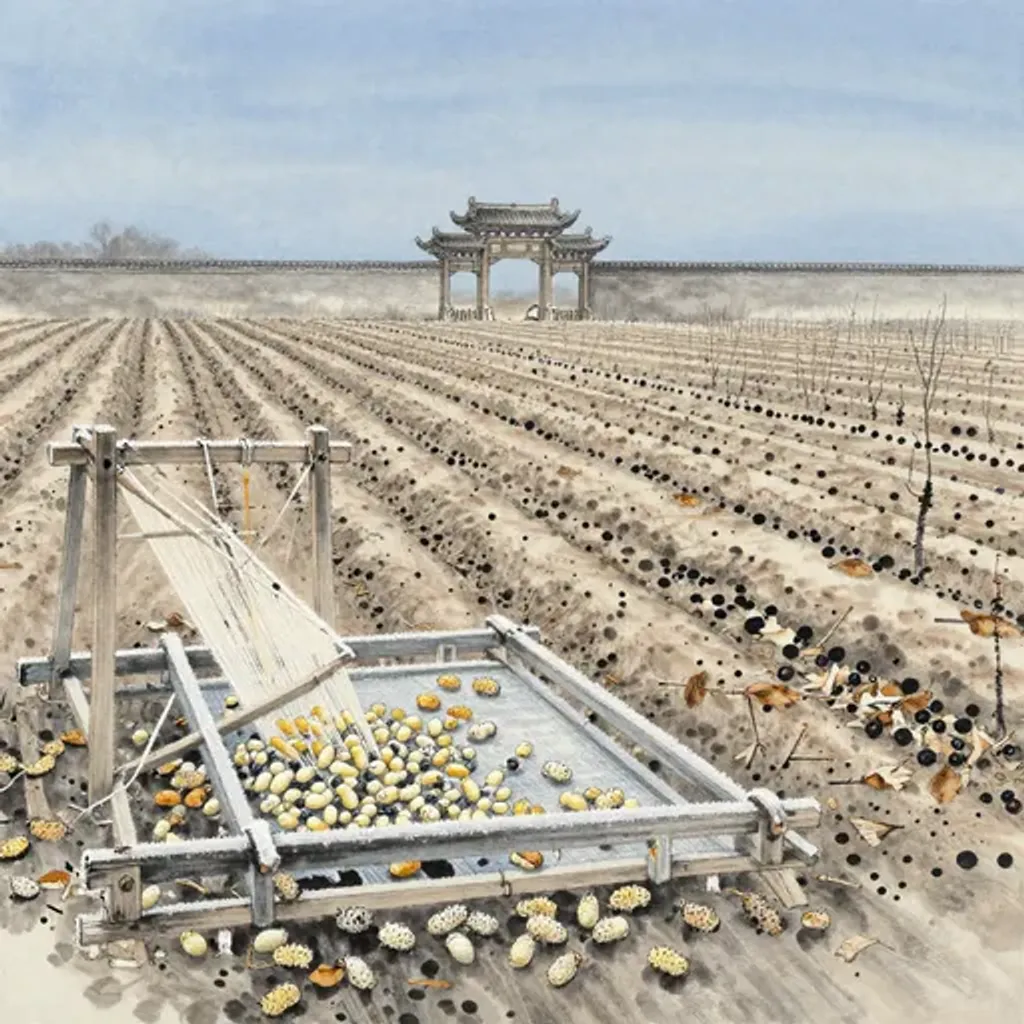
秋蚕不成,冬種不生。殷王逆理,棄其寵榮。
Autumn silkworms yield no silk; winter planting bears no life. The Yin king defied right reason and cast away his honored glory.
— Jiao Yanshou, Yilin (Forest of Changes), 1st century BC
Commentary
Fire on the mountain scorches the harvest before its time. Autumn silkworms fail to spin their cocoons; winter seeds refuse to germinate — every endeavor launched against the natural season comes to nothing. The verse then names 'the Yin king who defied reason,' almost certainly referencing the last Shang tyrant Zhou, whose cruelty and perversion of the cosmic order led him to discard his own glory. From The Wanderer to Conflict, fire meets heaven moving against water. The Yin king's tragedy is precisely the Conflict hexagram's warning: acting contrary to the natural flow invites contention with heaven itself. A ruler who abandons propriety is a wanderer who has lost not merely his home but his mandate.
旅 → 師
Hexagram 56 → Hexagram 7: The Army
Changing lines: 2, 3, 4, 6
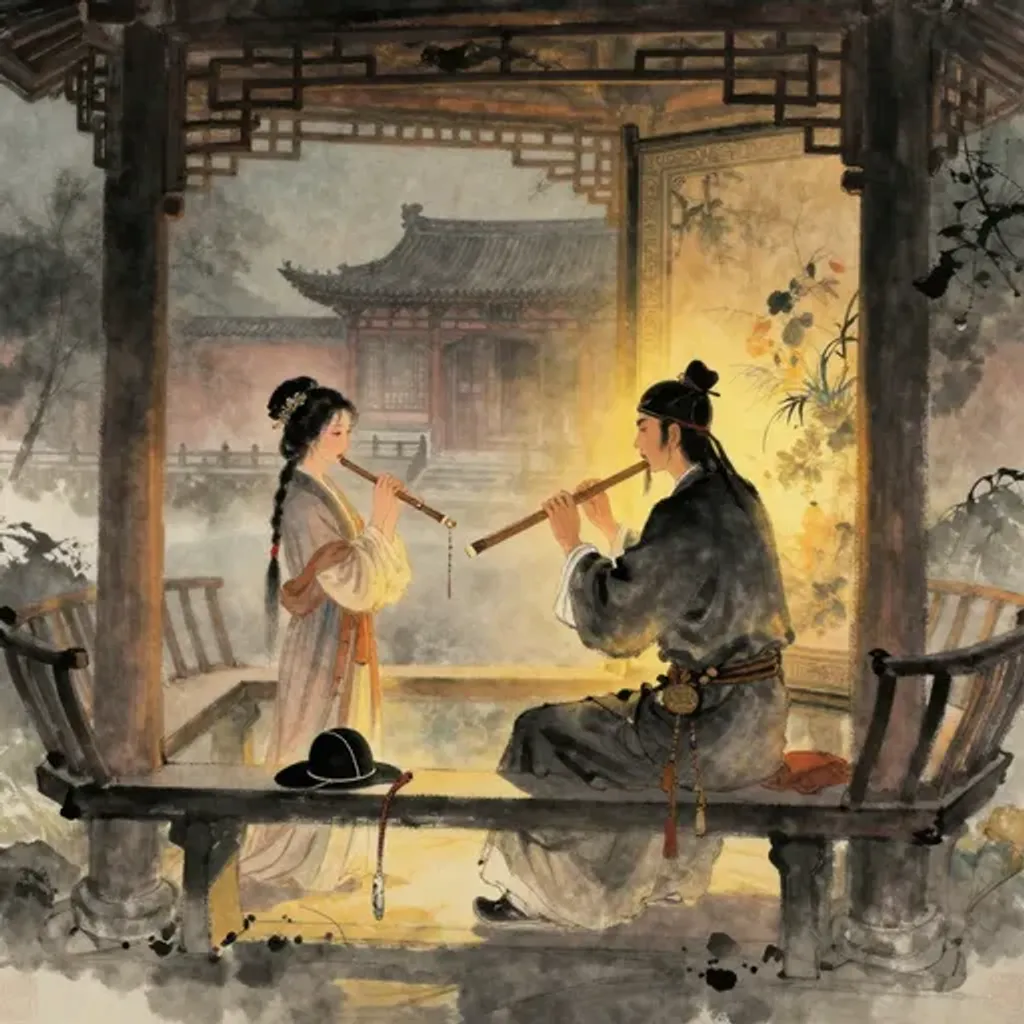
衛侯東遊,惑於少姬。忘我考妣,久迷不來。
The Marquis of Wei journeyed east, beguiled by the young Lady Ji. Forgetting his father and mother, long lost, he did not return.
— Jiao Yanshou, Yilin (Forest of Changes), 1st century BC
Commentary
Fire on the mountain, and a duke wanders east, bewitched by a young consort. The verse names the Marquis of Wei who traveled eastward and fell under the spell of Lady Shao, forgetting his own parents and ancestors. He lingered in pleasure, lost in infatuation, never returning home. The wanderer here is not the dispossessed exile but the willing absentee — a ruler who abandons his responsibilities for sensual indulgence. From The Wanderer to The Army, the transformation is deeply ironic: while the duke dallies, the state he neglects requires disciplined governance. Water hidden within the earth, The Army's image, demands a leader who channels collective strength. A ruler wandering in another's bedchamber leaves his army without direction and his people without a shepherd.
旅 → 比
Hexagram 56 → Hexagram 8: Holding Together
Changing lines: 3, 4, 5, 6
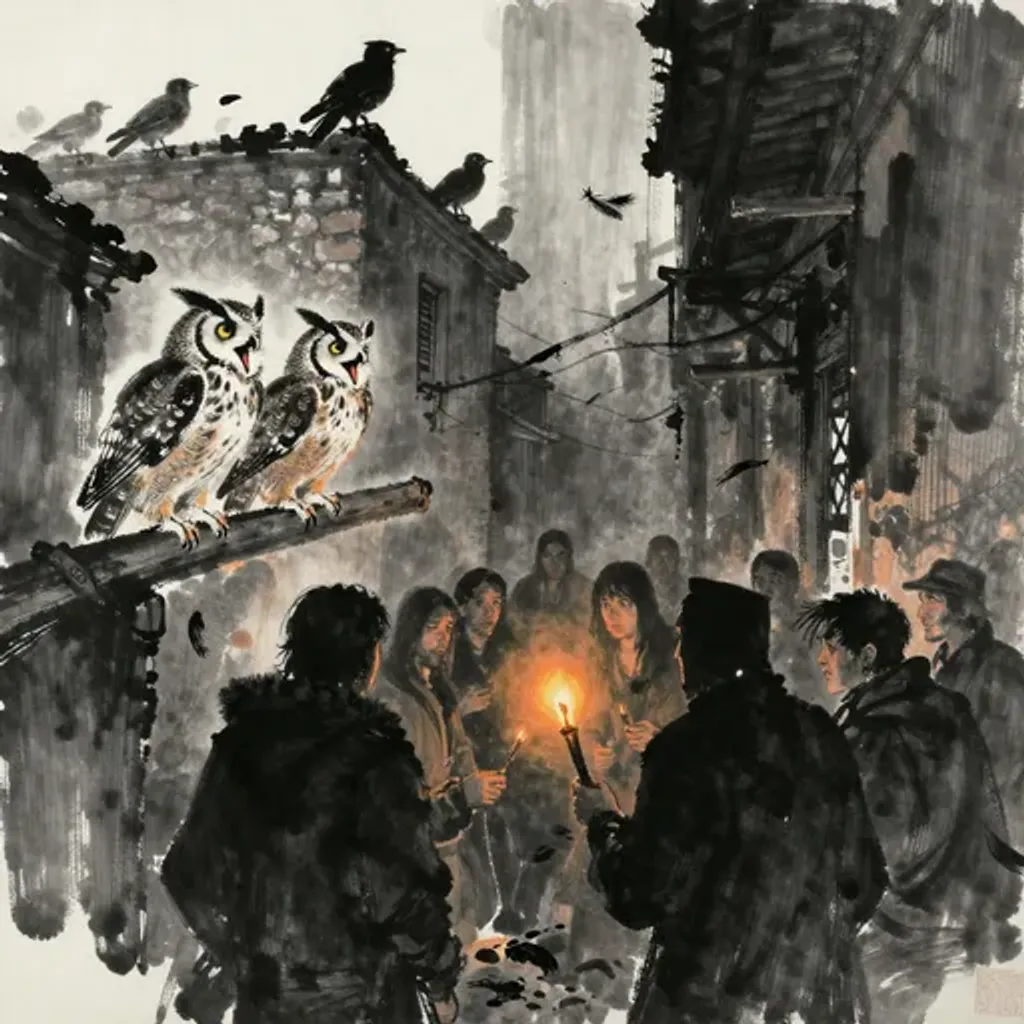
烏合卒會,與惡相得。鴟鴞相酬,為心所賊。
A rabble assembled by chance, finding kinship with the wicked. Owls toast one another; the heart is its own undoing.
— Jiao Yanshou, Yilin (Forest of Changes), 1st century BC
Commentary
Fire on the mountain illuminates a rabble gathering below. A mob assembles like crows — disorderly, opportunistic, held together only by shared malice. Owls toast one another in sinister fellowship, their hearts breeding treachery. The 'crow-gathered soldiers' (烏合之眾) became a lasting idiom for an undisciplined force united by circumstances rather than principle. The owls exchanging courtesies recalls the Shijing ode where the owl threatens the nest — false amity concealing predatory intent. From The Wanderer to Holding Together, the verse warns that not all bonds are wholesome. Water on the earth draws everything toward alliance, but alliance with the wicked compounds rather than cures the wanderer's displacement. Proximity to evil corrodes from within.
旅 → 小畜
Hexagram 56 → Hexagram 9: Small Taming
Changing lines: 1, 2, 4, 5
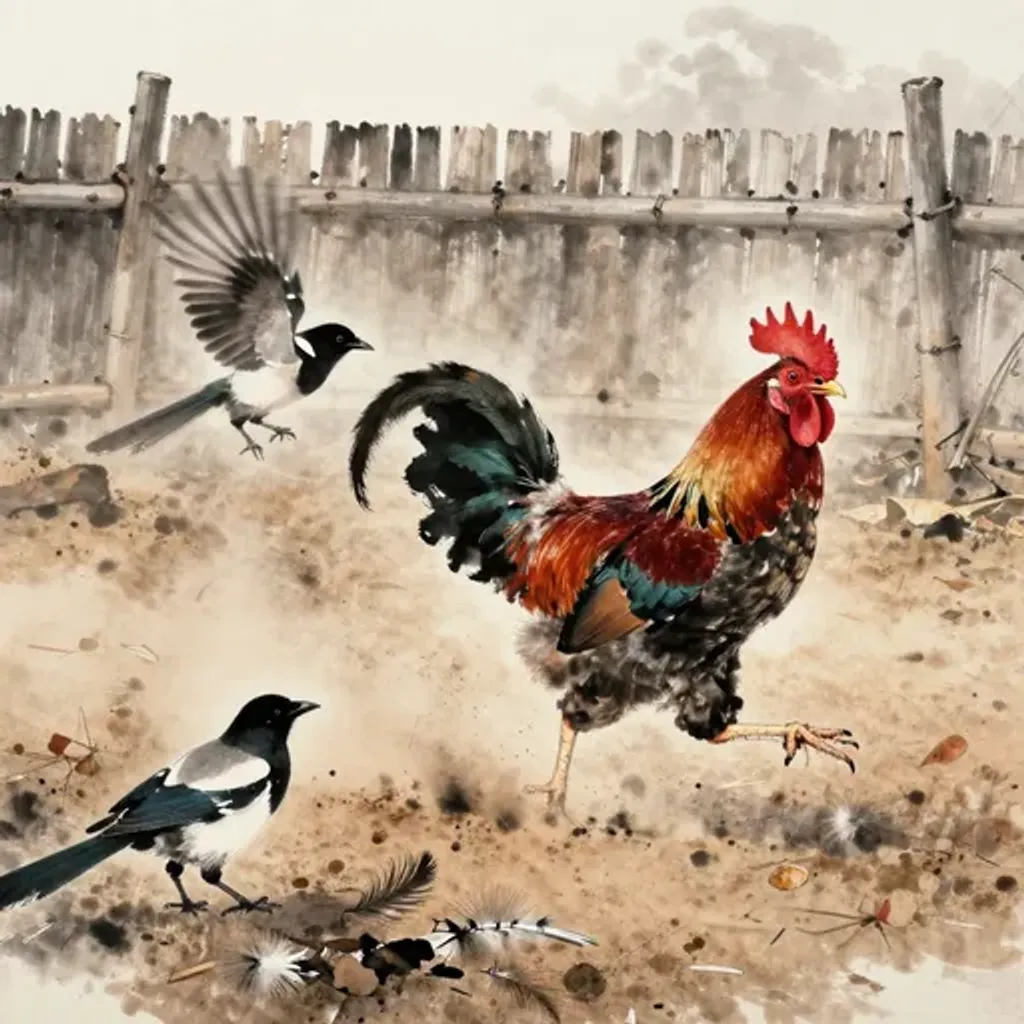
鳴雞无距,與鵲格鬭。翅折目盲,為仇所傷。
A crowing cock without spurs fights and grapples with a magpie. Its wing is broken, its eye blinded; wounded by its foe.
— Jiao Yanshou, Yilin (Forest of Changes), 1st century BC
Commentary
Fire on the mountain, and a rooster without spurs picks a fight with a magpie. Wings broken and eyes blinded, the combatant is destroyed by the very enemy it provoked. The rooster enters battle lacking its natural weapon — the sharp spur that makes a fighting cock formidable — and challenges a bird outside its class. This is the wanderer who overestimates his position in unfamiliar territory. From The Wanderer to Small Taming, wind blows gently above heaven: a force of restraint and refinement, not brute combat. The verse warns that attempting to fight when one lacks the proper equipment, in a contest one was never suited for, leads not to small accumulation of virtue but to self-inflicted ruin.
旅 → 履
Hexagram 56 → Hexagram 10: Treading
Changing lines: 1, 2, 3, 5
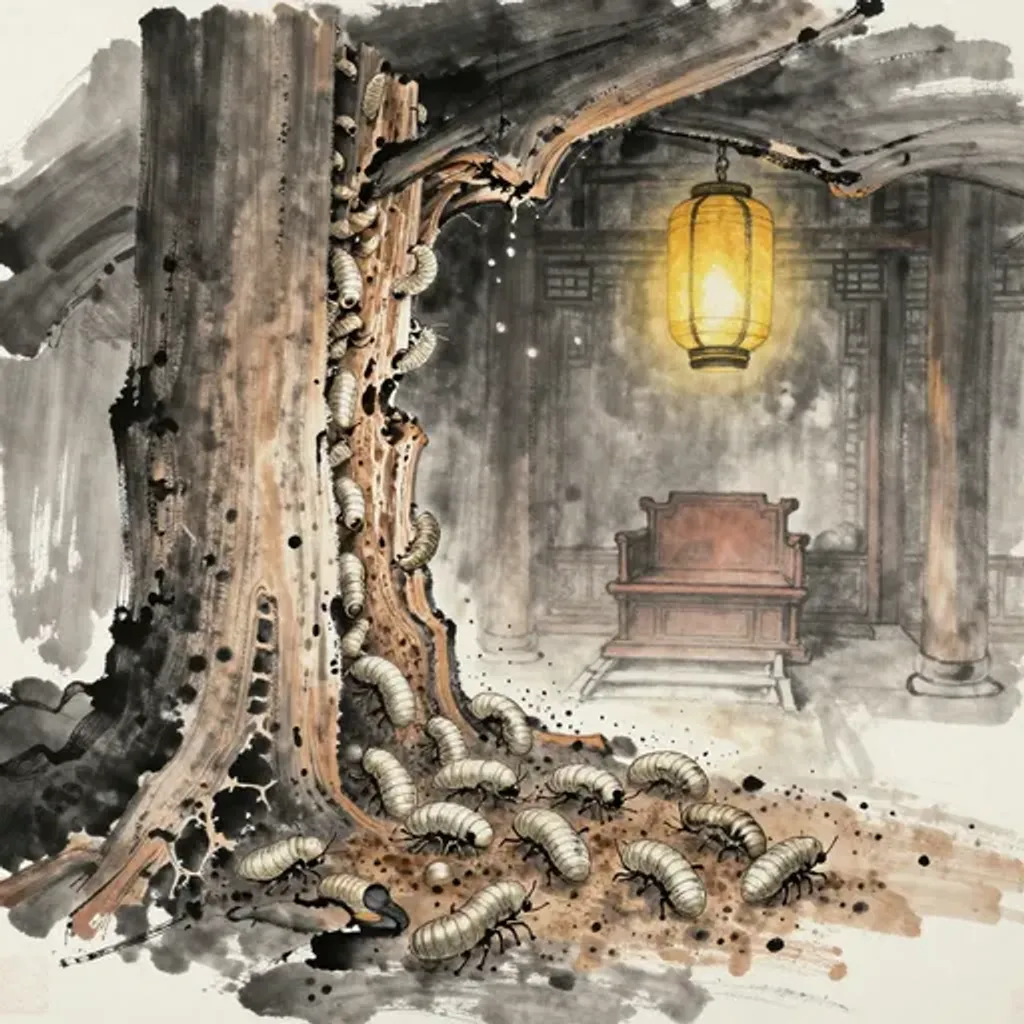
木生內蠹,上下相賊,禍亂我國。
Wood breeds worms within; above and below devour each other, bringing ruin to our realm.
— Jiao Yanshou, Yilin (Forest of Changes), 1st century BC
Commentary
Fire on the mountain, and within the timber wood-borers gnaw unseen. Decay originates inside the heartwood, and upper and lower levels of the structure prey upon one another until the entire nation is thrown into disorder. The image of internal parasites destroying a tree from within is a classic political metaphor: corruption that begins at the core spreads outward, toppling what appeared solid. From The Wanderer to Treading, the traveler steps onto dangerous ground. Heaven above the lake demands clear distinctions between high and low, but when those inside the system are already consuming one another, no amount of careful stepping can prevent the collapse. The wanderer discovers that the ground itself is rotten.
旅 → 泰
Hexagram 56 → Hexagram 11: Peace
Changing lines: 1, 2, 4, 6
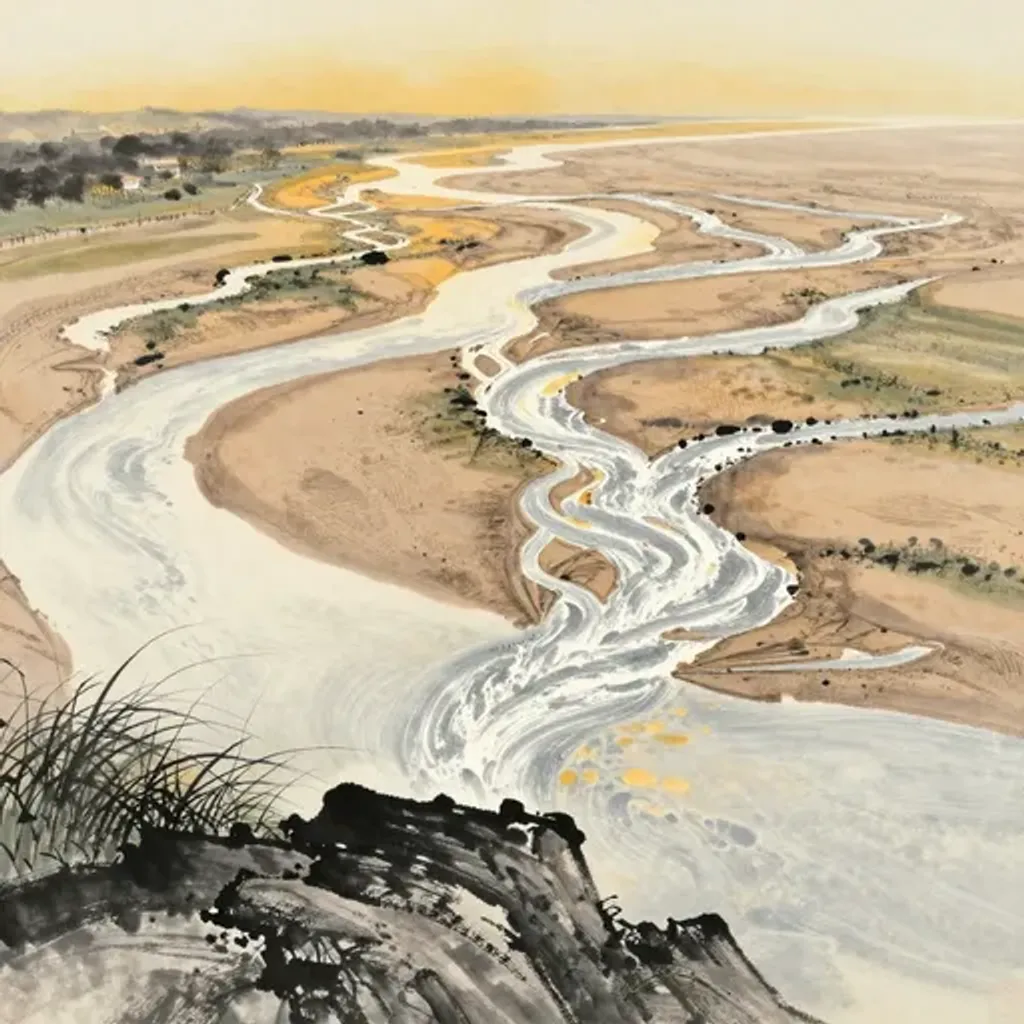
延陵適魯,觀樂太史。車轔白顛,知秦興起。卒兼其國,一統為主。
A hundred streams return to the sea, caring not for east or west. The great river rolls on — ten thousand currents converge as one.
— Jiao Yanshou, Yilin (Forest of Changes), 1st century BC
Commentary
Fire on the mountain, and a traveler witnesses the convergence of all streams. The original verse tells of Ji Zha of Yanling visiting Lu to observe its ritual music, and of an omen — white-headed chariots rumbling — foretelling Qin's rise and its eventual unification of all states under one ruler. Ji Zha, the wandering prince of Wu renowned for his discernment, perceived in the music of nations the seeds of their fates. From The Wanderer to Peace, heaven and earth exchange their energies freely. The wanderer's keen observation becomes prophetic insight: separate streams converging into one great flow, as earth descends and heaven rises to meet it. Unification emerges not from conquest alone but from the natural momentum of a pattern already in motion.
旅 → 否
Hexagram 56 → Hexagram 12: Standstill
Changing lines: 3, 5
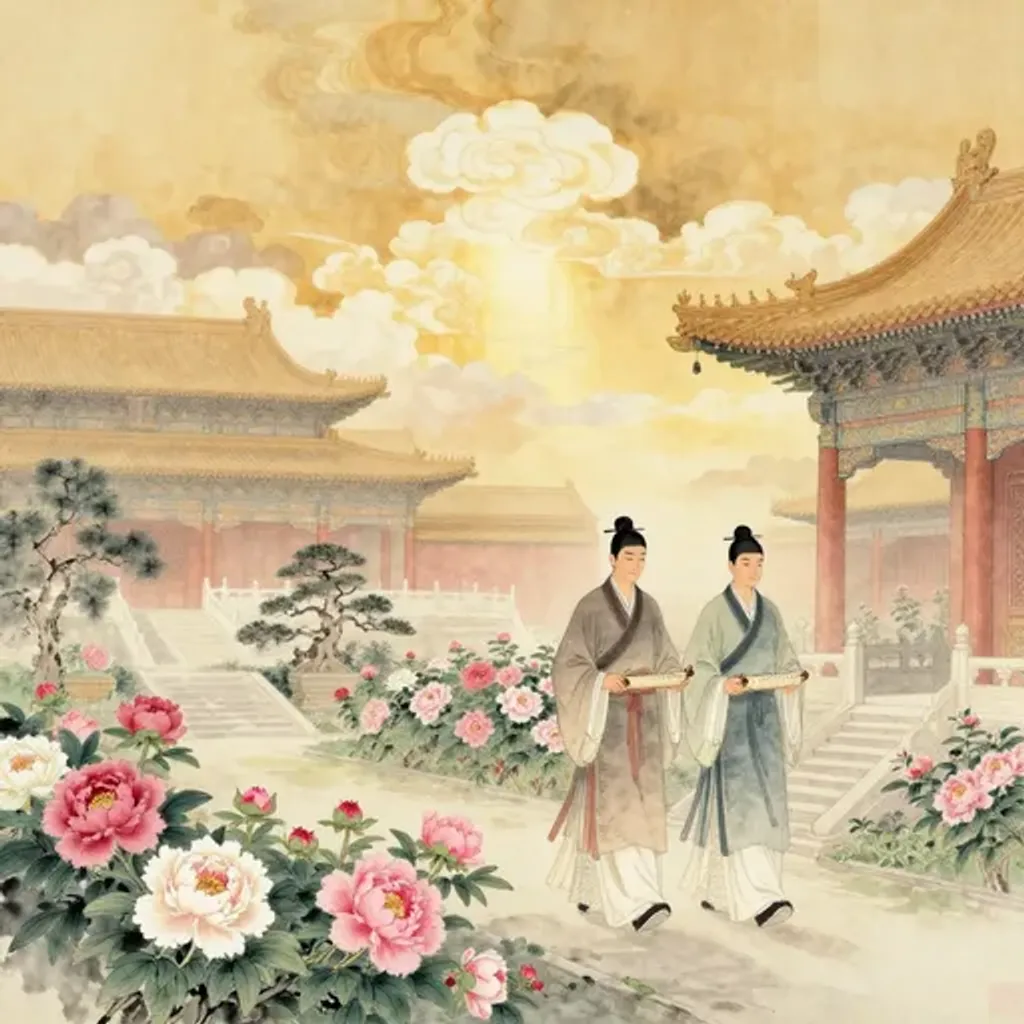
輔相之好,无有休息。時行雲集,所在遇福。
The bond between minister and aide knows no rest. Timely clouds gather where they go; blessings are found in every place.
— Jiao Yanshou, Yilin (Forest of Changes), 1st century BC
Commentary
Fire on the mountain, and a worthy minister finds his counterpart. The bond between 'auxiliary and minister' knows no rest — their partnership is tireless, their cooperation unceasing. When the time comes, clouds gather naturally and blessings follow wherever they settle. The verse celebrates the rare harmony between a capable traveler and a receptive host, a wanderer who finds his proper station. From The Wanderer to Standstill, the paradox deepens: heaven and earth separate, communication ceases. Yet the verse is entirely auspicious. Perhaps the minister's fortune lies precisely in withdrawing: in a time of Standstill, the wise man retreats from public life, and his private alliance with a true companion becomes his shelter. Fortune is found not in the world's approval but in the right relationship.
旅 → 同人
Hexagram 56 → Hexagram 13: Fellowship
Changing lines: 1, 5
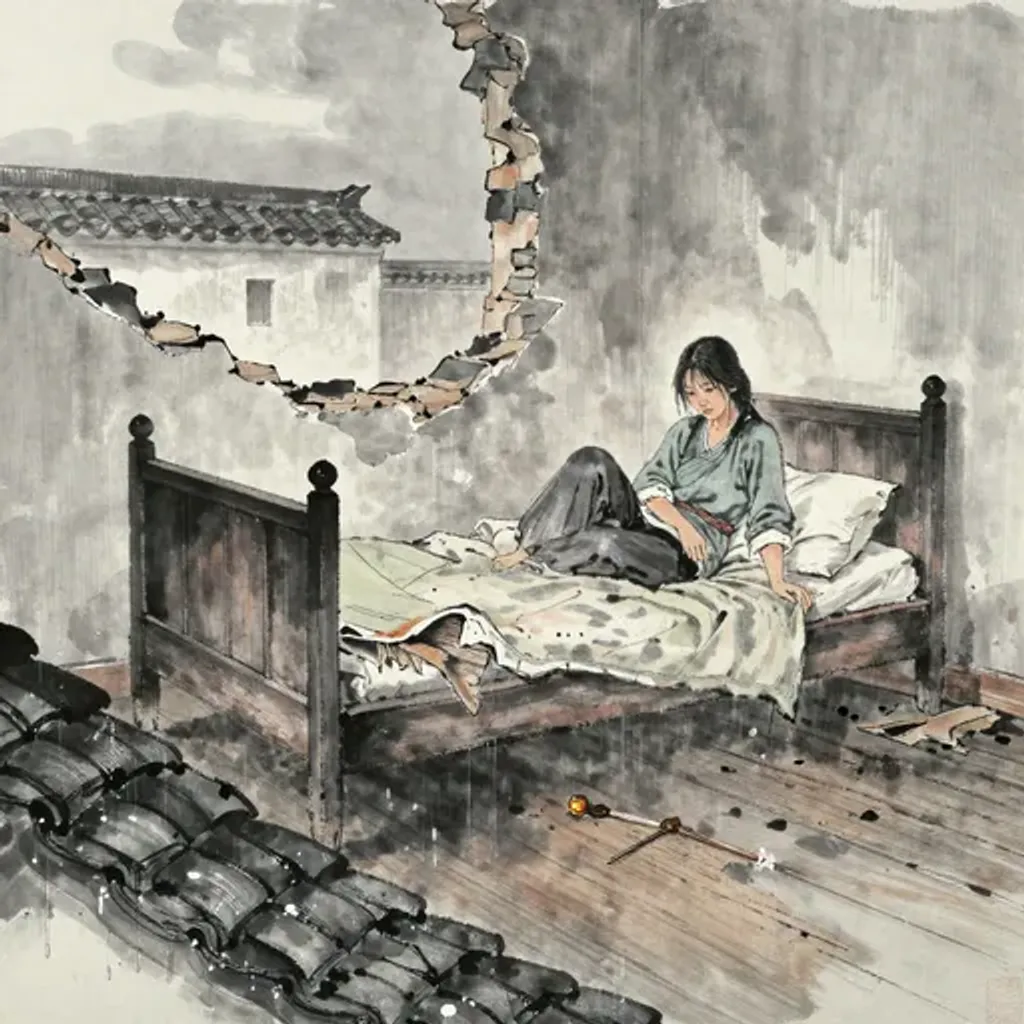
床傾簀折,屋漏垣缺,季姬不愜。
The bed tilts, the mat splits; the roof leaks, the wall crumbles. Lady Ji is not content.
— Jiao Yanshou, Yilin (Forest of Changes), 1st century BC
Commentary
Fire on the mountain, and the traveler's dwelling collapses around him. The bed tilts and the mat snaps, the roof leaks and the wall crumbles, and Lady Ji is deeply displeased. Every element of domestic comfort fails simultaneously — the furniture, the structure, the relationship itself. 'Ji Ji' (季姬) likely refers to a noble bride who finds her new household in shambles, her expectations of a stable home bitterly disappointed. From The Wanderer to Fellowship, heaven blazes above fire, suggesting shared illumination. Yet the verse presents the opposite: fellowship requires a solid foundation, and this household offers none. The wanderer who cannot maintain his own dwelling cannot sustain community. Broken furnishings mirror broken bonds.
旅 → 大有
Hexagram 56 → Hexagram 14: Great Possession
Changing lines: 1, 2

東入海口,循流北走。一高一下,五色無主。七日六夜,死於水浦。
Entering the sea's mouth to the east, following the current northward. Rising and falling, five colors in chaos; seven days and six nights, death at the water's edge.
— Jiao Yanshou, Yilin (Forest of Changes), 1st century BC
Commentary
Fire on the mountain gives way to a harrowing sea journey. The traveler enters the river mouth heading east, then follows the current northward, tossed high and low, dazzled by shifting colors without any anchor. After seven days and six nights of drifting, he perishes on the waterside. The rhythmic enumeration — seven days, six nights — conveys exhaustion stretched to its limit. From The Wanderer to Great Possession, fire blazes above heaven, an image of supreme abundance. Yet the verse depicts its inverse: the wanderer who enters the vast waters without preparation possesses nothing, not even his life. Great Possession demands the wisdom to channel abundance; without it, the traveler is swallowed by the very enormity he sought to navigate.
旅 → 謙
Hexagram 56 → Hexagram 15: Modesty
Changing lines: 4, 6
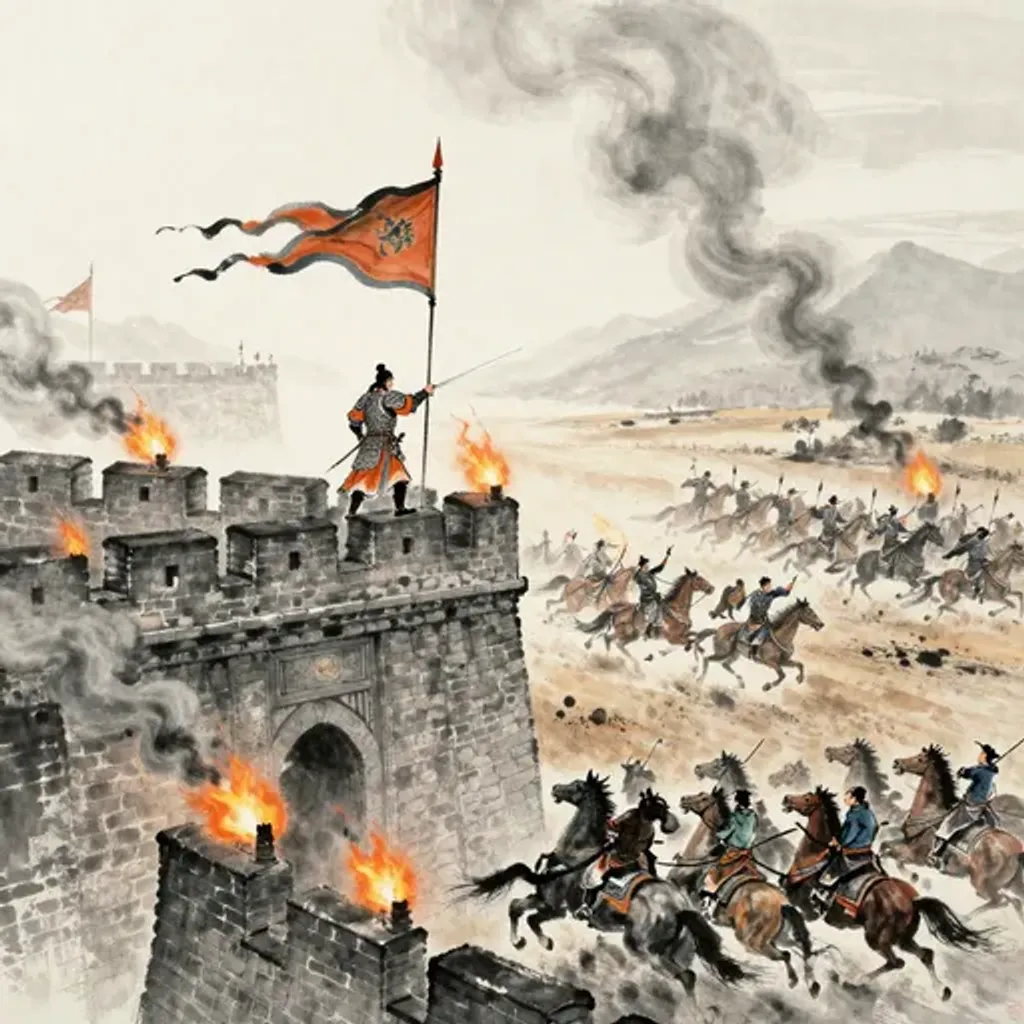
群虎入邑,求索肉食。大人禦守,君不失國。
Beacon fires rise on all sides — the watchtower is in peril. The general draws his sword and stands unmoved. Below the walls, ten thousand riders surge like a tide — atop the wall, one banner has not yet fallen.
— Jiao Yanshou, Yilin (Forest of Changes), 1st century BC
Commentary
Fire on the mountain, and a pack of tigers descends upon a city seeking flesh. The original verse — 'Tigers swarm into the settlement seeking meat; the great man guards and defends, and the lord does not lose his state' — presents the wanderer's crisis at its most acute: hostile forces arrive, and survival depends on resolute defense. The 'great man' (大人) stands firm, transforming a desperate siege into a demonstration of principled endurance. From The Wanderer to Modesty, the mountain hidden within the earth, the defender does not boast of his strength but simply holds the line. Modesty's power lies precisely in this: reducing one's profile while maintaining inner solidity. The state is preserved not through spectacle but through quiet, immovable resolve.
旅 → 豫
Hexagram 56 → Hexagram 16: Enthusiasm
Changing lines: 3, 6
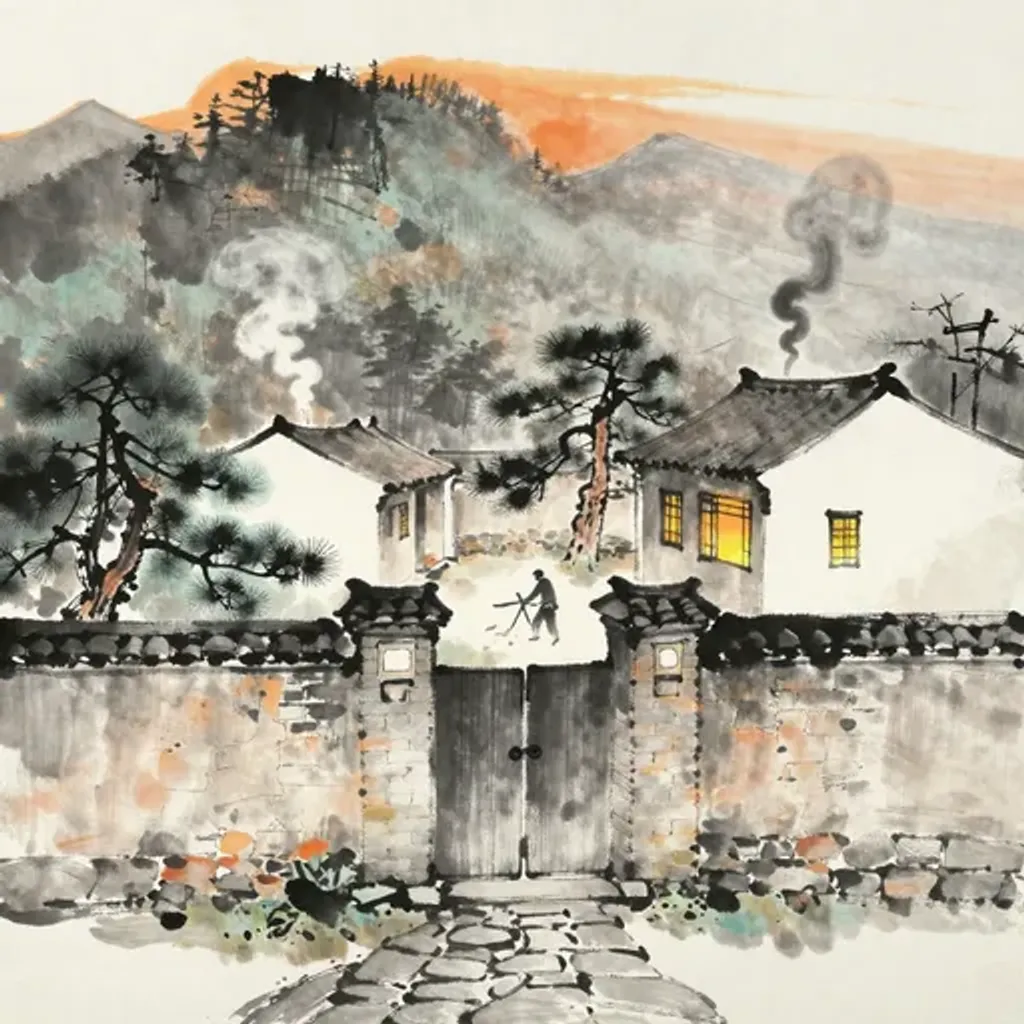
四亂不安,東西為患。退身止足,无出邦域。乃得完全,賴其生福。
Chaos on four sides, threats from east and west. Withdrawing the self, knowing enough to stop; not venturing beyond the domain. Thus one remains whole and is blessed with life's fortune.
— Jiao Yanshou, Yilin (Forest of Changes), 1st century BC
Commentary
Fire on the mountain, and turmoil erupts in all four directions. East and west alike breed calamity, and the world beyond the borders is hostile ground. The verse counsels retreat: withdraw, know when to stop, do not venture beyond your own domain. Only then can you remain whole, and your life's blessings be preserved. This is the wanderer who has learned discretion — the traveler who, having seen the dangers of the road, chooses to stay home. From The Wanderer to Enthusiasm, thunder surges from the earth in a burst of joyful energy. Yet the verse tempers this: enthusiasm misapplied is reckless movement outward; true enthusiasm here means the exhilaration of knowing one has chosen safety wisely, the relief of the door bolted against the storm.
旅 → 隨
Hexagram 56 → Hexagram 17: Following
Changing lines: 1, 3, 5, 6
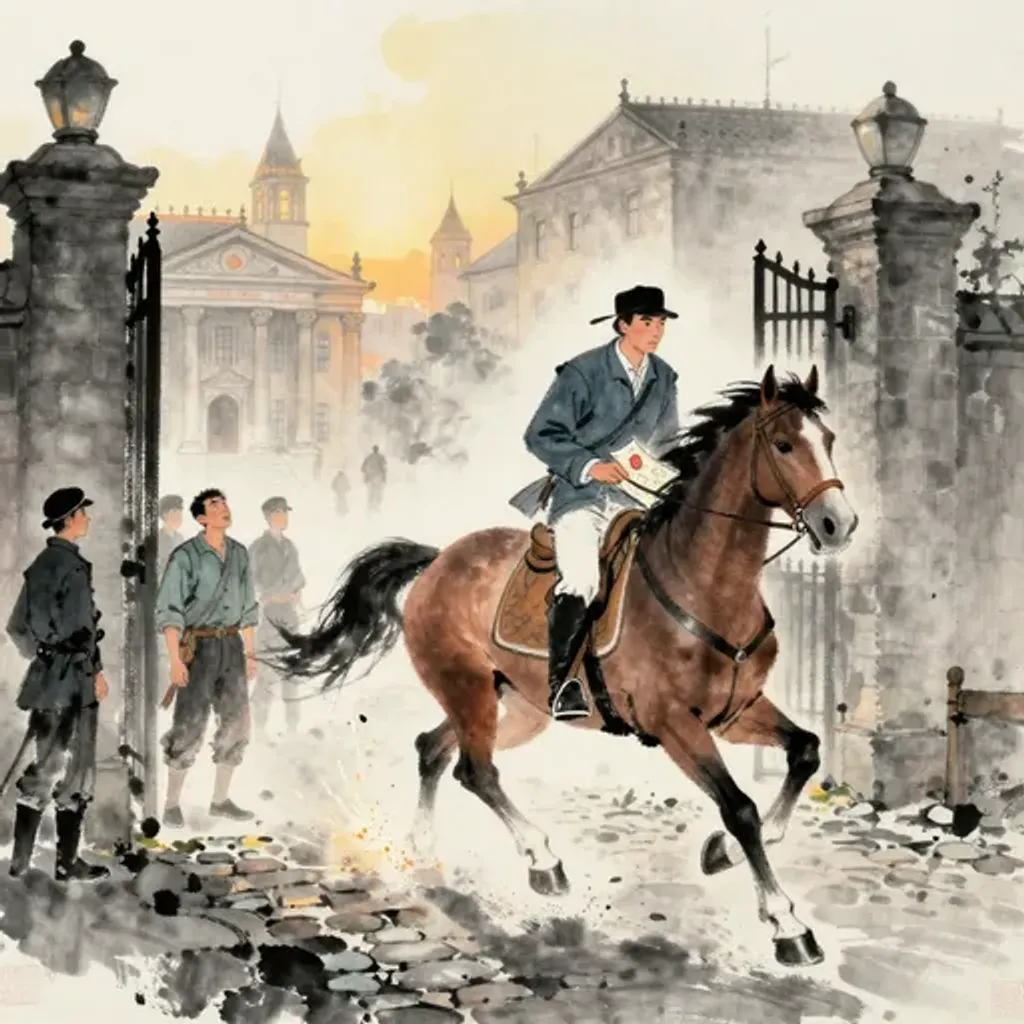
叔盻抱冤,祁子自邑。乘遽解患,羊舌以免。賴其福全。
Shu Xi nursed a grievance; Qi Zi fled to his own city. Riding the courier horse, the crisis was resolved; Yangshe was thereby spared. His good fortune preserved him whole.
— Jiao Yanshou, Yilin (Forest of Changes), 1st century BC
Commentary
Fire on the mountain, and an innocent man bears grievous injustice. According to the Zuo Zhuan, Shu Xiang (also called Shu Pan) of Jin was imprisoned on false charges after the Luan Ying affair. The retired minister Qi Xi, famed for recommending talent without regard to personal enmity or kinship, rode in haste to plead his case. Through Qi Xi's swift intervention, the Yangshe clan — Shu Xiang's family — was spared destruction. From The Wanderer to Following, the lake cradles thunder in its depths: the superior man rests at nightfall, trusting the world's rhythms. The verse enacts Following's principle — when a wronged man does not act rashly but waits for the right advocate, deliverance arrives through another's timely movement.
旅 → 蠱
Hexagram 56 → Hexagram 18: Work on the Decayed
Changing lines: 2, 4
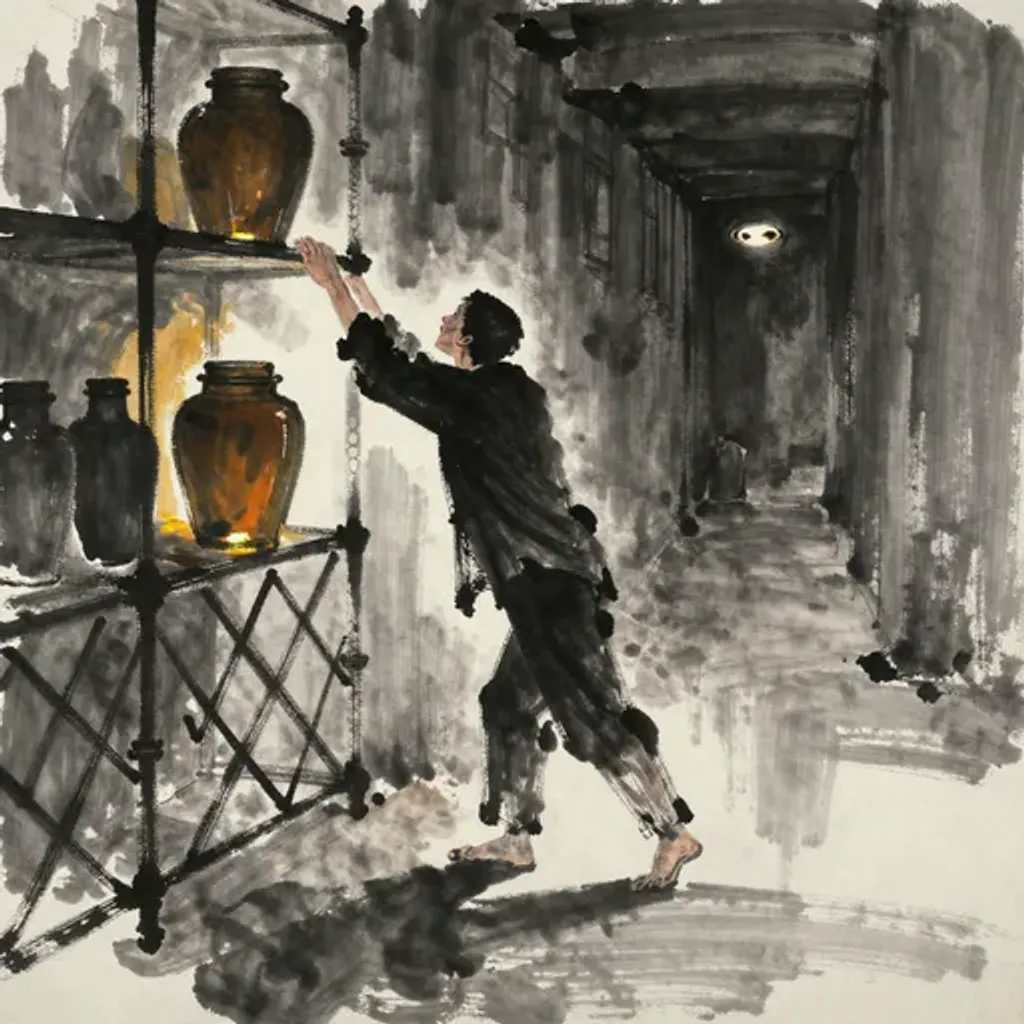
延頸望酒,不入我口。深目自苦,利得无有。
Craning the neck, gazing at wine that never reaches my mouth. Eyes deep-set in bitter longing; no profit to be had.
— Jiao Yanshou, Yilin (Forest of Changes), 1st century BC
Commentary
Fire on the mountain, and a thirsty traveler stretches his neck toward wine that never reaches his lips. Deep-set eyes betray self-inflicted suffering; he strains after profit but gains nothing. The image is visceral — desire without fulfillment, effort without reward. The wine exists, tantalizingly close, but some barrier prevents consumption. From The Wanderer to Work on the Decayed, wind stirs beneath the mountain, disturbing what has long settled. The Wanderer's frustrated longing meets Decay's demand for renovation. What the traveler craves may already be spoiled; what he pursues is not worth the pursuit. The verse suggests that the bitterness comes not from external denial but from chasing something rotten at its source.
旅 → 臨
Hexagram 56 → Hexagram 19: Approach
Changing lines: 1, 2, 3, 4, 6
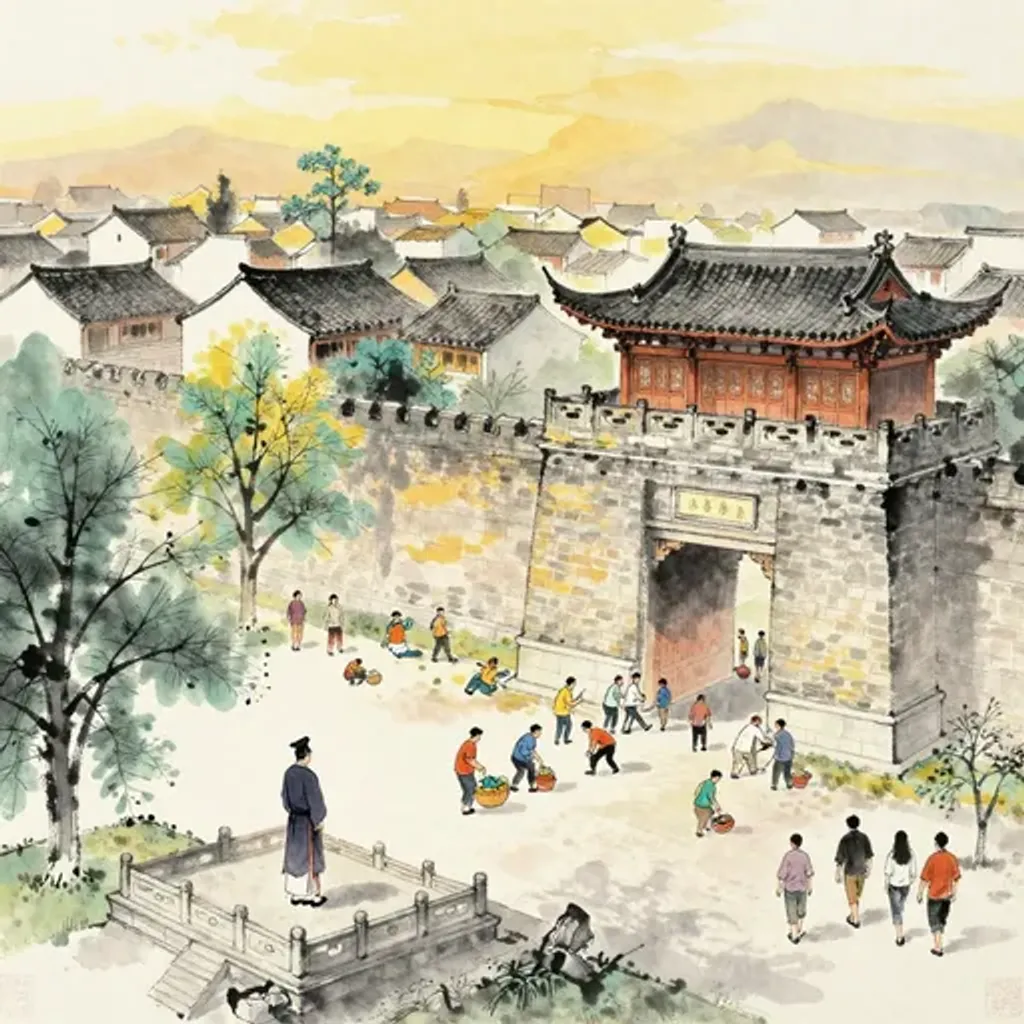
仁政之德,恭恭日息。成都就邑,人受厥福。
The virtue of benevolent rule, reverent and ceaseless. The city is built, the settlement complete; the people receive its blessings.
— Jiao Yanshou, Yilin (Forest of Changes), 1st century BC
Commentary
Fire on the mountain, and a realm flourishes under benevolent rule. The virtue of humane governance spreads daily in reverent practice. Cities are established, settlements completed, and the people receive their blessings. This is the wanderer who has finally arrived: the traveler who plants roots, builds community, and governs with care. The phrase 'cheng du jiu yi' (成都就邑) — 'completing the capital, establishing the settlement' — evokes the founding of a permanent home after long journeying. From The Wanderer to Approach, earth opens above the lake in generous welcome. Approach's meaning is the arrival of benevolent authority, drawing near to the people. The wanderer's journey culminates not in further travel but in the act of settling down and nourishing those around him.
旅 → 觀
Hexagram 56 → Hexagram 20: Contemplation
Changing lines: 3, 4, 5
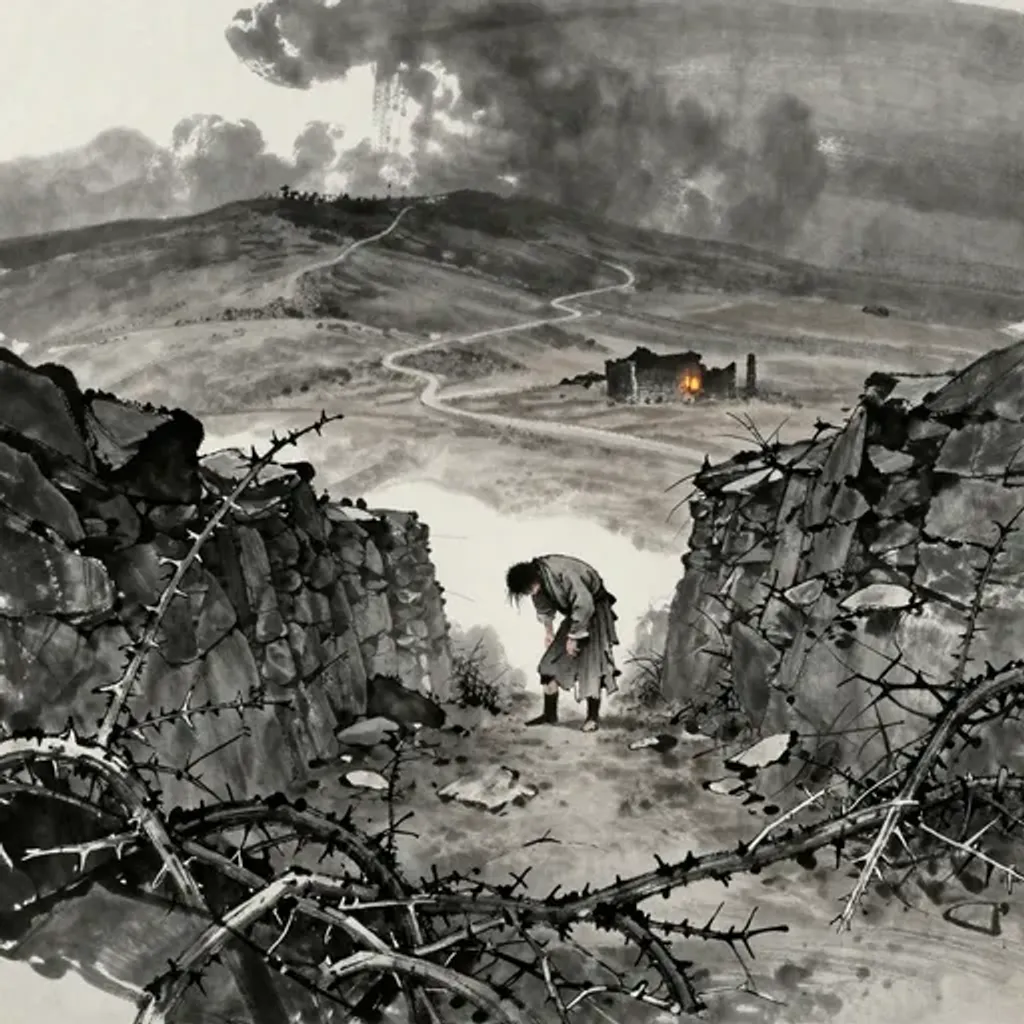
牽頭繫尾,屈折幾死。周世无人,不知所歸。
Pulled by the head, bound at the tail; bent and broken, near death. The age of Zhou has no one left; there is nowhere to return.
— Jiao Yanshou, Yilin (Forest of Changes), 1st century BC
Commentary
Fire on the mountain, but the traveler is bound head and tail, twisted nearly to death. 'In the world of Zhou there is no one left' — the age has emptied of righteous people, and the wanderer does not know where to return. The verse describes a captive dragged along by force, bent and broken, with neither protector nor destination. The 'world of Zhou' bereft of worthy men suggests an era when the old order has collapsed and its virtues are extinct. From The Wanderer to Contemplation, wind sweeps over the earth, observing all. Yet there is nothing to observe but desolation. The wanderer who once surveyed the landscape for opportunity now sees only emptiness — contemplation without an object, vision without hope.
旅 → 噬嗑
Hexagram 56 → Hexagram 21: Biting Through
Changing lines: 1, 3
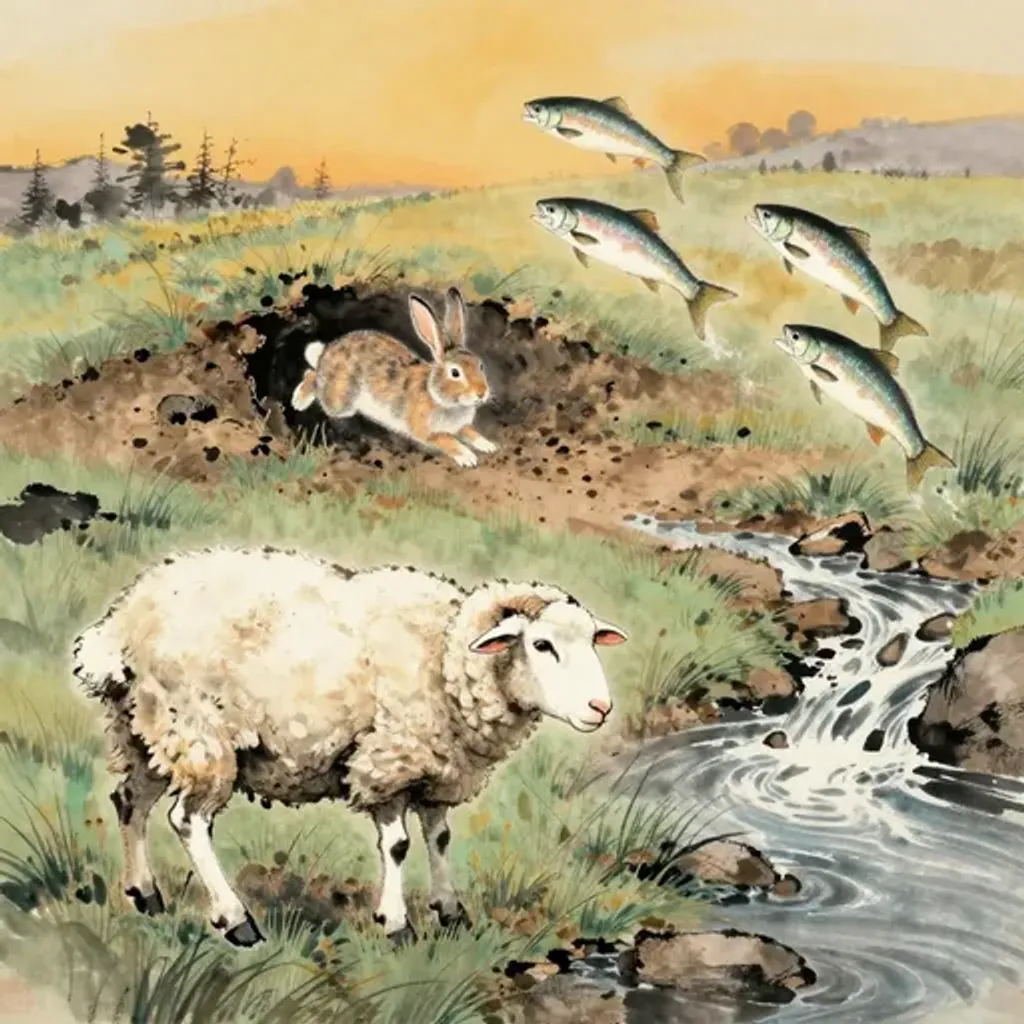
教羊逐兔,使魚相捕。任非其人,費日无功。
Teaching sheep to chase rabbits, setting fish to catch one another. Appointing those unfit for the task; wasting days without achievement.
— Jiao Yanshou, Yilin (Forest of Changes), 1st century BC
Commentary
Fire on the mountain, and a traveler assigns impossible tasks. Teaching sheep to chase rabbits, ordering fish to hunt one another — every appointment mismatches nature with function. The person is unsuited to the task, and the result is wasted days with nothing accomplished. The verse's humor barely masks its political edge: this is governance by absurdity, where roles are assigned without regard for aptitude. From The Wanderer to Biting Through, thunder and lightning combine to enforce clarity — the hexagram of legal judgment that cuts through obstruction. Yet the verse warns that no amount of judicial force can remedy fundamental misassignment. Fire and thunder may strike, but if the sheep is still chasing the rabbit, the system itself is the problem.
旅 → 賁
Hexagram 56 → Hexagram 22: Grace
Changing lines: 1, 4
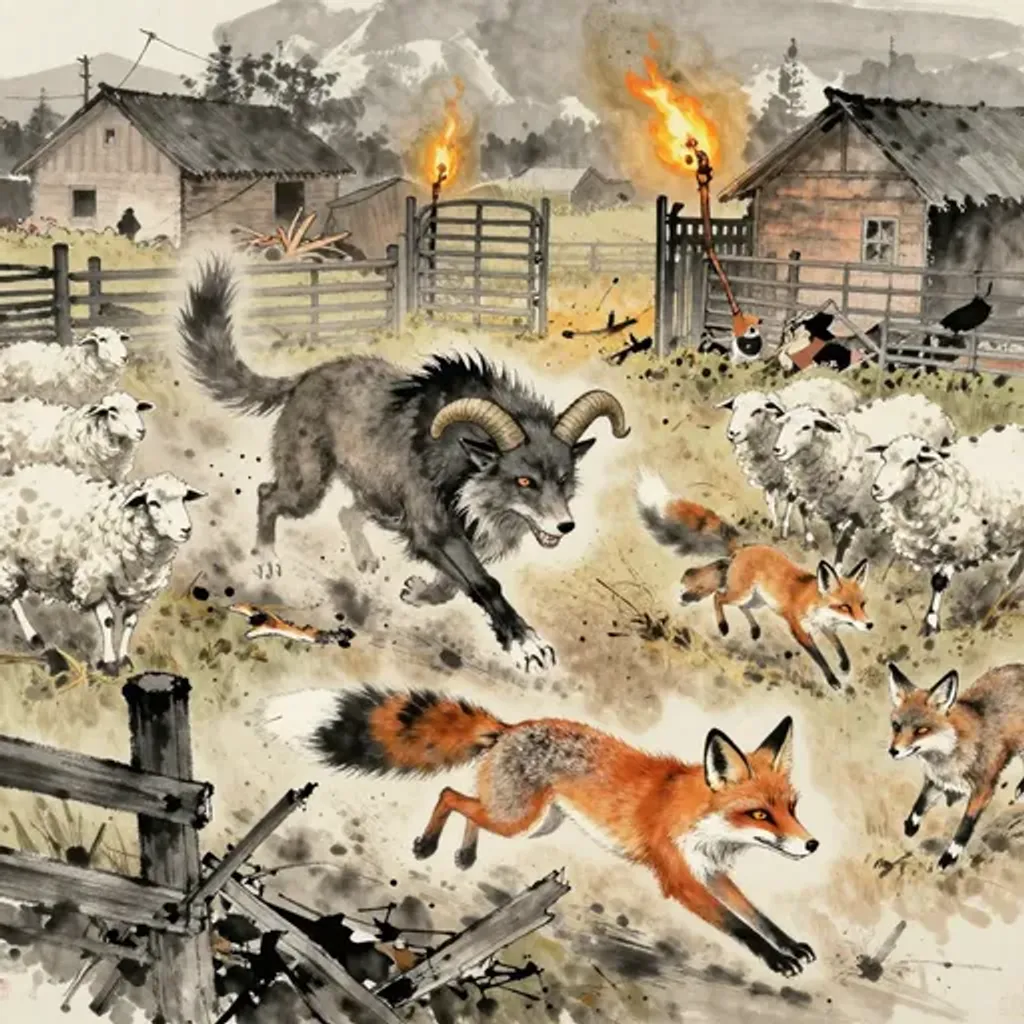
生角有尾,張孽制家,排羊逐狐。張氏易公,憂禍重凶。
Born with horns and a tail, this prodigy seizes the household. It drives the sheep and chases the fox; the Zhang clan usurps the duke. Worry and calamity, grievous misfortune.
— Jiao Yanshou, Yilin (Forest of Changes), 1st century BC
Commentary
Fire on the mountain illuminates a monstrous hybrid — a creature with horns and a tail, its strangeness spreading disorder through the household. The 'Zhang' surname usurps public authority, and sheep are driven out while foxes are pursued — a topsy-turvy governance where predators displace the innocent. The verse alludes to a minister surnamed Zhang who overturned proper hierarchy, breeding anxiety and compounding calamity. From The Wanderer to Grace, fire glows beneath the mountain in gentle adornment. Yet the verse inverts Grace's ideal: instead of refined beauty illuminating mundane affairs, surface decoration conceals the monstrous. When a hornéd, tailed creature runs the household, all ornament becomes grotesque disguise.
旅 → 剝
Hexagram 56 → Hexagram 23: Splitting Apart
Changing lines: 3, 4
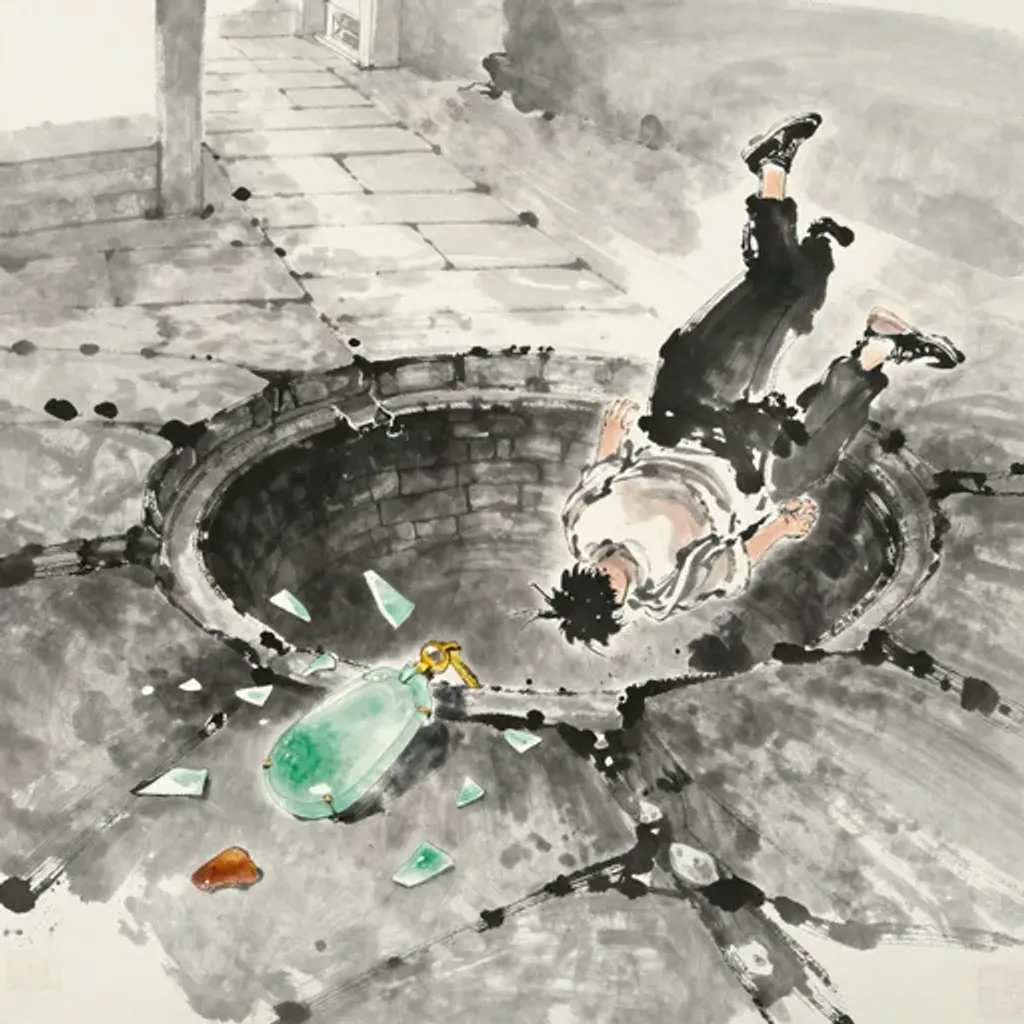
去安就危,墜陷井池,破我玉瑀。
Leaving safety for danger, falling into a well and pit; shattering my precious jade.
— Jiao Yanshou, Yilin (Forest of Changes), 1st century BC
Commentary
Fire on the mountain, and the wanderer abandons safety for danger. Leaving secure ground, he stumbles and falls into a well or pool, shattering his precious jade ornament. The jade pendant (玉瑀) is both material treasure and symbol of moral integrity — once broken, it cannot be restored. The verse is a stark warning against reckless movement: the traveler who voluntarily leaves stable ground for unknown terrain loses what is most valuable. From The Wanderer to Splitting Apart, the mountain crumbles upon the earth. Everything solid dissolves from beneath. The jade's destruction parallels the hexagram's erosion: what was whole is stripped away layer by layer until nothing remains but bare ground.
旅 → 復
Hexagram 56 → Hexagram 24: Return
Changing lines: 1, 3, 4, 6
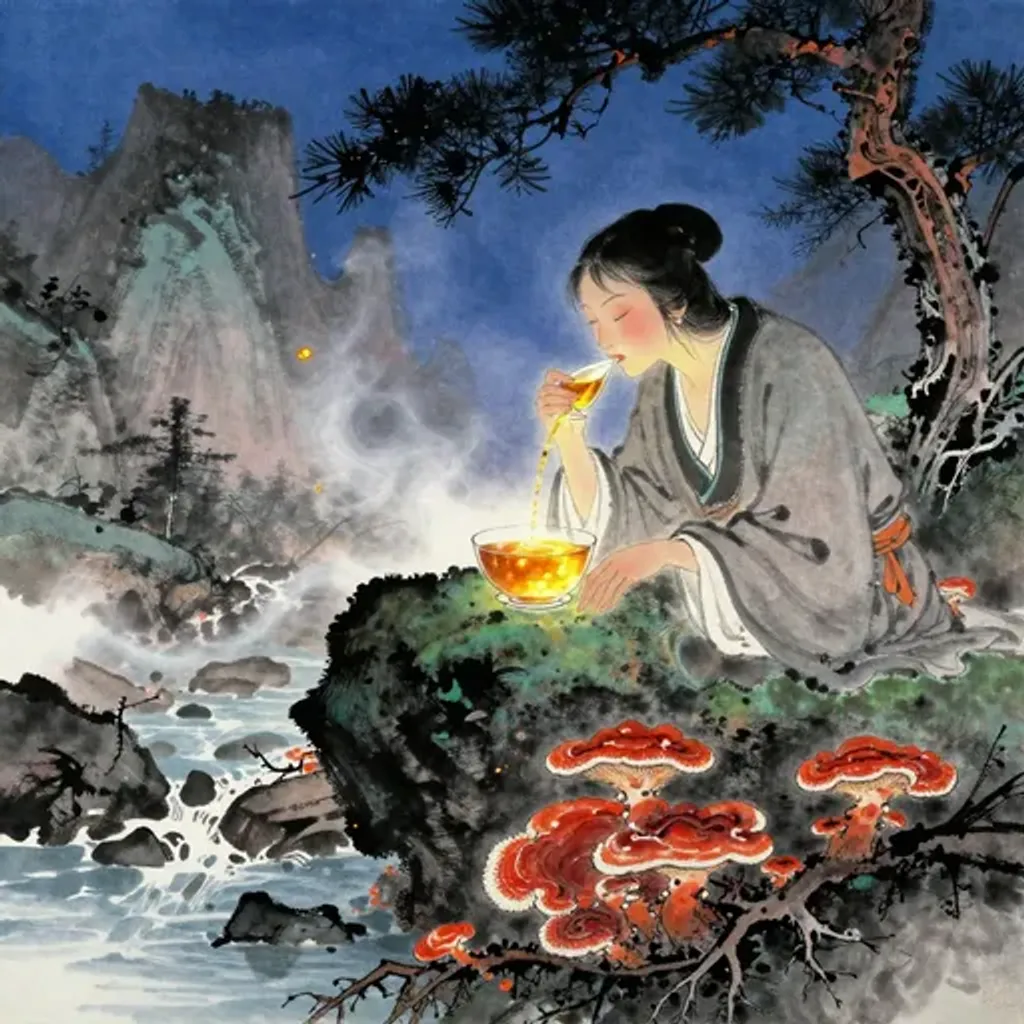
茹芝餌黃,塗飲玉英。與神流通,長无憂凶。
Eating lingzhi, taking the Yellow Essence, drinking the Jade Nectar on the way. In communion with the spirits; forever free from worry and misfortune.
— Jiao Yanshou, Yilin (Forest of Changes), 1st century BC
Commentary
Fire on the mountain, and the wanderer discovers the path of immortality. Eating fungus of long life, ingesting alchemical elixirs, drinking the essence of jade — the traveler enters communion with the spirits and dwells forever free of misfortune. The verse draws on Daoist cultivation imagery: lingzhi mushrooms (芝), cinnabar preparations (黃), and jade-infused potions (玉英) are the standard pharmacopoeia of the immortal-seeker. From The Wanderer to Return, thunder stirs beneath the earth at the winter solstice — the single yang line returns at the base. The wanderer's spiritual practice is itself a return: by cultivating the body's vital essence, one returns to the primordial state before dispersal, finding permanence within the cycle.
旅 → 无妄
Hexagram 56 → Hexagram 25: Innocence
Changing lines: 1, 3, 5
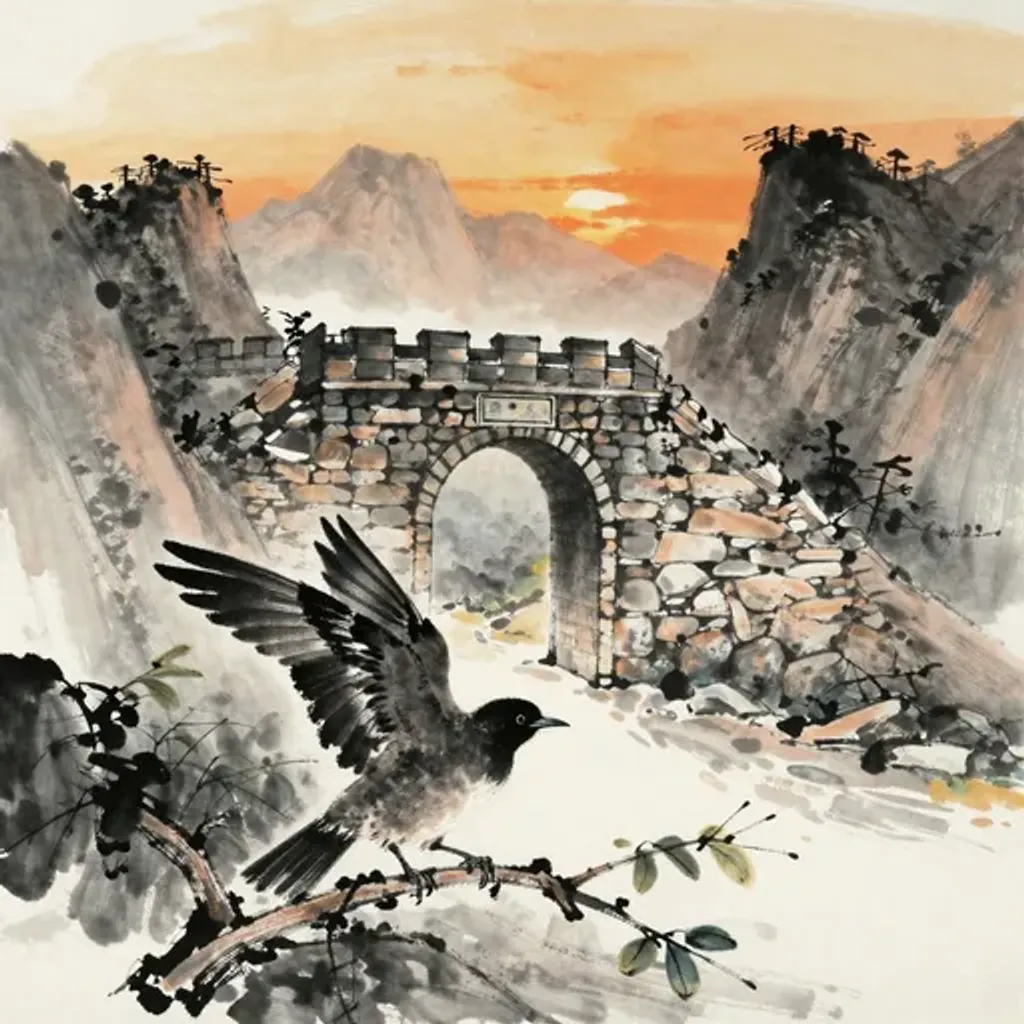
體重飛難,未能越關。
Body too heavy to fly; unable yet to cross the pass.
— Jiao Yanshou, Yilin (Forest of Changes), 1st century BC
Commentary
Fire on the mountain, and a heavy bird cannot cross the pass. Its body is too cumbersome for flight, and the barrier remains uncrossed. In just two terse lines, the verse captures total futility: the desire to soar exists, the destination is visible, but physical reality forbids passage. The wanderer is grounded by his own weight — whether of possessions, obligations, or simply unsuitability for the task. From The Wanderer to Innocence, thunder rolls beneath heaven in spontaneous, unforced movement. Yet the heavy bird cannot access this natural ease. Innocence requires lightness of spirit, freedom from the accumulated burden that makes the body too dense for flight. What weighs the traveler down is precisely what must be shed.
旅 → 大畜
Hexagram 56 → Hexagram 26: Great Taming
Changing lines: 1, 2, 4
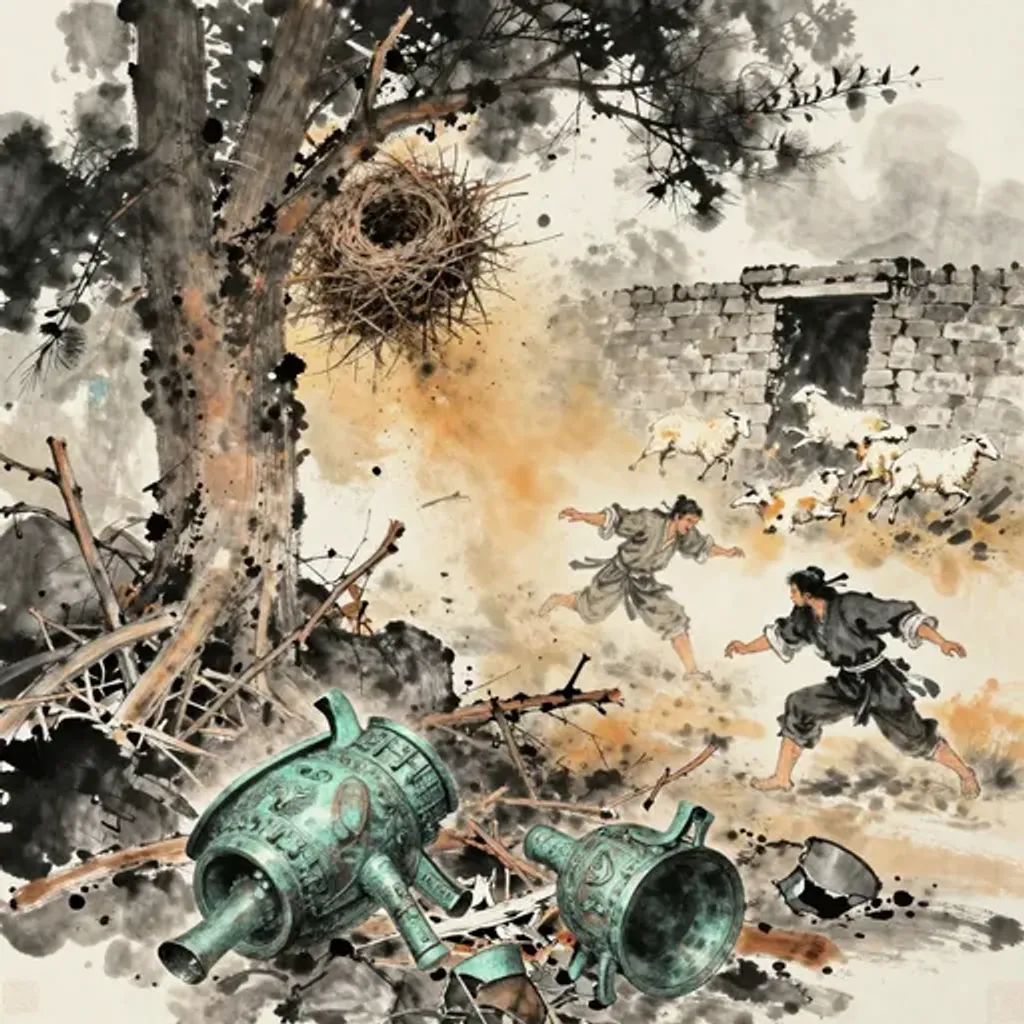
巢成樹折,傷我彝器。伯踒叔跌,亡羊乃追。
The nest is built, the tree breaks; it shatters my ritual vessels. The elder stumbles, the younger falls; they chase the sheep already lost.
— Jiao Yanshou, Yilin (Forest of Changes), 1st century BC
Commentary
Fire on the mountain, and the nest is finished just as the tree snaps. Sacred vessels are damaged, the eldest stumbles and the second trips, and only then does anyone think to chase the lost sheep. Every disaster arrives after the moment of supposed completion — the nest is built upon a branch already breaking. The 'lost sheep pursued too late' echoes the proverb 'mending the pen after the sheep are gone.' From The Wanderer to Great Taming, heaven stored within the mountain accumulates wisdom from the past. Yet the verse presents the failure to learn in time: the knowledge that should have been stored — awareness of structural weakness — was neglected until catastrophe struck. Great Taming's power of retention is wasted on those who only remember after the loss.
旅 → 頤
Hexagram 56 → Hexagram 27: Nourishment
Changing lines: 1, 3, 4
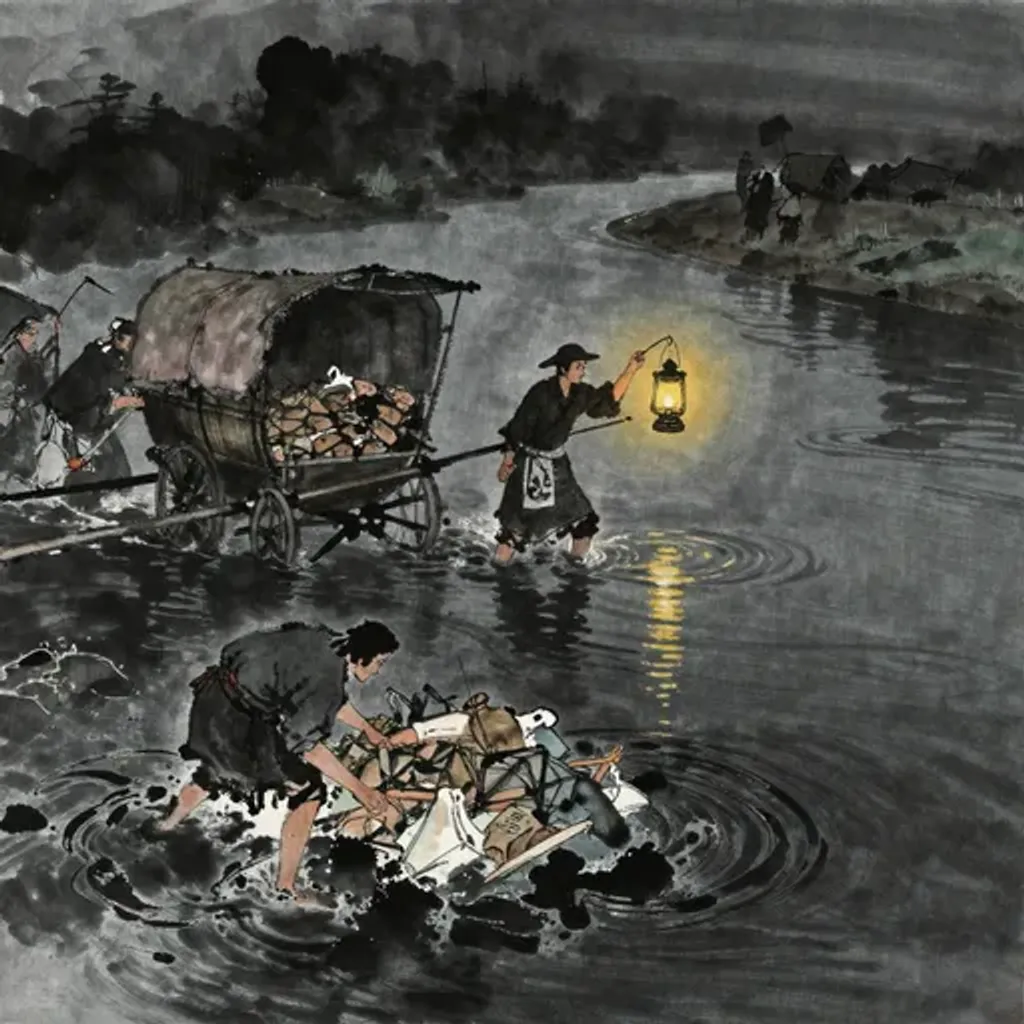
六人俱行,各遺其囊。黃鵠失珠,无以為明。
The merchant caravan crosses the river — goods sink in the current. Baggage slips from the donkey's back, uncollectable. Night falls, the lamp is lit — but it too goes out. Groping forward in darkness, each person worries alone.
— Jiao Yanshou, Yilin (Forest of Changes), 1st century BC
Commentary
Fire on the mountain, and six travelers lose everything on the road. The original verse — 'Six people journey together, each losing his bag; the yellow swan loses its pearl and has nothing for light' — depicts a collective calamity on the road. Belongings scatter, and the luminous pearl that should guide the way is gone, leaving only darkness. The yellow swan (黃鵠) losing its pearl suggests the loss of the one precious thing that made the journey navigable. From The Wanderer to Nourishment, the mountain rests above thunder, counseling careful speech and measured consumption. The verse warns that travelers who cannot safeguard their provisions arrive at Nourishment's gate with nothing to sustain them — mouths open but no food to enter.
旅 → 大過
Hexagram 56 → Hexagram 28: Great Exceeding
Changing lines: 2, 5, 6
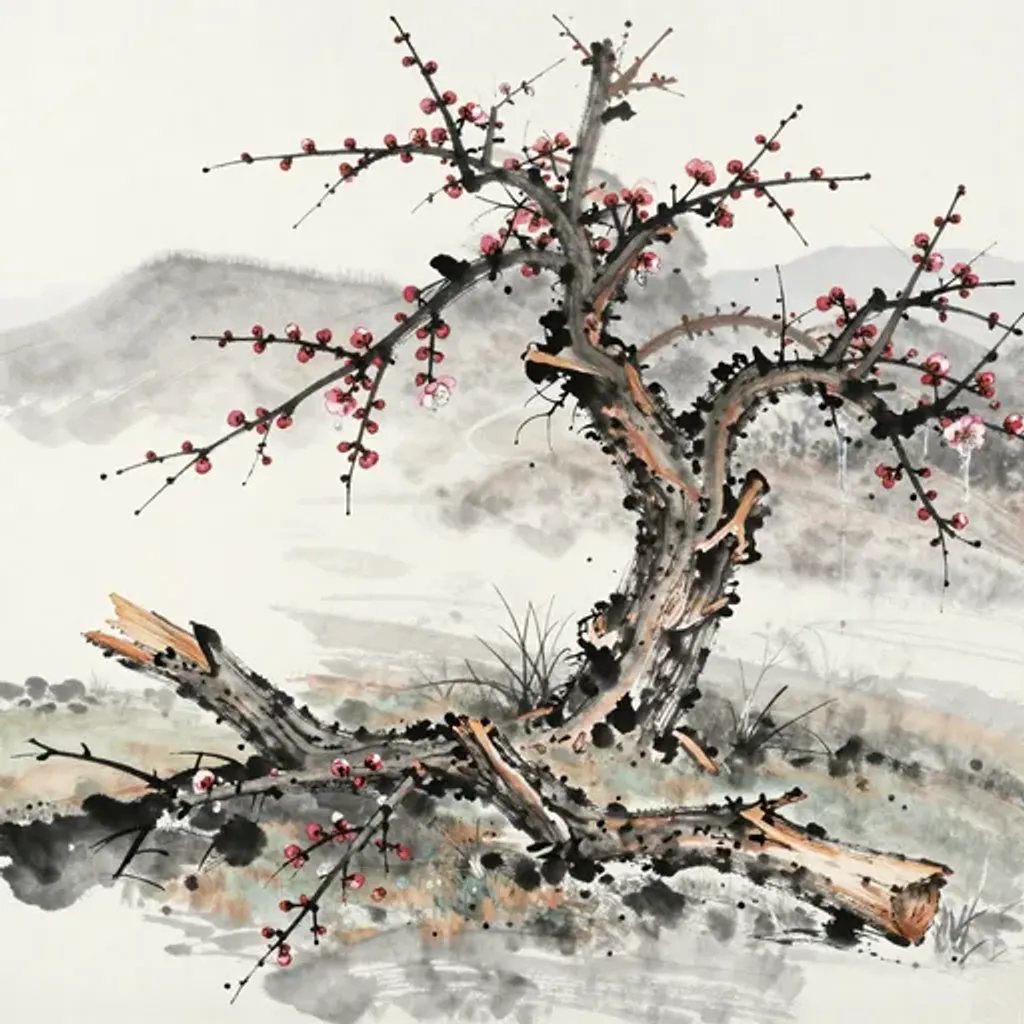
蟠梅折枝,與母分離,絕不相知。
The coiling plum tree breaks a branch; separated from the mother, severed beyond knowing.
— Jiao Yanshou, Yilin (Forest of Changes), 1st century BC
Commentary
Fire on the mountain, and a plum branch breaks from its trunk. A climbing plant coils around the old plum tree, but its weight snaps the limb, severing child from mother forever. The separation is absolute — 'they will never know each other again.' The plum tree, symbol of resilience in Chinese poetry, here cannot bear the parasitic burden. From The Wanderer to Great Exceeding, the lake submerges the trees, and the ridgepole sags under impossible weight. The verse embodies Great Exceeding's crisis: the structure is overloaded, the branch breaks, and what should have been nurturing connection becomes the very force that destroys it. Maternal bonds severed by excessive strain — this is the wanderer's deepest grief.
旅 → 坎
Hexagram 56 → Hexagram 29: The Abysmal Water
Changing lines: 2, 3, 4, 5, 6
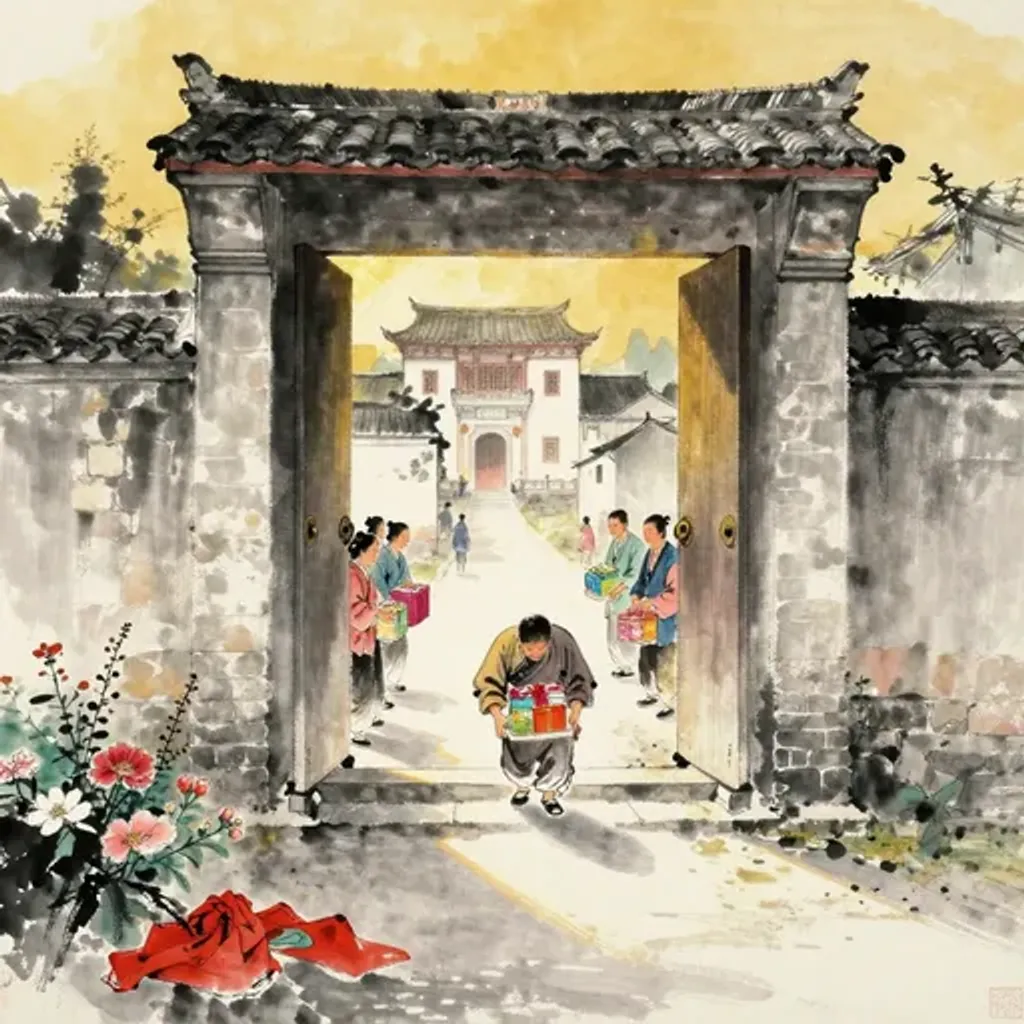
迎福開戶,喜隨我後。曹伯愷悌,為宋國主。
Opening the door to welcome fortune; joy follows close behind. Lord Cao, kind and brotherly, became the ruler of Song.
— Jiao Yanshou, Yilin (Forest of Changes), 1st century BC
Commentary
Fire on the mountain, and the door opens to welcome arriving fortune. Joy follows close behind. The verse names 'Cao Bo' — a ruler of the state of Cao — who through fraternal virtue and harmonious conduct became lord of Song. The precise historical identification is debated, but the pattern is clear: a wanderer from one state, by virtue of his character, wins the trust and sovereignty of another. From The Wanderer to The Abysmal, water flows upon water, peril doubled. Yet the verse is entirely auspicious, suggesting that within danger lies opportunity. The one who opens his door to fortune navigates the abyss successfully — not by avoiding risk but by meeting it with generosity and warmth that disarms suspicion.
旅 → 離
Hexagram 56 → Hexagram 30: The Clinging Fire
Changing lines: 1
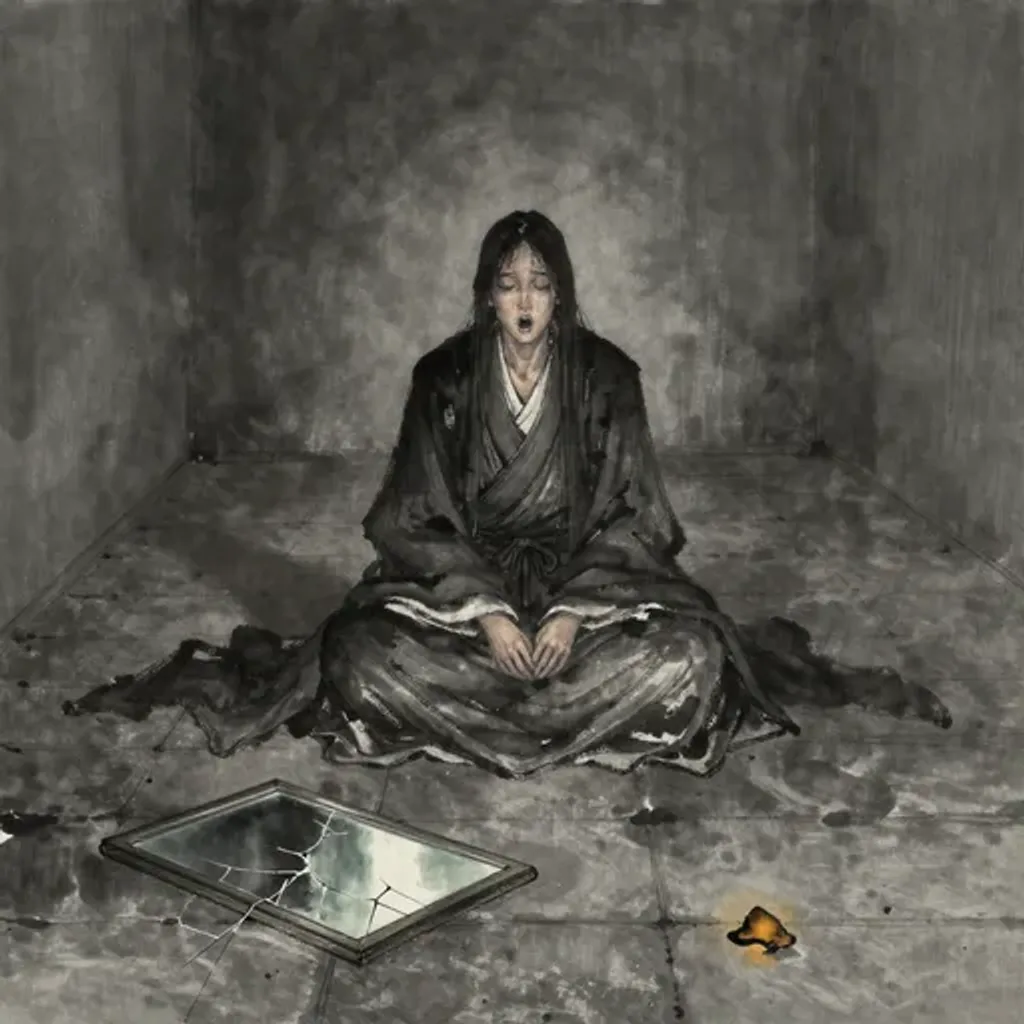
既痴且狂,兩目又盲。箕踞喑啞,名為无中。
Already foolish and already mad, both eyes also blind. Sitting sprawled and mute; named as one who has nothing within.
— Jiao Yanshou, Yilin (Forest of Changes), 1st century BC
Commentary
Fire on the mountain, and a man feigns madness to survive. Both crazed and raving, his eyes blind, he sprawls with legs spread in the insolent 'jiji' posture, mute and dumb, erasing himself from notice. This almost certainly alludes to the Viscount of Ji (箕子), uncle of the tyrant Zhou of Shang, who feigned insanity to escape execution at court. The phrase 'named as nothing' (名為無中) captures his strategy: make yourself invisible, become no one. From The Wanderer to The Clinging, doubled fire blazes in mutual illumination. Yet the verse describes the deliberate extinguishing of one's own light. The wisest response to a tyrant's court is to blind oneself, to become darkness within a house of fire.
旅 → 咸
Hexagram 56 → Hexagram 31: Influence
Changing lines: 5, 6
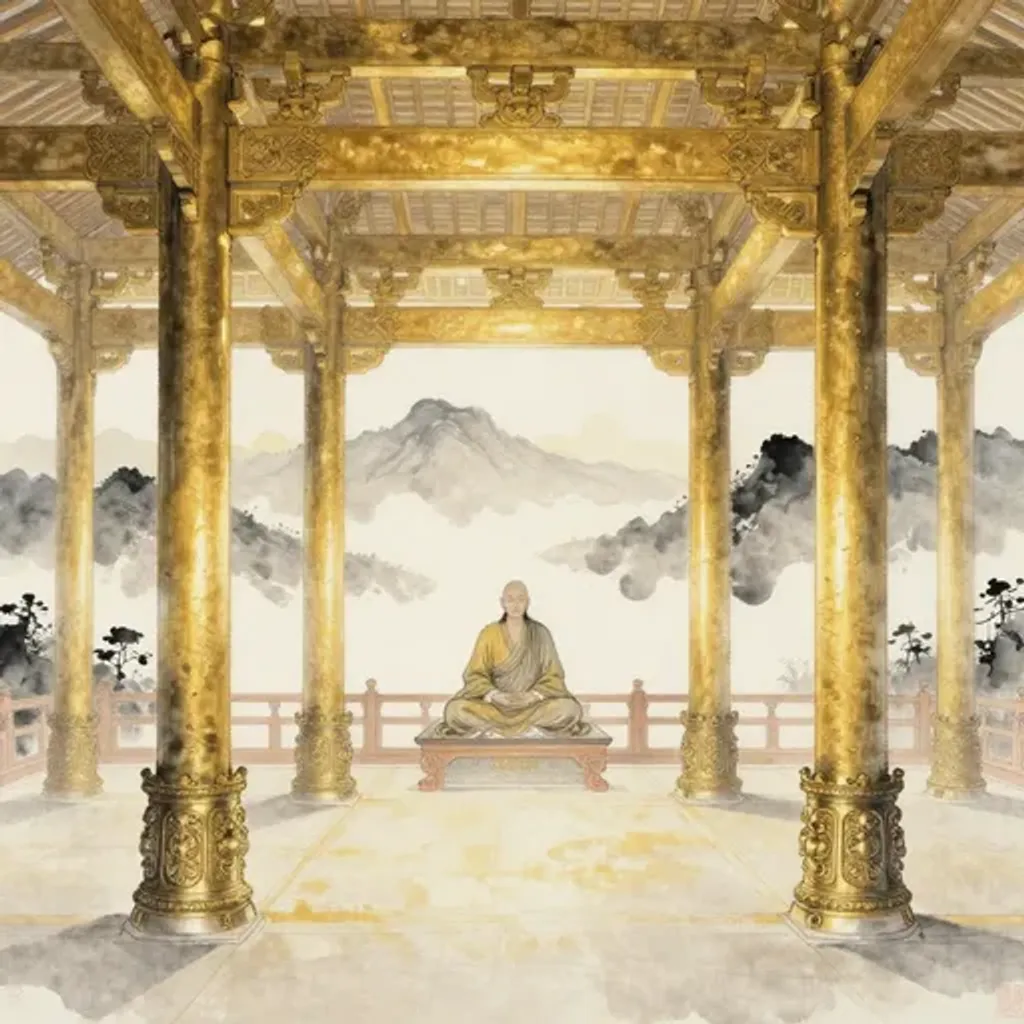
金梁銕柱,千年牢固。完全不腐,聖人安處。
Golden beams, iron pillars; steadfast for a thousand years. Whole and uncorrupted; the sage dwells there in peace.
— Jiao Yanshou, Yilin (Forest of Changes), 1st century BC
Commentary
Fire on the mountain, and below stands a structure built to last a thousand years. Golden beams and iron pillars — complete, incorruptible, unrotting — provide a dwelling where the sage rests in peace. This is architecture as permanence incarnate: no wanderer's tent or roadside inn, but a fortress of enduring materials. The verse offers the opposite of transience: what is built with the strongest elements need never be rebuilt. From The Wanderer to Influence, a lake rests atop the mountain, and the open heart receives all. The sage's secure dwelling is not a sealed vault but an open structure — firm in its foundations yet receptive at its summit. True permanence comes from influence that endures because its core is unshakable.
旅 → 恆
Hexagram 56 → Hexagram 32: Duration
Changing lines: 2, 6
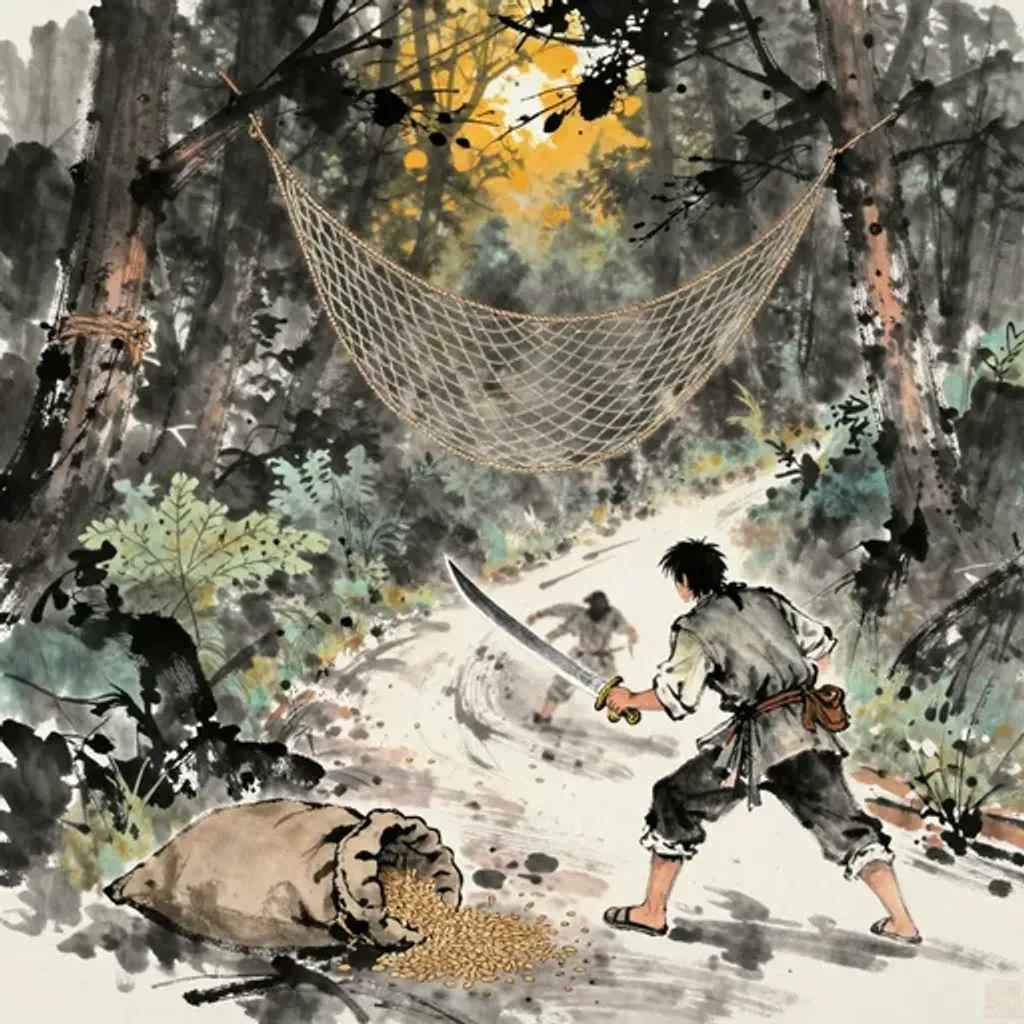
褁糗荷糧,與跖相逢。欲飛不得,為網所獲。
Wrapping rations and shouldering provisions, he meets the bandit Zhi on the road. Wishing to flee but unable; caught in the net.
— Jiao Yanshou, Yilin (Forest of Changes), 1st century BC
Commentary
Fire on the mountain, and a traveler carrying provisions encounters Robber Zhi on the road. Wrapping dried grain and shouldering supplies, he meets the legendary bandit chief, and though he longs to flee like a bird, the net has already closed. The verse captures the wanderer's worst nightmare: prepared for the journey but ambushed by lawlessness. Robber Zhi, the archetypal outlaw of Chinese tradition, represents pure predatory force that no amount of preparation can guard against. From The Wanderer to Duration, thunder and wind reinforce each other in constancy. Yet the traveler finds no constancy — only entrapment. Duration's lesson here is grimly inverted: the net that holds him is the one enduring thing in a world of violent caprice.
旅 → 遯
Hexagram 56 → Hexagram 33: Retreat
Changing lines: 5
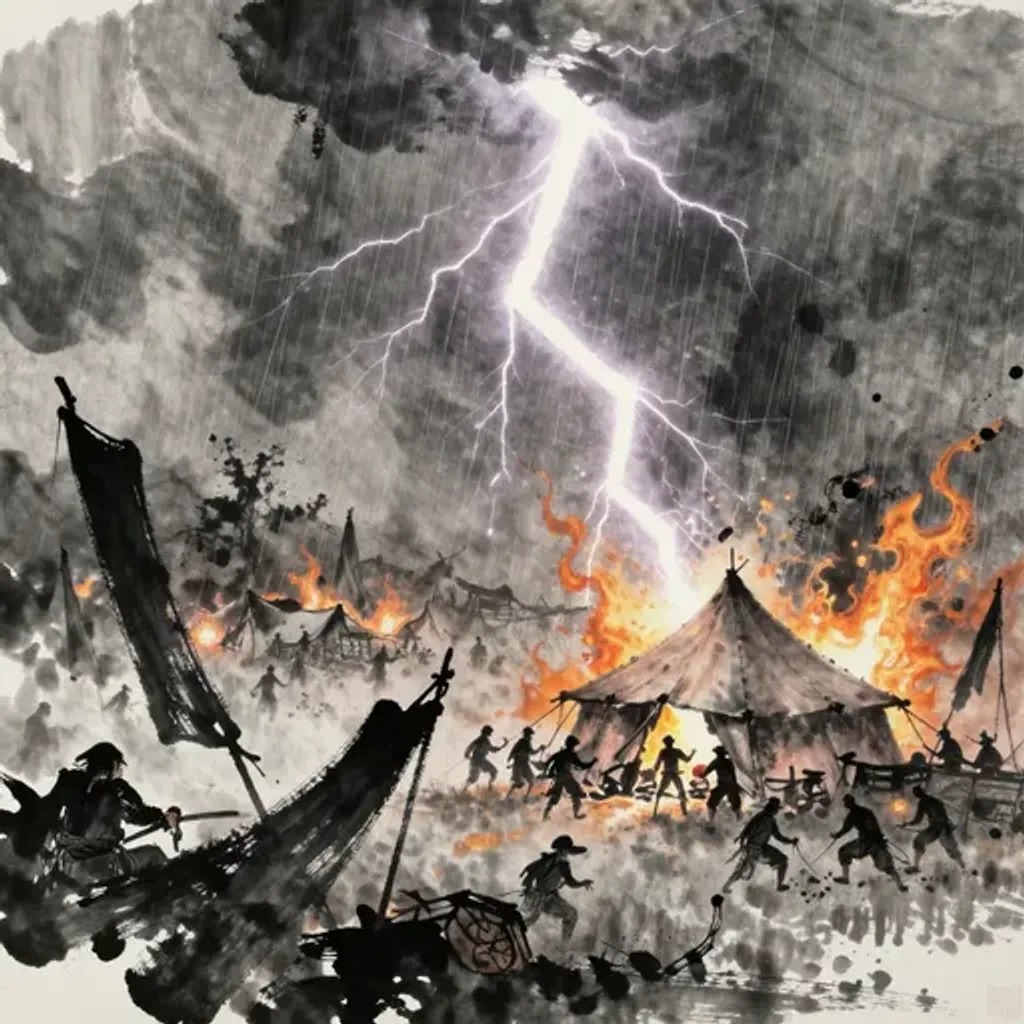
彭名為妖,暴龍作災。盜堯衣裳,聚跖荷兵。青禽照夜,三旦夷亡。
Black banners cover the fields — bandits gather their camp. Beacon fires burn for three months, nights without peace. Suddenly heavenly thunder splits the commander's tent — the bandits scatter in all directions, wailing like ghosts.
— Jiao Yanshou, Yilin (Forest of Changes), 1st century BC
Commentary
Fire on the mountain, and the original verse names Peng Ming as a demonic force, a violent dragon bringing catastrophe. Bandits steal the garments of sage-kings and gather armies under the banner of stolen legitimacy. Then the 'blue bird illuminates the night' — a dawn omen or celestial intervention — and after three dawns the barbarians are destroyed. The verse describes usurpers who dress themselves in Yao's robes while wielding Robber Zhi's weapons, false order masking true chaos. From The Wanderer to Retreat, heaven rises above the mountain, and the gentleman distances himself from petty men. The celestial strike that scatters the bandits enacts Retreat's principle: darkness disperses not through confrontation but through the return of authentic light.
旅 → 大壯
Hexagram 56 → Hexagram 34: Great Power
Changing lines: 1, 2, 6
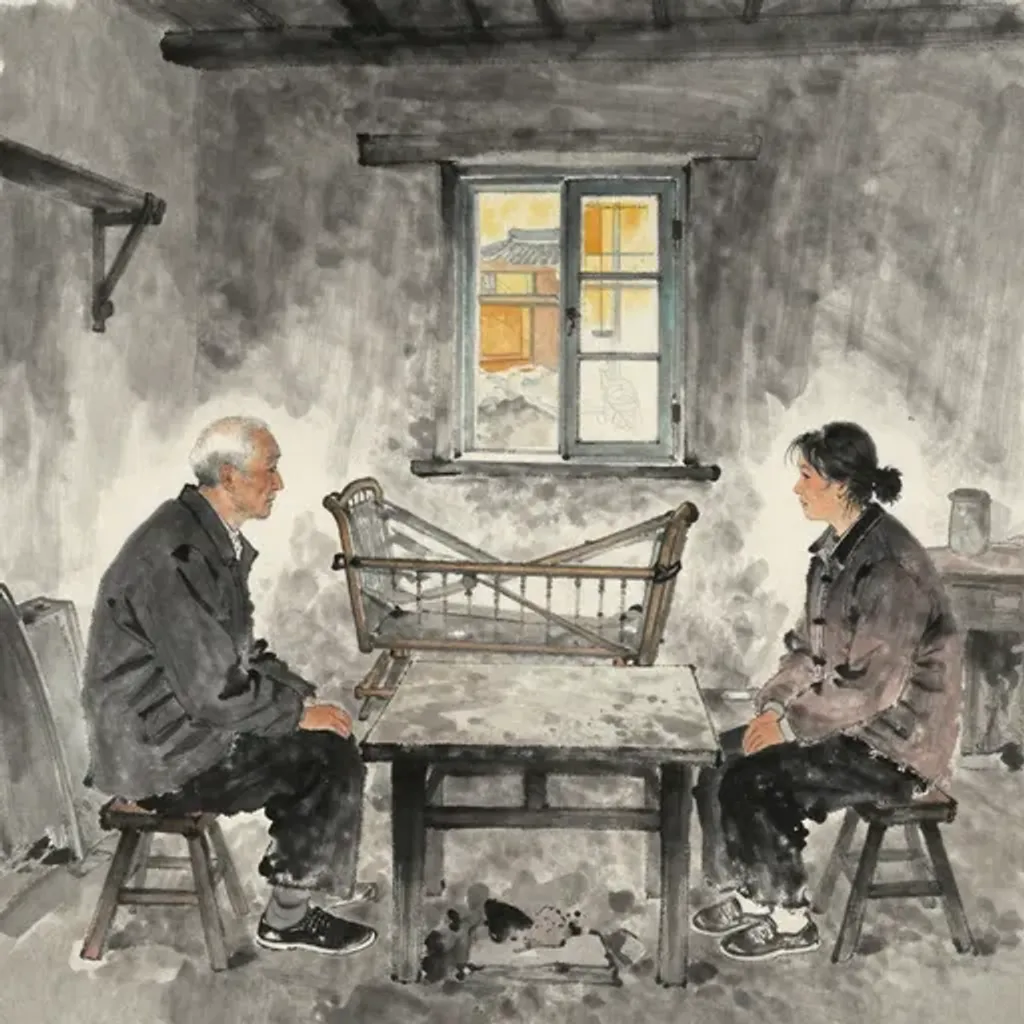
獨夫老婦,不能生子,鰥寡俱處。
A solitary old man and an aged widow, unable to bear children; widower and widow dwelling together.
— Jiao Yanshou, Yilin (Forest of Changes), 1st century BC
Commentary
Fire on the mountain, and below a solitary old man and a solitary old woman share a dwelling but cannot produce an heir. Alone, widowed, they keep each other company in barren coexistence. The verse distills desolation into three lines: no future, no continuity, only the companionship of mutual decline. From The Wanderer to Great Power, thunder roars above heaven in a display of overwhelming yang energy. Yet the verse presents the absolute negation of that power — a union that generates nothing, strength that cannot propagate. Great Power misapplied produces only noise without issue. The wanderer paired with the wrong partner finds that even proximity cannot substitute for genuine generative capacity.
旅 → 晉
Hexagram 56 → Hexagram 35: Progress
Changing lines: 3
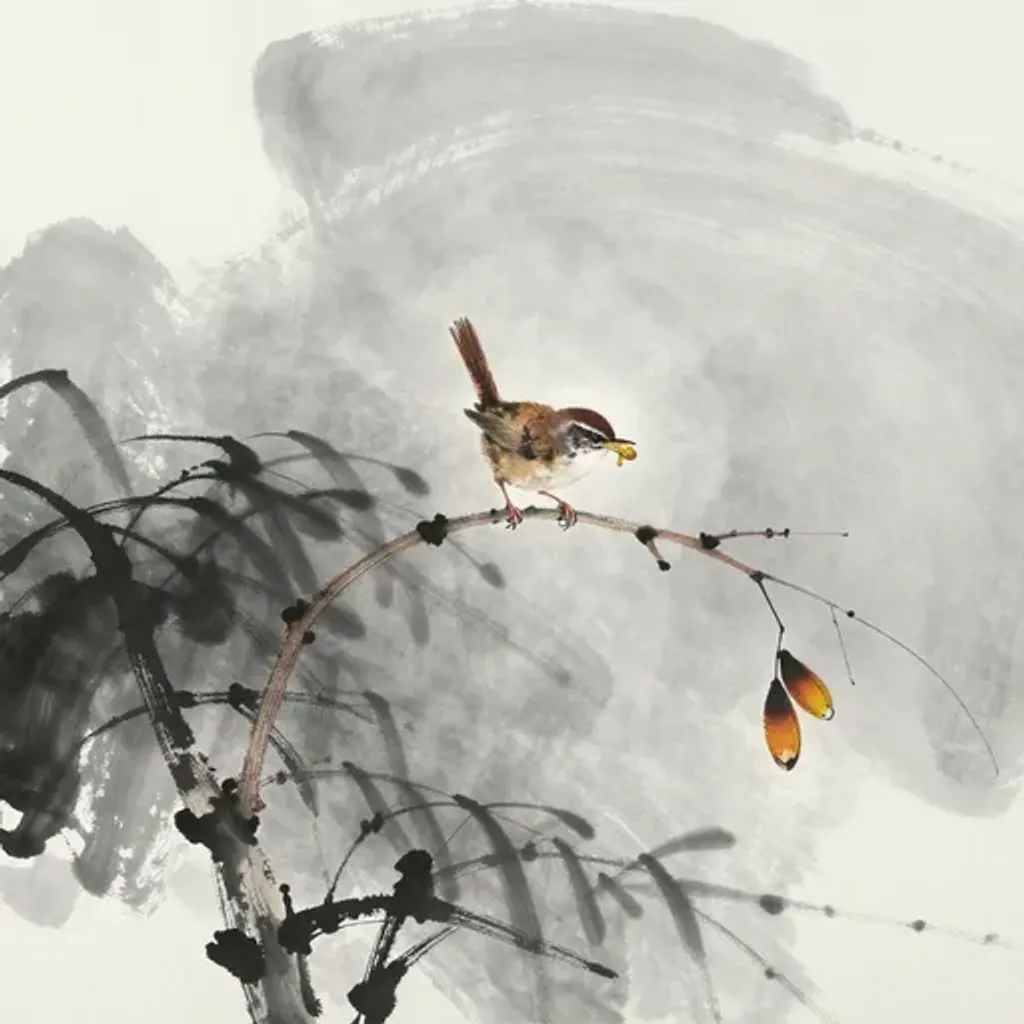
鷦鷯竊脂,巢於小枝。搖動不安,為風所吹,心寒飄搖,常憂危殆。
The wren steals fat and nests upon a slender twig. Shaken and uneasy, blown by the wind; the heart chills, tossed about, ever fearing peril.
— Jiao Yanshou, Yilin (Forest of Changes), 1st century BC
Commentary
Fire on the mountain, and a tiny wren perches on the thinnest branch, swaying in the wind. The wren (鷦鷯) steals grease for its nest, building upon a twig too slender to bear even its slight weight. Wind buffets it ceaselessly; cold pierces its heart, and it lives in constant fear of falling. The image captures the wanderer in the most precarious possible position — a creature that has built its entire existence on something fundamentally insufficient. From The Wanderer to Progress, fire rises above the earth, illuminating upward. Yet the wren cannot advance; it clings to a trembling perch. Progress demands a solid foundation from which brightness can emerge. Those who build on twigs may see the dawn but cannot greet it standing.
旅 → 明夷
Hexagram 56 → Hexagram 36: Darkening of the Light
Changing lines: 1, 4, 6
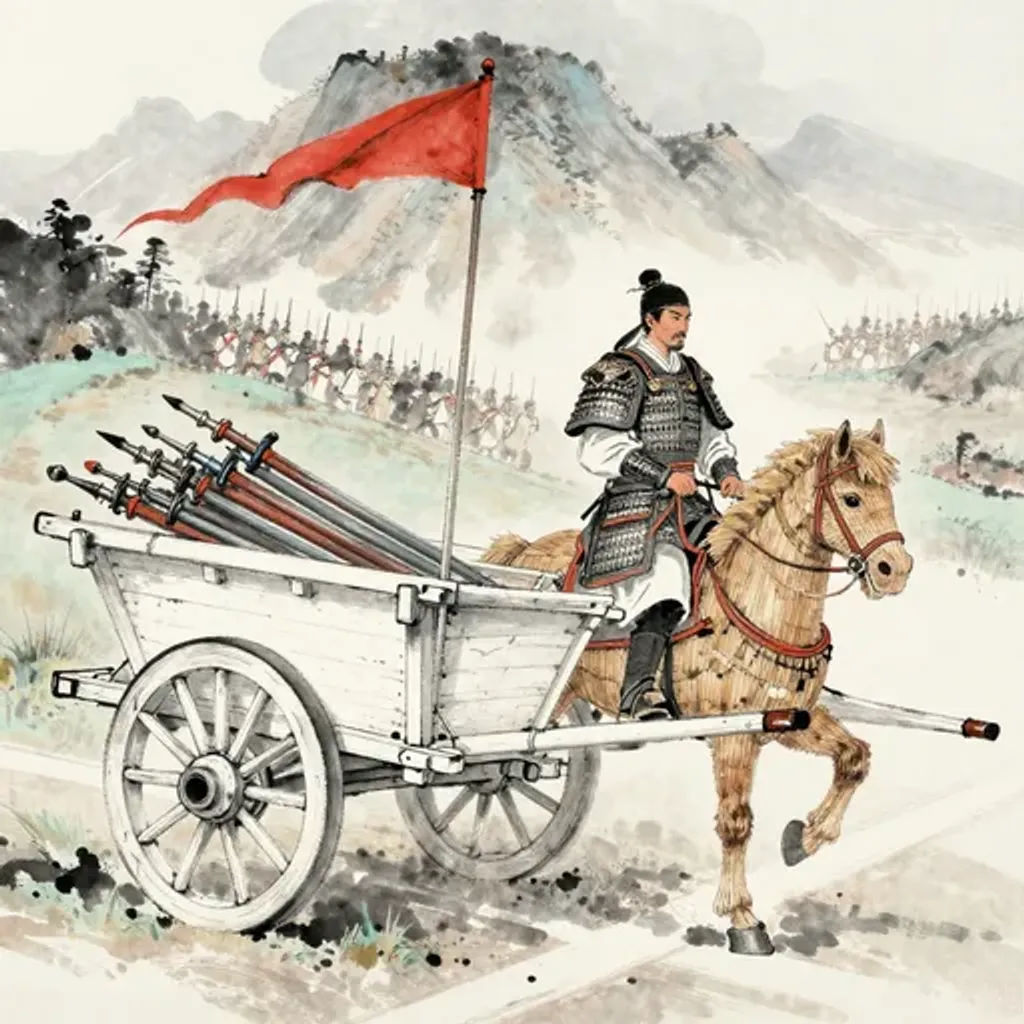
素車木馬,不任負重。王子出征,憂危為咎。
A plain cart, a wooden horse, unfit to bear heavy loads. The prince sets out on campaign; worry and peril bring blame.
— Jiao Yanshou, Yilin (Forest of Changes), 1st century BC
Commentary
Fire on the mountain, and a wooden horse pulls a paper chariot. 'Unplastered cart, wooden horse' — vehicles of ritual burial, meant for the dead, not the living. They cannot bear real weight or endure a real journey. A prince sets out on campaign with such equipment, and the result is predictable: anxiety and danger become his undoing. The verse warns against attempting serious ventures with inadequate resources — funerary props mistaken for functional tools. From The Wanderer to Darkening of the Light, fire sinks into the earth, brilliance deliberately concealed. The prince's expedition fails because it was never equipped for reality; the light that should guide him is buried beneath the pretense of readiness.
旅 → 家人
Hexagram 56 → Hexagram 37: The Family
Changing lines: 1, 4, 5
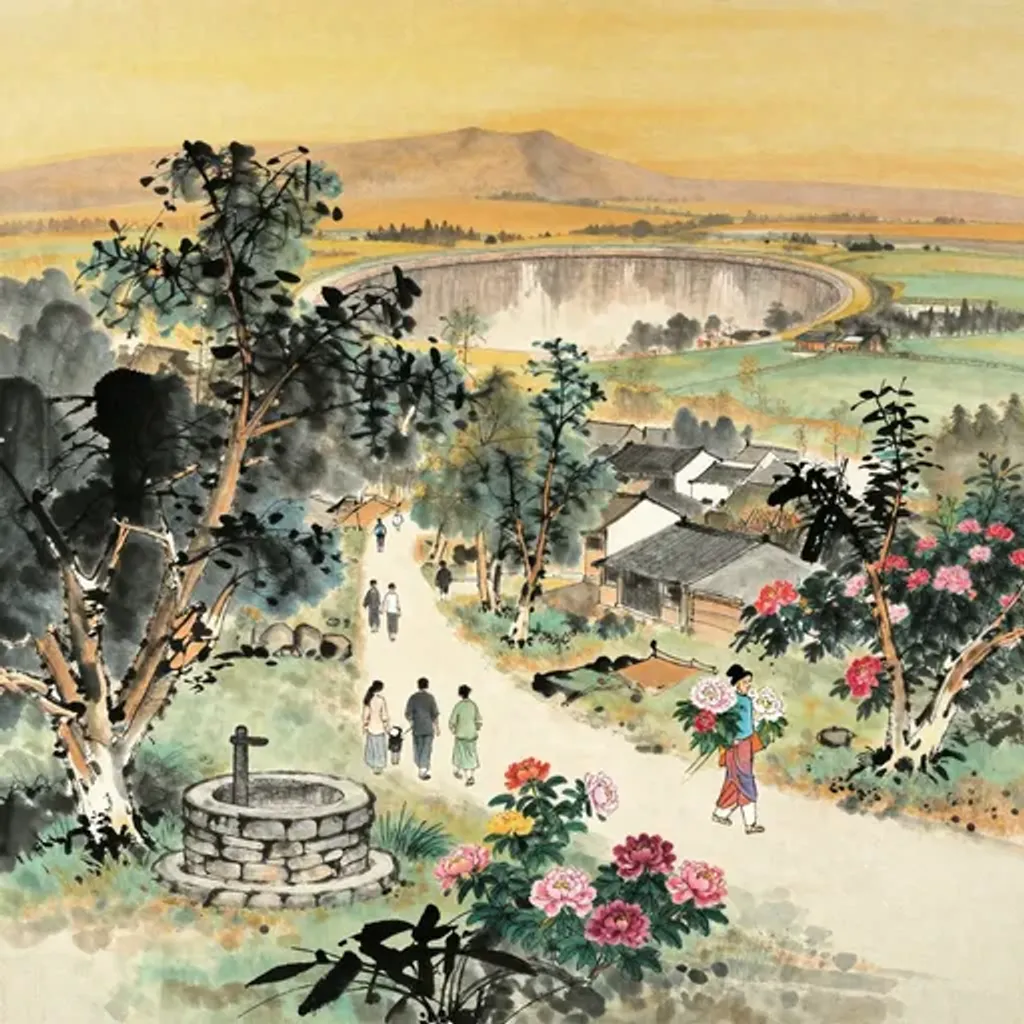
土陷四維,安平不危。利以居止,保有玉女。
The earth sinks at the four edges; peaceful and level, without peril. Favorable for settling and staying; one keeps a jade maiden safe.
— Jiao Yanshou, Yilin (Forest of Changes), 1st century BC
Commentary
Fire on the mountain, and the four corners of the earth settle into tranquil stability. Though the ground has shifted at its edges, the center holds — level, peaceful, free from peril. It is advantageous to dwell here, and a jade-like maiden awaits. The verse presents the wanderer's ultimate reward: after upheaval at the periphery, the heartland remains secure, offering both safety and domestic happiness. From The Wanderer to The Family, wind rises from fire, warmth radiating outward as gentle influence. The traveler who finds his way home discovers that true security lies within the household. The 'jade maiden' symbolizes refined domestic virtue — the family that one builds after wandering is the lasting treasure.
旅 → 睽
Hexagram 56 → Hexagram 38: Opposition
Changing lines: 1, 2, 3
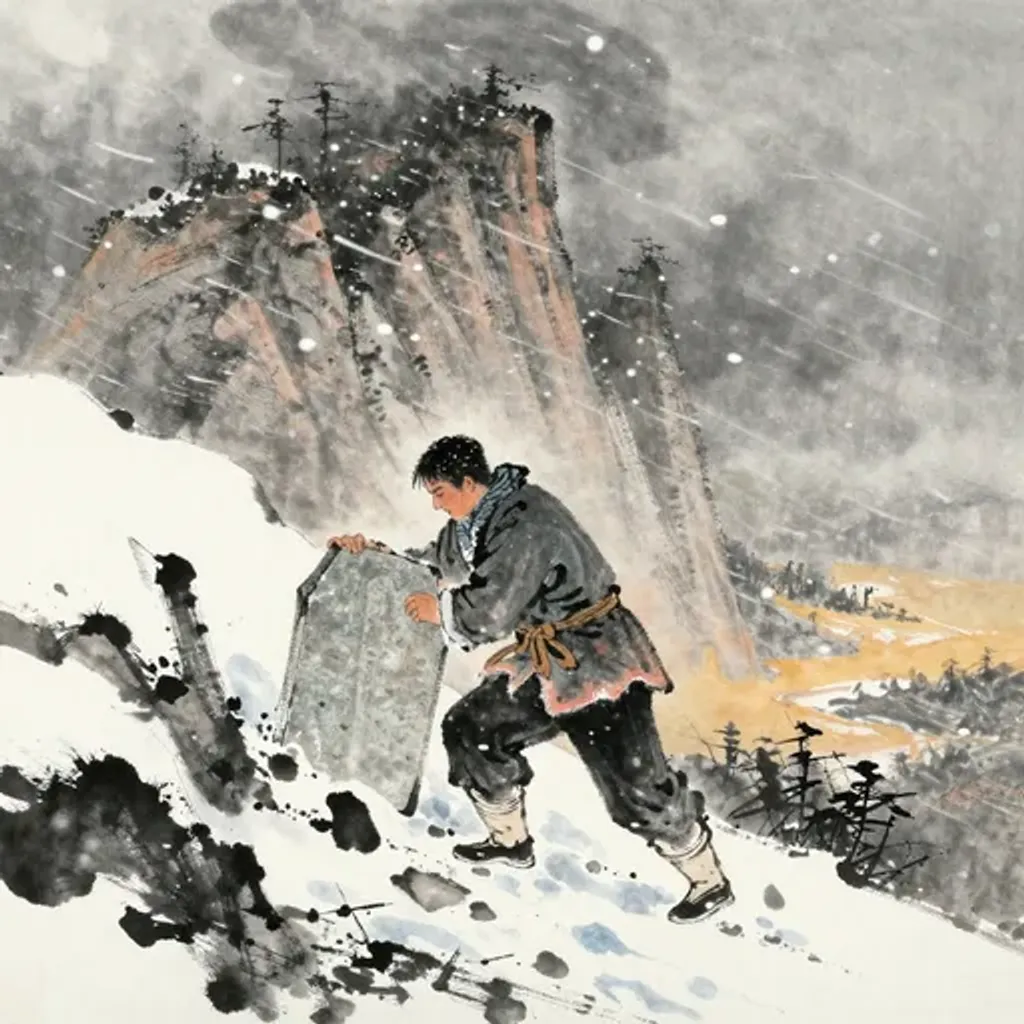
負牛上山,力劣行難。烈風雨雪,遮遏我前。中道復還。
Shouldering a stone stele up a sheer cliff — knees buckling, waist bent, sweat like mud. Blizzard seals the path, three steps backward for each one. Abandoning the stele, descending — the person is already spent.
— Jiao Yanshou, Yilin (Forest of Changes), 1st century BC
Commentary
Fire on the mountain, and a man drives an ox up a steep slope. The original verse — 'Shouldering an ox up the mountain, strength fails and travel grows hard; fierce wind and driving snow block the way ahead; midway, he turns back' — paints a picture of doomed overexertion. The traveler attempts the impossible, loading himself with a burden too great for the terrain, and nature itself intervenes to force retreat. From The Wanderer to Opposition, fire and lake pull in contrary directions, each evaporating the other. The verse embodies Opposition's irreconcilable tension: the upward effort meets the downward pull, and the blizzard seals the impasse. Sometimes the wisest opposition is to oppose one's own stubbornness and turn around.
旅 → 蹇
Hexagram 56 → Hexagram 39: Obstruction
Changing lines: 4, 5, 6
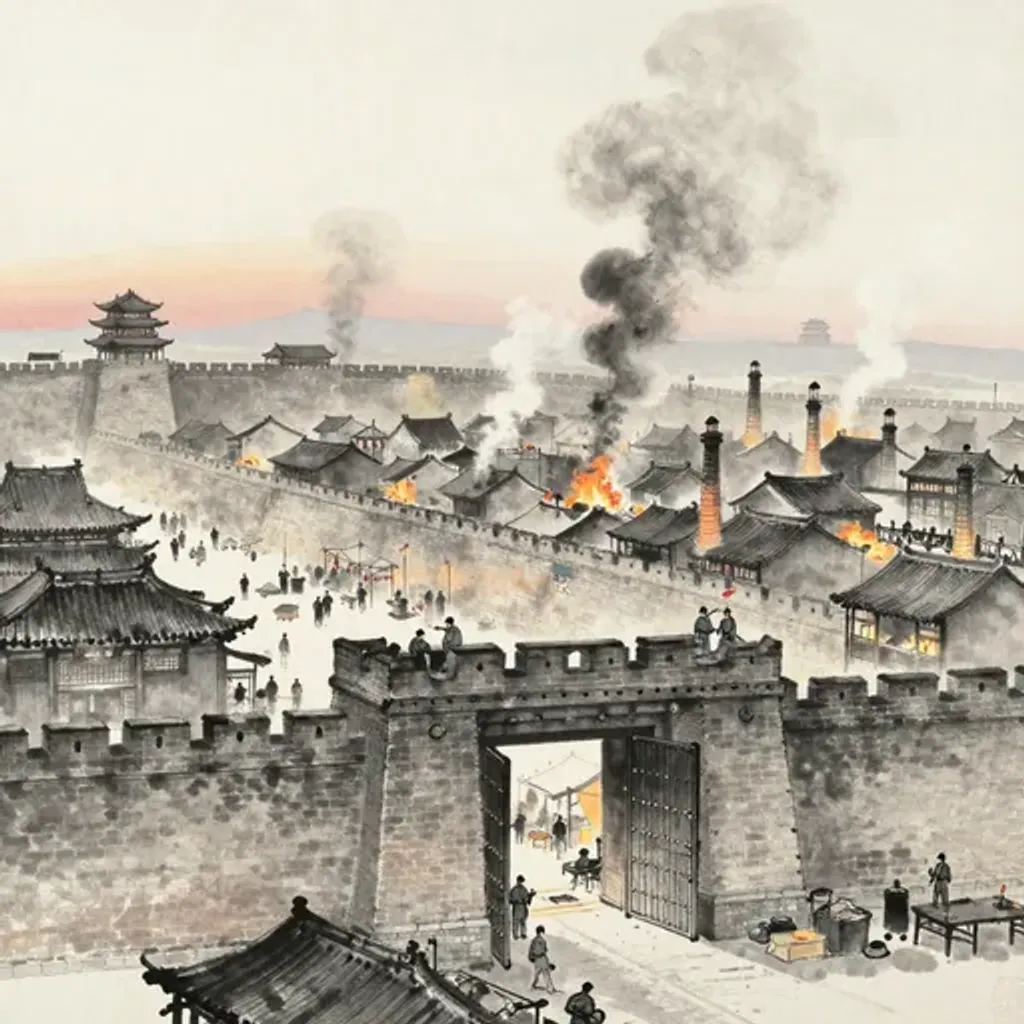
金城銕郭,上下同力。政平民親,寇不敢賊。
Bronze walls and iron battlements, solid as a mountain. The garrison patrols through the night without sleep. The people dwell in peace — cooking smoke rises. The four gates stand open, never needing to close.
— Jiao Yanshou, Yilin (Forest of Changes), 1st century BC
Commentary
Fire on the mountain, and below the mountain a city of metal and iron stands impregnable. The original verse — 'Metal walls and iron ramparts, high and low united in strength; governance is just, the people are close, and bandits dare not attack' — presents the ideal defended settlement. The wanderer here is not the one inside the walls but the threat outside: the city's unity of purpose renders it invulnerable. From The Wanderer to Obstruction, water gathers above the mountain, blocking the path forward. Yet the verse transforms obstruction into strength: what appears as a barrier to the enemy is security for the inhabitants. The mountain's water becomes a moat; the difficulty of approach becomes the city's greatest asset.
旅 → 解
Hexagram 56 → Hexagram 40: Deliverance
Changing lines: 2, 3, 6
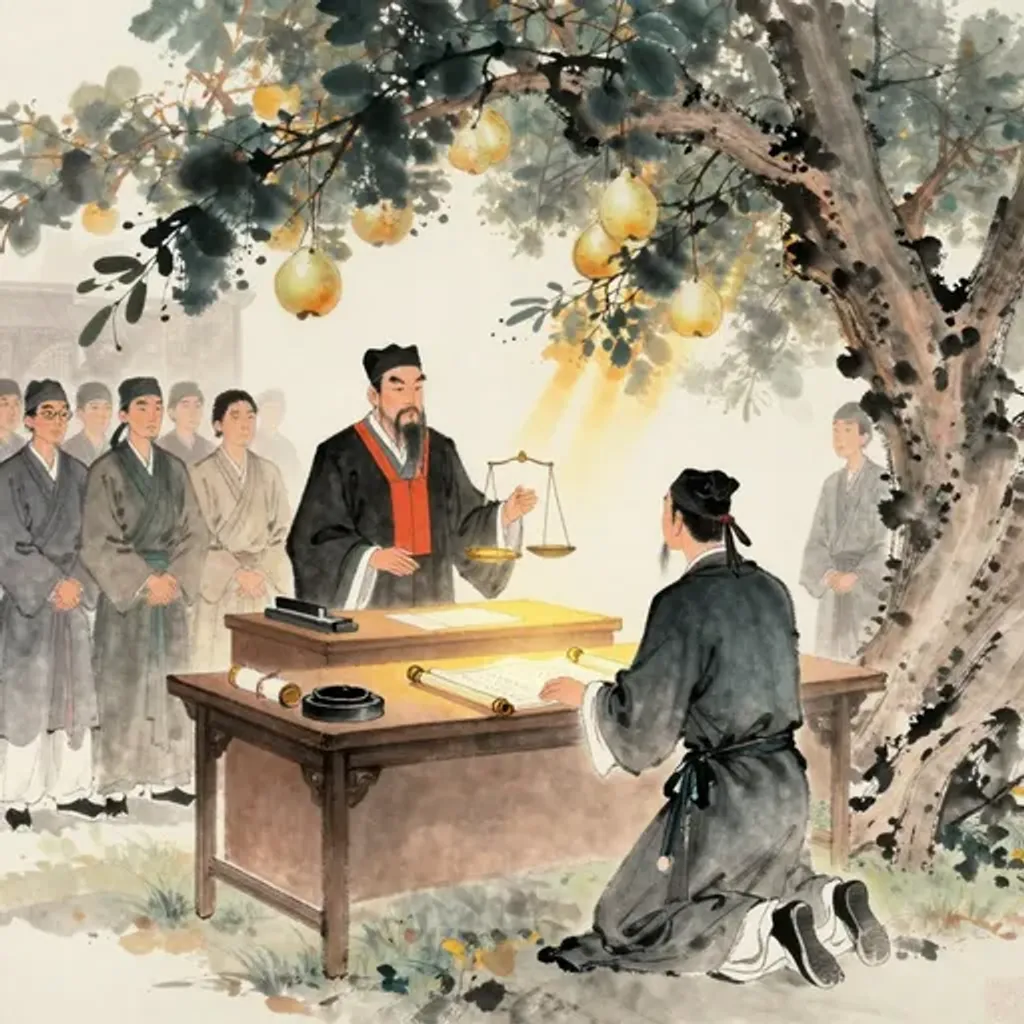
清潔淵塞,為人所言。證訊詰問,繫於枳溫。甘棠聽斷,昭然蒙恩。
Pure and honest yet slandered, spoken against by others. Questioned and interrogated, bound at Zhiwen. Under the wild pear tree justice was heard; clearly and brightly, grace was bestowed.
— Jiao Yanshou, Yilin (Forest of Changes), 1st century BC
Commentary
Fire on the mountain, and a case of slander is brought to trial. Someone of clean reputation finds himself accused and interrogated, bound at a place of detention. But then the verse pivots to the 'Sweet Pear Tree' (甘棠) — the Shijing ode celebrating the Duke of Shao, who dispensed justice under its branches with such wisdom that the people preserved the tree after his death. Under such judicious hearing, the truth emerges and grace descends. From The Wanderer to Deliverance, thunder and rain erupt together, washing clean. The falsely accused wanderer is delivered: like a spring thunderstorm breaking a drought, the just verdict pardons the innocent and restores what slander had stolen.
旅 → 損
Hexagram 56 → Hexagram 41: Decrease
Changing lines: 1, 2, 3, 4
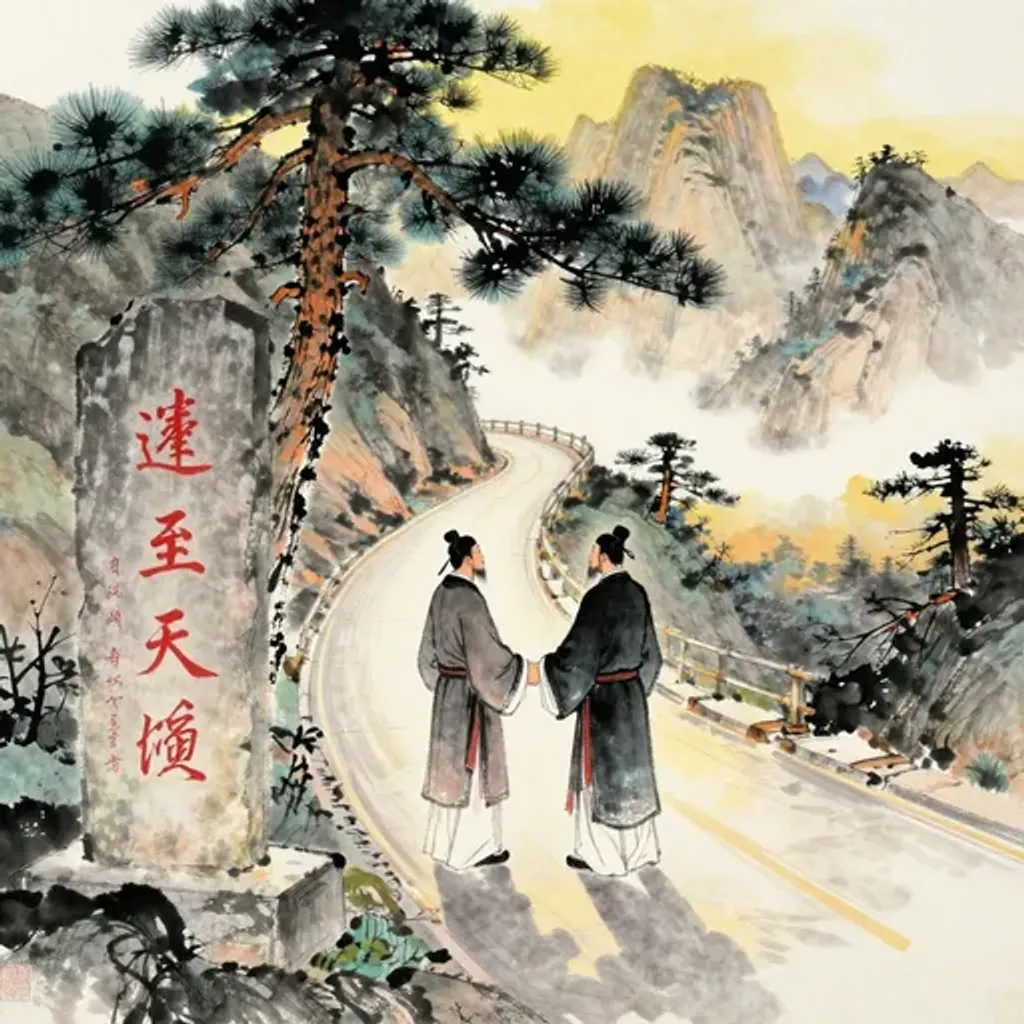
皋陶聽理,岐伯悅喜。西登華道,東歸无咎。
Gao Yao attends to justice; Qi Bo is pleased and glad. Ascending west on the road to Hua; returning east without fault.
— Jiao Yanshou, Yilin (Forest of Changes), 1st century BC
Commentary
Fire on the mountain, and two legendary ministers of justice preside over a harmonious age. Gao Yao, the sage-judge of Shun's court, hears cases with impartial clarity, while Qi Bo, the Yellow Emperor's physician, rejoices at the people's well-being. The verse then traces a journey: ascending westward along the Hua mountain road, then returning eastward without mishap. The wanderer who travels under the protection of just governance and wise counsel can venture far and return safely. From The Wanderer to Decrease, the mountain towers above the lake, and the wise man restrains his anger and curbs desire. The sage-ministers' work is itself a form of Decrease: by cutting away injustice and disease, they make the whole system lighter and more just.
旅 → 益
Hexagram 56 → Hexagram 42: Increase
Changing lines: 1, 3, 4, 5
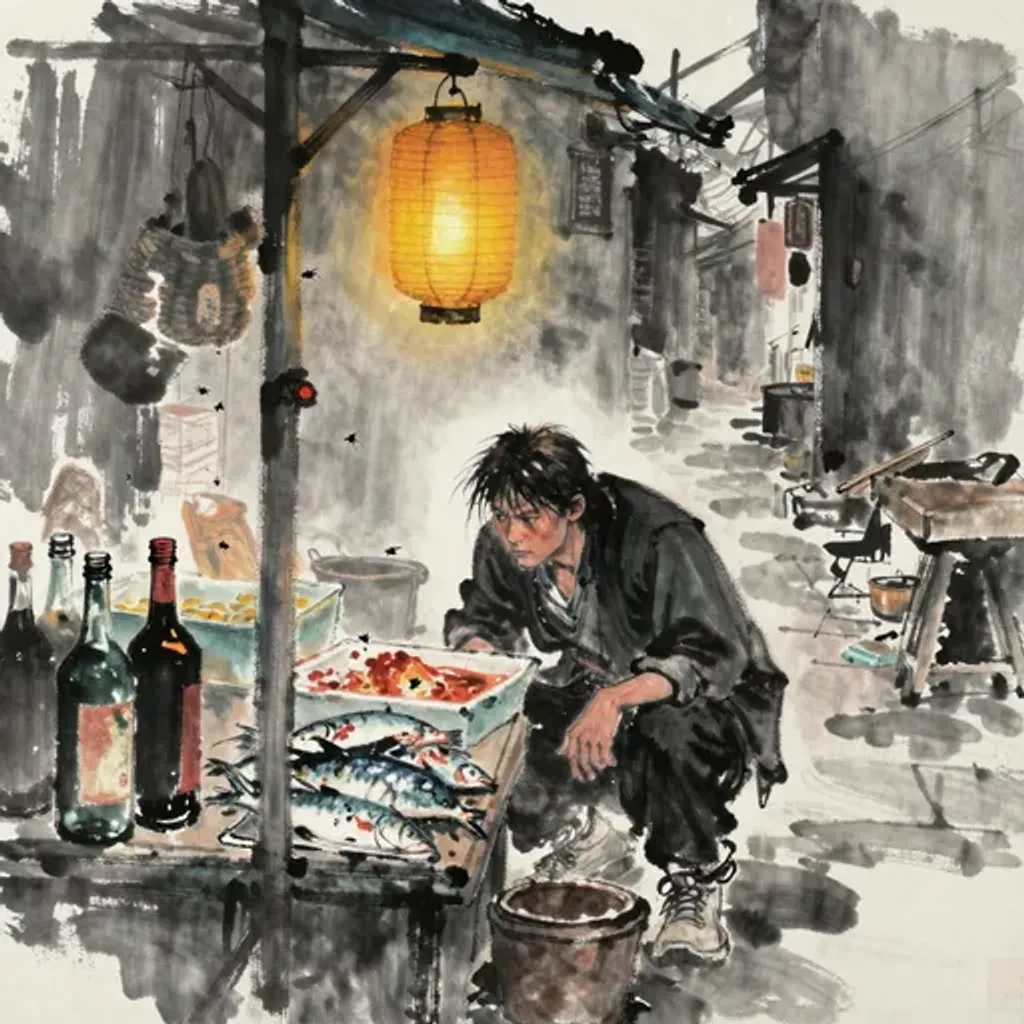
低頭竊視,有所畏避。行作未利,酒酸魚敗,重莫貪嗜。
Bowing the head, stealing a glance; there is something feared and avoided. Actions bring no profit; the wine has soured, the fish is spoiled. Better not to crave such things.
— Jiao Yanshou, Yilin (Forest of Changes), 1st century BC
Commentary
Fire on the mountain, and the traveler moves furtively, eyes downcast, full of fear. He glances about with lowered head, avoiding notice, dreading some unseen threat. His ventures yield nothing profitable; the wine has soured and the fish has spoiled — yet still he must resist the temptation to consume what is rotten. From The Wanderer to Increase, wind and thunder combine to inspire improvement — the gentleman sees the good and follows it, recognizes error and corrects it. Yet this traveler is trapped in a cycle of fear and spoiled opportunity. Increase demands discernment: the courage to reject what appears nourishing but is in fact corrupt. Refusing rotten fare may feel like deprivation, but it is the first step toward genuine gain.
旅 → 夬
Hexagram 56 → Hexagram 43: Breakthrough
Changing lines: 1, 2, 5, 6
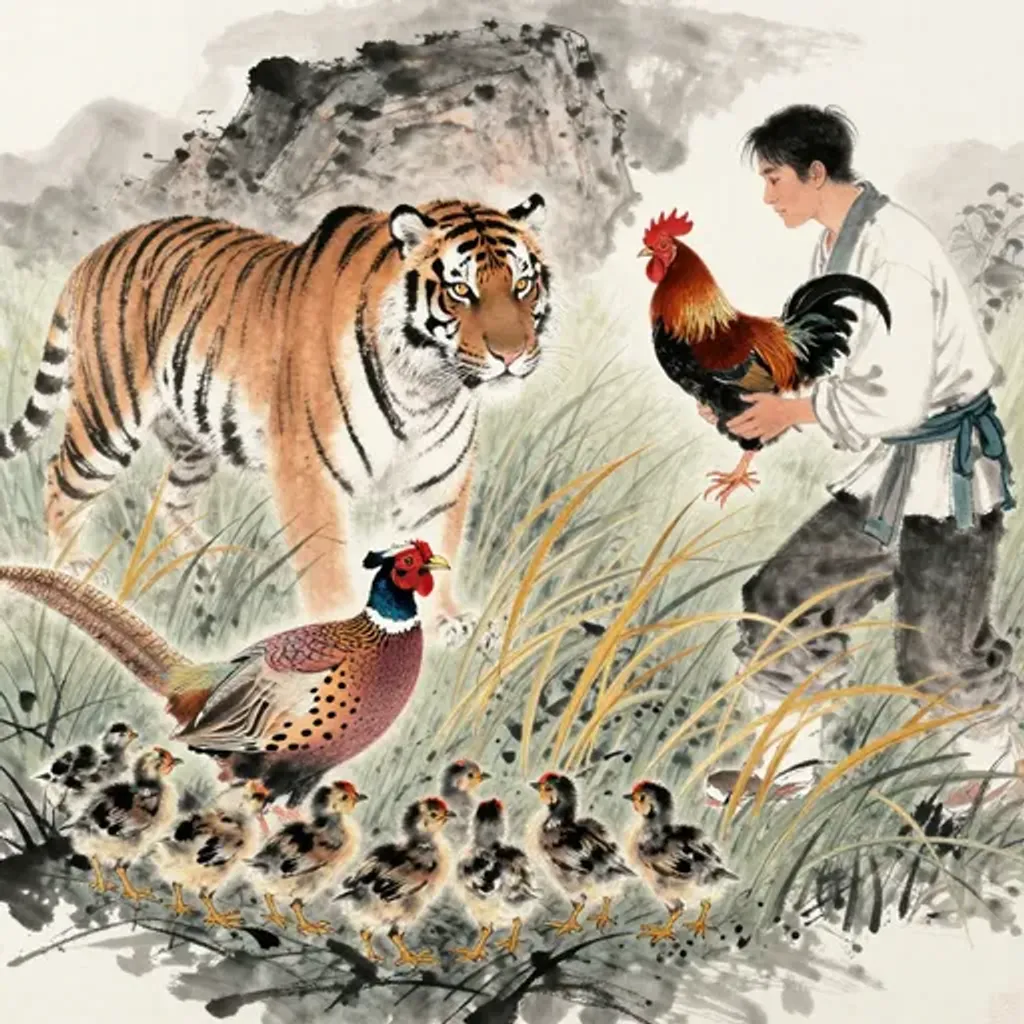
十雉百雛,常與母俱。抱雞搏虎,誰肯為侶?
Ten pheasants, a hundred chicks, always with the mother. Clutching a rooster to fight a tiger — who would be his companion?
— Jiao Yanshou, Yilin (Forest of Changes), 1st century BC
Commentary
Fire on the mountain, and a mother pheasant leads ten young and a hundred chicks, all clustered close. Then the verse pivots sharply: 'Clutching a chicken to fight a tiger — who would be your companion in that?' The contrast is devastating. The nurturing hen with her brood represents natural order and protective instinct; the madman clutching a chicken against a tiger represents suicidal folly that no one will join. From The Wanderer to Breakthrough, the lake surges above heaven, a torrent of decisive yang energy. But Breakthrough demands the right weapon and the right allies. The traveler who faces overwhelming force with ludicrously inadequate means finds himself abandoned — no one follows a fool into certain death.
旅 → 姤
Hexagram 56 → Hexagram 44: Coming to Meet
Changing lines: 2, 5
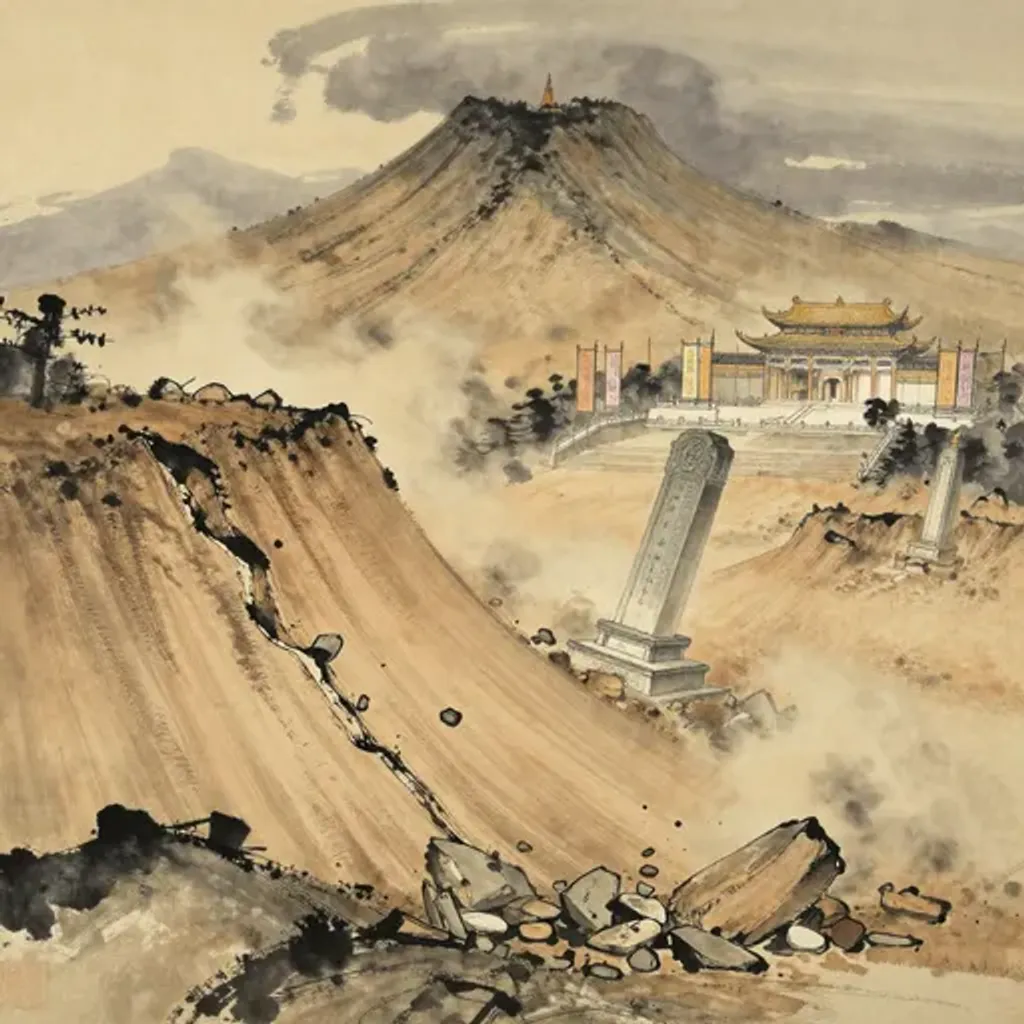
高阜山陵,陂陁顛崩。為國妖祥,元后以薨。
High mounds and mountain ridges, slopes collapsing and peaks crumbling. An ill omen for the realm; the sovereign thereby perishes.
— Jiao Yanshou, Yilin (Forest of Changes), 1st century BC
Commentary
Fire on the mountain, and the high mounds and ridges suddenly crack and collapse. This becomes a portent for the state — an ill omen of the highest order — and the sovereign perishes. Mountain collapse was understood in Han cosmology as a direct sign of dynastic catastrophe: when the earth itself cannot hold its shape, the mandate of heaven is withdrawing. From The Wanderer to Coming to Meet, wind stirs beneath heaven, and the king issues commands to all quarters. Yet the verse describes the moment before that authority shatters. The sovereign dies because the very ground of his legitimacy has given way. Coming to Meet warns against the yin force rising unexpectedly — here, it rises as geological disaster, the earth itself turning treacherous.
旅 → 萃
Hexagram 56 → Hexagram 45: Gathering Together
Changing lines: 3, 5, 6
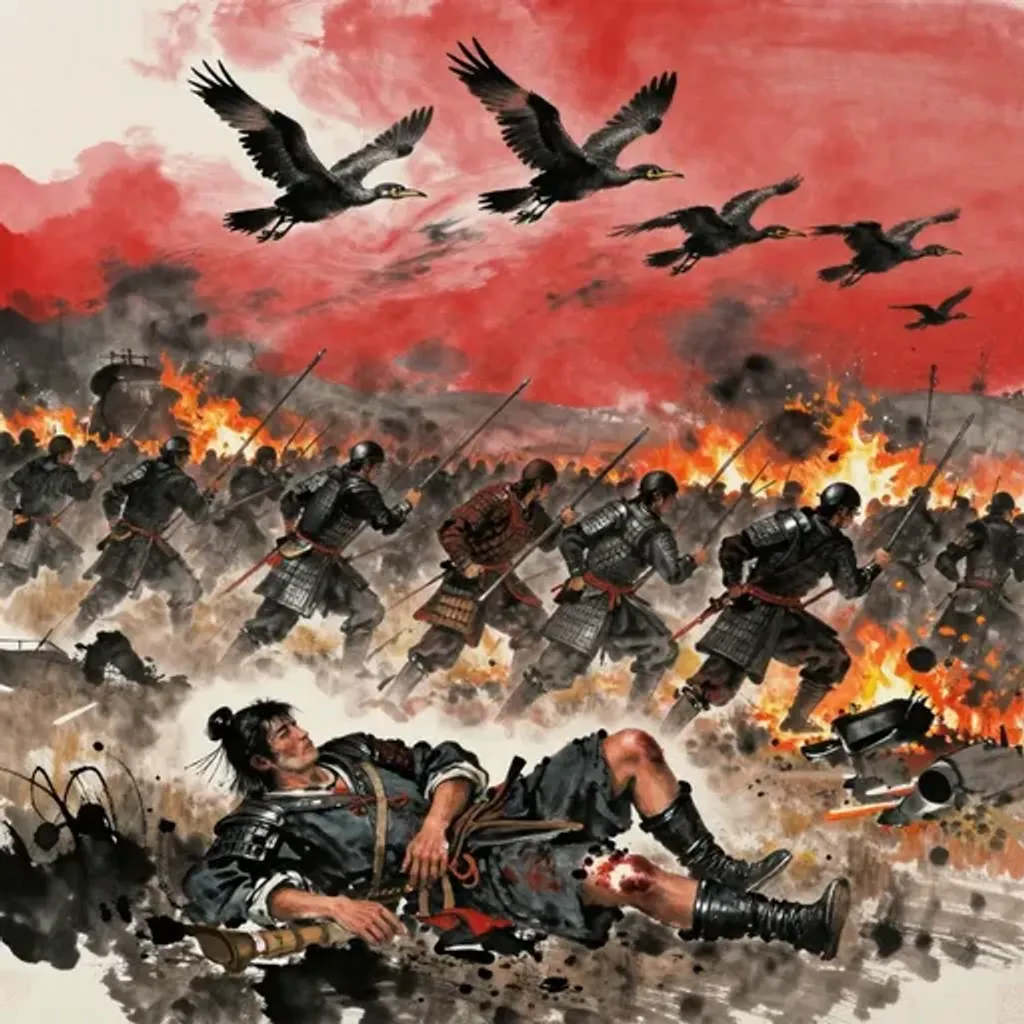
六鷁退飛,為衰敗祥。陳師合戰,左股疾傷。遂以薨崩,霸功不成。
Six cormorants fly backward — an omen of decay and defeat. Marshaling troops for battle, the left thigh is wounded. Thereupon he falls and dies; his hegemony is not achieved.
— Jiao Yanshou, Yilin (Forest of Changes), 1st century BC
Commentary
Fire on the mountain, and six fishhawks fly backward — an omen of decline and defeat. According to the Zuo Zhuan, in 644 BC six yi-birds were blown backward over the Song capital, a portent that the interior scribe of Zhou interpreted for Duke Xiang of Song. The verse then describes a campaign: mustering troops and joining battle, the commander suffers a wound to his left thigh and ultimately perishes, his hegemonic ambitions unfulfilled. Duke Xiang of Song, who insisted on fighting honorably against Chu at the Battle of Hong River (638 BC), was wounded in that very leg and died shortly after. From The Wanderer to Gathering, the lake collects upon the earth. Yet what gathers here is not strength but misfortune — omens accumulate until they overwhelm.
旅 → 升
Hexagram 56 → Hexagram 46: Pushing Upward
Changing lines: 2, 4, 6
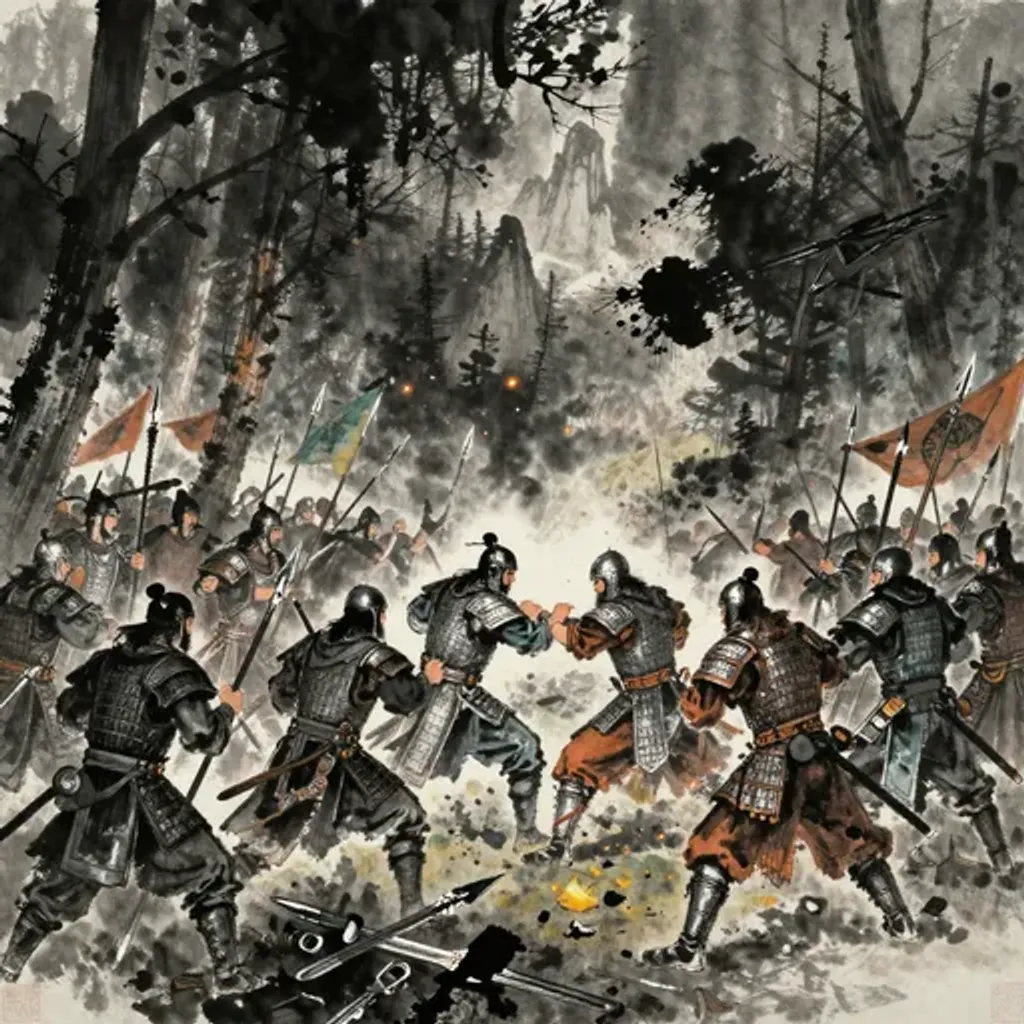
異國殊俗,情不相得。金木為仇,百戰檀穀。
Foreign lands, alien customs; feelings that find no accord. Metal and wood as mortal enemies; a hundred battles in the sandalwood valley.
— Jiao Yanshou, Yilin (Forest of Changes), 1st century BC
Commentary
Fire on the mountain, and the traveler enters a land of alien customs where feelings cannot connect. Metal and wood are natural enemies — they war endlessly at a place called Tangu. The verse describes the fundamental incompatibility between foreign peoples and foreign ways: no common ground, no shared sentiment, only perpetual friction. 'A hundred battles at Tangu' suggests an exhausting, inconclusive frontier conflict. From The Wanderer to Pushing Upward, wood rises through the earth in quiet, steady growth. Yet the verse denies this progress: when the elements themselves are at war, no upward movement is possible. The wanderer in hostile territory cannot take root because the very soil resists his nature.
旅 → 困
Hexagram 56 → Hexagram 47: Oppression
Changing lines: 2, 3, 5, 6
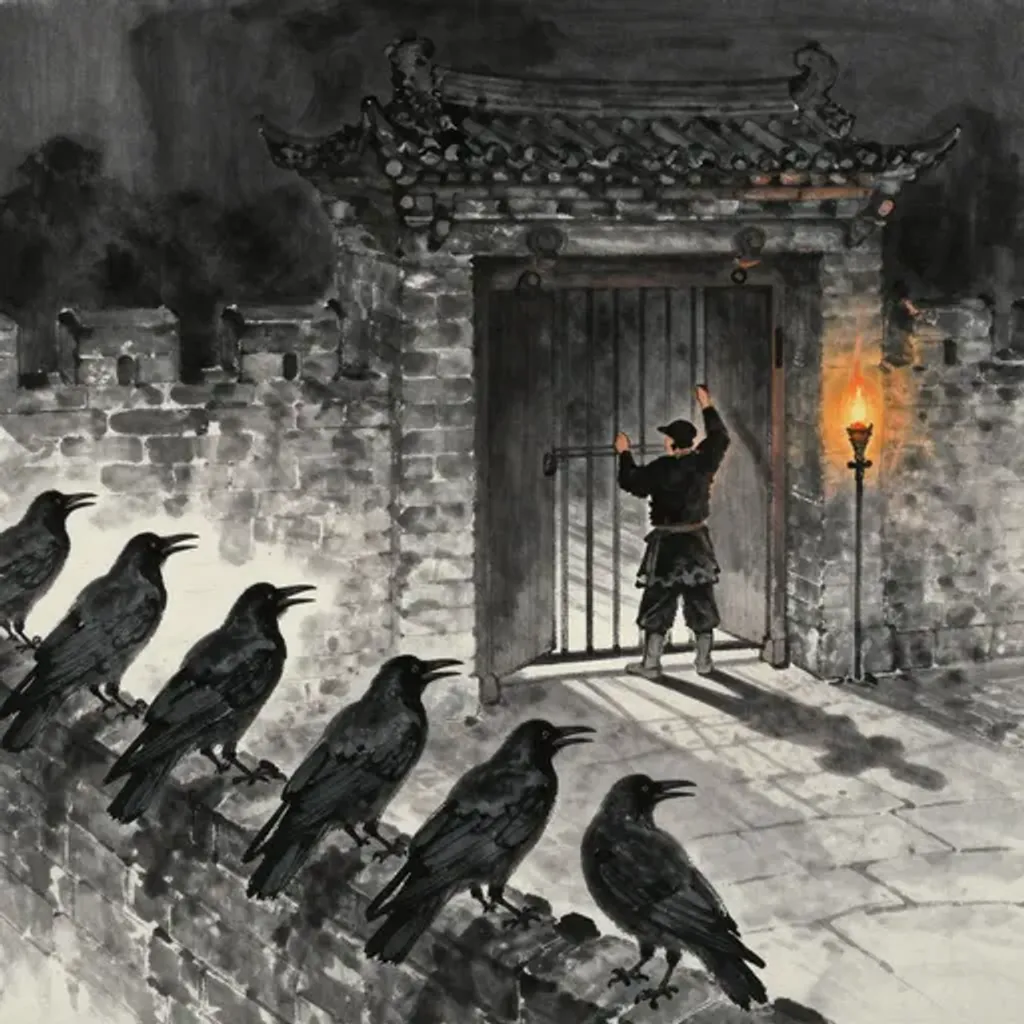
鴉噪庭中,以戒災凶。重門擊柝,備憂暴客。
Crows caw in the courtyard, a warning of coming disaster. The layered gates are struck with clappers, guarding against sudden intruders.
— Jiao Yanshou, Yilin (Forest of Changes), 1st century BC
Commentary
Fire on the mountain, and crows clamor in the courtyard — a warning of impending disaster. The verse invokes the ancient precaution: bar the double gates, strike the watchman's clapper, prepare against sudden intruders. The crow's raucous cry in the home yard was understood as an omen demanding vigilance. From The Wanderer to Oppression, the lake has drained and only water remains trapped below — a cistern without outlet. The verse's defensive posture mirrors Oppression's constrained condition: one cannot flee, cannot expand, can only bolt the door and wait. The wanderer under siege discovers that Oppression is not passive suffering but active watchfulness, the discipline of staying alert when escape is impossible.
旅 → 井
Hexagram 56 → Hexagram 48: The Well
Changing lines: 2, 4, 5, 6
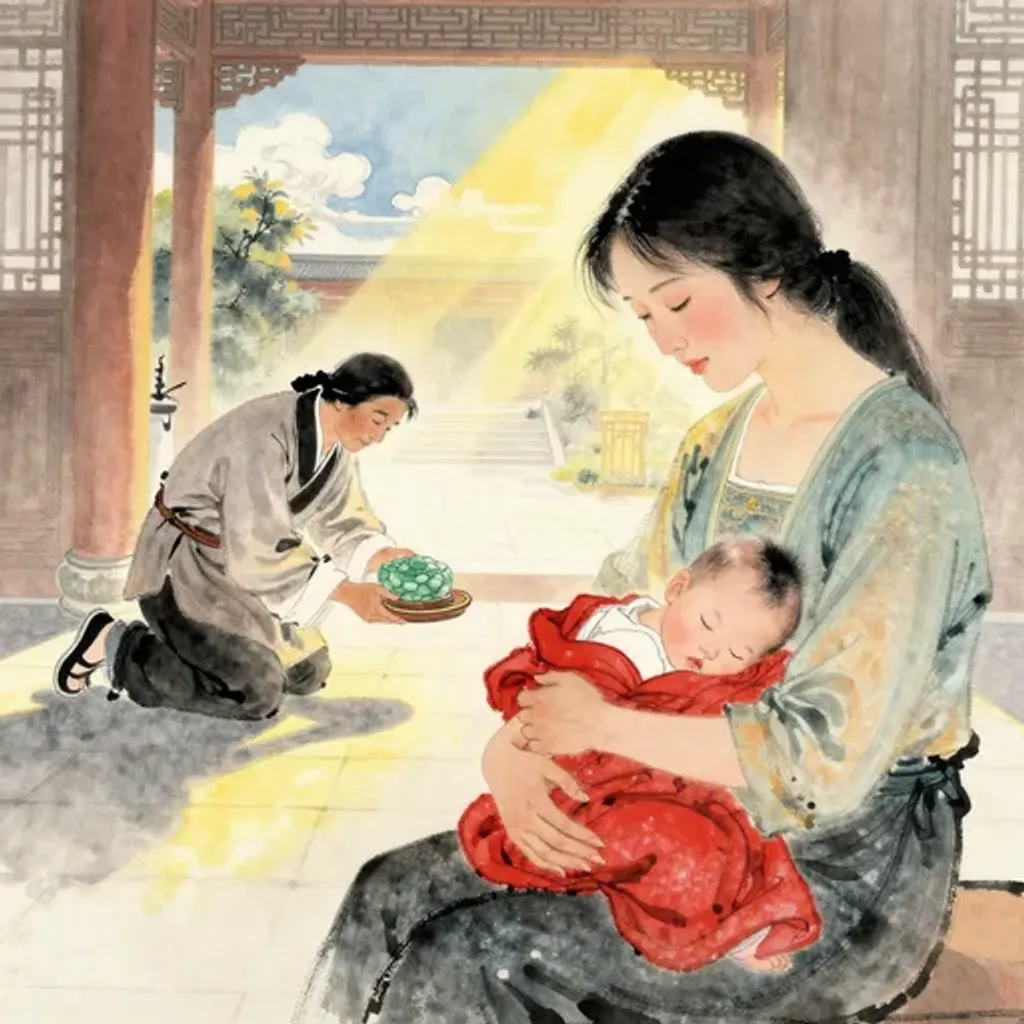
慈母赤子,享賜得士,獲夷服除。以安王家,側陋逢時。
A loving mother and her infant; the gifts bestowed win worthy men. The frontier is pacified, robes of office conferred. The royal house is put at ease; the humble find their moment.
— Jiao Yanshou, Yilin (Forest of Changes), 1st century BC
Commentary
Fire on the mountain, and a compassionate mother raises her beloved child to become a worthy minister. The traveler receives gifts and gains capable attendants; threats are subdued and removed. Through this, the royal household is stabilized, and even one of humble origin meets his destined moment. The verse celebrates the nurturing power that transforms a wanderer into a pillar of state — the mother's care, the lord's recognition, the subject's loyal service forming a chain of reciprocal virtue. From The Wanderer to The Well, water rises through wood to nourish all without discrimination. The Well's inexhaustible giving mirrors the maternal devotion described: sustenance flows upward from the depths to those who need it, regardless of their station.
旅 → 革
Hexagram 56 → Hexagram 49: Revolution
Changing lines: 1, 5, 6
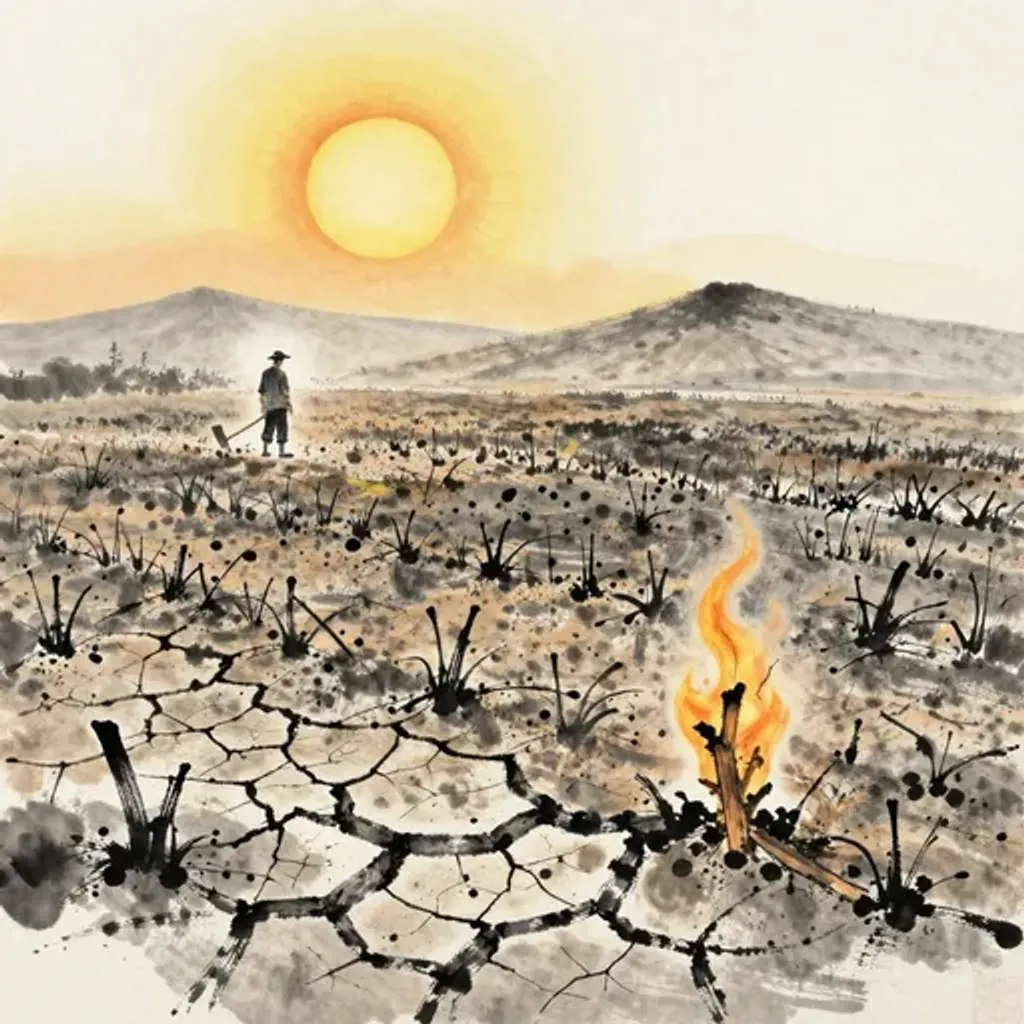
剗迹惡人,使德不通。炎旱為災,年穀大傷。
Cutting down the traces of wicked men, so virtue cannot prevail. Scorching drought brings disaster; the year's grain is greatly ruined.
— Jiao Yanshou, Yilin (Forest of Changes), 1st century BC
Commentary
Fire on the mountain, and wicked men have trampled down the traces of virtue until goodness can no longer circulate. Scorching drought compounds the catastrophe — the harvest is devastated, the grain of the year ruined. The verse links moral corruption to natural disaster: when evil men erase the pathways of virtue, heaven responds with punishing heat. The connection is not causal but resonant — the pattern of obstruction repeats at every level. From The Wanderer to Revolution, fire within the lake, two forces in transformative tension. Revolution promises renewal through radical change, but the verse shows the conditions that make revolution necessary: when moral channels are so thoroughly blocked that even heaven's nourishment cannot flow, only upheaval can clear the way.
旅 → 鼎
Hexagram 56 → Hexagram 50: The Cauldron
Changing lines: 2
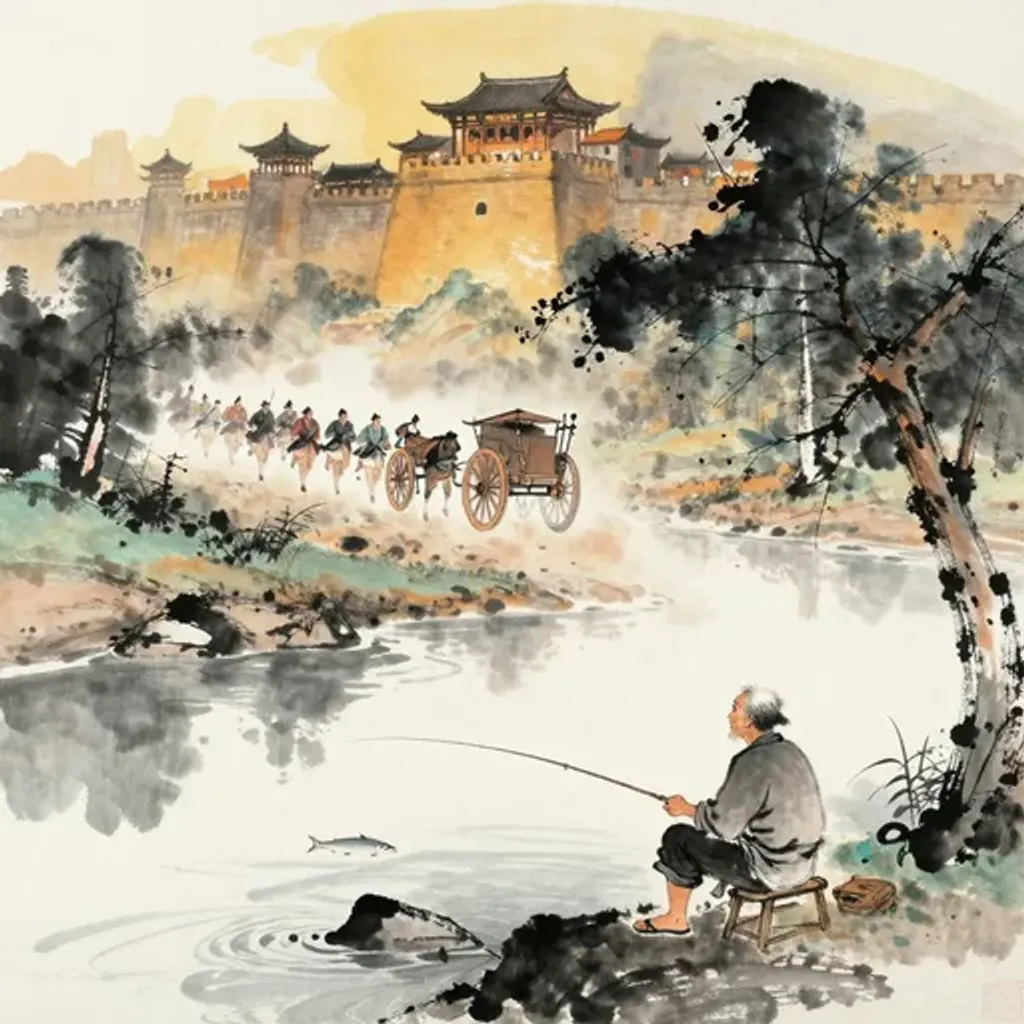
躬履孔德,以待束帶。文君燎獵,呂尚獲福。號稱太師,封建齊國。
Humbly practicing the virtue of Confucius, waiting in readiness, belt fastened. Lord Wen hunted and found him; Lu Shang received great fortune. Titled Grand Preceptor, enfeoffed to found the state of Qi.
— Jiao Yanshou, Yilin (Forest of Changes), 1st century BC
Commentary
Fire on the mountain, and a man of supreme virtue waits, properly dressed and self-disciplined. King Wen went hunting and encountered Lü Shang — Taigong Wang — fishing by the Wei River. Taigong received his reward: titled Grand Preceptor (太師), he was enfeoffed as lord of the state of Qi. The verse celebrates the wanderer who, through patient cultivation of personal excellence, attracts the sovereign's recognition. Taigong's long wait by the river was not idleness but readiness. From The Wanderer to The Cauldron, fire blazes above wood, transforming raw material into refined nourishment. The Cauldron is the vessel of state ritual, and Taigong becomes its living embodiment — the stranger who, through merit, is placed at the center of civilized order.
旅 → 震
Hexagram 56 → Hexagram 51: The Arousing Thunder
Changing lines: 1, 3, 6
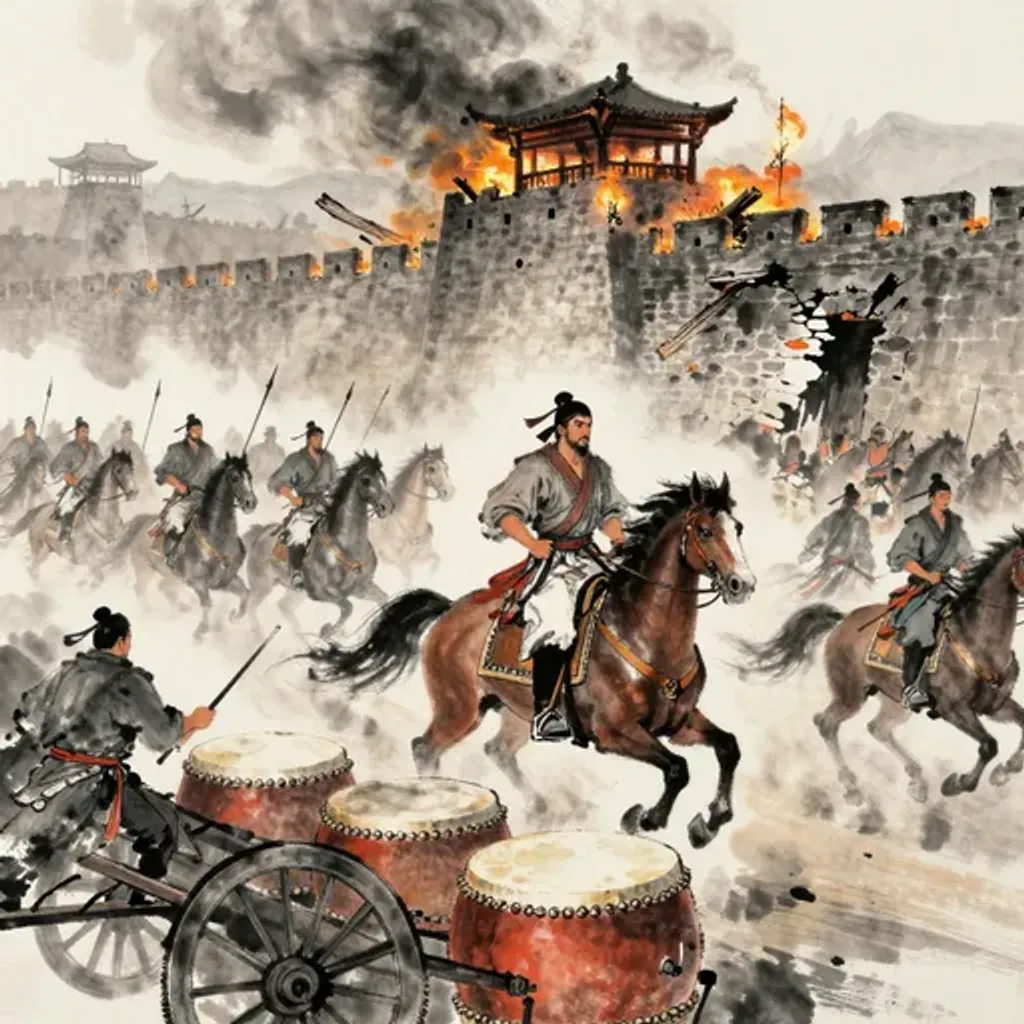
征將止惡,鼓鞞除賊。慶仲奔莒,子般獲福。
The general marches to suppress evil, beating drums to drive out bandits. Qing Zhong fled to Ju; Zi Ban was blessed with fortune.
— Jiao Yanshou, Yilin (Forest of Changes), 1st century BC
Commentary
Fire on the mountain, and drums beat to suppress evil and expel treachery. The verse references the crisis in the state of Lu: Qingfu (庆父), whose murderous intrigues killed both Ziban and Duke Min, was finally forced to flee to the state of Ju. With the source of chaos removed, Ziban's legacy was vindicated and the state found peace. 'Qing Zhong fled to Ju, and Ziban received his fortune' — the living gained reprieve only after the troublemaker departed. From The Wanderer to The Arousing, doubled thunder shakes the world and the gentleman practices self-examination through fear. The thunderclap here is the decisive stroke that drives out the usurper: shock administered as corrective force, exile as the state's salvation.
旅 → 艮
Hexagram 56 → Hexagram 52: Keeping Still Mountain
Changing lines: 4
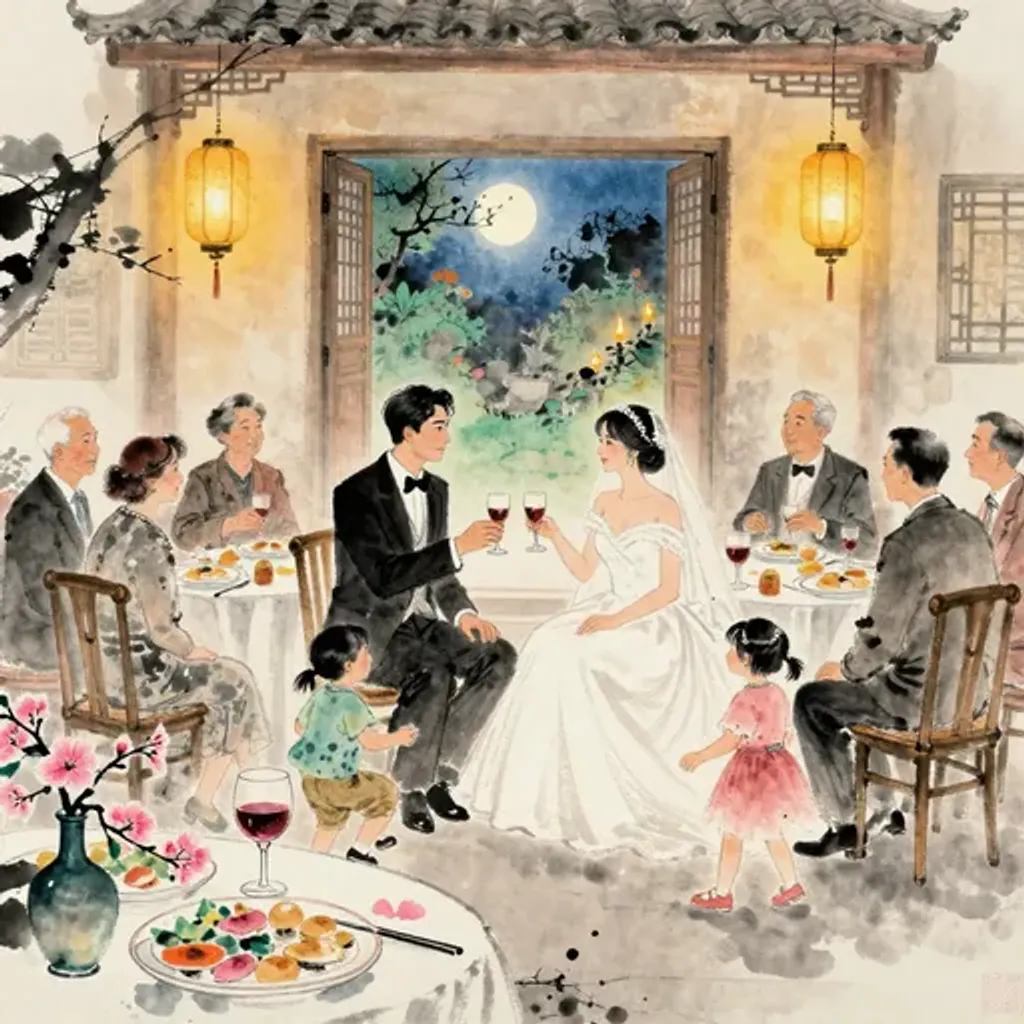
良夫淑女,配合相保。多孫眾子,懽樂長久。
A fine husband and a virtuous wife, matched and joined, preserving one another. Many grandsons and numerous children; joy and delight enduring long.
— Jiao Yanshou, Yilin (Forest of Changes), 1st century BC
Commentary
Fire on the mountain, and below the mountain stands a vision of conjugal harmony. A good husband and a virtuous wife protect each other; many sons and grandsons fill the household with enduring joy. This is the simplest and most complete reversal of the wanderer's condition: rootlessness transformed into generational permanence, solitude dissolved into abundant family. From The Wanderer to Keeping Still, twin mountains stand firm. The wanderer ceases to wander — not through exhaustion but through fulfillment. Keeping Still's injunction to 'think not beyond one's position' is joyfully obeyed when one's position is precisely where one belongs: at home, surrounded by loved ones, with no reason to move.
旅 → 漸
Hexagram 56 → Hexagram 53: Development
Changing lines: 4, 5
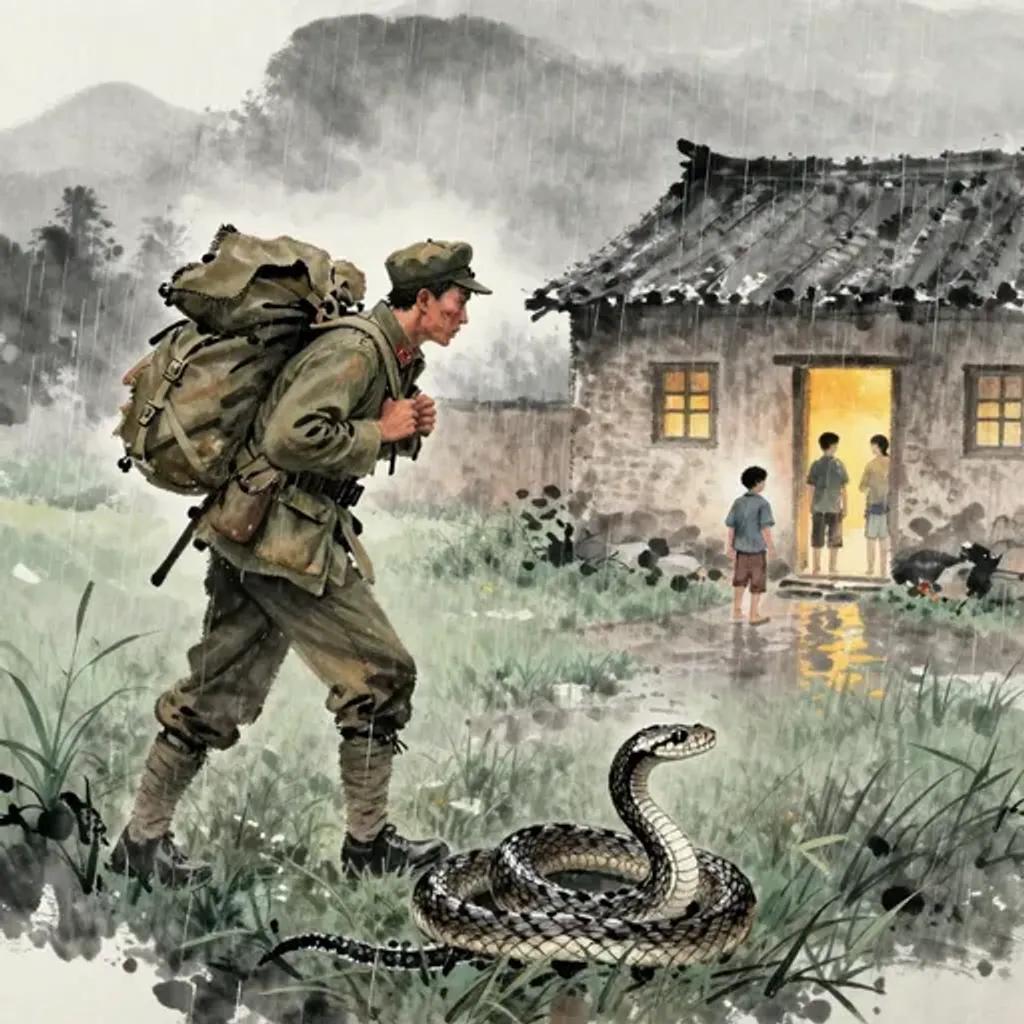
蜲蛇四壯,恩念父母。王事靡盬,不我安處。
The serpent grows thick in its four limbs, yearning for father and mother. The king's service never ceases; it gives me no rest or peace.
— Jiao Yanshou, Yilin (Forest of Changes), 1st century BC
Commentary
Fire on the mountain, and a great serpent grows powerful in four directions, but the traveler's heart aches with longing for his parents. The verse echoes the Shijing soldiers' lament: 'The king's affairs know no rest; they will not let me dwell in peace.' Conscripted for endless state service, the wanderer cannot return to care for aging parents. The 'mighty serpent' (蜲蛇) may represent the sprawling demands of the state, growing in all directions and consuming the individual's loyalty. From The Wanderer to Development, wood grows slowly atop the mountain — gradual, methodical progress. Yet the wanderer cannot enjoy this steady growth because duty constantly uproots him. Development's patience is mocked by the state's insatiable appetite for service.
旅 → 歸妹
Hexagram 56 → Hexagram 54: The Marrying Maiden
Changing lines: 1, 2, 3, 6
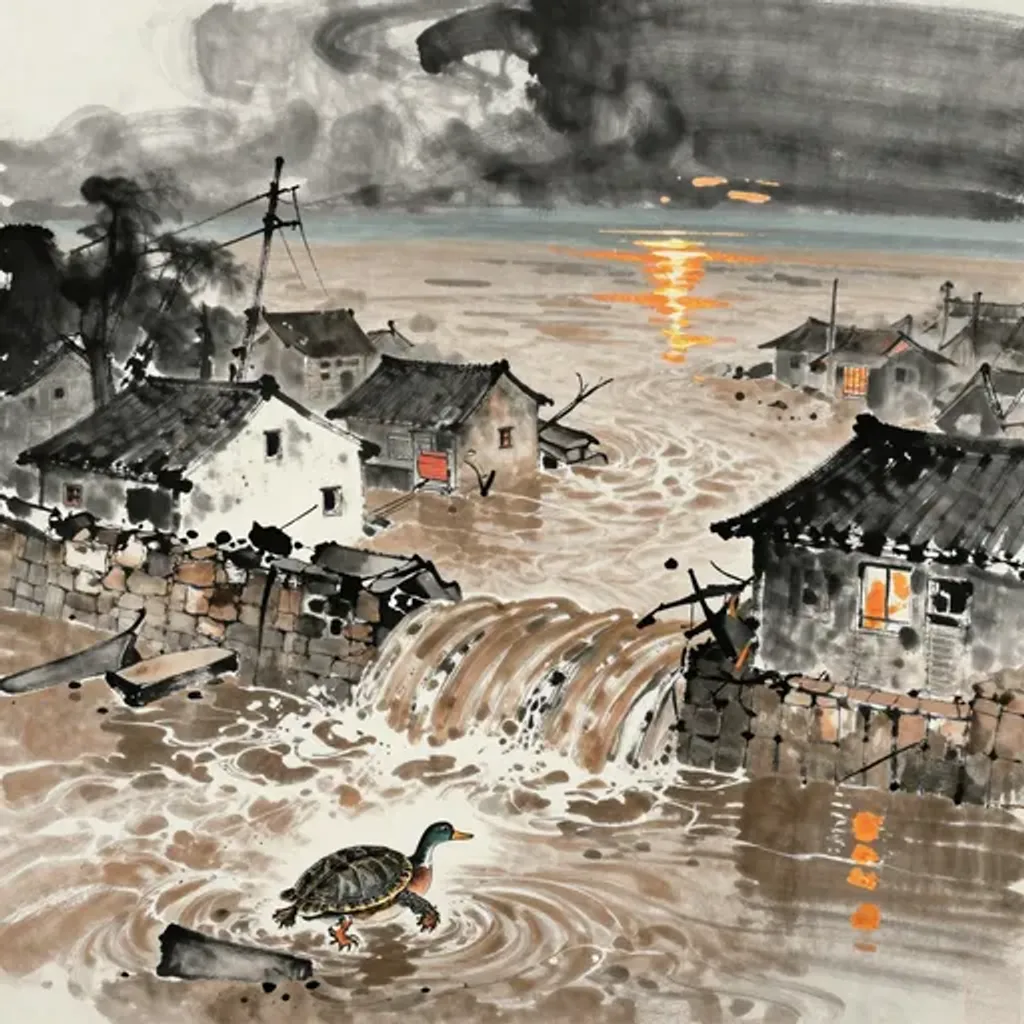
水壞我里,東流為海。鳧龜讙囂,不得安居。
Water destroys my village, flowing east to the sea. Ducks and turtles cry in uproar; there is no place to dwell in peace.
— Jiao Yanshou, Yilin (Forest of Changes), 1st century BC
Commentary
Fire on the mountain, and floodwaters destroy the traveler's neighborhood. The torrent rushes eastward toward the sea; ducks and turtles clamor in the chaos, and no one can find a peaceful dwelling. Water has displaced earth — the familiar ground is gone, replaced by churning currents and displaced creatures. From The Wanderer to Marrying Maiden, thunder surges above the lake in an arrangement that cannot sustain itself long-term. The Marrying Maiden's pattern of improper position — the younger sister placed above her station — mirrors the verse's image of creatures out of place, a community washed from its foundations. Displacement compounds displacement: the wanderer's home is flooded, and what remains is turbulent misalliance.
旅 → 豐
Hexagram 56 → Hexagram 55: Abundance
Changing lines: 1, 6
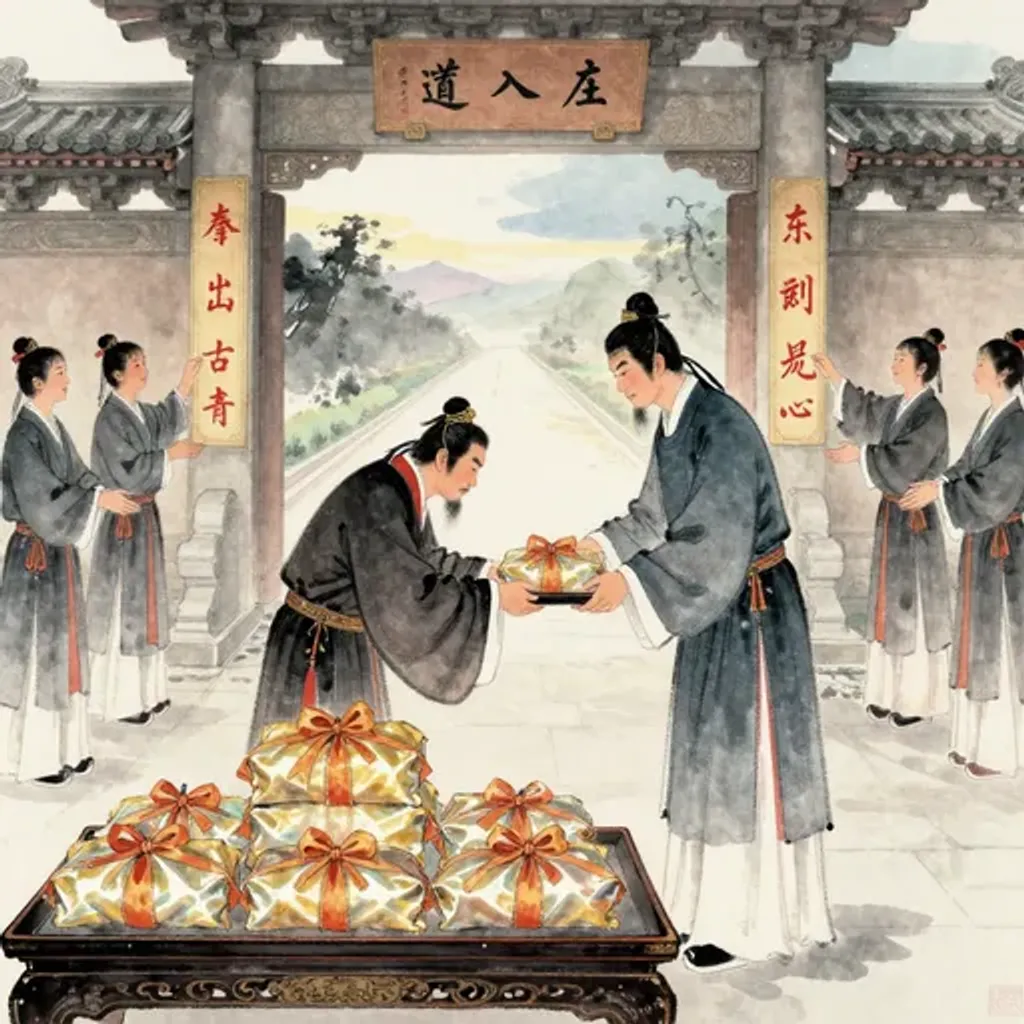
束帛戔戔,賻我孟宣。徵召送君,變號易字。
Bolts of silk bundled tight, a condolence gift for Lord Mengxuan. Summoned and sent forth; titles are changed, names are altered.
— Jiao Yanshou, Yilin (Forest of Changes), 1st century BC
Commentary
Fire on the mountain, and bolts of silk arrive as funeral gifts — bundles of cloth in 'qianqian' (戔戔) abundance, offered to mourn Lord Mengxuan. The phrase 'shu bo jian jian' (束帛戔戔) derives from the I-Ching's Grace hexagram, describing modest silk offerings. The verse then shifts: summoning and sending off the lord, changing his posthumous title and his courtesy name. The traveler participates in the rituals of death and remembrance — the transitions that mark a life's end and a legacy's beginning. From The Wanderer to Abundance, thunder and lightning blaze together. Yet this brilliance accompanies mourning: the wanderer's abundance is measured in ritual propriety, not material wealth.
旅 → 旅
Hexagram 56 → Hexagram 56: The Wanderer
No changing lines — the hexagram is unchanged
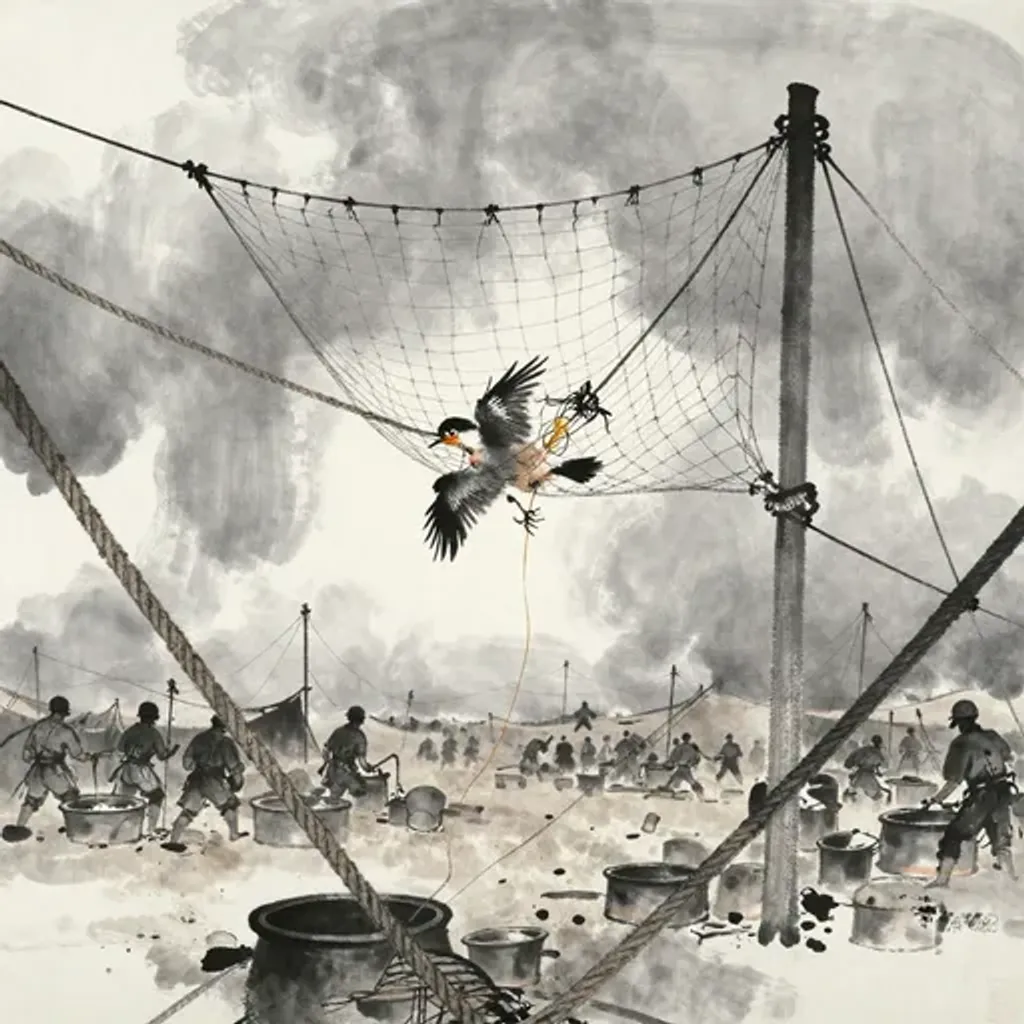
羅網四張,鳥无所翔。征伐困極,飢窮不食。
Nets are spread in every direction; the bird has nowhere to fly. Campaign and conquest pushed to the limit; starving and destitute, without food.
— Jiao Yanshou, Yilin (Forest of Changes), 1st century BC
Commentary
Fire on the mountain returns to fire on the mountain — The Wanderer doubled. Nets spread in all four directions; the bird has nowhere to fly. The traveler, exhausted from endless campaigns, starves in his own destitution. This is the wanderer's condition taken to its logical extreme: when source and target are the same hexagram, the pattern intensifies without relief. No transformation occurs; the fire simply burns on the same mountain. From The Wanderer to The Wanderer, there is no escape from transience. The nets are ubiquitous, the hunger permanent, and the warfare without end. The only shift possible is in the wanderer's stance: even trapped, one may choose how to bear the unbearable.
旅 → 巽
Hexagram 56 → Hexagram 57: The Gentle Wind
Changing lines: 2, 4, 5
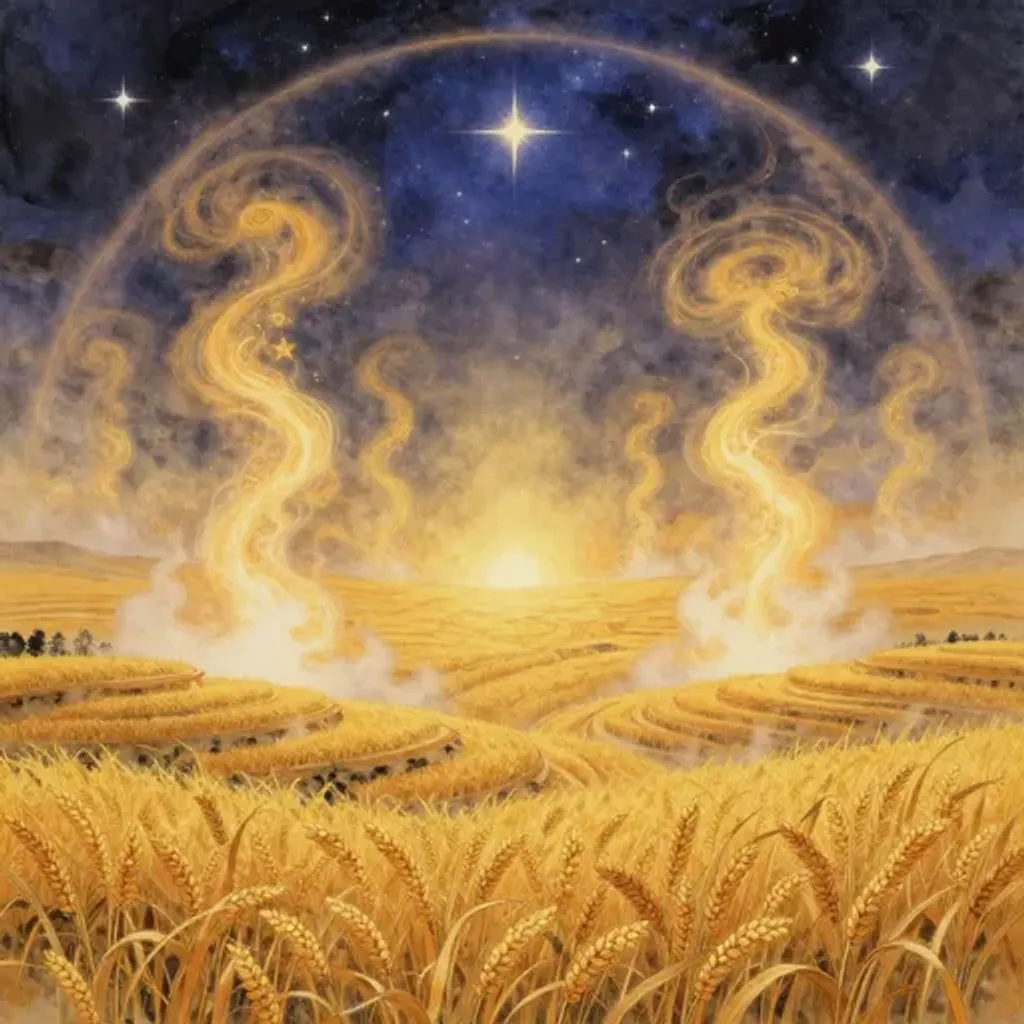
乾行大德,覆贍六合。嘔喣成熟,使我福德。
Heaven's great virtue in motion, sheltering and nourishing the six directions. Warm breath ripens all to fullness; it bestows upon me blessing and virtue.
— Jiao Yanshou, Yilin (Forest of Changes), 1st century BC
Commentary
Fire on the mountain, and heaven's great virtue descends to canopy the six directions. Warmth nurtures all things to ripeness, bestowing blessings and fortune. The verse invokes the cosmological ideal: when the Creative principle operates at full capacity, its generative warmth (嘔喣) brings everything to fruition. The wanderer here is no longer displaced but enveloped by cosmic benevolence — the universal shelter that requires no walls. From The Wanderer to The Gentle, doubled wind penetrates everywhere, carrying the ruler's commands into every corner. The verse enacts this gentle pervasiveness: virtue does not conquer, it permeates. The wanderer finds that the entire world becomes habitable when heaven's warmth suffuses it without distinction.
旅 → 兌
Hexagram 56 → Hexagram 58: The Joyous Lake
Changing lines: 1, 2, 3, 5, 6
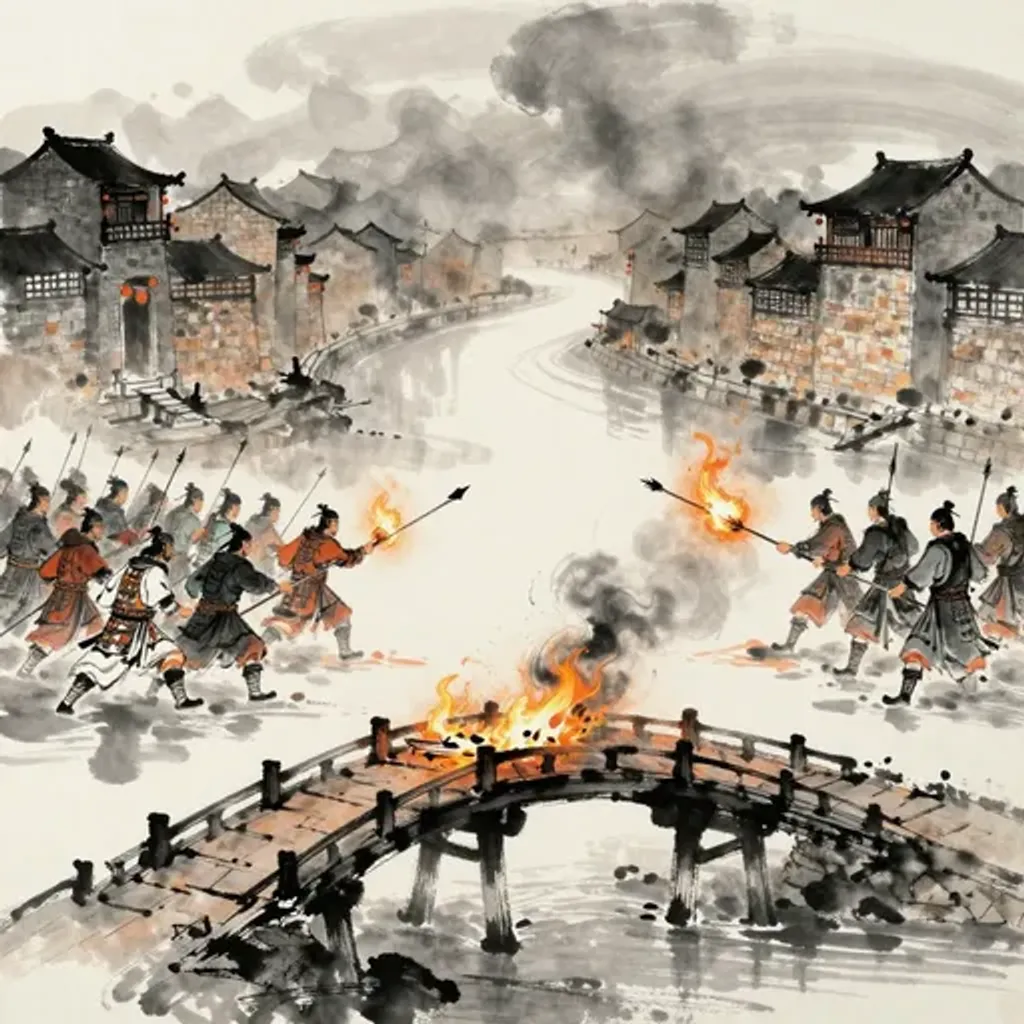
秦晉大國,更相克賊。獲惠質圉,鄭被其咎。
Qin and Jin, great states, each preying upon the other. Seizing Hui, ransoming Yu; Zheng bore the blame.
— Jiao Yanshou, Yilin (Forest of Changes), 1st century BC
Commentary
Fire on the mountain, and the great states of Qin and Jin tear at each other in cycles of mutual aggression. The verse references the capture of Duke Hui and his son Prince Yu (Zi Yu) — hostages exchanged between the two powers — while the state of Zheng suffers collateral damage. According to the Zuo Zhuan, after the Battle of Han (645 BC), Duke Hui of Jin was captured by Duke Mu of Qin. His son Prince Yu (later Duke Huai) was sent as a hostage to Qin. The verse captures how smaller states like Zheng are ground between warring giants. From The Wanderer to The Joyous, doubled lakes in mutual delight. Yet the 'joy' here is bitterly ironic: great powers exchanging hostages and inflicting collateral ruin is fellowship perverted into predation.
旅 → 渙
Hexagram 56 → Hexagram 59: Dispersion
Changing lines: 2, 3, 4, 5
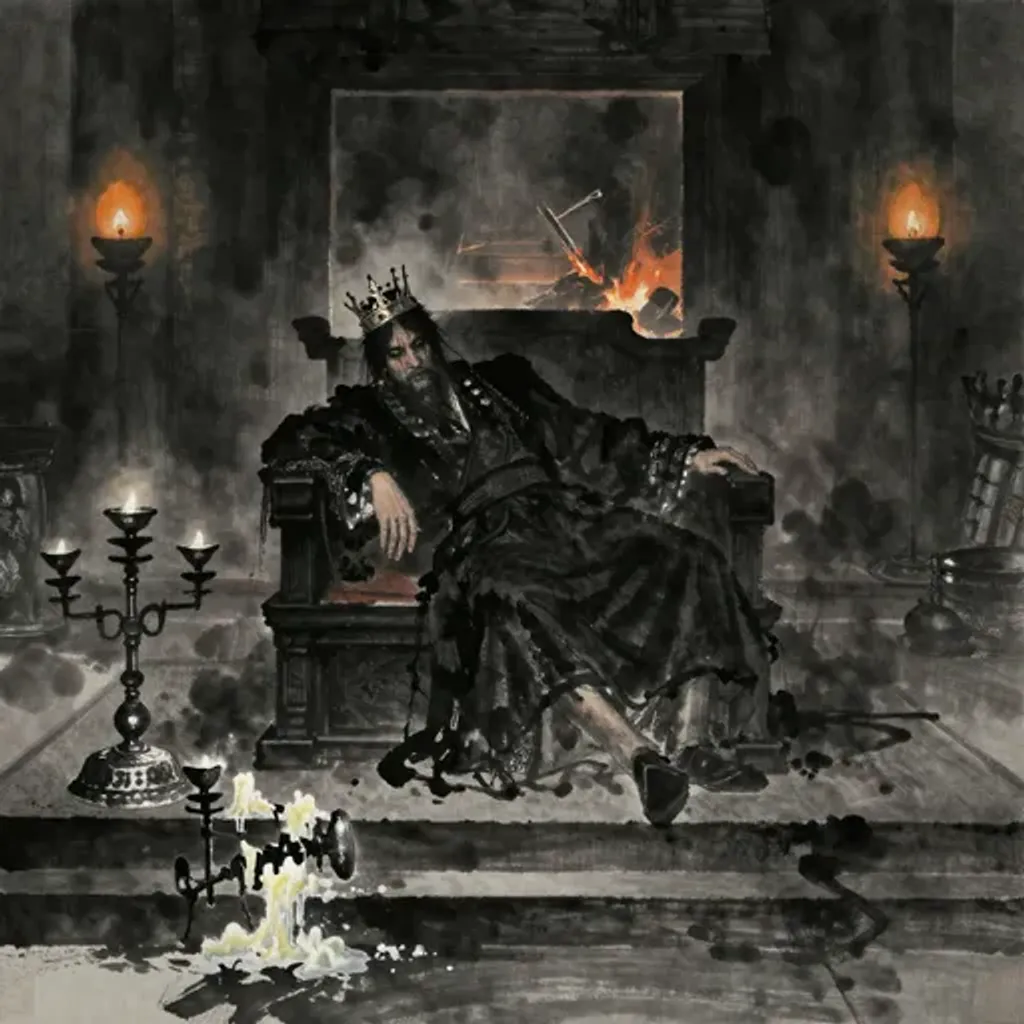
晦昧昏明,君无紀綱。甲子成亂,簡公喪亡。
Dim and dark, murky and unclear; the lord has lost all order. On the jiazi day, chaos erupts; Duke Jian is destroyed.
— Jiao Yanshou, Yilin (Forest of Changes), 1st century BC
Commentary
Fire on the mountain, and the court descends into darkness. Day and night blur together; the ruler has lost all discipline and order. On a jiazi day, chaos erupts, and Duke Jian is destroyed. This almost certainly refers to the assassination of Duke Jian of Qi by the powerful minister Tian Chang (田常/田成子) in 481 BC — an event recorded in the Zuo Zhuan that marked the effective end of the Jiang clan's rule in Qi. The 'jiazi' day locates the event with calendrical precision. From The Wanderer to Dispersion, wind blows across the water, scattering what was gathered. The duke's murder disperses the last pretense of legitimate rule: governance dissolves into formlessness, and the wanderer witnesses a state losing its very identity.
旅 → 節
Hexagram 56 → Hexagram 60: Limitation
Changing lines: 1, 2, 3, 4, 5, 6
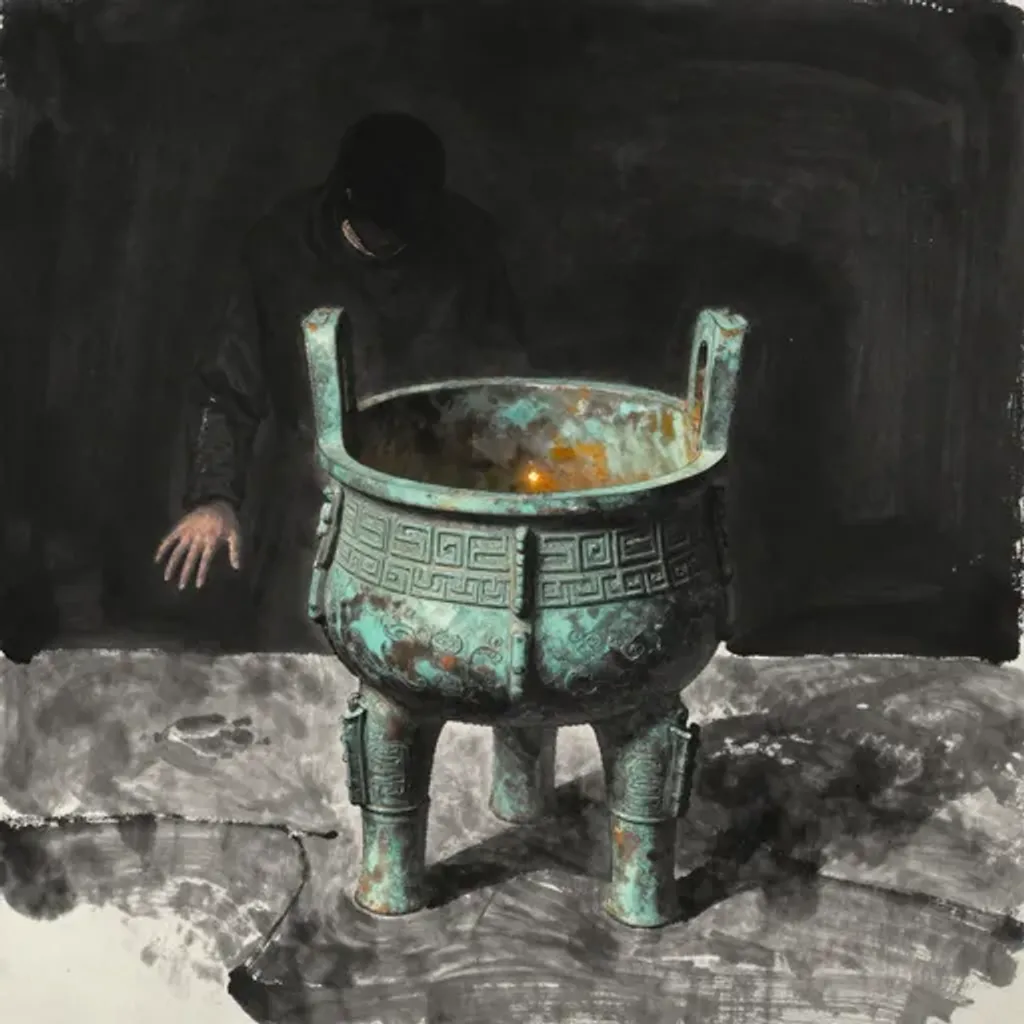
三足无頭,弗知所之。心狂精傷,莫使為明,不見月光。
Three legs, no head; it knows not where to go. The mind is deranged, the spirit wounded; nothing can serve as light. The moon's glow is not seen.
— Jiao Yanshou, Yilin (Forest of Changes), 1st century BC
Commentary
Fire on the mountain, and a three-legged creature with no head stumbles blindly, not knowing where to go. Mind deranged and spirit broken, nothing serves as illumination — even the moonlight is invisible. The headless three-legged form may invert the auspicious three-legged sun-crow: where the sun-crow carries light across the sky, this creature is its dark parody, groping through a world without guidance. From The Wanderer to Limitation, water above the lake establishes boundaries and measure. Yet the verse depicts a being beyond all limitation — not transcending it but falling below it, too damaged even to perceive the structures that might save it. Limitation here is medicine the patient cannot swallow.
旅 → 中孚
Hexagram 56 → Hexagram 61: Inner Truth
Changing lines: 1, 2, 3, 4, 5
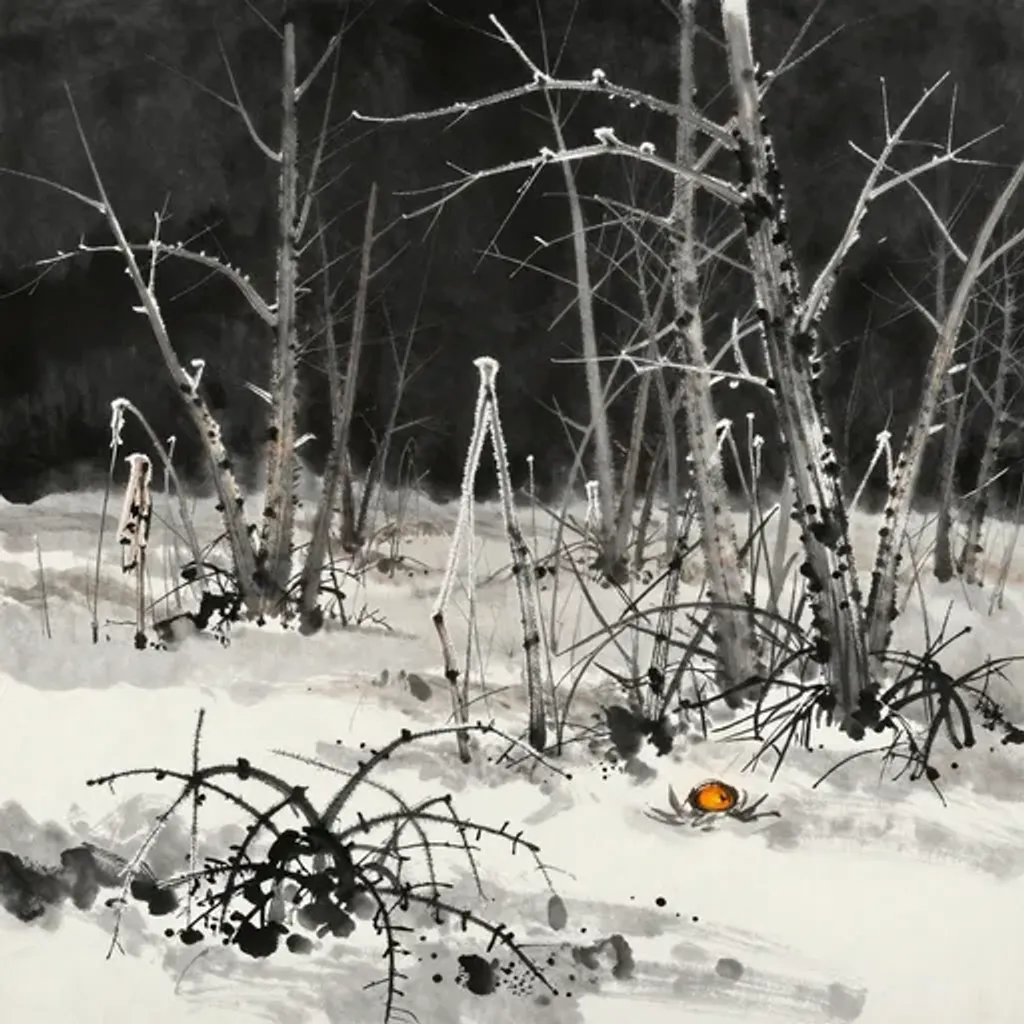
長夜短日,陰為陽賊。萬物空枯,藏在北陸。
Long nights, short days; yin plunders yang. The ten thousand things are emptied and withered, hidden away in the northern land.
— Jiao Yanshou, Yilin (Forest of Changes), 1st century BC
Commentary
Fire on the mountain, yet the season is deep winter. Long nights and short days; yin assaults yang like a thief in the dark. All living things wither and empty; life retreats to storage in the northern quarter. The verse captures the nadir of the annual cycle: maximum darkness, minimum vitality, nature's treasury sealed against the cold. From The Wanderer to Inner Truth, wind blows above the lake, and the hollow center of the hexagram embodies sincerity without pretension. Yet the verse presents truth stripped to its bleakest form: winter's honesty is that nothing grows, nothing flourishes, and survival requires withdrawal into the innermost chamber. The wanderer's inner truth is the bare acknowledgment of his own desolation.
旅 → 小過
Hexagram 56 → Hexagram 62: Small Exceeding
Changing lines: 6
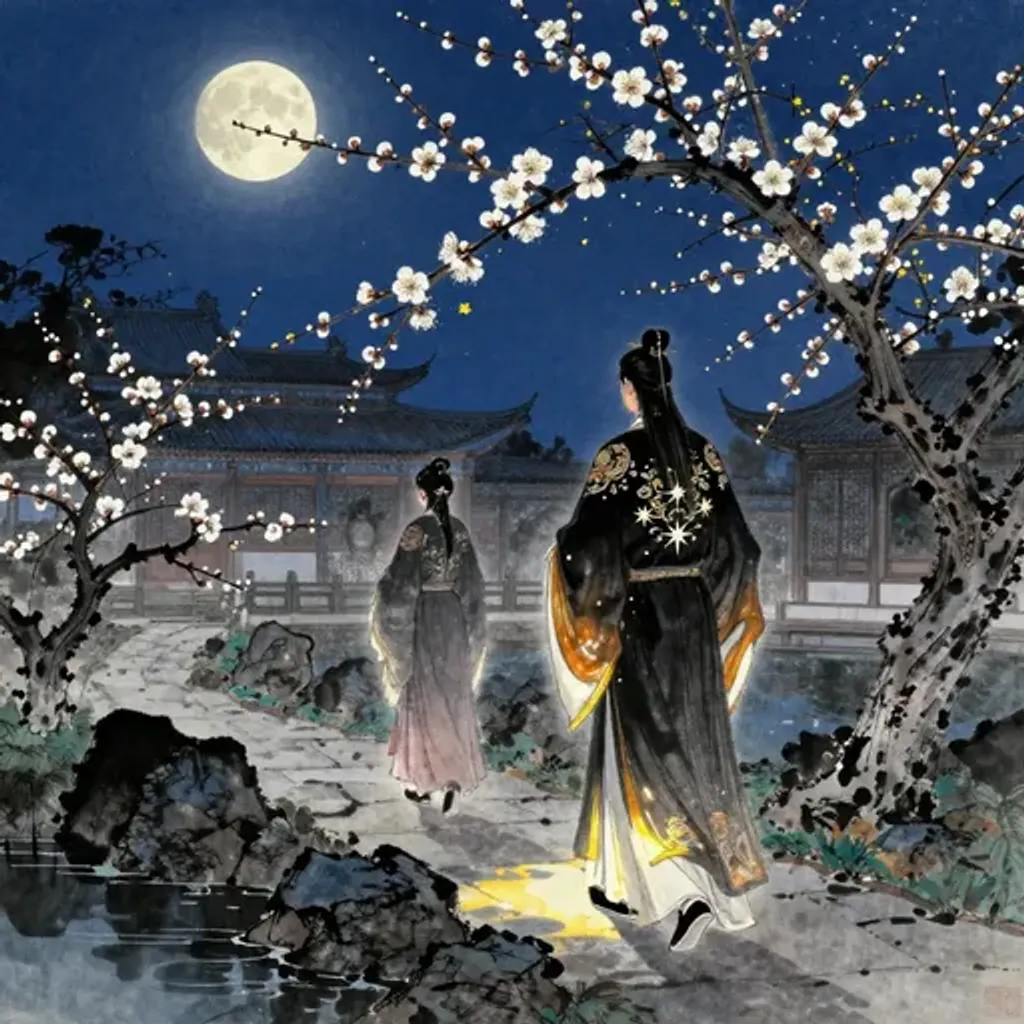
依宵夜遊,與大君俱。除解煩惑,使我无憂。
Relying on the night to wander, in the company of a great lord. Dissolving vexation and confusion, freeing me from worry.
— Jiao Yanshou, Yilin (Forest of Changes), 1st century BC
Commentary
Fire on the mountain, and the traveler ventures out at night in the company of a great lord. Together they roam through the darkness, and all confusion and vexation dissolve — worry disappears entirely. The 'great lord' (大君) provides protection and purpose to the nocturnal journey, transforming a potentially dangerous wandering into a liberating excursion. From The Wanderer to Small Exceeding, thunder rumbles above the mountain, a slight excess of action over form. The verse captures the Small Exceeding spirit precisely: venturing beyond the norm — wandering at night, consorting with the powerful — yet remaining within the bounds of what the moment permits. Small transgressions in good company yield disproportionate relief.
旅 → 既濟
Hexagram 56 → Hexagram 63: After Completion
Changing lines: 1, 4, 5, 6
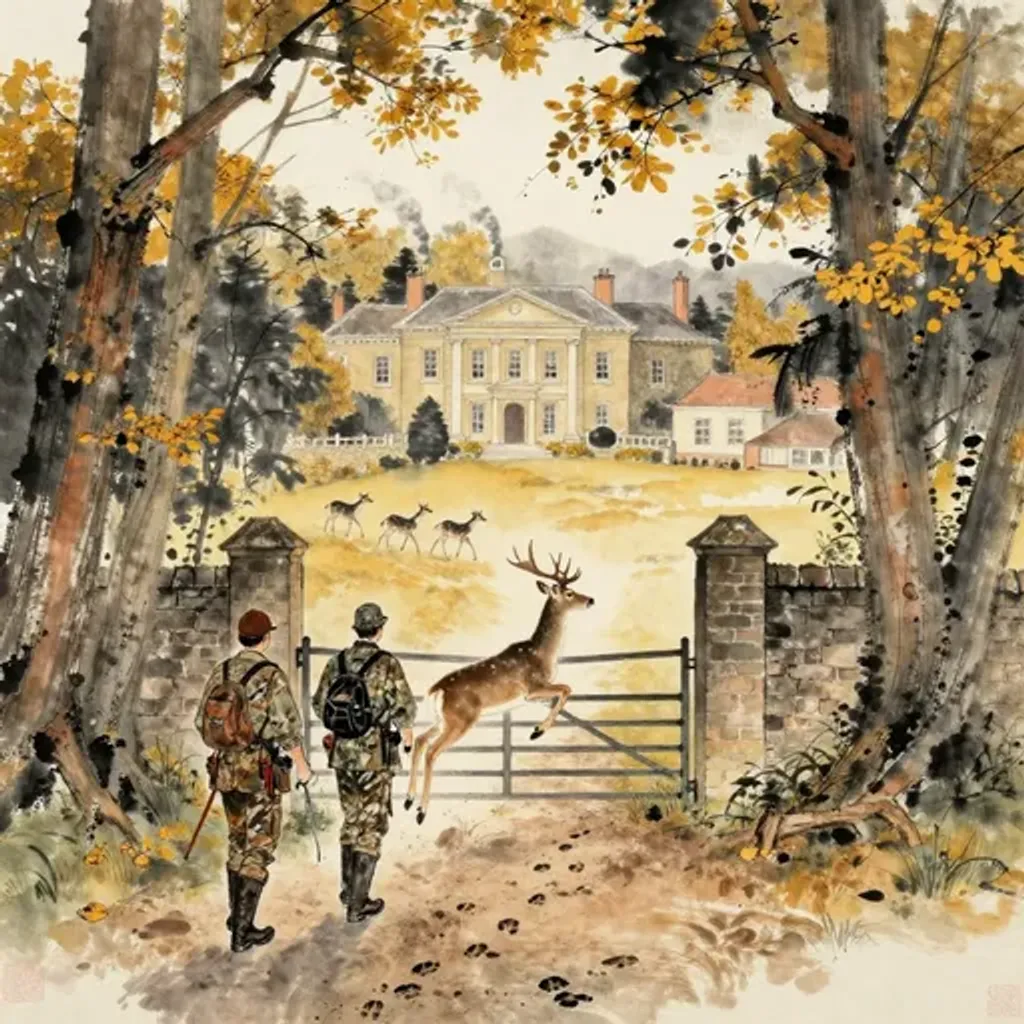
逐鹿南山,利入我門。陰陽和調,國无災殘。長子出遊,須其仁君。
Chasing the deer on the southern mountain; the prize enters my gate. Yin and yang in harmony; the realm suffers no ruin. The eldest son ventures forth, awaiting his benevolent lord.
— Jiao Yanshou, Yilin (Forest of Changes), 1st century BC
Commentary
Fire on the mountain, and a deer is driven south toward the hunter's gate. The chase succeeds: fortune enters through the door, yin and yang harmonize, and the state knows no disaster. The eldest son sets out on a journey, awaiting his benevolent lord. The deer hunt recalls the ancient metaphor for pursuing the mandate of heaven — 'chasing the deer' (逐鹿) signifying the contest for sovereignty. Here the pursuit ends well: the quarry enters willingly, balance is achieved, and the heir travels abroad to find the ruler worthy of his service. From The Wanderer to After Completion, water rests above fire in perfect equilibrium. The verse celebrates that rarest of moments: the journey complete, all elements aligned, nothing lacking.
旅 → 未濟
Hexagram 56 → Hexagram 64: Before Completion
Changing lines: 2, 3
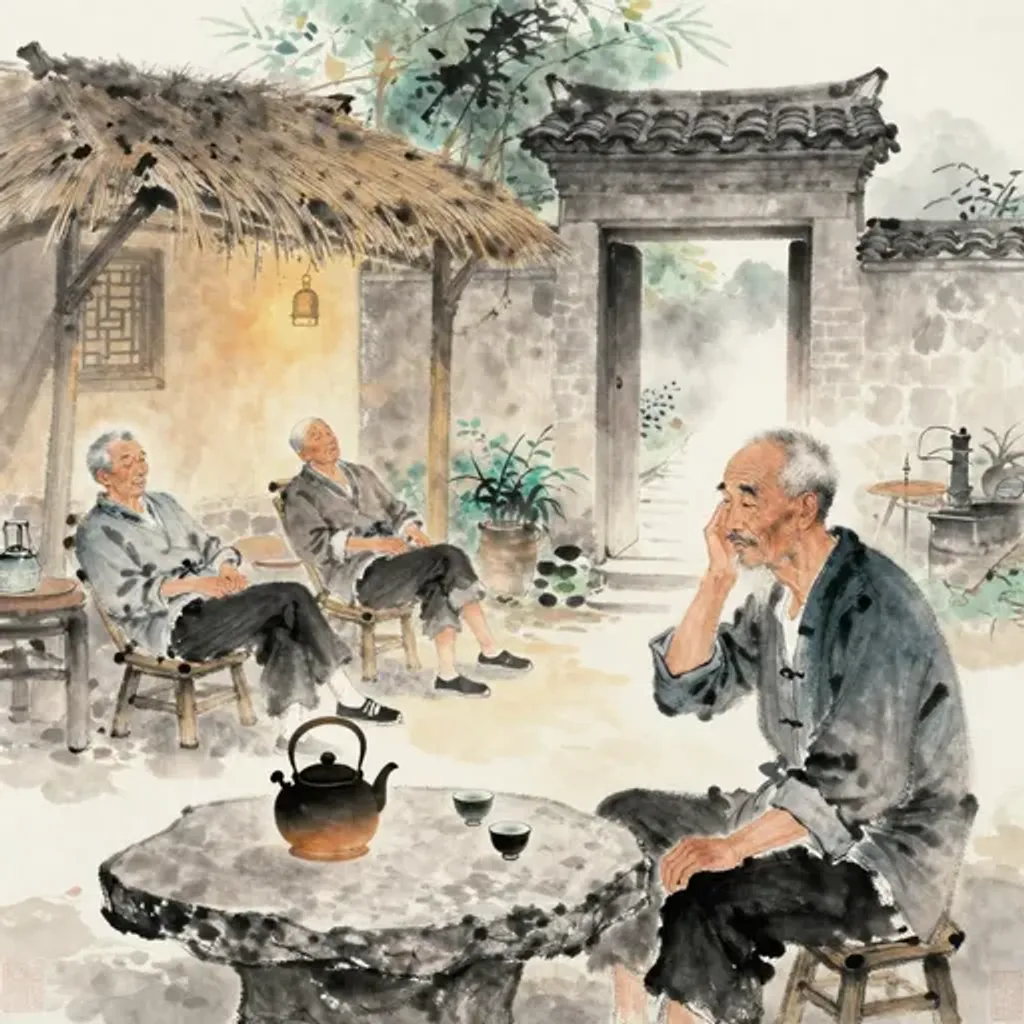
請冀左耳,嗇不我驅,與我父母。
I beg you, spare this left ear; do not be harsh, do not drive me away. Let me remain with my father and mother.
— Jiao Yanshou, Yilin (Forest of Changes), 1st century BC
Commentary
Fire on the mountain, and the wanderer makes a humble plea — requesting only a left ear of millet from Ji, asking only that the stingy master not drive him away but let him remain with his parents. The verse distills the wanderer's condition to its most basic negotiation: not glory or wealth but mere tolerance, not a feast but a handful of grain, not a homecoming but permission to stay near one's family. From The Wanderer to Before Completion, fire hovers above water without resolution. The final hexagram of the I-Ching leaves all things unfinished, and this verse matches that incompleteness. The wanderer's plea remains suspended — we do not know if it is granted. The journey, like the cycle, does not truly end.