Transformations of Hexagram 63
Every line of change out of Hexagram 63 既濟 After Completion, with the Yilin verse for each of the 64 resulting hexagrams, its translation, and the original ink brush artwork.
既濟 → 乾
Hexagram 63 → Hexagram 1: The Creative
Changing lines: 2, 4, 6
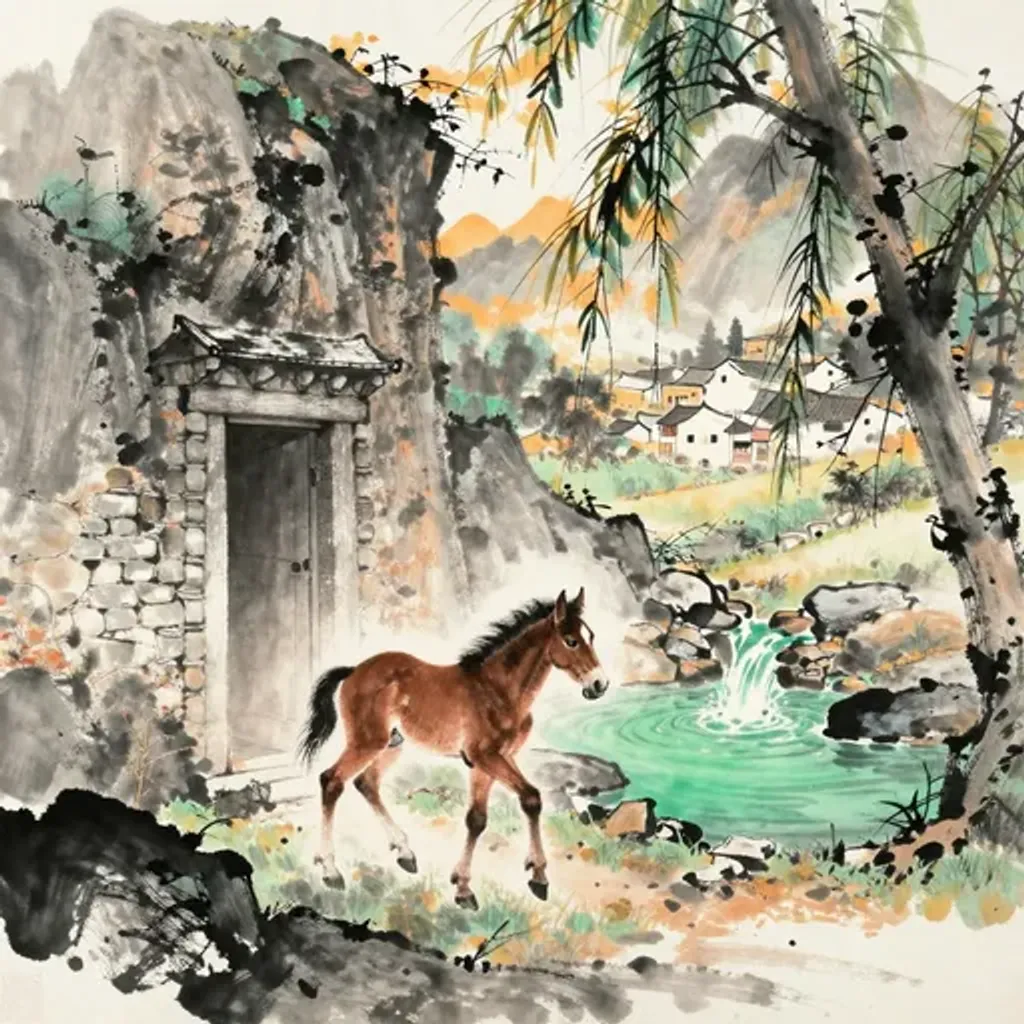
游駒石門,騄耳安全。受福西鄰,歸邑玉泉。
The wandering colt passes through the Stone Gate; the fine steed arrives safely. Blessings received from the western neighbor; returning to the village of the Jade Spring.
— Jiao Yanshou, Yilin (Forest of Changes), 1st century BC
Commentary
Water sits above fire, every line in place — After Completion at its most precarious equilibrium. A wandering colt passes through the Stone Gate, and the famous steed Luer arrives safely. Blessings come from the western neighbor, and one returns home to the Jade Spring. Luer was one of King Mu of Zhou's legendary eight steeds that bore him west to Mount Kunlun and the Queen Mother of the West. The Stone Gate suggests a dangerous passage navigated with sureness. From After Completion to the Creative, perfect order transforms into heaven's self-generating initiative. What was carefully arranged now becomes dynamic force — the thoroughbred no longer merely completes the journey but gallops of its own sovereign will.
既濟 → 坤
Hexagram 63 → Hexagram 2: The Receptive
Changing lines: 1, 3, 5
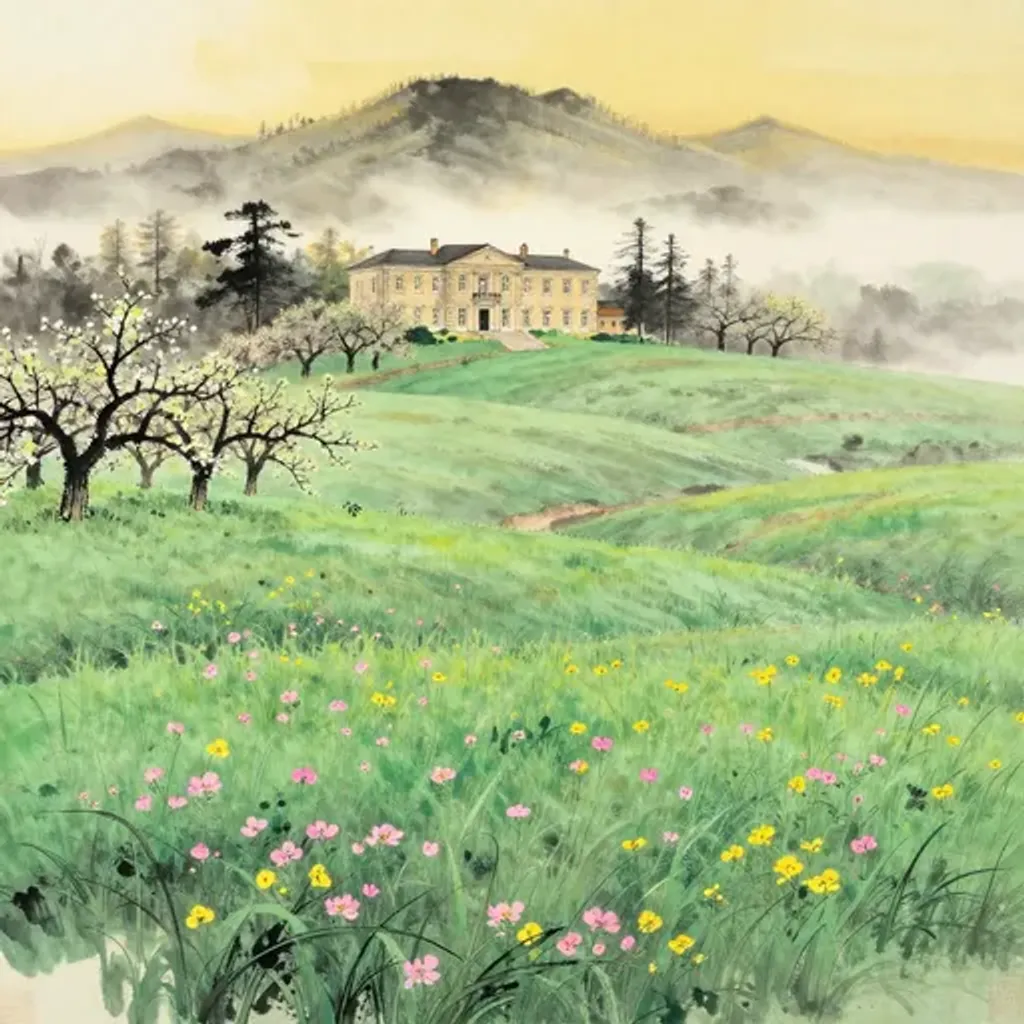
陽春生草,萬物盛興。君子所居,災禍不到。
In the warmth of spring, grass grows; all things flourish and thrive. Where the noble one dwells, disaster and misfortune do not arrive.
— Jiao Yanshou, Yilin (Forest of Changes), 1st century BC
Commentary
Water sits above fire in perfect balance, and spring sunlight coaxes grass from the earth. All living things flourish in abundance. Where the gentleman dwells, disaster and misfortune cannot reach. The verse paints an idyll of natural prosperity under benevolent presence — not through effort but through the sheer quality of one's abode. From After Completion to the Receptive, the precise arrangement of fire and water dissolves into earth's boundless capacity to receive and sustain. Order completed now yields to something gentler: the earth that nurtures without discrimination, where growth happens not by command but by the quiet generosity of the ground itself.
既濟 → 屯
Hexagram 63 → Hexagram 3: Difficulty at the Beginning
Changing lines: 3
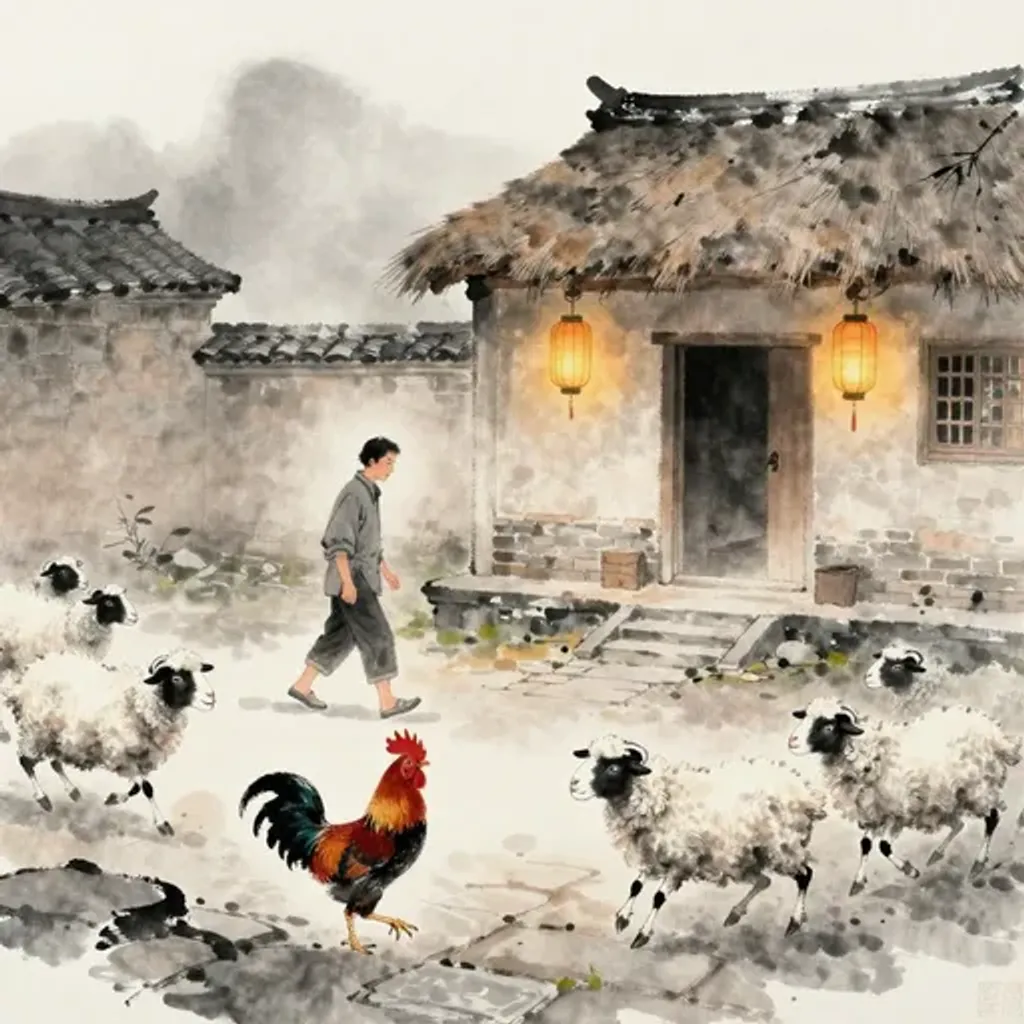
人无足法,緩除才出。雄走羊驚,不失其家。
A man without sure footing; slow to remove what has only just emerged. The rooster runs, the sheep startles, yet neither leaves its home.
— Jiao Yanshou, Yilin (Forest of Changes), 1st century BC
Commentary
Water sits above fire, all in order, yet movement is awkward. A person without proper footing stumbles forward — slow to emerge, cautious in each step. A rooster startles and the sheep scatter, but none strays from home. The verse captures the paradox of difficult birth from a settled state: everything is in place, yet the first steps are halting and ungainly. From After Completion to Difficulty at the Beginning, the stable configuration gives way to thunder churning beneath water — clouds gathering before the first rain. The transition from completion to new genesis is never smooth; one lurches into the unknown, startled and stumbling, yet ultimately finds one's way back to shelter.
既濟 → 蒙
Hexagram 63 → Hexagram 4: Youthful Folly
Changing lines: 1, 2, 3, 5, 6
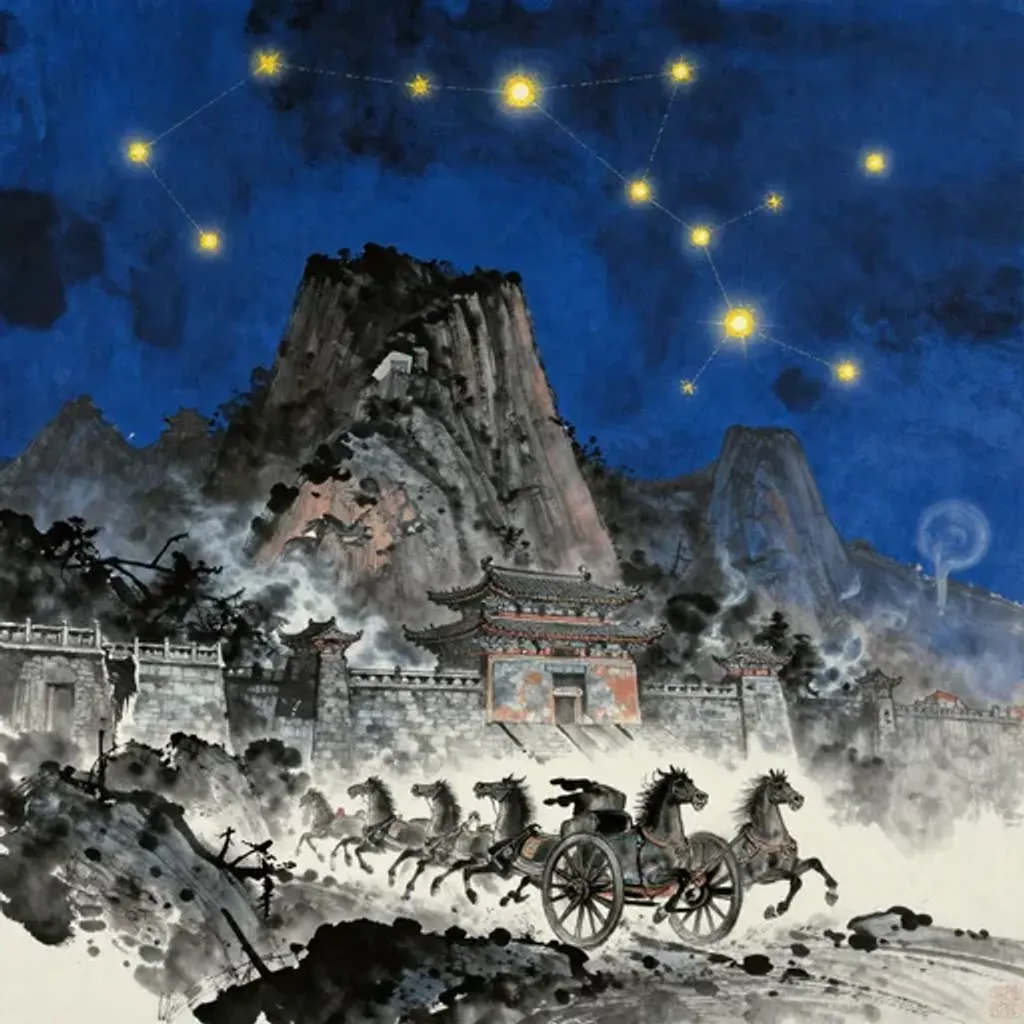
太山止奔,變見太微。陳吳廢忽,作為禍患。
Mount Tai halts the charge; a change is seen at Taiwei. Chen and Wu, once neglected, become the source of calamity.
— Jiao Yanshou, Yilin (Forest of Changes), 1st century BC
Commentary
Water sits above fire, but the balance is already tipping. Mount Tai halts the fleeing — a great obstacle blocks the path of retreat. Then a change appears in the Taiwei celestial enclosure, an omen of political upheaval. Chen and Wu grow reckless, discarding their ruler Hu and bringing calamity upon the state. This likely alludes to the turmoil in the state of Zheng, where the powerful minister Zhai Zhong, pressured by the states of Chen and Song, deposed Duke Zhao (Hu) and installed Zi Tu. From After Completion to Youthful Folly, the orderly arrangement devolves into the mountain's spring — water emerging in darkness, groping without guidance. Completed order collapses into the confusion of those who act without understanding consequences.
既濟 → 需
Hexagram 63 → Hexagram 5: Waiting
Changing lines: 2
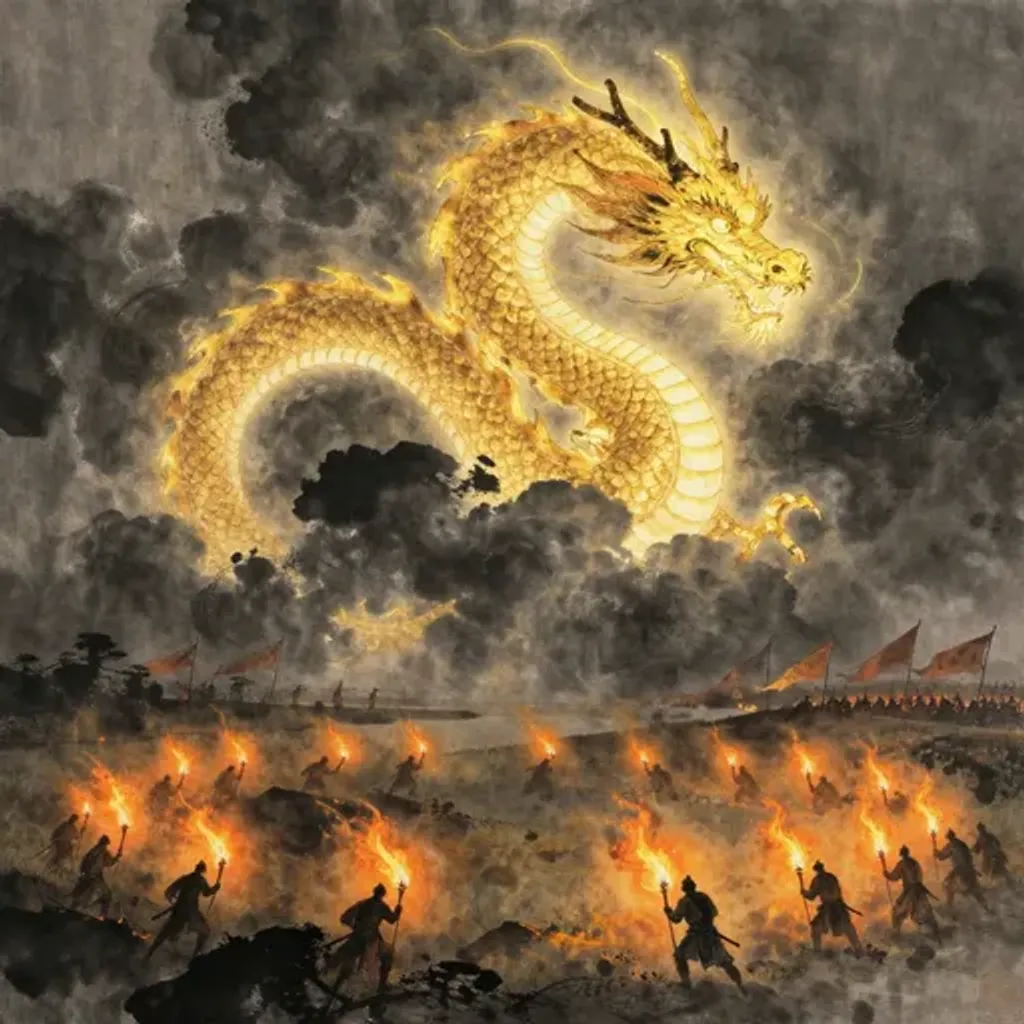
乘龍吐光,使暗後明。燎獵大得,六師以昌。
Riding the dragon that spits forth light, turning darkness into brightness. The torchlit hunt yields great success; the six armies thereby flourish.
— Jiao Yanshou, Yilin (Forest of Changes), 1st century BC
Commentary
Water sits above fire, and a dragon rises breathing light, turning darkness into radiance. The great hunt yields a magnificent catch, and the six armies prosper. The dragon spewing luminance evokes the sovereign who illuminates his age — the Son of Heaven whose mandate shines forth. The six armies (六師) are the full military complement of a Zhou king, signifying royal power at its zenith. From After Completion to Waiting, fire-and-water equilibrium yields to water suspended above heaven — clouds gathering with promise. The completed order does not stagnate but pauses in confident anticipation, the dragon having risen, now poised above the clouds before its next descent.
既濟 → 訟
Hexagram 63 → Hexagram 6: Conflict
Changing lines: 1, 2, 3, 4, 6
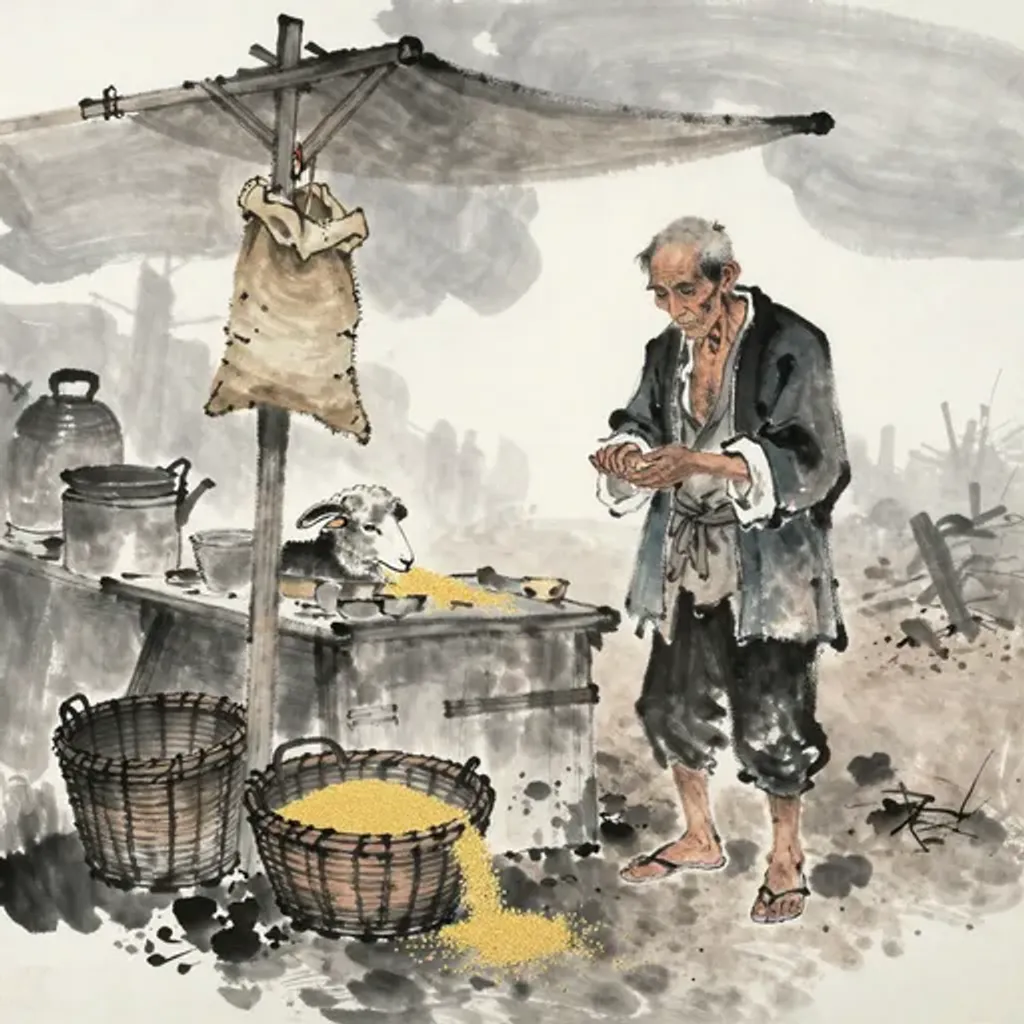
羊頭兔足,羸瘦少肉。漏囊貯粟,利无所得。
Sheep's head and rabbit's feet; thin and lean, little meat. A leaking sack stores grain; profit is nowhere to be gained.
— Jiao Yanshou, Yilin (Forest of Changes), 1st century BC
Commentary
Water sits above fire, but the balance yields nothing of substance. A sheep's head on rabbit's legs — the body is emaciated, scarcely any meat. Grain stored in a leaking sack drains away; there is no profit to be had. The imagery is relentlessly deficient: mismatched anatomy producing a creature too thin to eat, a container too porous to hold its contents. From After Completion to Conflict, the orderly fire-and-water arrangement gives way to heaven and water moving in opposite directions. What was complete now comes apart at the seams — the vessel that should hold everything leaks, and opposing forces drain whatever was accumulated. Completion without structural integrity is merely the prelude to loss.
既濟 → 師
Hexagram 63 → Hexagram 7: The Army
Changing lines: 1, 2, 3, 5
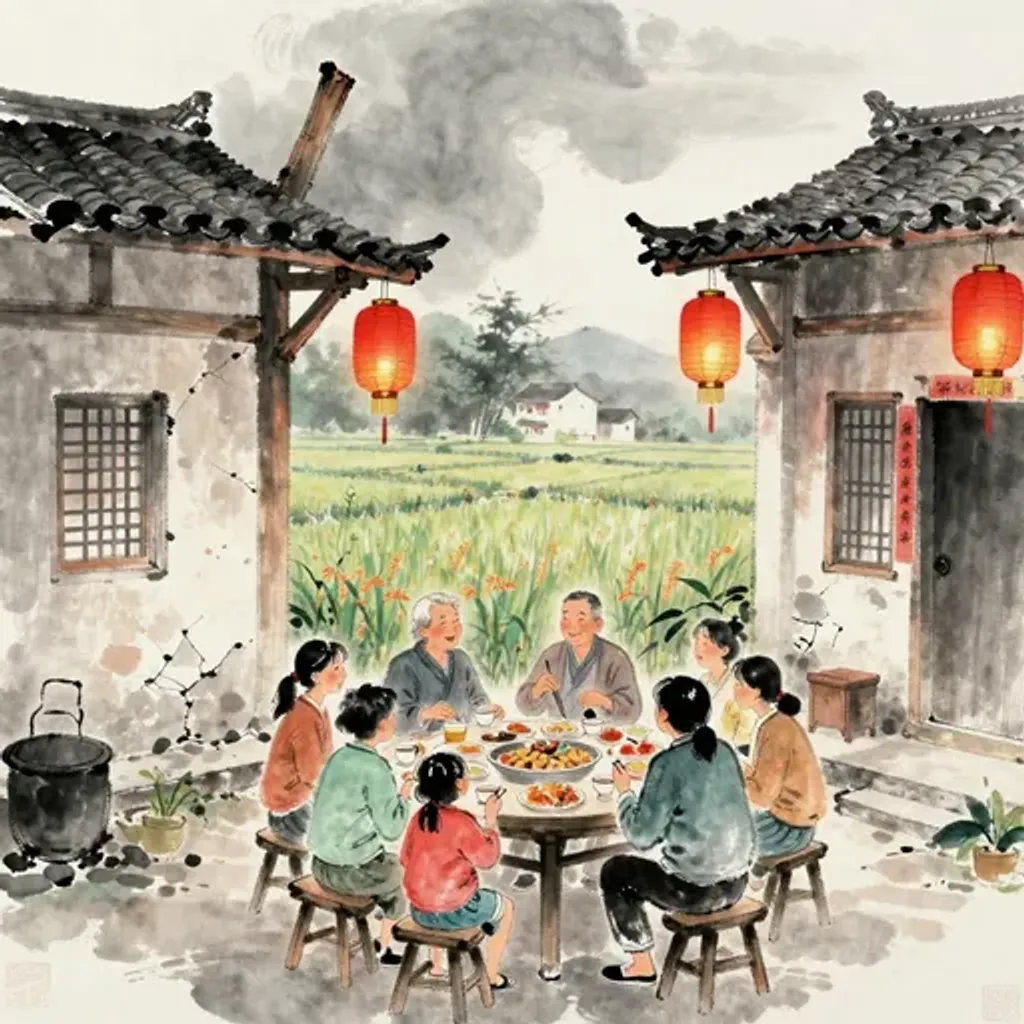
因禍受福,喜盈其室。螟虫不作,君无可得。
From misfortune, blessings received; joy fills the household. The crop-eating insects do not appear; what could the ruler ask for more?
— Jiao Yanshou, Yilin (Forest of Changes), 1st century BC
Commentary
Water sits above fire, and misfortune transmutes into blessing — joy fills the household. Pestilent insects do not arise; the ruler finds no fault to punish. The verse describes a paradox of governance: disaster averted becomes a source of happiness, and the absence of crisis is itself the greatest achievement. From After Completion to the Army, the balanced configuration transforms into water hidden within the earth — disciplined reserves held in readiness. The shift from completed order to military discipline captures how sustained peace requires organized vigilance. The army's strength lies not in combat but in the quiet containment of threats before they emerge, like water gathered deep in the earth, invisible but powerful.
既濟 → 比
Hexagram 63 → Hexagram 8: Holding Together
Changing lines: 1, 3
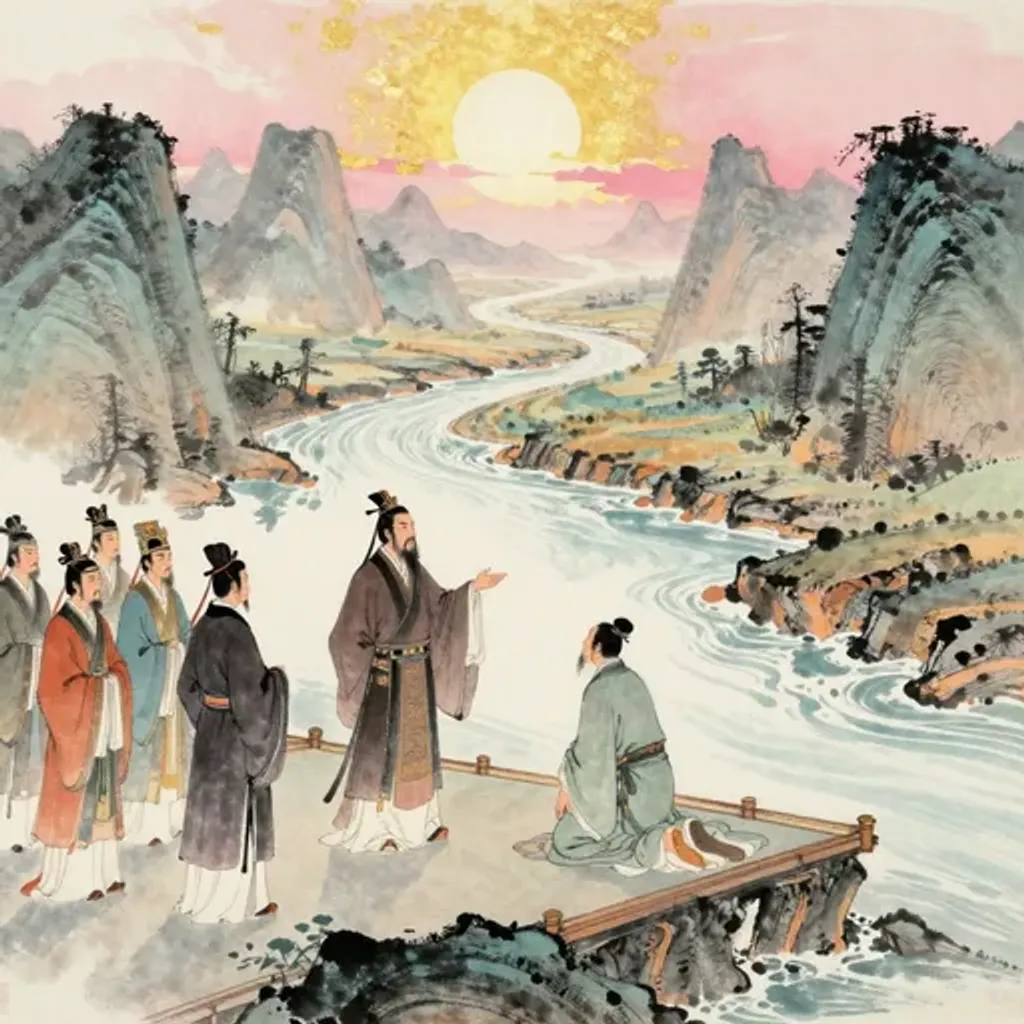
舜升大禹,石夷之野。徵詣王闕,拜治水土。
Shun elevates Great Yu in the wilderness of Shiyi. Summoned to the royal palace, he bows and is appointed to tame the waters and lands.
— Jiao Yanshou, Yilin (Forest of Changes), 1st century BC
Commentary
Water sits above fire, and the sage-king Shun elevates Yu the Great. In the rocky wilderness of Shiyi, Yu toils at his labors. Summoned to the royal court, he is appointed to govern water and earth. According to tradition, Shun recognized Yu's extraordinary capability and charged him with taming the great floods — a task Yu completed by channeling rather than damming the waters. From After Completion to Holding Together, the fire-and-water equilibrium yields to water flowing across the earth, binding all into union. The verse enacts the very mechanism of Holding Together: a sovereign recognizes talent, elevates it, and through that bond the realm coheres. Merit, not birth, becomes the mortar of the state.
既濟 → 小畜
Hexagram 63 → Hexagram 9: Small Taming
Changing lines: 2, 6
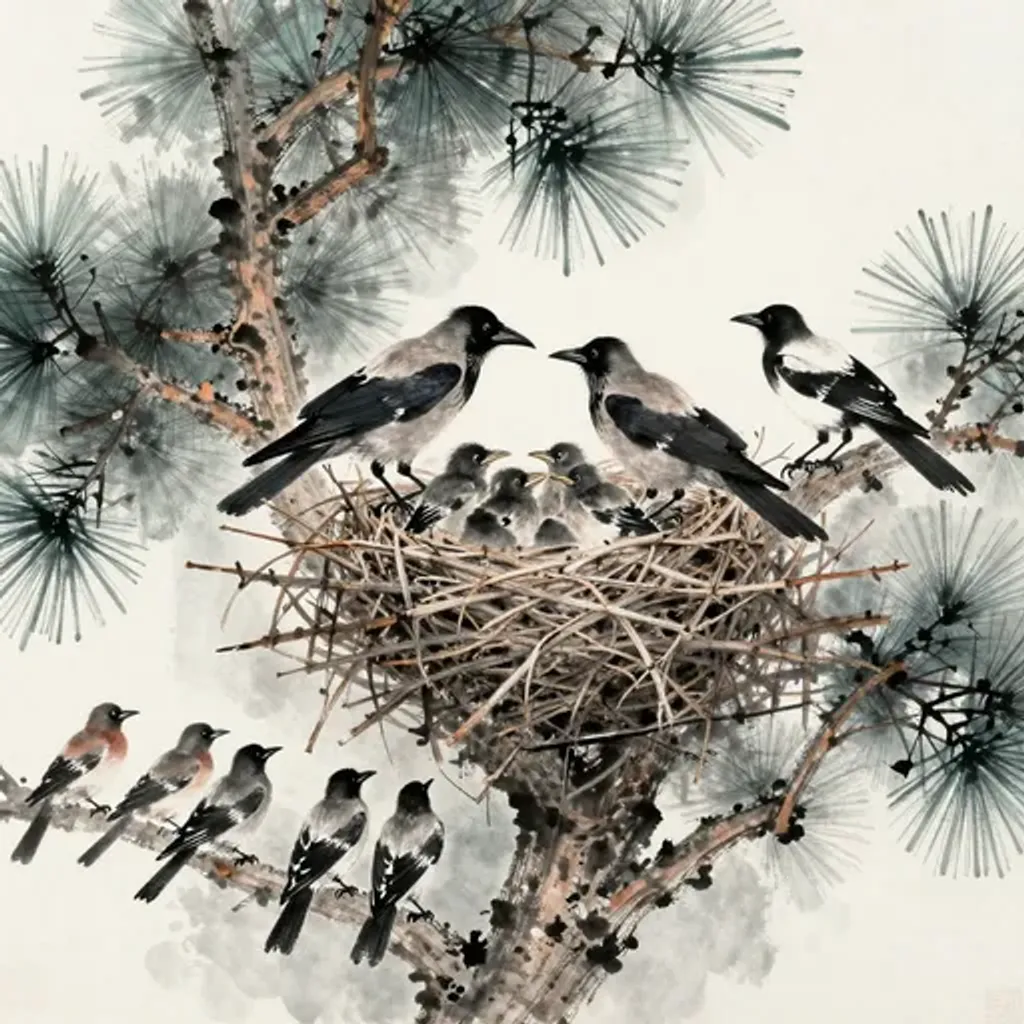
烏子鵲雛,常與母俱。顧類群族,不離其巢。
Crow chicks and magpie fledglings always stay close to their mothers. Looking to their kin and flock, they do not leave the nest.
— Jiao Yanshou, Yilin (Forest of Changes), 1st century BC
Commentary
Water sits above fire, everything in its place — and so the young stay close to home. Crow chicks and magpie fledglings remain always with their mother, watching over their kin and flock, never straying from the nest. The verse is a gentle portrait of familial constancy: the young do not wander because the nest provides everything they need. From After Completion to Small Taming, fire-and-water order gives way to wind moving across heaven — a gentle breeze that restrains without force. The completed household does not confine its members by walls but by warmth. Small Taming's wind over heaven refines through culture and affection, the way a mother bird's presence alone keeps her brood gathered.
既濟 → 履
Hexagram 63 → Hexagram 10: Treading
Changing lines: 2, 3, 4, 6
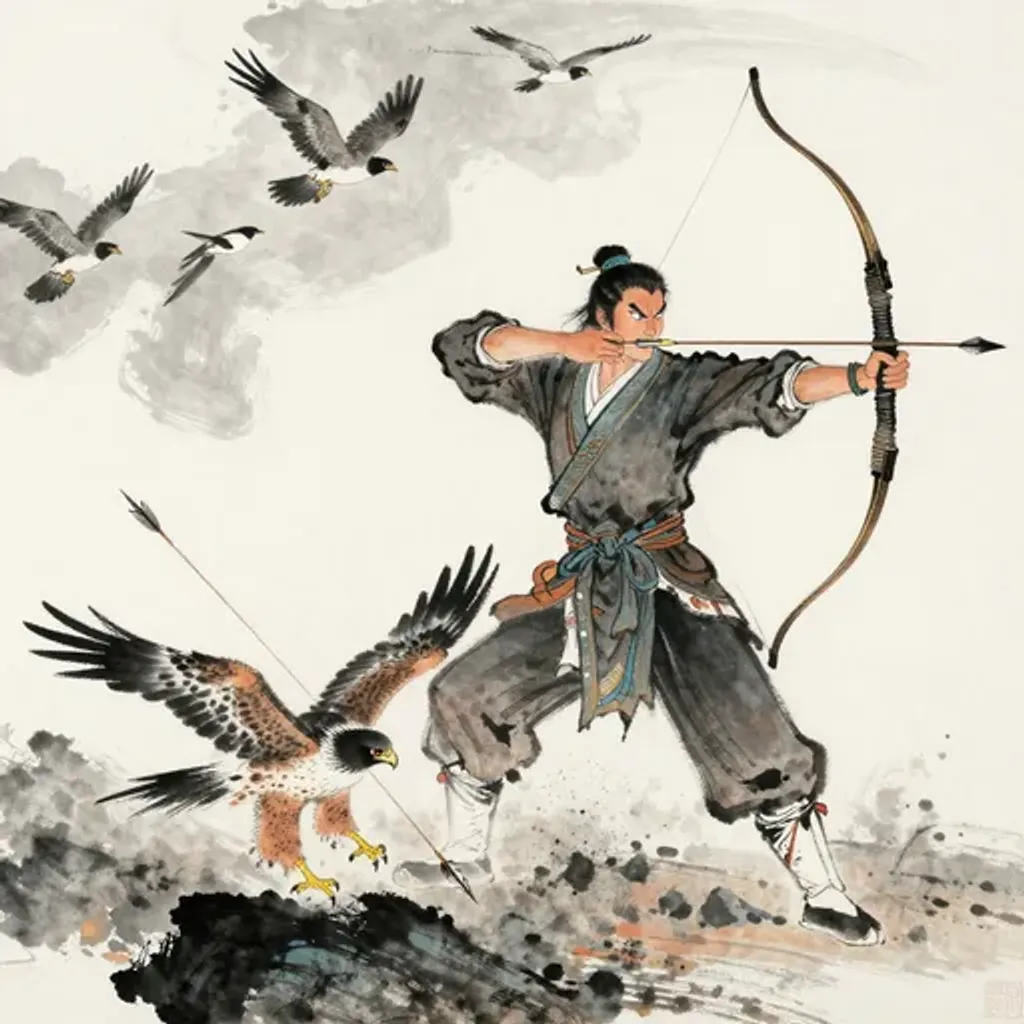
夷羿所射,發輒有獲。矰加鵲鷹,雙鳥俱得。
What Yi of the eastern tribes shoots, each arrow finds its mark. The silk-corded arrow strikes hawk and magpie; both birds are taken together.
— Jiao Yanshou, Yilin (Forest of Changes), 1st century BC
Commentary
Water sits above fire, and Archer Yi draws his bow — every shot finds its mark. His stringed arrow strikes both magpie and hawk; two birds fall with a single release. Yi, the divine bowman who shot down nine of the ten suns tormenting the earth, here embodies supreme precision and decisive action. From After Completion to Treading, the balanced arrangement yields to heaven above the lake — treading carefully where danger lurks. Yet this is not the timid treading of one who fears the tiger's tail; it is the marksman's confident step, measured and exact. Completion becomes disciplined conduct: knowing precisely where to aim, one walks fearlessly through perilous terrain.
既濟 → 泰
Hexagram 63 → Hexagram 11: Peace
Changing lines: 2, 5
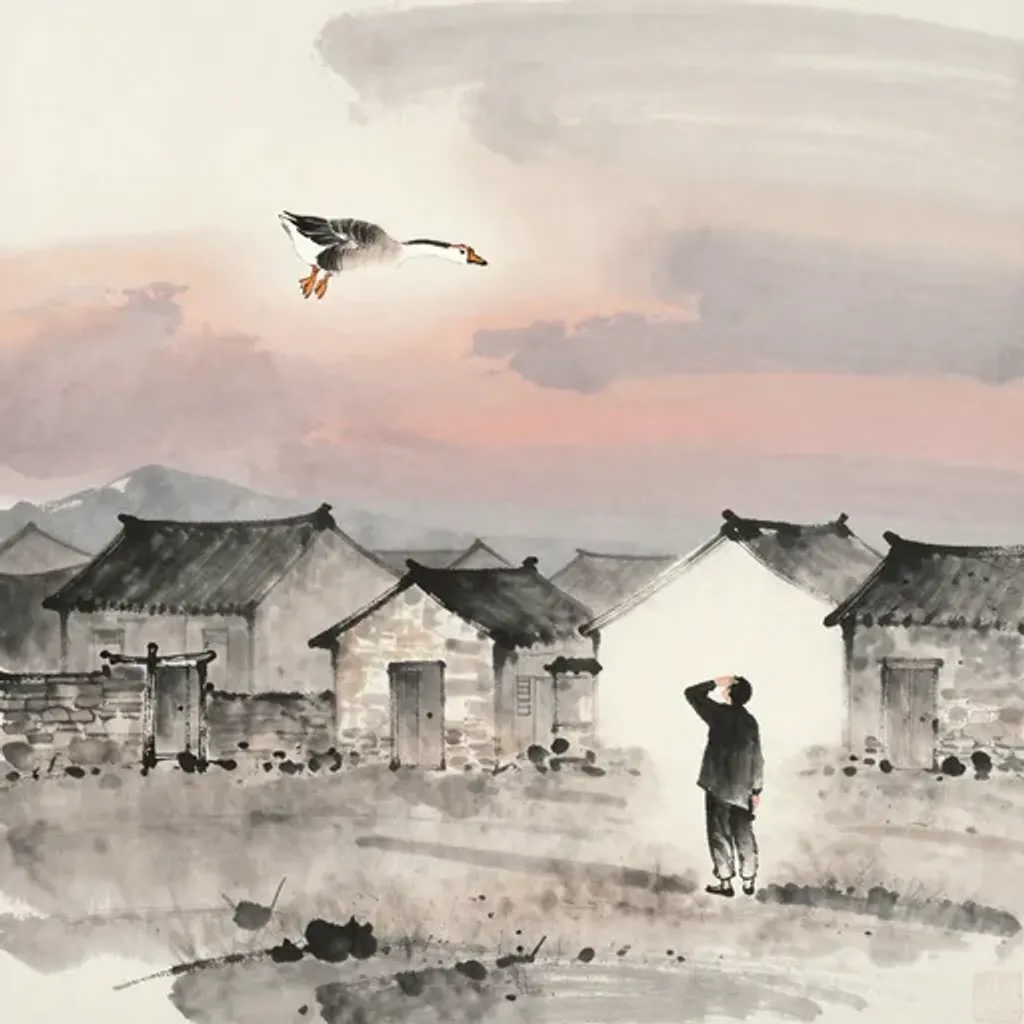
晨風文翰,大舉就溫。昧過我邑,羿无所得。
The goose passes and leaves a cry; a person passes and leaves a name. But this place is left with only emptiness — even the shadow does not linger.
— Jiao Yanshou, Yilin (Forest of Changes), 1st century BC
Commentary
Water sits above fire, but this verse is a modern rewrite. The original reads: 'The morning wind and patterned pheasant take great flight toward warmth, passing my village at dawn — Yi cannot catch them.' Swift birds fly south in formation, moving through the early light too fast for even the divine archer to intercept. Their passage is a flash of beauty that cannot be seized or detained. From After Completion to Peace, fire-and-water order transforms into heaven and earth in mutual exchange. The birds' effortless migration embodies Peace: unforced passage between realms, warmth sought and found without struggle. What is complete need not be grasped — it flows naturally toward where it belongs.
既濟 → 否
Hexagram 63 → Hexagram 12: Standstill
Changing lines: 1, 3, 4, 6
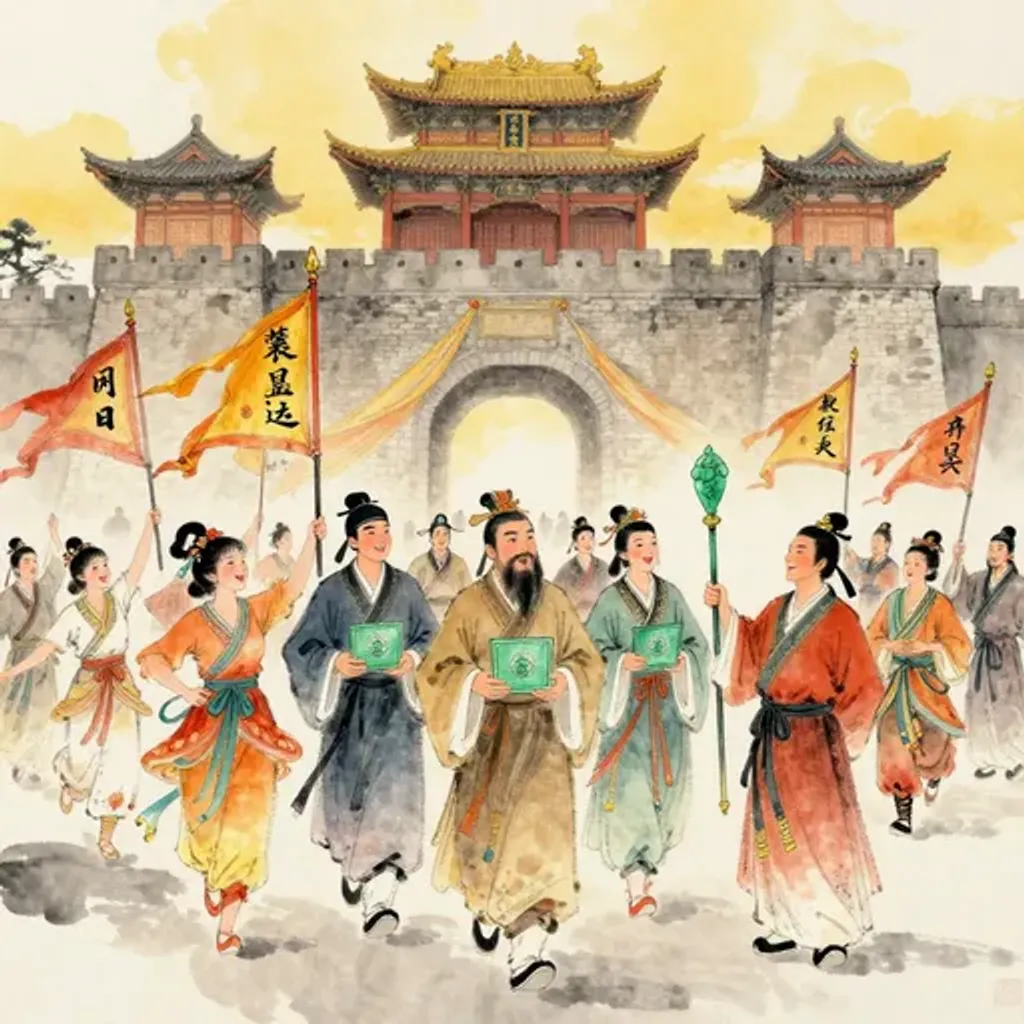
六喜三福,南至歡國。與喜忻樂,珪我潔德。
Six joys and three blessings; traveling south to the Land of Delight. Sharing in joy and happiness, the jade gui honors my pure virtue.
— Jiao Yanshou, Yilin (Forest of Changes), 1st century BC
Commentary
Water sits above fire, and six joys meet three blessings. One journeys south to the Land of Delight, sharing in happiness and festivity. The jade tablet of gui purifies one's virtue. The verse overflows with auspicious language — joy, blessing, celebration — painting a world where every direction yields good fortune. The gui jade tablet was a ritual symbol of moral refinement in Zhou court ceremony. From After Completion to Standstill, however, the exuberance carries an undertone: heaven and earth cease to communicate, the upper and lower realms separate. Abundance at its peak tips into stagnation. The wise person reads the joy with caution, knowing that even the happiest moment in a completed cycle may precede withdrawal.
既濟 → 同人
Hexagram 63 → Hexagram 13: Fellowship
Changing lines: 4, 6
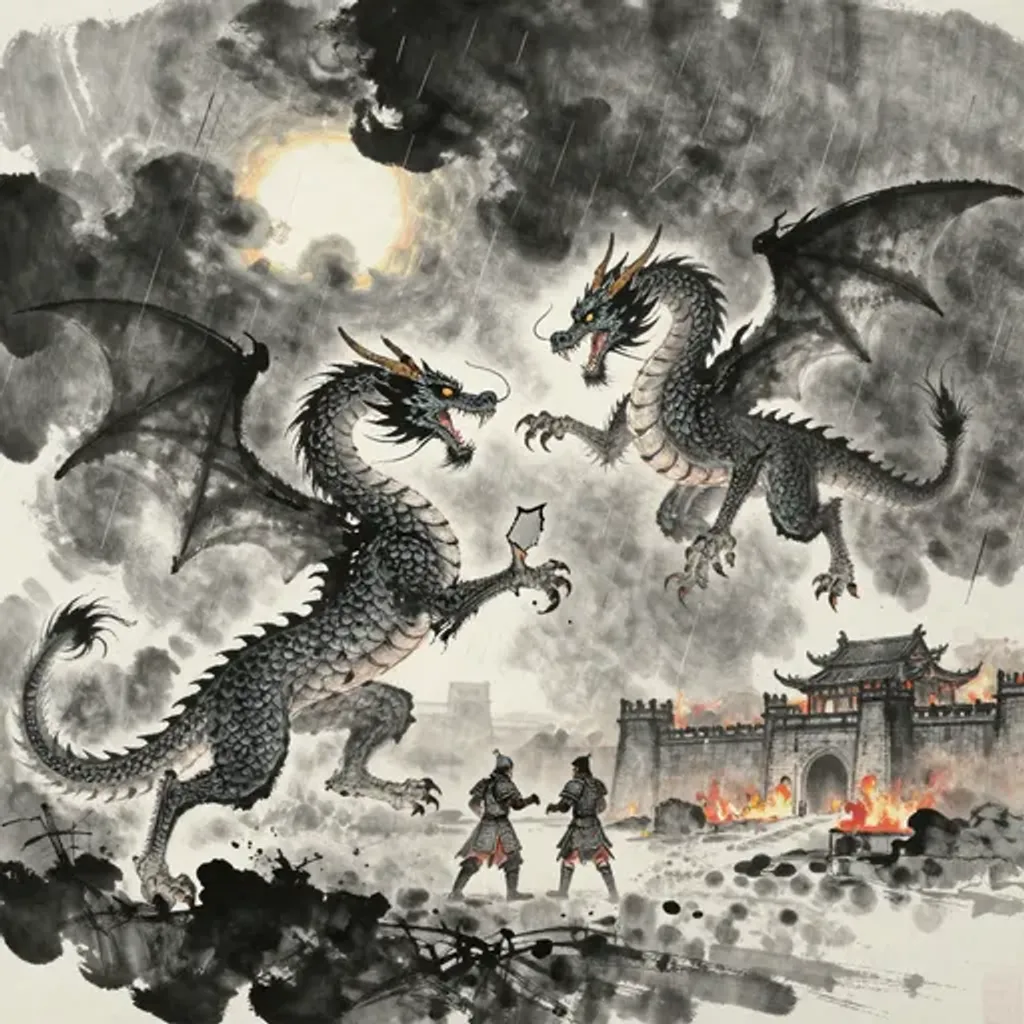
鬭龍股折,日遂不明。自外為主,弟伐其兄。
Fighting dragons, a leg broken; the sun thereafter grows dim. An outsider becomes master; brother attacks brother.
— Jiao Yanshou, Yilin (Forest of Changes), 1st century BC
Commentary
Water sits above fire, but the dragons have turned on each other. In the struggle, a thigh is broken; the sun itself grows dim. An outsider seizes the throne as master, and the younger brother attacks his elder. The battling dragons (鬭龍) recall the omen of dragons wrestling in a ruler's court — a sign of fraternal strife and dynastic collapse. The sun darkening signals the loss of legitimate authority. From After Completion to Fellowship, the orderly arrangement gives way to heaven joined with fire — a blaze that should unite but here illuminates fratricide. Fellowship demands that those within the same clan find common cause; this verse shows what happens when completion breeds rivalry instead, and brothers weaponize their shared inheritance.
既濟 → 大有
Hexagram 63 → Hexagram 14: Great Possession
Changing lines: 2, 4, 5, 6
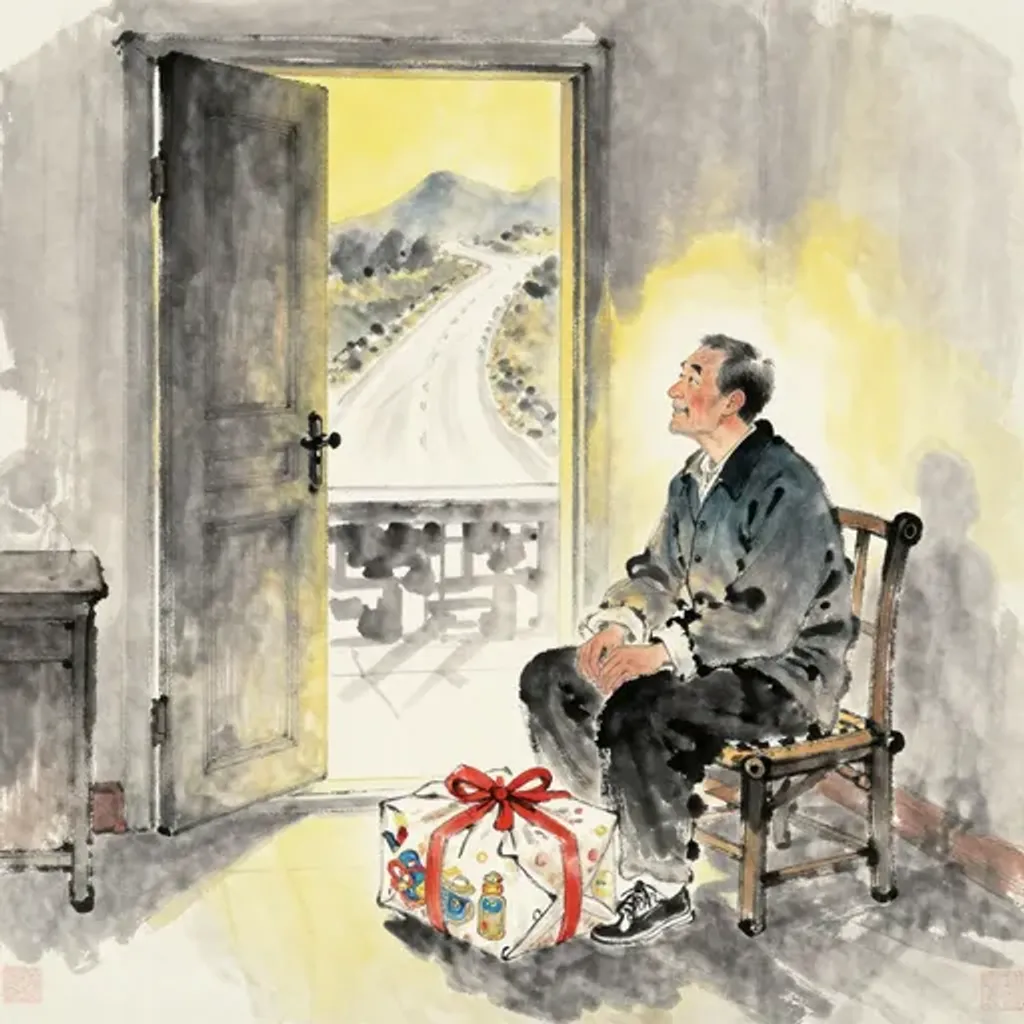
蒙慶受福,有所獲得,不利出門。
Receiving blessings amid good fortune, there is something to be gained; it is not favorable to go out the door.
— Jiao Yanshou, Yilin (Forest of Changes), 1st century BC
Commentary
Water sits above fire, blessings and good fortune arrive — there are gains to be had. Yet the verse cautions: do not go out the door. One receives favor and profit while staying within, but venturing abroad invites danger. The message is one of quiet consolidation: fortune comes to those who tend what they already possess rather than seeking more. From After Completion to Great Possession, fire-and-water balance yields to fire blazing above heaven — abundance at its most expansive. Yet the verse tempers this: Great Possession achieved from a completed state works best through restraint, not expansion. The completed order already contains everything needed; going outside its bounds is how one loses what was gained.
既濟 → 謙
Hexagram 63 → Hexagram 15: Modesty
Changing lines: 1, 5
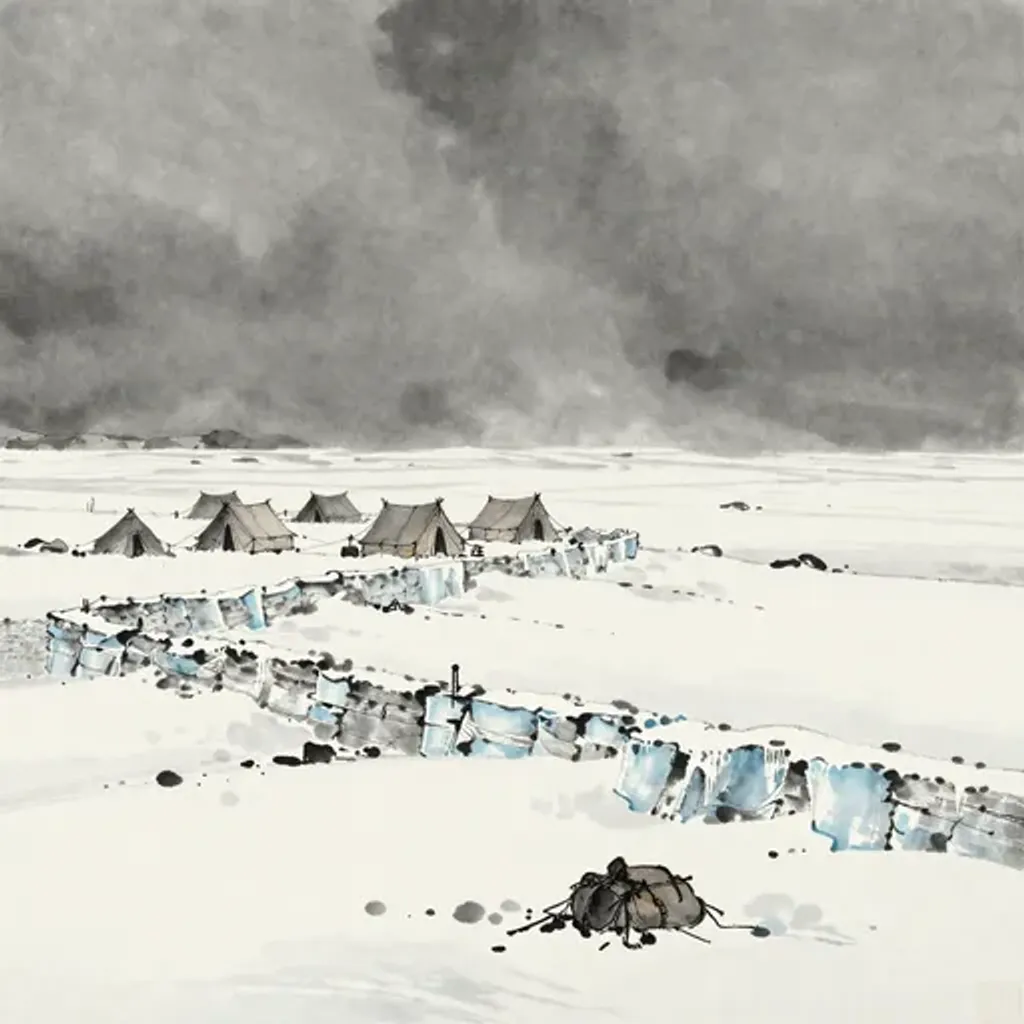
蠻戎夷狄,太陰所積。涸冰沍寒,君子不存。
The lands of the Man, Rong, Yi, and Di; where extreme yin accumulates. Frozen ice and bitter cold; the noble one cannot endure here.
— Jiao Yanshou, Yilin (Forest of Changes), 1st century BC
Commentary
Water sits above fire, but the scene is desolate. Barbarian tribes of the four quarters press inward, and extreme yin accumulates — ice congeals, bitter cold descends. The gentleman cannot survive in such a place. The verse conjures a frontier stripped of civilized presence, where cold overwhelms warmth and the completed order freezes into lifelessness. From After Completion to Modesty, the balanced configuration gives way to a mountain hidden within the earth — Modesty's image of the high brought low. Yet here the lowering is not voluntary humility but forced retreat. The gentleman withdraws not from virtue but from a hostile environment where completion has calcified into frozen stagnation, and survival requires yielding ground.
既濟 → 豫
Hexagram 63 → Hexagram 16: Enthusiasm
Changing lines: 1, 3, 4, 5
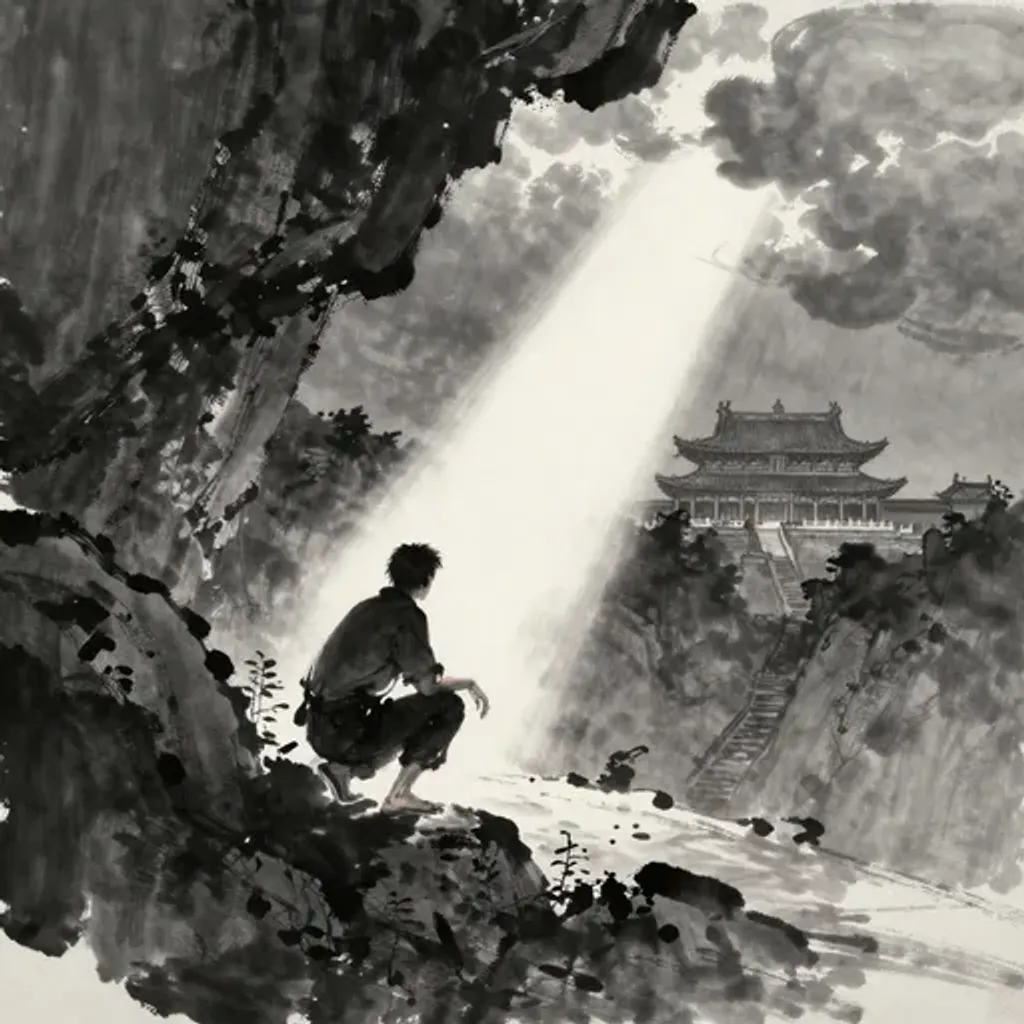
畏昏潛處,候時昭明。卒遭白日,為榮祿主。
Fearing darkness, hiding in secret, awaiting the time of clarity. Suddenly meeting the bright sun, becoming master of glory and rank.
— Jiao Yanshou, Yilin (Forest of Changes), 1st century BC
Commentary
Water sits above fire, and one who feared the darkness hides in the shadows, biding time until the light returns. Then suddenly the bright sun bursts forth, and the hidden one emerges as master of glory and rank. The verse traces the arc of a talent concealed during dangerous times who seizes the moment of clarity. From After Completion to Enthusiasm, the precise fire-and-water balance gives way to thunder erupting from the earth — Enthusiasm's explosive release. The completed order contained this energy all along; it merely awaited the proper moment. The one who crouched in darkness was not passive but prepared, and when thunder sounds, rises instantly to claim what patience earned.
既濟 → 隨
Hexagram 63 → Hexagram 17: Following
Changing lines: 3, 4
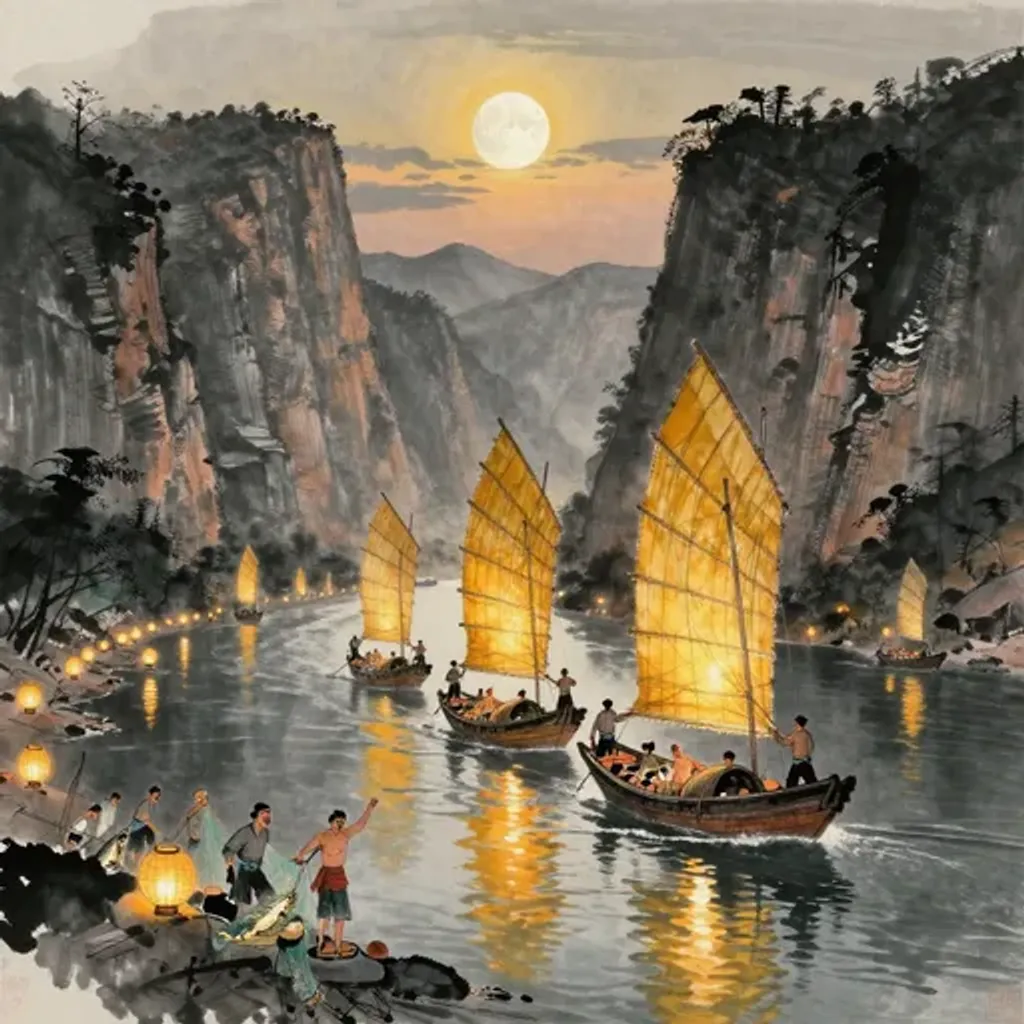
水流趍下,欲至東海。求我所有,買魴與鯉。
Merchant boats ride the wind through the gorge mouth; sails round as the moon reflect on green water. Along the shore, a thousand fishing lanterns shine — baskets brim with fish and shrimp, laughter is thick.
— Jiao Yanshou, Yilin (Forest of Changes), 1st century BC
Commentary
Water sits above fire, but this verse is a modern rewrite. The original reads: 'Water flows downward, seeking to reach the Eastern Sea. I seek what I possess — buying bream and carp.' The imagery is of natural flow and commerce: water follows its course to the sea, and a buyer goes to market for fish. Both movements are purposeful and unhurried, following the path of least resistance. From After Completion to Following, fire-and-water order transforms into thunder resting beneath the lake — energy stilled, yielding to the current. Following's wisdom is knowing when to let the stream carry you. The completed order does not resist its own momentum but flows toward its natural destination.
既濟 → 蠱
Hexagram 63 → Hexagram 18: Work on the Decayed
Changing lines: 1, 2, 5, 6
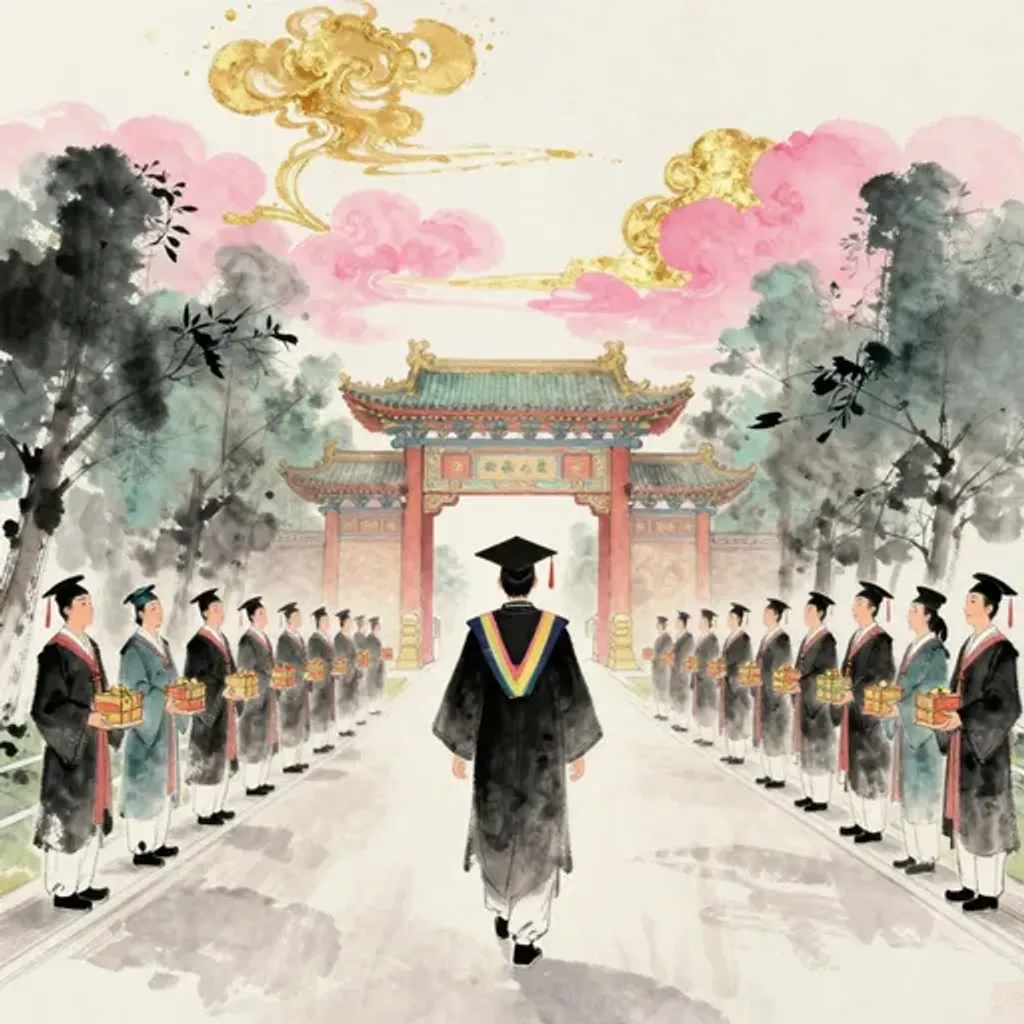
冠帶南遊,與福喜期。徼於嘉國,拜為逢時。
Wearing cap and sash, traveling south, keeping an appointment with good fortune. Meeting with favor in the blessed land, bowing to receive the gift of perfect timing.
— Jiao Yanshou, Yilin (Forest of Changes), 1st century BC
Commentary
Water sits above fire, and a gentleman dons his cap and sash to journey south, keeping an appointment with fortune and joy. Arriving at a blessed land, he receives an audience and is honored for arriving at the right moment. The verse celebrates timely action: proper attire signals readiness, the southern journey suggests advancement, and the appointment fulfilled marks alignment with opportunity. From After Completion to Work on the Decayed, the orderly configuration gives way to wind stirring beneath the mountain — renewal of what has grown stale. The completed gentleman does not rest on accomplishment but ventures forth to restore and reform, arriving precisely when his skills are most needed.
既濟 → 臨
Hexagram 63 → Hexagram 19: Approach
Changing lines: 2, 3, 5
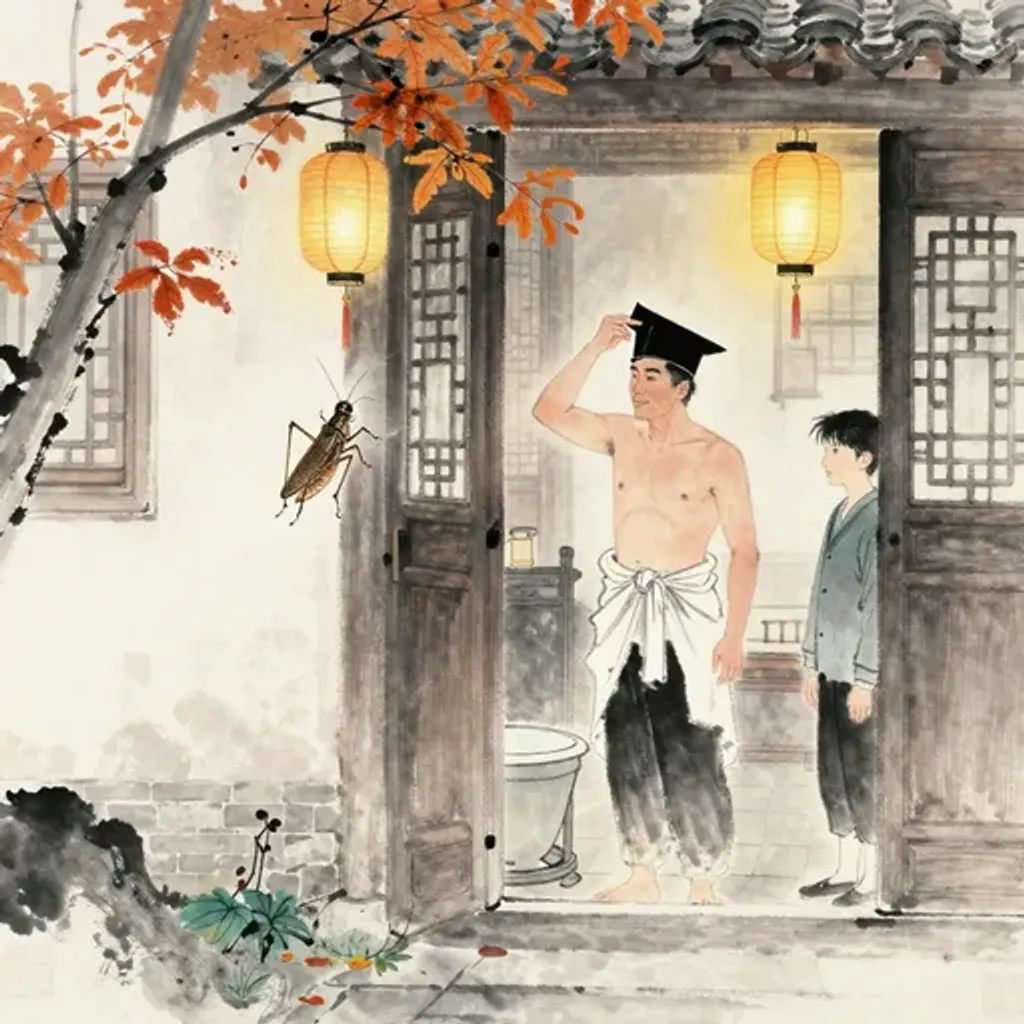
莎雞振羽,為季門戶。新沐彈冠,仲公悅喜。
The katydid beats its wings, serving as doorkeeper for the younger brother. Freshly bathed and dusting off the cap, the second-eldest rejoices.
— Jiao Yanshou, Yilin (Forest of Changes), 1st century BC
Commentary
Water sits above fire, and the katydid rubs its wings in seasonal rhythm, keeping the household gate for the youngest brother. One who has freshly washed his hair dusts off his cap — and his companion rejoices. The katydid's wing-song (莎雞振羽) echoes the Shijing's seasonal markers, signaling autumn's domestic preparations. 'Freshly bathed, one dusts the cap' alludes to Qu Yuan's declaration in the Chuci: 'One who has just washed must dust his cap' — a metaphor for moral purity maintained despite corruption. From After Completion to Approach, fire-and-water balance yields to earth spreading above the lake — authority extending generously downward. The completed person approaches others with renewed integrity, and those who recognize such purity welcome it with delight.
既濟 → 觀
Hexagram 63 → Hexagram 20: Contemplation
Changing lines: 1, 3, 6
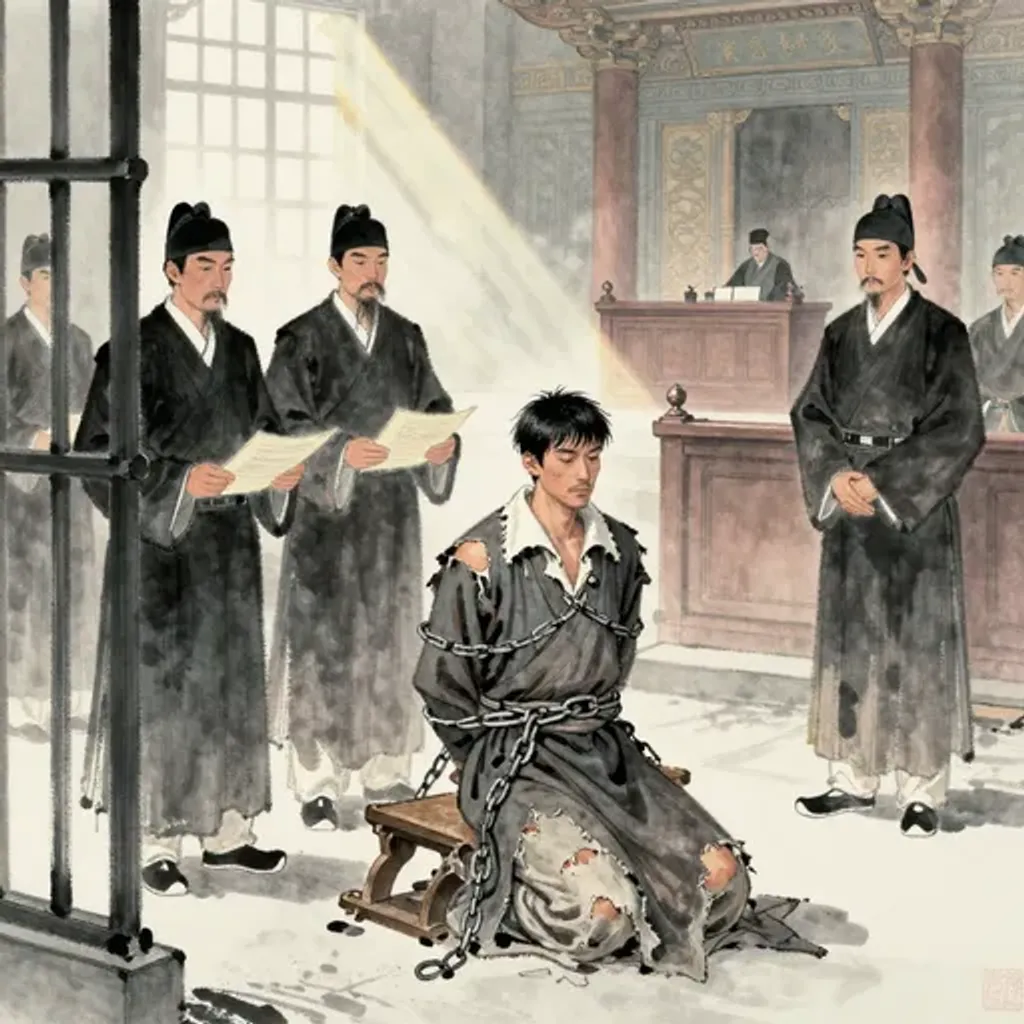
結衿流粥,遭讒桎梏。周召述職,身受大福。
Bound at the collar, fed only gruel, slandered and shackled. The Dukes of Zhou and Shao perform their duties; his person receives great blessing.
— Jiao Yanshou, Yilin (Forest of Changes), 1st century BC
Commentary
Water sits above fire, and a minister distributes gruel while wearing his court robes tied at the collar — yet he is slandered and thrown into chains. Then the Duke of Zhou and Duke of Shao faithfully fulfill their offices, and the imprisoned one receives great blessings. The verse traces the arc of unjust suffering followed by vindication through loyal governance. The image of serving gruel in formal dress suggests selfless duty during famine. From After Completion to Contemplation, fire-and-water order yields to wind moving above the earth — the ruler surveying his domain from on high. Contemplation here restores what slander destroyed: the truth, once observed from the proper vantage, clears the innocent and rewards faithful service.
既濟 → 噬嗑
Hexagram 63 → Hexagram 21: Biting Through
Changing lines: 3, 4, 5, 6
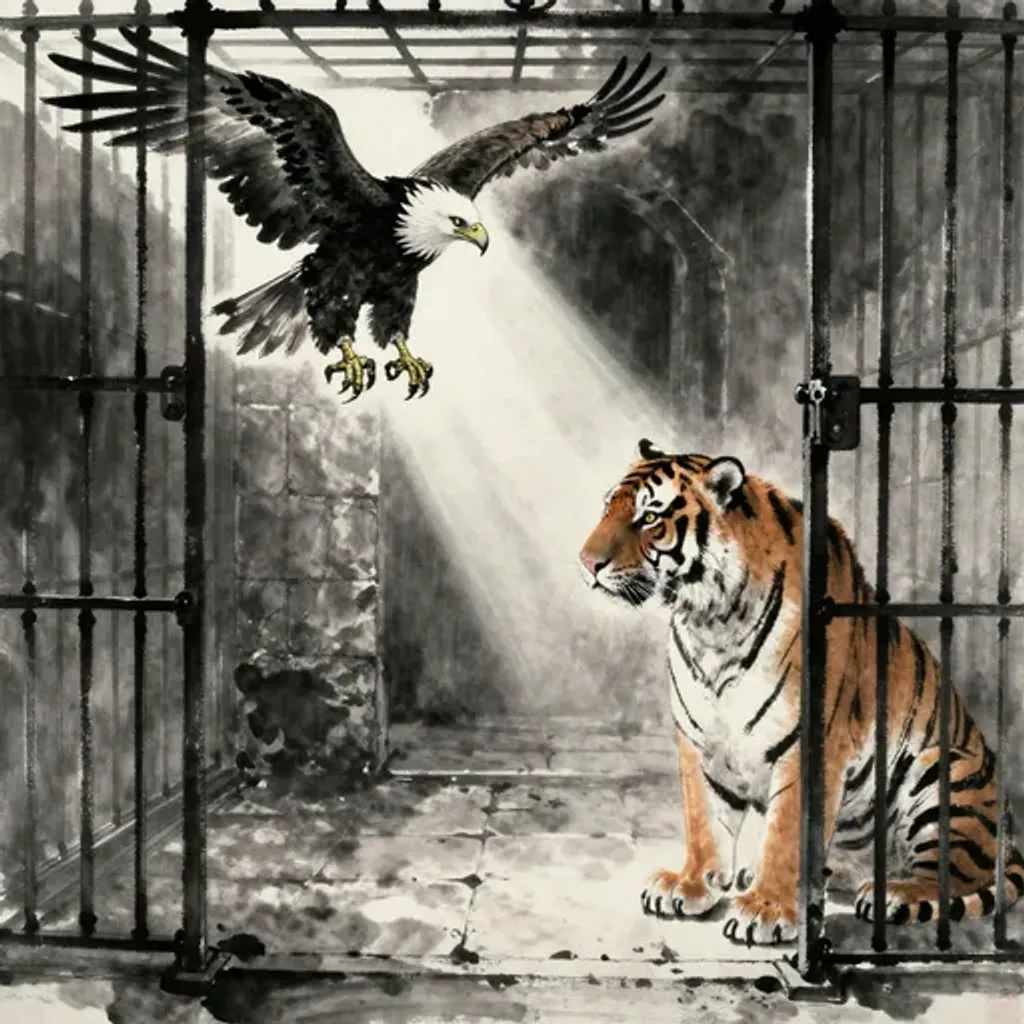
田鼠野雞,意常欲逃。拘制籠檻,不得動搖。
An iron cage locks the eagle whose wings are already broken; a stone cell holds a tiger whose claws are worn flat. Day and night watching a thin line of light through the window — the word "freedom" weighs a thousand jin.
— Jiao Yanshou, Yilin (Forest of Changes), 1st century BC
Commentary
Water sits above fire, but this verse is a modern rewrite. The original reads: 'Field mice and pheasants constantly wish to escape, but confined in cage and pen, they cannot move.' The imagery is stark: wild creatures trapped in enclosures, their instinct for freedom thwarted by physical restraint. The verse offers no resolution — only the grinding frustration of captivity. From After Completion to Biting Through, fire-and-water order transforms into fire above thunder — lightning's clarifying strike that breaks through obstruction. The completed state here has become a prison; Biting Through's mechanism demands that the obstacle be bitten apart. Freedom requires not patience but decisive force applied to the specific point of confinement.
既濟 → 賁
Hexagram 63 → Hexagram 22: Grace
Changing lines: 5, 6
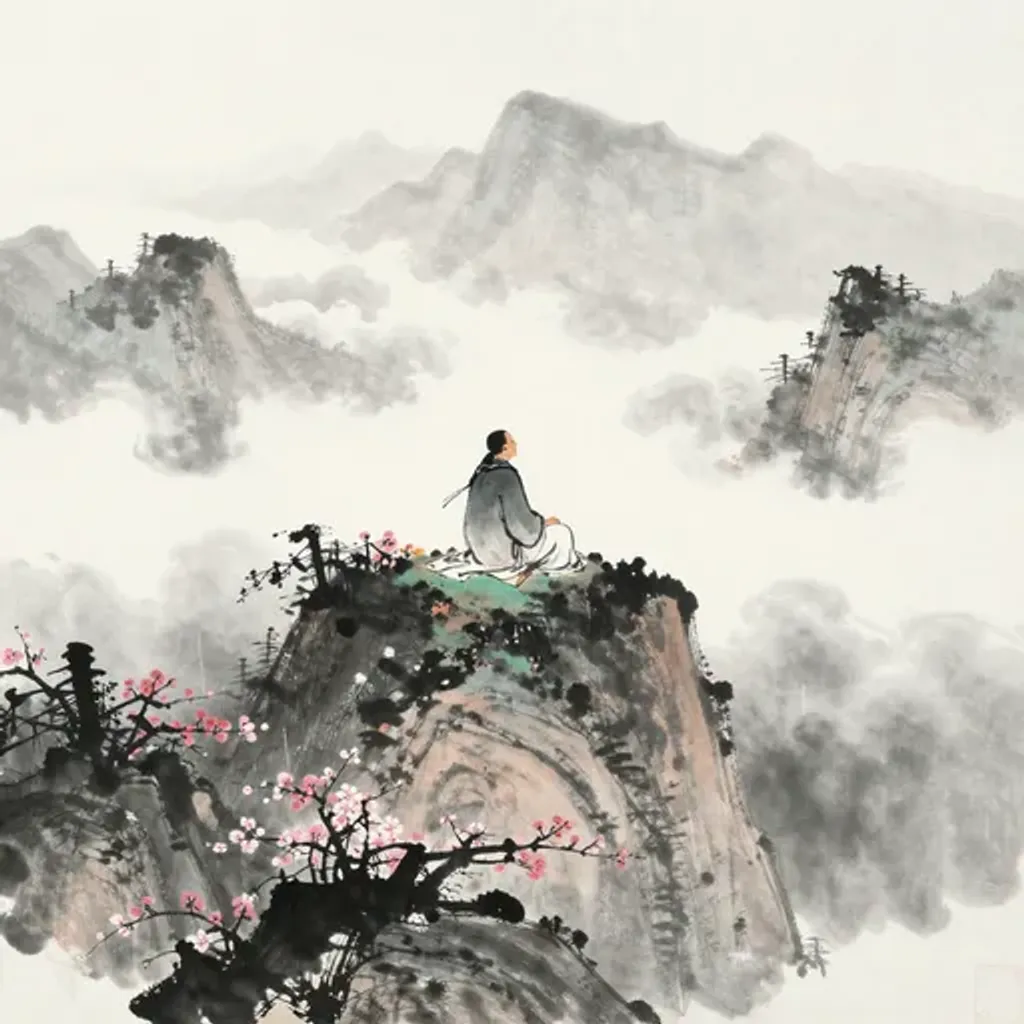
居華巔,觀浮雲。風不搖,雨不濡。心平安,无咎憂。
Dwelling on the flowered peak, watching the floating clouds. The wind does not shake, the rain does not drench. Heart calm and peaceful, without blame or worry.
— Jiao Yanshou, Yilin (Forest of Changes), 1st century BC
Commentary
Water sits above fire in perfect equilibrium, and one dwells upon a splendid summit, watching floating clouds drift past. The wind does not shake, the rain does not soak. The heart rests in peace, free from blame or worry. The verse is a portrait of serene elevation — above the turmoil of weather and the world, yet not detached from it. From After Completion to Grace, fire-and-water order yields to fire glowing beneath the mountain — illumination restrained by natural form. Grace is not mere decoration but the beauty that emerges when inner light is tempered by structure. The completed person stands at the height, ornamented not by effort but by the quiet radiance of a life that has found its proper form.
既濟 → 剝
Hexagram 63 → Hexagram 23: Splitting Apart
Changing lines: 1, 3, 5, 6
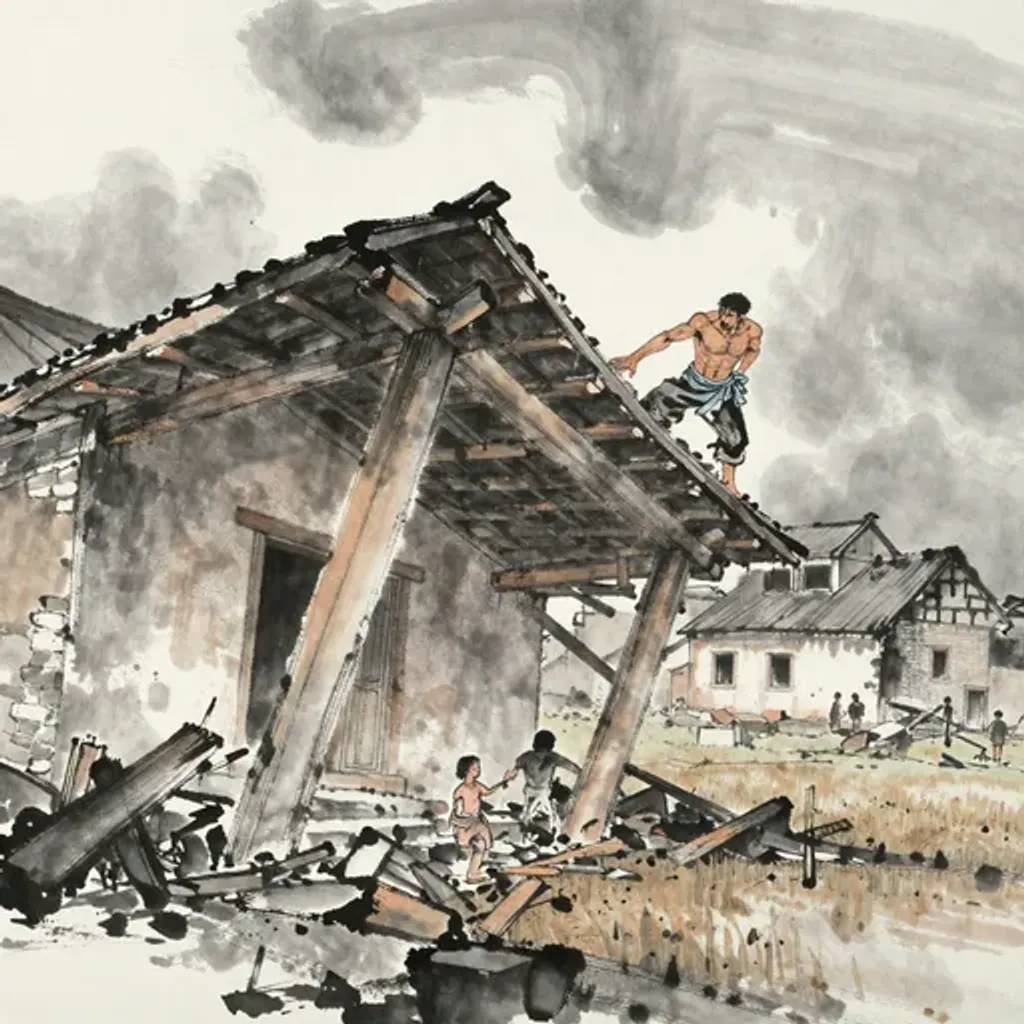
傾倚將顛,不能得存。英雄作業,家困无年。
Leaning and tilting, about to collapse, unable to survive. The hero's enterprise fails; the family is destitute, the year without harvest.
— Jiao Yanshou, Yilin (Forest of Changes), 1st century BC
Commentary
Water sits above fire, but the structure is leaning and about to topple — nothing can be preserved. A hero builds his enterprise, yet his household falls to ruin within the year. The verse captures the tragedy of a capable person whose personal foundation crumbles even as ambition drives outward achievement. From After Completion to Splitting Apart, fire-and-water balance degrades into the mountain resting on bare earth — the last solid yang line perched atop five yin lines, erosion nearly complete. Completion does not guarantee permanence. When the base decays while attention is elsewhere, even heroic effort cannot arrest the collapse. The mountain splits from its foundation, and no amount of accomplishment can hold together what has rotted beneath.
既濟 → 復
Hexagram 63 → Hexagram 24: Return
Changing lines: 3, 5
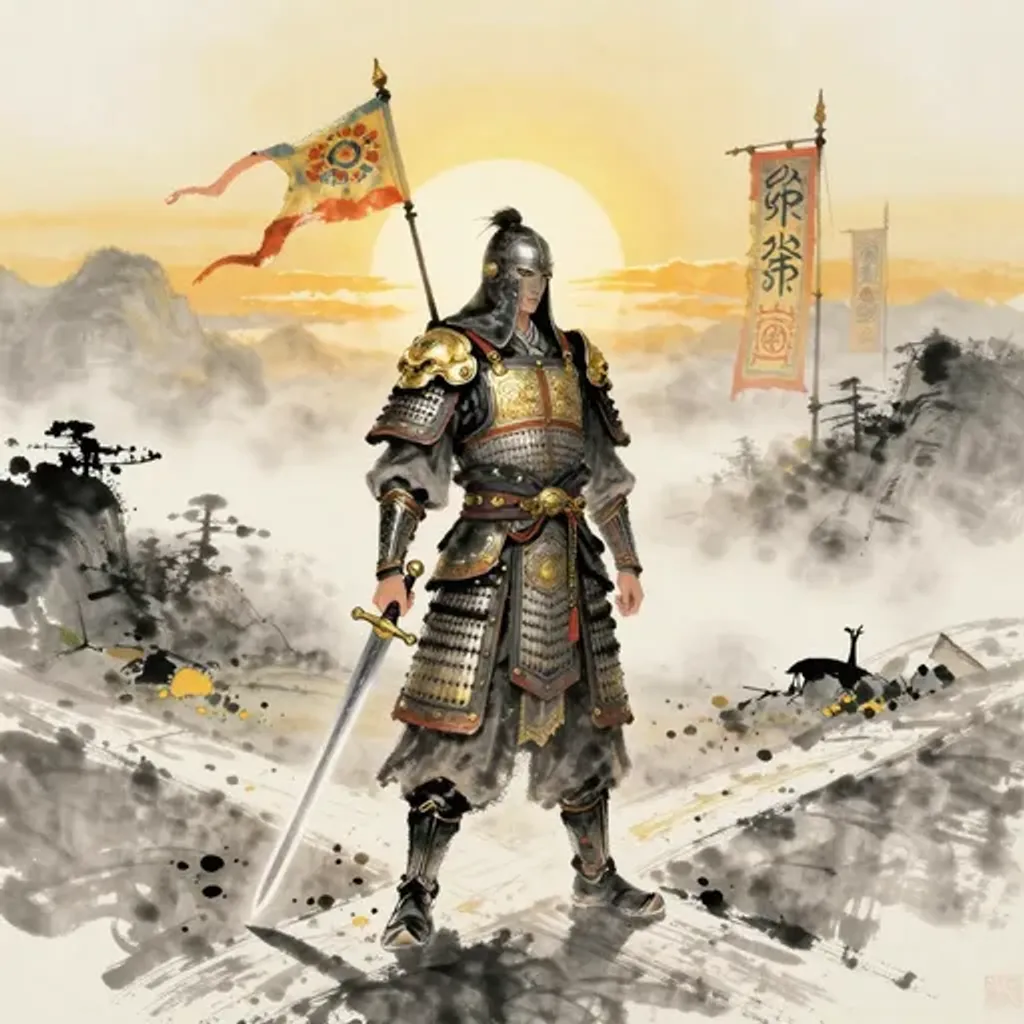
心願所喜,今乃逢時。保我利福,不離兵革。
What the heart desires and delights in now meets its proper time. Protecting my fortune and blessing, yet not departing from arms and warfare.
— Jiao Yanshou, Yilin (Forest of Changes), 1st century BC
Commentary
Water sits above fire, and one's heart's desire meets its moment — the time has finally arrived. Fortune and blessings are secured, yet they come entangled with weapons and warfare. The verse refuses easy optimism: joy is real but inseparable from conflict, and the protective blessing requires armed vigilance to maintain. From After Completion to Return, fire-and-water order transforms into thunder stirring beneath the earth — the first yang line re-entering from below. Return marks the solstice of renewal after a dark period, but this Return carries weapons. The completed state does not return to innocence; it returns to the world as it is, where blessings must be defended and the heart's desire is won through struggle, not granted as a gift.
既濟 → 无妄
Hexagram 63 → Hexagram 25: Innocence
Changing lines: 3, 4, 6
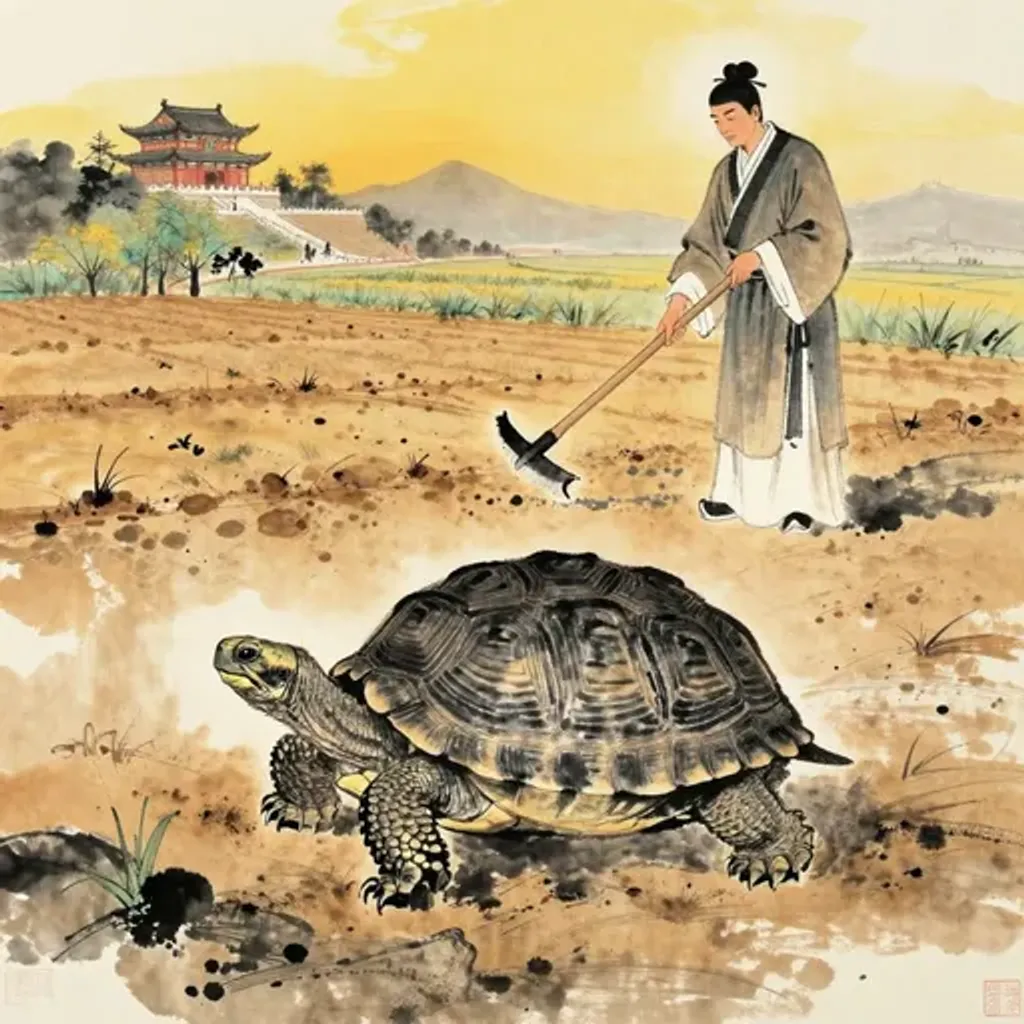
靈龜陸處,盤桓失所。阿衡退耕,夏封於國。
The spirit tortoise dwells on land, wandering, having lost its place. The minister Yi Yin retires to the plow; in Xia, he is enfeoffed with a state.
— Jiao Yanshou, Yilin (Forest of Changes), 1st century BC
Commentary
Water sits above fire, and the sacred tortoise wanders on land, circling without finding its place. Then the verse invokes Aheng — Yi Yin's ministerial title — who withdraws to plow the fields before being called to serve the Xia-overthrowing Shang dynasty. Yi Yin, the sage cook of Youshen who became founding chancellor, here embodies talent biding its time in obscurity. From After Completion to Innocence, fire-and-water precision yields to thunder moving beneath heaven — the unexpected, unforced arrival of what was always meant to be. Innocence means acting without calculated design. Yi Yin did not scheme his rise; he simply plowed and waited, and heaven's thunder brought him forth at the appointed hour.
既濟 → 大畜
Hexagram 63 → Hexagram 26: Great Taming
Changing lines: 2, 5, 6
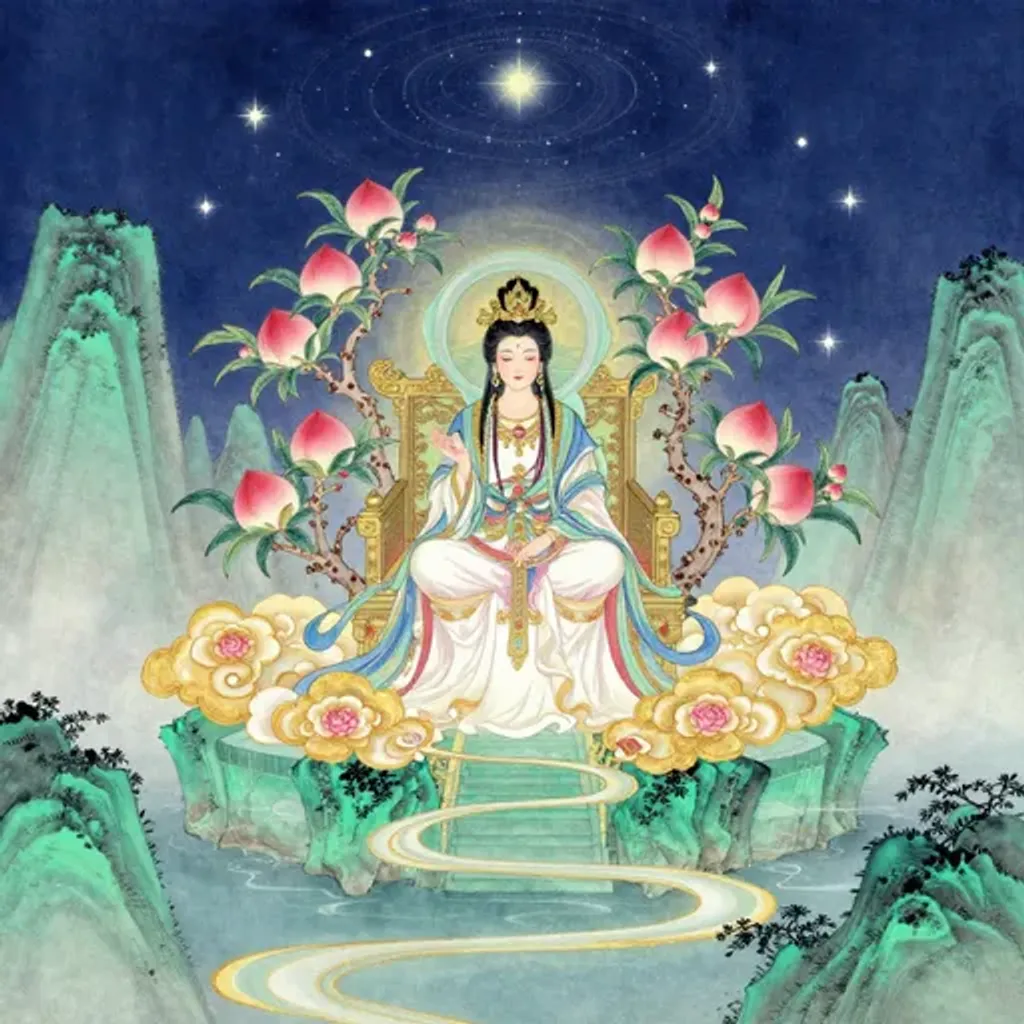
弱水之右,有西王母。生不知老,與天相保,不利行旅。
To the west of the Weak Water, there dwells the Queen Mother of the West. She lives knowing no old age, preserved alongside Heaven. Travel is not favorable.
— Jiao Yanshou, Yilin (Forest of Changes), 1st century BC
Commentary
Water sits above fire, and to the right of the Weak Water dwells the Queen Mother of the West. She knows neither birth nor aging, her existence coextensive with heaven itself — yet travel to reach her is inadvisable. The Queen Mother of the West, guardian of the peaches of immortality atop Mount Kunlun, represents transcendence beyond the mortal order. The Weak Water, too thin to float a feather, separates the human world from the divine. From After Completion to Great Taming, the balanced state transforms into heaven stored within the mountain — vast energy accumulated and held. The immortal realm is the ultimate taming: eternal life contained within sacred geography. But the warning stands: the completed person should not attempt the crossing.
既濟 → 頤
Hexagram 63 → Hexagram 27: Nourishment
Changing lines: 3, 5, 6
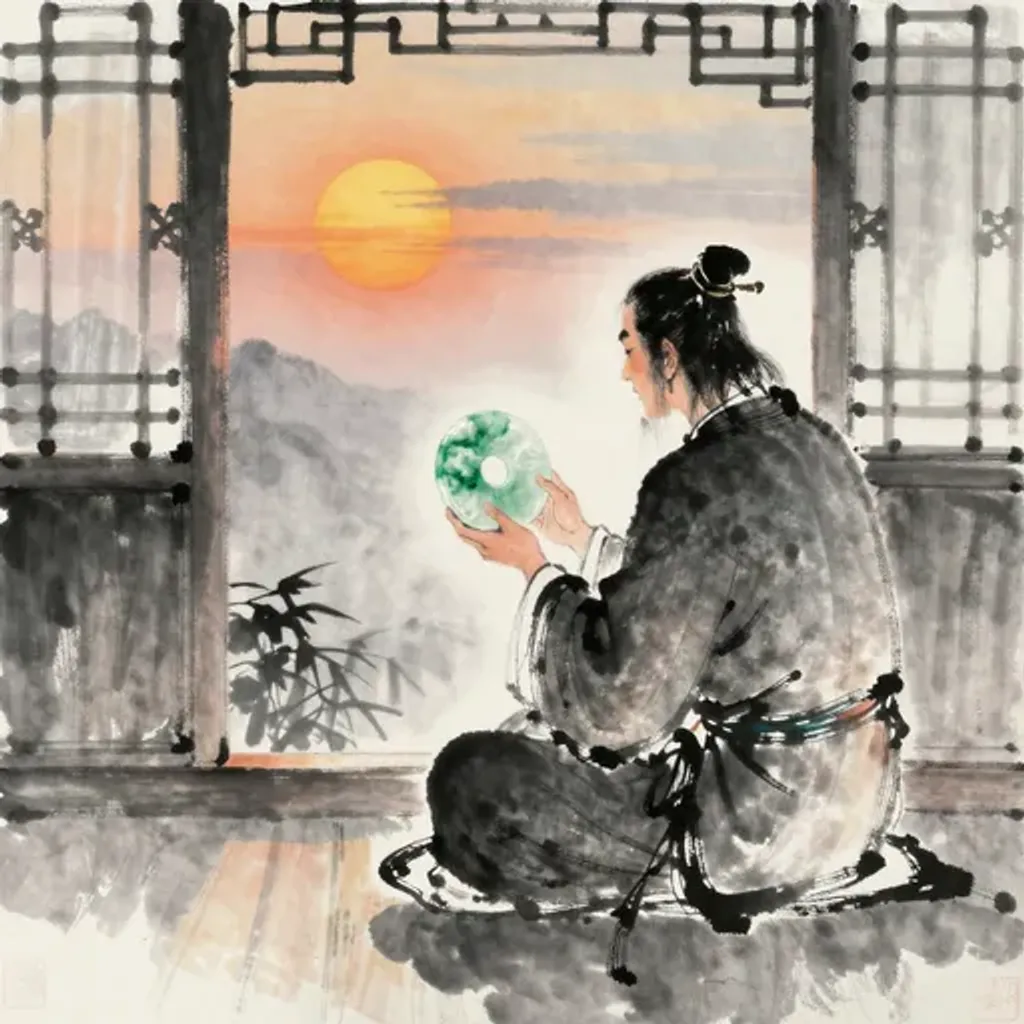
抱瓌求金,日暮坐吟。終月卒歲,竟无成功。
Clutching jade, seeking gold; as the sun sets, sitting and sighing. Month after month, year after year, in the end no success.
— Jiao Yanshou, Yilin (Forest of Changes), 1st century BC
Commentary
Water sits above fire, but one clutches a precious jade and seeks gold — sitting and sighing as the day grows late. Month after month, year after year, nothing is achieved. The verse depicts frustration born of misplaced expectation: holding treasure yet wanting more, the person wastes time lamenting instead of acting. From After Completion to Nourishment, fire-and-water order yields to the mountain above thunder — the open mouth that must learn what to take in and what to refuse. Nourishment requires discernment about what truly sustains. The completed person who cannot distinguish between what he holds and what he lacks starves amid plenty, unable to nourish himself because desire has eclipsed gratitude.
既濟 → 大過
Hexagram 63 → Hexagram 28: Great Exceeding
Changing lines: 1, 2, 4
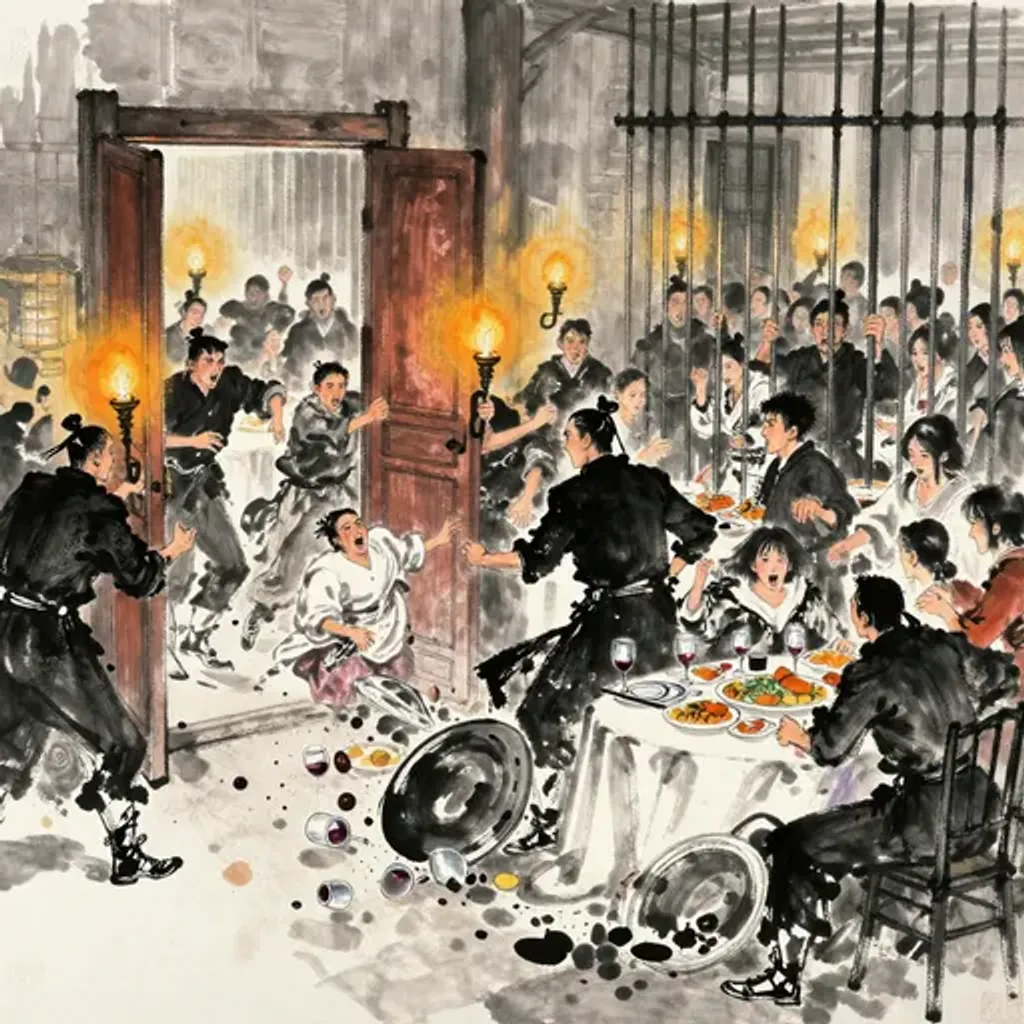
言笑未畢,憂來暴卒。身加搤檻,囚繫縛束。
Laughter and words not yet finished when worry arrives suddenly. The body placed in stocks and bars, imprisoned and bound tight.
— Jiao Yanshou, Yilin (Forest of Changes), 1st century BC
Commentary
Water sits above fire, and laughter has not yet finished when calamity strikes without warning. One is seized, shackled, and bound — imprisoned in an instant. The verse is brutally abrupt: mid-sentence joy becomes incarceration, with no transition and no cause given. The speed of the reversal is the point. From After Completion to Great Exceeding, fire-and-water balance collapses into the lake submerging the trees — an extraordinary burden that overwhelms normal structures. Great Exceeding's ridgepole sags under impossible weight. The completed state, at its most relaxed and celebratory, proves most vulnerable to sudden catastrophe. The very completeness bred complacency, and the blow falls precisely where no one was watching.
既濟 → 坎
Hexagram 63 → Hexagram 29: The Abysmal Water
Changing lines: 1, 2, 3
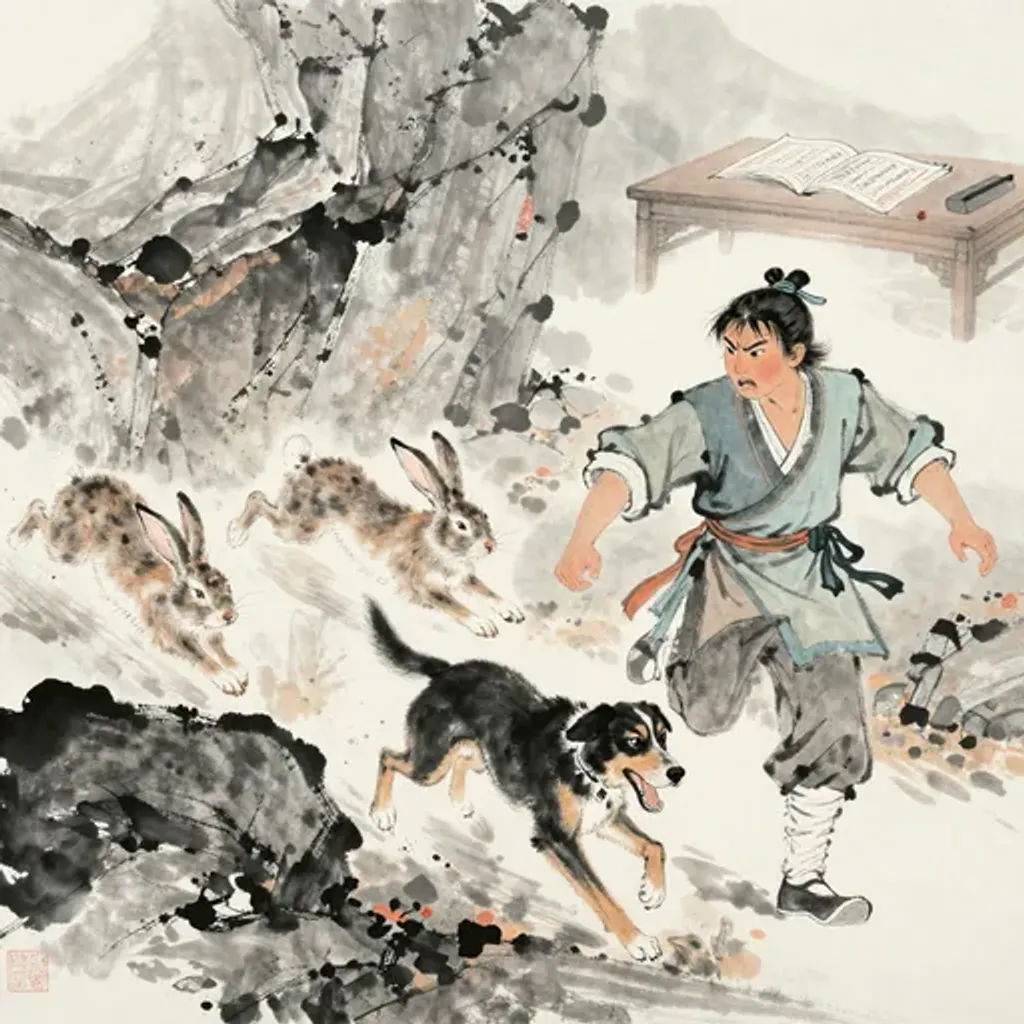
望幸不到,文章未成。王子逐兔,犬踦不得。
Hoped-for favor does not arrive; the written work remains unfinished. The prince chases the rabbit, but the lame dog cannot catch it.
— Jiao Yanshou, Yilin (Forest of Changes), 1st century BC
Commentary
Water sits above fire, but the hoped-for imperial favor never arrives, and the literary composition remains unfinished. A prince chases a rabbit, but his dog stumbles and cannot catch it. Every pursuit in this verse falls short: the anticipated visit does not come, the essay is not completed, and even the hunt fails when the hound trips. From After Completion to the Abysmal, fire-and-water order plunges into doubled water — peril upon peril, the abyss that keeps flowing. The completed state that should have produced results instead generates only near-misses. The Abysmal's lesson is to keep faith amid repeated failure, but the verse offers no resolution, only the deepening frustration of a world where nothing quite connects.
既濟 → 離
Hexagram 63 → Hexagram 30: The Clinging Fire
Changing lines: 4, 5, 6
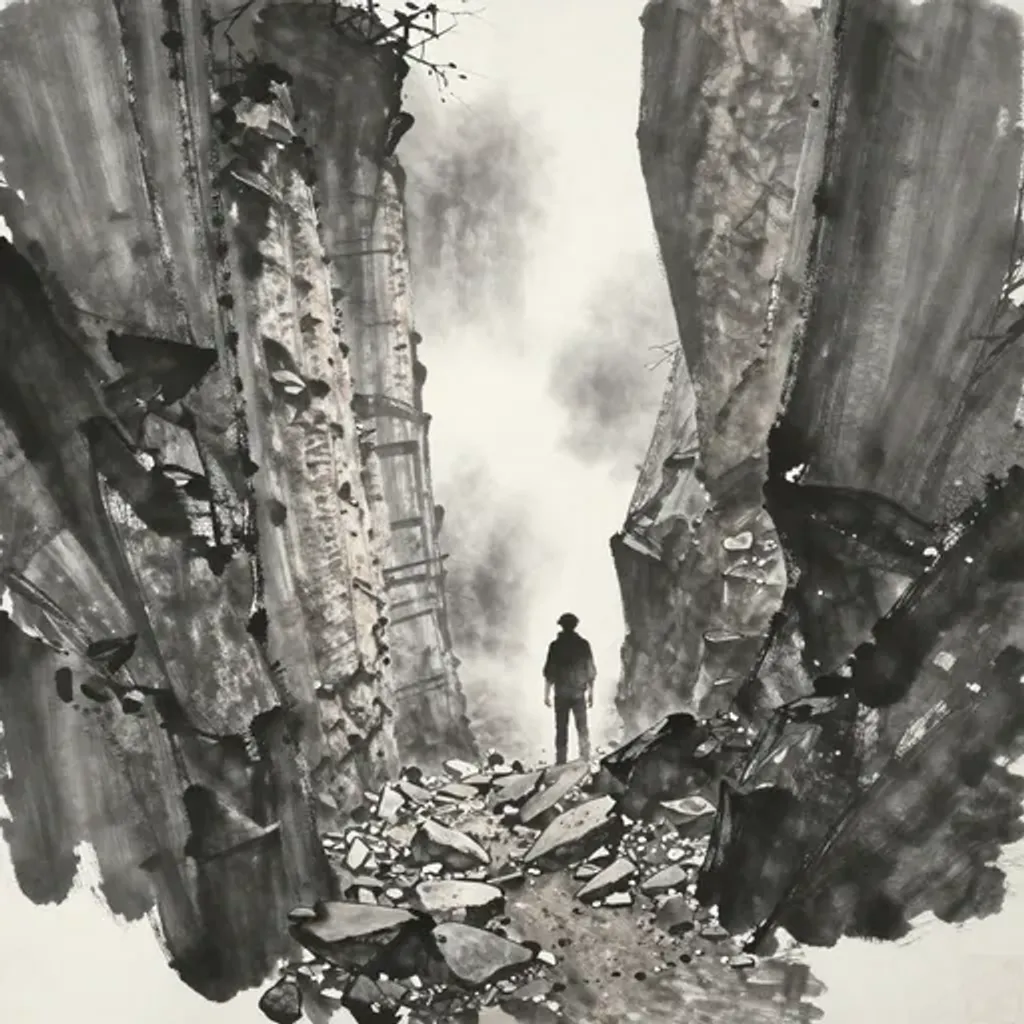
震慄恐懼,多所畏惡。行道留難,不可以步。
The valley walls on both sides are smooth as cut iron; pebbles knocked loose by the foot fall without sound. Ahead, a sheer cliff bars the path — behind, the fog is so thick no lamp can be seen.
— Jiao Yanshou, Yilin (Forest of Changes), 1st century BC
Commentary
Water sits above fire, but this verse is a modern rewrite. The original reads: 'Trembling with fear, beset by dread. Terrors multiply on every side. The road ahead is blocked with obstacles; one cannot take a single step.' Paralysis grips the traveler: terror is physical, the path impassable, and movement itself becomes impossible. From After Completion to the Clinging, fire-and-water balance transforms into doubled fire — brightness upon brightness. Yet this brilliance is not liberating; it exposes every danger with merciless clarity. The Clinging's light reveals what darkness mercifully concealed. The completed person, now stripped of all cover, must cling to whatever offers support, for the illuminated path shows only how thoroughly surrounded one truly is.
既濟 → 咸
Hexagram 63 → Hexagram 31: Influence
Changing lines: 1, 4
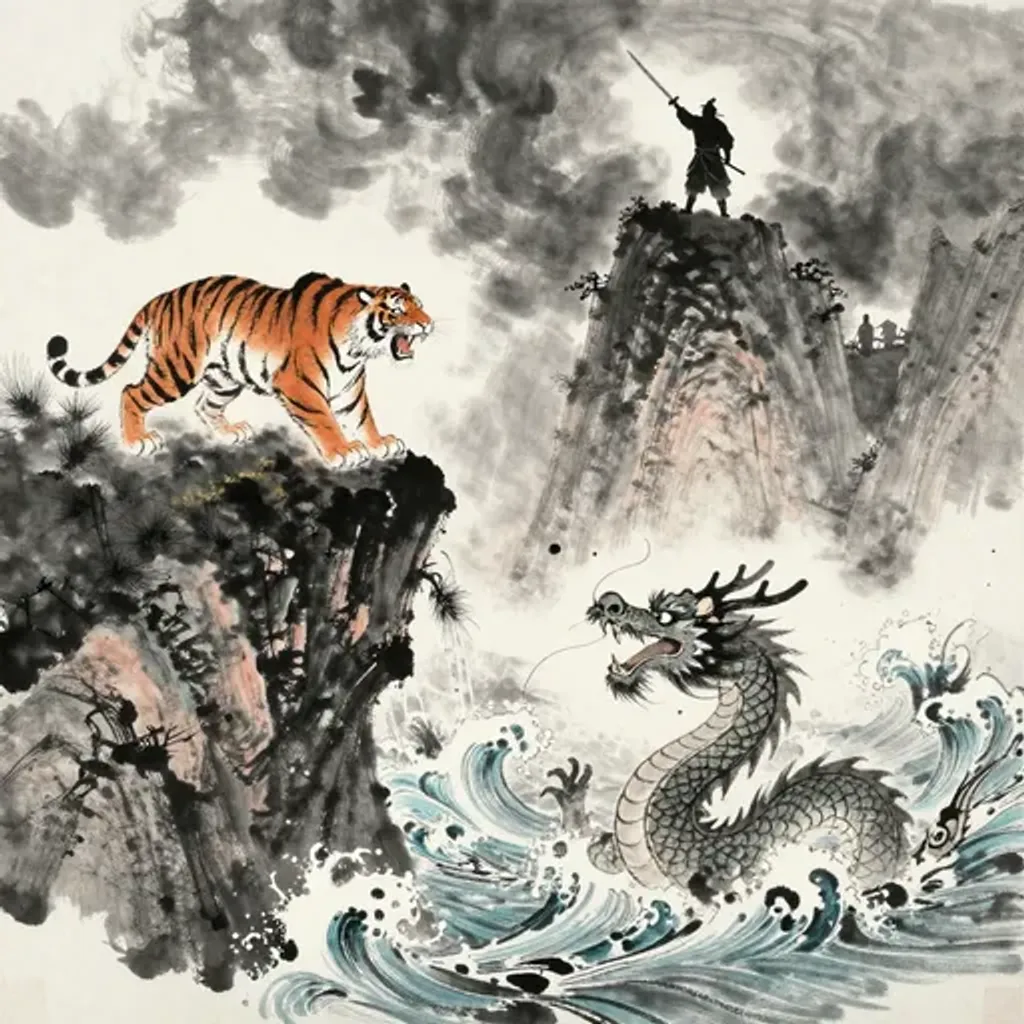
雄狐綏綏,登山崔嵬。昭告顯功,大福允興。
The tiger roars from the cliff — pine needles tremble. The fierce dragon surges from the water — waves part. Standing at the summit, brandishing the long sword — the four quarters hear the fame and come unbidden.
— Jiao Yanshou, Yilin (Forest of Changes), 1st century BC
Commentary
Water sits above fire, but this verse is a modern rewrite. The original reads: 'A magnificent fox moves with majestic ease, ascending the towering peak. He proclaims his conspicuous merit, and great blessings truly flourish.' The fox, traditionally a creature of cunning and adaptability, here ascends the heights with sovereign confidence. His merit is publicly declared and heaven responds with abundance. From After Completion to Influence, fire-and-water order transforms into the lake resting atop the mountain — Influence's image of mutual responsiveness. The completed one does not remain static but climbs higher and announces his accomplishments. Influence works through receptive openness: the mountain is still while the lake above draws all things toward it, and demonstrated merit attracts its own reward.
既濟 → 恆
Hexagram 63 → Hexagram 32: Duration
Changing lines: 1, 2, 4, 5
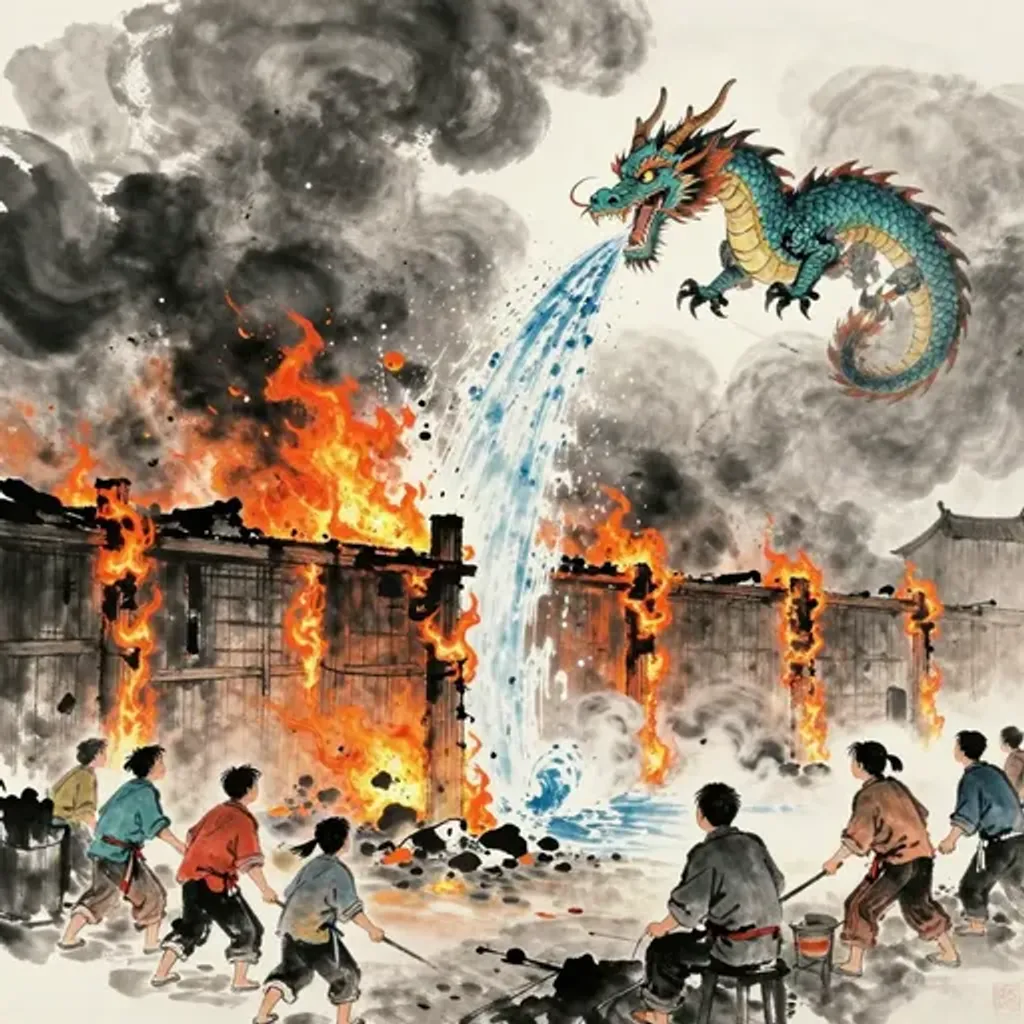
火起吾後,喜炙倉廡。龍衘水深,潠注屋柱,雖憂无咎。
Fire rises behind me, threatening to burn the granary and storehouse. A dragon carrying deep water sprays it upon the roof pillars; though there is worry, there is no harm.
— Jiao Yanshou, Yilin (Forest of Changes), 1st century BC
Commentary
Water sits above fire — and then fire erupts behind. Flames threaten the granary and storehouse, but a dragon carrying water from the depths spews it upon the pillars, dousing the blaze. Though worry remains, there is no lasting harm. The verse dramatizes emergency and response: the completed order catches fire, but a primal force — the dragon from below — intervenes with exactly the needed element. From After Completion to Duration, the balanced configuration yields to thunder above wind — enduring forces in constant motion. Duration is not static preservation but the dynamic rhythm of crisis and response. The completed state survives not because it avoids disaster but because it possesses the reflexive capacity to meet fire with water, again and again.
既濟 → 遯
Hexagram 63 → Hexagram 33: Retreat
Changing lines: 1, 4, 6
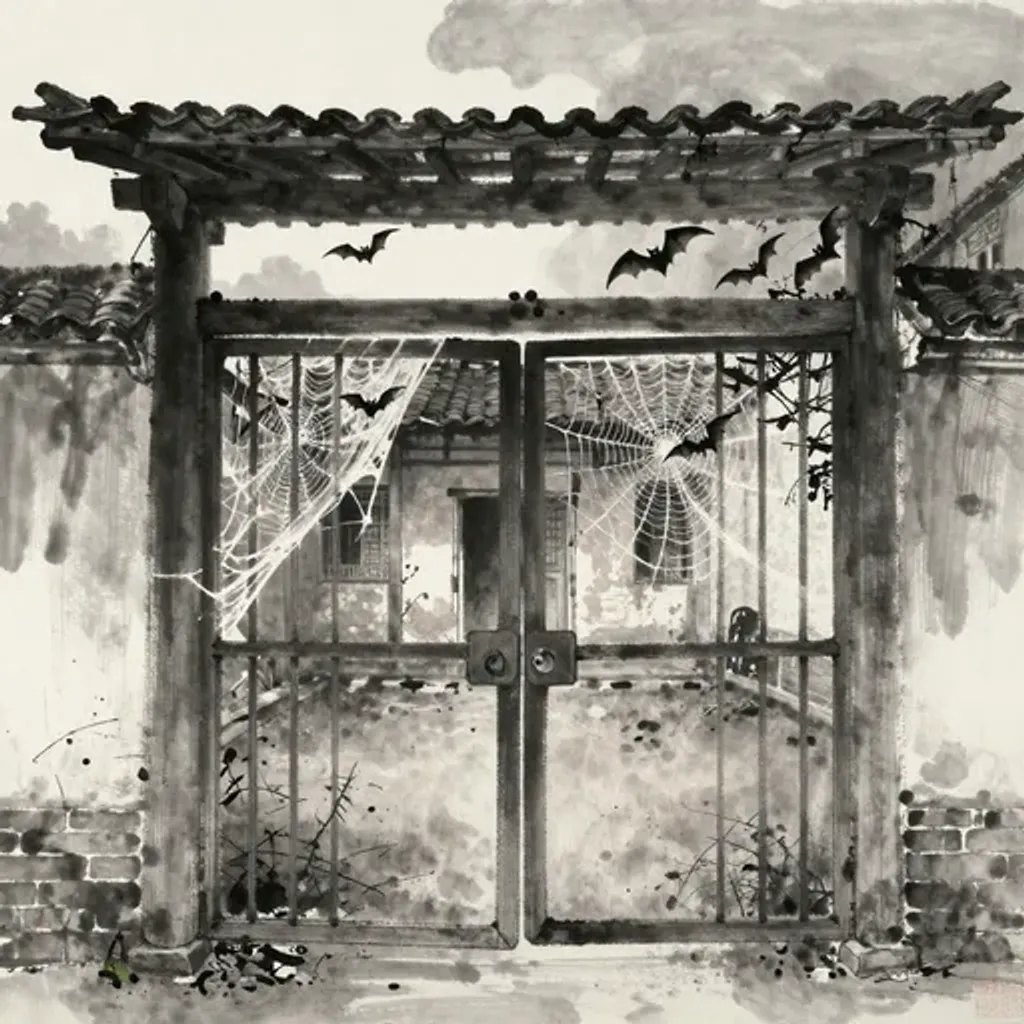
危坐至暮,請求不得。膏澤不降,政戾民忒。
Knocking at the door, no answer — the courtyard is deep, the compound locked. Bats circle the roof beams; spiders web across the entrance.
— Jiao Yanshou, Yilin (Forest of Changes), 1st century BC
Commentary
Water sits above fire, but this verse is a modern rewrite. The original reads: 'Sitting rigidly until dusk, petitions go unanswered. Beneficent moisture does not fall; governance is perverse, the people suffer.' The scene is of a supplicant waiting all day at the gate of power, receiving nothing. The rain that should nourish the land is withheld; misgovernance dries up the blessings that should flow downward. From After Completion to Retreat, fire-and-water balance yields to heaven beneath the mountain — withdrawal as strategic necessity. When the court is deaf and the rains have stopped, the wise person retreats rather than continuing to beg at closed doors. Retreat here is not defeat but the recognition that some doors will never open.
既濟 → 大壯
Hexagram 63 → Hexagram 34: Great Power
Changing lines: 2, 4, 5
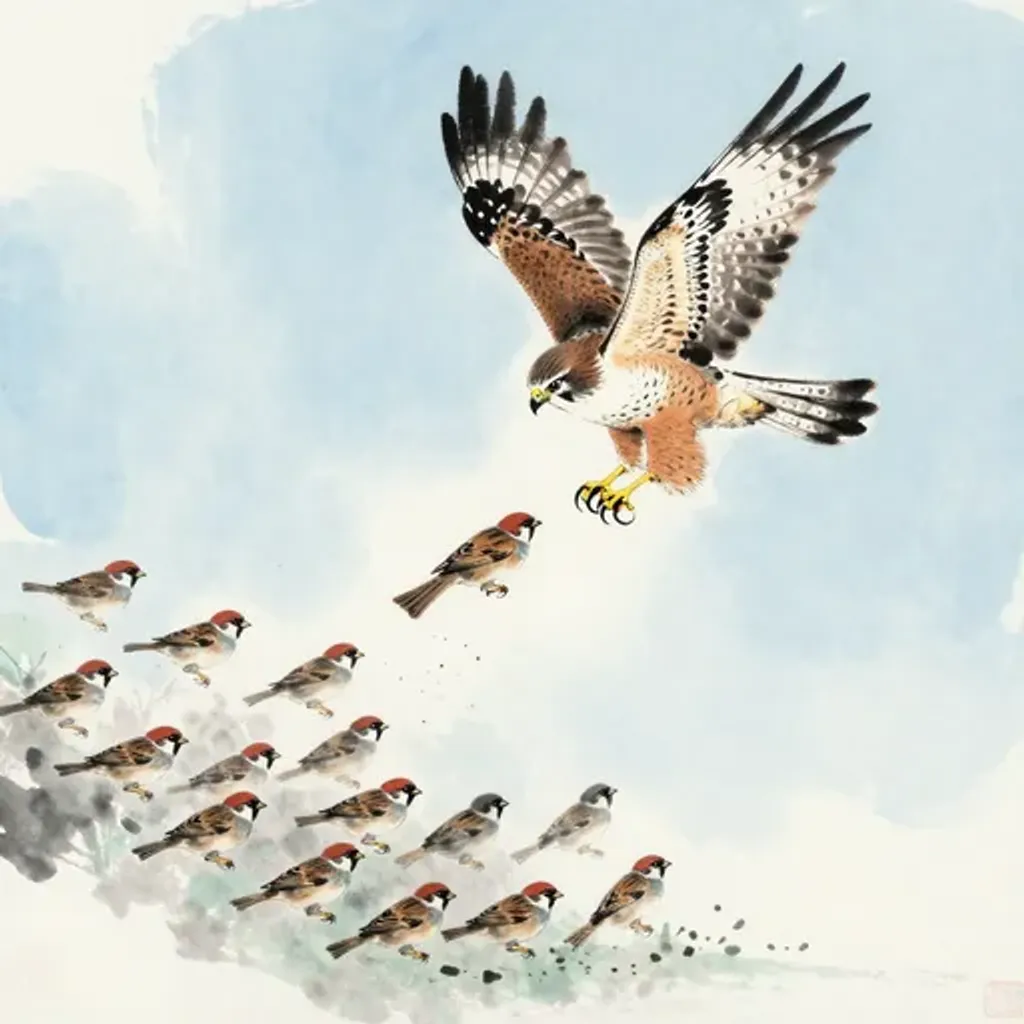
孟春和氣,鷹隼搏鷙。眾雀憂憒。
In the harmonious air of early spring, hawk and falcon strike and seize. The gathered sparrows are thrown into fearful confusion.
— Jiao Yanshou, Yilin (Forest of Changes), 1st century BC
Commentary
Water sits above fire, and in the gentle warmth of early spring, hawks and falcons strike with predatory precision. The flock of sparrows scatters in panic. The first month's mild air belies the violence overhead: the season of renewal is also the season of the hunt. From After Completion to Great Power, fire-and-water equilibrium transforms into thunder roaring above heaven — overwhelming force unleashed. The completed order generates surplus energy that must find an outlet. Great Power's thunder above heaven is not subtle; it is raw, directional force. The hawk does not deliberate — it strikes. The verse warns that even within harmonious seasons, power operates by its own predatory logic, and the small have reason to fear.
既濟 → 晉
Hexagram 63 → Hexagram 35: Progress
Changing lines: 1, 3, 4, 5, 6
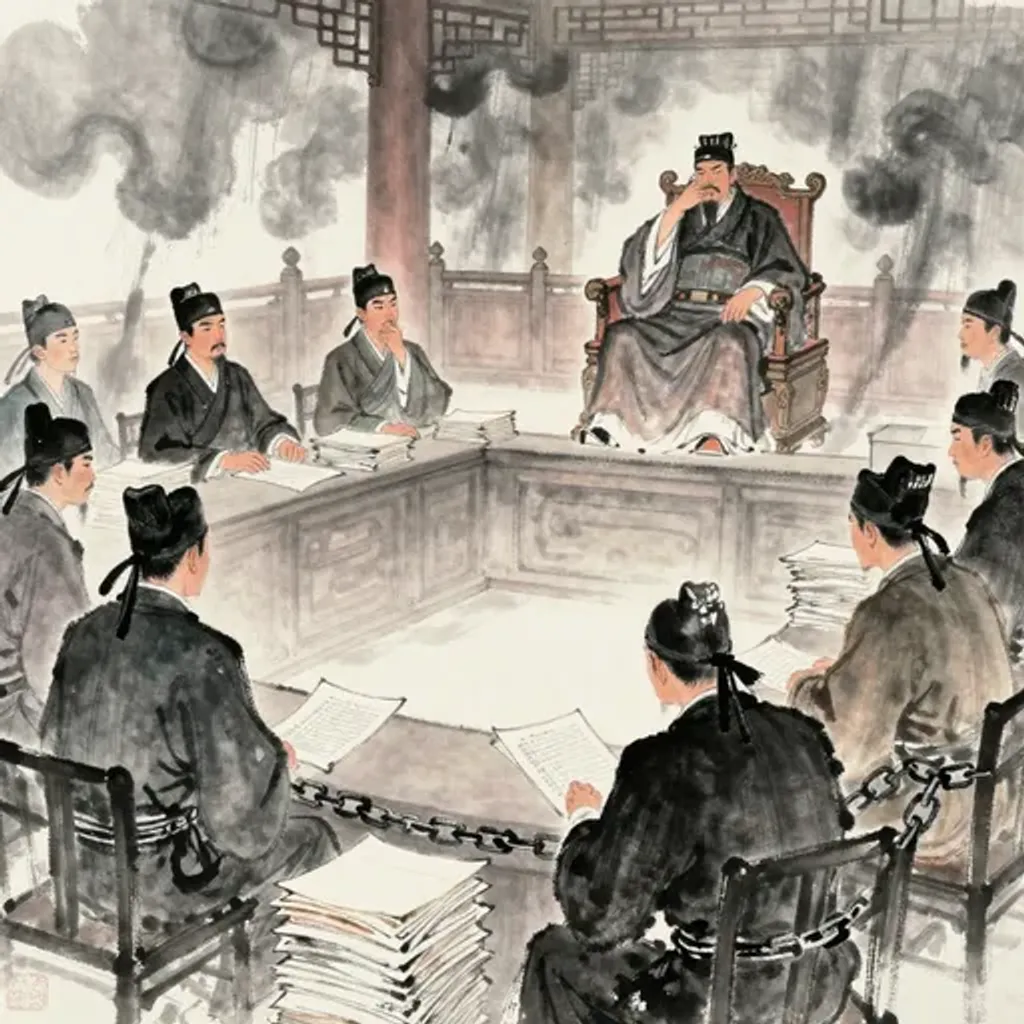
緩法長奸,不肯理冤。浮沉失節,君受其患。
Lax laws breed treachery; none will address the injustice. Drifting and sinking, integrity lost; the ruler bears the consequence.
— Jiao Yanshou, Yilin (Forest of Changes), 1st century BC
Commentary
Water sits above fire, but the law has grown lax, breeding treachery. No one is willing to right injustice. Officials drift and lose their principles; the ruler suffers the consequences. The verse diagnoses institutional decay: when enforcement relaxes, wrongdoing multiplies, and grievances fester unaddressed until the sovereign himself is imperiled. From After Completion to Progress, fire-and-water balance yields to fire rising above the earth — the brightness of Progress emerging from darkness. Yet the verse is ironic: progress should illuminate and correct, but here the advancing light only exposes how thoroughly corruption has eaten through the system. The completed order decayed precisely because no one upheld the standards that made completion possible.
既濟 → 明夷
Hexagram 63 → Hexagram 36: Darkening of the Light
Changing lines: 5
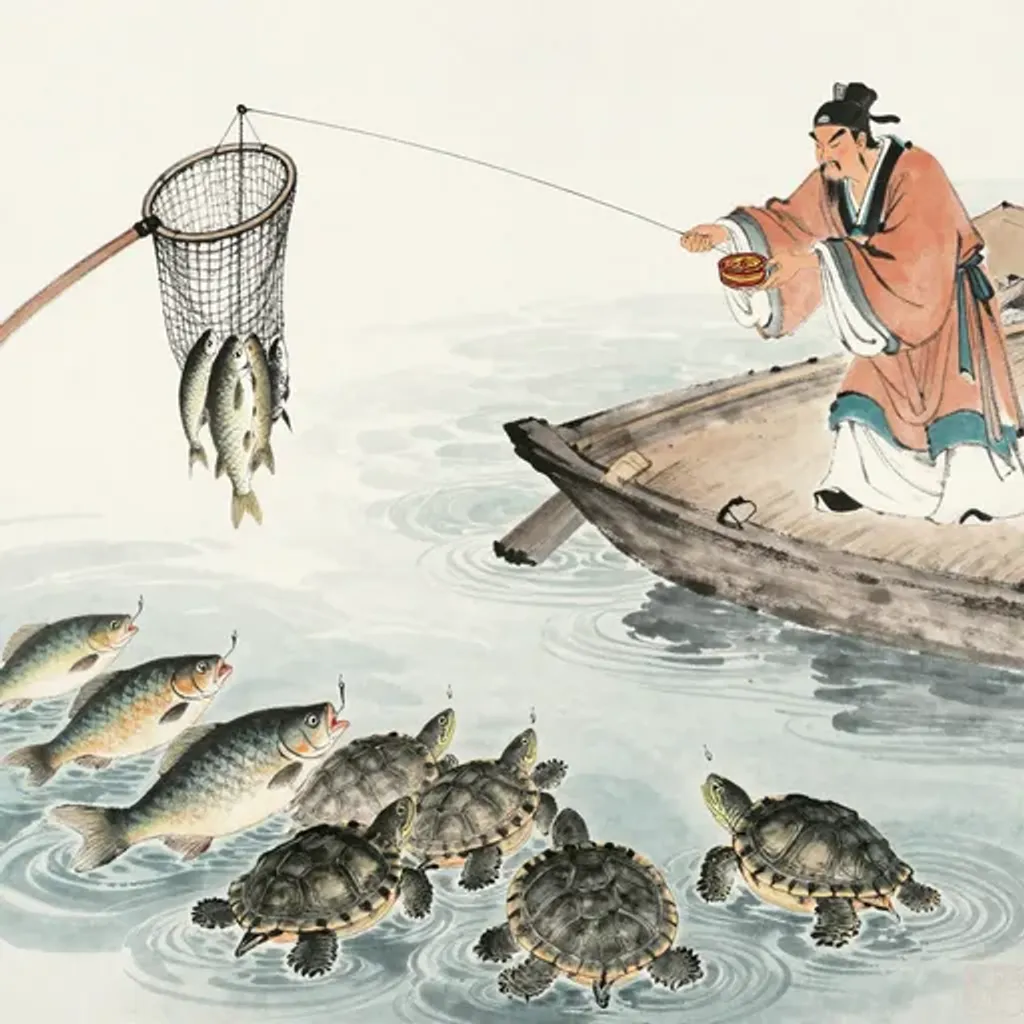
魚鱉貪餌,死於網釣。受危國寵,為身殃咎。
Fish and turtles, greedy for bait, die by net and hook. Accepting a perilous kingdom's favor becomes calamity for one's person.
— Jiao Yanshou, Yilin (Forest of Changes), 1st century BC
Commentary
Water sits above fire, and fish and turtles snap greedily at the bait, dying in nets and on hooks. Those who accept a dangerous state's favor make themselves targets, bringing calamity upon their own persons. The verse links animal appetite to political naivety: the creature that bites the lure is no different from the courtier who accepts a doomed regime's patronage. From After Completion to Darkening of the Light, fire-and-water order yields to fire sinking into the earth — brightness driven underground. The completed world becomes treacherous, and those who fail to see the dimming light are consumed. Darkening of the Light demands the wisdom to conceal one's brilliance; the fish that could not resist the bait lacked precisely this restraint.
既濟 → 家人
Hexagram 63 → Hexagram 37: The Family
Changing lines: 6
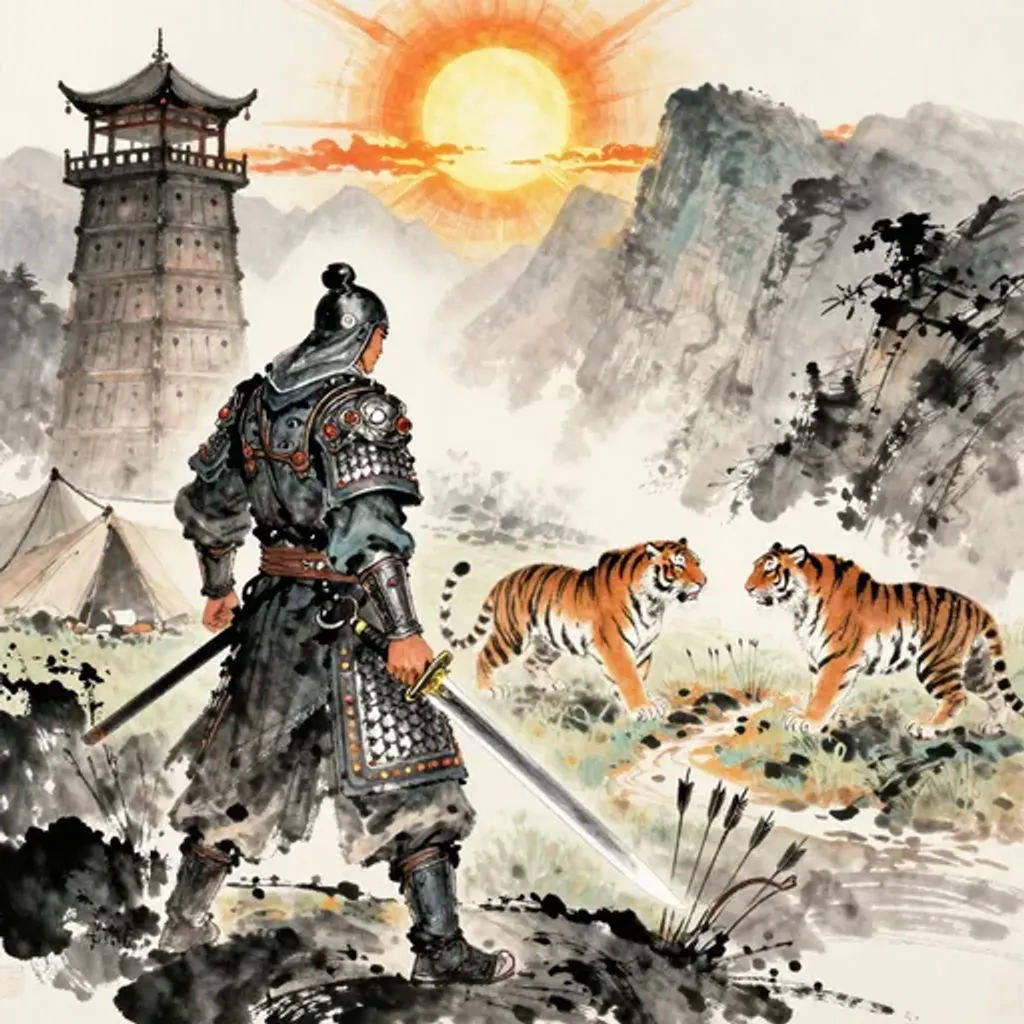
金精輝怒,帶劍過午。徘徊高庫,宿於山谷。兩虎相拒,弓矢滿野。
Metal's essence rages with brilliance; wearing sword past noon. Lingering by the high armory, lodging in the mountain valley. Two tigers face off; bows and arrows fill the field.
— Jiao Yanshou, Yilin (Forest of Changes), 1st century BC
Commentary
Water sits above fire, but metal's essence blazes with fury. A swordsman passes the noon hour, prowling around the high treasury, then lodges in a mountain valley. Two tigers face off; bows and arrows fill the open field. The imagery is saturated with martial tension: the metallic star (Venus/Taibai) signaling war, weapons at midday when yang peaks, and paired predators locked in territorial standoff. From After Completion to the Family, fire-and-water balance yields to wind issuing from fire — the household's inner flame projecting outward as influence. Yet this Family is militarized: the domestic order is defended by armed vigilance, and the valley harbors warriors, not farmers. Internal coherence here is maintained through strength, not gentleness.
既濟 → 睽
Hexagram 63 → Hexagram 38: Opposition
Changing lines: 2, 3, 4, 5, 6
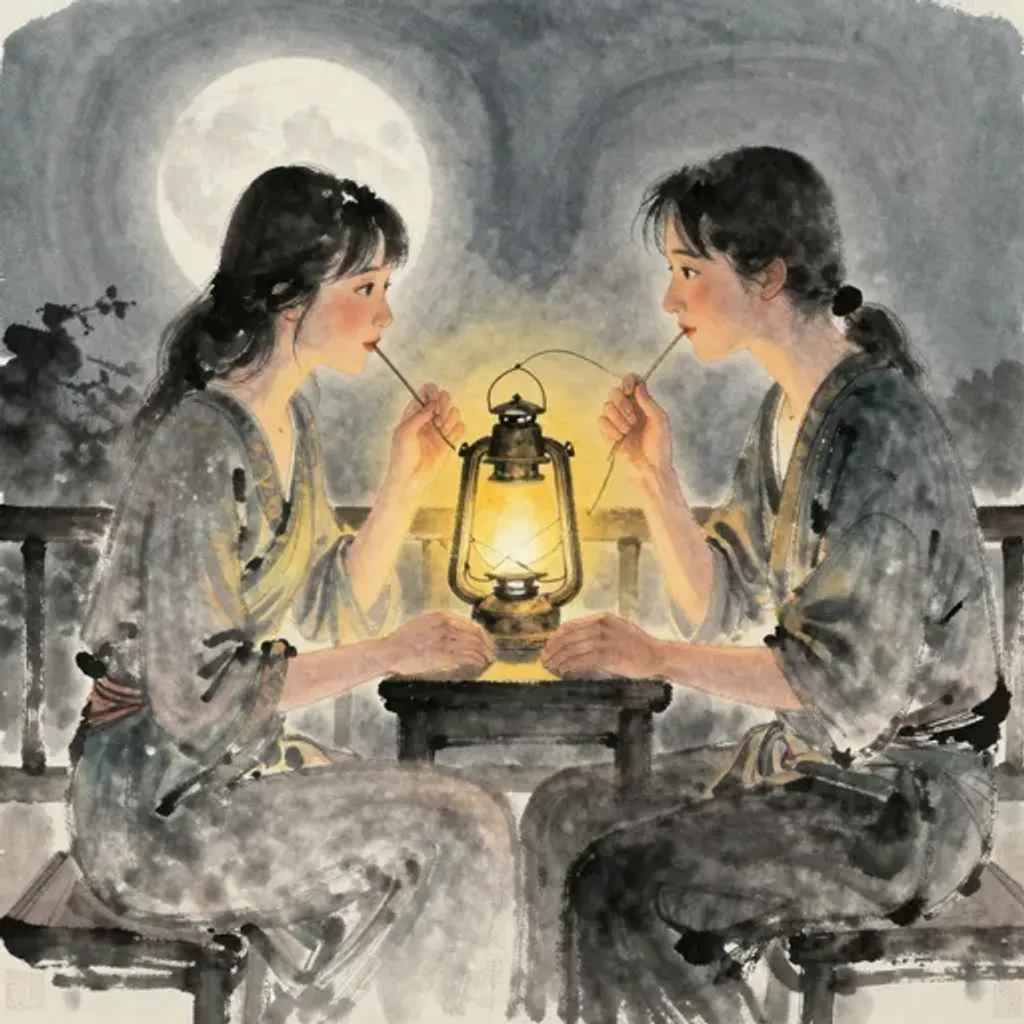
四目相望,稍近同光,並坐鼓簧。
Four eyes gaze upon each other; gradually drawing near, sharing the same light. Seated side by side, playing the mouth-organ together.
— Jiao Yanshou, Yilin (Forest of Changes), 1st century BC
Commentary
Water sits above fire, and four eyes meet — two pairs of gazes gradually drawing closer until they share the same light, sitting side by side and playing the mouth organ together. The verse is a miniature love story told in three beats: first mutual recognition across distance, then convergence, then harmonious music. From After Completion to Opposition, fire-and-water balance yields to fire above the lake — two elements that by nature diverge. Yet Opposition's wisdom lies in finding unity within difference. The four eyes belong to two separate persons who remain distinct yet achieve harmony. The mouth organ's polyphonic reed-pipes produce beauty precisely because different notes sound simultaneously — agreement that does not require sameness.
既濟 → 蹇
Hexagram 63 → Hexagram 39: Obstruction
Changing lines: 1
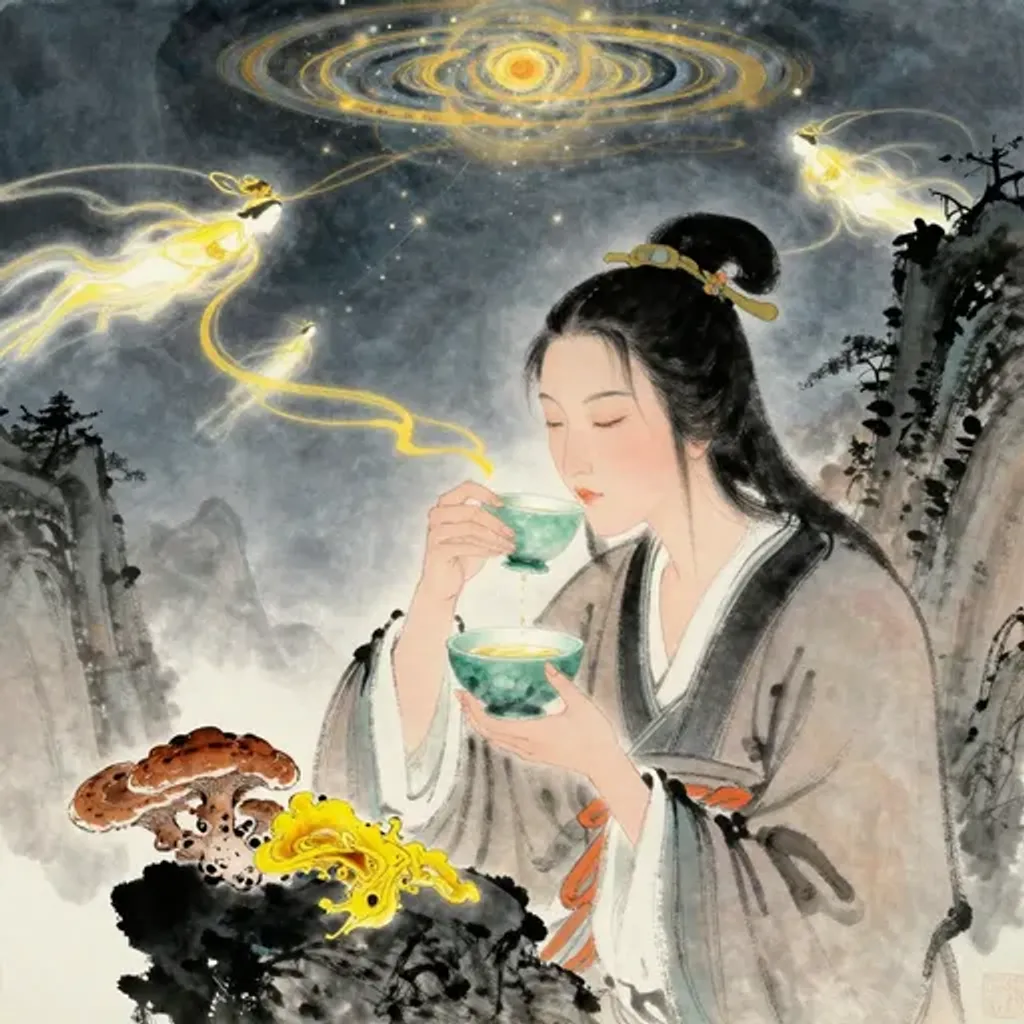
茹芝餌黃,飲酒玉英。與神流通,長无憂凶。
Eating lingzhi, ingesting yellow essence, drinking jade-flower wine. Communing with the spirits in flowing union, forever free from sorrow and misfortune.
— Jiao Yanshou, Yilin (Forest of Changes), 1st century BC
Commentary
Water sits above fire, and one ingests lingzhi mushrooms and yellow essence, drinking the jade-flower elixir of wine. Communing with the spirits, one lives forever free from worry or misfortune. The verse describes Daoist longevity practices: consuming sacred fungi, mineral elixirs, and spirit-infused liquors to achieve transcendence. From After Completion to Obstruction, fire-and-water balance transforms into water pooling atop the mountain — danger above, stillness below. Obstruction's water-over-mountain creates an impassable barrier for ordinary travel. Yet the verse reframes this obstacle as a sacred boundary: the practitioner who cultivates immortality does not need to cross the mountain because he has already transcended the world that lies beyond it. The obstruction protects rather than confines.
既濟 → 解
Hexagram 63 → Hexagram 40: Deliverance
Changing lines: 1, 2, 3, 4, 5
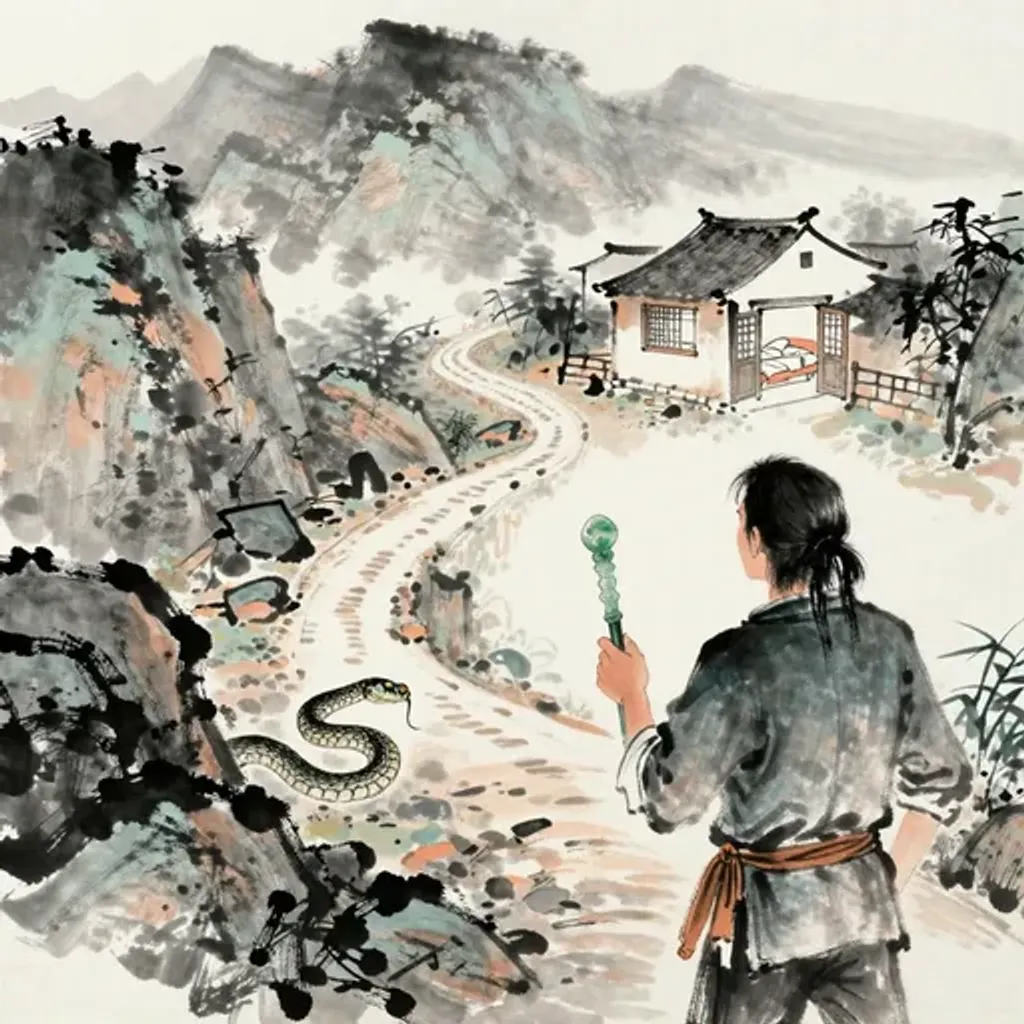
求璋嘉鄉,惡虵不行。道出岐口,還復其床。
Seeking the zhang jade in the blessed village; the evil snake does not appear. Taking the road out through Qi Pass, returning again to his own bed.
— Jiao Yanshou, Yilin (Forest of Changes), 1st century BC
Commentary
Water sits above fire, and one seeks the jade tablet of zhang in a beautiful village. Venomous serpents dare not cross the path. The road leads out through the fork at Qi, and one returns safely to one's own bed. The zhang jade tablet was a ritual instrument of authority and pure intention; its presence repels malevolent forces. The fork at Qi (岐口) recalls the ancient Zhou homeland near Mount Qi, a place of auspicious origins. From After Completion to Deliverance, fire-and-water order yields to thunder and rain together — the storm that releases all tension. Deliverance clears the road of obstacles. The serpent withdraws, the path opens, and the traveler returns home — danger dissolved by the arrival of what was sought.
既濟 → 損
Hexagram 63 → Hexagram 41: Decrease
Changing lines: 2, 3, 5, 6
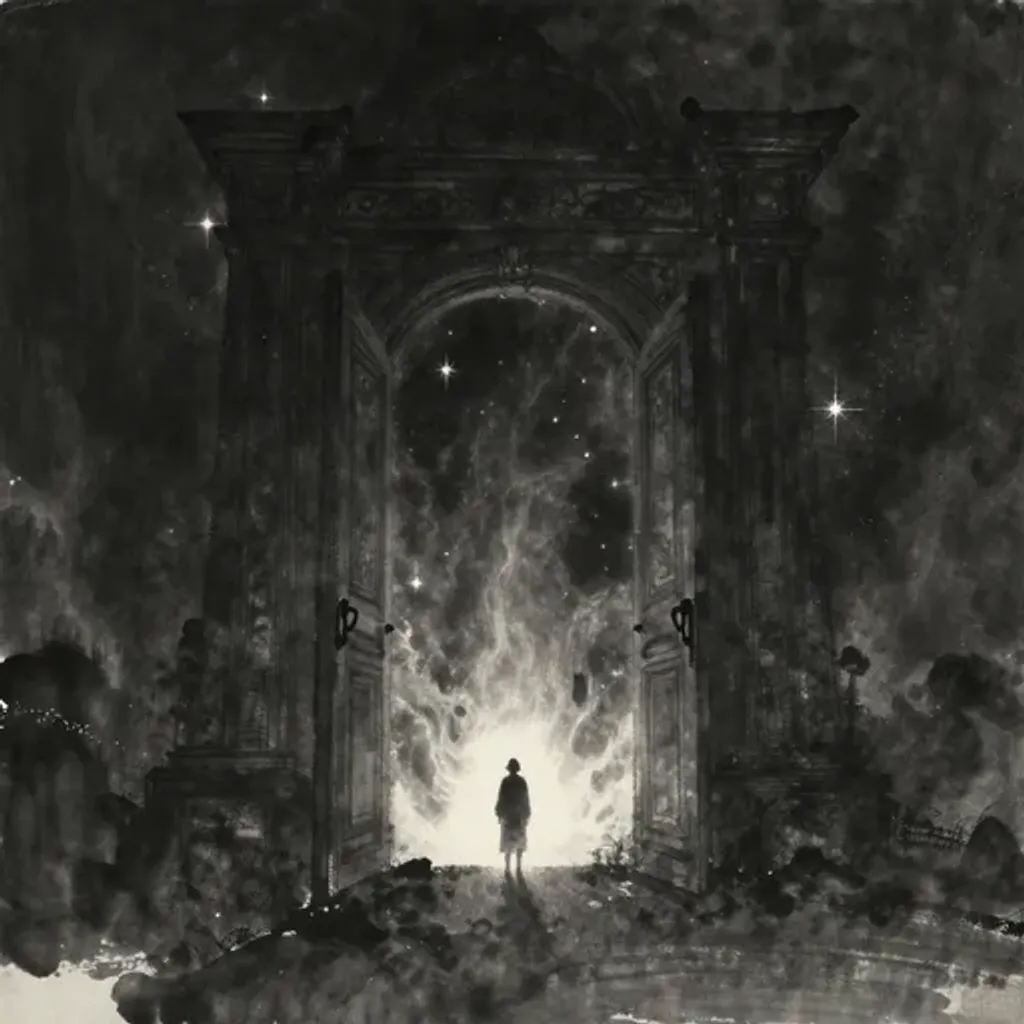
天門地戶,幽冥不覩,不知所在。
Heaven's gate and earth's door; dark and dim, unseen. Whereabouts unknown.
— Jiao Yanshou, Yilin (Forest of Changes), 1st century BC
Commentary
Water sits above fire, but the gates of heaven and earth are sealed. The underworld is impenetrably dark; one cannot perceive what lies within or know where anything is. The verse is three lines of absolute disorientation: heaven's gate locked, earth's portal shut, darkness total. From After Completion to Decrease, fire-and-water balance transforms into the mountain rising above the lake — the lake's substance diminished to feed the mountain's height. Decrease here is ontological: not merely losing possessions but losing all spatial and cognitive bearings. The completed order, which once held everything in place, has been reduced to a void where neither heaven nor earth offers passage. What remains is the discipline to accept radical loss without panic.
既濟 → 益
Hexagram 63 → Hexagram 42: Increase
Changing lines: 3, 6
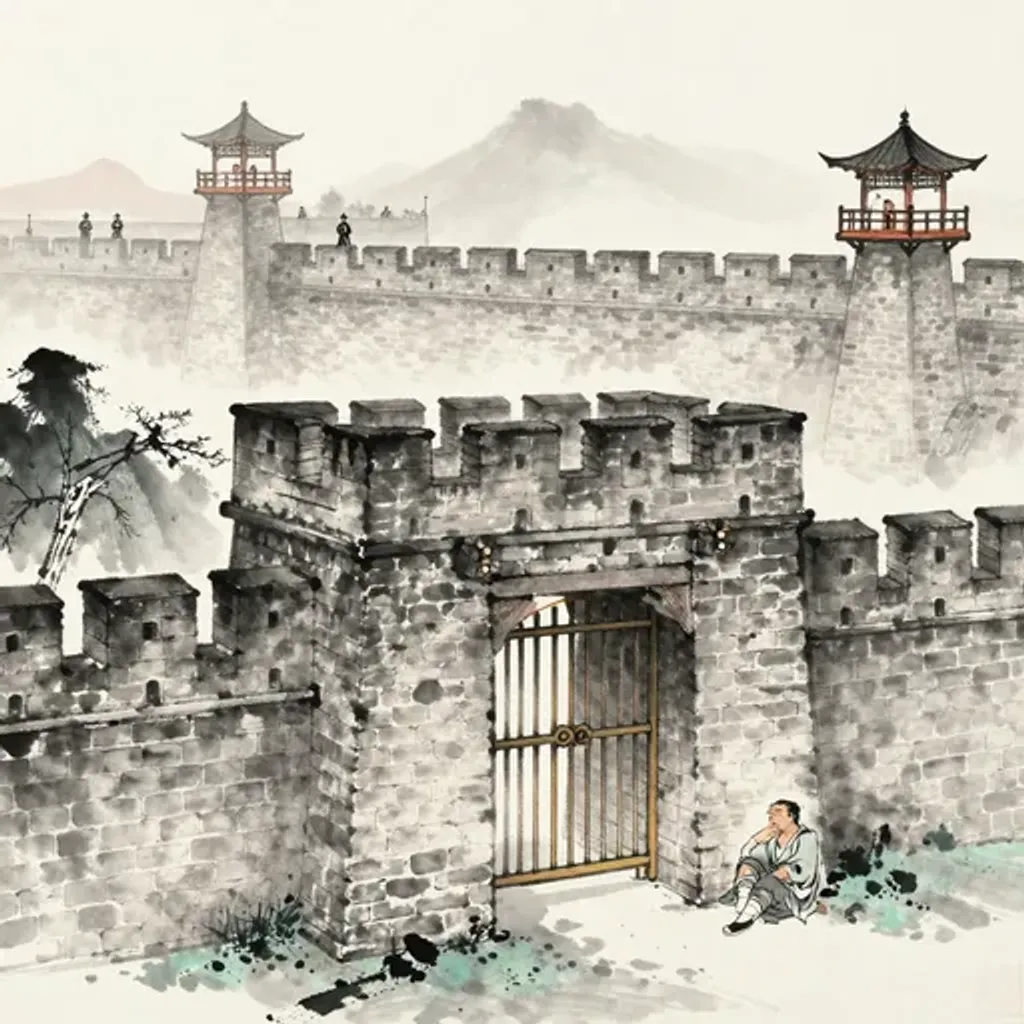
跌足息肩,有所忌難。金城鐵郭,以銅為關。藩屏自衛,安止无患。
Stumbling to rest, shouldering burdens, there is cause for fear and difficulty. Walls of gold and iron, gates of bronze. Guarding with defensive screens, resting in peace without peril.
— Jiao Yanshou, Yilin (Forest of Changes), 1st century BC
Commentary
Water sits above fire, and one halts — stumbling to rest, setting down the shoulder-load. Though fears and obstacles surround, the response is fortification: walls of metal, gates of bronze, a city of iron. Screens and barriers rise for self-protection, and peace is achieved without harm. The verse prescribes active defense rather than flight: when exhausted and surrounded, build rather than flee. From After Completion to Increase, the balanced arrangement yields to wind and thunder working together — dynamic growth through complementary forces. Increase here comes not from expansion but from intelligent consolidation. The iron walls are not aggression but infrastructure, converting vulnerability into sustainable strength through deliberate construction.
既濟 → 夬
Hexagram 63 → Hexagram 43: Breakthrough
Changing lines: 2, 4
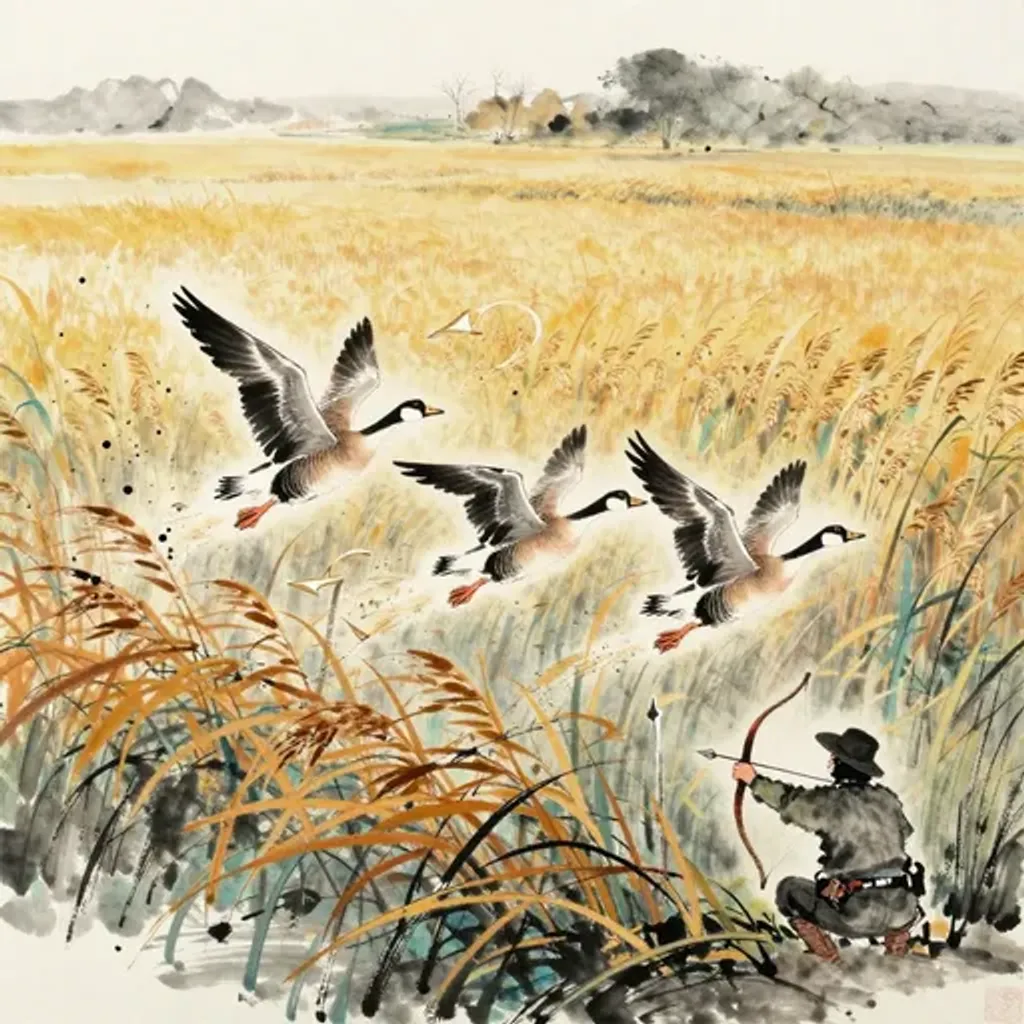
三雁俱飛,欲歸稻池。先涉雚澤,為矢所射,傷我胸臆。
Three geese fly together, wishing to return to the rice pond. First crossing the reed marsh, struck by an arrow that wounds my breast.
— Jiao Yanshou, Yilin (Forest of Changes), 1st century BC
Commentary
Water sits above fire, and three wild geese fly together, heading for the rice pond. But first they pass through a reed marsh, where they are struck by arrows — one is wounded in the breast. The verse follows the geese from hopeful flight to ambush: the destination was visible, the route seemed clear, but the intervening terrain concealed danger. From After Completion to Breakthrough, fire-and-water order yields to the lake rising above heaven — water breaching its boundary. Breakthrough is decisive severance, but this verse shows its dangerous side: the geese broke through the safe zone into exposed territory. The one who pushes past completion into new ground must expect that the space between the old order and the new destination is where arrows fly.
既濟 → 姤
Hexagram 63 → Hexagram 44: Coming to Meet
Changing lines: 1, 2, 4, 6
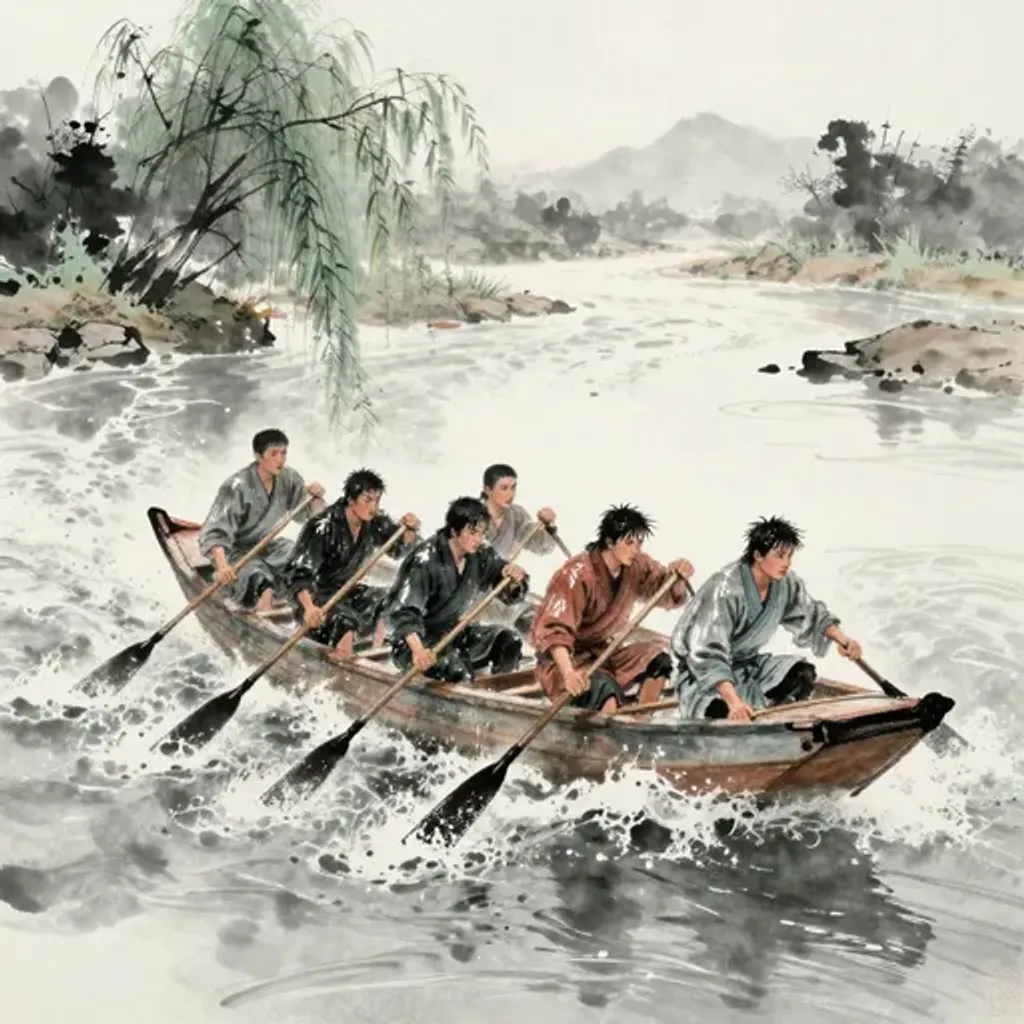
濟流難渡,濡我衣袴。五子善櫂,脫无他故。
The swift current is hard to cross; it soaks my clothes and trousers. Five sons skilled with oars escape without mishap.
— Jiao Yanshou, Yilin (Forest of Changes), 1st century BC
Commentary
Water sits above fire, and the river crossing proves difficult — clothes and trousers are soaked through. But five skilled oarsmen handle the boat, and the crossing is completed without mishap. The verse acknowledges that the passage is rough but provides the means to survive it: expert hands on the oars transform a dangerous ford into a safe one. From After Completion to Coming to Meet, fire-and-water balance yields to heaven with wind beneath — the unexpected encounter that arrives from below. The five oarsmen are the unforeseen resource that makes the crossing possible. Coming to Meet brings what was not planned for; the completed order encounters a new element and, if handled well, integrates it without capsizing.
既濟 → 萃
Hexagram 63 → Hexagram 45: Gathering Together
Changing lines: 1, 3, 4
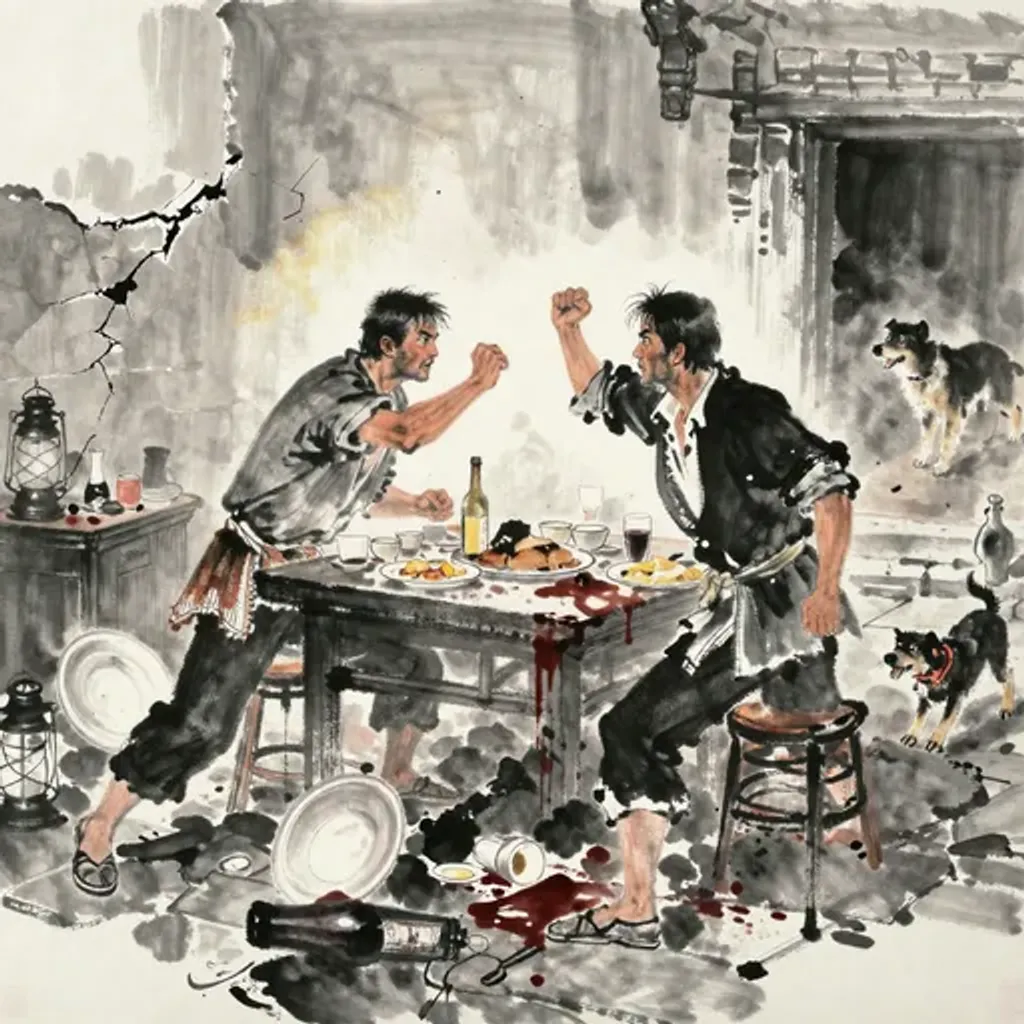
飲酒醉酗,跳起爭鬭。伯傷叔僵,東家治喪。
Cups and plates in disarray, wine overturns the table. Glaring at each other, fists rain down. The lamp shatters, the wall cracks, the neighbor's dog barks — at dawn, sweeping up blood, regret comes too late.
— Jiao Yanshou, Yilin (Forest of Changes), 1st century BC
Commentary
Water sits above fire, but this verse is a modern rewrite. The original reads: 'Drinking turns to drunken brawling; they leap up and fight. The elder brother is wounded, the younger collapses. At the eastern neighbor's house, they prepare for a funeral.' Wine transforms fellowship into violence with lethal speed. Brothers who shared a cup now draw blood, and by morning someone is dead. From After Completion to Gathering, fire-and-water order yields to the lake gathering upon the earth — a congregation that should unite. Yet the verse inverts Gathering's promise: the assembly that pooled together over wine becomes a site of fratricide. Gathering without discipline is combustion. The completed celebration, unchecked by restraint, gathers not communion but casualties.
既濟 → 升
Hexagram 63 → Hexagram 46: Pushing Upward
Changing lines: 1, 2, 5
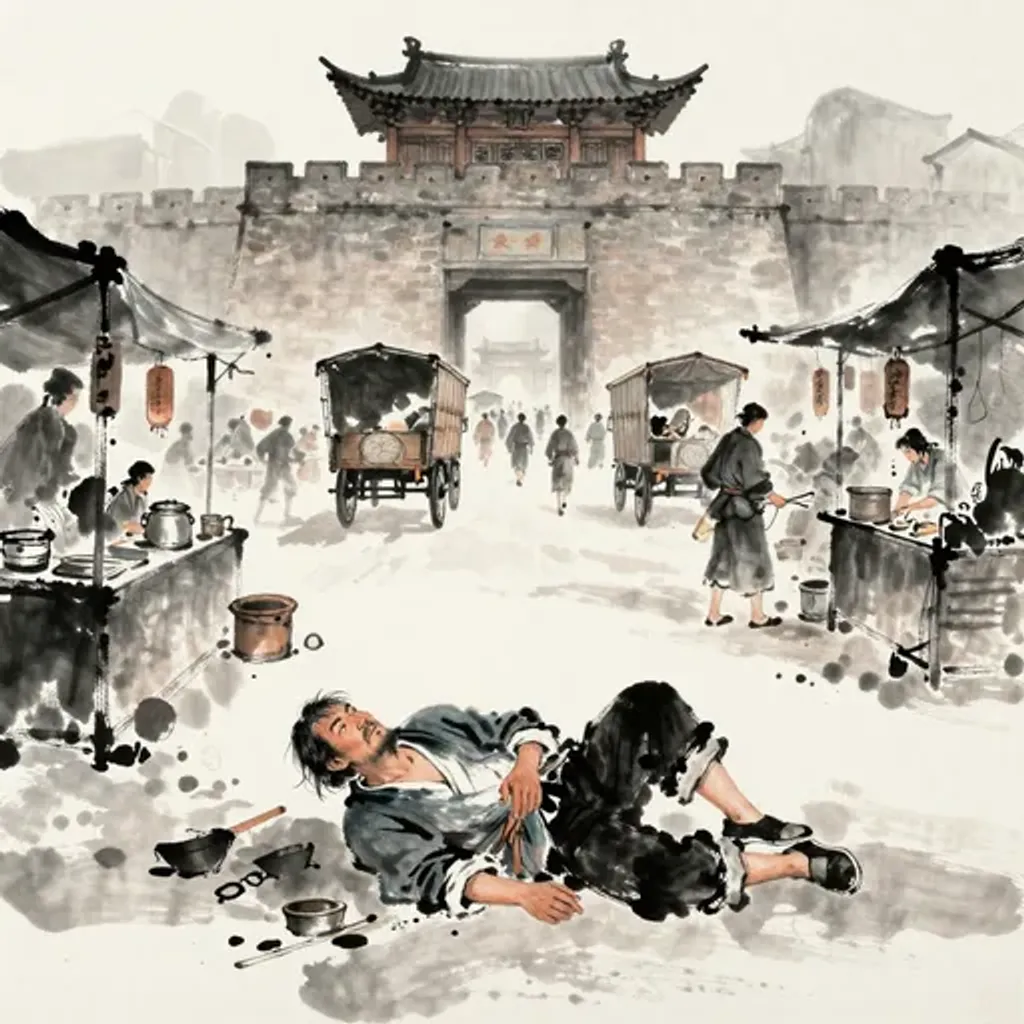
跌躓未起,後失利市。蒙被咎殃。
Stumbling, not yet risen, afterward losing the profitable market. Covered in blame and misfortune.
— Jiao Yanshou, Yilin (Forest of Changes), 1st century BC
Commentary
Water sits above fire, but one stumbles and has not yet risen when the market opportunity is already lost. One suffers blame and misfortune. The verse captures the cruelty of timing: a single fall at the wrong moment costs everything, because the market will not wait. From After Completion to Pushing Upward, fire-and-water balance yields to wood growing within the earth — the slow, steady ascent. Yet the verse is anti-Pushing Upward: instead of rising methodically, one has fallen and cannot recover in time. The completed state that should have provided a platform for gradual advancement instead produces a stumble from which there is no recovery. Upward momentum requires an unbroken sequence; one gap in the rhythm and the ascent is forfeit.
既濟 → 困
Hexagram 63 → Hexagram 47: Oppression
Changing lines: 1, 2, 3, 4
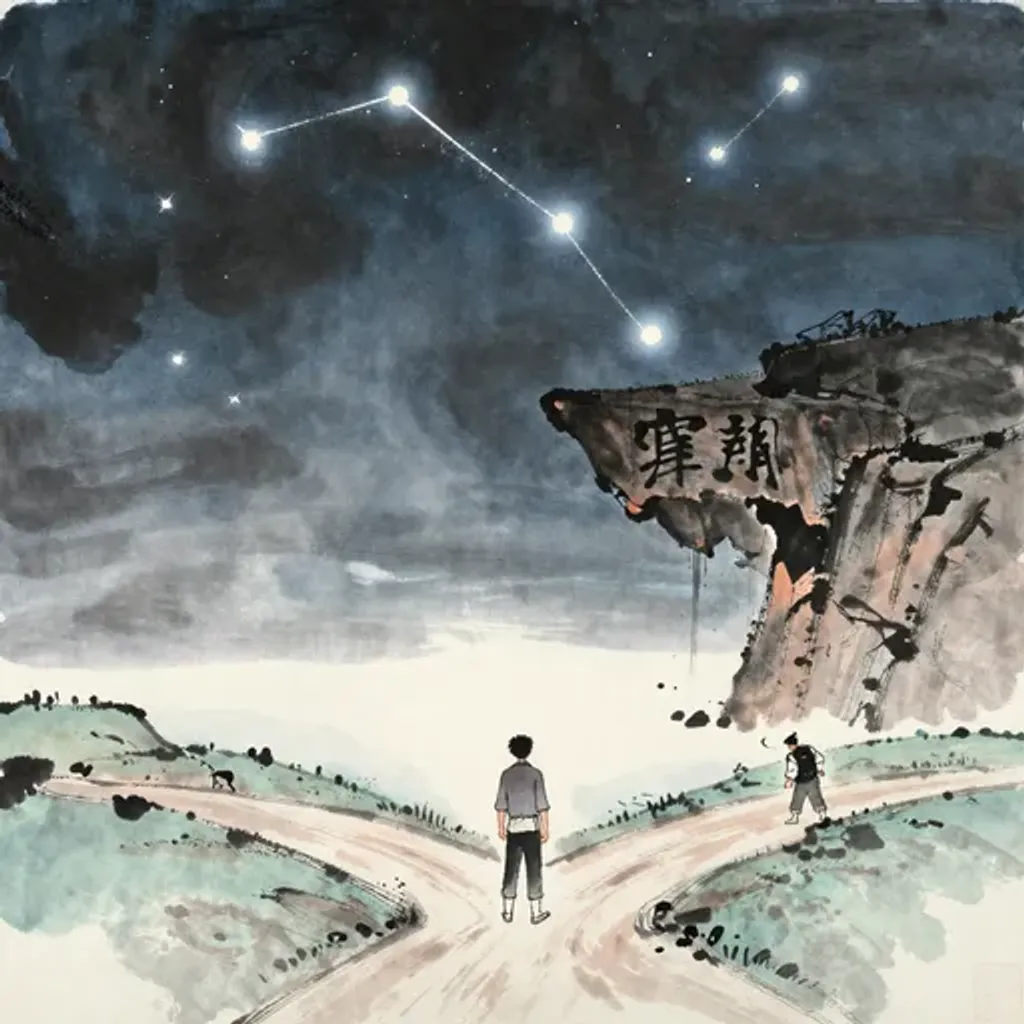
辰次降婁,建星中堅,子无遠行。外顛霄陷,遂命訖終。
When the chronogram reaches Lowering Lou and the Building Star stands firm, a son should not travel far. Beyond lies falling and sinking into the void; thus life's mandate ends.
— Jiao Yanshou, Yilin (Forest of Changes), 1st century BC
Commentary
Water sits above fire, and the celestial stations align at the Jianlou lodge while the Jianxing star stands at the meridian — a configuration that warns against distant travel. Do not venture far. Beyond the gate, one falls into a celestial pit and one's fate reaches its end. The verse deploys Han-dynasty astrology to issue a stark prohibition: the stars forbid travel, and those who ignore the warning perish. From After Completion to Oppression, fire-and-water balance yields to the lake drained of water — Oppression's image of exhaustion. The completed order, read through the star chart, reveals that the current configuration is terminal. Oppression here is cosmic, not personal: the heavens themselves have closed the road.
既濟 → 井
Hexagram 63 → Hexagram 48: The Well
Changing lines: 1, 2
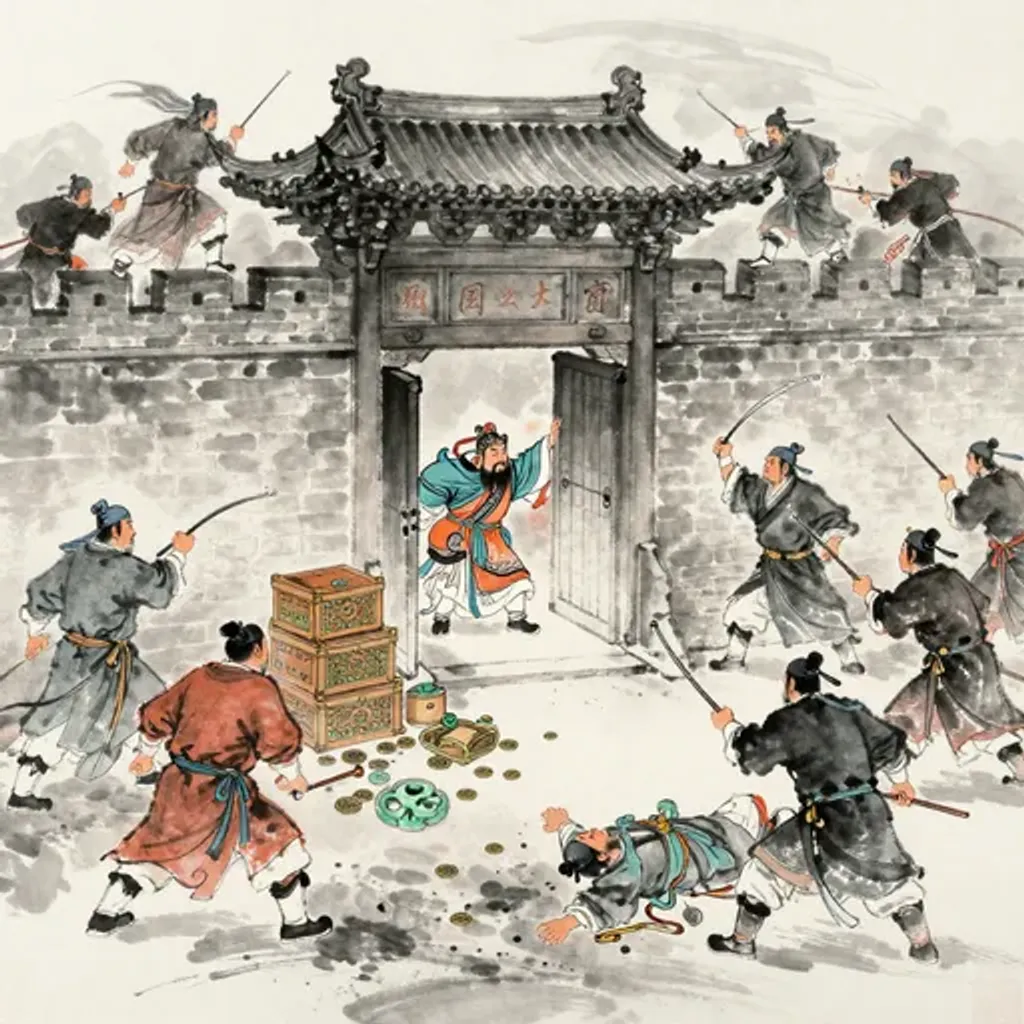
商風召寇,來呼外盜。間諜內應,與我爭鬭。殫已寶藏,主人不勝。
The autumn wind summons thieves, calling outlaws from without. Spies respond from within, joining battle against me. The treasures exhausted and gone, the master cannot prevail.
— Jiao Yanshou, Yilin (Forest of Changes), 1st century BC
Commentary
Water sits above fire, but the autumn wind summons invaders, calling in bandits from beyond the border. Spies respond from within, and together they attack. The treasury is emptied of its precious stores; the master of the house cannot prevail. The verse describes a coordinated inside-outside assault: external raiders exploit internal collaborators, and the household is looted. From After Completion to the Well, fire-and-water balance yields to water drawn up through wood — the Well's mechanism of communal sustenance. Yet the verse inverts the Well: instead of nourishing the community, the infrastructure is exploited by enemies who drain it dry. The completed order's own channels of supply become conduits for plunder when loyalty fails.
既濟 → 革
Hexagram 63 → Hexagram 49: Revolution
Changing lines: 4
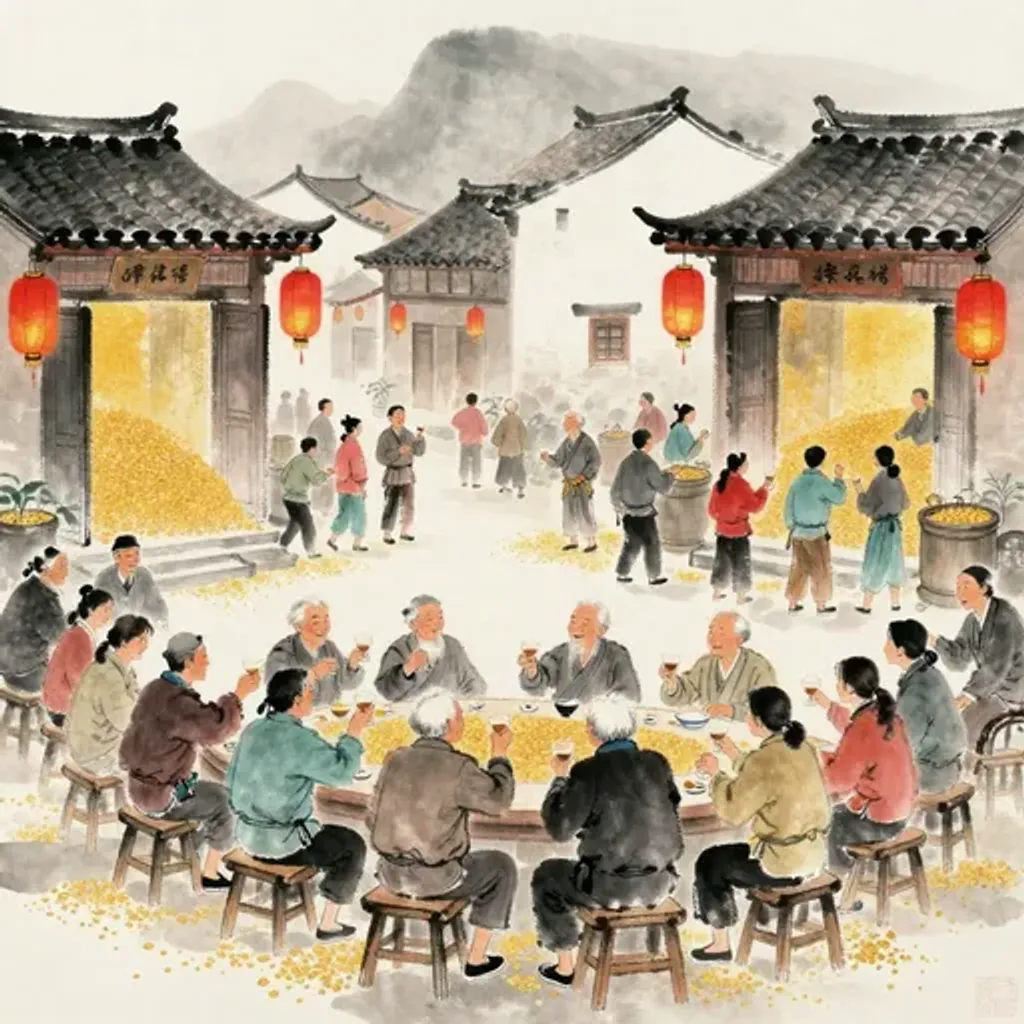
甘露醴泉,太平機關。仁德感應,歲樂民安。
A ripe year, an abundant harvest — grain fills a thousand granaries. The village feast of wine and ritual; white-haired elders share the hall.
— Jiao Yanshou, Yilin (Forest of Changes), 1st century BC
Commentary
Water sits above fire, but this verse is a modern rewrite. The original reads: 'Sweet dew and sweet springs — the mechanisms of great peace. Benevolent virtue resonates with heaven; the year is joyful and the people secure.' Sweet dew (甘露) and sweet springs (醴泉) are classical omens of a sage ruler's reign, appearing when virtue above and contentment below are in perfect harmony. From After Completion to Revolution, fire-and-water balance transforms into fire within the lake — the revolutionary tension of opposed elements sharing one space. Yet here Revolution is not violent upheaval but the ultimate transformation: the old order, completed and fulfilled, transmutes into a new dispensation so perfectly aligned that heaven itself responds with miraculous signs.
既濟 → 鼎
Hexagram 63 → Hexagram 50: The Cauldron
Changing lines: 1, 2, 4, 5, 6
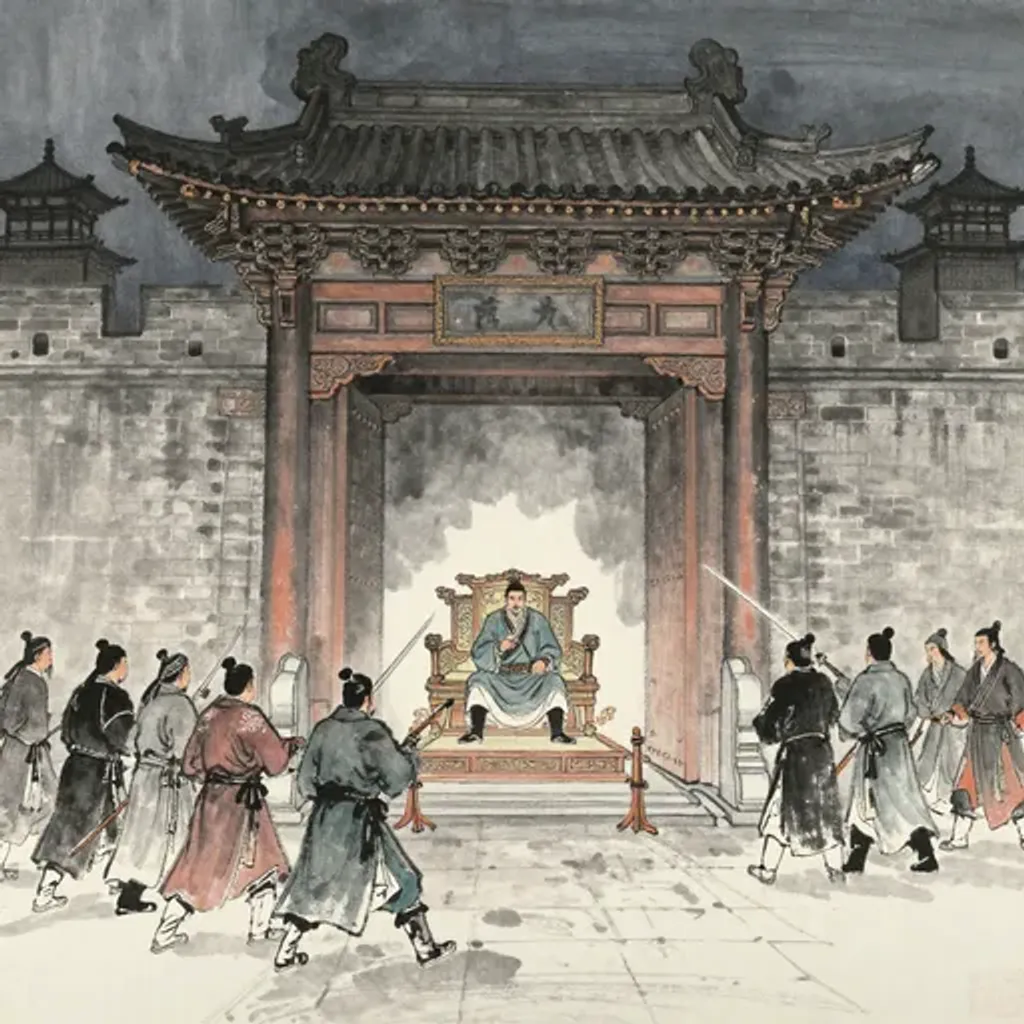
祭仲子突,要門逐忽。禍起子商,弟伐其兄,鄭久不昌。
Sacrificer Zhong and Prince Tu block the gate and expel Prince Hu. Calamity rises from Prince Shang; brother attacks brother. Zheng will long fail to flourish.
— Jiao Yanshou, Yilin (Forest of Changes), 1st century BC
Commentary
Water sits above fire, and the minister Zhai Zhong installs Zi Tu, blocking the gate against the legitimate ruler Hu. Calamity originates from Zi Shang; the younger brother attacks his elder, and Zheng knows no prosperity for a long time. This alludes to the Zheng succession crisis: in 701 BC, the powerful minister Zhai Zhong, coerced by the state of Song, deposed Duke Zhao (Hu) and enthroned Zi Tu as Duke Li. The resulting instability plagued Zheng for decades. From After Completion to the Cauldron, fire-and-water order yields to fire above wind — the sacred vessel that refines and transforms. Yet here the Cauldron's transformative power is corrupted: instead of refining governance, it melts legitimate authority into usurpation, and the state's nourishment turns to poison.
既濟 → 震
Hexagram 63 → Hexagram 51: The Arousing Thunder
Changing lines: 3, 4, 5
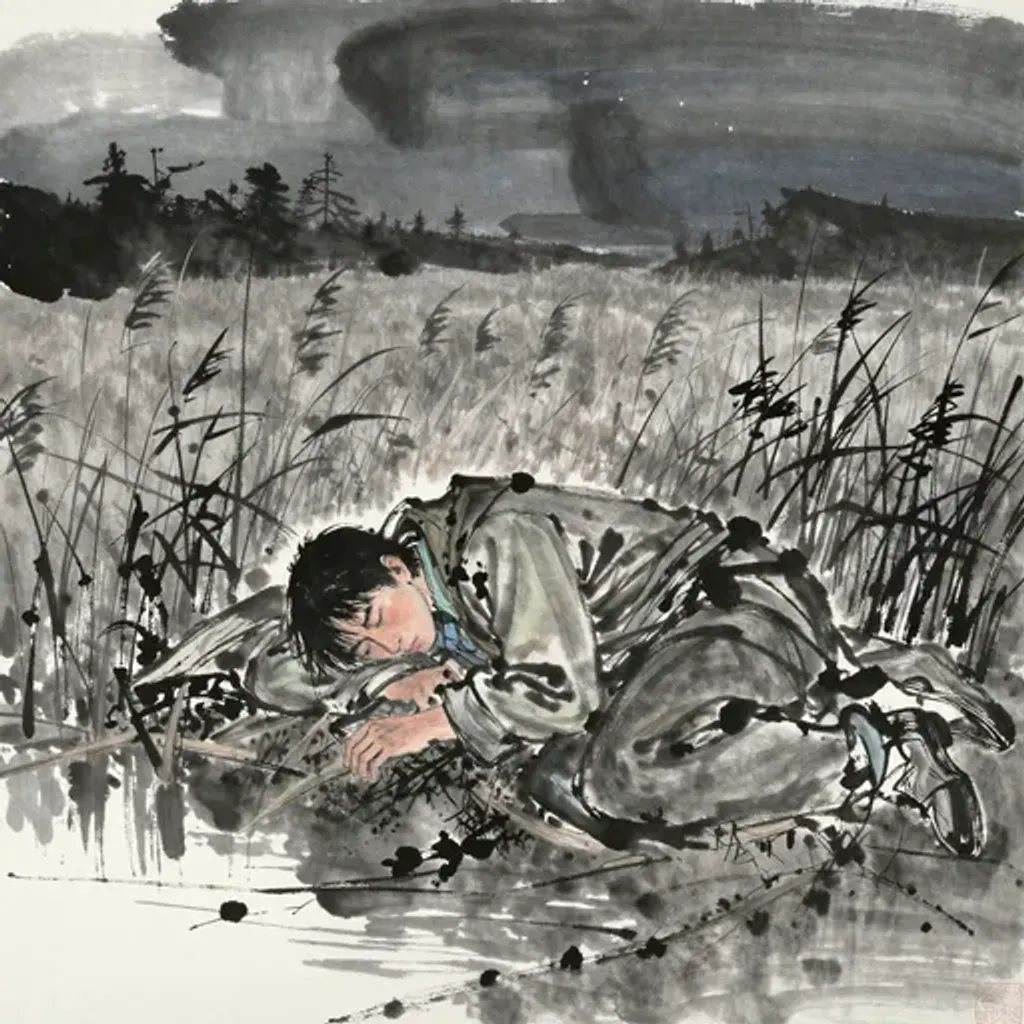
反孽難步,留不反舍。露宿澤陂,亡其襦袴。
Rebellion and calamity make walking hard; staying on, unable to return to shelter. Sleeping exposed by the marsh bank, losing coat and trousers.
— Jiao Yanshou, Yilin (Forest of Changes), 1st century BC
Commentary
Water sits above fire, but rebellion makes every step treacherous. One cannot stay, yet returning home is equally impossible. Forced to sleep in the open by the marshland's edge, one loses even shirt and trousers. The verse depicts total dispossession: a fugitive stripped of shelter, direction, and clothing. From After Completion to the Arousing, fire-and-water balance gives way to doubled thunder — shock upon shock. The completed order has not merely ended but detonated, leaving the person exposed and disoriented in the aftermath. The Arousing's thunder startles one into motion, but here there is nowhere to go. Each thunderclap strips away another layer of security until nothing remains but the bare body in the open air.
既濟 → 艮
Hexagram 63 → Hexagram 52: Keeping Still Mountain
Changing lines: 1, 5, 6
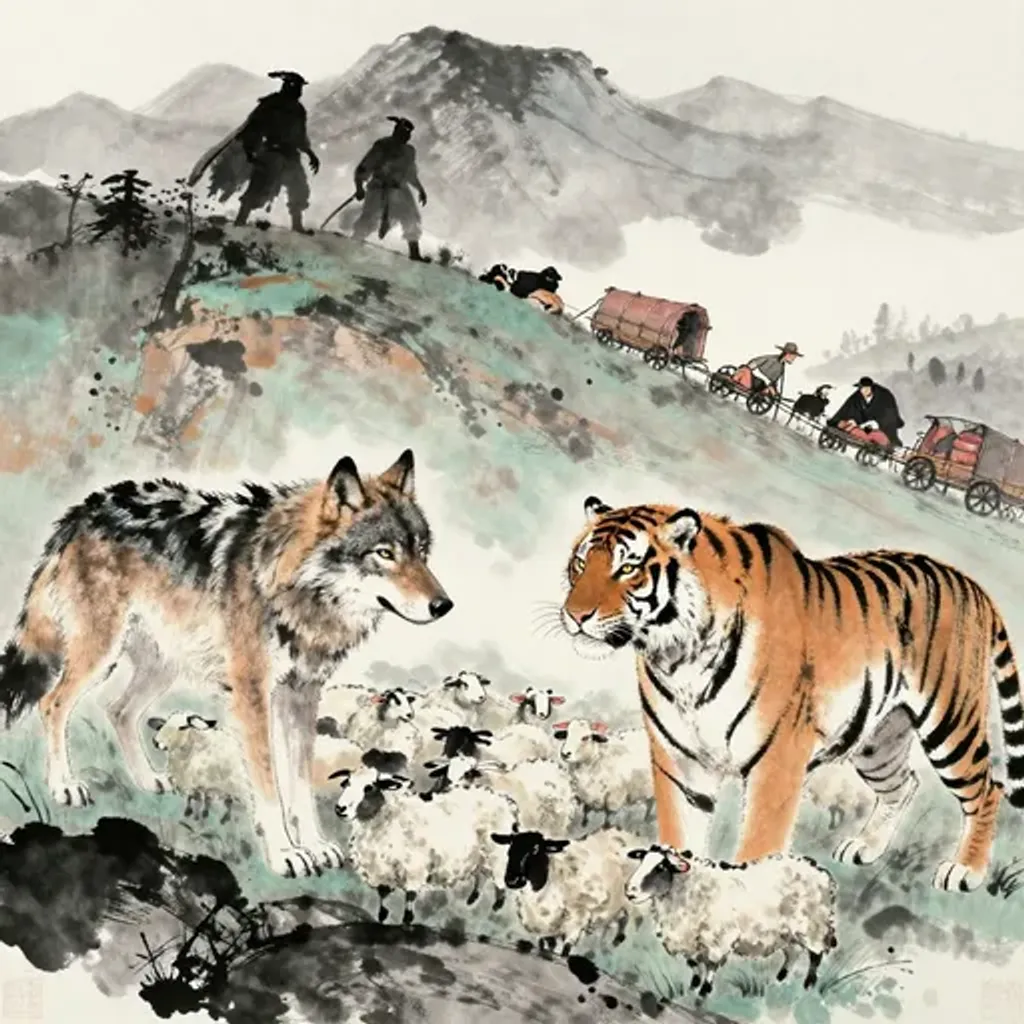
狼虎結謀,相聚為保。伺候牛羊,病我商人。
Wolf and tiger scheme together, gathering for mutual protection. Lying in wait for sheep and cattle, they bring harm to the traveling merchant.
— Jiao Yanshou, Yilin (Forest of Changes), 1st century BC
Commentary
Water sits above fire, and wolves and tigers conspire together, gathering in alliance for mutual protection. They lie in wait for cattle and sheep, preying upon the merchants. The verse describes organized predation: apex predators forming a cooperative band to exploit the vulnerable. From After Completion to Keeping Still, fire-and-water order yields to doubled mountains — absolute stillness, each thing fixed in position. The wolves and tigers have found their mountain and will not move from it. Keeping Still's instruction is to 'think without going beyond one's position,' but here that fixity becomes predatory patience. The completed order has crystallized into a trap, and the merchants who pass through this territory walk into a stillness that is not peace but ambush.
既濟 → 漸
Hexagram 63 → Hexagram 53: Development
Changing lines: 1, 6
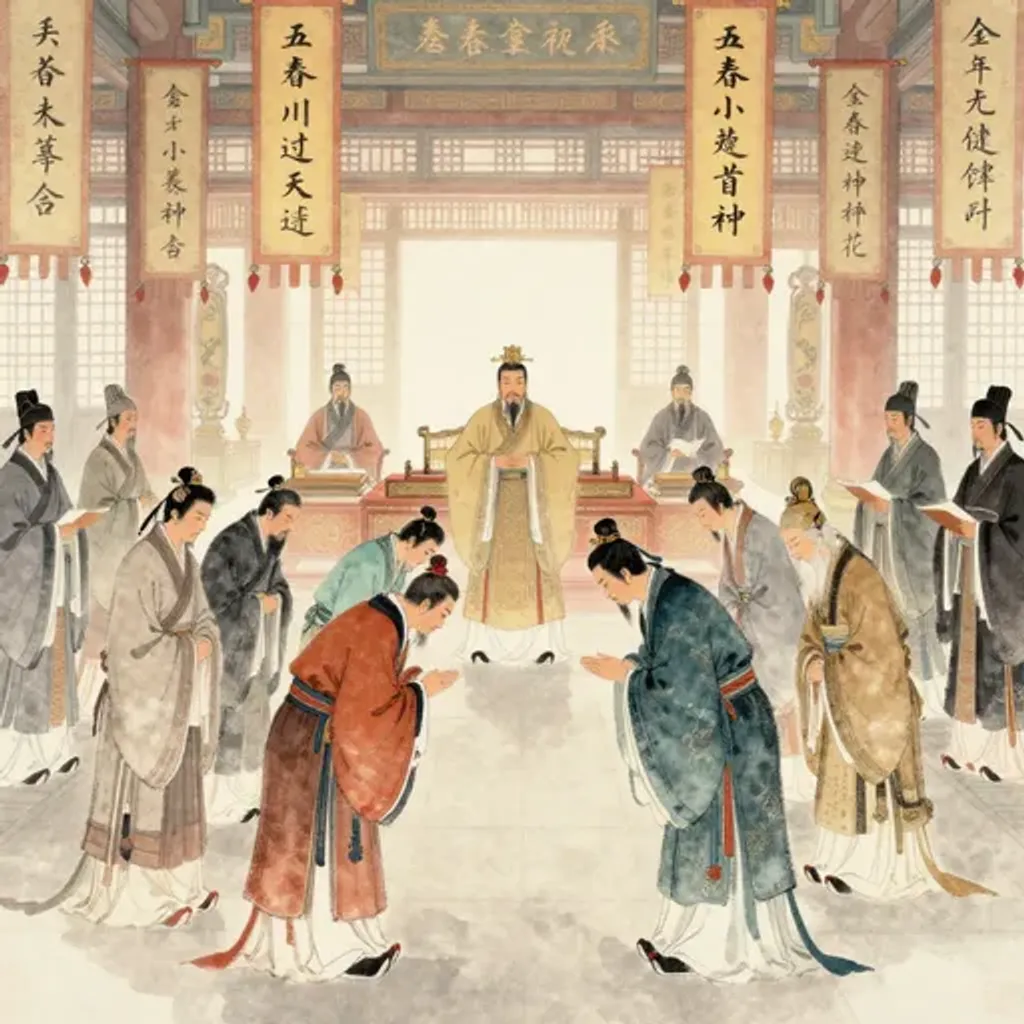
明德克敏,重華貢舉。放勳徵用,八哲蒙佑。
Bright virtue, keen and capable; Chonghua presented for service. Emperor Fangxun employs them; the eight sages receive protection.
— Jiao Yanshou, Yilin (Forest of Changes), 1st century BC
Commentary
Water sits above fire, and one of brilliant virtue and keen ability — Chonghua, Emperor Shun — is recommended for office. Fangxun, Emperor Yao, summons and employs him, and the eight wise counselors receive heaven's blessing. Chonghua (重華) is Shun's legendary name, meaning 'doubled radiance' for his double-pupiled eyes. Fangxun (放勳) is Yao's honorific. The eight wise men (八哲) likely refer to the eight able ministers who served under the sage-kings. From After Completion to Development, fire-and-water balance yields to wood growing upon the mountain — gradual, organic advancement. Development's goose alights on ever-higher branches; Shun's elevation from farmer to emperor was similarly incremental, each stage earned through proven merit.
既濟 → 歸妹
Hexagram 63 → Hexagram 54: The Marrying Maiden
Changing lines: 2, 3, 4, 5
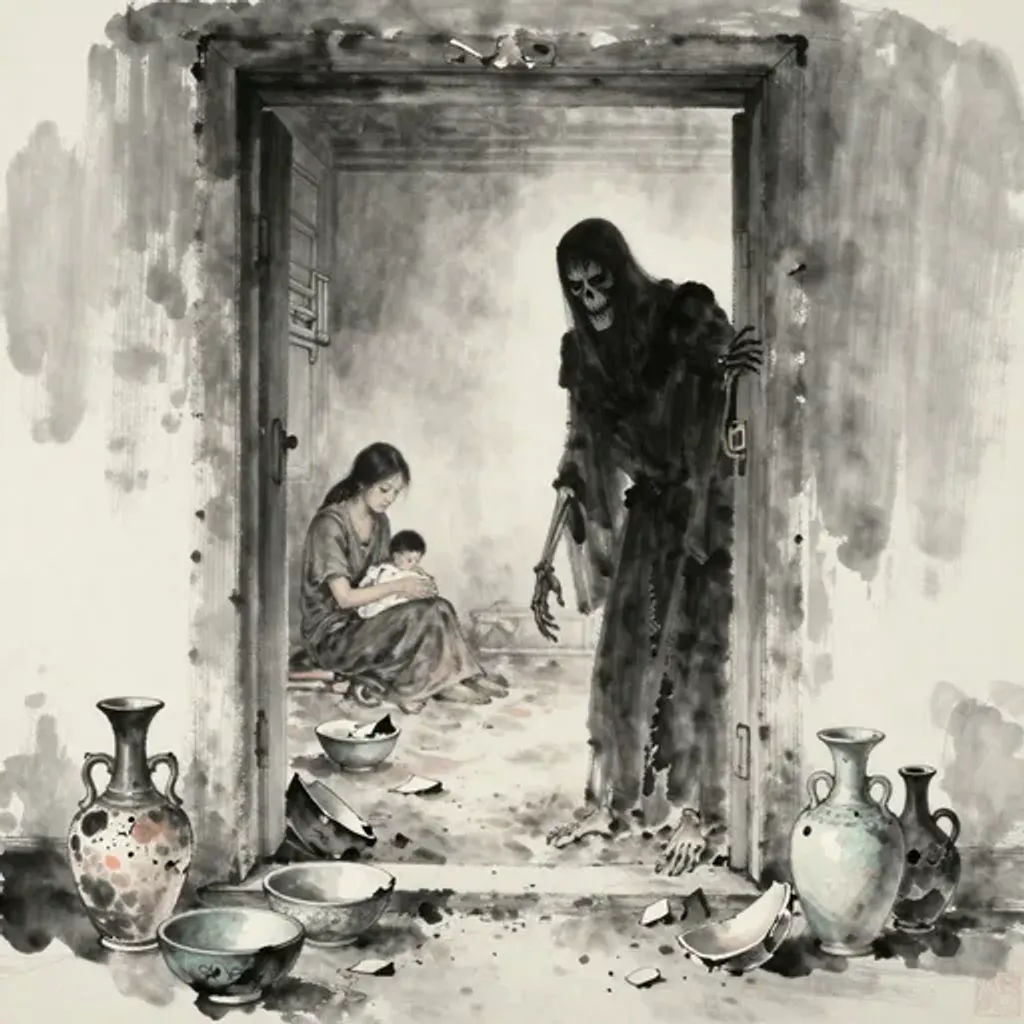
貧鬼守門,日破我盆。毀罌傷瓶,空虛无子。
The ghost of poverty guards the door, daily breaking my bowls. Jars and vases smashed, empty and void, without child.
— Jiao Yanshou, Yilin (Forest of Changes), 1st century BC
Commentary
Water sits above fire, but a ghost of poverty guards the gate, daily smashing one's pots and basins. Jars are broken, bottles shattered — the household is empty and without offspring. The verse personifies destitution as a malicious spirit stationed at the threshold, systematically destroying every vessel that might hold sustenance or hope. From After Completion to the Marrying Maiden, fire-and-water order yields to thunder above the lake — a union that the tradition views with ambivalence, as the younger sister given in marriage follows rather than leads. The completed household has been hollowed out by misfortune, and the Marrying Maiden's subordinate position mirrors this: one enters a new arrangement from a position of depletion, with nothing left to bring to the union.
既濟 → 豐
Hexagram 63 → Hexagram 55: Abundance
Changing lines: 4, 5
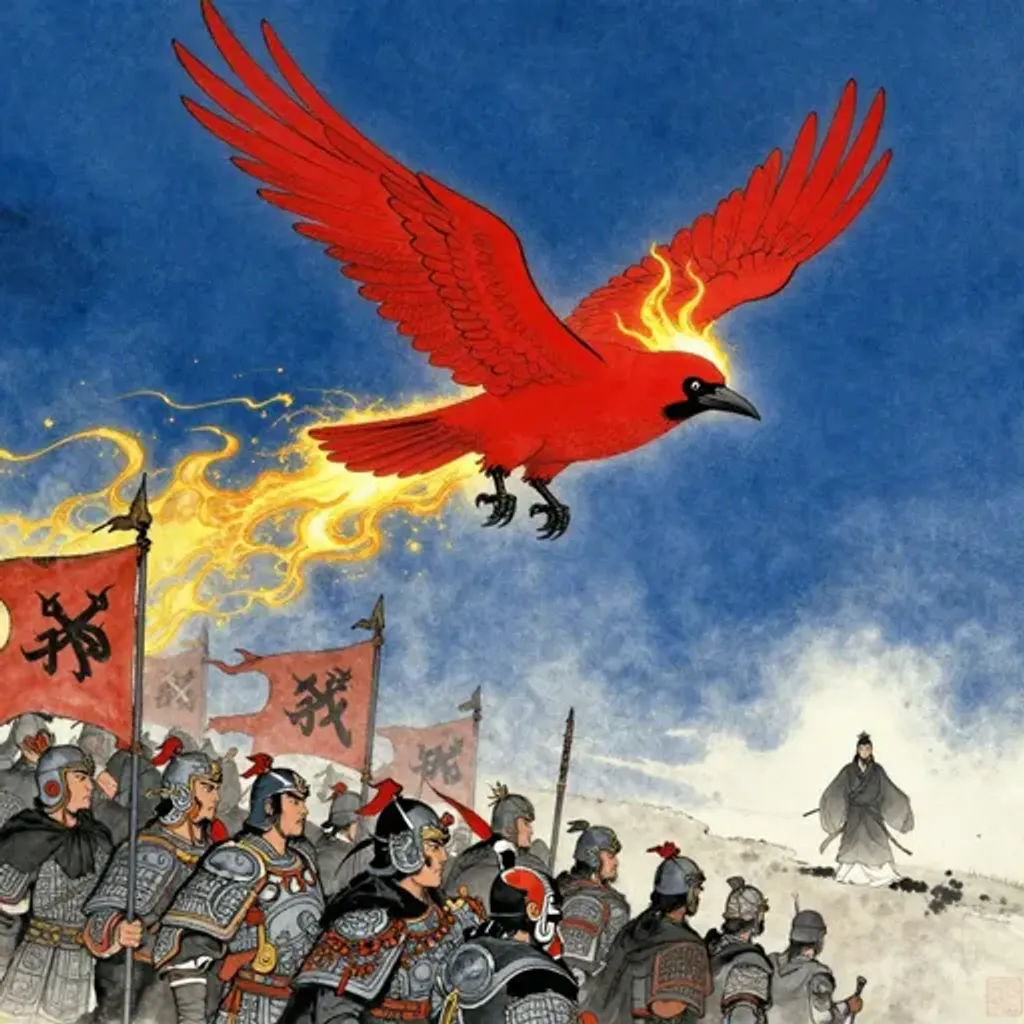
天命赤烏,與兵徼期。征伐无道,箕子遊遨。
Heaven commands the red crow to set the time for war. Marching against the unrighteous way; Jizi wanders free.
— Jiao Yanshou, Yilin (Forest of Changes), 1st century BC
Commentary
Water sits above fire, and heaven's mandate sends forth the red crow — the auspicious omen that signals the time for military action. The campaign targets a ruler who has lost the Way, and the Viscount of Ji wanders freely at last. The red crow (赤烏) was the omen that confirmed King Wu of Zhou's mandate to overthrow the tyrant Zhou of Shang at the Battle of Muye in 1046 BC. The Viscount of Ji, one of the Three Benevolent Ones of Shang who had feigned madness to survive the tyrant's court, was liberated after the conquest. From After Completion to Abundance, fire-and-water order transforms into thunder and lightning striking together — overwhelming brilliance and power converging at the decisive moment.
既濟 → 旅
Hexagram 63 → Hexagram 56: The Wanderer
Changing lines: 1, 4, 5, 6
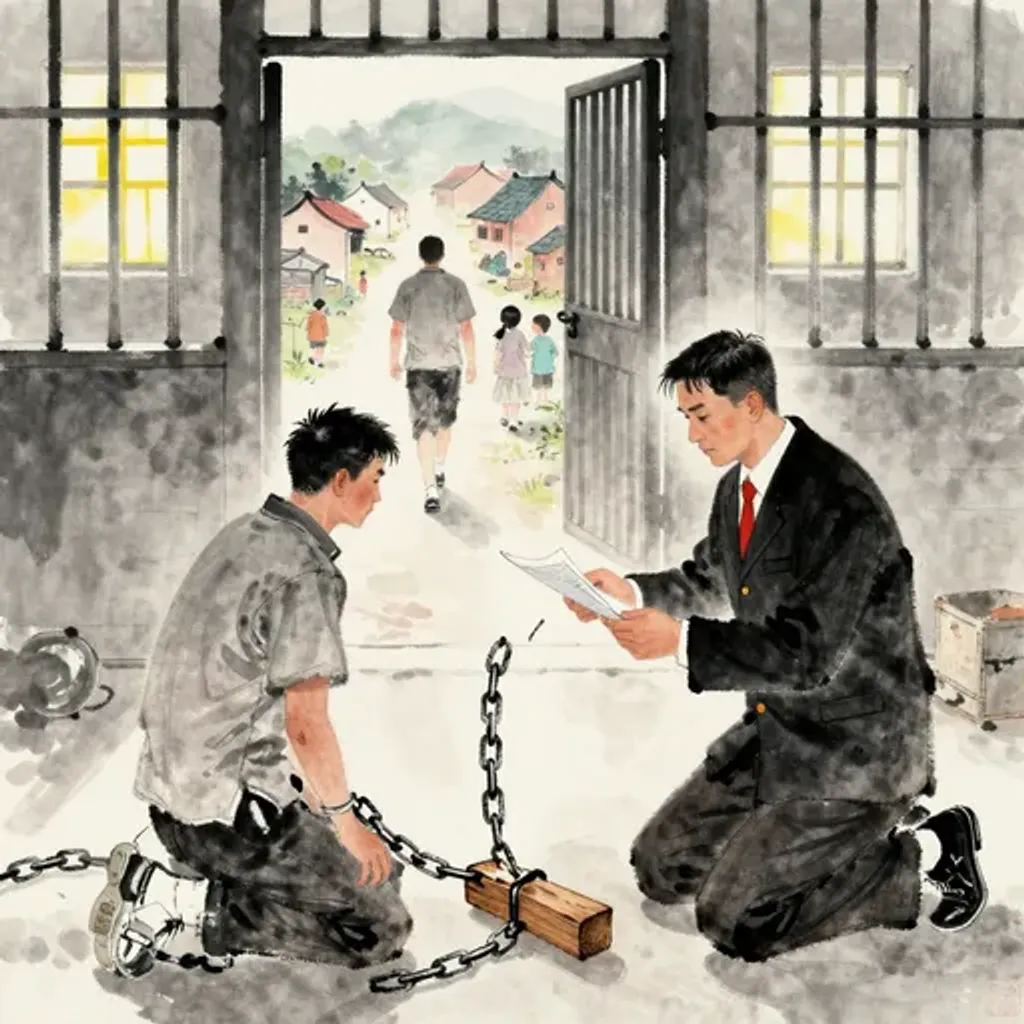
威約拘囚,為人所誣。皋陶平理,剖械出牢,脫歸家閭。
Bound by force and imprisoned, slandered by others. Gaotao judges fairly, breaking the shackles, releasing from prison, returning to home and village.
— Jiao Yanshou, Yilin (Forest of Changes), 1st century BC
Commentary
Water sits above fire, and one is coerced and imprisoned, falsely accused by others. Then Gao Yao adjudicates with fairness, breaking open the shackles and releasing the prisoner from the dungeon, who returns home to his village. Gao Yao, the legendary minister of justice under Emperors Shun and Yu, embodies the ideal of impartial law that liberates the innocent. From After Completion to the Wanderer, fire-and-water balance yields to fire above the mountain — the traveler's campfire on a strange peak. The freed prisoner does not return to the completed order but emerges into the Wanderer's uncertain terrain. Justice has set him free, but the road home passes through unfamiliar country, and the fire that lights his way is small and temporary.
既濟 → 巽
Hexagram 63 → Hexagram 57: The Gentle Wind
Changing lines: 1, 2, 6
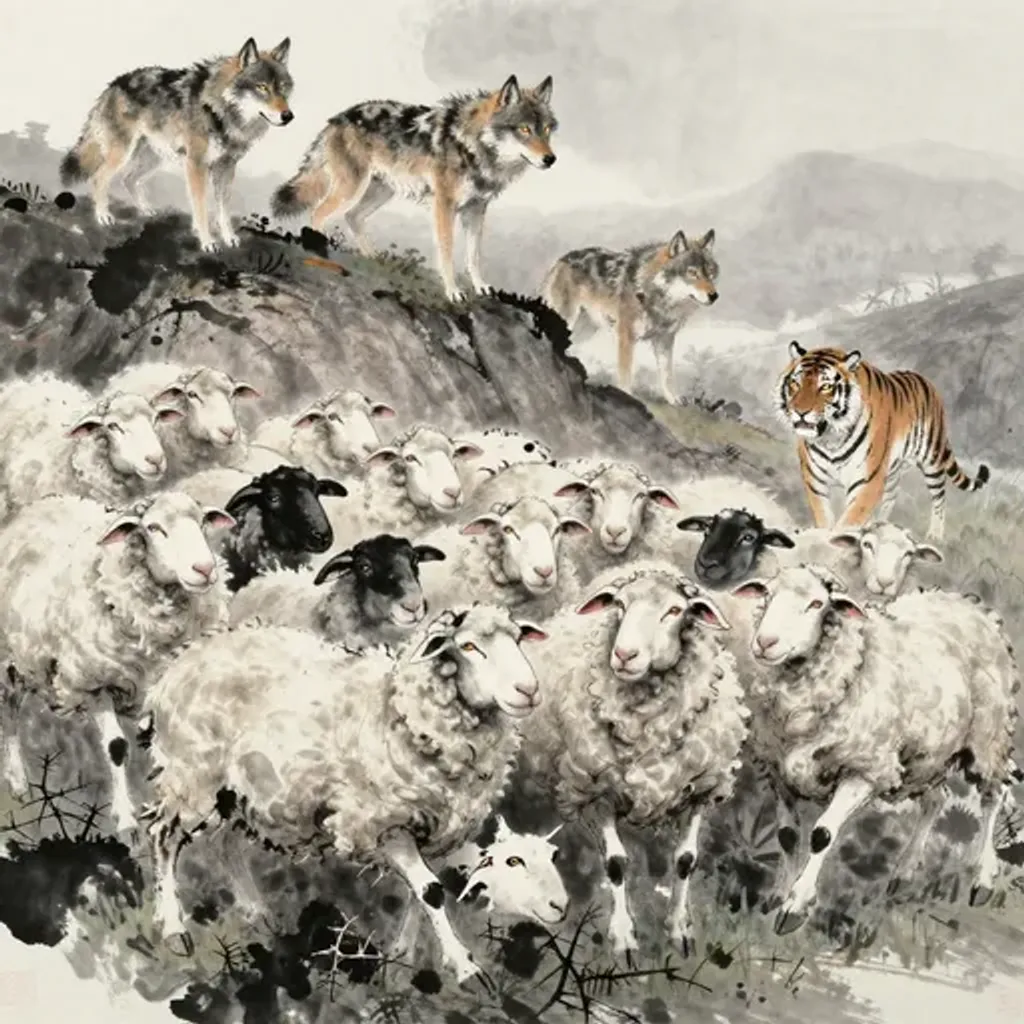
羊驚虎狼,聳耳群聚。无益威彊,為齒所傷。
Sheep startled by tigers and wolves, ears alert, crowding together. This brings no benefit against the strong; they are wounded by fangs.
— Jiao Yanshou, Yilin (Forest of Changes), 1st century BC
Commentary
Water sits above fire, but sheep catch scent of wolves and tigers. Ears pricked, the flock huddles together in panic. Their numbers offer no real strength; they are wounded by the predator's teeth all the same. The verse strips away the illusion that mere gathering equals safety: the sheep's instinctive clustering provides psychological comfort but no actual defense against superior force. From After Completion to the Gentle, fire-and-water order yields to doubled wind — penetrating influence that works by gradual infiltration. The Gentle's wind enters everywhere, just as the predator's threat permeates the flock. Against such pervasive danger, huddling is futile; what is needed is the wind's own quality — adaptive flexibility rather than rigid formation.
既濟 → 兌
Hexagram 63 → Hexagram 58: The Joyous Lake
Changing lines: 2, 3, 4
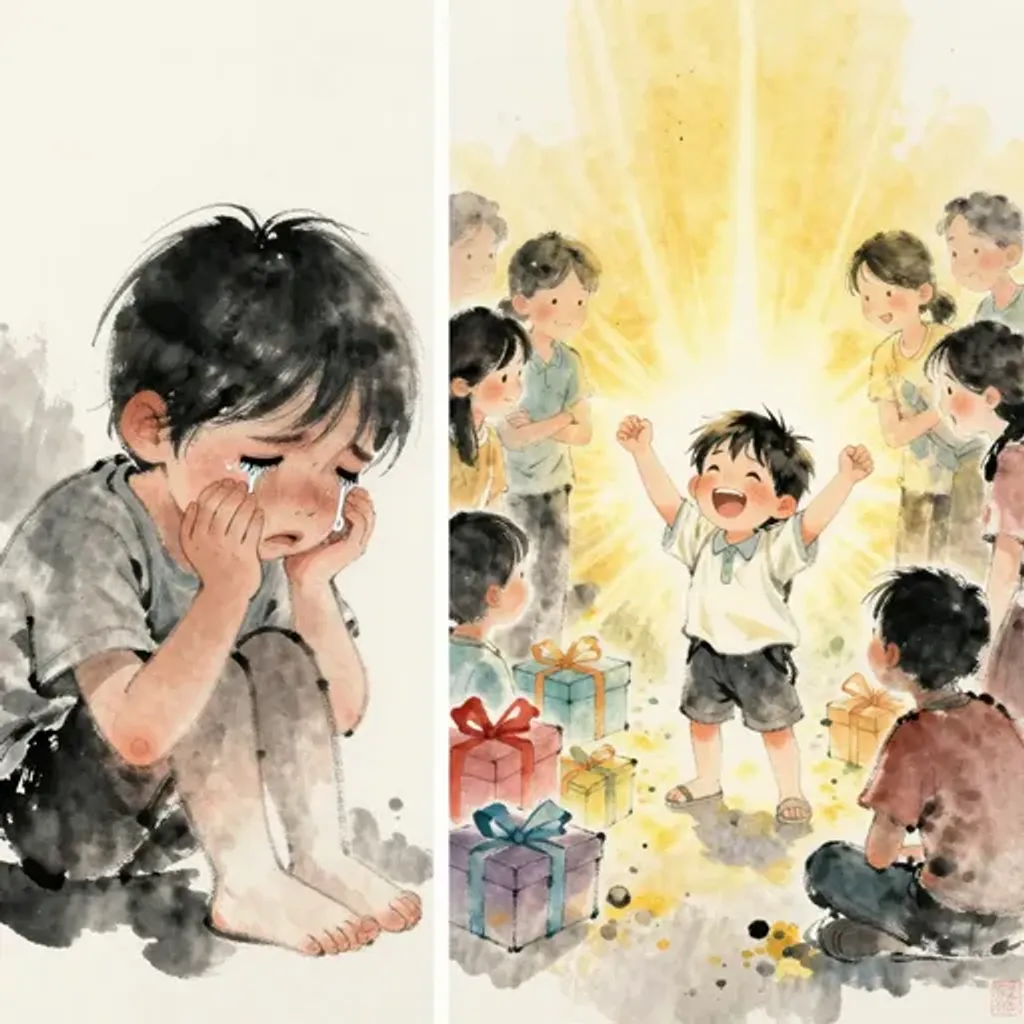
初雖號啼,後必慶笑。光明照耀,百喜如意。
At first there may be weeping and crying; afterward surely celebration and laughter. Light and brightness shine forth; a hundred joys accord with one's wishes.
— Jiao Yanshou, Yilin (Forest of Changes), 1st century BC
Commentary
Water sits above fire, and though one begins with weeping, joy follows in the end. Radiant light shines forth, and a hundred blessings align as one desires. The verse traces the simplest and most reassuring arc: from tears to laughter, from darkness to illumination. No specific allusion anchors it — the comfort is generic and universal. From After Completion to the Joyous, fire-and-water balance yields to doubled lakes — the image of mutual delight, friends studying and laughing together. The completed order, which began with the anxiety of maintaining equilibrium, dissolves into pure, uncomplicated happiness. The Joyous is the endpoint where all tension releases and the only remaining energy is shared celebration.
既濟 → 渙
Hexagram 63 → Hexagram 59: Dispersion
Changing lines: 1, 2, 3, 6
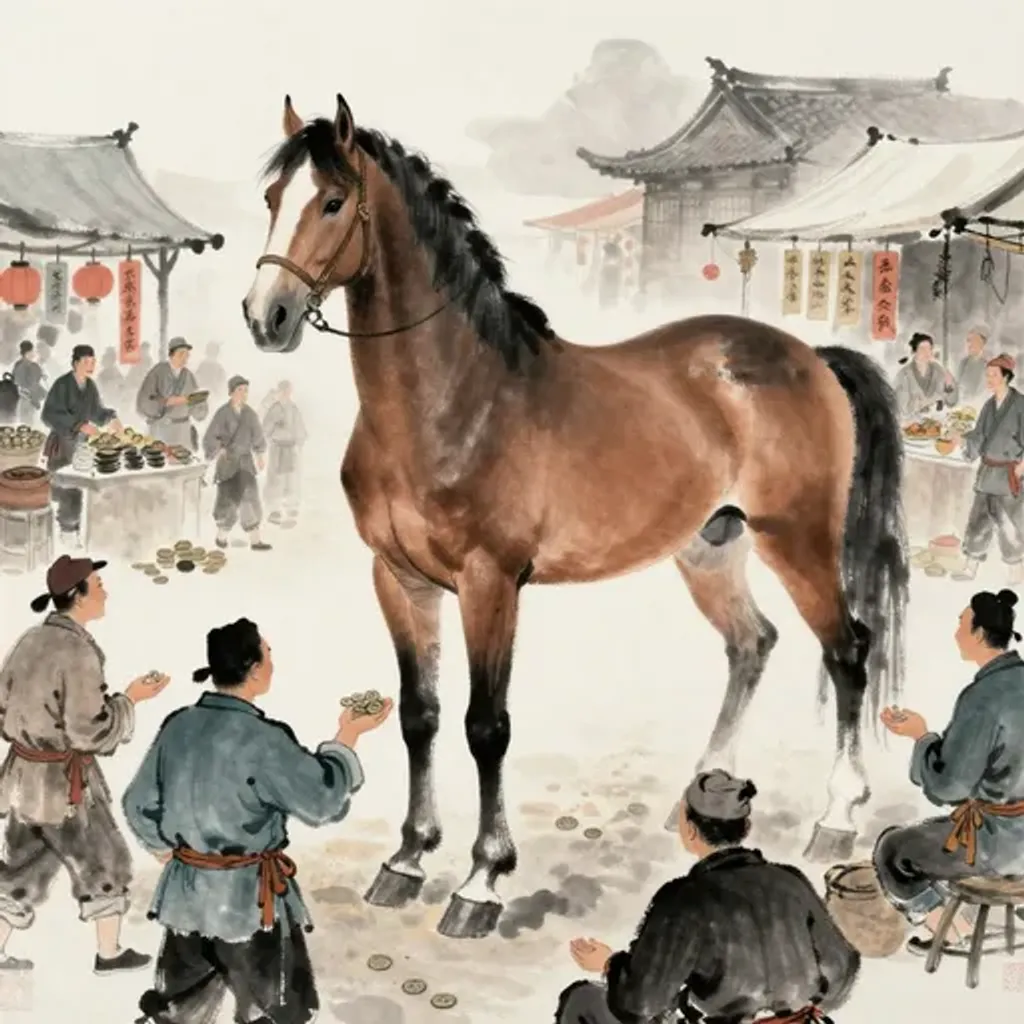
馬服長股,宜行善市。蒙祐諧耦,獲金五倍。
A horse with long legs is suited for travel and good markets. Receiving the blessing of a harmonious match, gaining gold fivefold.
— Jiao Yanshou, Yilin (Forest of Changes), 1st century BC
Commentary
Water sits above fire, and the horse is tall with long legs — well-suited for trade and travel. Blessed with favorable pairings, one gains fivefold in gold. The horse built for the road, the market that rewards the venture, the returns that multiply — the verse celebrates commercial success enabled by the right instrument. From After Completion to Dispersion, fire-and-water balance yields to wind moving across water — Dispersion's image of barriers dissolving. The completed order does not hoard but disperses its wealth outward through trade, and the returns exceed the investment. Dispersion here is not loss but circulation: wealth flows outward on strong legs and returns multiplied, because movement itself generates value.
既濟 → 節
Hexagram 63 → Hexagram 60: Limitation
Changing lines: 2, 3
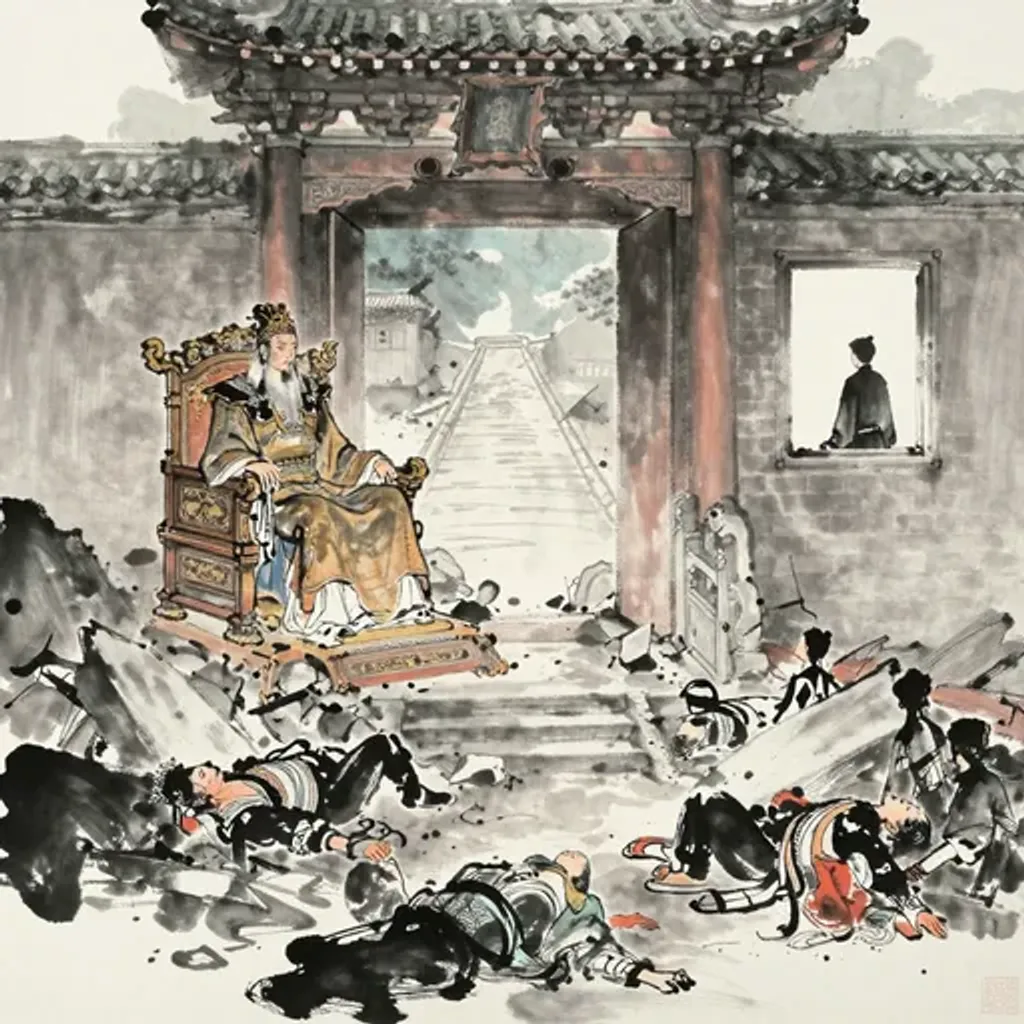
應門內崩,誅賢殺暴。上下咸悖,景公失位。長歸無恆,望妻不來。
The inner gate collapses; both worthy and wicked are killed. Above and below all rebel; Duke Jing loses his position. Departing forever without return, watching for a wife who does not come.
— Jiao Yanshou, Yilin (Forest of Changes), 1st century BC
Commentary
Water sits above fire, but the inner gate collapses. Virtuous and wicked alike are slain; high and low are all in rebellion. Duke Jing loses his position. Separated for so long there is no constancy; one gazes for the wife who never comes. The verse catalogs political and domestic disintegration: the palace gate — boundary between inner court and outer world — falls, signaling that all distinctions have broken down. From After Completion to Limitation, fire-and-water balance yields to water above the lake — proper boundaries that regulate excess. Yet the verse shows what happens when limits fail entirely: without the gate, without the boundary, authority collapses and even the domestic bond dissolves. Limitation is the remedy this verse desperately needs but cannot find.
既濟 → 中孚
Hexagram 63 → Hexagram 61: Inner Truth
Changing lines: 2, 3, 6
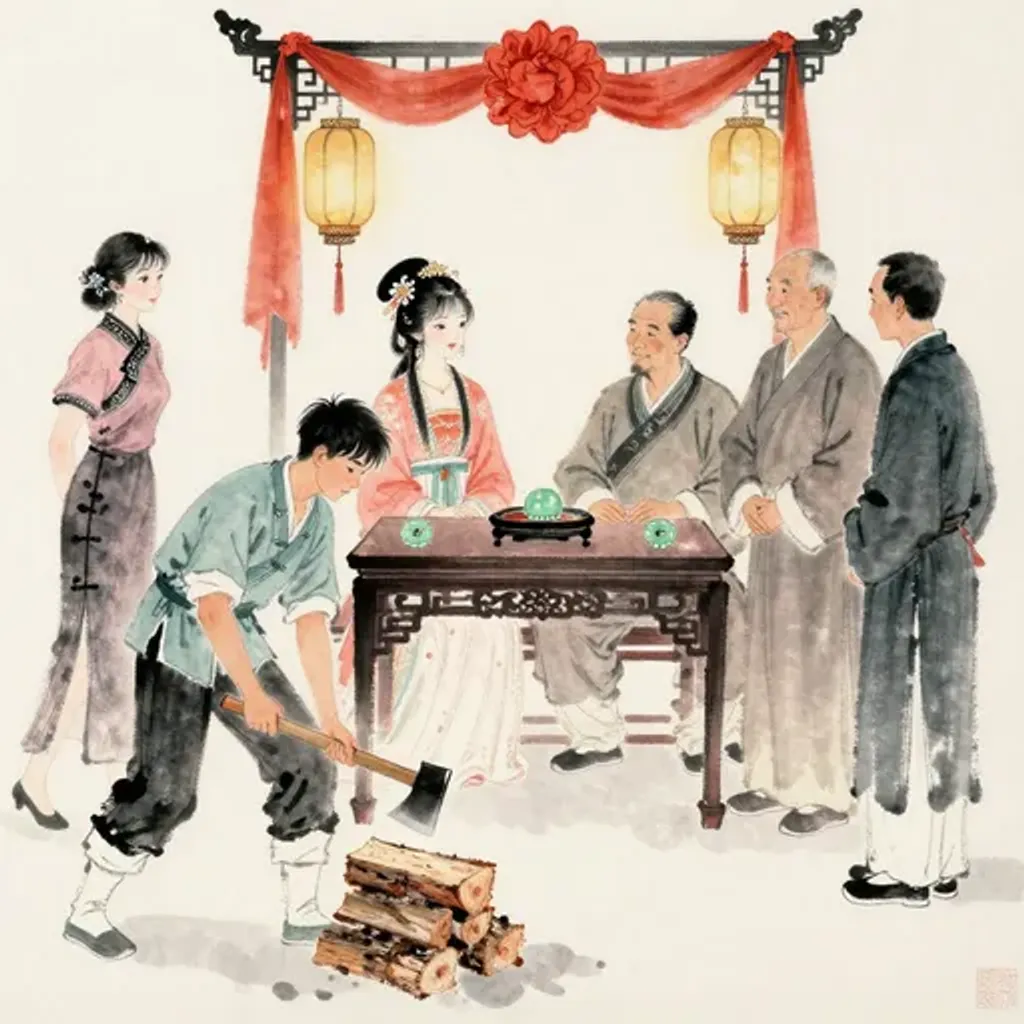
執斧破薪,使媒求婦。好合二姓,親御斯須。色比毛嬙,姑悅公喜。
Taking up axe to split firewood, sending a matchmaker to seek a bride. The two surnames join in harmony; the groom attends her for a moment. Her beauty rivals Mao Qiang; mother-in-law is pleased, father-in-law delighted.
— Jiao Yanshou, Yilin (Forest of Changes), 1st century BC
Commentary
Water sits above fire, and one takes an axe to split kindling, then sends a matchmaker to seek a bride. Two surnames join in harmonious union; the couple receives formal blessing. Her beauty rivals Mao Qiang's, and both mother-in-law and father-in-law are delighted. The verse follows the proper sequence of Han marriage: wood-splitting (preparing the household), matchmaking, surname compatibility, and ritual approval. Mao Qiang was a legendary beauty of the Spring and Autumn era, often paired with Xi Shi. From After Completion to Inner Truth, fire-and-water order transforms into wind above the lake — sincerity radiating outward from an open center. The completed life finds its deepest truth in the mutual trust of marriage, where inner emptiness receives another and both are made whole.
既濟 → 小過
Hexagram 63 → Hexagram 62: Small Exceeding
Changing lines: 1, 4, 5
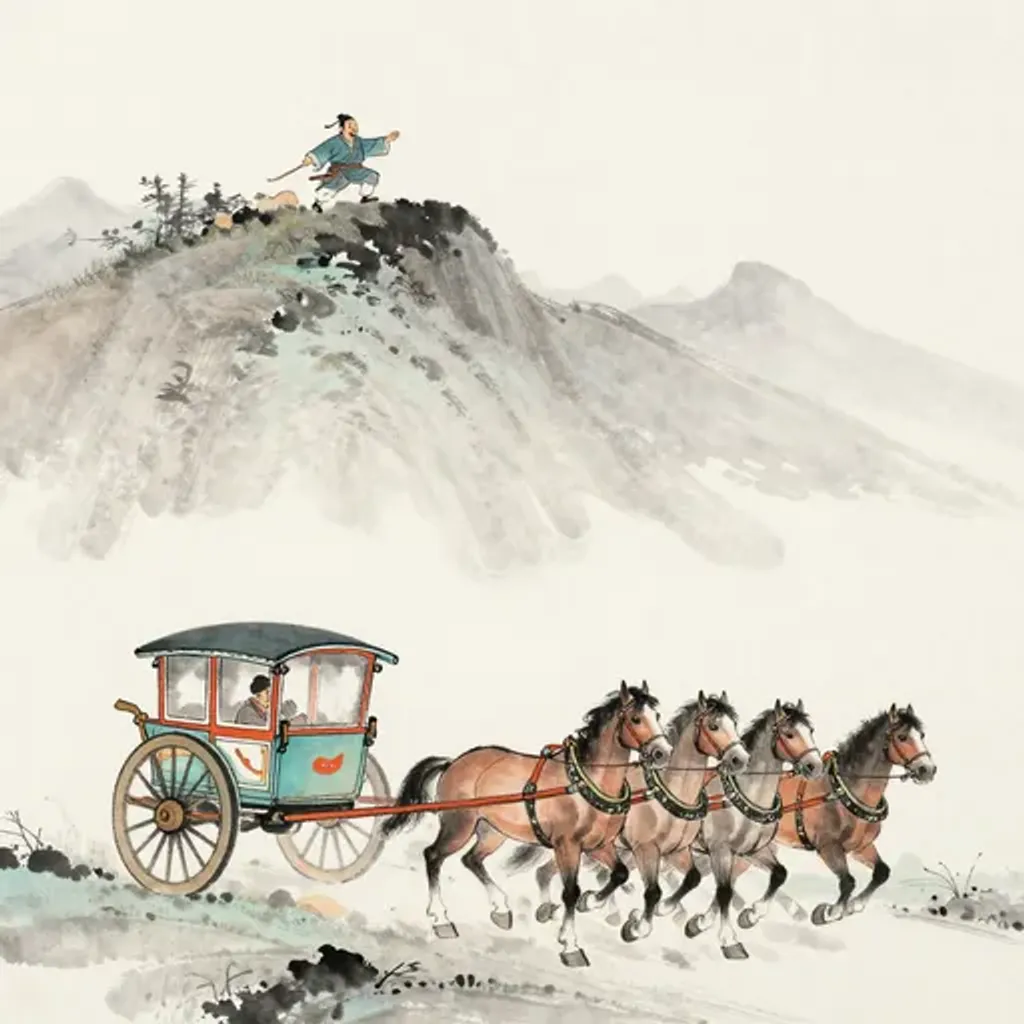
兩輪日轉,南上大阪。四馬共轅,无有險難,與禹笑言。
Two wheels turn daily, climbing south to the great slope. Four horses share one shaft; there is no danger or difficulty. Sharing laughter and words with Yu.
— Jiao Yanshou, Yilin (Forest of Changes), 1st century BC
Commentary
Water sits above fire, and two wheels turn daily as the carriage climbs the great slope heading south. Four horses share a single yoke; there are no dangers or difficulties on the road. One converses and laughs with Yu the Great himself. The verse is an idealized journey: matched horses, smooth ascent, and the companionship of the greatest sage-hero of flood control. From After Completion to Small Exceeding, fire-and-water balance yields to thunder above the mountain — the small bird that must not fly too high. Small Exceeding counsels modesty in action, exceeding only in small ways. The verse embodies this: the journey succeeds not through daring but through steady teamwork, and the greatest company is found not in heaven but on the road, laughing with a fellow traveler.
既濟 → 既濟
Hexagram 63 → Hexagram 63: After Completion
No changing lines — the hexagram is unchanged
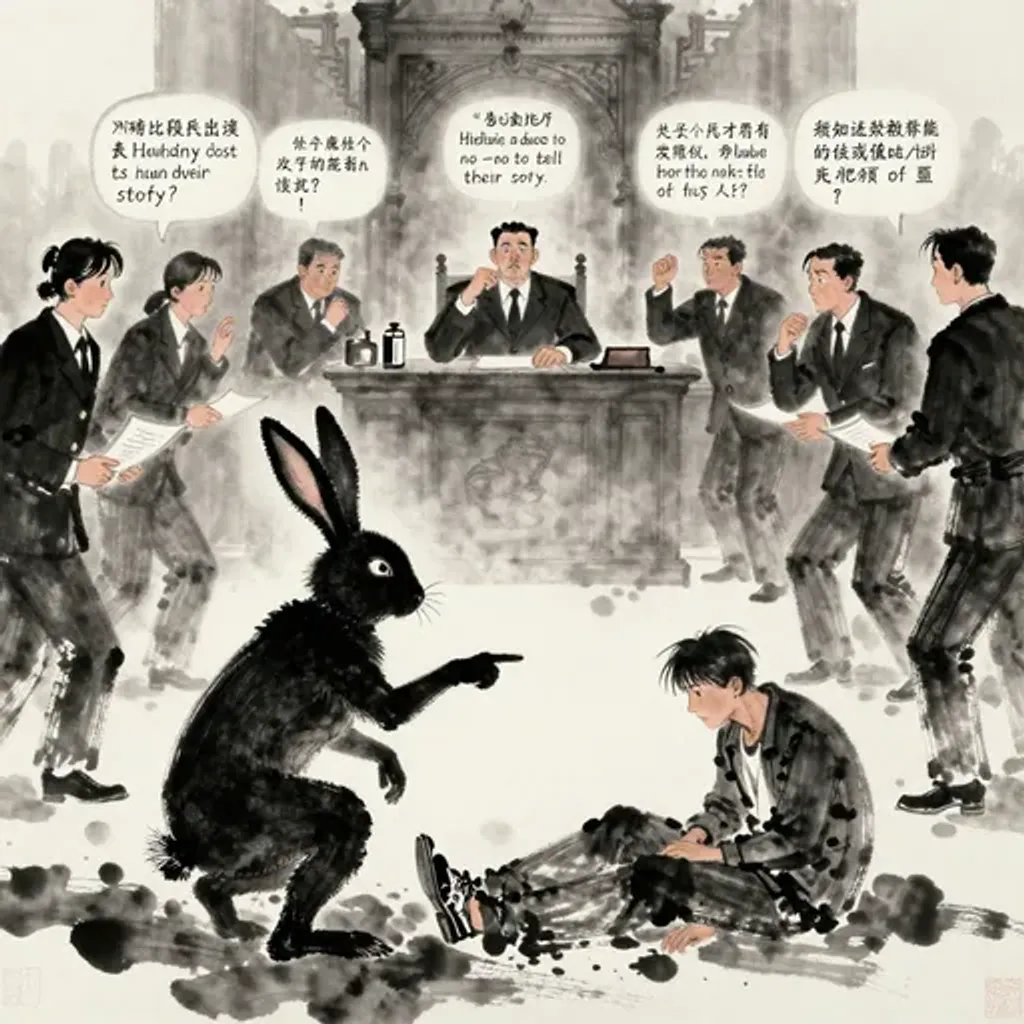
玄兔指掌,與足相恃。謹訊詰問,誣情自直。冤死誰告,口為身禍。
The black rabbit points with its paw, hand and foot accusing each other. Careful interrogation and questioning; false charges straighten themselves out. Who will tell the wrongly dead? The mouth brings disaster to the body.
— Jiao Yanshou, Yilin (Forest of Changes), 1st century BC
Commentary
Water sits above fire — After Completion returning to itself. The dark hare points with its paw, relying on its feet for support. Under rigorous interrogation, false accusations are straightened out on their own. Yet the unjustly dead have no one to appeal to, for the mouth that should speak becomes the body's undoing. The verse oscillates between justice and its failure: inquiry can expose falsehood, but sometimes truth arrives too late, after the innocent are already dead. The mouth — instrument of both testimony and self-incrimination — is the pivot. From After Completion to After Completion, the hexagram meets its own mirror. There is no transformation, only the completed order confronting its own internal contradictions: the system that can both vindicate and destroy.
既濟 → 未濟
Hexagram 63 → Hexagram 64: Before Completion
Changing lines: 1, 2, 3, 4, 5, 6
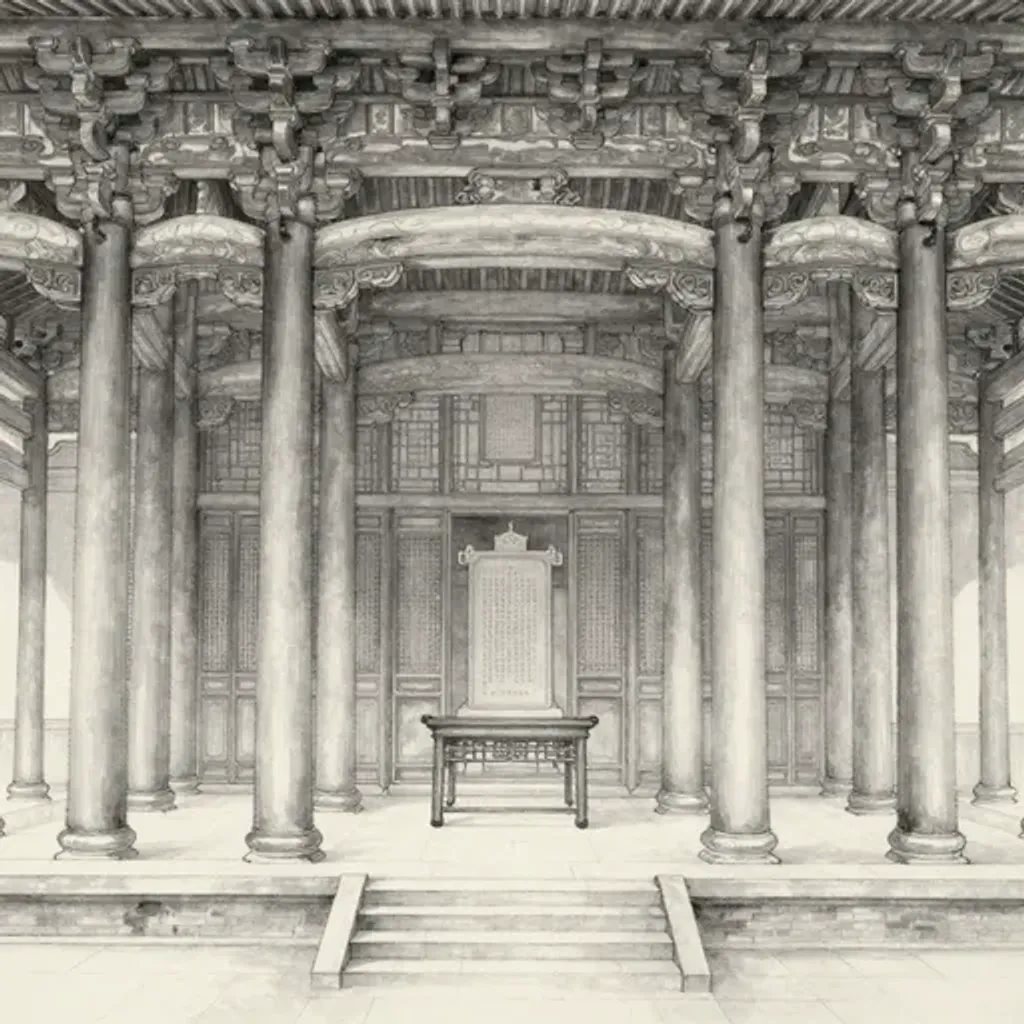
千柱百梁,終不傾僵,周宗寧康。
A thousand pillars and a hundred beams, never tilting or falling. The Zhou ancestral line rests in peace and health.
— Jiao Yanshou, Yilin (Forest of Changes), 1st century BC
Commentary
Water sits above fire, and a thousand pillars with a hundred beams stand firm — the structure will never topple. The house of Zhou enjoys peace and prosperity. The verse is a declaration of architectural and dynastic permanence: the building's redundant support guarantees stability, and the Zhou royal house endures. From After Completion to Before Completion, fire-and-water order inverts into fire above water — everything still to be done. Yet the verse's confidence is unshaken: even facing the ultimate incompletion, the foundation is so thoroughly laid that it holds. The transition from After Completion to Before Completion is not collapse but renewal — the thousand pillars that survived one cycle are strong enough to begin the next.