Transformations of Hexagram 9
Every line of change out of Hexagram 9 小畜 Small Taming, with the Yilin verse for each of the 64 resulting hexagrams, its translation, and the original ink brush artwork.
小畜 → 乾
Hexagram 9 → Hexagram 1: The Creative
Changing lines: 4
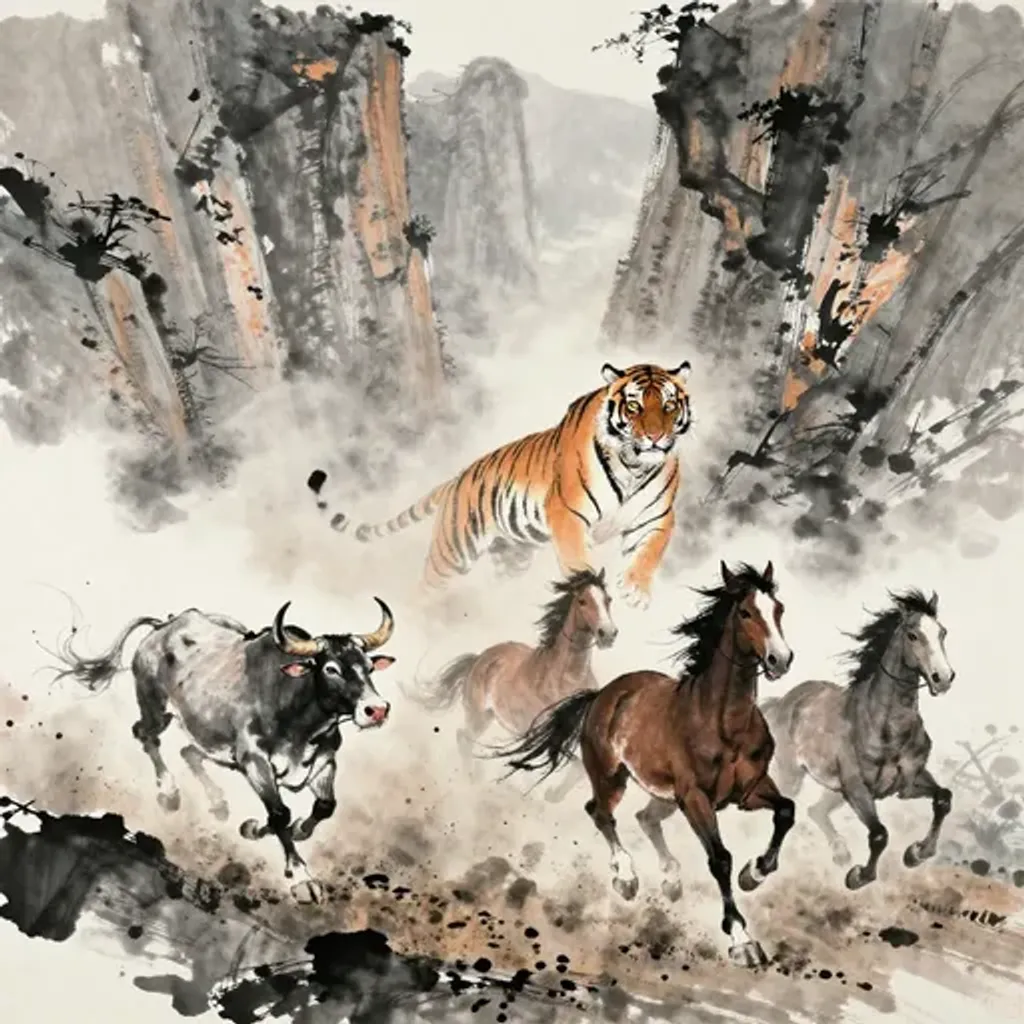
東遇虎地,牛馬奔驚;道絕不通,南困無功。
Heading east, he meets a tiger ground; cattle and horses bolt in panic. The road is cut off, impassable; trapped in the south, achieving nothing.
— Jiao Yanshou, Yilin (Forest of Changes), 1st century BC
Commentary
Wind courses above heaven, gentle restraint refining raw force. Yet here that gentle hand fails: the traveler encounters a tiger in the east, and oxen and horses bolt in terror. The road is cut off, impassable; turning south brings only futility. From Small Taming to the Creative, the soft wind that once modulated heaven's drive is overwhelmed by pure yang reasserting itself as uncontrollable force. The tiger is wild heaven unleashed — no wind can tame it. When the path forward is blocked and retreat yields nothing, one faces the Creative's double-edged truth: limitless energy without a channel becomes menace rather than momentum.
小畜 → 坤
Hexagram 9 → Hexagram 2: The Receptive
Changing lines: 1, 2, 3, 5, 6
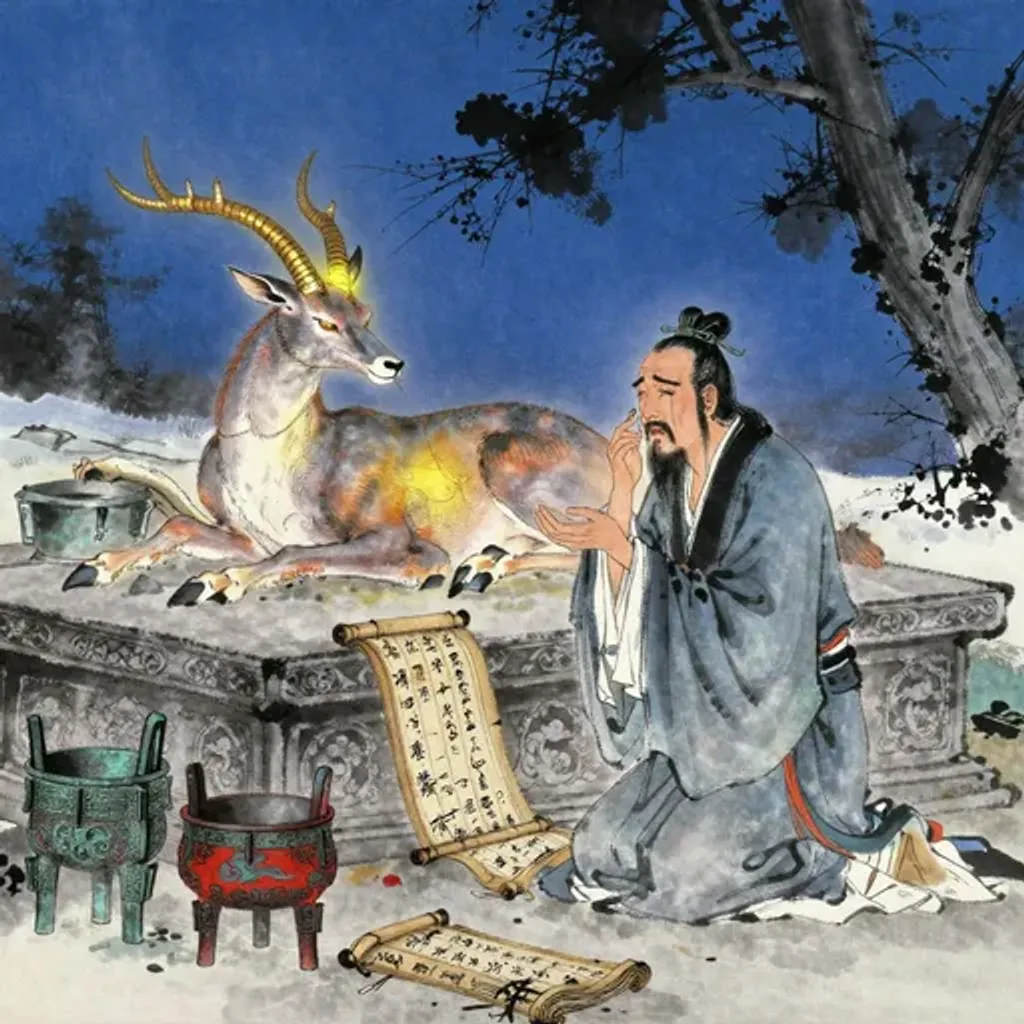
子鉏執麟,《春秋》作元;陰將以終,尼父悲心。
Zichu captures the qilin; the Spring and Autumn Annals begins. Yin is about to end; Master Ni grieves in his heart.
— Jiao Yanshou, Yilin (Forest of Changes), 1st century BC
Commentary
Wind above heaven yields to pure earth. Zichushang, the charioteer of the Shusun clan, captures a qilin during a hunt in the Great Marsh — the incident of 481 BC that traditionally marks where Confucius ceased writing the Spring and Autumn Annals. The sage, here called by his surname 'Father Ni,' grieves: the benevolent beast that appears only under sage rulers now emerges in a degenerate age. Yin reaches its terminal phase; the moral order exhausts itself. From Small Taming to the Receptive, heaven's restrained energy collapses into earth's passive finality. The qilin's capture is not renewal but closure — the last flicker of cosmic harmony absorbed into undifferentiated earth.
小畜 → 屯
Hexagram 9 → Hexagram 3: Difficulty at the Beginning
Changing lines: 2, 3, 6
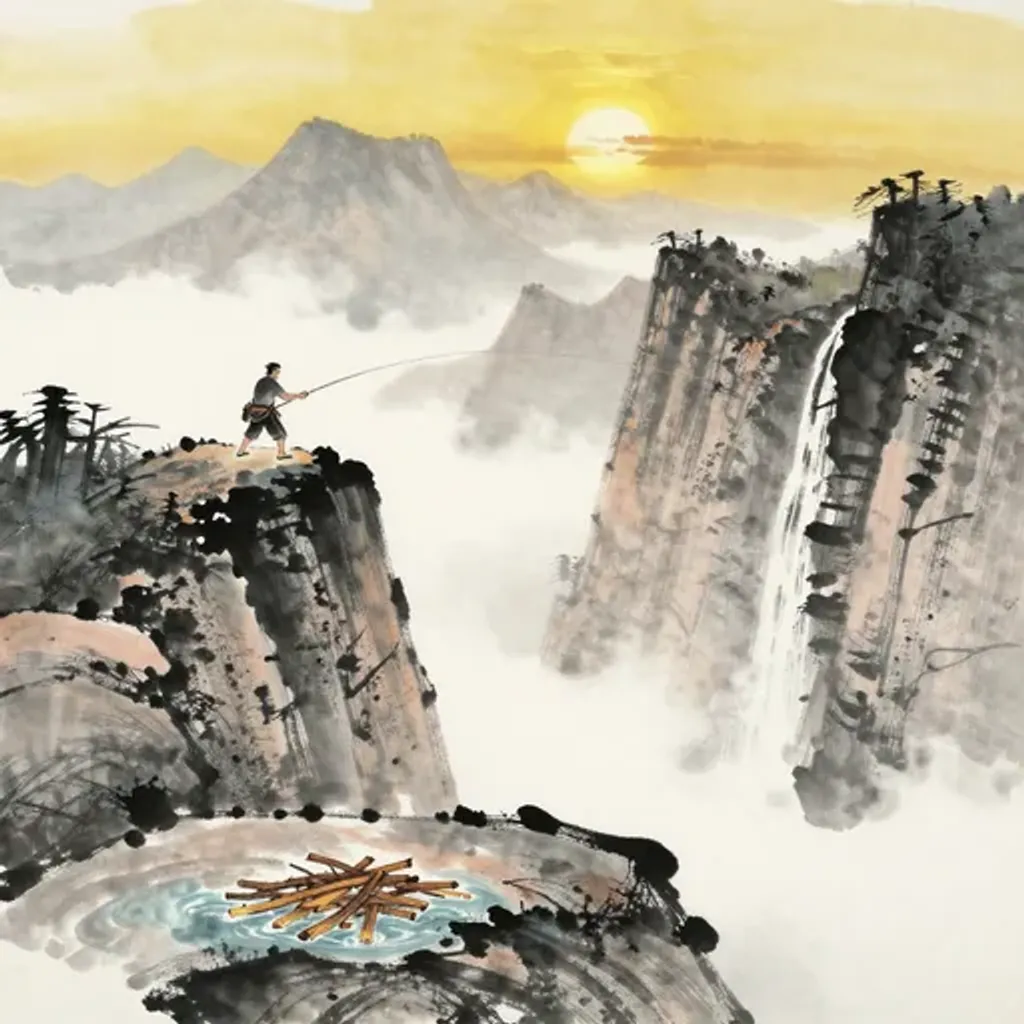
取火泉源,釣魚山顛;魚不可得,火不可然。
Seeking fire from a flowing spring, fishing atop a mountain peak. The fish cannot be caught; the fire will not ignite.
— Jiao Yanshou, Yilin (Forest of Changes), 1st century BC
Commentary
Wind above heaven meets cloud and thunder in birth-struggle. Someone seeks fire from a spring and tries to fish on a mountaintop — both acts absurdly misplaced. Fire cannot be kindled from water, and fish cannot be caught on stone. The verse is a parable of categorical error: pursuing goals with fundamentally wrong methods. From Small Taming to Difficulty at the Beginning, the gentle refinement of wind gives way to the turbulent emergence of Zhun, where water churns above thunder. Zhun demands that one navigate chaos with discernment, choosing the right tool for the right terrain. These inverted efforts fail precisely because they ignore the nature of what they seek.
小畜 → 蒙
Hexagram 9 → Hexagram 4: Youthful Folly
Changing lines: 1, 3, 5
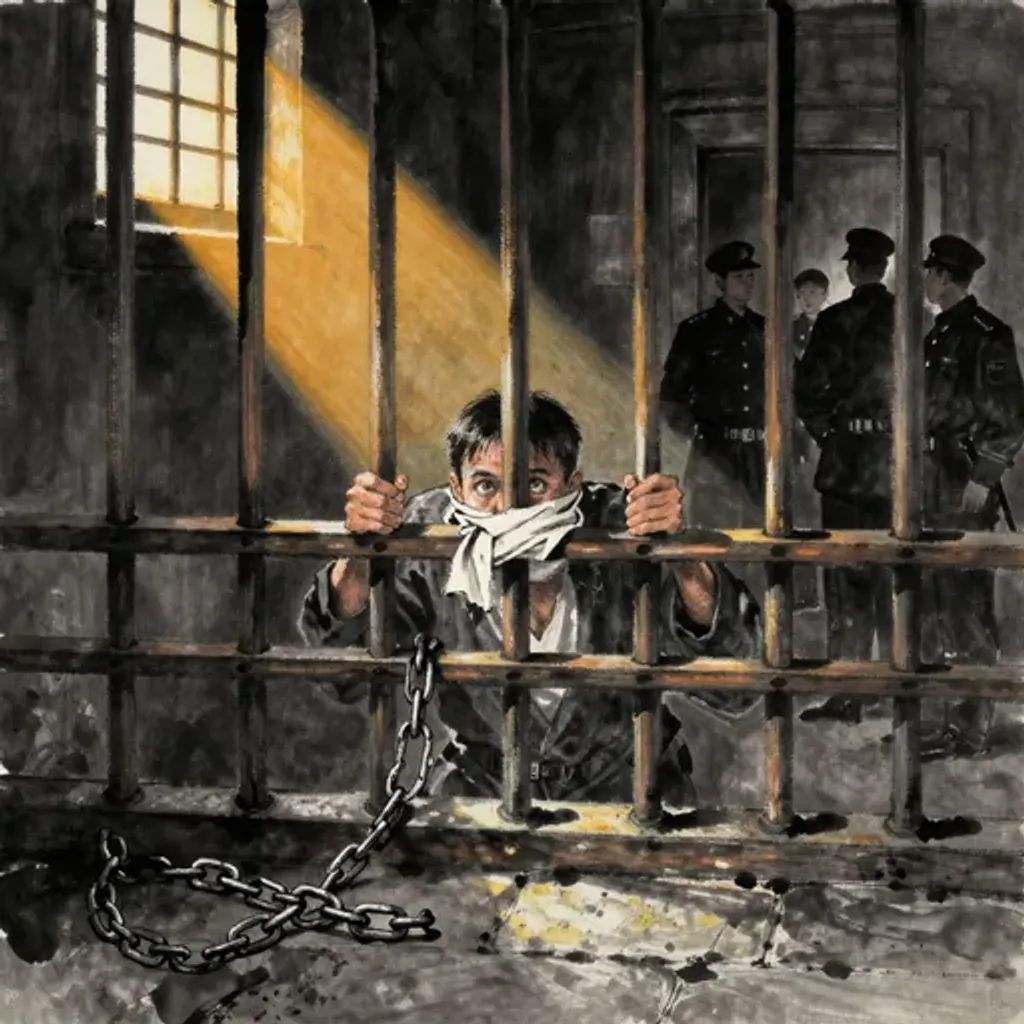
機關不便,不能出言;精誠不通,為人所冤。
The mechanism is not smooth; he cannot speak his words. His sincerity cannot get through; he is wronged by others.
— Jiao Yanshou, Yilin (Forest of Changes), 1st century BC
Commentary
Wind above heaven gives way to a spring blocked beneath the mountain. The mechanism jams and cannot produce speech; sincerity fails to communicate, and the innocent are wrongly accused. From Small Taming to Youthful Folly, heaven's broad sky narrows into the dark passage where a mountain spring must find its way through rock. Meng's image — water emerging below the mountain — suggests potential that has not yet found its outlet. The verse captures the painful state before breakthrough: one knows the truth but cannot articulate it, and that silence becomes a weapon turned against the self. The spring is there, but the rock has not yet cracked.
小畜 → 需
Hexagram 9 → Hexagram 5: Waiting
Changing lines: 6
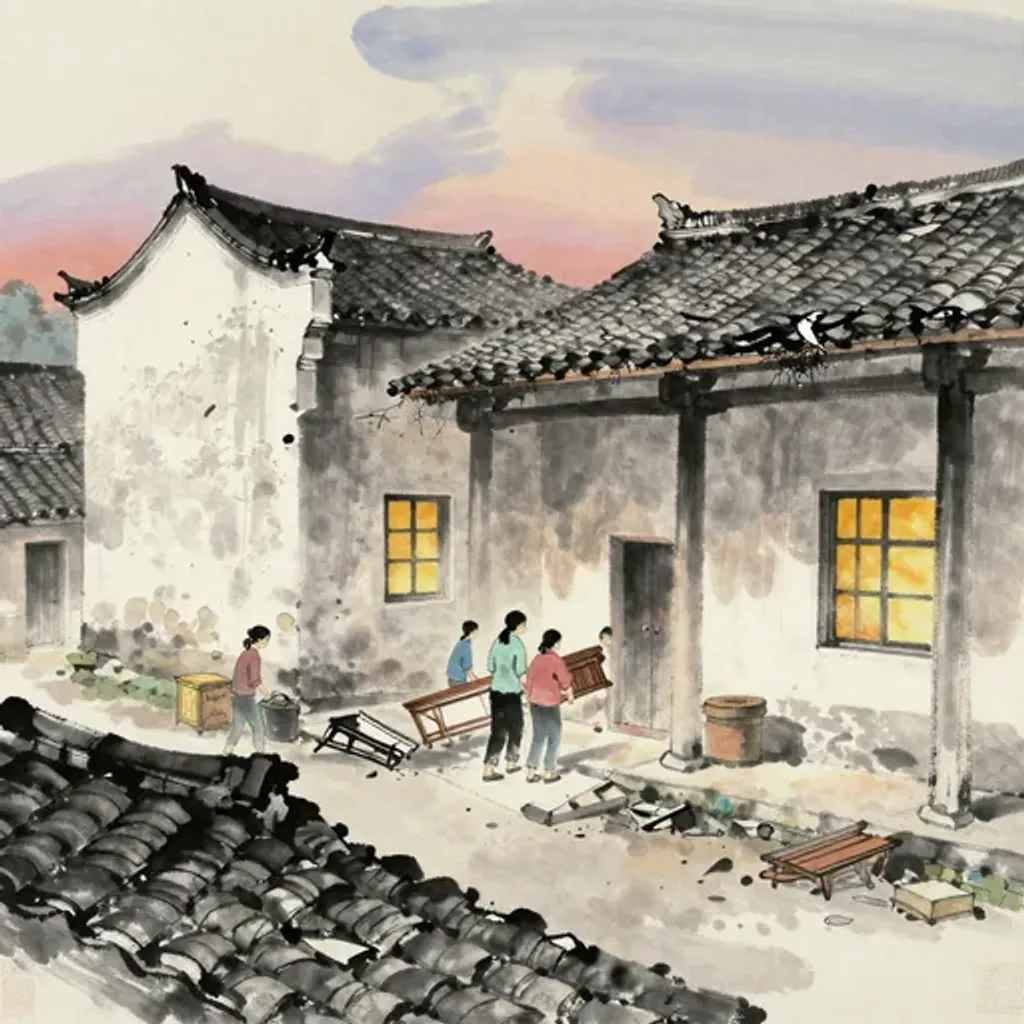
故室舊廬,稍弊且徐;不如新巢,可治樂居。
The old house and former dwelling, gradually worn and slow to mend. Not as good as a new nest; fit for making a joyful home.
— Jiao Yanshou, Yilin (Forest of Changes), 1st century BC
Commentary
Wind above heaven settles into patient waiting. The old house and former dwelling have grown shabby and decrepit over time. Better to build a new nest — one fit for comfortable habitation. From Small Taming to Waiting, the wind's gentle restraint gives way to clouds gathering above heaven, the image of nourishment approaching but not yet arrived. The verse counsels practical renewal: do not cling to what has decayed when something better can be built. Need's wisdom is that one must prepare the ground — a secure dwelling, adequate provisions — while waiting for heaven's timing. The new nest is the act of readiness that transforms passive waiting into active preparation.
小畜 → 訟
Hexagram 9 → Hexagram 6: Conflict
Changing lines: 1, 3, 4
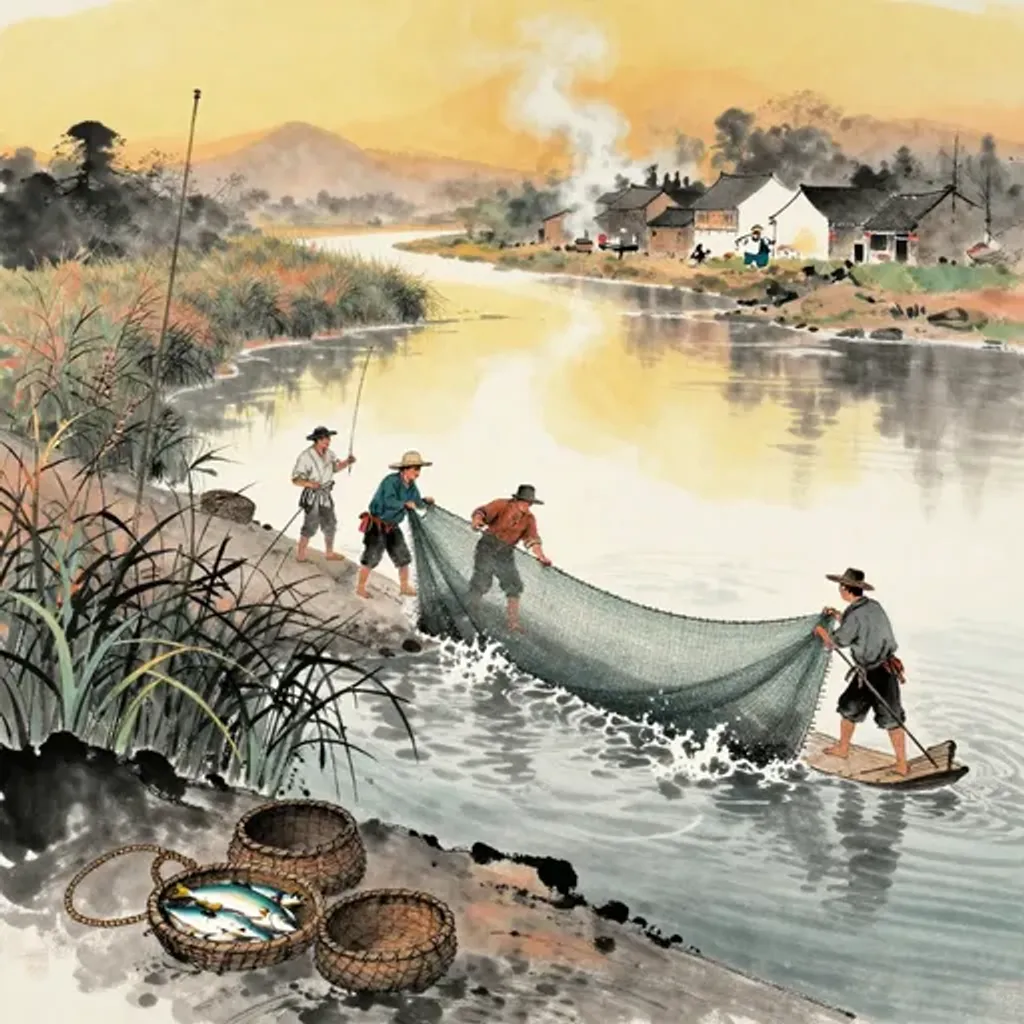
蜲蛇循流,東求大魚;預且舉網,庖人歌謳。
The serpent follows the current, seeking great fish in the east. Yuqie casts the net; the cook sings a song.
— Jiao Yanshou, Yilin (Forest of Changes), 1st century BC
Commentary
Wind above heaven turns to heaven opposing water below. A serpent winds along the current, heading east to find a great fish. The fisherman Yuqie spreads his net, and the cook sings in triumph. From Small Taming to Conflict, heaven and water move in contrary directions — yet here the opposition becomes productive tension. The snake follows the flow, the net anticipates the catch, and the kitchen celebrates the yield. Conflict's counsel is to plan from the very beginning, and this verse shows that principle fulfilled: each actor in the chain — serpent, net, cook — occupies the right position at the right moment, turning natural opposition into a coordinated harvest.
小畜 → 師
Hexagram 9 → Hexagram 7: The Army
Changing lines: 1, 3, 5, 6
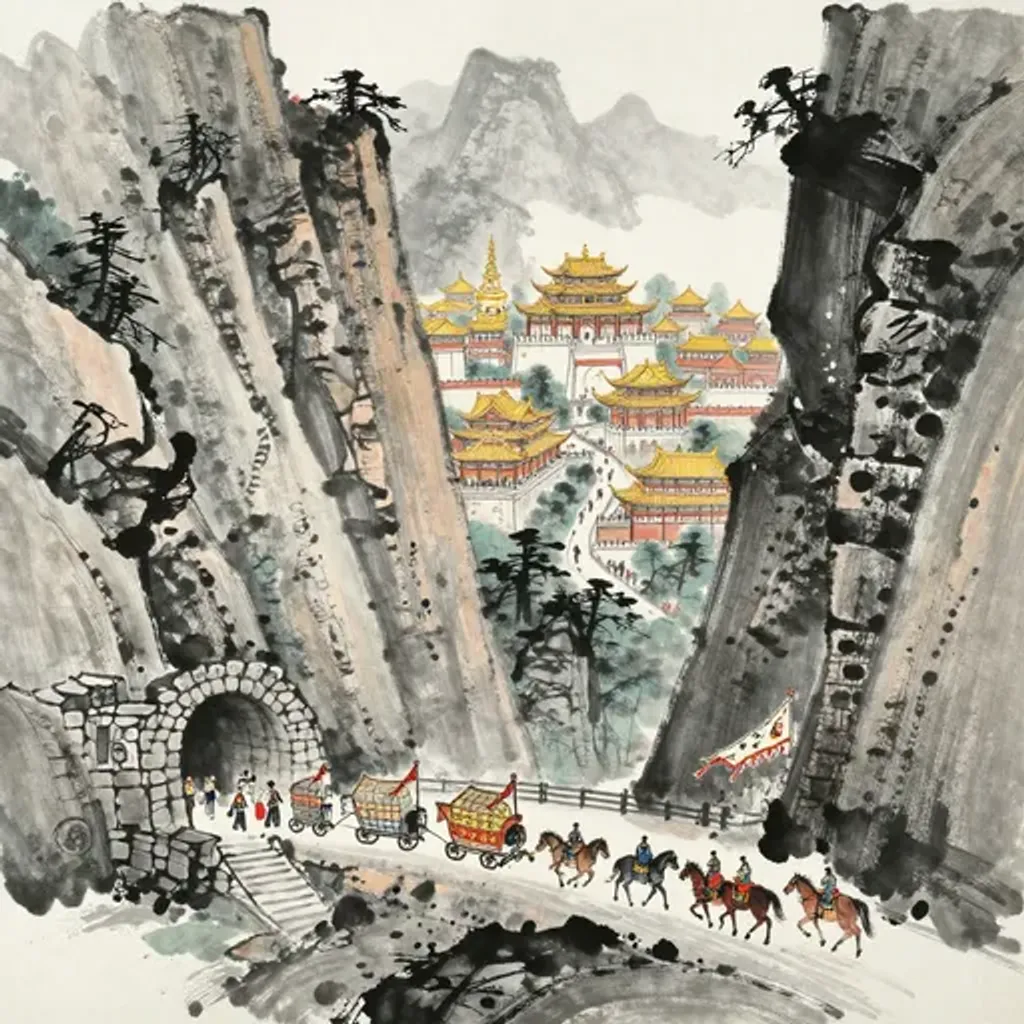
鑿山通道,南至嘉國;周公祝祖,襄適荊楚。
Cutting through mountains to open roads, heading south to a fair land. The Duke of Zhou offers ancestral prayers; Xiang goes to the land of Jing and Chu.
— Jiao Yanshou, Yilin (Forest of Changes), 1st century BC
Commentary
Wind above heaven sinks into earth concealing water — the image of disciplined reserves. Mountains are hewn open to carve a road south to a prosperous state. The Duke of Zhou prays to the ancestral spirits, and Duke Xiang journeys to the realm of Jing-Chu. The verse evokes the Zhou tradition of ritual preparation before major undertakings: prayer secures spiritual sanction, engineering opens the physical path. From Small Taming to The Army, gentle cultural refinement transforms into organized mobilization. The mountain passage is not conquest but logistics — the patient infrastructure that makes great expeditions possible. The army's true strength lies in the road built before the march begins.
小畜 → 比
Hexagram 9 → Hexagram 8: Holding Together
Changing lines: 1, 2, 3, 6
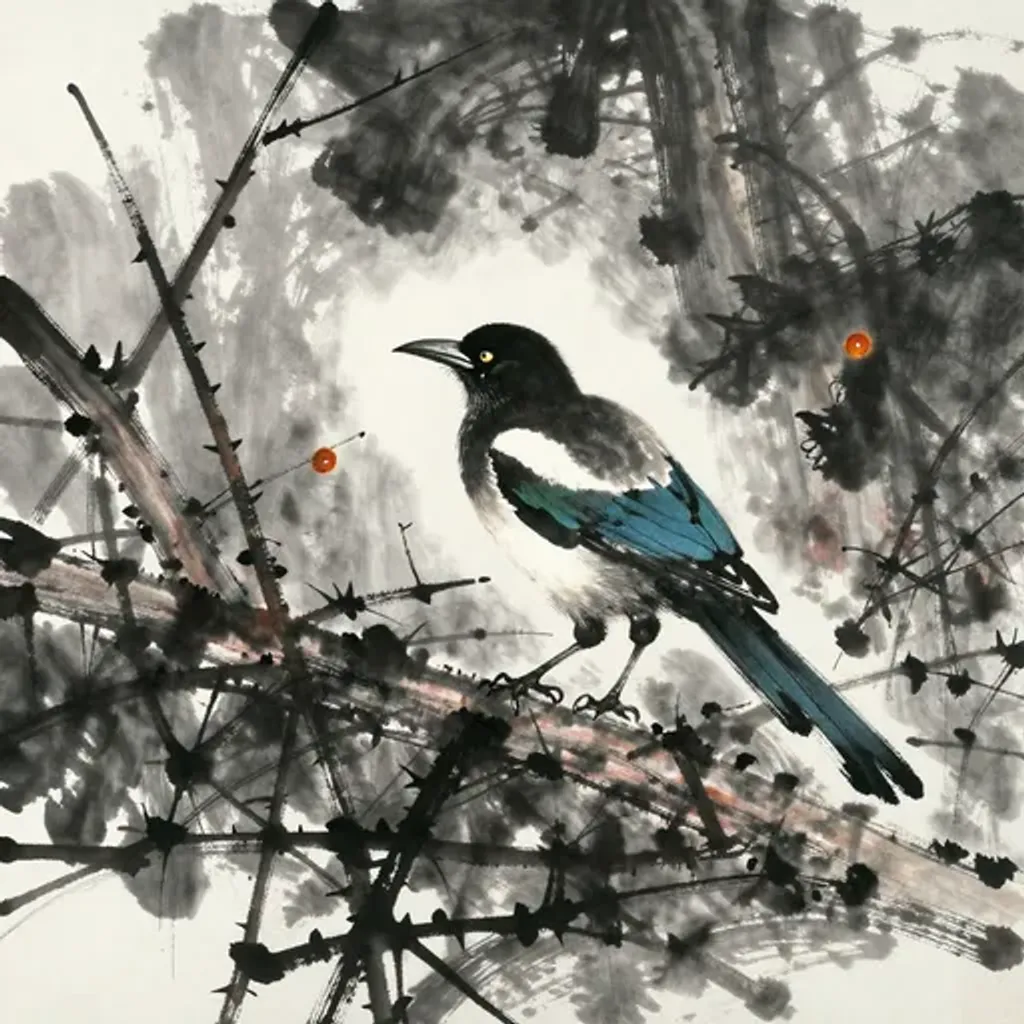
鵲近卻縮,不見頭目;日以困急,不能自復。
The magpie draws near then shrinks back, unable to see head or eyes. Day by day more pressed and desperate; unable to recover on its own.
— Jiao Yanshou, Yilin (Forest of Changes), 1st century BC
Commentary
Wind above heaven meets water resting upon earth — the promise of solidarity. Yet a magpie approaches, then shrinks back, its head and eyes invisible. Day by day the distress grows more urgent, and recovery becomes impossible. From Small Taming to Holding Together, one might expect the comfort of alliance, but the verse inverts the promise. The magpie — traditionally an omen of good news — recoils rather than arrives. Bi's image demands trust and timely commitment: the ancient kings established their network of states by acting decisively. Here, hesitation has cost everything. The bird that should have brought connection instead retreats, and isolation deepens into paralysis.
小畜 → 小畜
Hexagram 9 → Hexagram 9: Small Taming
No changing lines — the hexagram is unchanged
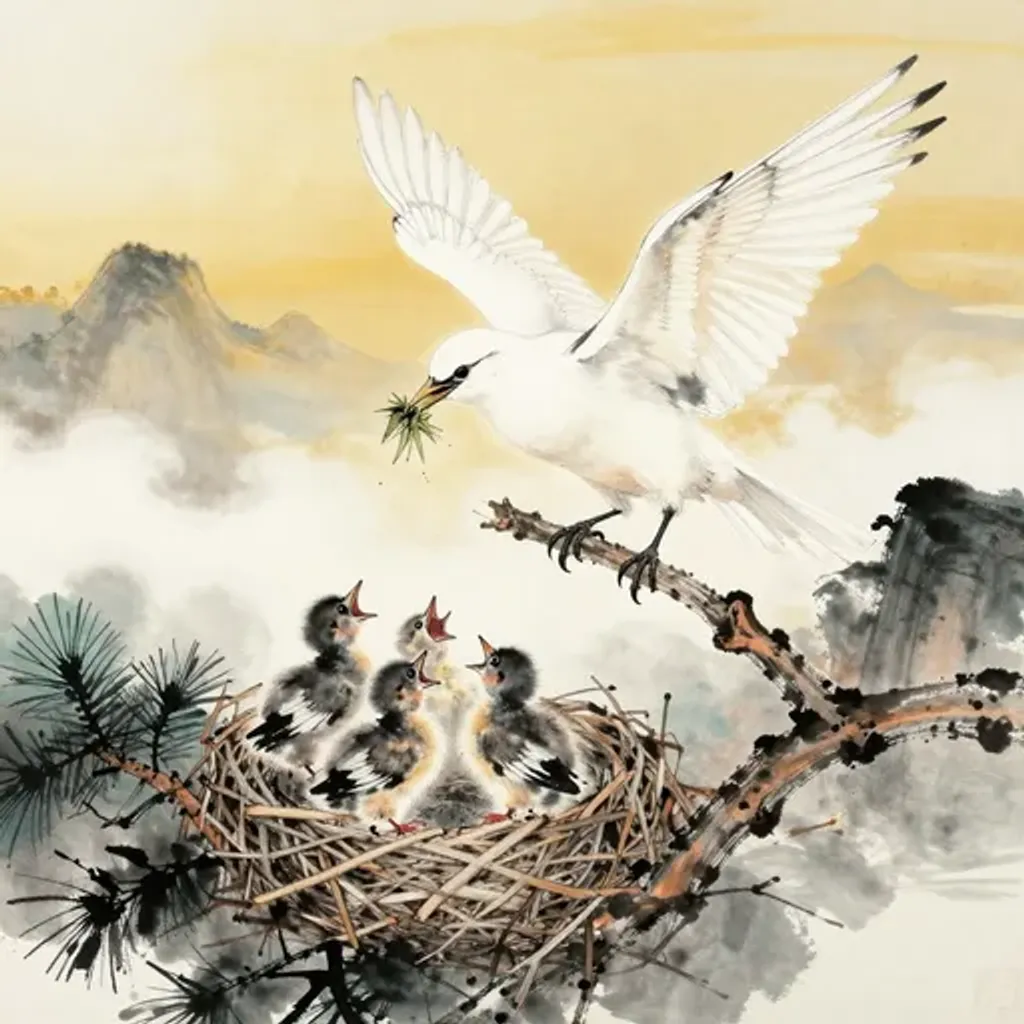
白鳥衘餌,鳴呼其子;斡枝張翅,來從其母;伯仲叔季,尢賀舉手。
The white bird holds bait in its beak, calling out to its young. Bending the branch, spreading its wings, the chicks come to their mother. Elder and younger brothers all raise their hands in celebration.
— Jiao Yanshou, Yilin (Forest of Changes), 1st century BC
Commentary
Wind above heaven returns to itself — Small Taming meeting its own image. A white bird carries food in its beak, calling to its young. It spreads its wings upon the branch, and the chicks come flocking to their mother. Brothers eldest to youngest — Bai, Zhong, Shu, Ji — raise their hands in celebration. The verse is a portrait of familial wholeness: the mother nourishes, the children gather, the household rejoices. When Small Taming meets itself, gentle accumulation needs no transformation. The wind that refines heaven's force simply sustains what it has always cultivated: warmth, bonds, and the quiet sufficiency of a family fed and together.
小畜 → 履
Hexagram 9 → Hexagram 10: Treading
Changing lines: 3, 4
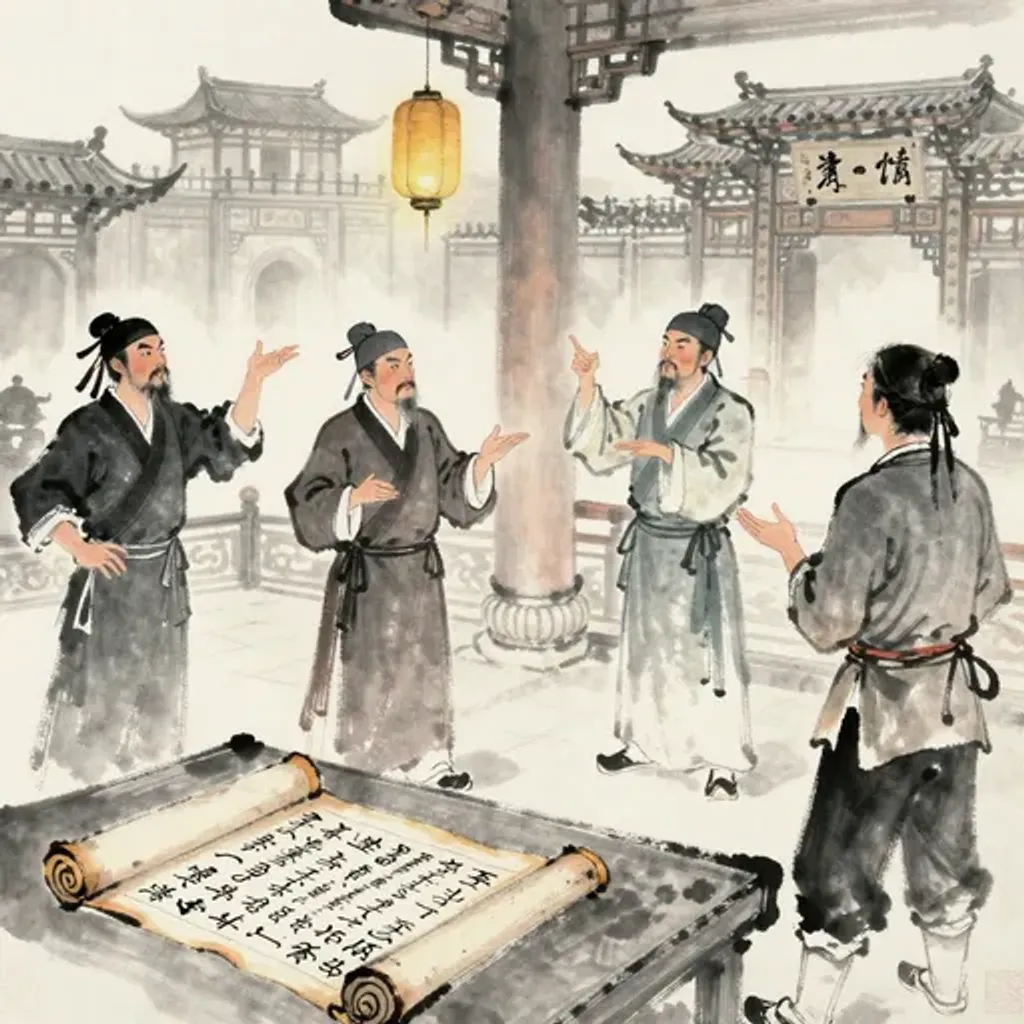
五舌啄難,各自有言;異國殊俗,使心迷惑,所求不得。
Five tongues peck at trouble, each with its own words. Foreign lands and different customs confuse the heart; what is sought cannot be obtained.
— Jiao Yanshou, Yilin (Forest of Changes), 1st century BC
Commentary
Wind above heaven meets heaven standing over the lake — propriety and distinction. Five tongues peck contentiously, each with its own argument. Foreign lands and alien customs bewilder the heart, and what one seeks remains out of reach. From Small Taming to Treading, the gentle wind that should refine gives way to the careful step that must navigate danger. Treading's image is walking on the tiger's tail without being bitten — a matter of knowing precisely where to place one's foot. The five quarreling tongues represent the confusion of voices in unfamiliar territory. When customs conflict and languages clash, discernment falters and the goal recedes.
小畜 → 泰
Hexagram 9 → Hexagram 11: Peace
Changing lines: 5, 6
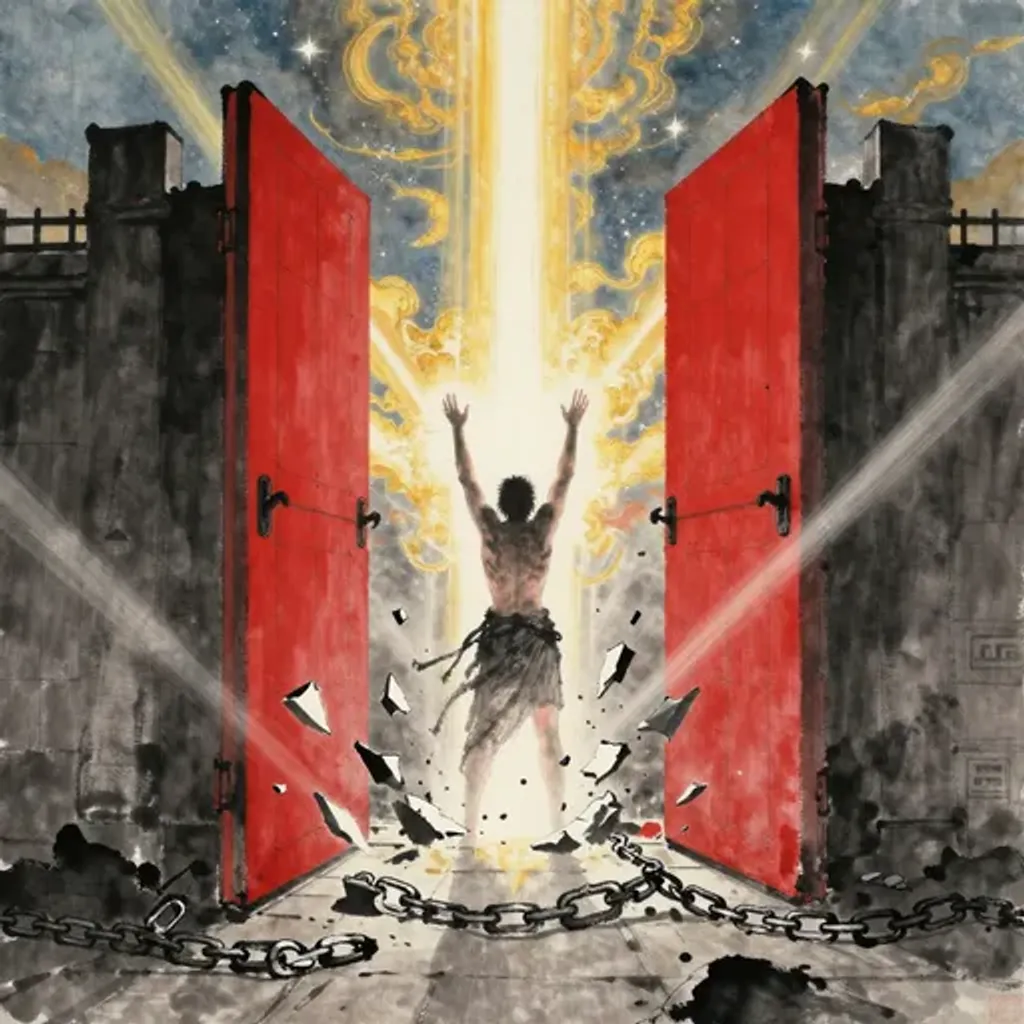
天門開闢,牢戶寥廓;桎梏解脫,拘囚縱釋。
Heaven is gate opens wide; the prison doors stand vast and empty. Shackles and fetters are cast off; the captives are set free.
— Jiao Yanshou, Yilin (Forest of Changes), 1st century BC
Commentary
Wind above heaven opens into the free exchange of heaven and earth. The gates of heaven swing wide; the prison doors stand vast and empty. Shackles and fetters fall away; the confined are released at last. From Small Taming to Peace, the transformation is among the most dramatic in the cycle. What the wind could only gently restrain now dissolves entirely as heaven descends and earth rises to meet it. Tai is the hexagram of open passage — spring itself — where no barrier holds. The verse distills this into one liberating image: what was locked is unlocked, what was bound walks free. Restraint fulfilled becomes release.
小畜 → 否
Hexagram 9 → Hexagram 12: Standstill
Changing lines: 1, 2, 3, 4
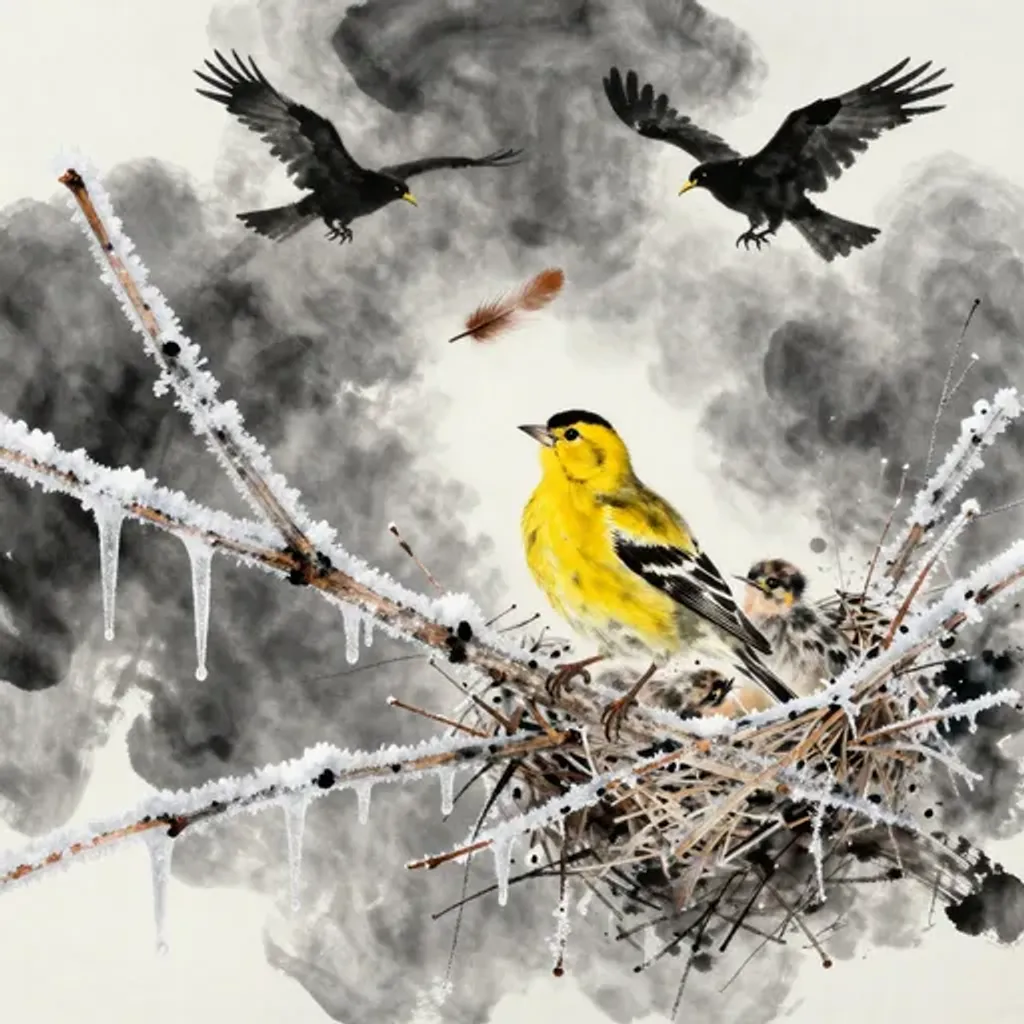
堅冰黃鳥,常哀愁悲;數驚鷙鳥,雛為我憂。
Hard ice and the yellow bird, always mournful and full of sorrow. Startled again and again by birds of prey; the nestlings grieve on my behalf.
— Jiao Yanshou, Yilin (Forest of Changes), 1st century BC
Commentary
Wind above heaven gives way to heaven and earth sealed apart. Hard ice encases the world as yellow birds cry in constant sorrow. A raptor startles them repeatedly; the fledglings tremble with fear for their parent. The yellow bird evokes the Shijing exile's lament — a stranger in a hostile land, crying 'Yellow birds, do not gather in my mulberry.' From Small Taming to Standstill, the gentle wind that once modulated heaven now freezes into complete separation. Pi is winter's hexagram: heaven and earth refuse to communicate. Ice, fear, and the vulnerable bird's grief compose a landscape where all connection has been severed and no warmth penetrates.
小畜 → 同人
Hexagram 9 → Hexagram 13: Fellowship
Changing lines: 2, 4
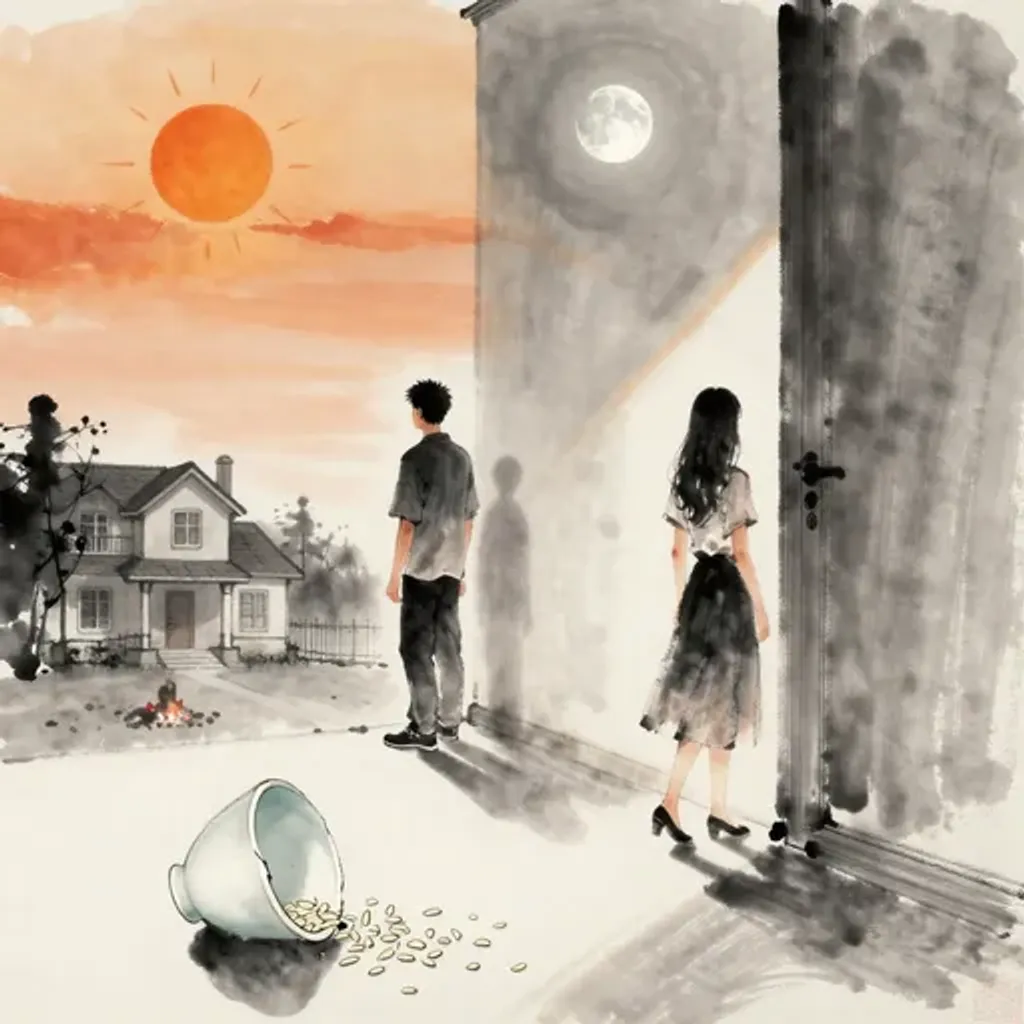
日走月步,趣不同舍;夫妻反目,主君失居。
The sun runs, the moon walks; they rush to different lodgings. Husband and wife turn against each other; the ruling lord loses his home.
— Jiao Yanshou, Yilin (Forest of Changes), 1st century BC
Commentary
Wind above heaven meets heaven joined with fire — the promise of fellowship. Yet sun and moon race at different speeds, never sharing the same lodging. Husband and wife turn against each other; the lord loses his dwelling. From Small Taming to Fellowship, the verse inverts its target hexagram. Tong Ren's image is heaven and fire moving together, their natures aligned. But here celestial bodies diverge, the intimate bond fractures, and the ruler is displaced. When those who should move in concert fall out of rhythm, fellowship collapses into estrangement. The sun and moon are always in the same sky but never in the same place — proximity without harmony is the cruelest form of separation.
小畜 → 大有
Hexagram 9 → Hexagram 14: Great Possession
Changing lines: 4, 5
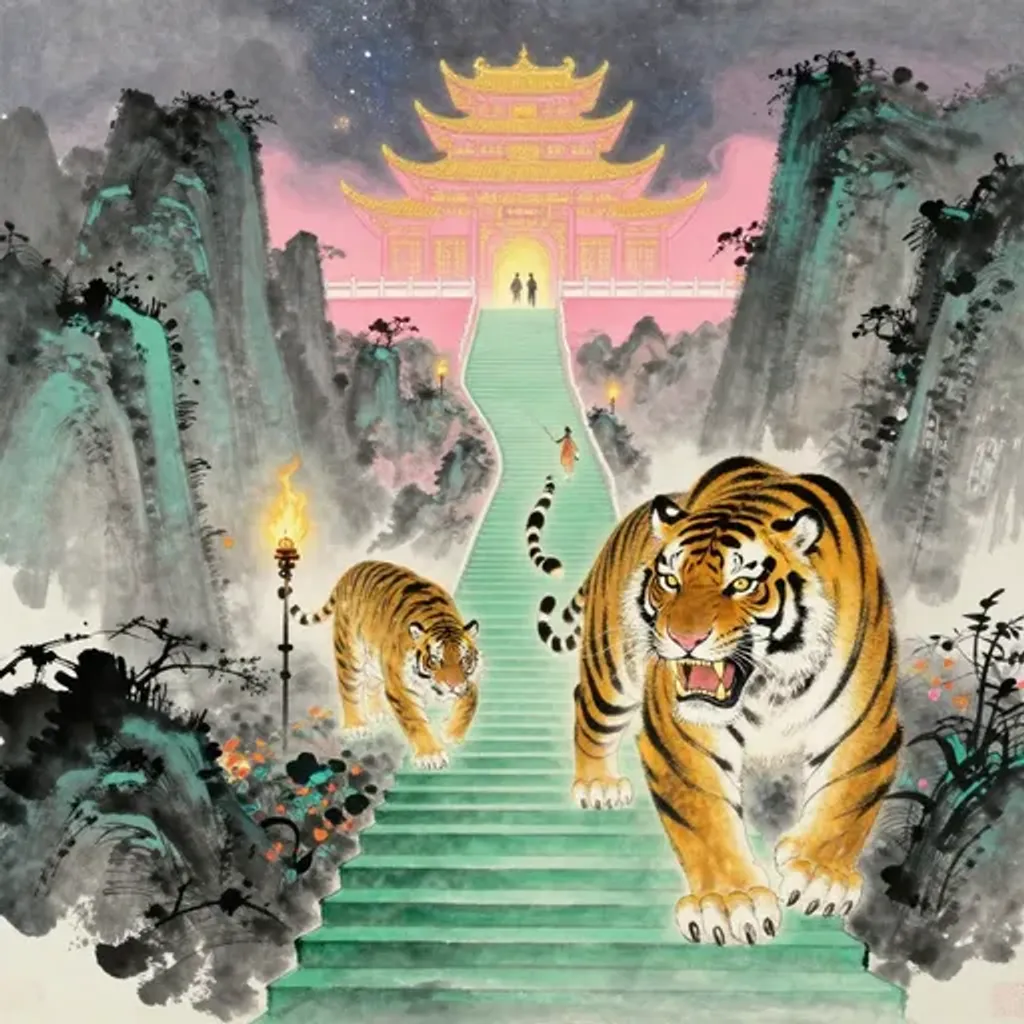
金牙鐵齒,西王母子。無有患殃。扶舍陟道,到來不久。
Golden fangs and iron teeth -- the children of the Queen Mother of the West. Free from plague and calamity. Supporting and climbing along the road; arrival is not far off.
— Jiao Yanshou, Yilin (Forest of Changes), 1st century BC
Commentary
Wind above heaven kindles fire blazing in the sky. Metal teeth and iron jaws — these are the children of the Queen Mother of the West, fierce guardians of her immortal realm on Mount Kunlun. No calamity can touch them. The traveler climbs the road, leaning on staff and shelter, and arrival is imminent. From Small Taming to Great Possession, gentle cultivation explodes into radiant abundance. The Queen Mother's progeny are invulnerable because they partake of celestial power channeled through proper lineage. Da You's fire above heaven illuminates everything it surveys. The verse promises safe passage under divine protection — not through one's own strength but through alignment with powers greater than the self.
小畜 → 謙
Hexagram 9 → Hexagram 15: Modesty
Changing lines: 1, 2, 5, 6
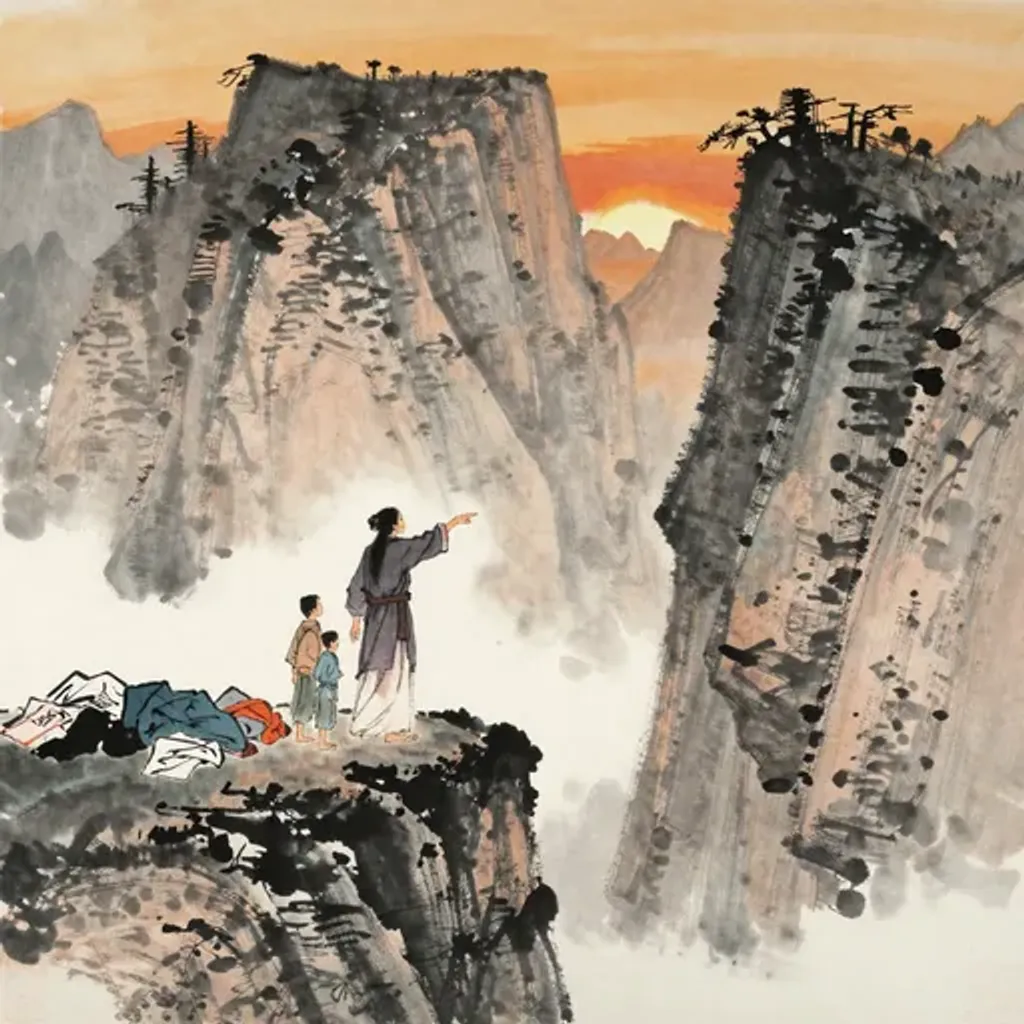
式微式微,憂禍相半;隔以岩山,室家分散。
Fading, fading away; worry and misfortune share equal measure. Separated by cliffs and mountains; the household is scattered apart.
— Jiao Yanshou, Yilin (Forest of Changes), 1st century BC
Commentary
Wind above heaven descends into earth concealing the mountain — humility pressed to its painful limit. 'Declining, declining' — the verse opens by quoting the Shijing ode 'Shi Wei,' a lament of those forced into degrading service: 'Why not go home?' Worry and misfortune split evenly between them, but rocky mountains intervene, and the household is scattered. From Small Taming to Modesty, the transformation should bring the mountain's quiet dignity hidden within the earth. Yet the verse shows modesty's shadow: when humility is forced rather than chosen, it becomes exile. The mountain that should elevate the lowly instead separates the family. Qian's virtue only works when one still has a home to be humble in.
小畜 → 豫
Hexagram 9 → Hexagram 16: Enthusiasm
Changing lines: 1, 2, 3, 4, 5, 6
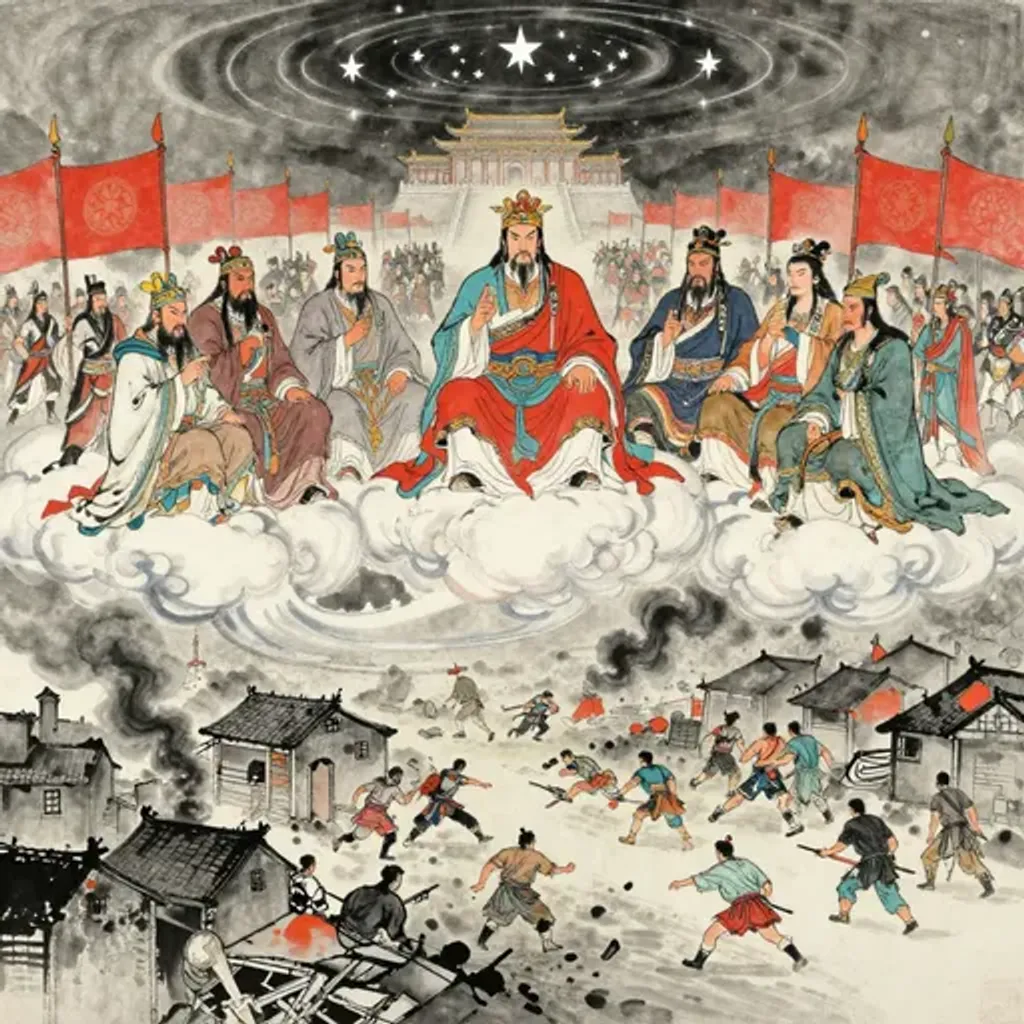
眾神集聚,相與議語;南國虛亂,百姓勞苦;興師征伐,更立賢主。
The assembled spirits gather together, conferring and deliberating. The southern land is empty and in turmoil; the common people suffer toil. They raise an army to campaign; and set up a worthy lord.
— Jiao Yanshou, Yilin (Forest of Changes), 1st century BC
Commentary
Wind above heaven gives way to thunder bursting from the earth. The assembled spirits gather and deliberate among themselves: the southern state has fallen into chaos, the people groan under suffering. An army is raised to campaign, and a worthy ruler is installed. From Small Taming to Enthusiasm, gentle accumulation transforms into decisive, thunderous action. Yu's image — thunder erupting from the earth — is the energy of ritual music and martial resolve that stirs the world. The spirits' council mirrors the sage-kings who made music to honor heaven before marching to war. When cultural refinement has done its work, the moment demands initiative: armies move, order is restored, and the mandate passes to the virtuous.
小畜 → 隨
Hexagram 9 → Hexagram 17: Following
Changing lines: 2, 3, 4, 6
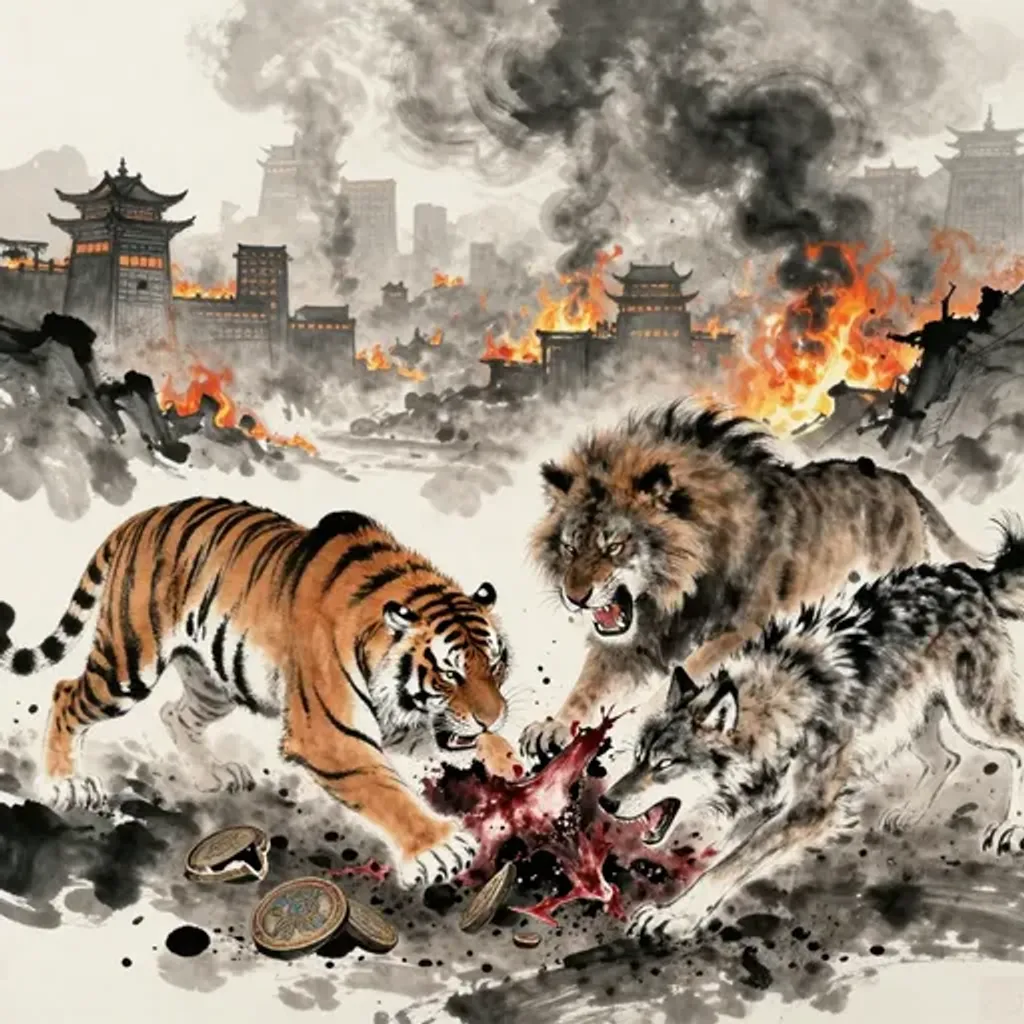
虎狼爭食,禮義不行;兼吞其國,齊魯無主。
Tiger and wolf fight over food; rites and propriety are abandoned. They swallow each other is states; Qi and Lu have no lord.
— Jiao Yanshou, Yilin (Forest of Changes), 1st century BC
Commentary
Wind above heaven dissolves into thunder resting within the lake. Tigers and wolves fight over prey; propriety and righteousness have vanished. States are swallowed whole; Qi and Lu find themselves without rulers. From Small Taming to Following, gentle restraint collapses into a world where one must follow the strongest to survive. Sui's image — thunder dormant in the lake — suggests yielding to the rhythm of what is, resting when the time demands rest. But the verse shows the dark side of following: when moral order disappears, following becomes submission to predators. The states of Qi and Lu, heartlands of ritual culture, losing their lords captures the moment when civilization itself becomes prey.
小畜 → 蠱
Hexagram 9 → Hexagram 18: Work on the Decayed
Changing lines: 1, 5
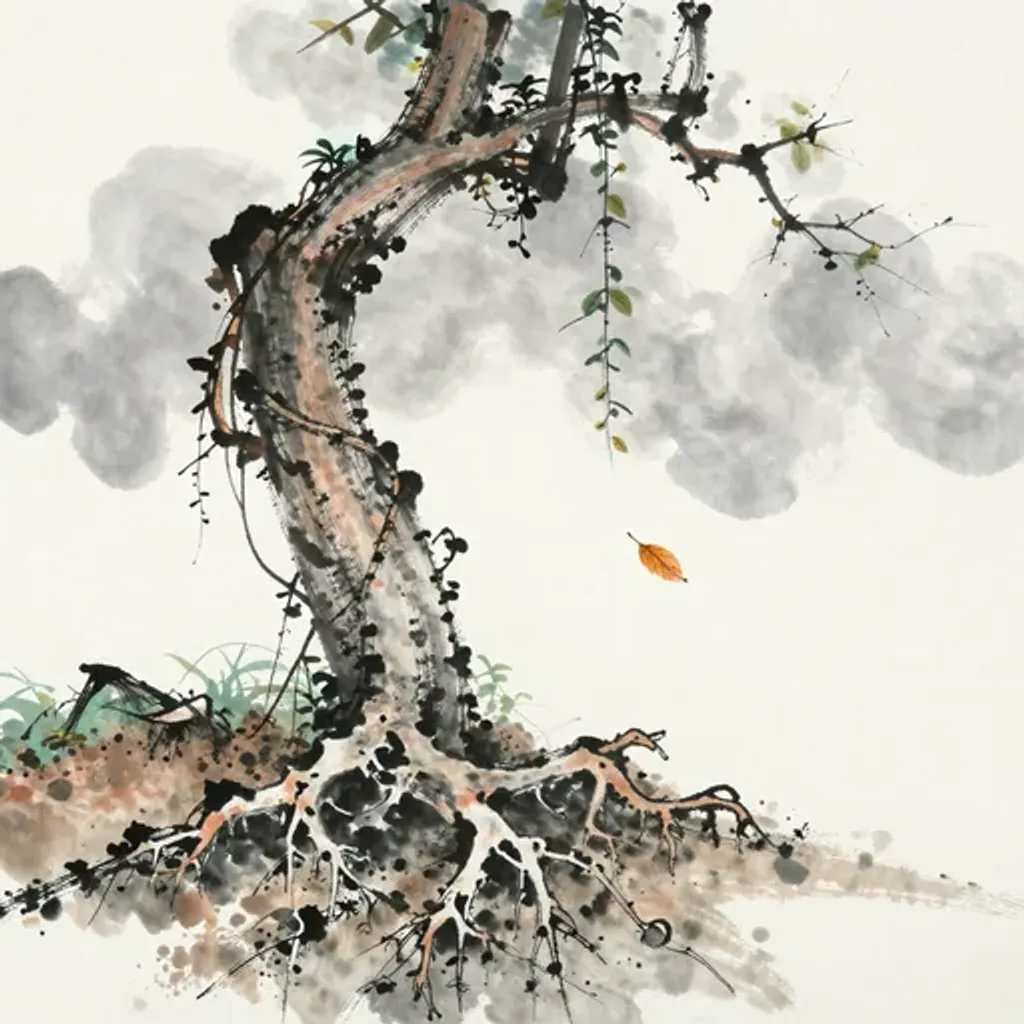
寄生無根,如過浮雲;本立不固,斯須落去,更為枯樹。
The parasitic plant has no roots, like a passing floating cloud. Its base not firmly established; in an instant it drops away, becoming a withered tree.
— Jiao Yanshou, Yilin (Forest of Changes), 1st century BC
Commentary
Wind above heaven meets wind trapped beneath the mountain — decay eating at the root. A parasitic vine has no root of its own, drifting like a passing cloud. Its foundation never held firm; in an instant it drops away, leaving only a dead tree. From Small Taming to Work on the Decayed, the verse diagnoses precisely what Gu addresses: structural rot. The parasite flourished by borrowing another's vitality, never establishing independent support. When that host weakens, collapse is instantaneous. Gu's counsel — to invigorate the people and cultivate virtue — demands exactly what the parasite lacked: an autonomous root system. Without it, even apparent growth is merely borrowed time floating overhead.
小畜 → 臨
Hexagram 9 → Hexagram 19: Approach
Changing lines: 3, 5, 6
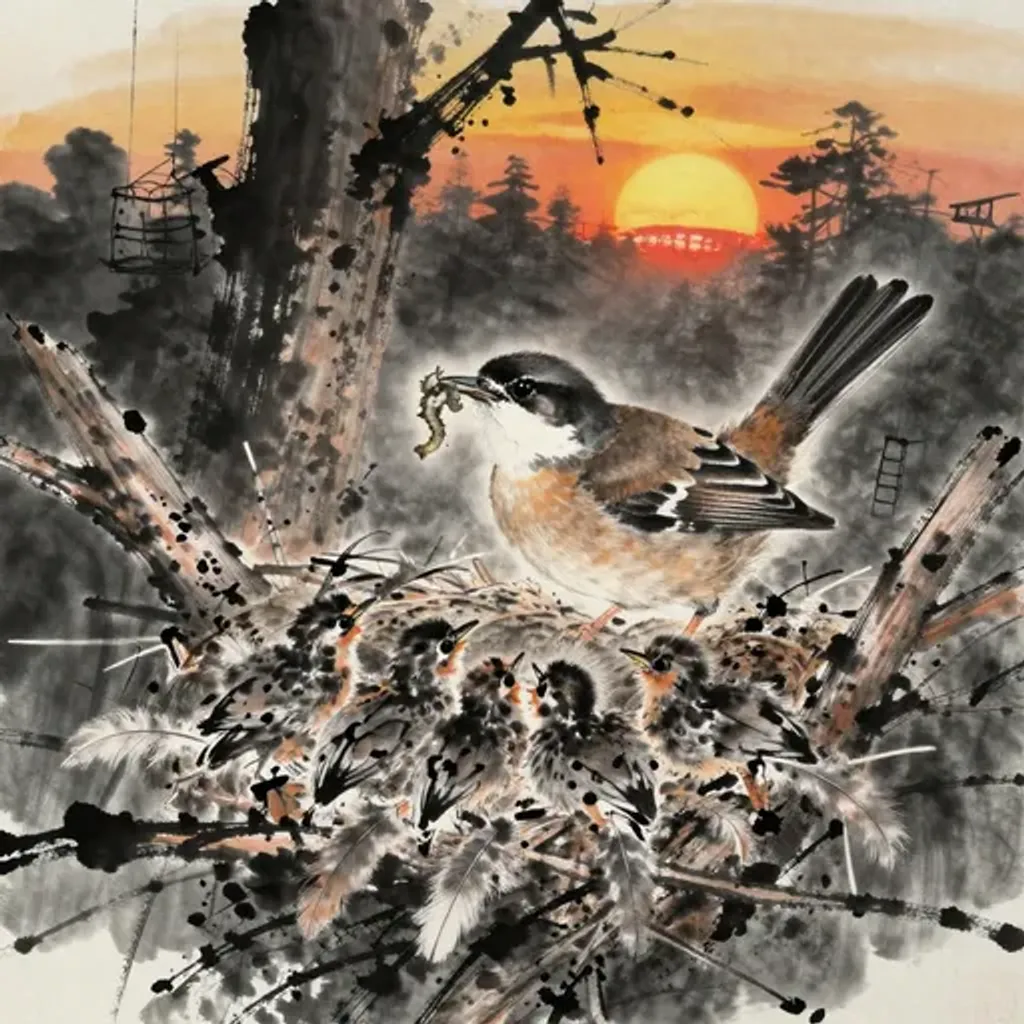
子啼索哺,母行求食;反見空巢,長息訾弋。
The chick cries out for food; the mother goes out to forage. Returning to find an empty nest; she sighs long and grieves.
— Jiao Yanshou, Yilin (Forest of Changes), 1st century BC
Commentary
Wind above heaven opens into earth overseeing the lake — the image of a superior approaching the people below. A chick cries for food; the mother bird goes out foraging. When she returns, she finds an empty nest — the young have been taken, and she sighs and laments the hunter's cruelty. From Small Taming to Approach, the transformation should embody Lin's generous oversight. Yet the verse reveals its cost: the nurturer who goes out to provide returns to find her charges gone. Approach implies drawing near with benevolent intent, but absence during the approach creates a fatal gap. The mother's departure was an act of love; the empty nest is its unintended consequence. Even care must reckon with timing.
小畜 → 觀
Hexagram 9 → Hexagram 20: Contemplation
Changing lines: 1, 2, 3
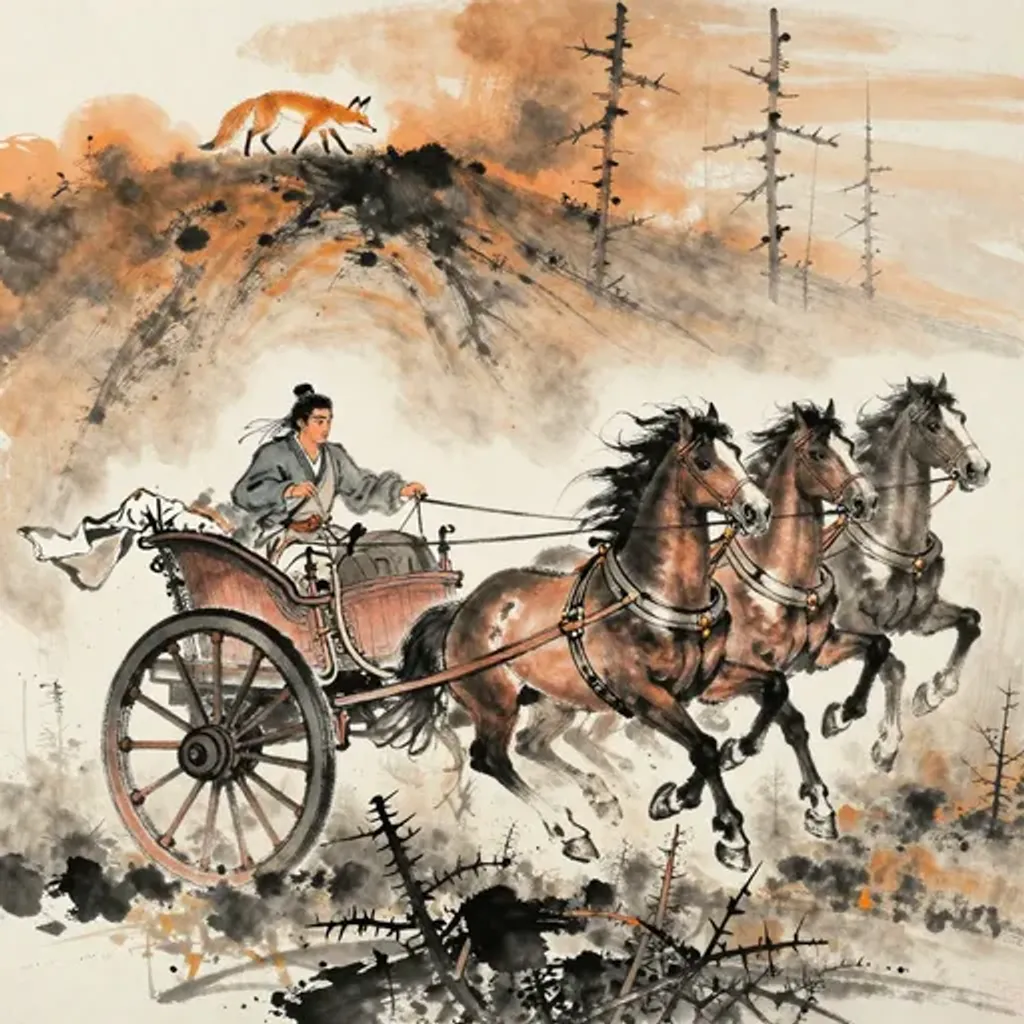
駕駟逐狐,輪掛荊棘;車不結轍,公子無得。
Driving a four-horse team to chase the fox; the wheels catch on thorns and briars. The carriage cannot hold its track; the young lord gains nothing.
— Jiao Yanshou, Yilin (Forest of Changes), 1st century BC
Commentary
Wind above heaven settles into wind coursing over the earth — contemplation from a high vantage. A four-horse chariot chases a fox, but the wheels catch in thorns. The chariot cannot complete its tracks; the young lord gains nothing. From Small Taming to Contemplation, the gentle wind that refined heaven's force now surveys the earth with discerning eyes. Guan's image is the wind moving across the land, as the ancient kings toured the regions to observe the people. Yet here observation is replaced by reckless pursuit. The fox — a creature of cunning and evasion — cannot be caught by brute speed alone. The thorns punish haste. Contemplation's lesson: look before you chase, or the quarry will always escape.
小畜 → 噬嗑
Hexagram 9 → Hexagram 21: Biting Through
Changing lines: 2, 3, 4, 5
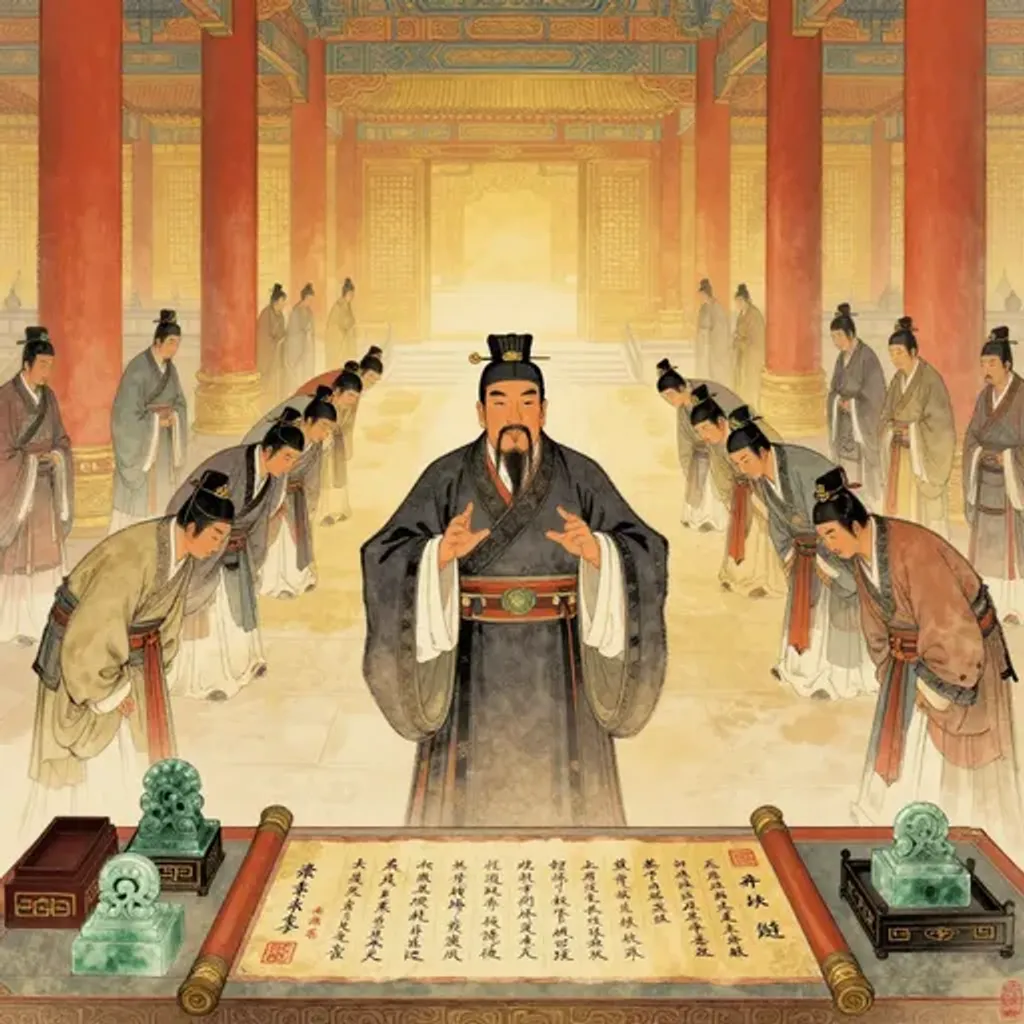
方啄廣口,仁智聖厚;釋解倒懸,唐國太安。
A broad beak and wide mouth; benevolent, wise, sagely, and generous. Releasing those hung upside down; the land of Tang rests in great peace.
— Jiao Yanshou, Yilin (Forest of Changes), 1st century BC
Commentary
Wind above heaven meets fire and thunder biting through obstacles. A broad-beaked bird pecks through hardship; benevolence, wisdom, and sagehood shine through with generosity. Those hung upside down are released from their torment, and the state of Tang enjoys great peace. From Small Taming to Biting Through, gentle cultivation gives way to decisive judicial action. Shi He's image — lightning and thunder together — represents the clarity of law applied with force. The verse shows justice at its best: impediments are bitten through, the innocent freed, and the realm stabilized. The 'state of Tang' evokes the ideal of Yao's ancient domain. When wisdom accompanies power, punishment becomes liberation rather than violence.
小畜 → 賁
Hexagram 9 → Hexagram 22: Grace
Changing lines: 2, 5
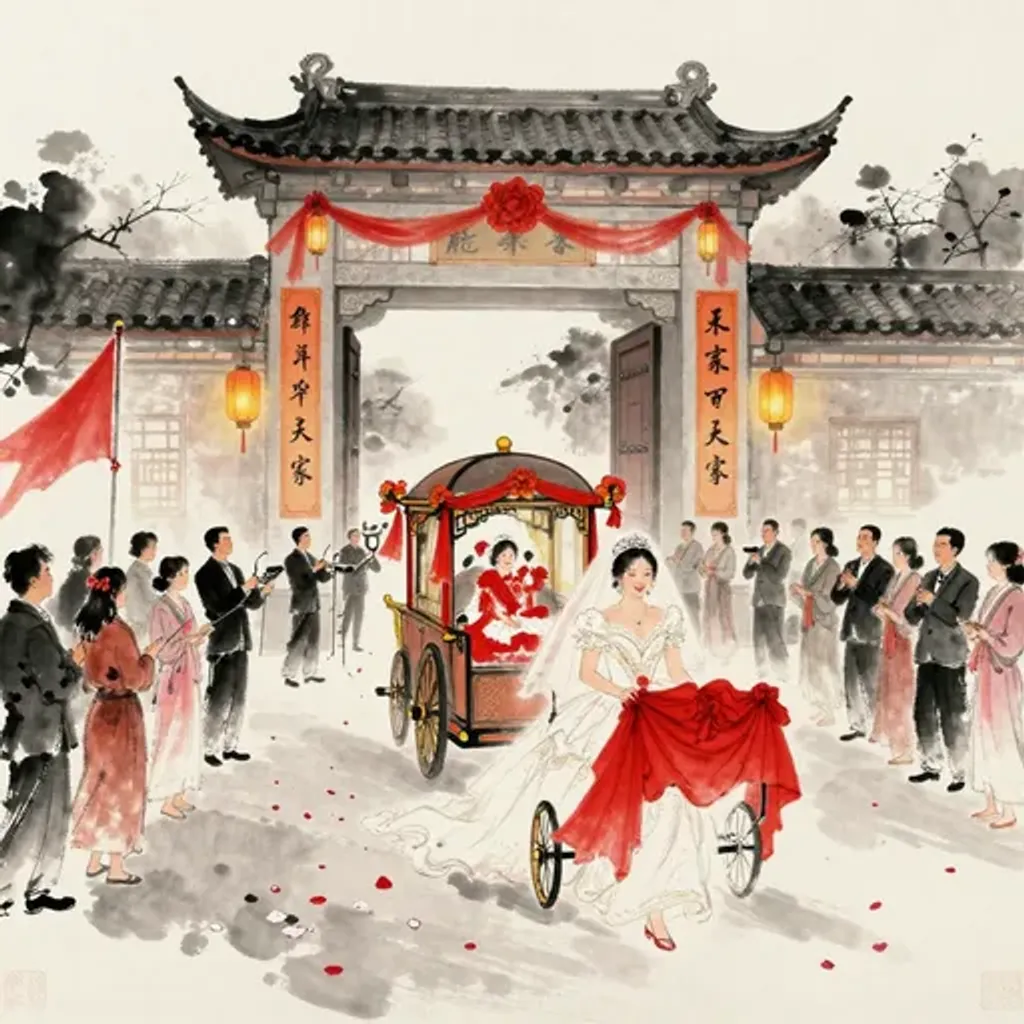
駕福乘喜,來至家國;戴慶南行,離我安居。
Riding fortune, mounting joy; arriving at the homeland. Bearing blessings, heading south; departing from my peaceful dwelling.
— Jiao Yanshou, Yilin (Forest of Changes), 1st century BC
Commentary
Wind above heaven transforms into fire glowing beneath the mountain — the quiet radiance of Grace. Fortune is harnessed and joy is mounted like a carriage, arriving at the homeland. Carrying blessings southward, one departs from this place of peaceful dwelling. From Small Taming to Grace, heaven's energy descends into the mountain where fire illuminates from below — an image of inner light that adorns without overwhelming. The verse captures arrival and departure as equally blessed: joy comes in, blessings go out. Bi's counsel is to attend to appearances and outward form while refraining from harsh judgments. The movement of fortune here is graceful, not grasping — blessings circulate rather than accumulate.
小畜 → 剝
Hexagram 9 → Hexagram 23: Splitting Apart
Changing lines: 1, 2, 3, 5
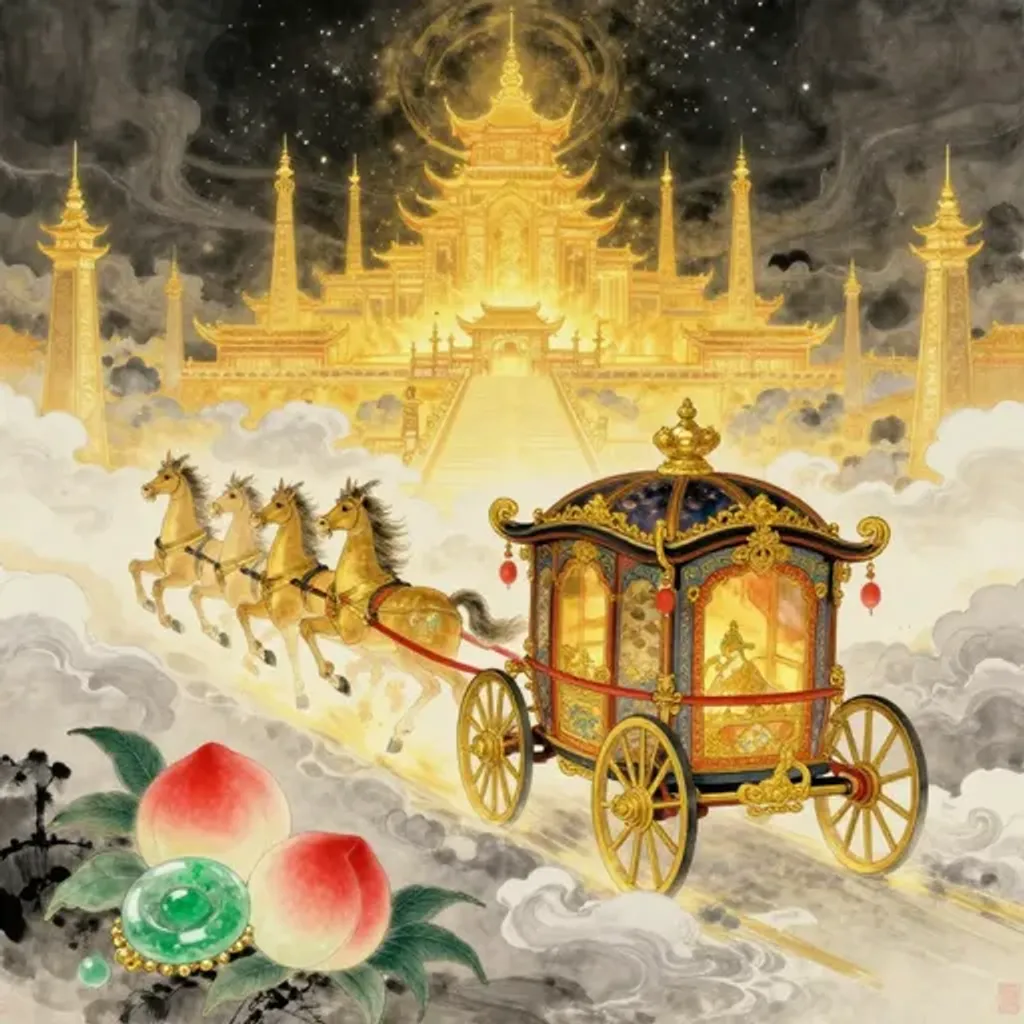
孔鯉伯魚,北至高奴;木馬金車,駕遊大都;王母送我,來牝字駒。
Kong Li, courtesy name Boyu, travels north to Gaonu. With wooden horse and golden carriage, he tours the great capital. The Queen Mother sends me off; the mare arrives with her colt.
— Jiao Yanshou, Yilin (Forest of Changes), 1st century BC
Commentary
Wind above heaven gives way to the mountain crumbling upon earth. Kong Li, courtesy name Boyu — Confucius's only son, named after the carp (鯉) that Duke Zhao of Lu sent as a gift at his birth — travels north to the distant garrison of Gaonu. A wooden horse and golden carriage convey him to the great capital. The Queen Mother sends him off, presenting a mare and her foal. From Small Taming to Splitting Apart, the verse weaves an unlikely journey: the sage's son, divine patronage, and royal steeds all attend a northward mission. Yet Bo's image — the mountain eroding onto the earth — suggests this splendor cannot last. The gifts are generous but the foundation crumbles beneath the traveler's feet.
小畜 → 復
Hexagram 9 → Hexagram 24: Return
Changing lines: 2, 3, 5, 6
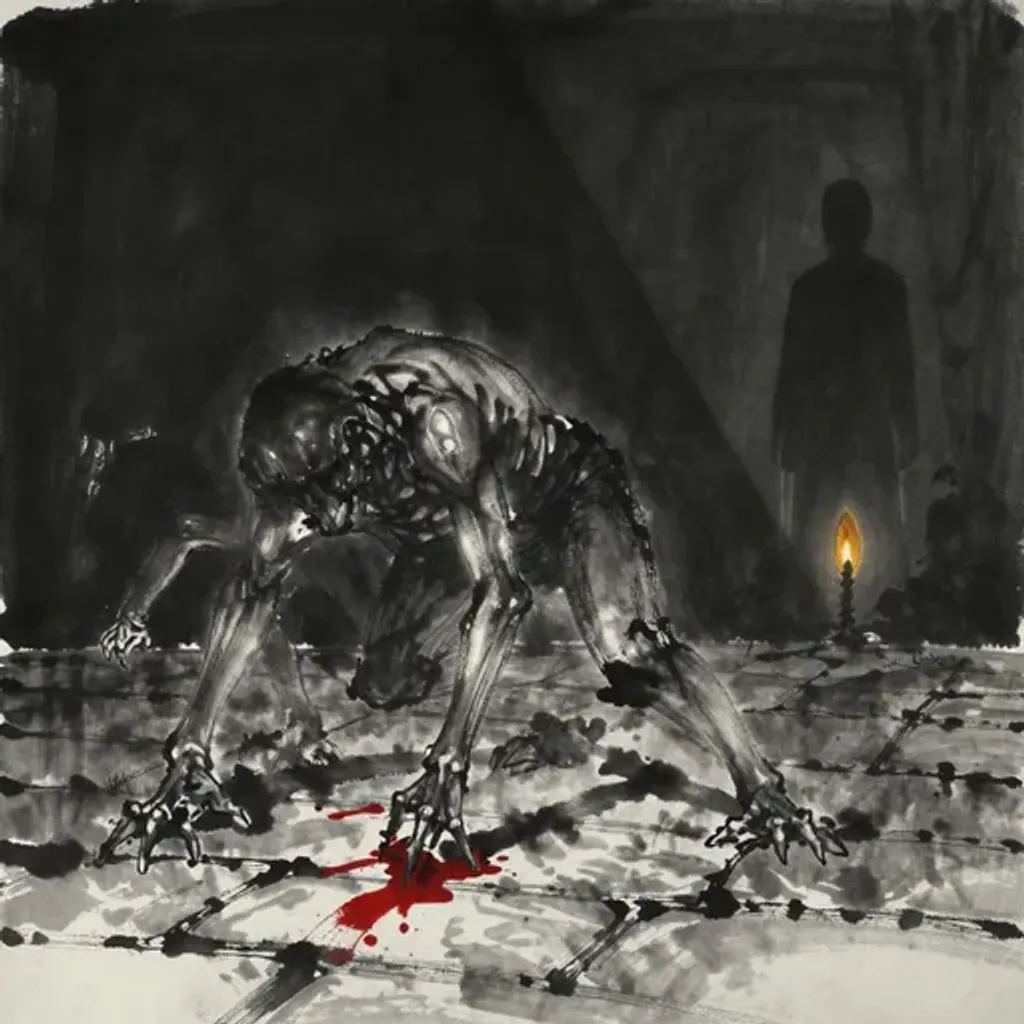
三足無頭,不知所之;心狂精傷,莫使為明,不見日光。
Three feet and no head; not knowing where to go. The mind is crazed, the spirit wounded; none can make it see -- it cannot glimpse the sunlight.
— Jiao Yanshou, Yilin (Forest of Changes), 1st century BC
Commentary
Wind above heaven descends into thunder buried beneath the earth — the first stirring of return. A three-legged creature without a head wanders directionless. Mind crazed and spirit wounded, nothing provides clarity; daylight itself has vanished. The three-legged form evokes the solar crow, but headless and lost it becomes a grotesque inversion of its celestial role. From Small Taming to Return, the verse captures the darkest moment before revival. Fu's thunder lies dormant beneath the earth — the winter solstice when yang's first flicker reappears after maximum darkness. The headless wanderer has not yet found that turning point. Return promises recovery, but only after one fully inhabits the disorientation that precedes it.
小畜 → 无妄
Hexagram 9 → Hexagram 25: Innocence
Changing lines: 2, 3, 4
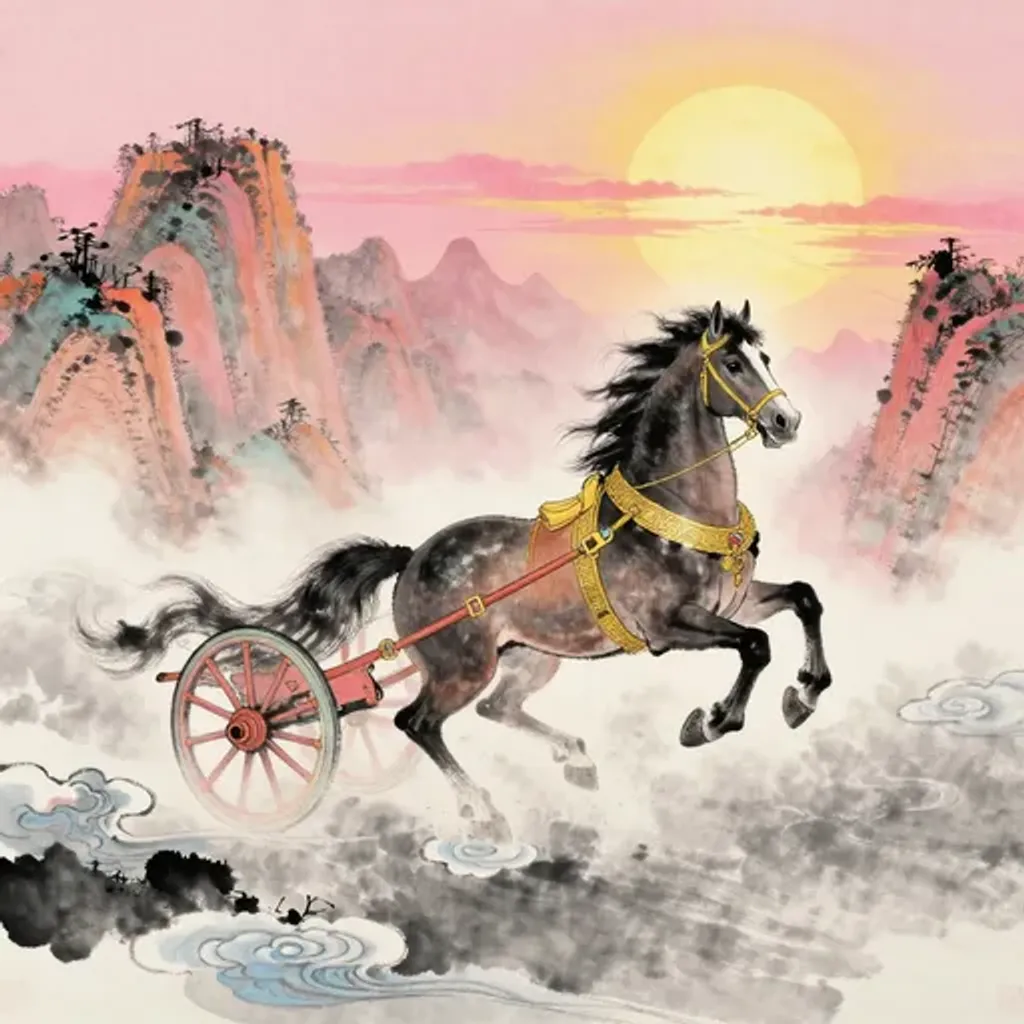
騋牝龍身,日馭三千,南止蒼梧,與福為婚。道里夷易,安全無忌。
A tall mare with a dragon is form, galloping three thousand li by day. Halting south at Cangwu; wedded to good fortune. The road is smooth and easy; safe and free from hindrance.
— Jiao Yanshou, Yilin (Forest of Changes), 1st century BC
Commentary
Wind above heaven yields to thunder rolling beneath heaven's vault — Innocence's natural spontaneity. A great mare with a dragon's body covers three thousand leagues a day, halting in the south at Cangwu — the distant land where Emperor Shun died and was buried. Fortune and blessing attend the journey as companions. The road is smooth and easy; all is safe, with nothing to fear. From Small Taming to Innocence, gentle restraint opens into heaven-sanctioned movement that encounters no false obstacle. The dragon-mare embodies Wu Wang's principle: when action proceeds from genuine nature rather than scheming calculation, even the most extraordinary journey unfolds without impediment. Innocence is not naivety but alignment with cosmic order.
小畜 → 大畜
Hexagram 9 → Hexagram 26: Great Taming
Changing lines: 5
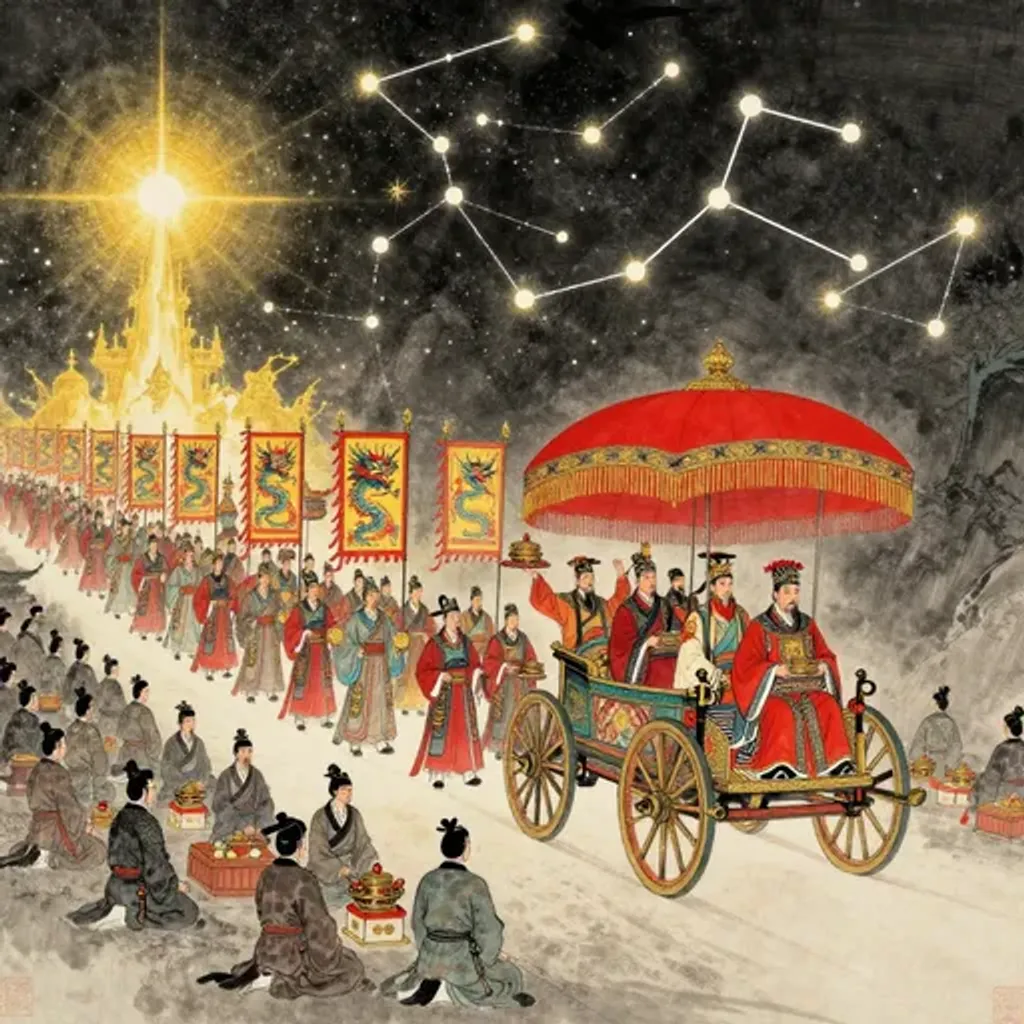
辰次降婁,王駕巡時;廣佑施惠,安國無憂。
The stars descend to Jianglou; the king drives on his seasonal tour. Spreading broad protection and bestowing grace; the state is at peace, without worry.
— Jiao Yanshou, Yilin (Forest of Changes), 1st century BC
Commentary
Wind above heaven turns to heaven stored within the mountain. The celestial stations align at Jianglou — the lodge corresponding to spring's beginning in the Chinese astronomical system. The king sets out on his seasonal tour, dispensing generosity and broad beneficence. The state rests secure, free from worry. From Small Taming to Great Taming, the gentle accumulation of the wind intensifies into the mountain's vast reservoir of heaven's power. Da Xu's image is heaven contained within the mountain, and the king's tour embodies its counsel: to study the words and deeds of the past in order to accumulate virtue. The celestial alignment signals the proper time; the king's tour channels stored power into administered grace.
小畜 → 頤
Hexagram 9 → Hexagram 27: Nourishment
Changing lines: 2, 3, 5
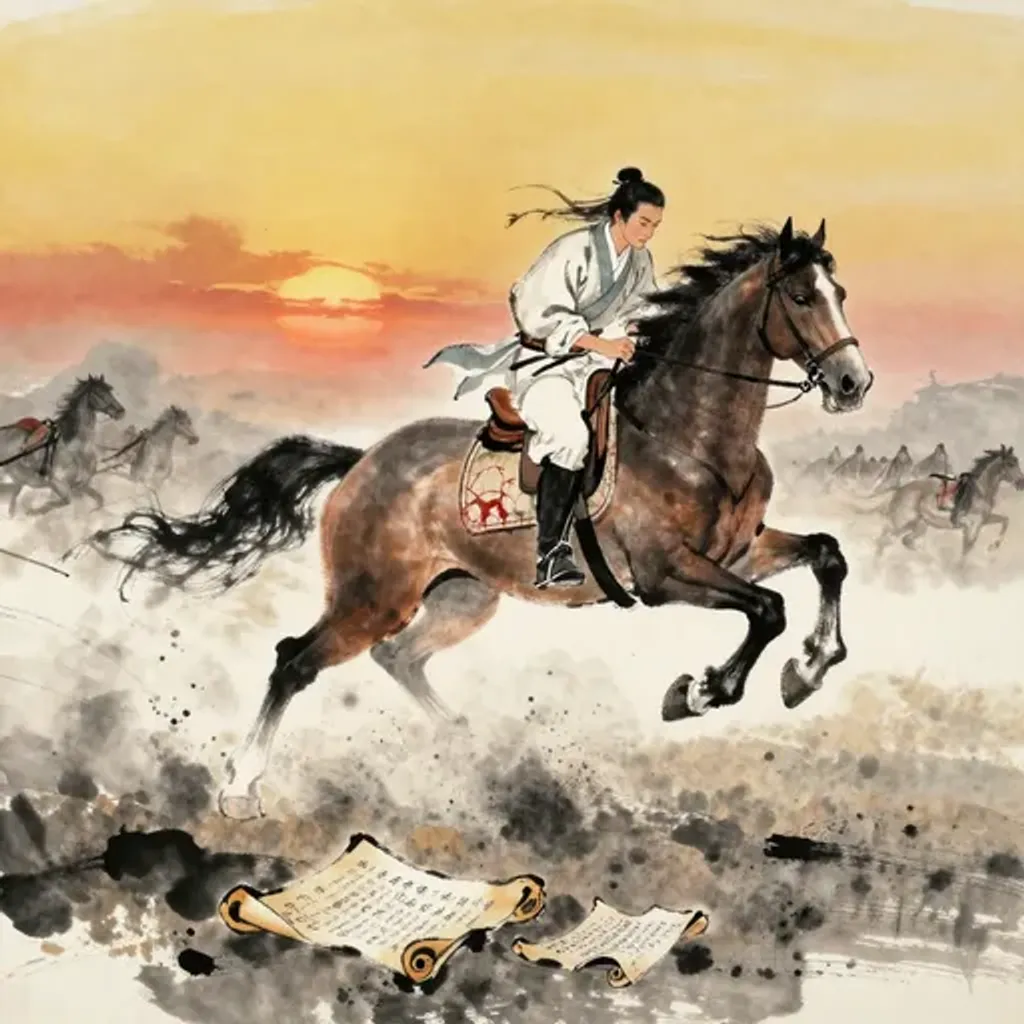
望幸不到,文章未就;王子逐走,馬騎啣傷;昳跡不得,曷其有常。
Hoping for the royal visit, but it does not come; the writings remain unfinished. The prince is driven to flee; horse and rider wounded by the bit. Tracks erased, nothing gained -- how can there be constancy?
— Jiao Yanshou, Yilin (Forest of Changes), 1st century BC
Commentary
Wind above heaven settles into the mountain's still nourishment. Hopes for imperial favor go unfulfilled; the literary composition remains unfinished. A prince flees in haste, his horse stumbles and bites its wound. Tracks vanish, irrecoverable — what constancy can there be? From Small Taming to Nourishment, the verse darkens what should be the mountain's caring stillness. Yi's image — mountain over thunder — counsels careful speech and measured sustenance. Yet here all nourishment fails: the awaited patron never arrives, the work of art is left incomplete, and the prince's flight scatters all possibility of stability. Nourishment requires a steady hand, and this verse shows what happens when the provider bolts.
小畜 → 大過
Hexagram 9 → Hexagram 28: Great Exceeding
Changing lines: 1, 4, 6
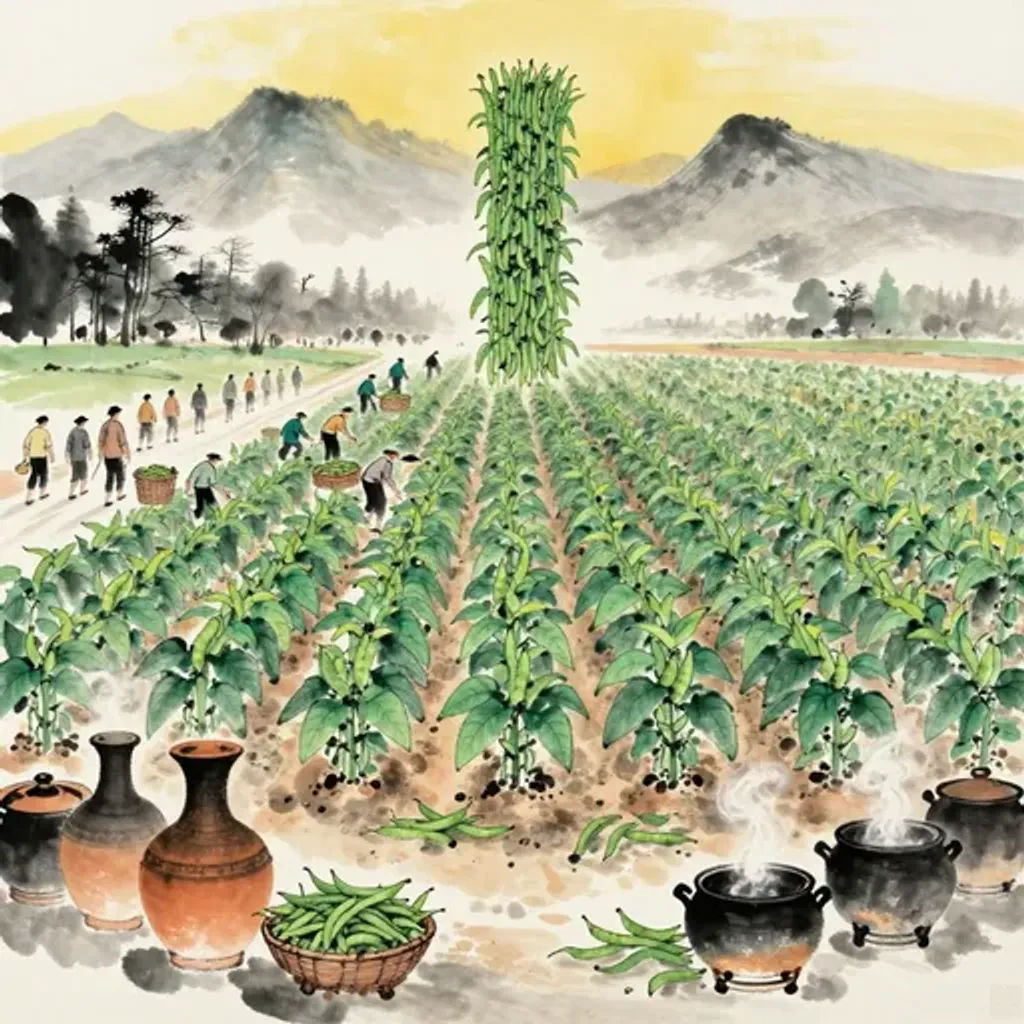
中原有菽,以待饔食;飲御諸友,所求大得。
In the central plains there are beans, awaiting the morning and evening meals. Pouring drinks and hosting all friends; what is sought is greatly obtained.
— Jiao Yanshou, Yilin (Forest of Changes), 1st century BC
Commentary
Wind above heaven meets the lake submerging the trees — Great Exceeding's image of a structure pushed beyond its limits. Yet the verse is unexpectedly generous: in the central fields beans grow tall, ready for the evening meal. Wine is served to welcome friends, and every wish is greatly fulfilled. From Small Taming to Great Exceeding, the transformation crosses into territory where excess should spell danger. Da Guo's ridgepole bends under impossible weight. But here the excess is abundance itself — so much food, so much hospitality that the structure groans not from decay but from plenty. The verse suggests that when the right provisions fill the vessel, even exceeding can be a feast rather than a collapse.
小畜 → 坎
Hexagram 9 → Hexagram 29: The Abysmal Water
Changing lines: 1, 3, 6
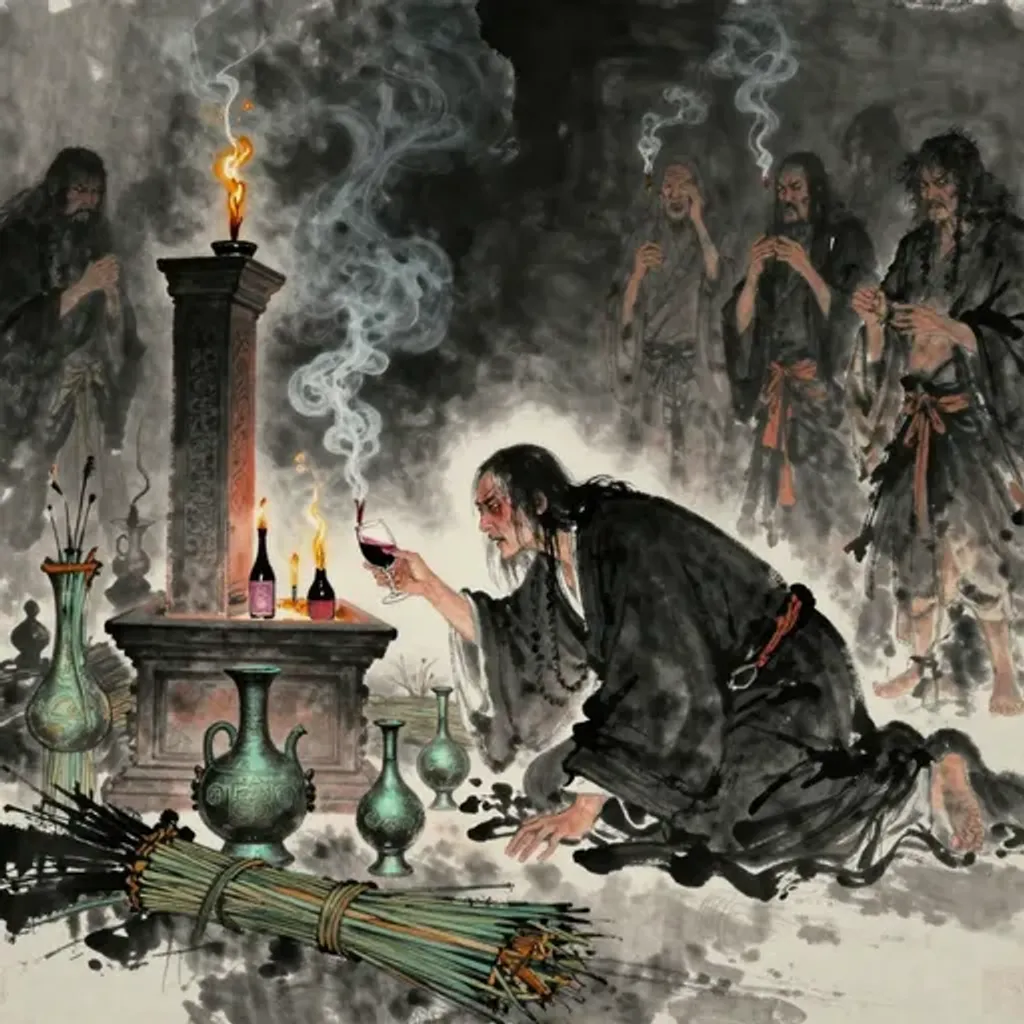
亂茅縮酒,靈巫拜禱;神怒不許,瘁愁憂苦。
Tangled rushes strain the wine; the spirit-medium bows in prayer. The spirits rage and refuse; grief and bitter sorrow remain.
— Jiao Yanshou, Yilin (Forest of Changes), 1st century BC
Commentary
Wind above heaven plunges into doubled water — the Abysmal repeated, peril upon peril. Tangled reeds are used to strain the sacrificial wine; the spirit-medium bows and prays. Yet the spirits are angered and refuse to accept the offering. Exhaustion, grief, and worry consume the supplicant. From Small Taming to the Abysmal, gentle refinement descends into the abyss where sincerity alone can navigate. The failed ritual is devastating: even the correct form — reed-strained wine, proper invocations — cannot compel divine assent. Kan demands steadfast inner truth, not ritual mechanics. When the heart's sincerity falls short, no amount of ceremony bridges the gulf between human need and heaven's silence.
小畜 → 離
Hexagram 9 → Hexagram 30: The Clinging Fire
Changing lines: 2, 4, 5
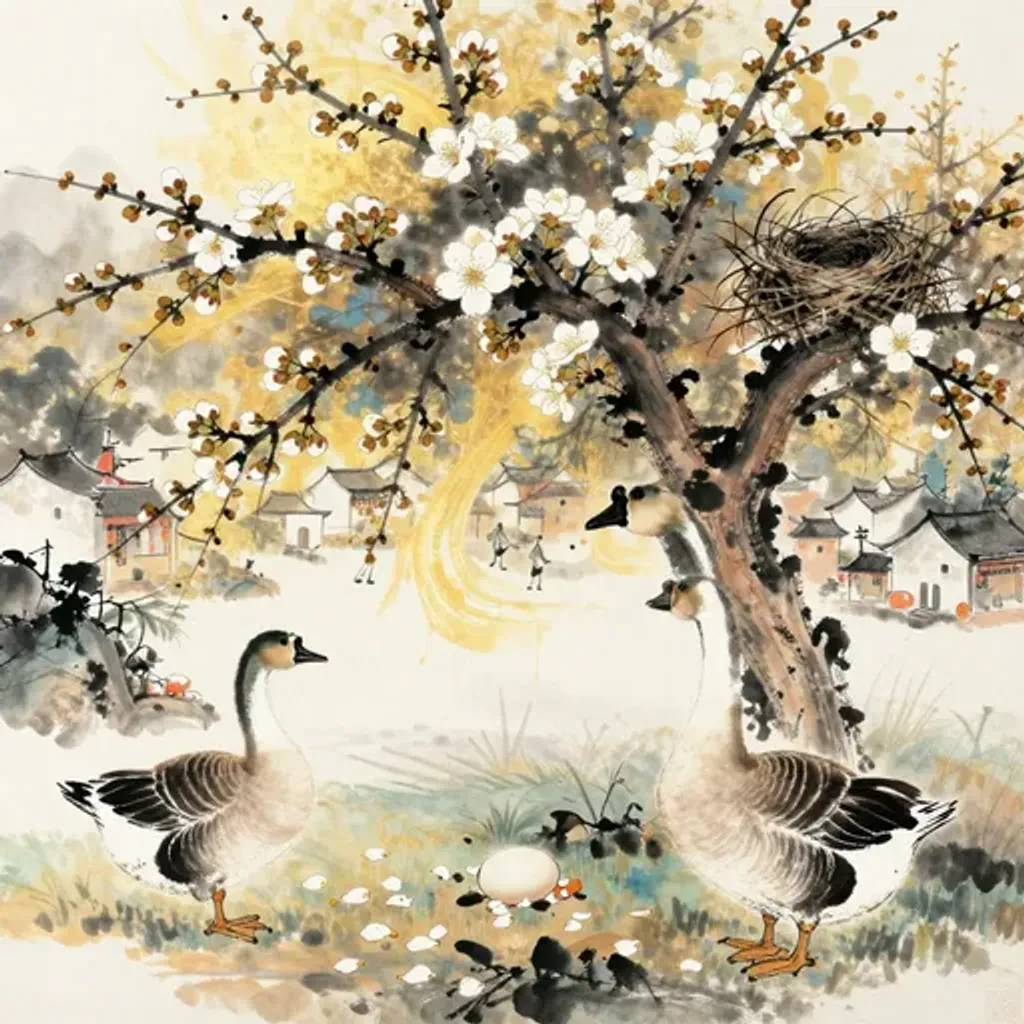
李華再實,鴻卵降集;仁哲以興,蔭國受福。
The plum tree fruits twice; swan eggs descend and gather. The humane and wise begin their rise; shading the state, receiving blessings.
— Jiao Yanshou, Yilin (Forest of Changes), 1st century BC
Commentary
Wind above heaven kindles into doubled fire — the Clinging's sustained brilliance. Plum blossoms fruit a second time; wild goose eggs descend and gather. The benevolent and wise rise to prominence, sheltering the state and bestowing its blessings. From Small Taming to the Clinging, the wind's gentle cultivation ignites into the great person's radiance illuminating all four directions. Li's image is brightness succeeding brightness — continuity of light. The plum fruiting twice captures this: one flowering is natural, a second is extraordinary grace. The goose eggs — symbols of fertility arriving from above — confirm that heaven favors this renewal. When wisdom governs, abundance renews itself without exhaustion.
小畜 → 咸
Hexagram 9 → Hexagram 31: Influence
Changing lines: 1, 2, 4, 6
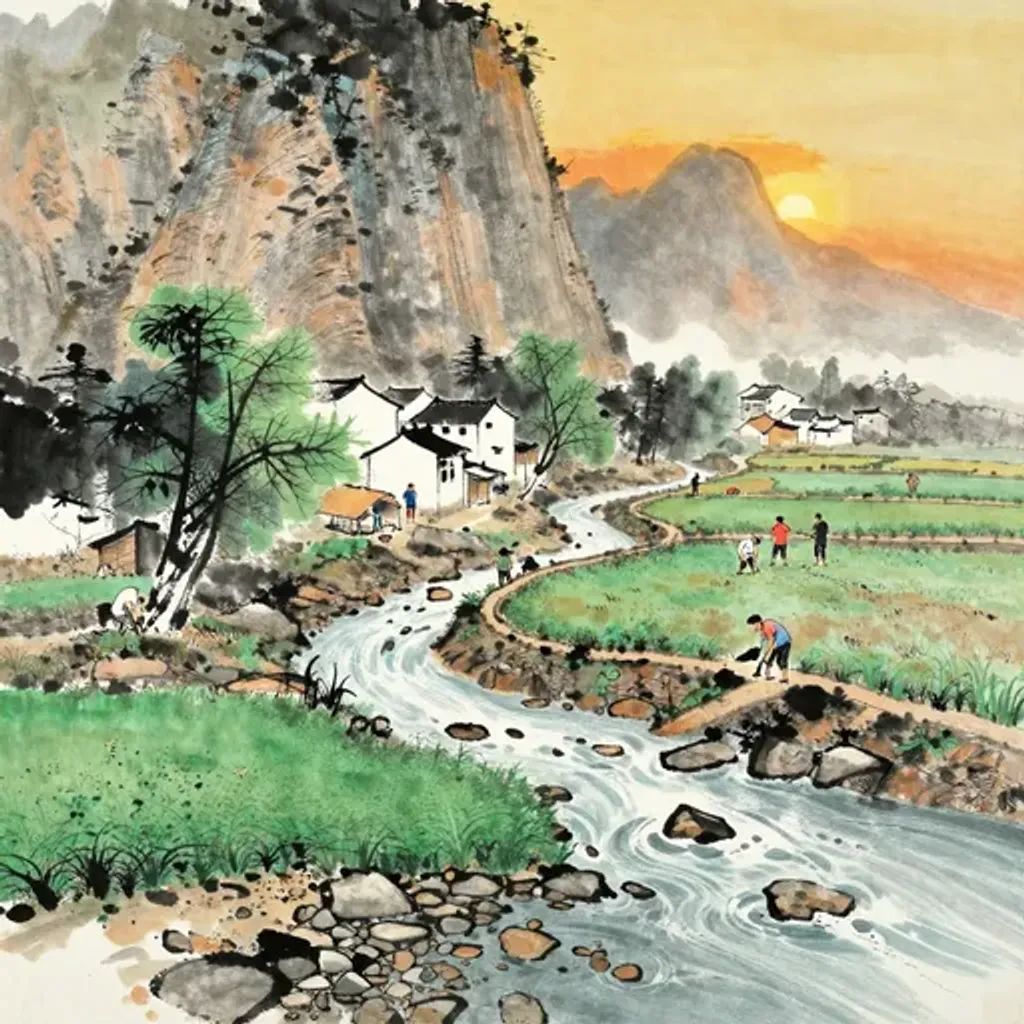
源出陵足,行於山趾;不為暴害,民得安居。
The spring rises at the foot of the hill, flowing along the mountain base. It does not cause violent harm; the people find peaceful dwelling.
— Jiao Yanshou, Yilin (Forest of Changes), 1st century BC
Commentary
Wind above heaven transforms into the lake resting upon the mountain — mutual influence without force. A spring emerges at the base of a hill, flowing along the mountain's foot. It causes no flooding or destruction; the people dwell in peace. From Small Taming to Influence, the verse is a miniature landscape of Xian's ideal: stimulation that nourishes without overwhelming. The mountain lake of Xian's image represents openness above receptivity — the gentleman who empties himself to receive others. Here the spring is the natural expression of that receptivity: water finding its way downhill through the gentlest gradient, sustaining the village below without violence. Influence at its purest is simply this: flowing where gravity takes you.
小畜 → 恆
Hexagram 9 → Hexagram 32: Duration
Changing lines: 1, 4, 5, 6
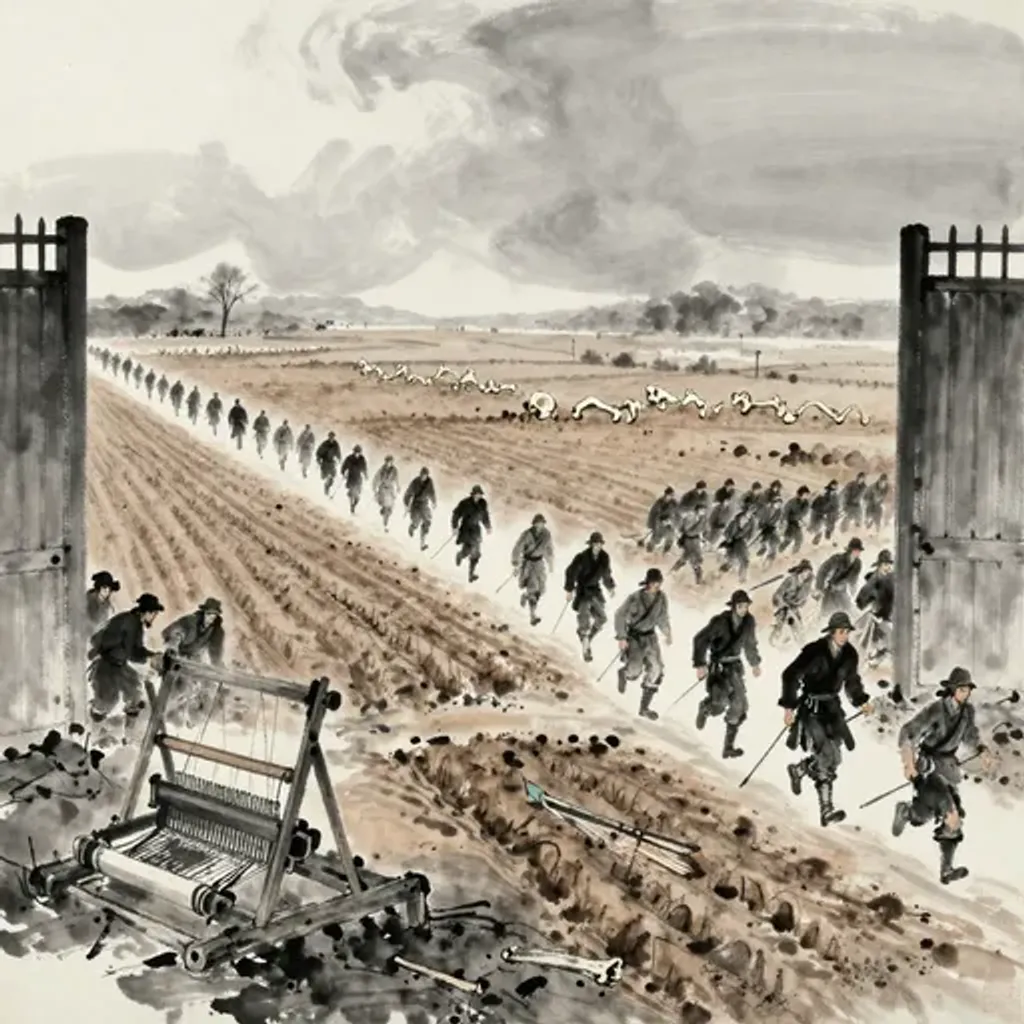
客入其門,奔走東西;童女不織,士棄耕畝;暴骨千里,歲寒無年。
Intruders enter the gate, rushing about east and west. The young women no longer weave; the scholars abandon their fields. Bleached bones stretch a thousand li; the year grows cold, the harvest lost.
— Jiao Yanshou, Yilin (Forest of Changes), 1st century BC
Commentary
Wind above heaven hardens into thunder and wind locked together — Duration's unyielding persistence. But here endurance is a curse. Invaders enter the gates; people flee east and west. Girls abandon their looms, men forsake their plows. Bleached bones stretch a thousand leagues; the harsh year yields no harvest. From Small Taming to Duration, the verse shows Heng's dark face: when what persists is not virtue but catastrophe, duration becomes a trap. Thunder and wind reinforce each other endlessly, and here it is war and famine that refuse to relent. The bones across the landscape are the terrible monument to a suffering that has outlasted all capacity to endure. Constancy without righteousness is merely prolonged agony.
小畜 → 遯
Hexagram 9 → Hexagram 33: Retreat
Changing lines: 1, 2, 4
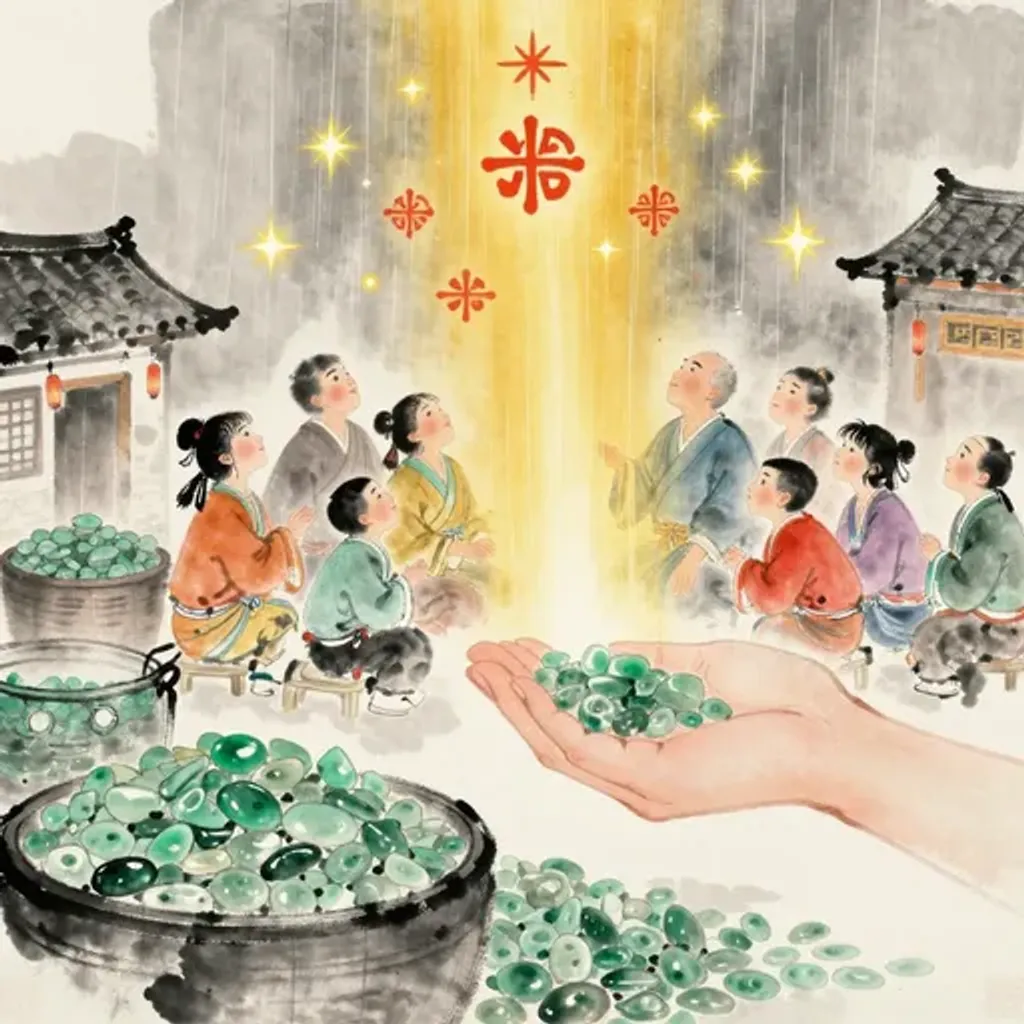
天之所予,福祿常在;以永康寧,不憂危殆。
What heaven bestows, fortune and blessings abide. In lasting peace and tranquility; no fear of danger or peril.
— Jiao Yanshou, Yilin (Forest of Changes), 1st century BC
Commentary
Wind above heaven opens into heaven standing above the mountain — the image of strategic withdrawal. What heaven bestows, fortune and blessing, endures always. Eternal peace and tranquility prevail; there is no anxiety over danger. From Small Taming to Retreat, the verse celebrates withdrawal not as defeat but as divine gift. Dun's image — heaven soaring above the mountain, beyond the reach of small forces below — frames retreat as a position of strength. The gentleman distances himself from petty men without hostility, simply by ascending. The blessings here are permanent because they are secured through timely withdrawal: knowing when to step back is how one keeps what heaven has given.
小畜 → 大壯
Hexagram 9 → Hexagram 34: Great Power
Changing lines: 4, 5, 6
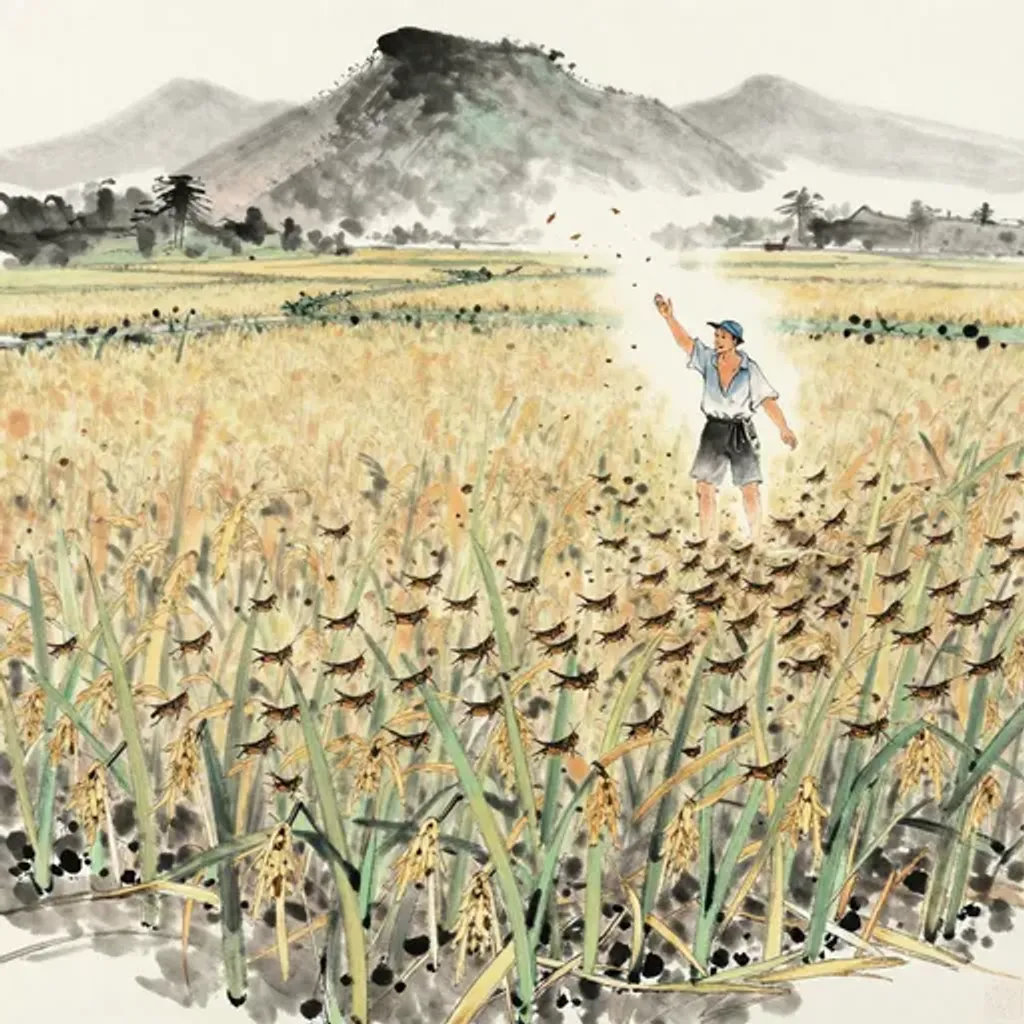
蝗食我稻,驅不可去;實穗無有,但見空藁。
Locusts devour my rice; driven off, they will not leave. Not a full ear remains; only empty stalks are seen.
— Jiao Yanshou, Yilin (Forest of Changes), 1st century BC
Commentary
Wind above heaven erupts into thunder roaring in the sky — Great Power unchecked. Locusts devour the rice, and no amount of driving chases them away. Full ears of grain are gone; nothing remains but hollow stalks. From Small Taming to Great Power, gentle cultivation is overwhelmed by raw force misdirected. Da Zhuang's thunder above heaven is immense energy that demands propriety to channel it — the gentleman must not tread where ritual forbids. The locusts are power without moral restraint: relentless, consuming, immune to resistance. The verse warns that when great strength serves only appetite, it reduces a cultivated field to empty husks. Power that devours what it should protect is no different from a plague.
小畜 → 晉
Hexagram 9 → Hexagram 35: Progress
Changing lines: 1, 2, 3, 4, 5
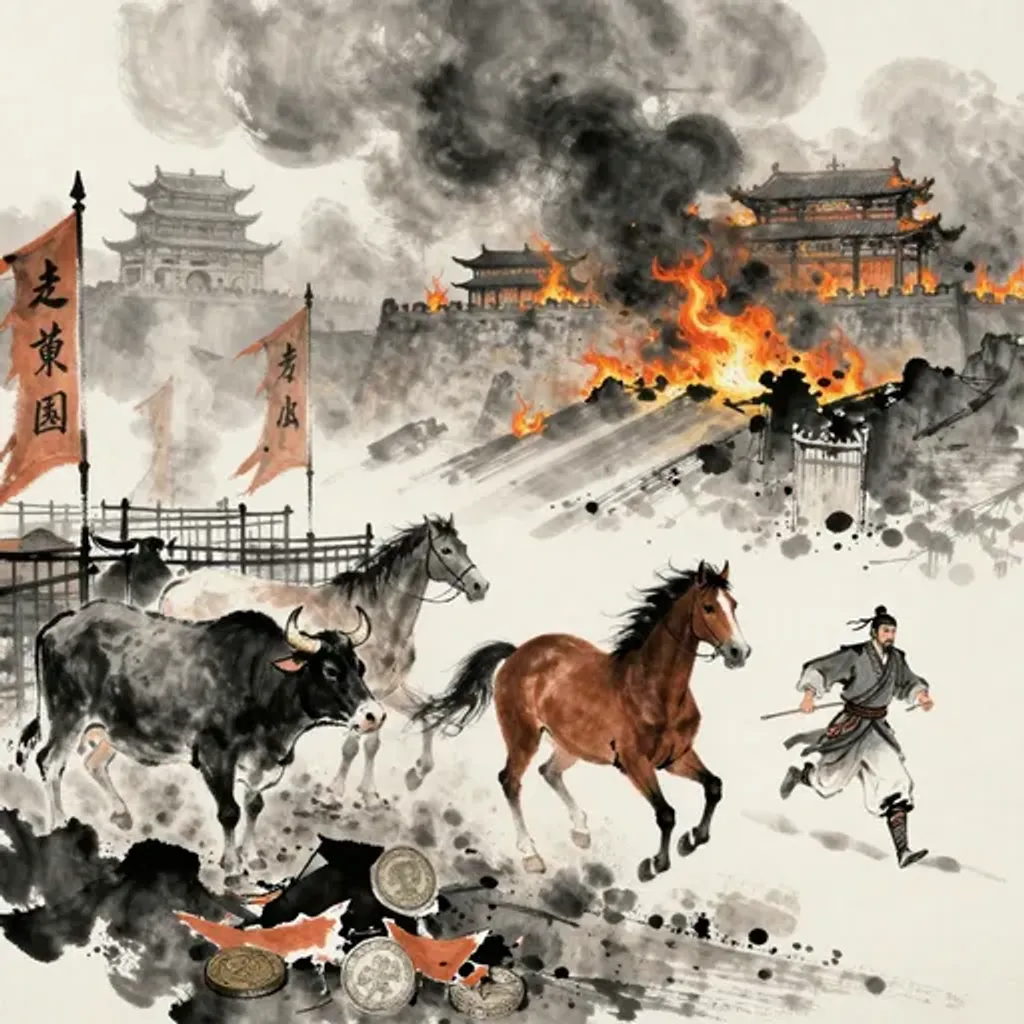
牛驥同堂,郭氏已亡;國破空虛,君奔走逃。
Cattle and thoroughbreds share one stable; the Guo clan is already lost. The state broken and emptied; the lord flees in haste.
— Jiao Yanshou, Yilin (Forest of Changes), 1st century BC
Commentary
Wind above heaven gives way to fire emerging from the earth — Progress, the sun rising at dawn. Yet here the dawn illuminates ruin. Oxen and thoroughbreds share the same stall — the idiom 'niu ji tong tang' from Zou Yang's prison letter, lamenting when talented and mediocre are treated alike. The Guo clan has already perished; the state lies broken and empty; the lord flees. From Small Taming to Progress, the verse inverts Jin's promise of advancement. Fire above earth should illuminate merit and distinguish the worthy. Instead, the light reveals that such distinctions have already been abolished. When a state cannot tell its thoroughbreds from its oxen, collapse is not impending but complete.
小畜 → 明夷
Hexagram 9 → Hexagram 36: Darkening of the Light
Changing lines: 2, 5, 6
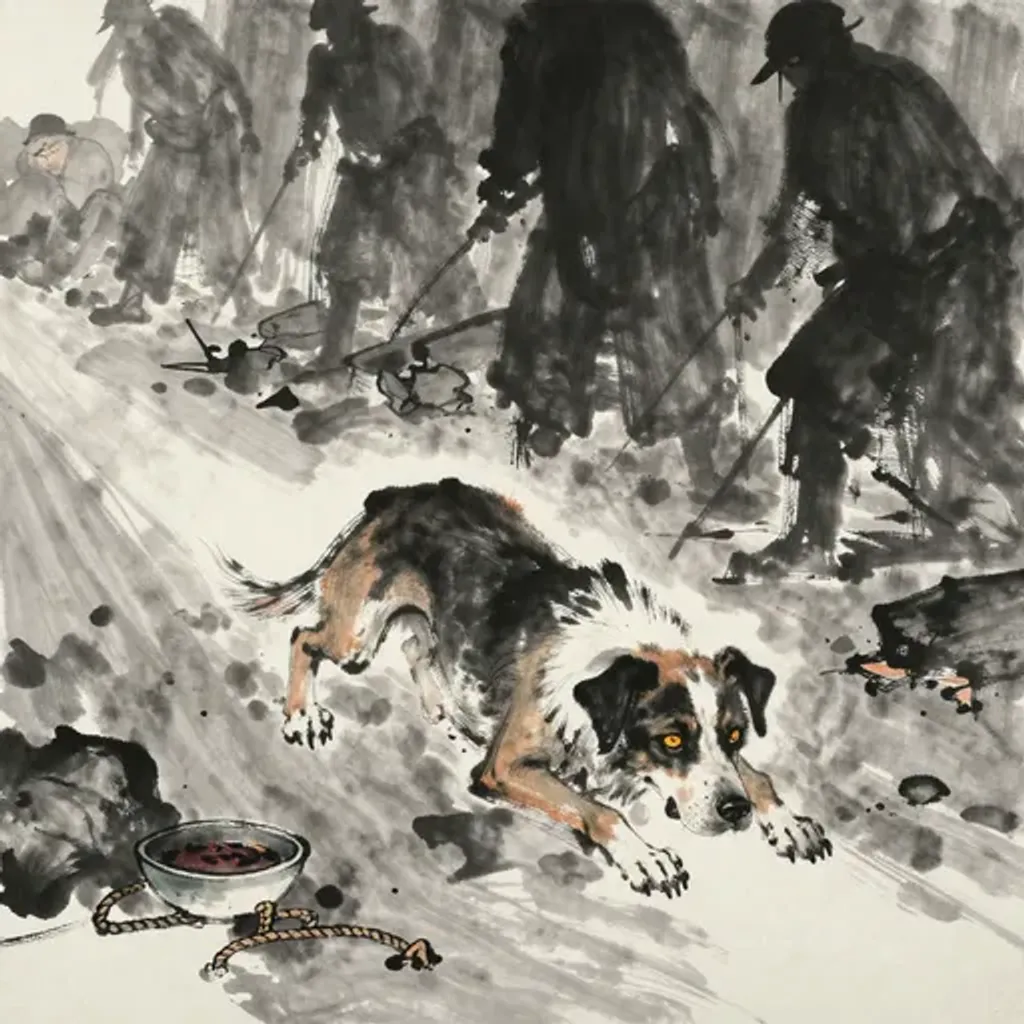
狗無前足,陰謀其北;為身賊害,何以安息。
A dog without front legs; yin conspires in the north. Bringing harm to its own body; how can it find rest?
— Jiao Yanshou, Yilin (Forest of Changes), 1st century BC
Commentary
Wind above heaven sinks into fire buried beneath the earth — the Darkening of the Light. A dog without forelegs drags itself forward; conspiracies brew in the north. The body is wounded by treachery; how can there be any rest? From Small Taming to Darkening of the Light, the verse plunges into Ming Yi's world of intelligence suppressed and light extinguished. The maimed dog is a visceral image of crippled agency — still alive, still struggling, but fundamentally impaired. The northern conspiracy suggests danger from the direction of yin and cold. Ming Yi's counsel is to govern the multitude by dimming one's own brilliance while remaining inwardly clear. Here the darkness is not chosen but inflicted, and survival demands endurance without the luxury of rest.
小畜 → 家人
Hexagram 9 → Hexagram 37: The Family
Changing lines: 2
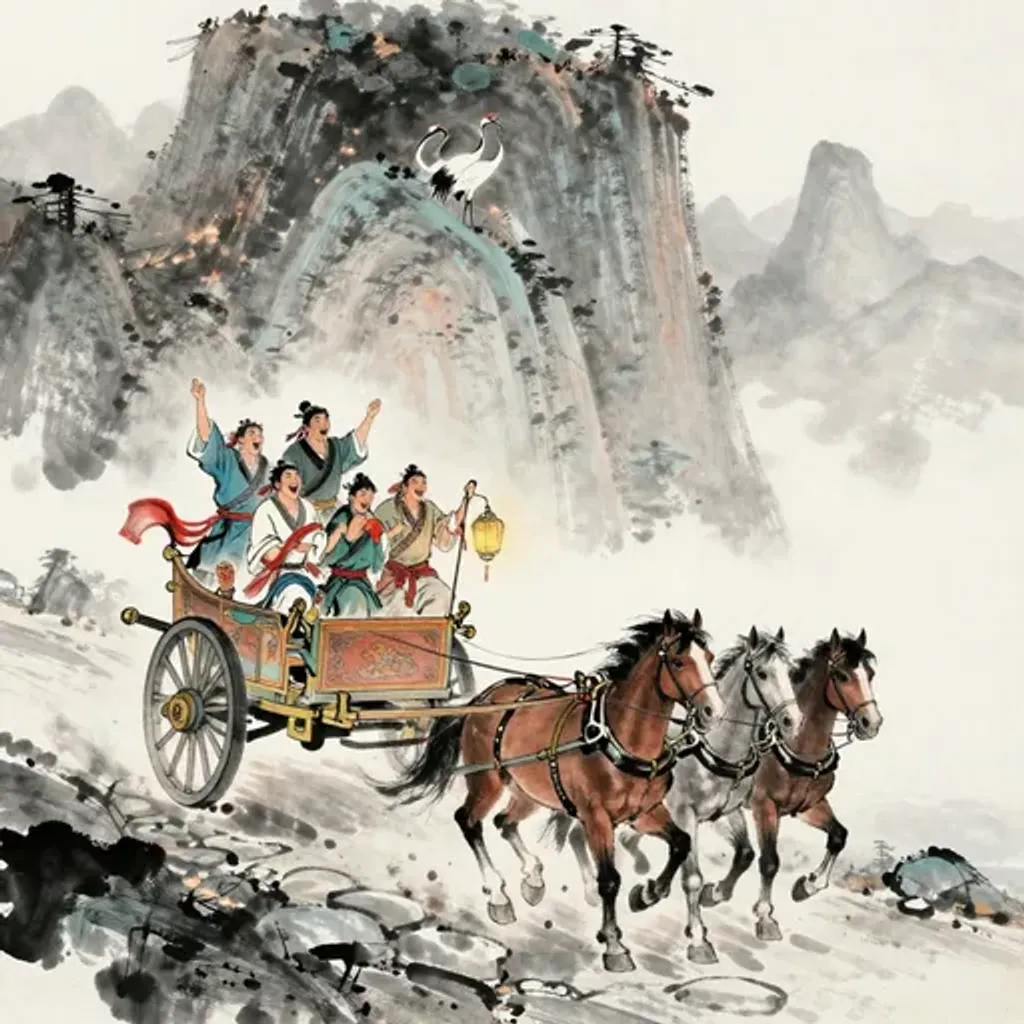
兩輪自轉,南上大阪;四馬共轅,無有重難;與禹笑言。鶴鳴竅穴,不離其室。
Two wheels turn of themselves, climbing south up the great slope. Four horses share one shaft; no burden too heavy to bear -- laughing and talking with Yu. The crane calls from its burrow; it does not leave its chamber.
— Jiao Yanshou, Yilin (Forest of Changes), 1st century BC
Commentary
Wind above heaven transforms into wind emerging from fire — the warmth of The Family radiating outward. Two wheels turn freely, climbing the great southern slope. Four horses share one shaft with no difficulty at all, and the traveler shares laughter with Yu the Great himself. A crane calls from its hidden hollow, never straying from its chamber. From Small Taming to The Family, the verse is radiant with domestic harmony extended outward. Yu the Great — the flood-tamer who passed his own door three times without entering — represents the ideal of public service grounded in family loyalty. The crane calling from its den echoes the Shijing's hidden virtue that makes itself known. Family's wind from fire: inner warmth becoming gentle influence abroad.
小畜 → 睽
Hexagram 9 → Hexagram 38: Opposition
Changing lines: 3, 4, 5
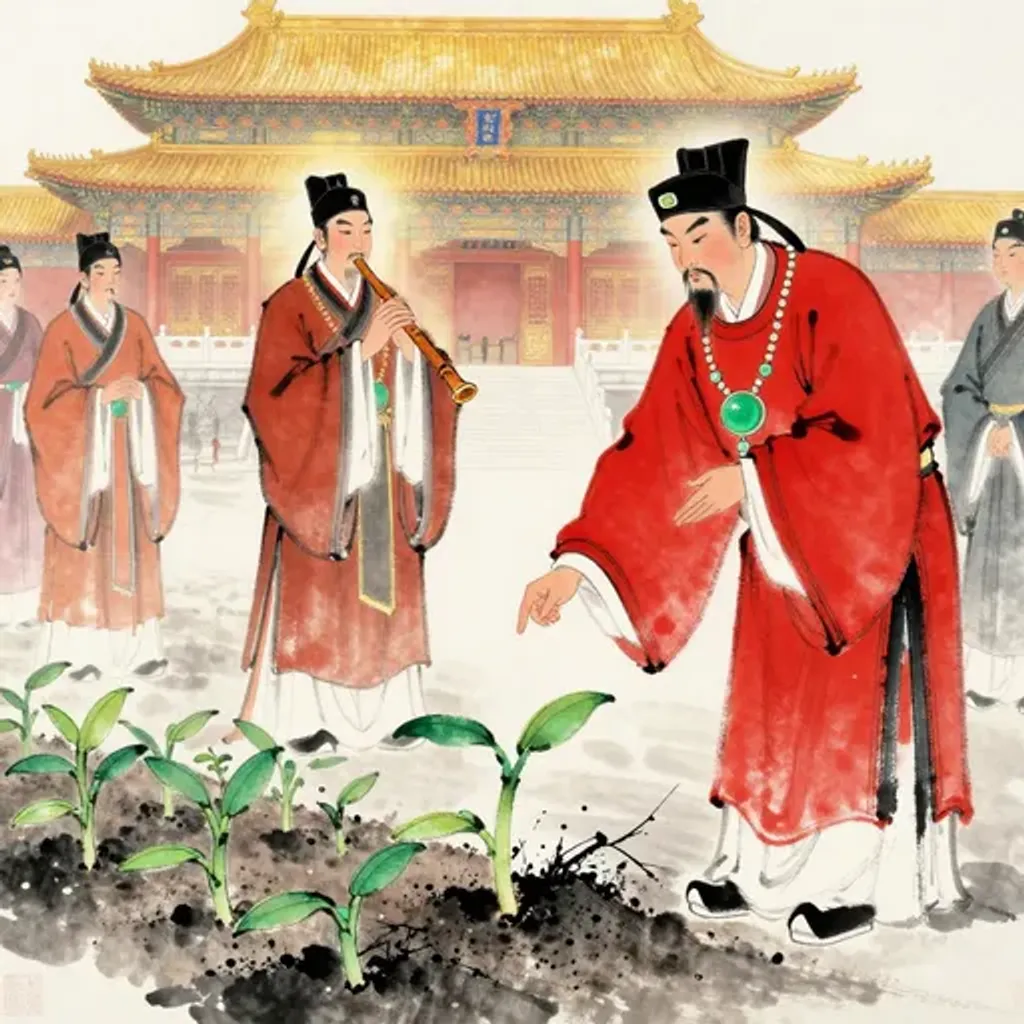
芽孽生達,陽昌於外;左手執籥,公言錫爵。
Shoots and sprouts emerge and thrive; yang flourishes in the outer realm. The left hand grasps the flute; the duke proclaims the granting of rank.
— Jiao Yanshou, Yilin (Forest of Changes), 1st century BC
Commentary
Wind above heaven meets fire above the lake — Opposition's estranged pairing. Shoots and sprouts break through, thriving; yang flourishes outwardly. The left hand holds a flute, and the lord announces the bestowal of rank. From Small Taming to Opposition, the verse finds unexpected harmony within estrangement. Kui's fire and lake move in contrary directions, yet the gentleman uses this tension to 'agree in principle while differing in practice.' The sprouting yang and the ceremonial flute suggest creative energy finding formal expression. The lord's reward comes precisely because opposition has been navigated rather than suppressed. Growth under tension, recognition amid difference — Kui's gift is that fruitful things emerge from the space between incompatibles.
小畜 → 蹇
Hexagram 9 → Hexagram 39: Obstruction
Changing lines: 1, 2, 6
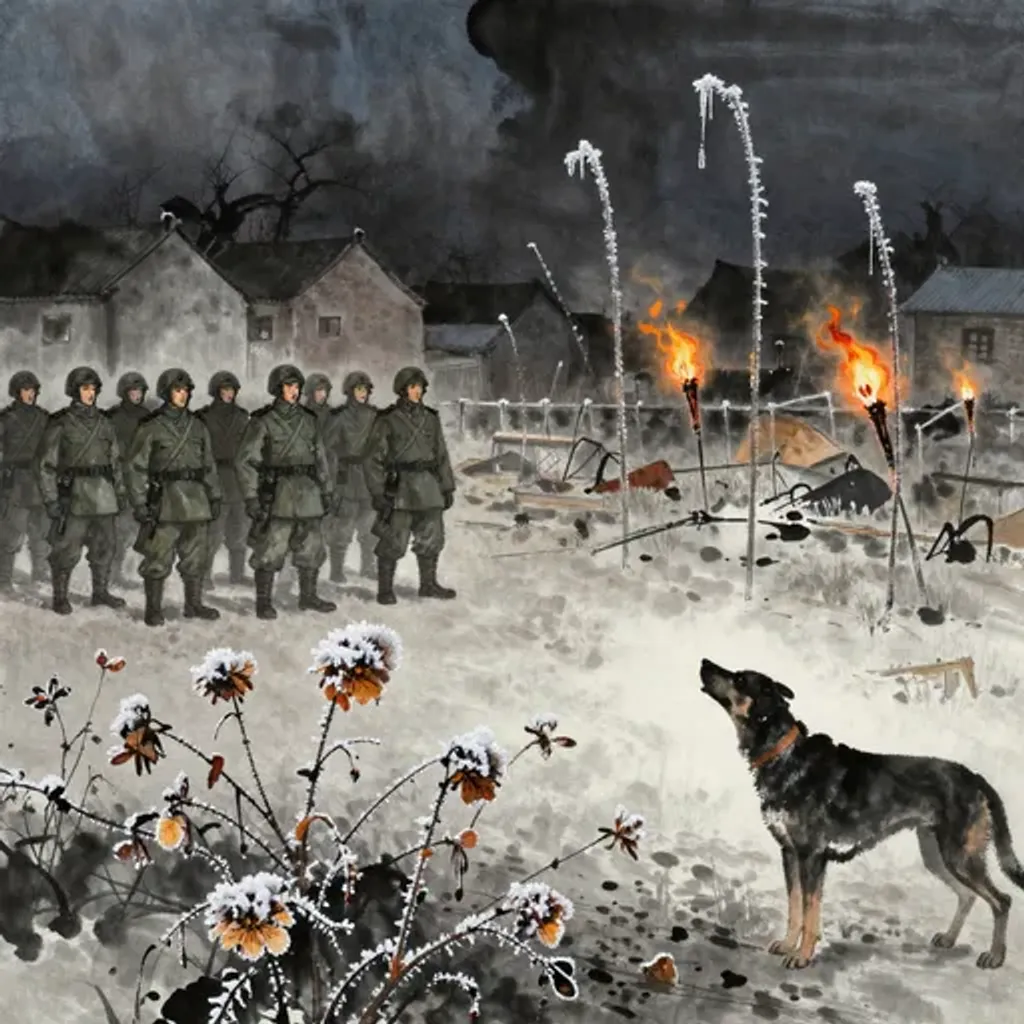
秋花冬萼,數被嚴霜;甲兵當庭,萬物不生;雄犬夜鳴,民擾大驚。
Autumn flowers and winter buds, struck again and again by harsh frost. Armored soldiers fill the courtyard; the myriad things do not grow. The male dog howls at night; the people are troubled and greatly alarmed.
— Jiao Yanshou, Yilin (Forest of Changes), 1st century BC
Commentary
Wind above heaven confronts water perched upon the mountain — Obstruction's cold impasse. Autumn flowers and winter buds are ravaged repeatedly by harsh frost. Weapons stand arrayed in the courtyard; nothing grows. A war-dog howls through the night, and the people reel in terror. From Small Taming to Obstruction, the transformation is brutal. Jian's water above the mountain is the image of danger piled upon difficulty — the path forward blocked, the path back treacherous. The verse compounds natural disaster with military threat: frost kills the harvest while armed force occupies the living space. Obstruction demands self-reflection and inner cultivation, but here there is no room even for that. The dog's cry is the voice of a world past counsel.
小畜 → 解
Hexagram 9 → Hexagram 40: Deliverance
Changing lines: 1, 3, 4, 5, 6
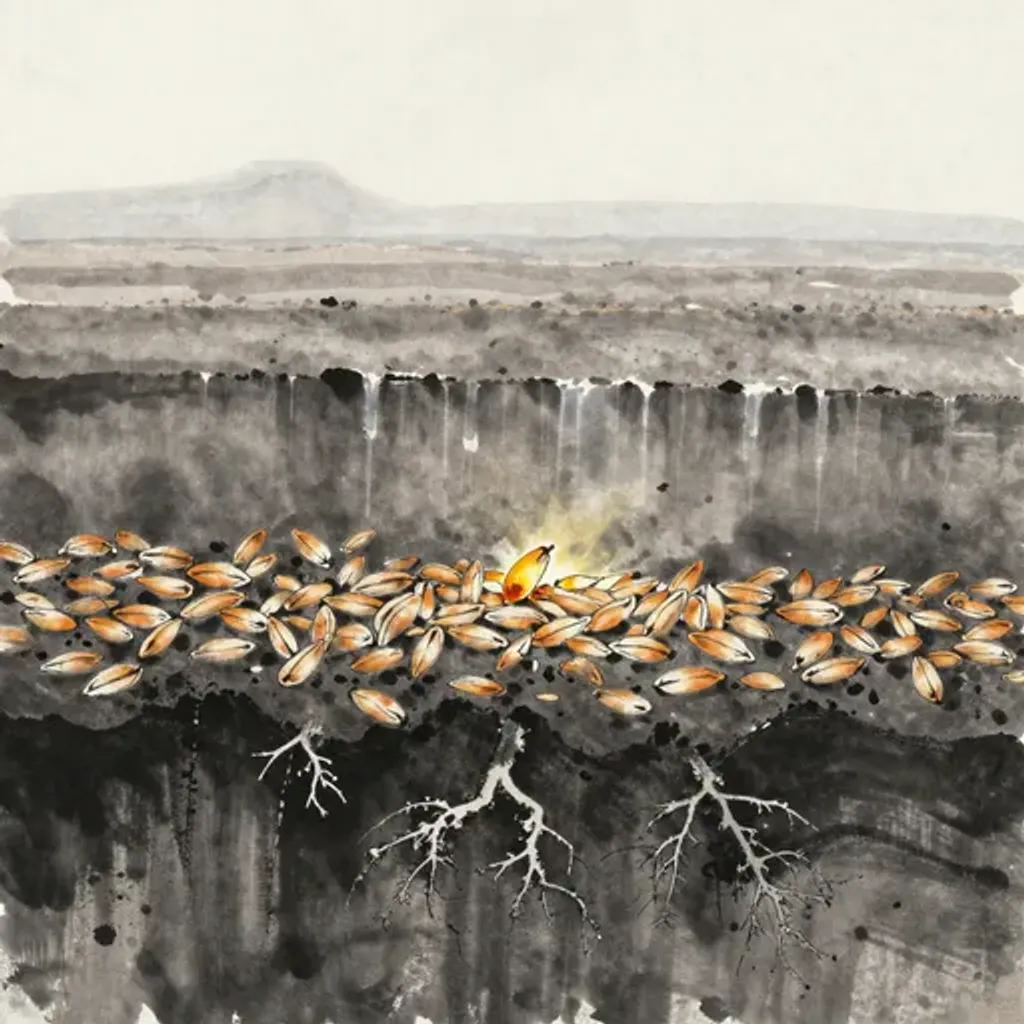
霜降閉戶,蟄虫隱處;不見日月,與死為伍。
The ground frozen three feet deep; the seeds sleep in darkness. Knowing nothing of spring's message — the blackness is without limit.
— Jiao Yanshou, Yilin (Forest of Changes), 1st century BC
Commentary
Wind above heaven yields to thunder released from water — Deliverance's breaking of tension. The original verse reads: 'At Frost Descent the doors close; hibernating creatures hide away. Sun and moon are unseen; one keeps company with death.' The season of execution has arrived — Frost Descent was when the Han state carried out capital sentences, aligning human punishment with nature's killing energy. All life withdraws into dormancy, sealed away from light. From Small Taming to Deliverance, the verse sits at the nadir before release. Jie's thunder and rain herald the spring thaw that dissolves winter's grip. The hiding creatures will emerge again. Even companionship with death is temporary when deliverance waits on the other side of the frost.
小畜 → 損
Hexagram 9 → Hexagram 41: Decrease
Changing lines: 3, 5
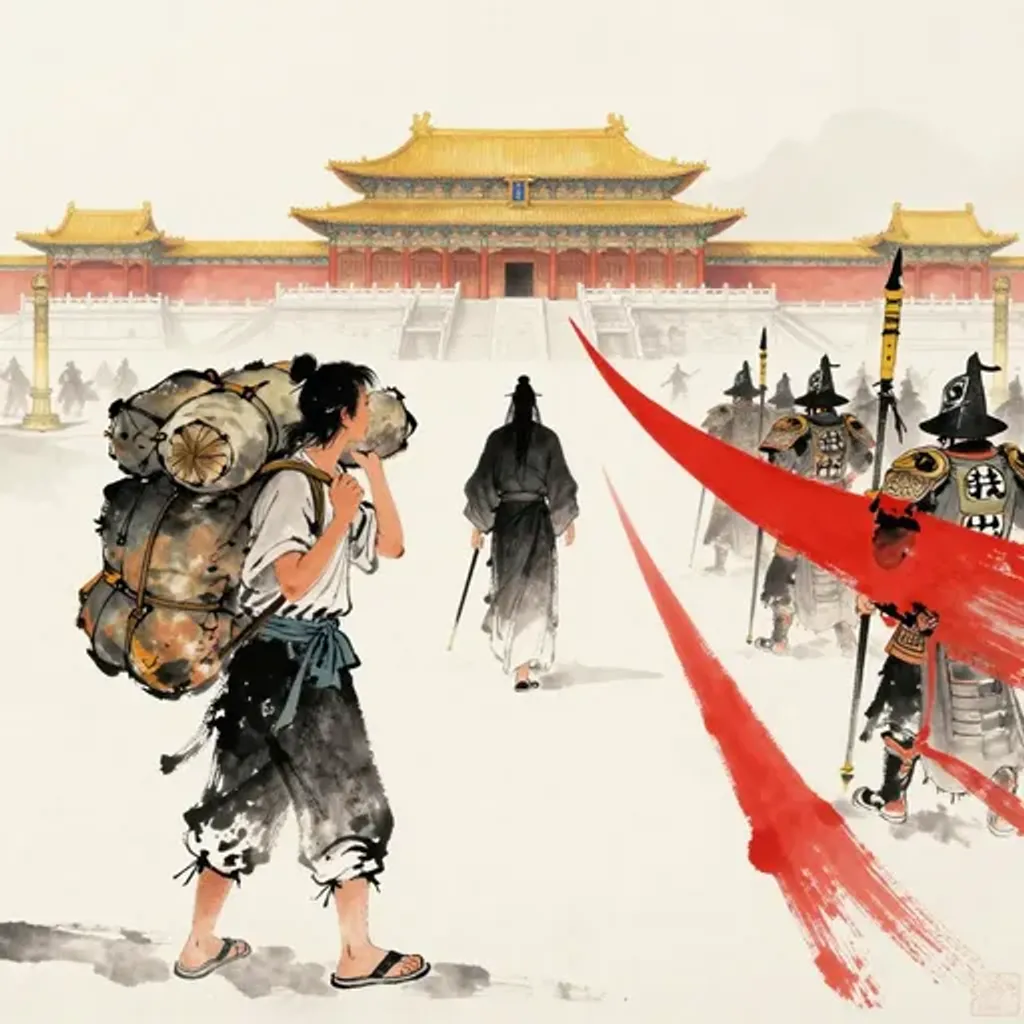
身載百里,功加四海;為文開基,武立大柱。
Bearing a hundred li upon his shoulders, his merit extends to the four seas. Laying the foundation through civil virtue; through martial might he raises the great pillar.
— Jiao Yanshou, Yilin (Forest of Changes), 1st century BC
Commentary
Wind above heaven transforms into the mountain overlooking the lake — Decrease that serves a higher purpose. One shoulders the burden of a hundred leagues while achieving merit across the four seas. Civil virtue lays the foundation; martial power raises the great pillar. From Small Taming to Decrease, the verse embodies Sun's paradox: diminishing the lower to increase the upper. The one who carries a territory's weight and extends merit across all directions is the minister who sacrifices personal ease for public good. The pairing of 'wen' (civil) and 'wu' (martial) — foundation and pillar — echoes the Zhou ideal of King Wen and King Wu as complementary virtues. Decrease here is not loss but the discipline of channeling everything upward.
小畜 → 益
Hexagram 9 → Hexagram 42: Increase
Changing lines: 2, 3
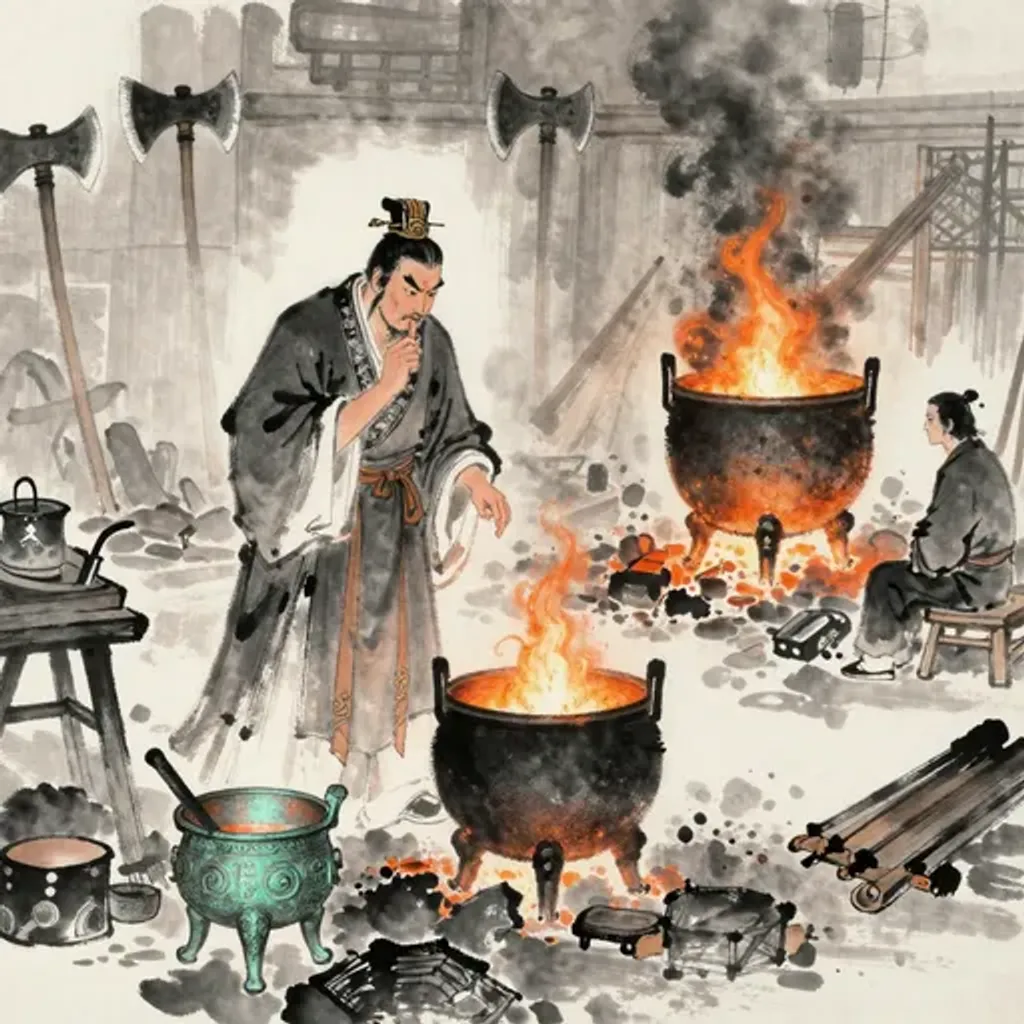
禹作神鼎,伯益衘指;斧斤高閣,憧位獨坐;賣庸不售,苦困為禍。
Yu forged the divine cauldrons; Bo Yi pointed the way. Axes set high on the shelf; the attendant sits alone at his post. Selling his labor, none will buy; bitter hardship becomes disaster.
— Jiao Yanshou, Yilin (Forest of Changes), 1st century BC
Commentary
Wind above heaven meets wind and thunder together — Increase's dynamic generosity. Yu the Great casts the sacred cauldrons, and Bo Yi bites his finger in agitation. Yet axes and hatchets are shelved high above; the servant sits alone at his post. He tries to sell his labor but finds no buyer; hardship and frustration become his lot. The verse juxtaposes two registers: the heroic age of Yu and his minister Bo Yi — who helped tame the floods and later was passed over for succession — against the anonymous laborer whose skills go unpurchased. From Small Taming to Increase, the promise of gain is undercut by misallocated talent. The cauldrons are cast, but the craftsman sits idle.
小畜 → 夬
Hexagram 9 → Hexagram 43: Breakthrough
Changing lines: 4, 6
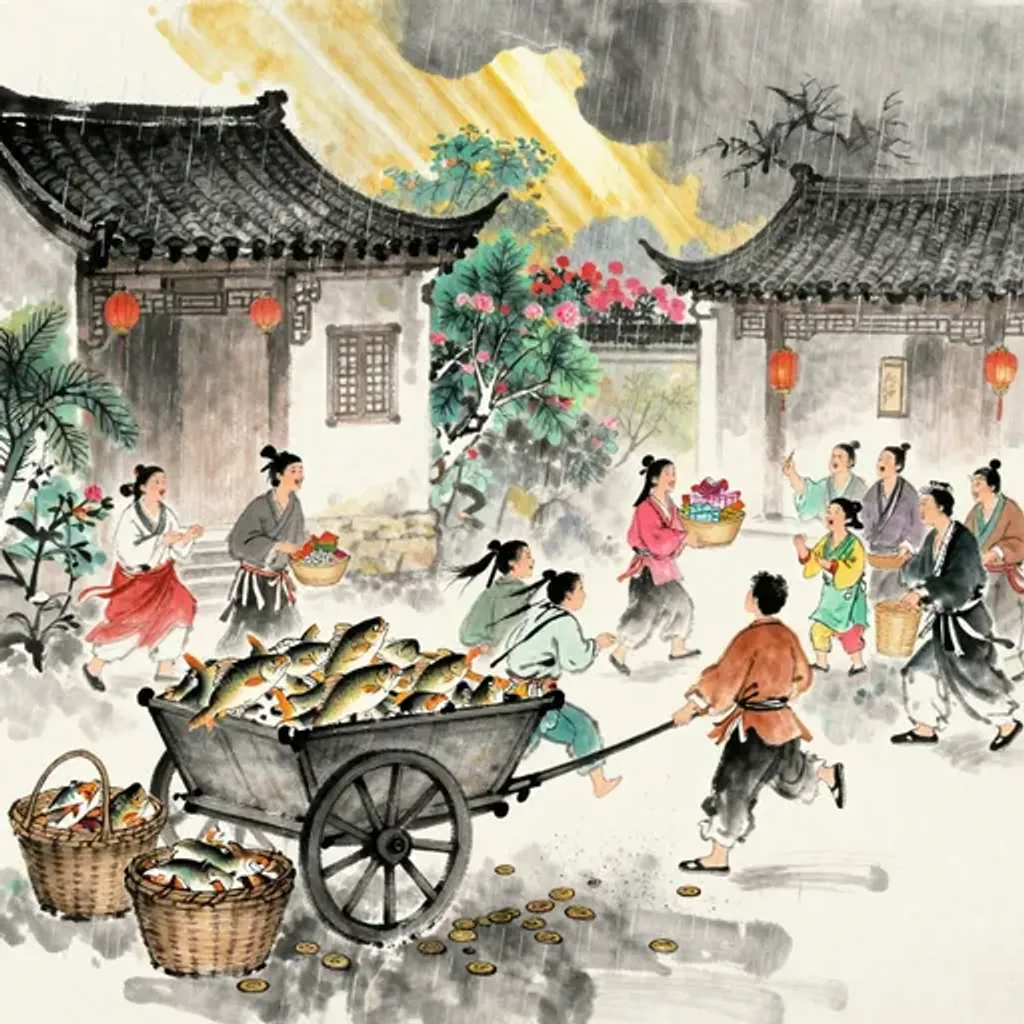
福祚之家,喜至憂除;如風兼雨,出車入魚。
A house of fortune and blessing; joy arrives and worry departs. Like wind paired with rain; setting forth the carriage, bringing in the fish.
— Jiao Yanshou, Yilin (Forest of Changes), 1st century BC
Commentary
Wind above heaven bursts into the lake rising above heaven — Breakthrough's decisive moment. A household blessed with fortune finds joy arriving and worry departing. Like wind paired with rain — complementary forces moving together — chariots go out and fish come in. From Small Taming to Breakthrough, the gentle restraint of wind gives way to the lake's irresistible upward surge. Guai's counsel is to distribute blessings downward while residing in virtue. The verse captures this circulation: fortune flows in, anxiety flows out, movement in one direction generates return in another. 'Chariots out, fish in' is a proverbial image of balanced exchange — prosperity not as hoarding but as continuous flow.
小畜 → 姤
Hexagram 9 → Hexagram 44: Coming to Meet
Changing lines: 1, 4
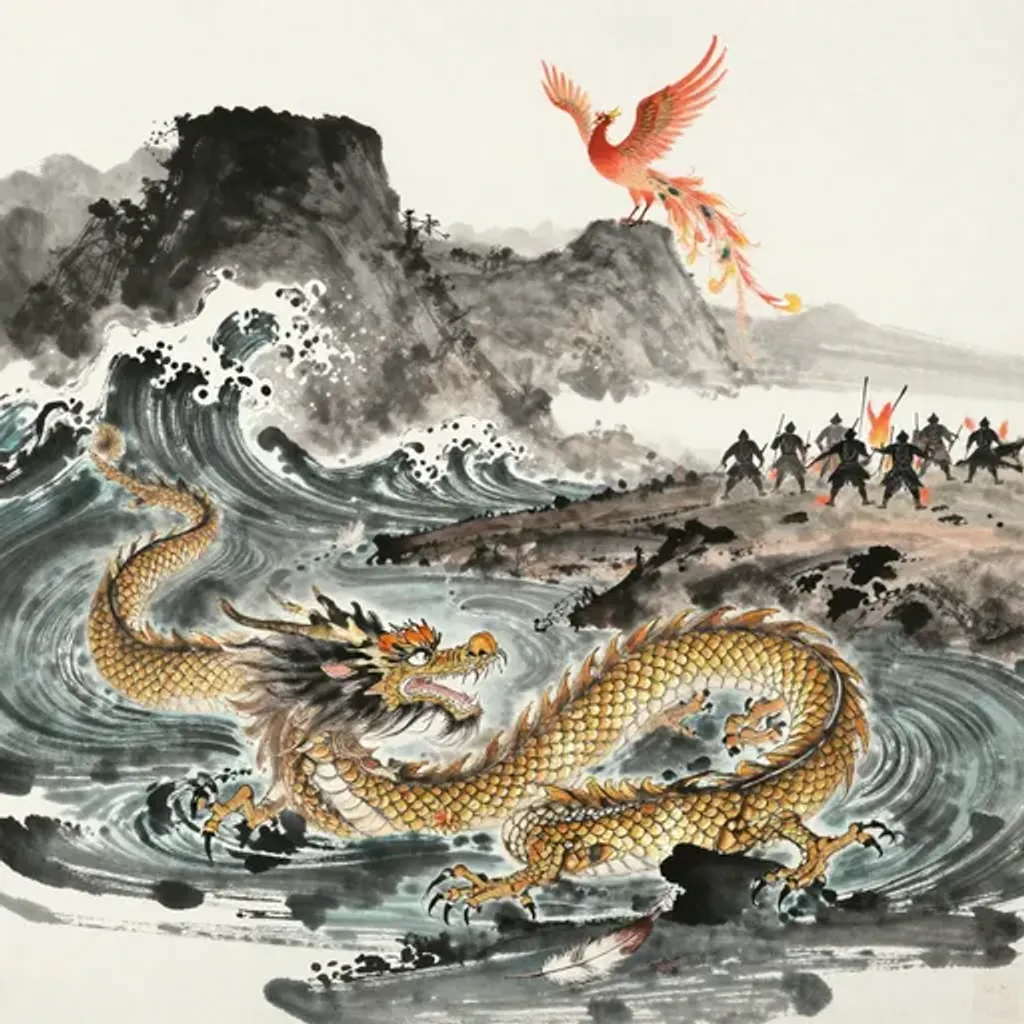
蒼龍隱伏,麟鳳遠匿;寇來同處,未得安息。
The dark dragon hides in concealment; qilin and phoenix retreat far away. Brigands come to share the dwelling; no rest can be found.
— Jiao Yanshou, Yilin (Forest of Changes), 1st century BC
Commentary
Wind above heaven encounters heaven descending to meet the wind below — an unexpected meeting in the dark. The Azure Dragon lies hidden; qilin and phoenix have fled far away. Bandits arrive and occupy the same space; there is no peace or rest. From Small Taming to Coming to Meet, the verse inverts Gou's encounter. When heaven meets wind from below, what rises up should be an opportunity. Yet here what emerges are robbers, while all auspicious creatures — the dragon, the qilin, the phoenix — have withdrawn. These three represent cosmic order in its martial, benevolent, and civilizing aspects. Their absence signals a world where only predators remain. The meeting that was supposed to be generative becomes occupation by hostile forces.
小畜 → 萃
Hexagram 9 → Hexagram 45: Gathering Together
Changing lines: 1, 2, 3, 4, 6
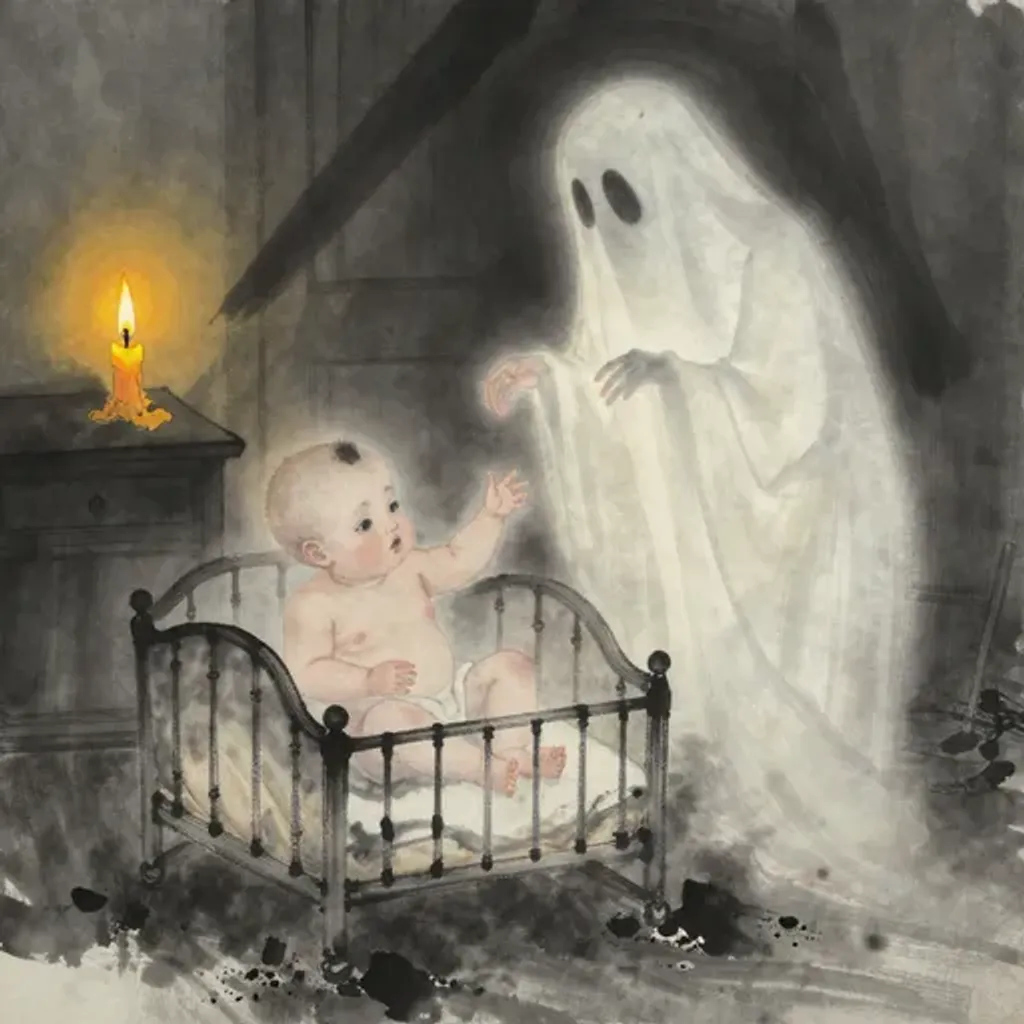
旦生夕死,名曰嬰鬼,不可得視。
Born at dawn, dead by dusk; it is called an infant ghost -- it cannot be seen.
— Jiao Yanshou, Yilin (Forest of Changes), 1st century BC
Commentary
Wind above heaven meets the lake gathering upon earth — Gathering's assembly of life. Yet this gathering is spectral: born at dawn, dead by dusk, named an 'infant ghost,' invisible and beyond sight. The creature that lives only a single day embodies the most extreme form of transience — a mayfly existence that gathers into being only to dissolve before it can be perceived. From Small Taming to Gathering, the verse subverts Cui's promise of collective strength. Gathering implies convergence, marshaling, preparation. But what gathers here disperses before it coalesces. The infant ghost is congregation without substance: the assembled dissolve even as they convene.
小畜 → 升
Hexagram 9 → Hexagram 46: Pushing Upward
Changing lines: 1, 5, 6
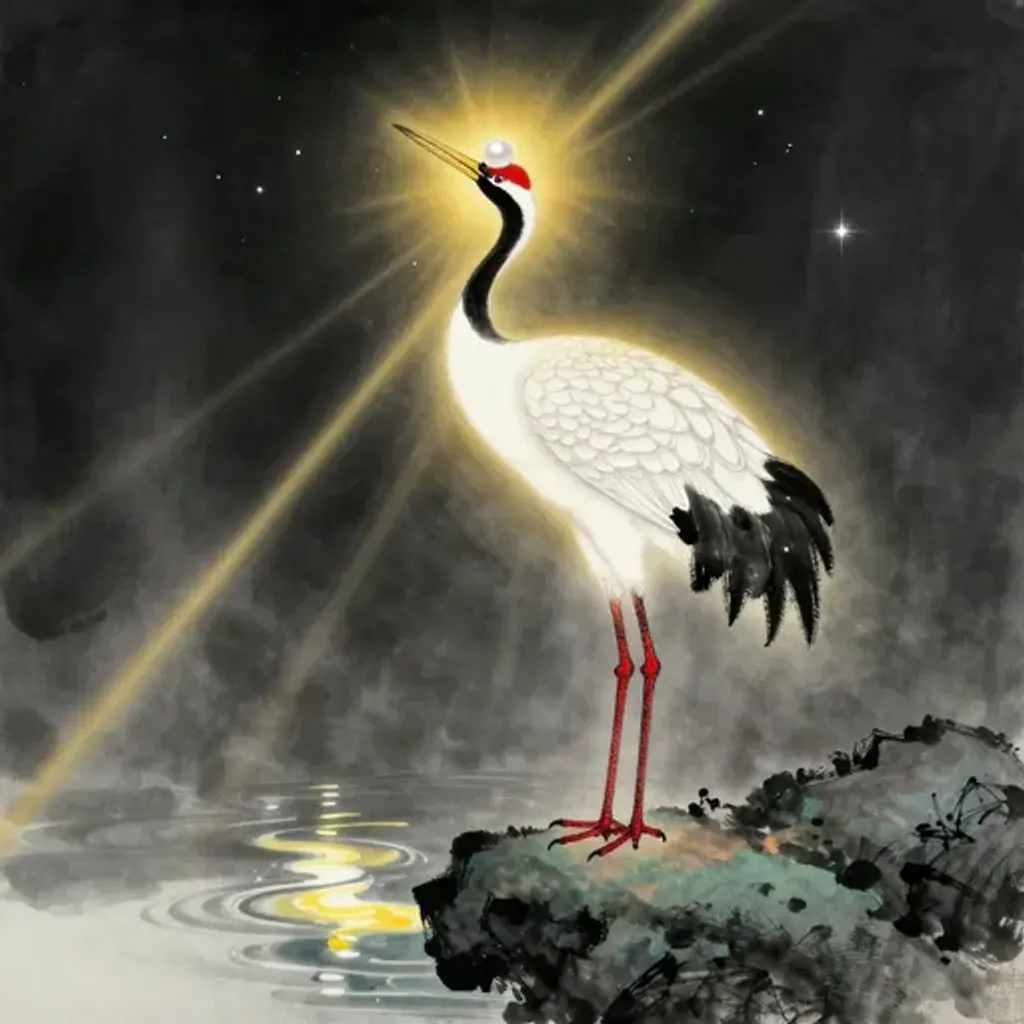
白鶴𠾑珠,夜食為明;懷安德音,身受光榮。
The white crane holds a pearl in its beak, feeding at night for light. Cherishing peace and virtuous words; the body receives glory and honor.
— Jiao Yanshou, Yilin (Forest of Changes), 1st century BC
Commentary
Wind above heaven transforms into the steady upward growth of wood within earth. A white crane holds a pearl in its beak, feeding in the night to create its own light. Cherishing peaceful virtue and fine reputation, the crane's body receives glory. From Small Taming to Pushing Upward, gentle refinement becomes incremental ascent. Sheng's image — wood growing within the earth — is the most organic form of progress: slow, steady, nourished from below. The luminous pearl in the crane's beak is inner virtue that generates its own illumination even in darkness. One need not wait for dawn when one carries the light within. The upward path is not a leap but a slow, self-radiant climb.
小畜 → 困
Hexagram 9 → Hexagram 47: Oppression
Changing lines: 1, 3, 4, 6
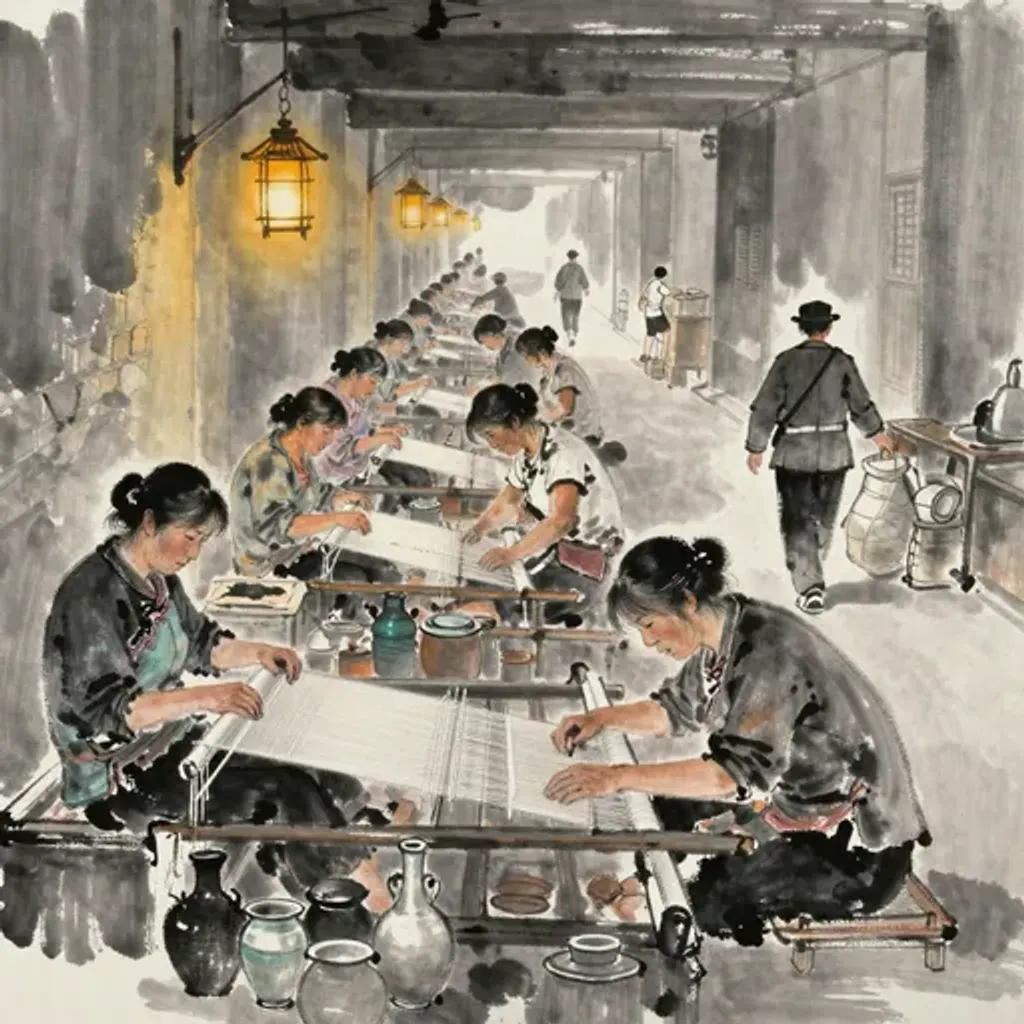
行役未已,新事復起;姬姜勞苦,不得休息。
Service and labor not yet ended; new tasks arise again. Ji and Jiang toil and suffer; finding no rest or reprieve.
— Jiao Yanshou, Yilin (Forest of Changes), 1st century BC
Commentary
Wind above heaven drains into the lake with no water — Oppression's exhaustion. Military duties drag on without end; new tasks pile upon the old before the first is finished. The women of noble clans — Ji and Jiang — toil and suffer without respite. From Small Taming to Oppression, the gentle wind that once refined heaven's force is now wrung dry. Kun's lake has lost its water: an empty vessel that cannot nourish. The verse echoes the Shijing soldiers' lament — 'What day do we not march?' — where service becomes an endless drain. Ji and Jiang, the great surname clans of Zhou and Qi, represent the highest-born reduced to grinding labor. When even the privileged find no rest, oppression has become total.
小畜 → 井
Hexagram 9 → Hexagram 48: The Well
Changing lines: 1, 6
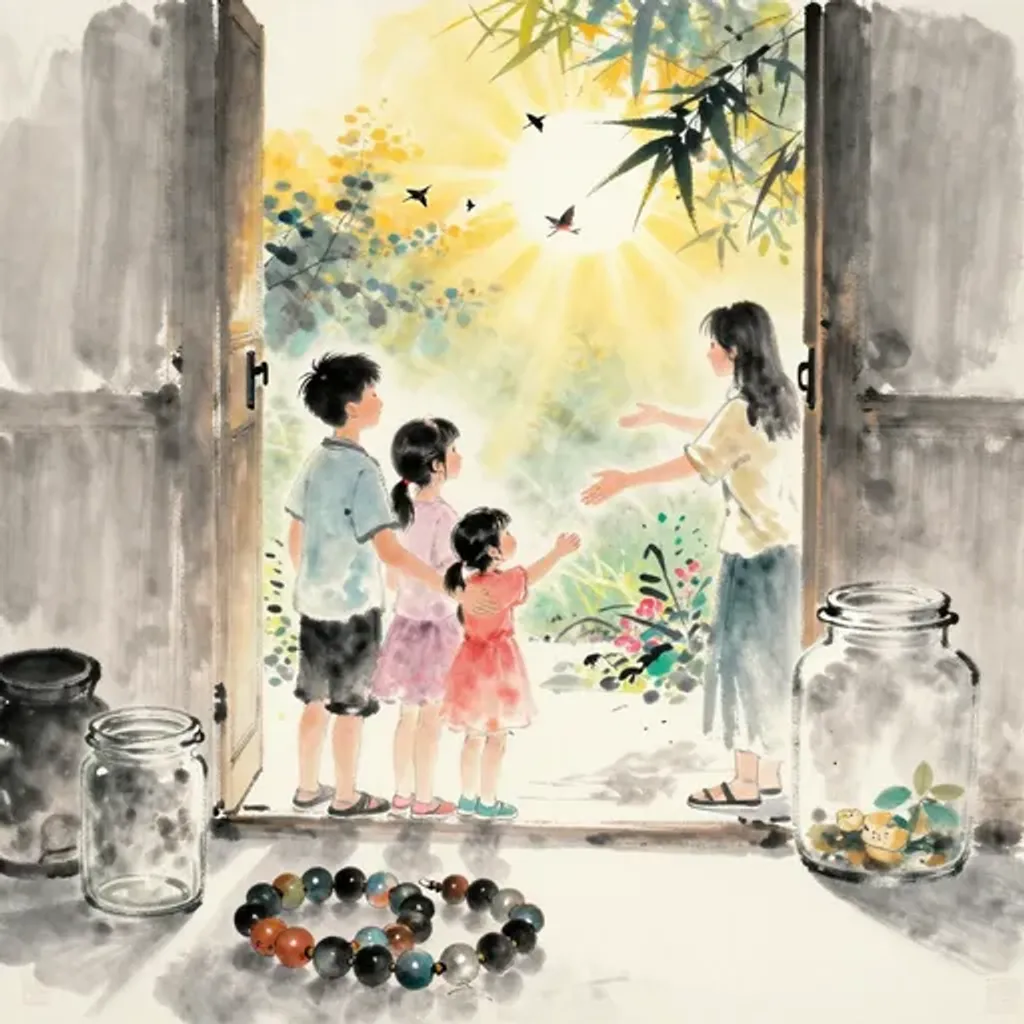
憂患解除,喜至慶來;坐立懽忻,與樂為鄰。
Worry and trouble are dissolved; joy arrives and celebration comes. Sitting or standing, filled with delight; dwelling as a neighbor of happiness.
— Jiao Yanshou, Yilin (Forest of Changes), 1st century BC
Commentary
Wind above heaven settles into water drawn upward through wood — the Well's inexhaustible nourishment. Worry and hardship dissolve; joy and celebration arrive. Sitting and standing alike overflow with delight; happiness becomes one's nearest neighbor. From Small Taming to the Well, the transformation moves from surface refinement to deep sustenance. Jing's image — wood above water — is the well-sweep drawing water from below to serve the community above. The verse captures the moment when the well yields: anxiety drains away and contentment fills the space it vacated. The Well never moves, never runs dry, and serves all who approach without discrimination. This is joy not as excitement but as the quiet reliability of being nourished at the source.
小畜 → 革
Hexagram 9 → Hexagram 49: Revolution
Changing lines: 2, 4, 6
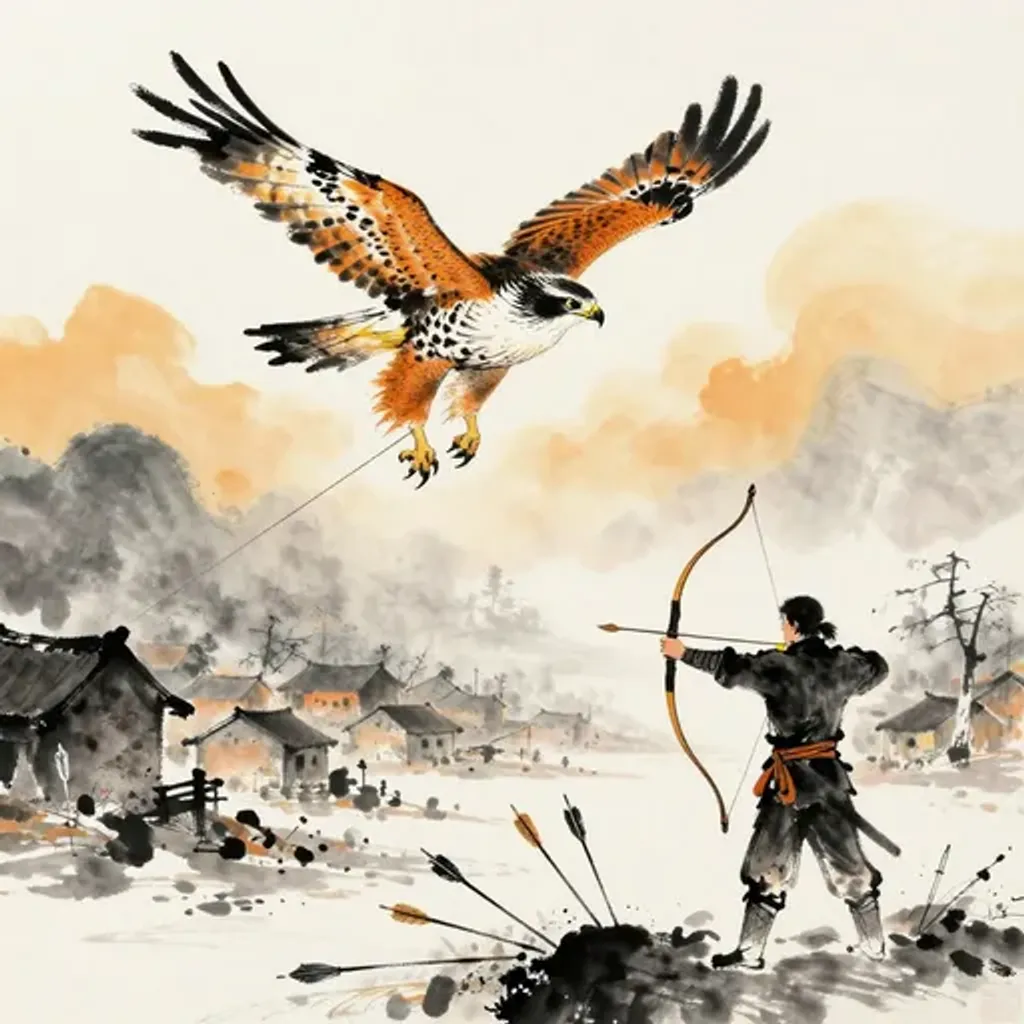
晨風之翰,大舉就溫;昧過我邑,羿無所得。
The morning wind is hawk rises high, soaring toward the warmth. Swiftly it passes over my town; Yi the Archer gains nothing.
— Jiao Yanshou, Yilin (Forest of Changes), 1st century BC
Commentary
Wind above heaven meets fire within the lake — Revolution's transformative blaze. The falcon of the Shijing's 'Chen Feng' ode soars high, departing for warmer climes at dawn. It passes swiftly over our settlement, and even Archer Yi with his divine bow gains nothing from the shot. From Small Taming to Revolution, the verse captures the essence of Ge: what is swift and decisive cannot be intercepted by the old order. Yi, the supreme archer who shot down nine suns, here represents the ancien regime's ultimate weapon — yet even he cannot strike the falcon in its moment of transformation. Revolution succeeds when the change is already airborne before the old guard can react. The bird has passed; the arrow finds only empty sky.
小畜 → 鼎
Hexagram 9 → Hexagram 50: The Cauldron
Changing lines: 1, 4, 5
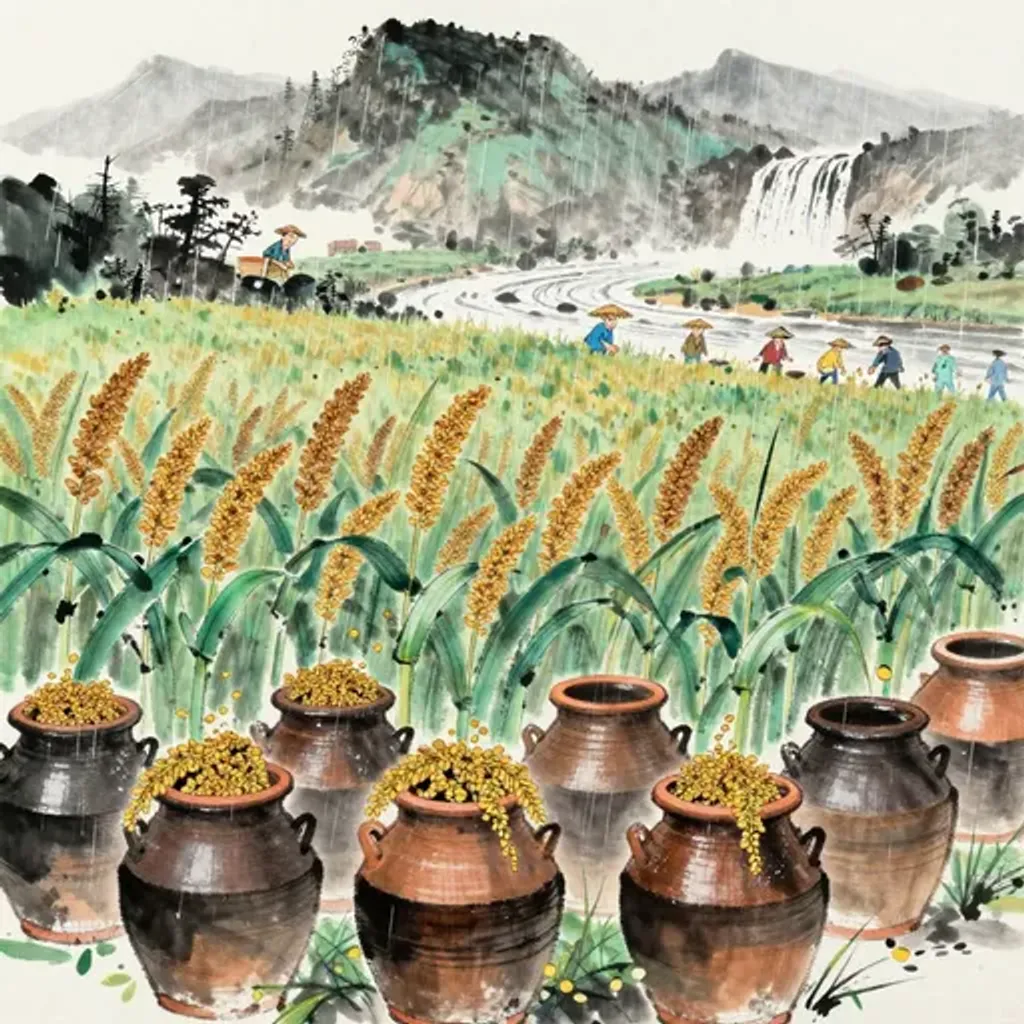
下田稷黍,芳華生齒;大雨集降,紛澇滿甕。
In the lowland fields, millet and grain; fragrant blossoms sprout like teeth. Great rains descend in torrents; flooding and filling the jars.
— Jiao Yanshou, Yilin (Forest of Changes), 1st century BC
Commentary
Wind above heaven kindles into fire above wood — the Cauldron, where raw materials are transformed into refined nourishment. Millet and grain grow in the lowland fields, their fragrant blossoms showing through new shoots. Then great rains descend, pouring abundantly until the jars overflow. From Small Taming to the Cauldron, the verse traces the full arc of Ding's transformative process: planting, growth, harvest, and the rain that makes it all possible. The Cauldron takes what earth produces and refines it into offering and sustenance. Here the rain is heaven's contribution — the final ingredient that fills the vessel to overflowing. When gentle cultivation receives heaven's complement, the yield exceeds all measure.
小畜 → 震
Hexagram 9 → Hexagram 51: The Arousing Thunder
Changing lines: 2, 3, 4, 5, 6
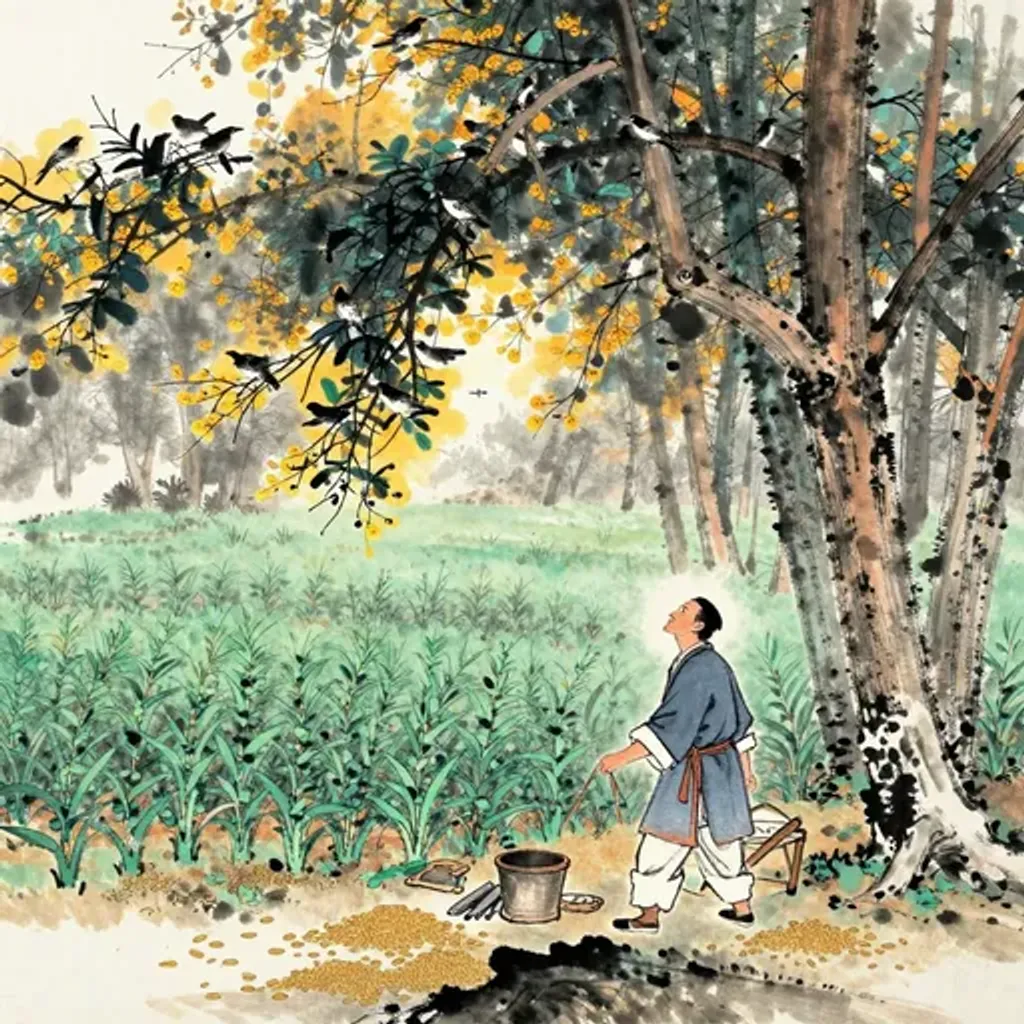
君子碌碌,鳥庇茂木。見春百穀,心勞願德。
The noble man labors diligently; the bird shelters in thick trees. Seeing spring is hundred grains; the heart toils, longing for virtue.
— Jiao Yanshou, Yilin (Forest of Changes), 1st century BC
Commentary
Wind above heaven descends into doubled thunder — the Arousing's seismic awakening. The gentleman toils steadily; birds shelter in the dense forest canopy. Spring reveals the hundred grains; the heart labors but yearns for virtue. From Small Taming to the Arousing, gentle accumulation gives way to the shock that demands self-examination. Zhen's doubled thunder is heaven's alarm clock — the sage responds with reverent self-correction. The gentleman working among the sprouting grains, the birds finding refuge in thick branches: both embody the productive response to shock. Spring arrives not as gentle transition but as thunderous eruption, and the one who has labored through winter greets it with readiness. Wishing for virtue amid toil — this is Zhen's true awakening.
小畜 → 艮
Hexagram 9 → Hexagram 52: Keeping Still Mountain
Changing lines: 1, 2, 5
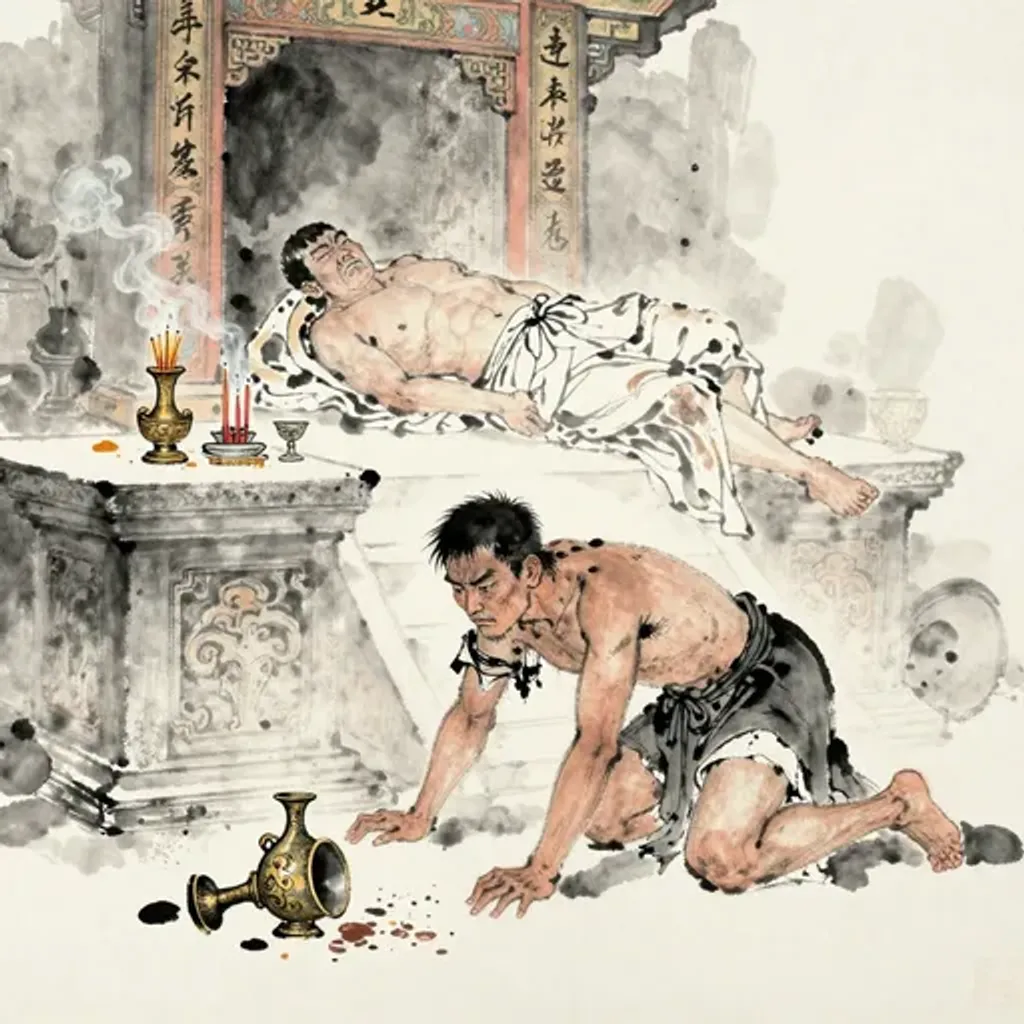
折臂踒足,不能進酒;祠祀闊曠,神怒不喜。
A broken arm, a twisted foot; unable to pour the wine. Ancestral rites grow sparse and distant; the spirits rage with displeasure.
— Jiao Yanshou, Yilin (Forest of Changes), 1st century BC
Commentary
Wind above heaven hardens into doubled mountain — Keeping Still's absolute arrest. An arm is broken, a foot twisted; one cannot even present the sacrificial wine. The ancestral shrine stands empty too long, and the spirits grow displeased. From Small Taming to Keeping Still, the gentle wind freezes into the mountain's immobility. Gen's image is thinking that does not exceed one's place. But here stillness has become incapacity: the body is too damaged to perform ritual duties, and the prolonged neglect of worship angers the gods. When stillness is not chosen discipline but enforced helplessness, it severes the vital link between the human and the divine. The mountain that should anchor becomes a prison of the broken body.
小畜 → 漸
Hexagram 9 → Hexagram 53: Development
Changing lines: 1, 2
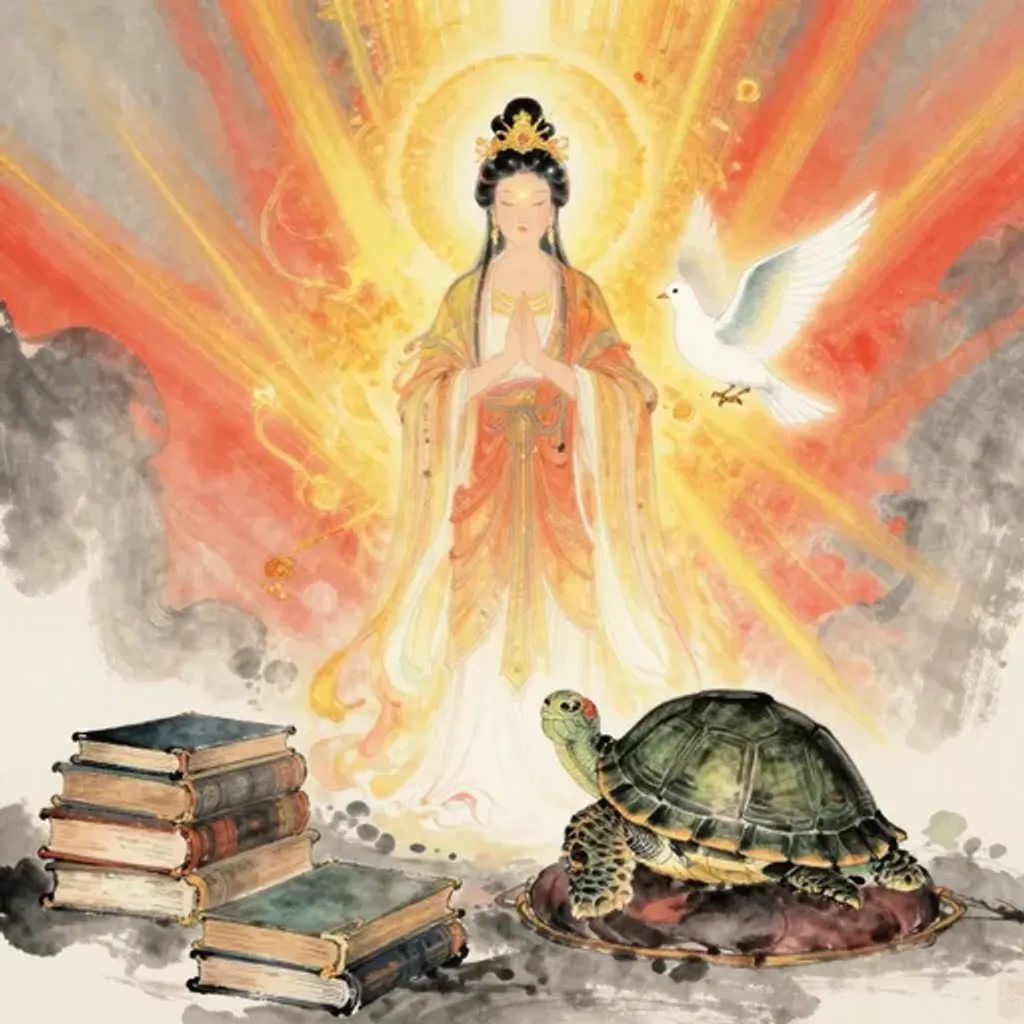
學靈三年,聖且神明;光見善祥,吉喜福慶;鳴鳩飛來,告我無憂。
Studying the numinous for three years, becoming sagely and divinely clear. Light reveals auspicious signs; fortune, joy, and blessed celebration. The calling dove flies to me; announcing that I need not worry.
— Jiao Yanshou, Yilin (Forest of Changes), 1st century BC
Commentary
Wind above heaven meets wind atop the mountain — Development's gradual, organic growth. Three years of studying the numinous arts yield sagely insight and spiritual clarity. Auspicious light reveals good omens; joy, blessings, and celebration abound. A turtledove flies in bearing a message: be free of worry. From Small Taming to Development, gentle refinement extends into the slow, rooted advancement of Jian's tree growing upon the mountain. Three years of study echoes the classical period of mourning and mastery — the time required for genuine transformation. The turtledove, a bird of constancy in the Shijing, confirms the ripened result. Development is never hurried; the omens appear only after the full apprenticeship is served.
小畜 → 歸妹
Hexagram 9 → Hexagram 54: The Marrying Maiden
Changing lines: 3, 4, 5, 6
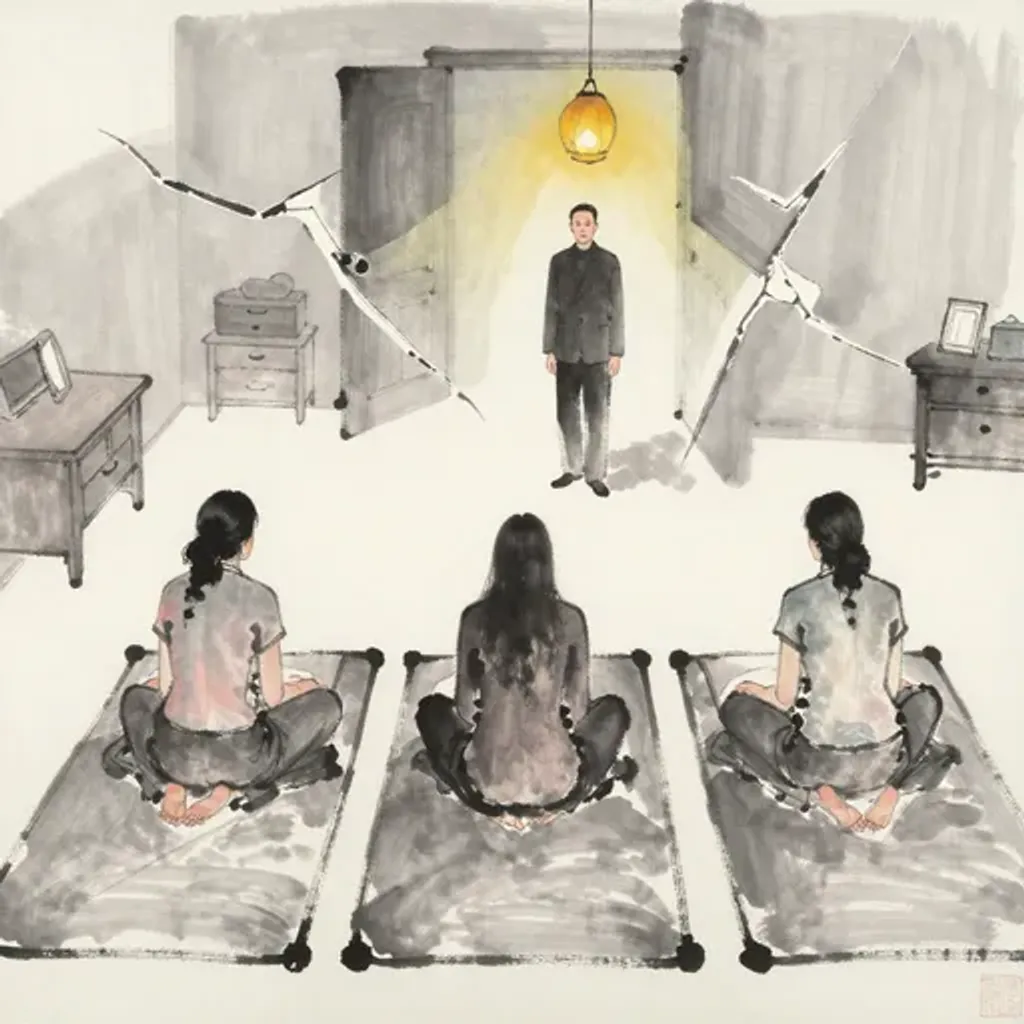
三婦同夫,志不相思;心懷不平,志常愁悲。
Three wives share one husband; their hearts hold no longing for each other. Harboring resentment; their spirits are always grieved.
— Jiao Yanshou, Yilin (Forest of Changes), 1st century BC
Commentary
Wind above heaven gives way to thunder above the lake — the Marrying Maiden's irreversible commitment. Three wives share one husband, but their hearts hold no affection for each other. Resentment festers; constant sorrow fills their days. From Small Taming to the Marrying Maiden, the verse exposes Gui Mei's inherent instability. Thunder over the lake creates excitement but also recklessness — the eldest daughter given to the youngest son, a structurally unequal union. Three women forced into proximity without mutual sympathy produce not a household but a prison of silent antagonism. Gui Mei warns the gentleman to 'know the flaw and see it through to the end.' The flaw here is foundational: a bond built on obligation rather than genuine resonance cannot generate anything but grief.
小畜 → 豐
Hexagram 9 → Hexagram 55: Abundance
Changing lines: 2, 4, 5, 6
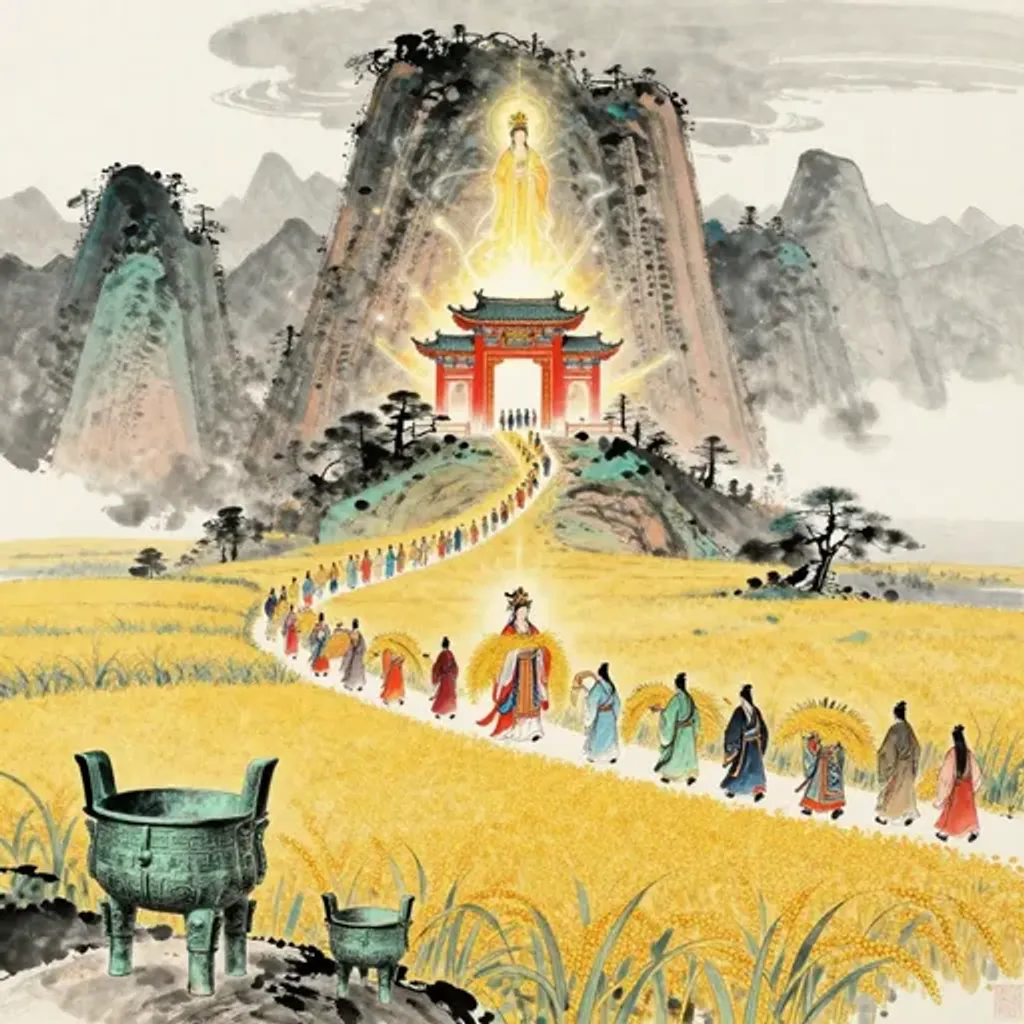
中田膏黍,以享王母;受福千億,所求大得。
In the central fields, rich millet; offered in feast to the Queen Mother. Receiving blessings by the billions; what is sought is greatly obtained.
— Jiao Yanshou, Yilin (Forest of Changes), 1st century BC
Commentary
Wind above heaven erupts into thunder and lightning together — Abundance's overwhelming fullness. Rich millet grows in the central fields, offered to the Queen Mother in sacrifice. Blessings pour down by the billions; every wish is greatly fulfilled. From Small Taming to Abundance, gentle cultivation explodes into Feng's maximum brilliance. Thunder and fire converge: energy and clarity united at their peak. The offering to the Queen Mother — divine matriarch of Mount Kunlun, keeper of the peaches of immortality — elevates a simple harvest into cosmic exchange. When human effort aligns with celestial favor, the return is not merely proportional but superabundant. Feng warns that such fullness cannot last, but in this moment the cup overflows.
小畜 → 旅
Hexagram 9 → Hexagram 56: The Wanderer
Changing lines: 1, 2, 4, 5
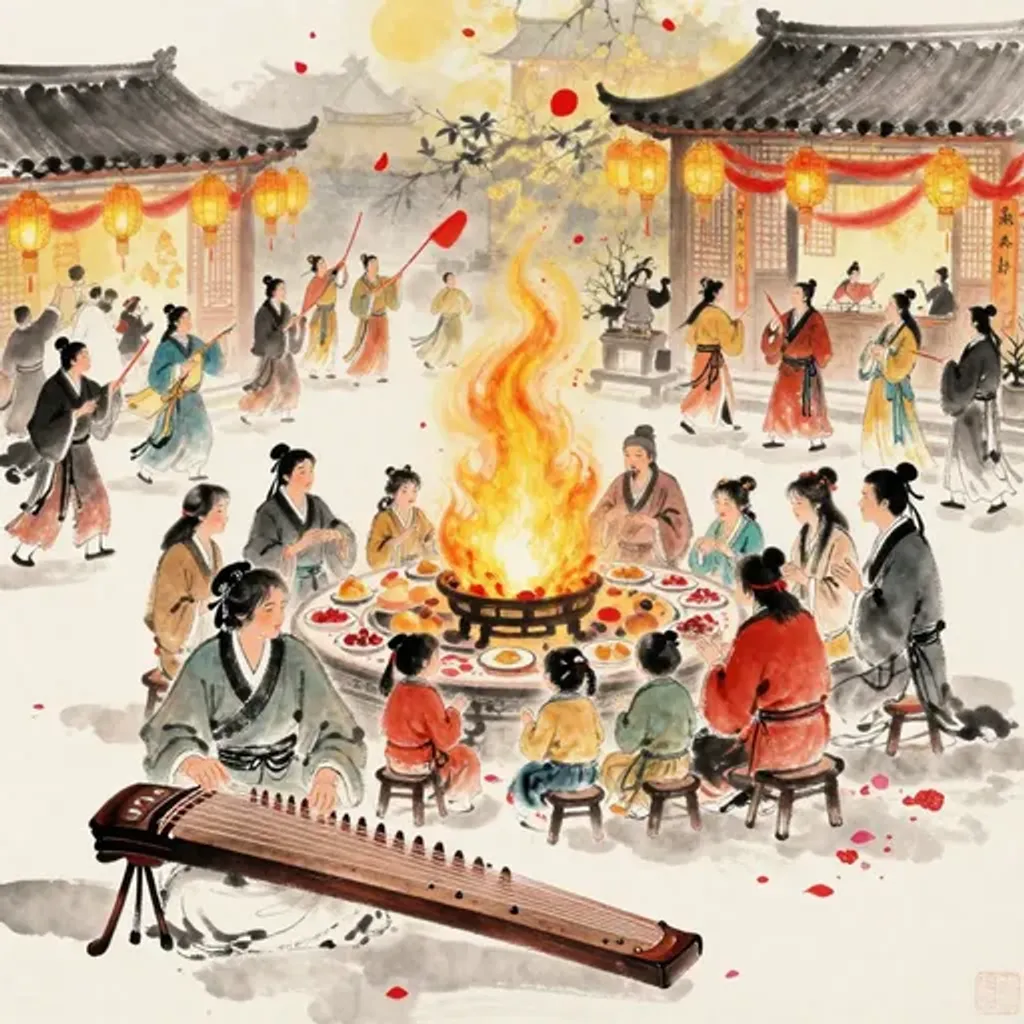
陽火不災,喜至慶來;降福送喜,鼓琴歌謳。
Yang fire brings no disaster; joy arrives and celebration comes. Blessings descend and happiness is sent; drumming the zither, singing songs.
— Jiao Yanshou, Yilin (Forest of Changes), 1st century BC
Commentary
Wind above heaven meets fire upon the mountain — the Wanderer's transient flame. Benevolent fire refrains from causing disaster; joy and celebration arrive. Blessings are sent down with delight; the zither is strummed and songs fill the air. From Small Taming to the Wanderer, the verse finds warmth within impermanence. Lu's fire on the mountain is brief but illuminating — the wanderer who passes through leaves light, not destruction. The 'yang fire' that does not burn destructively is restraint in motion: fire that knows it is a guest. The music and singing transform transience into festivity rather than mourning. When one travels light and blesses where one passes, even rootlessness becomes a kind of homecoming.
小畜 → 巽
Hexagram 9 → Hexagram 57: The Gentle Wind
Changing lines: 1
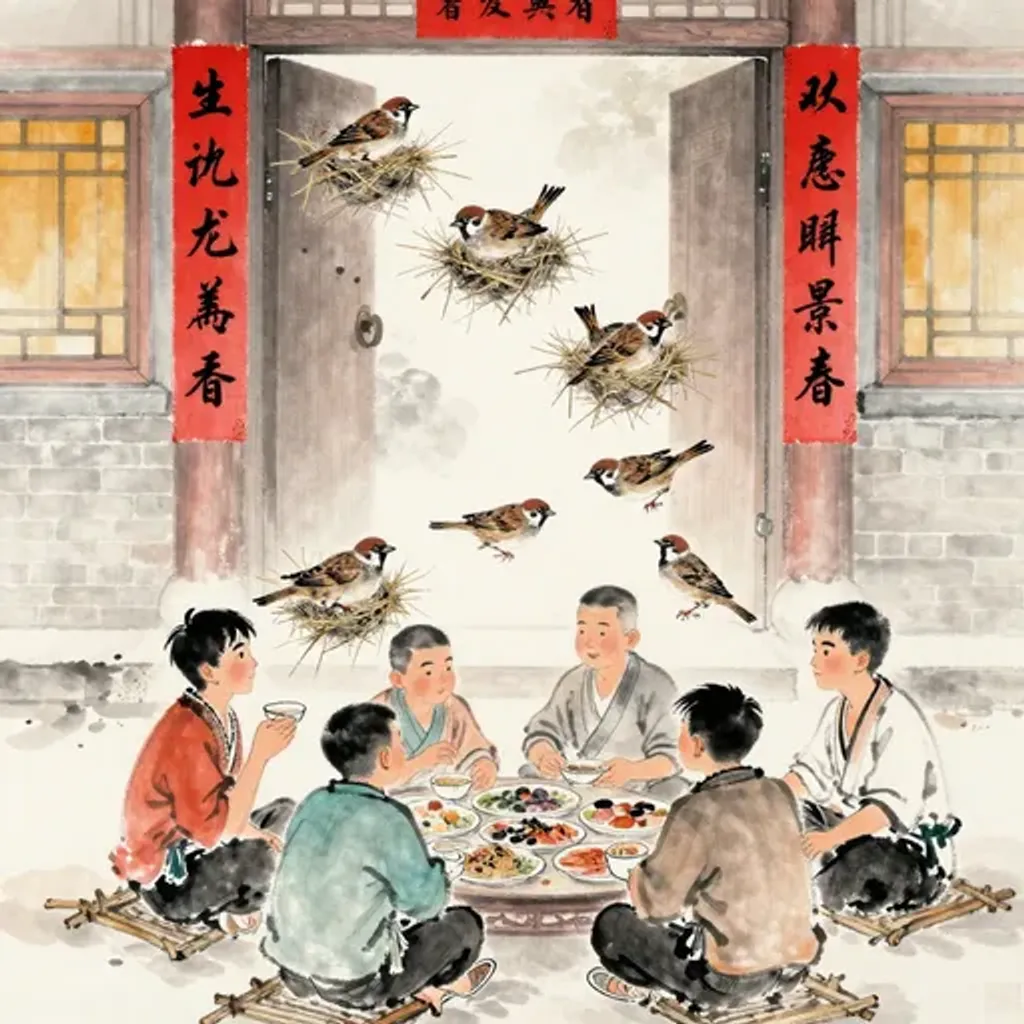
燕雀衘茅,以生孚乳;兄弟六人,姣好孝悌;各得其願,和悅相樂。
Swallows and sparrows carry straw to bear and nurse their young. Six brothers, all handsome and filial. Each fulfills his wish; in harmony and joy together.
— Jiao Yanshou, Yilin (Forest of Changes), 1st century BC
Commentary
Wind above heaven settles into doubled wind — the Gentle's repeated, penetrating influence. Sparrows and swallows carry straw to build their nests, breeding and nursing their young. Six brothers live in beauty and filial harmony; each achieves his heart's desire, and all rejoice together. From Small Taming to the Gentle, wind meets itself and doubles its permeating force. Xun's image — following wind — represents commands issued repeatedly until they take effect. The verse embodies this as domestic order: birds build homes, siblings cooperate, and fulfillment is shared without competition. Six brothers echoes the trigram family's generative harmony. When gentle influence is consistently applied, it produces not obedience but genuine contentment — each member finding their own place within the larger pattern.
小畜 → 兌
Hexagram 9 → Hexagram 58: The Joyous Lake
Changing lines: 3, 4, 6
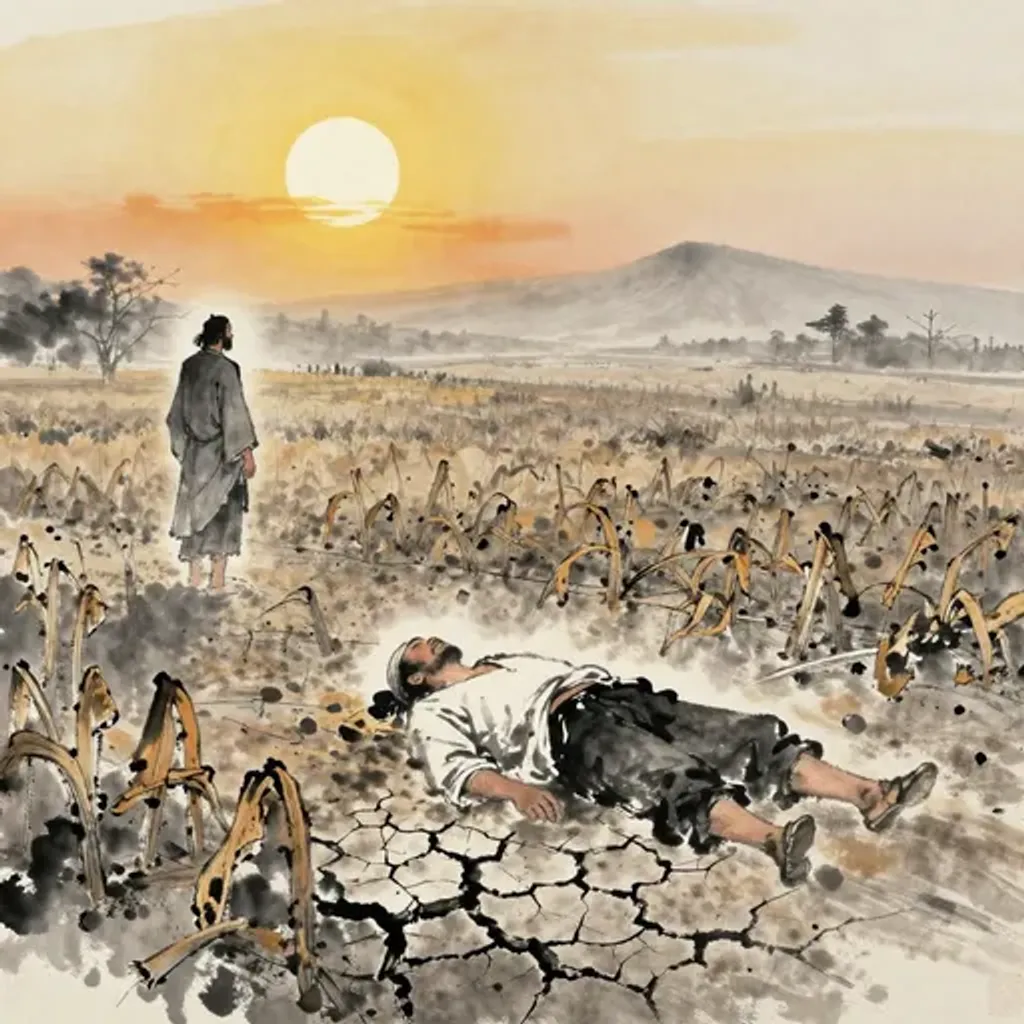
陽明不息,君無恩德;伯氏失利,農喪其力。
The yang light does not cease, yet the lord bestows no grace. The elder brother loses his profit; the farmer loses his strength.
— Jiao Yanshou, Yilin (Forest of Changes), 1st century BC
Commentary
Wind above heaven meets the doubled lake — Joyousness that should bring shared delight. Yet the sun blazes without relent; the ruler lacks benevolence and virtue. The eldest brother loses his advantage, and the farmer exhausts his strength. From Small Taming to the Joyous, the verse darkens what should be mutual happiness. Dui's paired lakes represent friends learning together in open exchange. But here the yang sun is unceasing — generosity has become oppressive heat — and neither lord nor commoner benefits. The eldest brother (bo) losing his position and the farmer losing his strength suggest a breakdown of social hierarchy from top to bottom. When joy is commanded rather than shared, it desiccates into joyless obligation.
小畜 → 渙
Hexagram 9 → Hexagram 59: Dispersion
Changing lines: 1, 3
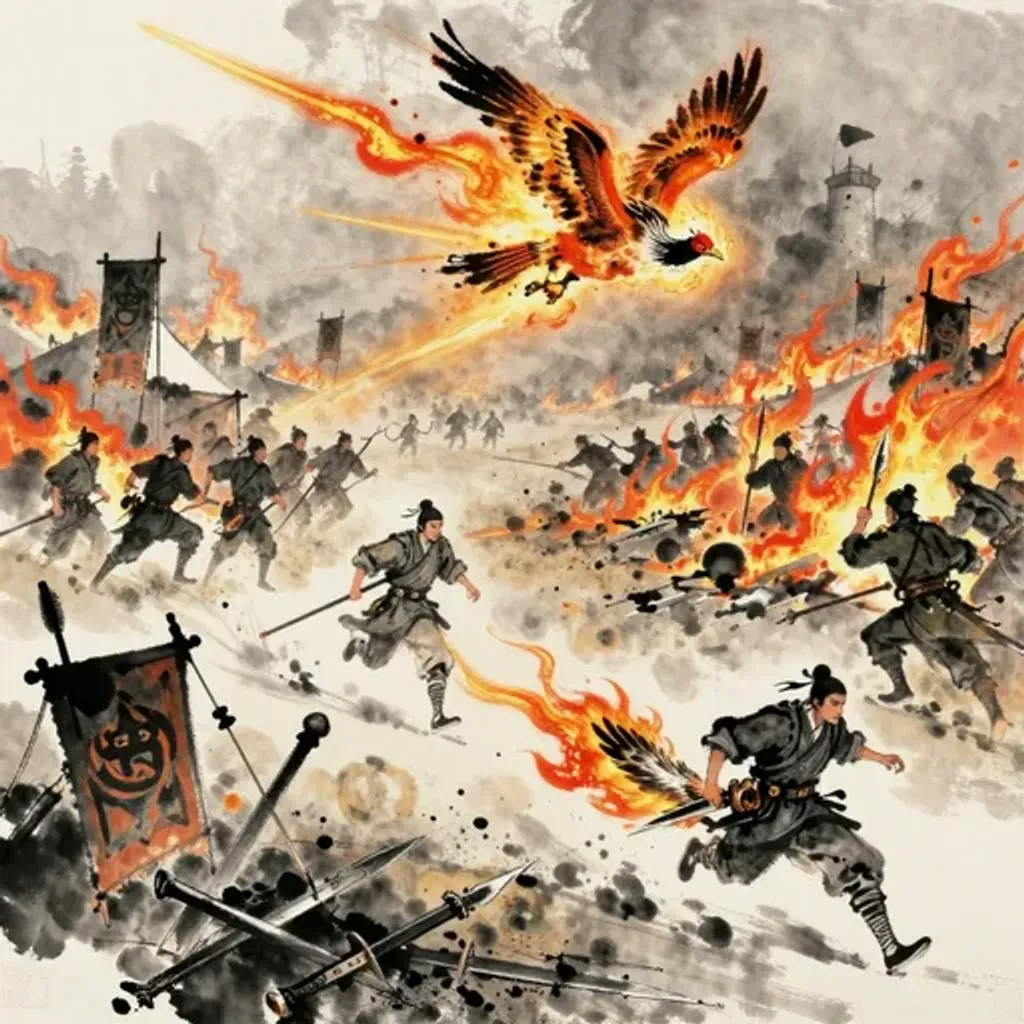
鶉尾奔奔,火中成軍;虢叔出奔,下失其君。
The quail is tail in wild flight; an army forms amid the flames. Lord Guo is uncle flees; below, the lord is lost.
— Jiao Yanshou, Yilin (Forest of Changes), 1st century BC
Commentary
Wind above heaven disperses into wind racing over water — Dispersion's scattering force. Quail-tails bob and bounce — evoking the Shijing ode 'Chun Zhi Ben Ben' that satirizes rulers whose immorality shames even the faithful birds. Fire assembles an army in chaotic formation. The Viscount of Guo flees his state; below, the people lose their sovereign. From Small Taming to Dispersion, the verse traces how moral disorder scatters political coherence. Huan's wind over water disperses what had been gathered: the state fragments, its ruler absconds, and the people are left without a center. The quail — a bird proverbial for fidelity — serves as a reproach: even animals keep their mates, yet this lord abandons his domain.
小畜 → 節
Hexagram 9 → Hexagram 60: Limitation
Changing lines: 3, 6
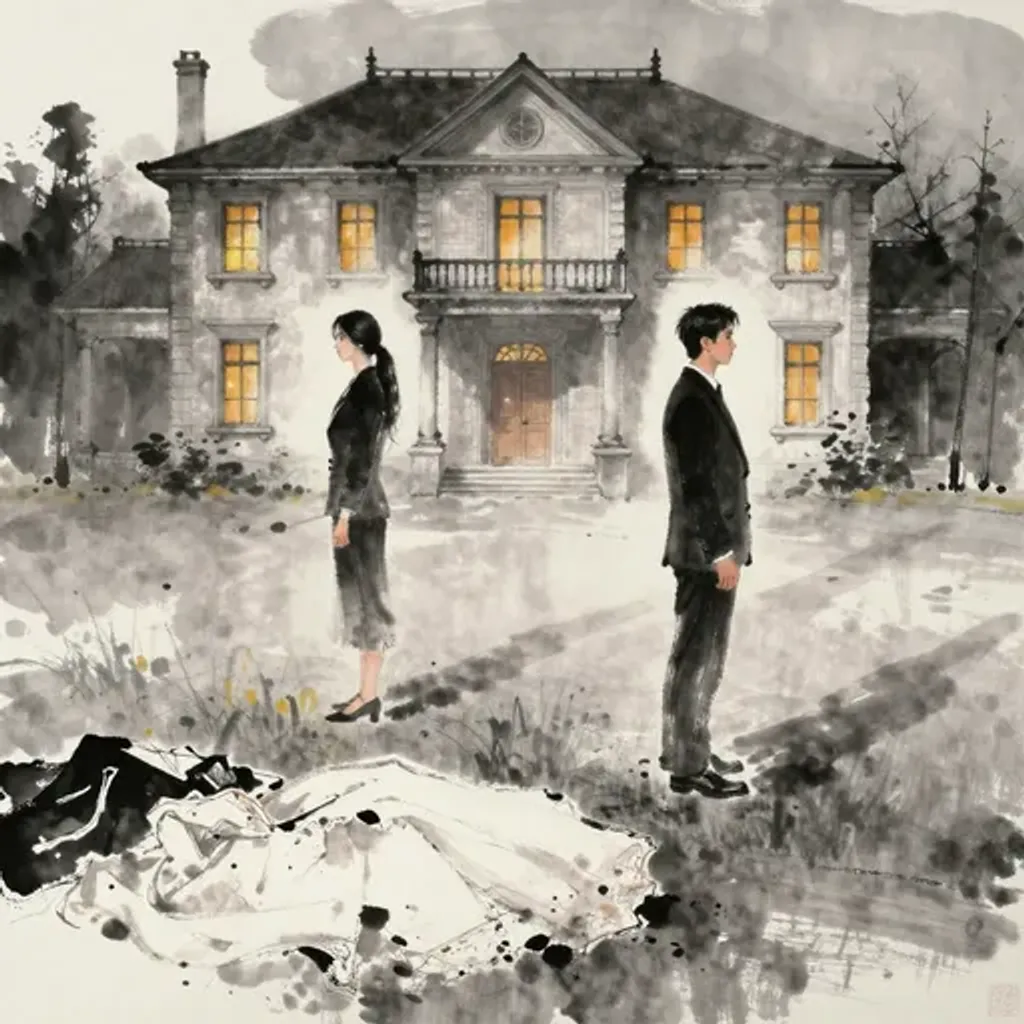
兩人相距,止不同舍;夫妻離散,衛侯失居。
Two men stand opposed, halting at different lodgings. Husband and wife are scattered apart; the Marquis of Wei loses his home.
— Jiao Yanshou, Yilin (Forest of Changes), 1st century BC
Commentary
Wind above heaven meets water resting upon the lake — Limitation's measured boundaries. Two people stand apart, halting in separate lodgings, refusing to share the same roof. Husband and wife are scattered; the Lord of Wei loses his dwelling. From Small Taming to Limitation, the verse shows boundaries hardened into walls. Jie's water upon the lake represents measured containment — neither overflowing nor stagnant. Yet here limitation has become estrangement: the couple who should dwell together are separated by mutual refusal. The Lord of Wei losing his home echoes the political dimension of shattered intimacy. When limits meant to structure a relationship become the instruments of division, Limitation's virtue — knowing when enough is enough — inverts into the destruction of what it was meant to preserve.
小畜 → 中孚
Hexagram 9 → Hexagram 61: Inner Truth
Changing lines: 3
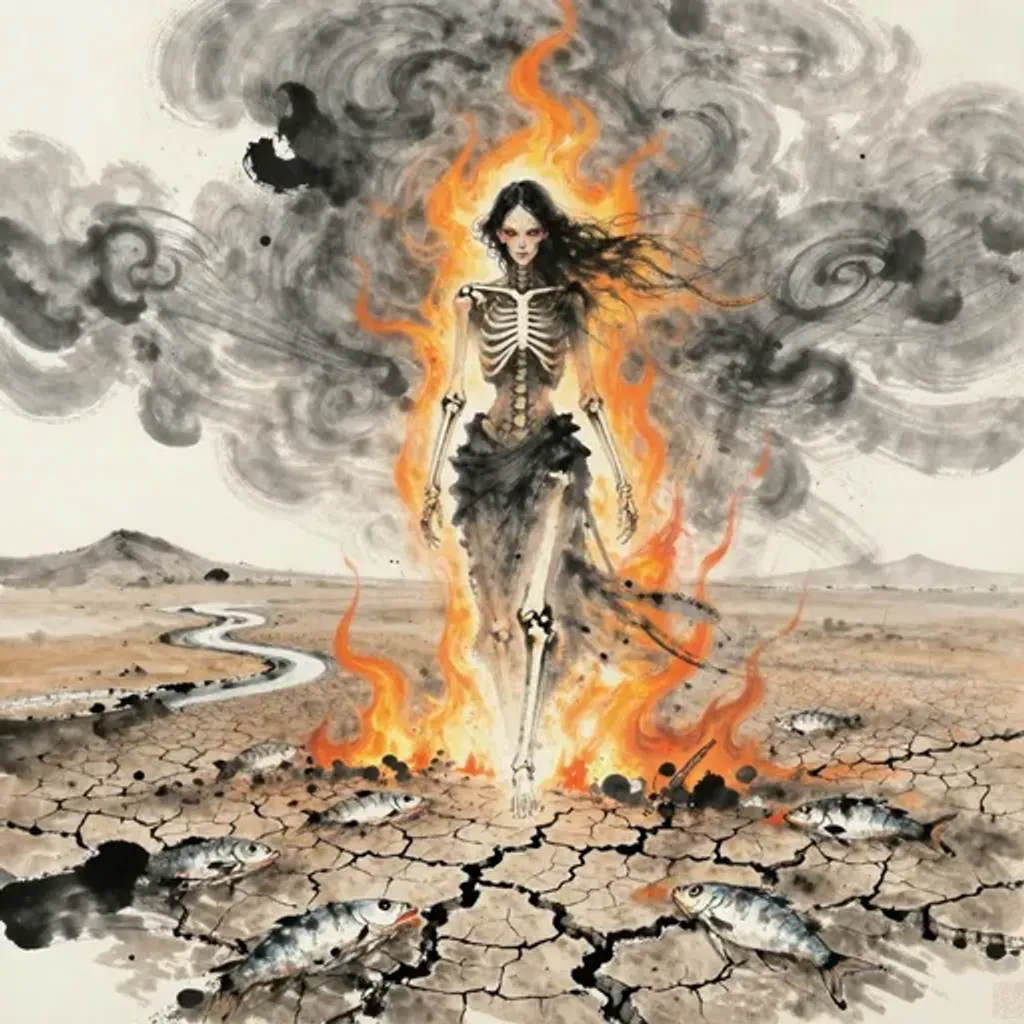
魃為燔虐,風吹雲卻;欲上不得,反歸其宅。
The drought demon scorches and rages; wind blows the clouds away. Wishing to rise but unable; it returns instead to its own dwelling.
— Jiao Yanshou, Yilin (Forest of Changes), 1st century BC
Commentary
Wind above heaven opens into wind hovering over the lake — Inner Truth's hollow-centered sincerity. The drought demon Ba rages with scorching fury; wind blows the clouds away. One strives to rise but cannot; forced back, one returns to one's own dwelling. From Small Taming to Inner Truth, the verse tests sincerity against cosmic indifference. Ba, the drought goddess who descended from heaven to aid the Yellow Emperor at Zhuolu, was cursed never to return — wherever she walks, rain ceases. The wind that should carry moisture instead disperses it. Zhong Fu's empty center — the hollow that allows truth to resonate — here echoes with futility rather than harmony. When the inner vessel is parched by forces beyond one's control, sincerity alone cannot summon the rain.
小畜 → 小過
Hexagram 9 → Hexagram 62: Small Exceeding
Changing lines: 1, 2, 4, 5, 6
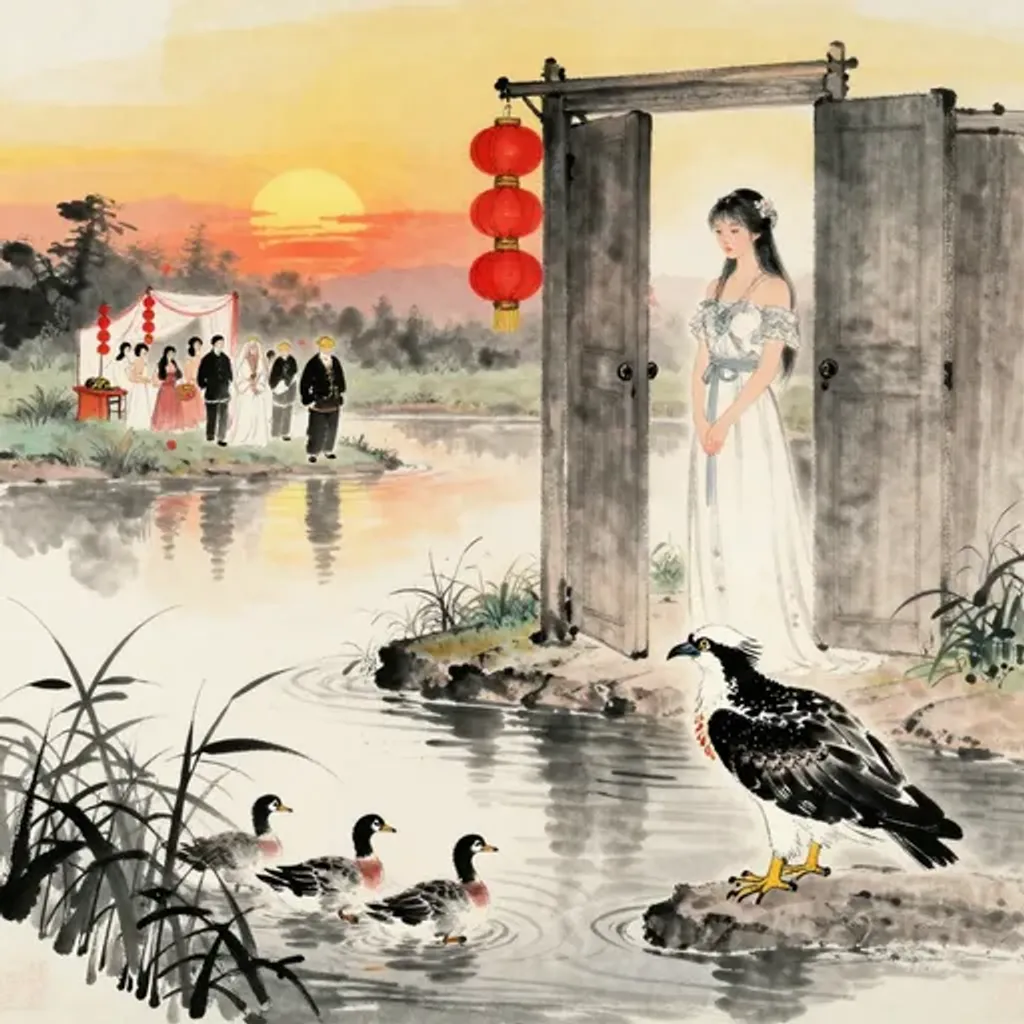
關雎淑女,配我君子;少妻在門,君子嘉喜。
The osprey cries for a virtuous maiden, a fit match for my lord. The young wife stands at the gate; the noble man rejoices.
— Jiao Yanshou, Yilin (Forest of Changes), 1st century BC
Commentary
Wind above heaven meets thunder resting above the mountain — Small Exceeding's modest overstepping. The verse quotes the Shijing's opening ode 'Guan Ju': ospreys cry on the river islet, and the gentle maiden is a worthy match for the gentleman. A young bride stands at the gate; the gentleman rejoices. From Small Taming to Small Exceeding, the verse finds in Xiao Guo's cautious overreach the courage to make a match. The poem's restraint is the key: this is not Great Exceeding's structural strain but a small, appropriate step beyond propriety's usual boundaries — the heart's quiet boldness in declaring its intent. The osprey's cry announces that even modest initiative, rightly timed, brings the match that fulfills both partners.
小畜 → 既濟
Hexagram 9 → Hexagram 63: After Completion
Changing lines: 2, 6
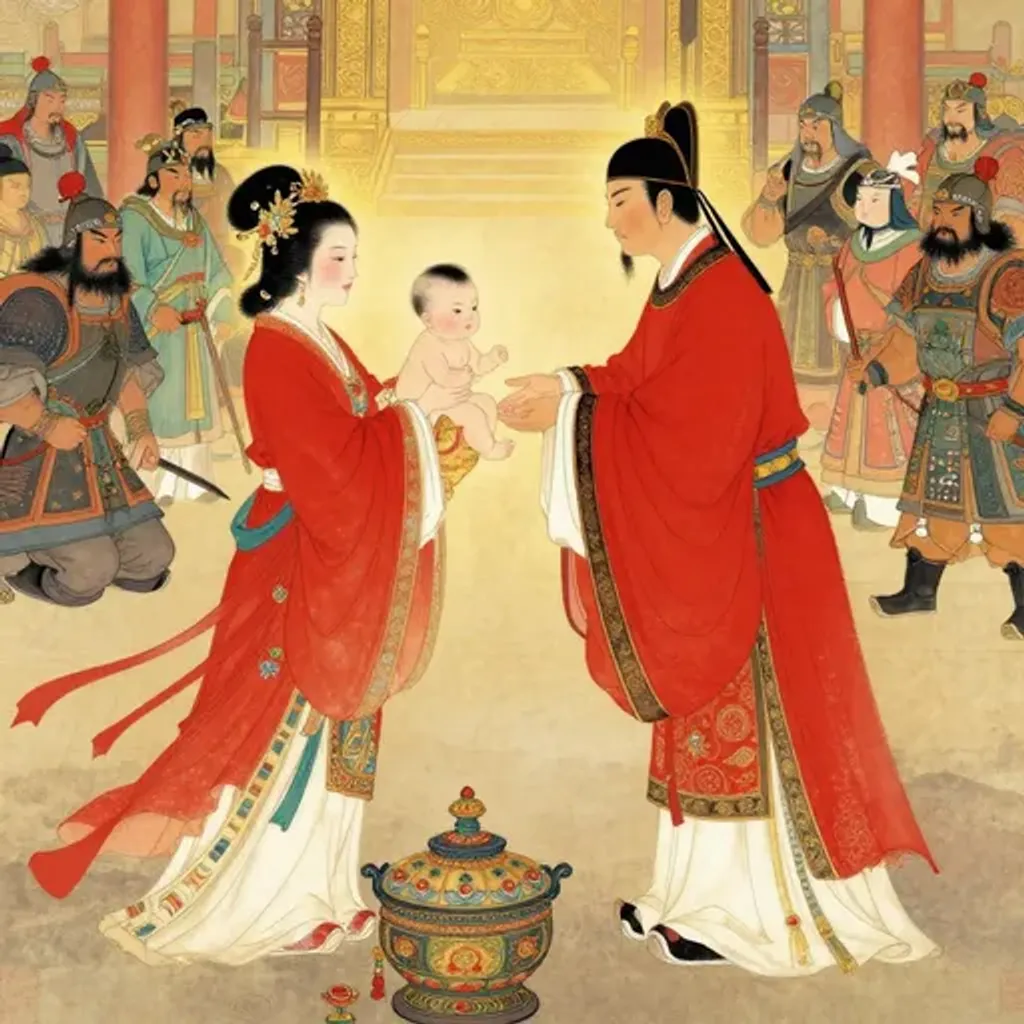
慈母赤子,饗賜得士;夷狄服除,以安王家。
A loving mother and her dear child; feasting and rewarding, she wins loyal followers. The barbarian tribes submit and disrobe; bringing peace to the royal house.
— Jiao Yanshou, Yilin (Forest of Changes), 1st century BC
Commentary
Wind above heaven achieves the perfect balance of water above fire — After Completion's fully ordered state. A loving mother tends her infant; feasting and gifts secure the allegiance of worthy men. The frontier peoples submit and are pacified; the royal house rests in safety. From Small Taming to After Completion, the verse presents Ji Ji's ideal: every element in its proper place. The mother-child bond is the primordial unit of care; the feast that wins loyal officers is governance working as it should; the pacified borders complete the picture. Water above fire keeps the pot at a steady boil — everything functions. Ji Ji's warning, however, is to 'think of calamity and prepare against it,' for such perfection is always the moment before things begin to shift.
小畜 → 未濟
Hexagram 9 → Hexagram 64: Before Completion
Changing lines: 1, 3, 4, 5
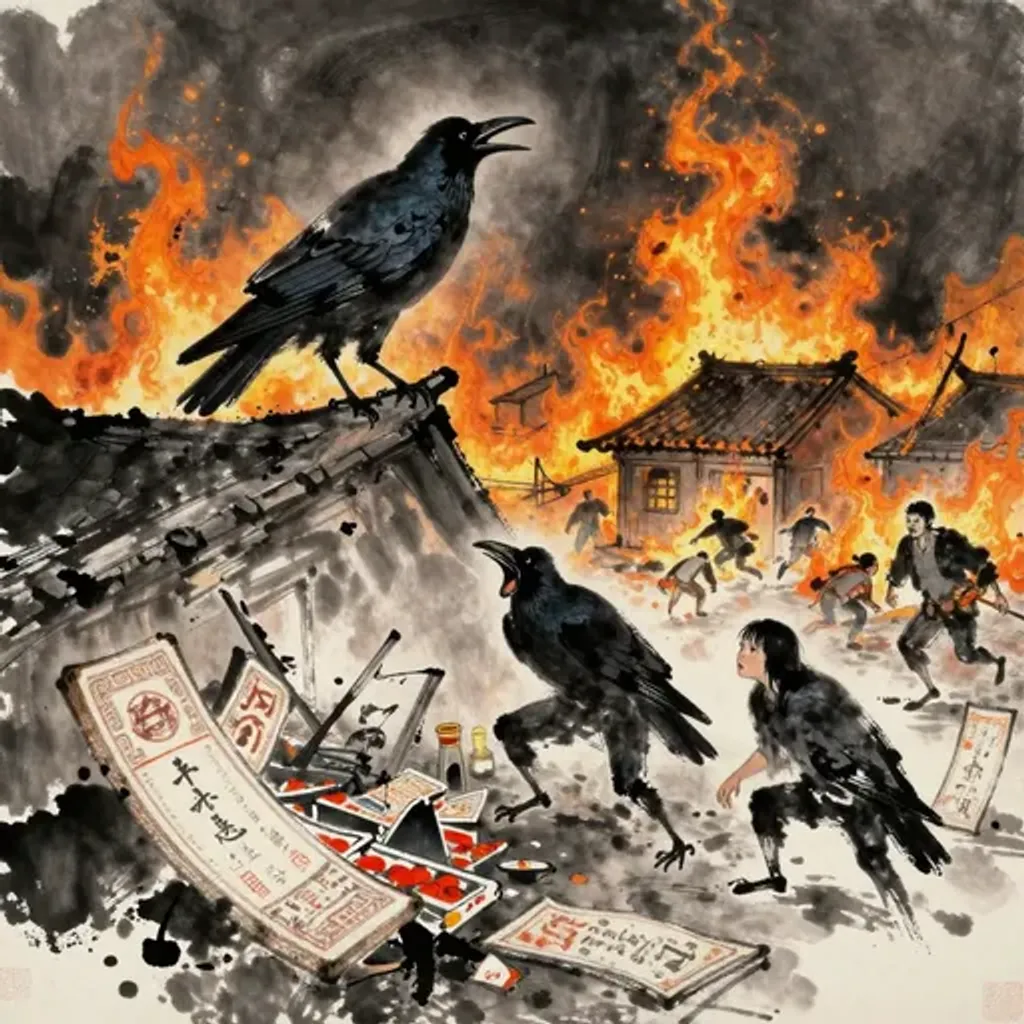
三足孤烏,靈鳴督卸,思過罰惡,自賊其家。
The three-legged solitary crow, its spirit cry urges and drives. Reflecting on faults, punishing evil; it ruins its own house.
— Jiao Yanshou, Yilin (Forest of Changes), 1st century BC
Commentary
Wind above heaven dissolves into fire hovering above water — Before Completion's perpetual almost. The three-legged sun-crow, lone and solitary, cries out in its numinous voice, urging reflection on past faults and punishment of evil. Yet it brings ruin upon its own household. From Small Taming to Before Completion, the verse ends the cycle with Wei Ji's irresolvable tension. Fire above water — each element in the other's place — represents a world not yet aligned. The sun-crow, emblem of celestial order, here turns its judicial energy inward: prosecuting evil but destroying its own home in the process. Self-correction pursued without wisdom becomes self-destruction. Before Completion warns that the final crossing demands the most care, and premature judgment capsizes the vessel midstream.